Hello and how was your week? And are you ready for Christmas? A little bit? I am not, and it will worry me soon but at the moment I am too busy.
My college lectures finished—well, more fizzled out, due to Omicron and Boris and having to revert to being on zoom which doesn’t feel as satisfying. No big farewells and ‘Happy Christmas’ or silly jumpers. (Not that there necessarily would have been even if we had all met in person, but probably I would have done those things, even if no one else did.)
Next on my list was essays (just practice ones) then getting the results and realising that writing an academic essay is far-removed from the fun of writing a blog. We are meant to provide lots of quotes to show we are well-read (I do read lots, but am not very good at remembering who said what, where, and we have to splatter our essays with page numbers, which is very unsatisfying). We also have to give our own opinion (no problem there!) but not in a personal way (is that even possible?) and it has to be backed up with evidence. I’m not sure anyone else shares my views, so the evidence bit is not easy. I am also very bad at extracting relevant information from books, whilst not reading the whole book. I start to skim read (which feels like cheating, by the way) but then the author writes something interesting, and before you know it, it’s 6pm, Husband is asking what’s for dinner (nothing) and I have read the whole book and completely forgotten to write the page numbers of bits relevant for my essay. Which means I am enjoying my course tremendously, and learning lots, but I may well fail due to chatty unsubstantiated essay-style.
Another distraction was having the Covid booster. This was all very efficient except for the last bit, when having socially-distanced in the queue and shown into an individual booth to be stabbed, we were then told to wait in a crowded seating area in case we turned blue or something. Of course, neither me nor Husband are very good at obeying rules, so we looked into crowded waiting area and decided we would sit in our car instead. Neither of us turned blue. Though I did have a horrible reaction later, and had a temperature that wouldn’t go for two days. Very unpleasant but presumably less unpleasant than having covid.
We also had our traditional family meal in London. We went to The Ivy this time, at Tower Bridge. Very lovely. I drank pink G&Ts and thoroughly enjoyed the evening. I like my family (even without the G&T I like them, they make me laugh). London is very pretty at night, and there were Christmas lights, and it was all wonderful. We wandered back to the station via Hay’s Galleria, which had a big Christmas tree, and I tried to encourage the family to sing carols (this might have been due to the G&T) but none of them would. Never mind, lovely evening.
London Lights (and children who I do not know but honestly! They posed in front for ages!)
Another nice thing is my cyclamen plants. Now, I am not very good with plants, and generally have a row of dead plants on my windowsill, but I try. A few years ago, my sister-in-law gave me a cyclamen for my birthday, and surprisingly, it has survived. I noticed that it was growing buds that weren’t buds, so checked online and sure enough, they were seed pods. The internet said I should wait until they opened, and then wash the seeds in washing-up liquid before soaking overnight in clean water. This is because they have a sticky coating and a hard shell. In the wild, ants will carry them away from the main plant, eat the sugar from the coating and pierce the hard shell, so the seed can then grow. They then need to be left somewhere cold and dark.
I have a lot of bad luck with cats sleeping on my seedlings, so after the washing/soaking thing, I planted the seeds and put them in the loft. I left it a few days, then went to check if they needed more water. A mouse had dug them all up and scattered the mud all around the loft. I shoved them back into the pot (the seeds, not the mouse) and put them on a windowsill instead. Two chances. Live or not. I assumed not, but you never know. Anyway, when I looked yesterday, there are two tiny cyclamen plants just sprouting. How exciting is that!
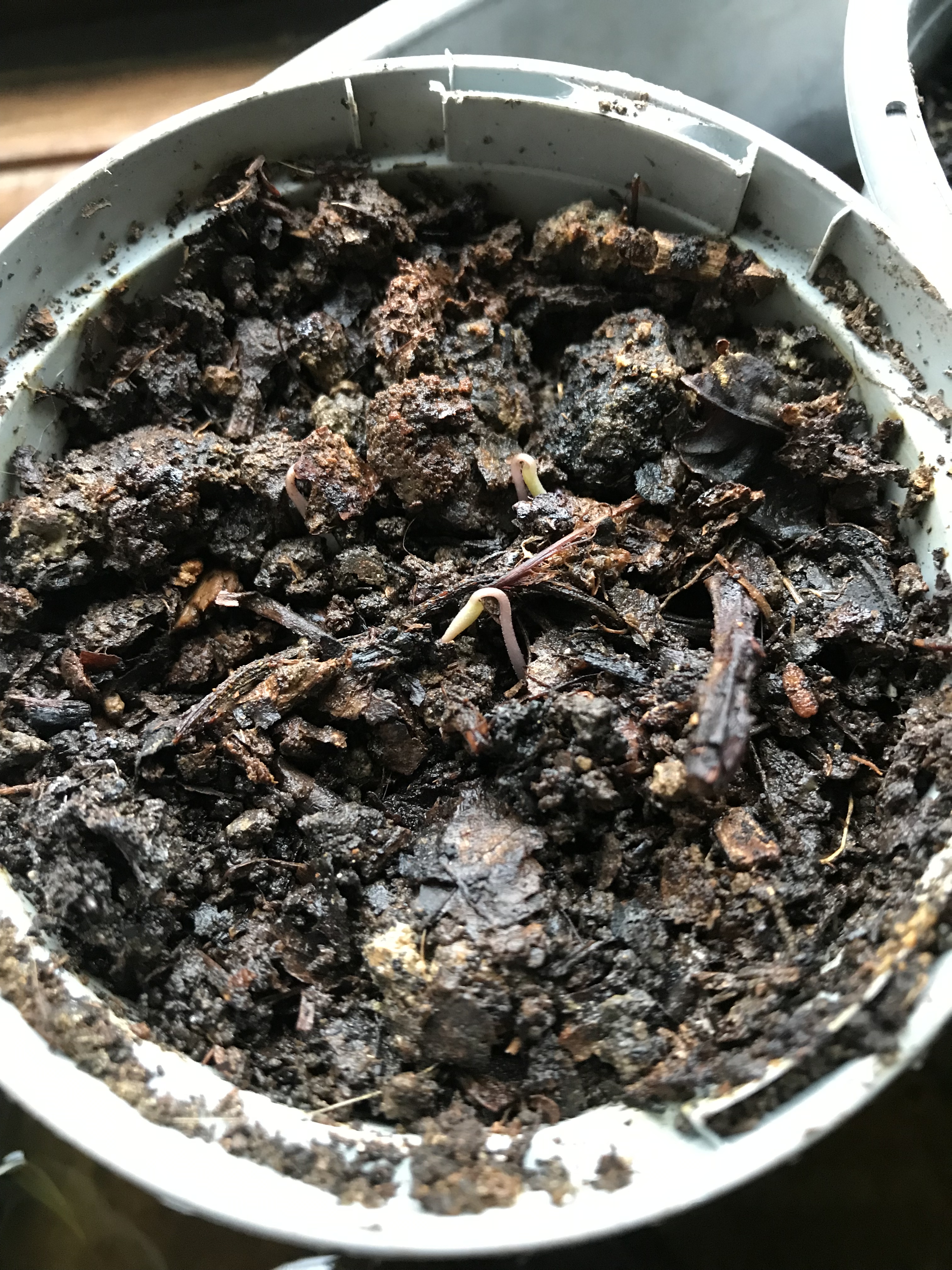
The seed pods and the tiny seedlings.
Of course, all this means I have done almost nothing to prepare for Christmas. I would delay it for a few weeks if I could, but instead I will have to hide my books in case I read them by mistake, and force myself to wrap some gifts and bake some gingerbread. I did decorate the too-big-because-I-wasn’t-there tree that Husband bought, but to be honest, I just sort of flung ornaments on it while cooking sausages because I was trying to read about Calvin. I still have a week, it will be fine…
Hope you have a wonderful Christmas. Thank you for reading. Take care. Love, Anne x
Thank you for reading
anneethompson.com
Why not sign up to follow my blog?
Look on your device for this icon (it’s probably right at the bottom of the screen if you scroll down). Follow the link to follow my blog!
I am writing this in Zurich. My college had a week with no lectures, set aside for reading and reflection, and it coincided rather nicely with Husband having to visit Zurich for work. I had a mountain of reading to do, plus an essay to finish writing, but we agreed that I could work in the room, and breaks would be spent wandering the city and eating meals that I hadn’t had to cook. An excellent plan (which I hoped would turn out better than the Devon ‘excellent plan’ of earlier!)
We arrived late Friday night. As the aeroplane neared Zurich, I could see the Alps, white with snow, shining in sunlight. We appeared to be flying over a sea with islands, but as we dropped, I realised the sea was cloud, and we dropped down, into the misty ‘water’ to the gloom of a city in dusk. The mountains were like a basin of cloud, and the sunlight was hidden from the land below.
As this was a ‘work trip’, our room was a rather lovely suite opposite a park in the city centre. We had the weekend to explore, so after a run round the park and breakfast in the hotel, we set off. (The breakfast was good, but there was a lot of sausage on offer, and I am pretty sure one of the fruit options was coleslaw.) The weather was crisp but dry, and gradually some of the clouds dispersed so we could almost see mountains beyond the city.
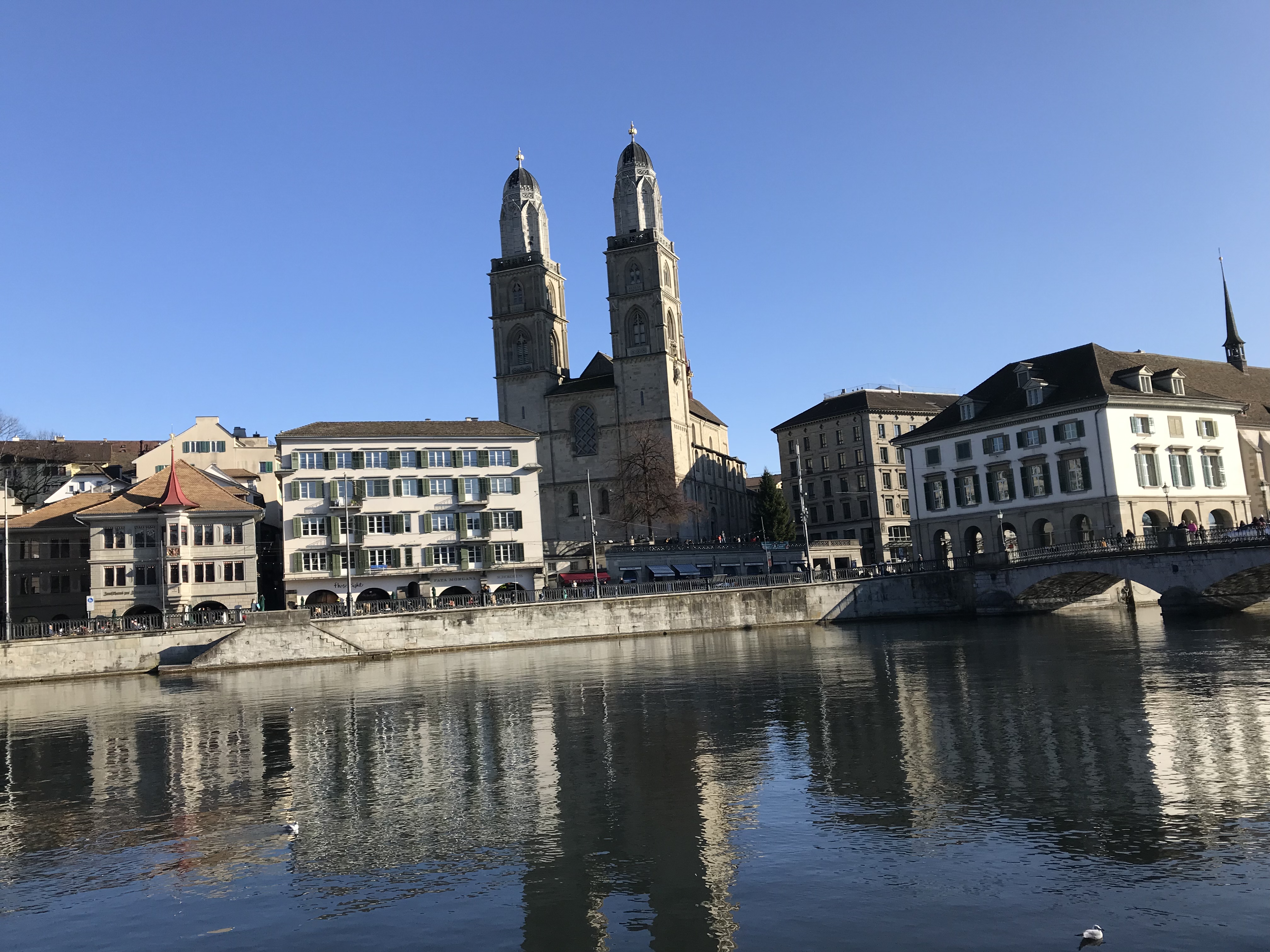
The city has the river Limmat flowing through it and we walked beside it to the large glacial lake, the Zűrichsee. The houses are very Germanic, with pointy roofs and shutters at the windows. It was all very pretty. It was also hideously expensive for British travellers, as the exchange rate is very bad at the moment. There were coffee shops with seats in a pretty square, huddled around patio heaters, all the seats lined with fur to keep people warm. But to pay £6 for a coffee was off-putting, so we enjoyed looking but kept walking. Luckily we had access to the ‘members lounge’ in the hotel, where there was a coffee machine for free.
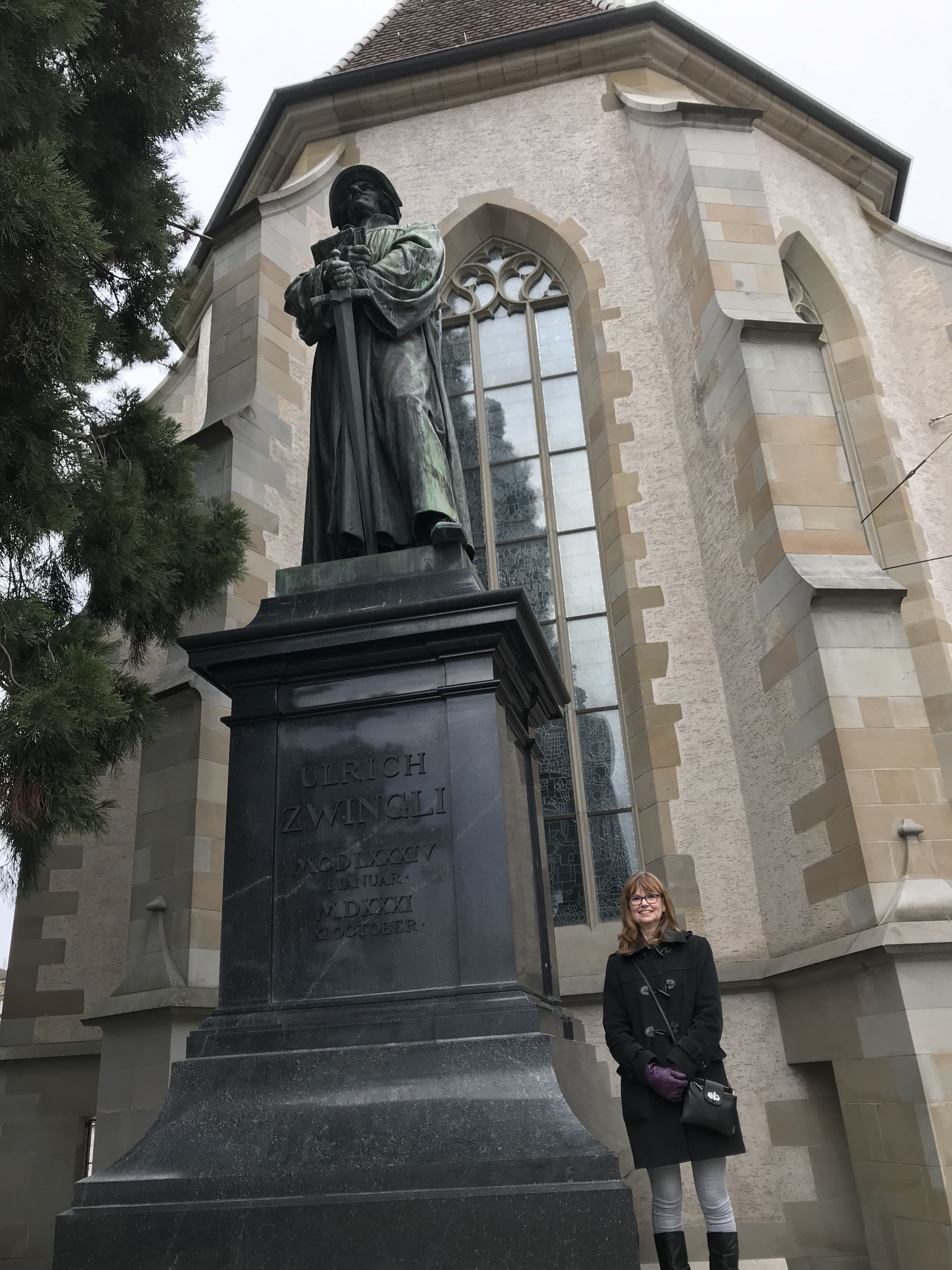
As I am studying theology, I felt that I should visit the church where Zwingli preached. Who, you might ask, was Zwingli? Ulrich Zwingli (not a looker, but you wouldn’t expect him to be with a name like that) was quite a character in the 1500s. He was a priest in the large Grossműnster church, during a time when the church was ruled from Rome and was very powerful. Zwingli began to preach against some of the practices (which made him popular with the people, but not especially liked amongst his clerical peers). He decided that fasting in Lent was wrong, and (somewhat controversially I feel) attended a sausage supper during Lent.
He learnt Greek and Hebrew (so must be a good chap) and sought to find the correct translation to passages that he felt the church had corrupted. He preached against celibacy for priests (which I cannot help but feel sceptical about, as he had a wife at the time so I feel he was perhaps slightly biased). He also tried to rid the church of icons, and told people they shouldn’t worship saints. He was a contemporary of Luther (who is more famous) but they disagreed over the Eucharist, and were never friends. When there was a plague in Zurich, many people left the city but Zwingli stayed to help the sick. He survived the plague, but died during a battle (which I think he partly caused by speaking out against the church).
So, an interesting chap with some strong beliefs. It seems silly now, that he and Luther didn’t work together, simply because they disagreed over one point of doctrine. It seems to me that Christians still do this today, it can feel a little like a club, where if you don’t agree with all the rules some people don’t think you belong. Perhaps that’s why Jesus never tried to start a new religion, he showed people how to live and left them to copy.
We saw Zwingli’s statue, and went to the Grossműnster, which was very plain because he had removed all the icons and decorations. I blame him a little, for the ugliness of Baptist churches. I understand the sentiment, that we should be worshipping God not the building/statues/icons. But I do feel people go too far. Baptists seem to thrive on very ugly places in which to worship. I find it off-putting.
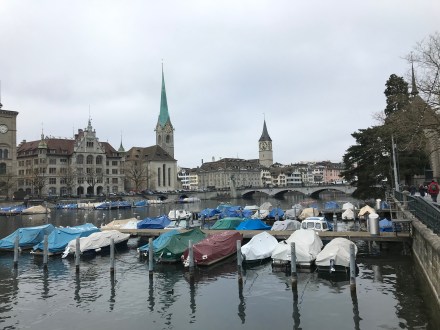
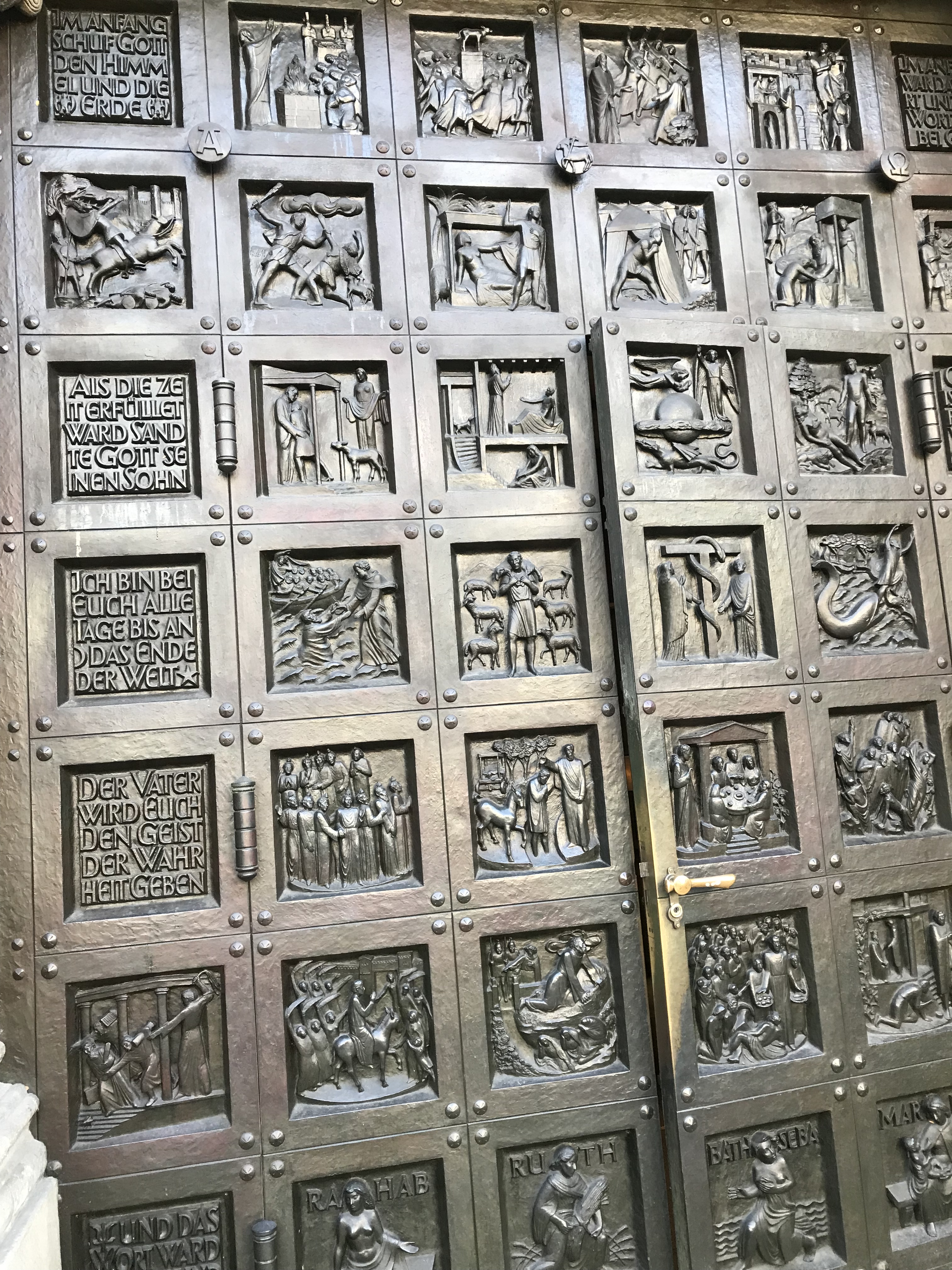
I will leave you with some photos of Zurich. Lovely clean city, mortgage your house and pop over for a weekend. You will need proof of two vaccines to enter any public building, and people here wear masks whenever they’re inside a public building. Other than that, it’s almost the same as pre-Covid times.
Hope your day is good, wherever you happen to be.
Thanks for reading. Love, Anne x
Beautiful Zurich
*****
Thanks for reading. anneethompson.com Why not sign up to follow my blog?
It was half-term, and when Husband suggested a mini break in Devon, it seemed like a good idea. A reward for forcing myself to confront lots of scary things during the college term. I had lots of study to do, but I decided I could study in a cottage just as well as at home, and my breaks would be striding over windy cliffs rather than walking down the road. Plus, no housework, so all rather lovely. We decided to take elderly dog, as she loves the beach and there won’t be many more opportunities to take her. Mother hasn’t had a holiday in ages, so we invited her too. It was an excellent plan. But even excellent plans can go wrong…
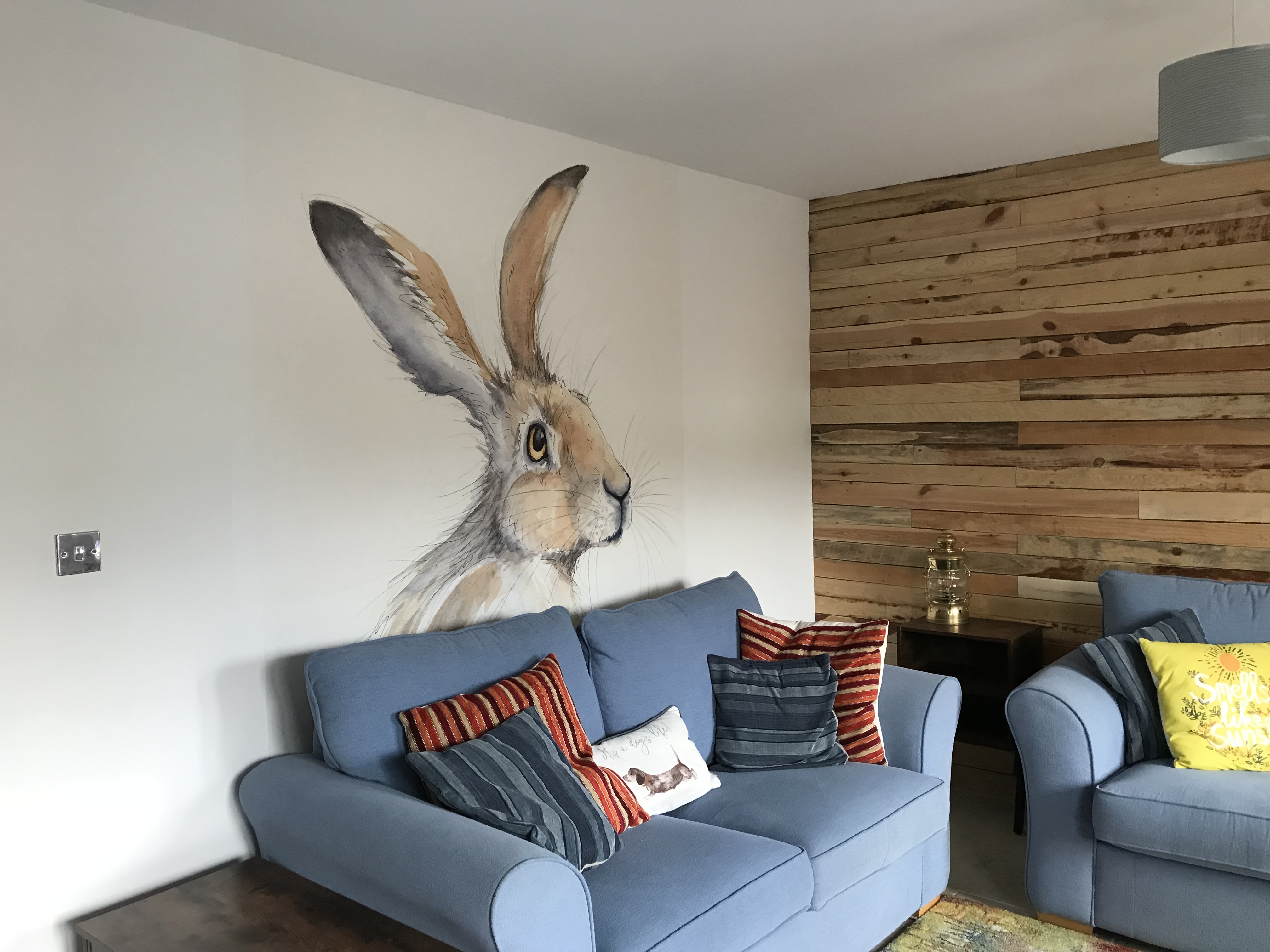
Things started to be difficult fairly early on, but we will skip the description of the dog fouling in the car on the way there, and jump straight into the cottage—which was lovely. A small semi-detached house with two bedrooms and three bathrooms, it seemed ideal. It was incredibly clean, and everything was comfortable and modern. They had painted murals on the walls, and there was a view of the sea from an upstairs window. I set up a table with my computer and books, and settled into a week of study and seaside.
Meals in pubs and walks on the beach. Perfect.
It happened in the evening, when we were leaving to have dinner in a local pub. It was dark, and pouring with rain, and the wind was racing up the cliffs. The cottage had off-road parking a short walk from the house, and I set off with Mum while Husband locked the house. The wind was pulling at our hair, and the rain was beginning to increase, so I hurried ahead to unlock the car and open the heavy door before Mum got there. Such a mistake. Why did I not walk with her, holding her arm for support? Why did I not have a torch? Why did we even think taking an elderly woman to the pub was a good idea? Hindsight is a terrible thing.
There was a step up to where the car was, then a step down. Tricky to see in the dark.
“Mind the step,” I called as I unlocked the car and threw the keys inside.
Mum stepped up onto the kerb, but forgot the step down. I was heaving the door open, heard her call out, watched her stagger forwards. I left the door, rushed towards her as she fought to keep her balance, reached out to grab her hand, missed, lurched forwards and clutched the front of her coat, which slid from my gasp and Mum fell, straight back, smack onto the concrete.
The rain was still falling, relentlessly wetting everything.
“Mum!” I shouted, rushing to her.
No response. She lay, still, not a sound.
“Mum!” I called again as I reached her side.
There was a groan.
Husband arrived, tripped over the same step and managed to get his balance. I yelled to him to call an ambulance. There was no phone signal, so he ran back to the house to use the wi-fi. A man from the flats opposite shouted, asking if everything was okay, and could he help?
I asked if he had an umbrella, and he arrived, knelt next to us, tried to cover Mum. I took off my coat, hardly noticed the rain seeping through my cardigan, tried to cover Mum, told the man to get the old towel from the back of the car, and the blanket from the back seat, all the while telling Mum to keep still, she was safe now, the ambulance would soon arrive.
I tried to remember distant first-aid courses: Don’t move the patient in case of broken bones, keep them warm, reassure them, check for bleeding, check for breathing…but not in that order.
Husband came back to say the ambulance person wanted to ask some medical questions. I went into the house. They took some details, told me the ambulance would be at least two hours (two hours!) and then put me on hold. I was on hold for a long time.
The nice man from opposite arrived, saying they thought they should move Mum as it was so cold and wet. I tried (desperately) to decide what was best. “Don’t move the patient” was embedded in my mind. But it was pouring! And two hours! I told him I agreed it was best, but not to lift Mum, make her get up alone, with help supporting her, but never lifting. Then, if she had broken anything, the pain would make her stop and she was unlikely to make anything worse. If moving was too painful and she stopped, we could have a rethink.
The operator came back to the phone. I asked her whether I should give Mum a drink (sweet tea was in my mind) should I lie her down or sit her up for a head injury? Should I let her eat? Should I remove her wet clothes?
The operator told me not to move the patient. I could lift the visor of a helmet but not remove it. I should check for breathing.
I realised she was reading from a list.
I stopped her, and asked if she had any clinical training.
She told me not to move the patient.
I asked her again (using my teacher voice, which I’m not proud of) whether she had any clinical training.
Long pause.
No, she did not.
I thanked her, said she had been very kind, told her I understood everything she had told me. Ended the call. Dashed upstairs, grabbed duvet and towels, covered the sofa (because it wasn’t my cottage and we mustn’t spoil it) and removed the back cushions so soaked mother could lie down.
Mum arrived, supported by kind man from opposite and husband.
We sat her down, she wouldn’t lie. Should I make her lie down? She said the light hurt her eyes. I knew I needed to observe her, told her it had to stay on.
We tried phoning NHS 111, I needed to speak to a medic to ask what to do. It was on a continual loop, asking us to choose options, then starting again. Might have been due to dodgy wifi-calling with dodgy-internet connection (no phone signal). I realised that actually, I know a LOT of medics, half my friends seem to be doctors! I would message them and ask for help. Felt slightly cheeky, because they would be off-duty and trying to relax/live their life, but I decided I needed a favour. Sent messages to two friends who are doctors.
Managed to remove wet clothes from Mum, left them in a heap on the floor, wrapped her in duvets. She was too shaken to want to be fussed with dry clothes, and it was warm, so I left her for a while as she was. Tried to chat, told her funny stories (which weren’t funny) about the children when they were small, and about my course, and all sorts of strained boring conversation.
She was very shaken and weak, and I wanted to rouse her. I poured some sugar into my palm, told her to dip her finger in it and put some on her tongue. She did. I told her to do it again. Gradually I watched the energy return, it was like magic! Mum noticed too, and asked what I had given her. Assured her it was sugar and not cocaine.
She wanted a drink. I gave her sips of water. She was sick.
Kind doctor friends responded, telling me what to do—which was pretty much what I was doing anyway. But a relief to know that sitting or lying probably made no difference, and a big cup of tea was a bad idea until she had been checked, and being awake was important.
I phoned the ambulance service again, told them Mum had been sick. Made it clear that she had been unconscious for a short time, that she seemed muddled. I could hear her chatting to husband, sounding much brighter. I didn’t mention that, I wanted her checked by someone who knew more than me.
Two hours is a long time. We waited, keeping Mum warm, keeping her awake (not easy) trying to appear unconcerned. My mind was full of cracked skulls and internal bleeding and strokes. I talked about the ducks and how naughty the boys were when they were 10, and did she remember her first job? Husband was better at chatting than me, he managed to get her talking, she would only sigh and groan when I tried.
Daughter messaged, suggesting I pack a bag in case the ambulance took her to hospital. I ran around, guessing what might be needed, searching for prescriptions and toothbrushes and clean underwear and something comfy to wear in bed.
The ambulance arrived—a little over two hours. I opened the door, heard the crew share a joke, fought to control my irritation, to remember that this was their job, they couldn’t do everything at a run even if tonight I needed them to.
They came inside, declined a cup of tea, chatted to Mum while they assessed her. They weren’t sure whether they needed to take her to hospital, as it was already more than two hours since the accident, so they left to phone a doctor. I wondered if they would come back, worried some more about all the things that might be happening inside my poor shaken mother.
They came back. Mum needed to go to hospital. They wrapped her in blankets and took her bag, and I watched them lead her away.
“Try to get some sleep,” they said. “The hospital will phone you later.”
Husband told me to eat (a day without dinner) but I was too tense, ate a bowl of cereal, felt better.
I went to bed and didn’t sleep. The guilt was immense. Why hadn’t I been holding her arm? Why had I taken her out in the dark? Why hadn’t I been quicker at trying to catch her? I cried then, and lifted all my guilt and worry upwards, to God, who was big enough to handle it even when I didn’t have the words to explain it.
I must have slept because at 2:30 am the hospital called and woke me. The doctor asked who I was, said he was with my mother—what was her name? I said her name. He asked if I knew what had happened. Somewhere in my sleepy brain an alert sounded—was this a scam? He had given me no information and seemed to be getting lots of details from me. I stopped giving proper answers, started to be equally vague: yes, I knew what had had happened. He paused, considering. (Afterwards, Husband, who was listening, told me that the poor doctor was trying to verify my identity before he gave confidential patient information. But at 2:30 am, this was too subtle for me.)
Mum had a fractured skull and there was a small bleed but they didn’t need to operate.
He told me that they would keep her in for observation, give her medication so nothing got worse, that everything was stable. It didn’t feel stable. The whole world was out of kilter.
*
The rest of the holiday was spent visiting the hospital, and trying to enjoy walks on the beach that weren’t relaxed, staring at pages of college work but not really absorbing anything, planning what would happen if Mum had to stay after our cottage let ended.
But she didn’t. We collected her, and we came home. While the course of pills continued, I wanted her with me, to check on her easily. Mum was tired, and shaken, but not ill.
After a week she moved back to her own house. Gradually her confidence came back, eventually her bounce did too.
She’s okay now…though probably needs a holiday…
Thank you for reading
anneethompson.com
Why not sign up to follow my blog?
One of the sessions I attend at Spurgeon’s College is ‘chapel.’ This is basically an Assembly, just the same as every school used to hold at 10am each morning, the whole school gathered to sit on a cold hard floor for a bit of singing, a Bible-related talk and notices for the day. We don’t have to sit on the floor, and no one is glared at for whispering or removed for kicking the person in front, but other than that it’s identical.
One chapel service included a story, which is always my favourite thing. I believe the person leading chapel copied it from someone else, so you might know it already—but stories are meant to be copied and changed and passed on, so I will share it with you. Grab a coffee and settle back, and I will begin…
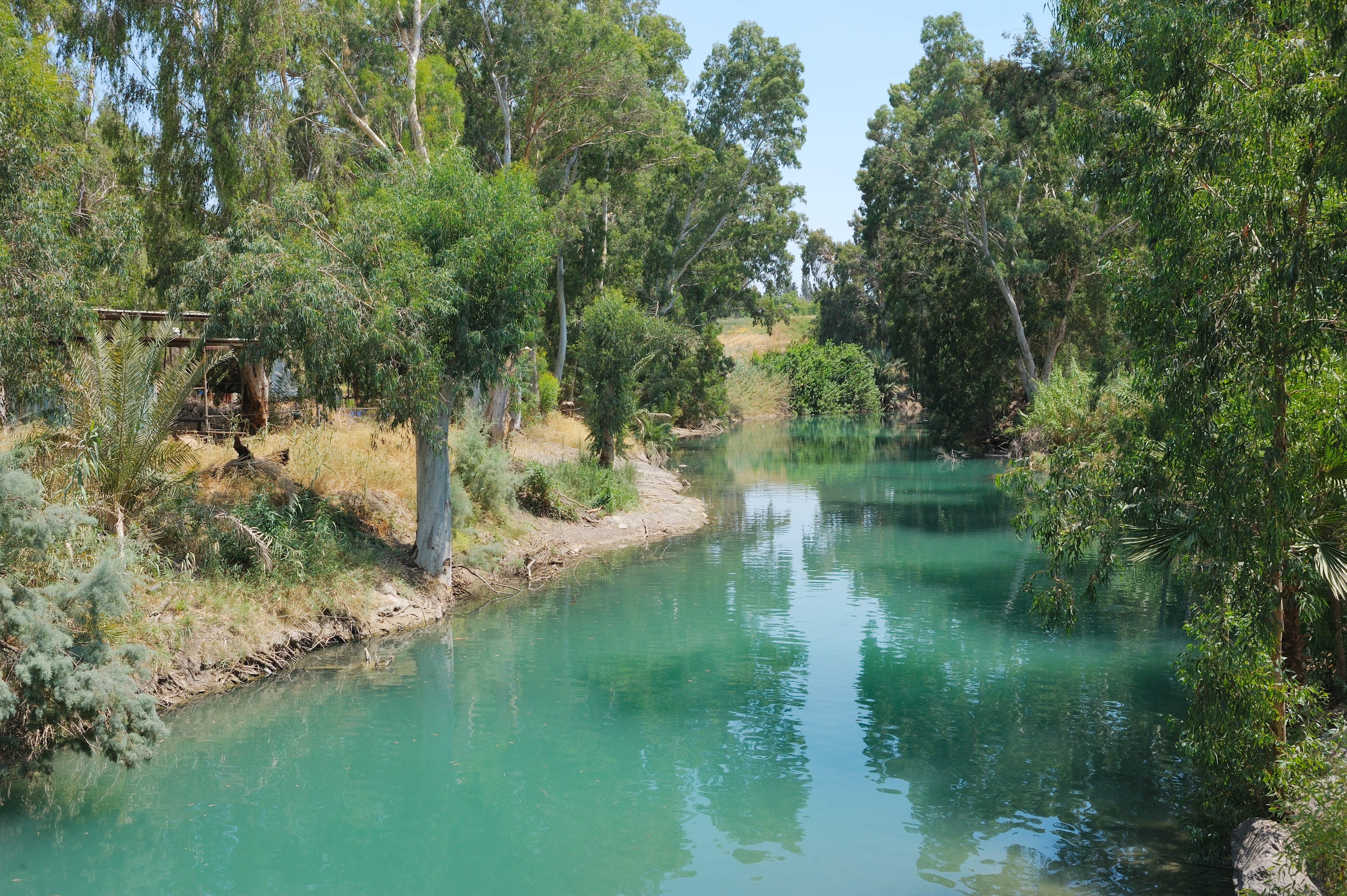
River Jordan near lake Kinneret
Taken from Google Images, (c) copyright 2016 Land of the Bible
We are travelling way back in time, to where John the Baptist is baptising people in the river. Imagine a hot sun shining above, the waves lapping onto the beach, John up to his waist in water, busily baptising.
Hoards of people have come to see the weird-man-who-eats-locusts, they have heard him preach, they want to be dunked under the water to show that they believe what he has said, and they want to change, to be better people. Being baptised—dunked in the water—was not unusual in those days, it was a way to show you were changing something, ‘dying’ to the old way, and starting again. They were being baptised because they knew they were wrong. Try to imagine them, lounging against trees, some sitting on the ground watching, others jostling to a better position.
As I said, hoards of people had come, and there was a bit of pushing, a few mutterings of discontent, a bit of unfair queue-jumping. John is in the river, baptising, saying a few words to each person. The crowd of people waiting grows larger.
While we watch, a woman arrives. She’s an Human Resources manager, complete with clipboard and an officious attitude. She watches the chaos for a few minutes and decides to intervene. Marching to the front of the line, she waves her clipboard at John, and suggests a few changes. He’s a little taken aback, but he agrees she can try to improve things on the shore, while he gets on with baptising.
The woman sets up a table, and tells everyone to form an orderly queue. She then explains that before they are baptised, they will need to tell John they wish to repent of their sin, and it will speed things up considerably if instead of needing to ask, John can see their main sin clearly written on a badge. She places her badge-making kit on the table, and the first person approaches.
“What is your biggest sin?” asks Mrs H.R.
The man at the table hesitates, then confesses, “I had an affair.”
Mrs H.R. writes ADULTERER in large letters, hands him the badge, then calls the next person.
“What is your biggest sin?” she asks.
“I hate my mother-in-law,” whispers the woman in the queue.
Mrs H.R writes HATE on the badge, and the woman pins it to her clothes.
One after another, people arrive at the table, and their main sin is written on a badge, and they walk away, to await baptism. Some have ENVY, some have GOSSIP, some have SELFISH. When it’s their turn, they join John in the water, he checks the badge, asks if they want to repent, then baptises them. It is all very efficient.
Then Jesus arrives at the table.
“What is your biggest sin?” asks Mrs H.R.
“None,” says Jesus.
Mrs H.R. blinks, confused.
“Oh,” she says. “Then what is your smallest sin?”
“None,” says Jesus.
Mrs H.R. frowns, unsure how to proceed. She gestures for Jesus to pass her, and he goes to join the people waiting to be baptised.
“Here,” he says to a man wearing a badge saying MEANNESS. “Let me have your badge,” says Jesus. He takes the badge, and pins it to his tunic. Then he takes the badge saying THIEF from the woman next to him, and the badge saying CRUDE, and a badge saying CRITICAL. Jesus walks through the crowd, taking everyone’s badge, pinning them to his tunic.
Then Jesus walks down, into the water, and faces John, ready to be baptised.
John looks at Jesus. He looks at the badges that cover Jesus’ tunic, and then he says: “Behold, the Lamb of God…”
Thank you for reading
anneethompson.com
Why not sign up to follow my blog?
I have just attended a fascinating lecture about Psalms, so I want to tell you about it. (I ought to be writing an essay, but this is more fun.)
When you study at Spurgeon’s College, you are allowed to listen to any of the other lectures that they offer. So although it is not related to my course, when I heard there was a lecture about Old Testament writing, I slunk into the back and took notes. It really was very interesting.
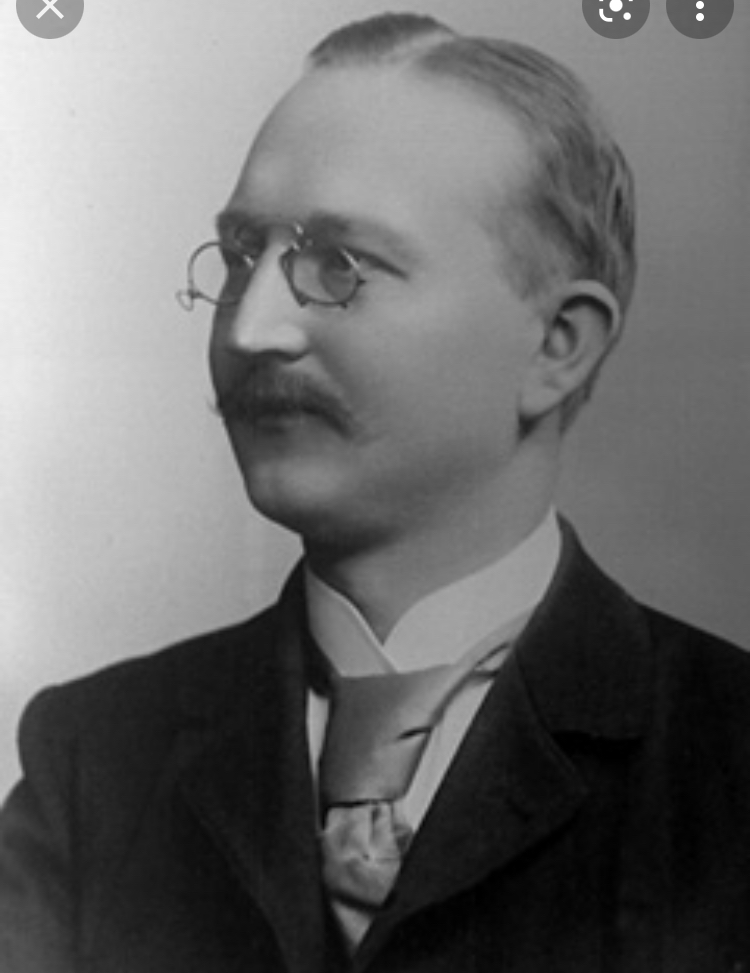
In case you don’t know, Psalms are found in the middle of the Bible, and are songs/poems, expressing emotions and full of metaphors. A chap called Herman Gunkel (can only be German with a brilliant name like that!) decided that rather than fuss about who wrote the Psalms, and which situations they related to, we should simply examine them “sitz im Leben,” which means ‘forget all the things we cannot possibly know, and think about the general setting.’
“Ah,” you might say, “but my Bible tells me who wrote the Psalms, some of them say ‘of David’ in the title.”
Well, that is very misleading. Don’t forget, you are probably reading an English translation. The Hebrew would say:לְדָוִד which can be translated as ‘of David’ or ‘to David’ or ‘for David’ or ‘the sort of thing that David wrote.’ So a bit uncertain really.
Herman lived about a hundred years ago, but scholars still use his findings today.
Herman Gunkel
He sorted the Psalms into three main types: hymns, laments and thanksgiving. If you pick a Psalm, it will fit into one of those categories. He then divided them up further, saying that each type would have certain features—which makes it easy to categorise them if you have to write an essay or preach a sermon—but is also simply interesting.
As you might remember, I am going to learn some of Psalm 22 every day in Lent, and in preparation I have been reading the English version and learning some of the vocab. This Psalm is a lament. If you look, it fits into the category noticed by Herman. A ‘lament’ has the following form:
*It’s addressed to God. *It describes a terrible situation. *There is a confession of trust. *There is a petition. *There is an appeal to God’s care. *There is a vow of praise. *It finishes with an assurance of being heard.
Pick a Psalm, if you can divide it as above, it is a lament. The other forms (hymns and thanksgiving) also have a set structure. It’s quite fun when you know, because you start to spot the various forms when you are reading them.
However, be careful, because the occasional Psalm doesn’t seem to fit. This is probably because originally, they were two separate Psalms, and an editor has patched them together. (Or I suppose it could be that Herman was wrong, but people who know more than me believe he was correct, so who am I to argue?)
The lecture then talked about all the nasty bits in Psalms, and how we should view them today. We looked at a Psalm that ended with the hope that their enemies would suffer and the heads of their babies would be smashed against rocks. Not something we tend to preach in church today. How should we use the uncomfortable and violent sections of Psalms?
Some people simply ignore those bits, and edit the Psalm so only the ‘nice’ bits are read out. That seems like a cop-out to me.
Some people ‘spiritualise’ the Psalm, and transfer the curse to anything evil, wanting for temptation or greed or hatred to be ‘smashed against rocks.’ Personally, I think there are dangers with spiritualising things that were not meant to be spiritualised—the early writers did want to smash up babies’ heads, that is the era in which they lived and I think we should look at the Bible through the lens of history. That’s what they wanted, we don’t say things like that now, though we understand the sentiment of anger.
Some people use those bits to express anger, even though they wouldn’t actually want to smash heads today—they say the anger is a human condition, and that is still relevant. I’m not sure about that either, because the curse is so violent, I don’t feel it does express my own emotions. What do you think?
Anyway, it was all very interesting, and I think I will gate-crash other lectures in the future. Hope you enjoyed reading about it. Thank you for reading.
Take care. Love, Anne x
Thank you for reading
anneethompson.com
Why not sign up to follow my blog?
As you know, I have started by M.A. at Spurgeon’s college, and part of my assessment is a theological essay. I thought this might be quite fun, as I am someone with lots of opinions (as you know) and an essay is the perfect way to inflict them on someone who is paid to read it. I chose my title from a small selection, and started to read the suggested books. The book by Colin Gunton (see above) is the first one I read.
As you will know from my last blog, the second-hand copy I bought was full of irritating under-linings by the previous owner. I shan’t mention this again. The book was quite difficult to read, as it was very wordy (perhaps I should have been expecting this given the not particularly snappy title). However, a box of Cadbury’s ice-creams helped, and I ploughed my way through.
The book was clearly aimed at readers who know more than me, because there were unexplained references to theologians (who I had never heard of). For example, he starts by describing the work of Kant (a chap born in 1724 who also had strong opinions) and Colin is discussing his views, when suddenly he writes: “… and as Barth has asked, ‘Is it possible…” Who is Barth? Had I missed something, I wondered. I checked back a few pages—nope, no mention of him. I assumed he was another theologian as opposed to Colin’s uncle, but I did feel rather bemused. I felt I should have been warned before his name was suddenly interjected into the debate, it was like everyone knew something that I didn’t. This happened a lot when I was day-dreaming at school, but I feel it’s cheating when it’s in a book. It happens again later in the book, when Colin writes about, “Dr, Carr’s querying…” and “G. B. Caird’s remark…” Who are they? People he met at the bus-stop? It was like when you’re chatting with someone and they pause to reply to a text on their phone. Oi! Introduce your readers first please Colin.
I read the book with the help of a dictionary, because Colin has a better vocabulary than me. I had no idea of the meaning of terms like ‘procrustean’ (something that forces everything to be the same) or ‘fortiori’ (a stronger reason) or ‘Pelagianism’ (Pelagius believed humans are basically good, and it is possible to be perfect/sinless) and although I had heard of Plato, I didn’t know that ‘platonist’ was another way of saying, ‘a dispassionate realist.’ I won’t use these terms in my essay, just in case … (some of them sound a bit dodgy).
Colin described various types of rationalism (helpful for my essay) and then wrote pretty much a whole chapter on what constitutes a metaphor. This was less helpful, but quite interesting. His main point was that when we take a word out of context and use it to explain an image of something else, it makes a good description, but is it reliable? As much of the doctrine of the Bible is explained in metaphors (like Jesus having victory over death—a military image, and people being redeemed—which is a slave-trade image) then do we actually have a clear understanding of what is described, or just a hazy picture/image? If God is too big to be fully known, then we cannot have the correct terms to describe him, so we have to use images/metaphors—but are these reliable? Interesting point.
One thing Colin writes (which I can definitely use in my essay) is:
“The language…does not then give us a theory, something final and fixed forever, but one way into a many-sided reality with which we are concerned. It helps us, that is to say, to come to a measure of understanding of some aspects of the way in which the Bible sets forth in language the saving action of God in and towards his world.”
I like when people are a little uncertain, when they don’t think God and theology can be packed into the little box of our brains.
Colin makes the point that we all use the language of our time and culture, and so too did the authors of the Bible. Therefore some of the images which relate to the slave market, or Roman conquest, might be misunderstood by later readers. He writes an interesting chapter on demons, and whether these are ‘individuals’ (like people but somehow spirits) or forces (as in evil influences). The words used in the ancient manuscripts meant different things to later readers. All very interesting.
I’m not sure if I would recommend you read this book, unless you are interested in studying theology, because it is not hugely accessible. However, if you are interested in reading something difficult, buy a box of ice-creams and set aside a weekend for some heavy reading. Colin makes some interesting points.
Thank you for reading
anneethompson.com
Why not sign up to follow my blog?
I have a question: When you are reading a book, do you underline passages with a pencil? This is something I am struggling with. I am struggling with many things actually, but this is currently the most irritating.
My M.A. course started at a local theological college, and I drove there for the first time in September. This alone was scary enough. I’m not a ‘natural driver’ and mostly I pootle between my house and my mother’s, and use public transport if I need to go much further. But Spurgeon’s College is not easily reached from my house, so driving is the only sensible option. I did a practice drive first, with encouraging Husband cheering me on from the passenger seat, but this did not prepare me for the first day of term.
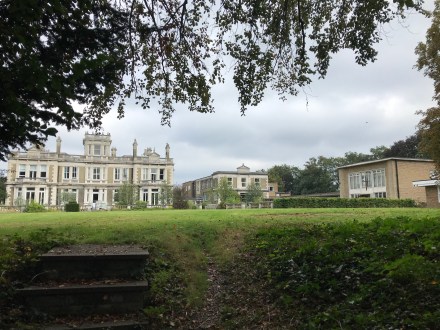
Spurgeon’s College
I set off in rush hour, when obviously the traffic was heavier than when we did our practice drive, so clever Satnav created exciting new routes to beat the traffic. I didn’t know the route well enough to do anything other than blindly follow, which was incredibly scary. We turned off the main road fairly soon after leaving home, and dived through a hedge, along a footpath, over a field and back onto the road. Okay, I am exaggerating, but not by much—most roads were not even wide enough for one car, so not sure what would have happened if I had met someone going in the opposite direction. (I didn’t.)
Then we joined the ‘London traffic’ I am a country bumpkin, anything bigger than a small town is ‘London traffic.’ Satnav continued to guide me down side roads, back onto the main road (always turning right across the traffic) then back down another side road. Pretty sure we crossed someone’s garden at one point.
There were speed limits designed to catch out the unwary driver, encouraging you to travel at 40 mph, then dropping briefly to 30 mph in the widest sections of road. There were pedestrian lights, which you thought you could nip through on orange, only to discover they are actually tram lights and you are about to be squashed under a tram. Teenagers stepped into the road on their way to school, grannies opened car doors without checking for cars, buses—well! I could write a whole article on the driving manners of whoever drives those big red buses that swoosh past you and then brake suddenly to collect passengers, blocking the road while they chat, read the newspaper, eat their lunch, phone their mothers and take a nap. Meanwhile, you sit behind them, wondering whether you can inch past (into the path of another swooshing bus) growing ever more worried as the car behind honks, and streams of boys walk between you and the bus, and a motorbike skims past and away down the road. Just as you decide to ‘go for it’ and edge past, the driver finishes his lunch/phone call/nap, indicates (briefly) as he glides away from the stop. You sigh with relief, enjoy a few yards of actual movement, and then he stops and it all starts again.
However, I made it to college in time and with very few casualties. (I will need to check the post for a few weeks so I can collect all the speeding fines before anyone sees them.) I walked into college, collected my student pass (wish I had tried a little harder to find a better photo now, I have the image of ‘Aunty Ethel on a bad hair day’ hanging round my neck) and I joined my fellow students in the chapel. Felt I had probably prayed more than most other people before the day had even begun!
The course is mostly fun. There are some good discussions, and the people seem nice. Much of the learning is through reading, and this is where my earlier comment is relevant. I bought a couple of books, second-hand, from Amazon. They have arrived with lots of underlinings. I find this very irritating. I tend to read in my own voice, pausing, thinking, absorbing. Passages that are underlined feel like I’m being shouted at, and it’s hard to absorb what is being said. I have so far spent longer erasing the lines than I have reading the passages. Not sure if they will give me any credit for that, probably not. I even found underlinings in a library book. Terrible! They should bring back hanging for things like that, then people would stop.
Hope you have a good week. I will tell you more about college in my future blogs. Take care. Love, Anne x
Thank you for reading
anneethompson.com
Why not sign up to follow my blog?
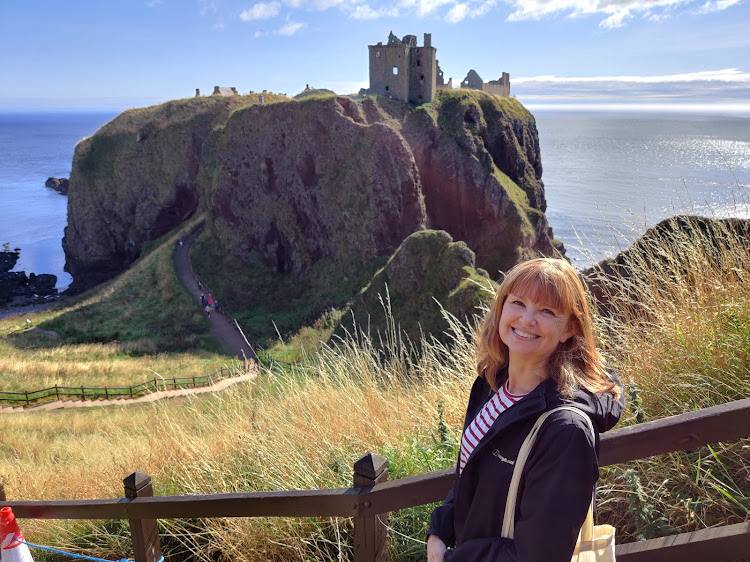
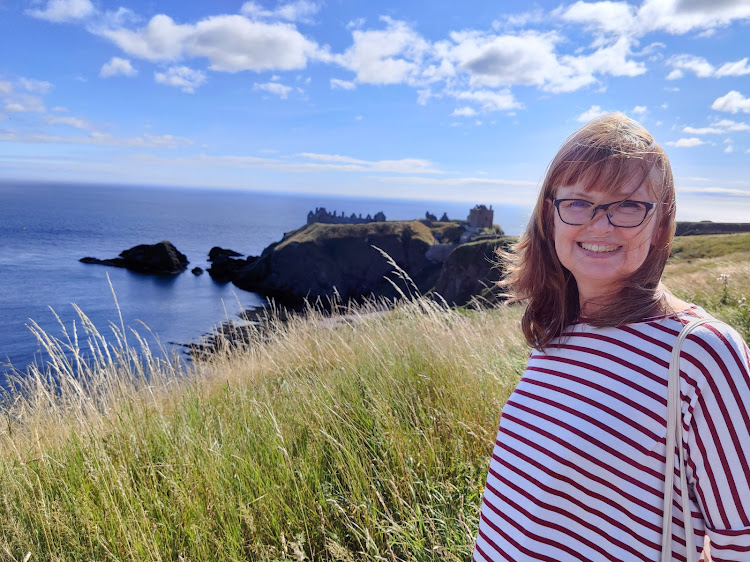
While staying at Thornton Castle, we visited Dunnottar Castle—which is a ruin and is my absolutely favourite castle in the whole world. We visited on a day full of sunshine and wind, and as we left the car park we could see a wind farm which looked as if it was floating above the horizon due to the mist. The castle was reached via steps which drop down from the cliff and then rise steeply to the spit of land housing the castle. The cliff edges are pitted, with large pebbles held by rock, which we were told is called ‘pudding rock.’ It is gradually eroding, so visit the castle quickly, before it tumbles into the sea.
The Perfect Ruined Castle
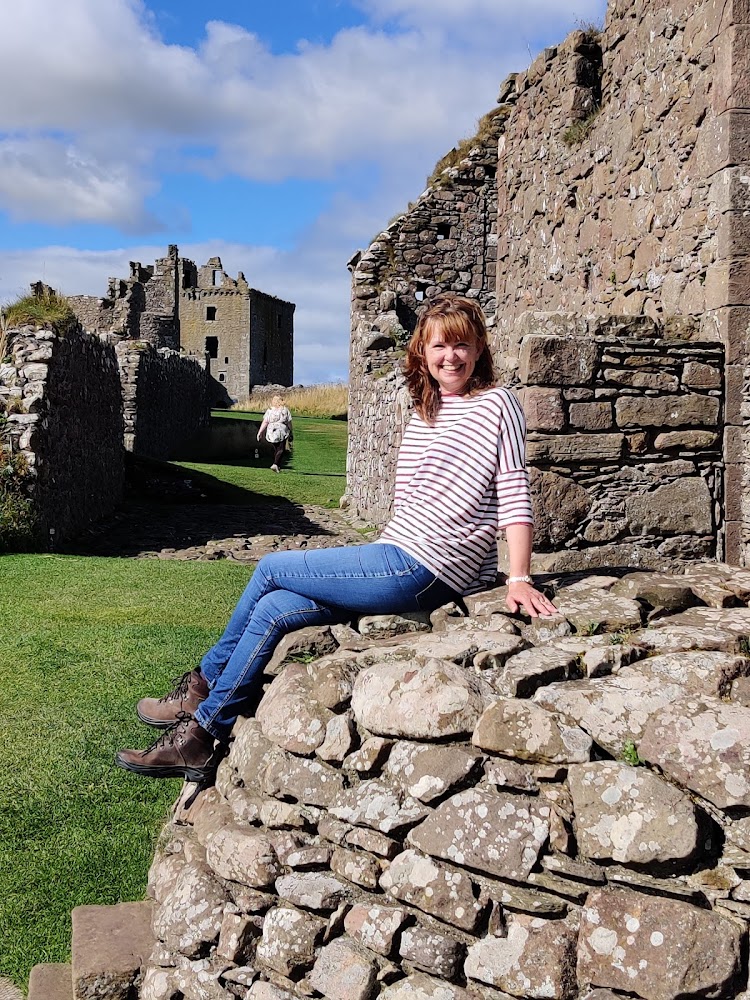
Dunnottar is a complete ruin, the skeleton of the castle reaching towards the sky. Some of the towers still have several storeys, some walls have almost completely disappeared. There are helpful information signs, and we saw the hole where William Wallace (Braveheart) is said to have attacked the British. The dark cavern of the old brewery is said to be haunted by a woman in green who is searching for her children (she has my sympathy, losing children in large buildings like castles/supermarkets is easily done). Seagull cries mingled with tourist’s comments: Mind your head, these guides are beautifully produced for the money, let’s sit here for a bit…
There was a lion’s den in the castle, dating back to Earl Marischal. Apparently his Coat of Arms had a lion, so he thought it would be a good idea to keep a real one in the castle. However, the roaring kept the Countess awake at night, so they got rid of it. Poor thing. The lion, not the Countess.
The surprises of the castle were the well, which is a large pool of fresh water right in the centre of the castle, and the public loos (also right in the centre, and very clean) and the sheer size of the place. It really is the best castle ever.
After visiting the castle, we walked along the cliffs. There is a great walk from Stonehaven, along the cliff top towards the castle. In a couple of places you can climb down to the beach.
Just outside the town, on a hill, is a war memorial. After the first world war, over 200 men from Stonehaven never came home. That would have been a huge percentage of the young men. The memorial looks like a ruined Greek temple, to represent the lives ruined by the war. It also fits very well with the view of the castle, and is very in keeping with the atmosphere of the area. As we walked past, there were several people walking up to look at the memorial, and people running with a dog in tow—it is clearly a dominant feature of the town.
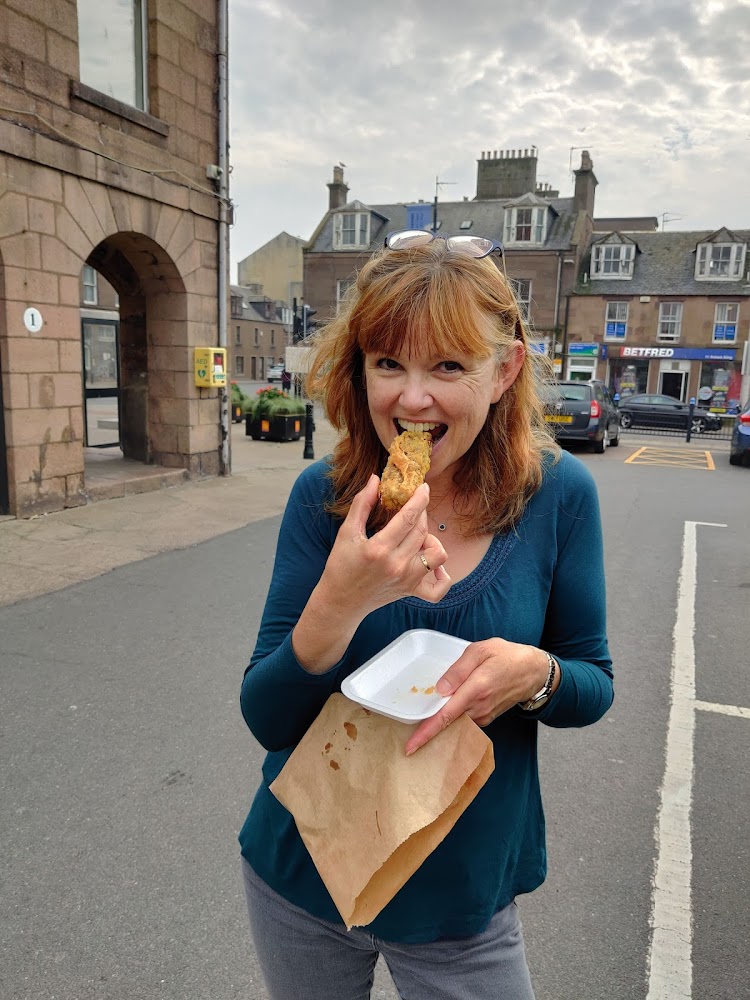
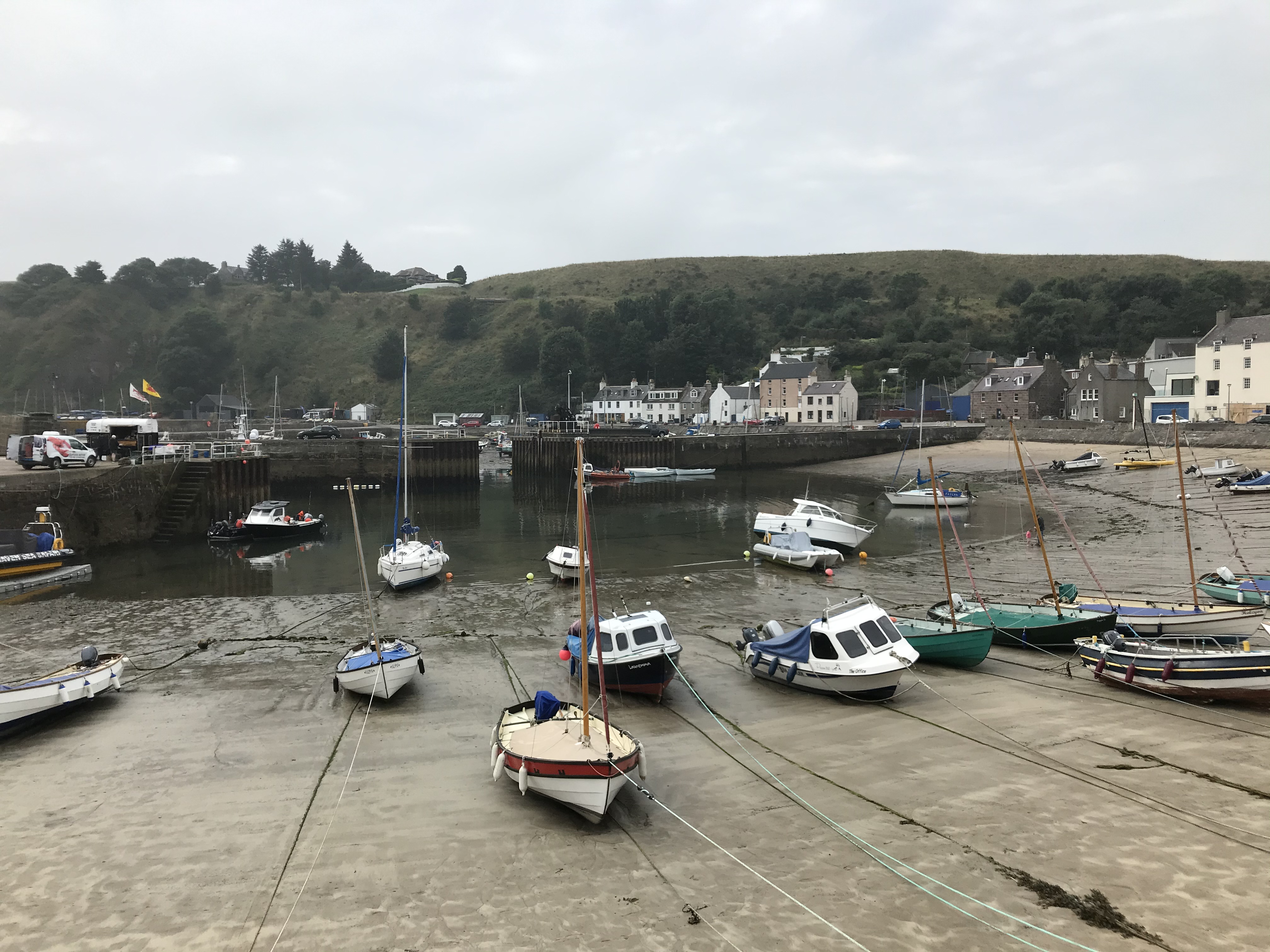
Stonehaven is a fishing town, with a big harbour and some interesting sculptures along the sea front. It is also the home of the deep-fried mars bar, so I insisted that we try it. It was pretty revolting! I think our order was unexpected as it wasn’t tourist season, and so I am guessing that they simply dipped a mars bar into the batter they were using for fish and then fried it in the same vat of oil. It tasted very fishy anyway. Imagine biting into a piece of deep-fried fish, and then finding a melted mars bar inside. The flavours clashed horribly—maybe it would be better with fresh batter, more of a mars bar pancake perhaps.
Tasting a deep-fried mars bar.
Although I cannot recommend the mars bar, Stonehaven is worth a visit. They were busy building sea defences when we were there, so it was quite noisy, but I expect it’s rather lovely most of the time. We found a great bakers to buy lunch from, and then we sat, watching the boats bob on the water and listening to the gulls. A lovely way to finish our holiday.
Thank you for reading about our road trip through Scotland. There are so many places that we didn’t have time to visit, and so many that I hope to return to one day. To be honest, I’m not sure why we spend so much time in Italy and France, when Scotland is easily as beautiful. I guess you just have to be lucky with the weather (and the midges, which were a nuisance when they appeared). But if you have never been, go soon…before the rest of the world realises what a treasure it is.
Take care. Love, Anne x
Thanks for reading. Why not sign up to follow my blog? anneethompson.com *****
Don’t forget, my travel book, The sarcastic Mother’s Holiday Diary, is available from an Amazon near you. It’s a fun read, and makes a great gift.
Now is an excellent time to read my travel book. Happy adventures from around the world. Available from Amazon. *****
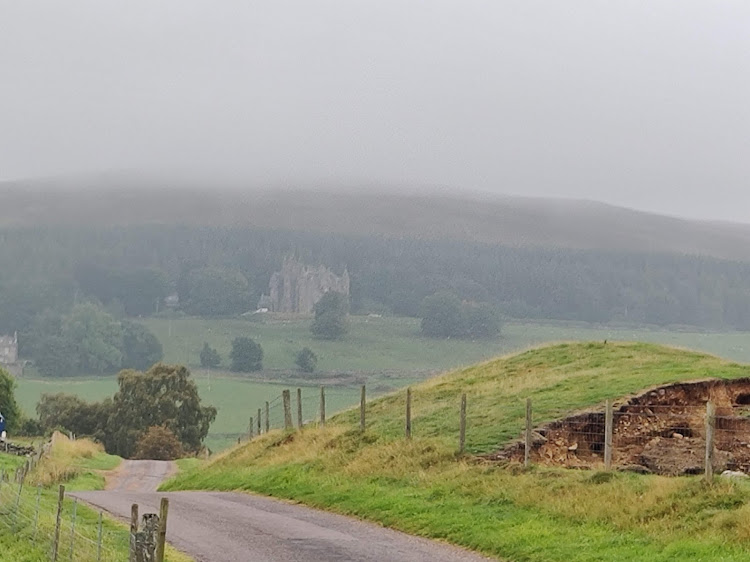
Does anywhere in the world do castles like Scotland? They are everywhere—even ‘normal’ houses tend to include the odd turret. Fabulous. While we drove around Scotland, we would turn a corner, and there would be a castle, sitting atop a hill or rising from the mist in a loch. I would shout ‘Stop!’ and we would park somewhere and look. Often we knew a photo would never manage to capture the scene: those turrets reaching to the sky, the walls stark against the water, mist swirling around the base. I am not much interested in the history of tribal wars or the dates of battles, but castles make you remember stories of princesses and sea monsters and dragons. I love castles, especially ruined ones.
We left Balintore Castle and drove north, on the snow road, to Balmoral Castle. We thought it would be interesting to see the castle built by the royals. There was a car park, with a £3 charge, and a short walk over a bridge spanning the River Dee to the gift shop and entrance gate. That’s it. The grounds were closed, and from the road we couldn’t see anything—not even a turret. The £3 charge was basically to enter the gift shop!
This is all we saw of Balmoral Castle!
Instead, we went to Ballatar (where the Queen pops to the Co-op when she runs out of teabags—there’s even a bus stop right outside Balmoral, which is handy for her). There is the ‘royal station’ where the Queen’s train used to arrive, but it’s not used today and the rails have been removed, which sort of fitted with our experience of the whole day.
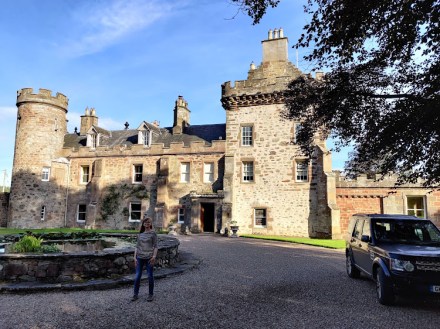
Of course, I still had no idea where our final location was going to be. I was hoping it would be less cold than Balintore Castle—and it was. Husband had booked another castle for us to stay in, and this one was very comfy. We arrived at Thornton Castle about 4pm, and to my relief, this one was not derelict.
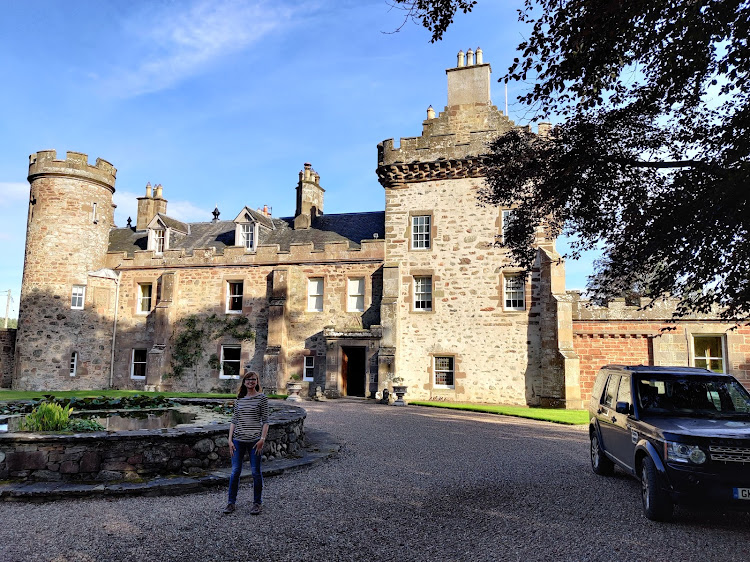
Thornton Castle–a great place to stay.
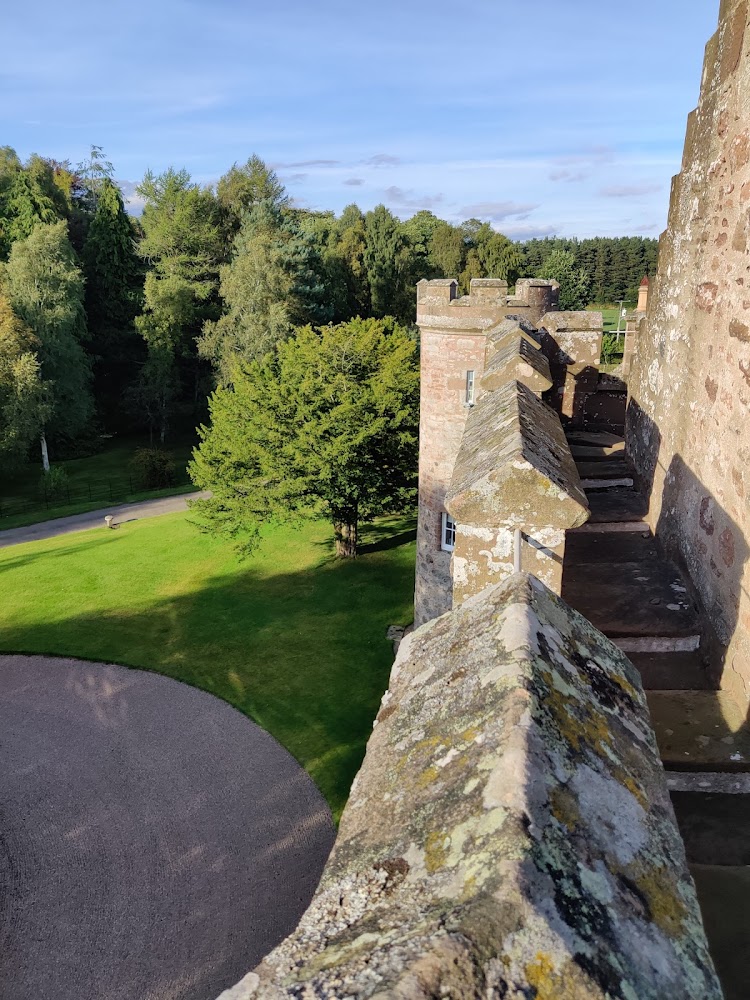
Our host welcomed us, and gave us a tour of the grounds from the battlements. I pretended to be completely comfortable with walking along a narrow walkway 4 storeys high with only a low parapet between me and certain death. Our host pointed to a round tower, which dated from about 1200’s, and a square tower with dated from about 1500’s, and the remainder of the house which was added much later. Thornton Castle has been in the same family for many generations, and is full of family paintings and artefacts (and not so many stuffed animals as the last castle!)
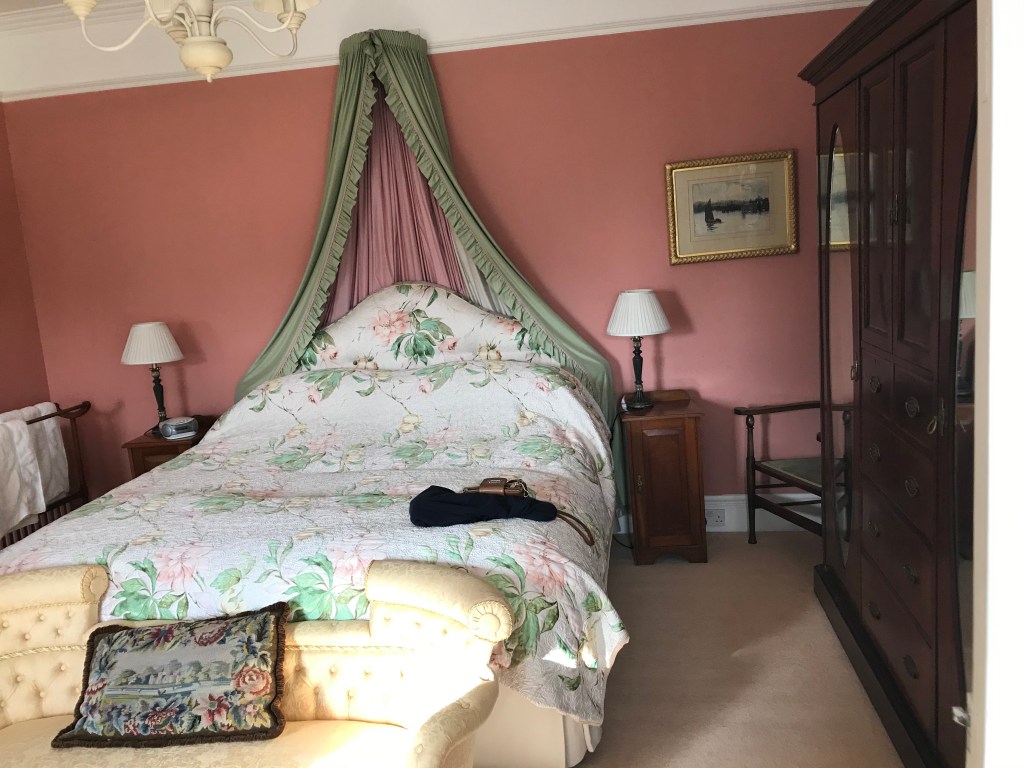
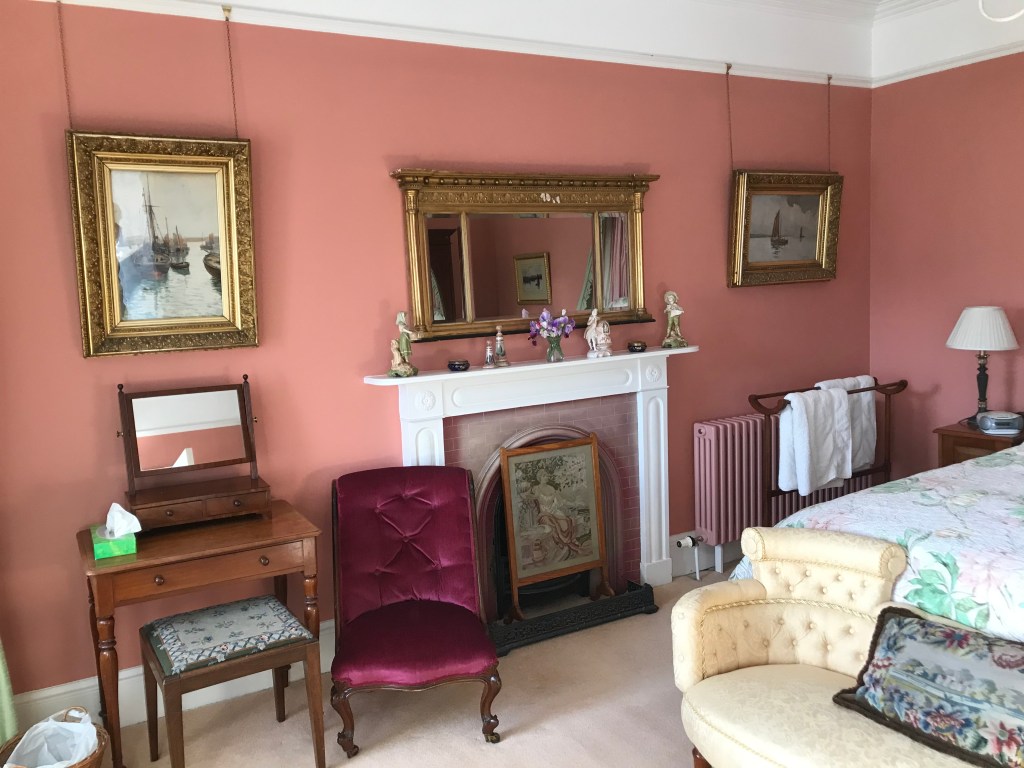
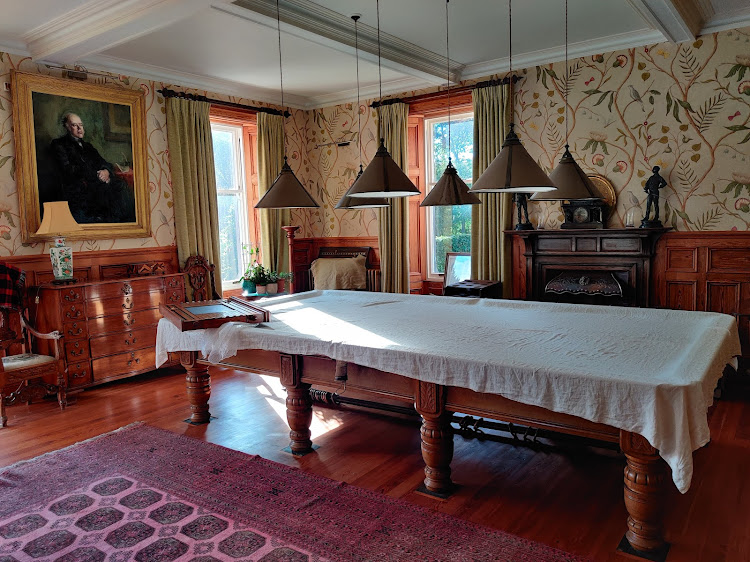
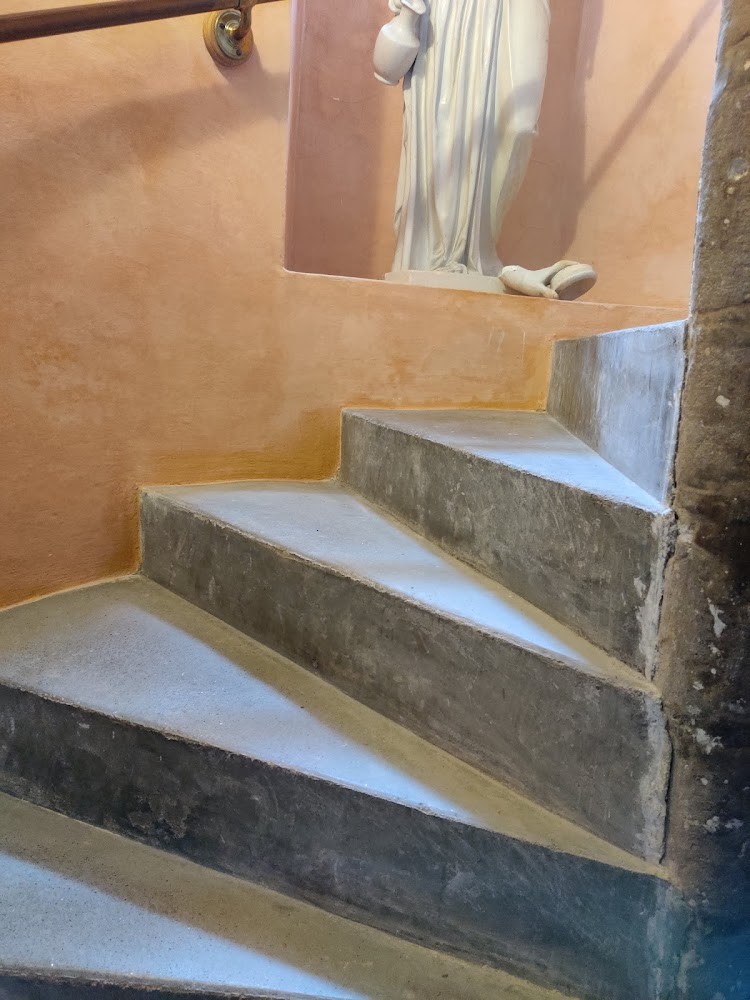
Our Airbnb was in the square tower, and it was magnificent. We had a beautiful bedroom with a little adjoining sitting room. Above was another bedroom (which we didn’t need) and a bathroom, and there was a kettle and fridge so we could make our own drinks. We also had use of the billiard room, which was very grand, but I preferred our little sitting room. The rooms were reached by a spiral staircase (a bit dangerous if very tired or drunk). Breakfast was included in the price, and this was served in the dining room.
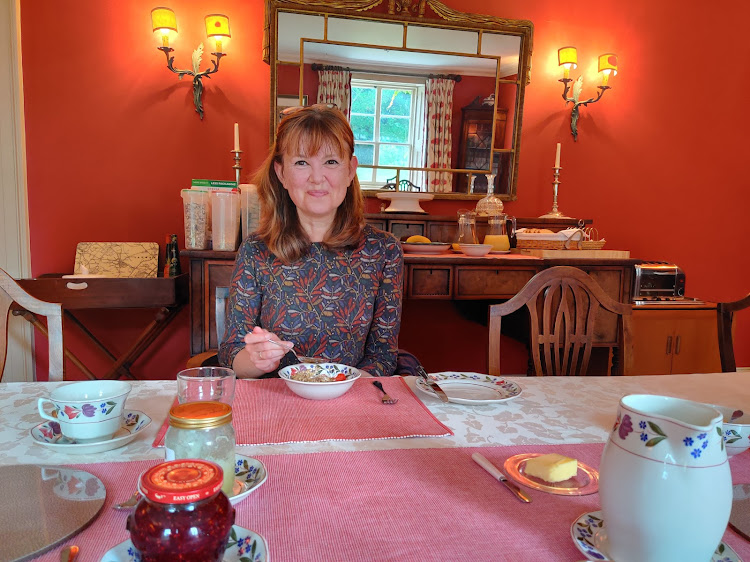
Breakfast was amazing, and deserves its own paragraph. We were shown into the dining room, where the long table was set with two places opposite each other. The sideboard was laid with cereals, and juices, and fresh fruit, bowls of yogurt, bread and a toaster. Our host offered us a range of cooked food, so Husband had a full Scottish breakfast each day, but I was happy with yogurt and fruit and cereal. We had a big pot of good coffee (very important) and I sat there, feeling like I was living in Downton Abbey, and loving it. It was such a treat. Our host was very friendly. It was slightly odd being waited on by the owner of the castle, but I managed to cope! It was perfect.
Such fun!
Thornton Castle is near the coast, so we had some lovely meals in little fishing villages. We also visited Dunnottar Castle, but I will tell you about that tomorrow.
Thanks for reading. Take care. Love, Anne x
If you fancy staying at Thornton Castle, the link is here:
When we left Inverlochy Castle Hotel, I wondered what Husband had planned next. Nothing, I thought, as spectacular as Inverlochy. He didn’t speak much as we drove, and I could see he was slightly tense. I wondered what was coming.
We left the main roads, and followed single-carriage lanes through the hills, passing rivers, and farms, and cattle. There were a lot of rabbits, and families of partridges, and then, perched on a hilltop, there was a ruined castle.
“Is that our next Airbnb?” I joked. “Yep!” said Husband.
Oh wow!
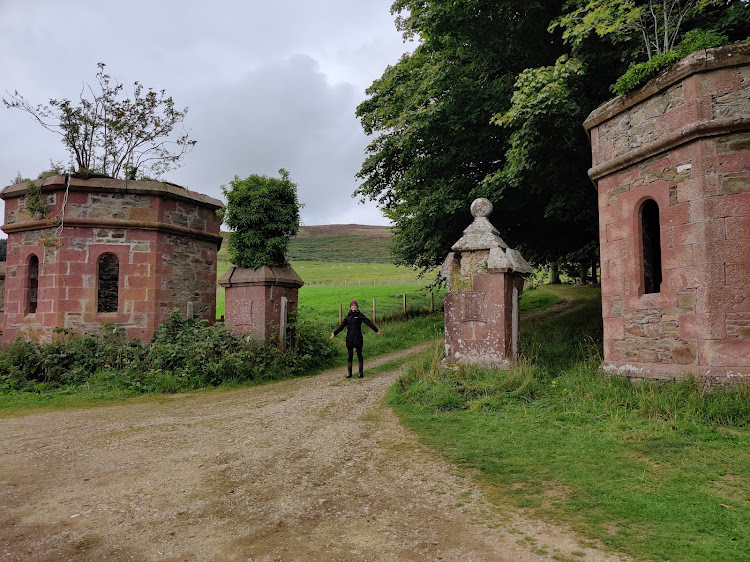
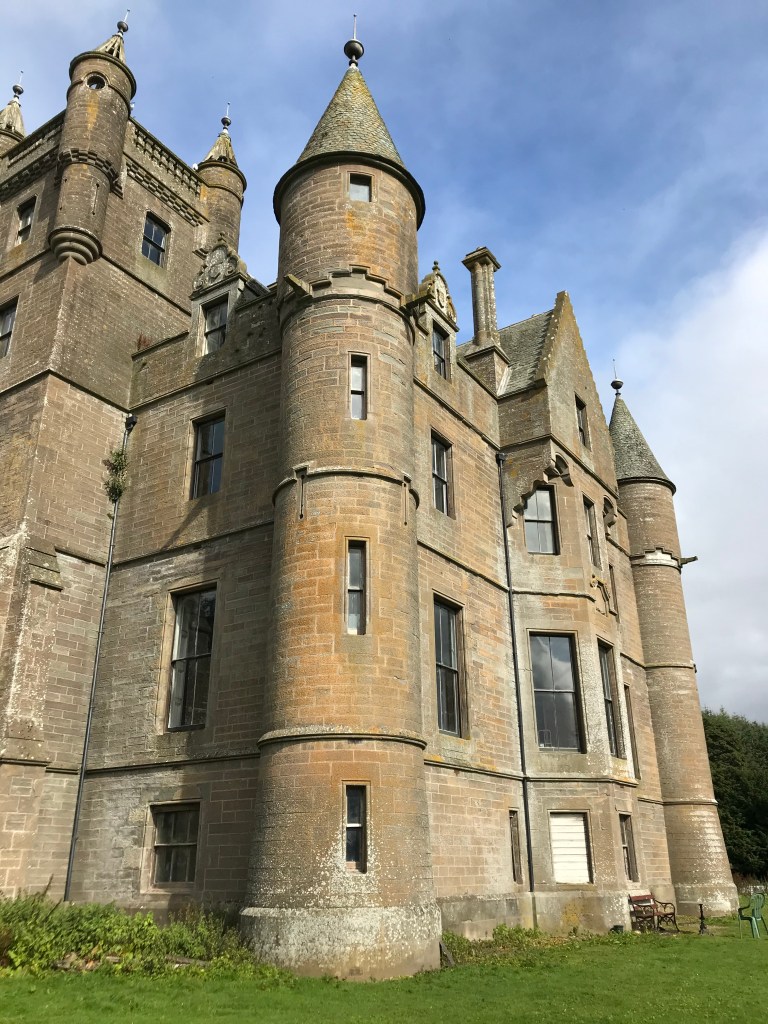
The entrance gates were a complete ruin, with a tree growing out the top of the lodgehouse. We had been told to use the back entrance, as it was less rugged, but even so I was glad of the 4-wheel drive. Rabbits (so many rabbits) leaped out of the way (and often back into our way, so we drove very slowly) until we arrived at the entrance to the castle. Round turrets stood stark against the sky, tumbled down stone littered the garden, empty windows hid the dark rooms. Husband checked the instructions, collected the key, and we entered.
We were staying in the kitchen wing. A series of rooms, that had once been the kitchen, dairy, scullery, and meat room, had been renovated, a modern kitchen fitted, furniture installed. There were stuffed animal heads on the wall, and coat-hooks made from deer feet. The floor was stone, and cold, and the ceilings were very high. We spoke in whispers as we looked around. There was something slightly spooky about it all, though I’m not sure why. We chose the least scary room for our bedroom and unloaded our cases. Then we left for dinner, and warmth, and something familiar.
We ate at Armstrongs, a restaurant next to a caravan site (quite a different atmosphere). The food was excellent. We then returned to the castle and settled in for the night. It was actually very comfy. Well, less uncomfortable than I had feared.
The kitchen wing
The following day, we were given a tour of the whole castle by the owner—Dr David (I can’t remember his last name). Balintore Castle has been bought (14 years ago) by an IT doctor who has until recently been living in Oxford while he renovates the castle. When he bought it, the roof was missing and some of the walls. The previous owner (a Lady) had lived there until she died, at which point the castle (in a state of disrepair) reverted to the adjoining estate. The lady who inherited it had hated the old lady, and she wanted to blow up the castle (and had even set the explosives) when the authorities stopped her because the castle was built along a fault line and they worried an explosion might trigger an earthquake! Instead the castle was left to go to ruin, plundered for building materials, at the mercy of the weather.
The Scottish authorities realised a cultural treasure was going to waste, and placed a compulsory purchase order on the castle, which is how the present owner managed to buy it. It is undoubtedly a labour of love, and many years and millions of pounds, have been spent restoring the castle to its former glory (there is a way to go yet). As I listened to Dr David, I found his enthusiasm contagious.
It was also really interesting to see the derelict rooms and imagine how they would have been in the past. The great hall, with the huge bay window (now boarded up) and the vaulted ceiling (currently lying in a heap on the floor). Some of the turrets had been restored to their original purpose—ensuite toilets for the bedrooms! They had rounded wooden toilet seats that fitted the rounded walls of the turret, and all the waste would have fallen easily away from the castle. Not the fairytale image I had imagined.
Still some work to do.
The castle was not terribly old, built in 1860 in the ‘Scottish Baronial’ style (like Balmoral, the Queen’s Scottish castle). The architect was William Burn, who was quite brilliant and designed things like a water tower on a nearby mountain that was higher than even the highest turret, so the water pressure was excellent throughout. The kitchen wing was built where it would remain cool (this was particularly effective—our rooms were freezing!)
It was such an amazing experience to stay in the castle. I never managed to shake off the slightly spooky feeling (a great disincentive to pop to the loo in the night, I never fancied those cold corridors in the dark). The scariest thing in reality was probably a mouse, but it was the sort of place where you imagined things. I am so glad we did it. What fun!
We left after a couple of days, and I wondered where we were staying for the last few days of our amazing tour of Scotland. I felt that wherever it was, it couldn’t possibly be as amazing as the places we had already visited. Yet again, I was wrong…
Thank you for reading and sharing our adventure. Take care. Love, Anne x
If you fancy staying in a real castle, the website is here:





























 Anne E Thompson