Hello, what kind of a week have you had? I am enjoying seeing all the spring flowers, the lambs in the field next to the house, and a few blue skies. Spring time has so much promise. The pond is lovely, though it is sadly bare of plants. Even the grass on the bank is being dug up and eaten by greedy ducks—perhaps in retaliation for my stealing their eggs.
Ducks are generally terrible mothers—they often lay their eggs in random places, and although occasionally one will make a nest and hatch the eggs, as soon as they hatch she leaves the nest and goes back to the pond. The ducklings have to struggle to keep up with her, or else be eaten. I am usually aware that the eggs have hatched because I hear the crows and magpies as they circle the pond, ready for a tasty snack.
I am currently collecting the eggs as they are laid, and will incubate them when I have enough. I’ll leave three in the nest. There is one nest, the other eggs are laid randomly on the bank, some roll into the water, some are collected by crows—my ducks clearly never read the ‘how to build a nest’ manual. I’ll then raise them inside until they’re too big for the crows to eat (they’re full-grown in four weeks). Am hoping to time it so they are on the pond before I have to start serious revision for my exams.
Ducks having a chat.
Ducks are lovely, but they do tend to destroy anything growing around the pond. I have tried protecting plants with nets and fences—but they don’t look very nice. In the early days, I used to believe the people in the garden centres who would assure me that I could buy certain plants and ‘the ducks won’t eat them.’ They either lied, or knew very little about ducks.
So, if you hope to both keep ducks and grow plants around your pond, here is a list of plants that ducks will eat. Some of them are poisonous, so they shouldn’t really be planted near a pond (though none of my ducks have ever died from eating plants that are listed as ‘poisonous’). It is quite a long list.
Plants that ducks will eat include:
water starwort hornwort willow moss frog’s lettuce mare’s-tail water violet water milfoils water lobelia water crowfoot
They also eat floating plants such as:
frogbit water soldier duckweed waterlilies (all kinds)
Marginal plants they will eat include: great water plantain water hawthorn bog bean arum lily sweet flag flowering rush bog arum yellow flag corkscrew rush golden club pickerel weed large-flowered spearwort Old World arrowhead zebra rush T. laxmannii T. minima Acorus gramineus ‘Variegatus’ marsh marigold Bowles’ golden sedge Carex pendula C. pseudocyperus golden buttons Houttuynia cordata Japanese water iris Iris versicolor Mimulus cardinalis M. lewisii M. luteus M. ringens water forget-me-not Saururus cernuus brooklime
Plants that ducks do not eat include:
.
.
.
.
.
Nope, cannot think of any. Trees I guess—but only because duck feet are designed to swim not perch, so they cannot reach the leaves very easily.
Hoping your plants grow well this spring.
Thanks for reading. Take care. Love, Anne x
Thank you for reading
anneethompson.com
Why not sign up to follow my blog?
Look on your device for this icon (it’s probably right at the bottom of the screen if you scroll down). Follow the link to follow my blog!
Last week, the second part of my Greek course started. The tutor gave us an overview of Biblical Greek, and how the culture and church seem to reflect the language.
Greek was an enthusiastic language, a sort of bubble of words that flowed like the thoughts in your head. It reminds me of when a 7-year-old writes a story, with lots of “and…and…and…and then…and…” This might be because some of the books in the New Testament were dictated—and that’s how people talk, but it also seems to be a feature of the language. It’s a wonderfully expressive language. In English, a verb basically can tell you what’s happening, and the time period (‘I went’ or ‘I go’) but not much more. In Greek, time is a tiny element, and verbs have aspects that convey whether the action happened once or was on-going, whether the action was passive or active, who did it. There is a lot of mood and feeling in the ancient Greek language.
Sentences in Greek are often very long. When they’re translated into English, the translators usually add punctuation, so a single sentence in Greek might be split into many sentences in English. (Originally, there was no punctuation, and people paused wherever they felt it was right.) The order of the words is not important, with ideas and expressions spurted onto the page in an order that appears to be random.
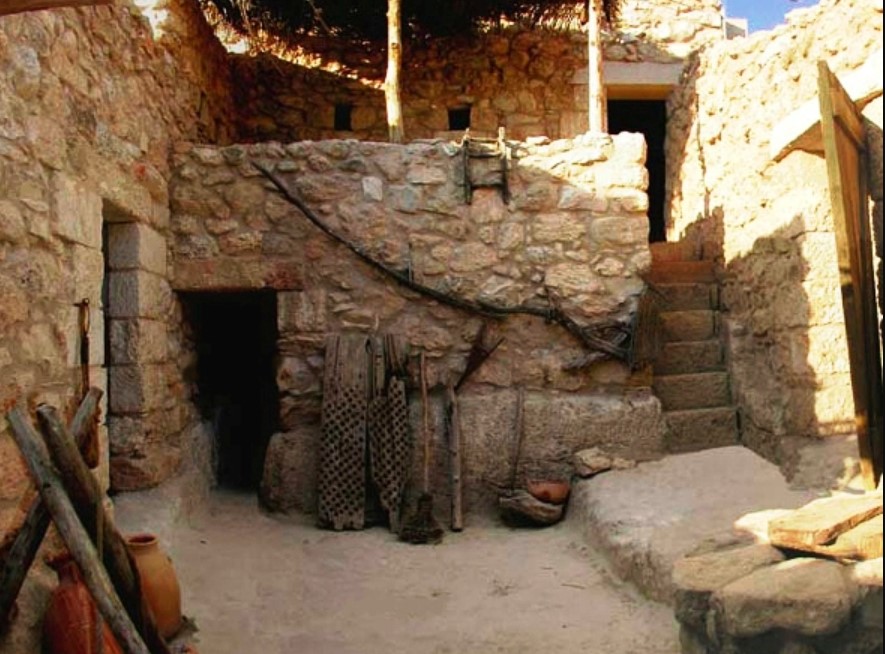
At the time that Greek was being spoken, the church was meeting in homes. The groups would have been fairly small, and homes automatically convey something intimate, expressive. When someone is sitting in your home, you notice if they are sad or worried, sharing emotions would be natural. Like the language, the church would have been enthusiastically conveying ideas and feelings, passing on the themes that Jesus spoke about—a lot of love and acceptance, looking to God rather than rules, learning how to change.
(Image: Blendspace) A home in New Testament times
As the church grew, people needed somewhere bigger to meet. A suitable building was the hall used as a law court. Instead of all sitting in a home, people now would have faced in the same direction, with a speaker at the front. The speaker would have been sitting where during the rest of the week the judge presiding over the court would have sat. The language gradually changed from Greek to Latin, which I understand is a language with strict rules.
The emphasis of the church also seemed to change, moving from expressions of love and freedom towards deciding rules. Who, exactly, was a Christian? Did they need to be circumcised? What were the rules of this new religion? What were the essentials that a person needed to believe in so they could be ‘classified’ as a Christian?
Today, we might like to think our churches are like the friendly church that met in homes, but we do seem to spend a lot of time talking about ‘non-Christians’ and the points they need to believe so that they can ‘become a Christian.’
Churches are currently seeing another huge change, as around the world they are unable to meet in person and services are all virtual. People miss being in the same space, being able to chat with their friends, touch each other, share a smile. But there are good elements too. People who are house-bound are able to be part of the fellowship again. Those who work unsociable hours can watch the service when they have time. People who want to be anonymous can watch a service unseen, they can listen to the Bible truths without having to defend their privacy, without the ‘danger’ of having to join something they are not yet sure about. I know that some churches have many more people ‘logging-on’ to their services than used to attend in person. I know of young people who would never have attended a service, but who will watch an online service, because they feel comfortable with that, it’s easy, more like the interactions they are used to.
Personally, I am enjoying Sundays in a way I never have before. As I wrote in a previous blog, it has become a special day, rather than one of duty. I can enjoy a service without being asked to do a job the minute I walk into the building. I have a loud tuneless singing voice and I’m not expected to sing or to keep standing up. When I take communion I am not wondering how many people have coughed on the bread before I eat it or if the server has washed their hands, and when I drink the ‘wine’ I don’t brace ready for an unknown acidic juice of dubious origin. Instead, I can listen to the words, and think about God, and take communion thinking only about what it means and why I am doing it. (Yes, I am bit of a grumpy unsociable person.)
I hope that when (if) the world opens up again and things start to return to normal, the church won’t rush to return to exactly the same model as before. I hope the leaders will keep some of the good things that have arisen this year.
Languages evolve, and people change. The church is simply a group of people trying to follow God together, and it’s interesting to look back and see the changes reflected there too.
Thanks for reading. Hope any changes in your life this week are good ones.
Take care.
Love, Anne x
Thank you for reading
anneethompson.com
Why not sign up to follow my blog?
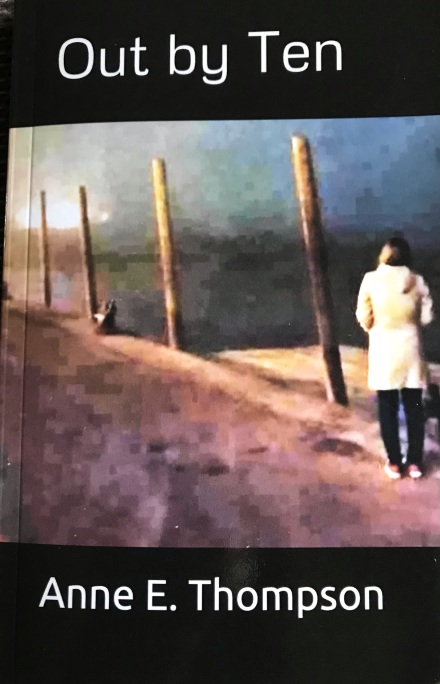
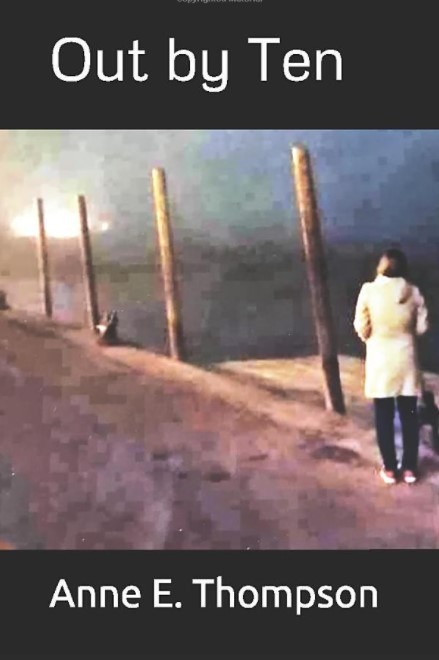
Thank you to all my followers who bought a copy of my new book: Out by Ten. I hope you’re enjoying it (if you could write a review on Amazon, that would be wonderful!) The link is below if you haven’t read a copy yet:
I want to share with you an extract from my new novel: Out by Ten by Anne E. Thompson
As I explained yesterday, it’s listed at the reduced price of £6.99 for just this week so that my friends and neighbours can buy a copy. I will put the Amazon link at the end (it’s available as both Kindle and paperback books).
I shared the bus ride back to Blakeney with a gaggle of teenaged girls, who looked as if they might be bunking off school. As I sat, staring at their snagged tights and improbable shoes, I heard their intense voices, and I remembered being that age, and the glorious excitement of new situations. It was only a few short years ago – and a whole lifetime. I immersed my thoughts in the sound of their whispers, looked at their carefully arranged hair, their casual closeness as they touched an arm, a knee rested against a thigh, feet slid near each other. They didn’t bother with personal space, the flicked hair of one girl brushed the cheek of another, their perfume spilled towards me with their whispered giggles. I remembered the intoxication of friendships, the undiluted energy; I remembered when I first saw Timothy. . .
***
I am sixteen, my school bag is bouncing on my shoulder, I glide into the classroom and slump into the chair next to Carol. I am looking for Nigel, searching the room for his blond hair whilst pretending to look for my homework book. Perhaps I should be worrying about my father, and his recently diagnosed cancer, but I’m not, I am absorbed by Nigel, hunting for his gangly legs stretching out from his desk, and the slant of his shoulder when he reaches for his bag. Carol digs me in the ribs and jerks her head forwards. I look up. I see Timothy.
He is standing at the front, his stance casual, his eyes watchful. I notice his eyes first, set below straight brows, that dark brown that seems to glow; even from my seat at the back I can tell he is noticing, watching us, in control. He wears a faded jacket, with patches on the elbows, and a white shirt, with the tie knotted to a perfect neat nobble, giving his appearance a tidy, meticulous look. His hair is brown. He has good hair, thick and wavy, cut to just above his ears but not so short that he looks like my dad. He doesn’t look like anyone’s dad, though I suppose, given his age, he might be. He smiles, I forget all about Nigel, forget he exists, forget that he has until now been the focus of every maths lesson I have attended this year.
Timothy is speaking. I notice his voice is deep, and posh, and it makes my stomach tingle. He is telling us his name is Timothy Oakfield and I want to write it in my book, and scribble variations of it. Mr. Oakfield. I realise that maths lessons will never be dull again. He is telling us that he’s our new teacher, that he’s pleased to meet us, let’s begin with an evaluation of what we have studied so far with Mr. Corbin. Mr. Corbin has had to leave, we don’t need to know why; I don’t want to know why, I don’t care. All is absorbed by the deep, posh, voice, and the brown, almost black eyes, and the apparent youth of our new mathematics teacher. He is asking for someone to raise their hand, someone who can give him a quick synopsis of work already covered by the unfortunate Mr. Corbin. Not me, I can’t breathe, let alone speak. I feel Carol stir beside me, she is raising her hand, introducing herself, telling him, Mr. Timothy Oakfield, that we have covered up to page 52 in the text book, and we all completed the questions at the back for homework. He smiles at her. I hate her.
He speaks, telling us about simplified equations, and exponential data, and I am barely listening. His words wash over me as I feel the tingle his voice stimulates, and I imagine how he would look in casual clothes, and wonder if he is married. He issues instructions, and everyone turns to a page in their text books, and I have to stop hating Carol long enough to ask her what the page number is. She slides a piece of paper towards me:
“Dreamy, huh?”
Dreamy is not a word I have ever used before, but it fits, I nod. I glance up.
Mr. Timothy Oakfield is walking round the classroom, peering at books. He pauses by John Simpkins and points at something. John Simpkins looks up, his face is very red, he hunches his shoulders and begins to frantically rub at his exercise book with an eraser. I wonder what he has written.
I glance across to my friend Charlie, she is frowning. I’m not sure if this is because she always finds maths difficult, or because her hair has recently been plaited again and I know that it pulls at her scalp and hurts. Her hair is a constant source of trouble for her, teachers repeatedly tell her it’s untidy and she should cut it. But it grows fast and surrounds her face with frizz, and there is nothing she can do but endure small tight plaits that hurt. Her mother shaves her head and wears a wig, I wonder if Charlie will when she’s older, if she will hide her hair in shame and try to look more ‘white.’ I hope not, I think her hair suits her face, and should be allowed to grow naturally. I wonder if my father will wear a wig too, when he loses more of his hair to the poison of chemotherapy, but this is too horrible to think about, so I spin my thoughts back to Charlie, and I wish she would look up so I can grimace to her in sympathy.
Mr. Timothy Oakfield is on the prowl again, I stare down at my book. We are all quiet, I don’t think this class has ever been silent before, there is something about him, an irresistible authority that has cast a spell on us. I try to see if he is wearing a wedding ring. He sees me raise my head, and approaches. I can feel my heart pounding behind my worn-out-doesn’t-fit-properly bra, the blood has rushed to flood my face and neck, so not-cool. I feel him approach. I have written nothing. I glance sideways, Carol’s book is neatly numbered 1 to 12, I begin to write the numbers in a long line down the margin, as if preparing my page for the answers that will surely follow; I haven’t even read the questions yet. He is here, I have only written up to number 7, and there are no words. He is leaning down, I can smell aftershave, he places a hand on my desk, it is his left hand, it is naked. I glance up, and drown in brown eyes.
“Are you okay? Do you understand what you need to do?”
I nod, my face a furnace. I do not have the first idea what I am supposed to be writing. He moves away. I breathe again, force myself to read the questions. They make no sense, words bouncing on a white page. I sneak a look at Carol’s book. I hate her, but I need her. I begin to copy her answers.
I have written several other novels but this is the one I like best.
While writing the book, I was rereading my favourite book of all time, A Tale of Two Cities by Charles Dickens—which has to be the most romantic book ever. As I read, I thought it would be rather fun to mingle what I was reading with what I was writing—my main character began to read the story, and the plot mirrors the same themes of imprisonment and escape, people living under false names, and individuals being caught up by national events (and of course, a dollop of romance).
I actually started to writeOut by Tenin April 2019, when I was staying in a holiday home in Norfolk. It struck me that holiday homes often hide the key in the same place each year, and that if you needed to disappear, they would be good places to hide (plus I thought it would be really fun to secretly live in someone else’s house!) I began to write a story about a young woman who was escaping.
It takes a long time to write a novel. I was still writing in 2020, so when Covid-19 arrived, I realised that my ‘contemporary fiction’ would not be very ‘contemporary’ unless I included references to the virus. I therefore rewrote the novel, setting it in the surreal world that we lived in during lockdown. As I felt bewildered by empty supermarket shelves, and insecure as I changed every event in my diary, I transferred those feelings to my main character. Bizarrely, world events, with the rise of the #BlackLivesMatter protests, beautifully mirrored the start of the French Revolution in A Tale of Two Cities, and I found my story flowed naturally in line with what was happening.
One of my friends is autistic. We worked together at lunch club, and when lockdown began we spoke on the phone. I realised how different things appear through her eyes, and I wanted to show some of the challenges involved for a family when one person is on the autistic spectrum. I therefore made one of the main characters autistic—though a child, so very different to my friend. As I wrote, I heard my friend’s voice bemoaning the silly fuss of coronavirus and I tried to imagine how a child might cope (or not cope) with different situations and the stress this would add to family dynamics.
When I thought the book was finished, I gave it to my beta readers, who informed me it was too religious. I didn’t really want to write ‘a religious book’ and decided to remove all references to my faith. This is simply a good story, with no agenda other than to entertain.
Writing this book was tremendous fun, so I hope you will enjoy reading it. As all my book-signings and fairs are currently in lockdown, a proper ‘launch’ of my book won’t be possible, but I wanted to tell you—my extended friends and neighbours—about it. To be honest, I always feel rather awkward about ‘selling’ to friends anyway but it’s a necessary evil to cover my costs. I have therefore decided to list the paperback on Amazon at the reduced price of just £6.99, for this week only. Next week it will raise to £8.99 (to start paying some costs) so please buy a copy quickly, and settle down for a good story.
So, a few weeks ago I took my Greek exam. This was very scary, and the source of many sleepless nights. I knew that there would be two passages to translate: one would be from the book of John, and one would be from a random non-Bible-but-same-time-period extract.
During one of our lessons in the autumn, our tutor had casually mentioned he was planning the exam, and there was a certain word, which means pathway, that he was thinking of including. It’s an interesting word because Greek words have a gender (like French words: masculine, feminine, or neuter) however this word is feminine but has a masculine ending (a sort of non-binary word). I took note of this information.
Now, the book of John does not have many places where the word ‘pathway/way’ is used. The most obvious one is the famous passage in John 14, when Jesus declares, “I am the way, the truth and the life.” I decided that this must be the passage that would appear in the exam, and I focussed my revision accordingly. I learnt that passage, and all the Greek words used in it thoroughly. I could parse (take apart and explain each bit) every word, I knew the different forms of the verbs, I could recite it in my sleep.
The morning of the exam arrived. I had not slept the night before, which was partly nerves, and partly due to some particularly noisy roadworks that had started on the road near us and involved noisily scrapping off the road surface all night, for many nights (they are in fact still doing it). I got up feeling sleepy but full of adrenaline and I reminded myself of all the things I used to tell my daughter when she walked into exams exhausted from not sleeping. I had done the work, put in the hours, a cup of coffee and a wallop of adrenaline would compensate for any lack of sleep. At least, I hoped so.
I did my usual coffee and Bible routine—and here we have bit of a miracle. I decided, bizarrely, that instead of reading my Bible at the place I was up to, I would open it randomly and read that passage instead. No idea why I did that. It was a strange passage, about Jesus arguing with the Pharisees about the law and needing two witnesses.
When it was time, I went to my computer for the exam. It was an ‘open book’ exam due to the Covid restrictions (in other words, they realised we couldn’t all assemble in an exam hall, so the exam was written assuming we would use our Greek Bible with lexicon attached). The exam paper appeared at the set time, and I began to read.
The exam lasted for 2 hours, so I had prepared a glass of water and a cold coffee (to top-up the caffeine when necessary). I didn’t touch them. I don’t think I actually took a breath the whole two hours. Or blinked.
At the bottom of each page was a button saying ‘next page.’ On the last page was a button which said ‘ready to end the exam?’ (or something similar). Did that mean when I clicked it, the exam would be whisked away, or that the final few questions were on the next/last page? I was too scared to click it, in case it was the ‘whisked away’ option, so I will never know.
The unseen translation was fairly impossible, and I guessed some of it, trying to use words that I knew were similar to the ones written. At one point I wrote something about, “Why has your face collapsed?” which I knew wasn’t right, but something definitely collapsed and the word looked very similar to ‘face’. I decided I would return to it at the end.
When I clicked onto the translation from John, it was not from Chapter 14 at all. It was however, the passage that I had randomly read that morning. Wow! I felt it was a miracle, and that God was saying “Don’t worry Anne, we’re in this together – you did the preliminary work, I’ll help with the exam.” It was quite a moment.
I worked my way through the translation, using the Greek I knew, and although I could have done okay anyway, having read it so recently certainly helped. I then returned to the random passage, and was tackling something which I could see I had translated wrongly, when without warning, the paper was whisked away and the two hours had ended.
I took a big breath (two hours is a long time to not breathe for) and drank some cold coffee. Felt like I’d been through a mangle, and did very little for the rest of the day.
One of my fellow students managed to find the unseen passage online, and there was a section about ‘his countenance fell’ which I guess is the part I translated as his face collapsing. Not sure if my tutor laughed or despaired when he read my answers.
You might think I would sleep better after the exam, but I didn’t. The roadworks continued, and I kept thinking of all the mistakes that I realised I had made, all the transliterations where I wrote a ‘v’ instead of an ‘n’ and all the words which I had learnt but simply couldn’t remember. I also, in one terrible moment, realised that at no point had I actually written my name or student number. Could that information have been on the last page which I never dared to look at? Would my efforts be invalidated due to being unidentifiable?
But no, all was fine. A very nice administrator sent through my mark, and I had done better than I had hoped, and am all set for Greek 2. I will hopefully have recovered from the exam in time to take the next one.
Thanks for reading. Hope things go well for you this week too.
Love, Anne
Thank you for reading
anneethompson.com
Why not sign up to follow my blog?
Hello and how was last week? I am beginning to feel very fed up with lockdown, this one seems much harder than the previous ones. I don’t know why, but it makes it much harder to cope with disappointments. Mostly my disappointments are small, but I’m not reacting overly well. I had planned to introduce my new book, but I’m not managing to upload a perfect manuscript yet, so that will have to wait. (I made an annoying mistake and excitedly ordered a few copies, and then found several typos. Next time I will wait to check the physical proof copy before I rush to buy copies–but it is so exciting when a book finally appears in print, it’s hard to be sensible!)
The weather has been a mixed blessing. I look out of the window and the view is beautiful, as England is enjoying a rare long spell of snow and ice. I am extremely thankful that I’m not having to do a school-run every day, which was always a nightmare when it snowed. But the chickens are grumpy and mostly refusing to lay, and I have to keep lugging water up to them because everything is frozen. Water is surprisingly heavy. One of the outside cats has decided she’s going to live inside instead, and is now usually to be found asleep on the boiler.
As you read this, I will be starting my first Hebrew lecture. This is very exciting, and I’m interested to know where we’ll start and how fast we’ll go. The Greek lectures seemed to fly at a pace that was sometimes hard to keep up with — but my exam mark was surprisingly good, so perhaps I managed to learn more than I thought I did. Hebrew will be different as the alphabet looks nothing like our letters, and the words are read from right to left. I have bought some modern Hebrew language Cds, and told my Mum she can learn too. We had a very funny morning trying to copy the words and accents on the Cd. I have also started to watch a series on Netflix in Hebrew, and I can understand the odd word (thank you, hello — things like that). I love how the brain gradually assimilates language. When I first started to listen to Hebrew, I couldn’t even hear the difference between sounds. Then I began to notice certain sounds, and then words. I can now match some of the things I am hearing to the written words. Of course, as I am learning Biblical Hebrew, some of the words (computer, phone, duck) will be pretty useless unless I plan a trip to Israel. But it’s still fun. Not sure how similar modern Hebrew and Biblical Hebrew are. I will let you know. Yiddish sounds just like German, so that is probably easier.
Did you do anything special for Valentine’s Day? Or Chinese New Year? It is very strange not being able to go to restaurants to mark occasions. As my lectures stopped for a while after the exams, every day is the same. Except for Sundays. Sundays are a special day in the house. When I was growing up, I pretty much hated Sundays because we weren’t allowed to do anything fun (like watch television or play with friends) and instead we went to church and church groups (which were mostly boring). I fear I may have inflicted the same restrictions on my own children. But since lockdown, we have tried to make Sunday a special day. So I make pancakes — big fat American ones, stuffed with banana slices and walnuts, drizzled with maple syrup. I set the table for brunch, with pretty glasses of juice, and we have pots of coffee, and eat pancakes. Then we watch a sermon (usually one from our church when we lived in America). I try not to do any jobs, and I don’t revise/study. Dinner is something easy (frozen pizza or something). It makes the day different, if nothing else.
What would you do if you were in charge of the country? Hind sight is a wonderful thing, and 2020 was a year that none of us saw coming, but if you had—if somehow you had known about the pandemic—what would you have done?
This is not a political post (I regularly whack you over the head with my faith, so my politics I try to keep private) but in an unreal scenario, what would you do? What laws would you have put in place?
It’s not an easy role, because there are so many things to balance. The media is no help at all, because anyone can find an ‘expert’ to quote shocking headlines. For example, any health minister is going to focus on that aspect (because that’s what they’re paid to do) but often it’s not balanced by an economist’s view, or an education minister’s view.
How to solve the problem of Covid?
For example, in 2019 (before Covid was a thing) we could have seen a headline shouting (correctly) something like:
“15,000 people will die of flu unless we have a whole-country lockdown.”
Now, 15,000 people dying of flu is horrible, and happens fairly regularly, but we don’t generally lockdown the country because that fact needs to be balanced with children being educated and the economy. We could equally have a headline:
“Over 100 young people will die in motorcycle accidents this year unless we stop them driving.”
So, what would you do? I recently heard a report about a country that was choosing to vaccinate all the young people first, hence enabling them to continue with their education and social lives. The logic was that they were most likely to break the lockdown rules and thus spread the virus, so if they were vaccinated, the vulnerable would continue to shelter and the young wouldn’t be spreading the disease in the wider community. It also means that their country will not have lost a year of education, students will not have missed out on the experience of university, children will have the stability of school and clubs. Tough on the older people—but is it a good idea?
One fact worth considering as you make your decision is that we currently have about 8 million people aged 15-24 years. As the country pays for people on furlough, and extra aid for those who need help, we are building up a debt. At some point, that debt will have to be paid (because we have never paid off our deficit, let alone saved money for a pandemic). Who will pay? Those young people. We are borrowing from their future. My understanding is that from this age group of 8 million young people, there have been 56 deaths from Covid. Only 56. Compare that to the 100 deaths due to motorcycle accidents over the same period, and consider what you would do.
Before you make your decision, consider the hospitals. You can ignore all the people shouting that hospitals are empty—I know several people who work in hospitals, and they are not lying when they talk about being stretched to capacity and the stress of watching people suffer and die, not enough staff, services diverted from other health areas. There are buildings available, but not enough staff. So, while you make your decision, consider how you are going to stop the hospitals being over-whelmed—because do you want to live in a country where there is no medical care when you need it? Is there a way other than lockdown to ensure that hospitals cope? Looking forward, will you attract more people into the health service with higher salaries? Ah, but how will you pay for that?
Now consider the economy. There is not a magic pot of money that the government can draw from in times of national debt. Money that is given out to save businesses and to provide Covid tests and to buy vaccines, all has to be paid back. We are the ones who will be paying it back (and our children and grandchildren). If the country is in lockdown, then small businesses will be bankrupt. Even large businesses can only survive for so long, especially if they were already struggling (like some of the aviation companies). Would you give more money so they can survive the crisis (and increase the debt, which might mean higher taxes later thereby simply delaying the inevitable) or hope they can modify and find news forms of revenue? What will it do to the unemployment numbers? How long would you suspend the economy for the sake of the health service?
There are of course, many other issues, but I think it’s hard enough if we simply balance health, education, economy. At the moment, the world seems to be focussed on health. I am waiting for the headlines to switch to:
“Leading economist warns of huge recession in the wake of lockdown.”
I haven’t mentioned issues beyond individual countries. But if you’re going to be in charge, you need to also consider global policies. If you vaccinate your own citizens, then the virus will mutate in poorer countries and become vaccine-resistant which puts us all back to the start. Plus we rely on the global economy, so we cannot afford to let another country crash because it will impact us. So, would you vaccinate all your own country first, or would you ensure a vaccine was rolled out globally?
What, I wonder, would you do? I’m sure that we can all think of things we would have changed about the past—but the solution is not obvious. I for one have no intention of standing for office at the next election.
Hope you make good decisions in your own life this week.
Take care.
Love, Anne x
Thank you for reading
anneethompson.com
Why not sign up to follow my blog?
Toby swallowed, and leaned forwards, peering across the parking area to where Clarissa’s car was. He could see her roof, over the low wall, pitted now with dents. Cautiously, he pushed open his door and started to stand. His foot crunched on melting hailstones, and he held the door, anxious in case he should slip. As he stood, he began to see more of Clarissa’s car. Below the dented roof, the windscreen had splintered into a spiders-web of cracks, but the shards of glass seemed to be held in place, he couldn’t see any gaps.
“Clarissa!” he called, climbing fully out of his car and testing his balance on the slippery ground. “Clarissa, are you alright?”
There was a sound from within her car, muted and distorted, so Toby couldn’t hear words. He began to walk towards her, holding onto his car for balance, his feet skidding and sliding on the ice, he reached the low wall and lurched forward, pushing his weight towards Clarissa’s car, his arms braced for a fall his eyes searching to see beyond the laced cracks of the glass. He reached the car. Inside, he could see movement, could hear Clarissa calling but all was indistinct. The glass had shattered in all the windows, so although he could discern movement, he couldn’t tell if it was an arm he was seeing or a hand. He stared at the door handle, and paused. At the moment, the glass was shattered, but still in place. If he opened the door, would the cracked shards be dislodged, and fall inside, slicing through anything they fell on? Toby considered the possibility of trying to remove the glass first, pulling away the broken pieces so they couldn’t fall. But he had no tools, nothing useful to prise the sharp pieces out of the frame.
He decided to risk opened the door and placed his hand on the handle. He looked at the window. If it should fall outwards, it would slice through the flesh of his wrist. If it fell inwards, it would cut Clarissa. He swallowed. Gradually, inch by inch, Toby depressed the handle until he heard the mechanism click open. He paused. The glass remained in place. His fingers were stiff on the handle, he daren’t let go, knew that he must softly pull the door towards him. He began to open the door. The glass shuddered, but did not fall. He inched the door towards him. He could hear Clarissa now, telling him to be careful, saying that she was okay, but please don’t let the glass fall. She had moved into the far seat, but was still in range should the glass fall. Toby could almost feel her eyes on him, he held his breath, waited a second, moved the door another inch, paused. The glass shivered, held, shivered again. Toby exhaled, sucked in his lips, edged the door further open, pulling it towards him, until at last, there was a big enough gap for Clarissa to squeeze through. She slid from the car, he took her arm, they moved to a safe place, sliding over the icy ground, then stood, staring at the little pink car with the shattered windows.
“Where did that storm come from?” said Clarissa after a while.
Toby shook his head. “I have no idea. It would make the roads treacherous though, I wonder how the cars on the training track managed.”
He looked down. Clarissa’s voice sounded hollow, as if she was making a supreme effort to sound normal, and when he looked at her, she lifted frightened eyes to stare back.
“Do you think. . .” she whispered, “do you think my car is so damaged that. . .” she stopped, and a sob escaped.
Toby moved closer and wrapped an arm around her shoulders. “No,” he said.
“But it might be,” whispered Clarissa. “It might be so badly damaged that I am called to the real track. And I’m not ready, I haven’t really trained properly, I won’t be issued with anything decent to drive, I’m not ready. . .”
“No,” said Toby again, and pulled her closer. He looked across at her car. It appeared somehow blind, with all the windows smashed – like eyes covered with cataracts. He shook his head, convincing himself that he was right.
“Think of how damaged some of those cars were in the broken cars training area. They were in a right state some of them, and yet they had been repaired and the drivers were still training. You’ve hardly arrived Clarissa, the Engineer won’t call you to the real track yet, I’m sure he won’t.
“Your car looks a mess,” he admitted. “But I’m sure it can be repaired. It’s only surface damage really, just a bit of glass.”
He looked at her again and tried to smile.
“You wait here,” he said. “I’ll go and find a mechanic, someone who can tell you the best way to get your car repaired. It might take me a while, I expect there are loads of cars damaged by that storm, but I will come back as soon as I can. You can wait next to the beach, it’s pretty there, a nice place to sit for a while. You’ll feel better in a minute, I expect it’s just the shock.”
Clarissa nodded, and Toby felt her take a breath and straighten. He wasn’t sure if she believed him – he wasn’t sure if he believed himself – but he very much wanted it to be true. He gave her a last hug, and went back to his car.
As Toby drove from the car park, he glanced in his rear view mirror. He could see Clarissa’s car, jagged shards of glass hanging in every window, and Clarissa, walking with hunched shoulders towards the beach. There was something defeated in her stance. Then he looked forwards, and concentrated on where he was going.
Chapter Fourteen
Trying to Find Help and What Happened to Percy
Toby drove slowly, his wheels crunching over the remaining hailstones, leaning forwards in his seat so he could look for patches of ice. A couple of times he felt his back wheels spin as he turned corners, but nothing he couldn’t bring back under control. He was heading for the entrance to the Special Features training area, to where he had seen a line of mechanic stations.
It was just after a particularly sharp bend that the man stopped him. Toby had again felt his rear wheels slip, had fought to turn the steering wheel back on track and keep from sliding to the edge of the road, when he saw the man, standing right in the centre of the road, waving madly. Toby depressed the brake pedal, remembering to press it gradually, to not brake hard and go into a skid, to adjust the steering bit by bit, until he was safely at the side of the road. His car stopped, and he started to get out.
Toby was now slightly beyond the man, who had turned, and was running towards him, slipping on the icy road, his arms waving, his face red as he fought to stay upright.
“You’re Toby, right?—One of Percy’s trainees?—You have to come.—Right now—Toby?—You’re Toby?”
His shouts came between breaths, forced through the wintry air, clipped and urgent.
Toby frowned. He really did not have time for this. Whatever Percy wanted to say could wait until he had sent a mechanic to help Clarissa.
“I can’t come right now,” Toby shouted back, turning back to his car. “I have to find a mechanic first.”
The man had reached Toby. Toby realised he was from the brown training area, his brown overalls were as tatty as his car, and were blotched with patches of oil. The pocket was ragged where it had torn, and the knees were worn thin. The man was shaking his head.
“No, you should come now, really you should. There are things you need to know —important things. Honestly, come now. It will help your friend more later if you come now. Trust me. . .”
Toby was not sure that he did trust the man. He was, after all, from the brown area. But there was something urgent about his red face, and his eyes were kind as well as determined, and Toby realised that the man had risked skidding and crashing in order to find him, and so maybe, maybe, Toby should trust him and go to find Percy. He stood still, thinking about Clarissa, and whether her car could be mended, and how she was waiting for him; weighing it in his mind with the urgency of the brown driver, and the suggestion that he would help Clarissa more if he found Percy first.
“Okay,” he said at last, his heart unwilling, “I’ll come.”
Toby followed the battered brown car along the wide roads of the Special Features training area, and out into the narrower link roads. They drove as fast as the conditions would allow, their wheels skidding over icy patches, the windscreens misting with their breath, the wet roads hissing beneath them. The roads became narrower, and they turned sharply into the brown training area. Toby parked in one of the narrow spaces, barely registering that he could now manage to park in a single move, and hurried to follow the brown driver. They walked under the deformed trunks of leafless trees to a wide area of mud and sparse tufts of grass. Percy was standing next to his car, and looked up as Toby approached.
“Ah, Toby! Just in time I think.”
Toby looked at Percy’s car. Each window had shattered, and a wheel had fallen from the front, the wing crumpled. It looked as if he had driven hard into something solid, and the old car looked beyond repair.
“Why are you here?” said Toby, wanting to know before Percy left why he had chosen to train with the brown drivers. “Do you think this is the best training area? Even with all the restrictions and nastiness?”
Percy shook his head. “As I told you before Toby, you can choose where to train, it is possible in any area, you simply need to find the best place for you. I came here long ago, because I realised that these drivers needed a little help, they were all trying so hard, and yet they still missed the point. I felt I could help them.”
“But you stayed so long!” said Toby, the words escaping before he could adjust them to something less blunt. “Don’t you think a different area might have got you good enough for the real track sooner?”
“Ah. No Toby. It’s not about being ‘good enough.’ We’re never good enough, we simply have to do our very best to improve. I realised that I needed to stay here, to be a mentor. I had an understanding you see, with the Engineer. I had something to offer, I could help the other drivers, and so I stayed. But I think I can go now. . .”
His voice trailed off, and he looked, past Toby, and smiled.
Toby spun round. There was a line of men standing, smiling at Percy. Their long grey hair was moving in the breeze, their eyes shone with welcome, and one of them stepped forwards, as if he was going to speak to Percy. Toby turned back, to ask Percy who they were—
Percy had gone. The place he had stood was empty, only his car remained. When Toby looked back, the line of men had gone too.
“Who were they?”
Toby was joined by another driver, his overalls were purple, and he had black curly hair. “Who were those men?”
Toby shook his head. “I don’t know.”
“Am I too late?” said the purple driver, looking around. “Percy was my mentor, I came to say goodbye. Did I miss him?”
Toby nodded. “Yes, I think so. I think he has gone.”
He turned to the purple driver.
“I was never sure why he was still here anyway, why his driving wasn’t good enough for the real track. I did wonder whether perhaps he’d never be good enough, never get there.”
The purple driver was shaking his head, his eyes worried.
“But it’s not about being good enough,” he said, repeating what Percy had said a few minutes ago. “We don’t have to train to be good enough to enter, the entry fee has already been sorted, by the Engineer. That’s why we’re here, at the training ground—because we’ve been chosen. No no, we’ll all get there eventually, but it’s up to us how ready we are, that’s the point of why we train. That’s what we’re here for.” His face creased into a frown. “But didn’t you know that already? Didn’t Percy explain that when you arrived?”
“Not really,” said Toby, trying to remember. “At least, I don’t think he did.”
“Are you going to stay?” asked the purple driver, nodding towards Percy’s broken car, which stood abandoned next to them. “I know that Percy wouldn’t care, he doesn’t need it anymore. But I think I might stay until it’s taken by the crusher. It feels, I don’t know, sort of respectful. Will you stay too?”
“Yes,” said Toby, hoping that it would be quick. He really needed to get back to Clarissa, but he felt it would be wrong to simply leave Percy’s car in the middle of the mud.
As they stood there, waiting for the crusher to arrive, the wind gradually dropped, and the sun slid from the clouds. Sunbeams danced on the broken glass, and a warmth spread over the muddy field. Other drivers arrived, their clothes showing they were from various training areas. Some wore brown overalls, some were dressed in colours, some were older drivers, some looked as new as Toby; all said that Percy had been their mentor, they were coming to say goodbye.
Eventually the crusher arrived, engine roaring, wheels dwarfing the abandoned brown car. The drivers began to whisper, quietly, as if not sure that the words mattered, but wanting to say something, wanting to mark the occasion somehow: “From metal you came, from metal you return. . .”
Thank you for reading
anneethompson.com
Why not sign up to follow my blog?
Toby and Clarissa left the track for broken, sorry, different, cars, and walked back to their cars. Toby felt a great weight of disappointment inside, as if he had finally found something special, and it had been cruelly taken away from him before he could enjoy it.
“I don’t think we’ll ever find the right place to train,” he said, his voice defeated. “The brown cars were too austere, the shiny cars didn’t train at all, you said the special features cars hardly bothered to drive, and now we’ve found the area for ‘different’ cars, we’re not allowed to train there. It feels hopeless.” Toby reached his car and slumped against the side.
“Any clever suggestions?”
Clarissa came near, and lightly punched his arm.
“Don’t be so gloomy! I agree, that looked like a good place to train, but like your mentor said, we can choose where to train, which must mean that it’s possible to train anywhere, otherwise we would all be told exactly where and how we should practise. I think you should come back to the special features training area. True, it doesn’t have the best training track in the world, and some drivers are only focussed on having a good time. But there is a track if you want to practise, and I think we’re allowed a little fun, otherwise we wouldn’t have been given the special features in the first place, would we? The Engineer must have put them there for a reason, and every car has one, something fun for the driver to enjoy. You might as well make the most of it. I don’t think your mentor would mind. . .”
“Oh him, Percy,” said Toby, his voice still gloomy. “I’m not sure he’s much good as a mentor. If he was such a good driver, why is he still here? Why hasn’t the Engineer called him to the real track? If he’s not ready after all this time, then he can’t be much of a driver at all, can he?”
Clarissa was still smiling, but her eye-brows were raised in an exasperated expression, and she was shaking her head from side to side. “Oh Toby! Stop being so melodramatic! And you’re wrong – about Percy, I mean. Sometimes the Engineer leaves a driver here, long after they’re good enough for the real track. He leaves them because they know things that can help other drivers. That’s why he’s a mentor, you numpty! I don’t especially. . .” she paused and looked at the sky. Sounds of crashes, very faint now, drifted over the walls to where they stood. “I don’t especially like Percy,” said Clarissa, her voice determined. “But I do think he’s probably a good driver. And I do think that perhaps he gives good advice.
“Anyway, will you come? Shall we go back to the special features area? I think you’ll like it.”
She stood, looking up into Toby’s eyes, her expression hopeful. He looked back at her, thinking that she was very pretty, and there was something about her that made him want to smile. Training with Clarissa would be fun, wherever they trained, and if she enjoyed the special features area, then perhaps he should just follow her and stop worrying about whether or not it would prepare him for the real track. After all, he had been supplied with the bubble button for a purpose, he may as well as enjoy it.
“Okay then,” said Toby, his voice resigned. “I’ll follow you.”
Clarissa reached up, and very lightly kissed his cheek. “Good decision,” she smiled, and skipped back to her own car.
***
They heard the special features area long before they reached it. As Toby drove along the road, which had become very wide and smooth, with a camber that helped to steer the car as he negotiated corners, sounds floated through his window. There were bells, and melody, and as he drove nearer, he could hear laughter and squeals of delight.
The special features area was entered through a large arch, and Toby drove under it, looking at the rainbow of colours that flashed over his car, changing the blue paintwork to purple, and brown and orange, before it emerged into the area looking plain blue again. He glanced down, and realised the paint was now clean – the arch must have incorporated a washing feature too, and his car gleamed. When he opened his door, the smell of blueberry pie wafted up, and he remembered Gerald and his strawberry scent, and realised that part of the car wash had included a colour-related scent. He sighed. Blueberry pie was not quite how he hoped his car would smell.
Toby had parked in the special features parking area. Each space was wide, and low walls separated each car. The walls had speakers, which spoke loudly, guiding the driver into the space, and then congratulating them loudly when the car was parked.
“Well done, Blueberry Driver!” Toby heard, as he opened his door. “That was excellent parking. Welcome to the special features area.”
He walked over to meet Clarissa, who was just opening her door.
“Well done Rose-Blossom Driver!” he heard. “That was excellent parking. Welcome to the special features area.”
Toby glanced at Clarissa’s car. The pink paint was shiny, and now smelt of roses (which he felt rather suited her) but it was parked within the space at an angle, the left wing touching the low wall. It was not, he thought, excellent parking at all. It was, he felt, nice to be complimented, and it made him feel good about his driving, but if everyone was complimented, no matter what their skill or lack of it, then he decided it could not be trusted. He decided to ignore all future praise as irrelevant.
Clarissa beamed up at him.
They give you such a nice welcome, don’t they?” she said, closing her door and leading the way into the area. “I think this is the best place to train. Honestly, you’ll love it here.”
Toby smiled at her, because he wanted her to be happy. “I will look around, and then decide,” he told himself. “There’s no harm in just looking.”
The pathway from the car park wound through flower beds and trees. Birds were singing, and there was music drifting from far away, and the sound of waves. When they rounded a corner, Toby saw the waves – the area was on the coast, and part of the road went right next to the sea. Waves crashed up the beach, breaking on the sand and running up towards the road before they ran out of energy and were drawn back to the ocean. There were palm trees growing along the edge of the road, casting dollops of shade on the road, and as he watched, a line of pelicans flew over the water, three of them, one after the other, searching for food.
“This is the rest area,” explained Clarissa, her smile satisfied, as if certain of Toby’s approval. It’s wonderful, isn’t it? A lovely place to relax after a long day driving.”
Toby nodded. “Where do the cars train though?” he asked, thinking that the coastal road looked very straight, there wouldn’t be much skill needed to drive along it, a driver wouldn’t learn anything.
“Don’t you want to stay a little while? Enjoy the view and rest?” said Clarissa, frowning at him.
“I’d rather see the training area,” said Toby. “It’s why we’ve come.”
Clarissa gave an impatient shrug, and took him to a footbridge that cross the road and headed inland. “We have a saying here,” she called over her shoulder as she led the way: “If it feels good, it must be right! So perhaps you should focus a little less on training and think about how you feel.”
Toby followed, staring over the training ground. There were booths where cars could be fitted with virtual experiences, and Toby watched a car as it drove onto the ramps and the driver attached wires, the windscreen facing a huge screen. The wheels then turned on the treadmill, and the screen showed different courses – some of them elevated so the car looked as if it was flying, while the driver inside swept the steering wheel from side to side, the car was rocked and jolted, and the engine whirred.
“But it’s not real,” thought Toby, peering over the side of the walkway, watching the driver’s animated face. “He feels like he’s having an amazing driving experience, but really his car is just on the ramps, he isn’t going anywhere. He can’t get anything wrong and risk damaging his car, because none of it is real. . .”
“Those simulators are brilliant for training,” said Clarissa, leaning over to see where Toby was looking.
Toby said nothing.
They continued along the walkway, and came to an area full of cars. They were all parked in a circle, their special features buttons were turned on, and each car was adding something different. Some were playing music, others were creating light-shows, some were puffing clouds of perfumed air, a white car was sending snowflakes into the sky above the drivers, and another was sending waves of feathers, that floated on the air currents, up and down, spiralling above the drivers before drifting down and resting on roofs and heads and underfoot in a soft coloured carpet. Toby watched, staring at the driver’s faces. They were all smiling, but he noticed a lack of excitement, as if they had done this many times before, there was no novelty to it, nothing different. There was not, Toby felt, much joy about the scene. He compared it to the area they had recently left, where the drivers had spent all day training, enduring difficult knocks and impossible trials, and then had come together to enjoy their special features. It had all felt so much more genuine.
“But I’m not allowed to train there,” he reminded himself. “That’s only for broken cars. . .”
“Look, there’s the training circuit,” said Clarissa, interrupting his thoughts and pointing to an area beyond the circle of drivers.
Toby could see a circuit, laid out like a race track, with start and finish lines. There were large car parks at each end, all full of drivers using their special features and having what looked like a party. A ‘before party’ and an ‘after party,’ thought Toby, shaking his head. The course itself had curves and hills, but only very gentle ones, with clear visibility, and warning signs flashed before each corner, giving recommended speeds and showing the gradient of the curve. “It wouldn’t take much skill to drive round that,” thought Toby. “All the hard work has been done all ready, the driver simply has to follow what the signs say, there are no decisions to make.”
Toby sighed. He wasn’t quite sure how to explain to Clarissa that he simply couldn’t stay here. He could see that it was attractive, there were lots of fun elements, but he didn’t think after a while that they would seem fun. He thought it all looked rather mundane and boring, and his driving wouldn’t improve at all. He turned to face her, and she smiled up at him, and he opened his mouth to start explaining, then stopped. He frowned.
Beyond Clarissa, behind her bouncing curls and her eager face, Toby noticed the sky. When they arrived, the sky had been blue, tiny white clouds scudding across it, the sun shining down. But not now. With no warning, there was large black cloud, gradually filling the sky, looming nearer and nearer. It crossed the sun, and Clarissa, noticing the shadow, spun around and gasped.
The cloud loomed ever nearer. It filled more and more of the sky, heavy and silent, grey and black, blotting out the blue sunshine, and the blue sky; everything that had been calm and peaceful appeared stark and cold. The sea changed from a gentle lapping to a furious crash, the birds were gone, the flowers and trees bending as a wind crept from the sky and whooshed towards them, pushing feathers and snowflakes in its wake. It pulled at their hair, so Clarissa’s curls were a long tangle of rat’s tails, and Toby felt his own hair sweeping over his eyes.
“We need to get back to the cars,” he shouted, taking Clarissa’s hand and starting to run.
Clarissa opened her mouth, but her words were snatched away, and there was a sudden crash of thunder, deep and rumbling, that burst from the cloud and boomed over the training area.
They started to run. Below them, Toby could see all the drivers running for their cars, the music drowned by the sounds of nature, the special features scattered by the wind. Lightening shot forth, breaking the sky, scarring their eyes with bright white light that left them blind for a second, slowing them as they ran. Toby kept hold of Clarissa’s hand. He was pulling her after him, the walkway they were running over trembled beneath them, shuddering as the wind buffeted it. He tasted salt, as the sea sent waves heaving over the beach, almost reaching the road, he ran on, his hand tight on Clarissa’s, his clothes pushed against him by the wind, his hair flying into his face, pulling into the sky, streaming back over his face.
They reached their cars, and Toby released Clarissa’s hand, watched as she flew to her car, tugged open the door, slid inside, even as he wrestled with his own door, struggling to close it behind him. As the door clicked shut, enclosing him safely in his car, muting the wind, the hail started. Great icy balls of ice, white stones of destruction, fell from the sky as if emptied from a giant bucket. They plummeted to earth, hitting road and tree and cars, bouncing as they landed, stuttering away to land somewhere else. Plants were broken, snapped and covered by the heavy balls of ice, which fell, one after the other, a great torrent of them, pelting the earth as if thrown, smashing glass, denting metal, bouncing for a moment, then lying still, in a bulbous heap of glistening white.
Toby huddled down behind the steering wheel, listening as his car was pelted, watching as chips appeared on the windscreen, depressions were carved onto the bonnet. He was wondering if the glass would shatter, if the great hailstones would manage to penetrate the car, and whether he should attempt to drive somewhere more sheltered, when it stopped. As suddenly as the hail had started, it ceased.
Nothing fell from the sky. Toby peered up, the black cloud was moving, reducing, drifting further away, higher into the sky, getting smaller and lighter, until it was a small grey blob, a blot, a dot, and was gone. The sky was blue, the wind had dropped, the sun shone down. The piles of ice were already melting, shining for a moment in the sunlight, dazzling in their whiteness, silver for a moment, then transparent, then nothing but patches of wet on the road.
To be continued. . .
Thank you for reading
anneethompson.com
Why not sign up to follow my blog?
Percy was sitting beside three mugs of hot chocolate when they arrived. Toby slid into a spare seat and wrapped both hands around the mug, feeling the heat seep into his blood. He took a sip, the rich taste filling his mouth, the cup burning his lip.
“How was the film?” asked Percy.
“It was good,” said Clarissa, her voice cagey.
Toby glanced at her, noted her eyes were watchful again. She clearly did not trust Percy, and he wondered why.
Percy was turning to Toby, leaning forwards, his voice conspiratorial. “And tell me, Toby, what did Clarissa do when the mentor in the film produced the wings?”
Toby frowned. He could remember Clarissa giggling at the mistake the protégé made, and he knew – at least he thought he knew – that she had enjoyed the film. But her reaction at that specific point in the film? Was she leaning back in her seat or sitting forward? Smiling or frowning? He had no idea.
“Um, I’m not sure. I mean, I know she was there, I think I’d have noticed if she had left, but I wasn’t really concentrating on Clarissa, I was absorbed in the film. It was really exciting. . .” he stopped, feeling slightly foolish.
But Percy beamed at him.
“Exactly!”
Toby was confused.
“Exactly,” repeated Percy. “You were so absorbed in the action, that you were aware of Clarissa, but only vaguely. She was not the focus of your attention because something more exciting was grabbing it.”
Toby was aware Clarissa was scowling, obviously not enjoying the explanation. But he had to agree with Percy, so he nodded.
“And that,” continued Percy, “is what I think it will be like at the real circuit. You asked if you would see your friend Gerald again, and I don’t know the answer if I am honest. But I suspect that it will be like at the film. I suspect that you will be so absorbed by what is there, by the realness of it, that you will only dimly notice other drivers. We’ll know they are there, but there will be something better to absorb us.”
“This is real too,” said Clarissa, sounding cross. “You said we’ll be absorbed by the realness of the real track. But this training ground is real too. We are here you know, this isn’t just a rehearsal.”
“Ah,” said Percy. He sat back and folded his arms. Toby didn’t think he looked annoyed by Clarissa’s interruption, more thoughtful. His old eyes crinkled at the edges, and he stared very hard into the depths of his mug.
“Perhaps,” he said finally, “perhaps I mean that we don’t see the realness of the real track yet. Perhaps I mean that our images are very hazy, like looking at shadows and when we’re there, all will be clear. Sometimes the real track seems like a dream, something not at all real. Which is somewhat ironic, don’t you think, given the name?” He chuckled to himself, pleased with the irony.
“Doesn’t anyone know?” asked Toby. “What about drivers who have arrived there, hasn’t one of them ever come back, or sent a message of something?”
“Exactly,” said Clarissa, sitting up straighter. “How can we even be sure the real track is real? Could it be that it doesn’t even exist?”
Percy shook his head and had a sip of his drink.
“No Toby, no driver has ever come back. I don’t expect they would want to, not once they’ve arrived at the real track. But once, long ago, the Engineer himself came. He visited the training ground, and gave lots of advice about how to train, and showed the drivers there the best way to improve.”
“And the real track?” asked Toby, eager to learn new information. “What did he say about the real track?”
“Very little, actually,” said Percy, shaking his head. “Perhaps it is too real, too beyond our experience for us to understand properly, I don’t know.” He turned to Clarissa, his voice very solemn. “But Clarissa, the real track does exist, and we are not here by accident, we are here to learn the skills we need, ready for when we arrive at the real track. So be sure to train properly.”
“Well,” said Clarissa, shaking her head so that her curls bounced, “I intend to return to the special features training ground. It might not be the very best for teaching me to drive, but it’s fun.” She turned to Toby and touched his hand.
“You should come with me. You need something nice after –” she glanced at Percy and her voice became very deliberate, “after those horrid brown car drivers.”
To Toby’s surprise, Percy nodded. “Yes Clarissa, you might be right. But first, you must visit the broken cars Toby. You cannot stay there. But you must go, you should both go I think. Then you will understand a little more.”
Clarissa opened her mouth, and Toby felt sure she was about to object. But instead she said: “Okay,” very lightly, as if humouring someone rather senile. Then she finished her hot chocolate and rose to her feet.
“Come on then Toby, let’s get this over with.”
Toby watched as she shook her curls again, turned smartly on her heel and strode from the tent. He nodded at Percy in apology and hurried after her.
***
The broken cars training ground was tucked away behind the brown cars training ground. You reached it via a long driveway lined with thick fir hedges. Toby felt there was something rather comforting about the hedge, even though it was very high and cut out lots of light, because the branches were soft. If he over-steered to avoid an oncoming car, the branches would brush against the side of the car, almost as if stroking it, but would leave no scratches.
Toby followed Clarissa, along the wide driveway and into a parking area. Each space was separated by a barrier, and Toby parked his car and went to where Clarissa stood, hoping from foot to foot, waiting.
“This will be embarrassing,” she said.
“Why?” asked Toby, confused.
“You’ll see,” said Clarissa over her shoulder as she marched ahead.
Unlike the other training areas, there was a separate pathway for drivers to walk along, with a tall wall between them and the road. As they walked – or rather marched, because Clarissa was striding very fast – Toby strained to hear what was happening the other side of the wall. It sounded like a war zone. There were bangs, and metal scraping on metal, and a high-pitched horn beeping before an almighty crash. But instead of shouts, the voices that Toby heard were gentle, resigned – even happy. After one particularly loud crash, he heard doors being opened and then laughter – which made no sense at all.
They arrived at an area of tables, with drivers sitting around, reading manuals and eating snacks. They looked up when Toby and Clarissa arrived, and one of the drivers got up and invited them to sit. At the edge of the area were all the parked cars. Each one was dented, some had bumpers missing, one even had a door missing – a great hole in the side with shiny hinges hanging uselessly. Yet each car was producing something rather wonderful. One car was spraying bubbles over the area, and Toby thought about his own car, and how he had not yet had time to enjoy that feature. Another car was playing music. From the roof of the car with no door, there was a lights projector, and as the drivers rested they were entertained with coloured lights floating above them. It was all rather lovely, and Toby sat, staring around him.
The drivers were all studying their manuals and discussing various points, but unlike the brown cars, they were helping each other.
“I wouldn’t be able to drive on this track,” said one driver, holding up a diagram of a road full of twists and turns. “My car loses steering if I touch the wheel, no way I could make it round a corner.”
“You need to adjust the speed,” suggested a fat man with very red cheeks. “Try braking hard and leaning out the door, just as you reach the bend. That can sometimes make it spin in the right direction.”
Clarissa was talking to the driver at their table, and Toby moved his chair a little closer so he could hear them over the music.
“Can’t you just get your cars mended?” Clarissa asked. “Surely there are repair garages here?”
The driver shook his head. “Our cars aren’t exactly broken when we get them,” he explained. “They simply don’t work the same as most other cars. We don’t like to think of them as broken, just as different. They can’t do certain things, and are very hard to control, which means being on the same tracks as other cars is more difficult, because sometimes we damage them by mistake. That’s why we mostly train separately, in this training area: the different car area.”
“We thought it was called the broken car area,” said Toby, frowning. “Because all the cars are broken.”
The driver was shaking his head, but smiling. He nodded towards the cars parked at the perimeter, and pointed upwards, where coloured lights were mingling with the bubbles and wafts of smoke, a multi-coloured shifting ceiling above the rest area.
“Our cars make the most beautiful things,” he said. “I don’t think they’re broken at all. They are simply hard to control when we drive them. We have to learn different driving techniques just so we can keep on the training track, and if we get invited to race, we always end up damaging one of the other cars, from the other training grounds. But we do our best. Really, we’d rather just stay here, at our own training ground, but if we’re called for a race, there’s no choice, we have to risk it. And it all makes for good training, doesn’t it?
He paused, his face thoughtful. “Well, to be fair, a few cars are broken.”
He nodded towards a car parked to one side. The whole front was missing, the car ended at the driver’s seat; everything in front of that had been added on. There was a wooden board, with wheels on each side, and a string to pull them from side to side. It looked, thought Toby, like someone had welded the front of a go-kart onto the back of a car. On the roof, over the back seats, was a golden chimney; it sparkled when the lights skimmed over it, and Toby thought it looked rather ridiculous on such a mish-mash car.
“That car really is broken,” said the driver, his voice so low that Toby had to lean forwards to hear over the sound of the music. “It used to be in the area for shiny cars, but the driver never bothered to train, and when he was called for his first training race, he had a serious accident, and lost the whole of the front of his vehicle. We all thought he’d be called straight to the real track, but he wasn’t, so the mechanics patched him up, as you can see. But the steering was a bit unreliable, so he asked for special permission to join us. There are a few here like him – drivers who once had normal cars but then broke them. But most cars are like mine, not broken, just made to be different.”
Toby looked up as drivers at a different table snorted with laughter. One went very red when he realised Toby was watching, and buried his head back in his manual.
“Are these manuals any use?” asked Clarissa, leaning across the table and lifting the heavy book. Toby saw it was the same as his manual, with advice for repairs and ideas for training. “Surely you can’t do most of the things it suggests?”
“Some of them,” agreed the driver. “But we can try, especially the simple ones.” He stood. “Come on, you ought to see our training track while you’re here. Then you’ll understand what we’re up against.”
Toby and Clarissa followed him along the walkway. There were steps, and they climbed them, up above the road, where they could see cars below crashing into each other, or missing the road and skidding on the grass banks. The walkway ran along a river, through a wood of pine trees, then over to where the training track was. Several cars had lined up at the start line, and as they approached, the flag was dropped, and a klaxon sounded, and the cars leaped forwards. At least, most of them did. One car shot backwards, and another did a sort of leap-frog and then stopped, smoke billowing from the engine.
“Oh dear,” said Clarissa.
One car appeared to be jumping round the track as it started, stalled, started, stalled.
Around the edge of the track were fat bumpers, like Toby had seen children use at a bowling alley. They were grey and cushioned, and as cars slammed into them they absorbed the impact. There were men with long grey hair lined up at the side of the track, the far side of the bumpers. As pieces of car were snapped off – bumpers and headlights and wing-mirrors – the men would rush onto the track and sweep them to the side. One car had its horn permanently on, and an ugly noise bellowed forth as it lurched around the track. One car kept losing its steering, and it would travel forwards and then suddenly lurch to the side, sometimes pushing another driver into the barrier. One car had loose wheels, and whenever the driver reached a certain speed a wheel would come off and roll across the track, and the driver would stop, race over to retrieve the wheel, then spend time reattaching it. The cars were not attempting to race, the drivers concentrated all their energy on trying to control the cars, trying to navigate the track.
“How can they possibly train?” asked Toby, tearing his eyes from the track as he realised Clarissa and the driver were leaving. He hurried after them. “I mean, those cars are so broken, some of them don’t even go in a straight line. How can the drivers train in them?”
“Oh, that’s not a problem,” said the driver. “The training is excellent. Once we’ve learnt how to control our broken car, which sometimes takes years, but once we’ve mastered that, well, I reckon we could drive anything the real track has to offer! And you keep calling them ‘broken’. I’m not sure they are broken. The engineer made them like that, and personally, I think they are the best cars to train in. That’s what we’re all here for after all, the whole point is to train for the real track, and these cars are brilliant for that.
“No, the problem is the drivers from other training grounds. You see we get in their way, we can’t help it. Sometimes we damage their cars, we certainly mess up the races at the race circuit. Nothing we can do to avoid that, and they find us a challenge, think we’re spoiling things for them. That’s why we like it here, at our training ground. Everyone understands here, we’re all in the same boat, all struggling to control an unpredictable car.”
“Then, why race,” asked Toby, his face wrinkling into a frown as he tried to understand. “I mean, why does the Engineer ever call one of these broken. . . I mean, different, cars to race? Why not leave them here to train?”
“No idea,” called the driver over his shoulder, his voice carrying on the wind, so Toby had to hurry forward to hear him, trying to keep up as the driver marched away. The noise from the track was immense, crashing and clashing and squealing, and the words were almost drowned by the other sounds.
“Perhaps because it’s good for the other drivers to have to cope with us,” Toby heard. Or at least, he thought he heard, but there was so much noise he couldn’t be sure.
They had arrived back at the little cafe area. The music had changed now, and was coming from two different cars: one was playing the beat of a drum, the other a melody from a dance tune. Some of the drivers were dancing, swaying their hips and laughing. A large driver was stepping from side to side, clapping in time to the music. A short driver with plaits was dancing an elaborate series of steps, her hair flying out at the sides as she danced.
Clarissa rushed forwards, grabbing Toby’s hand.
“I know this song. Come on, let’s join in,” she said.
Toby allowed himself to be led into the middle of the group of dancing drivers. They began to skip and step in time to the music, clapping their hands, stamping their feet. The music was loud and wild and there was a wonderful abandonment to it, so different to the brown driving area, that it felt to Toby cathartic, as if he was being healed of something nasty. All around them, bubbles floated, reflecting rainbow colours. A car was pumping huge black clouds from its roof, and another car was projecting images onto them, of colour and life and space. It was, thought Toby, like being in a magical world of wonderful sensations.
“The special features in the cars still work then?” he called across to the driver who had shown them around. “That bit’s not broken in the cars?”
“Oh no,” said the driver, laughing. “If anything, we have better special features than most other cars. Gives us something to enjoy after a day of crashing round the training track!”
He flung his arms in the air, waving them in time to the music, and danced a little jig, spinning in circles.
“I think I might stay,” said Toby, turning to Clarissa and deciding, all at once, that this was the best place to train. He liked the friendly drivers, the mix of hard work and relaxation, the intensity of it all.
“I’ll stay too!” said Clarissa, throwing back her head and laughing as she danced. “I like it here!”
“No, no, you can’t,” said the driver next to them. He stopped dancing and faced them, his face serious.
“Only drivers with special cars can train here. The track isn’t designed for drivers with working cars, there isn’t room for you. Sorry. You can visit, but you can’t stay.”
Toby felt as if someone had thrown cold water over him. He stopped dancing and stared at Clarissa.
“Where should we train then?” he asked.
*****
Continues tomorrow. Please share.
Thank you for reading
anneethompson.com
Why not sign up to follow my blog?








 Anne E Thompson