I woke up yesterday, and felt like I was falling. All I could think was that I needed to prepare those bedrooms by this date, and plan meals for those days, and I probably need to go food shopping because we have run out of juice, and I must find time to wrap the gifts, and I should do that load of washing before this happens, and I really need to clean out the chickens, and we are nearly out of cat litter and Goose needs her feeder changed, and, and, and … So much to do! Plus, of course all the ‘normal’ jobs like housework and meals and animal care. Too much to think about.
Do you ever feel like that? Like there is just too much? Like you need to pause things for a day so you can catch up? My guess is that at this time of year, many people feel like this. So I invite you to pause (yes, I know you don’t have time, but pause anyway).
Just stop. Breathe. Look.
Because I don’t think we feel this way because we have been caught up with consumerism, or because we are trying to keep up with the media’s image of Christmas, or any of those other negative comments that sometimes come washing down on use when we’re feeling overwhelmed. I think we feel like this because we love people, and we want to show them that we love them, and at Christmas we have a lot of contact with a lot of people all at once–who all need to be loved–and we cannot quite keep up.
But if we pause, and think, this is a good thing. We feel overwhelmed because we love so many people that we don’t want to disappoint anyone. This is good. We have people who we love. The opposite would be worse. (I once heard–not sure where–that Christmas acts as a magnifier, and if we have lots of people who we love, we feel very happy at Christmas, and if we have no one, we feel very lonely. This has some truth, but loving a lot of people also brings a lot of work!)
Therefore, my message today is simple. We need to pause, and realise that today is a gift that we may never have been given, so it’s a shame to squander it on worry. Today is overwhelming because we love people, and this is good. So we need to take a breath, and write our lists, and put our heads down and plough through the jobs–because that is what people like us do. But instead of feeling as if we are falling, we will try to feel as if we are flying, carried along on the winds of time (which travels very fast in the week before Christmas) because we are preparing to scatter love. Which is hard work, but worth it. So offer a prayer of thanks, and promise yourself a Bailey’s later, and know that you are not alone as you fly…
Hoping your day goes well. Take care. Love, Anne x
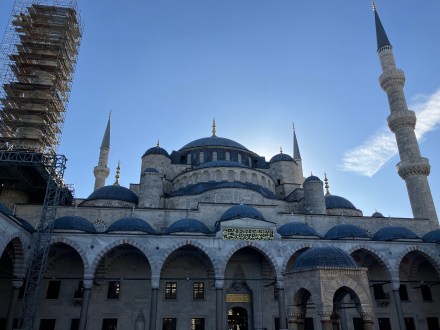
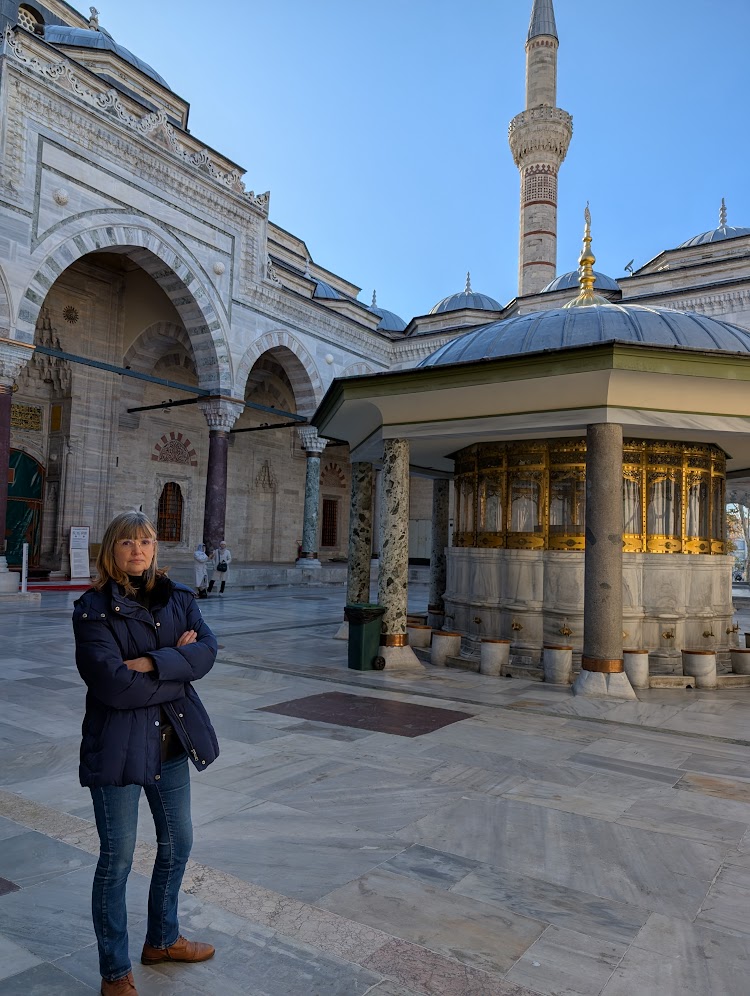
We visited the Blue Mosque. I was expecting it to be more blue and only the roof was blue. But it was still very pretty, and they managed to herd lots of tourists through their holy space in a dignified manner. There was no entrance fee. Very well done.
There were clear signs, telling us what was expected (like women wearing a headscarf and everyone removing their shoes) so you knew what to expect before you arrived.
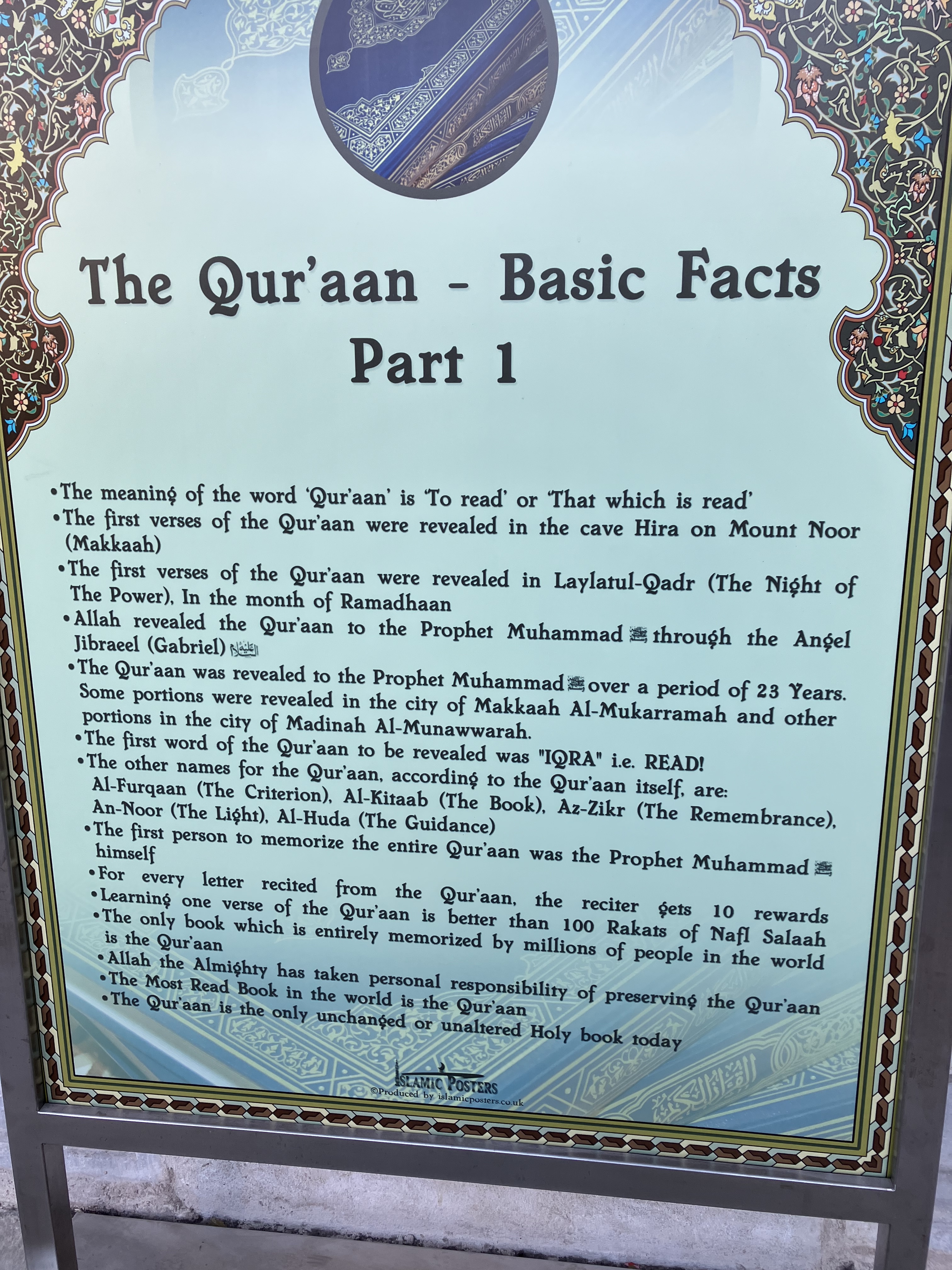
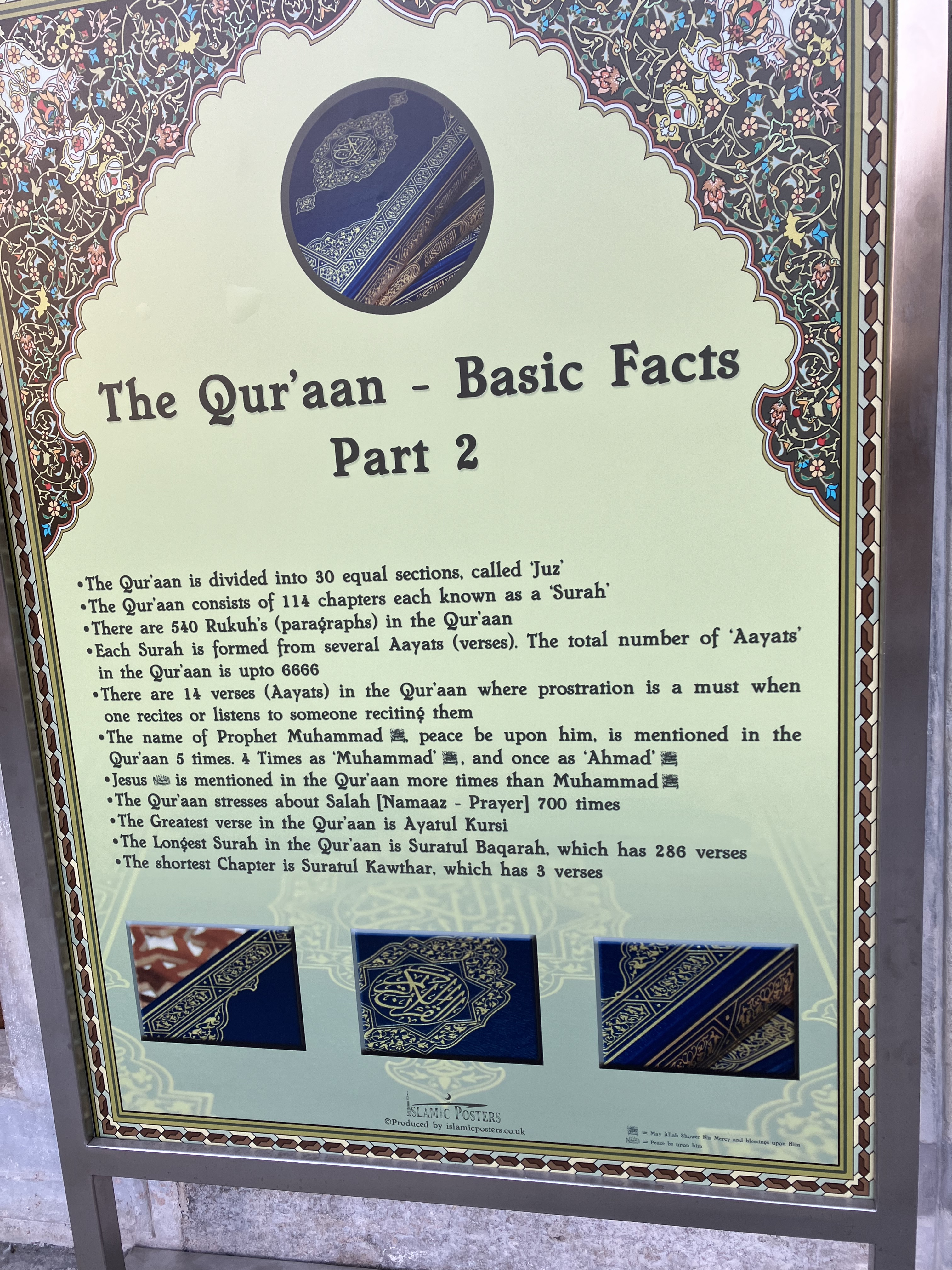
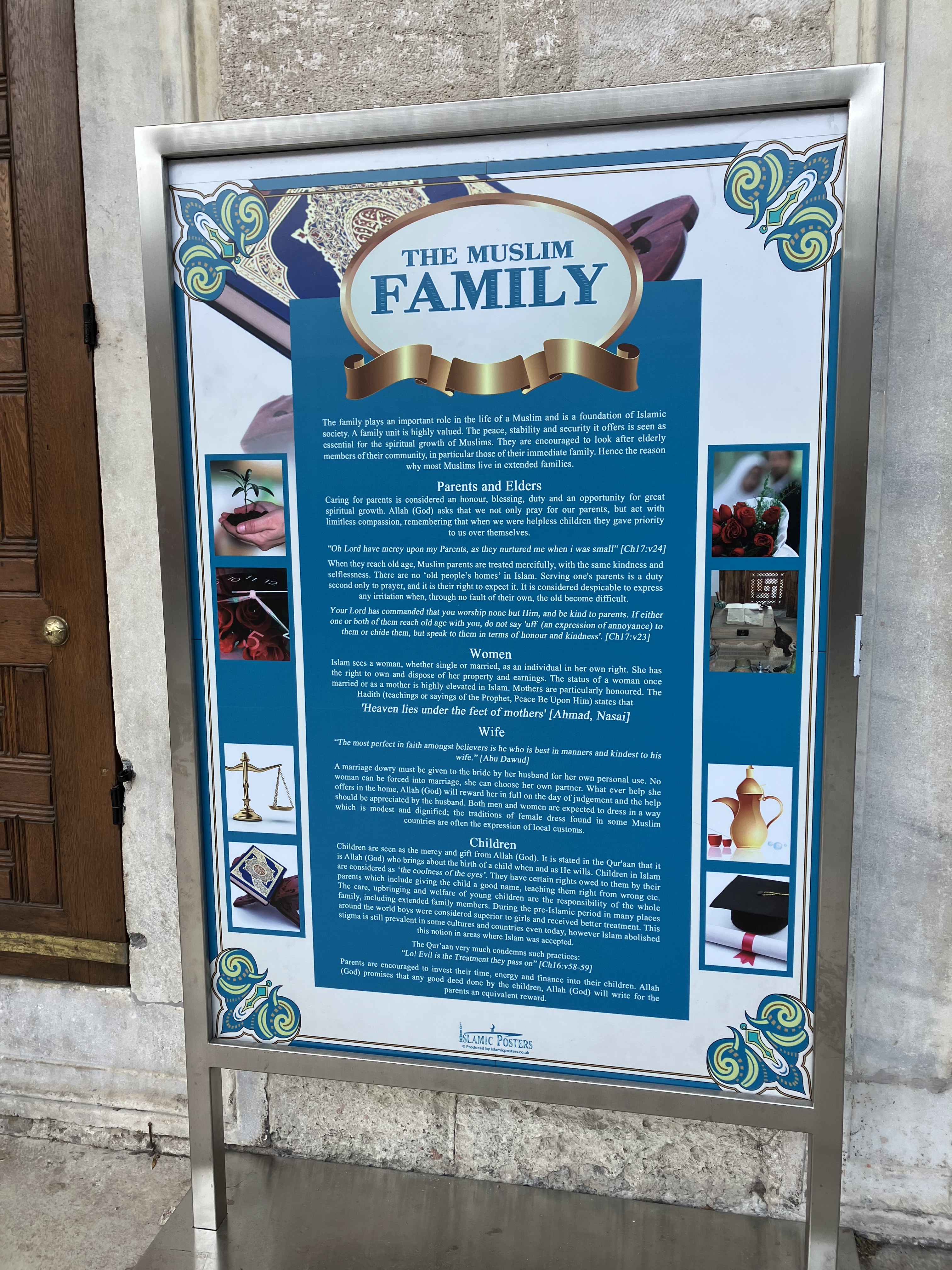
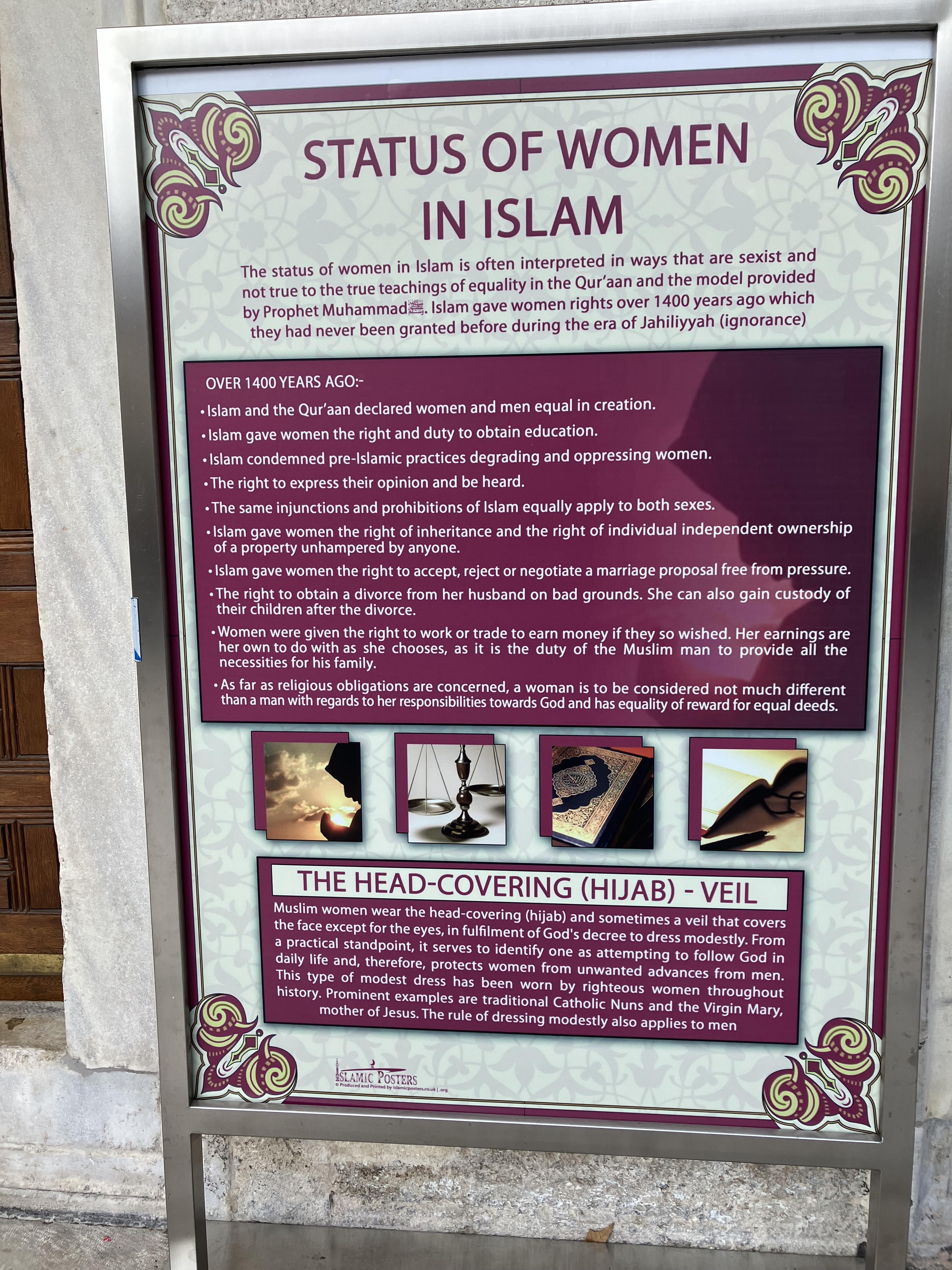
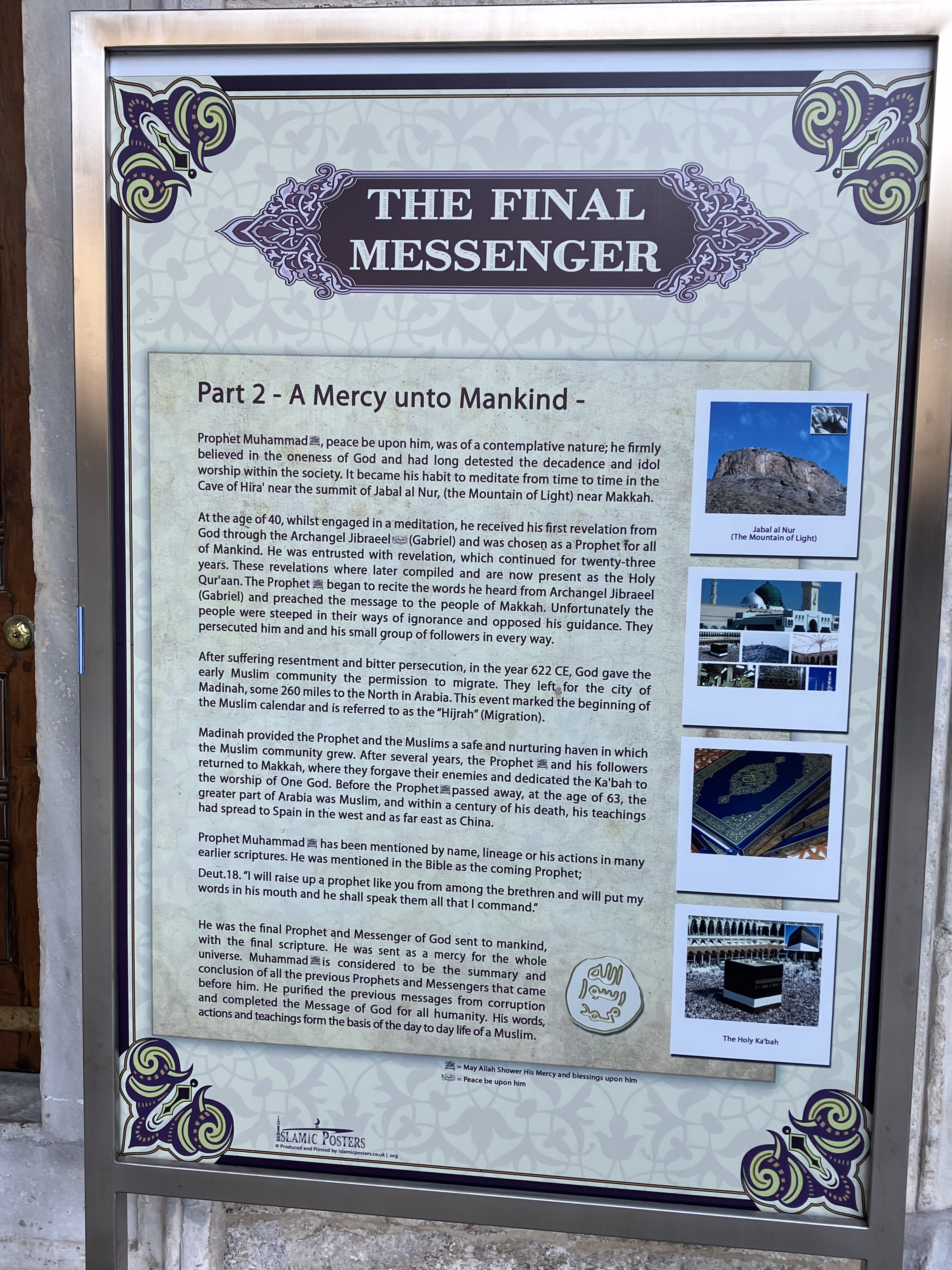
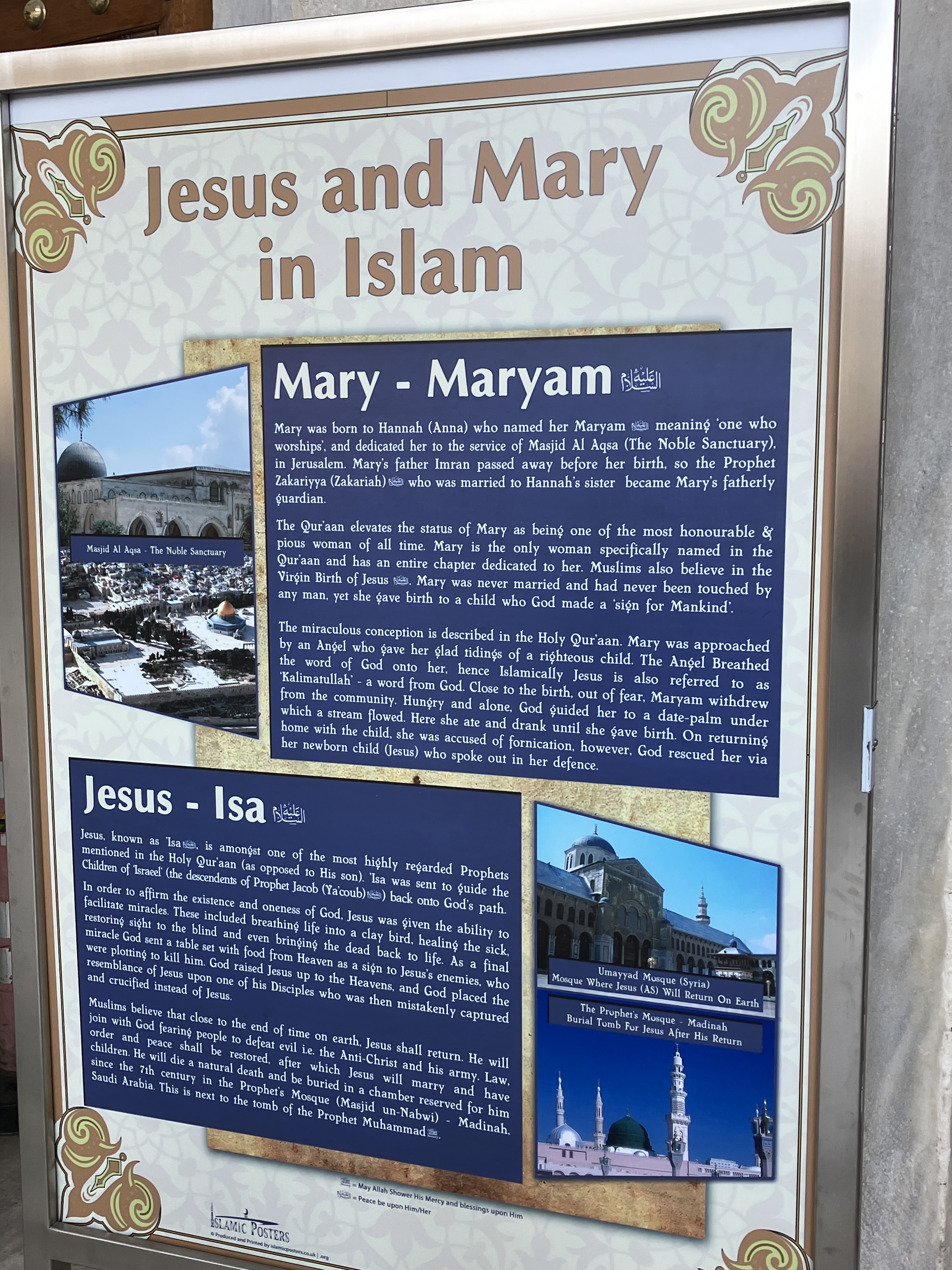
The outer courtyard had information boards, explaining their beliefs. (I checked, and they were happy for me to post them on my blog.) Do read them, and think about whether they compliment or threaten your own views. It’s helpful to know what other people believe, even if we differ from them (and perhaps you don’t differ as much as you thought you did!)
It interests me how many overlaps there are with Jewish, Christian and Muslim beliefs. Obviously there are extremes within each religion, and I would not, as a Christian, want to be linked with the violent hateful sects that call themselves Christian (like the Klu-Klux-Klan in the US) while not showing much in the way of love or purity that Jesus taught. We should remember this when viewing other religions, I think, and not judge the whole by the extremes at the fringe. When I read the boards I did feel some were written in a slightly unrealistic light though, especially the ones referring to the equality of women. I am not sure the ethos described reflects the thinking in practice. But maybe it does sometimes. It’s always hard to remove religion from the culture it has developed within.
We filed into the entrance area, removed our shoes and put them into a bag to carry with us. (Some places have an area where people leave their shoes, but I worry they might be stolen, so this felt more comfortable.) Inside the floor was carpeted, and the prayer area was sectioned to one side. People had hushed voices, though photography was allowed.
There was an information desk, and I had a question about the plurality of words for God in Hebrew, and whether the Quran was the same (it is). The person was well-informed, and spoke excellent English, and probably I could have asked about anything that I didn’t understand. (In case you’re interested, the Hebrew Canon/Old Testament has several places where a plural word for ‘God’ is used, even though Jews and Christians believe in one God. I am exploring why this might be, so I am interested that the Quran is similar.) Whilst my beliefs are different to Islam, I am aware there are overlaps, and there is lots that we agree on. (To be honest, while I do disagree with some of what Islam teaches, I also disagree with what some Christians teach. I guess it’s a matter of deciding what is essential–dogma, and what is variable–doctrine.)
It was, I think, a much better experience than when tourists visit our cathedrals, which seem to lose all reverence and become places that want to collect money rather than inform about Christian belief. This makes me sad. We could learn a lot from Turkey. Tourists can’t enter mosques during prayer times, which are advertised outside.
The call to pray sounds five times a day, reminding people to pray. I liked it, though it sounds very foreign to English ears. It’s too easy to forget about God and all spiritual things when we are busy with our day, it’s good to be reminded to pause.
I hope you will remember to pray today (even if not five times). Thanks for reading. Take care. Love, Anne x
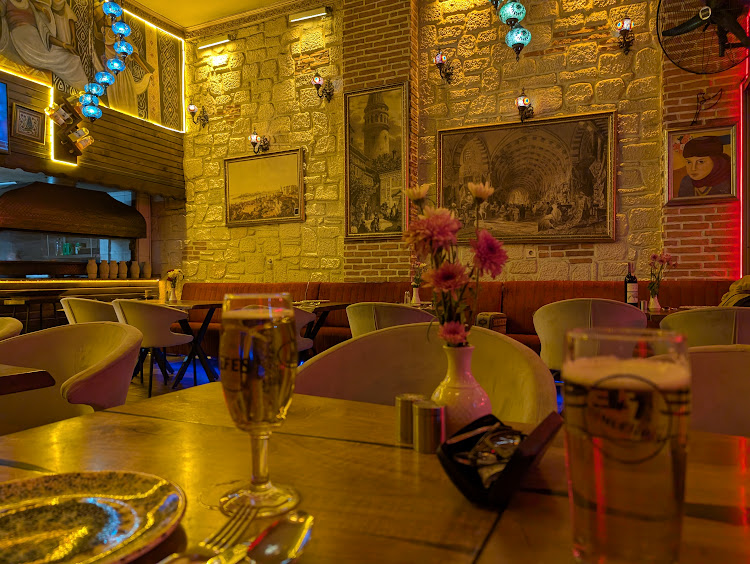
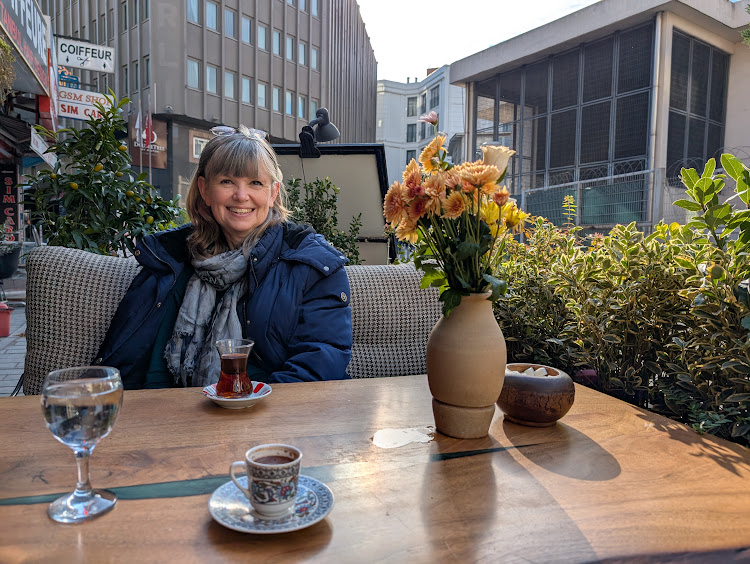
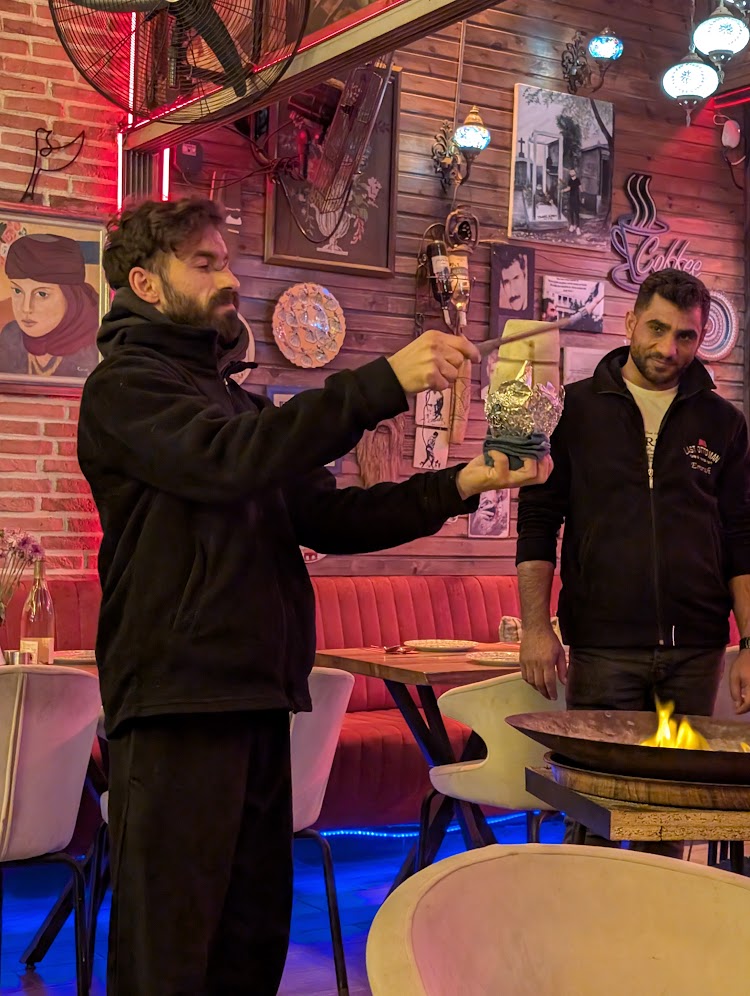
We soon developed a routine of a huge breakfast at the hotel, snacks for lunch, then a big dinner at the Last Ottoman Restaurant and Cafe which was our restaurant of choice because it had good reviews, sensible prices and the staff were very friendly. They are a Kurdish family, all working in the restaurant set up by their grandfather, and we found them warm and welcoming. (Though to be honest, I found most people in Turkey to be warm and welcoming.) One local dish is cooked in a small clay pot sealed with foil. It is stewed for a couple of hours, then (for the tourists) it is tossed in flames, and the pot is cut open and the hot food is tipped onto a sizzling platter. The performance is fun, and I bought one of the pots in a market for a couple of pounds. Very ethnic. They begin each meal with a complimentary bowl of lentil soup, served with steaming flat bread. You can taste different herbs, and mint, so I’m guessing it starts with a lamb stock. After the meal they bring warm squares of havila, and tiny glasses of clear tea on little white saucers. The restaurant is cosy, with walls full of pictures (lots of photos of revolutionaries like Che Guevara) and cushioned seats, and in the centre a wood stove bellows out heat. It is also, like everywhere I have been in Turkey, very clean.
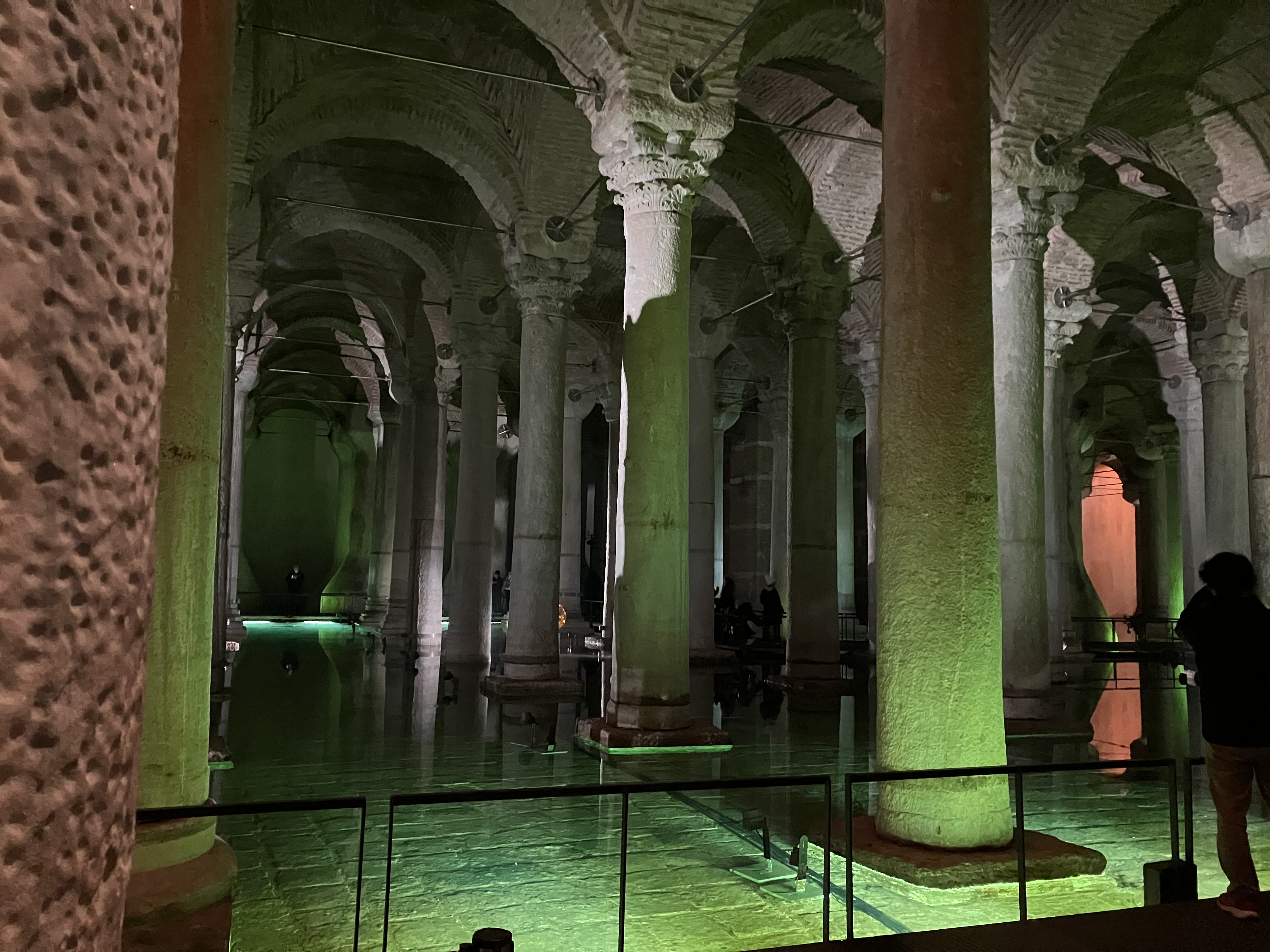
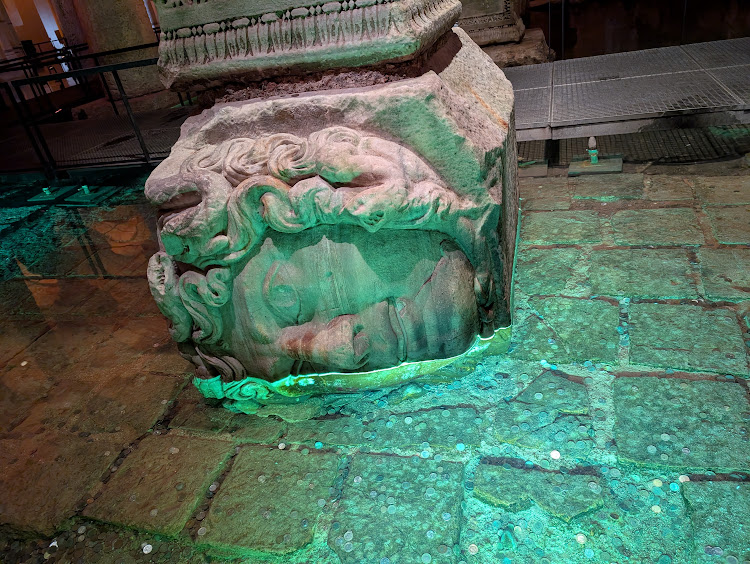
My favourite thing was the ancient water cistern, hidden under the city near the Blue Mosque. It was built in Roman times (maybe by Hadrian) but fell into disuse and everyone forgot they were there. Which means they remained unspoilt until they were opened, drained, and made safe.
We paid 900 TL to enter (about £20 each) and wondered whether it was worth it. It was. We walked down a metal staircase, into a world of atmospheric lighting reflecting on the water and elegant arches over tall pillars. A subterranean palace for enchanted princesses, or ghosts, or maybe just James Bond (From Russia with Love).
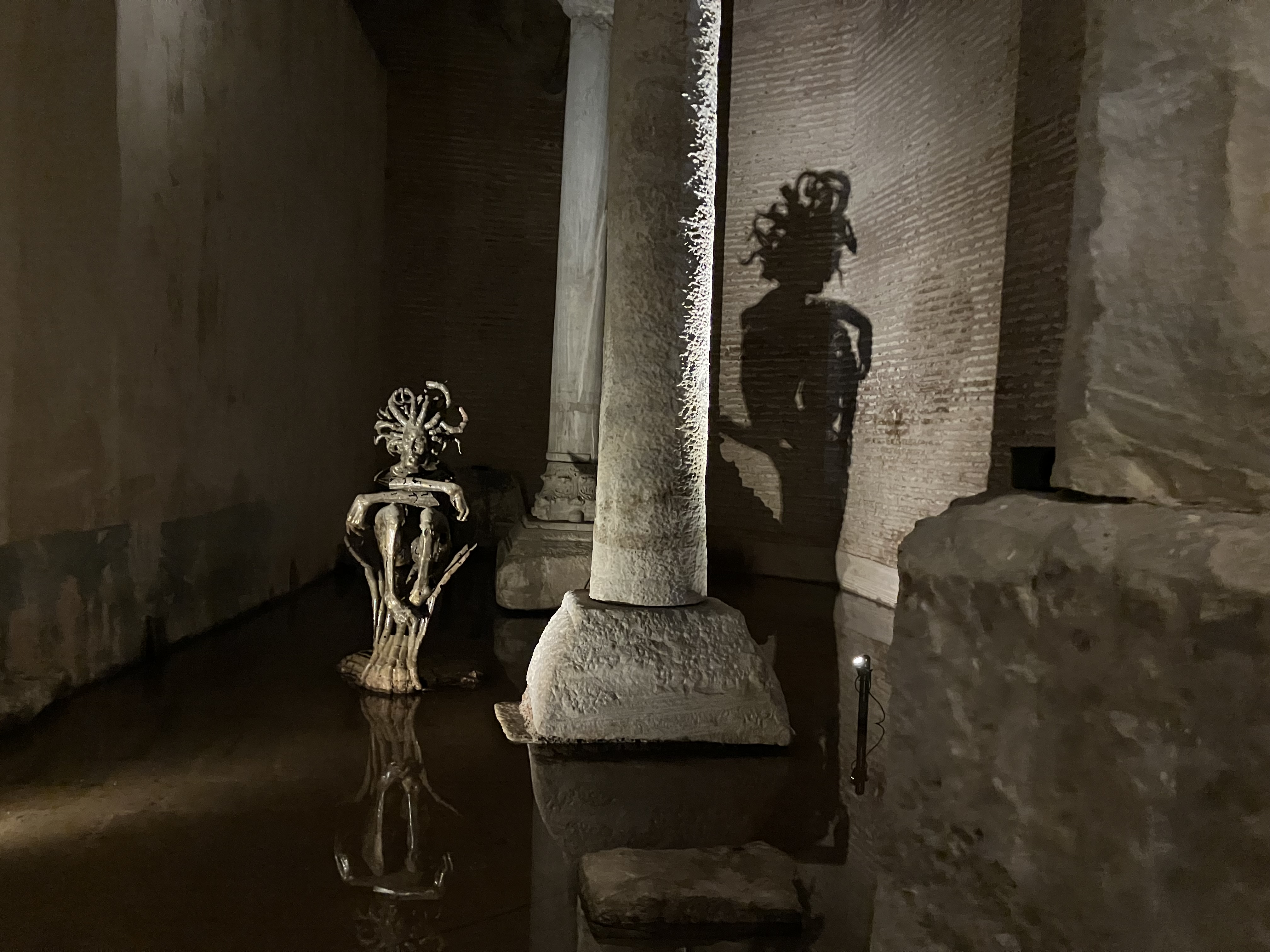
The cistern was made by slaves, and one pillar was engraved with eyes and tears to represent those who died. Other pillars stood on huge Medusa heads—thought to have been taken from Ephesus—which were placed on the side and upside-down. Whether this was to show that the Christian architects (who used slaves) no longer believed in the power of Medusa, or whether they were slightly nervous and so didn’t place them upright (just in case) is anyone’s guess. The modern architects have placed a sculpture of Medusa nearby, and the lights cast her shadow on the wall, which is brilliant.
On a November afternoon, there were few tourists, and we wandered along the suspended metal walkways enjoying the atmosphere, not hurrying, noticing the splendour of the place. I don’t know if they limit the numbers during peak times. Afterwards, when we had walked back up to street level, we crossed the road and sat, looking across the park at the Blue Mosque. I’ll tell you about our visit there tomorrow.
I loved being here, Istanbul is a city with a heart. November turned out to be a good time to visit—but be ready in case it snows.
We arrived in snow. It was Saturday, 23rd November, and Istanbul was colder than expected. The grass between the runways was white, and parked planes were frosted with snow. When we left the airport (which seemed very efficient) we stepped over slushy puddles to reach our hotel car. Pre-booking a car (with a fixed price) was definitely a good decision, as there were queues into the city and the journey was a long one. We crossed a long bridge over the river that divides Asia and Europe, and saw the new mosque (which is not called the new mosque) perched high on a hill overlooking the city.
The snow continued for a while, and we saw cars that had parked on the motorway so people could throw snowballs! Then it turned to rain, and by the time we reached the city everything was cold and grey and damp.
The hotel is nice, and warm and very clean. But there are no cupboards or drawers so we can’t unpack, and the light switches are confusing so every time we try to adjust the lighting one of us touches the master switch and we are plunged into darkness! We ate in the restaurant on the roof, and the food was nice but grossly overpriced. The linen had embroidered cuneiform script, which said Mesopotamia, and I felt clever for recognising it was script (not that I could read it, or even know whether it went left to right or vice versa). We found out later that some cuneiform tablets had been found here—of a receipt for a delivery of furniture. (Cuneiform script is when they pushed a wedge-shaped stick into clay to make symbols, a very early form of writing.)
Breakfast the next day was fun, as we ordered a Turkish breakfast and lots of tiny pots arrived with honey and jam, meats and cheeses and fruits and nuts. There was no room left on the table. All so pretty. I remembered this from our last visit, Turkey is a very hospitable place, with friendly people who seem to enjoy feeding you.
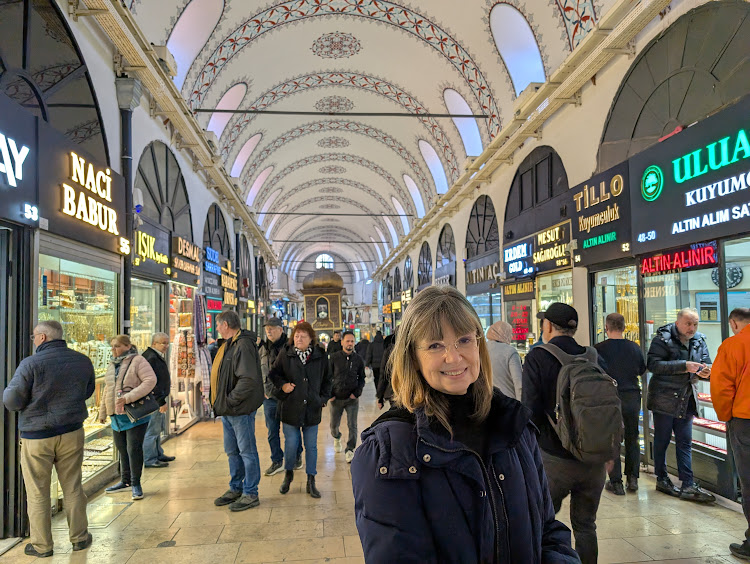
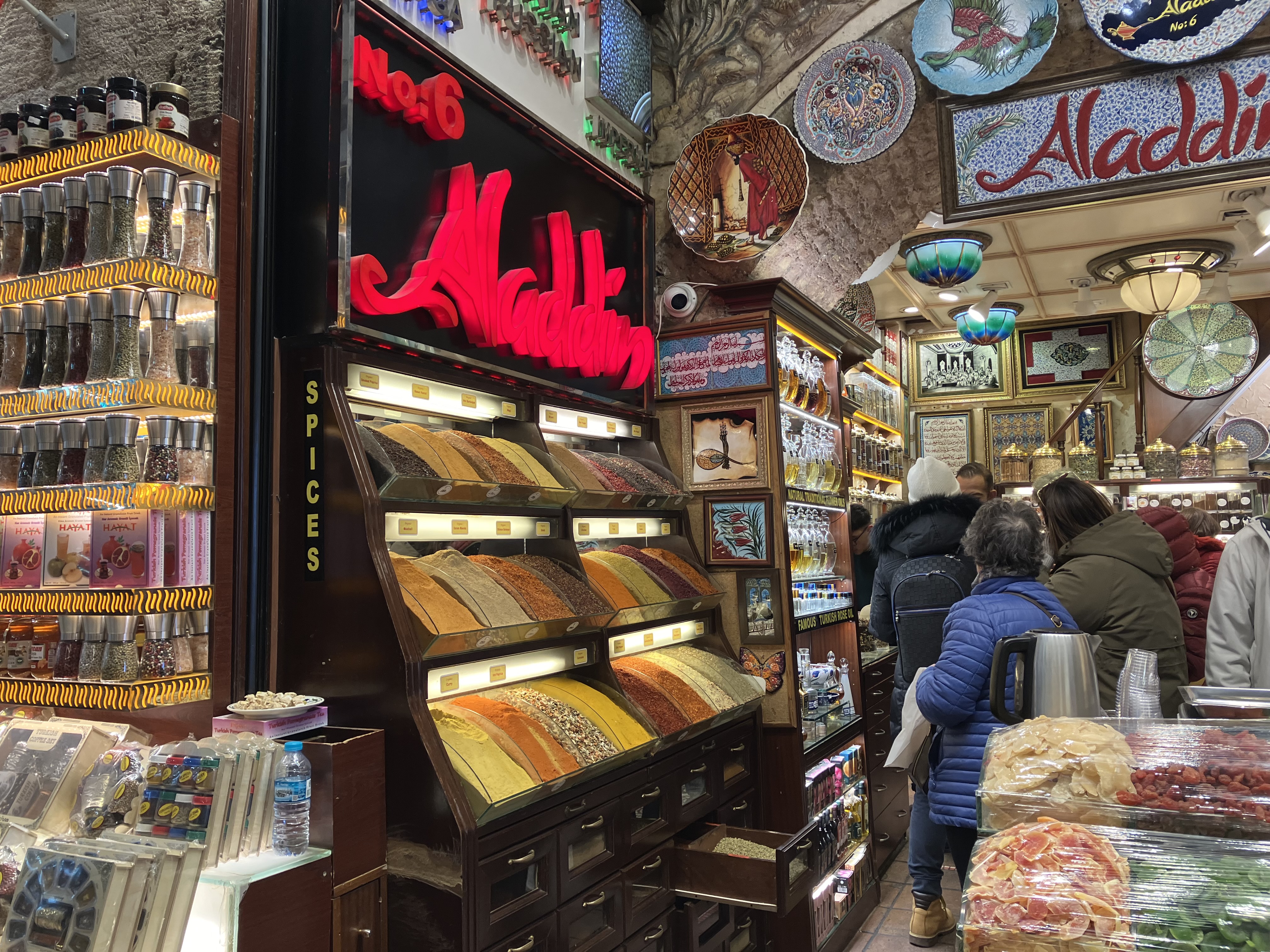
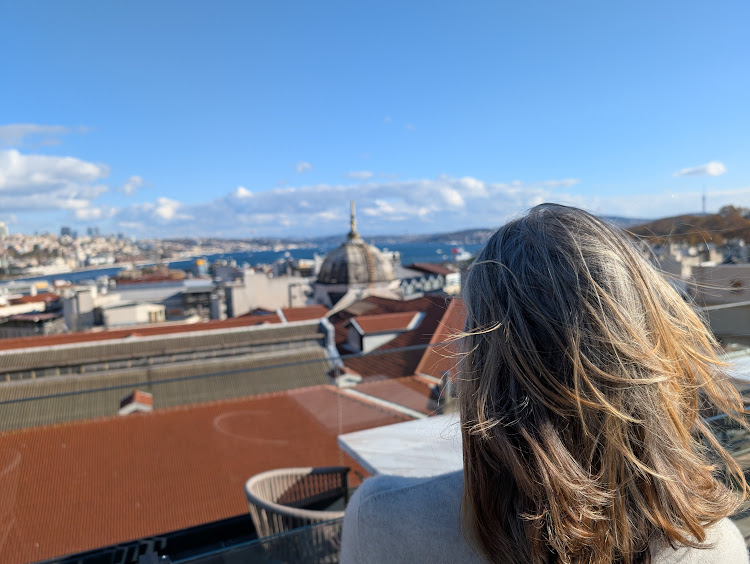
Our hotel is in the old town, and we walked along cobbled streets, sharing the space with motorbikes and men hauling heavy trolleys. There were tourist shops with shiny wares, colourful sweets and bright fabrics and heaps of spices. The skyline is full of minarets, there are so many mosques. We walked to the nearby spice market. It was pretty, a mass of colour and smells in a high-arched ceiling hallway. But it was very touristy, no locals seem to shop there, which made it feel rather artificial. (Though I don’t know who would buy spice when on holiday—I have never felt the urge to take home a few grams of cumin after a week away!) There were streets of stalls outside the spice market, and these felt less tidy and more authentic. Tahtakale is much nicer I think. There were pots and linens and tools and spices, with local people buying them, while men with trays of glasses of tea glided between them and cats watched from every corner. Cats are everywhere here, they are fed by the shopkeepers and stallholders, and they watch everyone and seem very content. I guess they keep the rodents in check. (New York should learn from this: people put out bowls of food and water, the cats are free to roam, and I didn’t see a single rat the entire visit.)
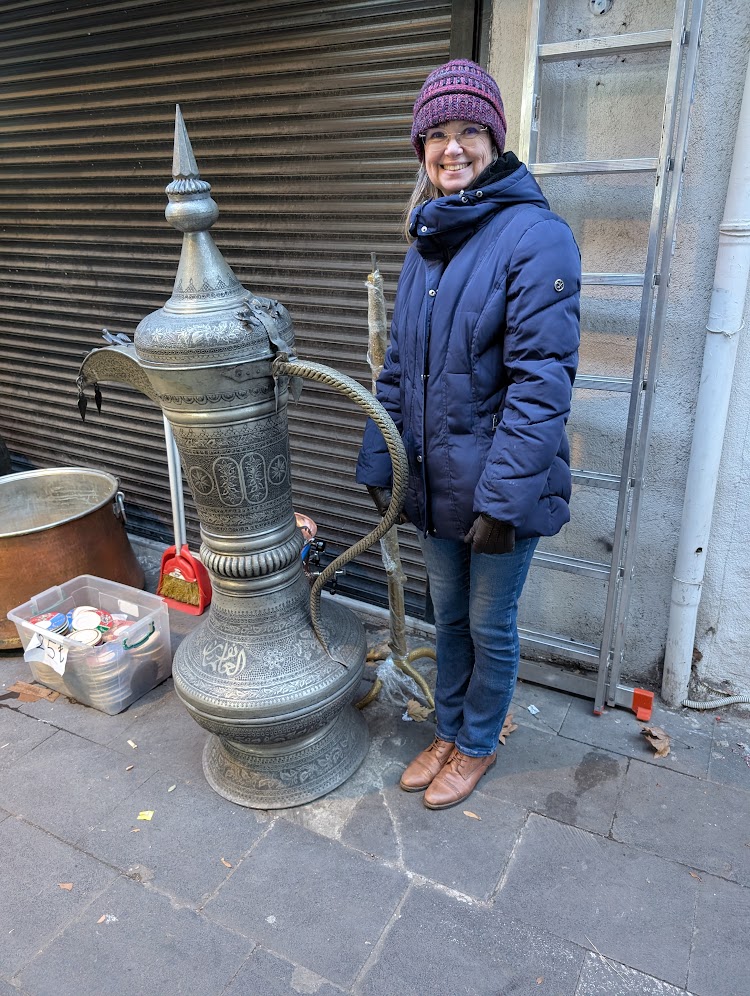
I was keen to buy a teapot, and found a set that is bright green, and slightly garish, and very Turkish-looking. They sell them in sets, a smaller one for tea balanced over a larger one for hot water. Turkish tea is served in fluted glasses, boiling hot and without a handle so you hold them by the rim to sip the tea. But I didn’t buy those. We spent most of our days just wandering. There is lots to see, and people seem happy enough with strangers wandering round. One area was manufacturing goods, the items put into boxes and wrapped into huge white bundles that were heaved onto small lorries or the backs of motorbikes or metal trolleys. You had to watch out for them when you walked, and take care not to fall down one of the gaping holes that plummeted to a warehouse cellar, or to trip over the various uneven paving stones or steps that were randomly on the narrow pathways. I stopped trying to look and walk at the same time, because there were too many hazards, so we stopped frequently, to notice the crumbling buildings above the modern shops, or to stare at the bright wares, or to simply look up at the hills. There are domes, and minarets, and it is all very beautiful.
I will tell you more in another blog. Thanks for reading. Take care. Love, Anne x
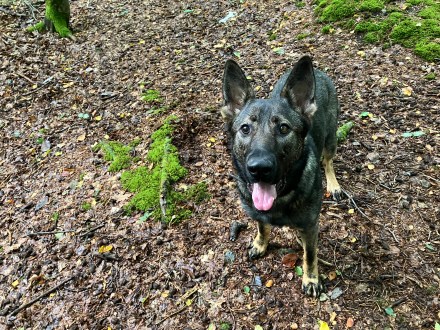
I feel that Meg has changed. She is still challenging, but we have come to an understanding, and I feel she is slightly calmer. Very slightly. I am also trying to have her out of her crate for longer. This has mixed results. In the evening, we now watch telly in the lounge, while Meg chews a bone in the doorway. She knows she must not enter the room (or she gets sprayed with water!) and she is happy, watching us, and chewing her bone. During the day, if left for more than a minute, she will find her own entertainment. Today she was left for 5 minutes (washroom visit) and she found a newspaper and ripped it to shreds. That didn’t matter, but if it had been one of my plants, or a cushion, it would have been very annoying. We are getting to where I hope to be, but slowly.
Walking is easier because I don’t attempt to walk near roads. We go to the woods, and she stays near me, and comes when called (even if I do have to shout ‘Stick!’) so putting her back on the lead is reliably do-able. She will do anything for a stick.
10/8/24,
Meg is definitely calmer than she was. Not ‘calm’ but calmer than the completely hyper monster that she was a few months ago. I am also better at knowing what she can cope with.
In July, I went away for a week, and a son and his partner lived in the house with Meg. When I got home, I was greeted with a happy, calm dog. They had basically played with her for most of every day, and let her run free in the garden, and she had learnt to sleep on the kitchen floor when she was tired. The garden was a mess, with several pots shredded, but it seemed a good tactic. It was lovely to return home to a happy dog. I was however, disappointed by her reaction when she first saw me. There are some people who she is super-excited to see, so excited that she pees on the floor and does laps of the garden. Me, on the other hand, she wagged her tail for, and then went back to shredding the large log she had carried onto the lawn. She was sort-of pleased to see me, but definitely not super-excited. I am in charge of the home, so maybe that makes me more of an annoyance in her eyes than someone to have fun with–because if I wasn’t here, she would probably be in charge. I don’t know. It’s so different to Kia, who was part of me and would have died for me—whereas I have a sneaky suspicion that Meg might be secretly pleased if I disappeared because then she could do whatever she wanted.
On 31st July, we went to meet someone at the airport. I brought Meg, thinking it would be excellent training to walk through a crowded airport. It didn’t quite go to plan, because although she walked into the lift happily, they were broken, so we had to use the stairs. When we entered the stairwell, Meg froze. Four paws on the ground, not going anywhere. We didn’t have time to teach her how to use stairs, so Husband went to the arrivals hall, and I walked round the car park with Meg. It was still good training, walking past lots of people with luggage and moving cars, and going in and out of the stairwell. But not as good as I had hoped. We will work on stairs, and spooky stairwells.
Meg now walks through the woods on the lead very nicely, and we go every morning. When she’s off the lead, she happily greets other dogs, but she tends to chase them, and other owners get anxious, so I mainly keep her on the lead. We have met deer a few times when she was free, and I grabbed a stick, and led her away, and she absolutely prefers a stick to chasing a deer. I have no idea why. I’m worried that with so many deer, there are probably ticks, so I’m careful about keeping her flea/tick drops up to date, and I use insect repellent. (Ticks carry Lyme disease, and that can be dangerous for people.)
Every evening, Meg chews her bone in the hall while we relax in the lounge. She is very good, knows the routine, and does not attempt to enter the room (well, not very far). This is nice, I like having her around.
I started tempting her up and down the stairs with her ball. She’s hesitant, but getting used to using stairs in the house. Mostly, she will do anything for a ball. I still try to hand-feed her most of her food, and practise calling her, and teaching her to walk to heel. It’s all great unless there’s a distraction, and then she is still terrible. I can get her to sit near the main road and concentrate on a treat rather than the cars, but not yet in our lane. She still hares up and down the garden fence if a car goes up the farm lane.
Next week we go to Rome, and for the first time, Meg will go into kennels. I think she’ll enjoy it, she is very sociable. I am so looking forward to the break.
11 Months
12/8/24
I have started to keep Meg on the lead for longer, because I am more relaxed and it makes the walk more enjoyable. She has lots of time to run free in the garden, and walks are more for mental stimulation. Today, in the brief time that she was free, we met 3 large black Labradors. I think they were all males. Meg bounced up to the first one—and I didn’t attempt to stop her because they were a similar size to her, so wouldn’t be bounced, and they were Labradors so must be friendly. Except they weren’t (friendly—that is, they were Labradors!) The first one raised his hackles, obviously not keen to be greeted by an impertinent young female. The other two surrounded her, and before I knew it, Meg was lying on the floor while the Labrador owner shouted at her dogs. Meg managed to get up, and started to run, so I called her, and she came near enough to grab. (Not, of course, running directly to me, but sort of in my general direction, which is usually the best I can hope for.) At no point had Meg yelped, and in my experience, dogs yelp at the smallest discomfort, so I’m pretty sure the encounter was about dominating her rather than attacking her. The owner was extremely apologetic, but I wasn’t sure it was necessarily a bad experience for Meg. It might be good for her to learn that racing up to a big dog is not always a good idea. And as I say, there didn’t seem to be any viciousness to it, the Labradors were just making sure she knew her place in the pack—which was at the bottom!
We continued our walk on the lead. It’s really hot, so the whole world was walking their dogs early, and we met lots of people. When they saw Meg on the lead, most people called their dogs, thinking she was unfriendly, so I started to call to them, explaining she was friendly but super-bouncy. They then relaxed, and I worked on training Meg to sit while the other dog approached her, and I had little chats with the owners and it was all very sociable. Meg was friendly to all the dogs that passed us, so the earlier encounter with the Labradors had obviously not affected her badly.
It’s hard to keep Meg cool in this weather, and she pants continually. I can’t wet her, because she hates the hose, but I have wet her bedding, so she can lie on cool damp towels. Not that she does of course, she picks them up and runs round the kitchen with cool damp towels! But I tried.
She is getting better at stairs already. Today I put her ball on increasingly higher steps, and she walked right to the top of the flight without a problem. Coming down is more precarious, because she tries to leap the last few steps—which would be dangerous if she was on the lead—so I will keep teaching her to go slowly up and down. (And is quite dangerous if anyone stands near, as they might get a flying German Shepherd land on their head.) She’s fun to teach, because she learns so quickly. Just as long as she doesn’t kill someone by mistake…
Thanks for reading. Have a safe week. Love, Anne x
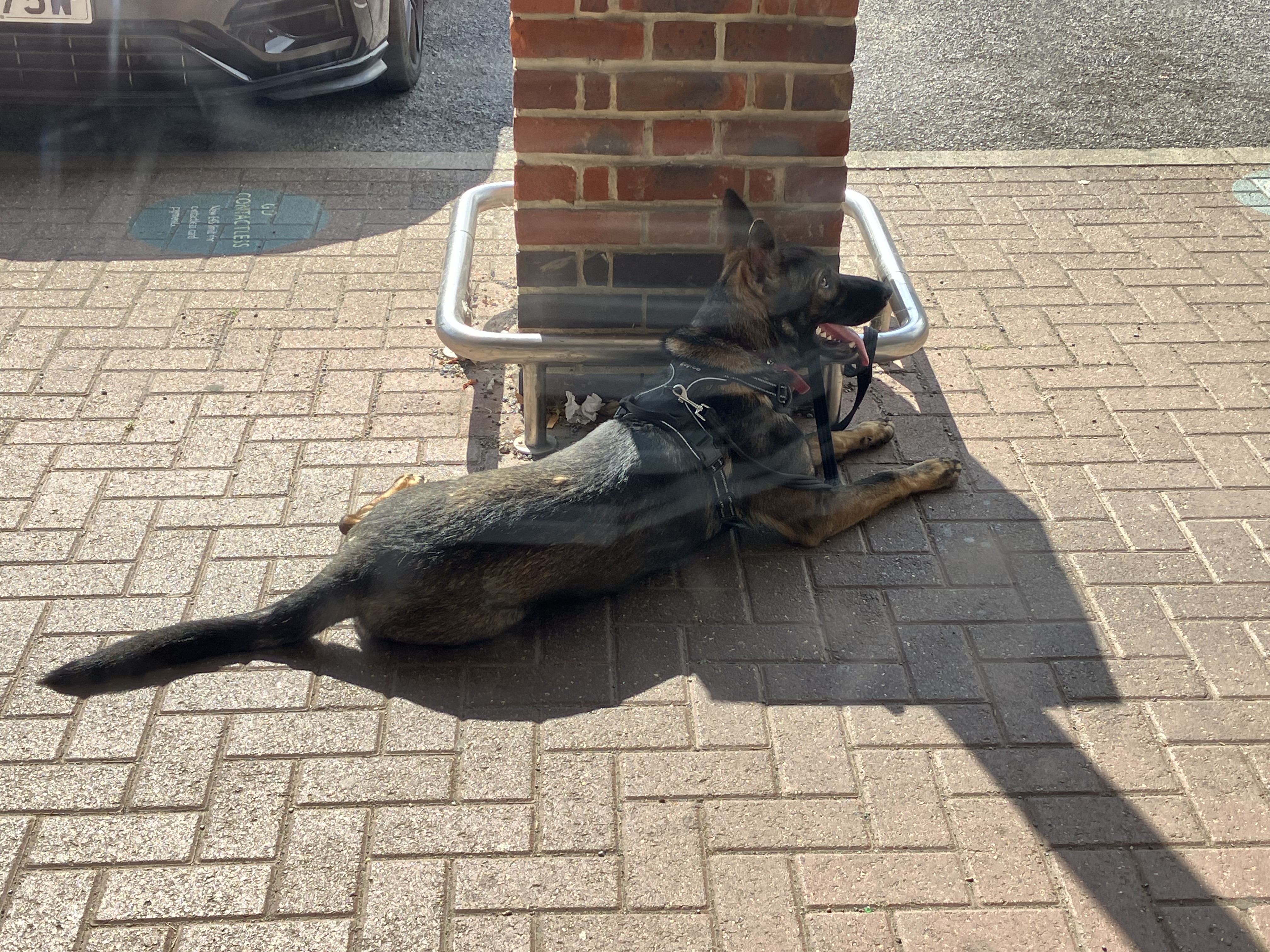
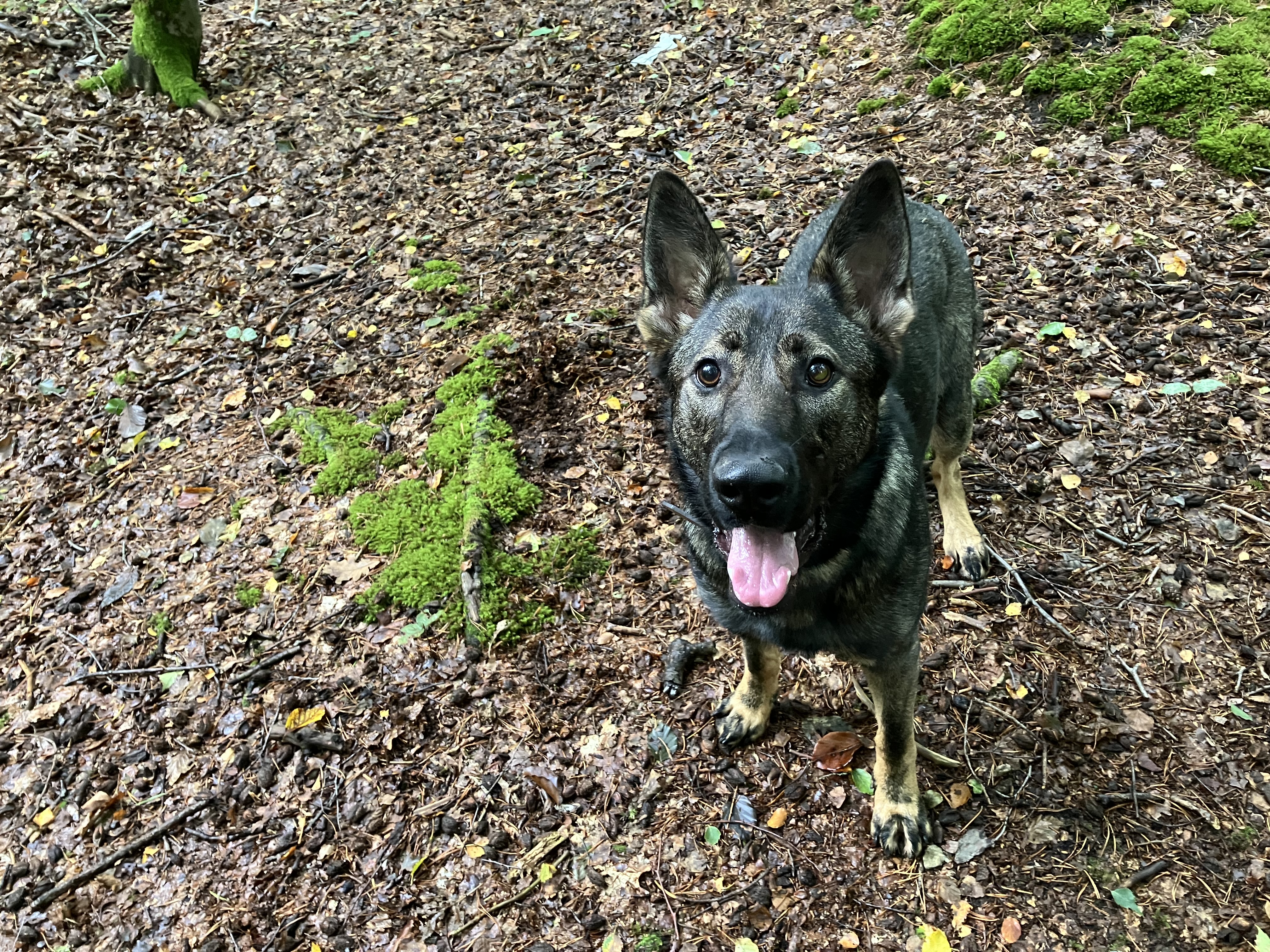
Walking calmly next to the trolleyWaiting outside the supermarketFocussed on a stick!Action shot
I have coffee and cake, and am settled down to read The Consuming Fire by Liane M. Feldman. My PhD supervisor recommended it, and I’m really enjoying it—so am recommending it to you. I will share what I have read so far, and then you can borrow/buy a copy and read the rest yourself. I suggest you read it with your ‘thinking-hat’ on (it’s hard to escape my past life as a primary school teacher). There may be bits you disagree with. But that should be true of everything you read—never accept what someone says without thinking about it for yourself.
Even the physical form of the book is enjoyable. It has a classy cover in black and white (unlike most theology books, which are either overly jazzy or artistically unpleasant). It’s a good size—not too heavy with decent sized print (again, not a given with theological books. Sometimes I think people publish books that are purposefully unpleasant to read, almost as if they are challenging anyone to actually enjoy them!)
The content of the book is about the Hebrew Canon/Old Testament (obviously, as that’s my area of study) and it’s looking at what is called the ‘priestly writing’. To understand this, you need to know a little about who wrote the first five books of the Old Testament/Hebrew Canon—the part called ‘the Pentateuch’ (‘pent’ because there’s five books, not sure where the ‘teuch’ bit comes from, so do tell if you know). There are probably five books because at one time they were written on scrolls, and the length of a scroll was limited (if they were too long they ripped) so the very long narrative of the Pentateuch was split into sections, and written on five scrolls.
Anyway, for centuries, people studying them thought they were written by Moses (even though the narrative of the death of Moses and beyond is contained in them). Then in the middle ages, scholars decided that actually, the styles of writing, and the fact that there were different accounts of the same event, and facts that contradicted each other, probably meant that there had been several texts, written by different authors, that had all been put together at a later date. They gave the different types of writing labels: P (because it seemed like priests had written them—lots of religious details); J (because God was called ‘YHWH’ and they were German, so wrote YHWH with a ‘J’); D (because Deuteronomy had a style all of its own, and was mainly about the failure of the Israelites and how they were punished); E (because God was called ‘Elohim’). This idea, of four authors, lasted for another few centuries.
More recently, after lots of debate by scholars (who like to challenge each other’s assumptions) they have decided that actually, it is unlikely that there were definitely four authors. May have been more, may have been less. However, they are all agreed (which is rare) that there was certainly a ‘priestly’ writer (or writers). Some texts have a distinct style (in the Hebrew) and can be lumped together as coming from one text (even if it evolved over time).
Back to The Consuming Fire—this book takes just the texts thought to be ‘priestly’ texts, and has put them all together. Mrs Feldman says that at one time they existed as a single text, so we should read them now as a single text. She also changes the language a little (I especially like this bit!) as she wants her translation to reflect how we think today. (She speaks American I think, but we will forgive her that.) So she has avoided ‘biblical’ language (the language that only appears in the Bible today). Things like ‘hardened his heart’—who actually says that today? Or ‘bloodguilt’? (We say ‘he has blood on his hands’ which means the same thing, and its easier for us to understand the concept.) Mrs Feldman has tried to write a translation that we understand—though not one that we can relate to. The concepts within the text are ancient ones, we do not consider women to be ‘contaminated’ after childbirth, for example. It is an ancient text, and we should read it as an ancient text, but this translation allows us insight into how those ancient people thought. Mrs Feldman has also (another thing I like) been honest about the words that we don’t understand, and has stated this in her translation. Sometimes, we don’t know what the Hebrew meant, and rather than writing a possible translation (which readers then accept as ‘truth’ because ‘it’s in the Bible, isn’t it!’) she has been clear that actually, we don’t have a clue.
What is the point of this, you may be wondering? Well, I think if we try to understand what those ancient authors were trying to communicate, if we read texts in the correct context, we will understand it better. If we think about why some of the details are there, we may begin to understand how they are relevant for us. I doubt any of you, when you read about the dimensions of the temple, think ‘It’s great I know these numbers and measurements, because now I can build my own temple on the playing field next to the scout’s hut!’ So why are they there? What were the priestly writers trying to say? What was their point?
Now, my final note before you make a drink and add the book to your Christmas list—does all this talk about multiple authors mean the Bible can’t be trusted? Does examining a text in detail, taking it apart, thinking about what the author intended—well, does all that take away its authority? Does it reduce the Bible to just another ancient text? I think not. I believe the Bible, especially the Old Testament/Hebrew Canon, has great authority. I believe that we meet God there, and meeting with God changes us. For me, the text was inspired by God, and he uses it today to teach us truth. I don’t think that having several authors means God wasn’t able to inspire what was written, or what was edited, or what was preserved and translated. We don’t have to pretend it isn’t an ancient text. We don’t have to pretend we understand all of it. We don’t have to pretend that every single dot and dash and comma has existed throughout history until it landed in your shiny English version. God can, and has, worked through different people in different eras. If we let him, God can still change us through our reading of the text—no matter how many people were involved in its writing, editing, translation, copying.
Time to stop writing now, and read to learn more. Hope you have a great day.
I very quickly want to tell you about a meeting that I’ve just had, with a couple of people who partner with Tearfund in India. Some of the meting was confidential, but some things I can share. Talking to people who live in vastly different places, with different problems, is always good. It’s so easy to stay in our own bubble, and to worry about our own problems, and hearing about people who mainly eat rats for supper helps to keep things in proportion.
I was learning about a project Tearfund are partnering with, which has the catchy title: Transforming Masculinities. (Honestly! I kid you not, this is the title they have come up with.) Unlike the title, the work has absolutely nothing to do with people who feel they are the wrong gender, or who want a sex-change, or any of the other modern inferences that you might imagine. The work is about educating men about the rights of women—teaching husbands that their wives are equal partners, and their daughters should have the same rights as their sons—that sort of thing. Crimes against women is still a big problem in India, and educating the men might be a good way of sorting it out. Especially because men in the churches are sometimes no better, when it comes to abusing women, than men outside of the church.
Tearfund is better than me at knowing how to meet need—and how to assess it. One of the workers made the excellent point that when assessing the success of a project like this, initially, you might expect the police stats on crime against women to increase. Because more people will be reporting it rather than hiding it, telling the women that it doesn’t matter. (The long-term aim, of course, is for the crimes to stop, but reporting them officially is a first step.)
The workers also talked, as an aside, about some of their other work—like ensuring people who cannot read or write are able to access the government help that is available, or mending toilets and checking that people in the slums are using them, or ensuring there is clean water available. When you see lists of things like one toilet to every 33 people, or a clean water tap available to x number of families, it really makes you think. This is today, 2024, and there are still families sharing a single clean water tap? Really? How is this okay?
They also spoke about the issues today, which I was ignorant about. Did you know that currently (end of November 2024) the pollution in Delhi is so bad that people have been told to stay inside? So just like during Covid times, children are not able to attend school, people are struggling with child-care and online work—and those are the ones lucky enough to have a job that can happen indoors. The people who have to be out are getting ill, simply because they don’t have clean air to breathe. We talk a lot about our rights in the UK, and the sense of entitlement worries me. But surely, everyone has the right to clean air to breathe.
We need to be aware of these issues, because we are all part of the problem, aren’t we? As I said, we live in our bubble, and if climate change doesn’t directly affect us, it is easy to ignore. If our taps work (our own tap, in our own kitchen—not shared with several other families) then do we even think about clean water? And as you read this, are you hoping to catch some rats for your supper this evening? We live in a small world, we are able to be part of communities that have less than us. Please don’t just turn away. Please think about how you can be part of the change to improve their lives, because they are real people, coping with real issues, they are not just a photo on a charity poster. I know, because I chatted to them this morning.
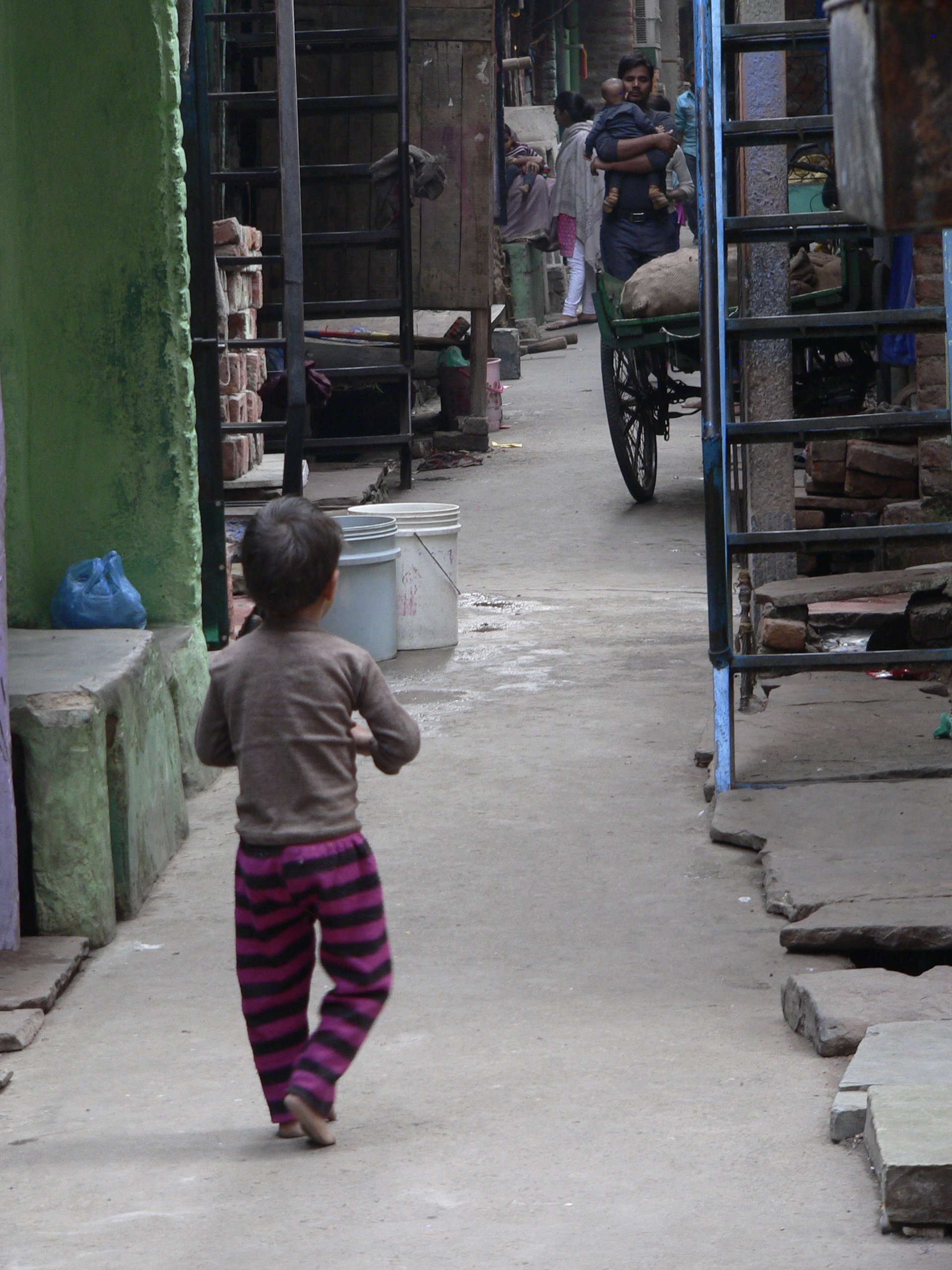
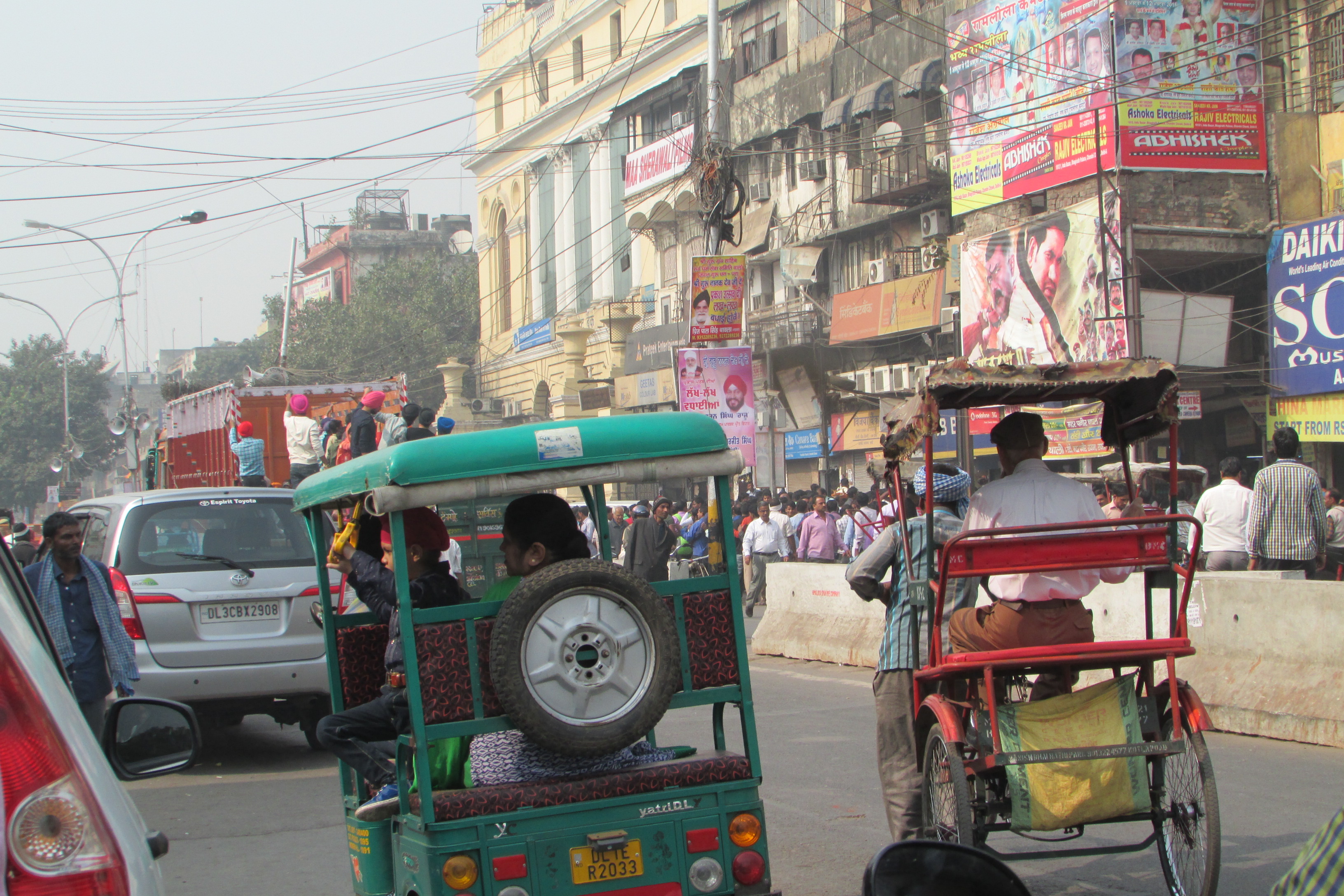
Thank you for reading, and please don’t just forget about it. Have a good week. Take care. Love, Anne x Some photos from my last trip, which was several years ago, but I fear things may not have changed much.
Playing in a rubbish tipUnder the paving slabs is an open sewerWonderful, colourful, crazy traffic!
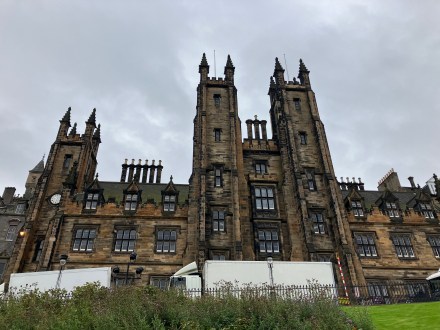
There was a debate about assisted dying in Edinburgh, so I went. It’s the first time I have done a random short trip to the university, and it was rather fun. I’m also feeling rather pleased with how brave I was (because I am not a happy single traveller).
The train to Edinburgh passes some pretty scenery.Be sure to sit on the right of the train for the views.
I arrived in Edinburgh mid-afternoon. I had booked a Premier Inn near to where the debate was, so I set Google maps to ‘wheelchair access’ and pulled my suitcase through the city. (Google still took me up some incredibly steep inclines, so I’m glad I wasn’t really pushing a wheelchair!) The city is lovely in November in a new way. They are setting up the stalls for Christmas markets, and several places already had lights on, and it was very pretty and exciting.
I checked into the hotel, left my bags, and went to where the debate was going to be held—a sort of dry-run so I knew where to go and how long it would take to walk there. I suspect no other students did this, but they are probably better at finding things than me, and less embarrassed if they arrive late. People who get anxious like to be prepared. I’m glad I did, as it was in one of the lecture theatres of the medical school, and I needed to ask directions when I was in the building. The seats all faced the doorway, so arriving late would be awful!
Once my plan was sorted, I looked for somewhere to eat. The debate was at 6.30, so I ate early and braved the hotel restaurant. I sat in a completely empty restaurant, drinking red wine and eating dinner, feeling like ‘a real grown-up.’ You would be surprised how often grown-up things, like attending a conference in a city on my own, seem difficult. But they’re not really. It has taken me many decades to realise this.
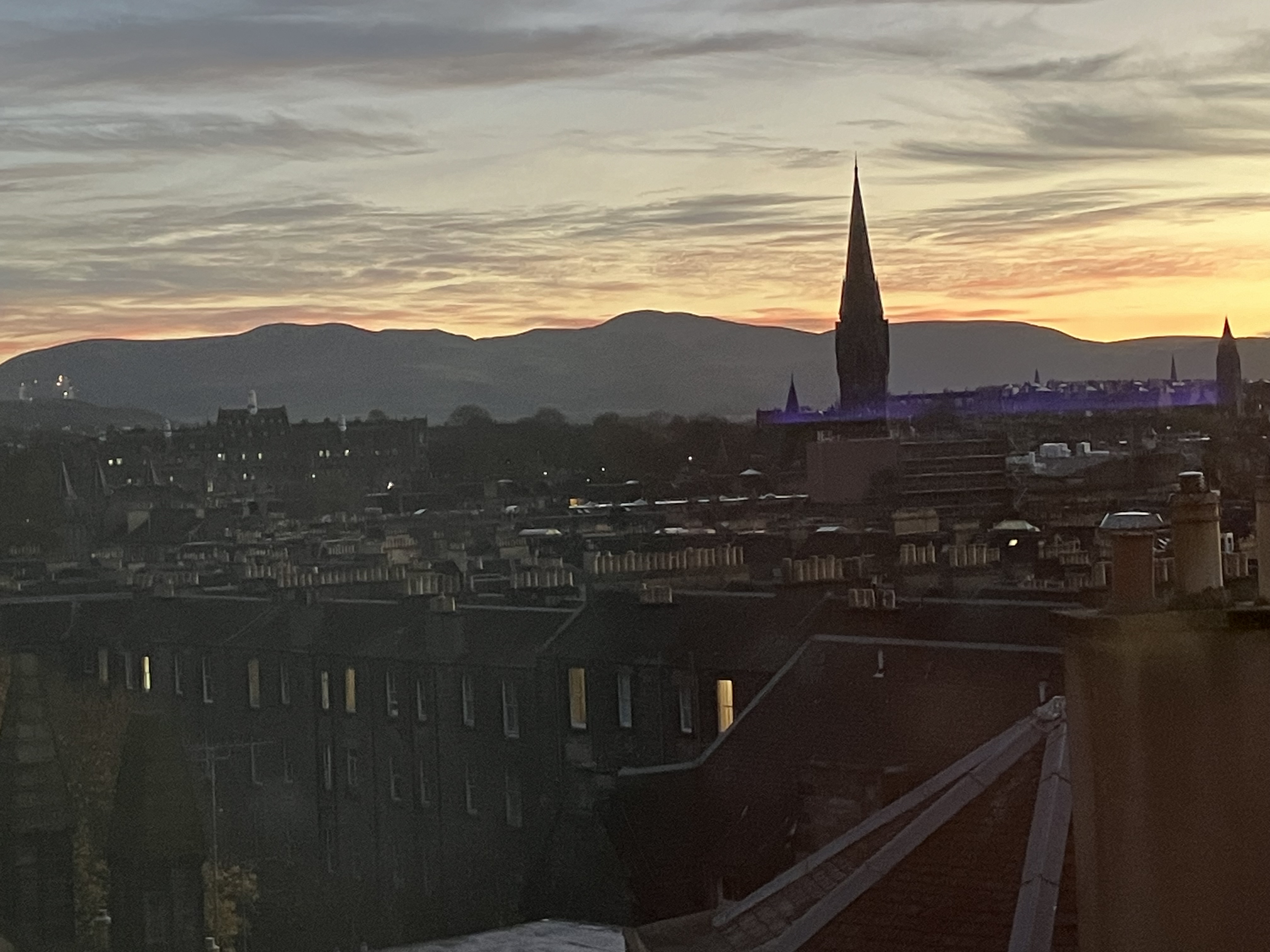
Beautiful Edinburgh at Dusk
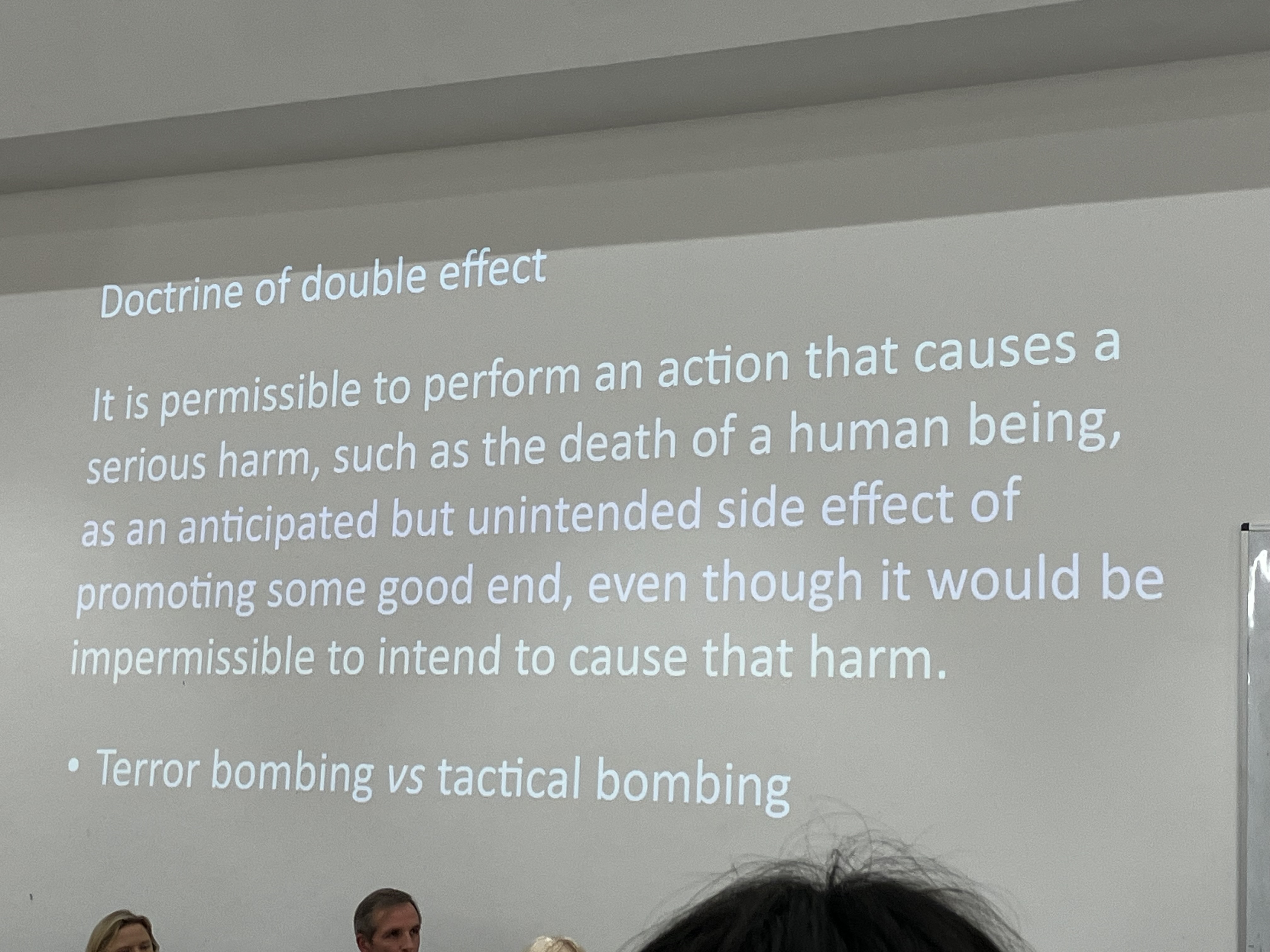
The debate was excellent. I will write a separate blog about what was said, but they had speakers on both sides of the debate who made clear logical arguments. The lecture theatre was mainly full of medical students (who looked like children to me) and they were very invested in the issue. If the law changes they will be involved with administering it in a couple of years time. Which must affect them, I would think. (More on that another time!) In my nerves I had left my notebook and pen sitting on my desk, so had to make notes on my phone, which was less good. I also took a photo for my mother, who had made a comment about a flower arrangement at the front, so I wanted to show her that a university lecture theatre and a church conference hall are very different styles. (There is also less leg room in a lecture theatre, so I was very uncomfortable.)
After the debate there was a drinks reception. I was keen to speak to some of the panel, so I grabbed an apple juice and looked around. I found one of the speakers, but I couldn’t remember his name (of course) and as I have a problem with recognising faces, I asked him if he was ‘the philosophy chap?’ Which he coped with very well, and told me his name. Turns out he’s the Head of Philosophy at the university, so I got that bit right if not his name. We had an interesting chat as we negotiated our way passed the boy opening bottles of Prosecco by popping the corks up into the ceiling. I asked him (the head of philosophy, not the boy trying to injure us with corks) whether assisted dying should be called suicide (which one of the panel had). Given the choice, the people would choose to recover, not die, so surely they weren’t suicidal? He pointed out that philosophically, it’s the same thing, as people suffering from depressive illness would probably choose to be cured rather than die too. (Which was a good point.) Though he did allow that assisted dying was more about choosing how to die than whether to die.
As I said, it was an interesting evening, and I have lots to think about. (Especially, I question whether assisted dying should be decided by either the medics or the politicians. It’s about death, and this is a matter for theologians and philosophers I feel. When someone is about to die, I think a chaplain or counsellor would be better qualified to help than a doctor. But contemporary society doesn’t particularly value theologians or philosophers. Perhaps it should.)
It was late when I left, so I phoned Husband as I walked through the city back to my hotel (because then he would know exactly when I was murdered). Got back safely, slept badly because I couldn’t work the room thermostat.
Breakfast in a pretty Cafe Nero that had fairy lights and Christmas wreaths. Felt very pleased I had come as I walked back to the station, listening to the seagulls and looking at the lovely old city that is Edinburgh.
Thank you for reading, I hope you have a great week. Take care. Love, Anne x
IKEA homeware packed in boxes, Heaps of stuff littering the hall, squashed into the back of the car. Last hugs, cheery goodbyes, the drive to uni. Snippets of home, spread around the strange smelling room, The lanky excited-scared almost-man says goodbye, And the mother remembers. She remembers the feel of the bowling ball weight on her hip when she carried him, The feel of his tiny hands on her cheeks when he offered snotty kisses, The snuffle of breath as he slept against her shoulder, She remembers the child as she looks at the man. As she wishes him well, holds back tears until she has driven away.
Billycans and clothes stuffed in kit-bag, A train to London packed up tight, hurry to find the right squad. Last hugs, tearful goodbyes, a band plays on. Heaving the bag, look around for friends joining too, The lanky excited-scared almost-man says goodbye, And the mother remembers. She remembers the feel of the bowling ball weight on her hip when she carried him, The feel of his tiny hands on her cheeks when he offered snotty kisses, The snuffle of breath as he slept against her shoulder, She remembers the child as she looks at the man. As she wishes him well, holds back tears until he has joined his unit.
The posts on Facebook show new friends and nightclubs, Texts assure his food is fine, his studies easy. He doesn’t discuss the drunken evenings, the sleepless nights, the fear of loneliness. But his mother knows, she reads it in unsaid words and tired-eyed photos. And she waits. As life goes on.
There are no letters and the News shows little, Bold battles move to the Front, the headlines proclaim. They do not discuss the fallen comrades, the sleepless nights, the fear of injury. But his mother knows; she reads it in unsaid words and tired-eyed photos. And she waits. As life goes on.
The war ends. The boy returns home. Yet, not a boy, become a man. A man who will not speak of horrors, Will not discuss the stench of death, The sight of his friends, falling. The nights when he still hears the screams, still fears the dark. But his mother knows; she reads it in sunken cheeks and, eyes so weary. And she waits. As time goes on.
The term ends. The boy returns home. Yes, still a boy, almost a man. A boy who chats and loves to amuse, Loves to debate the point of life, Who meets all his friends, laughing. The nights when they drink, talk at length, sort their beliefs. And his mother knows, he is safe and content with life, has a future. And she waits. As time goes on.
by Anne E. Thompson
Thank you for reading. anneethompson.com Why not sign up to follow my blog?
I used to spend a lot of time asking ‘What does this Bible passage really mean?’ I meant, what did it mean to the first people who heard it—what did the author intend? However, I have realised that actually, the early readers of the Bible texts didn’t do this. Even within the Bible itself, we see the New Testament characters taking Old Testament texts and using them in a new way. In the spirit of this, I considered the text in the book of Matthew, chapter 4, when Jesus was tempted in the wilderness.
We read of three different temptations of Jesus, and as I thought about them, I applied them to my own life. I wonder if your own reflection will be the same? I think it’s okay to put them into a different context, and to apply them to ourselves because just before this, Jesus had been baptised—which was a sign of repentance. Matthew tells us that he did this, not because he needed to repent, but to ‘fulfil all righteousness.’ In other words, he was doing what everyone else needed to do—I think to show that he was coming alongside people—we are meant to watch his example and copy it. So what were the temptations all about?
The first temptation was to turn stones into bread. He hadn’t eaten for over a month, he would be starving! But Jesus said it was more important to live ‘by every word that comes from the mouth of God.’ For me, this means that physical things may seem overwhelmingly worrying, but I need to focus more on spiritual things than the physical. Between you and me, I am not at all sure that I am clever enough or brave enough to do this PhD research—but I needn’t worry overly much about that, I should mainly worry about whether I am where I think God wants me. I need to live each day as if it was my last one—to live it well, thinking more about God than all the worrying things.
The second temptation was for Jesus to throw himself off the temple steeple, because the angels would save him. Jesus replied that it’s wrong to put God to the test. For me, this means that there are things which I should take responsibility for. I have a couple of health niggles, and I want to pray and ask God to sort them and then just ignore them. But that is not what I should be doing, God is not a genie in a lamp. I need to take responsibility, and to take myself to a doctor. (I really hate going to the doctor, it’s so much hassle to get an appointment, and then so unpleasant being examined, and it all takes ages.)
Finally, Jesus was tempted to accept the world from Satan, if only he would worship him. Jesus told him to get lost! Only God should be worshipped. For me, this means that I must not be distracted by the theology I am learning and lose sight of God. There are some very clever, very convincing theologians, who have written all kinds of fascinating papers showing that much of the Bible is historically inaccurate, and full of bias and error. I need to consider their arguments, and sometimes they are correct—but I must not lose sight of who God is, I must not be tempted to turn my faith into religious theory.
I wonder how you will apply the three temptations to your own situation? I guess the main thing is that it is good to pause, to reflect, to consider what might stop us becoming the people who we are meant to be. What might stop us from walking with God? Sometimes we need to take stock, see where we are in danger of going wrong, and get back on track.



























 Anne E Thompson