Dogs in the Bible


Hello, I hope you and your family have had a great weekend. When I say ‘your family,’ I do of course include any pets that you might own. They are definitely part of the family. Especially dogs.

As you know, I am studying animals as part of my PhD research—looking at animals in the Old Testament. This week I read an interesting chapter about dogs in the book of Exodus.[1] It always surprises me, when I study the Bible, how much I have missed in the past. I certainly missed the dogs in Exodus, even though they appear a couple of times. We can understand something of how ancient people regarded dogs.

Archaeologists find evidence of dogs and humans living together since the earliest times. Whether humans domesticated dogs to help them hunt, or whether dogs trained humans to feed them in return for protection, is unknown. The ancient Israelites certainly interacted with dogs, and they were listed as ‘unclean’ in the law, meaning they could not be eaten. (Which I have always thought made the animal disliked, but actually, it protected the animal’s freedom to some extent.)

The first mention in Exodus is near the beginning of the book, in chapter 11 (I am giving the English Bible references, the Hebrew Bible has different verse numbers). We have a description of the last plague in Egypt, when God’s angel of death was going to pass over the land, killing all the first-born people (and all the first-born animals, interestingly).[2] As children died, the people would wail and cry. But not the dogs. The dogs would remain silent. (In the Hebrew, it has something complicated, about not deciding to ‘tongue’ and tongue tends to be used for ‘speech’ and dog-speech is barking or growling, so that is how it tends to be translated.) Think about that for a minute. What does it mean? Dogs—which were kept to help with hunting and guarding—would not bark. Why? Did the dogs somehow know? Did the dogs recognise that this terrible happening was from God? Did the dogs understand something that the people did not recognise? I think they did.

Another mention of dogs is in Exodus 22:31. This has been linked by Jewish scholars to the verse in Exodus 11. It talks about when the Israelites find dead animals in the wild (road-kill of the ancient world), and they are told not to eat them, but to give them to the dogs. Jewish scholars suggest this meat is given as a reward to the dogs for keeping silent. It is owed to the dogs. I have never understood it this way before, but it is logical. God looks after people, and he looks after animals. Therefore animals have certain rights to certain food.

The book mentioned another scholar, a Jewish man who talks about his own experience with a dog.[3] He was a Jewish prisoner during the war, and forced to work in a work camp, where he describes being treated as if he was an animal. He says that Jews were viewed as animals by the guards—which in turn made the guards behave like animals. All very sad and dehumanising and wrong. But a stray dog wandered into the camp, and he managed to live there. When the prisoners returned from a day of hard labour, the dog would bounce around, joyfully greeting them. The dog made them feel human again. I can imagine the scene—I know what it is to be greeted enthusiastically by a dog. I can imagine how affirming that would be for prisoners who were hated.

In his book, Levinas suggests the dog viewed the prisoners as human (whereas the guards did not). Personally, I think the dog regarded them as dogs—one of the pack. We often ascribe human traits to animals. However, even if the dog was simply behaving like a dog, treating the men as one of the pack, it is still good. I think animals have much to teach us. We need to learn how to notice.

There are lots of animals in the Bible. Too often we don’t notice them, or assume they are simply metaphors and not an intrinsic part of the teaching. Yet the ancient world did not view animals as a mere commodity, and we should notice how they are used in the sacred texts. We might learn something.

Thanks for reading.
Take care.
Love, Anne x

Thank you for reading.
anneethompson.com
**********


[1] Ken Stone, Reading the Hebrew Bible with Animal Studies (Stanford, CA: Stanford University Press, 2018).

[2] Stone suggests this shows the people/animal groups were divided by God according to whether they were Egyptian or Hebrew, not according to species.

[3] Emmanual Levinas, Difficult Freedom, trans. Sean Hand, (Baltimore: John Hopkins University Press, 1997), 151.


Who wrote Genesis?


Genesis is the first book of the Bible and I was taught that Moses wrote it (as part of the Pentateuch—the first five books of the Christian Bible). However, being taught something, even believing something, does not necessarily make it true. So what is the evidence?

There is some evidence within the Bible itself. In the Old Testament, the law is often referred to as ‘the law of Moses.’ (Eg: Dan 9:13, Mic. 6:4) plus we read that Moses wrote down all that God told him. This does not necessarily mean he wrote the book of Genesis—he perhaps only wrote down the laws, and then passed them to the people. In the New Testament people also refer to the law of Moses, which falls into the same category. Jesus refers to ‘the book of Moses’ (Mk 12:26) and there are several places when Moses is described as having written the law. Therefore it is clear that the early church believed that the law came from Moses—but not explicitly that he wrote Genesis.

If I use a modern analogy, I can say that I tell my children Hans Christian Anderson’s story  of The Ugly Duckling. Now, I have never actually read his original story (I do not read Danish) nor have I ever read a translation. But I know the story from my own childhood, and I trust that it originated with him, therefore I consider it truthful to say it is his story. I might even write it down, centuries after he died, and it would still be ‘his’ story, even if I wrote it in modern English. Of course, someone looking at my book in the year 3000 might notice it is not written in Danish, or even in English of the 1800s, and they might question whether it was really a story by Hans Christian Anderson. But I think this is an accurate description of the book. (Today, we would write a colophon, saying that the story was retold by me, and the dates, but in the ancient world, this was not a thing.)

What then do we find if we look at the writing of Genesis? We do not have any original texts, so we need to use the manuscripts that we do have. The oldest manuscripts show it was written mostly in Hebrew (just two words in Aramaic, in Gen.31:47). Like all languages, Hebrew has evolved over time, and the language is not consistent throughout. There are texts written in Archaic Biblical Hebrew, Classical Biblical Hebrew, and Late Biblical Hebrew. However, most of the texts were written in Classical Biblical Hebrew. This was used from about 9th century BCE to the 6th century BCE. Within this time frame, Classical Hebrew continued to evolve and some words began to be written in different ways. It is likely therefore that Genesis 1 (the 7 days of creation) was written later than the Eden creation story, even though it is placed first in the book.

As well as the style of language, some of the terms used also help to date the texts. For example, ‘Ur of the Chaldeans (Gen.11:28) must have been written (or added) after 700 BCE, yet the city Calah in Gen.10:12 must have been written about 880 BCE, because after 704 BCE it was part of Ninevah, not a separate place.

So what do we make of all this? And does it matter? 

My view is that the best way to read Genesis is as openly as you are able, making sense of what the texts say, and asking God to reveal something to you while you read. That, I think, is how biblical texts should be read. Genesis is a place where you might encounter God.

However, from an academic point of view (which generally reveals very little of God, but is extremely interesting if you like that sort of thing!) Genesis seems to be a composite text, added to over centuries by various authors or schools of thought. Whether it began with a single author is impossible to prove. Personally, I do not like to examine the various sections in isolation, taking strands from various time periods and looking at them separately. I think they were combined for a reason, and to study them properly you need to view them within the context of the whole. But others disagree. What do you think?

Thanks for reading. I hope your day is a good one.

Take care.

Love, Anne x

My main source for facts was Ronald Hendel, ‘Historical Context’ in The Book of Genesis (Leiden: Brill, 2012) 51-82.

SOTS 2025


I went to the summer conference of SOTS (Society for Old Testament Study). As in previous years, I was one of the least qualified people in the room (which is actually rather a safe position to be in, there is nothing to lose in the way of status).

I set off from home on a dull Monday morning, and caught the early afternoon train from Kings Cross to Durham. It happened to be an Edinburgh train, and I was tempted to just stay on it, and have a sneaky few days in Edinburgh while Husband did all my duties at home. When I arrived in Durham it was sunny, and I decided to walk to Collingwood College. I had not factored-in the hills; Durham has a lot of them. Or the lack of signposts; Durham has very few road name signs. I arrived at the venue resembling a witch recently evicted from a sauna. Everyone else stepped from taxis looking very smart and intelligent.

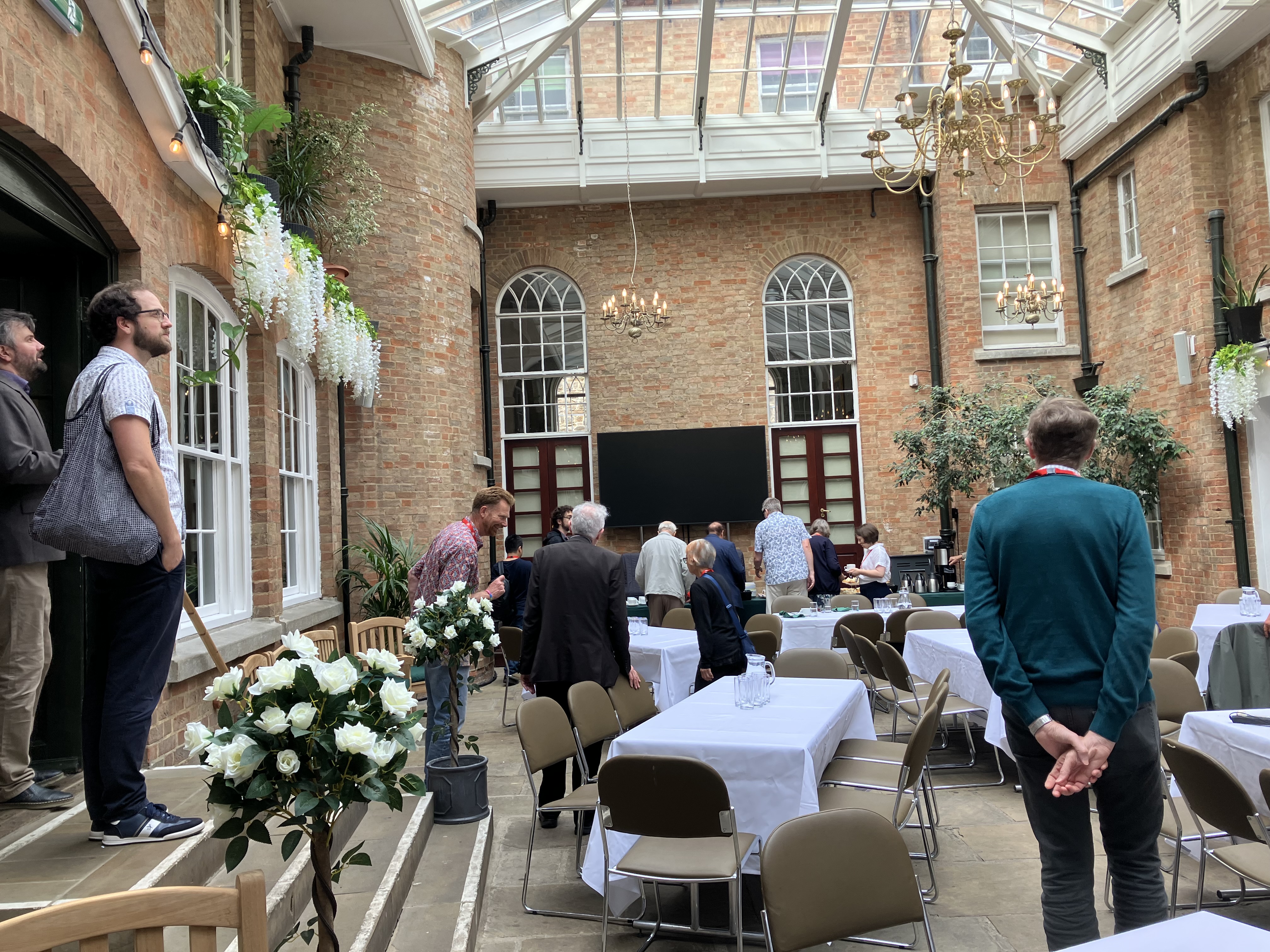
Not a pretty campus. My room was in that block.

I went to the reception desk, received my name badge (kept it round the wrong way until I had managed to tidy up a bit) and collected my room key. I set off to find my room, returned a few minutes later and was issued with a map—the campus is like a rabbit warren, it all connects (great if it rains) and lack of signs seems to be a feature of university campuses. Maybe it’s like in Malta, and they plan to confuse any invaders. My room, when I finally found it, was clean and uncomfortable, with a tiny shower room and paper-thin walls. It was also extremely hot, which seems to be another feature of university campuses. But it was a nice private space to escape to when I needed a break from trying to look intelligent.

This was my fifth conference, so I now recognise most people and would include some of them as friends—even though I see them only at conferences. There was a drinks reception, so I changed into a dress, combed my hair, and negotiated the rabbit warren back to the dining area. I remember my first SOTS, when I hid in my too-hot room, too nervous to join the reception until I was sure the cohort from my college had arrived. I am less anxious now. I recognise several people by their names, because they have written the books in the libraries, and it’s fun to meet them, to tell them I have enjoyed their writing, to discover whether the person matches the style of words. (They often do not, some of the people who write very clear, easy to understand books are less comfortable in real life.)

Therefore, only a few minutes after arriving at the university, there I was, drink in hand, chatting with a group of clever people who I have never met before, trying to look intelligent—or at least, not too stupid. But as I stood there, drink in hand, I was aware that I could feel an unusual crease in my dress, and the awful thought loomed—was my dress inside-out? I tried to remember whether I had actually looked in a mirror after changing, and I realised that no, I had checked my face when I combed my hair, but I had not looked in a full-length mirror at any time, I wasn’t even sure if there was one. (There was, I later found one inside the wardrobe door.) It was therefore completely possible that my clothing was the wrong way round. I daren’t look down to check, because I sort of didn’t want to know until I was alone, and could rush off to change. So I held eye-contact with the person talking, but I probably looked distracted. When the main group moved away, I glanced down. All was well; dress properly positioned. But I did make a note that in future, this is the sort of thing I should check before I leave the room. Although, if I am honest, it is possible that the sort of people who attend SOTS might not notice inside-out clothing anyway.

The conference continued with dinner, and then a lecture. This was the format of the whole week: food, lecture, coffee, lecture, repeat. It was fairly intense, because even during the mealtimes people continued talking about academic things. Even at breakfast, the conversation was intelligent, which was bit of a struggle for me. The lectures were interesting, and even when I didn’t understand the whole thing (there was one lecture with a lot of Greek discussed) there was usually something that struck a chord, a little oh, I didn’t know that, moment, which is always fun.

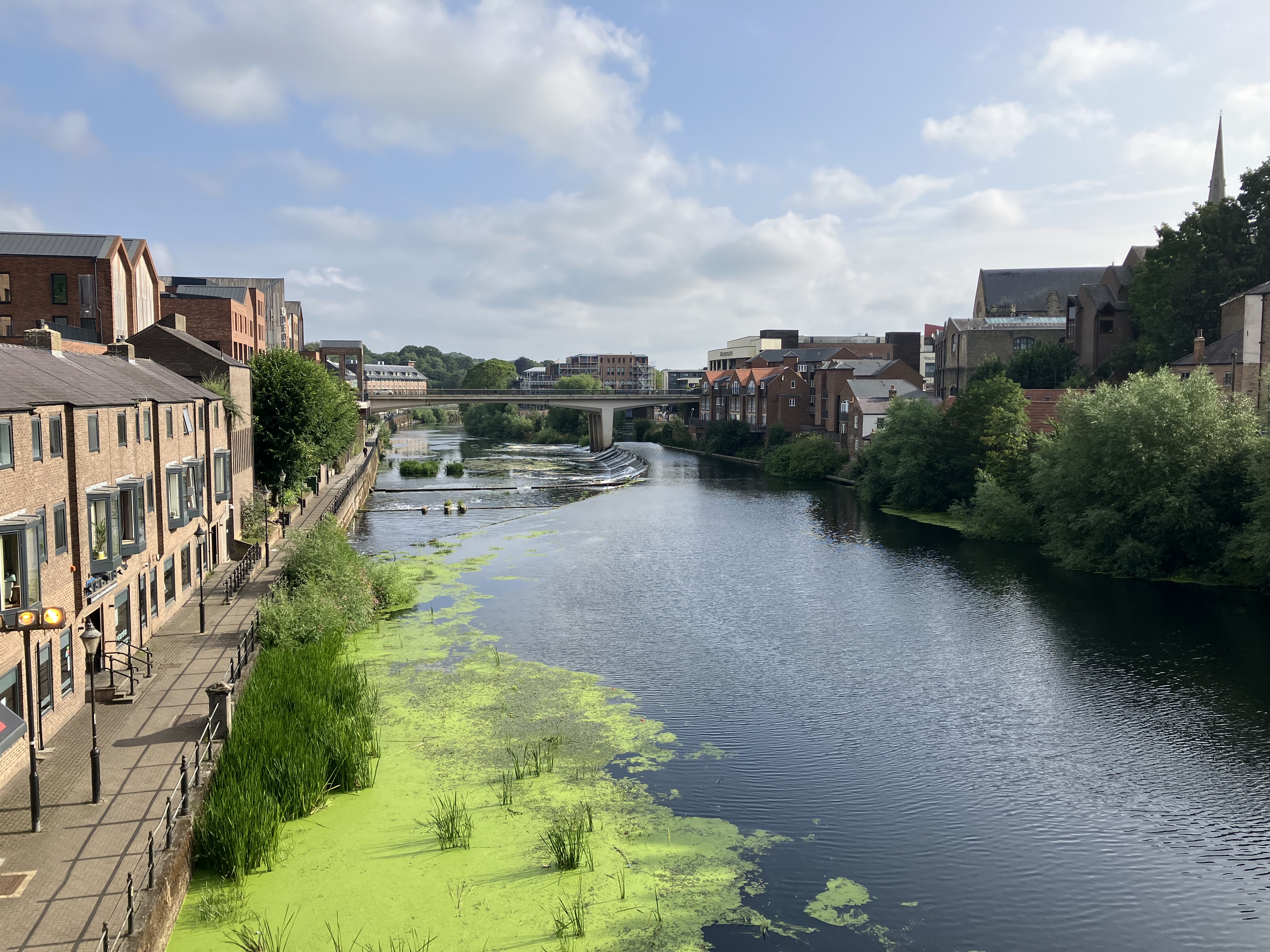
By the end of the conference, I was exhausted. I found it impossible to ‘switch off’ my brain after the evening lectures, and this combined with the hot room and uncomfortable bed meant I slept very little. I also missed my home. I was therefore very happy on Thursday morning, when I could abandon my room, and walk through the beautiful city of Durham to the station. I am really pleased that I attended the conference, and I learnt a great deal. But going home was wonderful.

I hope you have something to look forward to this week. Thanks for reading.
Take care.
Love, Anne x

I will write about some of the papers in another post.

What is Moral?


‘Humans are different to animals because we have morals.’ But is this true? Is it true that animals do not have moral capacity? Do they act purely on instinct? This is a question I continue to wrestle with, but as ever with academic research, the journey itself has been fascinating.

This week, I decided to read what Kant wrote. Immanuel Kant was a philosopher who lived in Prussia in the 1700s. People still quote him today, which is a sign that someone’s work was significant (even at my most optimistic, I do not dream that anyone will be reading my work in 2325). He wrote a couple of books about the metaphysics of morals. I decided that before I could answer my questions about animals, I needed to define what I meant by ‘moral’ and ‘moral behaviour’. As this is not something I have considered before, I hoped Kant would help.

The problem was, I did not understand what I was reading — even his titles needed deciphering. I was reading a translation, with a commentary, but even the commentary was impossible! Now, this is not a rare occurrence when I read academic books. Some academics, especially those who are not also teachers, tend to use language that usually only appears in a dictionary. Kant has the added bonus of writing sentences that never seem to end. Reading very long sentences, full of unfamiliar words, makes for difficult reading. But never fear, I have a tactic.

Reading something difficult can be stressful, because we feel stupid. My tactic is to read it aloud, in my ‘telling a story to 5-year-olds’ voice, while recording it on my phone. I do not attempt to understand it (you don’t need to understand something to read it aloud, it’s like handwriting practise). I use accents for the quotes, different voices for certain phrases, lots of expression and a generally calm slow voice.

Then, when I am relaxed, perhaps on a train or baking a cake, I listen to the recording. The words are now in my own speech pattern, nothing is scary, I can listen properly, concentrating on the meaning. Now, Kant is still complicated, I still needed to pause the recording to check words in dictionaries or make notes. But by removing the stress, I can tackle the content. The recording isn’t perfect. I attempted a Prussian accent when reading direct quotes, and then giggled because it was so bad. Meg was with me, and did not appreciate Kant, so there are long groans from the dog, and at one point she came and panted into the mic and then licked the book, which sounds very weird. But I still found it helpful, and understood enough to give you a summary:

Kant was considering what makes good actions good. He described someone risking his life to save another person. He noted that even if they didn’t succeed in the rescue, or even if the person died in the attempt, we would still say their action was good. However, this is only good if their motive is good. If they were offered lots of money for the rescue, and especially if they believed there was no risk to themselves, then we would be less sure that their action was good. The motive matters. Kant decided that only motives of pure duty, with no other motives, means an action is moral. He said this motive (which he calls a maxim) should be as strong as a law. Other motives, like a reward, or because we like/want to do something, should not be a factor in how we decide to behave, as only an action based purely on duty an be called moral.

Now, I am not sure that I agree with him. I understand that reward muddles our motive (though I am not convinced it makes an action less moral) but I think that acting due to gratitude can also be moral. The idea of ‘not repaying good with evil’ is also, I think, a sign of morality. If someone helps me, and I therefore want to help them in response, I think this can still be moral. This is sort of the ethic of Christianity: God has loved me and that makes me want to be good— not because of what I will receive, but because of what I have already received. I think this is different to what Kant says — but I will continue listen to my Prussian accent while the dog groans a few more times, just in case I have misunderstood. I also need to decide how this applies to animals (the morality, not the groaning). Do animals behave in response to gratitude, and can this be called moral? More thought needed before I answer that one.

I hope you find ways to overcome difficulties this week. Thanks for reading.

Take care.

Love, Anne x

anneethompson.com

No Smiley Faces for PhD Students


As you will know if you are a regular reader of my blog, in June I was in Edinburgh for my annual assessment. This was rather scary. In the weeks beforehand, I completed an online form, and submitted a writing sample. I also sent an updated proposal. (A proposal is a document that describes what you want to research, and your method, and what literature already exists and how your work will be different.) In return, I was told where and when I would be assessed. As I said, all very scary.

On the day of my assessment I visited the washroom 376 times, and arrived at the room much too early. I was told to wait outside, while the panel of academics discussed their strategy. I worried I might need the washroom again. Or faint. Managed to not do either.

I was called into the room, introduced to the person on the panel who I didn’t know, and offered a choice of seats. I chose a low sofa, then instantly regretted it—it felt like the ‘naughty seat’ at school.

The panel consisted of three lecturers at the university, one of whom was my primary supervisor. They explained that my supervisor would say very little, as she already knew about my research, the questions all came from the other two. I was expecting questions about the writing that I had submitted, and I was ready to discuss what I had learnt, and the shape of my project to date, and some of the views of other scholars. I was wrong. They asked nothing about this.

Instead, they asked about where my research fitted into the academic world—which area did I feel it was addressing? Was it philosophy, theology, biblical studies, psychology? They noted that I had quoted scholars from all those fields, and appeared to be addressing many different disciplines. They asked which scholar, of the many I have read, did I most want to be like?—They then argued with my choice (which felt a little unfair). It was a very intense interview, and I felt very unprepared. Gradually, I worked out what they were saying—they felt my work was too broad, it covers too many disciplines, and will not go ‘deep enough’ if I continue on this trajectory. I need to narrow my research, focus on a single discipline and do it well.

I did not cry (though it was close). I tried to listen. I realised that what they were saying was correct, and they were trying to help me succeed. But to be honest, I have worked very hard this year, and what I really wanted was a sticker with a smiley face on it. I think perhaps universities don’t have those.

In some ways, the outcome of the review is a relief. I have been aware that I have been dipping into various disciplines (and it has been tremendous fun!) I have known, in the back of my mind, that trying to pull all my research into a single thesis would be a challenge, but I had decided I would worry about that nearer the time, assuming that it would become clear which areas I should ignore and which ones I should focus on. It will be easier to only focus on one area (biblical studies—because I really enjoy the Hebrew, and how it communicates meaning).

As I am a part-time student, I didn’t have to ‘pass’ this review (probably just as well!) That delight happens next summer. I spent time with my supervisor, and we planned a strategy for the next year, ways to improve my proposal and focus my research.

The rest of the week was spent attending seminars, and chatting to other students. Everyone who I spoke to had a similar experience in the review—no one received a smiley face. My supervisor explained that the first year of a PhD is all about exploring the field, deciding which area to concentrate on—and I hadn’t done anything ‘wrong’ but now it was time to focus.  Several students had decided to change direction completely, and were now doing research in a different field. Mine has stayed basically the same—but with fewer dips into other interesting areas.

I was thinking about all this on the train ride home. It was not a fun activity, but perhaps honestly reviewing our performance, reassessing where we are heading, is often uncomfortable. It’s something we often ignore in ‘real life’ but I wonder if perhaps we ought to do it more often. What exactly do we want to be, and are we achieving it? I thought about some of the people who I had met—the extremely intelligent ones, the high-achievers, the academically gifted, the leaders. I don’t think I fit into any of those categories. I think I want to be the ‘safe’ one, the person who people feel comfortable with, the welcoming one. If I also end up with a PhD at the end of it all, that will be excellent.

I hope you achieve your aims this week. Thanks for reading.
Take care.
Love, Anne x

I will leave you with some photos of beautiful Edinburgh.

English/Greek Grammar


A Little Grammar Revision

I decided to take a break from my studies this week, and instead to revise some Greek. I started learning Greek in 2020, and I have forgotten nearly everything (‘use it or lose it’ is certainly true with languages). I dug up my two text books—one has a fun but slightly muddled approach,[1] the other an incredibly dry but systematic approach.[2] I read them together, side-by-side, and the knowledge seeped back. However, one of the main things I remember when I started to properly learn a language was my lack of formal English grammar. I went to school in the era of creative writing, when it was all about free expression and writing from the heart and responding emotionally to what we read. I don’t think words like ‘pronoun’ or ‘intransitive verb’ were ever uttered in one of my English lessons. Not ever. Which was possibly an acceptable way to develop a love of words, but not so useful when learning a foreign language.

After several years of formal language learning (the Greek, and then the Hebrew) I have now assimilated most of the grammar that I need. But just in case you have never heard these terms, or for the fun of being reminded of them if you were educated in a different era, here are some quick definitions. How many do you recognise?

Nouns

Subject  This is the noun that ‘does’ the verb. Eg. The boy arrived. She sang. They ate.

Object This is the noun that ‘suffers’ the verb. Eg. Mary stole the cake.

Common Noun These are things in general. Eg. cup, nose, sky

Proper Noun These are names of people, places, or things. Eg. Jane, Oxford, or Hazelwood School

Abstract Noun These label abstract ideas, actions, states. Eg. Love, peace, destruction

Pronouns

A pronoun replaces a noun with a substitute word. The original word (noun) is the antecedent. Eg. she, it, who, are pronouns which can replace the antecedents: Mum, Meg, Dave.

A relative pronoun (is not your aunty!) but makes a relation (a fancy way of saying ‘a connection’) between clauses. So: ‘John hates Mary. Mary ate the cake.’ This changes to: ‘John hates Mary, who ate the cake.’ Thus ‘who’ is the relative pronoun, and ‘Mary’ is the antecedent.

Adjectives

An adjective describes the noun. We say it ‘qualifies’ the noun. Eg. Greedy Mary ate the cake.

Demonstrative adjectives answer the question: Which noun? Eg. this, those (Greedy Mary ate this cake.)

Possessive adjectives answer the question: Whose noun? Eg. my, your, his (Greedy Mary ate his cake.)

Interrogative adjectives are question words. Eg. Which, where? (Greedy Mary ate which cake?)

Definite article just means ‘the’ and indefinite article just means ‘a’. They are included as adjectives because they qualify the noun. (Greedy Mary ate the cake.)

Prepositions

Prepositions are generally ‘place’ words. Eg. on, in, over. In Greek and English they govern what follows them. So ‘I go into the house,’ the house is what follows the preposition. (In English, they can also do other things, but I am only bothering with the grammar that’s useful for Greek.)

Adverb

An adverb can qualify either a verb or another adverb. They usually end ‘ly’ in English. (Greedy Mary extremely hurriedly ate his cake.)

Verbs

A verb can be an action or a state (thus ‘stative verbs’ –which I am pretty sure never cropped up at my school, where we were only taught that a verb is a ‘doing word’.) Apparently, a ‘state’ is also an action, so if the boy is hot, then his ‘being hot’ is an action and therefore a verb—but a stative one. (I personally feel this is unfair grammar, because ‘the hot boy’ uses ‘hot’ as an adjective, not a verb. Which is very confusing for me, and I am English! My sympathy goes to those who are learning it as a foreign language.)

Transitive Verb A transitive verb effects something (the subject). Eg. They ate the cake. (So ‘ate’ is a transitive verb and ‘the cake’ is the subject—the cake was affected by the verb.)

Intransitive Verbs These do not effect anything else (there is no subject). Eg. I ate. I remain. I die.

Indirect Object This is indirectly affected (a clue in the name!) and usually follow a preposition. Eg. She ate the cake on a plate. (This sentence has a subject: she, a transitive verb: ate, an object: cake and an indirect object: plate.)

Finite Verb This may be indicative, imperative or subjunctive (explained below). A clause must have a finite verb, otherwise it’s a phrase. A complement completes the clause: He is _______. It can be a noun (He is a boy) or an adjective (He is good) or a pronoun (He is mine). In Greek, the complement is never the object, it is always linked to the subject.

Mood

This matters a lot in Greek, but we use it in English too (you just may not be aware of it). Verbs can either be finite or infinite.

Indicative –this is a finite verb, so describes a particular action, and can be a statement or a question. Eg. He went in.

Imperative—this is another finite verb (describes a particular action) and is a command, a ‘bossy verb.’ Eg. Get inside!

Subjunctive—this is another finite verb (describes a particular action) and is a wish, or a wonder.
Eg. I might go inside. Or: If you go inside... [needs to be completed].

Infinitive—an infinite verb, (so not specific, we need more information for it to make sense) a verb that is on-going. Eg. To sing, or to laugh. They tend to follow ‘to’. They are called ‘verbal nouns’ because they tend to follow another verb (I want to sing) like a noun, and they can take an object (to sing a song) like a verb.

While we’re describing mixes (verbal noun) we should also look at participles, a mix of a verb and an adjective.

Participles

Participle—this can be an active participle, which ends in ‘ing’. Eg. laughing, singing.
Or it can be a passive participle, which ends in ‘ed’. Eg. laughed, cried.
Participles are used in English and Greek as adjectives (even though they look like verbs to me!) Eg. The laughing man went inside. You are my beloved mother. (English also uses them as tenses—I am laughing—but Greek does not.)

Tenses

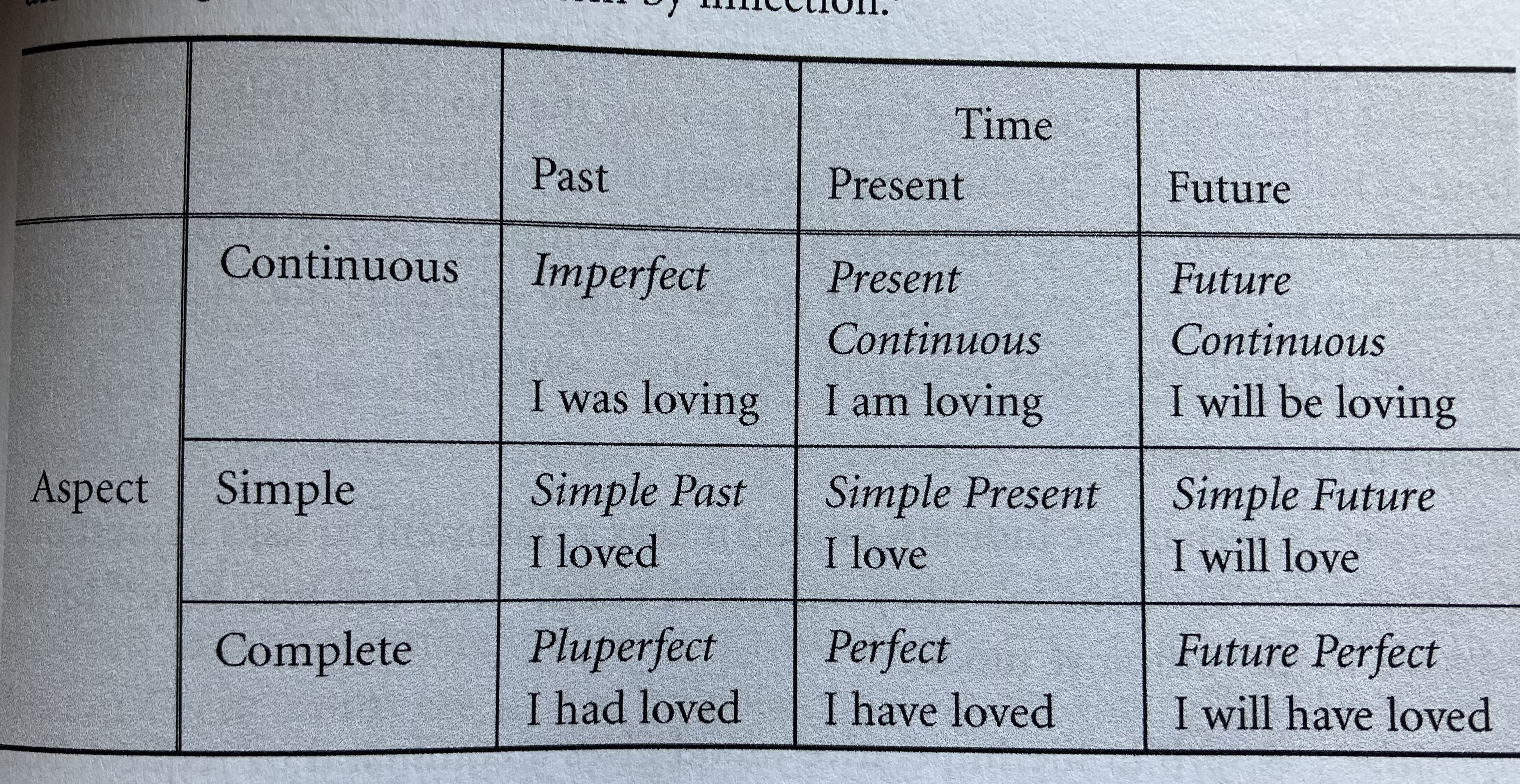
These really confuse me, but Mr Duff included a helpful chart, which I will attempt to copy. Basically, tenses show time (past, present, future) and aspect (continuous, simple, complete). Hold your hat, and we’ll look at some examples: (Depending on the device you read this on, the chart below is either helpful or completely muddled. I have therefore also included a photo, from page 247 of Duff’s book, ref. below.)

                                                Past                   Present                   Future

Continuous:         (imperfect)                       (continuous)          (continuous)
                               I was loving                      I am loving               I will be loving

Simple:                    (simple)                               (simple)                  (simple)
                                  I loved                               I love                        I will love

Complete:                (pluperfect)                       (perfect)                  (perfect)
                                 I had loved                       I have loved              I will have loved

If you still have brain left—well done, you are ready to learn Greek. Personally, I am going for a cup of tea and a lie down. Thanks for reading. Hope you have an interesting week.
Take care.
Love, Anne x

******
anneethompson.com
*****


[1] Ian Macnair, Teach Yourself New Testament Geek (Nashville, TN: Thomas Nelson, 1995).

[2] Jeremy Duff, The Elements of New Testament Greek (Cambridge: Cambridge University Press, 2005)

What is ‘The Image of God’ and Do You Have It?


Part of my university research has involved looking at ‘the image of God’ (or imago Dei as it tends to be written in scholarly articles). One of the reasons I hear Christians give for not wanting assisted dying, is that people are created ‘in the image of God’ and therefore they are different to animals, and should not choose when/how to end their life. The ‘image of God’ is what many people believe makes humans special. So what is it, and where does it come from?

You might remember that when we were in Jamaica, I started to read The Liberating Image by the Jamaican Dr Middleton.[1] He explores the different possible meanings for the image, and discusses which are the most plausible explanation—because the problem with the ‘image of God,’ is that although I have heard a lot of people talk about it, few people are agreed on what it actually is. The phrase appears right at the beginning of the Bible, in Genesis 1, when God creates the cosmos. In Genesis 1:26-27 we read:

 ‘Then God said, “Let us make humankind in our image, according to our likeness; and let them have dominion over the fish of the sea, and over the birds of the air, and over the cattle, and over all the wild animals of the earth.” So God created humankind in his image, in the image of God he created them; male and female he created them.’

The term is only used twice more in the whole Hebrew canon, both times in Genesis (Gen.5:1, Gen.9:6). None of the references define what is actually meant, and although the Genesis 9 mention links it to ‘not shedding blood’ of a person because they are in God’s image, this certainly never crops up later, when the Israelites/Judahites (who are believed to have written Genesis) are busy killing the people who are in their way. So the Bible itself does not use as a reason for not killing people, even if Christians today use it that way.

I have read a lot on this, and Middleton’s book is helpful for looking at what God’s image might have meant to ancient people. He examines the term in the context of the ancient world, and decides that it is linked to the statues that kings used to set up in remote places, to remind the people of his presence. That is one possible explanation, but there are others. Middleton looks at several other ancient creation stories, and these are interesting (though possibly, I think, irrelevant) so I will tell you the tales in other blogs. Personally, I think the problem with Middleton’s approach is he looks too much at religions outside of the Hebrew one, and I’m not sure how helpful that is. If I want to understand my religion, I’m not sure how helpful it is to examine what other religions teach. I think the key is within my own sacred books.

After lots of reading, I decided that the image of God was a role—a way we are meant to behave (caring for the world, like God does in Genesis). The trouble with this, is that if people are not acting in this way, are not behaving like God, does that mean they do not have the image of God? And the problem with that conclusion is it is scarily like the conclusion of Hitler when he wrote Mein Kampf—and I am not keen to align myself to his views! I am now busy trying to justify how some people might not be living ‘in the image of God’ but they do possess the potential to do so—which means we are all equal but not necessarily fulfilling our potential. Overall, due to how little the term is used in the whole Hebrew canon/Old Testament, plus the fact that it is never defined so we don’t even know what it is, I mainly think it is not very important. Which means it should not be used as a reason for not allowing assisted dying. (There may be other reasons, I will let you know when I finish my studies, but imago Dei is not one of them.)

I have therefore spent several months learning about something which I now think is irrelevant to my final dissertation. Such is the joy of research! I hope you have a good week, and enjoy doing things even if they are not especially useful. Thanks for reading.
Take care.
Love, Anne x


[1] J. Richard Middleton, The Liberating Image (Grand Rapids, MI: Brazos Press, 2005).

The Sheep’s Poem


We had such an interesting seminar last week. It was a joint initiative, the biblical studies students (that’s me!) joined with the Islamic studies students, and we had a guest speaker who joined us via the internet from the West Bank in Palestine. That alone made it pretty exciting.

There is a man (Jakub) and he is trying to get translations of the Bible in local Arabic dialects. He isn’t trying to ‘convert’ anyone, there’s no agenda here, he simply reads the passages to local people and asks them to interpret the texts according to their own understanding. How do local people (likely to be Muslim) interpret texts, when they are removed from our Western understanding? What do the texts mean today, to local people?

There is no problem with studying the Bible in the West Bank; this surprised me. I assume there would be a problem with trying to ‘convert’ people, but the book itself is openly sold in shops and it’s not uncommon to see Arabic versions of the Christian Bible in Muslim homes. For his research, Jakub asks people to tell him what the words mean to them, and then he translates them using the most suitable words in the dialect. Language is personal to people, so although in time A.I. will replace translators, it won’t understand the nuances of meaning in the same way as real people, in real time. It’s an interesting project, but I was especially excited by the next bit.

One of the example texts that Jakub has been working with is Psalm 23. You remember it—the one about the Good Shepherd, looking after his sheep? We listened to how a local man, Ahmed, interpreted the words, and I realised that perhaps my understanding of this well-known Psalm has been wrong. Perhaps the words mean something slightly different.

 You should also know that scholars have debated the interpretation of this Psalm for decades, and do not agree (this is pretty normal for scholars—they like to debate, and rarely agree). The Psalm begins with a relaxing pastoral scene, the sheep being led to pastures, with streams of water, and told to rest. Then there is reference to a table—so does the action now move into a house? Then the Psalm describes anointing with oil—so has the subject now changed to a person, maybe a king being anointed? It finishes in ‘the house of the LORD’ which would be the temple, which is where a sheep would be slaughtered as a sacrifice—so what does that mean???

 Ahmed is from a shepherding family in Palestine. He has spent time with his family’s flocks, caring for them in the wilderness. He told us how shepherding traditions are passed down, and have probably changed very little over the centuries. A sheep is still a sheep, they need the same food and water, and the landscape in the Palestinian wilderness is not much different to when the Psalmist cared for flocks and wrote his poem. He described how he understood the Psalm, and it helped me to understand it in a whole new light. Ahmed’s words made me understand the Psalm from the viewpoint of the sheep. Imagine a shepherd, who was also a poet (so a creative sort of chap) and he thinks about God, and he looks at his flock, and he writes a poem with the sheep as the subject—not a metaphor—this is the sheep talking. I will rename this: The Sheep’s Poem.

The LORD is my shepherd, I shall not need anything. Ahmed said a shepherd wants to raise healthy sheep, so he will ensure they have everything they need.

He makes me lie down in green pastures; he leads me beside still waters; he restores my soul. God the shepherd takes the sheep to where they will find food, where they can rest safely, he cares about the sheep’s soul—the internal wellbeing of the speaker.

He leads me in right paths for his name’s sake. In Muslim thinking, the paths of God have special meaning, it is about living in the way that pleases God. In this Psalm, the sheep is being kept safe so he can please God the shepherd.

Even though I walk through the darkest valley, I fear no evil; for you are with me; your rod and staff—they comfort me. Ahmed described how predators lurk in the valleys of the wilderness, and the sheep get frightened. A frightened sheep becomes erratic, so the shepherd uses his rod and staff to control them, to keep them safe, keep them on the right path.

You prepare a table before me in the presence of my enemies; you anoint my head with oil; my cup overflows. Ahmed said that sometimes, if he has a ewe about to give birth and he wants to supplement her feed, he would make a little table by setting a plank of wood on logs, and he would put some grain or milk in bowls, and take the ewe there to eat. He also frequently rubbed oil on the heads of his flock, to calm them down, and improve their health. He said a sheep that is regularly anointed with olive oil has a much healthier coat and is less likely to get ill. It is the pinnacle of caring for a sheep.

Surely goodness and mercy shall follow me all the days of my life, and I shall dwell in the house of the LORD for the rest of my days. In Islam, an animal is only ever killed as part of a ritual, a sacrifice to God (otherwise it is viewed as murder). Only after this ritual can a sheep be eaten. This sheep, which has been so cared for, is content to know that its purpose is to serve God as a sacrifice, it will go to the temple ready to die—death is not seen as an end, but as a beginning of something new—the sheep will be with God forever.

*

I love when something familiar can be understood in a new way, and it makes perfect sense to me that this Psalm is about a sheep (because we see animals as periphery in the biblical texts, but I don’t think God does). Now, obviously the text wasn’t written for a sheep, even if it’s about a sheep. I’m not pretending sheep can read! But if we read this Psalm, about a sheep, can we not learn something? Does it not show what it means to have absolute trust? To know that our purpose is simply to be what we were designed to be (not what the rest of the flock thinks we should be)? The sheep doesn’t fear the future, or what will happen after it is time to physically die—the main event happens in the LORD’s house. It is never scary going home.

I hope you find this interpretation helpful. May we never stop learning new things in the biblical texts, they are such a helpful guide in life. Thanks for reading.
Take care.
Love, Anne x

Who Has Got Your Back?


As part of my research, I have gone back to Genesis, exploring the text for new insight. It never ceases to surprise me how often reading a passage that I ‘know’ extremely well, offers something new. A new teaching, or way of looking at life, something helpful for life ‘beyond theology.’ (Afterall, the biblical texts would be pretty useless if they were only good for academic debate.) I’ll share my recent discovery with you.

I am looking at the story about the garden of Eden, which begins near the start of Genesis (after the narrative about the 7 days of creation). There are different ways of understanding these stories. Some people view them as historically accurate—these describe actual events about actual people. Others understand them as myths or parables—stories to explain something important, but the things in them didn’t actually happen.[1] To be honest, I’m not sure it matters really, as long as you are reading openly, listening for God to speak to you (the main fault, in my opinion, is to read them as a weapon, to ‘prove’ your own belief or show someone else that they are wrong.) Anyway, for this nugget of wisdom, it doesn’t matter what your viewpoint is. Personally, I sit in the ‘parable’ camp, but to properly understand the texts I think we have to enter the world of the story, leave behind our scientific knowledge for a moment, and try to understand what is being taught.

It helps if you can read them in Hebrew, but I’ll write this in English (just be aware that the words are not exactly as written). The story begins (Gen.2:4) with the earth being bare and barren—because, we are told, there is no human to work the ground and God hasn’t sent any rain yet. God creates the man, forming him from the dust of the earth (so he’s literally an earthling!) God plants a garden in a place called Eden and places the man there. God causes trees to grow, so the man has food. (In the middle was the tree of knowledge of good and evil—but that’s not relevant for this bit of the story.) God made rivers, to water the garden, and then we are told (again) that God put the man into the garden (and this is important) לְעָבְדָהּ וּלְשָׁמְרָֽהּ to work it and to guard it. Remember that bit—especially the ‘guarding’ bit. These were the roles given to people: to work the ground, and to guard.[2]

There is lots of speculation (academics prefer the word ‘deduction’ but really it cannot be more than educated guesses) about what, exactly, the man was guarding the garden from. Some say it has an ecological meaning—showing that humans were meant to care for the world (we’ve certainly made a mess of that!) Others say it’s evidence that there were other people, outside the garden, and the man was to guard against them.[3] God then commands the man to eat from every tree, but warns that if he eats from the tree of knowledge of good and bad, then he will die that very day.

We’re going to skip through the next bit. The man needs a companion, and God makes a woman to help him. (The word עֵזֶר helper is the same word used when God helps people—just in case you were wondering if there was a hierarchy here.) Then a snake appears (described as עָרוּם prudent/shrewd which is a clever little pun, because it’s pronounced ‘aroom’ and the people are עֲרוּמִּים  naked which is pronounced ‘aroomim’.) The people eat from the forbidden tree, they and the snake are punished and the people are banished from the garden. They still have to ‘work’ the ground, but now it’s harder. There is no mention here of guarding anything.

Then we skip ahead, to when the couple have two sons, Cain and Abel. Both sons make an offering to God, and Cain’s is rejected. I wrote an earlier blog on how this wasn’t fair.

Right, we’re nearly at the bit I want to talk about.

Cain takes his brother into a field (presumably because there were other people around—and he didn’t want to be seen). Cain kills Abel. God asks Cain, where is your brother? Cain replies (this is important): לֹא יָדַעְתִּי הֲשֹׁמֵר אָחִי אָנֹֽכִי  ‘I don’t know, am I my brother’s keeper/guard?’ We have that word again, שָׁמַר to keep or guard. Remember, the word at the beginning, when the man was told to work and guard the ground.

So, this is my understanding. People were given two tasks: to work the ground (care for nature) and to guard. At first, they had to keep/guard the garden. Then, when there were other people, they were supposed to guard each other. When Cain asked, ‘Am I my brother’s guard?’ our reply is: Yes! Yes, you are supposed to look after your brother. You are supposed to watch out for each other. That is what people are supposed to do.

This seems to me to be true today, it is how things are meant to be. When someone is having a rough time, when they have a health issue or a problem or something difficult, does anything help like having someone watch their back? It’s what parents do—they guard their children. It’s what siblings do—they support each other. It’s what friends do—they make it known that they are there, supporting, keeping, guarding. Let’s try to do this in the next week, let’s look for people who need to be ‘guarded.’ People who we can help as they cope with the muddle that is life as we know it.

Thanks for reading. I hope you have someone to watch your back.
Take care.
Love, Anne x


[1] Joseph Fitzpatrick, The Fall and the Ascent of Man (2012).

[2] Kristin M. Swenson, ‘Earth Tells the Lesson of Cain,’ in Exploring Ecological Hermeneutics, ed. Norman C. Habel (2008).

[3] Ziony Zevit, What Really Happened in the Garden of Eden? (2013).

Being Mortal: Thinking About Being Elderly


Atul Gawande, Being Mortal (London: Profile Books, 2015)

I was lent the book by a medical friend, and after reading half I bought my own copy. It’s the sort of book you want to keep so you can refer back to it. As my PhD will finish by exploring the assisted dying  issue, I need to start learning about the issues that surround dying. This book helped to inform my own thinking, and introduced some new concepts. It also informed my thinking about ageing, and how people might want to live in the final stages of their lives. This has little to do with my studies, and a lot to do with real life. Whether we are old, or helping elderly parents, this book has practical advice and confronts some difficult issues.

Gawande is a doctor, and he spends some time explaining how in old age, it is very important to keep your feet healthy. People are not able to live independently if they cannot walk. A fall in an older person is dangerous—brittle bones break more easily, and the space inside the skull where the brain has shrunk means it gets a nasty jolt in a fall, which can cause all sorts of problems. Therefore, balance is important, and good balance relies on good feet. If someone is unable to properly care for their feet, they are likely to develop problems with balance. [Note to future self: Do some simple balance exercises every day, and keep lifting feet to where I can touch them. ‘Use it or lose it.’]

The first half of the book deals with the ageing process, and how western societies treat their old and infirm. Gawande is American, with Indian heritage, and his comparison of the two cultures was very interesting. Whilst the ‘traditional Indian’ setting of an elderly person living with the extended family, being helped through their old age by younger members sounds idyllic, Gawande is honest about the problems this can entail. Different problems to our western traditions, but still problems. He then discusses the situation in the US.

One topic he discusses are nursing homes. He doesn’t rate them very highly, and compares them to prisons! (p.73) He explains how nursing homes grew from the need in 1954 to provide hospital beds for the elderly when hospitals were too full—so their medical care was transferred to a purpose-designed home. (p.71.) They were all about medical needs, keeping the patients physically safe, and were run to be clean, efficient and safe. Then, in the 1980s, Keren Wilson tried to build a better model, and built an ‘assisted living’ community—where the aim was to allow elderly people to live independently, with the physical help that they needed. They had locks on their doors, privacy, and autonomy. If they wanted to wear pyjamas all day, or eat food that was bad for them, they could.

This led to the assisted living homes we have today, which tend to be a compromise between the two models. He makes the point that homes for the elderly advertise that they are safe and clean—not that the residents can make their own choices. This is because the homes tend to be chosen by the children, not the elderly—and children want their parents to be safe and clean. He writes that this is because ‘it’s often precisely the parents’ cantankerousness and obstinacy about the choices they make that drive children to bring them on the tour to begin with.’ (p.106) He also remarks that this is partly the fault of the parents, ‘because they disperse the decision making to their children . . . It’s sort of like, “Well you’re in charge now.”’(p.106.) [Note to future self: Don’t dump decisions on my children if I am capable of making them myself.]

He does also describe some excellent care homes, some of which introduce things like plants, or animals, or combine with a school so the residents can help the children. He discusses the motivation for living, and that in the end, being ‘safe’ is not enough. People need a role, something beyond themselves, a purpose. Otherwise it seems they disappear inside of themselves and lose the enthusiasm for life. He writes that ‘death rates can be traced to the fundamental human need for a reason to live.’ (p.123.) He discusses Maslow’s hierarchy of needs (the idea that physiological needs—food and water—are more important that safety, which is more important than love/friendship, which is more important than self-esteem, which is more important than self-actualisation.) Gawande considers that above ‘self-actualisation’ is the need for transcendence—the need to go beyond ourselves and help other living creatures. [Note to future self: Find someone/thing to care for.]

Gawande states that the problem, as he sees it, is that we have put issues of life and death with the medics—and they are not necessarily equipped for this. He describes ‘a still unresolved argument about what the function of medicine really is’. (p.187.)[This is my own view too—I think death should be left to philosophers and theologians, not medical professionals.]

Another modern problem—which affects the States more than the UK is the availability of treatments and the way that insurance works. Therefore medics no longer have to question whether a treatment is ‘worth it,’ either financially or in terms of benefit to the patient. If it’s available, and a patient wants it, then they check the insurance company will pay for it and the patient undergoes the treatment. This has a parallel in the UK with pet medical insurance. If our pets are insured, and if the vet suggests a treatment, it is very hard to step back from this, to take a holistic view and decide whether the treatment is actually in the best interests of the pet. We love our pets, we don’t want to lose them—but sometimes I think they suffer more due to invasive treatments than if we just made them comfortable and helped them to die peacefully. Gawande questions whether most of the money spent in the last months of life actually benefits anyone. He suggests this is particularly true at the very end, when patients are hooked up to expensive machines, their lives prolonged by a few days but with no ability to ‘die a good death.’ (My expression.) Unable to say goodbye, or come to terms with what is happening to them, their last moments are reduced to being a patient. He says that people who are dying have priorities other than living for an extra day or two, and ‘technological medical care has utterly failed to meet these needs’ and the financial cost is massive. (p.155.) He suggests that by putting our faith in modern medicine so completely, we have forgotten ‘how to die.’ (p.158.) [Note to future self: Decide what is important to me in the present.]

Gawande is a great believer in palliative care—help to live your final days as well as you can, rather than suffering intrusive uncomfortable treatments trying to extend life by a few more months. He discusses this in the setting of his own father’s death, which makes the discussion both personal and honest. It’s much easier to have a theory about death when it doesn’t touch you. He also lists some questions—difficult to ask ones—which enable families to help their relatives to die how they want to die. This involves asking the person what they fear most about their diagnosis, and what they want the most. (It might be to continue being able to eat, rather than to have the longest possible life!) He also suggests asking what the person would like in an emergency—do they want to have their heart restarted? Do they want aggressive treatments (such as being on a ventilator)? If the answers are known before the emergency happens, then people are able to make the right choices in a crisis situation. He talks about what the aim should be for a terminally ill person, saying it is not about ‘a good death, but a good life to the very end.’ (p. 245.) For Gawande, this means that assisted dying would be a rarity, not the norm—because so much can be done to help a person optimise their last few days, and very few conditions cannot be managed with drugs. [Note to future self: Communicate my wishes to my children, don’t make them have to guess.]

I am still unsure of my own view about assisted dying, so it’s helpful to hear what others think. I found Gawandes book to be a helpful resource, and I value his insight into the issues surrounding old age and the end of life. Now, don’t forget to take care of your feet!
Thanks for reading.
Take care.
Love, Anne x