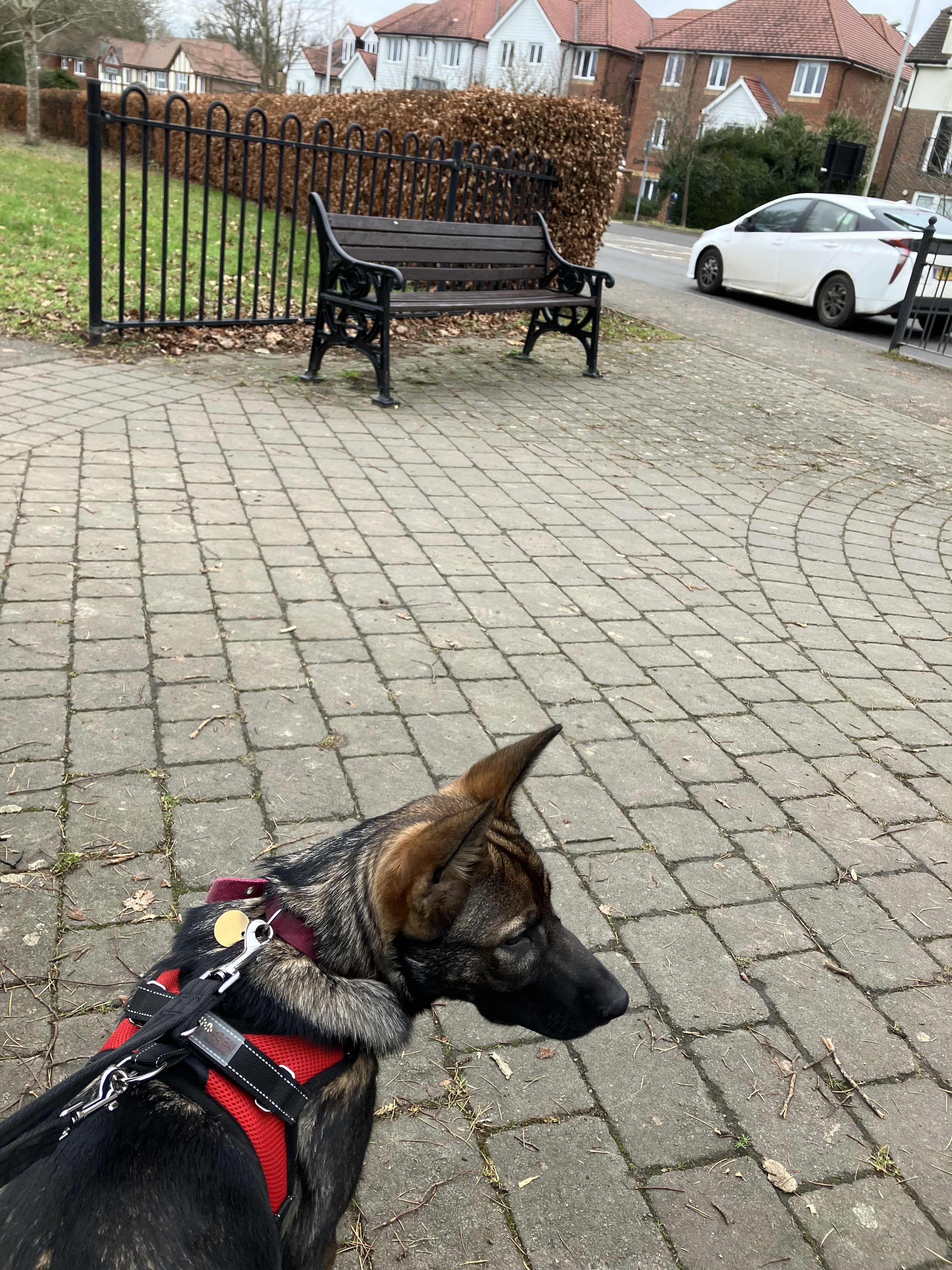
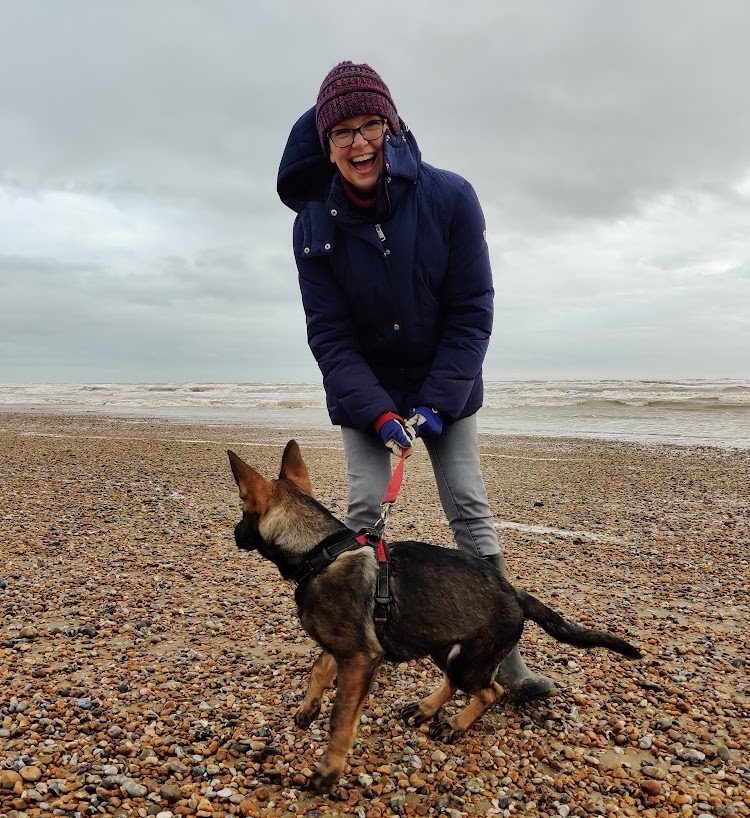
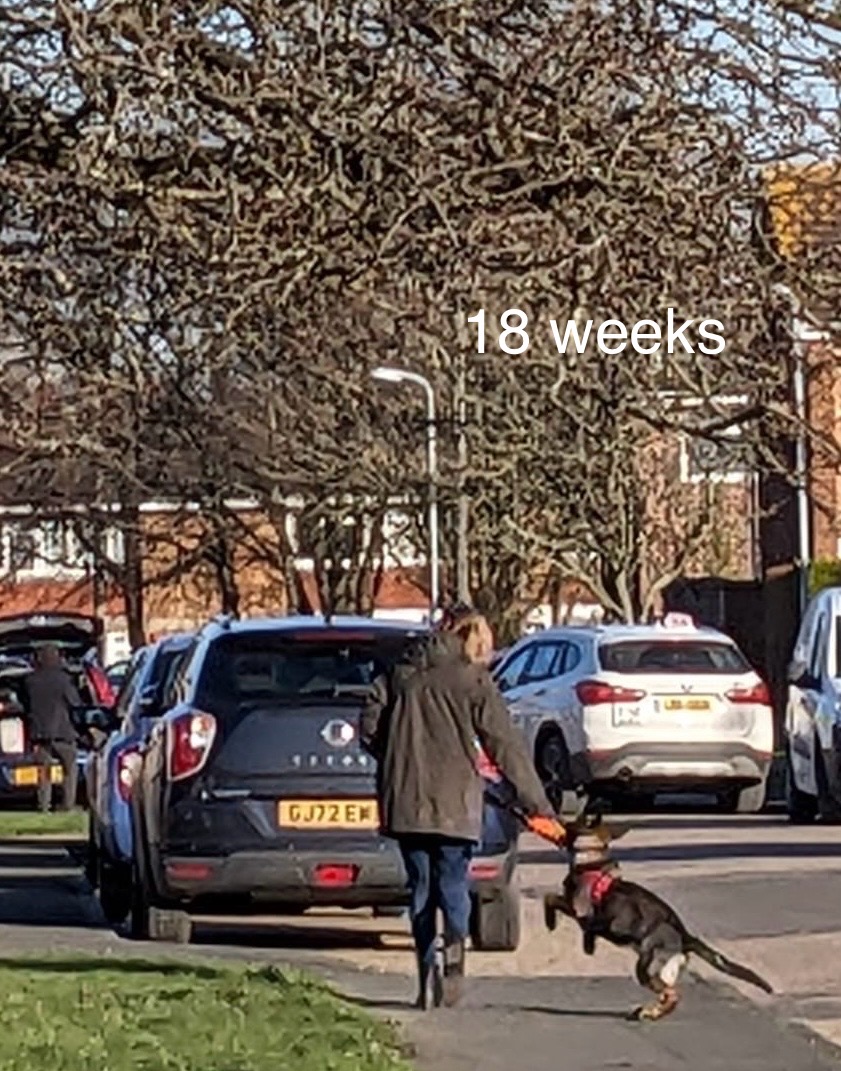
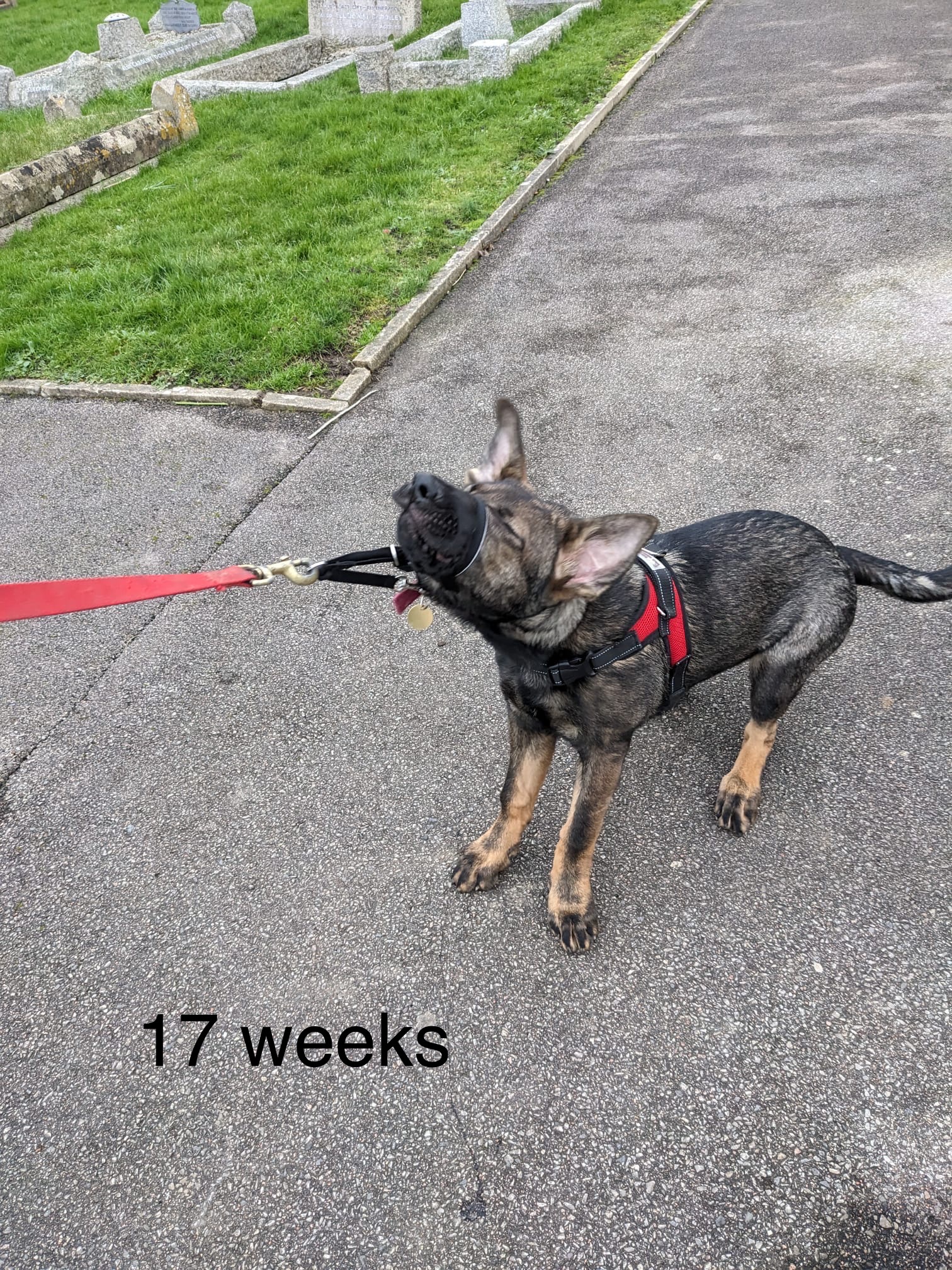
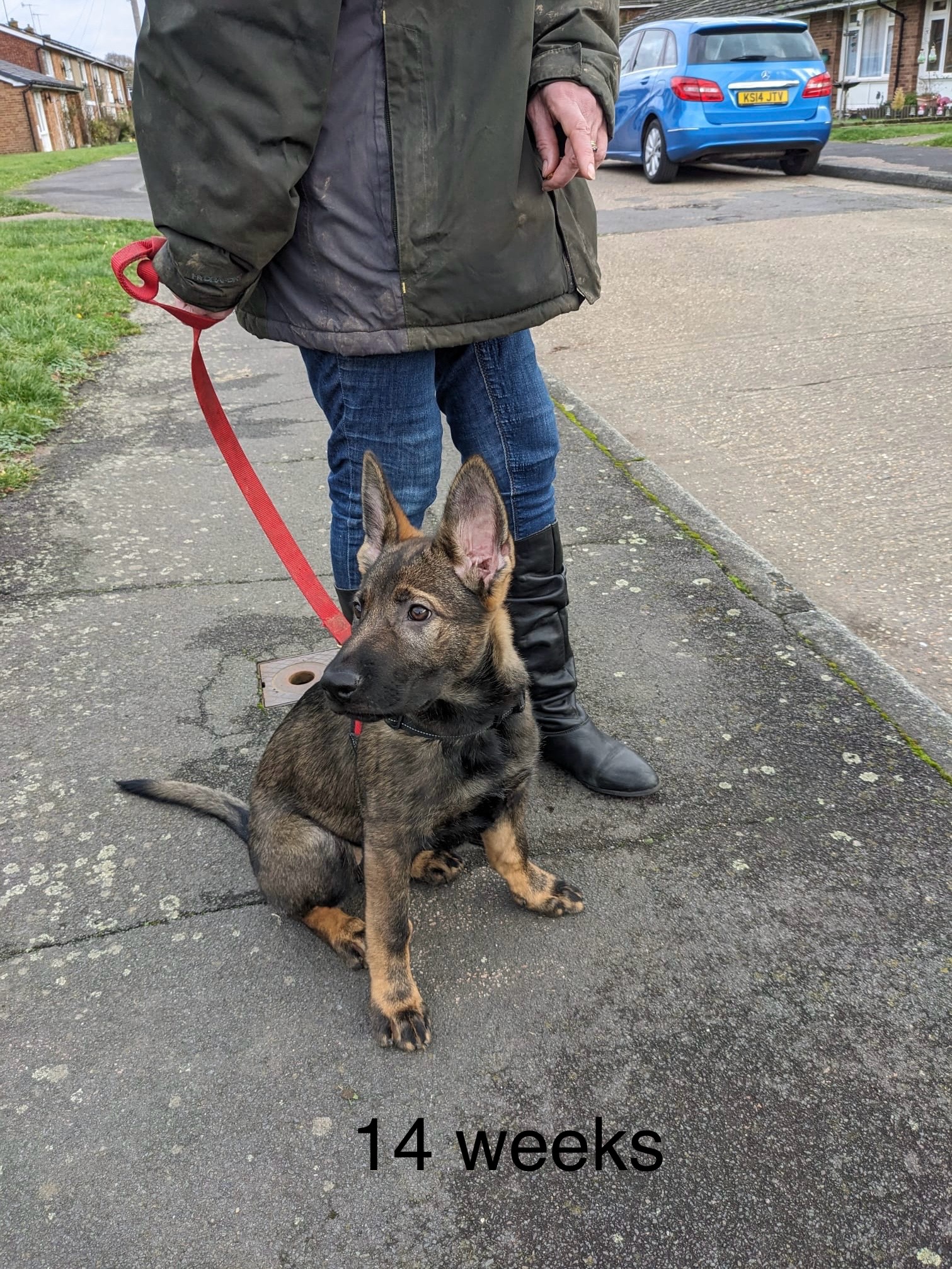
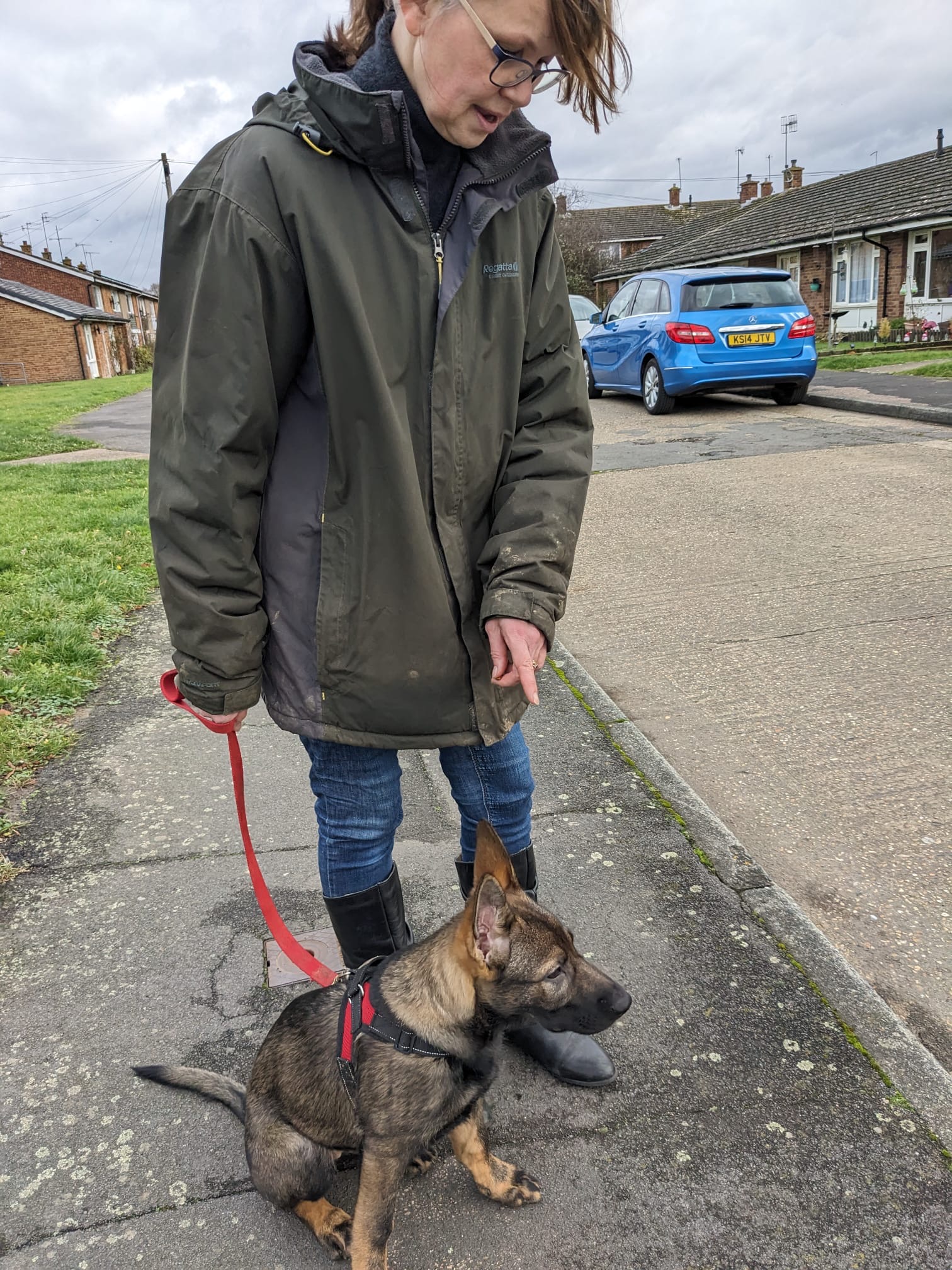
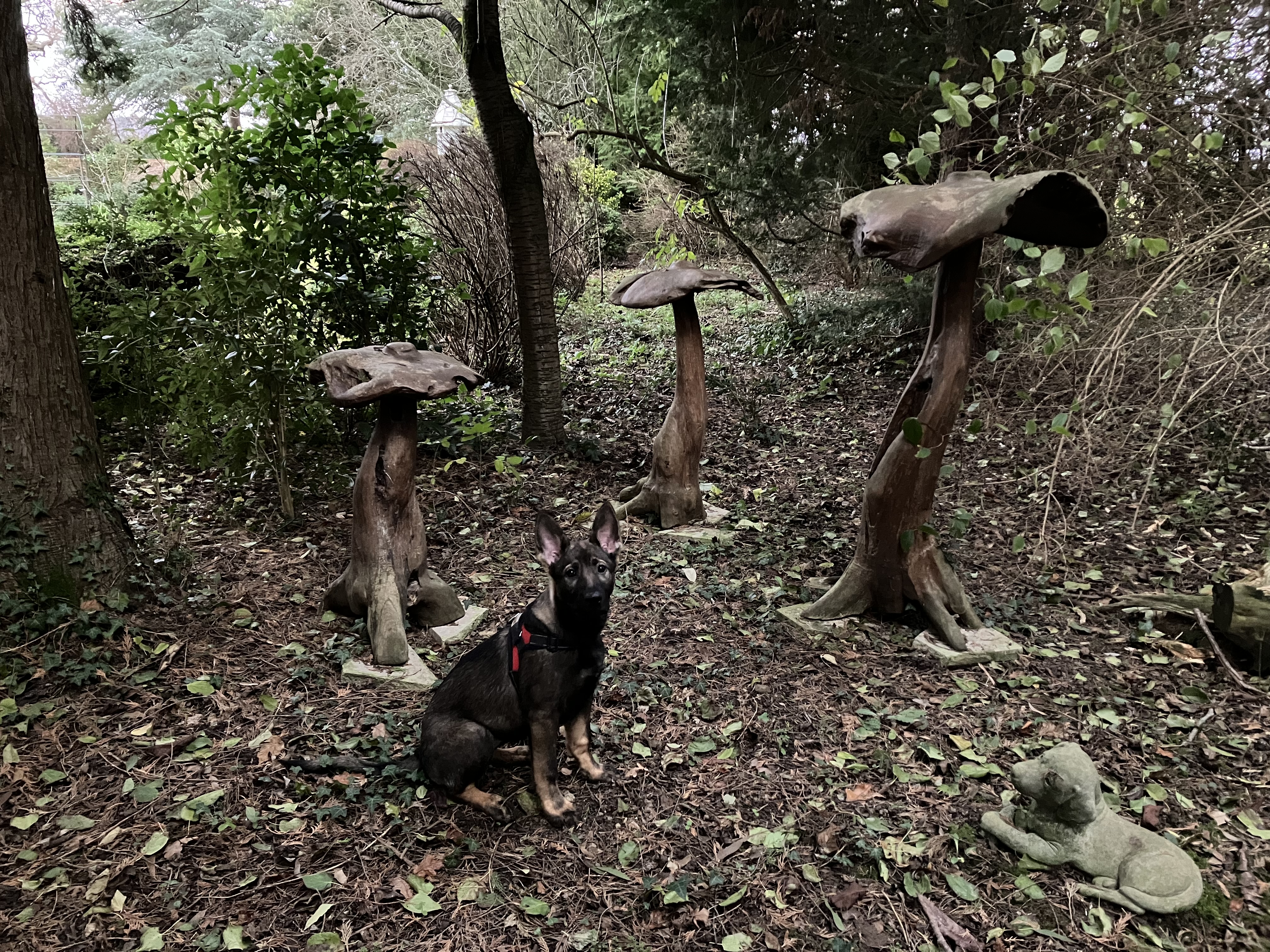
Meg’s Diary, 12–15 weeks


12 Weeks

Still have a muddle of feelings about Meg—mainly that she has made life so much more complicated, and she doesn’t even seem to like me! Occasionally she will crawl onto my lap when I’m sitting on the floor, or follow me when I am cooking, chewing her toys and watching me, and I feel genuine affection. But mostly, as she knocks something over, or destroys a seat cushion, or bites my clothes, I feel cross. I cannot trust her in the kitchen alone, so I either have to be in there, guarding everything, or she has to be in her large pen with her toys—which she is beginning to resent.

She is still terrible with the other animals, and chases them if she can (so she is mostly on the lead when they are out). The cats are getting used to her, and Milly will even follow us at a distance, because she knows she can outrun Meg.

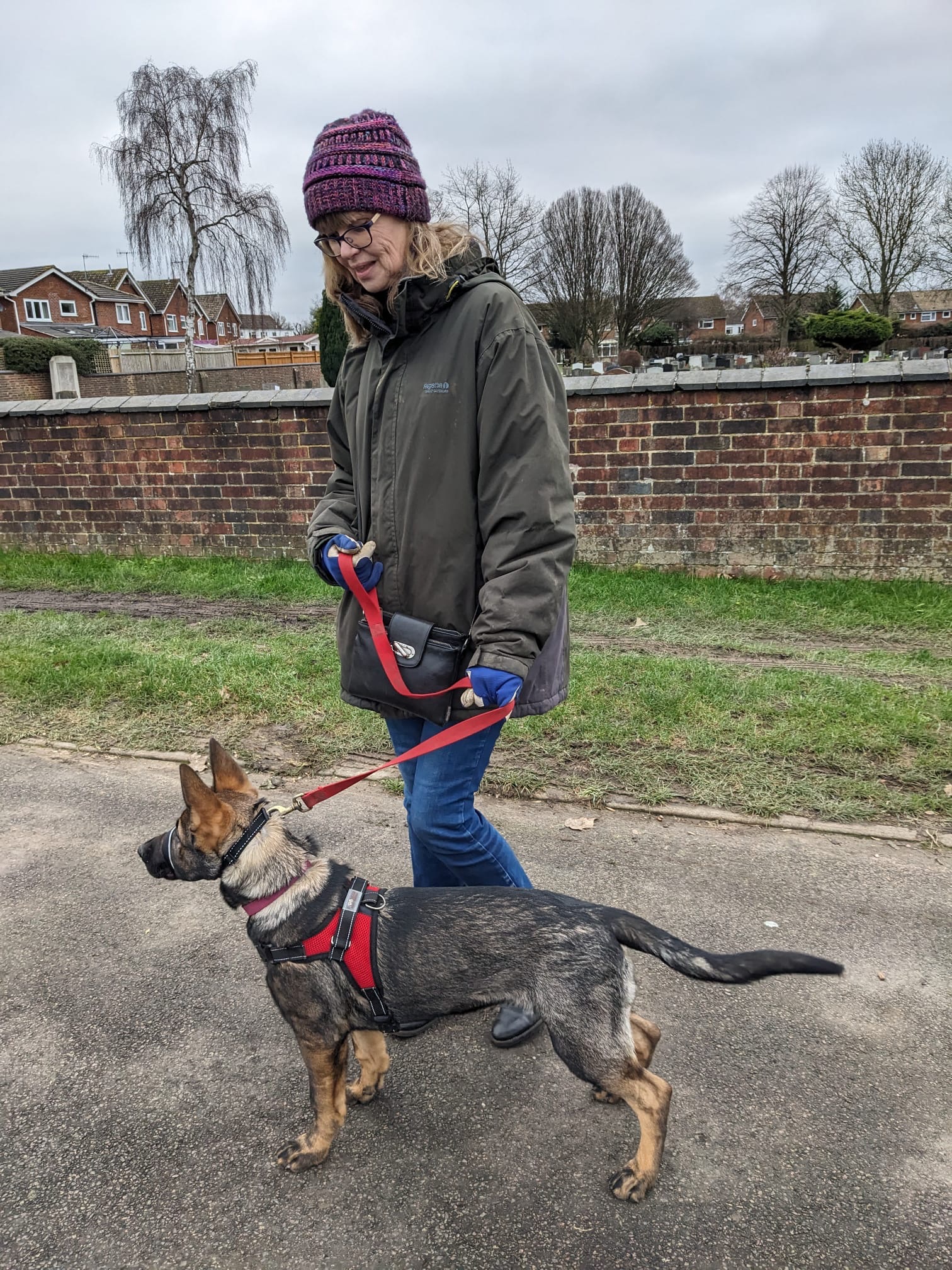
She is super-fast at learning things (if I have the mental energy to teach her). For a treat she likes (mince) she will sit, wait, shake hands, fetch a ball and put it into my hand. She’s not too sure about walks, and tries to stop us leaving the driveway (she uses all four paws as a brake, and I end up dragging her). She usually looks quite happy when we get to the field, and walks relatively well, then tries to drag me all the way home. She absolutely hates being hosed afterwards (but she’s covered in mud, so it’s the only option).

I have been out a couple of evenings, and a friend has come and let her out. Meg has been fine with this—which is one good thing about a confident puppy. I think going into kennels wouldn’t phase her at all. Nothing seems to.

13 Weeks

Walking on the lead is still a nightmare, and hurts my shoulder. When there are two of us, the ‘pack-instinct’ kicks in, and she will walk with us, trying to keep up with the ‘leader’. But on her own it’s just hard work. She stops, leaps, grabs the lead or pulls as hard as she can. By the time we have walked a short loop, I am exhausted (and not particularly kind when I hose the mud off her, which she hates, but I am so angry by that time that I take a sadistic pleasure in giving her a thorough wash).

Cutting her nails is also not going well. All the books suggest playing with her feet, regularly touching her paws/nails and giving treats until it becomes ‘normal.’ This has never worked. Meg will offer me her paw when asked (in return for food) but she snatches it away in an instance. Trying to ‘play’ with her paws results in biting. I have therefore been quickly clipping a single nail after sneaking up on her when she’s sleeping, and then trying to remove clippers/fingers from her mouth. It has not felt like victory. Therefore this week, we resorted to the two-man method. Husband pinned her down, and while she was immobile, I trimmed her nails. She started to make all sorts of fuss, so we started to sing, very loudly, the rousing hymn: ‘And can it be, that I should gain…’ This always worked with screaming babies, they were shocked into silence. Seems it also works with angry puppies! The bad quality of our singing, plus the volume, made her completely freeze. I need to share this tip with the people who write the dog obedience books—nothing else seems to work.

14 Weeks

Jay came home this week, and said Meg is lots calmer than when he last saw her. This gives me hope. Though I seriously consider rehoming her almost every day. She is still too much for me.

I have taken her into town a couple of times. I park in Waitrose, and we walk from the car to the front of the shop, then to the chip shop in the High Street, and back to the car. It takes about 30 minutes. Most puppies would be scared of the cars, the sliding doors of the shop, the trolleys, the number of people. Not Meg. She tries to attack everything, bouncing with all four feet. She is delighted if someone greets her, and lurches madly, trying to chase the cars, and the people, and the trolleys. I tried taking various treats, and bribing her to concentrate on me. No chance. She is completely distracted and just wants to chase everything. I will keep trying. Maybe it will become boring eventually, and she will listen to me.

The only thing I have ever known her to be wary of is a lorry, which stopped to ask directions. As the massive wheels stopped next to us, she moved back, and when it left, she didn’t try to chase it. But that’s it—giant lorries but nothing else. She would have been a brilliant army dog.

15 Weeks

Meg has been great this week, and I now feel thoroughly bonded (no more thoughts of rehoming). It has been a difficult road, but we have learnt each other sufficiently that life has settled into a mutual understanding. The puppy understands that evenings here are boring. Absolutely nothing happens after 6pm, so there’s no point in trying to make things exciting, may as well settle into crate for the evening with a chew to gnaw. In return, I try to exercise her brain and body several times during the day.

She is getting better with the animals—and I no longer try to clean them out while she is with me (way too stressful). Each morning, Milly (the cat) comes in, jumps onto the work surface, and I feed her and Meg something tasty (a tin of tuna if I don’t have anything better). Meg has learnt that if she jumps up, the cat slaps her face. She has also learnt—because they are fed together, and the cat always comes first—that the cat belongs here, and therefore whilst bouncing perhaps cannot be helped, biting is clearly wrong. In return, the cat sometimes follows us round the garden, and although she has been bounced a few times, she stays near enough to be part of life. A good start.

The cockerel has also asserted himself, and not been killed, and both are now relatively wary of each other, but neither show aggression—which is as much as I can hope for at this stage. We are getting there.

Over Christmas, Meg had lots of interaction with the family. She’s very friendly, and loves everyone, but also showed some obedience when people were firm with her. Whilst her behaviour is still ‘naughty’ she does now obey commands, and we are able to tell her things rather than physically force her off chairs, into her crate, etc. As I feed her in the crate, and all her toys are in there, she sees it as a nice place to be rather than a punishment, which is good.

Meg was at her best on the 28th December. We had the whole extended family here for games and supper. Meg stayed in her big crate, which is in the kitchen, right next to where highly competitive family members were pretty much shouting at each other and squealing and generally being very noisy. Meg was completely comfortable, watching with interest, and showing no nerves at all. I felt very pleased with her.

We have just returned from a walk with Bridie (older dog in the family). After an initial silly barking fit and showing of teeth, Meg realised that Bridie was completely unimpressed, and then walked next to her, round the park, meeting a few other dogs on the way. Whilst she pulled on the lead the whole time, she did very well with other dogs, and was much better with passing cars, and definitely seemed to be watching Bridie and learning from her. Another success.

Hope you have some success too this week. Thanks for reading.
Take care.
Love, Anne x

A Treat in the Cotswolds


I woke at 6, took the dog for a quick run in the garden, then showered, threw a few things into a bag, and was ready to leave at 7:15. We went to my daughter’s house first, as she had kindly (madly?) offered to have the puppy for a couple of days. We dumped the dog, bags of food and toys and a playpen, then off we went, heading west.

Our first stop was The White Horse pub in Forest Hill. On our wedding day, in 1988, we left Surrey and drove to the Cotswolds for our honeymoon, but on the way, we stopped at a pub for dinner. Neither of us can remember anything about it, except that we ate chicken in mustard sauce, and I remember being very excited because I was married and I wanted to tell everyone in the pub, but I didn’t, and it felt very odd that no one knew such a significant fact. We found the name in Husband’s diary in the loft, and decided to visit, to see if it stirred any memories. We sort of remembered the car park, but nothing else. But then, it was a long time ago. It’s a Thai restaurant now.

We continued to Bibury, and lunch in The Catherine Wheel. It was pouring with rain, so we didn’t stop to walk around Bibury. I recognised the pretty cottages next to the river, but I couldn’t remember the trout farm (which Husband assured me we visited). It was busy, with coaches of tourists and lots of cars. It must be strange to live somewhere like that.

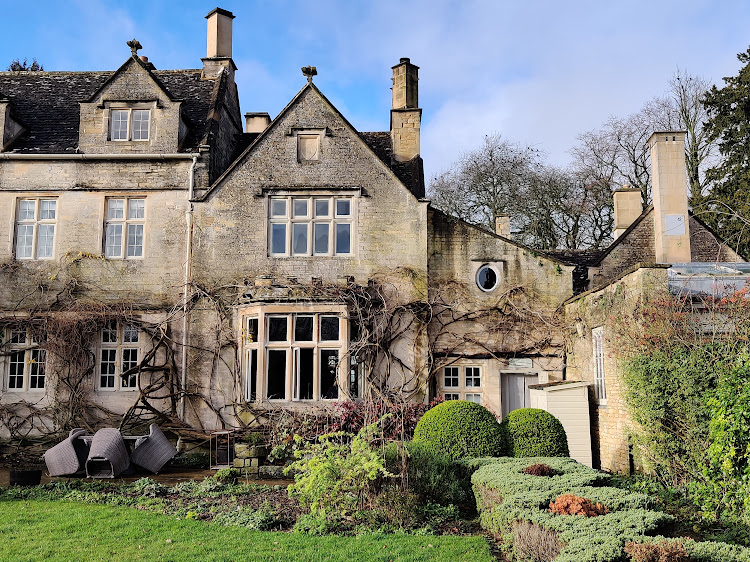
We stayed at Barnsley House. Just one night, but it still felt like a holiday. Our room was fabulous, with a whole sitting area, and facilities to make drinks. They had provided a tiny carton of fresh milk, and a jar of cookies, and apples in a bowl. I like when they provide free stuff, it feels more welcoming that a sign telling you to pay £1 for a coffee capsule!

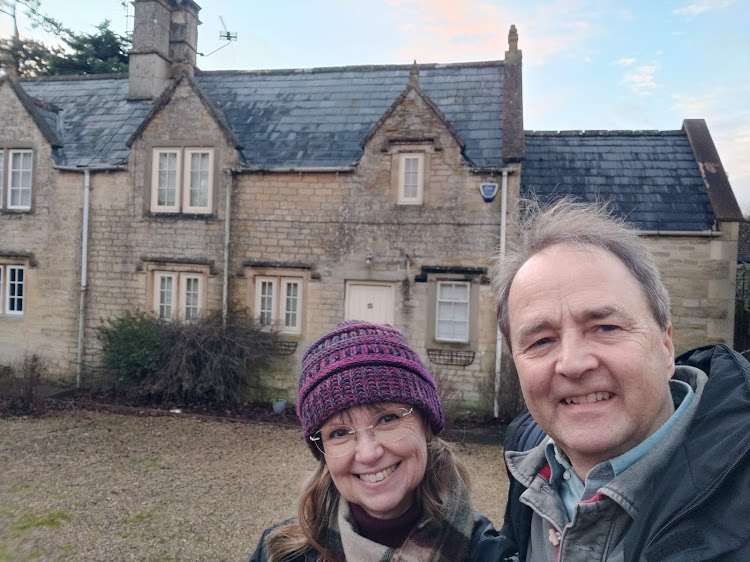
We drove around the Cotswolds, looking at places we remembered from our honeymoon. We looked at the cottage we stayed in (it has a new extension now, but looks much the same) and I bought a toothbrush at an unfriendly village shop. (Not sure how I managed to forget my bathroom bag!)

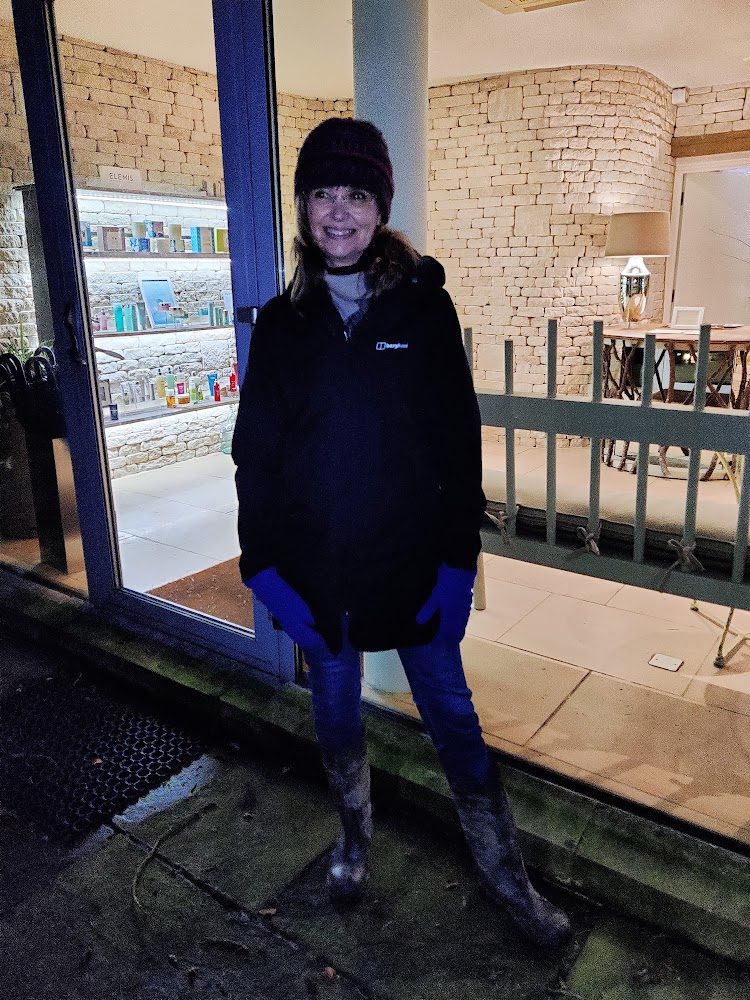
The weather was still wet, so we had drinks and watched a film. We could have used the ‘cinema’ at the hotel, but it was nicer in the room. We did dress in wet-weather gear and wander round the grounds. There was a spa (I think this is a feature of the hotel) so we went to have a look. There was an outside pool, with women drinking cocktails in bubbly water. I peeked at them through a bush, and decided I can think of little worse than being at a spa! There was a sign offering various ‘treatments’ but as I stood there, in my wellies and bobble hat, I felt it wasn’t really for me. (Husband compared me to Compo in Last of the Summer Wine, so I don’t think he imagined me sipping cocktails in a jacuzzi either!)

Not really a spa person!

Dinner was marvellous. We dressed up, though we didn’t need to, it was very relaxed. There wasn’t a taster menu, but the food was delicious, with lots of fresh vegetables and interesting flavours. I drank too much wine, and got the giggles, and it was a lovely evening. Such a treat to only have to walk upstairs after dinner, and not to drive home.

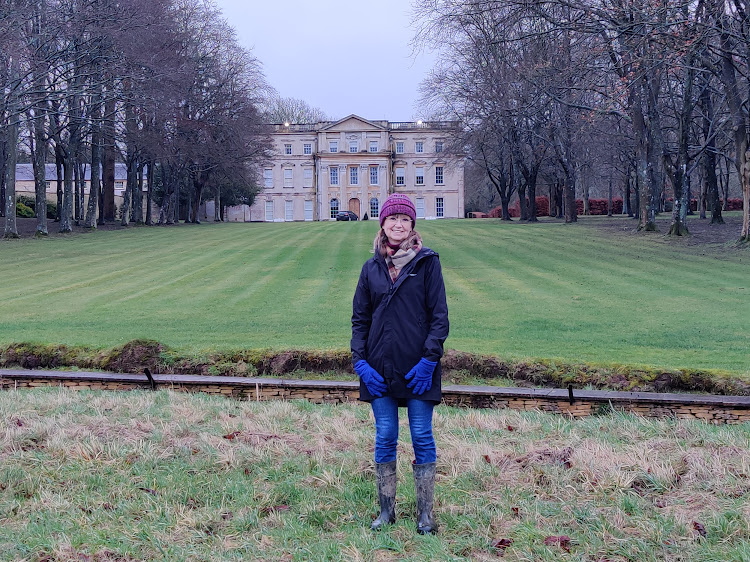
We ate a huge breakfast, and then went for a walk. It was really muddy, and I worried I might lose a boot in the boggy bits, but it wasn’t raining. We walked beside a stately home (Barnsley Palace) and wondered what it would be like to live there (cold, I expect). Then we packed up, and drove back to collect Meg and go home. It was so lovely, and just what I needed after all the Christmas busyness.

I hope you manage to plan some treats too. Thanks for reading.
Take care.
Love, Anne x

Epiphany


Hello, and how are you? Christmas has finished, the decorations are (mostly) down, and the Christmas tree is in the chicken cage (because apparently the needles have lots of nutrients that are good for poultry). It was also Epiphany on Sunday.

In my church, Epiphany marks when the wise men visited Jesus—I understand other churches give it different significance. The story of the ‘three kings’ is one I find difficult; it grates on me. Perhaps it’s because it is the part of the Nativity story that is more legend than biblical ‘fact.’ Though to be frank, much of what is discussed, sung about, portrayed and celebrated at Christmas is quite a stretch from the Bible story.

No one even knew how many kings there were until the sixth century, when someone in Alexandria wrote a Greek manuscript about them. Their names sound definite, but were added to fit the image, not part of the biblical account. They certainly would have arrived much later in the Nativity story, Jesus was probably a toddler given the response of Herod—perhaps Jesus even spoke to the kings, or played with them. My two-year-olds would certainly have not been passive during such a visit.

Somehow, the story in the book of Matthew (chapter 2) doesn’t quite fit with my image of a lowly birth, and it leaves me with lots of questions—did the neighbours not notice the arrival of rich travellers, and did they just forget about it afterwards or was there a big fuss? What happened to the gifts? How much gold was actually given, and did Jesus keep it, or did his parents spend it? Was the myrrh ever used to anoint Jesus? Was the frankincense kept until Jesus died, and it used to embalm him when they wrapped the body? And what happened to the ‘kings’? Did they return home and forget about Jesus, or did it change them, did they tell people (like the shepherds did) and did they even understand what happened?

There are also lots of questions about how they got there—they ‘saw a star’ so I presume they were astrologers, reading the stars to understand the world—which seems distinctly dodgy and in fact, they nearly caused Herod to kill Jesus, which suggests they shouldn’t have been relying on their predictions. It wasn’t until someone looked ‘in the Scriptures’ that they found Jesus. Why did God stop them returning to Herod but allowed them to go to Jerusalem in the first place—when it resulted in the death of so many babies? Were the dead Jewish babies just collateral damage? Is that not horribly cruel, and surely not justified by simply fulfilling a prophecy?

However, the story is in the Bible, so I feel I must take it seriously. It is there for a reason. (I was challenged recently, when struggling to decide if a text was ‘true’ and I was asked whether, if the Bible is God’s word, its purpose is to provide ‘true’ accurate facts like a diary or history book, or whether its primary purpose is to change me.) It surely matters not what we know about the story, but rather what we learn from the story. What does it show us?

*It shows that Jesus’ birth was a global event, not restricted to the locality of his birth. *Even foreigners could worship him. *It coincided with ‘something big’ in the universe. *There is a lot in Scripture about God loving the poor, but this is an example where rich people could bring something of value as part of their worship. *God is able to use ‘supernatural powers’ to ensure we hear what is really important—so going to the wrong place was allowed by God (though don’t ask me why!) but returning to Herod afterwards was clearly stopped, and the astrologers were in no doubt which way to travel.

These are things I can learn from. God did not confine himself to the Jews. God uses poor people and rich people to further his kingdom. I don’t need to worry about ‘not hearing’ God—if something is important he will make it clear.

I still have lots of questions, but perhaps I need to focus more on what I can learn, perhaps I mainly need to ask: how might this change me?

Thanks for reading. Have a great week.
Take care.
Love, Anne x

anneethompson.com

******

Feeling Down?


Hello, and thank you for starting the new year reading my blog.

I had written a perky little blog, full of chat and giggles–but actually, when I thought about it, it felt like lying. Because at this time of year, after all the work of Christmas (yes, I know it’s fun, and special, but it is also lots of work) I always feel down. It’s the anniversary of my father’s death, the weather is usually grey, and I am deeply tired. The core of me is sad. I want to crawl into bed and stay there until Spring. But I can’t. Life goes on.

So, if you share these feelings–if you too struggle a bit after Christmas–know that you are not alone. Understand that no one can feel happy all the time, and the low times are part of us just as much as the enthusiastic times. Know that it will pass. Because everything passes in time, even the bleakness. And sometimes, when we look back, we realise that the valleys are as beautiful as the mountains.

Thanks for reading. Live your week well, because however you feel, we only have one life and living it well matters.

Love, Anne x

The valleys can be as beautiful as the mountains.

anneethompson.com
*****

Mary’s Story


by Anne E. Thompson

I travelled to Bethlehem in a small cart. Every bump (and there were many) was agony. As I jolted along, I was racked with pain. The baby’s time was near, you see and the pain was almost unbearable. Later, they would sing songs about a cute donkey carrying me. Nice thought! I don’t think there’s any way you could have got me on a donkey. As each contraction cramped every muscle in my torso, I huddled up like an animal and prayed for it to be over.

I could see Joseph, watching me as he walked alongside. He really didn’t have the first idea what to do. Oh, how I wanted my mother. I yearned for her to be there, holding my hand, telling me everything was all right and would be over soon.

When we arrived at Joseph’s uncle’s house, the women folk came and helped me inside. The room was crowded. All Joseph’s male relatives from miles around had come to the house for shelter and food. The women were busy cooking supper and the men were drinking wine and comparing stories. They all told Joseph how much he resembled his grandfather, Matthan and laughed at old stories from years ago. The smell of fish and fresh bread was nauseating. I was so tired and so uncomfortable.

Joseph knew I was suffering and asked if there was somewhere quiet that I could go. There was no chance that we would get a place in the inn, they had filled up days ago. Somewhere quiet, in a little house packed with relatives?

There were some fraught discussions and then his aunt suggested that the animal shelter, down on the lower floor of the house, might be best. It wasn’t terribly clean, but it would be quiet and private and at least it wouldn’t smell of fish.

Joseph helped me to go down, and a couple of the women came too. One of them examined me and told me the baby was a long way off yet, first babies always take their time in coming. This was not great news but I felt better having her there. I felt that she knew what was happening, had seen this before; it took some of the fear away.

I was frightened, you see. I was horribly afraid that somehow I would damage my baby. My baby and God’s. I knew he was going to be special, I knew I had a great task ahead of me but it all seemed to be going horribly wrong. I trusted that God was still in control but he felt so far away.

Could the baby not have been born in a palace, surrounded by comfort? Would these poor beginnings really be part of a plan? Could they really make this king accessible to the people? I had no idea.

I was a mere girl; I had no education and my memory of scriptures was often fuzzy. To be honest, at this present moment, I didn’t even care. I just wanted this baby OUT! Special or not, my body was tired of carrying him, tired of being stretched and pushed, of fitting something inside that was now too big to be there. I needed this baby to be born and I was too exhausted to wait much longer.

How I longed for sleep. The pain in my back was terrible. Great waves of cramp that seared through my body, making me oblivious to everything else. I was vaguely aware that someone was sweeping the floor and moving the animals to a far corner. They had laid out a mattress and blankets for me to rest on but I couldn’t lie still for long. I felt better standing, rocking in time with the pain, trying to remember to breathe: in out, in out. Someone offered me water but I couldn’t drink. I wasn’t thirsty—I just wanted this baby to be born.

I could see Joseph with his big anxious eyes watching me. He didn’t know what to do. Someone suggested he should go into the house to eat and I nodded in agreement. There was nothing he could do and the poor man must have been tired too. He had endured such an emotional time lately. First there was his fear and anger when he first heard about the baby (now that was a difficult conversation). Then he had to endure the smirks of his friends when the pregnancy became public knowledge. He never complained, but I know he felt embarrassed, wished that God could have chosen a different girl.

We had been travelling for five days, with hardly any rest and the last couple of days had been chilly. I know he felt the burden of caring for me, watching for bandits on the roads and wondering if we would make it to Bethlehem in time. If the baby had come early, I don’t know what he’d have done—left me with strangers on the road somewhere I guess and come to register on his own. You didn’t mess with a Roman decree. . .

The pain eventually became almost constant. Joseph had eaten and rested but I continued to sway in discomfort in the little room of animals. Every so often one of them would poop, and although the women with me cleaned it up quickly, the smell pervaded the atmosphere. It was hard to ignore.

I could hear the musicians gathering, someone must have told them the birth would be soon. They would stand outside, waiting to hear whether the baby was a boy so they could play. That gave me hope, maybe soon the baby would arrive.

Then at last, in a final searing pain, the baby was born. I looked down at his blue waxy body as he wriggled on the blanket, and I knew that he was mine. My love for him was overwhelming. He was part of me, I would die rather than let anything hurt him.

One of the women wiped him down with oil and salt and I held him in my arms while they looked for the swaddling bands in our luggage.

How beautiful he was. His indigo eyes would soon turn brown and they gazed at me trustingly. I loved him with my whole being.

Outside, there was the sound of music and singing as the musicians heralded the arrival of a boy, and I smiled, knowing they would have quietly slid away into the night if the baby had been a girl. But there had been no chance of that, not this time.

Joseph came and took the baby from me. He held the tiny baby in his giant carpenter’s hands, hands that spoke of hard work and safety. He didn’t say anything, this man who had been chosen to protect me; he simply stared at the baby—looking, wondering.

Then the baby started to mouth for food and Joseph passed him back. The women showed me how to feed him, but he was soon asleep. Then we gently wrapped him in the swaddling bands, securing his tiny limbs so he would feel snug and secure and his bones would grow straight and true. He was so beautiful. It was hard to remember what the angel had told me, that this was God’s son too. I began to wonder if I had imagined it, if it were all a dream. This baby did not look like God, he was a baby. My baby.

“If it’s true God,” I thought, “Let there be another sign. He is so little and I love him so much. Is all this travelling, and squashing into a crowded house with the animals, really part of the plan? Are you still in control? Can you still see me? Remind me again…”

I too needed to sleep. Joseph fetched fresh hay and put it in the animal’s manger, covering it with a soft blanket. I didn’t want him to put the baby there, I wanted to keep him on the bed next to me, but Joseph was worried I might roll on him in my sleep. Then he laid the baby down and told me to sleep. He looked deep into my eyes and brushed my collar bone lightly with his fingers.

“Soon you’ll be truly mine,” he whispered. I knew what he meant and felt myself blush.
I was so tired, I thought I would sleep for a week.

I actually slept for about two hours. I was abruptly woken by loud voices and a draft of cold air as the door was flung open. There, standing uncertainly in the doorway was a group of youths. Their clothes were dirty and exuded the strong smell of sheep. Joseph was with them.

“Mary? Are you awake?” he asked.

It would be hard not to be with all the noise from outside.

“These shepherds want to see the baby. They were told by angels where they could find him and they have come to look at him.”

I checked I was decently covered before nodding, letting Joseph know that it was all right, they could come in. They trouped into the room. They seemed so big and clumsy in such a small space, with their long limbs and rough clothes. I worried they might hurt the baby.

But they didn’t try to touch him, they just stared for a while and then one of them knelt and they all followed suit, kneeling before the manger, staring at the baby.

Then they told me their story, how they had been in the fields and an angel had appeared. They had thought they were going to die, to be struck down right where they were.

The angel had reassured them, told them that a saviour had been born, the Christ who we’ve all been waiting for. They would find him lying in a manger. Then suddenly there were lots of angels, all praising God and saying he was pleased with people on earth.

After the angels had gone, finding they were still alive after all, the shepherds decided to come at once and see for themselves. It was as though they couldn’t quite believe what they had seen and heard, they needed to actually see the baby with their own eyes.

I felt so humbled and so cared for. God had heard my thoughts. He was reassuring me. It was all his plan, not some terrible mistake; circumstances hadn’t caused us to drop out of his control, he could still see me. We were meant to be here. He even knew about the manger.

I listened and smiled and treasured my thoughts.

The shepherds left as noisily as they came. I could hear them in the streets, shouting their news, telling everyone what had happened. They were so excited, I expect they woke up half the town. They had of course woken the baby who was now crying with a thin wail that jarred my nerves and was impossible to ignore. I fed him some more and then we both slept. A tired, contented sleep borne from exhaustion and wonder.

***

After eight days, Joseph came and circumcised the baby. How he wailed! It felt cruel, though I knew it was the right thing to do, even in this strange place we must obey the Jewish laws. We also formally gave him the name Yeshua, the name we had been told to give him by the angel all those months ago.

I wondered if Joseph minded, people would know it wasn’t a family name. I also had no one called Yeshua in my own family, though I did know a boy from my childhood with the name.

***

After forty days, we had to travel to Jerusalem, to pay for redemption at the temple. As Joseph was from the tribe of Judah, we had to pay five shekels of silver. We couldn’t afford a lamb, so bought two pigeons to sacrifice.

It was nice to leave Bethlehem and to have some exercise at last, to see people and to take my baby into the world. I felt quite excited as I approached the temple, our holy place. I didn’t recognise anyone, but everyone could see we had a new baby and lots of the women came over to see him. I felt so happy. We walked through the Beautiful Gate and up to the Gate of Nicanor.

It was then that something strange happened. As Joseph and I walked through the temple, a man approached us. He came to look at Yeshua and indicated that he wanted to hold him. That was a little unusual but there was something about him, something that made you sure he was a good man, someone you could trust.

When he looked at the baby, the old man got all emotional and prayed, thanking God and saying that now he could die in peace. He blessed me and Joseph too and then he leant towards me and said something which was very strange.

He said Yeshua would cause “the fall and rising of many in Israel” and would be “a sign that would be opposed so that the thoughts of many hearts may be revealed.”

What does that mean? I know that he is God’s own son and that he is part of the plan to establish God’s reign on earth. Will he be opposed? Surely everyone will accept God’s anointed one, we have waited so long for him.

But then he said something that made me afraid; this old man with his determined face and bright eyes. His face was very near, I could smell his breath.

He said that a sword would pierce my soul.

Something inside contracted, all the joy of entering the temple evaporated into a lump of fear. Fear and anger. I practically snatched Yeshua away from him. I want my son to grow strong and be happy, will I suffer for this? I will do everything in my power to protect him; he is mine.

I knew I was tired, not getting enough sleep and it was hard to care for a new baby in a strange place without my mother to help me. I felt that I did not want to hear the man’s words, even if they were true. I was coping with enough, and I felt that although I had been brave, I couldn’t be brave any more.

Thankfully the man left us and almost at once an old lady approached. She was ancient, her white hair showed under her mitpahath and she leant heavily on a stick. What I noticed most were her eyes. They almost sparkled! You could tell at once that she was a holy woman and also one who loved to laugh. As soon as she saw Yeshua, the elderly woman started to pray loudly, thanking God and telling people nearby that if they wanted Jerusalem to be redeemed, they should look to the baby. I was glad that no Romans were allowed in the temple; we would have been in trouble.

We finished making the offerings and then went back to Bethlehem. I didn’t know whether to tell Joseph what the old man had told me. I kept thinking about his words, worrying about what they might mean. I was so tired, I decided I would wait and maybe tell him later.

***

The months passed and we settled into life in Bethlehem. We moved into a little house and Joseph found work on the many building projects that the Romans have introduced.

Yeshua continued to thrive. He grew into a sturdy toddler and would walk around the room holding onto the stools and baskets. I loved to feel his solid weight when I carried him on my hip, the light touch of his chubby fingers when he reached up to touch my face. There was pure joy in the gurgle of his giggles. He started to sleep much better at night and Joseph and I were thinking about having another child. But then everything changed.

It was one evening, still quite early but we had filled the lamp with olive oil and lit the linen wick. Joseph put it on a bushel basket, so the room was well lit and we could talk about the day. Suddenly, there was a banging at the door.

Joseph went at once and there, in the road, was a group of Persian travellers. They had dismounted from their horses and were peering intently into the house. They told Joseph they had seen a star and had come to worship the king. I was so glad I hadn’t gone to bed yet.

We let them into the house and I went to get Yeshua. He was damp from sleep and his tired eyes looked blearily around him. I wondered if he would cry but he seemed fascinated by our strange visitors. They wore their hair in long curls and one had a band of gold on his head. It glinted in the lamp light and I could see Yeshua watching it intently. Their clothes were patterned with birds and flowers.

We offered them wine; it was clear they were tired from their journey. I was embarrassed that we only had two stools to offer them, but they didn’t seem to mind and in fact insisted that I should sit on one with Yeshua and they were happy to sit on the rush mat. They didn’t really sit anyway, they wanted to kneel before Yeshua.

Then they gave him gifts. They were beautiful to look at. They gave him gold, signifying that he is a king. They gave him frankincense. The strong aroma filled the house and I wondered if Yeshua was to be a priest, even though he is not descended from Levi. They also gave him myrrh. Myrrh is costly but is for embalming a body. It was a strange gift for a baby and I wondered what it meant.

They told us their story before they left. In their Persian home, they were magi, watching the stars and foretelling the future. Many months ago, at the time of Yeshua’s birth, they had seen a special star which they knew meant a powerful new king had been born and they determined they would find him and worship him. Unfortunately, following the star caused them to go to Jerusalem first (I always knew that star gazing was a misleading activity). They went to Herod’s palace and asked where the new king was. This was scary; Herod had shown he was not a king to be trusted and his cruelty was well known. I would not have wanted to visit his palace.

However, it sounded as though he had decided to be helpful. Herod asked the scribes to research the early scriptures and they discovered that the promised king was to be born in Bethlehem. The king told the Easterners, asking them to find the king and then return and tell him the exact location, so that he too could worship.

I wondered what would happen next. Would Herod himself come to visit my precious baby or would we be summoned to the palace? This was not a comfortable thought.

I also wondered: why had the palace scribes not come to visit us? Why didn’t they travel with the Easterners to see the baby? Did they not believe the scriptures that they studied so diligently? Surely, if they were truly expecting a redeemer they would also have come? I frowned, feeling uneasy. There was something that I didn’t understand, and it nagged at me.

The men left. They planned to sleep in an inn and return to Jerusalem the next day. We could not offer them lodging in our tiny house and they seemed content to leave now they had seen Yeshua. I returned Yeshua to bed and soon afterwards Joseph and I also went to sleep.

I had not been asleep for long when Joseph woke me. He shook me awake, then went to light the lamp. I could see his face was tense and instantly turned to check Yeshua was well. He was sleeping soundly.

Joseph told me I needed to get up—at once—we needed to leave. He said that he had had a dream, like the dream when the angel told him that the baby inside me was God’s son. It was so intense, so real, that he could not ignore it. Joseph said he had been told we must leave Bethlehem, leave Israel; Yeshua is in danger, Herod plans to kill him.

For a moment I paused, wondering why I too had not been warned. But then understanding flooded through me, as I realised—God had told Joseph to take care of me and Yeshua—that was a hard task for a man, to care for a son that was not his own. So now, God was telling Joseph alone what we needed to do, underlining his role, establishing him as head of our family. It was a kind act, asserting Joseph’s value, his part in all this.

I began to pack our things, Joseph was hurrying me, telling me to only take what was essential, we needed to leave. We were to go to Egypt. Egypt! Could this be right? Was Yeshua not to be king of the Jews? I packed hurriedly and we left that very night.

What would the future hold? Would we ever return to our home town? The future was uncertain but I knew that something bigger than us was happening. Whatever happened, God had a plan and no one could alter the course of that, not Herod, not the Romans. We didn’t know what was going to happen, but we were part of the plan—and that was enough.

******

Thank you for reading and Happy Christmas! I hope you have a special day.

This account necessarily involves some imagination but I believe it is also as historically correct as possible (and more accurate than some of our Christmas carols).
If you are aware of any historical errors, please tell me and I will modify it.
I used a variety of sources including:
The Gospels of Matthew and Luke
Geoffrey Bromiley (1995)
William Hendriksen
William Barclay
Joseph P Amar (university of Notre Dame)
Michael Marlowe
Tessa Afshar
Kenneth Bailey

anneethompson.com
*****

Meg’s Diary– 8 Weeks


The first week with Meg was exhausting—mainly because I needed to learn her, and I daren’t trust her for a moment alone. I also really hate poop in the house, so I was constantly watching to see if she needed to toilet. She was actually really good at this, and very quickly learnt what ‘Be quick!’ meant, so pretty much can pee on-demand in return for a treat. We managed to have only 2 accidents, and those were within a few hours of arriving home. It’s surprising how two adults can be so focussed on a small puppy’s bladder.

Sleep has got better. She goes out at midnight, and then sleeps until 6 am. We will gradually increase this, as her bladder gets stronger. She now is used to her crate, and knows she must sleep when put in it.

I found really helpful lessons online: Absolute Dogs, on Youtube. They teach all the things that the breeder also recommended, and it’s really helpful (especially for a clever breed). So I hand-feed Meg her food (which creates a bond—because I really need her to pay attention to me, or we will be doomed!) I also keep part of her meal in my pocket, for regular treats to reward good behaviour. This week we have concentrated on a few lessons.

Meeting Grandma. When I go out, I take Meg with me. Mostly she is good.

Most importantly, Meg comes when I call. I love to watch her short legs leaping across the garden! She also knows to sit, and that she will not receive her treat unless sitting. The main lessons (which will take a while) are that not everything is her business, and being calm is good. The first of these is super-important for a gsd. Although she’s gorgeous now, and everyone wants to touch her, in a few months she will be a big scary dog. She needs to learn now that bounding up to people is not the right behaviour, instead she should ignore everyone, and focus only on me (and the treat in my pocket!) This applies to people, children, and animals—she has to learn to ignore them. The cat, Millie, who comes in the house regularly, is helping with the training, and Meg is learning that interfering with a cat is a bad idea. We are still working on not chasing the poultry (and the cockerel has to learn not to fight the puppy—but that’s harder to teach).

Being calm is also difficult, but she’s getting better. I bought some toys to chew, and she does, on occasion, lie at my feet and peacefully play. However, she views Husband as a hugely exciting game, and whenever she sees him all ‘calm’ disappears and she becomes an uncontrollable force. Unfortunately, there are no online lessons for teaching husbands to be calm. Though he assures me that he is trying.

It was my daughter’s wedding blessing this week, and Meg was introduced to being in a crowd—while ignoring everyone. I walked into the room, carrying Meg and feeding her treats while talking softly, trying to ensure she concentrated on me, and not everyone else. Apart from her tail (lots of mad wagging) she did very well at ignoring the crowd.

The main game she enjoys is collecting all her toys into a heap. So I throw a toy, she runs to get it, then takes it to the doormat. I repeat with the next toy. I guess it’s the puppy equivalent of herding sheep. She does the same with sticks, and the back step is now covered in sticks.

I feel this week has been about learning each other, and settling into a routine. She seems very clever, and very strong-willed, and I am hoping to be the boss before the teenaged-rebellion starts. There’s a long way to go, but we are making progress. And she is completely beautiful, which helps. Hope you have a good week. Take care, and thanks for reading.
Love, Anne x

Travelling is not her favourite thing. But she has stopped being car-sick, so that’s good.

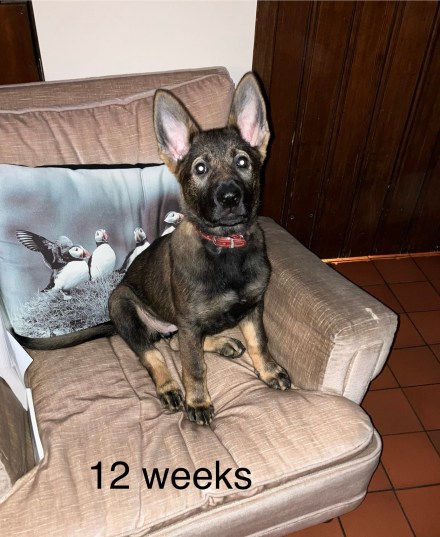
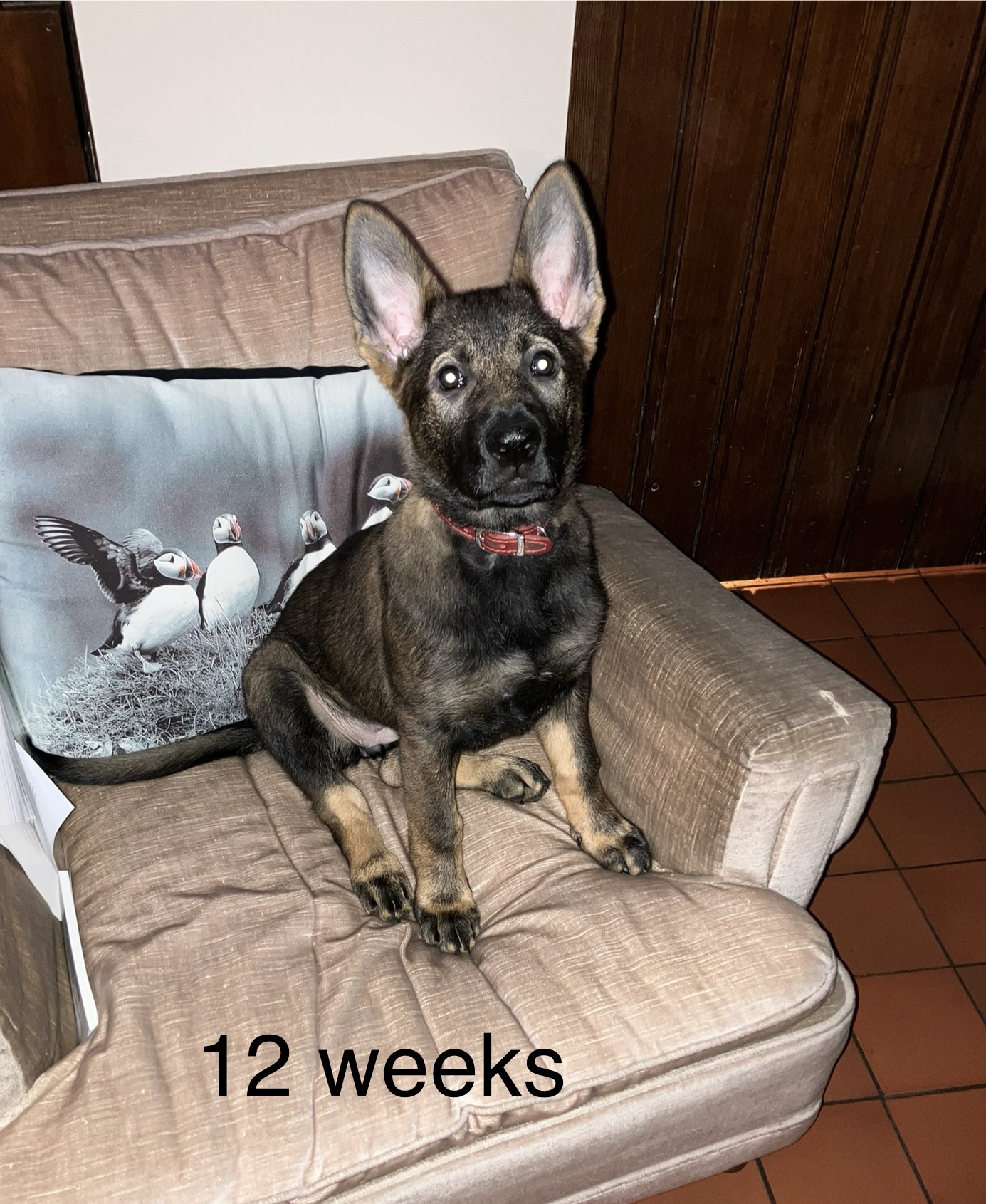
I will let you know how Meg develops. I am writing this postscript a few weeks later, and you will see from the photo below, that this dog is possibly too clever for me! This is what happened at 12 weeks, when I told her to ‘sit!’ (She’s not allowed on the furniture.)

A New Puppy


Meg’s Diary: First Day

We drove to near Northampton to collect Meg. You might remember from an earlier blog, that I was looking for a German Shepherd puppy, and learnt that working gsd are a very different strain. They are shorter, stockier, and generally have less health problems and nervous issues—so they are less likely to react badly due to fear. They also tend to have more energy/focus, which I worried might be a problem (as I don’t have sheep to be herded, only a few poultry) but we requested one, and I started reading. ‘Being calm’ was going to be an important lesson.

When we arrived, all the puppies were outside, in a pen. All my worries disappeared and I realised that I really really wanted a puppy—or maybe several! They were gorgeous, full of life as they chased each other and played with an empty milk carton and tried to leap the fence to say hello. Nearly all of their ears were up (a show strain gsd has floppy ears until they are several months old) and they had stocky little legs and nice straight backs and you could tell they were going to be strong dogs.

I asked to see their mother—because that seemed sensible. She was still lovely, though looked more tired than when I had seen her previously!

The breeder recommended Meg, as I had asked for a darker sable, and she knew I didn’t want a pup who was ‘very driven.’ Not that any of them looked particularly calm.

We paid and put her in the car. (£2,000 in case you are interested—a big increase from the £450 we paid for Kia when she was a puppy—but comparable to other reputable breeders. You have to divide that between 16 years, and then it’s worth the price.) The price covered her first vaccine and worm-course, a chip to identify her, and half a bag of dog food. I thanked the breeder (because she had sold me the best thing ever) and we left.

Meg started to cry as soon as we left. I really wanted her on my lap, but I wasn’t sure of the law/view of breeder (and gsd breeders are very fussy, and will refuse to release their puppies unless they are certain the new owner will be sensible). However, I also felt that the two-hour trip would be a good bonding time. So we stopped (like naughty children, as soon as we were out of sight!) and I transferred the puppy onto my lap.

She was easy to control, and I had piles of towels to hand in case of accidents, and I hoped she would just sleep. She didn’t. But she was settled, and she snuggled into me and watched Husband drive. A couple of times she was sick, but I am pretty nifty with bags after years of baby-vomit, so it was fine. By the time we arrived home, we knew each other.

I took Meg into the kitchen and put her on the floor. She ran round, knocked over a plant, tried to eat the plant, tried to eat me when I started to clear up. She has super-sharp claws and very pointy teeth. A friend had kindly leant me a puppy-pen. The first time we put Meg in it, she leapt at the sides, managed to get half-way up, and tried to leap the rest of the way. I worried she might either fall backwards, or climb over—either way she would be hurt. Husband managed to find a super-large crate at Argos, meant for a Wiemaraner but perfect for an energetic gsd puppy.

The first night, we did as the breeder had suggested. When we went to bed, we put Meg into a small crate, turned off the lights, left her. She cried, barked, sounded like she was being murdered, and then fell asleep. I slept within earshot. When she woke (2am) I went to her, didn’t turn on the lights or speak, took her in the garden to pee, returned her to the crate. She made a fuss, but fell asleep after about 10 minutes. When she woke again (4:30) I repeated. I got up at 5.30, and we started the day (I am usually up at 6ish, so that was fine). Whenever Meg toileted outside, she was praised and given a treat. She’s really clever, and we only had two accidents in the house. She cannot be left alone for a moment (unless she’s in her playpen-crate, which I don’t want to use too often). She seems very happy. I am exhausted.

Thanks for reading.

Take care.
Love, Anne x

***

Can You Name the Character?


Quiz

  1. Who lost their home, possessions, children during a wager between God and the accuser, and were then ignored by God?
  2. Which prophet determined the outcome of a battle?
  3. Which unarmed, untrained civilian killed the head warrior of the opposition in a one-on-one encounter?
  4. Who was forced into a position of subservience, due to their talents rose to a position of authority within a foreign palace, and then used their wisdom to save the Israelite people?
  5. Who was the longest follower of Jesus, who never deserted him, and was there at the crucifixion?
  6. Whose action was stopped in the wilderness, and they then named God: ‘God who sees’?
  7. Name a child used to further God’s plan.
  8. Who defied the authorities to save the life of God’s people?
  9. Who were Mahlah, Noa, Hoglah, Milcah, and Tirzah?
  10. Which story in JOSHUA 15:16-19 is repeated in JUDGES 1:12-15? Why is it important? How often have you heard it mentioned in church?
  11. What characteristics make a good leader?


    Answers
    1. Might be Job, but actually it’s Job’s wife.
    2. Deborah (Judges 4:9)
    3. You might have said David (against Goliath) but actually it was Jael, a housewife who hammered a tent peg through the man’s head! (Judges 4:21)
    4. Esther
    5. Mary, his mother
    6. You might think Abraham, when he was going to sacrifice Isaac, but actually it was Hagar. (Gen 16:13)
    7. You may have said Samuel, but it was Miriam—Moses’ sister.
    8. You may have Rahab in Jericho, Michel with David, or the Midwives in Exodus. Brave women, who risked their lives to defy the authorities.
    9. Numbers 27, daughters of Zelophead who asked for share in inheritance—radical protestors! Their story is told twice, and (unusually) they are named — but did you know who they were?
    10. The story of Caleb’s daughter. Yet she is rarely mentioned.
    11. Strong, leads from the front, not afraid to make mistakes, sense of direction, decisive, task-focussed, sense of gravitas? These are ‘masculine’ characteristics. Feminine leadership is about consensus, working as a group, collaboration, listening—Eg. Mo Mowlan in Ireland. Either gender can lead using either style, so Margaret Thatcher led with a ‘masculine’ leadership style. If groups are listing certain criteria when looking for leaders, they might be introducing bias.

So, how many answers did you know? When I did the quiz with a class of 12 year old’s, they all named different men in the Bible (It was an RS lesson, so they knew they all were in the Bible.) The point is, the answers are all females, yet they are rarely preached about, and often we don’t even know their names. At college, we have been studying feminist theology—so what is it? Some definitions are:

“Feminist theology is a theological movement primarily within Christianity and Judaism that is intended to re-examine scriptural teachings on women and women’s roles from a woman’s perspective. Feminist theology attempts to counter arguments or practices that place women in inferior spiritual or moral positions.”

Ann Bock:Feminist theology, the study of God with special attention to women’s experience and their struggle for equality and justice, can be approached from at least three different perspectives: feminist theology as story, as history, and as traditional concepts and categories of academic theology. Each has its strengths and weaknesses, but all together, in combination with one another, they offer us a more complete picture and understanding of feminist theology”.

When using story, there will be a triangle between the author/story/reader When looking at history, we look at how women have been treated/recorded—Eg. Phyllis Trible wrote a well-known book, ‘Texts of Terror’. The treatment of women can be examined in history, and then evaluated—do we want to continue/copy the behaviour? How can it be addressed? If you look at some of the ‘terrible’ texts below, you will probably agree that no, we don’t want to treat women like this today.

Some texts that abuse women:
Gen 19:8 – daughters offered for rape
Numbers 30: 3-5, 6-8, 12-13 A man could overrule a woman’s pledge.
Numbers 5 A jealous husband can abuse/poison his wife to ‘prove’ her innocence.
Deut. 21:11-13 You can take a female captive as your wife, but first degrade her.
Deut. 22:13-30 Also chapter 24 Females were possessions, therefore ‘adultory’ was a property violation. A wife could not take action against her husband.
Exodus 21:7 A man can sell his daughter as a sex slave
Exodus 22:18 Female sorcerer should be killed (but not a male one???)
Judges 11:31, 34-40 Jephthah kills his daughter due to a bargain he made with God.

The problem with these texts is some men, in some places, use them to justify abusing women. This is never right, and we should all be helping to enable women to have value, to have a voice, and to have the same rights as men. I saw in Brazil, on a Tearfund trip, and in India, that people in poverty sometimes have an in-balance of gender power, and women have less justice than men.

I understand why ‘feminist theology’ is a thing, though I see problems too. There is a danger that some texts are disregarded as too misogynous, when we should be looking to see what we can learn from it. It also, like ‘liberation theology’ is in danger of creating ‘an other’ (men) and it is always dangerous to blame a whole group for all problems. I also dislike being put into a box, and I resent having a label, so most of these ‘theologies’ irritate me.

What do you think? Thanks for reading. Have a good week and take care.
Love, Anne x

Next week I will introduce you to Meg. Why not sign up to follow my blog so you don’t miss it?

anneethompson.com
*****

Talking to the Homeless Man


Hello and how was your week? In college, we have been looking at Liberation Theology in Hermeneutics. Don’t stop reading! These are fancy names for simple ideas—as most jargon turns out to be. Hermeneutics simply means looking at how different groups interpret the Bible—what is their bias when they read? (We all have a bias, even if we aren’t aware of it.) And what are they looking for when they read, what sort of things do they emphasize?

Before the lecture, we were given a task: Speak to a homeless person. I thought this might be too difficult, as there are not generally homeless people begging where I live, but I was wrong. When I went to the dentist, there was a man begging next to Morrison’s. He had a sign: ‘I am hungry. God bless you.’ As a marketing device, I thought it was rather effective—nothing confrontational, stated the need, offered a reward. I decided that after the dentist, I would pop into Boots and buy something for lunch, then chat to him. I felt quite holy about this, feeding the hungry is something the Bible talks about lots. It did, of course, go wrong, because I am not as holy as I like to think. But first, I will tell you about Liberation Theology.

Liberation Theology started in South America in the 70’s (I think—possibly earlier, but that seems to be when the loudest voices appeared.) It looks at what the Bible says about inequality, and poverty, and people who are oppressed, and it encourages people to fight this. It teaches that everyone is equal, and God has a special love for the poor, and poor people often have a clearer view of who God is. Therefore, the rich should give financially to help the poor, and they should also listen to them and learn from them. It is not the benevolence of the greater person giving to the lesser, but rather a fair sharing of resources, and those with less having a voice, and teaching ‘life lessons’ to the rich.

In many ways, I agree with the teaching. However, there is also a Marxist element, a stirring up of trouble, encouraging people to protest, which I don’t see in the Bible. It creates ‘an other,’ a group of people who are ‘different’ and who therefore can be hated, and I think that is dangerous. That’s what the Nazis did with the Jews. Encouraging poor people to blame ‘the rich’ is not okay. I think the Bible should be applied to ourselves. So yes, if we are wealthy we should seek to balance resources (and everyone living in England is wealthy, when compared to those people in the world who have literally nothing—no furniture, home, food). We should be sharing what we have—it doesn’t belong to us, it comes from God and we should be using it wisely. However, the poor should apply the Bible to themselves too. They should be seeking to change, to become who God wants, too—not reading it to apply it to others. The Bible is meant to change us, not give us a stick to bash-up others.

But back to my homeless man. I went to Boots, and chose some food. Not easy, as I didn’t know his religion, and whether he would eat meat, and the only vegetarian sandwiches looked horrible. I bought some sandwiches, and some juice, and some water. Then I had the not-so-clever idea of buying some vitamin pills, thinking that I was only helping for a single meal, but with vitamins his health would improve for the next month. Stupid idea.

I returned to the man, gave him the food, and asked where he was from. Then I tried to explain that the vitamins should only be eaten one per day, and they would be dangerous if more than one was taken each day. I worried that he might not understand this complicated English, so I tried miming, and was feeling very stressed as I repeated, several times, that more than one was dangerous, only eat one a day. I realised I was basically telling him off, and he was looking rather worried by this ranting woman. I wondered whether I should remove the pills, but thought that might turn into a scuffle, given how badly this was going. So I left.

I realised, walking away, that I had not even asked his name. I certainly hadn’t listened to him, or shown him any real respect; I had simply tried to enforce what I thought was good for him, and I had done it badly. This I suspect, is often the problem with trying to help—it becomes interfering, or is not done wisely. This is why I prefer to give to a professional organisation, rather than an individual. I trust Tearfund to feed the poor on my behalf, and not to end up shouting about vitamins being dangerous!

I hope you do better today than me, and may you be spared encounters with stressed middle-aged women! Take care. Thanks for reading.
Love, Anne x

Blessed


Last week was the wedding blessing. If you follow my blog, you will know that my daughter was married in Scotland a few weeks ago—an incredibly happy day with lots of colour and loud voices and large men in kilts. It was a celebration, and it was marvellous. However, being married is something serious, and when I heard they also wanted to have a service of blessing, in our local church, I was delighted.

The plan was to have a short service, very low-key, attended by just close friends and family. We don’t currently have a vicar at our church, but the previous vicar—who my daughter and her husband have met and liked—kindly agreed to lead the service. I have never attended a wedding blessing before, and I wasn’t sure what to expect. But the vicar met the couple a few times, and talked about what they could do, and advised them on what was appropriate, and together they made a plan for a short service.

I spent the day before cleaning (not easy, as I will explain in another blog) and decorating the house with bunting and bows. I found some strings of flowers on Amazon, and hung them around the front door. My sons arrived, so there were beds to make, and meals to prepare, and time was too short but we got there eventually.

On the afternoon, we all dressed in nice clothes (dressed as if going to a nice restaurant—as instructed by my daughter) and set off in various cars. There was then a brief moment of confusion, as one of my sons realised he didn’t actually know which church he was driving to (!) but we all arrived in time.

My daughter and son-in-law were at the church, welcoming people and smiling and looking happy and not too nervous. My daughter was wearing another white dress (we only had one wedding dress when I was married!) and carried yellow roses, which made me smile. (When she was born, everyone sent me yellow flowers, so I always think of her with yellow flowers, not pink.) The church looked lovely. The flowers for the Sunday service were already there, and they were white as the flower ladies knew we had the blessing. The heating had been switched on, so it was nice and warm, and the verger had lit all the candles. It was very special.

The vicar started the service, my daughter and her husband waited at the back, and the organ started to play. . . The Phantom of the Opera! She had chosen this, to surprise her husband, and as people recognised the music they started to smile, and laugh, and by the time they reached the front, everyone had relaxed and realised this was not going to be ‘a boring church service.’ It was something different.

There was a reading about love from the Bible, and a poem. The vicar spoke about marriage, and advised that it could be tough, and needed commitment, and things like not going to bed angry (Husband kicked me) and remembering to notice the needs of the other person (I kicked Husband) were important. The couple then listened to the marriage vows, and agreed that this is what they had promised to do when they married. Their rings were blessed. They knelt, and were prayed for. The congregation promised to support them. There were  three hymns (songs that people would know from school assemblies, as many of the people there don’t usually attend church).

It lasted about half an hour, and I think it was perfect. The thing is, being married is not always easy. We have been married since 1988, and my husband is my very best friend. But sometimes I feel angry, or lonely, and sometimes we get things wrong. Therefore, asking God to be part of a marriage seems sensible to me. Why wouldn’t you want the extra help to sort things out, when someone needs to be forgiven, or things feel impossible because you haven’t slept for weeks due to a new baby? Marriage should be about love, and joy, and faithfulness, and those things describe who God is, so including him makes sense.

Afterwards, everyone came to the house for tea and cupcakes. We had champagne, and my sons made a speech. (Brothers speaking about their sister was always going to be funny and naughty and affectionate.)

And that’s it—wedding stuff is finished. It has been a special time, a good memory. Life should be about creating good memories.

Thanks for reading, I hope you have a good week. Take care.
Love, Anne x