Dale Dyke Reservoir


The weather was grey but dry, so we decided to walk up to Dale Dyke Reservoir. We followed muddy footpaths around Agden Reservoir (this area has a LOT of reservoirs—it’s a good place for water birds). The track rose over a grassy hill, with sheep begrudgingly moving out of our path, and then we saw it—first the steps of rushing water from the overflow channel, and then the reservoir itself, glinting under the grey sky, stretching across the valley.

As we drew near, we saw a strange stone, like a mini gravestone, marked with CLOB, and I wondered whether it was the grave for a dog with a strange name. But then I read the board next to the path, and it took on a new significance. Dale Dyke Reservoir was built to replace another, larger reservoir—which in 1864 burst through the dam, rushed into the valley below, swelled the rivers to Sheffield and killed hundreds of people. We read the story.

Accounts of the incident vary slightly, but it seems that on 11th March, 1864, after several days of stormy rain, a local man, William Horsfield, crossed the dam on his way home from work, and noticed a crack. It was fairly small, but big enough for him to notice, and the dam was new—only recently finished. I wonder what he thought at that point. Did he have a sense of fear, knowing the reservoir was new, it hadn’t been there for years, it wasn’t yet something familiar, something he assumed was permanent. Was he frightened, or merely interested? Did he assume all would be okay? Maybe not, in an age when bad things happened more often, perhaps he was instantly concerned.

One of the dam builders, Mr. Fountain, was still in the area, so William told him, and they both examined the crack. Mr. Fountain thought it was probably nothing to worry about, but just to be cautious, he sent for the main engineer, Mr, Gunson, who lived in Sheffield. (To be accurate, he sent his son—sons have always been useful.)

By the time Mr. Gunson arrived (Sheffield is about 8 miles away, and I am guessing they travelled by horseback) the crack was bigger. Water was beginning to spill over the embankment.

Suddenly, a huge gap opened—30 feet wide—and the water began to gush into the valley. At this point, there was nothing anyone could do to prevent tragedy. The men scrambled to safety as the dam gave way, and 700 million gallons of water swept towards Sheffield. There was no time to warn anyone, no telephones to contact people, nothing they could do but watch in horror.

The water raced along the valley, swelling the rivers Loxley and Don. The River Don ran through Sheffield, and an area called The Wicker was badly flooded. The bridges were choked with fallen trees, destroyed mill wheels, carts and debris. People stood on bridges to watch, unable to stop the flow, helpless. About 250 people were killed.

After walking to the reservoir—which looked placid and innocent when we were there, we decided to visit Sheffield. Great-Grandpa Todd was a vicar in a church there, about a hundred years ago, and we were interested to see his church. It just so happened, that his church was in Wicker, next to the river Don, right where the flood water had been worst. We saw the church, and the river, and on the opposite bank, there is a memorial to those who lost their lives. Some of them are unnamed, just ‘servant, male, aged 27’, or ‘infant, 2 days old’. Some names were of people later found alive. Some people died later of their injuries.

It’s thought to be one of the worst man-made disasters in the UK. It reminded me of Aberfan, the mining town where the slag-heap slid over the school and killed the town’s children in 1966. Except I had never heard of the Dale Dyke disaster—perhaps because it was so much earlier. But the local people have not forgotten. In 2014, on the 150th anniversary, they commemorated the occasion. There were talks by historians and civil engineers, and the local brewery produced a beer named ‘Dam It,’ and they produced a CD of ‘flood songs.’

It is difficult to understand who was to blame for the disaster. Locals blamed the Sheffield Waterworks Company, who commissioned the dam in an attempt to provide clean water to the city. They were not held accountable at the later inquiry. Nor was Mr. Leather, their engineer (though interestingly, his uncle George Leather was the engineer for another reservoir that collapsed, near Leeds, killing 81 people). Maybe the reservoir was too large for the engineering of the times. Maybe (as claimed by the company) there had been unexpected earth movements (though I would’ve thought that their engineers/geologists should have checked for earth stability before building it—but maybe these things couldn’t be predicted in those days). Hard to know. I don’t know whether having someone to blame would help the grieving survivors. 

I do wonder though, how William Horsfield felt afterwards. Although he took immediate action, although it was in no way his fault, did he torture himself with regret? There was time to fetch the engineer from Sheffield, which means there was time to bang on doors, to try and warn people—even though at that point, they didn’t think it would breech. But should they have warned people anyway? Should they have risked looking stupid, of raising a false alarm, of causing unnecessary panic? What would we do? Remember, no one knew what would happen, it remained an unlikely possibility, right up until the time it happened—but would that have been a comfort to poor William? I suspect not.

Today, there are several, smaller reservoirs in the area, feeding water to the city. They look peaceful, places to walk to when on holiday. But water camouflages danger with gentle ripples and inviting cool blue calm. Once the restraints fall, the chaos can begin.

Thank for reading. Have a safe week.

Love, Anne x 

Photos a mixture of my own, from information boards, and the Daily Mail website.

Thank you for reading.
anneethompson.com
Sign up below to follow my blog.

Mini Break in the Peak District


Easter Away Trip

I am writing this in a tiny cottage snuggled in the hills of Lower Bradfield. You might remember that in January I attended a conference for Old Testament Study in Sheffield, and Husband kindly drove me and rented a cottage in the Peak District? I stayed in the cottage for just one night, and was sorry to leave, so when we realised we had a week free after Easter, we decided to return. 

We arrived on Easter Sunday, after lunch with the family in Cambridge. The cottage was warm and comfortable, and after unpacking we strolled up the steep lane behind the house. It was dusk, and an owl was hunting in the fields, swooping over the lane. There was the trill of curlews, who rose above us, warning us not to stray near their nest. Sheep watched from behind stone walls, their lambs snuggled under their legs. In the distance, hills rolled away, dotted with stone buildings and steep fields, up to the moors. It’s a open place, a place where you can breathe, and it feels weird that it’s only half an hour from Sheffield.

Monday morning, my Ocado deivery arrived at 8am. Perfect timing for breakfast. The delivery man was exceedingly grumpy, and told me he had worked all weekend, and no, he had not had a nice Easter. I felt slightly guilty as I unpacked my order. I seem to have ordered a lot of cakes, so won’t be losing any weight this trip.

We walked across Agden Nature Reserve to Canyard Hills. Muddy footpaths, twisted trees, a reservoir in the valley. I wished I hadn’t gone for a long walk a few days before Easter and given myself blisters. I blamed my walking boots (which I left at home) and was stomping along in wellies. Husband hardly mentioned it. We walked for two hours. There were beautiful views—and big black clouds. We got home just before it poured with rain.

It was still pouring after lunch (ate some cake). We went for drive to Castleton—which we both remembered but couldn’t remember why (we are at that age when we can spend a happy half hour trying to remember things). Then we drove through Winnats Pass. This was spectacular, we turned the corner, and there it was—steep rocks rising on either side, tiny streams bubbling down to the valley. The road was single-carriage, and there were lines of cars waiting to pass, so I recommend you don’t visit in peak times. But definitely plan to visit, it’s amazing.

We had dinner at The Plough in Lower Bradfield. It was a ‘pubby’ sort of pub (as opposed to a ‘gourmet’ sort of pub) but after a nice glass of Merlot I decided it was lovely. We chatted about the day, and managed to remember when we last visited Castelton, and I bored Husband with interesting details about the theology book I am currently reading. A good day.

Tuesday, I got up at 6.30. At 9.30 we left the cottage and walked to Lower Bradfield on the footpaths. I was still in wellies. It was okay. The walk was very pretty, we went up the hill to High Bradfield, and the old church with dragon gargoyles and sheep grazing in the graveyard. Then back down, along pretty footpaths under trees and over rivers, to the village. There’s a new cafe, which advertised brunch and coffee, but it was shut. (Apparently it’s always shut on Tuesdays.) Walked back to the cottage for coffee and toast (and more cake).

I spent the afternoon reading my theology book (by a chap called Leo Perdue, about Wisdom Literature—very interesting). Sounds of fighting wafted upstairs. Husband was in the sitting room, watching a cartoon. 

We decided to drive to a cheese factory advertised on Google Maps. We found the lane (very narrow) but not the factory. I think it must have closed. Drove into Hathersage, and I bought some walking boots in one of those outdoors shops that smell of sensible clothes and waxed jackets. These boots fit better than my last ones. And they have pink laces, which is an additional delight.

It was pouring with rain again. We drove home via Snake Pass, but it didn’t compare to Winnats. 

Dinner at The Plough again. We had asked to sit in the same room, but they either forgot or decided to ignore us because they were busy. We were seated in a very ugly room, full of people who seemed to know each other. I ordered fish and chips, and the portion barely fitted on the plate, it would have fed three of me. Especially as I was already full of cake. A pleasant day, but not as perfect as Monday.

I hope your week is fun. And you have cake.

Thanks for reading. Take care.

Love, Anne x

Thanks for reading.

anneethompson.com

Why not sign up to follow my blog?

Hello From My World


Hello, and how was your week? I thought I would give you a quick update from my house. This isn’t really what I want to write about, as really I want to tell you about what I plan to write for my thesis. But I can’t. I’ll explain why in a minute.

Firstly, if you had Mother’s Day last weekend, was it lovely? I had lovely gifts from my family, and no one forgot this year. (I never assume…) I cooked dinner for my mum and mother-in-law, and it was all very pleasant.

I used it as an excuse to use the last of the turkey dinners from the freezer. Due to various off-spring changing their plans/announcing they no longer eat birds/incompetence on my part, I ended up with several turkeys, of different sizes, this Christmas. They all went into the freezer, and the last one has now been defrosted—which always takes longer than expected—and cooked.

Last Sunday was busy, because it’s also the day my daughter and her fiancé moved back home. They are currently between selling/buying houses, and they are living here for a while. Mostly this is brilliant. It’s the first time since Kia died that the house hasn’t been horribly empty. When I pop out, I now can shout through a bedroom door to my soon-to-be-son-in-law and tell him that I am leaving. And when I am home, I shout that I’m back. He probably can’t hear me, because he’s busy working, but I like having someone to tell. To be honest, Kia probably never understood when I told her these things, but I just liked telling her.

They did move back with more stuff than I was expecting, even though all their furniture has gone into storage. My house is rather full. But I like having a full house, empty rooms feel wasteful.

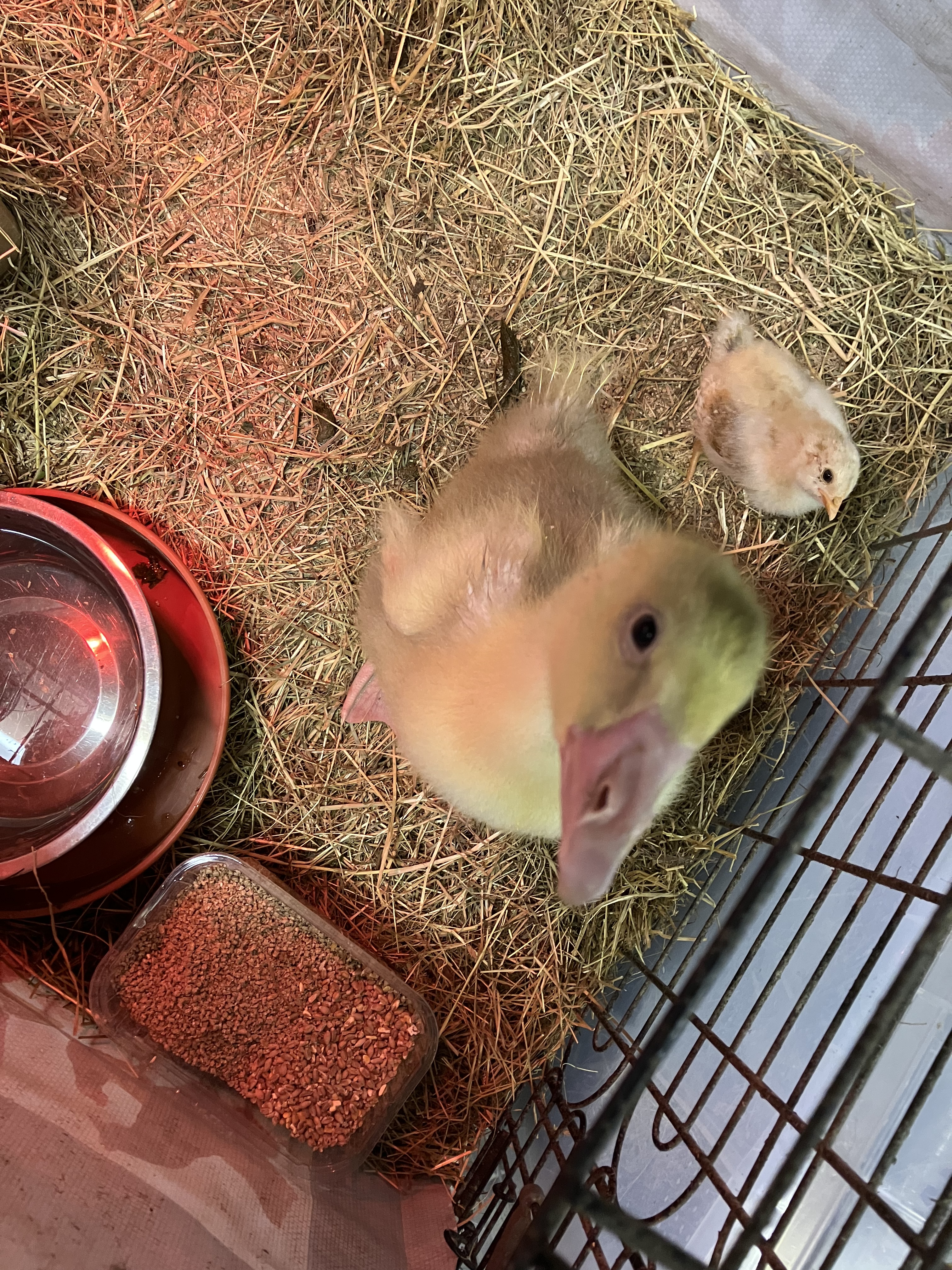
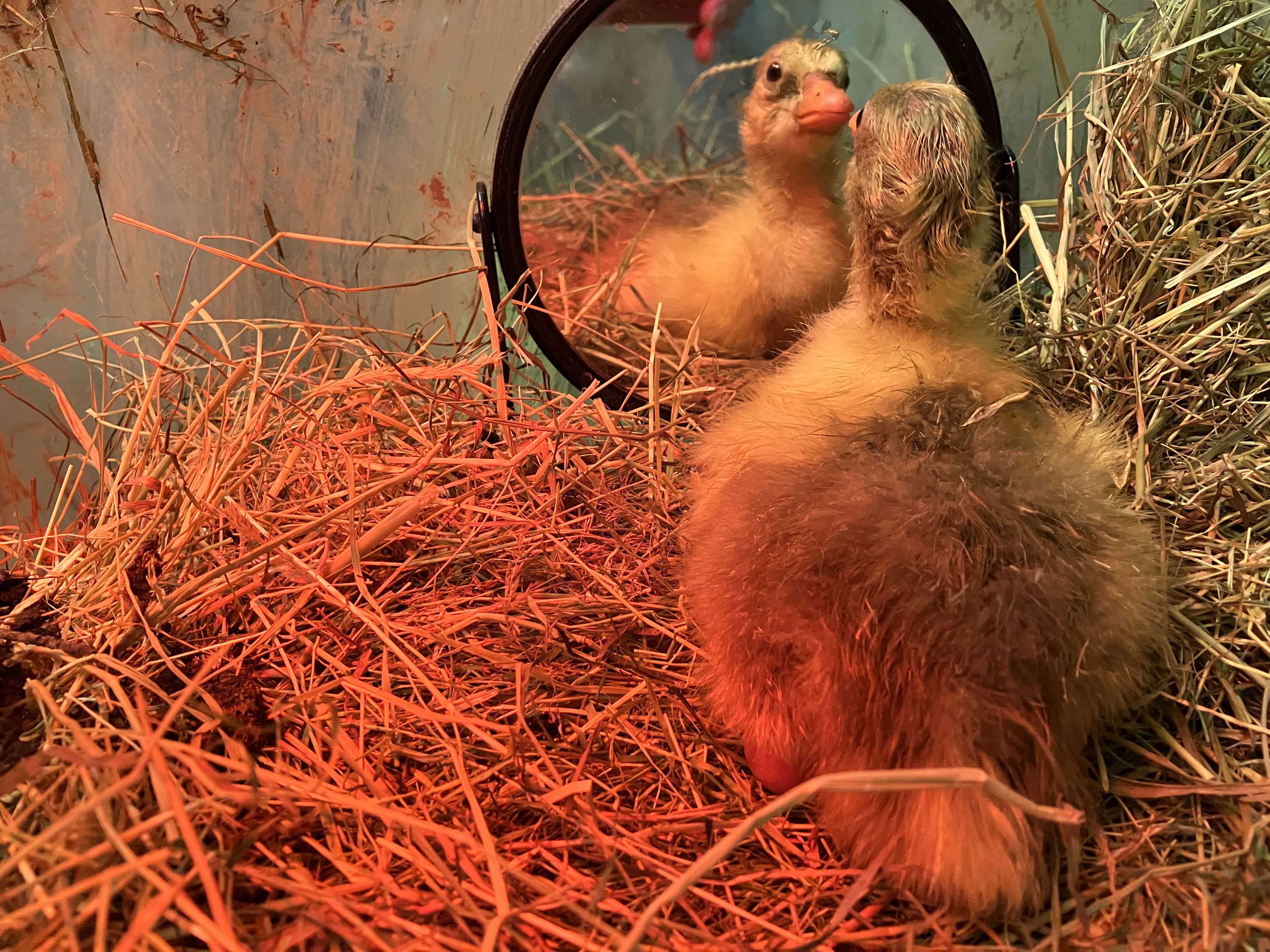
The cage by the pond is also very full at the moment. When Kia died, the local fox soon realised the garden was accessible again, and started to visit, so I have kept the ducks shut away (even thought they could be back on the pond now). They seem quite happy, but the cage is incredibly muddy as they spend all day transporting wet mud from the end with puddles to the rest of the cage. Ducks are mucky creatures. There are a couple of nests, in corners where they think I won’t notice them, and I think they must be almost ready to hatch. Depending on how many hatch, the cage will definitely be too full. And I can’t bring the ducklings into the garage this year, as that is full of daughter-stuff. Ah well, I shall decide on a plan when I know how many hatch.

Last year’s hatch.

I don’t have a huge amount of time for duck or daughter sorting, as I am preparing the proposal for my thesis. I want to tell you all about it, but I have to be careful—apparently ‘self-plagiarism’ is a thing. If I write and publish something, I cannot then put it into the thesis. So I can only tell you snippets, and nothing in academic language. Basically, I want to look at why the Leviathan, which is clearly not a crocodile (because it breathes fire/smoke) changes Job’s attitude in the Book of Job. What does it represent? I’m reading lots of books by scholarly authors, and have discovered ‘monster theory.’ Who knew that was a thing! Apparently, all cultures have monsters, and you can learn a lot about cultures, and what they valued, by examining their monsters. In a time/place of physical uncertainty, the monster might be extreme weather-monsters, or lions; before medical advances, the monster might represent disease; when there were warring nations, the monster might be violent. I wonder what our monsters today might be—loss of control? Racism? Mental disorders that result in unpredictable violence? The films/books we read seem to have lots about psychopaths and historical racism at the moment. When I was a teenager, there was lots about evil spirits/demon-possession (with films like ‘The Exorcist’). You don’t see so much about that now, maybe our monsters are changing.

The other thing you don’t see so much of now are—complete change of subject coming, so brace yourself: some of the sweets I ate as a child! My mum is doing a jigsaw, and on the back are photos of sweets from the 40’s, 50’s, 60’s and 70’s. I will leave you with them—how many do you recognise? Fruit gums have always been my favourite, though I am also keen on a bar of Cadbury’s milk chocolate.

Hope you have a good week, that has a manageable amount of stuff, and no monsters. Maybe there’ll be some sweets too.

Thanks for reading. Take care.
Love, Anne x

What is an ‘Evangelical Christian’? And Are You One?


What is an ‘Evangelical Christian’?

A Church — Not necessarily an evangelical one, I have never been inside.

Before I went to college, I would have described myself as an ‘Evangelical Christian.’ Now I’m not so sure. To be honest, I didn’t really know what the term meant—I assumed, as it contained the word ‘evangelical’ it meant that the person thought it was right to ‘evangelise,’ in other words, to tell other people about God. However, depending on who you speak to, it means different things. And sometimes it’s used as an insult in the Christian world. Shocking! Or maybe not…

There is a handy (if not scintillating) book that defines what ‘evangelicalism’ means, using seven points.[1] If I am honest, I have been aware of these within churches I have attended, and they’re not always good. What do you think?

  1. Conversion. To be a Christian, evangelicals tend to emphasis a moment in time when you committed yourself to God. They talk about ‘repenting of your sins’ and ‘changing direction’ and asking God for forgiveness. I too think this is an important step, though I’m not so sure it happens only once, and certainly not necessarily at the start. I also don’t think there’s an ‘in’ and an ‘out’ and until you have ‘prayed the prayer’ you are definitely in the ‘out’ club (if you see what I mean!) Things are fuzzier than this, in my experience.
  2. Assurance of Salvation. This means a belief that Christ becoming human, living, dying and rising again is all that is necessary for salvation. It slightly contradicts point one above (in my view). Now, being sure you have been accepted by God is important, but I’m not sure that everyone gets there all at once, in a single leap. Nor am I sure that we agree on what ‘salvation’ is. People talk about ‘going to Heaven when I die’ but (as discussed before) that’s what Plato taught, not the Bible. Again, I think things might be fuzzier than sometimes presented. I also worry that ‘assurance of salvation’ is most often used to point a grubby finger at the person who we are ‘sure has not been saved’! Comments such as: “Oh, he was ever so kind, and he’s not even a Christian you know,” tend to be revealing.
  3. Biblicism. Evangelicals tend to say they believe the Bible is the ‘Word of God’ and available to everyone, but then go to great lengths to explain every contradiction and to teach things the way they believe them. Whilst they might be right, they might also be wrong, and maybe a little more caution is called for. It’s easy to find verses in the Bible that support your beliefs. The KluKluxKlan did it, so did the fascists. I think that using the Bible to learn who God is, is great. I think using the Bible to make rules for other people is not so great.
  4. Prayer. Evangelicals believe that prayer is important—both private prayers and prayers in church. The early evangelicals taught that prayer should come ‘from the heart’ (which I agree with) and therefore pre-written prayers, and especially liturgy, are not really prayer. (This part I disagree with.)
  5. The Cross/Penal Substitution. This goes back to point 2., that Christ died to save us from our sin. This is a huge concept, and I don’t think we really understand it, so I won’t comment. I do believe Christ died, and I do believe that somehow that repaired the relationship between God and us. But I don’t know how exactly, and I am suspicious when others seem very certain about concepts which seem to me to be beyond human understanding.
  6. Holiness. When we are saved (see point 1.) it will affect the way we behave. The ancient Methodists believed it was possible to become sinless. The ancient Baptists believed holiness should be pursued through behaviour. In the 1870’s the Keswick Convention was set up, to try and decide this issue. They stated that ‘sin is perpetually counteracted.’ (Keswick is also home to an excellent kitchen shop, which is unrelated.) All I know is, I am not perfect, some terrible people do some really good things, and some apparently ‘holy’ people do really bad things.
  7. Mission. After conversion (see point 1.) a Christian will be dedicated to God’s service, hoping to convert others. Sometimes this can feel like ‘scalp-hunting’ if done badly. At best, it’s the sense of having something special and wanting to share it with others.


Unfortunately, the Church is made up of humans, and none of us get it right. God is very patient with us. I find it helpful to step back, and look at what defines the things I believe, and then to decide whether they are really the things I believe, or if they are simply unquestioned teaching.


[1] Peter J. Morden, ‘Evangelical Spirituality’, in Andrew Atherstone and David Ceri Jones (eds.)  The Routledge Research Companion to the History of Evangelicalism (London: Taylor and Francis, 2018).

Thank you for reading.
anneethompson.com
You can sign-up below to follow my blog.

*****

Springtime Jobs


It’s time to do all those jobs that happen every year at this time. It doesn’t feel much like spring here at the moment, as we’ve had snow and frosts all week. But the mornings are lighter, and the animals know, even if we’re not sure. Depending on where you live, you will either have put your clocks forward an hour, or be preparing to do so. We move our clocks on the 26th March this year, so the US and Canada are ahead of us.

One Christmas gift (which feels like yesterday) was a pot and a packet of beans. We’re having a family competition, to see who can grow the tallest bean. It has to be in the pot provided, which wasn’t very deep. Mine grew to 67cm, then it decided the kitchen was too warm and the pot too small, and died. I planted the remaining seeds outside, and they don’t seem to mind the cold and are looking healthy. I expect the slugs will eat them, but here’s hoping.

My bean, growing next to a lemon pip (which is slower but less fussy).

The birds know it’s spring. The ducks have started laying, even though it’s cold, so April will be busy with ducklings again. There are already lambs in the fields. The cycle of life begins again.

We also have a wren in the garden. Male wrens are busy at this time of year, collecting things to build nests. Nests plural. A male wren builds several nests. When he manages to attract a female, he takes her on a tour of the nests, she chooses the best one, and lays her eggs. He then goes off and finds another female, and repeats the tour with the remaining nests. He’ll do this until all the nests have females, sitting on his offspring. Not the sort of male you want to introduce to your daughter. He’s a tiny brown bird, but has something (which I cannot remember the name of) in his lungs, which amplifies his voice. A tiny bird with a loud song. I’m rather fond of him, so I hope the cats don’t catch him.

Spring this year will be busy for me too. I need to sort out the house, because my daughter is moving home for a few months between selling her flat and buying a new property. This will be fun, but I need to make space for her. Though once I have emptied some cupboards, the job will be finished. I also need to write the proposal for my dissertation, which is less fun. I have to submit the title of my thesis, explaining what I plan to research and why, with a list of all the literature I plan to read and why it will be relevant. I am going to explore the dragon in the book of Job (chapter 41) which will be interesting, but being assessed makes it more stressful. But at least I only have to produce one, and I can submit that to the university and they will either love it or not. Being a wren and having to repeat that many times over each year must be a whole different game.

Hoping that all you attempt this week grows well and is completed on time. Thanks for reading. Take care.
Love, Anne x

Thank you for reading.
anneethompson.com
Sign up below to follow my blog.

Madeira, February 2023


We visited a few towns on the south coast of Madeira. It wasn’t possible (I think) to reach them via pretty coastal roads, as the roads seem to be either blocked or fallen into the sea or abandoned to rock falls. Our drive was therefore through a series of tunnels. Madeira does tunnels very well, but you don’t get to see much scenery. I cannot imagine how different life must have been before the tunnels were built. Towns would have been fairly isolated, as visiting other places would have taken much longer.

We visited Ponta do Sol. As we drove down the steep road into town, we saw a small carpark. It was full, but we managed to arrive as someone was leaving, so parked the car and followed signs to the old town. The town is built on a steep hill, terraces of bananas reaching up the cliff side, cobbled streets and houses clinging to the lower levels. There were some good coastal views, but nothing to entice us to stay in the town. The busiest area was the beach, with families sitting on the black sand or swimming in the sea. I never like black sand. Although I know it’s no less clean than yellow sand, it feels dirty. As Madeira is basically just a big volcano, all the natural sand is black.

Next we drove to Madalena do Mar. We did attempt to follow the coastal road, but it petered out, so we had to do a difficult 3-point turn on a bendy road, and it wasn’t worth the hassle; we returned to the series of tunnels.

Madalena do Mar has a big car park next to the sea, and a lovely promenade lined with palm trees along the coast, a jetty for fishing or mooring boats . . . And very little else! There were plots of land waiting to be built on, and even an area designed for a café, but no one seemed to have actually arrived yet to build the hotels and cafes. It was lovely, in a sort of abandoned, not quite there yet, way. Not sure what it will look like in ten years time.

Quite windy!

Our last stop was Praia da Calheta. This was a busy town, full of people, cars trying to park, cafes and supermarkets. There was a small marina, with little boats bobbing in rows, and a long promenade with palm trees and cafes. There were also beaches, with yellow sand hauled from Africa. Despite the cold, several teenagers were swimming, their squeals piercing the air. Steep cliffs bordered the coastal road, and we sat in a cafe, sipping espresso and watching little black and white birds nesting in the rock while seagulls swept past looking for food.

We returned to Funchal for dinner, and ate in Noitescura, a restaurant near the apartment. It served traditional food, and last time we tried ‘Francesinha’ which were like burgers (beef, chicken, fish or vegetable) with a fried egg on top, and served covered in a sauce/gravy. I chose badly, and had the vegetable one, thinking it would be a mushroom burger, but it wasn’t, it was more like minced vegetables (tiny pieces of onion, broccoli, carrot) in a soggy bun. It was as horrible as it sounds. This time we shared a fish platter, which was lovely. It had a variety of local fish (scabbard, parrot fish, bass) and we ate it with fried sweetcorn, rice and chips. (No veg this visit, Husband chose the food.) 

I also tried a poncha, which is a traditional drink, sold all over the island. I was expecting something like a caipirinha, as it’s made with sugarcane alcohol, but it wasn’t, it was more bitter, and orange, and served in a short fat wine glass with no ice. Not unpleasant, but I prefer caipirinha. I also had white wine with my meal, and a dessert with sambuca (which I remembered too late I don’t like, but luckily they poured it over the dessert and then set it on fire, so most of it burnt off). We finished with a glass of Madeira wine, but refused the rum that was offered with the bill. I don’t usually drink much. I didn’t sleep very well that night.

Thanks for reading.
Have a good week. Take care.
Love, Anne x

Thanks for reading.
anneethompson.com
Sign up to follow my blog, and it will be emailed to you each week.

Another Day in Funchal, Madeira


Winter Break in Madeira

Day Two

We found heaters in the apartment, and managed to warm up a bit. There’s no central air conditioning or central heating—I assume because usually all year round is ambient. It’s colder this year. I woke early, before sunrise (it’s not light here until about an hour after it’s light in the UK). When it was light, we went for a run. Although not sunny, it wasn’t cold. The light is different here. It’s a comforting light. Most of Madeira is mountainous, so lots of people run on the only flat land, along the promenade. It’s a pretty place to run, with little areas of garden, and interesting statues and the sea lapping onto pebbles next to you. There are often cruise ships, towering over the docks, and occasionally we had to dodge large groups who were touring the island, led by a guide to the most famous sights. I prefer living here, even for a few days, to try to absorb some of the real life. It was fun to watch the ships arriving though, such impossibly huge structures balanced on the water.

After a shower, we walked back to the little cafe where last year we went every morning, Husband always had a cheese and onion bolo, and I had an espresso. But the cafe was shut. What a shame. We wandered around, looking for somewhere to recreate the same ‘coffee with the locals’ feel, but most cafes looked very touristy. Then we settled on the cafe under the apartment, which wasn’t in such a nice location (okay, it is a horrible location, as it’s basically right on a busy road). But it had plastic chairs, and locals sipping espressos, and it looked clean. We ordered (Husband had chips. Chips. For breakfast.)

Note my disapproving face! The sandwich is actually very traditional in Madeira: sliced beef, ham and cheese. But the chips?

While we waited for our coffee (and chips) we saw the elderly man from last year’s café. He sat outside and had his coffee, and we wondered whether we should say hello, but decided we didn’t speak enough Portuguese and he didn’t speak English, and probably it would just confuse him. So we didn’t. But we mentioned it to the waitress, and she told us that he still runs his café, but the roof fell down, so he’s waiting for it to be fixed. This is why I like returning to the same places. Being on holiday is a break from life, but if you travel a lot, it can mean that you never engage in life, you are never part of anything, which seems a waste. When we return to the same places, we can be part of a different community — even if only very briefly. I think life is about connections, not being isolated. I’m not a great one for drifting, I like to have a purpose.

Caffeine replenished, we set off to find the boot shop. Last year I packed the right clothes, but not the right footwear, and when we had torrential rain, my only ‘waterproof’ shoes were drenched. We found a little shop that sold boots, and I bought a pair because they weren’t too expensive. They have been the most comfortable shoes I have ever owned, and are still worn all the time. They are brown boots, and I don’t like wearing brown shoes with grey trousers, so I was keen to buy some black ones. But would we manage to find the shop?

We set off, past the market (Mercado dos Lavradores) and all the aggressive salesmen selling fruit at inflated prices to unsuspecting tourists. We crossed the road, rounded the corner where they are building a Savoy hotel, and headed into the lanes of the old town. We half-remembered the road, and that the shop was opposite a larger shoe shop selling fashion shoes. We found a smaller shoe shop opposite, and went inside. It looked slightly different, but was in the right place, selling shoes. I explained what I wanted, showed the salesman my brown boots, and he went off to find some black ones. He returned with several boots, some of the black, none of them the same manufacturer as mine. I explained that I wanted the exact same boot, but in black (otherwise I may as well buy them in England). He came back with some similar boots, which he spent a long time stretching, undoing the laces, bending them open. I tried them on, knowing they were a size smaller than I wanted. I thanked him for trying, and left. The man suggested I should try in the big shop opposite, but I knew they only sold fashion shoes, and I wanted the same good quality leather boots.

I set off towards the apartment,  refusing to listen when Husband suggested we should look in other shops, because I hate shopping, and only went to that place because I thought it would be easy. Husband insisted. I said I would look in one more shop. Husband led me up the road . . . To the exact same shop we had visited last year! We had been in a different shop, which explained why they hadn’t had my boots. This shop only sold Tapadas boots. Which begs the question: why did the other shop, when I was leaving anyway, not direct me back up the road? He must have known the Tapadas shop was there, and he wasn’t making the sale, so why not tell me? I dislike mean people. If you want comfortable boots (the sort of boots you can wear on an all-day hike on the day you buy them and not get blisters) then head to Abreu’s Sapataria.

I like Madeira, but I cannot quite get a feel for what it must be like to live here. Unless you want to work in the service/tourist industry, or to be an engineer (because there are some serious mountains to build on/through) then I’m not sure what work the island offers. There are the huge cruise ships that visit regularly, but the passengers tend to eat onboard, and only do brief excursions into town, making shops and attractions overly busy and then leaving, returning the narrow streets to the locals. The restaurants tout for business by trying to persuade passing people inside, which I always find uncomfortable, but maybe they have to, maybe there isn’t quite enough tourism for the number of restaurants. I suspect it’s a difficult place to run a business. We ate in some restaurants that were lovely, with delicious food and staff who worked very hard to keep everything clean and efficient. But they were rarely full, and sometimes we were the only customers, which felt sad given how hard people worked. But for us, it was lovely. I like visiting places out of season, pretending that I live here.

I will tell you more next week. Thanks for reading.
Have a good week, and take care.
Love, Anne x

Thanks for reading.

anneethompson.com

****

Returning to Madeira in 2023


We left home at 4 am, and arrived at the apartment about 12am. Arriving in Funchal is always an adventure. Funchal is a short drive from the airport in Madeira, and both times we have come, the little airport has been very efficient, with very few people arriving, short queues, helpful staff, and clean facilities. The car hire place is in the airport, and there is a short walk, including a lift down the side of the rock, to reach the cars. The drive from the airport is easy enough with Google Maps and the road is edged with amazing plants. I love the plants in Madeira, and it’s worth visiting simply to see them: great succulents with huge protruding stamen, sharp-leafed flowers clinging to rocks, impossibly tall trees that sort of resemble pine trees with a twist.  However, once you leave the main road and enter  Funchal, the fun starts!

The roads are steep, narrow, often cobbled. You feel like you are driving down a pathway. Then you meet a parked car, or tables spilling from restaurants, and you wonder if perhaps you really ARE driving along a pathway. But these rabbit-warren streets are the only route into Funchal. Then there is the problem of needing to park, and the entry-fob for the car park is in the apartment, but there is nowhere to park in order to collect said entry-fob.

At least this time we knew what to expect, and planned accordingly. (If you read the blog about our previous visit, you will know that Husband dumped me and all the luggage in the street outside, while he went off to find somewhere to park, which took longer than you might expect.) Husband drove to the garage entrance, and I jumped out and walked to the street where the apartment was. Somewhat confused by lack of numbers on doors—or at least, there were numbers, but they were all 18, so finding ‘number 18’ was less specific than I had hoped. Decided it was unlikely to be 18A, or 18B, as they were gyms. Then there was a door numbered 18, but that was locked. The adjoining door was unlocked, and as the buildings were connected, I entered. Tried the lift (I needed Apartment 36, which I guessed might be on the 3rd floor). The lift only went to floors -1 to -3. Left the lift and tried the stairs. Found myself in a doctor’s surgery. Showed  the address to a woman who was leaving, and tried to remember how to ask for directions in Portuguese. Failed, but she understood me anyway and told me I needed to go ‘beyond the cafe.’ I didn’t, I needed to go through the locked door of number 18. Found some doorbells, rang number 36. Found the cleaner, who had the garage-fob. Returned to garage. No sign of Husband… You get the idea.

When we actually managed to enter the apartment, it was lovely. There are tiny balconies, and a view over rooftops to the sea. It has pretty wooden furniture, slightly antique in style. The kitchen is modern and clean. The bathroom is tiny, smelly, with a shower that doesn’t work very well. Not dissimilar to the bathroom at the last apartment we rented in Funchal, so am assuming Madeira doesn’t prioritise bathrooms.

We went for a stroll. The air was bright and balmy, not too hot—cardigan weather. We walked next to the sea for a while, then went to the supermarket and bought juice and water and milk. Probably we could drink the tap water, but I don’t want to discover it upsets my stomach; we’re only here for a week.

Mainly I want to rest while we’re here, read some books, and have a break from missing Kia. When your dog dies, you can never forget your loss while you’re at home, because everywhere is lonely. Hopefully Madeira will be different enough to not leave any gaps. Maybe I won’t go home again afterwards…

We walked back to the sea front for dinner, and found Xaramba, the restaurant we regularly ate in last year. The serving staff were the same, and they agreed it is much colder this year, and said it had even snowed. It IS cold here, especially in the evening after the sun has gone down. I packed all the same clothes that I wore last year, which basically means I have two outfits with thick jumpers (and a heap of summer stuff which won’t be worn). Will have to do some washing while we’re here.

I will write more tomorrow. Thanks for reading. Take care.

Love, Anne x

Thanks for reading.

anneethompson.com

Gifts for Men


Absolutely no idea what to buy for the man in your life? Join the club!

It’s Husband’s birthday, and I struggle every year to find a gift that I think/hope/pray he will like. (I blame my mother-in-law for having a baby so near to Christmas.) It’s impossible. Anything that he might need, he has either bought for himself, or has recently received at Christmas; which leaves me with nothing. Literally, nothing.

I know that some couples don’t buy gifts for each other, but we do—it’s one of the ways we express our love. Husband is extremely good at this in reverse, and I have over the years received many thoughtful gifts.

This year is worse than ever, because I cannot even think of little things to buy for him. I know that he already has a stash of chocolates and shortbread and men-magazines to read. (I should clarify, by men-magazines I mean magazines about cars, not naked women.) In desperation, I searched online shops under the ‘gifts for men’ tab. This is what I discovered:

Alcohol related gifts. These seem to be popular (but he already has these from Christmas). Men, it seems, like craft beers, whiskey, and (way down the list) gin-making kits. There are many variations on this, including beer mats/towels/tee-shirts, and appropriately shaped glasses and openers. Plus, of course, the actual drinks. A good idea if not buying right after Christmas, when the cupboards are full of half-full bottles of alcohol.

Curry related gifts. Strangely, this appears as the next popular choice. Clearly men in England eat a lot of curry. Many of the related gifts involve growing chillies, or sets of spices, or aprons. Do men also enjoy cooking curry? This has not been my experience.

Coffee is third on the list. Maybe after cooking curry and drinking beers/whiskey/gin, the man in your life likes to settle down with an exotic coffee? Unfortunately, Husband has settled on Ily coffee made in a cafetiere, and in his mind, nothing else compares in terms of flavour and ease—so not for him.

Massage devices. (Again, I will clarify: neck/feet massage kits, nothing dodgy!) I don’t know what Husband thinks about these, but he has never wanted a spa holiday, so I’m assuming he wouldn’t want to sit still long enough for something resembling a hairdryer to scratch his neck.

Toiletries, with various spicy smells. Do men want to smell like an Egyptian souq? I don’t think mine does. I think he would worry if I gave him a gift encouraging him to be cleaner.

Lego. This has proved popular in the past, and has provided many contented (and noisy) hours while watching telly with me, making various well-engineered vehicles. However, I think I have given too many of these recently. Also, it seems that once constructed, these intricate feats of engineering can never be dismantled, but must be displayed on a table or shelf. My life is too short to dust them (and no one else is going to) so they simply become dirty toys that are regularly smuggled by him into the sitting room (which I try to keep clean and tidy ready for unexpected guests/visits by the police) or, worse, on top of my kitchen units.

Multi-tools are also a thing that apparently, men desire. There are many varieties, and they resemble a grown-up version of a penknife, with a hammer, screw-driver, saw, all folded into one tool. I cannot believe this is ever useful. Either it would be too heavy to be fun, or the tools would be too flimsy for real work. But perhaps I need to do further research, maybe every man dreams of owning an all-in-one tool that he can produce from his pocket to save the world/fix the wobbly table at a moment’s notice. (If all else fails, this might have to be the gift this year.)

Lamps on heads are also a thing. You can buy them incorporated into a natty woolly hat, or on an headband. Maybe men all want to be coal miners really, and it makes them feel butch? Or perhaps the whole ‘torch held in the teeth’ thing happens more often than I think? But I don’t have the sort of husband who does much D.I.Y. in dark, inaccessible places, and I think it would be like buying me a mop—so I don’t want to encourage that sort of gift-giving.

Finally, there is a whole lot of tat which is either too sexual to mention here, or too useless to even bother with. Do men really want a structure to keep their bedside table tidy? Or an illuminated toilet seat? Or a pen that can bend into various shapes? A grow-your-own bonsai kit looks fun, but the sceptic in me feels it would never work. Therefore, I am stumped. Maybe I will dig out my knitting needles in the hope that a homemade gift will show that I care. Or maybe not. Please send help.

Hoping you find what you’re looking for this week.
Thanks for reading.
Take care.
Love, Anne x

Anne E. Thompson
Thank you for reading.
anneethompson.com
Why not sign up to follow my blog?

Covenants and Mathematical Monotheism


More from the Winter 2023 SOTS conference.

(It was January 2023, so not entirely sure whether the date above is a typo or for when it was originally scheduled.)

As promised, I will tell you about the two papers which I enjoyed the most at the SOTS conference. They both helped to shape my understanding of who God is—and are far removed from the way God is presented at Sunday School. As before, please note that I am describing the lectures as per my own understanding, with apologies if I am not accurately describing what the papers said.


Peter Hatton: ברית as treaty

The Hebrew word ‘beret’ (ברית) is frequently used in the Old Testament, and is usually translated as ‘covenant.’ Therefore, God made a ‘covenant’ with Noah, that he would not flood the world again, and he made a ‘covenant’ with Abram that his descendants would be more numerous than the stars, and so on. However, Peter Hatton suggested that our understanding of ‘covenant’ is misleading, and ‘treaty’ would be a better word. He said, “You don’t make covenants with friends, but with enemies.” There is an element of threat when a covenant is made—and we tend to forget this today. A ‘covenant’ or treaty is very different to a contract, which is an agreement between two equal sides, with no underlying threat, and with a right to appeal if things change.

He then discussed the treaty made with Noah, which was symbolised by a bow in the sky. A bow was a sign of power, a threat of attack. Peter showed several examples of pictures of bows from the ancient world, and each time they were signifying threat and power. The bow shown to Noah is a bow (not a rainbow) and it is immediately after God has murdered/executed all the people and animals in the world (so definitely something of a threat would be understood). [This is not something my Sunday School teachers emphasized, with our songs about ‘When you see a rainbow, remember God is love…’]

The treaty with Abram included a sign too. Abram had slaughtered animals, and cut them in half, and fire had gone between the halves. In the ancient world, people sometimes walked between divided carcasses, to symbolise the idea that if they went back on the agreement, they would be like the dead animals. [A little like in a Court of Law, we swear to tell the whole truth ‘so help me God’ in other words, only God will be able to save me if I lie.] In the example of Abram, God was saying that he would be like a divided carcass if the covenant was broken. [I am unclear here as to who the he might be. According to my notes, Peter Hatton said that Abram would be like the dead animals, but when I later read a commentary, they said that it was God himself who was saying he (God) would be like the animals if he didn’t fulfil the covenant. I think the Hebrew can mean either, so you can decide for yourself. Either way, the covenant/treaty held an element of threat.]

Peter’s paper then considered why this element of threat might be important. When people are in situations of conflict, pretence tends to disappear, and people are very real/honest. Peter said that when he has counselled couples with marriage problems, they are in conflict, and they tend to be honest about the hurt and difficulty. He remarked that in this situation, when people are genuine about the pain, they can start to rebuild. He also said that marriage is a covenant/treaty between people who are different (because individuals are different). [He lost me a little here, perhaps I was tired, but I don’t entirely see the same link with a marriage covenant and conflict/threat. But maybe you can work that out for yourself.]


Philip Jenson: Mathematical Monotheism

For me, this was the most helpful paper of all, because I have been struggling with the idea that the Old Testament is very clear that there is ‘One God’ and yet Christians are very strong on the Trinity (which to my mind, is basically three Gods working as one).

Philip Jenson pointed out that ‘monotheism’ is a term that first arose in the 17th century, which is when understanding of mathematics and science was developing rapidly. The idea (rather than the word) of monotheism first arose during the exile. Before then, people held a belief in monolatry (that only one God should be worshipped, above all other gods).

The Hebrew word for ‘one’ is אחד and it means more than the mathematical idea of quantity. אחד is about quality, about being incomparable, being in a position above all others. ‘God’ is not countable. Numbers are unhelpful here. God is known by power. אחד might be better translated as ‘unique’ rather than ‘one.’

[I think some of these comments about inappropriate translations maybe arise because language is not static, and our understanding of words changes over time. Therefore, when Hebrew is being translated today, words like ‘one’ or ‘covenant’ have slightly different nuances than they did during the reign of King James and the Authorised Version.]

Another problem with this is our understanding of the word ‘god.’ What is a god? Modern people don’t like to think that there could be lots of different gods floating around. However, the Bible speaks of ‘Heavenly Beings’ and some are named (Eg. Seraphim). These might be who were understood to be ‘gods.’ Or perhaps the ‘gods’ were man-made, anything that was worshipped and revered, anything that people treated like a god. Anything that rivalled people’s loyalty to God. Therefore, they did exist, but not in a way that was separate from human perception. A carved animal was a god, because it was worshipped as a god but if placed on a shelf as a mere ornament, it was not a god.

The paper then considered texts that possibly contradicted this idea, such as Isaiah 44: 6, “…beside me there is no god.” This seems to exclude the possibility of other gods. But this ‘exclusion formula’ might refer to power rather than the existence of other gods, so is inconclusive.

The conclusion was that God, YWH, is incomparable, and his multiple titles add to the hierarchy (because a lack of names implied a lack of status in the ancient world). The implication in the Bible is that other gods were created by God, and were potentially mortal (ie. not eternal).

I found it all extremely interesting, with lots of ideas to mull on. I also find it helpful when thinking about the Trinity, because I don’t need to try and explain an apparent contradiction between ‘one God,’ and that I believe Jesus was God, and yet he prayed to his Father, who was God. I can stop worrying about how many I can count, and focus on the unique, incomparable being who is God. I am very happy to admit that this God is beyond my understanding, and leave it there.

Hope you have a great week. Take care.
Love, Anne x

Anne E. Thompson
Thank you for reading
anneethompson.com
Why not sign up to follow my blog?
*****