How Should the Bible Form Our Ethics?


A review of The Moral Vision of the New Testament by Richard B. Hays, continued.

As discussed in my previous blogs, I have found Hays’ book to be insightful as well as very interesting (and easy to read, which is not always the case with theological books!) However, when he starts to discuss actual ethics that he has gleaned from the Bible—that is, the final conclusions of his study, I disagree with him. I agree with his evidence, the way that he has formulated his views, but I don’t agree with where he lands. Not always. As the book was published in 1996, maybe he has now changed his position, but chunks of the book I disagree with. It’s still worth reading though.

Hays writes that even if we say that we form our ethics from the Bible alone (referred to as Sola Scripta by theologians) this is actually impossible, because everyone brings their own understanding and we all live in a culture that influences us. He suggests then that we should be aware of other factors when we form our ethics. He lists these as: Tradition (what the Church has believed for centuries—this is what the Reformation struggled with) reason (what we know to be true from science and logic—this is what the Enlightenment struggled with) and experience (what we have personally learnt about God, and what our church has experienced of God—this is what I struggle with!). These three will influence the type of authority we give to the teaching of the Bible.

The teaching itself falls into various categories. It might be a rule (it’s obvious what this means!) Or it might be a principle (like when Jesus explained about love). Or a paradigm (which is when a story or character teaches us something—like the parable of the Good Samaritan). Finally, it might be the symbolic world (for example, throughout the Bible we learn that humans get things wrong, though this might not be specifically stated).

The most important point that Hays makes (in my opinion) is the more pragmatic one: what is the outcome of our ethics? It’s all very well claiming they are Bible-based and the result of genuinely seeking God’s will—but what actually happens? What, in other words, is the fruit that these ethics will produce? The good ‘fruit’ is listed as: love, joy, peace, patience, kindness, goodness, faithfulness, gentleness, self-control. Do our ethics illustrate those things? (Notice that ‘being self-righteous’ is not one of them!)

Hays then takes various teachings from the New Testament, and looks at how five different theologians have interpreted them in light of the above. Which is very interesting. He then forms his own conclusions about certain ethics, which is also very interesting, though I strongly disagree with some of his conclusions.

One such view is that Christians should be pacifists. Hays explains very clearly how he has formed his view, how the life and teaching of Jesus show that we should not retaliate when wronged, that we should ‘turn the other cheek’ when hurt. He shows that Jesus never used force, and rebuked his followers when they did, even when in defence of someone else. Hays logic is very clear, and I cannot argue with it—but I think he is wrong. I believe that in certain situations, force is correct. For example, I do not believe that God would have wanted Christians to remain pacifists when Hitler was gassing all the Jews. If people had not fought, then Hitler’s evil would have continued unstopped. I agree with Hays that often nations fight when they shouldn’t, that economics are often the motive, and innocent people are hurt unnecessarily due to greed or power-hungry politicians. But sometimes, I think it is necessary to fight.

I also find it telling that the only time we read of Jesus being slapped in the face, he did not ‘turn the other cheek’ but instead told them they were wrong. I think this teaching is a principle, something we should strive to follow, whilst knowing that there are situations when it does not apply.

I also strongly disagree with Hays that homosexuality is wrong. Again, his logic is sound, but I feel he has come to the wrong conclusion. He looks at the various biblical passages that are used to condemn homosexuality, and concludes that only the passage in Timothy is definitely written in condemnation of homosexuality (as the other passages are either unclear or are discussing other issues). He then makes a strong case for homosexuality being wrong. I disagree.

Although Hays’ evidence is sound—and I do agree that Paul probably believed homosexual activity was wrong—I believe that this should be interpreted in the light of today’s culture. Paul lived in a different culture in a different age, and what he wrote was applicable then, but today, when loving same-sex couples can live in monogamous relationships, the world is different. In the same way that I would agree that Paul believed women should cover their heads in church—but I think this no longer applies (and he possibly believed that slavery was acceptable, as he never explicitly wrote against it). As Hays said, one test of our ethics should be the fruit they produce. When the church preaches against gay relationships, it alienates a whole sector of society, it encourages gay people to look elsewhere for guidance, it causes untold harm to gay people who are taught they are ‘wrong’ (not infrequently leading to suicide of gay teenagers within the church). None of this can be right.

Hays discusses several other issues, including divorce and remarriage, abortion, anti-Judaism. Whilst you might disagree with his conclusions, I would still recommend this book to you. I think you will learn something, and that is always good.

Thanks for reading. Have a great day, and try to think about what ‘fruit’ you are producing today.

I’ll let you know if I read anything else that’s especially interesting. To be honest, many of the books I read are pretty boring, and they tend to use a lot of language that sounds very intelligent but I suspect is more to do with the pride of the author than actually necessary. If I ever meet of the the theologians who write like this, I will ask if they would like feedback. (Unless they will be marking any of my assignments of course!)
Take care.
Love, Anne x

Thank you for reading anneethompson.com

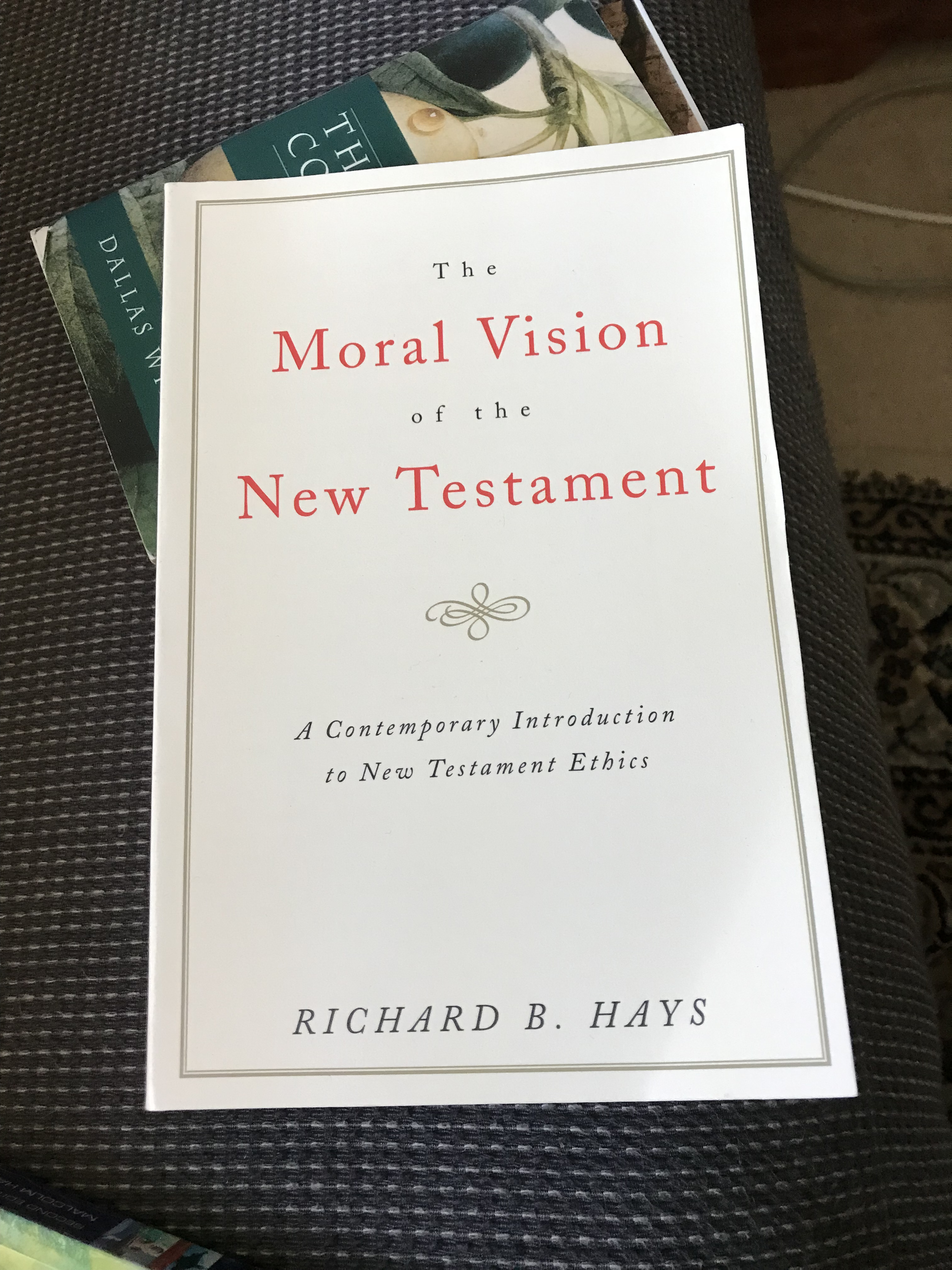
The Moral Vision of the New Testament by Richard B. Hays


As I read different theology books, there are some authors who I find very easy to learn from. Richard Hays is one of them. In The Moral Vision of the New Testament, Hays discusses various books in the New Testament, showing when they were written and why, and then uses them to form his ethics (‘ethics’ is things like: ‘is lying always wrong?’) I enjoyed the book, found his ideas interesting, agreed with his method of forming ethics and disagreed with some of his conclusions. Although his process for deciding ethics is a good one (in my opinion) I didn’t always agree with what he concluded. The book is meaty, so I will write a few blogs, picking out the especially interesting bits.

Chapter on Mark. I will give you the main points.

The Gospel of Mark was written as a whole, and the order of events matter. Mark begins with a declaration, that Jesus is the Son of God. The reader therefore reads the book knowing this fact, whilst watching all the characters in the book grapple with the question—who is Jesus? It’s not until the end, when he dies, that the centurion declares the same statement: ‘Truly, this was the Son of God.’ Mark is making the point that to understand who Jesus is, we need to understand the way he died.

There is, midway through the book, a scene when Peter declares that Jesus is the Messiah. In Matthew’s Gospel, he is praised for this, but in Mark’s book, Jesus rebukes him. The word for ‘rebuke’ is the same word used when the demons are ‘rebuked.’ The point is, Peter’s declaration is linked to the expected political power that the Messiah would have (Jews of the time didn’t think the Messiah was a spiritual saviour). Mark shows that Jesus is teaching the disciples (and the reader) that Jesus’s mission was a spiritual one, not to get rid of the Romans.

Another interesting point is the healing of a blind man, when Jesus asks him what he can see, and to begin with, he can only see dim shapes, people look like walking trees. Jesus then heals him completely, so he can see clearly. Hays makes the point that this account is linked to Jesus describing people as being blind, as ‘having eyes but not seeing, and ears but not hearing’. It seems to be an illustration that he will show people the things of God, but gradually.

When Jesus explains that his disciples must be prepared to ‘take up their cross’ to follow him, he is explaining that he can only be understood in terms of the crucifixion, and that when his followers recognise this, they are recognising their own destiny too. Jesus explains this again in chapters 8, 9, and 10. Each time the disciples misunderstand, and need to hear it again. The second part of the Gospel is less about big miracles, and more about the preparation for death. The healing of Bartimaeus happens all at once (not like the previous blind man) which signifies that the disciples now understand who Jesus is. The miracle ends with Bartimaeus ‘following’ Jesus, which mirrors the same verb used in chapter 8, about his disciples following him. (The miracle is an illustration of the theological point.)

The Gospel then gives examples of all the disciples failing to ‘follow’ Jesus. But despite their failures, they are still disciples, the call to follow is still there. In Mark’s Gospel, the key to following Jesus is obedience, not love. He does mention love, when he quotes Deut.6;4-5. These verses are known as the Shema and they were (and are) recited by Jews morning and evening. Jesus adds a Leviticus quote, about loving people, and Mark uses it to give an overview of the Law (but not especially as a definition of being a follower of Jesus). The Gospel gives fairly vague hints about future hope, basically teaching that this is in God’s hands, and we should trust him. He teaches that the Son of Man will return soon, before the disciples have died. In Chapter 13 Jesus tells them to watch, and stay awake (spiritually), in Chapter 14 there is a scene in the garden, when they fall asleep (physically).

The original ending of the Gospel describes the death of Jesus and the empty tomb, but no sightings of the risen Jesus. This illustrates the futuristic element of Jesus’s mission, that the Kingdom of God is still to come. In brief, the Gospel is about the disciple’s calling to follow as servants, the replacing of the Jewish Law with the teachings of Jesus, the promise that Jesus will return in glory. Mark gives a picture of the ‘world torn open by God’ and a new order established. History is re-established, but in an unexpected manner. Old prophecies are fulfilled, and there is a ‘sense of urgency’ in the book. Mark writes about Jesus’s ministry like someone today might describe having an ice-bucket thrown over them. It is lowly, suffering people who receive the message, and the power of God is expressed by suffering and death. (Which sort of makes no sense logically.) People constantly fail to understand Jesus, especially the people trying to follow him. (I really like this point. Sometimes today, the church, and Christians, are way too smug about thinking they understand God. Mark mainly shows how the disciples didn’t understand, and they had direct access to Jesus. We should remember this when we think we understand something. God was, and is, unexpected.)

There is lots more to Hays’ book, I have just summarised one chapter, and will tell you more next week. Definitely a book worth reading.

Thanks for reading my blog. Hope the rest of your day goes well.
Take care.
Love, Anne x

Anne E. Thompson
Thank you for reading.
anneethompson.com
Why not sign up to follow my blog?
Look on your device for this icon (it’s probably right at the bottom of the screen if you scroll down).
Follow the link to follow my blog!

I like starting clubs…


I like starting clubs. Always have. Some have been more successful than others.

One of the first clubs I started, aged about 7, was the SSO Club. I made badges, and put a pot next to the telephone labelled with SSO Club Funds, please give generously in bright letters. I figured that when people came to borrow our telephone (which happened a lot) they might mistake the club funds for the telephone donations box. Club funds would be spent on snacks (sweets) for our club meetings. SSO stood for: Secret Service to Others and the plan was that we would do ‘good deeds’ without anyone knowing. I devised a series of merits that could be earned when the good deeds were revealed at club meetings (while we ate the copious amount of sweets earned through misdirected telephone funding).

We never actually had a meeting, as no one else ever joined the club (my brother was meant to, but he was an awkward little wotsit, and was never easily persuaded into playing my games). Nor did we ever earn any funds. I do still have the badges somewhere though.

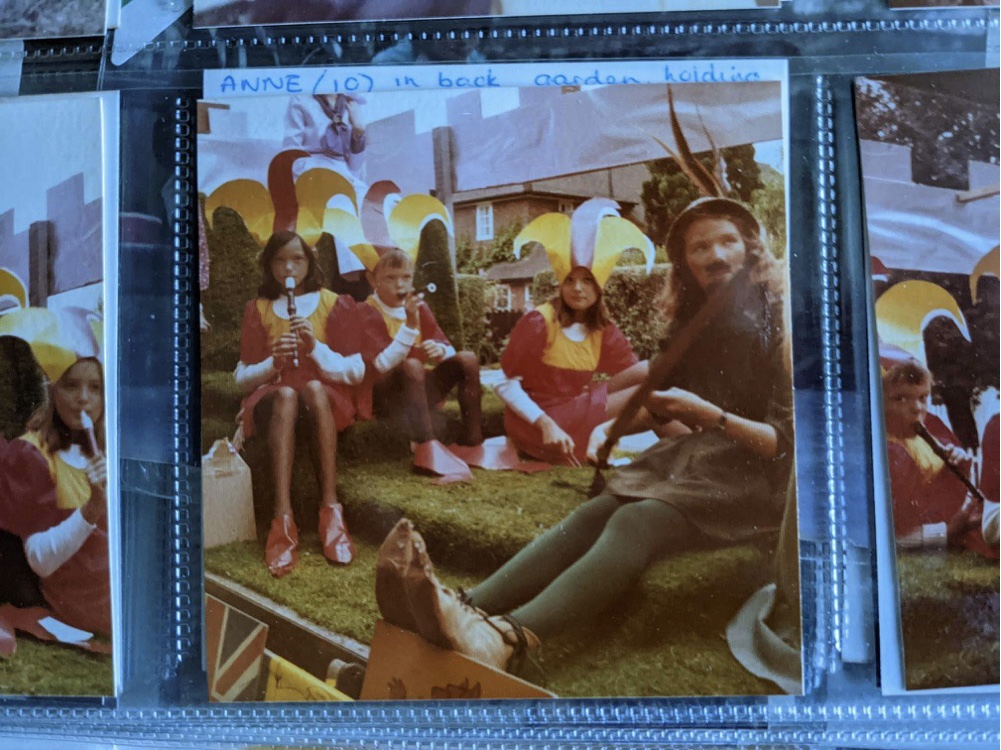
At Junior school, I once joined another club, a song-and-dance group that my friends invented. I could neither sing nor dance, so they put me in charge of costumes. This was a mistake, as I have never been even slightly interested in clothes. I think they had visions of Pans People, shimmying in shiny sexy outfits. I asked my mother if I could borrow the jester’s outfits that we had worn in the Letchworth carnival that year. When I arrived at the practice studio (Carol Watkin’s garden shed) they were less than excited to be dressed in bright yellow and red shapeless tunics—one size fits all—more tent than bikini. I don’t remember whether I was actually fired, but I don’t remember attending any rehearsals after this. They were never famous.

Letchworth Carnival in the 70’s

As an 18-year-old, I took over the church youth group (not sure whether this counts as ‘starting’ a group). I ran it in the exact same way that they youth club from my previous church had been run, with a variety of social events, light refreshments, and a 10-minute religious talk at the end. I was quite a stickler for the religious talk, and insisted that the embarrassed adult who had agreed to drive us all to bowling in Crawley also did a talk in McDonald’s afterwards. That club was more of a success than the SSO and when I left for uni, I handed over a group of about 20 teenagers (I think my sister led it after I left, and then my brother—same genes).

The adult Anne still likes starting clubs. I have run a breakfast club for teenagers, a baking club on Sunday afternoons, and have been involved in running various other groups and clubs in the town and at church. At present, I am doing nothing…though I feel the village is crying out for a cake-eating discussion club (because I like making cakes and discussing things). We will see.

Anne E. Thompson
Thank you for reading anneethompson.com Why not sign up to follow my blog?

anneethompson.com

*****

The Prison Camp in La Thuile


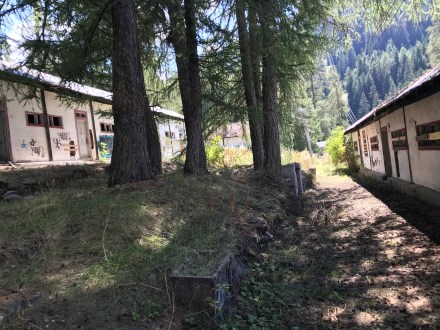
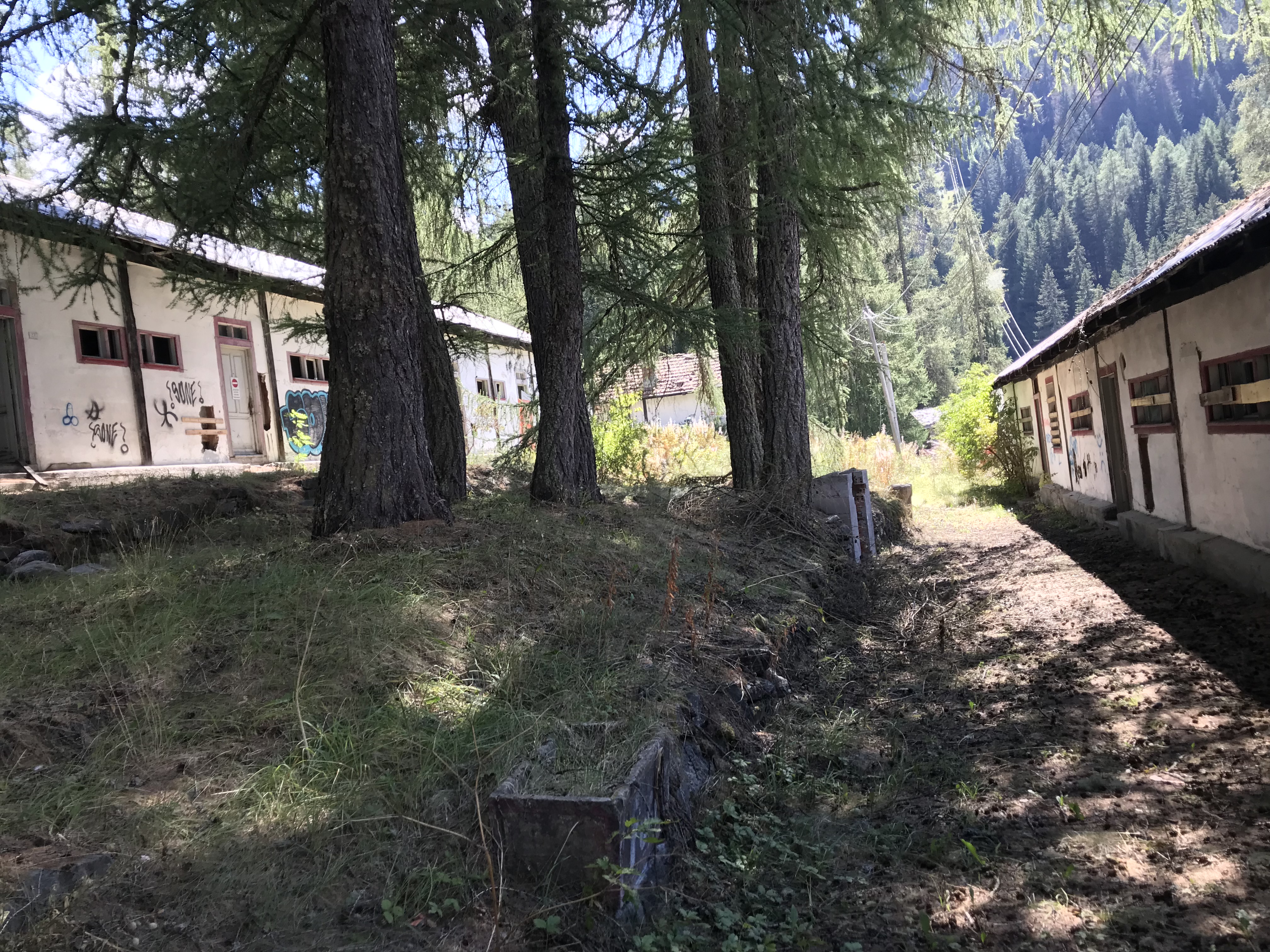
At one end of La Thuile, away from where most tourists would wander, is the remains of a prison of war camp. There are a few worn signs, which are all in Italian, so I photographed them and typed them into Google Translate. It seems that the camp was in use during both wars, and the prisoners worked in the local mines. During the second world war, prisoners came from Yugoslavia. I’m not sure who they would be, though I have read elsewhere that Jewish prisoners were used as slave labour in Italy, for things like keeping the mountain passes open, and in mines. I guess it’s possible they were also part of the camp in La Thuile, and used in the mines here.

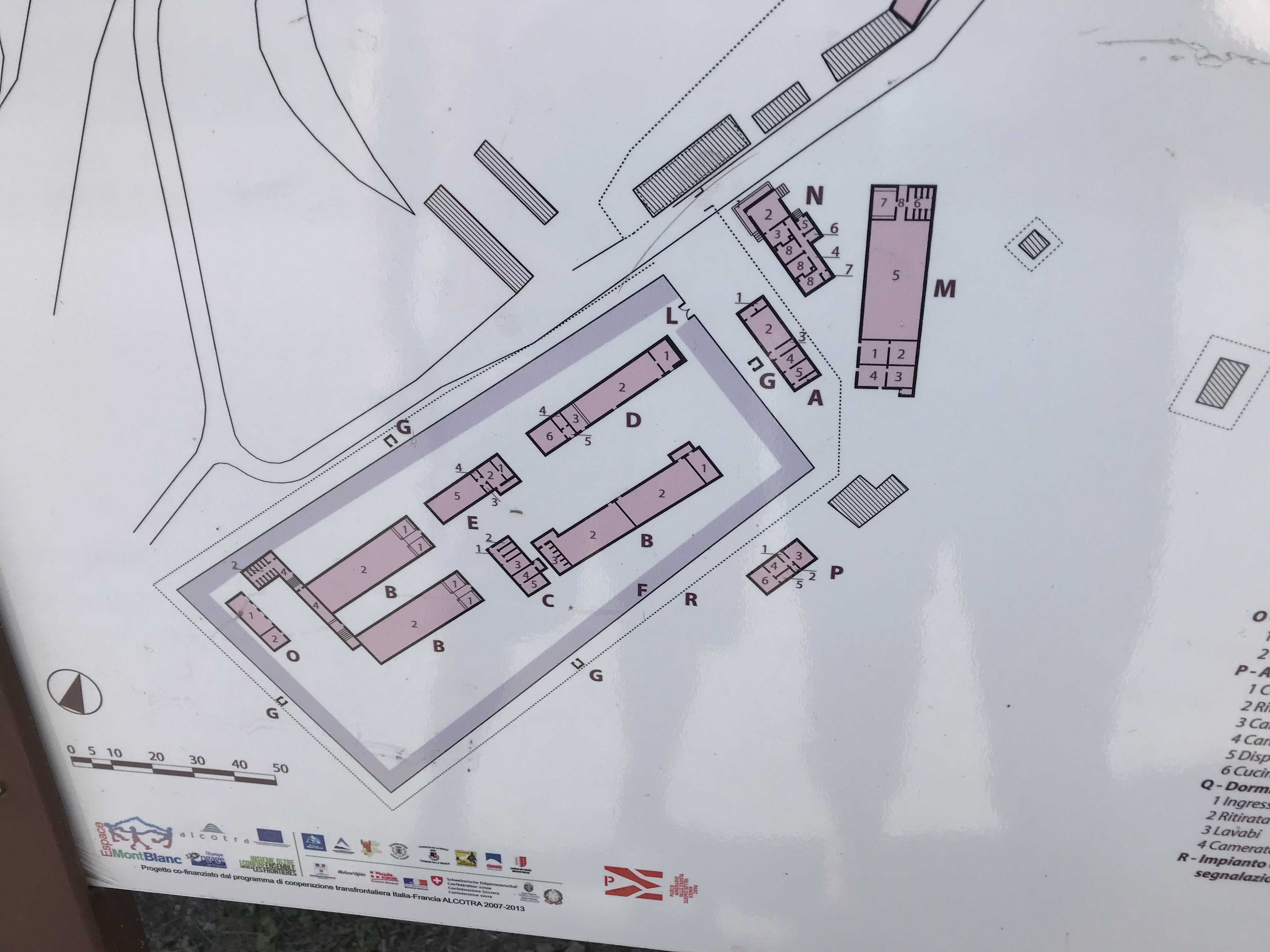
There’s not much left of the camp, and it’s hard to see whether the buildings were barracks for guards or dormitories for prisoners. Most of the buildings are on private land, so it wasn’t possible to get very close. Below are some photos, and the translation of the information signs. It’s hard to glean many facts from either.

Translation of Prison Sign:

First World War

Already during the First World War it is known that over 50 prisoners of war were employed in the work of the mines. In 1918, “the 31 prisoners of war were awarded a wage of just under 1/3 of the normal worker, ie 3,400 lire per day. By making a downward calculation it is possible to establish that, at the end of the First World War, the prisoners of war who find employment in the anthracite mines of La Thuile amounted to about one hundred units. They were guarded by military personnel and housed in special barracks in the Villaret region.”

Unfortunately there is no other news, it is not known where they were housed, where the special barracks were, but the presence of prisoners and their work in mining are attested in the first as in the second world war. Surely it was a place near the mouth of the mine, perhaps the place was already this … [sic]

Second World War

The set of buildings that insist on this area were born between 1941 and 1942 when the Cogne, “for exceptional needs, had to undertake the construction of barracks for housing prisoners of war, militarized workers from the army and military surveillance personnel at the concentration camp for prisoners” who will work in the mine. The building project is dated November 1941 and the request for the concession is presented by the Cogne Society to the Municipality of La Thuile on May 28, 1942.

The document shows that the constructions are “partly carried out and partly to be carried out. […] These are temporary barracks raised to a single floor above ground and will be built in timber with walls covered in” Eraclit or Populit “slabs. 2 cm thick, plastered, with a roof covered in Marseilles tiles on a timber frame.” The camp consists of the dormitories, the refectory, the prisons and a small infirmary inside the fence as well as the building for the guard, offices and lodgings of the Commando, non-commissioned officers and troops. From military archive documents it is clear that this is the camp for prisoners of war called Campo P.G.N. Porta Littoria.

The opening date is not known but on 1 March 1942 there are 250 ex-Yugoslav prisoners of war, more precisely 131 Serbs, 113 Montenegrins and 6 annexed Italians; in the following months the number and the provenance will be constant. The P.G. 101 and a mandatory work camp in the mine. The prison camp was closed on August 8, 1942 ‘following the cessation of use of labour by prisoners of war in the mines of the Soc. in Cogne.

Consequently, they are probably sent back to the camp, where the interpreters return. It is therefore open for a few months, a part planned on the south side will not even be built. [sic]

***

If you happen to know anything about the prison camp, please let me know. It doesn’t quite fit with the beautiful village in the Alps that is La Thuile today. I suspect in a few years, all remains will be removed, as the new houses being built are gradually getting nearer. LaThuile is beautiful, but I wonder what secrets it holds.

Thanks for reading. Have a great day.
Love, Anne x

Thanks for reading.

anneethompson.com
Why not sign up to follow my blog?

Having a Laugh in Turin


Continuing my travel blogs, written whilst in Italy.

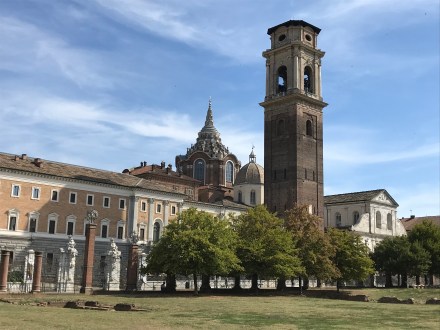
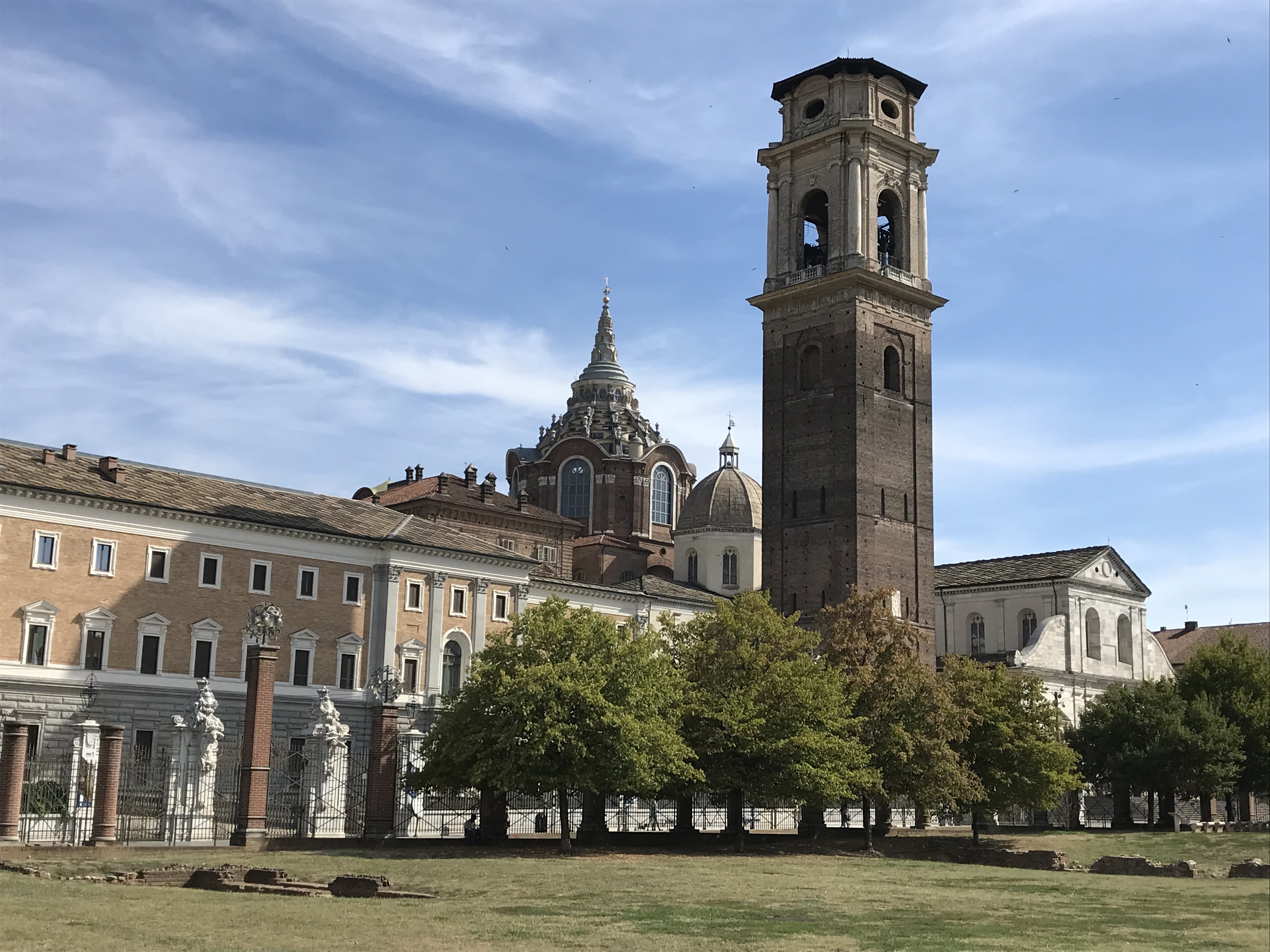
Taken from next to the Roman wall. The big dome with windows is part of the cathedral.

Some friends from England were staying just across the border, in the French Alps, so we arranged to meet them in Turin. It was such a fun day.

They were arriving by train, and we drove from La Thuile, so I used Google maps to search for a nearby car park. It directed us to one very near the station. As we approached, it was difficult to find, then at the last minute, we spotted a ramp descending under the buildings, advertising parking. We took a ticket, went through the barrier, and disappeared under the building. It was all a little scary. There were spaces, and nothing to indicate they were reserved for residents, so we parked. Checked the prices on the pay machine (just in case) and it all looked fine, so we left and hoped the car wouldn’t be clamped when we returned.

Met friends and wandered towards the old part of town (which was very near to excellent car park). We came to a square, with two nearly identical churches (this seems to be a thing in Italy) and found the cathedral, Cattedrale di San Giovanni Battista. This is where they keep the Shroud of Turin, the shroud that some think wrapped the body of Jesus after he was crucified. I knew that it wasn’t on display, but I was interested to see where it was kept. There is also a replica shroud, in another church, so I hoped to see that too. Just out of interest. I am not sure what I think about the shroud (other than that it’s interesting). Some people claim the shroud is miraculous. Others say it’s a hoax, and dates from mediaeval times. I understand that several universities tested it, and all found it dated much later than Christ, but it was also thought to have been in a fire at some point, which would mess up carbon dating. Personally, I have no idea. If a shroud was ever used (I’m not sure how bodies were wrapped in those days) then it’s possible that it never decayed because Christ was holy—but it’s equally possible it did, as I don’t think everything he touched still exists today.

Anyway, the cathedral had a special side chapel where people could sit and muse the idea. I think the shroud was in the box in an alcove, but I’m not sure—the signs were all in Italian.

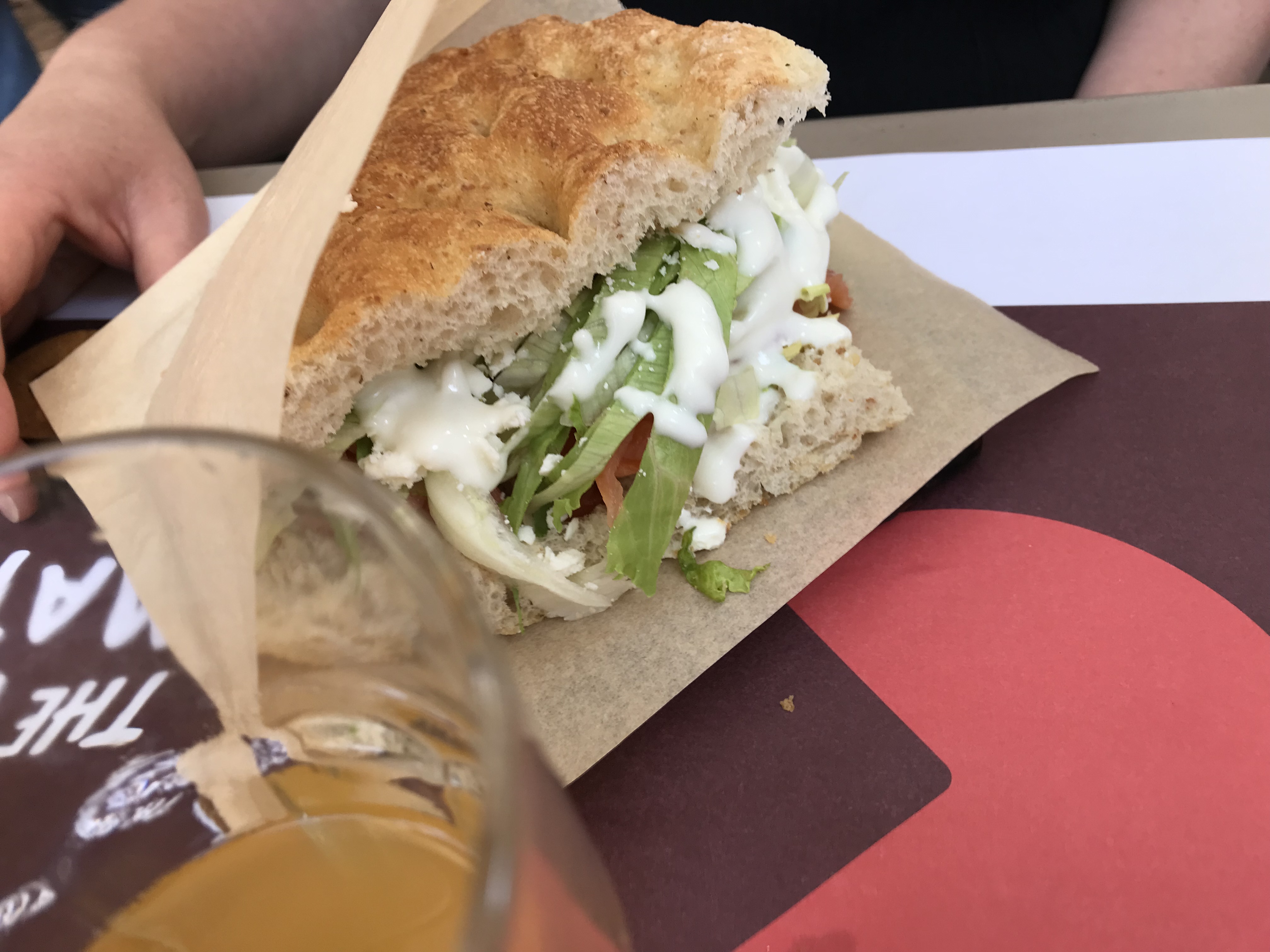
Then we went for lunch. We found a café in a square, and ordered focaccia. Some ordered enough for six people, and then ate them all. (No judgement.)

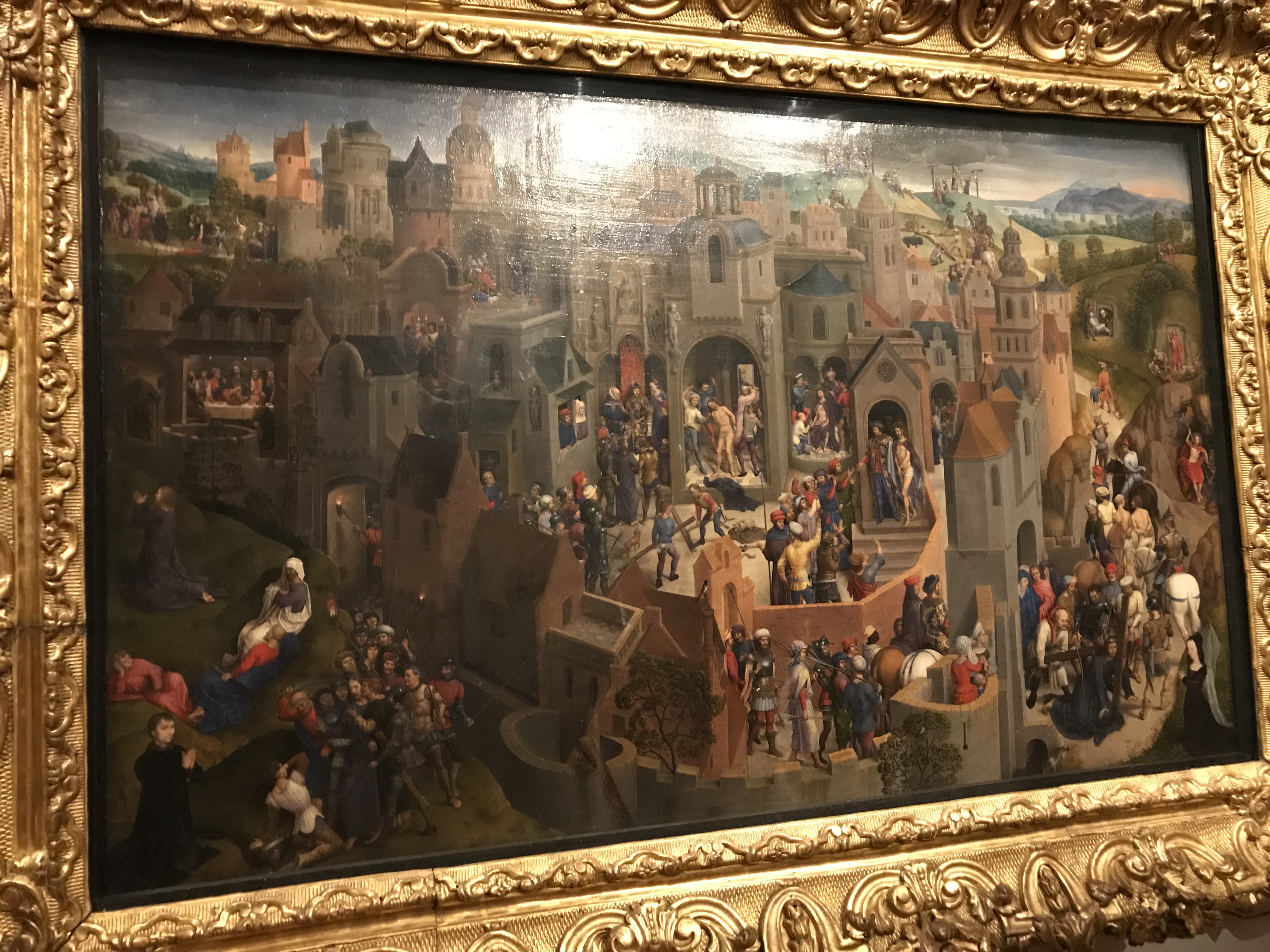
Our next stop was Galleria Sabauda which was accessed via Musei Reali Torino and we had to buy a ticket that included several different things. Our friends were keen to see a particular painting (Passion of Christ by Memling) which none of the guides seemed to realise was there. We found it eventually (it looks smaller in real life than online!)

Lots of different scenes from The Passion of Christ, all in one painting. By Hans Memling.

There was another painting, which Husband said was called ‘The Shocking Spectacle Following Unexpected Gust of Wind’ but I’m pretty sure he was lying.

We then wandered back towards the royal palace (because we had tickets). On the way, we popped into what we thought was a chapel, and it turned out to be an amazing part of the cathedral, where originally they had kept the shroud. There was a massive dome, with a dove at the top (which Husband said was a leftover Christmas decoration that the caretaker had refused to get down because it was so high). We considered the possibility of smuggling a helium balloon in and releasing it before running away. It was very opulent, with lots of black and gold. It didn’t feel very holy, I didn’t feel inspired to pray, but it was impressive.

A really cool dome. There is a glass dove, right at the top.

The royal palace was the same as every other royal palace that allows tourists—lots of interconnecting rooms, lots of gilt and dusty curtains. The sort of place that makes you feel glad you’re not royal and forced to live there.

We were then at saturation point with museum/galleries, so went in search of ice creams. I ordered a bicerin (pronounced ‘bich-er-in’) which is a traditional drink in Turin. It’s basically very rich hot chocolate with a shot of espresso and topped with cream. It was delicious.

Bicerin. Delicious.

Then we sat near the river and chatted, very lovely. We had a quick McDonald’s (very nice, but probably not what you should do when in Turin) before our friends left to catch their train back to France. We found our car (not as easy as it sounds) and it wasn’t clamped, so we paid (17 euro) and drove back to La Thuile.

Turin is a lovely city, and there’s lots more to see. Definitely worth a second visit, would make a good weekend away.

Hope your day goes well. Thanks for reading.
Take care.
Love, Anne x

Thanks for reading.
anneethompson.com
Sign up to follow my blog by following the link below.
Look on your device for this icon (it’s probably right at the bottom of the screen if you scroll down). Follow the link to follow my blog!

When the Queen Dies


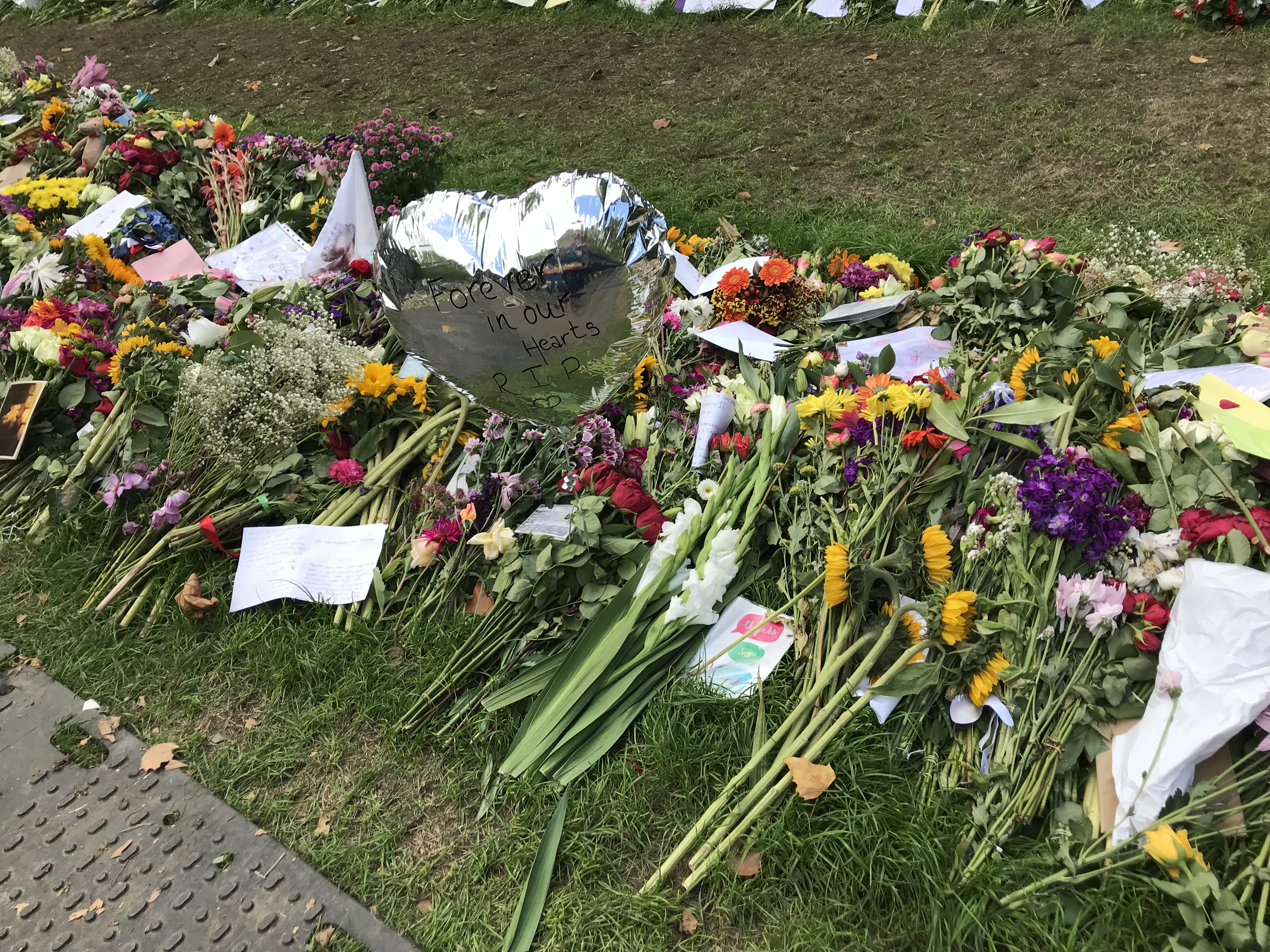
Tributes left to honour Queen Elizabeth II

We were in Italy when the Queen died. (I will continue my travel blogs next week, but in respect to the Queen’s funeral, I felt I should write something different today.) Messages started to appear on our family online chat, so I was aware that ‘something’ was happening at Balmoral, and we watched BBC news, waiting for the expected announcement. Even though we could access the news online, I wanted to be in England while it was happening. I wanted to hear discussions in the supermarket, and hear announcements and prayers at church, and to share the news with people around me. Instead, we were in Italy, eating in restaurants where people were untouched by the news.

We came home the Sunday after her death. I watched the coffin procession on television, and wondered how it would feel, to follow the coffin of someone you loved while the world watched. Maybe it helps when everyone understands. Maybe it doesn’t.

On Thursday I went to London. I wanted to see the flowers, to be part of history while it unfolded, part of the community. When the train reached Croydon, I began to notice people carrying flowers, the station was full, there was a sense of people who had a purpose. There were more flowers at Victoria Station—a pop-up shop selling bouquets at inflated prices.

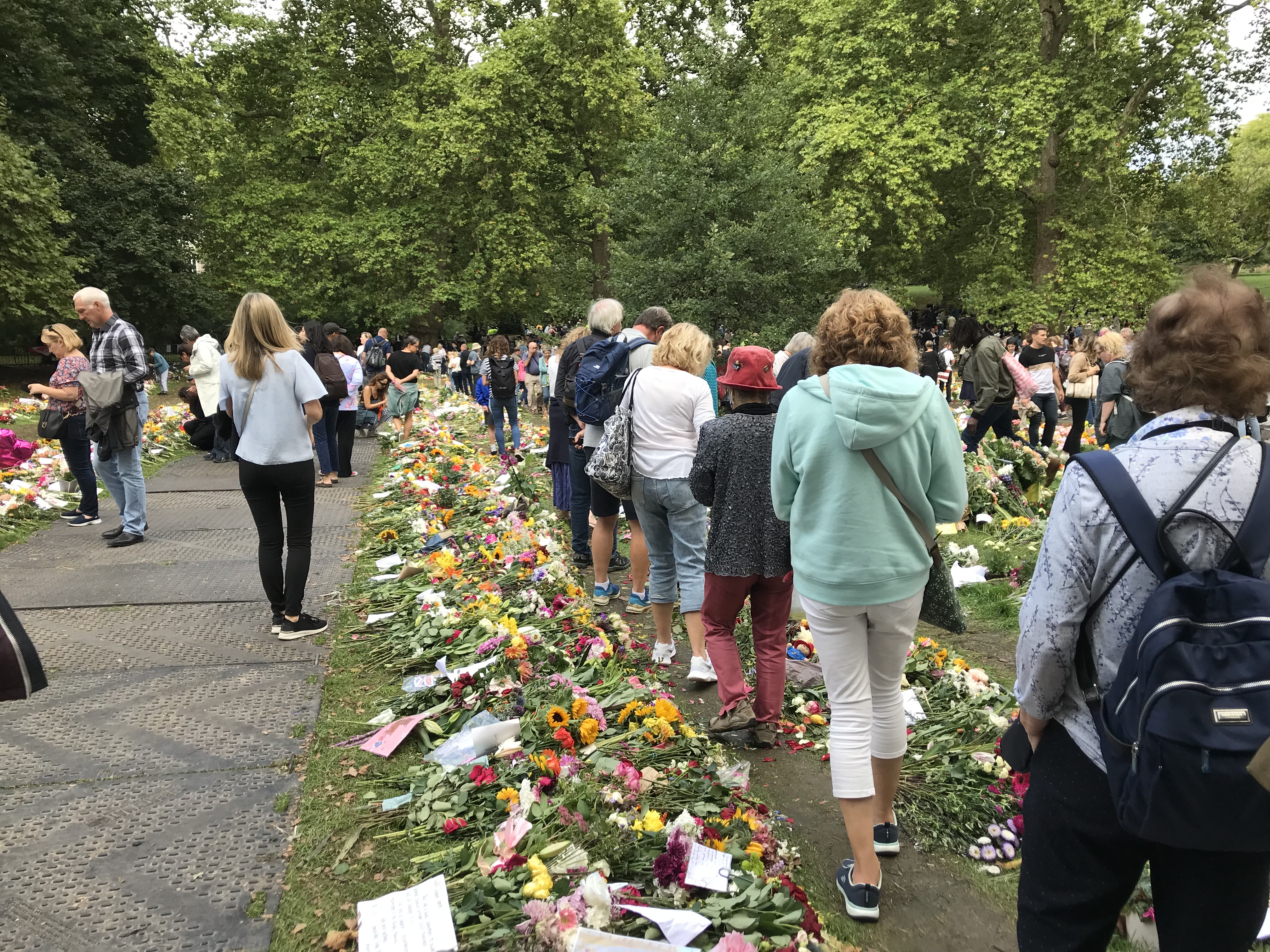
I followed the crowds towards the palace, and we were soon directed between barriers, filtering towards Green Park. We passed Buckingham Palace, the flag flying at half-mast, the guards on duty, extra police standing at street corners. There were signs, and toilets, and marshals wearing purple vests who were directing people and answering questions. We walked along the edge of the park, to Wellington Arch (so we had walked two sides of a triangle!) then back into Green Park, to an area cordoned off for flowers.

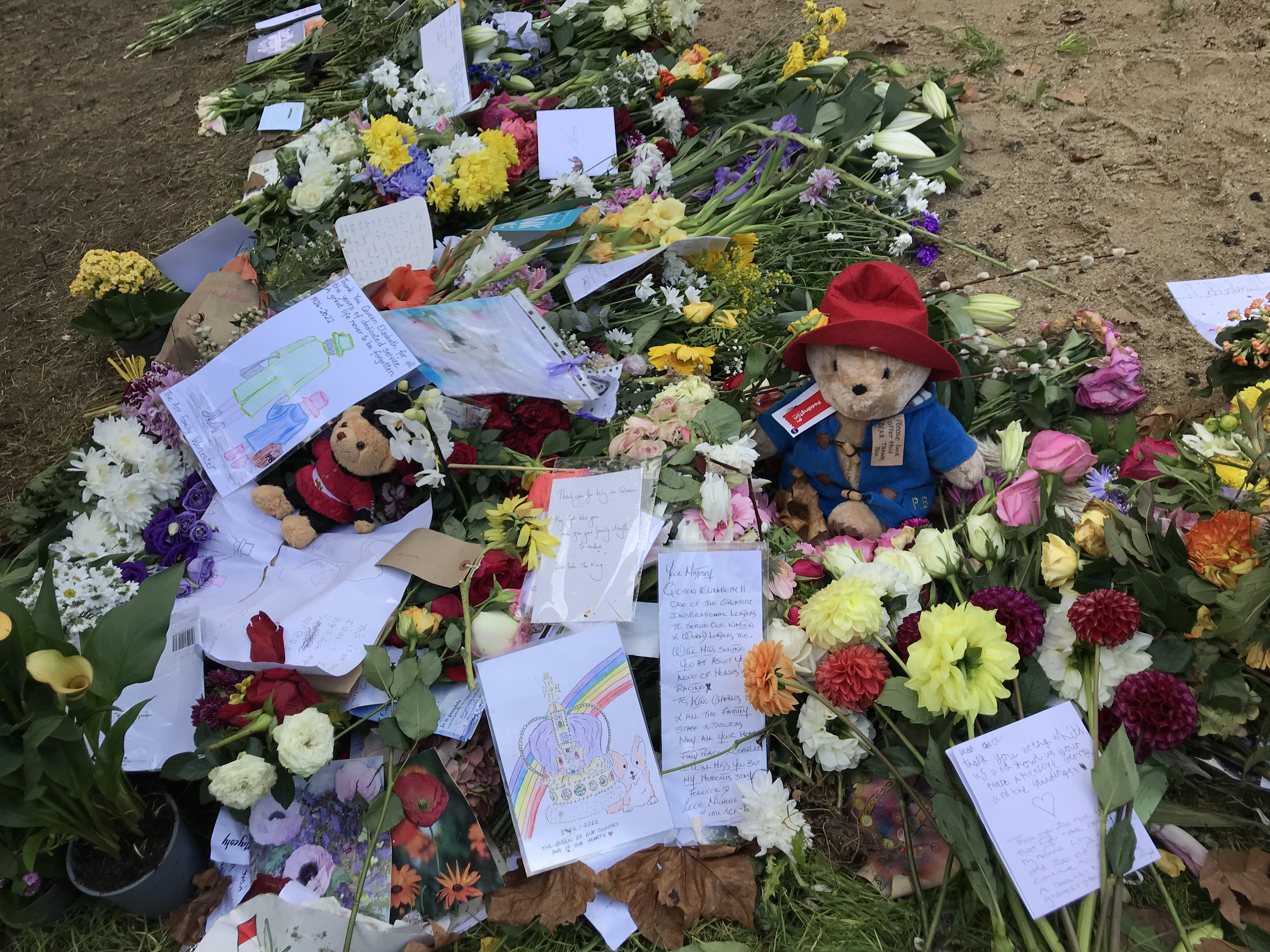
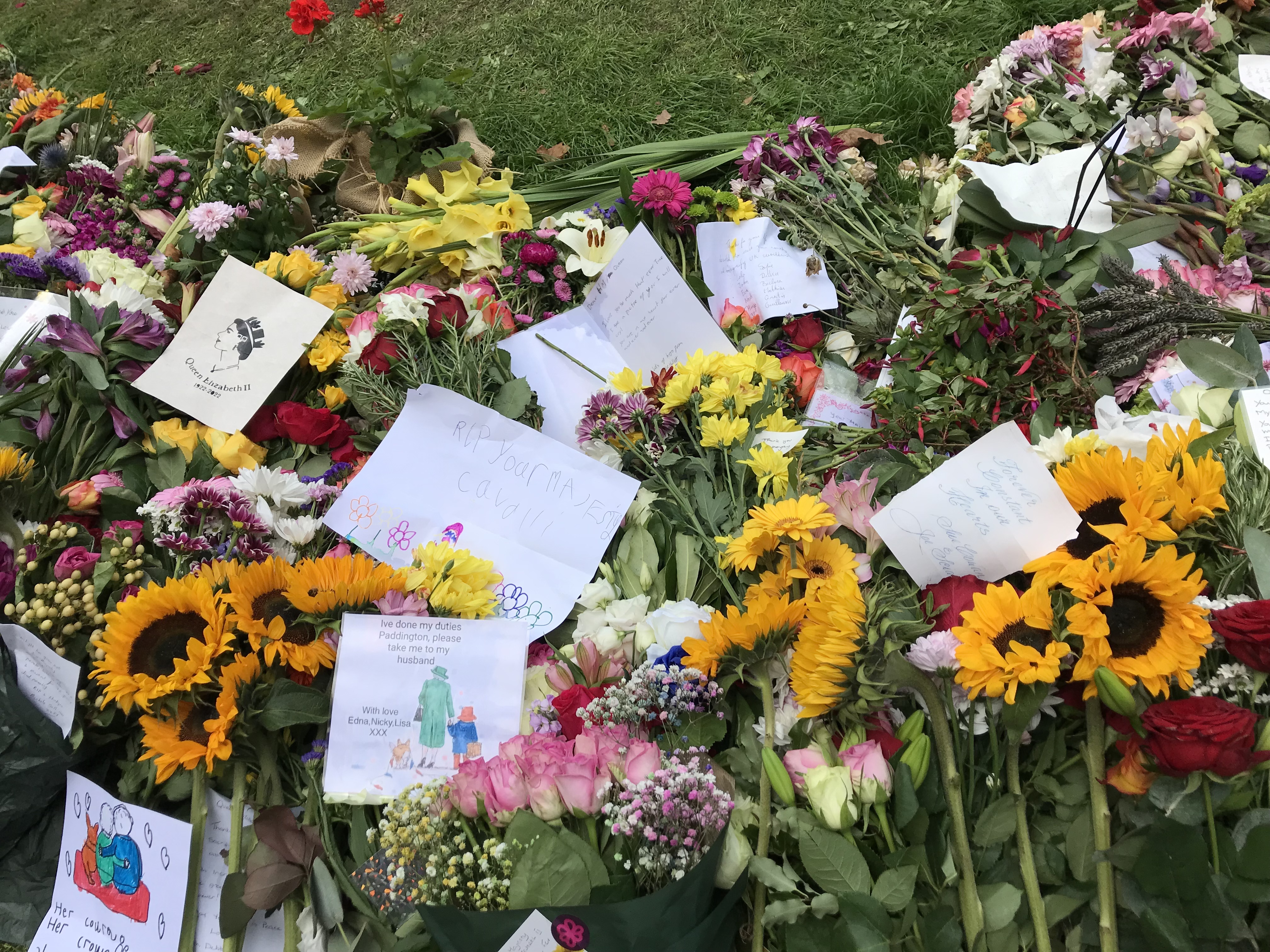
There were a lot of flowers. There were flowering orchids in pots, and arrangements, and bouquets that had been unwrapped and were lying in lines. Cards and letters were secured on top, damp and smudged, carrying messages from school children and people who had met the Queen and people who had watched her from afar. People were respectful, there was no shouting or laughter, but neither did I see any tears. The atmosphere was peaceful, grandparents showing the flowers to children, young people placing bouquets along the line.

Some people had left candles, others left cuddly toys. Especially Paddington Bear.

To be honest, I find the Paddington Bear messages slightly perturbing. I enjoyed the video clip for the Diamond Jubilee, and I understand that people want the Queen’s death to be peaceful, for her to be in a better place. But it’s like they have replaced angels with a fictitious bear from a storybook. Have we, as Christians, done such a bad job of preparing people for death? Has the Church not explained that death is not the end?—Not because a pretend cuddly toy will collect us—but because Jesus himself said he’s preparing a place, that he’ll collect us when it’s time, and there will be a new world, with no more suffering. Have we made angels and Jesus so rule-based, so frightening, so detached from the reality of our lives, that people prefer to think of Paddington collecting the Queen? Is that safer somehow, less demanding of us perhaps? When we are trying to make sense of death, coping with all the upheaval and insecurity that even the death of a distant person will bring, surely that is the time we need to know where to turn. I’m sad that Paddington Bear seems to be filling that spot. I feel it’s time we turned round, and tried to find God again.

Anne E. Thompson
Thank you for reading
anneethompson.com
Why not sign up to follow my blog?

Best Lunch Date, Ever…


I have just had the most amazing lunch. Not the food perhaps (though there was nothing wrong with it) but the venue? Wow! We have just arrived home, and I have a slight headache (you will understand why in a minute) and I am bursting to tell someone.

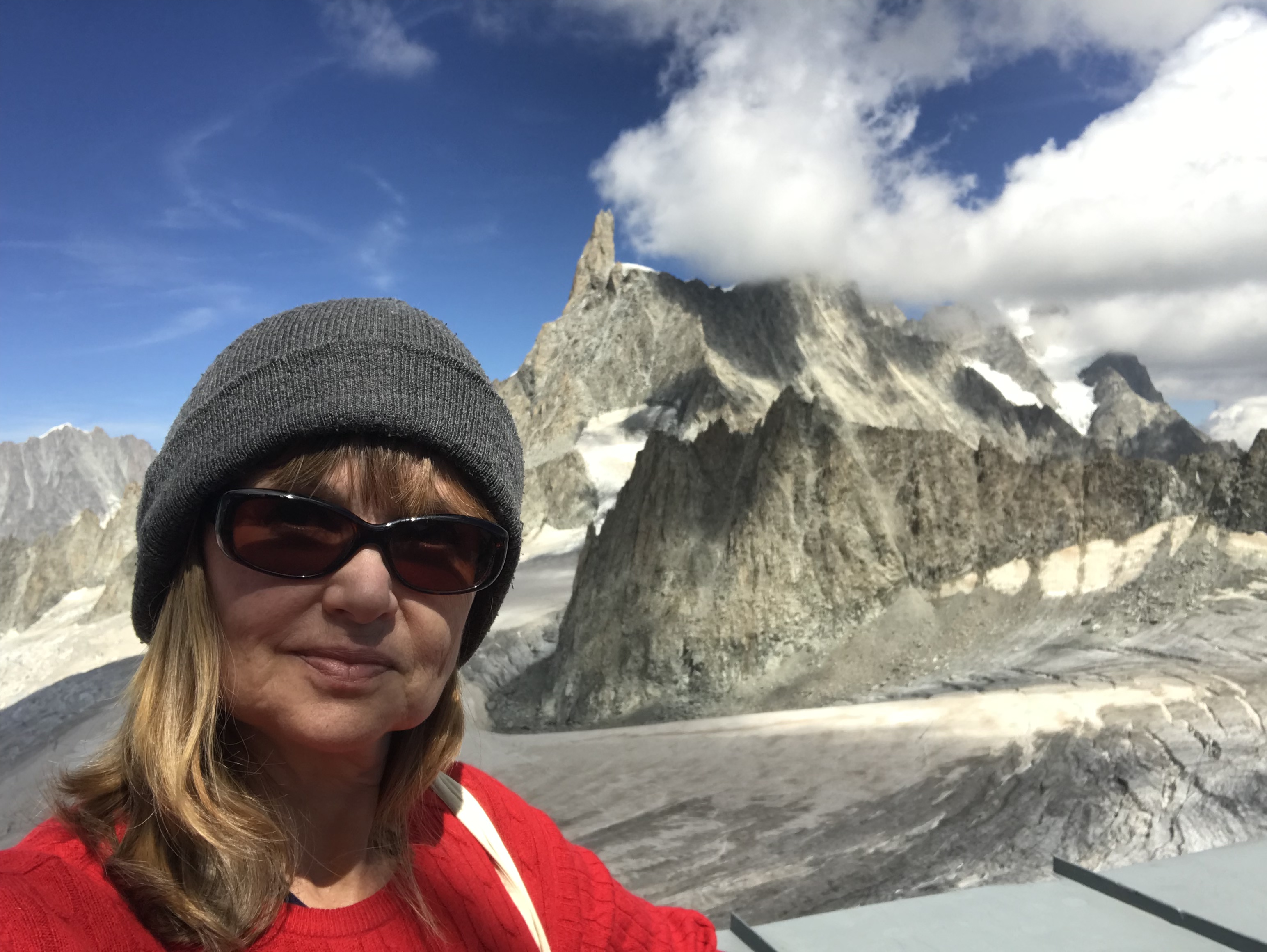
We had lunch at the top of Mont Blanc!

Preparing for the descent.

It was such fun. First we drove to Courmayeur. Well, strictly speaking, first we went to the local Pharmacy in a panic because we read on the website that it was essential that we wore the correct type of face-mask—but after that we drove to Courmayeur. We followed signs for the cable-car (the funivia) and there was plenty of parking underneath. Italy seems to do parking very well (either that, or we have been very lucky so far).

There was then some confusion, with a ticket office, and several different queues which didn’t seem to lead anywhere and no helpful signs, and loads of people. We had already bought our tickets online, so we joined a line that looked promising, and managed to get the piece of paper we needed to walk up to the cable car. I don’t like heights (as you know if you read my blogs regularly) so I was extremely pleased to find a seat, in the middle, where there was hardy any view through all the standing passengers to the scary plummet as we ascended the mountain. Hardly anyone wore masks, I think only the foreign tourists, who had also read the website, were wearing them. The website should perhaps be updated (I write this in August 2022).

The cable car stopped midway. There were amazing views, and paths you could walk along, a little botanical garden, and deckchairs. The deckchairs were full of lounging bronzed people who had stripped down to their underwear. I don’t think any will make the cover of Vogue, so I will spare you a photo!

We then caught another car up to the top of the mountain. Again, not too scary if you kept your eyes shut the entire time. It was crammed full of tourists, and athletic looking people with climbing gear, and dogs. I love that in Italy, dogs are welcome just about everywhere.

The top of the mountain had various viewing platforms, but we went straight to Bistrot Panoramic. It sits on top of Pointe Helbronner (which I understand is one of the peaks of Mont Blanc). The views were amazing. The restaurant walls were glass, and the seats were transparent, so wherever you sat there would be views. We were slightly early, and managed to have a corner table. After a quick gin and tonic, this was fine, and I rather enjoyed it. I had some red wine too to prepare for the descent (hence the slight headache now).

The meal was a set menu: a potato dish (like Dauphinoise potatoes but with bits of ham), a soggy-bread-and onion dish (nicer than it sounds) and a vegetable soup over pasta dish. We chose a mushroom dish and a sausage in tomato sauce dish, to accompany the cheesy polenta (which all went together very well, but would have been not great alone, as the mushrooms were a bit slimy and the polenta needed more salt). Dessert was apple cake (which was apple pie!) and tiramisu. We finished with coffee. All very nice, and when put together with the view, completely fabulous.

The table next to us had a huge dog curled up asleep. Next to the door of the restaurant was a bowl of dog water. I now plan to return, with my dog (maybe not Kia, as she’s a bit old now and would snarl at everyone).

We spent some time taking millions of photos, then went back to the car. As lunch dates go, it was perfect.

Thanks for reading and have a great day.
Take care.
Love, Anne x

And we saw Maria!!!!
Thanks for reading.
anneethompson.com
Sign up to follow my blog by following the link below.

The Best of Days, the Worst of Days…


Today has been a mix of highs and lows. Mostly highs, so I will start there.

As you know (if you read my blog regularly) we had booked a house in Italy for the summer, but popped home after a couple of weeks to attend my niece’s wedding. After the wedding, we returned to La Thuile for the rest of August. It felt like coming home as we drove from the airport, past ‘our river’ that races through the valley, to the view of ‘our mountain’ with the glacier that reflects all the moods of the sun.

Anyway, today I suggested that we should go to a café for an espresso (which is one of my favourite things about Italy—sipping a coffee in the sunshine, somewhere beautiful). Husband suggested that rather than walk to the nearby café (‘our café’) we should try somewhere new, on the other side of town.

He directed me along lanes, through the park next to the river, up narrow streets. We arrived at a pretty building next to the river, with a family sitting in lounge-chairs in the garden. At our arrival, they all jumped up, assured us that they were open, and the man showed us to a table in the shade. He then disappeared.

I looked around. On one side was the river, on the other was mountains—all very pretty, perfect for a leisurely coffee. The man then reappeared, carrying cutlery and glassware, and a basket of fresh bread. He smiled welcoming as he set our table. Lots of eye-contact between Husband and I, neither of us spoke. The man hurried away.

Now what? The man was so welcoming, the bread looked freshly baked, dare we say that we only wanted a coffee? Husband said we should just order something small (we already had dinner reservations for the evening at ‘our restaurant’). The man reappeared with the menu, and we chose a couple of dishes. Neither of us understand much Italian, so it was a bit random. What arrived were platters of cheese and meat, which went perfectly with the house wine. We finished, an hour later, with the espresso that we had come for. It was all very unexpected, and very lovely. A good time.

After our lunch, we discussed what to do, as I have hurt my leg and can’t walk far. Husband suggested we went ‘up the mountain on the cable car.’ I knew this was something he really wanted to do, and we had just enjoyed a lovely lunch in the sunshine, so I agreed. I hate heights. It was even worse than I imagined.

The ‘cable car’ is not a cable car, it is a chairlift—designed for skiers in the winter, and mountain bikers in the summer. I watched the chairs as they flew down the mountain, turning at the bottom, slowing for passengers, then continuing back up the mountain in a continuous loop, never actually stopping. I saw a few people nearly getting bonked when they stood up but didn’t move out of the way quickly enough, and I tried to learn from their mistake as we joined the line of young men with bikes. We fed our tickets into the machine, and stepped forward. A man appeared from his cubicle and hovered near the emergency-stop button. We stood in place, the chair arrived behind us, we sat back, a bar was lowered in front of us, and we rose towards the sky.

I decided it would be best to keep my eyes shut. This worked fine on the way up. It felt like flying, I could hear birds and smell the pine trees, and the temperature grew gradually cooler as we rose. We reached the top, Husband yelled at me to let go of the safety-bar, a man hovered near the emergency-stop button, I leaped off the chair, remembered to hurry to the side, the chair sailed past me and I was on solid ground. All great. I felt rather pleased with myself, and enjoyed looking at the views and watching the young men as they raced down the mountain on their bikes. Then we decided to go back down. Then it all went wrong.

As we fed our tickets into the machine, the man emerged again to hover near the stop-button. Obviously we looked incompetent. The chair swept behind us, I sat, the bar was lowered, I shut my eyes and pretended I was flying. Then Husband (who I have now forgiven) mentioned that the safety bar was raised and lowered by the passengers—in other words, him. That felt very unsafe. If you have a fear of heights, you will know that the fear is connected with falling, and the belief that somehow you might fling yourself over the precipice. I am not scared in airplanes, because I cannot fall out. I am terrified on cliff edges because I might fall over. Now I was being told that if I lifted the bar (yes, I know that this was entirely in my control and wouldn’t happen, but fear is not rational)—if I lifted the bar, I would plummet to my death. I took deep breaths. Then Husband mentioned something about the view below, and fool that I am, I opened my eyes. I was not flying. I was suspended on an insecure chair, miles above ground, with nothing but a moveable bar between me and certain death. My heart stopped, I thought I might vomit (pity the mountain bikers below!) and I started to shake all over. I think I whimpered.

For the next few terrifying moments we sailed through the air. I shut my eyes and prayed very hard and tried not to think about how it would feel to fall. Then we arrived. The same man hovered near the emergency button (they didn’t seem to do that for anyone else!) and I managed to stand, to move out of the way, to walk to the nearest bench. I didn’t speak. Somehow, I survived. But it was bad, very bad.

I hope your day is full of good things, and that you cope with the bad things calmly.
Take care.
Love, Anne x

Anne E. Thompson
Thank you for reading.
anneethompson.com
Why not sign up to follow my blog?
Look on your device for this icon (it’s probably right at the bottom of the screen if you scroll down). Follow the link to follow my blog!

Weddings, then and now.


We came home from Italy in time for my niece’s wedding. I really enjoyed it—it was an afternoon full of prettiness, and declarations of love, and being with family. I haven’t been to many weddings recently, so I was interested to see how much things have changed from when I was married in the 1980s. Many things were the same, but here are some of the differences:

Venue. Most people were married in church. My friends who married in a registry office (the only alternative to marriage in a church) did not include the ‘traditional’ elements of the wedding. So no long white dress, no walking down an aisle with the father of the bride, no music. A registry office wedding tending to be brief and functional, with very few people invited to attend.

Today, the possible venues are varied. My niece’s wedding was in a barn, and the layout was almost exactly the same as any small chapel, with an aisle and flowers and rows of seats facing the front. There was even a wooden lectern to rest a book on. In England a non-church wedding can’t include hymns or prayers or Bible readings, but there was music.

I sort of understand why ‘the church’ demands that non-church weddings don’t include anything religious, because God, and the worship of him, is not a game; not something to pick up and use like something of no importance. Therefore they want to regulate how their holy things—the holy book, hymns, prayers—are presented. However, I feel sad that if someone wishes to include God in their wedding but for some reason does not feel able to marry in a church, they are excluded from all outward signs of this. They can still invite God to be present, and they can pray internally, but I feel sad that English law makes it difficult for a couple to include God unless they want a church wedding. Over time, every marriage faces challenges, and wanting God to bless your vows, including him in the marriage seems sensible to me. I think a wedding is less likely to use religious things inappropriately than other places (like football matches, where hymns are allowed to be sung).

Vows. Some of the vows said at a wedding are legal requirements. These are the same wherever you marry, and they don’t seem to have changed since I was married. They have to be word-perfect, and said in the presence of witnesses and a person certified to register a marriage. In the past, at a registry office, these were the only vows said. Today, it seems popular to add your own vows.

Church weddings also include certain vows, as listed below:

I, N, take you, N,

to be my husband,

to have and to hold

from this day forward;

for better, for worse,

for richer, for poorer,

in sickness and in health,

to love and to cherish,

till death us do part;

according to God’s holy law.

In the presence of God I make this vow.

When I was married, the bride also promised to obey her husband.

Couples today seem to write their own vows. I’m not sure what I think about this. I was wondering what I would promise if I wrote my own vows. Marriage lasts a really long time. I think being faithful is important (because otherwise, what is the point of a marriage?) Promising to forgive is essential, and to try and listen. I think respect is important, and for me, being able to share anything and to laugh together lots, matters. Staying together, even when times are tough, is also part of being married.

Gender Roles. Traditionally, the bride was given away by her father, and accepted by her husband. I was completely happy with this when I was married (though actually, my brother gave me away). Today, many brides consider this sexist (not sure why I didn’t!) Even if they walk into the venue with their father, they may have words that don’t involve being given from one man to another.

There were other differences, but these were the main ones. However, the occasion was still about a couple committing to each other, it was still about love, and everyone dressed in their best clothes and arrived hoping to have fun. There was still a meal, and lots to drink, speeches (though these are not always said by males only today) and laughter.

The Cake. When I was married, we continued the tradition of having a tiered fruit cake, with formal white icing. The bottom tier was cut and shared with guests, the top tier was kept and used as a christening cake when the first baby was born. As people tended not to have children immediately, most couples removed the icing and shoved the cake in the freezer until they needed it. Eating it a few years later felt decidedly dodgy, but as far as I know, no one was ever poisoned.

Today, many couples choose not to have a fruit cake, which seems an excellent plan to me (does anyone other than my brother like eating fruit cake???) There is still a cake, and it is still cut (which is a tradition which I never liked, and I wanted to leave out from my wedding, but I was told there must be a photo!) The wedding we attended had a red velvet cake and chocolate brownies to share, which are a much better idea.

Whatever traditions are followed, weddings are still about love, and a couple committing to stay with each other. Rather marvelous I think. Thanks for reading. Take care.
Love, Anne x

Next Monday I’ll tell you about our return trip to Italy. It was very interesting to live somewhere different for a while, and learn about a small town in the Alps.

Thanks for reading.
Why not sign up to follow my blog?
anneethompson.com

Italy: Angry Ice Creams and Absolute Beauty


Italy is beautiful. There are many beautiful places, but I have a personal favourite—do you?

You will remember from last week’s blog that we went to Italy for a couple of weeks at the beginning of August (returning for my niece’s wedding on the 18th, but you will have to wait until next week to read about that!) We stayed in LaThuile, which is a ski resort in the winter, and in the summer is a village of musical-box log cabins, and window boxes full of geraniums, and hot, hot, sunshine. The whole family plus partners came, and we had a happy time of reconnecting.

The Italian Alps might be the most beautiful place in the world. Even better than Scotland (which has some amazing scenery). I’m not a great lover of cities; I love big skies, and rushing rivers, and mountains, and trees (so Iceland wasn’t really my taste). Some of the mountains were still topped with snow, and snow is always exciting, even when it’s in the distance. (My family will correct me here, and tell me it’s not snow, it’s frozen glacier, but you know what I mean.)

We visited many beautiful towns and villages, and walked up mountains, and through mountain passes, and along valleys. There was a lake, high on a mountain pass. The water was so blue, and the sun was so hot, it was tempting to swim. Only the dogs were actually in the water, humans knew it would be freezing. As we walked round the lake we could hear the clonking bells of cows, and there was a herd of them with curved horns, drinking from the lake.

We visited Aosta, with its Roman remains and cobbled streets and carvings of wood. It was full of tourists when we were there, and there was a rain storm with huge drops of water soaking us all.

My dad played an accordion, so I loved this sculpture.

My main memory of Aosta is the ice cream parlour, where I had a stand-off with the assistant! The shop was busy, and while we stood in line we watched a man bring trays of chocolate-dipped lollies, and vats of fresh sorbet and creamy ice cream to refill the display. The counter was pretty, with fresh fruit, and coloured ices, and cones. But I also watched the girls serving, as they touched the money and credit cards, scratched an itch, then served the ice cream without washing their hands. I decided I would have an ice, placed in a cup with a scoop (no contact with those hands). All was going well, until I saw the assistant pick up a straw (touching the part that goes in the mouth) and place it in the ice. When it was my turn, I reached up, and took my own straw from the pot.

The assistant glared at me, and told me I shouldn’t touch. (Somewhat ironic.) I explained that I had only touched my own staw. She continued to scold me, then tried to add a straw from her own dirty hand. I told her that I did not want her straw, I already had one. I did not want a straw she had touched.

Oh the fury in those eyes! She returned to serving the rest of our order, glaring at me as she dolloped scoops of ice cream into cones. I have never been served ice cream with so much hatred! It did taste very nice though.

We also walked in Parco Nazionale Gran Paradiso, strolling beside rivers and waterfalls, staring at huge rocks left by glaciers. Very pretty.

But there is one place more beautiful than all the others. You can walk there from LaThuile, but two hours is about my maximum for an enjoyable walk, so we drove up the winding road from the town, turning onto a track before we reached the hamlet of Cappella di San Bernado. The track was very narrow, with hairpin bends, the valley falling steeply away to one side. Not a comfortable drive. I was glad when Husband announced he wasn’t going any further, and parked on a slim patch of grass next to the track. If a bus came, we’d be in trouble. But it wasn’t the sort of place a bus would go.

We walked. The track rose gradually, gently taking us further from the valley floor. We could see a river, and guessed the speed of it. There were trees below, dwarfed by the distance between us, dark green pines clinging to the side of the mountain. Patches of grass were dotted with brown mud, dug out by marmots which scampered away when they heard our voices echoing round the valley. (I must say, I will never ever manage to see much wildlife, because my family is so noisy!) Streams trickled from the rock next to us, forming puddles before trickling down to join the river. As we stepped over the puddles, clouds of blue butterflies rose, dancing around us like a host of fairies with blue and gold wings. We could see cows with their clonking bells in the distance, and beyond them, beyond everything, there were the mountains, watching. It was truly beautiful.

I hope you see some beauty this week. Try not to annoy any sales assistants though! Thanks for reading. Take care.
Love, Anne x

Clonking bells wherever there are cows.