Who Needs Theology?


Who Needs Theology by Stanley J. Grenz and Roger E. Olson

This is an interesting book, which outlines exactly what theology is, and how it might be applied. Although the beginning is somewhat repetitive, the authors do thoroughly explain things, and if the concepts are new this would be helpful. The writing throughout was clear and easy to understand, and it was regularly smattered with examples from the Snoopy comic.

One slightly irritating aspect was the printing of the book. The typesetter had not kept the words complete, and on some pages there were many words split with a hyphen. When reading unfamiliar words, this was unhelpful. (I suspect it was done to reduce the number of pages and therefore the cost, but was, in my opinion, a mistake.) But if you can ignore the physical aspects (and I am being picky so you may not even notice) the content was excellent.
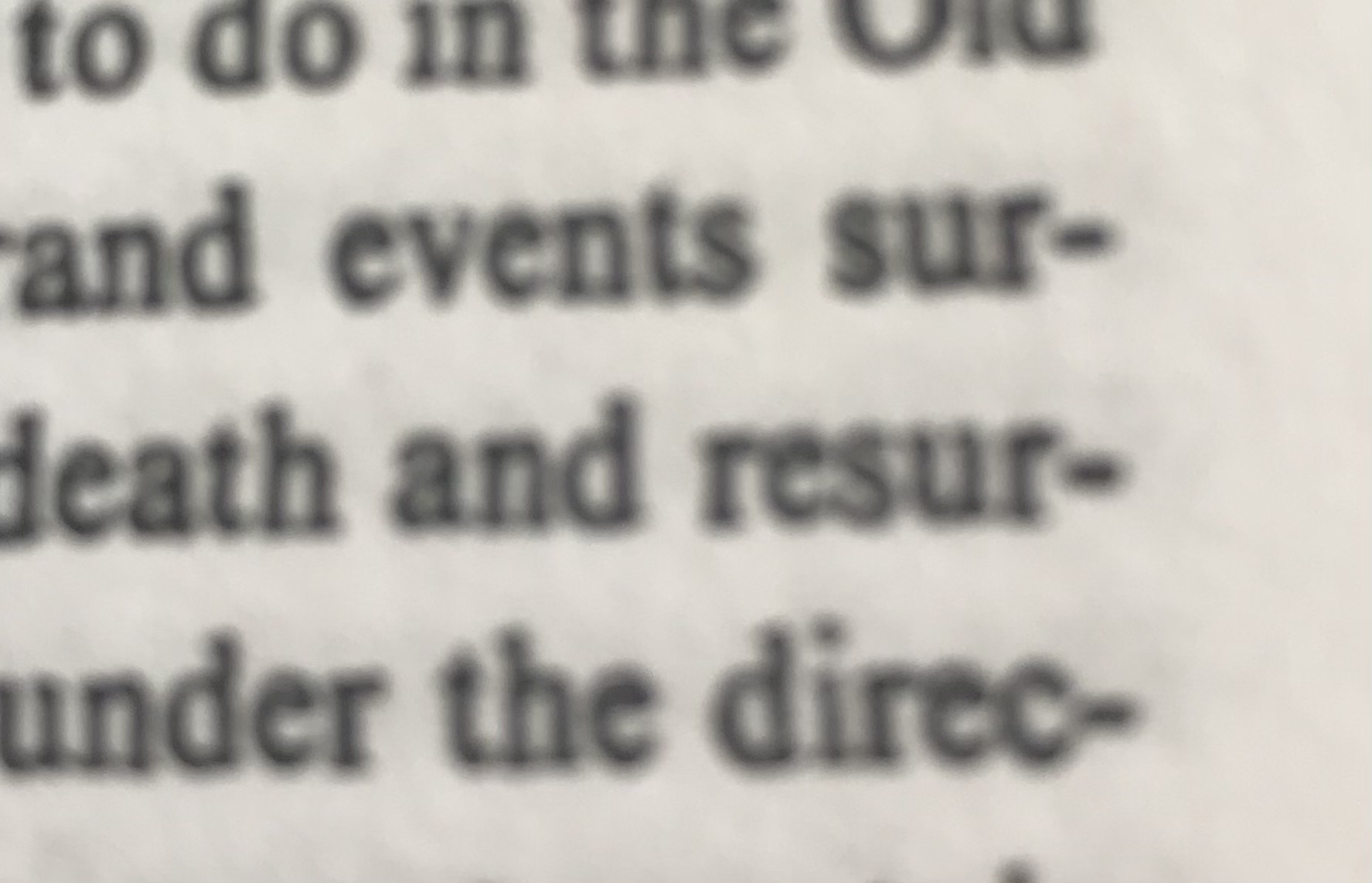
Irritating hyphenated words.

I especially enjoyed the description of different types of belief, such as the explanation of dogma, doctrine and opinion. The Bible contains many truths and rules. Some of these are dogma, i.e., if you don’t believe them, you aren’t a Christian. They include things like that there is only one God (so if you believe there are many gods, you cannot call yourself a Christian).

Then there is doctrine. A doctrine is a belief that is considered important by certain churches, and they would not allow you to be a leader in their church unless you believe them—though you would still be a Christian. For example, some people believe you should be baptised by being fully immersed, when a believer. They would not allow someone who believed in infant baptism to lead their church, though they would recognise them as being Christian.

Lastly, there are some parts of the Bible that are interpreted according to opinion. Two people might both be Christians (same dogma) both belong to the same church (same doctrine) but one might think women should wear a hat to pray, and the other think that’s irrelevant in modern times (different opinions).

Churches/Christians decide what is dogma, and what is doctrine, and what is opinion. Sometimes they disagree. Of course they do! However, it is helpful to keep these categories in mind when discussing issues. I have heard people protest that if you start saying one part of the Bible should be interpreted in the light of contemporary culture, where do you stop? The answer is now clear—you stop when you reach the truths that make up our dogma.


The book also includes a brief outline of church history:

The first Christian emperor, Constantine, called together the leaders of the church from all the Christian cities in the Roman Empire to write a creed stating what it meant to be a Christian. They met in Nicea (because Constantinople was still being built, and no one likes visitors when the builders are in). They wrote the Nicene Creed, which basically said that to be a Christian, a person must accept that Jesus was equal to/of the same substance as God. This was dogma (non-negotiable).

Until 1054, the church was unified.

In AD 1054: the church split into:

1) Eastern Orthodox (who believed that everything that was decided in Nicea in AD 325 and AD 787 constitutes a definitive body of Christian doctrine—so nothing should be changed.)

2)Roman Catholic Church—this includes the ‘Holy Office’ which decides what should be dogma/doctrine/opinion. They decided, for example, that dogma should include the immaculate conception of Mary, and her bodily assumption into heaven. This church has been further split as follows.

In 1517, Martin Luther, a German monk nailed 95 points for debate to the cathedral door. This evolved to become a new wing of the church, which protested the Roman Catholic emphasis of the authority of popes and councils—it was therefore called the Protestant Church. This then split again:
Luther founded Lutherism.
Zwingli and Calvin founded the Presbyterian church.
Cranmer helped establish the Anglican church (when Henry VIII wanted a divorce).
Simons led the Anabaptists/Mennonites.   

These wings of the church (Eastern Orthodox, Roman Catholic and Protestant) were all Christian. They all believed the same basic dogma.

In the early nineteenth century, modernism arrived. The Protestant church began to view Biblical truths in the light of modern culture—in some cases, refusing to believe things written in the Bible unless they complimented modern thought. The Roman Catholic church rejected modernism, thereby also rejecting scientific discoveries, the rights of humans, and so on. The Protestant church divided into two groups—those called ‘liberal’ who at their most extreme would only believe Biblical texts if they could be ‘proven’ by modern thought (so they rejected miracles as superstition, for example) and ‘fundamentalists.’ Fundamentalists at their most extreme tried to make all belief dogma, producing a tight list of everything found in the Bible and declaring that none was a matter of doctrine or opinion, and to be a Christian everyone must believe exactly the same things.

The book then explores the role of theologians, and how theology might be studied and applied. I found the book very accessible and immensely interesting. It is definitely worth reading if you have any interest in theology, or how the church evolved, and is continuing to evolve today.

A Foxy Problem


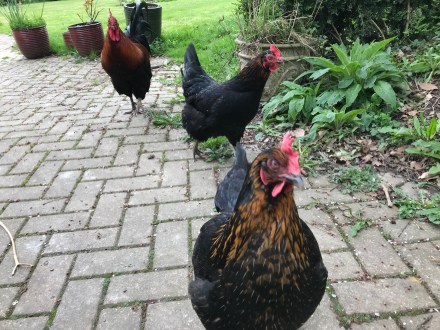
I decided to let the chickens into the garden. They had been shut in their cage for a few weeks while the local fox had cubs, and again while we were in the Lake District, and again while some plants were being established (because chickens like to dig). But it’s much healthier for them to be roam free, to have dust-baths to clean their feathers, and to fly into the trees. I opened their door, and out they rushed.

It was hours later, as I was cooking dinner, that I realised I had never collected the eggs. I left the potatoes bubbling on the stove, and walked up the garden. As I neared the pond area, I smelt the unmistakeable whiff of fox. I started to hurry, peering into the trees for signs of feathers.

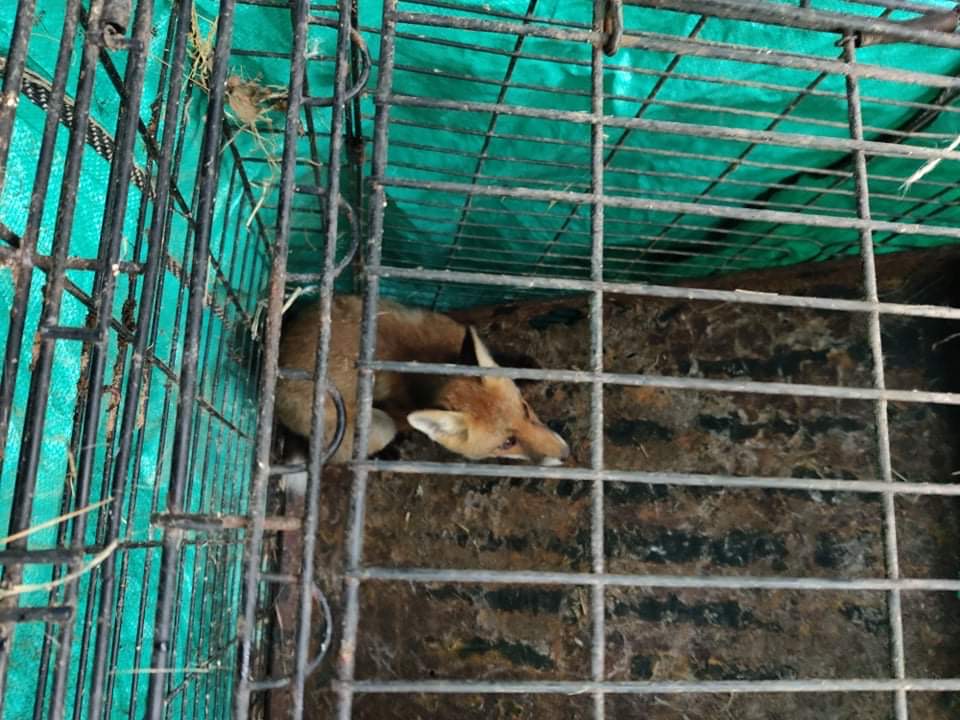
As I reached the chicken coop, I could see all the chickens, peacefully digging in the earth as they searched for tasty bugs. No casualties. But as I rounded the corner, there in the coop, just sneaking through the door, was a fox. Without thinking, I rushed up, slammed shut the door, and locked it.

The fox leapt to the corner of the cage, then turned, eyes flashing, teeth barred, fur raised. It flung itself at the locked door, then leapt for the far corner. It dug at the earth, clawed at the bars, ripped the netting from the sides of the cage. But it was trapped. Now what?

I hadn’t really thought this through. If I released the furious fox, it would almost certainly snatch a chicken or duck as it passed. But I couldn’t keep a wild animal in a cage, and soon it would be dusk and the chickens would want to roost.

I watched the fox as it flung his angry body around the cage, then I went to get reinforcements. Jay happened to be visiting, and Husband was working in his study, so I told them I had caught a fox, and asked if they could help. Both appeared amazingly quickly.

(Later, Jay informed me that this was another instance of my not being normal. Apparently normal mothers do not catch foxes, nor do they ask in very calm ‘please-can-you-empty-the-dishwasher’ type voices if their sons can help with a trapped fox. But I have given up trying to be normal.)

The fox was still angry/upset/terrified. I thought the chances of one of us being bitten was fairly high, and I wondered if foxes, like bats, have rabies. It looked healthy enough. I was impressed with the energy it was expending on trying to rip up my chicken coop, and pleased with how strong the coop was proving to be. I watched the fox as it climbed a vertical wall, traversed the roof upside-down, then dropped to the floor. Agile as a cat, vicious as a hyena.

My animals were not much help. Kia arrived, but I worried she might fight and be hurt, so I took her back to the house. Three cats arrived, and sat staring at the trapped fox. Stupid chickens arrived—it was time to roost—and lined up next to the door, ready to go inside. Did they not recognise a predator? Clearly not.

The problem was: How to remove livid fox from coop in such a way as to ensure no chickens would be hurt? Or ducks. Or cats. Or humans.

We own a couple of metal dog crates. One was inside the coop, used as a nesting box. We got the second one, checked it would fit through the door if the coop, and placed it inside a huge bag used for collecting leaves. This made a dark space, somewhere a scared fox might try to hide. We tied string to the door, so we could shut it from afar. When the fox was at the far end of the coop, we placed this wrapped cage in the coop.

We then used sticks and noise to ‘shoo’ the fox into the wrapped cage. Not as easy as it sounds, but we managed it, pulled the string to close the door, then Husband rushed into coop and closed the latch. Fox was now secure in smaller dog crate.

Jay and Husband carried the dog crate away from the coop, all the chickens went back inside, and I closed the door for the night. Disaster averted.

Note to self: Next time I trap a wild animal, it would be good to have an end-of-plan strategy in place.

Hope you don’t have any disasters this week. Thanks for reading. Take care.

Love, Anne x


P.S. Pleeease don’t feed foxes. They are wild animals, and when they lose their fear of humans, and their gardens, they become a problem.

Anne E. Thompson
Thank you for reading anneethompson.com Why not sign up to follow my blog?

anneethompson.com

*****

A Celebration of Discipline — My Review


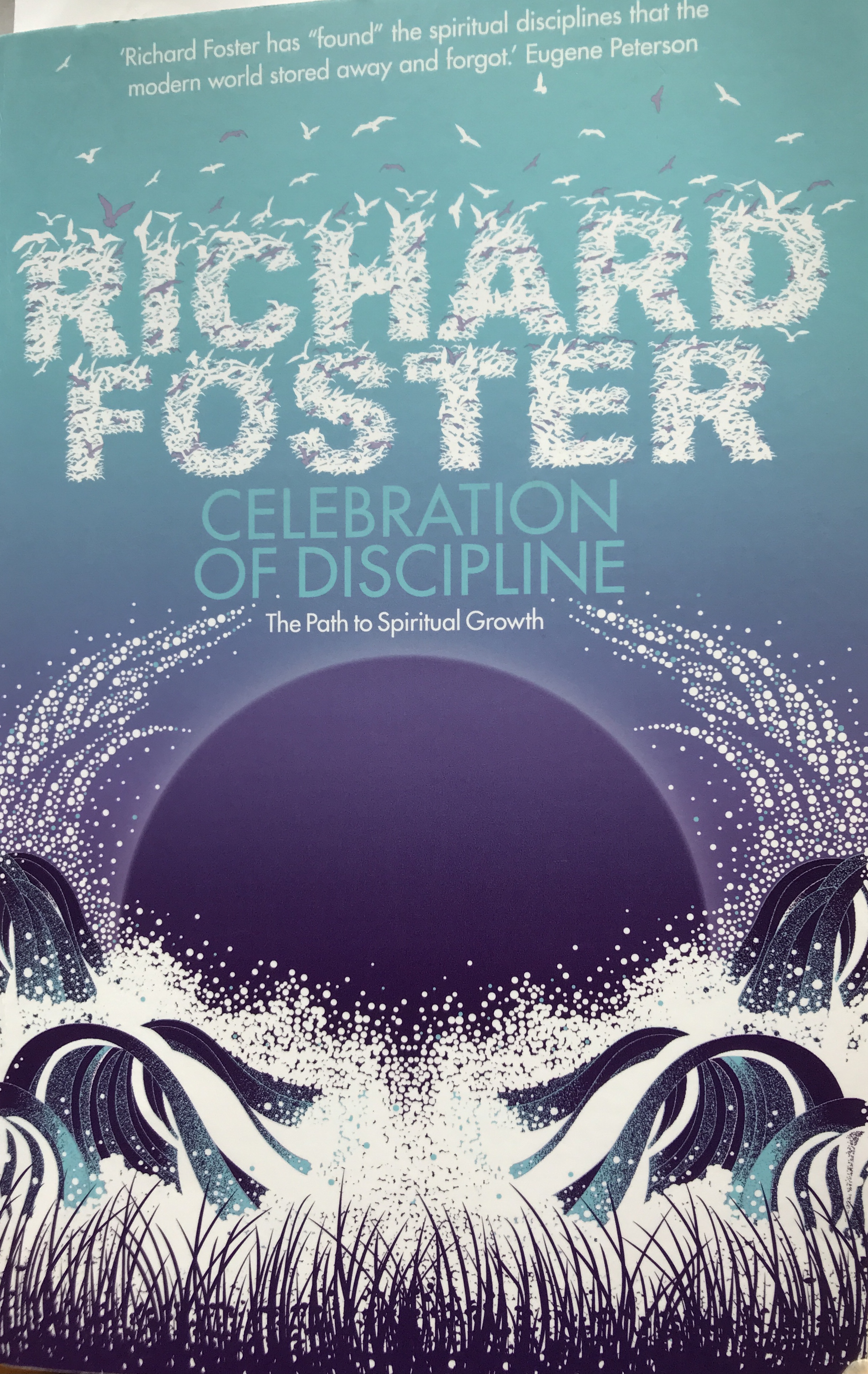
Celebration of Discipline by Richard Foster.

A book review (sort of—more a glimpse of my own experience with this book).


Leo Tolstoy: “Everybody thinks of changing humanity and nobody thinks of changing himself.”

For me, the book didn’t start well. Firstly, there was the cover, which reminded me of a hairy bubble-bath with a planet in the background. “Never buy a book where the author’s name is bigger than the title” is a warning which I have pretty much ignored over the years, yet it still rings in my head. I have no idea who Richard Foster is, and probably he’s a very nice bloke, but the artistic writing of his name with flying birds made me wonder.

I opened the book, none the wiser for the cover but hoping to discover the link between hairy bubble-baths and flocks of birds and the celebration of discipline.

I met the Foreword, which turned out to be an advertisement for the book which I had already bought, so it felt unnecessary. I didn’t read further than the third paragraph.

Then there were the Acknowledgements. Strange positioning. They were dated, showing that the book has been republished many times. Perhaps that explains the large author name, perhaps this is a name that people-who-know-more-than-me look for. The 1978 Acknowledgement mentioned his children. The 1988 Acknowledgement mentioned his wife, who he said the book was dedicated to. This made me smile—images of irritated wife complaining that she had held fort while he dedicated himself to writing and only the kids got a mention. (I searched, but there was no dedication page in my copy, so maybe he changed his mind by the current edition.) The 1998 Acknowledgement was about his friend Bess, who had died. There were encouraging words about death and how it feels, and I began to have hope that this book would be worth reading after all, if only because he quotes both C.S. Lewis and Charles Wesley, who are eminently worth quoting (in my opinion).

The first chapter was very different. Foster stops writing about himself (and his abundant successes) and focusses on how a person can improve. He says that mere will-power is not enough, we can never force ourselves to be righteous, all the debris of selfishness bubbles back up. Righteousness is a gift, but Foster writes that this does not mean we have nothing to do. He quotes Dietrich Bonhoeffer, saying: “Grace is free, but it is not cheap.” Foster describes spiritual growth as being like a seed that is planted, ready to develop; he believes that Disciplines are a means for that development to take place. We cannot earn righteousness, we can only receive it, but we can put ourselves in a place whereby we are ready to receive. Foster warns against making laws, saying: “Once we have made a law, we have an ‘externalism’ by which we judge who is measuring up and who is not.” This rings true, I struggle with churches who seem to primarily want to apply rules to others and who have “a passion to set others straight.” (It is something I was guilty of myself, in the past.)

At this point, I wasn’t sure whether Foster was going to introduce a regime of ‘works’ disguised under the name of ‘discipline,’ but I was interested enough to want to read more. The chapter finished with suggested Bible readings for each day (which I ignored) and questions for discussion—so I guess this would be a good book for a group to study.

Foster makes many points that made me pause. Things like that the well-known text in Romans: “I stand at the door and knock…” was originally written for Christians, not non-believers. It isn’t suggesting non-believers should let God in, it’s showing that Christians have shut him out. Foster argues that we should include meditation as a discipline in our lives. Not the airy-fairy-mystical centring on self, but the conscious decision to centre internally on God.

I did meet a hiccup in the third chapter, about prayer. I agreed with some (but not all) of his views, but then he used ‘sexual deviation’ as an example of something to be prayed about. His definition of this was anything that differed to his own understanding that sex was only right if between one man and one woman. This irritated me intensely, especially in light of his earlier comments about externalism/law/judging others. I understand that this is his view, and I understand why he has formed this view—based on his reading of the Bible, in the same way that some people believe that black people were created to serve white people, and some believe that women have a unique role to support but never lead, and so on—all based on clearly written passages in the Bible. I am always furious when I read Christians stating their viewpoint as fact when they happily contextualise other teaching in the Bible and it is rarely in relation to themselves but rather their interpretation of what God is teaching other people.

At this point I was ready to use the book as kindling. However, I was perhaps over-reacting, and I remembered the saying: “A wise man learns more from the fool than the fool learns from the wise man.” Foster may not be a fool, and certainly wisdom is something I can only aspire to, but the principle holds true. I continued reading in the hope that I would learn something worth learning.

The other chapters covered many valuable subjects, such as: Meditation, Fasting, Solitude, Service, Confession and Worship to name a few. It is tempting to give details of each chapter, but then this becomes a precis rather than a review, so I will stop and let you read it for yourself. Brace yourself to disagree with some views, and try to glean the gold that’s hidden behind the words.

I felt that there was gold to be found, but I never managed to shake the feeling that I would dislike the author. A low point came on page 90, in the chapter on study, when he urges us to “make friends with the flowers and the trees and the little creatures that creep upon the earth.” I felt patronised. He also annoyed me when he writes: “In time we will be unable to pray like the Pharisee, ‘God, I thank thee that I am not like other men…'” It seemed ironic that simply by writing this, he was doing exactly what he claimed would be impossible. If you read this book, I hope you will absorb the wisdom without wanting to punch the author on the nose. I hope you are better than me…

Foster quoted Dietrich Bonhoeffer, so I have bought a copy of his book. A review will follow in due course. Next book on my list is about theology.

I hope you read something good this week. Thanks for reading my blog.
Take care.
Love, Anne x

Anne E. Thompson
Thank you for reading anneethompson.com Why not sign up to follow my blog?

anneethompson.com

*****

Review of the MINI Electric


My Review of the Electric Mini (for non-experts).

I had read an advert online: Make the new MINI Electric your own. Reserve online today with a £500 deposit. Learn more. 0-60mph in 7.3 seconds. From £25,500. Reserve yours today with our Feel Good Guarantee. Dual Zone Air Con. Intelligent E-Call. Front & Rear LED Lights. MINI Navigation

To be honest, I probably don’t understand all of that, but the thought of a small car (easy to park) that was fully electric (no more trips to the petrol station unless I run out of milk) was tempting. We went to have a look, and booked a test-drive—not that I intended to buy one, but don’t tell anyone!

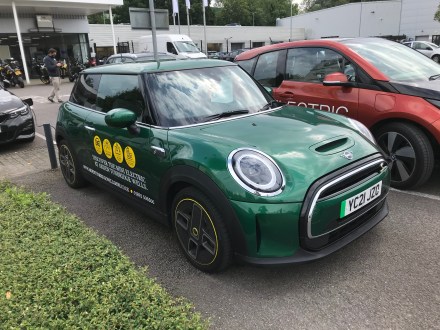
When we arrived, there were several different minis on the forecourt. Some looked like they had been inflated with an air-pump (not keen) and some like they had been painted by 6-year-olds, with nice yellow rims around the lights and hubcaps. Not really my taste. But one was a beautiful green (if you ignore the adverts on the side). Obviously, you don’t choose a car for its paintwork, but if you did, this was the one. It had unfortunate hubcaps, that made it resemble a Playmobile car, but other than that, it was very nice.

We took our licences inside, and the salesman checked we weren’t listed as car thieves, and then said we could take one out for a drive. Due to the Covid regs at the time, he wasn’t able to accompany us, which was fine.

I went first. Driving the electric mini is unusual because there is no clutch pedal (like any automatic) but the accelerator pedal also acts as a brake—press to speed up, lift your foot to brake. As a driver who tends to coast and not use the accelerator, this took a little getting used to. There is a brake pedal as well, and you can switch off the clever multi-function pedal, but it was quite good once I trusted it.

The car is small (obviously) but it felt solid (not like our Fiesta, which feels a bit flimsy on fast roads). The acceleration was fierce—not that I properly tested it. I drove with Husband, who kept urging me to zoom away from junctions: “Go on, put your foot down, nip into that gap, give it some oomph.” But I simply wanted to drive slowly and get a feel for the car; I ignored him. He then drove it with Son 2, and I think they both thoroughly explored the whole “0-60mph in 7.3 seconds” and apparently, it’s true.

The interior was compact, but didn’t feel cramped with two adults. It would also be ideal for taking passengers in the rear, as long as they don’t have legs. It only has two doors (the third door is a lie, it’s the boot lid) so I fear Grandma might get stuck forever if she was put in the back. The back seats fold down flat, which makes an okay-sized space for a large dog who wants to breathe down your neck while you drive.

Interior was compact, but not too cramped for two adults.

 The steering wheel was a nice sporty size, in leather. The seats are only available in fabric unless you pay for a higher spec, which is a disincentive for putting large dog in the back (we decided not to include her in the test-drive trip, which was probably wise.) The higher spec also includes an ugly sunroof and fancy wing-mirrors, and front parking sensors. However, the higher spec also offers an automatic parallel-parking feature, which would be very attractive and save me many hours of humiliation (why are there always people watching when I attempt to parallel-park?) The higher spec is an extra £4,000 though, so not cheap (or worth it, in my opinion).

When I drive, I concentrate fully on what’s happening around me, trying to not hit anything. However, I was aware of a very fancy array of lights on the dashboard. There was a lack of dials and knobs, everything was digital. Things like CD players no longer seem to exist in cars, everything is linked to mobile phones or Ipods. For me to own one of these cars would require several hours of IT lessons if I wanted to use all the features on offer. There wasn’t even a slot to put the key into, simply having the key was sufficient it seems, and then there is a button to start the motor. Knowing which button starts the motor was not as easy as you might think, and when we returned the car, I turned on the radio and the set the air-conditioning before I managed to turn off the engine. I think Husband and Son had less trouble.

The electric mini has limited range due to the battery, and will only manage about 100 miles. It then needs to be recharged. (I think officially it does 145 miles, but I understand this is optimistic.) For me, this wouldn’t be a great problem as I can only drive for about 100 miles before I also need to rest and recharge. Though I suppose it would be annoying if there was a queue at the recharging points. The battery is guaranteed for 10 years, though I was assured it would last 15. It seems that the car will then be obsolete, as replacing the battery would cost more than a new car (the same as a mobile phone). Son assures me that batteries will improve over time, so unless you are particularly eager, it’s possibly better to wait a few years for the next grade of electric mini. It was temptingly nice though…

Thanks for reading. I hope you see something interesting this week.
Take care.
Love, Anne x

Anne E. Thompson
Thank you for reading anneethompson.com Why not sign up to follow my blog?

Trip to the Zoo


We went to the zoo.

The weather promised to be not too bad (best you can hope for in an English summer) and the day was empty, so I made some cheese sandwiches (because zoo restaurant food is usually dire) and we set off for Port Lympne. I’m not entirely sure how you pronounce that, but it sounds like ‘Port Lymf.’ Just say it fast, and no-one will notice.

The day was a good one. Here are the highlights:

We were greeted by prowling lions. Luckily they were behind bars, but something had clearly caught their attention, and they stared intently at a gateway, their eyes brooding, their muscles tense. I have always thought that lions and tigers are simply big versions of my domestic cats, but these were scary. They wanted something, and I was very pleased there was a strong fence between us. There were lots of squirrels in the zoo. I guess they learn pretty quickly which enclosures to avoid.

Next stop were the gorillas, but we were distracted by the view (the zoo overlooks the Romney marshes down to the sea) and some rather fine steps that went down past the mansion. A feature of the zoo is that it’s built on a stonking great hill, so don’t visit unless you have good legs.

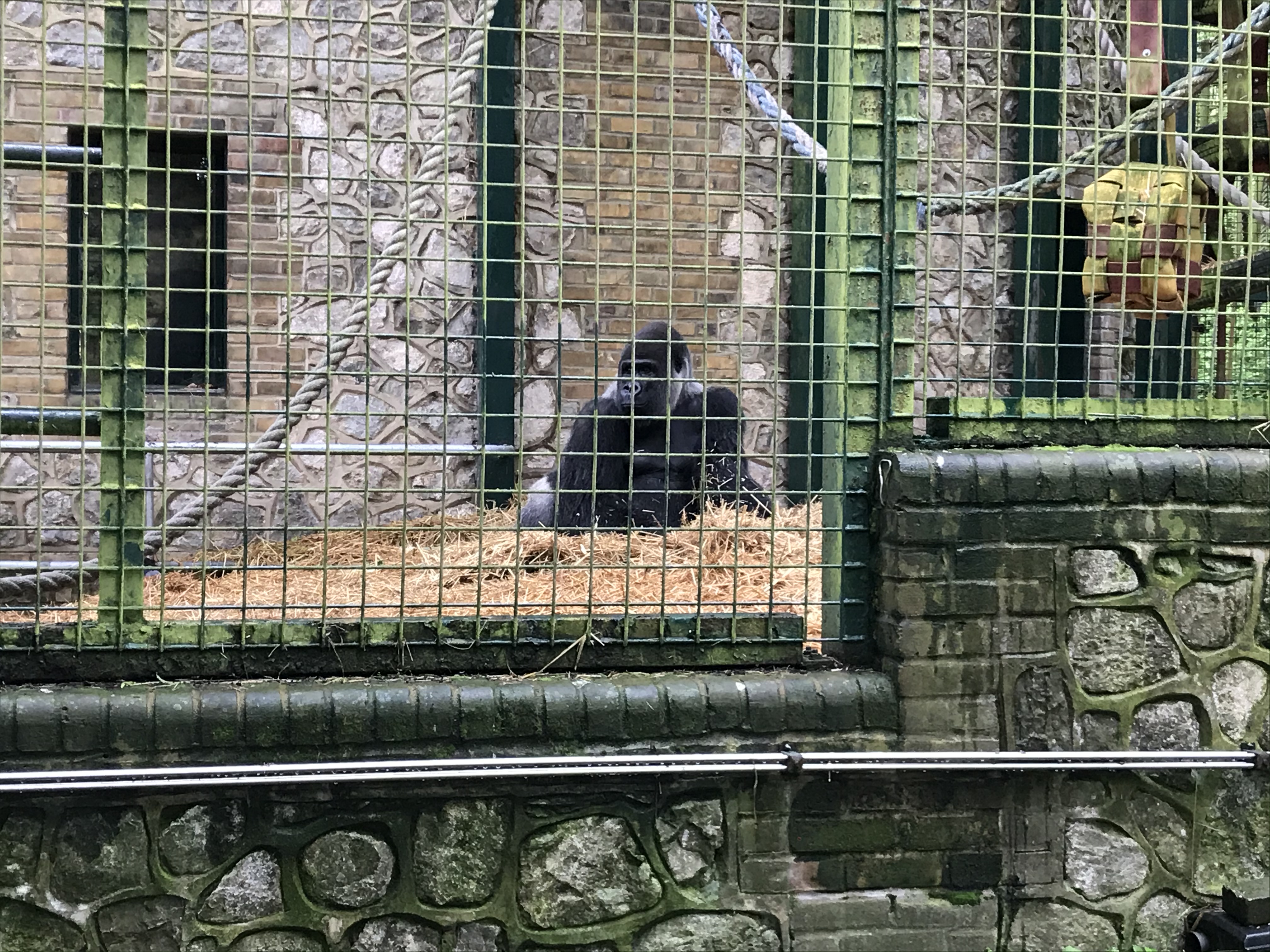
Grumpy gorilla searching for bugs.

The gorillas have a brilliant enclosure full of swings and ropes and barrels. Unfortunately they mostly preferred sitting inside their warm house, so we only saw two fat males, who were busy picking insects out of the straw. Tasty snack. Port Lympne is famous for its gorillas, and on better days we have watched whole families play. The zoo breeds them, recreates an environment similar to the wild (but with fences) and then releases them. (Not locally. Obviously.)They have reintroduced about 70 gorillas back into the wild, and are busy breeding more. When they’re out, you can spend hours watching them, they’re fascinating. Empty cages are less fun.

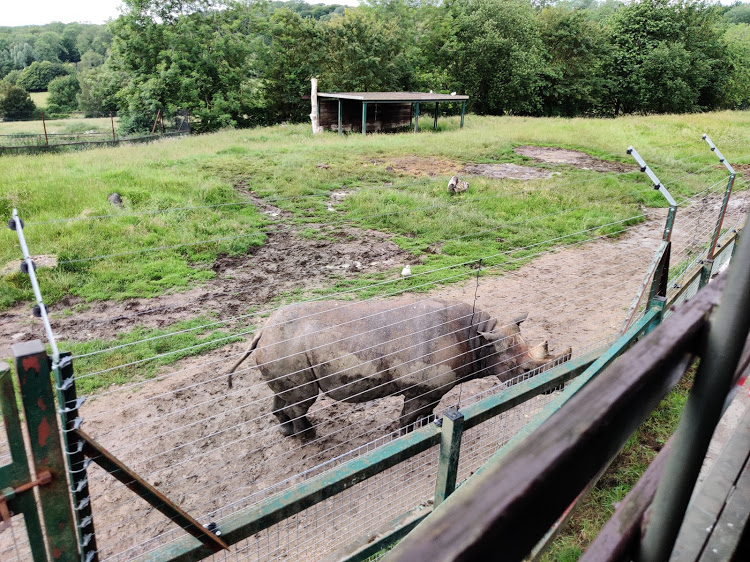
There was a muddy field with rhinos stomping. Their footprints were as big as dinner plates.

We caught the ‘safari bus’ for a tour of the bigger enclosures. This was worth doing mainly for the giraffes, which took up the slack from the gorillas—they weren’t just outside, they all decided to huddle next to the gate so the bus was unable to open it. We sat there, for ages, watching them. Long necks stretched to eat leaves from trees, improbable legs that moved—both right legs then both left legs—in a finely balanced glide. Their eyes were knowing as they dipped their heads towards the bus and licked the salt from the windscreen. Eventually, a keeper came, and called them all into the giraffe house. They all stalked towards her call, except for one, which lifted its head but decided, very obviously, that it wouldn’t obey. The herd floated away, and the rebellious young male drifted after them. It was worth the entrance fee. They don’t look real. Who would design such ridiculous creatures?

The rest of the safari involved mainly deer (all different kinds, and some were called ‘gazelle’ or ‘lechwe’ or ‘eland’ but they were basically all deer with different flavours of antlers/horns). There was a pack of wild dogs, which reminded me of Kia, and a couple of zebra (another unreal animal) but mainly we saw deer. And some people glamping in a field with a muddy pond that was meant to resemble a waterhole. The people, with their glasses of wine and woolly jumpers sitting on their verandas and pretending the bus hadn’t stopped right in front of their ‘glamp-tent’ were probably as interesting as the deer to be honest.

There were signs for dinosaur land and babydolls, but we had walked up and down enough hills, so we decided to skip those. I was suspicious that the dinosaurs might not be real, but perhaps I’m just a sceptic. I later read that babydolls is a pizza restaurant.

We ate our cheese sandwiches sitting in the car, then drove home. A pretty perfect day. I recommend you visit, wear comfy shoes.

Hope you have a good week. Thanks for reading.

Love, Anne x

Anne E. Thompson
Thank you for reading anneethompson.com Why not sign up to follow my blog?

anneethompson.com

*****

Sheffield Cutlery


A Quick Visit to Sheffield

Our ‘cottage in the ‘Peak District’ was a house fairly near to Sheffield. As I have never visited the city, we decided to pop in for a quick look. The only thing I know about Sheffield is The Full Monty was set there, and all the cutlery in the world is made there. The last fact might be an exaggeration, though I did hope to buy some cutlery as a memento of my visit.

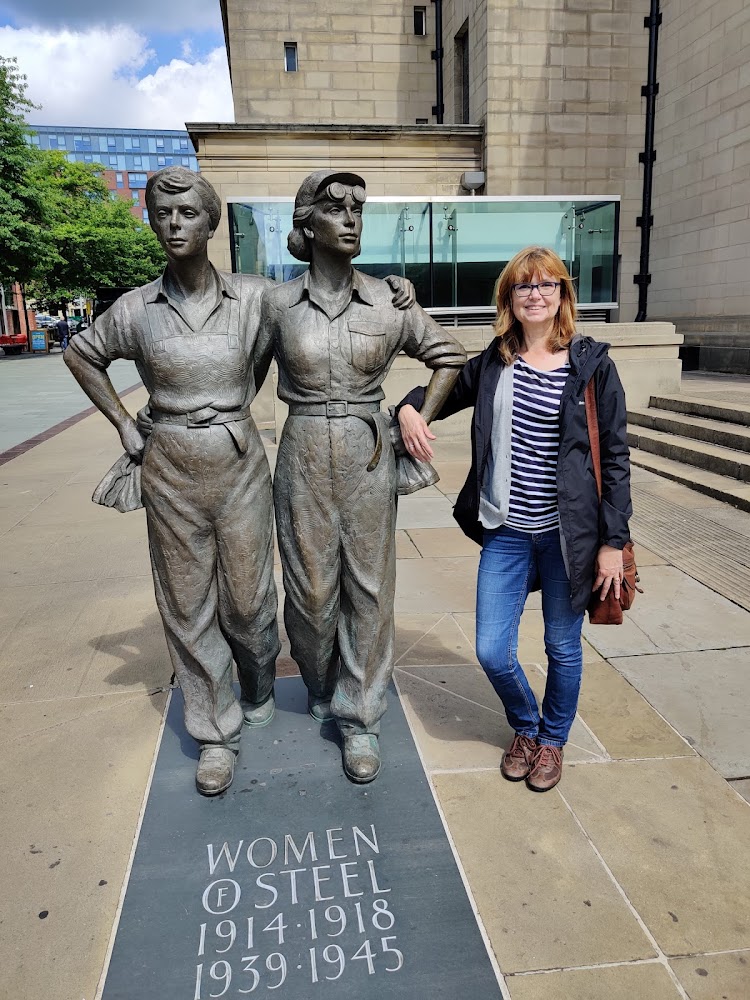
Lots of reminders of the steel industry in Sheffield.

We found a car park, and set off through the city centre. I was pretty desperate for the loo, and public toilets were hard to find. There was a large John Lewis department store, which looked a good bet, but it didn’t seem to have an entrance. We walked all around it, and eventually decided it was shut. This seemed to be a feature of Sheffield—a lot of large buildings were shut, and many were being demolished.

The city centre was not unpleasant, and there were a few holiday-related events happening—the main one being painted bears for children to find. I spotted a few family groups going round, hunting for bears as they followed a map. Nice idea.

I wanted to see the cathedral, and Son-who-knows-Sheffield confidently set off to show us. We arrived, and it was much smaller than expected. The inside was nice, not too ornate, and there were a few people praying, which is much nicer than the usual cathedral where there are more likely to be people taking photos. I wanted a photo, but it felt disrespectful to take one in the building, so I went and took one through the open doorway.

We wandered through the city, and saw a signpost to the cathedral, pointing away from where we had come. Followed it. Came to ‘another’ cathedral…or maybe Son-who-knows actually is Son-who-doesn’t-know! This cathedral was much bigger, with a slightly dodgy extension, lots of ornate stuff inside, and tourists taking photos. I didn’t spot anyone praying. I think I prefer the non-cathedral.

Slightly dodgy extension on cathedral. One of the bears is lurking outside, waiting to be found by the many bear-hunters in the city.

There was a notice board with a few Sheffield-related facts. Apparently Chaucer mentioned the city, so it’s been around for a while. I also read a little about the steel industry, and we decided to visit the museum, even though I don’t like museums.

We had a quick lunch, and I asked the waitress if she knew where was a good place to buy cutlery, as Sheffield is famous for cutlery. She looked at me blankly, and went to hide behind the counter. Maybe young people don’t realise that all our cutlery comes from Sheffield.

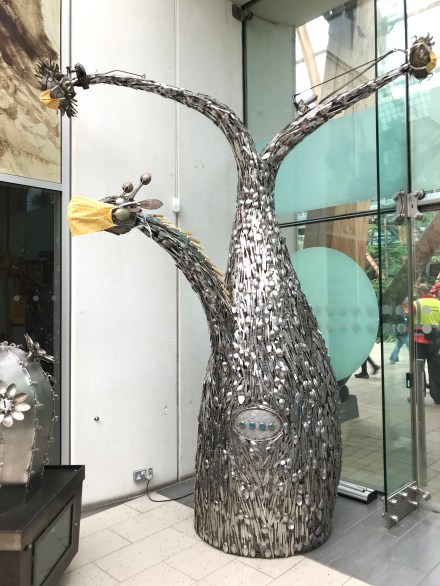
All the cutlery in the world is made in Sheffield. Probably.

Walked to the Winter Garden, but this just turned out to be a lot of plants in the lobby of a hotel (or maybe this was the equivalent of the non-cathedral and map-reading family were mistaken).

We found Kelham Island Museum, which disappointingly is no longer an island, though was well-signposted. It used to be a steel works, and shows the story of the steel industry through the ages. For a museum, it wasn’t too bad (it was fairly small, which helped). I learnt that the women used to tie brown paper over their clothes to protect them from oil, and that the term ‘cutlery’ applies only to knives (spoons and forks are ‘flatware’). They had a small giftshop, and I managed to buy an ‘antique’ sugar spoon (a small spoon with holes in, which I seem to recall one of my grandparents had, whereby you dribble sugar from the sugar bowl to your dish but it is then very useful for sprinkling on strawberries). Although I now know that I did not buy cutlery in Sheffield, at least I managed to buy some flatware.

Some pretty big machines were used in the steel industry.

Have a look at your cutlery next time you use it—I bet it was made in Sheffield.

Thanks for reading. Hope you have a good day. Take care.
Love, Anne x

Thanks for reading. Why not sign up to follow my blog?
anneethompson.com

Chatsworth House


Holiday 2021 continues…

Chatsworth House

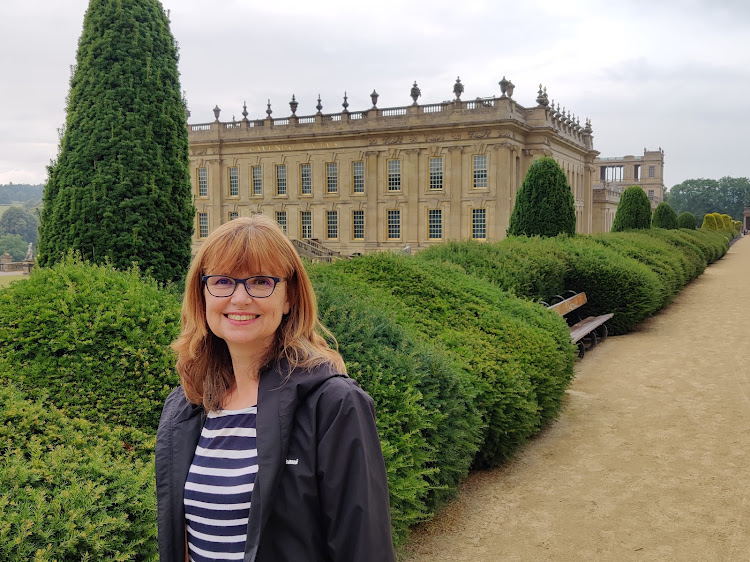
We were staying about half an hour from Chatsworth House, which we visited 10 years ago and enjoyed, so it was a good way to occupy a rainy afternoon in July. The house is now mainly famous for that scene with Colin Firth swimming in the lake in Pride and Prejudice, which is a little ironic considering the history of the house. It was also the home of Georgiana, the Duchess of Devonshire, who entertained the aristocracy in the 1700’s, and was a sort of olden-days movie star—so perhaps the link to recent films is appropriate after all.

We set off after lunch, Emm stating that he didn’t much like old houses and deciding to stay at home. I don’t much like old houses either, but I dimly remembered that this one was worth seeing, and it made a change from long walks.

The house has the most impressive golden gates at the entrance (someone possibly had ideas above themselves) but we weren’t allowed to use them (hoping that isn’t a premonition) and we were directed through the park. We showed our tickets, which cost £24 each, and were timed. We were told not to arrive before our designated time, and the first available tickets were mid-afternoon, with no reduction in price despite the grounds closing at 5pm. I felt this was too expensive, but I wasn’t part of the planning committee, so tried to not complain (not very good at that).

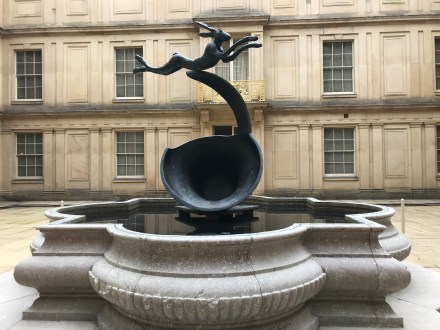
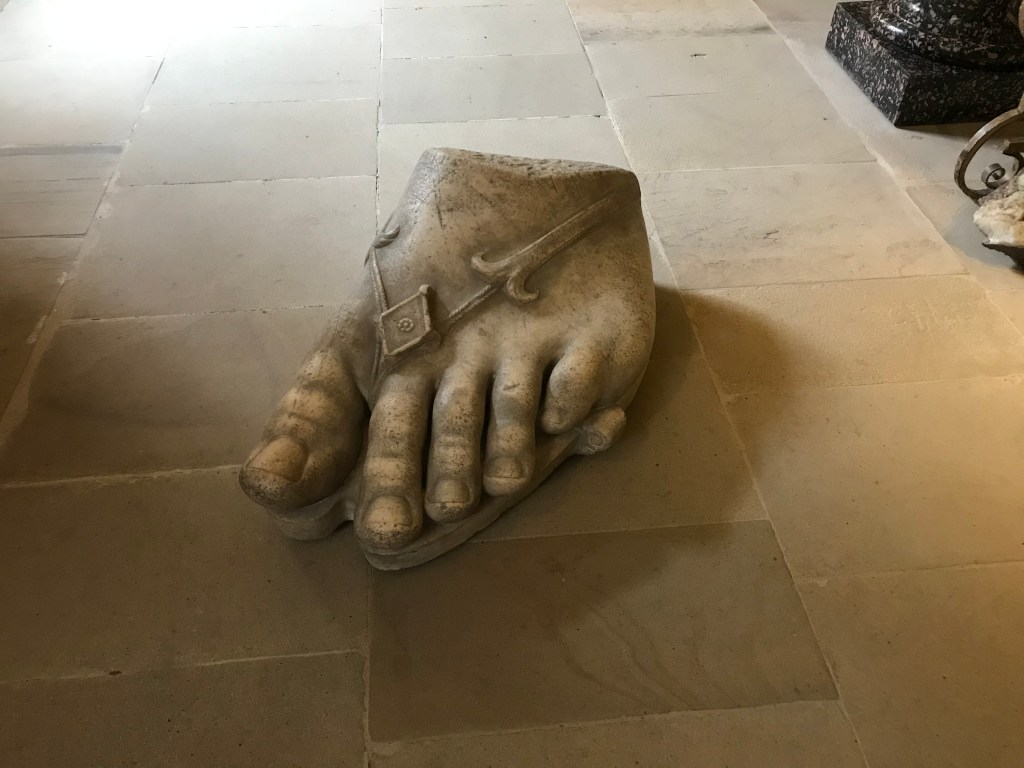
The house is stuffed full of art. As you walk around, there are masterpieces by ancient masters, artifacts ‘stolen’ from ancient Egypt, and modern art, all jumbled together. I don’t like much modern art, but some of the older works were fabulous.

There was also a portrait of Georgiana, the Duchess whose life was in many ways like Princess Diana’s. The portrait is interesting because she has six toes. I don’t know why (I did ask, but the guides didn’t seem to know either). Maybe she really did have six toes, or maybe it was to represent her rather unusual life (she was forced to live with her husband and his mistress, and was pursued by the newspapers and was a great influencer of both fashion and politics in her day). She looked nothing like Kiera Knightly though, who plays her in the recent film of her life. I bought a copy of her biography in the gift shop (the Duchess, not Kiera). I’ll write about it in a later blog if it’s interesting.

The Duchess

We zoomed round the house fairly quickly, because old houses tend to all be quite similar (in my opinion). Too dim and crowded and full of tourists, so you never manage to get a sense of real people actually living there. They resemble museums. I don’t like most museums.

The gardens however, were lovely.  There was a big concrete block (it was actually granite) which was some kind of memorial to soldiers. It was called The Antithesis of Sarcophagi and I was busy saying what rubbish/not art/ugly it was, when Son 2 told me to peer through one of the little holes in the side. Inside was a jungle. Wow! It was brilliant, you felt as if you were peering at a whole rainforest, growing in a cube. Very clever. Sometimes modern art is brilliant (but mostly not).

Peering inside the granite block

The rest of the gardens were lovely too. There was a rock garden, with the biggest rocks you can imagine, and one very clever structure that was finely balanced and could be moved if you touched it. There was a walled garden, and long pathways, and a wild flower garden, and a lake and everything, really, that you might hope to find in the garden of a palace. I was tempted to pick myself a bunch of flowers (compensation for the £24 entrance fee even though we had limited time due to designated ticket system). But family told me they wouldn’t visit me if I was in prison, so I decided not to.

Rock Garden

It was an interesting afternoon (well, half-afternoon—I can’t quite get over the price of entry). If you know the present Duchess of Devonshire, perhaps you could mention the unfair pricing to her. The people who lived there in the past were good at changing things.

Hope you have a lovely day. Thanks for reading. Take care.
Love, Anne x

Anne E. Thompson
Thank you for reading anneethompson.com Why not sign up to follow my blog?

anneethompson.com
*****

Millthorpe is not The Peak District (though it tries).


Family Holiday 2021 continued.


We packed up the house in the Lake District and left. Everyone felt slightly dirty due to water shortage/lack of showering ability. Our next holiday home was in the Peak District, and we hoped they had more water. The drive was busy, as Saturdays in July are full of people leaving and arriving on holiday, but we didn’t meet any major hold-ups. Our journey took us through the outskirts of Sheffield, and we began to wonder how near the city our Airbnb would be. The details had described it as being in the grounds of Carpenter House, in an area of beautiful countryside, but we were beginning to worry.

At the last minute, the roads turned away from the city, we drove through a few fields, and arrived at the little hamlet of Millthorpe. It was not exactly the Peak District, but was far enough from the city to not feel crowded. There were several fields of horses, and lots of the houses had stables attached—clearly an area for the horsey people of Sheffield to live.

Went for a walk across the fields. More horses. I am very comfortable with all cows and sheep; horses make me nervous but we weren’t eaten or stampeded. Walked to the local Royal Oak for dinner. The pub was ancient, with low beams and a huge fireplace. The menu was limited unless you are a cheese-lover (everything had cheese, and fried cheeses made a very nice, if rather unhealthy, starter).


Sunday 25th July

The family voted to go paddle-boarding. They discovered you could hire boards and wet suits at Tittesworth Reservoir (with a name like that, I really hope they did a Google search for ‘paddle boarding’ and not something else!)

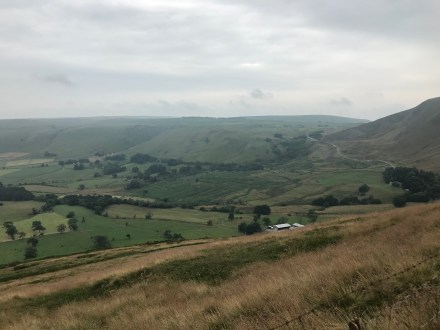
The drive took us through the Peak District, which is beautiful and very near to Millthorpe. The weather was less sunny than last week, but still warm. We arrived at the car park, and saw several families hiring wet suits, squeezing into the little changing cubicles, struggling to carry the unwieldy boards. I decided that paddle boarding was not something I wanted to do (I felt that complete lack of co-ordination, no ability to balance and not being a good swimmer would make it less fun). Went for a walk with Bea while the others pootled about on the water for an hour.

Paddle Boarding

Everyone seemed to have fun, and we discussed it (at length) in the pub afterwards. I had real trouble remembering that the term is ‘paddle-boarding’ and not ‘water-boarding’ so I kept asking them about their experience of torture.

Monday 26th July

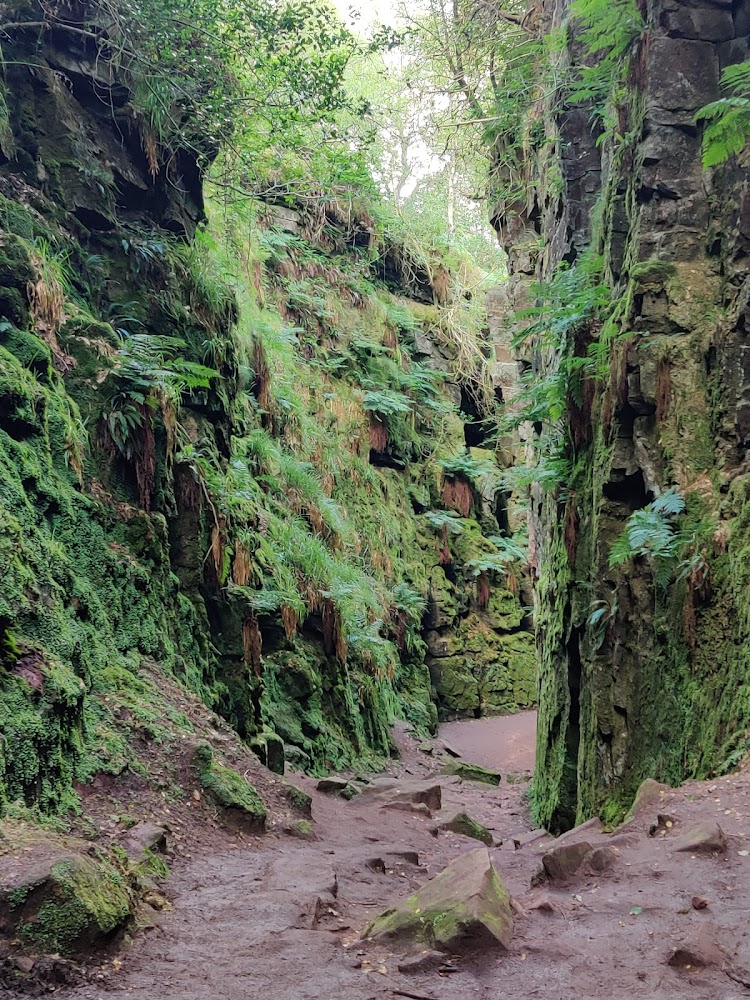
We went for a walk to Lud’s Church. This is a cavern, tucked into the Peak District, and makes for a pretty walk. There are many stories and legends swirling around the cavern, and Emm assured me it was the spookiest place in the world.

We walked along a pretty footpath through the woods, the sun was shining, birds singing, ferns carpeted the floor. Hard to see why it was spooky. We arrived at the cavern, and the temperature dropped as we walked between the giant-sided rocks, taking care not to slip on the moss. It was easier to understand (slightly) why someone might think the cavern was haunted. It then transpired that he had visited at dusk, on Halloween, when all the trees were bare and everywhere was gloomy and cold—that would definitely be spooky.

Lud’s Church

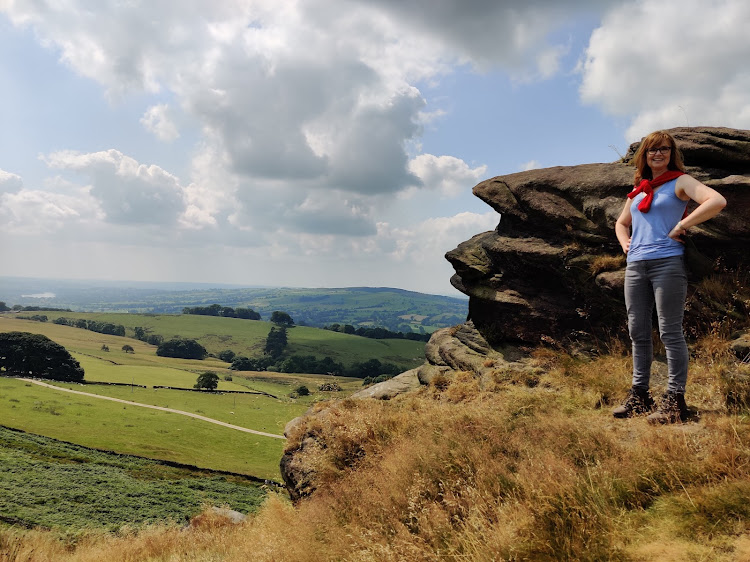
We left the cavern and walked up to the Roaches, which are big rocks protruding from the hills. Great views of the valley.

The Roaches


Tuesday 27th July

Walked up Mam Tor, near Castleton. This is about as high as my knees can manage, but actually was very easy as there are paths all the way and no scary precipice to make me dizzy. It was a long walk, and I was pleased to reach the top. Asked Husband to take photo for blog. Family photo-bombed. I informed them the photo was for a blog, and I would  use it whatever they looked like. Posed for another photo. No better. Decided to use it anyway.

Unhelpful Family

In the afternoon, we visited Chatsworth House. But that will have to wait for another blog.

Thanks for reading. Take care.
Love, Anne x

Thanks for reading. Why not sign up to follow my blog? anneethompson.com

A Holiday in The Lake District


Tuesday 20th July
Our holiday in the Lake District continues—without us actually managing to visit a lake. The weather was boiling hot, so actually visiting a lake would have been a good idea, but instead we decided to go for lots of long walks. I was not part of the planning committee, though to be fair, the area is beautiful, even with sweat dripping into your eyes.

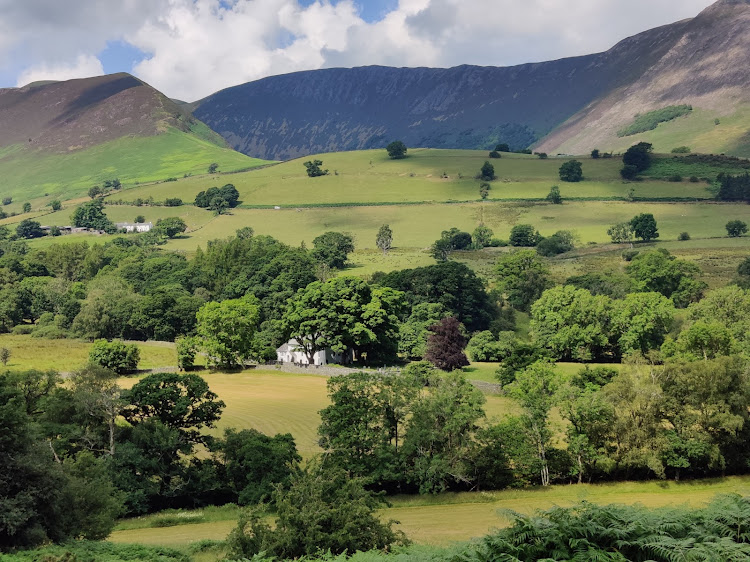
Our Airbnb is in Newlands Valley, and we found a lovely walk from the house that was relatively flat (even the planning committee decided big hills were a bad idea in the heat). There was a little ancient church with a school attached, and bubbling brooks, and sheep huddled in the shade of every tree.

An ancient church nestling in the valley.

We had dinner at The Royal Oak in Keswick (Husband likes booking Royal Oak pubs. It’s a thing.) The food was delicious, and despite being very crowded, the pub seemed clean. All the staff wore masks, which seems a polite thing to do at the moment.

Wednesday 21st July

We walked in the valley again, going a little further this time so we managed a loop. The valley stretches beyond the roads, and the path disappears into the fold of the hills. I would love to walk further, but the weather is too hot.

In the afternoon we decided to drive somewhere pretty (though everywhere is pretty, so not sure why) and go for another stroll. We drove to Honister Slate Mine, which is a working mine with tours and climbing lessons and a gift shop. It also has a lot of tourists in a Covid-world in July. I am not keen on climbing or mines or tourists, so it wasn’t my favourite place. Had a quick look at the gift shop, which was full of beautiful things that I couldn’t afford. Walked in a different area, where there were fewer tourists.

We ate at The Royal Oak in Keswick again. It was so good last time, several of us chose the same dishes. The food was tasteless—must have been a different chef.

Thursday 22nd July
We walked the same loop of the valley, past the old church. It was still beautiful, still very hot. I still didn’t manage to walk further into the hills.

In the afternoon we drove into the hills to Watendlath Tarn. The roads there were clearly built for horses rather than cars, and were so narrow that sometimes the hedge brushed both sides of the car. The lanes twisted up steep hills, and you hoped you wouldn’t meet a car coming in the opposite direction—but of course in July, it was inevitable and we would have to reverse back to a passing place. Occasionally the passing place was filled by a parked car, and we would have to reverse even further. Unfortunately Husband quite loudly stated his views of people who park in passing places, at a moment when his window was down, and so was the window of the parked car. We managed to pass without a punch-up!

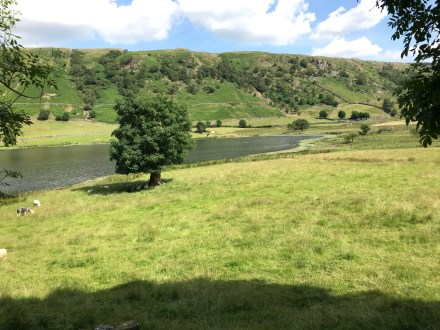
The journey was slow, but so very beautiful. After winding up and up, we began to drive downhill, but not for very long when we rounded a last bend, and there was the car park. There were toilets (which were locked) and a tea room (which was closed) and the tarn, shimmering in the sunlight. It was much prettier than the photo. We strolled, and paddled, and enjoyed the beauty. There weren’t many other people there, which was nice—probably they were stranded somewhere due to all the parked cars in passing places along the route.

A tarn, high in the dip of the mountains.

We had a final dinner at the Royal Oak in Keswick. The food was tasty again, so the Tuesday chef must have returned. I did notice that no one was now wearing a mask. It’s weird how noticeable that has become.

In the evening we were contacted by a neighbour and asked to limit our water usage. The hamlet is fed from a stream, and it was getting low. Maybe we’ll have to visit another lake after all, to wash and do laundry.

Thanks for reading. Next week I’ll tell you about the second stage of our holiday, in the Peak District. One day we went paddle boarding, which I kept mistakenly calling ‘water-boarding!’ I promise there was no torture involved.

Take care.
Love, Anne x

Anne E. Thompson
Thank you for reading anneethompson.com Why not sign up to follow my blog?

anneethompson.com

*****

If you enjoyed this, read a copy of The Sarcastic Mother’s Holiday Diary:

Family Holiday 2021


Saturday 17th July
We drove to the Lake District, via Cambridge to collect Emm. Kia was safely installed in the boot, on a sort of doggy-throne so she was well-cushioned and could lie flat or look out of the window as she pleased. The rest of us squashed into the rest of the car with our luggage. The dog was very comfy.

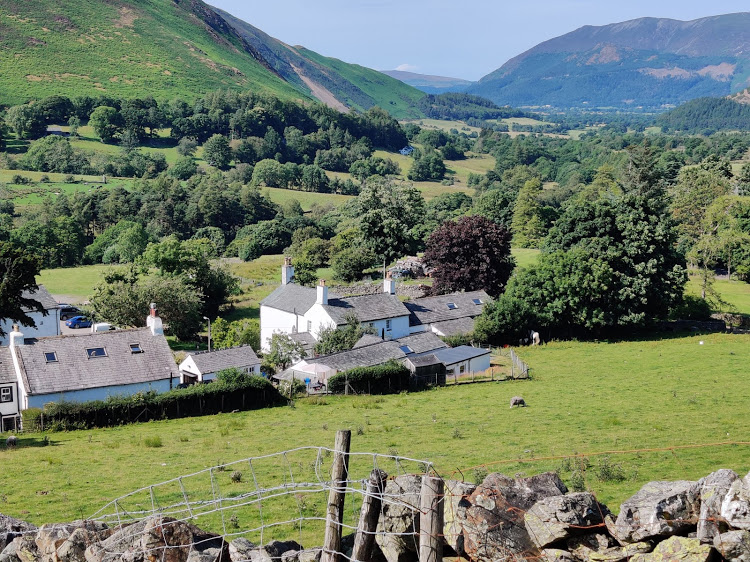
We arrived at The Old Vicarage in Littletown in Newlands Valley. The house has a nice feel, with high ceilings and spacious rooms and views across the valley. Parking next to the house was a three-man activity, but we managed it without scraping the car. The neighbours came out to watch. Bea and Boyfriend arrived, and managed to park without as much shouting.

Beautiful Little Town.

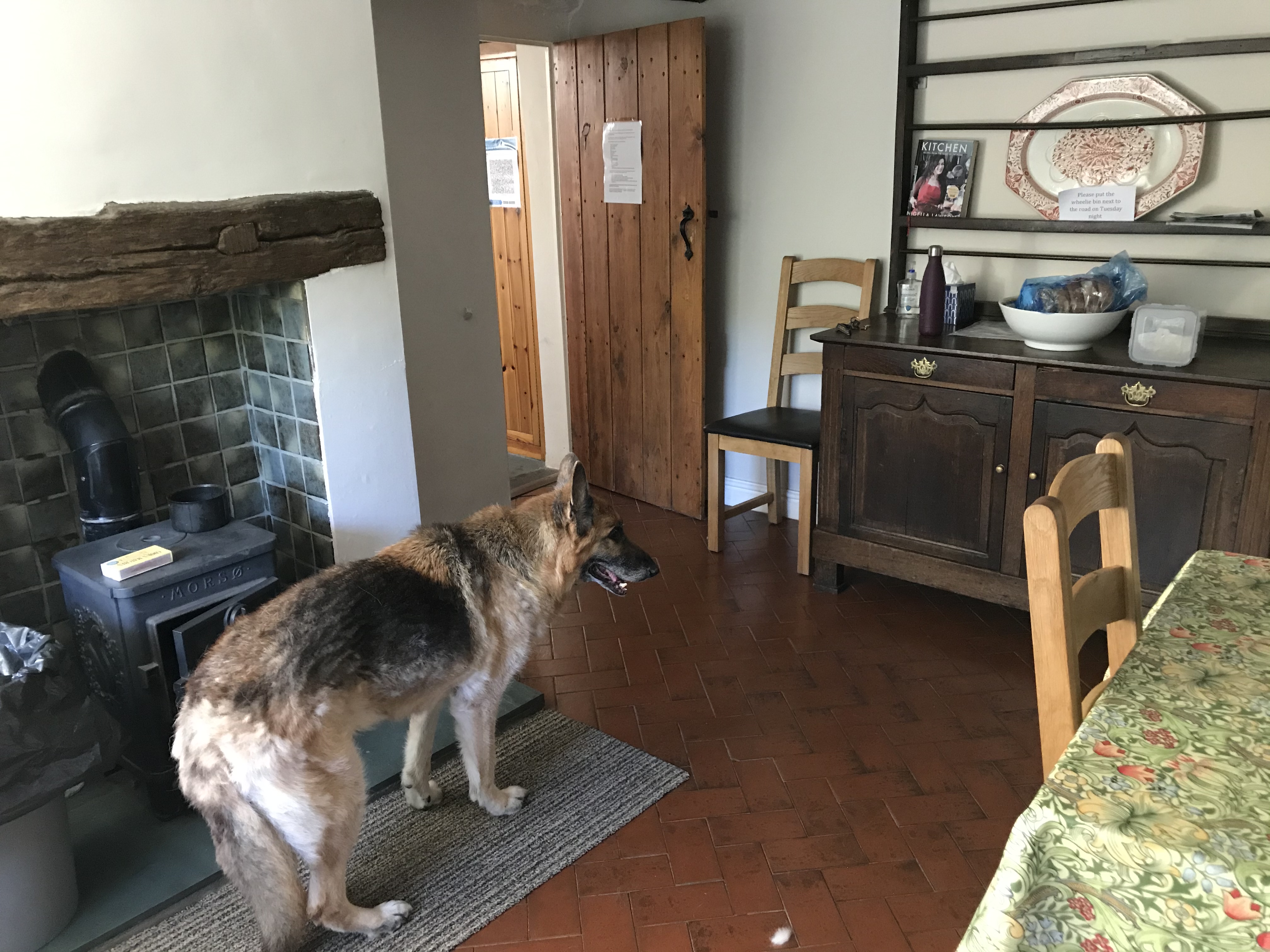
We allocated rooms. Husband and I took the downstairs room attached to the still-being-converted barn. I thought it would be quiet (it was—but it was also a very long way from the upstairs bathrooms, which proved inconvenient). The rest of the family took the three upstairs bedrooms, and the dog took the kitchen and utility room, with sneaky excursions into the rest of the house when she thought no one was looking.

Kia deciding whether the kitchen is a suitable room.

We ate at The Royal Oak in Braithwaite. Husband booked it before we left home, and it’s lucky he did as the area was jam-packed with tourists and the pubs were full. As we drove to the pub, we saw a hedgehog, hurrying up the lane. We stopped to watch. Our house is opposite Little Town Farm, which was the setting for the Beatrix Potter book Mrs Tiggy Winkle, so it seemed appropriate. It’s rare to see hedgehogs today, as a child they were mainly of the squashed variety.

Sunday 18th July
I woke early and attempted to go for a run. Little Town is at the top of a hill, and I don’t run downhill (dodgy knees) so it wasn’t the most active run in the world. But the family didn’t know that, and they were all getting up when I returned, so I let them think I had run for miles.

I made pancakes for brunch. As I had only packed pancake ingredients (Kia took up too much space) we then went to Keswick for supplies. Went to Boothes supermarket. If you are in the area, I suggest that you avoid Boothes unless you’re feeling rich. It is very expensive. It was also full of Christians, as we had unknowingly timed our trip to coincide with the Keswick Convention, which is a big deal in the Christian world. I have never attended, but can inform you that they have their own traffic lights so the Christians can cross the road, they have large white marquees, and the supermarkets fill up with polite people who smile at each other. It brought out the rebel in me, and I felt the need to buy way more alcohol than we’ll drink in a week. I also bought the most expensive tea-towel in the world, as the house didn’t provide them and I had forgotten to bring any. £8.99. For one tea towel. One. It’s not even pretty.

After lunch we went for a walk. I had ( as you might remember) bought waterproof coat, trousers and walking boots. It was a boiling hot day, so I left all the kit at the house and wore trainers. Felt weirdly disappointed. The walk turned out to be up a mountain (they often do when Husband is in charge). I don’t do mountains, so walked a different route with Bea. Drank Pimms in the garden (still lots left after rebellious shopping trip).

Monday 19th July
Morning walk in hills behind the house. So wonderfully pretty.

After lunch we drove to Moss Falls. There was another mountain to climb, so the males set off, and I walked a little way and then sat and read. Everywhere is so beautiful.

Moss Falls
Absolutely no idea who the bloke behind me is.

We ate at The Royal Oak in Braithwaite again. Our drive there takes us through a wood with signs warning us to look out for red squirrels. Son 2 informs me this is because they are known to attack cars (pretty sure he was lying). Bea declared she had never seen a red squirrel. We all stared through the windows. There was something reddish, dead, next to the road. Bea said this didn’t count. We did however see a hare, lolloping up the lane. Personally, I think a hare is as exciting as a red squirrel.

Hope you see something fun today. Thanks for reading.
Take care.
Love, Anne x

If you enjoyed this, why not read The Sarcastic Mother’s Holiday Diary.


https://www.amazon.co.uk/Sarcastic-Mothers-Holiday-Diary/dp/1790374235/ref=sr_1_1?dchild=1&keywords=The+sarcastic+mothers+holiday+diary+by+anne+e+thompson&qid=1627491559&sr=8-1