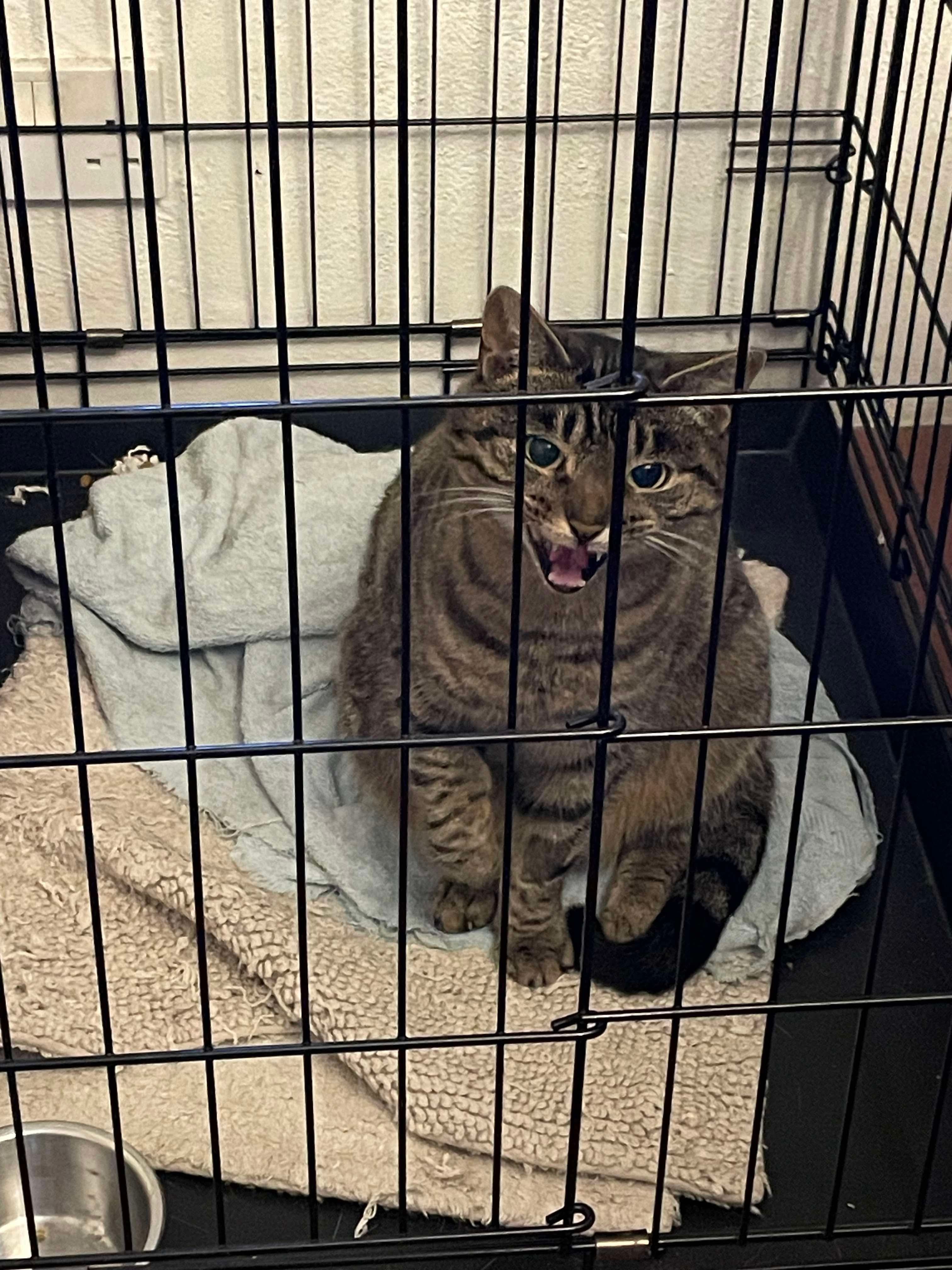
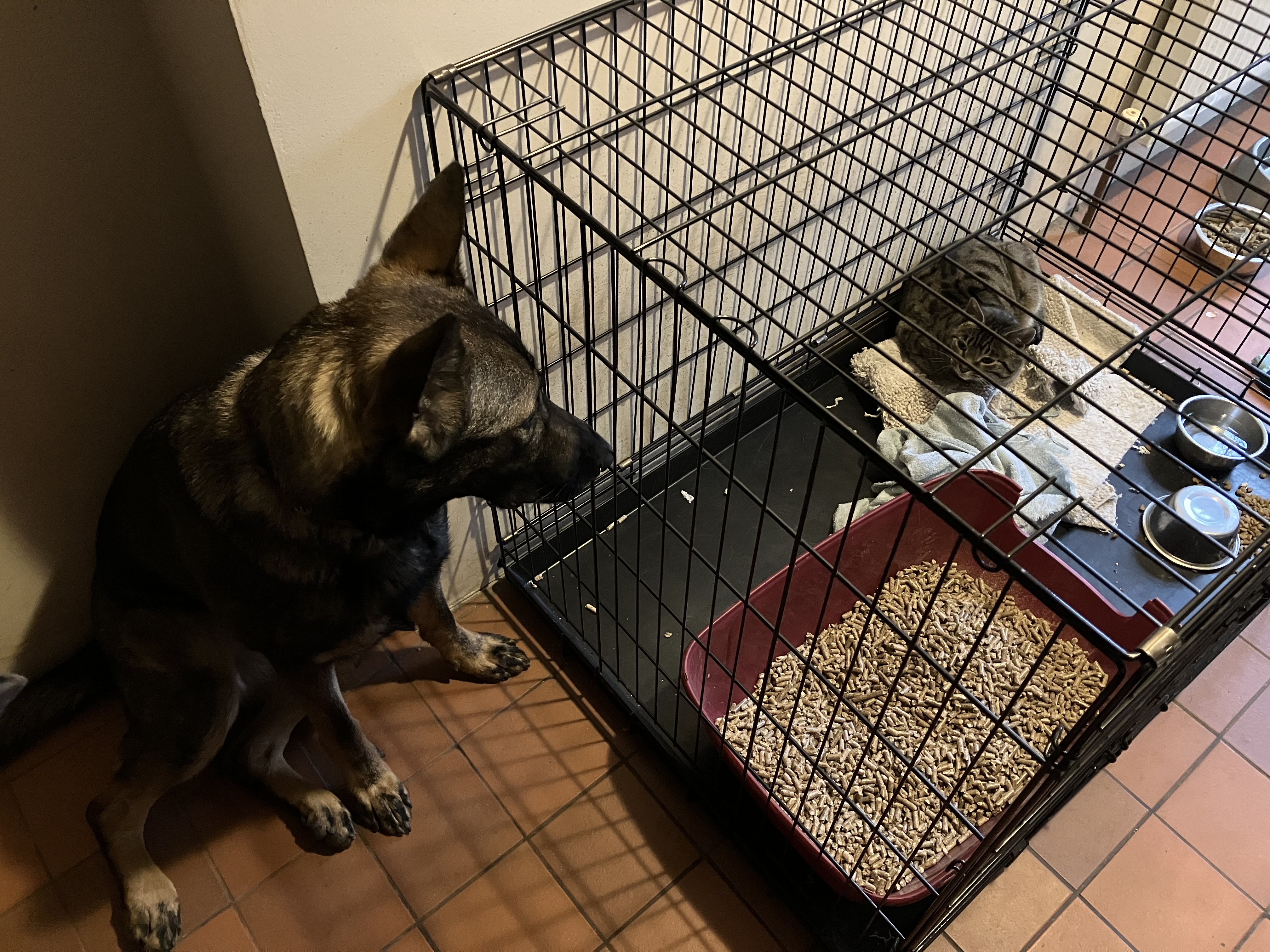
Trying to force Meg and the cat to be friends is not, I think, going well. The cages are now pushed next to each other, and on the positive side, they are able to both sleep in them—so for many hours there is peace. But the cat’s cage makes a corridor into the utility room, and the cat knows that when Meg goes in and out, she can reach through the bars and scratch Meg. Meg also knows this, so is very wary of walking past the cage, which results in a lot of barking and bouncing (because that is what a nervous Meg does). I blame the cat for this.
There is also chaos when the cat uses her dirt tray. I don’t know why, but as soon as the cat goes onto the tray, Meg starts to bark and bounce and bang against the cat’s cage. Maybe she doesn’t like the smell (though she emits such awful smells herself, I don’t think this can be the reason).
On the positive side, they have their bowls of food next to each other—either side of the bars—and they notice what the other is eating and don’t try to interfere. Lots of the time life is peaceful, even though they are in close proximity. The cat seems to be the boss, and is the main instigator of trouble—though as Meg is much bigger and has the potential to damage the cat, I really need them to co-exist peacefully, without a constant battle even if the cat starts it. The cat will have to be confined for another two weeks, until her snapped ligament has fully healed. Then we will see what happens. I’m not sure that anything has changed at all, and their relationship will continue to be one of Meg chasing the cat whenever she can, and the cat hissing at Meg from high vantage points. Which is exactly what it was before I started this exercise.
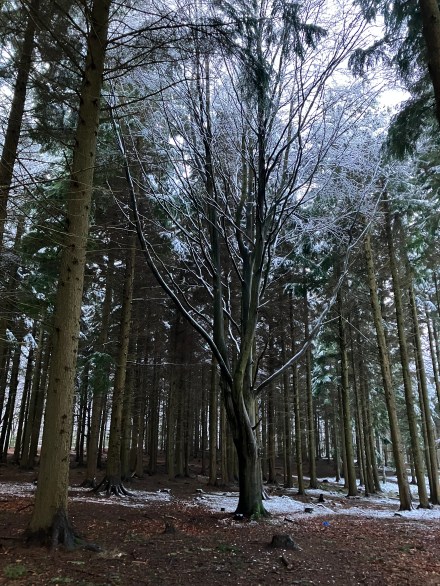
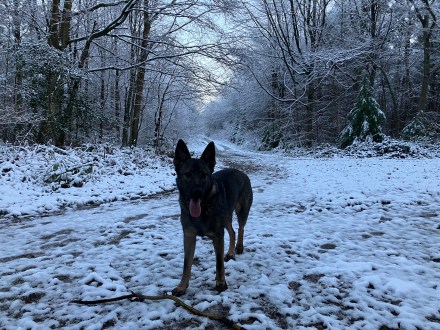
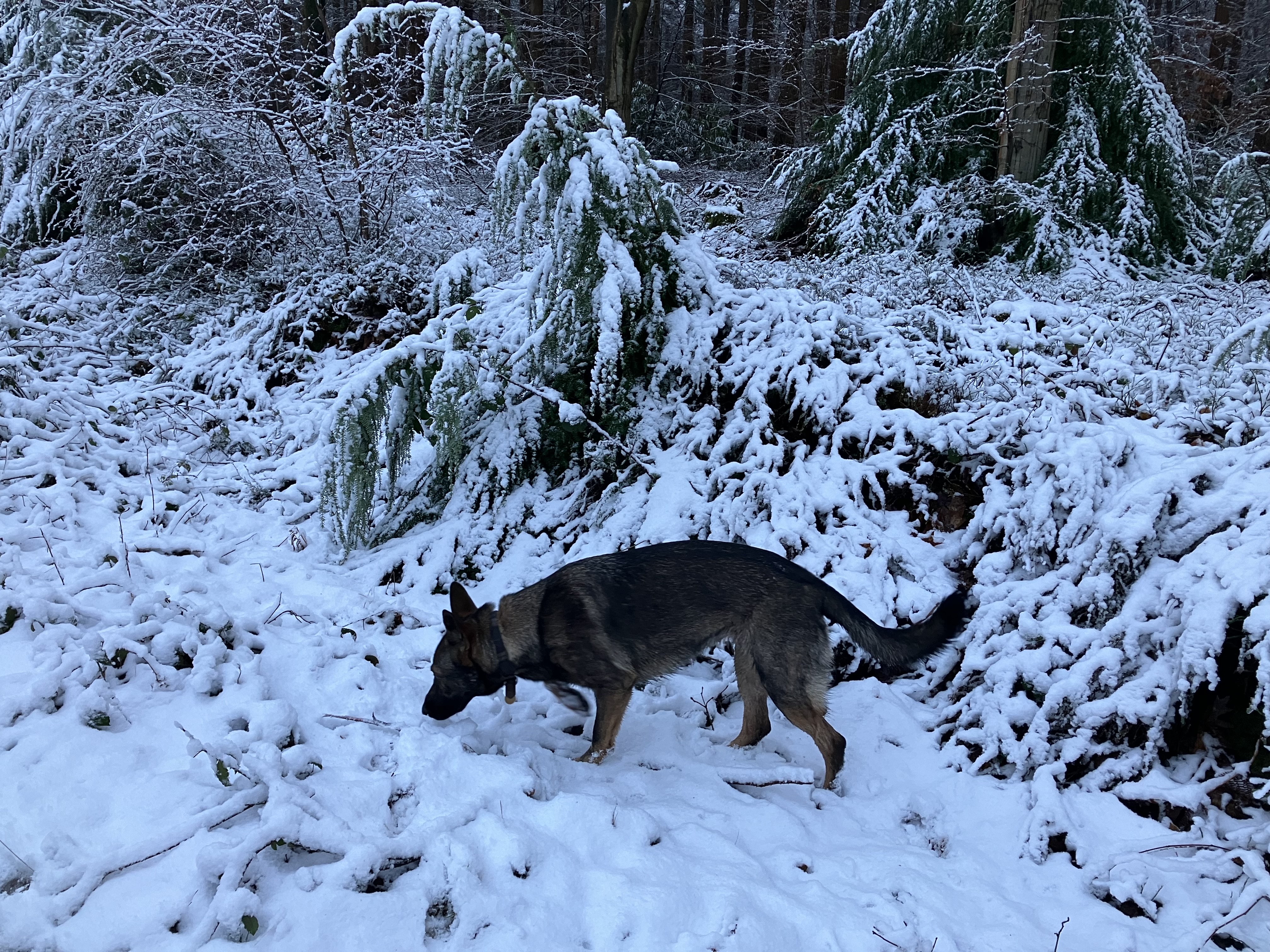
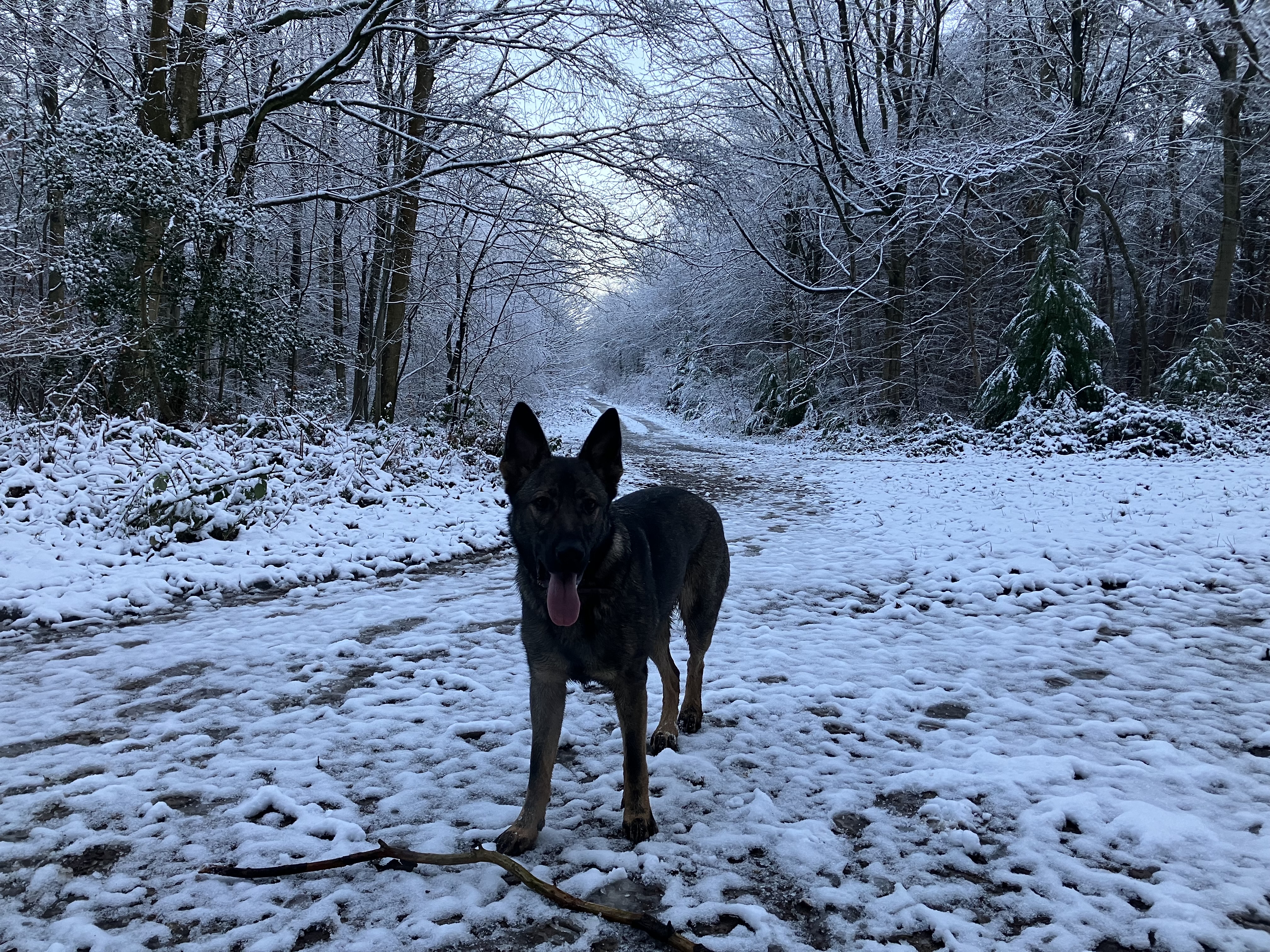
The woods are beautiful this week. The snow is clinging to the trees and the temperature has dipped below freezing, so it has stayed for a few days. Breathtakingly pretty. The ice means that walking is a bit dodgy, and the snow is packed hard from all the dog-walkers, and incredibly slippery. Everyone walks on the edges, where it’s less compacted, which means gradually the footpaths are widening.
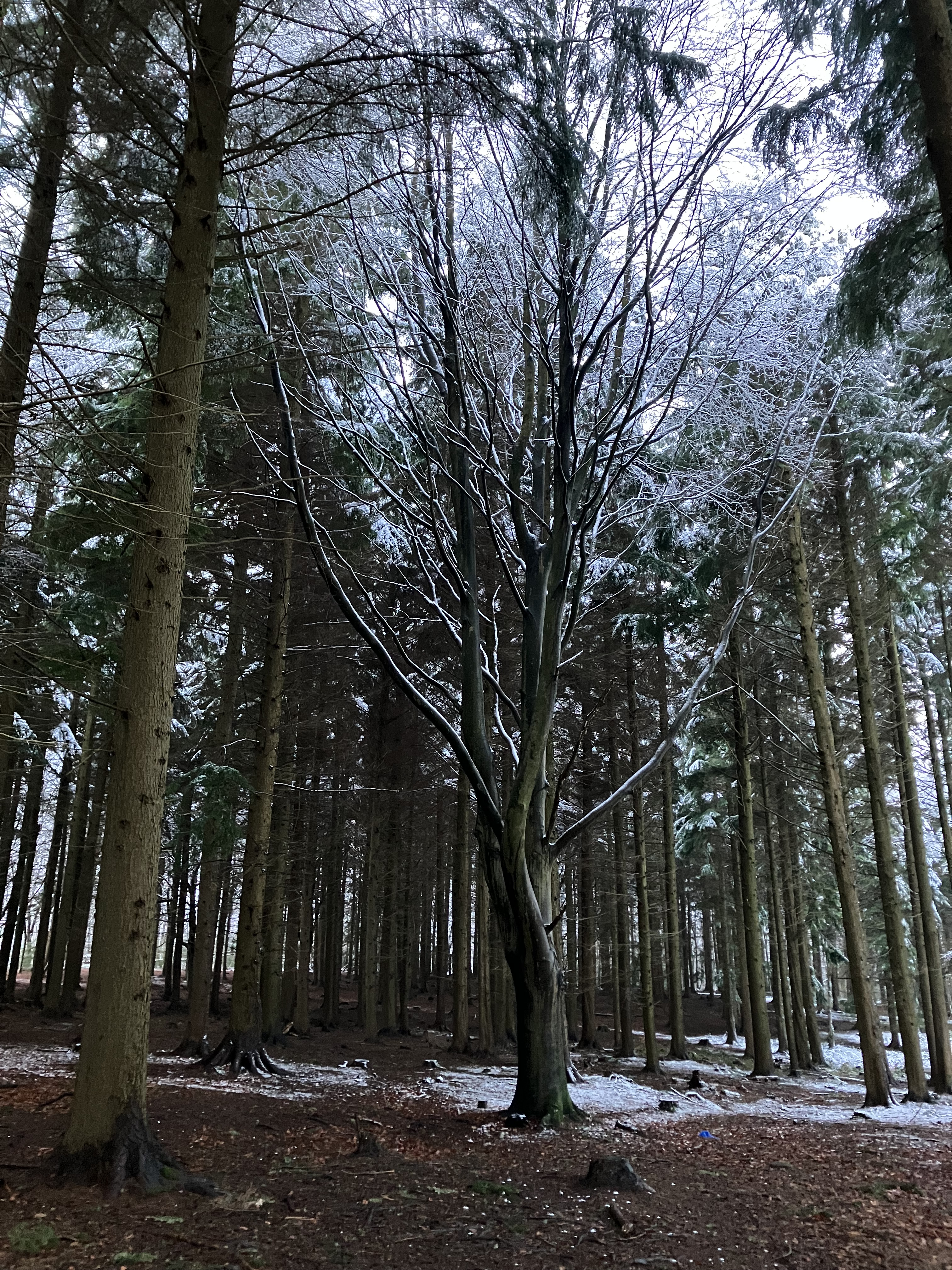
The tree men are back, with their great machines of destruction, chopping down trees and churning up the mud. At least now its frozen the wheels will do less damage, but before Christmas was very wet, and they have ruined swathes of woodland by making trenches of mud and destroying the undergrowth. I hope they know what they are doing, and it’s necessary for the health of the woodland, but it looks to me like they are just blokes enjoying big machinery. Yesterday they started work in an area of mainly pines—which is where ‘my’ tree is. There is one tree (I think a beech) which has a very black trunk and a beautiful shape, and it’s very stark against all the surrounding pines. I have noticed it on my walks since 2001; twenty-four years ago when I used to walk my Labrador there. I even wrote a story about it. I do hope it survives the men and their machines.
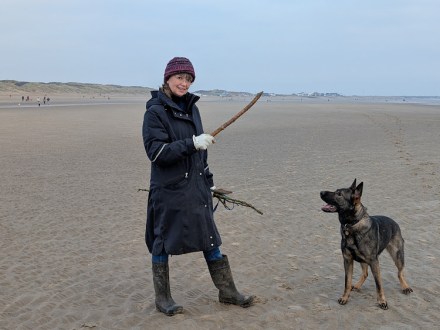
Meg, as ever in the woods, is very good near the workers—she basically ignores them. Yesterday we needed to walk very close to where they were working, so I collected a few sticks, told her to walk on my right, and we kept our distance, throwing sticks into the woods every few minutes so Meg was on full-alert, waiting for the next one to chase. She ignored the noise of the machines, the moving lorries, the falling trees, the men shouting to each other and the whine of saws. The only thing in Meg’s world was the next stick, and when it would be thrown. (It made her appear very well-trained. But she’s not. She simply has a compulsive desire to chase sticks.)
15/1/2025
Meg has favourite places to lie now (like a proper dog!) She has discovered the radiator on the landing and will lie there for hours, soaking up the heat and waiting for me to come out of my room. She also (weirdly) likes her crate, and will sometimes put herself to bed in there. She also prefers it to the utility room, so if she starts fussing when we eat, I go to the utility room, open the door, call her. Meg stops and looks at me. She understands she is about to be shut away, and she walks, very deliberately, into her crate and sits down. It’s very funny!
Thanks for reading, and have a great week. Take care. Love, Anne x
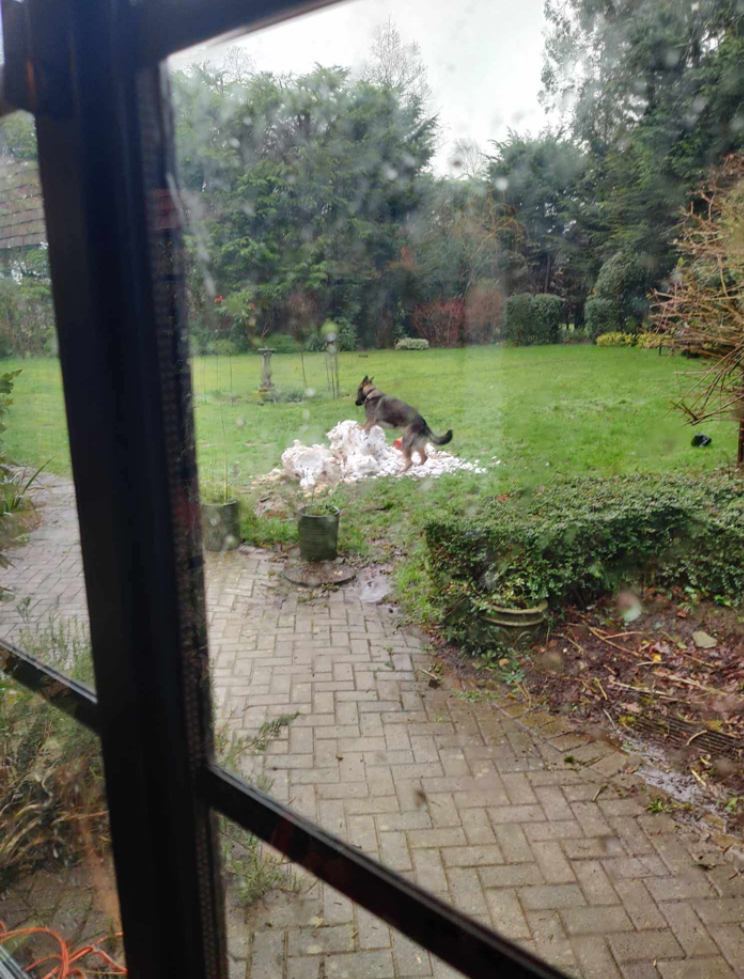
It has been cold, with some snow but mainly lots of rain. The snow was fun, the males made a snowman at midnight, and Meg destroyed it with enthusiasm the following morning.
The rain is not so much fun. Everywhere is muddy, which means Meg is constantly covered in mud, and however much I try to hose her down (which she hates) it still seems to end up inside. The kitchen floor is gritty and I waste lots of time with the vacuum cleaner. (This feels an utter waste of time, because it doesn’t stay clean, and I’m not sure that having a dirty floor matters too much. But I do it anyway.)
Today Meg was very annoying in the evening, and it felt unfair because we had enjoyed a nice day together. I took her to the woods early morning, and we had a good long walk, Meg chasing sticks, me enjoying the peace of the woods and the few flakes of snow that drifted down. At home I hosed her (which she protests about, and nearly wrenches my arm off, but she is completely covered in mud because she wades through all the puddles so it is necessary). Then I left her in the utility room to dry.
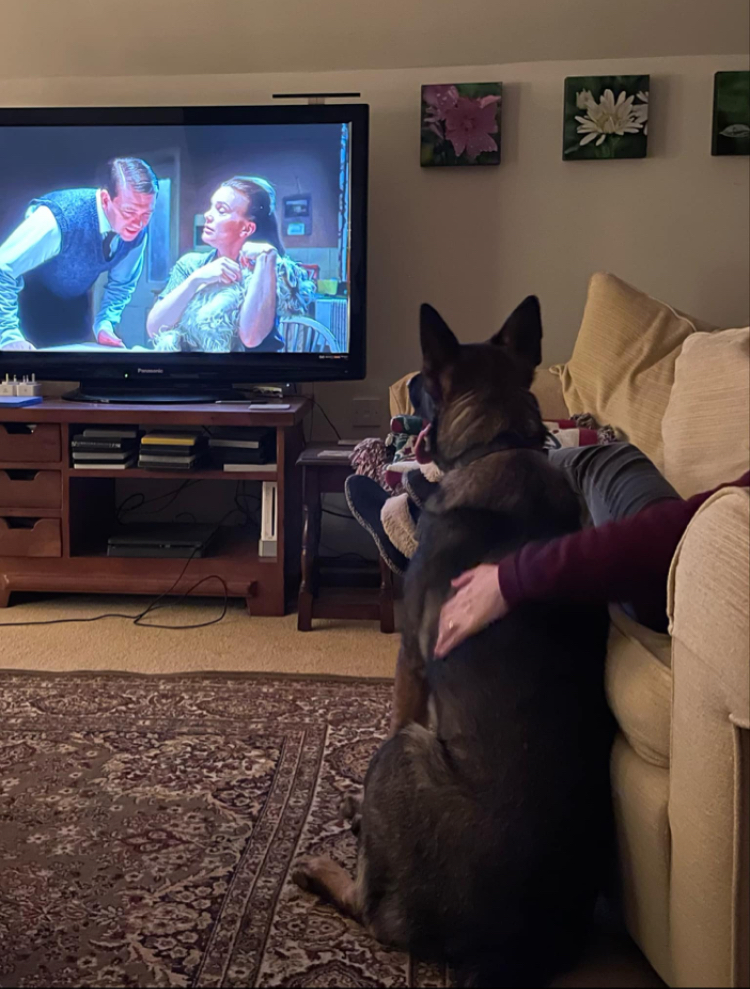
I worked most of the morning, and when Meg was dry enough to be let into the rest of the house she lay next to me, chewing her toys and farting. She had a run in the garden while I ate lunch—followed by another short stint in the utility room—then she followed me round the house while I did some cleaning, occasionally barking at the cat, mostly just following me and poking her head into cupboards that I opened, adding her toys to piles of laundry, watching from a distance when I cleaned the sinks. It was companiable.
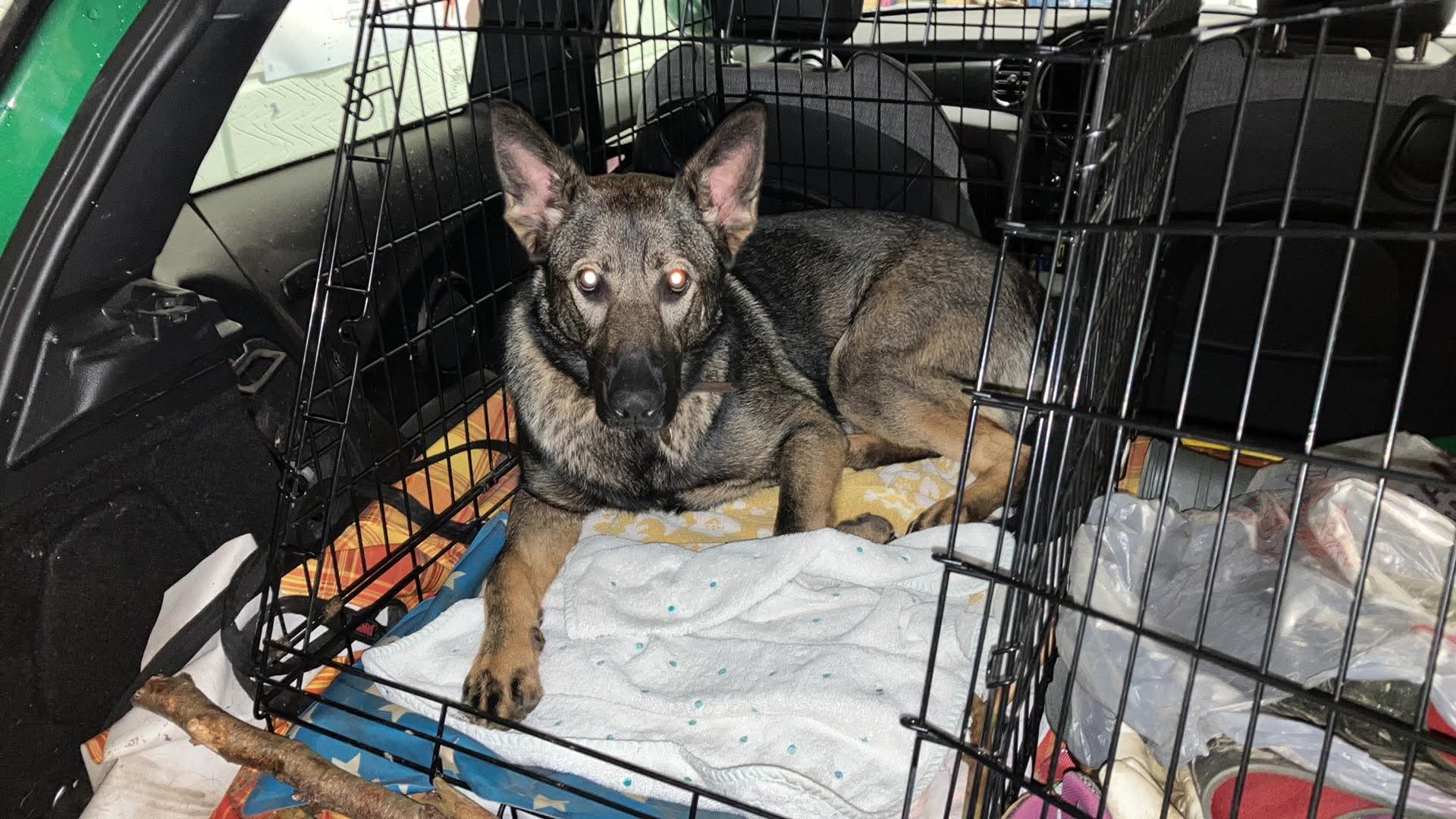
I needed to buy food for dinner, so Meg came in the car. When I went into the supermarket I tied her up outside (she seems to enjoy this, as she watches everyone and often gets attention from dog-lovers on their way into the shop). She walked back to the car beautifully, stopping for traffic and not pulling on the lead. When we reached the car she paused before jumping into the boot. She paused for about 2 minutes, letting me know that this had not been a ‘proper’ walk, and she was not ready to go home, and perhaps she wouldn’t get back into the car. Then she jumped up, into her crate—discussion ended—and we went home.
A lovely day, and then she was bad. I put her briefly into the garden while I started cooking dinner, and then called her to come in. No sign of her. I shut the door, thinking that when she returned the door would be shut, and she would learn to come faster next time. Except she didn’t come. I called her at regular intervals while cooking dinner, but she ignored me. It was dark, and cold, and I was tired. I didn’t want to traipse up the garden to collect her, and I needed to cook dinner. I felt defeated. I knew she would be doing something bad, but I didn’t have the energy to go and sort it out. After about an hour, Meg decided to come back inside. I let her into the utility room. She was completely covered in mud. I couldn’t face finding out why, so I left her in there. After dinner Husband hosed her down (which was very kind of him because he’d been working in London all day and was probably as tired as I was). Then I put her into her crate for the evening. She protested and barked, letting me know that she wanted to come and watch telly with us—but she was wet, and not allowed on the carpets, so we put up with the barking and I felt cross. It was a shame after such a nice day together that Meg had ended it by being annoying. I know she’s a dog, and doesn’t know any better, but it feels personal. I feel (irrationally) that if I have made the effort to include her and give her lots of attention/stimulation, then in return she should be good. It doesn’t work like that with dogs, and that feels unfair. But that’s life isn’t it. Life is not fair, not very often, and we just have to get on with it. Went to bed feeling grumpy.
Hope your day is full of beautiful scenes and better than my evening–though sometimes we just have to cope with the bad bits of life. Thanks for reading. Take care. Love, Anne x
The City That Never Sleeps (But Sometimes It Naps)
When you walk through New York City in the early hours of the morning, it’s quiet. Not asleep—this city really does never sleep—but it definitely dozes. The streets are well-lit, there are always cars edging between the millions of traffic lights, and several diners are open all night, serving a few shift-workers, and insomniacs, and us.
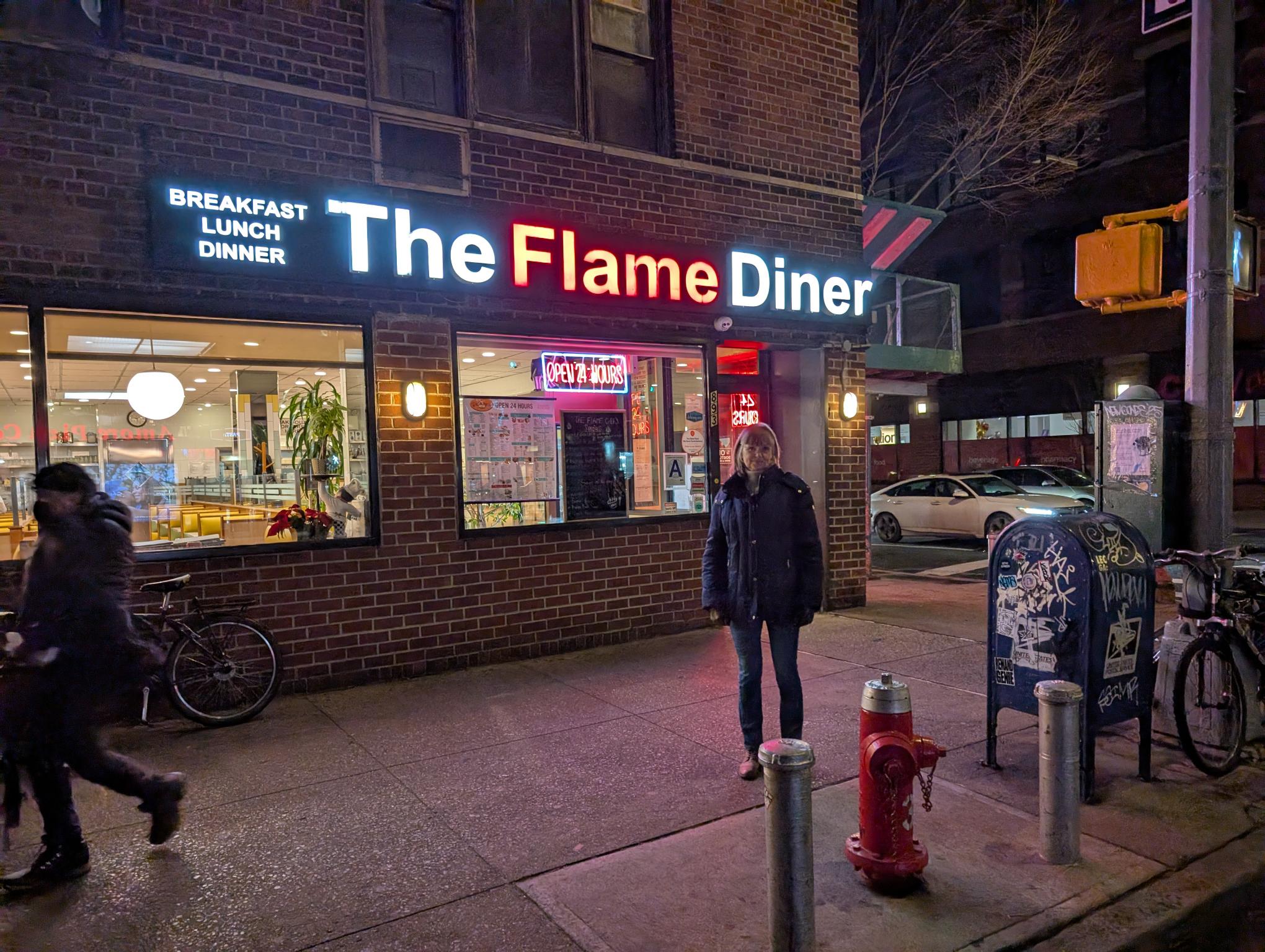
I have developed a fun routine, keeping roughly to English time. I wake at 2am, eat a pastry, then work for a couple of hours by torchlight until Husband wakes at 4. We then go down to the hotel basement and use the gym. It’s a good gym—lots of fancy equipment, and not many people at 4am. We run on the machines because it’s -11º outside. After a shower, we walk to the Flame Diner for breakfast. I’m edging back on-track with my healthy eating (vaguely) and order oatmeal (which is porridge) with strawberries and blueberries and a tiny pot of maple syrup (that they gave me on the first day, and I only use a bit of it, so I kept it and bring it back each day. If the lid ever comes off in my bag I will regret it!) Not as nice as pancakes, or cinnamon bagels, but I feel less guilty.
I have a sandwich/bagel for lunch, then we have dinner in the Westway Diner at about 1pm US time, when everyone else is finishing their lunch. I then use earplugs and eye-mask and go to bed about 5pm US time. It has worked well so far.
The first day here we walked down the island, which is my favourite thing, walking through the various districts and looking at the shops and restaurants. Midtown, Garment District, Chelsea, Greenwich Village, SoHo, then East to Little Italy and Chinatown and into Wall Street. Districts that are vaguely familiar (we lived in NJ in the late 90’s) but still exotic, unreal places that exist in films and distant memories.
We visited the World Trade Centre Memorial. In previous visits I haven’t wanted to, because I knew people who died there (not well—other parents at the school pick-up, people I would recognise by sight but not really friends). Enough time has passed for it not to be upsetting, though it’s still sombre, still reminds of the tragedy, the fear, the loss. They have built two huge fountains on the footprint of the building, with water sliding down, out of sight. It’s very dignified. Someone had left a rose in one of the names engraved on the edge—23 years is not long for those who lost loved-ones.
World Trade Centre Memorial. (Look at the people for perspective on the size.)
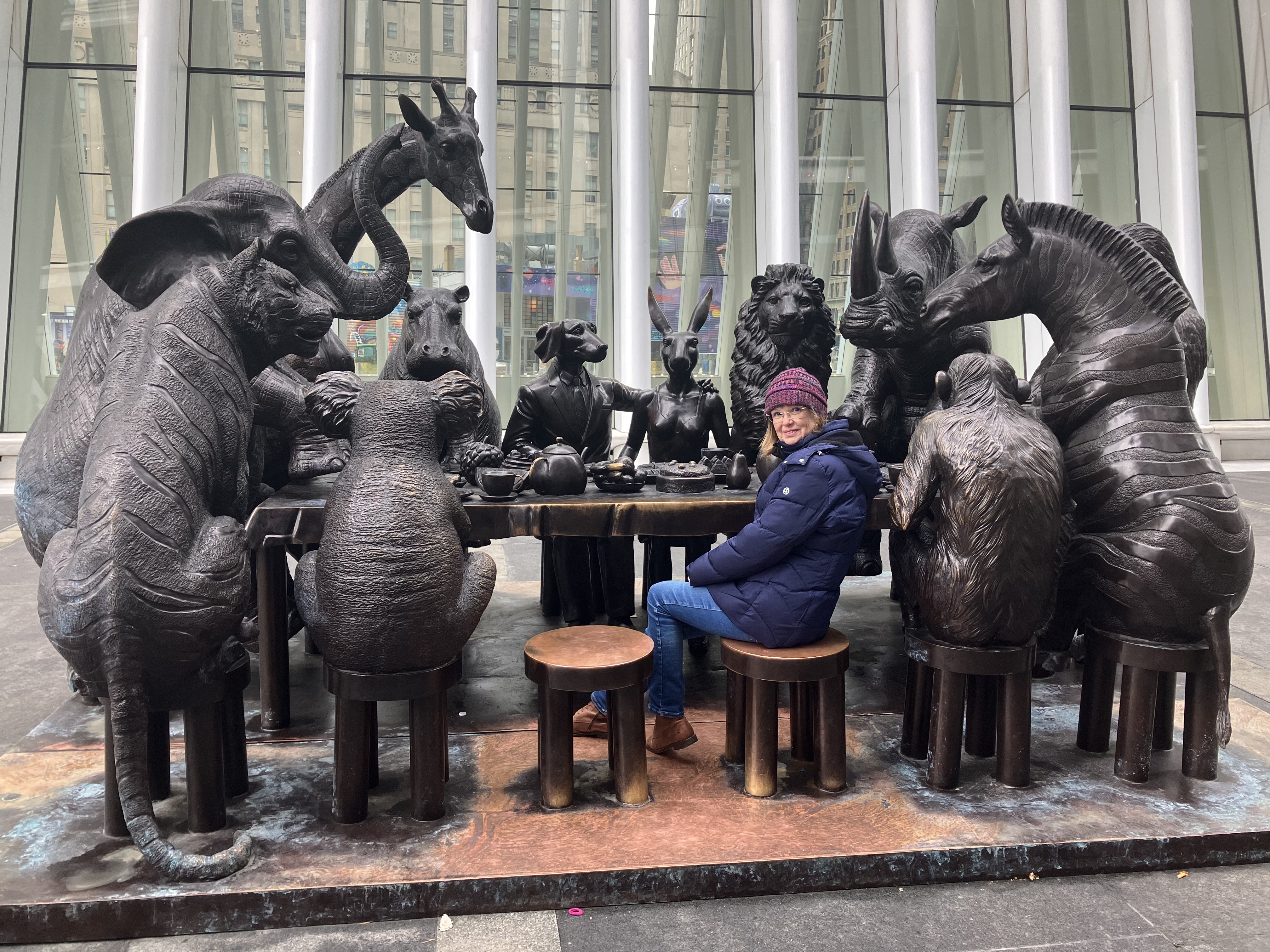
A completely different vibe are the animal sculptures nearby. They are great fun, a storybook reminder that we need to care for endangered animals or we will lose them. Impossible to resist joining the animals for a photo op!
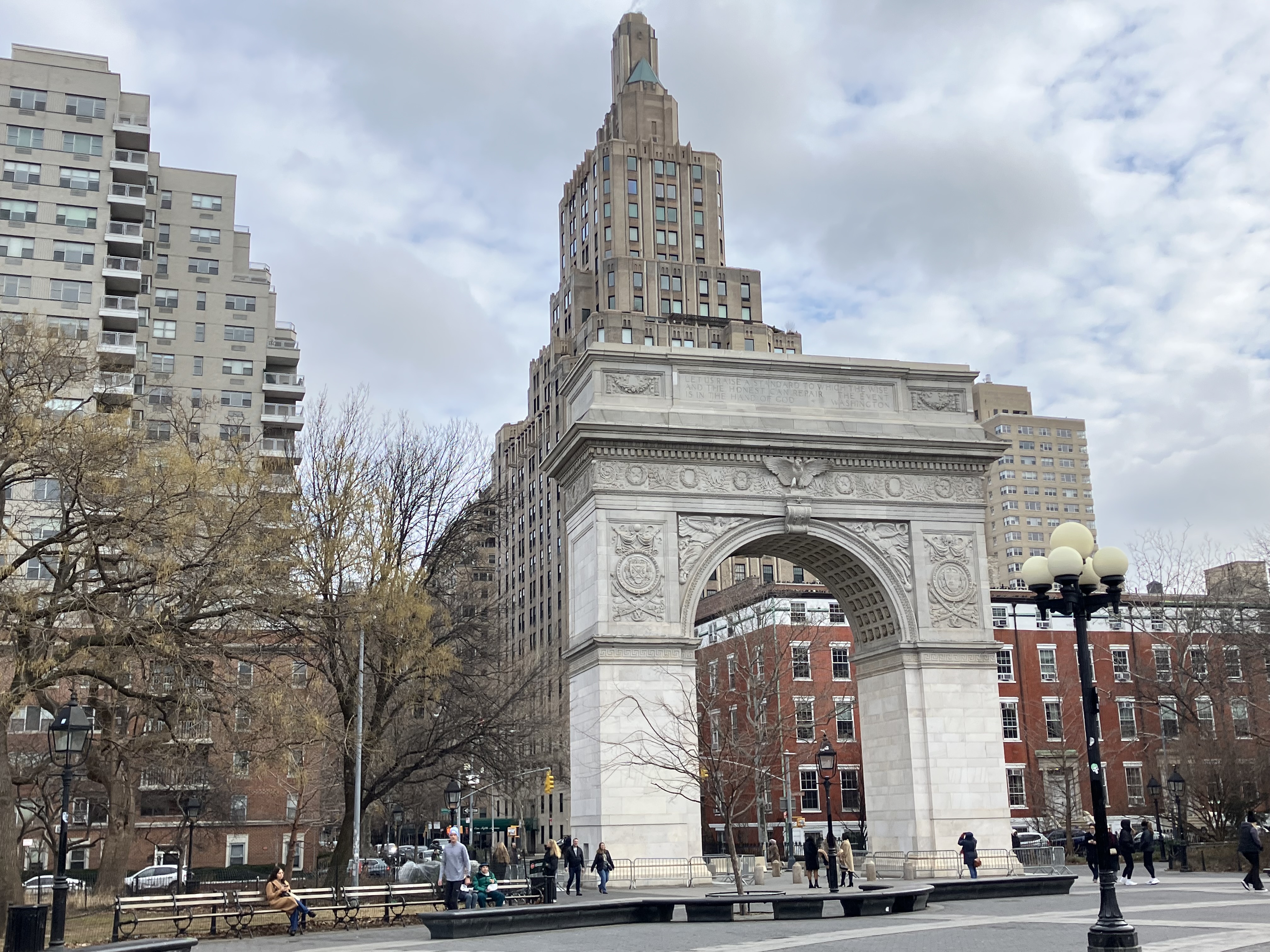
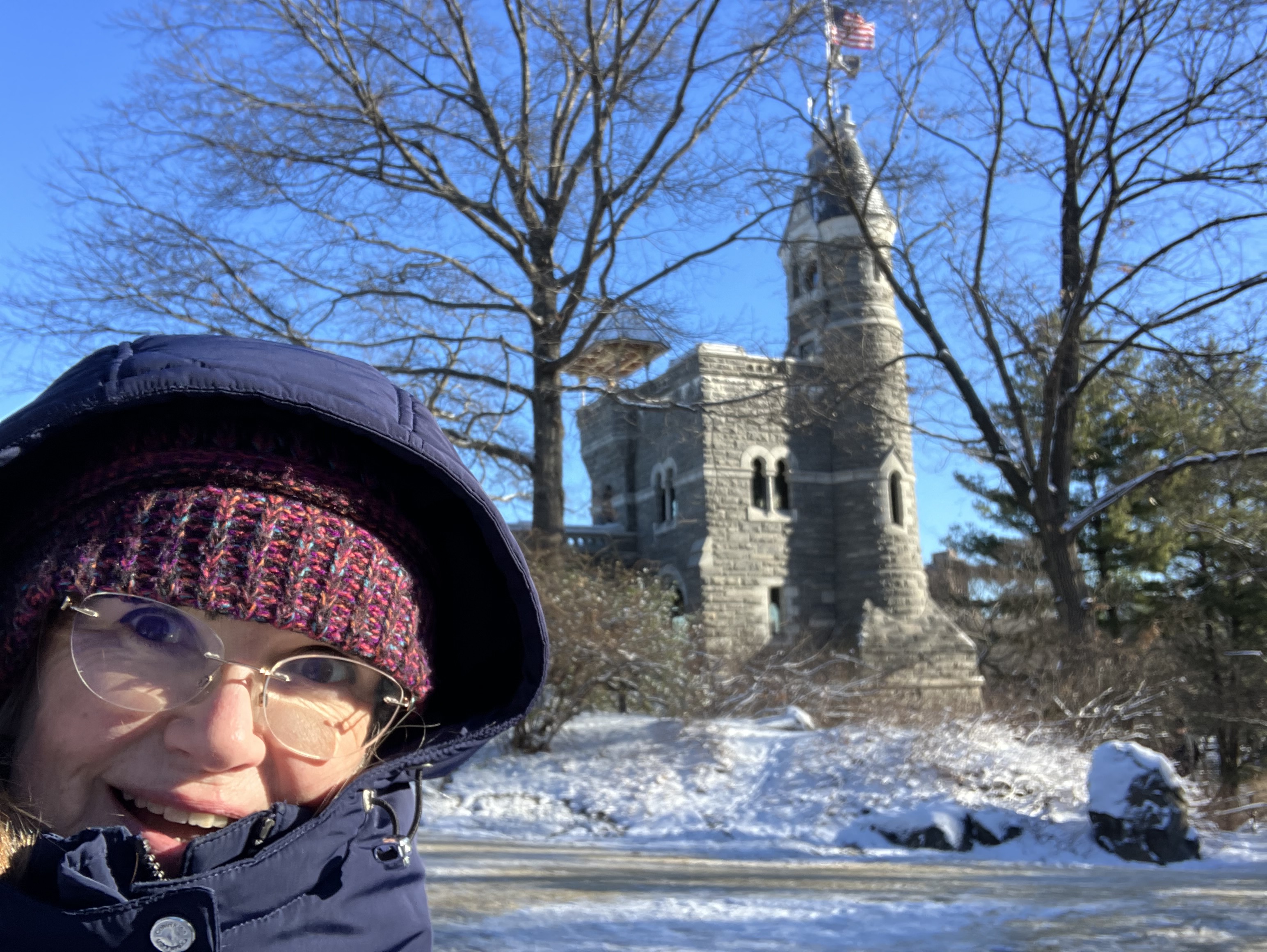
It snowed. We were forecast lots of snow, but weather forecasts always promise more than arrives. The next day was mainly ice, though there was more snow in the park. We thought the paths would be clear, but they weren’t, and it was quite precarious walking. People had salted, but the temperatures were so low the salty water had frozen, leaving sheets of ice across the paths. In Central Park everyone was walking their dogs, and enjoying the bright sunshine and the crisp air. Some people (us) had dressed appropriately and resembled walking duvets. Others were still beautiful, with uncovered hair and unbuttoned long coats that flowed in the breeze, showing designer outfits. Beautiful but uncomfortable I imagine, as it was absolutely freezing! I managed not to slip over on the ice (it was quite close a few times) and I actually managed to find the castle—which every other time I have come to the park has either been closed or impossible to find. It looks better in films.
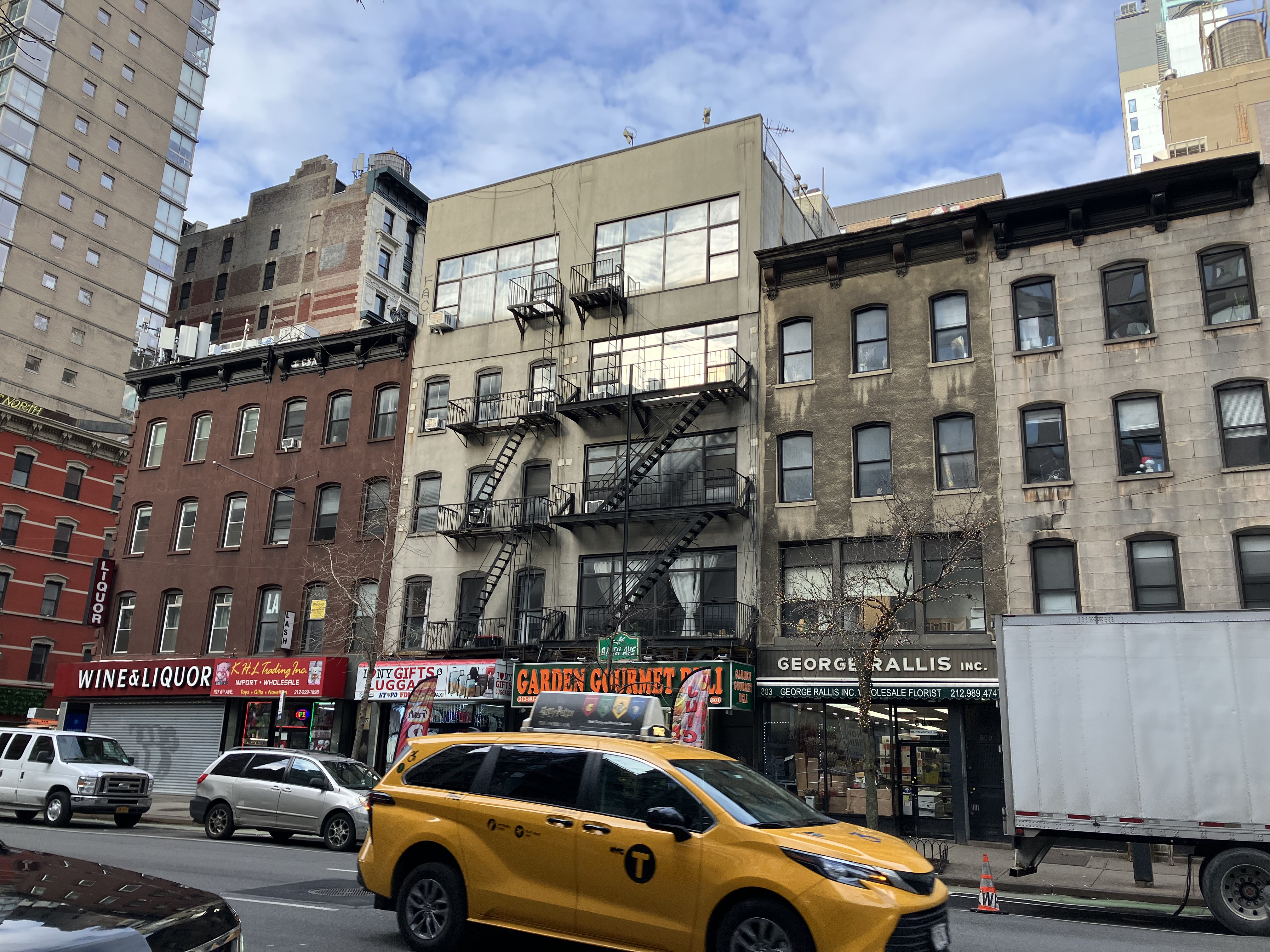
I prefer to walk in NYC, but sometimes we use the subway. It’s easy, but always feels a bit scary—I think it features in too many crime and ghost films! South of 100th Street was always safe, but nowadays maybe everywhere is. I’ve used it several times, and never actually seen any crime (or ghosts).
Hope you stay warm today. Thanks for reading. Take care. Love, Anne x
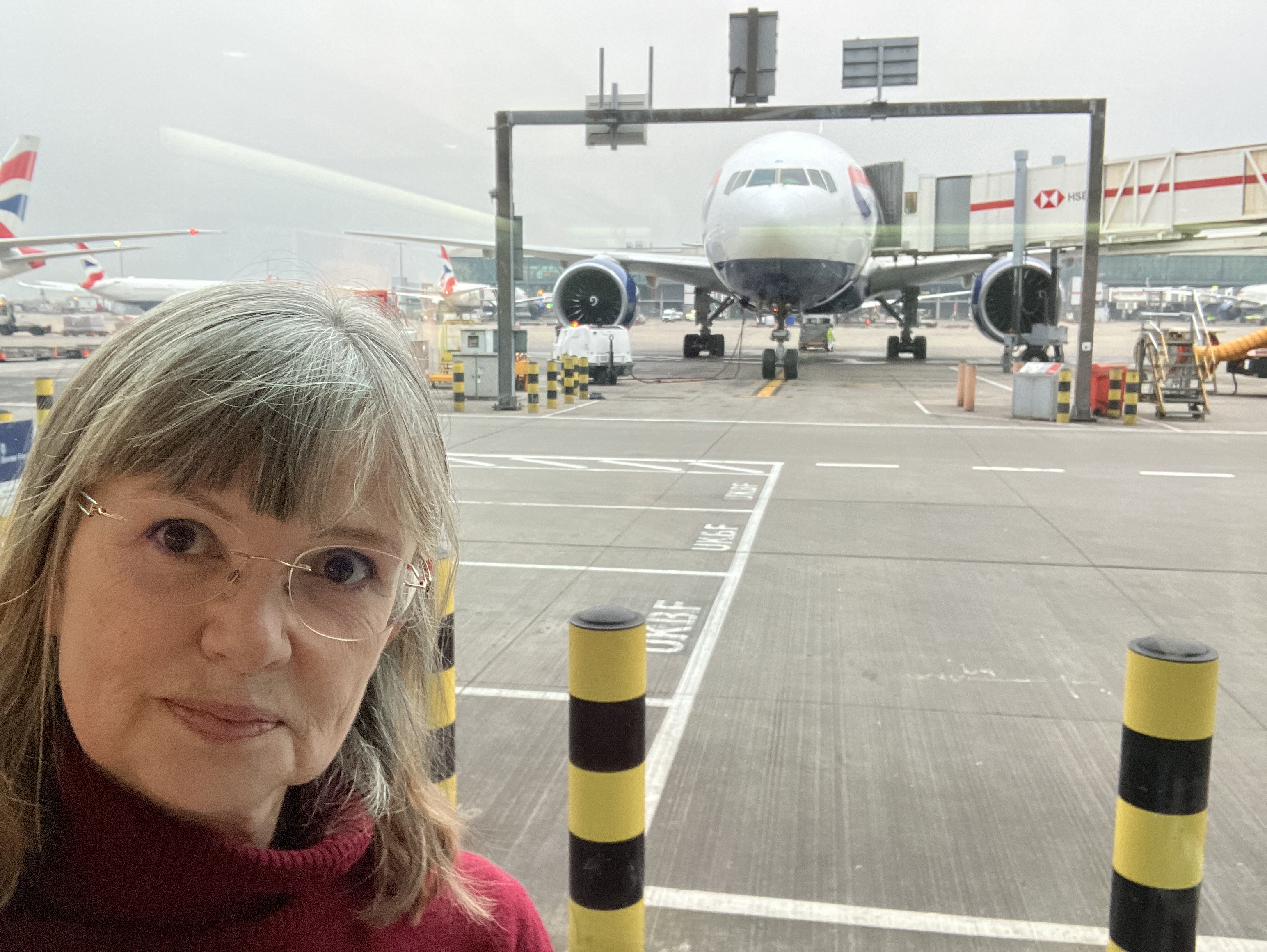
Husband had a work trip, I hate being in the house on my own, plus (I told myself) I will manage to do more work if I’m not also juggling animals and housework, so I went too. We left home Saturday morning, flying from Heathrow—which is not my favourite place in the world. Airports are always too full of people and germs and flashing signs and hard deadlines. Everything that I find stressful, especially because everyone seems tense and everything matters—you really cannot forget to put your hand sanitiser in a separate plastic bag, and you can’t take too long taking off your boots—even though you find it a struggle to balance and there isn’t a chair—because the people behind you are also anxious and rushing and the staff are grumpy, and arghh, arghh, arghh.
But it was fine. I didn’t end up in a small room with a woman wearing plastic gloves, nor did I lose any valuables. Our departure gate was at the far end of the airport, and rather than use the transit we walked. Did you know that is a thing? I didn’t until recently. If you go down to the basement, you can walk the mile or so under the runways and avoid using the rail-link. It’s a bit spooky down there, so even though there are lots of security cameras I’m not sure I would feel comfortable walking on my own, but I prefer it to riding in a crowded train. You can stretch your legs and avoid the crowds for a minute, and although there’s no weather (another thing I dislike about airports and hospitals) it is at least cool, and the air feels cleaner, less artificial.
The plane ride was uneventful. Husband sat at the front because his ticket was paid for by work. I sat next to a tall Chinese boy (probably a man, but he looked young to me) who was on his way to New Zealand. I’m always pleased when I’m next to a man, because on the whole they understand it’s inappropriate to have physical contact with a stranger and therefore they keep within the confines of their own allocated space. Women do not—if a woman is larger than is comfortable on an airplane seat she will sometimes spread sideways, into my seating area, and is not as sensitive to territorial boundaries. I find it quite difficult to have a Christian attitude to this, and do not easily forgive.
I managed to work on the flight, which was good use of time. I read most of a book about animal theology. Did you know that was a thing? It’s very interesting. Plus, I have treated myself to a very fancy selection of sticker/post-it highlighter/marker things. They are brightly coloured and remind me of when I played post-offices as a little girl. Intrinsically pleasing to use.
We are staying at the Sheraton, Times Square. I stayed here with my sister a few years ago, and it has become a bit more run-down since then and is currently being renovated. Not a great time to be staying here, but the room is clean and everything works (even if the taps do wobble and the lights have slightly dodgy switches). Being in New York is a treat in itself, and the position is great.
I am keeping to UK time, so I ate the sandwiches I had packed at home, and drank a tiny bottle of Merlot that I saved from the flight, and went to bed early. Husband went out for dinner, and I told him to be careful not to get mugged if he was going out in the dark. He muttered something about it being 4pm, and not as late as I thought.
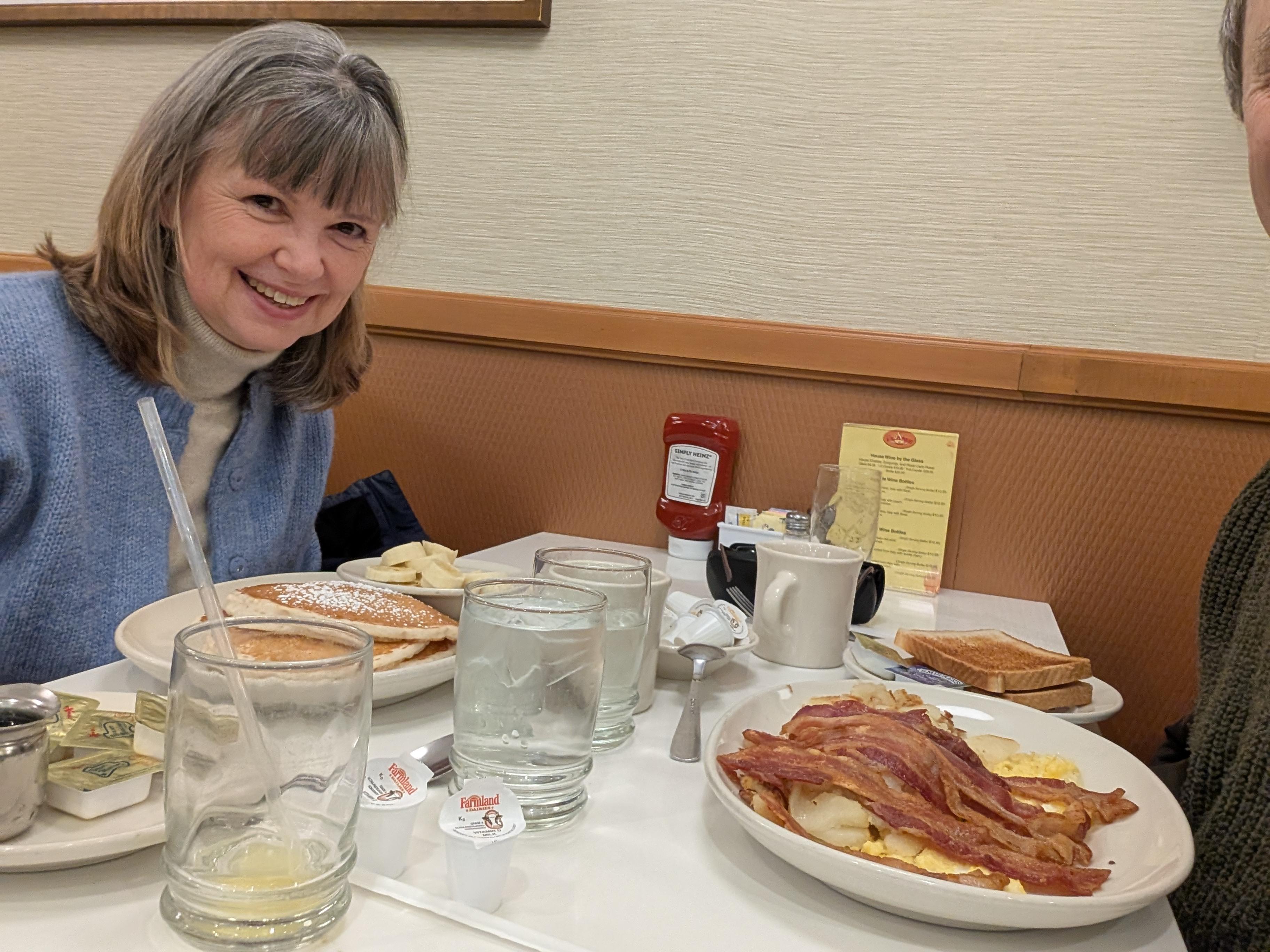
This morning I woke at 2 am US time, and ate a stale croissant while reading by torch light. When Husband woke, we walked to a nearby diner. Nothing in the world beats a New York diner. This is why I came. We sat in a booth at 5am, it was clean and bright, with a large plastic menu. When we sat, we were given glasses of iced water and offered coffee. Perfect. I am trying to reduce the cholesterol in my diet—so that went out the window! I had pancakes (delicious) and dipped slices of banana in sweet smokey maple syrup, and snaffled a piece of bacon from Husband’s plate. (He had a full bacon, scrambled eggs, hash browns and toast breakfast—so his was even less low-fat than mine!) We had fat glasses of freshly squeezed juice, and I lusted after the pies and cakes in the glass cabinet. The diner was fairly empty (I wondered why anyone would be there are 5am). They were playing a church service on the radio, and it was all rather lovely.
Afterwards we walked down to Times Square. It was still before dawn, but Times square was as bright as daytime with the huge billboards flashing colours and light into the street. Walking through Times Square is like scrolling through Instagram. Lots of perfect young people looking happy and attractive as they dance or walk their dogs or show you a new toothpaste. In the early morning it’s quiet, so rather lovely, and we walked hand-in-hand, arguing about whether we should obey the traffic lights and remembering all the other times we have visited New York. I felt very happy (and very full of pancakes).
I hope you have something happy too this week. Thanks for reading.
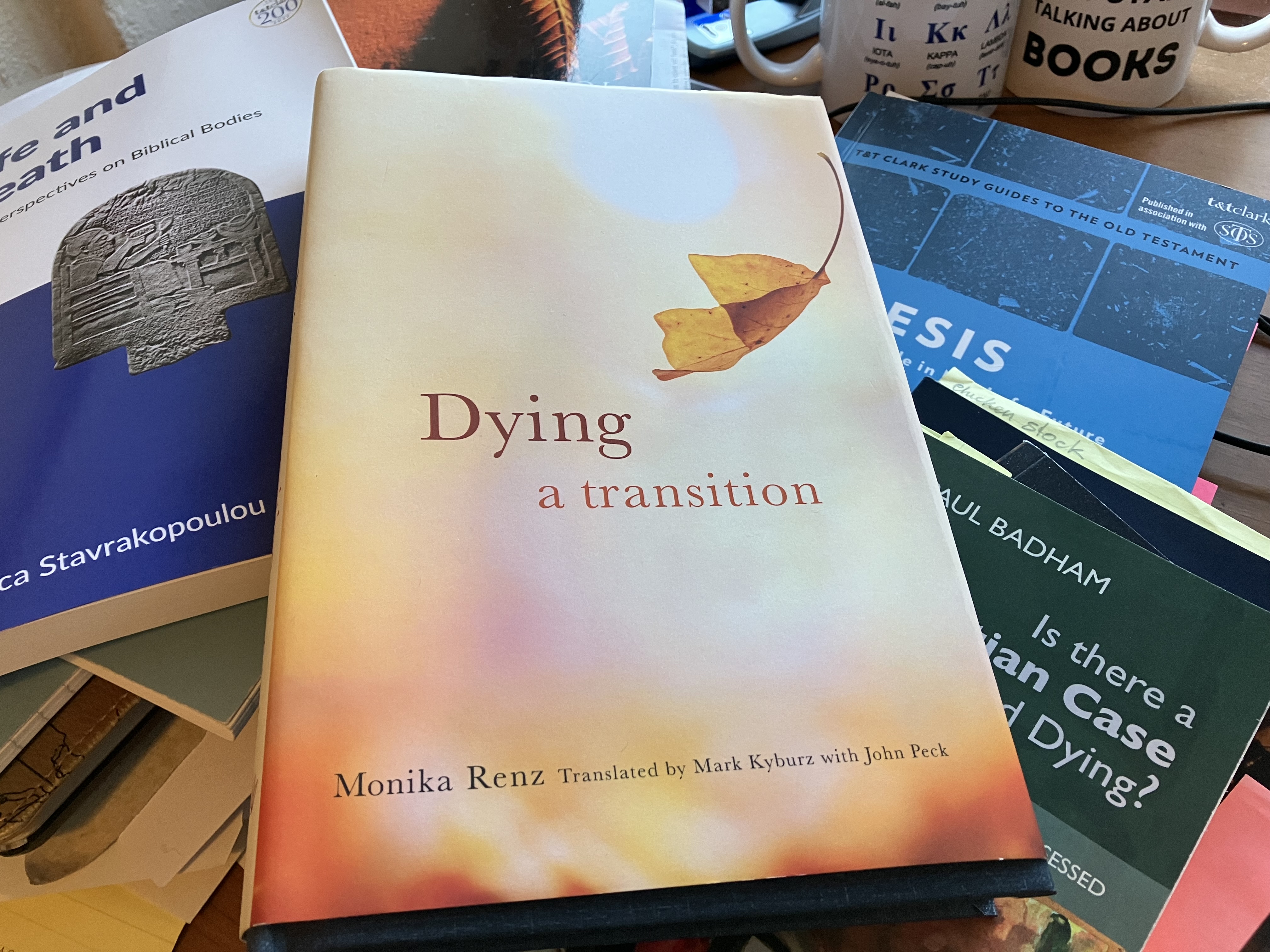
Book Review: Monika Renz, Dying, a Transition, trans. Mark Kyburz, (New York: Columbia University Press, 2015)
When I attended the debate on assisted dying at the medical school of Edinburgh University, one of the panel suggested that I should read this book. We were discussing the dying process, and whether dying is something that medics are trained to help with—and whether, in reality, it is a process where they should be involved. I felt that perhaps dying (as opposed to illness/recovery) is a stage of life best left to philosophers and theologians. I am not sure that medics understand dying, or that it is particularly relevant to their role as healers. Dying, I argued, is something that happens after the role of the medic has ended.
The book is thought-provoking, and I recommend you read it for yourself. You might not agree with everything written (nor should you ever expect to agree with everything that anyone writes). But it might challenge you, and help you to formulate your own ideas about dying. Most people that I speak to dislike thinking about dying—they find it an uncomfortable topic except in the abstract, when it applies to ‘other’ people. When I was about to have surgery to remove a brain tumour, I found this extremely unhelpful. I needed to confront the possibility of dying. None of us can escape the dying process—first with those who we love, and eventually our own death. I think reading Renz’s book will help you with both. I found it tremendously reassuring.
Renz writes for professionals dealing with palliative care, so her style is academic, but I don’t think you need a degree to understand the book. (You can always skip over some of the more academic pages.) Renz works with cancer patients in Switzerland, and her initial study was with 600 patients (which isn’t a huge range, but is big enough to give an indication of general trends). She analysed her data, and compared it to other studies, then refined her conclusions. The book therefore represents the conclusion of several years of work.
The patients studied were all dying. Some were religious (various religions) others were not (and some were ‘devout’ atheists). Renz found that the dying process for all of them was similar, and went through the same phases—though the amount of time spent in each phase varied. She offers advice as to how each phase can be eased by practitioners and family members—which I assume will be helpful when you next are close to someone who is dying.
To summarise the whole book (and really, you should read it yourself) Renz views dying as a transition, with marked phases. She talks about people going through a final stage, which she names ‘transition’ when they lose all sense of ego. By ‘ego’ she doesn’t really mean pride, though that is a part of it—more that the patient loses all sense of self. Just as a young baby has no pride or shame—pooping is something that happens but the baby is not embarrassed, they don’t care if they dribble or make noises. As a person nears death they too go through a similar phase, which Renz says can be distressing for relatives—who do have a sense of ego and therefore feel embarrassed to see their loved one in a position they see as ‘shameful’. But it’s not shameful, it’s just a body behaving how bodies behave without an awareness of social conventions. Renz states that the patient is not embarrassed, they feel no shame because they have ‘transitioned’ to a state where their body is no longer important.
Part of this transition is also a letting-go of earthly things. She says that for some people this is difficult, they do not want to leave pets or family or a role—and this is a necessary struggle, that changes them into a state whereby they are ready to die. Renz understands the process to be formative, even if difficult. She also describes an ‘encounter’ with a spiritual world—even for people who are not religious or are staunch atheists. Sometimes this is a period of fear, and she suggests actions that can calm the patient, helping them to find peace. She describes patients ‘seeing’ their deceased ancestors, or spiritual beings who are waiting for them to die, and how this is often comforting to the patient (even if perturbing for the relatives).
I found it interesting that there seemed to be the same phases of dying for both the religious and the non-religious person. I have never been present when a person died, so I cannot evaluate the truth of what she says, but I did find it comforting. Renz views dying as a natural process, a natural part of life, and one that should be recognised and not feared. Even when a death is a struggle, Renz equates this to a difficult birth—where there is sometimes pain or fear, but it is a process that leads somewhere. She suggests that we should not shy away from difficult deaths, or seek to shorten them or dull the senses, because the struggle is part of the preparation for what comes next.
I’m not sure how Renz’s research shapes the debate on assisted dying, and she was a little fuzzy on instant death (like an accident or a murder). She simply thought the phases happened instantaneously—but obviously this is not something she could test. Therefore some of the ‘research’ was speculation, but I didn’t feel that detracted from her overall findings.
As I said, I recommend you read the book. I found it very reassuring, it took away the fear of death. Renz shows that death is as natural as birth. It may be beyond our control, but it does not need to be feared. (Though I would note that the death of other people is always, in my experience, completely horrible. But perhaps it helps if we can view the stages as both necessary and natural. I don’t know.)
I hope you have a good day, and that death doesn’t trouble you. Thank you for reading. Take care. Love, Anne x
I should start by admitting that (unlike most other donors) I was there for purely selfish motives. As I told you about a year ago, I was diagnosed with haemochromatosis, which means my body builds up iron stores. Too much iron causes fatigue, and eats your ligaments, and eventually gives you liver cancer—so catching the condition early is a very good idea. I had never heard of it before being tipped off by a relative (it’s genetic, so runs in families) but I have since realised that it’s fairly common.
Anyway, a year ago I was referred to a haematologist, who is very nice and very disorganised, and who basically does nothing and is impossible to communicate with—which is stressful. I therefore decided that I would take action myself, and sign up to be a blood donor. That way I could get some of the iron removed. I knew from a recent blood test what my iron levels were, and it’s not difficult maths to work out ratios, and how much iron will be removed per pint of blood (the iron will be less each time—so actually the maths is quite difficult, but luckily I married a mathematician). I’m all for being proactive with health issues—we are responsible for our own health.
To be a donor is relatively easy. You can complete an online form, and depending on your answers, they then phone you for more details before saying whether or not you are suitable. If you pass the first stage, you make an appointment at a nearby donation centre.
I arrived in good time for my appointment. They had advised me to drink lots, so I arrived absolutely bursting for the washroom! After using the Ladies, I was given a form to complete, and a booklet explaining the possible side effects, and a large drink of water. Several other people had arrived, and I was interested to see that many used the washroom (had obviously followed the same instructions as me) and most people sipped the water while reading the form (I had downed mine in one—which is how I drink water, though not alcohol).
I was then called into a little makeshift booth (the centre was in the local United Reformed Church) and my question sheet was scrutinised, and more questions were asked, and some of my answers caused the nurse to phone the blood centre, to check I was allowed to donate. I found this scrutiny unexpected, but realised that it is excellent. The blood bank is very careful to ensure that all the blood is suitable—not contaminated with diseases or medicines. (I was very pleased that I hadn’t taken a couple of Nurofen that morning when I woke with a slight headache, or I may have been sent home.)
The nurse then explained she needed a small sample to check, took my hand, and stabbed my finger. This was shocking! I had known that they would put a needle in my arm, and was ready for that, but the finger damage felt worse somehow. But I didn’t scream or snatch away my hand, I managed to sit still like a grown-up, as if people shoved sharp things into my fingers every day and this was no big deal. My blood passed the test, I was accepted as donor. Yaay!
I was then (after another trip to the washroom—very full bladder!) shown to a seat that reclined, like a dentist’s chair (but without the drill). The church hall had about 10 chairs, all with donors tipped backwards, their feet wiggling. I was given a leaflet that suggested certain exercises I should do while giving blood—squeezing my fingers and relaxing them, clenching my leg muscles, moving my feet—I joined the feet wigglers. My nurse started to explain what he was doing, but I said I’d rather not know, and tried to read my book. I won’t put you off your breakfast with the details, but he did what was necessary for me to donate (and it was not fun). I tried to look away, but the room was full of people, wiggling their toes and not-watching their own arms, so it was best to look at my book so I didn’t watch someone else by mistake.
As I lay there, trying to read, and staring up at the ceiling, and not thinking about what was happening, I was suddenly aware that someone would probably receive my blood at some point. Someone who would be suffering way more than I was, someone who might die without it. And I felt very humble, because here was I, shocked by a finger prick, and yet someone in crisis would maybe have their life extended by the blood I didn’t need. So I prayed for them, whoever they are, that my blood would be useful, and that God would use it to bless someone in a time of great need. And then I became aware of all the other people in the room—the other donors who were probably not there for selfish reasons like me, but were undergoing this rather ghastly procedure just because they are good people who want to help. And the staff, who were diligent, and caring, and were working as a team to collect blood to save lives. I was probably the least-good person in the room, and it was humbling.
Then, quicker than I had imagined, it was over. (I only read 4 pages of my book.) An alarm pinged, and they removed whatever was in my arm (I never looked, so never saw it). Then a nurse sat me up, and my head felt woozy so she lay me down again. (Actually, she tipped my right back so my head was very low and I thought I might slide right off the back of the chair which would have been very embarrassing! But I didn’t, and it stopped the light-headed feeling instantly.) I was sat up very slowly, and given a drink of water and a packet of crisps. (My brother gets a cup of tea and a biscuit, so I felt slightly cheated.)
When I had sat for a few minutes (which felt like a very long time) I was able to leave. I felt fine, very happy that I had been able to donate, and very pleased that I had not fainted (which was a distinct possibility).
When I got home (Husband drove, which was kind of him and probably safest for the world) I had the best cup of tea ever, and some chocolate brownie. It was done. I didn’t feel tired, or drained, or any of the other things that I had worried about (probably due to downing all those pints of water). If you have never donated blood, maybe you should think about it. If I can do it (even for selfish reasons) then really, anyone can. It’s a good thing to do.
I hope you meet some good people today too. Thanks for reading. Take care. Love, Anne x
After we had done Christmas with the family who were going elsewhere for the 25th, and then Christmas on the 25th, and then tea with the extended family on the 26th, I was ready for a break. We booked a small house with a garden for three nights, and drove down to Camber.
The house was perfect for dogs, with hard floors throughout, and a kitchen big enough for her crate, a gate into the back garden which was fully fenced and accessed from the kitchen. We dumped our bags, set up Meg’s crate, and then took her to the beach.
Meg confined to her mat. (Works for about 3 minutes.)
Camber Sands is a marvellous beach. It is divided from the Rye beach by a deep wide river that the fishing boats use, and from there, you can walk for miles, all the way to Dungeness. When the tide goes out, there are acres of flat hard sand—popular with dogs and families and horses. Towards Dungeness there are wind-surfers and athletic people (mostly men) riding dangerous wind-powered vehicles and flying into the air attached to giant sails and all sorts of crafts on the water. But down nearer to Rye, it’s safe to walk, and we love it.
To reach the beach, we needed to walk along a road for a few hundred yards, and it was such hard work with Meg. Beaches are often devoid of sticks, and Meg is easiest to control if I am carrying a stick—so I took a supply. Whether it was because I was carrying sticks, or whether it was residue excitement/bad behaviour following the Christmas upheaval, I don’t know, but Meg was terrible! It is the worst she has been near a road for months, and very disappointing. The road is a fast one, and every car that sped past us, Meg barked and tried to chase. I tried to calm her, to stop and make her focus on me, or the sticks, or a food treat—nothing worked. Meg had clicked into ‘wild dog’ and she pulled like a husky and was much too strong for me.
We managed to get to the sand dunes, and I suggested Meg might improve if let free. As soon as she was off the lead, she changed. Now her full focus was the sticks, and as long as I threw one occasionally, she stayed close and watched me closely. I don’t know if this would work when there are cars, but I don’t trust her enough to have her free near a road and I’m not strong enough to tie a lead to my waist. We might both end up under a car.
While Meg was free, she was great. The beach was as brilliant as ever, cold and windy and wild, full of happy dogs and windswept owners. We walked for a while, enjoying the openness of the place, the expanse of sea and sky and air. Meg walked with us, running off to chase seagulls, returning when I called, ignoring all the other dogs. At one point some horses arrived to gallop along the hard sand, and I knew that as long as I kept Meg’s focus on the sticks, she would ignore them. For a while we walked with the wonderful sound of horses hooves pounding the sand next to us, while Meg collected sticks and sniffed seaweed and tested the water for saltiness. This is happiness. There is something about a dog running across a beach that is infectiously joyful.
Other dogs and horses, but Meg ignored them all. All she wanted was a stick!
The rest of the stay was lovely, we did very little, and Meg was mostly contented to sit with a chew while we read or watched telly, and in return we gave her a long windy walk along the beach every day. She continued to be terrible near the road. I even tried to take her for a ‘training walk’ one morning—not planning to go anywhere but just to practice walking properly on the lead, like I did when she was younger. Every time she pulled, I stopped. When she looked at me, and came to my side, we continued walking. After 10 minutes we still hadn’t left the driveway! When I saw a car approaching, I quickly turned her, made her sit, tried to make her focus on me/a treat. Meg sat, heard the car, spun around, lurched towards the car, leapt at it when it passed, tried to pull me after it to chase it down the road. Not a success in terms of training. I gave up at that point and went back inside. For the rest of our stay, Husband had to hold the lead when we walked to the beach and we tried to get over the road as fast as possible. Like I said, Meg was great when on the beach, even if she’s a devil near a road.
The house survived, and there was a vacuum cleaner to clear up the bucket loads of sand that Meg carries in her coat. The sprinkling of sand in every room she went into was constant, even hours after returning from the beach, when completely dry and having been brushed in the garden—always there was sand in her coat. The garden was a big help, though a previous dog had chewed a chunk of the wooden decking (I am assuming it was a dog) and Meg noticed it on the second day. Although she never chewed it, I could see her thinking about it, so we could never leave her unattended in the garden after that, which was a shame. She also developed bit of a tummy upset—I’m guessing down to eating sand and trying to drink salty water. She was very good about telling me when she needed to go outside, so there were never any accidents, but it made clearing up after her in the garden a ghastly job. Taking Meg on holiday is only relaxing up to a point. (But in this case, the pleasure of watching her run on the beach was worth the pain.)
I hope you have some joy this week, and in the year to come. Thanks for reading. Take care. Love, Anne x
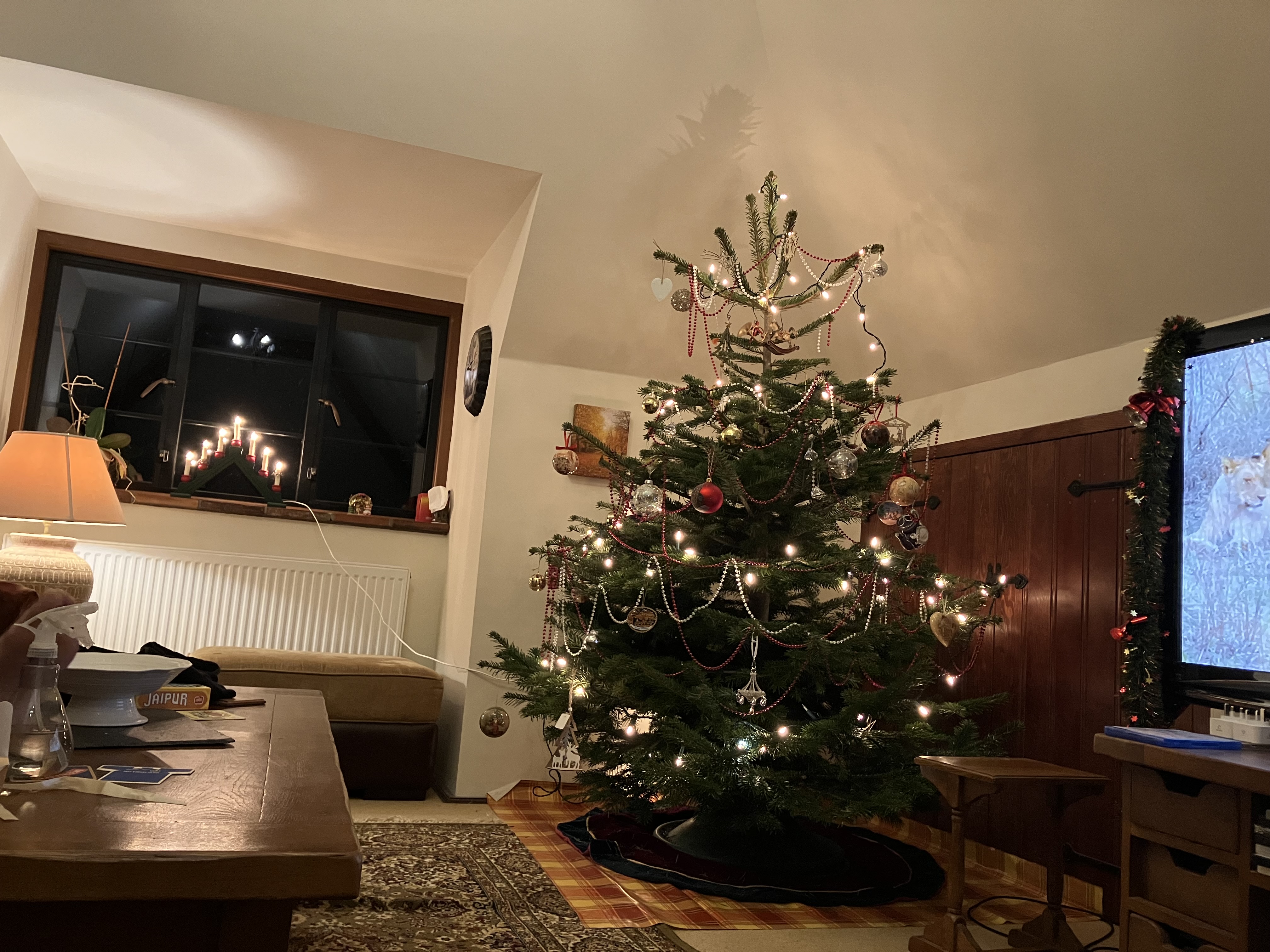
Christmas was super-exciting, with a tree in the lounge and decorations which were not for chewing, and lots of visitors which were not for bouncing, and a complete abandonment of schedule which had to be coped with. All this was way too exciting for Meg, and she returned to the slightly-hyper, never listening mad dog of previous months. It was a shame, because I had just started to feel that Meg was exactly the dog I had hoped for, and her behaviour combined with Christmas chaos made me feel like one of us needed to be booked into the nearest mental institution!
However, to be fair, Meg did not destroy the tree or decorations. Nor did she steal any of the food that was left around the house. (Food is not her thing really, it’s no good as a reward for good behaviour, but it also means that she has never stolen food.) She was overly excited by all the guests, but it was a friendly, ‘perhaps I could leap on you to greet you’, sort of excitement—there was no fear or aggression in it. Due to the age (and therefore fragility) of some guests, Meg did have to spend longer than normal locked in her crate. She mostly coped with this very well—though I do wonder if it added to the general hyper-excitement when she was free. The main disappointment for me was that she pretty much stopped listening. When we were relaxing watching telly, if Meg started to wander around and I told her to sit, or to take her chew to her mat, she completely ignored me. This was a shame, especially as it meant that when I was really tired and wanted to stop, I had to put Meg back in her crate because I couldn’t rest while she was free.
The cat-with-snapped-ligament is still locked in her crate (she will be for a while). Both Meg and Milly are behaving badly when together, as even if I am with Meg and ensuring she is calm, the cat will hiss at her and try to scratch her through the bars, which then quickly becomes a general shouting/bouncing match. Over the Christmas period there were times when I needed to use the utility room while Meg’s paws dried (and Milly had been moved in there as we needed to use the dining room and the smell of a cat litter tray is not a good accompaniment to a meal!) If Meg was in there after a walk—when she tends to be sleepy—then after an initial bounce/bark/hiss there was peace. This is good. Whilst they are not friends, or to be trusted for long together, there was certainly some kind of truce. It is a start.
I usually walk Meg in the woods, which is a popular place for dog-walkers (and the occasional horse rider) so it’s a good place for Meg to socialise. By ‘socialise’ I mean ‘learn to ignore other animals,’ not ‘go and play with them.’ I learnt this at puppy classes—I need to teach Meg that not everything is her business, and rushing up to an unknown dog is not acceptable behaviour. When there are sticks (and the woods has a steady supply) then Meg is now excellent at this. We can pass other dogs and their owners, and Meg walks with me, fully focussed on the stick in my hand, ignoring the dog/horse/deer that is passing. However, other owners clearly never attended such good puppy classes (or the dogs are less easy to train—though that seems unlikely in Meg’s case!) Fairly frequently, another dog will run up to Meg and some of them are aggressive. I have grown fearful of small dogs (it always seems to be the little dogs that snarl and show their teeth) and especially Spaniels. We have had some very bad interactions with Spaniels. Just before Christmas, we were walking through the woods which were beautiful with morning mist, and a black Spaniel came towards us. It looked young, and was darting through the trees, and I wondered, as we approached, whether she would play with Meg. I was throwing sticks, Meg was leaping over fallen trunks and into craters to retrieve them. Suddenly, without warning, the black Spaniel changed direction and chased after Meg. At first I thought it was joining in our stick-chasing game, but no, it trapped Meg next to a bush, growled and snarled and showed its teeth. The owner yelled at it, but there was no response. I called Meg, who managed to get past the Spaniel and run to me, and we began to walk away. At first the Spaniel followed, and I wondered whether I would be bitten (and to be honest, I measured the distance I would need to give it a big kick if it started to leap at me) but then it stopped, and returned to its yelling owner. I have no idea whether this was an unusual occurrence for this particular dog, but I am suspicious that some owners ought to put their dog on a lead if they are near other dogs but they choose not to. Which is a shame for everyone.
Meg in the car, with the sticks she keeps for emergencies!
Thanks for reading. I hope your Christmas was good, and exciting but not hyper! Have a good week. Take care. Love, Anne x
After eight days, Joseph came and circumcised the baby. How he wailed! It felt cruel, though I knew it was the right thing to do, even in this strange place we must obey the Jewish laws. We also formally gave him the name Yeshua, the name we had been told to give him by the angel all those months ago.
I wondered if Joseph minded, people would know it wasn’t a family name. I also had no one called Yeshua in my own family, though I did know a boy from my childhood with the name.
***
After forty days, we had to travel to Jerusalem, to pay for redemption at the temple. As Joseph was from the tribe of Judah, we had to pay five shekels of silver. We couldn’t afford a lamb, so bought two pigeons to sacrifice.
It was nice to leave Bethlehem and to have some exercise at last, to see people and to take my baby into the world. I felt quite excited as I approached the temple, our holy place. I didn’t recognise anyone, but everyone could see we had a new baby and lots of the women came over to see him. I felt so happy!
We walked through the Beautiful Gate and up to the Gate of Nicanor.
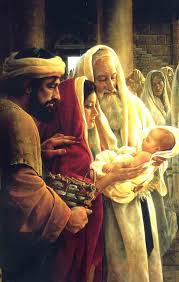
It was then that something strange happened. As Joseph and I walked through the temple, a man approached us. He came to look at Yeshua and indicated that he wanted to hold him. That was a little unusual but there was something about him, something that made you sure he was a good man, someone you could trust.
When he looked at the baby, the old man got all emotional and prayed, thanking God and saying that now he could die in peace. He blessed me and Joseph too and then he leant towards me and said something which was very strange.
He said Yeshua would cause “the fall and rising of many in Israel” and would be “a sign that would be opposed so that the thoughts of many hearts may be revealed.”
What does that mean? I know that he is God’s own son and that he is part of the plan to establish God’s reign on earth. Will he be opposed? Surely everyone will accept God’s anointed one, we have waited so long for him.
But then he said something that made me afraid; this old man with his determined face and bright eyes. His face was very near, I could smell his breath.
He said that a sword would pierce my soul.
Something inside contracted, all the joy of entering the temple evaporated into a lump of fear. Fear and anger. I practically snatched Yeshua away from him. I want my son to grow strong and be happy, will I suffer for this? I will do everything in my power to protect him; he is mine.
I knew I was tired, not getting enough sleep and it was hard to care for a new baby in a strange place without my mother to help me. I felt that I did not want to hear the man’s words, even if they were true. I was coping with enough, and I felt that although I had been brave, I couldn’t be brave any more.
Thankfully the man left us and almost at once an old lady approached. She was ancient, her white hair showed under her mitpahath and she leant heavily on a stick. What I noticed most were her eyes. They almost sparkled! You could tell at once that she was a holy woman and also one who loved to laugh.
As soon as she saw Yeshua, the elderly woman started to pray loudly, thanking God and telling people nearby that if they wanted Jerusalem to be redeemed, they should look to the baby. I was glad that no Romans were allowed in the temple; we would have been in trouble.
We finished making the offerings and then went back to Bethlehem. I didn’t know whether to tell Joseph what the old man had told me. I kept thinking about his words, worrying about what they might mean. I was so tired, I decided I would wait and maybe tell him later.
***
The months passed and we settled into life in Bethlehem. We moved into a little house and Joseph found work on the many building projects that the Romans have introduced.
Yeshua continued to thrive. He grew into a sturdy toddler and would walk around the room holding onto the stools and baskets. I loved to feel his solid weight when I carried him on my hip, the light touch of his chubby fingers when he reached up to touch my face. There was pure joy in the gurgle of his giggles. He started to sleep much better at night and Joseph and I were thinking about having another child. But then everything changed.
It was one evening, still quite early but we had filled the lamp with olive oil and lit the linen wick. Joseph put it on a bushel basket, so the room was well lit and we could talk about the day. Suddenly, there was a banging at the door.
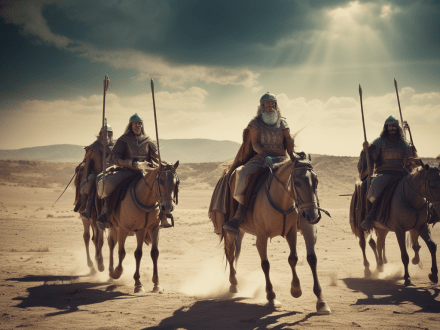
Joseph went at once and there, in the road, was a group of Persian travellers. They had dismounted from their horses and were peering intently into the house. They told Joseph they had seen a star and had come to worship the king. I was so glad I hadn’t gone to bed yet!
We let them into the house and I went to get Yeshua. He was damp from sleep and his tired eyes looked blearily around him. I wondered if he would cry but he seemed fascinated by our strange visitors. They wore their hair in long curls and one had a band of gold on his head. It glinted in the lamp light and I could see Yeshua watching it intently. Their clothes were patterned with birds and flowers.
We offered them wine; it was clear they were tired from their journey. I was embarrassed that we only had two stools to offer them, but they didn’t seem to mind and in fact insisted that I should sit on one with Yeshua and they were happy to sit on the rush mat. They didn’t really sit anyway, they wanted to kneel before Yeshua.
Then they gave him gifts. They were beautiful to look at. They gave him gold, signifying that he is a king. They gave him frankincense. The strong aroma filled the house and I wondered if Yeshua was to be a priest, even though he is not descended from Levi. They also gave him myrrh. Myrrh is costly but is for embalming a body. It was a strange gift for a baby and I wondered what it meant.
They told us their story before they left. In their Persian home, they were magi, watching the stars and foretelling the future. Many months ago, at the time of Yeshua’s birth, they had seen a special star which they knew meant a powerful new king had been born and they determined they would find him and worship him. Unfortunately, following the star caused them to go to Jerusalem first (I always knew that star gazing was a misleading activity). They went to Herod’s palace and asked where the new king was. This was scary; Herod had shown he was not a king to be trusted and his cruelty was well known. I would not have wanted to visit his palace.
However, it sounded as though he had decided to be helpful. Herod asked the scribes to research the early scriptures and they discovered that the promised king was to be born in Bethlehem. The king told the Easterners, asking them to find the king and then return and tell him theexact location, so that he too could worship.
I wondered what would happen next. Would Herod himself come to visit my precious baby or would we be summoned to the palace? This was not a comfortable thought.
I also wondered: why had the palace scribes not come to visit us? Why didn’t they travel with the Easterners to see the baby? Did they not believe the scriptures that they studied so diligently? Surely, if they were truly expecting a redeemer they would also have come? I frowned, feeling uneasy. There was something that I didn’t understand, and it nagged at me.
The men left. They planned to sleep in an inn and return to Jerusalem the next day. We could not offer them lodging in our tiny house and they seemed content to leave now they had seen Yeshua.
I returned Yeshua to bed and soon afterwards Joseph and I also went to sleep.
I had not been asleep for long when Joseph woke me. He shook me awake, then went to light the lamp. I could see his face was tense and instantly turned to check Yeshua was well. He was sleeping soundly.
Joseph told me I needed to get up—at once—we needed to leave. He said that he had had a dream, like the dream when the angel told him that the baby inside me was God’s son. It was so intense, so real, that he could not ignore it. Joseph said he had been told we must leave Bethlehem, leave Israel; Yeshua is in danger, Herod plans to kill him.
For a moment I paused, wondering why I too had not been warned. But then understanding flooded through me, as I realised—God had told Joseph to take care of me and Yeshua—that was a hard task for a man, to care for a son that was not his own. So now, God was telling Joseph alone what we needed to do, underlining his role, establishing him as head of our family. It was a kind act, asserting Joseph’s value, his part in all this.
I began to pack our things, Joseph was hurrying me, telling me to only take what was essential, we needed to leave.
We were to go to Egypt. Egypt! Could this be right? Was Yeshua not to be king of the Jews? I packed hurriedly and we left that very night.
What would the future hold? Would we ever return to our home town? The future was uncertain but I knew that something bigger than us was happening. Whatever happened, God had a plan and no one could alter the course of that, not Herod, not the Romans. We didn’t know what was going to happen, but we were part of the plan—and that was enough.
******
Thank you for reading.
This account necessarily involves some imagination but I believe it is also as historically correct as possible (and more accurate than some of our Christmas carols!) If you are aware of any historical errors, please tell me and I will modify it. I used a variety of sources including: The Gospels of Matthew and Luke Geoffrey Bromily (1995) William Hendriksen William Barclay Joseph P Amar (university of Notre Dame) Michael Marlowe Tessa Afshar Kenneth Bailey
Thank you for reading anneethompson.com Why not sign up to follow my blog?
We arrived in the morning. It was Winter, and the ancient town of Bethlehem looked tired in the early-morning light, as if the colours had been muted. It reflected how I felt. Muted. Near that saturation point of worry and exhaustion whereby the world seems unreal and fuzzy. But it wasn’t unreal–it was a new dimension of reality, and it was just beginning. . .
I had travelled to Bethlehem in a small cart. Every bump (and there were many) was agony. As I was jolted along, I was racked with pain. The baby’s time was near, you see and the pain was almost unbearable. Later, they would sing songs about a cute donkey carrying me. Nice thought! I don’t think there’s any way you could have got me on a donkey. As each contraction cramped every muscle in my torso, I huddled up like an animal and prayed for it to be over.
I could see Joseph, watching me as he walked alongside. He really didn’t have the first idea what to do. Oh, how I wanted my mother. I yearned for her to be there, holding my hand, telling me everything was all right and would be over soon.
When we arrived at Joseph’s uncle’s house, the women folk came and helped me inside. The room was crowded. All Joseph’s male relatives from miles around had come to the house for shelter and food. The women were busy cooking supper and the men were drinking wine and comparing stories. They all told Joseph how much he resembled his grandfather, Matthan and laughed at old stories from years ago. The smell of fish and fresh bread was nauseating. I was so tired and so uncomfortable.
Joseph knew I was suffering and asked if there was somewhere quiet that I could go. There was no chance that we would get a place in the inn, they had filled up days ago. Somewhere quiet, in a little house packed with relatives?
There were some fraught discussions and then his aunt suggested that the animal shelter, down on the lower floor of the house, might be best. It wasn’t terribly clean, but it would be quiet and private and at least it wouldn’t smell of fish.
Joseph helped me to go down, and a couple of the women came too. One of them examined me and told me the baby was a long way off yet, first babies always take their time in coming. This was not great news but I felt better having her there. I felt that she knew what was happening, had seen this before; it took some of the fear away.
I was frightened, you see. I was horribly afraid that somehow I would damage my baby. My baby and God’s. I knew he was going to be special, I knew I had a great task ahead of me but it all seemed to be going horribly wrong. I trusted that God was still in control but he felt so far away.
Could the baby not have been born in a palace, surrounded by comfort? Would these poor beginnings really be part of a plan? Could they really make this king accessible to the people? I had no idea.
I was a mere girl; I had no education and my memory of scriptures was often fuzzy. To be honest, at this present moment, I didn’t even care. I just wanted this baby OUT! Special or not, my body was tired of carrying him, tired of being stretched and pushed, of fitting something inside that was now too big to be there. I needed this baby to be born and I was too exhausted to wait much longer.
How I longed for sleep. The pain in my back was terrible. Great waves of cramp that seared through my body, making me oblivious to everything else. I was vaguely aware that someone was sweeping the floor and moving the animals to a far corner. They had laid out a mattress and blankets for me to rest on but I couldn’t lie still for long. I felt better standing, rocking in time with the pain, trying to remember to breathe: in out, in out. Someone offered me water but I couldn’t drink. I wasn’t thirsty—I just wanted this baby to be born.
I could see Joseph with his big anxious eyes watching me. He didn’t know what to do. Someone suggested he should go into the house to eat and I nodded in agreement. There was nothing he could do and the poor man must have been tired too. He had endured such an emotional time lately. First there was his fear and anger when he first heard about the baby (now that was a difficult conversation!) Then he had to endure the smirks of his friends when the pregnancy became public knowledge. He never complained, but I know he felt embarrassed, wished that God could have chosen a different girl.
We had been travelling for five days, with hardly any rest and the last couple of days had been chilly. I know he felt the burden of caring for me, watching for bandits on the roads and wondering if we would make it to Bethlehem in time. If the baby had come early, I don’t know what he’d have done—left me with strangers on the road somewhere I guess and come to register on his own. One didn’t mess with a Roman decree. . .
The pain eventually became almost constant. Joseph had eaten and rested but I continued to sway in discomfort in the little room of animals. Every so often one of them would poop, and although the women with me cleaned it up quickly, the smell pervaded the atmosphere. It was hard to ignore.
I could hear the musicians gathering, someone must have told them the birth would be soon. They would stand outside, waiting to hear whether the baby was a boy so they could play. That gave me hope, maybe soon the baby would arrive.
Then at last, in a final searing pain, the baby was born. I looked down at his blue waxy body as he wriggled on the blanket, and I knew that he was mine. My love for him was overwhelming. He was part of me, I would die rather than let anything hurt him.
One of the women wiped him down with oil and salt and I held him in my arms while they looked for the swaddling bands in our luggage.
How beautiful he was. His indigo eyes would soon turn brown and they gazed at me trustingly. I loved him with my whole being.
Outside, there was the sound of music and singing as the musicians heralded the arrival of a boy, and I smiled, knowing they would have quietly slid away into the night if the baby had been a girl. But there had been no chance of that, not this time.
Joseph came and took the baby from me. He held the tiny baby in his giant carpenter’s hands, hands that spoke of hard work and safety. He didn’t say anything, this man who had been chosen to protect me; he simply stared at the baby—looking, wondering.
Then the baby started to mouth for food and Joseph passed him back. The women showed me how to feed him, but he was soon asleep. Then we gently wrapped him in the swaddling bands, securing his tiny limbs so he would feel snug and secure and his bones would grow straight and true. He was so beautiful. It was hard to remember what the angel had told me, that this was God’s son too. I began to wonder if I had imagined it, if it were all a dream. This baby did not look like God, he was a baby. My baby.
“If it’s true God,” I thought, “Let there be another sign. He is so little and I love him so much. Is all this travelling, and squashing into a crowded house with the animals, really part of the plan? Are you still in control? Can you still see me? Remind me again…”
I too needed to sleep. Joseph fetched fresh hay and put it in the animal’s manger, covering it with a soft blanket. I didn’t want him to put the baby there, I wanted to keep him on the bed next to me, but Joseph was worried I might roll on him in my sleep. Then he laid the baby down and told me to sleep. He looked deep into my eyes and brushed my collar bone lightly with his fingers.
“Soon you’ll be truly mine,” he whispered. I knew what he meant and felt myself blush. I was so tired, I thought I would sleep for a week.
I actually slept for about two hours. I was abruptly woken by loud voices and a draft of cold air as the door was flung open. There, standing uncertainly in the doorway was a group of youths. Their clothes were dirty and exuded the strong smell of sheep. Joseph was with them.
“Mary? Are you awake?” he asked.
It would be hard not to be with all the noise from outside.
“These shepherds want to see the baby. They were told by angels where they could find him and they have come to look at him.”
I checked I was decently covered before nodding, letting Joseph know that it was all right, they could come in. They trouped into the room. They seemed so big and clumsy in such a small space, with their long limbs and rough clothes. I worried they might hurt the baby.
But they didn’t try to touch him, they just stared for a while and then one of them knelt and they all followed suit, kneeling before the manger, staring at the baby.
Then they told me their story, how they had been in the fields and an angel had appeared. They had thought they were going to die, to be struck down right where they were.
The angel had reassured them, told them that a saviour had been born, the Christ who we’ve all been waiting for. They would find him lying in a manger. Then suddenly there were lots of angels, all praising God and saying he was pleased with people on earth.
After the angels had gone, finding they were still alive after all, the shepherds decided to come at once and see for themselves. It was as though they couldn’t quite believe what they had seen and heard, they needed to actually see the baby with their own eyes.
I felt so humbled and so cared for. God had heard my thoughts. He was reassuring me. It was all his plan, not some terrible mistake; circumstances hadn’t caused us to drop out of his control, he could still see me. We were meant to be here. He even knew about the manger!
I listened and smiled and treasured my thoughts.
The shepherds left as noisily as they came. I could hear them in the streets, shouting their news, telling everyone what had happened. They were so excited, I expect they woke up half the town. They had of course woken the baby who was now crying with a thin wail that jarred my nerves and was impossible to ignore. I fed him some more and then we both slept. A tired, contented sleep borne from exhaustion and wonder.
***
Continued tomorrow.
Why not sign up to follow my blog? Then you won’t miss the next installment.
Look on your device for this icon (it’s probably right at the bottom of the screen if you scroll down). Follow the link to follow my blog!























 Anne E Thompson