Alone in Tokyo – Diary of a Nervous Traveller


Alone in Tokyo

The holiday part of our trip has finished, and Husband has gone off to work, which was the main aim of coming to Tokyo, so I cannot really complain. It does change the mood though, as although I will comfortably follow him round the world, I am quite a nervous traveller when alone. I have never been alone in Tokyo before.

I spent the morning writing blogs, telling myself that this was a perfectly reasonable thing to do, I had spent several days seeing sights, and it is always best to write about places while you’re actually in them, as it’s easier to capture the mood of a place. Plus, it was a nice easy thing to do, which didn’t require speaking to anyone other than the maid, who came to clean the room.

But then it was midday, and I was hungry. I told myself, unconvincingly, that the packet of stale shortbread from England would make an excellent lunch, and I needed to lose weight, and eating wasn’t a priority. Tummy rumbled and logic kicked in. I needed to leave the room and venture to some shops. All very scary for me.

Having made the decision to go, I left quickly, so I didn’t change my mind or become so nervous I needed multiple trips to the washroom. This was partly good – I made it down to the lobby without changing my mind; and partly bad – because I left without a bag, which meant I left without an umbrella. It was raining. I can tell you that everyone in this part of Japan owns an umbrella, and uses it even when there’s just a spot of rain.
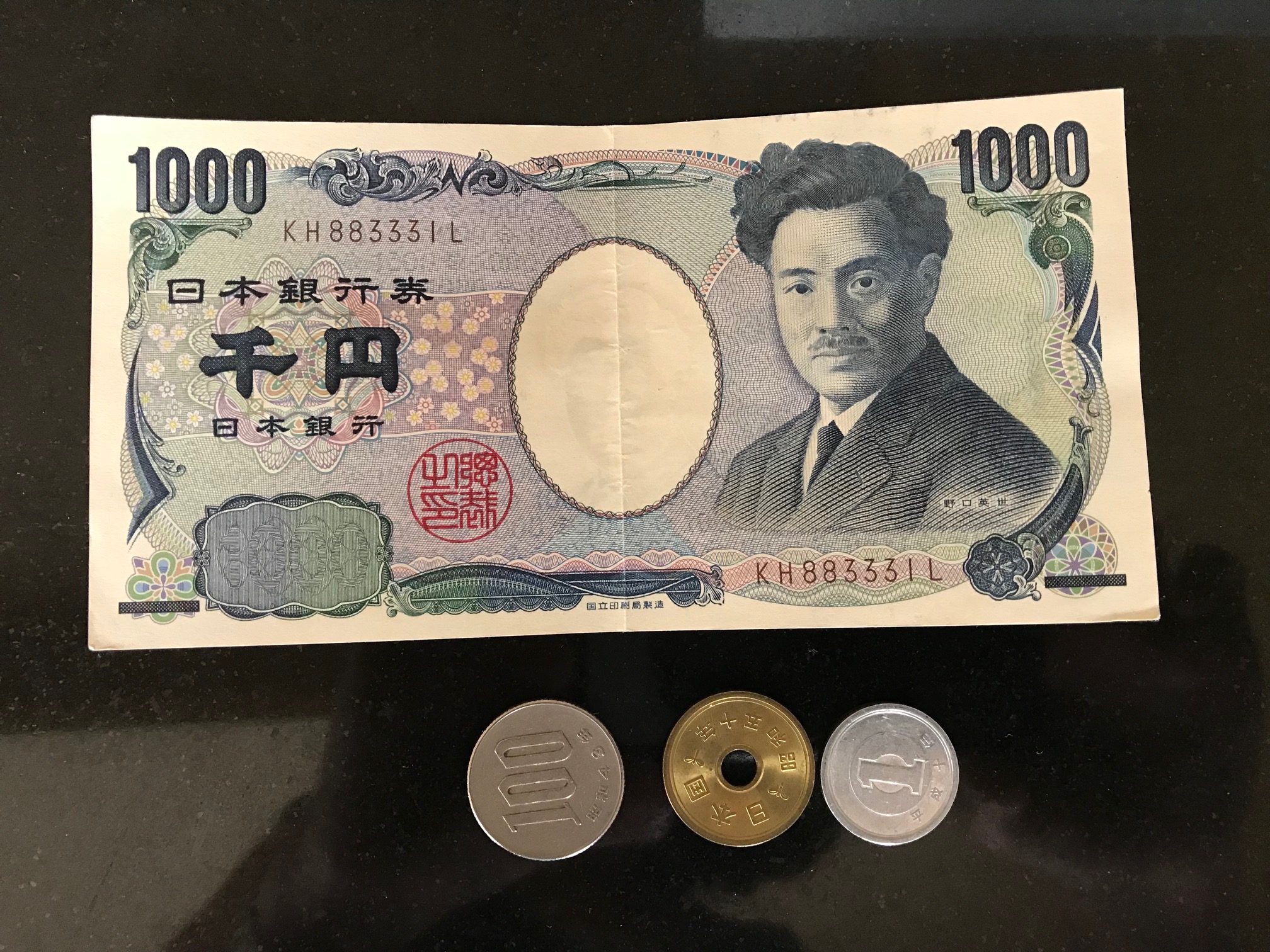
I walked through the tiny shopping mall opposite the hotel, and used the skywalk to reach Ebisu Station. I knew there were a few little shops there. I first checked the bakers. There were pictures and prices outside which was helpful, though I was unsure if the ‘egg sandwiches’ were a single portion or a whole loaf. They cost ¥900, and I knew (because I had been given a lesson by Husband to avoid me spending an unexpected amount) that ¥1000 was a little under £10. So they seemed expensive, but maybe not for a city. Then a smiley young shop assistant came to speak to me. Added pressure. Decided I wasn’t in the mood for egg sandwiches.

Found a supermarket – this was easier, as I could check things whilst remaining anonymous. Most food seemed to be wrapped in shiny plastic. It made the food itself look plastic, especially the sandwiches. There was a fridge full of little containers of dumplings and rice balls and fish. I couldn’t work out which ones required cooking, and which were ready to eat. Found some onigiri (triangles of rice, sometimes with a fishy filling). That seemed safe, though I couldn’t tell if they were plain or filled. There was also a salad, though I wasn’t sure if I was buying slices of cheese or tofu.
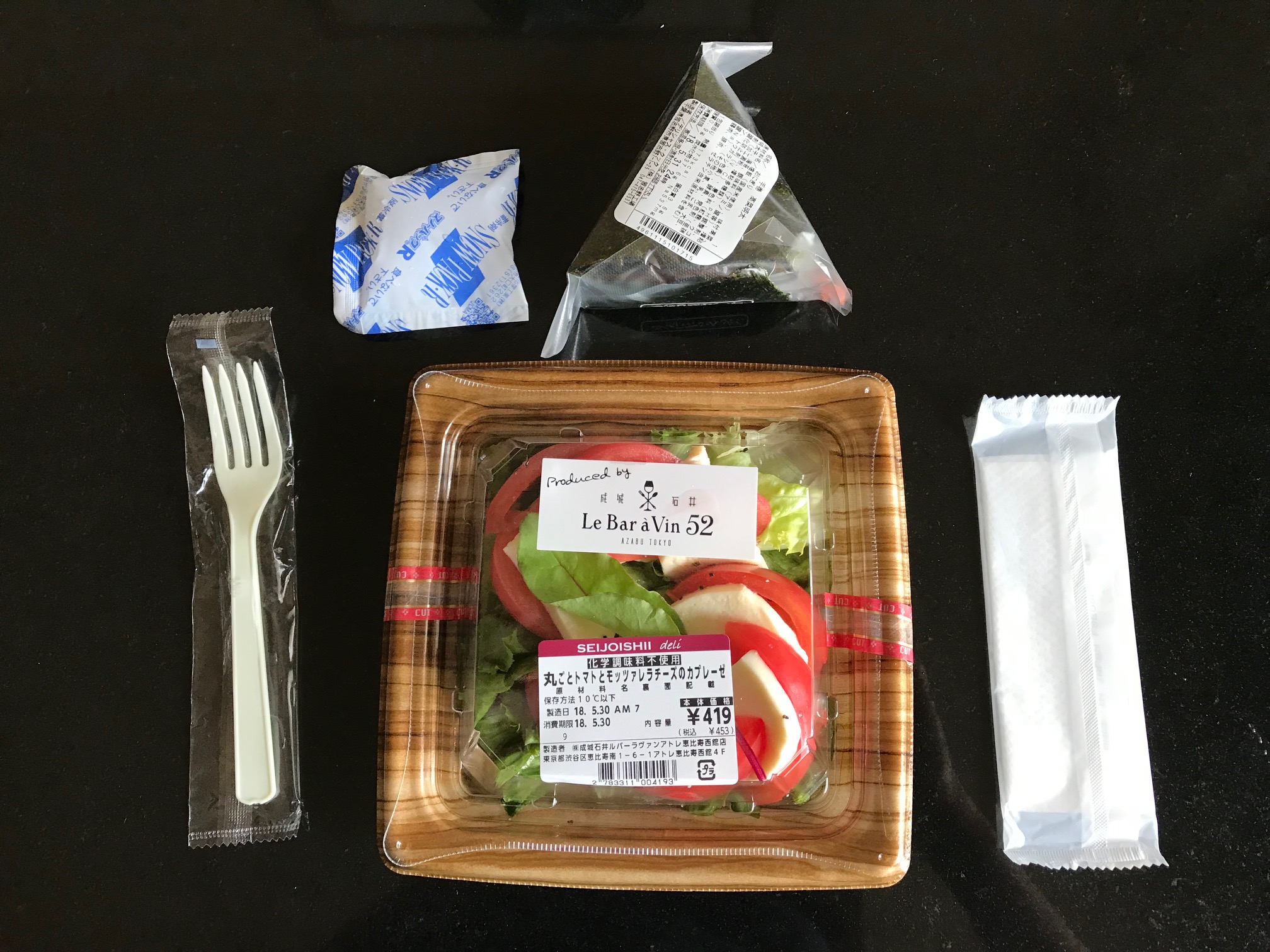
Stood in the queue to pay. The checkout girl spoke, so I nodded and said “Arigato,” which means “thank you” and is the only Japanese word I know, and hoped I hadn’t agreed to anything expensive. I was given my food, in a carrier bag, with a plastic wrapped fork, and a wet-wipe, and a little blue packet which turned out to be an ice-pack. Wasn’t that nice? I paid with my ¥1000 note, and received a bunch a change which could, frankly, have been any amount at all for all I knew. Then we both nodded, and thanked each other again, and I left.
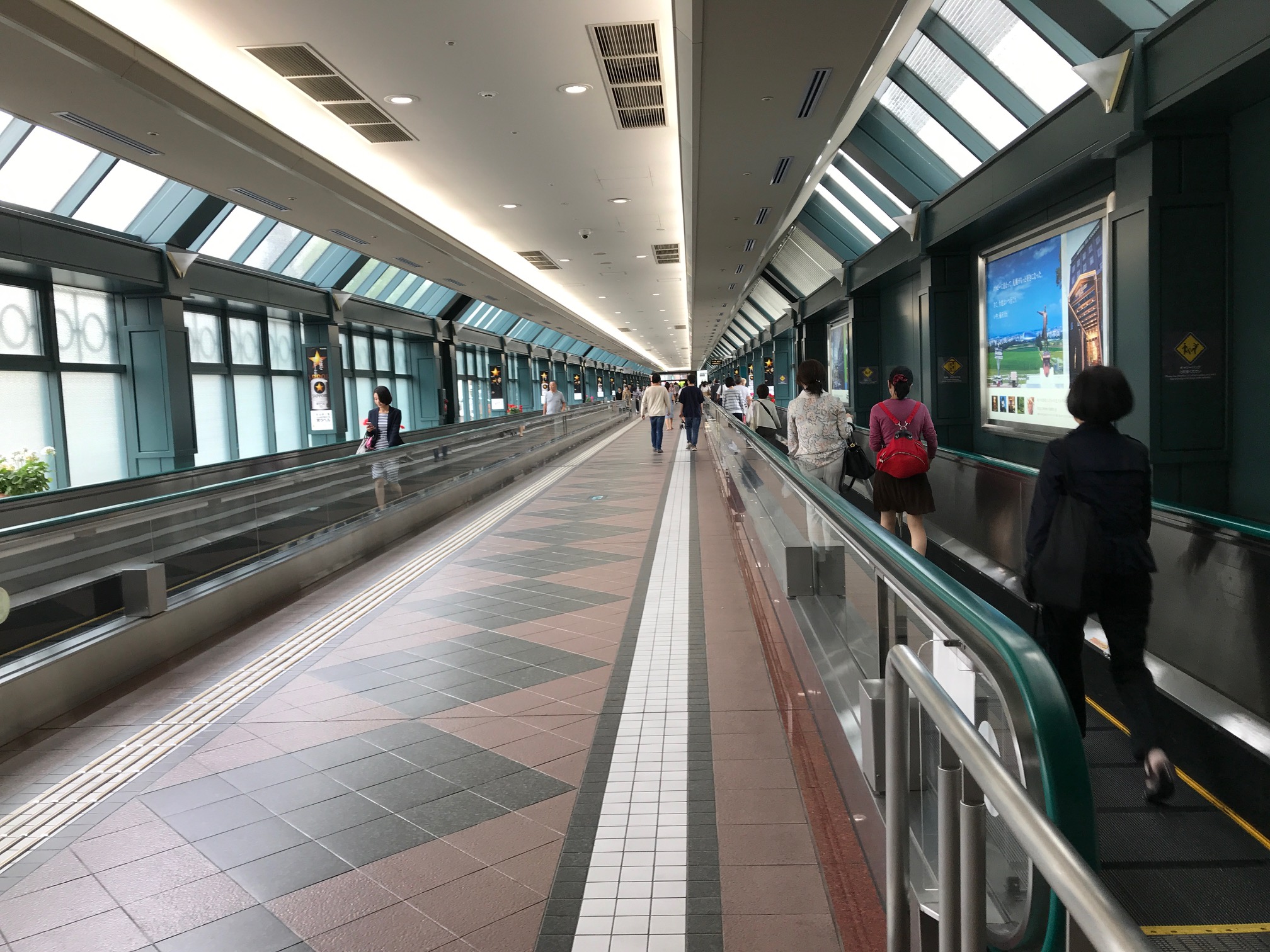
Walked out of the shop, and I swear, everything was different. I didn’t recognise a thing, nor did I know which direction to walk in. This happens to me a lot, especially when trying to find where I’ve parked a car. Husband had given me very clear instructions about finding my way back to the hotel. “Look for the sign to the skywalk.” This was not where I thought it was, but I followed it anyway, and round the next corner, everything became familiar again. I’m rather fond of that skywalk. I took a photo for you, though I’m not sure if you’re supposed to. Ate lunch in my hotel room. Now, shall I write something more this afternoon, or shall I try to find a park…?

******


Thank you for reading. Why not sign up to follow my blog?

anneethompson.com
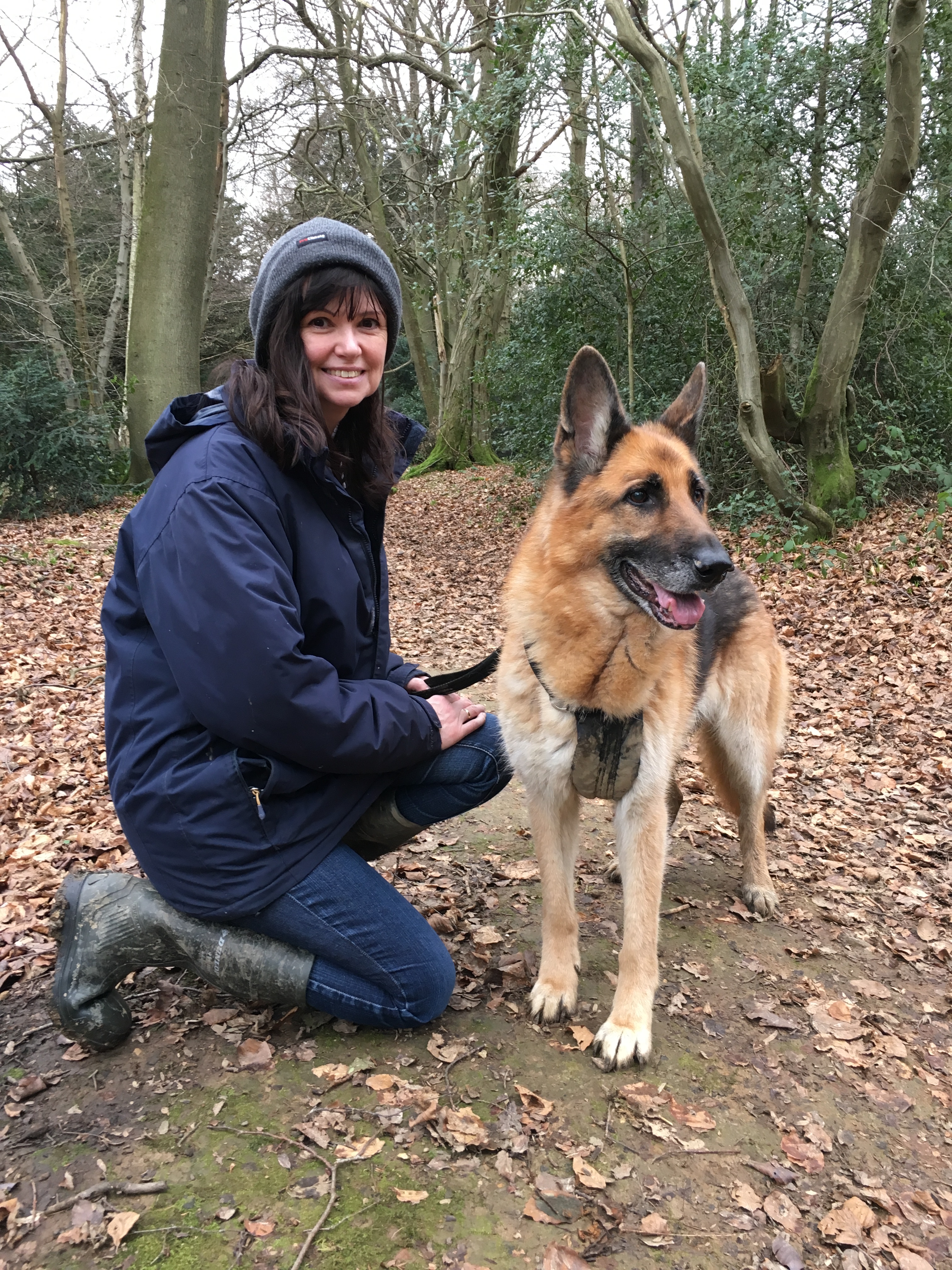
Anne E. Thompson has written several novels and one non-fiction book. You can find her work in bookshops and Amazon.

If you enjoyed this, you will love my new book: The Sarcastic Mother’s Holiday Diary.
I have always written a diary on holiday, so last Christmas, I decided to find all my old diaries and blogs, and make a book for my children. However, several other people also asked for a copy, so I have written a public version – it’s available on Amazon and has been described as “The Durrells meet Bill Bryson”!

Why not buy a copy today? I think it will make you laugh.

The US link is here:

https://www.amazon.com/Sarcastic-Mothers-Holiday-Diary-ebook/dp/B07N95281F/ref=sr_1_1?ie=UTF8&qid=1549015525&sr=8-1&keywords=the+sarcastic+mothers+holiday+diary

The India link is here:

https://www.amazon.in/Sarcastic-Mothers-Holiday-Diary-ebook/dp/B07N95281F/ref=sr_1_1?ie=UTF8&qid=1549015429&sr=8-1&keywords=the+sarcastic+mothers+holiday+diary

The UK link is here:

https://www.amazon.co.uk/Sarcastic-Mothers-Holiday-Diary-ebook/dp/B07N95281F/ref=sr_1_2?ie=UTF8&qid=1549014970&sr=8-2&keywords=the+sarcastic+mothers+holiday+diary

Ashinoko Lake


Hakone Tozan

I fancied being away from a city, plus I saw a picture in a guide book of a pirate ship, so we went to Hakone Tozan. The guide book listed all sorts of activities, like hot springs and cable cars and temples (Japan has lots and lots of temples) but all I wanted was a little countryside with a view of Mount Fuji…and maybe a pirate ship. (If I’m honest, I might not have mentioned the pirate bit to Husband.)

Now, although I mainly married my husband because he makes me laugh, an added bonus is that he is exceptionally good at planning trips. So by the time I woke up the following day, he had sorted a rather complicated series of steps, ending at Lake Ashi in Hakone.

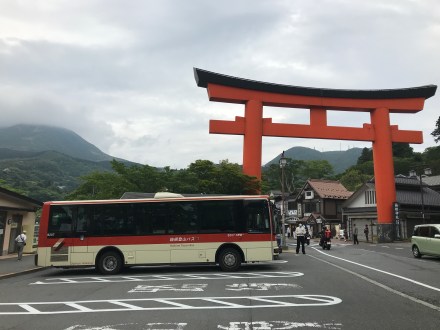
We got a train into Tokyo, then the shinkansen (a bullet train) to Odawar. There we were able to buy a two-day pass to the Hakone area. We took the local tourist train (Hakone Tozan Railway) to Hakone Yumoto. Here, we caught a bus, which went up the mountain, to Lake Ashi, also known as Ashinoko Lake. It’s a crater lake, formed on the side of Mount Hakone.

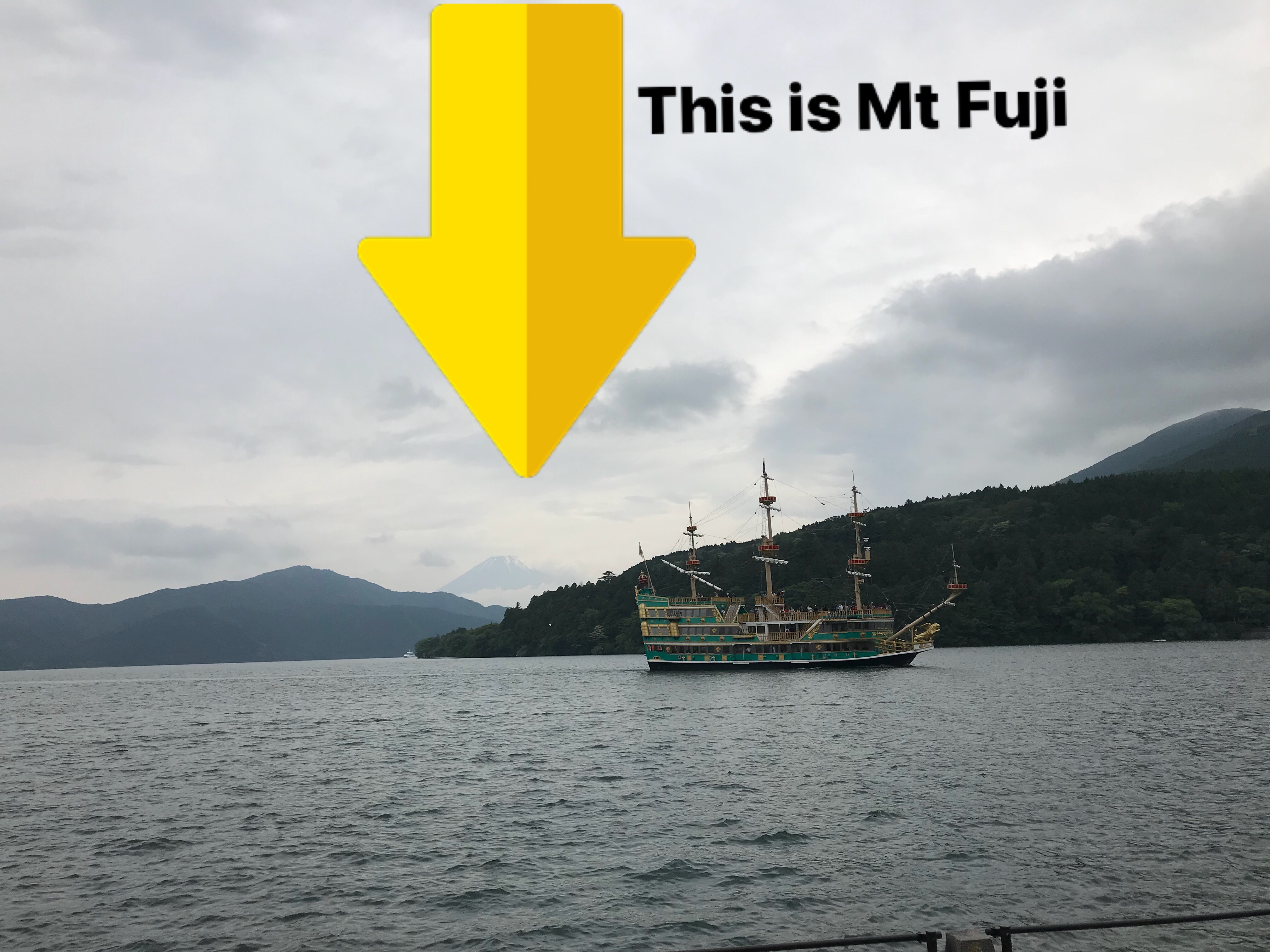
Lake Ashi was exactly what I’d hoped. As we arrived, the sun was shining, and there, in the distance, was Mount Fuji. It kept clouding over, and an iphone is not necessarily the best camera for taking views, but if you look very carefully, you can see it. In real life, it was very clear, and very exciting. The lake has ferries, which take you to various tourist spots, and one is designed to look like a pirate ship. I could tell Husband was impressed. (Actually, if I’m honest, his only comment was to wonder how they managed to get full-sized ferries onto a mountain lake. Did they build them on site, or were they helicoptered in?)

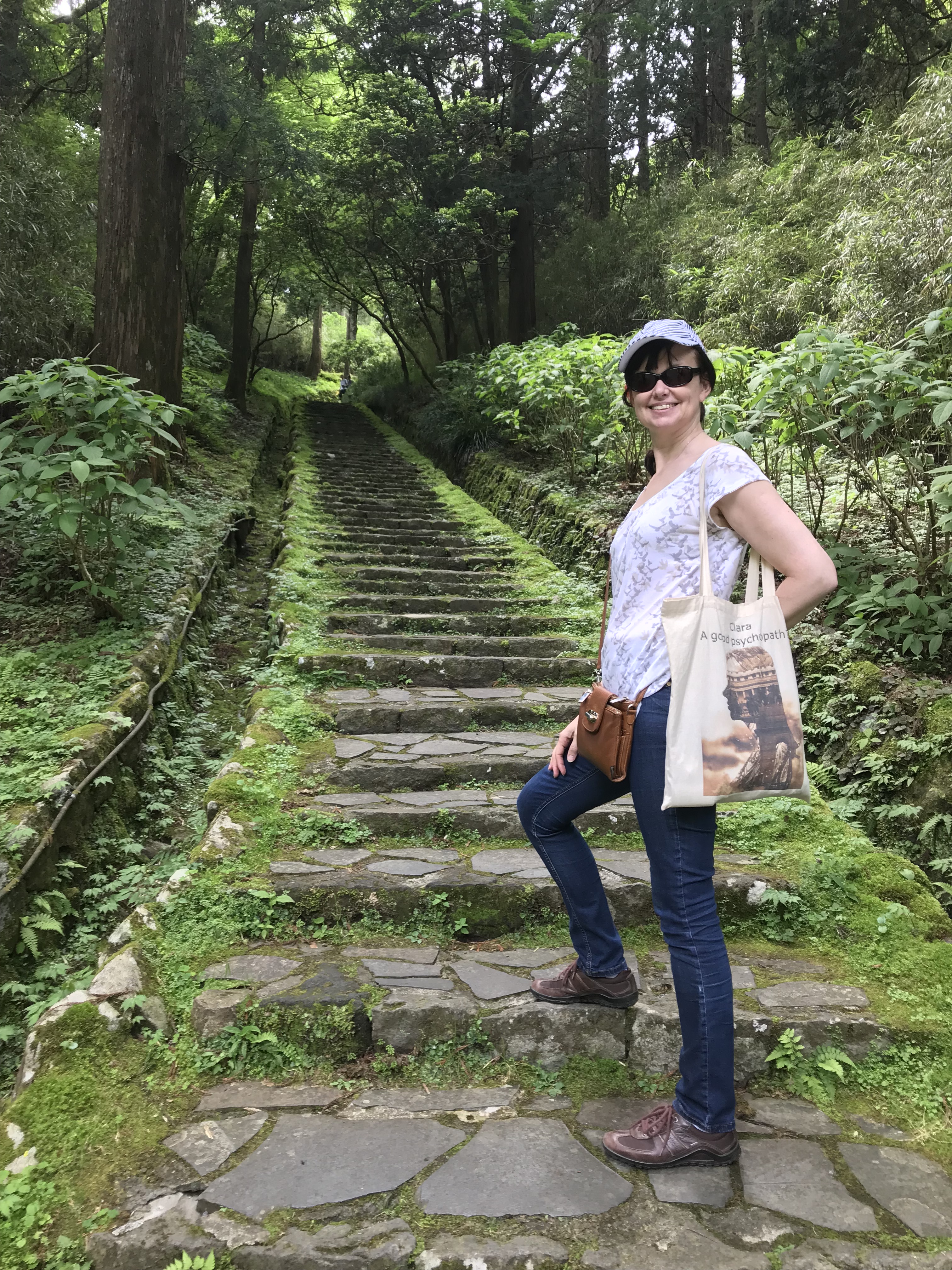
The whole area is a well known tourist spot, so there were lots of facilities (and luckily for us, not too many tourists). We bought lunch in a 7-Eleven (which is, interestingly, a Japanese owned chain) and ate next to the lake. Then we walked to a view point, across a bridge where you could see koi, up two hundred steps through a woodland hill. There were birds calling, the weather was warm and humid, the air felt green and peaceful. It was all pretty perfect.

We considered hiring a rowing boat or peddle boat, taking the ferry across to a temple, or going to see the hot springs. But really, to simply sit in the sun and listen to the water lapping and the birds singing, was all we wanted. That and a bin for the rubbish – Husband was strangely fixated on finding a dustbin.

We then caught the bus back to Hakone Yumoto. We bought tickets for the Romance Train, which was a slower and cheaper way to get to Shinjuku, where we could go on the JR line to the hotel. A ‘Romance Train’ is not, by the way, romantic. Kissing in public is considered indecent in Japan, and we saw very few people even holding hands.

Fabulous day out.

xxx

Thank you for reading.
anneethompson.com

Anne E. Thompson has written several novels and non-fiction books. You can find her work in bookshops and Amazon.
https://www.amazon.co.uk/Anne-E-Thompson/e/B07CL8HV95/ref=pd_sbs_351_bl_4?_encoding=UTF8&refRID=GDEWHMEETMHX34HR7S5G

If you enjoyed this, you will love my new book: The Sarcastic Mother’s Holiday Diary.
I have always written a diary on holiday, so last Christmas, I decided to find all my old diaries and blogs, and make a book for my children. However, several other people also asked for a copy, so I have written a public version – it’s available on Amazon and has been described as “The Durrells meet Bill Bryson”!

Why not buy a copy today? I think it will make you laugh.

The US link is here:

https://www.amazon.com/Sarcastic-Mothers-Holiday-Diary-ebook/dp/B07N95281F/ref=sr_1_1?ie=UTF8&qid=1549015525&sr=8-1&keywords=the+sarcastic+mothers+holiday+diary

The India link is here:

https://www.amazon.in/Sarcastic-Mothers-Holiday-Diary-ebook/dp/B07N95281F/ref=sr_1_1?ie=UTF8&qid=1549015429&sr=8-1&keywords=the+sarcastic+mothers+holiday+diary

The UK link is here:
https://www.amazon.co.uk/Sarcastic-Mothers-Holiday-Diary-ebook/dp/B07N95281F/ref=sr_1_2?ie=UTF8&qid=1549014970&sr=8-2&keywords=the+sarcastic+mothers+holiday+diary


Travel in Japan


Travelling Around Japan

For the foreign traveller, Japan has a very user-friendly transport system. I have explained the Tokyo underground system in a previous blog, so I’ll tell you about the bullet trains and buses, and general other tourist stuff. Japan seems to be one of the safest countries I have ever explored, so if you are a nervous traveller, come to Japan.

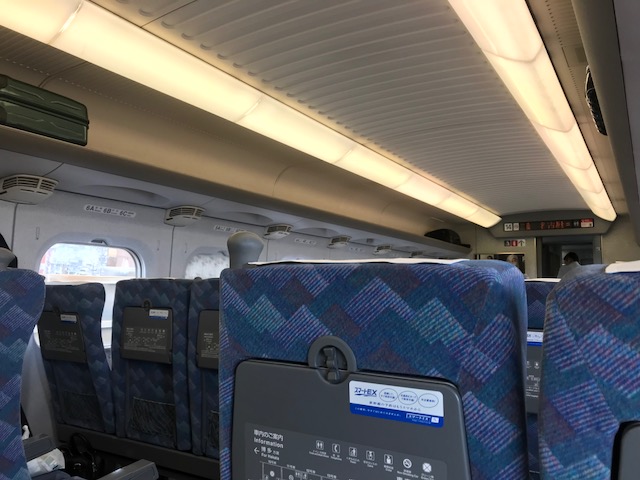
Everyone knows that Japan has bullet trains. They are quick and easy. They are not the cheapest way to travel though. In 2018, a trip from Tokyo to Kyoto takes about 2 hours and costs about £200 return. It’s a few pounds more if you want to reserve a seat. Announcements on the trains are in Japanese followed by English, and an onboard sign shows which station you are approaching. Each carriage has a map of the train, marking toilets, bins and crew positions. The seats are comfy, forward facing, and recline. When passengers disembark, they replace their seat to the upright position (Japanese people are very polite, they don’t leave things in a way to inconvenience other people).

Buying tickets was relatively easy. We went to the ticket office, and staff spoke enough English to be helpful. They also told us which platform we needed. Platforms can be confusing, as different ends of the same platform have trains going to different places, but we found that other passengers were willing to help. Carriage positions are marked on the platform, so you can queue in the correct place. Stations have a shortage of seats, so don’t go to the platform before you need to unless you enjoy standing.

Local trains stop at more stations, and have less comfy seats, but are still clean. The onboard facilities depend on the train.

Taxis can be hailed anywhere (unlike in Singapore, where there are special places, like bus stops for hailing cabs). When they are available, they have the Chinese symbol for ‘free’ lit in red lights in the windscreen.

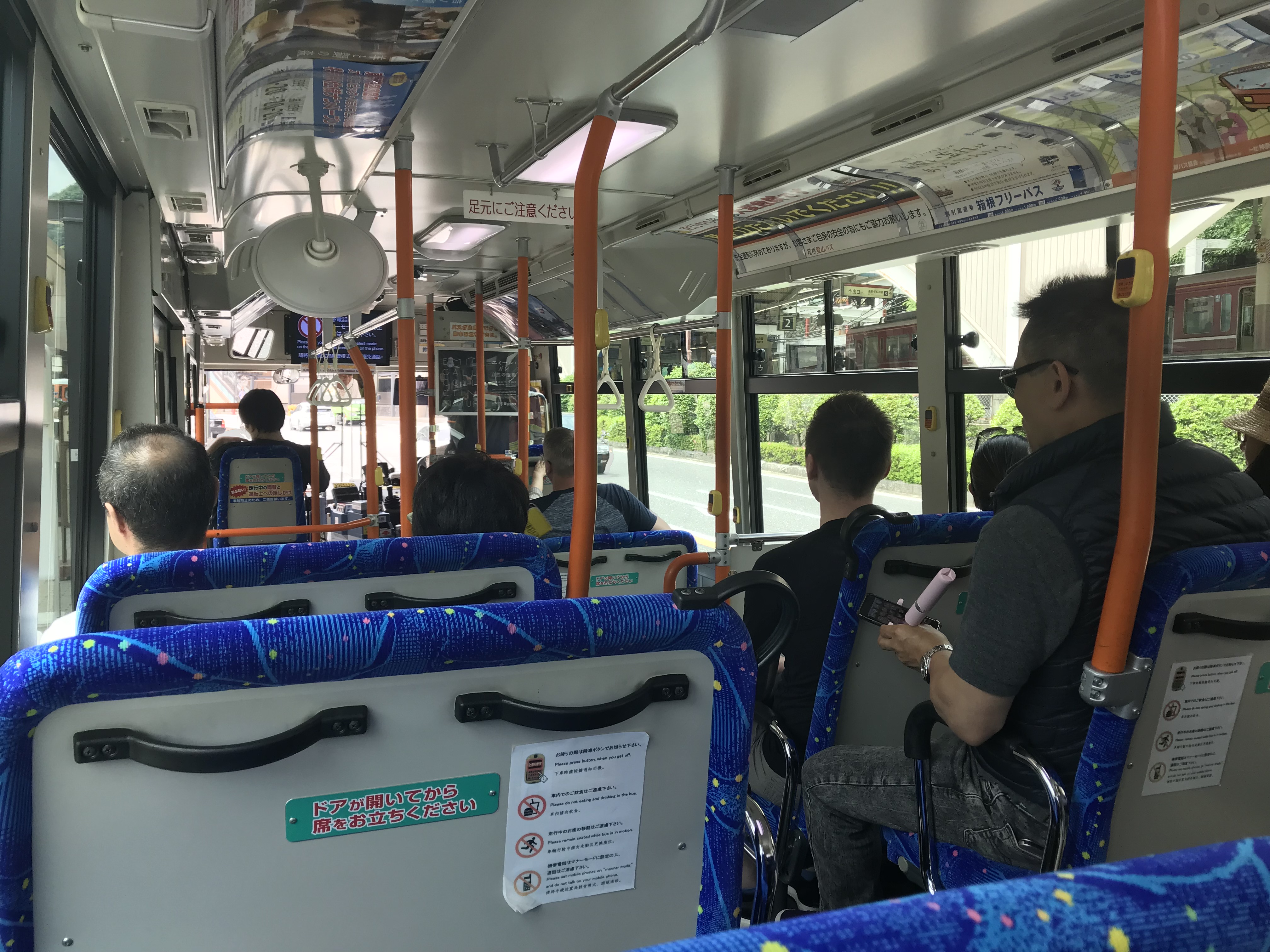
In some places (like Hakone) you can buy a ticket that covers trains, underground, and buses. The buses run to timetable, so be at the stop on time. The timetable will show the bus number or letter, which you then match with the sign on the bus stop. If you don’t have a prepaid ticket, you take a ticket when you get on the bus, and pay the driver when you leave (though I think this varies, as some have machines for paying). The next stop is shown on a sign at the front, and you press a button to request a stop. I think eating on a bus is impolite, as is blowing your nose. So you might want to sit separately from your husband. (Just saying.)

When you arrive, stations have good facilities. There are often shops and cafes. Tokyo station even has tunnels full of market stalls!

Public toilets are clean, and tend to have both traditional toilets and European style ones. All the ones I found were free to use. They also provide loo paper (some countries don’t). ALSO, Japan is the first country I have ever been in, where there is one cubicle designated for mothers of young babies. Inside, in the corner, there is a seat where you can strap a young child. This is SUCH a good idea – why do all countries not have them? Using the washroom with a young child tends to involve either abandoning them in a public place strapped into their buggy where you can’t see them, or leaving the door open so the whole world can watch you pee, or attempting to hold them while you use the toilet (which they always see as a time to wriggle unhelpfully). On behalf of mothers everywhere I would like to say, well done Japan!

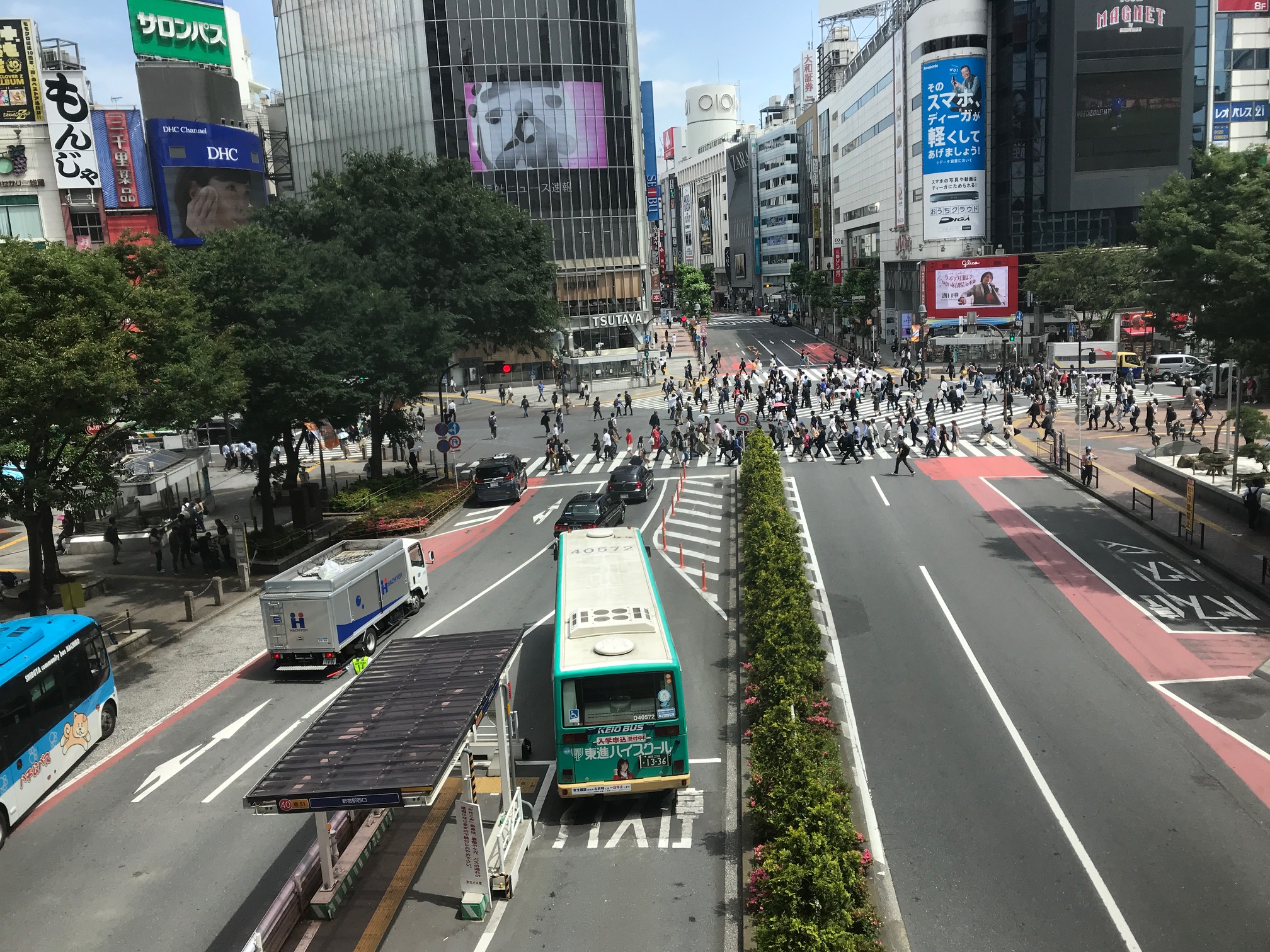
Walking around cities is safe, as pavements are clean and well maintained. Any building work or obstacles have men who wave red flags at you so you notice. Signs are in Japanese, so you need a good map. Roads have crossing points, with lights. Everyone obeys the lights. Sometimes you have to wait for a long time, but they tweet at you when the light is green, which is a helpful indication that you should stop writing emails if your wife has decided to ignore you. (Just saying.)

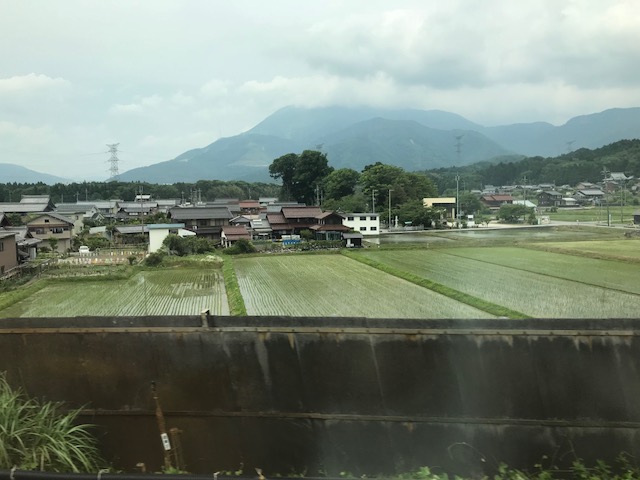
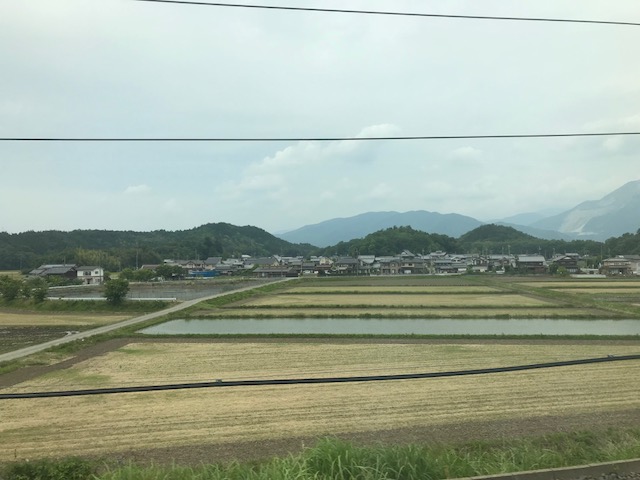
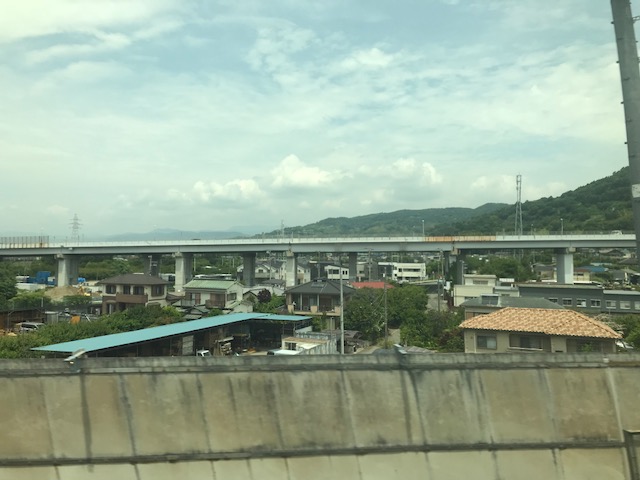
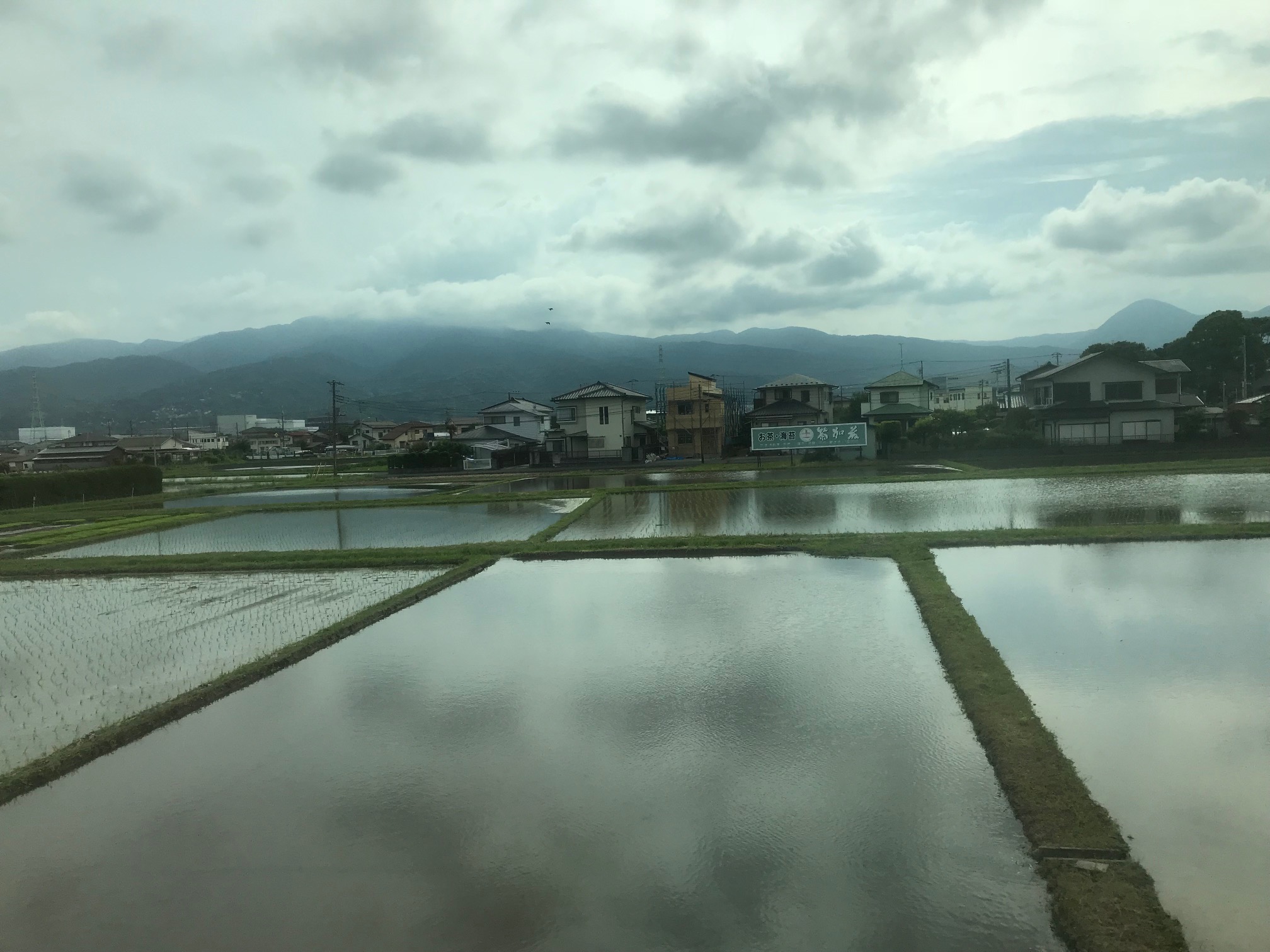
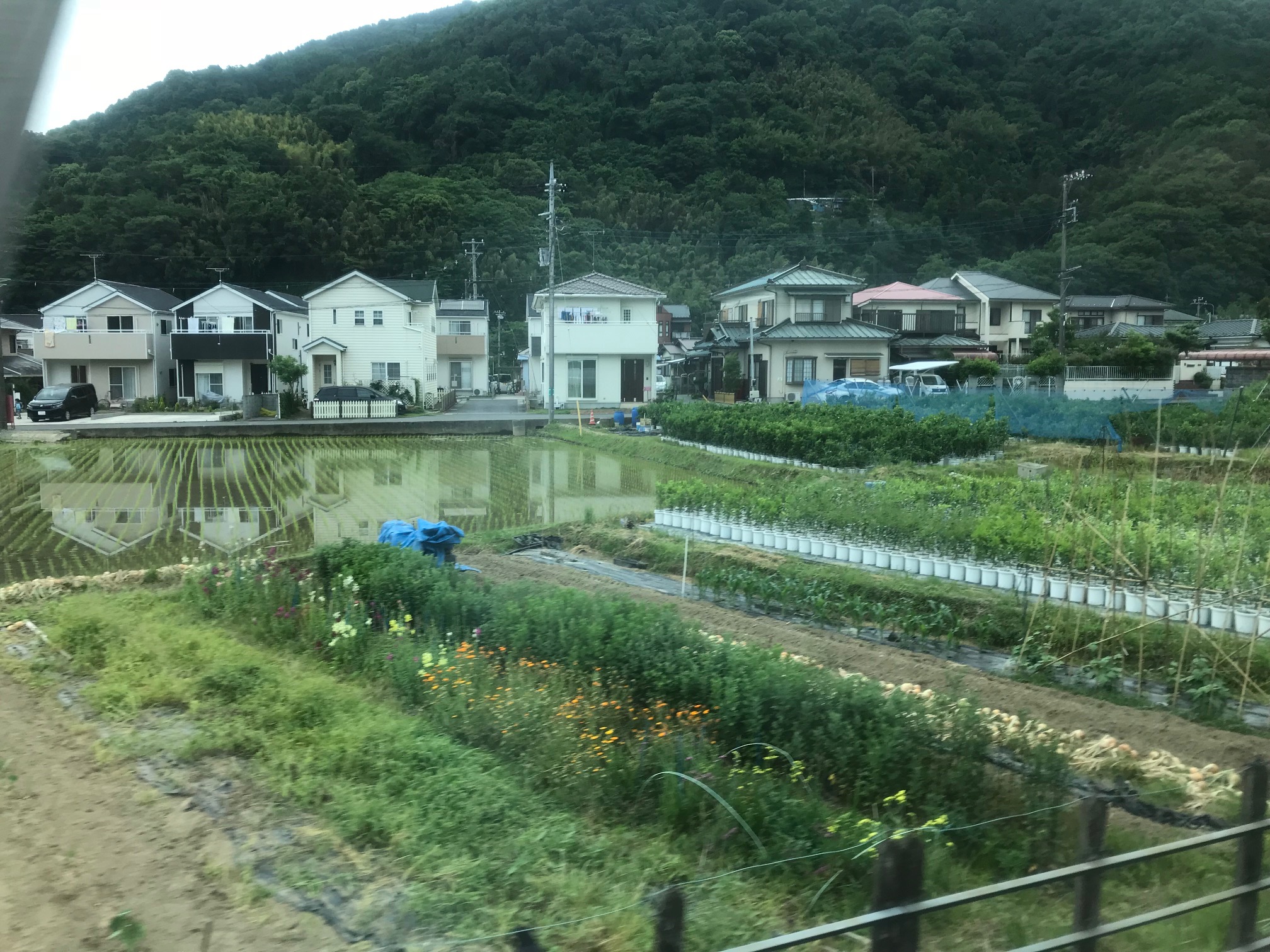
Trains in Japan are a good way to see the countryside. We saw houses, which tended to fill the whole plot, so gardens were tiny. In rural areas there were flooded fields (I assume for growing rice) and temples and mountains and plains. Here are a few fuzzy photos taken from the train:

Anne E. Thompson has written several novels and non-fiction books. You can find her work in bookshops and Amazon.

*****

Thank you for reading.

anneethompson.com


Geisha in Kyoto


A Day Trip to Kyoto

Although I know very little about Japan, even I have heard of geisha. Which means I have heard of the ancient capital city, Kyoto. When I saw that it was possible to do a day trip from Tokyo, I was keen to visit.

Ate breakfast after another ‘not much sleep’ night and walked to Ebisu Station. We got the underground to a mainline JR station, and then bought tickets for the bullet train to Kyoto. We had reserved seats on the way there, but left the return journey open, as we weren’t sure how much time we’d need in the city. There was a lot of flexibility, as trains left every ten minutes.

The bullet train was brilliant. At the end of the line, they turn all the seats, so you are always facing forwards. Your seat is comfortable, and reclines, with a pull-down table on the seat in front (like an aeroplane seat). There was a food/drink trolley. Eating on the train is acceptable (in Japan, eating in the street is considered very bad manners). The journey took about 2 hours.

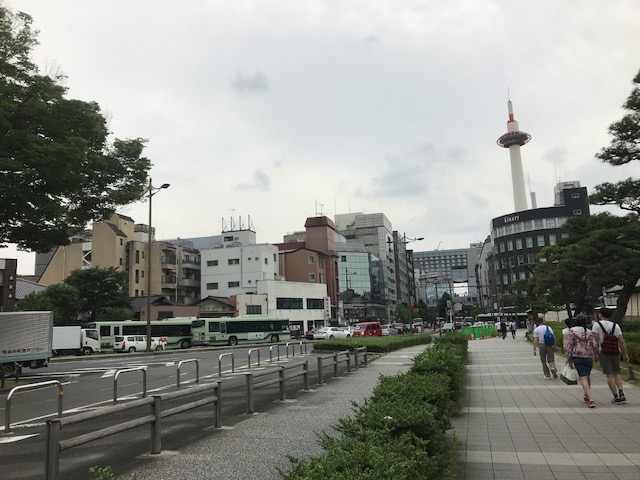
 When we arrived, Kyoto seemed just the same as any other city – too much traffic, lots of tall buildings, people in suits looking busy, department stores. We popped in to the Tourist Information office in the station, and a helpful lady gave us a map and advice as to where we should walk. Her directions were good, but her distances were a little off, as we walked a very long way to reach the old part of the city.

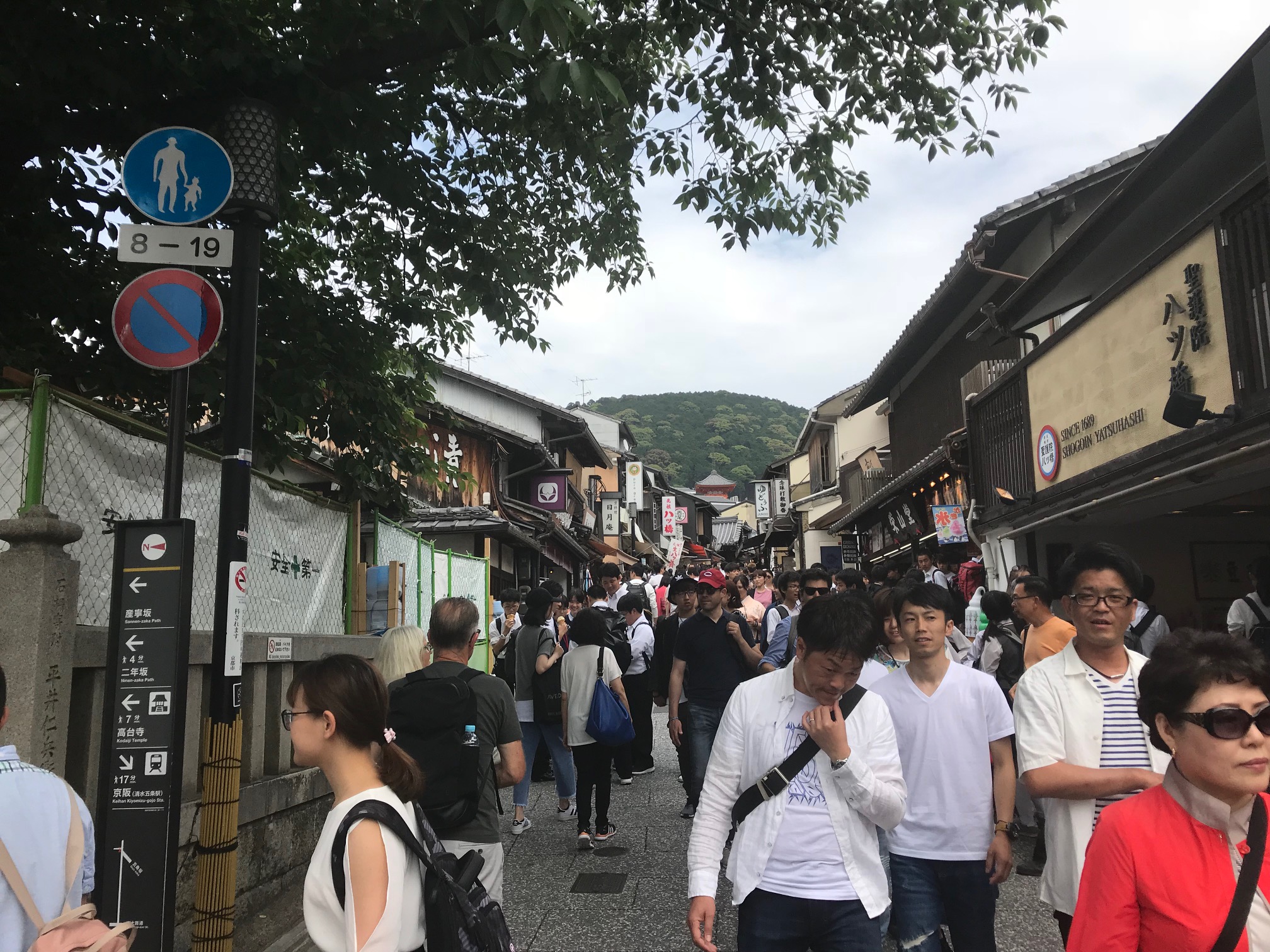
Old Kyoto is a bit like a Japanese Clovelly – there were way too many tourists, and it was almost impossible to imagine what it used to be like. As we walked up the main street, avoiding the coaches, the over-priced gift shops, the coffee shops; I began to wonder why we’d come. It was school-trip world, I think every school in Japan was on an outing to Kyoto.

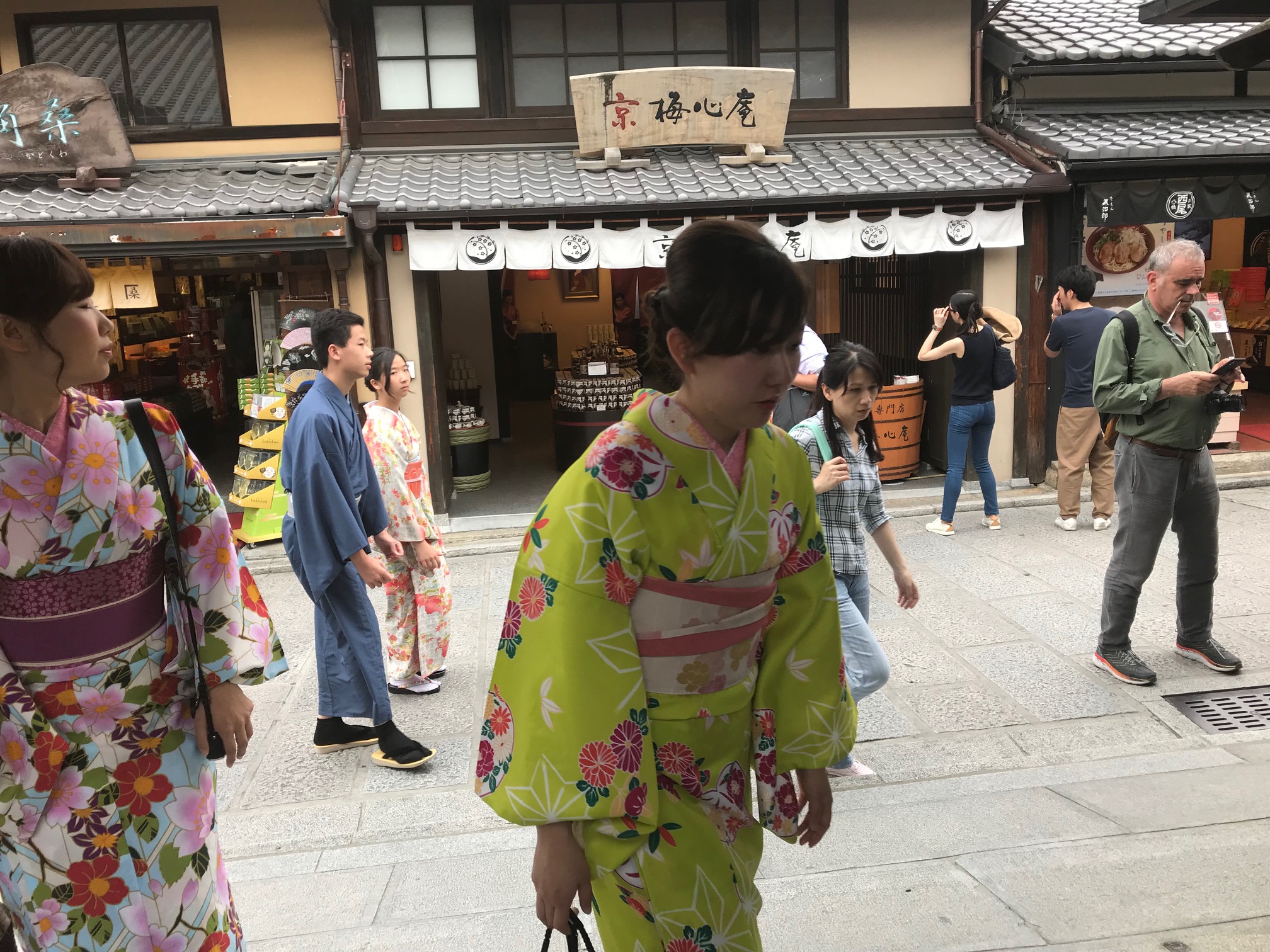
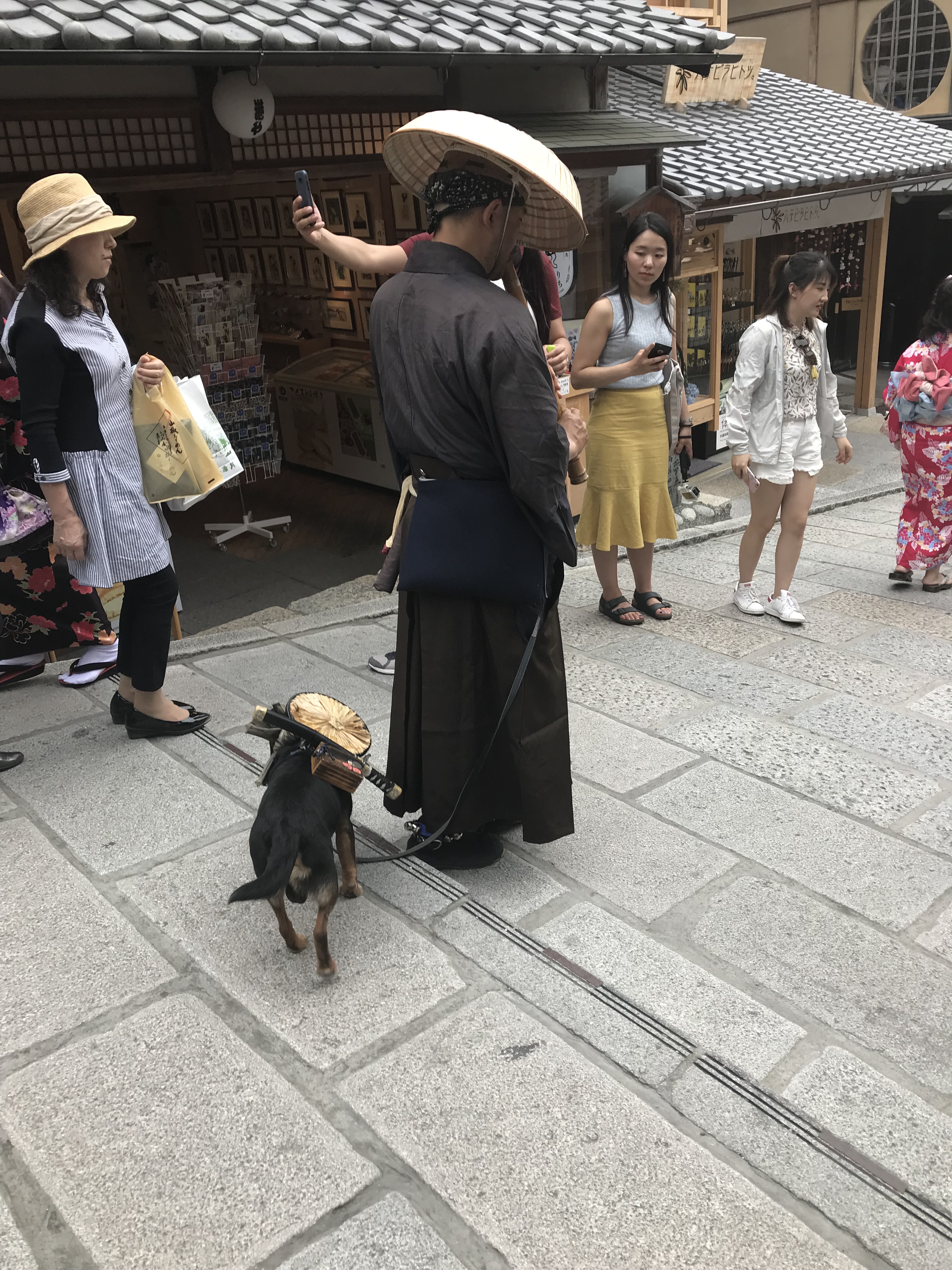
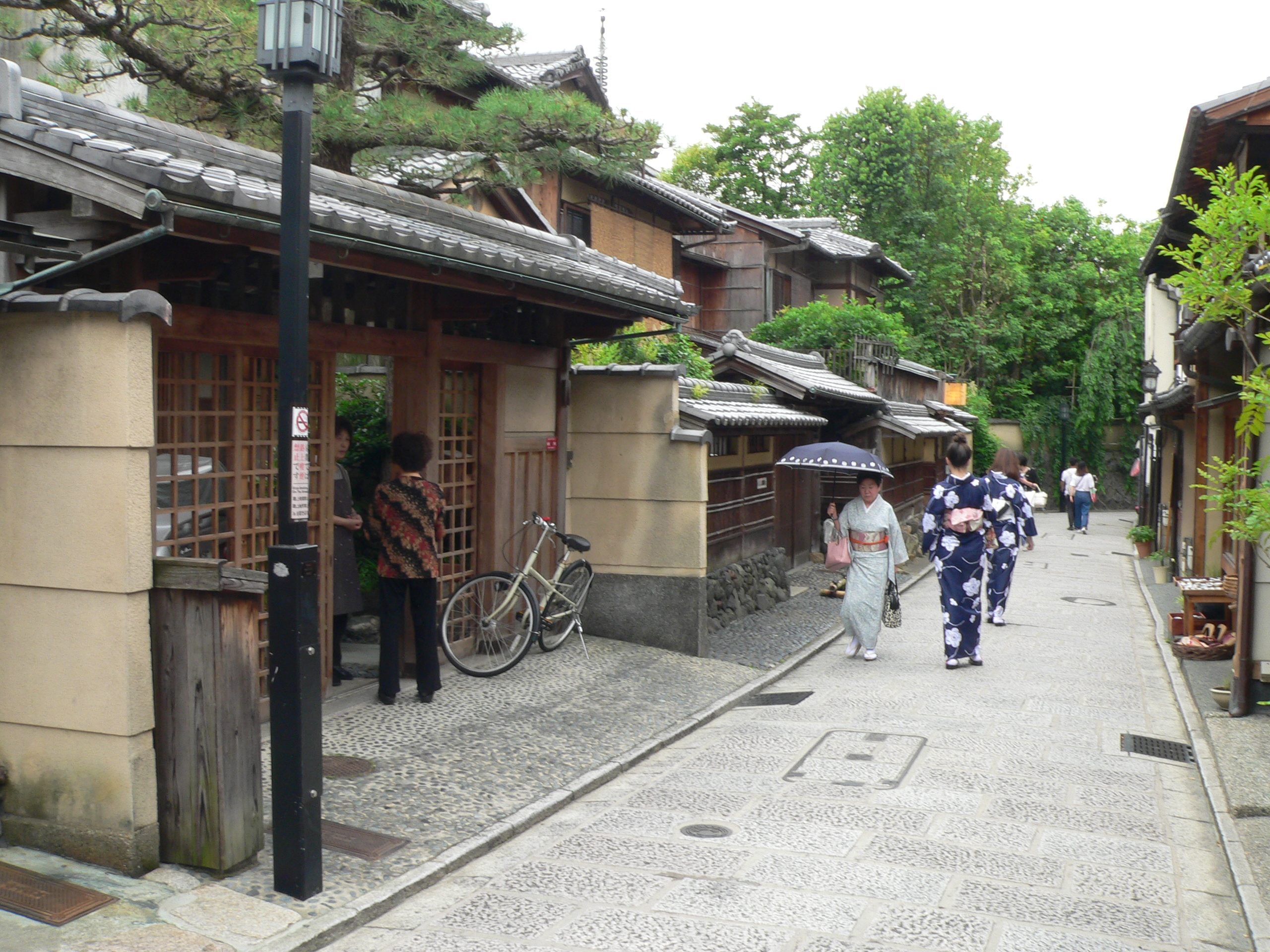
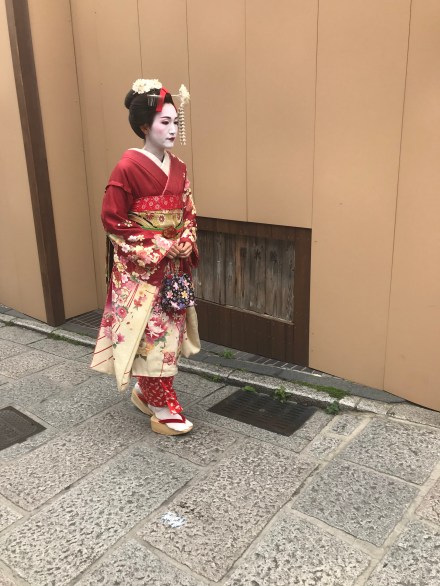
But as we found some back streets that were less busy, and got used to the general bustle, we started to notice things. There were lots of shops where you could hire a kimono for the day, and many of the Japanese tourists were wearing them. I’m not sure why, it’s clearly a thing to do. We glimpsed tiny gardens outside tea shops, many many temples, and streets of two-storey wooden houses in narrow lanes. I saw a geisha hurrying past, but whether she was a real geisha or someone dressed up, I couldn’t say.

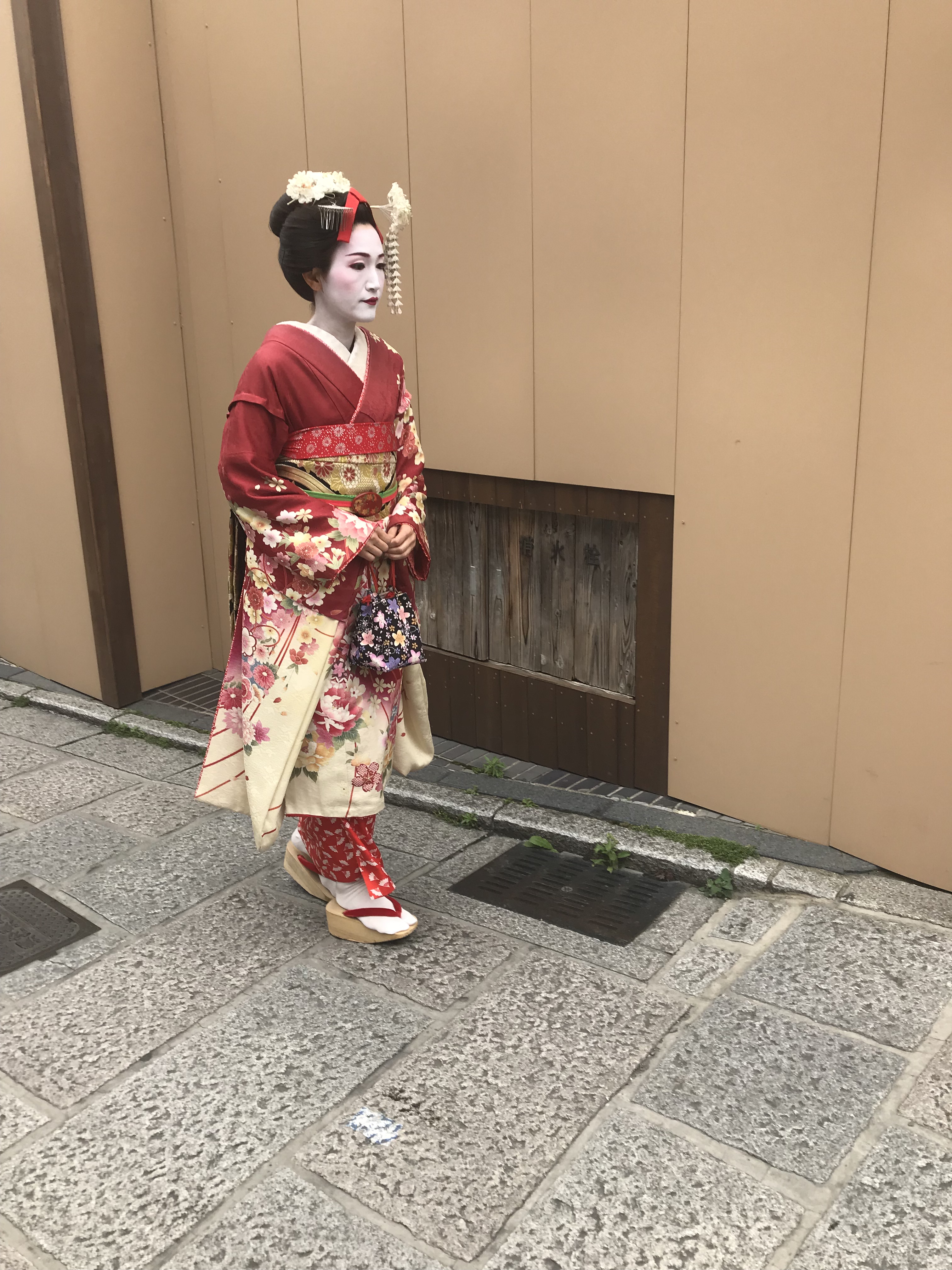
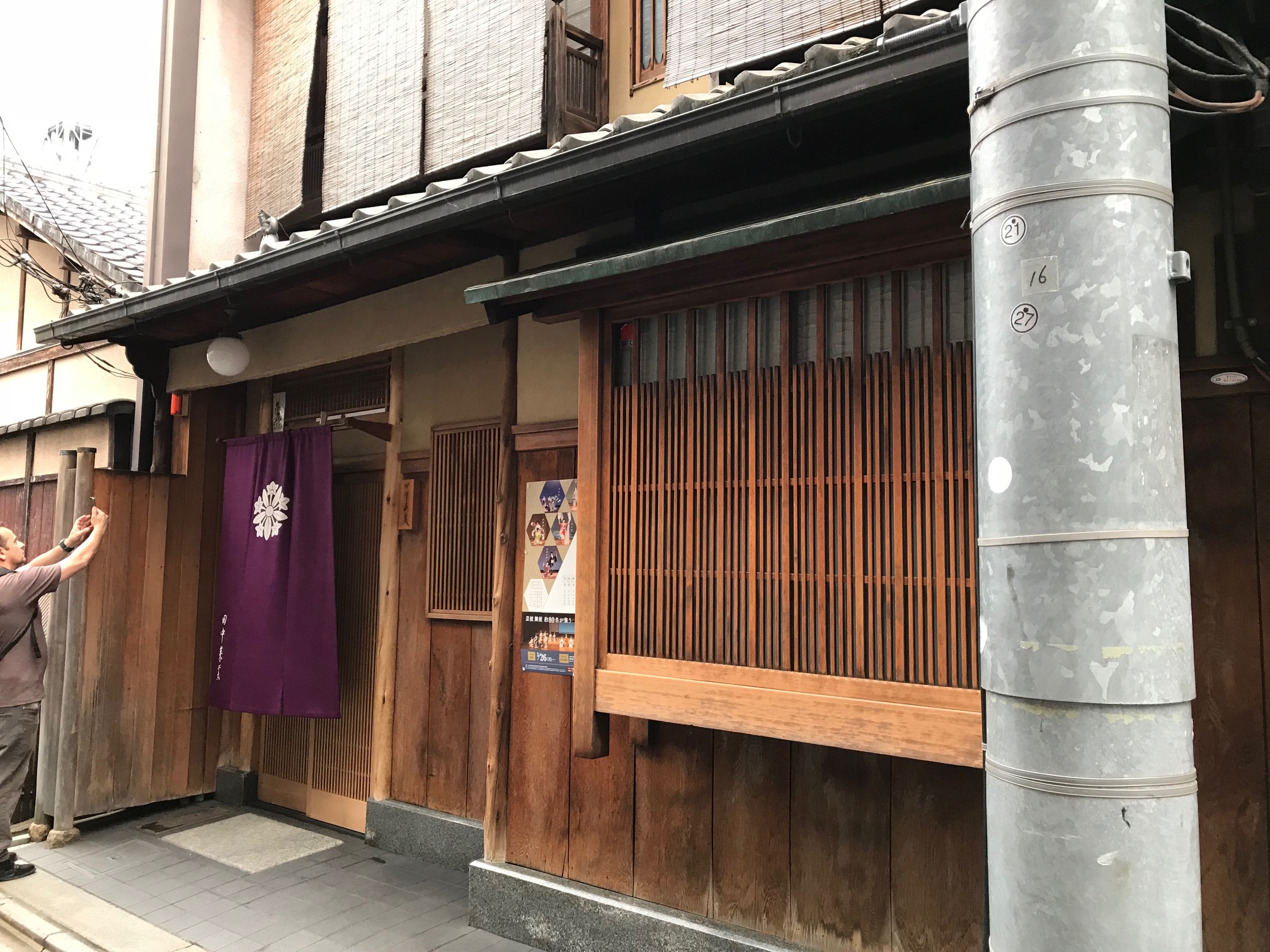
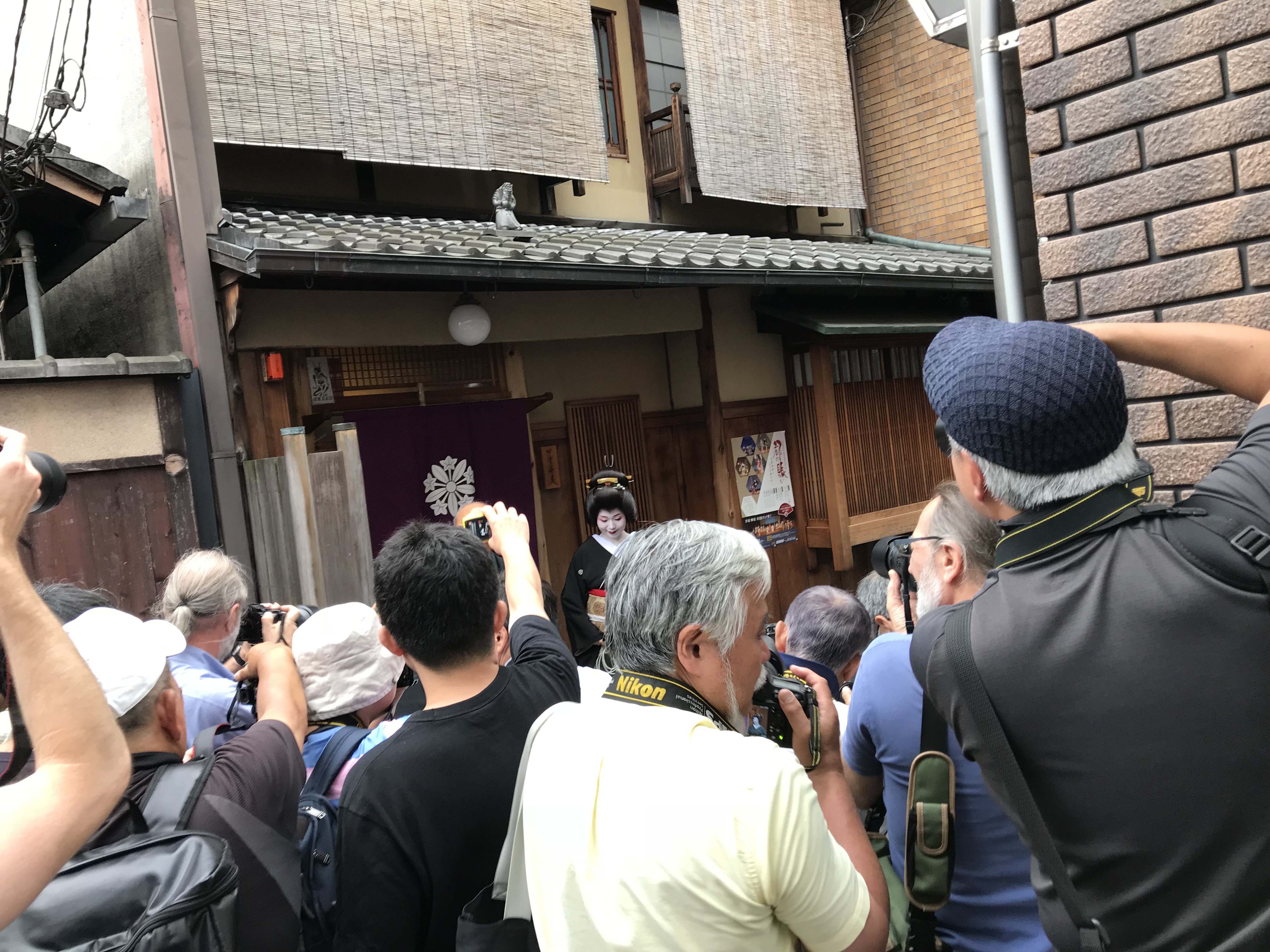
The guide book said that the main Geisha District was Gion, so we walked there. I knew that it is rare to see geisha, but I hoped to be lucky. We left the main street, and began to wander down the narrow lanes. This area felt more seedy, with clubs and shuttered buildings. I wouldn’t have walked there on my own. Then we saw lots of men with cameras, standing outside a small, wooden fronted house, which looked to me like an okiya – the house where girls live while they are training to be a geisha. In Kyoto, trainee geisha are called maiko. We asked a woman why all the photographers were there, and she told us that it was the debut day for one of the maiko. She was twenty, and had completed her geisha training, and would be taking her first walk as a geisha, which is a big event.

We were very lucky, as while we were talking, she emerged. All the photographers leapt forwards, cameras clicking, pushing for the best view. Then they followed her as she made her way down the street.

I’m not sure what my view of geisha is, as their role is slightly fuzzy. Historically, they were beautiful girls, trained to sing and dance and play a shamisen (a stringed instrument like a guitar). They were very elegant, witty, and trained as hostesses of the tea ceremony. They earned money by entertaining rich men, a sort of ritualised escort. Their aim seems to have been to be taken on as a mistress, so supported as a companion by a wealthy protector. They weren’t prostitutes, as they didn’t trade sex for money, and were more like concubines, faithful to one man. However, sometimes this was not by choice, and beautiful young girls were trafficked, sold to okiya. Clearly wrong.

Over time, the role of the geisha has changed. After the war, lots of allied troops came to Japan, and they wanted to sleep with geisha, so prostitutes copied their costume and style, and the word ‘geisha’ became synonymous to westerners with ‘prostitute’. However, the tradition of geisha continued, and today, they prefer to be called geiko, emphasising that they train in the arts, and are entertainers, not sex workers. I’m not sure if it’s the same as being an actress or ballet dancer in western culture (bearing in mind that a hundred years ago, ballet dancers were the scantily dressed girls who appeared at the end of an opera and posed for the men in the audience, hoping to procure a male protector – yet we do not today think that girls who want to be ballet dancers are sex workers).

I decided to not think about it too deeply, and simply enjoyed seeing a piece of Japanese culture. I glimpsed the white face, meant to resemble a mask, hiding the geisha’s real face. A section of her neck, an erotic area in Japan, was left unpainted (like a revealed shoulder, more seductive than a nearly naked body). Her hair was full of ornaments, and geisha have wooden head rests rather than pillows, so their hair is kept in place at night (which sounds extremely uncomfortable, and I’m surprised they’re not all cranky from lack of sleep). Their collar is dipped at the back, to expose that erotic neck, and a geisha has a white collar, whereas a meiko will have a coloured collar. They wear white socks, and walk on platformed wooden shoes, which also look extremely uncomfortable. The long sash is called an obi, and requires another person to help tie it. Their silk kimono are beautiful, and very costly. In the past, the okiya owned the kimono, which was a way of controlling the geisha, as she needed to remain with the house (and pay them some of her earnings) in order to work.

Human history is always interesting, and so much more complex than we first think. I’m glad I saw a geisha, as they seem like an intrinsic part of Japanese history. But I’m not sure how long they will be here for, there is too much that jars with modern life.

xxxx

Thank you for reading.

anneethompson.com

Anne E. Thompson has written several novels and one non-fiction book. You can find her work in bookshops and Amazon.

Thank you for reading. If you enjoyed this, why not buy one of my novels? For the month of June, I am selling them for the special summer price of £7.95* each, or all three for £20, with free UK postage. They make great holiday reading. If you would like a copy, use the contact form below.

← Back

Thank you for your response. ✨


The latest, and best book (in my opinion). An exciting novel written in the first person, which shows how a psychopath views the world. The story encompasses the world of women trafficked in India, and shows how someone very bad, can be used to achieve something amazing.

A gritty thriller, which shows what it means to be a psychopath, and how it would feel if someone in your family did something awful. (Because every psychopath has a mother.)

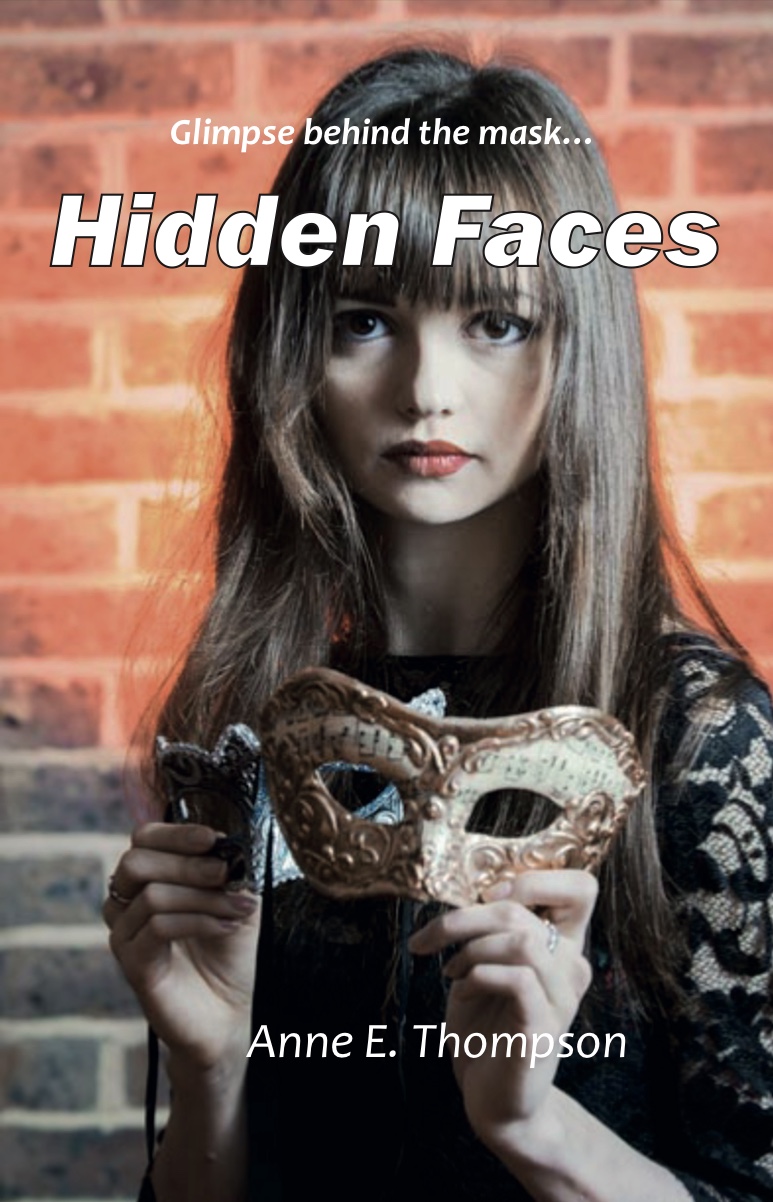
Hidden Faces by Anne E. Thompson.
An easy read, feel good novel, set in an infant school. An ideal gift, this is a book to make you smile.


Payment is on receipt of the books, by either cheque or bank transfer.

*as compared with the £11.95 plus postage if you buy from WH Smith or Waterstones.

Tokyo Underground Trains


Using the Tokyo Underground

Using the underground system in Tokyo is easy – even I managed to do it, and it’s much cheaper and faster than using taxis. It is the cleanest underground system I’ve ever encountered, and although it’s sensible to keep valuables hidden, I saw local people with phones shoved into back pockets and purses at the top of bags, so I’m guessing there is very little crime.

It’s much easier if there are two of you, as stations have lots of signs, and it takes time to read them all. One of you can check for arrows, showing which side you are meant to walk/queue/wait, and the other can read the less important ones about which platform and trains you need.

First of all, find a map, and work out which station you want to visit. I can’t read Japanese, but all the signs were also in English, so it wasn’t a problem. The map is topological, like the London underground (so the stations are shown in the right order, but the distances aren’t to scale). The stations are shown on coloured lines, and you need to know the names of the lines you want to travel on. You also need to know which direction you want, so take note of the final station on the line. This is all shown on maps, which are available at stations and displayed on walls.

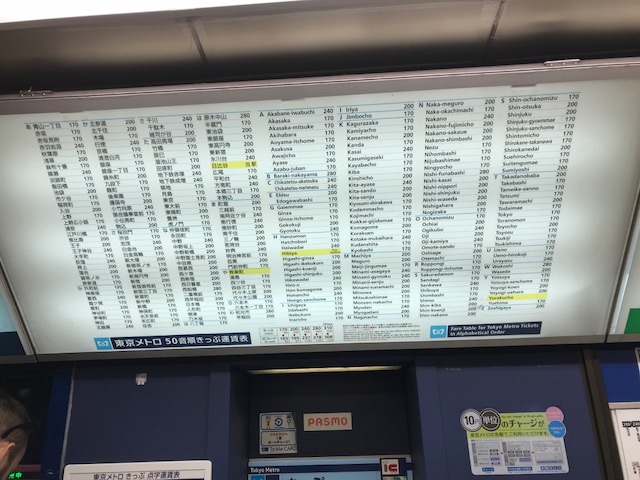
You then need a ticket. Find an automatic ticket machine. Nearby will be a list of all the stations, in alphabetical order, and next to them, the price of a ticket. Find the station you are aiming for, and remember the number next to it.


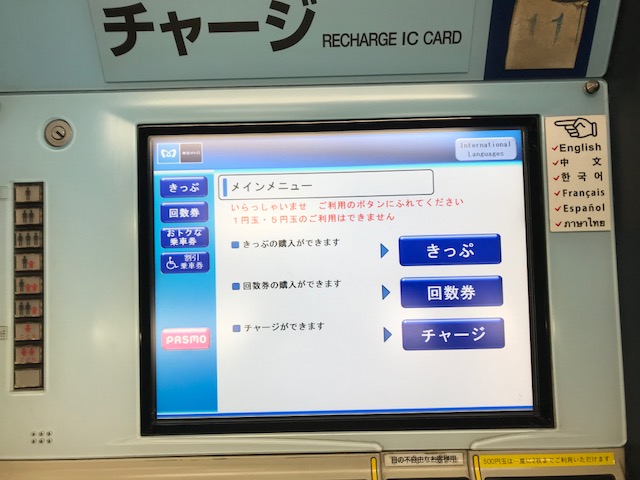
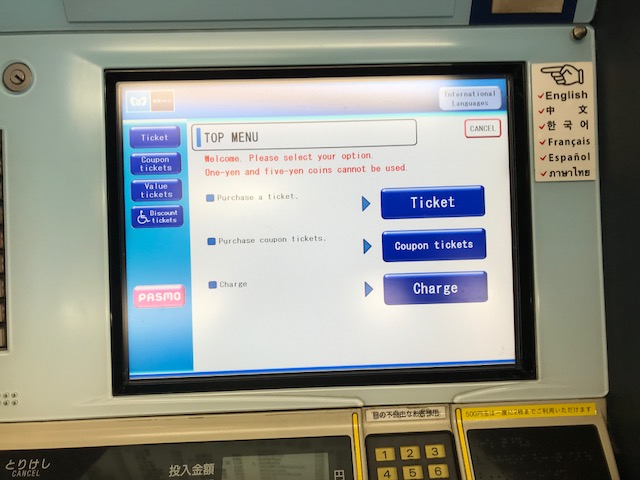
Go to the ticket machine. Press the button for ‘international languages’ and touch the English button. Then press to ‘buy a ticket’ and select the price (which you have remembered from the previous sign).

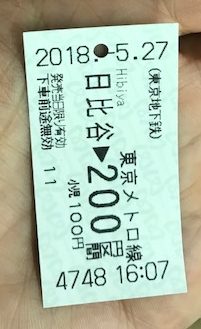
Then put in your money. Take your change, and the ticket.


You then need to use the overhead signs to find the correct line. To enter the platform, you put your ticket into the machine – which snatches it in quite a fierce way and then spits it out for you to collect when you’re through the barrier.

You need to know which direction you’re travelling in, and follow the signs to the correct platform.

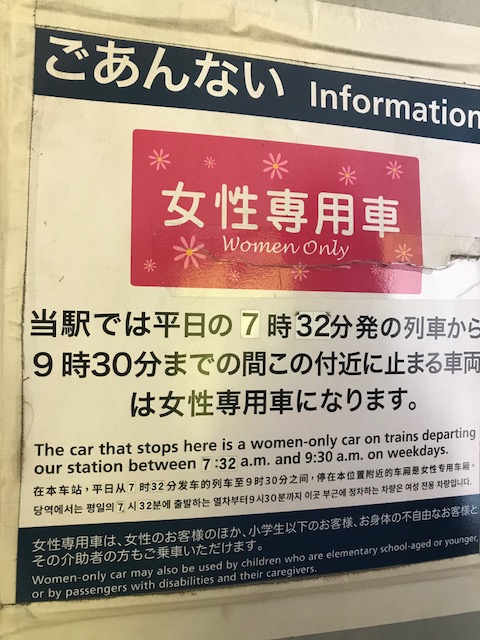
One thing to be careful of, is that some trains have ‘women only’ carriages. The position of these is marked by signs on the platform. I noticed a sign, and helpfully told some European-looking tourists, so they knew not to enter those carriages. Husband afterwards told me that the restriction only applies at certain times, and I had moved the tourists on unnecessarily. But I’m hoping they never realise that.


********

anneethompson.com

Anne E. Thompson has written several novels and one non-fiction book. You can find her work in bookshops and Amazon.

If you enjoyed this, you will love my new book: The Sarcastic Mother’s Holiday Diary.
I have always written a diary on holiday, so last Christmas, I decided to find all my old diaries and blogs, and make a book for my children. However, several other people also asked for a copy, so I have written a public version – it’s available on Amazon and has been described as “The Durrells meet Bill Bryson”!

Why not buy a copy today? I think it will make you laugh.

The US link is here:

https://www.amazon.com/Sarcastic-Mothers-Holiday-Diary-ebook/dp/B07N95281F/ref=sr_1_1?ie=UTF8&qid=1549015525&sr=8-1&keywords=the+sarcastic+mothers+holiday+diary

The India link is here:

https://www.amazon.in/Sarcastic-Mothers-Holiday-Diary-ebook/dp/B07N95281F/ref=sr_1_1?ie=UTF8&qid=1549015429&sr=8-1&keywords=the+sarcastic+mothers+holiday+diary

The UK link is here:
https://www.amazon.co.uk/Sarcastic-Mothers-Holiday-Diary-ebook/dp/B07N95281F/ref=sr_1_2?ie=UTF8&qid=1549014970&sr=8-2&keywords=the+sarcastic+mothers+holiday+diary


The Imperial Gardens in Tokyo


The Imperial Gardens in Tokyo

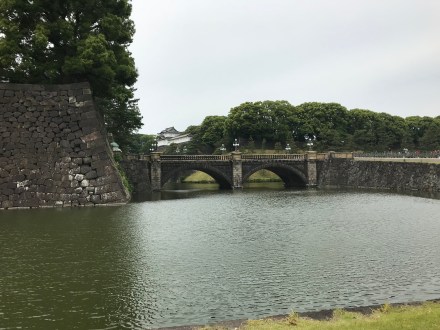
We got a taxi to the Imperial Gardens (which was very silly, as the underground is a fraction of the price, safe and clean and would have delivered us to Hibiya station in less time. But we’re tourists – knowing things takes time). We passed the Nijubashhi, which is a stone bridge over the river, and used to be the main entrance. Lots of people were taking photos, so we did too, assuming this was a famous landmark.

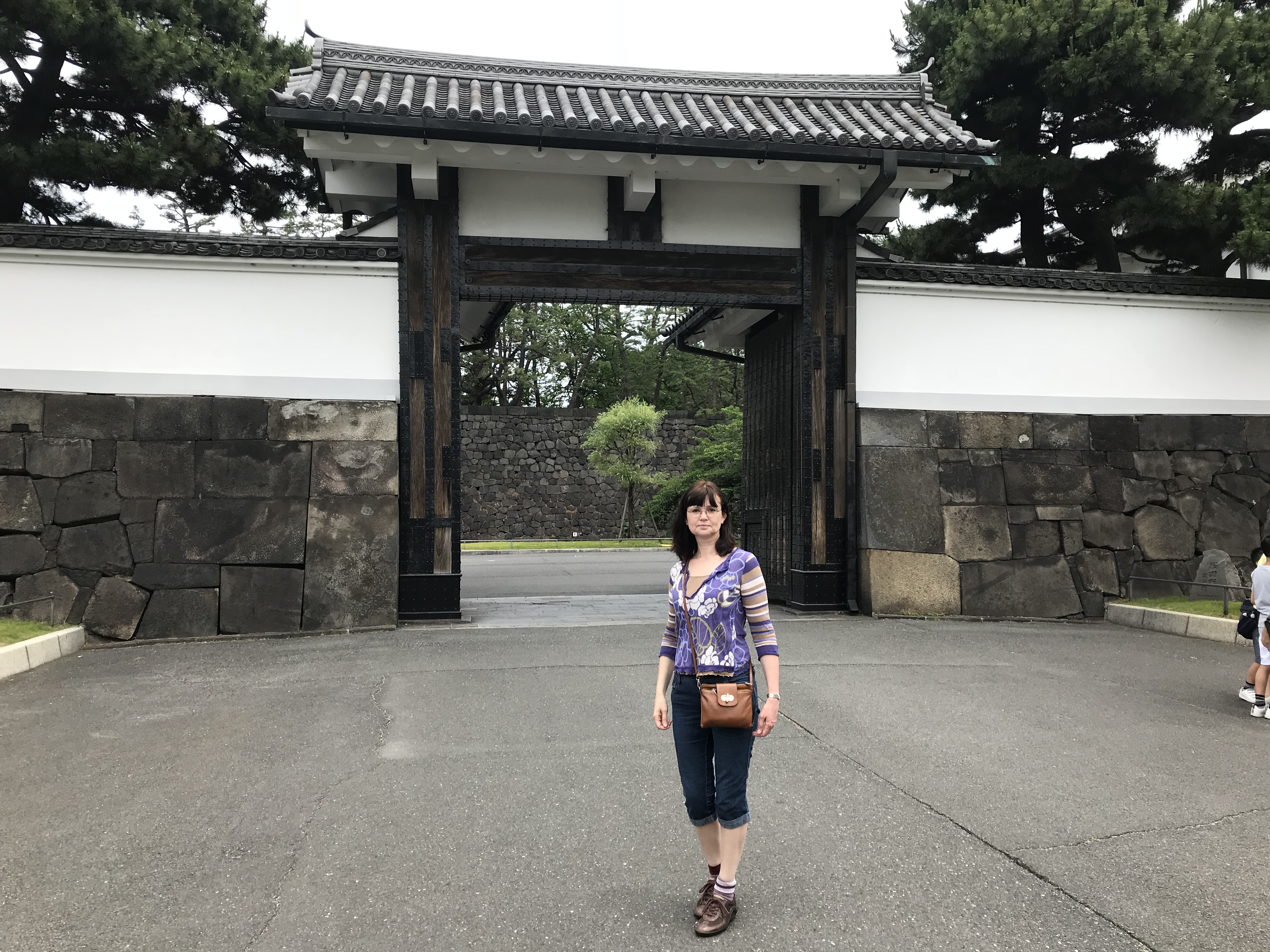
We walked to the park entrance, which seemed like a long way in the hot sun, and there weren’t many signs, but we found it eventually. I was glad I had worn comfy shoes (will not repeat Husband’s feedback comments).

We were issued with tickets, which were free, and had to be returned at the end (am not entirely sure of their purpose).

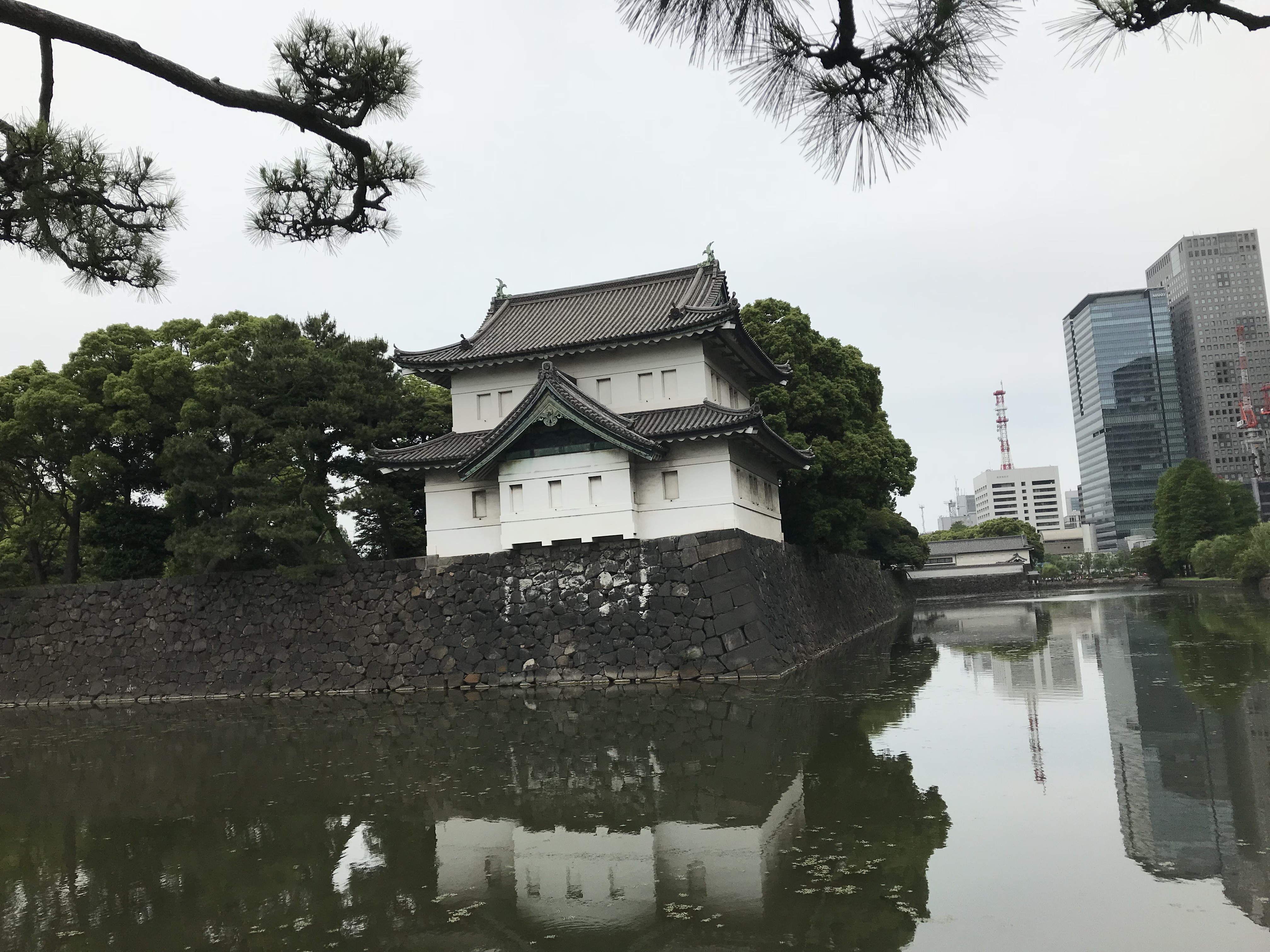
The gardens were a mix of huge walls (the Japanese are very good at walls) and random buildings. We passed a restroom, which is NOT a washroom, but rather a shady area to sit and rest. Most Japanese gardens seem to have them. They have vending machines (everywhere in Japan has vending machines) and seating, sometimes people remove their shoes to enter, and they are generally quiet. I like them.

The gardens were also, at times, startlingly beautiful. I imagine that during different seasons, various areas would become more lovely. It is a garden you need to visit throughout the year. There were several trees that were bandaged and supported by posts, trimmed and encouraged to grow into the desired shape. Trees in Japan are also beautiful.

We went into an old guard’s barracks. We had to remove our shoes, and were provided with a plastic bag to carry them. A man seemed to be employed for the sole purpose of taking the plastic bags from the ‘finished’ bin, folding them, and replacing them in the ‘to use’ bin. I am not at all sure why we needed to remove our shoes. The barracks was rebuilt, and had a modern lino floor, so preservation wasn’t an issue. It was where the soldiers lived, not died, so I don’t think it had any sacred significance. Perhaps it was for cleanliness reasons – Japanese people are very clean.

***

The following day (after an almost completely sleepless night – jetlag is horrible) we returned to another park in the same area. This time we went by underground. I am not convinced that Husband read the scale on the map properly, but perhaps I was just tired. After walking for about 6 hours, we found the entrance. I was not really in the mood for wandering around a park, so we went straight to the park cafe for lunch.

We ordered burgers and cokes, using our pointing and gesturing method. Japanese people all seem to be very polite and helpful, and they cope very well with people who speak no Japanese at all. The burger was really nice, very fresh, and served with salad (not the mushy slime you tend to get in the UK). Portions are smaller than in England – it would be easier to be healthier here I think. Lots of areas are for jogging, and we saw several runners.

We then realised we had seen most of the park on our way to the restaurant. It wasn’t huge. We wandered around for a while, and found some shady tracks through trees, saw a couple of rest areas (vending machines and seats) and walked to a viewpoint over a river (somewhat marred by the massive flyover). Then we gave up, and went back to the hotel.

Tokyo is beginning to grow on me. The people are very polite, and friendly and helpful. When we are confused, people will stop, and ask if we need help. Everywhere is very clean, and it feels very safe. We saw people jogging around the parks, and they had left a bag with their belongings in, on a bench. Bikes are left unlocked. In restaurants and trains, people will leave their things – even mobile phones – on their seats while they order food or go to the washroom. No one seems to steal here, it is rather nice, how you feel society ought to be. We have not seen a single homeless person or beggar, which is very rare in a major city. Are there no homeless people in Japan?

I look forward to discovering more as we explore a little further.

xxx

Thank you for reading.

anneethompson.com

*****


Startled by Beauty


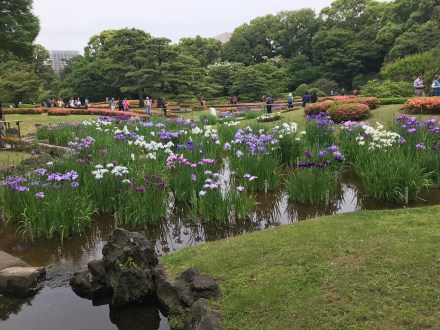
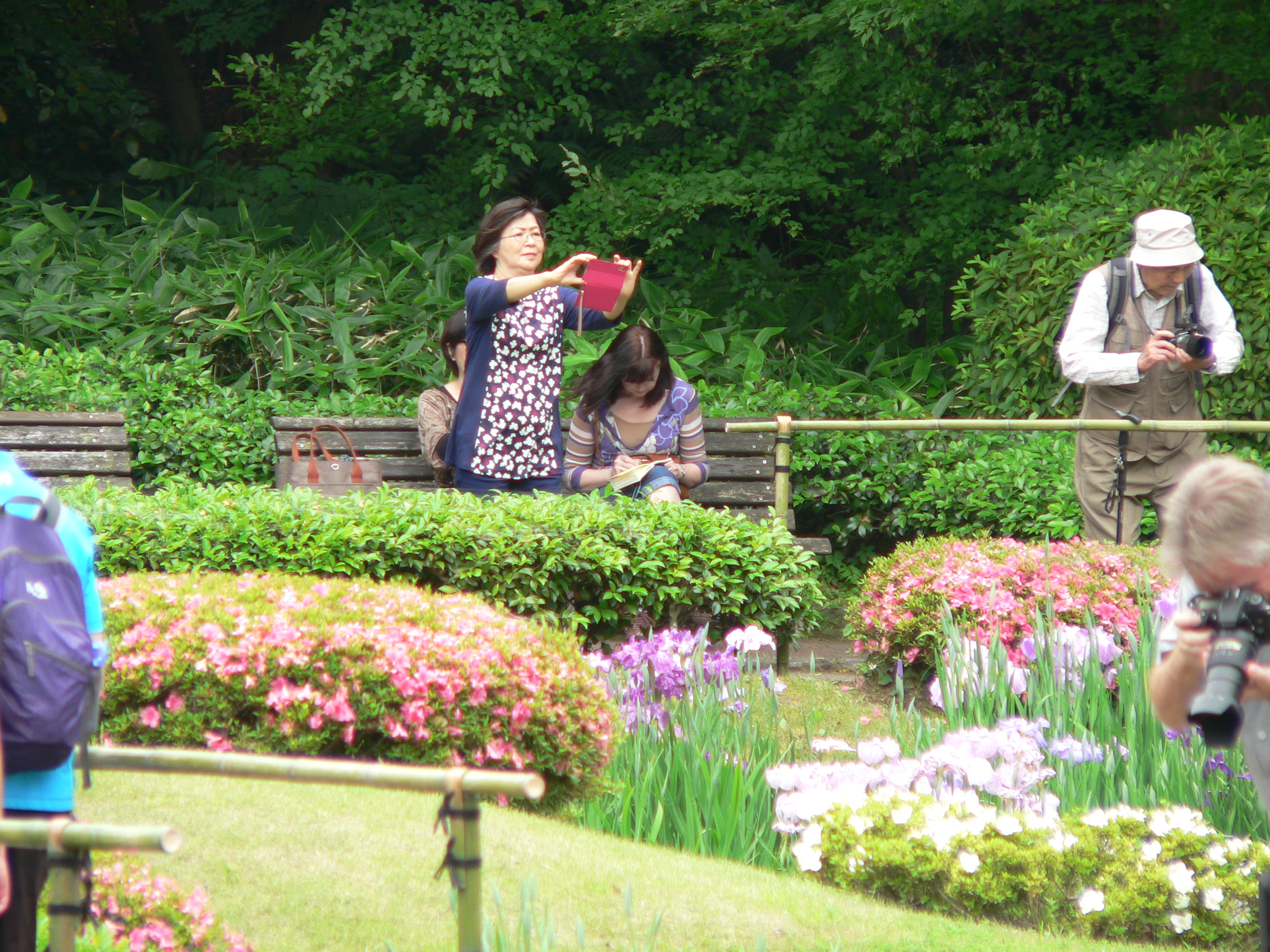
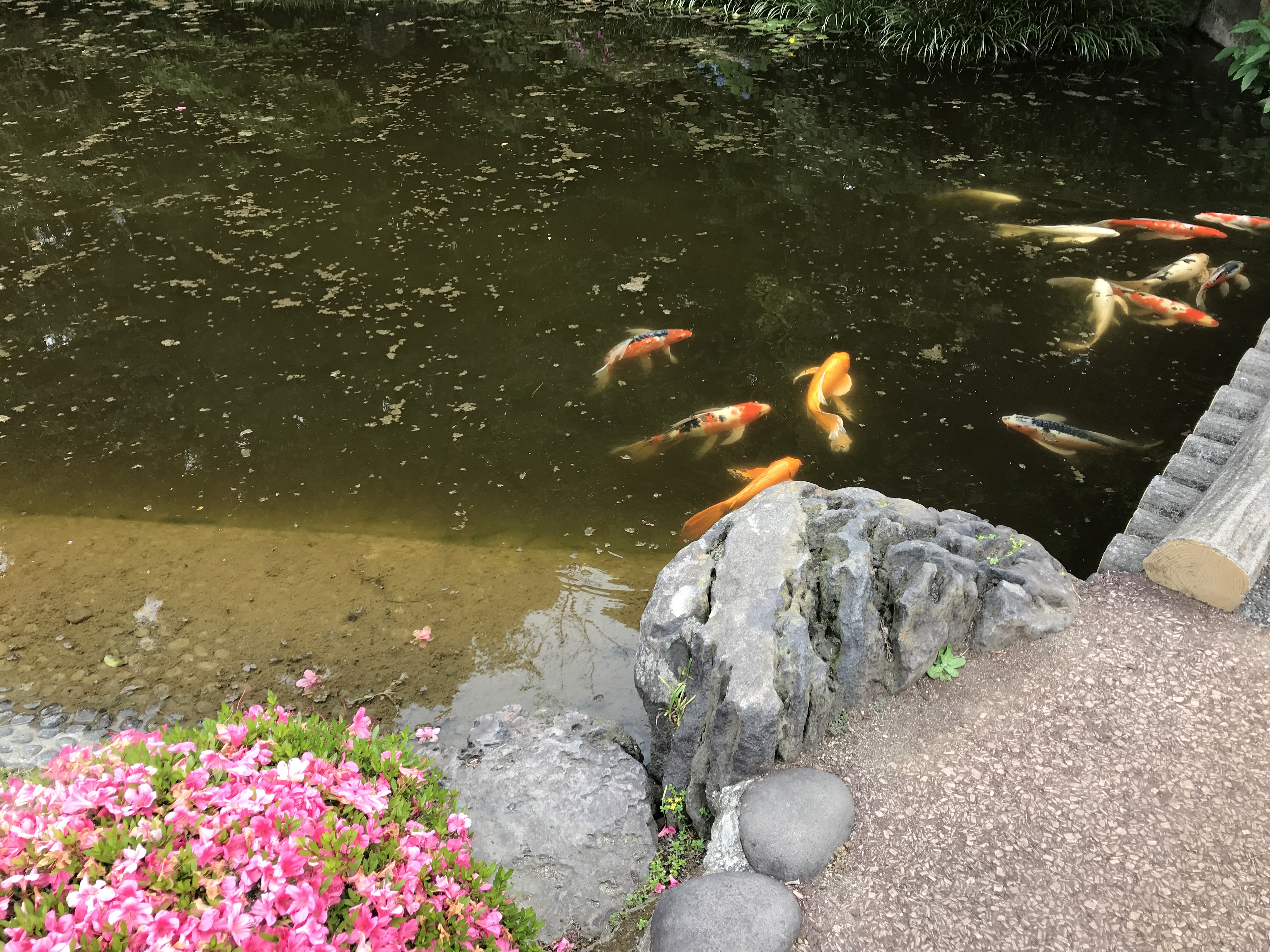
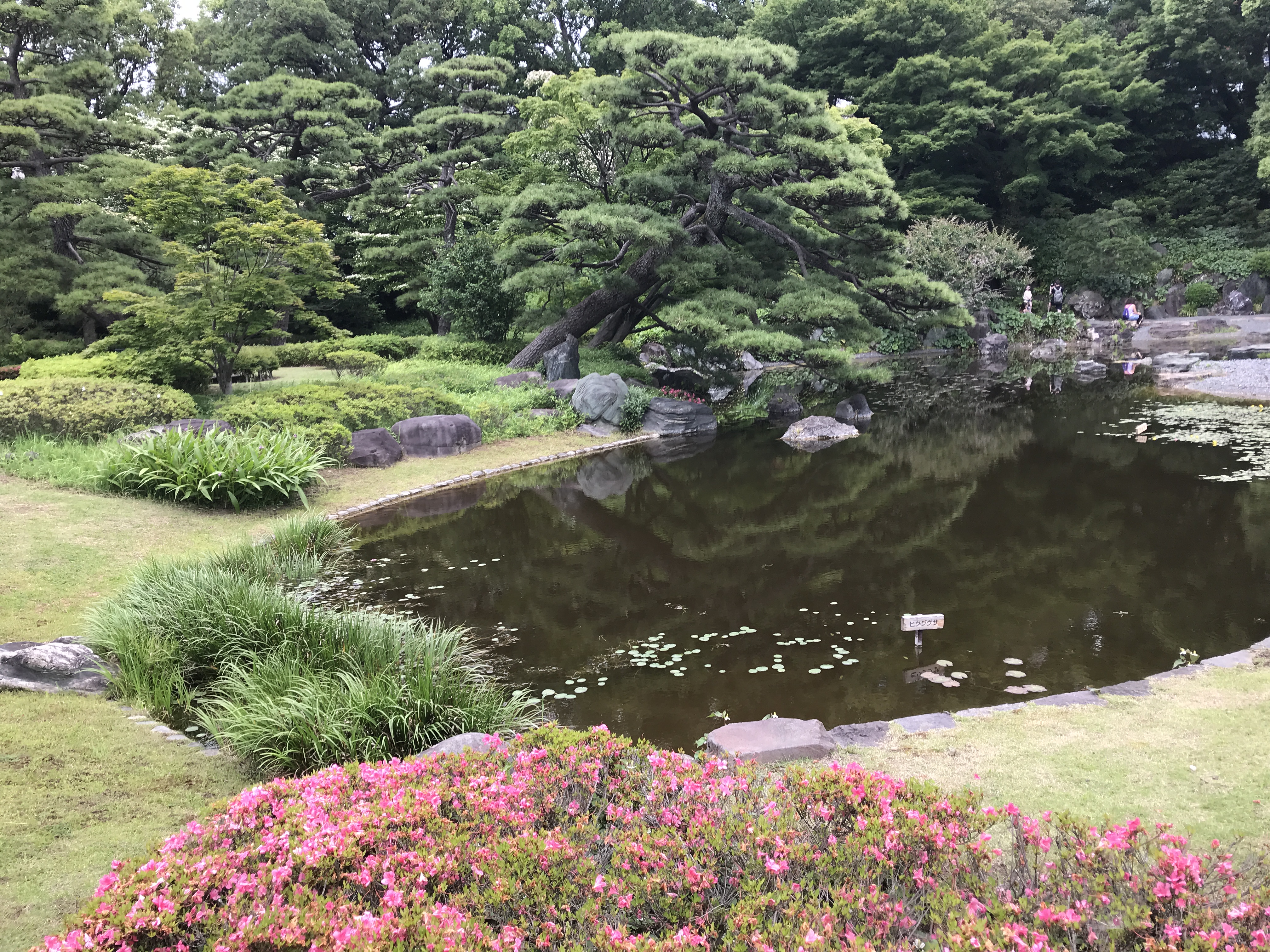
I turn a corner, and happen upon a small pond, filled with water irises all in bloom, their sword-shaped leaves reaching towards the sky. The pond is edged with azalea and has a backdrop of shaped fir trees. It is beautiful, a tiny spot of perfection.

Husband took a sneaky photo of me while I was writing this.

All around me, people are taking photographs. There are kneeling professionals, aiming long lenses for the best angle, tourists with iphones, teenagers taking selfies. Everyone pauses, surprised by the beauty, snaps a shot. Then they move on. Very few make use of the wooden benches, stop a while, take time to absorb the scene. We have become a species that rushes to record, to collect, to own. But we rarely live in the moment. How many of these photographs, I wonder, will be examined, enjoyed. Or will they too be quickly glanced at before put away, the next event always being more pressing, more important.

This was art. The sculptured trees, the colour, the trickle of water, the flash of bright koi as they swam through lilies. I was startled by the beauty. It is, perhaps, the most beautiful scene I have ever encountered. Thank you for sharing it with me.

****

The water irises can be seen at the Imperial Palace in Tokyo.

Why not sign up to follow my blog?

anneethompson.com

*****

The latest, and best book (in my opinion). An exciting novel written in the first person, which shows how a psychopath views the world. The story encompasses the world of women trafficked in India, and shows how someone very bad, can be used to achieve something amazing.

A gritty thriller, which shows what it means to be a psychopath, and how it would feel if someone in your family did something awful. (Because every psychopath has a mother.)

Hidden Faces by Anne E. Thompson.
An easy read, feel good novel, set in an infant school. An ideal gift, this is a book to make you smile.

Thank you for reading. If you enjoyed this, why not buy one of my novels? For the month of June, I am selling them for the special summer price of £7.95* each, or all three for £20, with free UK postage. They make great holiday reading.

If you would like a copy, use the contact form below.

← Back

Thank you for your response. ✨

*Compares with the £11.95 plus postage from Waterstones and WH Smith.

Payment is by cheque or bank transfer, and is required when books have been received.


First Impressions of Tokyo


First Impressions of Tokyo

Arrived in Tokyo after a week of obstacles: dog kennels all full, no one able to cover Lunch Club or children’s work, house being painted (will not comment on the wisdom of deciding to arrange for renovations to coincide with a trip away). However, we did finally make it to the airport (after a brief return to the house because one of us forgot to put on shoes and suddenly realised they were wearing slippers – but we won’t comment on that either).

The flight, with BA, was about 11 hours, which is way too long wherever you’re sitting, but if your seat happens to be right next to the toilets, is even more unpleasant. The highlight – which almost made it worth it – was a brilliant view of the peak of Mount Fuji as we landed.

Finally arrived at The Westin in Tokyo. Hard to keep track of time when travelling, so several days had merged into one long one. Hotel was nice, dumped bags and went for a wander.

I have never been to Japan before, and had fairly low expectations. Tokyo is unexpected. It reminds me, on first impressions, of the Stockholm I visited 20 years ago, in that it appears to be very clean and functional but with ugly buildings. And massive flyovers. Things are designed to work efficiently, not to look nice. Perhaps in a city this is sensible – I’m not sure people who work in London are particularly enamoured with the time it takes to edge your way around Trafalgar Square.

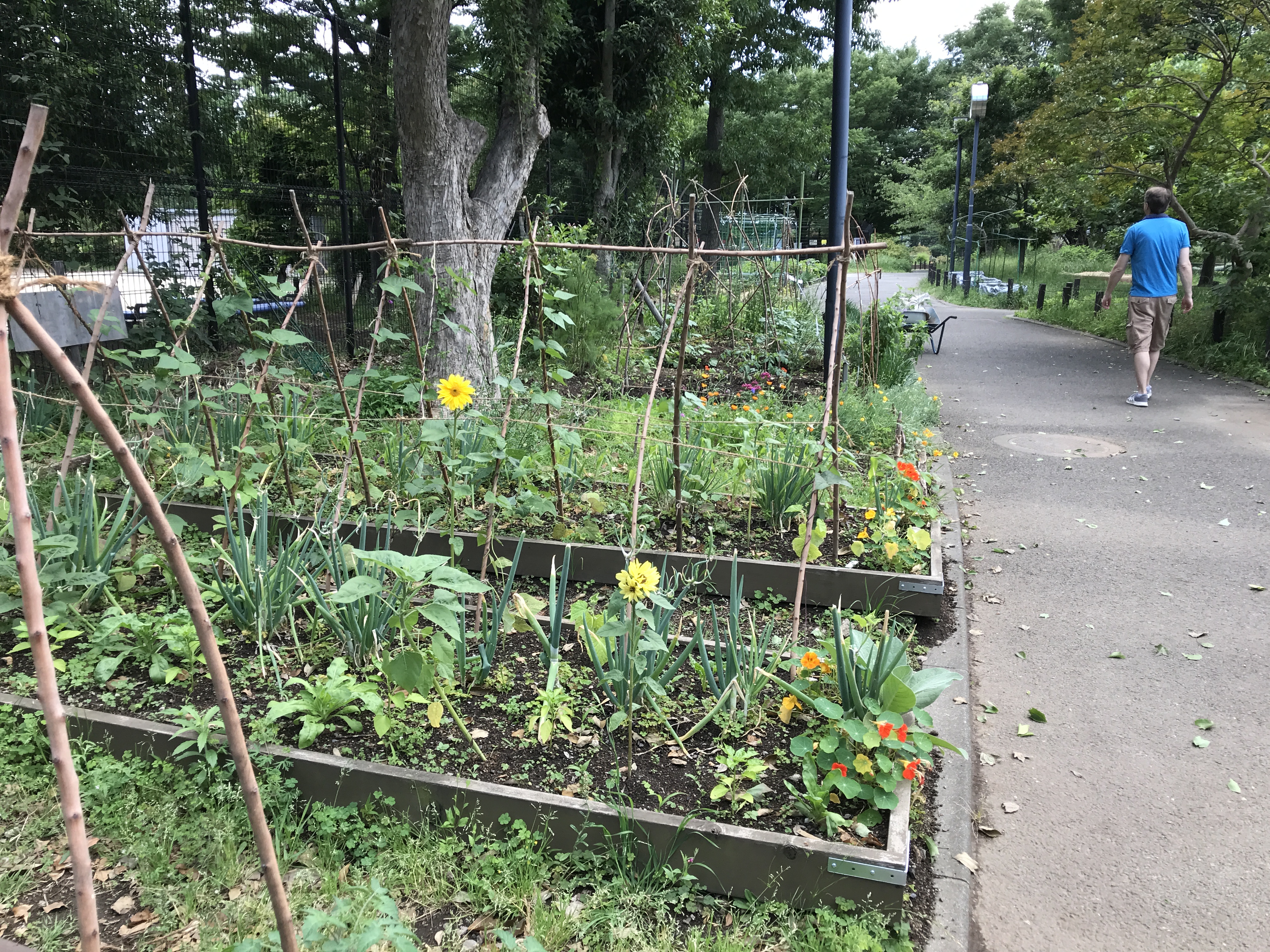
We went for a quick stroll, to a river near the hotel. The weather is humid but not too hot. We wandered through a little park, where school children were growing vegetables. We saw lots of bikes – many of them electric, and lots had a young child sitting in a child seat at the back. Japanese children are very very cute. I am guessing, by the number of bikes left unlocked, some with bags in the basket, that Tokyo has an unusually low crime rate. My mother tends to leave her bicycle unlocked and no one steals it (but then, it is particularly old and unfashionable) but I’ve never seen other bikes abandoned before, and certainly not in cities.

I can tell you that: everyone obeys the traffic signals, the streets are very clean, and everyone has the same hair as me. This is weird, and feels rather surreal (perhaps not helped by being awake for about 36 hours now). In England, straight dark hair is fairly unusual, but here everyone has it. It is like looking at the back of me all the time. People are also very smart, and I feel scruffy and crumpled. I may have to do some ironing while we’re here.

There are lots of men with flags, who wave you around every obstacle (sort of the opposite to India, where a deep hole in the street will be completely unmarked). There are also vending machines everywhere. As in, everywhere.

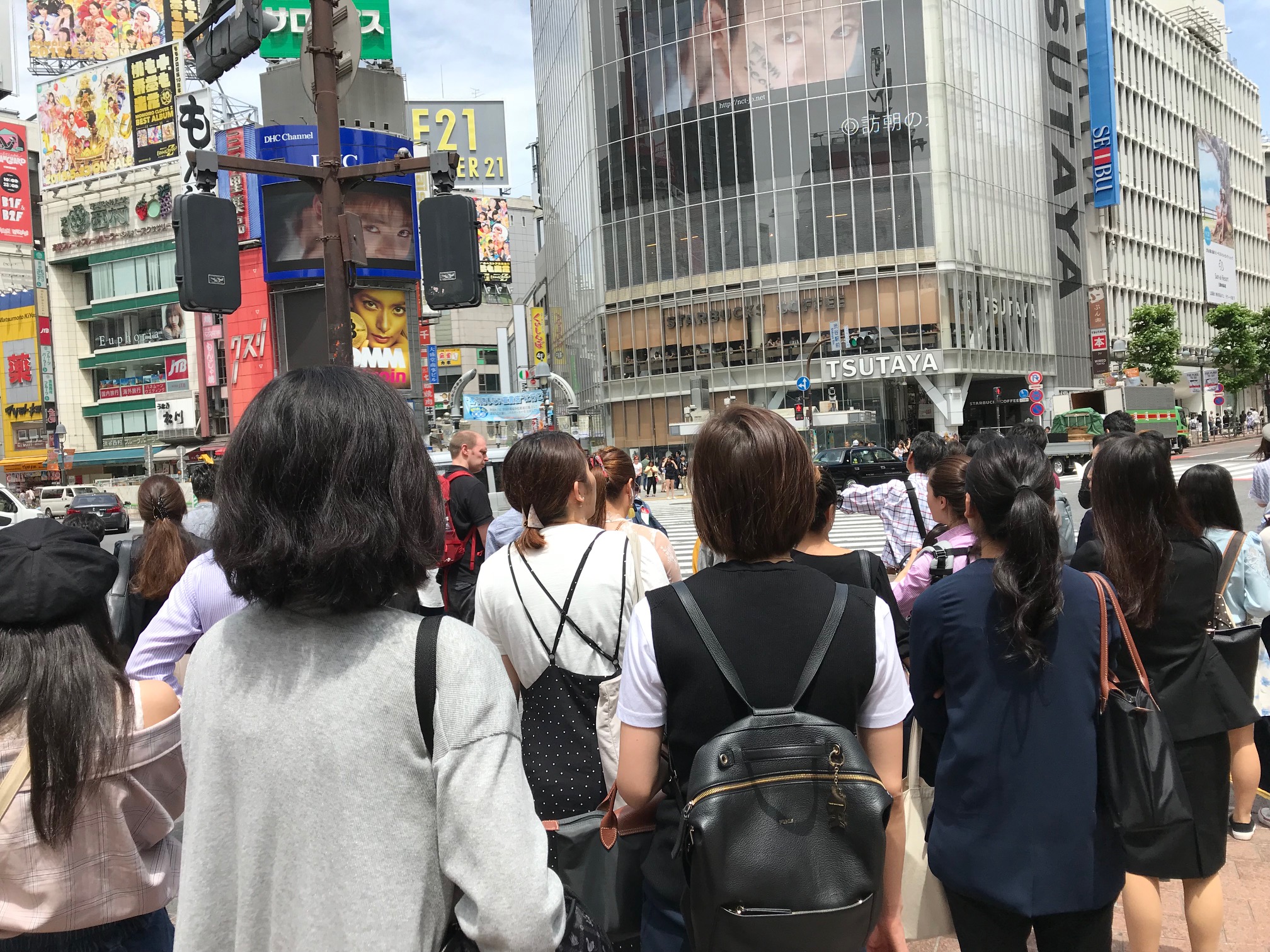
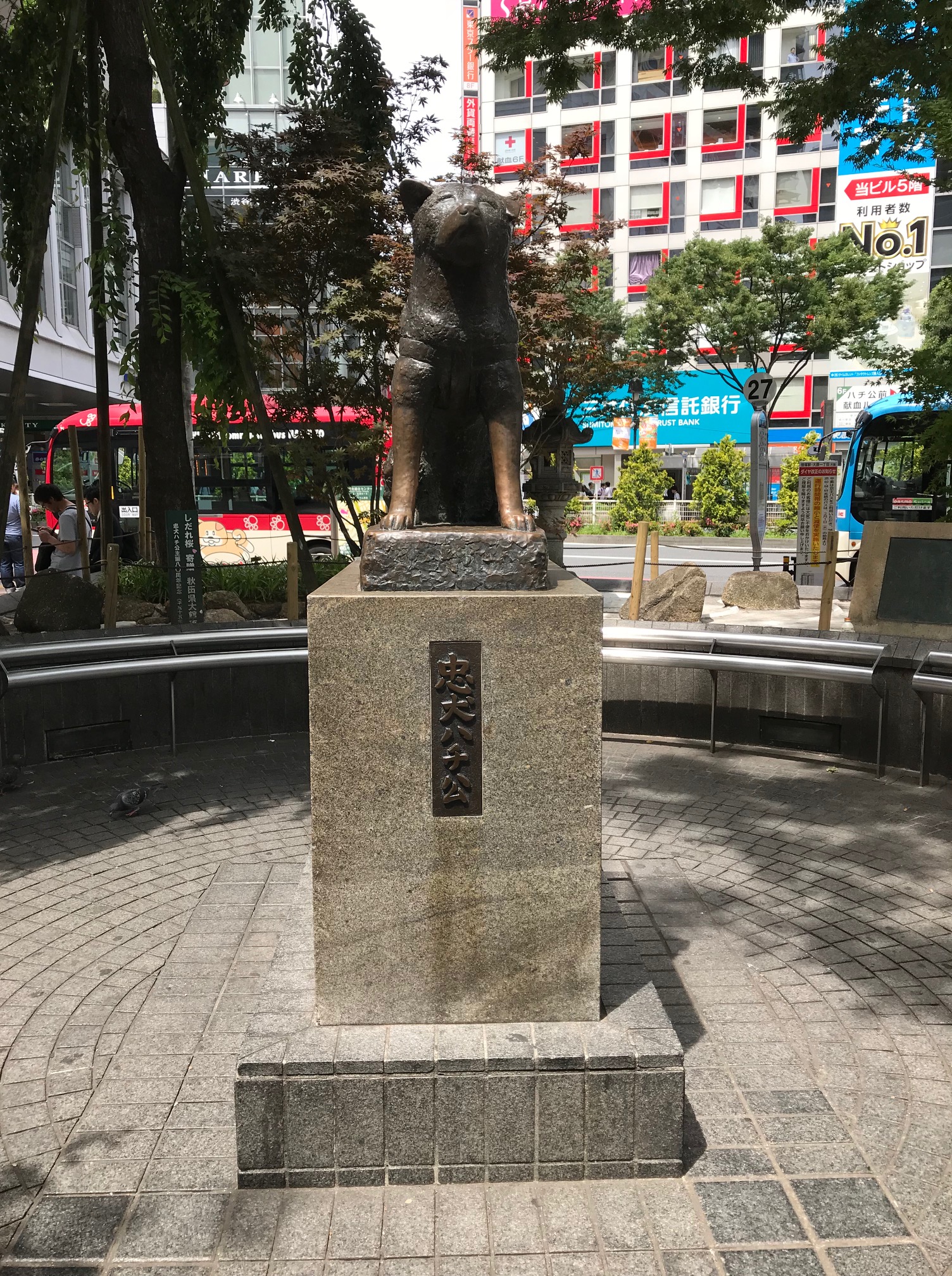
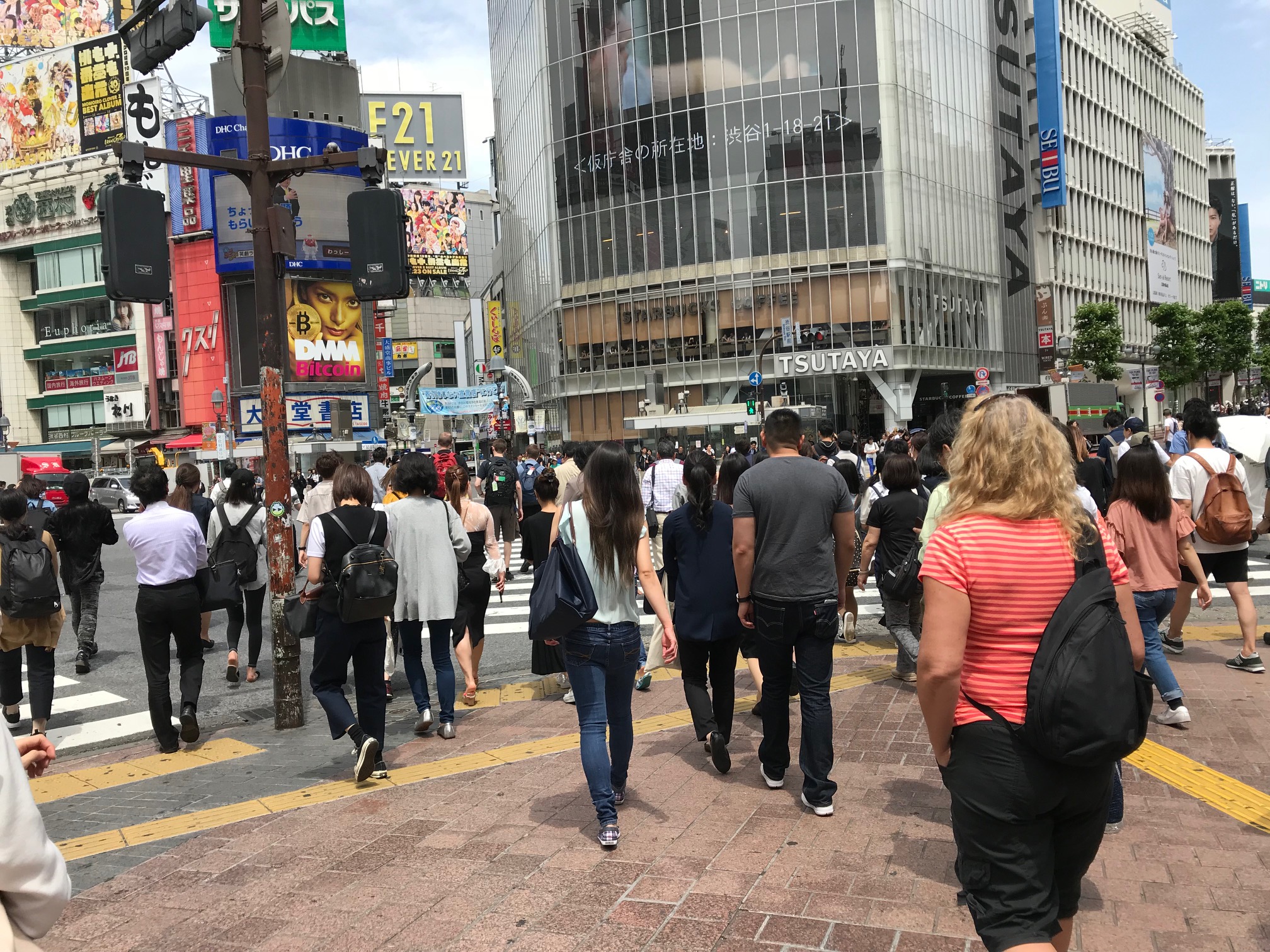
We went to the Shibuya district. There’s a statue of Hachiko, a dog who sat outside the station every night waiting for his master, for ten years after his death. We also saw a famous road crossing, where people were pausing, in the middle, to take photographs – it’s one of the iconic scenes of Tokyo.

We wandered around a district which appeared to be full of hairdressers – lots of shop windows filled with photos of women’s faces. Read the Chinese characters, and realised that they were in fact brothels – suggested to Husband that we might find a better area to walk around.

Went back to Ebisu district, which is where our hotel is. Wanted dinner, but didn’t have the energy to cope with anything unfamiliar, so opted for Burger King. Buying a burger in a foreign language is challenge enough, but a combination of pointing and smiling, plus a very helpful server, managed to buy a couple of burgers. In Japan, “small” means small – I think I had a child’s dinner (about 8 fries and a half-sized coke).

We pretty much sussed the underground system – I will explain it in another blog, but it’s a brilliant way to get around Tokyo. I’m looking forward to discovering more of this city.

Went to bed feeling exhausted but not at all sleepy. The joys of jet-lag…

*****

Thank you for reading.

Why not sign up to follow my blog?
anneethompson.com

*****

If you enjoyed this, you will love my new book: The Sarcastic Mother’s Holiday Diary.
I have always written a diary on holiday, so last Christmas, I decided to find all my old diaries and blogs, and make a book for my children. However, several other people also asked for a copy, so I have written a public version – it’s available on Amazon and has been described as “The Durrells meet Bill Bryson”!

Why not buy a copy today? I think it will make you laugh.

The US link is here:

https://www.amazon.com/Sarcastic-Mothers-Holiday-Diary-ebook/dp/B07N95281F/ref=sr_1_1?ie=UTF8&qid=1549015525&sr=8-1&keywords=the+sarcastic+mothers+holiday+diary

The India link is here:

https://www.amazon.in/Sarcastic-Mothers-Holiday-Diary-ebook/dp/B07N95281F/ref=sr_1_1?ie=UTF8&qid=1549015429&sr=8-1&keywords=the+sarcastic+mothers+holiday+diary

The UK link is here:
https://www.amazon.co.uk/Sarcastic-Mothers-Holiday-Diary-ebook/dp/B07N95281F/ref=sr_1_2?ie=UTF8&qid=1549014970&sr=8-2&keywords=the+sarcastic+mothers+holiday+diary


A Letter to my Children : Visiting the ancestors in Hankerton.

Dear Children,

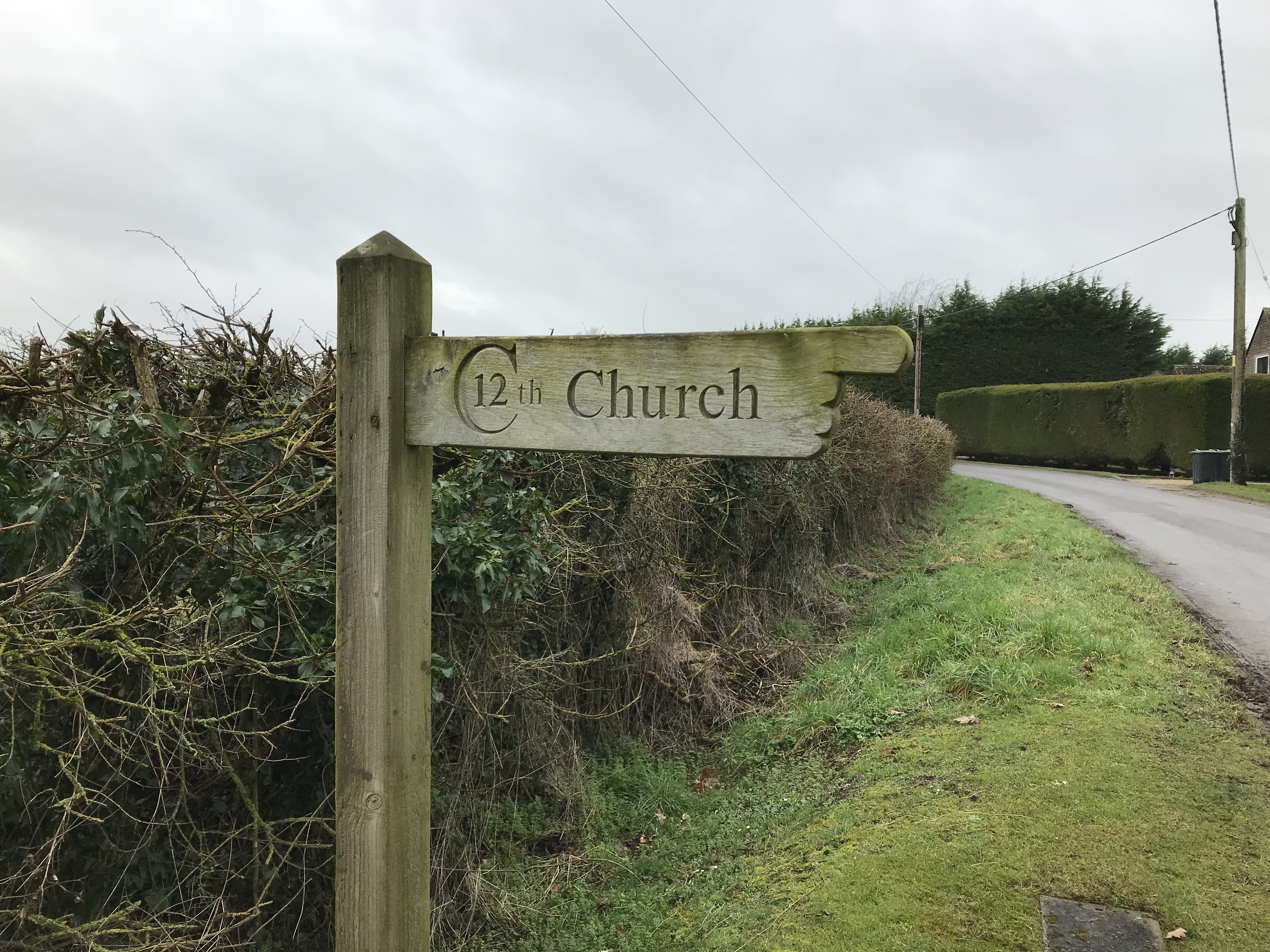
Today I went to Hankerton, in Wiltshire. It’s a hamlet, a scattering of houses and a tiny church set in the Wiltshire countryside. It’s where my granny was born and raised, and is full of family history. It is your history too, so I will tell you about it, because one day you might visit on your own.

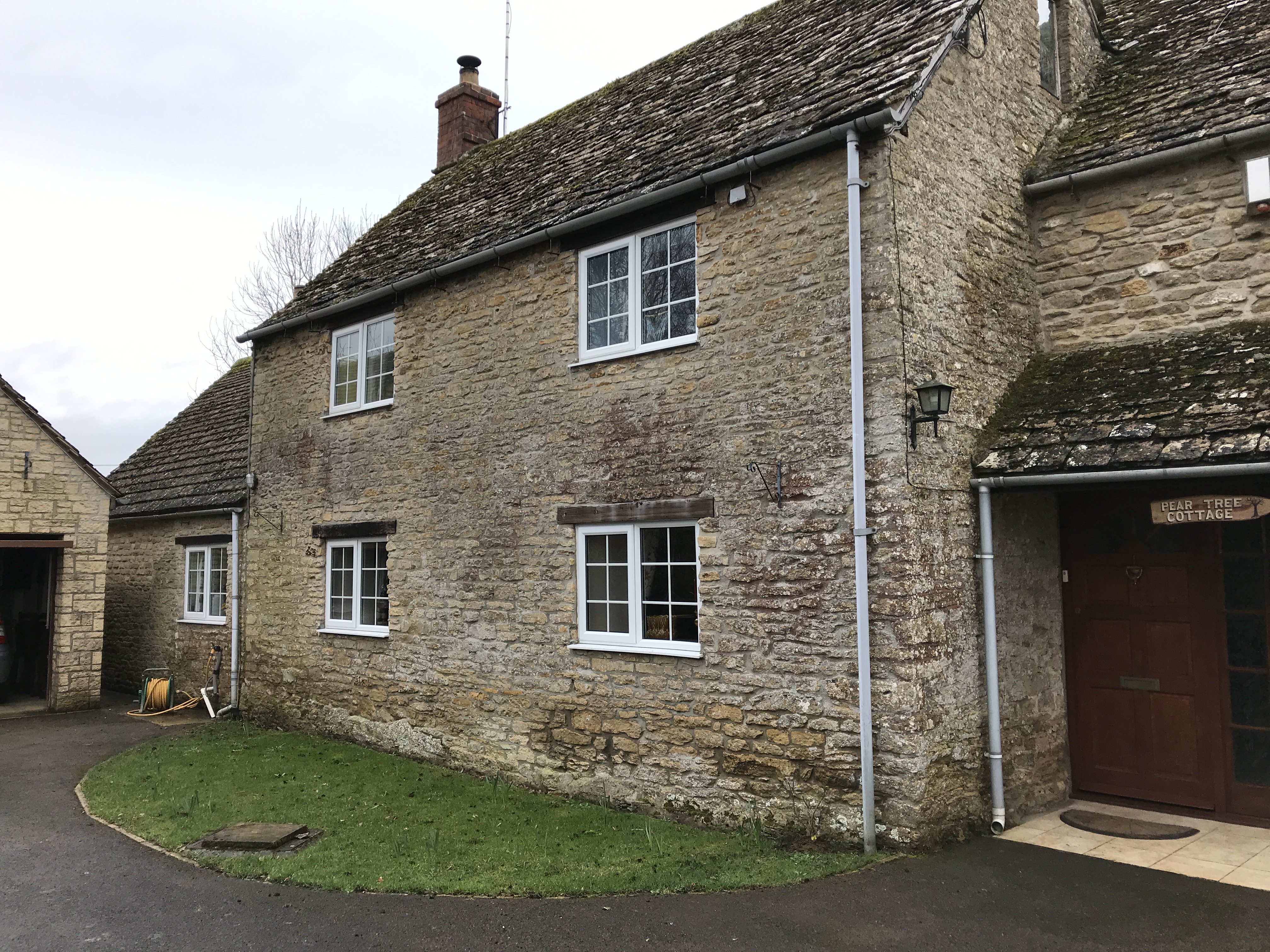
Granny was born in Pear Tree cottage. She lived there with her parents, Mark and Mary Woodward. Mary washed clothes for the surrounding houses, and there was a well in the back garden, and a wash house next to the cottage. Mark was a busy man. I think he built part of the roof for the church, so maybe he was a builder. Mainly he was busy, because, it was later discovered, he actually had two families – my granny’s mother and another wife and children in the nearby market town of Malmesbury. Not sure which one was first, and therefore the legal wife. I have no idea what became of the other family, or if they resemble us or know of our existence. But Mark Woodward died in his fifties, and there is no stone to mark his grave. His wife was buried alone.

The story I grew up with, was that when he died, both wives went to claim the body, which is how they discovered the other existed. I have since been told that isn’t true, and that Granny’s mother was shopping in Malmesbury, when she overheard someone talking about Mark’s other wife. I’ve no idea which is correct, so believe whichever you like. It makes for an interesting bit of family history though.

I visited the cottage once, when I was very young. I remember the big room with the fireplace, and the well in the back garden. When I went back today, I met the people who now live there, and they invited me inside. The ‘big room’ is now their lounge, and they’ve extended the cottage on both sides. The well is now at the front, as the original cottage faced away from what is now the road, so when they extended they made a new front door (at the back, which is now the front, if you see what I mean).

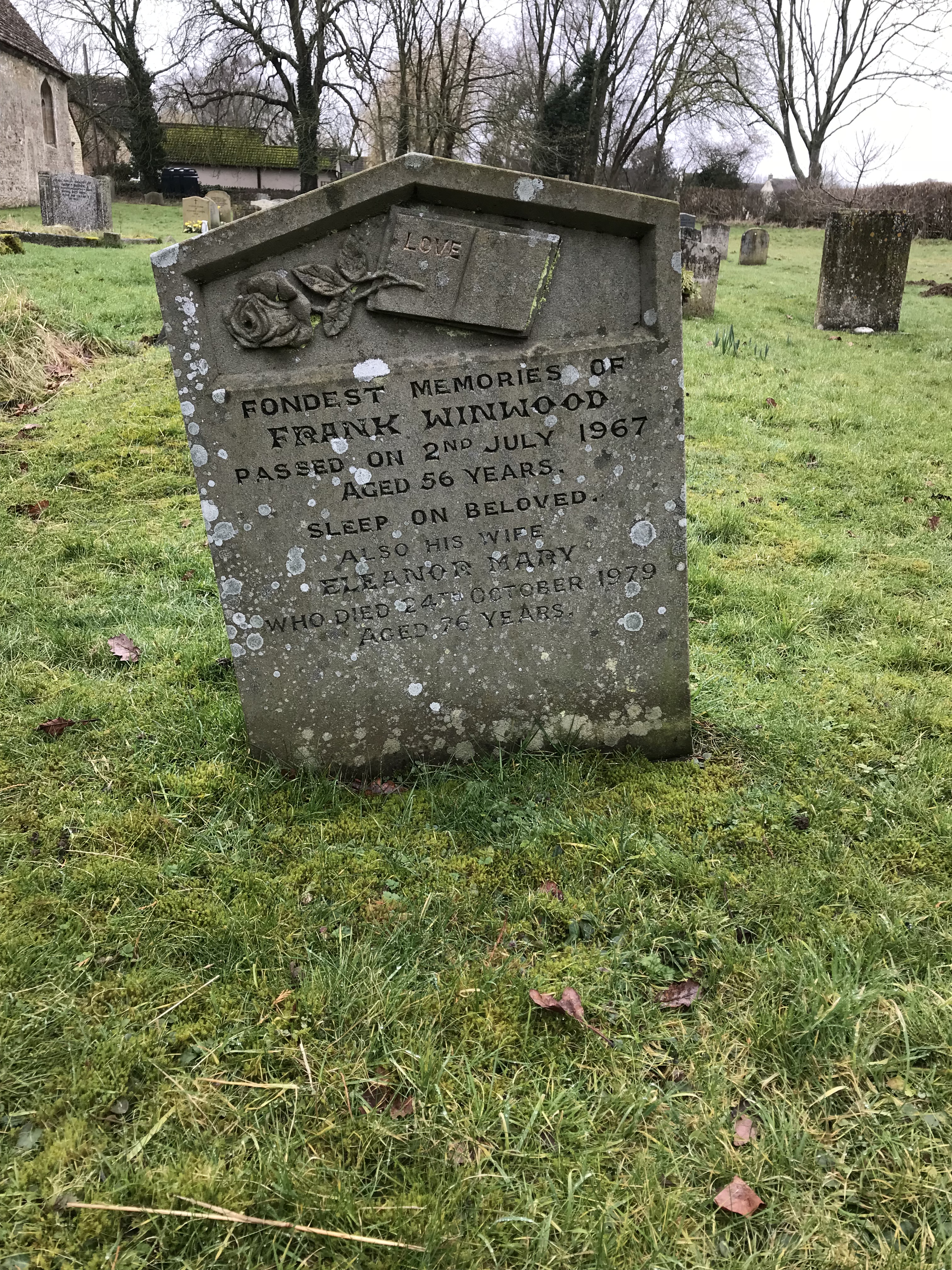
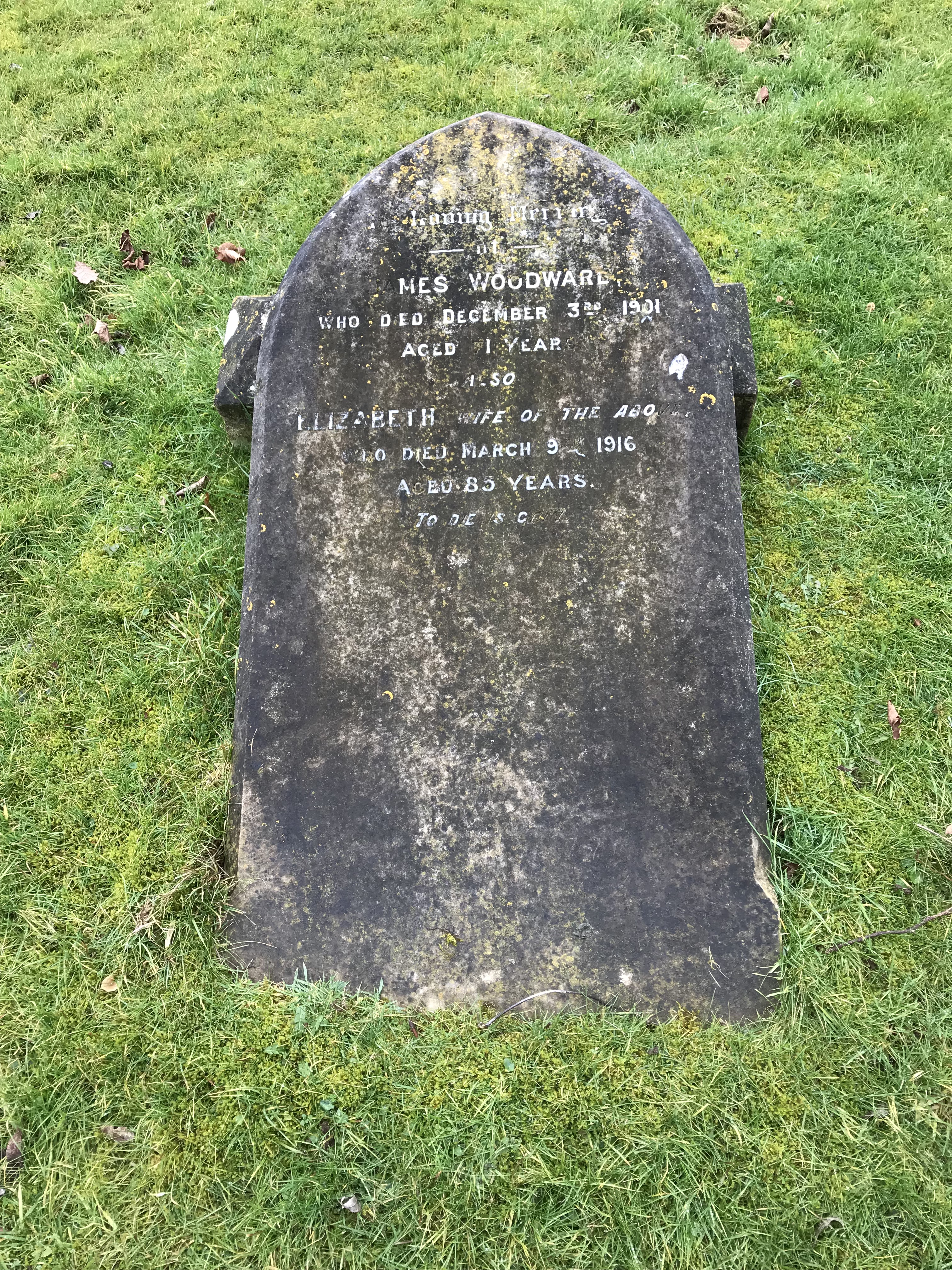
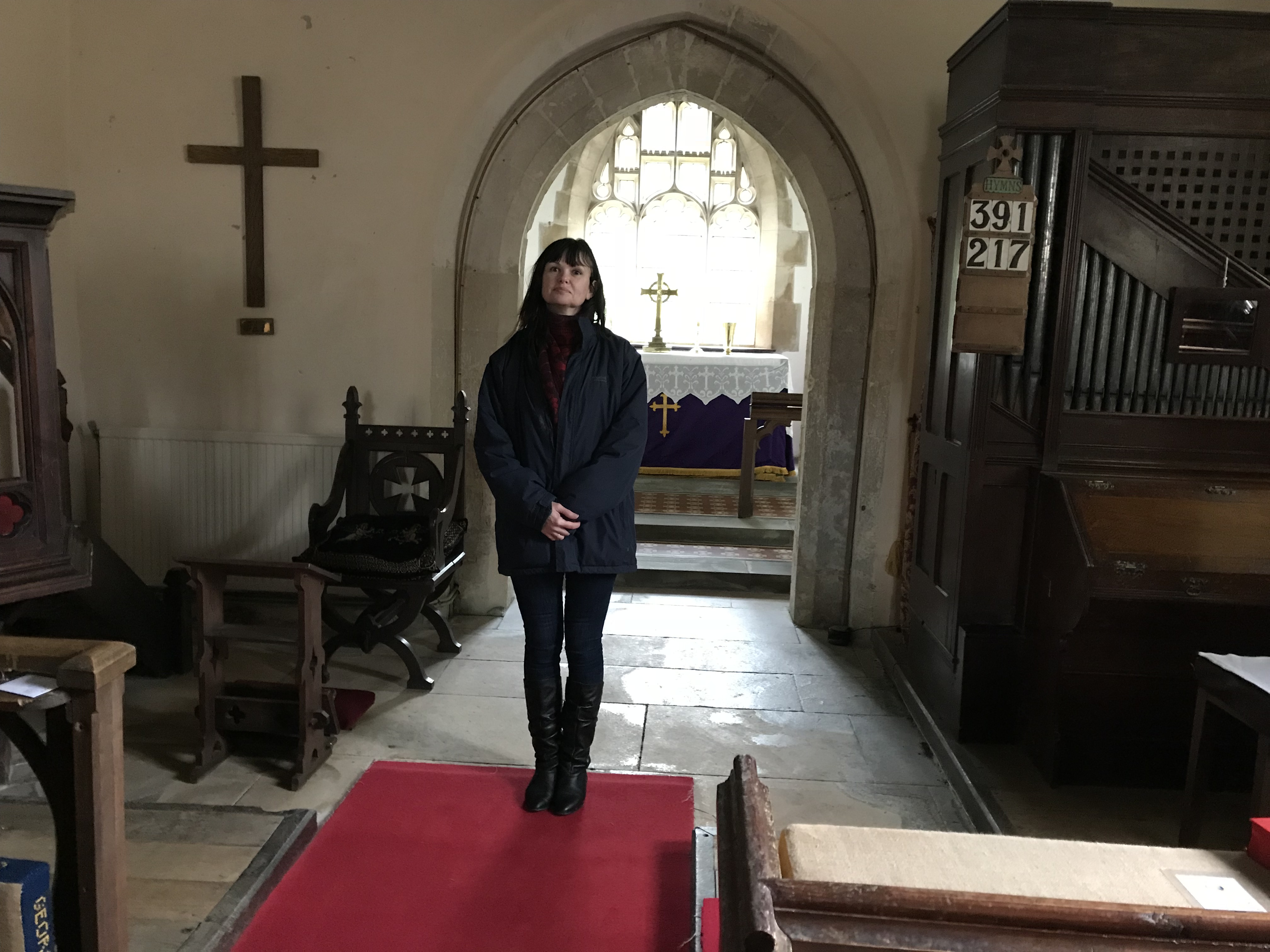
The church is where my granny was married. It is also where many of the family are buried, and as you wander around the graveyard, lots of the stones belong to Woodwards. One grave is for Frank Winwood. I never met him, though I know he had a heat attack while driving, and his wife, Nell, had to grab the wheel. I did meet Nell. Aunty Nell lived in Peartree cottage after everyone else had left. She went a bit nutty towards the end, and had to be put into a home, which she didn’t like, so she used to turn the fire hose on the nurses and phone 999, asking to be rescued. She was buried with her husband Frank (her real name was Eleanor).

Granny’s other sister, Elizabeth, died before I was born. She had two sons, David and Ken, and we used to meet David and his family when I was little. Elizabeth died when Ken was born, so I think my granny helped to care for the two boys. Certainly they feature in lots of the stories my father told.

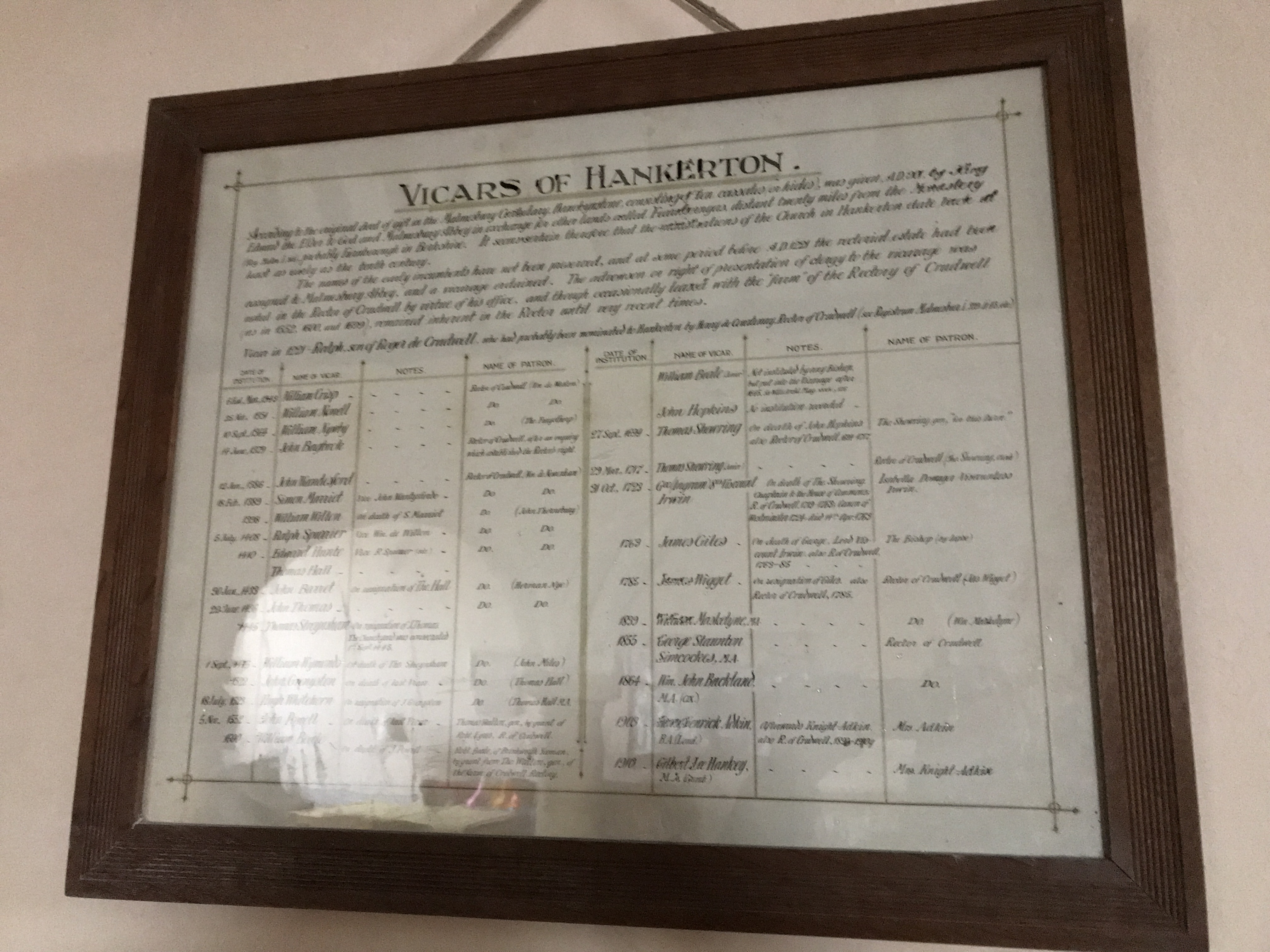
Inside the church, is a document showing all the vicars. In the 1600s were two vicars named Beale, who are also our ancestors. Some of my cousins have Beale in their names (not sure why my brother doesn’t, guess my mum didn’t like the name).

Next to the church is the old school house. When my granny’s mother was dying, Granny went to nurse her, and so my dad (your Grampy) went to school there for a few weeks. You will find his name in old registers.

You never met my granny, but you’d have liked her. She had a wicked sense of humour, and she told stories. I wonder if that’s where me and Aunty Ruth get our love of stories from. Most of her stories were ghost stories though, and tales about people in the village. I’m not quite sure now which ones were true, and which ones she made up. When her father died, when she was fourteen, she had to leave the grammar school in Malmesbury, and join her mother washing clothes. I sometimes wonder what her life would have been, if she’d been able to choose.

So, that’s a little family history for you, an eighth of who you are. If you ever go through Hankerton, remember to stop and visit the church. It’s a lovely place, and has a comfortable feel to it. It’s where our roots are, and I think you’ll like it.

I don’t know much about my Grampy’s family, but I do know about my mother’s relatives, who seem to have owned most of Huntingdon. Now there are some stories for you – but that will have to wait until another day.

Have a good week. Take care.

Love,

Mum xx

****

Thank you for reading.
anneethompson.com

If you enjoyed this, why not have a look at my latest novel? Amazon UK link below:
https://www.amazon.co.uk/CLARA-Good-Psychopath-Anne-Thompson/dp/0995463255/ref=sr_1_1?ie=UTF8&qid=1521032827&sr=8-1&keywords=clara+by+anne+thompson

****

Anne E. Thompson has written several novels and non-fiction books. You can find her work in bookshops and Amazon.
Why not sign up to follow her blog today?
anneethompson.com

Instow, Devon, continued


3rd Day

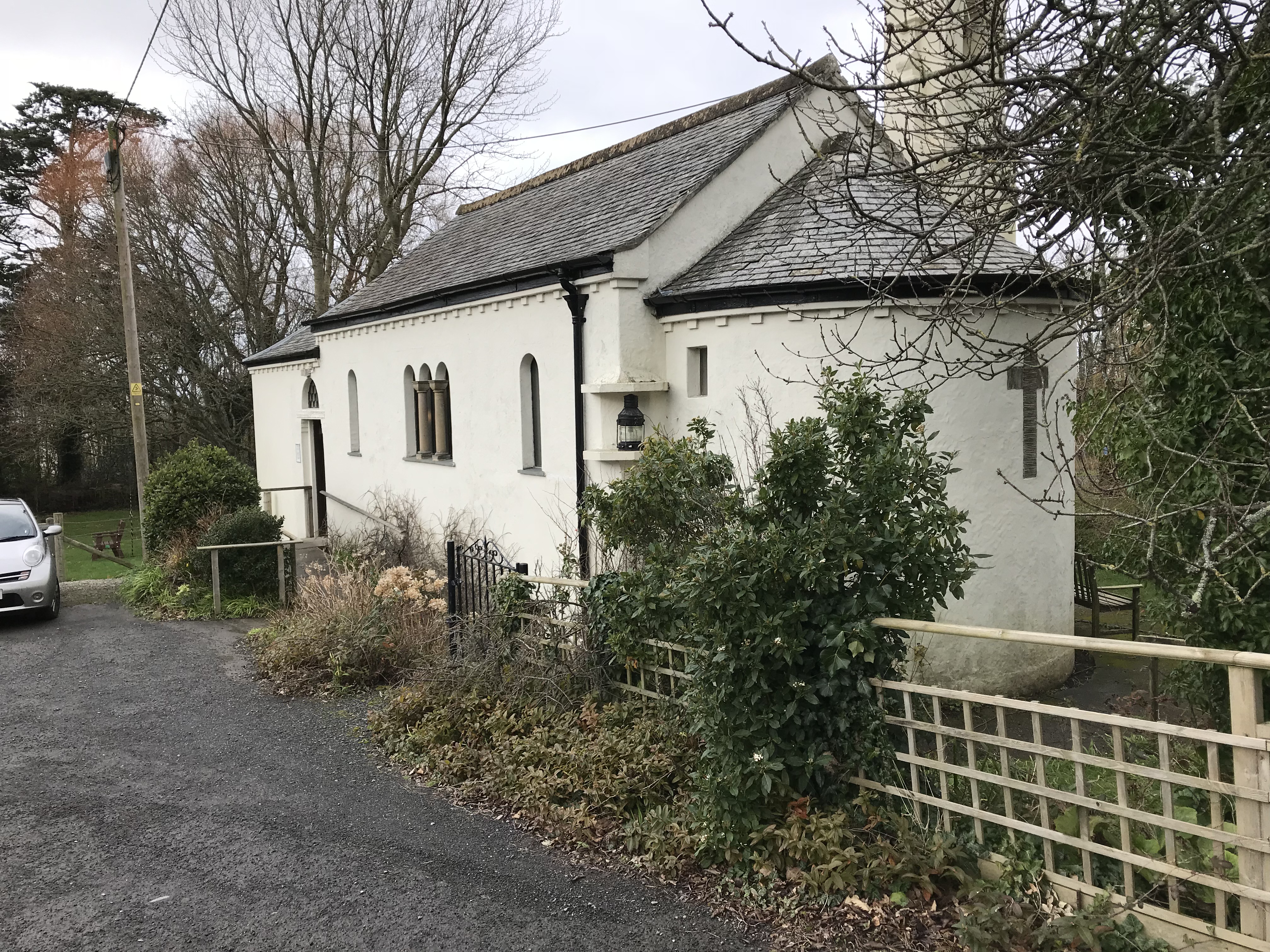
Went for an early walk along beach. Dog happy. Then I went to church, walking up to the little white hall I found yesterday. I’m not sure how old it was, but it wasn’t modern. Nor was it huge – it was pretty full, and I think there were 18 of us. It’s always a bit scary going to a new church – will anyone speak to you, or will people just stare and make you feel uncomfortable…This church was fine. People looked up and smiled when I arrived, which is always a good sign, and the Vicar came out from wherever he was hiding, just to say hello and ask where I was from. He was a retired policeman, and worked part-time, covering a couple of little churches. The service was nice, very traditional, with an easy, friendly atmosphere. You felt like everyone knew each other well, and it was nice to sit at the back and absorb it all. (Apart from the singing – you wouldn’t want to absorb that – despite the best efforts of the man on the keyboard, it was somewhat rough…)

We had a quick lunch in John’s Cafe (best cafe in the world). Then we drove to Abbotsham, which is sort of attached to Westward Ho. We parked near the cliff, on the edge of a caravan park, and set off for a walk.

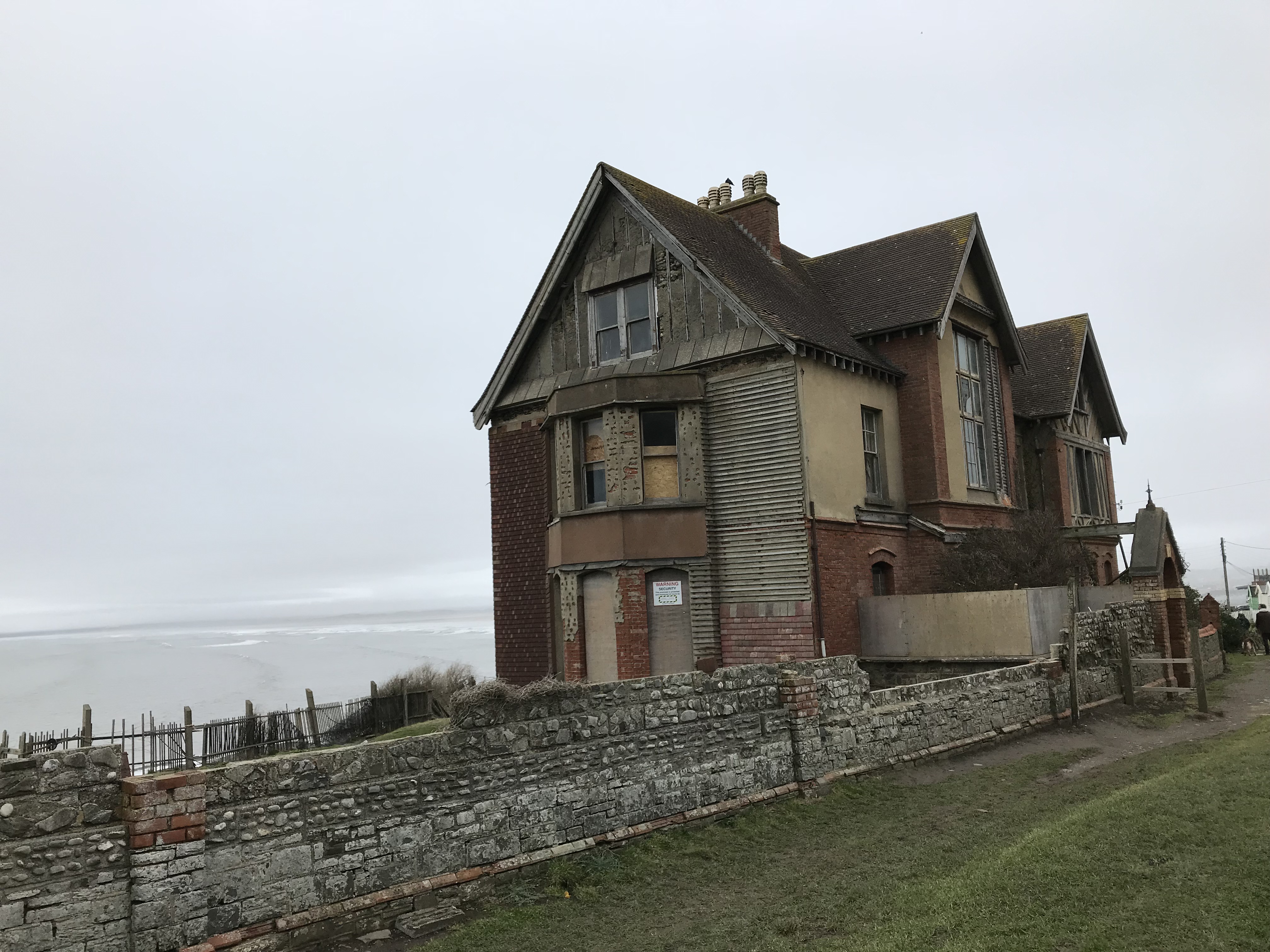
The first thing you see is a house. A superb house. It’s huge, facing right out to sea, and is very beautiful. Unfortunately it appears to be falling down the cliff and is now derelict. I walked all round it, looking for a place to break in, but the security was pretty tight. Shame. I would like to die in a house like that. When the medics announce that my end is near, I hope my relatives will break in and rescue me from the beige, airless, machine-filled world of the hospital, and dump me in a derelict house on a cliff edge. Preferably with a stash of morphine, so nothing hurts. Then I can die looking at the sky and listening to sea-gulls and waves. But Husband said this was a morbid thing to say when looking at an old house, and hurried me away along the cliff.

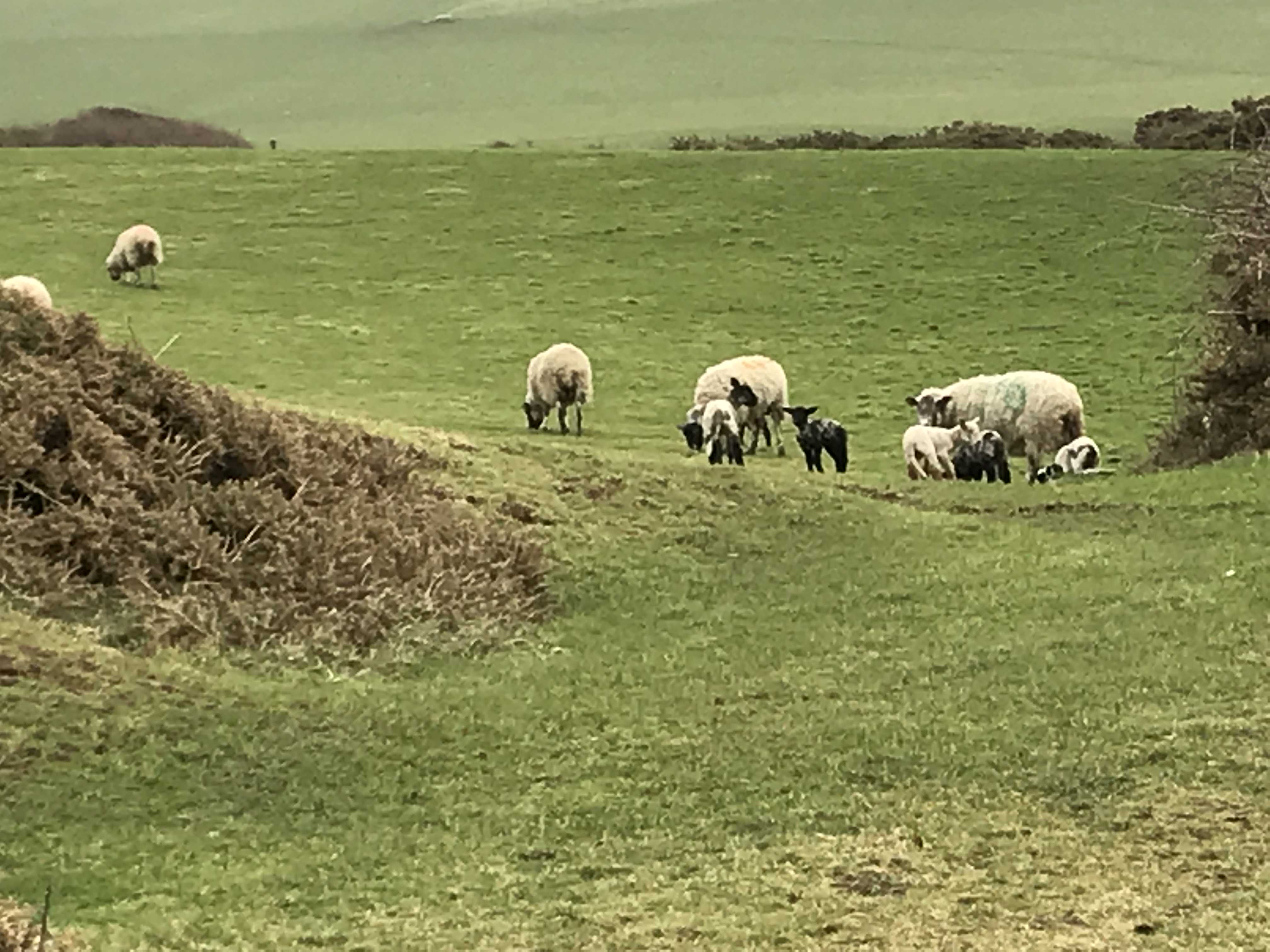
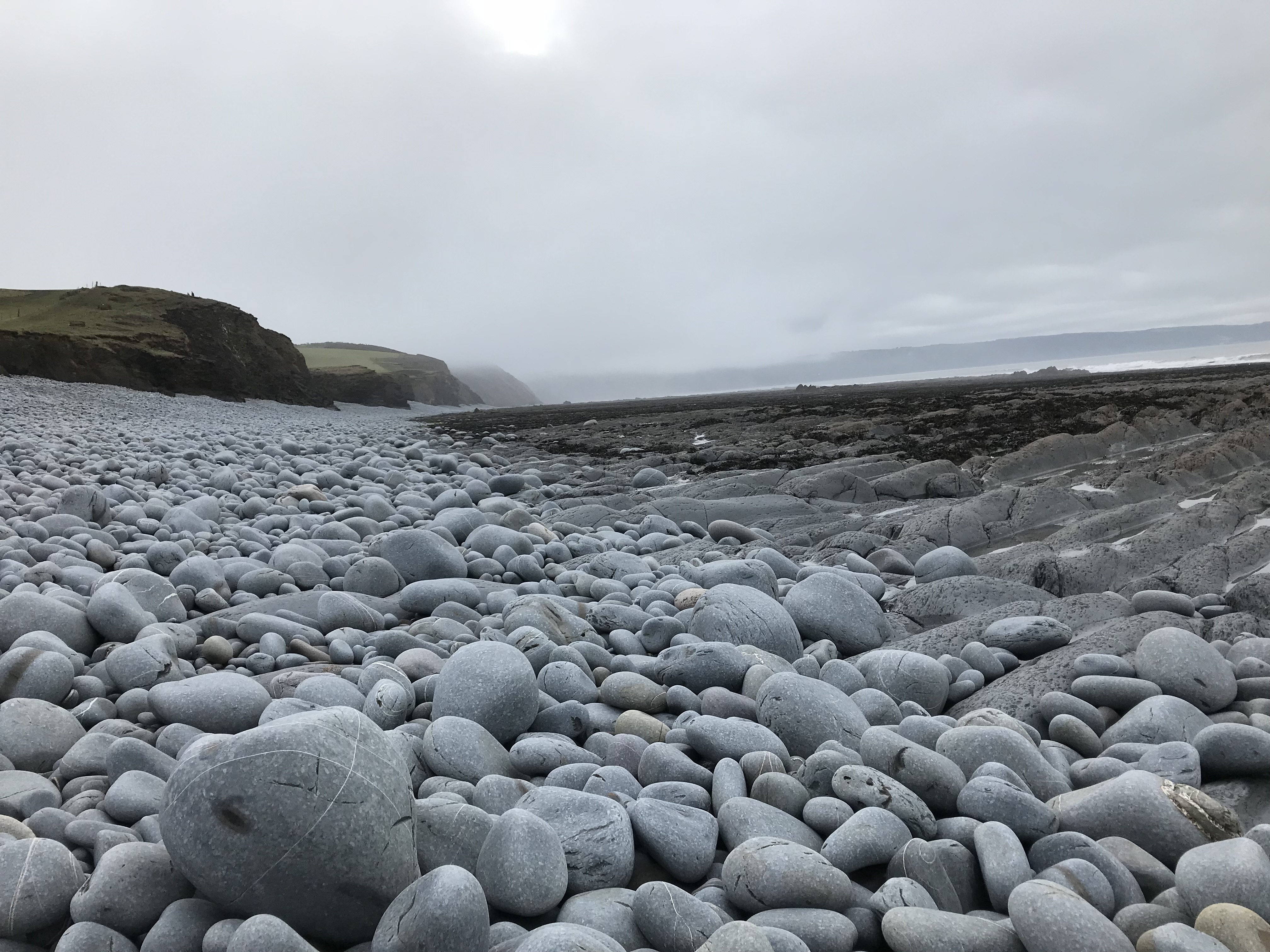
The cliff walk is pretty perfect. There is grass, and gorse, and waves crashing against rocks. Next to us were fields with lambs in. At one point, there was a great mound of pebbles, right up to the cliff path, and we could scramble down onto the rocks and peer into rock pools. Husband was happy, explaining how fresh water channels had formed deep grooves in the rock. The dog was happy, charging up and down the path. I was happy, listening to the sea (and Husband, of course).

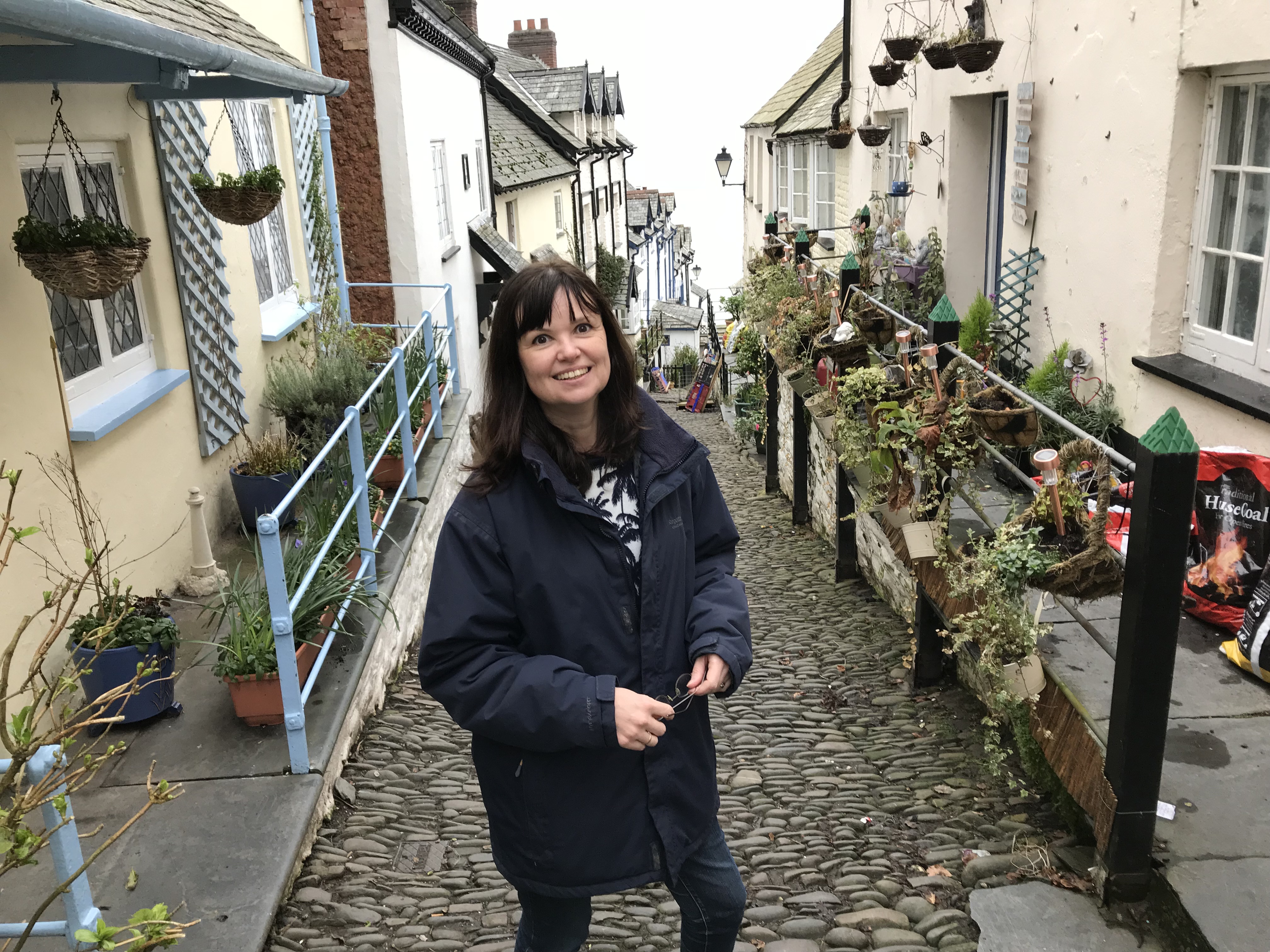
A long walk in Devon makes you hungry for a cream tea, so we decided to go to Clovelly, which we visited years ago when the children were small. The car-park is at the top of the village, and you have to pay to enter the village, because it’s all owned by the big estate. But as we were out of season, it was all free, and empty. I have never seen Clovelly empty before, usually it’s teeming with tourists. The village clings to the cliff, and has a cobbled street that meanders down to the harbour. The cobble stones make for pretty tough walking, so don’t wear heels. Or bring a pushchair (I can tell you, from previous experience, a pushchair is a very bad idea).

We walked down to the harbour, and The Red Lion pub was open. There was a fire burning in the snug, and they had cream teas. The tea was a bit ‘packaged’, but actually the scones were soft, and it is not the worst tea I’ve had. Sitting in the window seat, looking out to sea, it was timeless.

Then came the long slog back up the slippery cobble stones to the car park.

When I got back to the cottage, I checked my clever phone app to see how far we’d walked that day. I was sure it was further than the previous day (which was 16 km). I was surprised to see it was only 12km. Then I noticed I had climbed 52 staircases. Clearly the app can’t differentiate, and up and down is a staircase, even when it’s along a cliff edge.

Tomorrow we’re going home, but plan to drive back via Hankerton, where my granny lived as a girl.

Thank you for reading.
Take care.
Love,
Anne x

*****

You can sign up to follow my blog at:
anneethompson.com

***