Being Mortal: Thinking About Being Elderly


Atul Gawande, Being Mortal (London: Profile Books, 2015)

I was lent the book by a medical friend, and after reading half I bought my own copy. It’s the sort of book you want to keep so you can refer back to it. As my PhD will finish by exploring the assisted dying  issue, I need to start learning about the issues that surround dying. This book helped to inform my own thinking, and introduced some new concepts. It also informed my thinking about ageing, and how people might want to live in the final stages of their lives. This has little to do with my studies, and a lot to do with real life. Whether we are old, or helping elderly parents, this book has practical advice and confronts some difficult issues.

Gawande is a doctor, and he spends some time explaining how in old age, it is very important to keep your feet healthy. People are not able to live independently if they cannot walk. A fall in an older person is dangerous—brittle bones break more easily, and the space inside the skull where the brain has shrunk means it gets a nasty jolt in a fall, which can cause all sorts of problems. Therefore, balance is important, and good balance relies on good feet. If someone is unable to properly care for their feet, they are likely to develop problems with balance. [Note to future self: Do some simple balance exercises every day, and keep lifting feet to where I can touch them. ‘Use it or lose it.’]

The first half of the book deals with the ageing process, and how western societies treat their old and infirm. Gawande is American, with Indian heritage, and his comparison of the two cultures was very interesting. Whilst the ‘traditional Indian’ setting of an elderly person living with the extended family, being helped through their old age by younger members sounds idyllic, Gawande is honest about the problems this can entail. Different problems to our western traditions, but still problems. He then discusses the situation in the US.

One topic he discusses are nursing homes. He doesn’t rate them very highly, and compares them to prisons! (p.73) He explains how nursing homes grew from the need in 1954 to provide hospital beds for the elderly when hospitals were too full—so their medical care was transferred to a purpose-designed home. (p.71.) They were all about medical needs, keeping the patients physically safe, and were run to be clean, efficient and safe. Then, in the 1980s, Keren Wilson tried to build a better model, and built an ‘assisted living’ community—where the aim was to allow elderly people to live independently, with the physical help that they needed. They had locks on their doors, privacy, and autonomy. If they wanted to wear pyjamas all day, or eat food that was bad for them, they could.

This led to the assisted living homes we have today, which tend to be a compromise between the two models. He makes the point that homes for the elderly advertise that they are safe and clean—not that the residents can make their own choices. This is because the homes tend to be chosen by the children, not the elderly—and children want their parents to be safe and clean. He writes that this is because ‘it’s often precisely the parents’ cantankerousness and obstinacy about the choices they make that drive children to bring them on the tour to begin with.’ (p.106) He also remarks that this is partly the fault of the parents, ‘because they disperse the decision making to their children . . . It’s sort of like, “Well you’re in charge now.”’(p.106.) [Note to future self: Don’t dump decisions on my children if I am capable of making them myself.]

He does also describe some excellent care homes, some of which introduce things like plants, or animals, or combine with a school so the residents can help the children. He discusses the motivation for living, and that in the end, being ‘safe’ is not enough. People need a role, something beyond themselves, a purpose. Otherwise it seems they disappear inside of themselves and lose the enthusiasm for life. He writes that ‘death rates can be traced to the fundamental human need for a reason to live.’ (p.123.) He discusses Maslow’s hierarchy of needs (the idea that physiological needs—food and water—are more important that safety, which is more important than love/friendship, which is more important than self-esteem, which is more important than self-actualisation.) Gawande considers that above ‘self-actualisation’ is the need for transcendence—the need to go beyond ourselves and help other living creatures. [Note to future self: Find someone/thing to care for.]

Gawande states that the problem, as he sees it, is that we have put issues of life and death with the medics—and they are not necessarily equipped for this. He describes ‘a still unresolved argument about what the function of medicine really is’. (p.187.)[This is my own view too—I think death should be left to philosophers and theologians, not medical professionals.]

Another modern problem—which affects the States more than the UK is the availability of treatments and the way that insurance works. Therefore medics no longer have to question whether a treatment is ‘worth it,’ either financially or in terms of benefit to the patient. If it’s available, and a patient wants it, then they check the insurance company will pay for it and the patient undergoes the treatment. This has a parallel in the UK with pet medical insurance. If our pets are insured, and if the vet suggests a treatment, it is very hard to step back from this, to take a holistic view and decide whether the treatment is actually in the best interests of the pet. We love our pets, we don’t want to lose them—but sometimes I think they suffer more due to invasive treatments than if we just made them comfortable and helped them to die peacefully. Gawande questions whether most of the money spent in the last months of life actually benefits anyone. He suggests this is particularly true at the very end, when patients are hooked up to expensive machines, their lives prolonged by a few days but with no ability to ‘die a good death.’ (My expression.) Unable to say goodbye, or come to terms with what is happening to them, their last moments are reduced to being a patient. He says that people who are dying have priorities other than living for an extra day or two, and ‘technological medical care has utterly failed to meet these needs’ and the financial cost is massive. (p.155.) He suggests that by putting our faith in modern medicine so completely, we have forgotten ‘how to die.’ (p.158.) [Note to future self: Decide what is important to me in the present.]

Gawande is a great believer in palliative care—help to live your final days as well as you can, rather than suffering intrusive uncomfortable treatments trying to extend life by a few more months. He discusses this in the setting of his own father’s death, which makes the discussion both personal and honest. It’s much easier to have a theory about death when it doesn’t touch you. He also lists some questions—difficult to ask ones—which enable families to help their relatives to die how they want to die. This involves asking the person what they fear most about their diagnosis, and what they want the most. (It might be to continue being able to eat, rather than to have the longest possible life!) He also suggests asking what the person would like in an emergency—do they want to have their heart restarted? Do they want aggressive treatments (such as being on a ventilator)? If the answers are known before the emergency happens, then people are able to make the right choices in a crisis situation. He talks about what the aim should be for a terminally ill person, saying it is not about ‘a good death, but a good life to the very end.’ (p. 245.) For Gawande, this means that assisted dying would be a rarity, not the norm—because so much can be done to help a person optimise their last few days, and very few conditions cannot be managed with drugs. [Note to future self: Communicate my wishes to my children, don’t make them have to guess.]

I am still unsure of my own view about assisted dying, so it’s helpful to hear what others think. I found Gawandes book to be a helpful resource, and I value his insight into the issues surrounding old age and the end of life. Now, don’t forget to take care of your feet!
Thanks for reading.
Take care.
Love, Anne x

A Book on Dying


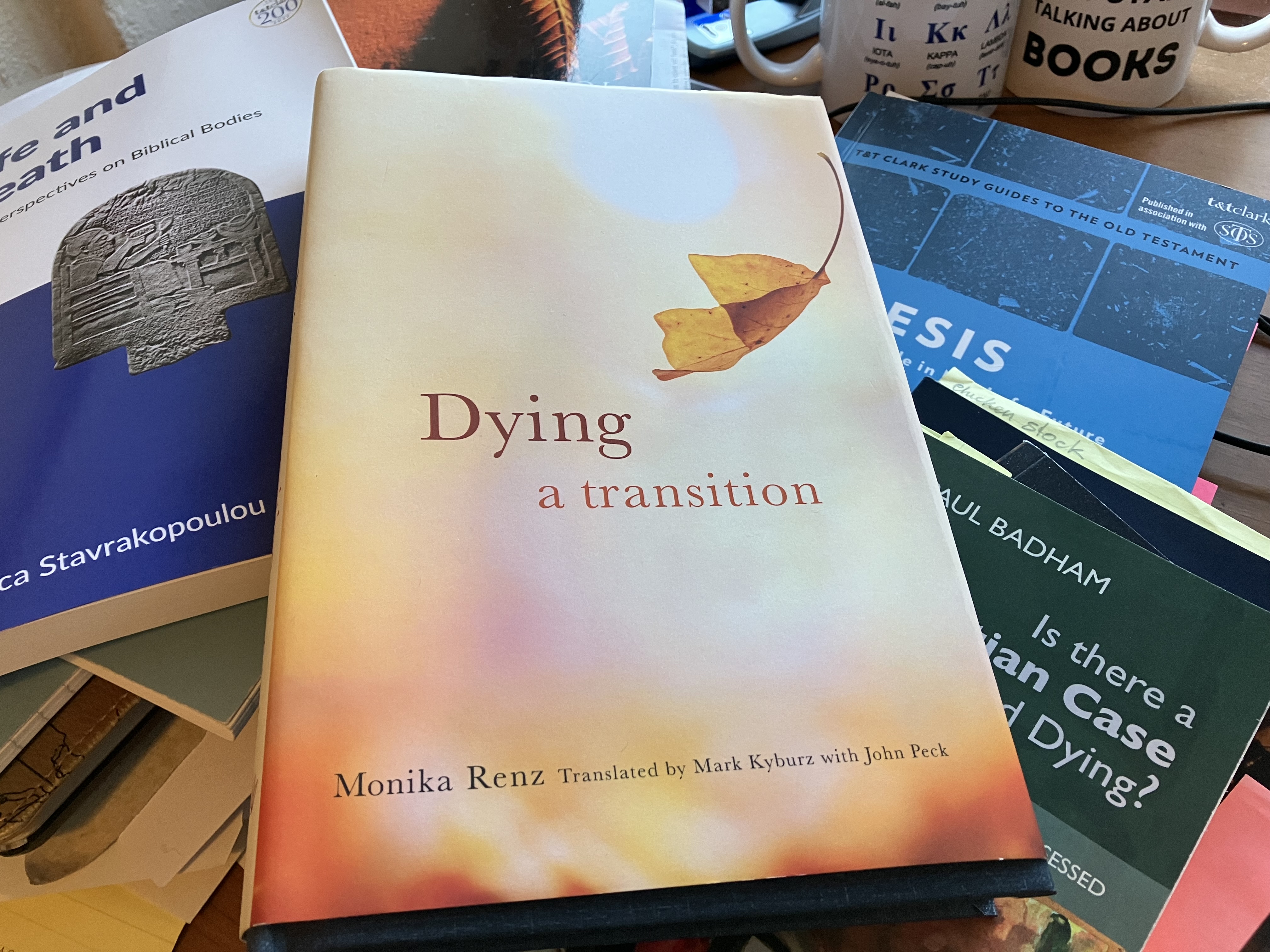
Book Review: Monika Renz, Dying, a Transition,
trans. Mark Kyburz, (New York: Columbia University Press, 2015)

When I attended the debate on assisted dying at the medical school of Edinburgh University, one of the panel suggested that I should read this book. We were discussing the dying process, and whether dying is something that medics are trained to help with—and whether, in reality, it is a process where they should be involved. I felt that perhaps dying (as opposed to illness/recovery) is a stage of life best left to philosophers and theologians. I am not sure that medics understand dying, or that it is particularly relevant to their role as healers. Dying, I argued, is something that happens after the role of the medic has ended.

The book is thought-provoking, and I recommend you read it for yourself. You might not agree with everything written (nor should you ever expect to agree with everything that anyone writes). But it might challenge you, and help you to formulate your own ideas about dying. Most people that I speak to dislike thinking about dying—they find it an uncomfortable topic except in the abstract, when it applies to ‘other’ people. When I was about to have surgery to remove a brain tumour, I found this extremely unhelpful. I needed to confront the possibility of dying. None of us can escape the dying process—first with those who we love, and eventually our own death. I think reading Renz’s book will help you with both. I found it tremendously reassuring.

Renz writes for professionals dealing with palliative care, so her style is academic, but I don’t think you need a degree to understand the book. (You can always skip over some of the more academic pages.) Renz works with cancer patients in Switzerland, and her initial study was with 600 patients (which isn’t a huge range, but is big enough to give an indication of general trends). She analysed her data, and compared it to other studies, then refined her conclusions. The book therefore represents the conclusion of several years of work.

The patients studied were all dying. Some were religious (various religions) others were not (and some were ‘devout’ atheists). Renz found that the dying process for all of them was similar, and went through the same phases—though the amount of time spent in each phase varied. She offers advice as to how each phase can be eased by practitioners and family members—which I assume will be helpful when you next are close to someone who is dying.

To summarise the whole book (and really, you should read it yourself) Renz views dying as a transition, with marked phases. She talks about people going through a final stage, which she names ‘transition’ when they lose all sense of ego. By ‘ego’ she doesn’t really mean pride, though that is a part of it—more that the patient loses all sense of self. Just as a young baby has no pride or shame—pooping is something that happens but the baby is not embarrassed, they don’t care if they dribble or make noises. As a person nears death they too go through a similar phase, which Renz says can be distressing for relatives—who do have a sense of ego and therefore feel embarrassed to see their loved one in a position they see as ‘shameful’. But it’s not shameful, it’s just a body behaving how bodies behave without an awareness of social conventions. Renz states that the patient is not embarrassed, they feel no shame because they have ‘transitioned’ to a state where their body is no longer important.

Part of this transition is also a letting-go of earthly things. She says that for some people this is difficult, they do not want to leave pets or family or a role—and this is a necessary struggle, that changes them into a state whereby they are ready to die. Renz understands the process to be formative, even if difficult. She also describes an ‘encounter’ with a spiritual world—even for people who are not religious or are staunch atheists. Sometimes this is a period of fear, and she suggests actions that can calm the patient, helping them to find peace. She describes patients ‘seeing’ their deceased ancestors, or spiritual beings who are waiting for them to die, and how this is often comforting to the patient (even if perturbing for the relatives).

I found it interesting that there seemed to be the same phases of dying for both the religious and the non-religious person. I have never been present when a person died, so I cannot evaluate the truth of what she says, but I did find it comforting. Renz views dying as a natural process, a natural part of life, and one that should be recognised and not feared. Even when a death is a struggle, Renz equates this to a difficult birth—where there is sometimes pain or fear, but it is a process that leads somewhere. She suggests that we should not shy away from difficult deaths, or seek to shorten them or dull the senses, because the struggle is part of the preparation for what comes next.

I’m not sure how Renz’s research shapes the debate on assisted dying, and she was a little fuzzy on instant death (like an accident or a murder). She simply thought the phases happened instantaneously—but obviously this is not something she could test. Therefore some of the ‘research’ was speculation, but I didn’t feel that detracted from her overall findings.

As I said, I recommend you read the book. I found it very reassuring, it took away the fear of death. Renz shows that death is as natural as birth. It may be beyond our control, but it does not need to be feared. (Though I would note that the death of other people is always, in my experience, completely horrible. But perhaps it helps if we can view the stages as both necessary and natural. I don’t know.)

I hope you have a good day, and that death doesn’t trouble you. Thank you for reading.
Take care.
Love, Anne x
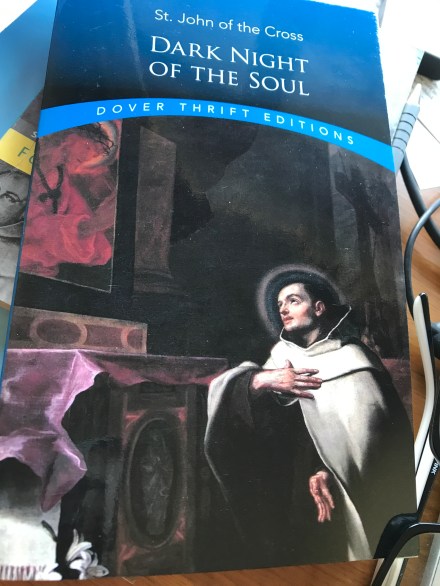
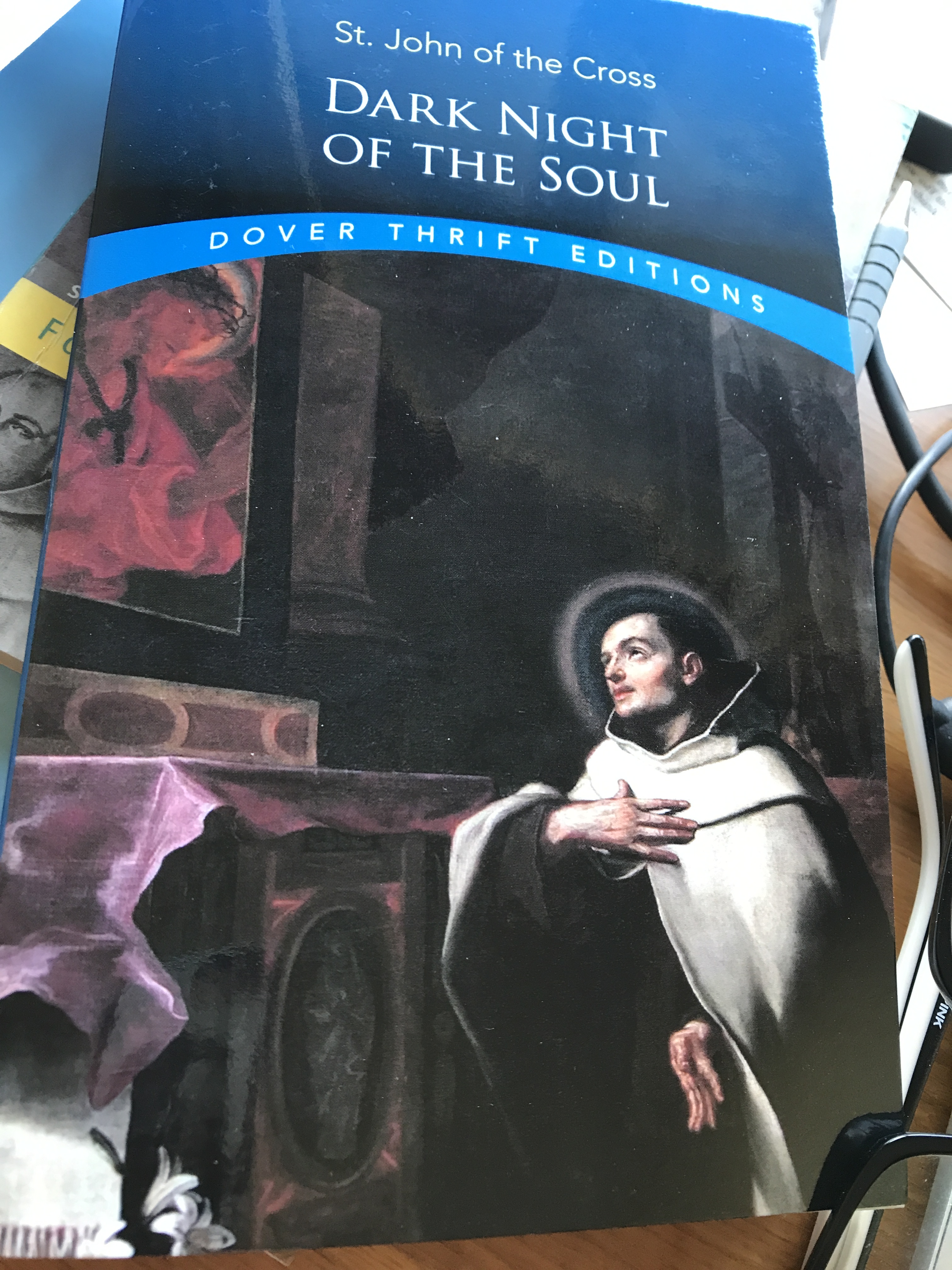
Dark Night of the Soul


by St. John of the Cross


When my lecturer said that the influence of St. John of the Cross was hugely significant, even today, I thought, ‘Hmm…’ I have grown up amongst churchy people, and I had never heard of him.
Then, later in the week I was watching an episode of ‘Call the Midwife’ and they referred to ‘The dark night of the soul.’ Perhaps my lecturer was right; if it’s reaching as far as a series on telly, I maybe ought to know more.

St. John of the Cross, or Juan de Yepes, was a Spanish monk in the 16th century – the time of Spanish wars with the Moors, Martin Luther writing his thesis, Queen Elizabeth ruling England, the Spanish Armada and the Europeans venturing to America.
His father was a converso (from a Jewish family that had converted to Catholicism) and he was rejected by his rich family when he married John’s mother.
John grew up poor, and when his father died his mother placed him in a Catholic orphanage, where he was educated and taught a trade—though Burke remarks that he was, “a spectacularly unsuccessful apprentice” and all his employers fired him![1] He ended up nursing in a hospital for syphilis patients, which was the equivalent of nursing AIDS patients in the 1980s. He later took vows, and then joined Teresa of Avila as a ‘barefooted’ monk, trying to reform the abuses of the Church from within.

St. John was a mystic, which means he considered things that cannot be explained. He believed the soul was separate to the mind and body, and I’m not sure that I agree with him. I think people are maybe more ‘whole’ than this (in the same way that I don’t think Heaven is full of dis-embodied souls floating around). Much of St. John’s thinking seems to have been influenced by Plato (who also separated the soul and the physical).
Some people suggest we should have “a hermeneutics of suspicion” when examining the mystics.[2] (‘Hermeneutics of suspicion’ is bit of a fashionable phrase at college. ‘Hermeneutics’ simply means how we interpret the text according to our experience, so the phrase is a fancy way of saying ‘Don’t trust everything you are told.’)

St. John had a rough time, with lots of paranoia around, due to the Spanish Inquisition, and the Reformation—so when people rejected his beliefs, he was imprisoned and tortured. It was after this that he wrote a poem: ‘Dark Night of the Soul.’

The poem is similar in style to Song of Solomon in the Bible, and depicts God as a lover. The night reflects the horrors of his time in prison, but with God by his side he has no fear. Some time later, St. John wrote prose by the same name, to explain his poem. He’s fairly wordy, and writes very long sentences, but usually his meaning is clear (you do need to concentrate while reading though, and spousal interruptions are very annoying!) My feeling is that he wrote the poem in a splurge of emotion, putting words to his feelings. Later, he tried to explain the words and the theology behind them (I wasn’t sure that the explanation always fitted the poetry).

St. John believed that there were three different states of being a Christian: Beginner, Progressive and Perfect. Perfection is achieved after physical death. Many people never develop further than ‘Beginner’ as they become complacent, they enjoy using the gifts God gives them, and never seek to develop their relationship further. They are self-satisfied, they feel they know all the answers and are contented in their relationship with God. Although they strive to please God, and to pray, to give to charity, and offer penances, their religion has become more important to them than God himself, and they stop trying to develop their spiritual relationship. (This rings true.)

He describes ‘spiritual gluttony’ where Christians enjoy spiritual gifts for their own sake, and become increasingly religious whilst not being closer to God. They rely on feelings, and if their prayers or works don’t result in feeling peaceful, joyful, holy, they then consider them a waste of time. It is like they think God ‘owes’ them in return for their devotion.

To develop into a ‘Progressive’ one must pass through the ‘dark night,’ which is a state instigated by God. St. John describes a dark night of the senses, which tends to follow a time of spiritual happiness, when the person feels close to God and peaceful but is then plunged into depression, with God out of reach. (This reminds me of when as teenagers several of us were baptised, and afterwards most of us experienced a ‘low’ time, and some stopped coming to church completely.) He writes that God gives this time of depression so the person can become stronger, relying on God and not on the feelings of God (peace, joy, contentment). It reminds me of the Book of Job, which teaches that God is worthy of worship because he is God, not because it results in good things for the worshipper.

St. John views this time of depression as a purging of the soul, a time when instead of feeling good and happy, a person is turned back to honouring God through love and discipline, even though they feel they are gaining nothing in return. I’m not sure how this fits with our modern culture, where mental health seems to mean people should never be depressed. Whilst there is, I believe, a mental illness that should be treated, there is also perhaps a time when mentally healthy people feel depressed, and perhaps we shouldn’t run from this. Perhaps we can learn more from our ‘low’ times than our ‘highs.’ In the poem, the house represents the physical and mental state, which are allowed to rest while the soul meets with God. God then kindles a love, which is not necessarily felt, yet is still real. This is a good, happy thing. The soul is free to meet God without being confused by emotions, it has escaped.

La noche oscura del alma

En una noche obscura,
con ansias en amores imflamada,
¡oh dichosa uentura!
sali sin ser notada,
estando ya mi casa sosegada.

A escuras y segura,
por la secreta escala disfraçada,
¡oh dichosa uentura!
a escuras y ençelada,
estando ya mi casa sosegada.

En la noche dichosa,
en secreto, que nadie me ueya,
ni yo miraua cosa,
sin otra luz ni guia
sino la que en el coraçon ardia.

Aquesta me guiaua
mas cierto que la luz del mediodia,
adonde me esperaua
quien yo bien me sabia,
en parte donde nadie parecia.

¡Oh noche que me guiaste!
¡oh noche amable mas que el aluorada!,
¡oh noche que juntaste
amado con amada,
amada en el amado transformada!

En mi pecho florido,
que entero para el solo se guardaua,
alli quedo dormido,
y yo le regalaua,
y el ventalle de cedros ayre daua.

El ayre de la almena,
cuando ya sus cabellos esparzia,
con su mano serena
en mi cuello heria,
y todos mis sentidos suspendia.

Quedeme y oluideme,
el rostro recline sobre el amado,
ceso todo, y dexeme,
dexando mi cuidado
entre las açucenas olvidado.
Dark Night of the Soul

On a dark night,
Kindled in love with yearnings
–oh, happy chance!–
I went forth without being observed,
My house being now at rest.

In darkness and secure,
By the secret ladder, disguised
–oh, happy chance!–
In darkness and in concealment,
My house being now at rest.

In the happy night,
In secret, when none saw me,
Nor I beheld aught,
Without light or guide, save that which burned in my
heart.

This light guided me
More surely than the light of noonday
To the place where he (well I knew who!) was awaiting me–
A place where none appeared.

Oh, night that guided me,
Oh, night more lovely than the dawn,
Oh, night that joined Beloved with lover,
Lover transformed in the Beloved!

Upon my flowery breast,
Kept wholly for himself alone,
There he stayed sleeping, and I caressed him,
And the fanning of the cedars made a breeze.

The breeze blew from the turret
As I parted his locks;
With his gentle hand he wounded my neck
And caused all my senses to be suspended.

I remained, lost in oblivion;
My face I reclined on the Beloved.
All ceased and I abandoned myself,
Leaving my cares forgotten among the lilies.

Translation by Edgar Allison Peers 

I’m finding the writing of these ancient monks to be challenging. Whilst I disagree with the way they tried to find God, it’s hard to reject some of the things that they learnt along the way. I have noticed that it’s often in our hardest times that we draw closer to God, but I’m not sure I agree that without this ‘dark night’ people are limited in their spiritual journey. I also don’t know whether the monks’ rejection of marriage and society (and shoes!) was a sign of holiness or of being weird; but I do respect what they were striving to achieve.

Thanks for reading. I hope that when you have a ‘dark night of the soul’ it will be something precious rather than destructive.
Take care.
Love, Anne x

Thanks for reading.
anneethompson.com
Why not sign up to follow my blog?

[1] Gregory Burke, St John of the Cross (Alba House Publisher: New York, 2001) P.35.

[2] David Stewart, The Hermeneutics of Suspicion, in The Journal of Literature and Theology 3, 1989, Pp. 296-307.

A Celebration of Discipline — My Review


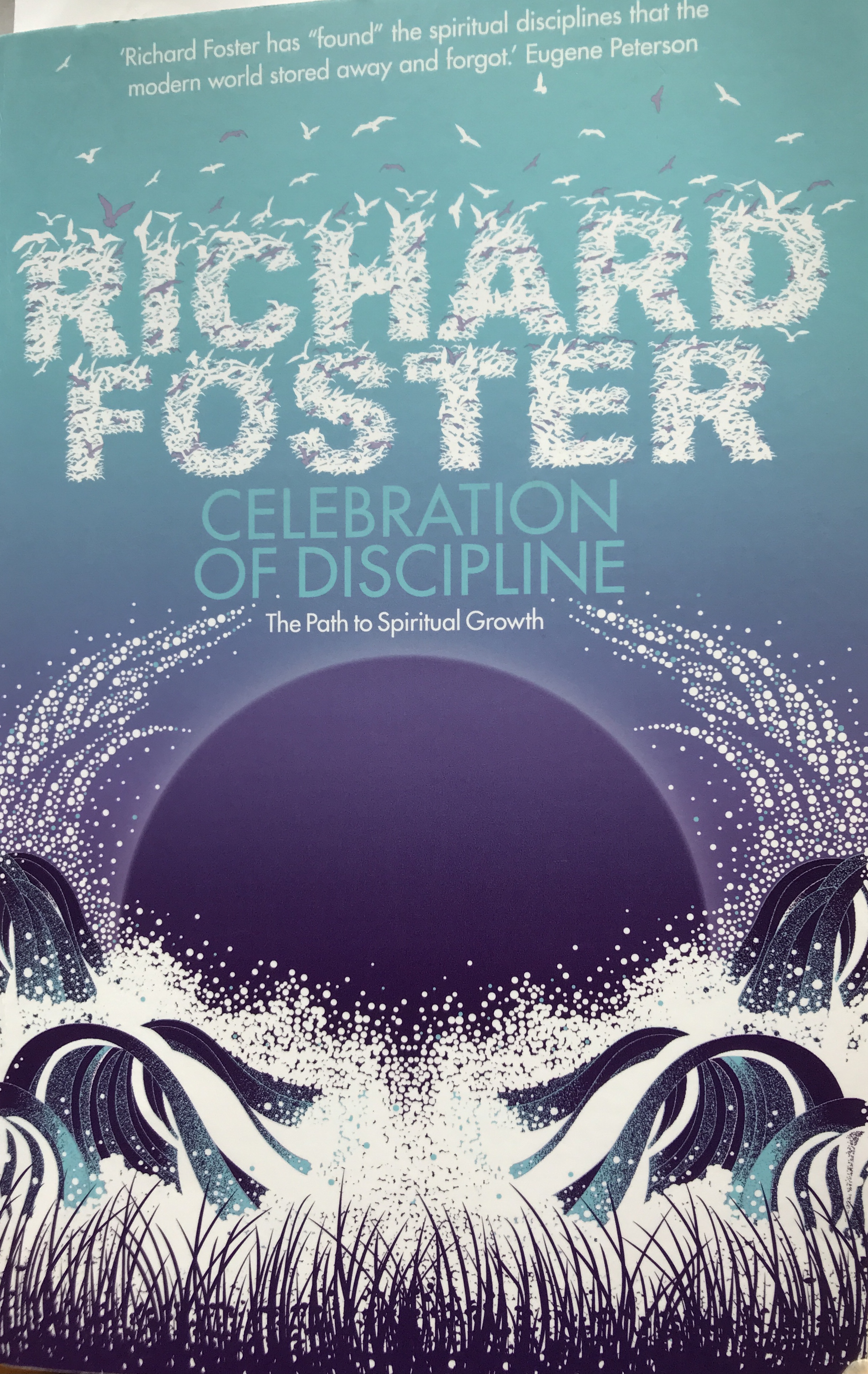
Celebration of Discipline by Richard Foster.

A book review (sort of—more a glimpse of my own experience with this book).


Leo Tolstoy: “Everybody thinks of changing humanity and nobody thinks of changing himself.”

For me, the book didn’t start well. Firstly, there was the cover, which reminded me of a hairy bubble-bath with a planet in the background. “Never buy a book where the author’s name is bigger than the title” is a warning which I have pretty much ignored over the years, yet it still rings in my head. I have no idea who Richard Foster is, and probably he’s a very nice bloke, but the artistic writing of his name with flying birds made me wonder.

I opened the book, none the wiser for the cover but hoping to discover the link between hairy bubble-baths and flocks of birds and the celebration of discipline.

I met the Foreword, which turned out to be an advertisement for the book which I had already bought, so it felt unnecessary. I didn’t read further than the third paragraph.

Then there were the Acknowledgements. Strange positioning. They were dated, showing that the book has been republished many times. Perhaps that explains the large author name, perhaps this is a name that people-who-know-more-than-me look for. The 1978 Acknowledgement mentioned his children. The 1988 Acknowledgement mentioned his wife, who he said the book was dedicated to. This made me smile—images of irritated wife complaining that she had held fort while he dedicated himself to writing and only the kids got a mention. (I searched, but there was no dedication page in my copy, so maybe he changed his mind by the current edition.) The 1998 Acknowledgement was about his friend Bess, who had died. There were encouraging words about death and how it feels, and I began to have hope that this book would be worth reading after all, if only because he quotes both C.S. Lewis and Charles Wesley, who are eminently worth quoting (in my opinion).

The first chapter was very different. Foster stops writing about himself (and his abundant successes) and focusses on how a person can improve. He says that mere will-power is not enough, we can never force ourselves to be righteous, all the debris of selfishness bubbles back up. Righteousness is a gift, but Foster writes that this does not mean we have nothing to do. He quotes Dietrich Bonhoeffer, saying: “Grace is free, but it is not cheap.” Foster describes spiritual growth as being like a seed that is planted, ready to develop; he believes that Disciplines are a means for that development to take place. We cannot earn righteousness, we can only receive it, but we can put ourselves in a place whereby we are ready to receive. Foster warns against making laws, saying: “Once we have made a law, we have an ‘externalism’ by which we judge who is measuring up and who is not.” This rings true, I struggle with churches who seem to primarily want to apply rules to others and who have “a passion to set others straight.” (It is something I was guilty of myself, in the past.)

At this point, I wasn’t sure whether Foster was going to introduce a regime of ‘works’ disguised under the name of ‘discipline,’ but I was interested enough to want to read more. The chapter finished with suggested Bible readings for each day (which I ignored) and questions for discussion—so I guess this would be a good book for a group to study.

Foster makes many points that made me pause. Things like that the well-known text in Romans: “I stand at the door and knock…” was originally written for Christians, not non-believers. It isn’t suggesting non-believers should let God in, it’s showing that Christians have shut him out. Foster argues that we should include meditation as a discipline in our lives. Not the airy-fairy-mystical centring on self, but the conscious decision to centre internally on God.

I did meet a hiccup in the third chapter, about prayer. I agreed with some (but not all) of his views, but then he used ‘sexual deviation’ as an example of something to be prayed about. His definition of this was anything that differed to his own understanding that sex was only right if between one man and one woman. This irritated me intensely, especially in light of his earlier comments about externalism/law/judging others. I understand that this is his view, and I understand why he has formed this view—based on his reading of the Bible, in the same way that some people believe that black people were created to serve white people, and some believe that women have a unique role to support but never lead, and so on—all based on clearly written passages in the Bible. I am always furious when I read Christians stating their viewpoint as fact when they happily contextualise other teaching in the Bible and it is rarely in relation to themselves but rather their interpretation of what God is teaching other people.

At this point I was ready to use the book as kindling. However, I was perhaps over-reacting, and I remembered the saying: “A wise man learns more from the fool than the fool learns from the wise man.” Foster may not be a fool, and certainly wisdom is something I can only aspire to, but the principle holds true. I continued reading in the hope that I would learn something worth learning.

The other chapters covered many valuable subjects, such as: Meditation, Fasting, Solitude, Service, Confession and Worship to name a few. It is tempting to give details of each chapter, but then this becomes a precis rather than a review, so I will stop and let you read it for yourself. Brace yourself to disagree with some views, and try to glean the gold that’s hidden behind the words.

I felt that there was gold to be found, but I never managed to shake the feeling that I would dislike the author. A low point came on page 90, in the chapter on study, when he urges us to “make friends with the flowers and the trees and the little creatures that creep upon the earth.” I felt patronised. He also annoyed me when he writes: “In time we will be unable to pray like the Pharisee, ‘God, I thank thee that I am not like other men…'” It seemed ironic that simply by writing this, he was doing exactly what he claimed would be impossible. If you read this book, I hope you will absorb the wisdom without wanting to punch the author on the nose. I hope you are better than me…

Foster quoted Dietrich Bonhoeffer, so I have bought a copy of his book. A review will follow in due course. Next book on my list is about theology.

I hope you read something good this week. Thanks for reading my blog.
Take care.
Love, Anne x
Anne E. Thompson
Thank you for reading anneethompson.com Why not sign up to follow my blog?

anneethompson.com

*****

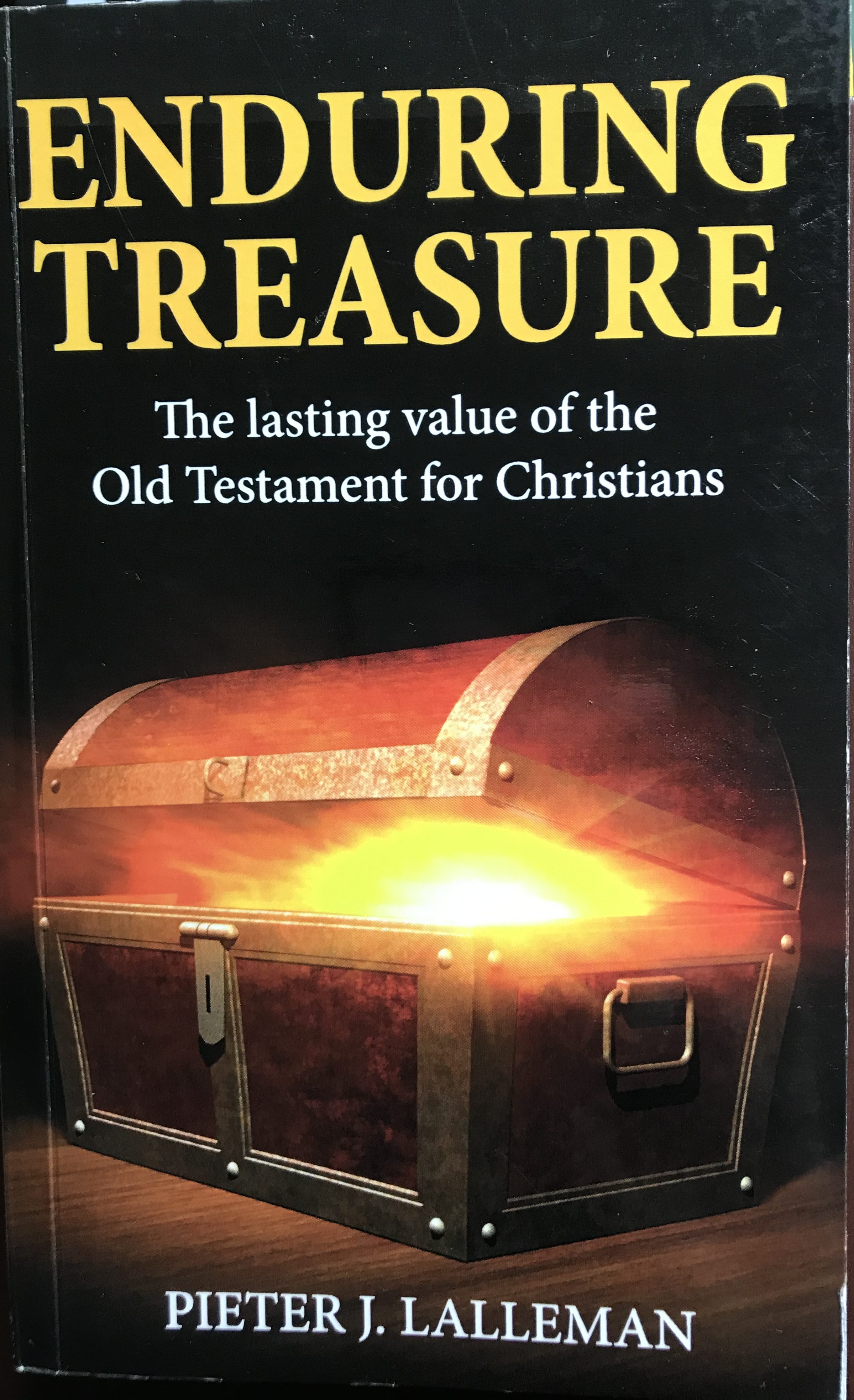
Enduring Treasure


by Pieter J. Lalleman

Is the Hebrew Bible, which Christians call ‘The Old Testament,’ irrelevant today? Were all the laws superseded and made obsolete when Jesus came, or are there still truths to be retained? We eat prawns and pork, and we no longer observe the Sabbath or stone to death adulterers and I for one wear mixed fabrics and would never sell my daughter as a sex-slave to pay my debts. And yet the books are still read, and quoted, and used to justify certain beliefs. So how do we decide what is relevant and what is simply part of history? Enduring Treasure might help you to decide…

A Book Review

Here is the review of the first book on my pre-course reading list. I’m not sure if I’m meant to declare that I have met the author (he taught my first semester of Greek) but it’s pretty irrelevant in terms of the review, because most authors tend to meet/know other authors. The only real difference from a personal perspective is that I did read the entire book with his accent.

I don’t usually read the Introduction of books, but I did this time, and I would recommend you do the same. It made me really want to read the book! Many of the issues about the relevance or otherwise of reading the Old Testament were addressed, and we were also introduced to Marcion—who said the Old Testament is no longer relevant and should be discarded. He pops up again later, and had I not read the Introduction I would have been confused, so take note!

The book then explores whether or not the Old Testament is relevant for today, and which parts should be firmly contextualised and which parts stand as unchangeable truths. As a non-theologian, I wasn’t sure how accessible the book would be, but actually everything was presented very simply, and even ordinary people like me could understand it.

There were two parts that made me laugh out loud (though I’m not sure they were meant to!) One was when Sarah and Abraham were described as a “giggly couple,” which I thought was a lovely phrase. Inappropriate laughing is something I also suffer with. The other was about church notices (the information about members and future dates for the diary that most churches list during a service). The author describes: “that someone is terminally ill, that a murder has been committed, when a case of adultery becomes public…” I have to say, the church notices in his church are way more exciting than in any church I have ever attended, where they tend to be about needing more leaders for the children’s work and someone to make a flower rota!

I was pleased that the book of Ecclesiastes was mentioned. As rather a cynical person, this is a book I have always related to. I also enjoyed the section about modern-day laments, and how most churches prefer to sing nothing but worship songs. (As I pretty much loathe the style of most contemporary church music, I possibly liked this section for the wrong reasons.)

I wasn’t sure if I agreed with the section about the book of Job—though as the author is a theologian and I am not, I assume that this means I am wrong. He writes that Job is about the meaning of suffering, but I don’t think it is. I love the book of Job, because I think it shows that God is worth following, simply because he is God. Everything is removed from Job, and he suffers horribly, yet still God is worth following. Being a Christian is not (for me) about the possibility that life will be easy or free of pain or unfair things happening—because I have known some tough times. Being a Christian is about God being worth following, whatever happens. Maybe the book is trying to show both things.

I did however, enjoy pondering his point about Esther. He says: “It shows us that God works in inconspicuous details and through people who simply do their duty without deep emotions or powerful experiences.” Our churches tend to be in awe of the people who do have big emotions and who proclaim their big experiences. We tend to ignore those who simply quietly plod on with the work behind the scene—perhaps we shouldn’t.

The only part that I didn’t understand was in an interesting section about how the books of the Bible were ordered. He writes that the Jews collected the books that they wanted to be in their Bible, and “recognised them as canonical—that is, authoritative and normative—” I’m not quite sure what that expression means. I’m also not familiar with the names of theologians who are quoted, and I don’t know whether they are alive or from the distant past; but that didn’t affect my enjoyment of the book.

My only other thought concerns those sections which the author suggests are now redundant in the light of the New Testament. This includes things like priests, and tithes and the Sabbath. Whilst I understand the point that they are no longer necessary, I wonder whether they might still be helpful. For example, I believe it is true that Jesus taught that we can all approach God directly, that we don’t need a priest as a go-between. However, for some people, in some situations, it might be easier/better to confess to a priest than in prayer, and perhaps the priest can facilitate approaching God—even if not strictly necessary. The same is true of tithes, which again should not be needed if people are generously giving so that everyone’s needs are met. But perhaps the general principle is a good one, and helpful for people (especially children as they are learning good practice) as it ensures that gifts are part of the structure of life.

In short, I enjoyed this little book (it was surprisingly little!) If you are interested in whether or not the Old Testament is relevant today, I recommend that you buy a copy. The language is easy to understand, and the concepts are interesting and worth considering. The Amazon link is below.

Thanks for reading. I hope you have a good week.

Take care.
Love, Anne x

Anne E. Thompson
Thank you for reading anneethompson.com Why not sign up to follow my blog?

anneethompson.com

*****

The Buried


The Buried

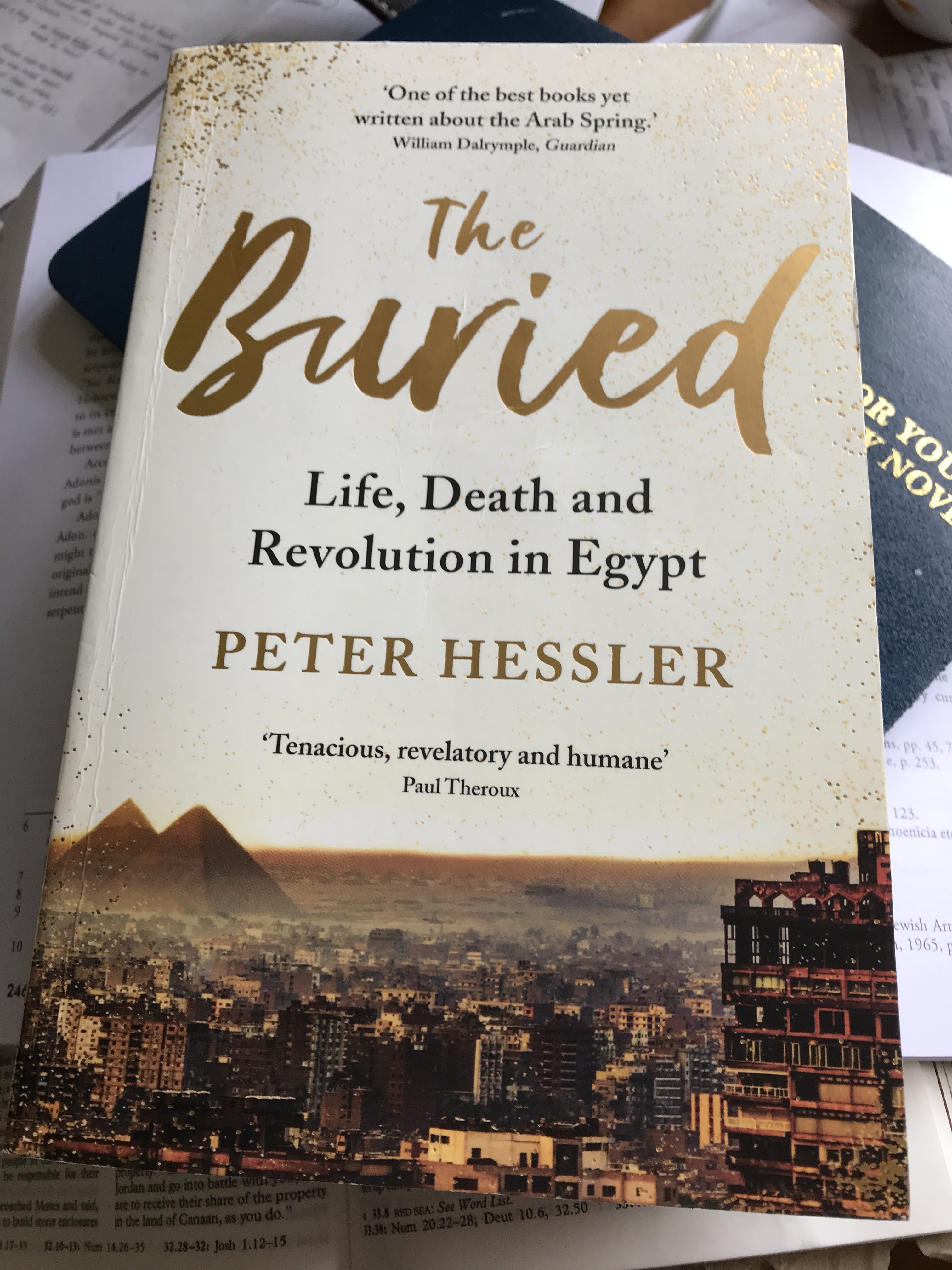
by Peter Hessler

I recently read The Buried by Peter Hessler, and I can definitely recommend it. I knew of Peter Hessler because when I started learning Mandarin, and scanned the bookshops for any English books with any link to China, his books popped up. He was sent to China as a young man, and worked in a remote town, teaching English (with an American accent) to Chinese students. His books described his adventures.

I loved his books. He wrote with humour, describing the many things that went wrong as he learnt Mandarin and described life in China. I felt that he wrote with tact, and had a real respect for the people he met. He seemed to genuinely like Chinese people (most foreign travellers seem rather condescending towards different cultures) and so I wasn’t surprised to learn that he is now married to a woman from China, and they have twin girls.

At the time of writing The Buried, Hessler had again left the US, with his wife and young girls, and had gone to live in Egypt. He applied the same amused patience as he tried to learn Arabic, and the culture in Cairo. He moved there at the beginning of the Arab Spring, and the book describes the events unfolding in the city.

Hessler writes in short sections, so this is a book to dip into during odd moments. I like the respect he shows towards the people he writes about. His says he always tries to learn a language using the books written in the country, because they reveal lots about the culture. I would agree with this. When I learnt Mandarin, the textbooks had lots about authority, and the vocab lists were about managers, and directors, and people in authority. Hessler compares this to the textbooks in Egypt, which were full of polite greetings and blessings, and the correct polite response in every situation. There is apparently even a correct way to thank your hairdresser!

Most people in Cairo spoke Arabic, though any quotes in newspapers were always translated into Fusha. Hessler describes one word, Yanni, which can be translated as: ‘yes,’ sort of,’ or ‘let’s pretend.’ That word alone tells you so much about the culture!

One of the charms of Hessler’s books, is that he befriends normal, working-class people. In Cairo, he befriends the man who collects the rubbish from the flats. There is lots to be gleaned from other people’s waste, much of which is recycled, any alcohol is sold (because good Muslim folk don’t drink alcohol). He also befriends a young gay man, who is struggling with the dangers facing a gay person in a strictly Muslim country (though I was interested to read that mostly, everyone knows that there is a certain place where gay people meet, and yet no one in authority is very bothered by it. It tends to be individuals who react strongly and cruelly, not the governing authorities per se.)

The political situation during the Arab Spring was obviously very interesting. Sometimes Hessler was in dangerous situations, though he writes: “What scared me most was the elevator shaft in our apartment.” He interviews people on the street and in the mosque, and attends news conferences. One feature of Egyptian politics seems to be the repeating of ‘facts’ over and over, until eventually people began to believe them. If something is asserted often enough, it becomes true…

While in Egypt, Hessler visits some of the archaeological sites. The book explores the links with ancient Egypt, and how the past continues to shape the future. The places he visited sound fascinating, and I now firmly want to visit.

Akhenaten c1346 BC

If you want to read something light and interesting, I recommend The Buried.

Thanks for reading. I hope you have a lovely week.

Take care,
Love, Anne x

Anne E. Thompson
Thank you for reading anneethompson.com Why not sign up to follow my blog?

anneethompson.com

Is Steve Chalke a Heretic?


Steve Chalke

When I was a teenager, a young trainee pastor at Bible college came to lead a youth weekend at our church. The main thing that I remember is that he talked about sex, and it was one of the few youth weekends I attended that was not boring. His name was Steve Chalke.

Several years later, I heard of Steve Chalke again when he set up a charity, aimed at helping homeless people, which morphed (the charity, not the homeless people) into Oasis Trust. I was therefore interested when recently, during dinner with a friend, they mentioned that Steve Chalke had been ‘thrown out’ of the Evangelical Alliance. Was such a thing even possible? I had (wrongly) assumed that the Evangelical Alliance was a union for anyone who called themselves a Christian, a place to share ideas and resources, and which organised events which might prove helpful to said Christians. I had not realised it was possible to either ‘belong’ or be ‘thrown out’. What, I wondered, had SC done which merited being thrown out of this esteemed organisation? Had he murdered someone, eaten babies, kicked a dog? No! He had, apparently, become a heretic.

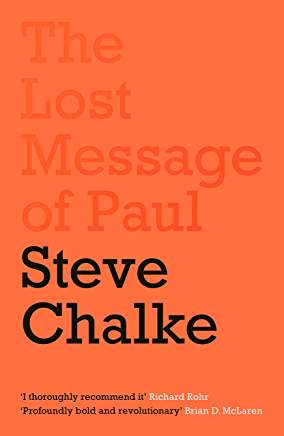
I heard a few whispers about the apparent downfall of SC. I heard that he had turned his back on evangelical Christianity, that he questioned the crucifixion, and even went as far as to call the death of Jesus “child abuse”. I wondered if I was hearing things properly. Searches online were varied, and it was hard to find the truth. I decided to buy his book, The Lost Message of Paul, and decide for myself.

The book is, to be honest, challenging. It begins with an introduction, when SC explains that he is rethinking his faith, and says he is hoping for an informed debate. It seems somewhat ironic to me that the reaction of established Christianity is simply to rebrand Chalke as a heretic and to exclude him from the Evangelical Alliance—but perhaps the debate happened before I was aware of this, and there were other reasons for his exclusion. I again checked online, but he is still the pastor of a church, still working amongst some of the neediest people in our society. I listened to an online interview, and he was still saying that he believes in one God, still believes in the death and resurrection of Jesus, so what is the reason for his exclusion? Maybe he really did eat a baby.

The book gave some insight as to why people find his ideas difficult—I find them difficult myself. The book basically gives good insight into the culture in which the Bible books were first written, and then questions whether we have properly interpreted what the words are saying. My understanding is that SC now questions whether the idea of ‘original sin’ is correct (the idea that when man sinned in the story of Genesis, that sin was then passed down to every person in every generation that followed, hence separating them from God). He makes the point that Genesis is a Jewish book, written in Hebrew, and yet Christians never ask Jews today what their understanding is, we never think about what the words would have meant in Hebrew.

Much of his explanations are very interesting—did you know that in Hebrew, you cannot have a word for an emotion? So, when it talks about God’s anger, it actually talks about God’s nose, because when you’re angry you snort through your nose? But that word could also be translated as passion, or fury, or great sadness?

I felt that SC’s views here (if I was understanding them correctly) were flawed. I never taught any of my children to do wrong, and yet they all did, so my experience suggests that people are born ‘sinful’ and the rest of the Bible seems to support this. If we are all ‘sinful’ then how can we approach God, who has no sin? Surely before we can approach, we need to be washed, there needs to be some kind of repentance? But his argument is persuasive, it cannot easily be dismissed, and gives pause for thought. (Or, of course, you could just chuck him out of your club.)

SC also builds a case for refuting Hell, or that people will be eternally damned. He says that this idea was first introduced by the Renaissance poets and artists (like Dante) and were not based on the Bible at all. SC does think that there will be judgement, but that it will not be an eternal suffering, more of a refining fire that will prepare us for our eternity with God. One example is when Jesus talks about Hell, and the gnashing of teeth, which SC says should never have been translated at all, as the word Jesus used (translated as ‘Hell’) was an actual place, used as a rubbish tip, where wild dogs lived (and gnashed their teeth) and that Jesus is asking, would you rather live with God, or in that place?

There is too much in the book for me to cover everything here, and I found many of the ideas troubling, though also that many fitted with my understanding of God. One of the main points made by SC was that God does not create people for eternal suffering, in other words: Hell, as usually defined, is a human invention and does not exist in the form we imagine. SC says he cannot accept that God, who is defined as Love, could create people knowing that they will eventually be destined for eternal suffering.

SC makes the point that if you asked Paul, or any of the early apostles, how they knew that they were saved, they would look at you blankly, and reply: “Because I am a Jew.” The Jews believed that, simply because they were Jewish, they were chosen, they were ‘saved’. SC argues that when Jesus died and rose again, this grace of God, was automatically extended to non-Jews, in short, that all people were now ‘chosen’ and therefore ‘saved’. He points out that when Paul writes that ‘through one man, all have sinned,’ we have no problem accepting that this means that due to the actions of Adam, who represents the first human, all people now sin. However, when, in the same passage, Paul then says that through the actions of Jesus, all are now saved, we start to add caveats. We say things like, ‘but it only applies if people have faith’ or ‘but people have to believe in the New Testament, and ask God into their lives, otherwise it doesn’t count.’ But that is not what is written. It is written as an equation—Adam sinned, so all sin: Jesus rose, so all are saved. It is, I feel, a compelling argument.

I find that I am left with a lot of questions after reading this book. SC has written a second book, and I will read that and see if it offers some clarity. There are things I disagree with, but some I find it difficult to define quite why I disagree. There are other points which I would like, very much, to be correct, but have not yet decided if it is wishful thinking or true. SC is undoubtedly a talented speaker/persuader, but that does not necessarily mean that he is correct.

Would I recommend this book? Well, that rather depends on who you are. If you don’t feel that you know everything about God, and that there is more to faith than perhaps you have discovered, then you might find this interesting. However, if you think you have faith and God pretty much ‘sorted’, and really you want to read things that backup rather than challenge your views, then perhaps you should avoid this book. SC writes that he hopes his book will start a discussion. My feeling is that it probably will (I for one am bursting to discuss his views with other people!) but unfortunately for SC, I suspect that he will not be part of those discussions. He has stated his views, people will now either agree or disagree with them, but as with most leaders, I expect the only feedback he receives will be negative. It is also quite likely to be voiced by people who have not read his book and have simply heard vague quotes. I do not know whether what SC wrote is correct, but I’m glad he wrote it because I think it’s good to sometimes question what we believe and explore other ideas. None of us knows all there is to know about God, he is beyond our understanding; but we can strive to understand a little more. What do you think?

Thank you for reading.
anneethompson.com
Why not sign up to follow my blog?

Post Script:

Since writing this article, I have learnt more detail concerning the debate with the Evangelical Alliance, and my article is somewhat unfair. If you want to know more, I suggest the following book: Justin Thacker and others, The Atonement Debate (Grand Rapids, MI: Zondervan, 2008) This describes the debate that followed Steve Chalke’s book, and how the EA changed their statement of faith (apparently an unrelated event) which meant Steve Chalke was no longer able to be part of the EA, rather than him being ‘thrown out of the club’ as my article suggests.

If you prefer to read a slightly lighter book, then have a look at my latest novel, Ploughing Through Rainbows.

A feel-good family saga, set on a farm, the story explores how parenthood never ends. It’s a lovely book to relax with, or to buy for a friend. Available as both a Kindle book, or as a paperback, from an Amazon near you. Don’t forget to have a look, UK link below:

UK link here

A hilarious family saga set on a farm. Being a parent has no end-date, as Susan discovers when her adult sons begin to make unexpected choices in life.
A warm-hearted, feel good novel that will make you smile.

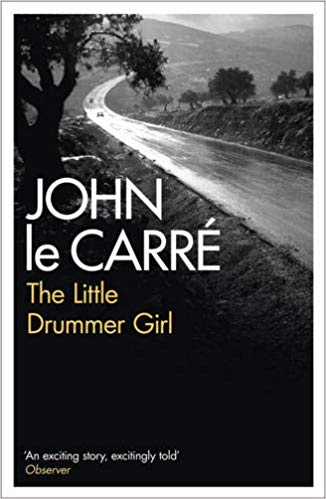
The Little Drummer Girl


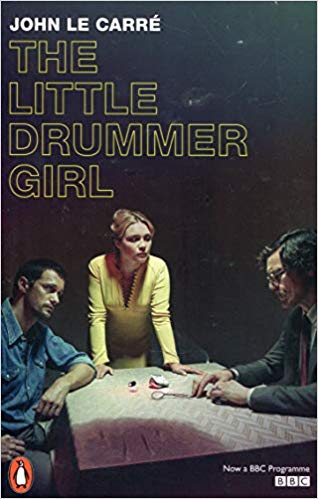
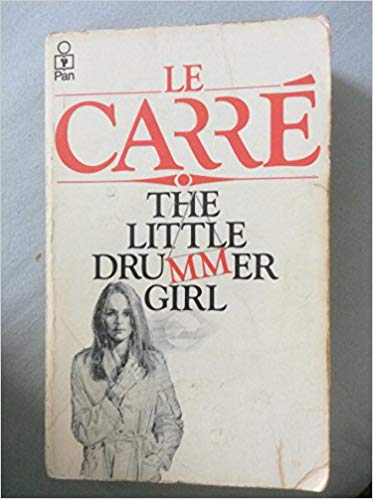
The Little Drummer Girl by John Le Carré

(This review contains spoilers!)

I first watched this on an overnight flight from Hong Kong. I planned to sleep, but had the box-set on in the background. It was fascinating, but there was lots which I didn’t understand, so I think I drifted off to sleep for chunks of it. When I got home, I ordered the book on my Kindle, and tried to untangle the confusion. It really is, an excellent book, with a complicated plot.

The story basically charts the training of a spy. She is a young actress, and therefore unknown in the spying world. She is seduced by Zionists, and persuaded that spying is simply acting, with the real world as your stage. The idea is a good one, and probably close to the truth—I guess to spy you are pretending to be someone else.

A cover story is created, which the actress has to ‘live’, so that if she is ever questioned, she will be relying on real memories in her answers. She falls in love with her trainer (so did I, a little, he is the absolute tall dark stranger, a silent strong type).

However, the real interest for me was the exploration of the whole Zionist issue. While the actress is being prepared for her role, she needs to absorb the teachings and propaganda of the Palestinians. Gradually, they change from being simply terrorists willing to kill and maim innocent bystanders, and become real people with a cause. The reader is gradually shown that neither side in the debate is without blame, and that the issue is much more complicated than it first appears.

For example, there is some discussion about the Jews, who were made a faceless non-human by the Nazis, and therefore able to be exterminated. When they then went to Israel, after the war, their view of the Palestinians was not so different. They also considered them as lesser humans, people who had no right to live in the land promised to the Jews. In their minds, they exterminated them. In reality, they took their homes and land, places they had been settled in for generations. The book also talked of the unprovoked violence that peaceful Palestinians encountered, and how it had forced them to become an army, so the rest of the world listened to them.

Now, this is a work of fiction, and therefore one assumes that both the characters and the situations have been romanticised. But it does also ask some real questions, and encourages the reader to look at the issues in the Middle East from both sides. When the actress finally joins the Palestinians, she bonds with them, loves some of them, watches children being killed by the Zionist army. We, the reader, wonder whether she will turn, and instead of spying for the Zionists, will join the Palestinians, and there is a moment of tension when you are unsure which way she will turn (as are her handlers).

I loved this book, even though sometimes I got a little lost and found it difficult to keep each character clear in my head. The issues explored are fascinating, the idea that neither side is perfect, that there is real hurt and despair inflicted on both peoples, and there are no easy answers. Of course, because this is a John Le Carré book, there are also beautiful descriptions, and moments of real humour, and the characters are so real you start to look for them in the street. It is the timeless sort of book that you can read and enjoy more than once.

Thank you for reading. Use your time wisely today.
Take care.
Love, Anne x


Anne E Thompson has written several novels and writes a regular blog each week. You can follow her blog at:
anneethompson.com

Have you read my latest novel: Ploughing Through Rainbows? It’s a great holiday read. Available from an Amazon near you as both a Kindle book and a paperback.

A hilarious family saga set on a farm. Being a parent has no end-date, as Susan discovers when her adult sons begin to make unexpected choices in life.
A warm-hearted, feel good novel that will make you smile.

German Amazon link here

UK link here

U.S. link here

An exciting surprise!


Good Morning!

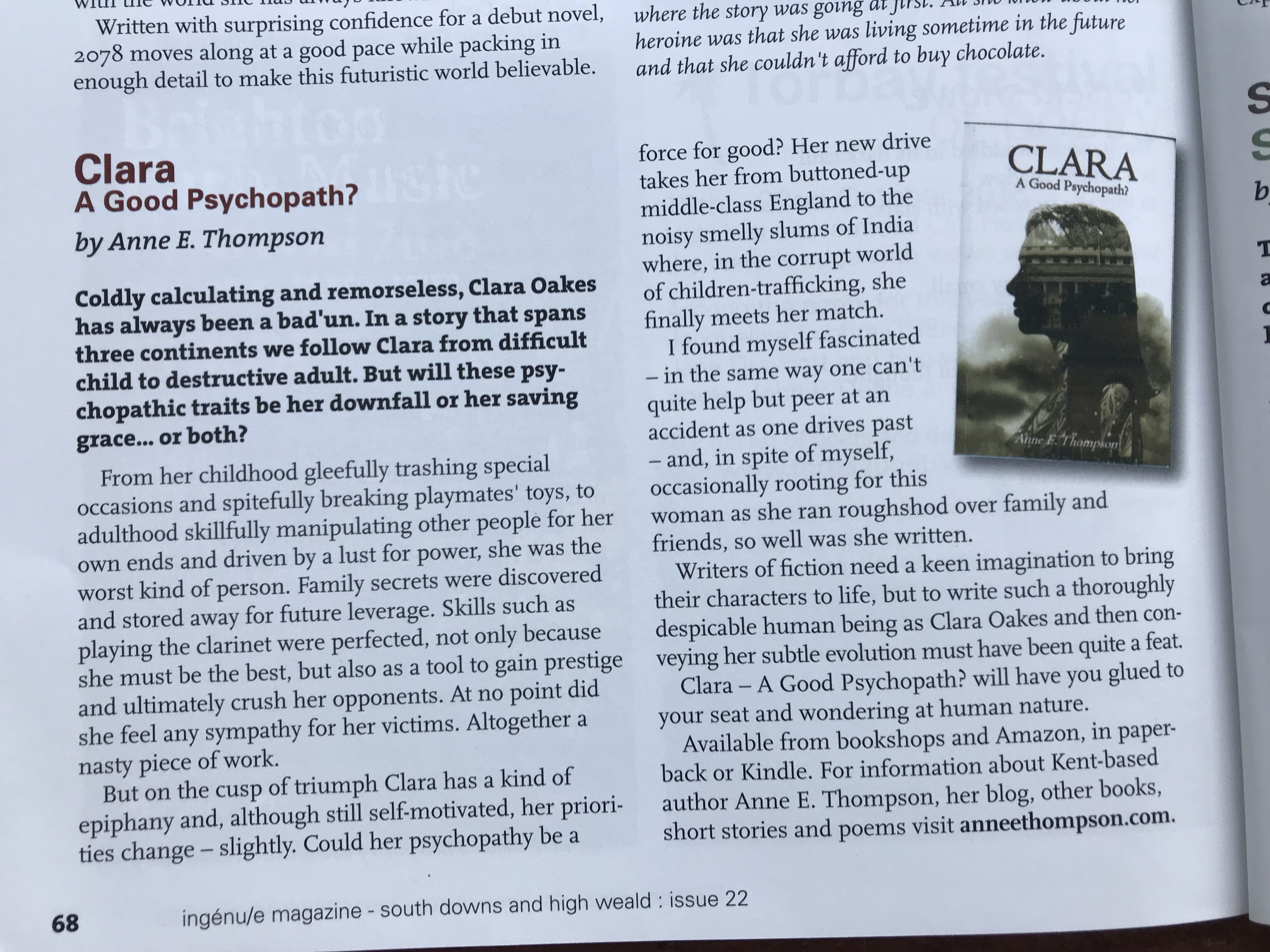
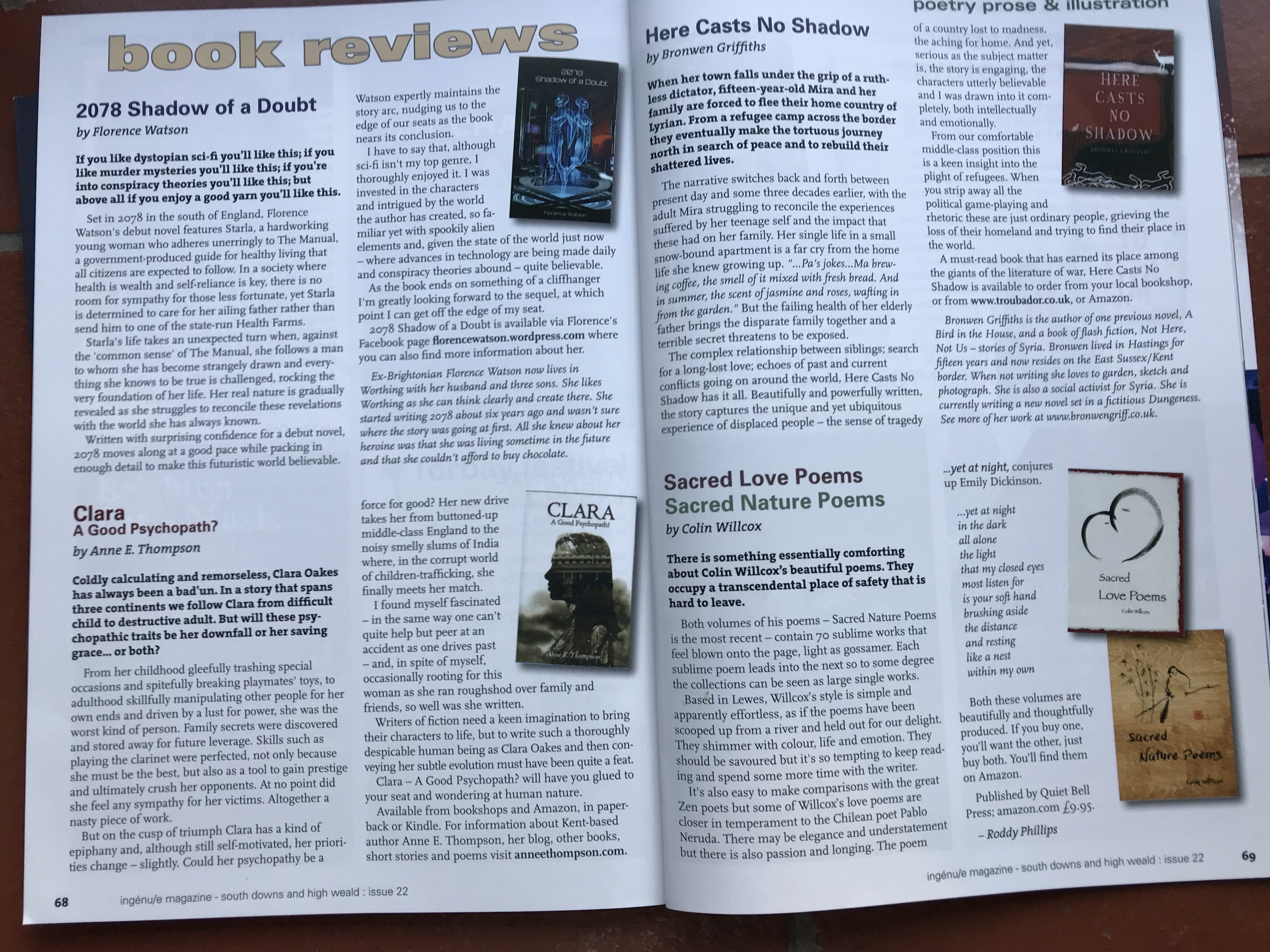
This isn’t my normal time for posting blogs, but I wanted to share some news with you (because I’m very excited, and Son is in bed and Husband is at work, and I have to tell SOMEONE!) This morning, when I woke up, an envelope was waiting at the bottom of the stairs. When I opened it, I found a magazine. It’s an Arts magazine, and reviews art, literature, music and dance. As I flicked through the shiny pages, I found, on page 68, a review of CLARA. Wow! This is my first ever unsolicited review. How exciting!

I skimmed the review first, heart in mouth, wondering if I was going to read something critical. But no, the reviewer had found the book gripping. They describe being “glued to your seat and wondering at human nature”.

Clara is a pretty awful person (slight understatement) but the reviewer says: “I found myself fascinated – in the same way one can’t quite help but peer at an accident as one drives past – and in spite of myself, occasionally rooting for this woman as she ran roughshod over family and friends, so well was she written.”

Have you read Clara yet? Here is the Amazon UK link:https://www.amazon.co.uk/dp/B079T5NJP7?ref_=k4w_oembed_94cpRjkhwVeJc3&tag=kpembed-20&linkCode=kpd

Reading a review of Clara, when it’s written by someone who has never met me (and therefore has no reason to be kind) was rather scary. But the reviewer wrote such a lovely article, it has brightened my day!

Clara tells the story of a young woman, who shows all the traits of psychopathy – so she lies, is self-absorbed, unable to empathise with others, and feels no guilt. But then she is shocked into changing her behaviour, and although she is still a psychopath, still not able to feel as most people feel, her actions change, and instead of being destructive, she begins to achieve great things.

Clara can be ordered at any book shop or library. You can also order a copy directly from me, or from Amazon. Buy a copy now, in paperback or on Kindle, and enjoy reading a different sort of book.

Amazon Link

CLARA – A Good Psychopath?
by Anne E. Thompson
ISBN:9780995463257
You can order copies from any library or bookshop. Also available from my website:
anneethompson.com

Email from a stranger


I received this message, which was lovely, so I thought I would share it with you:

Comment: Dear Anne
I just wanted to let you know how much I enjoyed reading “Clara”. I was very much taken by the explanation you gave when you told me about your book at the East Grinstead book shop.
Some books stay with you when you have read them, and Clara was one of those for me.
I found Clara fascinating. I think there is a little bit of Clara in all of us, particularly in the way we all do try and manipulate others. However, unlike Clara, we will feel remorse for doing so.
At first I found the character of Clara intriguing as to how her mind worked. Then, the further she went, the more I started to feel uneasy about what she was doing. However, that then changed again when she went to India where she became a bit of an anti-heroine. I wondered what it would be like to try and communicate with her; knowing that would never be possible with someone like her. As soon as you were of no use she would just drop you.
Some books I buy to stretch the mind, others simply for the enjoyment as “page turners”. Clara was one of those books that did both for me. Thank you.
I went back to the bookshop today and purchased Joanna and Hidden Faces, and will continue to look out for your work.

Kind regards

Philip

********

 Clara – A Good Psychopath? by Anne E. Thompson
ISBN 9780995463257
Published by The Cobweb Press
Available from book shops and Amazon.

Have you bought a copy yet?