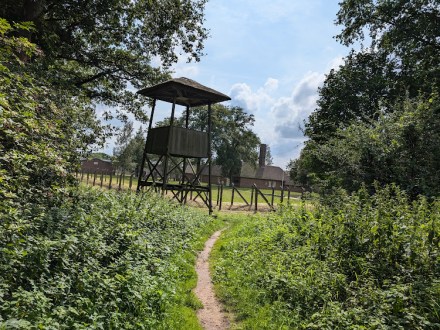
While we were in ‘s-Hertogenbosch, we realised there was a concentration camp a short walk away. It was used by the Germans in the war, and Corrie ten Boom was sent there. You may not have heard of Corrie ten Boom, but when I was young, I read all her books and she feels like a distant relative. Corrie and her family hid Jews in their house in Haarlem, near Amsterdam, during the war. They were betrayed by a visitor, and sent to prison. After a while, Corrie and her sister were sent to Vught.
The camp was about an hour’s fast walk from the town, so after my conference finished, we set off to find it. We followed Google maps, and the walk was very pretty, next to the river and then over the railway and through a wood. The wood was lovely, paths meandering through the trees, people walking their dogs, birds singing. Then we rounded a corner, and there was the camp.
Kamp Vught is now a memorial, with a prison (still used today) next to it. The memorial mainly shows a few rebuilt areas, with photos and information. It was okay, but not as effective as the Auschwitz camps—which changed your heart and soul slightly, simply because they were so vast and so cruel, and completely impossible to ignore. The remains of this camp were smaller, and it felt more like a museum than somewhere real—though for the inmates, it was very real. I will copy some extracts from Corrie’s book, so you can glimpse something of her experience, and add a few photos from my visit.
‘[…] We seemed to have stopped in the middle of a wood. Floodlights mounted in trees lit a broad rough-cleared path lined by soldiers with leveled guns.
‘Spurred by the shouts of the guards Betsie and I started up the path between the gun barrels. “Schneller! Close ranks! Keep up! Five abreast!” Betsie’s breath was coming short and hard and they yelled at us to go faster. It had rained hard here, for there were deep puddles in the path.’

‘[…] The nightmare march lasted a mile or more. At last we came to a barbed wire fence surrounding a row of wooden barracks. There were no beds in the one we entered, only long tables with backless benches pulled up to them. Betsie and I collapsed onto one of these. […] We fell into an exhausted sleep, our heads on the table[…]’

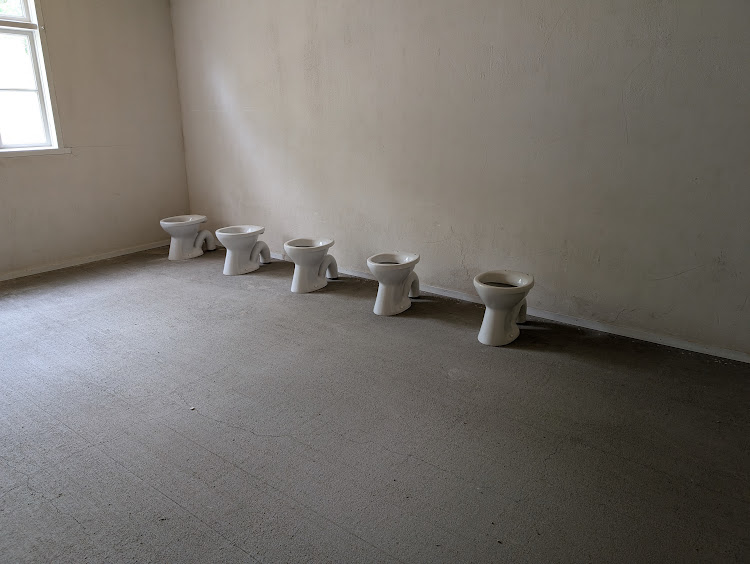
Days later, Corrie is processed into the main camp, and allocated to a room. During a roll call, she looks at the woods beyond the fence: ‘[…] The group of prisoners grew until there were forty or fifty of us standing in line beside a high anchor-chain fence topped with barbed wire. On the other side of the fence was a white birch wood, above our heads the blue Brabant sky. We too belonged to that wide free world. […]’

‘[…] The barracks appeared almost identical with the one we had left this morning, except this one was furnished with bunks as well as tables and benches. And still we were not allowed to sit: there was a last wait while the matron with maddening deliberateness checked off our documents against a list. […]’

‘[…] Part of the way [to her daily work detail] we walked beside a small wood, separated only by a roll of barbed wire from a glistening world of dew-drops. We were also marched past a section of the men’s camp, many of our group straining to identify a husband or a son among the ranks of shaved heads and striped overalls.
‘[… T]he discipline in the male section was much harsher than in the women’s; executions were frequent. Almost every day a salvo of shots would send the anguished whispers flying: How many this time? Who were they?
‘[…] The guards were noticeably tense. Roll call was an agony. The old and the ill who were slow reaching their places were beaten mercilessly. Even the “red light commando” came in for discipline. These young women were ordinarily a favored group of prisoners. Prostitutes, mostly from Amsterdam, they were in prison not for their profession—which was extolled as a patriotic duty—but for infecting German soldiers. […]’
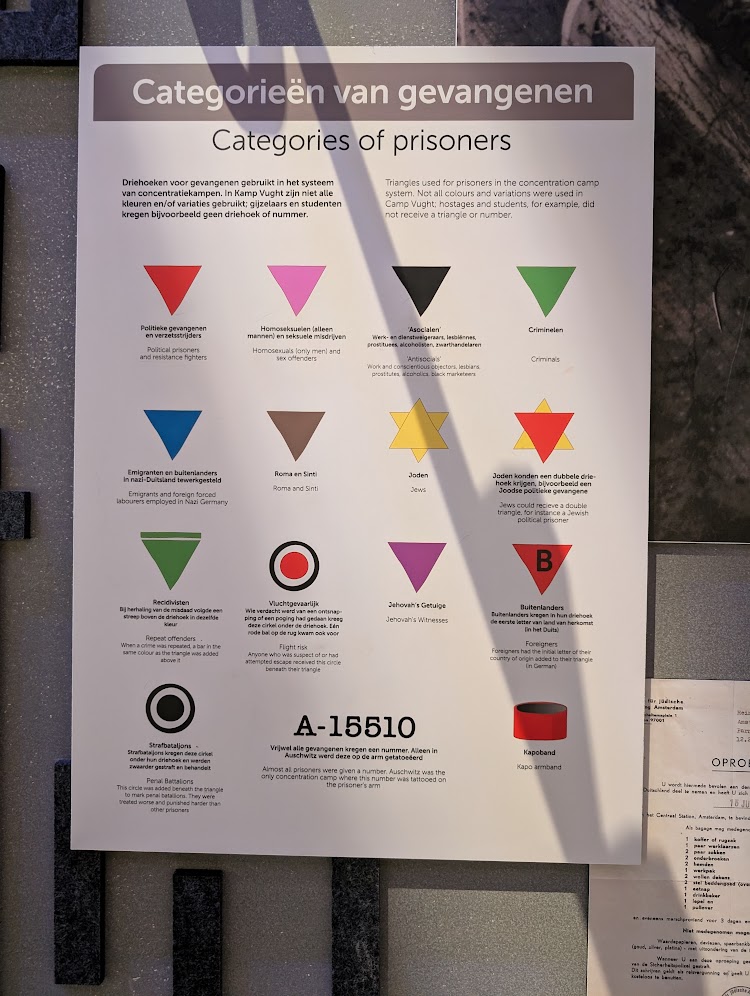
‘[…] Then rifle fire split the air. Around us women began to weep. A second volley. A third. For two hours the executions went on. Someone counted. More than seven hundred male prisoners were killed that day. […]’

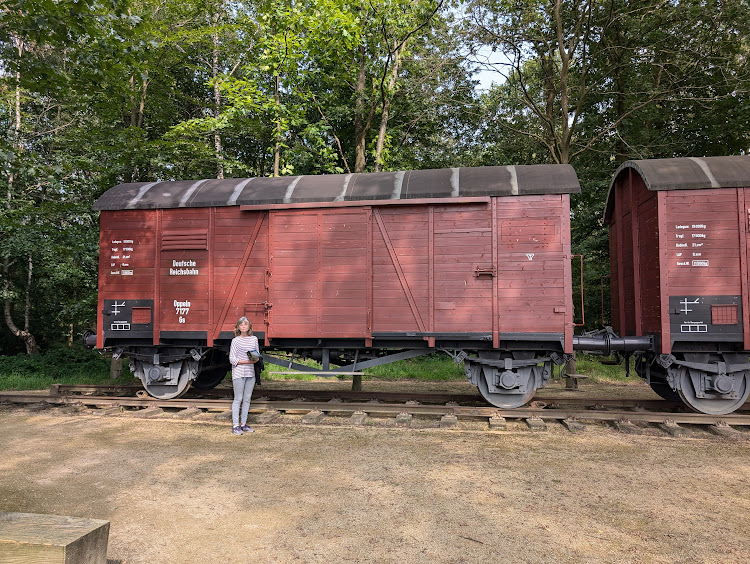
And then, as the camp was evacuated when the Allies drew nearer: ‘[…] At last the path ended and we lined up facing the single track, over a thousand women standing toe to heel. Farther along, the men’s section was also at the siding: it was impossible to identify individuals among the shaved heads glistening in the autumn sun.
‘At first I thought our train had not come; then I realized that these freight cars standing on the tracks were for us. Already the men were being prodded aboard, clambering over the high sides. We could not see the engine, just this row of small, high-wheeled European boxcars stretching out of sight in both directions, machine guns mounted at intervals on the roof. Soldiers were approaching along the track, pausing at each car to haul open the heavy sliding door. In front of us a gaping black interior appeared. Women began to press forward. […]’
Corrie ten Boom, The Hiding Place (London: Hodder and Stoughton, 1972)

The Hiding Place is available from Amazon, as either a paperback or on kindle. It gives real insight into what it was like during the war, the bravery of the Dutch Resistance, and the horror of the concentration camps. Throughout it all, Corrie is strengthened by her faith until finally she is released. It’s worth reading.
Thanks for reading. I hope your week is a good one.
Take care.
Love, Anne x

 Anne E Thompson