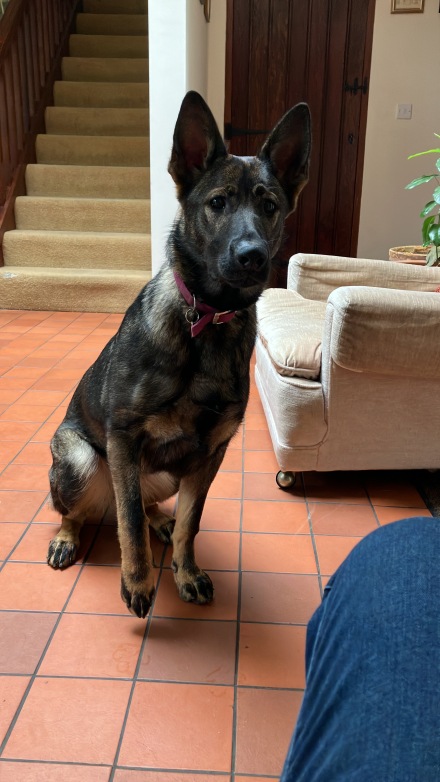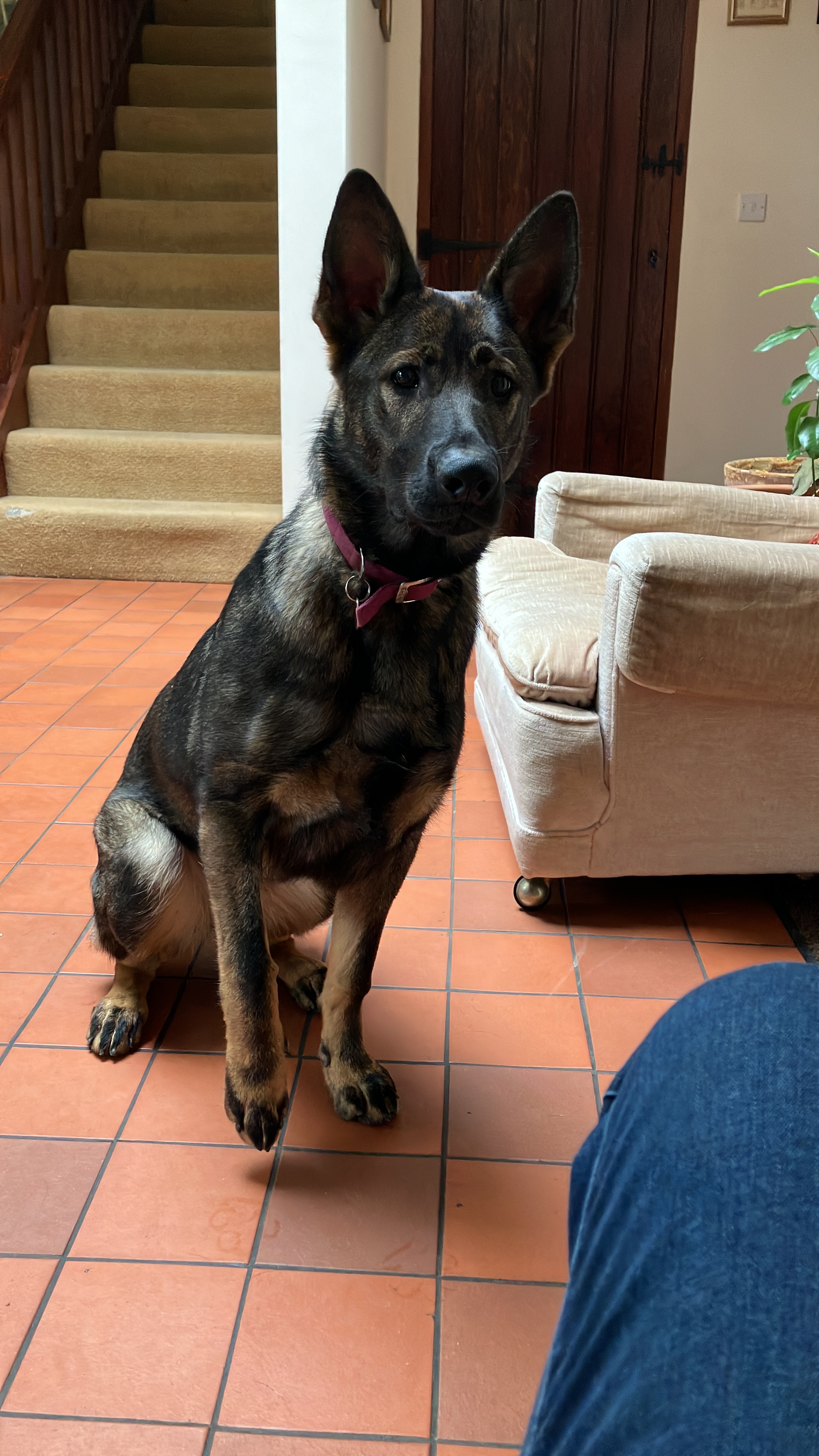
Meg’s Diary, Life with the Cat


11/1/2025

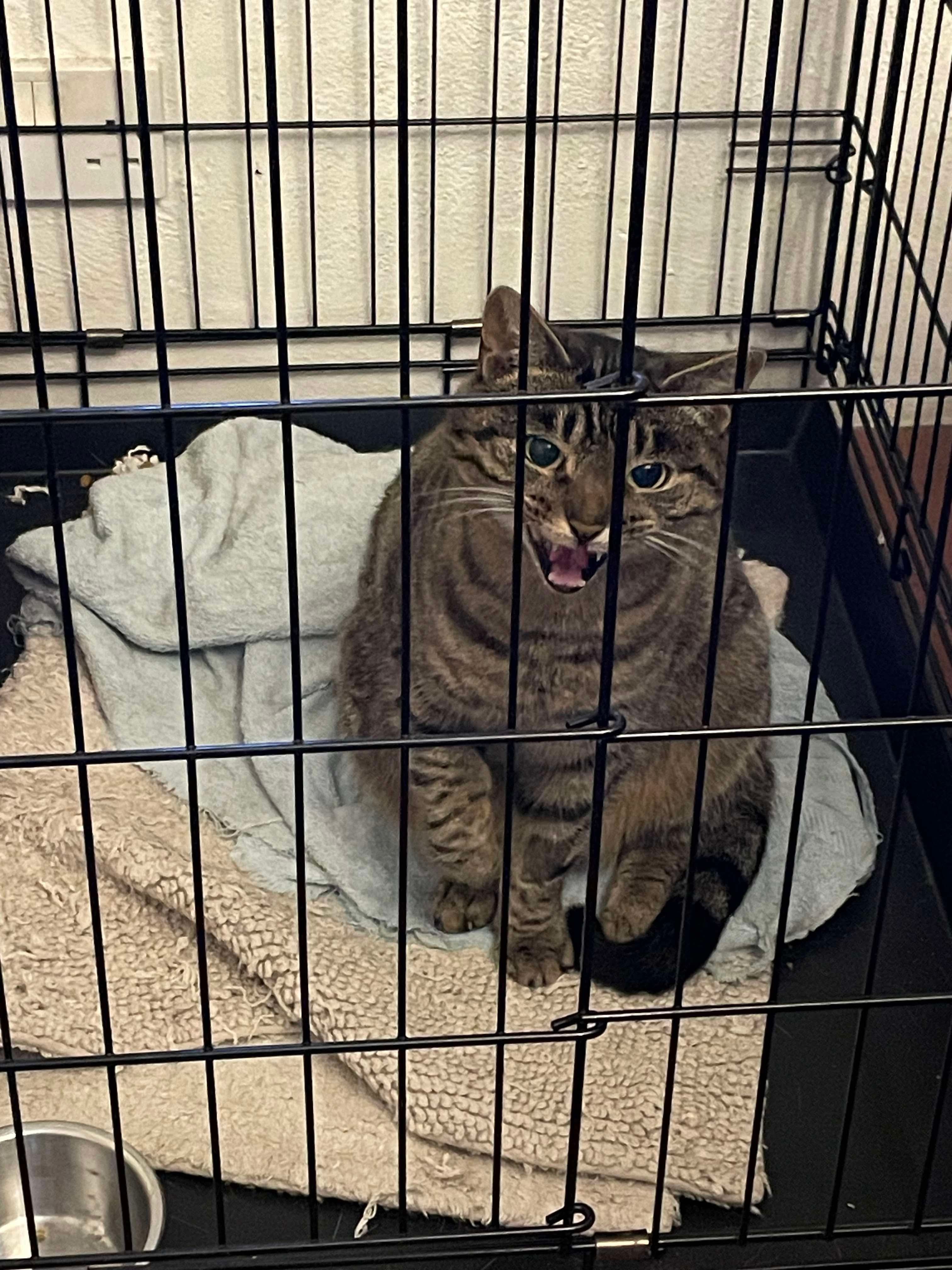
Trying to force Meg and the cat to be friends is not, I think, going well. The cages are now pushed next to each other, and on the positive side, they are able to both sleep in them—so for many hours there is peace. But the cat’s cage makes a corridor into the utility room, and the cat knows that when Meg goes in and out, she can reach through the bars and scratch Meg. Meg also knows this, so is very wary of walking past the cage, which results in a lot of barking and bouncing (because that is what a nervous Meg does). I blame the cat for this.


There is also chaos when the cat uses her dirt tray. I don’t know why, but as soon as the cat goes onto the tray, Meg starts to bark and bounce and bang against the cat’s cage. Maybe she doesn’t like the smell (though she emits such awful smells herself, I don’t think this can be the reason).

On the positive side, they have their bowls of food next to each other—either side of the bars—and they notice what the other is eating and don’t try to interfere. Lots of the time life is peaceful, even though they are in close proximity. The cat seems to be the boss, and is the main instigator of trouble—though as Meg is much bigger and has the potential to damage the cat, I really need them to co-exist peacefully, without a constant battle even if the cat starts it. The cat will have to be confined for another two weeks, until her snapped ligament has fully healed. Then we will see what happens. I’m not sure that anything has changed at all, and their relationship will continue to be one of Meg chasing the cat whenever she can, and the cat hissing at Meg from high vantage points. Which is exactly what it was before I started this exercise.

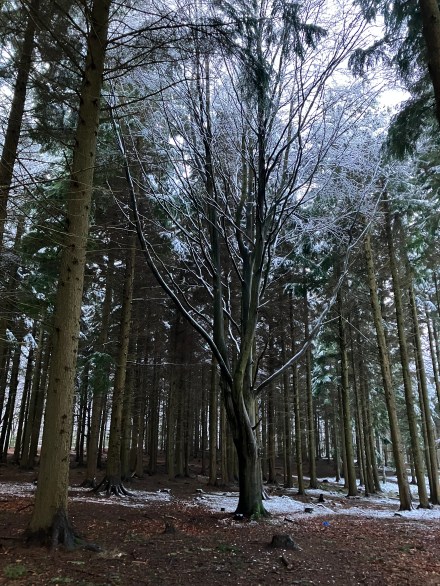
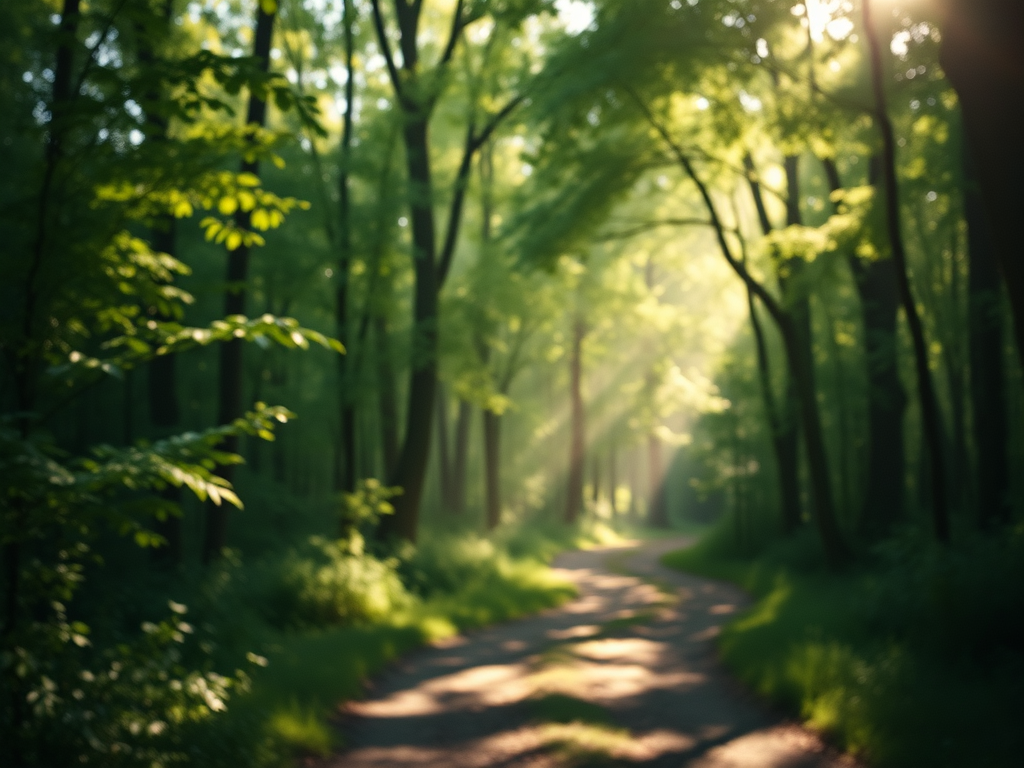
The woods are beautiful this week. The snow is clinging to the trees and the temperature has dipped below freezing, so it has stayed for a few days. Breathtakingly pretty. The ice means that walking is a bit dodgy, and the snow is packed hard from all the dog-walkers, and incredibly slippery. Everyone walks on the edges, where it’s less compacted, which means gradually the footpaths are widening.

The tree men are back, with their great machines of destruction, chopping down trees and churning up the mud. At least now its frozen the wheels will do less damage, but before Christmas was very wet, and they have ruined swathes of woodland by making trenches of mud and destroying the undergrowth. I hope they know what they are doing, and it’s necessary for the health of the woodland, but it looks to me like they are just blokes enjoying big machinery. Yesterday they started work in an area of mainly pines—which is where ‘my’ tree is. There is one tree (I think a beech) which has a very black trunk and a beautiful shape, and it’s very stark against all the surrounding pines. I have noticed it on my walks since 2001; twenty-four years ago when I used to walk my Labrador there. I even wrote a story about it. I do hope it survives the men and their machines.

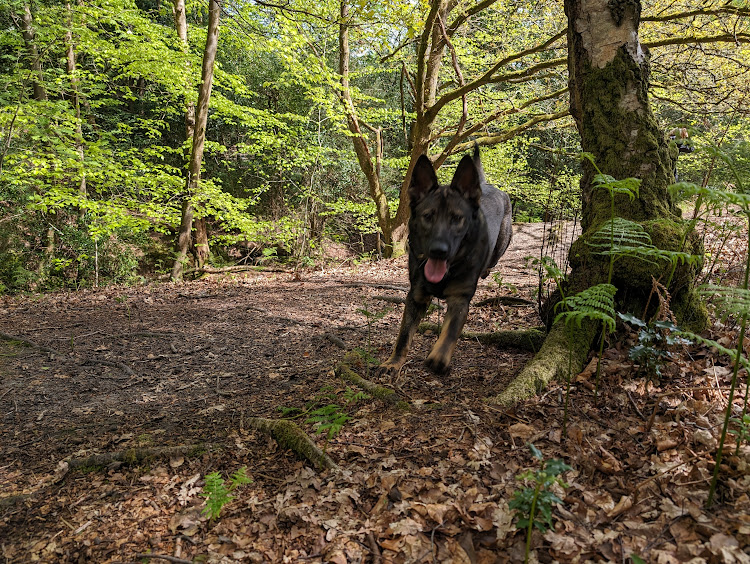
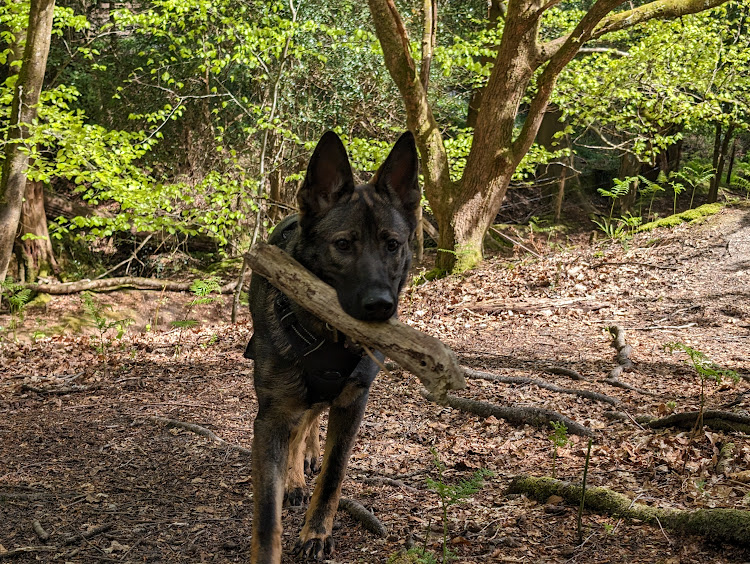
Meg, as ever in the woods, is very good near the workers—she basically ignores them. Yesterday we needed to walk very close to where they were working, so I collected a few sticks, told her to walk on my right, and we kept our distance, throwing sticks into the woods every few minutes so Meg was on full-alert, waiting for the next one to chase. She ignored the noise of the machines, the moving lorries, the falling trees, the men shouting to each other and the whine of saws. The only thing in Meg’s world was the next stick, and when it would be thrown. (It made her appear very well-trained. But she’s not. She simply has a compulsive desire to chase sticks.)


15/1/2025

Meg has favourite places to lie now (like a proper dog!) She has discovered the radiator on the landing and will lie there for hours, soaking up the heat and waiting for me to come out of my room. She also (weirdly) likes her crate, and will sometimes put herself to bed in there. She also prefers it to the utility room, so if she starts fussing when we eat, I go to the utility room, open the door, call her. Meg stops and looks at me. She understands she is about to be shut away, and she walks, very deliberately, into her crate and sits down. It’s very funny!

Thanks for reading, and have a great week.
Take care.
Love, Anne x

I gave blood today. It was, as expected, an utterly ghastly experience. It was also, unexpectedly, a humbling experience—and afterwards I felt very glad that I had done it.


I should start by admitting that (unlike most other donors) I was there for purely selfish motives. As I told you about a year ago, I was diagnosed with haemochromatosis, which means my body builds up iron stores. Too much iron causes fatigue, and eats your ligaments, and eventually gives you liver cancer—so catching the condition early is a very good idea. I had never heard of it before being tipped off by a relative (it’s genetic, so runs in families) but I have since realised that it’s fairly common.

Anyway, a year ago I was referred to a haematologist, who is very nice and very disorganised, and who basically does nothing and is impossible to communicate with—which is stressful. I therefore decided that I would take action myself, and sign up to be a blood donor. That way I could get some of the iron removed. I knew from a recent blood test what my iron levels were, and it’s not difficult maths to work out ratios, and how much iron will be removed per pint of blood (the iron will be less each time—so actually the maths is quite difficult, but luckily I married a mathematician). I’m all for being proactive with health issues—we are responsible for our own health.

To be a donor is relatively easy. You can complete an online form, and depending on your answers, they then phone you for more details before saying whether or not you are suitable. If you pass the first stage, you make an appointment at a nearby donation centre.

I arrived in good time for my appointment. They had advised me to drink lots, so I arrived absolutely bursting for the washroom! After using the Ladies, I was given a form to complete, and a booklet explaining the possible side effects, and a large drink of water. Several other people had arrived, and I was interested to see that many used the washroom (had obviously followed the same instructions as me) and most people sipped the water while reading the form (I had downed mine in one—which is how I drink water, though not alcohol).

I was then called into a little makeshift booth (the centre was in the local United Reformed Church) and my question sheet was scrutinised, and more questions were asked, and some of my answers caused the nurse to phone the blood centre, to check I was allowed to donate. I found this scrutiny unexpected, but realised that it is excellent. The blood bank is very careful to ensure that all the blood is suitable—not contaminated with diseases or medicines. (I was very pleased that I hadn’t taken a couple of Nurofen that morning when I woke with a slight headache, or I may have been sent home.)

The nurse then explained she needed a small sample to check, took my hand, and stabbed my finger. This was shocking! I had known that they would put a needle in my arm, and was ready for that, but the finger damage felt worse somehow. But I didn’t scream or snatch away my hand, I managed to sit still like a grown-up, as if people shoved sharp things into my fingers every day and this was no big deal. My blood passed the test, I was accepted as donor. Yaay!

I was then (after another trip to the washroom—very full bladder!) shown to a seat that reclined, like a dentist’s chair (but without the drill). The church hall had about 10 chairs, all with donors tipped backwards, their feet wiggling. I was given a leaflet that suggested certain exercises I should do while giving blood—squeezing my fingers and relaxing them, clenching my leg muscles, moving my feet—I joined the feet wigglers. My nurse started to explain what he was doing, but I said I’d rather not know, and tried to read my book. I won’t put you off your breakfast with the details, but he did what was necessary for me to donate (and it was not fun). I tried to look away, but the room was full of people, wiggling their toes and not-watching their own arms, so it was best to look at my book so I didn’t watch someone else by mistake.

As I lay there, trying to read, and staring up at the ceiling, and not thinking about what was happening, I was suddenly aware that someone would probably receive my blood at some point. Someone who would be suffering way more than I was, someone who might die without it. And I felt very humble, because here was I, shocked by a finger prick, and yet someone in crisis would maybe have their life extended by the blood I didn’t need. So I prayed for them, whoever they are, that my blood would be useful, and that God would use it to bless someone in a time of great need. And then I became aware of all the other people in the room—the other donors who were probably not there for selfish reasons like me, but were undergoing this rather ghastly procedure just because they are good people who want to help. And the staff, who were diligent, and caring, and were working as a team to collect blood to save lives. I was probably the least-good person in the room, and it was humbling.

Then, quicker than I had imagined, it was over. (I only read 4 pages of my book.) An alarm pinged, and they removed whatever was in my arm (I never looked, so never saw it). Then a nurse sat me up, and my head felt woozy so she lay me down again. (Actually, she tipped my right back so my head was very low and I thought I might slide right off the back of the chair which would have been very embarrassing! But I didn’t, and it stopped the light-headed feeling instantly.) I was sat up very slowly, and given a drink of water and a packet of crisps. (My brother gets a cup of tea and a biscuit, so I felt slightly cheated.)

When I had sat for a few minutes (which felt like a very long time) I was able to leave. I felt fine, very happy that I had been able to donate, and very pleased that I had not fainted (which was a distinct possibility).

When I got home (Husband drove, which was kind of him and probably safest for the world) I had the best cup of tea ever, and some chocolate brownie. It was done. I didn’t feel tired, or drained, or any of the other things that I had worried about (probably due to downing all those pints of water). If you have never donated blood, maybe you should think about it. If I can do it (even for selfish reasons) then really, anyone can. It’s a good thing to do.

I hope you meet some good people today too. Thanks for reading.
Take care.
Love, Anne x

I’m Sorry. I was wrong.


I’m sorry, I was wrong.

When I was very young, my knowledge of other religions was limited to two facts:

  1. Catholics believed in Jesus, but they didn’t believe he rose from the dead, which is why they always depicted him still hanging on the cross.
  2. Jews believed that the only way to be right with God was to offer sacrifices, and the idea of repentance started with Jesus.

I was wrong, in both cases. To my regret, although I learnt fairly quickly that I was wrong about Catholics, I continued to believe—and to teach—the wrong fact about Jews even as an adult. I’m very sorry about this, it was ignorant, and as someone who read the Bible, including the Old Testament, I really have no excuse.

I was reminded of this recently, when reading a little red book of daily Bible studies,[1] that I inherited from my father. The book is looking at the Gospel of Matthew, and is considering John the Baptist. You may remember that John lived in the wilderness, and wore strange clothes, and called to people to repent. As John the Baptist came before Jesus, this should have been evidence enough that Jews believed in repentance—without sacrifice—otherwise John’s preaching would have made no sense.

Barclay discusses what those early Jews would have understood by repentance. It’s much the same as the Christian church today preaches. The word in Hebrew means ‘turn’ or change direction/return, so the idea was that people felt sorry for a behaviour, and therefore wanted to change direction, to turn away from what they knew was wrong. This has always been the way that people have been able to approach God—first we admit the things we are doing wrong, and then we turn away and stop those behaviours. All very New Testament, except actually it started way back, in the Hebrew Canon.

There are several instances when the Hebrews were told to repent, so that God would heal their land, or hear their prayers, or be close to them. We read about it in Ezekiel (Ezekiel 33:11). It also appears in Jeremiah (Jeremiah 31:18-19). Hosea is full of it (Hosea 14:1-2). The book of Jonah is pretty much only about repentance—a wicked nation being told to repent so they won’t be destroyed.

Repentance does of course, thread its way through the New Testament teaching too. It is important. I think it is also timeless—but maybe not something we teach about today as often as we ought. When was the last time you repented of something? Not in the regretful, I wish I hadn’t done that because it caused me a problem, kind of way, but in the, I’m honestly sorry and I will say I was wrong and try not to do it again, sort of way. Repentance, I feel, has gone out of fashion. Instead of saying we were wrong, we give a reason as to why it wasn’t our fault. Or we belittle it, and say it didn’t really matter.

Unless, of course, we are thinking about other people’s wrong-doing. Then we are very keen that they should be sorry. Then we absolutely think they should change their behaviour.

I think repentance is important. I believe it is good for us. I think it is healthy, every night, to think about what we have done wrong during the day, and to admit we were wrong, and to ask God to forgive us—and to try to change. If we never do this, never stop and deliberately think about what we have done wrong, how can we change? How can we be better people? How can we know God in any meaningful way?

I wonder if this is also true of nations. When I look at the big disputes in the world—Israel/Palestine, England/Ireland, India/Pakistan—there seems to be no solution. But everyone is looking at the wrongs (and there have undoubtedly been wrongs) committed by the other side. I wonder what would happen if nations looked at their own wrong-doings? What would happen if governments admitted they had been wrong, and promised to change? But perhaps that is not possible, perhaps the hurts go too deep, perhaps there is not enough trust that the admittance of guilt wouldn’t be misused and twisted by the other party.

Therefore, I will leave the dream of national repentance to one side, and challenge you, today, to think about what it means at a personal level. There is risk with being honest with ourselves—but not, I think, as much risk as being continually dishonest. So go on, I challenge you. Spend some time today thinking about what you have done wrong (because I don’t know anyone who genuinely believes they are perfect). Name those faults before God—and plan to turn in a new direction. It’s what Jews and Christians have been teaching for centuries, maybe it’s time we all did it.

Thanks for reading. Have a good week.
Love, Anne x

anneethompson.com
******


[1] William Barclay, The Daily Study Bible: Gospel of Matthew (Edinburgh: The Saint Andrew Press, 1956).

Looking Outside of the Bubble


I very quickly want to tell you about a meeting that I’ve just had, with a couple of people who partner with Tearfund in India. Some of the meting was confidential, but some things I can share. Talking to people who live in vastly different places, with different problems, is always good. It’s so easy to stay in our own bubble, and to worry about our own problems, and hearing about people who mainly eat rats for supper helps to keep things in proportion.

I was learning about a project Tearfund are partnering with, which has the catchy title: Transforming Masculinities. (Honestly! I kid you not, this is the title they have come up with.) Unlike the title, the work has absolutely nothing to do with people who feel they are the wrong gender, or who want a sex-change, or any of the other modern inferences that you might imagine. The work is about educating men about the rights of women—teaching husbands that their wives are equal partners, and their daughters should have the same rights as their sons—that sort of thing. Crimes against women is still a big problem in India, and educating the men might be a good way of sorting it out. Especially because men in the churches are sometimes no better, when it comes to abusing women, than men outside of the church.

Tearfund is better than me at knowing how to meet need—and how to assess it. One of the workers made the excellent point that when assessing the success of a project like this, initially, you might expect the police stats on crime against women to increase. Because more people will be reporting it rather than hiding it, telling the women that it doesn’t matter. (The long-term aim, of course, is for the crimes to stop, but reporting them officially is a first step.)

The workers also talked, as an aside, about some of their other work—like ensuring people who cannot read or write are able to access the government help that is available, or mending toilets and checking that people in the slums are using them, or ensuring there is clean water available. When you see lists of things like one toilet to every 33 people, or a clean water tap available to x number of families, it really makes you think. This is today, 2024, and there are still families sharing a single clean water tap? Really? How is this okay?

They also spoke about the issues today, which I was ignorant about. Did you know that currently (end of November 2024) the pollution in Delhi is so bad that people have been told to stay inside? So just like during Covid times, children are not able to attend school, people are struggling with child-care and online work—and those are the ones lucky enough to have a job that can happen indoors. The people who have to be out are getting ill, simply because they don’t have clean air to breathe. We talk a lot about our rights in the UK, and the sense of entitlement worries me. But surely, everyone has the right to clean air to breathe.

We need to be aware of these issues, because we are all part of the problem, aren’t we? As I said, we live in our bubble, and if climate change doesn’t directly affect us, it is easy to ignore. If our taps work (our own tap, in our own kitchen—not shared with several other families) then do we even think about clean water? And as you read this, are you hoping to catch some rats for your supper this evening? We live in a small world, we are able to be part of communities that have less than us. Please don’t just turn away. Please think about how you can be part of the change to improve their lives, because they are real people, coping with real issues, they are not just a photo on a charity poster. I know, because I chatted to them this morning.

Thank you for reading, and please don’t just forget about it.
Have a good week.
Take care.
Love, Anne x
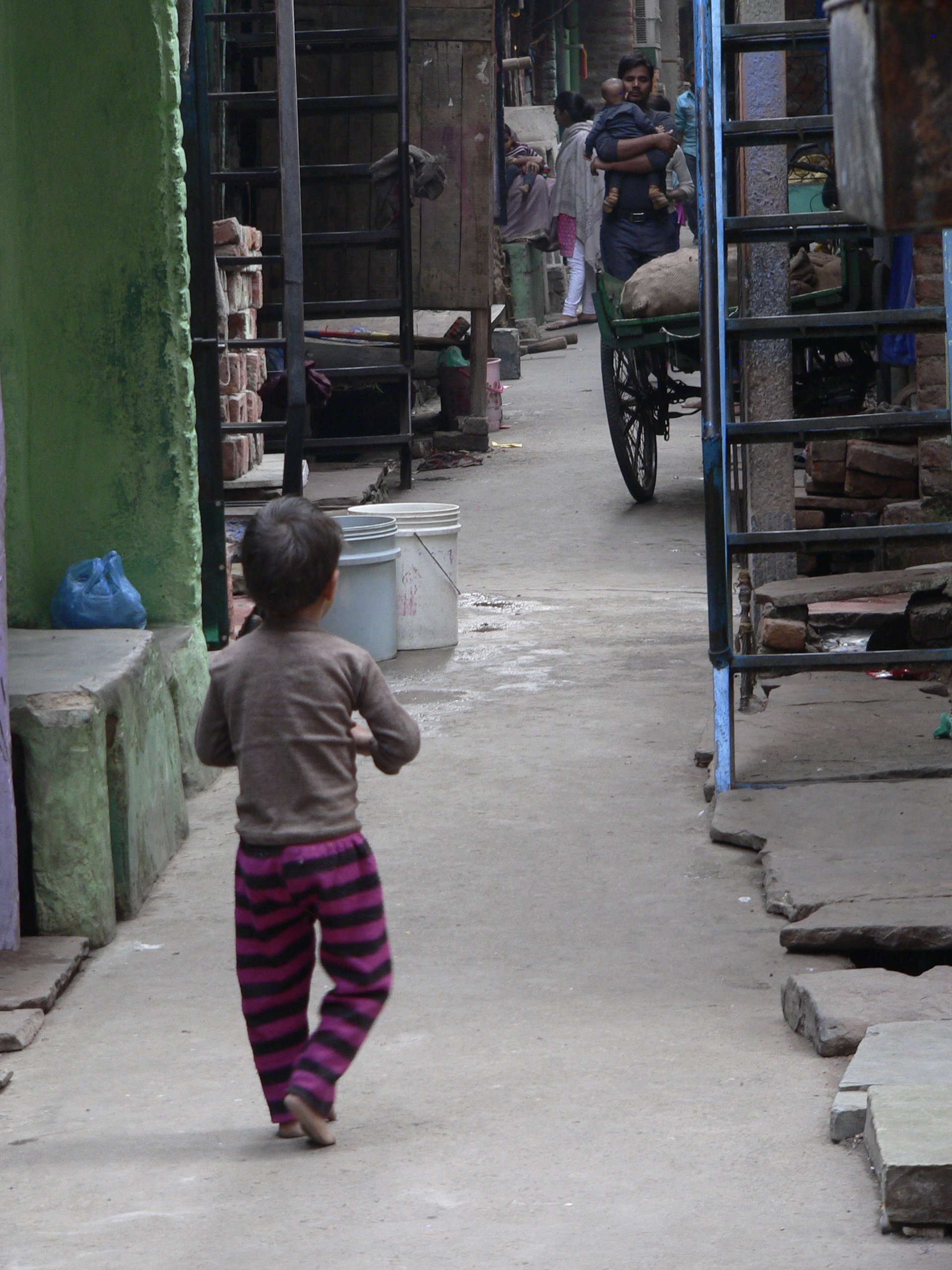
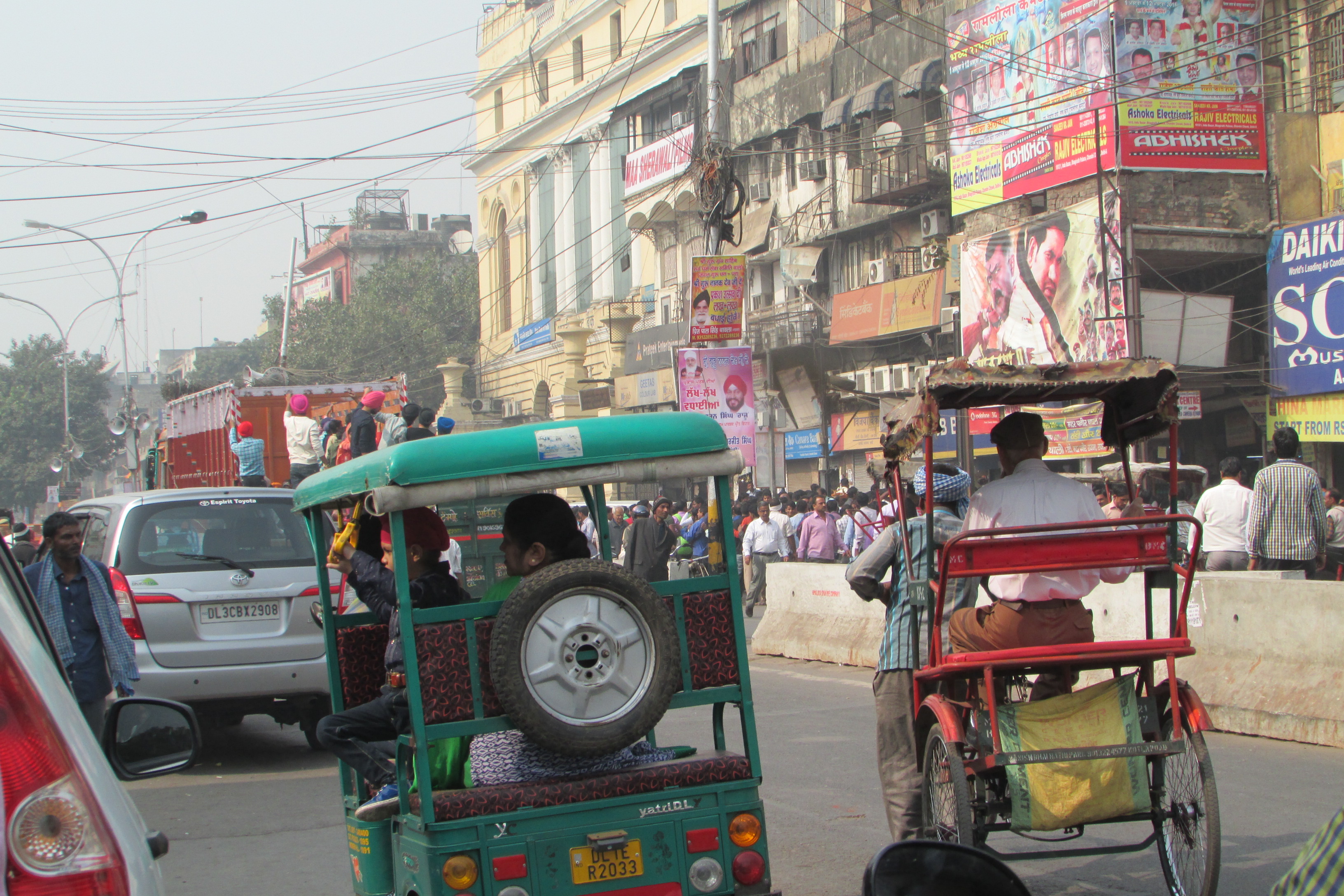
Some photos from my last trip, which was several years ago, but I fear things may not have changed much.

Remembrance Day Poem Reposted As Life Goes On


Now, and Then

IKEA homeware packed in boxes,
Heaps of stuff littering the hall, squashed into the back of the car.
Last hugs, cheery goodbyes, the drive to uni.
Snippets of home, spread around the strange smelling room,
The lanky excited-scared almost-man says goodbye,
And the mother remembers.
She remembers the feel of the bowling ball weight on her hip when she carried him,
The feel of his tiny hands on her cheeks when he offered snotty kisses,
The snuffle of breath as he slept against her shoulder,
She remembers the child as she looks at the man.
As she wishes him well, holds back tears until she has driven away.

Billycans and clothes stuffed in kit-bag,
A train to London packed up tight, hurry to find the right squad.
Last hugs, tearful goodbyes, a band plays on.
Heaving the bag, look around for friends joining too,
The lanky excited-scared almost-man says goodbye,
And the mother remembers.
She remembers the feel of the bowling ball weight on her hip when she carried him,
The feel of his tiny hands on her cheeks when he offered snotty kisses,
The snuffle of breath as he slept against her shoulder,
She remembers the child as she looks at the man.
As she wishes him well, holds back tears until he has joined his unit.

The posts on Facebook show new friends and nightclubs,
Texts assure his food is fine, his studies easy.
He doesn’t discuss the drunken evenings, the sleepless nights, the fear of loneliness.
But his mother knows, she reads it in unsaid words and tired-eyed photos.
And she waits. As life goes on.

There are no letters and the News shows little,
Bold battles move to the Front, the headlines proclaim.
They do not discuss the fallen comrades, the sleepless nights, the fear of injury.
But his mother knows; she reads it in unsaid words and tired-eyed photos.
And she waits. As life goes on.

The war ends. The boy returns home.
Yet, not a boy, become a man.
A man who will not speak of horrors,
Will not discuss the stench of death,
The sight of his friends, falling.
The nights when he still hears the screams, still fears the dark.
But his mother knows; she reads it in sunken cheeks and, eyes so weary.
And she waits. As time goes on.

The term ends. The boy returns home.
Yes, still a boy, almost a man.
A boy who chats and loves to amuse,
Loves to debate the point of life,
Who meets all his friends, laughing.
The nights when they drink, talk at length, sort their beliefs.
And his mother knows, he is safe and content with life, has a future.
And she waits. As time goes on.

by Anne E. Thompson

Anne E. Thompson
Thank you for reading.
anneethompson.com
Why not sign up to follow my blog?

Edinburgh University and Spurgeon’s Graduation


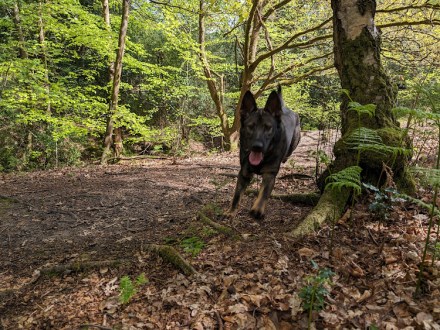
After our stay at Gleneagles (see last week’s blog) we drove to Edinburgh. I had an important meeting, and Husband took Meg for a walk around the city centre (because Meg, and important meetings, would be a bad combination). Afterwards he commented on how well-behaved she was. They had encountered marching bands, bagpipes, crowds of people and other dogs. Meg had walked beside him, looking very like a working dog being trained. (He told me that when asked, he said that Meg is being trained as a Royal protection animal—but I think/hope he was joking!) It was nice for me that he had a good experience, a little Meg/Husband bonding is useful.

Meg in the City

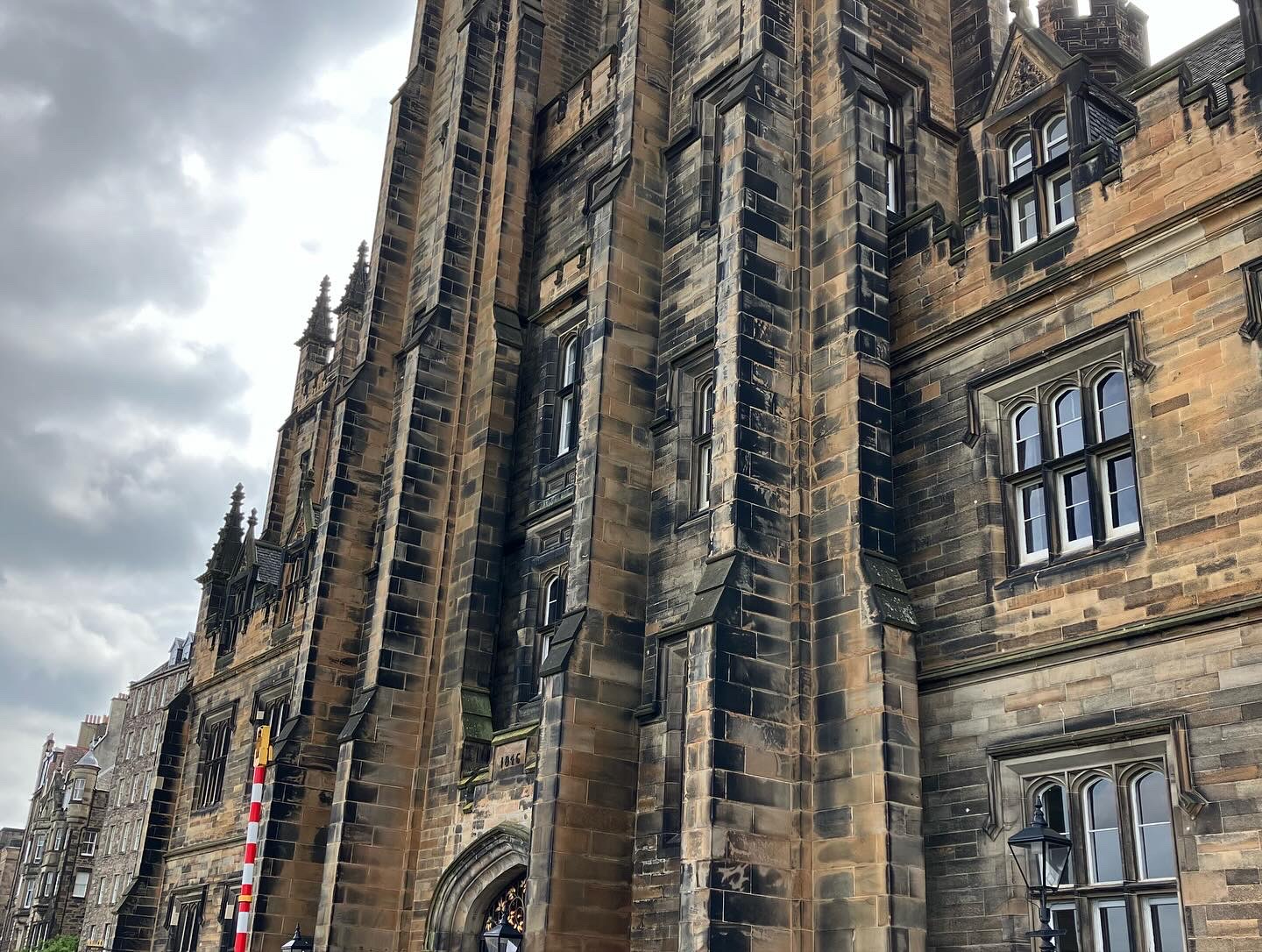
My meeting was at the university. I had forgotten how beautiful the city of Edinburgh is, and my meeting was at New College, which is next to the castle. New College is not new, it’s a fairly old building, steeped in tradition. I was told to wait in the quad, and I walked through the arch and sat in a little square courtyard, looking at a statue of John Knox, and arched windows and turrets, and stone steps. There is a feeling of history, of scholars through the ages studying Scripture, testing their beliefs—and I realised that I really want to be part of that. We will see—I will let you know what happens next.

My current studies are now officially finished, and it was my graduation ceremony at the weekend. At first I wasn’t going to attend, because I graduated with my teaching degree many years ago, and have since attended the various graduations of my children, and I felt rather old to be dressing in a cap and gown and having a photo taken. But then, when my final results arrived, I found that I wanted to mark the occasion—to finish my time at college with ‘an event.’ I’m glad now that I did.

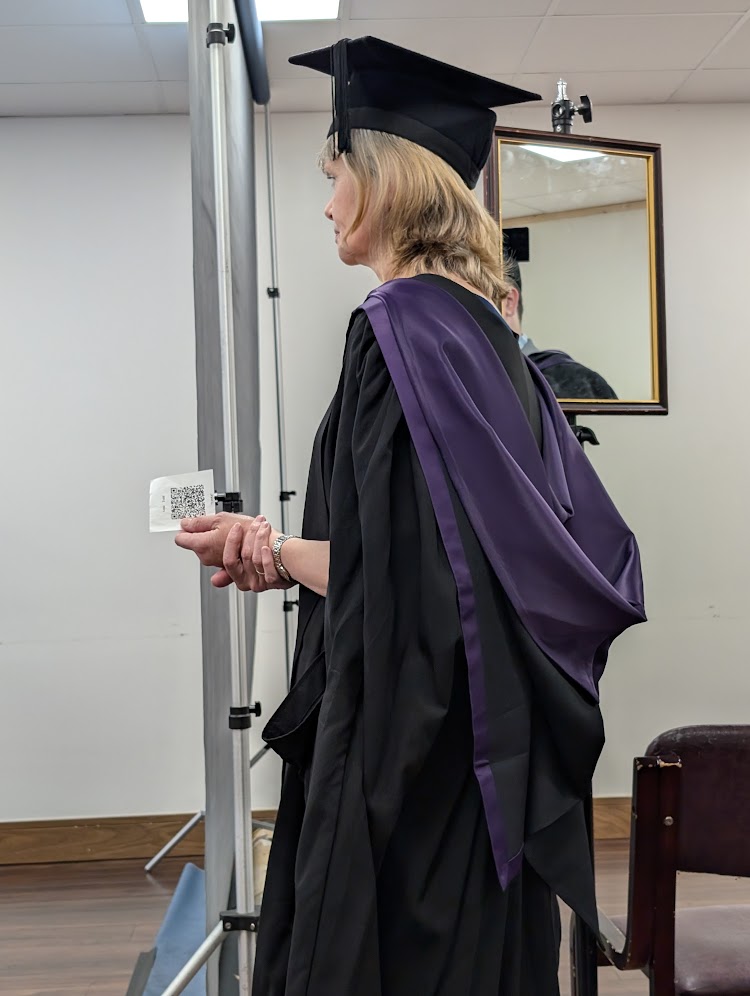
My MA is from Manchester University, but I have been studying at Spurgeon’s College, and they had arranged for the graduation to be at a big church in Croydon. We went by train, and then tram, and then walked down a residential street and I wondered if we were lost. But the church is huge, and modern, so it was easy enough to find. Everything was very efficient. I didn’t have a paper receipt or ticket, which I found very unnerving (this probably reflects my age—but honestly, what would happen if my phone lost power and all those clever QR codes were lost?) In the event, I only needed my name, and then I was directed by various members of staff (very kind of them to work on a Saturday) to the ‘robing room.’

The gown was difficult, and kept slipping around, and the hood—which was a pleasing colour—tended to sit in a rather racy off-the-shoulder position rather than the neat and tidy scholarly look that was intended. I had taken safety pins to try and secure the gown to my dress, but this resulted in the front of the dress riding up in an undignified manner. As for the hat—well! It felt fine in the fitting room, but as soon as I left, I’m sure it shrunk. It absolutely refused to sit securely, and perched precariously on my head, falling off if I moved too quickly. No one else seemed to have any problem at all, and the auditorium filled up with students looking tidy and elegant, and staff members in a rainbow of universities’ caps and gowns. (Actually, some of the staff graduated from universities with decidedly daft hats. I realise that before applying to do a PhD, a very important factor should be what the graduation outfit is, because for evermore, that is the cap and gown you will have to wear for every academic occasion. Some of the staff had not done their due research here. But I felt feedback would be inappropriate at this point.)

It was fun meeting all my student friends again, catching up with news, hearing what their plans are. We haven’t met since before I started writing my dissertation, which is months ago. Some of my family came to support me, which was a lovely surprise.

There were group photos (the photographer tidied me up a bit beforehand, which reminded me of my mother, who always seems to tell me to comb my hair, even though I am quite old now). The actual service was very long (graduation ceremonies always are). This one was even longer, because lots of the graduates were now Baptist ministers, so there was a sort of church service, complete with extra-long sermon from Rick Warren (our Chancellor) and several hymns and prayers. But I’m still glad I went, and they gave a short bio as each student went on stage, which made it feel very personal. And most importantly, the cap stayed on my head for the whole walk across the stage (it fell off when I sat down, but that didn’t matter).

I hope everything stays in place for you this week. Thanks for reading.
Take care.
Love, Anne x

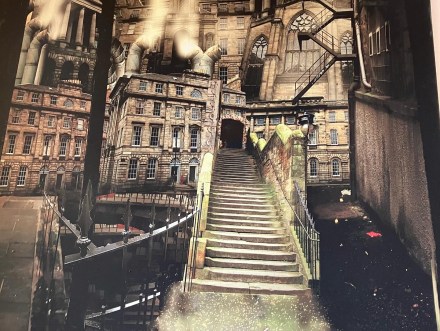
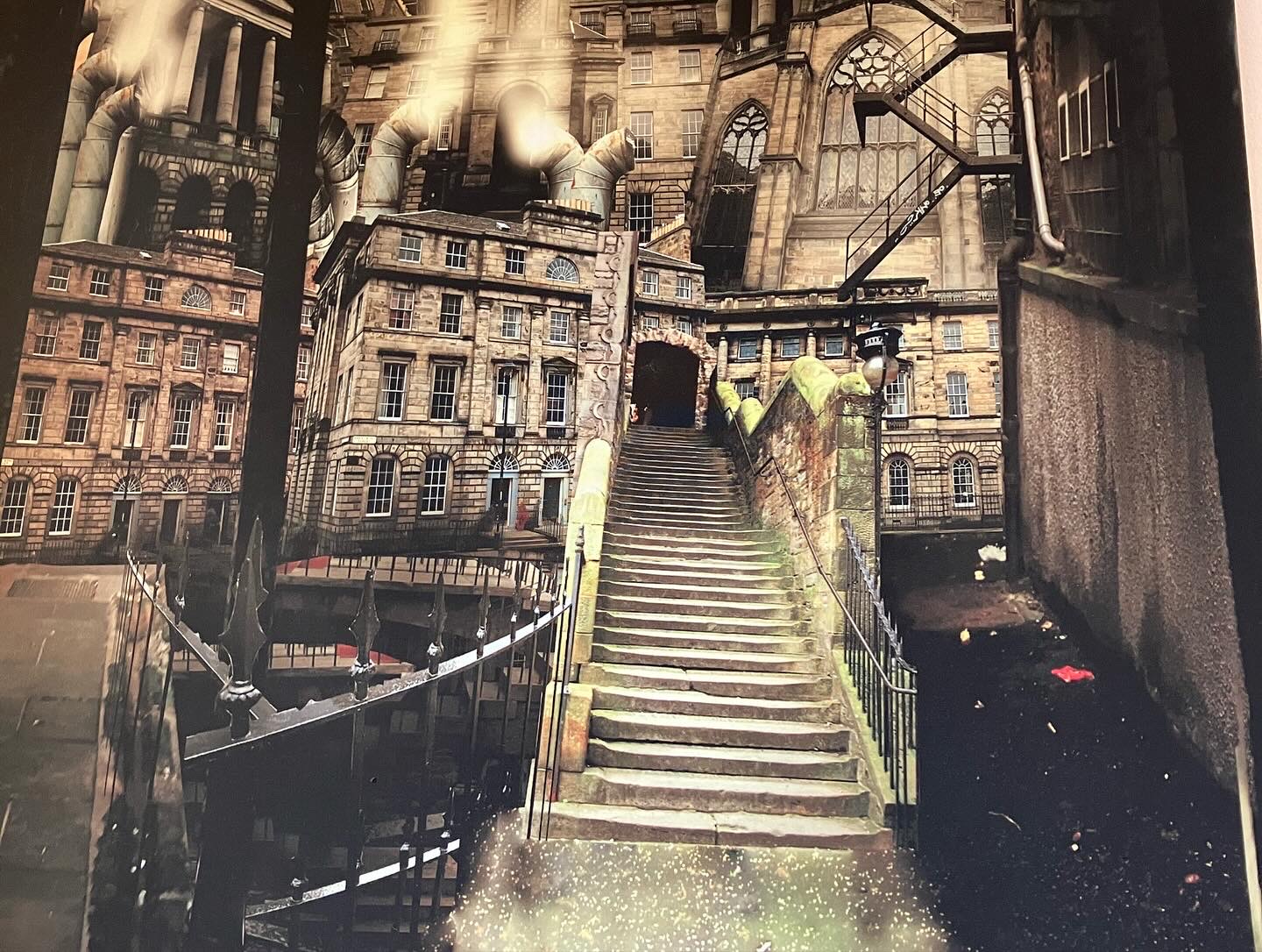
A painting (in the café next to New College) which I really like. Unfortunately I don’t know the artist’s name, but I will add it when I find out.

anneethompson.com
*****

Mad Meg Nearly Kills Me


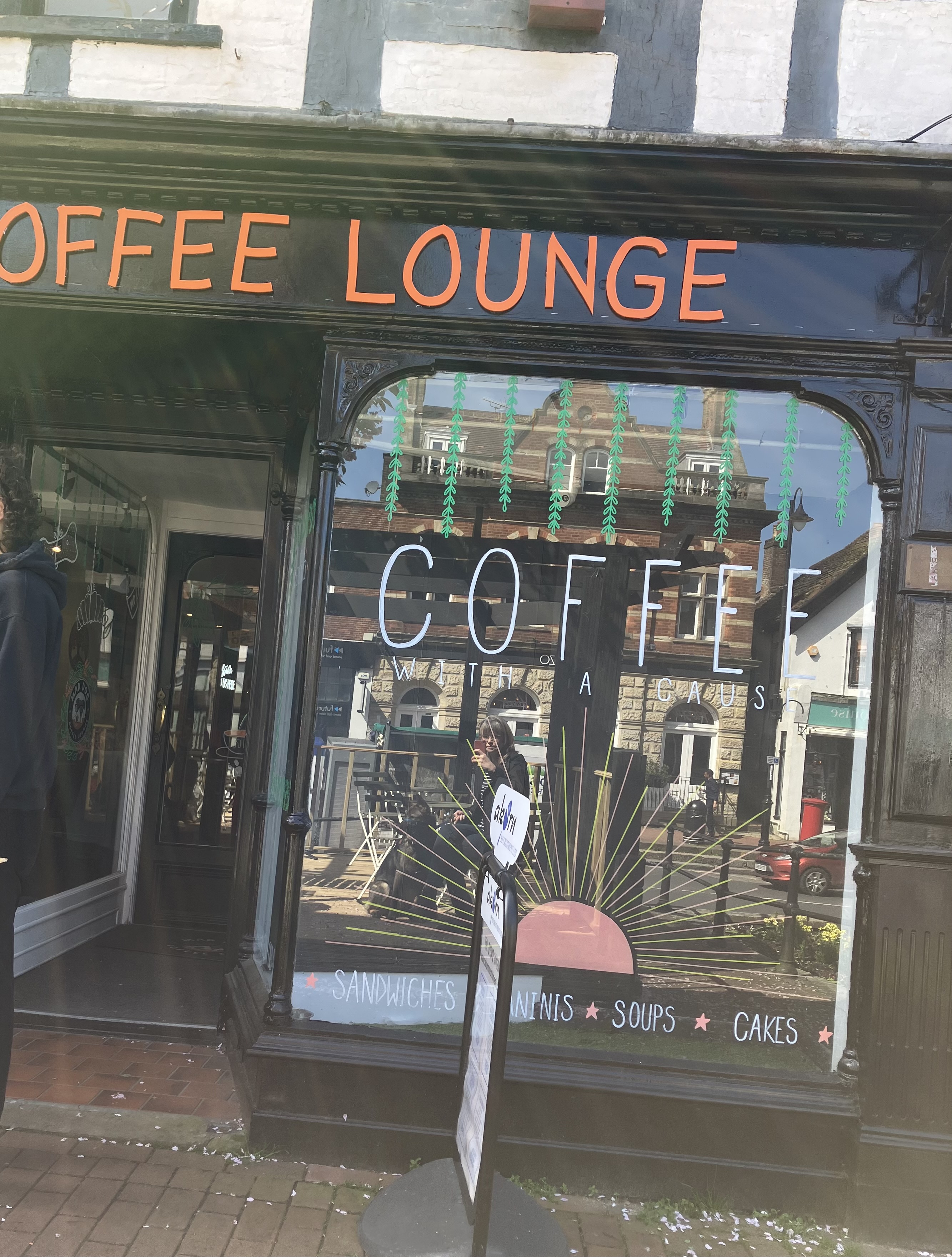
We had a great day on Tuesday. I drove to East Grinstead (Meg is still refusing to jump into the Mini, which is a real pain, she is very heavy to lift). Parked, and walked 10 minutes along the High Street. Meg lurched towards cars when we were right next to the road, but the High Street has a slightly raised path, a couple of metres from the road, and she ignored the traffic there. We were meeting a friend, and arrived early, so we sat at a table outside in the High Street. There was another dog, who Meg noticed, but she then settled down and was peaceful.

When my friend arrived we went into the cafe (the Mad Dog Cafe—appropriate name!) Meg, for some reason, baulked when we were inside and refused to walk any further. No idea what spooked her. We were next to a table, so sat there. Meg settled on the floor with her chew. She barked, briefly, at a woman carrying a tray, and at a baby shaking a toy. Other than that, she was very well-behaved, and I plan to return.

It was Puppy Classes in the evening. There was a new dog, a 10 month old poodle (a big one) and he barked at everyone. Meg responded initially, but then ignored him. It was fairly crowded this week, with puppies of all sizes, and she did very well, sitting and lying and walking in close proximity to lots of other dogs. Only dug one hole this week, so a success. (The class is in the sand school of a stables and we usually arrive to perfectly flattened sand, and leave to a mass of craters that Meg has dug.)

Yesterday was not so successful. I was feeling tired, so exercised her in the garden. During the afternoon I bent to pick up a stick, Meg dived for it, ran straight through my legs, and knocked me flying. Luckily I didn’t bang my head on a nearby tree, but I sprained my knee and ankle, and got a few bruises. While I lay on the floor, winded, with my glasses next to me, did Meg care? Not a jot! She bounced around with the stick and was in danger of trampling me. So much for the idea that dogs are attune with us and empathise with our emotions. I suspect if I had been knocked out, she might have eaten me! Hobbled back to the house for Nurofen and bandages.

**

My ankles are healing well (tight bandages, rested and raised—usually does the trick). I haven’t risked running yet, but yesterday I took Meg for a walk to the stream. This was such hard work. The main road has been shut for several weeks, due to a collapsed drain, which means there has been very little traffic. It is now open, and lots of cars zoomed past us—Meg lurched at every one. This is very disappointing, I have tried so hard to desensitize her to traffic. I’m guessing we made a mistake when she was little, in allowing her to pull on the lead. It’s now a real problem, and trying to make her walk to heel is futile. The best I could do was make her sit, before each car reached us, and held her on a tight lead, with one hand on her head (not sure if that was for comfort or because I was so angry with her I needed to be pushing her down!) There were many cars, it took a very long time to walk the 100 metres to the field entrance.

Once away from the road, I released Meg, and she ran into the field, hunting for sticks and sniffing smells, and always keeping relatively close as I marched away. There’s something about walking fast that is a great releaser of tension—for both of us I suspect. I’m sure if I couldn’t walk fast I would be taking anti-depressants.

Unfortunately, the happy walk was interrupted as soon as we rounded the first corner. A collie was there, called Leo, with his owner, and he was nasty. (I mean the dog was nasty, the owner was simply incompetent, I assume, as a nasty dog should not be loose where other people walk.) He snapped at Meg, who has never met an unfriendly dog before. He then pounced at her, and she yelped—I don’t know if he bit her or just frightened her. She ran off, back into the first field, and Leo followed. I could see her through the gate, she was watching me, but not daring to pass nasty Leo, who was baring the way. I called her, and Meg started to come, but Leo lurched towards her again. I asked the owner (in my very snotty schoolteacher voice) to ‘Please put your dog on the lead because he’s frightening my dog and she daren’t come back to me.’

Incompetent owner shouted, ineffectually, at Leo, and managed to move him further away (though still didn’t put him on the lead). I was furious. Meg is a German Shepherd dog, and they are known for being unfriendly towards other dogs. Meg, however, has a very sweet nature, and will happily ignore most dogs. It only takes one encounter with an aggressive dog to spoil this. I’m really hoping that Leo-the-nasty-collie will not cause Meg to be defensive whenever she sees another dog.

We marched off, round the field, releasing our tension. By the time we returned to the road, with all the whizzing traffic, I had recovered enough to cope with mad Meg trying to catch every car that passed (every single car). Arrived home exhausted.

Hope you have more success with the difficult things in your life–hopefully we will get there eventually. Thanks for reading.
Take care.
Love, Anne x

Thank you for reading. anneethompson.com *****

The Pathway to Applying for a PhD


Hello and how was your week? Do you have any changes in the near future?

The change facing me at the moment is the end of my MA course. I have received the mark for my dissertation (and was very pleased with it) and as soon as it has been validated by Manchester University, the final grade will be set and I will graduate. Which for me, is rather unsettling. I am not a person who relishes more time for housework, so I need to decide what comes next in life. I have loved studying, and would love to continue, so I am writing a proposal to work towards a PhD. I will let you know whether anyone accepts me. My current college works with Manchester Uni for Master’s level awards, but is not currently accredited for PhD awards.

I have not been in the academic world for very long, so before I could apply, I had to discover the process. There is a way to do everything. This may not apply to other disciplines, but this is how a PhD in Theology works:

Firstly, I have to decide what to research (a PhD is a research project). I am meant to ‘contribute to the discussion’ so unlike my MA, which could be simply a review of other scholars’ work, I have to bring something new. This is fairly difficult, because although I am fully expecting to think of something original as I do my research (my brain generally  finds different avenues to other people) until I start, I don’t know what I will discover. Therefore much reading around topics is required, trying to find an area of interest.

Having decided on a topic, the next stage is to see what studies have already been undertaken. It would be difficult to research a completely new field, with no literature to evaluate. As I read, I start refining my ideas, listing relevant literature, deciding on the direction of my research.

The next (massive) stage is finding a supervisor. Basically, during a research project, you have a supervisor who gives good advice and keeps you on track. They need to be interested in your subject, and be willing to work with you. My current supervisor (for my MA) suggested some suitable scholars. I now have to approach them, briefly outline my project (like a sales pitch) and ask if they would be interested in hearing more. At this stage I don’t say much about me, I simply outline my research idea.

If they are interested, and have time for another PhD student, they will ask for more details. I then send them a more formal proposal, outlining what I consider to be the main issues, the sort of literature that’s available, a vague general direction for my research. If they like all that (here’s hoping!) they will then agree to supervise me . . . if the university accept me.

The next stage is to apply to the university. The supervisor will help with this, telling me how to shape my proposal so it covers the areas the university requires. I apply directly to the university (who expect me to already have a supervisor in place). My understanding is that whilst the supervisor needs to be interested in my project, the university is interested on whether my project will gain the funding it needs, and whether I will complete it in three/four years. (Finding funding is another step.) Both these factors affect their stats, and universities are primarily businesses. If they have students who start but never finish their PhD, that reflects badly on their reputation.

If the university accepts me, then I will be exceedingly happy, and I will disappear into a frenzy of study. But there are several steps, so we will see. I will let you know. I hope your own plans are going forward. Thank you for reading.
Take care.
Love, Anne x

Thank you for reading.
anneethompson.com
*****

More Meg


I have started to take Meg with me wherever I go (that allows dogs). We have walked round the market (stressful) the garden centre (surprisingly good) and the Four Elms shop (excellent behaviour once through the scary sliding doors!) I also take her, when appropriate, when I go out for coffee—I carry a chew and an old towel for her to lie on (not that she does lie on the towel, but it shows willing). She has been to Mum’s a couple of times—the first time was a nightmare and I spent the entire time stopping her eating the carpet/rug/draught-excluder/flower arrangement. The second time was better, and we had a nice chat (me and Mum, not me and Meg) while she (Meg, not Mum) chewed her chew. She does have the snake draught-excluder on her hit list though, and looks for it whenever we visit.

Always fully alert and ready to bounce.

Today we took her for coffee in The Garden Coffee Shop (Four Elms). We walked in, and Meg jumped up to look out of the window, put her paws on a seat, tried to join other customers at their table. Not too professional. We got her into a corner, and she settled down with her chew. Every time new customers entered, she stood up and barked at them (not sure why, no one else had a dog). Then gradually she relaxed, and we had some time to actually drink coffee and chat. After about 30 minutes she grew restless again, so we paid and left. I’m hoping that over time, this will be relaxing for all of us. At the moment, it’s a work in progress.

While the main road near the house is closed (and there is less traffic passing) I am walking Meg to the nearby stream each day. She is still super reactive if a car passes, but we only have a short stretch next to the road, and once in the field she is fine. I have no idea what will happen when she sees a deer, but I don’t think she can run to any roads even if she chases it. The good thing about the walk is that she has to wait at the gate when we leave, so it’s easy to put her back on the lead. She has become very naughty at being caught when it’s time to go home, so I can only take her to places with a barrier that stops her.

7 Months
I talked to ‘dog-trainer-Sue’ about taking Meg on a train. She advised me not to take her to a station initially, as it would just scare her, and to practice things like going through sliding doors, and walking through the underpass tunnel in Oxted. We practice the sliding doors at the garden centre, and Meg is completely fine with them now. But trying to go through the underpass had the same reaction as the tunnel in Instow—full brakes, and not persuadable! We have walked up and down the ramp a few times, but I’ll need Husband to help me get her through the underpass

We went to Cambridge, and took Meg. I took her on a long walk first, so she didn’t need physical exercise. We shoved her into her crate in the boot, and drove (2 hours) to Cambridge. I then walked her for 10 minutes, just to loosen up her joints, and offered her a drink (which she didn’t want). Then back into the crate while we looked around a prospective house to buy, and then drove home. She was great, and I think she just slept or chewed her chew. (I keep the chew for ‘special’ occasions, like when we’re out and I need her to be confined.) Though she did stand up and bark on the QE2 bridge! I don’t think she likes heights. When we got home it was evening, and I worried she might be full of energy, but she seemed tired, and was happy to go to bed. I guess she must have been alert and watching during the afternoon.

Today we took her to the pub. It’s a 45 minute walk, which is slightly long, but I’m hoping it won’t hurt occasionally. She was terrible whenever a car passed us, but we can cope with terrible now. In the pub she settled under the table with her chew, and was completely engrossed unless someone approached the table—when she barked at them. I think she was worried they might steal her chew. It wasn’t as relaxing as when we leave her at home, but I’m hoping that things like this will become routine. It’s easier to occupy Meg if she joins me for my activities rather than having to do things exclusively for her. After a quick lunch, we walked back home. I was tired, she was still bouncing. Such is life.

Thanks for reading. I hope you have things sorted this week.
Take care.
Love, Anne x

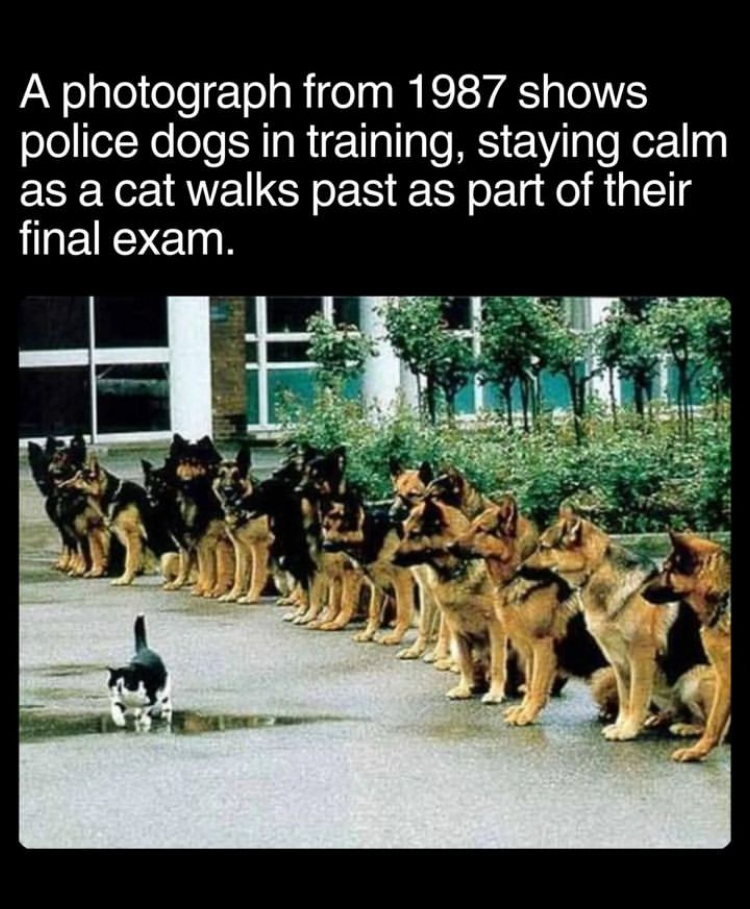
Without a doubt, we would fail this exam.

****
anneethompson.com

Life


Hello, and how has your week been? Life usually has lots of good things and difficult things–and as long as I remember to notice the good things, I can cope with the difficult stuff. At the moment, I am noticing lots of good things.

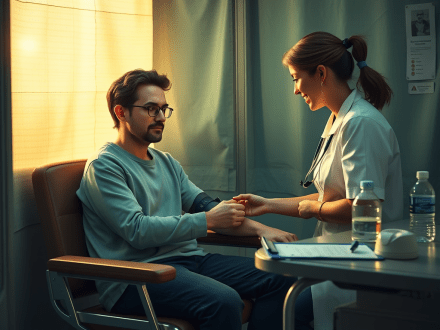
The main thing I’m thankful for is my health. I have now had the results from the heart and liver scan (actually, they seemed to check just about every internal organ!) and all is good. No iron deposits were seen, so I can start having venesections and that should prevent any future trouble. I also had my most recent blood test at the hospital where they’ll do the venesections, and it was a very good experience. Unlike the nurses who often take blood or put in a tube (usually related to scans for the brain tumour) this nurse quickly found a vein and didn’t leave my arm looking like I had been in a fight. The hospital space is also very nice, with big comfy chairs to relax in (ready to stop wimpy people like me fainting!) and staff who were really kind, and very reassuring. I came away feeling confident that venesections are something that will soon become ‘normal’ and I felt so grateful for the medics and feeling safe in a hospital (when I know that in some countries, this would not be my experience). I sneaked a photo to show you— not sure if taking photos is allowed in hospitals so don’t tell anyone. I don’t yet know when the venesections will start, but I am ready!

It’s also Spring, and that is a wonderful time of year. I love all the colour, the warmer weather, the busyness of insects waking up and birds nesting and lambs in the fields. Goose decided to sit on her nest (the better one she made, with hay stolen from the chickens–not the rather pathetic 6 sticks thrown on the ground affair that she started with!) I had collected her eggs as she laid them (just 8) as I was hoping she wouldn’t go broody, but she did. I left her with one egg, and have given her a couple of fertile chicken eggs from my old black hen (because she might die soon and she lays lovely big brown eggs). I have also found a few random duck eggs abandoned on the bank, so I have given her those. She seems to accept anything, so we’ll see what hatches. (It won’t be her own egg, as that’s infertile.) Probably she’ll step on the hatchlings and squash them, because she’s very clumsy, but we’ll see.

Maverick, the cockerel, is being a pain. He’s obviously full of Springtime hormones and has started to attack people when they go in the garden. I pick him up and carry him around, but other people are less happy doing that, so he has to stay locked up when we have visitors. The thing is, he’s so beautiful, and at night he snuggles onto the nest with Goose (who he thinks is his mother) which is so cute, and I don’t think I can get rid of him. I’m hoping he will calm down again after Spring.

My other news is that my dissertation has been submitted. I now wait 8 weeks for the mark, and that’s it, my MA is complete. I have started to read about cognitive linguistics, which is really interesting, and hope to write a proposal about death for a PhD. (I think the evidence in the Old Testament shows that death of an individual is a good thing, and was always part of God’s design — otherwise a ‘tree of life’ would never have been a thing. Losing someone else to death is definitely bad, and taking a life is bad, but dying oneself is, I think, good. Otherwise when God killed innocent people–like King David’s baby son–he was acting badly, which is not the nature of God.)

There has, of course, been a fair amount of nasty things too. Friends dying, sad funerals, bad news, family being unhappy, and housework — always there is housework, which is very irritating.

Hoping your week has a balance of good things to help you cope with the rubbish that happens. Thanks for reading. Take care.
Love, Anne x