Cairo, Egypt. Blog Seven.


Memphis and the Red Pyramid

We wanted to visit an agricultural area, and the Red Pyramid because it looked as if it was in the desert rather than sandwiched between cities. Husband negotiated a car without a guide, because we wanted to plan our own route. This took some nifty negotiation, but he managed it.

When the car arrived, there was further negotiation about the route. The driver (who had 42 years experience as a tour guide—a sentence I heard a few times that day!) was insistent that it was much better to drive to the Saqqara area of pyramids, and look at those first. Then, if we wanted he could drive us to the Red Pyramid, and after that if we still had energy we could drive to Memphis (which had a small museum).

The driver spoke only to Husband during this negotiation, which I was very happy with. Male dominance is a thing in Egypt, but to be honest it rather suits me. The men are comfortable in their superiority and therefore only address other men. I don’t much like being spoken to by random men in the street, so was happy for all the touts to confront Husband. The women have a sort of secret understanding between themselves, so as I made eye-contact with women, they would smile, and nod, and I felt great unity with them. Mostly, I liked it. Being underestimated is usually a good thing I find.

Husband politely (because everything is polite in Egypt) insisted that we would first visit Memphis. We knew that Google maps showed this as an agricultural area, so we chose a small museum within Memphis as our destination. I suspect the driver had a planned route, that would take us to various places on the way where we could spend money and he would receive a percentage, and we rather ruined that. I didn’t feel guilty.

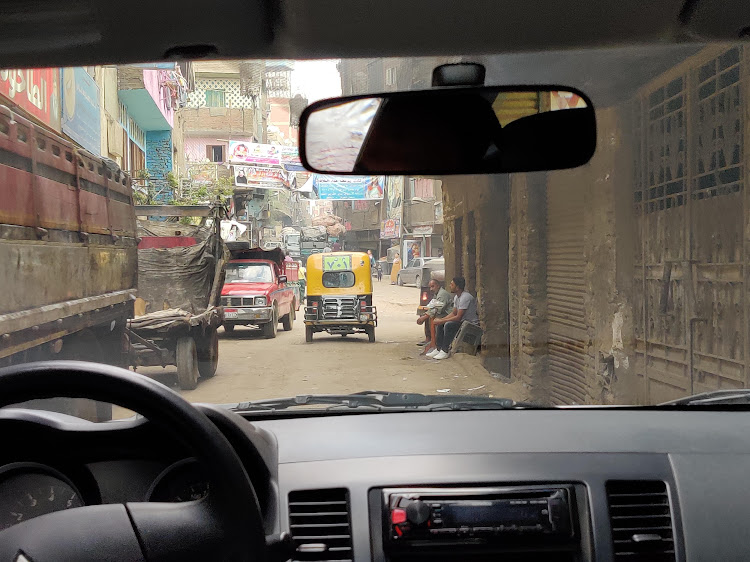
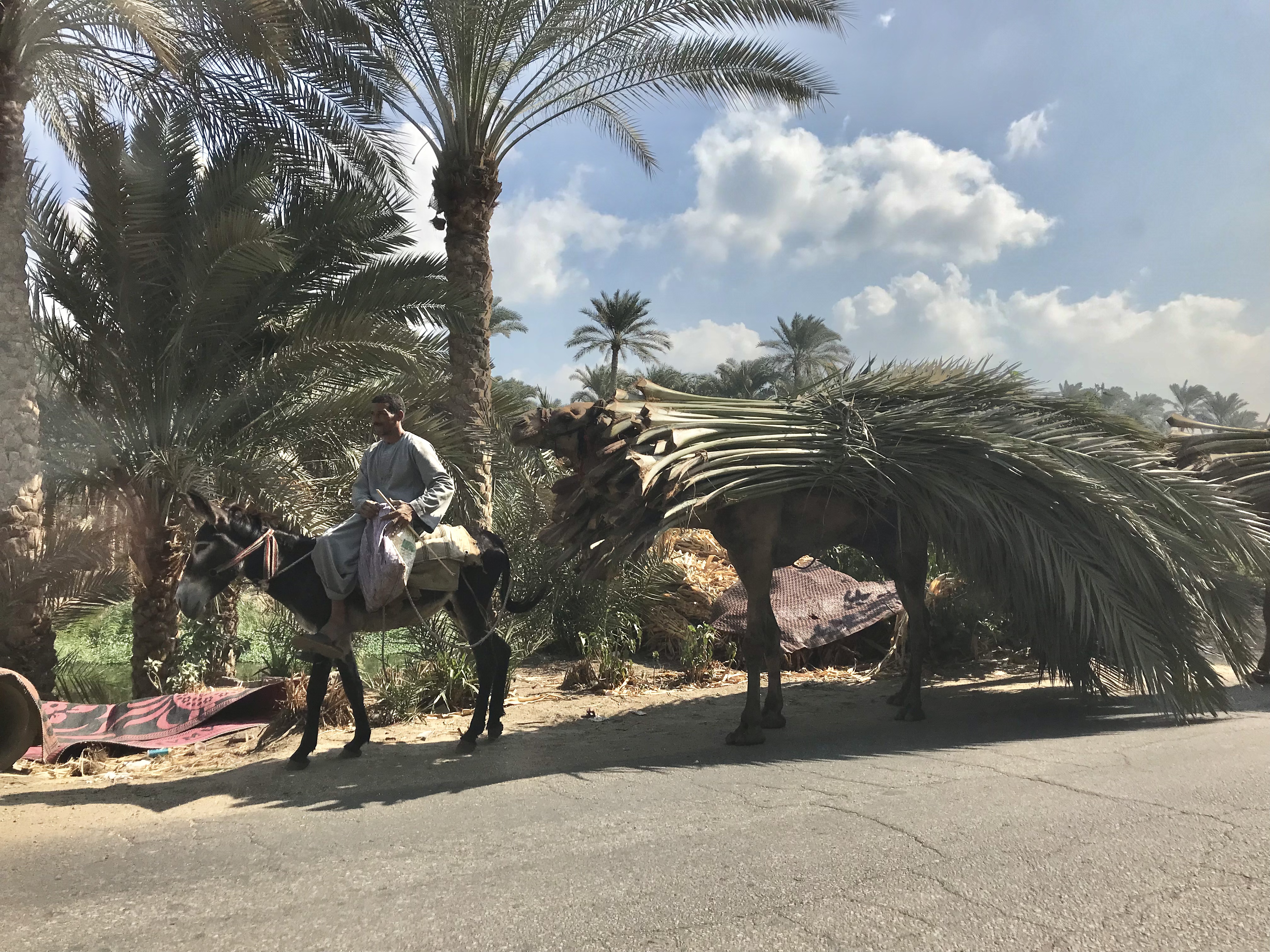
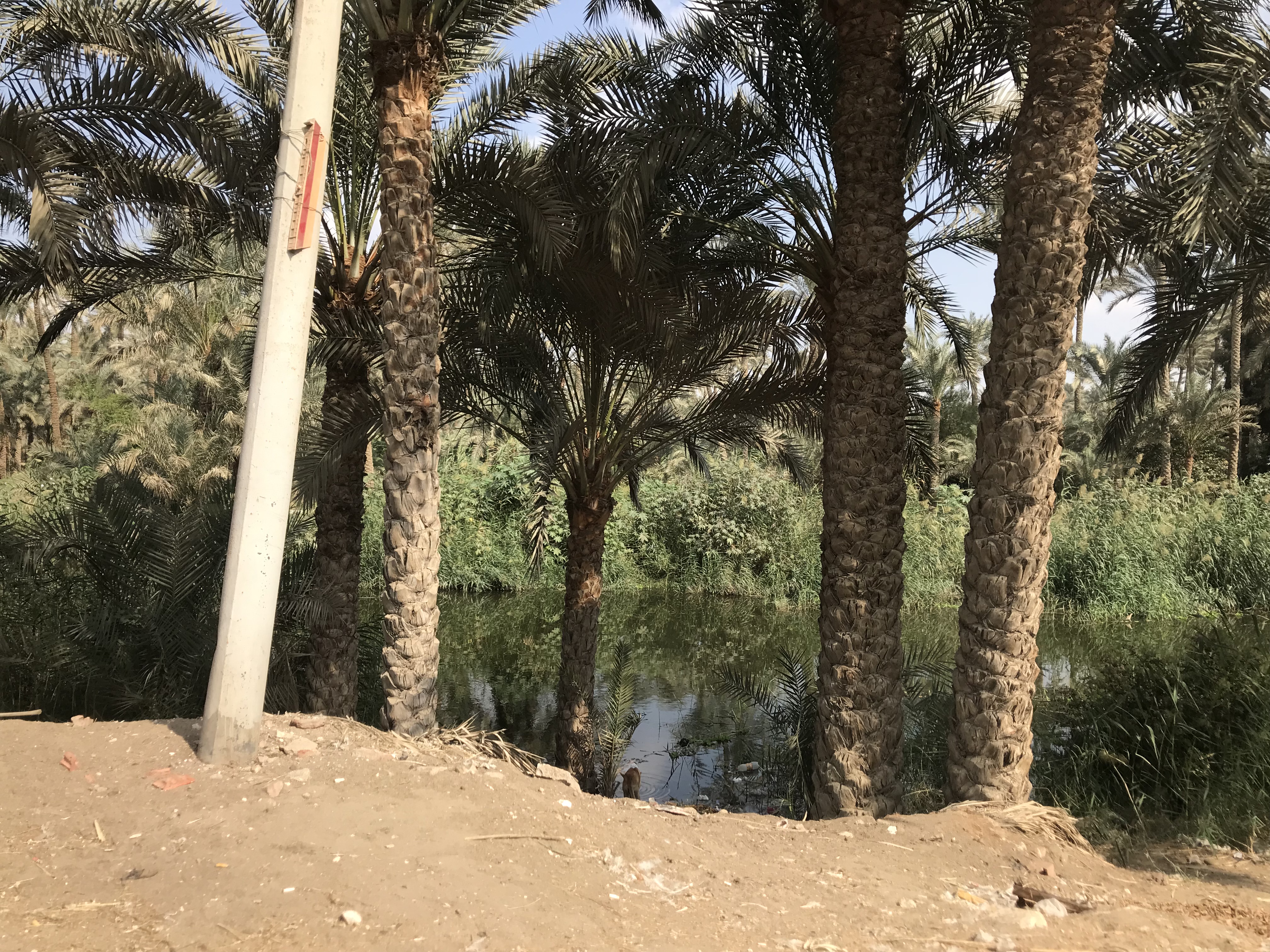
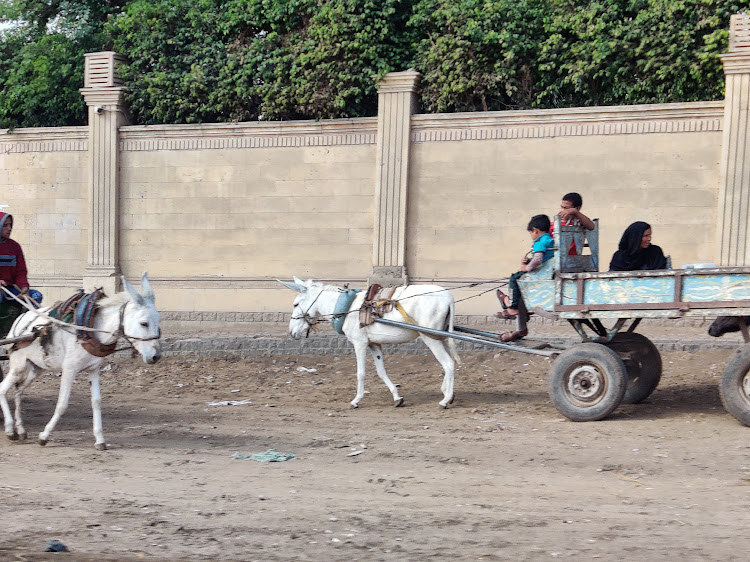
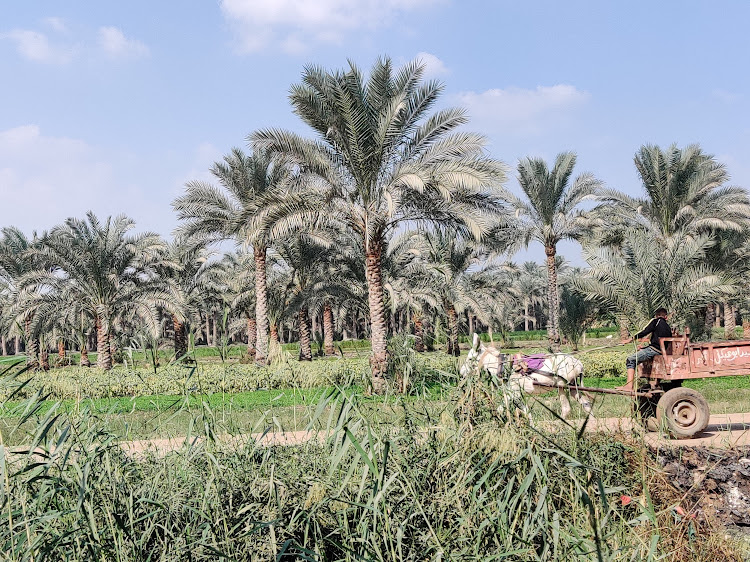
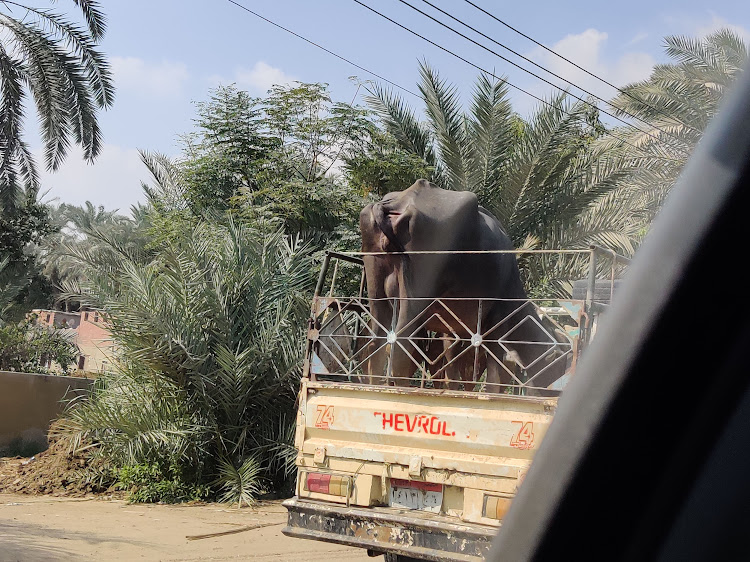
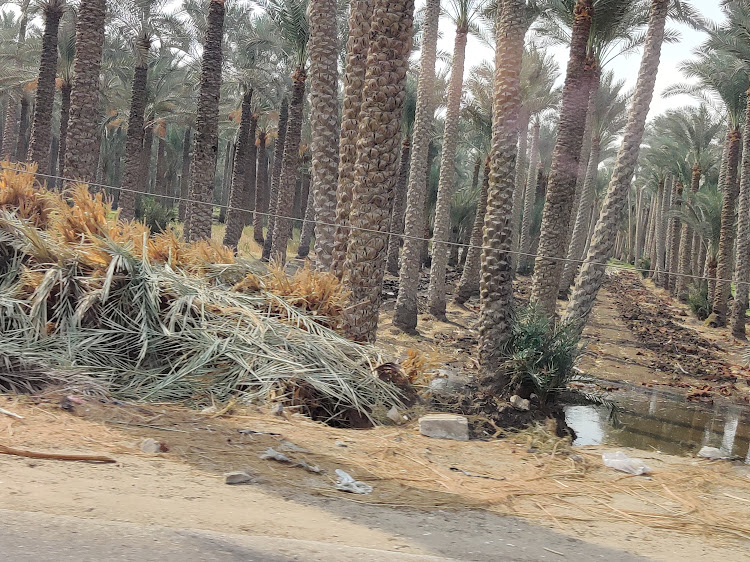
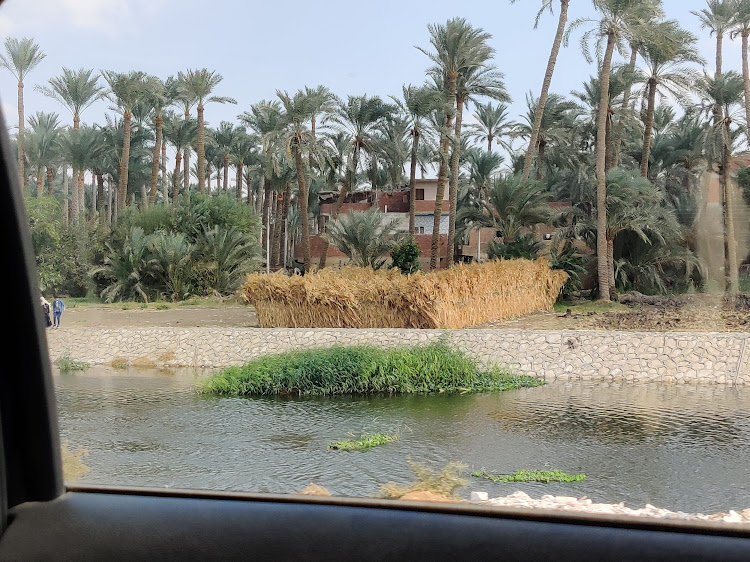
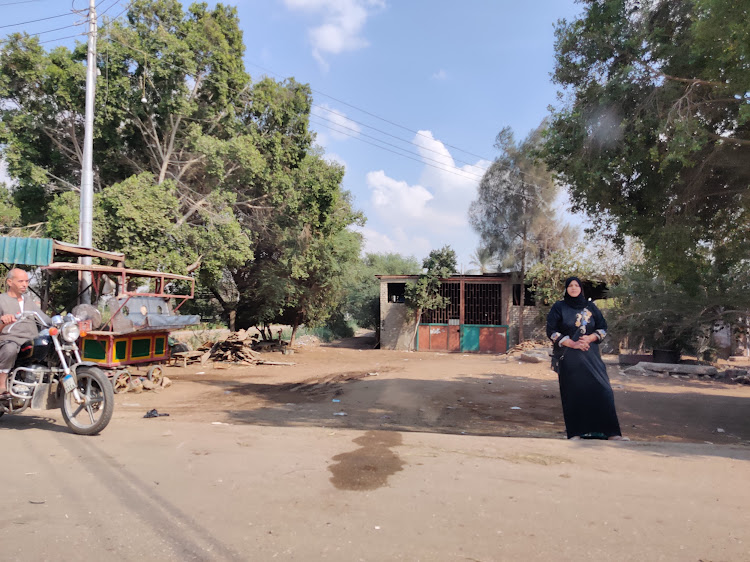
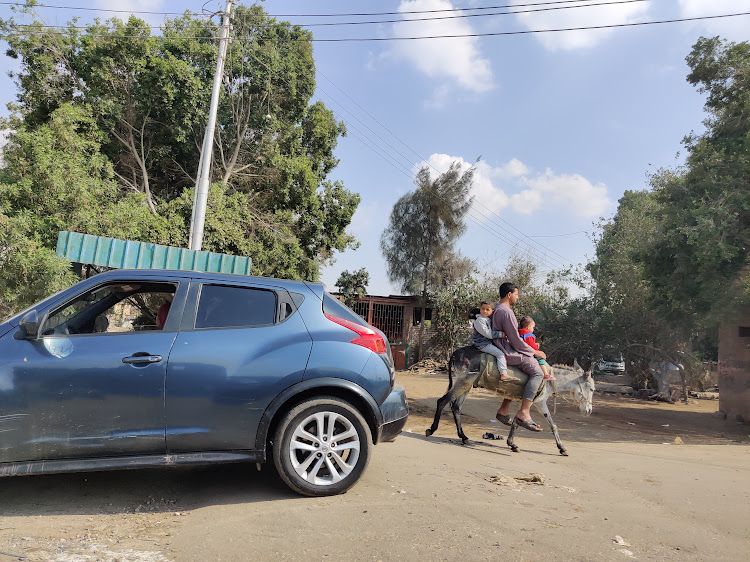
The museum at Mit Rahina was wonderful—my favourite museum so far (and Egypt has done very well with having non-pompous museums). The drive there was exactly what we hoped, and we drove beside a canal from the Nile, on a small road passing date palms, and sugar beet, and buffalo and goats. They were digging the silt from the river, and putting on the fields to fertilise them. We passed mosques and villages, hump-backed cows led by a man on a donkey, a camel under a load of branches, children playing, white egrets perched in trees above the water.

The museum itself was a large outside area, with traders selling crafts along the edge, and various ancient artifacts arranged in the middle. I had the impression that these things—the leg from a statue, a plaque with hieroglyphics—had been accidently dug up by builders, who simply drove their diggers to the museum and dumped their finds on the ground. Instead of being in glass cases, things were propped up against trees. Fabulous. We saw a big statue of RamsesII and an alabaster sphinx (smaller than the one in Giza, but in better condition).

The Red Pyramid is also worth visiting. There were very few tourists (only two other groups when we were there) and the pyramid is plonked in the desert, where it should be. The desert was packed hard sand and bits of crumbling stone from the pyramid. We were able to walk round in silence, while the other tourists were talked at by their guides (Husband joined in at one point, and told some Americans how old the pyramids are—I pretended I didn’t know him!)

We drove further across the desert to the Bent Pyramid (there’s a clue in the name). It was windy and there were lots of flies, but it was still brilliant. Behind the pyramid was the remains of a temple, made with ancient bricks. The bricks were made with mud and straw—just like the bricks described in the Bible story of the Exodus (when Pharoah got cross with Moses and told him they couldn’t have straw). How marvellous to actually see them (though I think these would be older than Exodus).

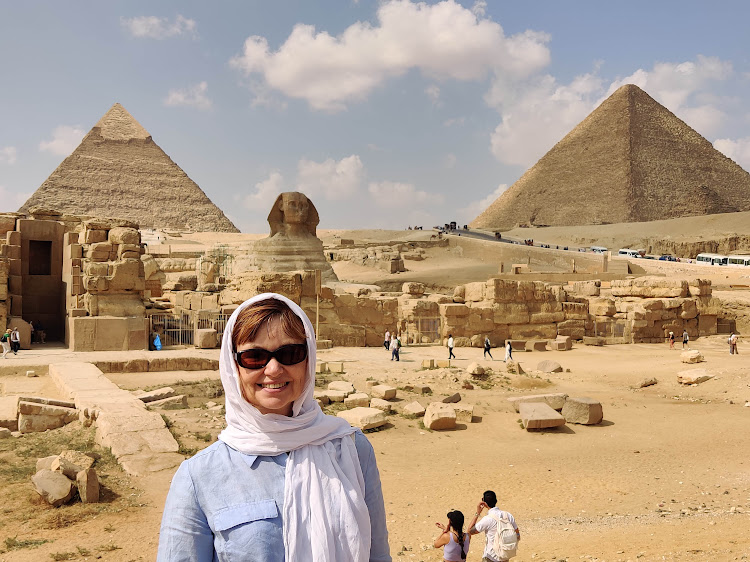
The pyramids and Sphynx in Giza are definitely worth visiting if you visit Cairo, but I really recommend that you go slightly further and see the Red Pyramid. They give a much better sense of history because they feel less ‘commercial.’ There are also no touts there, so you don’t need a guide.

Whatever you do today, I hope it’s good. Thanks for reading. Take care.
Love, Anne x

Thanks for reading.
anneethompson.com
Why not sign up to follow my blog?

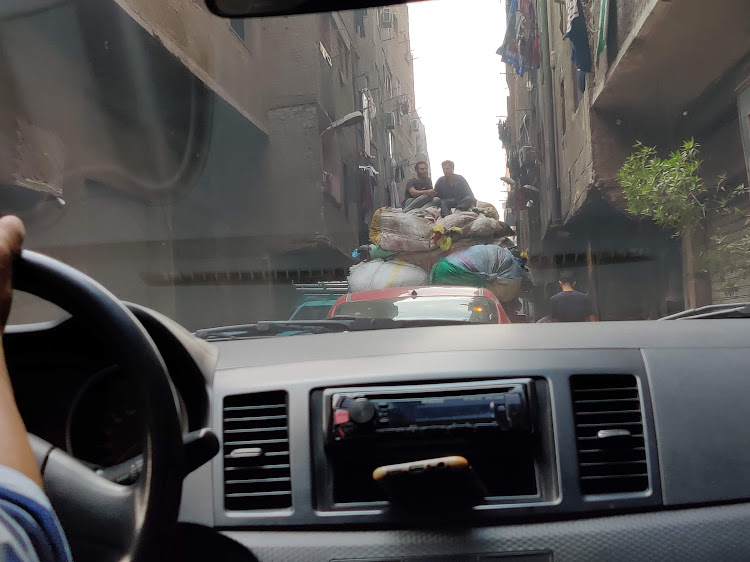
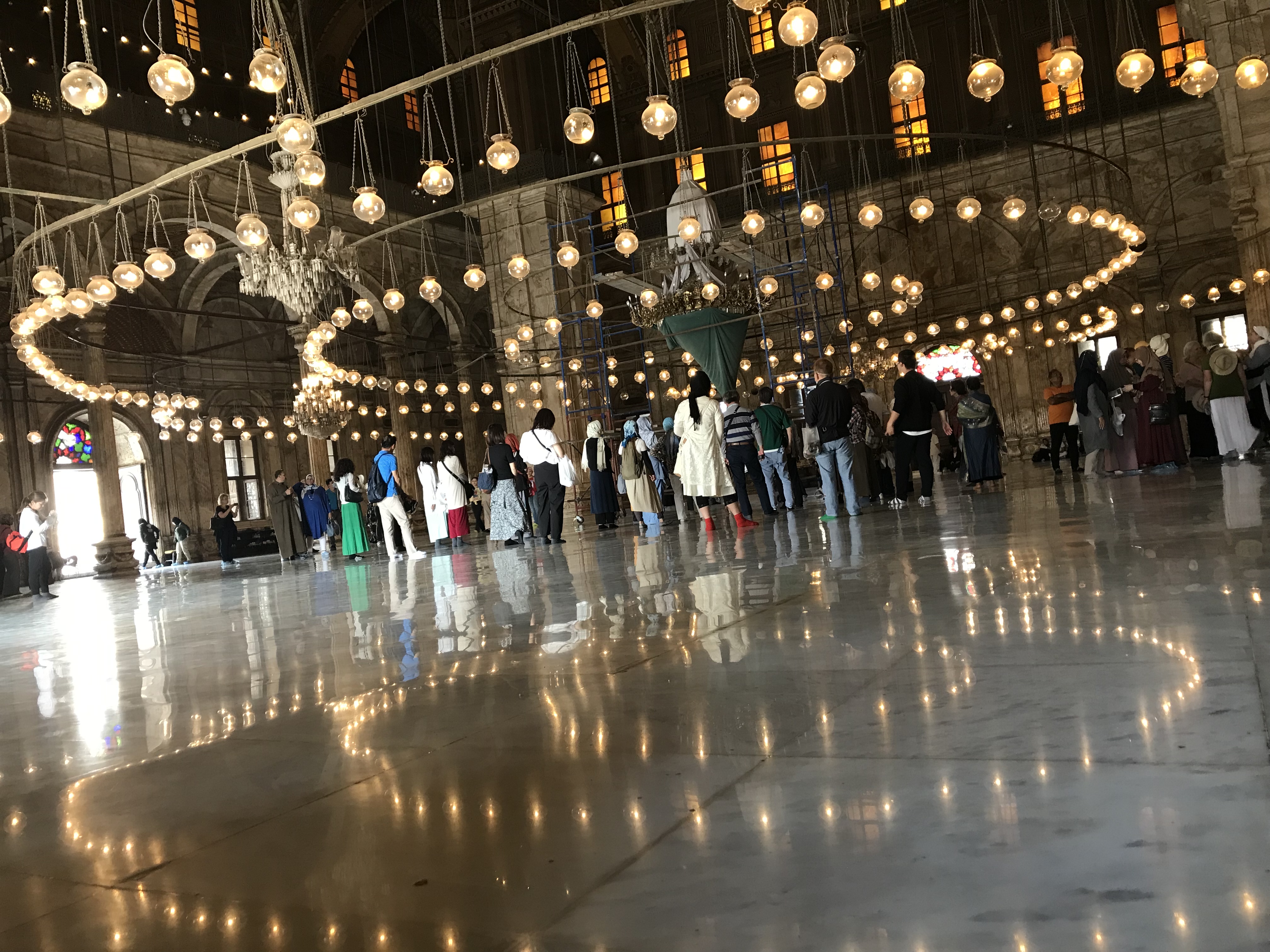
I will leave you with some more sights as we drove through the countryside.

If you enjoy travel blogs, why not read The Sarcastic Mother’s Holiday Diary ? If you have a Kindle, you can read it for free. Also available as a paperback (and it makes a brilliant Christmas gift!) 

Cairo, Egypt. Blog Six


The Coptic District

We decided to visit the Coptic district, which is the oldest part of Cairo. The car dropped us near the ancient city wall, and we followed the crowds, walking along the street to where there were steps going down, and signs directing us to various places. There was no big sign saying This way to the Coptic district so we were a little unsure where to go—usually we avoid underground passages in unfamiliar cities—but we walked down the steps.

The hidden entrance to the Coptic District of Cairo.

There was a short tunnel, under the old city wall, and then we were in a narrow lane, the walls lined with books for sale. It was very unexpected! Tour groups and local people all seemed to be walking in the same direction, so we followed the crowd, round a corner, to a junction with signs on walls and archways in the wall. It was too busy to check our map, but I remembered we planned to see the Church of St. Sergius and Bacchus so we followed the sign for that. It all felt rather disorientating to be honest, and I was disappointed because I knew there were several places I hoped to visit but I was beginning to think it would be too difficult to find them.

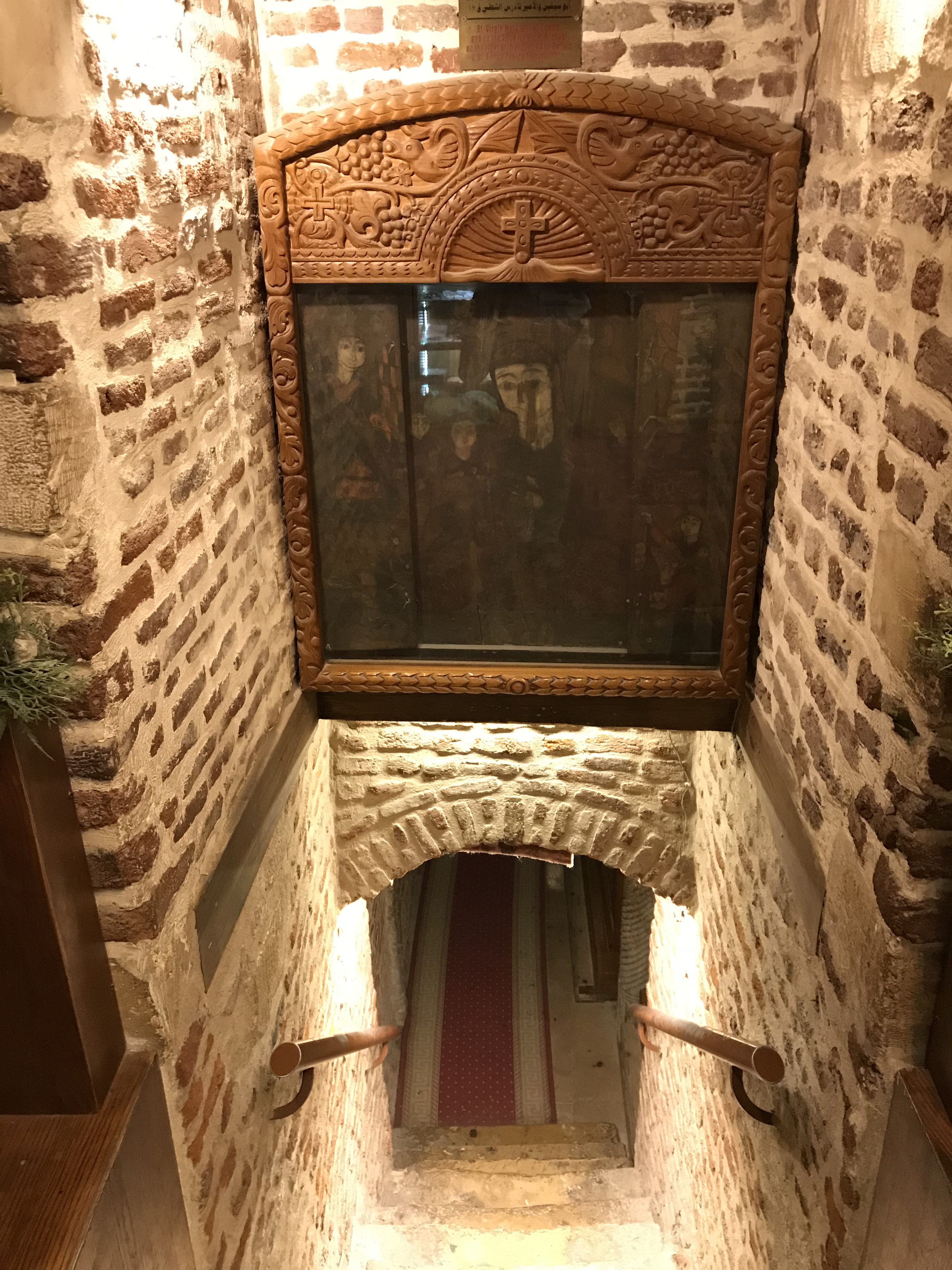
The church was built in the 11th century, in honour of Sergus and Baccus, a couple of Roman soldiers who were martyred for being Christians. I had read that under the church is a cave, where it is believed Mary and Joseph lived when they ran to Egypt with baby Jesus, to escape King Herod. Several places in Egypt claim to have been visited by the holy family during their time here, which I guess makes for good tourism, but it’s easy to mock—and who knows? They must have lived somewhere and maybe afterwards they told people, and it was remembered.

We found a sign to the cave, and went down some steps, to the area below the church. Much of the Coptic area has stuff below it, because it was built on top of a Roman city. We were in a long line of tourists visiting the cave, so there was no great atmosphere to it, and it was hard to imagine how it might have been, with a young couple and a baby sheltering there.

The church itself was very glitzy, with lots of icons, gilt and tourists. Places like that don’t inspire me to pray, I find it hard to discover God under all the religion, but I guess people are different. To be honest, I found the mosques, with their ornate outsides and big empty interiors to be much better at inducing thoughts of God and prayer. I feel there must be a balance, something between the plain ugliness of a Baptist church and the distracting gloss of a high church. Somewhere special, but that doesn’t distract away from God.

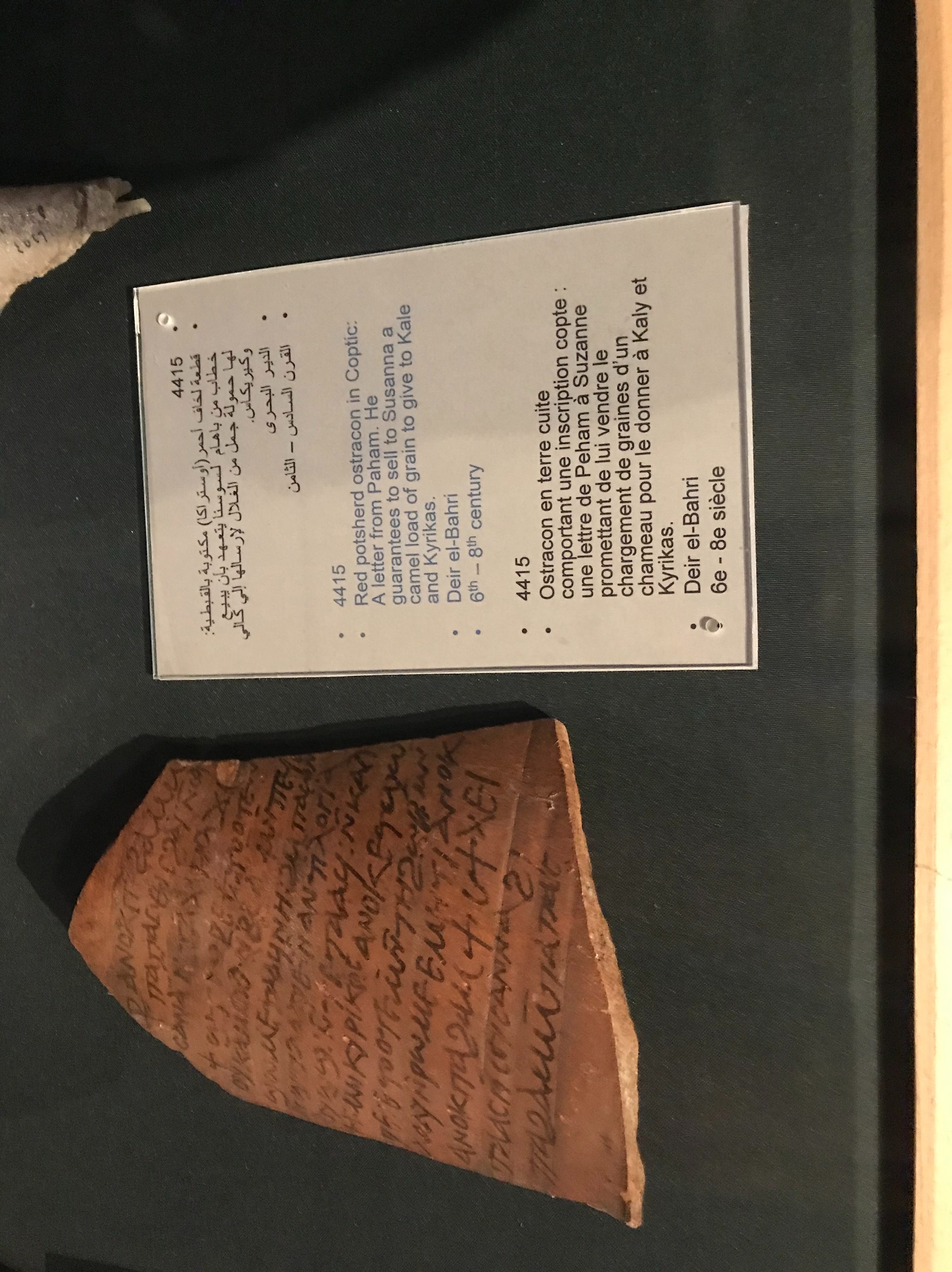
Anyway, next we went to the Coptic Museum (because the Ben Ezra Synagogue, which I really wanted to see, was closed for renovations). We wandered into a private area by mistake, and were stopped by a friendly smiling man who turned out to be head of security. People in Egypt were always friendly. After being pointed in the right direction, we went to see the Nag Hammadi manuscripts (which are the source for Gnosticism—the belief that spirit is entirely separate to anything physical, and that Jesus was spirit, not physical). They also have the oldest surviving copy of the Psalms of David, but that was being restored so we couldn’t see it. We did see some very cool examples of early letters, written on pottery, in ancient Greek. (The museum also has very clean public toilets, if you’re interested.)

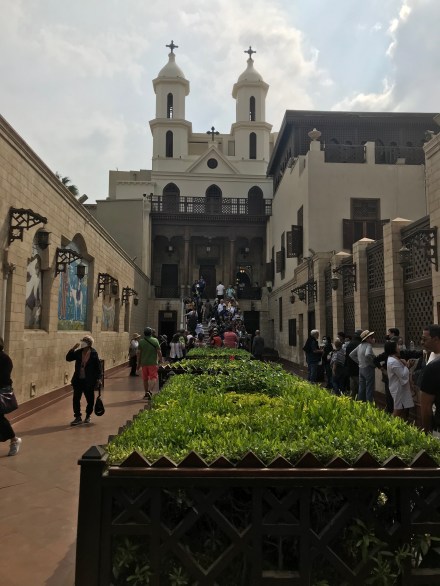
Finally, we visited the Hanging Church or Al Kineesa Al Mu’allaqa. It has a barrel-shaped ceiling, and white pillars that represent the 12 disciples, with a black one for Judas. Again, there were lots of icons, and gilt, and red bricks, and tourists. Part of the floor was glass, so you could peer down at the Roman towers below. (Which actually makes it less of a ‘hanging’ church and more of a ‘suspended’ one.)

We walked back to the hotel along busy roads. It was more of a slog than yesterday, and I found the constant honking of horns, the music of Cairo, to be very draining. We saw more poor people begging this time, including a young boy. I am uneasy refusing children, but I had no food to give him and money would possibly end up with the wrong person—so I told him no, and then felt guilty for the rest of the holiday and carried packets of Hulahoops everywhere in the hope I would see him again (but I never did).

At one point the road was very crowded with men, all waiting outside the Kuwait embassy. They queue there to apply for visas so they can go to work in Kuwait. It rained, quite heavily at one point, which I think is very rare here. Fingers up noses and men peeing behind parked cars seem to be a thing here. But mostly, I am interested by how friendly everyone is, how children smile and say hello, and people wave at us from buses, and greet us when we pass.

Later, there was a thunderstorm, and more rain. We watched from the balcony as big puddles formed on the roads. An unusual sight in Cairo. Thanks for reading. Hope you have a good day. Take care.
Love, Anne x

Thanks for reading.
anneethompson.com
Why not sign up to follow my blog?

If you enjoy travel blogs, why not read The Sarcastic Mother’s Holiday Diary ? If you have a Kindle, you can read it for free. Also available as a paperback (and it makes a brilliant Christmas gift!)

Cairo, Egypt. Blog Five.


Visiting a Souk

After breakfast in the hotel lounge, we took a hotel car to Khan Al Khalili – a sort of bazaar in the Islamic district of Cairo. The hotel cars are more expensive than using local taxis, but they’re easier than trying to explain in non-Arabic where we want to go, and we know they’ll have seatbelts and not take us to the wrong location. We found places in the guidebook that looked interesting, booked a car to take us there and then walked back to the hotel. Neither of us especially like museums or monuments, and this proved a good strategy for seeing some of ‘real Cairo.’

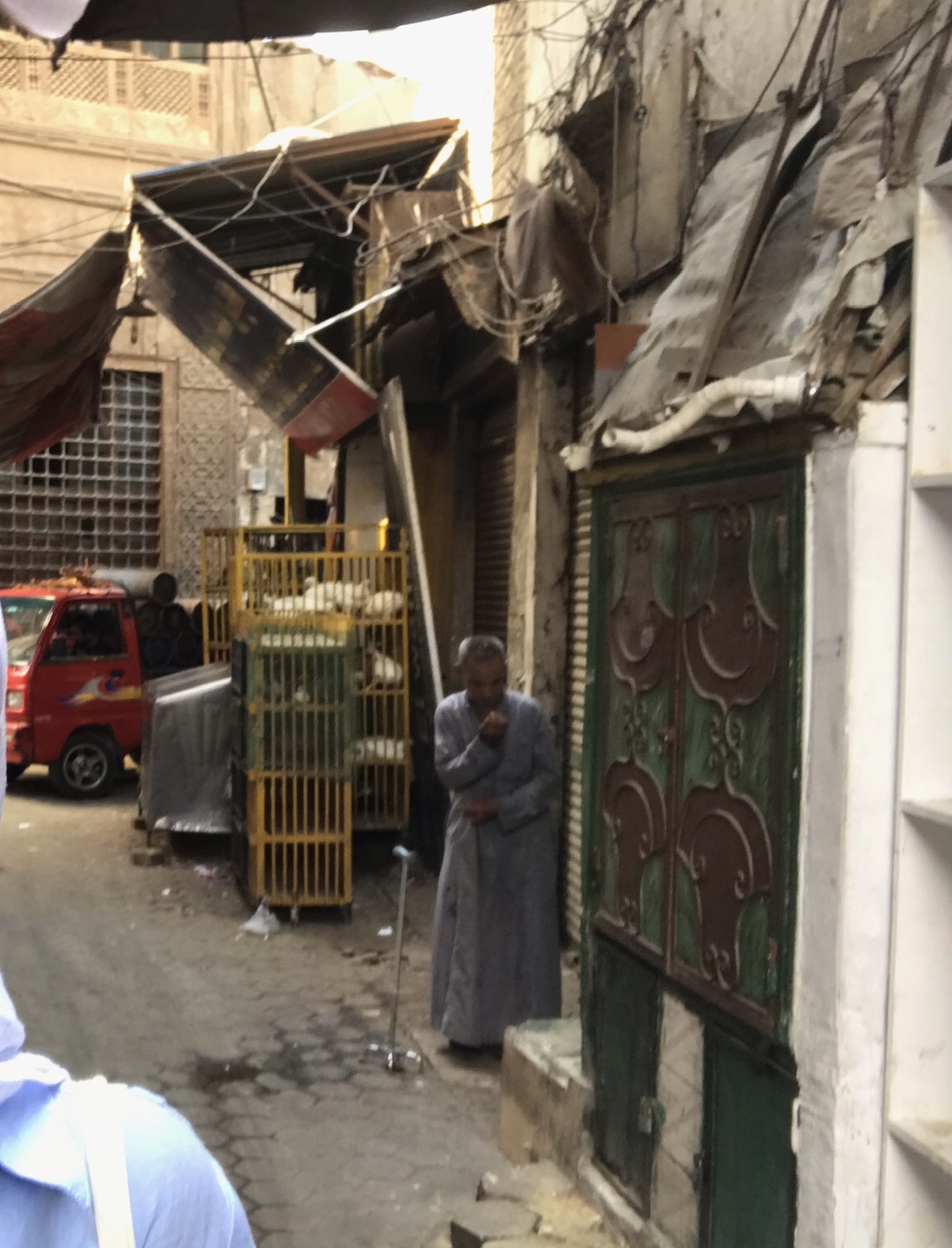
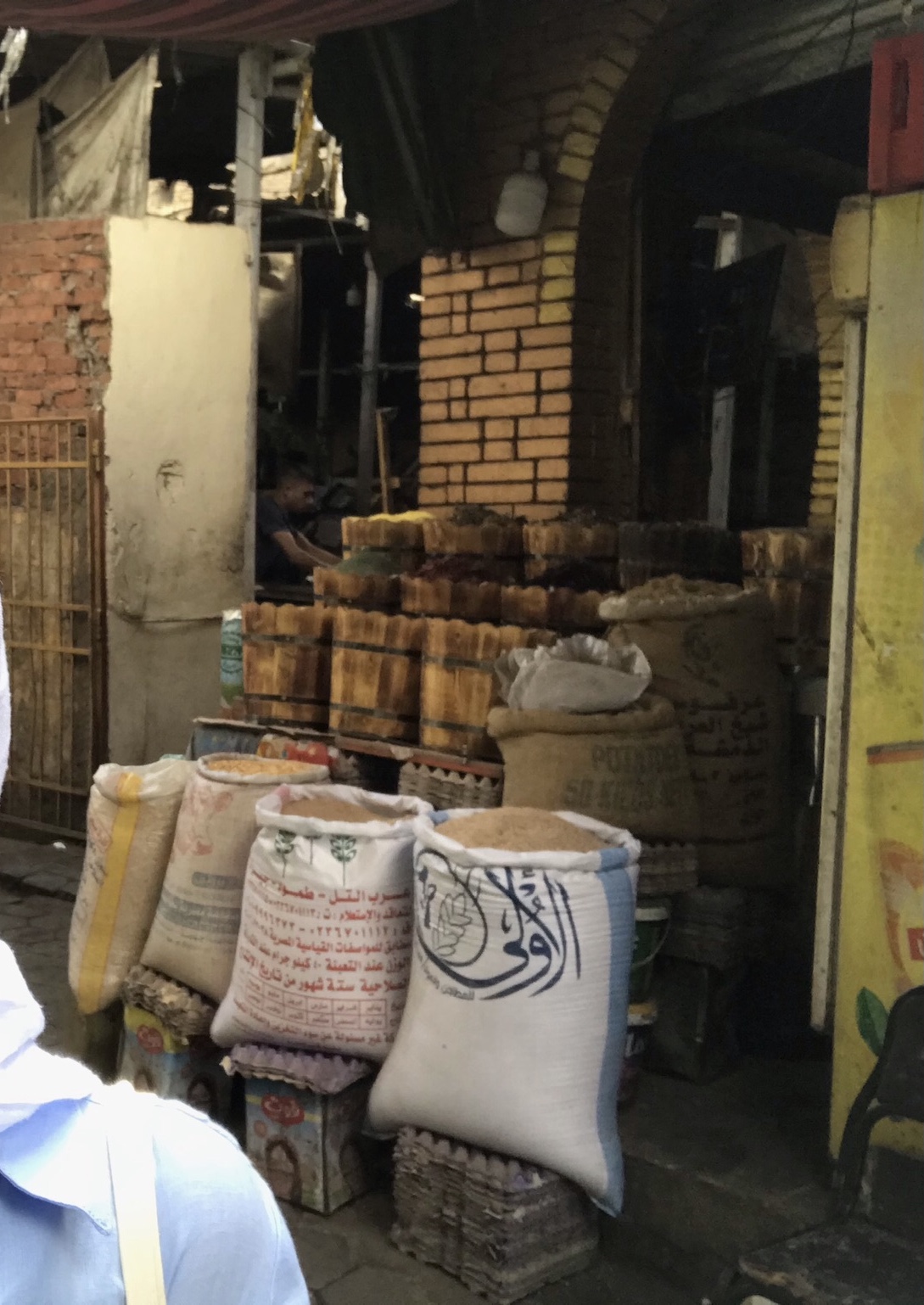
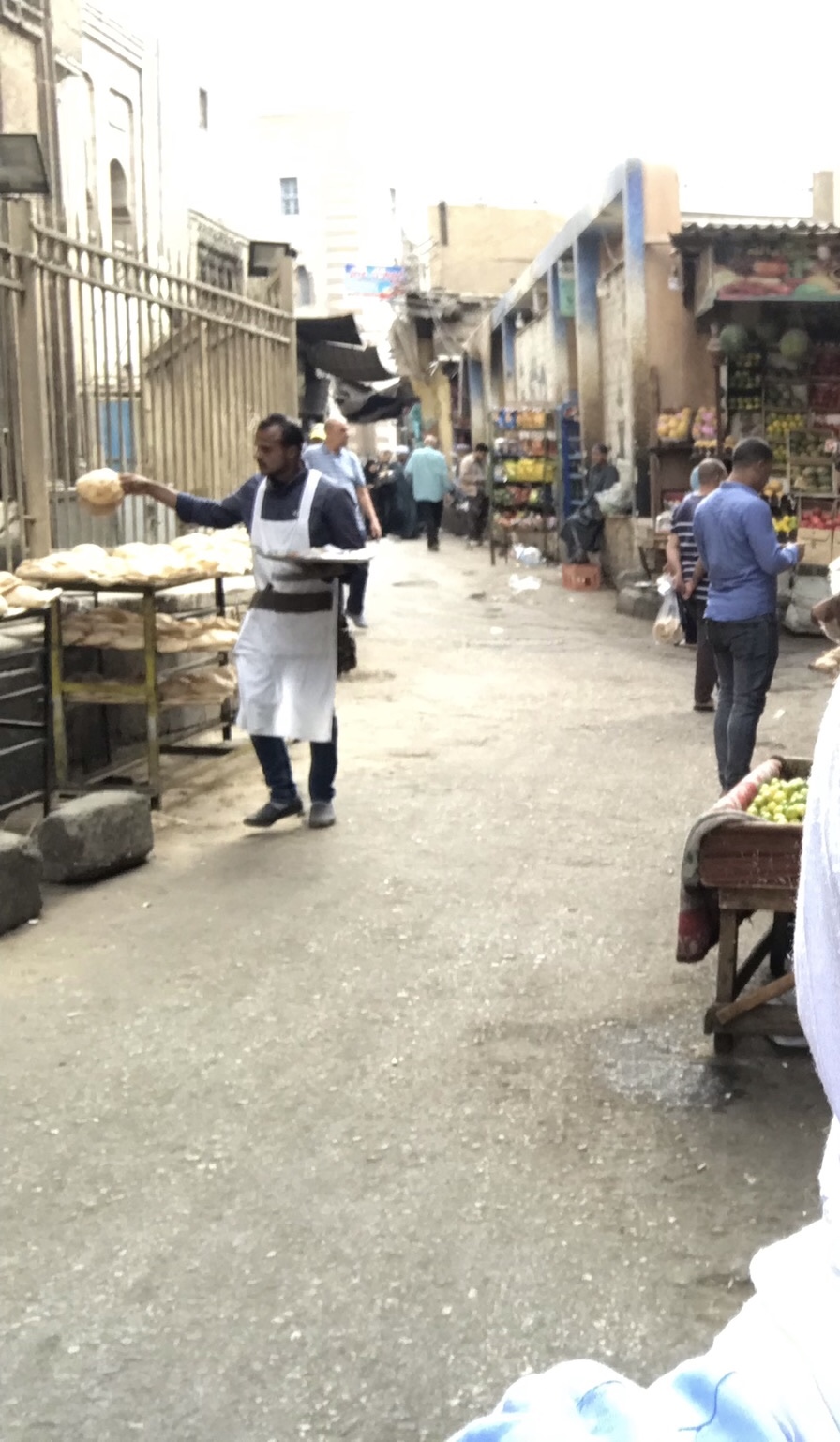
The car dropped us, and we walked round the corner, into a myriad of ancient lanes lined with stalls, a whole mishmash of sights: Chickens and rabbits and pigeons in cages. Men pulling wheeled carts. People balancing crates on their heads—one young man on a bicycle had a plank on his head stacked with eish baladi the local flatbread. Stalls selling fruit, and cloth, and drinks.

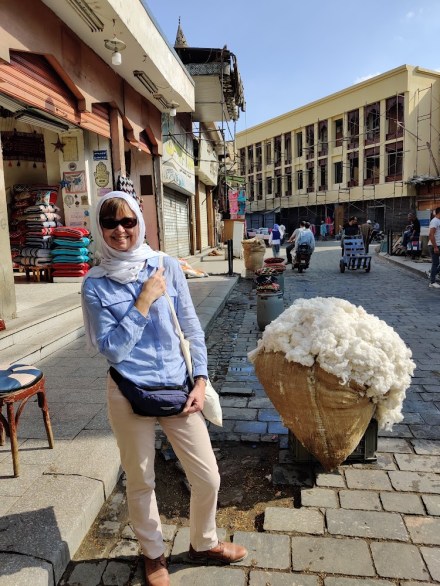
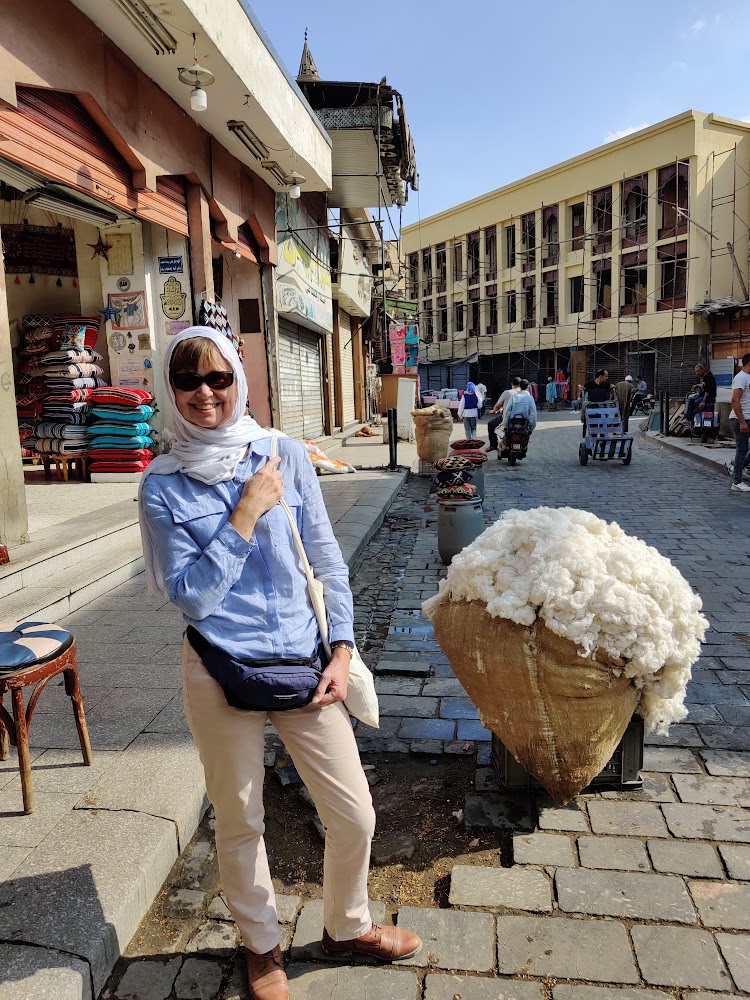
There were stray dogs and skinny kittens—cats were everywhere—sleeping on a food-cart hotplate, sharing a beggar’s blanket, curled under stalls. We watched eish baladi being fried in a sizzling vat of oil, hoisted out by a net on a long pole, the oil dripping off, then heaped on a stall for the flies to feast on. There was a fabric shop, with burst sacks of fresh cotton on the street outside. The streets were busy, with uneven hard-packed mud to walk along, and I felt as if I had wandered into a stage set. It was marvellous. It was also the wrong place! We checked the map, and realised we should have been across the street, in the lanes that make up the bazaar—we were in a market intended for locals (much better, in my opinion).

When we entered the bazaar proper, it was very crowded. Many of the shops were aimed at tourists, and stallholders called to us, inviting us to look, telling us they had the best products, the lowest prices. We had come to look, not to buy, so we disappointed them. Like all roads in Cairo, traffic and pedestrians shared the space. There were tuktuks here (we didn’t see them in the centre of the city) and they mingled with the lorries and bikes and pedestrians, vying for space in the narrow lanes. The air was full of pollution and spices and the sharp tang of limes from a nearby stall. A woman sat on the kerb, her short round body swathed in flowing black, selling bunches of mint. Children sat nearby, screaming at cars when they passed in some noisy game. Men with shiny round trays carried glasses of tea.

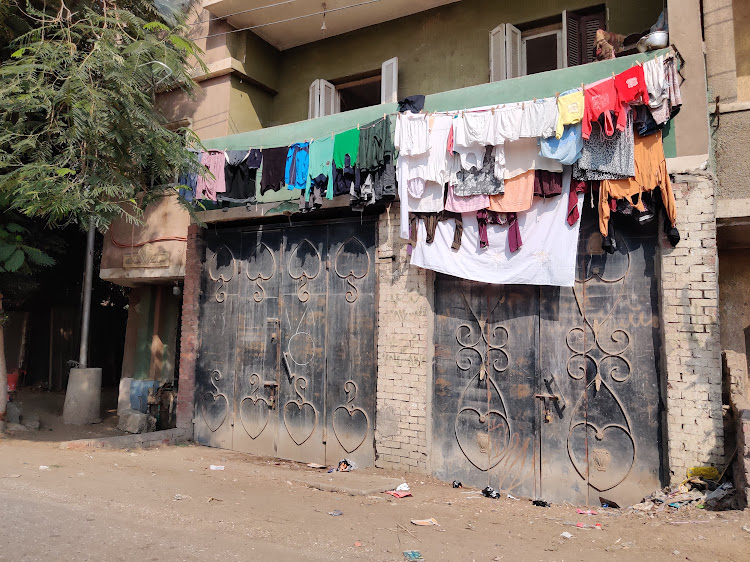
We passed the faded finery of ornate mosques, and crumbling walls, and red brick buildings; all powdered in brown pollution. The road was often uneven, often with holes or dirtied by dog mess.

When we reached the centre of the market it was even busier, and many of the products were the same as you would see in an English market—cheap clothing and plastic houseware. Inflatable legs were strung over the walkway, modelling various brands of trousers. Large dolls (like American Girl Dolls) stood in rows, modelling baby clothes. There were windows displaying sexy lace underwear on voluptuous mannequins—yet all the real women seemed to be covered from head to foot in flowing robes. (No one seemed to see the irony of this.)

Random men approached us at intervals, to practise their English, or to give unwanted directions. Always polite, always with smiles, sometimes overly persistent. We smiled back, and walked on.

There were constant car horns. Speakers blasted a sport’s game commentary or an Islamic sermon. The call to prayer echoed from minarets. I saw smiles, lots of smiles, especially when we responded to vendors’ calls in our limited Arabic. There was also lots of spitting in the street, and fingers pushed up noses, and loads of shopping carried on heads—all very different to an English market.

It was a fabulous walk back to the hotel. The sun was hot, the air thick with pollution, but there was so much to absorb, so much life to be part of. Wonderful.

Thanks for reading, I will tell you more about our visit in another blog. Hope you have a lovely day. Take care.
Love, Anne x
Thanks for reading.
anneethompson.com
Why not sign up to follow my blog?
Look on your device for this icon (it’s probably right at the bottom of the screen if you scroll down).
Follow the link to follow my blog!

*****

Visiting Cairo


I have always wanted to visit Cairo, to see the pyramids. I have heard about Egypt, that mysterious place that people in the Bible ran to whenever there was trouble, ever since I was a tiny child in Sunday School. As I study the Old Testament, and learn about Moses, and the Hebrews living in Egypt and then miraculously leaving, it makes me want to visit even more. Our trip to the British Museum, to look at all the stuff the English took from Egypt in the past, and my knowledge of Pharaohs and how they were buried, has all fueled this longing. So, when Husband suggested a trip to Cairo, I leapt at it!

I prepared by downloading the Duolingo Arabic app, and practising my Arabic every day. I mainly wanted to know how to ask where the toilets are, and to be able to recognise which door has ‘Ladies’ written on it. Unfortunately, neither Duolingo, nor the CD I bought, ever got to this essential information. I set off for Egypt able to say things like, ‘Hamid is from Oman’ or ‘The house has a new door.’ Not as helpful as I had hoped.

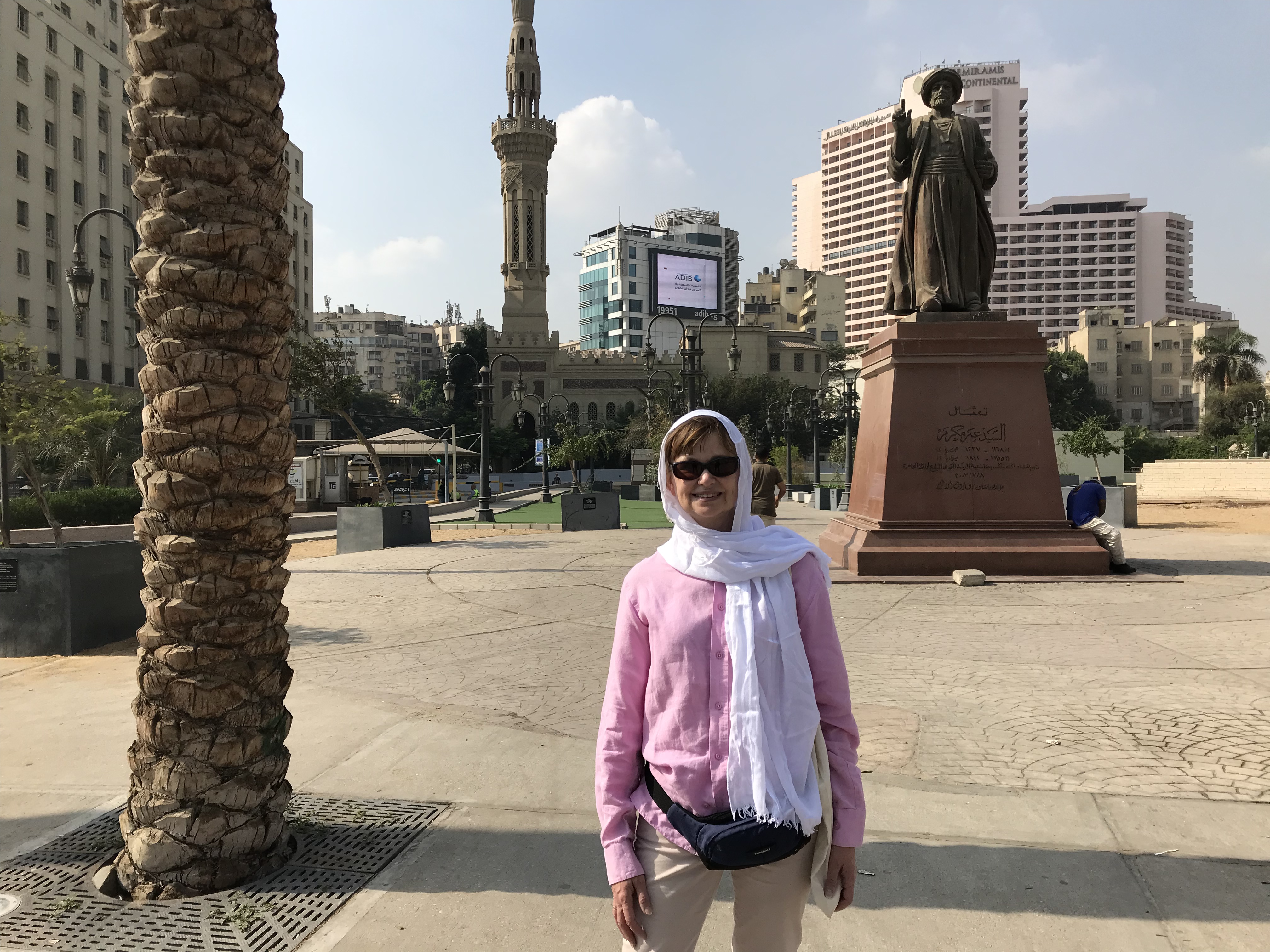
I read a few guidebooks, and chatted to friends who have visited Egypt, and packed things they recommended. My case was full of long skirts, chaste shirts, and tatty bags to carry a water bottle and an umbrella, without appearing ‘rich.’ I took my money-belt, as apparently pickpockets are common in Egypt. I also ordered a hijab and hair cap from Amazon. In Dubai, I disliked being stared at, and found the best thing was to dress like a local. I decided I would watch from the taxi from the airport, and see whether most women covered their hair or not, and then I would copy. Warned Husband I would not be looking my best during the trip. I showed him my hijab, and he laughed, told me I looked exceedingly grim, and no one would dare to come near me with that face. I’m sure he meant it kindly.

I also bought some books, mainly about the Exodus, and whether it could possibly have happened or not. They were hugely interesting, but too heavy to take, and I only read a little before it was time to go. Might have to plan another trip. Many of the places mentioned were several hours drive from Cairo, and this was slightly less secure. The travel advice was that touristy areas were safe, but possibly not other places. We decided we would stay in the city, and see what we could. (I secretly told myself I would visit again if I like it.) Husband booked The Sheraton, which also has a casino, so I hoped it wouldn’t be too tacky. It was walking distance from the Nile (Oh wow! Can’t believe I am going to see the Nile!) and right next door to the Russian Embassy (which perhaps wasn’t quite so good, given the current politics).

We arrived Friday evening. As we drove from the airport, I saw faded villas that had once been beautiful, mingled with ornate minarets and tall concrete apartment blocks. Cairo is busy and noisy and has a faded charm. I loved it.

Our hotel room was lovely, with a tiny balcony that gave a glimpse of the Nile. Oh wow! I am looking at the actual NILE as I write this! When I was a child in Sunday School, listening to stories of Egypt, I never imagined I would actually see the river Nile. Amazing.

I will tell you more about our trip in another blog. Thanks for reading. Stay safe.

Love, Anne x

LaThuile in the Summer


Things to do in LaThuile in the Summer

LaThuile has the most beautiful walks. You can find a map at the Tourist Information but this is relatively unhelpful as the walks are miles and miles long, and are more serious hikes for serious hikers than the sort of walk that’s actually enjoyable. However, it is possible to cheat, and drive part of the way.

I write this after a beautiful 2-hour walk through a valley, a short drive from the town.

  1. Leave LaThuile on the SS26 towards San Bernardo pass. After passing Ristorante Lo Riondet, start to look for a parking place on the right—it’s at the next big corner.
  2. Follow the track through pine trees, catching brief glimpses of the most beautiful valley in the world (see previous blog).
  3. When you see a bridge over the river on your left, turn off the main track and cross the river. If you look up, you will see a cave above you. (If you venture up there, let me know what was inside.)
  4. Follow the track to the left. It goes uphill slightly, but nothing scary. You will pass some derelict houses and some cows, and depending on where the farmer has laid his electric fence, you might need to cross it. (Note on electric fences: If you touch the wire, it hurts. A lot. However, the stick securing it to the ground is not usually electrified—so test this theory by touching it with a blade of grass, then you can lift the stick, shimmy under the wire, replace the stick in the ground.)
  5. When the path forks, take the left fork, which heads down towards the river.
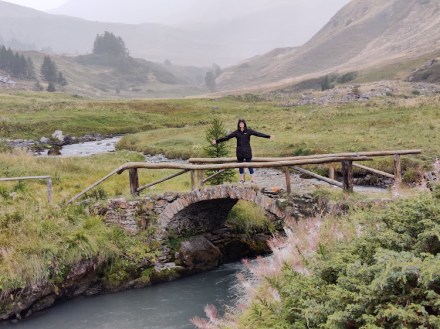
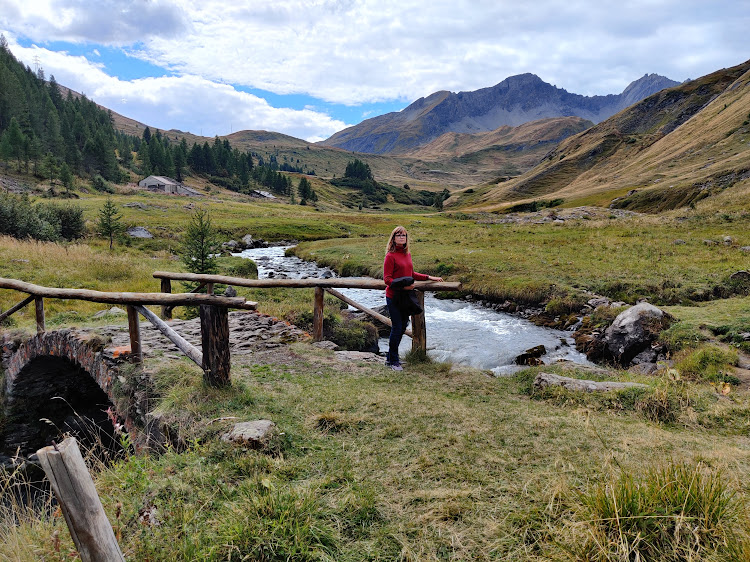
  6. Cross the river on the footbridge.
  7. Either turn left, and follow the track back to the car, or continue right for a while until you reach the farmhouse/viewpoint, then retrace your steps.

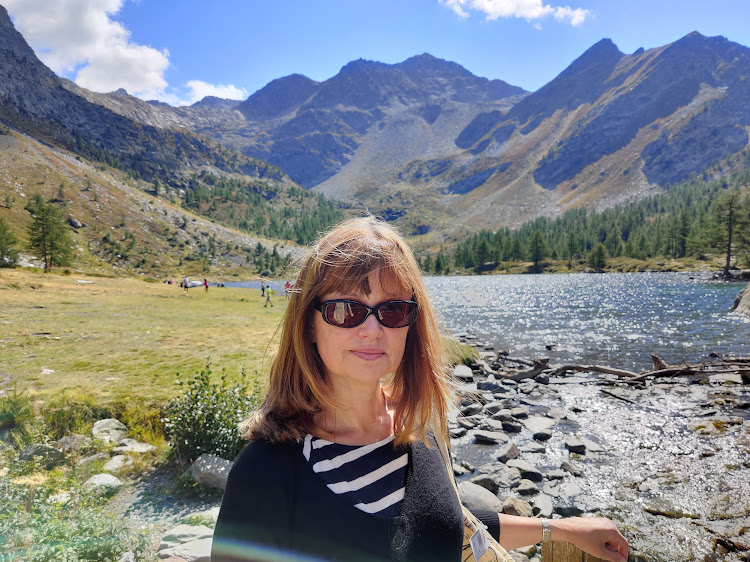
Another good walk, that’s slightly shorter, is to Lake Arpy. Take the SR39 from LaThuile, and park at the top of the mountain, where there’s a pub and a couple of car parks. (The car parks are easy to find, a space is less easy, so you might need to abandon your car on the road somewhere.) The footpaths up are clearly marked, and relatively easy (though slightly steep in places). The lake is very pretty, and in the summer people sit up there, reading or chatting. Some (silly ones?) even swim in the icy water (but not for long!) There are good views of Mont Blanc as you walk back down. It takes about 30 minutes to reach the lake from the car park.

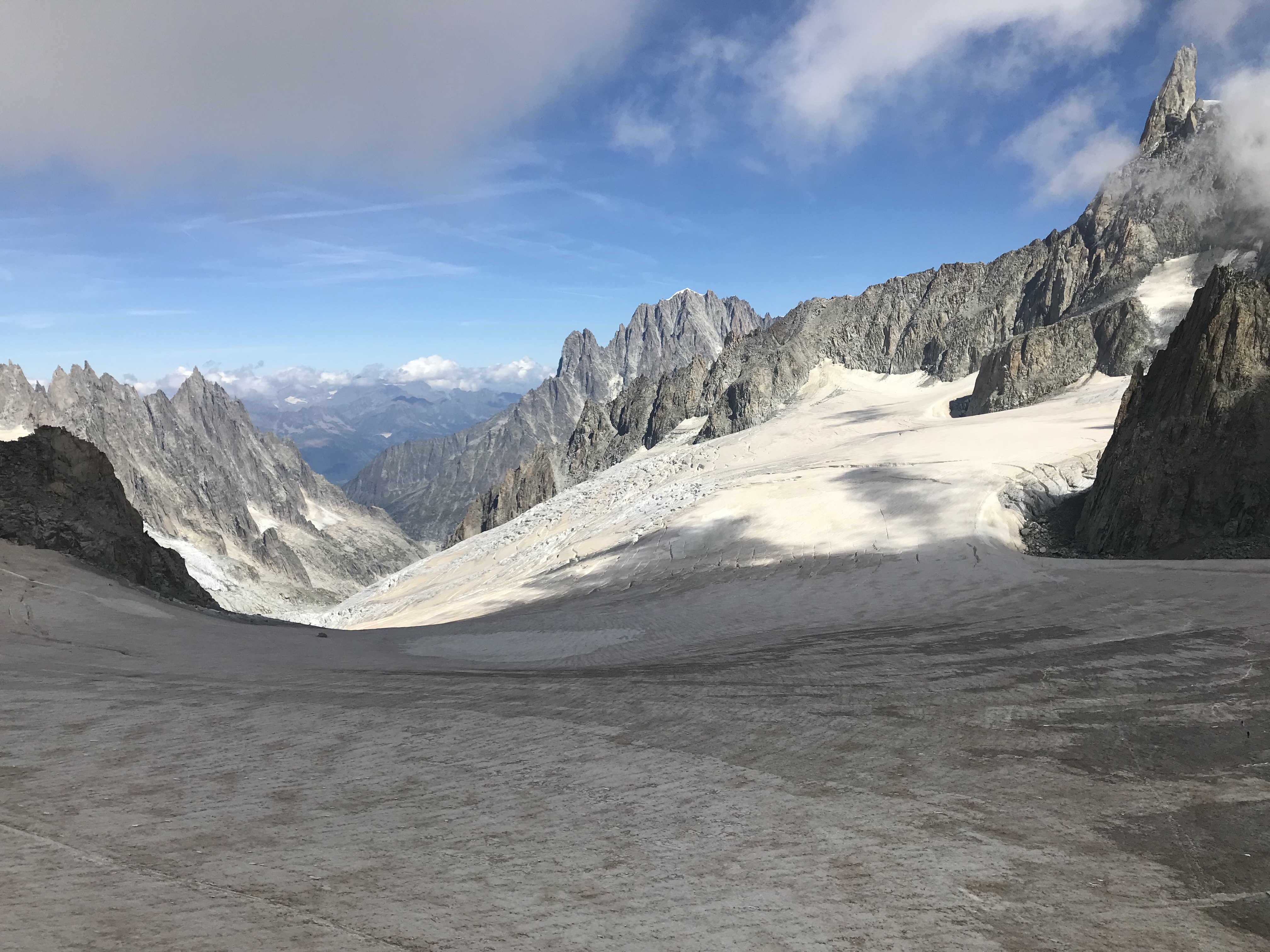
If you fancy a drive rather than a walk, then going to look at the glacier in Courayeur is fun. You never manage to get especially near to it (unless you’re a climber) but the road, Via Val Veny, rises above the town to opposite the glacier. You have a good view of the Mont Blanc tunnel.

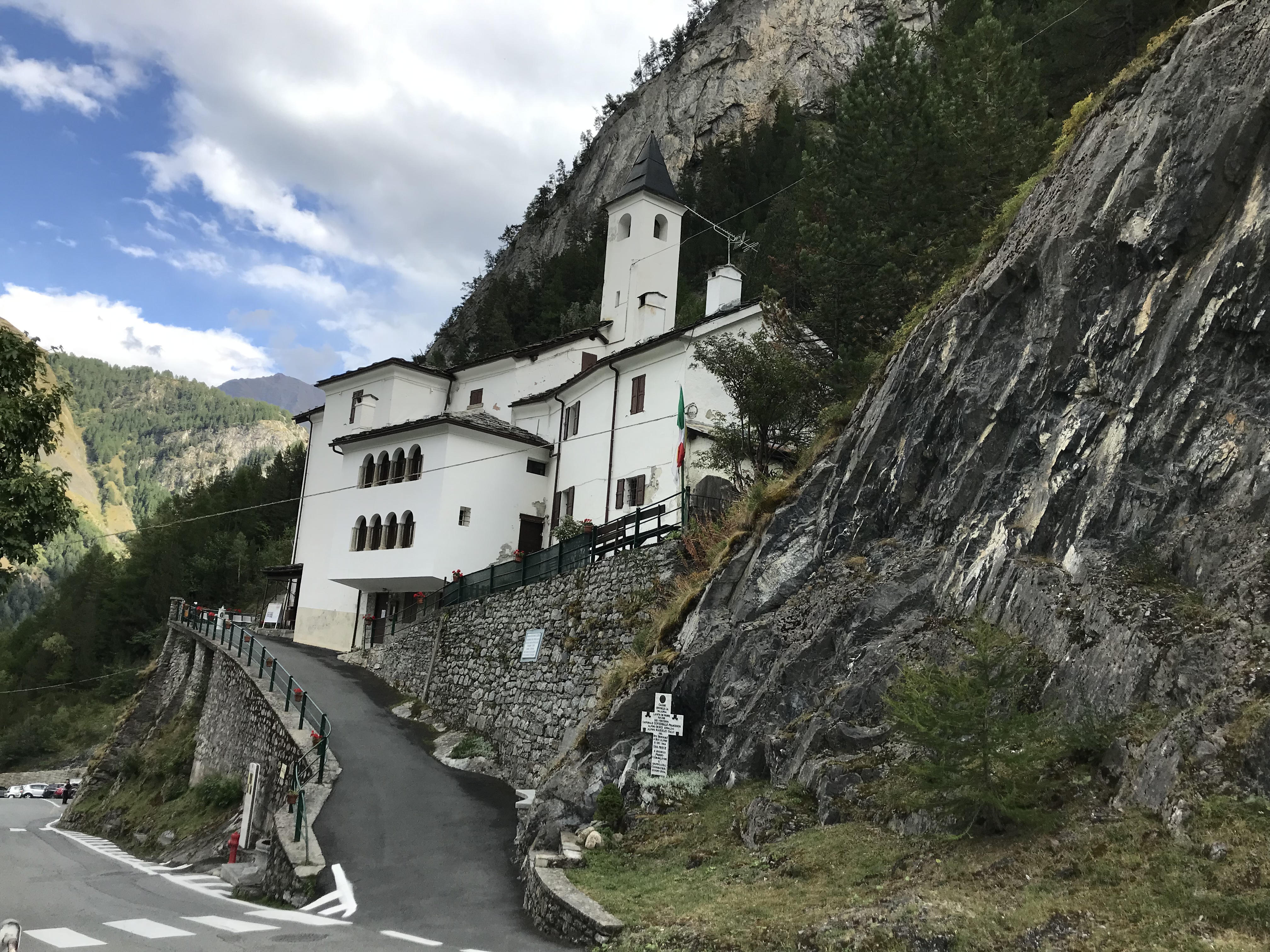
There is a little church on the hillside: Notre Dame de Guerison. Inside are lots of votives left by climbers who are thankful to still be alive. There have been icons there since 1753, and a chapel since 1781. When we visited, there was a service, and a surprising number of people had driven up the mountain to attend it. Opposite is a small gift shop, for people who want to buy a fridge magnet with a saint on it.

Looking down on the Monte Bianco tunnel!

You might enjoy Courmayeur itself. I didn’t. It was okay for a quick stroll, but there were too many designer shops and designer people (the sort of people with matching socks and weekly pedicures and a touch of plastic surgery). I enjoyed our first visit (see previous blog) but was disappointed when we went back. Perhaps it’s better in the rain, when you just want a cosy café and a decent coffee (those, it has).

Hope you have some fun days this week. Thanks for reading.
Take care.
Love, Anne x

Thanks for reading.

anneethompson.com

Why not sign up to follow my blog?

The Prison Camp in La Thuile


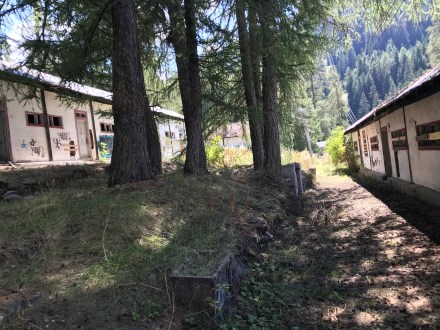
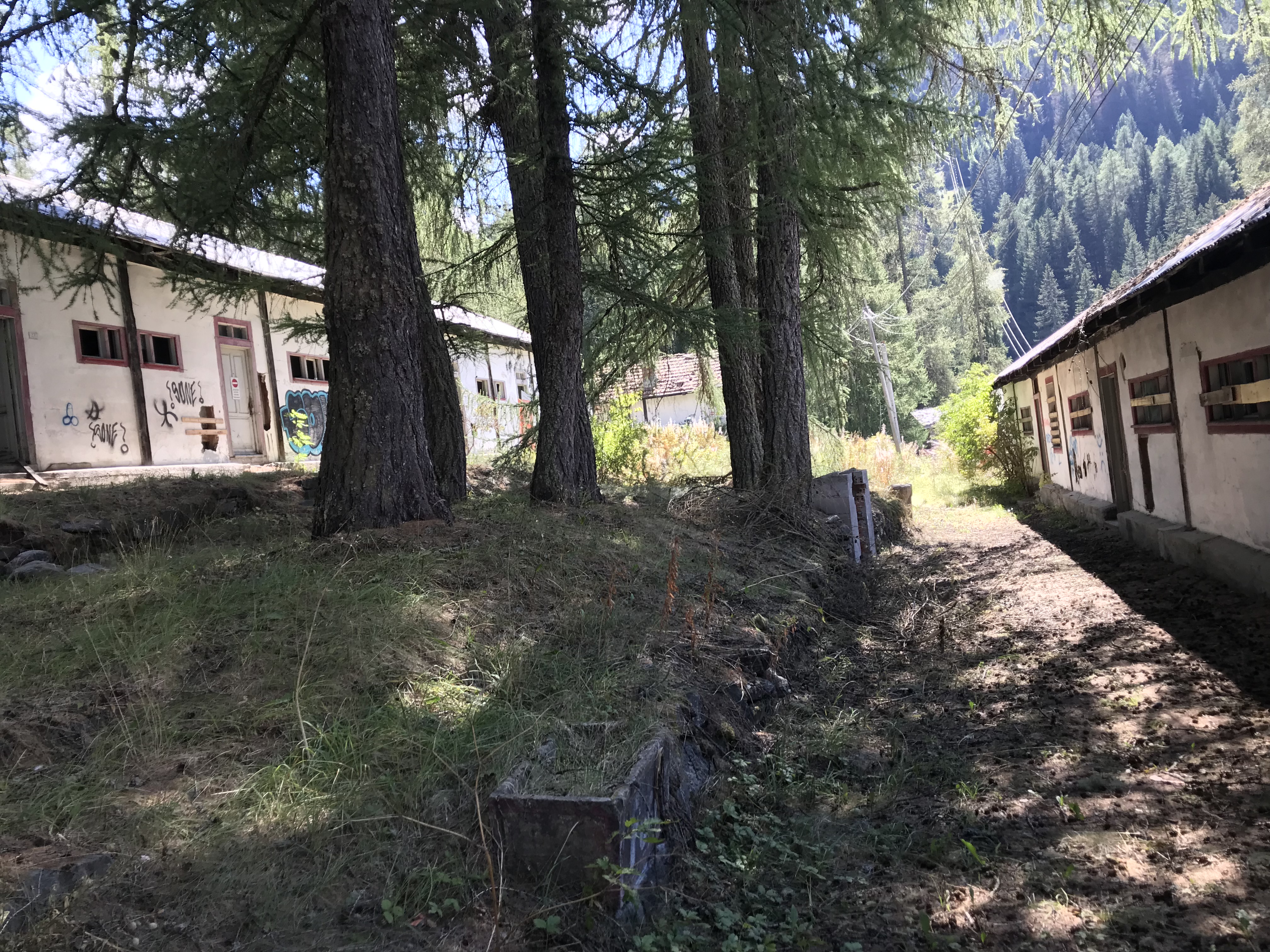
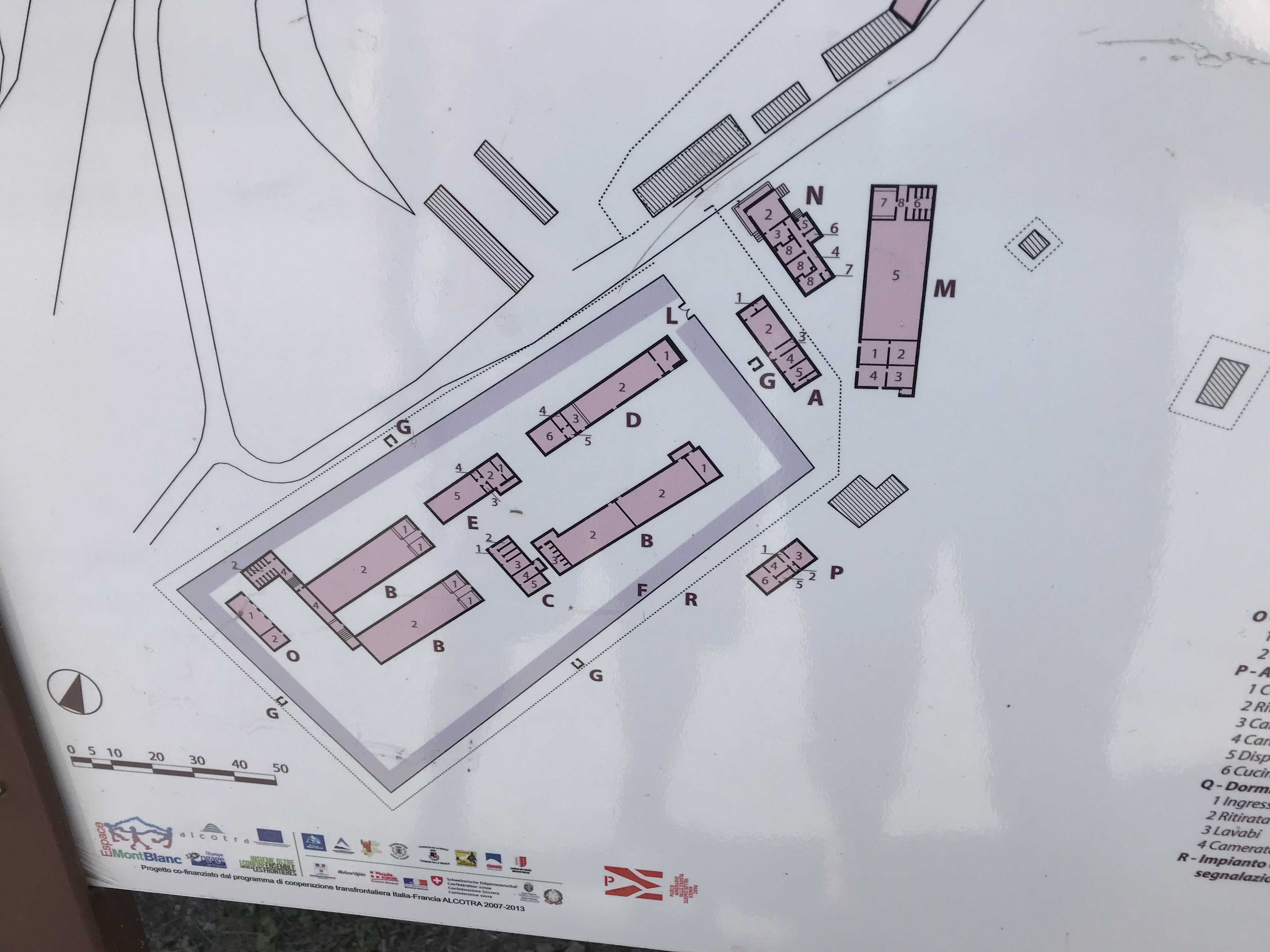
At one end of La Thuile, away from where most tourists would wander, is the remains of a prison of war camp. There are a few worn signs, which are all in Italian, so I photographed them and typed them into Google Translate. It seems that the camp was in use during both wars, and the prisoners worked in the local mines. During the second world war, prisoners came from Yugoslavia. I’m not sure who they would be, though I have read elsewhere that Jewish prisoners were used as slave labour in Italy, for things like keeping the mountain passes open, and in mines. I guess it’s possible they were also part of the camp in La Thuile, and used in the mines here.

There’s not much left of the camp, and it’s hard to see whether the buildings were barracks for guards or dormitories for prisoners. Most of the buildings are on private land, so it wasn’t possible to get very close. Below are some photos, and the translation of the information signs. It’s hard to glean many facts from either.

Translation of Prison Sign:

First World War

Already during the First World War it is known that over 50 prisoners of war were employed in the work of the mines. In 1918, “the 31 prisoners of war were awarded a wage of just under 1/3 of the normal worker, ie 3,400 lire per day. By making a downward calculation it is possible to establish that, at the end of the First World War, the prisoners of war who find employment in the anthracite mines of La Thuile amounted to about one hundred units. They were guarded by military personnel and housed in special barracks in the Villaret region.”

Unfortunately there is no other news, it is not known where they were housed, where the special barracks were, but the presence of prisoners and their work in mining are attested in the first as in the second world war. Surely it was a place near the mouth of the mine, perhaps the place was already this … [sic]

Second World War

The set of buildings that insist on this area were born between 1941 and 1942 when the Cogne, “for exceptional needs, had to undertake the construction of barracks for housing prisoners of war, militarized workers from the army and military surveillance personnel at the concentration camp for prisoners” who will work in the mine. The building project is dated November 1941 and the request for the concession is presented by the Cogne Society to the Municipality of La Thuile on May 28, 1942.
The document shows that the constructions are “partly carried out and partly to be carried out. […] These are temporary barracks raised to a single floor above ground and will be built in timber with walls covered in” Eraclit or Populit “slabs. 2 cm thick, plastered, with a roof covered in Marseilles tiles on a timber frame.” The camp consists of the dormitories, the refectory, the prisons and a small infirmary inside the fence as well as the building for the guard, offices and lodgings of the Commando, non-commissioned officers and troops. From military archive documents it is clear that this is the camp for prisoners of war called Campo P.G.N. Porta Littoria.

The opening date is not known but on 1 March 1942 there are 250 ex-Yugoslav prisoners of war, more precisely 131 Serbs, 113 Montenegrins and 6 annexed Italians; in the following months the number and the provenance will be constant. The P.G. 101 and a mandatory work camp in the mine. The prison camp was closed on August 8, 1942 ‘following the cessation of use of labour by prisoners of war in the mines of the Soc. in Cogne.

Consequently, they are probably sent back to the camp, where the interpreters return. It is therefore open for a few months, a part planned on the south side will not even be built. [sic]

***

If you happen to know anything about the prison camp, please let me know. It doesn’t quite fit with the beautiful village in the Alps that is La Thuile today. I suspect in a few years, all remains will be removed, as the new houses being built are gradually getting nearer. LaThuile is beautiful, but I wonder what secrets it holds.

Thanks for reading. Have a great day.
Love, Anne x

Thanks for reading.

anneethompson.com
Why not sign up to follow my blog?

Best Lunch Date, Ever…


I have just had the most amazing lunch. Not the food perhaps (though there was nothing wrong with it) but the venue? Wow! We have just arrived home, and I have a slight headache (you will understand why in a minute) and I am bursting to tell someone.

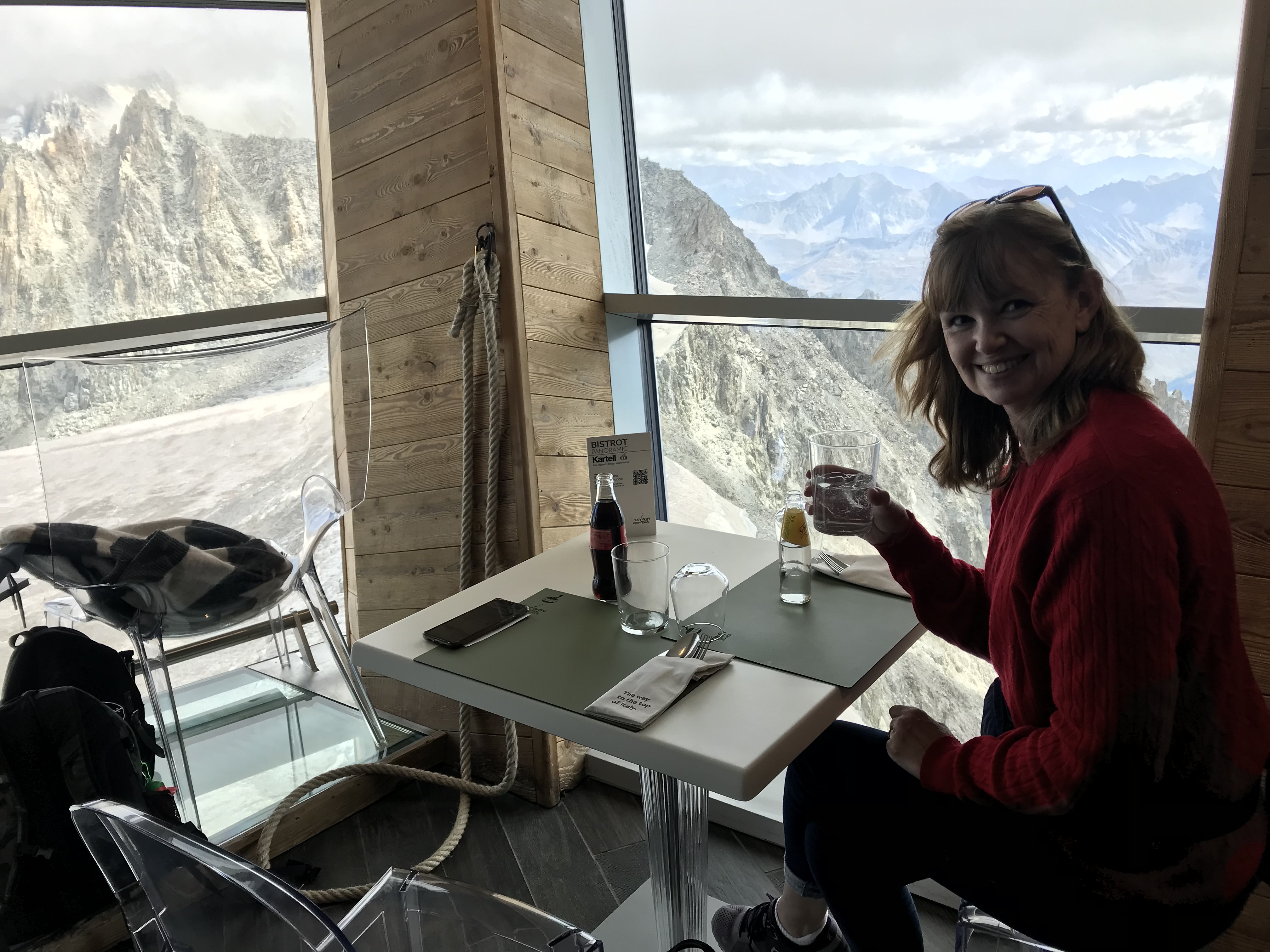
We had lunch at the top of Mont Blanc!

Preparing for the descent.

It was such fun. First we drove to Courmayeur. Well, strictly speaking, first we went to the local Pharmacy in a panic because we read on the website that it was essential that we wore the correct type of face-mask—but after that we drove to Courmayeur. We followed signs for the cable-car (the funivia) and there was plenty of parking underneath. Italy seems to do parking very well (either that, or we have been very lucky so far).

There was then some confusion, with a ticket office, and several different queues which didn’t seem to lead anywhere and no helpful signs, and loads of people. We had already bought our tickets online, so we joined a line that looked promising, and managed to get the piece of paper we needed to walk up to the cable car. I don’t like heights (as you know if you read my blogs regularly) so I was extremely pleased to find a seat, in the middle, where there was hardy any view through all the standing passengers to the scary plummet as we ascended the mountain. Hardly anyone wore masks, I think only the foreign tourists, who had also read the website, were wearing them. The website should perhaps be updated (I write this in August 2022).

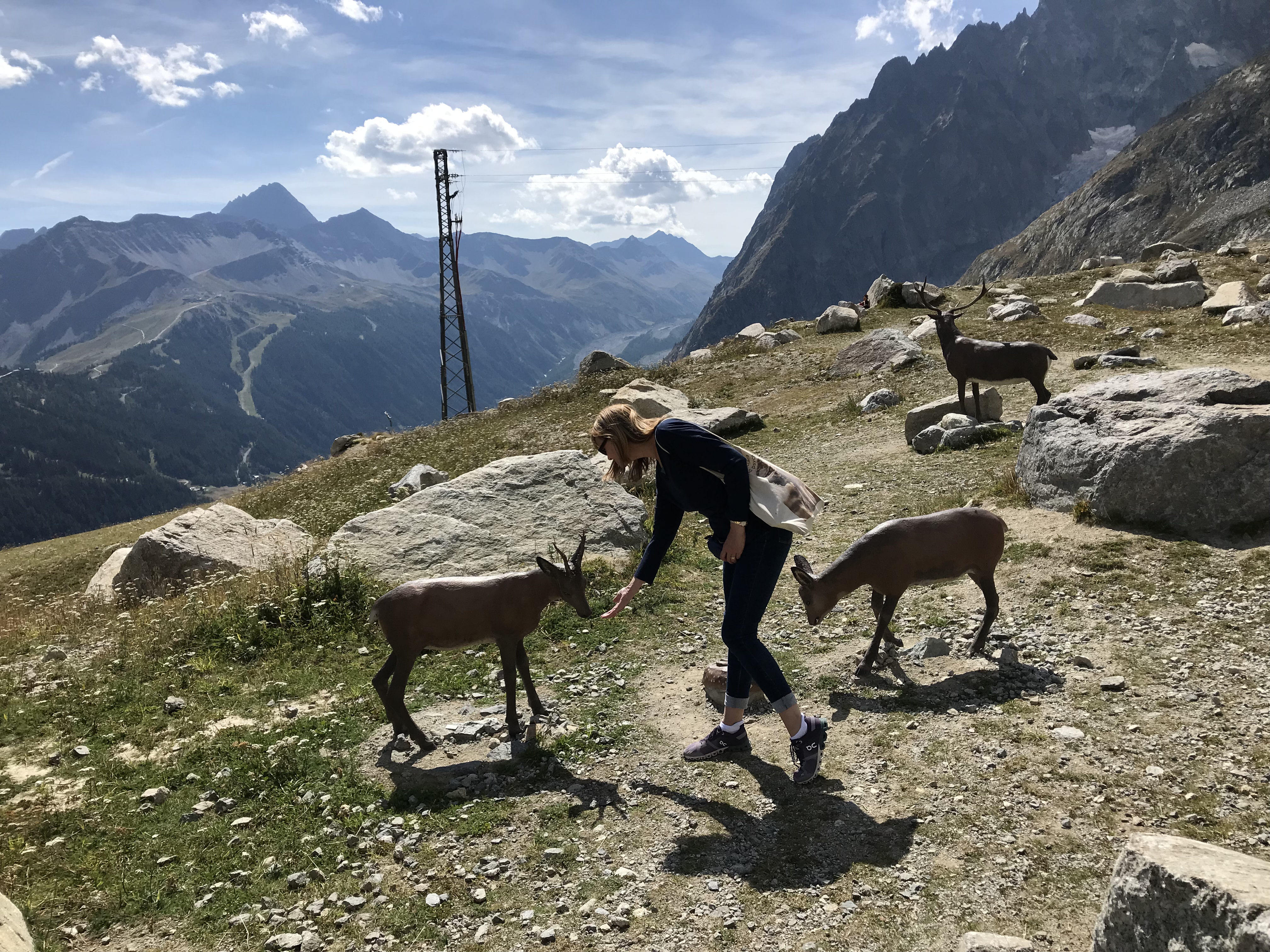
The cable car stopped midway. There were amazing views, and paths you could walk along, a little botanical garden, and deckchairs. The deckchairs were full of lounging bronzed people who had stripped down to their underwear. I don’t think any will make the cover of Vogue, so I will spare you a photo!

We then caught another car up to the top of the mountain. Again, not too scary if you kept your eyes shut the entire time. It was crammed full of tourists, and athletic looking people with climbing gear, and dogs. I love that in Italy, dogs are welcome just about everywhere.

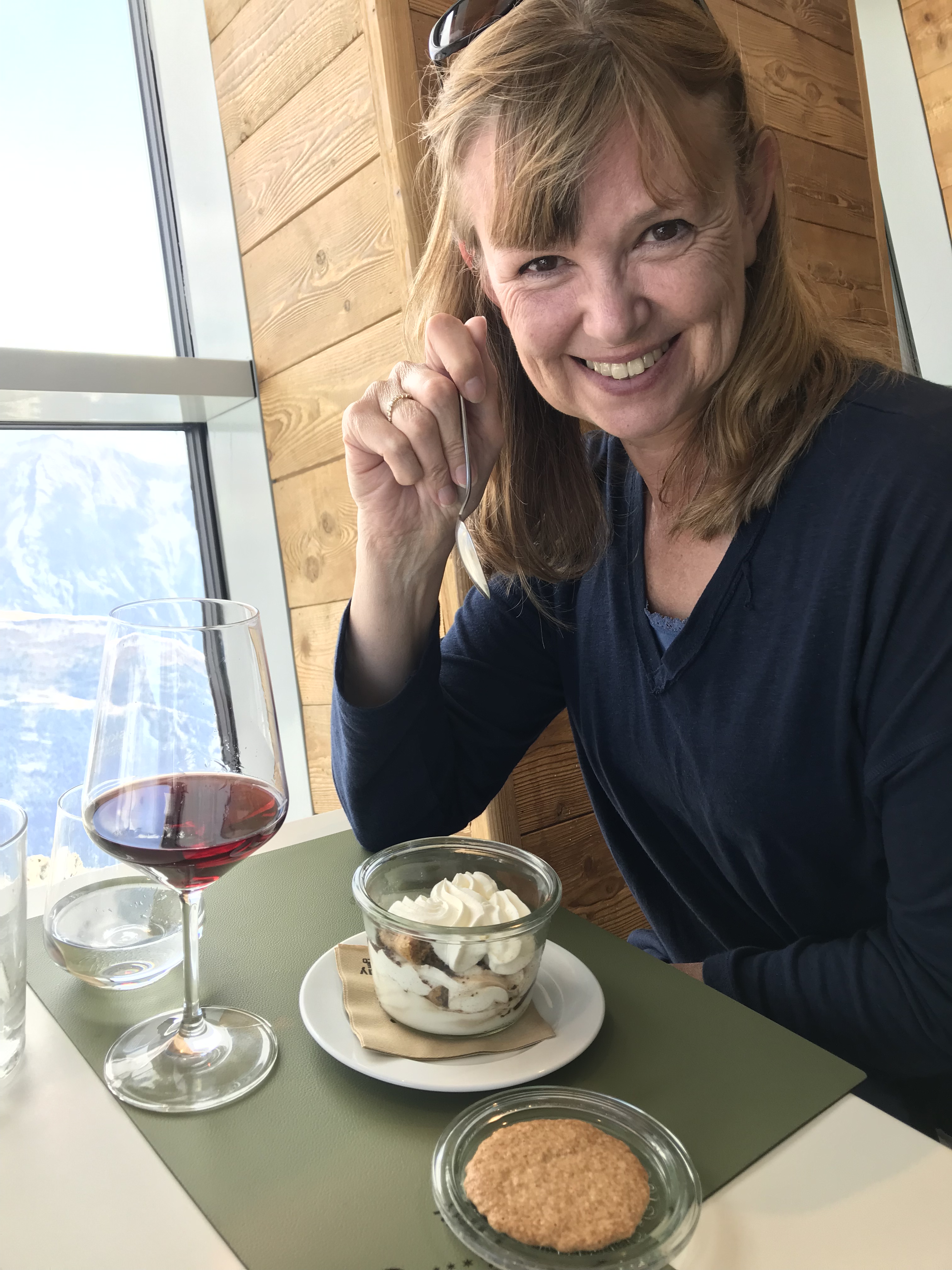
The top of the mountain had various viewing platforms, but we went straight to Bistrot Panoramic. It sits on top of Pointe Helbronner (which I understand is one of the peaks of Mont Blanc). The views were amazing. The restaurant walls were glass, and the seats were transparent, so wherever you sat there would be views. We were slightly early, and managed to have a corner table. After a quick gin and tonic, this was fine, and I rather enjoyed it. I had some red wine too to prepare for the descent (hence the slight headache now).

The meal was a set menu: a potato dish (like Dauphinoise potatoes but with bits of ham), a soggy-bread-and onion dish (nicer than it sounds) and a vegetable soup over pasta dish. We chose a mushroom dish and a sausage in tomato sauce dish, to accompany the cheesy polenta (which all went together very well, but would have been not great alone, as the mushrooms were a bit slimy and the polenta needed more salt). Dessert was apple cake (which was apple pie!) and tiramisu. We finished with coffee. All very nice, and when put together with the view, completely fabulous.

The table next to us had a huge dog curled up asleep. Next to the door of the restaurant was a bowl of dog water. I now plan to return, with my dog (maybe not Kia, as she’s a bit old now and would snarl at everyone).

We spent some time taking millions of photos, then went back to the car. As lunch dates go, it was perfect.

Thanks for reading and have a great day.
Take care.
Love, Anne x

And we saw Maria!!!!
Thanks for reading.
anneethompson.com
Sign up to follow my blog by following the link below.

The Best of Days, the Worst of Days…


Today has been a mix of highs and lows. Mostly highs, so I will start there.

As you know (if you read my blog regularly) we had booked a house in Italy for the summer, but popped home after a couple of weeks to attend my niece’s wedding. After the wedding, we returned to La Thuile for the rest of August. It felt like coming home as we drove from the airport, past ‘our river’ that races through the valley, to the view of ‘our mountain’ with the glacier that reflects all the moods of the sun.

Anyway, today I suggested that we should go to a café for an espresso (which is one of my favourite things about Italy—sipping a coffee in the sunshine, somewhere beautiful). Husband suggested that rather than walk to the nearby café (‘our café’) we should try somewhere new, on the other side of town.

He directed me along lanes, through the park next to the river, up narrow streets. We arrived at a pretty building next to the river, with a family sitting in lounge-chairs in the garden. At our arrival, they all jumped up, assured us that they were open, and the man showed us to a table in the shade. He then disappeared.

I looked around. On one side was the river, on the other was mountains—all very pretty, perfect for a leisurely coffee. The man then reappeared, carrying cutlery and glassware, and a basket of fresh bread. He smiled welcoming as he set our table. Lots of eye-contact between Husband and I, neither of us spoke. The man hurried away.

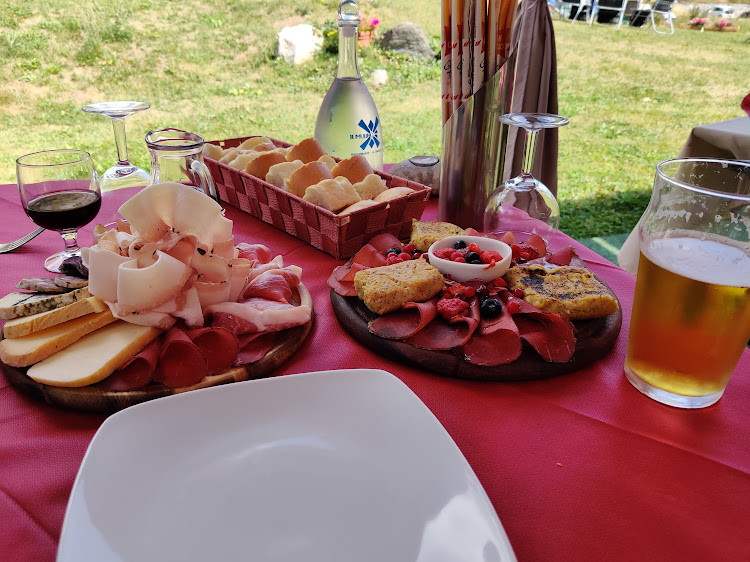
Now what? The man was so welcoming, the bread looked freshly baked, dare we say that we only wanted a coffee? Husband said we should just order something small (we already had dinner reservations for the evening at ‘our restaurant’). The man reappeared with the menu, and we chose a couple of dishes. Neither of us understand much Italian, so it was a bit random. What arrived were platters of cheese and meat, which went perfectly with the house wine. We finished, an hour later, with the espresso that we had come for. It was all very unexpected, and very lovely. A good time.

After our lunch, we discussed what to do, as I have hurt my leg and can’t walk far. Husband suggested we went ‘up the mountain on the cable car.’ I knew this was something he really wanted to do, and we had just enjoyed a lovely lunch in the sunshine, so I agreed. I hate heights. It was even worse than I imagined.

The ‘cable car’ is not a cable car, it is a chairlift—designed for skiers in the winter, and mountain bikers in the summer. I watched the chairs as they flew down the mountain, turning at the bottom, slowing for passengers, then continuing back up the mountain in a continuous loop, never actually stopping. I saw a few people nearly getting bonked when they stood up but didn’t move out of the way quickly enough, and I tried to learn from their mistake as we joined the line of young men with bikes. We fed our tickets into the machine, and stepped forward. A man appeared from his cubicle and hovered near the emergency-stop button. We stood in place, the chair arrived behind us, we sat back, a bar was lowered in front of us, and we rose towards the sky.

I decided it would be best to keep my eyes shut. This worked fine on the way up. It felt like flying, I could hear birds and smell the pine trees, and the temperature grew gradually cooler as we rose. We reached the top, Husband yelled at me to let go of the safety-bar, a man hovered near the emergency-stop button, I leaped off the chair, remembered to hurry to the side, the chair sailed past me and I was on solid ground. All great. I felt rather pleased with myself, and enjoyed looking at the views and watching the young men as they raced down the mountain on their bikes. Then we decided to go back down. Then it all went wrong.

As we fed our tickets into the machine, the man emerged again to hover near the stop-button. Obviously we looked incompetent. The chair swept behind us, I sat, the bar was lowered, I shut my eyes and pretended I was flying. Then Husband (who I have now forgiven) mentioned that the safety bar was raised and lowered by the passengers—in other words, him. That felt very unsafe. If you have a fear of heights, you will know that the fear is connected with falling, and the belief that somehow you might fling yourself over the precipice. I am not scared in airplanes, because I cannot fall out. I am terrified on cliff edges because I might fall over. Now I was being told that if I lifted the bar (yes, I know that this was entirely in my control and wouldn’t happen, but fear is not rational)—if I lifted the bar, I would plummet to my death. I took deep breaths. Then Husband mentioned something about the view below, and fool that I am, I opened my eyes. I was not flying. I was suspended on an insecure chair, miles above ground, with nothing but a moveable bar between me and certain death. My heart stopped, I thought I might vomit (pity the mountain bikers below!) and I started to shake all over. I think I whimpered.

For the next few terrifying moments we sailed through the air. I shut my eyes and prayed very hard and tried not to think about how it would feel to fall. Then we arrived. The same man hovered near the emergency button (they didn’t seem to do that for anyone else!) and I managed to stand, to move out of the way, to walk to the nearest bench. I didn’t speak. Somehow, I survived. But it was bad, very bad.

I hope your day is full of good things, and that you cope with the bad things calmly.
Take care.
Love, Anne x

Anne E. Thompson
Thank you for reading.
anneethompson.com
Why not sign up to follow my blog?
Look on your device for this icon (it’s probably right at the bottom of the screen if you scroll down). Follow the link to follow my blog!

Italy: Angry Ice Creams and Absolute Beauty


Italy is beautiful. There are many beautiful places, but I have a personal favourite—do you?

You will remember from last week’s blog that we went to Italy for a couple of weeks at the beginning of August (returning for my niece’s wedding on the 18th, but you will have to wait until next week to read about that!) We stayed in LaThuile, which is a ski resort in the winter, and in the summer is a village of musical-box log cabins, and window boxes full of geraniums, and hot, hot, sunshine. The whole family plus partners came, and we had a happy time of reconnecting.

The Italian Alps might be the most beautiful place in the world. Even better than Scotland (which has some amazing scenery). I’m not a great lover of cities; I love big skies, and rushing rivers, and mountains, and trees (so Iceland wasn’t really my taste). Some of the mountains were still topped with snow, and snow is always exciting, even when it’s in the distance. (My family will correct me here, and tell me it’s not snow, it’s frozen glacier, but you know what I mean.)

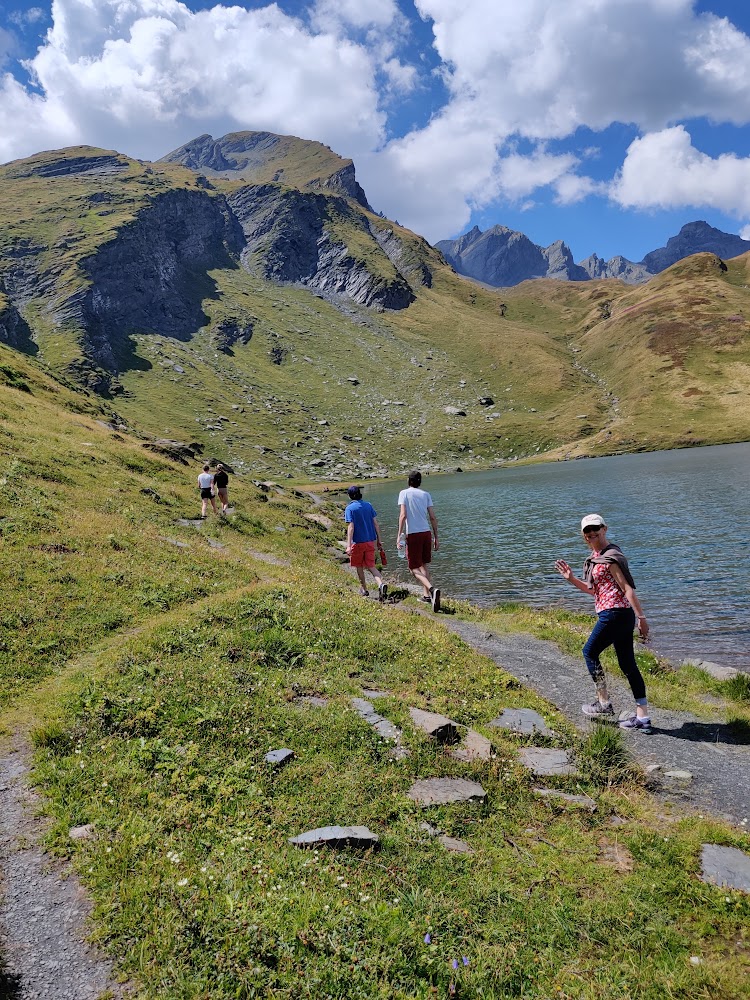
We visited many beautiful towns and villages, and walked up mountains, and through mountain passes, and along valleys. There was a lake, high on a mountain pass. The water was so blue, and the sun was so hot, it was tempting to swim. Only the dogs were actually in the water, humans knew it would be freezing. As we walked round the lake we could hear the clonking bells of cows, and there was a herd of them with curved horns, drinking from the lake.

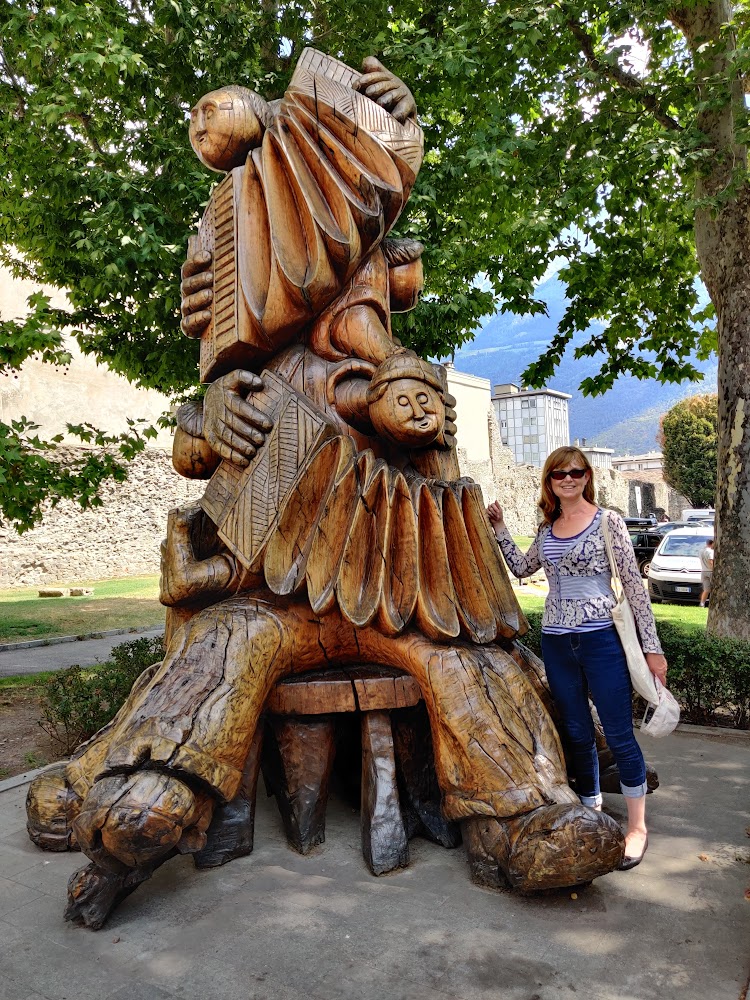
We visited Aosta, with its Roman remains and cobbled streets and carvings of wood. It was full of tourists when we were there, and there was a rain storm with huge drops of water soaking us all.

My dad played an accordion, so I loved this sculpture.

My main memory of Aosta is the ice cream parlour, where I had a stand-off with the assistant! The shop was busy, and while we stood in line we watched a man bring trays of chocolate-dipped lollies, and vats of fresh sorbet and creamy ice cream to refill the display. The counter was pretty, with fresh fruit, and coloured ices, and cones. But I also watched the girls serving, as they touched the money and credit cards, scratched an itch, then served the ice cream without washing their hands. I decided I would have an ice, placed in a cup with a scoop (no contact with those hands). All was going well, until I saw the assistant pick up a straw (touching the part that goes in the mouth) and place it in the ice. When it was my turn, I reached up, and took my own straw from the pot.

The assistant glared at me, and told me I shouldn’t touch. (Somewhat ironic.) I explained that I had only touched my own staw. She continued to scold me, then tried to add a straw from her own dirty hand. I told her that I did not want her straw, I already had one. I did not want a straw she had touched.

Oh the fury in those eyes! She returned to serving the rest of our order, glaring at me as she dolloped scoops of ice cream into cones. I have never been served ice cream with so much hatred! It did taste very nice though.

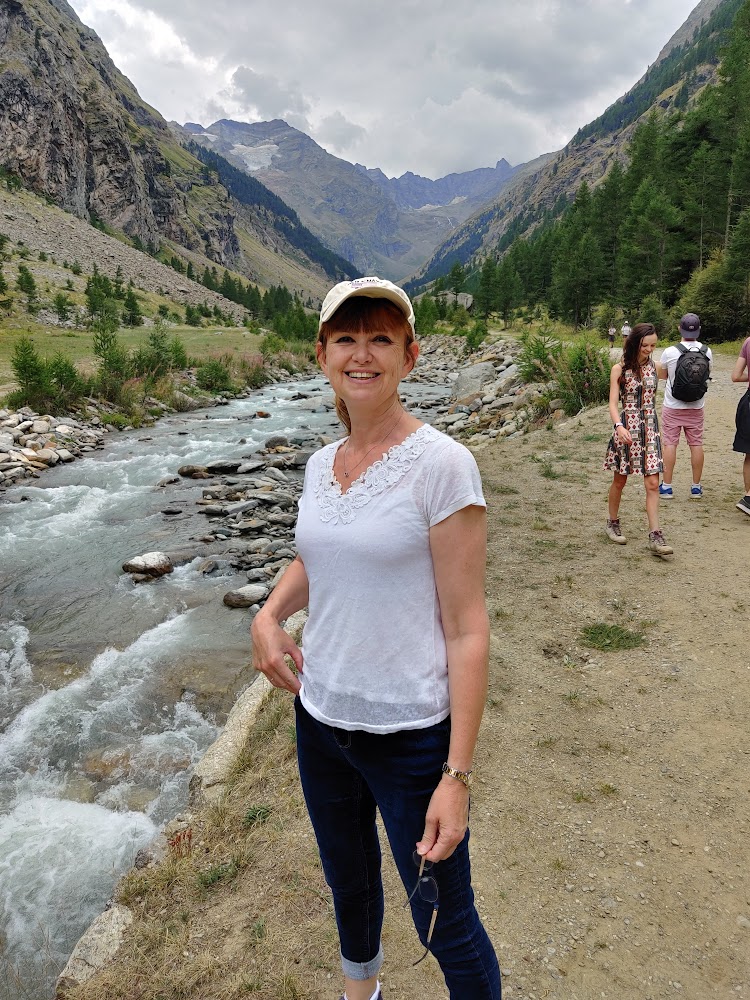
We also walked in Parco Nazionale Gran Paradiso, strolling beside rivers and waterfalls, staring at huge rocks left by glaciers. Very pretty.

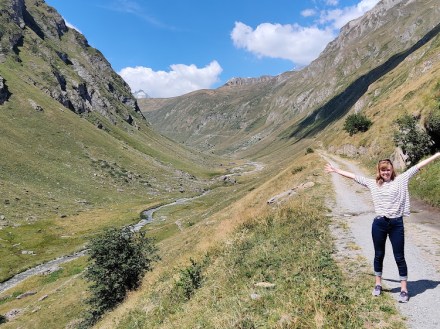
But there is one place more beautiful than all the others. You can walk there from LaThuile, but two hours is about my maximum for an enjoyable walk, so we drove up the winding road from the town, turning onto a track before we reached the hamlet of Cappella di San Bernado. The track was very narrow, with hairpin bends, the valley falling steeply away to one side. Not a comfortable drive. I was glad when Husband announced he wasn’t going any further, and parked on a slim patch of grass next to the track. If a bus came, we’d be in trouble. But it wasn’t the sort of place a bus would go.

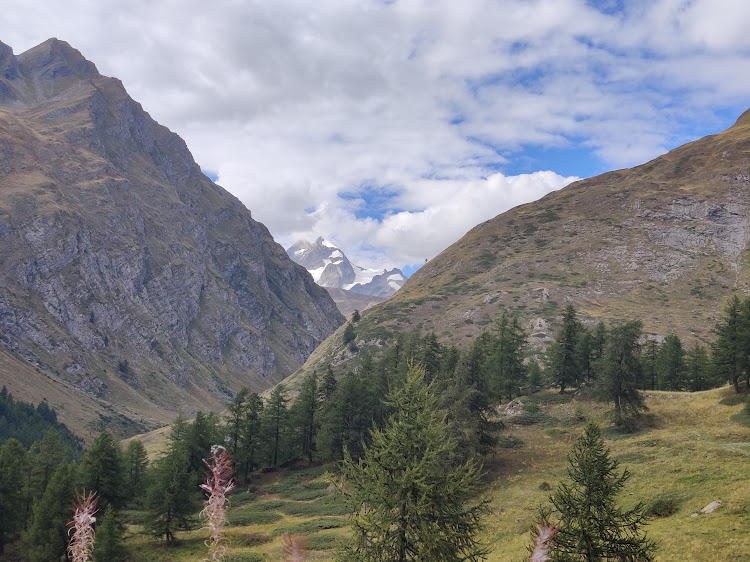
We walked. The track rose gradually, gently taking us further from the valley floor. We could see a river, and guessed the speed of it. There were trees below, dwarfed by the distance between us, dark green pines clinging to the side of the mountain. Patches of grass were dotted with brown mud, dug out by marmots which scampered away when they heard our voices echoing round the valley. (I must say, I will never ever manage to see much wildlife, because my family is so noisy!) Streams trickled from the rock next to us, forming puddles before trickling down to join the river. As we stepped over the puddles, clouds of blue butterflies rose, dancing around us like a host of fairies with blue and gold wings. We could see cows with their clonking bells in the distance, and beyond them, beyond everything, there were the mountains, watching. It was truly beautiful.

I hope you see some beauty this week. Try not to annoy any sales assistants though! Thanks for reading. Take care.
Love, Anne x

Clonking bells wherever there are cows.

Before Italy…


We went to Italy for a couple of weeks. It was a variation of the trip we planned for 2020, when we rented a house in the Italian Alps for a few months, just to see how it would be to stay somewhere beautiful for a while. That trip was cancelled—another victim of the Covid lockdowns—so when the same house was free for the beginning of August, we booked it.

I arrived exhausted, mainly due to the last days of July. It had been busy—much too busy to call the wasp man, so I told Husband that we had a nest, and he said he hadn’t seen any wasps, so neither of us phoned the wasp man. Which was a mistake, but we’ll come to that later.

Sisters

You will remember my sister was staying? Well, she returned to Canada on the 30th of July, so we all met the night before for a barbecue at my brother’s house. To say goodbye. I hate saying goodbye to my sister, she’s a part of me, there’s some strange physical bond, and Canada is much too far away. When we returned from our family trip to Cromer (see an earlier blog) I had to make lots of scones, because all the ones I had made previously were eaten by my sister, and me, and various relatives who came to see my sister.

The dog also had to go into kennels, and I hate that now she’s so old, just in case…

Anyway, I survived saying goodbye to both of them again, and there was no time to think because the 30th was a whirlwind of making beds, cleaning the house, preparing meals for stray children (who aren’t children any more, but you know what I mean) when they arrived. In between time, I flung items of clothing in the general direction of a suitcase.

At about 2pm, my eldest son arrived from Vietnam. He’d been working there, managed to dislocate his leg, and had to be collected by taxi from the airport (because no one else was free). He hobbled in on his crutches, looking all tired and relieved to be in England, and thin. I don’t think he’d eaten much and he’d done a lot of trekking through jungles. When confronted with a tired thin son, mothers like to cook. I was busy, so cooked a frozen pizza (but the thought was there). Younger son carried the suitcase upstairs, I put a load of Vietnam-dirty clothes in the washing machine, then smiled a welcoming smile as our first visitors arrived.

At about 2:30, all my in-laws arrived for a cream tea to celebrate my parents-in-law’s diamond wedding anniversary. We had put up bunting, and decorated tables, and it was sunny so we could sit outside (with the wasps—you remember them?) Everyone seemed contented though, and it was a happy celebration.

At 4pm, people left, and I had time to clean up (mostly) and then fold the clothes that I had thrown towards the suitcase, packing them properly. I cooked dinner for the family (they all came back for the wedding anniversary and to come on holiday). I was asleep within minutes of going to bed. But only managed a few hours because the taxi arrived at about 4 am. Then off to the chaos of Gatwick.

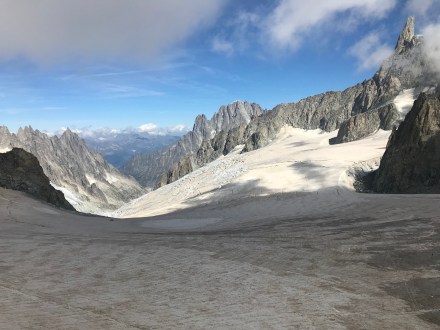
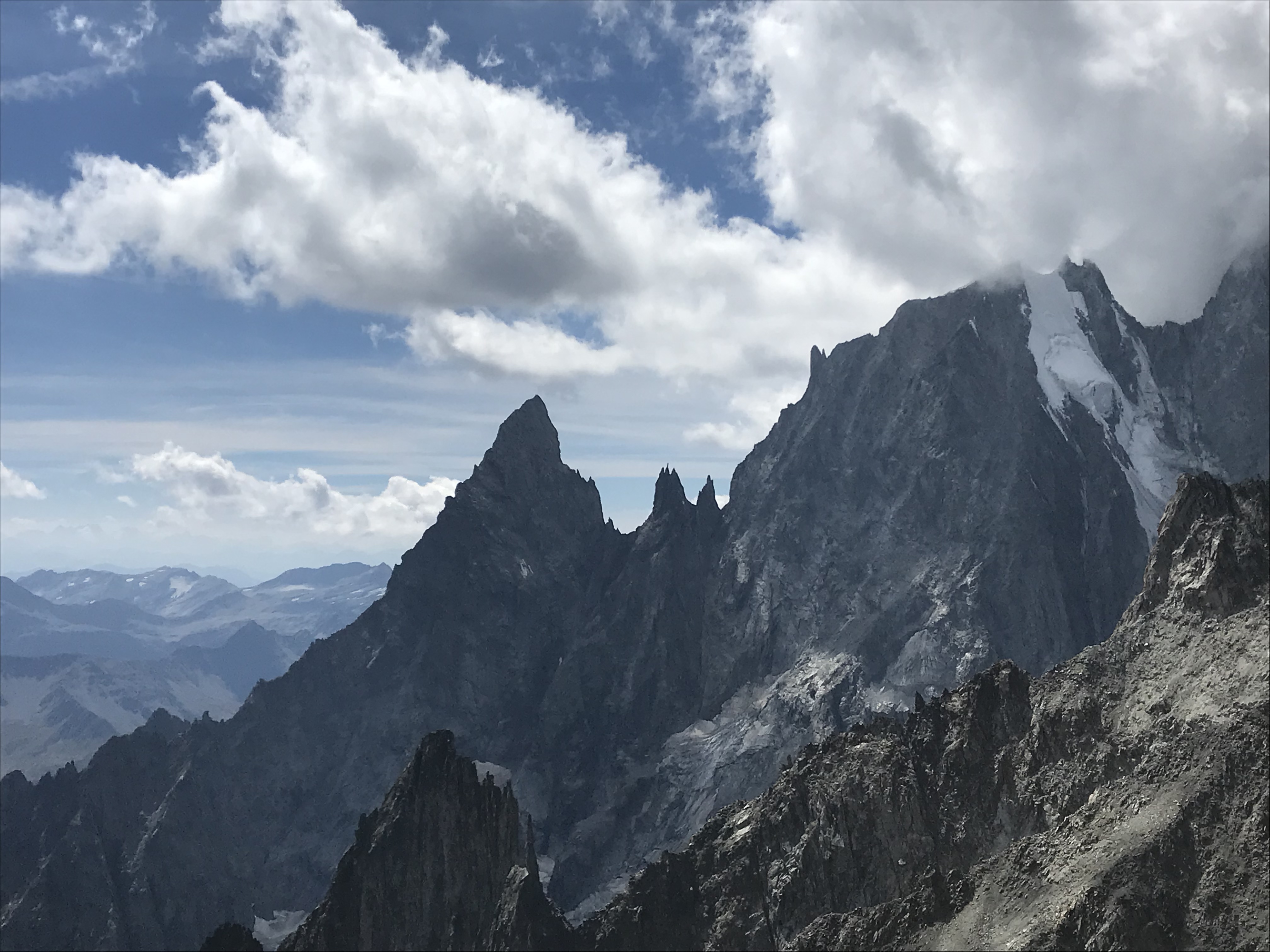
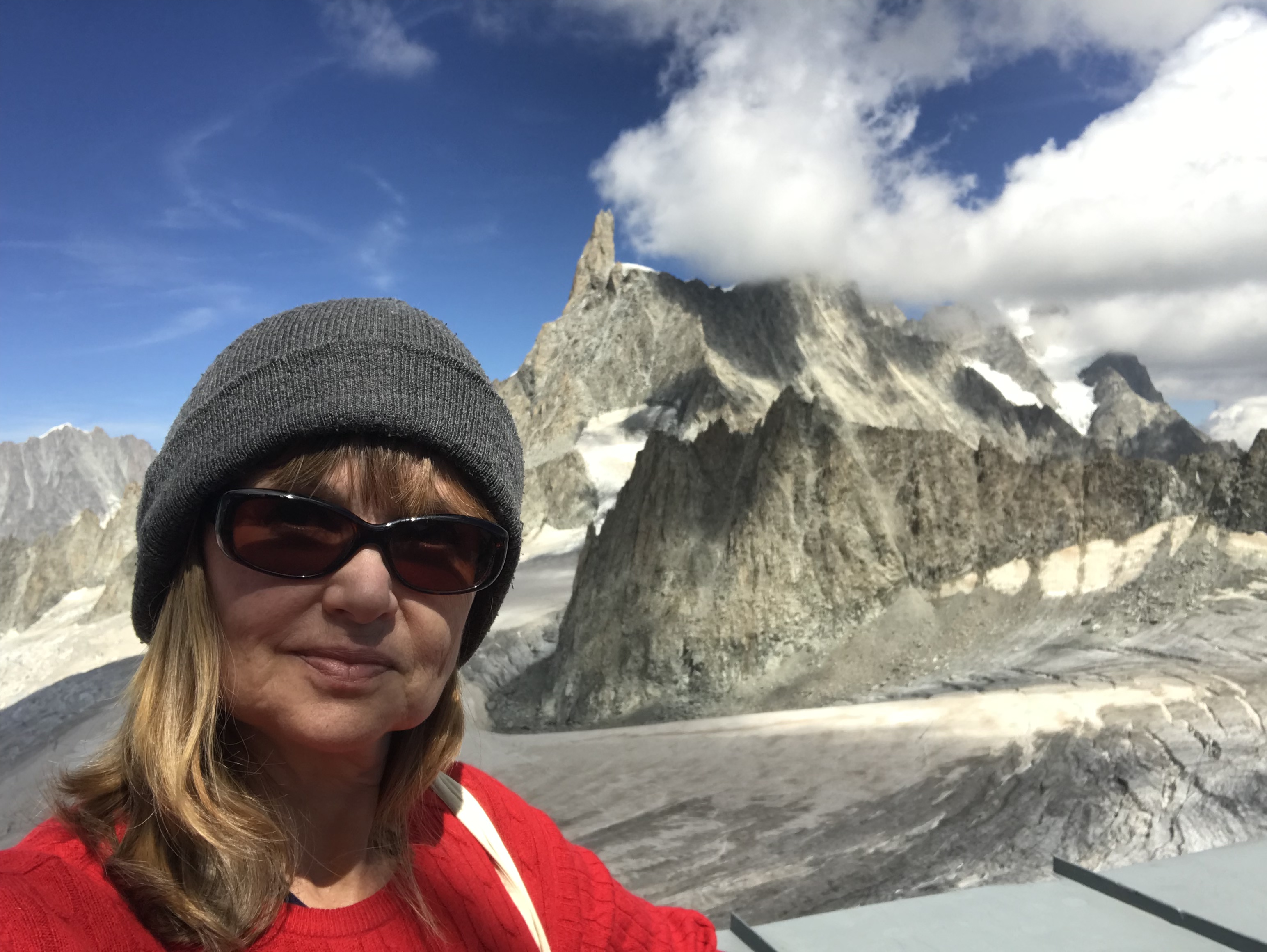
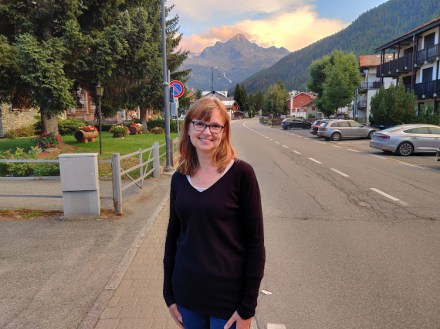
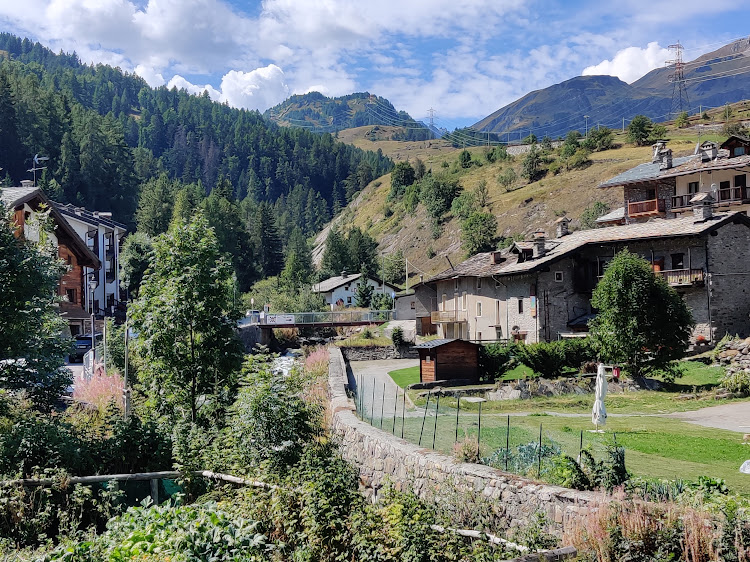
I will tell you about the joys of travelling with someone in a wheelchair in a later blog. Italy will have to wait too, otherwise this will be too long. We returned yesterday, ready to attend my niece’s wedding (another fun celebration I expect) and I will leave you with a few pictures of Italy, simply because it is beautiful.

Hope your week goes well. I will tell you about the very best place in Italy next week. Thanks for reading. Take care.
Love, Anne x

Thanks for reading anneethompson.com
Why not sign up to follow my blog?
A friendly chat every Monday.
anneethompson.com