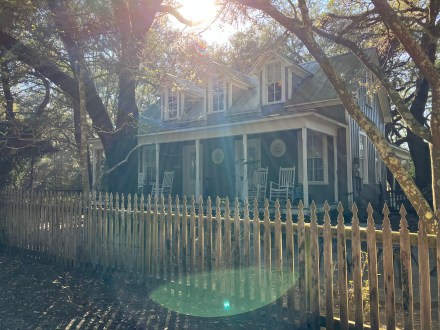
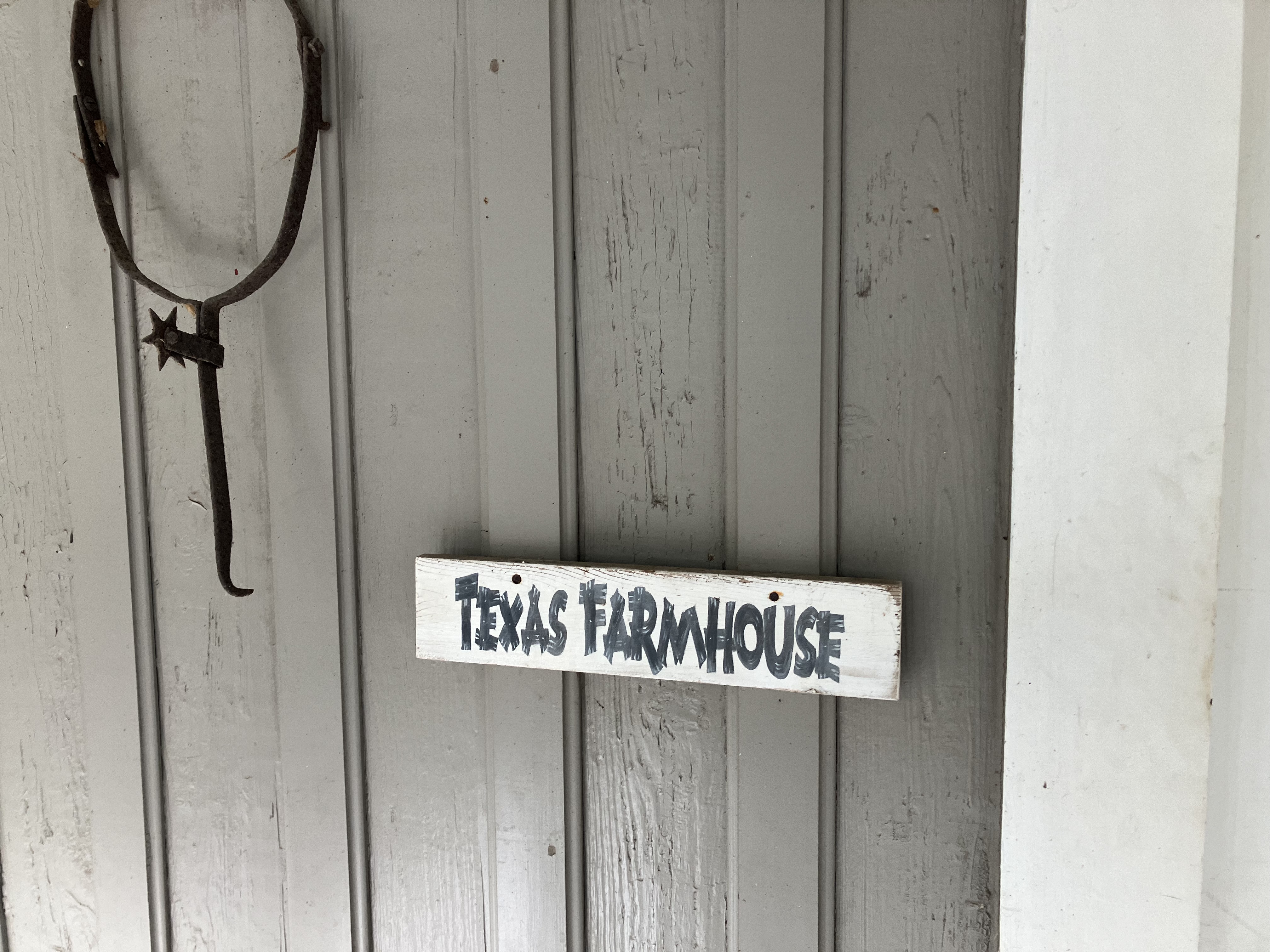
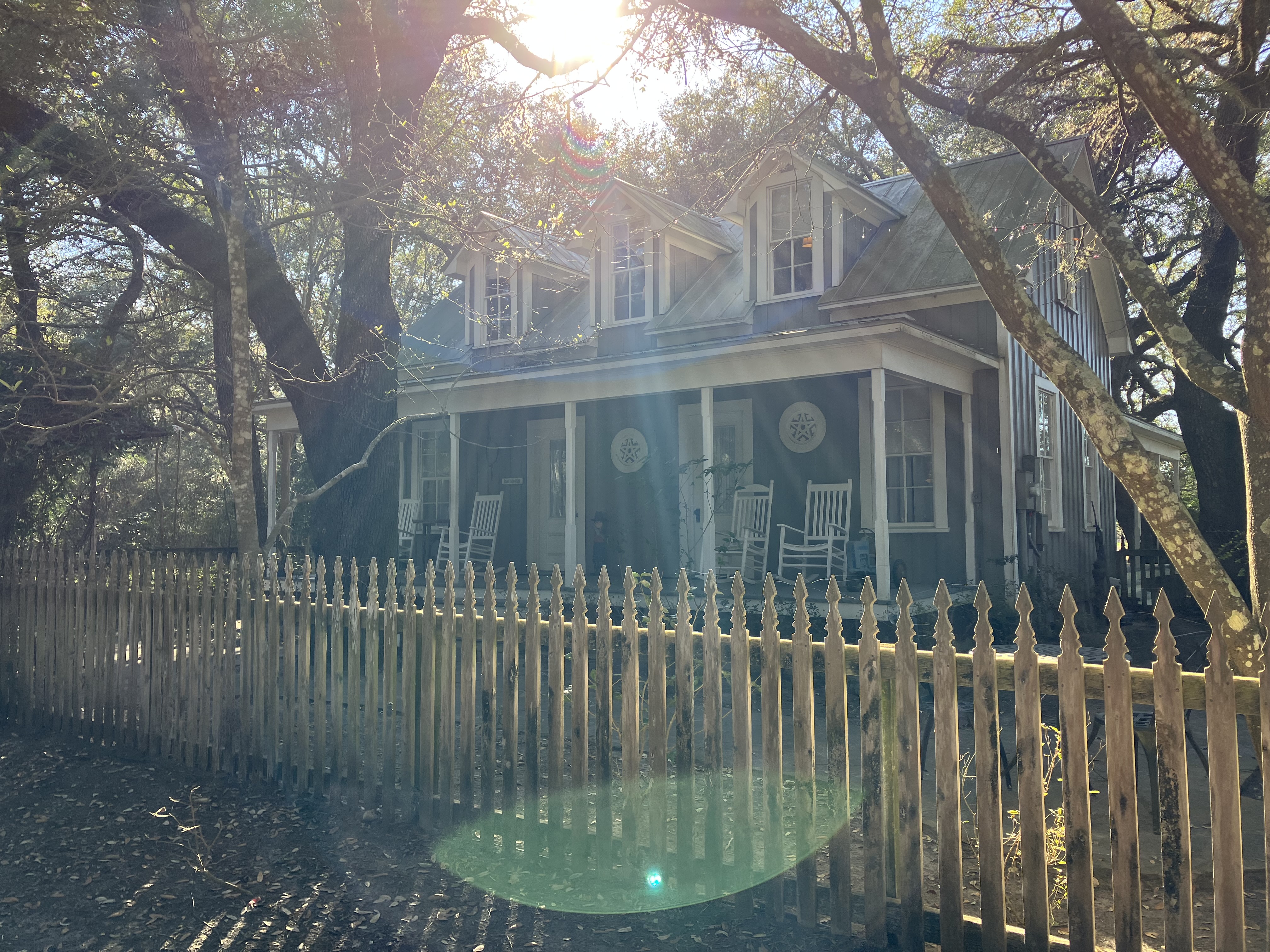
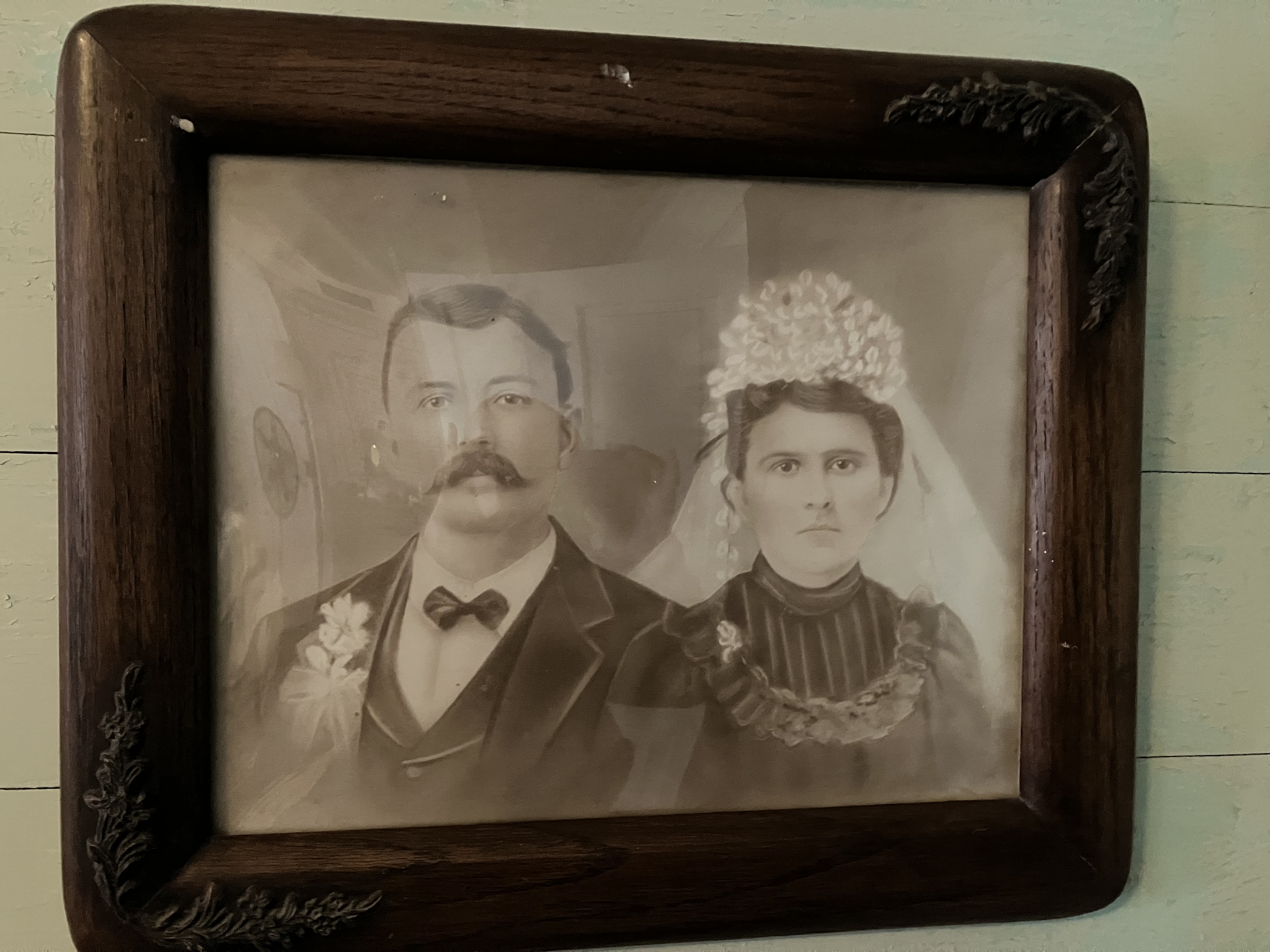
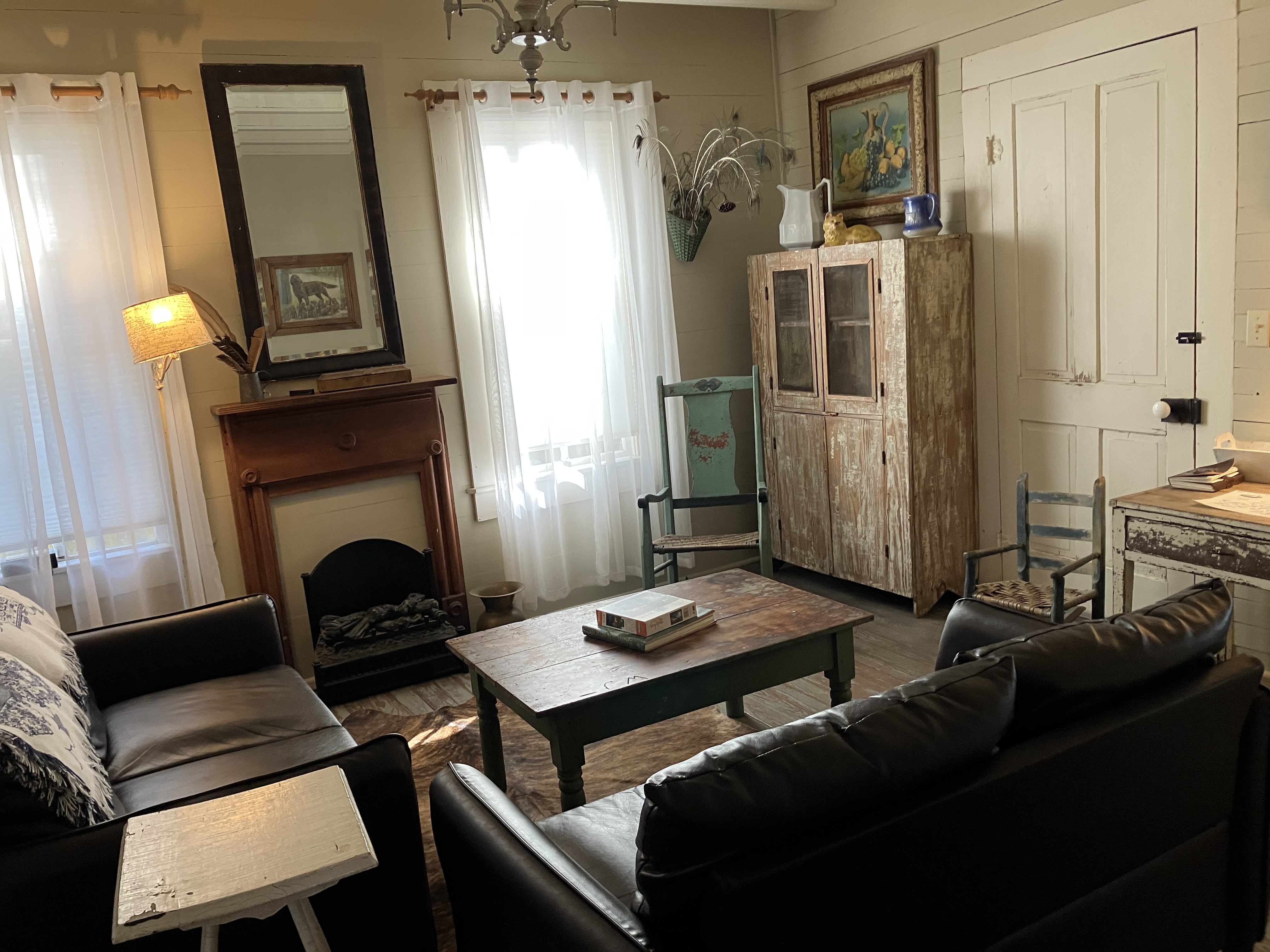
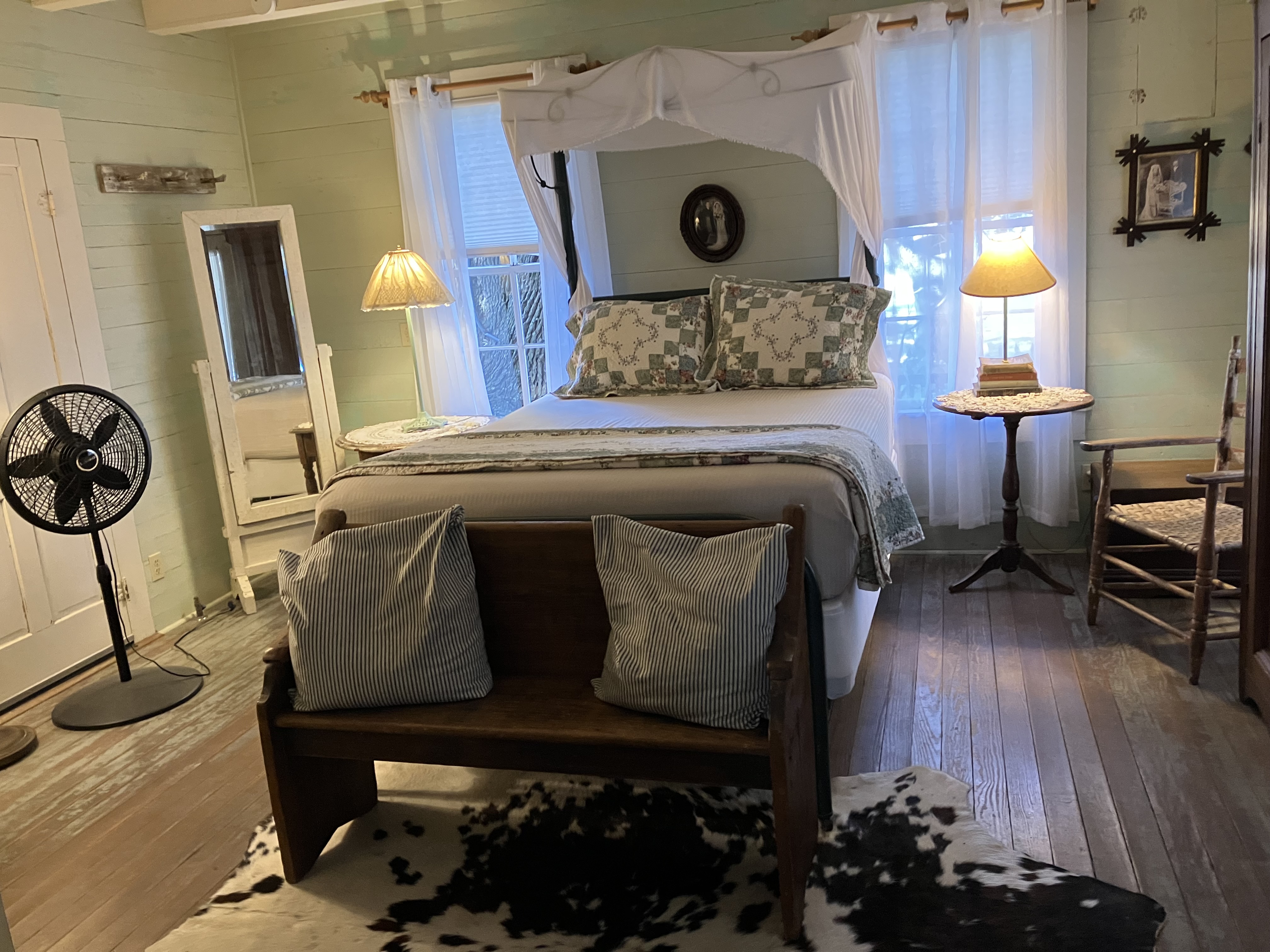
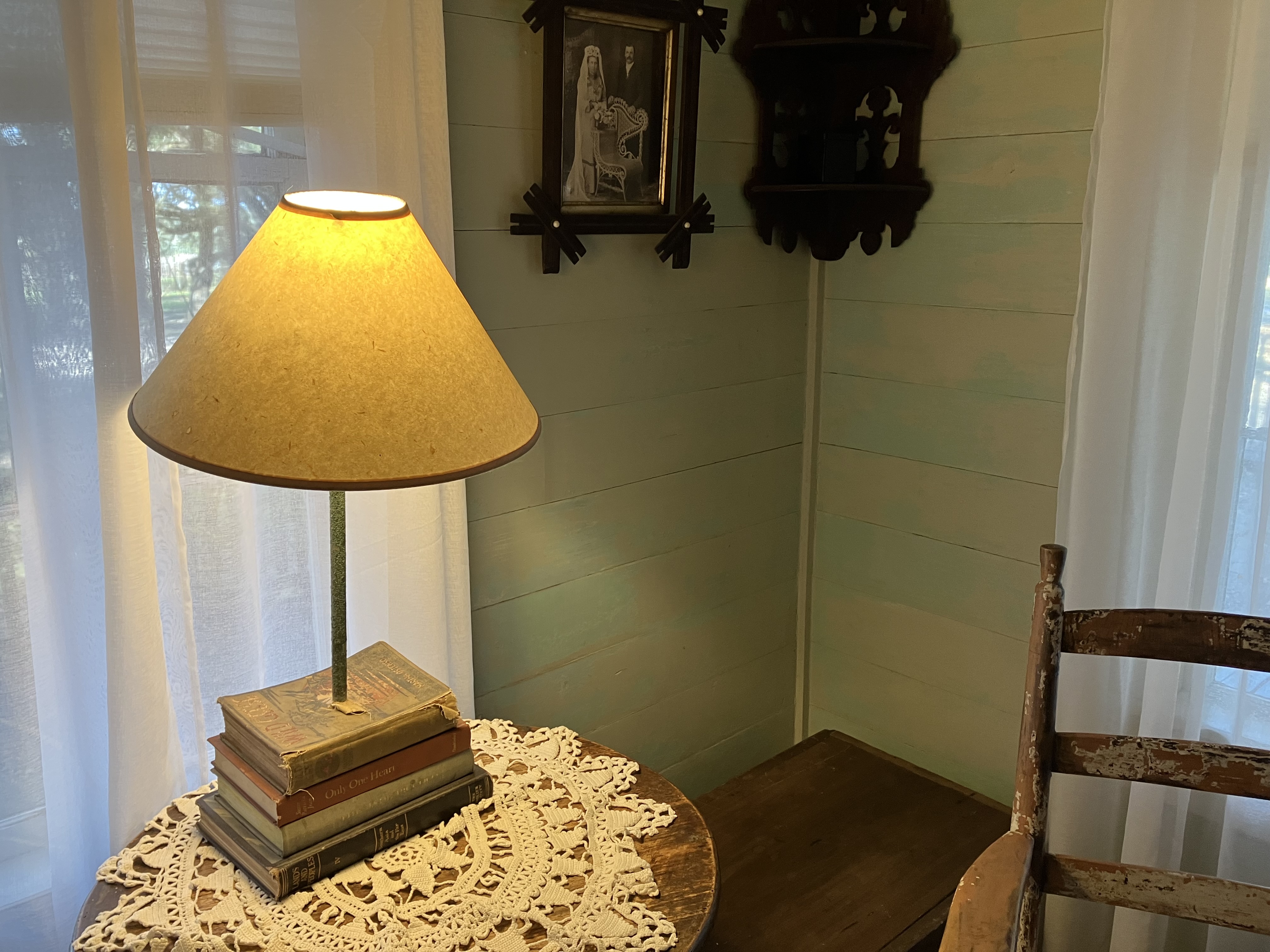
Texas Farmhouse is an unfortunate name. A wooden house, with dim lighting, far from the nearest town, evokes images of ‘The Texas Farmhouse Massacre.’ (A very slight modification of the film name, which I have not seen, but kind of evokes an unsettling image.) I think the furnishings don’t help. There are austere-looking people gazing from the walls, and although I have similar photos of my own ancestors at home, not knowing these grim people, and feeling nervous, makes for a bad combination.
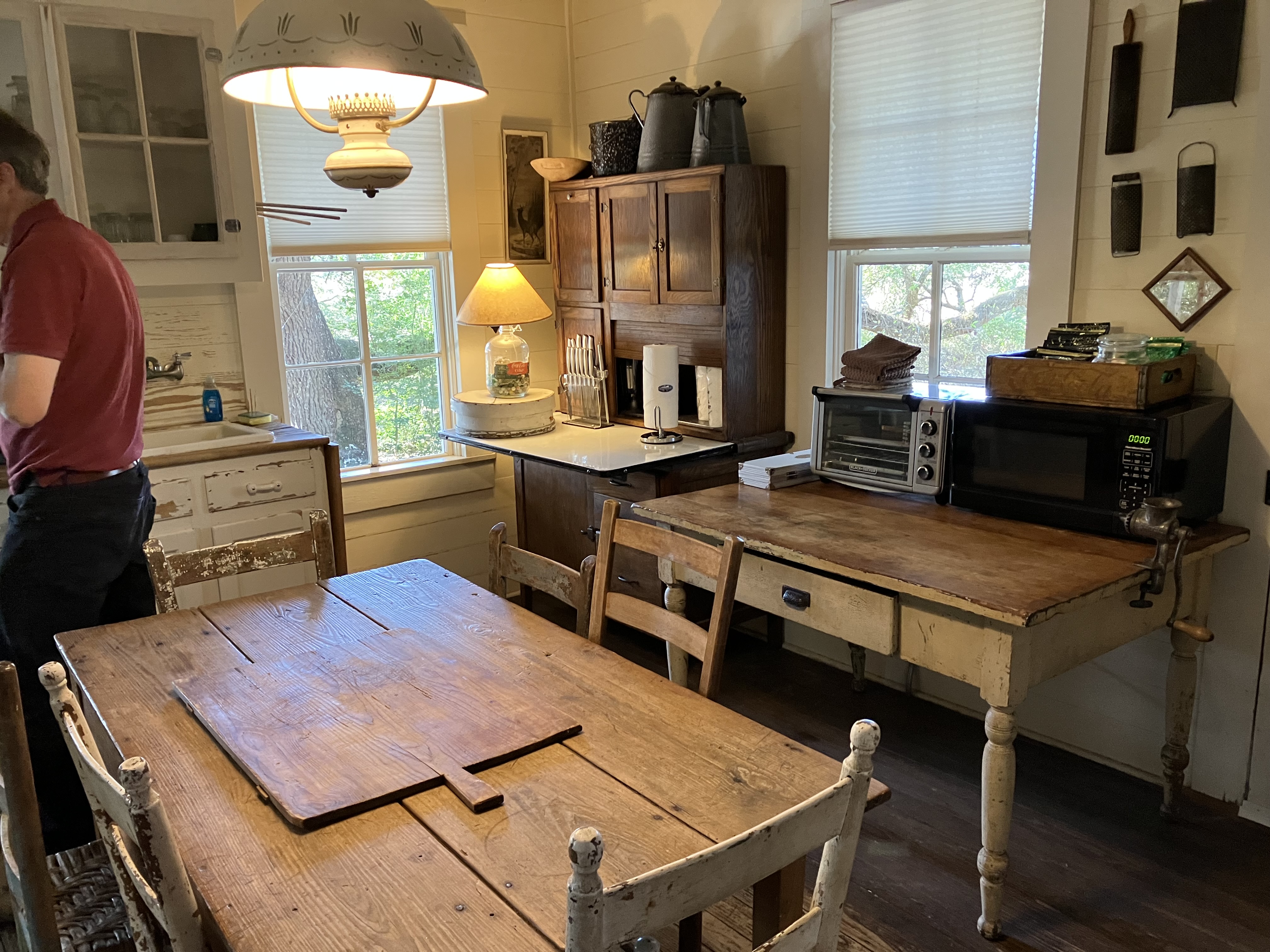
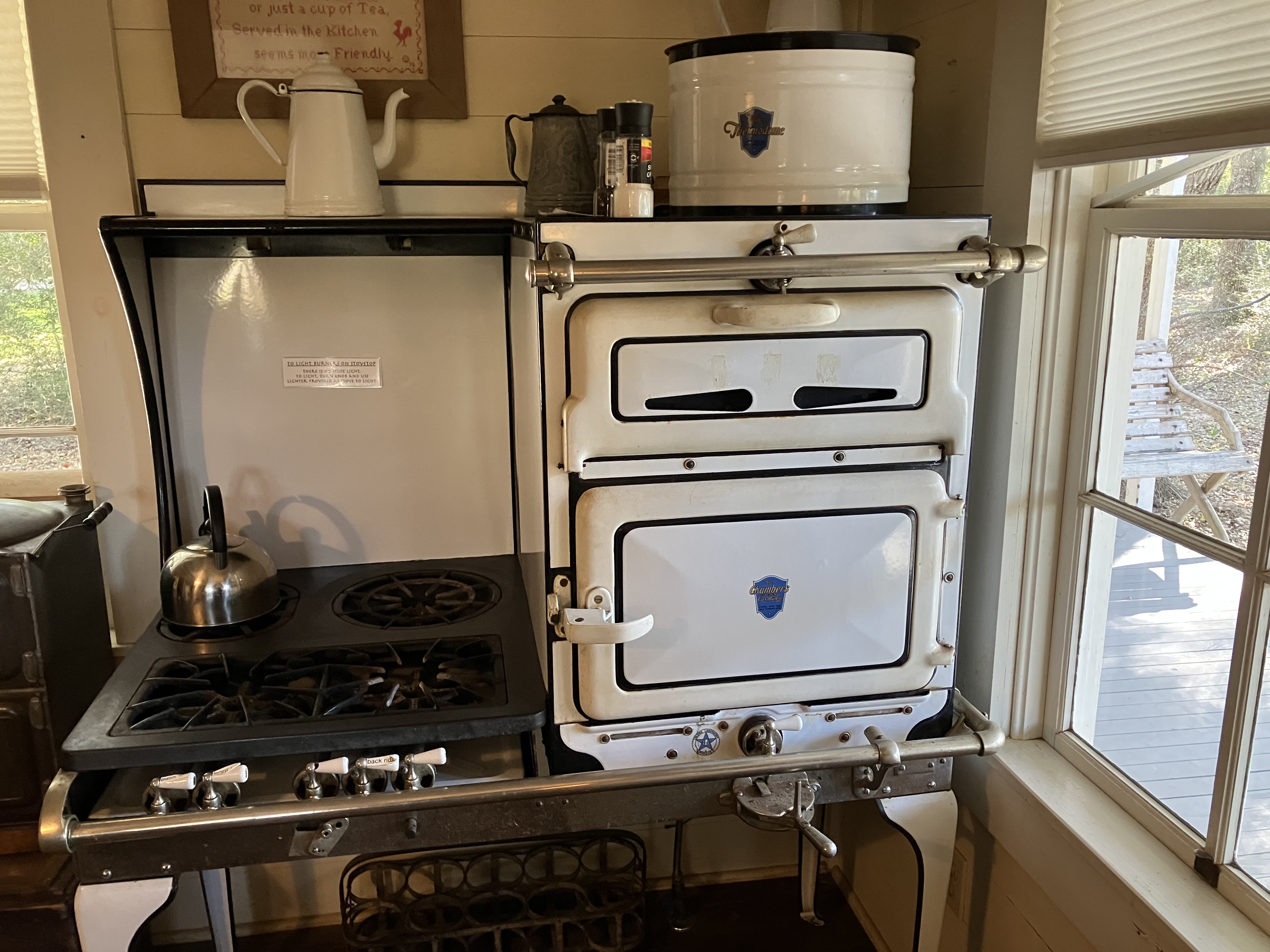
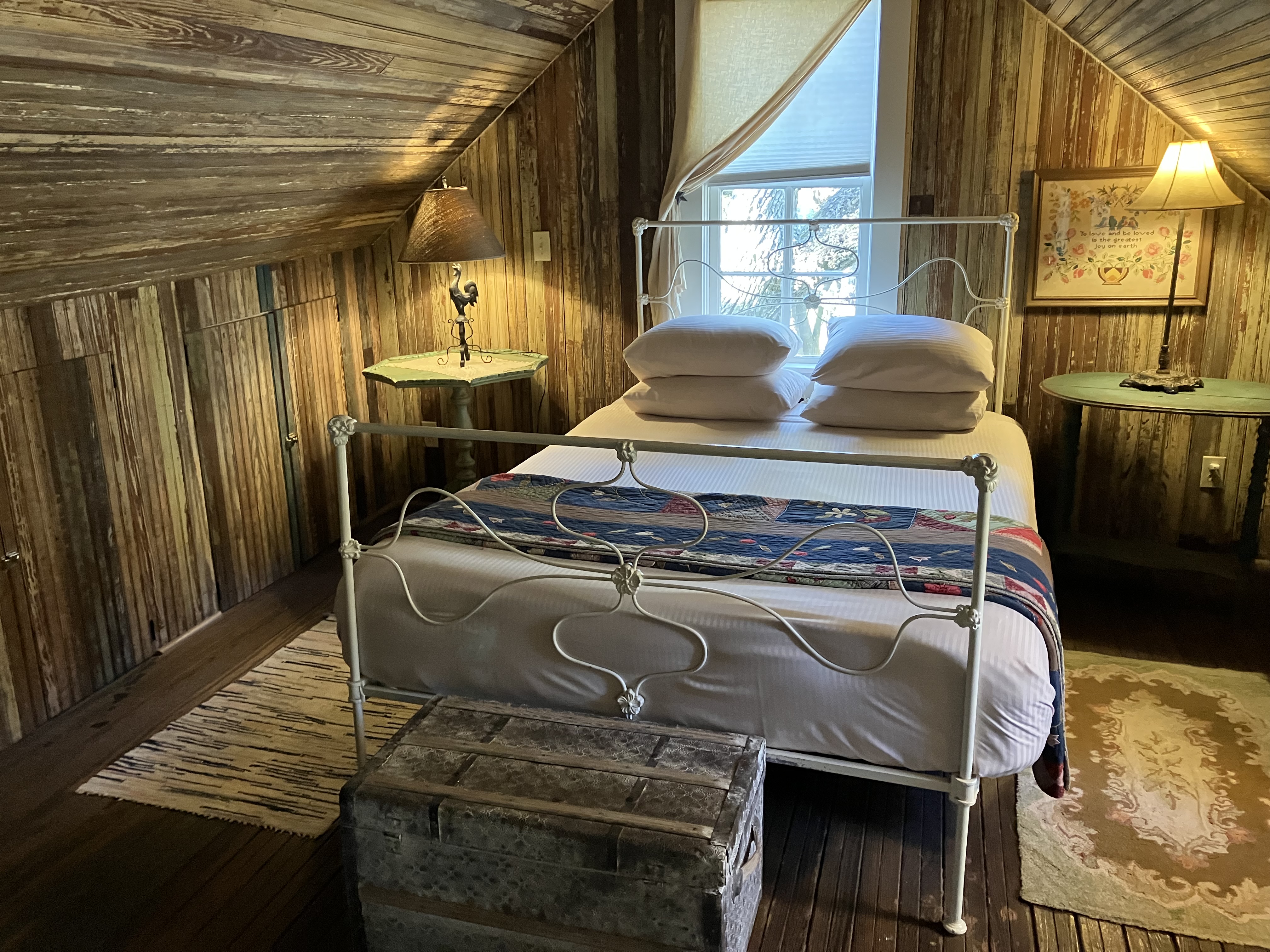
The ‘farmhouse’ (‘log cabin’ is more accurate) is furnished with historical artifacts so it sort of feels like living in a museum exhibit. They have also tried to make things ‘more old’ by scraping off paint, not removing grime from sinks—which to me seems very inaccurate. ‘Old’ does not equate ‘dirty’ and I’m sure the original occupants would have repainted things when they needed it, and kept their sinks clean and free from rust. There are some concessions to modern living (indoor bathroom and modern plumbing and air/con, heating system). I think it would be nicer if they had also removed rust and grime from the sinks. But we are getting used to it.
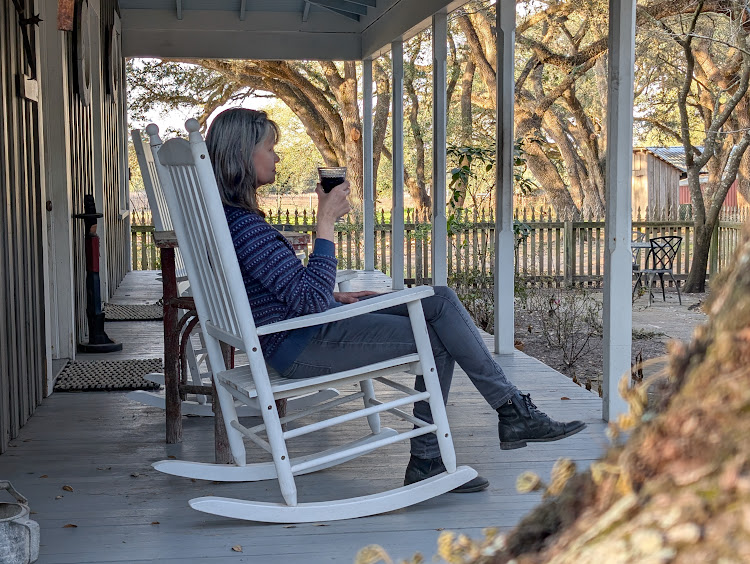
The first morning we discussed changing our plans, and abandoning the cabin. We would lose our fee, but if we weren’t going to enjoy it, what was the point? But we have now settled into ‘camping’ mode—ignoring the grubby parts and enjoying what is lovely. And there are lovely parts. Yesterday evening, as we sat in rocking chairs on the veranda, sipping red wine, enjoying the peace, it was perfect. Leaves rustled in the breeze, birds sang, the spanish moss swayed on the ancient trees.
There are also animals, which I love being near to. We found a field nearby with deer, which came up to the fence to greet us. There were also bison, huge shaggy bodies squarely facing us as they decided whether we were interesting. Then they walked towards us, one deliberate step after the next, slowly coming towards the fence. (We were quite happy to have a fence between us—I don’t know much about bison). An emu appeared, and did a sort of dance next to us (which may or may not have been aggressive—if it was a cockerel I would have been wary, but it’s hard to feel threatened by a bird which has a perpetual smile). It followed us along the fence line as we continued our walk.
Then there was screaming, or a siren—something loud and urgent, which made us stop and look, and worry about whether we should be running towards or away from the noise. It ended with a definite animal noise, and a he-haw that we recognised as ‘donkey-noise.’ Out from the trees, our side of the fence, ran a donkey. It looked very cute, but something about the noise had sounded aggressive, so I wasn’t so sure. Husband assured me it just wanted to be fed, I thought it was warning us away. We walked on, it followed, although never got very near. A second donkey appeared, and they both followed us. It was a shame, because it stopped me wanted to stay and watch the fenced animals. That’s the trouble with animals you don’t understand—it’s hard to know what might be dangerous. (Later, I looked online to see whether donkeys are ever aggressive. The main result was newspaper articles about a mayor in Texas who had been killed by a donkey on his ranch. This was not reassuring.)
Other than the scary donkeys, it was a lovely walk. That, and the wine-on-the-veranda moment encouraged us to stay for another day. I like staying in weird places (for short periods). It’s less comfortable than the ubiquitous modern motels, but also more interesting, something that builds memories. And if we get killed by donkeys—well, it’s a pretty unique way to die and probably better than hooked to machines in a skyless hospital room, isn’t it?
Thanks for reading. More of our road trip in my next blog. Take care (and avoid haunted houses). Love, Anne x
Btw, I have since done more research into donkeys, because there were loads of them in Texas. Apparently, they make very good guards and keep foxes and coyotes away from livestock. So people keep them to protect their sheep, flocks. I’m now trying to persuade Husband that we need a donkey to keep foxes away from my birds. He is not yet convinced.
We drove from New Orleans to St, Martinsville. I was desperate for a washroom when we arrived. It was Sunday, in a sleepy town there were not many options. We tried to buy coffee in a Mexican restaurant, but they said they did not serve coffee. (They may not have understood us.) We bought a couple of bottles of coke. I asked if I could use the washroom. Relief! Now, it might seem strange to begin a travel blog with washroom details, but that will only be if you are not an older female who has had children. Age and children muck up bladders, and this can become something of a hindrance to travel. However, usually it’s not a problem in the US, as there are usually plenty of restaurants with washrooms (you just have to drink a lot of coffee, because they are only for customer use).
We were in St. Martinsville because the guide book told us there was a famous oak, a famous square, and an eternal flame. The people who we spoke to in the street seemed unaware of this. We did, eventually, find the oak, and the square (which was not really identifiable as a square) and the eternal flame (which could be seen by walking across some grass and peering through a fence). I don’t think they get many tourists. Most things were closed (it was Sunday).
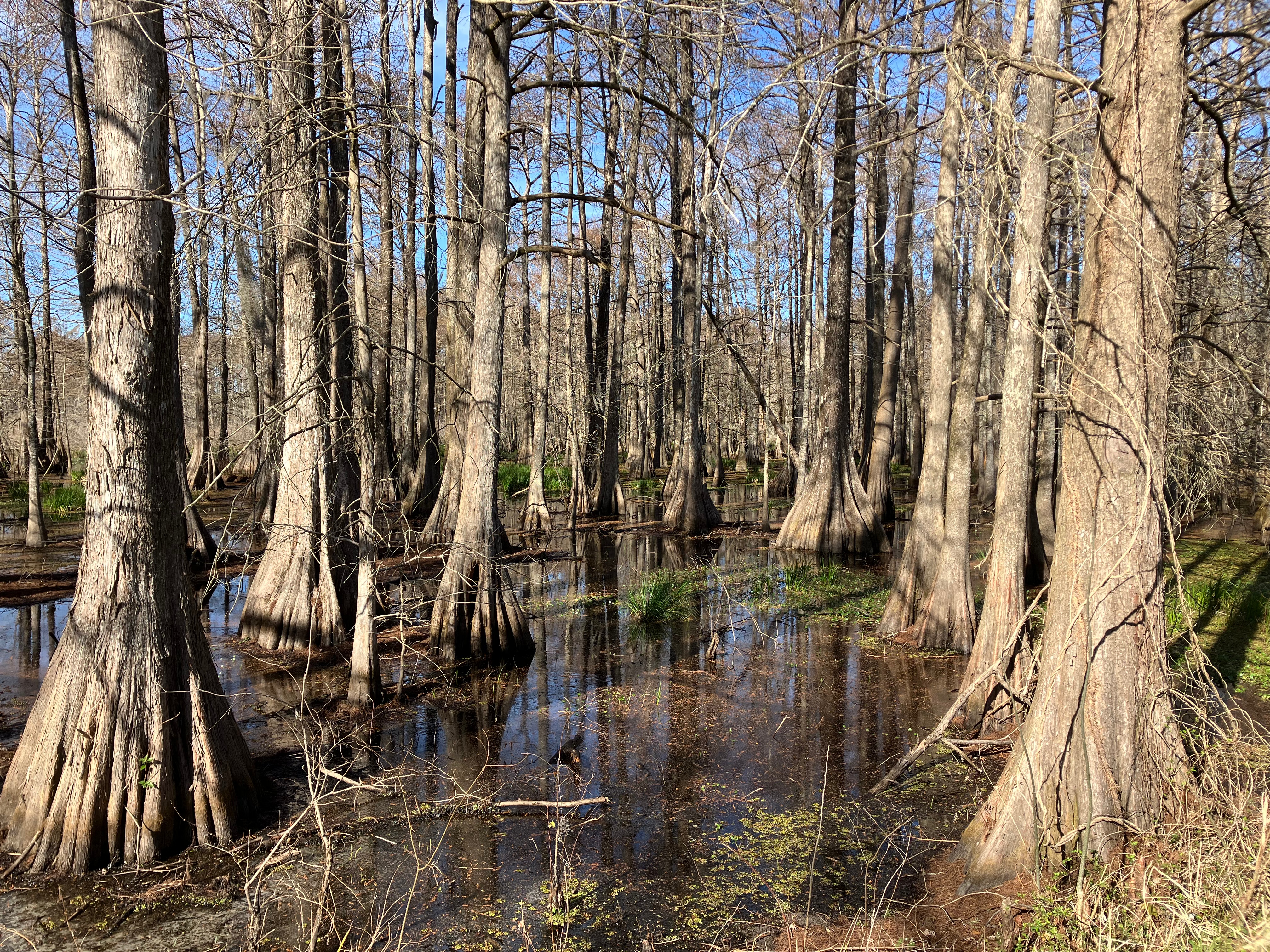
We then drove, without much optimism, to the nearby Cypress Swamp reservation. This also seemed deserted. We parked and followed a pathway to look at the river. It was swampland, with wooden decks into them, and it was pretty amazing and very beautiful. However, the decking was low over the water, and broken in places, and I worried it might give way and we would plunge into the swamp water and be eaten by alligators. (Not that we could see any alligators, I think it’s the wrong time of year.) We survived, and took some photos. We could see large white egrets in the trees, getting ready to nest. It was beautiful, and peaceful, and very unnerving because we are foreign and not sure of the dangers. We went into the information hut afterwards. This is like reading the instructions of a machine after trying to work it out first. There was a helpful man, and information boards, and it all seemed very well organised and safe.
We drove to Lafayette and checked into a Residence Inn which are my favourite motels because they have a little kitchen area, and a shared laundry. I like being able to wash our clothes. We ate in a nearby restaurant, which had welcoming music, and comfy booths, and a very friendly waitress. I ate alligator nuggets, which were deep-fried and tasted exactly like chicken. Apparently, alligator meat is high in protein and iron, but low in fats.
(I think from my current study of Noah, that humans were told they can eat fish and ‘creepers,’ not all animals. I have not yet finished researching this, so I may come to a different conclusion, but currently I try to only eat veggie food or fish/‘creepers.’ I decided alligators are ‘creepers.’ Husband is not admiring of my food choices nor my theology.)
The following day (Monday 23rd Feb) we drove through Louisiana (LA) towards Texas. We passed flooded fields, and swampland, and vast green fields of cows. According to the internet, the flooded fields are for rice, which some farmers alternate with crawfish after the harvest. It would be interesting to stop, and see one properly. I hadn’t realised that rice was grown in the US.
As we neared Houston, the roads grew very busy. We stopped for food, and I asked the waitress for the name of a good grocery shop. Kroger’s. (It’s very hard to find supermarkets, because Google does not differentiate between the small garage shop with outdated food and the big supermarket that locals use.) We drove through Texas. There were fewer farms, and lots of industry: aggregates and oil. Some of the oil refineries were huge, the size of a town, filled with tall metal tubes and machines and nasty smells. Driving around Houston was no fun. Huge lorries, 9-lane roads, junctions on both sides, everything moving very fast, overtaking on either side, roadworks shutting lanes.
We made it, and left the main road for our next stop.
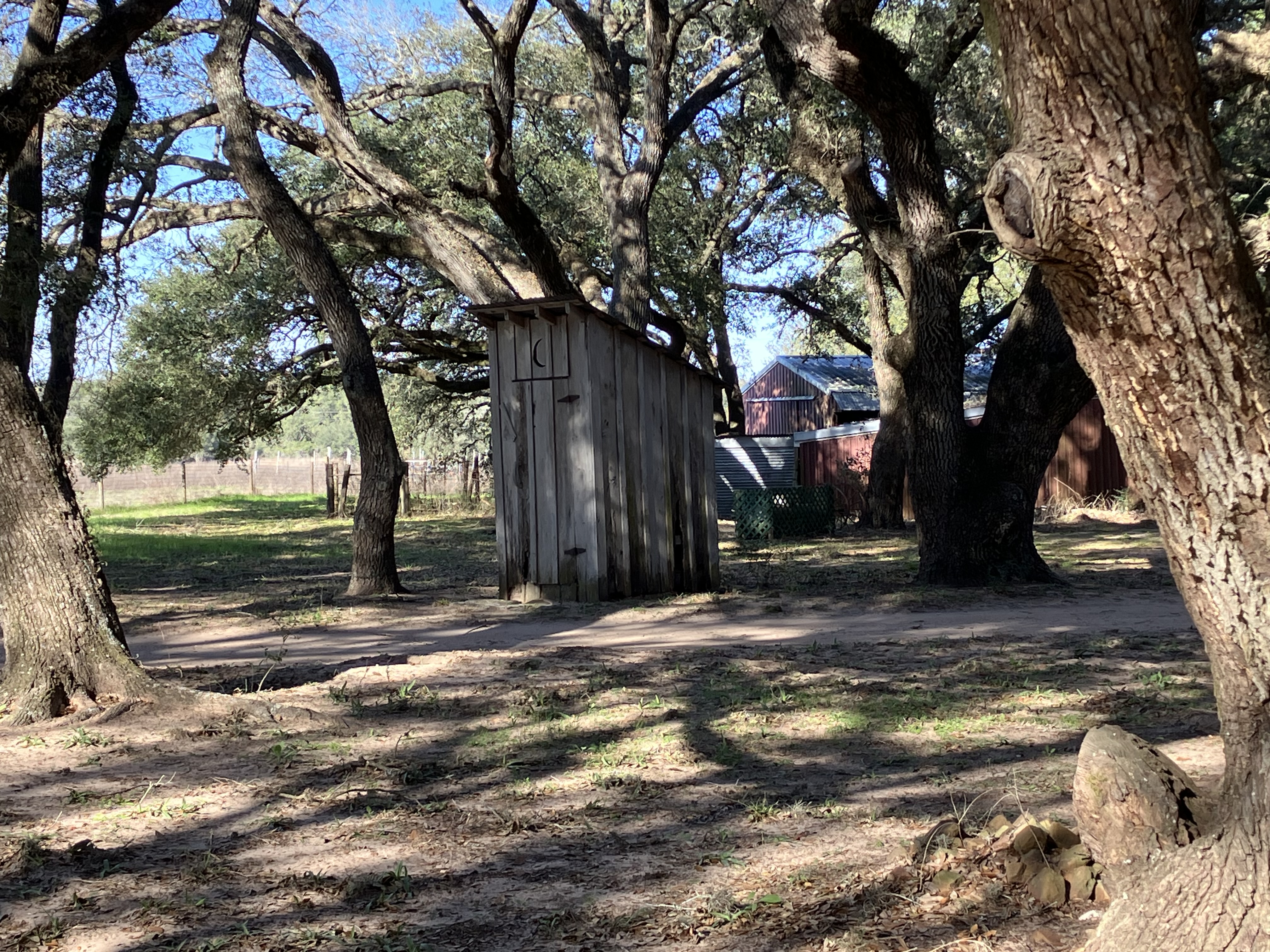
Husband had booked an airbnb on a ranch. Sounded nice. It took 15 minutes to drive down the dirt track. The houses were cabins, hidden in the trees, full of historical furniture. As we parked the car, we saw a wooden outside loo. I was silent.
We went into our cabin. It felt haunted, I don’t really like houses that have photographs of dead people on the walls (which makes no sense). The facilities were quirky, but there was modern plumbing, so I felt happier. We ate some food, and went to bed. No ghosts visited. I rather like the place now, it’s very unusual, but has good working washrooms.
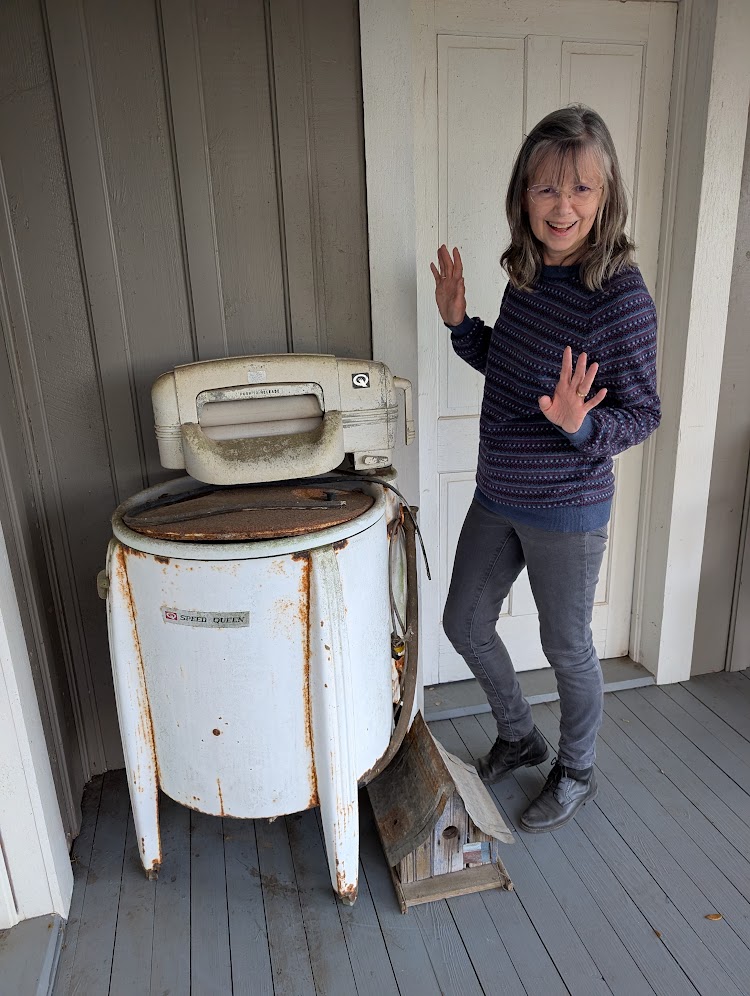
It had a washing machine. Sort of…
Thanks for reading. More of our road trip in my next blog. Take care (and avoid haunted houses). Love, Anne x
Our last day in New Orleans was Sunday. We woke early (managing a sort of hybrid UK/US time, although the extra hour when we moved from Florida towards Alabama was brutal). We ran in the hotel gym, because even though we wait until it’s light, running in New Orleans would feel unsafe due to all the drug addicts—who I suspect are unpredictable when needing money.
We wanted to attend a church. I like attending local churches when away from home. Since I went to Spurgeon’s College (a Baptist college) I have definitely become less Baptist ironically, and much more interested in how different denominations express their faith. Most of the churches near us were black churches, so I checked with the hotel receptionist whether we would be welcome in a black church, or whether it would be rude to attend. She assured us we would be welcome, and also suggested we could try the local Catholic church—St. Jude’s. This, plus the information that the local Baptist church service would run to at least 2 hours, was helpful. We walked to St.Judes.
The walk to church typifies New Orleans for me. The roads were big, but easy to cross because traffic stops at crosswalks. The streets were fairly busy, with a mishmash of people—many with dyed (blue/green/pink) hair, many looking smart, music seeping from doorways. Lying on the hard tarmac, huddled under old coats because the weather was chilly, were the homeless. There was a police convoy, stopping traffic as floats from Mardi Gras swept past—going I guess into storage until next year. The floats were bright, huge figureheads, painted fences to enclose the people who would ride on them.
As we neared church, I saw a couple of people, sleeping with blankets pulled over their heads, bare toes peeping out from under the cover. It was sad, sadder for some reason than the homeless that I see in London—perhaps because there are places they can go to if they choose, and here I don’t know what their options are. Plus so many were young men, thin faces and blank eyes, ravaged by drugs. It broke my heart. I wanted to lay my jacket over them, but Husband stopped me, said it would probably be sold for drugs, better to donate money to a charity that could help them properly. But it was sad. As we arrived at the church I felt very near tears. I kept wondering where God was in this city, wondering who was working for him to help these people.
The church was welcoming when we entered. We are not Catholics, and much of it was completely confusing, everyone else seemed to know what to chant at intervals, which responses to give. It was a big church, packed with a whole variety of people—many were very smart, posh clothes ladies wearing hats and heels, some were casual, some looked like they had wandered in from the street in search of somewhere warm to rest. The choir were dressed in white and processed down the aisle to signify the start of the service. Most were fairly old, and they wore fez-type hats. All the church wardens wore red gowns, which helped to know who was an official. There was a brass band, and the songs all had a Kum by Yah African-American spiritual-folk flavour to them. The offering was collected in baskets with long handles (like fishing nets) and after collecting it, they came back a second time, which was unexpected. (I think they were collecting for two different things, but it made me giggle.) The Priest gave a talk, which was short but I thought it was good—about Jesus being tempted and how people are tempted today by Power and Prestige and Profit (even the leaders). There was then a prayer asking that leaders of countries should behave according to God’s will, and for the good of the world not just their own prestige or the good of their own country. (But he did not name anyone specifically.) At the end was a little prize-giving for the women’s group (who seemed to do all the work in the church) and they reminded me of the strong women working in the Zambian church we visited. Then it ended, and people walked out, dipping their fingers in a bowl of holy water.
We packed our bags and drove away from New Orleans. I’m glad we visited, but it made me sad. There was so much creativity, a lot of carefree relaxation, a lot of excellent music, all with an undercurrent of heartbreaking sadness when you noticed the lost faces of the addicts. But we were only there for a few days, so my impressions might be wrong.
I cannot explain my first impression of New Orleans to you, I can only show you what I saw and try to describe my feelings about the city. It is not like any other city I have visited previously, and it felt sad, like I had entered a world read about in the past. A city I thought no longer existed today in our modern world of mental health care and intellectual superiority.
Arriving was easy—Google maps guided us along highways, bridges over vast rivers, lanes of traffic swooshing past the clogged streets of the city until finally, just before our hotel we were taken onto smaller roads, a brief moment of stress and traffic lights before arriving at the hotel. We’re staying at a Courtyard by Marriott—a nice reliable chain of hotels—you know what you’re going to get. We checked in, dumped our bags, went for a walk.
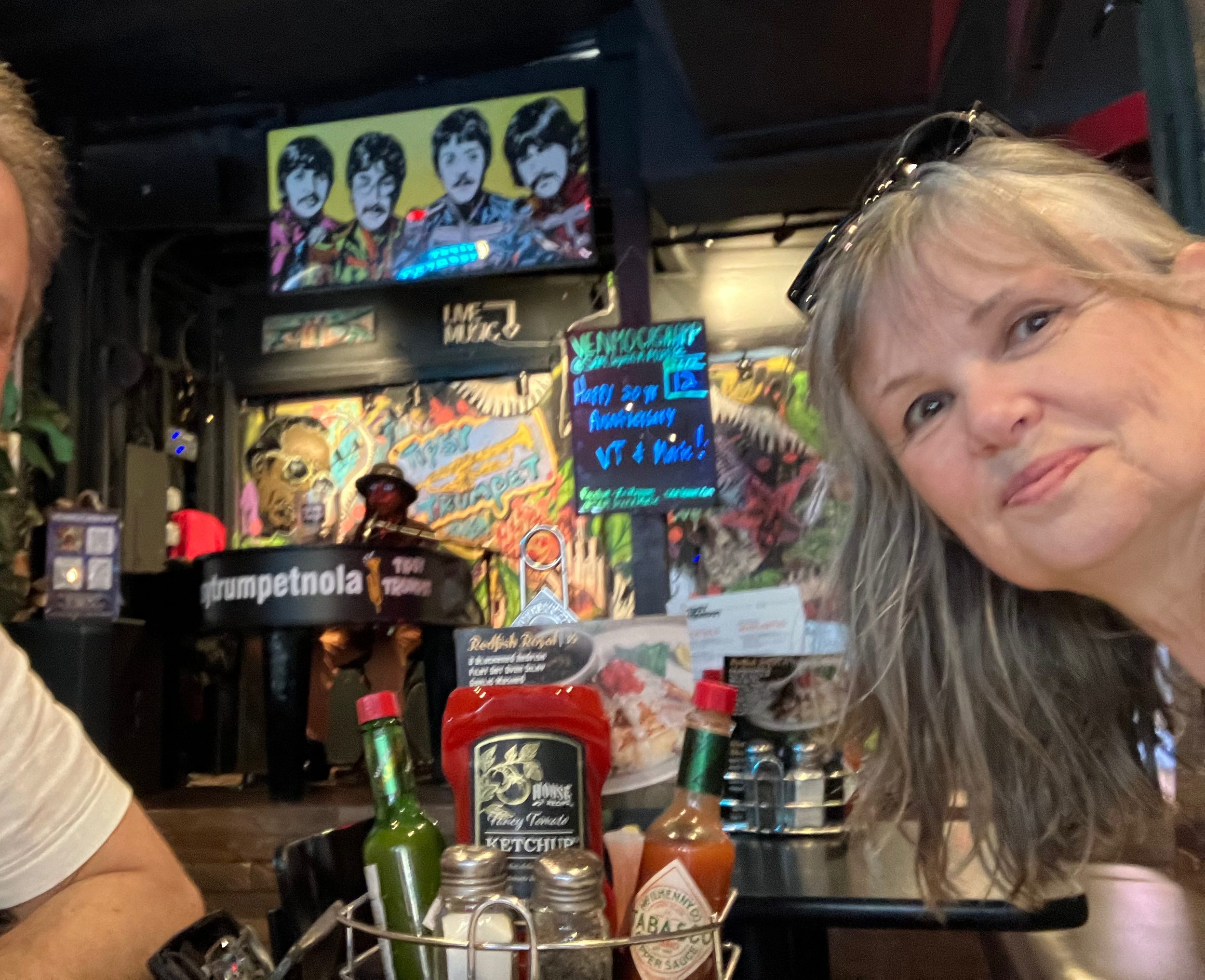
The pathways were busy, lots of colour, lots of noise. Mardi Gras finished this week, so we thought it would be quieter. Not sure there was anything quiet. There was music. Bands and piano music drifting from bars, trumpets played on the street, children using upturned plastic cartons as drums beating out a rhythm. It made you want to dance.
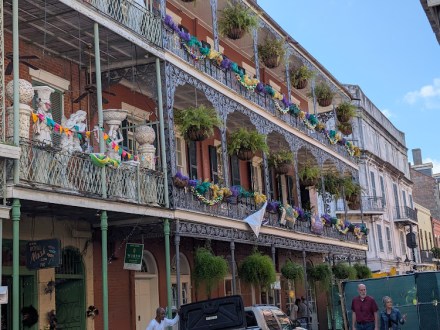
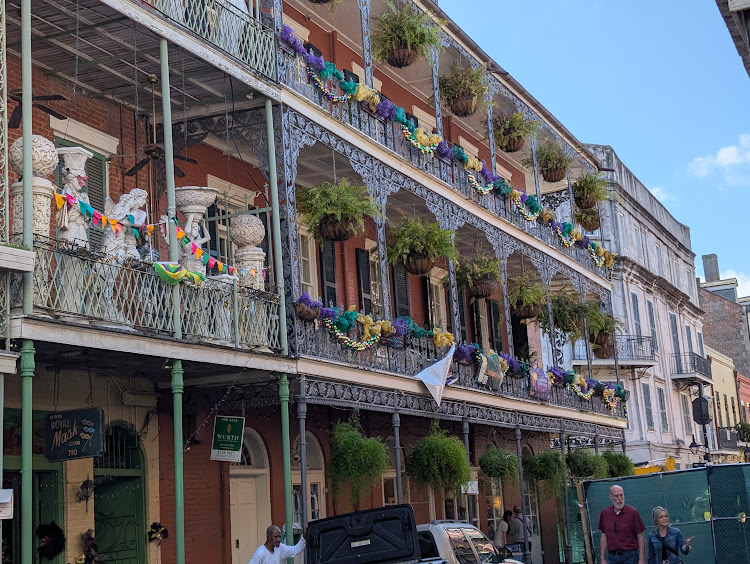
The creativity of the city is undeniable. There were poets, offering to write for any price. Artists with paintings hung on walls. The buildings were pretty with lattice work on balconies, strung with beads and draped with bright fabric. Even the people wore bright clothing, hair dyed pink and purple and blue.
But the sad side of the city is unescapable. People in drug stupors lying on the kerbs, on benches, huddled in corners. Homeless people carrying all their belongings.
There were the businesses I wanted to avoid: the photos of naked girls outside, the ‘first church of witchcraft’ the stalls offering tarot readings. We had only walked a few minutes when we encountered a naked man, and a shouting policeman, watched by a grinning crowd filming the spectacle on their phones. I didn’t see the crime—the drug sellers, the pick-pockets, the people traffickers—but I felt they were there.
The authorities were easy to spot, but I’m not sure what they were doing. We saw a few groups of National Guard—young men struggling in layers of uniform in the humid air, looking uncomfortable, as if they didn’t know what they were doing either. Mostly they seemed to be standing in a group, looking aimless. Some were walking, but they still looked a little aimless, maybe they had finished for the day, were on their way home.
I don’t know how to explain the city. It is somehow creative without being beautiful, as if all the creativity is too much for itself, and it doesn’t know where to go. Maybe for creativity to be beautiful it also needs boundaries, or it spins out of control into drugs and aimlessness. It all felt a bit pointless, as if the people there—the musicians and artists and entertainers—had forgotten what they were trying to achieve. As if they were searching for freedom but had become trapped not having any goals; trying to escape but unsure what they were escaping from or where they wanted to go. Overall, it just felt sad. I wanted to wrap it up and take it home, show it some security, the beauty of the countryside, the peace of routine. It felt like a city that has lost its mother, and it needs some care. But first impressions can be misleading. I will look further tomorrow.
After Sanibel we drove to a motel in Brooksville. I can’t tell you anything about Brooksville. We stayed in a Fairfield Inn (always reliable) next to a busy road. When we went for our morning run I was not worried about alligators (my usual fear when running at dawn in Florida) but we did inhale lots of car fumes. Other than that, it was good. We ate in ‘Glory Days,’ a sport’s bar, which is less seedy than it sounds. It served delicious espresso martinis, in proper glasses, so I was happy.
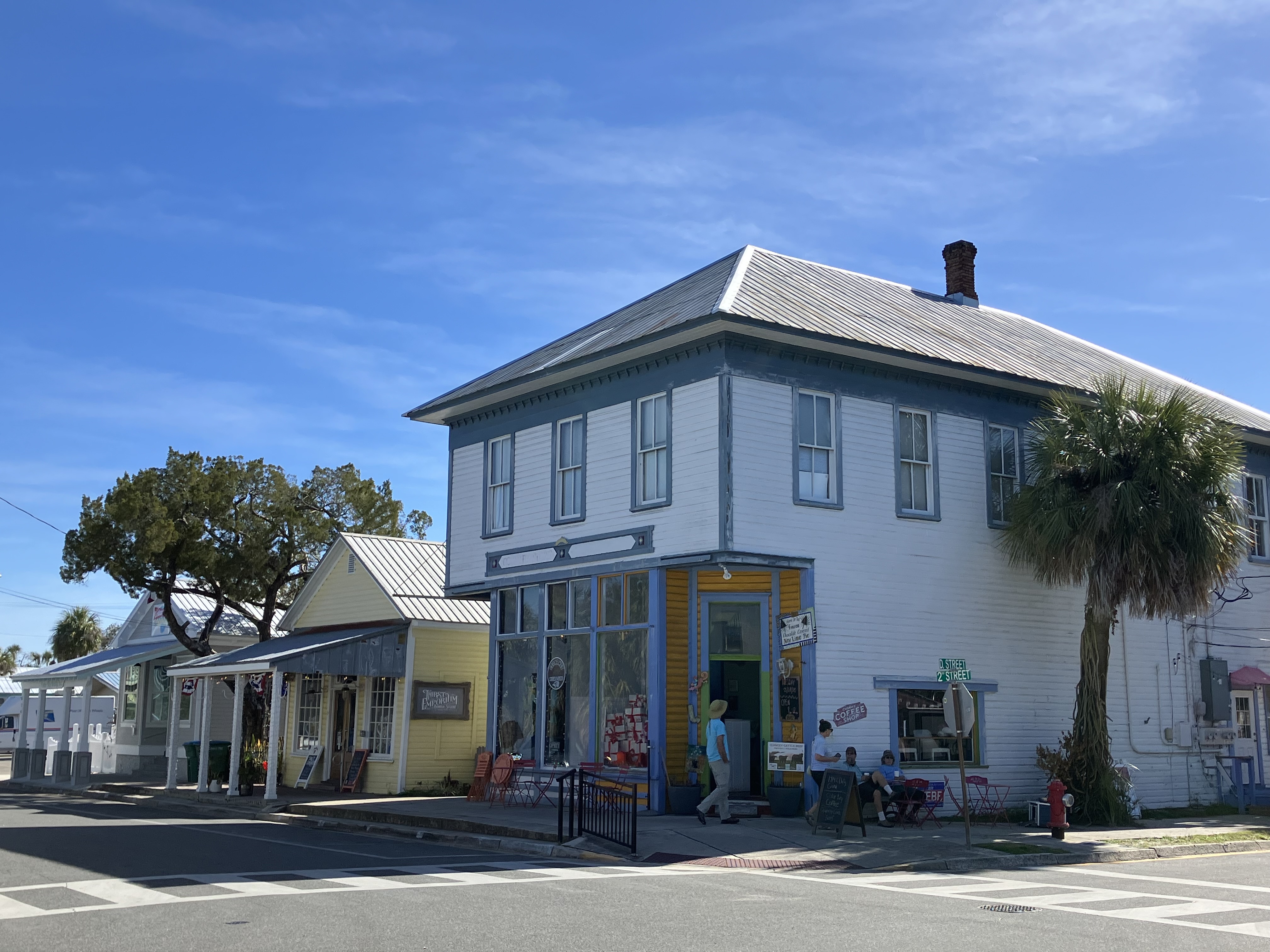
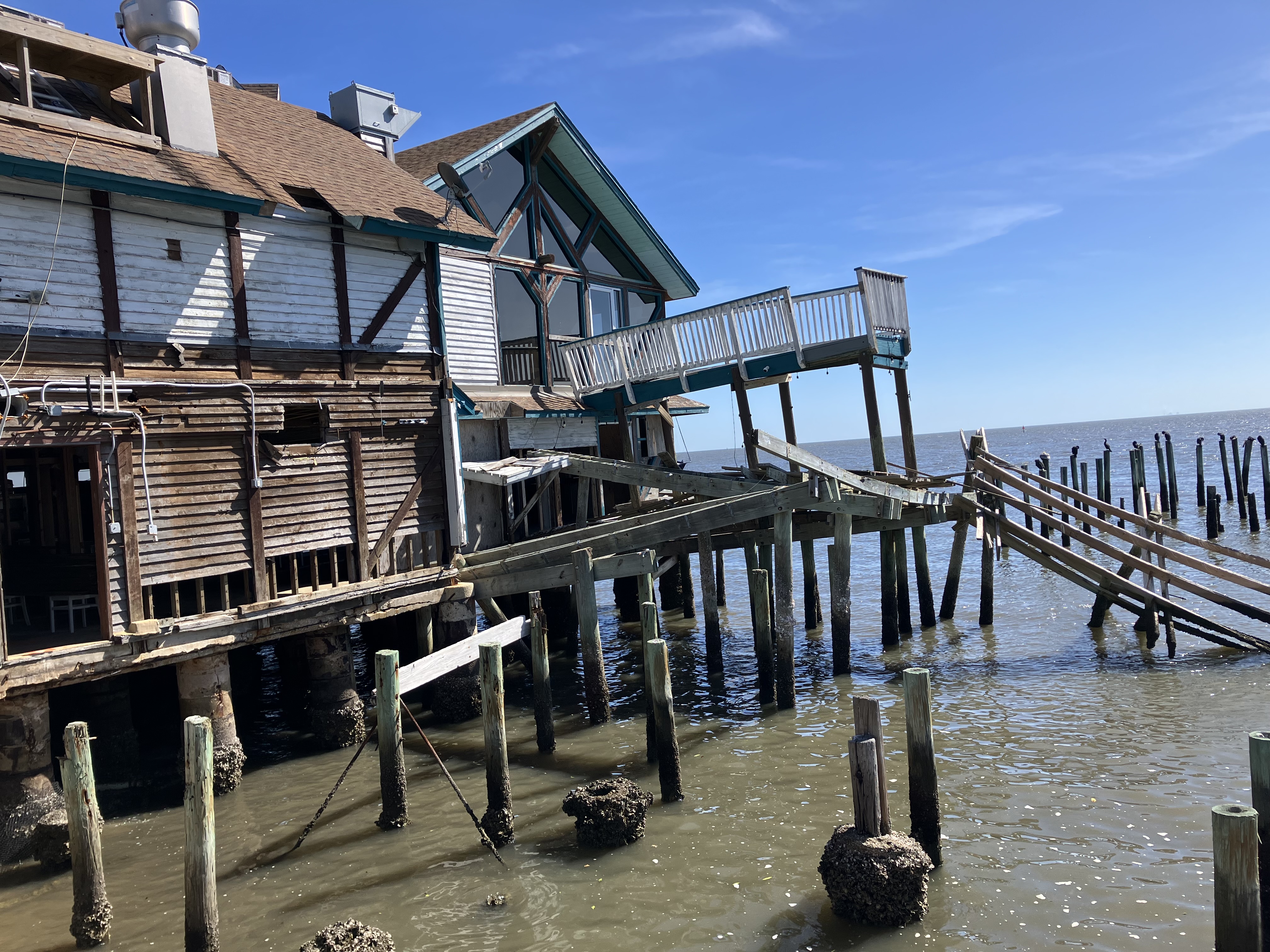
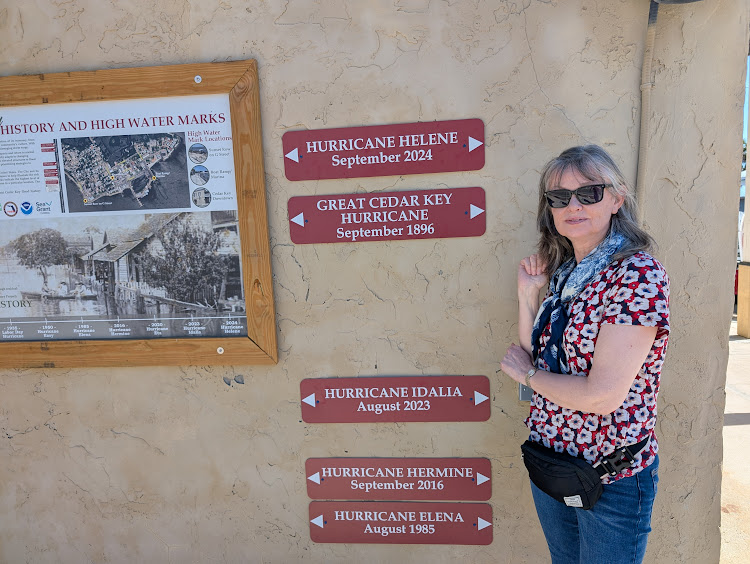
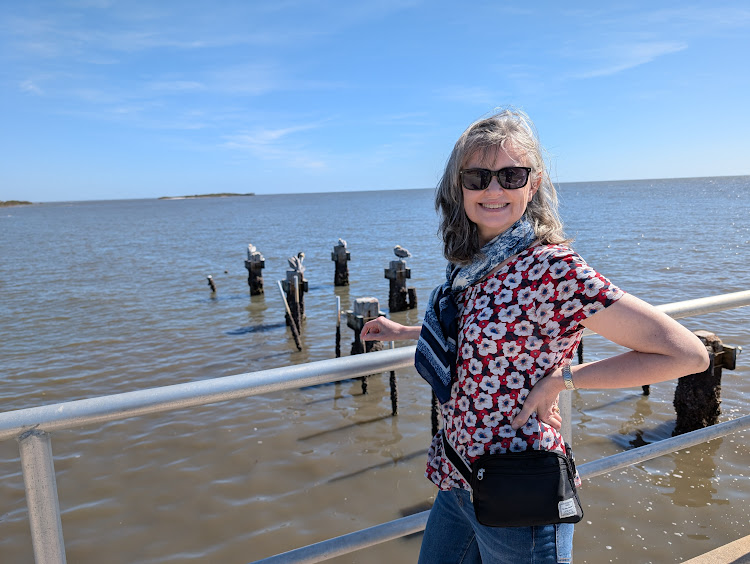
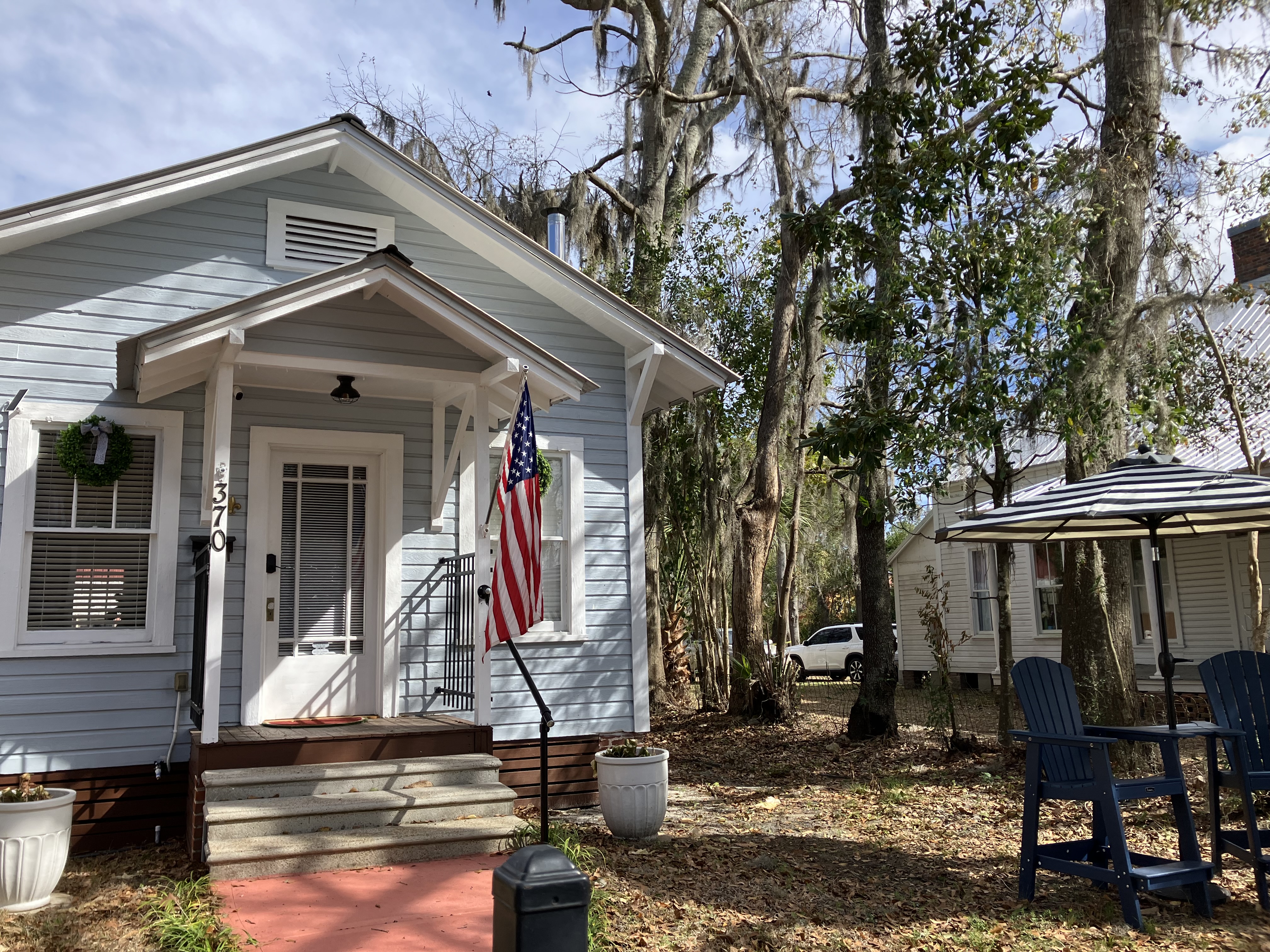
The following day we drove to Cedar Key. This is a small town, on the coast. It has pretty houses and huge trees full of spanish moss, and a LOT of tourists! It has had its share of hurricanes, and there were still signs of damage from Helene, which hit in 2024. The houses next to the coast were built on stilts. Pelicans had moved in to sunbathe on the vacant stilts, left sticking up like the skeletons of the demolished houses. Some of the buildings looked very unstable, although they were still being used so I am assuming (hoping) they are safe. It’s a very sweet little town, and I think it would be fun to stay overnight in one of the houses perched over the water’s edge. Maybe we’ll come back here on our return drive.
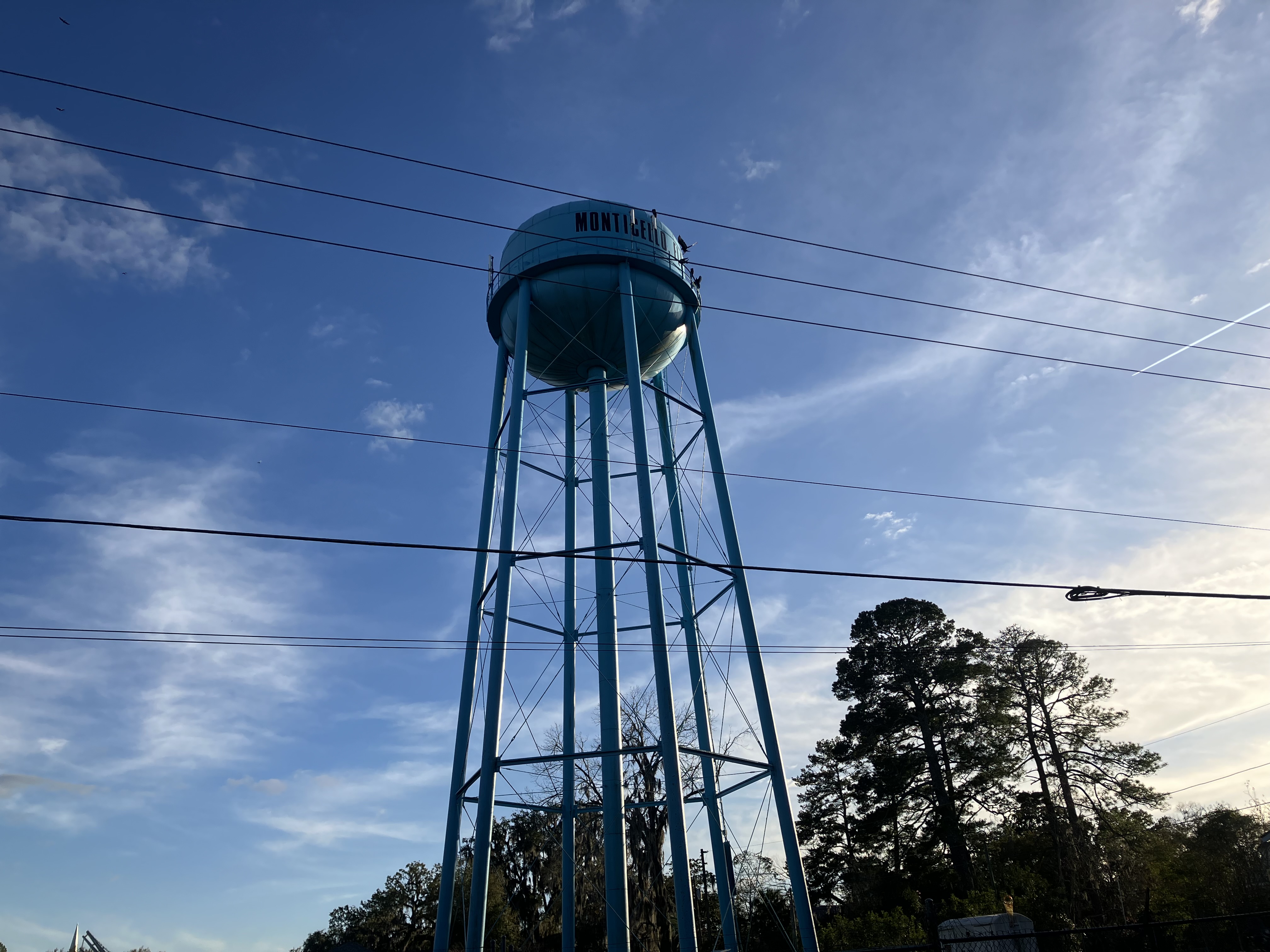
We left the coast and drove to Monticello. This was another quick visit, although we had booked an Airbnb so stayed overnight. The town was quiet. Very quiet. There was not even a grocery shop (just a few groceries at a petrol station and a market selling local veg) nowhere to buy fresh milk or bread. But there was a Mexican restaurant, so we ate there. I have never been to a Mexican restaurant before. I tried a margarita. Delicious, like slightly melted lemon sorbet. I thought it wasn’t alcoholic, and nearly ordered a second one. Glad I didn’t—definitely had alcohol, just bit of a delayed reaction.
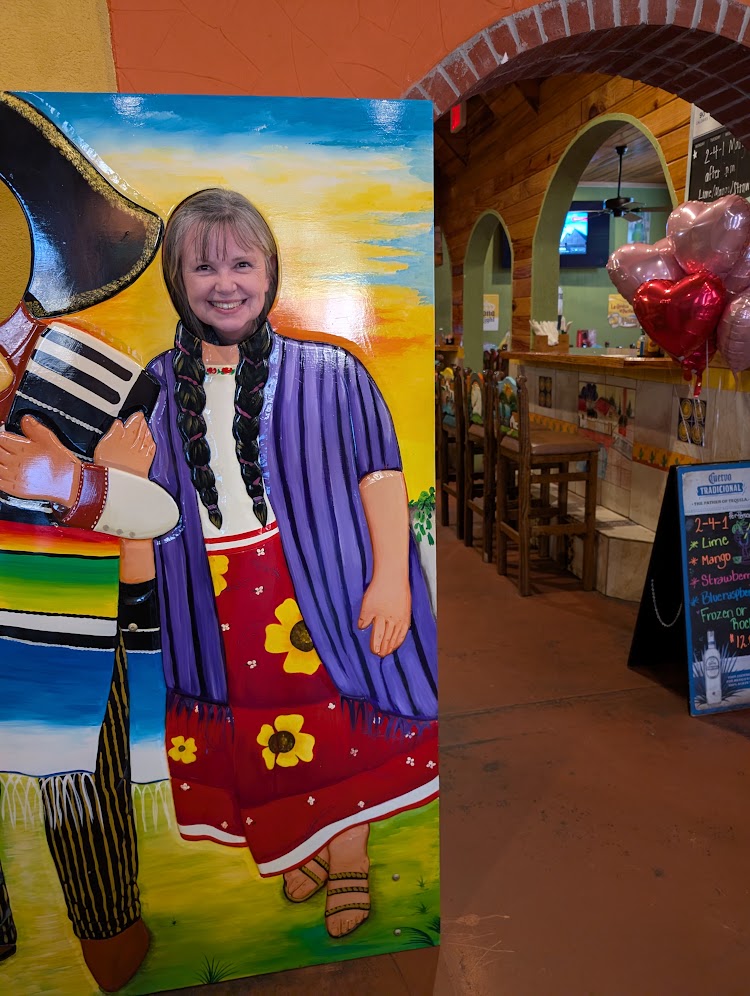
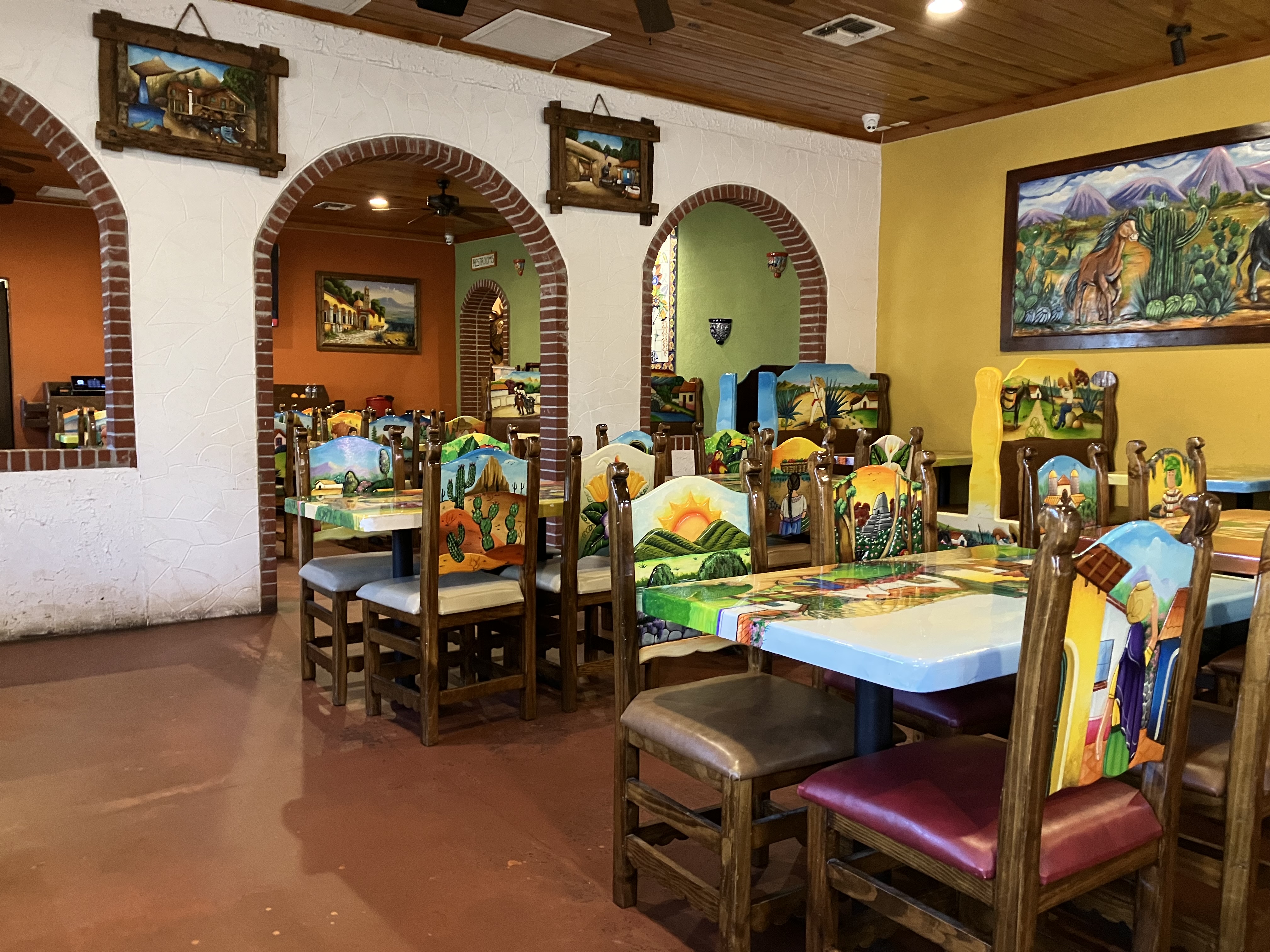
We were the only customers (because we’re on an early clock still) but they were very nice to us, and the food was good. The restaurant was painted with scenes from Mexico (I assume—have never actually been to Mexico, so I guess they may have just been random countryside scenes). We enjoyed it.
Finding my inner Mexican!
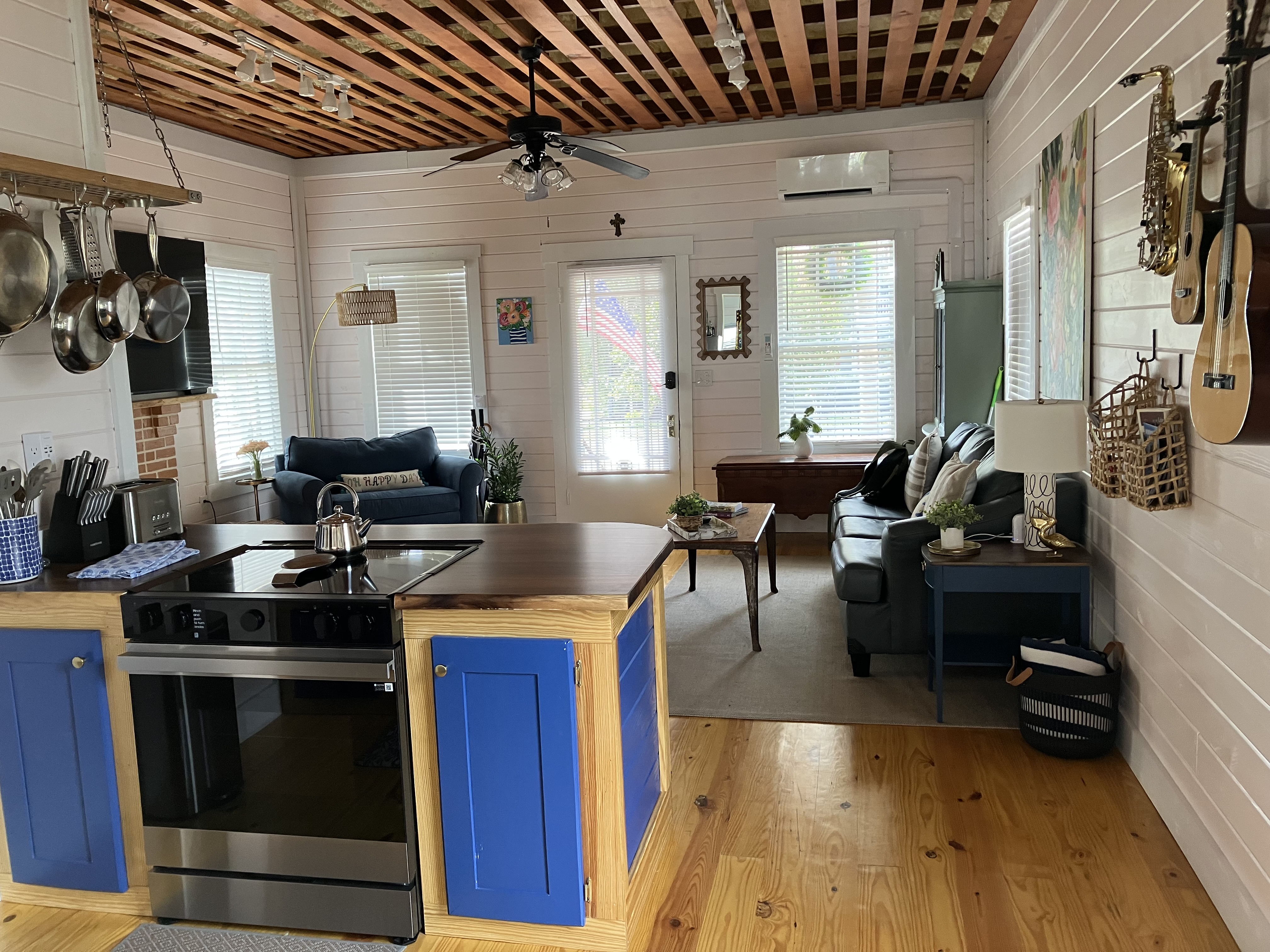
The Airbnb was unusual. It was basically a single room, with a bathroom added to one side, and the conservatory turned into a bedroom. It was pretty, and convenient, and scrupulously clean. The owner had left beers and water in the fridge for us (I certainly didn’t need any beer!). It was right next to the main road, so quite a fretful night every time a lorry whooshed past, but for one night it was fine.
Woke tired. Decided not to run (which is a shame, because running in a strange place is always fun—it makes me feel like a local). We packed the car and drove away. It was a long drive, through Florida, across to Alabama. Next stop was Dauphin Island.
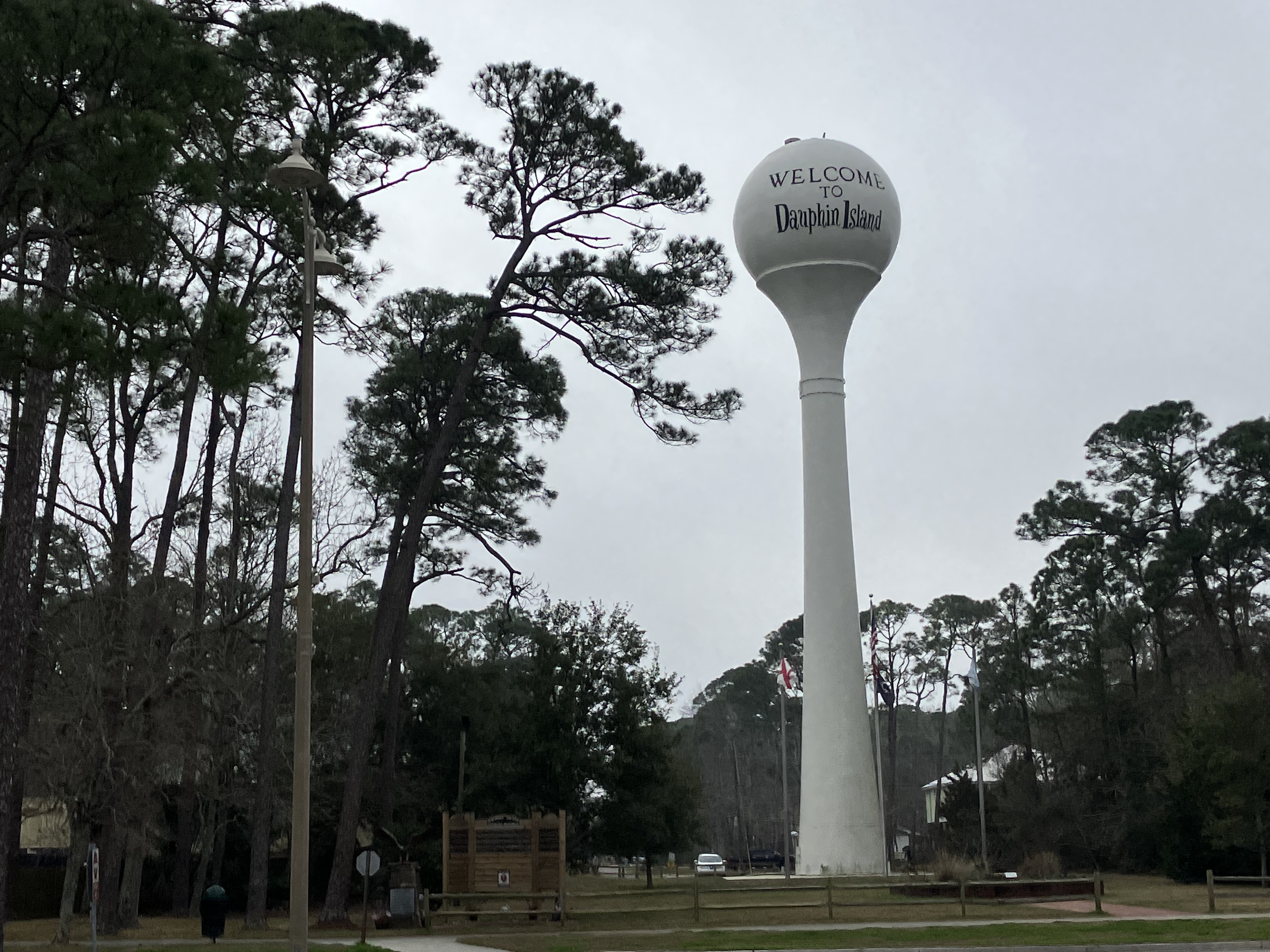
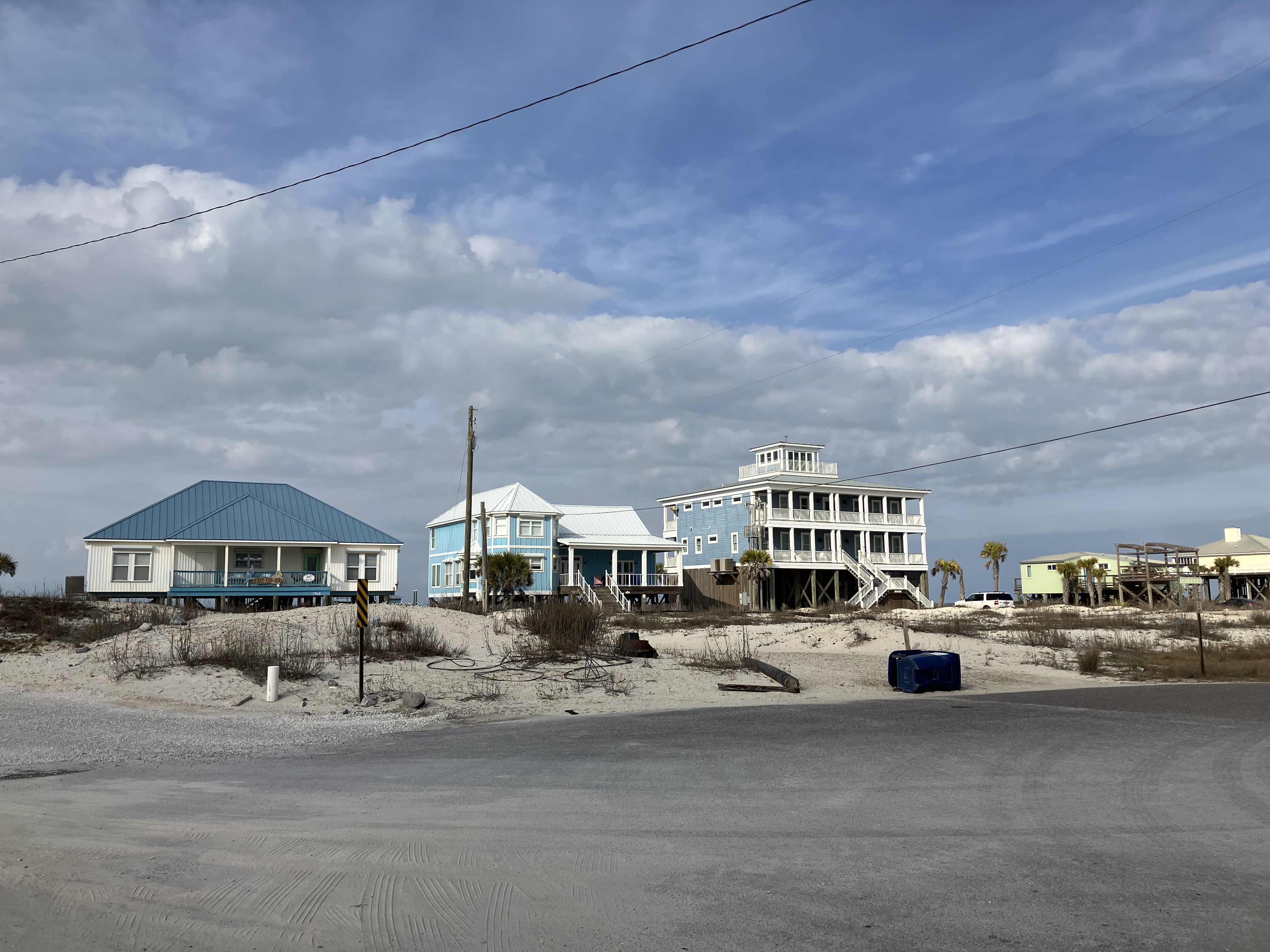
Dauphin Island is another place that gets demolished when hurricanes hit. To combat this, all the modern buildings were built on stilts. As we drove across the bride to the island, you could see the pretty wooden houses perched on their stilts, overlooking the coast. On the horizon were the hazy outlines of oil rigs. The island was pretty—similar to Sanibel (lots of tourists on bikes, well-kept roads, white beaches) but different due to all the houses on stilts.
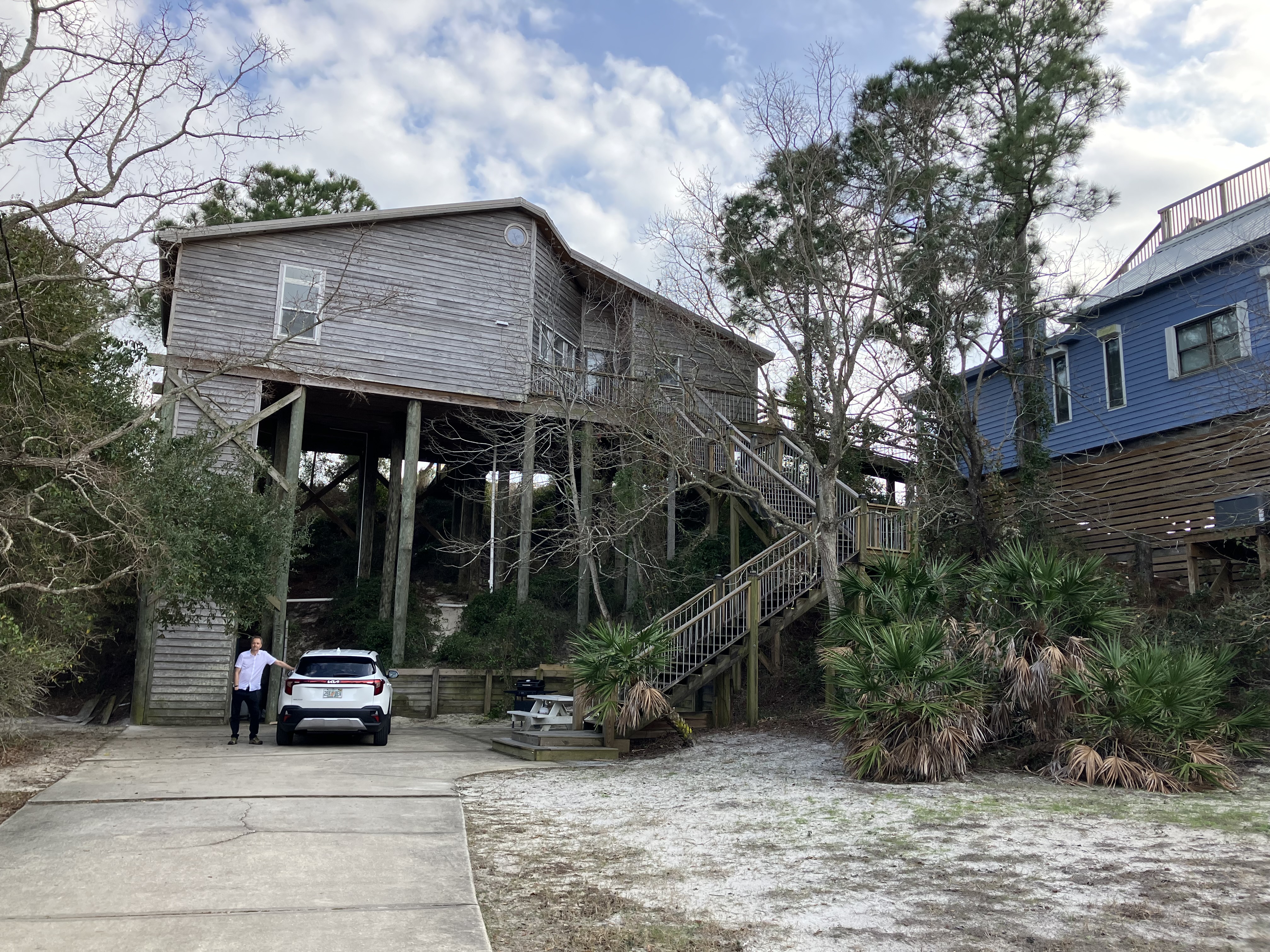
We were too early for our Airbnb, so had lunch at a fish restaurant. The staff were very friendly, said we were welcome to hang around until our house was available. We shopped (had to leave the island to find a grocery store of any size, and I wanted yogurt). We drove to the house. It was unexpected—it was built on top of the highest stilts ever! Walking up the steps was quite a feat for someone who doesn’t like heights!
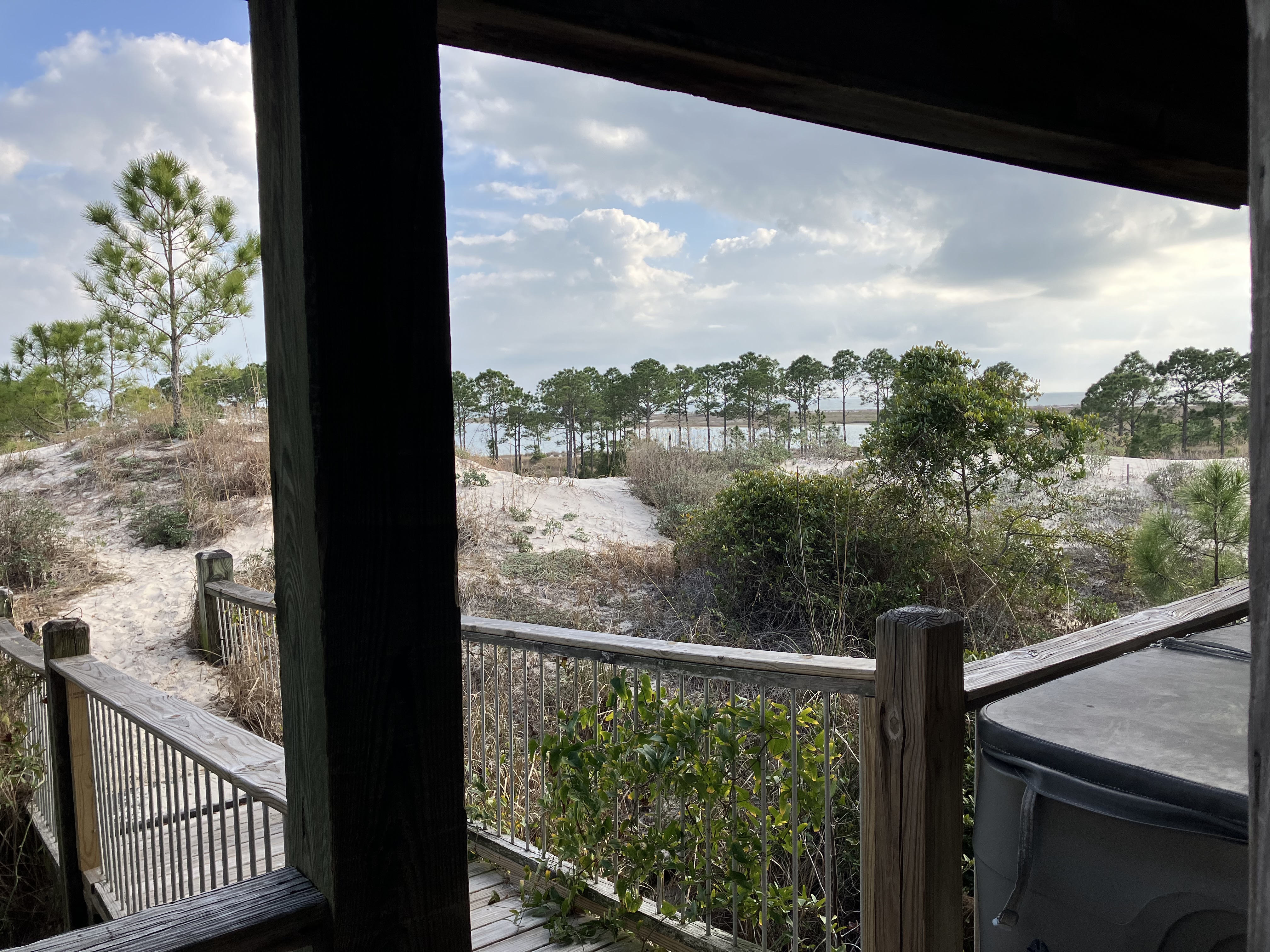
The back of the house rested against sand dunes, and behind the trees the sea glinted, so it was a nice place to stay (once you had climbed the scary steps). Not sure I would feel safe there on a windy day. There was a washing machine, so I emptied our suitcases and washed everything. Nice to be clean.
Before we left, we ran through the town. It was lovely, big trees shading the roads, birds singing, very peaceful. Then we loaded the car and set off. We drove through Mississippi, into Louisiana, to New Orleans.
I did not want to visit the US. I had read lots of scary things online about new border regulations, and how the border guards now check social media accounts, and insist on looking through computers, and how aggressive it all is now. Plus the news reports showing innocent people being shot, or sent to holding centres prior to being deported. It made the US seem like a very unwelcoming place, somewhere that did not want visitors, somewhere that I didn’t want to go.
But Husband had other ideas. Husband talked about the Florida sunshine, the ease of living in a country with diners, and clean motels, and empty roads. Husband yearned for another road trip. He talked about being retired, having more time, what was life for if it wasn’t to be enjoyed?
So I relented. I chose the books I couldn’t live without for a few weeks, and then put half of them back on the shelf because I couldn’t lift my suitcase. After a few hard work days of sorting animals and house, we caught a flight from Heathrow and flew to Orlando.
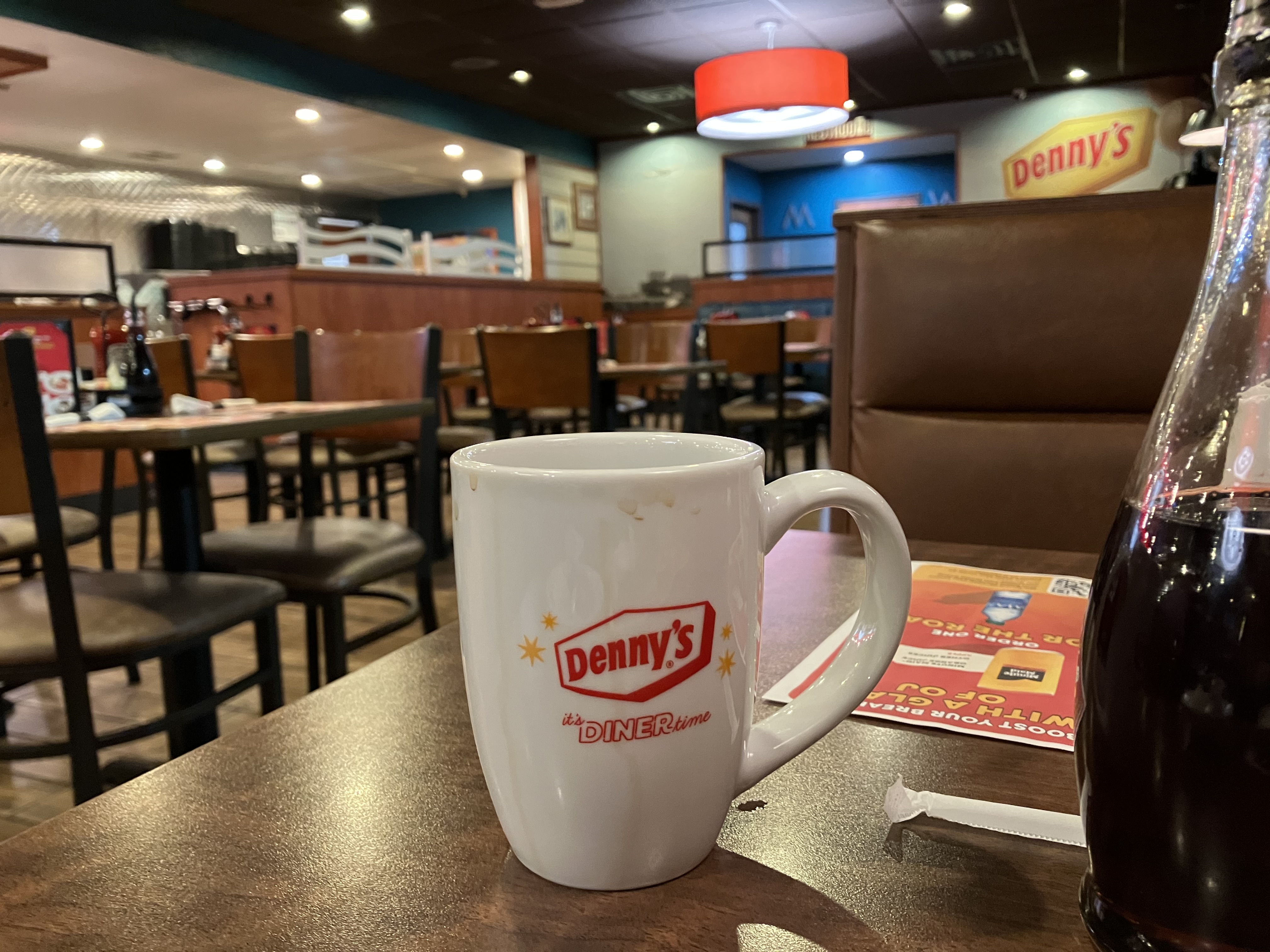
The flight was mainly full of families visiting Disney. The flight attendants wore Mickey Mouse ears. When we landed, the border guards did not wear false ears, but the mood was the same—they were friendly and welcoming, gave tips about which roads to use. Nothing threatening at all. Maybe other airports are different, but I did not find any change at all to arriving in the US, despite the news coverage. Our first breakfast was at Denny’s—a typical diner, one of the things I love about travel in the US. Food is so easy, service is friendly.
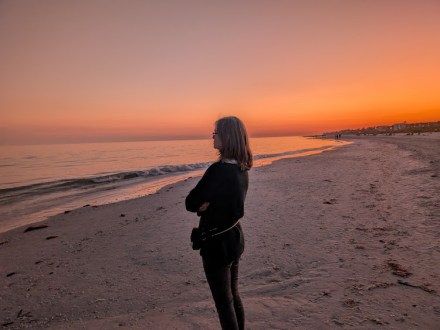
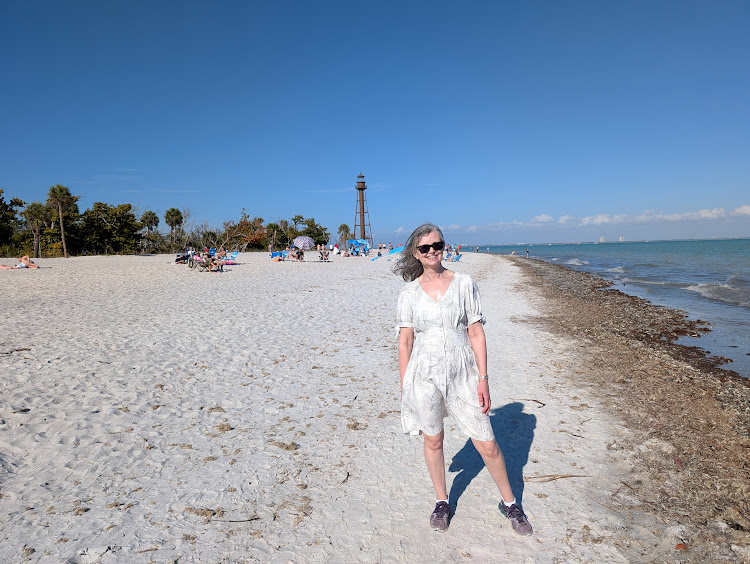
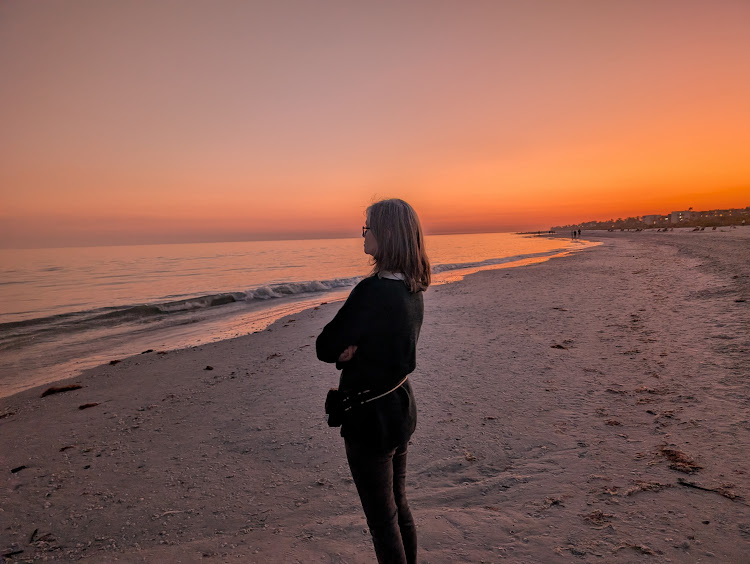
We collected a car and drove to Sanibel Island. This is always beautiful. We had a few days adjusting our clock to US time (slightly, we stayed on an early clock). We strolled along the beach, I spent some time studying and enjoyed not having to sort animals or cook/clean anything.
Sanibel InnLighthouseSunset
On Sunday we went to church. I looked online, and nearly chose the Community Church, because that was the oldest on the island, and it looked easy. Instead we attended the Congregational Church, which turned out to be excellent. Since being at college, my theology has changed slightly, so I was expecting there to be things I disagreed with, but I was raised a Baptist, I know how to ‘be’ a Baptist (and Congregational churches are basically the same). I chose this one because the website said they welcome everyone, and specifically listed race, gender preferences, marriage status—everyone was welcome. I like this. Some churches, in their statement of faith, choose to state that they are against gay marriage (and whatever they believe, this never strikes me as a welcoming thing to write on their website, which is usually the first indication of their church ethos).
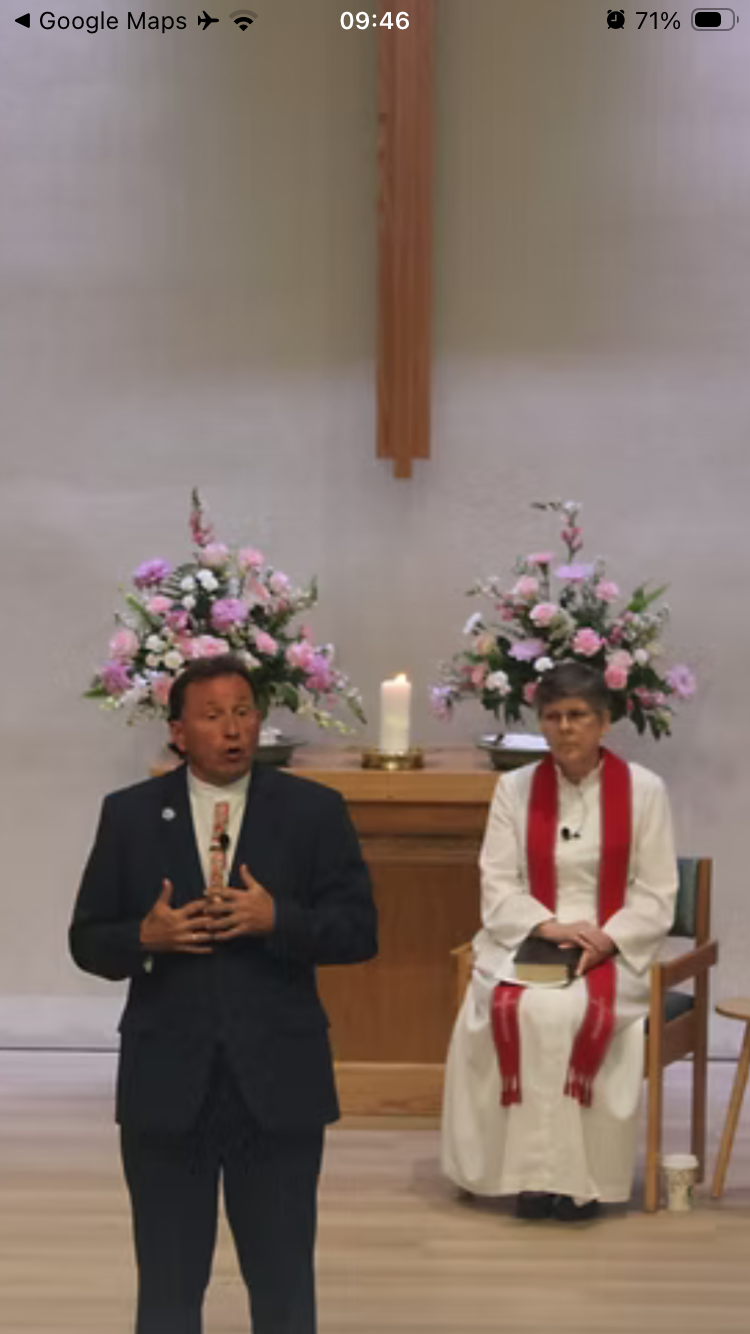
The photo online: were flower hats compulsory??
Husband came. I wore jeans (may as well test the welcome anyone thing) and it was easy to find and park. Churches in the US are sometimes like shopping malls, although this one was normal sized. They had a brass band—excellent start. They had a choir—also excellent (although I don’t think people had to audition to be a member). The sermon was by the minister, and surprisingly I didn’t disagree with anything he said! He obviously keeps up with the latest developments in biblical studies, and did not feel constrained to keep to the fundamentalist line (like who authored certain books). It was also very welcoming.
As well as attending different churches, I also want to compare espresso martinis in different places. The one I had in Sanibel was very average, especially as it was served in a tumbler, and half the fun is in having a pretty martini glass.
After a few days we left Sanibel and drove to Brooksville. The plan is to spend a few days driving north, round the pan handle, visiting places like Dauphin Island and New Orleans, heading towards Texas. We’ll see how far we get before we need to head home.
Thanks for reading. I hope the things you dread turn out to be good. I’ll let you know about the other places we visit.
Take care.
Love, Anne x
Holiday blogs are always written at the time, but posted later when I am home.
Meg is in disgrace. We had a couple of workmen in the house and garden, plus her favourite gardener (huge excitement when he arrives) so Meg was super hyper. The birds were loose in the garden, and we discovered that Meg can now open doors unless they are locked. She jumped at the handle, the door flew open. She charged out and leapt on Goose. Horrible moment. I yelled and screamed and shouted all sorts of commands that Meg ignored. Husband hauled her off Goose, and took her inside.
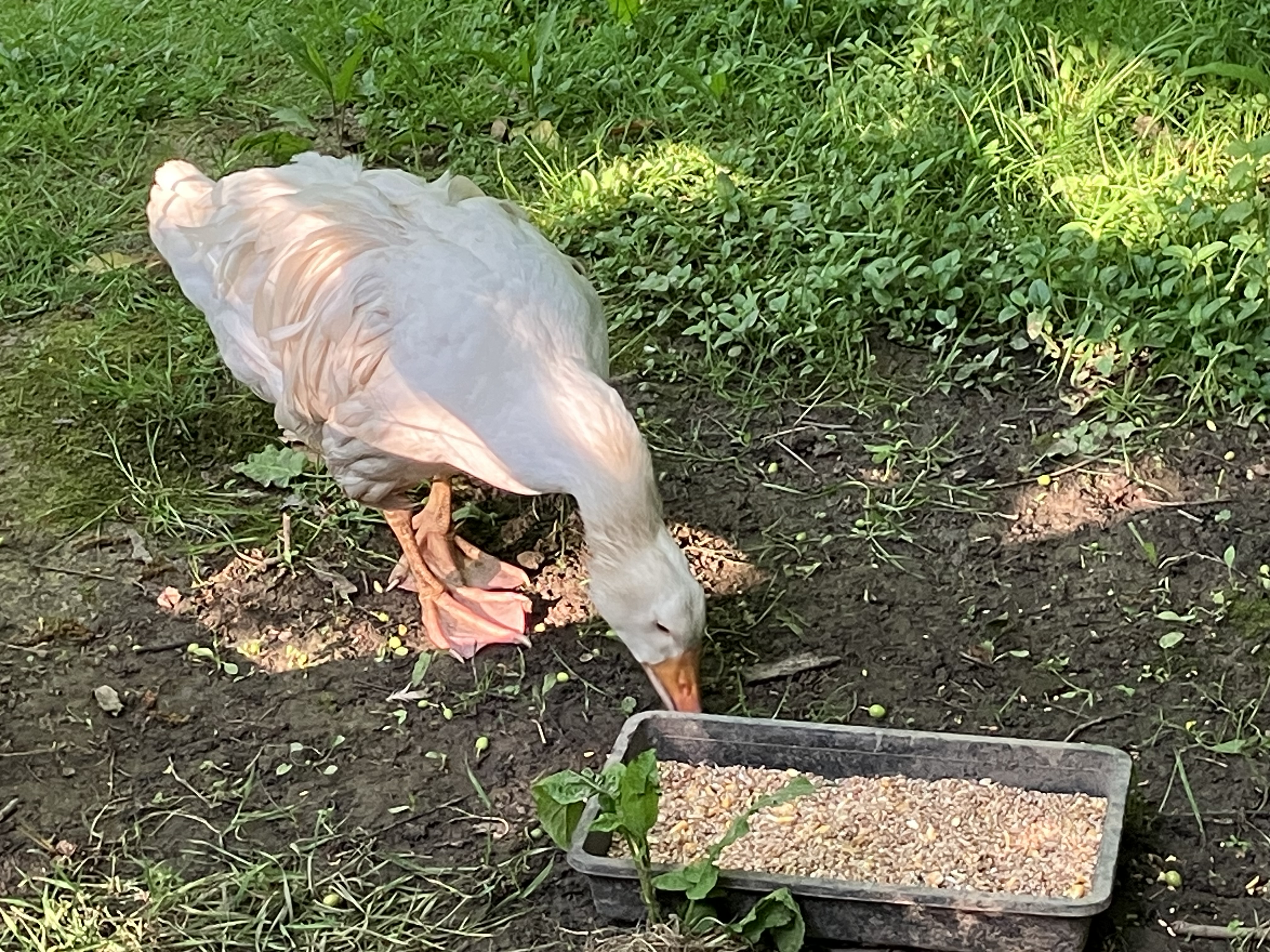
I picked up a terrified Goose, who rubbed her cheek against mine and trembled in my arms. I sat with her on my lap until she stopped trembling, then left her in the hay box for a while to calm down. Poor Goose.
15/11/2025
Meg hardly changes now, so there is much less to write. She’s a lovely companion (mostly) and follows me round the house, sleeping (and farting) in whichever room I am in. Sometimes she dreams and wakes up barking (not at great at night if I am also asleep).
I love how clever she is. One of her annoying habits is barking at dogs that we pass in the car. I try to notice them before her, and I start to talk in a quiet calm voice, hoping to distract her. Yesterday when I did this, Meg listened to my whisper and then barked at the other dog but super-softly, like she knew we needed to whisper. She barked in a whisper! It may have been coincidence, I will let you know if she continues to do this. It would be an improvement.
16/12/2025
Well, to my surprise, Meg seems to have stopped barking at other dogs when we pass them in the car. She does still bark at the occasional one, but perhaps they are particularly dodgy-looking in dog-world. Mostly we pass them without being yelled at from behind.
Meg has been a bit wild this week. I suspect it’s because the wild animals (foxes and deer) are marking/spraying. Even I, with my human nose, can sometimes smell a strong odour de la fox, so I’m sure it’s overpowering for Meg. Not that this is really an excuse for even more disobedience that normal.
We have put up the Christmas decorations, and other than trying to participate when we kneel on the floor to water the tree each day (obviously seen as a time for licking faces) Meg has been very good at ignoring them. She does sometimes carry her chew to a position that is extremely close to the Christmas tree, but as far as I know, she has not touched it. I don’t think I will hang chocolates on it though, that might a too much temptation for her.
We now have use of the field next to the house (the rams are with the ewes). For a few days, this made a very easy walk, as I would walk around the perimeter, and Meg would race the cars on the main road, tearing up and down at great speed. It was definitely racing, not chasing, as she watched and chose which vehicle she was going to race (usually a bus or lorry) and then she gave herself a headstart, beginning to run before they reached the field, charging at full speed along the hedge until the passed her, and then stopping and going back to the ‘start line’ to wait for the next target.
However, the novelty soon wore off. Meg noticed that I did a loop of the field, and she decided this was boring. If we go into the field now, she walks to the middle, and sits, watching me exercise myself, and then she joins me back at the gate to go inside. Not quite the plan. I have to take her to the woods now, otherwise she doesn’t have a walk.
5/1/2026
Meg has become very difficult. Not sure if it’s because she had a lot of restrictions over Christmas due to various visitors, plus the wet weather mean she spent vast amounts of time locked in a room while she dried off after being washed every time she came in from the muddy outside. Or it could be the foxes are still marking ready for mating season. Whatever the reason, Meg has reverted to ‘difficult teenager’ stage. We have lots of stand-offs, and trying to modify her behaviour is just plain hard work.
We walked yesterday across the fields. I am trying to not walk with her on the lead if she pulls, so it took about 15 minutes to cross the farm lane from one field to the other. She is also meant to sit before going through a gate—as a safety feature to give me a few seconds to check for unexpected livestock in the field (plus it’s good manners for her to sit while I unbolt the gates). She absolutely refused to do this. Left her on the wrong side of the gate, and marched across the field away from her, leaving her to frantically try to find a way through the gate. (Actually, she didn’t look frantic at all, more like a bolshy teenager.) Then a man came, and looked very worried that there was a big dog his side of the gate, with the owner halfway across the next field. So had to relent and collect her (the man looked at me like I was mad).
Then when on our own land, I hooked her lead over the post and walked away, returning to tell her to sit before I released her. Took AGES. Eventually she sat, and we continued. I feel frazzled after these stand-offs, and I don’t like her very much. Meg does not appear to be affected even slightly. It feels important, if I have given her a command, that nothing happens until she has obeyed. But it’s not fun, and it makes me want to just give in and have an unruly dog. Hope you have a better week than me. Thanks for reading. Take care. Love, Anne x
Meg’s vocabulary—the words she can understand—is pretty extensive now. She will be lying, apparently asleep, and if I say ‘walk’ or ‘woods’ or ‘going out’ she will leap up and run to the garage, ready to get in the car, worried I might forget her. She also understands the significance of certain actions. I have bad eyesight, but dislike wearing glasses in the house so I only tend to wear glasses if I am going out. If Meg sees me putting on my glasses, she runs to the door, ready to come into the garden (and bark at my poultry).
Meg also understands routines—and has her own ones (which I do not understand). When I sit at the kitchen table with food, Meg goes to the door and asks to be let out. I don’t know why, but it’s convenient as I prefer her to be in the garden when I’m eating. Perhaps she doesn’t like my table manners. Or maybe she knows she will have unsupervised play in the garden because I am occupied. I don’t know. It doesn’t matter what time it is, if I make a coffee mid-morning and sit at the table, Meg goes straight to the door. Very strange.
Meg understands that when she is annoying, I tend to secure her somewhere—either the utility room or her crate. Meg prefers her crate (which is in the kitchen). If she is being too bouncy, and I open the utility room door for a ‘time-out,’ Meg will run into her crate and look at me. The message is clear—‘You can lock me in here, please don’t put me in the utility room!’
11/9/2025
Meg will soon be 2 years old. Husband tells me this is wonderful, as everyone has told him that dogs of 2 years are perfect pets, calm and obedient. I have told Meg. We are expecting big changes in a few days…
Two Years Old
16/9/2025
Well, despite our dreams, Meg did not suddenly become calm and obedient on her 2nd birthday. Online, most of her siblings are now qualified police or army working dogs, leaping from helicopters in enemy territory or chasing criminals. Meg chases cars. And my poultry. Neither are allowed.
I would have said that Meg has never stolen food, but I am now not so sure. I have never seen her steal food, and I will eat near her without her stealing (although I would not leave her alone in a room with a roast chicken nearby). However, I do have a pretty china bowl that I sometimes keep chocolates and sweets in, left on a coffee table, as a welcoming treat to offer visitors. Last week I filled it with mint humbugs. Yesterday I found a wrapper, and a spat-out mint humbug at the top of the stairs. Now, I am not saying it was Meg—my daughter has been staying, and I know for a fact my husband dislikes mint humbugs—but I am suspicious. I am also now wondering whether she has helped herself to other sweets that I have left out. Perhaps I should be more careful.
As I said, Meg still loves to chase cars. Any car that drives up the lane next to the garden, Meg zooms alongside. She gets to quite an impressive speed. I’m not sure if she’s trying to catch it, or if it’s a race. We now have a clear track worn into the lawn, through the trees, with a heap of mud at the far end where she slams on the brakes and skids to a stop before she hits the fence. It’s good exercise for her, and good house-security for us (because everyone sees we have a scary guard dog loose in the garden). I am trying to be positive. Not quite on a par with leaping from helicopters or chasing criminals in terms of usefulness perhaps.
23/9/2025
Mostly nice day with Meg, just pootling round the house. When I pop out—for a run or to the shops—I leave her loose in the house, and so far all has survived. I even left some slippers in the hallway, and they were untouched when I returned. (Slippers were always a favourite thing to grab and run away with and chew to pieces when she was younger.) We are making progress.
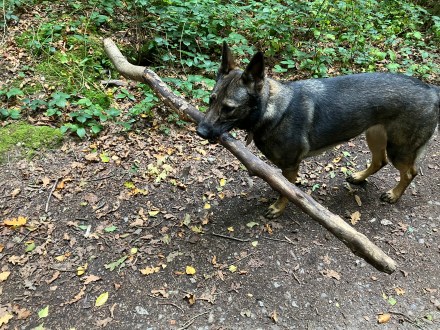
There are still things to improve though. Usually we have lovely walks each day in the woods, and Meg’s behaviour is excellent—we even get comments from other dog owners about how obedient she is (little do they know!) She does look obedient in the woods (and only in the woods). For example, this week I saw a man hurriedly putting his dog on the lead, so I assumed his dog was reactive to other dogs. I called Meg to my side, and made her sit, away from the footpath. I didn’t put her on the lead, Meg sat, completely focussed on the stick she was waiting for me to throw while the man and his dog (now barking death-threats at Meg—the dog, not the man) passed us. When they were safely passed, I threw the stick for Meg and we continued our walk. Wonderful, she had no reaction whatsoever to the dog.
Meg pretending she is obedient.
I did the same thing yesterday when we encountered a horse being walked through the woods. I moved off the pathway, told Meg to sit, and we waited while the horse passed. Meg did notice the horse, she glanced at it a couple of times and each time I said ‘Stick!’ and waved the stick in the air, and she refocussed on that and ignored the horse. Marvellous.
But (there had to be a ‘but’ didn’t there!) when Meg is tense, she has a very dangerous habit of leaping unexpectedly for the stick I am holding or picking up, and if I wasn’t wearing tough leather gloves, she would definitely remove a finger. Her jaws are incredibly strong. Several things can make Meg tense. If it’s a windy day (like young children—it was always a challenge teaching infants on stormy days). Or if another dog has approached her and threatened her—she never retaliates, but I notice that afterwards she is extra intense, and will often grab at the stick before it’s thrown.
I am trying to break her of this habit (before I lose a finger) and therefore I try to make her ‘wait’ when I pick up a stick, and I growl at her if she grabs a stick from my hand, and I refuse to throw it. Today this happened, and we had a standoff.
Meg had previously been accosted by a nasty little spaniel (it always seems to be spaniels, and they usually have dopey owners in my experience). This spaniel ran up to Meg, who was carrying a log (of course) and it barked and snarled, right in her face. Meg dropped the log (unfortunately not on the spaniel!) and stood there, looking worried. I called her, threw a stick, we passed unharmed. (The dopey owner just looked worried, shouted ineffectually at her dog but made no attempt to put the vicious beast on a lead.) Anyway, as we walked away, Meg was noticeably tense, and charged with extra energy at sticks, completely fixed on them. Perhaps I should have stopped throwing them, but I thought it would help to get rid of some adrenaline if she charged around for a while. [see PS below.]
Suddenly Meg leaped up, and grabbed the stick in my hand. This is not allowed. I told her ‘No!’ and held on to my end. Meg stood there, trying to pull the stick from my hand, refusing to release it. I realised this had become a new game, a battle of wills, and she is stronger than me. So I let go of the stick, told her to give it, and refused to move. Meg sat down, but held the stick, clearly waiting for me to resume the tug-of-war. I turned away, giving her no attention, not looking at her, not moving. Meg did not put down the stick. We stayed like this for 6 minutes. I timed it. 6 minutes is a very long time to stand still, ignoring your dog, in the middle of the woods. Thankfully no one passed us or they would have thought I was mad. After 6 minutes, Meg very carefully placed the stick on the ground.
I instantly praised her, and threw a different stick for her to chase. When she was safely away, I picked up the stick we had argued over. It is now my stick. I carried it back to the car. We went home. Not entirely sure what I will do with the stick now. (If I’m honest, I do not really want it—but don’t tell Meg!)
In terms of dog training, I have absolutely no idea whether this is what you are supposed to do with strong-minded dogs. I certainly have never seen anyone else having a standoff with their dog in the woods. I guess I will know in a few more years. Thanks for reading. Take care. Love, Anne x
[PS. After speaking to my ‘animal psychology’ friend, I now understand these events a little better. Basically, like a small child, dogs have layers of excitement/tension, which build on each other until the dog (or small child) is unable to listen to even the most basic of instructions. Therefore, after encountering nasty aggressive Spaniel in the woods, I should not have then thrown a stick for Meg ‘to release some tension.’ What I was actually doing was building on her tension, releasing even more adrenaline. Instead, we should have walked calmly for a few minutes, letting all the tension dissipate, resetting back to ‘boring.’]
Ruth came to stay again, Meg was delighted and brought her smelly towels as gifts. She definitely sees Ruth as an ally. When I try to correct her (like stopping her jumping at the door, or chewing a slipper) Meg will rush to Ruth, lean against her, and look at me. It’s like she’s saying, ‘You can’t be cross with me, Ruth is here.’ I do my best to keep Ruth safe by calling Meg away from the stairs and warning Ruth about massive logs being charged at her legs and things, but there is only so much I can do. Hopefully Meg won’t kill her by mistake.
We took Meg to a coffee shop today. We sat outside and tied her to the picnic bench, because in the past when she has been tied up she is slightly more subdued. She understands being tied, and that she cannot get free so she generally doesn’t struggle. It only half worked, as unfortunately Meg was able to jump up to our table and plant big GSD paws next to our coffee cups. Definitely not allowed. I shouted at her, she seemed very pleased with herself. After a while she settled down. She did bark at a passing dog, but only briefly. Plus there were lots of wasps, and she barked at them when she noticed. But mostly it wasn’t too bad, and the wasps were probably more annoying than Meg. I’m not sure it would have been so peaceful if another dog had been in sight, but it was okay for a trial, and nice to have her with us.
3/9/2025
We had a family holiday in Norfolk. I did not, for a second, consider taking Meg with us. She would have been a pain, and ruined the holiday for everyone. It’s a shame, because there is a lot of pleasure in walking across a beach with a happy dog. But she is very difficult to control when on the lead, and strange places invariably involve lots of walking on the lead. Plus, a little excitement goes a long, long, way with Meg. I have learned that Meg is at her best when the routine is unchanging. She seems to enjoy being in kennels (not entirely sure whether kennels enjoy having her!)
Routines and Meg are good. At home, every morning I get up, let her into the garden, prepare her food. She has started to have a sachet of wet food on her dry kibble ( a gift from someone whose dog didn’t like them) and she absolutely loves this! She comes in from the garden, walks to the garage door (where the sachets are stored) sits and waits for me to go in, then follows me, her nose nudging my leg, as I collect a sachet. She sits when we reach the door, follows me back into the kitchen, rushes to her crate and sits, looking angelic. She is fed in her crate, and I only put down the food when she is sitting, so she gets herself ready immediately!
I then make my coffee while she eats. I take my coffee into the sitting room, and Meg follows, sitting at each door until I go through it. She usually has a chew, and she remembers where she last had it, and will rush off to whichever room it was left in, then joins me in the sitting room. She lies on the floor, chewing, while I drink my coffee and read the Bible. When I close the Bible, Meg leaves her chew and comes to sit next to me, leaning against my knees. I then pray (in my head—this whole routine is done in silence). I do not know why she does this, I don’t know if she senses something, or if it’s just what she does so now she always does it. Then we leave the sitting room, and the day begins.
Today, I tried to do gardening with Meg. Not easy. Anything that might be construed as even faintly interesting sends Meg into super-excited mode. I was weeding, throwing the weeds into a wheelbarrow. Meg waited, fixed on my hands, leapt for every weed I threw. A few times she decided to join me on the flowerbed, trampling all the plants. She went off to find a stick, returned with it and attempted to leap over the flowerbed. She almost made it. More plants trampled. Then when grabbing at the weeds in the wheelbarrow, she unbalanced it, and the whole thing fell over, tipping weeds all over the lawn. I gave up at that point, and took her inside. The garden now looks worse than when I started.
5/9/2025
We walked to the pub for lunch, and attempted to take Meg again. She was terrible. Before we had even left the driveway—before we had even left the front doorstep—she heard a car in the lane and started to leap for it, barking. Perhaps we should have dumped her in the kitchen at that point, but we persisted. We walked to the pub with a hugely annoying dog who tried to chase every car that passed us. She was relatively good when we crossed a couple of fields, and very good when we walked through the woods, but at least half the walk is along lanes, and she was awful.
In the pub, she was mostly good. I took a chew, which she ignored, but for most of the time she lay in the corner, watching. No paws on the table this time, although she did bark at one point (for no apparent reason) and made everyone in the pub jump! Mostly, it was not a success. We will try again in 6 months. (I think that in about 5 years’ time, she will be good.) I am ever the optimist, but sometimes it is exhausting.
Hope you have a good day. Thanks for reading. Take care. Love, Anne x
I have had covid (my first time). Not a pleasant experience, and one that I hope to never repeat. I stayed in bed for several days—which is something that I never do. Even when I was feeling better, I stayed in my room until the 10-day-no-longer-contageous deadline, just in case. During this time, Meg was almost constantly my companion.
Meg is not allowed in my bedroom, but she sneaks in sometimes, and if she stays low and quiet, I pretend I have not noticed. For the first few days of illness, we continued this pretence. I would hear the door pushed open, the quiet footsteps of a sneaky dog, then the jolt of the bed as she lay down, leaning against it. It was nice. I woke and slept to the sound of Meg’s breathing (she breathes very noisily when she’s asleep). I have previously doubted whether Meg likes me much—she seems to prefer the rest of the world (who allow her to do what she wants). However, she definitely chose to be with me this week, even with other people in the house. Perhaps she sensed I was ill. It was nice.
After a couple of days, Meg decided she would join me on the bed. This was definitely crossing a line, and not allowed. She placed two legs on the bed, and reached across to lick me. I told her ‘Down!’ No reaction. I told her ‘No!’ Nothing changed. I reached for my water glass—Meg sighed and jumped down. She tried again, a few times a day. If I reached for the water glass, even if it was empty, then Meg jumped down. I like the modern theory that you train a dog with rewards, not punishment (nor threat of punishment). However, with Meg, I am not sure that it works. No treat is ever enough to deter her actions, but the threat of being wet always stops her. I tend to want an easy life, so the water glass it is.
*
We have almost completely stopped locking Meg in her cage during the day. We have left her unsupervised for several hours, and she has been fine. I therefore assumed that having Meg free all day, even if we are out, is now a thing. Yesterday she ate Husband’s pyjama top.
I am a little unclear as to where she found the top—whether it was waiting to be washed, or stowed neatly with his bedding—but Meg found it and decided it would be a good thing to chew into tatters. As he owns far worse clothes, I am assuming this was not a fashion decision. The sad result is that I no longer trust her for too long unattended, which is a big shame. I was not especially upset by the pyjama top, which is replaceable. A chair cushion would be a different matter.
*
I brushed Meg today, and I realised that this is the first time. Until now, she has been much too bouncy for me to even consider brushing her—much easier to just vacuum the house. However today, as I picked her fur from my sweater, I decided to try and brush her.
I have a variety of dog brushes and combs leftover from when Kia was alive. Kia would allow me to brush her, but only if I let her run like a crazy thing round the garden every few minutes. There was also one brush—with very fine metal teeth—which Kia would not let me use. She ran away when she saw it. I was not sure how Meg would behave.
We went in the garden, I told her to sit and ran the brush along her back, giving her lots of praise. Meg tried to take the brush. Meg heard a car and rushed off to investigate. Meg returned, we repeated the exercise. I collected a brush full of hair. I emptied the brush, and put the fur into the bush, as birds collect it for their nests. Meg jumped up, grabbed the fur, ate it.
I then tried using the metal-toothed brush that Kia hated. Meg didn’t seem to notice. The brush ran along her back, vast amounts of fur billowed out, Meg stretched, enjoying being scratched. She heard a car, and rushed off.
For several minutes we continued—I brushed her, until there was a car—Meg chased the car, then returned for more brushing. She tried to eat all the fur, but I managed to put most of it out of reach. At one point she jumped up, knocking my chin so I nearly bit my tongue (it’s a long time since she has done that). Other than that, the exercise was danger-free and not too stressful. She now looks nice and sleek.
Hoping you managed to brush your hair today. Thanks for reading. Take care. Love, Anne x










 Anne E Thompson