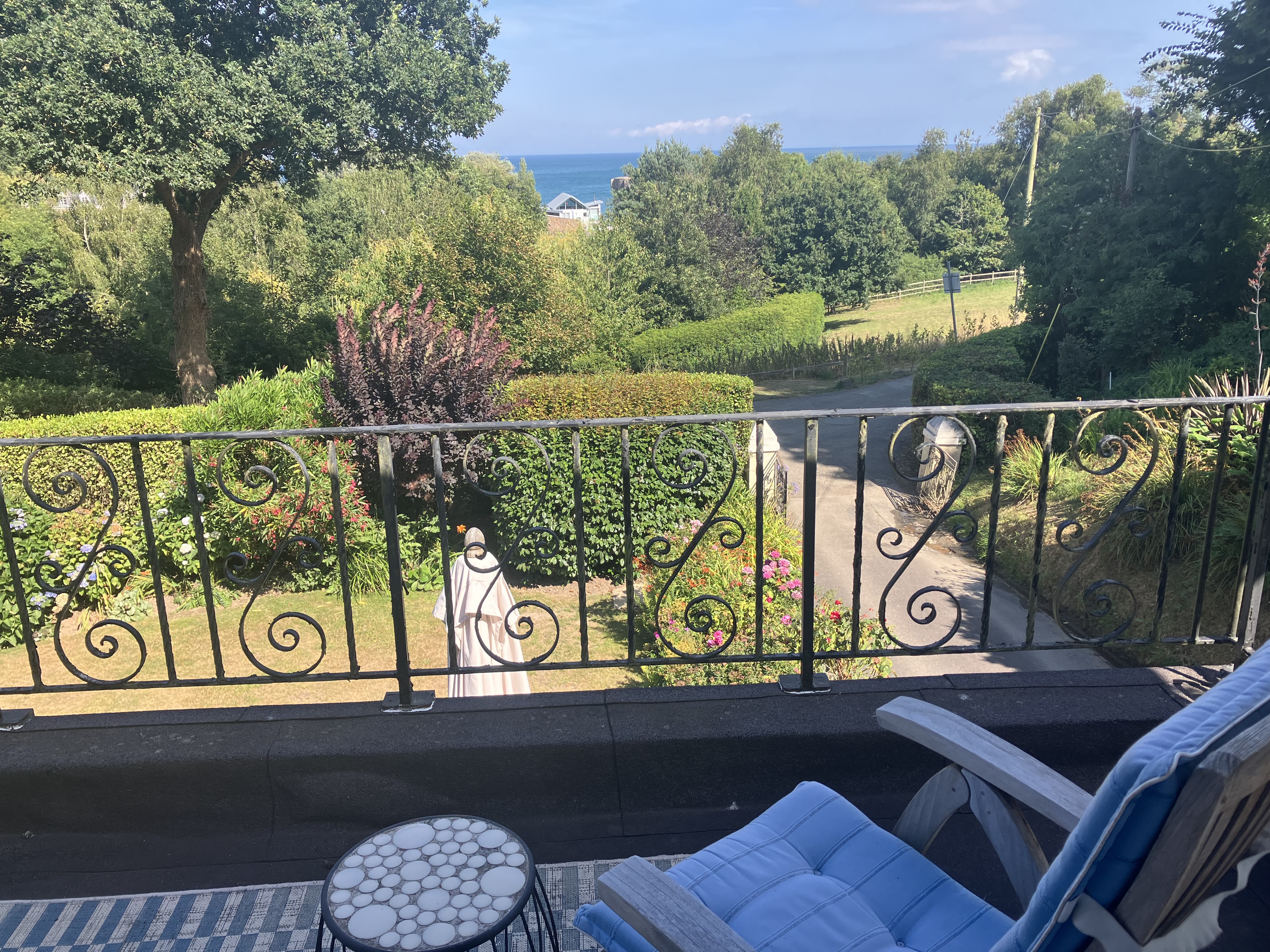
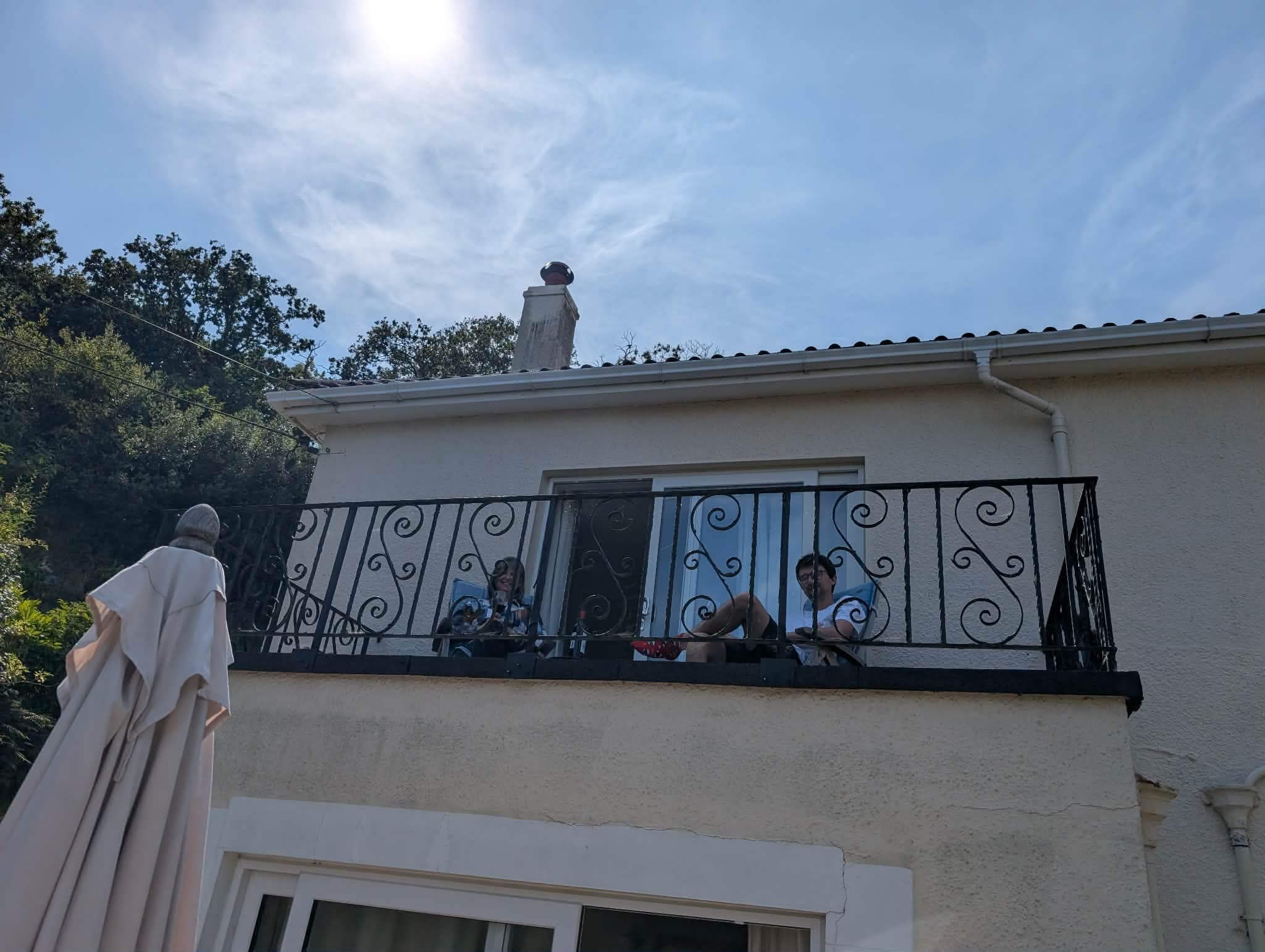
This is my second time of writing this. I am sitting on a veranda, in the sunshine, and I merrily typed on my keyboard while not being able to see my screen. When I checked what I had written, it was all in Hebrew script! It made no sense, because I had used English spellings, so it was a complete waste of time. I shall start again—in English…
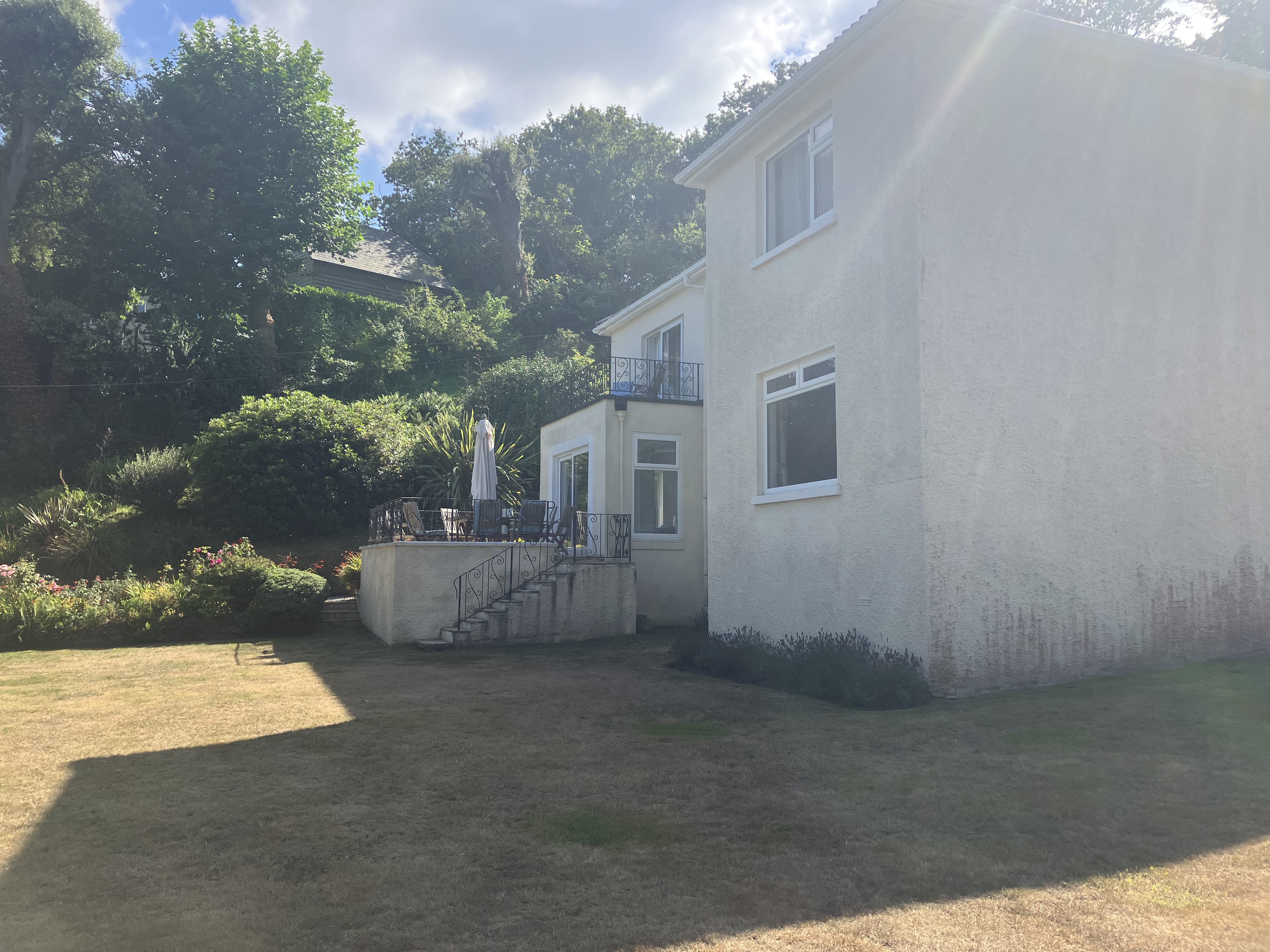
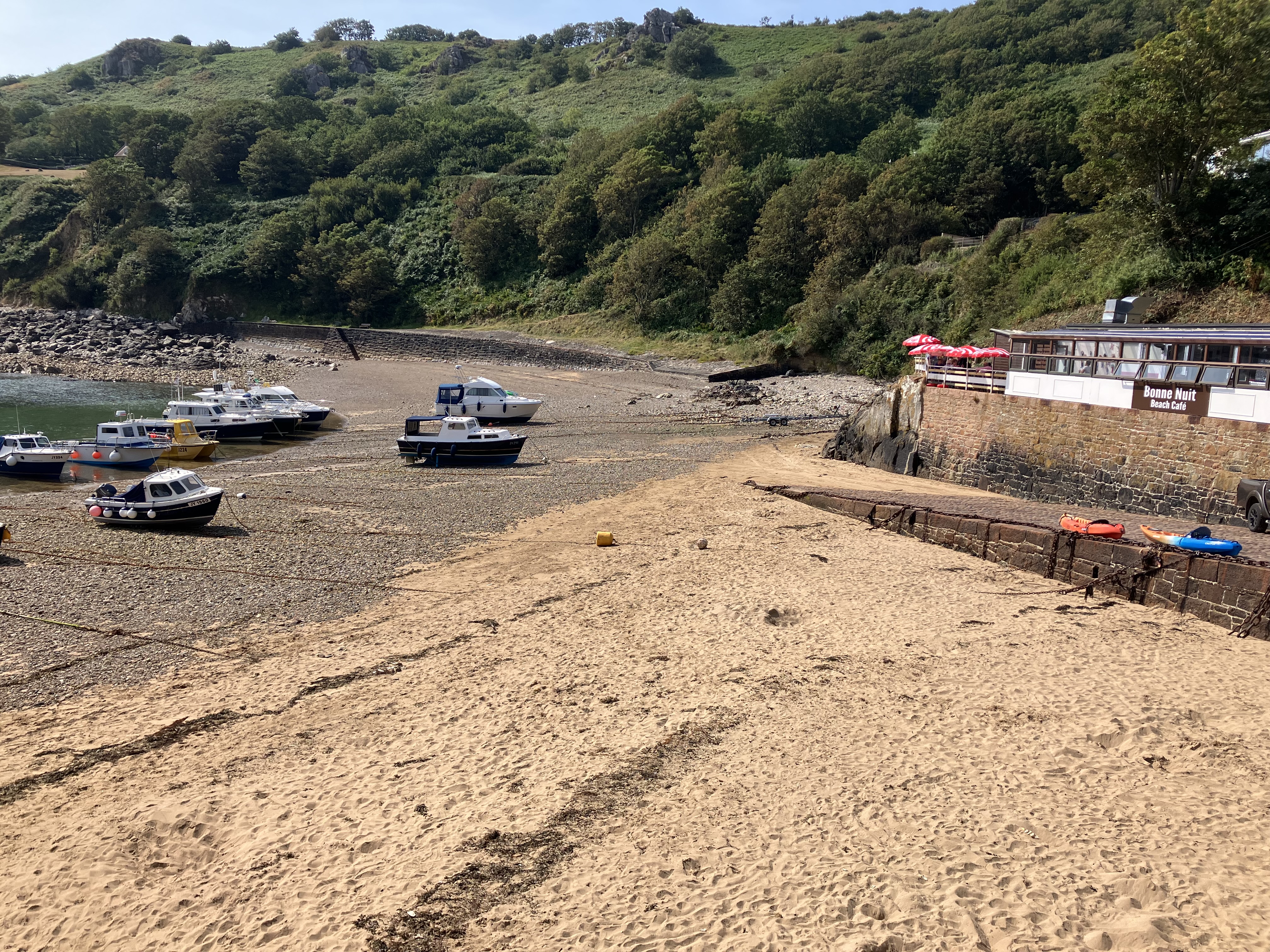
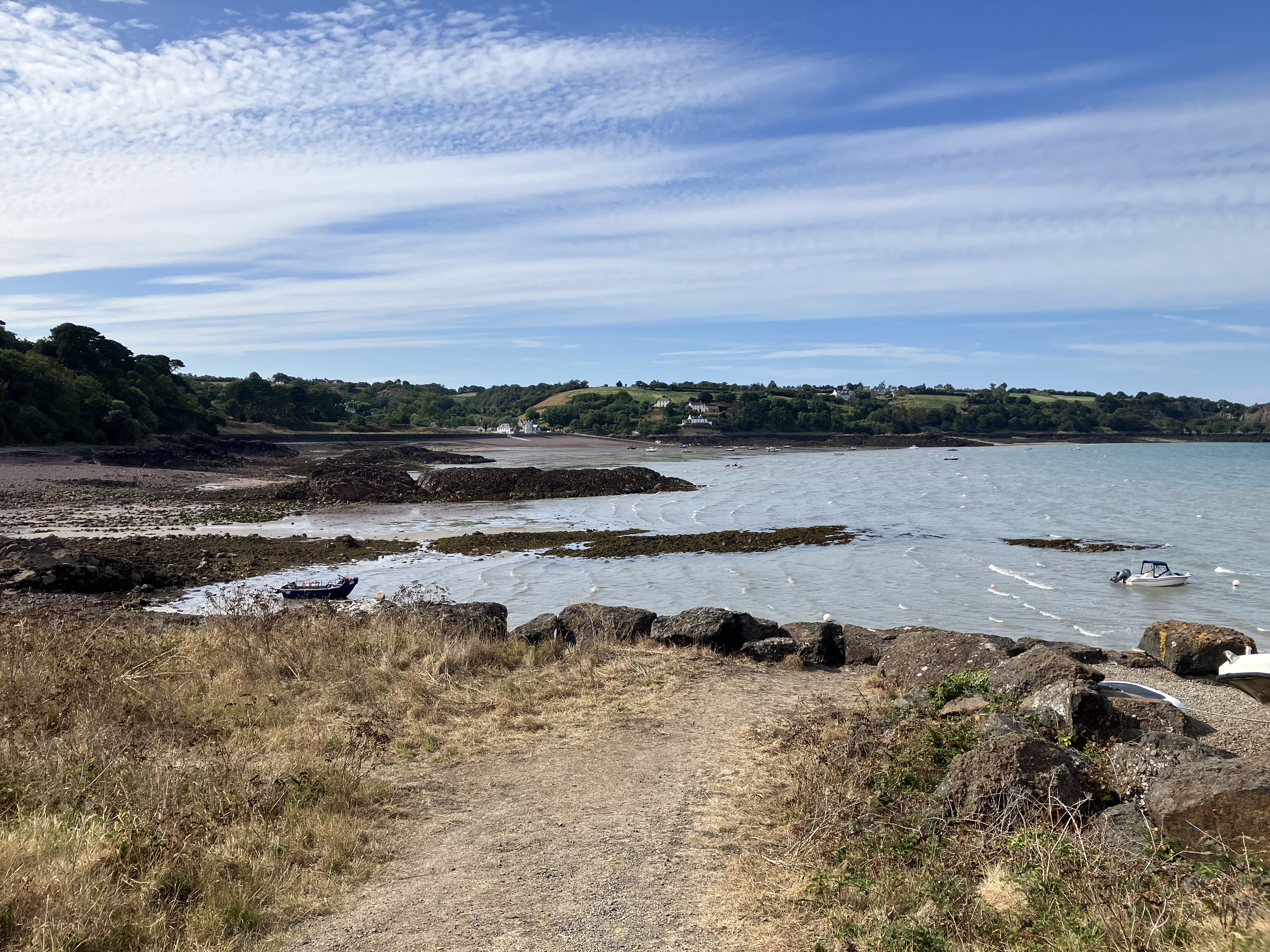
It’s the end of July, and we have joined the family in Jersey. We rented a large Airbnb in St Martins, and as I write I can see the sea over the tree tops, and hear birds singing, a dog barking, and not much else. It’s very peaceful. We’ve never visited Jersey before. It’s part of England, so wonderfully familiar, yet not attached, so it feels slightly different. Driving, language, currency is all like home—but the island is quite small and very well-kept, so very pretty. The sunshine helps of course.
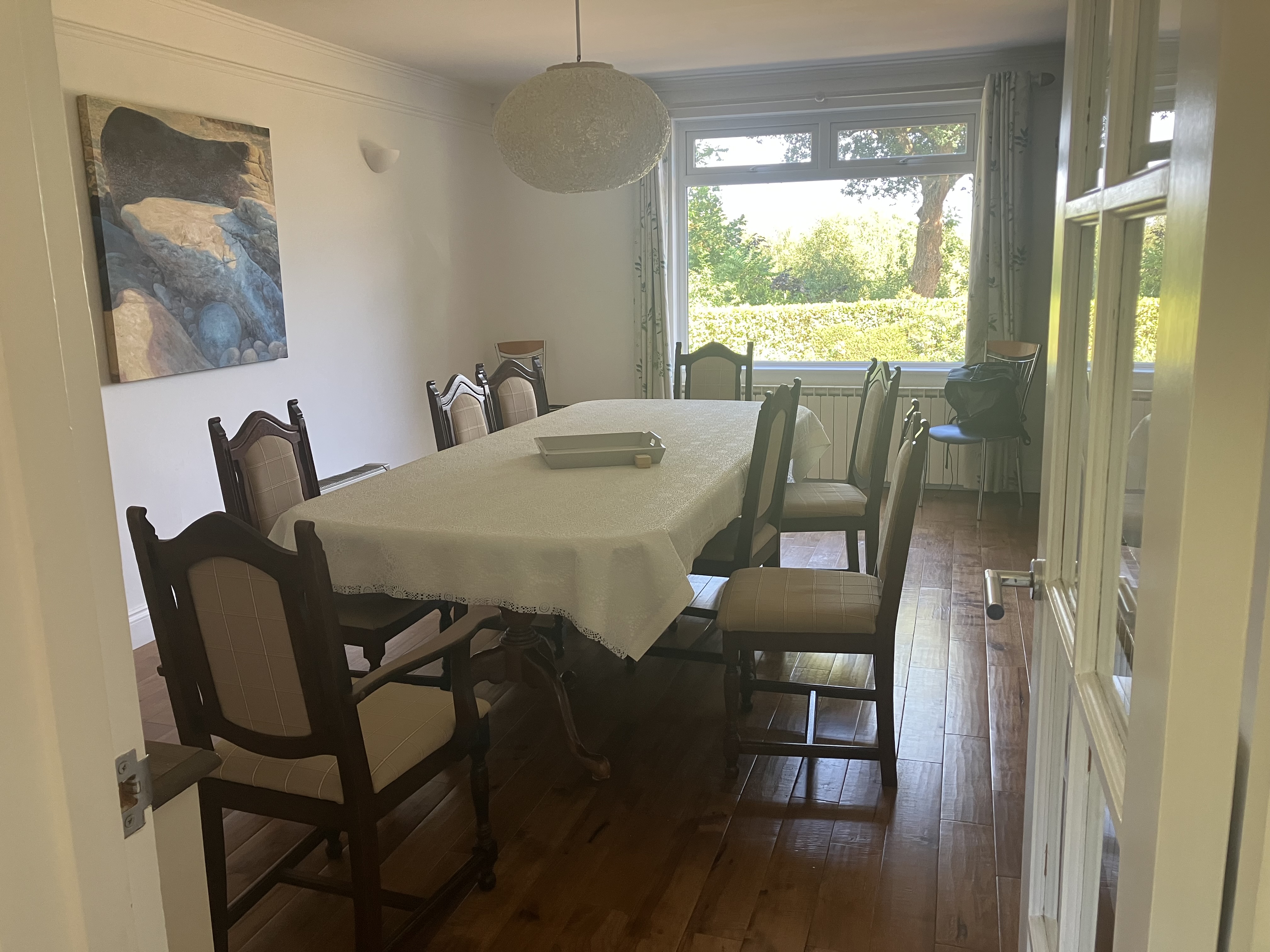
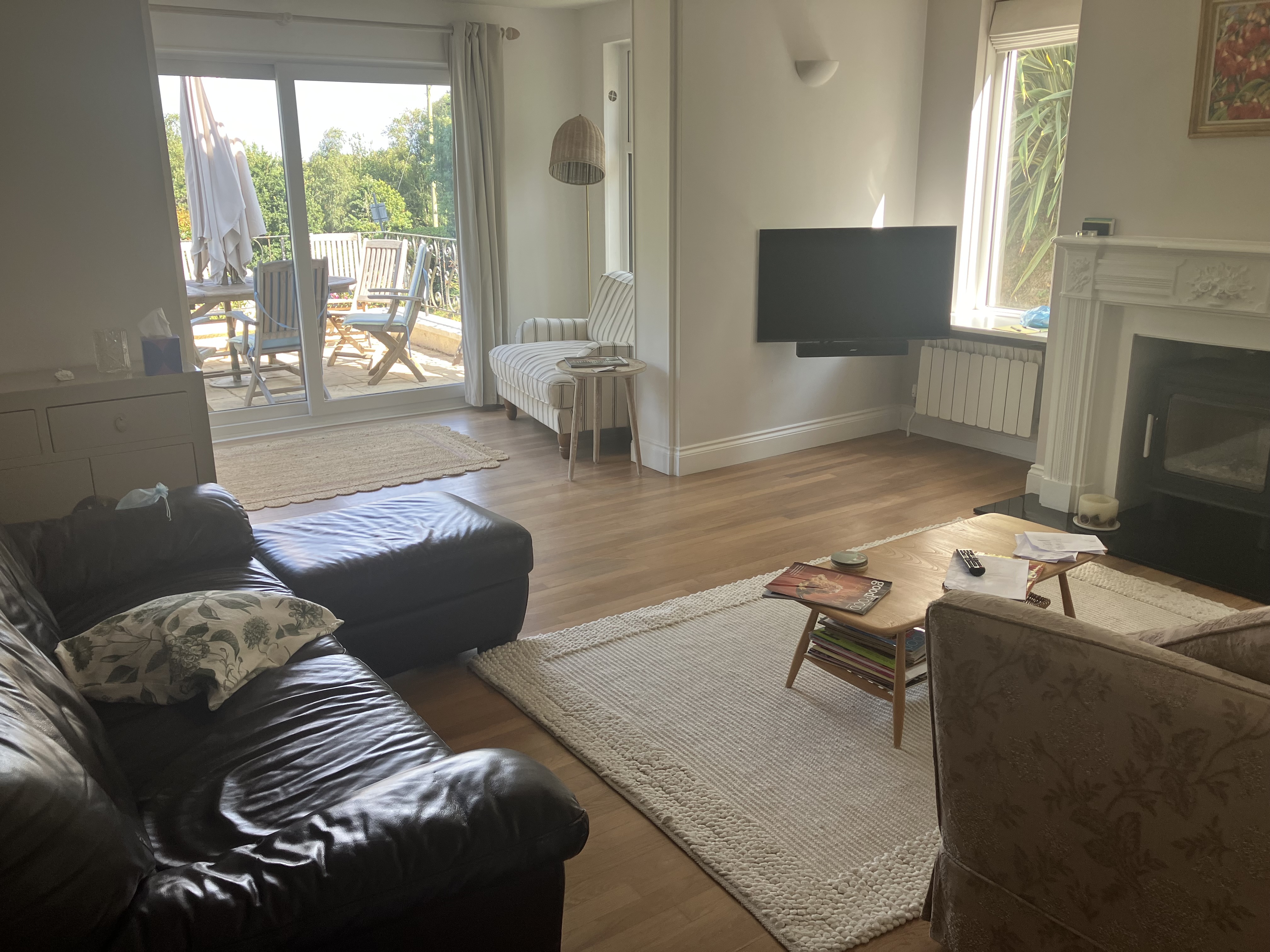
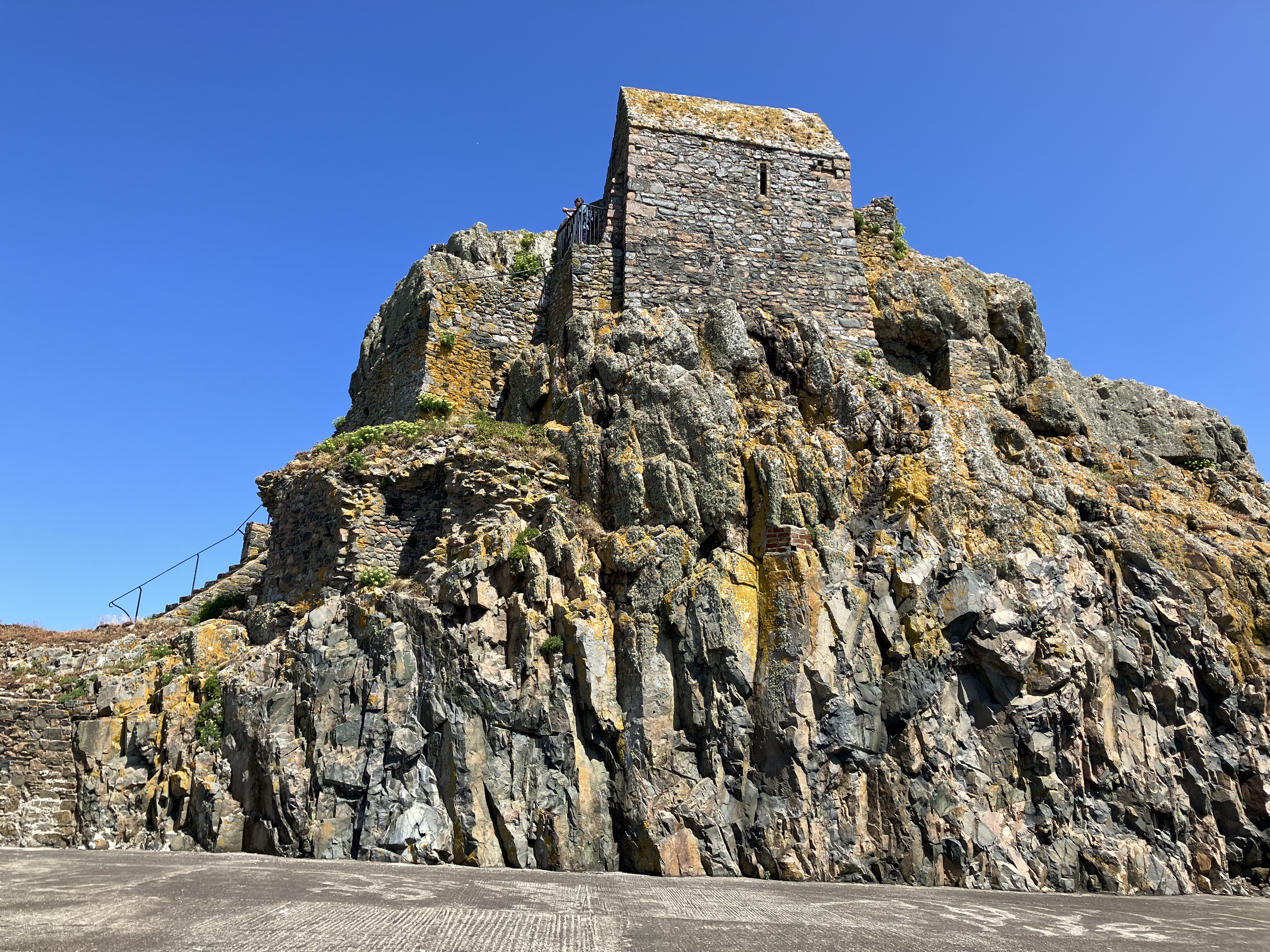
We haven’t done much, and various family members have worked (online) on different days, which has worked well in the house which is big, with rooms people can escape to or meet for (loud) chats depending on their mood. The days have passed much too quickly—walking next to the coast, visiting castles, eating lots of cake. One day we rode on an amphibious vehicle to a nearby island. Husband and I sat in a secluded garden and drank coffee while the others watched canons being fired.
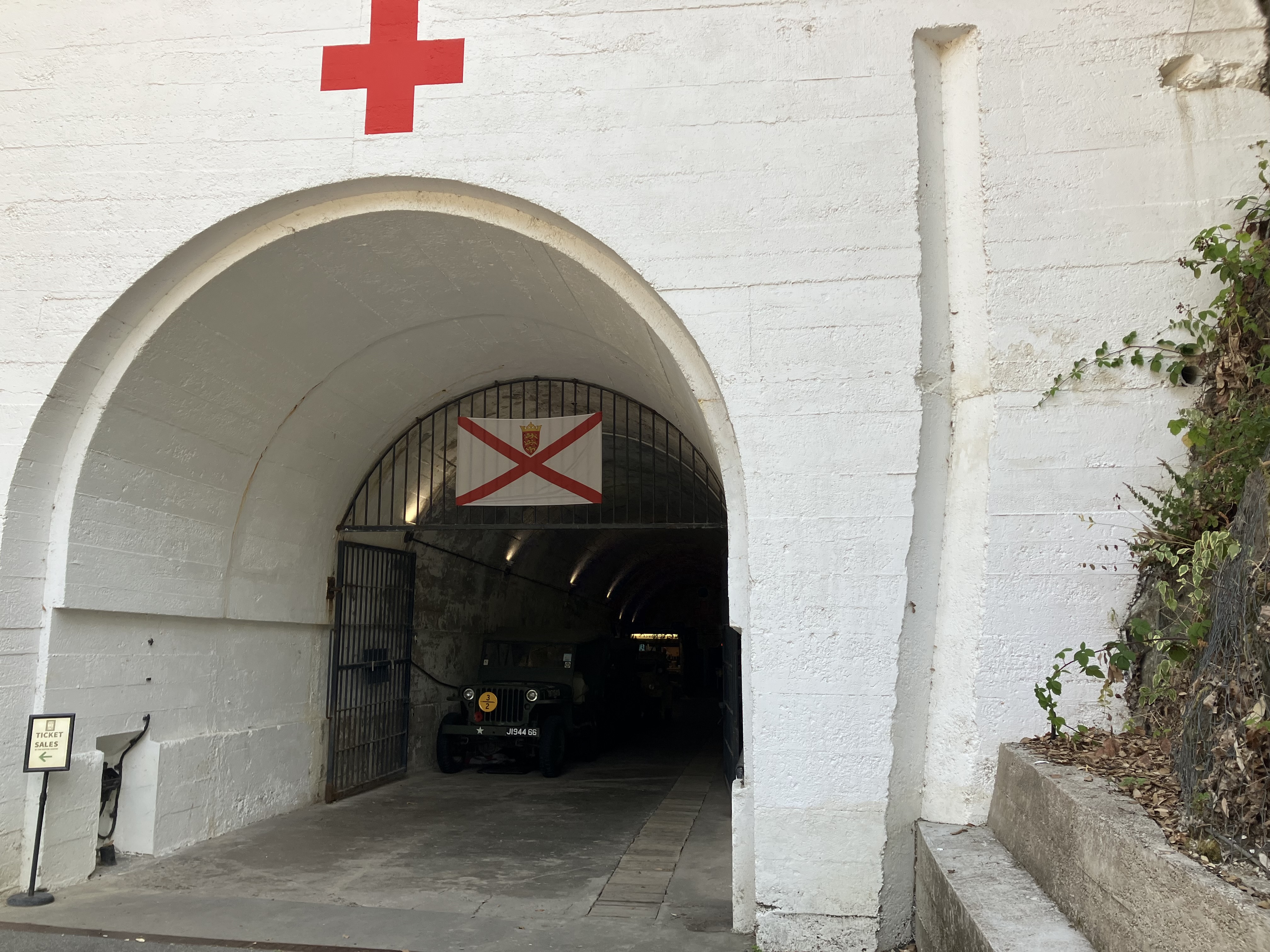
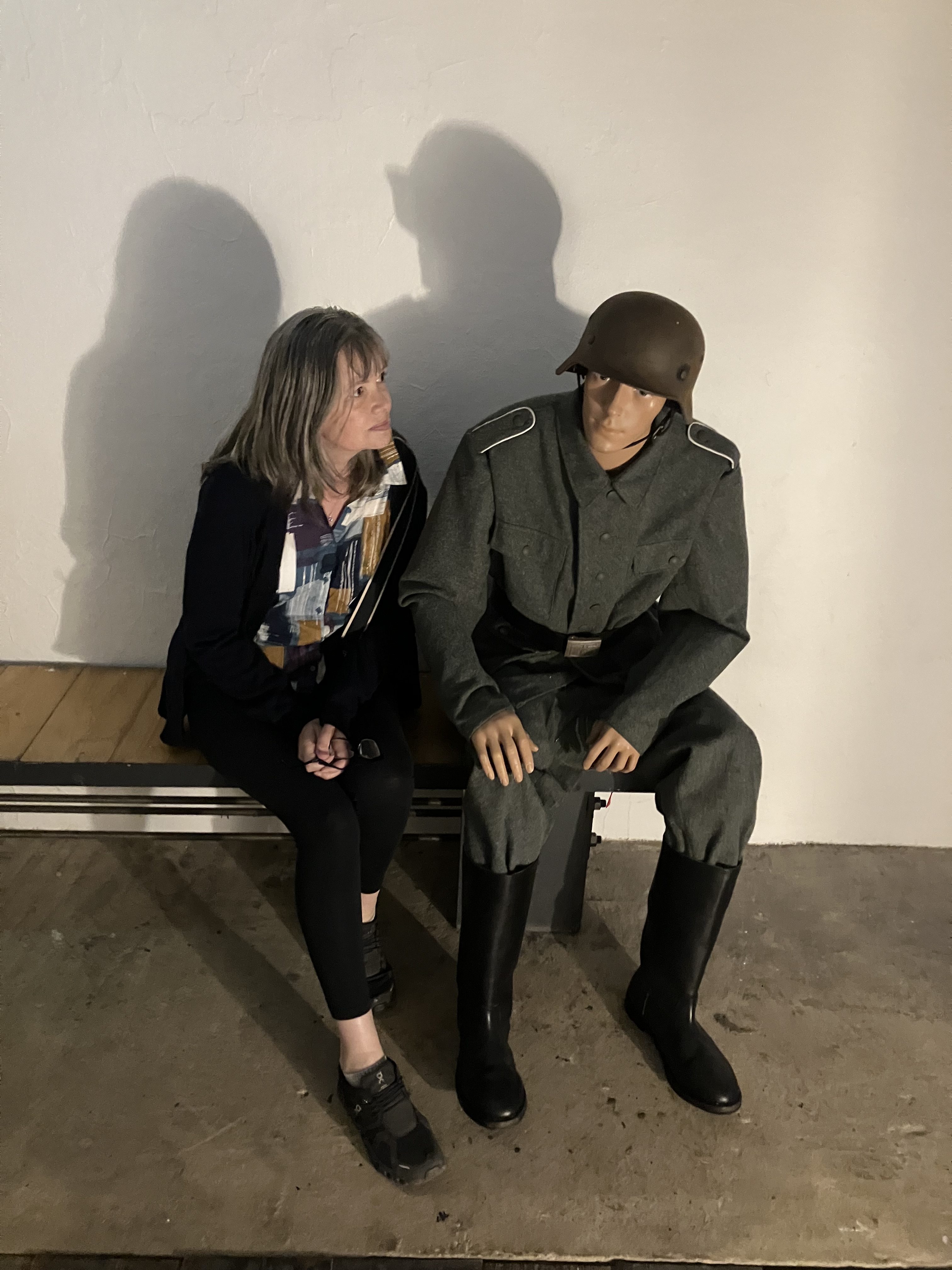
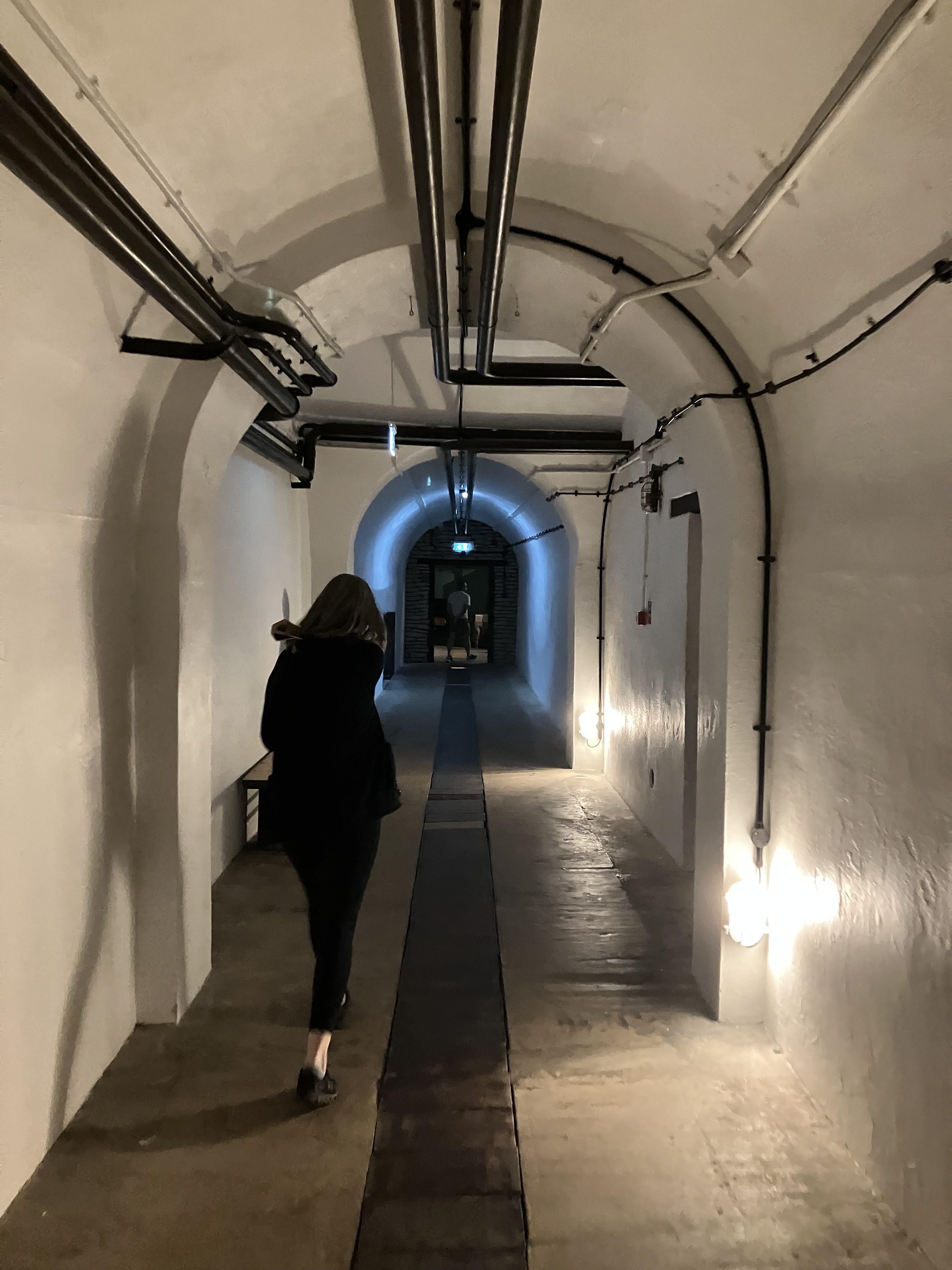
Today we went to the tunnels—built during the German occupation by their war prisoners. There were shocking signs announcing that the the government had decided to not, ‘repeat not’ defend the island when the Germans attacked. Can you imagine how it would feel when the islanders read that for the first time? The tunnel displays showed what life was like under German occupation, much was sad (they killed all the cats and dogs because there was no food for them) and some things were practical, just getting on with life during difficult circumstances. It makes you question your own core beliefs—how would you behave when compliance with the enemy would enable food for your children? I had previously thought I would definitely be part of the resistance movement—no one forces a Thompson to do things. But some of the soldiers were 14. Big children. I don’t think I could have been involved in killing kids, even if they were the enemy.
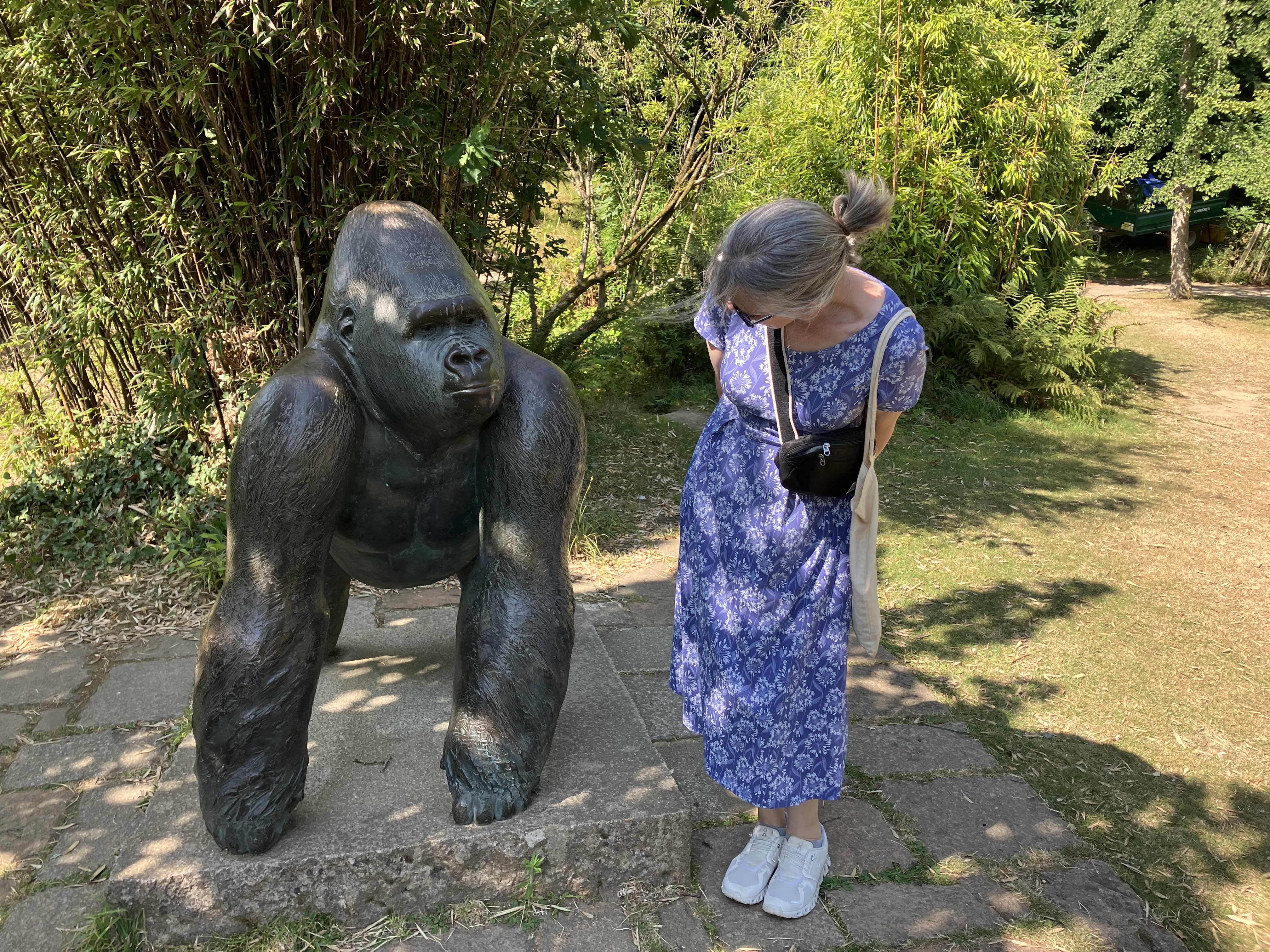
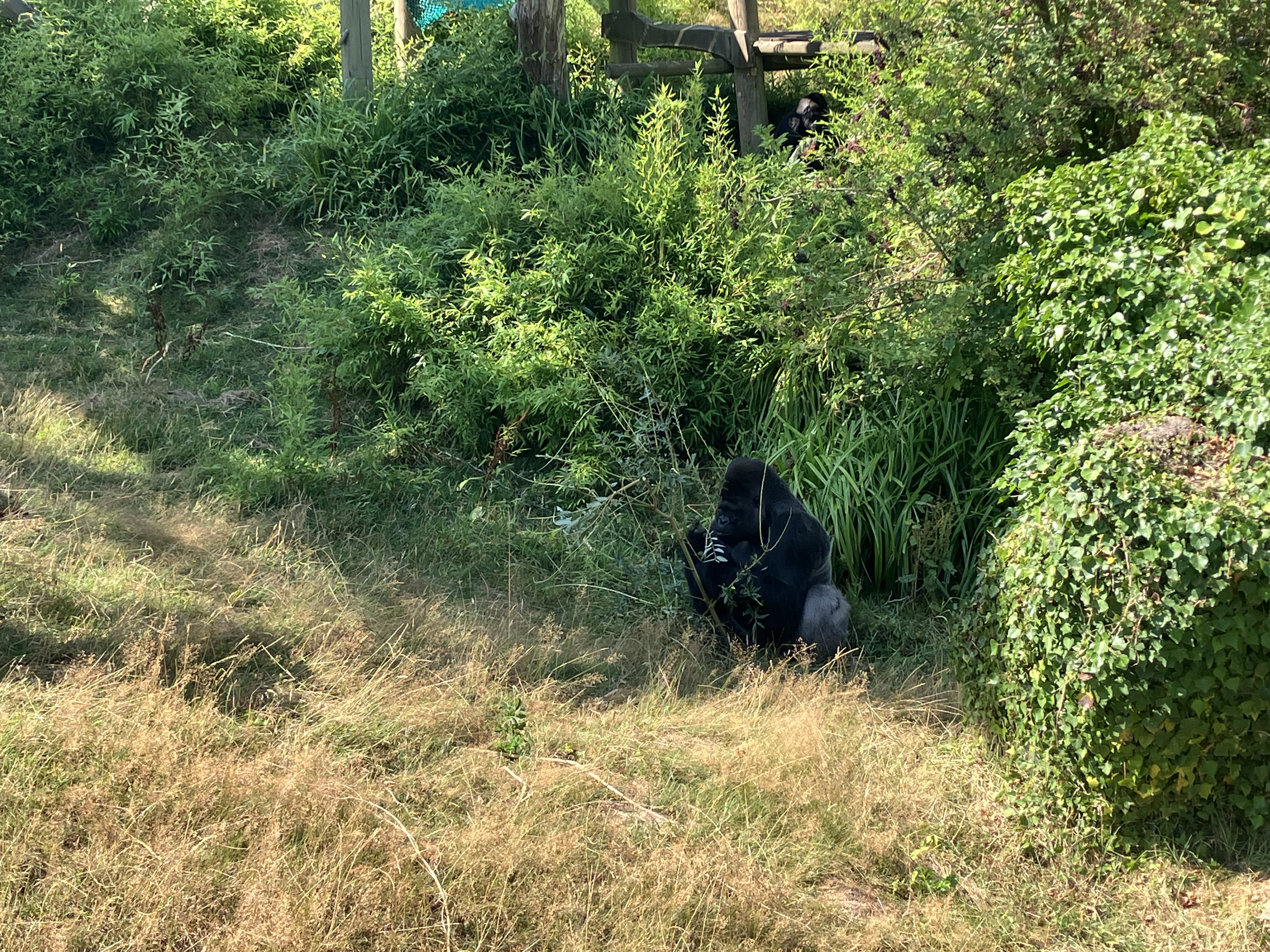
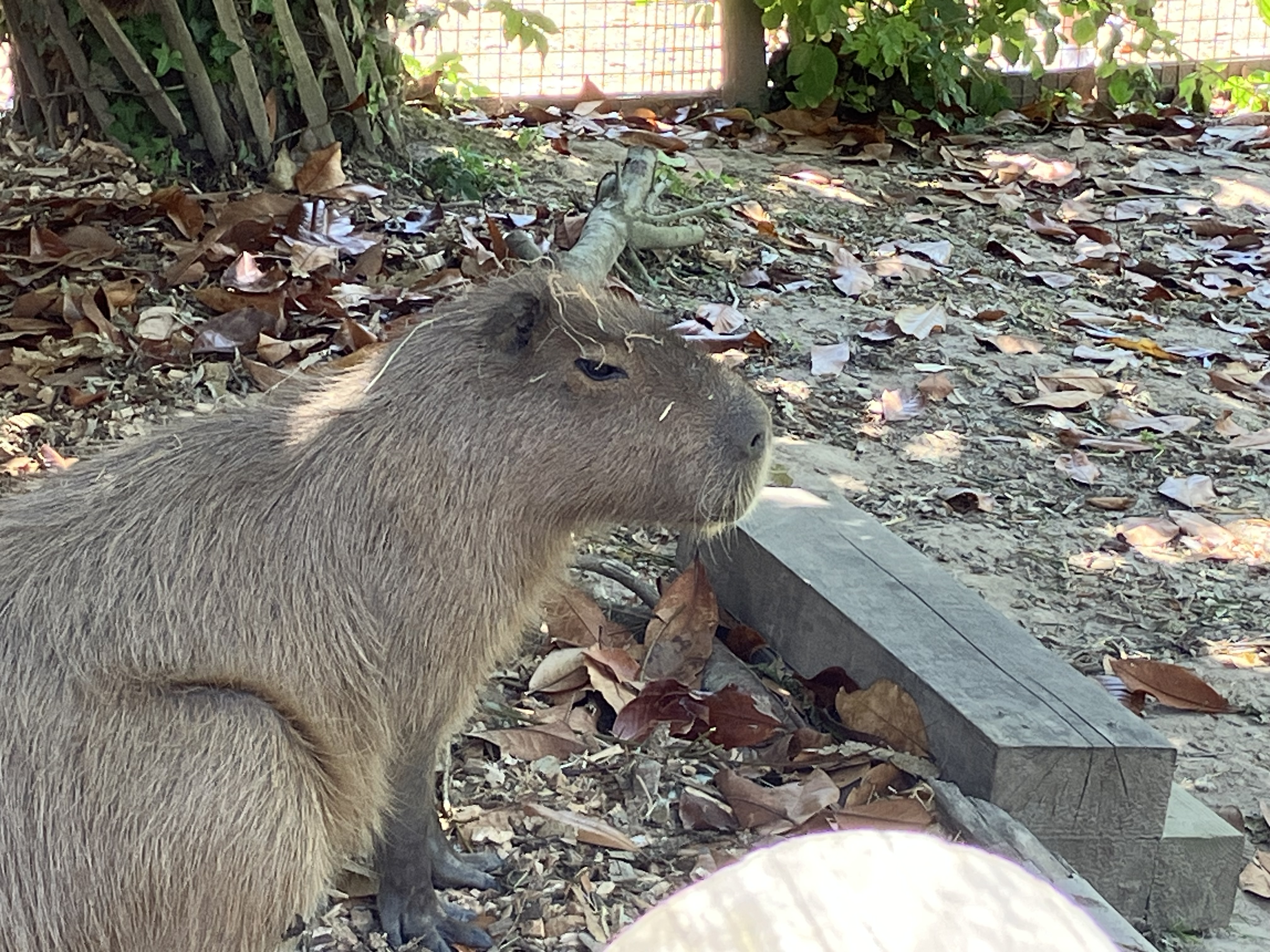
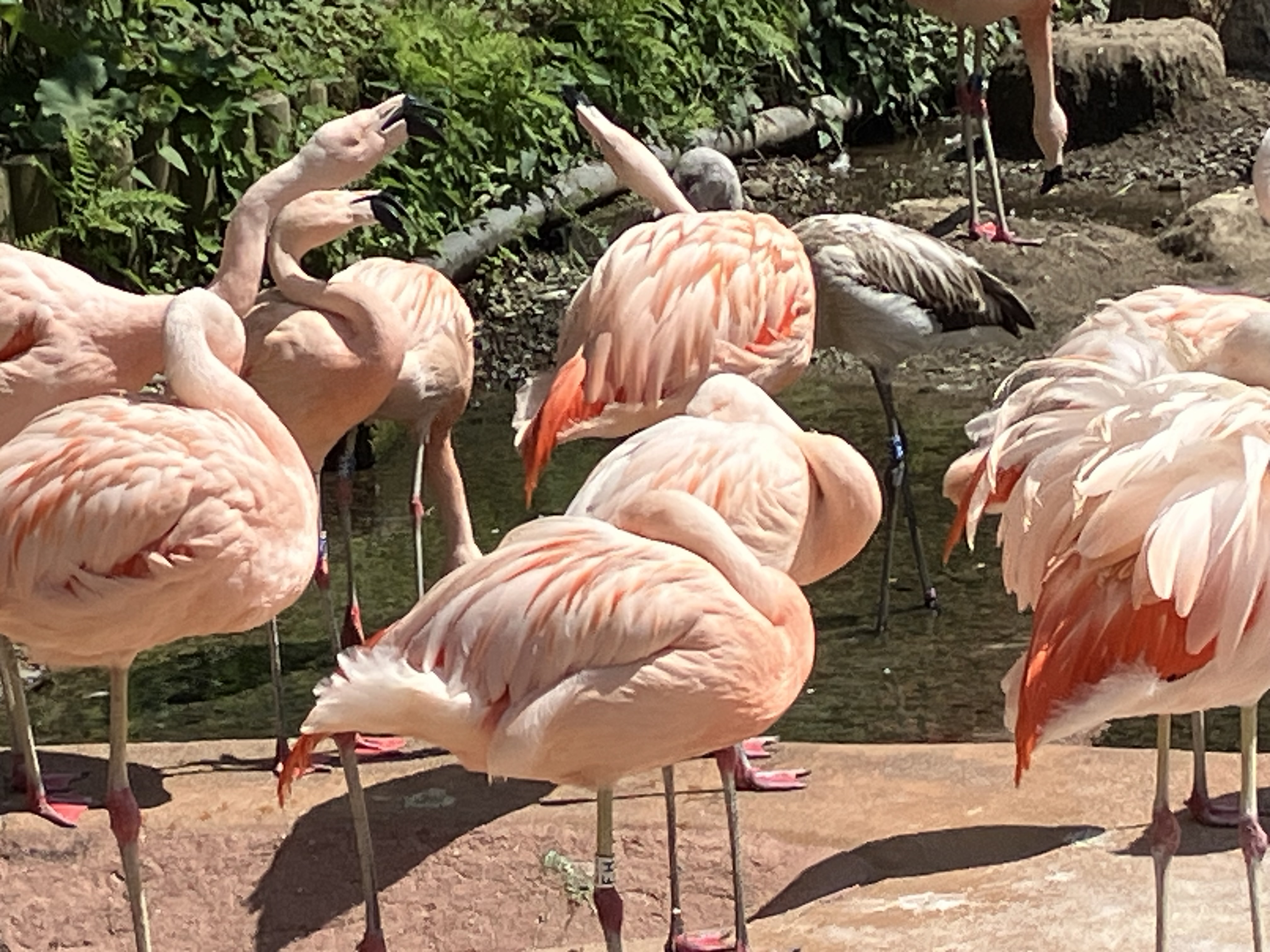
Today we plan to visit the zoo. This deserves it’s own post (it’s an excellent zoo) so I will write some separate blogs when I am home. Thanks for reading.
Take care.
Love, Anne x
Things I Heard in Jersey/Only in a Family:
Is someone watching a video in the bathroom?
Don’t throw rocks at your brother.
I’ll give £5 to anyone who can hit him with a pebble.
Let’s get the curry, the linguine and the roast dinner, and then share them.
Stop trying to open the car door—that’s not our car!
Don’t open the flip-top bin with your foot, you’ll break it.
Please can we have a designated quiet area in the house?
(When playing Code Names): Oh great, that’s just what you want your vocal and dominant teammates to say…
Your washing is all over the lawn; let me introduce you to the peg basket.:
Thanks for allowing our query to go to arbitration after your complaints department deemed it something they were unable to resolve. I understand the arbitration has also proved unsuccessful for us, which means we must accept the decision. And wow! What a decision! I am writing because I am surprised this is acceptable to you. But perhaps it’s not. Perhaps you are just a person working in the Customer Services department, wishing there was air-conditioning that worked and wondering why the clock moves so slowly. Perhaps you, the person reading this, has no real idea (nor possibly interest) on what is actually happening to real people in the real world. Or perhaps I have misunderstood. In which case, please do reply and let me know. It would be nice to discover that Virgin Media is notexploiting vulnerable people…which is what it looks like.
The situation (from where I am sitting, in my non-air-conditioned room) looks rather grim in terms of customer service and honesty. The situation looks very like you (not you personally, obviously, but the company for which you work) have found that ripping-off elderly customers is a really easy way to increase income. I guess it is an easy way to make money. Especially if you put a friendly person with an authoritative voice on the phone—who wouldn’t believe them if you phone to query your bill and are told that this deal (double what others pay) is the best deal? Most elderly people would trust that, wouldn’t they? But I like to think this wasn’t your plan. I like to think there were strange coincidences along the way.
We must go back in time, to 2018, when my mother agreed a package with you. It seemed reasonable, we relaxed (this was our mistake). Every few years, the price would mysteriously rise (I know, cost of living, need to have a holiday, the first price was never meant to continue at that level anyway, etc, etc). We warned Mum (not easy to get your mother to take advice—have you found that?) that the price being offered was probably not the best deal. And so Mum (who did listen on this occasion) would phone Virgin Media. She would speak to a lovely person (I am sure you are all lovely) who would convince her that the price they could offer was the very best price available, they were doing her a favour really—you know the sort of thing. Now, these calls were recorded (by you, not Mum—that would be a bit too difficult and possibly illegal). Strangely, these recordings no longer exist. Isn’t that strange? You still have the transcripts, written by a Virgin Media person who is possibly unlikely to write: ‘I offered a really high price and the old lady seemed confused but accepted it, so we’re good to buy decent wine for the office party this year, soo easy to rip-off vulnerable old women! Go Virgin Media!’ Yes, it seems unlikely they would phrase it like that. And of course we cannot compare what they did write with the actual conversation because you no longer have the recording, apparently. I love my mother dearly, but I doubt if she would have seemed especially savvy on the calls. I don’t suppose they confused her with a stocks trader.
All we have are the basic facts. Virgin Media assured my mum that £63 a month, for the most basic package, was the very best deal available. So, from 2019 at £36:19, to 2025 at £62:27—that is quite a rate of inflation! Do you pay that much for the basic package at Virgin Media? I hope you don’t mind me asking, but I really am curious. How much do you pay for the most basic package?
The really funny thing (this will come as a shock, I know, so maybe sit down before you read it) the really funny thing is that when my husband phoned Virgin Media on her behalf, they offered a price of £33. Yes, £33 for the most basic package. Isn’t that strange! Now, I don’t like to think this is because my husband does not sound like a vulnerable elderly person—but he doesn’t. I don’t like to suggest that if he had sounded like a vulnerable elderly person Virgin Media would have decided to exploit his vulnerability to maybe increase the bill even more rather than halve it. Yes, practically halve it. But it’s certainly strange, don’t you think?
Now, we contacted your complaints department, but they were unable to help. (I think they offered a token gesture, but given how much money an elderly person has over-paid this seemed worth taking further). We continued to arbitration. I don’t like to think they are possibly biased, are not working for the consumer nor setting rigorous standards for the industry, but they decided that a vulnerable elderly person being exploited for several years by Virgin Media was an acceptable situation. We lost. Nothing more we can do. The amount paid to Virgin Media over several years is not insignificant to an elderly lady living on a pension—but I guess that’s of no concern to you. I guess nothing illegal was done, if exploiting vulnerable people is an acceptable practice for Virgin Media, then why worry? But I do wonder what you (this time I do mean you, the human who is reading this letter) I wonder what you think? You probably have a granny, or an elderly aunt, or someone a little vulnerable. Do you think it’s okay?
Thanks for reading. Take care.
Love, Anne x
I sent this to Virgin Media as a courtesy before posting on my blog. I will let you know if they reply.
Hello, you may remember from last week’s blog that we had trouble getting home from Italy. After a week in the Italian alps, we packed ready to catch our flight home on Sunday. At 3am we received a message from BA saying our flight was cancelled (there had been storms in London and the plane did not arrive in Italy ready to take us back). We therefore booked into a hotel in Milan, and waited for our rescheduled flight on the following Tuesday. (Yes, Tuesday.) The hotel was lovely, and we had internet, therefore although inconvenient it wasn’t the end of the world, we could both work, there are worse things in life.
However, by Tuesday I was SO ready to go home. There was a limit to how useful my work was without my computer (I could access the library on my phone, but reading theology books on a phone is not quite as easy as reading them on a large screen). The weather was really hot, so although we were near Milan, a hot hour on a train to get to the centre, followed by tourism in an overheated city, was very unattractive. So we stayed in the hotel–literally inside the hotel. Which after two days made me a bit desperate for fresh air (but when I ventured outside, the air was thick with fumes and it was so very hot, it was not ‘fresh’ at all!)
Tuesday morning, we packed our things ready to go home. I joked with Husband about how I had mixed my clean and dirty clothes before, and this time I wondered whether I should try to keep the not-too-dirty ones separate…just in case… But I didn’t. Although I did decide to keep snacks and water bottles, thinking I would discard them at the very last moment.
We left the hotel and entered the stale-aired chaos of the airport. Too many people, concentrating on pulling luggage, avoiding other travellers, signs flashing, noisy tannoy, watching the red letters on the information board, keeping track of my valuables, ignoring the smells of fast-food outlets, and perfume, and bodies, trying to balance on the escalator. Much too much noise and smell and stress. (I am not a happy traveller.)
We checked in and left our bags. BA had moved us down a group when it reissued the tickets, so we requested to be put back into the group we had paid for (Group 4–so nothing fancy, just not left until the very end when all the overhead lockers would be full.) The kind person at check-in moved us into Group 3. We walked to the gate. Due to Brexit (so much I could write) we have to go to passport control via separate screens, entering details about visas and right-to-stay, which adds another long queue to enter and depart Europe. We eventually arrived at the gate, waited to board.
We boarded the flight pretty much on time. Then we waited. There was a fault on the aircraft; an engineer was sent. We waited. After a couple of hours (yes, hours) they brought round cans of drink and biscuits. At one point they warned us the lights and air-con would turn off, as they were ‘switching everything off and then restarting the system.’ This reminded me of my son’s advice when my computer won’t work. It did not bode well. After about 4 hours, we were told they couldn’t fix the fault, we should collect our luggage, and we would be sent to hotels and contacted about new flights. Super.
We went back to the terminal (via the annoying extra queues because of Brexit) and collected our bags. There was no one with a sign telling us what to do or where to go. I went to security, and they suggested I should go to the BA lounge. There was a BA representative, but he did not make his presence obvious, and certainly did not make any announcements. If I had been travelling alone, I would have felt very insecure. I chatted to a couple of passengers who were travelling alone, and told them the information I had. When we left, I went via the lounge and told them they should send someone with a sign to the arrivals hall, because people did not know what to do. I’m afraid the bossy-school-teacher is still in me.
However, I was not alone, and 40ish years ago, I chose wisely. As soon as the flight was delayed, Husband had looked online for other flights leaving Milan. The instant they announced our flight was cancelled, he booked tickets on the flight the following day, and rooms back at the Sheraton. I suggested that if the flights BA sent were better, maybe we should use those? He made non-committal noises.
We returned to the lovely Sheraton. No clean clothes, yuk. But I still had water and snacks. We got to our room sometime after midnight. A message from BA arrived. They offered us tickets at 5am the following mornings (so after maybe 3 hours sleep) to Zurich. Yes, Zurich. We would then spend 12 hours in Zurich airport, and catch the evening flight to Heathrow. We declined, and requested a refund.
Wednesday, three days after our scheduled flight, we returned to the airport. The flight was delayed, which worried me, but after about an hour, we taxied to the runway. We made it home. It was so lovely to finally arrive, to see the animals, to unpack, to have clean clothes and my own bed. In the grand scheme of things, a few days in Europe staying in a hotel is not so bad. But something about being in limbo, of not being able to do things we have planned (I missed the funeral of a friend, for example) was very unsettling. We have our plans, and we like things to be normal. Normal is something to be valued, but we often don’t notice it until it’s missing.
Hoping you have a nice ‘normal’ week this week. Thanks for reading. Take care. Love, Anne x
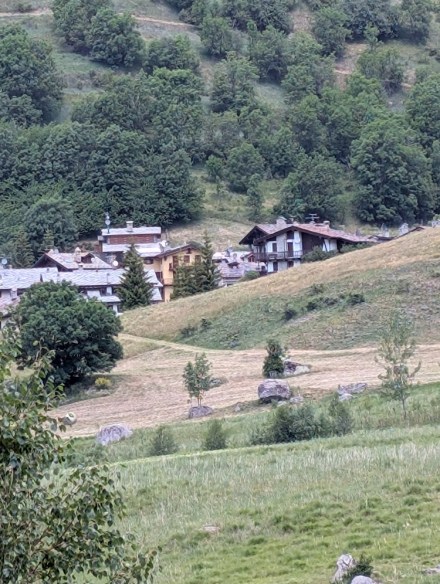
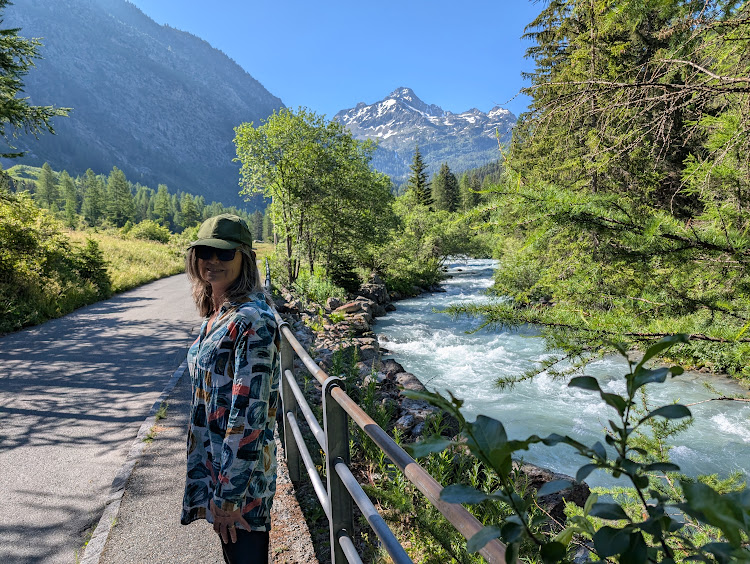
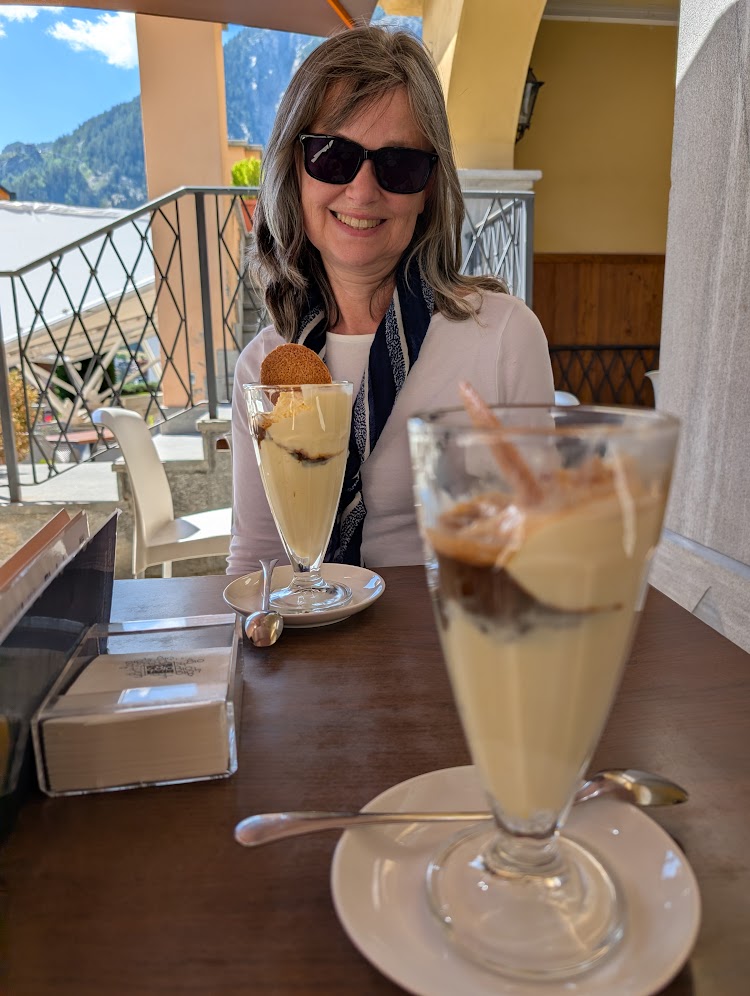
It’s holiday season, so we escaped to Italy for a week. We did very little, so enjoy the photos (but the diary is possibly not worth reading unless you want to see what doing nothing in Italy means!)
A Week in the Italian Alps
Taxi 5:30. Flew BA to Milan from Heathrow. Now, I don’t book the flights, therefore I have no right to criticise. But I would like to say that there are nearer airports, and cheaper flights, and I am not convinced that BA are the best. But that is just my opinion (and mostly I am just grateful that I don’t have to book the flights.
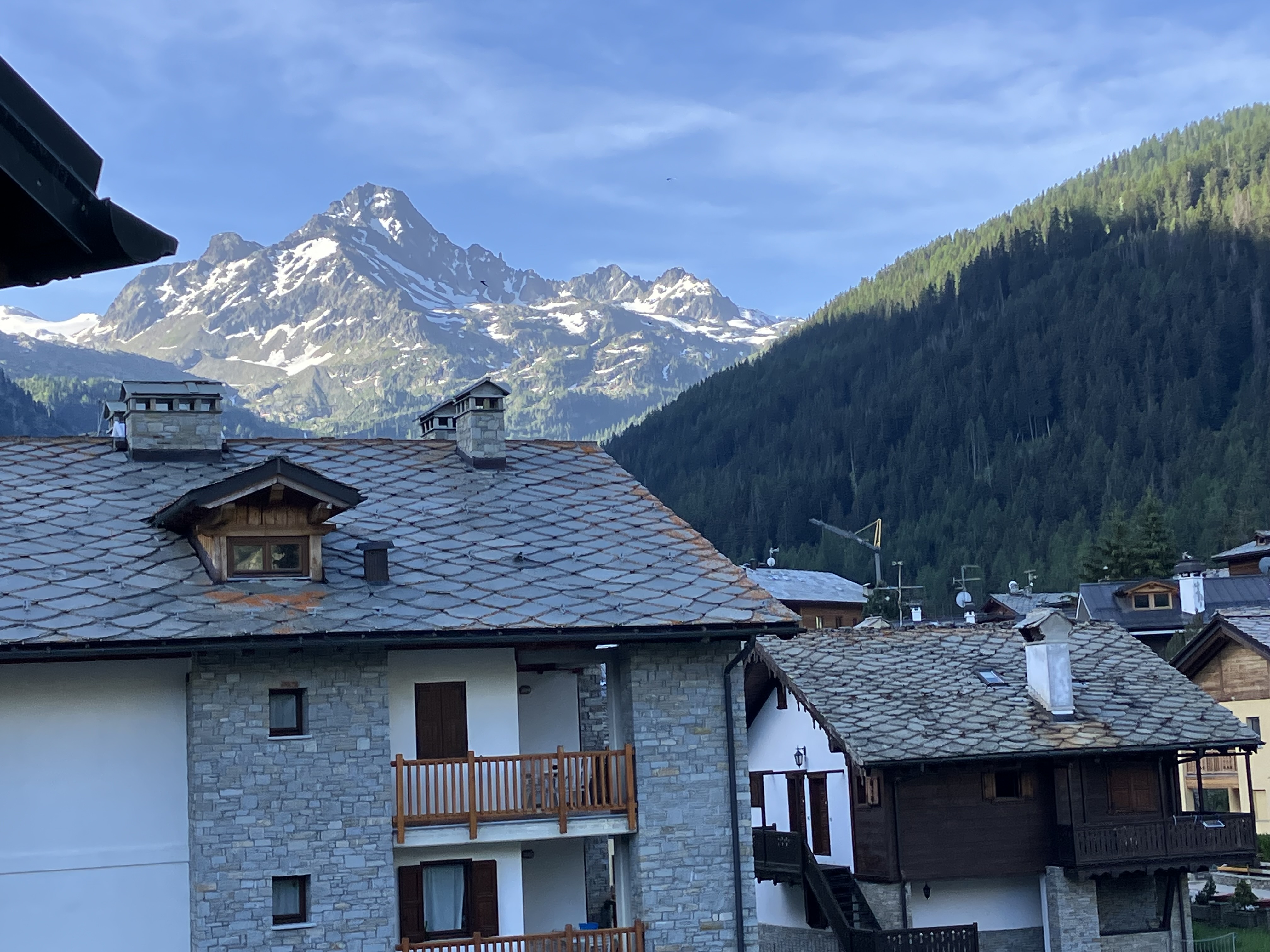
Picked up a Fiat, drove to La Thuile. Apartment opposite Montana Lodge (nice). It overlooks the glacier from the front, and the meadow from the back, so wherever you sit is beautiful.
Dinner in La Grotta, and we had to sit outside, which is not my favourite thing (insects always bite me). Husband had cheesy starter and cheesy main. A LOT of cheese.
Each day began in the same way: I open the shutters and windows, in rushes the crisp cold air, the sound of cow bells from the forest, the smell of pine trees. I make coffee and sit on the balcony reading my little Tanakh. Lovely. Later we have a second coffee and croissant on balcony. No kettle but hob super fast for boiling water. I hadn’t realised the advantage of convection hobs before, they are very space-age.
Our days varied, but we never did very much, we just returned to the places we have enjoyed on previous visits. Walked up to river (the little local shop we used on previous holidays has closed).
I did some washing (yaay). I do like having a washing machine on holiday (this is not sarcasm, I actually do).
Mostly we ate at La Grotta, but it’s closed on Tuesdays–many places were closed on Tuesdays. Actually, most places haven’t even opened for the season yet—coming before July is very quiet, which is mostly good but does limit restaurant choices. We managed to book dinner at Lo Tata. Very lovely. We shared a cheese and meat platter, drank wine and beer. I then couldn’t eat all my spagetti, and received an angry scowl from the owner!
One day we drove to the most beautiful valley in the world. Still beautiful. It was early, so not too hot (excellent) but we got entangled with a herd of cows going to be milked, on a narrow path next to the mountain edge. They were very big (a bit worrying). Made it back unscathed.
It’s hot and cloudy. Thunder is rolling round the mountains and odd spots of rain fall occasionally. Some evenings the storm passed over the valley, which made walking to restaurants rather damp (the day that we had hail, Husband drove, but mostly we walked unless it was too wet).
We returned for dinner in Lo Tatà again. It was busy. They put different parties on shared tables. Boss lady wouldn’t allow Husband to mix meat dish and pasta dish (‘In Italy this is not possible.’) I thought maybe she was joking, both were available on the menu. But no, she refused to serve them at the same time. He switched to a more Italian-acceptable order. Nice food.
Saturday was a sort of nothing day. I started to pack, we strolled around Gollet and found the restaurant (now closed and overgrown) where we enjoyed an unexpected lunch a few years ago. We watched several lorries unload sheep onto the meadow, then different lorries collected most of them. We tried to guess why. (A sale place? Switching to Swiss lorries? A respite break?) They were still there the next day.
There were storms in the evening again, but it was dry enough to walk to La Grotta for dinner. Nice to be back somewhere familiar with no scary Italian women checking our behaviour!
I finished packing, set alarm for 6 am, went to sleep. It has been a lovely week, and now I am ready to go home. I miss my animals and my books, and just being at home with the routine of days. (Sometimes I wonder if I am slightly autistic, I prefer routine.)
Sunday
Husband woke at me at 4am to say BA had cancelled our flight and put us on one Tuesday evening. I was so sleepy, I couldn’t think. There was opportunity to try to get on an earlier flight, but I needed to decide quickly. I was too sleepy. I didn’t have my diary, but thought I could probably stay if I could extend the animal care for an extra couple of days. But I wouldn’t know that until England was awake, which would be too late for quickly booking an earlier flight. Chicken-and-egg situation. And I was SO sleepy. Agreed I would get the allocated flight.
Then it was difficult to get back to sleep. Put a load of dirty clothes in washing machine (not enough socks for the extra days!) Sort of dozed until 7.
We left apartment and drove to Malpensa airport. Three hours, good run. Returned hire car. Then we headed for the terminal, pushing cases that never roll straight, avoiding crowds of other passengers, into the noise of electronic announcments, flashing advertisement boards, flicking flight information. Just being there, bombarded with stale air and too many people makes me feel tense. Then, just as I braced for a difficult route towards the hotel, there it was. Before we even entered the main terminal, there was a sign, and electric doors opened before us, and whoosh, we were in an atmosphere of cool air and calm.
Checked into Sheraton Milan Airport (Husband had booked it as soon as he heard about our flight). It was very easy. I did not know such places existed. I shall seek airport hotels whenever we travel now.
Hotel is nice. Big. Quiet. We have access to the club lounge due to Husband-who-travels gold card. They have nice drinks and snacks. Our room is okay. Weather hot (35°) so we’re staying inside.
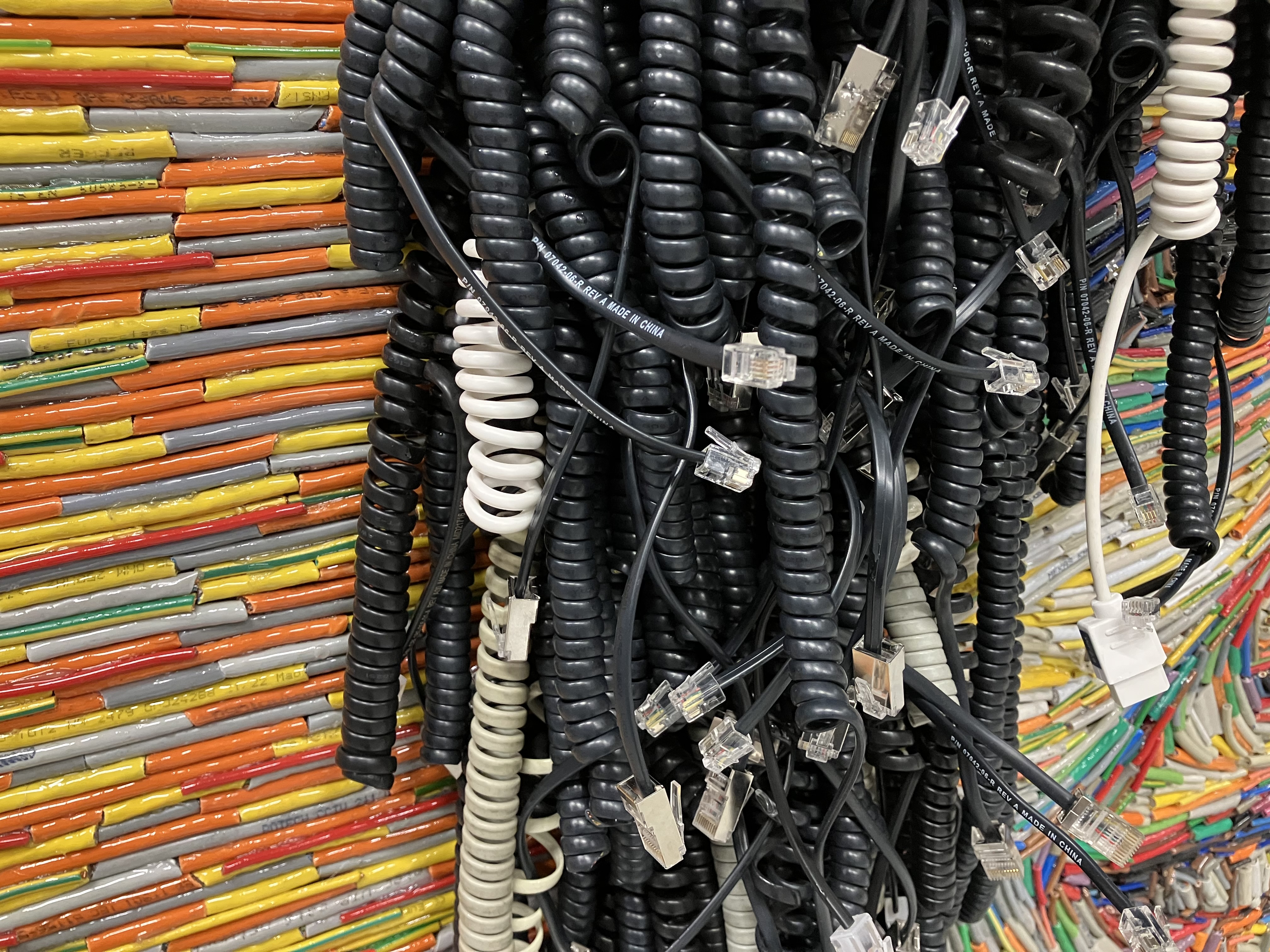
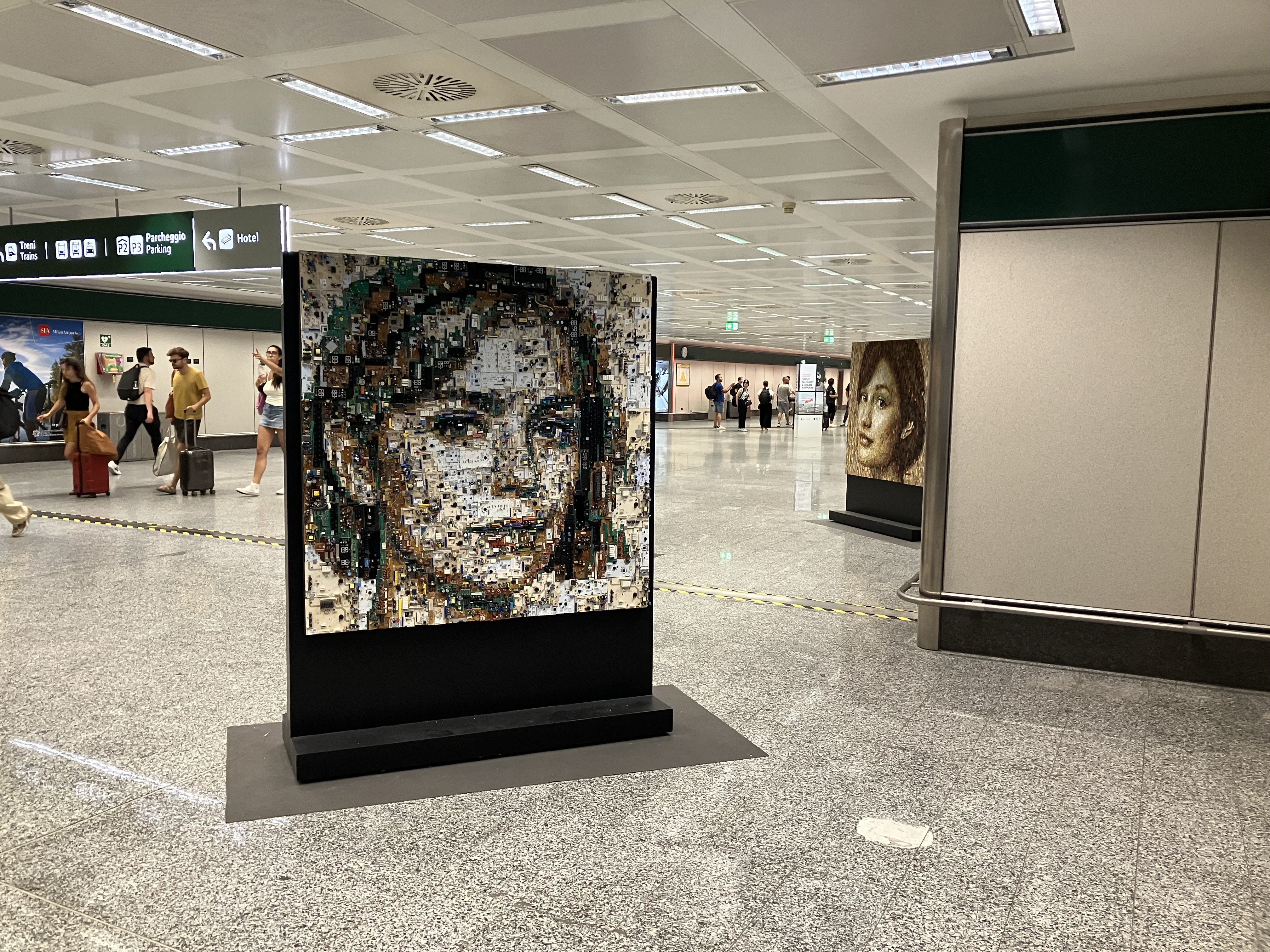
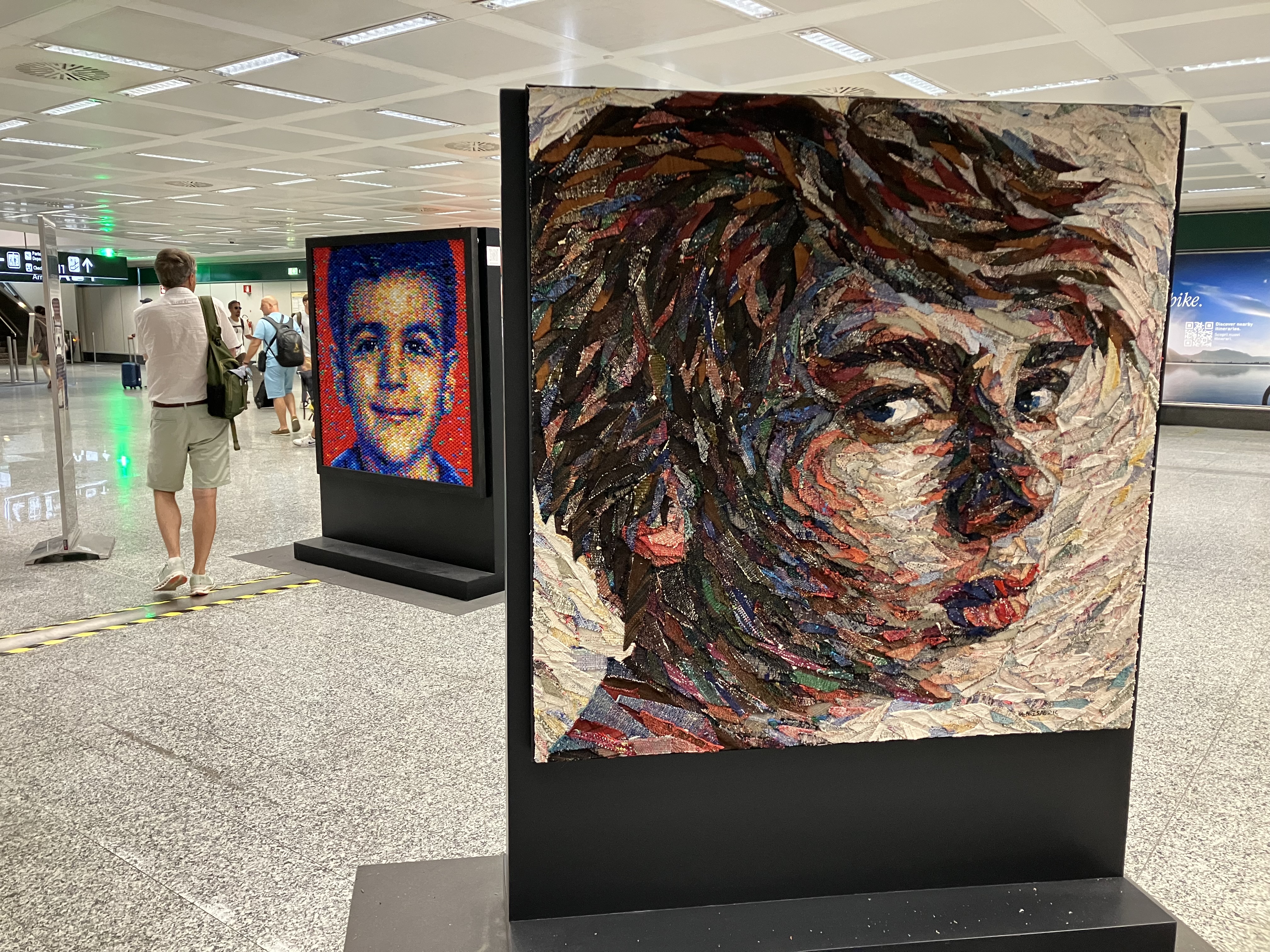
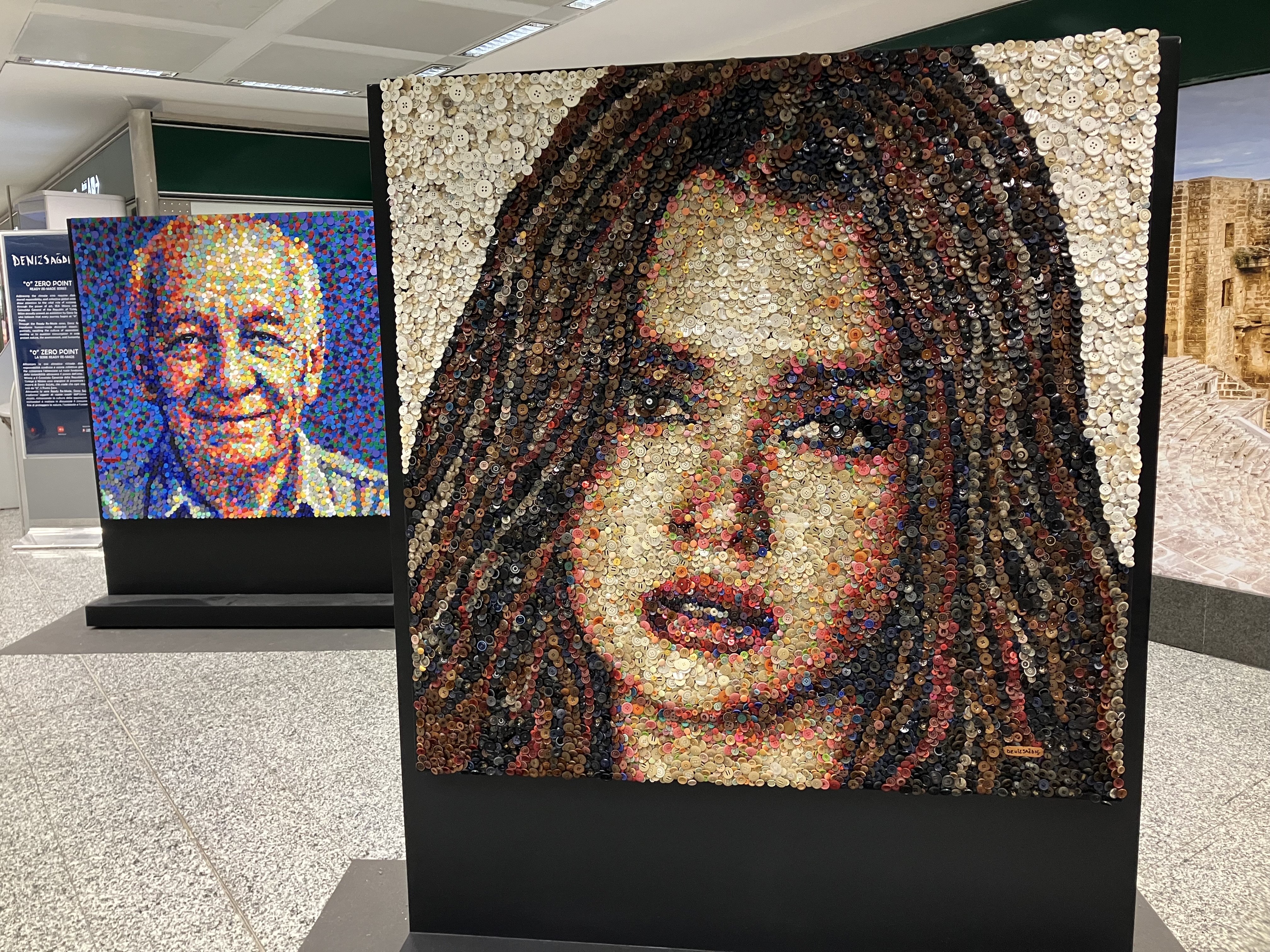
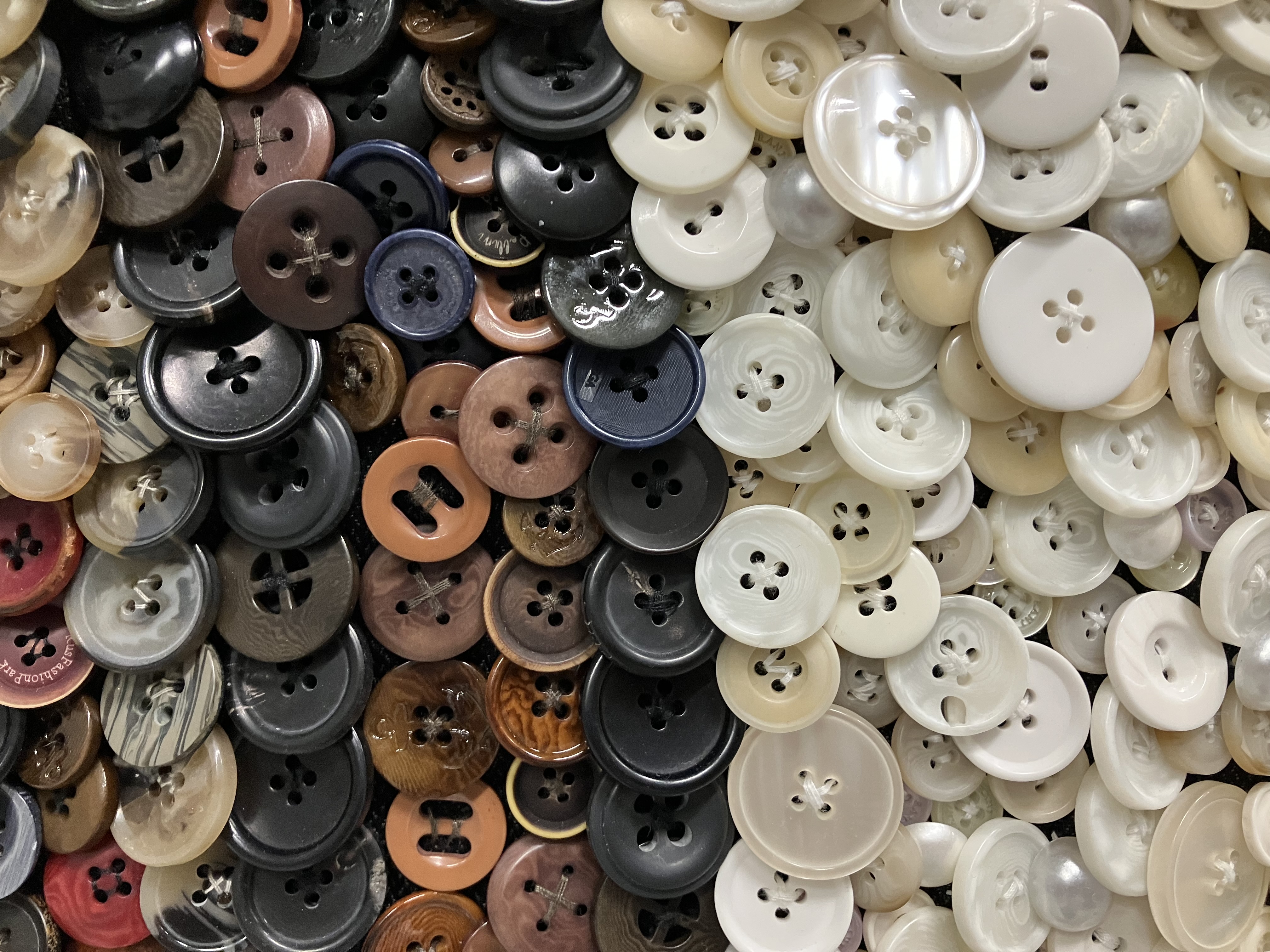
Went for a stroll around airport terminal. Husband ate a Pret. Looked at art in the foyer. This was really good—portraits made from buttons, drink cans, circuit boards. If you zoom in on the photos you will see how clever they are.
Dinner (small one) in the lounge (a bit crowded). It was okay (I wasn’t really very hungry). In room, phoned family.
Monday
I was really tired, so slept well.
We went to the exercise room, 20 minutes on a treadmill. Then breakfast . Fresh orange juice was €8, so we stayed with the free stuff! There was a trolley of take-away fruit, with little paper bags. Very nice touch. I had an apricot (nice).
We both worked in the morning, then went into terminal for Pret sandwich (never nice). Husband had online meetings all afternoon. These are always very loud, and (not unreasonably) he uses the only desk and chair. I was therefore somewhat dislocated. It was too hot for tourism. I went to the executive lounge (free with Husbands card) and tried to work. Tired, so switched to watching Bridgerton on my phone.
Then they brought in some food I had a glass of red wine. I sat there, Hebrew grammar book on the desk, watching Netflix on my phone, nibbling parmesan cheese dipped in honey and sipping red wine. Not too much to complain about. Now have a headache.
We checked in for flight tomorrow. I so want to go home…
Thanks for reading. I hope any unexpected problems that happen this week are easily resolved.
Take care.
Love, Anne x
PS. Things did not go as smoothly as hoped. I will write a post for next week!
I have been reading the news lately with a sense of doom. Yet again, the Prime Minister has been ousted from office—not because they were found to be undertaking criminal activity, nor having an affair (anyone who can’t keep solemn promises to their spouses is unlikely to be trustworthy in power) nor were they found to be abusive in some way. Nope, yet again, a prime minister has been shoved aside because (in my opinion) other politicians (you) think they would like the job. Of course, this is all dressed up in rhetoric about it saving the country, about taking society in a different direction. But really? Do you honestly expect us to believe that the person who a few short months ago was being lauded as the best leader in the country has suddenly had a personality change? Perhaps has been converted to a dodgy ideology? Has been found to be secretly working for the enemy? (I’m not even sure who the enemy is anymore.)
Now, I should admit, I am not political. I have no interest in the political manipulation that is part of running for office. I want to stay at home with my animals and books, with occasional visits with family and friends. I am very happy to stay in my box and let those with ambition run the country. But please, can you get on with it? Can you do the job we voted for you to do and run the country, and not waste all this time and money and energy in looking out for your own career? Because it seem to me, that being a member of Parliament is just shorthand for ‘wants to be prime minister and will be constantly looking for an opportunity to criticise the current one.’
I am not suggesting that our previous leaders (and there have been a lot of them) were perfect. Mistakes were made. However, have our social-media-minds made it impossible to think in the long term? Do we look at ‘now,’ feel dissatisfied, and holler for a change in leadership? How does that allow anyone time to learn the job? How does that allow for long-term policies which might be unpleasant now but will in time improve the country? … improve the country…now that’s a thought!
Do any of you think about that any more? Do you think about how to make this small piece of land a good place to live? Or do you focus only on the popularity polls? Does it matter more that the voters like you, or that what you are doing is good? I understand this is a problem with democracy—that to be voted for you need to be popular, and if not voted for you can do nothing. But surely, this could be a problem limited to the times of a general election? Surely once we have voted for a party, that party might change focus and become engrossed in running the country? Could you, I wonder, forget about your own career for a few years until the next election, and allow the person who we all voted for, to run the country? We might change our minds—we might decide we made a bad choice—but could you, as a member of parliament, please show some loyalty, some stability, and support that person (in public if not in private) until the end of their term?
I find it disappointing when newspapers have phrases like ‘voted for the person most likely to ensure they keep their jobs at the next election.’ Is that truly the situation? Is that honestly why we have seen one leader after the next undermined by their own party (the party that voted them into the position in the first place).
I have a suggestion for you. Look at the policies of the person who you are voting to lead your party, and choose wisely. But then, after the voters have voted them into power, take some responsibility—stick with them, loyally supporting them until the end of their term. Keep your arguments for the private debates, not the newspapers. Even when they make mistakes (could you perhaps try and help them so the mistakes are fewer, or do you gleefully think that if they go down, you’ll go up, so mistakes are great?) Maybe we need to make this law. Maybe we need to say that unless there is a reason (health, criminality, indecency) we are all stuck with our freely-voted-for leader until the end of the term. Maybe that would change your focus, so that running the country is what matters.
So, Dear Member of Parliament, please could you think about it? About running the country, I mean, not enhancing your political career. Could you consider whether you want to SERVE the people who voted for you, and if not, then look for another job?
Hopefully yours,
Anne
P.S. To my foreign readers, who might have read that we didn’t like our leader because he didn’t support a certain war, please be assured that this is not true. I have heard many views from people who disliked our prime minister (although I personally thought he was okay) and not one of them has thought we should have entered a war which we considered to be ilegal. Just to correct the record.
My back muscles gave out this week. It always surprises me how this affects everything (which shouldn’t really because obviously all other limbs hang off the back, so when your back is agony, so is lifting a fork or taking a step). If you’ve never suffered with a bad back, you probably don’t fully appreciate what I’m saying (and everyone who has had a bad back will be nodding along in sympathy!)
It’s very annoying, and very bad timing. I was planting sunflower seeds, and I didn’t feel anything aching, so I guess I wasn’t being particularly protective of my back (which is an on-going weakness). I stood up and ‘click’ something snapped. (Well, it didn’t snap, but it felt like it!) I was at the far side of the field, without a phone, and I wondered how I would get back to the house. Mad Meg was not helpful, rushing round with a log and trying to entice me to throw sticks for her. Nor were the cats, who saw me walking (hobbling) slowly and came to enquire whether I would like to stroke them, rubbing against my legs and jumping on my feet. I made it back to the house and told Husband he would have to sort the geese and cook dinner.
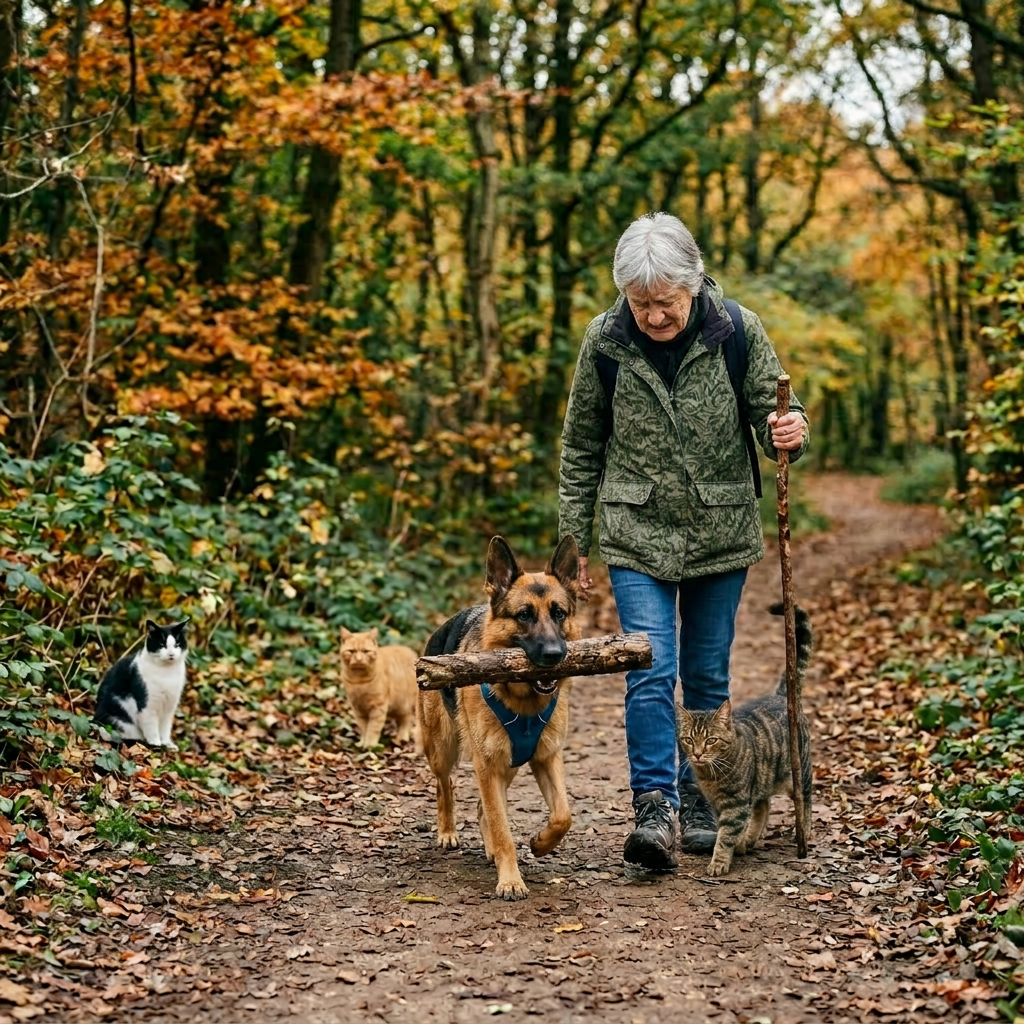
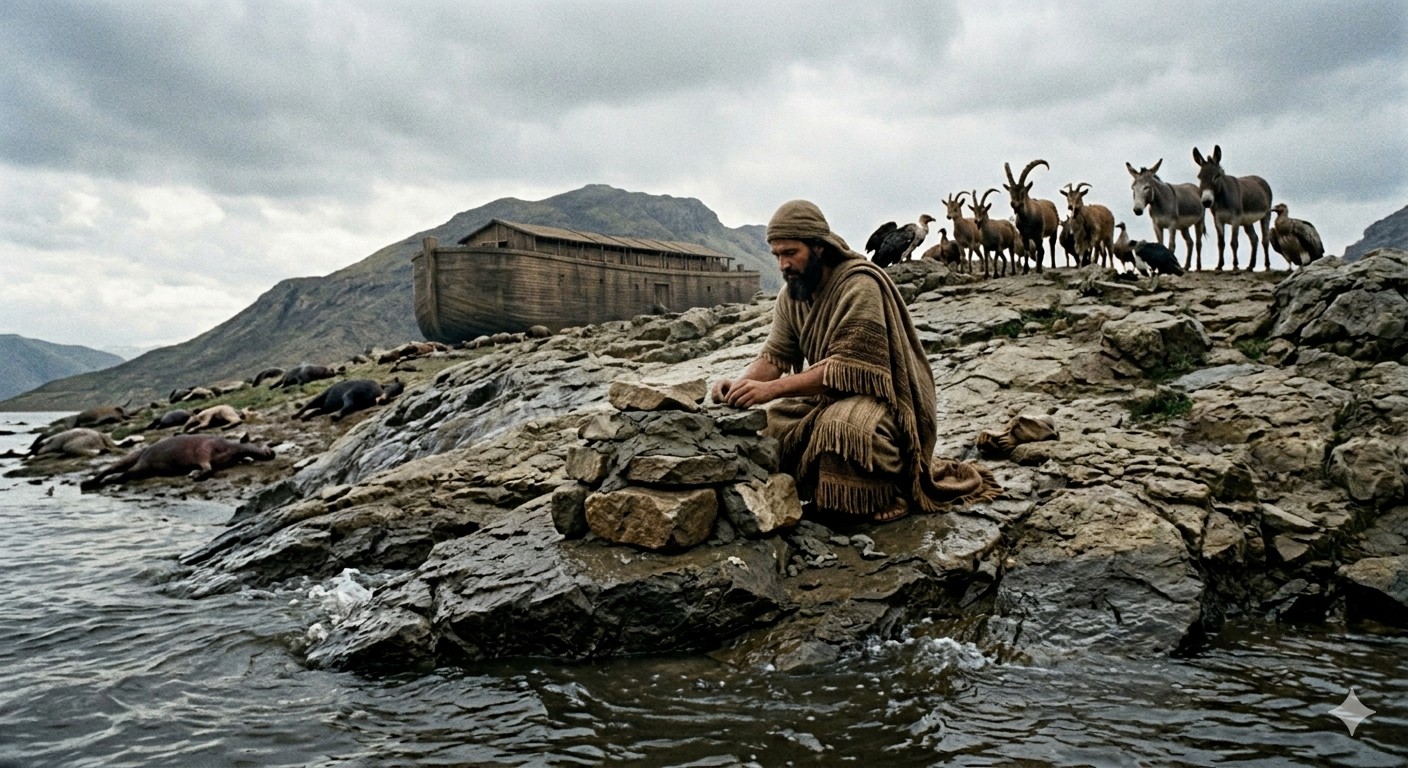
Picture generated with AI. Not quite me!
The timing was terrible—the day before Husband left for Egypt on a work trip. He did offer to stay at home, but his trip looked fun, and I knew I could manage, so I told him to go. I took ibuprofen (marvellous drug) and rested, hoping and praying that it would be better in the morning. It wasn’t. Which meant I had to cancel tea with my daughter-in-law, which has been a treat in the diary I have been looking forward to. Illness is rarely convenient, life is often disappointing.
I am currently managing, whilst being in pain most of the time. I know it will pass, it’s only muscles/ligaments I think, because if I rest and take Nurofen it starts to improve, and when I move (the animals and me still have to eat) then it stiffens up again. I am existing with life at a new level. If I drop something I look at it, lying unhelpfully on the floor, knowing it will stay there for a week. (It’s a little like being 9 months pregnant, when so much of life is beyond reach.) If I put on clothes inside out, they stay that way because it’s too much effort to change them. Drying after a shower takes on a whole new logistical procedure. I can manage slippers and wellies, shoes are beyond me. I found a nice fat stick in the garden, and now use it to walk to feed the animals. I hobble slowly, like an old woman. Meg bounces along next to me. I can’t take her for a walk, but she seems happy enough just following me around, and she sleeps in my room when Husband is away, so she has become my (rather smelly) shadow. Some furniture (the comfortable kind) is no longer possible—I use the upright chairs to avoid getting stuck.
The thing is, when life goes wrong (and in my experience it often does) then we have to cope with bitter disappointment, and then get on with solving the new problem. I appreciate my back in a whole new way, and I realise that in our modern world of pain killers and dishwashers (but only the top shelf—the bottom shelf is too low!) even a bad back is not so bad. I am very grateful this didn’t happen when I was in Edinburgh for my review, or when travelling. This week I can cope. One day, we will all be old, or ill, and have to adjust to a new way of doing things, perhaps wearing inside-out clothes or eating less well because it’s too difficult to cook. That is life. It has some difficult times, and we just have to get on with it. Perhaps illness is a way to practise, so that when we get to that stage in life we know to live in the moment, to focus on the good things, to not let the pain dominate.
I hope you are currently pain free. Thanks for reading. Take care. Love, Anne x
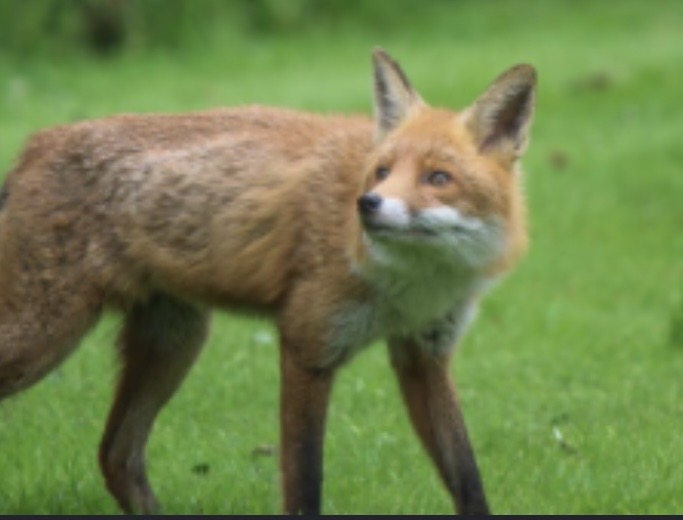
Anyone who keeps poultry tends to dislike foxes. I have nothing against them per se, but they kill my birds so I try to keep them away. It was easier before people started feeding foxes, because they are wild animals and had a natural wariness of people. But now people feed them (I have strong opinions about such people, which I am holding in) the fox has lost all fear of humans. Foxes will positively seek out human houses, looking for food. I have seen foxes walking brazenly across my lawn, right in front of the kitchen window—no fear at all.
Screenshot
The trouble is that foxes do not kill for food, they kill for pleasure (like cats). If they see birds, they will kill all of them not just the ones they want to eat. Killing is sport.
The main way I protect my flocks is locking them in a fox-proof cage as soon as it’s dusk, and having a dog. For all her annoyances, Meg is good at keeping the fox away. I am careful when we’ve been on holiday, because the fox quickly learns that the dog is away, and our garden becomes part of fox-territory. I always keep the birds locked inside for a few days, until the fox has learnt there is a mad dog who loves to chase things in the garden.
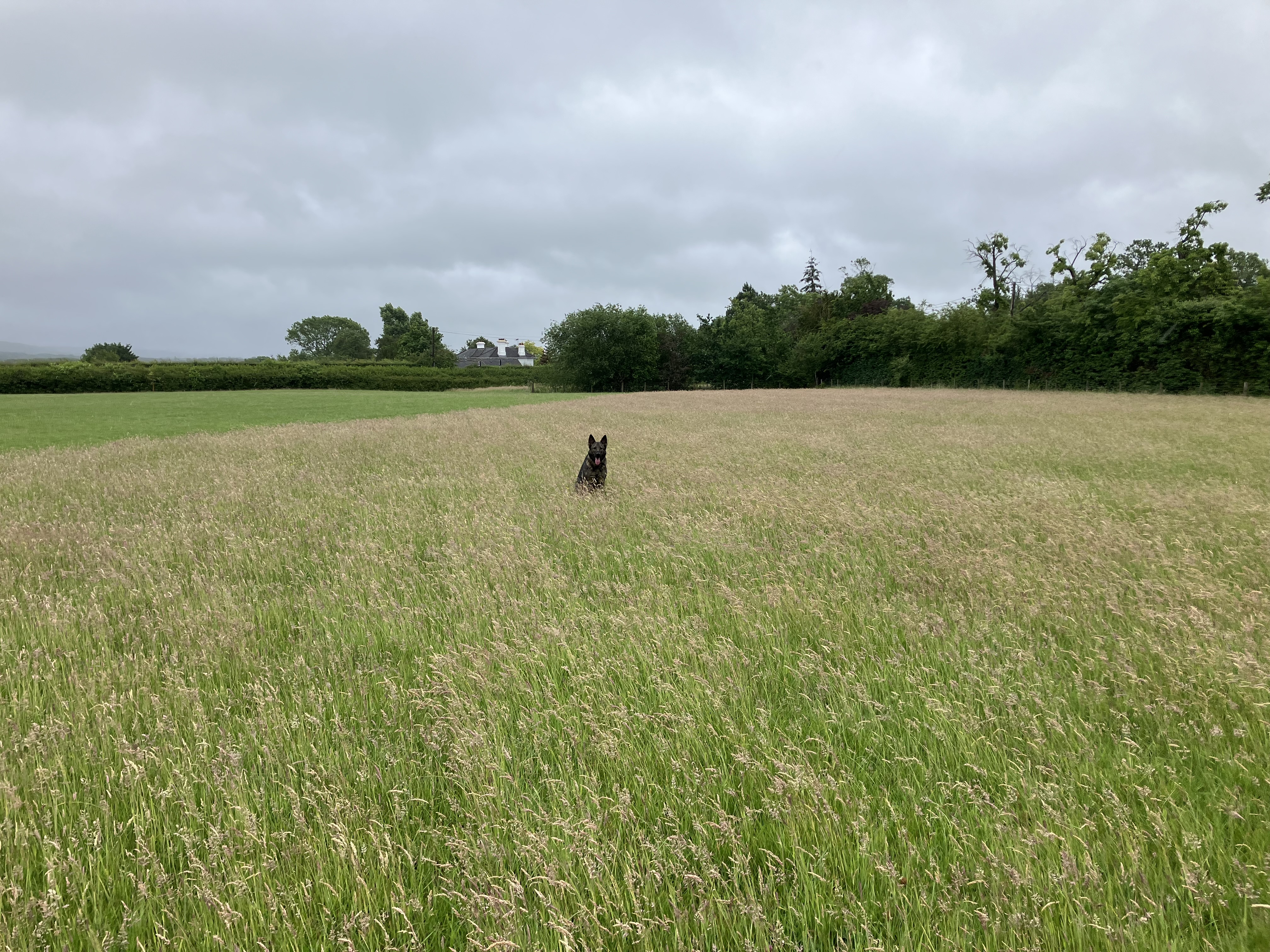
My new problem is that the geese are now in the field next to the garden—which is a bigger area for the dog to patrol. She goes in there a couple of times a day, and I hope that the scent of her will be a deterrent, but I still worry. Most foxes would probably not bother geese and cockerels—much too much bother, because they are big and noisy and fight back. But a big male fox, or a fox with cubs, would kill them in a flash.
Apparently foxes dislike the buzz of an electric fence, so that is one (expensive) possibility to consider for the future. I did once buy a battery-operated deterrent which claimed to make a noise that foxes would hate. I put in the battery and switched it on—no sound at all. Then all my children (who were teenagers at the time) arrived in the kitchen to ask what the horrible noise was! It clearly worked (on teenagers, if not foxes). I will try to find something similar.
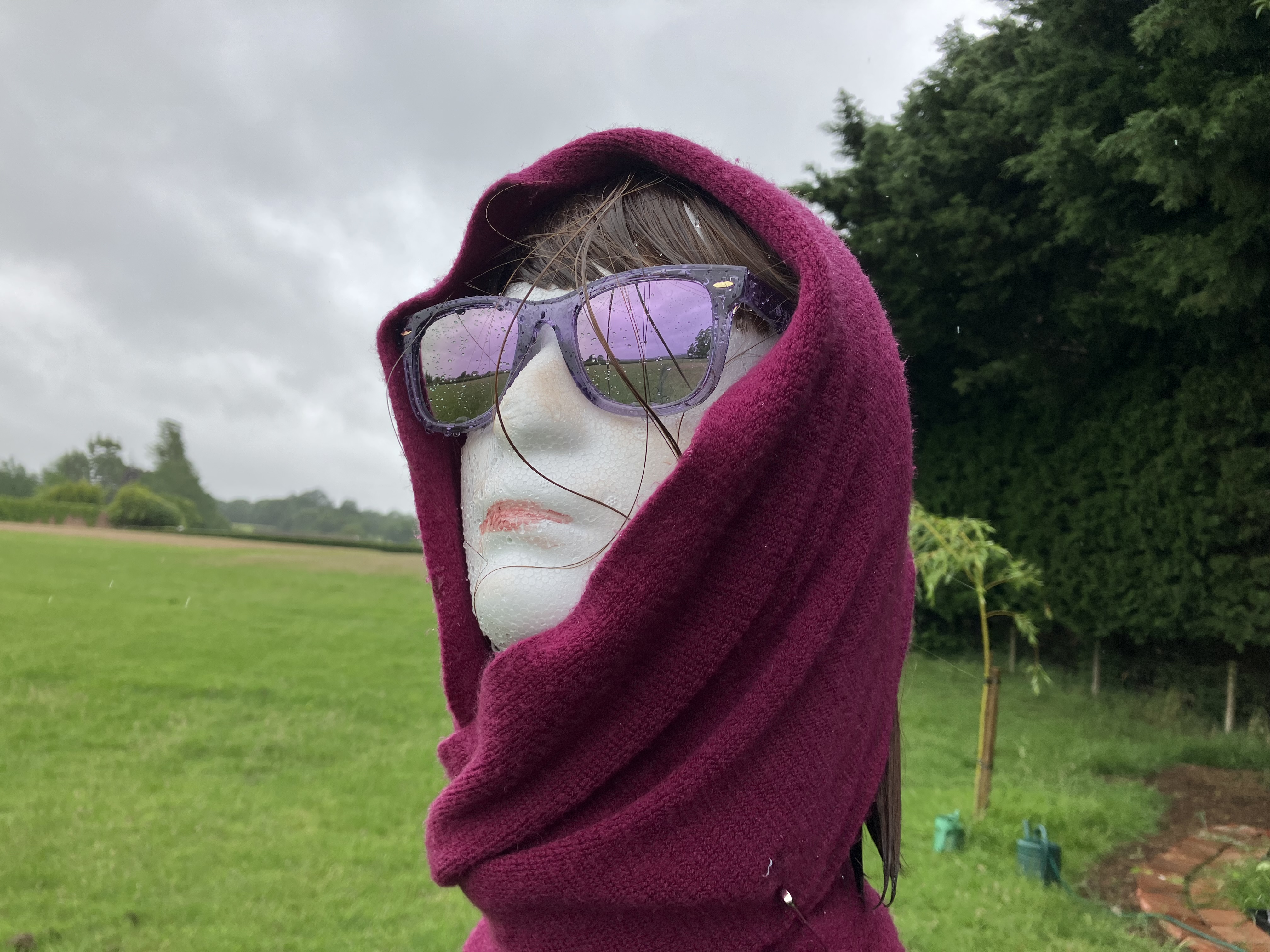
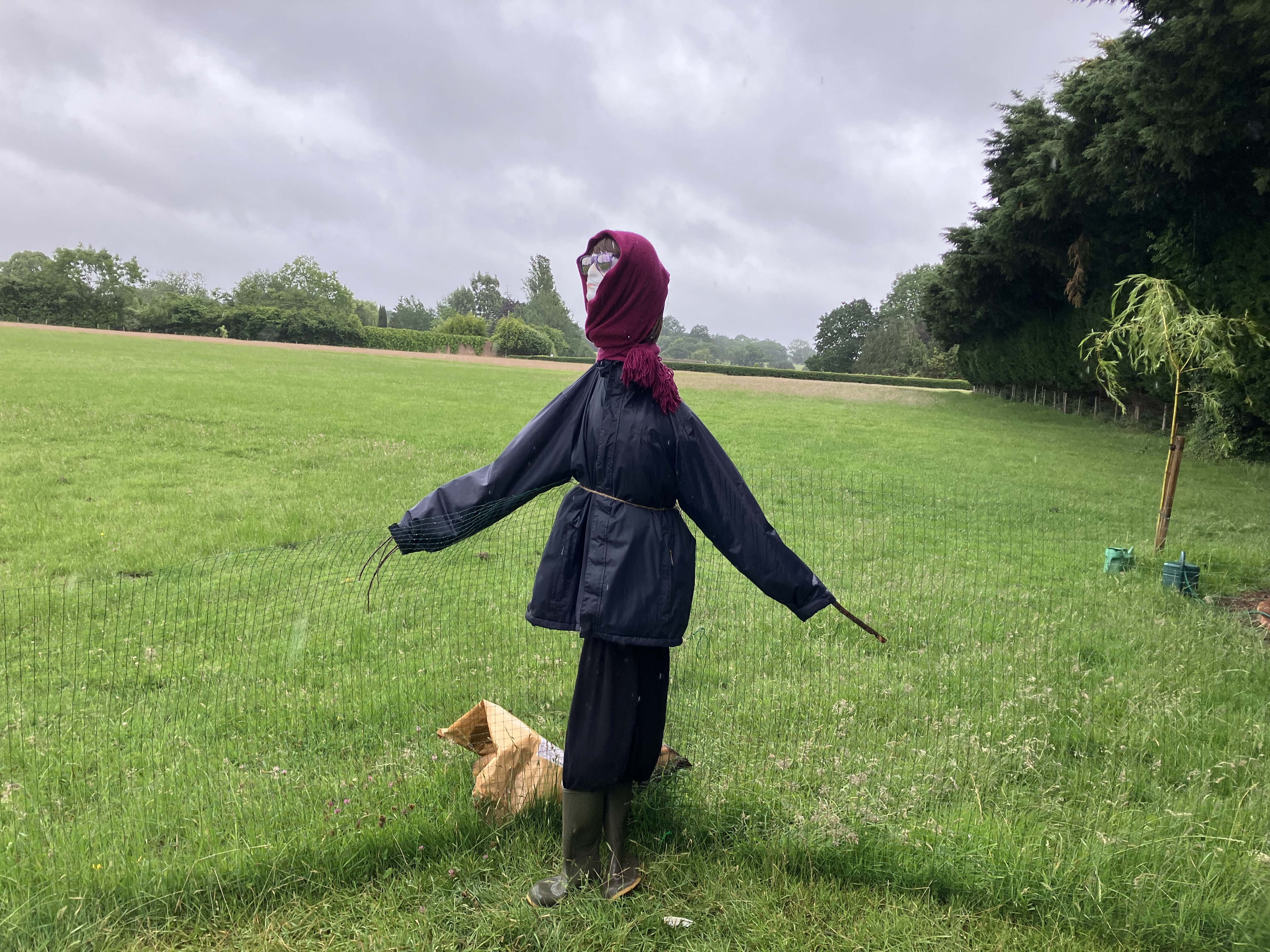
I also thought that maybe, if I made a model of a person, the fox would see a human, and decide to go elsewhere. Afterall, farmers have used scarecrows for centuries. I have no idea whether they actually work, but I have plenty of old clothes, I thought I would try. When we were children we made guys to burn, stuffing old clothes with newspapers (this is a tradition which is impossible to explain to Americans without sounding like we’re very weird). However, I wanted something a little more weather-proof. I looked online for a manikin. They were all over £100, which is more than I wanted to spend (because it might not work). Then I thought maybe an inflatable one would work. I can tell you, looking online for an inflatable manikin shows some seriously dodgy sites! However, Amazon sells some, for using as Halloween decorations. I bought a cheap one. I also bought a Styrofoam head, a wig, some reflective sunglasses—all very cheap, but quite good when put together. I now have a tall thin person guarding my field. Not very realistic if one looks properly—I’m hoping a fox will not pay too much attention but will see it and move on. Perhaps I should spray it with perfume occasionally. Certainly the geese were interested, and all came to chat to the strange person standing in their field. I will let you know how things develop.
When I was teaching, there was a child (who we will call Christopher) who I struggled to teach to read. At the time the school was using an exciting new reading scheme with the characters Biff and Chip and Kipper. It was great fun, especially as the author had included some humour in the pictures for the teacher to smile at as the child read. However, Christopher did not learn the names of the characters, nor any other words.
I therefore searched the shelves for a different reading scheme. I found an old book. Every page had a picture of a house, and the word house written at the bottom. I gave it to Christopher, we chatted about the picture, he read the word ‘house’ and turned the page. We chatted about the picture, he read the word ‘house,’ we turned the page. We chatted about the picture, he read the word ‘h, h, …castle?’ We stopped. I searched the cupboards for something different. Eventually I found an ancient reading scheme, which relied heavily on phonics (at the time—mid-80’s—this was considered detrimental to learning to read unless introduced in the correct way). The pictures and content were completely out of date (the boys flew kites, the girls played with dolls and helped mummy, everyone was white middleclass). But it worked. Something about the books clicked with Christopher, he learnt to read.
I am feeling a little like Christopher this week. After my first year review (see last week’s blog) I decided to allow myself a week off. A week reading for fun, watching Netflix, eating cakes, walking the dog. I have two books to read—one is a novel (a gift from my brother)—the other is a classical Hebrew grammar book. (I fear that reading a grammar book for fun might meet the definition of nerd.) Now, I have been learning Hebrew for several years, but there is something which simply does not ‘stick.’ I understand the basics, and know quite a lot of vocabulary, but some of the grammar I struggle to remember. There seem to be a lot of rules which simply need to be memorised—and my memory for abstract ideas is rubbish.
I have read a few different grammar books—Ross, Lambden, Kelley. They all remind me of when I was at school and struggling with maths and physics—lots of disjointed rules to memorise, none of which I understood. However, this book (recommended by another student) seems to finally make things clear. It’s by J. Weingreen and was first published in 1939. I found a second-hand copy online. There is something about how it is written that makes sense, it appeals to how my brain works. Perhaps because it gives the Hebrew of the grammatical terms.
For example, I have learnt in the past about the rules of ‘dagesh’ (a dot) but reading it as דָּגֵשׁ which means ‘piercing’ for some reason makes sense to me; understanding that it changes the sound of certain letters (בגדכפת) if they appear first in a syllable and not after a vowel, for some reason is easy to remember. I don’t know why. Or, that the definite article (the) was originally הַל (like the Arabic ‘al’) and when it was added to a word, they dropped the ל and added a dagesh to the next letter, so it is doubled. (This doubling a letter to mark a ‘dropped’ letter also appears in English (from Latin): We took the negative ‘in’ then dropped the ‘n’ and doubled the next letter in illegal (not ‘inlegal) and immune (not ‘inmune’). These explanations make sense to me; I remember them.
We all learn differently. I am a great believer in the idea (which I think Piaget stated) that nothing is intrinsically difficult. Everything can be learnt, but we have to approach it in the right way, we have to find the steps that we find easy to follow, and eventually we will get there. Sometimes approaching something from a new angle makes all the difference.
I hope you have a great week, and that you find a way to understand the things you find difficult. I do think learning is fun, wherever we are in the process. Thanks for reading. Take care. Love, Anne x
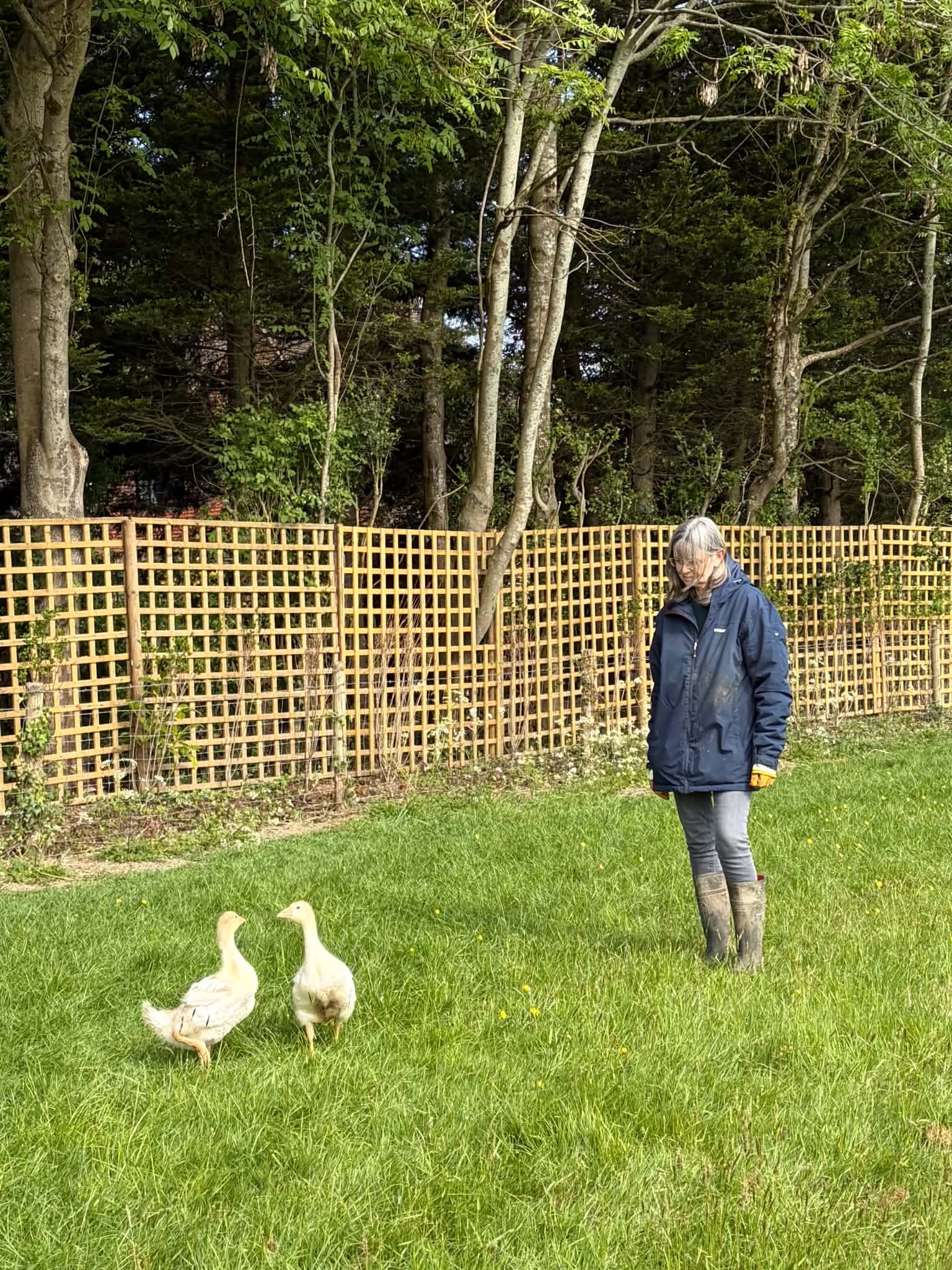
The baby goslings grew like dinosaurs and are now happily living outside. I think one is a gander, so hoping for more fertile eggs in January.
Hello, and how are you? This post nearly didn’t get written–it has been a hectic week. Please forgive any typos, I am writing in a rush before Monday has gone, and my regular Monday blog doesn’t appear (for the first time since 2015, I believe). Usually I am very organised, and if I’m going away or have a busy time ahead, I post things in advance. But not this time. This time I was much too busy preparing for my First Year Review.
For those who don’t know, I’m currently doing my PhD research, part time, at Edinburgh Uni. Every year, I have a review, to check I’m on track and to prepare me for the final Viva (a spoken examination). However, before you are considered a fully-fledged PhD researcher, you have to pass the First Year Review (which for me, as a part-timer, is after 2 years of study). This is a big deal. I have loved researching, and am learning lots of fascinating things. But if you don’t pass the review, the university recommends that you leave. I was very keen to not be thrown out, but I also was far from confident that I could pass. Most of my interactions with other students reinforces my feeling that actually, everyone else is much more clever than me, with a much deeper knowledge base. I feel very new to all this (even though I am older than most of the staff). I was very anxious about it.
The review begins weeks in advance, when I submit a writing sample and an updated proposal. (A proposal is the document which explains what you plan to research, and how you plan to do it.) I wrote a proposal as part of my initial application to the university, but they often change once the research begins (mine has changed almost entirely). There was also a long form to complete, showing what I have done in the last year, what skills I have developed. It all took a long time to complete, and edit, and rewrite. It was a lovely feeling when it was all submitted.
I then began to prepare for the review. My supervisor suggested some aspects of my research which might receive questions, so I read around these areas, trying to formulate arguments to justify my approach. (A supervisor is a member of staff who works alongside you, giving feedback and making helpful suggestions–it’s usual to meet with them every few months.) I knew I would need to justify how my research will be used when it’s complete, and why I have chosen to work with the ‘final’ Hebrew texts (because many scholars consider the ‘most original’ text is the best, and the ‘final form’ was written fairly late — and actually ‘final form’ means different things to different people, so there is not really a single ‘final’ form). I also found work written by the people who would be assessing me, so I could understand their own positions on things.
The day arrived. I was terrified. I wore a trouser suit (hoped to look like I had tried). Unfortunately I have gained weight since I last wore it, so it was uncomfortable and I bulged in the wrong places. I walked to the university, allowing plenty of time to find the room, go to the washroom, comb my hair (which was lucky, because the room changed, and New College is beautiful but like a rabbit warren). I was allocated to a tower room. I walked past lots of tourists taking photos (later they will wonder who the woman in their photos with unfortunate bulges was). I stood outside a large door (like a church door) wondering whether to wait or knock. I waited until exactly 10 am, knocked. A voice called me in. It began.
Mostly it was okay, but difficult. The room was hot, so I removed my jacket. A panel of 3 people asked various questions. Nothing was unexpected; I was glad I had done my homework. It wasn’t a smiley interview, but neither was it too horrible, and once I began talking I forgot about being anxious and submerged into the excitement of what I am studying. I love talking about all the amazing things I am discovering, and I had 3 people trapped for an hour, who could not escape while I bubbled enthusiastically about what I am doing. (They looked a lot less bored than most people who I try to tell! Although they did interrupt a few times to ask questions; especially when I got a bit distracted and started to tell them about something which is really interesting but not connected to what they were asking about.)
Then it was done. I left. Felt exhausted.
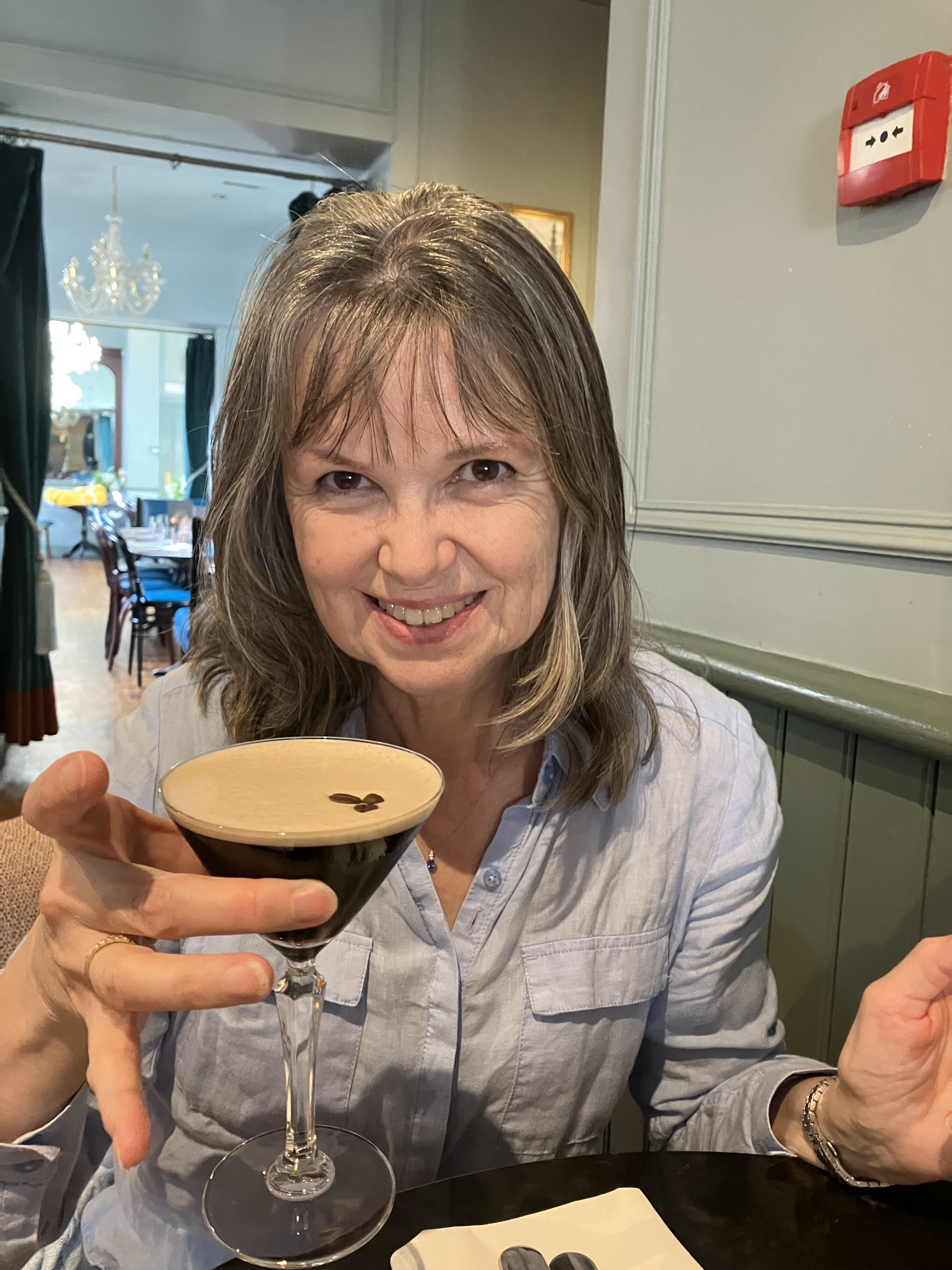
Recovering with Husband and an espresso martini.
The university send the result within 24 hours, which is nice. I had passed. Marvellous. I could now enjoy the rest of the week with my cohorts, chatting, sharing papers, attending seminars. It was a good week, but completely exhausting. On Friday I gave a paper. (This means you have a strict time slot to read a document about an aspect of your research to a room of scholars, who then ask lots of questions.) I have never presented a paper before, but I found the process very helpful–it made me write differently. I also made a Power-point of visuals, and used AI to produce a couple of pictures, which was great fun (and much easier than expected).
I am now home. I plan to have a week of nothing, reading novels and watching Netflix and walking the dog. Next week I shall start work again. I love studying, and it’s lovely to know that I now have 4 years to complete my work. I will have annual reviews, but they are more for me, to prepare me for the Viva–the university won’t throw me out now. I am officially a research student, albeit an old one. Great fun.
I hope you have some fun too this week. Thank you for reading. Take care. Love, Anne x
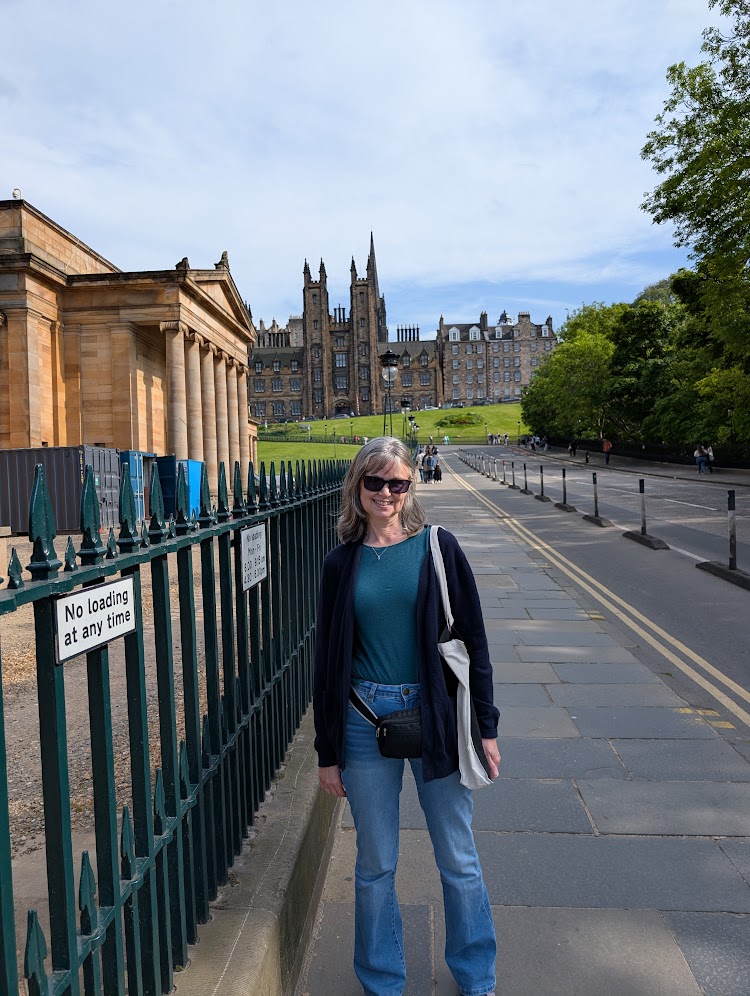
Feeling happy with beautiful New College, Edinburgh University, in the background.
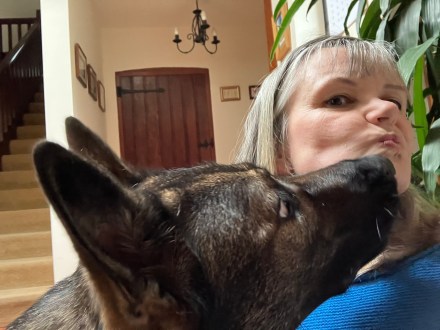
Meg is extremely unhappy. On Saturday she went in the garden with Husband. When Husband is in the garden, it is often to destroy something—take down a dead tree, pull up ivy, dig up an old root. Meg seems to have noticed, and joins in with enthusiasm—which means that if she goes into the garden with Husband she is also destructive (but not in a good way). He blames the personality of the dog (but I don’t tend to have this trouble when I am in the garden with her—just saying).
Anyway, on Saturday they both disappeared into the garden (one on a mission to destroy) and I started to vacuum (not my favourite thing). In a very short while, they both came back, Husband saying that destructor-dog had hurt herself during a frenzy of destroying old logs. He wasn’t exactly sure what had happened, but as she blasted her way through a bush she yelped, hopped, charged across the lawn and through another bush, yelped again. She was now limping and licking her front paw.
I checked, but couldn’t see any sign of thorns or tears. I thought she may have caught her ‘dew claw’ on something. (These are the doggy equivalent of thumb nails, and some people remove them because they often catch on things and cause trouble.) Saturday evening passed peacefully enough. Meg licked her paw occasionally, but nothing troublesome, and when we went in the field she forgot about it and walked quite happily and then let me hose it, so I thought all was fine. Probably just a thorn which was now gone, or caught her nail, something minor.
Sunday morning, Meg got out of her bed, and her back legs were weird and she was limping. This was a shock. I am very worried about her back hips, because she has always sat ‘wonky’ so I worry they are not properly aligned or something—but she walks/runs/charges without problem, so I have always reassured myself. Now I was worried—had my fears come true?
However, it soon became apparent that it was not her hips but a back foot that was causing her problems. She wouldn’t put it down, and kept licking it. The licking turned to more persistent bothering, and she made it bleed. Which meant we had to resort to a collar—you know, one of those big plastic cones that fit around a dog’s head and make it impossible for them to lick their limbs. We had an old one from when Kia was alive, and we fitted it onto Meg. She was terrified.
Meg sat, shaking, refusing to move. I tried to reassure her, stroking her, talking calmly, being close. Meg bashed her way into her bed (she couldn’t account for her extra width) and did not move all day. She would not eat, nor drink, nor be tempted from her bed. It was very sad. I worried she would dehydrate, so resorted to squirting water into her mouth with a dosing syringe. I was pretty sure there was nothing urgent wrong, nothing deemed worthy of a trip to the animal hospital (why do animals always hurt themselves at weekends when the vet is closed?). We decided to wait until today, and book an appointment with her vet.
Gradually, Meg began to get used to the collar. After about 12 hours, she left her bed and walked around, bashing into things. Her solution to the difficulty of not-fitting through gaps due to her expanded width was to try and force her way through things, and she was very difficult to guide/help. But she did go outside to toilet, and she did drink. No food though, not even when I tried to handfeed her.
We are just home from the vet. Meg was clearly in a lot of pain, and actually snarled/growled when she was examined (which is the first time she has ever done that). Her temperature was 42 (should be 38) so there is some kind of infection. She did not keep still (this is an understatement—think ‘trying to contain a hurricane’ and you will get the picture). The vet sent us away with antibiotics and anti-inflammatories and told us to return in a couple of days if no improvement. (Their Xray machine is being fixed, but will be ready on Wednesday. Plus I think he needed recovery time after trying to examine Meg.) He said it might be a broken toe, or a thorn—either way the treatment is the same. If no better on Wednesday they will sedate her (never good, because there are always risks) and do a proper examination. Poor Meg.
I fed her a piece of cheese with her pill. She very quickly managed to separate the two and spit the pill sideways out of her mouth, into the cat bowl. (I think this was a fluke!) I then gave her just the pill (she is very good about me putting things into her mouth) and waited until it was gone.
I took her into the garden and she spent a long time attempting to pick up a log while wearing the plastic cone. We have bought a replacement cone, because I don’t think the current one will survive until Wednesday. Nor, I fear, will the door frames which get thoroughly bashed. I am hoping she gets the hang of her increased width soon.
21/1/2026
Meg is still not used to the added width of the cone (which she is wearing to stop her licking damaged foot). She simply rams it with increasing force at whatever object stands in her way. The cone has a huge crack in it—I doubt it will last more than one more day. Luckily, her foot is healing well. She went back to the vet, who said it was extremely unlikely that anything is broken. She has to continue with her meds (penicillin and anti-inflammatory) but she seems to be doing well. It certainly has not slowed her down, not now she is used to the scary cone (which made her petrified for 12 hours).
25/1/2026
The cone has gone. At least, during the day Meg no longer wears it. This is at partly due to the fact that I could not cope with the pain of it crashing into my legs whenever Meg was trying to force her way past me, or round me, or through me. The hard plastic cone would dig into my leg, causing bruises and pain. Therefore, I made the executive decision that during the day, Meg’s foot is well enough to risk occasional licks. We put the cone back on last night, because I worried the foot might get chewed during the night when no one was watching, but first bash at 7 a.m. this morning, it was removed again. It is entirely possible that Meg realises this and is bashing me on purpose—if so, she has won. Such is life with a GSD.
It is rather wonderful to be able to walk her freely again. I have taken her to the woods a few times, and it brightens my day to watch her bounding through the trees, stick (log) in mouth, tail wagging. Her whole body shows her delight, and it’s contagious, I cannot watch her happiness and not feel the joy myself. Maybe this is why God invented dogs, they teach us what joy is. (And resilience!)