Talking to the Homeless Man


Hello and how was your week? In college, we have been looking at Liberation Theology in Hermeneutics. Don’t stop reading! These are fancy names for simple ideas—as most jargon turns out to be. Hermeneutics simply means looking at how different groups interpret the Bible—what is their bias when they read? (We all have a bias, even if we aren’t aware of it.) And what are they looking for when they read, what sort of things do they emphasize?

Before the lecture, we were given a task: Speak to a homeless person. I thought this might be too difficult, as there are not generally homeless people begging where I live, but I was wrong. When I went to the dentist, there was a man begging next to Morrison’s. He had a sign: ‘I am hungry. God bless you.’ As a marketing device, I thought it was rather effective—nothing confrontational, stated the need, offered a reward. I decided that after the dentist, I would pop into Boots and buy something for lunch, then chat to him. I felt quite holy about this, feeding the hungry is something the Bible talks about lots. It did, of course, go wrong, because I am not as holy as I like to think. But first, I will tell you about Liberation Theology.

Liberation Theology started in South America in the 70’s (I think—possibly earlier, but that seems to be when the loudest voices appeared.) It looks at what the Bible says about inequality, and poverty, and people who are oppressed, and it encourages people to fight this. It teaches that everyone is equal, and God has a special love for the poor, and poor people often have a clearer view of who God is. Therefore, the rich should give financially to help the poor, and they should also listen to them and learn from them. It is not the benevolence of the greater person giving to the lesser, but rather a fair sharing of resources, and those with less having a voice, and teaching ‘life lessons’ to the rich.

In many ways, I agree with the teaching. However, there is also a Marxist element, a stirring up of trouble, encouraging people to protest, which I don’t see in the Bible. It creates ‘an other,’ a group of people who are ‘different’ and who therefore can be hated, and I think that is dangerous. That’s what the Nazis did with the Jews. Encouraging poor people to blame ‘the rich’ is not okay. I think the Bible should be applied to ourselves. So yes, if we are wealthy we should seek to balance resources (and everyone living in England is wealthy, when compared to those people in the world who have literally nothing—no furniture, home, food). We should be sharing what we have—it doesn’t belong to us, it comes from God and we should be using it wisely. However, the poor should apply the Bible to themselves too. They should be seeking to change, to become who God wants, too—not reading it to apply it to others. The Bible is meant to change us, not give us a stick to bash-up others.

But back to my homeless man. I went to Boots, and chose some food. Not easy, as I didn’t know his religion, and whether he would eat meat, and the only vegetarian sandwiches looked horrible. I bought some sandwiches, and some juice, and some water. Then I had the not-so-clever idea of buying some vitamin pills, thinking that I was only helping for a single meal, but with vitamins his health would improve for the next month. Stupid idea.

I returned to the man, gave him the food, and asked where he was from. Then I tried to explain that the vitamins should only be eaten one per day, and they would be dangerous if more than one was taken each day. I worried that he might not understand this complicated English, so I tried miming, and was feeling very stressed as I repeated, several times, that more than one was dangerous, only eat one a day. I realised I was basically telling him off, and he was looking rather worried by this ranting woman. I wondered whether I should remove the pills, but thought that might turn into a scuffle, given how badly this was going. So I left.

I realised, walking away, that I had not even asked his name. I certainly hadn’t listened to him, or shown him any real respect; I had simply tried to enforce what I thought was good for him, and I had done it badly. This I suspect, is often the problem with trying to help—it becomes interfering, or is not done wisely. This is why I prefer to give to a professional organisation, rather than an individual. I trust Tearfund to feed the poor on my behalf, and not to end up shouting about vitamins being dangerous!

I hope you do better today than me, and may you be spared encounters with stressed middle-aged women! Take care. Thanks for reading.
Love, Anne x

Blessed


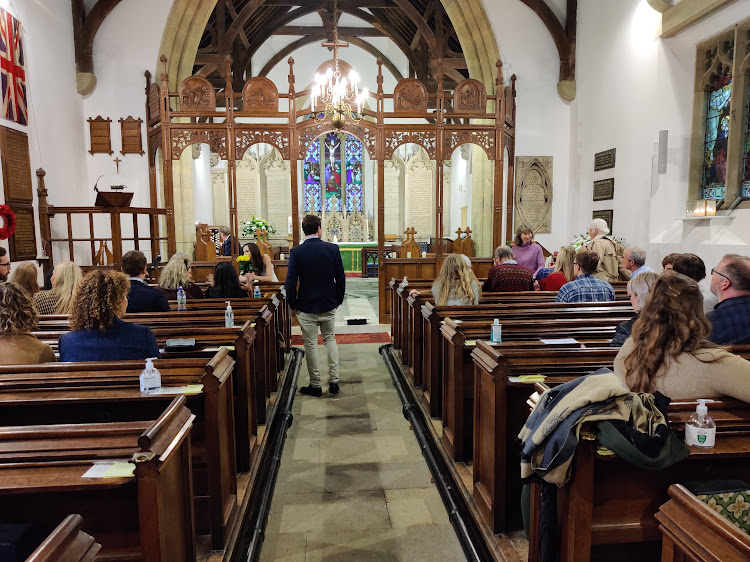
Last week was the wedding blessing. If you follow my blog, you will know that my daughter was married in Scotland a few weeks ago—an incredibly happy day with lots of colour and loud voices and large men in kilts. It was a celebration, and it was marvellous. However, being married is something serious, and when I heard they also wanted to have a service of blessing, in our local church, I was delighted.

The plan was to have a short service, very low-key, attended by just close friends and family. We don’t currently have a vicar at our church, but the previous vicar—who my daughter and her husband have met and liked—kindly agreed to lead the service. I have never attended a wedding blessing before, and I wasn’t sure what to expect. But the vicar met the couple a few times, and talked about what they could do, and advised them on what was appropriate, and together they made a plan for a short service.

I spent the day before cleaning (not easy, as I will explain in another blog) and decorating the house with bunting and bows. I found some strings of flowers on Amazon, and hung them around the front door. My sons arrived, so there were beds to make, and meals to prepare, and time was too short but we got there eventually.

On the afternoon, we all dressed in nice clothes (dressed as if going to a nice restaurant—as instructed by my daughter) and set off in various cars. There was then a brief moment of confusion, as one of my sons realised he didn’t actually know which church he was driving to (!) but we all arrived in time.

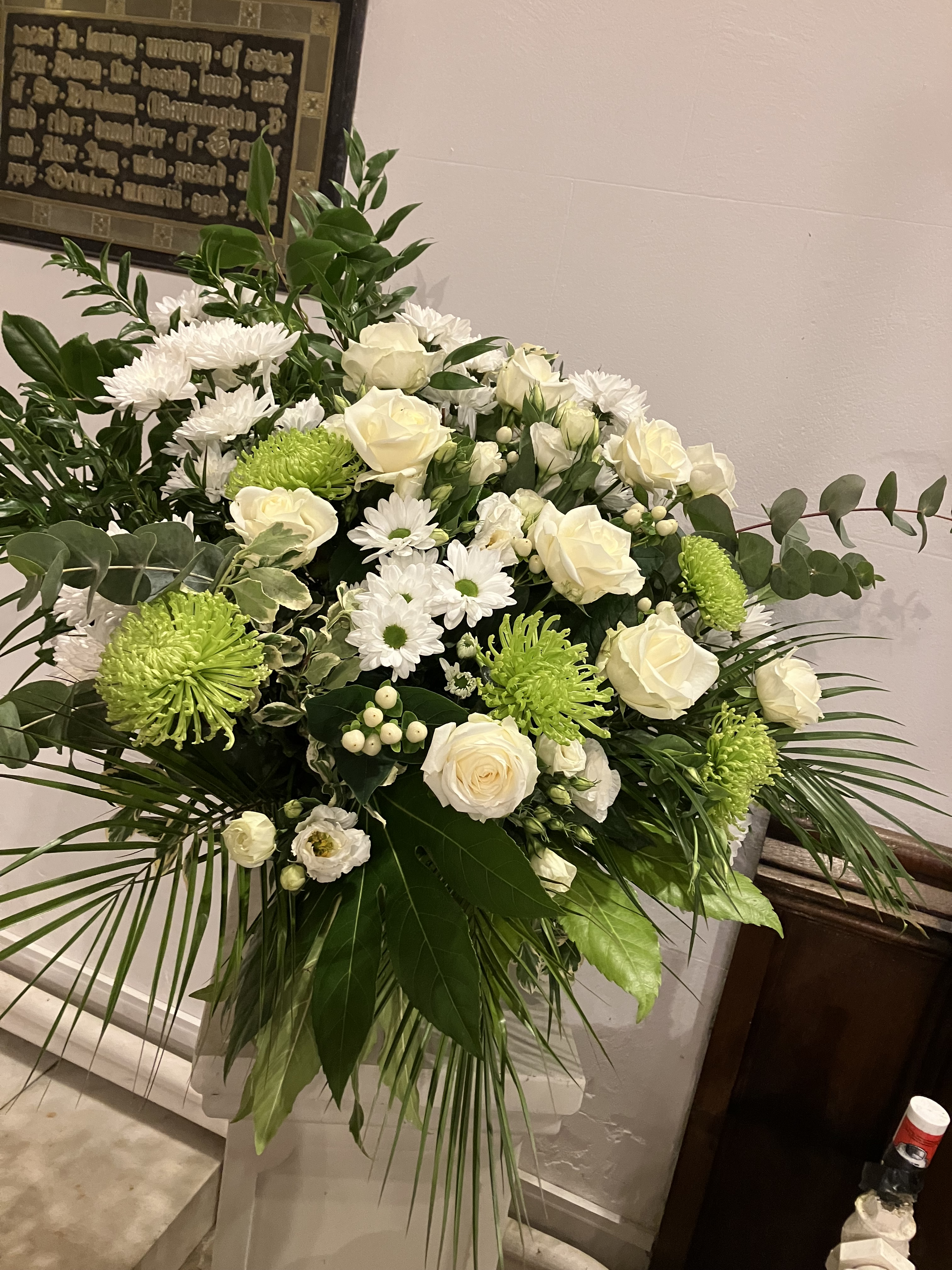
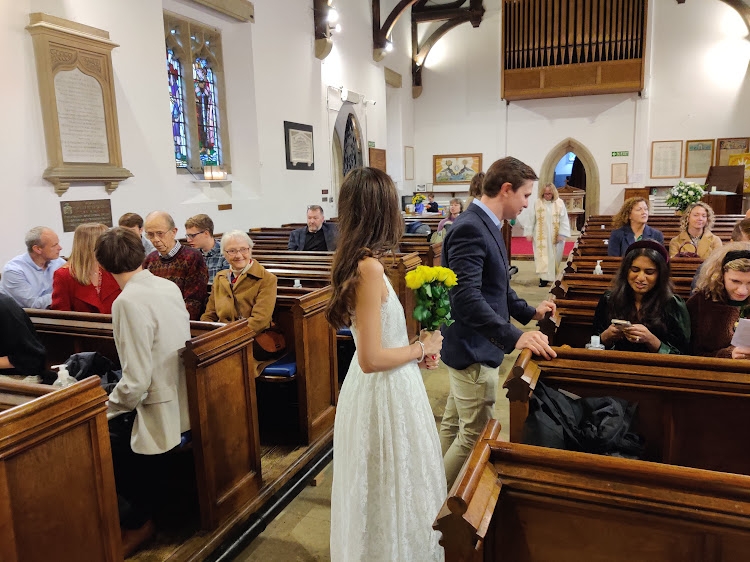
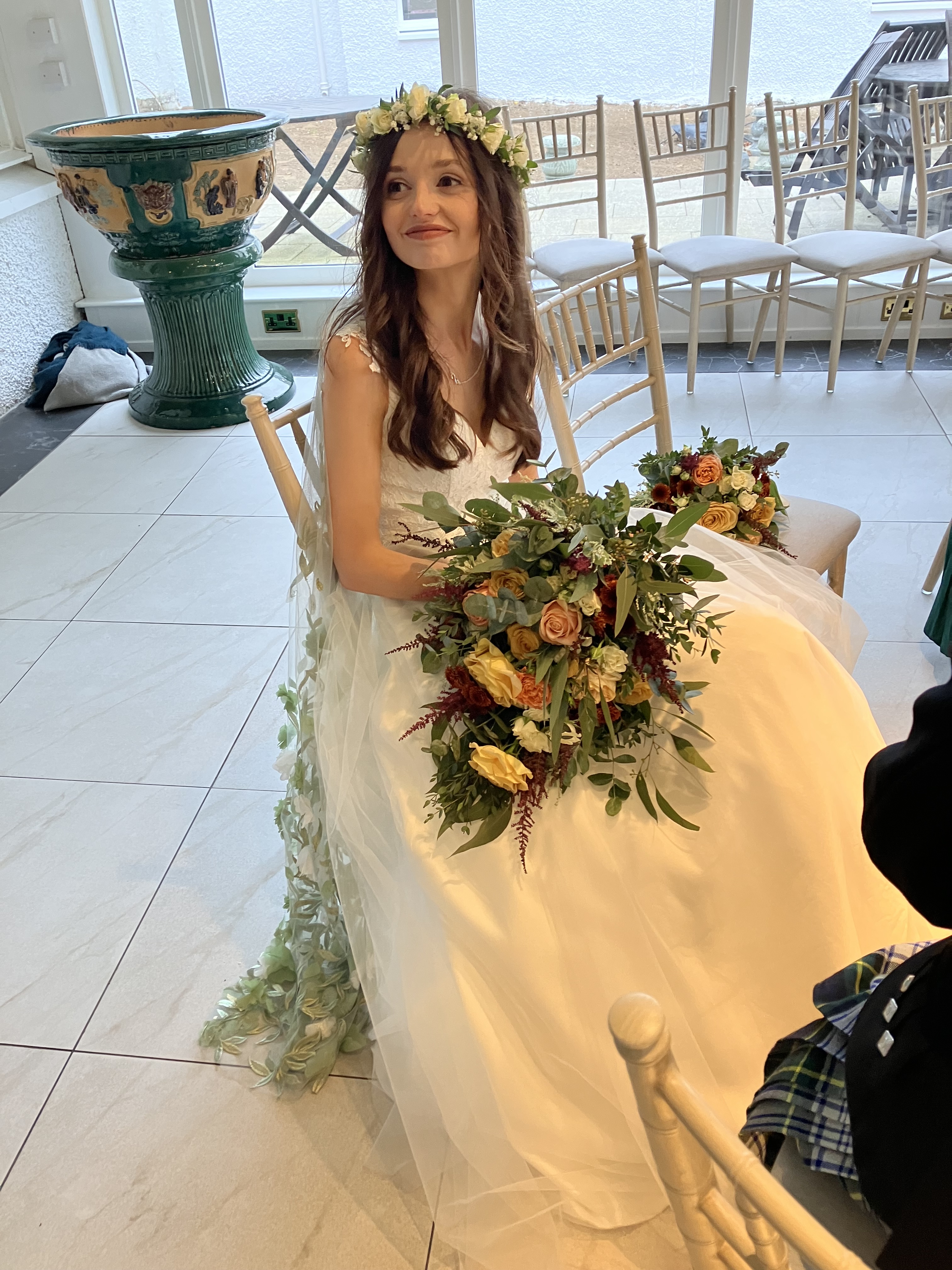
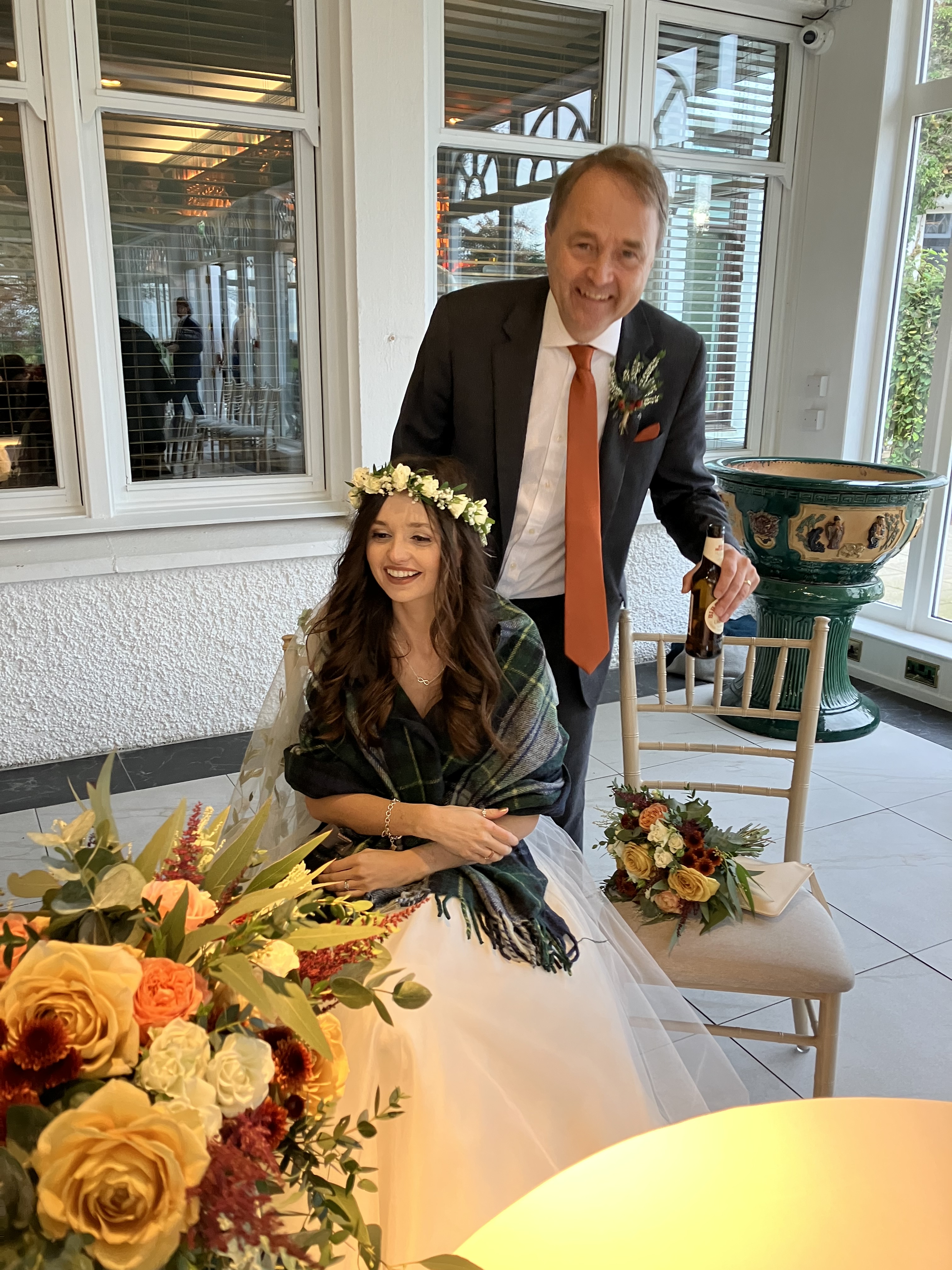
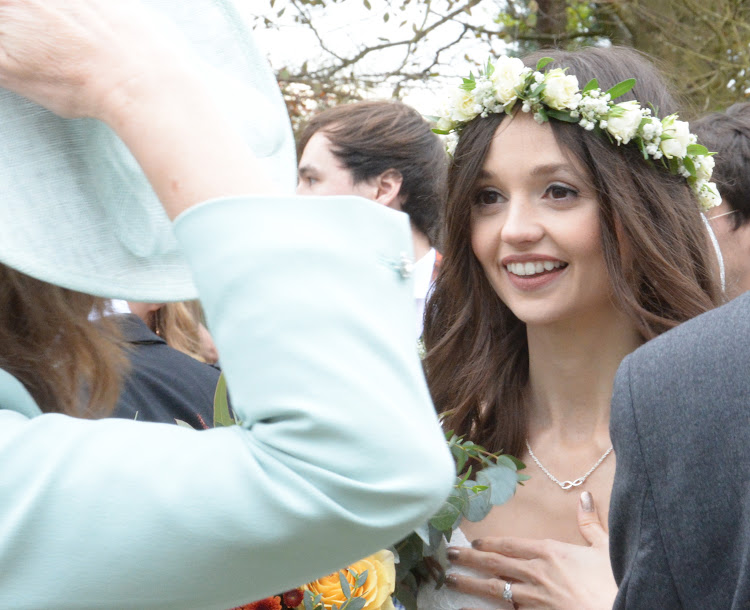
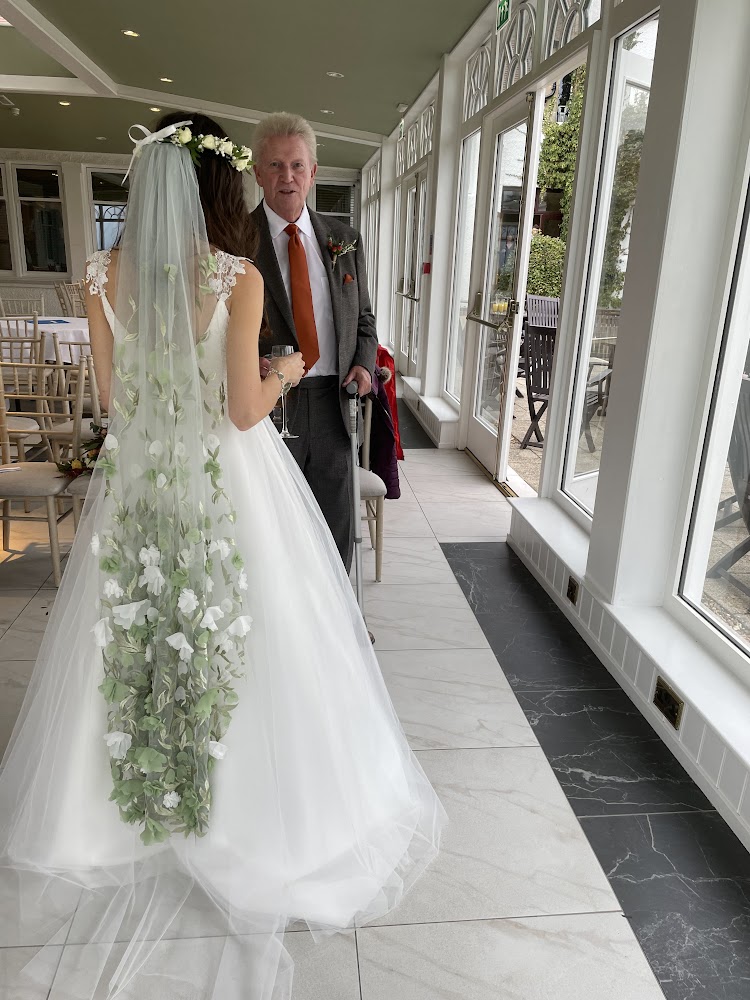
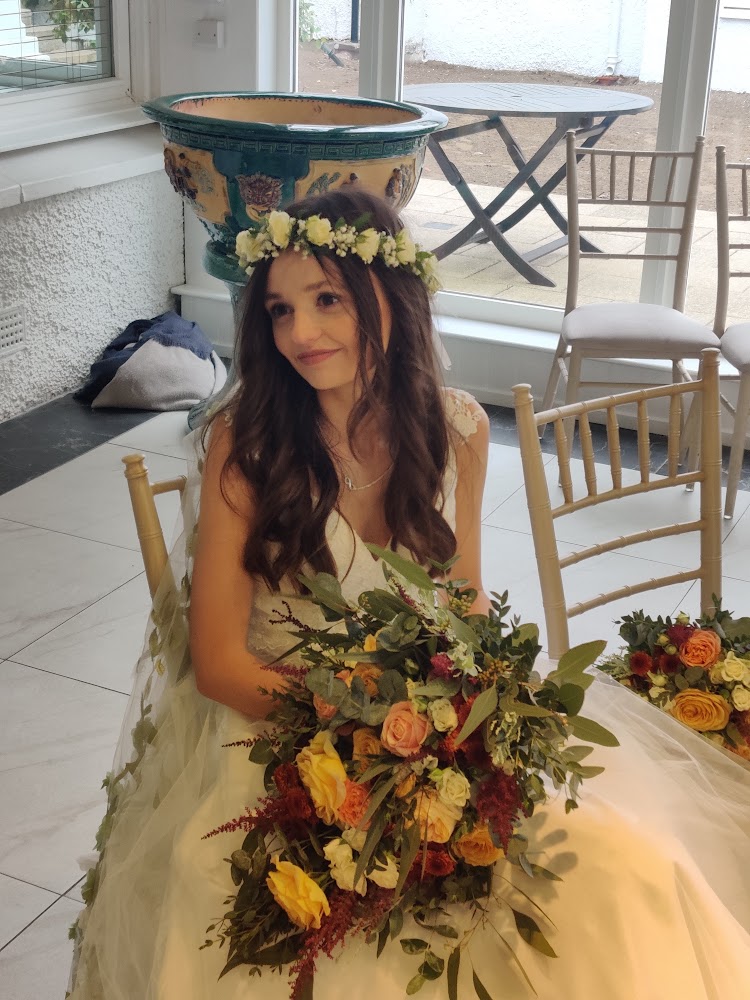
My daughter and son-in-law were at the church, welcoming people and smiling and looking happy and not too nervous. My daughter was wearing another white dress (we only had one wedding dress when I was married!) and carried yellow roses, which made me smile. (When she was born, everyone sent me yellow flowers, so I always think of her with yellow flowers, not pink.) The church looked lovely. The flowers for the Sunday service were already there, and they were white as the flower ladies knew we had the blessing. The heating had been switched on, so it was nice and warm, and the verger had lit all the candles. It was very special.

The vicar started the service, my daughter and her husband waited at the back, and the organ started to play. . . The Phantom of the Opera! She had chosen this, to surprise her husband, and as people recognised the music they started to smile, and laugh, and by the time they reached the front, everyone had relaxed and realised this was not going to be ‘a boring church service.’ It was something different.

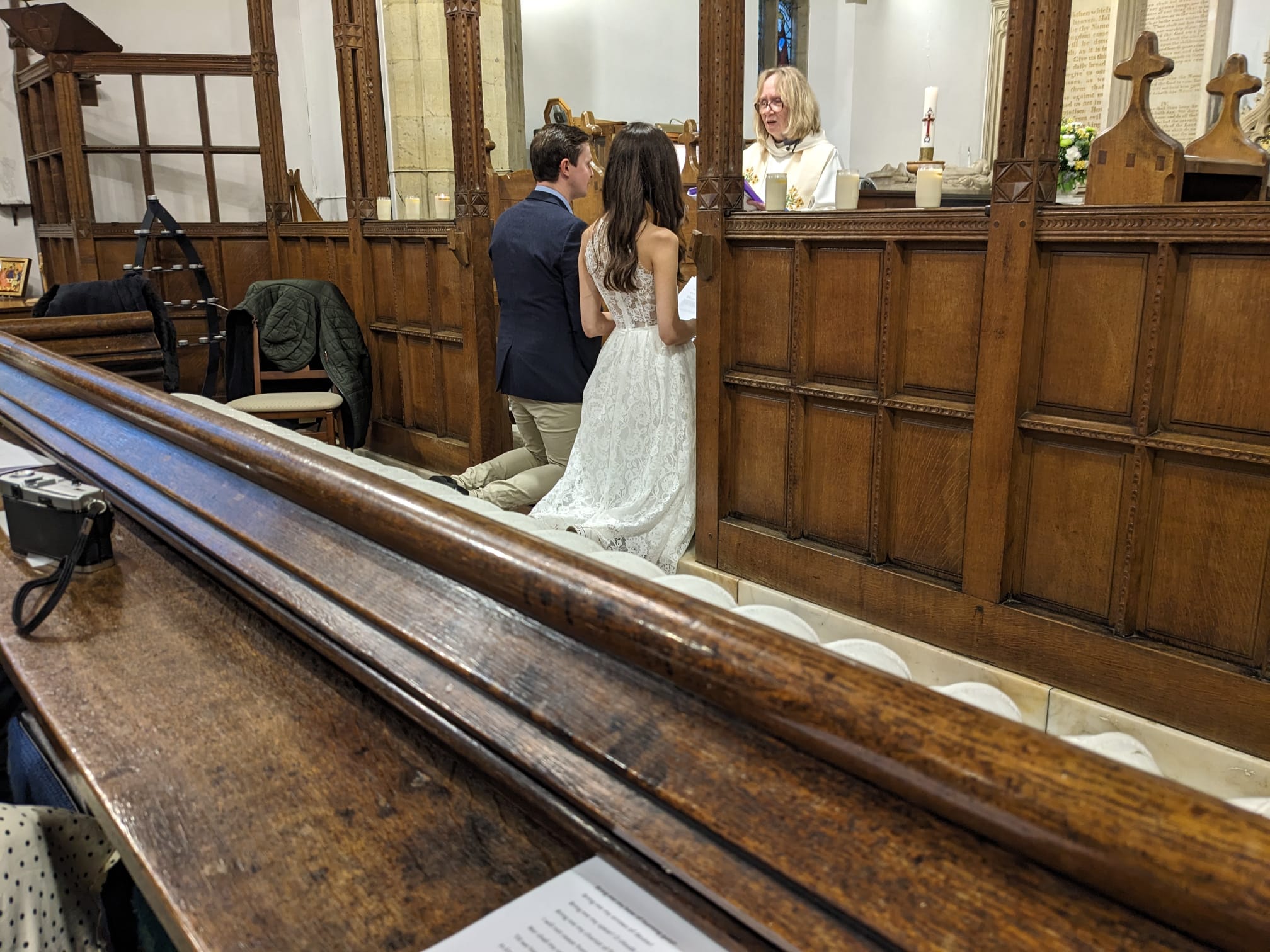
There was a reading about love from the Bible, and a poem. The vicar spoke about marriage, and advised that it could be tough, and needed commitment, and things like not going to bed angry (Husband kicked me) and remembering to notice the needs of the other person (I kicked Husband) were important. The couple then listened to the marriage vows, and agreed that this is what they had promised to do when they married. Their rings were blessed. They knelt, and were prayed for. The congregation promised to support them. There were  three hymns (songs that people would know from school assemblies, as many of the people there don’t usually attend church).

It lasted about half an hour, and I think it was perfect. The thing is, being married is not always easy. We have been married since 1988, and my husband is my very best friend. But sometimes I feel angry, or lonely, and sometimes we get things wrong. Therefore, asking God to be part of a marriage seems sensible to me. Why wouldn’t you want the extra help to sort things out, when someone needs to be forgiven, or things feel impossible because you haven’t slept for weeks due to a new baby? Marriage should be about love, and joy, and faithfulness, and those things describe who God is, so including him makes sense.

Afterwards, everyone came to the house for tea and cupcakes. We had champagne, and my sons made a speech. (Brothers speaking about their sister was always going to be funny and naughty and affectionate.)

And that’s it—wedding stuff is finished. It has been a special time, a good memory. Life should be about creating good memories.

Thanks for reading, I hope you have a good week. Take care.
Love, Anne x

An Unexpected Experience


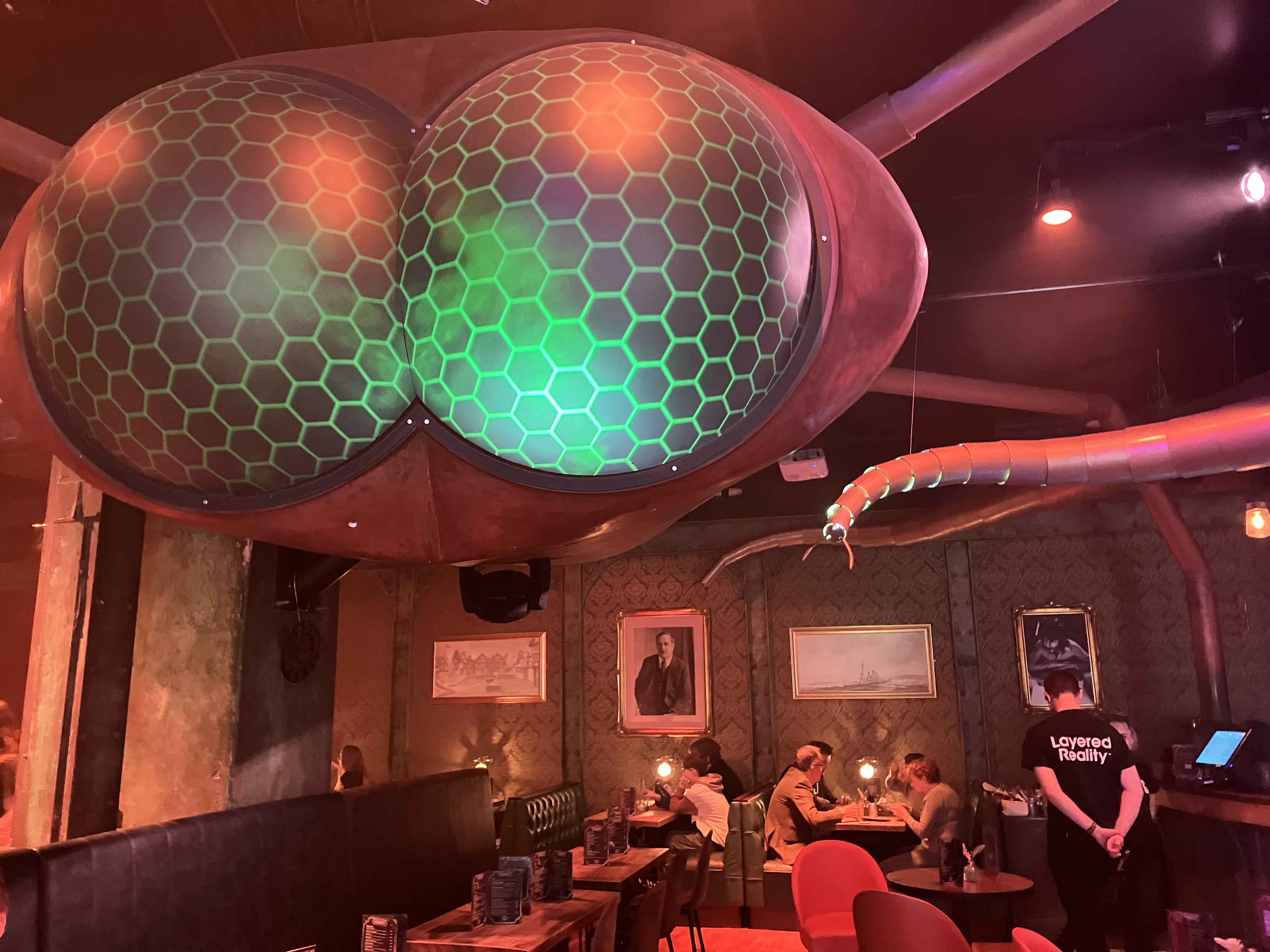
We were invited to a ‘War of the Worlds’ experience. I had absolutely no idea what this meant—but accepted anyway. Husband, I suspect, had more idea than me, but decided to not share. Last week, we met our friends at the station, and set off for London.

It was difficult to know what to wear, but I decided it was probably something similar to a thing my cousin went to recently, when an orchestra played the tunes from ‘Lord of the Rings’ while images from the film were shown on a giant screen. I certainly thought it would be a passive experience, and as my friend is something of a natty-dresser, I decided to wear nice clothes. (My wardrobe is divided into three: very posh evening wear, expensive ‘nice clothes’ or tatty stuff that a tramp might wear. I usually wear the latter.) This was a mistake; especially the heeled boots.

We walked from London Bridge—the men striding a hundred yards ahead, me stumbling over uneven pavements while my friend kindly walked beside me. We arrived at a building resembling the sort of clubs we went to as students, and went inside. There was a young man (everyone is young these days) looking official, checking tickets. We were given yellow wristbands (also reminiscent of student nightclub) and told to wait for yellow smoke. We were also directed to fill out a waiver form (they hadn’t invented those when I was a student!)

We sat at a table in a sort of bar, with dimmed lights and strange decorations. The waiver form informed me I should be over 16 (√check) wear flat shoes (X failed there) and not be sensitive to light/noise/motion or scary things. I stopped reading at that point, as yellow smoke squirted from a tube in the ceiling (it was disappointing how long it took four of us to decide on smoke colours!) and we joined the line at the door.

We were part of a group of 12, and I was pleased that we were not the only adults. (Adults are people over the age of 45.) We were led through a door and met by a bouncy actor with exaggerated enthusiasm, who explained we were going back in time to when the Martians had landed. She was very good at her job, as she maintained her ‘in character’ persona despite our rather doubtful expressions and complete lack of reciprocation. We were shown virtual-reality headsets, and told how to use them, then led along a dark corridor to a theatre. We took our seats, and I hoped that perhaps this was where the rest of the experience would happen. It didn’t.

The experience continued. There were holograms, and we had to walk along corridors, and through holes, and down steep spiral stairs—which was sometimes a challenge for someone with a dodgy back in heels. However, it was all very professional, and although I never managed to quite believe that Martians had landed and our lives were in peril, I had to admire their enthusiasm. To be honest, I was nervous—but of falling over or someone shouting ‘Boo!’ unexpectedly. There was a lot of ‘dark’ involved. And amazing special effects.

The experience was based on the book/films of ‘War of the Worlds’ and was a series of rooms that showed different aspects of the story. We had done our homework and watched the Tom Cruise film version, so each scene made sense. My favourite part was when we sat in boats, wearing virtual-reality glasses, and we ‘sailed’ through a burning London, looking at the destruction and feeling the waves lift us. It was really well done. I have never experienced such clever technology. The actors and props were brilliant.

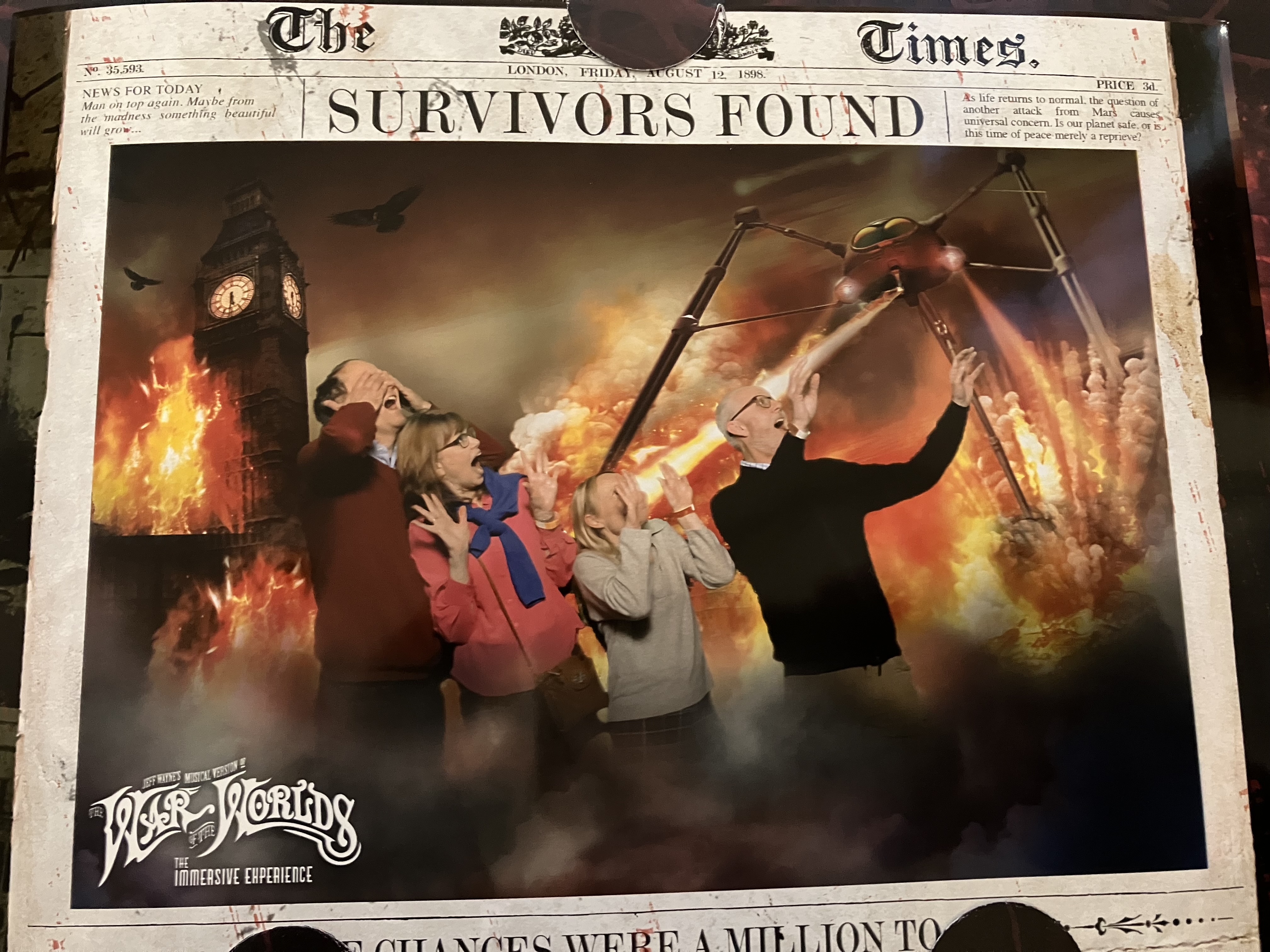
I couldn’t take photos during the experience, as cameras were banned, so I can only share pictures taken in the bar area, and the ‘professional’ photo taken at the end. But if you are ever invited to visit the experience, I would certainly recommend it. Just be sure to wear flat shoes.

Thanks for reading.
Have a great week, and be sure to wear the right clothes.
Take care.
Love, Anne x

anneethompson.com

Why not sign up below to follow my blog?
*****

The Gathering of the Clan


Our daughter’s wedding in Troon was beautiful, and I now understand two things:

  1. Why my son-in-law was so keen to have a Scottish wedding (because they are amazing).
  2. Why the Romans decided they would never defeat the Scots and so built a big wall (large young men in kilts are quite a force).


The week before had been lovely, with our ‘clan’ making their way north. It was really lovely that so many people made the journey, and it made the day very special. My sister even came from Canada, and my brother drove the grandparents up from Surrey. I had worried that not many family would come, but they did, and it made a big difference.

The day passed in a blur, so we are now eager to see everyone’s photos—because there is no time to take your own when you are part of the wedding party. I began at 6 am, checking the house we’d rented was clean and tidy, preparing a few last decorations. A Waitrose order arrived at 8, the florist soon after, and by the time the last bridesmaids arrived the house was full of laughter and perfume and young women staring intently into mirrors. I was wearing the ‘Mother of the Bride’ sweatshirt my daughter had given me, and was busy preparing food, and offering drinks, and checking that all was on track.

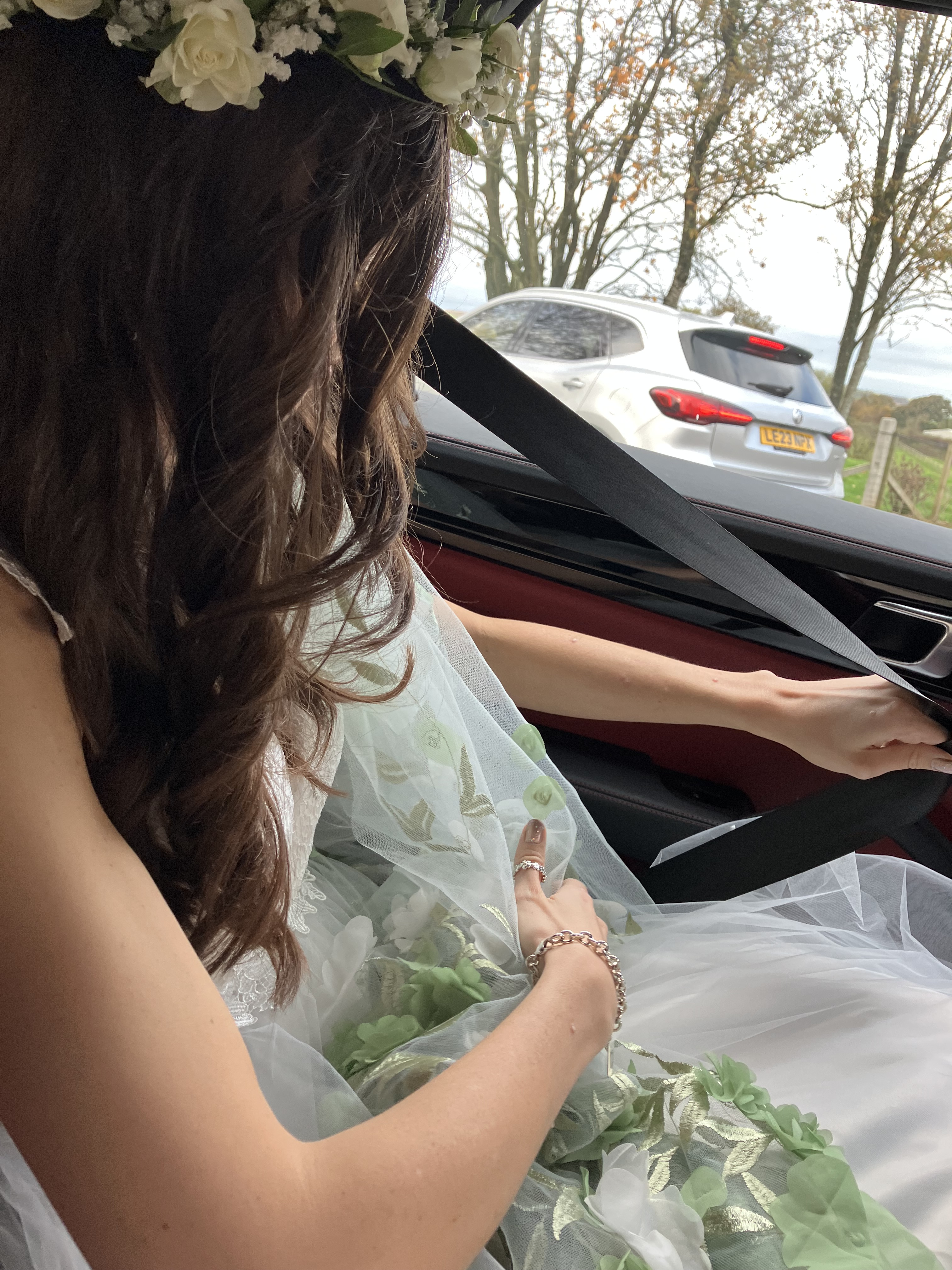
Time suddenly sped-up, and all of a sudden it was time to pin on flowers and distribute bouquets and check everything we needed was in the car. I had allowed roughly 2 minutes to change myself, which was a mistake, and I spent the journey to the venue checking my dress wasn’t inside-out and trying to stop my hat bouncing on the roof of the car, while distracting my daughter so she didn’t get emotional. We had disco music playing, which was completely inappropriate, but it kept the mood light.

As we arrived at the venue, Donald, the piper, stepped onto the drive. He then led the way, playing his bagpipes. It was rather special (there is lots about a Scottish wedding that is special).

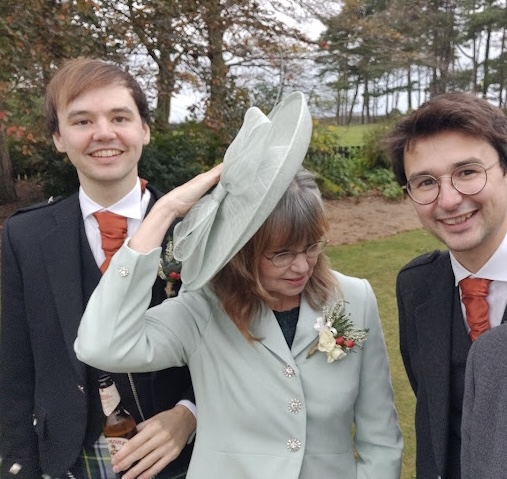
The guests were all seated in rows and we waited in a room at the back, out of sight. My two sons were there, grinning at their sister in her pretty outfit, managing not to make funny comments. I straightened my daughter’s dress, told her she looked beautiful, and then the celebrant was announcing my arrival. I walked down the aisle with my two sons—smiling hello to my brother and sister, hoping my hat didn’t fall off, looking for my name on a seat. The front of the room had flowers, and a glass wall, and a view of the sea.

Music played, and the flower girls walked to the front, holding hands, looking perfect. Then the bridesmaids, one at a time, remembering not to hurry, all young and elegant and matching the flowers. Donald started his bagpipes again, and I knew that Husband and my daughter were coming, but I felt suddenly emotional, and I didn’t want to cry, so I twisted my face into funny shapes (hoping no one captured that in a photo!) and stared forwards.

The ceremony bit was short and interesting. The celebrant was very professional, and told funny stories about the bride and groom. There was the legal vow, and then a hand-tying ceremony, when she threaded silk ties between them, and they pulled, and there was a knot. (I knew the saying, ‘tying the knot’ but hadn’t realised it was a thing.) They also drank from a double-handled cup—another Scottish tradition.

There were photographs outside, and time to chat before the meal. The weather was dry. I will write that again, as it was October, in Scotland—the weather was dry! My hat didn’t behave though.

There were speeches, and people stood for the toasts (like they are supposed to, but rarely seem to any more). Dinner was delicious.

Daughter (and others) changed into clothes suitable for dancing, and the bride and groom cut the cake and did a dance (which was actually very good, and not at all like the dancing I remember from her ballet days when she was ten—no skipping in circles). Then we all joined a Caleigh dance (which did involve skipping in circles).

One of the very best bits was right at the end, when the last dance was announced and everyone made a big circle (not me, because I knew what was coming and there were a lot of slightly drunk, very large young men wearing kilts and a wild look in their eyes). They sang the Loch Lomond song, with arms linked, and then gradually started to move forwards, squashing the bride and groom who were in the middle. They did this a few times, before lifting them on their shoulders, and dancing them round. I checked my daughter wasn’t going to bash her head on the ceiling, and then enjoyed the moment—it was quite something with all those deep male voices, and flashing colours of the kilts, and energy. An exciting end to an exciting day.

Thanks for sharing the day with me.

Take care.
Love, Anne x
The Wedding Plans Continue


Hello, I hope you’re having a good month. I cannot believe how busy I am, so this will be brief. Apologies—but next week I hope to have wedding photos to show you.

The plans are so far going smoothly, though there is suddenly SO much to do. The wedding is in Glasgow, so at the moment I am worrying about how to pack lots of fragile things, and not crease the bridesmaid dresses, and not crush my hat. We plan to rent a house for the week before the wedding, which means the family will have a base while last-minute jobs happen near the venue, and the bridal party can all prepare there on the morning of the wedding.

Obviously doing all the mummy-stuff is more difficult in a rented house, so I am trying to be very prepared. I don’t know if there will be vases, so I have been to my local Home Bargains and stocked up on silk flowers and pretty containers that I can take with me. I have managed to buy big ribbons on Amazon, so I am hoping there is somewhere in the house I can tie them, and I have balloons for the end of the driveway so everyone knows where to come. Hopefully I can make the house look special.

Food is a challenge, as the wedding is at 2pm, which means bridesmaids will arrive in the morning to get ready, and they will need to eat or they will faint. Thankfully, there is a Waitrose that delivers, so I have ordered fruit and pastries for the morning, and platters of sandwiches and cheeses for midday. To be honest, I got a little carried away when I was ordering, because it’s my daughter’s wedding—and so it’s okay to be extravagant—and they did have a huge variety of very exciting-looking food. Who wouldn’t want ‘fruit kebabs’ or a wedding cake of cheeses or tiny desserts on a tray? (I need to hide the credit card bill, or I will get feedback.)

I am also taking anything I can think of to avert disasters. My mummy-bag is packed with headache pills, plasters for blisters, sweets for energy, mirror to check lipsticks, bottles of water, sewing things with thread in the colours of each outfit, safety pins and—if things go really badly—tipex to cover any stains! We have large umbrellas, and old towels to dry damp bouquets because it is Scotland, so I am assuming we will be running from the car through heavy rain and gale-force wind.

The actual ceremony has all been planned, and we have been told our roles. I enter right before the beginning, accompanied by my sons. Then the music will start, and we hope two very sweet flower girls will walk down the aisle. (I have to admit, I have my doubts about whether this will actually happen, as small sweet flower girls can be very obstinate at weddings, and they might well refuse—but here’s hoping.) Then the bridesmaids will enter, and then Husband will accompany our daughter, while a piper (Donald) plays bagpipes. I expect I shall be crying by this point (tissues are in the bag, and powder to cover red nose). All the men in the wedding party will be wearing kilts, but as the groom’s father is wearing a suit, so will Husband. He has a tie and hankie to match the bridesmaids.

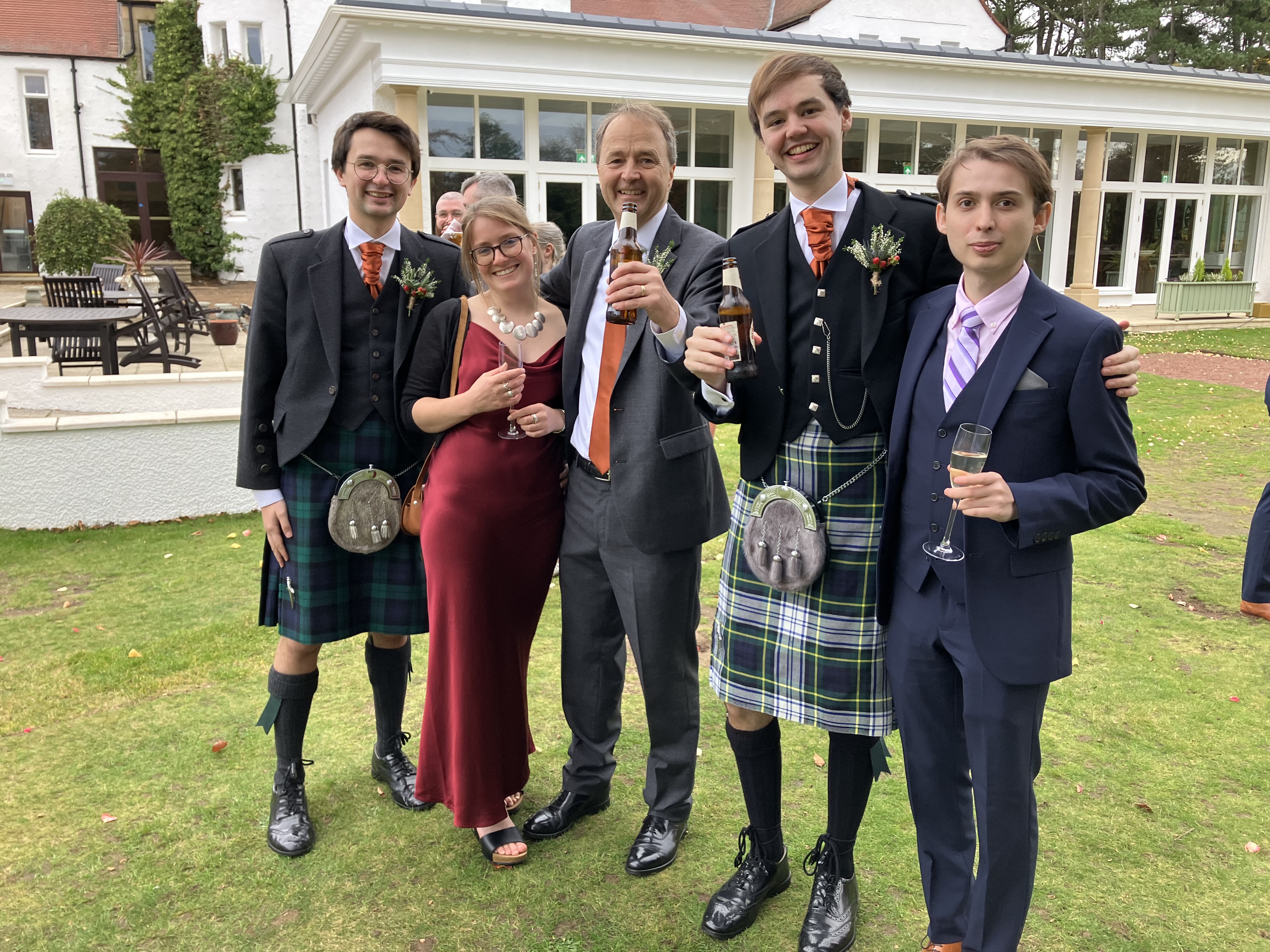
I had assumed, in my ignorance, that all the groomsmen would wear the same tartan. But this is not a thing. Apparently, getting your first kilt is an occasion (like being fitted for your first suit used to be in England). Young men will get a kilt—perhaps for a special birthday—complete with all the right shoes/socks/garters/jackets. The outfit is expensive, so they want to wear it for special occasions, like weddings. Obviously, each person has a different tartan (either their clan or the pattern they like) therefore at a wedding, each groomsman will be wearing a different tartan to the others. My sons are hiring their outfits, and they were asked to not choose the same tartan, as otherwise they would be the only matching pair. I’m not sure whether the jackets will all be the same—you will have to wait for the photos.

I need to go and start packing now. Thanks for reading, have a great week.
Take care.
Love, Anne x

Thanks for reading.
anneethompson.com
Sign up below to follow my blog (then you won’t miss the photos!)
*****

PS. I always write blogs in advance, so this was written last week. I am waiting for the official photos, but I have a few snaps. Next week I will tell you how it went—and have better pictures.

Ax

Mother-of-the Bride


As you know, in a few weeks’ time, we have the wedding of my daughter. This is very exciting, but has had some unexpected moments. My role is fairly minimal, as my daughter and her fiancé are fully grown-up and independent, and have therefore planned everything themselves. This seems to be fairly common now, as a quick online search for ‘Mother of the Bride’ (MoB) shows most articles are aimed at the bride, warning her not to allow her mother to deter her from the things she wants at her wedding, to give her mother a task or two so she feels involved, and to check that the MoB’s outfit is not white and does not match the bridesmaids!

I am hoping I have supported rather than interfered (let’s not ask my daughter—just in case!) The main task I have been given is to make cupcakes for the blessing, which I am really enjoying. If I have time, I will share the recipe with you in a blog (it’s an excellent recipe, and they freeze really well, which takes away all the pressure).

The time aspect has been challenging, as I am also writing my dissertation and altering the bridesmaid dresses, and all this would have been fun IF Husband (who we love) had not decided that now would be an excellent time to have the whole of the inside of the house decorated. I have everything in the wrong rooms, and am constantly wiping paint dust off every surface, and I am thoroughly grumpy about the whole thing. But we will survive, and the house will look smart when people come after the blessing.

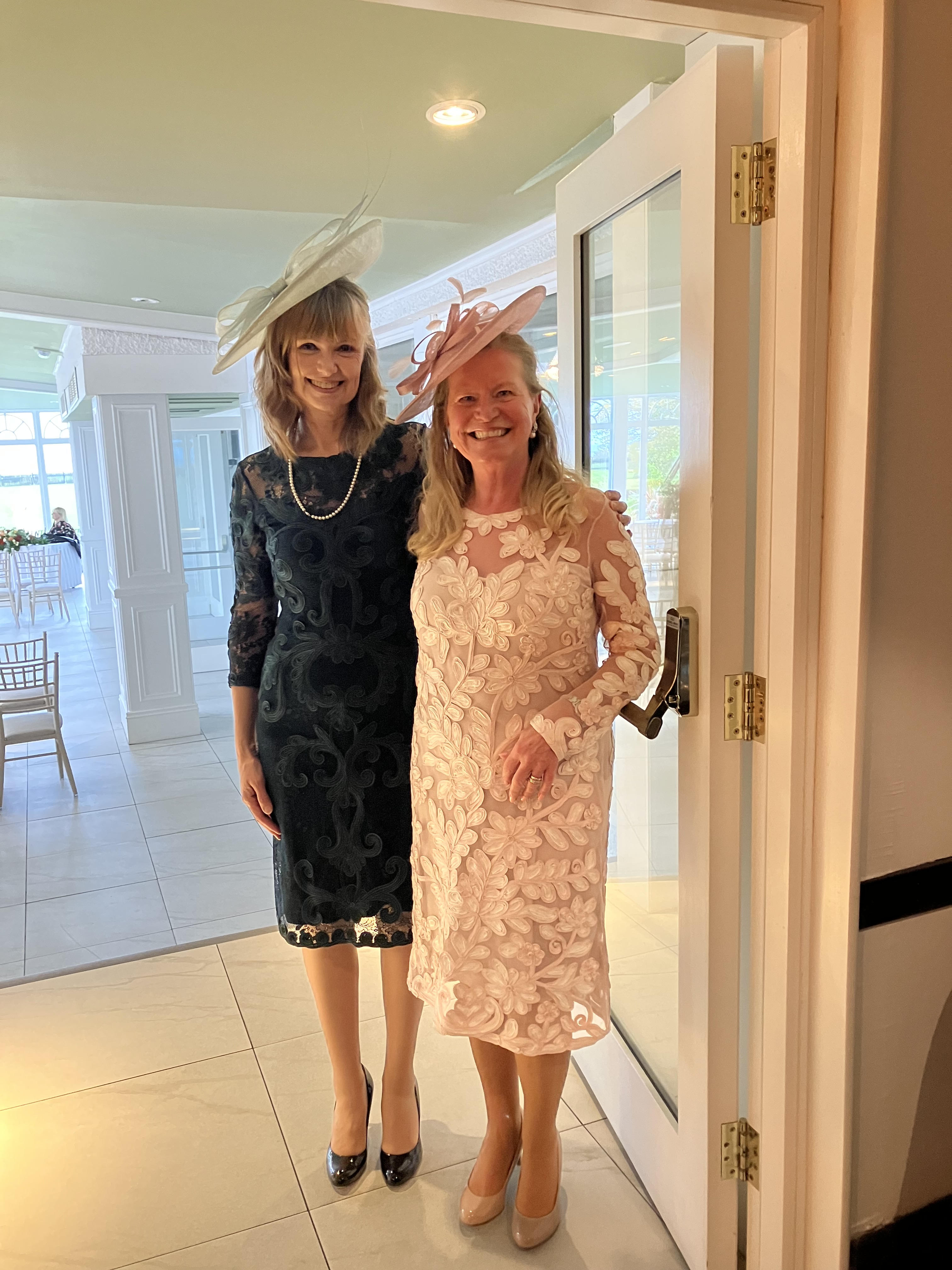
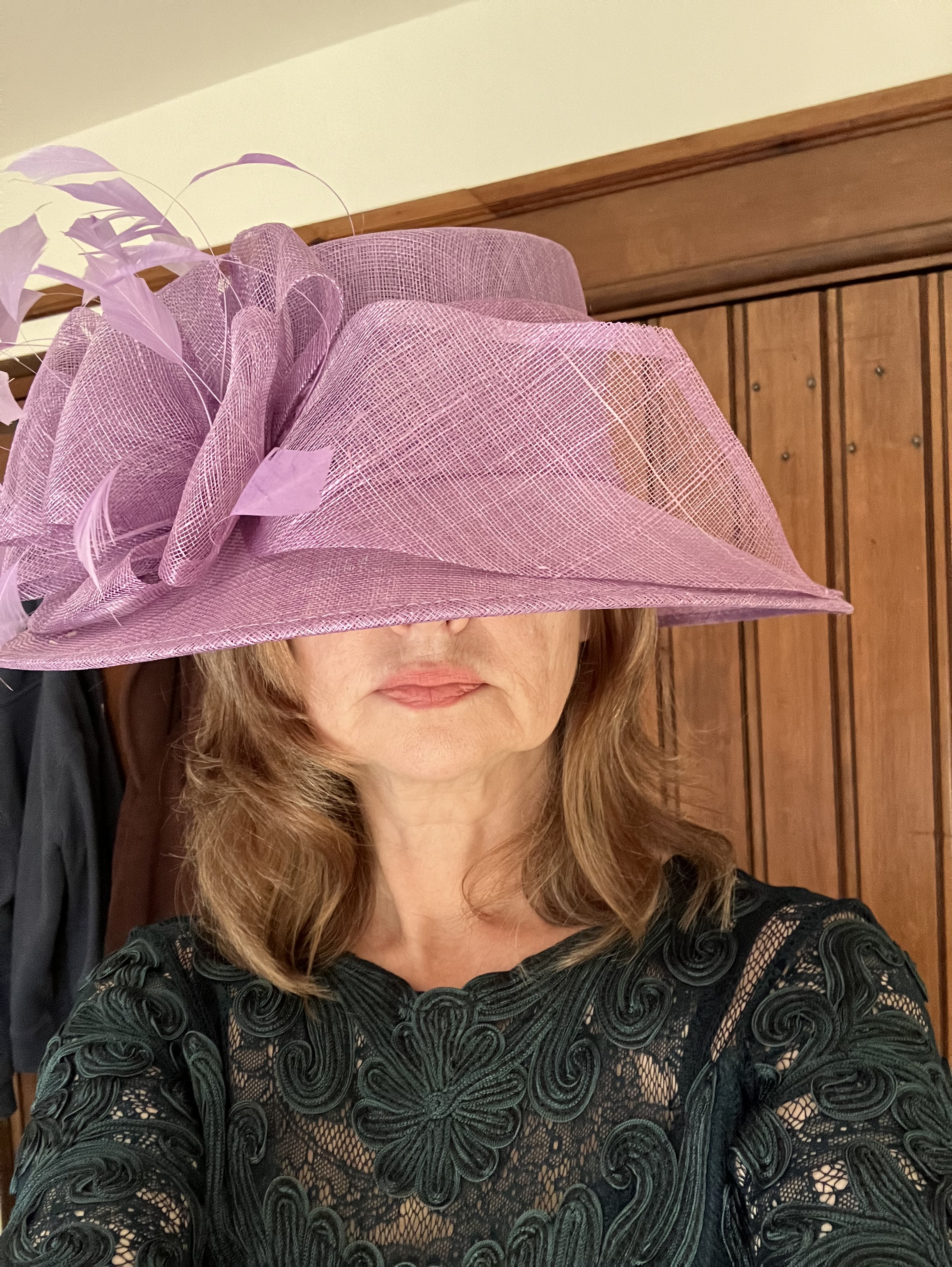
As you will know from other blogs, clothes are not my thing, so the outfit has been a challenge for me. When my sister was here, we bought hats, which was fun. I do already have a very nice hat, but when I wore it for my nephew’s wedding recently, it kept falling down—either it has got bigger or my head has shrunk (is that even possible?) I now have a new one, which matches my coat—one of those ‘fascinator-not-a-real-hat’ things with feathers. I expect I shall sit on it or it will slip off, but I shall do my best. I feel a hat defines the mother of the bride, so it matters. According to the internet, the MoB is the ‘lead hat lady’ and everyone else is supposed to remove their hat when I do (and not before). I doubt if anyone else will know that little gem of etiquette, but just in case, I shall try to wear mine for as long as possible, otherwise someone might feel obligated to remove their own creation before they’ve had their money’s-worth.

 I ordered one outfit online, which looked very pale when it arrived and we worried it might look white in the photos (see comment above) so that was rejected. I now have an outfit that I am very pleased with, and it has long sleeves because November can be cold (and no one my age is in love with how their upper arms look—except maybe Madonna). It’s also tight, so I bought a looser dress when my sister was here, in case I am too fat on the day. (I never know what my stomach will do!) However, when I tried it on this week, it is massive, so I think I must have eaten more scones than I realised when my sister stayed here. As there will be dancing afterwards, it will be comfortable for that, and I have a pretty cardigan (to hide fat upper arms) though I am not entirely sure whether cardigans are suitable attire for a wedding, so I won’t ask in advance.

I will let you know more details as the plans unfold—and of course I shall show you photos afterwards. I hope you have something exciting to look forward to too. Thanks for reading, Take care.
Love, Anne x

Thanks for reading.
anneethompson.com
Sign up below to follow my blog, then I can show you the wedding photos!

Is God Too Simple?


I have often said that God is too great, too big, too complicated, for humans to understand. But I heard something this week that completely changes my view of this—I now think that maybe God is too simple for us to understand. Allow me to explain:

People have lots of different facets to their personalities. This results in different behaviours, depending on the situation—so they might be Mrs Friendly when they are in one group, Mrs Tense and Rude when they’re at the doctor’s, Mrs Shy when they apply for a job, and so on. I noticed this in myself when I was teaching. As a teacher, I never shouted—I barely ever raised my voice—a frown was enough to tell the class I was unhappy and I found a quiet ‘dangerous’ voice to be much more effective with 13-year-olds than shouting (because then they knew I had ‘lost it’). However, in the same period, I would hear myself yelling at my own children when they were being particularly slow/late/stupid. Because at home and school I was different people—and my own children’s behaviour affected me in a way that no pupil, however special, ever could. (If you ask my children, they will probably tell you they would have preferred to be spoken to like a cool teacher rather than a furious mother, but that’s not how life works.) My point is, we have different emotions, and they produce different behaviours.

When we think about God, we think about him in terms that we understand—so we attribute different emotions and behaviours to him too. However, perhaps this is misleading. Because if God is unchangeable, then perhaps everything he does is in one single sphere. He is always everything, combined. So we really should not differentiate between God’s love and his anger, or his joy and his justice, or his compassion and his punishment. Unlike us, perhaps God does not have different sides to his nature. He is not too complex, but rather so uniform, so simple, that he is beyond our understanding.

It was described to me as if God is light—a single stream of light—but we cannot understand that, so we only see God as if from the other side of a prism, when each light-colour has been separated. We can understand and talk about those single ‘colours’ but we find the concept of the whole light, being one thing all the time, too difficult.

There are perhaps echoes of this in Deuteronomy 6:4, ‘ יְהוָה אֱלֹהֵינוּ יְהוָה ׀ אֶחָֽד’ ‘YHWH, your God, YHWH is one.’ I am now wondering whether this is what the verse means? That God is not a complicated mish-mash of different moods and emotions and characters. He is simple, uniform—one.

Interesting idea, huh? Think about it.

Thanks for reading.
anneethompson.com
Sign up below to follow my blog.
*****

Hillsong in Tonbridge


Hello, and how are you? Have you done anything different lately? In general, I prefer ‘routine’ to ‘unscheduled’, though we did break our routine a little this week and attend a different church. The church in the village didn’t have its usual service, and we have occasionally passed a big church called ‘Hillsong’ in a nearby town—so we decided to have an adventure and attend! (As you get older, even little changes are an adventure.)

We looked online, decided to attend the 9:30 service, checked where to park and set off. Unfortunately it coincided with the Tonbridge Half-Marathon, and most of the roads we wanted to drive along were shut, so we watched the time tick away, decided that we did not want to arrive late at a new church, and made a plan to turn round if the chaos continued. Luckily we found a way into the town, abandoned the car in a nearby car park and hurried to the church.

Hillsong does not look like a church. It looks like a warehouse, or an architect’s office, with big doors. I was desperate for the loo by this point, so hoped there would be some washrooms near the entrance.

Hillsong has a large entrance hall, and there were lots of people milling around, and we avoided eye-contact and headed to the nearby washrooms. I was worried it might be a tiny room with no privacy next to a coat cupboard (which is fairly standard for church washrooms) but no, this was a whole line of public facilities, all very clean and convenient. Excellent.

We then continued into the building. There was a queuing system—like at a cinema—but I noticed it was a ‘child check-in’ kiosk, so we avoided that and walked to the main room. Except it wasn’t the main room—it was full of toys. So was the next room, and the final one was for parents to make coffee while they watched their children. We were clearly in the kids area. It’s a long time since we had kids.

Realised that the meeting room must be upstairs, so passed all the people in the lobby (again) and were met at the top of the stairs by a couple of people with baskets full of Nespresso capsules. I accepted a capsule with a smile—a cup of coffee would be rather lovely. Then I realised that it was not, after all, a Nespresso capsule, it was a super-hygienic tiny cup of ‘wine’ and a wafer sealed in plastic, ready for communion. (Not sure if it’s okay to feel disappointed to be taking communion rather than having a good cup of coffee, so we will move swiftly on.)

The meeting room was huge, it resembled a cinema with a stage at the front, and a massive screen and large speakers. We sat in the dimmed auditorium, on comfy seats (made up for the Nespresso disappointment) and waited. It was nearly 9:30, but most seats were empty.

The service started on time, with a band playing very loud music, and singers singing and dancing on the stage, and the words projected onto the screen. I didn’t know the songs, so told myself I didn’t have to sing (I hate singing. I like to listen.) As the music played, people gradually arrived, and the seats filled up. I’m guessing there were about 200 people by the end of the first song. Everyone was standing, some people lifted their hands, most people swayed. However, unlike some Pentecostal churches I have attended, we did not sing everything 5 times—there was a clear programme, and the leaders were taking us through the programme without deviation. The songs were all praise songs, mostly discussing a personal adoration of God, and the tunes were ‘modern’ but not unpleasant. It was too loud for me though. I put my fingers in my ears, and enjoyed them much more, as without the vibrating eardrums, you could actually hear the melody. Felt old.

A few different people led. At one point there were prayers, and people’s prayer-requests scrolled across the screen, followed by answers to previous prayers. I’m not sure whether these were personal to this church, or were submitted from Hillsong as a whole. (Hillsong is a large, global organisation, with churches in many cities.) There was no money collection, but a QR code appeared on screen, and people raised their phones to access the website (and I assume paid an offering, if they wanted to). All very modern.

A man led communion. He stood on stage, and said (I think) all of the things that are usually said at communion, with all the quotes from the Bible that are usually quoted—but very fast—so I had to watch very carefully. Suddenly realised I needed my Nespresso-communion-capsule, grabbed it from the floor. Oops, he’s eaten the wafer and I can’t get mine out from the plastic! Now he’s drunk the ‘wine’ and I’m having trouble with the cellophane…got there eventually. Felt old, again.

Not coffee.

After a final song, we were invited to sit. We had stood for half an hour.

The screen then projected the main speaker. It was very like being at the cinema, but not unpleasant. The talk was captivating, and the speaker was personable—so I sort of forgot he was a projection, and settled to listen. There hadn’t been a Bible reading until now, but he quoted lots of verses from a Psalm, and other random verses (verses taken out of context are not my favourite thing) and wound them into pithy sayings as he preached. His message was simple—God created you, you are special, don’t ever forget that. Not a bad thing to hear. He spoke for 30 minutes, which was too long for me. He linked his message to Black History Month, saying that all ethnic groups were part of Britain, and had something important to add to the nation. I thought he spoke well.

Then there was more singing, (just one song) and a long prayer, and people left. There was a man at the door, and he shook everyone’s hand and wished them well. It was a nice touch.

So, would I go again? Well yes, I would. Not every week, but maybe occasionally, when I was feeling like I wanted something different, a new way to worship God. It would be easy to be lazy though—to attend as a spectator and never really think. I did smile at one point, when the speaker declared that this church was a mix of genders and ages and ethnic groups. I don’t think anyone was over 60 years old (I was probably the oldest person in the room!) I wonder if they would have made that claim if no one under 40 had attended—do older people not count? But having said that, this is a church that offers something very accessible to young people, and most churches are failing there. And the message, whilst simple, was not unlike what Jesus preached—not loads of theology, just a basic reminder to let God be part of life.

I am aware that Hillsong as an industry has had problems, but I do not think that has to detract from the good of localised churches. They are meeting a need. Much of it was excellent. It was very centrally-controlled. Like McDonald’s. It was also (like McDonald’s) offering a product that people like. Just not Nespresso capsules…

*****

Goose continues to enjoy life. (Unrelated, just a great photo!)

Thanks for reading.
anneethompson.com
Sign up below to follow my weekly blog.
*****

Pretending to be ‘At Cambridge’


I went to the Society for Old Testament Study conference in Cambridge. It was excellent!

You may remember that in January I attended a conference in Sheffield, which was also good but this one was better. Perhaps it’s because I knew what to expect, or maybe because my general knowledge (and understanding of ancient Hebrew) has improved, and I found the papers much easier to understand.

I stayed in St. Catharine’s college—which is very pretty when you enter: an historic building for the porter’s lodge where I collected my key, a pretty square of grass surrounded by brick buildings within the walls, an old chapel. Then I walked past the green, to the new wing where the conference was held, and it all seemed rather less romantic—more functional than pretty. My room was in the new building, and it smelt of feet unless I had the window open, when it smelt of onions because I was near the kitchen. But it was warm, and comfortable enough, and it had its own bathroom (just—not sure I would have fitted in the shower if I’d been any bigger!) Best of all, a number of fire doors and insulated walls meant it was pretty sound-proof, so I slept well.

The conference was fully catered, and we ate together on long tables in the dining room. Some of the best chats were during meals, when I sat next to someone interesting and scholarly (almost everyone was interesting and learned) and I listened to their conversation. I didn’t say too much, because I didn’t have anything to offer, but their conversations were great fun! Was Esther written originally as a comedy? Is there enough evidence to support the idea of the Exodus ever happening as an historical event? What is the cognitive perspective of Ecclesiastes? All fascinating. It was tempting to record them, but I felt that might be crossing a line.

The meals were a bit ‘school dinners’ (Sheffield Uni had better ones). I did suffer a moment of guilt. We were issued with an electronic meal pass, and told that this allowed us one main, two sides, a drink and a dessert—anything else must be paid for. They told us that originally, all catered students were able to collect their food unsupervised, but apparently ‘some students’ would collect several main courses, and even go back to the servery two or three times to refill their trays, therefore it was now restricted. I had a horrible feeling that ‘some students’ might have included my sons at their own universities. I didn’t comment, and joined the other scholars who were shaking their heads in disapproval.

One afternoon we were invited to the Divinity College, where we were given wine, listened to a speech (a very clever one, of course) and then toured the library. I love libraries. One day I shall live in one.

The conference was fairly intensive, with papers read all morning and evening. Honestly, this is literally what happens—someone clever writes an academic paper for a journal/book, and then they read it, with questions answered afterwards. It’s hard to listen at first, but after a while you train your ears to concentrate, and what is read is usually fascinating. The questions afterwards are very clever, and show the depth of knowledge in the room.

On one day though, there were no afternoon papers, and most people went on a tour of Ely cathedral. I opted out (I knew my brain would be tired) and instead I rested, then met family in the city for a drink. Cambridge is such a pretty city. Though at this time of year, with students returning, you need to be careful where you walk. There is a lot of vomit in Cambridge.

Dipping into the academic world is very tempting. It doesn’t feel like ‘real life,’ but is slightly removed, only brains and conversation matter. I would love to stay part of that world a little longer, though I’m not sure if all the time in the world would be enough for me to catch up with some of those brains.

I returned home to grumpy chickens, a bored goose and a house FULL of spiders. I realise this is the time of year when spiders mate, but honestly! My house must be the spider equivalent of ‘Club 18 – 30’!

Thanks for reading. Enjoy your week and take care.
Love, Anne x
Thanks for reading.
anneethompson.com
Sign up below to follow my blog.
*****

Dead People and Names


I think there is little in life as thrilling as applied knowledge. To learn something new (like a language) is interesting, but when you manage to say something in that language and they understand you — wow! That’s exciting! I have found my Master’s course has given me lots of these moments, and the latest source of pleasure for me is a book by John H. Walton — Ancient Near Eastern Thought and the Old Testament. Allow me to share the excitement with you.

The book basically explains that unless we understand something of how ancient people thought, we cannot properly understand what they meant when we read the Old Testament. For example, if I ask you what the Old Testament writers say about Artificial Intelligence, you will reply that they had no knowledge of computers, therefore although we can possible use some of the principles set down in the OT and apply them to AI, they did not explicitly write about those things. Their understanding differs from ours.

The two examples I want to tell you about in the ancient world are: what meant something existed, and why having lots of descendants mattered.

In the ancient world, material things were not as important as they are today. Today, we know something exists if has a material form (and some people struggle with the idea of God because there is no material form to rely on). But not so in ancient times. In those days, something existed if it had a name and a function. Therefore believing in several gods was normal, as long as they all had a name (Sun-god) and a function (there was sunlight). Try to remember that:  having a name, and a function, meant that it existed—it was real.

Now we move to their understanding of what happened after death. They absolutely believed in some sort of existence after death, but it was very different from our own view (much of which comes from Plato, who taught about spirits leaving physical bodies and living a spiritual life). In the ancient world, they believed in a vague existence in an altered dimension to the physical world, in a place called Sheol. (Note: ‘Sheol’ and ‘Hell’ are not the same thing.) They believed that life in Sheol was affected by life on earth; life was sustained in Sheol by what happened in the world of the living. People in Mesopotamia and Egypt underwent certain rituals to enable the life of their dead ancestors—providing them with food for example. One important ritual involved ‘remembering’ the dead—talking about them, recalling the things they did before they died, somehow maintained their existence in Sheol. To be forgotten was the worst thing that could happen. Community was hugely important, and community included ancestors who had died (therefore asking ancestors for help was part of normal life).

Now, the Hebrews (who wrote the Old Testament) had variations of these beliefs, but we can see overlaps with their thinking. They too wanted descendants. I had previously thought this was so their children could care for them when they were old, but this doesn’t explain why several generations of descendants would matter—a belief that they would remember them after death makes sense in this context. (There is a text, which I cannot find, where someone explicitly says ‘I have no descendants to remember me.’ If you find it, please send me the reference!) Walton makes the point that the thinking of the Old Testament writers was much closer to the thinking of people in ancient Mesopotamia and Egypt than it was to the thinking of the New Testament writers (and far removed from our current ideas about things). If we understand this, it helps us to better understand what they wrote.

All very interesting, but the best bit comes when it’s actually applied. This happened this morning, as I drank my coffee and read a section of Genesis. I’m currently in the Italian Alps, and using a little book of devotions each morning, which I don’t especially like (I don’t like being told how to react/feel in response to what the Bible says). This morning’s passage was Genesis 16, when Hagar has run away from Sarah and God has spoken to her. In verse 13, Hagar says: ‘Then she called the name of Yahweh who was speaking to her “the one who sees”…’ (My translation of the OHB Hebrew.) This ties beautifully with the first thing I told you: Something existed if it had a name and a function. Hagar was accepting that God was real, thus she gave him a name and a function—God saw—‘seeing’ people was part of God’s identity.

The passage also says that God promises Hagar more descendants than she can count (verse 10). Again, if we apply our knowledge of what that would mean to Hagar, it would mean that after her death she would have numerous descendants to remember her—which was hugely important in the ancient world. This woman, a mere handmaid, rejected by her mistress, would be remembered forever, even after death.

I found reading this chapter with the understanding I have acquired about the ancient world changed my understanding—which I think is pretty exciting! I am loving being able to learn. I will tell you more in other blogs. 

I hope you enjoy something today too. Thanks for reading.

Take care.

Love, Anne x