Be Part of Something


Do you feel sad when you see pictures of families displaced from their homes due to war or poverty? Does your heart sigh for those young children who face dangerous sea-crossings with illegal smugglers? Do you worry about the poor in India, and the imbalance of society? Do you care?

Or do you feel guilty because you remain unmoved when you see the plight of others? You know that you should feel something, and you’re a good person, so you wish the world was fairer, but what can you do to help anyway?

Well, here is the chance to do something. You are invited to be part of a mental marathon, and raise money to help Tearfund.

Tearfund works with many people, including those living in poverty in the Democratic Republic of Congo — who live in a war-torn country and who struggle to find the resources they need to survive. They are also helping those in Syria who are trying to rebuild their country, offering support to refugees and families who need to heal after the trauma of war. Tearfund works in India, supporting the poor, helping them learn how to improve their lives.

I have been involved with Tearfund for many years, I trust them to spend the money wisely.

You are therefore invited to run a mental marathon in Lent 2022.

We are going to commit to learn Psalm 22 every day in Lent. Not religious? It doesn’t matter! Psalm 22 is basically a poem, it describes the events of Easter, and was written in Hebrew many centuries ago. Learning a poem from another culture is a good mental challenge. (When I was first learning Mandarin, I learnt a poem written by a Buddhist. It didn’t make me a Buddhist; it was a good exercise and I perhaps now understand a little about what Buddhists believe.) We all know that sitting on the sofa and eating ice-cream needs to be balanced with some physical exercise—but when did you last exercise your brain?

Everyone can do this. It doesn’t matter if you don’t manage to recite the whole Psalm, simply commit to learning some of it, every day for 40 days, and ask people to sponsor you. Your six-year-old might only learn the first few words, Grandpa might learn most of it, your ten-year-old will probably know the whole thing, forwards and backwards, and in twenty-two languages!

Why decide so early?

A marathon needs preparation. Plus, if you commit now, it’s so far in advance that it isn’t scary (I suffer a lot with scary). It’s a long poem, but if you read it through regularly (maybe every week) by the time we start Lent, it will already be familiar. I bet you could learn all the words to The National Anthem very quickly, simply because you have heard it so many times.

I am going to learn the Psalm in Hebrew, so I need to learn all the vocab first, and be familiar with the English version. You could decide to learn it in a different language too.

What do you need to do now? Commit to learning it, and put the date in your diary (2nd March 2022 for the start of Lent, earlier for collecting sponsorship). Decide whether you will learn the poem in English or another language. I will post an extract of the poem on my blog, every day in Lent. If you want the extract in a language other than English, let me know now and I will do my best!

If you want to receive daily reminders during Lent, sign up to follow my blog.

Plan your sponsorship. I have set up a Just Giving page (if you want to join mine, let me know now). Facebook do something similar. Or you could simply make an old-fashioned sponsor sheet on a piece of paper. It’s too early to start asking for sponsors, but plan now how to do it.

Put the dates in your diary. Be part of something.

(You can see more about Tearfund at: Tearfund.org)

Thanks for reading. Take care.
Love, Anne x

Anne E. Thompson
Thank you for reading anneethompson.com Why not sign up to follow my blog?

anneethompson.com

*****

Planning Ahead…


Planning Ahead

I have received the result of my Greek exam, and despite my worries I did unexpectedly well. In September I start an MA in Christian Thought and Practice (which is basically Theology for people who didn’t do theology for their undergraduate degree) and I hope to choose Hebrew as the optional subject. It’s validated by Manchester University and is all very exciting and scary.

One of the worrying things about exams is that anything can happen on the day, and if you wake with a headache or the roof falls in, then it’s tough—you just have to make the best of it. I am someone who likes to plan ahead, so that whatever happens, I am prepared. Perhaps having animals has taught me this, because if I leave things until the last minute, an animal is sure to upset the plan.

I love an excuse to read a new book.

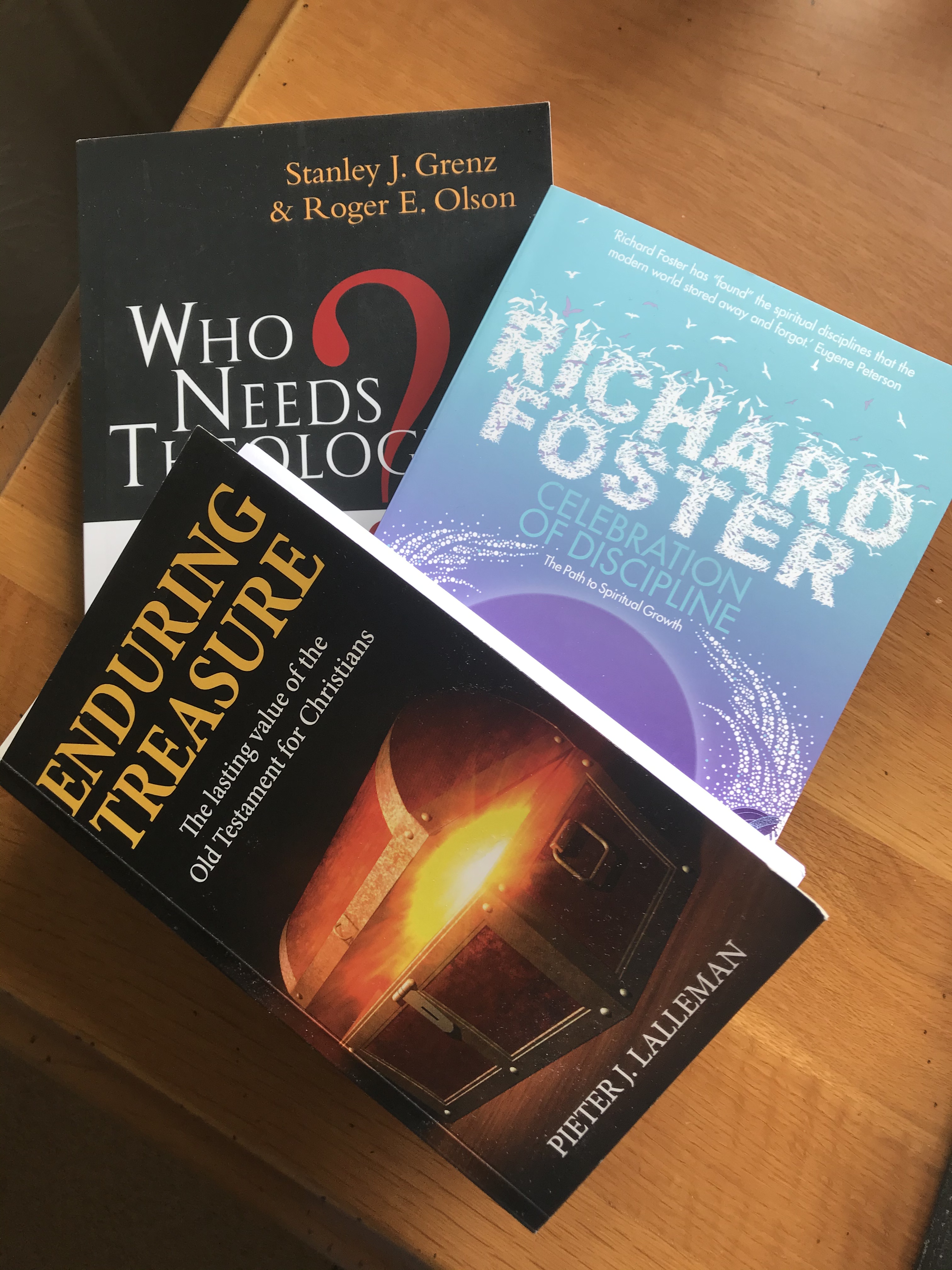
As soon as I was accepted for the MA, I looked at the books in the pre-course reading list. How exciting! I love an excuse to read a book. Some were expensive, so will have to be loaned from the library (or not read) but a few were within budget (ie, wouldn’t be commented on when the credit card bill arrives!) so I ordered them—three paperbacks and one on Kindle. I will write a review for you when I have read them (unless I hated them, as I don’t review books I dislike).

They arrived quickly, and my main surprise was the size! It seems that the price of theology books is not an indication of their size. There will certainly be room for them on my bookshelf…

Another plan is for Lent next year. Yes, I know that Lent is ages away, but I also know that I have a slightly compulsive personality, and when term starts in September every moment and thought will be taken up with study plus family commitments, so anything extra should be prepared now, while I have time. Don’t stop reading, because this involves you too.

I decided a while ago, that for Lent 2022, rather than give up chocolate or alcohol or whatever, I would give up some time and learn a Psalm by heart. Good for the brain. Psalm 22 is basically a poem about what happened at Easter.

I hope you will join me, so this week I wrote out the Psalm and divided it into 40 segments (one for each day in Lent) ready to post on my blog. I thought it would be good to learn it in another language, so also wrote it out in Hebrew. This looked rather daunting, but achievable. I decided that I will do it as a sponsored event, and raise money for Tearfund. The easiest way for people to give is via either a Just Giving page or a Facebook Charity page. I decided to use Just Giving, looked on their website, and discovered it was very easy to make a page. I made one, which will sit there, like a lemon, until next spring. I think Tearfund will be alerted that the page has been made, so they will look at it and think I am Billy-no-mates because I won’t start collecting sponsors until next year! In 2022 I hope lots of people will generously sponsor me, and each day I will learn a few lines of the Psalm.

Now, you would think that dividing a poem (because a Psalm is basically a poem) would be easy. I knew that Lent started after Ash Wednesday, so began distributing lines of poetry across the days. Then I thought I had better check my dates, because I wasn’t raised in an Anglican church and the dates of Lent are fuzzy. My dates were wrong. Lent begins ON Ash Wednesday. I rewrote the distributed lines of poetry.

Then I mentioned to my family what I was planning. Son 1 informed me that Lent doesn’t include Sundays. That sounded wrong. I checked. He was correct—Lent is 40 days, beginning on Ash Wednesday and not including Sundays. I rewrote the distributed lines of poetry again. This was proving harder to get right than learning the thing will be!

I added the Hebrew version underneath. I will upload it on my blog, so next Lent, all my followers will receive a snippet of the poem to learn each day. Learning things is achievable if they are broken into little bits and read often. I will write out the lines and stick them on the fridge, and the mirror in the bathroom, and next to my bed. It will be good for my brain, fun to achieve, and hopefully raise some money for Tearfund.

Now, here’s the thing—will you join me? I can add another language if you fancy learning the poem in French or Spanish or Mandarin, or whatever. You just need to let me know. The aim will be to try and learn a small section every day (if we don’t manage the whole thing, then it doesn’t matter).

If you want to be sponsored, which I think will be very motivational, then you can either make your own sponsor form, or use one of the online ones, or if you want to be added to mine, I can edit it so it shows other people too. If you want to be added, let me know your name, the language you plan to learn it in, and how much you think you will raise and I will add it to my page.

I realise that Lent 2022 is ages away, but now is the time to plan it, and then it will be put in your diary and it will actually happen. It doesn’t matter where you are, you can learn a poem anywhere. Things that are ‘left for later’ usually never happen in my experience. Plus, it’s better to plan ahead, because it’s so far in the future that it isn’t scary at all (I suffer a lot with ‘scary’!)

So there you are, a challenge for you to think about. Which language would you like to learn the poem in? I am excitedly waiting to hear from you…

Hope you have a motivated week. Take care.
Love, Anne x

P.S. I have now read ‘Enduring Treasure,’ the first book on my list. I will post my review of it next week, so be sure to look for it.

Anne E. Thompson
Thank you for reading anneethompson.com Why not sign up to follow my blog?

All Things Duck


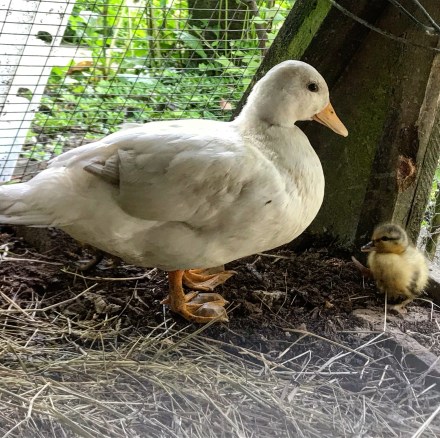
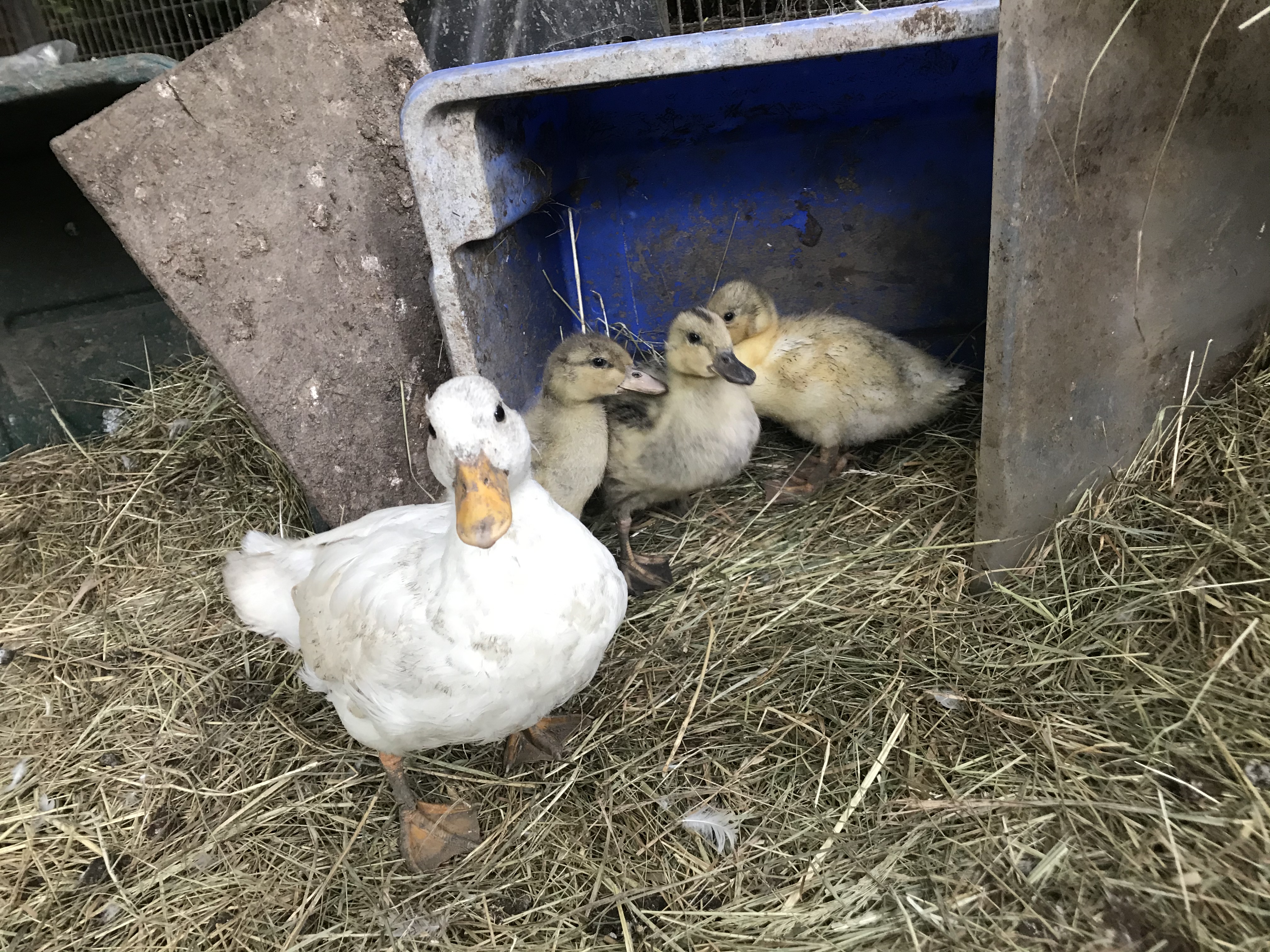
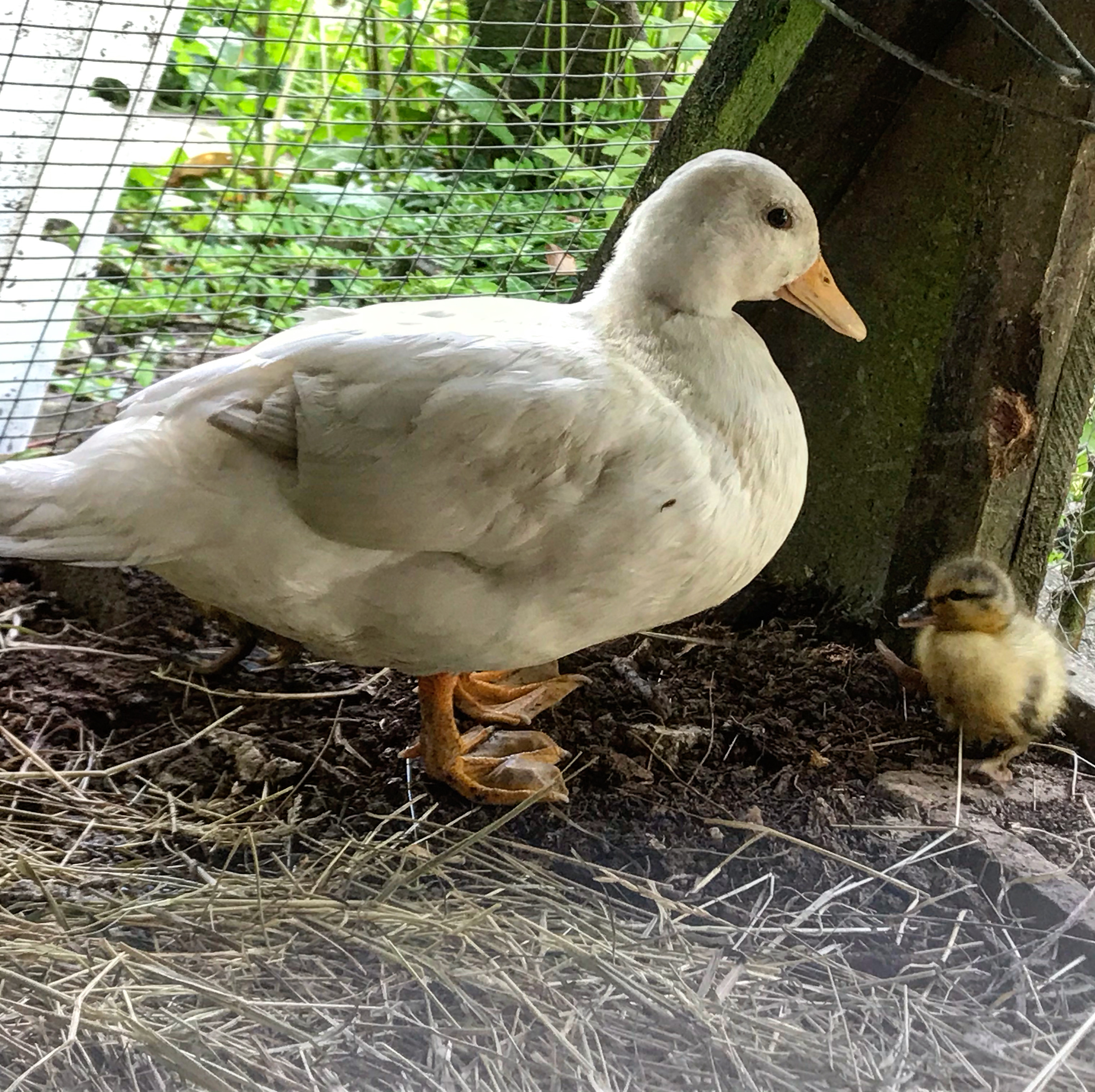
I have just sorted out the ducklings—not that they are ducklings anymore; they are pretty much full-grown after a few weeks. The 8 ducklings in the big cage were being lots of work, and the mother who unexpectedly hatched 3 extras were in a cage right next to the pond, even though they can’t go onto the pond until the new ducklings are big enough to avoid being a tasty snack for crows and cats. So, I decided to switch the cages. So easy to say…so much work involved.

The first job was to catch mother duck. I removed the door to the cage, and noticed I had been joined by 3 cats. Took a break and secured them in the shed—they had different plans for the ducklings. Went back to catch mother duck. Mothers can be scary when they think their offspring are at risk, but she knows me, so apart from crawling into a dirty cage, it was easy enough. I put her into a box while I caught the ducklings, which are as fast as rats when they think they’re going to be caught. Shoved them into the box with the mother.

Cleaned out cage (lots of cobwebs and poo and stinky hay and mouldy food involved in this—caring for animals is not glamorous). Moved big ducklings into the cage. As I said, they are not really ducklings anymore, and one never was as she is a chicken—but she identifies as a duck. While I moved them, I was able to determine their sex by the volume of their quacks. They’re too young for tail feathers (male ducks have curled tail feathers) but their voices are clearly different. The loud quack that you associate with a duck is only made by the females. The males make a sort of feeble grating noise. Out of 8 ‘ducklings’, I have: 1 chicken, 2 females and 5 drakes. Not a good ratio.

Lifted mother and her ducklings out of the box in the big cage and watched them for a while. They instantly went to dig in the wet mud, and now look revolting. But I think they’ll be happier in there. After a few days, I will open the end of the pond cage and let the full-grown ducks onto the pond. They will love that.

Not so cute when they’re muddy!

I am not entirely sure what will happen with the chicken/duck. I am assuming she will simply wander around the bank and the flock will join her in the cage in the evening. But we will see. Hope she doesn’t try and swim. I do have another hen who thinks she’s a duck, and I managed to integrate her into the chicken flock, but she has never been very happy and tries to return to the pond whenever she is released. I might try to combine the two of them, but introducing new chickens to each other is never easy—they are nasty birds compared to ducks, and will fight a bird they don’t recognise.

I am especially keen to see what colour eggs she lays. Her mother is a lovely black hen, and she came from a brown egg. Her father is white—and had he been female I think the eggs would be blue. I am really hoping for green eggs, but we shall see. They should be a good size anyway because the mother lays big eggs. Chicken-Duck is white, though might grow some darker feathers later because my grey/white hybrids have a few grey specks amongst the white.

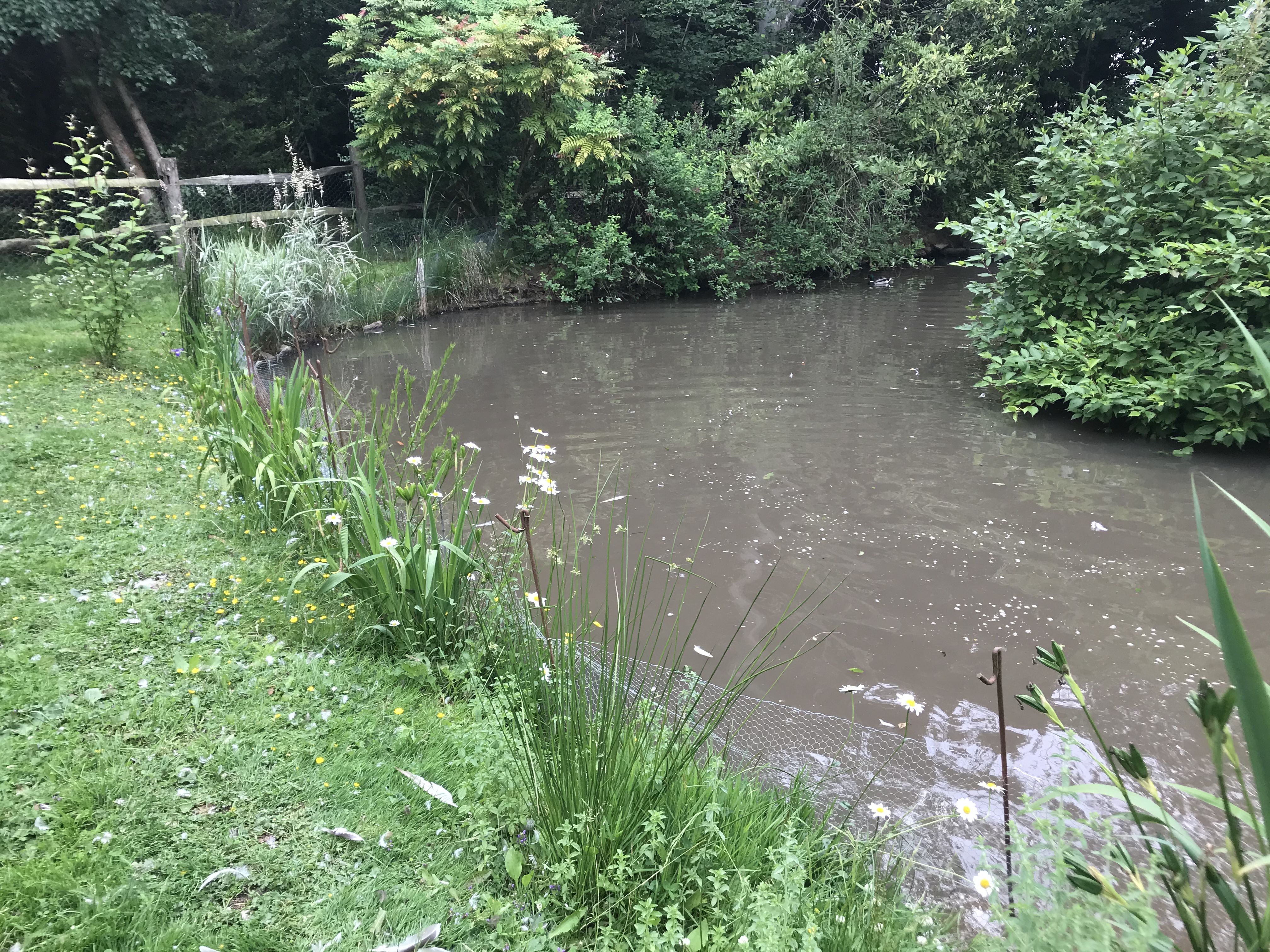
The cage next to the pond.

Time to go and use some of the eggs to make cakes now. Hope you have a good week (and that it involves less smelly poop than mine generally does!)

Thanks for reading. Take care.
Love, Anne x

Something no one who owns poultry wants to see.

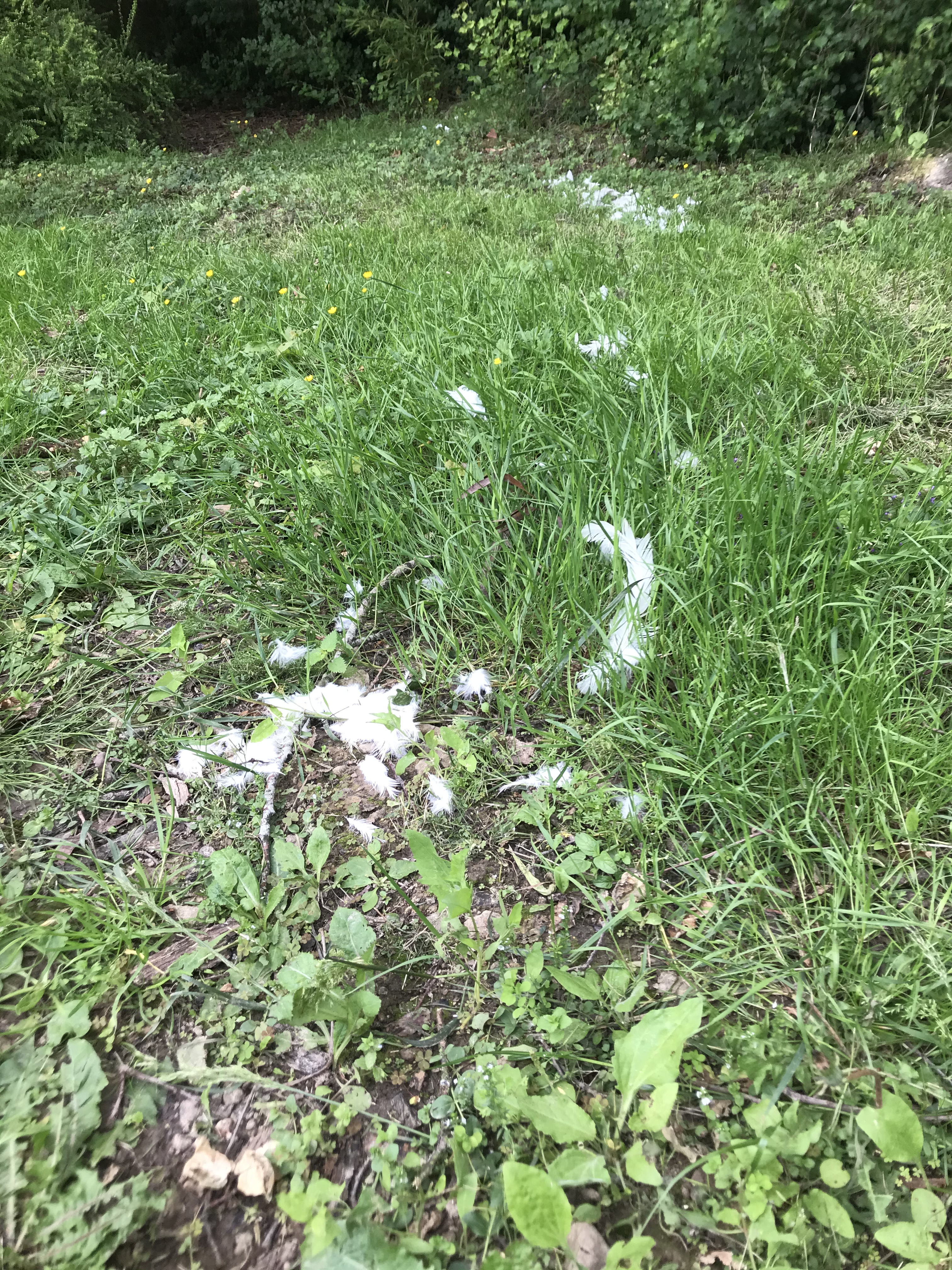
A sad footnote. I decided that enough time had passed for the local fox to have stopped using our garden as his territory, and I let the chickens out of their cage. I was wrong. At about 4pm, I went to check and found a trail of feathers. I locked the hens away quickly, but my lovely cockerel was killed. Not eaten, just killed. I saw the fox a little later, as it came back for more fun. It was still early, not even beginning to get dark.

If you are someone who feeds foxes, please note: You are not providing food for an hungry animal. Foxes kill for fun. If they are fed by humans, they lose all fear of humans and places like gardens become part of their territory. The natural balance of nature is upset, and foxes will breed more cubs than they can find food for in the wild, so they become dependent on humans, and their pets, for providing easy food. A fox will kill birds, and rabbits and an elderly cat if they happen to be within range.

A few years ago, there was lots of crying in the field opposite our house. Every ewe was standing next to a dead lamb. A fox had killed them, for fun. I have nothing against foxes, I like seeing them in the wild, where they belong. But foxes that have no fear of humans are a problem. Please do not feed foxes. If you want a pet, get a goldfish.

Anne E. Thompson
Thank you for reading anneethompson.com Why not sign up to follow my blog?

anneethompson.com

****

Life After Exams


Life After Exams

Yaay! My exams have finished. I write this the day after my Greek exam, and I have a slight headache. I have had a slight headache for a while now—almost as if my brain is over-stretched by all the facts I have been trying to cram into it. But my languages course is completed and that is such a good feeling. It has been fun, but the exams were scary.

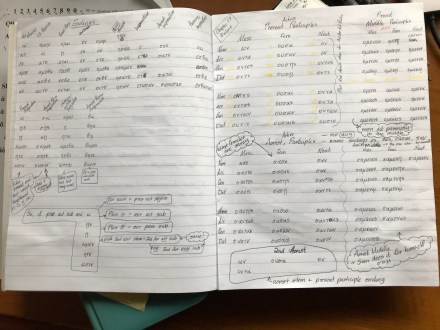
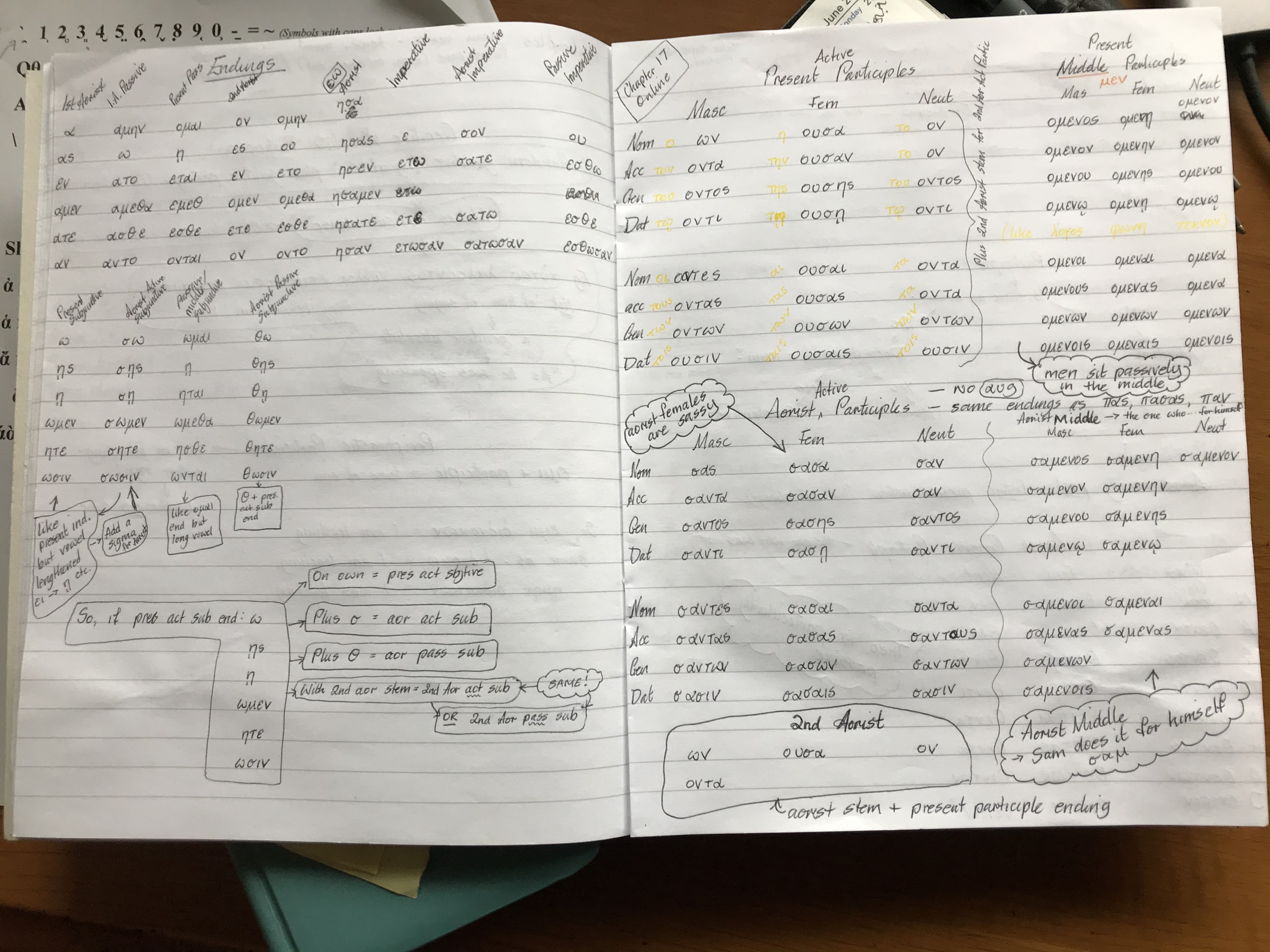
Lots of scribbled notes with silly sentences to help me remember them.

 Friday was busy. The house has been ignored for several weeks, so as soon as my last exam was finished, I cleaned up the kitchen a bit, ready for friends coming for dinner. The dog watched in alarm, especially when she saw her bed going into the washing-machine. She sat guard next to it for a while, then came to give me little nudges in case I hadn’t realised her bed was missing, and finally sat, very pointedly, in the space where her bed should have been.

Reunited with her clean bed.

The animals continued to ignore the fact that I was very busy, and on Wednesday old cat died. It’s always very sad when animals are old and unhappy, and when I went to see her Wednesday morning she gave me that look, letting me know that she had had enough. She was over twenty, and was a good friend to my daughter when she lived at home, so although the cat pretty much hated me, it was still sad to let her go.

Son 2 was working in the kitchen on Wednesday, and had angled his computer so there was a lovely view of the garden behind him during Zoom meetings. We all tiptoed around the kitchen so as not to disturb him, and all was going well—we were being good parents—until Husband forgot and walked past the window behind him carrying the cat. Probably not what Son 2 was hoping for, but we tried…

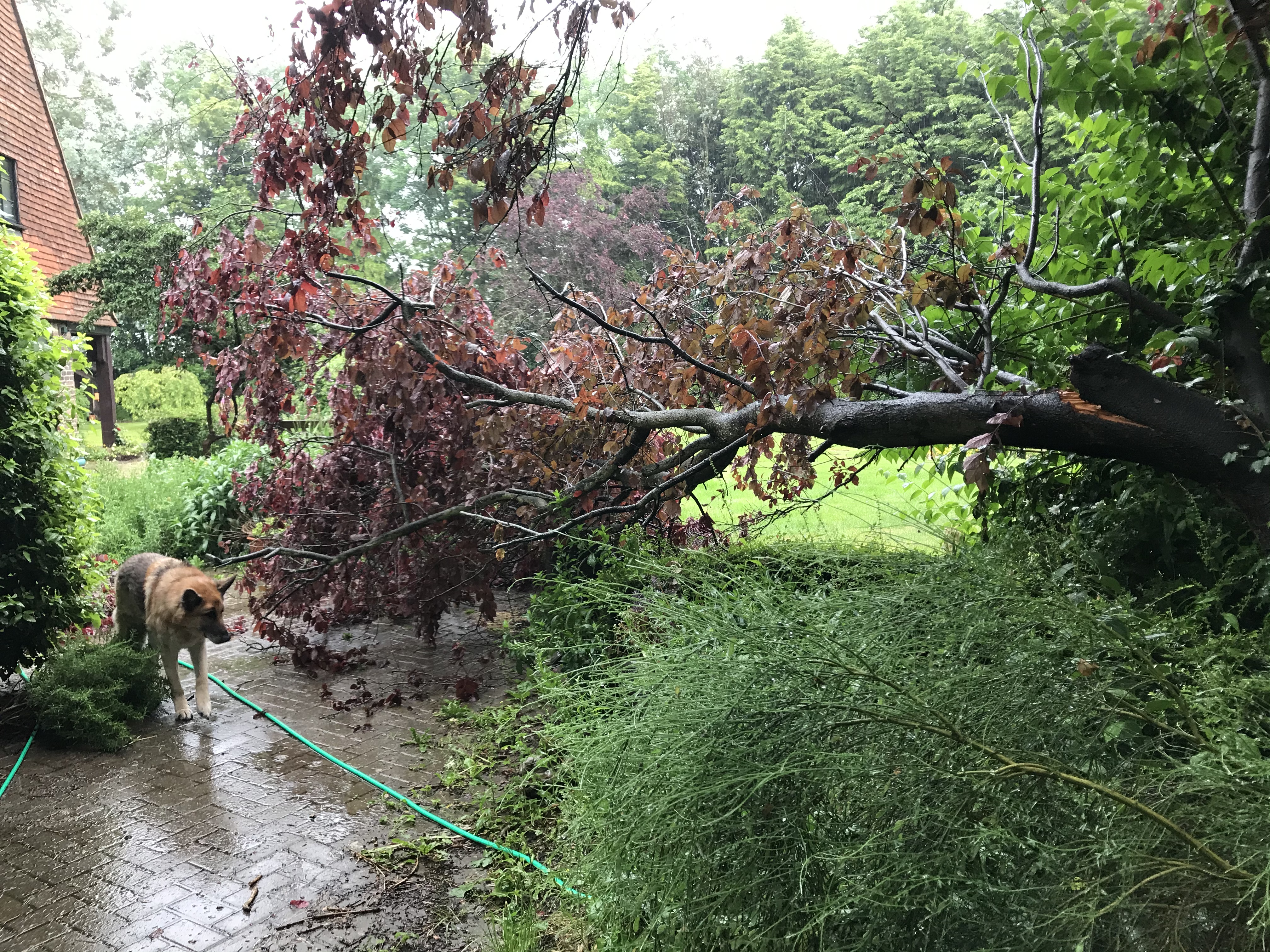
We had a tree down this week too. Did you have a big storm midweek? We didn’t have much wind, but the excessive rain was obviously enough weight to make half a tree snap off and fall across the garden. Dog went to investigate and was very perturbed that her route to the garden had changed. Two fat cats who live in the garden looked particularly innocent, which makes me wonder whether they had been up the tree when it happened and their combined weight helped the branch to snap—but they deny all knowledge.

This is a short blog because I need to continue cleaning the house. I keep finding all my scribbled revision notes in every room, paradigms to learn while I cooked or put washing in the machine. Not sure what to do with them —feels silly to keep them. I don’t suppose I shall ever look at them again, but they represent hours of my life. They are mostly all in the bin now.

So have a good week, and enjoy everything that you complete. I’m going to find the vacuum cleaner…though I do have ice-creams in the freezer and I can hear Husband and son leaving the house, so possibly I shall change the plan…

Bye for now.

Love, Anne x

Anne E. Thompson
Thank you for reading anneethompson.com Why not sign up to follow my blog?
I saw this online, and it made me laugh. I know just how they felt!

Family Chaos


You can’t control animals (or children…or husbands!)
As you know, I am trying to revise for exams. The Hebrew one is finished (I smashed it!) but the more I revise Greek, the more I realise I have forgotten/never understood in the first place. I have a feeling of rising panic growing inside as the exam date moves relentlessly nearer.

Now, I thought that I had at least sorted all the animals so that I could devote my time fully to my studies. I had timed the hatching of the eggs in the incubator so the ducks would be fully-grown and on the pond, I stocked up on supplies of pet food, incorporated cleaning-out times in my schedule. I was prepared. Except I wasn’t.

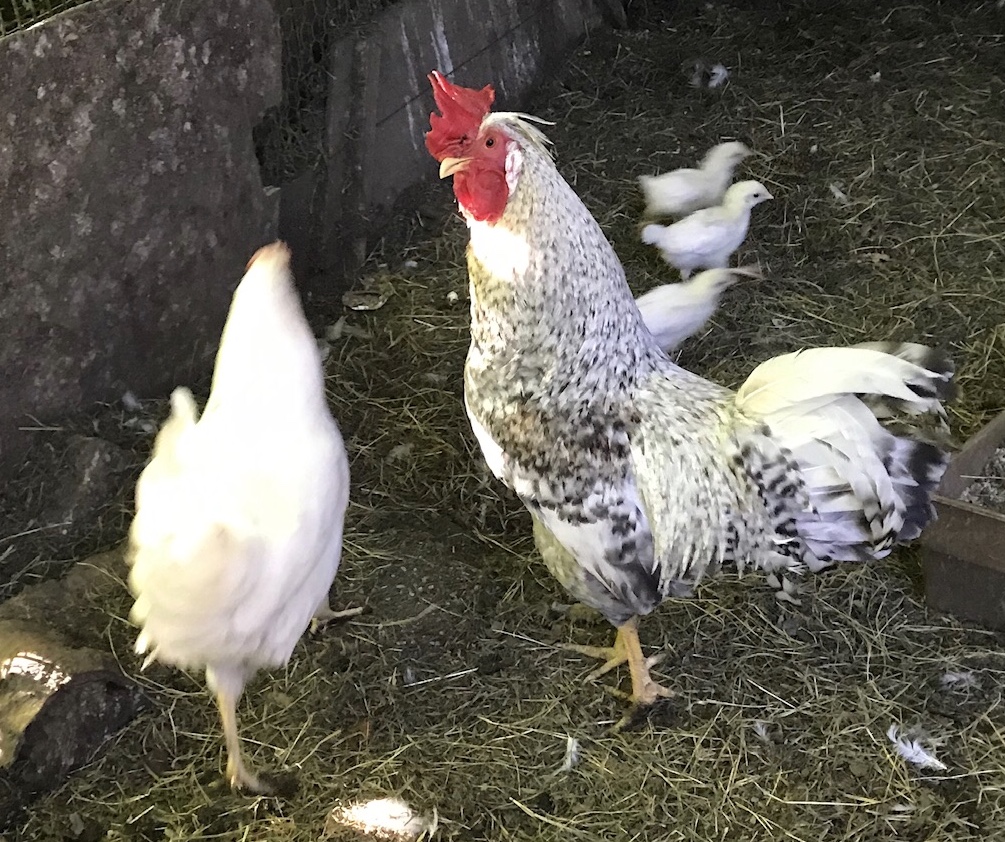
Firstly, the local fox decided to produce cubs, which meant it began to visit my garden at odd times of the day to snatch a chicken. The only way to keep them safe is to keep them locked inside for a few weeks until my garden is no longer seen as an easy source of food. This means the chickens now need cleaning-out more often, and they kick dirt into their water, and generally make everything more work.

Then mother duck started to sit on another nest. I calculated the date, and sure enough, they hatched this week. Which means they are now in the pond-cage I was planning to put the fully-grown ‘ducklings’ in. Which means they have to stay confined in the big cage (because if I release them on the pond now, they will sleep on the bank, not return to the pond-cage, and greedy fox will eat them—see above.) Ducks mainly spend their day putting mud into their water, which means I have to keep refreshing it. Which takes time. The new ducklings are cute, but add to the workload as I have to keep checking one isn’t stuck somewhere, plus food and clean-up schedule.

Then grumpy-old-cat-who-hates-me has started to walk further afield. She is over 20, and can hardly walk, but has decided that she will visit the outside cats each morning. They hate each other, so I’m not sure why. But she tends to climb into places that she cannot then get out of, so I have to keep remembering to check where she is in case she needs rescuing. Which takes time.

It reminds me of when my children were young, and they didn’t fit neatly into a schedule either. I’m not quite sure how families manage when they both work. I worked fulltime for one year when my children were aged 4, 6, and 8—and I collapsed in a heap at the end of the year and switched to a part-time contract. Children do not save their crises for convenient times. They will be devastated because someone doesn’t want to be their friend, or lose one shoe (only ever one) or start vomiting on those days when you have a deadline and extra stress and really need everything to be calm.

Husbands can also be a challenge (though mine is lovely of course). Yesterday Husband kindly cooked the dinner, which was incredibly kind. We had fishcakes, and rocket (nicely garnished with a tomato) and chips—all of which were lovely. There was also a dressing to go on the salad. It was a new creation, and had a pleasant taste to start with, followed by bit of a kick and then a slow burn. I don’t believe it was from a recipe book. After much discussion, the ingredients were revealed as: oil, garlic, oregano, seasoning, garlic (lots of this I think) and whiskey (which explains the burn!) I will send the recipe on request.

Hope you have an organised week—or ride the chaos with a smile if not.

Thanks for reading.

Love, Anne x

Anne E. Thompson
Thank you for reading anneethompson.com Why not sign up to follow my blog?

Why not sign up to follow my blog?

anneethompson.com

****

Cake Disaster


It was a disaster. I tried my best, but it still looked like something a twelve-year-old had made out of plasticine. At least it made my siblings laugh (good to bring a bit of laughter to someone’s day—even if that wasn’t the result I was going for).

You see, it was my mother’s 80th birthday, and I decided that I would make the cake. (Well, to be honest, the lady who I wanted to order a cake from has moved away, and when I looked at cakes in the shops, I thought I could make one that was better. I was wrong.) Birthday cakes in our family are a thing.

When we were young, my mum always made us a birthday cake. Every year, without fail. Previously, Mum had taken some evening courses (City and Guilds) and she was rather good at decorating cakes—good enough to sell them in fact. I remember the tension in the house whenever she was asked to make a wedding cake, because if we even breathed in the kitchen we were glared at!

I also remember the time she made a huge centenary cake for a Covenanter group (like the scouts) and it was left in the larder where it would be safe. Except it wasn’t safe at all because someone (my brother) lent on it to reach something and put his elbow right through the left-hand corner. There was a bit of fuss when it was discovered, minutes before the cake was due to leave the house, and my mother did a bit of nifty icing to hide the damage.

My favourite cake had a fairy on it, closely followed by one with iced pink flowers. My brother’s cakes tended to be football-themed. I don’t remember my sister’s, but they would have been beautiful.

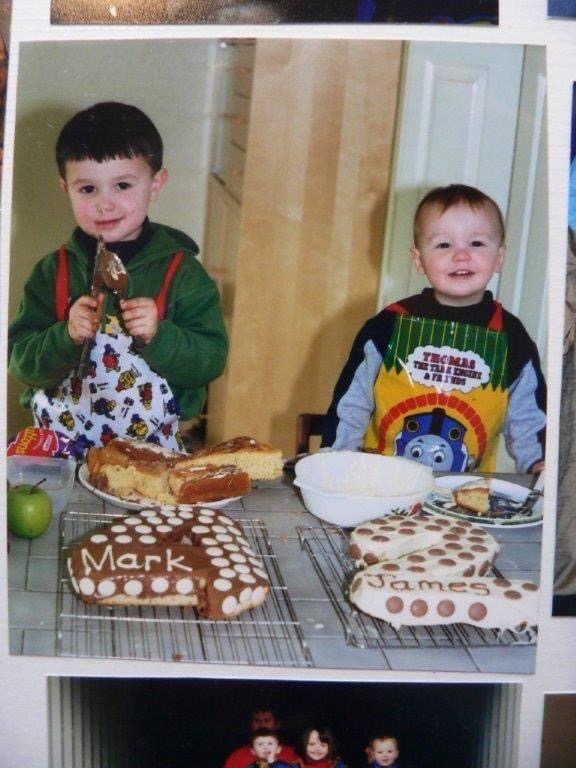
When I had children of my own, I tried to continue the family tradition. My results were less good, but usually passable—mainly because I went for simpler designs.

Cakes when my boys were small.

So now, with Mum about to be 80, I wanted to create something beautiful for her. She is a keen gardener, with painted watering cans in the garden (where she hides sweets for all the local children to find). I decided to make a cake covered in iced flowers, with bright watering cans all around the edge.

I found some tiny flowerpot muffin cases in Lakeland—they could sit on top of the cake.

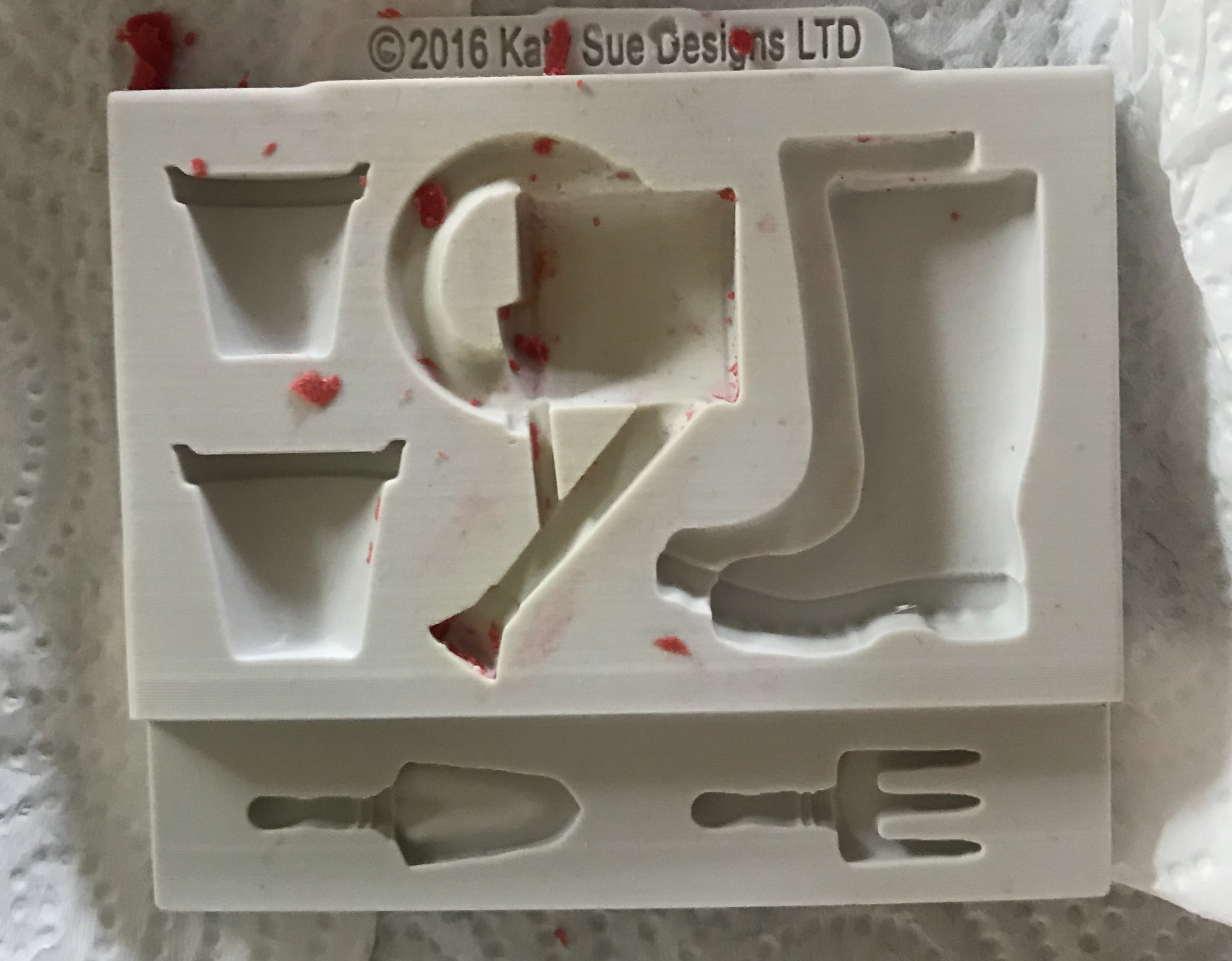
I found a mould for icing watering-cans on the internet. Perfect.

I was busy revising for exams, but when I could think no more, I used the break to make the cakes. I have made cakes a million times. These were the worst cakes ever.

I tried to make the watering-cans. Even I could see they weren’t exactly beautiful. The red icing seemed to go everywhere. The cake (and my kitchen) looked more like a war zone than a garden. I sent photos to my siblings. My brother suggested I add a hand-grenade to complete the look. My sister said she couldn’t stop laughing.

It was a disaster. I realised that decorating cakes is not one of my gifts.

On the day, I presented Mum with her garden-war-zone-chaos cake. She looked pleased.

Hope you have some success with whatever you attempt this week. But if not, at least it might make someone laugh.

Take care.
Love, Anne x

(The photo below, found on Facebook, seemed strangely apt!)

Anne E. Thompson
Thank you for reading anneethompson.com Why not sign up to follow my blog?

anneethompson.com

***

Can You Bring Some Fish?


I am scribbling this in the few minutes before I nip downstairs to start to cooking dinner. I am meant to be revising. My Greek and Hebrew exams are imminent, and every spare moment is spent chanting words or skim-reading textbooks and trying to make sense of my notes. If there weren’t exams looming, it would be quite fun. If nothing else it provides me with the perfect excuse to not do housework (don’t even think about how dirty my kitchen floor is…)

A selection of language textbooks

Anyway, I am currently translating a passage from John’s Gospel, the very last chapter, when the disciples have gone fishing and Jesus appears on the beach. He asks them if they have caught any fish, and when they say no, he tells them to throw their nets out on the other side of the boat. When they do, they catch so many fish they can barely struggle to shore. Jesus is cooking fish over a fire, and he asks them to bring some of the fish they caught, and eat breakfast with him. He then asks Peter whether he loves him.

Modern fishing boats.

Do you remember the story? Here are some of the things that I notice in the Greek version:

Firstly, the story seems to begin when Peter announces that he is going fishing. This is interesting because he used to be a fisherman, before he started to follow Jesus. Since then he has been a disciple for a few years, culminating in a terrible night when he denies knowing Jesus and then Jesus is killed. But after this, Jesus appears again to the disciples (so Peter knows that Jesus is alive) and Jesus tells them to wait in Jerusalem. So, when Peter decides to go fishing, he seems to be ignoring the command to stay in the city.

Why would he do that? Perhaps he was fed up with waiting. Perhaps he was bored. Perhaps—because he had failed Jesus so spectacularly—he didn’t think the command applied to him. You can decide.

When Jesus greets the fishermen, he calls them children. A greeting of: “Hey kids, have you caught anything?” Why would he call them children? It doesn’t seem to fit with fishermen. Was he teasing them? It’s too hard to guess from the Greek, so you can decide.

‘The disciple who Jesus loved’ (probably John) realises that it’s Jesus and tells Peter, who grabs his clothes, and leaps into the water. He would have been naked, because in those days, nudity was more convenient than lots of laundry and most active work would have been undertaken without clothes. (The gymnasts all performed naked, it wasn’t a big deal.)

When the disciples arrive on the beach, they find Jesus with a charcoal fire, cooking bread and fish. Where did the fire come from? Where did the bread and fish come from? We don’t know. But I think the really interesting bit is that Jesus then tells the disciples to bring some of the fish that they have just caught, and to come and have breakfast. Now, why did he want them to bring their own fish? Did Jesus not manage to bring enough? Seems unlikely. Did Jesus not realise how many disciples were going to be at the breakfast? Seems unlikely. Therefore, Jesus must have planned to not have enough. He planned to need what the disciples were able to offer (which he had helped them to catch in the first place).

What then, are the implications for us today? I think God chooses to need what we can offer. And if we don’t do our bit, then there won’t be enough. Whatever it is that we have to offer, however pathetic it might seem to us, that is what God needs. God then accepts our help. This is huge. I don’t think God pretends, I think he genuinely does need our help in whatever area we happen to have something to offer. Yes, he could do it all himself, just like Jesus could have produced enough fish along with the bread and the fire—but he didn’t.

I also think, that if we are meant to be following Jesus’ example, living like he did, then we too should be accepting help from others. We are meant to be a team, everyone with something to offer. If we want to help others, we need to also think about how they can help us, because then the relationship is equal. That seems to be the example we were given to follow. Mostly, we’re pretty bad at copying it.

Thanks for reading. I hope you find something to offer–and accept–this week.
Take care.
Love, Anne x

Anne E. Thompson
Thank you for reading anneethompson.com Why not sign up to follow my blog?

anneethompson.com

The Buried


The Buried

by Peter Hessler

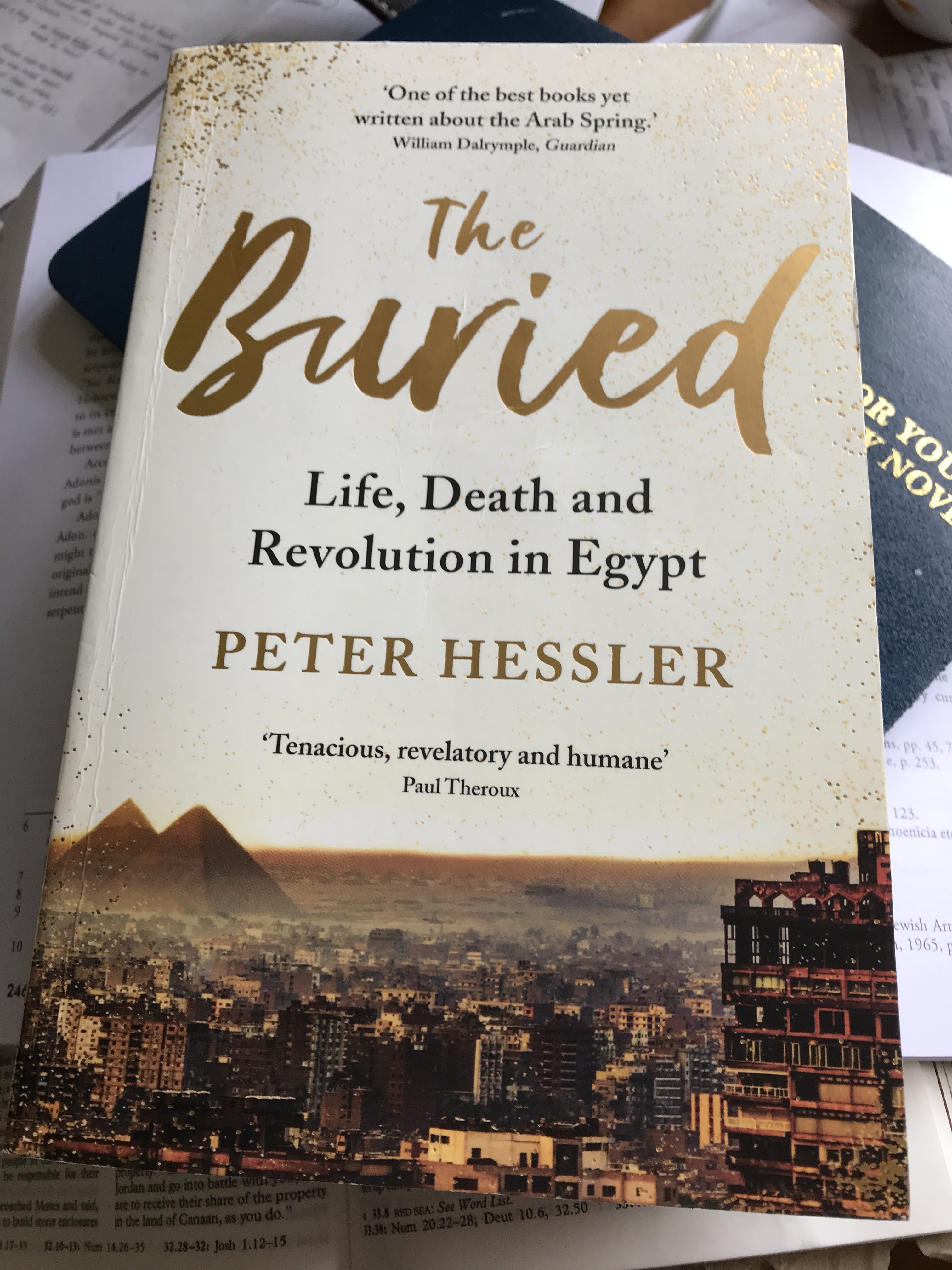
I recently read The Buried by Peter Hessler, and I can definitely recommend it. I knew of Peter Hessler because when I started learning Mandarin, and scanned the bookshops for any English books with any link to China, his books popped up. He was sent to China as a young man, and worked in a remote town, teaching English (with an American accent) to Chinese students. His books described his adventures.

I loved his books. He wrote with humour, describing the many things that went wrong as he learnt Mandarin and described life in China. I felt that he wrote with tact, and had a real respect for the people he met. He seemed to genuinely like Chinese people (most foreign travellers seem rather condescending towards different cultures) and so I wasn’t surprised to learn that he is now married to a woman from China, and they have twin girls.

At the time of writing The Buried, Hessler had again left the US, with his wife and young girls, and had gone to live in Egypt. He applied the same amused patience as he tried to learn Arabic, and the culture in Cairo. He moved there at the beginning of the Arab Spring, and the book describes the events unfolding in the city.

Hessler writes in short sections, so this is a book to dip into during odd moments. I like the respect he shows towards the people he writes about. His says he always tries to learn a language using the books written in the country, because they reveal lots about the culture. I would agree with this. When I learnt Mandarin, the textbooks had lots about authority, and the vocab lists were about managers, and directors, and people in authority. Hessler compares this to the textbooks in Egypt, which were full of polite greetings and blessings, and the correct polite response in every situation. There is apparently even a correct way to thank your hairdresser!

Most people in Cairo spoke Arabic, though any quotes in newspapers were always translated into Fusha. Hessler describes one word, Yanni, which can be translated as: ‘yes,’ sort of,’ or ‘let’s pretend.’ That word alone tells you so much about the culture!

One of the charms of Hessler’s books, is that he befriends normal, working-class people. In Cairo, he befriends the man who collects the rubbish from the flats. There is lots to be gleaned from other people’s waste, much of which is recycled, any alcohol is sold (because good Muslim folk don’t drink alcohol). He also befriends a young gay man, who is struggling with the dangers facing a gay person in a strictly Muslim country (though I was interested to read that mostly, everyone knows that there is a certain place where gay people meet, and yet no one in authority is very bothered by it. It tends to be individuals who react strongly and cruelly, not the governing authorities per se.)

The political situation during the Arab Spring was obviously very interesting. Sometimes Hessler was in dangerous situations, though he writes: “What scared me most was the elevator shaft in our apartment.” He interviews people on the street and in the mosque, and attends news conferences. One feature of Egyptian politics seems to be the repeating of ‘facts’ over and over, until eventually people began to believe them. If something is asserted often enough, it becomes true…

While in Egypt, Hessler visits some of the archaeological sites. The book explores the links with ancient Egypt, and how the past continues to shape the future. The places he visited sound fascinating, and I now firmly want to visit.

Akhenaten c1346 BC

If you want to read something light and interesting, I recommend The Buried.

Thanks for reading. I hope you have a lovely week.

Take care,
Love, Anne x

Anne E. Thompson
Thank you for reading anneethompson.com Why not sign up to follow my blog?

anneethompson.com

What is the Point of an Ice Sculpture?


Would you spend time on an ice-sculpture?

I am often amazed at the skill and time that people spend on ice-sculptures. Some of them are absolute works of art, and yet within a few hours they melt away to nothing. I wonder, is it worth spending all that time on something that melts so quickly? Or is it more beautiful because it’s fleeting?

You might remember that Husband spent time earlier this year emptying a flower bed, filling it with compost, then planting hundreds of tulip bulbs. (He had help. Not from me.) I teased him when he regularly checked the bare earth for signs of shoots. I bought plastic tulips online and crept down one night to put them under his frost-proof cover. But eventually, the tulips blossomed, and they now look rather lovely. However, several gardening-friends have said that they hope the tulips reappear next year, because tulip bulbs don’t always survive as well as daffodil bulbs. Was all that effort for one display? Was it worth it?

The ducklings I hatched are now outside. They’re safely in a cage, and I waste lots of time watching them. Their main aim in life seems to be to fill their water container full of mud, and to spread the water as far as they can. They are happy creatures. But in a couple of weeks I will put them on the pond. Some will fly away, some will get caught by the fox, some will hatch more eggs. But wild ducks don’t tend to last very long—the ducklings I nurtured last year have mostly gone and I am left with just one. Was it worth it?

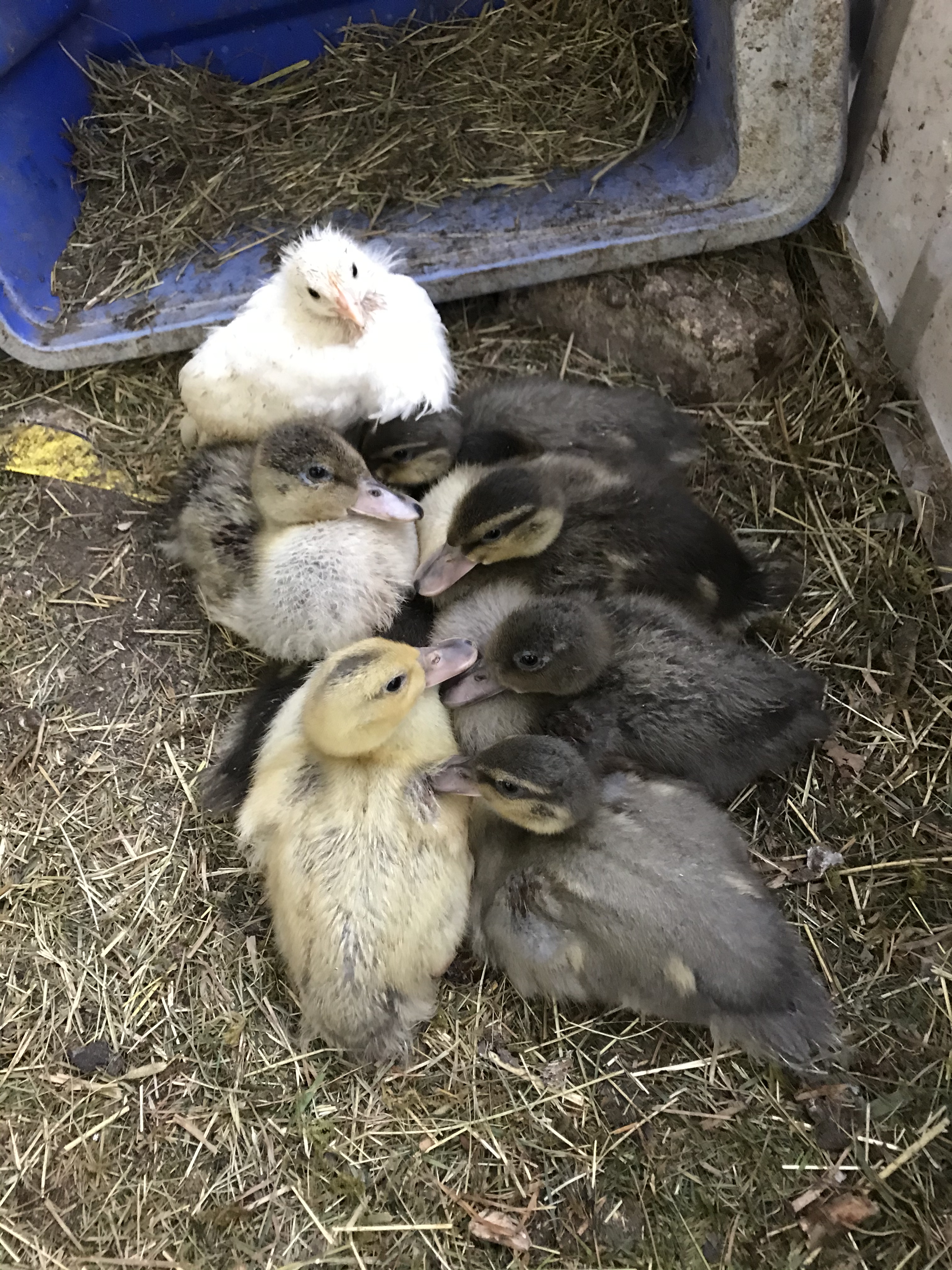
Ducklings snuggled with the chick.

I sometimes struggle with the “Is it worth it?” question. As I get older, I realise that life itself is very fleeting. If you have studied history, or read about the empires in the Bible, lives seem even more fleeting. Here today, gone tomorrow. Think of your own dreams and ambitions, how many have you realised? Is there still time to make them happen?

I feel that life itself is a little like an ice sculpture. We do the best we can, but we know it won’t last, and as we get older, we realise how quickly it will melt. But is it still worth doing? Is it worth creating something beautiful, even knowing that it won’t last, simply because it is beautiful?

I think that perhaps I must answer yes, it is. The shortest life has value. The melting sculpture is still beautiful.

I hope you create something beautiful with your life this week. Even if it is fleeting.

Take care.

Love, Anne x

Anne E. Thompson
Thank you for reading anneethompson.com Why not sign up to follow my blog?

anneethompson.com

Sold


I have been writing for a few years now, and some of my work I am immensely proud of, and some I am happy to never read again. This poem is definitely something I am proud of. I wanted to write something that answers the “How could a mother sell her child?” question, a poem that showed how choices are limited for some mothers, and how their love and longing to do the best thing for their child is just as strong as ours. I wrote it several years ago, but the message remains sadly unchanged.

Sold

I held you,
Your weight light on my hip
As I touched your button nose
With mine,
Peered deep into
Shining eyes,
Because you are my world.

We held hands
As we walked to the station.
And you skipped beside me
Trusting
While my heart
Became still,
Because you were my world.

I sold you
To the man whose words
Promised me,
That you would be schooled
And be fed
And have chances in life,
Beyond my reach.
And I walked away,
With breaking heart
And one hundred pounds
And the prayer you would be safe.
Because you were my world.

Help to stop child trafficking. See http://www.tearfund.org for more details.

xxxxxxxxxxxxx

I continued to explore child-trafficking, and when I wrote my Clara novel, I sent her to India and set her amidst the women in the slums who have such limited choices. While I was writing the book, I visited India several times, meeting girls who had been sold, talking to mothers who had sold their own children, trying to understand how and why this happens. When I finally wrote the book, although the story is fiction (and I know no one as horrible as Clara!) every house in the slum that is described is a home I have been in, every situation is one that I heard about.

If you want to read a copy, I can send you one for £7.99. Or you can buy a KDP copy directly from Amazon.

Anne E. Thompson
Thank you for reading anneethompson.com Why not sign up to follow my blog?

anneethompson.com