Hello, I hope you and your family have had a great weekend. When I say ‘your family,’ I do of course include any pets that you might own. They are definitely part of the family. Especially dogs.
As you know, I am studying animals as part of my PhD research—looking at animals in the Old Testament. This week I read an interesting chapter about dogs in the book of Exodus.[1] It always surprises me, when I study the Bible, how much I have missed in the past. I certainly missed the dogs in Exodus, even though they appear a couple of times. We can understand something of how ancient people regarded dogs.
Archaeologists find evidence of dogs and humans living together since the earliest times. Whether humans domesticated dogs to help them hunt, or whether dogs trained humans to feed them in return for protection, is unknown. The ancient Israelites certainly interacted with dogs, and they were listed as ‘unclean’ in the law, meaning they could not be eaten. (Which I have always thought made the animal disliked, but actually, it protected the animal’s freedom to some extent.)
The first mention in Exodus is near the beginning of the book, in chapter 11 (I am giving the English Bible references, the Hebrew Bible has different verse numbers). We have a description of the last plague in Egypt, when God’s angel of death was going to pass over the land, killing all the first-born people (and all the first-born animals, interestingly).[2] As children died, the people would wail and cry. But not the dogs. The dogs would remain silent. (In the Hebrew, it has something complicated, about not deciding to ‘tongue’ and tongue tends to be used for ‘speech’ and dog-speech is barking or growling, so that is how it tends to be translated.) Think about that for a minute. What does it mean? Dogs—which were kept to help with hunting and guarding—would not bark. Why? Did the dogs somehow know? Did the dogs recognise that this terrible happening was from God? Did the dogs understand something that the people did not recognise? I think they did.
Another mention of dogs is in Exodus 22:31. This has been linked by Jewish scholars to the verse in Exodus 11. It talks about when the Israelites find dead animals in the wild (road-kill of the ancient world), and they are told not to eat them, but to give them to the dogs. Jewish scholars suggest this meat is given as a reward to the dogs for keeping silent. It is owed to the dogs. I have never understood it this way before, but it is logical. God looks after people, and he looks after animals. Therefore animals have certain rights to certain food.
The book mentioned another scholar, a Jewish man who talks about his own experience with a dog.[3] He was a Jewish prisoner during the war, and forced to work in a work camp, where he describes being treated as if he was an animal. He says that Jews were viewed as animals by the guards—which in turn made the guards behave like animals. All very sad and dehumanising and wrong. But a stray dog wandered into the camp, and he managed to live there. When the prisoners returned from a day of hard labour, the dog would bounce around, joyfully greeting them. The dog made them feel human again. I can imagine the scene—I know what it is to be greeted enthusiastically by a dog. I can imagine how affirming that would be for prisoners who were hated.
In his book, Levinas suggests the dog viewed the prisoners as human (whereas the guards did not). Personally, I think the dog regarded them as dogs—one of the pack. We often ascribe human traits to animals. However, even if the dog was simply behaving like a dog, treating the men as one of the pack, it is still good. I think animals have much to teach us. We need to learn how to notice.
There are lots of animals in the Bible. Too often we don’t notice them, or assume they are simply metaphors and not an intrinsic part of the teaching. Yet the ancient world did not view animals as a mere commodity, and we should notice how they are used in the sacred texts. We might learn something.
Thanks for reading. Take care. Love, Anne x
Thank you for reading. anneethompson.com **********
[1] Ken Stone, Reading the Hebrew Bible with Animal Studies (Stanford, CA: Stanford University Press, 2018).
[2] Stone suggests this shows the people/animal groups were divided by God according to whether they were Egyptian or Hebrew, not according to species.
[3] Emmanual Levinas, Difficult Freedom, trans. Sean Hand, (Baltimore: John Hopkins University Press, 1997), 151.
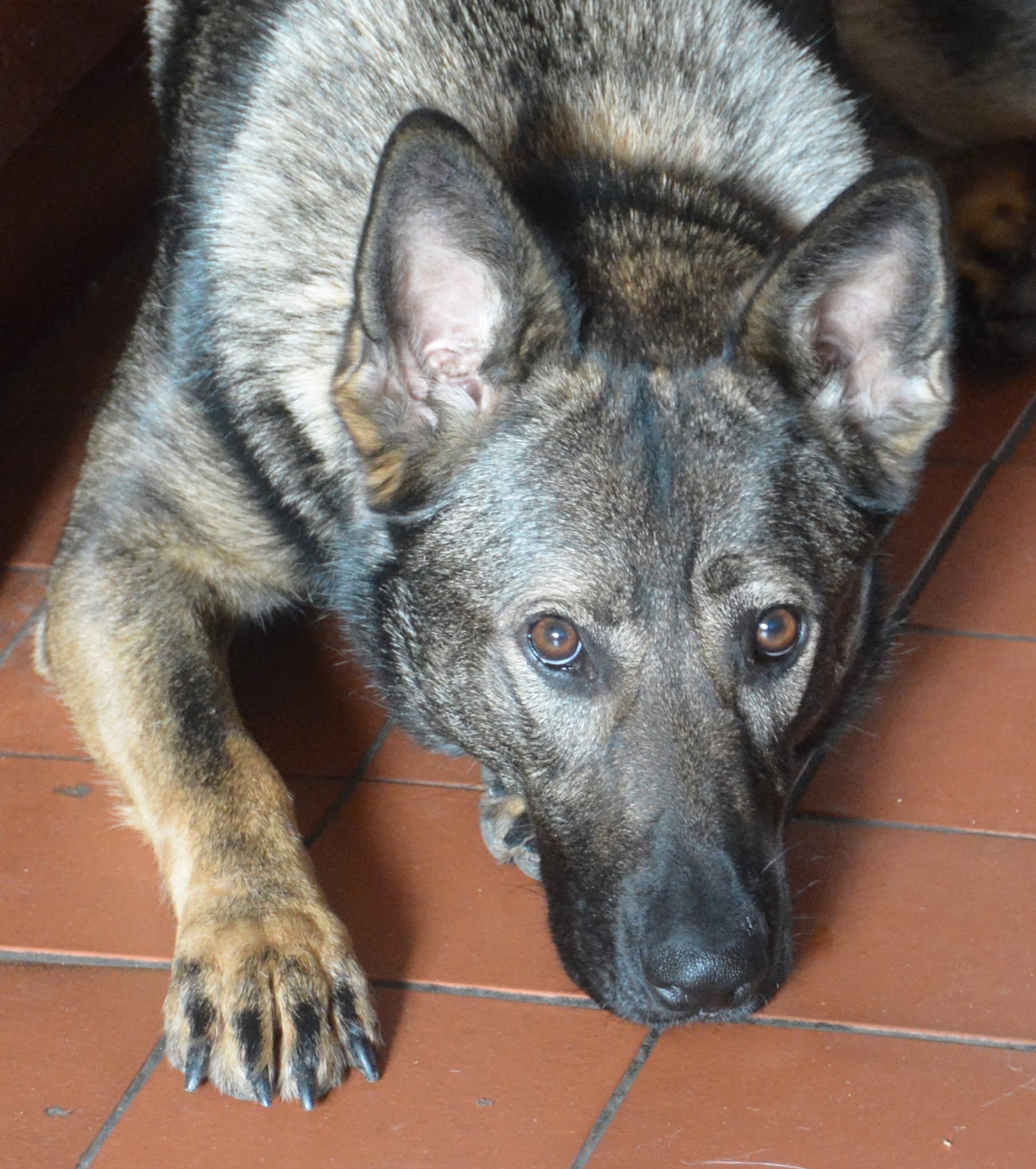
I have had a fun week with Meg—perhaps because it has been a ‘normal’ week, with nothing to make her over-excited. The only unusual event was that Meg chased a deer. We were walking in the woods, and I was throwing sticks (but a little apathetically—it was hot) when I heard the trees rustling. I guessed it was probably a deer, but I took no notice because we have encountered deer many times in the woods, and Meg is always more interested in the sticks I throw. But not this time. This time Meg went off to investigate. I watched her walk into the trees, sniffing, then she stopped, ears alert. She paused for a second and then was off, zooming through the trees and out of sight. I never saw a deer, but I assume that’s what she saw. I waited. I waited for quite a long time. Husband started to call her, but I suggested it was better to wait. I thought that if Meg could hear us, she would confidently continue to run away, knowing we were waiting. If we were silent, perhaps she would notice that she was alone and decide to return before she got too far away. I have no idea if this is a thing, but most of my dog-training techniques are based on ignorance, so it was worth a try. After a few minutes I spotted Meg returning, so we quickly resumed our walk, trying to look as if we didn’t care whether she was with us or not, and we (the pack) were leaving without her. Again, no idea if this is a thing, but it made me feel in control.
Another change is that this week (and maybe only this week) Meg has been jumping into the boot without a fuss. The turning point came one day when I was frustrated by our regular stand-off: me staring at Meg trying to coax her into the boot with treats and commands, her staring back and trying to coax me on a longer walk by refusing to get into the car. I clipped a long lead onto a restraining point in the car, the other onto her collar, and removed her lead. Then I just ignored her, and changed into my shoes ready to drive away. Meg jumped into the boot. The following day, as soon as she saw me reach for the long lead, she jumped into the boot. I no longer have to reach for the long lead—we get to the car, I open the boot, Meg jumps inside (just like all the other dogs I see, who are less awkward than my treasure). The only reason that I can think of, is that Meg was only awkward because I cared, and if I am not even going to try then she can’t be bothered to make a stand. Is this a dog thing? It’s certainly a teenaged boy thing, and Meg definitely has other similar behaviour traits to teenaged boys, so maybe it is. I will let you know if it continues. Perhaps ‘not caring’ is a way to make her obedient. That would be easy. (I cannot describe how different this is to Kia, my lovely ‘normal’ GSD, who would have walked through fire to please me and was upset if I was unhappy. Meg just sees me as competition!)
***
23/5/2025
Last weekend we went to Cambridge. It’s when we want to go away that having a dog feels like a hassle. Usually we pay vast amounts of money to put her in kennels, but this time My daughter kindly agreed to have her. I knew Meg would be happy (I was slightly more worried about Daughter!)
I walked Meg in the woods on the way to my daughter’s and then while Husband unloaded her crate from the car, I walked with Meg along the road. I wanted to see whether, now she is older, she will walk without leaping at cars when she is somewhere unfamiliar. For the first half of the walk (about 5 minutes) Meg was fine, although was clearly ‘noticing’ the cars. But I had a stick, and when a car came I managed to refocus her attention to the stick (which was snapped into pieces by the end of the 5 minutes—so she was tense). It all went wrong when we were nearly back at Daughter’s house. A car could be heard, approaching at speed, and I saw Meg click into ‘fully alert’ mode. I tried to make her focus on me, and told her to sit, and tried to calm her—but it was too late. As the car whizzed round the corner, Meg hurled herself towards it (and nearly broke my arm). Shame. Husband came came and rescued me, and I told Daughter that it definitely is not safe to walk Meg near a road, and she should just play with her in the garden while we were away.
When we collected Meg at the end of the weekend, she was happy and excited, and Daughter was okay and unharmed, so I feel it was successful.
***
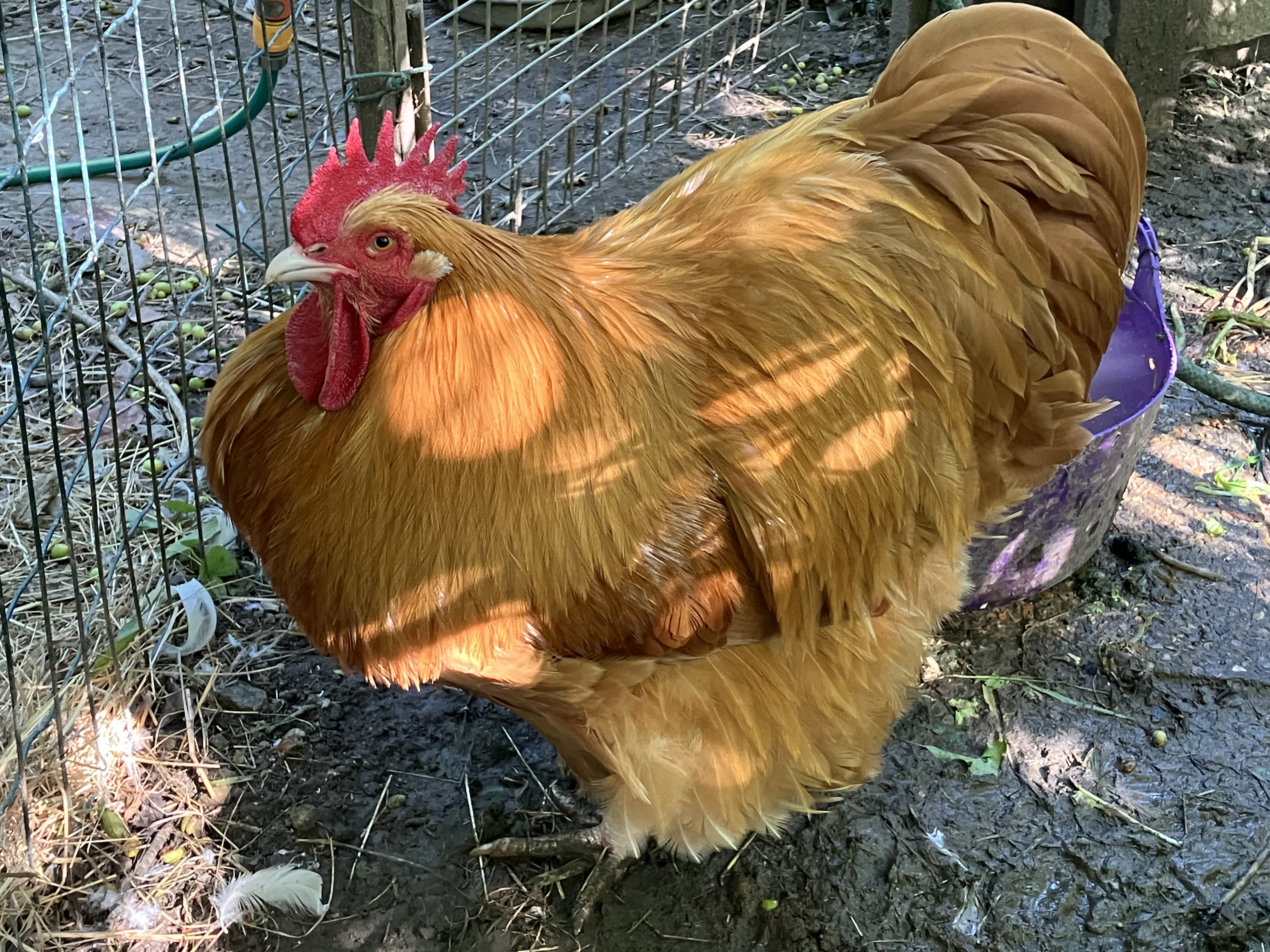
Yesterday I made a mistake, and let Meg into the garden when cockerel was out. He had been annoying when I shut up the birds for the night, and he ran off when he saw me trying to herd them all inside, so I was feeling cross with him and decided that he would have to cope with Meg. This was a bad mistake. I thought she would bark at him (as she does when on the lead) and that he would posture aggressively, and after facing-off, I would be able to herd him inside. It didn’t go like that.
Meg came up the garden with me, and I made sure she had a stick in her mouth. She saw the cockerel, and in an instant had dropped the stick and was on him. I called her, shouted to ‘Stop!’ and ‘Leave!’ Meg was deaf, zero response. She leapt onto the cockerel, and pinned him down. He made all sorts of attempts to get free and tried to jump at her with his spurs ready to attack, but she had him, trapped between her feet, long feathers drifting round them. I heaved her off him, and Husband took her inside while I sorted cockerel. I thought he was dead, but he wasn’t, he was just squashed. I lifted him into the cage, and watched to see whether he was likely to recover. He stood up, looked a bit dazed, and then started to walk around. Other than loosing some feathers, I think he is unharmed.
This was a learning experience for me—do not let Meg near my birds. It all happened in a second. But to be fair, Meg did not seem to be trying to kill him, I don’t think her teeth went near him, she just wanted to restrain him. Obviously my birds are too small, and she could easily kill one by mistake, but I guess she was only following her instinct to dominate and capture a herd (just happened to be a bird, not a flock of sheep). I’m not sure I will ever be able to train her to be safe around my other animals, though at least she has absolutely no aggression towards them.
I hope you have a safe week. Thanks for reading. Take care. Love, Anne x
My son was married in August. It was a beautiful wedding, and the day was perfect. Being mother of the groom is somewhat different to being mother of the bride. This is slightly strange, as obviously as a mother you have invested the same amount of love, time, energy, into raising a son as a daughter—but the relationship is slightly different when they’re adults. Plus, usually the wedding is the bride’s vision, so as a helper of the groom, the role is less clear.
The wedding was in Norfolk, and we rented a nearby house the week before so we could help wherever we were able. They had decided to book a ‘dry venue’—which does not mean that it has a roof (although it did) nor that it doesn’t allow alcohol (because it did) but rather that it is just a space. No furniture no decorations. The bride’s family are very artistic, and they wanted to create a very personal space for the reception.
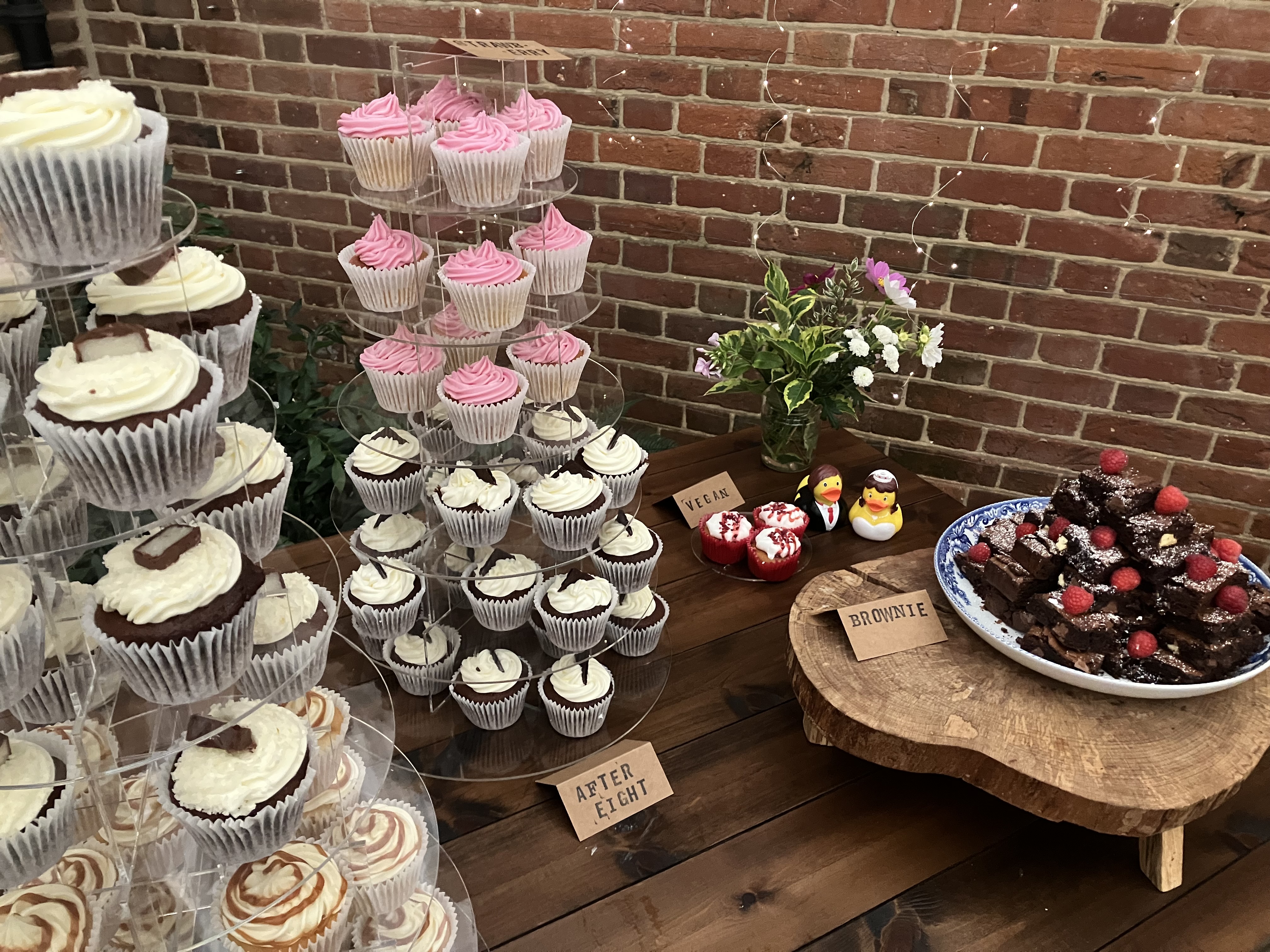
My main role was making cupcakes. They had asked me ages ago if I would, and I could not think of a way to transport them safely and freshly to Norfolk, so initially I said no. But then I realised I could bake them in the rented house, if she could find me space in someone’s freezer. I don’t enjoy cooking in a foreign kitchen, and I took absolutely all the equipment I would need (even my little cup that has a good rim for cracking eggs). When we arrived at the house, the cooker was exactly the same as my one at home, which was brilliant. I tested it with my oven thermometer, adjusted the cooking time for a slightly hotter oven, and all was good. I spent several hours baking and decorating cupcakes, and they were all finished by the Tuesday before the wedding.
We helped with other jobs where we could, although mostly the bride’s family wanted to do everything. This was an adjustment for me (my family is usually the ones organising things) but I could see they were working hard, and producing beautiful things, so I tried to not get in the way.
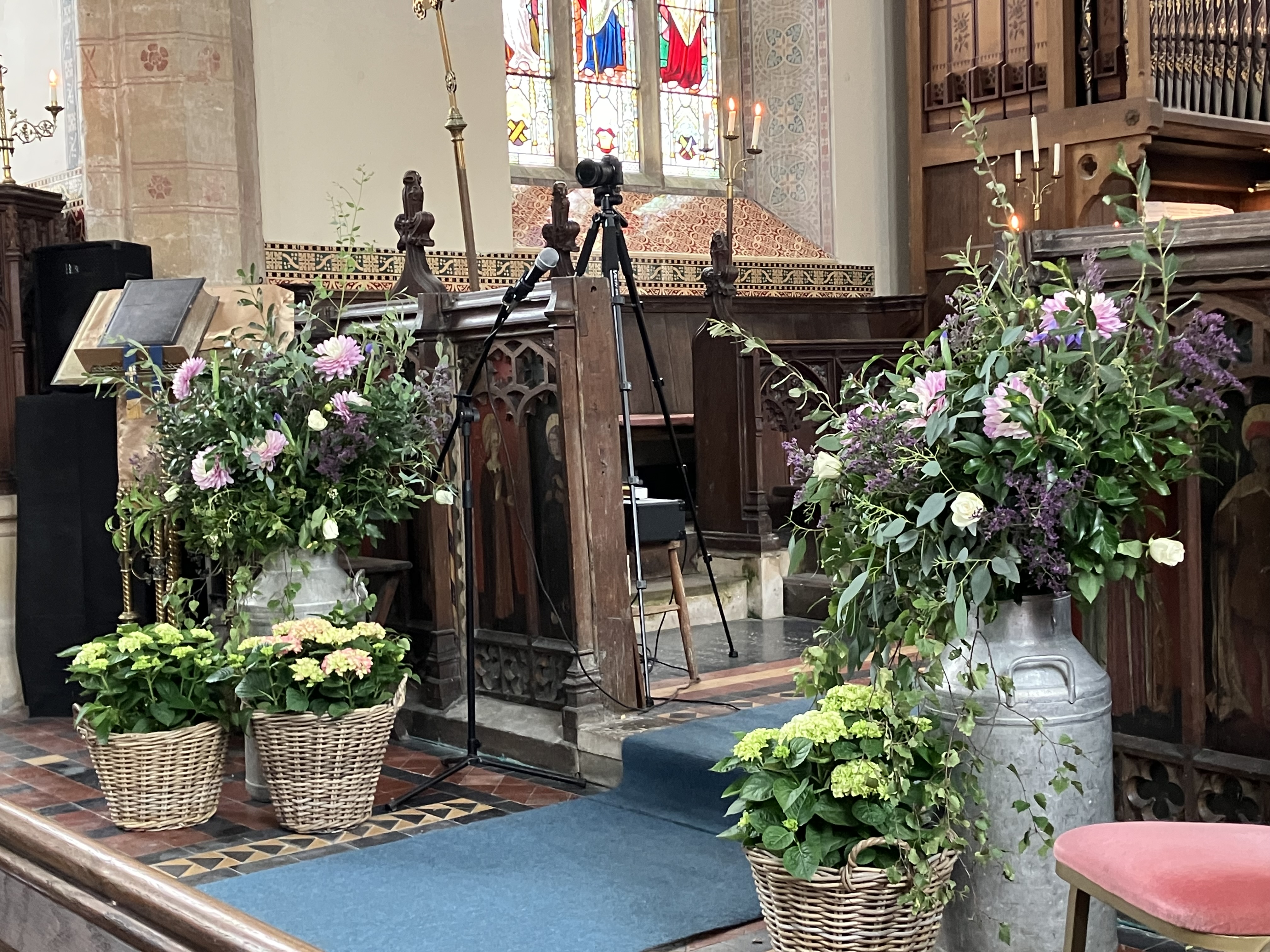
The bride’s mother had grown most of the flowers in her garden. We had all collected jam jars for the year before the wedding, and they twisted wire loops around them so they could hang on the end of each pew. They also had milk churns—no country wedding would be complete without milk churns.
On the Thursday we had a rehearsal and met the vicar. She was very jolly, and told us all what to do, where to sit and stand. The ‘bridesmaids’ (the bride’s three brothers) and the ‘groomsmen’ (the groom’s siblings) practised walking into the church, and the bride made decisions about who would walk in first.
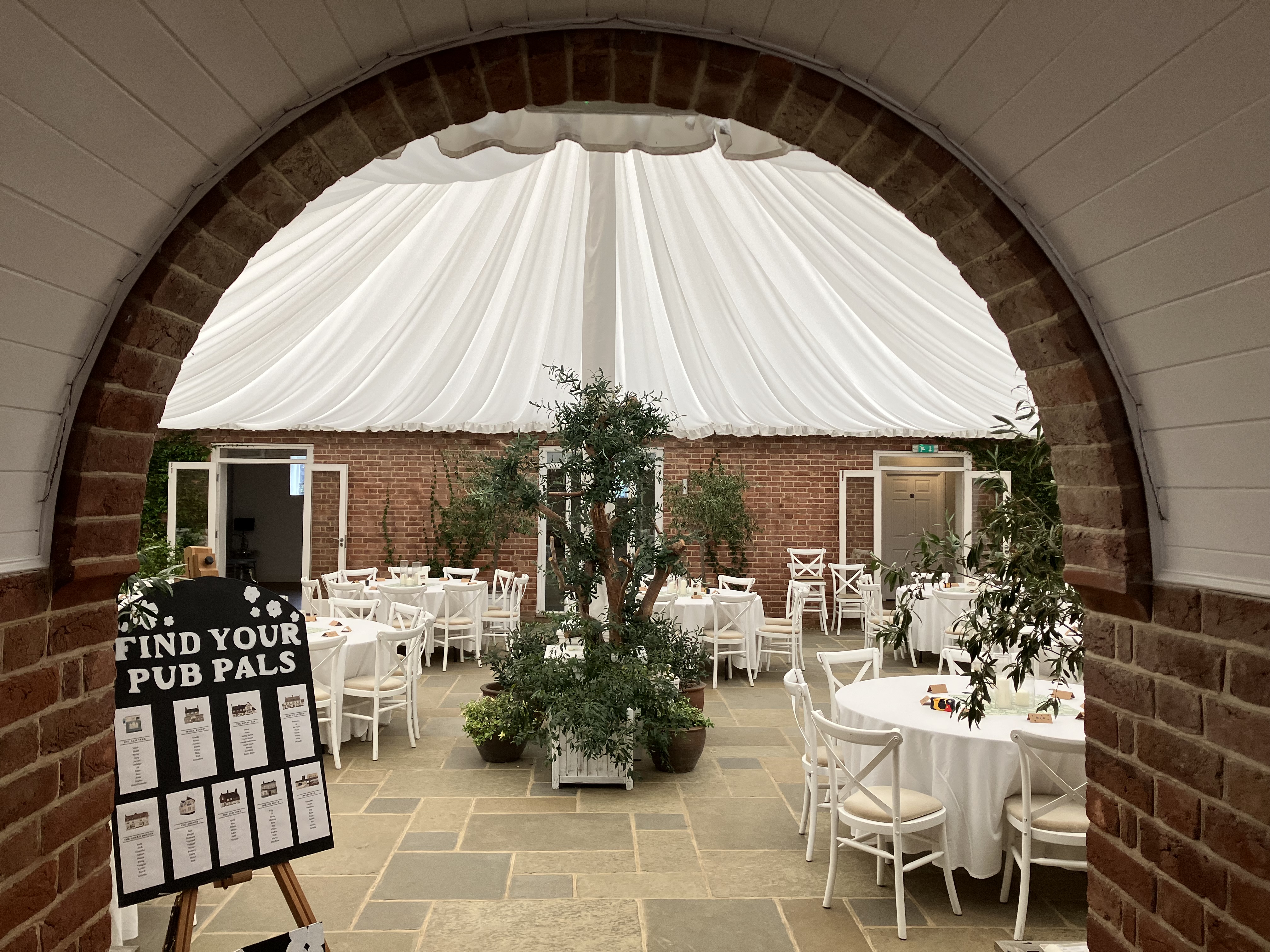
On the Friday we could help decorate the venue. They had rented round tables, and cloths, and chairs. We assembled everything, adding decorations like fairy lights and candles. Most people left to help with the flowers (including my younger son, which bemused me—I don’t really think of him as good with flowers). We continued to arrange things according to the bride’s plan, as best as we could. We needed batteries for the lights, so set off for the supermarket (things like that take ages). Son 2 sent an urgent message saying he was starving (obviously ignored the advice to eat an early lunch) so we bought food too. I then went home with Son 2, Husband went with the bride and groom to collect the flowers (and a lot of jam jar water, I believe) for the reception venue.
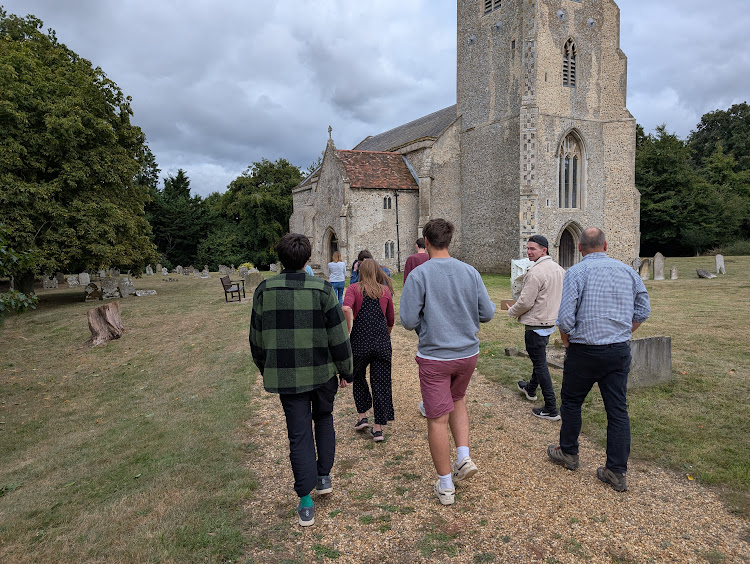
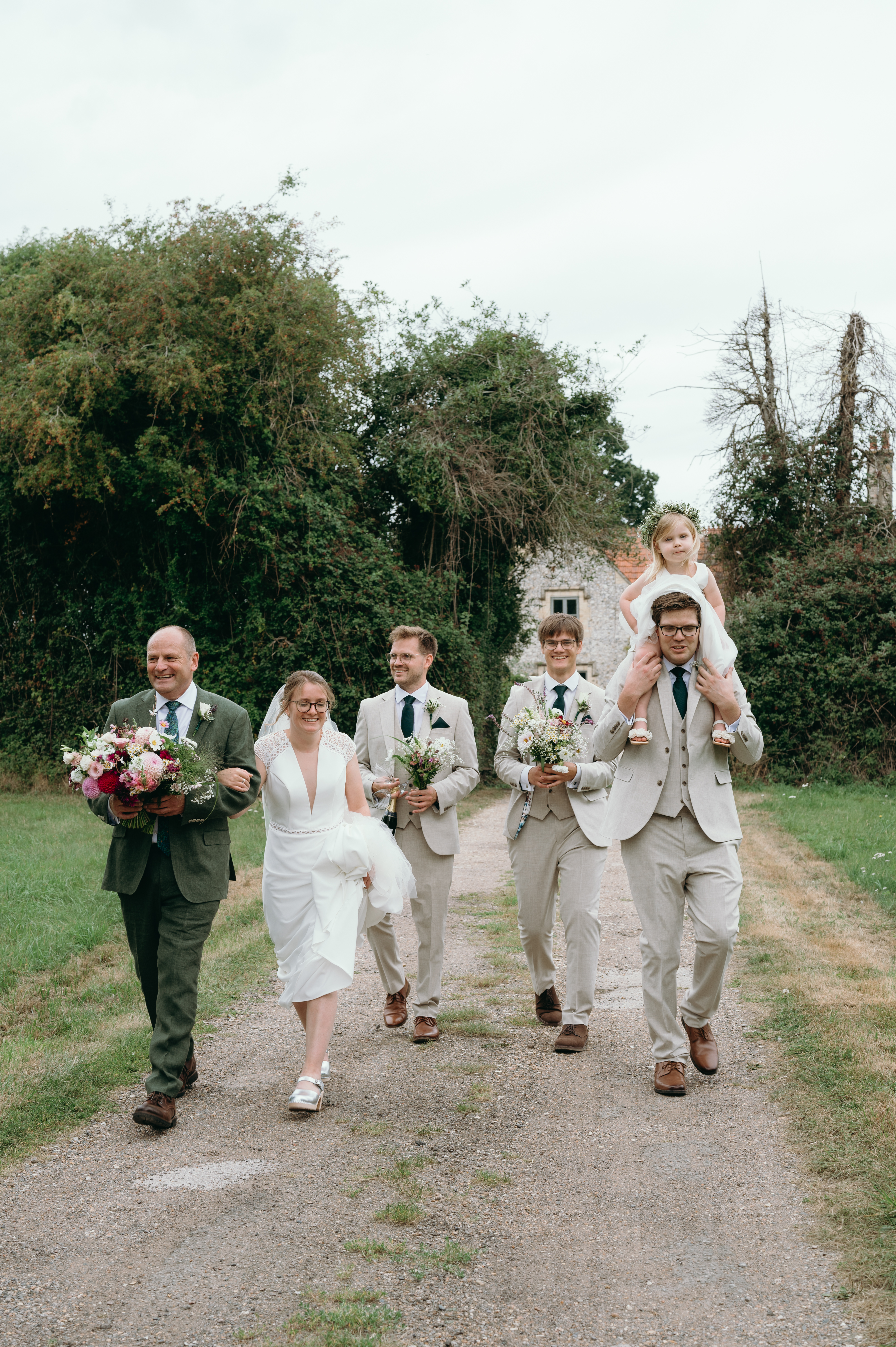
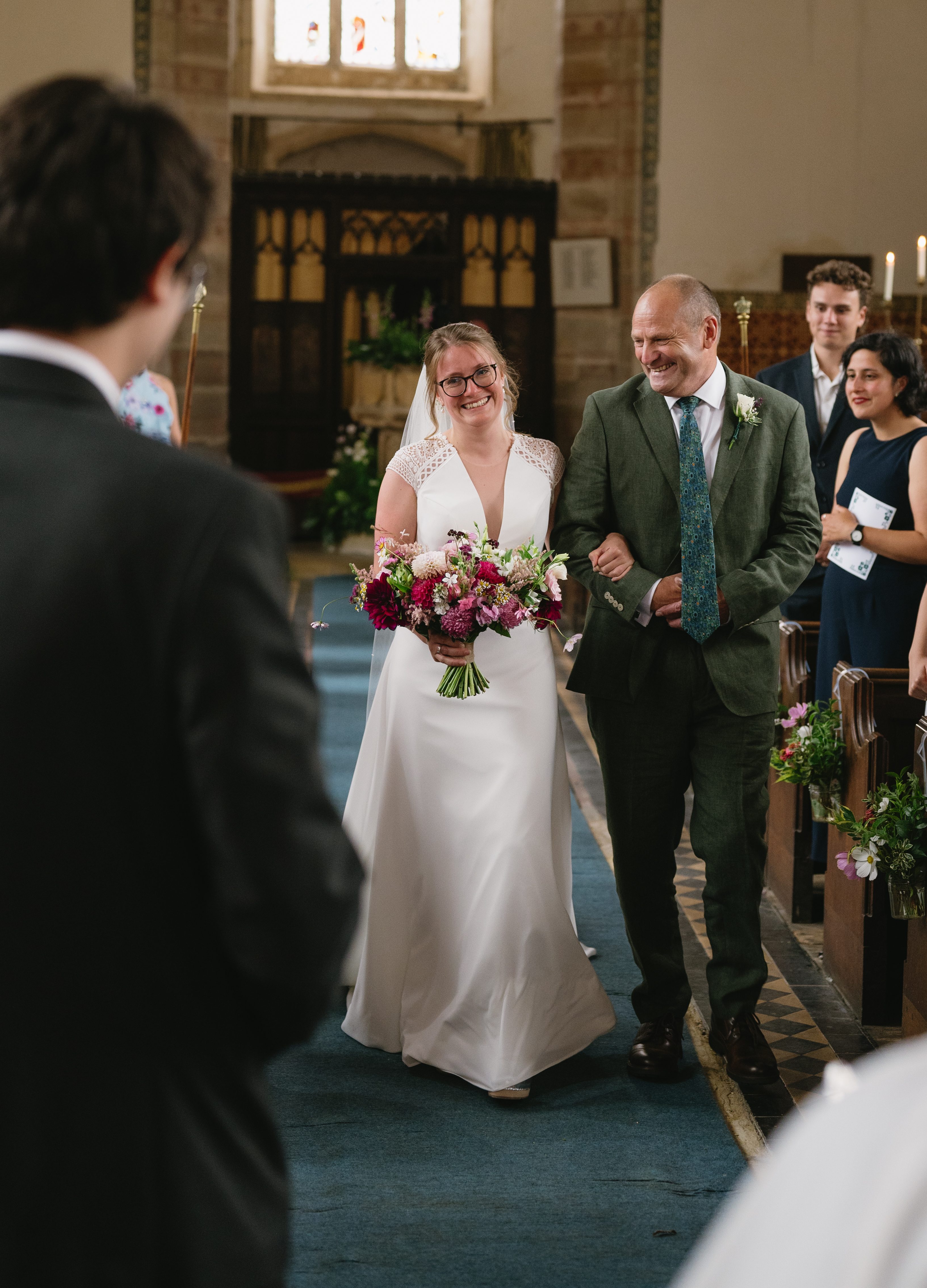
The wedding day was lovely. We arrived at the church, which was beautiful with candles and flowers. The bride walked across the field from her home, with her father and ‘bridesmaids’ and her face, smiling at my son as she walked down the aisle, is a memory to treasure. The ceremony was perfect. My daughter had written a poem, and that made everyone cry, and my youngest son had dressed as a chauffer for the ride to the reception, which made everyone laugh.
The reception began with the speeches—because Son knew he wouldn’t relax until he had given his speech and he wanted to enjoy the party. Then we had curry, which I have never before eaten at a wedding but actually went down rather well. There was dancing, and laughter, and lots of chance to chat to family and just enjoy being together.
I hope you have something lovely this week too. Thanks for reading. Take care. Love, Anne x
Walking to churchThis is what love looks like.
Some of the photographs taken from abimckennaphotography.
Thanks for reading. anneethompson.com *******************
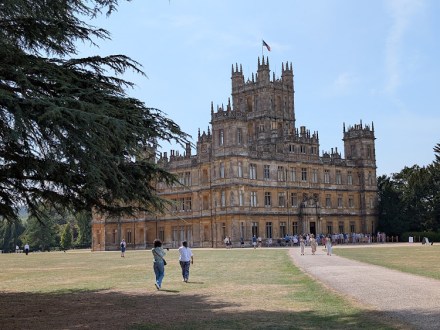
My sister Ruth is staying, and we bought tickets for Highclere Castle, the film location for Downton Abbey. The tickets were bought online, and there was lots of information about Downton Abbey, with photos of the actors in the house. We wanted to visit the house because we have watched Downton Abbey, we wanted to see the filmset, to take a selfie in the library, to enjoy seeing in real life what we had enjoyed watching. We were not especially interested in the Earl of Carnarvon (who owns Highclere House) nor in seeing another stately home. I felt the website reflected this, it was aimed at fans of Downton. We therefore paid our £22 for tickets to the house and garden. We decided not to pay £75 for a picnic (no surprise there!) although we wondered about taking our own picnic, if the weather was nice.
The day arrived, and off we set. We had booked lunch in a nearby pub instead of taking a picnic. This turned out to be a lucky decision. The reality of Highclere Castle is rather different to the enthusiasm of the website.
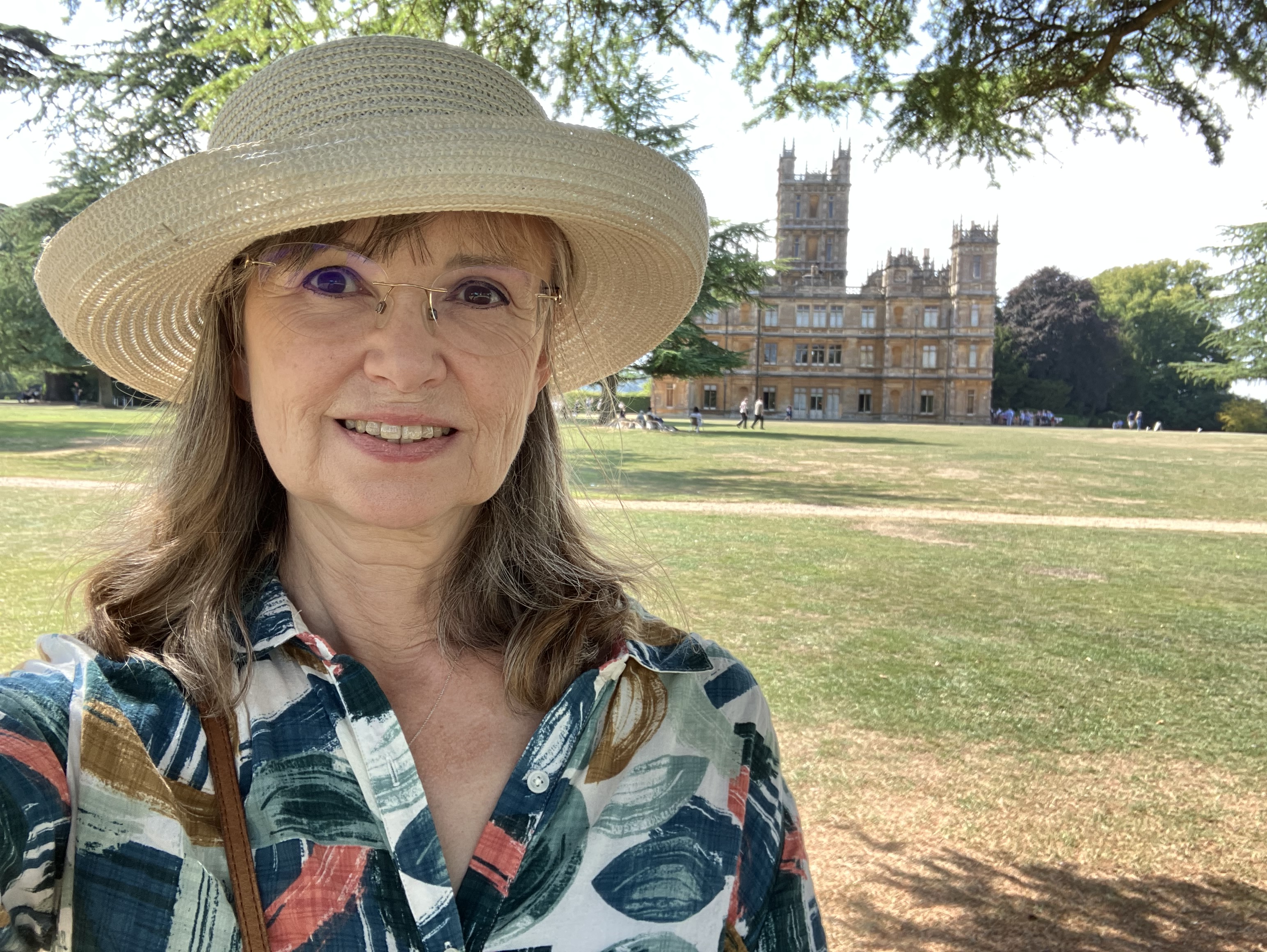
Now, to be fair, the grounds are beautiful, and we had fun posing for the iconic view in front of the house. Everything was clean, there were washrooms and a giftshop and a tearoom. However, it was very much geared up to be Highclere House — not Downton.
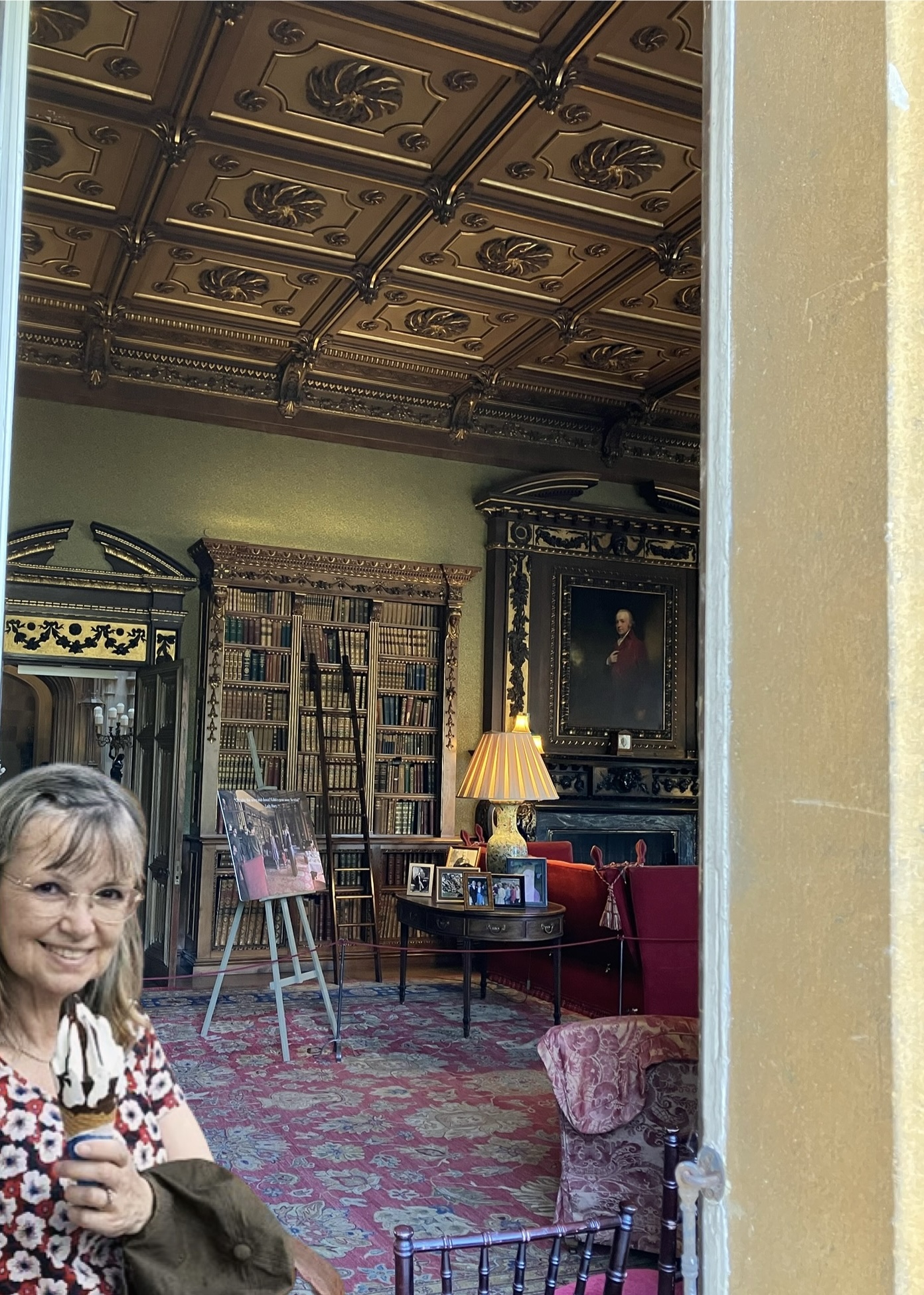
My main complaint, and I feel it’s valid, is that no photographs could be taken in the house. I can forgive the rather rude women standing at the door who insisted (as if we were 12 years old) that we kept our phones in our bags. I can forgive the long queue even though we had timed tickets (the time made no difference) and the rather ‘herded’ method that we were trooped through the house. I understand why most rooms were cordoned off, and we could only peer from the doorway. The number of photos of the family was a little odd, because I assume very few people were there to see Highclere, we all wanted to visit Downton—that is what we paid our £22 for, that is what the website sold us. I understand that it is the Earl’s family home, but visiting his house is not worth £22 to me (or I suspect most other visitors). He had sold us a visit to a film set.He gave us a visit to his house.
But we wanted a selfie, standing in Downton Abbey, and I feel that to deny us that was almost false advertising. It was mean. I checked online, and after all the Downton hype, after clicking on the page to buy tickets, I managed to find a tab that stated no photographs were allowed. It was definitely nowhere near as obvious as the numerous signs (and strict ‘guides’ who basically seemed concerned only with policing the policy). It felt like a trick. I was also somewhat bemused to find that they also do not allow picnics (despite selling them) though they do allow them to be eaten in the car! Again, it felt the website was misleading.
I am sure it costs a vast amount of money to maintain a stately home. But Highclere Castle seemed to be presenting a false image to encourage visitors. If you enjoy visiting stately homes, I expect you will enjoy it. If you want to take a selfie in Downton Abbey, or picnic in the park—then I suggest you save your money.
We spent a happy journey home downloading photos of the interior of the house from their website and adding photos of various family members. I hope you enjoy them.
Thanks for reading.
Take care,
Love, Anne x
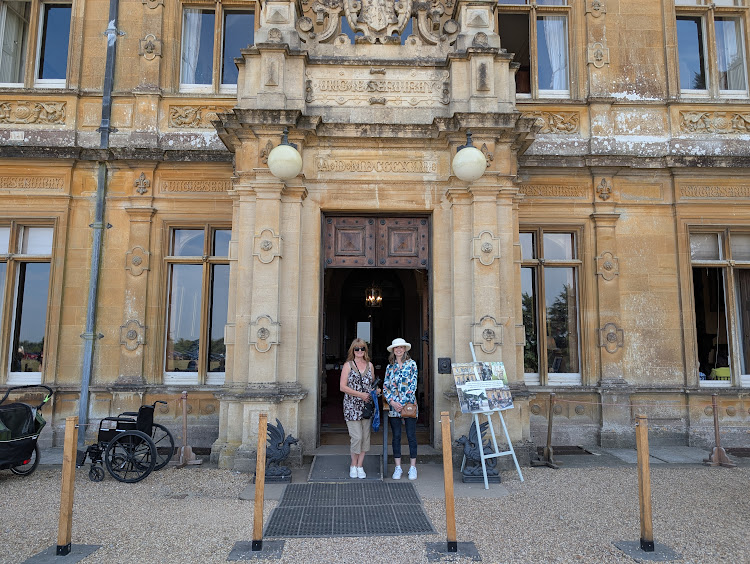
These were the photos we were allowed to take:
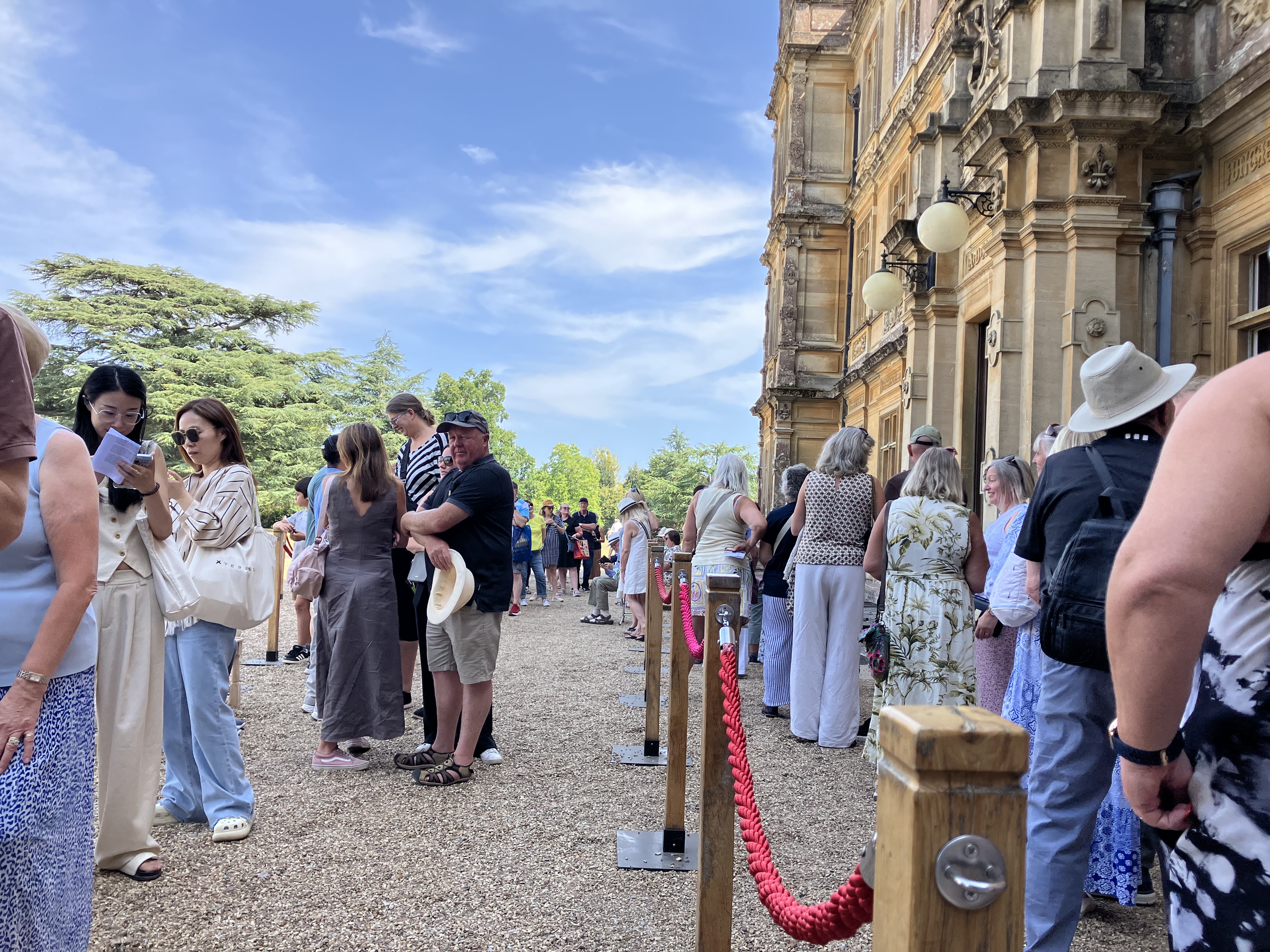
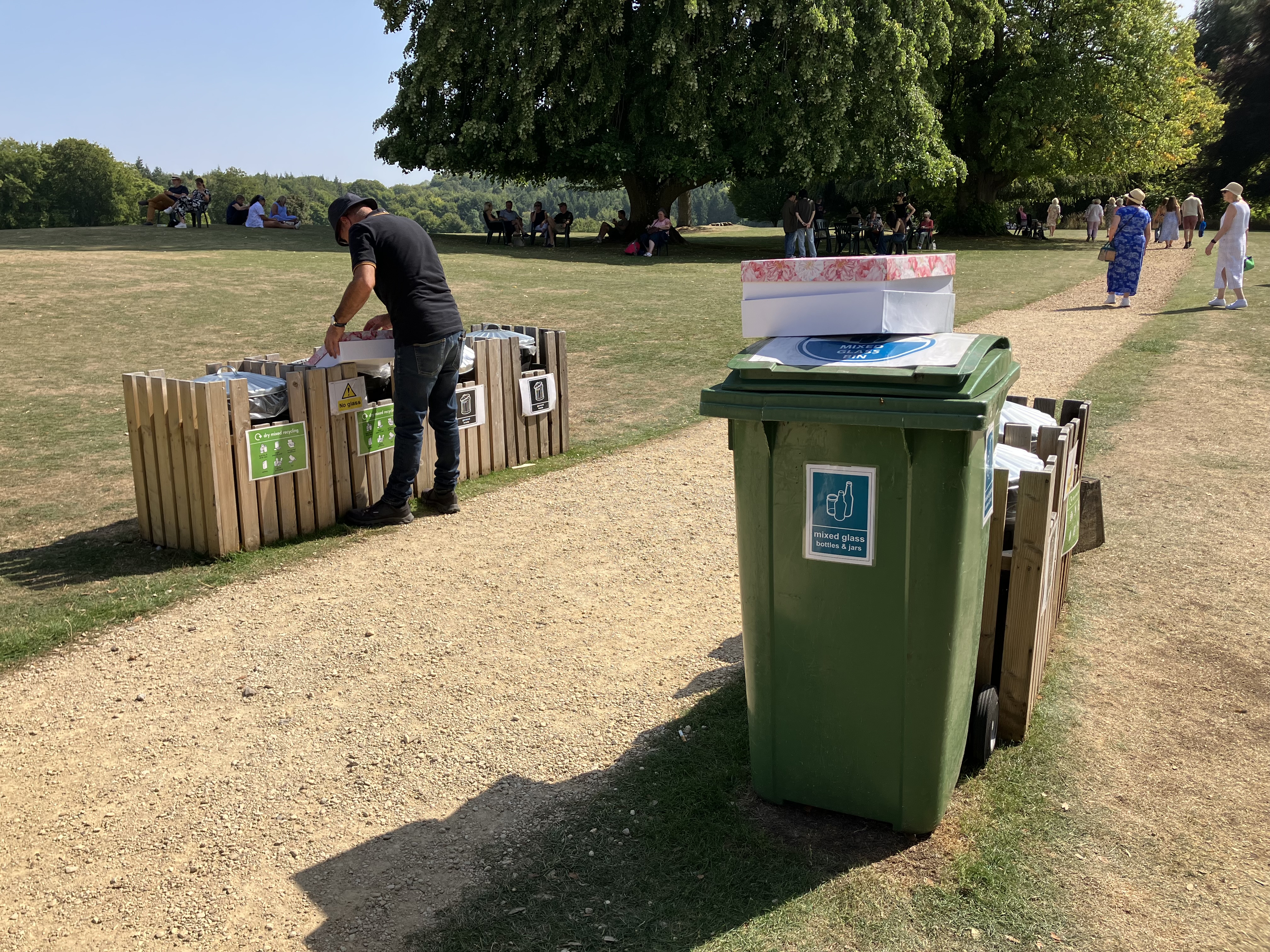
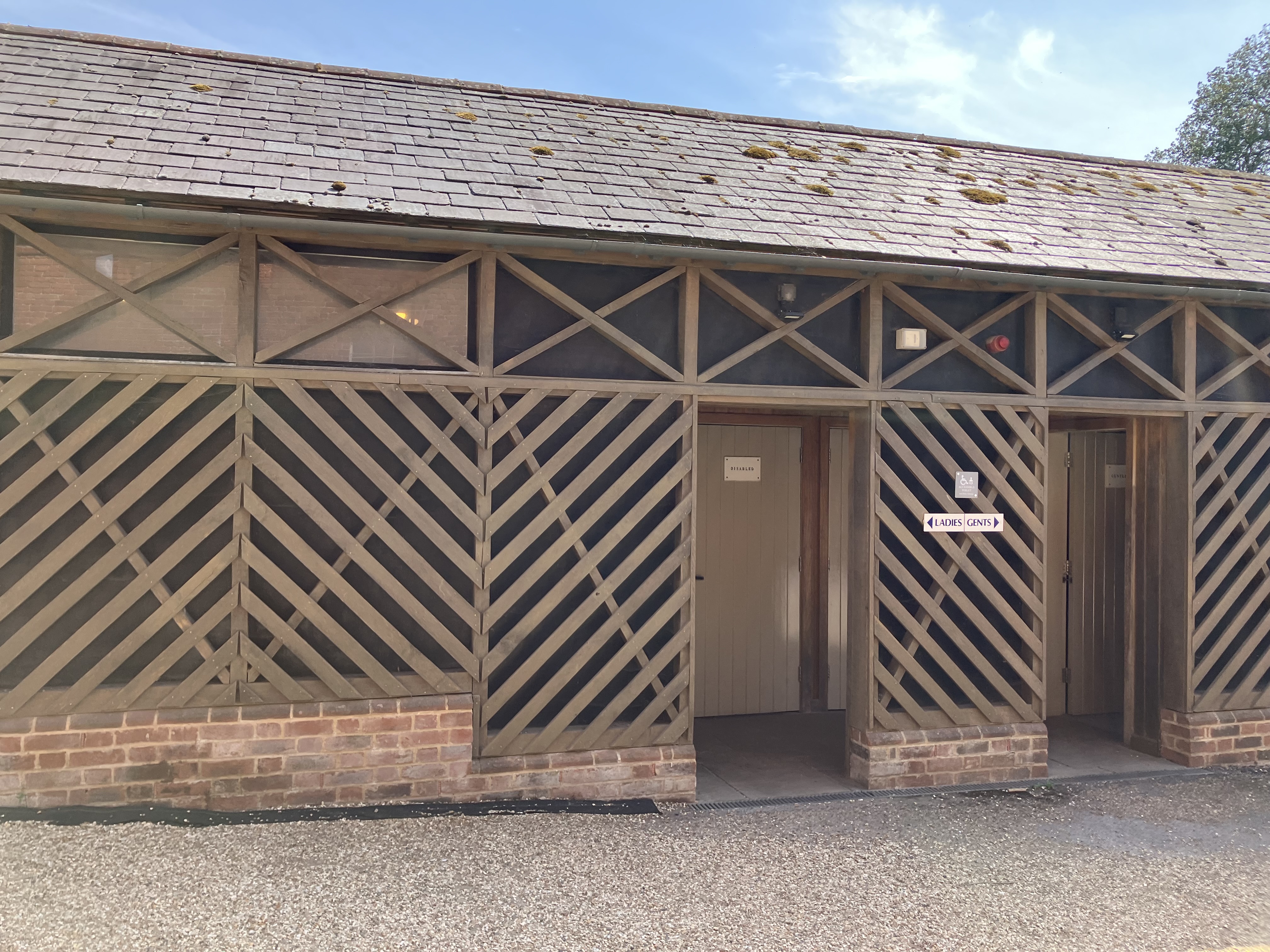
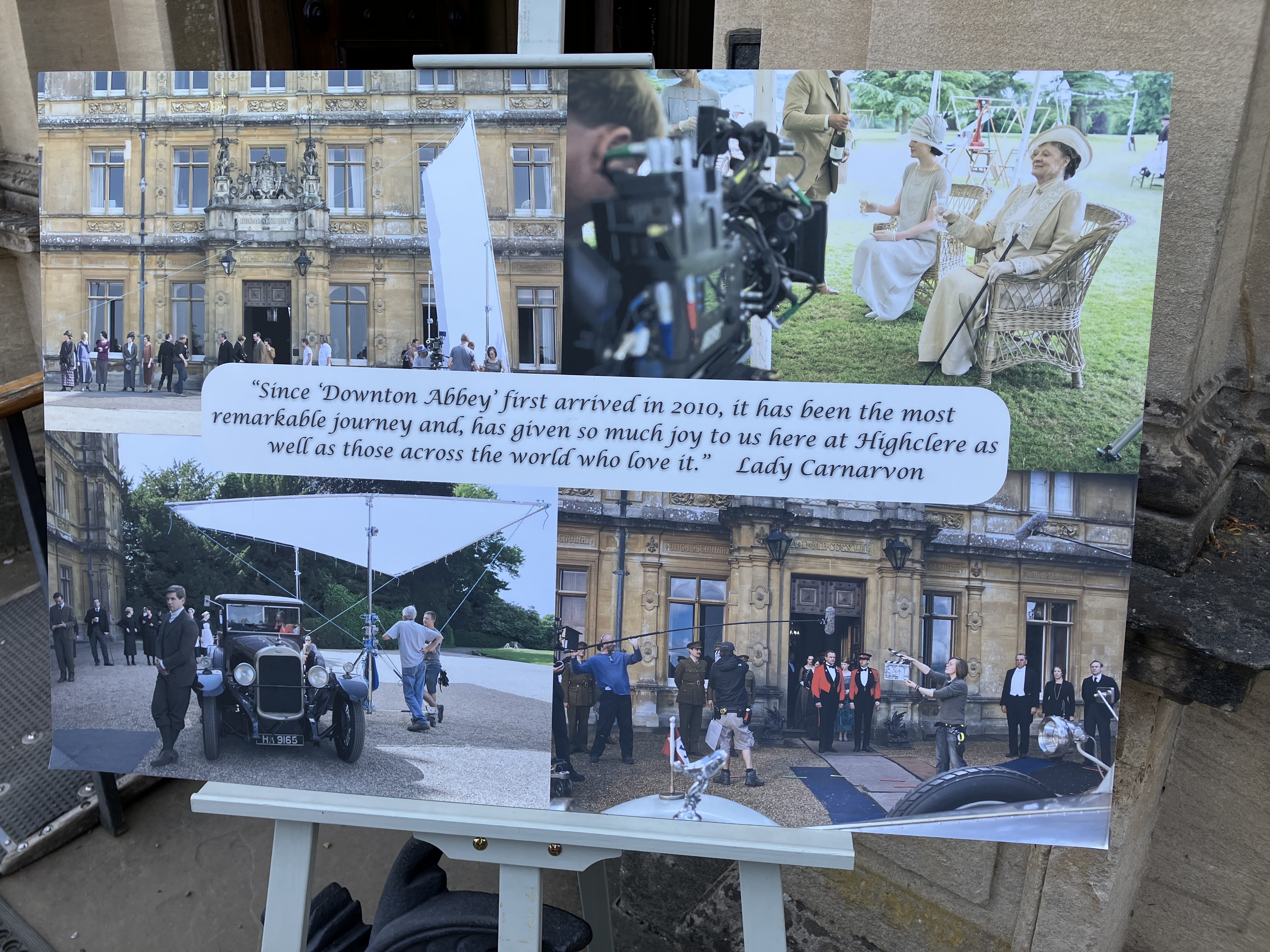
Very long queue–the timed tickets were not checked.The outside barThe dustbinsThe washroomsThe sign (all about Downton!)
**************
The photos we were not allowed to take:
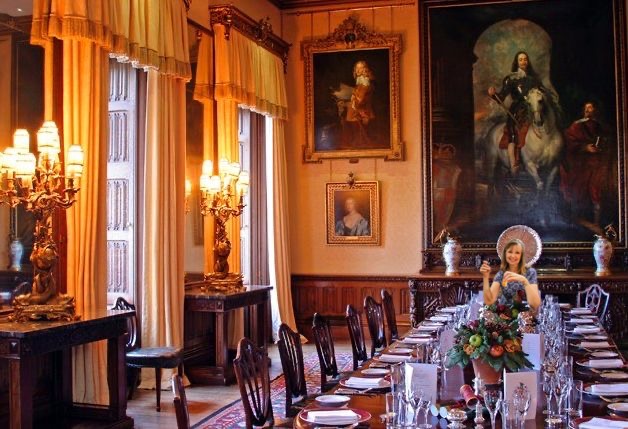
Taken through a windowCopied from websiteCopied from wensiteCopied from websiteCopied from website
I added the family members using clever phone. Therefore I have the photos of us in Downton Abbey–but not taken during the visit, which was a shame.
We took Meg to Camber Sands. At the beach we had a hiccup in the car park. Meg got a whiff of sea air, spotted another dog, started to whirl in circles and leap all over me. No control at all. Husband had walked on, but he noticed (eventually) and came to rescue me before I dislocated something essential. Once on the beach, I removed the lead (wasn’t too sure about this) showed Meg the stick I had brought (which she leapt at, in a very uncontrolled manner) and then started to walk. Like magic, Meg settled into ‘walking mode.’ I walked along the beach, throwing things for her to chase, she followed, absorbed in the game, ignoring everything else.
After a while we stopped and rested on a sand dune. Meg sat on the sand, where she was, and didn’t move. She was not especially near us, but she was watching. I think she was worried I might put on the lead again. She lay on the sand, just watching. Various people walked past her, various dogs walked past her (one brown curly spaniel even bounded up to her barking). Meg just sat, waiting for the game to resume, ignoring everything else. (Husband asked what I would do if she reacted badly to the spaniel. I replied that the spaniel had approached Meg, aggressively barking, and the owner had not stopped it. Therefore if Meg chose to eat it, that was not my concern. Not sure this was the answer he was expecting.)
It was a sunny day, the wind was gentle, the waves were lapping onto the shore. All very lovely. I wanted an ice cream before we went home, but they were deemed too expensive, so we drove home for a cup of tea instead. Well done Meg, a good day out.
Today I took Meg to the supermarket, and tied her up outside. I like doing this—it gives her something interesting to do, she often gets petted by other shoppers, and she waits very patiently. But today someone warned me that ‘the gypsies’ might steal her. This is the second time someone has warned me that she might get stolen. I don’t know whether this is a real risk or not. But she does wag her tail in a very non-threatening manner, so I don’t think anyone would be fooled into thinking she might bite them. And she is a very attractive dog. Bit of a quandary. Not sure what to do in the future.
6/7/2025
The little pony is back in the field next to the house. There are rams in the field too. Meg spends hours at the top of the garden, and refuses to come inside when called. Her and the pony run up and down the fence together, the rams just stand there, looking confused. Meg now smells of horse, so I think the pony must be putting her head through the fence, and is possibly licking Meg. It’s an unusual friendship, but kind of cute.
10/4/25
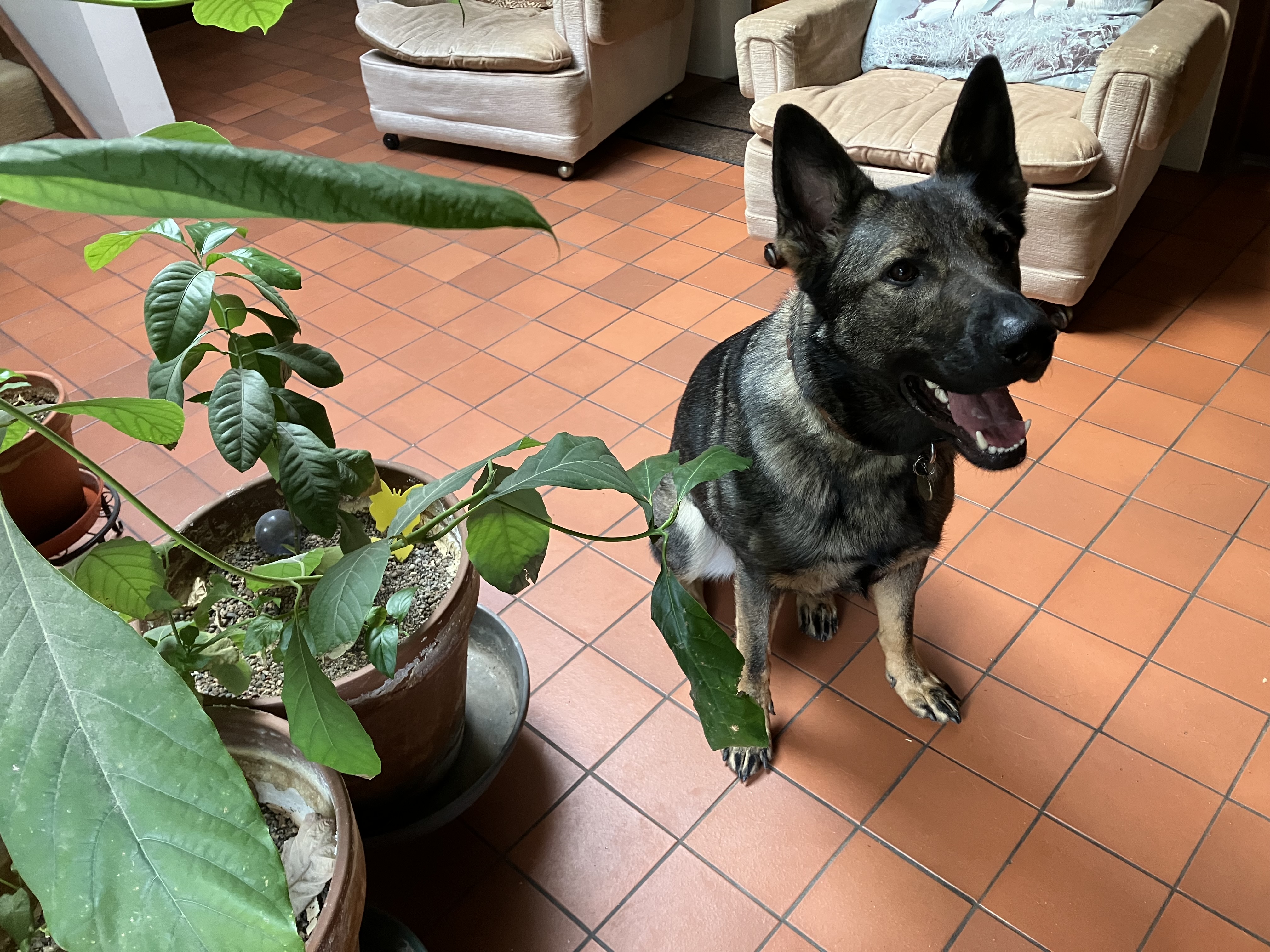
Today Meg emptied a plant pot and ate the avocado seed I was trying to grow. I found it in pieces all over the carpet. Meg didn’t seem ill (which is lucky, as I know the seeds and skins of avocado are poisonous—maybe she didn’t actually swallow any). I don’t think it will grow now.
I water my houseplants every Friday, and Meg follows me round the house, watching. In the kitchen I have a fern, which is sitting on a tray of gravel so the water can evaporate and keep the leaves humid. (I’m not sure if this actually works, but it’s what the instructions told me to do, and the fern is growing despite being repeatedly bashed by enthusiastic dog’s tail.) The only problem is that Meg prefers to drink the water from the gravel tray than from her bowl. Maybe it’s salty, I don’t know. Without fail, I water the plant every Friday, and as soon as she thinks I am not watching, Meg goes and drinks all the water. I worry that she also drinks some of the gravel, but it’s hard to stop her. She has a full bowl of fresh water always available, plus a bucket of water in the garden (because she is super-messy with water and sort of bites it when drinking instead of lapping it like other dogs). But nothing, it seems, compares to the water in the gravel tray. Except perhaps the extremely germ-filled muddy puddles that we pass when walking in the woods—she will sneak off to drink from those too if she has the chance.
24/4/2025
Yesterday was another low-point in our relationship. I checked the nest in the aviary, and saw the ducklings were hatching, so I needed to prepare a brooder and move mother and ducklings there (because ducks are usually pretty terrible mothers, and if I release them all on the pond, all the ducklings die/are eaten within a week or two). This involved lots of moving around the garden, so I let Meg come with me for the first part, knowing I would need to lock her inside when I moved the ducks or she would bark and cause all sorts of chaos. (Not yet the helpful farm dog I was hoping for.) I decided to throw some sticks for her first, so she could have a run around before being confined again. Bad decision.
I was only half concentrating on Meg, as I was thinking about the best way to move the ducks. There was a moment, when Meg was on the middle lawn holding a fairly big log, and I was on the narrow footpath between the lawns, and I (stupidly) picked up a decent stick to throw, called her, threw it behind me. I had not considered the size of the log in her mouth in relation to the size of the path I was standing on. Meg, as always, hurtled towards the thrown stick, her entire focus on reaching where it fell, all 34kg of her charging at about 20 mph, straight through me. Except of course, she did not go through me, she simply tried to go through me and instead bashed my leg with the log at great force. The log made contact with the side of my leg about 6 inches above the knee, then thudded to the ground when Meg dropped it to continue her charge.
The pain was immense. I cried out in agony, then found I couldn’t stop, and stood there, like a wild animal, howling. Meg took absolutely no notice at all. She ran to the thrown stick, picked it up, danced round the garden with it. When I managed to stop howling, I realised I needed to get to a seat because I felt very sick and dizzy and had pins and needles in both hands (was probably hyper-ventilating). I knew that if I sat/lay on the ground, Meg would bounce on me, and possibly kill me by bashing my head with the log. I hobbled to a garden seat, and sat there, trying to breathe, wondering if my thigh bone was broken, wondering how I was going to get into the house. Meg continued to dance around the garden, coming up to me a few times to entice me to try to get the stick. Her empathy level was nil, zero, zilch. Absolutely no awareness, whatsoever, that I was in agony. None. I have no idea how this compares to ‘normal’ dogs, but I know that Kia was fully aware of my mood at all times, and very attune to my emotions. Not Meg. I genuinely believe that if I dropped down dead she would not notice.
Luckily, Husband noticed my rather strange position on the bench and came into the garden to investigate. (Full empathy points there.) He helped me inside, put Meg somewhere safe, and we tried to sort out whether my leg needed any medical attention. It didn’t—nothing was broken, just incredibly painful. I think I probably bruised the bone, so just a matter of resting it for a few days and taking nurofen for the pain. (Which of course, is complicated by the fact that someone needs to sort out those ducklings, and to walk Meg.)
Thanks for reading. Take care. Love, Anne x
PS. Leg healed after a few days. The ducklings survived and now live on the pond. Meg is still happily disrupting my life, and I am more careful about watching for bashings from big logs.
Genesis is the first book of the Bible and I was taught that Moses wrote it (as part of the Pentateuch—the first five books of the Christian Bible). However, being taught something, even believing something, does not necessarily make it true. So what is the evidence?
There is some evidence within the Bible itself. In the Old Testament, the law is often referred to as ‘the law of Moses.’ (Eg: Dan 9:13, Mic. 6:4) plus we read that Moses wrote down all that God told him. This does not necessarily mean he wrote the book of Genesis—he perhaps only wrote down the laws, and then passed them to the people. In the New Testament people also refer to the law of Moses, which falls into the same category. Jesus refers to ‘the book of Moses’ (Mk 12:26) and there are several places when Moses is described as having written the law. Therefore it is clear that the early church believed that the law came from Moses—but not explicitly that he wrote Genesis.
If I use a modern analogy, I can say that I tell my children Hans Christian Anderson’s story of The Ugly Duckling. Now, I have never actually read his original story (I do not read Danish) nor have I ever read a translation. But I know the story from my own childhood, and I trust that it originated with him, therefore I consider it truthful to say it is his story. I might even write it down, centuries after he died, and it would still be ‘his’ story, even if I wrote it in modern English. Of course, someone looking at my book in the year 3000 might notice it is not written in Danish, or even in English of the 1800s, and they might question whether it was really a story by Hans Christian Anderson. But I think this is an accurate description of the book. (Today, we would write a colophon, saying that the story was retold by me, and the dates, but in the ancient world, this was not a thing.)
What then do we find if we look at the writing of Genesis? We do not have any original texts, so we need to use the manuscripts that we do have. The oldest manuscripts show it was written mostly in Hebrew (just two words in Aramaic, in Gen.31:47). Like all languages, Hebrew has evolved over time, and the language is not consistent throughout. There are texts written in Archaic Biblical Hebrew, Classical Biblical Hebrew, and Late Biblical Hebrew. However, most of the texts were written in Classical Biblical Hebrew. This was used from about 9th century BCE to the 6th century BCE. Within this time frame, Classical Hebrew continued to evolve and some words began to be written in different ways. It is likely therefore that Genesis 1 (the 7 days of creation) was written later than the Eden creation story, even though it is placed first in the book.
As well as the style of language, some of the terms used also help to date the texts. For example, ‘Ur of the Chaldeans (Gen.11:28) must have been written (or added) after 700 BCE, yet the city Calah in Gen.10:12 must have been written about 880 BCE, because after 704 BCE it was part of Ninevah, not a separate place.
So what do we make of all this? And does it matter?
My view is that the best way to read Genesis is as openly as you are able, making sense of what the texts say, and asking God to reveal something to you while you read. That, I think, is how biblical texts should be read. Genesis is a place where you might encounter God.
However, from an academic point of view (which generally reveals very little of God, but is extremely interesting if you like that sort of thing!) Genesis seems to be a composite text, added to over centuries by various authors or schools of thought. Whether it began with a single author is impossible to prove. Personally, I do not like to examine the various sections in isolation, taking strands from various time periods and looking at them separately. I think they were combined for a reason, and to study them properly you need to view them within the context of the whole. But others disagree. What do you think?
Thanks for reading. I hope your day is a good one.
Take care.
Love, Anne x
My main source for facts was Ronald Hendel, ‘Historical Context’ in The Book of Genesis (Leiden: Brill, 2012) 51-82.
As I write this, I am ill (by the time it’s posted, I shall be better). No one enjoys being ill, and this virus is a particularly nasty one, possibly covid (which I have never had before, so I have nothing to compare it with). Anyway, I have had to cancel a lot of things in the diary (all fun things, which makes it worse) and poor Husband is back on animal duty and preparing his own food. (A lot of ready meals, I believe.) However, while I do feel pretty sorry for myself, I am a great believer in making the best of a situation—even a rubbish one. Always live the best day possible. I tried to think about what I could do to make life less boring. Being ill is incredibly boring. I started optimistically, with a large volume on Genesis that I want to read. But my brain is too fuzzy to concentrate, so that was a fail. I moved on to a book Husband gave me, but that too required too much concentration. Then I decided to read the farm books that I wrote. Now, writing a novel is great fun, and fully consuming, and you live inside your head for about a year, only properly emerging when it’s ready to be published. Publishing a book is absolutely AWFUL. Suddenly all those characters who you have loved and hated for months are released into the world, and other people will have opinions. Plus, although I have never read a book that didn’t have at least one typo, even expensive books by well known publishers, my own mistakes worry me. No matter how many people have checked and proofread, there are always some that are missed. Which is very embarrassing. Therefore, when a book is published, I do not read it again for a long time. In fact, I am not sure that I have ever reread my farm books. Now was the perfect time. To be honest, they are rather good! I worry that I perhaps introduced too many characters too quickly, but other than that, I really enjoyed them. They made me laugh (I guess it is my own humour after all) and in places, they even made me cry. (Though the virus might have had something to do with that!) Anyway, if I might be so bold, I thoroughly recommend them. You can buy them from any Amazon. I have been ill for 3 days now, so I’m bored again. I am quarantined in the bedroom so no one else catches it (very nasty germ) though Meg has decided this doesn’t include her. I’m too desperate for company to keep to the rules. I am regularly gargling with the mouthwash that my virus-expert doctor friend recommended, and drinking lots of water. I realise afresh what a wonderful gift good health is. Hopefully I will be fully better in a couple of days. Now I need to find something else to do that’s worthwhile, because I’m currently watching back-to-back Instagram posts of puppies. (Some of these make me cry too—definitely due to the virus!) Hope you stay well this week. Thanks for reading. Take care. Love, Anne x
Sent from my iPhone
Gargle 3x per day Not allowed in bedroom Considering options Technically, not actually ON bed…
I went to the summer conference of SOTS (Society for Old Testament Study). As in previous years, I was one of the least qualified people in the room (which is actually rather a safe position to be in, there is nothing to lose in the way of status).
I set off from home on a dull Monday morning, and caught the early afternoon train from Kings Cross to Durham. It happened to be an Edinburgh train, and I was tempted to just stay on it, and have a sneaky few days in Edinburgh while Husband did all my duties at home. When I arrived in Durham it was sunny, and I decided to walk to Collingwood College. I had not factored-in the hills; Durham has a lot of them. Or the lack of signposts; Durham has very few road name signs. I arrived at the venue resembling a witch recently evicted from a sauna. Everyone else stepped from taxis looking very smart and intelligent.
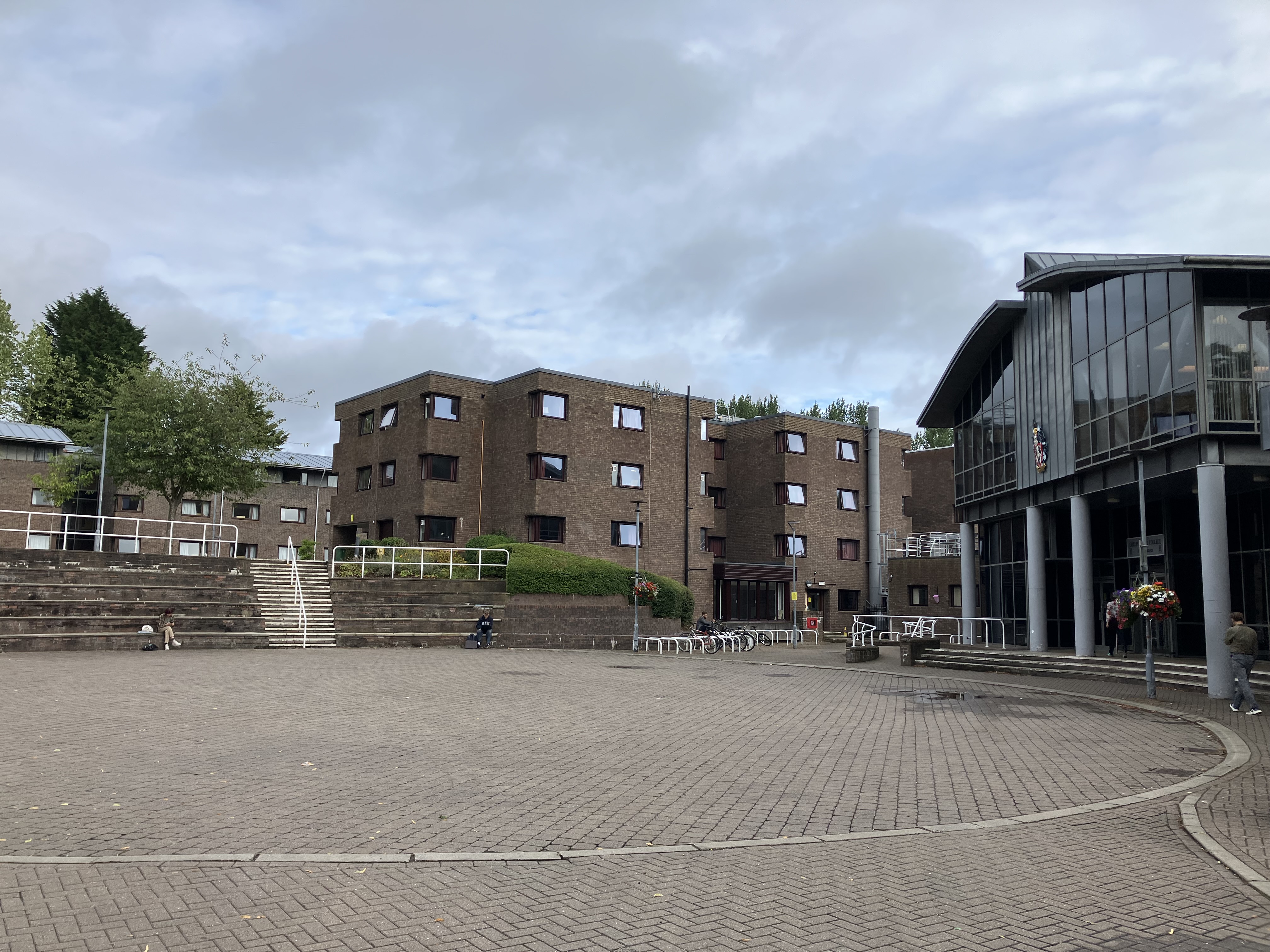
Not a pretty campus. My room was in that block.
I went to the reception desk, received my name badge (kept it round the wrong way until I had managed to tidy up a bit) and collected my room key. I set off to find my room, returned a few minutes later and was issued with a map—the campus is like a rabbit warren, it all connects (great if it rains) and lack of signs seems to be a feature of university campuses. Maybe it’s like in Malta, and they plan to confuse any invaders. My room, when I finally found it, was clean and uncomfortable, with a tiny shower room and paper-thin walls. It was also extremely hot, which seems to be another feature of university campuses. But it was a nice private space to escape to when I needed a break from trying to look intelligent.
This was my fifth conference, so I now recognise most people and would include some of them as friends—even though I see them only at conferences. There was a drinks reception, so I changed into a dress, combed my hair, and negotiated the rabbit warren back to the dining area. I remember my first SOTS, when I hid in my too-hot room, too nervous to join the reception until I was sure the cohort from my college had arrived. I am less anxious now. I recognise several people by their names, because they have written the books in the libraries, and it’s fun to meet them, to tell them I have enjoyed their writing, to discover whether the person matches the style of words. (They often do not, some of the people who write very clear, easy to understand books are less comfortable in real life.)
Therefore, only a few minutes after arriving at the university, there I was, drink in hand, chatting with a group of clever people who I have never met before, trying to look intelligent—or at least, not too stupid. But as I stood there, drink in hand, I was aware that I could feel an unusual crease in my dress, and the awful thought loomed—was my dress inside-out? I tried to remember whether I had actually looked in a mirror after changing, and I realised that no, I had checked my face when I combed my hair, but I had not looked in a full-length mirror at any time, I wasn’t even sure if there was one. (There was, I later found one inside the wardrobe door.) It was therefore completely possible that my clothing was the wrong way round. I daren’t look down to check, because I sort of didn’t want to know until I was alone, and could rush off to change. So I held eye-contact with the person talking, but I probably looked distracted. When the main group moved away, I glanced down. All was well; dress properly positioned. But I did make a note that in future, this is the sort of thing I should check before I leave the room. Although, if I am honest, it is possible that the sort of people who attend SOTS might not notice inside-out clothing anyway.
The conference continued with dinner, and then a lecture. This was the format of the whole week: food, lecture, coffee, lecture, repeat. It was fairly intense, because even during the mealtimes people continued talking about academic things. Even at breakfast, the conversation was intelligent, which was bit of a struggle for me. The lectures were interesting, and even when I didn’t understand the whole thing (there was one lecture with a lot of Greek discussed) there was usually something that struck a chord, a little oh, I didn’t know that, moment, which is always fun.
By the end of the conference, I was exhausted. I found it impossible to ‘switch off’ my brain after the evening lectures, and this combined with the hot room and uncomfortable bed meant I slept very little. I also missed my home. I was therefore very happy on Thursday morning, when I could abandon my room, and walk through the beautiful city of Durham to the station. I am really pleased that I attended the conference, and I learnt a great deal. But going home was wonderful.
I hope you have something to look forward to this week. Thanks for reading. Take care. Love, Anne x
I will write about some of the papers in another post.
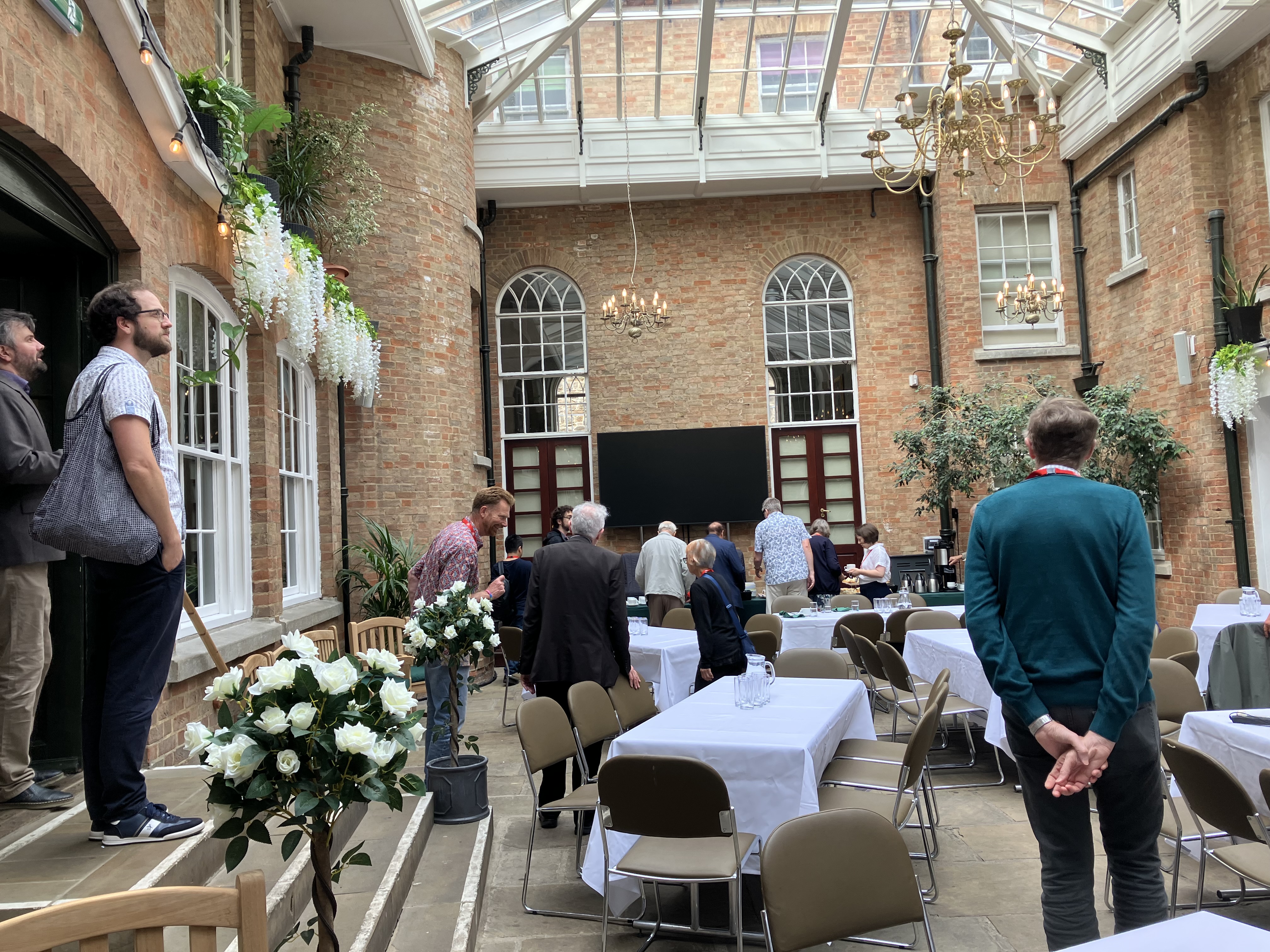
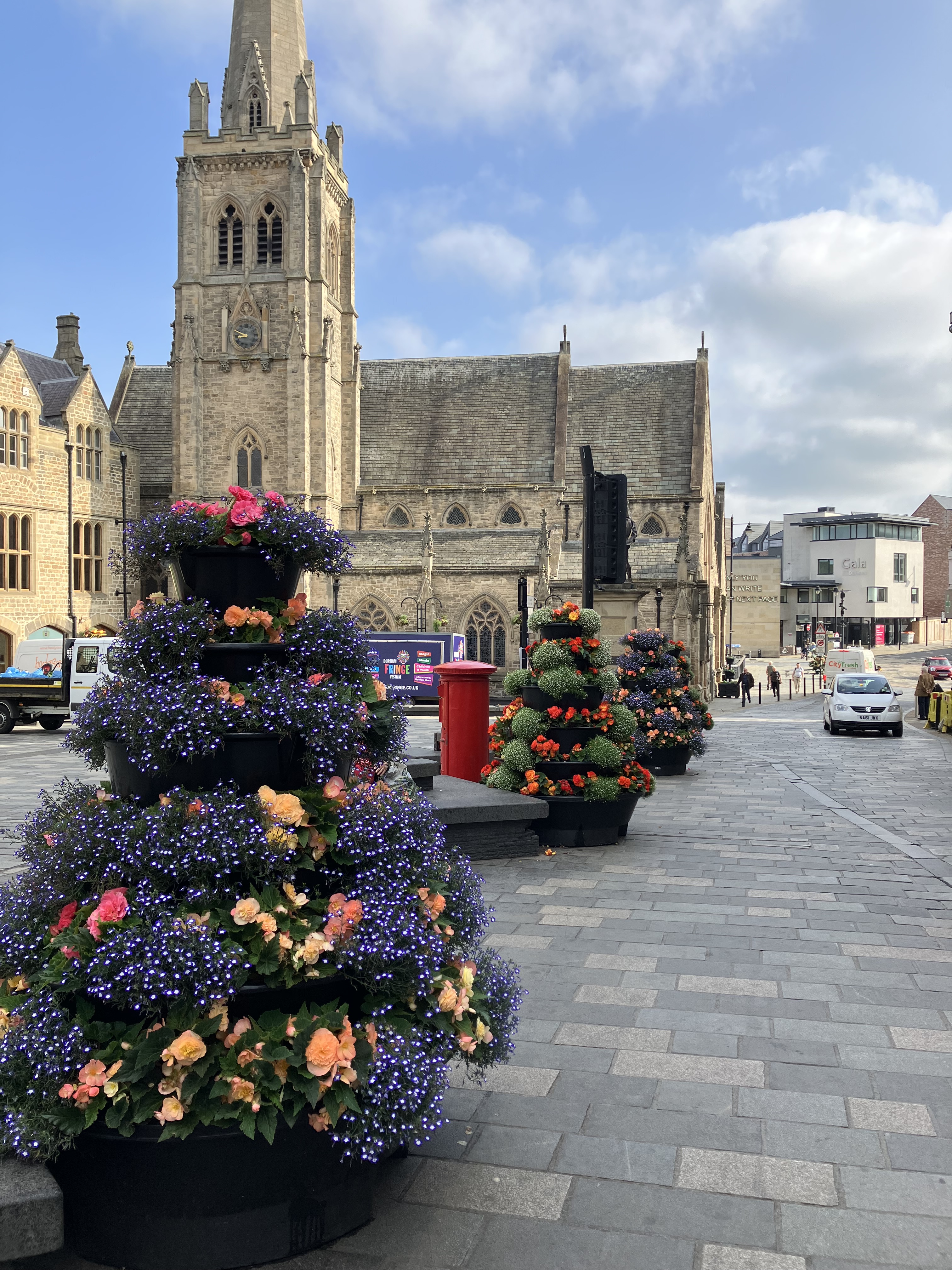
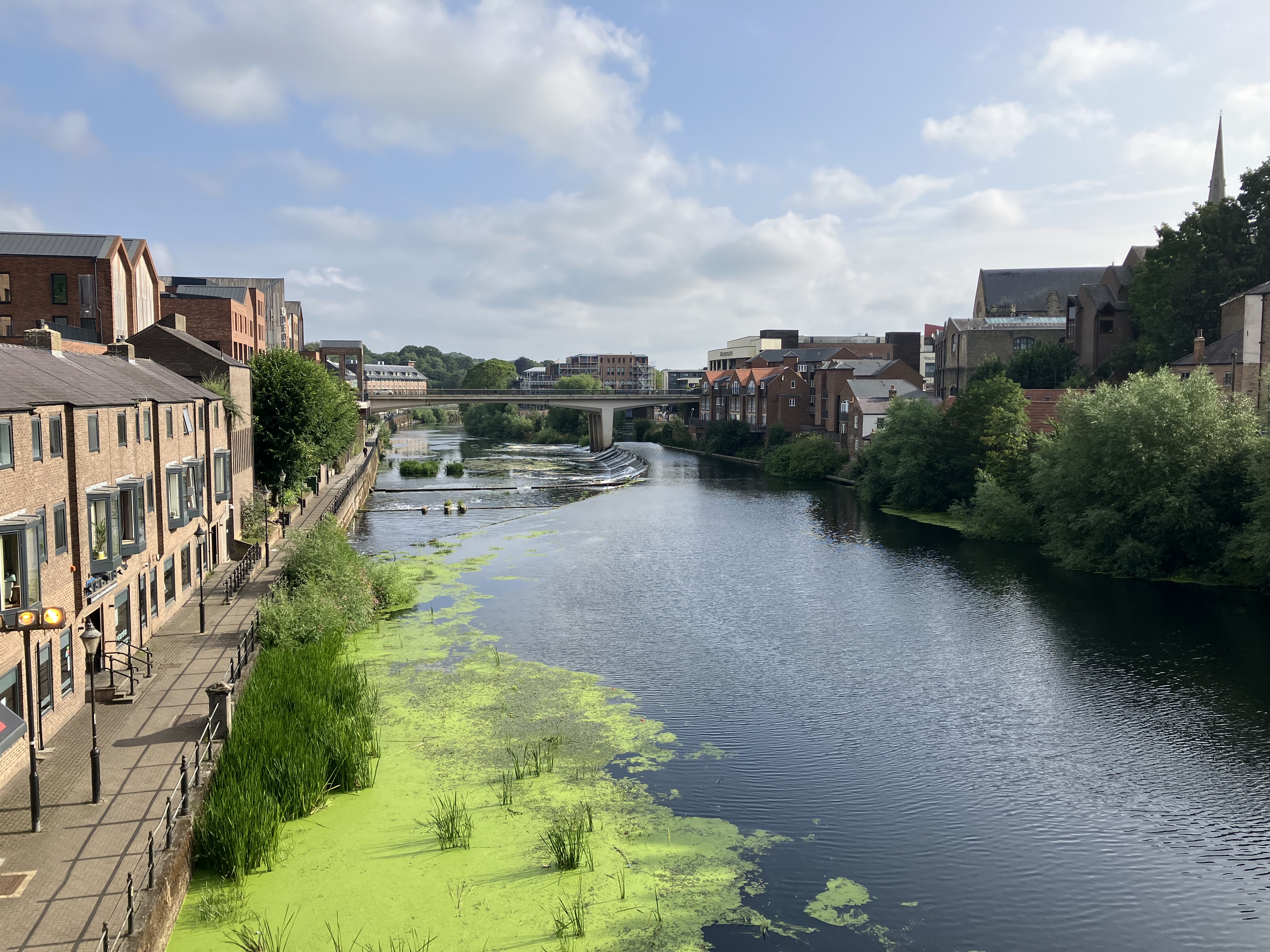
Afternoon tea to welcome the new SOTS president.Beautiful Durham CityI crossed lots of bridges trying to follow Google maps!On the way home.
I was recently invited to lead a discussion on assisted dying. I had a few concerns, because I was keen that no one should be upset by the debate, and talking about death and dying will inevitably evoke painful memories, and possibly fear. As I don’t know the histories of the people attending the discussion group, I decided to be very safe, to keep the discussion as impersonal as possible and to encourage discussion at at a very broad, metaphysical level. I personally find details of the ‘mechanics’ of dying perturbing (I don’t think anyone needs to be reminded of what it looks like when food and water are withheld from a patient). I therefore wrote a little talk, to start the discussion and hopefully guide it in a direction that would be helpful, interesting, and not upsetting. This is what I said:
“The debate surrounding assisted dying takes place in a variety of arenas—I have attended debates in government and medical schools and universities. I argue that fundamentally it is also a theological issue—and perhaps it is the philosophers and theologians who should be the loudest voices, though in practice it is the medics and politicians who we mostly hear.
Even the semantics are emotive—are we discussing ‘assisted dying’ or ‘assisted suicide’ or ‘euthanasia’ or ‘mercy-killing’? The terminology can be confusing, so to clarify: ‘Voluntary Euthanasia’—means a doctor will administer medication (Netherlands and Belgium).‘Assisted Dying’—means the medication is provided by a medic, but the patient must take it themselves. (Switzerland, the state of Oregon, and Australia).
I hear people say that it should not be introduced, because ‘Humans are made in the image of God’ (I would love to know what they understand by the image of God) or, ‘Only God should decide life and death’ or ‘Assisted dying is murder, and murder is wrong’.
On the other side of the debate, I hear that ‘We would not allow an animal to suffer, it is cruel to make a human suffer’, ‘Palliative care cannot remove all suffering in all circumstances so we need another choice,’ or ‘Humans should be allowed dignity in life and dignity in death’, or ‘At the moment people have to travel alone to a different country so they can die with dignity’. All of these statements are both true and an over-simplification of the issue.
If we look to the Bible, the issue is one of finding an underlying ethic rather than finding clear examples in the biblical texts. Death in the Old Testament is seen as good (from God—we were created as mortal) and the ‘right’ end to life was die a natural death after a long life, and to be ‘gathered to the ancestors.’ Only premature death (by murder, killing or accident) was seen as a bad thing.
The Bible certainly does not condemn suicide in all cases, as Samson killed himself (and a hall full of enemies) when he pulled down the temple in Judges 17. There are only two cases of ‘assisted dying’ in the Bible of which I am aware. One is in Judges 9:54 (when a man has a millstone dropped on his head by a woman and he would rather a man killed him so he asked his servant to kill him before he died). The other is 1 Samuel 31:4, when King Saul asked his armour-bearer to kill him so that he wouldn’t die by the hand of the enemy. Both of these examples have reasons which today seem unacceptable—but I wonder if they are so different from the motivation today that is sometimes given, of not wanting to be a burden, or not wanting to lose one’s dignity. People want to be in control of their own life, and this includes their own death. In Oregon, reason for assisted dying is most often ‘loss of dignity.’
There are examples in New Testament about ‘laying down life’ for others—such as Jesus, and the good shepherd (for his sheep) and John 15:13 (Greater love has no man than this…) St Paul put himself in danger, and said ‘to die is gain’. This shows that death is not ‘to be avoided at all costs’. (p.35)[1]The New Testament teaches we should love others as Jesus loved us—but should there be limits on this? Should someone feel obligated to ask for assisted suicide, because they don’t want to be a burden on their family, or because they want to spare their family the upset of seeing them as their body deteriorates, or (worse) because they don’t want to use their children’s inheritance to pay for palliative care? How much should love for others obliterate our own rights?
I find it more thought-provoking that in the New Testament, there was the a case which one feels is an obvious time to mercifully aid death. When Jesus was on the cross, he was next to two men, who were also dying, in agony. Crucifixion can take many painful hours to die. One assumes that Jesus, who could summon healing from a distance, would also have been able to summon death, to stop the suffering of the men next to him, who were certainly dying, and who were in agony. Yet he did not. We know that Jesus died first, and that the men had to be killed cruelly (by breaking their legs) for the convenience of the soldiers. It provokes the question of why. Why would Jesus not accelerate death? Is it possible that in dying, people learn something?
Badham suggests the reasons people now want assisted dying are because:
1. People are now enabled to live much longer, and well past the point that they actually want to be alive. (He notes that pneumonia used to be called ‘old man’s friend’ but now it is almost always cured.) As statistics indicate that healthy lifespan is not increasing, the editor of Bulletin of Medical Ethics suggest that the NHS is basically simply involved in ‘the prolongation of dying’. (p.9)
2. People demand autonomy over every area of their lives. People who are used to being autonomous do not wish to be dependent. (p.13)
3. When the medical intervention is stopped (including feeding) death can be slow and painful. (p.14) Dying naturally might not be quick and easy.
Badham examines utilitarianism (the greatest good for the greatest number of people) and states that as 80% of people now want euthanasia in the UK, the law should be changed. (p. 47) He dismisses that this same ethic was used by the Nazis to justify euthanising the handicapped and infirm who did not want to die. (p.53)
In the UK, doctors can already give life-shortening medication, when death is ‘foreseen but not intended’ and therefore changing the law is simply clarifying what already happens, thus protecting medics from potential law suits. (p.105) At present, the doctor cannot discuss this possibility with the patient, they have to ‘intuit’ that this is what the patient and relatives want, which is open to abuse. Badham says there will be more trust if the situation is more open, and the possibility is legalised formally.
The work of Dr Monika Renz, who undertook research of dying patients in Switzerland, is also relevant.[2] As a psychotherapist and theologian, she helped many patients during the final moments of life, and she suggests that like birth, death is a transition from one state to another. She proposes that understanding this transition enables care-givers and relatives to both help the patient and to view death as a natural process that should not be shortened.
Renz has studied palliative care patients, and concludes that as they die, they pass through a process—which she names ‘transition’—whereby they reach a state where they welcome death and pass peacefully into it. She describes a ‘pre-transition’ phase, when patients often become agitated, they see various ‘visions’ or hallucinations, they feel the need to correct past wrongs or let go of certain relationships. They then reach ‘transition stage, when they relax and are peaceful and all awareness of self/ego appears to have completely disappeared. Like a return to the early stages of life, when a baby is unaware of what it looks like, and bodily functions are of no matter. Renz says this stage can be hard for other people to watch, but for the patient, it is a time of peace. They then gradually slip into death.
This view of death is a natural one. Death is not to be feared, but rather welcomed (and Renz warns against things that force a ‘return to life’ like a last ride in a car, or a visit to a certain place—the patient’s focus should be on letting go, accepting that they are dying.) This tallies with the few references we have of death in the Canon, whereby a character ‘lived to an old age, and then was gathered to their ancestors’.
The implications for assisted dying are therefore somewhat fuzzy. If this process, whilst possibly difficult is also natural, and helpful, and prepares a person for death, then to curtail it would seem wrong. Assisted dying would be akin to sudden unnatural death—which is portrayed as a bad thing in the Canon—like murder or accident. Assisted dying would be to deny a person the time to process what is necessary, to let go of life, to ‘transition’.
‘The inner world of patients and their changing perceptions is strongly related to the spiritual dimension of being, and many dying patients—religious (followers of all religions) as well as agnostic—have impressive spiritual experiences.’ p.6.
‘Nowadays, more and more dying persons proclaim a right to die, as if they owned life and death. The term “self-determination” is misleading: self-determination is important in life to prevent an individual becoming nothing but an object of others, power structures and medical systems. Self-determination however, finds its absolute limits in facing nature, fate, the earth or the divine.’ p.7.
She views humans as essentially spiritual beings (though she avoids using this phrase) and therefore dying is a process whereby a person, whether religious or not, gradually accepts their spiritual identity and moves away from the world with dignity. She writes: ‘such dignity touches on the divine realm, which in post-transition draws close and is almost tangibly present.’ p.43.
She disagrees with the ‘right to die’ or ‘dying with dignity’ campaigns, saying: ‘It is ‘a catchphrase that obscures the question of ultimate human dignity. It is assumed that dignity depends on the autonomous functioning and decision-making capacity of the ego.’ p.117. She goes on to argue that true dignity is found in ‘letting go’ of the ego, and is not something that exists only in relation to how other people view one. She uses children living in poverty as an example, people who have little to ‘offer’ and who suffer daily, yet they still have the right to dignity. She separates ‘dignity’ and ‘autonomy’, saying they are not the same thing and should not be linked. p.117. She views dignity as stemming from God. p.120.
Renz notes there is value in suffering and endurance, and modern society does not value these things and wants to remove them. She worries that health professionals are now pressured to do what people demand, and not what they consider to be right. p.121. (A similar point was made at the Edinburgh debate at the medical school Nov. 2024.)
Badham notes that for Christians, death is not the end—as Bonhoeffer said as he was taken to be hanged: ‘This is the end. For me the beginning of life.’ When Cardinal Hume phoned Timothy Wright, the Abbot of Ampleforth to say he had terminal cancer, the Abbot replied: ‘Congratulations! That’s brilliant news. I wish I was coming with you.’ (p.119)
Questions for Discussion
When you consider your own experiences of people dying, how much do you think they influence your view on assisted dying? Is this a good basis on which to form an ethical view?
From a biblical perspective, do you think assisted dying is right or wrong in any circumstances?
Should a person feel ‘obligated to die’ to spare their relatives inconvenience, embarrassment, sadness, financial loss?
Should doctors still adhere to the Hippocratic Oath?
In regard to assisted dying, is it possible to have a rigid ethic that applies to all situations in every age—or does everything depend on circumstances? In what situations do we think killing is definitely right, or definitely wrong?
Do we think the Bible is still relevant today when deciding contemporary issues?
The Old Testament presents death/dying as good, ordained by God, a natural planned part of life on earth. What do you consider the good aspects of dying are? What are the bad aspects?
If we consider the ‘bad aspects,’ which of these will assisted dying address? Could they be resolved differently?
Do you think that humans should be in control of their own death? If yes, would you place any limits on this, and why? If no, what are your reasons? Are individuals always competent to decide what is an ‘acceptable’ quality of life? If not, who should make that decision? Does dignity depends on the autonomous functioning and decision-making capacity of the ego.’
Monika Renz states that dying and birth are similar processes, and that in dying we are transformed into a different state. Which of her reasons for a ‘natural death’ do you agree/disagree with?
If we consider how assisted dying will be implemented, which do you consider to be the biggest problem that must be overcome?
How should vulnerable people be protected— how will they be protected from coercion?
[1] Paul Badham, Is There a Christian Case for Assisted Dying? (London: SPCK, 2009)
[2] Monika Renz, Dying a Transition trans. Mark Kyburz with John Peck (NY: Columbia University Press, 2015)
We have been married for a very long time, it has been mostly good, but undoubtedly I have changed during this time. If you are a long-term reader of my blog, you will notice that I have changed since I first began writing—for a start my hair is a different colour. I am aware that I have changed because when I meet people who I haven’t seen for a while, they do not recognise me, and I have to tell them to imagine I have black hair and am thinner—then they usually remember me. However, I am not sure that Husband always notices or remembers that I have changed. Often this is good. But when we go for walks, especially long walks in Italy, this can cause challenges. I don’t find adventures as relaxing as I once did.
Yesterday we went for a walk around a mountain lake. It was beautiful, not too far to walk, no danger of getting lost because we could see the whole perimeter. Lovely—but not without challenges. The first challenge was the lack of facilities—older bodies mean weaker bladders, and whilst this is not a problem for men, it makes for a slightly uncomfortable walk for women.
Then there was the ground, which was boggy in places where the snow was melting on the slopes. It was very pretty, with steams of water flowing into the lake, but not so easy to navigate in my not-waterproof trainers. There was quite a bit of leaping over stepping-stones, which with my lack of co-ordination and balance is a challenge. (I blame this lack of co-ordination/balance on the brain surgery, but if I am honest, I was never exactly athletic. I did read somewhere that people should practise standing on one leg while cleaning their teeth, to improve their balance. This means I fall over a lot when cleaning my teeth). But it was fine, the stepping stones were not too far apart, they didn’t wobble, my feet stayed dry and I was quite impressed with how far I can still jump.
But then we encountered an area that was basically swamp, with no dry ground at all. It was caused by a large area of snow halfway up the scree slope which was melting fast. The ground above the snow was dry, and Husband suggested we should walk up the slope, along the line where the top of the snow met the scree, then down the other side. It was bound to be a disaster, but I decided it didn’t look too difficult, off I set.
I walked up the scree, next to the heap of snow. As we approached, marmots (groundhogs if you’re American) scampered off and dived into their burrows. How cute. The terrain grew steeper, and less easy to walk, but we were nearing the top of the snow. Husband is very good at offering his hand for the more difficult parts, and he usually goes first and suggests the best footing. But somehow I managed to be slightly higher than him, and I started to slip, and needed to use my hands to avoid falling. I just needed to climb slightly further. My face was now right next to a marmot burrow, and I felt I could hear them watching, just out of sight, gnashing their teeth inches from my cheek. Not so cute. I climbed higher, level with the top of the snow now, maybe we could walk along it? Husband tested the footing and slipped—no, snow is too slippery to walk on in trainers. I searched for hand/footholds in the scree. There was nowhere to secure myself, I started to slip whenever I paused, I needed to keep moving sideways. Husband told me to wait while he found a route. I told him (very calmly, no panic at all) that I could not. If I kept still I slipped. I started to make my way back to where we had started. Sharp thorns were sticking into my fingers, my feet were skidding, there was an Italian man below shouting ‘Allez!’ which might have been nothing to do with us, but it added to the stress of the situation. I crawled/slipped//skidded back down to the swampy land. Avoided being attacked by marmots (they were probably laughing). Found a big rock and sat on it, waiting for Rambo Husband to join me. He went off in search of an easier route. There wasn’t one. We were halfway round the lake, and decided that perhaps this was as far as we could get. Walked back to the car. More of an adventure than hoped, but it was very beautiful.
We drove up to the San Bernado Pass, into France. Stopped for coffee and crepe (and washroom—yaay!). This bit I enjoyed.
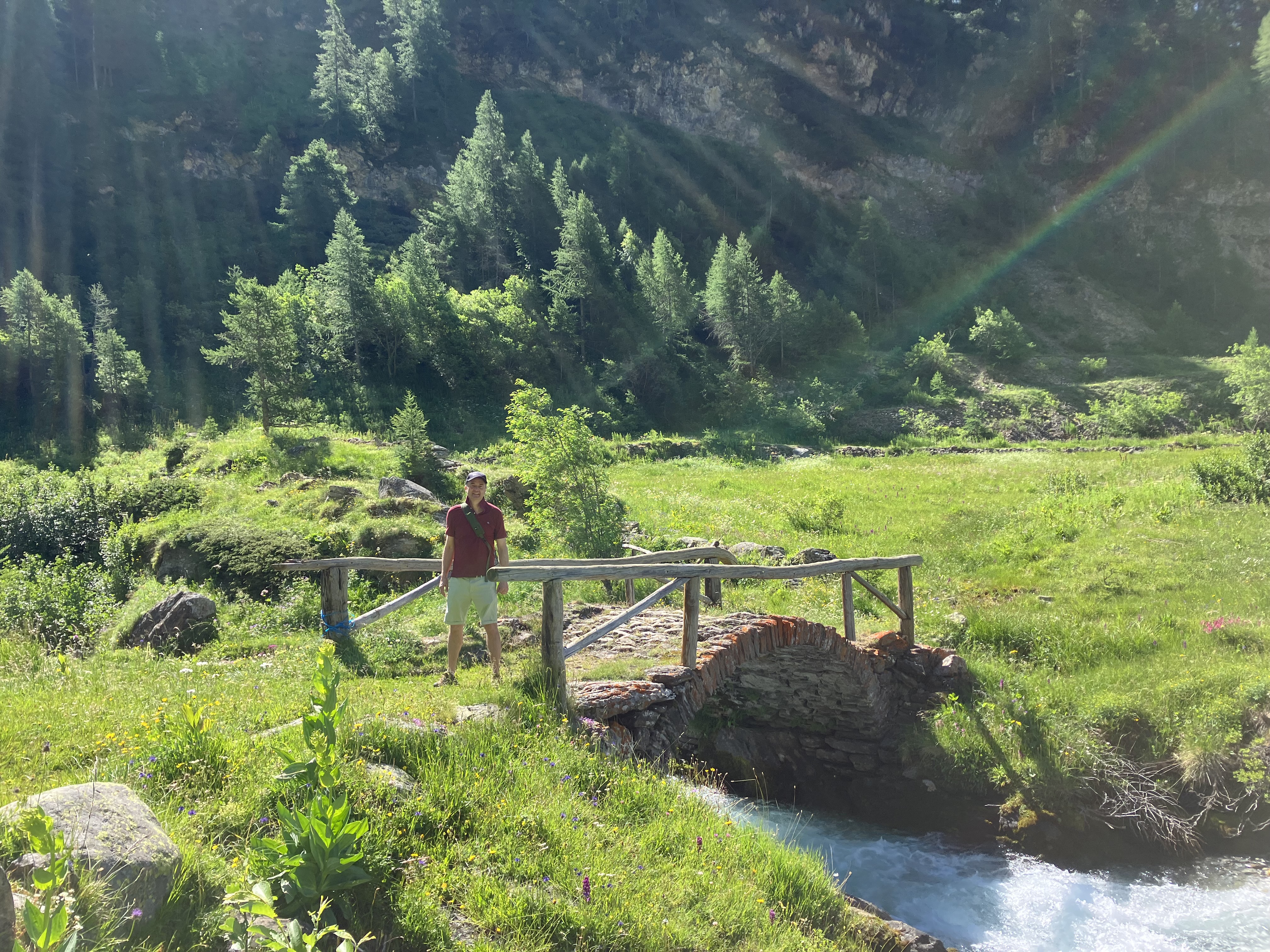
Today Husband suggested another walk in another valley. I said I did not want any scrabbling, off we went. We drove into the mountains, and walked into the valley. Gushing rivers with little bridges, meadows full of flowers, very beautiful. The path wound upwards. Not so good, but okay so far. Then the ground got boggy, more melting snow, more jumping across stepping stones. Then, while perched on stepping stones, we noticed cows—frisky ones—walking up the hillside towards us. Worried we might get trampled. Noticed a thin blue line of electric fence and felt safer. Under the fence dashed two large dogs, barking loudly, hackles raised—felt less safe. I kept my arms tucked in, and spoke sternly, telling them to stay down (hoped they understood English). They circled us, but didn’t approach. A farmer further up the hill heard the noise, called the dogs. Husband asked if we were okay to walk, he replied with a thumbs-up, we continued. The electric fence crossed the path. It was nearly too high, but managed to step over it (held onto Husband for support). Then a little further on there was another wire—this one was too high for stepping over, so we crawled under it, hands and knees on the gravel. Old back protested, took some nurofen.
The rest of the walk was very beautiful, with stone bridges over bubbling water, and flowers and mountains, and all boisterous cows secured behind wires. But I felt a bit worn out. I do like walks in beautiful places, but I prefer less adventure. And definitely less scrabbling up scree or under fences. Being upright is very nice at my age. I don’t mind being older—I actually do not want to do the things that I did in my forties, I don’t want more children or to be worried about a career or to be planning to move house. Mostly I like being older. But as I cover my cuts with savlon and top up my nurofen for my aching back, I realise that I do not quite keep up with Husband anymore. I now prefer my adventures in books. I think I will take charge of planning the walks in future. They will involve only walking.
I hope you survive your day. Thanks for reading. Take care.






























 Anne E Thompson