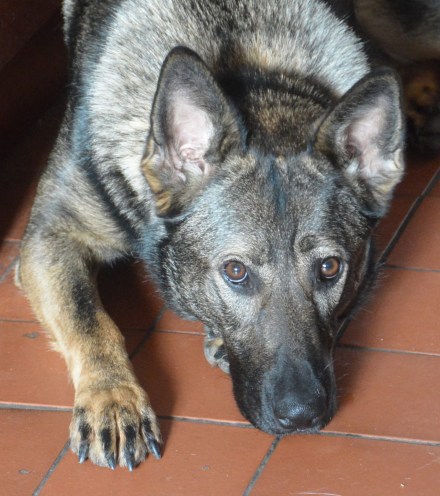
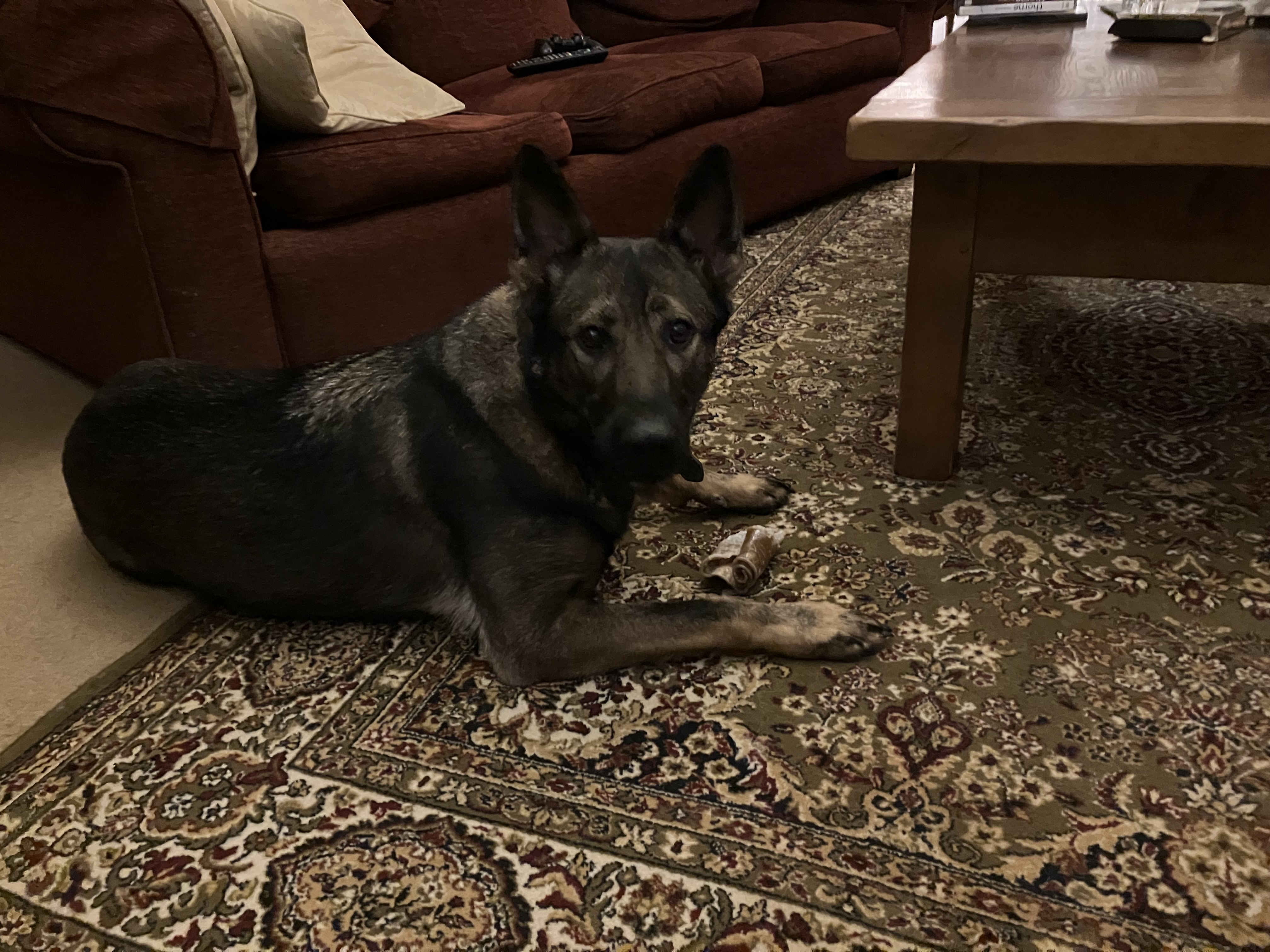
The longer we have Meshi staying here, the more I realise that we ‘got right’ with Meg’s training. This is extremely reassuring, as mostly I am aware of all the ways that we failed! I think if I could go back in time, I would say that anything that I thought would ‘sort itself out when she’s older’ simply did not happen, and all the tiny bits of everyday training that we insisted on have been worthwhile. For example, every morning she bounds for the door and leaps at it; we insist that she sits and looks at us; or the door does not open—this has helped her to learn some impulse control. In contrast, Meshi ignores absolutely everything I say.
The two dogs have been very good together in terms of friendliness. They genuinely seem to like each other, and when Meg has been in her crate and Meshi is loose, he tends to stay close to her, and if he puts his nose through the bars she licks his nose. Very cute. The nicest times are in the garden, when I walk them round the loop of the perimeter together. Meshi is on the lead (because he will not return when I call, and I cannot risk losing him). Meg is loose, running round with a stick (log) in her mouth, but staying close. Meg tends to take the lead, and Meshi races off, straining on the lead to follow her. He pauses to pee on every bush/tree/flower, and Meg stops to wait for him, then continues to lead the way round the garden.
I have tried to stop Meshi going into Meg’s crate—that is her space. He tries to sneak in there at every opportunity. Yesterday the crate door was closed, and I watched him walk round the crate, looking for a way inside. Meg also saw him, jumped up from where she was lying with her chew, and went and opened the door for him, then they both went inside and Meshi started to eat her food. I quickly got him out—great danger of being squashed.
Meg usually settles down if she has a chew. I buy her (at great cost) large rolls of camel hide, and these last for several days (they stink). Meshi has decided that he also likes them. Whichever chew Meg has is the chew that Meshi wants. She is incredibly good-natured, and allows him to take the chew out of her mouth and walk away with it. She then goes and finds another chew. After a few minutes, Meshi decides he wants the new chew, so gets up and removes it from Meg, who goes and collects her original chew. I don’t intervene. Unlike with children, who can be taught about sharing and fairness and not taking toys away from other children, my understanding is that dogs are different. In the wild, a pack will have a leader, and that dog eats first, and dominate the rest of the pack. The pack is peaceful as long as no one challenges the pack leader. I want peace in my house. I allow Meshi to be the pack leader. (I am also trying to establish that I am not in the pack, and unlike Meg, I do not follow his lead. I have managed to make him sit down when told, but not much else. Luckily he is small.)
My main difficulty has been in keeping Meshi physically safe. He is so much smaller than Meg, and she is incredibly strong and incredibly bouncy. Whenever I have allowed them short bursts of free play, Meg has been in danger off leaping on him—which could easily dislocate a limb and would certainly hurt him—so almost immediately I have to separate them. I can have them both in the same room, but only in a very controlled way, telling Meg to lie down and not allowing her to stand until Meshi has also decided to lie down (usually with one of Meg’s chews). There have been a few times when they have both been free and settled in the same area, but I would not feel comfortable leaving them unattended.
I have noticed a change in Meg since Meshi arrived. Usually when we walk in the woods, she completely ignores all the other dogs (of which there are many) and will avoid them if possible, concentrating on her stick and veering off into the undergrowth if they approach. This week, Meg has been approaching other dogs, walking up to them. She has returned to me when I call (after she has finished sniffing the other dog, not instantly) but she is definitely showing more interest. I’m not sure whether this is a good thing. Some owners will be frightened of a big German Shepherd approaching their darling Spaniel—it was easier when she ignored them. Perhaps she has realised that other dogs might be fun to play with, or maybe previously she was frightened of them. I don’t know. I’m hoping that after Meshi has gone to his own home, Meg will gradually forget about playing with other dogs and will go back to ignoring them. Otherwise I will need to improve her ‘recall’ so she returns to me instantly if I need her to.
Another change is in my own attitude, having Meshi here has made me look at Meg, and I realise that she has become very dependable. She never steals food, or destroys things, or toilets in the house. (This is not to imply Meshi does these things, but rather that I appreciate Meg never has.) Therefore I feel I should stop putting her in the crate when I leave the house. This week I have left her free to roam the house while I have been out, and so far there has been no damage. I think she just sleeps when I’m not here. I even went to London, leaving her for several hours, and all was fine when I returned. This is marvellous. It means she is now a good deterrent for burglars, and it’s much nicer for her when it’s hot, as she can more easily find somewhere cool to lie. (Of course, there is still a possibility that I will return to find she has dismantled a cupboard or removed the stuffing from a sofa—but for now it’s great.)
Hope you have a great day. Thanks for reading. Take care. Love, Anne x
I agreed to look after Son’s dog while he’s away. He is a small male Shiba Inu, very cute, looks exactly like Basil Brush (this is the dog, obviously, not my son!). I asked friends for advice on how to introduce dogs, and the main tip seemed to be—given Meg’s personality—to keep everything as calm as possible. Meshi must be presented as something boring. Of course, with Meg, nothing is boring.
When they were due to arrive, I took Meg into the garage for some ‘training exercises.’ This was as neutral a place as I could manage, as they were coming late for dinner, and I couldn’t be in the woods or somewhere completely neutral given the time. (Though actually, going out for a walk is super exciting in Meg’s world, so maybe the boring garage was better.) I had some meat as a treat, and we practised walking to heel, stopping, turning, waiting until called, lying down. All the things we practise regularly. Mid-way through the ‘training session’ Son and Meshi entered the garage.
Meg immediately ran up to Meshi, so I called her to heel—she half-came (automatic response) then realised that Meshi was more interesting and ran back to him. Meshi seemed uncertain but not frightened. There was a bit of running round, then I called Meg to me again. I wanted to stop the excitement from escalating (although nothing with Meg is ever calm). This time Meg came to me, sat, received a treat. She didn’t wait to be ‘released’ but ran straight back to Meshi, but that was not too bad and it broke the cycle of excitement. Meshi is older and male, and although he is much smaller, he soon asserted himself as the dominant dog. This was good, and what I had hoped. Meg is bouncy, but she is relatively submissive with other dogs. Meshi was able to ‘stop the game’ when he had had enough, and Meg backed off. She did not stop trying to re-engage with him, so we limited their interaction to a few minutes. I then told Meg to go into her crate, and she went to the garage door, and then ran to her crate. I think she wanted a break too, but didn’t know how to stop the chasing/being chased game. Meshi was very relaxed when Meg was in her crate, and happily lay on the floor nearby. Meg wanted a rest, so ate her food and went to sleep. So far so good.
We let them interact a few more times during the evening, but for very short bursts and in a very controlled setting. I have read that dogs need a ‘top dog’ and we decided this would be Meshi, even though Meg is bigger and stronger. Therefore when Meshi ‘stopped the game’ by showing his teeth (not biting or being aggressive, just showing he wanted her to back-off) we enforced this by calling Meg away.
We left Meg in her cage for the evening, and let Meshi have the run of the house. They both slept, all was peaceful.
This morning I took the dogs into the garden separately to toilet. Then I attempted to have them both with me (Meshi on a lead) while I cleared up their mess. Meg was super-excited and kept trying to entice Meshi into a game, and he was keen but wary, so it was not a relaxing start to the day. Meshi peed on absolutely everything in the garden—no idea how he produces so much pee!
While I had coffee I put Meg into her crate with her breakfast, fed Meshi in the dining room, went to have my coffee. I returned to find him curled up on a sofa—which is not allowed. I told him no, and he ignored me, so I removed him and explained that dogs are not allowed on my furniture. He gave me a look. Am pretty sure he will wait until I have gone and then get back onto the sofa. I hope Meg doesn’t decide to copy—this is one of the few things she is good at obeying.
Actually, Meg has done very well. Although she is way too excited and bouncy, considering she has a dog, who she has never met, in her house, she is very friendly. There seems to be nothing territorial or aggressive in her at all—which considering her siblings are all in the police and bringing down criminals, is excellent. One of my fears was that she might be aggressive. Online I see videos of her siblings as they fly through the air and grab hold of men and pull them down—and I was keen not to have that in a pet. We have tried very hard not to stimulate her aggressive side (which is why I was wary of the training advice from the police-dog handler—who would have produced an obedient dog, but not necessarily a friendly one). I spent the day working, sharing the run of the house with the dogs in turn. I didn’t attempt to have them sharing the same space for long—not yet. Maybe when they are used to each other that will work, but for now it’s better to have them mostly in separate rooms. When I let them have ‘free play’ (closely watched the entire time, because I do not want to return a damaged dog to my son!) they chase each other. Meshi will run away, with Meg chasing, then he will turn and face her. I call Meg back to me—taking his turning as an indication that he has lost patience. Meg runs towards me, Meshi chases her, tail wagging. Meg then turns and chases him, and he runs away (still with tail wagging). At one point they did laps of the kitchen. But Meg is so easily tipped into mega-excited-mode, that I stop the game pretty soon. I tell Meg to go into her bed, and she is very obedient and does this immediately. Sometimes I don’t even bother to shut the door; Meg entering her crate is enough to calm the game. Sometimes Meshi attempts to enter her crate too, and I stop this and shut the door. I think Meg needs a space that belongs to her alone (though I haven’t noticed any signs that she is bothered).
I will let you know how things develop. Thank you for reading. Take care. Love, Anne x
Hello, and how is your 2026 going so far? Last year whizzed past, so I might keep the Christmas decorations under the bed this year to save me scrabbling in the back of the cupboard. But maybe that (the time-whizzing thing) is just because I am getting older—time definitely goes faster as we age.
We went to an event this week which would suit any age—the annual town Tractor Run. I’m not sure if other rural towns do this, but where I live, every year all the local farmers decorate their tractors with lights and tinsel, and parade through the villages honking their horns and flashing their lights. It’s brilliant! I dragged Husband along this year; I could tell he wasn’t keen as we stomped through the dark lanes, and risked the cars whizzing along the main road, to the nearest viewpoint. There were lots of other people—families and couples and people walking their dogs. My town is good at community events.
Screenshot
We stood next to the road, in the dark, waiting. After a few minutes we could hear horns, way off over the fields, and we knew they were coming. There were a few cars, and a motorbike flashing his lights (not sure if he was part of it or just entering into the general mood). Then the tractors arrived—I’m guessing about 200 of them, giant ones, ancient ones, tiny ones; some looked not much bigger than our lawn mower, others could have moved a house. It was terribly exciting—I’m not sure why. Perhaps it was the lights and noise in the dark lane, maybe it was the size of some of the machines (maybe it was all the hunky young farmers!) I thought it was brilliant. I do enjoy a good parade.
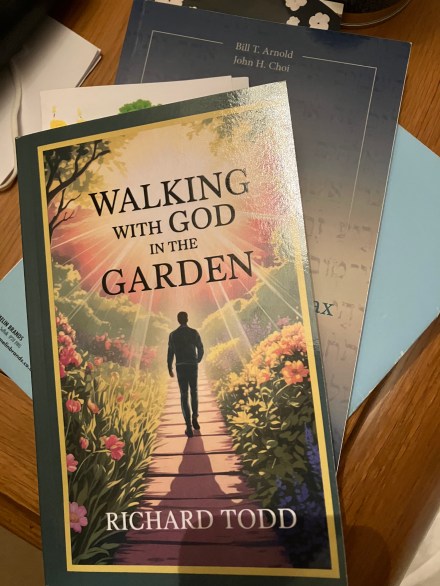
Another thing I have enjoyed this week is a book by Richard Todd. He’s no relation, although I have met him a few times because two of his brothers married two of my aunts. When I heard he’d written a book, I bought a copy (partly because I happen to know that publishing a book takes a lot of courage). He was the head gardener at Anglesey Abbey, and the book describes his career, interspersed with how he believes God has guided him. It’s not a complicated book (which is very refreshing after reading lots of theology books, which do tend to make religion seem very complicated). If you are interested in gardening, or just want something nice to read at bedtime, I recommend it.[1]
Do you have times when you read certain books? I do. At bedtime, I like something that’s easy to read, nice and relaxing. But if I wake in the night and I can’t go back to sleep, I tend to read theology books—which tend to be slightly boring, but also make me feel I’m not wasting time so it doesn’t matter if I’m sleepy the next day. This does not work for the few theologians who write well (like Moberley or Clines) because then I become engrossed in the book and the night disappears. In the afternoon, when on holiday, I like something interesting—my favourites are John le Carre or Joanna Trollope—which are very different authors but they both have a nice turn of phrase. Their books are like sipping a good red wine next to the fire.
I don’t watch much telly, although Husband and I do enjoy watching certain series (usually on Netflix or even DVD—remember those?!) Our big secret is that several years ago, Husband gave me the entire boxset of The Good Wife and we have already rewatched it THREE times! It’s disappointing how much we have forgotten each time—especially when we watched it for the third time. Whole plots are like new. Which I guess is one of the many good things about growing old—bad memory means you enjoy the same films and books more than once. I hope you enjoy something this week—whether it’s a parade or a book or a television series.
Thanks for reading. Take care. Love, Anne x
PS. For those who follow my blog regularly, my last two venesections were both cancelled because my iron levels have remained normal. I am extremely thankful for this and hope it continues. I am always cautious when talking about ‘answers to prayer’ (because what about the prayers that appear to be ‘unanswered’?—how do we explain parents who have lost children, drought-ridden areas when people pray for rain, those praying for the end to war, etc?)
All I can say is that I did pray for the impossible and ask to not need more venesections, and the last two have been cancelled. Make of that what you will. I’m due for another one this week, so waiting to see what the blood test says…
Hello, and how are you? Here is a blog I wrote a few years ago, but never posted (perhaps because it was too ‘raw’ at the time). Hoping it helps someone.
***
I have been struggling this week with the feeling that I am, to be frank, fairly pointless. This is something that has dogged me throughout my life, as I have never managed to motivate myself when things seem pointless. ‘Where is the point,’ said my 16-year-old self, ‘of learning French, when I cannot afford to ever leave the country?’ If I couldn’t see the worth—the point—of something, then I didn’t do it. To feel that one’s self is pointless is therefore bit of a problem, and not one that is easily solved.
My children have all grown up, they have independent lives and have studied things I don’t understand and all work in offices (whereas I only know classrooms) so their conversation is smattered with words like sprints and neds and nids, and difs and dofs (okay, I made up the last ones, but you get the idea?) I feel left behind, a little bit stupid, and really rather pointless.
There have been times in my life when I felt like I mattered too much. A working mother, with a husband who was always in the city and three young children and a house to cope with, life was so busy I didn’t have time to wonder whether I was pointless, I just had to make it through the day. Perhaps therefore this introspective issue is one reserved for people with too much undirected time. Perhaps busy people don’t stop to wonder. (Perhaps they should.)
I am at a ‘funny age for a woman’ so some of my feelings might be due to hormones rather than actual fact, but I see it in other people too. I look at what I have achieved in my life, and feel that it is all finishing, and I am left with nothing to do that’s worth doing, and I don’t want to be that frivolous person who has hobbies. I want to be up there, with the nurses in casualty, with the politicians making decisions, with the artist who produces something that affects people. I want to matter.
I suspect that lots of people felt pointless during the time of lockdown. Many people were stuck in their homes, possibly furloughed from work, not able to use their skills and talents. We feel pointless, we need to feel that what we do, our lives, has some worth. And sometimes, frankly, they don’t.
This is a problem that I also see with older people. As people approach the end of their life, when their body doesn’t quite manage to do all the things it used to do, when they can no longer be the person who goes up the ladder to fix the light, or carries the shopping, or caters for the crowd, then they start to feel a bit pointless. When the time comes to stop driving, it hits even harder. If you can’t do things, then what is the point of living? I hear this voiced (in different words) by people suffering a major illness. If you’re in so much pain that you can’t function, then what is the point? Why not end it now?
Even busy people actually, are fairly pointless. They work hard, they strive for wealth—but they never have time to enjoy it; or they want to be promoted to positions of power—but after a while someone else takes over and they retire and it was all for nothing. It is like chasing the wind. There is no point, not really. You work hard, you earn security, and then you die and someone who hasn’t worked, who doesn’t deserve it, enjoys everything you have achieved. So, why bother?
Before you all go and throw yourselves under a bus, I have a few thoughts.
I think that actually, on our own, we are all pointless. Time passes very quickly, and you will grow old, and lose your abilities, and die, and in a few decades you will probably be forgotten. So, as the writer of Ecclesiastes wrote, you should find work that you enjoy, and make the most of the life that you have.
We were all created for a purpose, and I believe that even more strongly than my feelings of despondency. Therefore there is a plan for my life, and if I manage to follow that plan, then my life will not be pointless, it will be part of a whole wonderful eternal plan. Which is what I want, need, long for. And this, in case you were wondering, is why I am a Christian. I want to be on God’s side, because he is eternal; following him is not like chasing the wind, and he gives my life meaning now, and will give my life meaning when I’m older. I might not see the whole plan now, some things will only be clear with hindsight, when I look back; sometimes I might lose sight of the plan altogether and wander off a bit. But if I keep trying to follow God, to every day ask him to guide me along the right path, then what I am will be worthwhile. My life is a tiny, but useful, essential, part of the whole. And that is worth living for.
Thank you for reading. Take care.
Love, Anne x
PS. When I initially wrote this, after a few days of absolutely everything going wrong, plus it being my dad’s birthday and I always miss him on his birthday, I had a mini explosion and told my family how I was feeling. They were all super-supportive, and I received flowers and loving messages and felt thoroughly loved (and a little guilty for having exploded). If you are feeling pointless, perhaps you should be brave enough to tell someone close to you. It might help.
Thanks for reading. Why not sign up to follow my blog? anneethompson.com
Look on your device for this icon (it’s probably right at the bottom of the screen if you scroll down). Follow the link to follow my blog!
Thanks for your email, which made me and my family and friends laugh. Soo kind of you to offer to collect the excess boxes at no cost to me. Please, allow me to recap, as I’m sure you’re busy at this time of year and maybe are unaware of the chain of events. (You can verify the details in the email chain.)
15th November, I order one set of teacups and teaspoons.
16th November, (company name) emails to say there is a delay, do I want to continue or cancel the order (very polite of them).
I reply, saying I would still like to receive my one set of teacups and teaspoons (because they are very pretty, and I don’t mind waiting).
25th November, My one set of teacups arrives, with an unexpected three extra boxes, which were not ordered, not paid for.
Against the advice of family (who said, they’re lovely, just keep them, it’s not your mistake) I email Carol (who told me about the initial delay) and inform her of (company name)’s mistake.
26th November, Carol kindly replies, saying she will find out how this happened and arrange collection. She asks when I can be at home, Monday to Friday.
27th November, I send two days 2nd Dec and 3rd Dec)when I am at home. I receive a date for DPD to collect them on a different day (1st December). I reschedule my work.
1st December, I wait at home all day, DPD never arrive, and their tracking note (0048 031 900 5) says they were told there was nothing to collect (am assuming they went to the wrong address, as I was here all day and other delivery companies had no problems).
1st December, I contact (company name) to inform them of the situation.
3rd December, (I believe this is where you entered the drama). I am asked for another day I can be at home.
4th December, I send a date (5th Dec).
5th December, I wait at home all day, DPD never arrive. I email to inform (company name) I have stayed at home for another day, with no collection. I write, again, to inform (company name), and suggest it could be collected on 9th Dec.
7th December—Today—such a treat to be told that (company name) will not charge me for the privilege of storing their boxes of unordered crockery, or the failed collections. Thank you so much. There was I, worrying that perhaps you send random boxes of stuff to people, so they can inform their many visitors (because it is that time of year) not to trip over them, and they can keep the dogs locked in the kitchen so they don’t spoil the boxes (which are too large for window sills or cupboards and need to be stacked on the floor) and they can stay at home for multiple days waiting for a non-arriving DPD collection service, and that perhaps there might be a charge for this pleasure. Phew! What a relief to know I will not be charged for this delight.
You now ask that I suggest a date from Wednesday onwards for collection (at no cost to me—I can’t quite get over that little gem). Okay, I am always ready to gamble, how about Wednesday? Wednesday 10th December 2025 (just in case there is confusion over the year). I will stay at home in eager anticipation of a DPD collection (at no cost to me).
Please inform the driver that if he knocks at the door of my house (address written, just in case) then I am really good at opening the door and handing over boxes, but if he just drives past on nearby roads we might have a problem.
I will now go and decorate the boxes with lights and tinsel, because to be honest John, I’m not that confident that they will be collected on Wednesday. I think it is reasonable, that if they are still here on Thursday with no further instructions from (company name), I will consider them my property and wrap them up as gifts.[2]
[1] This is an email I sent in December. Names have been changed.
[2] Ithink that in UK law, if a company delivers items by mistake (rather than as advertising spam) then they can reclaim the cost of the goods for several years after the event, therefore selling/gifting items is not a good idea unless you have permission. They are not considered ‘unsolicited goods,’ it is a mistake.
[3] Guess what, the boxes were not collected that Wednesday. Thursday I received an email, giving permission to keep the items (which made me very happy). Hence the anonymising of the company’s name.
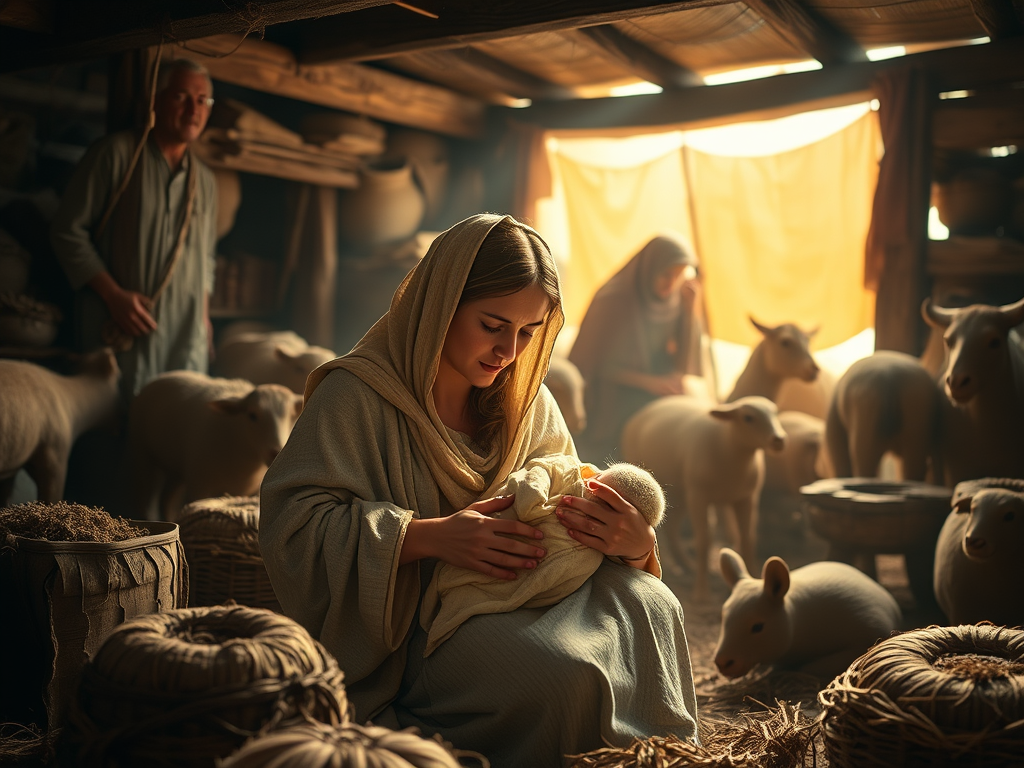
I travelled to Bethlehem in a small cart. Every bump (and there were many) was agony. As I jolted along, I was racked with pain. The baby’s time was near, you see and the pain was almost unbearable. Later, they would sing songs about a cute donkey carrying me. Nice thought! I don’t think there’s any way you could have got me on a donkey. As each contraction cramped every muscle in my torso, I huddled up like an animal and prayed for it to be over.
I could see Joseph, watching me as he walked alongside. He really didn’t have the first idea what to do. Oh, how I wanted my mother. I yearned for her to be there, holding my hand, telling me everything was all right and would be over soon.
When we arrived at Joseph’s uncle’s house, the women folk came and helped me inside. The room was crowded. All Joseph’s male relatives from miles around had come to the house for shelter and food. The women were busy cooking supper and the men were drinking wine and comparing stories. They all told Joseph how much he resembled his grandfather, Matthan and laughed at old stories from years ago. The smell of fish and fresh bread was nauseating. I was so tired and so uncomfortable.
Joseph knew I was suffering and asked if there was somewhere quiet that I could go. There was no chance that we would get a place in the inn, they had filled up days ago. Somewhere quiet, in a little house packed with relatives?
There were some fraught discussions and then his aunt suggested that the animal shelter, down on the lower floor of the house, might be best. It wasn’t terribly clean, but it would be quiet and private and at least it wouldn’t smell of fish.
Joseph helped me to go down, and a couple of the women came too. One of them examined me and told me the baby was a long way off yet, first babies always take their time in coming. This was not great news but I felt better having her there. I felt that she knew what was happening, had seen this before; it took some of the fear away.
I was frightened, you see. I was horribly afraid that somehow I would damage my baby. My baby and God’s. I knew he was going to be special, I knew I had a great task ahead of me but it all seemed to be going horribly wrong. I trusted that God was still in control but he felt so far away.
Could the baby not have been born in a palace, surrounded by comfort? Would these poor beginnings really be part of a plan? Could they really make this king accessible to the people? I had no idea.
I was a mere girl; I had no education and my memory of scriptures was often fuzzy. To be honest, at this present moment, I didn’t even care. I just wanted this baby OUT! Special or not, my body was tired of carrying him, tired of being stretched and pushed, of fitting something inside that was now too big to be there. I needed this baby to be born and I was too exhausted to wait much longer.
How I longed for sleep. The pain in my back was terrible. Great waves of cramp that seared through my body, making me oblivious to everything else. I was vaguely aware that someone was sweeping the floor and moving the animals to a far corner. They had laid out a mattress and blankets for me to rest on but I couldn’t lie still for long. I felt better standing, rocking in time with the pain, trying to remember to breathe: in out, in out. Someone offered me water but I couldn’t drink. I wasn’t thirsty—I just wanted this baby to be born.
I could see Joseph with his big anxious eyes watching me. He didn’t know what to do. Someone suggested he should go into the house to eat and I nodded in agreement. There was nothing he could do and the poor man must have been tired too. He had endured such an emotional time lately. First there was his fear and anger when he first heard about the baby (now that was a difficult conversation). Then he had to endure the smirks of his friends when the pregnancy became public knowledge. He never complained, but I know he felt embarrassed, wished that God could have chosen a different girl.
We had been travelling for five days, with hardly any rest and the last couple of days had been chilly. I know he felt the burden of caring for me, watching for bandits on the roads and wondering if we would make it to Bethlehem in time. If the baby had come early, I don’t know what he’d have done—left me with strangers on the road somewhere I guess and come to register on his own. You didn’t mess with a Roman decree. . .
The pain eventually became almost constant. Joseph had eaten and rested but I continued to sway in discomfort in the little room of animals. Every so often one of them would poop, and although the women with me cleaned it up quickly, the smell pervaded the atmosphere. It was hard to ignore.
I could hear the musicians gathering, someone must have told them the birth would be soon. They would stand outside, waiting to hear whether the baby was a boy so they could play. That gave me hope, maybe soon the baby would arrive.
Then at last, in a final searing pain, the baby was born. I looked down at his blue waxy body as he wriggled on the blanket, and I knew that he was mine. My love for him was overwhelming. He was part of me, I would die rather than let anything hurt him.
One of the women wiped him down with oil and salt and I held him in my arms while they looked for the swaddling bands in our luggage.
How beautiful he was. His indigo eyes would soon turn brown and they gazed at me trustingly. I loved him with my whole being.
Outside, there was the sound of music and singing as the musicians heralded the arrival of a boy, and I smiled, knowing they would have quietly slid away into the night if the baby had been a girl. But there had been no chance of that, not this time.
Joseph came and took the baby from me. He held the tiny baby in his giant carpenter’s hands, hands that spoke of hard work and safety. He didn’t say anything, this man who had been chosen to protect me; he simply stared at the baby—looking, wondering.
Then the baby started to mouth for food and Joseph passed him back. The women showed me how to feed him, but he was soon asleep. Then we gently wrapped him in the swaddling bands, securing his tiny limbs so he would feel snug and secure and his bones would grow straight and true. He was so beautiful. It was hard to remember what the angel had told me, that this was God’s son too. I began to wonder if I had imagined it, if it were all a dream. This baby did not look like God, he was a baby. My baby.
“If it’s true God,” I thought, “Let there be another sign. He is so little and I love him so much. Is all this travelling, and squashing into a crowded house with the animals, really part of the plan? Are you still in control? Can you still see me? Remind me again…”
I too needed to sleep. Joseph fetched fresh hay and put it in the animal’s manger, covering it with a soft blanket. I didn’t want him to put the baby there, I wanted to keep him on the bed next to me, but Joseph was worried I might roll on him in my sleep. Then he laid the baby down and told me to sleep. He looked deep into my eyes and brushed my collar bone lightly with his fingers.
“Soon you’ll be truly mine,” he whispered. I knew what he meant and felt myself blush. I was so tired, I thought I would sleep for a week.
I actually slept for about two hours. I was abruptly woken by loud voices and a draft of cold air as the door was flung open. There, standing uncertainly in the doorway was a group of youths. Their clothes were dirty and exuded the strong smell of sheep. Joseph was with them.
“Mary? Are you awake?” he asked.
It would be hard not to be with all the noise from outside.
“These shepherds want to see the baby. They were told by angels where they could find him and they have come to look at him.”
I checked I was decently covered before nodding, letting Joseph know that it was all right, they could come in. They trouped into the room. They seemed so big and clumsy in such a small space, with their long limbs and rough clothes. I worried they might hurt the baby.
But they didn’t try to touch him, they just stared for a while and then one of them knelt and they all followed suit, kneeling before the manger, staring at the baby.
Then they told me their story, how they had been in the fields and an angel had appeared. They had thought they were going to die, to be struck down right where they were.
The angel had reassured them, told them that a saviour had been born, the Christ who we’ve all been waiting for. They would find him lying in a manger. Then suddenly there were lots of angels, all praising God and saying he was pleased with people on earth.
After the angels had gone, finding they were still alive after all, the shepherds decided to come at once and see for themselves. It was as though they couldn’t quite believe what they had seen and heard, they needed to actually see the baby with their own eyes.
I felt so humbled and so cared for. God had heard my thoughts. He was reassuring me. It was all his plan, not some terrible mistake; circumstances hadn’t caused us to drop out of his control, he could still see me. We were meant to be here. He even knew about the manger.
I listened and smiled and treasured my thoughts.
The shepherds left as noisily as they came. I could hear them in the streets, shouting their news, telling everyone what had happened. They were so excited, I expect they woke up half the town. They had of course woken the baby who was now crying with a thin wail that jarred my nerves and was impossible to ignore. I fed him some more and then we both slept. A tired, contented sleep borne from exhaustion and wonder.
***
After eight days, Joseph came and circumcised the baby. How he wailed! It felt cruel, though I knew it was the right thing to do, even in this strange place we must obey the Jewish laws. We also formally gave him the name Yeshua, the name we had been told to give him by the angel all those months ago.
I wondered if Joseph minded, people would know it wasn’t a family name. I also had no one called Yeshua in my own family, though I did know a boy from my childhood with the name.
***
After forty days, we had to travel to Jerusalem, to pay for redemption at the temple. As Joseph was from the tribe of Judah, we had to pay five shekels of silver. We couldn’t afford a lamb, so bought two pigeons to sacrifice.
It was nice to leave Bethlehem and to have some exercise at last, to see people and to take my baby into the world. I felt quite excited as I approached the temple, our holy place. I didn’t recognise anyone, but everyone could see we had a new baby and lots of the women came over to see him. I felt so happy. We walked through the Beautiful Gate and up to the Gate of Nicanor.
It was then that something strange happened. As Joseph and I walked through the temple, a man approached us. He came to look at Yeshua and indicated that he wanted to hold him. That was a little unusual but there was something about him, something that made you sure he was a good man, someone you could trust.
When he looked at the baby, the old man got all emotional and prayed, thanking God and saying that now he could die in peace. He blessed me and Joseph too and then he leant towards me and said something which was very strange.
He said Yeshua would cause “the fall and rising of many in Israel” and would be “a sign that would be opposed so that the thoughts of many hearts may be revealed.”
What does that mean? I know that he is God’s own son and that he is part of the plan to establish God’s reign on earth. Will he be opposed? Surely everyone will accept God’s anointed one, we have waited so long for him.
But then he said something that made me afraid; this old man with his determined face and bright eyes. His face was very near, I could smell his breath.
He said that a sword would pierce my soul.
Something inside contracted, all the joy of entering the temple evaporated into a lump of fear. Fear and anger. I practically snatched Yeshua away from him. I want my son to grow strong and be happy, will I suffer for this? I will do everything in my power to protect him; he is mine.
I knew I was tired, not getting enough sleep and it was hard to care for a new baby in a strange place without my mother to help me. I felt that I did not want to hear the man’s words, even if they were true. I was coping with enough, and I felt that although I had been brave, I couldn’t be brave any more.
Thankfully the man left us and almost at once an old lady approached. She was ancient, her white hair showed under her mitpahath and she leant heavily on a stick. What I noticed most were her eyes. They almost sparkled! You could tell at once that she was a holy woman and also one who loved to laugh. As soon as she saw Yeshua, the elderly woman started to pray loudly, thanking God and telling people nearby that if they wanted Jerusalem to be redeemed, they should look to the baby. I was glad that no Romans were allowed in the temple; we would have been in trouble.
We finished making the offerings and then went back to Bethlehem. I didn’t know whether to tell Joseph what the old man had told me. I kept thinking about his words, worrying about what they might mean. I was so tired, I decided I would wait and maybe tell him later.
***
The months passed and we settled into life in Bethlehem. We moved into a little house and Joseph found work on the many building projects that the Romans have introduced.
Yeshua continued to thrive. He grew into a sturdy toddler and would walk around the room holding onto the stools and baskets. I loved to feel his solid weight when I carried him on my hip, the light touch of his chubby fingers when he reached up to touch my face. There was pure joy in the gurgle of his giggles. He started to sleep much better at night and Joseph and I were thinking about having another child. But then everything changed.
It was one evening, still quite early but we had filled the lamp with olive oil and lit the linen wick. Joseph put it on a bushel basket, so the room was well lit and we could talk about the day. Suddenly, there was a banging at the door.
Joseph went at once and there, in the road, was a group of Persian travellers. They had dismounted from their horses and were peering intently into the house. They told Joseph they had seen a star and had come to worship the king. I was so glad I hadn’t gone to bed yet.
We let them into the house and I went to get Yeshua. He was damp from sleep and his tired eyes looked blearily around him. I wondered if he would cry but he seemed fascinated by our strange visitors. They wore their hair in long curls and one had a band of gold on his head. It glinted in the lamp light and I could see Yeshua watching it intently. Their clothes were patterned with birds and flowers.
We offered them wine; it was clear they were tired from their journey. I was embarrassed that we only had two stools to offer them, but they didn’t seem to mind and in fact insisted that I should sit on one with Yeshua and they were happy to sit on the rush mat. They didn’t really sit anyway, they wanted to kneel before Yeshua.
Then they gave him gifts. They were beautiful to look at. They gave him gold, signifying that he is a king. They gave him frankincense. The strong aroma filled the house and I wondered if Yeshua was to be a priest, even though he is not descended from Levi. They also gave him myrrh. Myrrh is costly but is for embalming a body. It was a strange gift for a baby and I wondered what it meant.
They told us their story before they left. In their Persian home, they were magi, watching the stars and foretelling the future. Many months ago, at the time of Yeshua’s birth, they had seen a special star which they knew meant a powerful new king had been born and they determined they would find him and worship him. Unfortunately, following the star caused them to go to Jerusalem first (I always knew that star gazing was a misleading activity). They went to Herod’s palace and asked where the new king was. This was scary; Herod had shown he was not a king to be trusted and his cruelty was well known. I would not have wanted to visit his palace.
However, it sounded as though he had decided to be helpful. Herod asked the scribes to research the early scriptures and they discovered that the promised king was to be born in Bethlehem. The king told the Easterners, asking them to find the king and then return and tell him theexact location, so that he too could worship.
I wondered what would happen next. Would Herod himself come to visit my precious baby or would we be summoned to the palace? This was not a comfortable thought.
I also wondered: why had the palace scribes not come to visit us? Why didn’t they travel with the Easterners to see the baby? Did they not believe the scriptures that they studied so diligently? Surely, if they were truly expecting a redeemer they would also have come? I frowned, feeling uneasy. There was something that I didn’t understand, and it nagged at me.
The men left. They planned to sleep in an inn and return to Jerusalem the next day. We could not offer them lodging in our tiny house and they seemed content to leave now they had seen Yeshua. I returned Yeshua to bed and soon afterwards Joseph and I also went to sleep.
I had not been asleep for long when Joseph woke me. He shook me awake, then went to light the lamp. I could see his face was tense and instantly turned to check Yeshua was well. He was sleeping soundly.
Joseph told me I needed to get up—at once—we needed to leave. He said that he had had a dream, like the dream when the angel told him that the baby inside me was God’s son. It was so intense, so real, that he could not ignore it. Joseph said he had been told we must leave Bethlehem, leave Israel; Yeshua is in danger, Herod plans to kill him.
For a moment I paused, wondering why I too had not been warned. But then understanding flooded through me, as I realised—God had told Joseph to take care of me and Yeshua—that was a hard task for a man, to care for a son that was not his own. So now, God was telling Joseph alone what we needed to do, underlining his role, establishing him as head of our family. It was a kind act, asserting Joseph’s value, his part in all this.
I began to pack our things, Joseph was hurrying me, telling me to only take what was essential, we needed to leave. We were to go to Egypt. Egypt! Could this be right? Was Yeshua not to be king of the Jews? I packed hurriedly and we left that very night.
What would the future hold? Would we ever return to our home town? The future was uncertain but I knew that something bigger than us was happening. Whatever happened, God had a plan and no one could alter the course of that, not Herod, not the Romans. We didn’t know what was going to happen, but we were part of the plan—and that was enough.
******
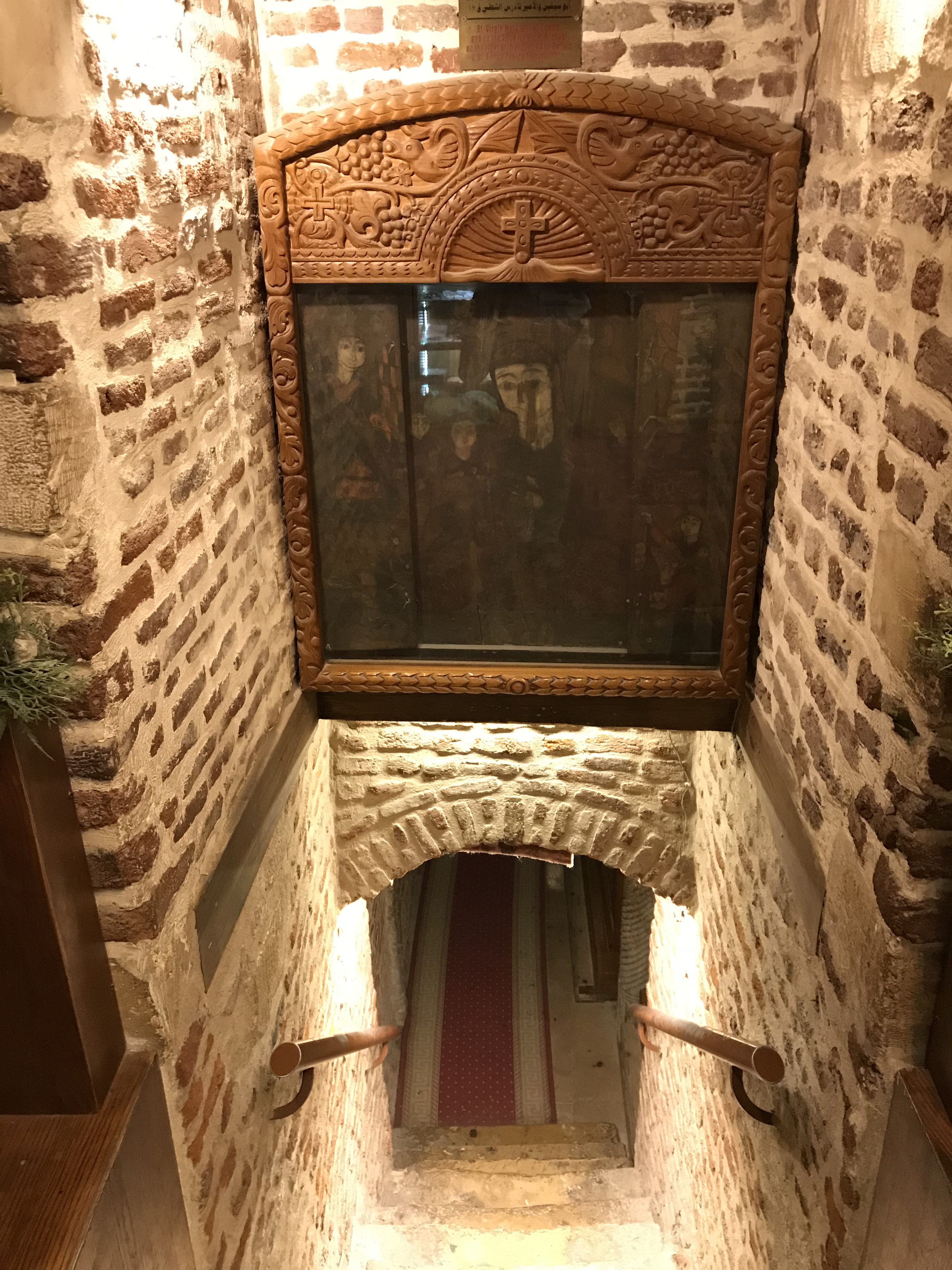
A place in Egypt which claims to be where the family rested.
Thank you for reading.
This account necessarily involves some imagination but I believe it is also as historically correct as possible (and more accurate than some of our Christmas carols). If you are aware of any historical errors, please tell me and I will modify it. I used a variety of sources including: The Gospels of Matthew and Luke Geoffrey Bromily (1995) William Hendriksen William Barclay Joseph P Amar (university of Notre Dame) Michael Marlowe Tessa Afshar Kenneth Bailey
After my run, I collect Meg and her ball, and go into the lounge (which is carpeted, and out of bounds for Meg). She follows me, and I place the ball on the floor next to her, and tell her: ‘Leave!’ Meg stares at the ball, occasionally placing a paw onto the carpet—which I remind her is not allowed. I then do some floor exercises—press-ups and stretches and stuff—while Meg stares at the ball. Even if someone comes to the door, or walks through the hallway, Meg ignores everything except her ball.
After a few minutes, I praise Meg, throw the ball, continue with the exercises. Meg races down the hall after the ball, brings it back and chews it next to me. After a while (when she has asserted her claim on the ball) she will place it in my hand, ready to repeat.
Today, when I threw the ball, Meg chased after it, then returned without it. She stood in the hall, staring at me. No ball. Something was wrong. I told her to go and fetch the ball.
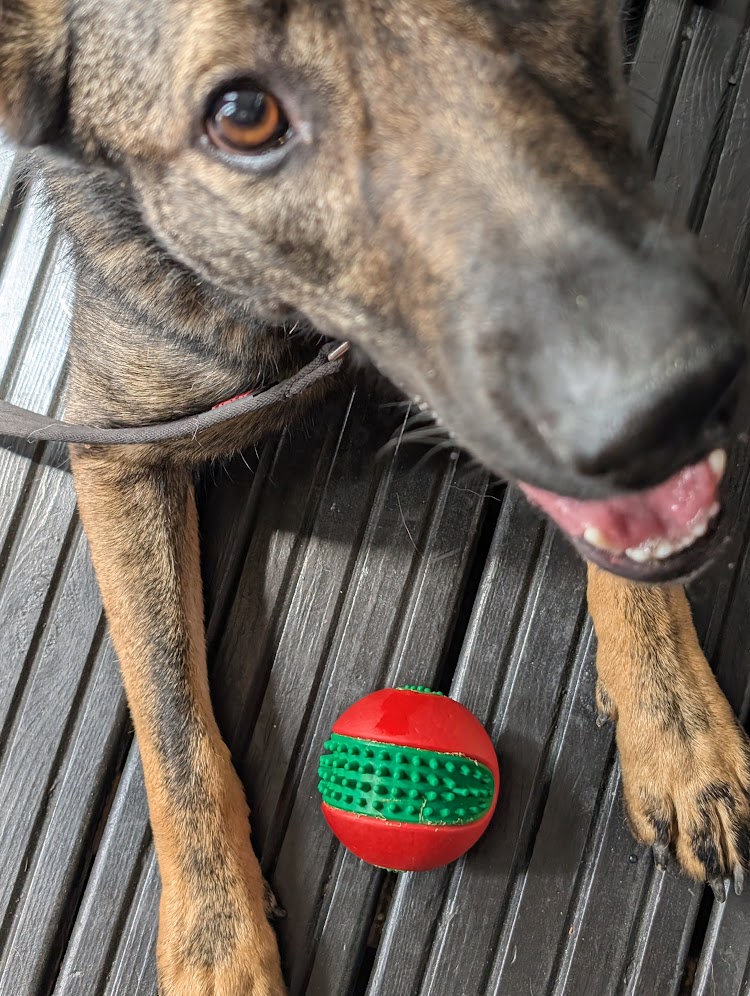
Meg disappeared for a few minutes. She returned with half the ball. It is made by Kong—and very strong, but it has a separate section in the middle, and over time her chewing means that it has come apart. Meg was very worried by this. She put the half-ball down in front of me and stared, asking what she should do next.
I took the half-ball, and told her to fetch the rest. Meg charged off, and returned with the thin strip that had fallen off the ball. She was obviously very worried by this. I tried to mend it, but it kept falling apart. I shall have to buy a replacement.
***
When we went to the woods today, Meg chased a deer. It happened while we were walking along a narrow footpath, and I was having a rest from sticks and just walking, so Meg had nothing to focus on. She spotted the deer before I did, and was gone in a flash.
I could hear them, crashing through the undergrowth (that would be Meg, she is like a tank when she runs). Then nothing. No sound, no sight, both dog and deer disappeared.
I remember that with Kia, calling her made no difference—if she chased a deer it was a waste of breath. I also think (based on no evidence at all) that if a dog can hear you calling in the distance, it does not make them return but it does give them the confidence to keep running, because they know where the rest of the pack is, so they can leave them there until they have finished chasing the deer. I therefore waited, without making a sound, until I heard the crashing of Meg returning. I quickly turned away, and began to walk off, as if I had not noticed she was missing, and was certainly not waiting for her, and if she got lost, that was her concern. My hope (again, based on no evidence at all) is that if Meg knows I will not wait for her, or even care that she is gone, then perhaps it will stop her running too far. The responsibility to stay ‘with the pack’ belongs with her. I have absolutely no idea whether this makes any difference. Nor do I know what I will do in the event that Meg does not return (because actually, I will care very much). But most of my training of Meg is based on compromise and chances, so hopefully that will never happen.
Hope you make some good compromises this week. Thanks for reading. Take care. Love, Anne x
I don’t have time to write much this week, but I was wondering—do you have an ethos for life? A sort of ‘code’ that you try to live by?
The thing that I most often try to remind myself is this: You only have one life. Life is short. Live well.
Of course, ‘living well’ is open to interpretation, but for me it means trying to live each day in a good way, a way that makes the world a better place, the way that I think God wants me to live. I realise that living well will be different for different people, but I still think that as a whole, this is a good aim in life. I also try to evaluate how I am doing, to spend a little time at bedtime assessing whether I think I have managed this. Usually I have not, and there are things I wish I hadn’t said or done. But again, I think this is a helpful thing to do—not to beat myself up, but so I can be deliberate about trying to change in the future. I think it is possible, as we get older, to live better lives than we did when we were younger. (Not, I hasten to clarify, better lives than other people—of whatever age—but better than we used to when we were younger.) Maybe, if I live to be a thousand, I might be a holy person.
This time of year is especially important for me to remind myself of this aim (to live well, not to be holy when I’m a thousand). It’s very difficult to prioritise our time as we near the end of the year, and Christmas looms ever nearer, and there is so much that I want to do. Days are not long enough.
Therefore, as I juggle the building stress of knowing I still need to buy lots of gifts, and I ought to clean the floor, and I really need to spend a few hours studying, and I haven’t had my eyes tested for ages and I need to sort that, plus all the regular stuff that has to happen in order to live. Sometimes it’s too much, and I need to stop, and remember. I need to decide what is important today. What needs to go on a list for tomorrow, and what can be fitted in but only if there’s time. And when I am doing stuff—going to the optician or rushing into the supermarket for milk or walking the dog—am I doing it well? Am I making the world, my little bit of the world, better? Sometimes it’s not so much what we do, but how we do it.
I will leave you with that thought for now, because I am trying to decipher a book about Hebrew punctuation, so that I can then decipher the Hebrew. It’s very interesting, but quite complicated, and not many people seem to explain it so I’m rather pleased that I managed to find a book about it. Reading Hebrew is very like reading a secret code, and you need to look for clues beyond the words sometimes. Meg is less interested, and keeps coming to poke me with her nose, so I shall have to walk her soon. But I shall try to do both things well. Because I only have one life, and life is short.
Hope you manage to live well this week. Thanks for reading and take care. Love, Anne x
Hello, do you enjoy buying gifts? What about receiving gifts? It seems to me, that people seem to fit into one of two boxes—either they love all things to do with gifts, and joyfully waste money on all sort of things just so they can wrap and give them, and they get tremendous pleasure from receiving gifts—or they feel awkward when receiving a gift and would rather people didn’t waste their money on them, and they would prefer a list when buying gifts so they can buy exactly what the person wants. I wonder, which box would you fit into? Or are you a combination of the two?
Some people are very good at buying ‘surprises.’ They seem able to think about what the recipient enjoys doing (which does of course require that you know the recipient well) and then they buy something to complement the hobby. (I think I have written in a previous blog, how one year Husband went to great effort to get a print of a painting that I had raved over in a gallery. This is now a very treasured possession.)
Here are my tips for buying a gift, just in case you are struggling. Of course, if you are buying for a person in the second box, they might actually prefer that you buy them something from their list, and sometimes that is the kindest thing to do. Sometimes we need to remember the gift is intended to make the recipient happy, it needn’t be something we enjoy giving. But assuming you know the person likes a surprise, here are some suggestions.
If they have a hobby (think about what they enjoy doing regularly) think of a gift for this. Even if they only really relax when watching telly, you can buy them a pretty blanket if they’re a ‘cold’ person, or a cushion, or case to keep their specs in. It’s all about thinking about what they enjoy doing (which probably is not picking up dog mess, even if they spend time doing that every day!)
Food treats are often another good gift. Either buy them something they will enjoy eating/drinking, or bake them their favourite cake/cookies/fudge. (This one does rather depend on your cooking skills, there are definitely some people who I would not like to receive home-baked goodies from!) Or maybe something food-related—a mug for their evening cocoa, a tumbler for their brandy, another teacup for the set they are collecting.
Another favourite of mine—which probably only applies if you are a young adult—is a promise of time. My family in the past have given me vouchers for afternoon tea with them. So I get to spend several hours with my extremely busy child, and we can have a proper chat. A real treat. Once, at a baby shower many years ago, I was given two days of cleaning from a friend who was a cleaner. It was amazing after having a baby to see my house beautifully clean (just as nice as all the Peter Rabbit crockery and knitted cardigans). I imagine a grandparent would appreciate a promise of gardening help in the spring.
Memories are always another excellent gift. A framed photo from the fun-filled holiday, a picture of a pet, the beer we drank in some far-away place. My siblings gave me photos from my childhood when I last had a ‘big’ birthday, and they are very precious.
So there you are, my tips for successful gift-giving. [If my family are reading this, I would really love a couple of baby goats, or alpacas, or donkeys, or calves—but don’t tell Dad because he has banned everything other than poultry!]
I hope you enjoy the preparations for Christmas, and are successful in your gift-buying. Thanks for reading. Take care. Love, Anne x
PS. In case you follow my blog, my last venesection was cancelled because my iron levels were surprisingly low. Yaay! That was a happy surprise. Hoping they stay low for the December test.
Meg was ill. She started being sick during the night, and was still being ill in the morning.
It’s always very difficult when a dog (or very young child) is ill, because you have to make a decision on their behalf as to how serious it is. I am not a great one for rushing to the doctor/vet whenever someone is ill, because I think usually people/animals get well by themselves. Going to the doctor/vet is just a big hassle (when you’re already stressed after clearing up unexpected mess) plus it means the ill child/dog has to be transported (not always easy when trying to contain mess) plus it mainly introduces them to a whole lot of new germs when their immunity is already low (because it is mostly other germy people/dogs in the waiting rooms). Plus with the vet, there is the lovely addition of the cost.
We do not have pet insurance for Meg. We decided with our other dogs to ‘self-insure,’ noticing that when they were younger they rarely needed medical attention and it was cheaper to pay ourselves than to pay the premium, and when they get old, the premium rises to being very expensive. The pet insurance companies are not running a charity, and we decided the risks were in our favour. Obviously, this is a personal decision, and we are aware that if something unexpected happened, we might have to pay an extremely expensive bill or six. But Kia lived to 16 years old, and even with a whopping bill for a twisted stomach surgery, we still think we saved money.
Vet bills and insurance is difficult for me. I worry that due to the ease of ‘not really paying’ at the time, people allow vets to undertake evermore complex (and costly) treatments, and I don’t know whether the animal is always better off. It can be hard to let go, but I do think that for an animal—who does not understand the pain or what is happening, sometimes that is the kinder option. I fully understand how difficult the decision can be, I think we lose a little bit of our heart with every animal we lose, and I still mourn my other dogs. But sometimes, when a treatment is difficult and lengthy and the odds of it working are slim or the animal will never be pain-free afterwards, I question whether it is the kindest option. Plus, I think not using insurance keeps things real. I have a problem with balancing priorities with money—there will never be enough in the world, and I know that there are currently people suffering due to lack of resources—is a pet’s life worth more than a child’s? This is an issue for me, and not one that I solve logically. I do spend a lot of money on keeping my pets fed and healthy, and I do give a relatively small amount of money (in regards to how much I keep for myself) to aid agencies. But when there is a huge vet’s bill, if I am paying myself and not just signing a form for the insurance people, it makes me stop, and think, and evaluate. I ask myself whether this huge amount of money is best spent on my pet, and whether I can justify it in the big picture. As I said, it is not logical, and I do not question every coffee I buy in a cafe, or every random pair of shoes that I buy, but I do think that occasionally it is good to have ‘stops’ in our brain, something to make us pause and consider what we should be spending our money on.
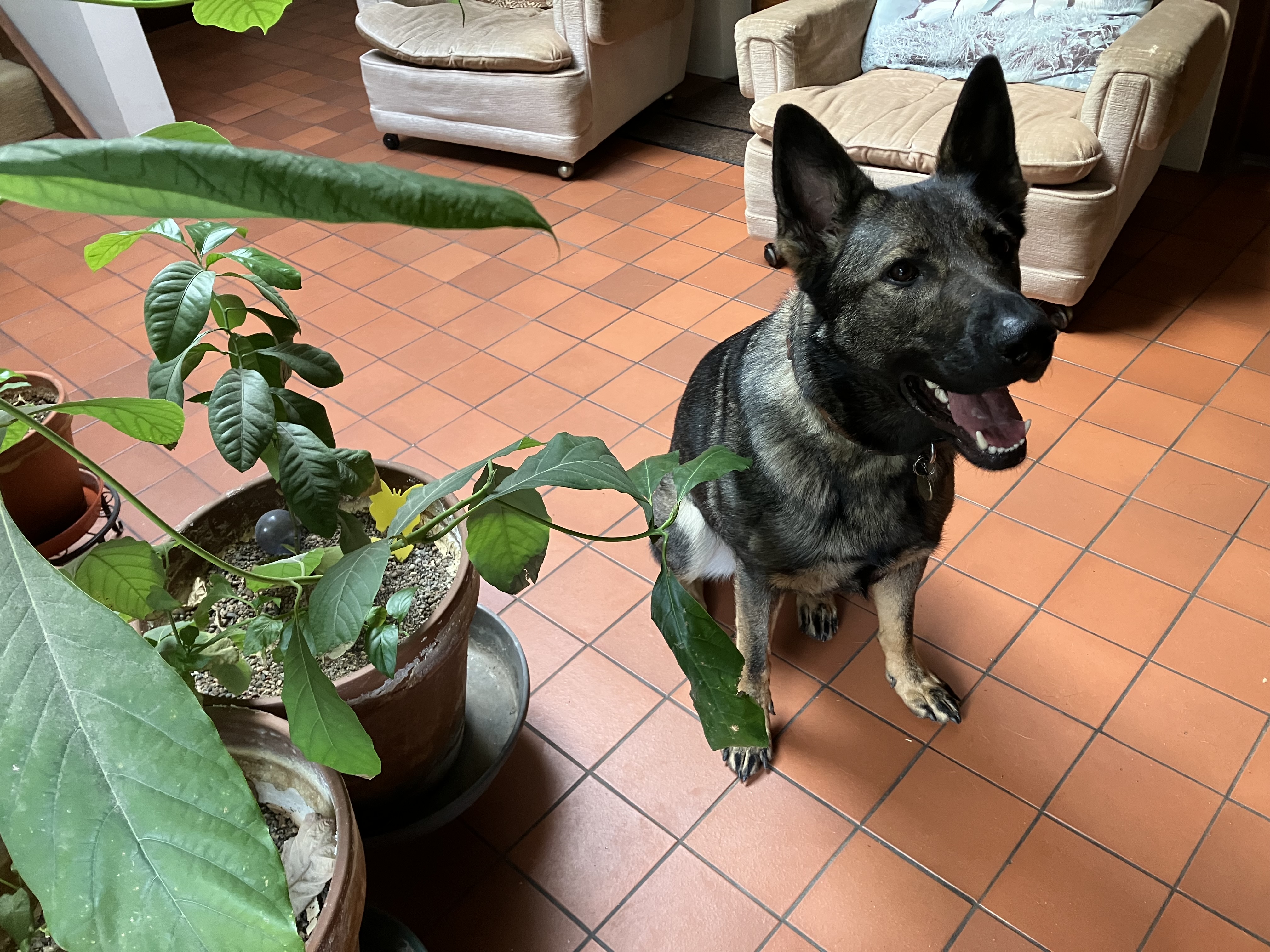
But none of these issues were at stake here, Meg was vomiting, and I needed to decide what to do. I tried to think about what she might have eaten, and I realised that we do have poisonous plants in the garden, and although she has never touched them, maybe she did. Or she might have picked up a germ from another dog. Or she may have eaten something that has made her sick but is not dangerous. As I said, it’s the same with a small child—you have to decide whether this is something serious that needs fast medical attention, or something that will get better on its own. I tend to have a general rule that if the patient is basically well in themselves (not too lethargic/listless) and if they are drinking water, they will probably be okay to leave for a day.[1] Then they will either be better or worse, which makes the decision easier. Meg seemed fine in herself, maybe slightly less bouncy, but still keen to come in the garden, and she was drinking water. (Also, she was only being sick, her bowels seemed to be okay, so she wasn’t losing vast amounts of liquid.) I decided to wait and watch (and clean the kitchen floor). After a morning, she seemed completely fine. When she was well the next day, I decided she was better, and stopped worrying. I still have no idea whether she ate something bad, or caught a germ. But my kitchen floor is very clean.
Hope your kitchen floor is clean for a better reason. Thanks for reading. Take care. Love, Anne x
[1] It should be noted that there are certain conditions which do not fit into this rule, and they need to be learnt separately. For example, any of the meningitis signs on a child would get instant attention. In a dog, I know that a twisted stomach does not initially bother them, but they need fast attention: look out for ‘egg-white’ type vomit, when they are not managing to bring up anything from their stomach, and general signs of discomfort or distended tummy. Kia was sick shortly after eating, but none of the food was in her vomit, which was a big sign that something was wrong, but she seemed fine and was excited to be ‘going for a walk’ when we took her to the vet. We managed to get her to a vet in time for them to operate, and she lived for several more years, and she did run along the beach again. (My one question: If we put her through this surgery, will she ever run along the beach again?)