Happy Walks in Devon


Son announced that Boris was going to make a speech, so we all sat in front of the television and waited. We (like much of the English population) waited for quite a long time because either someone was stuck in the washroom or they were discussing what to say, or the presentation wasn’t ready. Eventually Boris and his backup crew appeared, and another Lockdown was announced, beginning on Wednesday at midnight. Did that mean we had to go home early?

We pondered the ethics of pretending we hadn’t seen the news bulletin, whilst searching online for further details. Eventually we found details on the government website, which stated that people already on holiday did not have to return home early, but they did have to obey local lockdown rules wherever they were living. Phew! Holiday of basically enjoying the cottage with views and walks along the cliffs could continue.

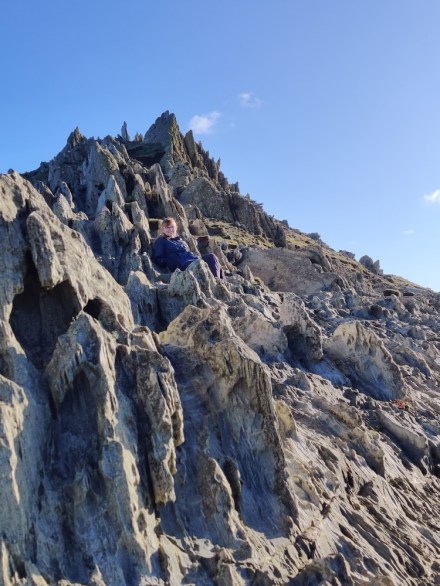
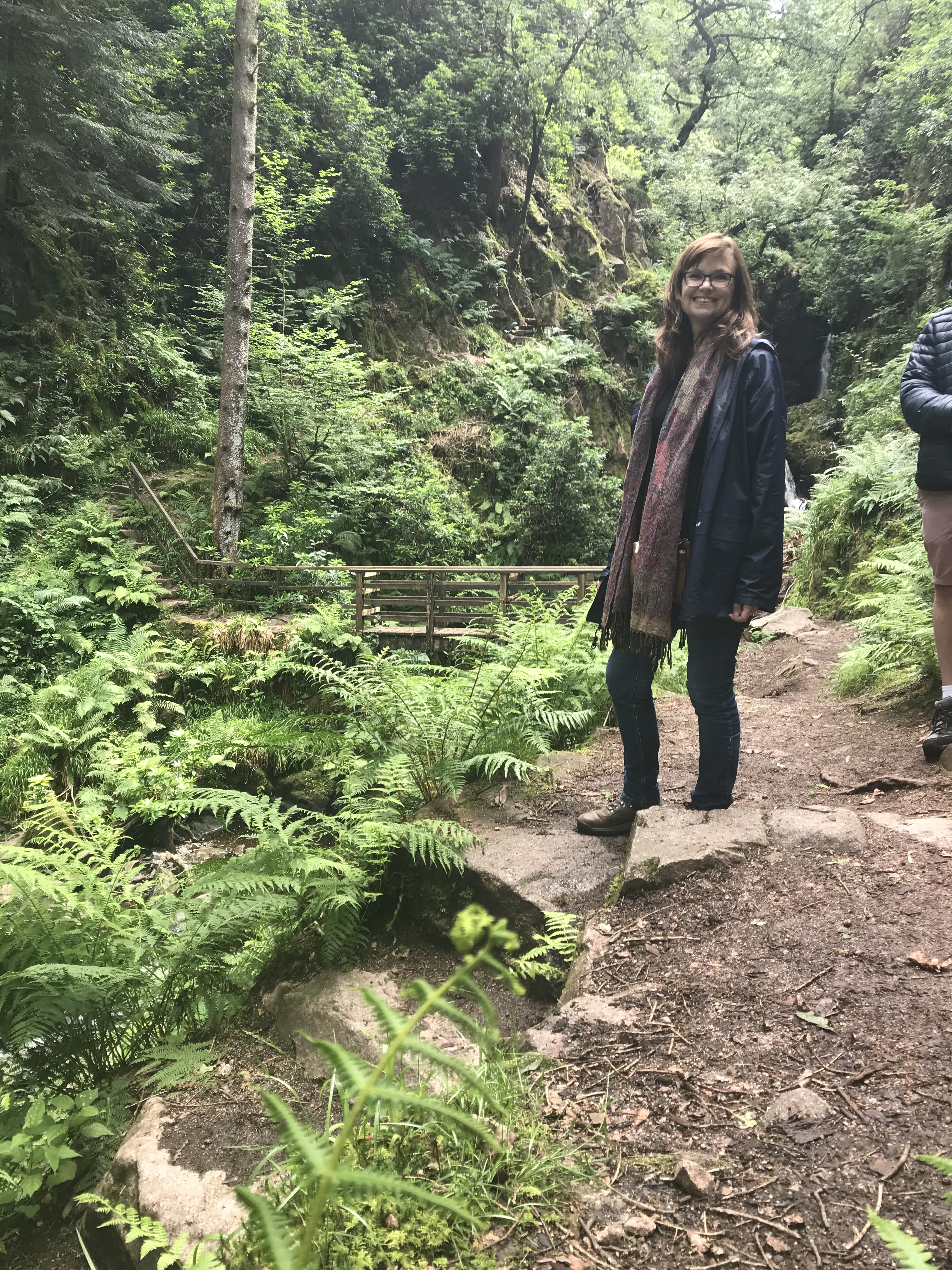
I didn’t much enjoy one walk, which involved scrabbling up the side of a mountain/hill. It was very steep, and as I struggled to follow Husband (who always strides ahead and forgets he has a wife at times like this) I knew that I would never be able to walk down the same way. Walking down is much harder, because my knees hurt, and my eyes see the sheer slope before me and tell my brain that I am about to fall to my death, at which point dodgy knees give up completely and I am unable to move. But we were going up, so that wasn’t so bad.

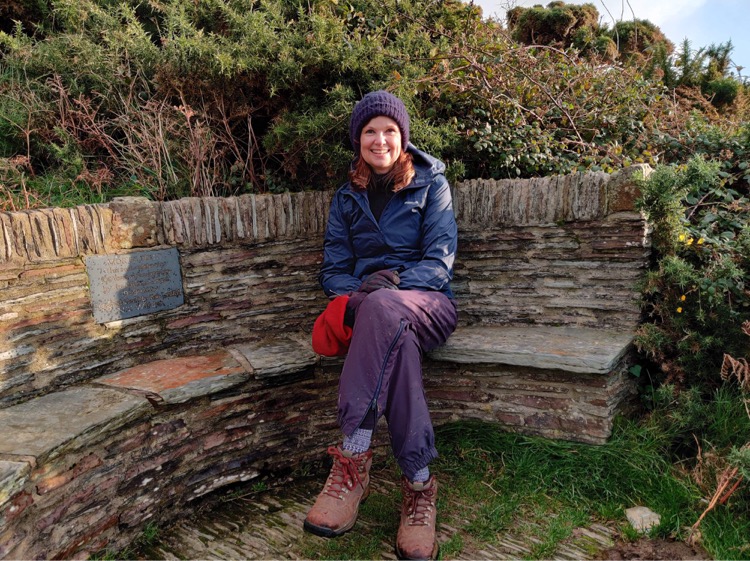
Unfortunately, when we got to the top of the mountain/hill, there did not appear to be an easy route down the other side. The way forward was just as sheer. I considered sliding down on my bottom. Then I noticed tyre tracks. There was no way a vehicle could have driven down those slopes, so even though the tracks went up, I followed them. The tracks led up the mountain, then curved back towards the town. We found an easier way down, and a curved round seat for wives with didgy knees to rest on.

My feet are not really this big!

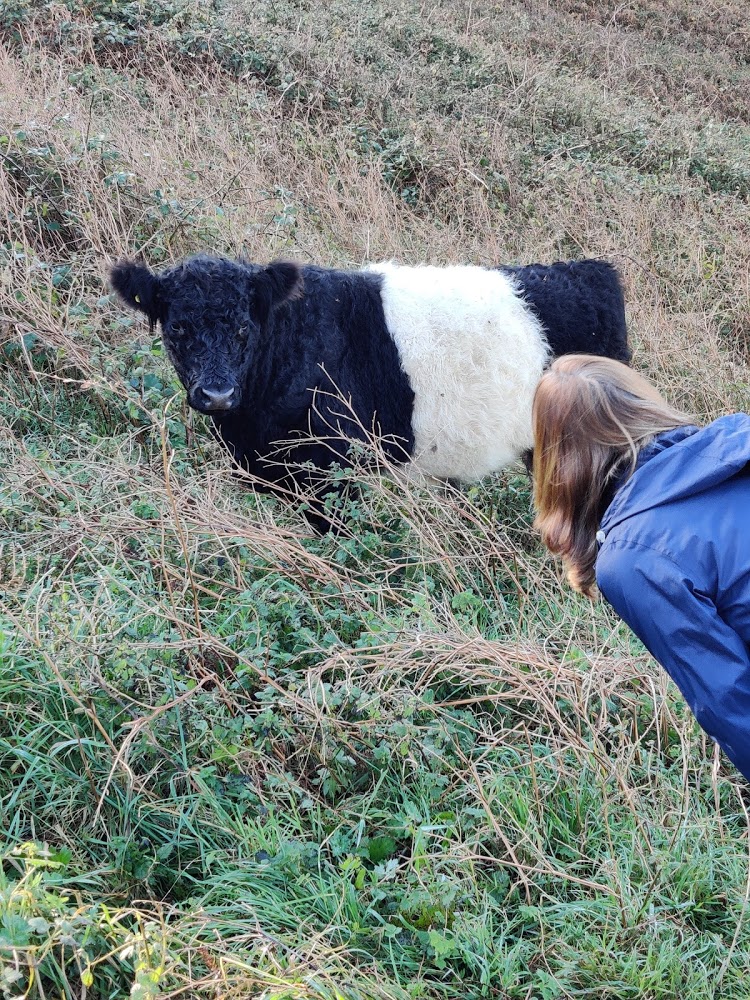
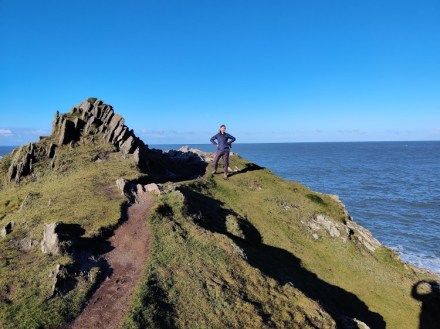
One lovely walk was to Morte Point. We left old dog at home (because her poor legs wouldn’t make it) and son at home (because he had to work) and set off along the coastal path. The first thing of interest we saw was a waterfall which should have been plummeting down the rockface, but due to the wind it was flowing up into the air and falling onto the cliff. It looked like very localised rain. There were also cows, the bovine equivalent of Shetland ponies as they had shaggy coats and they were short. I went and told them about my latest Greek lesson (because my family have refused to listen to any more interesting Greek facts).

Cow enjoying facts about Greek. It stayed for a remarkably long time before pooping and walking away. I think the breed is Belted Galloway. They all had a white ‘saddle’ and a shaggy coat.

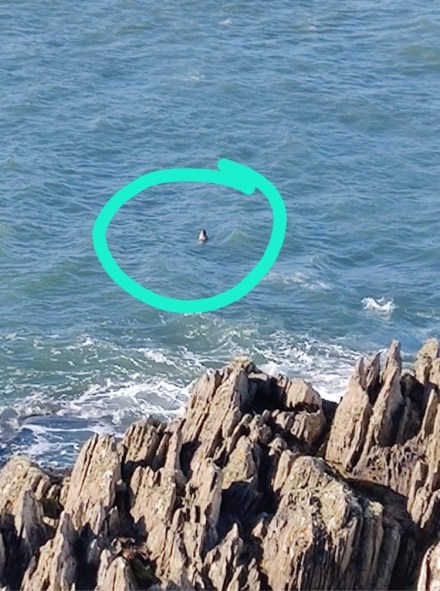
The walk to Morte Point was fairly easy, and although there were areas that the path went very near the cliff edge, it was possible to walk very fast and not look down, so even someone who doesn’t like heights managed it. I had read that there are often seals and cormorants on this bit of coast, but we didn’t see any on our first trip. Later in the week we returned with son, and there was a seal bobbing near the rocks, peering up at us, like a nosey Labrador puppy! We sat on rocks smoothed by waves, and looked out to sea. As we left, we saw two cormorants, drying their wings in the sunshine and ignoring us. They are quite big, black-winged birds, and I don’t think I have ever seen them in England before.

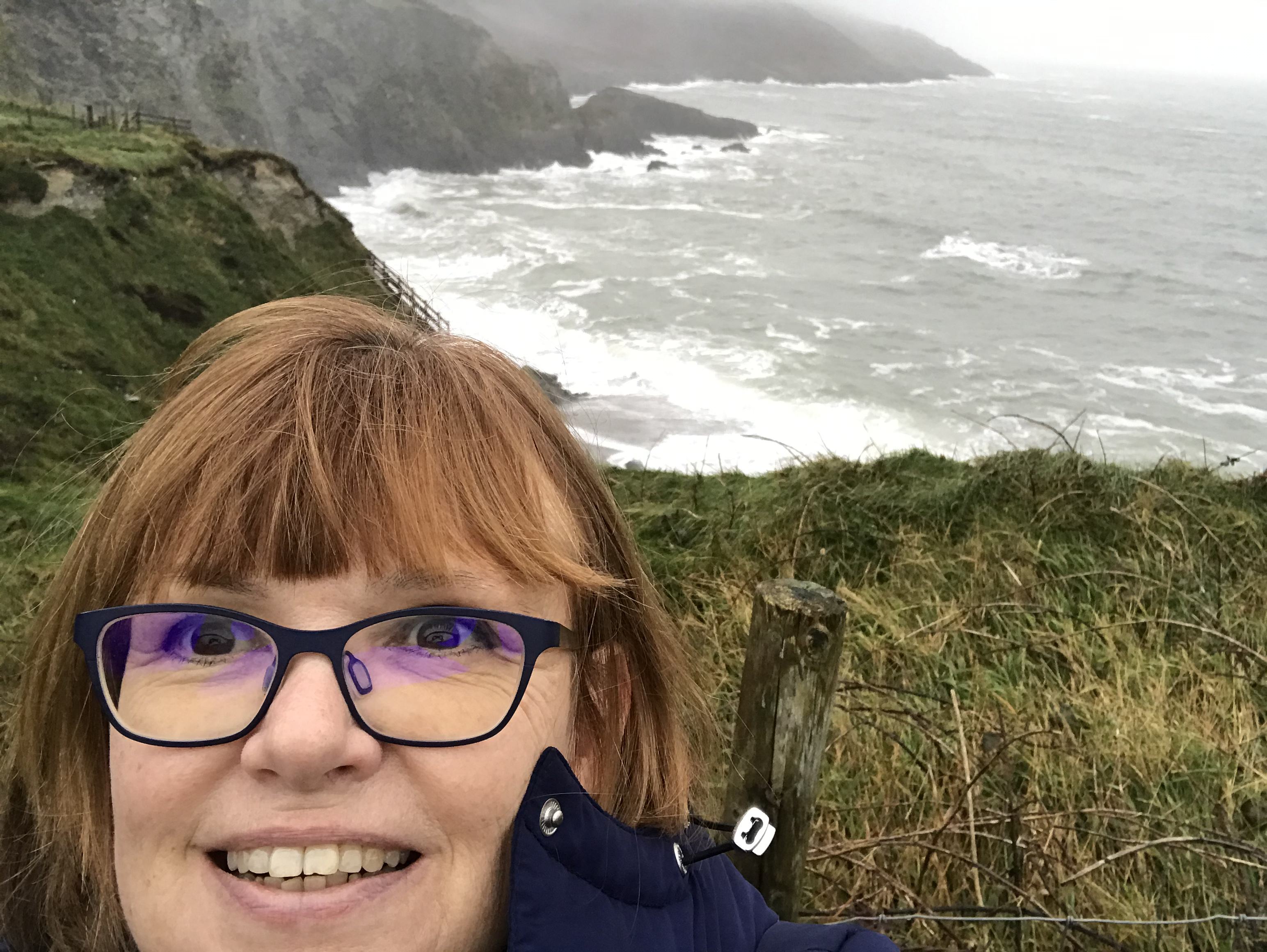
Further along the coast we saw foam drifting up from the beach. When I peered over the edge of the cliff, the sea was covered in bubbles of creamy foam, and when the wind caught it the foam floated up like bubble bath, to coat the cliffs above. There was a cove—Gunta Beach—that we could climb down to. We sat for a while, listening to the tiny waterfalls running down the cliff, and the sea whooshing over the rocks, and it was perfect.

Our last walk was to the lighthouse at Bull Point. It’s not possible to go into the lighthouse, but we could stand and look at it and imagine all the ships in times gone by that have crashed on the rocks below. It was built in 1879 and is one of those lighthouses that are very disappointing as a child, because all their height comes from the cliff, and they are squat buildings with a light rather than a tall slim structure like the ones in picture books.

On Saturday, we came home. The drive was very smooth because all the traffic was safely locked down at home. We will continue the lockdown safely at our own house. I hope you are safe too.

Take care, and thank you for reading.

Love, Anne x

Anne E. Thompson
Thank you for reading anneethompson.com Why not sign up to follow my blog?
Look on your device for this icon (it’s probably right at the bottom of the screen if you scroll down). Follow the link to follow my blog!
*****

Running Away to Devon


We decided to run away for a week before Boris announced another lockdown, so we filled the car with warm clothes ready for wet weather, and with food so we could avoid eating out, and drove to Devon with the dog and a boy.

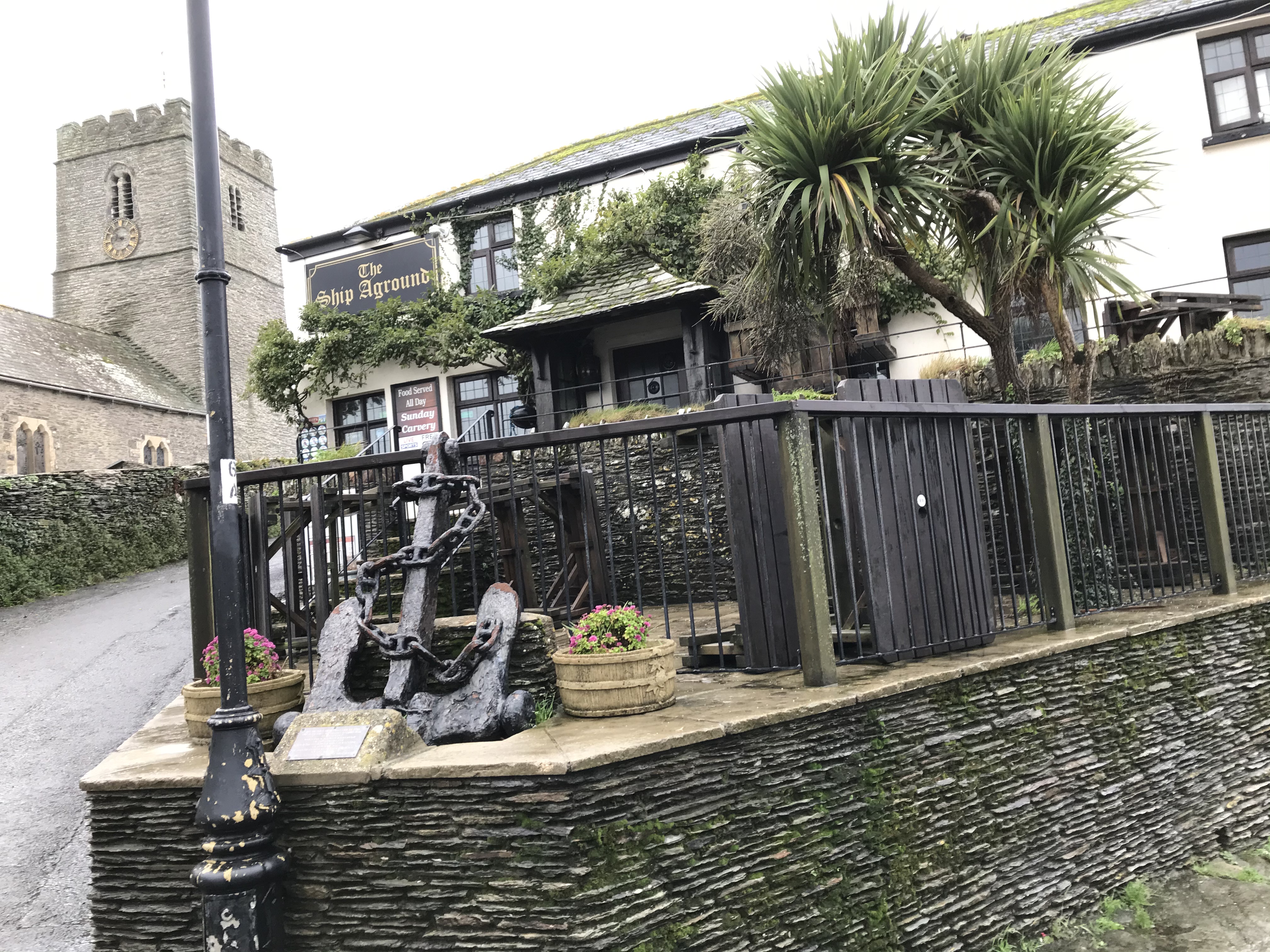
The Ship Aground Inn, Mortehoe
The Ship Aground, Mortehoe. Named after the ancient anchor retrieved from a wreck of a steamship that ran aground in 1914.

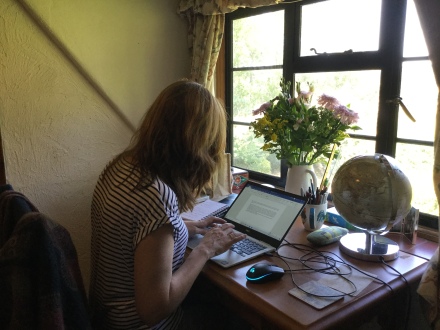
We’re staying in Mortehoe, a pretty stone village on the cliffs of North Devon. I brought all my Greek books and lists of words to learn, and the cottage promised internet, enabling me to continue my lessons whilst looking across a windy garden to the sea.

Trying to learn Greek vocab with a view of the sea from the window.

The cottage is fairly ugly on the outside, but the inside is warm and comfortable, and there are massive windows in every room, giving wonderful views of the outside. This includes in the ensuite bathroom, which I find slightly perturbing. There is a big bath in the centre of the room, next to a picture window. When I think of soaking in a warm tub whilst watching waves crash into the cove below, it’s rather lovely. When I think of soaking in a warm tub whilst on view to every unsuspecting walker on the North Devon coastal path, it’s less appealing! I checked from the garden, and the window is unfrosted, plain glass, giving anyone looking in a good view of the bathroom. A paradise for an exhibitionist.

The cottage garden joins the footpath, and is a sheltered spot with flower beds and a palm tree. It has an outside tap for washing dirty paws, but I forgot to bring a trowel for clearing up poop (when you keep animals, you can never completely avoid the poop aspect).

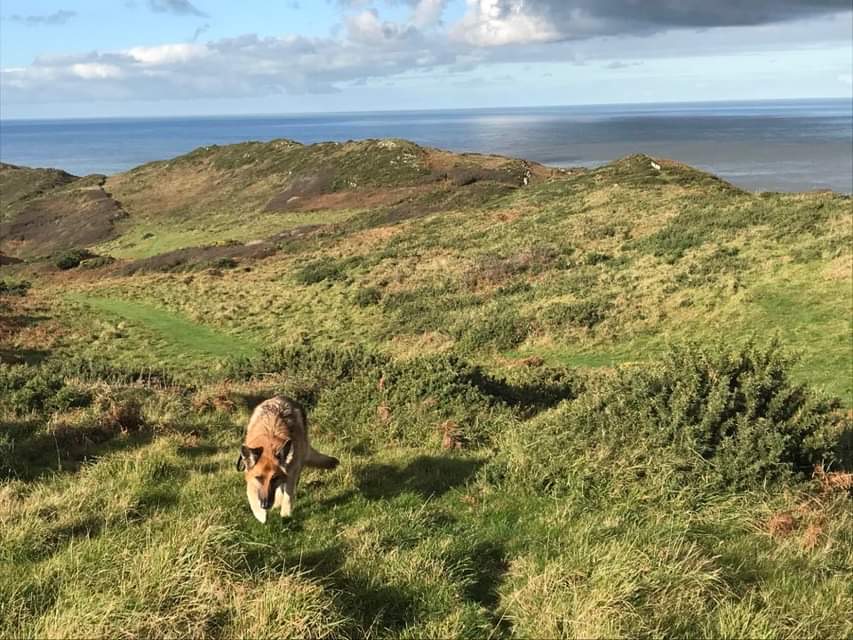
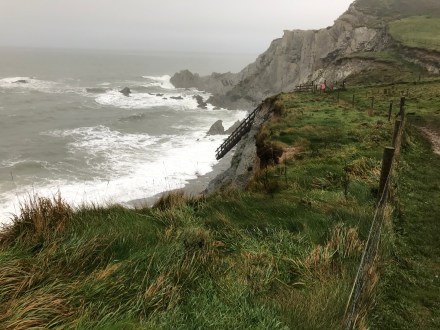
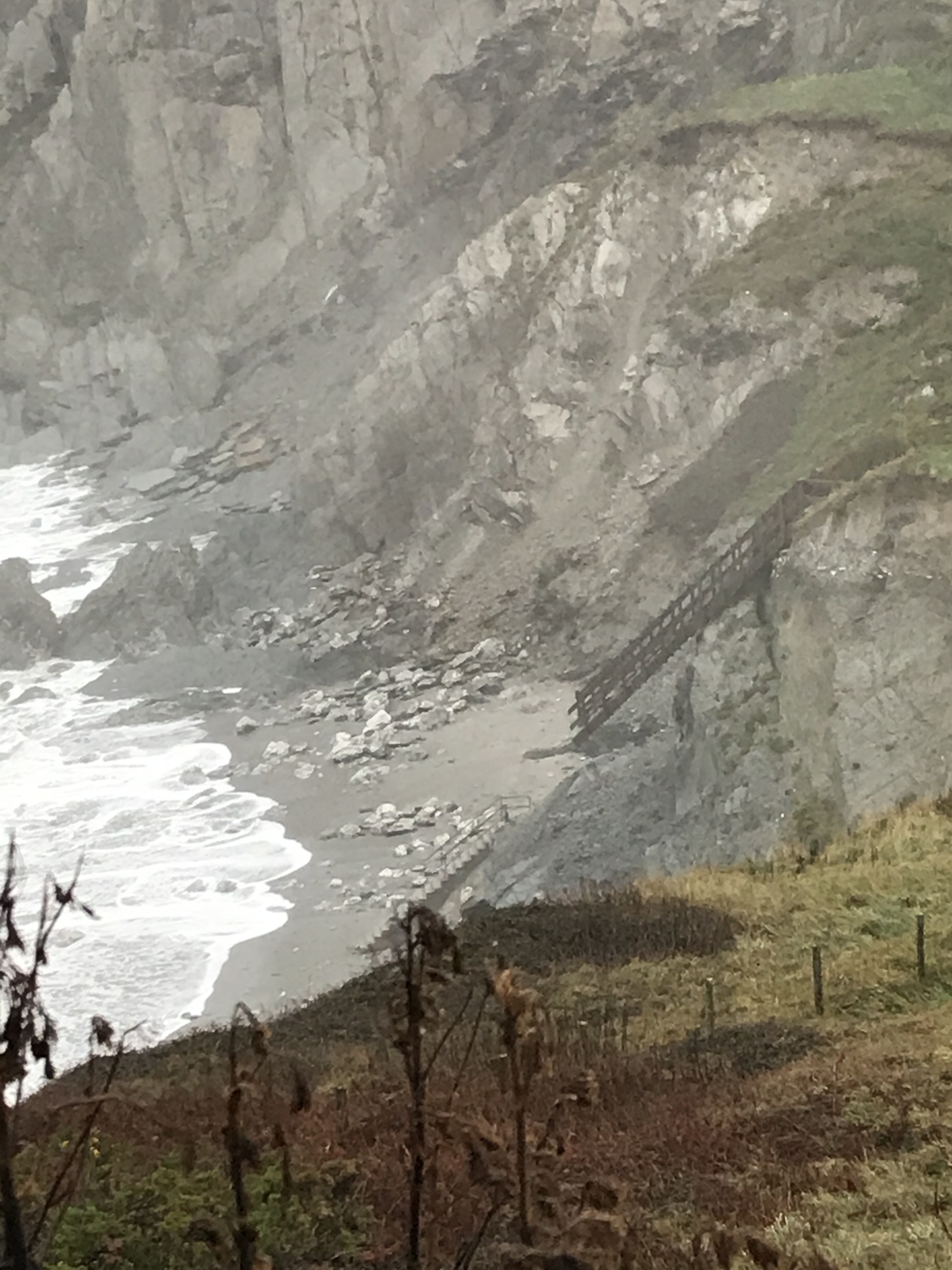
We took Kia for a walk along the cliffs. She saw the sea and set off along the footpath, straining on the lead. When we came to some steps, she suggested very strongly that we might like to visit the beach. But the steps had been washed away by a storm, and only the top and bottom steps remained, clinging onto the cliff in a futile attempt to look useful.

Cliff steps to beach.

There was no way to explain this to a persistent German Shepherd, so we dragged her back to the cottage.

Next stop was a trip to Tesco Superstores to stock up on supplies. The mist had crept up from the sea, and we drove through lanes towards the shop with Husband muttering about it being an unlikely place for a superstore, and was I directing him to a small garage Tescos? We turned into the carpark of a decent sized shop, grabbed a trolley, and started to collect things from the shopping list. I had hoped to live on Charlie Bigham ready-meals for a week, but there weren’t many, and we had to buy a few raw ingredients that I could shove into the oven without too much effort. Husband appeared at regular intervals with a selection of implements to use in place of a trowel for poop clearing. I didn’t think a wooden spatula or a plastic ice-scraper would work, despite their bargain prices.

Next challenge was trying to use the oven, which had unhelpfully been set to ‘automatic’ by the previous people, which meant that it was impossible to use until I had managed to turn it back to a manual setting (random pressing of pairs of buttons usually cures it—I have lots of experience in annoying church kitchens). We ate sausage beans and chips, which filled us up even if it wasn’t very healthy, and a Charlie Bigham’s sticky toffee sponge with custard.

Went to bed full and happy.


Saturday

Tried (in vain) to learn words in various declensions for my Greek lesson. I am writing them in different colours and making up silly sayings (“All the plural datives in the third declension like to sin —σιν”)—but to be honest, very little is staying in my brain.

Decided to take the dog on the beach for the afternoon and drove to Woolacombe Beach. Kia was ecstatic, and even forgot to snarl at all the other dogs in the carpark (anyone who owns a German Shepherd will understand this—the breed is not good with other dogs).

The carpark had lots of signs, saying that due to Covid there was distancing in place, and contactless paying, and certain restrictions. There was a queue waiting to go in (it was the final Saturday of half-term week). At the gate was a man, collecting money through the window of every car—sometimes having to lean across the car to reach the driver—in a very un-Covid-safe manner. I fumbled in my pocket for my crumpled mask (thank you Aunty Margaret) and put on gloves ready to receive the token given in return for the £3 fee. I don’t think it was possible to pay by card/phone. Cars were parked in every space, so I think the person putting up the signs had forgotten to explain them to the man at the gate (I did wonder if, in fact, he was simply a random man collecting £3 from every car and nothing to do with the carpark, but he did give everyone a token that lifted the barrier, so I am assuming he was legit!)

The tide was out, and there was a long expanse of wet sand and huge waves crashing onto the beach. We set off towards the water, the dog dancing next to us. We reached the rocks and Husband and son went closer to explore. I foolishly followed them, noticed a wave washing in, and ran back to the sand—but not in time. The sea lapped around me, filling my wellies and soaking my trousers while a family on the sand laughed. I turned to watch Husband wading through the water, even deeper than me, and son clambered onto the rocks. The dog looked bemused, surprised we were paddling with her. Emptied boots, tried to ignore soggy socks.

Happy afternoon striding through the wind, watching the surfers tackle the waves. Kia kept up for about 25 minutes, but then I noticed she was dragging one of her back legs—which is a sign she’s getting tired, so we turned round. I don’t mind her being old when I can see that she’s still happy and excited by things.

Rinsed out the wellies and filled the washing machine with soggy clothes, then sat down to write this before I put a ready-meal curry in the oven. Another happy day.

I hope you have some fun too this week—and manage to keep your feet dry.

Thanks for reading. Take care.

Love, Anne x

Anne E. Thompson
Thank you for reading anneethompson.com Why not sign up to follow my blog?
Look on your device for this icon (it’s probably right at the bottom of the screen if you scroll down). Follow the link to follow my blog!

********

Learning Languages


Three weeks into Greek, and it remains fascinating (whilst also being a challenge to learn lists of grammatical endings). So many of our English words are derived from Greek; often when I am trying to work out how to say a new word, I have one of those wonderful moments when I suddenly see the link to English. For example, I was reading something which I knew meant ‘throat’ and as I stumbled over the letters, sounding out the strange symbols, I gradually said: “la-larin-larinch. . .Oh! It’s larynx!”

Another wonderful example is the verb ‘to throw’ which is basically ‘ball,’ so when we play with a ball, we are playing with a ‘throw thing.’ This verb is used in the book of Mark, when he tells the story of Jesus explaining why he has chosen grubby fishermen and cheating taxmen instead of the established religious leaders. He says something about not putting new wine into old wineskins, and the verb in the Greek which is translated in my Bible as ‘put’ is actually that verb ‘ball:to throw.’ Which gives the whole story such a casual, over-the-top feel, doesn’t it: “Well, you wouldn’t chuck new wine into old wineskins,” has a different feel to it entirely.

There are lots of these snippets of truly fascinating facts, but there is also lots of boring learning. I am hopeless at learning charts of verb endings, which is why I could never learn languages at school. I think it becomes too mathematical. For me, starting with all the grammar rules is a problem, partly because it relies on memory and my memory is rubbish. Learning Greek is very different to how I learnt, when I decided to learn Mandarin.

Those of you who are new to my blog, may not know the story. Basically, from 2009, I had the most awful headaches/migraines due to a brain tumour which they wouldn’t remove because it was in the middle of my brain and removing it would cause too much damage. Being ill is incredibly boring, and when feeling completely useless after yet another day in a dark room struggling with pain, I realised that actually, whilst I couldn’t do anything, I could listen, which meant I could learn a language. So I started to listen to CDs and videos in Mandarin. I am not a linguist, and I never managed to learn French at school, but I decided that I would teach myself to learn Mandarin in the way that a Chinese child would learn, gradually acquiring more vocabulary and not worrying about the grammar. I bought some children’s books, and music, and learned things like “Mr. Mouse lived in a shoe,” and “I need an assassin who can kill without being seen.” Perhaps not really terribly useful for real life conversation but wonderfully easy to remember. I used all those long boring waits in hospital waiting-rooms to translate stories, and it occupied my mind and stopped me worrying about what the neurosurgeon might say. Gradually I absorbed the language. I tried to understand the meaning of the words and phrases without translating them into English, and as the written characters are very visual, and represent things not words, this was possible. I could listen to phrases and understand them, without consciously turning them into English. (Not much use if I want to ever sit an exam, but perfect for communicating–especially if I ever need an assassin!)

I wanted to practise, and learn some ‘real’ vocabulary, so I started to go into the local restaurants to teach English to the staff, which is where I learnt to ask for coffee with one sugar and all the language that real people actually use. As I could do very little at that time apart from Mandarin, I learnt quite fast.

I also joined a small class of parents at Jay’s school, and even now the teacher sometimes tells me that the language I have picked up from my friends in the restaurants is inappropriate in polite conversation. I think I speak very bad Mandarin with a strong yokel accent. But I speak enough for friends who speak no English to have coffee with me, and we chat about our children and in-laws and husbands in Mandarin. In fact, some of my very best friends speak very little English.

When the doctors did finally operate (and damage my brain because it was that or die) one of the things I worried about was that I would lose all my Mandarin. I didn’t—I lost other things, and I did forget lots of what I learnt, but the basic understanding remained.

So now that I am learning Greek, I want to use some of the ability I acquired through my casual learning, but it’s a very different situation. I need to learn the grammar this time, because I want to take an exam, but I know that staring at charts and lists is hopeless, so I have to put the words into sentences, and tell myself stories to make the words relevant. I want to be able to read the New Testament in Greek, but I will be tested on my knowledge of grammar–whether I know from the ending of the noun if it is masculine, past or future, the subject or the complement. It’s not easy, especially as my knowledge of formal English grammar is very weak (like my learning of Mandarin, when I was at school we learnt how to use the English language, not the structure of a sentence). Sometimes I struggle, but I am determined to continue.

I hope you learn someting interesting too this week. Thanks for reading. Take care.

Love, Anne x

Anne E. Thompson
Thank you for reading anneethompson.com Why not sign up to follow my blog?
Look on your device for this icon (it’s probably right at the bottom of the screen if you scroll down). Follow the link to follow my blog!

****

Punting in Cambridge


We went to visit Emm’s new house in Cambridge, and spent the afternoon on the River Cam in a punt. I like Cambridge, it’s one of the few cities I think I could live in—perhaps because it has cows. I’m not sure why it has cows, I assume it’s a hangover from old laws about grazing rights on common land, but they are there, in the centre of the city, wandering over footpaths and pooping on the grass as they mingle with students and tourists.

cows in Cambridge
Cows in Cambridge

Emm suggested punting before we arrived, so I put a spare pair of trousers and knickers in my bag. I remember punting. When I was a teenager, we lived in Letchworth, and regularly went to Cambridge with our church youth group. We would hire a few punts (it was a big youth group) and set off. The person punting always fell in (sometimes they were pushed). We always had water fights with the other punts, so our boats were returned full of water and the owner refused to return the deposit.

There was one time when one of the car drivers was pushed into the river, and lost his glasses. I remember people diving under the murky water, searching the mud for the lost glasses, but they were never found. The driver was unable to drive home, so someone with a provisional licence had to drive his car for him. That must have been terrifying! Having taught my children to drive, I now realise how scary it would be to have someone else’s teenager drive my car for me.

Once, I remember there were foreign girls with us (my sister says they were from Norwich, which they may have been—I wasn’t very good at accents in those days) and they got completely soaked and were rather upset, so we took them to a launderette and told them to strip, then we tumble-dried their clothes while they sat huddled under someone’s coat. I have no idea what the other people in the launderette thought. In fact, as I reflect on these memories as an adult, I have no idea why the youth group leaders were so willing to take us punting every year—it must have been a nightmare for them!

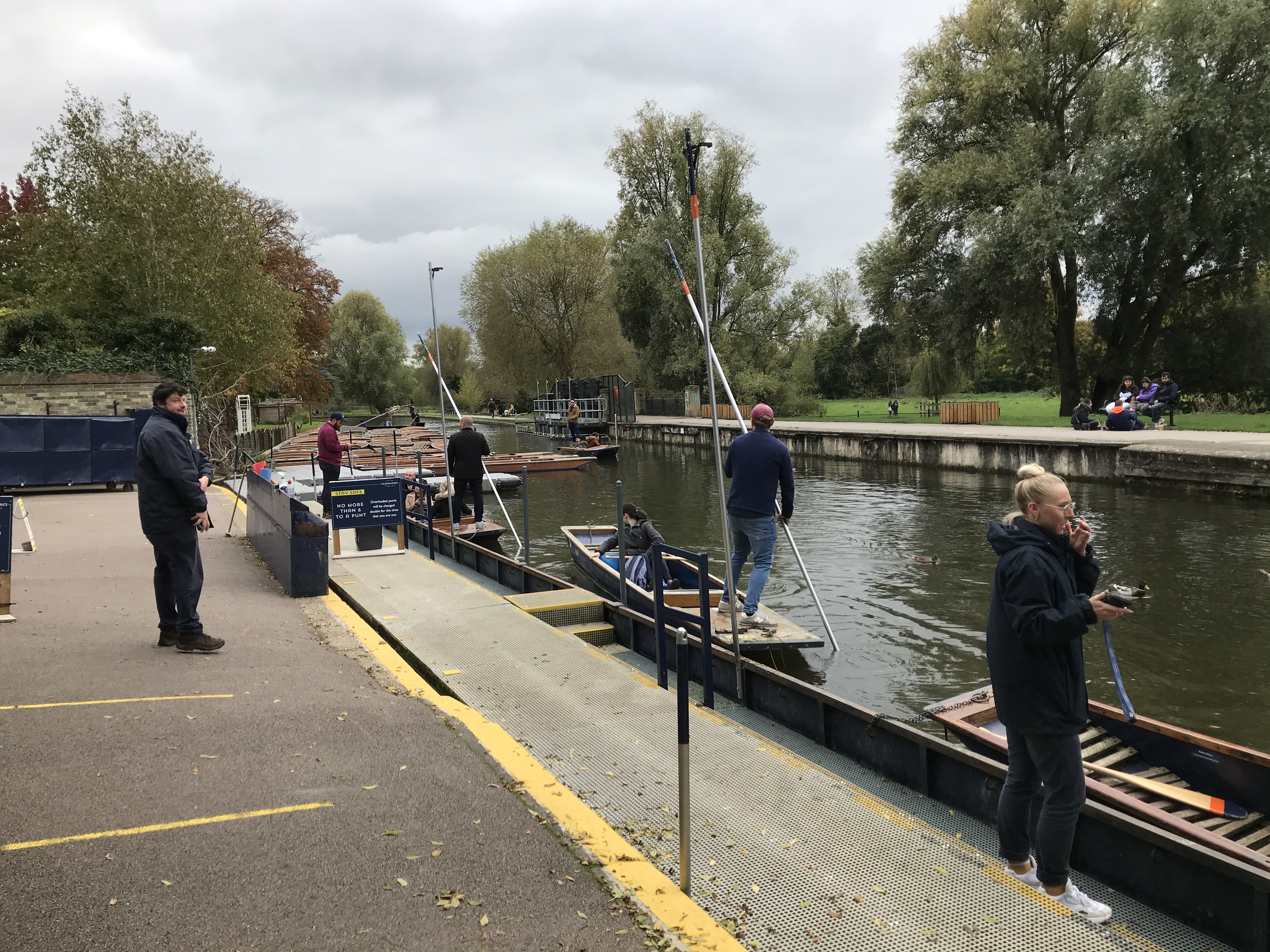
Anyway, last weekend we arrived at the punt hire place, and I was fully prepared with dry clothes, just in case. They were well prepared, with people wiping the boats and poles with disinfectant between each hire, spaced queueing, no cash payments. Such a lot of fuss Covid has created, but business has adapted.

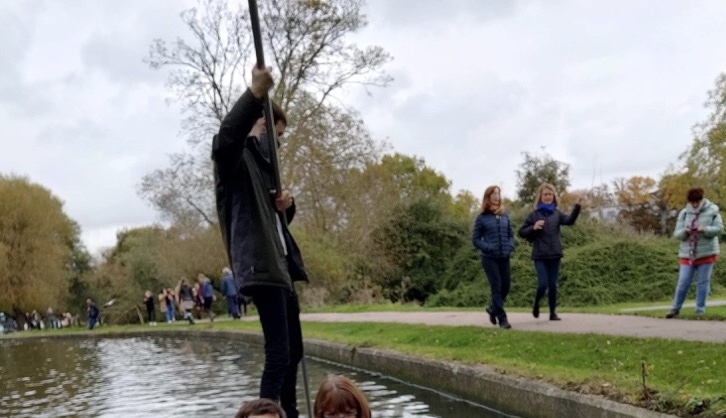
Emm decided that Jay would punt, even though he was the only person who had never previously been on a punt before. He listened attentively to the very brief instructions, and we set off with him muttering that the physics didn’t work, and the extremely narrow pole was not going to be sufficient. But it was, and he actually did very well.

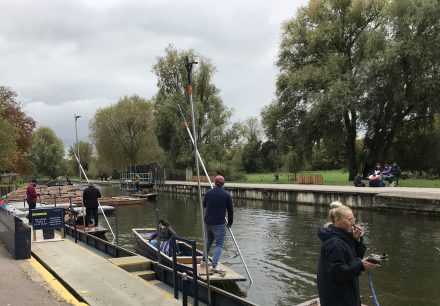
Punting is a skill (which I don’t have). In case you have never visited Cambridge (put it on your list for when Covid ends) I will explain. A ‘punt’ is a very shallow boat, which seats about 8 people in a sort of lounging position—good for beautiful blonde girls who want to trail their fingers in the water while sipping champagne. The person punting stands on the back, on a slippery-looking platform, and pushes a long thin pole into the mud below, then pushes forwards, hence propelling the boat. If the pole is placed on the left, the punt turns left; when placed on the right, the punt turns right. It turns quite sharply, and we passed several boats that were basically just turning in circles on the river. Sometimes the pole gets stuck in the mud, and tugging it out unbalances the punter. It’s easy to fall in, and you really do not want to fall in to the Cam—it’s not the cleanest river in the world.

The exercise is made more exciting by the bridges across the river. Some of these are quite low, and require the punter (not sure if that’s the correct term) to push hard before crouching in the boat to avoid being decapitated by the bridge. When you are a mother and your son is punting, this makes the activity less relaxing than when you are a carefree teenager.

Emm and Aitch also took turns punting, and no one fell in, and no one was decapitated, which was a good result. We had bought some of those little cans of cocktails from Tesco, so we stopped next to a quiet bank, and drank cocktails, and watched the branches trailing in the river and the ducks swimming past, and it was all rather lovely. Then we made out way back, under the low bridges, past the Chinese tourists who were still turning in circles, and returned our punt to the people waiting to disinfect it ready for the next party.

I hope you have a fun day today.

Thanks for reading.

Love, Anne x

Anne E. Thompson
Thank you for reading anneethompson.com Why not sign up to follow my blog?
Look on your device for this icon (it’s probably right at the bottom of the screen if you scroll down). Follow the link to follow my blog!

****

The Sarcastic Mother's Holiday Diary
https://www.amazon.co.uk/Sarcastic-Mothers-Holiday-Diary-ebook/dp/B07N95281F/ref=sr_1_1?dchild=1&keywords=the+sarcastic+mothers+holiday+diary+by+anne+e+thompson&qid=1603103026&sr=8-1
Now is an excellent time to read my travel book. Happy adventures from around the world. Available from Amazon.

More Greek Mishaps and Some Runaway Sheep


Quick Update

Hello, how has your week been? Mine has been extremely busy, and I’m not much enjoying the weather.

I am writing this after the first week of Greek lessons—so brace yourself for some more interesting facts.

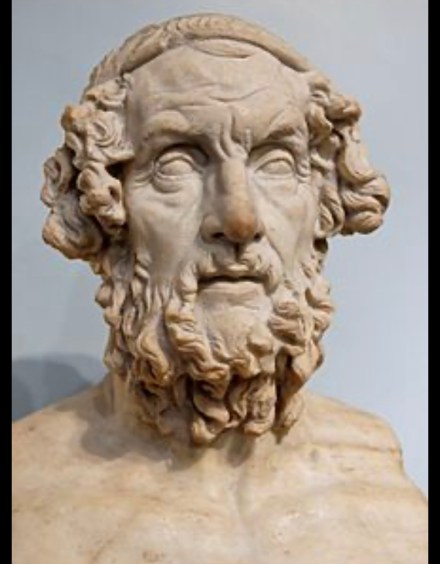
Did you know, that originally Greek was written entirely in capital letters, with no gaps between the words? I have taught children who do this, and it doesn’t make for easy reading. Greek later evolved to be written entirely in lower case letters (I’m guessing because they were faster to write). At some point, someone had to go along and put gaps between all the words, which must have involved some decisions, as it wouldn’t have always been obvious. Therefore, even when I am reading the New Testament in ancient Greek, some of it may be different to how the original was written, which I guess means I shouldn’t be too ‘purist’ about the whole thing. Each individual word was obviously not meant to be held in absolute holy awe, it was not dictated by God, it was written by people and has changed over time.

A Greek Temple

I talk of reading the ancient Greek, but of course this is being optimistic, I am currently struggling with remembering the letter sounds and the rather dodgy punctuation. In a bid to help myself practise, I decided it would be a good idea to write the shopping list on the fridge door in Greek letters—not the actual Greek words (because I don’t know them) but the English words written in Greek letters. Good idea, I thought. Except it wasn’t. Husband (bless him!) decided to join in, but he didn’t fully understand the exercise and put all the things he wanted me to buy through a Google Translate app. My shopping list is now full of words that neither of us understand. His writing is bad enough when he’s writing English, so some of the words contain symbols that are not even Greek, so we have no way of knowing what they say!

During a lesson, someone asked whether Jesus spoke Greek. My reaction was that no, we know that he spoke Aramaic. However, I was wrong. Apparently, Jesus probably spoke mainly Aramaic (the language of the Jews of the day) plus he would have read Hebrew (because all Jewish boys learnt Hebrew). But at the time, Israel was under Roman occupation, and they would probably have spoken Greek—so when Jesus spoke to officials, it is likely he would have used the Greek I am learning. (I thought that Romans spoke Latin, but although that was the official language of Rome, most citizens spoke Greek, and even in Rome, Latin was considered the language of the ‘educated’ rather than the common language.) Isn’t that interesting?

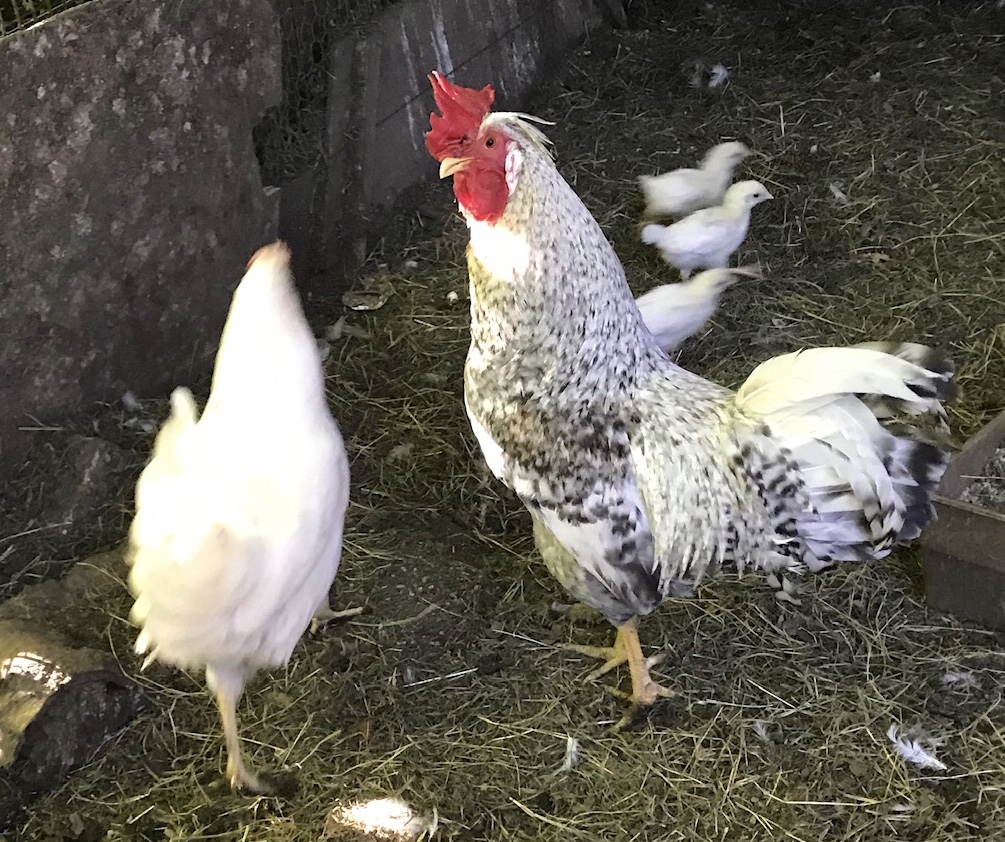
I do still have some life apart from Greek, though trying to learn it is very time-consuming and I’m very glad I’m not studying a full theology degree when it would have to fit around a whole lot of other subjects. My learning only has to fit around writing and selling books, and sorting the animals. The animals have been annoying this week, because I planted some bulbs ready for spring, and the chickens saw the freshly dug soil and rushed over to dig them all up again. Most of the bulbs are now kicked into random places and quite a lot of the lovely compost I lugged onto the flowerbed is now scattered across the path.

I am still making sourdough bread, though my enthusiasm is waning as it tends to be very heavy and slightly odd-tasting. I have branched out this week into making naan bread, and attempted peswari naan. It involved liquidizing sultanas and almonds and coconut, and I forgot to shut the lid properly so my kitchen floor is rather gritty. Dogs, it transpires, do not like sultanas.

We have a new flock of sheep in the field adjoining the house. The owner didn’t raise them, and the field is quite big, and he is having trouble catching them (which he needs to do soon because there’s a ram with them, so they’ll be in lamb). He did have a sheep dog, but clearly neither the dog nor the sheep had read the manual on how they are supposed to behave, as the dog responded wonderfully to commands and whistles but the sheep still managed to charge all over the field. We went to help him, and tried to funnel them into a small area of pens. Sheep are mostly pretty stupid animals, and as soon as they got near to the pens they charged away again. I didn’t take Kia because although she’s great with herding poultry, I don’t trust her with sheep and they are big creatures when running straight at you—a charging ram could easily break your leg. We never managed to enclose the flock, so the poor owner will have to find someone more experienced to help. I’ve only ever helped round up flocks that have been raised by the owner, so they follow rather than run away.

I hope your week goes well. Thanks for reading.

Take care.

Love, Anne x

Anne E. Thompson
Thank you for reading anneethompson.com Why not sign up to follow my blog?
Look on your device for this icon (it’s probably right at the bottom of the screen if you scroll down). Follow the link to follow my blog!

A Charlie Bigham Banquet


We had big excitement this week, when Husband discovered there was a Charlie Bigham Banquet happening.

I will explain: On Wednesdays, when I have my Mandarin lesson, Husband kindly cooks dinner. I hugely appreciate it, so I need to be careful what I write here, but he is not really what you would call an accomplished chef. In fact, his cooking doesn’t go much beyond opening the oven door and placing things inside for a specified amount of time—but he does that bit very well.

I therefore have been looking for meals that involve this amount of cooking, and I discovered Charlie Bigham meals. Have you seen them? They are very expensive, but rather delicious, and when you add chips, and peas in the microwave, it makes a complete meal—one that doesn’t feel as unhealthy as most ready-meals.

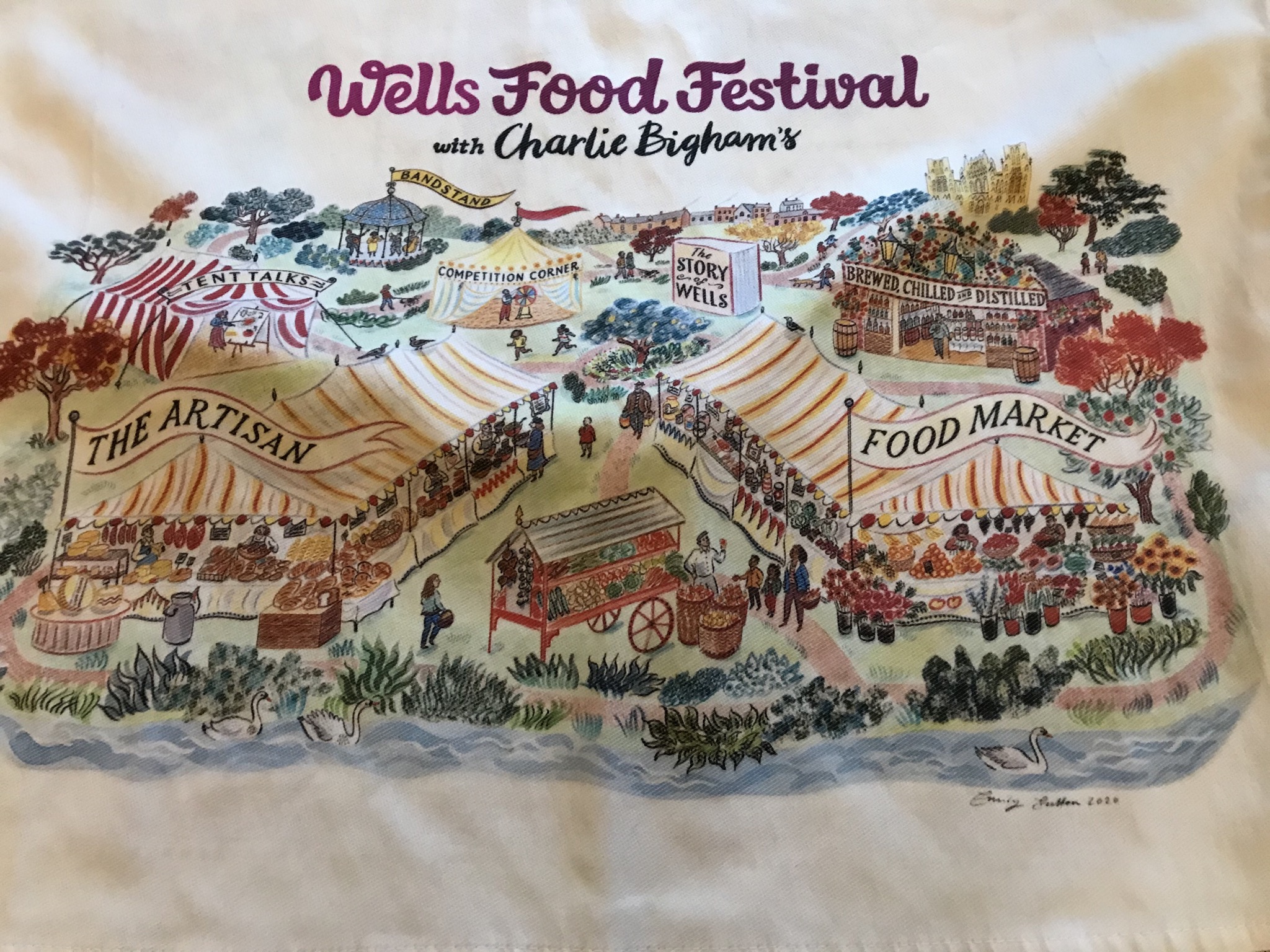
We were therefore very interested when we discovered there was a Charlie Bigham Banquet. It was in aid of the Wells Food Week (I didn’t know there was such a thing) and the idea was that you signed up online, bought the list of ingredients they sent, and then on Saturday, log into an online cookery class, where renowned chefs would show you how to turn the ingredients into a banquet. The money raised supported a charity that send chefs into school kitchens, so a worthy cause. What could possibly go wrong?

Husband sent me the list of ingredients, and I bought the ones we didn’t have in the cupboard. I improvised on some (I mean, who has fingers strong enough to grate parmesan cheese when you can buy it ready-grated??) and didn’t buy the things that I don’t like to eat (seemed reasonable to me). Husband audited my shopping, and went to buy the things I had got wrong. We invited another couple for the evening, and I figured that at worse I could get quietly drunk and let Husband lead the cooking—after all, it was his idea.

A package arrived, addressed to Husband. It contained an apron, a tea towel, and a small booklet of instructions. I glanced at it to check there was no equipment that might surprise me, and threw the tea towel into the washing machine. It came out slightly pinker than before (possibly due to the red towel I washed at the same time) but at least it was clean.

On the day of the banquet, we had some things to prepare during the morning. A printed sheet told us to core and peel the apples, cut them into chunks, and dry them out in the oven for 3 hours. But what size chunks? We were not sent entire recipes, all would be revealed later, which partly made it fun and partly was rather difficult as we had to guess things. We also needed to roast the beetroot—but should we peel and chop it first? I guessed from the timings given that whole beetroots wouldn’t work, so we cut them, but someone with no cooking experience could easily have gone wrong at this point. Perhaps there was a minimum level of cooking experience expected—I hoped it wouldn’t be very high.

The kitchen filled with wonderful smells, as the venison marinated in garlic and rosemary, the beetroots roasted (with a few added potatoes because I know the appetite of real people, and half a beetroot as the entire carb was not going to be filling anyone up!)

At the specified time we set up the computer and watched a couple of men—not quite Ant and Dec but they were trying—as they chatted about wine and introduced the chefs. I felt slightly bored, with a sense of foreboding as I waited for what I assumed would be a school cookery lesson. I was wrong.

The evening was tremendous fun—the best evening I’ve had in ages! The chefs were in their own homes, and did a little chat, then cooked a course of the meal. They cooked it very quickly, explaining almost nothing, and we raced to keep up. It was like trying to complete one of those escape rooms—four adults scurrying to solve the task. There was no recipe, so we had to watch intently to see what was being added. Sometimes they went off-piste and added things we didn’t have, like a sudden side-salad made from garden flowers and herbs. (I only have a few late dahlias and dead sunflowers in my garden, so they would be less good.)

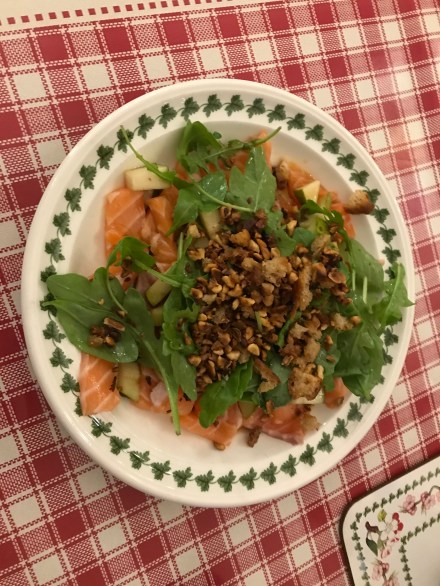
There was a lot of shouting as we spotted things. The first course involved raw salmon, put briefly into a brine to pickle it. Some of us worried about the safety of eating raw salmon and shoved it into the microwave. We had a mishap with the brine as the person watching the screen was calling out the ingredients, I was mixing, and brown sugar was mentioned. I added it, but that was for the pears, so we tipped it away and started again. There was a topping of sourdough crumbs and hazelnuts—ours was somewhat darker brown than the chef’s. We placed it all on the plates, and sat at the table feeling somewhat shellshocked, then took a mouthful. It was delicious. Really, the flavours all combined perfectly, it was like eating fine cuisine in an expensive restaurant and suddenly I realised what made these chefs special. They couldn’t teach, but wow! they could cook.

Then there was a chef making a starter with mushrooms and pancetta. He stood in his kitchen with a glass of wine and chatted about mushrooms. Was he drunk? He chatted for a long time. We saw the Ant-and-Dec men pass each other post-it notes, they clearly wondered if he was drunk too! Eventually he started cooking, we raced to keep up, the food was delicious.

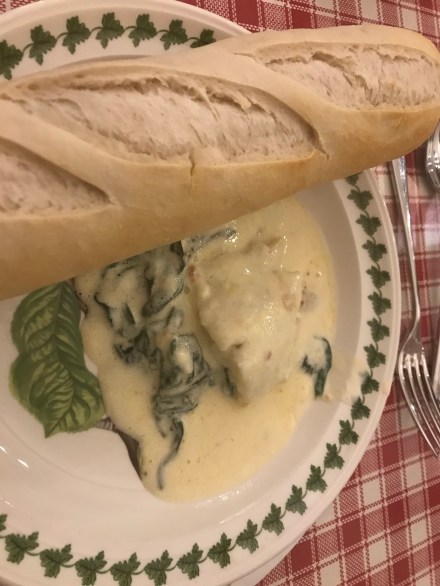
Next was smoked haddock. Would that be raw too? It was placed over spinach, covered in sour cream and parmesan (luckily ours was already grated) dotted with tabasco sauce and placed under a hot grill. Served with bread: delicious.

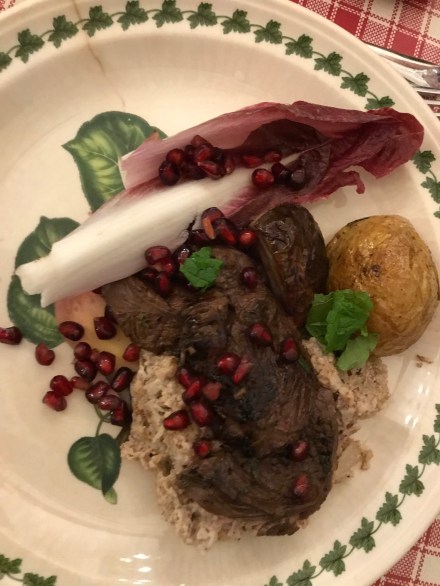
The main course was venison. The chef showed us her kitchen, and chatted, while next to her an empty frying pan smoked on the hob. Had she forgotten it was there? The fire alarm sounded, she rushed off, the camera cut to another chef, who struggled to take over her slot but he forgot bits and plated it up wrongly. We made a paste from liquidised almonds and pine nuts and burnt onions and garlic. The venison was sliced on top, and surrounded with roasted beets. It was wonderful.

The pudding was sticky apple cake with toffee sauce. I made the sauce, which had a whole pack of brown sugar, enough cream for the whole of Christmas and a month’s worth of butter. The chef multi-tasked and made the cake batter, so someone else made that, grabbing my mixer to try and keep up. When would he add the apple soaked in tea? Would he drain them first? Had he added the sultanas? We watched, he was holding a bowl—what was in it? In it went—quick! Add the sultanas! Then the apples—not drained, tip in the cold tea too… We had been told to prepare muffin trays, so I had laid out 8 paper cases in the tray. We made enough mixture for about 150, so abandoned the muffin tins and poured it into loaf tins instead.

My kitchen was full of shouting and laughing and rushing to grab ingredients and throwing away rubbish and washing equipment so it could be reused. As I said, it was like trying to solve a very complicated puzzle within a time limit. But the food we produced was far superior to anything I have ever cooked before. Those chefs knew how to create wonderful dishes. A few things were a bit ‘amateur,’ such as the fire alarm going off, the complete lack of teaching, the (possibly) drunk chef. But to be honest, it added to the charm of the event, and trying to keep up was so exciting!

By the end, we were completely full of fat and sugar, and the kitchen looked as if a bomb had exploded. We thanked out guests, and went to bed. Such a fun evening.

Anne E. Thompson
Thank you for reading anneethompson.com Why not sign up to follow my blog?
Look on your device for this icon (it’s probably right at the bottom of the screen if you scroll down). Follow the link to follow my blog!

***********

A Town Open Day


My town decided to have an open day. I don’t know who had the idea originally, but it was suggested on our town Facebook group (the one that usually moans about broken traffic lights and daft planning laws). The idea was simple: People could sell things at the end of their garden.

Enthusiasm grew, and people offered their services. Someone produced a map, showing where all the stalls would be. People shared advice about how they were ensuring their pitch was covid-safe—some provided hand sanitiser, some made a one-way system, some invested in a card machine for cash-free payment.

We were all responsible for our own area, and we were sent links to government websites with the latest advice (always a scintillating read!) The date was planned for 3rd October, between 10am and 4 pm, and the enthusiasm grew.

Some businesses offered space outside their shop, or in their pub garden for people who didn’t want to use their own garden. Shops joined in, with special offers for people who popped in during the day. An artist designed a poster, which was emailed to everyone who signed up, and we could print copies to advertise the event. Photos appeared on the Facebook page: painted stones, Christmas decorations, homemade soap, freshly baked cakes, greetings cards—all the things you might find in a craft fair (which have all been cancelled this year) plus some people were selling second-hand items. The enthusiasm grew…but would anyone actually come to buy?

I was very keen to take part, mainly because absolutely every event I have planned this year has been cancelled. Here was an event which couldn’t be cancelled because each stall was responsible for their own pitch, no one could suddenly deem it was unsafe (unless, of course, the government introduced another lockdown in our area, and 2020 being what it is, that was far from impossible!)

Then the ‘rule of 6’ was introduced. Would this affect the event? I thought it extremely unlikely that I would have more than six people vying to buy books all at the same time, so decided that it wouldn’t affect me. Some people made signs, telling people to queue sensibly if they needed to wait before approaching the stall.

My house isn’t near the centre of town, so I asked Mum if I could use her garden (it’s prettier than my garden too—has fewer weeds and scary animals wandering around). Mum kindly agreed and suggested I put up posters. My only posters are quite large—ideal for book-signings in big shops, not so good for sitting-room windows. Mum said they were fine, I placed them in the window, she lived in semi-darkness for a few days.

I printed some fliers from the poster we were sent, and Mum delivered them to her neighbours. I bought some ziplock bags, and placed each book into a bag, making them covid-safe. Husband printed copies of the back page, so that people could read them without handling the books. I considered printing off some sample pages, because most people like to read some of the book before buying—but if I’m honest, I wasn’t sure whether anyone would actually come so I didn’t want to waste too much time.

Now, I live in England. In England, it rains and it’s daft to assume that any day in the year won’t have rain. I watched the forecast, and the tail-end of a storm was predicted. Super. I decided that I could sit in the lounge, next to my over-sized posters, and run to the door if anyone braved the weather to visit. It was disappointing, but at worst I would be spending the day chatting to Mum, so the day would be fun anyway.

The day arrived. As I drove down to Mum’s house, I passed several houses setting up stalls at the end of their gardens. Most seemed to be whole-family affairs, with parents and children setting up gazebos and carrying boxes of items, ready to sell. There were balloons and posters and a general air of excited expectation that was weirdly infectious. I began to feel excited!

We set up our stall, and I decided to leave most of the books inside the house, as although it wasn’t actually raining there were a lot of black clouds. Then I snuggled into my big coat, and waited. Would anyone come?

Well, yes! Despite the awful weather, people did come. Some people drove round, obviously following the map that had been put on the town Facebook page, slowly touring all the stalls. Sometimes they waved as they passed, sometimes they parked and bought a book. Other people walked round, mothers with pushchairs and old men with shopping bags and young people with their friends. Sometimes they showed me the soap or painted stones they had bought, or told me they were on their way to look at the stalls in the pub garden or the churchyard. People were happy, entering into the spirit of the event, glad of something to do on a wet October day in a year of cancelled plans. Some people wore masks, but we were outside, it was easy to keep a sensible distance—as long as we washed our hands afterwards it was very safe.

The day, for me, was brilliant. I sold 20 books, but more importantly, I spoke to a whole range of people who live in my town (I have to say, I think my mother possibly knowns everyone who lives in town, and if she doesn’t know them, she knows their aunty/sister/cousin). I felt very proud of my town, of the community spirit, the number of people who wanted the day to work. All it takes is a little enthusiasm, a few people prepared to take the risk, and something very positive is produced. In a year of disappointments, this was a very good day.

I hope you have a good day too. Thanks for reading.

Take care.

Love, Anne x


PS. If you weren’t able to visit my town in Kent on 3rd October, all my books are available in bookshops and from Amazon. Here is a selection:

You can order through my Facebook page, or Amazon link here: https://www.amazon.co.uk/kindle-dbs/entity/author/B07CL8HV95?_encoding=UTF8&node=266239&offset=0&pageSize=12&searchAlias=stripbooks&sort=author-sidecar-rank&page=1&langFilter=default#formatSelectorHeader

Anne E. Thompson
Thank you for reading anneethompson.com Why not sign up to follow my blog?
Look on your device for this icon (it’s probably right at the bottom of the screen if you scroll down). Follow the link to follow my blog!

Trying to Learn the Greek Alphabet and other interesting stuff


Interesting Greek Facts

A Greek Temple

As I write this, I have managed to survive the introductory ‘Orientation Week’ at Spurgeon’s College and am about to embark on a term of Greek lectures. So far, it has been fine, as the main thing that would terrify me is the logistics—the whole ‘what if the traffic is bad,’ ‘where will I park?’ ‘how do I know where to go/sit/eat,’ ‘what if my brain runs out of energy before the end of a session?’ You can imagine the type of thing. Therefore a term (at least) of all lectures being online, is perfect for me.

Learning Greek

Greek Text Book

I haven’t had any proper lectures yet, but I have enthusiastically started reading the book they sent, and searched the resources they sent for interesting YouTube clips. I have to say, it has proven to be a very interesting week. I hadn’t realised how much of the English I speak has its roots in ancient Greek. Here are some fascinating facts:

The New Testament part of the Bible is written in Koine Greek. ‘Koine’ simply means ‘common’ because it was the common language for about 600 years. Obviously languages evolve—so if I wanted to read Chaucer, I would need to understand the language spoken in that period, whereas Henry VIII spoke a slightly different English. “Ah,” you might say, “but if it’s an ancient language, how do you know how to pronounce it?” Well, I thought the same thing, and the answer is brilliant. Historians study as many sources of the writing as possible—on tombs, and carved onto monuments, and written on manuscripts. They then compare them, and the spelling mistakes give clues about how the words were spoken. Isn’t that great? If you take an English example: “I read the book yesterday,” and find that in 200 instances, the word “read” had been misspelt as “red” then you could conclude that “ea” can be pronounced as the “e” in “red.”

When you learn the Greek alphabet, there are some letters which are very weird, and listed as sounds that we don’t say in English, like Psi. However, the Greek words have evolved into the words that we use today, we simply ignore the bits that we don’t pronounce. So the letter Psi gave us the words for psychology and psychopath and pseudo. (Now you know why they have odd spelling.)

There is a symbol in Greek called a breathing which looks like a tiny ‘c’ and floats above some vowels: αͨ εͨ ιͨ οͨ. When it’s backwards, it’s not pronounced (I don’t yet know what purpose it serves, that will have to be a later blog). But when it’s the correct way round (c) and it’s over a vowel at the start of a word, it adds an ‘h’ sound to the start of the word. In Greek, the letter P is called ‘rho’ and it is apparently a vowel (but only sometimes—again, I can’t yet explain this). This is interesting though, because when it has the breathing over it, an ‘h’ is added to the pronunciation. In English, we don’t say the ‘h’ but it is hidden in words like rheumatism and rhesus and rhetoric.

νόμος (sounds like nom-us) is the Greek word for law. If you add alpha (which looks like a fishy ‘a’ letter) to the front, it means the opposite. So νόμος = law and ανόμος = lawless. We still do this today with some words: symmetrical vs asymmetrical.

The word οͨ means ‘the’ when the word is masculine (I guess like ‘le’ in French, when ‘la’ is feminine) it’s pronounced ‘ho’ because the little ‘c’ adds an ‘h’. The word for God is θεος (‘Theos’) and in the places I’ve found it, it is preceded by the masculine ‘the’—so although I think God is genderless, certainly the Greek word was always masculine. The word θεος appears 1300 times in the New Testament, so I haven’t yet checked them all.

Learning the Greek alphabet in order is, I have decided, impossible. I have managed to learn the letter names (which gives a clue to how they sound) and the symbols for the lower-case letters. Everything I have read so far says not to bother learning capital letters at this stage as they are rarely used, so I have taken this to heart and ignored them completely. What is impossible though is learning the alphabet in order.

α alpha (sounds like ‘a’)

β beta (sounds like ‘b’)

γ gamma (g)

δ delta (d)

ε epsilon (e)

ζ zeta (z)

η eta (a long ‘e’ sound like in ‘air’) this one always confuses me!

θ theta (th)

ι iota (i)

κ kappa (k)

λ lamda (l)

μ mu (m)

ν nu (n) this is a tricky one too

ξ xi (x) easy to remember if you notice it looks like a pair of boobs so is ‘sexy’!

ο omicron (o) I always forget this one. Always.

π pi (p) brings back horrible memories of school mathematics

ρ rho (r) another tricky one because it pretends to be a ‘p’ and really it’s an ‘r’

ς σ sigma (s) this has two symbols, depending on whether it comes in the middle or at the end of a word. It is very hard to remember that σ is ‘s’!

τ tau (t)

υ upsilon (u,y)

φ phi (ph)

χ chi (ch)

ψ psi (ps)

ω omega (o, but a long one like in ‘bone’)

To be honest, I struggle over the order of letters in the English alphabet, and it’s only ever useful when I’m filing (which is never) or looking in a dictionary (which is rare) so why bother? I have tried making useful rhymes to help with the tricky bits: ‘epileptic zebras eat thick ice kittens’ and ‘lovely male nurses x-ray other people’ but I find I start to muddle up the rhymes too. I am shelving it for now and hoping that by the time I do an exam, the lecturer will have moved onto more complicated things and won’t bother to test us for the alphabet.

I sent one of my children a few words written in Greek, wanting to show-off a little. He was able to name all the letters, which was very disappointing (I long for the day I will know something my children don’t know—something beyond what temperature to use on the washing machine or how to hatch an egg). Apparently the Greek alphabet is used a lot in Physics, so he learnt all the letter names and symbols at uni. I think learning to read the language is much more interesting than Physics though, so I have decided that doesn’t count.

I hope you have something interesting too this week.

Thanks for reading. Take care.

Love, Anne x
Anne E. Thompson

Thank you for reading
anneethompson.com
Why not sign up to follow my blog?

Look on your device for this icon (it’s probably right at the bottom of the screen if you scroll down). Follow the link to follow my blog!

*****

How to Fail


Do You Know How to Fail?

Fear of Failure Can Prevent Us Succeeding

When I was teaching primary children, I noticed that most mothers were very good at teaching their children how to succeed. If, for example, Jimmy won a race at sport’s day, his mummy would smile and clap and tell him: “Well done! You were brilliant!” If Jimmy went on to do a victory dance in front of his class and make a ‘loser’ sign to the child who came last, his mummy would tell him no, that’s not the right way to behave, you mustn’t be a big-head.

I watched children being praised and taught not to be conceited when they passed exams, starred in performances, and painted wonderful pictures. Parents seemed to do a pretty good job of teaching their children how to succeed.

But what about when they failed? What about when Polly came last in the race? Or failed her piano exam? Or wasn’t given a part in the school play? Or painted really awful pictures? How did parents react then, and were the children taught how to fail well? Mostly not. Mostly, the parents made excuses as to why it wasn’t Polly’s fault, or why the system was unfair—or else they lied, and said that Polly was the best anyway, and that her grey/green splodged picture was beautiful.

Do you think it matters? I personally think that it’s a big problem, both for individuals and for society. For most of us, failing at things is a big part of life, and we are more likely to fail than succeed and if we know how to fail, then it doesn’t knock us on our backs, we simply accept that we have failed and carry on.

I am very aware of this as I start to learn Greek as a mature (very mature!) student. I might fail. It’s a long time since I took an exam or tried to learn a new skill, and I might not succeed. But knowing that I might fail shouldn’t stop me trying. If I fail, it will be because I am not intelligent enough. Sometimes, we are not clever enough—this is an excellent thing to learn.

Our society likes to make excuses. It seems to be an innate part of being human. Way back at the beginning of time in the book of Genesis, we read about people failing and making excuses. Whether you think Genesis is a book to take literally, and Adam was a man who physically existed, or whether you think it’s a story to show us why relationships exist as they do, the first story is very clear. Adam messed up (he ate a forbidden fruit) and when challenged he made an excuse: “The woman YOU gave me made me do it.” It wasn’t his fault. Except, it was.

If we always make excuses—the teacher was rubbish, I didn’t have time to study, I couldn’t afford the right textbooks—then things are never our fault. And when we blame others, we start to feel resentment. I think this causes all sorts of problems for society. If the bus drivers, shop assistants, manual workers all think that they are as intelligent and capable as people with more interesting jobs, then they will resent those people, and feel angry at the pay discrepancies. If people have not learnt to fail, they will avoid competition in case they don’t win. They will feel defeated when they don’t get the job or promotion they feel they deserve. They will feel angry with the world for the things they don’t achieve.

Fear of failure also makes people stop trying. They won’t sing the song they composed, they won’t audition for the fashion show, they won’t try for the promotion at work because they might fail.

I am not talking about whether society is fair. I realise that in some cases, people have underachieved due to an unfair system, but not always. Sometimes people fail at school because they don’t do their homework, or because they are not very clever. Sometimes people come last in all the races at sport’s day because they never practise, or they eat unhealthily, or they are simply born with an uncoordinated body that is rubbish at all sports. People fail music exams because they don’t practise or they have no talent.

I believe these problems start in childhood. Some parents at one school I worked in suggested that we shouldn’t have ‘winners’ at sport’s day, and everyone should receive a rosette. How does that help to prepare a person for not always winning? Some parents will buy all children a gift on a sibling’s birthday, because they don’t want the younger brother to feel left out. They always let their children win at games. Everything the child produces is praised. When the child messes up, they make excuses on their behalf. The child is not being taught how to fail. They are being taught that failing is wrong.

Parents, when you play games with your child, don’t let them win. You can play badly, so they enjoy the game, but don’t always let them win—that is not what will happen in real life and it’s sort of lying. (My own mother absolutely believed this, and would always completely annihilate us when we played cards with her!) Acknowledge that your child is not very good at sports/art/music/maths or whatever. Encourage them to still try, but let them know that not being the best is okay. If they fail at something because they didn’t study, or practise, or try, then be honest about that. Let them get used to knowing that yes, they failed the spelling test, and yes, it was their fault because they played on the computer instead of learning the words—but you love them anyway. Teach your children to say sorry. When we are adults, we will sometimes drive badly and bump a wall, or be tired and snap at someone rudely, or forget someone’s birthday. We should accept the fault and say that we are sorry. It is so much easier to accept and forgive another person’s mistakes if they acknowledge the fault and apologise, rather than making excuses.

Accepting that we fail does not stop us trying to achieve, but perhaps it helps us to aim more realistically. I have trouble learning unrelated facts and symbols. I also find abstract concepts difficult to understand and manipulate. Hence, I will never be a great physicist. There’s nothing wrong with that, it is partly the way I was made, and partly because I was lazy at school and never bothered to learn the fundamentals. You too will have things that you can’t do—and that too is possibly partly your own fault and partly not. I think we are much healthier and happier when we accept our failures, try to learn from the experience and move on, rather than perpetually making excuses and self-justifying.

This week, I challenge you to acknowledge your failures—and think about how you could possibly correct them in the future. And if you have children, please teach them how to fail well. It might make them better, happier, adults.

Thanks for reading—and do share your own views in the comments below.

Love, Anne x

Anne E. Thompson

Thank you for reading
anneethompson.com
Why not sign up to follow my blog?

Look on your device for this icon (it’s probably right at the bottom of the screen if you scroll down). Follow the link to follow my blog!

*****

Ironically, I have just ‘failed’ when posting this blog! I always write blogs ahead of time, and this was meant to be posted mid-October. But I forgot to change the date before completion, and so it went to all my followers today. Which must feel like spam as they have already received one blog from me today! Apologies.

Visiting Chiddingstone Castle and Village


Chiddingstone Castle

A Lazy Day in Kent

visiting Chiddingstone castle

The Castle and a gargoyle
(I’m the one in red!)

We had a few hours for an outing and decided to visit Chiddingstone Castle. This is one of the few local attractions which is actually open on Tuesdays—except only the grounds are open, the house is open on Sundays and Mondays. We have never visited before, despite it being practically on the doorstep, so we explained to the dog that we were leaving her at home (not quite sure why I always need to explain to the dog why I am leaving the house without her) and off we set.

Chiddingstone is between Tonbridge and Edenbridge, and is a tiny Tudor village. We parked in the castle grounds, put our £2 entry fee in the honesty box, and began to wander.

The castle is pretty, with turrets and the remains of an orangery. There are wooden bridges over the river, and ducks on the lakes and expanses of lawn (so I could have taken the dog, but she would have had to stay on the lead). There was an area set out like an Egyptian garden: The Fields of Eternity—though to be honest this was just random pathways cut into long grass, and the area meant to resemble Tutankhamun’s tomb was simply a sand tray that had been well used by the local cats. I didn’t see any actual garden as in flower beds, but perhaps they are within the walls and only accessible when the house is open.

The castle was originally a Tudor house. Then, in the 1800’s it was bought by Henry Streatfeild (all those vowels are the wrong way round, so a difficult name to write.) He demolished the old manor house, replaced it with a castle and diverted the road so none of the villagers could go on his land. I bet he was popular! Though to be fair, I share his desire to have turrets on my house.

In 1955 the castle was bought by Denys Eyre Bower (no relation to Jane) and he was a great collector of stuff. He set up collections of Egyptian antiques and various art collections, which he displayed in the castle for people to see (more popular with the locals than Henry Streatfeild I’m guessing). When he died in 1977, a charitable trust was set up to preserve his collections and continue showing them. I’m thinking of copying this idea with my cushion collection, my children will be thrilled.

Castle Inn, Chiddingstone

Castle Inn, Chiddingstone

We left the grounds and wandered up the main road of Chiddingstone. There was a narrow path, an old church, and classic Tudor houses. The village shop is full of gifts and frozen Cook food and sweets in old-fashioned jars (maybe more of a shop for people renting holiday homes than people actually living in the village). old fashioned sweets displayThe village has been bought by the National Trust. In Tudor times, the father of Anne Boleyn (of beheaded fame) owned property here. Currently the village is often used by film companies who want an authentic Tudor setting.

A Tudor village

Authentic Tudor buildings.

There is a school, which we passed at Playtime and was particularly noisy. The children were all wearing coloured caps, segregated into coloured pens, with coloured equipment and an appropriately coloured-clothed teacher standing guard. They are clearly attempting to be covid-aware, though whether the children all clustered in a tree were social distancing was uncertain.

the ancient Chidding Stone

Chidding Stone

We also found the Chidding Stone—the footpath there is marked by a signpost on the main road. A big lump of granite, people have been guessing its connection to the village name for centuries. Theories include: Used by the Druids as a religious place, or the place of judgement—nagging wives and petty criminals were taken there for general ‘chiding’ by the village, or a Saxon boundary, or the homestead of Cidda’s family—hence ‘Chidding tun.’ In the 12th century the village is listed as Cidingstane, so take your pick. I favour the chiding stone theory, and when you visit you can imagine the whole village standing round it to shout abuse at a nagging wife.

Chiddingstone village and castle is a fun place to visit if you have a couple of hours free and you happen to live in Kent. Next time we’ll go when the house is open, and I can get some ideas for the best way to display my cushion collection.

I hope you have a nice day too. Take care.

Love, Anne x

Next week I will tell you all about the start of my new course at college, learning ancient Greek. It is such fun!

Anne E. Thompson

Thank you for reading
anneethompson.com
Why not sign up to follow my blog?

Look on your device for this icon (it’s probably right at the bottom of the screen if you scroll down). Follow the link to follow my blog!

*****