Toby had almost decided to give up waiting, and to drive around the training ground by himself, when an old brown car purred up beside him. He glanced through the window, and realised that Percy, his mentor, was driving. Percy raised a hand, pointed forwards, and began to drive away. Toby started the engine, and followed.
Percy drove very slowly, and Toby was able to follow him and look around at the same time. They left the refreshment tent, with people coming and going, and drove along a narrow track that was empty of other cars. Every time they reached a corner, Toby clutched the wheel and held his breath, and concentrated hard on staying on the road, but when they drove along straight sections, it was easier to stare at his surroundings.
As they drove, Toby became aware that there were, as Percy had said, groups that were very different to each other. Along the first straight, near to the racing circuit, was a group of very smart cars. They were rainbow-coloured, and shiny, with fat black wheels and bright lights. The drivers stood next to the cars, chatting and laughing, and music floated through the window. Some were adding accessories to their cars; Toby glimpsed a golden chimney being attached to a roof, an animal cage being fitted to a boot, then he had driven past and needed to concentrate on the route Percy was taking.
There was a steep corner to negotiate, and then they passed a group of drivers, all in brown overalls, bending over manuals and looking serious. Their cars were parked, all in a line, looking as austere as the drivers. Toby saw bent bumpers, and rusty wings, and wheels where the tread had worn away to almost nothing. The drivers looked up as Toby passed, and stared for a moment before frowning and looking back at their manuals.
“Not so friendly then. . .” murmured Toby as he drove on.
The next group of drivers all seemed to be very busy. Toby watched someone struggle with a bucket of soapy water that was slopping over the edge as it was carried, and a mechanic with a large spanner, and another driver bending over his open bonnet, checking the oil level. One of them glanced up as Toby passed, and raised a hand, and the driver carrying the water nodded at Toby in a friendly way, before frowning back at the water which had whooshed out of the bucket and wet his shoe. Toby grinned.
Percy was now driving fairly fast, and Toby concentrated on keeping up. They wound their way past a garage, where several cars were being mended, and down to a refuelling station, where a row of cars was waiting in line. They doubled back, behind the refreshment tent, and up to start of the racing circuit. Percy parked his car and came up to speak to Toby.
“You park over there, in the spectator’s car park,” Percy said, pointing to a sign. “I need to get ready for the race now, so I’ll meet you afterwards. Go into the stadium, and someone will show you where to sit.
“It will be good for you to watch the race,” he added, nodding to himself. “Sometimes you can learn more by watching than by actually driving.”
Percy waved his hand, and his car glided away.
Toby lurched forwards, held the steering wheel tightly in his hands, and drove towards the car park sign. There were several spaces, and after a few shuffles, and one very near-miss, Toby managed to shunt his car almost into a space. He got out and stared at his parked car. Two wheels were over the thick white line, and there was enough room at the front to park another car. But Toby decided it was in the space enough, nothing was likely to hit it, and he walked away quickly, hoping that no one had watched him park.
He made his way to the stadium, and another man with a clipboard and long grey hair pointed to a seat, fairly near the back. Toby climbed the steps, edged into the narrow seat, and looked down. He was sitting on a raised seat, high above the race track, and the cars below looked like miniature toy cars. The sounds of revving engines drifted up. Toby stared down at the heads of the other spectators. Far below, near the front, he could see the large hat of Percy’s companion. Toby wondered how Percy would do in the race, he moved so incredibly slowly when he wasn’t in his car, it was difficult to imagine him racing.
Toby crinkled his eyes, and stared very hard at the cars near the start line. There, towards the back, he could see Percy’s brown car, waiting for the starter’s flag. There was some music playing, but it could barely be heard above the din of engines and the tangle of voices and the loud speaker, which was announcing the race, reminding everyone that this was the second training race of the season, and only experienced drivers were taking part. Toby saw the starter take his place, the large flag tucked under one arm, there was a flare, a blast of a siren, the flag waved, and they were off.
A shiny green car shot forwards, closely followed by a blue car with stars painted on the roof. Toby could see Percy’s car, it was passing several slower cars, advancing towards the leaders. A green and yellow spotted car zoomed away from the start line, Toby barely had time to enjoy its colours and the shine of the chrome, when it spun out of control and hit the barrier at the side.
Most of the cars were racing forwards, engines roaring, wheels spinning over the tarmac as the drivers fought to balance speed with control. There were a few near-misses as cars drifted too near to each other. The crowd in the spectator’s stand were shouting, some waving flags, everyone sitting forwards, straining to see.
Suddenly, a red car lurched across the track, almost hitting several other cars, spinning round in circles, crossing the lanes. It was heading towards Percy, and Toby held his breath, sure they would collide. Percy’s car braked hard, losing ground but avoiding the red car which crashed into the barrier and stopped. Percy was immediately back in the race, weaving between cars, making up for the ground he had lost. He had almost reached the blue car, when another car lurched into his pathway, crashing into his side and denting his wing. The lurching car spun three times, skidded on the black tarmac, righted itself and continued. Percy had been shoved into the barrier, but he was facing the right way; with a puff of smoke from the exhaust, he was back in the race. Toby was holding his breath, and he exhaled with a sigh, leaning forwards on his seat, his hands screwed into fists on his lap.
“Come on Percy, come on,” he shouted, bouncing on his seat.
Percy had sped forwards. He was passing the blue car, but a purple car was keeping up, overtaking on the inside. The red car had a clear lead, Percy and the purple were level as they raced after it. A brown car appeared on their tail, drew level with Percy, then dropped back as the back bumper detached from the boot and was dragged along the track, sparks trailing from it, the screech of metal reaching Toby. The brown car limped away to be repaired, the purple car and Percy were level, the red car kept its lead, the flag was lowered, the race was over.
Toby slumped back in his seat. He felt exhausted!
“Wow! That was sooo exciting!” said someone.
Toby turned to look.
The ‘someone’ was sitting next to him. She was leaning forwards in her seat, and all Toby noticed at first was a blur of pink. Then she turned to him, and he noticed eyes that danced and very white straight teeth when she smiled, and brown hair that curled to her shoulders.
“Hello,” said the pink someone. “I’m Clarissa. Are you new?”
“Yes,” said Toby, grinning back. “I’m Toby, and I just arrived this morning.”
“I thought so,” said Clarissa, nodding her head so that all her curls danced and tumbled on her shoulders. “You almost looked like you were taking notes!”
“It was thrilling,” said Toby, thinking about the race. “Who will get promoted to the real track now? Do you know? Is it just the winner or will all the leaders be allowed to go?”
“Real track?” repeated Clarissa, sounding vague. “I don’t know. I don’t know anything about that. . .” her voice faded. Then she said, her smile growing, “Is your car good? Mine is fabulous! I’m still not that good at corners, but I can start and stop just fine, and it’s pink. Pink! Oh, it’s sooo pretty. Is your car nice? Is it shiny? I heard that some people are given old cars, right from the start, I’m sooo glad I didn’t get one of those. I like new and shiny. Don’t you? What’s your fun feature?”
“Fun Feature?” said Toby, “what fun feature? I don’t know what you mean.”
Clarissa looked at him and frowned. “You are funny,” she said, “it’s the best bit about the cars. Each one has a fun feature included – you know, something that serves no real purpose when it comes to the boring driving stuff, but which looks pretty, or is fun to use.”
She leant closer and said in a breathless whisper: “Mine has music.”
“Oh,” said Toby, thinking about his car, and how it had a tendency to lurch when starting. “I hadn’t really thought about it.” He frowned, thinking hard. Then his brow cleared, and he smiled back at Clarissa.
“Bubbles!” he said. “My car has a bubbles button. I wondered how that would be useful.”
“It’s not meant to be useful,” said Clarissa, shaking her head again and giggling. “It’s meant to be fun!”
Toby smiled. “Well, I guess it will be,” he agreed.
“I ought to go and find my mentor now, Percy said he’d meet me after the race, and talk about my training, you know, to help me prepare for the real track. How do you plan to train?”
Clarissa was looking confused again. “Train? Real Track?” she murmured.
“Nope, I intend to enjoy the car I’ve been given and have loads of fun. I don’t have a mentor,” she added, shaking her head. “Perhaps not everyone needs one.”
Toby felt himself blush. He wasn’t sure that he liked the idea of needing a mentor if others didn’t. Then he remembered his rather crooked parking, and the way his car lurched, and how he nearly missed the road every time he turned a corner, and he grinned.
“Well,” he conceded, I do have a bit of technique to learn.”
Clarissa was standing up, and Toby noticed a very slim waist, and a waft of flowery perfume.
“Maybe catch you later,” she called over her shoulder. “It was very nice to meet you, Mr. Toby with the bubbles button and the mentor.”
Toby watched Clarissa as she skipped down the steps. He liked the way her hair bounced, and he thought that perhaps her idea of enjoying her car and having lots of fun was not such a bad one. Then he stood, and stretched his back, and followed the line of people descending towards the track. It was time to try and find Percy.
****
Thank you for reading. I will post the next chapter tomorrow.
Thank you for reading
anneethompson.com
Why not sign up to follow my blog?
Toby arrived at the training ground on a Wednesday, which was rather a good day to arrive because all the drivers were preparing for a race. Toby could feel a knot of excitement in his tummy, as he drove he stroked the steering wheel of his car.
“I’ve been issued with my car,” his mind sang. “My very own car! I own a car! I have my own. . . Oops!”
Toby stopped singing and clutched the wheel very tightly as his front bumper skimmed the edge of a cone that had been placed on the corner of the road. He turned the wheel quickly and too fast, nearly driving off the edge of the road. Gasping, he turned the wheel the other way, almost driving into a long yellow car that was passing him. The driver of the yellow car honked his horn before gliding past.
Toby giggled. “Not quite got the hang of driving yet,” he whispered, “but it will come, it will come.”
The racing circuit stretched out next to the road. At the moment it was being prepared for a race, with flags being raised and seats being cleaned. Toby noticed a brass band unpacking, and a man sorting great black cables that looked like giant snakes and were probably part of the sound system.
He drove slowly along the perimeter of the racing circuit, avoiding people rolling fat tyres, and mechanics dressed in grey overalls splattered in oil, and important looking souls striding around with clipboards.
He edged his car towards one end of the circuit, where a group of people were standing together in front of some monitors. As Toby approached, a tall man with grey hair that reached his shoulders noticed him, and waved his hands to stop the car.
Toby pressed the brake, and the car stopped, but not until it was well passed the man. Toby sighed, swivelling in his seat so he could see behind him, reversing the car. He managed to stop slightly too far ahead of the man. Very slowly, his foot hovering over the brake pedal, Toby edged forwards. He stopped, with a jolt, level with the man.
“You must be Toby?” said the man, glancing towards the monitors before staring at Toby very hard with his grey eyes. A lone bubble floated in the air above him, and sank slowly out of view.
Toby looked up at the man and felt suddenly worried, aware that this man was someone important and perhaps Toby should have known that and not approached him quite so boldly. Another bubble had replaced the first, and was drifting on the air towards the man’s head. The man was still staring at Toby, his long neck craning towards Toby, his mouth a thin line of disapproval. He seemed oblivious to the bubbles. Toby nodded.
“Yes,” he said, “I’m Toby.”
“You’ve been allocated a mentor,” said the man, looking cross. “You’ll find him over by the refreshment tent; ask for Percy.”
“A mentor?” repeated Toby, confused. He hadn’t realised they would be expecting him, he had hoped to simply watch and try to work out for himself what was happening.
“Yes,” the man was saying, “a mentor.”
Several bubbles were now floating around the man, the sunlight giving them rainbow patterns as they drifted down. One landed on the man, popping in a miniature shower of soap droplets. The man glanced up, looked at Toby and scowled.
“I realise you haven’t had time to learn your car yet, but could you do something about these bubbles? Hardly the right time for them, is it?”
“Me?” said Toby, wondering why the man would think he had any control over the bubbles. Did he expect Toby to get out and start popping bubbles?
The man sighed – an exasperated rush of air – and pointed behind Toby’s car.
Toby turned, and was surprised to see a whole shower of bubbles—tiny dancing bubbles, great swollen floating bubbles, groups of bubbles that clung to each other as though in a family, lone bubbles that drifted independently—all seemingly being pumped from the rear of his car.
“That switch?” said the man, nodding towards a red button on the dashboard.
Toby pressed it, and the bubbles stopped appearing. The few remaining bubbles continued to float on the air, a lazy drift towards the ground.
“That’s better,” said the man. “Now, your mentor. Someone to explain things and help you to improve. You do want to improve, don’t you? You want to be accepted?” The man was frowning now, beginning to look seriously cross.
Toby nodded. “Yes, yes, of course. Great. Thanks.”
The man stepped back, obviously expecting Toby to leave. Toby released the brake and eased the car forwards, heading towards the refreshment tent with its red and yellow striped flags.
As he drove, Toby noticed the sights and smells and sounds of the racetrack as they seeped through his open window. On his left were the stands—row after row of seats, each row slightly raised so that the back row was almost floating in the sky. Toby doubted that anyone would see very much from the back row, but perhaps simply being there, watching the race and listening to the noise would be exciting enough. The stands were almost empty, only the first few rows beginning to fill as the spectators arrived. It was still very early, and the people arriving would have a very long wait before the race began.
On his right, Toby could see the circuit, a wide expanse of black tarmac scarred with tyre marks. There was a small white fence between the track and the small road that Toby was on, but he could almost imagine he was part of the same circuit, that he was making his way to the start-line, about to compete in his first race. He imagined the cheers, people shouting his name, the car underneath him growling in impatience to speed along the track, his fingers clenched the steering wheel, his foot hovering over the accelerator. . .
Then someone stepped into his path, and Toby had to brake suddenly, and his daydream finished.
Toby sighed. He wondered how long it would be before he entered his first race. He knew that some drivers had to wait years and years, and he frowned. He hoped he would be one of the lucky ones, and that perhaps in a few short weeks he would be whizzing around that circuit, learning new skills, testing his ability against other trainee drivers.
He was almost at the refreshment tent now. The tent had flaps that were drawn wide, revealing small round tables inside, where people rested glasses of beer and mugs of cocoa. A woman in a very large hat covered in daisies was leaving, walking carefully over the grass in her high-heeled shoes, calling to someone behind her.
“Do hurry Percy dear, or I shall have to scramble for my seat with everyone else. I do like to be settled before most people arrive.”
“Percy?” thought Toby. “Percy was the name of my mentor.”
He stopped the car and leaned forwards on his seat, waiting for Percy to emerge. Would he be very large, wearing a leather jacket and driving goggles, like drivers from the past? Or would he be in tight jeans and a tee-shirt, with long hair and a wicked smile, like some of the wild drivers he had heard about? Toby rather hoped that his mentor would be one of the wild drivers, full of skill and daring, not afraid to take risks, a little frightening but admired by everyone for the speed at which they spun corners and raced the straights.
The daisy-hat woman had stopped walking, and Toby peered round her, staring hard into the gloom of the tent. But he couldn’t see who Percy was, because there was an old man in the way, a tall thin man who walked with a stoop and leaned heavily on a stick.
Toby sighed in frustration, waiting for the man to pass, so that he could see his mentor.
The old man made his way from the tent. He walked very slowly, as if worried something might break, using his stick almost like another leg. Step, move the stick, lean on the stick, step, move the stick, lean on the stick, step.
It was almost unbearably slow, and Toby felt like screaming. He was at the training ground, and for Toby that meant speed and daring, learning skills so that he could drive even faster. It was not about waiting, for what felt like several hours, while a stooped old man inched his way closer. Toby tried to peer round him, searching for a sign of his mentor, when, horror of horrors, the old man glanced up at the woman, and pointed at Toby and said: “He’s here. Go ahead without me.”
Toby gasped. Could this old man, this slow old man be his mentor? What could he possibly teach Toby about how to get the fastest speeds from his car?
By the time the man reached him, Toby was scowling. The elderly man leant down, and peered in the window. He smiled, and Toby saw yellow teeth and watery eyes. He felt something heavy lodge in the base of his stomach, and sit there, cold and heavy and full of disappointment.
“Hello Toby,” said the old man, meeting his eyes. “I can tell from your face that you weren’t expecting me, you were expecting someone young and colourful and fast?” He didn’t bother to wait for Toby to reply, he simply smiled and shook his head.
“First lesson,” he continued, “don’t judge a driver by his appearance. I know I look old and slow. I am old and slow. But put me into a car, and I’ll leave you standing at the start line while I finish the race!”
Toby felt his face turn red. “I wasn’t, I mean, I didn’t think. . .” he began to stammer.
“Yes, you did,” said the man – Percy – but his voice was calm, he sounded more amused than annoyed, even though he was correcting Toby, letting him know that he was wrong.
Toby wasn’t sure that he liked being corrected, but there was something about the way Percy spoke, about his complete assurance, that was somehow comforting. Toby began to wonder if perhaps this driver could, after all, teach him to drive faster.
“Now then,” said the man, leaning on his stick and turning his head away. “My car is parked round the back. You wait here, and then when I come back, follow me.” He grinned, flashing those yellow teeth at Toby again. “Don’t you worry, I’ll make sure you can keep up!
“I want to take you for a quick tour of the training ground. You’ll see that there are all kinds of drivers, and all kinds of cars. No one gets to choose the type of car they’re given, but how you use it is up to you, and drivers vary in how they think it’s best to behave.
“Drivers tend to keep close to drivers who think the same as they do, so as we drive around, you’ll begin to spot the different training methods. Each type of driver has a special area, their training area. It has a training track to help drivers prepare for the racing circuit, and of course that helps you to prepare for the real track. Which is what it’s all about!”
He glanced at Toby, who felt as if he was standing under a waterfall of words, and he didn’t understand any of them.
Toby must have looked as confused as he felt, because Percy stopped talking and patted his arm.
“Never mind about understanding it all now, it will be obvious when you’ve seen it for yourself. Let’s start with a little drive around.
“When you’ve seen it all, looked at all the groups of drivers, seen how they have decided to train, I want you to choose.”
“Choose?” repeated Toby, not quite sure what he was being told.
“Yes, choose,” said his mentor. “It’s up to you, like I said, you can choose how you want to train. You can choose which group you want to belong to. You can always switch, of course, if you realise you’ve made a mistake.”
“Switch?” said Toby.
“Yes, if you change your mind,” said his mentor, nodding his head, his lips pressed together.
As if, thought Toby, he expected Toby to change his mind.
“You see, it can be hard at first glance, to know who has the best training method. Everyone is here for the same reason, we all want to be the very best drivers that we can be, and to improve our speed and skills, ready for the real track.
“No one knows for sure how long their training will be, that’s all decided by The Engineer. But everyone wants to be ready. We don’t know exactly what the real track is like, but we do know that the best drivers will get the best cars, and the most interesting route. No one wants to end up being given a bus that can’t turn corners or make it up hills! Do they lad? Think how awful that would be!”
Toby nodded, but he was not quite sure what the old man was talking about. He had heard of the real track of course, everyone had. And he did know, sort of, that he was at the training circuit so he could improve his skills ready for the real track. But if he was honest, simply arriving, and being given a car—his own car!—well, that was exciting enough in itself. That had rather focussed his thoughts on the present, on what was happening now. He had, he was forced to admit, forgotten for the moment what it was all about.
But Toby did not feel inclined to explain all this to an old man with yellow teeth. Instead, he nodded, trying to look both wise and bored, as if to show that the man was telling him nothing that he didn’t already know.
The mentor grinned, and flashed a look at Toby that conveyed he knew exactly what the young driver had been thinking.
“Now, you wait here, I’ll collect my car. We’ll have a short drive around, then get back for the race. You can watch, try to spot some of the groups of drivers, decide how you want to train. We can talk properly after the race.” He patted the top of the car, and began his slow walk back towards the tent. Step, move the stick, lean on the stick, step. . .
Toby watched him go, yawned, and closed his eyes. This was not going to be quick.
He opened his eyes. Percy had moved about an inch. Toby sighed, reached forwards and pressed the red button on his dashboard. When he turned to look, bubbles of all shapes and sizes were being pumped from the back of the car. Now what, wondered Toby, could possibly be the point of the bubbles?
*****
Thank you for reading. I will post the next chapter tomorrow, please share with anyone you know who might enjoy a story.
Thank you for reading
anneethompson.com
Why not sign up to follow my blog?
I had to prepare for my own imminent death when I had a brain tumour (which came with the lovely added feature of causing ‘sudden instant death.’) But I am an adult. I joined Facebook forums so I could chat to other people coping with the same situation, and several of them were parents, coping with the potentially imminent death of a child. What should they say to help prepare them?
Some of the people on the forums were teenagers—little more than children themselves. They talked about losing all their school friends because they were often in hospital, and making friends with the other teenagers in hospital—who then died. They were lonely, and frightened, and a bit lost. What can you say to someone in that position? As they lose their friends, and their hair, as they watch their body morph into something they see as unattractive because medication adds weight they don’t want, and their teeth go bad, and they are tired—so tired—all the time. What can you say to them?
I have never, thankfully, had to cope with anything as difficult as preparing a child who has a terminal illness. The closest I have been was several years ago when I was teaching infants. One of the mothers suffered from a mental disease and she killed her little son and daughter. Robert, aged 5, should have been in my class, but instead we bought a weathervane in his memory and tried to comfort his friends. As teachers we were confronted by both our own grief, and trying to make sense of it when the children asked us questions. I learnt two things:
1. Do not be tempted to tell a child more than they have asked. If they ask about what happens physically, or for facts about procedures, then answer them honestly and concisely. But when you are half-way through a lengthy explanation about death certificates and your child turns back to their story-book, stop. There is no need to give more information than has been asked for, and children rarely ask about things they cannot cope with knowing.
2. Don’t lie. Children are very good monitors of when an adult is lying, and although they might not say anything, they will detect that you are not being honest, and that breeds insecurity. It is okay for them to know that you are sad. It’s okay for you to not have all the answers. They need to know they are loved, and that they can trust you. Whatever the situation.
What can you say to a child or teenager who is potentially facing imminent death? Should we ignore the possibility and only speak in positive terms, clinging on to the chance that the medics will manage to find a cure, and that one day this will all be a bad memory? Obviously being positive is sensible, and medics can cure all kinds of horrible illnesses. But when you are past that, when you know that they can only make your child comfortable, what then?
Personally, when I was facing a dangerous operation, I found it very odd that only the medics ever mentioned death. The doctors talked about it frequently, telling me with every permission form I signed that the risk of death was high, and the risk of permanent irreversible brain damage was higher. It was simply something I needed to prepare for—yet no one else ever mentioned it. Even church friends and leaders—no one ever talked about dying or how to prepare for it. In the event, God himself prepared me for dying, and then allowed me to live. But it has left me with a burden—people should be helped when they are dying. It’s not something we should shy away from, especially with young people.
Preparing for death is not gloomy. When I knew that I might die tomorrow, I lived today really well. Being ready to die means we live better. In fact, I would even go as far as to suggest that until we are prepared for death, we are perhaps not properly prepared for life. Perhaps we need to understand a little about death in order to properly understand the point of life–and to live it fully and enthusiastically.
For people who don’t believe in God, I cannot help. I would suggest that it might be worth putting your own beliefs on hold, because I cannot see how it would be helpful to tell a child that death is the end of everything about them. Perhaps now is the time to test your unbelief.
If you believe in God, then you believe in someone who is bigger than us, someone who we can trust. I cannot tell you why children die, or what God’s plan is, but I do know that he loves your child even more than you do. Dying is about moving from the physical to the spiritual. It is not a mistake, we were created with a use-by date, when we were born there was already a time of death planned.
So, let your child know this. Help them to understand that God has it all in hand, it was part of the plan, and he will be there when your child needs him. I don’t believe that God prepares us for death until we need to be ready, and I have many times told adults who are dying that if they are frightened about dying, then they are probably not going to die today. When it is time to die, I believe that God will come, and take us in his arms, and there will be no fear. Going home is not scary.
But explaining to a child the difference between physical life and spiritual life is hard. Many are struggling with bodies that don’t work properly, they cannot achieve the things they want to do, they can feel like failures. Anyone with a long-term disease fights to not be defined by the disease. When you have a brain tumour, you are not a brain-tumour-patient, you are you and the tumour is something annoying that’s added on. Children too are not simply patients. They each have their unique personality; they have something to offer.
I wrote a story in an attempt to explain some of these ideas in a form that a young child will understand. It seeks to show that who we are is not the physical body that we are wrapped in. There is more to us than can be seen. There is more to life than can be seen, and there is more to death than we realise.
I will post the story on my blog, a chapter at a time over the next few days. I hope it will be helpful. Please share it with anyone who might find it helpful (at some point I will turn it into a little book on Amazon, but I have a Greek exam to revise for at the moment!)
As I write this, it is one more week until my Greek exam, and to be honest, I am fed-up with revision. My sons inform me that I started too early, and that the night before the exam is the optimum time to start revision. I fear they may have inherited my work ethic.
As a teenager, I never revised for exams (which is probably why I never scored very highly). For my O’level exams (GCSEs if you’re young) the school said we could choose to either revise at home or in school during the weeks of study leave. I saw this as the perfect opportunity, and told my parents I would study in school, and told the school I would study at home. No one checked. (Sorry Mum, you might not know about this.) I spent the days having fun (I remember a day trip to Cambridge). My exam results were nothing to be proud of.
I seem to remember that I did study a little better for A levels and my degree, but in a rather half-hearted unfocussed way. I am therefore determined that this time, with what might be my last attempt at academia, I am going to do it properly. But Oh! it is very boring.
There is nothing at all interesting about looking up things that I sort-of-mostly-know, and writing lists and reading pages (that I have already read) so that I know it properly. It is also not at all what we do in real life. I sort of remember lots of recipes, but when I bake something I tend to look up the finer points (like the quantities of ingredients). I never spend a week writing lists and committing the quantities to memory so that I can dispense with the cookery books, even though it might save time in the long run. People don’t do things like that. We don’t memorise our mobile phone number, or the names of all the roads to the seaside, or how many grams of flour go into the cake. We understand how things work and look up the finer details when we need them. Which makes me feel that exams are more tests of memory than ability. But perhaps that’s because I have never been very good at them.
In order to give myself some light relief, I have started to dip into the Hebrew course. I don’t actually start Hebrew until February, but the course book appeared online, so I bought a copy. It begins with the alphabet, so in-between revising Greek, I am learning the Hebrew alphabet. Learning is so much more interesting than revision. My main trouble at the moment is that I have thoroughly learnt that a ‘v’ sounds like an ‘n’ (in Greek) and I now need to unlearn this so I pronounce one of the Hebrew letters correctly (it sounds like ‘vahv’ but I keep saying ‘nahn’!)
I have also bought an English grammar book. It was recommended by Robert Plummer, who wrote one of the Greek books that I have found useful, and it explains all the English grammar that I failed to learn at school (possibly because I had skived off for the day to Cambridge) like what an indirect object is and what ‘pluperfect’ means. It arrived today, and is smaller than expected. This often happens with books—they are recommended, and look interesting, so you pay more than usual—but then what arrives is little more than a pamphlet in a glossy cover. I am hoping the value of the content makes up for the lack of pages, but I might have been scammed. I also bought a children’s book: First Hundred Words in Hebrew. It has pictures. I shall leave it in the loo and glance at it whenever I am in there, hoping to absorb the occasional word.
Hebrew books as a reward for revising.
Another book that I started to read (you can see just how badly the revision is going—my house is very clean too!) is called: The Moral Vision of the New Testament by Richard Hays. It was a Christmas gift, and I haven’t read much, but it’s very interesting so far. It starts with the letters by Paul, because they were written before the Gospels (the books Matthew, Mark, Luke and John). I have never thought about that before—when Paul wrote his letters, the church didn’t have any of what is now the New Testament. He possibly didn’t even know some of the stories that we know today. Hays also makes the point that when Paul wrote his letters, the people were expecting that at any minute, Jesus would return and the world would end. They really were not expecting that 2,000 years later we would still be here, reading his letters and trying to figure out how to live. Paul wrote things that were imminently important rather than long-term ethics/rules to live by. I have never considered that before.
It’s always fun when a new idea is proposed and you can think about it and decide whether or not to agree. Much more interesting than revision anyway.
Hope you have an interesting week.
Take care.
Love, Anne x
Wondering if Husband is getting fed up with only being able to talk to me during lockdown.
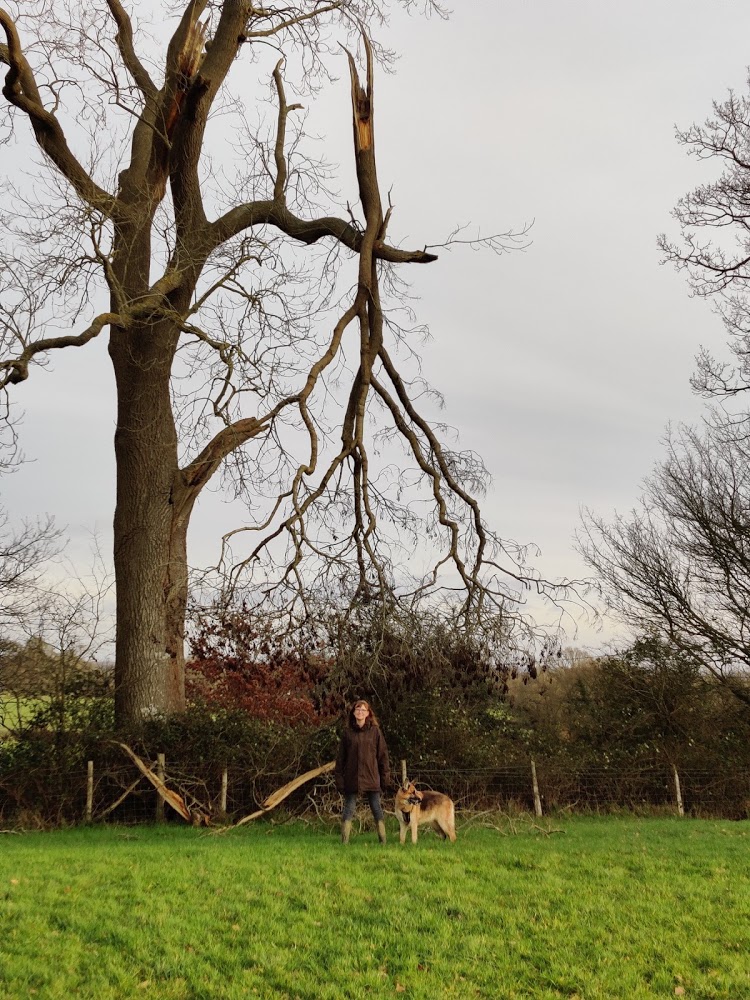
He certainly chooses some weird places for me to pose for photos…
Thank you for reading
anneethompson.com
Why not sign up to follow my blog?
An interesting fact: When there were printing presses in the past, the printers used to keep capital letters separately to cursive letters, in cases. The capital letters were usually stored in a case above the cursive letters, and hence they became known as ‘upper case letters.’ Did you know that? I didn’t! It is one of the interesting (but irrelevant) snippets I discovered whilst trying to unravel the apparatus part of my Greek New Testament. (An apparatus is like the key on a map, it gives extra information.)
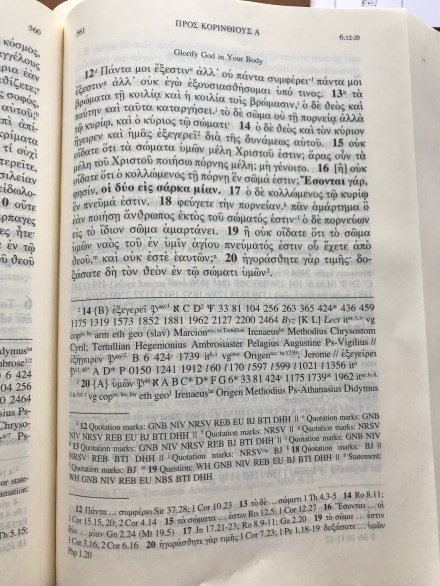
As part of my course, I was given a copy of the Greek New Testament. It has—as you would expect—the words of the New Testament books written in Greek. It also has, on each page, some tiny writing and symbols in the apparatus. To be honest, I have pretty much tried to ignore this (don’t tell anyone) but as my exam is looming, I realised that I needed to tackle it. What do all those symbols mean, and why do I need to look at them? As a way to help me learn them, I will explain what I have learnt so far.
As I think I told you previously, there is no existing copy of the original New Testament books. What we have are various manuscripts that have been found and translated, and put together to form what we think of as the New Testament. These manuscripts and documents make up the evidence for what was originally written, but they are not identical because they were written at a time when copying was all done by hand. Sometimes the scribes copying the manuscripts corrected the grammar, or added notes in the margin that were later copied as part of the main body of writing. Sometimes they made mistakes, or changed things to suit their own theology. Translators must make decisions, based on these pieces of evidence, as to what should be included.
The copy I have been given allows me to make some choices myself. It has not included every piece of evidence that was ever found, because that would make the book run to many volumes and I would never manage to wade through it all. It has therefore referenced the most important documents, and noted which are the more reliable ones. I can therefore look at the differences (which tend to be very minor, such as whether it should read: ‘he did this sign’ or ‘Jesus did this sign’ or ‘this sign was done.’) My NT has helpful symbols, and tells me what most scholars conclude. An ‘A’ in brackets means they are virtually certain that this is close to the original text, and a ‘D’ means they couldn’t agree. It is of course relative to the documents that have been found at this point (because they might find something older/more reliable) and I have no idea whether ‘A’ means most scholars agree, or whether the most qualified ones agree. (No reason to trust something simply because someone—who you don’t know—tells you it’s correct.) It reminds me of when a pupil at school did something bad, and we were trying to discover who the culprit was– did we trust the majority of the boys, who all said it was X, or did we trust the most reliable boy because he tended to be truthful, or did we listen to the small group who claimed to be eye-witnesses?
In about the 4th century, a version of the NT was produced that took the majority of the documents that were the same. This is known as the ‘Majority Text’ or the ‘Byzantine Text.’ It contains the majority of Greek texts that were available (hence the name majority text). It was the basis for the King James Version of the Bible.
However, since then, more and more manuscripts have been found, many of them much older than the Byzantine texts. Large codices were found, like Codex Sinaiticus. (‘Codex’ is just a fancy name for a collection of manuscripts that hasn’t been bound.) They sometimes differed from the majority texts, and so new translations began to appear. The potentially less reliable texts were moved down into the footnotes, so people could read and compare them. The manuscripts were given names, and these names were then represented by symbols (to take up less space in the apparatus).
Papyrus fragments are denoted by a curly P and a number. Papyri 45, 46, 66, 72 and 75 are the most important.
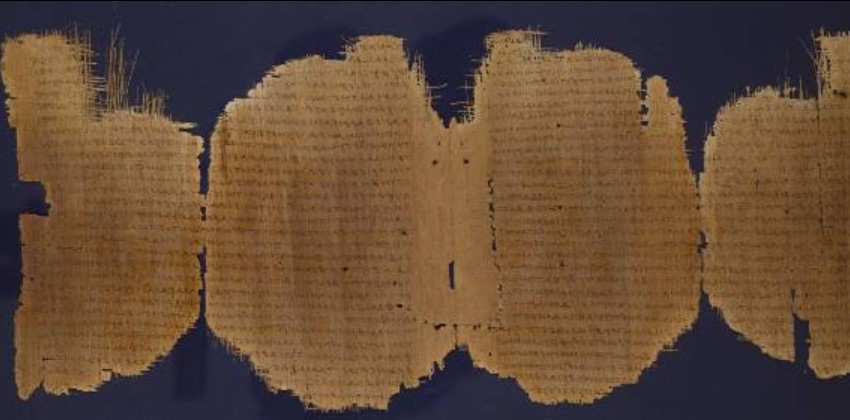
For example, P45 is from the 3rd century (probably written in about 250 AD, in Egypt so I think is one of our oldest manuscripts) and contains more than one New Testament text (which is unusual for 3rd century manuscripts). It is very concise, as the scribe took out lots of the adjectives, adverbs, pronouns and participles, but he didn’t add anything. It is a manuscript with no ‘fluff’ (which makes me wonder if the scribe was a bit grumpy and austere). However, writing equipment was expensive, and a scribe was paid per line of writing, so maybe he was trying to include as much as possible within a certain price. (I enjoy guessing these things, but I think I am supposed to stick to the facts in an exam.)
Papyrus 45 is badly damaged, and has lots of gaps (called ‘lacunae’).
Papyrus 45, kept mostly in Dublin with a small part in Vienna
The Codex Sinaiticus was shown by an aleph (The Hebrew letter ‘a’) which looks like a curly N. Important manuscripts include: Sinaiticus, Alexandrinus, Vaticanus, and until Sinaiticus was found, Vaticanus was thought to be most important. They were written in upright block letters on parchment (these documents are called majuscules). They appear in the apparatus as capital letters, or numbers beginning with 0.
There are also manuscripts written in miniscule. This simply means lower-case, or cursive, letters. The miniscule manuscripts were written later than the majuscule (capital letters) documents and were gathered together into families of similar texts. They are shown in the apparatus byƒ and a number.
Next are listed the lectionaries, shown by an ‘l.’ These are the lessons read in churches, and hence the name as they would be rested on the reading desk, or ‘lectern.’ Old manuscripts written in Latin are identified by ‘it’ which stands for Itala (they spoke Latin in Italy, so that’s easy to remember!)
The church fathers also left documents that are used to verify the texts. People like Augustine, Cyril, Theodoret (those names create wonderful images of stooped men in robes writing with a quill).
If documents have been corrected, the uncorrected document is marked with a * and the corrected copy appears with a tiny number next to the letter. If you look at the photo, you can see this with C* and D*. There will be a corresponding letter with a tiny number (the corrected version) and it took me longer than you might think to realise that these might be on the next page!
Greek New Testament with apparatus.
In fact, lots about understanding the apparatus has taken me longer than you might think. I feel that I am beginning to understand the bare minimum, but it feels like a physics lesson in my teenage years, when I sort of understood some of it but I hoped and prayed the teacher would never ask me to explain how I had reached my conclusions! Hoping to learn a little more by the end of the month (otherwise I shall have to wing it, which never worked out too well in the past).
Thanks for reading (and if you know more than me, do send help quickly).
Take care.
Love, Anne x
Thank you for reading
anneethompson.com
Why not sign up to follow my blog?
I think I might be slightly autistic—which I believe is a sign that I’m not—but I do have vast understanding for people who don’t like change. I don’t mind some change, but I struggle with mess, and ‘Christmas and visitors’ does result in a lot of mess, doesn’t it? The Christmas tree is beautiful, but after a while you stop being able to ignore the pine needles on the floor, and the cardboard box stuffed behind the sofa, and the chair that’s dumped on the landing because there’s no space for both it and a guest in the guestroom, and the gifts that never made it beyond the kitchen table, and the cards that drop glitter on the hall table, and so on. Therefore, as I write this, a few days after New Year’s Day, I am in my happy place. All the upheaval has finished, and although I delight in my family and love spending time with them, there is something wonderfully satisfying about putting everything back into place.
Tomorrow, the college semester recommences, and my schedule returns to the pattern of lectures and learning, intermingled with raising animals and cleaning the house, and secretly—just between you and me—I am really looking forward to it. I have an exam at the end of January, and I am even weirdly looking forward to that. I like structure and routine. Maybe it’s an age thing.
How did you find the weird story that I told you last week? I was messaged with various suggestions as to where it came from, some people thought it was a Chinese fable, others from Japan, some from the book of Genesis. It actually came from the book of Judges. I think it was about people being satisfied with the job they have been given, and that we should be wary of those who want to have power. But I’m not entirely sure. There is a lot in those Old Testament books that are weird and confusing and don’t have an obvious meaning.
I read another story this week (another one that my Sunday School teachers forgot to mention!) You might recognise the beginning: A man is travelling and stops overnight in a foreign city. A man of the city says he shouldn’t sleep in the town square because it’s not safe, and he welcomes him into his home. During the night, the men of the town bang on the door, demanding the visitor should come outside so they can gang-rape him. The owner of the house refuses, saying that they will send outside the women instead. (You might be thinking this is the story of Sodom, because it’s similar, but you would be wrong!)
The end is rather gruesome. They put the women outside, and they are abused all night and when the visitor opens the door in the morning, there is his wife, dead on the doorstep. So (brace yourself, this is horrible) he chops her into pieces and sends bits of her to all the tribes of Israel. They are astounded by this, they meet, they destroy the evil city.
It is a very similar story to the one about Sodom, though I have never heard it linked to the debate around whether homosexuality is wrong (which the Sodom story often is). Perhaps it’s because the women were also abused, and no one wants to suggest that it shows being heterosexual is wrong!
I have no idea why this story is in the Bible, or what we should learn about it. Some parts of the Bible are like that, if you read beyond what you were taught as a child, some bits are simply weird. Sometimes we have to accept that we don’t understand them. Personally, I wish that more people would admit that they don’t understand things; I think that being too certain that our theology or politics or lifestyle is right can be dangerous. It closes our ears to things that might teach us something. Not having everything in a neat tidy package—whether it’s our home or our theology—is probably good for us.
Hope you have a good week.
Take care.
Love, Anne x
Thank you for reading
anneethompson.com
Why not sign up to follow my blog?
Look on your device for this icon (it’s probably right at the bottom of the screen if you scroll down). Follow the link to follow my blog!
It’s nearly 2021—will you be making a new year’s resolution? Is there something that you would like to change about yourself, and how will you plan for a new improved self? I guess we all have dreams and aspirations, and some of them we pursue until we reach them, and others dwindle away into nothing. To be honest, I’m quite glad that some of my dreams evaporated into nothing—especially the ones I had as a teenager—otherwise I’d be in a right mess now!
The trouble with looking ahead and wishing for things that we don’t have, is that sometimes we stop appreciating what we have right now. Maybe, instead of planning to improve things we should sometimes stop and look around at what we already have, and be grateful.
I recently found a story, which sort of links with this idea. I have never noticed it before—add a comment if you recognise where it came from. Or simply sit back with some of your Christmas chocolate, and enjoy a story. . .
Once upon a time the trees got together to choose a king for themselves. They said to the olive tree, “Be our king.”
The olive tree answered, “In order to govern you, I would have to stop producing my oil, which is used to honour gods and human beings.”
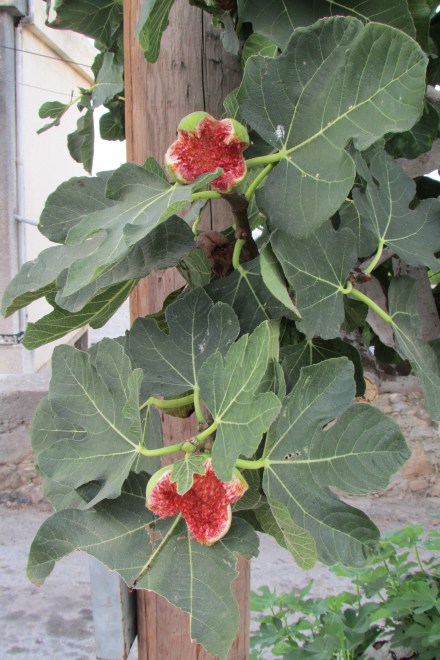
Then the trees said to the fig tree, “You come and be our king.”
But the fig tree answered, “In order to govern you, I would have to stop producing my good sweet fruit.”
So the trees then said to the grapevine, “You come and be our king.”
But the vine answered, “In order to govern you, I would have to stop producing my wine, and that makes gods and humans happy.”
So then all the trees said to the thorn bush, “You come and be our king.”
The thorn bush answered, “If you really want to make me your king, then come and take shelter in my shade. If you don’t, fire will blaze out of my thorny branches and burn up the cedars of Lebanon.”
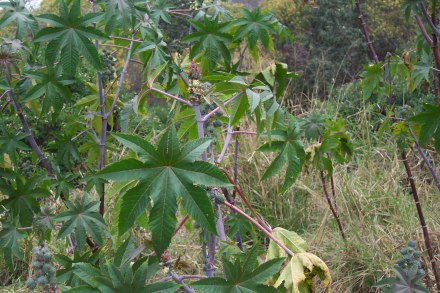
Caster Oil Plant
This is probably the plant which Jonah sat under.
Bit of a bizarre story, but I rather like bizarre. Not sure why I have never noticed it before—do you know where it came from?
If you make a resolution for the new year, choose carefully.
I am reposting this especially for you if you are lonely. I say ‘lonely’ and not ‘alone’ because some of my loneliest times are when I am with other people – we can be lonely in a crowd, we can be lonely in a family. Being lonely is about feeling of no value, no use. Being lonely is about not being understood, not being seen.
I think that Mary probably felt very isolated as she carried her baby inside her body, and then had to give birth at an inconvenient time in an inconvenient place. And then, when she was at her most exhausted (giving birth is exhausting) she had strangers visiting and was required to find extra reserves of strength to welcome them (there is no mention in the Bible that Mary said she was tired and please could they all go away and leave her in peace, which is what I would have done). I suspect the people around her did not really understand, and that only God really saw her.
There are several places in the Bible when God saw people. I think of Hagar, another mother – a woman who had been sorely used by her owners (she was a slave) and yet at her lowest point, God saw her and she went on to mother a nation (the Arab nation). God also saw Sarah, the woman who mistreated Hagar, and she too mothered a nation (the Israelites) even though she was very old. God saw Joseph when he was thrown into a pit by his brothers. God saw David when he struggled with enemies. God saw the son of a prostitute (Jephthah) when he was rejected by his half-siblings. God saw great leaders, and social outcasts – and God sees you. Whatever your religion or belief, even if you do not believe in anything at all: God sees you.
This Christmas is a weird one, and maybe your plans have been crushed by a horrible disease and the ineptitude of leaders. Maybe you are feeling lonely today. So this story is for you, and I hope that today will turn out to be special and you will find some peace.
Happy Christmas 2020, from me.
Love, Anne x
(If you know of someone else who might be feeling lonely today, perhaps you could send this to them.)
Mary’s Story
by Anne E. Thompson
I travelled to Bethlehem in a small cart. Every bump (and there were many) was agony. As I was jolted along, I was racked with pain. The baby’s time was near, you see and the pain was almost unbearable. Later, they would sing songs about a cute donkey carrying me. Nice thought! I don’t think there’s any way you could have got me on a donkey. As each contraction cramped every muscle in my torso, I huddled up like an animal and prayed for it to be over.
I could see Joseph, watching me as he walked alongside. He really didn’t have the first idea what to do. Oh, how I wanted my mother. I yearned for her to be there, holding my hand, telling me everything was all right and would be over soon.
When we arrived at Joseph’s uncle’s house, the women folk came and helped me inside. The room was crowded. All Joseph’s male relatives from miles around had come to the house for shelter and food. The women were busy cooking supper and the men were drinking wine and comparing stories. They all told Joseph how much he resembled his grandfather, Matthan and laughed at old stories from years ago. The smell of fish and fresh bread was nauseating. I was so tired and so uncomfortable.
Joseph knew I was suffering and asked if there was somewhere quiet that I could go. There was no chance that we would get a place in the inn, they had filled up days ago. Somewhere quiet, in a little house packed with relatives?
There were some fraught discussions and then his aunt suggested that the animal shelter, down on the lower floor of the house, might be best. It wasn’t terribly clean, but it would be quiet and private and at least it wouldn’t smell of fish!
Joseph helped me to go down, and a couple of the women came too. One of them examined me and told me the baby was a long way off yet, first babies always take their time in coming. This was not great news but I felt better having her there. I felt that she knew what was happening, had seen this before; it took some of the fear away.
I was frightened, you see. I was horribly afraid that somehow I would damage my baby. My baby and God’s. I knew he was going to be special, I knew I had a great task ahead of me but it all seemed to be going horribly wrong. I trusted that God was still in control but he felt so far away.
Could the baby not have been born in a palace, surrounded by comfort? Would these poor beginnings really be part of a plan? Could they really make this king accessible to the people? I had no idea.
I was a mere girl; I had no education and my memory of scriptures was often fuzzy. To be honest, at this present moment, I didn’t even care. I just wanted this baby OUT! Special or not, my body was tired of carrying him, tired of being stretched and pushed, of fitting something inside that was now too big to be there. I needed this baby to be born and I was too exhausted to wait much longer.
How I longed for sleep. The pain in my back was terrible. Great waves of cramp that seared through my body, making me oblivious to everything else. I was vaguely aware that someone was sweeping the floor and moving the animals to a far corner. They had laid out a mattress and blankets for me to rest on but I couldn’t lie still for long. I felt better standing, rocking in time with the pain, trying to remember to breathe: in out, in out. Someone offered me water but I couldn’t drink. I wasn’t thirsty—I just wanted this baby to be born.
I could see Joseph with his big anxious eyes watching me. He didn’t know what to do. Someone suggested he should go into the house to eat and I nodded in agreement. There was nothing he could do and the poor man must have been tired too. He had endured such an emotional time lately. First there was his fear and anger when he first heard about the baby (now that was a difficult conversation!) Then he had to endure the smirks of his friends when the pregnancy became public knowledge. He never complained, but I know he felt embarrassed, wished that God could have chosen a different girl.
We had been travelling for five days, with hardly any rest and the last couple of days had been chilly. I know he felt the burden of caring for me, watching for bandits on the roads and wondering if we would make it to Bethlehem in time. If the baby had come early I don’t know what he’d have done—left me with strangers on the road somewhere I guess and come to register on his own. One didn’t mess with a Roman decree. . .
The pain eventually became almost constant. Joseph had eaten and rested but I continued to sway in discomfort in the little room of animals. Every so often one of them would poop, and although the women with me cleaned it up quickly, the smell pervaded the atmosphere. It was hard to ignore.
I could hear the musicians gathering outside, someone must have told them the birth would be soon. That gave me hope, maybe soon the baby would arrive.
Then at last, in a final searing pain, the baby was born. I looked down at his blue waxy body as he wriggled on the blanket, and I knew that he was mine. My love for him was overwhelming. He was part of me, I would die rather than let anything hurt him.
One of the women wiped him down with oil and salt and I held him in my arms while they looked for the swaddling bands in our luggage.
How beautiful he was. His indigo eyes would soon turn brown and they gazed at me trustingly. I loved him with my whole being.
Outside, there was the sound of music and singing as the musicians heralded the arrival of a boy, and I smiled, knowing they would have quietly slid away into the night if the baby had been a girl. But there had been chance of that, not this time.
Joseph came and took the baby from me. He held the tiny baby in his giant carpenter’s hands, hands that spoke of hard work and safety. He didn’t say anything, this man who had been chosen to protect me, he simply stared at the baby—looking, wondering.
Then the baby started to mouth for food and Joseph passed him back. The women showed me how to feed him, but he was soon asleep. Then we gently wrapped him in the swaddling bands, securing his tiny limbs so he would feel snug and secure and his bones would grow straight and true. He was so beautiful. It was hard to remember what the angel had told me, that this was God’s son too. I began to wonder if I had imagined it, if it were all a dream. This baby did not look like God, he was a baby. My baby.
“If it’s true God,” I thought, “Let there be another sign. He is so little and I love him so much. Remind me again…”
I too needed to sleep. Joseph fetched fresh hay and put it in the animal’s manger, covering it with a soft blanket. I didn’t want him to put the baby there, I wanted to keep him on the bed next to me, but Joseph was worried I might roll on him in my sleep. Then he laid the baby down and told me to sleep. He looked deep into my eyes and brushed my collar bone lightly with his fingers.
“Soon you’ll be truly mine,” he whispered. I knew what he meant and felt myself blush. I was so tired, I thought I would sleep for a week.
I actually slept for about two hours! I was abruptly woken by loud voices and a draft of cold air as the door was flung open. There, standing uncertainly in the doorway was a group of youths. Their clothes were dirty and exuded the strong smell of sheep. Joseph was with them.
“Mary? Are you awake?” he asked.
It would be hard not to be with all the noise from outside.
“These shepherds want to see the baby. They were told by angels where they could find him and they have come to look at him.”
I checked I was decently covered before nodding, letting Joseph know that it was all right, they could come in. They trouped into the room. They seemed so big and clumsy in such a small space, with their long limbs and rough clothes. I worried they might hurt the baby.
But they didn’t try to touch him, they just stared for a while and then one of them knelt and they all followed suit, kneeling before the manger, staring at the baby.
Then they told me their story, how they had been in the fields and an angel had appeared. They had thought they were going to die, to be struck down right where they were.
The angel had reassured them, told them that a saviour had been born, the Christ who we’ve all been waiting for. They would find him lying in a manger. Then suddenly there were lots of angels, all praising God and saying he was pleased with people on earth.
After the angels had gone, finding they were still alive after all, the shepherds decided to come at once and see for themselves. It was as though they couldn’t quite believe what they had seen and heard, they needed to actually see the baby with their own eyes.
I felt so humbled and so cared for. God had heard my thoughts. He was reassuring me. It was all his plan, not some terrible mistake; circumstances hadn’t caused us to drop out of his control, he could still see me. We were meant to be here. He even knew about the manger!
I listened and smiled and treasured my thoughts.
The shepherds left as noisily as they came. I could hear them in the streets, shouting their news, telling everyone what had happened. They were so excited, I expect they woke up half the town.
They had of course woken the baby who was now crying with a thin wail that jarred my nerves and was impossible to ignore. I fed him some more and then we both slept. A tired, contented sleep borne from exhaustion and wonder.
***
After eight days, Joseph came and circumcised the baby. How he wailed! It felt cruel, though I knew it was the right thing to do, even in this strange place we must obey the Jewish laws. We also formally gave him the name Yeshua, the name we had been told to give him by the angel all those months ago.
I wondered if Joseph minded, people would know it wasn’t a family name. I also had no one called Yeshua in my own family, though I did know a boy from my childhood with the name.
***
After forty days, we had to travel to Jerusalem, to pay for redemption at the temple. As Joseph was from the tribe of Judah, we had to pay five shekels of silver. We couldn’t afford a lamb, so bought two pigeons to sacrifice.
It was nice to leave Bethlehem and to have some exercise at last, to see people and to take my baby into the world. I felt quite excited as I approached the temple, our holy place. I didn’t recognise anyone, but everyone could see we had a new baby and lots of the women came over to see him. I felt so happy!
We walked through the Beautiful Gate and up to the Gate of Nicanor.
It was then that something strange happened. As Joseph and I walked through the temple, a man approached us. He came to look at Yeshua and indicated that he wanted to hold him. That was a little unusual but there was something about him, something that made you sure he was a good man, someone you could trust.
When he looked at the baby, the old man got all emotional and prayed, thanking God and saying that now he could die in peace. He blessed me and Joseph too and then he leant towards me and said something which was very strange.
He said Yeshua would cause “the fall and rising of many in Israel” and would be “a sign that would be opposed so that the thoughts of many hearts may be revealed.”
What does that mean? I know that he is God’s own son and that he is part of the plan to establish God’s reign on earth. Will he be opposed? Surely everyone will accept God’s anointed one, we have waited so long for him.
But then he said something that made me afraid, this old man with his determined face and bright eyes. His face was very near, I could smell his breath.
He said that a sword would pierce my soul.
Something inside contracted, all the joy of entering the temple evaporated into a lump of fear. Fear and anger. I practically snatched Yeshua away from him. I want my son to grow strong and be happy, will I suffer for this? I will do everything in my power to protect him, he is mine.
I knew I was tired, not getting enough sleep and it was hard to care for a new baby in a strange place without my mother to help me. I felt that I did not want to hear the man’s words, even if they were true. I was coping with enough, and I felt that although I had been brave, I couldn’t be brave any more.
Thankfully the man left us and almost at once an old lady approached. She was ancient, her white hair showed under her mitpahath and she leant heavily on a stick. What I noticed most were her eyes. They almost sparkled! You could tell at once that she was a holy woman and also one who loved to laugh.
As soon as she saw Yeshua, the elderly woman started to pray loudly, thanking God and telling people nearby that if they wanted Jerusalem to be redeemed, they should look to the baby. I was glad that no Romans were allowed in the temple, we would have been in trouble!
We finished making the offerings and then went back to Bethlehem. I didn’t know whether to tell Joseph what the old man had told me. I kept thinking about his words, worrying about what they might mean. I was so tired, I decided I would wait and maybe tell him later.
***
The months passed and we settled into life in Bethlehem. We moved into a little house and Joseph found work on the many building projects that the Romans have introduced.
Yeshua continued to thrive. He grew into a sturdy toddler and would walk around the room holding onto the stools and baskets. I loved to feel his solid weight when I carried him on my hip, the light touch of his chubby fingers when he reached up to touch my face. There was pure joy in the gurgle of his giggles. He started to sleep much better at night and Joseph and I were thinking about having another child. But then everything changed.
It was one evening, still quite early but we had filled the lamp with olive oil and lit the linen wick. Joseph put it on a bushel basket, so the room was well lit and we could talk about the day. Suddenly, there was a banging at the door.
Joseph went at once and there, in the road, was a group of Persian travellers. They had dismounted from their horses and were peering intently into the house. They told Joseph they had seen a star and had come to worship the king. I was so glad I hadn’t gone to bed yet!
We let them into the house and I went to get Yeshua. He was damp from sleep and his tired eyes looked blearily around him. I wondered if he would cry but he seemed fascinated by our strange visitors. They wore their hair in long curls and one had a band of gold on his head. It glinted in the lamp light and I could see Yeshua watching it intently. Their clothes were patterned with birds and flowers.
We offered them wine, it was clear they were tired from their journey. I was embarrassed that we only had two stools to offer them, but they didn’t seem to mind and in fact insisted that I should sit on one with Yeshua and they were happy to sit on the rush mat. They didn’t really sit anyway, they wanted to kneel before Yeshua.
Then they gave him gifts. They were beautiful to look at. They gave him gold, signifying that he is a king. They gave him frankincense. The strong aroma filled the house and I wondered if Yeshua was to be a priest, even though he is not descended from Levi. They also gave him myrrh. Myrrh is costly but is for embalming a body. It was a strange gift for a baby and I wondered what it meant.
They told us their story before they left. In their Persian home, they were magi, watching the stars and foretelling the future. Many months ago, at the time of Yeshua’s birth, they had seen a special star which they knew meant a powerful new king had been born and they determined they would find him and worship him. Unfortunately, following the star caused them to go to Jerusalem first (I always knew that star gazing was a misleading activity!) They went to Herod’s palace and asked where the new king was. This was scary, Herod had shown he was not a king to be trusted and his cruelty was well known. I would not have wanted to visit his palace.
However, it sounded as though he had decided to be helpful. Herod asked the scribes to research the early scriptures and they discovered that the promised king was to be born in Bethlehem. The king told the Easterners, asking them to find the king and then return and tell him theexact location, so that he too could worship.
I wondered what would happen next. Would Herod himself come to visit my precious baby or would we be summoned to the palace? This was not a comfortable thought.
I also wondered, why had the palace scribes not come to visit us? Why didn’t they travel with the Easterners to see the baby? Did they not believe the scriptures that they studied so diligently? Surely, if they were truly expecting a redeemer they would also have come? I frowned, feeling uneasy. There was something that I didn’t understand, and it nagged at me.
The men left. They planned to sleep in an inn and return to Jerusalem the next day. We could not offer them lodging in our tiny house and they seemed content to leave now they had seen Yeshua.
I returned Yeshua to bed and soon afterwards Joseph and I also went to sleep.
I had not been asleep for long when Joseph woke me. He shook me awake, then went to light the lamp. I could see his face was tense and instantly turned to check Yeshua was well. He was sleeping soundly.
Joseph told me I needed to get up—at once—we needed to leave. He said that he had had a dream, like the dream when the angel told him that the baby inside me was God’s son. It was so intense, so real, that he could not ignore it. Joseph said he had been told we must leave Bethlehem, leave Israel; Yeshua is in danger, Herod plans to kill him.
For a moment I paused, wondering why I too had not been warned. But then understanding flooded through me, as I realised—God had told Joseph to take care of me and Yeshua—that was a hard task for a man, to care for a son that was not his own. So now, God was telling Joseph alone what we needed to do, underlining his role, establishing him as head of our family. It was a kind act, asserting Joseph’s value, his part in all this.
I began to pack our things, Joseph was hurrying me, telling me to only take what was essential, we needed to leave.
We were to go to Egypt. Egypt! Could this be right? Was Yeshua not to be king of the Jews? I packed hurriedly and we left that very night.
What would the future hold? Would we ever return to our home town? The future was uncertain but I knew that something bigger than us was happening. Whatever happened, God had a plan and no one could alter the course of that, not Herod, not the Romans. We didn’t know what was going to happen, but we were part of the plan—and that was enough.
******
Thank you for reading.
This account necessarily involves some imagination but I believe it is also as historically correct as possible (and more accurate than some of our Christmas carols!) If you are aware of any historical errors, please tell me and I will modify it. I used a variety of sources including: The gospels of Matthew and Luke Geoffrey Bromily (1995) William Hendriksen William Barclay Joseph P Amar (university of Notre Dame) Michael Marlowe Tessa Afshar Kenneth Bailey
Thank you for reading
anneethompson.com
Why not sign up to follow my blog?
If you enjoyed the story, you can read more of my writing in my novels. Why not treat yourself to one today? They are available as paperback or as kindle books. The UK Amazon link is below:
One of the best things about Christmas is the memories. Do you have happy ones?
I remember as a child, lying in bed and straining to hear the bells of Santa’s sleigh. Every year, sometime in late December, I would hear him—playing loud seventies pop music—as his sleigh drove around my home town. Mum would give us coins for the people rattling tins, and we would rush out, and Santa would lean over his sleigh (balanced on the back of a lorry—but that never struck me as strange) and pass us sweets. The sweets were never especially nice, but they were oh! so exciting! because they came directly from Father Christmas. (And thank you to the Letchworth Roundtable for organising this snippet of joy.)
My father always cooked Christmas lunch, after church and after his siblings had come round for a glass of sherry. We never ate very early. He cooked a wonderful dinner, and used absolutely every saucepan in the house. His speciality was the gravy, which was rich and smooth, made with meat juices and stock—it was like soup and he always made enough for about 57 people (and we never, as far as I can remember, had more than our family of 5 for Christmas lunch). Every year mouth-watering smells would seep out from the kitchen, and one of us would ‘volunteer’ to be Dad’s helper. This involved washing up for about 3 hours straight. Eventually the dinner would be ready, and we would carry the food to the dining table in the front room (only ever used on Christmas Day and for ‘posh’ meals with guests). Every year my parents would laugh at how late the lunch was (it often clashed with the Queen’s speech). Very often, to our dismay, we would have just said grace and be about to start when the phone would ring, and it would be ‘Aunty Pam from America.’ This was a big deal for my parents (she was my mum’s sister, but we didn’t really know her, so we mostly resented the intrusion).
When I was young, Father Christmas came secretly in the night and left a knitted sock of gifts on the end of our beds. (The socks were from my Dad’s wellies, and there was one terrible Christmas Eve when we couldn’t find them!) We could open the gifts as soon as we were awake, so we tended to wake very early. There was always an orange and a slightly bruised apple. My Dad would always get up and sit in his dressing gown watching us. When I was older, I realised that he had made some of the gifts himself, and I can guess how excited he would have been to watch us discover the farmyard, or the fort, or the puppet theatre. There is a certain smell of wood varnish, which even today zaps me straight back to Christmas Day.
I am now a mother, and I have another layer of memories with my own children. When they were small, Christmas Eve was all about preparing the food. I would turn a loaf of bread into crumbs for the stuffing, and a chubby toddler would eat all the crusts. We would sit in front of a film in the afternoon with a tray of sprouts, peeling them and tossing them into the colander ready for the next day. The youngest would diligently peel layer after layer, and then announce: “This one’s empty,” before starting on the next one.
I was always too excited to sleep Christmas Eve, waiting for them to wake and open their ‘Father Christmas presents.’ They all woke disappointingly late, and then would want to savour each gift before opening the next one (not my genes). As soon as they were old enough, I forced them to agree that we would open ‘stocking gifts’ on Christmas Eve, after dinner. I manage to sleep better.
We now all share the buying of stocking gifts, everyone adding small gifts or jokes to the named bags. Then we sit round, laughing at the person who received 29 bars of soap, or the funny tee-shirt that I bought after a glass of wine and sorely regretted ever after. . . And I know that Christmas is about God coming into the world as a baby, and knowing his peace, and being able to know him—but to be honest, this Christmas Eve opening of gifts is my favourite part of Christmas, it is just us, under the twinkle of lights from the tree, warm and relaxed, sharing laughter and love.
This Christmas will be different, an adapting of plans due to Covid, but I hope it will still be special. I hope that you will find ways to make it lovely, I hope that you add some more special memories to the storehouse in your mind.
Hello, and how has your week been? It was my birthday, so we tried to celebrate whilst also keeping to the current covid restrictions. Last weekend I met some of my children for a socially-distanced walk, and then we shared slices of cake in a carpark. It was lovely, but not as comfortable as sitting on sofas in a lounge.
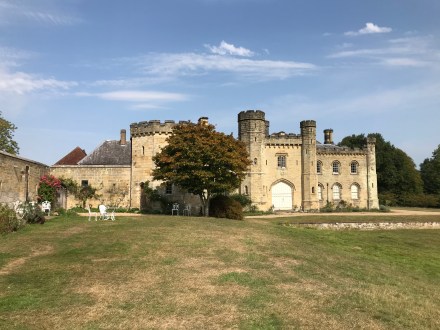
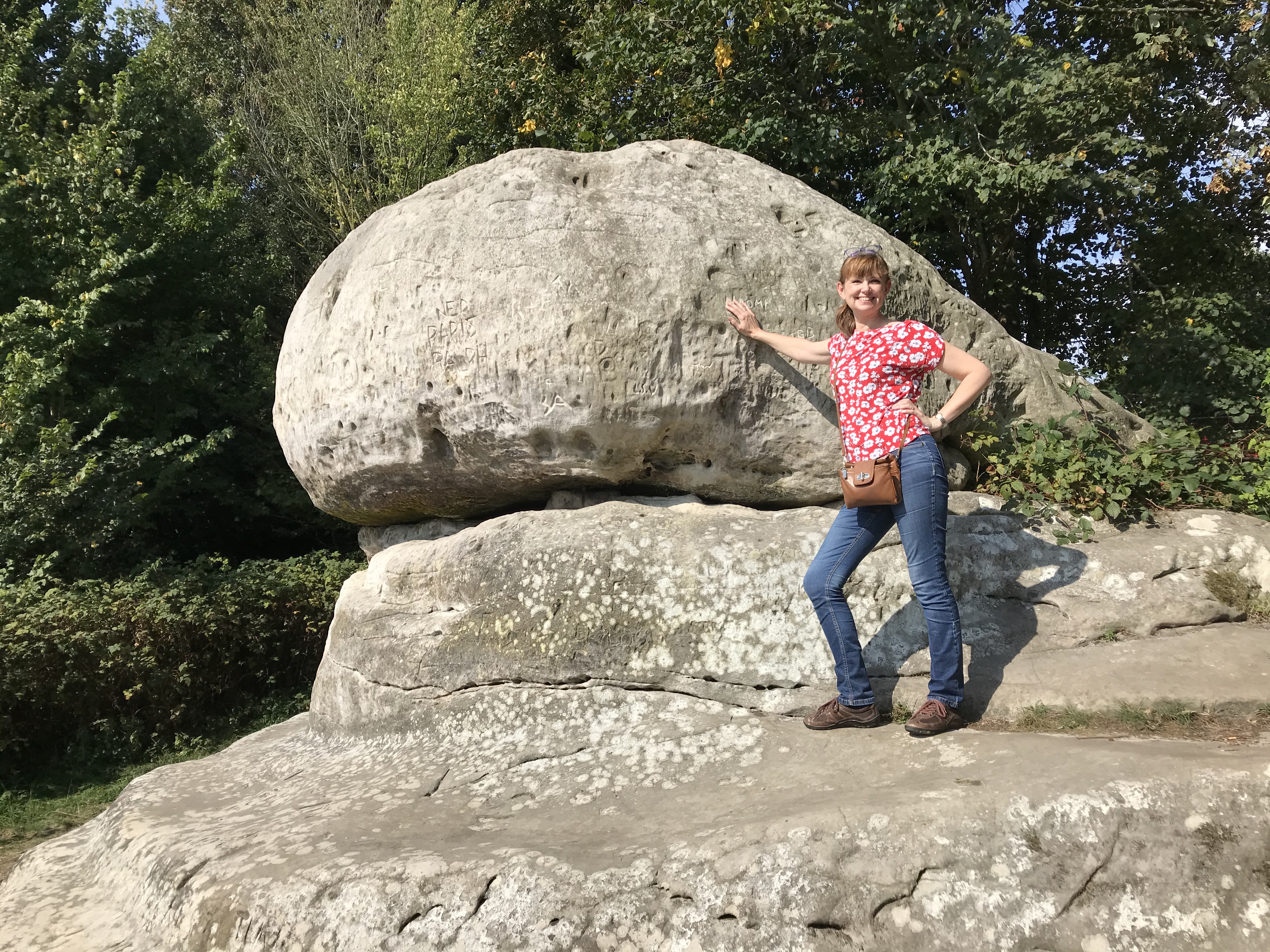
On my actual birthday I was treated to breakfast a’ la husband, which was smoked salmon on muffins with poached eggs and hollandaise sauce, grapefruit halves, and chocolate money in gold wrappers scattered across the table. I felt very spoilt. In the afternoon I took my mum to Chiddingstone Castle, and we walked to the Chidding Stone (and got lost and ended up walking through a field of cabbages!) Then we ate the remains of the carpark cake before I went home.
Chidding Stone
We spent the evening having a family quiz on zoom, where we each had prepared 10 questions. It was very funny, especially the round where we were presented with extracts from our family chat and we had to guess who had written them.
Have you put up your Christmas decorations yet? I noticed lots of houses were decorated in November, which helped to brighten the weird winter we’re having. I suggested we could do the same. We didn’t. Instead we bought our tree today, after a trip to the dentist. I hate going to the dentist, don’t you? Of course it was even worse this time with all the fussing about with hand-sanitiser and masks and not being allowed into the waiting room but freezing outside until the nurse came to fetch us. Actually being a dentist must be even worse — staring into all those germy mouths and wondering if covid is going sneak past your visor and make you ill for Christmas. Not a job I would relish.
Husband kindly drove me to the dentist, but this meant that he was also involved in the tree-buying decision. Needless to say, we now have a tree that is much too big for the space and we will spend Christmas peering at each other through the branches. But the house smells nice.
As if covid isn’t bad enough, I now have to avoid bird flu as well. Apparently there is another outbreak this year, and we all have to keep our poultry inside until it clears (it’s carried by wild birds, and keeping the chickens in their coop is the only way to avoid contact). They are all very grumpy, and try to push their way past me when I open the door to feed them. I’m sure they produce extra levels of poop when they’re locked inside in retaliation.
My Greek lessons continue to be fun and challenging in equal measure. I recognise more and more words in my Greek New Testament, though am still at the stage of saying: “I’ve learnt that word…but I don’t remember what it means.” Not yet very useful, but I am getting better. I have an exam in January, which is terrifying because December is plenty of time to forget absolutely everything learnt so far.
Another morning in my week is taken up with a Bible Study group that I belong to: BSF. It’s all online now, but mostly I like it because I am studying the Bible with a group of women who all live in my town. We do differ in our opinions, as some people tend to take the Bible very literally, and others place it very much in the context of the time it was written and then look to see how it applies today. This week we looked at the destruction of Sodom (lots to disagree about in that particular story!) However, something struck me for the first time.
In one of the daily questions, it asked why Lot didn’t want to leave Sodom. (A quick reminder: Sodom was a city of evil people who did things like gang-rape visitors, they ignored the poor and lived self-indulgent immoral lives, and God said he was going to destroy the city. But when Lot — a man who followed God — was told to leave, he didn’t want to.) Why would Lot not want to leave when he knew there was so much evil in the city? And then I thought, it’s like Christians today who don’t want to die. We know the world has evil things, horrible, unfair things happening. And we know that God has prepared a better place for us, that he will take us safely there when it is time for us to go. And yet when we think about dying, about leaving what we know –even though it’s not perfect — we’re not so sure that we want to go! We don’t want to walk into the unknown, even when we know that God can be trusted. We are a bit like Lot.
Reading the Bible
You can mull over that idea during the week — it will help to distract you from all the political debates if nothing else!
Hope you have a good week. Thanks for reading.
Take care. Love, Anne x
In an attempt to keep warm during my morning run, I have started to wear my son’s old school rugby shirt and a bobble hat my daughter gave me. Husband informed me that I looked like a ‘Where’s Wally?’ cartoon which seemed harsh. But perhaps he has a point. . .
Keeping warm on my run, but looking a little like ‘Where’s Wally?’