Stone Mountain


Stone Mountain

During our trip to Atlanta, Georgia, we visited Stone Mountain. I have visited it before. When I was 9 years old, my family visited relatives in Atlanta, and Aunty Pam took us to Stone Mountain. I remember that there were deer (which must have been very tame, as there are photographs of me trying to stroke them) and that we went for a trip in a paddle steamer, the Robert E. Lee, across the lake in Stone Mountain Park. I cannot remember whether or not we walked up the mountain.

This time however, I was travelling with Husband and there were no handy children to accompany him up the mountain, so I decided that I must ignore my general fear of heights and walk up with him. Sort of wifely duty. We arrived in October, so there was an area set out as a children’s pumpkin/Halloween activity. We avoided that, and I could see Husband was wondering why, exactly, I had suggested that we visit the mountain. But it’s a good mountain, a sort of odd one, because it is really a giant pebble just sort of thrown there and completely out of place with the rest of the area. In the park below, as well as a pumpkin trail if you visit during October, there are some 1793 buildings (which might be of more interest).

We parked the car, and began to walk.
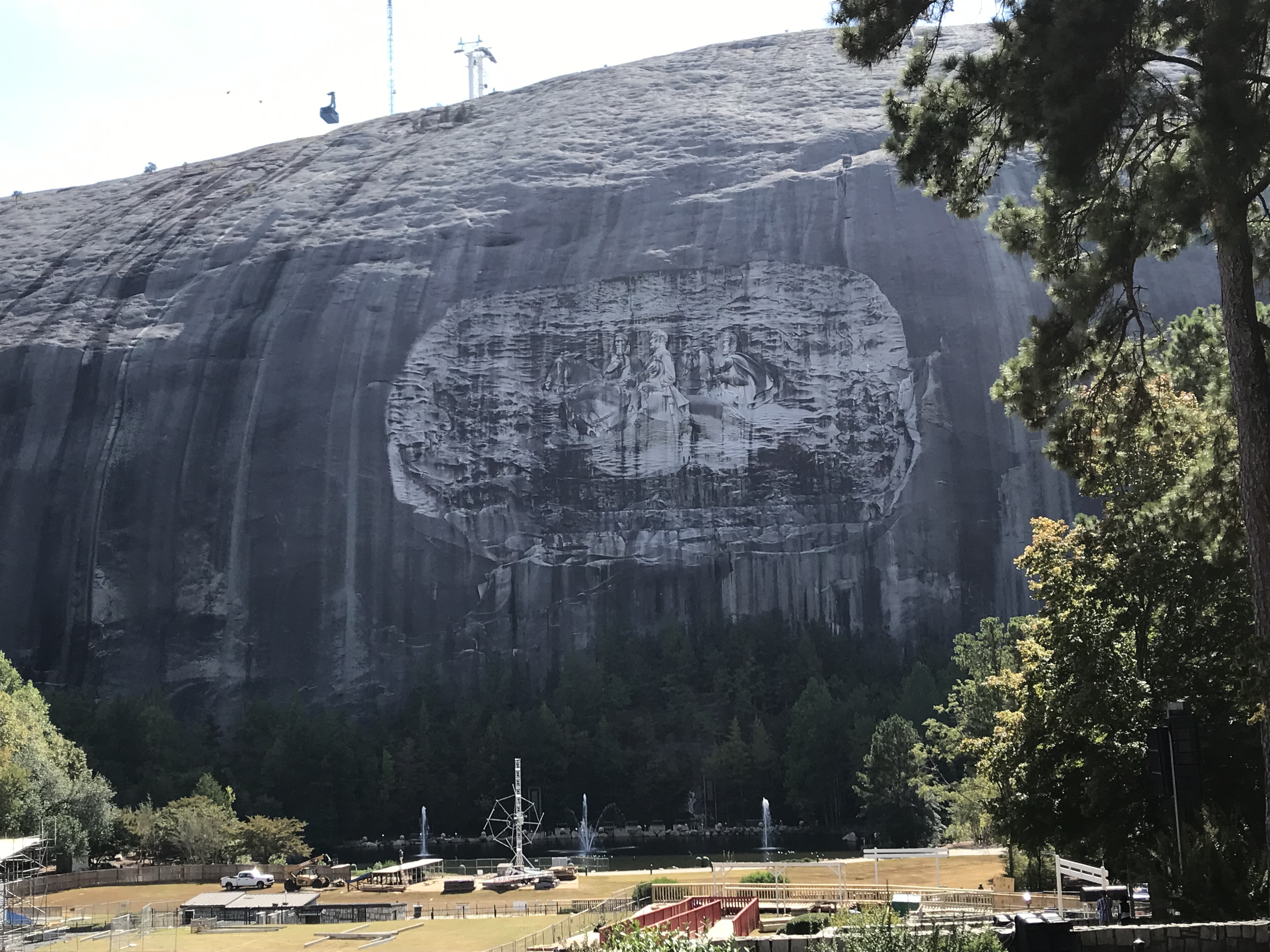
   Stone Mountain is the world’s largest piece of exposed granite (like I said, a giant pebble). For the geologists amongst you, it is actually a quartz dome monadnock which rises to 1,686 feet above sea level and is 825 feet high. In 1958 the State of Georgia bought it (not sure who they bought it from, or how much they paid) and the Civil War generals have been etched on one side.

You can still see giant carvings of Robert E. Lee (who the paddle steamer was named after) and Stonewall Jackson, and President Jefferson Davis. They are dirtier than when I visited when I was 9. They also are the source of much controversy, which came to a head after the racial shootings in Charleston in 2017 (when people in a black church were shot). The people etched on the side, as leaders of the Confederates, were also fighting to retain slavery. Many people think that all Confederate monuments should be destroyed (in this case, it would take a year of blasting the images from the mountain). Other people think that it is part of history, and should remain. Plus, of course, it’s a popular tourist attraction. I think, as a tourist from another country, I probably have no right to comment—but I preferred the monument when I was 9 years old, and it was simply an engraving of giant men.

Instead, I shall describe our walk up the mountain, as this is firmly etched into my mind as a never-to-be-repeated experience.

The walk started pleasantly enough. The park has helpfully painted lines on the mountain for hikers to follow, and the slope was gradual, up through pine trees, past some flags. It’s not an overly long walk, and all was fine until the very last section, when there are bars to cling on to, and you sort of haul yourself up to the peak. It was so far out of my comfort zone—a near-scrabble up towards the end, a concentrate on not looking down, or sideways, and don’t think about the stumble-sliding bone-crashing slide that awaits a slip on the shiny rock. Just walk—step, then step, then giant step—right to the top. Ignore the shaking legs, the ‘what if I slip?’ the ‘how will I get down?’ Just keep walking, forwards, to the cafe at the top, to a seat, where I can drink a coke. . .

Husband kept suggesting poses for potential photos, but I was concentrating too hard on not dying. The walk down was, of course, more difficult. I adjusted my cap, so that I could literally only see one foot ahead, and then I followed Husband, very closely, back down to where it was safe. We didn’t die.

There are, I am told, amazing views of the city from the top. There is also a cable-car if you don’t fancy walking/scrabbling to the top.

We then set off to find the paddle-steamer I had been on as a child. Husband reminded me that I am now quite old, and the steamer was probably long gone—so I was delighted when I saw it, hidden behind some trees. It was being refitted, for a Netflix series (Ozark) and there was a film crew building a casino set. But I was glad I had found it.

We spent October on a road trip, driving through America.
It was fabulous!
Why not sign up to follow my blog, then you can share it too…
anneethompson.com

I hope you have a safe day. Thank you for reading.

Take care.

Love, Anne x


Thank you for reading. If you enjoy my travel blogs, you will love my travel book: The Sarcastic Mother’s Holiday Diary. Available from an Amazon near you.

UK Link: Here


US Link: Here


Pondering the Martin Luther King Jr, Memorial. Atlanta, Georgia, USA.


   Having failed to reach the Martin Luther King Jr. Historical Park due to a fear of being mugged, we decided to approach it via a different route. Husband assured me it would be safe, and we would turn around and abandon the walk if it wasn’t. As we hurried under urine-stinking flyovers and passed a burnt-out house, I wasn’t entirely comfortable with the idea. But we survived.

We were in Atlanta, one of the places we visited on our road-trip through Eastern America. In the Southern States, there are echoes of the slave trade, the plantations, the civil war. I was keen to visit the memorial of Martin Luther King Jr, a voice shouting for freedom and equality.
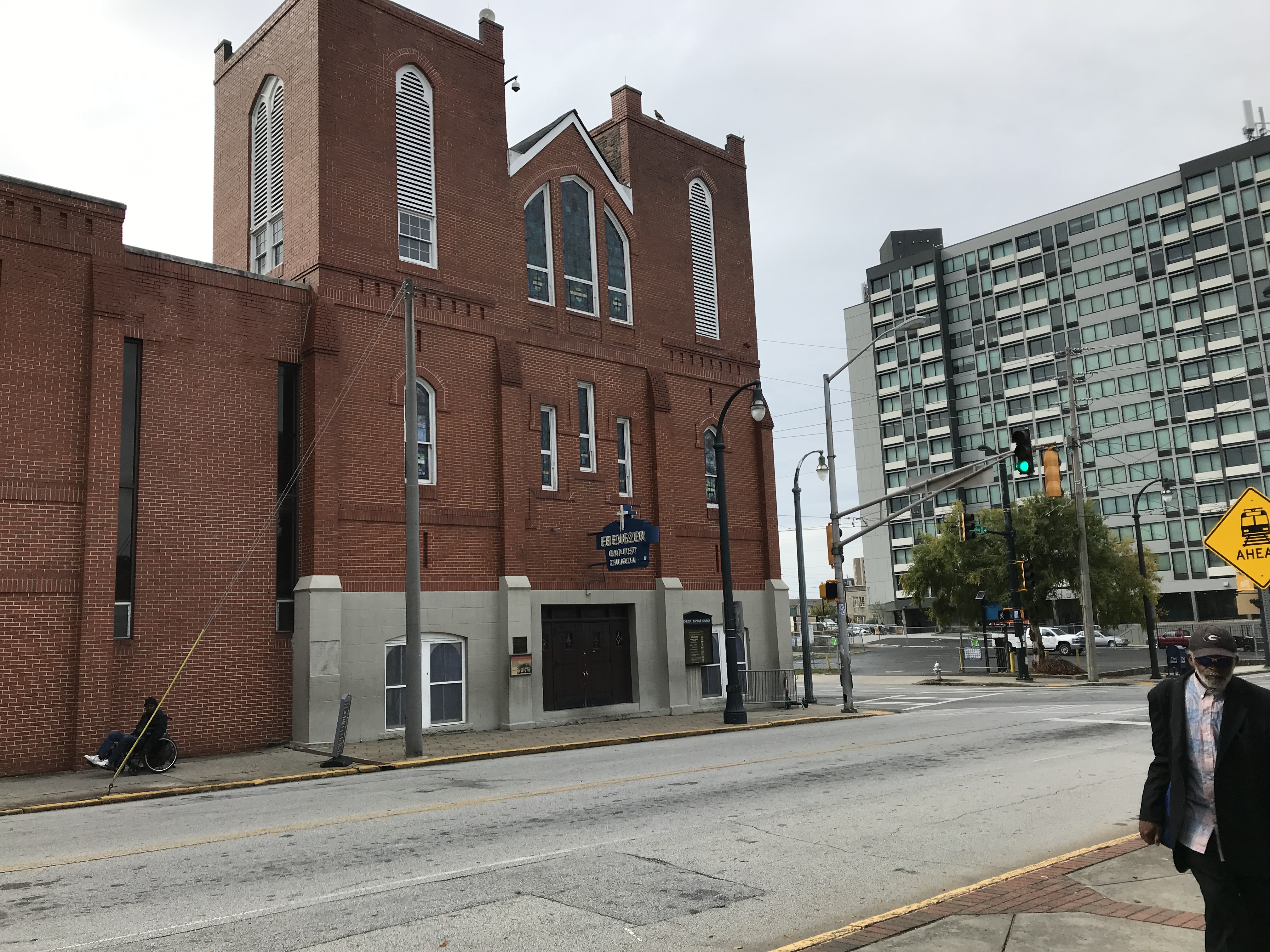
Ebenezer Baptist Church
Martin Luther King Jr. was baptised here, and later was the pastor. (His father was the pastor here too for 40 years.)

Opposite the memorial is a modern Ebenezer Church (King preached at the smaller, older, church, across the road). Outside is a statue of a slave. It’s the sort of sculpture that you want to spend a long time looking at—it speaks very clearly.

However, my thoughts were interrupted by a more audible voice speaking, booming over the road from the memorial. As we approached, I thought perhaps there was a rally in progress, but only a police woman stood there, guarding the monument. The voice came from speakers, and the voice was, I assume, from the past.

There were steps, with ML King quotations etched into them, a long pool of water flowed through the central area, with the tomb of MLK and his wife, Corrie, in the centre. The crypt is made of Georgia marble, and Dr King’s remains were placed there in 1970 (he was shot in 1968). I wonder what he would have thought about it.


To one side is The Eternal Flame—a metal firepit with a plaque explaining that the flame represents the eternal quest for freedom.

Behind the long pool, was an information centre/bookshop.

I was not expecting such a large, sophisticated, monument. I had thought we would happen upon the grave of Martin Luther King in a cemetery, a large stone, perhaps a statue. This memorial was big and flamboyant, certainly costly. If it represents the fight of the people, the hard-won struggle of black people in America to be treated as equals, then I understand. It needs to be significant. But if it is merely a monument to a man, even a great man, then I cannot help but feel that perhaps the money should have been directed towards the living, not the dead.

As we walked away, past the black man (colour matters here) in his wheelchair begging at the corner, past the numerous black men sleeping on the streets, I felt sad. Society has moved to a better place since we thought owning slaves was an okay thing to do. After slavery was abolished, segregation was also a horrible, unfair, system. But whether the changes have improved life for those individuals, whether all races are treated and see themselves as truly equal today is still uncertain in my mind.

We walked back, past the burnt-out house with the boarded-up neighbours, under the smelly fly-over, to our hotel. I was left feeling unsure about what, exactly, I had been to see.

We spent October on a road trip, driving through America.
It was fabulous!
Why not sign up to follow my blog, then you can share it too…
anneethompson.com

I hope your day is interesting too. Thank you for reading.

Take care.

Love, Anne x


Thank you for reading. If you enjoy my travel blogs, you will love my travel book: The Sarcastic Mother’s Holiday Diary. Available from an Amazon near you.

UK Link:


US Link:


The World of Coca Cola, Atlanta, Georgia — A Place of Sugar and Caffeine


Ran to Olympic Park and back to the hotel. We’re in the US, on a road trip, and trying to run every morning, to counter the vast quantities of food we’re eating. Atlanta is very hilly!

Decided to visit World of Coca Cola. Read the reviews. Decided to not visit World of Coca Cola. I wasn’t sure the descriptions of: ‘Basically just one long advert for Coca Cola’ sounded like a morning well spent. Decided instead to try and find the Martin Luther King Memorial on Auburn Avenue.

Auburn Avenue, or Sweet Auburn as it became known, was an area in Atlanta where black people were free to own businesses, use transport, and live normal lives, even before desegregation. We began to wander along the avenue, looking at the historical buildings. Gradually realised that other people in the street were looking at us. We seemed to be the only tourists there, and lots of the people were homeless or had mental issues. Felt uncomfortable. Ahead was a large flyover, and the pathway underneath was dim and full of shadows. We decided that we didn’t really want to continue walking along this road. Went back to hotel.

Decided to visit World of Coca Cola. At least we wouldn’t be mugged.

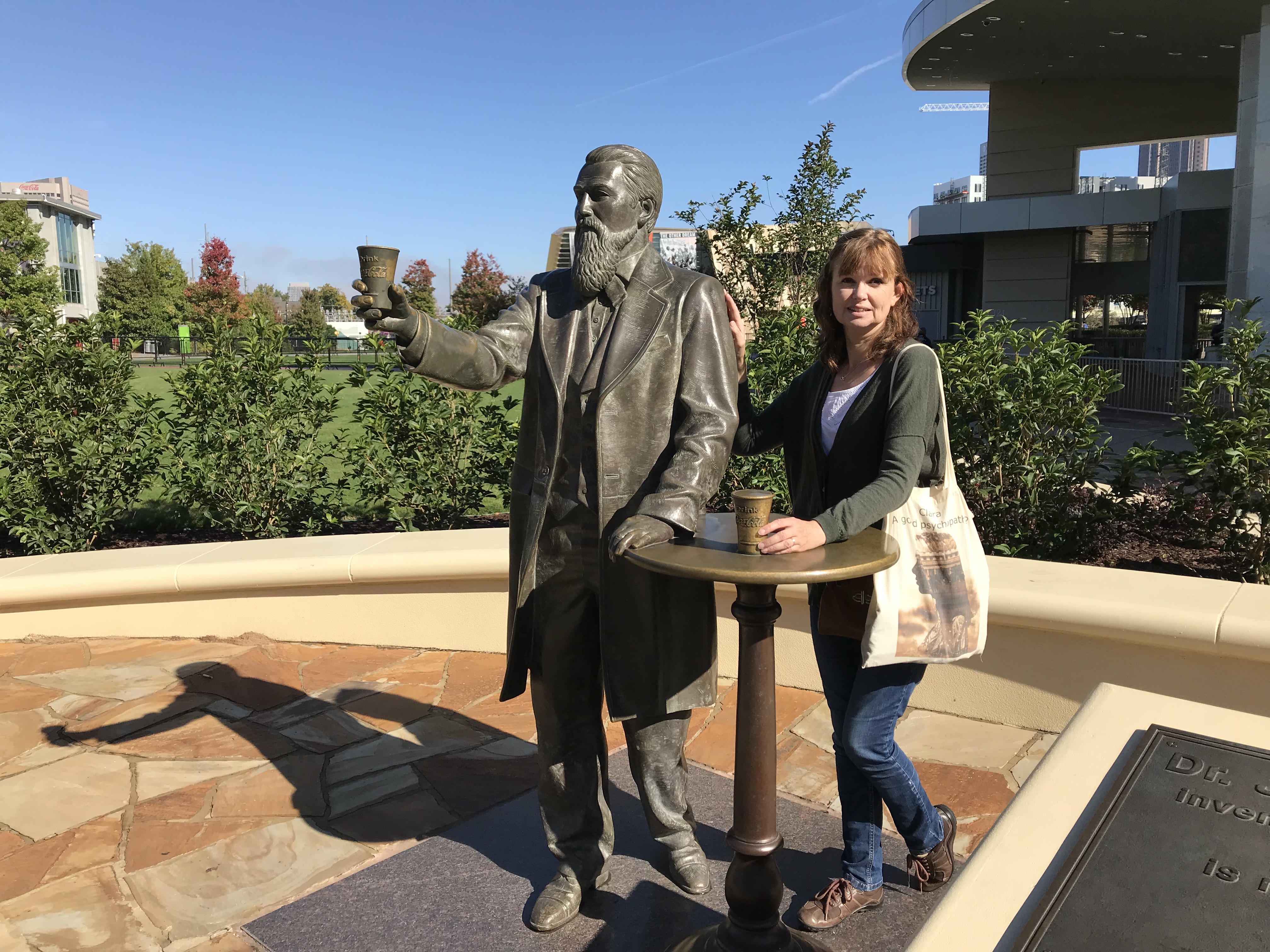
  We were greeted by a large statue of Dr. John Pemberton, who invented Coca Cola way back in 1886. We then paid our $17 each, and went through security. Security more interested in the drinks in our bags than whether we had weapons (though we didn’t have weapons, if you’re wondering). They do not allow any Pepsi products into the building. Our water was, apparently, part of the Pepsi empire, so we had the labels removed.

Directed to a waiting area, and offered complimentary drinks (various flavours of coca cola) but no seat. It’s off-season, and very few people were there, so we did not have to wait as long as some of the people who wrote angry reviews on Google. There was a timer, with big red numbers, and a guide appeared and excitedly counted down the numbers to when the doors would open. She tried, but I’m not sure her heart was in it.

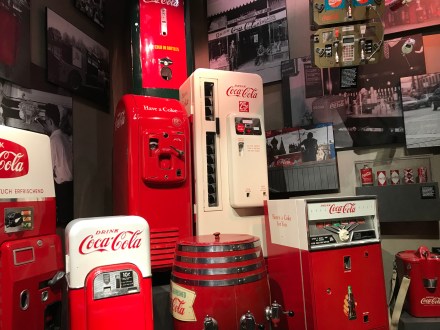
Went into next room. Still no seats. Our guide told us his name was ‘Divine’. He told us his family history, and where he lives. He then asked us, individually, where we lived. I realised that this was another ‘holding room’ and we were waiting for the tour ahead of us to move. To be fair, there was lots of interesting stuff on the walls—mainly old adverts for Coca Cola, but I quite like looking at them, they’re very cheerful. So was our guide, who reminded me of a dodgy TV evangelist. While we waited (though we weren’t ‘waiting’ we were in the first room) we were given a brief history lesson. Coke was invented in 1886. I’m SURE he said that it was first invented as a cough medicine. Husband says I imagined this. Pemberton was a pharmacist though, and his other inventions were medicinal.

  If you know your Coca Cola adverts, you will know that a large polar bear features in many. He was introduced when the company were trying to rebrand the drink as suitable for cold weather (previously it was sold as a refreshing drink for summertime).

While Divine spouted facts, television screens scrolled through adverts from around the world.

After ten minutes, we were allowed to enter the little theatre, and another sing-song evangelist voice introduced a film. We sat (at last!) and stared up at the big screen. The big screen was VERY big. Like one of those massive televisions that people have in a tiny sitting room. Actually, more like a massive telly in a cupboard.

The film showed emotional scenes of families around the world. It was like watching one of those Christmas adverts that make you cry. It ended with everyone drinking coke (no great surprise there). I like Christmas adverts, there are worse things to watch.

   We were then led into a corridor, and told we could visit the different rooms. The staff were all very intense and bubbly and over-enthusiastic. I imagine they are all force-fed copious amounts of Coca Cola every morning when they arrive at work. No one remembered to mention that Coca Cola is so named because it contains extract from the coca plant (where cocaine comes from) and the Kola fruit (which was used in a Spanish drink before the invention of Coke). Coca Cola apparently denies that it still uses extracts from the coca plant, but there is a company, which imports vast quantities of the plant each year, and if you look closely, the company is owned by a subsidiary of Coca Cola. Or so I have been led to believe. But sshhh, don’t tell anyone. . .

One room had signs that lit and faded when you read them—all very Harry Potter. We decided to visit the Headache Room (actually, I believe it was called The Vault of Information but my name is more accurate). Lots of flashing lights, images shine into our eyes, snippets of films jumping on the walls. Managed to not have an epileptic fit, and walked to next room.

The last room was the Tasting Room. Here, we could take one of the plastic cups, and help ourselves to a variety of drinks from around the world (all made by Coca Cola, of course). There were seats, and I was ready for some caffeine, so this was my favourite room. There were lots of hyperactive children helping themselves to sugar and caffeine.

The only exit was through the shop—full of Coca Cola merchandise. How do you manage to tempt people to pay inflated prices for goods that will advertise your brand for you? I wish I knew. Coca Cola have some deeply impressive marketing techniques.

We left, full of caffeine, with slight headaches. The World of Coca Cola would not be my first choice of things to do in Atlanta, but it wasn’t terrible. We did, however, decide that we would have one more attempt to visit the Martin Luther King Memorial. I’ll tell you about it in my next blog.

I hope you have some pleasing drinks today. Thank you for reading.

Take care.

Love, Anne x

We spent October on a road trip, driving through the Eastern States of America. We had a fabulous time!
Why not sign up to follow my blog, then you can share our adventures…
anneethompson.com

Thank you for reading. If you enjoy my travel blogs, you will love my travel book: The Sarcastic Mother’s Holiday Diary. Available from an Amazon near you.

UK Link:


US Link:


NFL Game One (Or, American Football through the eyes of a novice).


NFL Game One (Or, American Football through the eyes of a novice).

In Atlanta, Georgia, USA (this is the first blog from our road trip). Husband very keen to watch an NFL game, so I feign enthusiasm and we buy tickets. Cannot take a bag over a certain size into stadium unless it’s transparent. Spent a few stressful minutes deciding what was essential and stuffing pockets. Decided I would wear my cardi, with many pockets. Might boil.

11am. Left hotel room.

11:20 am. Gradually met more and more people heading towards the stadium. Most were wearing the blue/green/grey of Seattle Seahawk fans. They seemed a jolly crowd. Discussed jay-walking laws at traffic lights with one of them, who assured Husband a ‘quick nip’ across road was usually ignored but depending on the state, might incur a fine. We did a ‘quick nip.’

Dropped into a Starbucks for a pre-match refuelling. Husband offered further tuition on rules/players but I felt I had it covered, and had sufficient knowledge to fully enjoy the experience. (See, “fully enjoy” — I was being optimistic!)

Joined the throngs bound for the stadium. There was a level of excitement in the air, people were laughing, greeting other fans, discussing past games. Was I the only person thinking: hours in sun, potential terror threat, way too noisy, not enough washrooms?

There were more Atlanta Falcon fans now, dressed in red and black. Police were in place, but they were smiling, pointing out directions, part of the carnival. There were no horses, no riot gear, no segregating of different teams. This was a family affair, most people were in couples or family groups. No one was looking for a fight.

Entered stadium. Made it through the ‘no bag’ check with our stuffed pockets.

Then we had the most nerve-wracking part of the day, would our mobile tickets open the barrier? It wasn’t possible to print paper copies, or save them, we just flashed the phone under the scanner — and hoped. All good. We were in. However, when activated, the ticket disappeared. Needed to remember seat numbers.

Climbed stairs and escalators and more stairs. Found seats. No danger of being hit by a stray ball where we were sitting (but low-flying aircraft might be a problem!) It was similar to sitting on the peak of a very high mountain, with no safety gear. Considered tying myself to seat for security. Decided that might look odd. 

Looked down to the pitch. A band arrived, and a giant drum. Screens flashed details about Lock Down Locket and Matt Shabb, and there appeared to be 8 different referees. Cheerleaders skipped in a line of sparkle. A chicken arrived, to play the drum (I cannot explain the chicken, but it seemed significant). Drumming was very rousing, and a line of people ran on, did a short keep-fit routine, ran off. Boys ran on with giant flags. Three players ran on. Just three. Did they get their cue wrong? They sort of stood there, awkwardly throwing a ball back and forth. Bless.

The band, cheerleaders, keep-fitters and the chicken, left. The three players remained. There also were a LOT of people standing round the edges of the field (but it was quite tricky to find your seats).

Giant banners arrived, and the US flags, smoke, noise, lots of cheering and some rather irritating dance music blasted from the tannoys; the cheerleaders formed two lines (some buxom lasses there!) and the players ran between them, onto the field. All very exciting. There were several balls being thrown around, which I felt might cause problems later. The national anthem was sung.

Then, everyone but the players left the pitch (the unseated people still loitered at the edges, hoping no one would notice). The teams took their positions, everyone was very still, the ball was kicked, it rolled to the end. . . and. . . everything stopped again. People cheered, teams rearranged, it started again.

After two minutes, someone got hurt. He lay still, medics arrived, team members knelt down, we all worried. Hurt man got up. Game continued.

After three minutes — three minutes —there was a time-out. Did someone need a rest? I guess all that armour must be heavy. Or maybe he forgot to use the washroom (they are all boys).

After fifteen minutes, I was told we’d had five minutes of play. Obviously don’t include the washroom breaks. I felt afternoon was going to be long, settled down with a pretzel. We paused for a lucky draw based on seat numbers (the helmet shuffle game). Words escape me.

Teams returned. They start from where they finished, the place kept secure by two people with orange posts. 

To explain the rules (briefly, and as I understand them): two teams take it in turns to try and move a ball down the pitch, to the very end. The defensive team has to stop them by grabbing them. The game pauses when the ball touches the ground. They then have another go, from that spot. There are more rules, but I think that’s sufficient. When there’s a foul, the referee throws a yellow flag on the floor, in a sort of angry teacher tantrum, and blows his whistle, whilst keeping his distance. He is probably the smallest person on the field, and he has no armour, just a white cap — I guess he doesn’t want to take any chances. The crowd boos and shouts angry comments. When a team gets near to a touch down (ball nearly reached end of pitch) everyone gets very excited, stirring music blasts from speakers, sparkly cheerleaders have minor epileptic fits, audience leans forward on seats — all very moving.

At quarter time (45 hours into game) the seats at the front of the stadium fill up, as fans move forwards into empty seats. In-between play (there is a lot of in-between) big screens show close-ups of the crowd, who play simple games like ‘the T-shirt throw’ (it is what it says). Kinda fills the time.

Game ended about 4pm. The last five minutes was very long and lots of people left as soon as it was clear the Falcons had lost. We, however, stayed until the very end. There was music, we filed from the stadium, everyone seemed happy. There are worse ways to spend an afternoon.

Thank you for reading

Thank you for reading.
anneethompson.com
Why not sign up to follow my blog?

If you enjoy my travel blogs, you will love my travel book: The Sarcastic Mother’s Holiday Diary. Available from an Amazon near you.

UK Link https://www.amazon.co.uk/Sarcastic-Mothers-Holiday-Diary-ebook/dp/B07N95281F/ref=sr_1_1?keywords=the+sarcastic+mothers+holiday+diary&qid=1572600807&sr=8-1


Road Trip


Road Trip

October was amazing! Well, it was for us anyway, and I hope you had a good month too—though mine was particularly special as we ‘took a month out’ and went on a road trip. Husband is sort of between jobs (though they have overlapped a little) and we had two offspring briefly living at home (lucky them—they had the pleasure of house-sitting and caring for my menagerie!) so I arranged cover for my other responsibilities, and off we went.

We started in New Jersey. The plan was to fly to the US, hire a car, and drive down the east coast, booking hotels as we went. I was pretty sure that super-organised Husband would have every hotel/meal/rest-stop planned before we left, but he didn’t! (Actually, I think that he had planned to, but at the last minute, he needed to go abroad with his job, and so there was simply no time.)

I will share our trip with you over the next few months. As ever with my travel blogs, they are written in real time, while I am there, and posted on my blog later, when we’re home and I have more time to sort the photographs and delete the bits I decide are a bit dodgy. We flew to New York, then drove to New Jersey, Pennsylvania, along the Blue Ridge Parkway, to Nashville Tennessee, across to the Carolinas, down into Florida, and back to Atlanta Georgia. We covered about 3,500 miles, which is as far as if we had driven from London to New York! It was amazing!

If you don’t want to miss any, you can sign up to follow my bog at: anneethompson.com

If you ever plan to do a road trip, especially a long one, then here are my top tips:

  • *Go with someone you like! We spent many hours together, in a car, chatting and laughing and passing comment on what we saw. If I had been with someone less fun or interesting, it would have been dire.
  • *If you’re not great at lots of change, book hotels that are all part of the same chain. We stayed in Marriot Hotels (because Husband has a loyalty card due to copious work trips) and they are all basically the same. We tended to stay in Fairfield Inn, or Springhill Suites, or Residence Inn. We would check in, go to the room, and the layout was usually identical. So, I would put my suitcase in the corner by the air-conditioning unit, put my washbag next to the sink, hide my valuables in the big drawer under the telly, plug my phone into the recharging port on the clock-radio…and so on. Everything had a place, which meant packing and unpacking was very routine. It also meant that when I woke in the night and needed the washroom, I didn’t have that horrid disorientated feeling of not knowing where to head in the dark (nothing worse than peeing in the wardrobe by mistake).
  • *Plan some laundry stops. Some hotels have coin operated washing machines, and this makes a huge difference to a long trip. We needed to take a mix of clothes, as October in the States can have very hot and very cold days. To avoid taking 27 suitcases each, we needed to do some laundry.
  • *Have a smaller bag to hold a couple of day’s worth of clothes. We didn’t want to take all our cases into every hotel if we were only staying for a night, so I used my hand-luggage pull-along for my washbag, and enough clothes for the next couple of days.
  • *Force yourself to do some exercise. We realised that most of the time we would be sitting in a car, or wandering around cities, whilst eating lots of delicious (but unhealthy) food. We decided that every morning, we would go for a run. I use the word ‘run’ loosely, as I run slower than most people walk, but I do get very hot and red and breathless, so I assume it’s good aerobic activity. I find I feel better if my body is working properly. It also means you see snippets of real life happening in the area—people collecting their take-out coffee on the way to work, street cleaners, people opening their shops, other people jogging. (I particularly enjoyed seeing ‘real joggers’—they would lift a hand in greeting as we passed, and it made me feel like a proper runner, rather than a middle-aged woman pretending!)
  • *Take some vitamins and probiotics. You never know what you might be eating on the road, but in the US, lots of it is wonderfully delicious and super-processed. I bought some dried apricots, to keep everything moving! I also took vitamins every day, so it didn’t matter if there wasn’t too much in the way of fresh fruit and veg, and probiotics so my stomach could cope with all the new bacteria it would be facing.

I will start telling you about some of the things we saw tomorrow. I’ll start with Atlanta, which is actually at the end, because that is freshest in my mind and I wrote fewer notes at the time. I hope you enjoy reading about our road trip. It was such fun!

I hope you have a good week. Take care.

Love, Anne x

Thank you for reading. If you enjoy my travel blogs, you will love my travel book: The Sarcastic Mother’s Holiday Diary. Available from an Amazon near you.

UK Link:


US Link:

Buying a Bed


Some advice for Bed Salespeople (and others).

Bea needed a new bed, and so, with our suitcases barely unpacked from holiday, off we set. We went to the large shops spread along the Purley Way near Croydon, because many years ago, whenever we wanted to buy furniture, it was always worth braving the confusing dual-carriageway packed with cars, to visit a range of large, out-of-town stores. However, rather shockingly, the super-busy road, and the overly-full car parks had sort of disappeared. Instead of joining throngs of people, we were sometimes the only customers in the shops, and the car parks were empty. Where were all the shoppers? Has retail in the UK really deteriorated to such an extent so quickly? Or did we simply visit on an unusually quiet Saturday? I don’t know, but it was a little worrying (and I shan’t be buying shares in any retail businesses).

However, what I really want to tell you, is about the range of salespeople that we met (in the nearly empty shops). Some were so much better at selling than others, and I found this to be a good learning experience—so if you ever sell anything (such as books) take note!

We visited one shop and began to wander around, looking at furniture in general. Bea spotted that some of the furniture had chips, or was broken. The furniture was pretty, but the quality was fairly awful (and not particularly cheap). We were never approached by any salespeople, and we left pretty quickly. If you want to make a sale, it’s a good idea to approach potential customers before they leave!

The next shop we went into had a good range of furniture, and we were offered help (which we didn’t, at that stage, want). We tried a few beds, and discovered that beds vary a lot in softness, and some are like sleeping on marzipan and others are so hard, you may as well sleep on the floor and save the money. There were mattresses so thick that they doubled the height of the bed, and others which looked more like a thick duvet. You could buy two slim mattresses, and zip them together to make a double, which would suit the couple when one likes marzipan and the other prefers floor. Bea was very decided on her views of sleigh beds and wooden headboards and cushioned headboards. I found some lovely bunk-beds, reminding me of when she was little, but she was not even slightly interested in those. We then needed some help, and a salesperson came, but she looked cross. I felt that she thought we were wasting her time, and that really the answers to our questions were very simple, and we should have done more homework. I didn’t like her at all. Customers like to be smiled at, even if you think they are annoying! We left.

Another shop had very good quality furniture, and we saw several items that we might like to buy. We were very quickly accosted by a salesperson, who asked if we needed any help. We said no, thank you, we are just looking at the moment. However, salesperson was very persistent. She gave us information about the sale items, which was useful but long (and we are quite good at reading, so would have probably found the information eventually) but at least she was trying. She then asked what we were looking at, and proceeded to show us what was in stock. Which stopped us browsing other items (and we were interested in several things). Salesperson left, and we attempted a conversation about size of rooms and space and design. Salesperson returned, and joined in the conversation (despite not knowing the size of our rooms!) and then took us to see another piece of furniture. It was too difficult to make a decision, we felt rushed, and so—even though there were items we liked—we left. Sometimes customers need a little time and space to think! If they are looking at something (or reading a few paragraphs of a book) leave them alone.

Our final shop also had a range of furniture, and we were again approached by a salesperson soon after entering the shop. However, when we said we were just looking, he moved away, and hovered nearby, pretending to adjust display cushions. When we had a question, he was on hand to answer, and he knew the answer and spoke with authority, so we trusted him. He suggested a few items, and then again left us to discuss them. We liked the products, and he gave us the help we needed so we bought something.

There were a few fun aspects of buying a bed. Like the woman who we saw lying on a bed, with a pull-along suitcase next to her. I wondered if she had moved in, she certainly looked very comfortable. So did the chubby Chinese boy, who was asleep on one bed with his mother telling him to wake up, it was time to leave! There was also a coffee shop, and so we stopped for a quick cake and coffee, which is a lovely thing to do when you’re out with your daughter, and so much more fun than shopping. But we did buy a bed too, so it was a successful trip I feel.

Thank you for reading. I hope you have a successful day too. Take care.
Love, Anne x

Thank you for reading.
anneethompson.com
Why not sign up to follow my blog?

When other people write better than you do…


If you travel to London at the moment, there are several huge billboards advertising The Girl on the Train. The book has morphed into a film, and now a play. Now, I have read the book, and it was very enjoyable, but the writing style is not, in my opinion, very different to my own (Paula Hawkins even has the same errors as me, and tends to write ‘that’ too many times). Other than acknowledging that her book is way more successful than mine, it doesn’t cause me any angst. Nor do the books which are fairly well-known, published commercially, and hugely popular, written in a style which frankly I cannot read, because they are so full of drivel. No, the books which cause me a problem, which make me wonder if I should just give up and make hats or something, are the books which are excellent.

The problem, I think, for an author, is when other people write better than you do.

If you are an author, or writer, or whatever it is that you wish to call yourself, then you cannot help but compare yourself to other people. Let’s be honest, there is a wealth of literature out there, from excellent contemporary fiction, to way back when Jonathan Swift wrote Gulliver’s Travels (now that was a very clever book). And for most of us, if we are honest, our own writing does not compare very well.

Now, when I first began writing, this was something of a problem. I love writing, I always have, but letting other people read what I write was another matter altogether. Writing was private, for fun, not for sharing. The potential for public humiliation is immense—what if other people don’t like your writing? When I read the books I love, from Charlotte Bronté to John le Carré, I am aware that my own offerings are not in the same class. For decades, this meant that my work remained hidden away, never read.

Then, one day, in a moment of madness, I showed one of my books (which was scribbled on the back of Ocado receipts) to my husband. He’s not the sort of husband who gives away compliments freely, and yet, wonder of wonders, he actually liked my writing, and told me that he hadn’t realised that I “could write like that.”

In 2016, I published my first book. This took scary to a whole new level; now complete strangers were going to be reading my work—even worse, people who knew me would read it. I sold some copies, and waited (not quite hiding under the bed, but wanting to). To my amazement and relief, people were nice. I was sent letters from friends, and emails from strangers, who had enjoyed Hidden Faces, asking if there was a sequel.

People read my books, and told me that they: “Read a chapter every night, and so look forward to it that I find I go to bed early just so I can read more,” or “I became so engrossed in Joanna’s actions, she was such a complex character, I didn’t want the story to end,” and, “Reading Clara was like watching a car crash, I knew that I should look away, but I was fascinated, and half of me wanted her to succeed…” I grew braver.

Here’s the thing, I know that my books are still inferior to those by authors that I love to read. I guess it is similar to an artist, who loves to paint, and who creates some very pleasing watercolours, but who knows that their work does not even begin to compare to Van Gogh. They also know that their work is improving and evolving and that other people enjoy it enough to pay for it. Should they stop painting? No, I think they should definitely continue. Do you sometimes feel your own work isn’t good enough? Then improve it—but don’t stop writing!

Personally, I feel that my writing is like orange squash. There is nothing wrong with orange squash, and it’s a lot better than the vinegar that some people produce. In fact, on a hot summer’s day, a long cool drink of orange squash is exactly what you feel like, and is incredibly pleasing. However, it’s not red wine, it cannot pretend to be red wine, and no one is going to think that it is. When I read a certain phrase by John la Carré (my current favourite author) it is like sipping a beautiful red wine, I want to sip it, savour it; I read it several times. I cannot produce that, but that’s okay; there is definitely a place for orange squash, and who knows? Maybe one day, if I keep working hard, I too might produce something of a decent vintage. One day…

Thank you for reading.

The link to my Amazon page is here: Anne’s Amazon page

Work well this week, and take care.
Love, Anne x

As I said, my writing is definitely improving (because people tell me so!) Have you read my latest novel? A heartwarming story, set on a farm, it contains a lot of my family’s humour and some poignant moments. Why not buy a copy today?

Ploughing Through Rainbows by Anne E. Thompson. Available from Amazon.

Is Steve Chalke a Heretic?


Steve Chalke

When I was a teenager, a young trainee pastor at Bible college came to lead a youth weekend at our church. The main thing that I remember is that he talked about sex, and it was one of the few youth weekends I attended that was not boring. His name was Steve Chalke.

Several years later, I heard of Steve Chalke again when he set up a charity, aimed at helping homeless people, which morphed (the charity, not the homeless people) into Oasis Trust. I was therefore interested when recently, during dinner with a friend, they mentioned that Steve Chalke had been ‘thrown out’ of the Evangelical Alliance. Was such a thing even possible? I had (wrongly) assumed that the Evangelical Alliance was a union for anyone who called themselves a Christian, a place to share ideas and resources, and which organised events which might prove helpful to said Christians. I had not realised it was possible to either ‘belong’ or be ‘thrown out’. What, I wondered, had SC done which merited being thrown out of this esteemed organisation? Had he murdered someone, eaten babies, kicked a dog? No! He had, apparently, become a heretic.

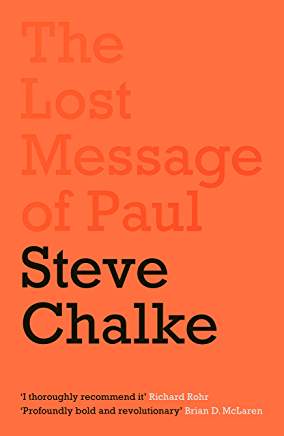
I heard a few whispers about the apparent downfall of SC. I heard that he had turned his back on evangelical Christianity, that he questioned the crucifixion, and even went as far as to call the death of Jesus “child abuse”. I wondered if I was hearing things properly. Searches online were varied, and it was hard to find the truth. I decided to buy his book, The Lost Message of Paul, and decide for myself.

The book is, to be honest, challenging. It begins with an introduction, when SC explains that he is rethinking his faith, and says he is hoping for an informed debate. It seems somewhat ironic to me that the reaction of established Christianity is simply to rebrand Chalke as a heretic and to exclude him from the Evangelical Alliance—but perhaps the debate happened before I was aware of this, and there were other reasons for his exclusion. I again checked online, but he is still the pastor of a church, still working amongst some of the neediest people in our society. I listened to an online interview, and he was still saying that he believes in one God, still believes in the death and resurrection of Jesus, so what is the reason for his exclusion? Maybe he really did eat a baby.

The book gave some insight as to why people find his ideas difficult—I find them difficult myself. The book basically gives good insight into the culture in which the Bible books were first written, and then questions whether we have properly interpreted what the words are saying. My understanding is that SC now questions whether the idea of ‘original sin’ is correct (the idea that when man sinned in the story of Genesis, that sin was then passed down to every person in every generation that followed, hence separating them from God). He makes the point that Genesis is a Jewish book, written in Hebrew, and yet Christians never ask Jews today what their understanding is, we never think about what the words would have meant in Hebrew.

Much of his explanations are very interesting—did you know that in Hebrew, you cannot have a word for an emotion? So, when it talks about God’s anger, it actually talks about God’s nose, because when you’re angry you snort through your nose? But that word could also be translated as passion, or fury, or great sadness?

I felt that SC’s views here (if I was understanding them correctly) were flawed. I never taught any of my children to do wrong, and yet they all did, so my experience suggests that people are born ‘sinful’ and the rest of the Bible seems to support this. If we are all ‘sinful’ then how can we approach God, who has no sin? Surely before we can approach, we need to be washed, there needs to be some kind of repentance? But his argument is persuasive, it cannot easily be dismissed, and gives pause for thought. (Or, of course, you could just chuck him out of your club.)

SC also builds a case for refuting Hell, or that people will be eternally damned. He says that this idea was first introduced by the Renaissance poets and artists (like Dante) and were not based on the Bible at all. SC does think that there will be judgement, but that it will not be an eternal suffering, more of a refining fire that will prepare us for our eternity with God. One example is when Jesus talks about Hell, and the gnashing of teeth, which SC says should never have been translated at all, as the word Jesus used (translated as ‘Hell’) was an actual place, used as a rubbish tip, where wild dogs lived (and gnashed their teeth) and that Jesus is asking, would you rather live with God, or in that place?

There is too much in the book for me to cover everything here, and I found many of the ideas troubling, though also that many fitted with my understanding of God. One of the main points made by SC was that God does not create people for eternal suffering, in other words: Hell, as usually defined, is a human invention and does not exist in the form we imagine. SC says he cannot accept that God, who is defined as Love, could create people knowing that they will eventually be destined for eternal suffering.

SC makes the point that if you asked Paul, or any of the early apostles, how they knew that they were saved, they would look at you blankly, and reply: “Because I am a Jew.” The Jews believed that, simply because they were Jewish, they were chosen, they were ‘saved’. SC argues that when Jesus died and rose again, this grace of God, was automatically extended to non-Jews, in short, that all people were now ‘chosen’ and therefore ‘saved’. He points out that when Paul writes that ‘through one man, all have sinned,’ we have no problem accepting that this means that due to the actions of Adam, who represents the first human, all people now sin. However, when, in the same passage, Paul then says that through the actions of Jesus, all are now saved, we start to add caveats. We say things like, ‘but it only applies if people have faith’ or ‘but people have to believe in the New Testament, and ask God into their lives, otherwise it doesn’t count.’ But that is not what is written. It is written as an equation—Adam sinned, so all sin: Jesus rose, so all are saved. It is, I feel, a compelling argument.

I find that I am left with a lot of questions after reading this book. SC has written a second book, and I will read that and see if it offers some clarity. There are things I disagree with, but some I find it difficult to define quite why I disagree. There are other points which I would like, very much, to be correct, but have not yet decided if it is wishful thinking or true. SC is undoubtedly a talented speaker/persuader, but that does not necessarily mean that he is correct.

Would I recommend this book? Well, that rather depends on who you are. If you don’t feel that you know everything about God, and that there is more to faith than perhaps you have discovered, then you might find this interesting. However, if you think you have faith and God pretty much ‘sorted’, and really you want to read things that backup rather than challenge your views, then perhaps you should avoid this book. SC writes that he hopes his book will start a discussion. My feeling is that it probably will (I for one am bursting to discuss his views with other people!) but unfortunately for SC, I suspect that he will not be part of those discussions. He has stated his views, people will now either agree or disagree with them, but as with most leaders, I expect the only feedback he receives will be negative. It is also quite likely to be voiced by people who have not read his book and have simply heard vague quotes. I do not know whether what SC wrote is correct, but I’m glad he wrote it because I think it’s good to sometimes question what we believe and explore other ideas. None of us knows all there is to know about God, he is beyond our understanding; but we can strive to understand a little more. What do you think?

Thank you for reading.
anneethompson.com
Why not sign up to follow my blog?

Post Script:

Since writing this article, I have learnt more detail concerning the debate with the Evangelical Alliance, and my article is somewhat unfair. If you want to know more, I suggest the following book: Justin Thacker and others, The Atonement Debate (Grand Rapids, MI: Zondervan, 2008) This describes the debate that followed Steve Chalke’s book, and how the EA changed their statement of faith (apparently an unrelated event) which meant Steve Chalke was no longer able to be part of the EA, rather than him being ‘thrown out of the club’ as my article suggests.

If you prefer to read a slightly lighter book, then have a look at my latest novel, Ploughing Through Rainbows.

A feel-good family saga, set on a farm, the story explores how parenthood never ends. It’s a lovely book to relax with, or to buy for a friend. Available as both a Kindle book, or as a paperback, from an Amazon near you. Don’t forget to have a look, UK link below:

UK link here

A hilarious family saga set on a farm. Being a parent has no end-date, as Susan discovers when her adult sons begin to make unexpected choices in life.
A warm-hearted, feel good novel that will make you smile.

Forget Brexit, This is Scary!


I am holding my breath and waiting to see what is going to happen next. . . Husband has retired! Well, to be fair, he has retired from the partnership of his firm (after about 95 years) and is now doing slightly different work. But it does mean that his hours will be less, more like those that most other people work. For the last 95 years, our entire married life, he has been working from about 7am each day until late in the evening, and his phone has been permanently attached to his hand during any time-off, in case the financial world should collapse without him. Well folks, forget Brexit and global warming and anything else that might be giving you nightmares: Husband is no longer holding the fort!

So, you might be asking, what are the implications of this at home? How was the first week of having a not-busy-every-second-of-the-day Husband at home? Let’s put it this way, I know how it would feel to be married to a small tornado.

As you know, my ‘job’ is writing. After sorting the ducks and chickens and cats and dog, I aim to be at my desk by about 9am every day, and start writing. This really does not work too well when within five minutes someone is offering tea, and then five minutes later asking if you need any shopping, and then five minutes later suggesting that the lounge needs repainting. My desk was in a corner of our bedroom. It feels unreasonable to lock a person out of their bedroom. My desk is now in the ‘guestroom’ and if we have any visitors they will have to share our bedroom. It seemed easier.

One thing is for sure, it’s not going to be boring. His extra time began straight after our holiday. By the end of the first evening, before we had even moved the suitcases to the bedroom, let alone unpacked them, he was discussing where we might go next year, and which would be good dates. The family all refused to discuss possible dates, saying that 12 months was too soon to commit. By the end of the second day, he had suggested a few months living in the Italian Alps. The third day he suggested we replace our rather decrepit Fiesta. I then banned him from any more big decisions for 48 hours. The following day he suggested a month in the US. Then spending February in New Zealand. Then adding turrets to the front of the house. (Okay, I made-up the last one, but you get the idea.)

There is of course, a potential book in this situation. I have started making notes. Possible titles are:

Caution: Man Retired
Enjoying Being Retired
Remembering Why You Married Him: The story of a retirement
How to Get Away with Murder
How to Hide a Dead Body
Serving a Life-Sentence: A Wife’s Story

I will let you know which one I decide on.

I hope your day goes well, and you don’t have any unwelcome interruptions. Take care.
Love, Anne x

Thank you for reading.
anneethompson.com
Why not sign up to follow my blog?


Not Quite Catholic. . .


Not Quite Catholic. . .

I have never attended a Catholic Mass, and I was interested to see how it differs from an Anglican service. On Sunday, I persuaded my mother to come with me, and we set off for the 5pm Mass.

The church building was a nice little church, painted white, with no obvious front door to enter, but my mother, who knows these things, took me to a door at the side, and we walked in. There was a foyer, with glass doors into the main church, and we could see a smattering of people (about 8) who were seated, not in the pews, but in a semi-circle around the altar. They looked at us.

Mum gave me a couple of service sheets (I don’t know how she knew which ones we needed, but it turned out she was correct) and we walked, down the aisle, to the front. It was a very long aisle, and I had dressed smartly, in a skirt and boots, and the boots had heels which made a very loud noise on the wooden-floored aisle. We walked, noisily, to the front, while everyone sitting near the altar watched us. I expect my face was red.

There were some empty chairs, and we sat, and looked around. The other people were now looking down, in a prayerful posture, so I copied.

A bell rang, and the priest entered from a side door, dressed in robes, dark-skinned (everyone else was white) and with a friendly face. There was organ music playing, which he controlled from his phone. He faced a statue of Mary, and made the sign of the cross (which interested me, because I’ve always assumed people did that facing the crucifix in the front of the church, but he definitely turned to face the statue). He then leant down and kissed the white cloth on the altar, turned down the music, and the service began.

There was an order of service sheet, but they didn’t seem to follow it entirely, and it was quite difficult to keep up with the liturgy because they spoke very fast. I joined in where I could, but mostly just listened. It all seemed to be almost identical to the words spoken in Anglican churches. At one point, people ‘shared the peace,’ and went around shaking hands and saying: ‘The peace of God be with you.’ We joined in with that. There was a prayer to Mary, but it was very fast, and I couldn’t understand the words enough to hear whether it was something I would want to join in with or not. (I had decided that unless something felt actually ‘wrong’ to me, I would join in. A little like: I don’t think women need to cover their head when praying, but if that is what people in the church believed, I would do it, because covering your head is not ‘wrong’ it is just, in my view, unnecessary. If I want to connect with people, I might need to partake of some rituals that I feel are unnecessary, so that I don’t offend anyone, and so it is easier for them to accept me.)

There was a collection, but I was prepared, and had remembered to put some coins into my bag (how much should one put into the collection in a strange church? I give money regularly as a tithe, so that’s not the issue, the money put into a collection in a strange church is sort of for the other people, to show support—so it has to be more than pennies, but when you’ve already given your main tithe to God, you don’t really want to give notes! I don’t, anyway.) I’m pretty sure that one person didn’t put in anything, and just put a closed hand over the basket and then rattled the money in there to make it look as though they had added something! But I can’t be sure.

There was a short sermon/talk. During this, a young family arrived, and sat in the front pew. I then worried that perhaps only the leadership were sitting around the altar, and they were all wondering why we had joined them! The priest greeted the family, who he clearly knew, and spoke a few words directly to the children.

After the sermon was communion. The priest and another man, did various things—washing fingers in a glass pot of water, drying them on a laced cloth, going to a small locked cabinet and removing other items—and then people filed up, and received communion. Mum had told me that we shouldn’t take communion, as only Catholics are meant to, so we sat and watched. Some people stood with their arms folded across their chest, and they received a blessing rather than the elements, so maybe we could have done that—I don’t know.

I thought we were nearly finished, and although I had lots of questions, we seemed to have survived. . . and then there was another collection! This felt unfair, as if despite our best efforts at integration, we had fallen at the last hurdle. I didn’t have any more money, so we had to just shake our heads when the basket arrived, feeling that out Protestant ineptitude was shining out for all to see.

The service finished, the priest disappeared into the side room in a swirl of robes, and everyone sat down. People started to leave. I had lots of questions, and wanted to make contact with someone, so we sat for a while, trying to look smiley and approachable. No one approached, or looked at us. Perhaps chatting is not a thing in Catholic churches? Baptists are generally very chatty, but perhaps after Mass people leave in reverent silence? Or perhaps we had done something wrong, and they were politely declining to tell us—should we have done the making a sign of the cross thing to the statue of Mary, and was it offensive that we hadn’t? I don’t know, because no one was available to ask. We left, my heels clonking back up the aisle.

As a first experience, it probably left me with more questions than answers. I think I might try to email the priest before I go next time, just to check that nothing I do, or don’t do, is tactless. And I will definitely wear quieter shoes.

Thanks for reading. Have a good day, and take care.

Love, Anne x

Thank you for reading.
anneethompson.com
Why not sign up to follow my blog?