I gave blood today. It was, as expected, an utterly ghastly experience. It was also, unexpectedly, a humbling experience—and afterwards I felt very glad that I had done it.


I should start by admitting that (unlike most other donors) I was there for purely selfish motives. As I told you about a year ago, I was diagnosed with haemochromatosis, which means my body builds up iron stores. Too much iron causes fatigue, and eats your ligaments, and eventually gives you liver cancer—so catching the condition early is a very good idea. I had never heard of it before being tipped off by a relative (it’s genetic, so runs in families) but I have since realised that it’s fairly common.

Anyway, a year ago I was referred to a haematologist, who is very nice and very disorganised, and who basically does nothing and is impossible to communicate with—which is stressful. I therefore decided that I would take action myself, and sign up to be a blood donor. That way I could get some of the iron removed. I knew from a recent blood test what my iron levels were, and it’s not difficult maths to work out ratios, and how much iron will be removed per pint of blood (the iron will be less each time—so actually the maths is quite difficult, but luckily I married a mathematician). I’m all for being proactive with health issues—we are responsible for our own health.

To be a donor is relatively easy. You can complete an online form, and depending on your answers, they then phone you for more details before saying whether or not you are suitable. If you pass the first stage, you make an appointment at a nearby donation centre.

I arrived in good time for my appointment. They had advised me to drink lots, so I arrived absolutely bursting for the washroom! After using the Ladies, I was given a form to complete, and a booklet explaining the possible side effects, and a large drink of water. Several other people had arrived, and I was interested to see that many used the washroom (had obviously followed the same instructions as me) and most people sipped the water while reading the form (I had downed mine in one—which is how I drink water, though not alcohol).

I was then called into a little makeshift booth (the centre was in the local United Reformed Church) and my question sheet was scrutinised, and more questions were asked, and some of my answers caused the nurse to phone the blood centre, to check I was allowed to donate. I found this scrutiny unexpected, but realised that it is excellent. The blood bank is very careful to ensure that all the blood is suitable—not contaminated with diseases or medicines. (I was very pleased that I hadn’t taken a couple of Nurofen that morning when I woke with a slight headache, or I may have been sent home.)

The nurse then explained she needed a small sample to check, took my hand, and stabbed my finger. This was shocking! I had known that they would put a needle in my arm, and was ready for that, but the finger damage felt worse somehow. But I didn’t scream or snatch away my hand, I managed to sit still like a grown-up, as if people shoved sharp things into my fingers every day and this was no big deal. My blood passed the test, I was accepted as donor. Yaay!

I was then (after another trip to the washroom—very full bladder!) shown to a seat that reclined, like a dentist’s chair (but without the drill). The church hall had about 10 chairs, all with donors tipped backwards, their feet wiggling. I was given a leaflet that suggested certain exercises I should do while giving blood—squeezing my fingers and relaxing them, clenching my leg muscles, moving my feet—I joined the feet wigglers. My nurse started to explain what he was doing, but I said I’d rather not know, and tried to read my book. I won’t put you off your breakfast with the details, but he did what was necessary for me to donate (and it was not fun). I tried to look away, but the room was full of people, wiggling their toes and not-watching their own arms, so it was best to look at my book so I didn’t watch someone else by mistake.

As I lay there, trying to read, and staring up at the ceiling, and not thinking about what was happening, I was suddenly aware that someone would probably receive my blood at some point. Someone who would be suffering way more than I was, someone who might die without it. And I felt very humble, because here was I, shocked by a finger prick, and yet someone in crisis would maybe have their life extended by the blood I didn’t need. So I prayed for them, whoever they are, that my blood would be useful, and that God would use it to bless someone in a time of great need. And then I became aware of all the other people in the room—the other donors who were probably not there for selfish reasons like me, but were undergoing this rather ghastly procedure just because they are good people who want to help. And the staff, who were diligent, and caring, and were working as a team to collect blood to save lives. I was probably the least-good person in the room, and it was humbling.

Then, quicker than I had imagined, it was over. (I only read 4 pages of my book.) An alarm pinged, and they removed whatever was in my arm (I never looked, so never saw it). Then a nurse sat me up, and my head felt woozy so she lay me down again. (Actually, she tipped my right back so my head was very low and I thought I might slide right off the back of the chair which would have been very embarrassing! But I didn’t, and it stopped the light-headed feeling instantly.) I was sat up very slowly, and given a drink of water and a packet of crisps. (My brother gets a cup of tea and a biscuit, so I felt slightly cheated.)

When I had sat for a few minutes (which felt like a very long time) I was able to leave. I felt fine, very happy that I had been able to donate, and very pleased that I had not fainted (which was a distinct possibility).

When I got home (Husband drove, which was kind of him and probably safest for the world) I had the best cup of tea ever, and some chocolate brownie. It was done. I didn’t feel tired, or drained, or any of the other things that I had worried about (probably due to downing all those pints of water). If you have never donated blood, maybe you should think about it. If I can do it (even for selfish reasons) then really, anyone can. It’s a good thing to do.

I hope you meet some good people today too. Thanks for reading.
Take care.
Love, Anne x

Meg’s Diary — After Christmas


Camber Sands

After we had done Christmas with the family who were going elsewhere for the 25th, and then Christmas on the 25th, and then tea with the extended family on the 26th, I was ready for a break. We booked a small house with a garden for three nights, and drove down to Camber.

The house was perfect for dogs, with hard floors throughout, and a kitchen big enough for her crate, a gate into the back garden which was fully fenced and accessed from the kitchen. We dumped our bags, set up Meg’s crate, and then took her to the beach.

Meg confined to her mat. (Works for about 3 minutes.)

Camber Sands is a marvellous beach. It is divided from the Rye beach by a deep wide river that the fishing boats use, and from there, you can walk for miles, all the way to Dungeness. When the tide goes out, there are acres of flat hard sand—popular with dogs and families and horses. Towards Dungeness there are wind-surfers and athletic people (mostly men) riding dangerous wind-powered vehicles and flying into the air attached to giant sails and all sorts of crafts on the water. But down nearer to Rye, it’s safe to walk, and we love it.

To reach the beach, we needed to walk along a road for a few hundred yards, and it was such hard work with Meg. Beaches are often devoid of sticks, and Meg is easiest to control if I am carrying a stick—so I took a supply. Whether it was because I was carrying sticks, or whether it was residue excitement/bad behaviour following the Christmas upheaval, I don’t know, but Meg was terrible! It is the worst she has been near a road for months, and very disappointing. The road is a fast one, and every car that sped past us, Meg barked and tried to chase. I tried to calm her, to stop and make her focus on me, or the sticks, or a food treat—nothing worked. Meg had clicked into ‘wild dog’ and she pulled like a husky and was much too strong for me.

We managed to get to the sand dunes, and I suggested Meg might improve if let free. As soon as she was off the lead, she changed. Now her full focus was the sticks, and as long as I threw one occasionally, she stayed close and watched me closely. I don’t know if this would work when there are cars, but I don’t trust her enough to have her free near a road and I’m not strong enough to tie a lead to my waist. We might both end up under a car.

While Meg was free, she was great. The beach was as brilliant as ever, cold and windy and wild, full of happy dogs and windswept owners. We walked for a while, enjoying the openness of the place, the expanse of sea and sky and air. Meg walked with us, running off to chase seagulls, returning when I called, ignoring all the other dogs. At one point some horses arrived to gallop along the hard sand, and I knew that as long as I kept Meg’s focus on the sticks, she would ignore them. For a while we walked with the wonderful sound of horses hooves pounding the sand next to us, while Meg collected sticks and sniffed seaweed and tested the water for saltiness. This is happiness. There is something about a dog running across a beach that is infectiously joyful.

Other dogs and horses, but Meg ignored them all. All she wanted was a stick!

The rest of the stay was lovely, we did very little, and Meg was mostly contented to sit with a chew while we read or watched telly, and in return we gave her a long windy walk along the beach every day. She continued to be terrible near the road. I even tried to take her for a ‘training walk’ one morning—not planning to go anywhere but just to practice walking properly on the lead, like I did when she was younger. Every time she pulled, I stopped. When she looked at me, and came to my side, we continued walking. After 10 minutes we still hadn’t left the driveway! When I saw a car approaching, I quickly turned her, made her sit, tried to make her focus on me/a treat. Meg sat, heard the car, spun around, lurched towards the car, leapt at it when it passed, tried to pull me after it to chase it down the road. Not a success in terms of training. I gave up at that point and went back inside. For the rest of our stay, Husband had to hold the lead when we walked to the beach and we tried to get over the road as fast as possible. Like I said, Meg was great when on the beach, even if she’s a devil near a road.

The house survived, and there was a vacuum cleaner to clear up the bucket loads of sand that Meg carries in her coat. The sprinkling of sand in every room she went into was constant, even hours after returning from the beach, when completely dry and having been brushed in the garden—always there was sand in her coat. The garden was a big help, though a previous dog had chewed a chunk of the wooden decking (I am assuming it was a dog) and Meg noticed it on the second day. Although she never chewed it, I could see her thinking about it, so we could never leave her unattended in the garden after that, which was a shame. She also developed bit of a tummy upset—I’m guessing down to eating sand and trying to drink salty water. She was very good about telling me when she needed to go outside, so there were never any accidents, but it made clearing up after her in the garden a ghastly job. Taking Meg on holiday is only relaxing up to a point. (But in this case, the pleasure of watching her run on the beach was worth the pain.)

I hope you have some joy this week, and in the year to come. Thanks for reading.
Take care.
Love, Anne x

Meg’s Diary, Christmas 2024


Christmas 2024 (15 months old)

Watching telly in a rare calm moment.

Christmas was super-exciting, with a tree in the lounge and decorations which were not for chewing, and lots of visitors which were not for bouncing, and a complete abandonment of schedule which had to be coped with. All this was way too exciting for Meg, and she returned to the slightly-hyper, never listening mad dog of previous months. It was a shame, because I had just started to feel that Meg was exactly the dog I had hoped for, and her behaviour combined with Christmas chaos made me feel like one of us needed to be booked into the nearest mental institution!

However, to be fair, Meg did not destroy the tree or decorations. Nor did she steal any of the food that was left around the house. (Food is not her thing really, it’s no good as a reward for good behaviour, but it also means that she has never stolen food.) She was overly excited by all the guests, but it was a friendly, ‘perhaps I could leap on you to greet you’, sort of excitement—there was no fear or aggression in it. Due to the age (and therefore fragility) of some guests, Meg did have to spend longer than normal locked in her crate. She mostly coped with this very well—though I do wonder if it added to the general hyper-excitement when she was free. The main disappointment for me was that she pretty much stopped listening. When we were relaxing watching telly, if Meg started to wander around and I told her to sit, or to take her chew to her mat, she completely ignored me. This was a shame, especially as it meant that when I was really tired and wanted to stop, I had to put Meg back in her crate because I couldn’t rest while she was free.

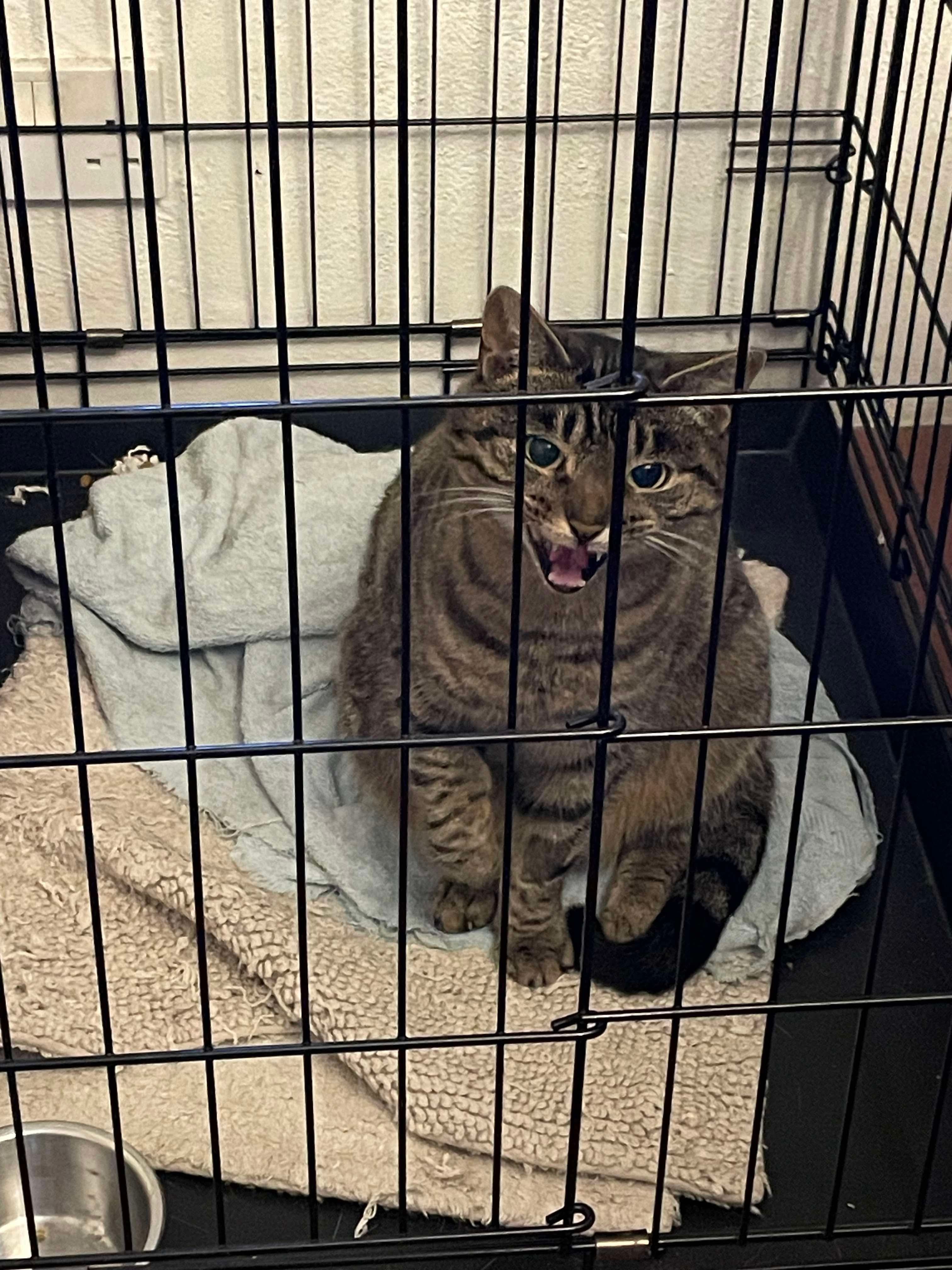
The cat-with-snapped-ligament is still locked in her crate (she will be for a while). Both Meg and Milly are behaving badly when together, as even if I am with Meg and ensuring she is calm, the cat will hiss at her and try to scratch her through the bars, which then quickly becomes a general shouting/bouncing match. Over the Christmas period there were times when I needed to use the utility room while Meg’s paws dried (and Milly had been moved in there as we needed to use the dining room and the smell of a cat litter tray is not a good accompaniment to a meal!) If Meg was in there after a walk—when she tends to be sleepy—then after an initial bounce/bark/hiss there was peace. This is good. Whilst they are not friends, or to be trusted for long together, there was certainly some kind of truce. It is a start.

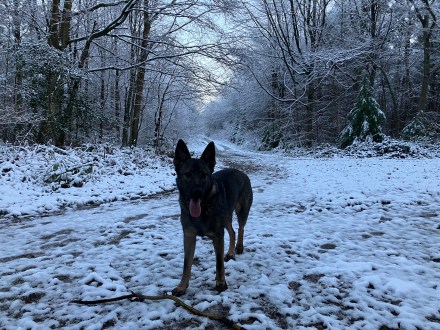
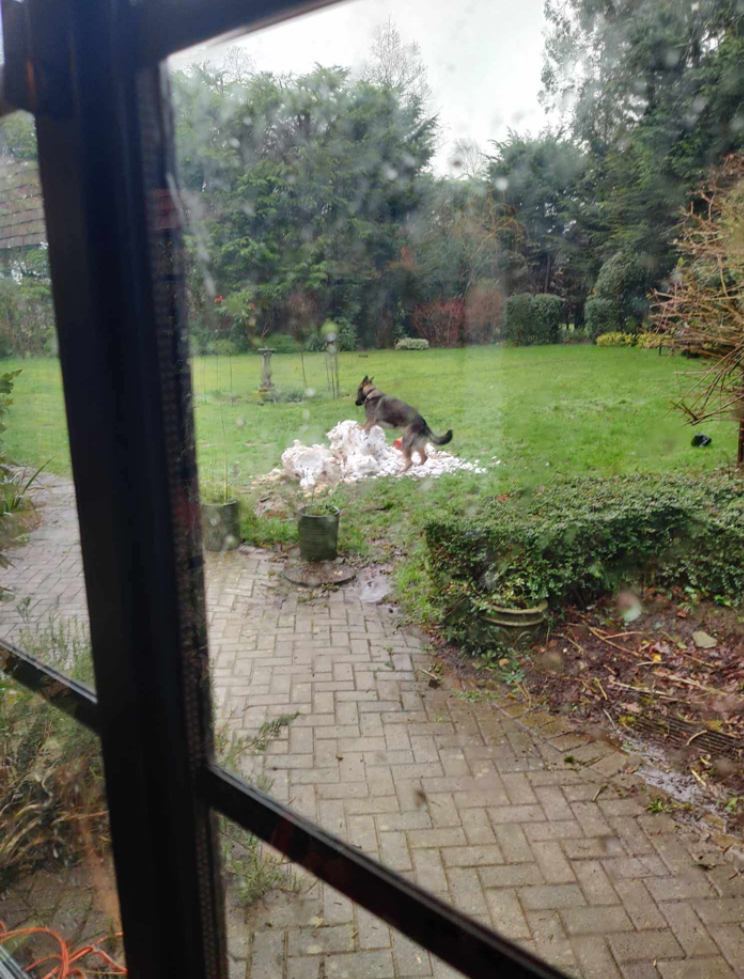
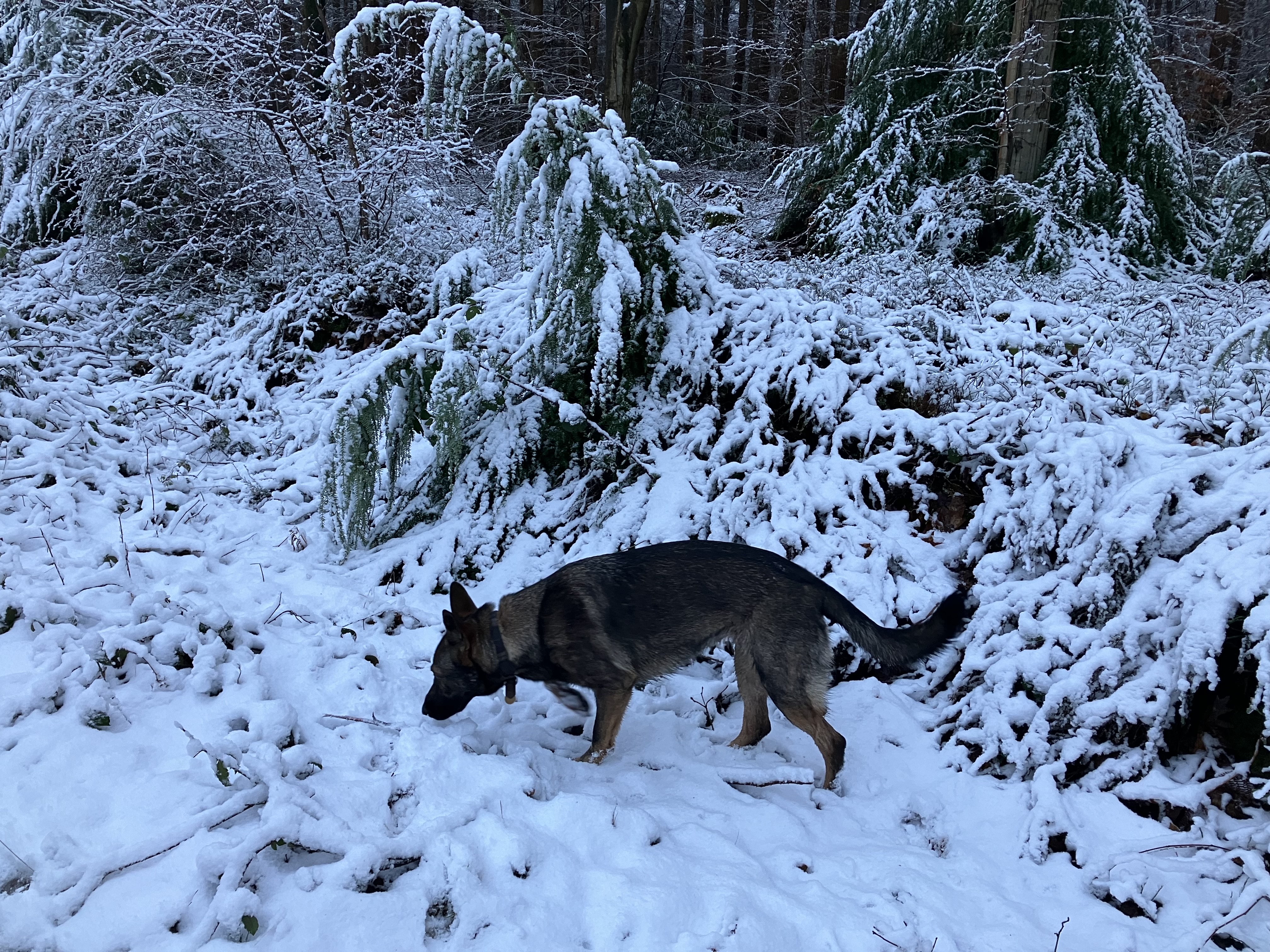
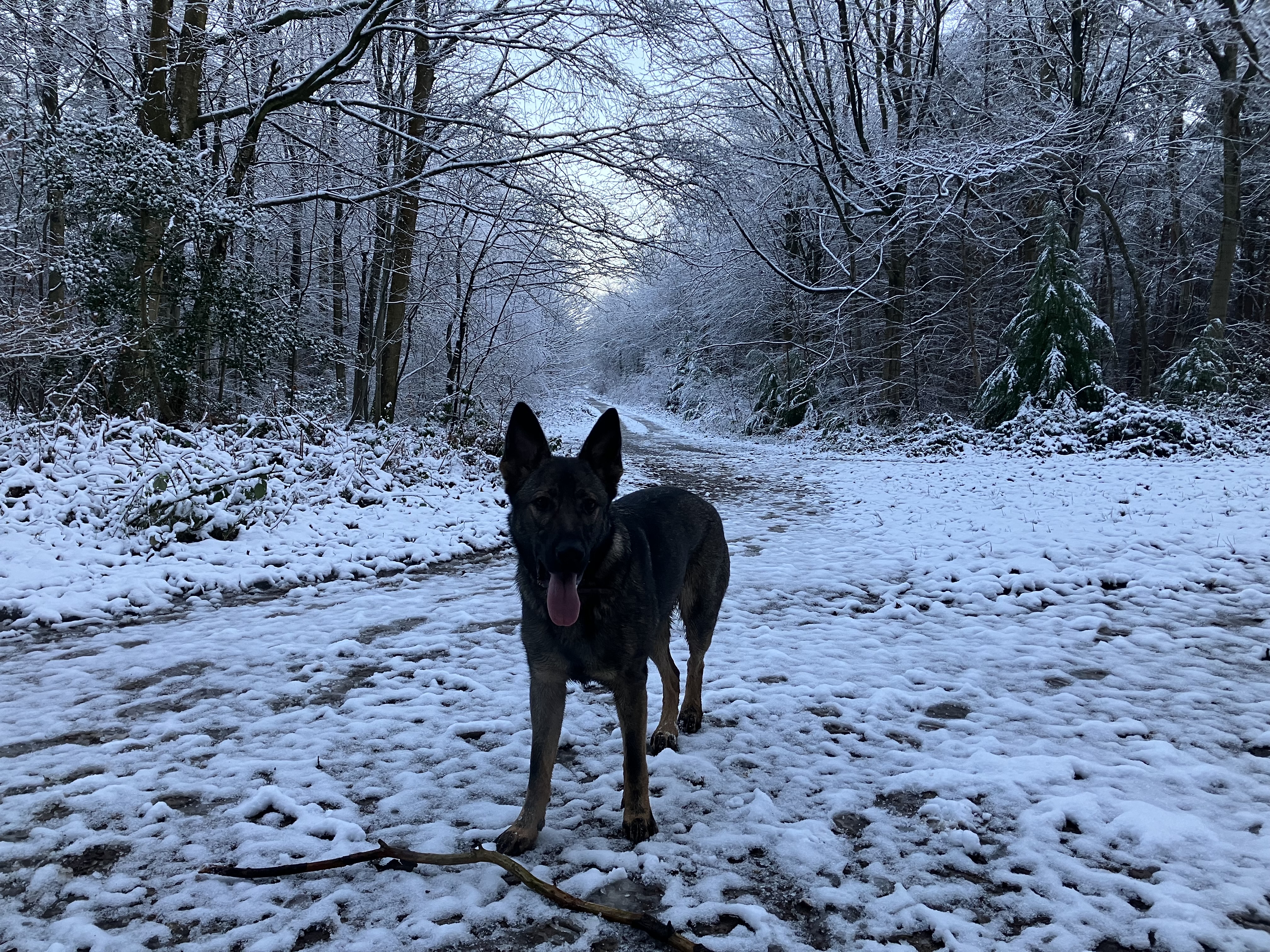
I usually walk Meg in the woods, which is a popular place for dog-walkers (and the occasional horse rider) so it’s a good place for Meg to socialise. By ‘socialise’ I mean ‘learn to ignore other animals,’ not ‘go and play with them.’ I learnt this at puppy classes—I need to teach Meg that not everything is her business, and rushing up to an unknown dog is not acceptable behaviour. When there are sticks (and the woods has a steady supply) then Meg is now excellent at this. We can pass other dogs and their owners, and Meg walks with me, fully focussed on the stick in my hand, ignoring the dog/horse/deer that is passing. However, other owners clearly never attended such good puppy classes (or the dogs are less easy to train—though that seems unlikely in Meg’s case!) Fairly frequently, another dog will run up to Meg and some of them are aggressive. I have grown fearful of small dogs (it always seems to be the little dogs that snarl and show their teeth) and especially Spaniels. We have had some very bad interactions with Spaniels. Just before Christmas, we were walking through the woods which were beautiful with morning mist, and a black Spaniel came towards us. It looked young, and was darting through the trees, and I wondered, as we approached, whether she would play with Meg. I was throwing sticks, Meg was leaping over fallen trunks and into craters to retrieve them. Suddenly, without warning, the black Spaniel changed direction and chased after Meg. At first I thought it was joining in our stick-chasing game, but no, it trapped Meg next to a bush, growled and snarled and showed its teeth. The owner yelled at it, but there was no response. I called Meg, who managed to get past the Spaniel and run to me, and we began to walk away. At first the Spaniel followed, and I wondered whether I would be bitten (and to be honest, I measured the distance I would need to give it a big kick if it started to leap at me) but then it stopped, and returned to its yelling owner. I have no idea whether this was an unusual occurrence for this particular dog, but I am suspicious that some owners ought to put their dog on a lead if they are near other dogs but they choose not to. Which is a shame for everyone.

Meg in the car, with the sticks she keeps for emergencies!

Thanks for reading. I hope your Christmas was good, and exciting but not hyper!
Have a good week. Take care.
Love, Anne x

I’m Sorry. I was wrong.


I’m sorry, I was wrong.

When I was very young, my knowledge of other religions was limited to two facts:

  1. Catholics believed in Jesus, but they didn’t believe he rose from the dead, which is why they always depicted him still hanging on the cross.
  2. Jews believed that the only way to be right with God was to offer sacrifices, and the idea of repentance started with Jesus.

I was wrong, in both cases. To my regret, although I learnt fairly quickly that I was wrong about Catholics, I continued to believe—and to teach—the wrong fact about Jews even as an adult. I’m very sorry about this, it was ignorant, and as someone who read the Bible, including the Old Testament, I really have no excuse.

I was reminded of this recently, when reading a little red book of daily Bible studies,[1] that I inherited from my father. The book is looking at the Gospel of Matthew, and is considering John the Baptist. You may remember that John lived in the wilderness, and wore strange clothes, and called to people to repent. As John the Baptist came before Jesus, this should have been evidence enough that Jews believed in repentance—without sacrifice—otherwise John’s preaching would have made no sense.

Barclay discusses what those early Jews would have understood by repentance. It’s much the same as the Christian church today preaches. The word in Hebrew means ‘turn’ or change direction/return, so the idea was that people felt sorry for a behaviour, and therefore wanted to change direction, to turn away from what they knew was wrong. This has always been the way that people have been able to approach God—first we admit the things we are doing wrong, and then we turn away and stop those behaviours. All very New Testament, except actually it started way back, in the Hebrew Canon.

There are several instances when the Hebrews were told to repent, so that God would heal their land, or hear their prayers, or be close to them. We read about it in Ezekiel (Ezekiel 33:11). It also appears in Jeremiah (Jeremiah 31:18-19). Hosea is full of it (Hosea 14:1-2). The book of Jonah is pretty much only about repentance—a wicked nation being told to repent so they won’t be destroyed.

Repentance does of course, thread its way through the New Testament teaching too. It is important. I think it is also timeless—but maybe not something we teach about today as often as we ought. When was the last time you repented of something? Not in the regretful, I wish I hadn’t done that because it caused me a problem, kind of way, but in the, I’m honestly sorry and I will say I was wrong and try not to do it again, sort of way. Repentance, I feel, has gone out of fashion. Instead of saying we were wrong, we give a reason as to why it wasn’t our fault. Or we belittle it, and say it didn’t really matter.

Unless, of course, we are thinking about other people’s wrong-doing. Then we are very keen that they should be sorry. Then we absolutely think they should change their behaviour.

I think repentance is important. I believe it is good for us. I think it is healthy, every night, to think about what we have done wrong during the day, and to admit we were wrong, and to ask God to forgive us—and to try to change. If we never do this, never stop and deliberately think about what we have done wrong, how can we change? How can we be better people? How can we know God in any meaningful way?

I wonder if this is also true of nations. When I look at the big disputes in the world—Israel/Palestine, England/Ireland, India/Pakistan—there seems to be no solution. But everyone is looking at the wrongs (and there have undoubtedly been wrongs) committed by the other side. I wonder what would happen if nations looked at their own wrong-doings? What would happen if governments admitted they had been wrong, and promised to change? But perhaps that is not possible, perhaps the hurts go too deep, perhaps there is not enough trust that the admittance of guilt wouldn’t be misused and twisted by the other party.

Therefore, I will leave the dream of national repentance to one side, and challenge you, today, to think about what it means at a personal level. There is risk with being honest with ourselves—but not, I think, as much risk as being continually dishonest. So go on, I challenge you. Spend some time today thinking about what you have done wrong (because I don’t know anyone who genuinely believes they are perfect). Name those faults before God—and plan to turn in a new direction. It’s what Jews and Christians have been teaching for centuries, maybe it’s time we all did it.

Thanks for reading. Have a good week.
Love, Anne x

anneethompson.com
******


[1] William Barclay, The Daily Study Bible: Gospel of Matthew (Edinburgh: The Saint Andrew Press, 1956).

Continuing the story


After eight days, Joseph came and circumcised the baby. How he wailed! It felt cruel, though I knew it was the right thing to do, even in this strange place we must obey the Jewish laws. We also formally gave him the name Yeshua, the name we had been told to give him by the angel all those months ago.

I wondered if Joseph minded, people would know it wasn’t a family name. I also had no one called Yeshua in my own family, though I did know a boy from my childhood with the name.

***

After forty days, we had to travel to Jerusalem, to pay for redemption at the temple. As Joseph was from the tribe of Judah, we had to pay five shekels of silver. We couldn’t afford a lamb, so bought two pigeons to sacrifice.

It was nice to leave Bethlehem and to have some exercise at last, to see people and to take my baby into the world. I felt quite excited as I approached the temple, our holy place. I didn’t recognise anyone, but everyone could see we had a new baby and lots of the women came over to see him. I felt so happy!

We walked through the Beautiful Gate and up to the Gate of Nicanor.

It was then that something strange happened. As Joseph and I walked through the temple, a man approached us. He came to look at Yeshua and indicated that he wanted to hold him. That was a little unusual but there was something about him, something that made you sure he was a good man, someone you could trust.

When he looked at the baby, the old man got all emotional and prayed, thanking God and saying that now he could die in peace. He blessed me and Joseph too and then he leant towards me and said something which was very strange.

He said Yeshua would cause “the fall and rising of many in Israel” and would be “a sign that would be opposed so that the thoughts of many hearts may be revealed.”

What does that mean? I know that he is God’s own son and that he is part of the plan to establish God’s reign on earth. Will he be opposed? Surely everyone will accept God’s anointed one, we have waited so long for him.

But then he said something that made me afraid; this old man with his determined face and bright eyes. His face was very near, I could smell his breath.

He said that a sword would pierce my soul.

Something inside contracted, all the joy of entering the temple evaporated into a lump of fear. Fear and anger. I practically snatched Yeshua away from him. I want my son to grow strong and be happy, will I suffer for this? I will do everything in my power to protect him; he is mine.

I knew I was tired, not getting enough sleep and it was hard to care for a new baby in a strange place without my mother to help me. I felt that I did not want to hear the man’s words, even if they were true. I was coping with enough, and I felt that although I had been brave, I couldn’t be brave any more.

Thankfully the man left us and almost at once an old lady approached. She was ancient, her white hair showed under her mitpahath and she leant heavily on a stick. What I noticed most were her eyes. They almost sparkled! You could tell at once that she was a holy woman and also one who loved to laugh.

As soon as she saw Yeshua, the elderly woman started to pray loudly, thanking God and telling people nearby that if they wanted Jerusalem to be redeemed, they should look to the baby. I was glad that no Romans were allowed in the temple; we would have been in trouble.

We finished making the offerings and then went back to Bethlehem. I didn’t know whether to tell Joseph what the old man had told me. I kept thinking about his words, worrying about what they might mean. I was so tired, I decided I would wait and maybe tell him later.

***

The months passed and we settled into life in Bethlehem. We moved into a little house and Joseph found work on the many building projects that the Romans have introduced.

Yeshua continued to thrive. He grew into a sturdy toddler and would walk around the room holding onto the stools and baskets. I loved to feel his solid weight when I carried him on my hip, the light touch of his chubby fingers when he reached up to touch my face. There was pure joy in the gurgle of his giggles. He started to sleep much better at night and Joseph and I were thinking about having another child. But then everything changed.

It was one evening, still quite early but we had filled the lamp with olive oil and lit the linen wick. Joseph put it on a bushel basket, so the room was well lit and we could talk about the day. Suddenly, there was a banging at the door.

Joseph went at once and there, in the road, was a group of Persian travellers. They had dismounted from their horses and were peering intently into the house. They told Joseph they had seen a star and had come to worship the king. I was so glad I hadn’t gone to bed yet!

We let them into the house and I went to get Yeshua. He was damp from sleep and his tired eyes looked blearily around him. I wondered if he would cry but he seemed fascinated by our strange visitors. They wore their hair in long curls and one had a band of gold on his head. It glinted in the lamp light and I could see Yeshua watching it intently. Their clothes were patterned with birds and flowers.

We offered them wine; it was clear they were tired from their journey. I was embarrassed that we only had two stools to offer them, but they didn’t seem to mind and in fact insisted that I should sit on one with Yeshua and they were happy to sit on the rush mat. They didn’t really sit anyway, they wanted to kneel before Yeshua.

Then they gave him gifts. They were beautiful to look at. They gave him gold, signifying that he is a king. They gave him frankincense. The strong aroma filled the house and I wondered if Yeshua was to be a priest, even though he is not descended from Levi. They also gave him myrrh. Myrrh is costly but is for embalming a body. It was a strange gift for a baby and I wondered what it meant.

They told us their story before they left. In their Persian home, they were magi, watching the stars and foretelling the future. Many months ago, at the time of Yeshua’s birth, they had seen a special star which they knew meant a powerful new king had been born and they determined they would find him and worship him. Unfortunately, following the star caused them to go to Jerusalem first (I always knew that star gazing was a misleading activity). They went to Herod’s palace and asked where the new king was. This was scary; Herod had shown he was not a king to be trusted and his cruelty was well known. I would not have wanted to visit his palace.

However, it sounded as though he had decided to be helpful. Herod asked the scribes to research the early scriptures and they discovered that the promised king was to be born in Bethlehem. The king told the Easterners, asking them to find the king and then return and tell him the exact location, so that he too could worship.

I wondered what would happen next. Would Herod himself come to visit my precious baby or would we be summoned to the palace? This was not a comfortable thought.

I also wondered: why had the palace scribes not come to visit us? Why didn’t they travel with the Easterners to see the baby? Did they not believe the scriptures that they studied so diligently? Surely, if they were truly expecting a redeemer they would also have come? I frowned, feeling uneasy. There was something that I didn’t understand, and it nagged at me.

The men left. They planned to sleep in an inn and return to Jerusalem the next day. We could not offer them lodging in our tiny house and they seemed content to leave now they had seen Yeshua.

I returned Yeshua to bed and soon afterwards Joseph and I also went to sleep.

I had not been asleep for long when Joseph woke me. He shook me awake, then went to light the lamp. I could see his face was tense and instantly turned to check Yeshua was well. He was sleeping soundly.

Joseph told me I needed to get up—at once—we needed to leave. He said that he had had a dream, like the dream when the angel told him that the baby inside me was God’s son. It was so intense, so real, that he could not ignore it. Joseph said he had been told we must leave Bethlehem, leave Israel; Yeshua is in danger, Herod plans to kill him.

For a moment I paused, wondering why I too had not been warned. But then understanding flooded through me, as I realised—God had told Joseph to take care of me and Yeshua—that was a hard task for a man, to care for a son that was not his own. So now, God was telling Joseph alone what we needed to do, underlining his role, establishing him as head of our family. It was a kind act, asserting Joseph’s value, his part in all this.

I began to pack our things, Joseph was hurrying me, telling me to only take what was essential, we needed to leave.

We were to go to Egypt. Egypt! Could this be right? Was Yeshua not to be king of the Jews? I packed hurriedly and we left that very night.

What would the future hold? Would we ever return to our home town? The future was uncertain but I knew that something bigger than us was happening. Whatever happened, God had a plan and no one could alter the course of that, not Herod, not the Romans. We didn’t know what was going to happen, but we were part of the plan—and that was enough.

******

Thank you for reading.

This account necessarily involves some imagination but I believe it is also as historically correct as possible (and more accurate than some of our Christmas carols!)
If you are aware of any historical errors, please tell me and I will modify it.
I used a variety of sources including:
The Gospels of Matthew and Luke
Geoffrey Bromily (1995)
William Hendriksen
William Barclay
Joseph P Amar (university of Notre Dame)
Michael Marlowe
Tessa Afshar
Kenneth Bailey

Anne E. Thompson
Thank you for reading
anneethompson.com
Why not sign up to follow my blog?

What Would Mary Say?


We arrived in the morning. It was Winter, and the ancient town of Bethlehem looked tired in the early-morning light, as if the colours had been muted. It reflected how I felt. Muted. Near that saturation point of worry and exhaustion whereby the world seems unreal and fuzzy. But it wasn’t unreal–it was a new dimension of reality, and it was just beginning. . .

I had travelled to Bethlehem in a small cart. Every bump (and there were many) was agony. As I was jolted along, I was racked with pain. The baby’s time was near, you see and the pain was almost unbearable. Later, they would sing songs about a cute donkey carrying me. Nice thought! I don’t think there’s any way you could have got me on a donkey. As each contraction cramped every muscle in my torso, I huddled up like an animal and prayed for it to be over.

I could see Joseph, watching me as he walked alongside. He really didn’t have the first idea what to do. Oh, how I wanted my mother. I yearned for her to be there, holding my hand, telling me everything was all right and would be over soon.

When we arrived at Joseph’s uncle’s house, the women folk came and helped me inside. The room was crowded. All Joseph’s male relatives from miles around had come to the house for shelter and food. The women were busy cooking supper and the men were drinking wine and comparing stories. They all told Joseph how much he resembled his grandfather, Matthan and laughed at old stories from years ago. The smell of fish and fresh bread was nauseating. I was so tired and so uncomfortable.

Joseph knew I was suffering and asked if there was somewhere quiet that I could go. There was no chance that we would get a place in the inn, they had filled up days ago. Somewhere quiet, in a little house packed with relatives?

There were some fraught discussions and then his aunt suggested that the animal shelter, down on the lower floor of the house, might be best. It wasn’t terribly clean, but it would be quiet and private and at least it wouldn’t smell of fish.

Joseph helped me to go down, and a couple of the women came too. One of them examined me and told me the baby was a long way off yet, first babies always take their time in coming. This was not great news but I felt better having her there. I felt that she knew what was happening, had seen this before; it took some of the fear away.

I was frightened, you see. I was horribly afraid that somehow I would damage my baby. My baby and God’s. I knew he was going to be special, I knew I had a great task ahead of me but it all seemed to be going horribly wrong. I trusted that God was still in control but he felt so far away.

Could the baby not have been born in a palace, surrounded by comfort? Would these poor beginnings really be part of a plan? Could they really make this king accessible to the people? I had no idea.

I was a mere girl; I had no education and my memory of scriptures was often fuzzy. To be honest, at this present moment, I didn’t even care. I just wanted this baby OUT! Special or not, my body was tired of carrying him, tired of being stretched and pushed, of fitting something inside that was now too big to be there. I needed this baby to be born and I was too exhausted to wait much longer.

How I longed for sleep. The pain in my back was terrible. Great waves of cramp that seared through my body, making me oblivious to everything else. I was vaguely aware that someone was sweeping the floor and moving the animals to a far corner. They had laid out a mattress and blankets for me to rest on but I couldn’t lie still for long. I felt better standing, rocking in time with the pain, trying to remember to breathe: in out, in out. Someone offered me water but I couldn’t drink. I wasn’t thirsty—I just wanted this baby to be born.

I could see Joseph with his big anxious eyes watching me. He didn’t know what to do. Someone suggested he should go into the house to eat and I nodded in agreement. There was nothing he could do and the poor man must have been tired too. He had endured such an emotional time lately. First there was his fear and anger when he first heard about the baby (now that was a difficult conversation!) Then he had to endure the smirks of his friends when the pregnancy became public knowledge. He never complained, but I know he felt embarrassed, wished that God could have chosen a different girl.

We had been travelling for five days, with hardly any rest and the last couple of days had been chilly. I know he felt the burden of caring for me, watching for bandits on the roads and wondering if we would make it to Bethlehem in time. If the baby had come early, I don’t know what he’d have done—left me with strangers on the road somewhere I guess and come to register on his own. One didn’t mess with a Roman decree. . .

The pain eventually became almost constant. Joseph had eaten and rested but I continued to sway in discomfort in the little room of animals. Every so often one of them would poop, and although the women with me cleaned it up quickly, the smell pervaded the atmosphere. It was hard to ignore.

I could hear the musicians gathering, someone must have told them the birth would be soon. They would stand outside, waiting to hear whether the baby was a boy so they could play. That gave me hope, maybe soon the baby would arrive.

Then at last, in a final searing pain, the baby was born. I looked down at his blue waxy body as he wriggled on the blanket, and I knew that he was mine. My love for him was overwhelming. He was part of me, I would die rather than let anything hurt him.

One of the women wiped him down with oil and salt and I held him in my arms while they looked for the swaddling bands in our luggage.

How beautiful he was. His indigo eyes would soon turn brown and they gazed at me trustingly. I loved him with my whole being.

Outside, there was the sound of music and singing as the musicians heralded the arrival of a boy, and I smiled, knowing they would have quietly slid away into the night if the baby had been a girl. But there had been no chance of that, not this time.

Joseph came and took the baby from me. He held the tiny baby in his giant carpenter’s hands, hands that spoke of hard work and safety. He didn’t say anything, this man who had been chosen to protect me; he simply stared at the baby—looking, wondering.

Then the baby started to mouth for food and Joseph passed him back. The women showed me how to feed him, but he was soon asleep. Then we gently wrapped him in the swaddling bands, securing his tiny limbs so he would feel snug and secure and his bones would grow straight and true. He was so beautiful. It was hard to remember what the angel had told me, that this was God’s son too. I began to wonder if I had imagined it, if it were all a dream. This baby did not look like God, he was a baby. My baby.

“If it’s true God,” I thought, “Let there be another sign. He is so little and I love him so much. Is all this travelling, and squashing into a crowded house with the animals, really part of the plan? Are you still in control? Can you still see me? Remind me again…”

I too needed to sleep. Joseph fetched fresh hay and put it in the animal’s manger, covering it with a soft blanket. I didn’t want him to put the baby there, I wanted to keep him on the bed next to me, but Joseph was worried I might roll on him in my sleep. Then he laid the baby down and told me to sleep. He looked deep into my eyes and brushed my collar bone lightly with his fingers.

“Soon you’ll be truly mine,” he whispered. I knew what he meant and felt myself blush.
I was so tired, I thought I would sleep for a week.

I actually slept for about two hours. I was abruptly woken by loud voices and a draft of cold air as the door was flung open. There, standing uncertainly in the doorway was a group of youths. Their clothes were dirty and exuded the strong smell of sheep. Joseph was with them.

“Mary? Are you awake?” he asked.

It would be hard not to be with all the noise from outside.

“These shepherds want to see the baby. They were told by angels where they could find him and they have come to look at him.”

I checked I was decently covered before nodding, letting Joseph know that it was all right, they could come in. They trouped into the room. They seemed so big and clumsy in such a small space, with their long limbs and rough clothes. I worried they might hurt the baby.

But they didn’t try to touch him, they just stared for a while and then one of them knelt and they all followed suit, kneeling before the manger, staring at the baby.

Then they told me their story, how they had been in the fields and an angel had appeared. They had thought they were going to die, to be struck down right where they were.

The angel had reassured them, told them that a saviour had been born, the Christ who we’ve all been waiting for. They would find him lying in a manger. Then suddenly there were lots of angels, all praising God and saying he was pleased with people on earth.

After the angels had gone, finding they were still alive after all, the shepherds decided to come at once and see for themselves. It was as though they couldn’t quite believe what they had seen and heard, they needed to actually see the baby with their own eyes.

I felt so humbled and so cared for. God had heard my thoughts. He was reassuring me. It was all his plan, not some terrible mistake; circumstances hadn’t caused us to drop out of his control, he could still see me. We were meant to be here. He even knew about the manger!

I listened and smiled and treasured my thoughts.

The shepherds left as noisily as they came. I could hear them in the streets, shouting their news, telling everyone what had happened. They were so excited, I expect they woke up half the town. They had of course woken the baby who was now crying with a thin wail that jarred my nerves and was impossible to ignore. I fed him some more and then we both slept. A tired, contented sleep borne from exhaustion and wonder.

***

Continued tomorrow.

Why not sign up to follow my blog? Then you won’t miss the next installment.

Look on your device for this icon (it’s probably right at the bottom of the screen if you scroll down). Follow the link to follow my blog!

Free-Falling


I woke up yesterday, and felt like I was falling. All I could think was that I needed to prepare those bedrooms by this date, and plan meals for those days, and I probably need to go food shopping because we have run out of juice, and I must find time to wrap the gifts, and I should do that load of washing before this happens, and I really need to clean out the chickens, and we are nearly out of cat litter and Goose needs her feeder changed, and, and, and … So much to do! Plus, of course all the ‘normal’ jobs like housework and meals and animal care. Too much to think about.

Do you ever feel like that? Like there is just too much? Like you need to pause things for a day so you can catch up? My guess is that at this time of year, many people feel like this. So I invite you to pause (yes, I know you don’t have time, but pause anyway).

Just stop. Breathe. Look.

Because I don’t think we feel this way because we have been caught up with consumerism, or because we are trying to keep up with the media’s image of Christmas, or any of those other negative comments that sometimes come washing down on use when we’re feeling overwhelmed. I think we feel like this because we love people, and we want to show them that we love them, and at Christmas we have a lot of contact with a lot of people all at once–who all need to be loved–and we cannot quite keep up.

But if we pause, and think, this is a good thing. We feel overwhelmed because we love so many people that we don’t want to disappoint anyone. This is good. We have people who we love. The opposite would be worse. (I once heard–not sure where–that Christmas acts as a magnifier, and if we have lots of people who we love, we feel very happy at Christmas, and if we have no one, we feel very lonely. This has some truth, but loving a lot of people also brings a lot of work!)

Therefore, my message today is simple. We need to pause, and realise that today is a gift that we may never have been given, so it’s a shame to squander it on worry. Today is overwhelming because we love people, and this is good. So we need to take a breath, and write our lists, and put our heads down and plough through the jobs–because that is what people like us do. But instead of feeling as if we are falling, we will try to feel as if we are flying, carried along on the winds of time (which travels very fast in the week before Christmas) because we are preparing to scatter love. Which is hard work, but worth it. So offer a prayer of thanks, and promise yourself a Bailey’s later, and know that you are not alone as you fly…

Hoping your day goes well. Take care.
Love, Anne x

The Blue Mosque


We visited the Blue Mosque. I was expecting it to be more blue and only the roof was blue. But it was still very pretty, and they managed to herd lots of tourists through their holy space in a dignified manner. There was no entrance fee. Very well done.

There were clear signs, telling us what was expected (like women wearing a headscarf and everyone removing their shoes) so you knew what to expect before you arrived.

The outer courtyard had information boards, explaining their beliefs. (I checked, and they were happy for me to post them on my blog.) Do read them, and think about whether they compliment or threaten your own views. It’s helpful to know what other people believe, even if we differ from them (and perhaps you don’t differ as much as you thought you did!)

It interests me how many overlaps there are with Jewish, Christian and Muslim beliefs. Obviously there are extremes within each religion, and I would not, as a Christian, want to be linked with the violent hateful sects that call themselves Christian (like the Klu-Klux-Klan in the US) while not showing much in the way of love or purity that Jesus taught. We should remember this when viewing other religions, I think, and not judge the whole by the extremes at the fringe. When I read the boards I did feel some were written in a slightly unrealistic light though, especially the ones referring to the equality of women. I am not sure the ethos described reflects the thinking in practice. But maybe it does sometimes. It’s always hard to remove religion from the culture it has developed within.

We filed into the entrance area, removed our shoes and put them into a bag to carry with us. (Some places have an area where people leave their shoes, but I worry they might be stolen, so this felt more comfortable.) Inside the floor was carpeted, and the prayer area was sectioned to one side. People had hushed voices, though photography was allowed.

There was an information desk, and I had a question about the plurality of words for God in Hebrew, and whether the Quran was the same (it is). The person was well-informed, and spoke excellent English, and probably I could have asked about anything that I didn’t understand. (In case you’re interested, the Hebrew Canon/Old Testament has several places where a plural word for ‘God’ is used, even though Jews and Christians believe in one God. I am exploring why this might be, so I am interested that the Quran is similar.) Whilst my beliefs are different to Islam, I am aware there are overlaps, and there is lots that we agree on. (To be honest, while I do disagree with some of what Islam teaches, I also disagree with what some Christians teach. I guess it’s a matter of deciding what is essential–dogma, and what is variable–doctrine.)

It was, I think, a much better experience than when tourists visit our cathedrals, which seem to lose all reverence and become places that want to collect money rather than inform about Christian belief. This makes me sad. We could learn a lot from Turkey. Tourists can’t enter mosques during prayer times, which are advertised outside.

The call to pray sounds five times a day, reminding people to pray. I liked it, though it sounds very foreign to English ears. It’s too easy to forget about God and all spiritual things when we are busy with our day, it’s good to be reminded to pause.

I hope you will remember to pray today (even if not five times). Thanks for reading.
Take care.
Love, Anne x

anneethompson.com
****

More Istanbul


We soon developed a routine of a huge breakfast at the hotel, snacks for lunch, then a big dinner at the Last Ottoman Restaurant and Cafe which was our restaurant of choice because it had good reviews, sensible prices and the staff were very friendly. They are a Kurdish family, all working in the restaurant set up by their grandfather, and we found them warm and welcoming. (Though to be honest, I found most people in Turkey to be warm and welcoming.) One local dish is cooked in a small clay pot sealed with foil. It is stewed for a couple of hours, then (for the tourists) it is tossed in flames, and the pot is cut open and the hot food is tipped onto a sizzling platter. The performance is fun, and I bought one of the pots in a market for a couple of pounds. Very ethnic. They begin each meal with a complimentary bowl of lentil soup, served with steaming flat bread. You can taste different herbs, and mint, so I’m guessing it starts with a lamb stock. After the meal they bring warm squares of havila, and tiny glasses of clear tea on little white saucers. The restaurant is cosy, with walls full of pictures (lots of photos of revolutionaries like Che Guevara) and cushioned seats, and in the centre a wood stove bellows out heat. It is also, like everywhere I have been in Turkey, very clean.

My favourite thing was the ancient water cistern, hidden under the city near the Blue Mosque. It was built in Roman times (maybe by Hadrian) but fell into disuse and everyone forgot they were there. Which means they remained unspoilt until they were opened, drained, and made safe.

We paid 900 TL to enter (about £20 each) and wondered whether it was worth it. It was. We walked down a metal staircase, into a world of atmospheric lighting reflecting on the water and elegant arches over tall pillars. A subterranean palace for enchanted princesses, or ghosts, or maybe just James Bond (From Russia with Love).

The cistern was made by slaves, and one pillar was engraved with eyes and tears to represent those who died. Other pillars stood on huge Medusa heads—thought to have been taken from Ephesus—which were placed on the side and upside-down. Whether this was to show that the Christian architects (who used slaves) no longer believed in the power of Medusa, or whether they were slightly nervous and so didn’t place them upright (just in case) is anyone’s guess. The modern architects have placed a sculpture of Medusa nearby, and the lights cast her shadow on the wall, which is brilliant.

On a November afternoon, there were few tourists, and we wandered along the suspended metal walkways enjoying the atmosphere, not hurrying, noticing the splendour of the place. I don’t know if they limit the numbers during peak times.  Afterwards, when we had walked back up to street level, we crossed the road and sat, looking across the park at the Blue Mosque. I’ll tell you about our visit there tomorrow.

I loved being here, Istanbul is a city with a heart. November turned out to be a good time to visit—but be ready in case it snows.

Thanks for reading.
Take care.
Love, Anne x
anneethompson.com
*****

Istanbul


We arrived in snow. It was Saturday, 23rd November, and Istanbul was colder than expected. The grass between the runways was white, and parked planes were frosted with snow. When we left the airport (which seemed very efficient) we stepped over slushy puddles to reach our hotel car. Pre-booking a car (with a fixed price) was definitely a good decision, as there were queues into the city and the journey was a long one. We crossed a long bridge over the river that divides Asia and Europe, and saw the new mosque (which is not called the new mosque) perched high on a hill overlooking the city.

The snow continued for a while, and we saw cars that had parked on the motorway so people could throw snowballs! Then it turned to rain, and by the time we reached the city everything was cold and grey and damp. 

The hotel is nice, and warm and very clean. But there are no cupboards or drawers so we can’t unpack, and the light switches are confusing so every time we try to adjust the lighting one of us touches the master switch and we are plunged into darkness! We ate in the restaurant on the roof, and the food was nice but grossly overpriced. The linen had embroidered cuneiform script, which said Mesopotamia, and I felt clever for recognising it was script (not that I could read it, or even know whether it went left to right or vice versa). We found out later that some cuneiform tablets had been found here—of a receipt for a delivery of furniture. (Cuneiform script is when they pushed a wedge-shaped stick into clay to make symbols, a very early form of writing.)

Breakfast the next day was fun, as we ordered a Turkish breakfast and lots of tiny pots arrived with honey and jam, meats and cheeses and fruits and nuts. There was no room left on the table. All so pretty. I remembered this from our last visit, Turkey is a very hospitable place, with friendly people who seem to enjoy feeding you.

Our hotel is in the old town, and we walked along cobbled streets, sharing the space with motorbikes and men hauling heavy trolleys. There were tourist shops with shiny wares, colourful sweets and bright fabrics and heaps of spices. The skyline is full of minarets, there are so many mosques. We walked to the nearby spice market. It was pretty, a mass of colour and smells in a high-arched ceiling hallway. But it was very touristy, no locals seem to shop there, which made it feel rather artificial. (Though I don’t know who would buy spice when on holiday—I have never felt the urge to take home a few grams of cumin after a week away!) There were streets of stalls outside the spice market, and these felt less tidy and more authentic. Tahtakale is much nicer I think. There were pots and linens and tools and spices, with local people buying them, while men with trays of glasses of tea glided between them and cats watched from every corner. Cats are everywhere here, they are fed by the shopkeepers and stallholders, and they watch everyone and seem very content. I guess they keep the rodents in check. (New York should learn from this: people put out bowls of food and water, the cats are free to roam, and I didn’t see a single rat the entire visit.)

I was keen to buy a teapot, and found a set that is bright green, and slightly garish, and very Turkish-looking. They sell them in sets, a smaller one for tea balanced over a larger one for hot water. Turkish tea is served in fluted glasses, boiling hot and without a handle so you hold them by the rim to sip the tea. But I didn’t buy those. We spent most of our days just wandering. There is lots to see, and people seem happy enough with strangers wandering round. One area was manufacturing goods, the items put into boxes and wrapped into huge white bundles that were heaved onto small lorries or the backs of motorbikes or metal trolleys. You had to watch out for them when you walked, and take care not to fall down one of the gaping holes that plummeted to a warehouse cellar, or to trip over the various uneven paving stones or steps that were randomly on the narrow pathways. I stopped trying to look and walk at the same time, because there were too many hazards, so we stopped frequently, to notice the crumbling buildings above the modern shops, or to stare at the bright wares, or to simply look up at the hills. There are domes, and minarets,  and it is all very beautiful.

I will tell you more in another blog. Thanks for reading.
Take care.
Love, Anne x