A Book on Dying


Book Review: Monika Renz, Dying, a Transition,
trans. Mark Kyburz, (New York: Columbia University Press, 2015)
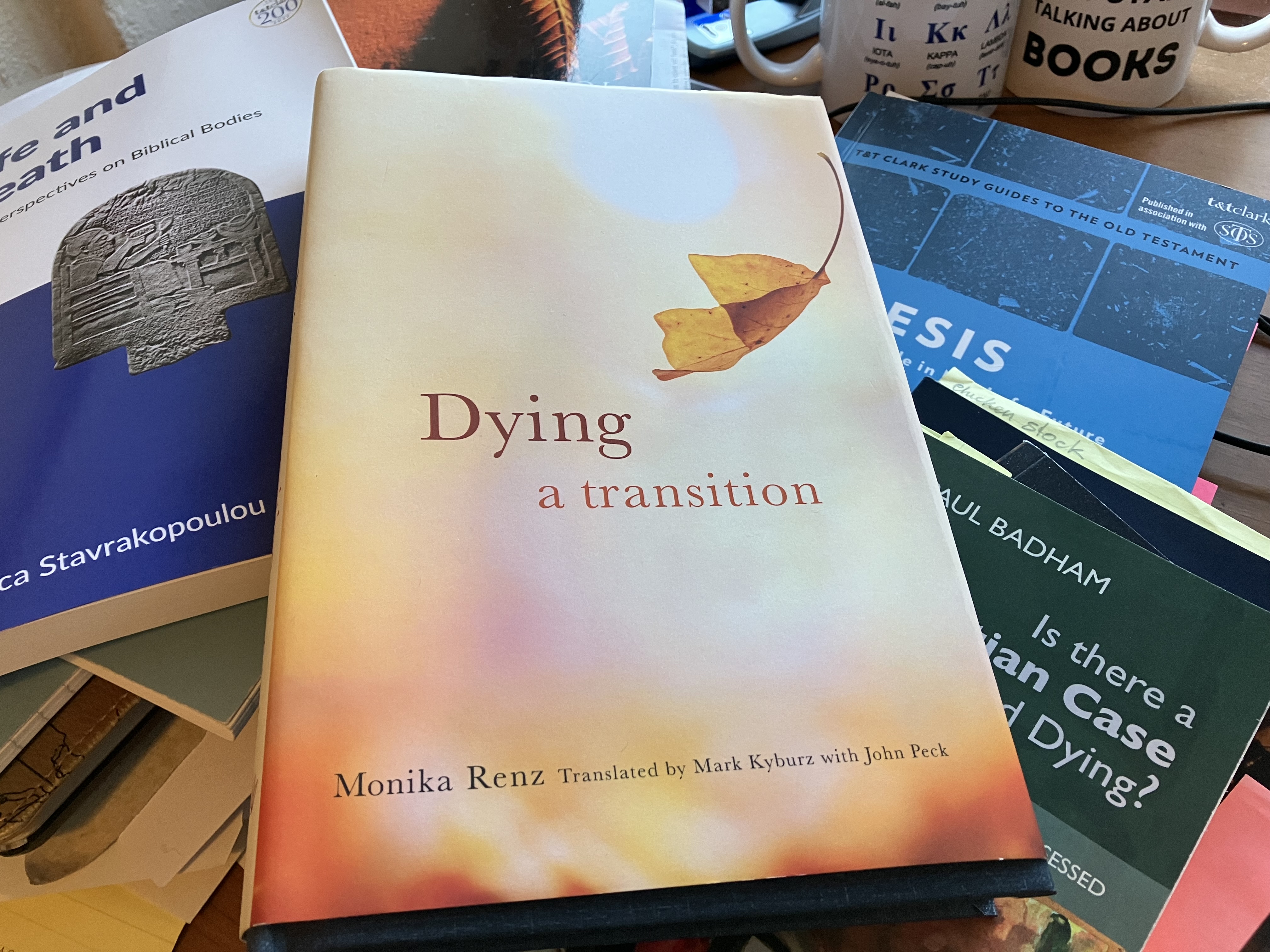
When I attended the debate on assisted dying at the medical school of Edinburgh University, one of the panel suggested that I should read this book. We were discussing the dying process, and whether dying is something that medics are trained to help with—and whether, in reality, it is a process where they should be involved. I felt that perhaps dying (as opposed to illness/recovery) is a stage of life best left to philosophers and theologians. I am not sure that medics understand dying, or that it is particularly relevant to their role as healers. Dying, I argued, is something that happens after the role of the medic has ended.

The book is thought-provoking, and I recommend you read it for yourself. You might not agree with everything written (nor should you ever expect to agree with everything that anyone writes). But it might challenge you, and help you to formulate your own ideas about dying. Most people that I speak to dislike thinking about dying—they find it an uncomfortable topic except in the abstract, when it applies to ‘other’ people. When I was about to have surgery to remove a brain tumour, I found this extremely unhelpful. I needed to confront the possibility of dying. None of us can escape the dying process—first with those who we love, and eventually our own death. I think reading Renz’s book will help you with both. I found it tremendously reassuring.

Renz writes for professionals dealing with palliative care, so her style is academic, but I don’t think you need a degree to understand the book. (You can always skip over some of the more academic pages.) Renz works with cancer patients in Switzerland, and her initial study was with 600 patients (which isn’t a huge range, but is big enough to give an indication of general trends). She analysed her data, and compared it to other studies, then refined her conclusions. The book therefore represents the conclusion of several years of work.

The patients studied were all dying. Some were religious (various religions) others were not (and some were ‘devout’ atheists). Renz found that the dying process for all of them was similar, and went through the same phases—though the amount of time spent in each phase varied. She offers advice as to how each phase can be eased by practitioners and family members—which I assume will be helpful when you next are close to someone who is dying.

To summarise the whole book (and really, you should read it yourself) Renz views dying as a transition, with marked phases. She talks about people going through a final stage, which she names ‘transition’ when they lose all sense of ego. By ‘ego’ she doesn’t really mean pride, though that is a part of it—more that the patient loses all sense of self. Just as a young baby has no pride or shame—pooping is something that happens but the baby is not embarrassed, they don’t care if they dribble or make noises. As a person nears death they too go through a similar phase, which Renz says can be distressing for relatives—who do have a sense of ego and therefore feel embarrassed to see their loved one in a position they see as ‘shameful’. But it’s not shameful, it’s just a body behaving how bodies behave without an awareness of social conventions. Renz states that the patient is not embarrassed, they feel no shame because they have ‘transitioned’ to a state where their body is no longer important.

Part of this transition is also a letting-go of earthly things. She says that for some people this is difficult, they do not want to leave pets or family or a role—and this is a necessary struggle, that changes them into a state whereby they are ready to die. Renz understands the process to be formative, even if difficult. She also describes an ‘encounter’ with a spiritual world—even for people who are not religious or are staunch atheists. Sometimes this is a period of fear, and she suggests actions that can calm the patient, helping them to find peace. She describes patients ‘seeing’ their deceased ancestors, or spiritual beings who are waiting for them to die, and how this is often comforting to the patient (even if perturbing for the relatives).

I found it interesting that there seemed to be the same phases of dying for both the religious and the non-religious person. I have never been present when a person died, so I cannot evaluate the truth of what she says, but I did find it comforting. Renz views dying as a natural process, a natural part of life, and one that should be recognised and not feared. Even when a death is a struggle, Renz equates this to a difficult birth—where there is sometimes pain or fear, but it is a process that leads somewhere. She suggests that we should not shy away from difficult deaths, or seek to shorten them or dull the senses, because the struggle is part of the preparation for what comes next.

I’m not sure how Renz’s research shapes the debate on assisted dying, and she was a little fuzzy on instant death (like an accident or a murder). She simply thought the phases happened instantaneously—but obviously this is not something she could test. Therefore some of the ‘research’ was speculation, but I didn’t feel that detracted from her overall findings.

As I said, I recommend you read the book. I found it very reassuring, it took away the fear of death. Renz shows that death is as natural as birth. It may be beyond our control, but it does not need to be feared. (Though I would note that the death of other people is always, in my experience, completely horrible. But perhaps it helps if we can view the stages as both necessary and natural. I don’t know.)

I hope you have a good day, and that death doesn’t trouble you. Thank you for reading.
Take care.
Love, Anne x

The Consuming Fire


I have coffee and cake, and am settled down to read The Consuming Fire by Liane M. Feldman. My PhD supervisor recommended it, and I’m really enjoying it—so am recommending it to you. I will share what I have read so far, and then you can borrow/buy a copy and read the rest yourself. I suggest you read it with your ‘thinking-hat’ on (it’s hard to escape my past life as a primary school teacher). There may be bits you disagree with. But that should be true of everything you read—never accept what someone says without thinking about it for yourself.

Even the physical form of the book is enjoyable. It has a classy cover in black and white (unlike most theology books, which are either overly jazzy or artistically unpleasant). It’s a good size—not too heavy with decent sized print (again, not a given with theological books. Sometimes I think people publish books that are purposefully unpleasant to read, almost as if they are challenging anyone to actually enjoy them!)

The content of the book is about the Hebrew Canon/Old Testament (obviously, as that’s my area of study) and it’s looking at what is called the ‘priestly writing’. To understand this, you need to know a little about who wrote the first five books of the Old Testament/Hebrew Canon—the part called ‘the Pentateuch’ (‘pent’ because there’s five books, not sure where the ‘teuch’ bit comes from, so do tell if you know). There are probably five books because at one time they were written on scrolls, and the length of a scroll was limited (if they were too long they ripped) so the very long narrative of the Pentateuch was split into sections, and written on five scrolls.

Anyway, for centuries, people studying them thought they were written by Moses (even though the narrative of the death of Moses and beyond is contained in them). Then in the middle ages, scholars decided that actually, the styles of writing, and the fact that there were different accounts of the same event, and facts that contradicted each other, probably meant that there had been several texts, written by different authors, that had all been put together at a later date. They gave the different types of writing labels: P (because it seemed like priests had written them—lots of religious details); J (because God was called ‘YHWH’ and they were German, so wrote YHWH with a ‘J’); D (because Deuteronomy had a style all of its own, and was mainly about the failure of the Israelites and how they were punished); E (because God was called ‘Elohim’). This idea, of four authors, lasted for another few centuries.

More recently, after lots of debate by scholars (who like to challenge each other’s assumptions) they have decided that actually, it is unlikely that there were definitely four authors. May have been more, may have been less. However, they are all agreed (which is rare) that there was certainly a ‘priestly’ writer (or writers). Some texts have a distinct style (in the Hebrew) and can be lumped together as coming from one text (even if it evolved over time).

Back to The Consuming Fire—this book takes just the texts thought to be ‘priestly’ texts, and has put them all together. Mrs Feldman says that at one time they existed as a single text, so we should read them now as a single text. She also changes the language a little (I especially like this bit!) as she wants her translation to reflect how we think today. (She speaks American I think, but we will forgive her that.) So she has avoided ‘biblical’ language (the language that only appears in the Bible today). Things like ‘hardened his heart’—who actually says that today? Or ‘bloodguilt’? (We say ‘he has blood on his hands’ which means the same thing, and its easier for us to understand the concept.) Mrs Feldman has tried to write a translation that we understand—though not one that we can relate to. The concepts within the text are ancient ones, we do not consider women to be ‘contaminated’ after childbirth, for example. It is an ancient text, and we should read it as an ancient text, but this translation allows us insight into how those ancient people thought. Mrs Feldman has also (another thing I like) been honest about the words that we don’t understand, and has stated this in her translation. Sometimes, we don’t know what the Hebrew meant, and rather than writing a possible translation (which readers then accept as ‘truth’ because ‘it’s in the Bible, isn’t it!’) she has been clear that actually, we don’t have a clue.

What is the point of this, you may be wondering? Well, I think if we try to understand what those ancient authors were trying to communicate, if we read texts in the correct context, we will understand it better. If we think about why some of the details are there, we may begin to understand how they are relevant for us. I doubt any of you, when you read about the dimensions of the temple, think ‘It’s great I know these numbers and measurements, because now I can build my own temple on the playing field next to the scout’s hut!’ So why are they there? What were the priestly writers trying to say? What was their point?

Now, my final note before you make a drink and add the book to your Christmas list—does all this talk about multiple authors mean the Bible can’t be trusted? Does examining a text in detail, taking it apart, thinking about what the author intended—well, does all that take away its authority? Does it reduce the Bible to just another ancient text? I think not. I believe the Bible, especially the Old Testament/Hebrew Canon, has great authority. I believe that we meet God there, and meeting with God changes us. For me, the text was inspired by God, and he uses it today to teach us truth. I don’t think that having several authors means God wasn’t able to inspire what was written, or what was edited, or what was preserved and translated. We don’t have to pretend it isn’t an ancient text. We don’t have to pretend we understand all of it. We don’t have to pretend that every single dot and dash and comma has existed throughout history until it landed in your shiny English version. God can, and has, worked through different people in different eras. If we let him, God can still change us through our reading of the text—no matter how many people were involved in its writing, editing, translation, copying.

Time to stop writing now, and read to learn more. Hope you have a great day.

Take care.
Love, Anne x

Debating Assisted Dying


There was a debate about assisted dying in Edinburgh, so I went. It’s the first time I have done a random short trip to the university, and it was rather fun. I’m also feeling rather pleased with how brave I was (because I am not a happy single traveller).

I arrived in Edinburgh mid-afternoon. I had booked a Premier Inn near to where the debate was, so I set Google maps to ‘wheelchair access’ and pulled my suitcase through the city. (Google still took me up some incredibly steep inclines, so I’m glad I wasn’t really pushing a wheelchair!) The city is lovely in November in a new way. They are setting up the stalls for Christmas markets, and several places already had lights on, and it was very pretty and exciting.

I checked into the hotel, left my bags, and went to where the debate was going to be held—a sort of dry-run so I knew where to go and how long it would take to walk there. I suspect no other students did this, but they are probably better at finding things than me, and less embarrassed if they arrive late. People who get anxious like to be prepared. I’m glad I did, as it was in one of the lecture theatres of the medical school, and I needed to ask directions when I was in the building. The seats all faced the doorway, so arriving late would be awful!

Once my plan was sorted, I looked for somewhere to eat. The debate was at 6.30, so I ate early and braved the hotel restaurant. I sat in a completely empty restaurant, drinking red wine and eating dinner, feeling like ‘a real grown-up.’ You would be surprised how often grown-up things, like attending a conference in a city on my own, seem difficult. But they’re not really. It has taken me many decades to realise this.

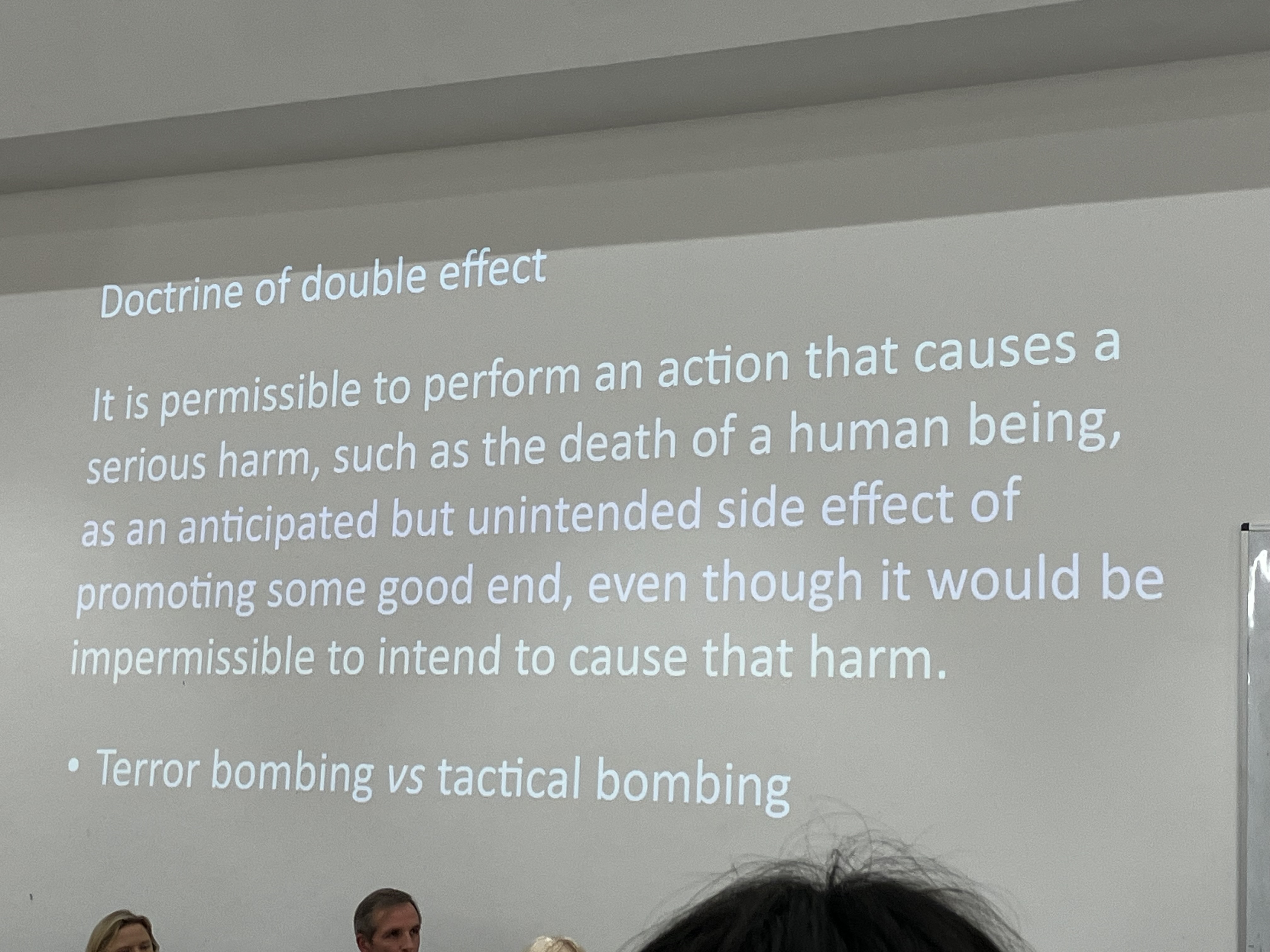
The debate was excellent. I will write a separate blog about what was said, but they had speakers on both sides of the debate who made clear logical arguments. The lecture theatre was mainly full of medical students (who looked like children to me) and they were very invested in the issue. If the law changes they will be involved with administering it in a couple of years time. Which must affect them, I would think. (More on that another time!) In my nerves I had left my notebook and pen sitting on my desk, so had to make notes on my phone, which was less good. I also took a photo for my mother, who had made a comment about a flower arrangement at the front, so I wanted to show her that a university lecture theatre and a church conference hall are very different styles. (There is also less leg room in a lecture theatre, so I was very uncomfortable.)

After the debate there was a drinks reception. I was keen to speak to some of the panel, so I grabbed an apple juice and looked around. I found one of the speakers, but I couldn’t remember his name (of course) and as I have a problem with recognising faces, I asked him if he was ‘the philosophy chap?’ Which he coped with very well, and told me his name. Turns out he’s the Head of Philosophy at the university, so I got that bit right if not his name. We had an interesting chat as we negotiated our way passed the boy opening bottles of Prosecco by popping the corks up into the ceiling. I asked him (the head of philosophy, not the boy trying to injure us with corks) whether assisted dying should be called suicide (which one of the panel had). Given the choice, the people would choose to recover, not die, so surely they weren’t suicidal? He pointed out that philosophically, it’s the same thing, as people suffering from depressive illness would probably choose to be cured rather than die too. (Which was a good point.) Though he did allow that assisted dying was more about choosing how to die than whether to die.

As I said, it was an interesting evening, and I have lots to think about. (Especially, I question whether assisted dying should be decided by either the medics or the politicians. It’s about death, and this is a matter for theologians and philosophers I feel. When someone is about to die, I think a chaplain or counsellor would be better qualified to help than a doctor. But contemporary society doesn’t particularly value theologians or philosophers. Perhaps it should.)

It was late when I left, so I phoned Husband as I walked through the city back to my hotel (because then he would know exactly when I was murdered). Got back safely, slept badly because I couldn’t work the room thermostat. 

Breakfast in a pretty Cafe Nero that had fairy lights and Christmas wreaths. Felt very pleased I had come as I walked back to the station, listening to the seagulls and looking at the lovely old city that is Edinburgh.

Thank you for reading, I hope you have a great week.
Take care.
Love, Anne x

anneethompson.com
*****

Is The Old Testament Still Helpful?


I am currently exploring how we can use the Old Testament[1] to help form our ethics. This is more complicated than I first thought, and there are several books which all seem to give slightly different views. The problem is, there is a whole variety of writings in the Old Testament—from narratives about genocide, to commandments, to prophecies, to love poems—and to apply it all literally today would involve stoning rebellious teenagers and slaughtering the pets of our enemies. So what do you think? Does the Old Testament have any relevance today, and if so, how should it be used?

One useful book has been The Immoral Bible by Eryl W. Davies.[2] He basically puts the various views into categories, and then says what he likes/dislikes about each one. He starts by considering some of the ‘difficult’ texts in the OT—mainly Joshua 6-11, which describes the conquest of Canaan. This has parallels with what I’m seeing on the news at the moment, but I don’t want to link the two because there are lots of complicated issues that I want to avoid discussing—so this post will only focus on the ancient world.

I find Davies’ book interesting because he forces me to consider things from a new angle. As a child, I learnt the story of ‘Joshua and the city of Jericho’, how God told him to march round the city, and then the walls fell down, and the Israelites killed everyone, and we all cheered and thought it was brilliant because we were, after all, on the side of the Israelites. But wait. If you engage your moral brain for a minute, is it really okay? The people were all killed—old people who were nearing the end of life, young people, almost certainly some babies and toddlers, as well as all their animals—just because they happened to live in the wrong city. I think, actually, it was not okay. I am uncomfortable with toddlers being crushed under city walls. So what do we do with stories like this one? Is there anything we can learn? Do we give the Old Testament authority when some (many) texts seem just plain wrong?

This is never okay.
(See below for credit.)

One approach is what Davies calls ‘the evolutionary approach.’ This says that people have evolved, and God’s revelation has been appropriate through history—in the less sophisticated ancient world, where slaughter was commonplace, the rules were different to those of today. Basically, it says that people today know better. The trouble with this is it makes the Old Testament pretty obsolete other than as a background history lesson for the New Testament. It is also rather disproved by things like the holocaust, which indicates that actually, people today are just as cruel/violent as the ancient world. However, whilst I don’t think people are getting better, I do think that perhaps God revealed himself and his plan for the world gradually—so ideals like ‘love your enemy’ were introduced at a time when this was an achievable goal for people.

Another approach is labelled by Davies as ‘the cultural relativist approach.’ (I feel this one overlaps with the previous one a bit.) This says that you need to look at the culture of the ancient world, and judge according to those standards. So we can tell ourselves that ‘this happened in the olden days’ and that was okay, but it wouldn’t be appropriate now. Scholars call this a ‘historical-critical’ view, and they enjoy digging around, discovering how ancient cultures lived and thought, putting texts into context. (I enjoy doing this too!) The problem is deciding what, if anything, is relevant today. If you take the 10 commandments, they were applicable to Israelite married males, rich enough to own property and important enough to give evidence in a lawsuit.[3]

Therefore, when we read the Bible, we should be aware of the difference between the ancient culture and our own. Which means those translations which change things like the patriarchal wording of ‘brothers’ to ‘brothers and sisters’ are (I think) making a mistake. We ought to recognise the biblical times were different, and treat them accordingly, not pretend that everything then still applies today. People who take this approach (do you?) would say that whilst the culture was different, some principles are timeless, and these are what we should learn from—whilst leaving other bits as historical. But I don’t know how you decide what to keep and what to put into the ‘historical’ bucket. I also fear it takes authority from the Bible, and allows the reader to disregard uncomfortable texts as ‘irrelevant for today.’

The next approach is ‘the Canonical approach.’ This says that we need to look at all the Bible, all the time, and only read texts in the light of all the others. So yes, the poor children of Jericho were slaughtered, but later Jesus taught things like kindness and mercy, and one thing balances out the other. Again, I’m not sure who decides what is important, and what is not. No one treats every text as having equal authority (even if they say they do) but the whole issue can become very subjective, and easily abused. Slave traders definitely took different passages as authoritative, as did men who wanted to oppress women. I personally like comparing different texts in the Bible as a way to understand them better (and have just returned from a conference on intertextuality, which spent whole days doing this). But as Davies points out, it’s not very practical (because who knows the whole Bible, in Greek, Hebrew and Aramaic, so that all the texts can be properly compared?) Plus what happens with the texts that contradict each other? And who decides what is the ‘Canon’ when Non-Conformists and Anglicans and Catholics disagree?

Next is ‘the paradigmatic approach.’ I like this one (though it still isn’t perfect). You will know about ‘paradigms’ if you have studied a foreign language. You take a bit of grammar (‘want’ becomes ‘wanted’ in the past tense) and then you apply it to other situations (so ‘look’ becomes ‘looked’ in the past tense). The ‘rule’ is applied in different situations.[4] With the Old Testament, we look at the principles behind the text, and then apply those. So not harvesting a field to the edges was a commandment, the principle was to ‘give some help to poor people’—and that can be applied today (even if you don’t happen to have a field). Also, just as you must learn not to apply the ‘paradigm’ to every word (‘run’ does not become ‘runned’) nor do all Old Testament principles apply to the modern world. The problem is that it can be subjective, and if you look hard enough, you can probably find an ‘underlying principle’ that makes the Bible say whatever you want it to say.

The final approach is ‘the reader-response approach.’ (This is the one Davies seems to prefer.) This states that the Old Testament ‘says’ nothing unless someone is reading it, and it is the response of the reader that brings the message. The reader should read it with a conscience, noting that some behaviour is wrong, being prepared to be critical. (Scholars like to use the phrase ‘a hermeneutic of suspicion’ which basically means not switching off your brain when you read the Bible, and not accepting everything as ‘right’.) However, it should be a two-way process, so the Old Testament texts will also criticise the reader, and speak to contemporary culture.

My problem with this approach is that it seems to remove all authority from the Bible. I do think it’s good to pause, and to question whether an action in the Bible was correct, but I think we should be careful. I believe there is a time to simply admit we don’t understand—that a narrative seems cruel or an action commended by the Old Testament author seems evil—but I am uncomfortable making judgement. I believe the Bible, including the Old Testament, is used by God to change people. Therefore the texts within it, can teach us something, even if we don’t understand what they say.

The Old Testament does not claim to be infallible, it was not dictated by God, it was written by men. I think we need to rely on God, and allow him to change us as we read the ancient texts. There is perhaps something helpful in all the above approaches, and certainly the Old Testament can still shape our thinking today—but I think no approach is perfect. What do you think?

anneethompson.com
*****


[1] By ‘Old Testament’ I mean the texts in the Hebrew Canon which have been selected for inclusion in the Christian Bible.

[2] Eryl W. Davies, The Immoral Bible (London: T&T Clark, 2010). Another helpful book is Pieter J. Lalleman, Enduring Treaure (London: Apostolos Publishing, 2017) though I personally find the method of putting texts into categories too subjective.

[3] David Clines, Interested Parties: The Ideology of Writers and Readers of the Hebrew Bible (Sheffield: Sheffield Academic Press, 1995).

[4] Christopher J. H. Wright, Walking in the Ways of the Lord (London: InterVarsity Press, 1995)

Photo credit: Mandatory Credit: Photo by Sipa USA / Rex Features (1894273a)
A severely wounded baby boy is medically treated
Conflict in Aleppo, Syria – 03 Oct 2012
As Bahar Al Assad’s army steps up its military campaign to regain control of Aleppo, children are treated by the small staff of doctors in one of the city’s last standing hospitals.

Edinburgh University and Spurgeon’s Graduation


After our stay at Gleneagles (see last week’s blog) we drove to Edinburgh. I had an important meeting, and Husband took Meg for a walk around the city centre (because Meg, and important meetings, would be a bad combination). Afterwards he commented on how well-behaved she was. They had encountered marching bands, bagpipes, crowds of people and other dogs. Meg had walked beside him, looking very like a working dog being trained. (He told me that when asked, he said that Meg is being trained as a Royal protection animal—but I think/hope he was joking!) It was nice for me that he had a good experience, a little Meg/Husband bonding is useful.

Meg in the City

My meeting was at the university. I had forgotten how beautiful the city of Edinburgh is, and my meeting was at New College, which is next to the castle. New College is not new, it’s a fairly old building, steeped in tradition. I was told to wait in the quad, and I walked through the arch and sat in a little square courtyard, looking at a statue of John Knox, and arched windows and turrets, and stone steps. There is a feeling of history, of scholars through the ages studying Scripture, testing their beliefs—and I realised that I really want to be part of that. We will see—I will let you know what happens next.

My current studies are now officially finished, and it was my graduation ceremony at the weekend. At first I wasn’t going to attend, because I graduated with my teaching degree many years ago, and have since attended the various graduations of my children, and I felt rather old to be dressing in a cap and gown and having a photo taken. But then, when my final results arrived, I found that I wanted to mark the occasion—to finish my time at college with ‘an event.’ I’m glad now that I did.

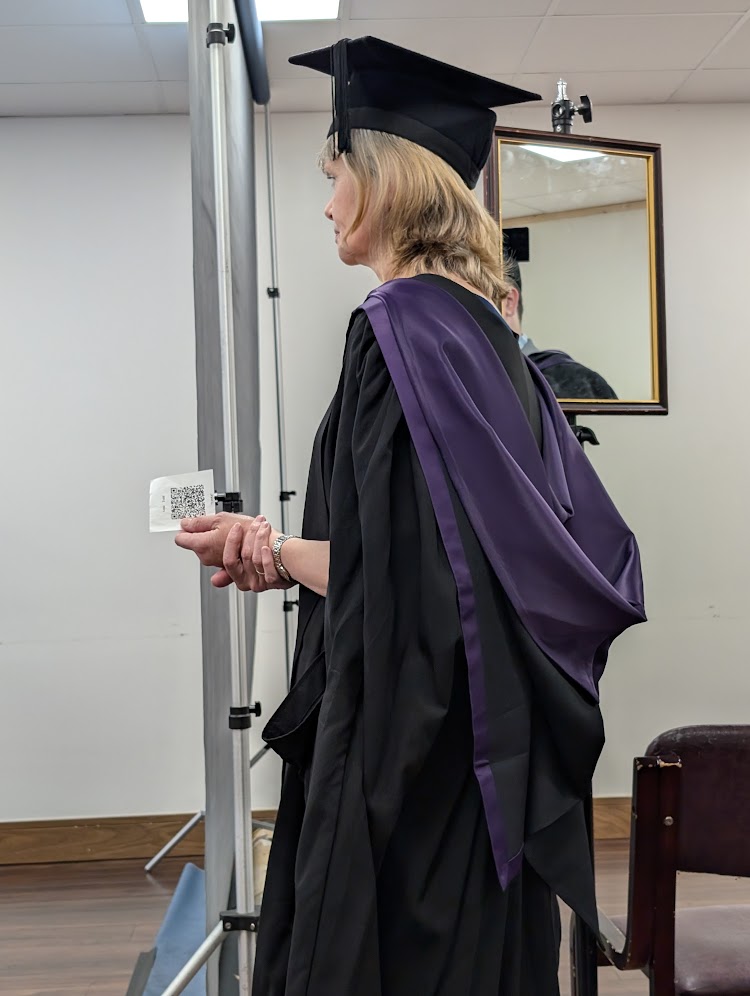
My MA is from Manchester University, but I have been studying at Spurgeon’s College, and they had arranged for the graduation to be at a big church in Croydon. We went by train, and then tram, and then walked down a residential street and I wondered if we were lost. But the church is huge, and modern, so it was easy enough to find. Everything was very efficient. I didn’t have a paper receipt or ticket, which I found very unnerving (this probably reflects my age—but honestly, what would happen if my phone lost power and all those clever QR codes were lost?) In the event, I only needed my name, and then I was directed by various members of staff (very kind of them to work on a Saturday) to the ‘robing room.’

The gown was difficult, and kept slipping around, and the hood—which was a pleasing colour—tended to sit in a rather racy off-the-shoulder position rather than the neat and tidy scholarly look that was intended. I had taken safety pins to try and secure the gown to my dress, but this resulted in the front of the dress riding up in an undignified manner. As for the hat—well! It felt fine in the fitting room, but as soon as I left, I’m sure it shrunk. It absolutely refused to sit securely, and perched precariously on my head, falling off if I moved too quickly. No one else seemed to have any problem at all, and the auditorium filled up with students looking tidy and elegant, and staff members in a rainbow of universities’ caps and gowns. (Actually, some of the staff graduated from universities with decidedly daft hats. I realise that before applying to do a PhD, a very important factor should be what the graduation outfit is, because for evermore, that is the cap and gown you will have to wear for every academic occasion. Some of the staff had not done their due research here. But I felt feedback would be inappropriate at this point.)

It was fun meeting all my student friends again, catching up with news, hearing what their plans are. We haven’t met since before I started writing my dissertation, which is months ago. Some of my family came to support me, which was a lovely surprise.

There were group photos (the photographer tidied me up a bit beforehand, which reminded me of my mother, who always seems to tell me to comb my hair, even though I am quite old now). The actual service was very long (graduation ceremonies always are). This one was even longer, because lots of the graduates were now Baptist ministers, so there was a sort of church service, complete with extra-long sermon from Rick Warren (our Chancellor) and several hymns and prayers. But I’m still glad I went, and they gave a short bio as each student went on stage, which made it feel very personal. And most importantly, the cap stayed on my head for the whole walk across the stage (it fell off when I sat down, but that didn’t matter).

I hope everything stays in place for you this week. Thanks for reading.
Take care.
Love, Anne x

A painting (in the café next to New College) which I really like. Unfortunately I don’t know the artist’s name, but I will add it when I find out.

anneethompson.com
*****

Ancient Texts and Deliberate Metaphors: Unveiling Hidden Meanings


This week, I was reading a fascinating paper on deliberate metaphors.[1] You remember from your school days what a metaphor is? Those descriptive words that often personify a thing ‘the wind marched’ or simple similes ‘like a puff of smoke’. They are often linked to certain traditional ideas—‘as dark as death’ and we tend to expect certain metaphors to appear—‘he took a wife’ (where he did not, literally, go to a house and take a wife, but rather he married a woman). The thing that’s fun with deliberate metaphors, is that they take descriptions that are usually linked with a particular subject (think of death: cold, dark, silent) and they are then used with a completely different subject. Which means, when someone reads the final text, they subconsciously link the two themes, even though they are not explicitly stated. Advertisers and poets use this a lot. The same works with car adverts and sleek beautiful bodies, or having fun zooming on things as a child, and they link those ideas to the car—so we see the car as either beautiful (it’s a car for goodness sake!) or an instrument of fun (though it will spend lots of hours in traffic jams and on the school-run).

There has also been lots written about whether metaphors apply mainly to speech, or if they are an unconscious element when we think. Therefore examining metaphors used by a particular culture or historical group, might give us clues into how they thought. For example, today when we describe relationships we use lots of metaphors that relate to travel, so we seem to view relationships like a journey. We start a relationship, they can go through a bumpy patch, we can get them back on track despite many obstacles. Likewise an argument or discussion is described using fighting metaphors: his points hit the target, he defeated the opposition and defended his case.

When the descriptive words are unrelated to the thing being described, we call them metaphors. (So fire and emotion are unrelated, but we say someone burned with anger.) If they are connected, we call them metonyms. So ‘I pay with plastic, not cash’ —(a credit card is made of plastic, so this has used a metonym not a metaphor). Or we might say that ‘Washington has passed a law’ — the Senate is in Washington, so this is another metonym.

Now, if we look at ancient texts, the same principles apply, but we often miss the subtle links because we are either reading a translation, or we don’t understand how the ancient culture would have used those words. So when we read ‘The LORD is my shepherd’ we have a completely different response to the ancient audience, who might link a whole bevy of different experiences to each of those words. Which I find very interesting.

Fascinating huh? It feels a little scary to finish my MA, the time has gone so fast, and there is so much still to learn. I do hope I can find a way to continue studying, but we shall see. I hope your plans are clear this week. Thanks for reading.
Take care.
Love, Anne x


[1] Ellen van Wolde, ‘A network of conventional and deliberate metaphors in Psalm 22,’ Journal for the Study of the Old Testament, 44 (2020), 642-666 (p.642) <https://doi.org/10.1177/0309089219862816> [Accessed 6/10/23].

The Pathway to Applying for a PhD


Hello and how was your week? Do you have any changes in the near future?

The change facing me at the moment is the end of my MA course. I have received the mark for my dissertation (and was very pleased with it) and as soon as it has been validated by Manchester University, the final grade will be set and I will graduate. Which for me, is rather unsettling. I am not a person who relishes more time for housework, so I need to decide what comes next in life. I have loved studying, and would love to continue, so I am writing a proposal to work towards a PhD. I will let you know whether anyone accepts me. My current college works with Manchester Uni for Master’s level awards, but is not currently accredited for PhD awards.

I have not been in the academic world for very long, so before I could apply, I had to discover the process. There is a way to do everything. This may not apply to other disciplines, but this is how a PhD in Theology works:

Firstly, I have to decide what to research (a PhD is a research project). I am meant to ‘contribute to the discussion’ so unlike my MA, which could be simply a review of other scholars’ work, I have to bring something new. This is fairly difficult, because although I am fully expecting to think of something original as I do my research (my brain generally  finds different avenues to other people) until I start, I don’t know what I will discover. Therefore much reading around topics is required, trying to find an area of interest.

Having decided on a topic, the next stage is to see what studies have already been undertaken. It would be difficult to research a completely new field, with no literature to evaluate. As I read, I start refining my ideas, listing relevant literature, deciding on the direction of my research.

The next (massive) stage is finding a supervisor. Basically, during a research project, you have a supervisor who gives good advice and keeps you on track. They need to be interested in your subject, and be willing to work with you. My current supervisor (for my MA) suggested some suitable scholars. I now have to approach them, briefly outline my project (like a sales pitch) and ask if they would be interested in hearing more. At this stage I don’t say much about me, I simply outline my research idea.

If they are interested, and have time for another PhD student, they will ask for more details. I then send them a more formal proposal, outlining what I consider to be the main issues, the sort of literature that’s available, a vague general direction for my research. If they like all that (here’s hoping!) they will then agree to supervise me . . . if the university accept me.

The next stage is to apply to the university. The supervisor will help with this, telling me how to shape my proposal so it covers the areas the university requires. I apply directly to the university (who expect me to already have a supervisor in place). My understanding is that whilst the supervisor needs to be interested in my project, the university is interested on whether my project will gain the funding it needs, and whether I will complete it in three/four years. (Finding funding is another step.) Both these factors affect their stats, and universities are primarily businesses. If they have students who start but never finish their PhD, that reflects badly on their reputation.

If the university accepts me, then I will be exceedingly happy, and I will disappear into a frenzy of study. But there are several steps, so we will see. I will let you know. I hope your own plans are going forward. Thank you for reading.
Take care.
Love, Anne x

Thank you for reading.
anneethompson.com
*****

Was he naked?


At college, we have been considering how other people’s interpretations of the Bible affect our own. This involved looking at some works of art, and considering whether we understood texts differently afterwards. I think I didn’t—though some of the ideas were very interesting.

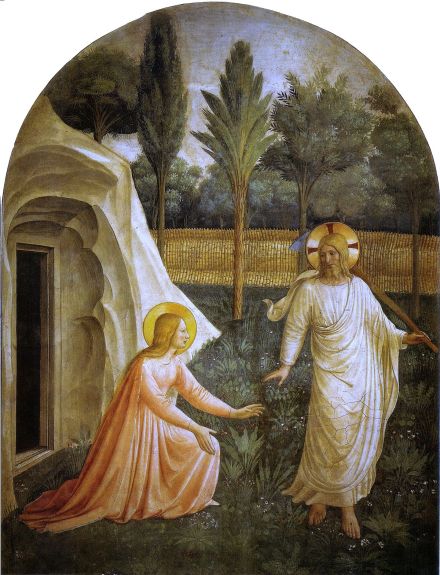
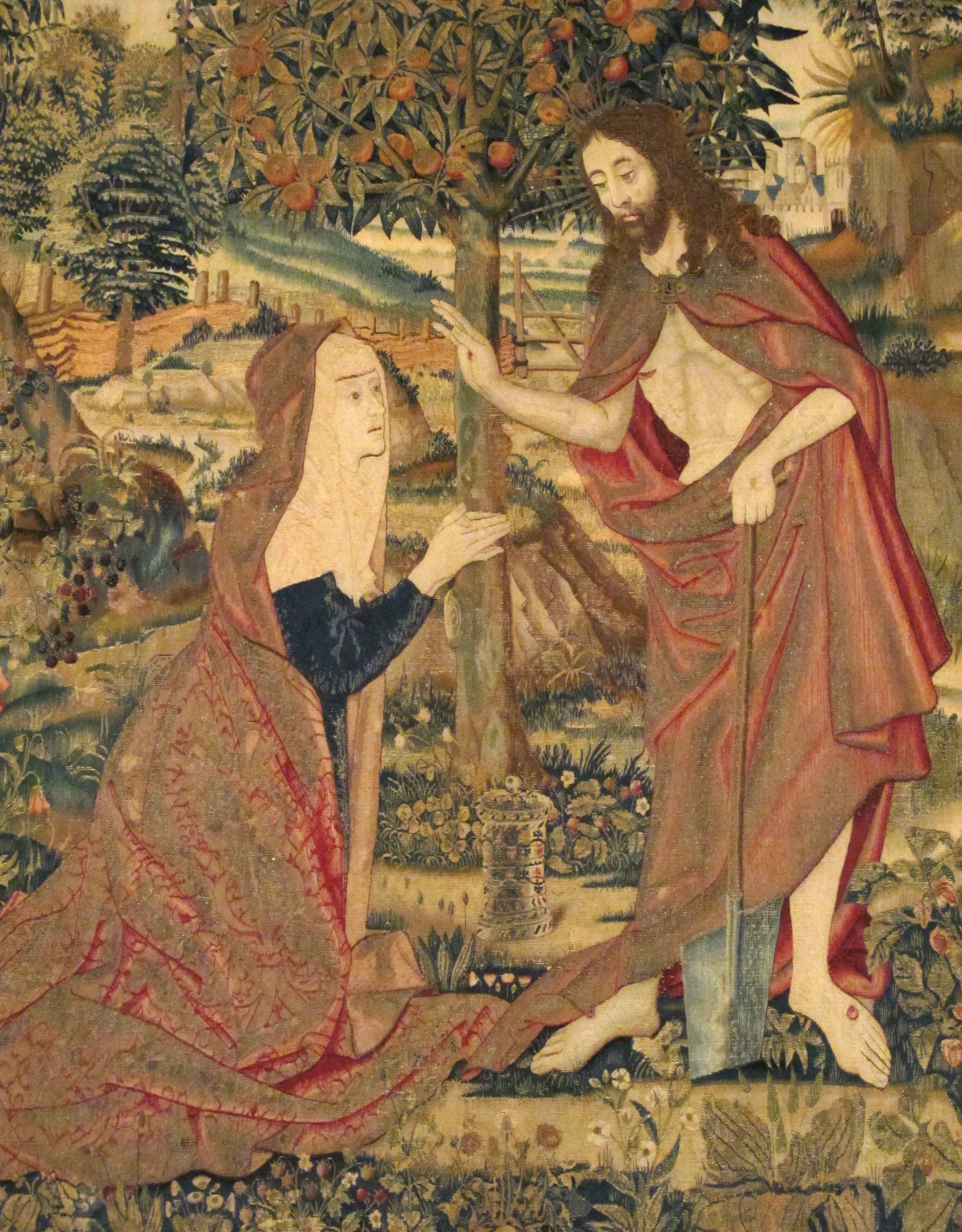
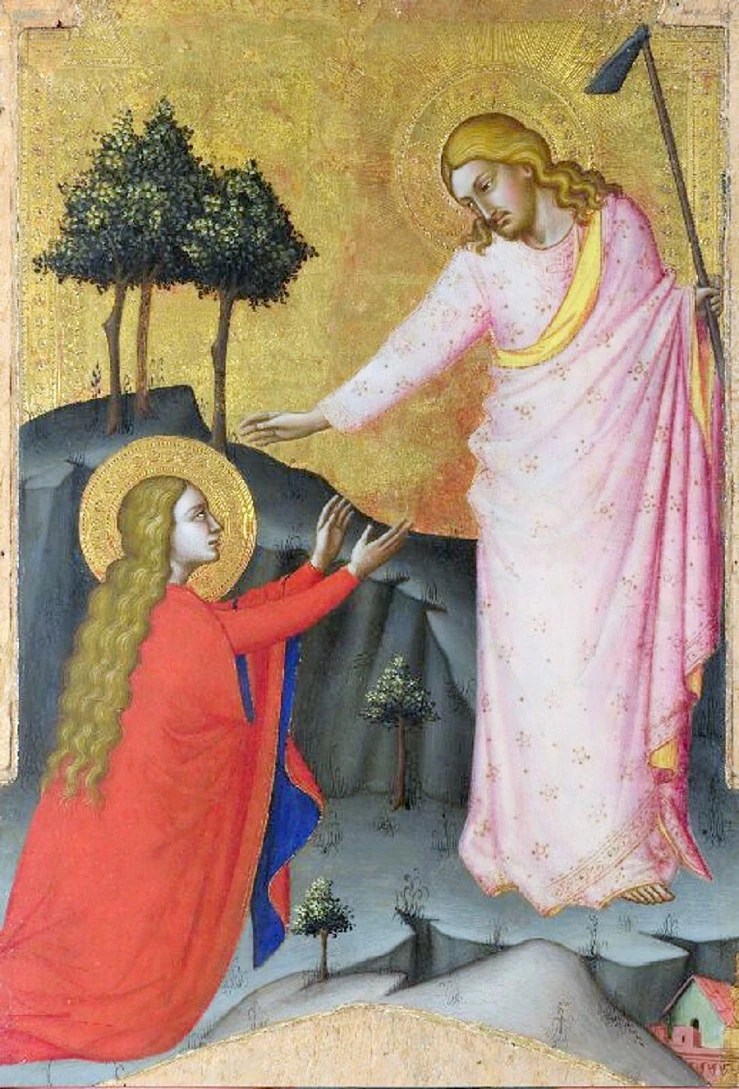
One passage we looked at was after the resurrection, when the women found the empty tomb, and Mary (his friend, not his mother) sees Jesus but thinks he is the gardener. Some paintings showed Jesus shying away as she tried to touch his clothes—emphasizing that he told Mary not to touch him.

Some depicted Jesus wearing gardener clothes, to try and explain why Mary confused him with the gardener. I have never personally imagined Jesus in a floppy gardeners hat, or carrying a spade, but I guess it’s one possible reason why Mary was initially confused.

As someone pointed out, Jesus rose physically (his body got up again) and the grave clothes (which is what he was dressed in) were found folded in the tomb. So, what was he wearing? Did he leave the tomb naked? (Not something mentioned at Sunday School). Did he perhaps borrow the gardeners clothes, thus confusing Mary? I guess it’s possible.

http://www.metmuseum.org/art/collection/search/468532
The Resurrected Christ Appearing to Mary Magdalene in the Garden
South Netherlandish ca. 1500-1520

(Jesus is holding a gardener’s spade. And has no clothes.)

Jacopo di Cione ca.1368
(Jesus is holding a gardener’s axe.)

Jesus appearing to the Magdalene
by Fra Angelico
(Jesus is shown holding a gardener’s axe, and is avoiding her hand.)

The thing is, I don’t think what physically happened at the resurrection is discussed much. We consider the theology of the situation– why did Jesus die and rise again? What difference did it make to our relationship with God? And we talk about the reaction to the resurrection, that his disciples changed and stopped hiding after they saw him. But as to what happened physically? That’s not something I have thought about. A man’s body is a big thing to hide, so where did Jesus go between rising and seeing people? And why could people not touch him, when he touched things like bread and ate it? Would touching him have affected Jesus, or affected the people?

Something for you to think about. Hope you have a great day. Thanks for reading.

Love, Anne x

Why Did He Ask What They Wanted?


As you know, I am currently writing the dissertation for my MA. One thing offered by my college is symposiums—nothing to do with music—where people present their work, and everyone makes helpful comments. They’re useful—partly because you hear some interesting presentations and everyone helps to improve the final dissertation—but also because writing a research paper is rather isolating. Lectures have finished, and we are all in our own bubble, and it’s really good to see each other again, and to hear how we are progressing.

Anyway, one happened last week, and one of the presenters (Rebecca—I can’t remember her last name) is writing a dissertation on people coping with health conditions, and she made a very interesting point: Before Jesus healed people in the New Testament, he often asked them what they wanted. Then the blind man said he wanted to see, and the lame man said he wanted to walk, and the lepers wanted to be clean—and so on. But why, if he was able to heal them, and already knew their complaint, did Jesus ask? Afterall, a blind man begging must have been obviously blind—did Jesus think perhaps he wanted to be blind? Or was something else going on?

It was suggested Jesus probably asked as a way to empower the person. They were choosing whether they wanted to be healed, able to voice their need. I found this very interesting, because it reminds me of a personal experience. Soon after being diagnosed with a brain tumour, I was at a church meeting, and when I spoke about my tumour and the constant pain, someone announced that they would pray for healing. I remained sitting, and the group stood around me, with their hands on my head, praying for healing.

Now, here’s the thing. I had not asked them to pray for healing. I was not at all sure that it was in God’s plan for me to be healed (because I recognised that I was a better person with the tumour, and daily asking him to help me was a good thing). But here I was, in the middle of a ring of very kind, well-meaning friends, praying for something that I didn’t know if I actually wanted. But I couldn’t really voice that—I couldn’t politely tell them ‘no thanks, I’m coping okay and I’m not sure it’s in the plan for me to be healed,’ could I? A bit awkward. So silently, in my head, I changed the prayer. You see, there were other, more important things that I was struggling with, and I felt as if I was sinking and really wanted/needed God’s help with those. And although I had prayed about them, I wondered if perhaps, in some way that I didn’t understand, God was more likely to act if these people all prayed on my behalf. So in my head, I asked God to use their prayers to please help me with this other thing, this non-health-issue thing, and could he please heal that instead?

I cannot justify the theology of this. Nor do I know whether those prayers were the trigger for God to answer my prayer. But he did. And my life would be worse today if he hadn’t.

Maybe sometimes, people praying for healing for others might not necessarily be what their greatest need is. Perhaps we should remember that often Jesus asked before he healed people. I find it rather thrilling that God doesn’t just know what we need, he listens to what we think we need too. Perhaps learning to walk with God—learning to be like God—is about listening to other people and understanding their needs rather than what we assume their needs are. Sometimes, we need to ask.

Thanks for reading. Have a great week.
Take care.
Love, Anne x

anneethompson.com

*****

Can You Name the Character?


Quiz

  1. Who lost their home, possessions, children during a wager between God and the accuser, and were then ignored by God?
  2. Which prophet determined the outcome of a battle?
  3. Which unarmed, untrained civilian killed the head warrior of the opposition in a one-on-one encounter?
  4. Who was forced into a position of subservience, due to their talents rose to a position of authority within a foreign palace, and then used their wisdom to save the Israelite people?
  5. Who was the longest follower of Jesus, who never deserted him, and was there at the crucifixion?
  6. Whose action was stopped in the wilderness, and they then named God: ‘God who sees’?
  7. Name a child used to further God’s plan.
  8. Who defied the authorities to save the life of God’s people?
  9. Who were Mahlah, Noa, Hoglah, Milcah, and Tirzah?
  10. Which story in JOSHUA 15:16-19 is repeated in JUDGES 1:12-15? Why is it important? How often have you heard it mentioned in church?
  11. What characteristics make a good leader?


    Answers
    1. Might be Job, but actually it’s Job’s wife.
    2. Deborah (Judges 4:9)
    3. You might have said David (against Goliath) but actually it was Jael, a housewife who hammered a tent peg through the man’s head! (Judges 4:21)
    4. Esther
    5. Mary, his mother
    6. You might think Abraham, when he was going to sacrifice Isaac, but actually it was Hagar. (Gen 16:13)
    7. You may have said Samuel, but it was Miriam—Moses’ sister.
    8. You may have Rahab in Jericho, Michel with David, or the Midwives in Exodus. Brave women, who risked their lives to defy the authorities.
    9. Numbers 27, daughters of Zelophead who asked for share in inheritance—radical protestors! Their story is told twice, and (unusually) they are named — but did you know who they were?
    10. The story of Caleb’s daughter. Yet she is rarely mentioned.
    11. Strong, leads from the front, not afraid to make mistakes, sense of direction, decisive, task-focussed, sense of gravitas? These are ‘masculine’ characteristics. Feminine leadership is about consensus, working as a group, collaboration, listening—Eg. Mo Mowlan in Ireland. Either gender can lead using either style, so Margaret Thatcher led with a ‘masculine’ leadership style. If groups are listing certain criteria when looking for leaders, they might be introducing bias.

So, how many answers did you know? When I did the quiz with a class of 12 year old’s, they all named different men in the Bible (It was an RS lesson, so they knew they all were in the Bible.) The point is, the answers are all females, yet they are rarely preached about, and often we don’t even know their names. At college, we have been studying feminist theology—so what is it? Some definitions are:

“Feminist theology is a theological movement primarily within Christianity and Judaism that is intended to re-examine scriptural teachings on women and women’s roles from a woman’s perspective. Feminist theology attempts to counter arguments or practices that place women in inferior spiritual or moral positions.”

Ann Bock:Feminist theology, the study of God with special attention to women’s experience and their struggle for equality and justice, can be approached from at least three different perspectives: feminist theology as story, as history, and as traditional concepts and categories of academic theology. Each has its strengths and weaknesses, but all together, in combination with one another, they offer us a more complete picture and understanding of feminist theology”.

When using story, there will be a triangle between the author/story/reader When looking at history, we look at how women have been treated/recorded—Eg. Phyllis Trible wrote a well-known book, ‘Texts of Terror’. The treatment of women can be examined in history, and then evaluated—do we want to continue/copy the behaviour? How can it be addressed? If you look at some of the ‘terrible’ texts below, you will probably agree that no, we don’t want to treat women like this today.

Some texts that abuse women:
Gen 19:8 – daughters offered for rape
Numbers 30: 3-5, 6-8, 12-13 A man could overrule a woman’s pledge.
Numbers 5 A jealous husband can abuse/poison his wife to ‘prove’ her innocence.
Deut. 21:11-13 You can take a female captive as your wife, but first degrade her.
Deut. 22:13-30 Also chapter 24 Females were possessions, therefore ‘adultory’ was a property violation. A wife could not take action against her husband.
Exodus 21:7 A man can sell his daughter as a sex slave
Exodus 22:18 Female sorcerer should be killed (but not a male one???)
Judges 11:31, 34-40 Jephthah kills his daughter due to a bargain he made with God.

The problem with these texts is some men, in some places, use them to justify abusing women. This is never right, and we should all be helping to enable women to have value, to have a voice, and to have the same rights as men. I saw in Brazil, on a Tearfund trip, and in India, that people in poverty sometimes have an in-balance of gender power, and women have less justice than men.

I understand why ‘feminist theology’ is a thing, though I see problems too. There is a danger that some texts are disregarded as too misogynous, when we should be looking to see what we can learn from it. It also, like ‘liberation theology’ is in danger of creating ‘an other’ (men) and it is always dangerous to blame a whole group for all problems. I also dislike being put into a box, and I resent having a label, so most of these ‘theologies’ irritate me.

What do you think? Thanks for reading. Have a good week and take care.
Love, Anne x

Next week I will introduce you to Meg. Why not sign up to follow my blog so you don’t miss it?

anneethompson.com
*****