Who Compiled the Bible?


[Post updated and corrected 2025.]

I was challenged recently when I quoted a bit of the Bible, and someone asked me when it was written, and when it was included in the Bible. I had absolutely no idea, so did a little research. If you know more than me, and can correct any of the following, then please do leave a comment—otherwise, this is where the Bible came from:

The first 5 books of the Bible were traditionally thought to have been written by Moses, and are called The Pentateuch. There is some disagreement on this, even amongst very conservative Jews.[1] My own view is that even if the narrative originated from a single person, it was not physically written until much later and was edited over the centuries.
These books were probably established as ‘scripture’ by Ezra and Nehemiah, and they are what the Jews today still mean when they refer to the Torah. (The books were in existence way before Ezra and Nehemiah, but the early Jews pretty much ignored them until the prophets reminded them they were important.)

Then, about 200BC, the writings of the prophets were added. Later, the book of Psalms was also included as ‘scripture’. Some of the texts (called the Writings) were not fully accepted as canon until much later (about AD 100) according to some sources.[2] However, the books were used by people, given authority and called ‘scripture’ before they were officially accepted as ‘canon.’ Therefore, the writers of the New Testament quoted as scripture texts that are not always part of what we call the Bible.

It became important for the Jews to have a clear understanding of what their holy books were. Jews were beginning to move away from Palestine, and they wanted to know exactly what defined them as a race, what their core beliefs were. Further afield, other Jews included other books as part of their scripture. The further away from Palestine they lived, the more books they seemed to include (some had as many as 15 extra books in their ‘scripture’).

As many Jews lived in Egypt, where Greek was spoken, they wanted scripture translated into Greek. This is sometimes called ‘The Greek Old Testament’ and sometimes called the Septuagint, and this contains hidden books (known as Apocrypha which means ‘hidden’). Some of these books have since disappeared, and we don’t know what was in them. (Actually, it is not as simple as this—for example there was not only one Greek translation that was used in Egypt, so referring to the Septuagint is a little misleading.[3])

So, what about the New Testament? Well, after Jesus left, the people who believed in him, began to separate from the Jews into a new religion. They still regarded the books we call the Old Testament to be scripture. However, gradually, people began to write other things. People who had seen and listened to Jesus began to write accounts of his life and teaching. Later, other people interviewed them, and wrote their own accounts. The early church began to decide what it believed (such as whether non-Jews could be Christians) and the leaders of the early church wrote letters, teaching the church. Letters were called ‘epistles’. People within the church basically chose which of these letters and writings they regarded as sacred. So, there were the letters written by Paul, as well as letters written by Thomas…and the ‘Shepherd of Hermas’ … and the ‘Apocalypse of Peter’ … and the ‘Epistle of Barnabas’…and so on. Some of these writings contradicted what Jesus had taught, and some had a definite bias. Gradually, over several years, the early church began to accept some writing as being from God, and disregard other writing.

Then, in AD 325 (so rather a long time later!) the church decided to state, once and for all, which books should be included as ‘scripture’. They formed a committee (because churches, it seems, have always liked committees) called the Council of Nicea. As far as I can tell from my research, they didn’t actually decide very much about what should be scripture.

Now things get tricky, as different sources contradict each other. One source states that in AD 381, the church had another try. They formed the First Council of Constantinople and set out clear criteria for which books to accept, and which to reject. The criteria for inclusion was:

  • *The book was written by a first-hand witness of Jesus, or someone who had interviewed witnesses (such as Luke).
    *The book was written within 100 years of Jesus (which meant, if it had been wrong, people alive at the time would have said so).
    *The book should be consistent with the other books of the Bible.

I read that this Council decided which books should be part of the Bible. They chose the books we have today, including the books of the Apocrypha.

However, other sources disagree, stating that no Council ever stated which books should be used, and it evolved over time, with respected leaders gradually ignoring certain books and relying on others.[4] Several sources agree that Athanasias, in AD 367, listed the books he considered should be scripture. He was the influential leader of the day, and others followed him, limiting their theology to this selection of books. In AD 393, the Western Council of Hippo specified that the Church accepted 27 books as a canon. (We have ancient manuscripts, such as the Codex Sinaiticus, which includes ‘Barnabus and the Shepherd’ thus showing that not everyone accepted this ruling.)

In AD 400, St. Jerome assembled the books of the Bible, in Latin. It was called ‘The Vulgate’.

In the 16th century, a man called Martin Luther was studying the Bible, and trying to discern what it meant. He decided that actually, the Apocrypha should not be included as Scripture. The protestant church follows Luther on this. The catholic church formed another committee in 1546 (the Council of Trent) who decided that Luther was wrong. This is why today, the Catholic Bible contains different books to the Protestant Bible.

Okay, that’s the end of the history lesson (interesting, huh?) There are implications that arise from all this—but that is for another blog. My final observation is that it is relatively recently that all the books of the Bible appeared together as a single book, and we do not have any original manuscripts from the individual books.

Bye for now, and thanks for reading. Take care.
Love, Anne x

[1] More details in an article by Kim Phillips (Genizah Research Unit; Tyndale House, Cambridge).

[2] See Stephen Chapman, The Law and The Prophets for more details.

[3] See Gregory R. Lanier, The Septuagint (Il: Crossway, 2021).

[4] R. A. Baker, How the New Testament Canon Was Formed.
Being Loved


I was reading Matthew 22 today, and there is a parable in the first 14 verses which seemed a bit odd. Jesus is talking to the leaders of the day, the Pharisees, and he tells them a story about a king throwing a party, and all the invited guests refusing to come. I understood that analogy – the invited guests were the Jews, and many of them were messing up their gift of a relationship with God.

So, in the story, the king sends his servants out into the streets, and they invite everyone who they meet to come to the party. I understand that bit too – after the Jews (well, some of them) messed up the whole ‘people having a relationship with God’ gift, Jesus made the gift available to other people (the ‘dirty gentiles’ – that’s most of us!)

But then there’s something which seemed very odd. In the story, the king arrives at the banquet, where all those people who have accepted the invitation are sitting, enjoying the party, and he sees someone who is inappropriately dressed. The king is so angry, he throws out (in effect, banishes him to hell). Now, what does that mean? Surely, if you invite people who live on the streets to a party, you have to expect them to be inappropriately dressed? This seems a little unfair.

I did some research, and this is what I think it means: God invites everyone to come to him. Like in the parable of the prodigal son, he is a loving father, he will do everything possible to meet us where we are, he wants to save us. (Remember, in an earlier blog, I explained how when the son says: “I have sinned before man and before God,” he is actually quoting what Pharaoh said when he wanted the plagues to stop – he wasn’t sorry, he just wanted things to get better. But the father met him anyway, and that love, that willingness of the father to save the son even when he was continuing to behave badly, was enough for the son to realise that he couldn’t earn his way back, he simply had to accept what the father/God was offering.) So what does the bit about the clothes mean?

Well, I think, that yes, God wants everyone to come to him, and he has done everything necessary for us to know him. However, we also have to accept that. Now, apparently, in the days of Jesus, a king would have provided appropriate clothing for a guest (a bit like when you turn up at a posh restaurant, and they have ties for you to borrow because you didn’t realise there was a dress-code). I guess the clothes would signify the willingness to change, to become what God wants us to be, to let him alter us. Therefore, although we can all come, unless we let God change us through his love, then that is not enough. If we truly are responding to God’s love, rather than using it as a sort of ‘get out of jail free’ card, then we will let that love change us. We will be pleased to wear the garments appropriate for a party. If we don’t, we have missed the point. Which would be worse than never acknowledging that great love in the first place.

I think that’s what it means anyway. Makes you think, doesn’t it?
Thank you for reading.
Take care this week.

Love, Anne x

Anne E. Thompson has written several novels, which are available in bookshops and Amazon.
Anne writes a weekly blog – why not sign up to follow?
anneethompson.com

Psalms – Next book in my Bible Blog


In my read through the Bible I have reached Psalms. I didn’t find it a very easy book to read through, as each Psalm is like a poem, and if I wasn’t in the right mood, it was hard to connect with what the psalmist was writing. Lots were written by David, when he was fighting for his life, so he was in a different situation to most of us. It’s quite difficult to hope all your enemies will die horrible deaths, if you don’t feel you actually have any enemies. However, there is still lots to glean from reading them.

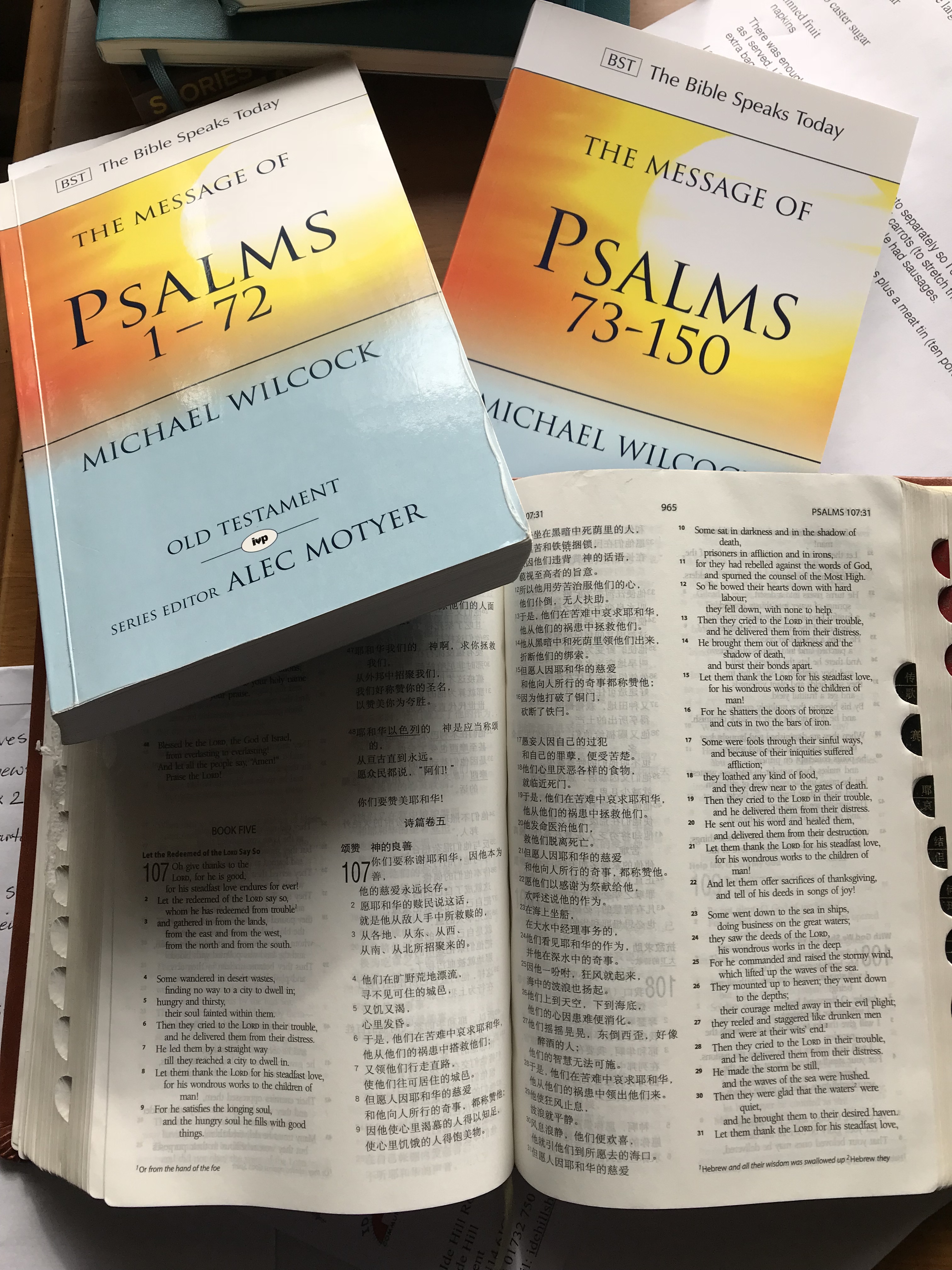
This book is made up of songs, which we tend to read as poems (and is actually divided into five separate books). I used the books by Michael Wilcock to help me understand them, and if you want to study individual psalms in detail, I would recommend it. (It’s part of The Bible Speaks Today series, ISBN 9780851115061) He describes the Psalms as being like “a photograph album, full of pictures that show us a variety of places in a land of spiritual experience.” I rather like that description.

As I read through, there were three main themes which struck me: The absolute power and sovereignty of God, the importance of remembering what God has done in the past, and the realisation that we are very temporary. These themes are repeated and intermingled throughout the Psalms, and I think they’re important. (There is also a lot of poetry, but I’m not a great appreciator of poetry, so that side was a bit lost on me.)

If you have ever faced a potentially terminal illness, you will have faced the fact that you might die soon. This is probably not a bad thing to realise, especially in our culture, which tends to hide away from death. We need to acknowledge that we have a ‘use-by’ date, and that our life is relatively fleeting. I guess for the psalmists, who lived in an age when dying in battle was likely, when diseases were mostly incurable, and when life expectancy was short, knowing that you would die one day was much more relevant. But it’s something we all need to consider. Not because we want to be gloomy, but because then we will have some urgency to how we choose to live our lives. What exactly is important? What really matters? (Probably not the designer handbag, nor being a best-selling novelist, or the CEO of a major company!) In Clara – A Good Psychopath? Clara makes the observation that all the writers of the Bible were pretty weak people, who made lots of mistakes, and they’re all dead now anyway. And yet, their lives had meaning and significance, simply because they followed God and HE gave their lives significance. Their lives were worth something, because HE was worth something. I think this is what the Psalms remind us. Unless we look to God, it’s all pretty meaningless in the long term.

Which leads on to the importance of remembering. I don’t know about you, but I am fairly fickle when it comes to praise and worship. I remember, right after I had brain surgery, when I was so grateful to God for his support, that I wanted to tell everyone I met about it. Talking about how great God was, happened naturally, it was sort of bubbling up inside of me. But I’m not like that now. Most days I’m a grumpy middle aged woman who has a crisis when the cat brings in a mouse. Therefore, remembering is important. We need to stop, regularly, and remember what God has done. The Israelites were told to remember being rescued from Egypt, long, long afterwards – in fact, generations afterwards. Remembering what God has done for us is important, especially when life is tough. If life is like a series of mountain peaks and valleys, then remembering how we felt on the mountain will help us to get through the valley.

Finally, the Psalms deal with the absolute power and sovereignty of God. The God who created the heavens, who formed the mountains, the power of the waves – there is no other. When we’re in the doldrums, it’s good to lift our thoughts upwards, to think about who God is, to remember to worship him. Which challenges us to think about how we do that. Do we make time to pray regularly? Do we bother to kneel down when we pray? Do we make space for the God we claim to worship in the busyness of life?

So, Psalms was not a favourite book of mine, and is one I would rather dip into when I’m in the mood, than to read from beginning to end. But reading it has, I think, helped to change me, just a little.

*****
anneethompson.com

Thank you for reading. The UK Amazon links for the books mentioned are below.

Psalms by Michael Wilcock:

Clara by Anne E. Thompson:

The Sword Pierced Heart (a story reposted for Easter)


The Sword Pierced Heart

by Anne E. Thompson

I watched my son die today. My beautiful boy, beaten, battered and left to die. And my heart broke. I held my cloak close and I remembered the weight of him as a babe, like a boulder on my hip, wriggling to be free, to run and jump and climb. Those legs will run no more. Those limbs, I was so proud when they grew. I remember when he grew as tall as me, then taller even than Joseph. I remember watching him, stretched out as he ate, those long limbs seemed to go on forever. “I grew him,” I used to think with pride. Those limbs will not sprawl relaxed in my home ever again.

I watched his hands, the hands that used to pat me cheekily on the head when he’d grown tall. Those strong hands which laboured with wood, which helped me carry heavy loads, which lifted young children playfully. They are no longer strong. I saw them bang nails through the flesh, felt that I heard the sound of bone shattering over the thump of the hammer, heard his ragged breath as they forced the cross upright. And I wondered if I too might die. But I watched. I am his mother and I would not leave him alone.

When they tried to take me home, when they told me to shield my eyes, avert my gaze, I did not. For he was my son. I would never leave him alone, not at such an anguished hour of need. Others watched. Some women were there, terrified and hanging back. Not me, I am his mother. I stood with John, where he could see me. What could they do to me that was worse than this?

Others watched who hated him. They mocked and spat and called abuse. It could not hurt him now, I thought, let them shout. “He trusts in God,” they called, “Let God save him now,” and they laughed, even as he died they laughed. Yet even God deserted him by the end and that was hardest to bear. He called out with a loud shout, asking why God had turned from him.
“My God,” he called in anguish, “why have you forsaken me?”
But I was there. I did not leave. I saw them crucify him, naked upon a cross. No mother wants to see her grown son naked, but still I did not look away. I was there at the beginning, I would stay with him until the end.

The soldiers took his clothes, for fabric is costly and even that of a criminal should not go to waste. Most they tore and shared between them but not his tunic. They cast lots for that, not wanting to spoil something precious. Yet my son was precious and they destroyed him.

It began last night. They woke me from my sleep and warned me there was trouble. He had been arrested, taken from a meal with his friends and questioned by the temple authorities. They feared the invaders, so he was then referred to a court of Godless law, a place that feared no God. They told me that he was scourged, beaten with whips that removed chunks of flesh as they struck. He was mocked and abused, then brought to this place.

I came, stumbling through streets full of people, full of noise and smells and fear and hatred. I came to this place, this Godforsaken hill beyond the city wall and I saw my son, my boy, diminished, shrunken somehow. I saw that what they had told me was true, smelt the repugnant stink of excrement mingle with the metallic stench of blood. I heard the shouts of abuse, the curses of the guards, the screams from the prisoners, the wails from friends. And him, like an oasis of calm amidst the turmoil, suffering but at peace.

And he saw me. Those dark eyes that as a baby had watched me intently when he fed. Those eyes that twinkled merrily when he teased me and became serious when he wanted to explain something important. Those eyes, red rimmed with exhaustion now, turned to me. Even hanging there, with parched mouth and dried lips, he spoke to me. His voice was hoarse, for he had refused the wine they offered, but I heard him well. A mother knows her child’s voice. I stood with John and my son told me that this was to be my son now and he was to care for me as a mother. Even in his torment he cared for me, fulfilled his duty as my son. Still I would not leave.

Then it ended. The sky had turned as black as my world and he drew his last breath. It was finished.
Those who had mocked became silent, some cried, some beat their breasts in despair. The blackness of the sky frightened them and many fled, wondering at what they had done.

Then I left, I let them lead me away. My soul was broken and my heart beat even though I bid it stop. My boy was gone, my firstborn, special baby, was no more. I carried that knowledge like a rock within me, I would have rather died in his place. How can I live, continue with my life knowing he is gone? There would be no more sunshine or laughter, nothing matters now. The core of me was gone. I could not even cry.

Afterwards, I could not rest and I heard strange stories. They said the soldiers pierced his side, to check there was no life in him. His blood had separated so they took him down, a solid corpse that had no life.
A man came and took the body, they said they followed and knew where he lay, in a tomb that was guarded. They told me of strange things, of the temple curtain torn in two, of dead men walking and boulders breaking open. I do not know. I only know my boy is gone. That is all that matters.
It should not have been like this. It was so recently that people praised his name, sang and danced before him, treated him like a king. It should not have ended like this.

And yet, I recall a song, it comes persistently to mind, sung often in the synagogue. It speaks of one forsaken by God in his time of need, scorned by many. He belonged to God from before he was born, then suffered at the hands of many. They sung of bones poured out like water, a heart of melted wax, that is how my boy would have felt. They sung of hands and feet pierced like his and enemies gloating over him. They sang of lots being cast for clothing and of God’s ultimate victory. They sung of remembering him for ever, not just now but families of every nation, even those presently unborn. For he has done it.
Is this my son’s song? Were the words written for him? He spoke of his death often, he tried to warn me that he would die. But not like this, not before my own time has come. No mother should bury her child, it goes against what is natural and right. Though, he showed no fear, he knew what his end would be. And he told me there was more.

As I turn now to sleep, I wonder at his words. Will he truly return somehow and will I know?

Has he finished what he was sent to do?

****

If Mary was a young teenager when she learned she was pregnant (which would fit with the age girl’s became betrothed in those days) then when Jesus died aged thirty-three, she would have been about forty-seven. How does a woman of that age cope with the things she was forced to witness and how much would she have understood at the time? I am about her age, I have sons, contemplating their dying is too horrible for words. I am sure she loved her boy as much as we love ours.

Crucifixion was a ghastly way to die. We learn in the Bible that Jesus, who never sinned, who never did anything wrong, died to save the world. What does that mean? You can learn more at:https://anneethompson.com/how-to/378-2/

However, many people were crucified, some probably unjustly accused. So is it the death that was important or was it that God became separate? I think that this is the key issue here, the part of Jesus that was God left him. That was more terrible than crucifixion. That is what each of us deserves and what we do not have to suffer if we choose to come to God.
If we want to know God, we can, even if that means changing our minds. You may not believe in God but God believes in you.

The song which Mary recalled in the story was Psalm 22. It has some striking similarities to the account of Jesus’ crucifixion. It was written about one thousand years before the event. (wow)
It begins: “My God, my God, why have you forsaken me?”
It finishes: “…..future generations will be told about the Lord. They will proclaim his righteousness to a people yet unborn – for he has done it.”

xxxxxxxxxxx

Thank you for reading.

If you liked this, why not sign up to follow my blog?

anneethompson.com

xxxxxxxxxxxxxxxxxxxxxxxxxxxxxxxxxxxxxxxxxxxxxxx

Harvest Thoughts (yep, I do know it’s only March!)


I have some ideas for Harvest. Yes, I know it’s ages away, but things in churches move very slowly, and unless I start making noises now, it will suddenly be upon us. My reason for wanting to do something stems from last Harvest, when I arrived at church, saw someone had made a pretty display of fruit and branches, and thought, “Oh, it’s Harvest!” And that was it. Harvest meant nothing to me any more, and I’m not sure it’s meant to be like that.

Harvest used to be quite exciting. When I was in infant school, we all took in tins and packets of food, and the teachers decorated shoe boxes. We had a special service, which I remember nothing about except that there was this heap of food in front of us, and we sang the same songs each year – you know, the ones about farmers, and hunter’s moons, and fields being ploughed. I’m not sure I had ever seen a field being ploughed, and I had no idea what a ‘hunter’s moon’ was. But that mound of food was so enticing. We didn’t have much money in those days, and to see packets of biscuits, and fruit, and tins of chocolate pudding – all the things that never appeared in our own home – made the service very interesting. Then, when we were in the ‘top class’, we were allowed to walk around the council estate where I lived, carrying the shoe boxes of produce, delivering them to the old people’s homes. All very exciting.

But things have settled since those days, and now that I don’t teach, Harvest has become bit of a non-event. Which is not, I feel, how it should be.

Now, I’m not sure that Harvest itself is particularly important in its own right, but I do think festivals and traditions in general are hugely important. I have been reading though the Bible, from start to finish, and as I ploughed through all the laws and instructions in the early books (not, if I’m honest, thrilling reading) I became aware that people were designed to have festivals. We need physical things to remind us about God, traditions to make sure we remember things that are important. Which led me to think that perhaps I am missing an opportunity with Harvest, perhaps it needs to have more importance in my year.

Originally, I think that our Harvest Festival was based on the Jewish festival of ‘Booths’ or ‘tents’. The Israelites were told to make little shelters, using boughs from trees, to decorate them, and to camp in them for a week. How much fun would that be! My kids would’ve loved to do that every year, they used to love making camps. For the whole family to camp in the garden or lounge for a week, to remember what God had given us, would’ve been something they’d have really enjoyed. The Israelites were told to use the festival to remember their escape from Egypt, and later, to use it to remember to thank God for what he had given them – and it was held at harvest time. Even pagan civilisations have celebrated harvest time, the time when the barns were full of food ready for the next year.

So, how can we, with our mobile phones and busy schedules, celebrate harvest in a meaningful way? How can we have a significant Harvest Festival?

The main elements seem to be decorating a space, sharing food, and making an offering to say thank you to God. I have some ideas about these (which I have not yet ‘shared’ with my church – so I will keep you posted on which ones actually come to fruition).

I recently went on a course on how to make table decorations and arrange flowers. Not really my ‘thing’ but most people were very enthusiastic. Perhaps therefore, we could run a similar course at the church. We could invite a demonstrator, people in the village could come, and everyone could spend a couple of evenings making decorations and flower arrangements. These would then be used to decorate the hall (and taken home by the people who made them after the festival). People from the village would also be sharing in Harvest, the church would be leading the community in a festival of thanks.

The food could be a ‘pot-luck’ supper. The whole community could be invited to the church, we could set up long tables with white cloths, in the space that has been previously decorated. We could provide some basic food – perhaps french stick loaves and slices of gammon – and everyone who came could bring one dish to share. It might be a slightly strange menu, but for a supper, I think it would work fine.

At the side, would be two tables. One is a ‘thank you’ table. On here, people put symbols of things they want to thank God for. Maybe photographs of pets or people or things. There would be a time when we say a simple prayer, thanking God for the things represented on the table.

There would also be an ‘offering’ table. People would put on there things that they want to offer back to God, a ‘sacrifice’ for want of a better word. Perhaps if someone can sew or knit, they might put a pair of gloves on there. If they paint, they might give a picture. I could give some of my books. The emphasis is on giving – giving something back to God. Something which has cost us, either time or money or both. Something of value. There would also be a box, for those who want to give money.

Of course, in Old Testament days, all the things offered for sacrifice were burnt or eaten by the priests, which doesn’t seem appropriate today. It might be better to sell the things, and send the money to Tearfund. We could either save them until the Christmas Fair, and have a stall, a “Thank You Stall”, where people could ‘buy’ the items by making a donation which would then be sent to Tearfund; or we could sell them at the Harvest Supper. But I think Christmas is a better option. It makes harvest a ‘giving back’ time, and the value of the items is the value of what the giver has given, not the value that might be raised by selling them.

The building would then remain decorated for the service the following day. At our church, the main thing God has given us is people, who have then moved into ministry in different places. I think it would be poignant if they were all invited back, and asked to give a five-minute sermon on giving thanks. It would remind us of what God has given to our church, it would mean that they could invite their families and old neighbours to share in the celebration, and it would be fun – seeing old friends is always fun.

So, there are my plans. Now to let them settle, share them with other people, and see which ones are from God and which ones are just my ideas. I will let you know in the autumn what actually happens!

***

Thank you for reading.


Anne E. Thompson writes a post every week. You can follow her blog at anneethompson.com
Anne is an author, and has written several novels and one non-fiction book. You can find her books in shops and on Amazon.


xxxxxxxxxxxx

Was St. Paul a Psychopath?


When I was researching JOANNA, I discovered what it meant to be a psychopath. Born with an under-developed frontal lobe in the brain, a psychopath was destined to live their lives unable to experience emotional empathy, unable to feel guilt, unable to love. I listened for many hours to psychopaths talking, I read copious studies by neuroscientists, and I even managed to find two mothers of psychopaths who were prepared to talk to me. By the time I came to write JOANNA, I knew how a psychopath would think and behave, and I could imagine what it would be like to live with one.

However, the whole time I was writing JOANNA, striving to make an interesting story that would also show the reader everything I had learnt, I had a nagging doubt. If someone was born a psychopath, were they doomed? What did the disorder mean from a spiritual point of view? Psychopathy is a mental disorder, not an illness. It cannot be cured. It is a genetic condition, it cannot be prevented. Whilst the vast majority of psychopaths are not killers, and are never convicted of any crime, they will still be difficult people to live with. They will still be ‘bad’ people. So, what does that mean in terms of Christianity? Could a psychopath be a Christian?

Now, I believe that whilst God can, and does, sometimes heal people of physical disabilities, in the vast majority of cases, he does not. So a blind person who becomes a Christian will be a blind Christian. A Downs Syndrome person who becomes a Christian will be a Christian who has Downs Syndrome. God can use those situations, but he rarely changes them. As psychopathy is a physical condition, I think it unlikely that God would necessarily heal a psychopath. So what would a psychopathic Christian look like?

I began to read the Bible with this in mind. I knew that a psychopath would be unaffected by physical cruelty towards others. They would be ambitious for their own advancement, and possibly a leader within either the established religion or start their own. They would have no obvious emotional ties, and be quite capable of rejecting anyone who they felt was holding them back, even if that person had made huge sacrifices in order to follow them. They would have no fear, and be able to walk into dangerous situations, even if they knew it was risky. In fact, as thrill-seekers, psychopaths will often do things which they know hold high risk. Psychopaths are often eloquent, and their lack of fear makes them excellent public speakers. There is something mesmerising about them, people cannot help but listen to them (look on YouTube for clips of Charles Manson or Ted Bundy speaking – you will not be bored).

But what about God? Could a psychopath follow God? Well, a psychopath’s main motivation is to look after themselves. So, if they had an experience which proved to them beyond all doubt that God existed, they would definitely decide to follow him. They would do whatever was necessary to ensure they were on the ‘winning side’. They would not risk their soul, not if they knew, absolutely, that God was real.

Now, when we read the accounts about Paul, he shows many of these traits. Was he a psychopath? We do not have enough information to make that statement, and certainly some of his writings suggest that he was not. But I think it’s possible. I wanted to try and explore this further, so I wrote CLARA. As I wrote, I used the knowledge I had gleaned about psychopaths, and I very much had the character of St Paul in mind as I wove the story. The character of Clara is not St. Paul – but I think you will notice some similarities.

CLARA – A Good Psychopath?
ISBN 978-0-9954632-5-7
The Cobweb Press

I hope it is also a book you will enjoy, though at times it makes for uncomfortable reading. It is exciting, but there are funny moments. It shows how someone who is very bad, can achieve something that is very good. Are you prepared to be challenged? This is not a cosy portrayal of Christianity, and some people will find the ideas disturbing.

Would you like to buy a copy? It costs £11.95 from Amazon and in bookshops (they can order it if it’s not in stock). But until the 31st March, it is available at a 33% discount, for £7.95 including free UK postage. Just send a message via the contact form below, with your postal address (this is sent directly to me, it isn’t public). Payment instructions will be sent with the book – you can pay by cheque or direct bank transfer. Why not buy a copy today?


Go back

Your message has been sent

Warning
Warning
Warning

Warning.


If you prefer to buy from Amazon – it is available as a Kindle book in most countries – the UK link is below:

****

anneethompson.com

***

The Book of Job : Bible Blog 13


I have now read to the end of the book of Job. It comes right after Esther, which I think is a really weird book (although very important historically for Jewish people, who still celebrate Purim today). I found it uncomfortable for two reasons. Firstly, Esther is very much a pawn. She is first used by Mordecai, who sends her off to enter a harem (not what I would want for any female I cared about). Later, she is pretty much used at the whim of the king, even though she does manage to use this to her advantage (and save the whole Jewish race). The second problem I have with the book is that when the Jewish people are saved, they then violently kill all their enemies. Chapter 9 is pretty gory (which was never really mentioned when I was in Sunday School!)

However, if Esther is one of my least favourite books of the Bible, my favourite is probably the book of Job. Which is surprising, as until recently I did not understand it, and probably disliked it as much as I now dislike Esther. If you have never read it, properly, from start to finish, do it this week. It isn’t an easy book to read, and the themes seem strange and complicated, but the message is huge.

In summary, Job is like a piece of theatre. It is an ancient story, and was told for generations, to show why God is worshipped. The dating of the book is difficult, and there is some evidence that shows it may have been written even before Moses’ times. It was a story that was told, some scholars think that even King Solomon used it, and it is thought to have been originally written in Arabic (so some of the translations are unsure). Job himself is thought to have been a real person, possibly a descendent of Nahor (Abraham’s brother). He is not part of ‘the promised race’, so it’s very interesting that this book is included as part of Jewish scriptures, and given equal weight to their other holy books.

The story is about Job, a good man, who worships God (which is significant, as he was a gentile). He is rich, with a family, and God allows just about everything to go wrong for him. So he loses his family, and all his possessions, and finally his health. Most of the book shows him, wretched and in despair, and we read the dialogues between him and his friends. His friends tell him that the calamity is due to his own evilness, that he has sinned against God, and therefore everything has gone wrong. Job defends himself, and says he has always been true to God, and it isn’t fair, because there are rich, happy, successful people who are evil. Then God speaks. God shows his might, his absolute power, his authority over everything. Which is why people should worship God. He is worthy of worship. Mankind is insignificant, so how can Job protest? Job, and his friends, repent, and God gives Job more than he had at the start of the story.

I love this story for several reasons. Firstly, I love the language of the last few chapters, when God is speaking. It talks about dawn holding the skirts of the earth, describes storehouses of snow waiting to fall; such beautiful imagery. I also like the main theme, that God should be worshipped because he is God. Our religion can be a useful way to achieve this – but sometimes it gets in the way. Sometimes the singing, the sermon, the Bible study can detract from what we are meant to be doing, which is worshipping God. We do not worship because we’ll be given peace, or blessings, or help through troubles. We worship because God is worthy. That is all. This is something we need to learn, and constantly remember. God is worthy, and that is all.

If you imagine a power-rangers type movie, where there are huge forces fighting for power, would you not want to be on the team of the power that will win? Don’t you want to be allied with the right side? That is what this book is about. It does not promise health or wealth or anything else, it just points out that God’s side is the best side, and so we should be on that team.

Now, I will admit, some of the text is a bit awkward. This might be because it is a translation.

There are some difficult ideas too, so Chapter 40 seems to be describing a dinosaur, and Chapter 41 has a pretty accurate description of a sea-living dragon, complete with fire-breathing capabilities. So what does that mean?

Some scholars have tried to explain this by saying they are mistranslated, and actually describe hippos and crocodiles. But if you read the texts, to my mind, this is a cop-out and not what is written. A crocodile does not breathe fire, and a hippo does not have a straight strong tail (like a brontosaurus).

My theory (based on nothing other than a desire to believe that dragons may have once existed!) is that there is no reason why early man would not have discovered fossils of prehistoric creatures. If they uncovered fossils of huge, fierce, dinosaurs, would they not have reasoned that these creatures existed? The world was pretty small in Bible times, people didn’t travel very far, so to believe that somewhere undiscovered, were huge animals, was not unreasonable. God was then using these beliefs when giving examples of his might (which was not untrue, because God did create the dinosaurs, even if Job had never encountered one). This is consistent with other Bible passages, where God used the beliefs of the day to explain something – such as the sun moving across the sky (whereas we now know that the earth moves around the sun). God has always met people where they are, and has made his explanations understandable for people, even if their own basic beliefs have been wrong.

So, there it is, my reasons for loving the book of Job. I used Matthew Henry’s commentary for help with the difficult bits. Now onto Psalms, and I will refer to a book by Michael Wilcock while I’m reading.

Thank you for reading. Take care.
Anne x

*****
You can follow my blog at:
anneethompson.com

I have written several novels, and one non-fiction book. My latest novel has recently been released, and although it is fiction, the overriding theme reflects the one in Job.

CLARA – A Good Psychopath?
ISBN 978-0-9954632-5-7
Published by The Cobweb Press

Would you like to buy a copy? It costs £11.95 from Amazon and in bookshops (they can order it if it’s not in stock). But until the 31st March, I can sell copies at a 33% discount, for £7.95 including free UK postage. Just send me a message via the contact form below, with your postal address (this is sent directly to me, it isn’t public). I will then send a book, and enclose payment instructions – you can pay by cheque or direct bank transfer. Why not buy a copy today?

Thank you for reading.

Go back

Your message has been sent

Warning
Warning
Warning

Warning.

Bible Blog 12 – I Finished Chronicles


I have now read to the end of 2 Chronicles. Some bits were boring, but I’m glad I did it, as it gave me a real overview of that period of Jewish history, and also an insight into the character of God. The books are basically lists of kings, giving their name, who their father was, and any major events. They finish each brief biography by saying that everything else the king did is recorded in different books. (We have some of the other reference books, in Kings and some of the prophets – like Isaiah. Others are lost.)

The thing is, as you read, you see how the kings kept on ignoring God. There would be a good king, the temple would be repaired, the laws upheld – and then his son would take over and we would read, “… who did evil in the sight of God”. It was a recurring theme. A king would take over, he would introduce new ideas about where/how to worship God and introduce other gods, the people would follow his lead, God would allow bad things to happen (like defeats in battle or famine or illness). Over, and over, it kept happening. Then, at last, there would be a king who tried to return to the rules God had given in the past, he would rebuild the temple, get rid of foreign gods, tell the people to observe the Passover. And God would forgive the people. Over, and over, whenever they returned to him, God gave them another chance.

This was interesting. As a mere reader, an unattached observer, I became fed up with the Jewish people. When, yet again, a bad king took over and the people followed him and ignored God, I was very irritated with them. As I read those words, “who did evil in the sight of God,” I found I was groaning. Oh no, surely not again. Then, when after a few generations, someone turned back to God, realised things were wrong, tried to do the right thing, I kind of wanted God to say no, stuff it, you didn’t learn last time, now it’s too late. Because that’s what I would do, after so much deliberate wrong-doing, after they continued to ignore what they knew from the past, after they stopped following God yet again. I would run out of kindness, tell them they’d blown it. But God didn’t. Every single time they came back to him, whatever had gone before, God accepted them.

You really have to read the whole of 1 and 2 Chronicles to get a feel of what I’m saying, which takes some discipline, but at the end, you are slightly amazed by the patience of God. It’s like a pre-runner to the story of The Prodigal Son, where a boy is shockingly rude to his father, shames him publicly, messes up big time – and then the father takes him back as soon as he returns. Such love. Love way beyond what I am capable of, almost beyond what we can even understand. This is my God.

*****

anneethompson.com

xxx

Jehosh-….Who? (Bible Blog 11)


Jehosh-….Who?
Another Strong Woman Who We Never Hear About.

Do you know the story of Jehosheba? She’s another strong woman, whose story is included in the Bible, but who we rarely hear about. I discovered her as part of my read-through the Bible, and she pops up in 2 Kings and 2 Chronicles. She is considered to be so important, the writers couldn’t even get her name right!

The story is as follows: The Jews are basically split into two nations – Israel and Judah. This is after King David, and both nations have their own kings, some of whom follow God and some who decide to include other gods too, as a way of keeping their options open. One of the kings in Jerusalem, Ahaziah, has just been killed. (The names make this story very confusing, as they all – to Western minds – seem very similar. But try to keep track.) His mother, Athalia (see what I mean?) decides that she will now rule Judah, so she starts to kill the whole royal family.

Whilst they are being killed, Jehosheba* hears what’s happening, and goes to where her baby nephew Joash is. (He’s a son of the recently dead king.) She whisks away Joash and his nurse, and hides them in a bedroom, so they aren’t slaughtered with everyone else. (I’m not sure why no one noticed he was missing. Perhaps in the frenzy, no one was keeping track of corpses. Or maybe they did realise he wasn’t there, but couldn’t find him, and he remained a mystery, like the princes in the tower at The Tower of London.)

Now, although Jehosheba’s actions only manage one verse in Chronicles, if you think about what she did, it was amazingly brave. Imagine the scene. There was a powerful person, killing anyone who might challenge her ability to rule, and Jehosheba defies her, to do what is right. She wouldn’t have had much time, she must have acted fairly instinctively, risking her own life to do what she believed was right. Even today, nations have leaders who are blatantly doing the wrong thing. It’s not easy to decide to risk all and continue to behave correctly.

So who is Jehosheba? We’re not even sure of her name, as sometimes she’s called Jehoshabeath. She was the daughter of a king, and sister to Ahaziah. She was also married to a priest, which is interesting, because after he was rescued, Joash lived secretly in the temple, guarded by the priests. Did Jehosheba suggest to her husband that he should arrange this? We aren’t told – but in those days, the man was the ruler of his wife, so it’s unlikely they would record that, even if it happened. Women of every era are usually very good at persuading their husbands, so I suspect she did.

The story continues with Joash being kept safe until he was about 7, when he was made king. He was then a good king, and ruled well – until he was older, and went bad. But it wouldn’t have happened unless Jehosheba had acted when she did. Another strong woman.

***

*As I’m sure you know, the Bible is a collection of ancient manuscripts. They’re not arranged chronologically, and so it can be a little confusing if you start at the beginning and read through. The books of Kings were written to give an historical account, and show the order of events for that period. The books of Chronicles were written at the same time, and record the same events, but add some commentary. (There were other books written at the same time, which are about the prophets of the time.) In Chronicles, she is called Jehoshabeath. In Kings, Jehosheba. No idea why.

xxx
anneethompson.com

When You Don’t Know What to Do…….Bible Blog 10


I found another little gem in 2 Chronicles. There I was, ploughing through Chronicles, which is mostly a repeat of everything I’ve already read in Kings, when I came upon this in chapter 21. I’m not sure if I missed it in Kings, or if it isn’t included there.

The story concerns King Jehoshaphat – who has already been told off by Jehu (a seer) but is now trying to do the right thing. His problem is that a whole ton of enemies are approaching, including his so-called allies, and he’s heading for a brutal defeat. So, he prays. He basically comes to God, and says, “We don’t know what to do, but we’re looking to you to solve the problem.” Ever felt like that? I know I have.

In fact, the whole nation comes to God – it says they came with their babies, and children, and wives (the men would be expected to be there anyway in those days). They came, and prayed to God, because they didn’t know what to do. Not because they had a clever plan they wanted God to carry out for them (so, not like the prayers we often pray). They came because they were stuck.

God answers, and tells them not to worry, He will be with them. Even though they have ignored God multiple times in the past. Even though they have sometimes worshipped other gods. Even though they do not have a great history. God says, because they have honestly come to him in their time of need, he will be with them.

Then – and this is interesting – they worshipped him. They didn’t actually know what the plan was. And all the enemies were still marching towards them. But they chose that moment to worship, simply because they believed God was with them, and they trusted him to somehow sort it out.

The next day, they go to the place God told them to go, and then (this made me laugh) they tell the choir to stand in front of the army and sing praises to God. (I can just imagine that, the church is being attacked, and we tell the music group to stand at the front!)

Anyhow, the story ends with all the enemies basically killing each other, so Judah is safe. But isn’t that a great story? Hidden amongst reams of boring lists. I’ll let you know what else I discover on my read through the Bible.

Thanks for reading. Have a nice day.

Anne x

You can find my other Bible Blogs at: https://anneethompson.com/christian-tearfund-materials-and-poems/