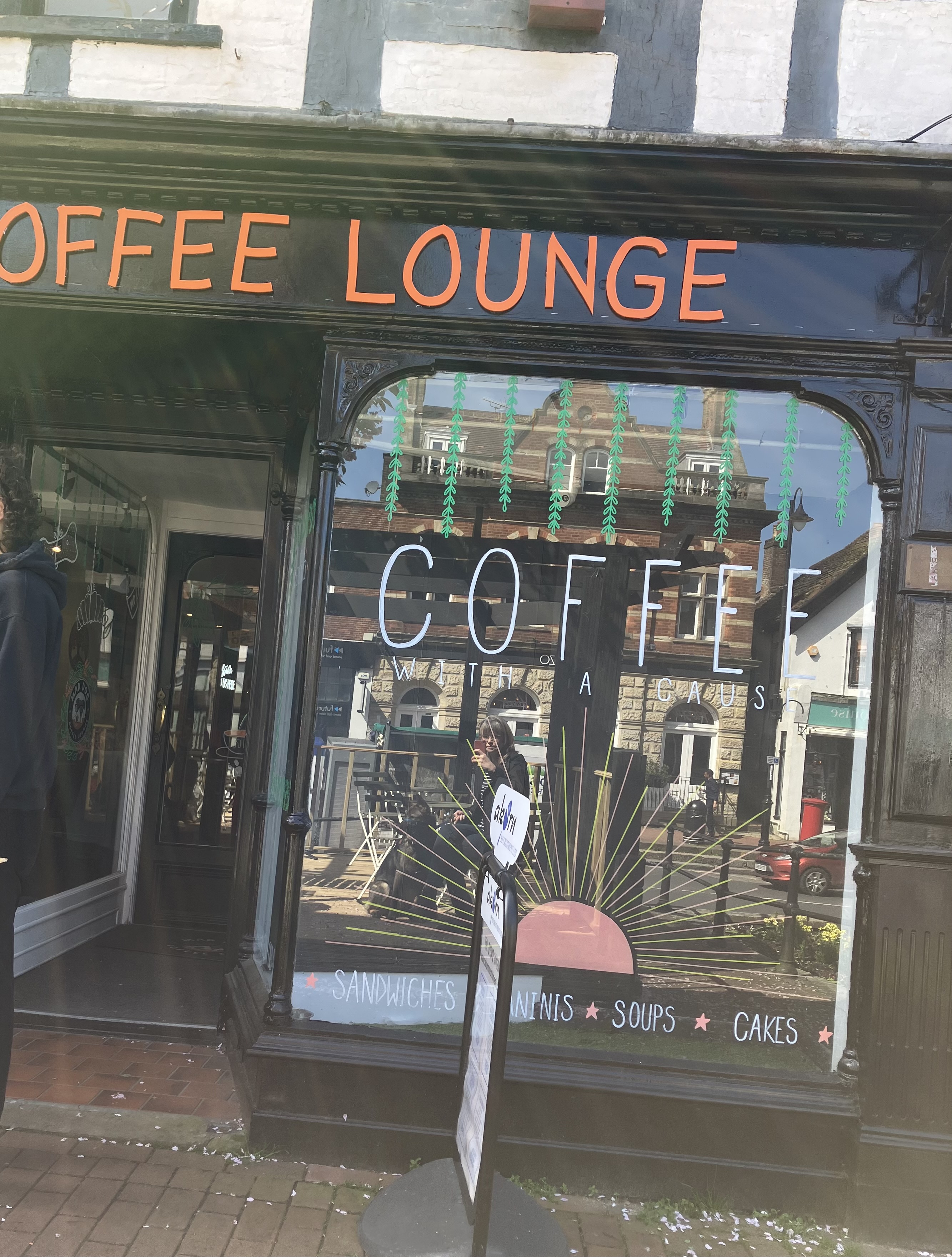
We had a great day on Tuesday. I drove to East Grinstead (Meg is still refusing to jump into the Mini, which is a real pain, she is very heavy to lift). Parked, and walked 10 minutes along the High Street. Meg lurched towards cars when we were right next to the road, but the High Street has a slightly raised path, a couple of metres from the road, and she ignored the traffic there. We were meeting a friend, and arrived early, so we sat at a table outside in the High Street. There was another dog, who Meg noticed, but she then settled down and was peaceful.
When my friend arrived we went into the cafe (the Mad Dog Cafe—appropriate name!) Meg, for some reason, baulked when we were inside and refused to walk any further. No idea what spooked her. We were next to a table, so sat there. Meg settled on the floor with her chew. She barked, briefly, at a woman carrying a tray, and at a baby shaking a toy. Other than that, she was very well-behaved, and I plan to return.
It was Puppy Classes in the evening. There was a new dog, a 10 month old poodle (a big one) and he barked at everyone. Meg responded initially, but then ignored him. It was fairly crowded this week, with puppies of all sizes, and she did very well, sitting and lying and walking in close proximity to lots of other dogs. Only dug one hole this week, so a success. (The class is in the sand school of a stables and we usually arrive to perfectly flattened sand, and leave to a mass of craters that Meg has dug.)
Yesterday was not so successful. I was feeling tired, so exercised her in the garden. During the afternoon I bent to pick up a stick, Meg dived for it, ran straight through my legs, and knocked me flying. Luckily I didn’t bang my head on a nearby tree, but I sprained my knee and ankle, and got a few bruises. While I lay on the floor, winded, with my glasses next to me, did Meg care? Not a jot! She bounced around with the stick and was in danger of trampling me. So much for the idea that dogs are attune with us and empathise with our emotions. I suspect if I had been knocked out, she might have eaten me! Hobbled back to the house for Nurofen and bandages.
**
My ankles are healing well (tight bandages, rested and raised—usually does the trick). I haven’t risked running yet, but yesterday I took Meg for a walk to the stream. This was such hard work. The main road has been shut for several weeks, due to a collapsed drain, which means there has been very little traffic. It is now open, and lots of cars zoomed past us—Meg lurched at every one. This is very disappointing, I have tried so hard to desensitize her to traffic. I’m guessing we made a mistake when she was little, in allowing her to pull on the lead. It’s now a real problem, and trying to make her walk to heel is futile. The best I could do was make her sit, before each car reached us, and held her on a tight lead, with one hand on her head (not sure if that was for comfort or because I was so angry with her I needed to be pushing her down!) There were many cars, it took a very long time to walk the 100 metres to the field entrance.
Once away from the road, I released Meg, and she ran into the field, hunting for sticks and sniffing smells, and always keeping relatively close as I marched away. There’s something about walking fast that is a great releaser of tension—for both of us I suspect. I’m sure if I couldn’t walk fast I would be taking anti-depressants.
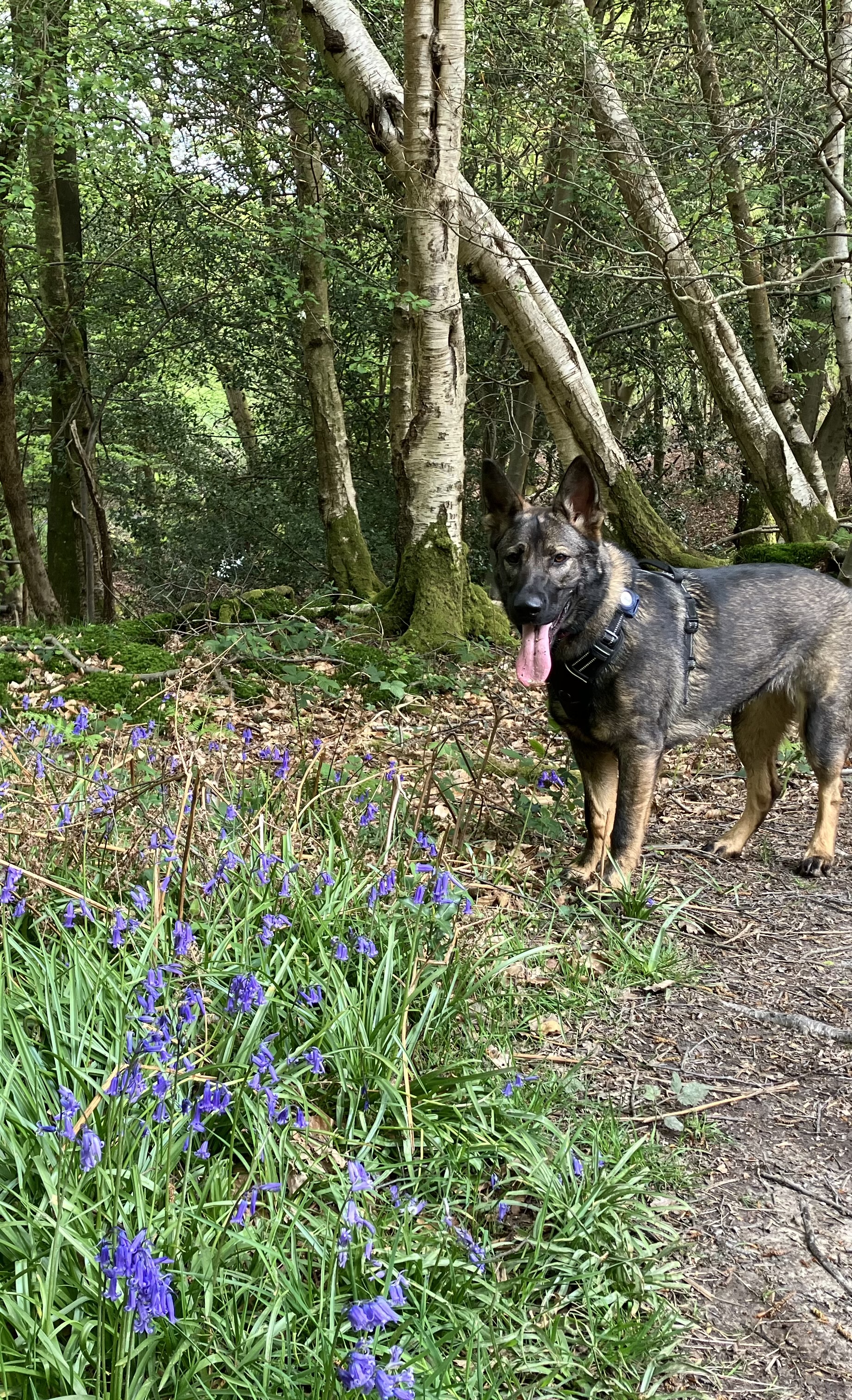
Unfortunately, the happy walk was interrupted as soon as we rounded the first corner. A collie was there, called Leo, with his owner, and he was nasty. (I mean the dog was nasty, the owner was simply incompetent, I assume, as a nasty dog should not be loose where other people walk.) He snapped at Meg, who has never met an unfriendly dog before. He then pounced at her, and she yelped—I don’t know if he bit her or just frightened her. She ran off, back into the first field, and Leo followed. I could see her through the gate, she was watching me, but not daring to pass nasty Leo, who was baring the way. I called her, and Meg started to come, but Leo lurched towards her again. I asked the owner (in my very snotty schoolteacher voice) to ‘Please put your dog on the lead because he’s frightening my dog and she daren’t come back to me.’
Incompetent owner shouted, ineffectually, at Leo, and managed to move him further away (though still didn’t put him on the lead). I was furious. Meg is a German Shepherd dog, and they are known for being unfriendly towards other dogs. Meg, however, has a very sweet nature, and will happily ignore most dogs. It only takes one encounter with an aggressive dog to spoil this. I’m really hoping that Leo-the-nasty-collie will not cause Meg to be defensive whenever she sees another dog.
We marched off, round the field, releasing our tension. By the time we returned to the road, with all the whizzing traffic, I had recovered enough to cope with mad Meg trying to catch every car that passed (every single car). Arrived home exhausted.
Hope you have more success with the difficult things in your life–hopefully we will get there eventually. Thanks for reading. Take care. Love, Anne x
I was feeling lost this week. I felt as if everything was going wrong, and I was trying to do things that were too difficult for me. Plus the dog was being worse than usual, the cockerel was pecking everyone, and my favourite plant was dying—so all the things that are supposed to be fun, supposed to balance the rubbish bits of life, were adding more stress. It was a dark moment, emerging from a difficult week and being over-tired. It happens.
But then, as I was preparing to go to bed, I read Isaiah 42. I am trying to learn it (just 3 words, every day, but it gradually goes in) and I had reached verse 6, and the part that says: אַחְזֵק בְּיָדֶךָ וְאֶצָּרְךָ I will seize your hand and guard you. The direct translation is better than most English Bibles, as the verb for ‘holding/taking your hand’ is much stronger than just ‘holding’ or ‘taking’. It’s more of a ‘strong grab.’ Which, when you are feeling tired and defeated, is extremely comforting, don’t you think? I was, at that moment, feeling like a failure, but God (who never fails) was grabbing hold of my hand and would guard me. Like a parent grabs hold of their child to stop them falling or walking into danger.
I realise that I am taking the text out of context, and the original author was not intending it to be about me—but I think that’s the thing with the Bible—sometimes it speaks straight into your situation, and you realise it is changing you. For me, this is why I am a Christian. It’s not so much about religion or theology, as about God being there—being part of the excellent bits of life, and the really rubbish bits. Frankly, I don’t think I could do it on my own, not really. I’m not very strong or clever or talented—I’m just a normal person who makes lots of mistakes. Like most of us. But I have a God who will seize hold of my hand when necessary, and that is very comforting.
I hope you find the help you need this week too. Thank you for reading. Take care. Love, Anne x
Thank you for reading. anneethompson.com *****
Why not sign up to follow my blog? Look for the symbol below and follow the link.
Hello, how are you? Have you ever deliberately used artificial intelligence? It is something that I have shied away from, but I noticed that my blog platform offers it as a tool. When I publish a blog, I can review it using A.I. It offers me an alternative picture, and will ‘read’ my writing and suggest improvements. I decided to test it. Below is a blog article that I wrote and uploaded.
Underneath the post, I show the suggestions offered by AI Assist.
My Original Blog Article: What does Leviathan Represent in Job 42?
The Book of Job in the Old Testament has been discussed for centuries, and scholars agree on very little. I therefore decided that this would be an excellent book to base my dissertation on. I have always been fascinated by the description of Leviathan in chapter 42—and even though my English translation has a footnote, telling me that Leviathan is a crocodile, I found this annoying. The Leviathan breathes fire, his breath kindles coals, he exhales smoke and is able to snap iron and bronze as if they are dried sticks—surely this describes a dragon rather than a crocodile.
I began by reading the Book of Job. Very briefly, the story is this: God meets with the heavenly host, and speaks specifically to ‘the accuser.’ (Some people translate this as ‘Satan’ but the Hebrew word for ‘accuser’ is ‘satan’ and it has the definite article, so I think it’s unlikely to be a name, and more likely a role—like ‘the accuser’ in a court of law.)
God says how delighted he is in Job, who is a very good man, and he asks the accuser if he has noticed Job. The accuser replies that yes, he has, but he believes that Job is only good because of what God has given him. God then says the accuser can test his theory, but he mustn’t kill Job. Then we switch to a different scene, and most of the book describes what happens on earth.
Job is a good man, with family and wealth and good health. He basically then loses everything. His children die, all his wealth is stolen or destroyed, his health fails and he is in agony. At this point, three friends come and sit with him, for a while silently sympathising. Then Job speaks, saying that none of this bad luck is fair, and he would like to challenge God about it.
There are then several long (and quite boring) speeches that take an amount of resilience to read! The friends each in turn tell Job that he must have sinned, because God is good, and if Job repents than ‘voila!’ God will restore his health. Job replies to each one, stating that he didn’t sin, and it isn’t fair, and he challenges God to justify the situation. Then there’s a speech by another character, which says much the same as the friends.
Finally, God replies. In God’s first speech, he shows Job creation, displaying his splendour, comparing it to humanity’s insignificance. Job basically replies by agreeing that yes, he had always known that God was great—nothing has changed. But then, God speaks again. This time he shows Job two monsters, Behemoth and Leviathan. After seeing Leviathan, Job says ‘Now I get it! Now I see who you truly are.’ He worships God.
The book ends with (in my view) a strange contradiction of all that has gone before, as Job is given more children (though his first children remain dead—which any parent will tell you is not okay). Job also gets more wealth—though there is no mention that he is healed. He dies after a long life (potentially lived in constant pain).
My interest is in Leviathan. What was there, in God’s description, that changed Job? Why did he suddenly understand, why did he say he had seen God? Why did this mean that losing everything was okay? I will tell you more in another blog.
****
The A.I. generated suggestions for the title are as follows:
The Book of Job: Leviathan and Divine Revelation
This title highlights the central focus of the content, the divine revelation through God’s description of Leviathan and its impact on Job, attracting readers interested in biblical analysis and interpretations.
Understanding Leviathan in the Book of Job: A Dragon or Crocodile?
This title sparks curiosity by addressing the debate of whether Leviathan represents a dragon or a crocodile, engaging readers seeking insights into the symbolic meaning and theological significance within the Book of Job.
Significance of Leviathan in the Book of Job: Unveiling Divine Wisdom
By emphasizing the significance of Leviathan and its role in revealing divine wisdom, this title appeals to those exploring the deeper spiritual and philosophical themes in the Old Testament, capturing the interest of a wider audience.
***
The suggested improvements to my blog article are as follows:
AI Assistant
The content’s main language is English.
The post content is engaging and offers a thorough review of the Book of Job in the Old Testament. It provides a personal perspective and raises thought-provoking questions about the character of Leviathan and its impact on Job. Consider breaking down some complex sentences for easier comprehension and refinement of the message. Utilize subheadings to enhance the readability and structure of the content. Keep up the insightful analysis and continue to explore the significance of Leviathan in the next blog.
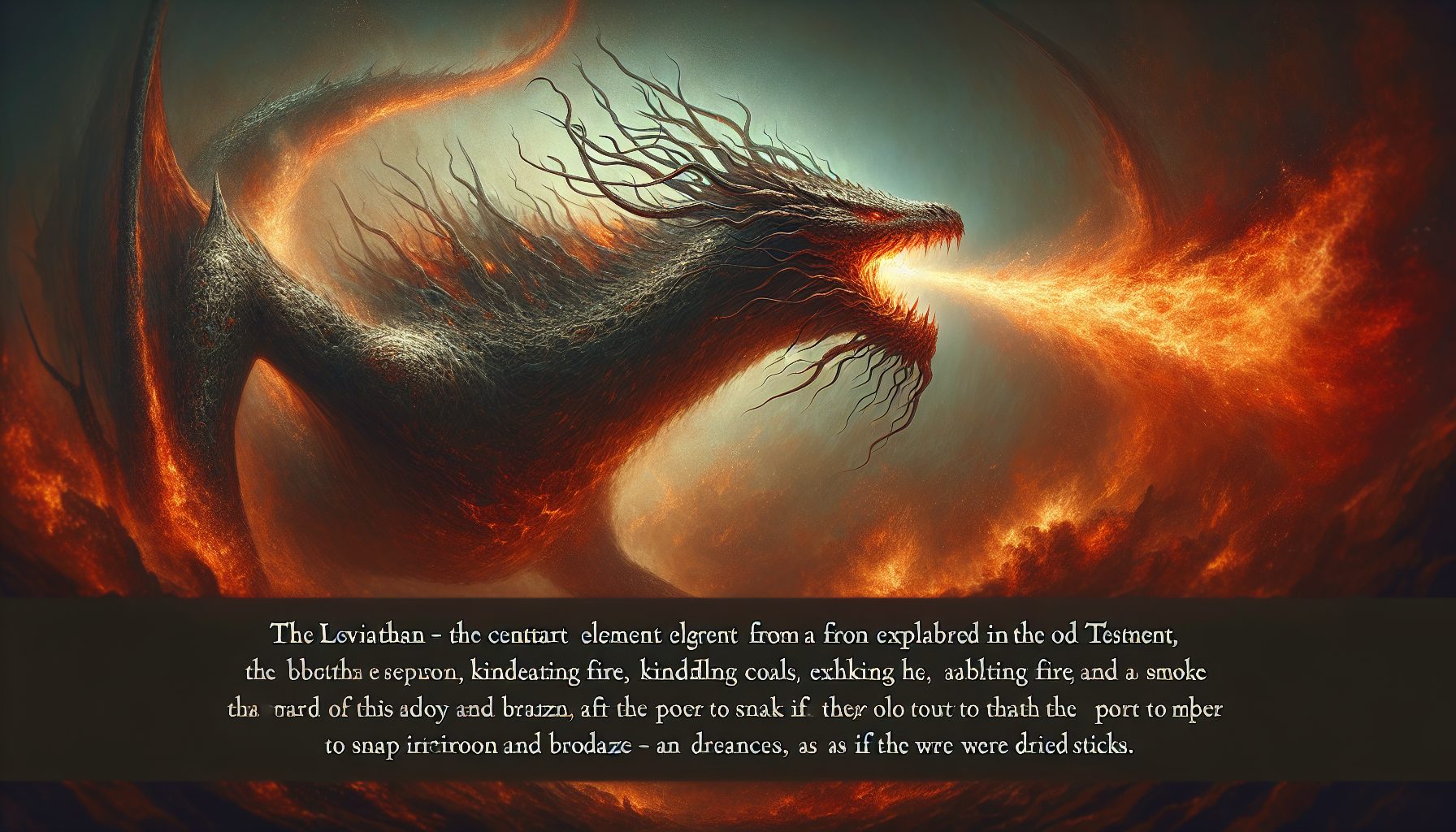
I then can choose a ‘featured image’. One is my own rather naff one, the other is computer generated:
I definitely prefer the generated image. (Though the words are a challenge!) ***
I’m not sure that I will use AI in future blogs–except to generate pictures. The most important editing feature of my blog comes from my husband, who frequently says’ “You can’t write that!” I find this an invaluable tool, as my humour is often a little risky. I’m not sure that AI will ever fully replace husbands when it comes to editing.
Thanks for reading. I really will tell you more about Leviathan in another blog. Take care. Love, Anne x
I have started to take Meg with me wherever I go (that allows dogs). We have walked round the market (stressful) the garden centre (surprisingly good) and the Four Elms shop (excellent behaviour once through the scary sliding doors!) I also take her, when appropriate, when I go out for coffee—I carry a chew and an old towel for her to lie on (not that she does lie on the towel, but it shows willing). She has been to Mum’s a couple of times—the first time was a nightmare and I spent the entire time stopping her eating the carpet/rug/draught-excluder/flower arrangement. The second time was better, and we had a nice chat (me and Mum, not me and Meg) while she (Meg, not Mum) chewed her chew. She does have the snake draught-excluder on her hit list though, and looks for it whenever we visit.
Always fully alert and ready to bounce.
Today we took her for coffee in The Garden Coffee Shop (Four Elms). We walked in, and Meg jumped up to look out of the window, put her paws on a seat, tried to join other customers at their table. Not too professional. We got her into a corner, and she settled down with her chew. Every time new customers entered, she stood up and barked at them (not sure why, no one else had a dog). Then gradually she relaxed, and we had some time to actually drink coffee and chat. After about 30 minutes she grew restless again, so we paid and left. I’m hoping that over time, this will be relaxing for all of us. At the moment, it’s a work in progress.
While the main road near the house is closed (and there is less traffic passing) I am walking Meg to the nearby stream each day. She is still super reactive if a car passes, but we only have a short stretch next to the road, and once in the field she is fine. I have no idea what will happen when she sees a deer, but I don’t think she can run to any roads even if she chases it. The good thing about the walk is that she has to wait at the gate when we leave, so it’s easy to put her back on the lead. She has become very naughty at being caught when it’s time to go home, so I can only take her to places with a barrier that stops her.
7 Months I talked to ‘dog-trainer-Sue’ about taking Meg on a train. She advised me not to take her to a station initially, as it would just scare her, and to practice things like going through sliding doors, and walking through the underpass tunnel in Oxted. We practice the sliding doors at the garden centre, and Meg is completely fine with them now. But trying to go through the underpass had the same reaction as the tunnel in Instow—full brakes, and not persuadable! We have walked up and down the ramp a few times, but I’ll need Husband to help me get her through the underpass
We went to Cambridge, and took Meg. I took her on a long walk first, so she didn’t need physical exercise. We shoved her into her crate in the boot, and drove (2 hours) to Cambridge. I then walked her for 10 minutes, just to loosen up her joints, and offered her a drink (which she didn’t want). Then back into the crate while we looked around a prospective house to buy, and then drove home. She was great, and I think she just slept or chewed her chew. (I keep the chew for ‘special’ occasions, like when we’re out and I need her to be confined.) Though she did stand up and bark on the QE2 bridge! I don’t think she likes heights. When we got home it was evening, and I worried she might be full of energy, but she seemed tired, and was happy to go to bed. I guess she must have been alert and watching during the afternoon.
Today we took her to the pub. It’s a 45 minute walk, which is slightly long, but I’m hoping it won’t hurt occasionally. She was terrible whenever a car passed us, but we can cope with terrible now. In the pub she settled under the table with her chew, and was completely engrossed unless someone approached the table—when she barked at them. I think she was worried they might steal her chew. It wasn’t as relaxing as when we leave her at home, but I’m hoping that things like this will become routine. It’s easier to occupy Meg if she joins me for my activities rather than having to do things exclusively for her. After a quick lunch, we walked back home. I was tired, she was still bouncing. Such is life.
Thanks for reading. I hope you have things sorted this week. Take care. Love, Anne x
I didn’t begin to feel safe until I reached Norwich. As the train heaved towards the platform, with a great screeching of wheels and complaining of brakes, it was as if I had been holding my breath and finally, with a sigh, allowed myself to think that perhaps I had managed to escape after all. While we slowed, a conveyor-belt of painted faces peering in, I joined the general shuffling of the masses and edged towards the doors. People were staring at suitcases stored near the exit, ensuring no one stole them, mothers were gathering a plethora of plastic toys and sweeping sweet wrappers over the edge of the grey tables so they fell like confetti to the carpet below, men in crumpled suits with tired faces were clutching briefcases and over-night bags. We inched forwards, any bond formed during the journey through smiles or the fleeting meeting of eyes was now dissolved, we moved individually, each person isolated from the other passengers, until finally, with a giant step down from the carriage, we were free.
I moved cautiously, looking for security cameras. I chose two boys, one with chaotic hair and a blue coat, his friend wearing a beanie and carrying a backpack, and stayed as close to their backs as I could. Anyone watching would have thought we were together, student friends returning to Norfolk, off to find a taxi together. The yellow barriers were all left open, so I shoved my redundant ticket into a back pocket and walked in the footsteps of my unsuspecting buddies as we left the canopied platform, past the Starbucks and the single policeman staring aimlessly into space. It was the end of the morning commuting time, and a few people in business suits were still hurrying to work. There was a child wearing pink bunny ears chewing a breakfast donut, spilling crumbs as she ate. A man, walking while he read a text almost walked into two girls as they emerged from M&S carrying their tiny bag of food. Everyone was in their own isolated capsule, and I felt invisible as we headed towards the Victorian red brick wall of the main concourse. As we neared the ticket office, I peeled off, said a silent farewell to my pretend friends, and stood in line at the automatic ticket machine.
I knew the timetable by heart – weeks of planning and surreptitious trips to the library to use the computer ensured I was prepared, and when it was my turn, I bought a single ticket to Sheringham. A man was standing behind me, and although I knew he was probably simply waiting his turn, he made me nervous, and I tried to cover the screen, to hide where I was going, in case he remembered later and repeated the information. I heard him sigh when I pulled out money – I knew he was impatient, surprised that I wasn’t using a card, which was surely what the machine was designed to receive. But I couldn’t risk using cards, couldn’t risk being traced, so I ignored him, and smoothed out the crumpled notes as best I could, and fed them laboriously into the slit designed for paper money. The machine whirred. Coins clinked into the bottom section, followed by the orange ticket and matching receipt. I pushed back the plastic flap and retrieved my things, clutching them in my hand as I moved away. I glanced up at the departures board, checking the times splashed in orange letters matched the information in my head.
The public toilets had the same damp chemical stale air as all other public toilets in England. The same middle-aged women were washing their hands while checking their hair in the mirror, the ubiquitous harried mother was trying to stop her three-year-old touching every surface, and handle, and wall; while a teenager smeared eye-liner around the rim of her eyes. I crossed the wet floor, edged past the yellow plastic “cleaning in progress” warning placard, and locked myself into a cubicle. Which is when I actually, for a moment, properly relaxed.
People assume that being a prisoner is all about locks – being locked into a space by someone else and not being allowed to leave. But actually, the reverse is as heavy a burden. Unless you are free, the ability to lock yourself into a place is also denied. The prisoner is unable to lock a door, to shut out the world, to enclose themselves into a space that is truly private. They are always on view, watched, analysed – whether they are aware of it or not. I leant back against the door and closed my eyes, savouring the precious moment of being unobserved, hidden from the world. No one knew where I was, no one was watching, I was truly, wonderfully, alone. But only for a few minutes.
When I emerged, walking straight to the row of damp sinks, there was a woman with two daughters standing by the driers. They were Chinese – or some similar ethnicity – and while they shook drips from their hands and spoke in their sign-song chatter, I noticed how similar the two girls were. Separated by a couple of years, one was taller, but that was the only difference I could discern, they seemed identical. Both were laughing, their dark eyes dancing beneath thick fringes of black hair, wide lips drawn back to show their small straight teeth. They were pretty, with their slim bodies and smooth skin, and as they giggled and chatted, they drew the attention of the other women using the washroom. Two identical dolls. I wondered what it would be like, to grow up with someone so similar in appearance as to be almost interchangeable, to potentially, when the height differential lessened, have a physical substitute at hand. I smiled briefly, exploring in my mind the wonderful freedom of being able to ask another person to take my place, to never be missed, because someone else was fulfilling my obligation. It would, I felt, be the most wondrous thing ever.
But then, as the pair moved away from the purring drier and turned towards the exit, both swishing long black plaits down their slim-shouldered backs, I realised that to have a substitute, they must first be willing. To have someone take my place in life, would involve giving up their own, and that, I knew, would be an impossible ask. No one, I thought, would willingly give up their own happiness simply to fulfil the dreams of another. The girls left, and I moved to take their place, holding my hands under the warm flow of air until they were dry.
I kept an eye on the time, moving back to the platforms when my train was due to leave. I chose a seat near the front, thinking that when we reached Sheringham, I could be out and away before most other people had alighted, and that a ticket inspector, if there was one, would be watching the masses as they stepped from the train, and would barely focus on the first few passengers to hand him their tickets.
I found a seat near a window, and moved my bag next to me, closing my eyes so that people would think I was asleep and would choose somewhere else to sit. The train was rumbling in the way that only diesel trains are able, that gradual warming up hum, the sound of an over-stretched engine which is trying to find the gears. I opened my eyes when the train jolted into motion, and looked around the carriage.
The train was fairly empty, the only person who could see me was an elderly lady, who sat in the seats opposite. She had a fat shopping bag, with groceries spilling from the top, and a small brown handbag which she moved from her knee to the empty seat next to her. She smiled at me when I glanced towards her, and opened her mouth as if to speak, so I turned quickly back to the window, and watched as the city was replaced by fields and bushes and lines of trees that rushed past in an endless line of green and brown.
“Excuse me.”
I looked across the aisle. The elderly woman had removed her coat and headscarf, and was leaning towards me, waiting. I nodded, sighing inwardly. Old ladies seem to enjoy talking to young women; I tried to appear discouraging.
“I wonder if you would be very kind and watch my things for me,” she was saying, her face creased into a smile, her eyes trusting. “I need to use the ladies’ room, and I was wondering if you could watch my bags while I’m gone? So no one touches them?”
I stared at her, took in her blue-grey hair, the kind eyes behind the wire-rimmed glasses. We were strangers, two people who happened to choose the same carriage to sit in, but apparently, that was the only criteria necessary for her to trust me. Or perhaps it was because I was female, and there was some unwritten code which meant that she could trust me, someone who shared her gender, that I as a woman would ensure her bags were safe. Maybe in her era, young people were more honest.
I opened my mouth, not sure how to respond, wanting to warn her, to protect her from the dangers of trusting strangers; then closed it and nodded.
“Thank you so much dear. I shan’t be long.”
I watched as she stood, she waited a moment to find her balance as the train swayed, then walked towards the doors at the end of the carriage. They clicked shut behind her departing back.
I looked across the aisle. There was her coat: brown, not new, neatly folded, topped by the square of her red headscarf. On the seat next to them was her handbag – her handbag – presumably containing her purse, possibly her house key, probably stuffed with old receipts, and a tissue and a pen, maybe even a phone. I thought for a long moment about that phone, savouring the possibility of it, the ease of owning it, making anonymous calls, connecting to the internet. My mind wandered back through the handbag, pausing for a moment on the purse, imagining the coins and notes, each in their designated place, counted after each purchase. And a credit card, which may well give contactless payment which if I was careful, if I used it sparingly, would last for a few groceries. I toyed with the idea, ran possibilities around my head, considered the morality of perhaps taking just some of the money, thinking that need probably justified deed, and my need was certainly greater than hers; my poverty was lurking just around the corner, my next few meals were far from certain. Plus, I thought, I was already a thief, I couldn’t deny the label, there was no way to pretend that I was anything else. And I was no Robin Hood figure, the only person to benefit from my illegal acts was myself, there was no justification, therefore this tiny, almost offered-on-a-platter act, was just a tiny part of the whole, barely significant.
But then I pulled back my thoughts, reigned in the tantalising exploration of possibilities, and reminded myself of who I was, who I hoped to become. No, I might indeed be a thief, I might take those things I had no right to, but I wasn’t a petty criminal. I had not yet stooped low enough to steal from elderly ladies on trains. I would not let circumstance mould me into a creature I would loathe.
I turned back to the window, watching trees like hunchbacked old men guarding the road, and muddy fields full of pigs with slices of upturned barrels to sleep in, and roads that raced beside us before curling away into towns and villages and places we could never reach, glimpses of rivers and boats and occasional docks, all blurring into an indiscernible haze. I strained forwards, trying to see the roads, wondering which were the ones that we had driven along, a lifetime ago. But it was too hard to see them, they all looked the same. My eyes closed, and I slept.
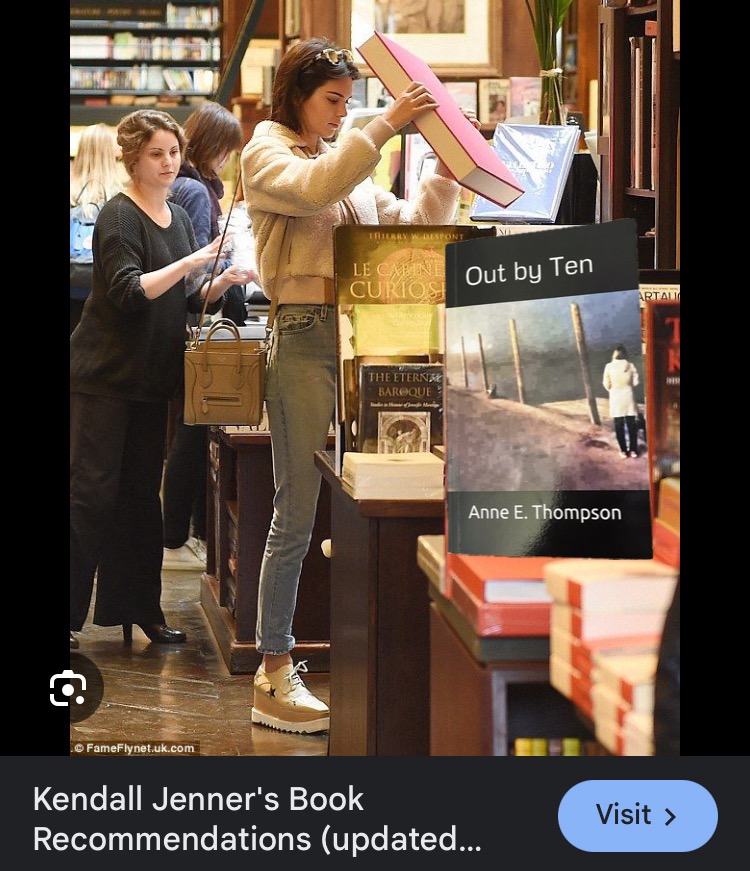
Thanks for reading. The book is available from Amazon, as a paperback or kindle book. I hope you will buy a copy to share with your friends.
One of my Christmas gifts was a ‘voucher’ made by Husband. It promised an ‘all expenses paid’ trip to Bluewater, which I feel was not fully thought-through. I saw potential for some fun.
I generally dislike shopping (understatement) and life has been busy, so I kept the voucher on my desk but never used it. However, this week, I eventually decided to take advantage of it, and we set off. Husband was a little shocked by the lack of specificity in the voucher, and I was smiling.
I needed new jeans. Jeans are a staple of my wardrobe, and they tend to reflect my hatred of shopping, because fashion is reflected in jeans. Have you noticed? Many clothes are timeless, but jeans change constantly.
Jeans seem to change every season. They flare, become tight, grow huge again, slim to fit the leg but flare over a boot, return to hug the flesh. The waistband hugs your middle, then drops to below your belly (everyone my age has a belly) then sneaks up again to hide the bulge, then rises to almost reach your chest. The zipper changes to buttons, then everyone realise how stupid this is (we all have moments of rushing to the loo!) and the zipper returns.
As someone with very little interest in clothes, I find this challenging. I want clothes that I can grab in the morning and wear all day, and I want to know what I am getting. My jeans need to be comfortable, washable, and tuck into wellies. They need to cope with mud, and being brushed clean (though the person who recently told me he was using his hairbrush to brush the mud off his trousers was perhaps unaware of the wild hairstyle he had acquired). I really do not need them to change to show how fashionable I am (because I am not!) Nor do I need them to be expensive.
I did, in my forties, flirt briefly with expensive clothes and bags with designer names. It was very unsatisfying. There really is no correlation between jeans that are expensive and how long they last—nor, I think—in how good they look or feel. I now buy my jeans at Next. They always have a range of sizes and colours and they are not overly expensive yet they usually last for a few years. (Some of the cheaper jeans tend to tear after a while, plus I dislike buying clothes that might have been made by slaves, and Next seem to have a reputable slavery policy.)
I can tell you that this year, it is possible to buy jeans with a waistband that holds in your tummy but isn’t up round your armpits, in a variety of shades (but not, thankfully, white—that was a bad fashion). They range in tightness but it is possible to find some that are neither completely flesh-hugging nor flapping in the wind. But they are short. Last time I bought jeans, they reached my shoes. This year, all jeans seem to show a little sock (I always buy ‘regular’ length, as ‘long’ need rolling up or I trip over). This will take some getting used to, as I am not especially keen on seeing ankles, and I dislike having to take the time to match my socks. But we will cope.
I also bought, in case you are interested, a top, some pyjamas (which I will wear as a tee-shirt) a pair of running shoes and some white trainers that Husband told me are currently fashionable (but I’m not sure if I will bond with them—they are very white).
We had coffee, as promised by the voucher, and returned to the car. We were in Bluewater for about an hour, which is about my limit for shopping. It was rather fun, so I might request a similar voucher next Christmas—though I bet it is more specific on what will be paid for!
Hope you have some comfortable clothes to wear. Thanks for reading. Take care. Love, Anne x
Thank you for reading. anneethompson.com *****
PS. We have four ducklings on the pond, and they have now survived, without me interfering for two weeks, which is a record! Brown duck is proving to be a very good mother (most unlike a duck).
After a quick burst in the garden, I put Meg back into her crate and we went for a run. We’re very near an entrance to the disused railway line, so we joined all the other joggers, bikers, and dog-walkers, and ran away from town, level with the coast. It’s a lovely place to run. While Husband showered, I decided to cool down by walking in the opposite direction with Meg. I kept her on the ‘lead of shame’* (the slip-lead with a nose noose, which is loose when she walks beside me but turns her head if she tries to pull, giving me complete control. She hates it, but it keeps us both safe). I tried jogging with her, and it was fine, so I might take her with us tomorrow.
All went well until we came to a short tunnel. Meg had walked under a couple of bridges, but she absolutely refused to walk through the tunnel. She put on the brakes about 10 feet from the entrance, and refused to move. I tried to reassure her, stroked her, tried walking away and then approaching it again—no luck. A family walked past, and I asked if their dog went through the tunnel. They assured me it did, and suggested we walk with them. I tagged along behind them—same result. We were not going through the tunnel. I decided to come back another time, with Husband, and see whether if I go in first, she will follow me.
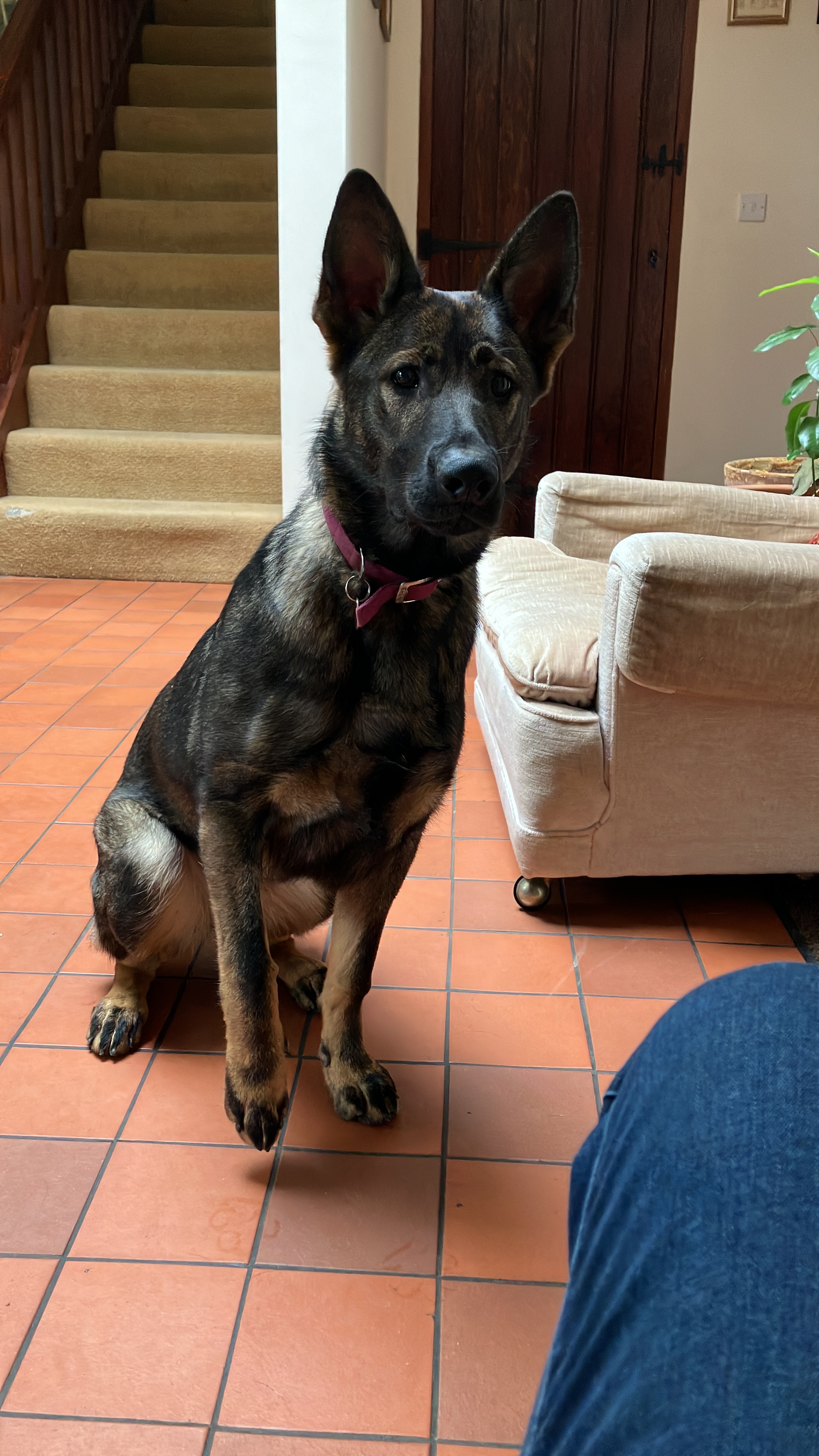
Another walker stopped to ask whether Meg is a Malinois. This seems to happen a lot. She’s not as tall as a Malinois, but while she’s going through her leggy stage she does look similar. The man was walking his own dog, and asked if he could give Meg a treat. She sat very politely while he fed her, but his own poor dog was most unhappy!
We decided to attempt a cafe with Meg. John’s Cafe often has dogs, and they have their own entrance, away from the grocery part of the shop. Husband secured a table and then let us in. I had a large chew with me, and hoped she would settle under the table and gnaw the chew while we had breakfast. Meg was wearing the lead of shame, so walking through the café was fine, and I put her in the corner. She was very antsy, trying to see what was happening in the café, so I switched places (not the seat—I remained on the seat and she remained on the floor! But I sat in the corner, and she sat under the table where she could see everything). After a few minutes she settled, and gnawed the chew while watching as other customers came and went. Other than replying when another dog barked, she was very good. Another first.
I messaged Sue, who leads the puppy class, to ask for advice re. the tunnel. She said not to attempt to call Meg through off the lead, as she might freak and run away. Nor should I force her through, as it would just make the fear permanent. Instead, I should make it into a game, approaching the tunnel with a treat, then turning and moving away from it, repeating until we were in the tunnel. We did this—Husband stood near the entrance with a treat, we ran up to ‘find Husband’, took the treat then turned and retreated. Gradually Husband stood nearer and nearer the tunnel, until he was inside, then moved further back. We managed to enter the tunnel, with Meg on the lead but moving on her own volition. Then we walked the rest of the way, to the other side. On the return trip, she hesitated at the entrance, we showed her a treat, and she walked through. Another success.
Success!
Friday
We tried taking Meg on the run this morning. It was definitely more effort, and we had to stop every time a bike or another dog was in range. But I’m hoping that in the future this will be a thing, and part of her daily exercise can naturally overlap with mine.
After a shower, we went to John’s Cafe again for brunch. They seem to only serve very large portions of food, so it’s not possible to have a single croissant and coffee. I brought home the extra croissant. It’s a shame, because our country seems to be getting gradually fatter/less healthy, which is bad for all of us. (And it’s not easy to limit what we eat when we have delicious food put in front of us—better to be only served a sensible portion, in my view.) Meg was mostly good, and lay under the table with a chew. She did find it necessary to bark when other dogs arrived, which was annoying. However, she coped with being in a cafe, with lots of people arriving and leaving, and young children swinging their legs and making a noise—so mostly I was pleased with her.
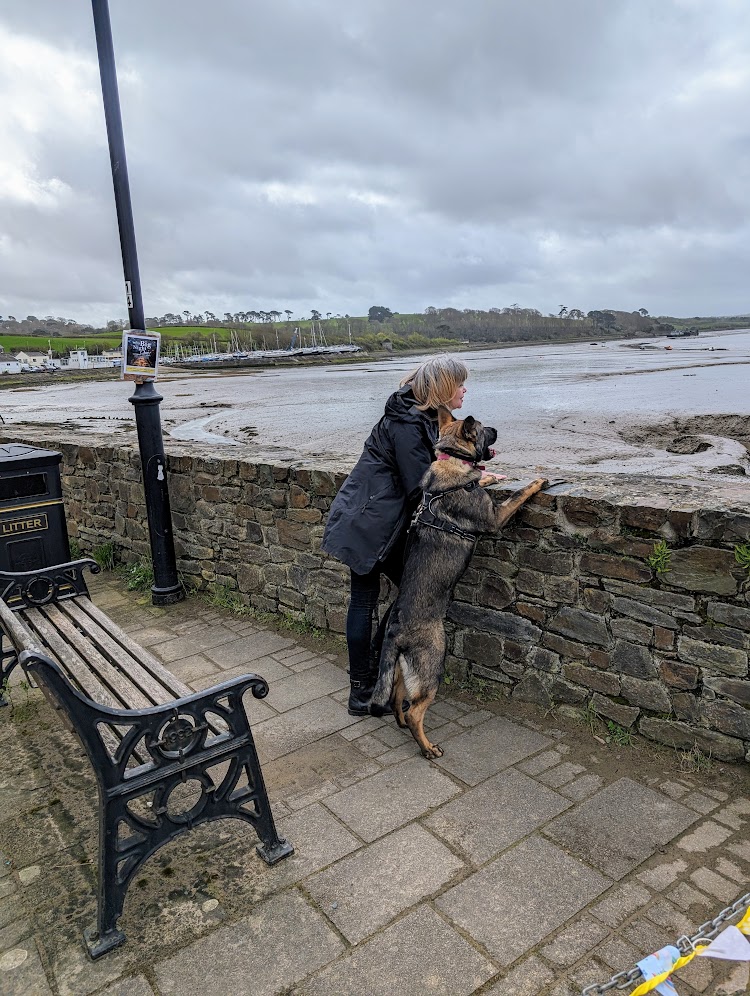
Walking along the street is still a challenge, as she reacts to every car that passes us. I can easily restrain her with the lead of shame, but it will be good when she stops reacting. There was a fun moment when I stopped to look at the beach, and she jumped up to see over the wall too. Mostly, she is a nice dog. David has re-named her ‘Nutmeg’. I am hoping this is because she is dark brown.
Thanks for reading. Have a lovely week, and take care. Love, Anne x
Thanks for reading. anneethompson.com *****
The lead of shame is a lead recommended by my puppy class teacher. It’s made by Gencon, and available from Amazon. The nose loop stops her pulling hard, so even though she is stronger than me, I can safely walk her next to roads. (As naughty Meg has learnt how to wriggle out of it when it’s loose, I also attach another lead to her harness, just in case.)
Instow is the most dog-friendly town in the country. We visited several years ago, when Kia was alive. Kia was true to her GSD nature, and was deeply suspicious of all other dogs, so we spent the entire holiday with a low grumble of disapproval in the background. Despite all the other dodgy dogs, Kia loved the beach, and always cried when we drove home at the end of the holiday. Meg however, is different (this could be a stand-alone sentence: Meg is different!) We therefore decided we would take her to Instow, and see whether she liked it.
The journey here was brilliant. Unlike when she was a puppy, and threw up on a 5 minute car ride, Meg travelled perfectly. (Whether this is due to my training, and constantly being taken in the car or simply because she’s older, is impossible to say, but I have had so few successes with my training so far, that I am claiming it.)
I learnt a lesson from a holiday in France, when our children were young, many years ago. We drove, and the baby was fine all the way on the long drive to the South, but the following day, when we tried to put him in the car to go into town, he had an absolute loop-out. Forcing a determined baby, with arching back and flailing arms, into a car seat is no easy feat. I think trying to force a reluctant GSD into a crate would be impossible, so I was keen to break the journey. We therefore stopped a couple of times, and Meg walked a few loops of the dirty Services’ car park, and had some water, before being put back into the crate. Meg was wonderful (I don’t often write that!) She even managed to sit outside a Costa while I drank a nasty coffee.
The house in Instow is in a quiet road, a short walk from the beach. It’s perfect for families with dogs (I believe everything in Instow is perfect for a family with a dog). There are hardwood floors, and an enclosed garden, and hoses outside both doors. The sofas are in one area, with a large rug, and we are trying to teach Meg that she is only allowed on the hardwood floors. At home she’s pretty good with keeping to certain areas—here not so much. I suspect it will be a battle all week, but we will persist…and then accept a compromise.
We took Meg on the beach. It’s a small stretch of dirty sand along the estuary, with a million people walking, and every person has a dog. Honestly, never come to Instow if you don’t like dogs, they are everywhere. Most were well behaved, and stayed with their owners, a few ran off to interfere with other people, but all seemed friendly. Meg has so far been okay with other dogs—I suspect this is thanks to puppy classes, where she has learnt to practise working with me whilst ignoring all the other dogs working with their owners.
As we walked over the sand dune, onto the main beach, a small black dog ran towards us. I grabbed a stick, and Meg’s focus was entirely on the stick. She ignored the small yappy thing at our feet, and walked with me towards the sea. Brilliant. She loved the beach (only the dry bits, she doesn’t do wet feet, and not even a flock of water birds tempted her into the sea). We had a lovely walk, the air was fresh, the seagulls circled above us, the dog bounced happily beside us. Then we tried to put her back on the lead to leave, and all went to pot. No way was Meg coming near enough to be caught. When I called her, she stood about 3 feet away, and stared at me. If I approached, she skipped back a step. Bribes (both food and toys) were useless. Very frustrating. We wasted 10 minutes trying to trick her into a situation where we could grab her, and I vowed never to let her run free ever again. We eventually caught her, and returned to the house.
Not coming close enough to be caught.
We left her in her crate while we ate in the Instow Arms. The food was okay—not such a good menu as I remember from previously. We could have taken Meg (I think you take dogs everywhere here) but I was still cross from the beach naughtiness, and needed a break.
After dinner we watched telly for a while (3 Body Problem on Netflix—it’s a bit tense but very clever). Meg has never seen television before, and she was deeply suspicious. She barked at it a few times, and then sat next to me (I like to think she was guarding me, but I suspect it was the other way round). She wasn’t a fan. Before bedtime we strolled along the beach. We kept Meg on a long lead, and she seemed quite happy. No other dogs this time, and the lights from Appledore twinkled through the night on the other side of the estuary. All was peaceful.
I hope you have a nice day too. Thanks for reading. Take care. Love, Anne x
20/2/2024 Today was a complete nightmare with Meg. Whatever I tried to do, she tried to disrupt. She kept jumping at me, pushing through doors ahead of me, chewed bits of furniture and barked at the chickens whenever I took her in the garden. To make it worse, it’s still rainy, so every time we went outside, we brought lots of wet mud back inside with us. There is a limit to how many times I can wipe the floor.
I did attempt to do some lead-training. Several times in fact. Each time, Meg tried to bite the lead as I put it on, then kept biting it while I tried to walk. If we went outside, she lurched towards everything. Standing still does not work (I have been advised that whenever she pulls, I should simply remain completely still, until she notices and stops). Meg is constantly interested in absolutely everything.
So, we manage to walk 2 steps together, she then lurches towards the gate because she heard a car in the lane. I stand still. Meg continues to pull towards the gate for several minutes, then notices I am not moving. Does she return to me, ready to walk obediently by my side? Like heck she does! No, she then decides a leaf is the next great excitement in the world, so lurches towards that instead. Then she spies a twig on the ground, lurches for it and grabs it before I can stop her. Small interval while I try to remove the twig she is hurriedly chewing and swallowing. I try to make her sit, she spins in circles, spots a stone, heaves us both towards it. I give up, and none too gently return her to her crate in the kitchen. An hour later, when the urge to throttle her has subsided, we try again. Re-read from the start of the paragraph. This lasted all day.
In the evening we were scheduled to go to puppy classes (the nice friendly one in the horse barn). I was so frazzled, so near tears, I messaged to say I didn’t have enough patience to attend and be dragged around the barn by my dog. I received lots of nice messages in reply, and the excellent advice from the teacher to have a glass of wine. This helped.
After days like this, I feel complete despair, and wonder if I will ever be able to walk with Meg, and whether she would be happier in a different home. I hate failing, and I like to think that I am rather gifted with animals. But Meg defeats me, and I am aware that lots of things I have done has made her behaviour worse. I think that expecting a working GSD to be a pet was a mistake, and if I could go back in time, I would choose a regular GSD. But I didn’t, so now I must decide what to do. What is best for all of us?
If nothing else, Meg is good for my prayer life. Praying is pretty much all I can do sometimes, because she seems determined to not be trained. I am aware that I need to keep all this in proportion too—no one has died, no one has been diagnosed with cancer or lost their job or home. It’s just a puppy, being difficult.
21/2/2024
Today it was like living with a different puppy. I will write it down quickly, before she turns back into a demon! From when I first let her out of the cage, Meg was lovely. She came for a snuggle (didn’t jump up) and then followed me round the kitchen while I made coffee.
When I was dressed, I drove her back down to the park. Although the police-dog-trainer said I was making her worse by doing this, I found her behaviour was better, and she was definitely less sensitive to cars, so I decided to ignore him (mostly). I did choose a seat further from the road, just in case the proximity was too confrontational, and I did fasten her lead to the seat because she is now too strong for me if she decides to take off. But we sat there, in the pouring rain, and I fed her breakfast to her. She sat, looking at me, while she was fed, and cars whizzed past a few hundred yards away, and people walked past us, and she ignored them all. Mostly. (We nearly had one nasty incident with a woman in a smart white coat who wanted to stroke her, but I managed to warn about bouncing muddy paws in time.) It was very wet, and Meg was more bothered by the rain than eating breakfast, so we walked back to the car, through the car park, which involved avoiding a few people and not chasing a couple of cars, and it was okay. Every time Meg pulled, I either stopped, or walked in a different direction, and she sort of went along with it. (This is the level of discipline I manage to achieve.)
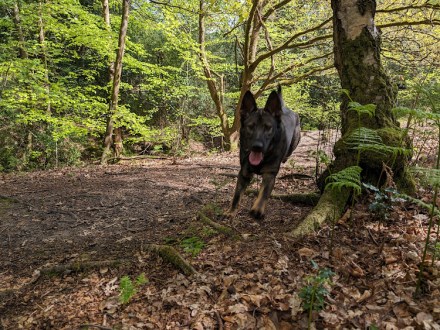
I then drove to an area of common, where there are several miles of woodland. I used to walk Kia here, and I have avoided it because the car park is near a busy road, but I decided to risk it, planning to put her straight back in the car if she started to lurch towards cars. It was fine. The road is far enough away, so a few squeaks on a toy kept her attention with me, and we walked into the woods. The woods are riddled with footpaths, and it’s very easy to get lost (I once walked for two hours longer than planned after getting lost with a friend and her dog). I was careful to stay on the main footpaths, and only to turn left. I still managed to almost lose my way, but realised in time and we arrived back at the car after about 40 minutes. I kept Meg on a long lead, stopping if she pulled hard. Apart from pulling towards other dogs a couple of times, she was great, and we had a lovely walk. Returned home covered in mud.
Trying to smile whilst struggling with crazy puppy…
Later, taking a break from work, I gave her a ball while I had a cup of tea. I sat at the table because I couldn’t face her leaping on me in a low chair, and she snuggled up against my legs. I became aware she was trying to put the ball on my knee, so I extended a hand below the table and a rather spitty damp ball was shoved into it. I rolled it across the kitchen floor, she leapt after it, and brought it back. What a sweet puppy! In another break, I tried upturning two dog bowls, and hiding food under one. I made Meg sit, then shuffled the bowls and asked her to choose one. She sniffed both, leapt on the one with food and chased it round trying to tip it over. I then halved the amount of food, and tried again. She is able to find the smallest crumb of food under a bowl. Then (after maybe 5 times) she started to leap on me, so we ended the game and I went back to work.
I will let you know how training Meg progresses. It’s certainly not boring! I hope you have stamina for the things you’re struggling with in life. Thanks for reading. Take care. Love, Anne x
Hello, and how has your week been? Life usually has lots of good things and difficult things–and as long as I remember to notice the good things, I can cope with the difficult stuff. At the moment, I am noticing lots of good things.
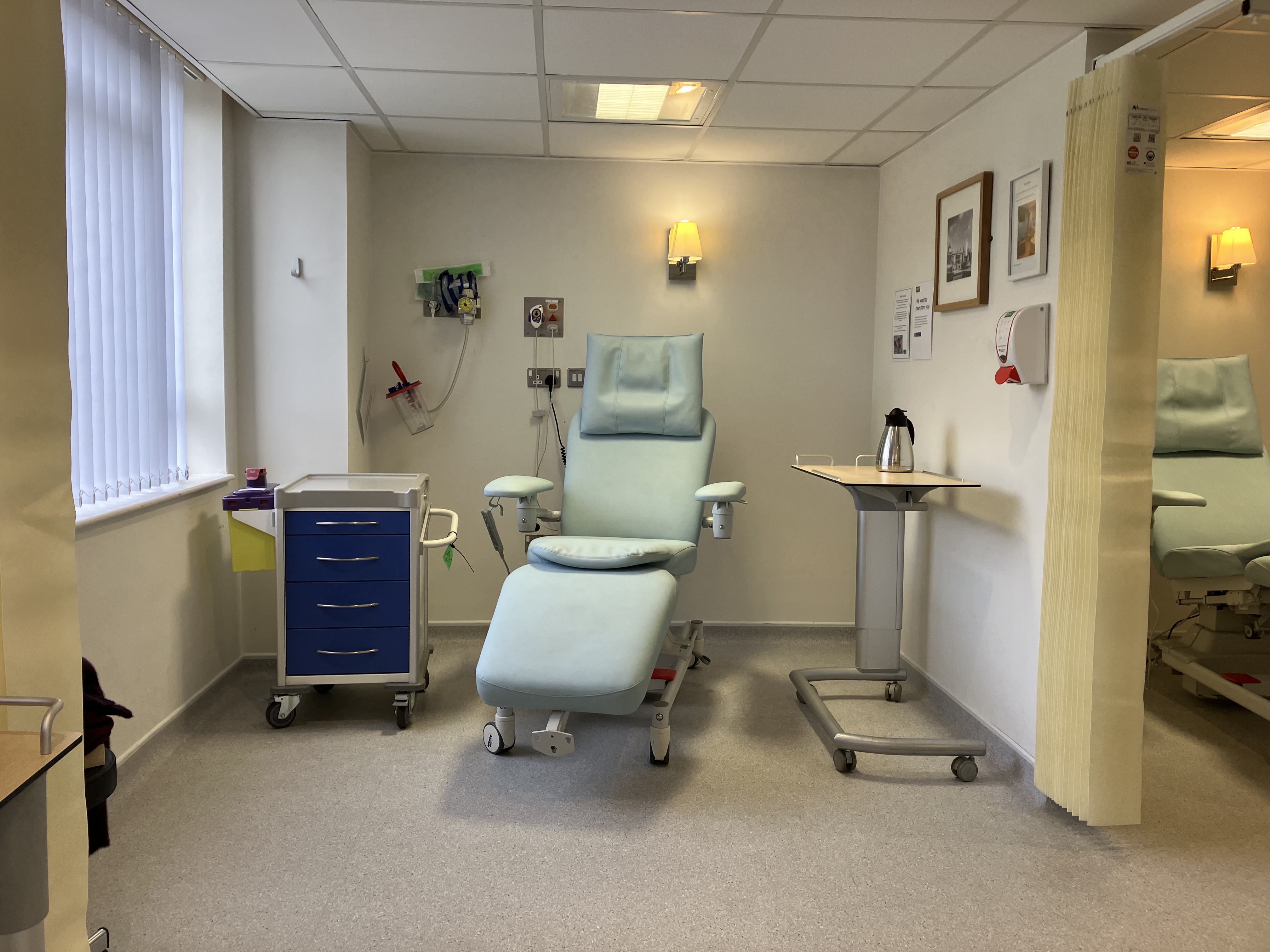
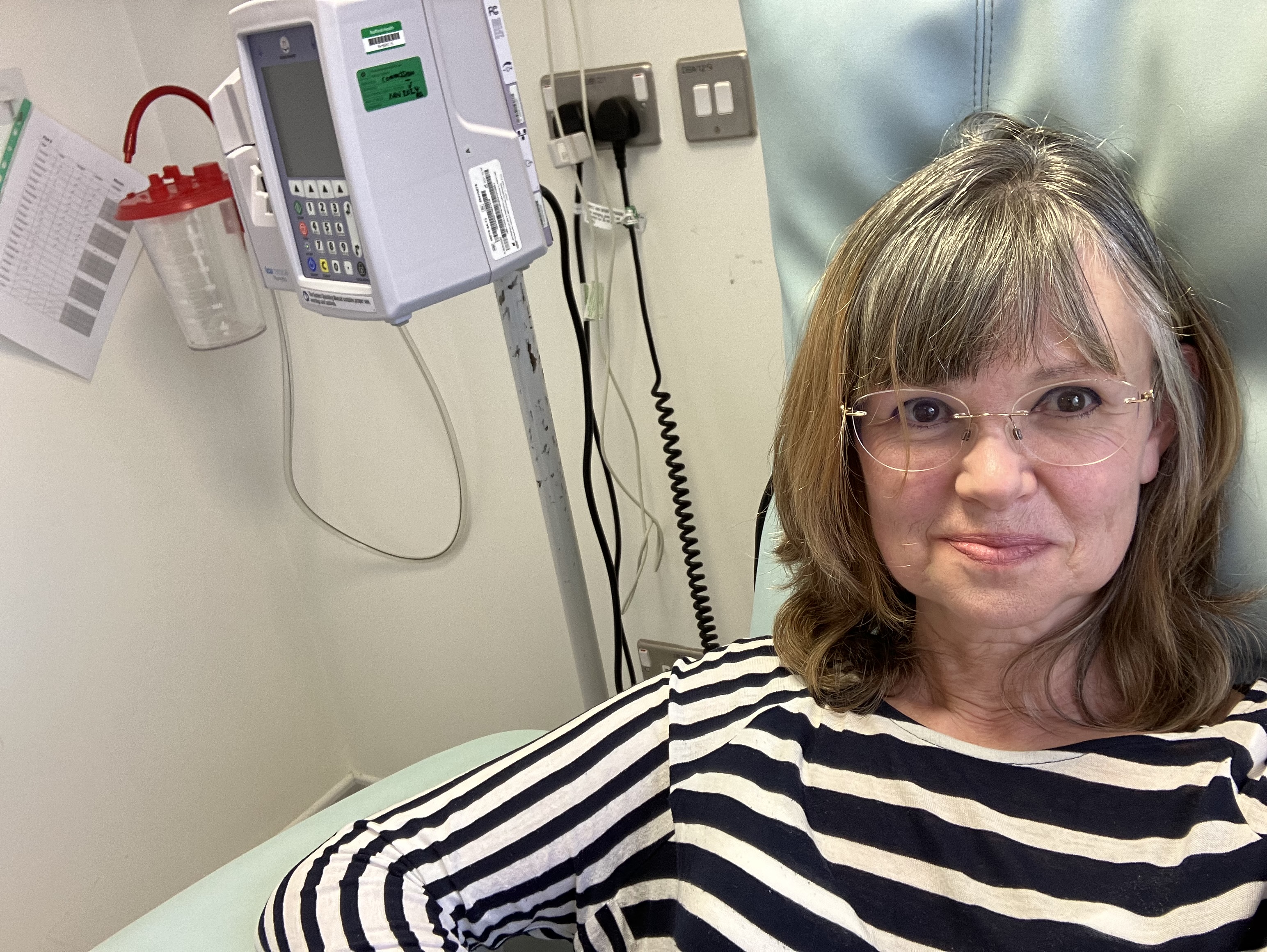
The main thing I’m thankful for is my health. I have now had the results from the heart and liver scan (actually, they seemed to check just about every internal organ!) and all is good. No iron deposits were seen, so I can start having venesections and that should prevent any future trouble. I also had my most recent blood test at the hospital where they’ll do the venesections, and it was a very good experience. Unlike the nurses who often take blood or put in a tube (usually related to scans for the brain tumour) this nurse quickly found a vein and didn’t leave my arm looking like I had been in a fight. The hospital space is also very nice, with big comfy chairs to relax in (ready to stop wimpy people like me fainting!) and staff who were really kind, and very reassuring. I came away feeling confident that venesections are something that will soon become ‘normal’ and I felt so grateful for the medics and feeling safe in a hospital (when I know that in some countries, this would not be my experience). I sneaked a photo to show you— not sure if taking photos is allowed in hospitals so don’t tell anyone. I don’t yet know when the venesections will start, but I am ready!
Nice clean and comfy space.Feeling grateful.
It’s also Spring, and that is a wonderful time of year. I love all the colour, the warmer weather, the busyness of insects waking up and birds nesting and lambs in the fields. Goose decided to sit on her nest (the better one she made, with hay stolen from the chickens–not the rather pathetic 6 sticks thrown on the ground affair that she started with!) I had collected her eggs as she laid them (just 8) as I was hoping she wouldn’t go broody, but she did. I left her with one egg, and have given her a couple of fertile chicken eggs from my old black hen (because she might die soon and she lays lovely big brown eggs). I have also found a few random duck eggs abandoned on the bank, so I have given her those. She seems to accept anything, so we’ll see what hatches. (It won’t be her own egg, as that’s infertile.) Probably she’ll step on the hatchlings and squash them, because she’s very clumsy, but we’ll see.
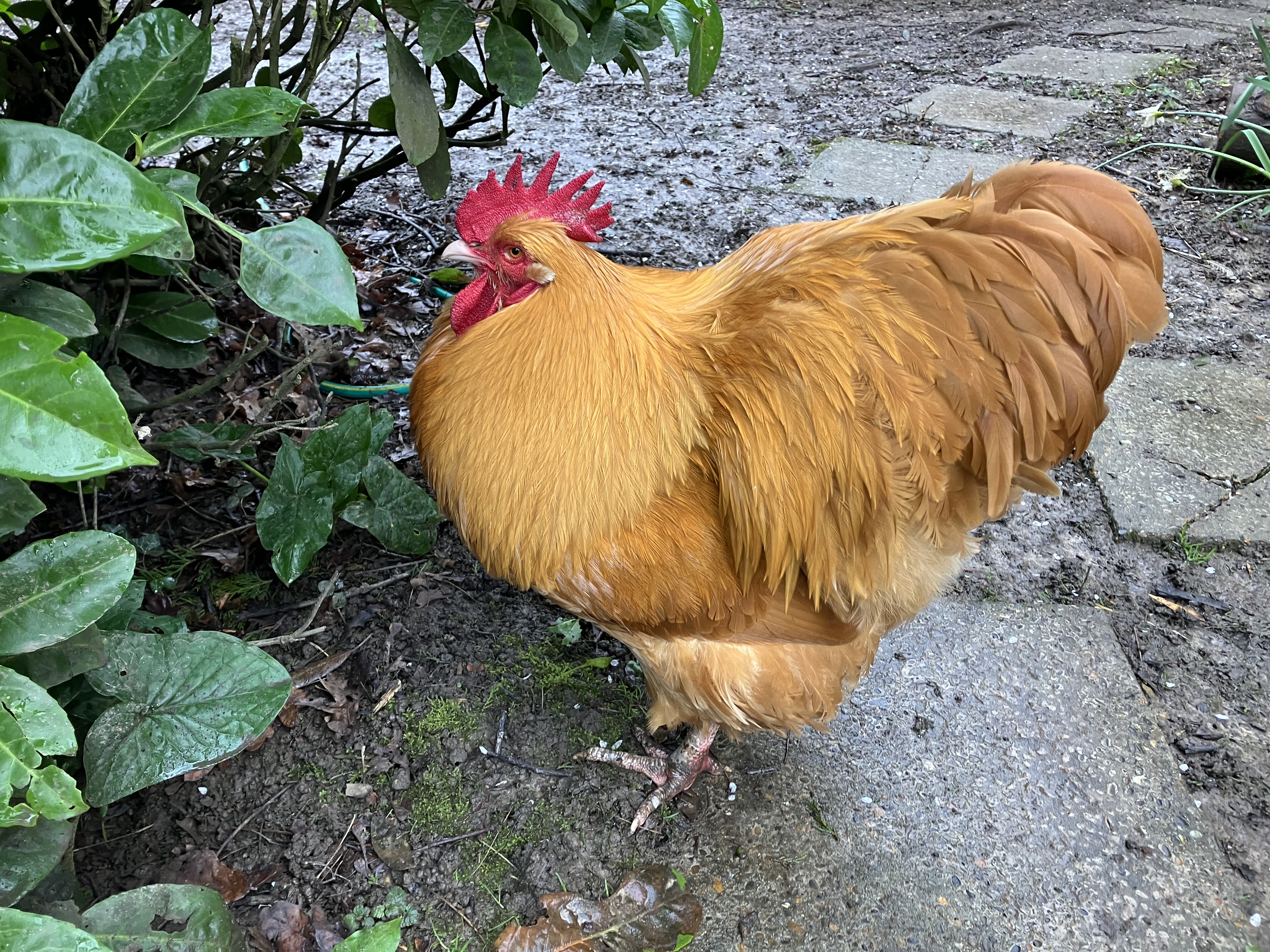
Feeling broody.A Buff Orpington who grew to goose-size!
Maverick, the cockerel, is being a pain. He’s obviously full of Springtime hormones and has started to attack people when they go in the garden. I pick him up and carry him around, but other people are less happy doing that, so he has to stay locked up when we have visitors. The thing is, he’s so beautiful, and at night he snuggles onto the nest with Goose (who he thinks is his mother) which is so cute, and I don’t think I can get rid of him. I’m hoping he will calm down again after Spring.
My other news is that my dissertation has been submitted. I now wait 8 weeks for the mark, and that’s it, my MA is complete. I have started to read about cognitive linguistics, which is really interesting, and hope to write a proposal about death for a PhD. (I think the evidence in the Old Testament shows that death of an individual is a good thing, and was always part of God’s design — otherwise a ‘tree of life’ would never have been a thing. Losing someone else to death is definitely bad, and taking a life is bad, but dying oneself is, I think, good. Otherwise when God killed innocent people–like King David’s baby son–he was acting badly, which is not the nature of God.)
There has, of course, been a fair amount of nasty things too. Friends dying, sad funerals, bad news, family being unhappy, and housework — always there is housework, which is very irritating.
Hoping your week has a balance of good things to help you cope with the rubbish that happens. Thanks for reading. Take care. Love, Anne x


 and follow the link.























 Anne E Thompson