What is ‘The Image of God’ and Do You Have It?


Part of my university research has involved looking at ‘the image of God’ (or imago Dei as it tends to be written in scholarly articles). One of the reasons I hear Christians give for not wanting assisted dying, is that people are created ‘in the image of God’ and therefore they are different to animals, and should not choose when/how to end their life. The ‘image of God’ is what many people believe makes humans special. So what is it, and where does it come from?

You might remember that when we were in Jamaica, I started to read The Liberating Image by the Jamaican Dr Middleton.[1] He explores the different possible meanings for the image, and discusses which are the most plausible explanation—because the problem with the ‘image of God,’ is that although I have heard a lot of people talk about it, few people are agreed on what it actually is. The phrase appears right at the beginning of the Bible, in Genesis 1, when God creates the cosmos. In Genesis 1:26-27 we read:

 ‘Then God said, “Let us make humankind in our image, according to our likeness; and let them have dominion over the fish of the sea, and over the birds of the air, and over the cattle, and over all the wild animals of the earth.” So God created humankind in his image, in the image of God he created them; male and female he created them.’

The term is only used twice more in the whole Hebrew canon, both times in Genesis (Gen.5:1, Gen.9:6). None of the references define what is actually meant, and although the Genesis 9 mention links it to ‘not shedding blood’ of a person because they are in God’s image, this certainly never crops up later, when the Israelites/Judahites (who are believed to have written Genesis) are busy killing the people who are in their way. So the Bible itself does not use as a reason for not killing people, even if Christians today use it that way.

I have read a lot on this, and Middleton’s book is helpful for looking at what God’s image might have meant to ancient people. He examines the term in the context of the ancient world, and decides that it is linked to the statues that kings used to set up in remote places, to remind the people of his presence. That is one possible explanation, but there are others. Middleton looks at several other ancient creation stories, and these are interesting (though possibly, I think, irrelevant) so I will tell you the tales in other blogs. Personally, I think the problem with Middleton’s approach is he looks too much at religions outside of the Hebrew one, and I’m not sure how helpful that is. If I want to understand my religion, I’m not sure how helpful it is to examine what other religions teach. I think the key is within my own sacred books.

After lots of reading, I decided that the image of God was a role—a way we are meant to behave (caring for the world, like God does in Genesis). The trouble with this, is that if people are not acting in this way, are not behaving like God, does that mean they do not have the image of God? And the problem with that conclusion is it is scarily like the conclusion of Hitler when he wrote Mein Kampf—and I am not keen to align myself to his views! I am now busy trying to justify how some people might not be living ‘in the image of God’ but they do possess the potential to do so—which means we are all equal but not necessarily fulfilling our potential. Overall, due to how little the term is used in the whole Hebrew canon/Old Testament, plus the fact that it is never defined so we don’t even know what it is, I mainly think it is not very important. Which means it should not be used as a reason for not allowing assisted dying. (There may be other reasons, I will let you know when I finish my studies, but imago Dei is not one of them.)

I have therefore spent several months learning about something which I now think is irrelevant to my final dissertation. Such is the joy of research! I hope you have a good week, and enjoy doing things even if they are not especially useful. Thanks for reading.
Take care.
Love, Anne x


[1] J. Richard Middleton, The Liberating Image (Grand Rapids, MI: Brazos Press, 2005).

I’m Sorry. I was wrong.


I’m sorry, I was wrong.

When I was very young, my knowledge of other religions was limited to two facts:

  1. Catholics believed in Jesus, but they didn’t believe he rose from the dead, which is why they always depicted him still hanging on the cross.
  2. Jews believed that the only way to be right with God was to offer sacrifices, and the idea of repentance started with Jesus.

I was wrong, in both cases. To my regret, although I learnt fairly quickly that I was wrong about Catholics, I continued to believe—and to teach—the wrong fact about Jews even as an adult. I’m very sorry about this, it was ignorant, and as someone who read the Bible, including the Old Testament, I really have no excuse.

I was reminded of this recently, when reading a little red book of daily Bible studies,[1] that I inherited from my father. The book is looking at the Gospel of Matthew, and is considering John the Baptist. You may remember that John lived in the wilderness, and wore strange clothes, and called to people to repent. As John the Baptist came before Jesus, this should have been evidence enough that Jews believed in repentance—without sacrifice—otherwise John’s preaching would have made no sense.

Barclay discusses what those early Jews would have understood by repentance. It’s much the same as the Christian church today preaches. The word in Hebrew means ‘turn’ or change direction/return, so the idea was that people felt sorry for a behaviour, and therefore wanted to change direction, to turn away from what they knew was wrong. This has always been the way that people have been able to approach God—first we admit the things we are doing wrong, and then we turn away and stop those behaviours. All very New Testament, except actually it started way back, in the Hebrew Canon.

There are several instances when the Hebrews were told to repent, so that God would heal their land, or hear their prayers, or be close to them. We read about it in Ezekiel (Ezekiel 33:11). It also appears in Jeremiah (Jeremiah 31:18-19). Hosea is full of it (Hosea 14:1-2). The book of Jonah is pretty much only about repentance—a wicked nation being told to repent so they won’t be destroyed.

Repentance does of course, thread its way through the New Testament teaching too. It is important. I think it is also timeless—but maybe not something we teach about today as often as we ought. When was the last time you repented of something? Not in the regretful, I wish I hadn’t done that because it caused me a problem, kind of way, but in the, I’m honestly sorry and I will say I was wrong and try not to do it again, sort of way. Repentance, I feel, has gone out of fashion. Instead of saying we were wrong, we give a reason as to why it wasn’t our fault. Or we belittle it, and say it didn’t really matter.

Unless, of course, we are thinking about other people’s wrong-doing. Then we are very keen that they should be sorry. Then we absolutely think they should change their behaviour.

I think repentance is important. I believe it is good for us. I think it is healthy, every night, to think about what we have done wrong during the day, and to admit we were wrong, and to ask God to forgive us—and to try to change. If we never do this, never stop and deliberately think about what we have done wrong, how can we change? How can we be better people? How can we know God in any meaningful way?

I wonder if this is also true of nations. When I look at the big disputes in the world—Israel/Palestine, England/Ireland, India/Pakistan—there seems to be no solution. But everyone is looking at the wrongs (and there have undoubtedly been wrongs) committed by the other side. I wonder what would happen if nations looked at their own wrong-doings? What would happen if governments admitted they had been wrong, and promised to change? But perhaps that is not possible, perhaps the hurts go too deep, perhaps there is not enough trust that the admittance of guilt wouldn’t be misused and twisted by the other party.

Therefore, I will leave the dream of national repentance to one side, and challenge you, today, to think about what it means at a personal level. There is risk with being honest with ourselves—but not, I think, as much risk as being continually dishonest. So go on, I challenge you. Spend some time today thinking about what you have done wrong (because I don’t know anyone who genuinely believes they are perfect). Name those faults before God—and plan to turn in a new direction. It’s what Jews and Christians have been teaching for centuries, maybe it’s time we all did it.

Thanks for reading. Have a good week.
Love, Anne x

anneethompson.com
******


[1] William Barclay, The Daily Study Bible: Gospel of Matthew (Edinburgh: The Saint Andrew Press, 1956).

Was he naked?


At college, we have been considering how other people’s interpretations of the Bible affect our own. This involved looking at some works of art, and considering whether we understood texts differently afterwards. I think I didn’t—though some of the ideas were very interesting.

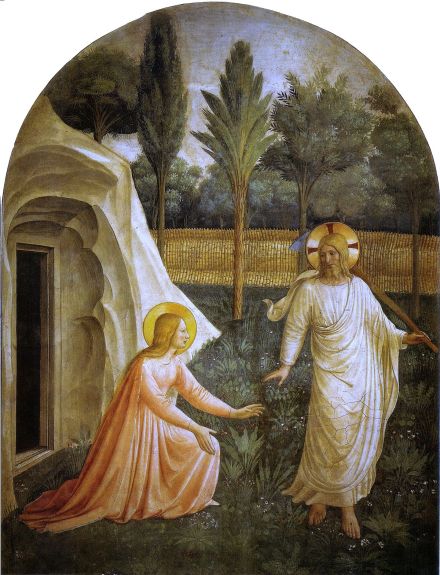
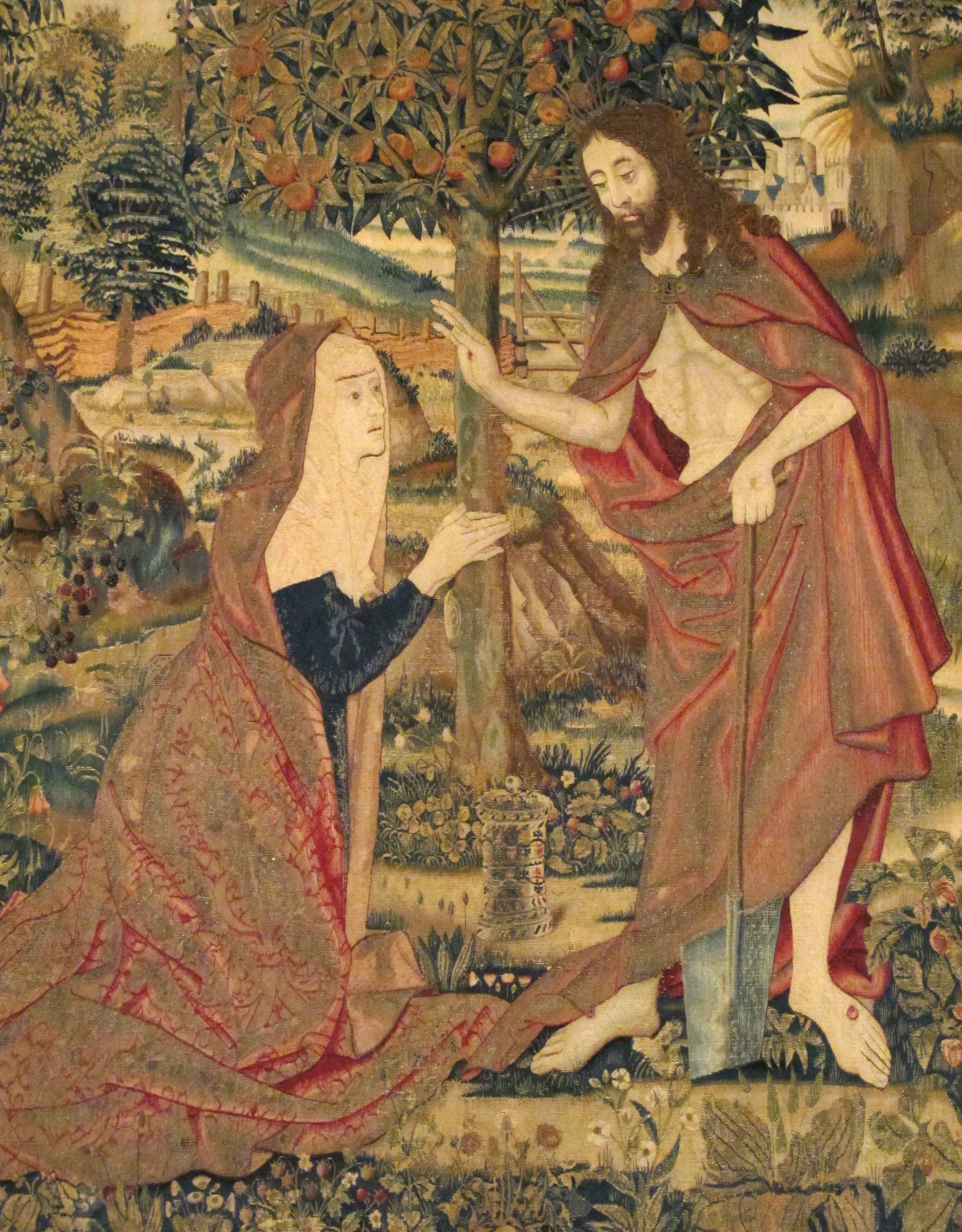
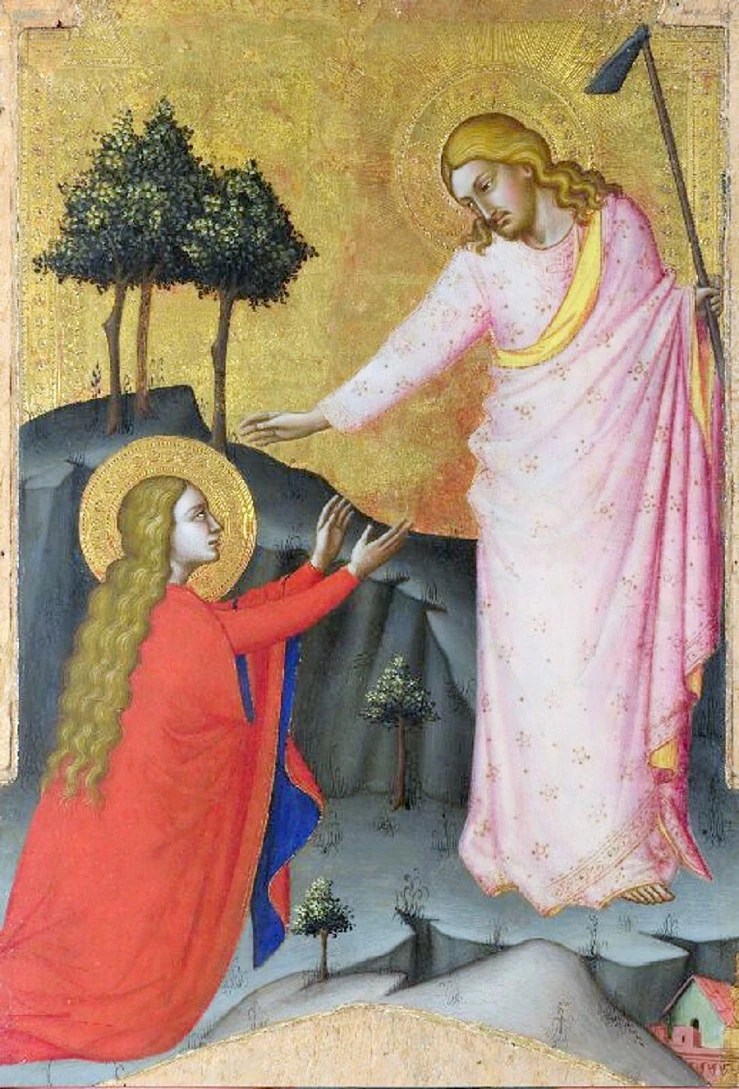
One passage we looked at was after the resurrection, when the women found the empty tomb, and Mary (his friend, not his mother) sees Jesus but thinks he is the gardener. Some paintings showed Jesus shying away as she tried to touch his clothes—emphasizing that he told Mary not to touch him.

Some depicted Jesus wearing gardener clothes, to try and explain why Mary confused him with the gardener. I have never personally imagined Jesus in a floppy gardeners hat, or carrying a spade, but I guess it’s one possible reason why Mary was initially confused.

As someone pointed out, Jesus rose physically (his body got up again) and the grave clothes (which is what he was dressed in) were found folded in the tomb. So, what was he wearing? Did he leave the tomb naked? (Not something mentioned at Sunday School). Did he perhaps borrow the gardeners clothes, thus confusing Mary? I guess it’s possible.

http://www.metmuseum.org/art/collection/search/468532
The Resurrected Christ Appearing to Mary Magdalene in the Garden
South Netherlandish ca. 1500-1520

(Jesus is holding a gardener’s spade. And has no clothes.)

Jacopo di Cione ca.1368
(Jesus is holding a gardener’s axe.)

Jesus appearing to the Magdalene
by Fra Angelico
(Jesus is shown holding a gardener’s axe, and is avoiding her hand.)

The thing is, I don’t think what physically happened at the resurrection is discussed much. We consider the theology of the situation– why did Jesus die and rise again? What difference did it make to our relationship with God? And we talk about the reaction to the resurrection, that his disciples changed and stopped hiding after they saw him. But as to what happened physically? That’s not something I have thought about. A man’s body is a big thing to hide, so where did Jesus go between rising and seeing people? And why could people not touch him, when he touched things like bread and ate it? Would touching him have affected Jesus, or affected the people?

Something for you to think about. Hope you have a great day. Thanks for reading.

Love, Anne x

Can You Name the Character?


Quiz

  1. Who lost their home, possessions, children during a wager between God and the accuser, and were then ignored by God?
  2. Which prophet determined the outcome of a battle?
  3. Which unarmed, untrained civilian killed the head warrior of the opposition in a one-on-one encounter?
  4. Who was forced into a position of subservience, due to their talents rose to a position of authority within a foreign palace, and then used their wisdom to save the Israelite people?
  5. Who was the longest follower of Jesus, who never deserted him, and was there at the crucifixion?
  6. Whose action was stopped in the wilderness, and they then named God: ‘God who sees’?
  7. Name a child used to further God’s plan.
  8. Who defied the authorities to save the life of God’s people?
  9. Who were Mahlah, Noa, Hoglah, Milcah, and Tirzah?
  10. Which story in JOSHUA 15:16-19 is repeated in JUDGES 1:12-15? Why is it important? How often have you heard it mentioned in church?
  11. What characteristics make a good leader?


    Answers
    1. Might be Job, but actually it’s Job’s wife.
    2. Deborah (Judges 4:9)
    3. You might have said David (against Goliath) but actually it was Jael, a housewife who hammered a tent peg through the man’s head! (Judges 4:21)
    4. Esther
    5. Mary, his mother
    6. You might think Abraham, when he was going to sacrifice Isaac, but actually it was Hagar. (Gen 16:13)
    7. You may have said Samuel, but it was Miriam—Moses’ sister.
    8. You may have Rahab in Jericho, Michel with David, or the Midwives in Exodus. Brave women, who risked their lives to defy the authorities.
    9. Numbers 27, daughters of Zelophead who asked for share in inheritance—radical protestors! Their story is told twice, and (unusually) they are named — but did you know who they were?
    10. The story of Caleb’s daughter. Yet she is rarely mentioned.
    11. Strong, leads from the front, not afraid to make mistakes, sense of direction, decisive, task-focussed, sense of gravitas? These are ‘masculine’ characteristics. Feminine leadership is about consensus, working as a group, collaboration, listening—Eg. Mo Mowlan in Ireland. Either gender can lead using either style, so Margaret Thatcher led with a ‘masculine’ leadership style. If groups are listing certain criteria when looking for leaders, they might be introducing bias.

So, how many answers did you know? When I did the quiz with a class of 12 year old’s, they all named different men in the Bible (It was an RS lesson, so they knew they all were in the Bible.) The point is, the answers are all females, yet they are rarely preached about, and often we don’t even know their names. At college, we have been studying feminist theology—so what is it? Some definitions are:

“Feminist theology is a theological movement primarily within Christianity and Judaism that is intended to re-examine scriptural teachings on women and women’s roles from a woman’s perspective. Feminist theology attempts to counter arguments or practices that place women in inferior spiritual or moral positions.”

Ann Bock:Feminist theology, the study of God with special attention to women’s experience and their struggle for equality and justice, can be approached from at least three different perspectives: feminist theology as story, as history, and as traditional concepts and categories of academic theology. Each has its strengths and weaknesses, but all together, in combination with one another, they offer us a more complete picture and understanding of feminist theology”.

When using story, there will be a triangle between the author/story/reader When looking at history, we look at how women have been treated/recorded—Eg. Phyllis Trible wrote a well-known book, ‘Texts of Terror’. The treatment of women can be examined in history, and then evaluated—do we want to continue/copy the behaviour? How can it be addressed? If you look at some of the ‘terrible’ texts below, you will probably agree that no, we don’t want to treat women like this today.

Some texts that abuse women:
Gen 19:8 – daughters offered for rape
Numbers 30: 3-5, 6-8, 12-13 A man could overrule a woman’s pledge.
Numbers 5 A jealous husband can abuse/poison his wife to ‘prove’ her innocence.
Deut. 21:11-13 You can take a female captive as your wife, but first degrade her.
Deut. 22:13-30 Also chapter 24 Females were possessions, therefore ‘adultory’ was a property violation. A wife could not take action against her husband.
Exodus 21:7 A man can sell his daughter as a sex slave
Exodus 22:18 Female sorcerer should be killed (but not a male one???)
Judges 11:31, 34-40 Jephthah kills his daughter due to a bargain he made with God.

The problem with these texts is some men, in some places, use them to justify abusing women. This is never right, and we should all be helping to enable women to have value, to have a voice, and to have the same rights as men. I saw in Brazil, on a Tearfund trip, and in India, that people in poverty sometimes have an in-balance of gender power, and women have less justice than men.

I understand why ‘feminist theology’ is a thing, though I see problems too. There is a danger that some texts are disregarded as too misogynous, when we should be looking to see what we can learn from it. It also, like ‘liberation theology’ is in danger of creating ‘an other’ (men) and it is always dangerous to blame a whole group for all problems. I also dislike being put into a box, and I resent having a label, so most of these ‘theologies’ irritate me.

What do you think? Thanks for reading. Have a good week and take care.
Love, Anne x

Next week I will introduce you to Meg. Why not sign up to follow my blog so you don’t miss it?

anneethompson.com
*****

Hillsong in Tonbridge


Hello, and how are you? Have you done anything different lately? In general, I prefer ‘routine’ to ‘unscheduled’, though we did break our routine a little this week and attend a different church. The church in the village didn’t have its usual service, and we have occasionally passed a big church called ‘Hillsong’ in a nearby town—so we decided to have an adventure and attend! (As you get older, even little changes are an adventure.)

We looked online, decided to attend the 9:30 service, checked where to park and set off. Unfortunately it coincided with the Tonbridge Half-Marathon, and most of the roads we wanted to drive along were shut, so we watched the time tick away, decided that we did not want to arrive late at a new church, and made a plan to turn round if the chaos continued. Luckily we found a way into the town, abandoned the car in a nearby car park and hurried to the church.

Hillsong does not look like a church. It looks like a warehouse, or an architect’s office, with big doors. I was desperate for the loo by this point, so hoped there would be some washrooms near the entrance.

Hillsong has a large entrance hall, and there were lots of people milling around, and we avoided eye-contact and headed to the nearby washrooms. I was worried it might be a tiny room with no privacy next to a coat cupboard (which is fairly standard for church washrooms) but no, this was a whole line of public facilities, all very clean and convenient. Excellent.

We then continued into the building. There was a queuing system—like at a cinema—but I noticed it was a ‘child check-in’ kiosk, so we avoided that and walked to the main room. Except it wasn’t the main room—it was full of toys. So was the next room, and the final one was for parents to make coffee while they watched their children. We were clearly in the kids area. It’s a long time since we had kids.

Realised that the meeting room must be upstairs, so passed all the people in the lobby (again) and were met at the top of the stairs by a couple of people with baskets full of Nespresso capsules. I accepted a capsule with a smile—a cup of coffee would be rather lovely. Then I realised that it was not, after all, a Nespresso capsule, it was a super-hygienic tiny cup of ‘wine’ and a wafer sealed in plastic, ready for communion. (Not sure if it’s okay to feel disappointed to be taking communion rather than having a good cup of coffee, so we will move swiftly on.)

The meeting room was huge, it resembled a cinema with a stage at the front, and a massive screen and large speakers. We sat in the dimmed auditorium, on comfy seats (made up for the Nespresso disappointment) and waited. It was nearly 9:30, but most seats were empty.

The service started on time, with a band playing very loud music, and singers singing and dancing on the stage, and the words projected onto the screen. I didn’t know the songs, so told myself I didn’t have to sing (I hate singing. I like to listen.) As the music played, people gradually arrived, and the seats filled up. I’m guessing there were about 200 people by the end of the first song. Everyone was standing, some people lifted their hands, most people swayed. However, unlike some Pentecostal churches I have attended, we did not sing everything 5 times—there was a clear programme, and the leaders were taking us through the programme without deviation. The songs were all praise songs, mostly discussing a personal adoration of God, and the tunes were ‘modern’ but not unpleasant. It was too loud for me though. I put my fingers in my ears, and enjoyed them much more, as without the vibrating eardrums, you could actually hear the melody. Felt old.

A few different people led. At one point there were prayers, and people’s prayer-requests scrolled across the screen, followed by answers to previous prayers. I’m not sure whether these were personal to this church, or were submitted from Hillsong as a whole. (Hillsong is a large, global organisation, with churches in many cities.) There was no money collection, but a QR code appeared on screen, and people raised their phones to access the website (and I assume paid an offering, if they wanted to). All very modern.

A man led communion. He stood on stage, and said (I think) all of the things that are usually said at communion, with all the quotes from the Bible that are usually quoted—but very fast—so I had to watch very carefully. Suddenly realised I needed my Nespresso-communion-capsule, grabbed it from the floor. Oops, he’s eaten the wafer and I can’t get mine out from the plastic! Now he’s drunk the ‘wine’ and I’m having trouble with the cellophane…got there eventually. Felt old, again.

Not coffee.

After a final song, we were invited to sit. We had stood for half an hour.

The screen then projected the main speaker. It was very like being at the cinema, but not unpleasant. The talk was captivating, and the speaker was personable—so I sort of forgot he was a projection, and settled to listen. There hadn’t been a Bible reading until now, but he quoted lots of verses from a Psalm, and other random verses (verses taken out of context are not my favourite thing) and wound them into pithy sayings as he preached. His message was simple—God created you, you are special, don’t ever forget that. Not a bad thing to hear. He spoke for 30 minutes, which was too long for me. He linked his message to Black History Month, saying that all ethnic groups were part of Britain, and had something important to add to the nation. I thought he spoke well.

Then there was more singing, (just one song) and a long prayer, and people left. There was a man at the door, and he shook everyone’s hand and wished them well. It was a nice touch.

So, would I go again? Well yes, I would. Not every week, but maybe occasionally, when I was feeling like I wanted something different, a new way to worship God. It would be easy to be lazy though—to attend as a spectator and never really think. I did smile at one point, when the speaker declared that this church was a mix of genders and ages and ethnic groups. I don’t think anyone was over 60 years old (I was probably the oldest person in the room!) I wonder if they would have made that claim if no one under 40 had attended—do older people not count? But having said that, this is a church that offers something very accessible to young people, and most churches are failing there. And the message, whilst simple, was not unlike what Jesus preached—not loads of theology, just a basic reminder to let God be part of life.

I am aware that Hillsong as an industry has had problems, but I do not think that has to detract from the good of localised churches. They are meeting a need. Much of it was excellent. It was very centrally-controlled. Like McDonald’s. It was also (like McDonald’s) offering a product that people like. Just not Nespresso capsules…

*****

Goose continues to enjoy life. (Unrelated, just a great photo!)

Thanks for reading.
anneethompson.com
Sign up below to follow my weekly blog.
*****

How Should We Pronounce YHWH?


In my last blog, I continued my discussion about God’s name, and whether we should call him by the name given in Exodus, or by a title, such as ‘LORD.’ However, if we DO decide to use the name given in Exodus (whether privately or in public) how should we pronounce it?

Usually, we see the tetragram YHWH used in place of God’s name. I understand this to be because some people consider the name too holy to say, and therefore they remove the vowels. The name given in Exodus is : אֶֽהְיֶה which is Hebrew for ‘I am/will be’ and usually the masculine singular form of the verb is used: ‘יהוה’ which we substitute for the English letters: YHWH. We then add vowels to make it pronounceable, and end up with ‘Yahweh.’

I was interested to learn how this should be said though, especially given the v/w confusion — I’m not sure why ‘W’ is used, as I have learnt that  ‘ו’ sounds like ‘v’. I will ask my tutor when term starts. Why do we not write it as ‘Yahveh’? I did some research, and discovered that likely BOTH are wrong—or at least, not what Moses would have said.

Languages, all languages, change over time. If Chaucer stepped into a time-machine and arrived in Tesco, I doubt they would understand what he was saying. If Shakespeare arrived in Waitrose, they would probably understand him, but assume he was foreign. Now, Hebrew has also changed over time. During the time of Moses (whenever you decide to date him) the Hebrew being spoken/written was different. The verb that is used for God’s name would have probably been written with a waw, a ‘v’ in the middle, as we write it today. Before 900 BC, there were no vowels, so the ending we have today would not make a ‘eh’ sound, but more of a ‘hah’ sound. Therefore, the problem we have (as explained by Mark Futato, The Divine Name ) is that the middle of ‘YahWeh’ is before Moses, but the ending of YahwEH is way later, long after Moses. Therefore, whatever name God gave to Moses, and whatever name the people then used in the Old Testament, it was almost definitely NOT ‘Yaweh’.

Does this matter? We don’t think so in the case of Jesus, (as Andrew Case, Pronouncing and translating the Divine Name points out). We say ‘Jesus’ but his parents would have named him ‘Yeshua’ and if you go to Italy, or China, or France, they pronounce it differently again. As I commented in my last blog, maybe the name is less important than we think. Maybe it is who God is that matters, and his name is for our benefit, so we know who we are talking to—and therefore the pronunciation, or whether we use a name or a title, does not matter at all. Thanks for reading.
Have a great day, and take care.
Love, Anne x

Thanks for reading.
anneethompson.com
Sign up below to follow my blog.

Do You Want the Good News or the Bad News?


Good News or Bad News?

Is the message of the Bible good news or bad news? Often the physical book even describes itself as a ‘Good News’ Bible, and Christians often refer to the good news of the gospel message. But is it good?

Sometimes this feels a little ironic to me. When churches then go on to explain how to ‘become a Christian’ a person must meet certain criteria, I think it all starts to sound more like bad news! I was taught that to ‘be a Christian’ I must understand that Jesus and the Holy Spirit and God are all one, I must repent of my sin and ask for forgiveness, I must acknowledge that Jesus died for my sin, and ask to be filled with the Holy Spirit. This was all achieved by praying ‘the prayer’ which somehow encompassed all the above. Going forward, I should attend church, read my Bible every day, praying frequently—confessing my new sins and striving to live how God wanted me to live. Most difficult of all (in my view) I should constantly be looking for ways to tell other people how to be a Christian, encouraging them to undergo the same process. Anyone who did not meet the above criteria was trapped in their sin and doomed to hell and eternal torment. Very bad news indeed. Most of the people who I love do not fit into the rather narrow category above.

Yet, when I read the Bible (point seven above!) things seem a little different. Jesus said he came to show people who God is, and he accepted people before they had done any of the above. Sometimes he told a person they needed to change their life, or give away their money, or repent of something they were doing wrong—but this was always after they had come to him. There wasn’t a form to complete, or a waiting list; the disciples didn’t regulate who could approach (and when they tried to, Jesus told them off!) People simply came. People were simply accepted.

I also read that after they came, after they had been accepted, they generally changed, they often wanted to be different, better, people. But the changing, the wanting to be changed, was afterwards. It was not an entry criteria. And they tended to differ in what they actually believed, they had different views of theology (which is shown in the later books in the Bible, where we see them having arguments about things).

Several of the books in the Bible were written by Paul, and I’m still not sure what authority they should have (as I have discussed in previous blogs) but I do think his views are helpful today. One of his letters describes Jesus’s mission as reconciling people to God, and that a Christian’s mission is to continue this—to be an ambassador, helping people to be reconciled with God. I do not, personally, feel I should be telling people what they are doing wrong, or insisting that they believe certain things (like in the Trinity) or changing their behaviour. But I would like to tell them that God wants to accept them (right now, just as they are, warts and all!) I would like to remind them that God wants them to be reconciled with him, and that everything that’s wrong in their lives does not count any more. All the rest of it—how they personally live out that truth—is between them and God.

Perhaps this is good news. Perhaps this is what our message should be. What do you think? Good news or bad news?

Thank you for reading. My next blog will be more about our holiday in Italy at the beginning of August. Enjoy your day.
Take care.
Love, Anne x

Anne E. Thompson
Thank you for reading anneethompson.com Why not sign up to follow my blog?
Look on your device for this icon (it’s probably right at the bottom of the screen if you scroll down). Follow the link to follow my blog!

anneethompson.com
*****

Do Names Matter?


What’s in a Name?

You might remember that I told you that ancient Hebrew did not have vowels (this seems to have been a thing with ancient languages—not sure why). The vowel signs were written later, a few in the 6th century BC, and then more in about the 9th century AD, when Hebrew was not spoken outside of the religious text and people were worried that everyone would forget how words should properly be pronounced. A group of scholars (the Masoretes) added little symbols below the letters, to show where the vowel sounds should be made.

The personal name of God was considered very special. I have no idea why Christians don’t also consider God’s name to be special, but we don’t tend to limit how/when we use it. If the Queen came to visit, we would refer to her as “Ma’am” or “Your Majesty” and only a person with no respect for the monarchy would talk about “Elizabeth coming to visit,” far less, “I’m going to see Liz.” The Jews give this same respect to God’s name, and they avoid saying it.

Now, here’s the interesting bit. When they added the vowels to the personal name of God, they used the vowels that actually corresponded to one of the titles for God, not his actual name. This reminded people not to read the name, but instead say ‘Adonai’ which is a title. The term for this would translate in English to ‘written-read’ because although something is written you read something different.

If we were to do this with the Queen, we would take the vowels from Majesty: a e and add them to the consonants of her personal name: LaZBeTH. LaZBeTH is not an actual name, people reading it would see the oddly-placed vowels, and remember to read: “Majesty.”

As I said, Christians don’t seem to have this same form of respect for God’s name. (Though to be fair, when God’s name appears in the Bible, it has been translated as LORD all in capitals.) Christians today mostly are not aware of this. In fact, they even have songs that combine both the personal name, and the ‘made-up’ name (Jehovah) and they sing them—sometimes I suspect thoughtlessly—without even being aware that the term ‘Jehovah’ is a sort of non-word created by the Jews to avoid saying God’s personal name. The J at the beginning of Jehovah is because that is how a ‘y’ sound was translated in the original German, and the word first appeared during the time of the Protestant Reformation and simply shows that they didn’t understand much Hebrew. ‘Jehovah’ is not a word.

I wonder what a Jew, listening to Christians being so casual with the name of God, would think about that. I wonder what God thinks about that.

What do you think about that? I’m sure that some people would say that God is more concerned with how we show our respect for him through what we say and do, than how we address him, and perhaps that is correct. But I’m not so sure. As I am learning Hebrew, and listening to my lecturer and various scholars online, I am noticing that most of them avoid using the personal name of God, and when they reached the word יְהוָה they tend to read ‘Adonai.’ I don’t know whether this is a sign of respect to the Jews whose language is being spoken, or to God. Perhaps the two reasons are the same.

Thank you for reading.

Anne E. Thompson
Thank you for reading anneethompson.com Why not sign up to follow my blog?

Who Invented the Alphabet?


Moses and The Phoenicians

Who Invented the First Alphabet?

Have you ever wondered who invented the alphabet? Where did the idea of having symbols to represent sounds come from? In yesterday’s blog about Moses, when I was trying to determine whether he ever actually existed, I mentioned the book: Who Were The Phoenicians? by Ganor. This examines the origins of the phonetic alphabet, and where it began.

About half way through the book, Ganor has thoroughly proved that the ‘Phoenicians’ were the Israelites/Hebrews, and Phoenicia was what the Greeks called Canaan (in the same way that the English call Deutschland ‘Germany.’ He believes that the name came from the Greek word: Phone which meant ‘language’ because they had an alphabet.

In 1905, an archaeologist called Petrie found several inscriptions written in alphabetic script. These were dated around 1500 BC, which is much earlier than it was thought people had an alphabet.

The early Greek alphabet has been linked by scholars to both ancient Hebrew and Egyptian hieroglyphics (not such a surprise if it originated with Hebrew slaves who escaped from Egypt). There are two theories for the names of the letter in the Greek alphabet.

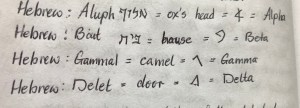
Theory One: The names (Alpha, Beta, Delta, etc) were based on Hebrew words, and the symbols that represent them are icons for the things represented. See chart below, and please excuse errors in the script as I have no idea how they are meant to be written, and was copying them from a book.

(Personally, I don’t think the letters look very like the objects they are meant to represent, and nor does Ganor. I can see that Gamma looks a little like a camel’s hump, but how is Beta a symbol for a house?)

Theory Two: The alphabet letter names came from Hebrew words that sounded like them, and they were copied by the Greeks (who didn’t understand the Hebrew) because they were often chanted, as a mnemonic. It would have to be a mnemonic said often, taught through the generations, and therefore heard by the Greeks. This is the same idea as the mnemonics we use today, to learn things like the order of notes on a music stave: Every Good Boy Deserves Fudge.

The ancient Hebrew words would have to sound almost exactly like the Greek letter words, because we know they haven’t evolved with time—though it’s possible the endings have changed, with the Greeks adding a final ‘a’ sound because that’s how they speak (like Italians today tend to add ‘a’ to the end of words). Ganor did a thorough search of possible ancient Hebrew words, and came up with only one possibility. He claims that if the mnemonic is to remain close to the names of the Greek alphabet, then there are very few possibilities for Hebrew words. The words he thinks fit, are the words of a saying, which was first used by the Israelites after they left Egypt, and is still used today by Jews who have them written on small scrolls and fastened to their doorposts (called the Mezuzah).

The Lord our God is one Lord; and you shall love the lord with all your heart, and with all your soul, and with all your might. And these words which I command you this day, shall be in your heart: and you shall teach them diligently to your children, and talk of them when you sit in your house, and when you walk in the field, and when you lie down, and when you rise up. And you shall bind them as a sign on your hand, and they shall be between your eyes. And you shall write them on the posts of your house, and on your gates.

And also: Be careful not to forget the Lord, you shall not go after other gods.

(Rough translation into English.)

The words are lifted from Deuteronomy, and made into an easy-to-remember saying, which perhaps the trading Phoenicians used to chant, and the Greeks gradually learnt the words though not the meaning. I don’t know any ancient Hebrew, so I can’t comment on whether Ganor is manipulating the language to make a point, or whether he has found an incredible link. But it’s interesting, isn’t it? It also sounds plausible. After many years teaching the alphabet to young children, I know that using rhymes and songs are often the best way to teach them even today.

The initial sound of each word was matched to a symbol, these symbols were used to make words. And hey presto! We have writing. Much easier than chipping pictures into rock.

Ganor asks the question, if writing came from the Israelites, who devised it? It either came from uneducated Hebrew slaves, or from a man who had been educated by intellectual Egyptian royalty (Moses). He therefore thinks it was Moses himself who devised the alphabet. He makes the point that splitting the sounds of words, especially consonants, is not something that occurs in normal speech unless you have a stutter. Moses is known (from the Bible and subsequent Jewish writings) to have suffered with a stammer. Breaking words into sounds would therefore be natural for him.  (I have no view on this, I am simply telling you what Ganor has written in his book!)

My own thoughts are that this might be stretching things too far, and there are a lot of assumptions. Firstly, there is no reason (I think) to assume that the Hebrew slaves were illiterate; certainly slaves in other eras have been able to read and write. Secondly, from reading the Bible account of the Exodus, Moses seems to have been completely at full-stretch simply keeping order of the Israelites—would he have had time to invent a new writing system? Though I suppose he might have devised it while he was living in exile before the Exodus. My understanding is the Jews teach that the alphabet originated with Moses, so maybe it did.

Thanks for reading. Use those letters carefully next time you write something, they have an ancient heritage wherever they originated.

Take care.

Love, Anne x

Anne E. Thompson

Thank you for reading
anneethompson.com
Why not sign up to follow my blog?

Look on your device for this icon (it’s probably right at the bottom of the screen if you scroll down). Follow the link to follow my blog!

***

Is the Old Testament Myth and Legend, Or Could It Be Historically Accurate?


Was Moses an Historical Person?

Or was he invented to prove a point?
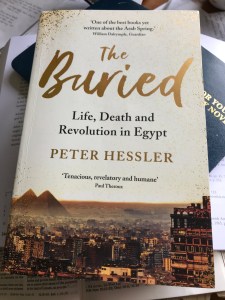
Sometimes, things seem to make a ‘perfect storm’ don’t they? Lots of unrelated things all come together and provoke an unexpected reaction. This happened recently with the story of the Exodus. I was reading a book by Peter Hessler, an author I enjoyed when I started to learn Mandarin, as he lived in China for a while. He has now written a book about living in Egypt, learning to speak Arabic, and discovering the Egyptian culture. I ordered a copy and started to read. At the same time, I just happened to be reading the book of Exodus in my daily Bible study time, and of course, this is all linked to Egypt. At the same time, the sermons we were watching from Cornerstone Christian Church in NJ (where we used to live) were all about…the Exodus from Egypt! My head was full of all things Egyptian.

I decided I wanted to write a story, through the eyes of Moses’ wife, about Moses the man. Who was he, this misfit who led a rebellion, the go-between for God and his people, the Egyptian-Hebrew hybrid? What kind of person can watch his adopted family suffer plagues—even the death of his nephew—and remain unmoved? Who is able to stand up to rejection from his blood-relatives, and not fear the might of his adopted-family, and can remain true to his God throughout it all? And what would it be like to be married to this man, this single-minded leader of the people?

But before I could write a story, I needed to do some research. What were the customs and life-style of people 3,000 years ago? What did they wear, eat, believe in? I asked people to recommend books, and I started to read. I have now spent several weeks reading, I am still not ready to write my story, but have learned a lot of ‘facts’ and theories about Moses and the time he lived in. I thought I would share my most interesting discoveries with you, because some of them were surprising.

One of the first things I discovered was that there is very little historical evidence from this time—almost no secular data to back-up the Bible account. Something (no one knows what) happened at the end of the Bronze Age, something that destroyed all the complex major cities, and most of the evidence about the lives of the people, so there is almost no evidence to support the account of the Old Testament. For this reason, many scholars believe the account is not factual—they think there never was a nation of slaves, freed through plagues, led away by a man called Moses, to a promised land that was unified under Kings David and Solomon—they say it is all legend and myth, written to explain relationships and understand God, but not historical fact. Could this be true? I watched a very convincing YouTube video, which was based on the book: The Bible Unearthed by Finkelstein and Silberman, and it was absolutely certain that the Old Testament is unverifiable myth and legend.

Undeterred, I kept looking. I wanted to read what the scholars who don’t believe in the authenticity of the Bible had to say (“the wise man learns more from the fool than the fool does from the wise man” and all that!) so I read a whole plethora of books (including The Bible Unearthed by Finkelstein and Silberman). Here’s what I learnt:

Sigmund Freud said that after various studies, he thought Moses was an historical figure, living about thirteenth century BC. However, he took task with his name, saying that although the Jews name him “Mosche” it’s more likely that an Egyptian princess would give him an Egyptian name. Freud refutes that “Mosche” (the Hebrew version of Moses) means “He was drawn out of the water” as per the Biblical account, saying at best it means: the drawer out. (I felt he was splitting hairs here!) He concludes that Moses was probably named Mose, which is an Egyptian word meaning ‘child.’ It was common to use this at the end of Egyptian names, and we know of the Pharaohs Ahmose and Ptahmose and Thutmose, for example. Apparently, the final ‘s’ of ‘Moses’ was added when the Old testament was translated from Hebrew to Greek (so I presume that the Jewish Torah has the original Mosche or Mose). Freud then went on to compare the basket the baby Moses was placed in with the womb, and the River Nile with the mother’s birthing waters, so he lost me at that point.
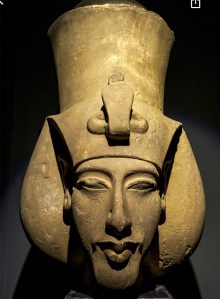
Akhenaten
c1346 BC

Freud is certain that Moses was Egyptian, and this is how he ‘got the idea’ for a new, monotheistic religion (a religion that says there is only one god). Freud says this idea came from Amenhotop IV, who enforced the worship of a single god: Aten. Freud’s argument is that IF Moses was Egyptian, then his mother would be Queen Hatsepsut (sometimes spelt Hatshepsut), and Thutmose I would be his grandfather. This would make him a rival to the throne of Amenhotep II, as the Pharaoh would be Moses’ nephew. This, says Freud, explains why Moses spoke with such authority, and why the Pharaoh didn’t simply kill him when he started to be annoying. (I hope you’re keeping up with all these names. Very annoying when parents name their children after their relatives!) Hatsepsut was a powerful woman, married to her brother Thutmose II, she is thought to have reigned jointly with Thutmose III for a while, though he is known to have later tried to destroy everything with her name on, erasing her from history.

However, if Moses ‘copied’ the idea of one god from Amenhotep IV (who changed his name to Akhenaton) then the Exodus would have to be after this. The Akhenaton period is 1353 – 1336 BC. I had never heard of Akhenaton, though I had heard of his beautiful wife Nefertiti, and his son (by a different wife) Tutankhamum.

Going back to the name of Mose, this also ties in with the lecture I attended last year at the British Museum. They suggested that Thutmose III was the pharaoh of the plagues. ( Blog link here. ) Like Freud, they also thought Thutmose I, with his powerful powerful daughter, was the Pharaoh during the time Moses was born and it would make sense for her to be the princess who found Moses, and then gave him a name linked to her father (Thut-mose). This would date the Exodus to around 1446 BC.

We know that Thutmose III disappeared mid-reign, and that the next Pharaoh was not his first son (which fits in with all the first-born being killed in the final plague).

Thutmose III
Who was probably the Pharaoh during the Exodus, when all the Israelites left Egypt.

In Exodus (the book) it appears to name a Pharaoh—Raamses—but this is apparently more likely to be referring to a place. The Old Testament often ‘muddles’ people and place names, and one ‘proof’ that it was written much later than the history it is meant to be describing, is that some of the places named did not exist until centuries later.

However, if the books were edited centuries later (but written when they said they were) then it would not be beyond belief that those later scribes added the names of places they knew, to tell their readers where the events took place. For example, if I was editing a book about a journey in 200BC from my house to where London now is, I might add that they walked from here “to London” even though London, as a place, did not exist until 43AD (this would then be ‘audited’ by my family who would insist I changed such an illogical statement, but there is lots in the Bible that tells me those early writers did not suffer living with auditors like I do, and many of their ‘facts’ are a little imprecise!)

Another piece of evidence in the British Museum is the city of Jericho, which the Bible says was destroyed when the Israelite army marched around it. When archaeologists examined the ‘dead zone’ (the layer showing when the walls were destroyed) they found that not the entire wall was destroyed. This supports the Biblical story of a prostitute, Rahab, surviving the destruction—her house was in the wall of the city.  The ‘dead zone’ has the remains of pots, which still had grain in because the people didn’t eat the grain and the invading army did not take the grain as plunder (which was unusual). Archaeologists have also found ancient tombs, which were Egyptian-style in design, but this changed about the time the Israelites would have arrived. The archaeological evidence shows a gradual decrease in Egyptian influence in the whole area, which again ties in with when the Israelites would have arrived back in Canaan.

I read Who Were the Phoenicians? by Nissim R. Ganor. The book was originally written in Hebrew, and I was reading an English translation, so it was quite heavy-going in places (actually, scrap that, it was very heavy-going! It took 195 pages before he had finished ‘proving’ who the Phoenicians were not). Ganor was exploring the Phoenicians, the people who first devised an alphabet (before this, people wrote either Egyptian hieroglyphics, or Chinese script or Mesopotamian cuneiform). It is from the Phoenicians we get our word ‘phonics,’ the idea that symbols can represent sounds.
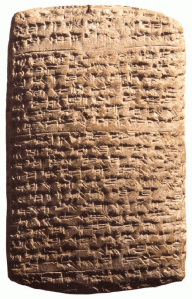
Tell el-Amarna letters.
They describe the ‘Habiru’ (Hebrews?) attacking cities, and the letters ask Egypt for help.

Ganor refers often to the Tell el-Amarna, which are clay tablets found in Upper Egypt. They were engraved about 1360BC, and were diplomatic correspondence between Egypt and Canaan, written in Akkadian cuneiform (cuneiform just means wedge-shaped carvings). Some of this correspondence talks about invasions of cities by an unstoppable tribe that is taking over the area. They describe kings being killed and buried at the city gate—all of which ties in with the stories of Joshua leading the Israelites into battle. The Tell el-Amarna is perhaps a tiny piece of related evidence, but it is still evidence that supports the Bible view. I don’t think ‘lack of evidence’ necessarily disproves something, and if the only evidence available supports an accepted view, then why try to ‘disprove’ it? The Amarna letters refer to invaders named Habiru, which was very likely to be the Hebrews.

Ganor also states that until recently, people believed that history was only recorded orally until 10BC (which makes it less reliable). However, new engravings have been found that show people had phonetic writing in 1500BC, and therefore it is entirely possible that Moses did write an historical account of the Exodus, as claimed by the Bible. (If you look online, you can read the diaries of Petrie, who was an archaeologist who found evidence of alphabetical writing—in a very unrefined form—from 1500BC, during his 1905 excavations.)

Knowing when the Exodus took place is another problem, even for scholars who believe it happened. The Old Testament says the Israelite slaves lived in Goshen. If this was in the Nile Delta, then the Exodus cannot have been before 1200BC (the period of Raamses II) because there was no substantial building around that time in that area (and they can’t have commuted very far to work!) However, much of the evidence for this is flimsy, an attempt to fit the facts to the Bible account. Some scholars have therefore said the Exodus never took place, others say that actually there were TWO exodus, one during the reign of Raamses, when half the Hebrews left, and another one later—this is because the evidence on the Tell el-Amarna doesn’t fit with the timing of the slaves leaving during the reign of Ramses.

It seems more likely that Goshen was situated in the area of Heliopolis (the ancient city of On) which is now modern-day Cairo. From there, it is three days journey to Yam Suph (Red Sea) and according to Hutchinson (The Exode, 1887) this route from Egypt across the Arabian Desert was probably the route of the Exodus (he bases this on Bedouin tradition, not the Bible—but it fits!) The ancient city of On (modern day Cairo) has several remains from Thutmose III and also Raamses II, though the remains credited to Raamses are always suspect as he would remove other Pharaoh’s symbols and add his own, to gain credit for things others had made.

In Who Were The Phoenicians? Ganor explains in great detail about how the timing of the Exodus with Ramses is erroneous (trust me, a LOT of detail!) Ganor says that it simply cannot have happened then, and shows all the reasons why it must have happened earlier, and all the evidence that supports this. I was convinced. He ‘proves’ the Exodus was about 1446 BC. This then discounts Freud’s clever theory about monotheism starting with Akhenaton (who came later).

In fact, it seems to me more likely to be the other way round. Akhenaton would have heard the stories of the plagues, and known that all the Hebrew slaves had escaped from Egypt, and he probably decided that worshipping the same God as the Hebrews was a good idea. This would also explain why in the el-Amarna it states that he refused to help the Canaanite kings in their wars with the Hebrews. However, as the Hebrews worshipped several gods during their time in Egypt, Akhenaton wouldn’t have known which deity to worship, hence the decision to worship Aten.

I then read The Bible Unearthed* by Finkelstein and Silberman, which is the book that the very convincing YouTube video was based on (the one which says none of the Old Testament is historically factual, and it is all myth and legend). The authors spend a long time discounting the story of the Exodus because it cannot have happened during the time of Raamses. I felt so frustrated with them, and wanted to tell them to read Who Were The Phoenicians? and then start again! All their arguments were based on the Hebrews leaving Egypt during the time of Raamses, and they went into great detail as to how this was impossible archaeologically, and therefore impossible per se. They even talk about the cities mentioned in the Biblical account—the ones conquered by the Israelites when they reached Canaan, saying that although they existed centuries before Ramses, and were rebuilt and powerful again centuries after Ramses, they did not exist at that time, therefore the Exodus never happened because etc etc etc. I wanted to shout at them, and tell them to rethink their basic premise, and that yes, the cities existed before the time of Ramses because that is when the Hebrews left Egypt.

They also discuss a document, written by an Egyptian historian Manetho in the third century BC. He tells the story of the Hyksos, who invaded Egypt and founded a dynasty and who were driven out by a strong Pharaoh. Later archaeologists have found that the Hyksos were from Canaan, and there is a gradual spread of Canaan influence in Egypt, which stopped around the time of Pharaoh Ahmose. Again, if you take the view of both the British Museum, and Ganor, then this ties in with the timing for Ahmose being the Pharaoh who began to oppress the Hebrews. So the evidence used to disprove the Exodus as an historical event yet again supports it.

My understanding of how archaeology works is that someone discovers something, and based on previously known evidence, they make conclusions about it. These conclusions then effect further findings. If those conclusions are proven to be wrong, then they should be adjusted, or the way they effect future findings will continue to be wrong. A simple illustration of this point would be:

Someone unearthed all the possessions of Henry, and they included a stamp collection. Based on previous knowledge, they said that eldest sons are usually named after their father, and as Henry is the eldest son, his father must also be named Henry. They also concluded that Henry had decided to collect stamps. Later, the possessions of another son, Charlie, are also unearthed. Charlie also collected stamps, so they conclude that Charlie copied his elder brother and decided to collect stamps. Perfectly reasonable assumption. But then, they unearth Charlie’s birth certificate. Charlie is an adopted son, and he was older than Henry. The conclusion must now be adjusted: It was Henry who copied Charlie when deciding to collect stamps, because Charlie came first.

The conclusions drawn in The Bible Unearthed are based on misinformation. They have placed the Exodus too late in history, and then concluded that the Israelites never formed a large empire, the Kings David and Solomon are mythical figures, their religion was a copied mish-mash from another race—the Phoenicians. Someone has used these wrong conclusions to make a convincing YouTube video, and people are listening to the well-presented information and assuming it is correct. But it is not. Beware listening to the clever voice that shouts loudest. It might be wrong.

There is more evidence for the Israelites reaching Canaan and conquering cities. The Greek historian, Diodorus Siculus (about 30BC) wrote a history of the area. He describes the Exodus from Egypt in detail, and how the Israelites defeated other nations and destroyed their cities. He doesn’t ever use the term ‘Hebrew’ or ‘Israelite’ but rather calls them ‘Phoenicians.’ You will recognise this name from Ganor’s book: Who Were The Phoenicians?

Ganor also believes the Hebrew slaves became the Israelite nation, and the Greek name for them was the Phoenicians. (He took 195 pages of proof to reach this conclusion! It was not an easy read but we got there eventually.) He also quotes Herodotus, another Greek scholar, who wrote about the three nations from Persia to Egypt: The Syrian Palestinians (who Ganor believes were the Philistines in the Bible) the Phoenicians and the Arabians. Herodotus himself links the Phoenicians with the Israelites; he also says they originally came from the ‘Red Sea’ which from his other writings can be deduced to mean ‘from Egypt.’

Greek writers also describe there later being two types of Phoenicians, those who circumcise and those who don’t—which ties in with the Bible account of the Israelite nation splitting, and the southern kingdom (Judah) remaining true to God and the laws given during the Exodus, and the northern kingdom, which pretty much ignored God, and had lots of different gods and were eventually taken away by the Babylonians.

The book goes on to talk about how the alphabet was formed—which Ganor also thinks started with Moses, but although this was hugely interesting, it doesn’t form part of the argument that Moses existed as an historical figure, so I will leave that for a later blog.

Now, although Ganor has pretty much ‘proved’ that the Hebrew slaves left Egypt in a mass exodus, and crossed the wilderness, and then conquered cities in Canaan and occupied them, all as per the Old Testament, he does not believe in the God part. Ganor believes that Moses wanted to establish a new religion, and therefore came up with the idea of one God. Some of his evidence makes sense. For example, we know from reading the Bible that people worshipped more than one god, because they are frequently told to stop! When Moses kills half the Israelites because they are worshipping the golden calf, he accuses them of ‘returning to the gods of Egypt’ and indeed, until Moses emerges from the mountain with the ten commandments, the people have not been told they should only worship one God.

Ganor, who is a linguistic historian, uses the names of God in the Old Testament as evidence. He says that the frequent mention of planting trees by Abraham and Jacob show that they worshipped trees. Jacob is thought to have worshipped the Asher tree, and the Hebrew word for ‘God’ is ‘El’ hence his name was changed to ‘Asher-El’ which became ‘Isra-El’ or Israel. Later, the Hebrews are known as “sons of Asher El” or “sons of Israel.” Ganor also says that the name ‘Adon’ is from an Egyptian god, and gradually became the basis for the Hebrew word ‘Adonai’. When, after settling in Canaan, the Israelites began to worship a myriad of gods, the god Adon became henotheistic (which means he was sort of the ‘king of gods’—all the other gods worshipped him). The prophets kept trying to re-establish a monotheistic (one God) religion.

There is an interesting link with the Greek god Eshmun sar Kadesh, which was a snake god used in medicine. Artefacts show that the Greeks acquired this god from the Phoenicians. The symbol is still used today in some places, of a snake wrapped around a pole (you see them outside pharmacists). Now, what has a snake got to do with medicine? Well, in the Bible account of the Exodus, when the people were leaving Kadesh (Numbers chapter 33) they were being bitten by snakes, and Moses made a bronze snake on a pole and held it up. When the people looked at it, they were saved from the snake bites and lived. After the Exodus, some of them were continuing to worship this bronze snake, saying it was a god of medicine (it’s like these people were continually looking for new gods to worship!) The Bible doesn’t hide that this was happening, and in 2 Kings chapter 18, there’s the story of a king finally destroying the bronze snake so people would stop worshipping it.

Looking at the Bible, it too makes it clear that the Israelites worshipped lots of gods (though to be honest, I had missed that when I read it—it’s not something that Sunday School teachers tended to point out!) I don’t know what I think about the idea that Abraham and Jacob worshipped tree gods, but there are references to Jacob being told to destroy idols, and he does bury them under a tree, so it might be significant. But the Bible also makes it clear that there is also one true God, and he is God.

My thoughts are that by denying the existence of God, Ganor rather misses the point. He can explain when the Exodus took place, and has provided evidence to support the Old Testament books, but he never addresses how they escaped. Why would Pharaoh let them go? If there is no God, there can not have been the plagues, and so the very fact of how they escaped is never solved. Ganor seems to go to an awful lot of bother to prove that God is created by Moses and perpetuated by the leaders who followed him—it would be more logical to simply acknowledge that God exists.

One fact that interested me was the name God gives when he meets Moses at the burning bush. Moses asks: ‘Who shall I say you are if they ask?’ (which is another proof that the Hebrews had several gods) and God says: “Ehye Asher Ehye” which apparently is ancient Hebrew for: “I will be whoever I will be.” Most Bibles translate this into the English: “I am who I am,” but I think the original translation says something slightly different, and I find that intriguing.

The name of the book of Exodus is also a Greek addition. It was originally called: “These are the names,” in Hebrew, according to David Pawson. I had never heard of David Pawson, he seems to be a Royal Air Force chaplain, who wrote a very fat (and very interesting!) book. It’s worth reading if you are interested in a few factoids around the books of the Bible. I was lent a copy, and liked it so much I ordered one for myself, even though I completely disagree with some of what he writes, mostly it is hugely interesting. One observation he makes is that according to the Bible, the Hebrew slaves were told to make bricks without straw, which would make them very heavy. He says, Archaeologists have found buildings built with bricks made with straw at the bottom, then a layer of bricks made with rubbish (while people scrabbled around trying to find a substitute) and then bricks made with just clay.

Going back to the Phoenicians, there is evidence that they were a trading nation, travelling to Crete and Greece and beyond. Different historians remark on the Hebrew influence in some Greek names and words. It is thought that the Phoenicians reached the peak of their trading empire about 1000BC—which is when the Bible says King Solomon reigned over a strong trading nation.

I don’t know what you believe, and there seems to be no way to prove anything, but personally I choose to believe the Bible account is historically accurate. It is true, the evidence is flimsy, and often circumstantial, but that doesn’t mean we should ignore it. I think it takes a sort of ‘faith’ to say the books in the Old Testament are not at all historically factual, written by authors centuries afterwards to justify invading the northern kingdoms of Israel. I prefer personally to have ‘faith’ that the Biblical records which claim to be history (some of them are poems or stories, and don’t claim to be otherwise) are factual. We lose some understanding because we don’t read them in ancient Hebrew, but I choose to believe the events actually happened.

***

The whole idea of language and translation and lost meanings is something that worries me. The Bible was not written in English! When archaeologists found the Dead Sea Scrolls, they found a copy of the Old Testament scriptures that predated other copies by about a thousand years. They found four differences, which I believe were the way some names were spelt (so nothing, really). The early scribes were incredibly careful when they copied scripture, they even counted letters, to ensure the correct letter of the entire manuscript was in the centre. For centuries, the Old Testament books were passed from generation to generation, unchanged. But then the New Testament was written, and the scriptures were translated into Greek. Instantly, there would be changes, but both the Greek and Latin versions of the Bible were pretty well standardised. The Bible continued unchanged—until now. Now we seem to have a new version every week! We have the Hip-Hop Bible, and the Youth Bible, the Good News Bible and the English Standard Version Bible. Each one is slightly different, even the ones which are translations from the original Hebrew and Greek.

When I read books like Who Were The Phoenicians it makes me realise how much emphasis we place on certain words and phrases, and how these are changing as new translations appear. In evangelical churches, it sometimes seems that the Bible and God are held in equal authority, and yet the Bible, as we read it, is based on the decisions and understanding of the person who translated it. Should we therefore be taking snippets and deciding whole doctrines? Should individual words and phrases be given great weight when we make our rules and set our beliefs? I believe that God is bigger than the Bible, and that we should take great care when we quote the Bible as ‘evidence’ for what God wants.

The Bible is given so that we can understand God better, it shows us something of his nature, but we will never completely understand God. We are not meant to. Should translations of the Bible be given the importance that they currently are? I wonder whether they should be viewed as a resource, but we should constantly remember that they are only translations. My understanding is that the Jewish religion insists that all children learn some Hebrew, and they read the Torah in Hebrew at their ‘coming of age’ service. I think that the Quran can only be read in the original Arabic because the phrases fit together like a pattern. It seems only Christians are comfortable with most of their teachers only ever reading the Bible in translation. I wonder if they are right.

Books:
The Bible Unearthed by Finkelstein and Silberman

Who Were The Phoenicians? by Nissim R. Ganor

Moses and Monotheism by Sigmund Freud

Unlocking the Bible by David Pawson

The Buried by Peter Hessler

You can listen to Fred’s lectures here: https://subsplash.com/cornerstonechristianchur/media/mi/+ft3y8mb

(I usually skip through all the news and songs and just listen to the talk! You want the early August 2020 talks)

Tomorrow, I’ll look at whether it’s likely that Moses invented phonetic writing and the alphabet. (It will be a shorter blog, I promise!)

Thanks for reading. (You deserve a coffee after all that!)
Take care.

Love, Anne x

Anne E. Thompson

Thank you for reading
anneethompson.com
Why not sign up to follow my blog?

Look on your device for this icon (it’s probably right at the bottom of the screen if you scroll down). Follow the link to follow my blog!

*****