Are Trump’s Tariffs Fair?


In an attempt to not believe what politicians tell me without fact-checking, I tried to unravel the new tariffs from the US. I am taking the view that President Trump is trying to do the best for his country, you can decide for yourself whether you believe this. His rhetoric is that in the distant past things were more fair, since then the US has been plundered, and he now wants to even the score.[1] But is this true? The perception elsewhere is that since this time, the US has become a world power, and this is due in part to free trade.

Free trade (I am reliably informed by the economists in my world) is when countries have trading partners and allow goods and services into and out of their countries with relative ease. Economists seem to agree that free trade is what makes strong economies. With free trade, everyone has an easier life. But, have other countries eroded this (as Pres. Trump states)?

Well, to some extent, from what I can discover, there have been some limits to free trade. Sometimes a country wishes to protect its citizens from something considered unhealthy. (In the UK, only toys that meet a certain standard can be sold for children–so some toys from China are rejected. In the UK, we dislike genetically modified beef, so refuse imports based on that. And so on.) Countries also add their own taxes. (In the UK, we have VAT—a tax that is added to goods before they are sold—which in the US is called ‘sales tax’—but VAT is applied to those good wherever they come from, even if made in the UK. So to list these as a ‘tariff on the US’ would be untrue.) Some countries have made sale agreements: My understanding is that car manufacturing is particularly cosmopolitan, with different components being added in different countries, so a car may pass between Canada and Mexico and the US, getting bits added, until it is finally ready to sell. Each time it has a part fitted in a new country, there has been agreement that no extra tax will be added to the final cost.

Now, despite what Pres. Trump said, the US has actually benefited from the global economy. Evidence for this is found in things like: Any country in the world will accept dollars (we take dollars when we travel to India). The US is seen as powerful, and is included in talks concerning climate or security. Services from the US have prospered; in the UK, Amazon is huge, so is Google, and Apple, and Microsoft, etc. American banks are strong. Across the globe, countries have welcomed companies like McDonald’s. Normal people in the US have benefited from this, it has supported their own economy. Yes, there has been a decline in certain industries—this is true everywhere. In the UK, whole towns were built on coal or steel, and they have needed to diversify, and find new industry, and this has not always been easy or smooth. But the US has sold many services abroad, and overall has grown stronger. Therefore, it seems the world has not ‘raped’ the US, but rather the US has done very nicely out of free trade, thank you very much.

I looked into what tariffs have actually been set, and why. It seems they are based on trade deficit—this is when the country sells less of a product than it buys, it’s a number. (US buys 100 televisions, it sells 40 televisions, therefore the trade deficit is 60.) Pres. Trump took the trade deficit with each country, divided it by the number sold, then divided by 2. (In my example, 60/100 divided by 2) However, he has only looked at the trade deficit of goods (actual stuff) not services (like Amazon, or banks, or IT) so it is rather skewed. And my understanding is that his method is ‘deeply flawed.’[2] Never mind the human cost, because breaking trade agreements does not make you an attractive partner in the future.

My conclusion therefore is that, from the evidence I can find, the new tariffs are not wise. They are not ‘fair’ because they are based on faulty economics, and they will not benefit people living in the US. But they may isolate the US from the rest of the free world.

The advice to the rest of the world appears to be that we should assume the US is ‘going it alone’ and we should make fresh deals with non-US partners. (As I showed yesterday, some supermarket shoppers now avoid goods from the US.) This potential decline seems a shame to me, I like the US, I have no wish to see its economy slump. I think there is a real danger that poverty in the US will increase, which often leads to more crime and unrest. I find this very sad.

I also worry about the impact on less developed nations. The US was generous towards those countries struggling with HIV, it helped to keep peace in the world, it was a good country. I worry that the loss in aid will be devastating for the poorest in our world. Never mind that we will have to pay more for Apple products (and will probably switch to non-US ones)—that is insignificant. What will happen to the poor in our world? Those are who we should be fighting for, and I hope that the people in the US, who are mostly good people (in my experience) will remember they have a privileged place in helping to restore balance in the world.

Thanks for reading. If you have further insight, do add to the comments.
Have a good week, and take care.
Love, Anne x

anneethompson.com


[1] Trump ‘glorifies’ the ‘era of the late 19th century’ and hopes to return to this economy. Zanny Minton Beddoes, Economist Online, April 2025. See also point (1) from yesterday’s blog.

[2] Financial Times Online, April 2025.

Being Aware


I rarely write blogs about political issues, but I find the news very unsettling at the moment. As you know, we studied a little politics in our Ethics class at Spurgeon’s, looking at how fascism grew in the past. It grew quickly, centred around one individual, and I doubt if most people realised what was happening. The parallels with today are alarmingly similar.

This partly came to my attention last week, at a family dinner. As I listened to one family member telling about her experience in Canada, and another family member comparing his news of Mexico, I realised that in the UK we are very complacent. I had no idea that people in these countries (and I’m guessing Greenland) are genuinely worried. They see a threat to their sovereignty. Mexico and Canada are fighting back. But what about those countries with unsettled economies? Who is speaking for the poor?

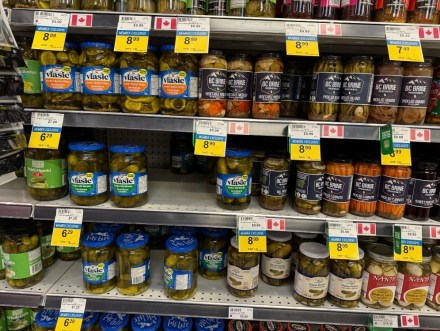
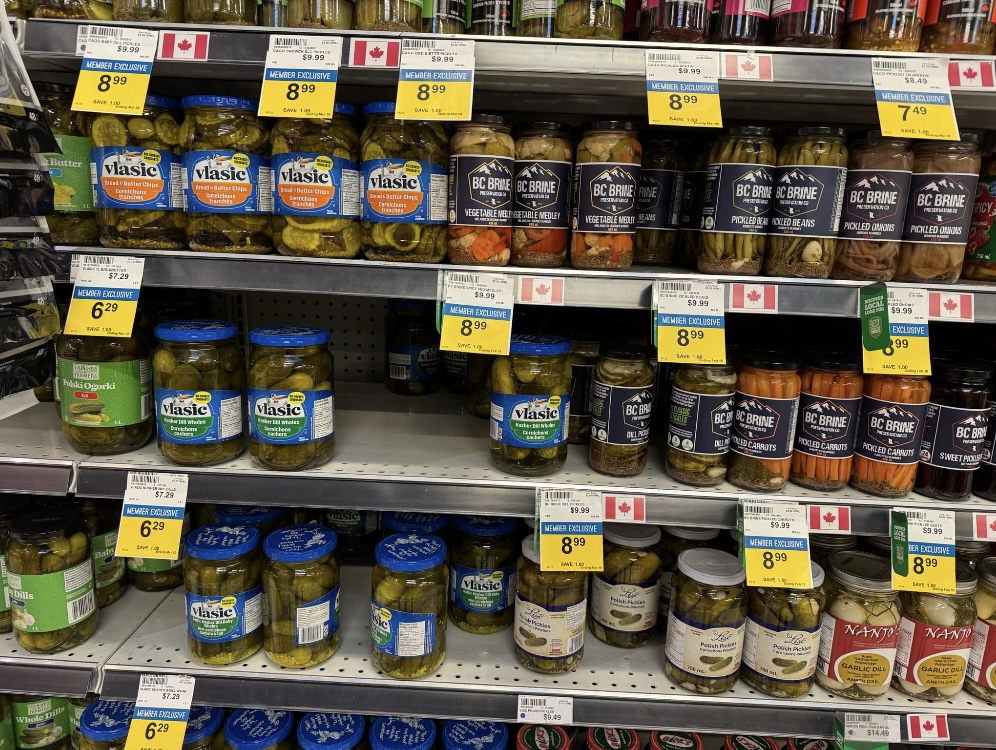
 I didn’t realise that shops in Mexico and Canada now label the country of origin for their products, people are encouraged to buy local produce and to reject things from the US. Maybe this will help. Do you think we should support them in this? Do we need to buy from the US when there are alternatives? If one man attempts to stamp on the rest of the world, maybe the world should join together in their response. The world today is a global community, and putting your own country first when that means alienating everyone else, is not such a good idea. And what will happen to the poor? Do we just allow them to be sucked down in a whirlpool of powerful economic battles? Who is speaking for the poor?

Shelves in a Canadian Supermarket

One aspect of the news that worries me is the motivation behind what politicians are saying. It used to be that when a politician spoke, you could hear them pandering to popular opinion, they cared about what the voters thought. (This created problems of its own.) But now I hear something else behind the words, now I hear them pandering to an individual—and this has been seen in history. Listen carefully when you hear the news—who do you think the politicians are most aware of when they speak? Who are they trying to impress—and is this healthy? Does this leader show any compassion for the poor of the world?

I leave you with the key points of fascism from Jason Stanley (author of How Fascism Works). As you read the list, which can you apply to the news today?

  1. A Great Mythical Past. A fascist leader will talk about how things used to be better in the past. They ignore all the problems that were actually in the past, and focus on a mythical ideal.
  2. Propaganda. A fascist leader will promote their own message and say that any alternative view is a lie. Hitler and Mussolini both did this, saying that things reported in newspapers were untrue, telling the population that their opponents were liars. The idea of accusing the media of ‘fake news’ goes way back in time.
  3. Anti-Intellectualism. Fascist leaders appeal to people with limited education, the speeches are not necessarily clever (because truth doesn’t matter) and they appeal directly to emotions. They dislike, and try to discredit, academics (because they will offer a counter view, or question the authenticity of the claims being made). Experts are shunned, people are told to ‘think for themselves’ which really means, ‘don’t question what I am telling you and don’t listen to someone who might have studied this issue.’ (I think we should be wary of people who tell us ‘the experts don’t know what they’re talking about.’ In my experience the ‘experts’ usually know more than the rest of us!)
  1. Unreality. This is another interesting one—apparently fascist leaders tend to love conspiracy theories. They always have an enemy who is trying to sabotage them, talk of subterfuge is encouraged, they want people to be paranoid. They also blame past leaders.
  2. Hierarchy. Fascist leaders always have a dominant group of loyal followers, those who are ‘true to the leader.’ Anyone who questions the general message is eyed with suspicion, and removed from the ‘inner group.’ As stated earlier, everything focusses on the leader. [Listen to what they are saying—who are politicians trying to please?]
  3. Victimhood. Fascist groups always state that they are the victims of another group—they have been oppressed, or made poor, or cheated—and this has been caused by a definable ‘other.’ (Hitler blamed the Jews, gay people and Roma, but other groups held to blame over the years include black people, feminists, immigrants.)
  4. Law and Order. Fascists declare that they want a return to law and order, and the group against them are the criminals. The ‘other’ people are the ones to blame for crime, for stealing, for rape, for drugs, for violence. [In the introduction of any emergency measures to combat ‘a risk to security,’ the ‘risk’ should be fact-checked.]
  5. Anti-Decadence. Fascists claim that the moral fibre of society is under threat (blaming the ‘other’ group). Only they, and their followers, have good morals. Anyone not supporting them is described as a bad person.
  6. Work Ethic. Fascists claim that the ‘other’ group are lazy, mere parasites of society. Fascists claim they are hard-working, deserving of better.
  7. Nationalism. Fascists promote great nationalism, and shun other nations. They strive to make their country ‘great again’ and nothing else matters. This gives a great sense of belonging to the followers of fascism. [But in a global community, what are the consequences of this? We need to be shrewd.]

I add to this the current policy of saying what you want to be true, as if presenting it as true makes it true. It does not. It is still a lie, however loudly you say it. We can fact-check statements, and test whether they are really true.

I hear President Trump say that the US has been ‘cheated’ in the past, the new tariffs are to make trade fair for the US. Is this true? We shouldn’t simply accept a statement just because someone says it loudly or repeats it several times. Personally, I know very little about tax and tariffs. I shall do some research and let you know tomorrow what I discover.

Please be wise, wherever you live. Please make good choices. I doubt if anyone in power reads my blog, but we have a voice even if no one listens. Let’s stand for what is right, because ‘those who are noble plan noble things, and by the noble things they shall stand.’ We need to be shrewd. We need to watch out for liars–just because someone says something, it doesn’t make it true.

Thanks for reading.
Take care.
Love, Anne x

There is a lot on social media at the moment, mocking the people in power. Maybe this is one way that people are ‘fighting back.’ Maybe things seem less scary if we make them a joke. Certainly it is good to laugh, but let us not forget what is serious.

When someone includes you in a military chat by mistake.

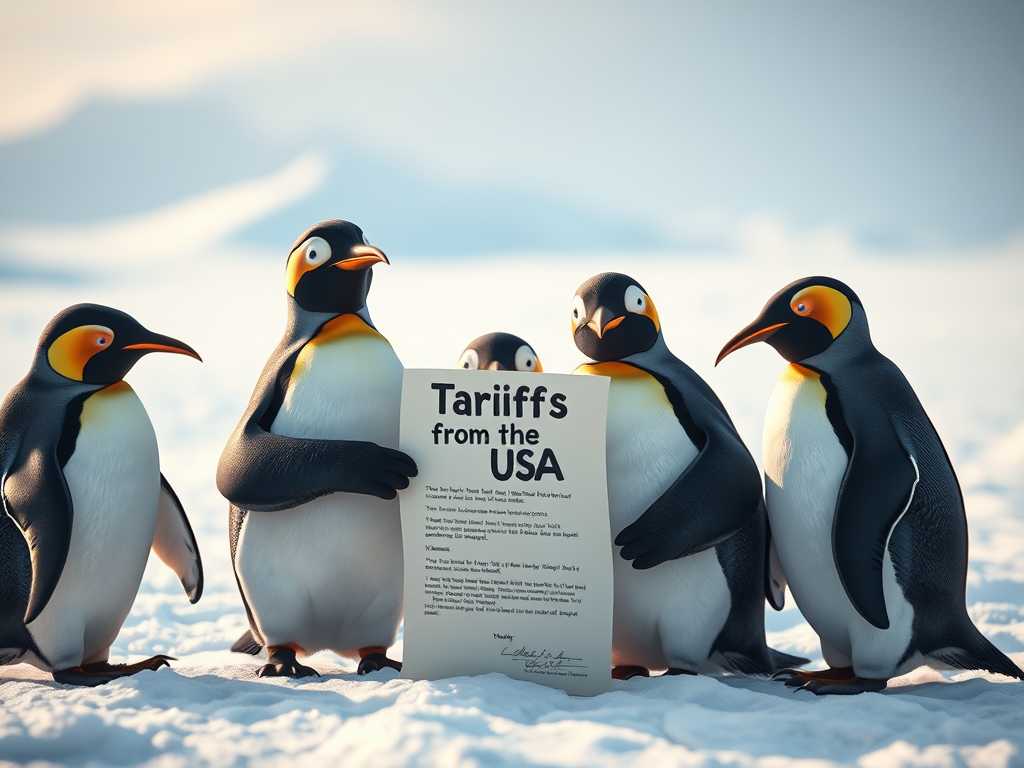
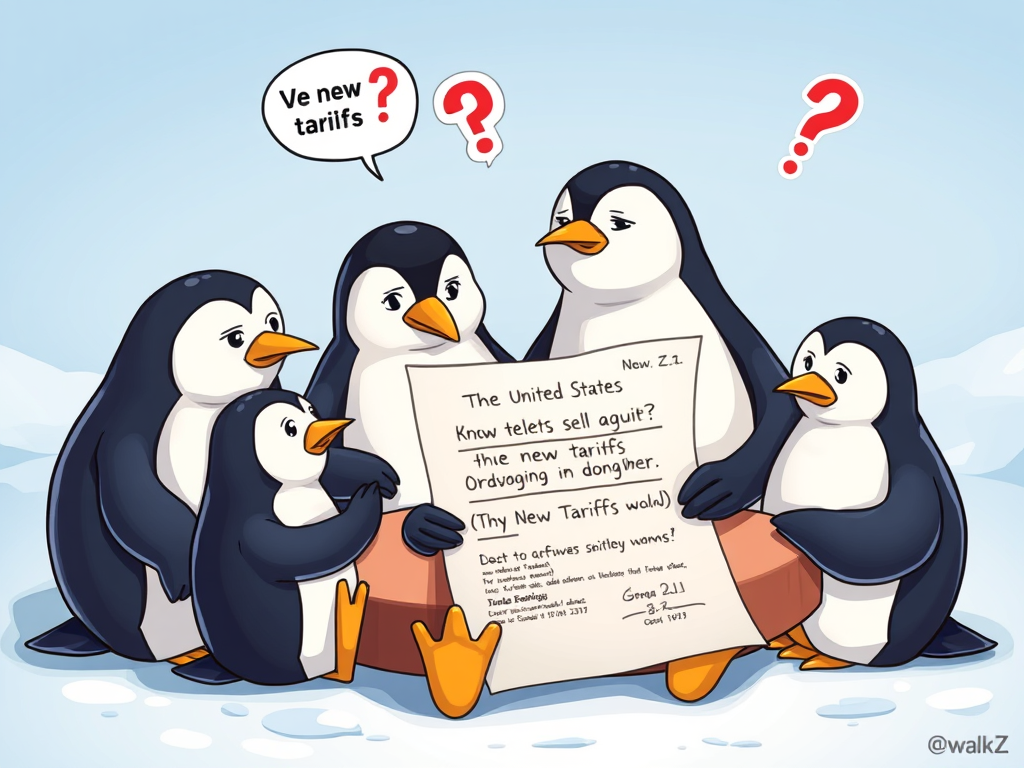
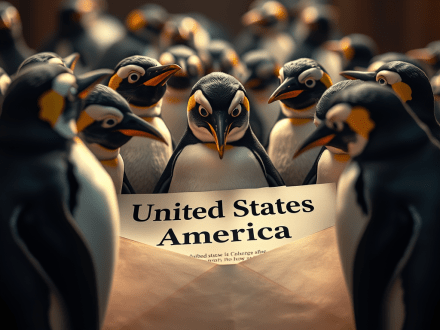
The McDonald Islands have a tariff. There is not a human population there (apparently) but the penguins are confused.

Link to previous post:
 https://anneethompson.com/2022/11/28/what-is-fascism-and-are-you-a-fascist/

Sign up below to follow my blog.
Then you won’t miss my post exploring whether the tariffs are fair or sensible and wise.
anneethompson.com
****

Indian Money Troubles….


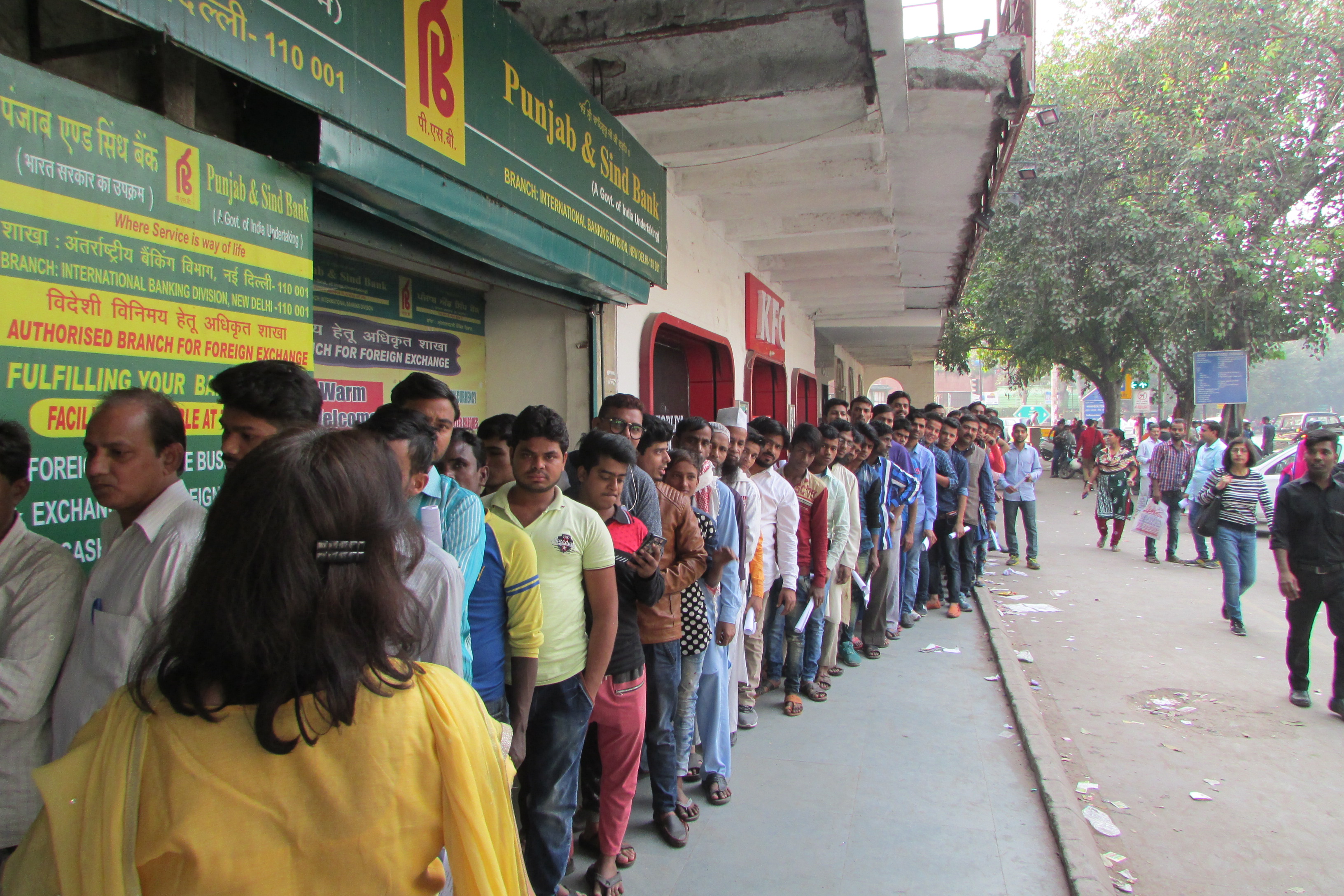
I have been learning a little about why the government here withdrew Rs500 and Rs1,000 notes so abruptly (overnight – with no notice.) I can also tell you about the impact we have seen so far on normal people.

So, last week, with no warning, the rupee notes which are most used, were demonetised. That is, everyone was told they now had no value. Cashpoint machines closed, and the only way to change old notes for the new currency was through the banks. This meant that 100 rupee notes soon became scarce, as people needed them. So, even if people had the new bank notes, no one would give them change if they bought something with a higher value note. (Eg. You could buy some apples using a $10 note, but no one would give you any change.)It also meant that no one received tips – which when you’re very poor, matters. So, why did the goverment do this?

There are a whole host of rumours on social media in India, most of which seem to be untrue. There seem to be several different reasons, but two main ones are often mentioned: to stop tax evasion, and to stop money that terrorists/criminals are printing.

India is largely a cash based society. Lots of people have no bank account, they are paid in cash, store their wealth in cash and pay others in cash. This means there is huge potential for tax evasion. A high proportion of the poorest people in India run shops or market stalls. These are automatically taxed ( you pay a ‘market tax’ to have your stall in the street.) So, the poor people are paying tax, even though their income is very low. However, the richer people, those who own businesses, often deal only or partly, in cash ( a bit like plumbers in the UK!) so they have the ability to pay no tax. Which means the government is losing vast amounts of income. This isn’t fair. The vendors who I listened to, approved of the government’s decision, even though in the short term, it made their lives very difficult. It was forcing people to open bank accounts, which enabled the authorities to track cash and stop tax evasion.

India also has a lot of ‘black money’. This is counterfeit money, produced by terrorists and criminals, which has begun to flood the market. One report I read said that terrorists are using counterfeit money in India to fund their campaigns. By withdrawing the currency quickly, with no notice, the government stopped these people from converting their money into gold or other assets. The only way to exchange old currency for new money is through the banks, which criminals and terrorists don’t want to do as they are more likely to be caught.

One report I read said that in India, property is also bought partly for cash. The current currency crisis ( bit of alliteration there) means house prices will probably drop, making them more affordable for the less wealthy. This will lead to an increase in building work, which will produce more work for labourers. Not sure if that’s true, or wishful thinking…

For normal people, this is a difficult time. When we visited the slums in the East of New Delhi, the women were complaining (and laughing) because all their secret cash had now been exposed. They told me that wives tend to hide money, so their husbands cannot drink it. They have now had to reveal all this hidden money, so it can be changed by the banks, which means their husbands now know they have it and can take it from them.

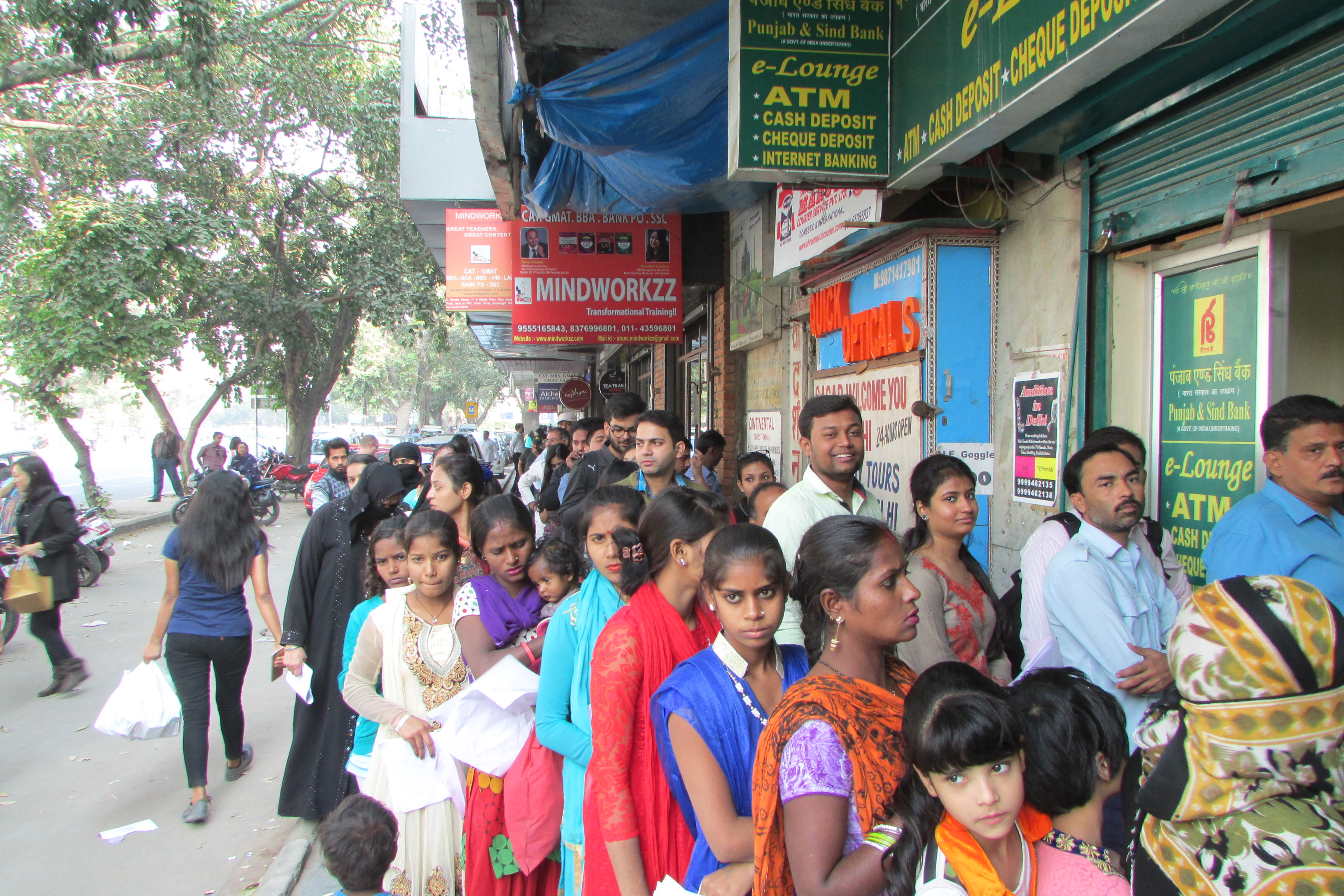
People are not buying cheaper goods, they are not giving money as tips, which impacts the poor people. They also complained that while they are queuing at the banks, they are not working, so are losing pay. Some people pay others to stand in line for them, but this caused disputes too, with those people who were losing work saying it wasn’t fair. If they needed money, people would exchange it for them, but at a bad rate, so they made a loss they couldn’t afford.

The queues outside the banks are getting longer. We saw one line begin to disintegrate, with people at the front trying to push past the guards and shouting. It could so easily turn to riots. Every bank has a guard on the door, holding at least a stick, sometimes a gun. It’s tough to be poor in India. I hope this doesn’t make life even harder.

img_5355 img_5356 img_5357

Thank you for reading.

I will write more about our trip tomorrow. Why not sign up to follow my blog, so you don’t miss it? We have a day of tourism, then venture into the slums…..

anneethompson.com

Immigrants are Stealing our Jobs : True or False?


I’m sure you have seen the awful photos of the people fleeing from their countries and trying to enter others. It is heartbreaking. It is also a little worrying. What will happen to our country if we allow all these people in? There has already been a lot of talk about immigration, about the impact on our economy and employment figures. What will happen?

It is a big topic, so this article will look at one small area. What is the impact of immigration on unemployment? I live in the UK, so will narrow it further: what is the impact of legal EU immigrants on UK unemployment? My assumption is that more immigrants equals more unemployment for British people. I asked my economics advisor if that was true. This is what he said.

He looked at legal EU immigrants between the age of 16 and 60 who come to the UK for work related reasons. So, either they have come to look for work or they are with someone (like a spouse) who intends to find work. He also looked at the UK unemployment rate. This is the percentage of the population who are willing and able to work (so not your toddler or great granny) but cannot find jobs.

The effect of immigration on unemployment is dependent on the ‘substitutability’ of immigrants and native labour. If they are ‘substitutes’ they will be able to do the same jobs, ie they will take the jobs from the British citizen (and increase unemployment.) If they are ‘complements’, having skills which we lack, they will decrease unemployment, increase the GDP and the country is better. So, are EU immigrants complements or substitutes?

All previous research of similar countries with similar demographics of immigrants show that there is very little long term rises in unemployment. However, there were very significant rises in the short term. (These studies include Mexican immigration into the US.) My advisor took these studies, built a model that was a compromise of all the methodology to see if the results were consistent with the UK and EU immigrants. The method is rather complicated, so I have included it at the end of this article (for those readers who enjoy a bit of economics.)

The results showed that the method worked and was statistically significant. It showed that a year after immigration, there was a rise in unemployment. Two years after that increased immigration, unemployment was at the same level that it would have been if there had been no immigration. So, if in 1980 there was high immigration, in 1981 there would be high unemployment but by 1982, the unemployment rate would have settled back to where it would be if no immigrants had arrived. Why would this happen?

Well, initially, those immigrants are unemployed (but not part of the ’employment statistics’.) So why is there a one year delay? This is because it takes a year for the employers to notice. You see, the bargaining power of immigrant labour is very low, they have very few ‘rights’. This means they are not in trade unions, their lifestyle at home was cheaper so they will accept lower wages, they are easier to ‘exploit’, so employers prefer them. After a year of immigration, employers notice they are surrounded by an available work force. They realise they can employ people for less money, easily replace workers if they leave and so on. Hence unemployment (of British people) increases (because the immigrants have been given jobs that Brits could do.)

However, after two years, something interesting happens. Companies spend a lot of money on labour, especially if they employ relatively unskilled workers. As their labour costs become lower (because they pay immigrants lower wages) the companies make more profit. This then enables the company to grow. A bigger company employs more people, which in turn reduces unemployment. This is helped by the fact that mobility within the UK is easy. People can move to where there are jobs, companies can expand to new places and the work force can follow.

However, we began the article by discussing Syrian refugees, not EU immigrants. Is that the same? Well, because Syrian refugees will be a similar demographic to migrant EU workers, they will have a similar impact. After two years of them immigrating, we can expect unemployment to be back to the levels it is at now.

So, I asked, that is good then? Lots more people but no big rise in unemployment after two years, so no big problem?

I was told that no, that was not true. The one year ‘blip’ after they first immigrate, that rise in unemployment, although temporary, could be potentially very damaging to the UK economy. If we take lots of refugees then it needs to be managed very carefully. The government needs to introduce them to the work force gradually, perhaps staggering the time that they can begin to find work in the UK. This article has only looked at one, very specific area, of immigration. It is a potential minefield of problems, all of which need to be carefully managed. So glad that I am not Prime Minister…….

xxxxxxxxxxxx

Methodology used to reach the conclusion: (not for the faint hearted…I have included it because I am told mathematicians and economists will find it interesting.)

The core of the model is a basic OLS regression model. This will show to what extent the independent variable of EU immigration (X) and the dependent variable of UK unemployment (Y) are correlated. However this correlation will not necessarily robustly prove any degree of causality between EU immigration and UK unemployment. To test this, modifications must be made to the model.

The first of these modifications will be to introduce control variables to address the problem of omitted variable bias. These will be factors that economists know to affect the unemployment rate. When these are accounted for model will explain more of the variation in Y.. This formula will use four such control variables – unemployment benefit, union density, real GDP growth and the interest rate. Next dummy variables are added into the model, used as ‘impulse dummies.’ This is where an effect takes place over a specific time period that would significantly affect the model, however at the end of that time period the effect would end and the model would return to normal.

By using dummies, the effect can be compensated for in solely the periods which it is active, therefore not changing the whole curve. There are three dummy variables added to the model to increase its usefulness. The first will be equal to one over the period of the financial crisis of 2007/2008 as the recession had a large effect on the UK economy, including on unemployment. The remaining two dummy variables will be the two separate years where a large amount of additional countries were added to the free movement of labour policy – 1994 and 2004.

Time lags will then be added. There are several reasons for this. Firstly, this will allow immigration in past time periods’ effect on unemployment can be analysed. Secondly it is assumed that the series are not completely non-stationary, in other words that past relationships have some relevance to the present economy. Finally, adding lags to the model will help to reduce reverse causality, a problem which is likely to be relevant. This is because the present state of the UK economy (of which unemployment is a large factor) will be included in a potential migrant’s migration decisions, therefore affecting immigration levels. 2 lags of X will be used in the t-1 and t-2 periods. This will give results of the immediate effect of immigration in period t, the relatively short term effects in t+1 and the long term effects in t+2.

The resulting model:

Image

The Chinese Economy


Will the Chinese Economy Collapse? Since I published the article, ‘The Hiccups of the Chinese Stock Exchange’, there have been dramatic changes to the Chinese economy. If you look at share prices, they have dropped by another 20%. On ‘Black Monday’ there was a huge drop in a single day which knocked stock markets around the world and they too lost value. So, could the whole Chinese economy collapse? If it did, what would be the impact on normal people (you and me)?

The Chinese government has taken measures to try and stabilise their economy. They have lowered interest rates and cut the exchange rate. (You will understand how that works from the article ‘Interesting Interest Rates’) However, will it work?

To answer this, we need to understand a little about China. Firstly, it is huge. Look at an atlas (okay, google maps). It owns a massive amount of land. Secondly, there are loads of Chinese people. Loads. This means that what China does is slightly different to the rest of the world, an elephant moves differently to an ant.

If we go back twenty-five years, the idea that China could totally collapse was a real possibility. Why? Well, have a look at what all those Chinese people do, how they live. In the past, when there were 1.1 billion people in China, 800 million of them lived on farms. They were subsistence farmers, surviving on what they could grow. Think about it, that was one sixth of the world’s population, living in rural China, dependent on their own piece of land for survival. This made for a very unstable country. If there had been a drought, for example, 800 million people would have up sticks and moved. Imagine if they had rioted! This would create something of a crowd control problem.

Now, that didn’t happen and since that time, China has been increasing industrial development and urbanising such that today under half of its population lives in rural communities. (That is still 10% of the world’s population but it is significantly less than it was.) This makes the country more stable, there are more safety nets if there is a disaster.

As an interesting aside, if you look at world poverty, China, through urbanisation, has done more to move more people out of poverty than any single aid agency. You might not agree with how that has been achieved but it still makes for an interesting fact.

So, if we go back to our original point, will China collapse, then no. A complete melt down now seems unlikely. Okay, but could it still have a serious wobble? Could they be heading for a massive recession? Could the Greece thing happen but on a hugely magnified scale? Could the growth of the last 15 years come to a grinding halt?

Well, let’s look for a minute at how that growth came about. Firstly, China has a stable government. Again, you might not like the way it runs the country, but it is stable and that is good. That government has incentivised the massive population so that they leave their little rural areas and move to the cities. They have encouraged people to start businesses, to be entrepreneurs. They have unlocked innovation and allowed huge growth. They have done this by largely ignoring: the environment, human rights, health and safety. You might think the costs are too high. But it worked. The Chinese economy grew very large very fast. At least, it worked in the short term. However, there are weaknesses.

The weakness can be seen if you take a train ride from Beijing to Shanghai. You will pass empty city after empty city. All the infra structure is in place, massive stations, sky scrapers, office blocks, housing, roads, electricity. But no people. They are like ghost towns. Why?

Well, the local governments have had a policy that “if we build it, they will come”. They have built cities and when they are complete, people have moved from the rural areas and opened business, run factories, made money. They have filled the cities with tax paying workers, that tax has been used to pay back the loans from the banks, everyone is happy. It fueled development on a huge scale. It was also like a lot of spinning plates, if you could keep them spinning it was great, if they start to slow down you have a problem. The plates are beginning to slow down.

If people stop coming to the empty cities, if they remain empty, then no one will pay tax, the local governments will default on their loans. Then the small banks will need help from the big banks. The big banks will need help from the government. In real terms, for real people, what would that mean?

In 2008, the UK had a banking crisis which led to a recession. People lost jobs, businesses stopped growing and so stopped recruiting (even good graduates could not find work anywhere, it was bit of a shock!) The housing market slumped, people had less money. It was an uncomfortable time, one we are still recovering from, but the country did not collapse. At the same time, in Ireland, they had a bigger banking crisis and there was a much bigger recession. Their economy collapsed and the IMF had to bail them out.

Now, my guess is that China will be more like the UK in recession than like Ireland. It has not, as a country, borrowed much from other countries, it is fairly self-sufficient. They do buy a lot of raw materials, which will impact the markets, some stock exchanges may have a dip. However, we will not see a disaster like Greece has seen. Which is good because on the scale that China is, that would be devastating.

Image

Can the Euro Survive?


Can the Euro Survive?

IMG_1255

      What will happen to the euro in the light of the Greek crisis? Does it have a long term future or will it disintegrate?

     I have no real opinion on this. So I listened in on a debate between two of my sources: an economist and a city worker. We will call them T (Tomato Source) and B (Brown Source). The words in italics are mine – either questions, or explanations of some of the terms used.

     Do you think the euro will survive for much longer?

T: No, because Germany will soon start to want it’s own monetary policy. At the moment, the eurozone has a monetary policy but Germany will decide it needs it’s own one soon. At present, if say Greece, France, Italy have slow economies, they will want to lower interest rates across the euro zone. Germany would have to comply with this, even if their own economy is over heating. (If you cannot remember what this means, read the article on interest rates published 11-7-15)

     The bigger point though is the opposite of this. When Germany wants to lower interest rates to increase consumption but most other economies are over heating. Then they will ‘stagflate.’ (This is not a form of indigestion, it means the economy is not growing but inflation is. It’s bad.)

B: I don’t agree. The currency wont inflate because it will always be balanced by those other economies. True, if Greece now had the drachma, it could use different techniques to the rest of the eurozone to sort out its economy. However, the USA works because it is centrally run. (Central government decides on tax, government borrowing etc for the whole country. Individual states decide on only some financial points.) A new ‘United States of Europe’ would work financially but all the countries would need to agree to be centrally run.

T: At present, if France, has a fast growing economy, they cannot lower interest rates unless all the eurozone agree. All they can do is change their fiscal policy. Classical economists think this cannot work.

Fiscal policy is what the government spends and what it sets taxes at. In the eurozone, the other measures to control the economy, like interest rates and the number of euros in circulation, are all agreed centrally. So, Greece could not decide to just print more euros when it ran out of money. Germany cannot decide to lower its own interest rates.

B: California is as big as a eurozone country and central policy works for them. Detroit went bust recently, but it works because they have more central control. The eurozone would work if they decided tax and government borrowing centrally, if it became a full union, like the USA. However, the citizens of the countries, the people who get to vote for governments, have never wanted this, they want the control to remain in the individual countries. This is why they have a sort of ‘half way house’, despite the theorists wanting a full union. That halfway situation is why it went wrong. They have now centralised the regulation and insurance of banks. This was an important step. The central bank (called the ECB) now controls all the domestic banks in all the eurozone countries.

So why weren’t the Greek banks protected? Haven’t they just gone bust?

B: It doesn’t stop them going bust. The insurance just protects the deposit, the money of the general public.

T: Another big problem is, monetary policy is effectively free, but it takes a long time to take effect. We’re in a recession. If I want to encourage people to spend more (and speed up the economy) I will lower interest rates. But that takes a long time to be effective. So the public feels its not effective at all (people tend to be impatient. Especially when their money is involved.)

     A faster way to speed up the economy, is through fiscal policy. The eurozone can only work if fiscal policy works. Everyone believes this. (Classical economists believe that fiscal policy does NOT work, therefore they believe the eurozone will NEVER work!)

     Whether or not fiscal policy works depends on two different things. It depends on:
1)the size of the multiplier effect
2)the scale of the crowding out

     Hmm, complicated terms! Economists love to use fancy phrases. We need to know what each of them means.

      Let’s look first at the ‘multiplier effect’. This refers to the GDP of a country. The GDP is simply the amount of ‘stuff’ produced annually in a country. It stands for ‘Gross Domestic Product.’ We’ll use China as our example because they have a big ‘multiplier effect’.

     Pretend the government decides to build a bridge. It pays £5,000 to the builder. (Yes, I know it wouldn’t be in £, but we’re trying to make this simple!) Now, that builder spends £3,000 in China on Chinese products, spends £1,000 on imports, saves £500 and gives £500 in tax.

      This increases GDP by £8,000. (Are you keeping up? It’s the government’s first 5,000 plus the builder’s 3,000 – all spent in China on Chinese stuff.)

     Now, the £3,000 of the builder was spent on a Chinese car. The car man then spends that money. He spends £2,000 on Chinese stuff, saves £500, spends £500 on imports and tax. So now we have another £2,000 spent in China on Chinese stuff, so their GDP increases again.

      That same money keeps multiplying the increase to their GDP (I am getting a hint as to how they chose that name now.) In fact, that original injection of £5,000 (from the government to the builder) increases GDP by £20,000.

     We used China as an example because in China, no one saves much, no one buys many imports (most things are ‘made in China’) and no one pays much tax. So, the ‘multiplier’ is much higher than somewhere like Belgium. Therefore, government spending in China is very effective.

     Now let’s look at ‘crowding out’. Pretend a government wants to build that same bridge and to raise the money to do so, it sells government bonds. These are in effect a way the government can borrow with interest. It borrows from banks and individuals (perhaps through National Savings Bonds) for a set period and then pays it back with interest.

     That money, when it is lent to the government, stops circulating, which slows the economy. (If I put £100 in Savings Bonds, then I am not using it to buy a new tele.) This is called ‘crowding out’.

     So, the ‘multiplier effect’ is the inverse of ‘crowding out’. (I wanted to write that it was the “opposite” of crowding out – because to my mind it is – but both my sources inform me that strictly that is not true, so we will stick with “inverse” knowing that for normal people that means “opposite”.) Whether or not fiscal policy works depends on which one – multiplier or crowding – is the most dominant

T: Therefore, fiscal policy will be less effective in places like Germany and France than somewhere like Poland. (Remember ‘fiscal policy’ is government spending and taxes.) So, even if the whole eurozone economy is slow, countries within the zone will disagree on how to speed it up, because fiscal policy will work better for some but not others. This is due to the diversity of countries within the eurozone. If they were all like France and Germany, then a central policy would be much more likely to be possible.

B: I don’t agree. In the USA, states have huge economic differences and yet a central policy works there.

T: That is because the culture across the states is broadly the same, the amount of stuff they import, the amount of tax they pay does not vary much between states. This allows a central policy.

B: Actually, I think it is because of central policy that they are similar. If all the countries across the eurozone accepted centralised government borrowing and taxation, then the euro would work. The Greek problem would probably never have happened.

     Politically, this is very unlikely to happen.

     So, can the euro continue?

B: The trouble is, politicians need to be popular to get votes. Democracy means that they are pressurised into continually borrowing as much as possible, so that life is good for the current population. They borrow from the future to keep voters happy today.

     This causes the temptation to behave rashly, to alleviate hardships today and to not live within their means. The euro takes away some of the consequences of over spending. Bad government decisions are spread across the eurozone. In the UK (not part of the eurozone) if the government overspends, then fairly soon it will face the consequences. Like Brazil had to. The countries in the eurozone can behave how they want and know that the other countries will bail them out.

     Maybe, the lessons learned in Greece will cause a change in behaviour. Maybe they will do things like set up a system of policing each other, auditing what is happening in each of the countries. Part of the Greece problem was caused because they lied about the amount of debt they had and no one checked. Even if they reject a central policy, they could introduce greater accountability. They could agree on tough consequences for governments who break the rules.

T: Whatever happens, I don’t think Germany will bail out another country. If Portugal follows Greece, I think the German people will just say no and Portugal would be forced to leave the euro. The eurozone would crumble.

     So, can the euro survive? If some new rules and tough consequences are introduced, then maybe. But it is far from certain…….

Interesting Interest Rates


Interesting Interest Rates……

IMG_0544

       In the News this week, Janet Yellen (federal reserve chairwoman) has again said that the US central bank is likely to increase interest rates. Is this important? Will this affect you?

     Now, I have never met Janet Yellen. All I can tell you is that she has blonde hair and likes to wear dark lipstick. I can however, tell you a little about the Federal Reserve. This is the central bank of the US. It is the US equivalent of the Bank of England. So, what is a central bank?

     A central bank works for the country. In recent years, it has become acceptable for it to be independent of the government. It manages inflation and financial stability, in other words, it manages the economy. How? Well, that is a whole article in itself (not yet written but I’m working on it!) For now, lets just say that it sets interest rates.

      Now, people do not like to be shocked by what central banks do. Just like with the Swiss Pegg (see : https://anneethompson.com/the-mystery-of-money/the-swiss-peg-nothing-to-do-with-clothes-lines/) which changed the markets by 20% in a single day. They therefore usually very carefully give hints, in tightly scripted statements. So, if someone senior (like Janet Yellen) makes a statement – trying to avoid a sudden shock – the market listens very attentively. So should we.

     Anyone who is young, may not realise that at the moment interest rates are low. Very low. Possibly the lowest they have ever been. This is due to the financial crisis – the central banks have all lowered interest rates.

     I used to own a Mercedes C class coupe. It was beautiful. It drove like a dream. It also had a ‘super charge’ button which I loved (made me feel like James Bond.) When I was stuck behind something slow, I could press my super charge button and whiz past at super fast speed. The central bank, in effect, has a ‘super charge’ button, which is to lower interest rates. If it lowers interest rates people change their behaviour. They are less likely to save (because their savings wont go up in value) it costs less to borrow money, so the population goes shopping. This creates jobs, creates income, leads to economic recovery. For the last five years, every central bank in the world has done this.

      However, central banks hate high inflation. Everyone is worse off if there is high inflation. Your money becomes worth less (what you can afford to buy with a pound this year will be less next year) it slows the economy and they do not like it. One thing that encourages high inflation is low interest rates. So central banks want to raise interest rates before this happens.

     At the moment, the US economy is going relatively well, which is why the central bank will probably begin to nudge up interest rates, before inflation creeps in.

     The other reason is that those ‘super charge’ buttons have been pressed for about five years now. They only really work for giving an extra ‘umph’ when needed, they are a back-up plan. They need to turn them off before we go into a new recession. The central banks need to get everything back to normal (with slightly higher interest rates) so their ‘secret weapon’ can go back into reserve.

     How will this affect the UK? Mark Carney (who I have met, at a dinner. He seemed like a very nice chap) is in charge of our central bank. He is saying that “nothing will change for now.” However, he is also saying that if interest rates move it “would be an increase rather than a cut.” These are those carefully scripted hints that we mentioned earlier. People (you and me) need to plan for interest rates to start going up before too long.

     Interest rates today are very low. This means that even a small increase has a big impact, even a 1% increase means big changes. For example, if you have borrowed £200,000 for a mortgage you might be paying it back at 2% interest. If interest goes up by 1%, so you are now paying 3%, then your monthly payment would go up by £100. For a normal family, finding an extra £100 every month in order to pay the mortgage, would be hard. Interest rates on other borrowing would also go up. Do you owe money on your credit cards? Have a car loan? Be prepared for the repayments to increase.

     We need to be wise, to start planning now for what is likely to happen in the near future. Listen to the hints.

The Hiccups of the Chinese Stock Exchange


The Hiccups of the Chinese Stock Exchange

IMG_0702

     The Chinese economy is growing at 7% per year and has been doing so for a decade. It is a very healthy economy at the moment. Companies are doing well and China now has a good working stock exchange, so it is possible to buy shares in Chinese companies. So should we? Should we be taking advantage of the healthy Chinese economy and investing our money?

      We first need to understand about shares and the stock exchange. A stock exchange is simply the place where shares in companies are bought and sold. The average value of all the shares on the exchange tells you how companies are doing. If we look at the Chinese stock exchange, from July 2014 to May 2015, the average value of shares more than doubled in value. If you had invested £200 in July 2014, by the end of May 2015 it would have been worth over £500.

ImageSource: Bloomberg

     However, before you rush out to buy shares in a Chinese company, you need to know that today (July ’15) those same shares would be worth less than £400. The Chinese stock market is crashing. Why? What is happening? Their economy is growing steadily but their stock market seems to have hiccups – big jumps followed by big slumps.

     We first need to consider what actually decides the value of a share. Firstly, a share is part ownership of a company – a ‘share’ of the company. So if the company is doing well, the share should be worth more. So if you own 1% of the company (have a 1% share) and that company doubles its income in a year, then you will either receive your share of that profit in a dividend (a cheque in the mail) or your investment is worth more (you can sell it and make a profit.) So, if the Chinese companies are doing well (which they are) you would expect the shares to be also growing steadily in value.

      In the long term, this is likely to be true. The steady growth of the companies will be reflected in a steady overall increase in share values. However, in the short term it is more erratic. Why? What else influences share prices?

      The second influence on the value of prices is supply and demand. Confidence in the Chinese market pushes up prices of shares. (Refer back to the article on market places if you are unclear on this. Remember, it’s just like ebay. Something that is popular will go up in price.) Global confidence in the Chinese market pushes up share prices. The share prices might even be higher than the value of the company itself.

     An example of this (though not a Chinese one) is Uber. In London, only black cabs can be hailed. Regular taxis have to be prebooked. Uber has created an app whereby a customer wanting a taxi can ‘order’ one on their phone. Any taxi who is part of the Uber scheme can respond and pick up the customer. It links taxi drivers and passengers. Excellent idea. I predict the company will do well. Unfortunately for me, lots of other people also think it will do well. That has pushed up the price of its shares, because lots of people see it as a good investment and want to buy them. According to the share price, Uber is worth twice as much as Sainsburys (though Sainsburys is probably worth a lot more as a company.) If I want to make money on the stock exchange, I need to be ‘ahead of the pack’. When everyone notices the same trend, it pushes up the price of shares, which lowers the likely profit from a short term investment.

     Now, the Chinese stock market is unusual because the overwhelming majority of shares are owned by small time Chinese investors. It is a culture that likes to gamble. The share holders are not interested in long term investment, they want short term profit.

      The Chinese stock market is very new (has grown up in the last five years) so people have not really seen any big ‘crashes’. It is seen as a safe bet. This is a bit like when we bought our first house. We had only ever experienced house prices going up, we assumed that a house was a ‘safe’ investment. It was something of a shock when houses prices plummeted at the end of the 80s.

      At the moment, small time investors see the Chinese stock market as a ‘safe’ investment. A lot of people are investing in, gambling on, the stock exchange. The share prices have become driven by rumour and speculation as people try to predict the future value of companies. The stock market has become more linked to crowd behaviour and less to the real value of companies. This explains the hiccups.

Should Companies Pay Tax? (Tax 102)


     Image 15 IMG_2397

     The Conservative’s recent manifesto claimed they would, ” raise at least five billion from continuing to tackle tax evasion and aggressive tax avoidance and tax planning.” However, in the Queen’s Speech (May 2015) no new bill was mentioned. Does it matter? What does it mean anyway?

To begin with, we need to look at what the terms ‘tax evasion’ and ‘tax avoidance’ mean. They are not the same. Tax evasion is against the law. It is when your friendly builder doesn’t declare all his earnings, so he is not taxed on them. It’s illegal and if he is caught he can be prosecuted.

Recently, there has been more focus on tax avoidance. This is completely legal and is when you set up your financial affairs so that you do not pay unnecessary tax. In the past, people have considered this to be good sense and most people have done it. For example, if you have your savings in a building society account, you will pay tax on the interest. If you move the savings into an ISA, then you don’t pay tax on them. This is tax avoidance. Most people would think this was good money management, a sensible thing to do.

However, in the last few years we have become aware that some companies are taking this to an extreme. It is still legal but most of us feel that it is undesirable, it feels like cheating. Let’s look at a couple of examples.

The first example is fictitious. Annie decides to set up ‘Annie’s Global Coffee Empire‘. It quickly grows and is very successful, with coffee shops all over the world. There are over a thousand of Annie’s Coffee shops in the UK, they serve delicious coffee and are very popular, everyone drinks Annie’s Coffee. You might expect them to be paying lots of tax in the UK, as all businesses pay corporation tax on their profits. But they are not. When Annie set up her company, she did some cunning tax planning. She set up her head office on a remote Pacific island. An island that has 1% tax. That head office owns all the recipes for the drinks and the brand name. It charges the Annie’s Coffee shops in the UK a fortune for the use of the recipes and the brand name, such that the UK shops do not make any profit at all (but head office, paying just 1% tax makes loads!)

Now, the employees in the UK all pay tax on their earnings, the shops all pay their rates, VAT, etc. However, all the profit, which should be liable for corporation tax, is only taxed on the island because on paper the UK coffee shops earn no profit at all. The parent company makes a fortune from it’s highly priced recipes and brand name, the UK shops appear to make nothing. This is not illegal. Nothing is secret or hidden, their accounts are accurate and open. However, all of Annie’s successful coffee shops pay no corporation tax in the UK at all. This seems unfair.

Our next example is a real one. Associated British Foods own Zambia Sugar (who make Silver Spoon sugar.) They have a big sugar factory in Zambia. Outside of the big, profitable factory, is a small street market. In the market, people can have a stall and sell a few vegetables that they have grown in their gardens. The stall holders pay a few cents of tax as a government fee for having a stall. Some years, they are paying more tax than Zambia Sugar. They contribute more to Zambia’s health and education budget than the big corporation. I do not know if ABF set this up deliberately but again, this seems vastly unfair, whilst being completely legal.

So, what is the answer? These companies are not doing anything which is against the law, they are are not ‘breaking the rules’ but morally it seems wrong. Sometimes there are clever accountants setting up the tax avoidance schemes when the company is set up. Sometimes a country is too corrupt to care (so in some places you find that government officials will charge a ‘set up fee’ when a big business wants to go to the country.)

So what should we as consumers do? Should we boycott products like Silver Spoon sugar? My feeling is that that would be a mistake. Whilst they are not paying tax, Zambia Sugar are hopefully improving Zambia. They will be giving gainful paid employment to thousands of people, do we want those workers to be unemployed, impoverished?

Yet the situation clearly seems unfair. The solution would seem to be in asking for transparency. If companies had to publicly publish a complete list for every country they worked in, clearly stating how much tax they paid in each country, then they would be embarrassed into changing their tax arrangements. No large corporation likes bad publicity. Public pressure can force them to change what they are doing in a way that the law cannot.

We as consumers should be aware of which companies pay tax in the countries in which they work, and which do not. If we switch our coffee consumption from Annie’s coffee to another, tax paying, brand, then that seems right. In those developing countries which need employment, we can be campaigning for greater transparency. We can let these corporations know that what they are doing may be legal but it is not right. There is an ethical element involved and that affects us all.

I have this week seen a coffee company ‘named and shamed’ on facebook for not paying UK tax. Now, I do not know if in fact, this company does not pay UK tax, I have not yet checked. I am uneasy with how quickly we like to criticise big companies, to all band together against a common scapegoat without checking the evidence (which is how the Nazis got to be so successful.) However, even if they ARE paying tax and the facebook friends are wrong, this will still be influencing companies. They will see the mood of the public and will be checking their own stance, eager to confirm that they are a moral tax payer. We do have influence. We need to use it.

A financial article is published weekly at:
https://anneethompson.com/the-mystery-of-money/

Why Do Supermarkets Price Match? (Game Theory)


Why do Supermarkets Price Match?

      Do you have a price match card at your supermarket? Have you heard them offer to refund your money if you can buy it cheaper elsewhere? Why do they do it – are they being nice to their loyal customers? Actually, no. Actually, the price match promise is not even aimed at their customers, it is sending a message to their competitors. To understand why, we need to look at something that economists call ‘Game Theory’ (don’t get excited, Pictionary and Cluedo do not feature.)

     Game Theory is something that John Nash made a big contribution to (you may have heard of him – he was the person who inspired the film A Beautiful Mind. ) He showed that when individuals (you and me) or companies (Sainsbury’s) make a decision, we do not just take into account the things that will benefit us, the things that we want. We also take into account other people and competitors. Companies, when making a decision, guess what other ‘players’ in the ‘game’ might do. Supermarkets know that if they reduce their prices, the supermarket up the road will also reduce theirs. So they will both lose money. They do not want this to happen, so they make their ‘price match’ to their customers. This is sending a clear message to the other supermarkets. It says,

“If you lower your prices, we will lower ours too, so both of us will make less profit and neither will get more customers. So don’t do it.”

     Economists call this making a ‘strategic commitment’. (Economists like to make up fancy terms, it makes them feel important.) It means the shop has made itself inflexible, it has limited its own options (because when the customer tells them that baked beans cost less in Asda, they have to match that price, they can’t just say “Oh, we were only joking, sorry, you still have to pay the original price.”) They do this so their competitors will know they are serious. They are making a tough commitment (because they believe it will influence how the other shops behave and everyone will be better off. Except for the customers maybe.)

    Supermarkets have been having price wars for years. All of their actions have to be visible (no point in matching prices if your competitor doesn’t know about it) credible (their competitor has to believe that they actually will do it. If Morrisons promise a free BMW with all their loaves of bread, no one will believe that they will actually do that. Well, some people might, but not the sort of people who will be reading this) and understandable.

     But why bother with the price match thing at all? Why not just tell the other supermarkets that you will lower your price if they lower theirs, so don’t do it? Well, they are not allowed to. That would be called collusion, which is illegal. We will come to that in a little while.

     Firstly, let’s look at another company that has made a tough commitment. I like Kelloggs cornflakes, no other cornflakes are quite the same in my opinion. They are known in the cereal making world as being price leaders. They have always aggressively matched any price of any comparative cereal (not that any other cornflakes really do compare with Kelloggs.) Now, they are not allowed to tell their competitors that they will do this (it would be collusion – illegal remember.) Plus their competitors would probably just laugh and not believe them. However, they have behaved like this for about 200 years (I am guessing the time) and so all cereal manufacturers know what to expect and they behave accordingly. No one tries to out price Kelloggs, it just is not worth it, everyone loses (apart from the customers. Again.) Economists (the people who like using fancy phrases) would say the cereal companies are in ‘Nash Equilibrium’. They cannot individually change and still succeed because their competitors will step in and lower their prices too until eventually they go bust.

     There is another kind of commitment that companies make. This is called a ‘soft commitment’ and it is less aggressive, it more involves sharing the market place. So, Dominoes and Pizza Hut do not open shops in the same town. They have not agreed to do this (that would be collusion) they simply do not do it. They share the customer base rather than trying to force the other company to lower their prices.

     Another ‘soft commitment’ can be seen with Sony and Phillips. When CDs first came out in 1982, Sony produced them but Phillips (the main competitor) did not. It let Sony go first, spend lots of money on researching the new technology and then Sony flooded the market with them. It worked to both company’s advantage. Phillips had no risk, it did not invest in a new technology which might never take off, might just be a waste of money. Sony had the advantage of knowing that if it invested in new technology, it would then have an empty market place and could sell lots to recoup it’s expenditure. It suited both companies.

     Another way that companies share the market place is by aiming their products at different people. So, Illy makes expensive but delicious coffee, Nescafe makes cheaper but still drinkable coffee, Asda own brand is pretty yukky but very cheap. It is almost a class system for coffee! This is called a ‘fragmented market’. Again, the coffee producers could not agree to do this (collusion) nor was it historical (like with kelloggs) but they could see which areas their competitors were investing in (like growing only highly refined coffee beans or investing in cheap transportation in Brazil) so they could predict what everyone was doing and make their own decisions accordingly. (This got a bit messed up when the US coffee people entered the scene, but it still makes for a good example and I rather like thinking that I prefer ‘upper class coffee’!)

     Now, we have kept mentioning ‘collusion’. What is that about? Capitalism works with the belief that the market place works best if there is free competition, if everyone is trying to win the game. People believe this so strongly that they have created organisations to police this. In the UK we have the CMA (Competition Market Authority.) Other countries have different bodies, all trying to ensure a fair market place. Competition keeps the prices down and everything working efficiently.

     The exception to this, is oil. The countries that produce oil (note, countries, not companies) do collude. Which is why oil is so expensive. The actual companies don’t talk – BP cannot have a price chat (over a cup of illy coffee) with DNO – but the UK can talk to Norway. They set the price of oil (by adding tax) where they want it. They try to limit how much oil people will use.

     If we return to supermarkets, we can now see that their price match promise does not actually help us the customers very much. However, they are still trying to entice us into their shop. So, while they may not ever give away a BMW with a loaf of bread (sorry mother) they will offer us other things. We can still enjoy our free coffee and newspaper or our loyalty card or our free knife set. It all makes shopping a little less boring.

Financial articles are posted on Saturdays.