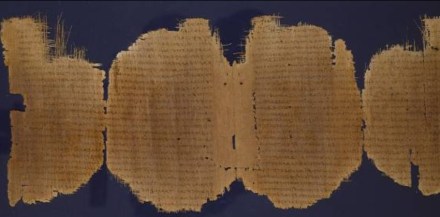
Does God Have a Name? And Should We Say It?


When I started to learn Hebrew, I was introduced to ‘ketiv qere’ in ancient scripts. As I have explained before, Hebrew words have a basic 3-letter root, and a group of people (the Masoretes) added dots and dashes to represent verbs, so people remembered how to say them. However, some words were written (ketiv) one way, but should be said (qere) differently—so they added the wrong verbs. Therefore, God’s name, written YAHWEH,[1] has the verbs for ADONAI, so when people saw the word, the would say ‘Adonai’ even though the letters are YWH. As my Hebrew lessons continue, whenever we read YHWH, we say ‘Adonai,’ as a sign of respect. But should we?

In most English Bibles, whenever Yahweh is translated, they write LORD, all in capitals. So we continue the tradition even in Christian churches; the name of God is rarely said.

Where did this idea originate, and should it continue? I have been reading a book on the subject by Andrew Case,[2] and I will give you a brief summary. He begins by quoting Clines, who states that, ‘The personal name of God is Yahweh. It is a foreign name, quite un-English […]’ and he suggests that perhaps for that reason alone ‘[…] the name Yahweh must be preserved—lest it should ever be imagined that God is an Englishman. He is a foreigner now to every race on earth. The very awkwardness of addressing a God whose name is not native to one’s language in itself alerts us to the alienness of Yahweh to every god created in our own image.’[3]

To begin with, Yahweh is introduced by God,[4] and is used by the Old Testament writers. All the early books use the name freely,[5] sometimes it was even used as part of a greeting,[6] and it was used in oaths.[7]

This changed in the book of Amos. There was a terrible punishment, many people died, and they declared that they ‘must not mention the name of the LORD!’[8] However, this was not a new ‘rule’ it was more that they were so traumatised, so worried the same thing might happen, that they dared not approach God or even say his name.[9] Case suggests that due to this fear (which sounds a bit superstitious I think) they started to use alternative names for God, avoiding saying Yahweh.

The use of Yahweh in oaths/contracts was also banned in the Talmud. (The Talmud is the written form of all the verbal laws the Jews had, with added explanations so they were clear.) The Rabbis disliked that a written contract would one day be rubbish, and therefore banned the use of Yahweh on written contracts.[10] Case notes that this, and a later ban by the Essenes (who probably wrote the Dead Sea Scrolls) does not give a reason—they don’t say it is out of reverence for God’s name. However, it seems likely to me that this is the reason, as unlike in the Amos example, no other reason seems logical.

The Essenes then began to eliminate the name from their copies of manuscripts, sometimes putting symbols or dots in place of the letters. As I have written before, we don’t have any original manuscripts for our Bible, we have used various manuscripts (copies of copies of copies…) which means anything ‘corrupted’ by the Essenes (an early sect of ‘manuscript copiers’) continues today.

This continued to when the Septuagint (the Greek translation of the Old Testament) was written. Case (who is himself a Bible translator, so speaks with authority) suggests that when the Septuagint was written, they were so indoctrinated with the idea that they must not say the name of God, that it influenced their translations. Therefore, for example, the passage in Leviticus that says: ‘The one who blasphemes the name of Yahweh will surely be put to death.’[11] was translated in the Greek as: ‘The one who names the name of the Lord will surely be put to death.’ There seems to be no other reason for the change, as all the copies we have of the Hebrew use ‘blaspheme’ so it appears to be a deliberate change by the translators. (My understanding is that this happens a lot with translations—there is rarely a word-for-word equivalent with different languages, there is always a choice as to which word best fits the meaning. If translators hold a particular belief, it would be natural for them to use a word that upholds that.)

Case suggests that the Masoretes (who wrote the Hebrew version that I use) copied the convention of the Septuagint, and so added the vowels of Adonai to YWH. He also discusses how, over time, people would have begun to read this substitution as a name. Therefore, although people read ‘kurios’ meaning ‘the Lord’ in their Greek versions, after a while they would think of ‘Lord’ as a name, not a title. (Which probably most English speakers do today, when they pray to ‘Lord’ they are possibly not thinking of it as a generic title, but as a term specifically for God.

This is interesting, because his next point refers to the church in New Testament times—did they return to using Yahweh to address God? Well, no. Case says this is probably because in mixed Jewish/Greek congregations, the disciples were challenging all sorts of traditional thoughts, and challenging the idea of not using God’s name was probably a step too far. (Which to me, suggests that perhaps it is not important.) However, he does make an interesting point when he refers to the bit that says Jesus has ‘the name that is above every name’.[12] This ‘name’ suggests Case, would have been understood to be Yahweh. He thinks Paul was quoting from Isaiah 45:23, which uses ‘Yahweh’ but Paul has changed it to ‘Lord’ because that is the Greek custom. Case also points out that ‘Jesus’ in Hebrew is from ‘Joshua’ meaning: Yahweh is salvation.

There is further evidence that ‘Lord’ was substituted for Yahweh when Jesus quotes Deuteronomy 6:5 in Mark 12:30. He changes ‘You shall love Yahweh your God’ to ‘You shall love the Lord your God’ and he also adds ‘with all your mind’. Case thinks this is because the ancient Hebrews thought that everything was decided by the heart, whereas in Greek thought, there was a disconnect between heart and mind (so loving Yahweh with all your heart was insufficient, they needed to engage the mind too). Jesus therefore ‘tweaks’ a quotation, so the people understand the meaning of the quote. Thus ‘Lord’ is a substitute for ‘Yahweh’. Every time the early church read ‘Jesus is Lord’, they were really reading ‘Jesus is Yahweh’ which was completely radical!

My main concern when reading Case’s argument, is that he refers to ‘the personal name’ of God. Yet the name that was given, Yahweh, was NOT really a ‘personal name’. It’s a verb. The verb ‘to be’ which in the tense given means that God told Moses: ‘I will be whatever I will be.’ This, I feel, is more of an evasion than a name, more a telling humans that they cannot sum up God in a name, they cannot label him. The Old Testament writers took this verb and used it as a name. Should we copy their example? I guess the difference is that they were Hebrew speakers, so although they used the verb as a name, they would ever be aware that it was really a verb. We, however, see the word only as a name. Which potentially has dangers, but I’m not sure. Maybe it only has power. Maybe it has both.


[1] In case you missed my earlier blog: When the German theologians wanted to write this (Yahweh written with Adonai vowels) they ended up writing ‘Jehovah’ because ‘Y’ sound is written ‘J’ in some languages. Therefore, when you see the name ‘Jehovah’ you are reading a German attempt to write a wrongly-written Hebrew word, not a name that ever appeared in any Bible!

[2] Andrew Case, Pronouncing and Translating the Divine Name יהוה (UK: Independently Published, 2020). Although self-published, Case references his sources appropriately, and therefore is considered reliable to cite.

[3] David Clines, Yahweh and the God of Christian Theology: Theology Volume 83 (Sage, 1980)

< https://journals.sagepub.com/doi/abs/10.1177/0040571X8008300503&gt; p.324.

[4] Exodus 3:15.

[5] Psalm 135:13.

[6] Ruth 2:4.

[7] 1 Samuel 14:45.

[8] Amos 6:10.

[9] Suggested by Douglas Stuart, Hosea – Jonah: World Biblical Commentary (Dallas: Word Incorporated, 1987) p.364.

[10] Michael L. Rodkinson, The Babylonian Talmud: Original Text, Edited, Corrected, Formulated and Translated into English (Boston: The Talmud Society, 1918).

[11] Leviticus 24:16.

[12] Philippians 2:9 -11.

The Baal Cycle — a story from an ancient world


The Baal Cycle

Here is an ancient story, from Ugarite, a civilisation that has lots in common with ancient Israel. The characters of the story are referred to during the Old Testament, because this is a tale the people would be familiar with—you might have noticed references to Baal, this is his story:

The Canaanite’s God, El, created all things. He is an old man, with a long white beard (he sat on a throne, not a cloud—but the description sounds familiar…) There is a Heavenly Realm, and El makes Yamm the king of all the gods. Yamm is a seven-headed sea dragon, known for his pride and creating chaos, sometimes called ‘Lotan’ (There is bit of a fuzzy divide between gods and monsters in some of these ancient stories. I guess they were trying to represent the things they didn’t understand with images/stories.)

Two other gods, Athtar and Baal resent this, and Baal threatens Yamm.

Baal is a young god, the son of Dagon, and his wife is Asherah (a name you might also recognise from the Old Testament).[1] He is a warrior god, he often brings thunder and lightning, and is in control of both fertility and rain. (This is particularly interesting in the light of the OT story in 1 Kings 18.)

Baal goes to Kothar, who is the god of skill and wisdom, and asks him to make two magical clubs. Baal then uses them to crush Yamm. He’s helped by his sister, Anat.

So we have Baal—thunder and lightning, defeating Yamm—chaotic sea. Baal is less chaotic than Yamm, so this is seen as a good thing.

They have a feast to celebrate (as you do) and Anat goes to ask El if they can build a palace for Baal on Mount Zaphon. Kothar (the god of skill and wisdom—remember?) helps to build the palace.

When the palace is complete, they invite Mot, the god of death to visit. (I find this is interesting, as ‘mot’ is the Hebrew word for ‘death.’) Mot says he will come, but to devour Baal, not to celebrate. Baal is defeated and killed (but not permanently, so don’t make a cuppa just yet). Anat (the sister) then fights Mot (because this is what sisters do when their younger brother is beaten up) and she manages to get Baal’s body. She kills Mot, and scatters his body to the birds (though he pops up again later, so this bit is a little confusing). During this battle, Athtart, another sister (obviously one who doesn’t like Baal so much) tries to make one of her sons king, but they all fail.

Baal and Mot then fight again (don’t ask me how, it seems ancient gods didn’t really stay dead, even when fed to the birds). Baal is declared the winner.

*****

I don’t feel the story has much traction as a bedtime story, but I found it interesting to see where some of the beliefs about Baal and Asherah came from. They pop up a few times in the Old Testament, because people tried to worship both them and God. The story seems strange/weird to our modern minds, but I guess the stories from every religion seem strange when you’re new to them.


[1] 1 Kings 14:15.

Thanks for reading. Hope you have a great week.

Take care.
Love, Anne x

Thank you for reading.
anneethompson.com
Why not sign up to follow my blog? Look for the icon below.

Talking with a Coptic Christian


As I told you in my last blog, we have been studying spirituality around the world. In our lecture, we spoke to a Coptic Christian from Egypt. ‘Coptic’ is the type of Egyptian writing that came after hieroglyphics, and became the language of Egypt, and therefore the language of the early Christians—people like Origen & Co. The chap we spoke to, spoke to us in English. Not much has been written in the past by Coptic Christians, and we were told that this is partly because it was a difficult place to be a Christian. He spoke about the ancient church in Alexandria, commenting that, “We produced more martyrs than books!”

He explained that the Coptic church is known as the church of the people, and it works with the poor people in Egypt. He said that Christ was found with the poor people, and that is where their focus is. Later, I asked him about all the money, and gilt and splendour, that I had seen in the Coptic churches in Cairo. How does that tally with their aim to work amongst the poor? He told me that it generally is the poor people who provide the money for the beautiful churches, that they want to contribute, to show how much they value God. He also said that in a country where they are the minority religion, it is very important to have a ‘presence’ and to be seen. It would be easy for the media to discount them, for governments to say there were no Coptic Christians—harder to do that when there is a stonking great temple in every city. This is something I hadn’t considered (it’s very easy to judge cultures before we understand them).

As a minority church in the country, their ‘outreach’ has to be different than in Western countries. They strive to do everything well, to live their lives authentically, and to work honestly. This is the way they hope to be noticed, and for people to be attracted to their church. (I think that in an Islamic country, you are not allowed to speak with Muslim people about your faith.) This tallies with what we saw in Cairo, where the Zabbaleen people (who are Coptic) collect the city’s rubbish, and are known for doing it better than anyone else.

When asked about people converting to Christianity, he said that they would only want people to do that who are sure they want to follow Jesus, not because they have been ’persuaded’ into it—because converting from Islam means risking so much.

He showed us his ‘Book of Hours,’ which is a tiny book of Psalms. They read it at regular intervals throughout the day—like when they wake, at mealtimes, when they go to bed. I thought that was a good practice to copy, it’s hard sometimes to even think about God during the day, even, ironically, when studying for an MA in Theology. My Muslim friends are currently fasting during daylight hours for Ramadan, and I admire their determination and wonder whether we have grown too ‘soft’ in our Christian churches. Sometimes a routine/discipline is a good thing. He also spoke about the monastic tradition. He likened this to the Bible story where Moses is praying while Joshua fights a battle. He said the monks are the ones praying, and studying Scripture, aiding the Christians who are outside the monastery. Most people go to the monastery for retreats, when they join the quiet contemplation for a while and learn from the monks (and share with them what is happening in the world). It’s different, but I can see how it would work.

As I said on Monday, we only had one seminar about global Christianity, but even the little we covered challenged some of my preconceived ideas. Churches in different countries need to find the best way to do things within the culture they live in. Often, this will be very different to how we do things in the West.

Thanks for reading. I hope you have a good week.
Take care.
Love, Anne x

Thanks for reading.

anneethompson.com

*****

Covenants and Mathematical Monotheism


More from the Winter 2023 SOTS conference.

(It was January 2023, so not entirely sure whether the date above is a typo or for when it was originally scheduled.)

As promised, I will tell you about the two papers which I enjoyed the most at the SOTS conference. They both helped to shape my understanding of who God is—and are far removed from the way God is presented at Sunday School. As before, please note that I am describing the lectures as per my own understanding, with apologies if I am not accurately describing what the papers said.


Peter Hatton: ברית as treaty

The Hebrew word ‘beret’ (ברית) is frequently used in the Old Testament, and is usually translated as ‘covenant.’ Therefore, God made a ‘covenant’ with Noah, that he would not flood the world again, and he made a ‘covenant’ with Abram that his descendants would be more numerous than the stars, and so on. However, Peter Hatton suggested that our understanding of ‘covenant’ is misleading, and ‘treaty’ would be a better word. He said, “You don’t make covenants with friends, but with enemies.” There is an element of threat when a covenant is made—and we tend to forget this today. A ‘covenant’ or treaty is very different to a contract, which is an agreement between two equal sides, with no underlying threat, and with a right to appeal if things change.

He then discussed the treaty made with Noah, which was symbolised by a bow in the sky. A bow was a sign of power, a threat of attack. Peter showed several examples of pictures of bows from the ancient world, and each time they were signifying threat and power. The bow shown to Noah is a bow (not a rainbow) and it is immediately after God has murdered/executed all the people and animals in the world (so definitely something of a threat would be understood). [This is not something my Sunday School teachers emphasized, with our songs about ‘When you see a rainbow, remember God is love…’]

The treaty with Abram included a sign too. Abram had slaughtered animals, and cut them in half, and fire had gone between the halves. In the ancient world, people sometimes walked between divided carcasses, to symbolise the idea that if they went back on the agreement, they would be like the dead animals. [A little like in a Court of Law, we swear to tell the whole truth ‘so help me God’ in other words, only God will be able to save me if I lie.] In the example of Abram, God was saying that he would be like a divided carcass if the covenant was broken. [I am unclear here as to who the he might be. According to my notes, Peter Hatton said that Abram would be like the dead animals, but when I later read a commentary, they said that it was God himself who was saying he (God) would be like the animals if he didn’t fulfil the covenant. I think the Hebrew can mean either, so you can decide for yourself. Either way, the covenant/treaty held an element of threat.]

Peter’s paper then considered why this element of threat might be important. When people are in situations of conflict, pretence tends to disappear, and people are very real/honest. Peter said that when he has counselled couples with marriage problems, they are in conflict, and they tend to be honest about the hurt and difficulty. He remarked that in this situation, when people are genuine about the pain, they can start to rebuild. He also said that marriage is a covenant/treaty between people who are different (because individuals are different). [He lost me a little here, perhaps I was tired, but I don’t entirely see the same link with a marriage covenant and conflict/threat. But maybe you can work that out for yourself.]


Philip Jenson: Mathematical Monotheism

For me, this was the most helpful paper of all, because I have been struggling with the idea that the Old Testament is very clear that there is ‘One God’ and yet Christians are very strong on the Trinity (which to my mind, is basically three Gods working as one).

Philip Jenson pointed out that ‘monotheism’ is a term that first arose in the 17th century, which is when understanding of mathematics and science was developing rapidly. The idea (rather than the word) of monotheism first arose during the exile. Before then, people held a belief in monolatry (that only one God should be worshipped, above all other gods).

The Hebrew word for ‘one’ is אחד and it means more than the mathematical idea of quantity. אחד is about quality, about being incomparable, being in a position above all others. ‘God’ is not countable. Numbers are unhelpful here. God is known by power. אחד might be better translated as ‘unique’ rather than ‘one.’

[I think some of these comments about inappropriate translations maybe arise because language is not static, and our understanding of words changes over time. Therefore, when Hebrew is being translated today, words like ‘one’ or ‘covenant’ have slightly different nuances than they did during the reign of King James and the Authorised Version.]

Another problem with this is our understanding of the word ‘god.’ What is a god? Modern people don’t like to think that there could be lots of different gods floating around. However, the Bible speaks of ‘Heavenly Beings’ and some are named (Eg. Seraphim). These might be who were understood to be ‘gods.’ Or perhaps the ‘gods’ were man-made, anything that was worshipped and revered, anything that people treated like a god. Anything that rivalled people’s loyalty to God. Therefore, they did exist, but not in a way that was separate from human perception. A carved animal was a god, because it was worshipped as a god but if placed on a shelf as a mere ornament, it was not a god.

The paper then considered texts that possibly contradicted this idea, such as Isaiah 44: 6, “…beside me there is no god.” This seems to exclude the possibility of other gods. But this ‘exclusion formula’ might refer to power rather than the existence of other gods, so is inconclusive.

The conclusion was that God, YWH, is incomparable, and his multiple titles add to the hierarchy (because a lack of names implied a lack of status in the ancient world). The implication in the Bible is that other gods were created by God, and were potentially mortal (ie. not eternal).

I found it all extremely interesting, with lots of ideas to mull on. I also find it helpful when thinking about the Trinity, because I don’t need to try and explain an apparent contradiction between ‘one God,’ and that I believe Jesus was God, and yet he prayed to his Father, who was God. I can stop worrying about how many I can count, and focus on the unique, incomparable being who is God. I am very happy to admit that this God is beyond my understanding, and leave it there.

Hope you have a great week. Take care.
Love, Anne x

Anne E. Thompson
Thank you for reading
anneethompson.com
Why not sign up to follow my blog?
*****

The Papers Presented at the Society for Old Testament Study


As promised, here is a brief overview of some papers presented at the SOTS conference that I attended last week. It is all new to me, so please be aware that I may have misunderstood some of the points being made, but these are the main highlights from my point of view. [I will add my own thoughts in square brackets.]


Moritz Adam: Ecclesiates

Moritz thought that Ecclesiates was well-introduced by the book of Proverbs. Solomon is sometimes linked to Christ, in an attempt to understand the books (though obviously this adds a whole layer of later history). Solomon is alluded to, but not named, possibly to widen the book’s appeal to later generations. However, the authorship is firmly linked to Solomon, ‘even if Solomon was not an historical figure’. [The scholars presenting papers often added this caveat—I don’t know whether they themselves doubted that Old Testament figures actually existed in history, or if they were ensuring their paper would be accepted whatever the reader’s view.]

There was a lot of discussion about how Ecclesiates potentially had Greek influence, such as the Hellenistic style of linking people with deeds: Moses—Exodus, Solomon—Proverbs. He suggested that the idiosyncrasies in Ecclesiates reflect a Greek style, as Hebrew doesn’t ‘do abstract’ very well. [I took notes, but found all this difficult to grasp as my own knowledge of Greek history is very limited.]

Moritz suggested that themes within the book reflect Greek thought, with no context for the ideas that are presented. He also quoted an Egyptian saying: ‘That which is crooked cannot be made straight.’ [I think this implies some of the thoughts may have come from Egypt, but to be honest, I didn’t really catch that bit!]

One idea that I enjoyed, is that ‘paradise’ is linked to the gardens of Persian courts.


Megan Daffern: Psalms

Megan was considering how the Psalms use self-reflection. [‘Talking to yourself’ in other words.] She said that sometimes this allowed the author to distance himself from the Psalm, and examine what was being presented. Sometimes it is used as a device to reassure oneself, to remind oneself that God offers security.

It was suggested that psychology today uses self-distancing to aid motivation [like when we talk to ourselves, saying we can achieve something].


David Firth: Psalm 40 and Psalm 70

Psalm 70 is basically the same as Psalm 40: 14-18. [I have never noticed this, have you?] David remarked that the Masorites [the scribes who added vowels and punctuation to the Hebrew texts] added a title to Psalm 70. Apparently, if a psalm has no title, it was possibly linked to the psalm before. [I didn’t know that, either!]

The paper then considered whether these two psalms were a copy of each other, or if both are original. It’s possible that both are included in the collection of psalms because they are very similar. Or, one may have been altered to be like the other.

The Hebrew word: ישב is a common verb in psalms 69, 70 and 71, which is some evidence that psalm 70 stands alone, and is not just an extract from psalm 40.

[Personally, I suspect that someone was feeling a bit desperate, read the extract in psalm 40 and wrote it out as it fitted his mood. He tweaked it a bit, and this then became part of the collection of psalms, because people liked it. But obviously I have no evidence for this.]


Kirsi Cobb: ‘Using Fiction to Fill the Gaps’

I hoped that this paper would be about how fiction writers can aid understanding by writing stories based on Bible narratives. But it wasn’t. The paper was basically a slating of a fictional book, stating that the concepts are badly presented. The whole paper made me furious, especially as at times it seemed to be a personal ridiculing of the author of the book being reviewed. There is a lot I can say, but I will leave it there.

[After the seminar, I remarked on the apparent personal attack, and I was told that this is normal. Scholars consider each other fair game for insults, and they don’t consider politeness to be a virtue when reviewing each other’s work. I hope I am never like this. Whilst I admire their brains, I did not always admire their manners.]


Paul Joyce: Inappropriate Optimism

This paper considered the unrealistic optimism that was presented by the false prophets, such as in Jeremiah. It discussed optimism as a cognitive illusion, and suggested that people tend to ignore evidence and lean towards optimism. [I feel I should introduce him to some of my family, as this seems very much a generalisation to me.]

He did note that biblical criticism and psychology share similar concepts, which I found interesting.


There are two other papers that I really want to tell you about. One was about covenants (you will never look at a rainbow in the same way again) and one was about whether the Hebrew Bible presents monotheism (there is only one single God). I will write about them in other blogs.

As you can see, most of the papers were full of information and ideas, and even though I am not as scholarly as most of the audience, it was extremely interesting. Thanks for sharing it with me.

Have a good rest of the week, and take care.
Love, Anne x

Anne E. Thompson
Thank you for reading
anneethompson.com
Why not sign up to follow my blog?

S.O.T.S


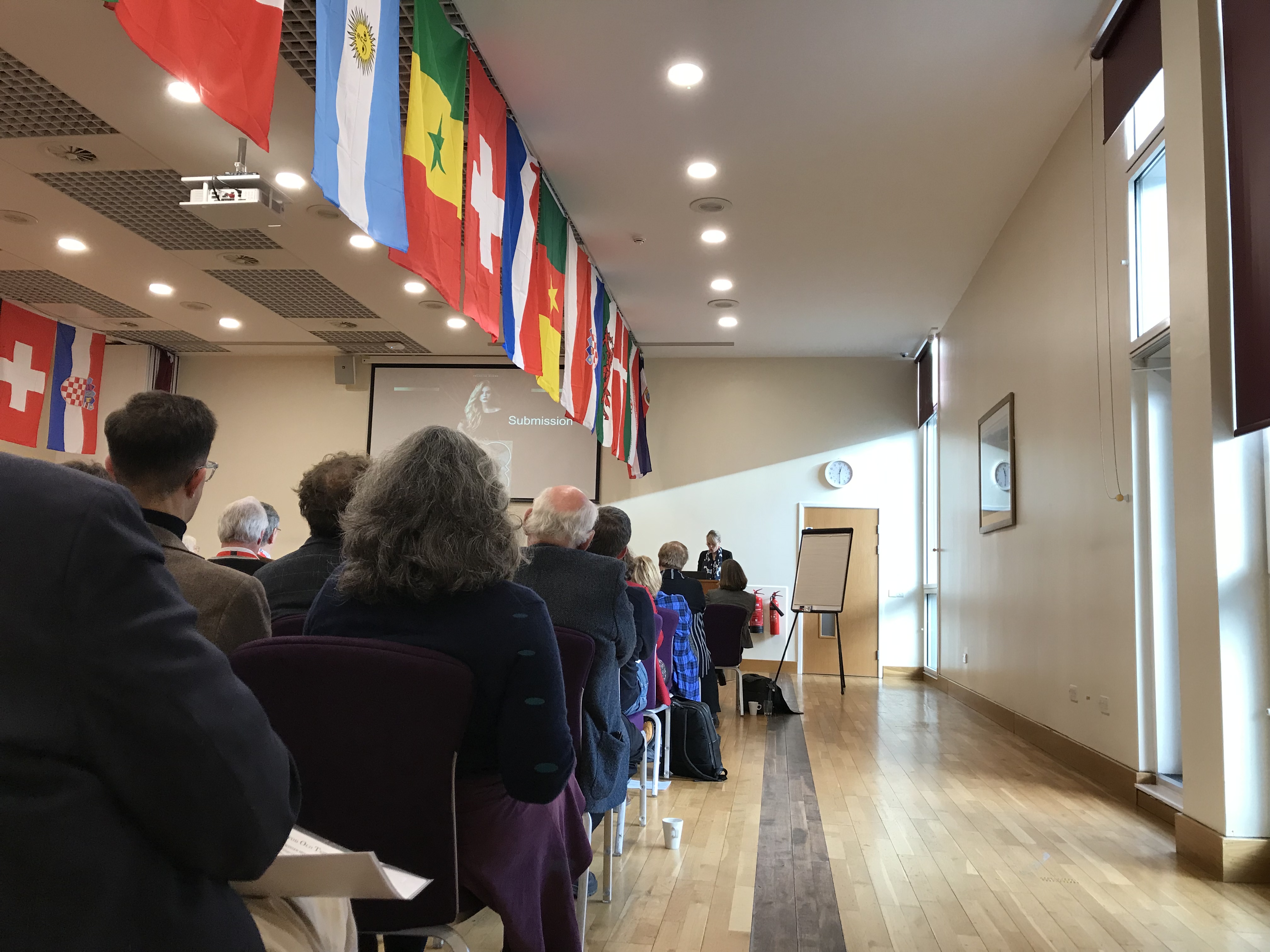
I was invited to attend the Society for Old Testament Study conference. It sounded interesting, and not something I have experienced before, so I was keen to attend. I sent off my application form and fee, booked a train to Sheffield and put the date in my diary. That was the easy part. (I also explained to my family that ‘SOTS’ did not mean what they thought it meant! They had images of drunken old men sharing sticky bottles of whiskey.)

British Rail announced strikes, and my train to Sheffield was cancelled. I decided that the conference was still worth attending, so booked a train for the day before, and a room in a Premier Inn. Worried that the cost/hassle was now increasing. A few other people from college were going, some by coach on the day of the conference, and one via the same train and Premier Inn as me. We would all travel home together after the conference. This is important. I have very annoying issues with anxiety, but usually if I force myself to do things, especially with other people to distract me, then it’s fine and no one notices. I strive to be normal.

However, the train drivers then announced a strike for the 5th, which is when we were travelling home. I agreed with my friends that we would catch a coach from Sheffield to Victoria. Which sounded easy until I thought about it. The coach picked up from a motorway junction. This might be tricky to reach with all our bags. The coach only went as far as Victoria, and there were no trains to bring me nearer home. It also looked like I would be travelling alone the day before the conference, and staying in the Premier Inn on my own, as the others opted for different travel plans. It was the final straw, and I was about to cancel. Husband then kindly said he would drive me, book an Airbnb where he could work, and drive me home afterwards. Phew! I was saved. (This is why I love the man. That and his wickedly funny sense of humour.)

The first day of the conference arrived and I desperately hoped it would be cancelled. It wasn’t. It was held at Sheffield University, which I found very confusing when arriving on a dark January afternoon. Managed to find the registration place, and checked into the ‘hotel’ (which was basically a student room. But a much nicer one than when I was a student.) I told my son, who knows the university, that the seminars were being held in ‘The Edge.’ He told me this is the student bar, and I should watch out for the jello-shots. (Not sure the family fully believed my explanation of SOTS.)

The itinerary was full, with lectures interspersed with drinks or meals. I soon got into the swing of it, my brain switched into conference mode: chatting to strangers over drinks, checking the timetable, listening to people present papers, learning almost as much from the questions that followed.
Most of the papers were very interesting, despite being read. I have realised that this is a thing in academic circles. Someone writes a paper (Eg. ‘The false prophets were overly optimistic, which is a human trait.’) They are then given 45 minutes to read it, followed by 15 minutes of questions.

Often the questions were not really questions at all. Sometimes they seemed a veiled criticism, suggesting someone else had already written about the subject extensively. Sometimes they were adding information from their own studies in the past. Sometimes they were an opportunity to cite their own paper/book. And occasionally they actually were questions, usually asking for clarity or how the paper tackled a certain problem raised elsewhere. It felt combative, and whilst enjoying the intellectual to-and-fro, I was glad that I wasn’t presenting anything.

There were about 80 scholars attending each session.

I was aware that everyone was more learned than me (most seemed to be lecturers at universities). Most were probably more intelligent. I listened, and learned.

I also drank a lot of coffee.

There is not room here to talk about the papers that were presented. Some of them were brilliant, so I will write a few brief blogs to tell you about the ideas being discussed. I arrived home feeling drunk — nothing to do with alcohol, more complete saturation-point of my brain. I am so glad that I went.

Thanks for reading. I hope your brain has a work-out this week too.
Take care.
Love, Anne x

Anne E. Thompson
Thank you for reading
anneethompson.com
Why not sign up to follow my blog?
Look on your device for this icon (it’s probably right at the bottom of the screen if you scroll down). Follow the link to follow my blog!

Philosophers.


Who Influenced the New Testament World?

It has been fascinating during my studies, to hear about different influences that have changed the way people see themselves and their world. Today, we accept things like a ‘sub-conscious’ or an ‘inner spirit’ without really thinking about where those ideas came from. They are part of our cultural thinking, and we refer to them effortlessly during conversations. Yet, they have not always been known concepts. They were introduced at a particular time by a particular philosopher.

The same has been true for centuries, and one aspect of studying the New Testament, is knowing which philosophers influenced the thinking at the time. This isn’t disputing any inspiration from God, but it’s recognising that the books were physically written by humans, and those people lived in a culture, and there were certain philosophies that we see reflected in what they wrote. They couldn’t have written about ‘outer space’ or ‘gravity,’ and especially not ‘cyber’ or ‘virtual’ because those things were not yet thought about. Here is a brief summary of the philosophies that were well-known the New Testament world. You can decide whether some of the thinking is incorporated into what was written. (I am only including the snippets of their teachings that I found interesting—you can do your own research if you want to know more!)

Socrates (470 -399 BC)

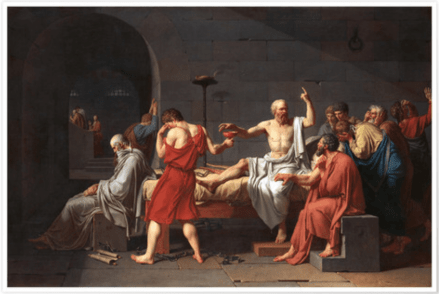
Socrates said: “The only wisdom is in knowing you know nothing.” He was killed by being forced to drink a cup of hemlock. He didn’t write anything, so we mainly know of his teaching via his pupils.

Plato (428 – 348 BC) Plato was heavily influenced by Socrates. He wrote a story, with Socrates teaching about cave dwellers:

‘A group of people lived deep in a dark cave. They sat behind a fire, and a puppeteer moved puppets, casting their shadow on the cave wall, telling the story of the world. This is how the cave people understood the world. But one day, a man left the group, and walked past the fire and out into the sunshine. At first he was blinded by the light, but gradually his eyes adjusted, and he saw that the plants and animals in the real world were better in every way to the shadow images he had seen previously. He went back into the cave and tried to tell his friends, but they refused to listen because his eyes could no longer see in the dark cave, and they decided he was blind.’ Plato wanted to teach people to ‘see’ the real world.

Plato said that the material world is transitory, and humans are capable of reaching an ideal state, which is eternal. He thought the intellect was the most important part of a person, and he differentiated between the intellect/spirit and the material/physical. Two separate parts of humans.

He also had an interesting idea for how society should operate: Plato divided people into those who were ‘rational’ (had wisdom) and said they should govern. The ‘spirited’ people were brave, so they should be soldiers and teachers. ‘Sensuous’ people should be providers, part of commerce, because they were temperate (knew moderation). This, he said, would bring social order and justice. [Looking for politicians who are wise might be difficult today, when being fast-talkers and good presenters seems more likely to get them elected than being wise. I guess Plato lived in a different time.]

Aristotle (384 – 323) Aristotle was Plato’s pupil. He thought that thinking (which he called ‘contemplation’) was superior to doing things. He thought the point of life was to contemplate God, and to serve him, and to pursue happiness. (I confess to be slightly confused by this, as he also said that contemplation is how humans can imitate gods, so not sure he was referring to God.) He taught that good action leads to good habits which leads to good disposition. All things should be tempered by moderation.

Sometime around Plato and Aristotle we had the Stoics. Stoicism taught that God was omnipresent, and everything was subject to his will. People should therefore not worry about what they cannot change (apatheia). Whatever happens, should be accepted. They said everyone should be treated well, because everyone shares the same spirit. Virtue is to know God’s will, and to follow it.

Plotinus (204 – 270 CE) He was a Neo-Platonic philosopher, and he tried to build on Plato’s work. He not only separated the body and soul, but also decided that ‘matter’ or the physical body was evil, and only ‘reason’ or spirit, are good. Therefore, the soul is more important than the body.

They all said lots more, obviously, but a lot of it was boring or confusing or both, so I have given you a brief overview. Interesting, huh?

I will tell you more about my studies in another blog. Thank you for reading.

Hope you have a philosophical day. Take care.
Love, Anne x

Something completely different: Have you read a copy of Out by Ten yet?

Reviews for Out by Ten:

“Out by Ten is a thrilling read from the very beginning. Set in the early days of a Covid world, every reader can instantly connect with the narrative landscape.
The story is full of intrigue which maintains the same pace through the entire book keeping you captivated. There are some delightfully unpredictable twists which add to the thrill. Some deep issues explored too making this an emotionally mature read.
I enjoyed discovering the double meaning of the book’s title Out by Ten ( read it to find out! )- very clever and a surprising revelation.”

5.0 out of 5 stars Couldn’t put it down!” Reviewed in the United Kingdom 🇬🇧

What an amazing book! Highly recommend”

Out by Ten is a thoughtful novel for those who enjoy reading. Available from Amazon. Treat yourself, buy a copy today.

(You can read it for free if you have a Kindle:https://www.amazon.co.uk/Out-Ten-Anne-Thompson/dp/0995463271/ref=sr_1_1?crid=2MZUUVJDF1723&keywords=out+by+ten+by+anne+e+thompson&qid=1672061302&sprefix=out+by+ten+by+anne+e+thompson%2Caps%2C67&sr=8-1)

***

Notes on Matthew’s Gospel


Notes on Matthew.

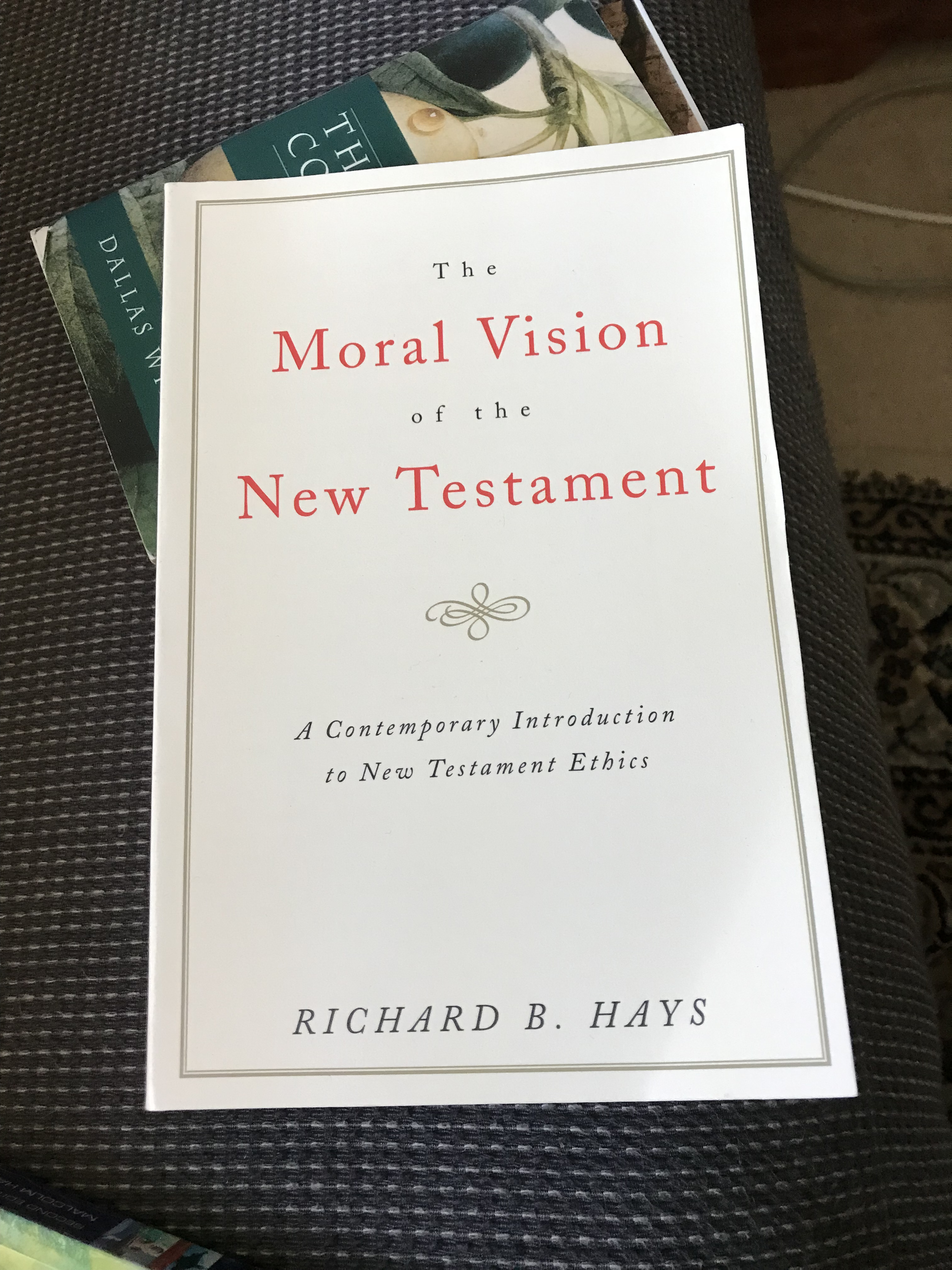
I am reading The Moral Vision of the New Testament by Richard B. Hays, and below is a summary of his chapter on Matthew. It’s a very interesting book (and if you decide to buy a copy, it’s cheapest as a Kindle book from Amazon, but if you want a physical copy, then Amazon seem to be the most expensive. I ordered a copy from Abe Books for half the price).

The Gospel of Matthew was written about 50 A.D. so after the Gospel of Mark, and the letters of Paul. The temple had been destroyed, and the Jewish Rabbis were striving to keep the Jewish people separate by concentrating on the laws of the Torah. In contrast, the early church was reaching out to Gentiles (non-Jews). All the early issues about Jewish law (like eating only clean animals) had probably already been sorted out during the time of Paul’s ministry, so Matthew doesn’t address them at all.

Matthew is writing an apologue (a moral story). He writes about an ordered world, where Jesus has all authority. The disciples are now forming a community, with an emphasis on teaching and obedience.

The book has a clear beginning (the genealogy of Jesus) and a clear ending (the commissioning of the disciples). It establishes Jesus’ authority as the Messiah. The birth story is interesting, as it has the same typology as Moses’ birth story (‘typology’ just means ‘classification’). Moses was a deliverer and a law giver, and Matthew parallels this with the story of Jesus. He uses phrases like: ‘When Jesus had said these words…’ which is the same as the phrase often used in Hebrew, in the story about Moses.

The book is written as narrative, describing the activities of Jesus, and this provides a framework for big chunks of teaching. Matthew shows that: Jesus taught with authority, wise people obey his teaching, Jesus fulfils the law and the Old Testament prophecies. Jesus did not supersede the law, but rather he showed what the core meaning was, and called people to obey the essence of the law rather than thoughtlessly follow the letter of the law.

Matthew is basically all about living righteously, and showing mercy. Both aspects matter. He writes that an ‘unrepentant brother’ should be treated like a ‘tax collector’ or a ‘Gentile.’ I always understood this to mean the person should be rejected, cast out of the church. But Hays points out that Matthew has already shown that Jesus sought out tax collectors, and the disciples were told to preach to the Gentiles. Therefore, the unrepentant brother should be treated the same, shown mercy, and be a focus for their teaching. Whilst he would no longer be part of the church, the church should continue to try and reach him.

Matthew’s teaching about Jesus’ returning is still strong, but it’s less immediate. I guess he had already waited for 50 odd years, so unlike Mark and Paul, he was no longer expecting it to happen tomorrow. His emphasis is that God is with us now (a point he makes right at the beginning, when Jesus’ birth is foretold). When the church meets, Jesus is present.

Hays comments that Matthew is rewriting many of the stories in Mark, but adding his own explanations. He uses the stories to show his theology. For example, in the story of Jesus walking on the water, Hays thinks that Matthew is using the narrative to make a point, showing that the church (represented by Peter in the story) is being battered by persecution (represented by waves and wind in the story) and they will survive only if they keep their focus on Jesus and have faith that he is with them. Matthew adds the declaration of the disciples: ‘You are the Son of God’ at the end of the story, because this is something that the church of his time understood. (In Mark’s Gospel, the story ends with a rather gloomy comment about the disciples being amazed and not understanding because they were in a muddle over an earlier miracle.) The story adds to Matthew’s overall message, that God is with us now, however things seem, which is good news for everyone.

Matthew writes about Jesus coming unexpectedly, and that people should be ready. They must prepare by good living (because God will reward or punish people accordingly). He also calls people to have mercy and be compassionate towards the needy, because this is the essence of ‘good living.’

***

Thanks for reading, I will continue this tomorrow.

Have a great day, and take care.
Love, Anne x

Anne E. Thompson
Thank you for reading.
anneethompson.com
Why not sign up to follow my blog?

Do You Want the Good News or the Bad News?


Good News or Bad News?

Is the message of the Bible good news or bad news? Often the physical book even describes itself as a ‘Good News’ Bible, and Christians often refer to the good news of the gospel message. But is it good?

Sometimes this feels a little ironic to me. When churches then go on to explain how to ‘become a Christian’ a person must meet certain criteria, I think it all starts to sound more like bad news! I was taught that to ‘be a Christian’ I must understand that Jesus and the Holy Spirit and God are all one, I must repent of my sin and ask for forgiveness, I must acknowledge that Jesus died for my sin, and ask to be filled with the Holy Spirit. This was all achieved by praying ‘the prayer’ which somehow encompassed all the above. Going forward, I should attend church, read my Bible every day, praying frequently—confessing my new sins and striving to live how God wanted me to live. Most difficult of all (in my view) I should constantly be looking for ways to tell other people how to be a Christian, encouraging them to undergo the same process. Anyone who did not meet the above criteria was trapped in their sin and doomed to hell and eternal torment. Very bad news indeed. Most of the people who I love do not fit into the rather narrow category above.

Yet, when I read the Bible (point seven above!) things seem a little different. Jesus said he came to show people who God is, and he accepted people before they had done any of the above. Sometimes he told a person they needed to change their life, or give away their money, or repent of something they were doing wrong—but this was always after they had come to him. There wasn’t a form to complete, or a waiting list; the disciples didn’t regulate who could approach (and when they tried to, Jesus told them off!) People simply came. People were simply accepted.

I also read that after they came, after they had been accepted, they generally changed, they often wanted to be different, better, people. But the changing, the wanting to be changed, was afterwards. It was not an entry criteria. And they tended to differ in what they actually believed, they had different views of theology (which is shown in the later books in the Bible, where we see them having arguments about things).

Several of the books in the Bible were written by Paul, and I’m still not sure what authority they should have (as I have discussed in previous blogs) but I do think his views are helpful today. One of his letters describes Jesus’s mission as reconciling people to God, and that a Christian’s mission is to continue this—to be an ambassador, helping people to be reconciled with God. I do not, personally, feel I should be telling people what they are doing wrong, or insisting that they believe certain things (like in the Trinity) or changing their behaviour. But I would like to tell them that God wants to accept them (right now, just as they are, warts and all!) I would like to remind them that God wants them to be reconciled with him, and that everything that’s wrong in their lives does not count any more. All the rest of it—how they personally live out that truth—is between them and God.

Perhaps this is good news. Perhaps this is what our message should be. What do you think? Good news or bad news?

Thank you for reading. My next blog will be more about our holiday in Italy at the beginning of August. Enjoy your day.
Take care.
Love, Anne x

Anne E. Thompson
Thank you for reading anneethompson.com Why not sign up to follow my blog?
Look on your device for this icon (it’s probably right at the bottom of the screen if you scroll down). Follow the link to follow my blog!

anneethompson.com
*****

Which One Is You?


Part of my course has involved looking at the different ways people view the Bible. I found it quite challenging, as looking at various definitions makes me notice things about my religion in a whole new way. The way that people use the Bible says a lot about their beliefs. I’m going to give you three brief definitions—though there are lots of variations in-between. Which one do you think best suits you?

  1. “The Bible is the infallible Word of God”

This is often said, but it can mean several different things so you need to decide: Firstly, what is ‘the Bible’? In Scripture itself, there was no word for ‘Bible’ or ‘Scripture,’ they only referred to ‘writings’ which is slightly vague. It can either mean the selection of books that you have, gathered together into a single book, called the ‘Holy Bible.’ Or it can refer to the original texts, written in ancient Hebrew and Koine Greek on individual parchments, long-since lost. We now only have copies of copies of copies, and the Hebrew has been ‘translated’ into biblical Hebrew (it was probably a much earlier form of the language—like Chaucer’s English compared to today’s).

The books we now call ‘Scripture’ themselves refer to other books, which are not included in our Bible—so are they also infallible, or only the bits that are actually quoted? (Eg. Jude 1:6.) And do you mean the whole selection of books we currently have, which means their position within the Bible are important, or the individual books? Does infallibility extend to the actual book (which is probably English) that you read today? Even though versions and translations are different?

Next to decide is what you mean by ‘infallible.’ Do you mean that the authors were like automatons, so none of their own views were included? Though their bad grammar was, and so were some mistakes when they quoted other parts of the Bible. (Check out Matt 27:9-10, when he says he’s quoting Jeremiah, but actually he quotes Zechariah 11:12-13. An easy mistake, we’ve all done it, and it doesn’t affect his point at all. But would you say a mistake was ‘infallible’?) Plus, some of the ‘facts’ are a bit questionable—like the sun going round the world, and the order of some events in the gospels are different. And if you believe the Bible is infallible, does that mean it all has equal status, so you give as much emphasis to some of the Old Testament laws as you do to the teachings of Christ?

Now, an interesting question if you hold this view—do you go to great lengths to justify it? Are you comfortable saying, ‘That bit doesn’t seem to make sense.’? Or do you produce reasons to explain why it does make sense, even if it isn’t obvious at first look? Is the emphasis of your worship teaching, or reading the Bible?

In my experience, the sermon (which is the speaker’s interpretation) is usually longer than the reading of Scripture. Which might imply we don’t think God can speak to individuals through the Bible—which is not what we state. If someone disagrees, do you spend time explaining your view, and are you unhappy unless everyone believes much the same thing?

The explaining/justifying is even reflected in some Bible translations: Isaiah 7:14 uses a Hebrew word, עלמה , which in that context probably means ‘young woman’ but the NIV translates it as ‘virgin.’ It’s quoted in Matt 1:23, and the Greek uses the word ‘virgin.’ However, I don’t think Matthew is using the quote to describe Mary, he is using it to describe the son, Jesus, the Messiah. Therefore, by changing the Isaiah meaning, the NIV has added its own view to Scripture (rather than allowing Scripture to speak as it will).

2.God Speaks Through the Bible (But the Bible is not equal with God)

This view means you believe God uses the Bible to guide people, to reveal himself and to provide a standard of right-and-wrong. But the writings are not ‘infallible.’ It is a theological book, the words have meaning and it’s the meaning that’s important, not the actual words. So for example, the parable of the ‘Prodigal Son’ explains something about God’s love. But the words are not necessarily a direct quotation of what Jesus said, and the situation surrounding the parable may have been changed, to help the reader understand the point. The writers were inspired by God, they were listening to his Spirit as they wrote, but they were still human, they may have made mistakes about timing or science—things that don’t affect the theology.

People who believe this are usually comfortable admitting that some bits of the Bible are difficult to understand, or don’t seem to make sense, or were part of the culture of the ancient world and therefore the theology still applies but not the literal words. However, you need to decide which bits should be taken literally, and which parts are less important. If God allowed mistakes in the Bible, how do you know which are the right texts, and which should be ignored? If God speaks to individuals through the Bible, then how do you stop people finding support for their own views, and misunderstanding passages? Is it okay if everyone in a church believes something different and there is no uniformity?

Churches who hold this view usually ensure that both Old and New Testaments are read at each service, and the emphasis is on the Bible, not the teaching/interpretation, so the sermons are less important.

3. Logic and Reason are Most Important, the Bible Contains Some Useful Teaching

If this is your view, then you acknowledge that there is some good teaching in the Bible, and that God can use it to speak to people, but unless the narration is logical, you doubt if it’s true. You like everything to be ‘proved.’ This means the miracles in the Bible were either misunderstood ‘tricks’ or made-up by the authors to explain a theological point. You believe the Bible is pure theology, and not at all historically reliable. Reading it can point to good behaviours and an understanding of God, but it shouldn’t be taken literally, and the events described might, or might not, be true.

People who believe this tend to focus on discussion, listening to a range of views and beliefs. They are open to being persuaded, and give more emphasis to what other people say and write than to the Bible itself.

As I said, there are a whole range of views between these, but they give a basic framework. Which one is you? The thing I find interesting, having spoken to various people, is that whatever view they hold, they all say that God speaks to them through the Bible. I believe them, which is rather marvellous don’t you think?

Thanks for reading.

My next blog is about our trip to Iceland. I kept hearing that it is a beautiful place, but I wasn’t so sure. Is lava beautiful? We booked a trip and went to see. I will tell you about it next week.

Take care.

Love, Anne x

Anne E. Thompson
Thank you for reading anneethompson.com Why not sign up to follow my blog?

anneethompson.com
*****