How Do We Read the Bible?


Learning How to Read the Bible

Reading the Bible

As my college lectures continue, I am beginning to meet some new ideas. One of my subjects this semester is ‘Reading the Bible’ which happily is more complex than it sounds. It’s an issue I’ve been struggling with ever since I learnt that we don’t actually have an original copy of the Bible even though we do have other writings that predate some of the Biblical books. So why did God not preserve an original manuscript of the books in the Bible? Could it be that perhaps we are giving it too much emphasis? Or the wrong sort of emphasis? Are we meant to be completely sure that we have all the answers?

Part of my lecture preparation this week is to read an article by N.T. Wright. Not sure if you’ve come across him? He writes lots of Christian stuff. I tend to think that he writes about interesting issues, but I find his books very difficult to read. Some writers produce work that flows easily into my head, and others are more of an effort. I’m not sure why, maybe it has something to do with speech patterns. If you want to read the whole article by Mr. Wright, the link is here:

Mr Wright begins by questioning what people mean when they talk about ‘the authority of the Bible.’ This intrigues me too—what exactly do they mean? People often tell me: “The Bible is God’s word,” but I’m never quite sure whether they mean the original books (which we don’t have any more) or their own translation, or the essence of the books but not absolutely every word/sentence/paragraph. It does seem that sometimes people treat the Bible as if it is God. I was interested to read that Mr Wright also struggles with this (well, to be fair, he didn’t say that he struggled, so he might be completely sorted on this point). He notes that the Bible itself only gives authority to God. He says that the Bible is one way that God reveals himself.

He then describes (not especially kindly) people who look at the Bible for ‘a daily blessing’ or ‘the answer to a question’ or ‘divine inspiration.’ He thinks this is a misuse of the Bible. Whilst I sort of agree with him (in the same way as I think people often use prayer as if God was a genie in a lamp, waiting to grant their requests) I didn’t much like his tone. In the Bible, people came to God for all sorts of wrong reasons, like they were scared of dying, or they had just watched a miracle and thought following Jesus would be the ancient equivalent of knowing the lottery numbers each week. Mostly, people came for selfish reasons, but God took them anyway, Jesus let them follow, and they learnt the truth along the way. People probably rarely come to God—or read the Bible—for the right reason. Not initially, anyway. However, the next thing Mr Wright wrote was, I thought, rather clever.

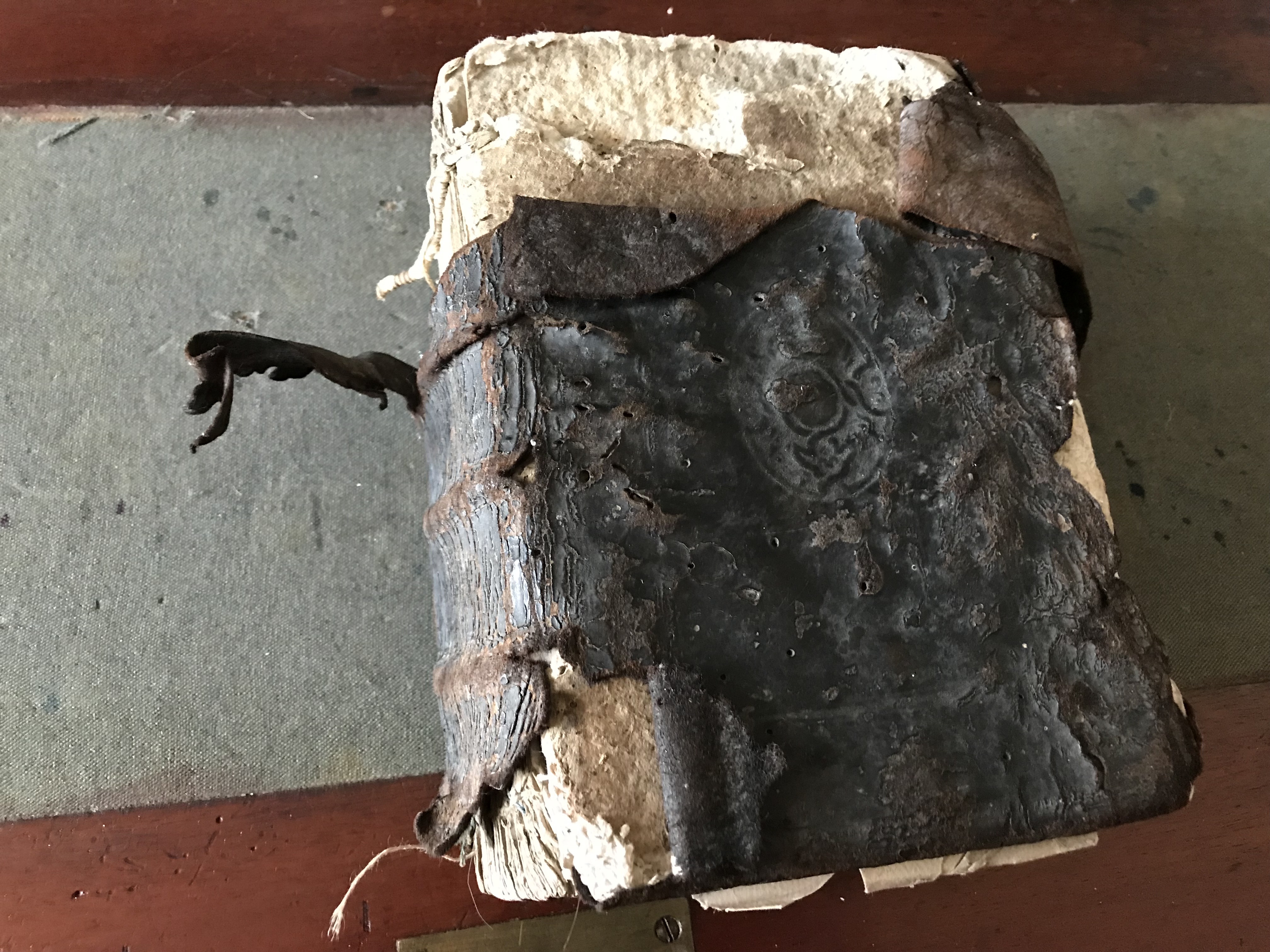
An ancient book

He described a pretend situation where a new play by Shakespeare had been discovered, but the last act was missing. Rather than produce the play while incomplete, or ask a modern playwright to write the ending, a group of Shakespearean actors decided to produce the play themselves. They thoroughly learnt the first few acts, so they were familiar with the characters, they knew how they would respond, they knew the situation they were in, and then—following the essence of the original—they finished the play. They didn’t simply regurgitate an earlier scene, nor did they ignore the essence of what was already written; they kept to the ‘authority’ of the first part whilst creating something that finished the drama completely in-keeping with what had gone before. This, says Mr. Wright, is how we should view the Bible. We are ‘making up’ the final act of the play, but it needs to be consistent with what has gone before.

It’s an interesting viewpoint, and I think I probably agree with it. We do need to be immersed in the Bible, so we know the message that it presents, but rather than it being a static, historical work, we can make it something alive, something relevant for today. Which means that the selecting of certain passages to ‘make rules’ is a dangerous game, not really what our purpose is meant to be. They might not apply in ‘the final act.’

I will mull on the idea, and try to think about the wider issues—but so far it looks like a useful analogy. What do you think? Of course, you do need to actually read the Bible. Do you?

Thanks for reading. I’ll give you more updates on what I discover at college as I go. It’s mainly been very interesting so far (one bit isn’t, but I’d better not talk too much about that!) Have a good day. Take care.
Love, Anne x

Anne E. Thompson
Thank you for reading anneethompson.com Why not sign up to follow my blog?
All ten ducklings healthy and happy.

The Gilgamesh Epic


Here is the quick summary of the Gilgamesh epic that I promised you last week. As you read it, think about how it compares to the garden of Eden story told in Genesis. To remind you: Genesis was written during the Iron Age, though was told (orally) much earlier. If you choose to believe it was first told/written by Moses, then the date of the Exodus was about 1446 (according to my own calculations).

(The link to my long ramble about when Moses should be dated is here: https://anneethompson.com/2020/09/07/was-moses-real/

https://anneethompson.com/2020/09/07/was-moses-real/)

The Story of Gilgamesh is actually an epic poem, written in Akkadian, about 2000 BCE (so before Moses). It was written in cuneiform script, which simply means it was written in wedge-shaped marks on clay tablets. A chap called George Smith was working at the British Museum in 1872, deciphering things that were stolen/bought/being kept safe (depending on your viewpoint) and he managed to translate a fragment of tablet found in the site that was once Nineveh. (You might recognise Nineveh? Story of Jonah and the whale.) Anyhow, this fragment seemed to have the story of the Genesis flood, and everyone got very excited and sent George back to try and dig up more. I think that this is when Gilgamesh was discovered.

The Story of Gilgamesh

Gilgamesh is the name of a king. He was pretty nasty, so the god Anu decided to create a counterpart, called Enkidu. He is created from clay (similar to Adam in Genesis story) and is made in the image of a god. Enkidu sets off to meet Gilgamesh, but is waylaid by the temptress Shamhat, and they spend a week making love. He is somehow transformed by this, and realises he needs to wear clothes. This frightens the animals (who previously had been his friends) and they run away. He goes off to meet Gilgamesh, they fight and then become friends.

They travel to a forest, which is guarded by Huwawa. They chop down trees, there is a fight, Huwawa is decapitated. The gods are angry and send a bull to punish them, but they kill that too. The gods are more angry, and decide one of the pair should die, so Enkidu is made ill, and then dies, going to ‘the house of dust.’. (There is stuff here about how the gods let him be like a god, but in the end withheld immortality from him, which also mirrors one of the themes in the Genesis story.)

Gilgamesh mourns his friend, and sets off to try and achieve immortality. The poem then has side stories of scorpion people, and lands of darkness, a beautiful garden and a ferryman. He is looking for Utnapishtim, who survived the great flood, as he holds the secret to immortality. As an aside (this story has a lot of asides) Utnapishtim survived a great flood by building a boat, and taking two of every animal inside. They floated until the boat came to rest on a mountain top.

Gilgamesh manages to find Utnapshtim, and asks how he can gain eternal life. At first, Gilgamesh is told not to sleep. He then sleeps for 7 days (not a great start!) He’s then told that he needs to acquire the plant of life (which mirrors the tree of life). He manages to get the plant, but then leaves it by a pool while he swims (as you do) and it is stolen by a snake. The poem then becomes very confusing, but I think that eventually Gilgamesh becomes both wise and immortal. Though in some versions he simply becomes content to be mortal. My Akkadian is non-existent so I can’t confirm either.

(There’s an entertaining video on Youtube if you fancy watching another quick summary of the story:  https://www.youtube.com/watch?v=BV9t3Cp18Rc )

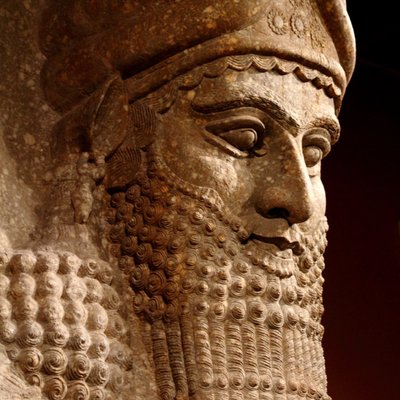
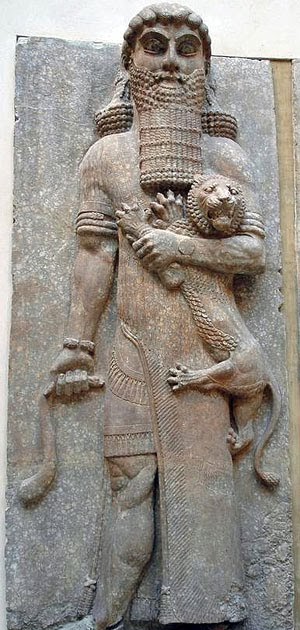
Mesopotamian art has lots of images of Gilgamesh.

So, what are your thoughts? Remember, this epic was written before the Old Testament was written. Though if the events in the Bible are factual, they would of course have happened before Gilgamesh, so you could argue that the Bible events influenced the writer of the epic, which then potentially influenced the writers of the Old Testament. I guess there’s no way of knowing, but it’s worth thinking about, because whatever you believe, you should be able to defend the logic of it.

Next week I’ll tell you about the arguments of James Barr and Joseph Fitzpatrick, who are very convincing. They also don’t think the garden story was about ‘original sin’. Thanks for reading. Take care, and try to avoid talking snakes.
Love, Anne x

Anne E. Thompson
Thank you for reading anneethompson.com Why not sign up to follow my blog?
Look on your device for this icon (it’s probably right at the bottom of the screen if you scroll down). Follow the link to follow my blog!

anneethompson.com

******

Words in Despair


What did Jesus say on the cross?

I learnt something interesting recently. I think I am slightly behind the curve, and maybe you knew this already—when Jesus was dying on the cross, he was probably reciting Psalm 22.

I knew that the psalm links to the crucifixion, as it seems to describe exactly how Jesus would be feeling, and some of the actions listed (like gambling to see who would win his clothes) actually happened at the time. I have always thought it was a poem, written about 600 years earlier, to describe how Jesus felt (because God can write things before they happen). But it had never occurred to me that Jesus, in his darkest time, would have recited it.

I learnt about it in a Greek lesson, because the words of Jesus on the cross were recorded by the gospel writers. But here’s the thing: the gospels were written in Greek, and each writer added their own slant. So in the synoptics (Matthew, Mark, Luke) they want to show how Jesus suffered on the cross and so they recite (but in Greek):

“My God, my God, why have you abandoned me?” (See Matthew 27 vs 46)

However, when John wrote his book, he wanted to show how everything about Jesus’ life was planned by God, and the crucifixion was part of that plan, and so he quotes the end of Jesus’ words:

“It is finished.” (See John 19 vs 30)

As I said, John was writing in Greek, and in Greek they are able to write in tense that shows something has happened in the past—but the consequences have not finished, it is on-going. In English we can do this with certain words, so if we say: “I became a vegetarian a year ago” it can be assumed we are still a vegetarian now (but not necessarily, because English doesn’t have the same clever tenses that Greek does).

John used this tense when he wrote the final words of Jesus. It was finished, in the past, but the consequences will continue.

Of course, Jesus wouldn’t have recited the Psalm in Greek, he spoke Hebrew/Aramaic. I don’t know enough Hebrew yet to tell you whether they have the same clever tenses that Koine Greek does, so I only know that he probably recited Psalm 22 when he was on the cross.

Does this knowledge make a difference?

Well, the stuff about the gospel writers using Greek to give an angle on what was said is interesting, but probably doesn’t affect me overly. But the idea that Jesus quoted scripture at his most difficult time makes me think that perhaps this is something I should aspire to do. If Jesus came to give us an example of how to live, maybe when life is hard for me, I should also recite scripture—perhaps it would comfort me and help me to focus on better things than the horrible situation I am coping with. I will probably never suffer anything on the same scale as being crucified, but everyone has dark times, don’t they? We all feel overwhelmed sometimes.

Of course, I can only recite scripture if I have previously learnt it. Which is not something that’s very fashionable these days. Perhaps it should be. I think I will try.

Psalm 22 is very long, so I won’t start with that one. I think it might be a good one to learn next year—perhaps as a discipline for Lent. Do you want to join me? We could learn a few lines every day, and by Easter we will know the whole Psalm. I will divide the Psalm into segments and post them on my blog (I can predate things now, so next year they will arrive in emails to my followers). It will be good for our brains if nothing else!

For now, I will try to learn Psalm 1 (because it’s short). It would be good for me to learn it in Hebrew, as that’s my current challenge—I will let you know how I get on.

Thanks for reading. I hope you find some interesting challenges this week.

Love, Anne x

Anne E. Thompson
Thank you for reading anneethompson.com Why not sign up to follow my blog?
Look on your device for this icon (it’s probably right at the bottom of the screen if you scroll down). Follow the link to follow my blog!

Psalm 23


I was recently asked to preach on this Psalm. It’s one of my favourites, and I thought I would share my notes with you. I hope you find them interesting. Usually when reading the Bible, it would be a mistake to focus too much on individual words unless you’re reading it in the original Hebrew. However, this Psalm is so well known, and the truths are repeated in the rest of scripture, so I think we are safe to dissect the passage and still understand what the author was trying to say:

Psalm 23: 1-6

God’s Shepherding

This Psalm was written by David, who had been a shepherd. The themes would be very relevant for him, because our relationships with God are a personal thing (isn’t that amazing!) One thing I love about this Psalm, is that the author started to write in in the third person, referring to God as ‘The LORD’ and ‘He’. About half way through, this changes, and he starts to talk to God, using ‘You.’ This happens to us, doesn’t it? We start to read the Bible, or think about God, or what he might want, and gradually, hardly noticing, we start to actually talk to him directly.

Verse 1

When I was little I was very confused by this Psalm, as it begins: ‘The LORD is my shepherd, I shall not want.‘ I understood that God was the shepherd, but not why I wouldn’t want him! Later of course I realised it meant ‘I shall not want for anything else.’

The LORD is my shepherd: LORD denotes Yaweh, “I am” the eternal God (written in capitals). We can never know God  so he kindly gives us analogies we can relate to.

No uncertainty—the LORD is my shepherd (not ‘I hope so’)

Personal, God cares about individuals—the LORD is my shepherd.

Cows know owner (I learnt a lot about cows before writing my farm books). They know owner because listen to his voice. We are like sheep to their shepherd.

Present tense—whatever has gone before doesn’t change what is now. We all have things we regret, but God is interested in the ‘now’ of our lives. WE tend to worry about our past, and be anxious about our future. But the Bible tells us that God will cancel out our past because of Jesus’ sacrifice, and none of us can know what the future holds. It is the ‘now’ that matters. Are you being kind today, being humble, being fair?

Because the LORD is my shepherd, I therefore will not need anything else. I don’t think this can mean physical things, because some Christians are starving, or living in war zones. I think it means that if we have the spiritual side of our lives sorted out, then we can trust that everything else is part of God’s will—if we suffer, or go through pain, then it won’t be for nothing, it will be part of the bigger picture, part of God’s eternal plan. God is enough. Sometimes we need to remember that, to focus on God more, to try and see today in the light of eternity.

My animals expect me to feed them. Do we expect to receive from God? Do we come to church expecting to hear God’s voice?

Verse 2

Spurgeon said the ‘green pastures’ represent Scripture. They are where we rest, they show God’s abundant love for his people—always fresh, abundant, never exhausted. We can read the Bible over and over, and so many times we find something new, it speaks to us in a new way, we understand a little more of God.

He maketh me lie down—God doesn’t want us to be always struggling, striving away at life. He wants us to come to him, give up our worries, rest in his promises. It will be alright, because God is our shepherd.

Still waters are like the Holy Spirit, who sometimes works quietly: a dove, not an eagle. Sometimes/often we don’t notice what God is doing, we don’t see his Spirit working in us or in others. But those waters are there, still waters run deep, afterwards we sometimes look back, and realise that God was at work, things did work out right.

God leads us. We aren’t driven along, we are given someone to follow. (Chickens cannot be ‘driven’ but they will follow if I have food!) Jesus leads us by his example, we can see how to live by looking at how he lived. We see God in other people, and that is an example for us to follow too. It’s much easier to copy than to decide for ourselves (like the chickens wandering all over the garden) so we need to choose carefully who we will copy. WE have to allow ourselves to be led.

Sometimes we want to know the whole route, all at once. But usually God leads us step by step. I need to be asking each day, ‘What does God want of me today?’ Sometimes Christians get in a muddle about this, they agonise over ‘being led’. A little like the joke of the man who needed saving and prayed to God, then ignored the police/firemen/lifeboat that came to rescue him! We ask God to lead us, but he has given us a brain, surrounded us with wise people—following God does not have to be via a thunderbolt!

Verse 3

God ‘restores’ our soul because it needs restoring! We get it wrong, we do/think/believe the wrong thing, over and over. God restores us, again and again. ‘Restores’ is an active verb, God keeps on restoring us.

He restores my soul. Not me, not yoga, not a holiday! God does it, because he is our shepherd—he wants to take care of us. We need to remember to pray, to ask him to restore us, to let him guide us, to accept his forgiveness.

He leads me in paths of righteousness (or ‘right paths’). We should be obedient, follow what we know is right. WE don’t pick and choose which commandments we will follow, we obey all of them. We belong to God, we need to behave accordingly. We MUST be kind, be humble, be just.

Verse 4

We don’t run, or slip or struggle our way through the valley of death, we walk. It is a calm thing. We don’t walk alone, God is with me. We don’t wander aimlessly though the valley of death, we walk through it, death is simply on the way to where we are going.

Corrie Ten Boom told a lovely story about when she was young, and was frightened of dying. Her father reminded her, that when they caught the train, he would give the young Corrie her ticket right at the end of the journey, just before she needed it—the rest of the journey he kept it safe for her. He said that God is the same with death, he doesn’t make us ready until we need to be ready. . . If we’re scared, we’re probably not going to die today! God gives us what we need when we need it. This Psalm reminds us that when the time comes, God will be there.

When I had brain surgery, my walk to the operating room was terrifying, but I felt ‘wrapped in warm cotton-wool’—God was with me in a whole new way, because that’s what I needed at that time.

It is only the shadow of death we walk through, God removed the actual permanent death when Jesus rose. The valley is often a peaceful place—when my Dad died, it was a peaceful, Godly thing, a becoming more soul and less physical.

I will fear no evil, not because evil doesn’t exist, but because God is stronger, and he is there, protecting me. Most of our fears are in our head: the interview, the being alone, the being ill, the missing the bus—these things are rarely as bad in real life as we fear they will be! When we walk with God, we don’t need to fear evil, he has it sorted, we can trust him. God is with me. All the time.

The rod and staff which are used to keep the flock in order: for discipline, they are the things that comfort when things are tough. Knowing that God is in charge, is mightier than anything we will ever face, is to have true comfort when we need it.

Verse 5

‘You prepare a table for me’: one translation has ‘furnish and decorate’ a table—God doesn’t skimp when he does something for us. He treats us as special. We prepare a special table for Christmas, or a party—it shows that something is special. The Psalmist is saying that God treats us as something precious, something worth celebrating.

‘You prepare a table’ implies something normal, not rushed—a meal is eaten slowly, in a calm way. God is preparing something we can enjoy, we don’t need to feel tense about it.

In the presence of my enemies’ for David, his enemies were very real—they wanted to kill him! This verse was literal for him. I don’t really have physical enemies, but I do have fears, anxieties, temptations, and they are very real to me. I think this verse shows that even though those things exist, God still treats me as something precious, and the way God treats me is what I should be focussing on, not the negative things.

‘You anoint my head with oil’ signifies that we are made special. A king was anointed with oil, a priest was anointed with oil, it signified something special, a change. We need to allow God to anoint us, to change us, to make us something special.

‘My cup overflows’ shows that God gives us more than we can even hold! God gives generously. Look at how many acorns an oak produces, how many eggs a chicken lays, how many pips are in an apple: way more than are needed! God gives to us extravagantly.

Verse 6

“Surely goodness” when I was a child I thought ‘surely goodness’ was a special type of goodness! But it means that ‘because of all this, then for sure goodness and mercy will follow me. Certainly these things will be in my life.

We can almost imagine them as two angels, watching our back, all the time. All the days of my life—so, the bad days as well as the good days, those two angels will be there.

and I shall dwell in the house of the LORD forever. We live there, not a visit, but living as children who have every right to be there. Forever.


I hope you feel encouraged today, whatever your day might hold.

Thanks for reading. Take care.

Love, Anne x

Thank you for reading
anneethompson.com
Why not sign up to follow my blog?


How We Use the Bible…


Hello, thanks for popping back to read this post, which continues from yesterday’s post about how the Bible was compiled. As we saw, the Bible was assembled gradually, and it was relatively recently that the Bible we have today came into existence (even though the books were written thousands of years previously).

Firstly, I find it interesting that our holy book was assembled using logical criteria. This is the way that God chose for people to learn about him, and it was put together logically. I think that sometimes today, churches rely too much on ‘supernatural’ inspiration —we want God to show us things miraculously. Yet the Bible was put together by a group of people making sensible decisions. When we read the Bible, we find this is consistent with how God often led his people, in both the Old and New Testaments. People tended to win wars/save nations, mainly by logical strategy, and less by miracles. We want God to “zap the answer to us” and yet, it seems, God has given us brains and he expects us to use them. Should we move house/rebuild the church/go and preach in darkest Peru? Perhaps, after prayer, we should think about all the pros and cons, and then make a sensible decision. You might see writing in the sky telling you the way, but that would be rare.

When we are disputing something, we need to be careful about saying: “It’s clearly written in the Bible that…” In my experience, people only say this when someone else has obviously NOT seen something as “clearly written” and has formed a different belief. If it was CLEARLY written, then there would be no differing of views amongst people who claim to believe the Bible. We should remember that the Bible was written originally in Hebrew and Greek, we are probably reading a translation, we will certainly be reading it in a different age and culture. Meanings can get lost, we can misunderstand things. A little humility when discussing the Bible would be good.

The Bible does not claim to be infallible. Some religions, such as Islam, believe that their holy book was dictated by God, so it cannot reliably be translated into other languages (because you always change the meaning slightly when translating things). However, the Bible was not dictated word-for-word by God. There are seeming anomalies between some of the books. This in my mind makes the Bible more authentic, because if people were going to sit down and write a ‘holy book’ they would make sure it had no mistakes! The Bible, however, was written by people who had witnessed God working, and they wrote their accounts, and they remembered some details differently—which doesn’t make the account untrue, it simply shows they were real people, writing what they honestly remembered.

What about the books which were rejected? Is only the Protestant Bible correct? This is tricky. I recently listened to a sermon about the book of Jude (which is included in the Bible). Jude refers to ancient Hebrew books, which we have since lost, but which Jude himself obviously regarded as ‘scripture’. Jude was a brother of Jesus—you would think he might know what was ‘holy’ and what wasn’t. Personally, I have no idea.

And that’s the thing really, the point of why I am writing this. We want everything to be sorted, we want God to be nicely tied up, to be sure we see the whole picture, know everything there is to know. But we don’t. God has not chosen to tell us everything. The Bible is, I believe, inspired by God—but we should be careful how we use it. Those early Christians were, absolutely, followers of God—they died for their beliefs. But they had a slightly different Bible to us. They relied on God, not texts, and God used their belief to explain the texts they had, so they could come to him.

Can we believe the Bible? It is the book which I believe God has given to people, to help us to know him. It is not an absolute, definitive, set of rules; we should be careful when we are applying it to others —people have used the Bible in the past to justify slavery and wars and all sorts of injustices. Be careful when you quote bits of it. Almost anything can be justified using selective editing of key verses:
Do I believe in reincarnation? No! (Can I find Bible verses which seem to support reincarnation? Yes.)
Do I believe some people were created to be slaves? No! (Can I find verses which seem to support slavery? Yes.)
Do I think we should be dishonest and scheming? No! (Can I find verses which seem to support gaining things through cheating? Yes.)

But if we read the Bible, honestly searching for God, then we will find him. I did, and I know other people who have…why not read it and decide for yourself?

Thanks for reading. Take care.
Love, Anne x

Anne E. Thompson has written several novels. They are available from bookshops and Amazon.
You can follow her blog at:
anneethompson.com
Why not sign up to follow today?

Who Compiled the Bible?


[Post updated and corrected 2025.]

I was challenged recently when I quoted a bit of the Bible, and someone asked me when it was written, and when it was included in the Bible. I had absolutely no idea, so did a little research. If you know more than me, and can correct any of the following, then please do leave a comment—otherwise, this is where the Bible came from:

The first 5 books of the Bible were traditionally thought to have been written by Moses, and are called The Pentateuch. There is some disagreement on this, even amongst very conservative Jews.[1] My own view is that even if the narrative originated from a single person, it was not physically written until much later and was edited over the centuries.
These books were probably established as ‘scripture’ by Ezra and Nehemiah, and they are what the Jews today still mean when they refer to the Torah. (The books were in existence way before Ezra and Nehemiah, but the early Jews pretty much ignored them until the prophets reminded them they were important.)

Then, about 200BC, the writings of the prophets were added. Later, the book of Psalms was also included as ‘scripture’. Some of the texts (called the Writings) were not fully accepted as canon until much later (about AD 100) according to some sources.[2] However, the books were used by people, given authority and called ‘scripture’ before they were officially accepted as ‘canon.’ Therefore, the writers of the New Testament quoted as scripture texts that are not always part of what we call the Bible.

It became important for the Jews to have a clear understanding of what their holy books were. Jews were beginning to move away from Palestine, and they wanted to know exactly what defined them as a race, what their core beliefs were. Further afield, other Jews included other books as part of their scripture. The further away from Palestine they lived, the more books they seemed to include (some had as many as 15 extra books in their ‘scripture’).

As many Jews lived in Egypt, where Greek was spoken, they wanted scripture translated into Greek. This is sometimes called ‘The Greek Old Testament’ and sometimes called the Septuagint, and this contains hidden books (known as Apocrypha which means ‘hidden’). Some of these books have since disappeared, and we don’t know what was in them. (Actually, it is not as simple as this—for example there was not only one Greek translation that was used in Egypt, so referring to the Septuagint is a little misleading.[3])

So, what about the New Testament? Well, after Jesus left, the people who believed in him, began to separate from the Jews into a new religion. They still regarded the books we call the Old Testament to be scripture. However, gradually, people began to write other things. People who had seen and listened to Jesus began to write accounts of his life and teaching. Later, other people interviewed them, and wrote their own accounts. The early church began to decide what it believed (such as whether non-Jews could be Christians) and the leaders of the early church wrote letters, teaching the church. Letters were called ‘epistles’. People within the church basically chose which of these letters and writings they regarded as sacred. So, there were the letters written by Paul, as well as letters written by Thomas…and the ‘Shepherd of Hermas’ … and the ‘Apocalypse of Peter’ … and the ‘Epistle of Barnabas’…and so on. Some of these writings contradicted what Jesus had taught, and some had a definite bias. Gradually, over several years, the early church began to accept some writing as being from God, and disregard other writing.

Then, in AD 325 (so rather a long time later!) the church decided to state, once and for all, which books should be included as ‘scripture’. They formed a committee (because churches, it seems, have always liked committees) called the Council of Nicea. As far as I can tell from my research, they didn’t actually decide very much about what should be scripture.

Now things get tricky, as different sources contradict each other. One source states that in AD 381, the church had another try. They formed the First Council of Constantinople and set out clear criteria for which books to accept, and which to reject. The criteria for inclusion was:

  • *The book was written by a first-hand witness of Jesus, or someone who had interviewed witnesses (such as Luke).
    *The book was written within 100 years of Jesus (which meant, if it had been wrong, people alive at the time would have said so).
    *The book should be consistent with the other books of the Bible.

I read that this Council decided which books should be part of the Bible. They chose the books we have today, including the books of the Apocrypha.

However, other sources disagree, stating that no Council ever stated which books should be used, and it evolved over time, with respected leaders gradually ignoring certain books and relying on others.[4] Several sources agree that Athanasias, in AD 367, listed the books he considered should be scripture. He was the influential leader of the day, and others followed him, limiting their theology to this selection of books. In AD 393, the Western Council of Hippo specified that the Church accepted 27 books as a canon. (We have ancient manuscripts, such as the Codex Sinaiticus, which includes ‘Barnabus and the Shepherd’ thus showing that not everyone accepted this ruling.)

In AD 400, St. Jerome assembled the books of the Bible, in Latin. It was called ‘The Vulgate’.

In the 16th century, a man called Martin Luther was studying the Bible, and trying to discern what it meant. He decided that actually, the Apocrypha should not be included as Scripture. The protestant church follows Luther on this. The catholic church formed another committee in 1546 (the Council of Trent) who decided that Luther was wrong. This is why today, the Catholic Bible contains different books to the Protestant Bible.

Okay, that’s the end of the history lesson (interesting, huh?) There are implications that arise from all this—but that is for another blog. My final observation is that it is relatively recently that all the books of the Bible appeared together as a single book, and we do not have any original manuscripts from the individual books.

Bye for now, and thanks for reading. Take care.
Love, Anne x

[1] More details in an article by Kim Phillips (Genizah Research Unit; Tyndale House, Cambridge).

[2] See Stephen Chapman, The Law and The Prophets for more details.

[3] See Gregory R. Lanier, The Septuagint (Il: Crossway, 2021).

[4] R. A. Baker, How the New Testament Canon Was Formed.

Being Loved


I was reading Matthew 22 today, and there is a parable in the first 14 verses which seemed a bit odd. Jesus is talking to the leaders of the day, the Pharisees, and he tells them a story about a king throwing a party, and all the invited guests refusing to come. I understood that analogy – the invited guests were the Jews, and many of them were messing up their gift of a relationship with God.

So, in the story, the king sends his servants out into the streets, and they invite everyone who they meet to come to the party. I understand that bit too – after the Jews (well, some of them) messed up the whole ‘people having a relationship with God’ gift, Jesus made the gift available to other people (the ‘dirty gentiles’ – that’s most of us!)

But then there’s something which seemed very odd. In the story, the king arrives at the banquet, where all those people who have accepted the invitation are sitting, enjoying the party, and he sees someone who is inappropriately dressed. The king is so angry, he throws out (in effect, banishes him to hell). Now, what does that mean? Surely, if you invite people who live on the streets to a party, you have to expect them to be inappropriately dressed? This seems a little unfair.

I did some research, and this is what I think it means: God invites everyone to come to him. Like in the parable of the prodigal son, he is a loving father, he will do everything possible to meet us where we are, he wants to save us. (Remember, in an earlier blog, I explained how when the son says: “I have sinned before man and before God,” he is actually quoting what Pharaoh said when he wanted the plagues to stop – he wasn’t sorry, he just wanted things to get better. But the father met him anyway, and that love, that willingness of the father to save the son even when he was continuing to behave badly, was enough for the son to realise that he couldn’t earn his way back, he simply had to accept what the father/God was offering.) So what does the bit about the clothes mean?

Well, I think, that yes, God wants everyone to come to him, and he has done everything necessary for us to know him. However, we also have to accept that. Now, apparently, in the days of Jesus, a king would have provided appropriate clothing for a guest (a bit like when you turn up at a posh restaurant, and they have ties for you to borrow because you didn’t realise there was a dress-code). I guess the clothes would signify the willingness to change, to become what God wants us to be, to let him alter us. Therefore, although we can all come, unless we let God change us through his love, then that is not enough. If we truly are responding to God’s love, rather than using it as a sort of ‘get out of jail free’ card, then we will let that love change us. We will be pleased to wear the garments appropriate for a party. If we don’t, we have missed the point. Which would be worse than never acknowledging that great love in the first place.

I think that’s what it means anyway. Makes you think, doesn’t it?
Thank you for reading.
Take care this week.

Love, Anne x

Anne E. Thompson has written several novels, which are available in bookshops and Amazon.
Anne writes a weekly blog – why not sign up to follow?
anneethompson.com

Nahum


Nahum is one of those little books which you sort of know is in the Bible, but can never find when you want to, and always end up looking in the Contents page. It comes between Micah and Habakkuk – not that this represents when the books were written. It is all about the fall of Nineveh (which you will have heard of from the story of Jonah).

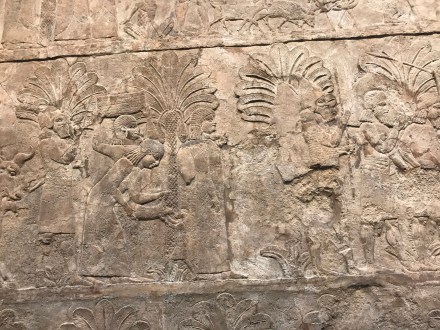
Scenes on walls, in the city of Nineveh – found when the ruins of the city were discovered.

Nahum was apparently originally written as a poem – possible as an acrostic poem (each line beginning with the next letter of the Hebrew alphabet). This has been somewhat lost in our modern translations, though some of the descriptions do read more like poetry than history. It is thought to have been written either just before the downfall of Assyria (making it a prophetic book) or just after (making it a history book) – so dated about 615/612 BC. Most people seem to think it was written after the fall of Thebes (which was 663 BC) and before the fall of Nineveh, and it certainly sounds like a warning to me, rather than a poem about what has already happened.

It seems that although the people of Nineveh had listened to Jonah and changed their ways, about 100 years later, they were back where they started, ignoring God and oppressing people and generally being bad. Nahum says they are going to be destroyed, and sometimes the descriptions are shockingly graphic (again, not something we ever studied in Sunday School – I would have remembered!)

The basic message, for today as much as then, is that God is holy, and will not tolerate evil forever. He is slow to anger, and he wants people to change and return to him, but he is a just God, and if people continue to ignore him, he will destroy them. God loves justice, and everyone will be judged. Sometimes, when we watch the news, it feels like God has gone to sleep, that awful things are happening and there is no justice. I especially felt this when I saw photographs of the children in Syria being torn apart by the war. However, this book reassures us, that God will act, when the time is right.

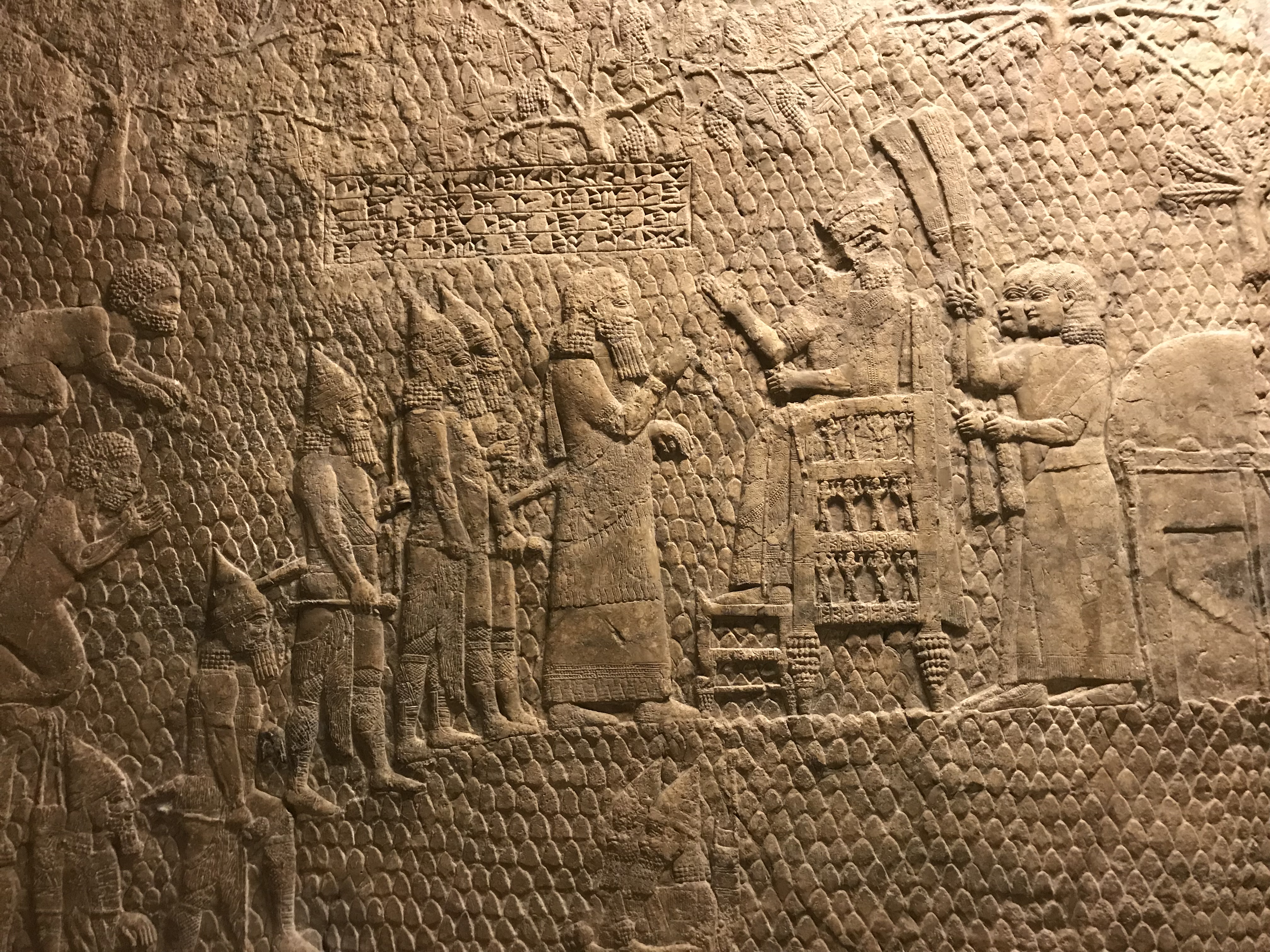
Art from Nineveh.
The art was discovered in the remains of the destroyed city, and are now in the British Museum.

Next week I’ll tell you all about a trip to ‘Spoons and the Tate. Why not sign up to follow my blog, so you don’t miss it?

anneethompson.com

Carved in Stone, Thrown to the Lions, and Defaced…


I told you in my last last blog all about how the ancient Egyptians thought that if something was carved in stone, it was true forever, and how therefore if they didn’t like part of history, they simply never recorded it – because then it never happened. They also applied this to statues, so if they didn’t like someone they chipped the face off (hence ‘defaced’).

Scenes on walls, in the city of Nineveh – found when the ruins of the city were discovered.

There was lots of stuff in the British Museum which at first glance (to me) looked completely boring, but when I listened to the explanation of what I was looking at, was very interesting. We saw things like the wall tiles from the city of Nineveh (of Jonah in the whale fame).

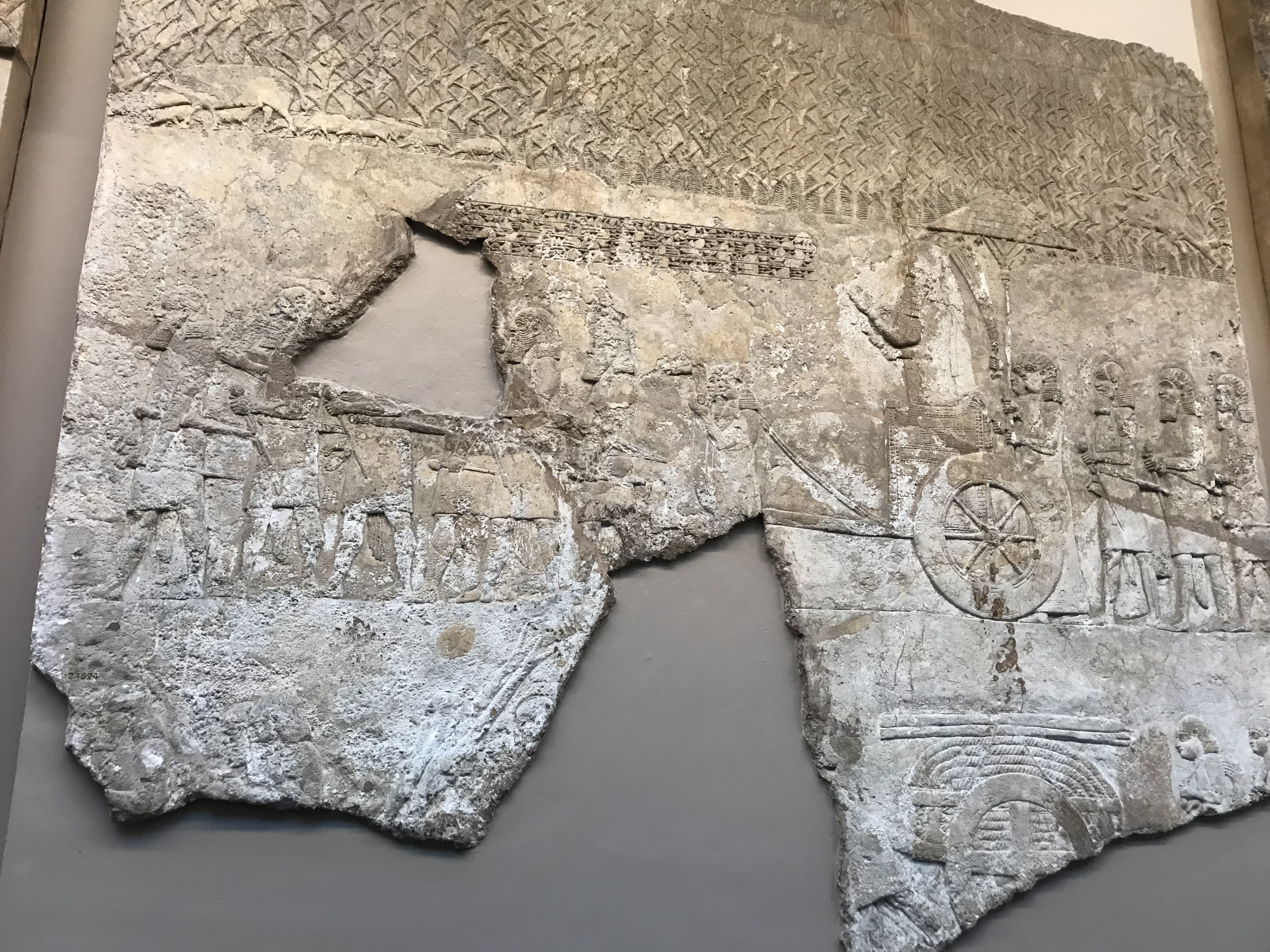
An interesting story was the defeat of Lachish, by a chap called Sennacharib. Sennacharib was a great warrier, and there were walls of carved stone, showing the triumphal defeat of Lachish, people being taken as slaves, the king bowing down to Sennacharib – a huge ego stroke, in other words. Except, Lachish was a small, weak, city. Conquering it was not such a big deal for someone as powerful as Sennacharib – so what wasn’t he saying? What was missing from the engarvings on the palace walls? Well, this is the time that Sennacharib was holding the city of Jerusalem in seige, and in fact, one panel lists all the plunder taken from the temple. After the defeat of Lachish, the plan was to return to Jerusalem, finish the job, and lead away King Hezekiah in chains.

But in the Old Testament, we read that God sent an angel, who went to where the army was camped outside of Jerusalem, and killed 185,000 men. When the people of Jerusalem woke up and looked out, there were thousands of dead bodies. However, although we have the Assyrian records – which show that Sennacharib sent an army of 200,000 men as the advance army to Jerusalem – there is nothing else recorded. Nothing. He simply reminded everyone of his triumph at Lachish, and had it carved in stone. Because if nothing was ever carved about Jerusalem, it never happened…(You can read the story in Isaiah 37.)

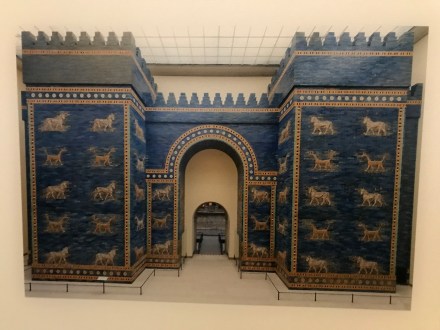
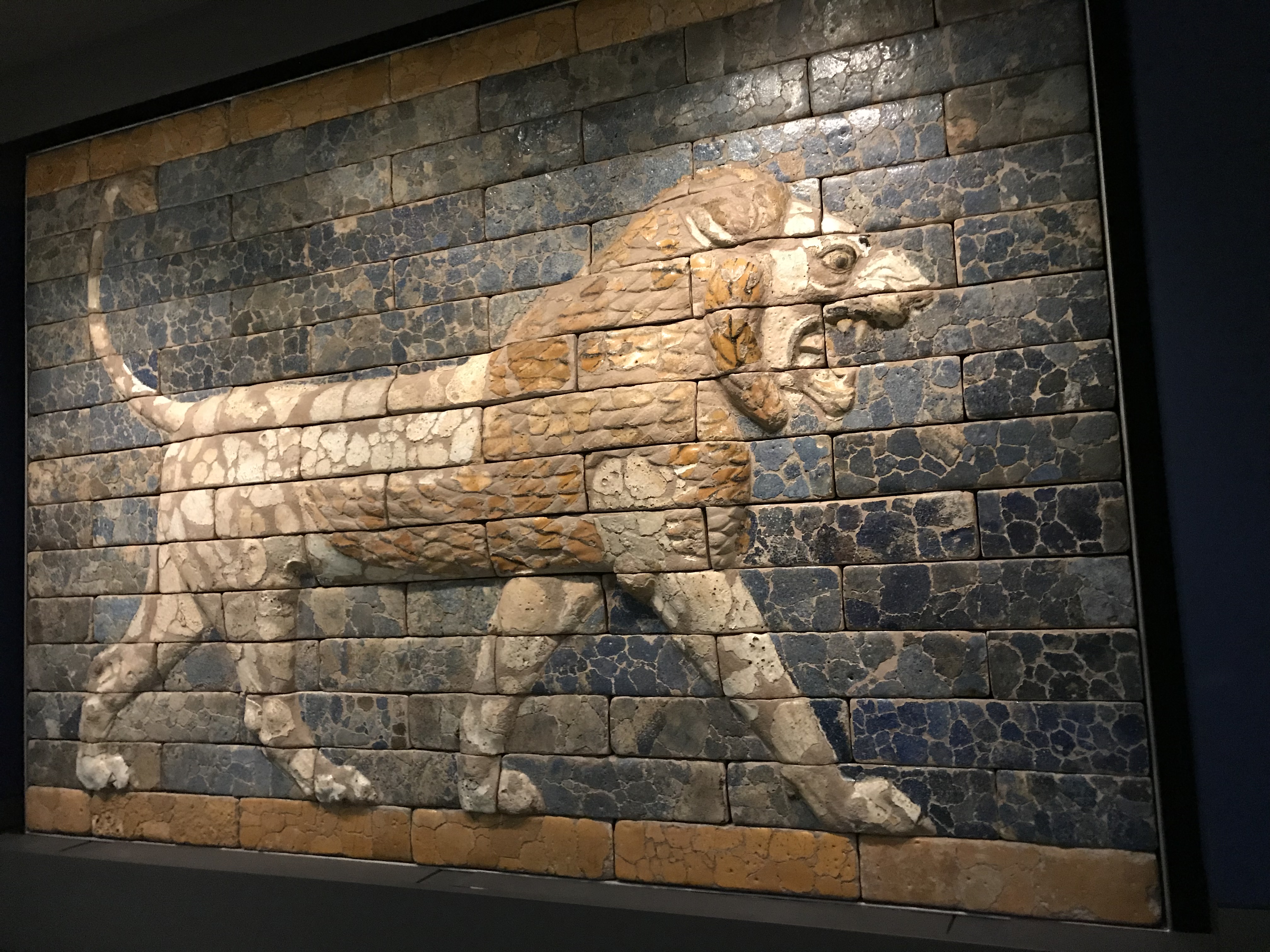
Lions were a symbol of strength in Babylon.
The tiles would be baked in furnaces, so the colour remains even today.

My favourite part of the tour was the stuff relating to Daniel and King Nebuchadnezzar. Now, in the early part of Daniel, we read that his friends were put into a fiery furnace, as a punishment. When we looked at the artefacts from the time, this made perfect sense, because Nebuchadnezzar was keen on coloured clay wall tiles – and these would all need to be fired in furnaces – so they would be readily available for the odd execution when needed! Many of those tiles depicted lions, and we learned that lions were a big deal to those Babylonians, and represented great strength. They would certainly have captured them, and kept them for viewing, so again, Daniel being thrown into a den of lions makes perfect sense!

There was lots more that we saw and heard, too much really to take in. I need to do a second tour – or buy the book from the museum bookshop and walk round by myself. It really was, hugely interesting.

Thank you for reading. Hope you have an interesting week.
Take care.
Love, Anne

anneethompson.com

PS. I have always written a diary on holiday, so last Christmas, I decided to find all my old diaries and blogs, and make a book for my children. However, several other people also asked for a copy, so I have written a public version – it’s available on Amazon and has been described as “The Durrells meet Bill Bryson!”

The paperback version is currently available for £9.99, but as I will need to buy copies for book fairs, I will need to cover my postage costs, so this price is for a very limited time (I think it will be around £12 in the future, but I wanted to let you, my blog readers, know that they can buy it for the cheaper price, until March). It is also available as a Kindle book.

Why not buy a copy today? I think it will make you laugh.

The US link is here:

https://www.amazon.com/Sarcastic-Mothers-Holiday-Diary-ebook/dp/B07N95281F/ref=sr_1_1?ie=UTF8&qid=1549015525&sr=8-1&keywords=the+sarcastic+mothers+holiday+diary

The India link is here:

https://www.amazon.in/Sarcastic-Mothers-Holiday-Diary-ebook/dp/B07N95281F/ref=sr_1_1?ie=UTF8&qid=1549015429&sr=8-1&keywords=the+sarcastic+mothers+holiday+diary

The UK link is here:

https://www.amazon.co.uk/Sarcastic-Mothers-Holiday-Diary-ebook/dp/B07N95281F/ref=sr_1_2?ie=UTF8&qid=1549014970&sr=8-2&keywords=the+sarcastic+mothers+holiday+diary

Deleting the Family Tree…


A Tour of The British Museum

Is there evidence that Joseph was a real person?

Who is the Pharaoh of the Plagues?

We began our tour in a large room full of Egyptian stuff. I didn’t know much about the Egyptians, and wasn’t sure how much I wanted to know about the Egyptians – but actually it turned out to be very interesting.

We were on a Bible Tour at the British Museum, and although I wasn’t completely sure what that meant, I figured I might learn something useful. We met our guide next to the stairs, picked up a folding chair (which I was later very grateful for, as the tour involved a lot of standing for those people who didn’t have chairs) and off we set – to the Egyptian room.

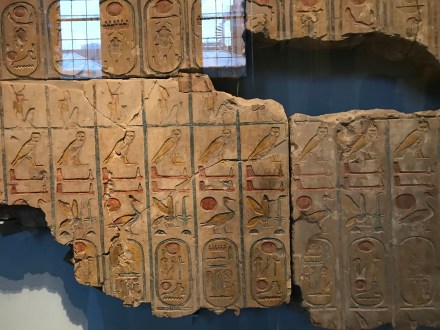
The ‘Family Tree’ of Ramesses – with all embarrassing relations deleted!

Before we could begin our tour, we needed to learn a fundamental truth about Egyptian psychology, which was that “If it isn’t carved in stone, it didn’t happen” and therefore anything unpleasant or embarrassing about their history, they simply deleted. So, when we looked at the Egyptian equivalent of a family tree for Ramesses (that well-known Pharaoh) there were lots of names missing. They weren’t missing because he didn’t know who his ancestors were, they were missing because those ancestors were embarrassing. (Now, wouldn’t we all like to do that!) As I said, anything ‘carved in stone’ was thought to be eternal, therefore anything not there, could be ignored, as if it never happened.

Having learnt this snippet of Egyptian psychology, we then began the tour proper – which was to look for evidence, beyond the writing in the Bible, that would support the events described. So, as the whole ‘Israelite slaves being saved by a God who sent plagues so that Pharaoh is defeated and those slaves can leave’ would be somewhat embarrassing to the Egypyians of the day, we were never going to find evidence, carved in stone, that would remind them of that piece of history. However, there were other clues, circumstantial evidence, that supported the Bible claims.

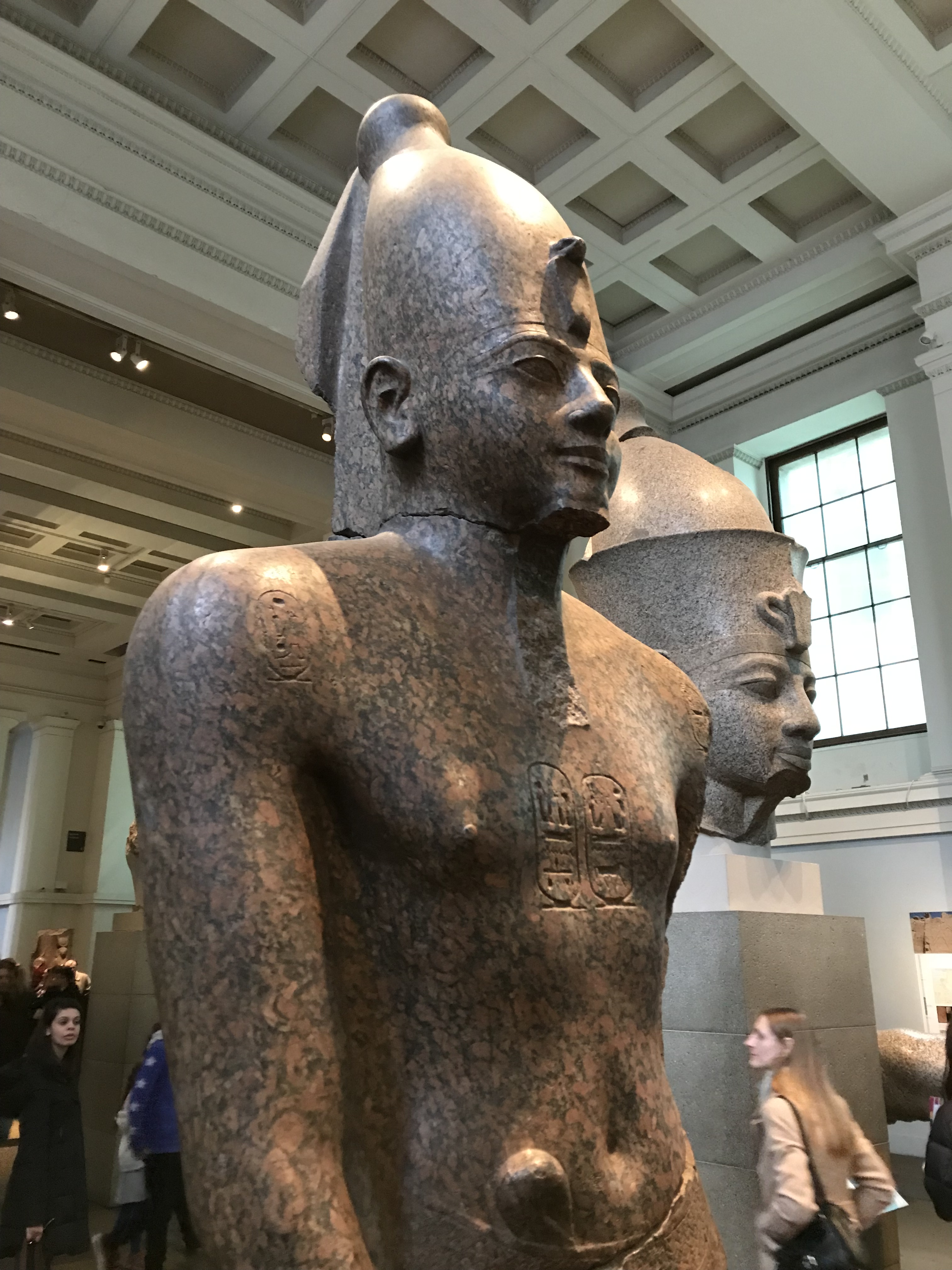
Senwosret was probably the Pharaoh who put Joseph in charge of all the agriculture.

In about 1875BC, Joseph was sold as a slave to Egypt, and while he was there, he told the pharaoh what his dreams meant, and was then put in charge of all the food. So, when there were 7years of plenty, they saved food, and when this was followed by 7years of famine, they could eat the stored grain. Now, we know that the pharaoh of the day was deemed to be responsible for everything, he was almost a god, and therefore a famine, of any length, would be his fault. This would make the pharaoh of the dreams very worried when Joseph told him the meaning of his dreams, and he would want to act.

Egyptian records, show that Senwosret took complete control of all the agriculture during his reign as pharaoh, which was a strange and significant thing to do. We also know that when he was buried, he shared his tomb with his vizier (the ancient Egyptian equivalent of a prime minister). There is a carving, which states this vizier was “ruler of all the world” – which is exactly what Pharaoh described Joseph as, in the Bible account. Pretty interesting, huh? You can see statues of Senwosret in the British Museum today (he wasn’t a looker).

The oppression of the Israelites, when they were treated as slaves, probably began during the reign of Ahmose. After him, came Thutmose, and he had a very powerful daughter (very unusual in those days) who even ruled for a while and had statues made in her image, in the form of a pharaoh. It would make sense if she was the “daughter of Pharaoh” who fished the baby Moses out of the river, and then raised him in the palace.

Thutmose III
Who was probably the Pharaoh during the Exodus, when all the Israelites left Egypt.


Later, there was a very powerful pharaoh, called Thutmose III. He ruled during the high point of Egyptian history, was well known for his building projects and so on. We know that Moses was over 80 when he started negotiating with Pharaoh to let the Israelites leave, so the timing fits. Then, half way through Thutmose III’s reign, everything begins to go wrong. We don’t know why (because there is nothing ‘carved in stone’ about it) but we do know that the next pharaoh was not his son, that all his power seemed to stop half way through his reign, and, even more significant, the pharaoh after him made it a priority to go and conquer other nations so they could capture new slaves. Sounds convincing to me, I reckon Thutmose III was probably the Pharaoh from Exodus (even if Hollywood thinks it was Ramesses!) You can see his statue in the museum, but someone has bashed away his belt (which was how the statue of a pharaoh was identified) and added the cartouche (the oval that contains the pharaoh’s symbols) of Ramesses on his chest. Because if it’s ‘carved in stone’, it must be true…

There is loads more to tell you about the museum, especially the ‘evidence’ for angels killing whole armies – but I’m out of space. I’ll tell you next week.

Bye for now,
Anne x


Anne E. Thompson

Thank you for reading
anneethompson.com
Why not sign up to follow my blog?

Look on your device for this icon (it’s probably right at the bottom of the screen if you scroll down). Follow the link to follow my blog!

****