Does God Have a Name? And Should We Say It?


When I started to learn Hebrew, I was introduced to ‘ketiv qere’ in ancient scripts. As I have explained before, Hebrew words have a basic 3-letter root, and a group of people (the Masoretes) added dots and dashes to represent verbs, so people remembered how to say them. However, some words were written (ketiv) one way, but should be said (qere) differently—so they added the wrong verbs. Therefore, God’s name, written YAHWEH,[1] has the verbs for ADONAI, so when people saw the word, the would say ‘Adonai’ even though the letters are YWH. As my Hebrew lessons continue, whenever we read YHWH, we say ‘Adonai,’ as a sign of respect. But should we?

In most English Bibles, whenever Yahweh is translated, they write LORD, all in capitals. So we continue the tradition even in Christian churches; the name of God is rarely said.

Where did this idea originate, and should it continue? I have been reading a book on the subject by Andrew Case,[2] and I will give you a brief summary. He begins by quoting Clines, who states that, ‘The personal name of God is Yahweh. It is a foreign name, quite un-English […]’ and he suggests that perhaps for that reason alone ‘[…] the name Yahweh must be preserved—lest it should ever be imagined that God is an Englishman. He is a foreigner now to every race on earth. The very awkwardness of addressing a God whose name is not native to one’s language in itself alerts us to the alienness of Yahweh to every god created in our own image.’[3]

To begin with, Yahweh is introduced by God,[4] and is used by the Old Testament writers. All the early books use the name freely,[5] sometimes it was even used as part of a greeting,[6] and it was used in oaths.[7]

This changed in the book of Amos. There was a terrible punishment, many people died, and they declared that they ‘must not mention the name of the LORD!’[8] However, this was not a new ‘rule’ it was more that they were so traumatised, so worried the same thing might happen, that they dared not approach God or even say his name.[9] Case suggests that due to this fear (which sounds a bit superstitious I think) they started to use alternative names for God, avoiding saying Yahweh.

The use of Yahweh in oaths/contracts was also banned in the Talmud. (The Talmud is the written form of all the verbal laws the Jews had, with added explanations so they were clear.) The Rabbis disliked that a written contract would one day be rubbish, and therefore banned the use of Yahweh on written contracts.[10] Case notes that this, and a later ban by the Essenes (who probably wrote the Dead Sea Scrolls) does not give a reason—they don’t say it is out of reverence for God’s name. However, it seems likely to me that this is the reason, as unlike in the Amos example, no other reason seems logical.

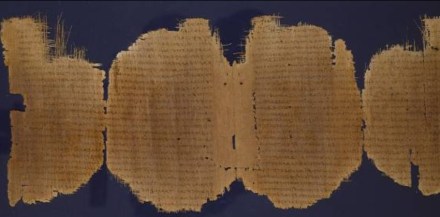
The Essenes then began to eliminate the name from their copies of manuscripts, sometimes putting symbols or dots in place of the letters. As I have written before, we don’t have any original manuscripts for our Bible, we have used various manuscripts (copies of copies of copies…) which means anything ‘corrupted’ by the Essenes (an early sect of ‘manuscript copiers’) continues today.

This continued to when the Septuagint (the Greek translation of the Old Testament) was written. Case (who is himself a Bible translator, so speaks with authority) suggests that when the Septuagint was written, they were so indoctrinated with the idea that they must not say the name of God, that it influenced their translations. Therefore, for example, the passage in Leviticus that says: ‘The one who blasphemes the name of Yahweh will surely be put to death.’[11] was translated in the Greek as: ‘The one who names the name of the Lord will surely be put to death.’ There seems to be no other reason for the change, as all the copies we have of the Hebrew use ‘blaspheme’ so it appears to be a deliberate change by the translators. (My understanding is that this happens a lot with translations—there is rarely a word-for-word equivalent with different languages, there is always a choice as to which word best fits the meaning. If translators hold a particular belief, it would be natural for them to use a word that upholds that.)

Case suggests that the Masoretes (who wrote the Hebrew version that I use) copied the convention of the Septuagint, and so added the vowels of Adonai to YWH. He also discusses how, over time, people would have begun to read this substitution as a name. Therefore, although people read ‘kurios’ meaning ‘the Lord’ in their Greek versions, after a while they would think of ‘Lord’ as a name, not a title. (Which probably most English speakers do today, when they pray to ‘Lord’ they are possibly not thinking of it as a generic title, but as a term specifically for God.

This is interesting, because his next point refers to the church in New Testament times—did they return to using Yahweh to address God? Well, no. Case says this is probably because in mixed Jewish/Greek congregations, the disciples were challenging all sorts of traditional thoughts, and challenging the idea of not using God’s name was probably a step too far. (Which to me, suggests that perhaps it is not important.) However, he does make an interesting point when he refers to the bit that says Jesus has ‘the name that is above every name’.[12] This ‘name’ suggests Case, would have been understood to be Yahweh. He thinks Paul was quoting from Isaiah 45:23, which uses ‘Yahweh’ but Paul has changed it to ‘Lord’ because that is the Greek custom. Case also points out that ‘Jesus’ in Hebrew is from ‘Joshua’ meaning: Yahweh is salvation.

There is further evidence that ‘Lord’ was substituted for Yahweh when Jesus quotes Deuteronomy 6:5 in Mark 12:30. He changes ‘You shall love Yahweh your God’ to ‘You shall love the Lord your God’ and he also adds ‘with all your mind’. Case thinks this is because the ancient Hebrews thought that everything was decided by the heart, whereas in Greek thought, there was a disconnect between heart and mind (so loving Yahweh with all your heart was insufficient, they needed to engage the mind too). Jesus therefore ‘tweaks’ a quotation, so the people understand the meaning of the quote. Thus ‘Lord’ is a substitute for ‘Yahweh’. Every time the early church read ‘Jesus is Lord’, they were really reading ‘Jesus is Yahweh’ which was completely radical!

My main concern when reading Case’s argument, is that he refers to ‘the personal name’ of God. Yet the name that was given, Yahweh, was NOT really a ‘personal name’. It’s a verb. The verb ‘to be’ which in the tense given means that God told Moses: ‘I will be whatever I will be.’ This, I feel, is more of an evasion than a name, more a telling humans that they cannot sum up God in a name, they cannot label him. The Old Testament writers took this verb and used it as a name. Should we copy their example? I guess the difference is that they were Hebrew speakers, so although they used the verb as a name, they would ever be aware that it was really a verb. We, however, see the word only as a name. Which potentially has dangers, but I’m not sure. Maybe it only has power. Maybe it has both.


[1] In case you missed my earlier blog: When the German theologians wanted to write this (Yahweh written with Adonai vowels) they ended up writing ‘Jehovah’ because ‘Y’ sound is written ‘J’ in some languages. Therefore, when you see the name ‘Jehovah’ you are reading a German attempt to write a wrongly-written Hebrew word, not a name that ever appeared in any Bible!

[2] Andrew Case, Pronouncing and Translating the Divine Name יהוה (UK: Independently Published, 2020). Although self-published, Case references his sources appropriately, and therefore is considered reliable to cite.

[3] David Clines, Yahweh and the God of Christian Theology: Theology Volume 83 (Sage, 1980)

< https://journals.sagepub.com/doi/abs/10.1177/0040571X8008300503&gt; p.324.

[4] Exodus 3:15.

[5] Psalm 135:13.

[6] Ruth 2:4.

[7] 1 Samuel 14:45.

[8] Amos 6:10.

[9] Suggested by Douglas Stuart, Hosea – Jonah: World Biblical Commentary (Dallas: Word Incorporated, 1987) p.364.

[10] Michael L. Rodkinson, The Babylonian Talmud: Original Text, Edited, Corrected, Formulated and Translated into English (Boston: The Talmud Society, 1918).

[11] Leviticus 24:16.

[12] Philippians 2:9 -11.

The Trouble with Textbooks


As I continue with my language studies, I have bit of an on-going battle with the textbooks. I realise that this is my problem, rather than the authors’ and is mainly due to my rather poor formal-English education. I was educated in an age when English lessons were about expression and creativity, with not much grammar mentioned. This wasn’t necessarily wrong–I now write novels, and the marketplace is overwhelmed by people my age who are putting that creativity into action. But when it comes to learning a language, it is fairly useless.

My latest novel

My problem is understanding what exactly the textbook is trying to say (the English bits). For example, I am faced with a chapter that begins:

Pronominal suffixes attached to nouns function as genitives, much like absolute nouns in construct relationships.

Introducing Biblical Hebrew by Allen Ross

I stare at the words. I can read the words. I can say the words. But understand them? Not at first glance. My brain has to unwind the language and remind myself that a ‘pronominal suffix‘ is simply ‘random-people-related letters added to the word’ and a ‘genitive’ is simply the word that owns/possesses the other word, and so on. I can get there, but by the time I have decoded the English, I am ready for a break.

I have also discovered that when faced with sentences I don’t understand, my mind sort of goes into shock, and I absorb absolutely nothing. People need to be relaxed in order to learn, and lots of poncy language makes me stressed.

There are of course, textbooks that are more friendly, but they have their own problems. For our Greek lectures, we use a book by Macnair, and he writes in a very folksy manner, describing verbs as ‘slimming-club verbs’ because they lose letters, for example. This was lovely when I started learning, as the information was very accessible. However, when I came to revise it was a nightmare, as I wanted to skim the chapter on ‘liquid-verbs’ and I couldn’t extract the information from the storybook style of writing.

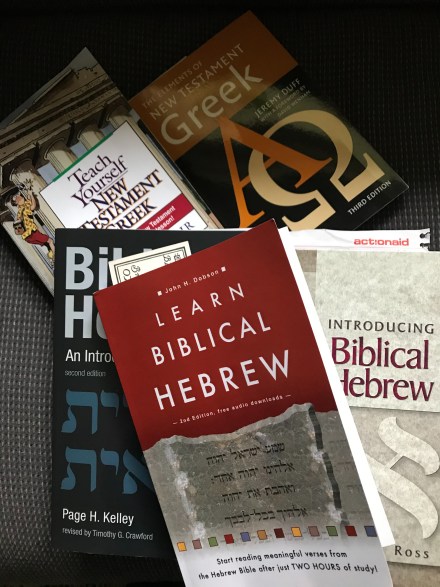
A selection of textbooks.

I think the only answer is for me to have a selection of textbooks. I do need the very formal one, because the exam is written in formal language, and I am expected to behave like a linguist. But when I am learning new grammar points, when understanding is the main aim, then I need a friendly book. For Hebrew, I have found a book by Dobson, which explains the grammar gradually amidst a jumble of reading and this suits the way I learn. I need to use the language in order to learn it, I find learning grammar in isolation to be almost impossible. The formal textbook by Ross will teach something, and then give lists of words (paradigms) to be learnt, but without saying what the words in the paradigm actually mean. (I have scribbled the meanings next to the lists of symbols–otherwise that is all they are–lists of meaningless symbols.) In contrast, the book by Dobson will give an extract of Hebrew text to read, and then points out a few minor grammar points. The order is jumbled, but the information is easily assimilated.

My other problem at the moment is trying to learn lists of Hebrew words (because unlike the Greek exam, we are not allowed to use a dictionary). My memory is pretty rubbish, so every list of new vocab represents many hours of work: writing, reciting, lists on the fridge, letters on my fingers, chants when we jog. Not sure whether I will get there, but I am determined to give it my best shot.

I hope you have something interesting to work on this week. It seems to me, that the most rewarding things usually require an uncomfortable amount of effort–but it’s worth it.

Thanks for reading. Take care.

Love, Anne x

Anne E. Thompson
Thank you for reading anneethompson.com Why not sign up to follow my blog?

anneethompson.com

*****

Hebrew and Hens


Hebrew Secret Code, Chickens and Tulips

I struggle to learn things out of context or anything to do with numbers—so learning the Hebrew alphabet has been a challenge. (I console myself with the knowledge that this is predominantly a ‘right-side’ of the brain activity, and the right side of my brain got chopped up during surgery—but to be honest, I never knew the English alphabet either, and that was before surgery!)

However, just to make things even trickier, the Hebrew alphabet is also linked to numbers. The first ten letters represent the numbers (1-10, not surprisingly). Then the eleventh number is 20, the twelfth letter is 30, and so on up to 100. Then the letters jump in hundreds up to 400.

א1   בּגּדּ4   הוזחטי10

כּ20  ל30 מ40  נ50  ס60  ע70  פ80 צ90 

ק100   ר200   שׁ300   ת400 

This makes it perfect for use as a secret code. In fact, if you remember, I gave Husband a gift of the Israeli series that was the fore-runner of the Homeland series. In Homeland, one character sends messages by taping the morse-code. But in the original series, the characters communicate by tapping their fingers and each number of taps corresponds to a letter, a wrap of the knuckles represents numbers 10 to 90, and so on. This would actually make a fairly simple code to use and learn. I have always loved secret codes, and many hours as a child trying to devise ones for my friends (which were always much to complicated to ever be used). But now I have the Hebrew version, I’m thinking we might use it. Think what fun it will be to be on a crowded train, and to be able to discuss the person sitting opposite us, simply by moving our fingers a number of times.

At the moment, Husband is proving resistant to learning the Hebrew alphabet so we can send secret messages to each other (such a shame my children all grew up and left home). Am thinking of with-holding treats until he can ask for them in code. . .

I have also enjoyed the garden this week. In the autumn, Husband cleared one of the flower beds and ordered hundreds of tulip bulbs (not sure exactly how many—a lot) which he duly planted. When the weather turned warmer, all the spring flowers came up, but the bed of tulips remained bare. I didn’t tease him at all about this. Then, one exciting day, a couple of tulips could be seen pushing up from the soil. Within a couple of weeks, the bed was a mass of tulip sprouts. . . and one hyacinth. (I did not plant the hyacinth, I promise, though if I had thought of it, it would have been a funny thing to do.) The hyacinth was duly transplanted to a different flower bed. The chickens are still imprisoned due to bird-flu so all looks promising for a pretty display very soon.

I’m not sure what is happening with the ducks. There are three hens and two nests. They seem to be sharing. I don’t think there’s a very high chance of any ducklings from them because they sit for a while and then get bored and go back to the pond. I might do what I did last year, and give them all to a chicken to hatch.

The incubator is whirring away, and the eggs I have stolen should hatch soon. I smuggled in a couple of chicken eggs, as my brown hens are fairly old, and I’d like to keep the line going. If I hatch hens (always more males hatch, so I’ll be lucky) then potentially they could have green eggs, as they’ll be hybrids of my blue-egg birds and my brown-egg hens. But realistically, they’ll probably be cockerels and simply cause trouble. Very little in life is easy.

Anne E. Thompson
Thank you for reading anneethompson.com Why not sign up to follow my blog?

anneethompson.com

Anne E. Thompson

Hebrew in a Nutshell


I have now completed the first half-term of Hebrew. I find that learning a new language tends to go through certain stages.
Stage 1: Everything is new and exciting, I know nothing, so there’s no pressure and I enjoy the ‘differentness’ of the language. This is quickly followed about a week later by a feeling of panic as I start to think I will never understand it, and even making the correct sounds is impossible, never mind understanding anything.


Stage 2: A few things begin to be familiar (with Mandarin and Hebrew, this is simply the letters, with other languages I begin to recognise words). I start learning vocabulary, I have a feel for how the language sounds, I feel I am making progress. All is wonderful.


Stage 3: I begin to realise how little I understand, I seem to forget more than I remember, the number of grammar rules is overwhelming, I feel like the stupidest person on the planet (after all, even tiny children can speak what I am struggling to learn). Continuing at this point is sheer determination.


Stage 4: I start to grasp some of the grammar, I notice I am making tiny steps forward, and I know lots more than when I started. I cling on to the belief that I will improve and delight in being able to recognise the occasional word or phrase, and I feel as if I actually understand something of the language whilst also recognising that there is a mountain of grammar rules waiting to be learnt.


Stage 5: I have full understanding of the grammar rules, can read and speak fluently, I have arrived. (I have never actually reached stage 5 in any language so am guessing! There might be more stages between 4 and 5, ask a linguist.)


I am currently between stages 2 and 3 with Hebrew. Here is an overview of what I have learnt so far (potentially with mistakes because I am new at this).

Hebrew is read from right to left:

.siht ekil kool dluow hsilgnE  ni ecnetnes a oS

All the letters are consonants. So “Hello!” would look like: “LLH.” The verbs are written underneath the letter they follow:

LLH
o  e

Hebrew has its own alphabet, so the letters actually look like this:

אבגדהוזחטי

All the words seem to be three letters long, with extra letters added to the front and back to confuse foreigners/add meaning. For example, in English we would write: He wanted to… but in Hebrew they would add letters to mean ‘he’ and ‘to’ onto the root of the other words. To make it more interesting/confusing, I think they sometimes remove letters from the root word as well. The letters that are added seem to change depending on the mood of the author, but I suspect there are further rules that we will learn at some point.

At the moment, my brain approaches Hebrew like a code to be deciphered rather than a language. This causes problems, as although I have learnt certain individual words, I don’t always recognise them in a text, because they are not yet ‘words’ for me, they are symbols which when I see them in isolation, I can give the correct translation to. To try and alter this, I decided to try and learn some modern Hebrew along-side the ancient Hebrew—because they are pretty similar at this level. It is sort of working, as for example I know that the words that sound like: “Tov me-odd” mean ‘very good’ and when I decipher the symbols that sound like ‘me-odd’ I can smile and say ‘very.’

To learn modern Hebrew, I bought a few CDs and a DVD for Husband. He enjoyed the Homeland series on Netflix, and it’s based on an Israeli series, so I bought him a copy of the original. It’s always good to share your interests with your spouse. He was less delighted than you might think, but we are dutifully watching it each evening and when I need to translate passages about spies, terrorism and torture in the Bible, I will have a real advantage.

Thanks for reading. Hope you have a good week.

Take care.
Love, Anne x

Anne E. Thompson
Thank you for reading anneethompson.com Why not sign up to follow my blog?