When I was teaching, there was a child (who we will call Christopher) who I struggled to teach to read. At the time the school was using an exciting new reading scheme with the characters Biff and Chip and Kipper. It was great fun, especially as the author had included some humour in the pictures for the teacher to smile at as the child read. However, Christopher did not learn the names of the characters, nor any other words.
I therefore searched the shelves for a different reading scheme. I found an old book. Every page had a picture of a house, and the word house written at the bottom. I gave it to Christopher, we chatted about the picture, he read the word ‘house’ and turned the page. We chatted about the picture, he read the word ‘house,’ we turned the page. We chatted about the picture, he read the word ‘h, h, …castle?’ We stopped. I searched the cupboards for something different. Eventually I found an ancient reading scheme, which relied heavily on phonics (at the time—mid-80’s—this was considered detrimental to learning to read unless introduced in the correct way). The pictures and content were completely out of date (the boys flew kites, the girls played with dolls and helped mummy, everyone was white middleclass). But it worked. Something about the books clicked with Christopher, he learnt to read.
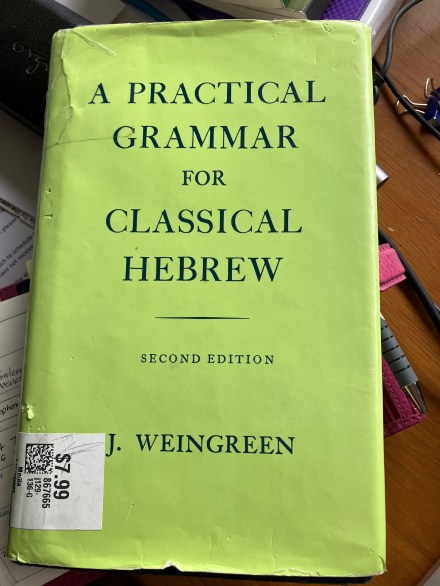
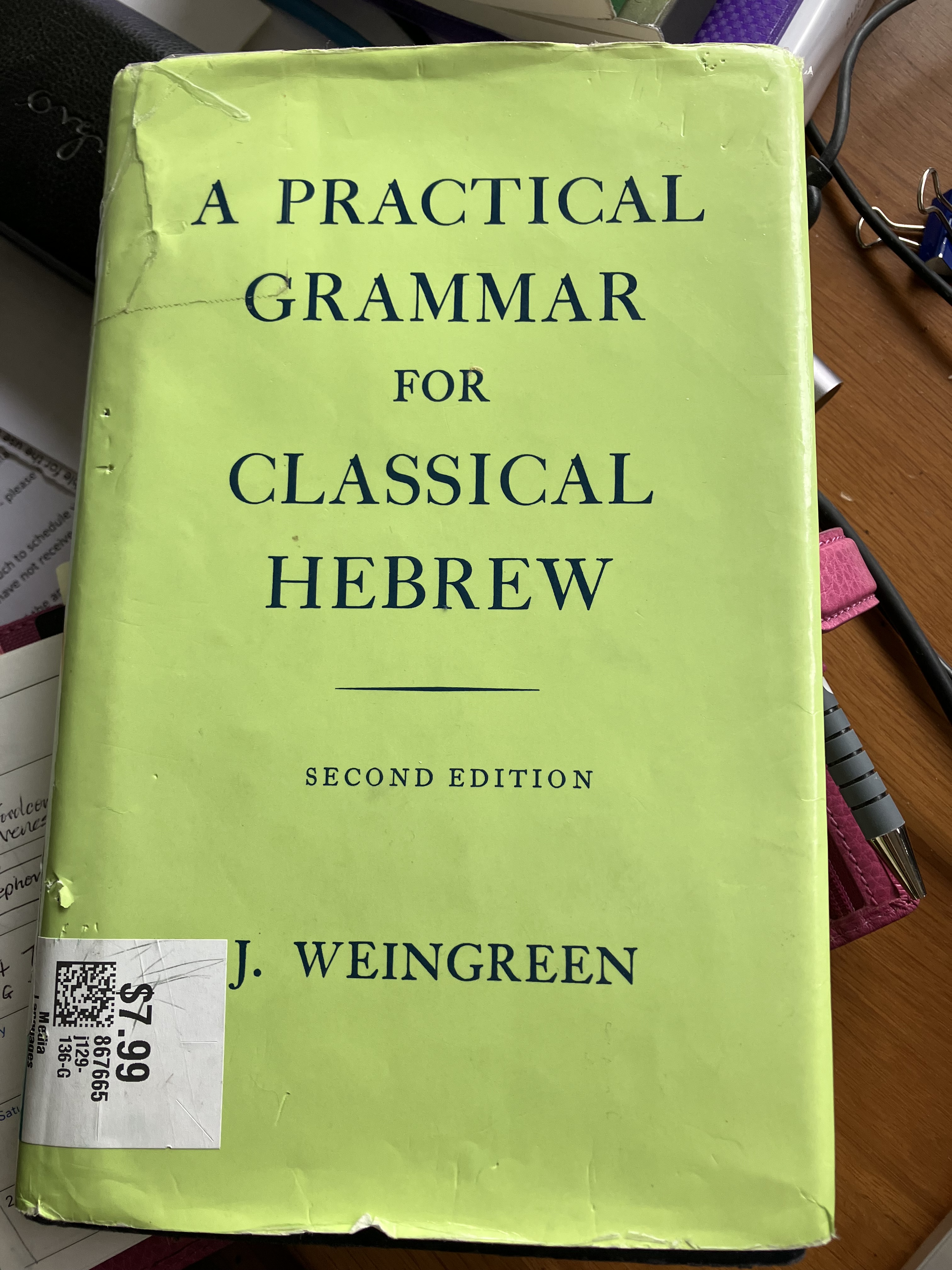
I am feeling a little like Christopher this week. After my first year review (see last week’s blog) I decided to allow myself a week off. A week reading for fun, watching Netflix, eating cakes, walking the dog. I have two books to read—one is a novel (a gift from my brother)—the other is a classical Hebrew grammar book. (I fear that reading a grammar book for fun might meet the definition of nerd.) Now, I have been learning Hebrew for several years, but there is something which simply does not ‘stick.’ I understand the basics, and know quite a lot of vocabulary, but some of the grammar I struggle to remember. There seem to be a lot of rules which simply need to be memorised—and my memory for abstract ideas is rubbish.
I have read a few different grammar books—Ross, Lambden, Kelley. They all remind me of when I was at school and struggling with maths and physics—lots of disjointed rules to memorise, none of which I understood. However, this book (recommended by another student) seems to finally make things clear. It’s by J. Weingreen and was first published in 1939. I found a second-hand copy online. There is something about how it is written that makes sense, it appeals to how my brain works. Perhaps because it gives the Hebrew of the grammatical terms.
For example, I have learnt in the past about the rules of ‘dagesh’ (a dot) but reading it as דָּגֵשׁ which means ‘piercing’ for some reason makes sense to me; understanding that it changes the sound of certain letters (בגדכפת) if they appear first in a syllable and not after a vowel, for some reason is easy to remember. I don’t know why. Or, that the definite article (the) was originally הַל (like the Arabic ‘al’) and when it was added to a word, they dropped the ל and added a dagesh to the next letter, so it is doubled. (This doubling a letter to mark a ‘dropped’ letter also appears in English (from Latin): We took the negative ‘in’ then dropped the ‘n’ and doubled the next letter in illegal (not ‘inlegal) and immune (not ‘inmune’). These explanations make sense to me; I remember them.
We all learn differently. I am a great believer in the idea (which I think Piaget stated) that nothing is intrinsically difficult. Everything can be learnt, but we have to approach it in the right way, we have to find the steps that we find easy to follow, and eventually we will get there. Sometimes approaching something from a new angle makes all the difference.
I hope you have a great week, and that you find a way to understand the things you find difficult. I do think learning is fun, wherever we are in the process. Thanks for reading.
Take care.
Love, Anne x
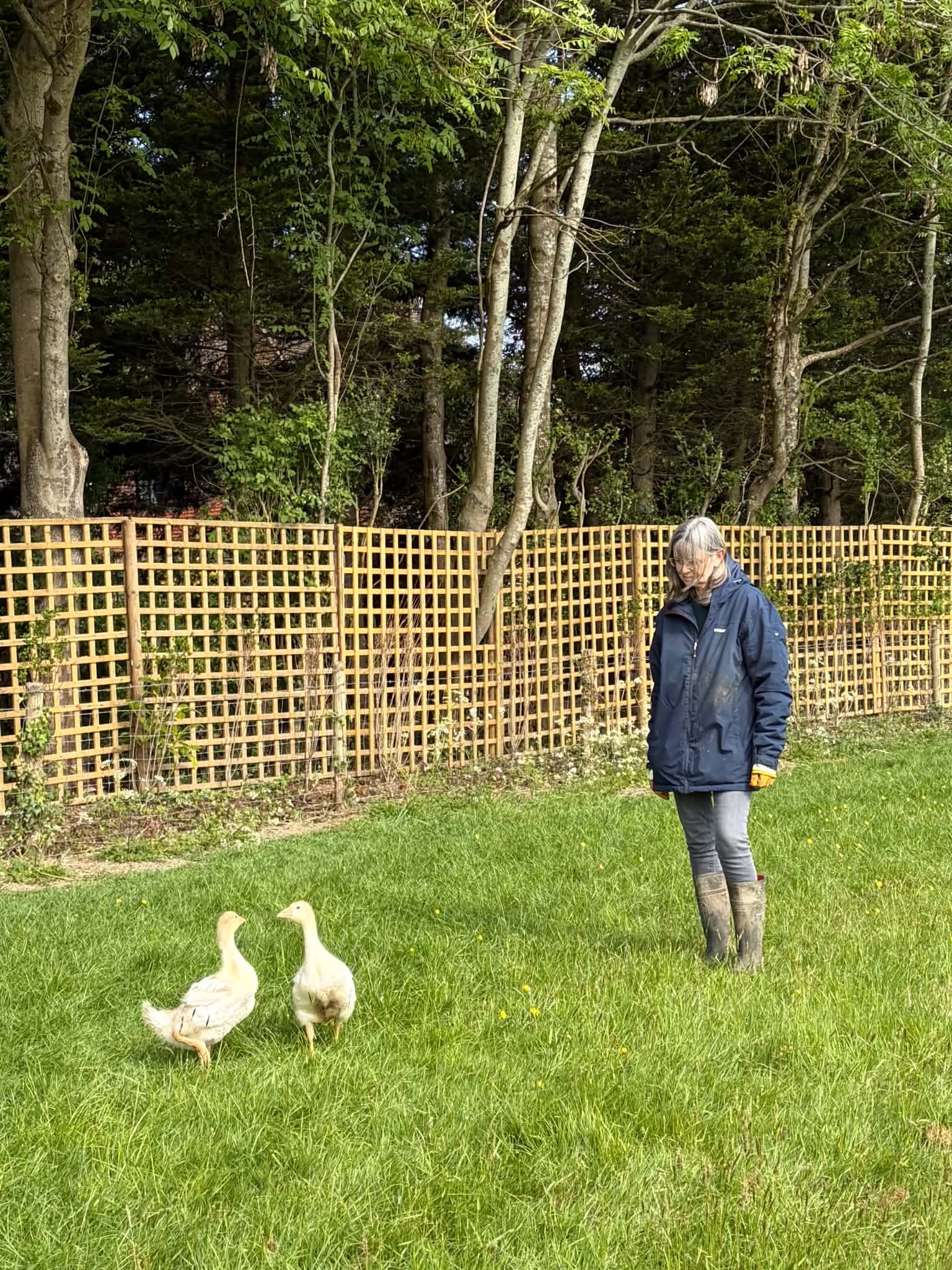
The baby goslings grew like dinosaurs and are now happily living outside. I think one is a gander, so hoping for more fertile eggs in January.


