We went to Italy for a couple of weeks. It was a variation of the trip we planned for 2020, when we rented a house in the Italian Alps for a few months, just to see how it would be to stay somewhere beautiful for a while. That trip was cancelled—another victim of the Covid lockdowns—so when the same house was free for the beginning of August, we booked it.
I arrived exhausted, mainly due to the last days of July. It had been busy—much too busy to call the wasp man, so I told Husband that we had a nest, and he said he hadn’t seen any wasps, so neither of us phoned the wasp man. Which was a mistake, but we’ll come to that later.
Sisters
You will remember my sister was staying? Well, she returned to Canada on the 30th of July, so we all met the night before for a barbecue at my brother’s house. To say goodbye. I hate saying goodbye to my sister, she’s a part of me, there’s some strange physical bond, and Canada is much too far away. When we returned from our family trip to Cromer (see an earlier blog) I had to make lots of scones, because all the ones I had made previously were eaten by my sister, and me, and various relatives who came to see my sister.
The dog also had to go into kennels, and I hate that now she’s so old, just in case…
Anyway, I survived saying goodbye to both of them again, and there was no time to think because the 30th was a whirlwind of making beds, cleaning the house, preparing meals for stray children (who aren’t children any more, but you know what I mean) when they arrived. In between time, I flung items of clothing in the general direction of a suitcase.
At about 2pm, my eldest son arrived from Vietnam. He’d been working there, managed to dislocate his leg, and had to be collected by taxi from the airport (because no one else was free). He hobbled in on his crutches, looking all tired and relieved to be in England, and thin. I don’t think he’d eaten much and he’d done a lot of trekking through jungles. When confronted with a tired thin son, mothers like to cook. I was busy, so cooked a frozen pizza (but the thought was there). Younger son carried the suitcase upstairs, I put a load of Vietnam-dirty clothes in the washing machine, then smiled a welcoming smile as our first visitors arrived.
At about 2:30, all my in-laws arrived for a cream tea to celebrate my parents-in-law’s diamond wedding anniversary. We had put up bunting, and decorated tables, and it was sunny so we could sit outside (with the wasps—you remember them?) Everyone seemed contented though, and it was a happy celebration.
At 4pm, people left, and I had time to clean up (mostly) and then fold the clothes that I had thrown towards the suitcase, packing them properly. I cooked dinner for the family (they all came back for the wedding anniversary and to come on holiday). I was asleep within minutes of going to bed. But only managed a few hours because the taxi arrived at about 4 am. Then off to the chaos of Gatwick.
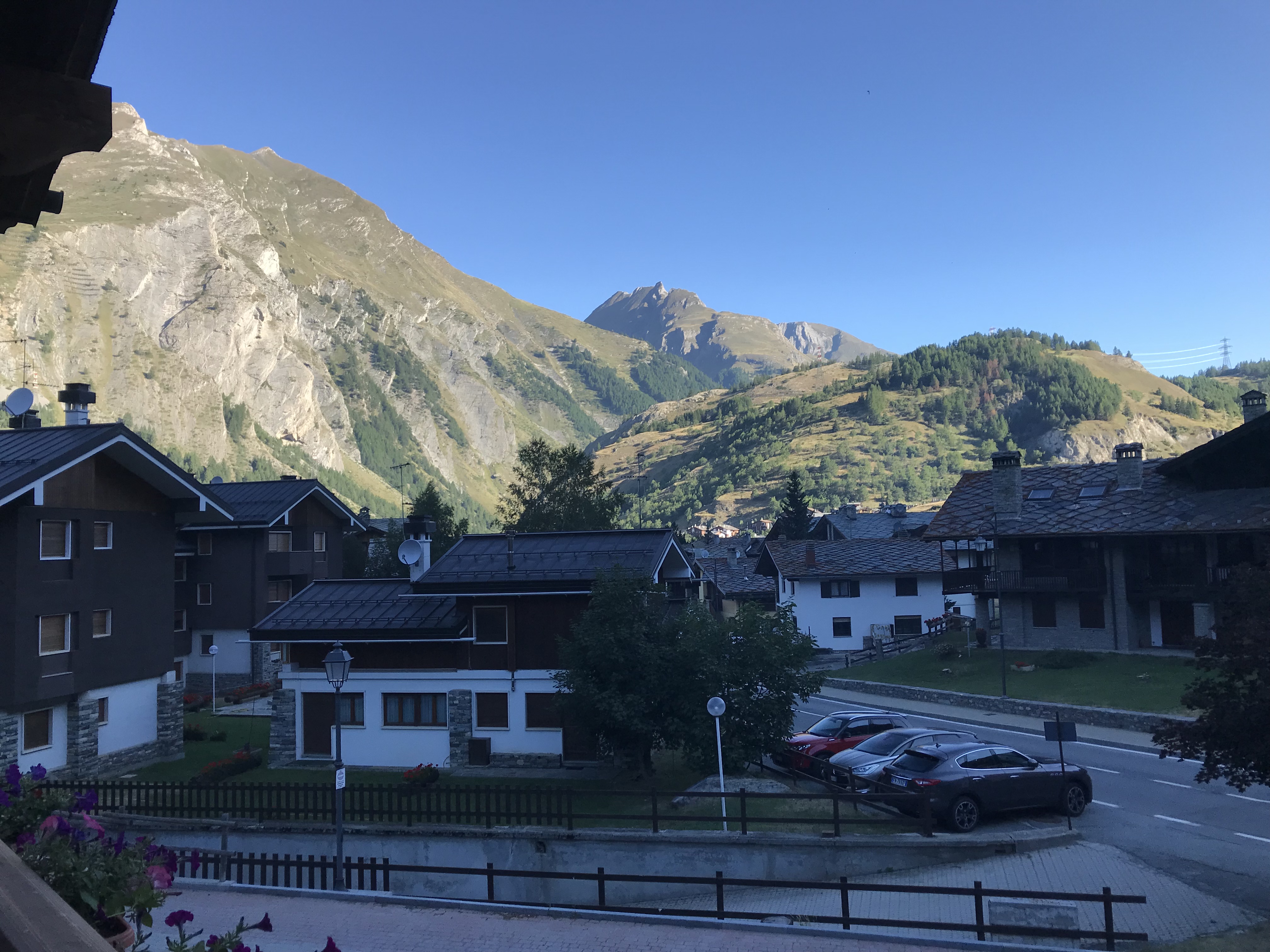
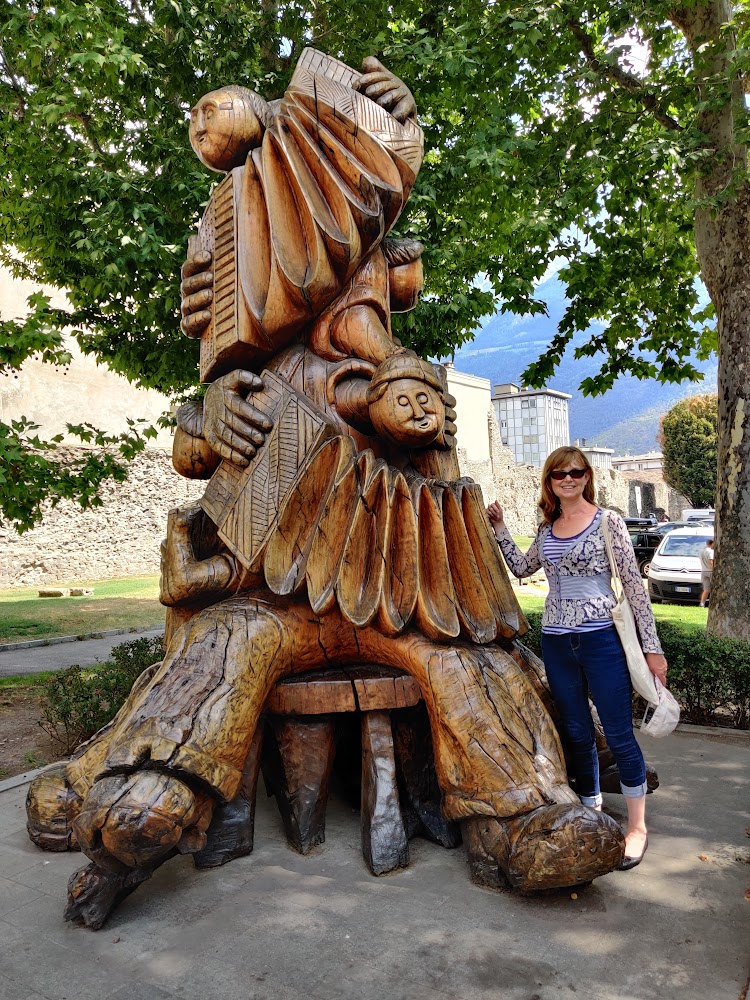
I will tell you about the joys of travelling with someone in a wheelchair in a later blog. Italy will have to wait too, otherwise this will be too long. We returned yesterday, ready to attend my niece’s wedding (another fun celebration I expect) and I will leave you with a few pictures of Italy, simply because it is beautiful.
Hope your week goes well. I will tell you about the very best place in Italy next week. Thanks for reading. Take care. Love, Anne x
A storybook place…there might be dragons…The water is silver, and fast.View from my window.Such pretty houses.There are always mountains, silently watching.
Thanks for reading anneethompson.com Why not sign up to follow my blog? A friendly chat every Monday. anneethompson.com
I love weddings, don’t you? They can sometimes be a bit long, all that waiting around for the photographs and not enough comfy seats—but mostly they are full of people promising to love each other, and lots of pretty stuff. I enjoy looking at pretty stuff.
I recently went to a wedding. I wasn’t an invited guest, but I have watched the bride grow up, so I asked if she would mind if I snuck into the back of the church to watch. She didn’t mind, so I donned some suitable clothes, and joined the smiling group at the church.
It was a Catholic church, and I’ve never been to a wedding at a Catholic church, so I was interested that the priest served communion mid-service, and there was an amount of bowing to the altar that tends to not happen in protestant churches. Other than that, it was the same really.
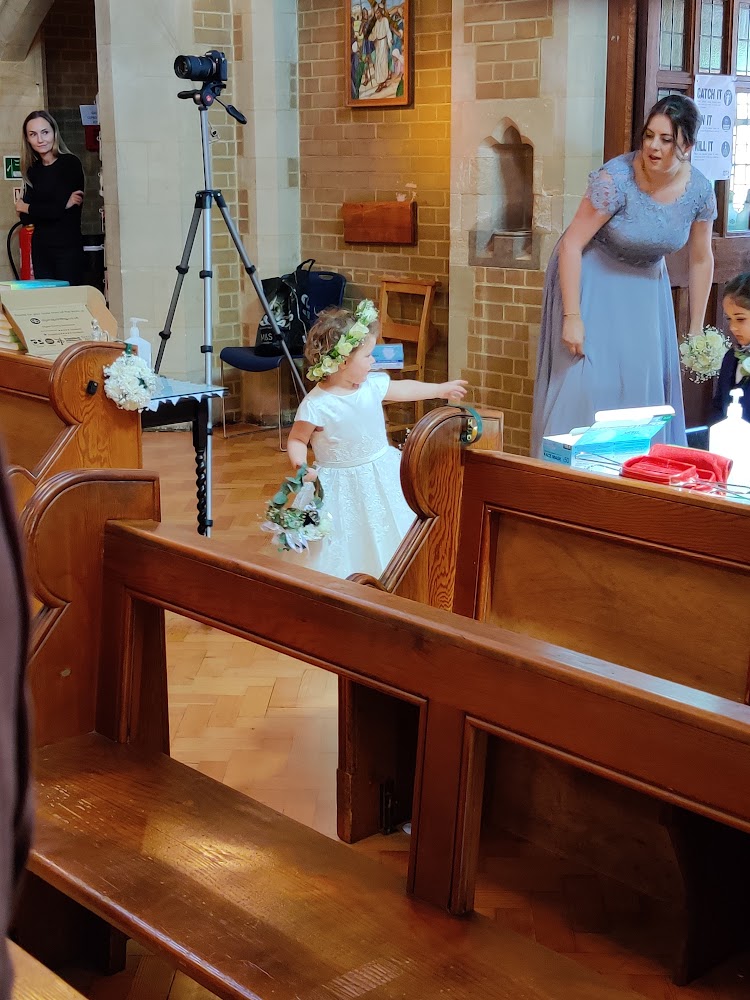
Of course, the absolute best thing was the tiny bridesmaid who changed her mind about wanting to be a bridesmaid as soon as she arrived at church. She must have been about three years old, and she appeared at the back of the church with the bridal party. I was right at the back, so had the perfect view as she was directed to walk down the aisle, basket of petals clutched in her little hands, a halo of flowers on her head.
She walked a couple of steps, decided that this was not something she wanted to do, and ran back to the doorway. A grown-up bridesmaid whispered encouragement, trying to persuade her down the aisle, but she was having none of it. First she shook her head, then noticing the flower-headdress, she yanked it down so it sat round her neck like a noose. The adult pulled the flowers back up into her hair, and tried again to send her down the aisle. A small boy, dressed the same as the groomsmen appeared. I think he was the ring-bearer, and he obviously sensed something fun was happening. The children looked at each other, mutiny afoot.
Another bridesmaid appeared, possibly the mother. She wasn’t taking any nonsense, she grabbed a hand of both children, and sounding terribly jolly, said they would all walk down the aisle together. Off they went, past me, hidden from sight as they hurried to the front.
The bride (brides are always beautiful, always) and her father appeared in the doorway. They hesitated, and suddenly the small bridesmaid reappeared, running full pelt back up the aisle, heading for the bride (or the doorway, hard to know). Before she reached her goal, a man—I assume her father—shot out from a side aisle and scooped her up. I didn’t see her again until after the service, when she had managed to lose the basket of petals, and the headdress, and her shoes. She was very cute.
I was therefore, full of wedding thoughts this week. This was excellent timing, as my daughter ‘popped round’ with her boyfriend, to tell me they are engaged. How exciting! Her fiancé had asked Husband’s permission ages ago, but he hadn’t told me, so the news was a complete surprise and very lovely. I am going to be the mother-of-the-bride. What a thrill. I hope I manage to fulfil the role better than the little bridesmaid did…though I cannot hope to look as lovely.
Thanks for reading. I hope you have some lovely events this week too. Take care. Love, Anne x
Thank you for reading
anneethompson.com
Why not sign up to follow my blog?
Sometimes you just know a day is going to be good, don’t you? Everything seems to work well together, and even unrelated events turn out well. And sometimes, the opposite is true, and we go to bed wishing we had never got out of it because everything we have attempted has gone wrong.
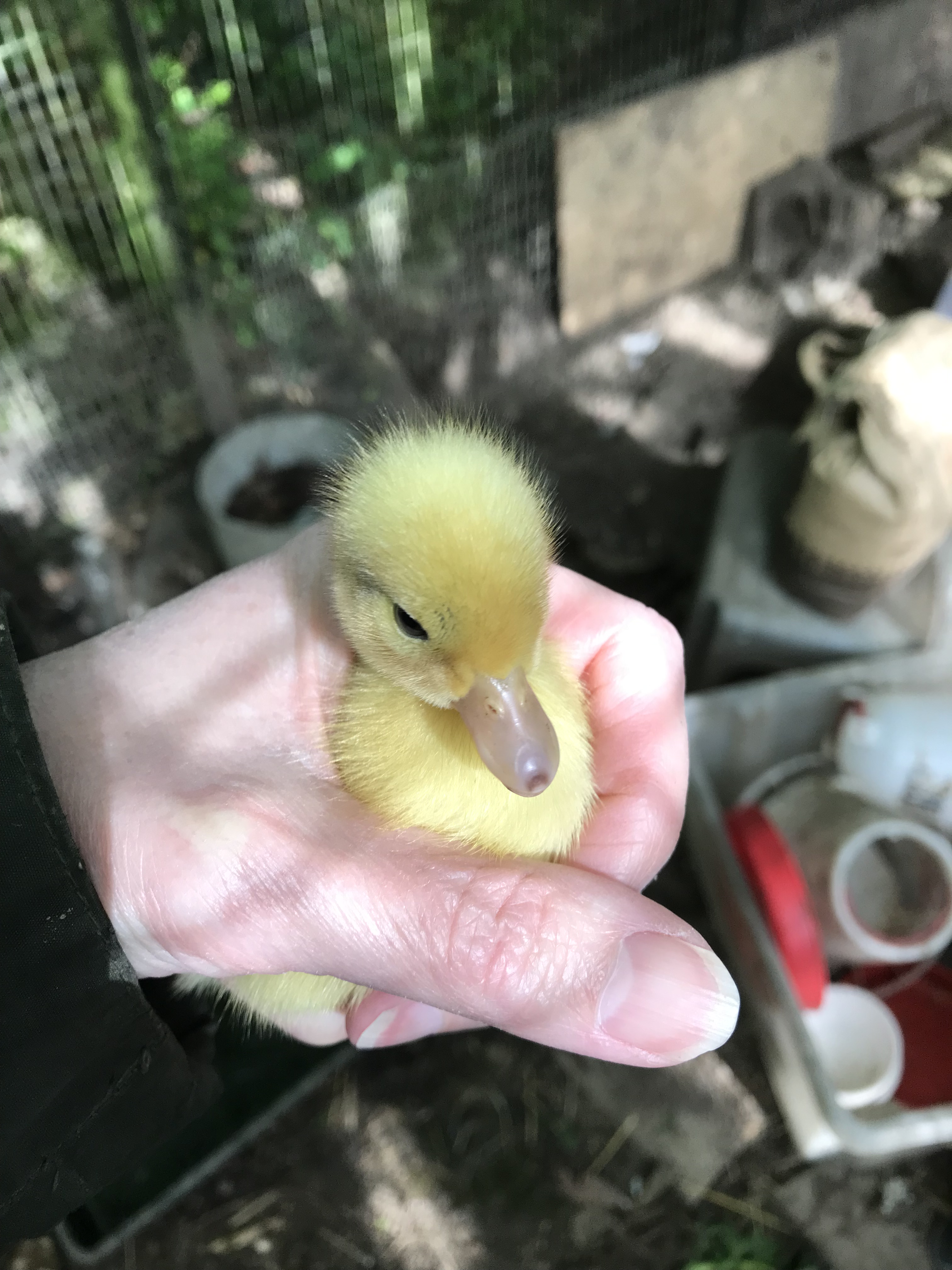
Today, is a good day. I wasn’t sure it would be, because when I got home yesterday, tired from a day at college and a long drive, my back was hurting. I went to check on the animals, and there was lots of movement in the nest on the pond, and definite sounds of cheeping. Mother duck wasn’t moving, and when she saw me looking, she tried to cover herself with dirt—not sure whether she was trying to hide or was securing a hatchling that wanted to escape.
A duck will stay on the nest until the first hatchlings decide to leave the nest, then she’ll abandon any unhatched eggs (even if they’re nearly hatched) and take the ducklings to water. After they have fed, she’ll relocate to a new place and gather her ducklings under her. Any ducklings that haven’t managed to keep up will drown or be eaten by all the predators that swoop in as soon as they hear the cheeping. Of say, 25 eggs she lays, about half will hatch, and of those 13, maybe one will survive to adulthood. It’s a tough world out there.
Anyway, last night I had a choice: 1. I could leave them to their fate. 2. I could risk drowning and try to catch the mother, put her into the chicken coop and then try to catch the ducklings. Mother would then raise the ducklings in safety. 3. I could leave the mother (because she is the hardest to catch) and remove the ducklings. I would then have to raise the ducklings myself in the garage, which is a lot of work and I have an essay to write. What would you have done?
I decided that my back hurt too much, plus I was tired, so I left them. I would reassess the situation in the morning.
Today, I woke about 6:30 and went straight to the pond. A miracle! It looked as if the mother had only just left the nest. She was on the pond with 10 ducklings, but there were no predators, she was very relaxed, and the ducklings were still full of energy. I went to collect Husband (who muttered about ‘Husband-abuse’ and having to wade into pond before 7 a.m.) We knew the drill: First, secure the area (cats locked into workshop while one of us stayed at the pond to deter flying predators). In the few minutes it took to lock up the cats, the trees filled with crows and magpies. Collect big bucket as dumping place for ducklings. Catch mother. (Unless you have ever caught an angry duck on a big pond, you have no idea how miraculous this was.) Put mother into chicken coop, and turf out grumpy chickens (will have to combine the flocks this evening, which will cause them some angst.) Catch remaining ducklings, reunite ducklings and mother. Make coop safe, put down fresh food and water, leave them to settle. Phew! All achieved before my morning coffee. I put my pyjamas into the wash and made a drink.
When the post arrived, there was a little package. It was a painting that I bought online. I have often seen the artist’s work on twitter, and he does some tiny paintings, the size of a coin, and some slightly bigger. This one was of London (I happen to like his London ones best) and it was being sold on a tiny easel. It’s the perfect size to brighten up a dark corner of my study, and only cost £15 including postage, so I followed the link to Etsy and bought it. I wasn’t sure what to expect, it’s hard to assess a painting online. But it really is perfect, and such good value for an acrylic.
Hello and how was your weekend? Mine was very mixed, with some truly lovely parts clouded by a loss.
Bluebells still beautiful, sheep looking fed-up.
Saturday started with a run down the lane, the bluebells are still holding on and the field was full of some grumpy-looking sheep. Am assuming they’re pregnant and fed-up (I remember that feeling).
The afternoon was spent at Lingfield Races. We were invited to a summer party, and we donned our smart clothes—so hard to walk in heels when you haven’t worn them for a while—and joined some friends at the racecourse. They had booked a private suite, which was rather lovely, with a buffet lunch and a balcony overlooking the course. I scoured the race details, trying to pick the winner for each race, and failing completely.
Enjoying the races. My horse was last.
It’s very hard to predict which horse will win (which I guess is why there are so many bookies). After each race, I compared the age, weight of jockey, distance they had travelled, last time they had run, trying to transpose the information to the next race. It didn’t work, I lost. After a few races I switched strategies, and backed the favourite. That didn’t work either. Nor did choosing the prettiest jockey colours, nor the best named horse. We walked down to the training ring to see if we could spot the winner there, but it was empty except for a man in dirty jeans—and I didn’t think he was likely to be winning any races! In the end I backed whichever horse was grey, which I believe was my grandad’s strategy many years ago. He never won anything either.
Trying to ignore the uncomfortable heels. (If my mother had been there, my hair would look less scruffy.)
Sunday we went to church. We have joined Holy Trinity, the little anglican church in the village, and I love it. It is full of friendly faces, and I find the words of the liturgy to be beautiful, the building inspiring, and taking the sacrament is being part of something holy. Having been raised a staunch baptist, I am noticing the differences, and revelling in approaching God from a different angle. Perhaps everyone should change denomination mid-life, so they can understand the good parts of both.
After church we always have brunch, which is another new tradition (since Covid) that makes me look forward to Sundays. (I used to dread them—they were all about being uncomfortable and doing my duty and working hard). We had banana and walnut and cinnamon pancakes with orange juice and coffee. Doesn’t that sound good?
Then we did some gardening, with my old dog beside me and the cats pouncing on the weeds I dug up, and the sunshine smiling on us. A peaceful day.
I needed a peaceful day, because a much-loved uncle died recently. He was the sort of uncle who you knew would smile if you turned up unannounced at the door, an uncle who told amazing stories (which you were never entirely sure whether they were true), the sort of uncle who wanted to be part of my life. When my children came along, he wanted to know them too. He was part of the stability of my life. I have been very lucky, my childhood was built on love and family. I will leave you with the wedding photo of my grandparents, which is where that stability and love started. Losing an uncle is sad, but mostly I feel grateful that he was my uncle, because family is precious.
My Granny and Grampy on their wedding day. Those heels look uncomfortable too!
Hold on to what is precious this week, and let things that don’t matter evaporate. Life is too short for anything else. Thanks for reading. Take care. Love, Anne x
Hello, how was your week? I am writing this in a rush, because it’s the end of my college semester and essays are due and exams need to be revised for.
Actually, if you take away the fear of failing the above, it has been quite a fun week. My lectures were interesting, and I managed to meet my daughter for lunch one day and have a good chat. I also managed to lose my purple gloves, which wasn’t so good, but maybe they’ll turn up.
We did Eschatology this week. Not sure if it’s possible to do that in one week, but we tried. (This is a fancy word for talking about ‘the end times’ and what might happen.) It sounds more exciting than it was.
Wednesday we had a lecture about digital theology. This was more interesting than it sounds. It showed all the ways that we now use technology, and how it has stopped being weird and has become part of everyday life (even my mother can now shop online). This extends to us actually incorporating technology into our bodies, so lots of people have artificial hips, or new knees. Some people have brain implants to help control an illness, or prosthetic limbs. The natural extension of this would be sort of cyber-hybrid-people. Some people apparently hope to ‘upload’ their brain into computers, or replace enough of their broken body to delay death for decades, maybe even longer. So we were asked to consider whether technology, with its ever-present, all-knowing, reaching-inside-us aspects was beginning to replace religion. Do people look to technology where they once looked to God? And how should Christians react to this?
Thursday I had a Hebrew test, when I desperately tried to remember all the different verb forms (and mostly failed, but remembered enough to pass). The big exam is in a couple of weeks, so I have verb paradigms scattered around the house in the belief that if I have copies of them next to the loo and stuck on the fridge door, I will magically assimilate them. Not working so far…Maybe future theologians will be able to simply upload a file of them straight into the memory part of their brain.
Friday I wrote an essay. Well, to be accurate, I deleted most of an essay, to try and squash it into the tiny word-limit that has been set. I have always talked too much, now I find that I also write too much, and squeezing all my arguments, and referring to various scholars, into a measly 4,000 words is very difficult. I have to evaluate a book, so I made rough notes, and this came to over 10,000 words before I’d even started to refer to other scholars or give my own opinions. To make it even harder, every time I refer to someone I have to add a footnote (which counts as part of the word count) saying what they wrote and when, and I can’t use contractions (‘would not’, instead of ‘wouldn’t’) which all adds to the length. Writing the first draft was great fun, and I wrote a blinder! Now I have to delete most of it and hope it still makes sense.
Then it was the weekend, which is when I try to clean the house and have conversations that aren’t linked to theology. Not very good at either of those things. I did however move all the unattractive cleaning products off the downstairs washroom window sill and replace them with a plant, and one of those smelly diffuser things that I was given for Christmas. It smells quite posh in there now. Hoping it will help me to learn the verb paradigms that are stuffed behind the toilet rolls. Hope you have a great week, whatever you’ve got planned. Thanks for reading. Take care. Love, Anne x
Thank you for reading
anneethompson.com
Why not sign up to follow my blog?
anneethompson.com
Look on your device for this icon (it’s probably right at the bottom of the screen if you scroll down). Follow the link to follow my blog!
In a novel, every character has a back story. The main plot might be about a governess falling in love with the master of the house, but before she met him, she was a poor orphan, raised by an uncaring aunt and sent to a harsh boarding school. Sometimes we learn the history right at the beginning, and sometimes the information is dripped to us, silver drops of information given as the story unfolds. Occasionally, the back story is more interesting than the main plot.
In real life, people have a back story too. Sometimes we learn it when we meet them, usually we discover it as we get to know them better. But we never learn the whole story, we never see the entire cast of people that influenced them, we never completely understand.
Weirdly, our own lives are like that too, but in reverse. We know the back story—who shaped us, what moulded us into the people we are today—but we don’t know the next bit. We don’t know what will happen next, what is coming in our life, and what will happen after we have gone. We also don’t know who we have influenced, how many people we have been the back story for.
After Christmas, as the old year ends and a new one arrives, we start to take stock. To think about these things in our own life. Have we lived a good year? Will the next one be better?
I was thinking about this while I read the bit in the Bible when the father of John the Baptist, Zechariah, regains his speech and he makes a long prophecy all about his baby son and the man who would come after him (Jesus). It’s a song about being saved from enemies, serving God without fear, being led into peace. I’m sure when he said it, he believed it was true.
But here’s the thing. The people who heard that prophecy would then have watched the baby grow into a weird man who lived in the desert, eating locusts and wild honey, shouting about God and then being beheaded. Not much there about peace, not exactly saved from enemies. And it gets worse, because pretty soon after that, instead of being saved from Roman occupation, everything got harder for the Jews, their temple was destroyed, they were scattered around the world. Generations later, they may have heard about Zechariah’s words, shaken their heads, and agreed he was wrong. So very, very wrong.
It is only after all these things, now we know more about why the baby John came, how he was part of the plan for Jesus, part of the bigger plan of God, that we understand. God’s plan was never to save the Jews from the Romans, he had a bigger plan. Zechariah was part of the plan, but he didn’t understand it, he didn’t even really understand what the plan was, or how it would unfold. But he was part of it. His life mattered beyond what he could see.
I want my life to matter, don’t you? Sometimes it feels like it doesn’t matter at all, I have never achieved anything great—even my garden is bit of a mess. But if I keep trying to live how God wants me to live, talking to him, trying to respond to his voice, then I can be part of the plan, even if I don’t see it. The great people of history were all influenced by someone, and those people, the hidden characters of the back story, were crucial to the outcome. When you think of someone great, a person in history who achieved something wonderful, try to imagine who was in their back story. Someone taught them to be kind, to be brave, to control their temper, and without those people, the greatness wouldn’t exist.
I might always be in the background, I might never be a great leader of people, a famous author, the person who changes the world. But I am part of the back story, even if I don’t actually see it, and so are you. We matter, we influence the outcome, we just have to keep trying to be the people who we are meant to be. The wonderful thing is that this never ends, however old we are, however ill we might be, we can still be part of the back story. What we say and do, how we live, can matter, even in the tiniest of ways, it matters. We can all be part of the plan.
Thanks for reading. Have a good week, and happy new year. Take care. Love, Anne x
Thank you for reading
anneethompson.com
Why not sign up to follow my blog?
I have a question: When you are reading a book, do you underline passages with a pencil? This is something I am struggling with. I am struggling with many things actually, but this is currently the most irritating.
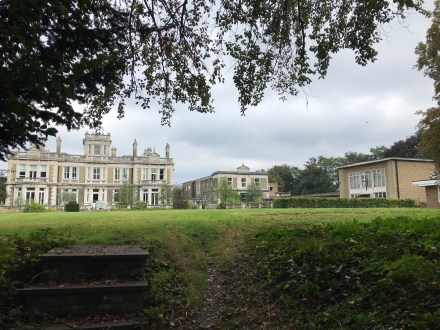
My M.A. course started at a local theological college, and I drove there for the first time in September. This alone was scary enough. I’m not a ‘natural driver’ and mostly I pootle between my house and my mother’s, and use public transport if I need to go much further. But Spurgeon’s College is not easily reached from my house, so driving is the only sensible option. I did a practice drive first, with encouraging Husband cheering me on from the passenger seat, but this did not prepare me for the first day of term.
Spurgeon’s College
I set off in rush hour, when obviously the traffic was heavier than when we did our practice drive, so clever Satnav created exciting new routes to beat the traffic. I didn’t know the route well enough to do anything other than blindly follow, which was incredibly scary. We turned off the main road fairly soon after leaving home, and dived through a hedge, along a footpath, over a field and back onto the road. Okay, I am exaggerating, but not by much—most roads were not even wide enough for one car, so not sure what would have happened if I had met someone going in the opposite direction. (I didn’t.)
Then we joined the ‘London traffic’ I am a country bumpkin, anything bigger than a small town is ‘London traffic.’ Satnav continued to guide me down side roads, back onto the main road (always turning right across the traffic) then back down another side road. Pretty sure we crossed someone’s garden at one point.
There were speed limits designed to catch out the unwary driver, encouraging you to travel at 40 mph, then dropping briefly to 30 mph in the widest sections of road. There were pedestrian lights, which you thought you could nip through on orange, only to discover they are actually tram lights and you are about to be squashed under a tram. Teenagers stepped into the road on their way to school, grannies opened car doors without checking for cars, buses—well! I could write a whole article on the driving manners of whoever drives those big red buses that swoosh past you and then brake suddenly to collect passengers, blocking the road while they chat, read the newspaper, eat their lunch, phone their mothers and take a nap. Meanwhile, you sit behind them, wondering whether you can inch past (into the path of another swooshing bus) growing ever more worried as the car behind honks, and streams of boys walk between you and the bus, and a motorbike skims past and away down the road. Just as you decide to ‘go for it’ and edge past, the driver finishes his lunch/phone call/nap, indicates (briefly) as he glides away from the stop. You sigh with relief, enjoy a few yards of actual movement, and then he stops and it all starts again.
However, I made it to college in time and with very few casualties. (I will need to check the post for a few weeks so I can collect all the speeding fines before anyone sees them.) I walked into college, collected my student pass (wish I had tried a little harder to find a better photo now, I have the image of ‘Aunty Ethel on a bad hair day’ hanging round my neck) and I joined my fellow students in the chapel. Felt I had probably prayed more than most other people before the day had even begun!
The course is mostly fun. There are some good discussions, and the people seem nice. Much of the learning is through reading, and this is where my earlier comment is relevant. I bought a couple of books, second-hand, from Amazon. They have arrived with lots of underlinings. I find this very irritating. I tend to read in my own voice, pausing, thinking, absorbing. Passages that are underlined feel like I’m being shouted at, and it’s hard to absorb what is being said. I have so far spent longer erasing the lines than I have reading the passages. Not sure if they will give me any credit for that, probably not. I even found underlinings in a library book. Terrible! They should bring back hanging for things like that, then people would stop.
Hope you have a good week. I will tell you more about college in my future blogs. Take care. Love, Anne x
Thank you for reading
anneethompson.com
Why not sign up to follow my blog?
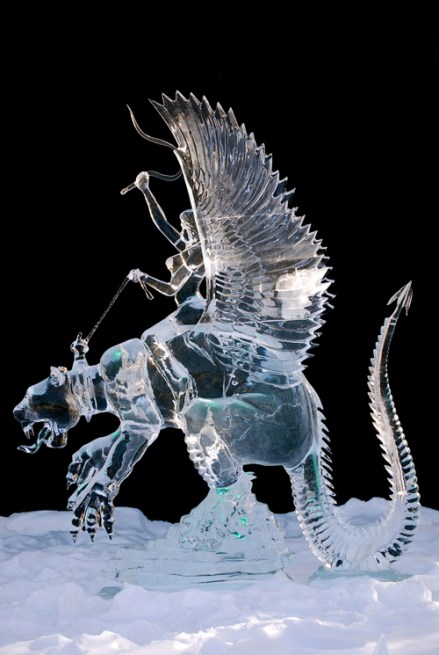
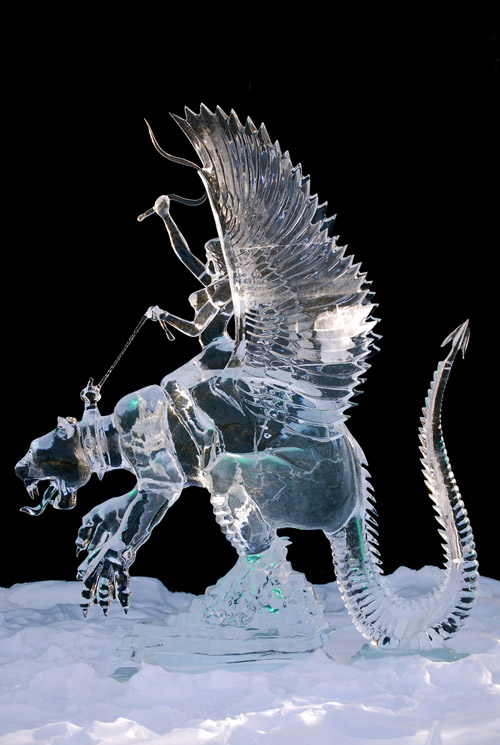
I am often amazed at the skill and time that people spend on ice-sculptures. Some of them are absolute works of art, and yet within a few hours they melt away to nothing. I wonder, is it worth spending all that time on something that melts so quickly? Or is it more beautiful because it’s fleeting?
You might remember that Husband spent time earlier this year emptying a flower bed, filling it with compost, then planting hundreds of tulip bulbs. (He had help. Not from me.) I teased him when he regularly checked the bare earth for signs of shoots. I bought plastic tulips online and crept down one night to put them under his frost-proof cover. But eventually, the tulips blossomed, and they now look rather lovely. However, several gardening-friends have said that they hope the tulips reappear next year, because tulip bulbs don’t always survive as well as daffodil bulbs. Was all that effort for one display? Was it worth it?
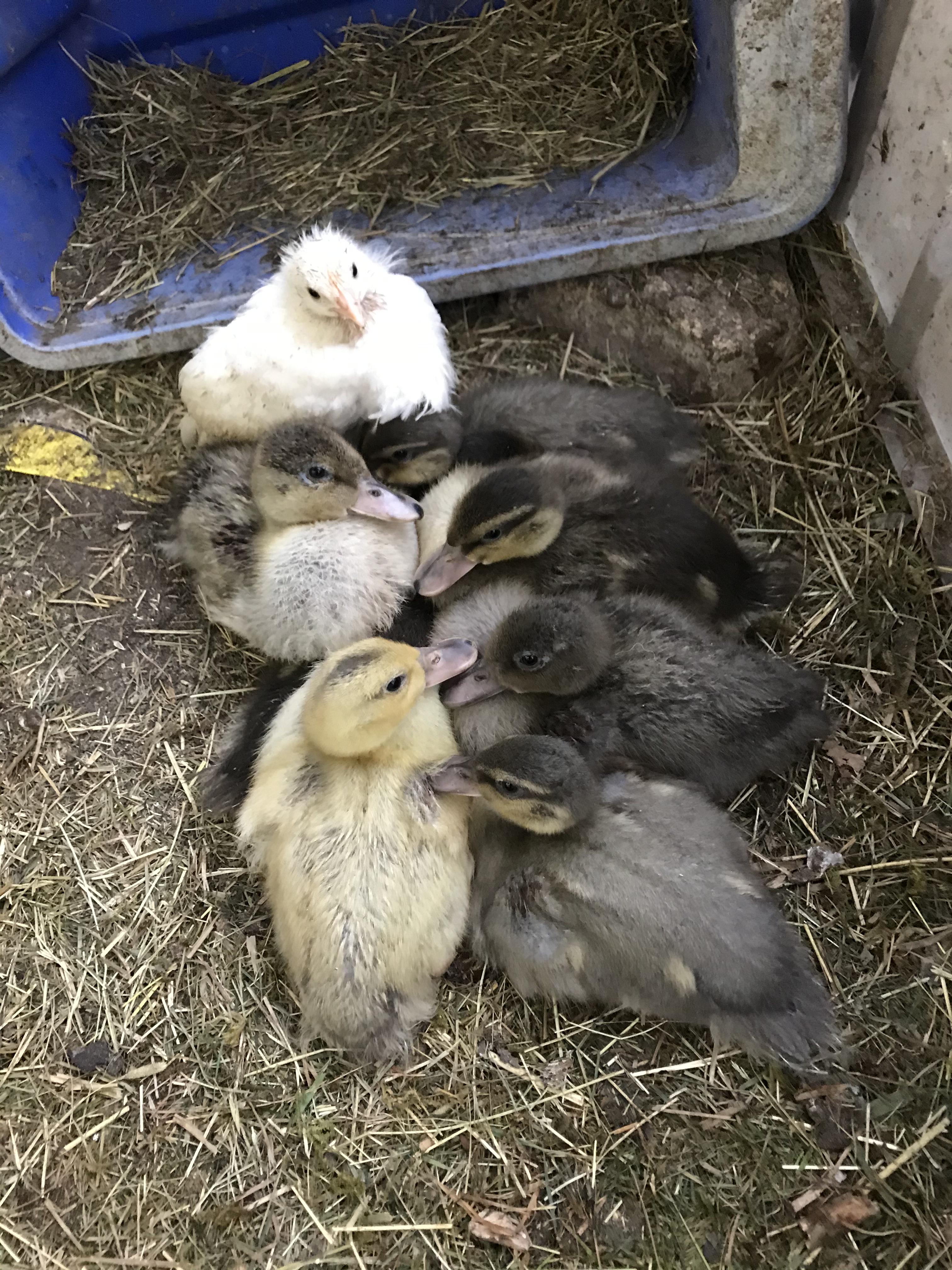
The ducklings I hatched are now outside. They’re safely in a cage, and I waste lots of time watching them. Their main aim in life seems to be to fill their water container full of mud, and to spread the water as far as they can. They are happy creatures. But in a couple of weeks I will put them on the pond. Some will fly away, some will get caught by the fox, some will hatch more eggs. But wild ducks don’t tend to last very long—the ducklings I nurtured last year have mostly gone and I am left with just one. Was it worth it?
Ducklings snuggled with the chick.
I sometimes struggle with the “Is it worth it?” question. As I get older, I realise that life itself is very fleeting. If you have studied history, or read about the empires in the Bible, lives seem even more fleeting. Here today, gone tomorrow. Think of your own dreams and ambitions, how many have you realised? Is there still time to make them happen?
I feel that life itself is a little like an ice sculpture. We do the best we can, but we know it won’t last, and as we get older, we realise how quickly it will melt. But is it still worth doing? Is it worth creating something beautiful, even knowing that it won’t last, simply because it is beautiful?
I think that perhaps I must answer yes, it is. The shortest life has value. The melting sculpture is still beautiful.
I hope you create something beautiful with your life this week. Even if it is fleeting.
Take care.
Love, Anne x
Thank you for reading
anneethompson.com
Why not sign up to follow my blog?
Hello and how was last week? I am beginning to feel very fed up with lockdown, this one seems much harder than the previous ones. I don’t know why, but it makes it much harder to cope with disappointments. Mostly my disappointments are small, but I’m not reacting overly well. I had planned to introduce my new book, but I’m not managing to upload a perfect manuscript yet, so that will have to wait. (I made an annoying mistake and excitedly ordered a few copies, and then found several typos. Next time I will wait to check the physical proof copy before I rush to buy copies–but it is so exciting when a book finally appears in print, it’s hard to be sensible!)
The weather has been a mixed blessing. I look out of the window and the view is beautiful, as England is enjoying a rare long spell of snow and ice. I am extremely thankful that I’m not having to do a school-run every day, which was always a nightmare when it snowed. But the chickens are grumpy and mostly refusing to lay, and I have to keep lugging water up to them because everything is frozen. Water is surprisingly heavy. One of the outside cats has decided she’s going to live inside instead, and is now usually to be found asleep on the boiler.
As you read this, I will be starting my first Hebrew lecture. This is very exciting, and I’m interested to know where we’ll start and how fast we’ll go. The Greek lectures seemed to fly at a pace that was sometimes hard to keep up with — but my exam mark was surprisingly good, so perhaps I managed to learn more than I thought I did. Hebrew will be different as the alphabet looks nothing like our letters, and the words are read from right to left. I have bought some modern Hebrew language Cds, and told my Mum she can learn too. We had a very funny morning trying to copy the words and accents on the Cd. I have also started to watch a series on Netflix in Hebrew, and I can understand the odd word (thank you, hello — things like that). I love how the brain gradually assimilates language. When I first started to listen to Hebrew, I couldn’t even hear the difference between sounds. Then I began to notice certain sounds, and then words. I can now match some of the things I am hearing to the written words. Of course, as I am learning Biblical Hebrew, some of the words (computer, phone, duck) will be pretty useless unless I plan a trip to Israel. But it’s still fun. Not sure how similar modern Hebrew and Biblical Hebrew are. I will let you know. Yiddish sounds just like German, so that is probably easier.
Did you do anything special for Valentine’s Day? Or Chinese New Year? It is very strange not being able to go to restaurants to mark occasions. As my lectures stopped for a while after the exams, every day is the same. Except for Sundays. Sundays are a special day in the house. When I was growing up, I pretty much hated Sundays because we weren’t allowed to do anything fun (like watch television or play with friends) and instead we went to church and church groups (which were mostly boring). I fear I may have inflicted the same restrictions on my own children. But since lockdown, we have tried to make Sunday a special day. So I make pancakes — big fat American ones, stuffed with banana slices and walnuts, drizzled with maple syrup. I set the table for brunch, with pretty glasses of juice, and we have pots of coffee, and eat pancakes. Then we watch a sermon (usually one from our church when we lived in America). I try not to do any jobs, and I don’t revise/study. Dinner is something easy (frozen pizza or something). It makes the day different, if nothing else.
Percy was sitting beside three mugs of hot chocolate when they arrived. Toby slid into a spare seat and wrapped both hands around the mug, feeling the heat seep into his blood. He took a sip, the rich taste filling his mouth, the cup burning his lip.
“How was the film?” asked Percy.
“It was good,” said Clarissa, her voice cagey.
Toby glanced at her, noted her eyes were watchful again. She clearly did not trust Percy, and he wondered why.
Percy was turning to Toby, leaning forwards, his voice conspiratorial. “And tell me, Toby, what did Clarissa do when the mentor in the film produced the wings?”
Toby frowned. He could remember Clarissa giggling at the mistake the protégé made, and he knew – at least he thought he knew – that she had enjoyed the film. But her reaction at that specific point in the film? Was she leaning back in her seat or sitting forward? Smiling or frowning? He had no idea.
“Um, I’m not sure. I mean, I know she was there, I think I’d have noticed if she had left, but I wasn’t really concentrating on Clarissa, I was absorbed in the film. It was really exciting. . .” he stopped, feeling slightly foolish.
But Percy beamed at him.
“Exactly!”
Toby was confused.
“Exactly,” repeated Percy. “You were so absorbed in the action, that you were aware of Clarissa, but only vaguely. She was not the focus of your attention because something more exciting was grabbing it.”
Toby was aware Clarissa was scowling, obviously not enjoying the explanation. But he had to agree with Percy, so he nodded.
“And that,” continued Percy, “is what I think it will be like at the real circuit. You asked if you would see your friend Gerald again, and I don’t know the answer if I am honest. But I suspect that it will be like at the film. I suspect that you will be so absorbed by what is there, by the realness of it, that you will only dimly notice other drivers. We’ll know they are there, but there will be something better to absorb us.”
“This is real too,” said Clarissa, sounding cross. “You said we’ll be absorbed by the realness of the real track. But this training ground is real too. We are here you know, this isn’t just a rehearsal.”
“Ah,” said Percy. He sat back and folded his arms. Toby didn’t think he looked annoyed by Clarissa’s interruption, more thoughtful. His old eyes crinkled at the edges, and he stared very hard into the depths of his mug.
“Perhaps,” he said finally, “perhaps I mean that we don’t see the realness of the real track yet. Perhaps I mean that our images are very hazy, like looking at shadows and when we’re there, all will be clear. Sometimes the real track seems like a dream, something not at all real. Which is somewhat ironic, don’t you think, given the name?” He chuckled to himself, pleased with the irony.
“Doesn’t anyone know?” asked Toby. “What about drivers who have arrived there, hasn’t one of them ever come back, or sent a message of something?”
“Exactly,” said Clarissa, sitting up straighter. “How can we even be sure the real track is real? Could it be that it doesn’t even exist?”
Percy shook his head and had a sip of his drink.
“No Toby, no driver has ever come back. I don’t expect they would want to, not once they’ve arrived at the real track. But once, long ago, the Engineer himself came. He visited the training ground, and gave lots of advice about how to train, and showed the drivers there the best way to improve.”
“And the real track?” asked Toby, eager to learn new information. “What did he say about the real track?”
“Very little, actually,” said Percy, shaking his head. “Perhaps it is too real, too beyond our experience for us to understand properly, I don’t know.” He turned to Clarissa, his voice very solemn. “But Clarissa, the real track does exist, and we are not here by accident, we are here to learn the skills we need, ready for when we arrive at the real track. So be sure to train properly.”
“Well,” said Clarissa, shaking her head so that her curls bounced, “I intend to return to the special features training ground. It might not be the very best for teaching me to drive, but it’s fun.” She turned to Toby and touched his hand.
“You should come with me. You need something nice after –” she glanced at Percy and her voice became very deliberate, “after those horrid brown car drivers.”
To Toby’s surprise, Percy nodded. “Yes Clarissa, you might be right. But first, you must visit the broken cars Toby. You cannot stay there. But you must go, you should both go I think. Then you will understand a little more.”
Clarissa opened her mouth, and Toby felt sure she was about to object. But instead she said: “Okay,” very lightly, as if humouring someone rather senile. Then she finished her hot chocolate and rose to her feet.
“Come on then Toby, let’s get this over with.”
Toby watched as she shook her curls again, turned smartly on her heel and strode from the tent. He nodded at Percy in apology and hurried after her.
***
The broken cars training ground was tucked away behind the brown cars training ground. You reached it via a long driveway lined with thick fir hedges. Toby felt there was something rather comforting about the hedge, even though it was very high and cut out lots of light, because the branches were soft. If he over-steered to avoid an oncoming car, the branches would brush against the side of the car, almost as if stroking it, but would leave no scratches.
Toby followed Clarissa, along the wide driveway and into a parking area. Each space was separated by a barrier, and Toby parked his car and went to where Clarissa stood, hoping from foot to foot, waiting.
“This will be embarrassing,” she said.
“Why?” asked Toby, confused.
“You’ll see,” said Clarissa over her shoulder as she marched ahead.
Unlike the other training areas, there was a separate pathway for drivers to walk along, with a tall wall between them and the road. As they walked – or rather marched, because Clarissa was striding very fast – Toby strained to hear what was happening the other side of the wall. It sounded like a war zone. There were bangs, and metal scraping on metal, and a high-pitched horn beeping before an almighty crash. But instead of shouts, the voices that Toby heard were gentle, resigned – even happy. After one particularly loud crash, he heard doors being opened and then laughter – which made no sense at all.
They arrived at an area of tables, with drivers sitting around, reading manuals and eating snacks. They looked up when Toby and Clarissa arrived, and one of the drivers got up and invited them to sit. At the edge of the area were all the parked cars. Each one was dented, some had bumpers missing, one even had a door missing – a great hole in the side with shiny hinges hanging uselessly. Yet each car was producing something rather wonderful. One car was spraying bubbles over the area, and Toby thought about his own car, and how he had not yet had time to enjoy that feature. Another car was playing music. From the roof of the car with no door, there was a lights projector, and as the drivers rested they were entertained with coloured lights floating above them. It was all rather lovely, and Toby sat, staring around him.
The drivers were all studying their manuals and discussing various points, but unlike the brown cars, they were helping each other.
“I wouldn’t be able to drive on this track,” said one driver, holding up a diagram of a road full of twists and turns. “My car loses steering if I touch the wheel, no way I could make it round a corner.”
“You need to adjust the speed,” suggested a fat man with very red cheeks. “Try braking hard and leaning out the door, just as you reach the bend. That can sometimes make it spin in the right direction.”
Clarissa was talking to the driver at their table, and Toby moved his chair a little closer so he could hear them over the music.
“Can’t you just get your cars mended?” Clarissa asked. “Surely there are repair garages here?”
The driver shook his head. “Our cars aren’t exactly broken when we get them,” he explained. “They simply don’t work the same as most other cars. We don’t like to think of them as broken, just as different. They can’t do certain things, and are very hard to control, which means being on the same tracks as other cars is more difficult, because sometimes we damage them by mistake. That’s why we mostly train separately, in this training area: the different car area.”
“We thought it was called the broken car area,” said Toby, frowning. “Because all the cars are broken.”
The driver was shaking his head, but smiling. He nodded towards the cars parked at the perimeter, and pointed upwards, where coloured lights were mingling with the bubbles and wafts of smoke, a multi-coloured shifting ceiling above the rest area.
“Our cars make the most beautiful things,” he said. “I don’t think they’re broken at all. They are simply hard to control when we drive them. We have to learn different driving techniques just so we can keep on the training track, and if we get invited to race, we always end up damaging one of the other cars, from the other training grounds. But we do our best. Really, we’d rather just stay here, at our own training ground, but if we’re called for a race, there’s no choice, we have to risk it. And it all makes for good training, doesn’t it?
He paused, his face thoughtful. “Well, to be fair, a few cars are broken.”
He nodded towards a car parked to one side. The whole front was missing, the car ended at the driver’s seat; everything in front of that had been added on. There was a wooden board, with wheels on each side, and a string to pull them from side to side. It looked, thought Toby, like someone had welded the front of a go-kart onto the back of a car. On the roof, over the back seats, was a golden chimney; it sparkled when the lights skimmed over it, and Toby thought it looked rather ridiculous on such a mish-mash car.
“That car really is broken,” said the driver, his voice so low that Toby had to lean forwards to hear over the sound of the music. “It used to be in the area for shiny cars, but the driver never bothered to train, and when he was called for his first training race, he had a serious accident, and lost the whole of the front of his vehicle. We all thought he’d be called straight to the real track, but he wasn’t, so the mechanics patched him up, as you can see. But the steering was a bit unreliable, so he asked for special permission to join us. There are a few here like him – drivers who once had normal cars but then broke them. But most cars are like mine, not broken, just made to be different.”
Toby looked up as drivers at a different table snorted with laughter. One went very red when he realised Toby was watching, and buried his head back in his manual.
“Are these manuals any use?” asked Clarissa, leaning across the table and lifting the heavy book. Toby saw it was the same as his manual, with advice for repairs and ideas for training. “Surely you can’t do most of the things it suggests?”
“Some of them,” agreed the driver. “But we can try, especially the simple ones.” He stood. “Come on, you ought to see our training track while you’re here. Then you’ll understand what we’re up against.”
Toby and Clarissa followed him along the walkway. There were steps, and they climbed them, up above the road, where they could see cars below crashing into each other, or missing the road and skidding on the grass banks. The walkway ran along a river, through a wood of pine trees, then over to where the training track was. Several cars had lined up at the start line, and as they approached, the flag was dropped, and a klaxon sounded, and the cars leaped forwards. At least, most of them did. One car shot backwards, and another did a sort of leap-frog and then stopped, smoke billowing from the engine.
“Oh dear,” said Clarissa.
One car appeared to be jumping round the track as it started, stalled, started, stalled.
Around the edge of the track were fat bumpers, like Toby had seen children use at a bowling alley. They were grey and cushioned, and as cars slammed into them they absorbed the impact. There were men with long grey hair lined up at the side of the track, the far side of the bumpers. As pieces of car were snapped off – bumpers and headlights and wing-mirrors – the men would rush onto the track and sweep them to the side. One car had its horn permanently on, and an ugly noise bellowed forth as it lurched around the track. One car kept losing its steering, and it would travel forwards and then suddenly lurch to the side, sometimes pushing another driver into the barrier. One car had loose wheels, and whenever the driver reached a certain speed a wheel would come off and roll across the track, and the driver would stop, race over to retrieve the wheel, then spend time reattaching it. The cars were not attempting to race, the drivers concentrated all their energy on trying to control the cars, trying to navigate the track.
“How can they possibly train?” asked Toby, tearing his eyes from the track as he realised Clarissa and the driver were leaving. He hurried after them. “I mean, those cars are so broken, some of them don’t even go in a straight line. How can the drivers train in them?”
“Oh, that’s not a problem,” said the driver. “The training is excellent. Once we’ve learnt how to control our broken car, which sometimes takes years, but once we’ve mastered that, well, I reckon we could drive anything the real track has to offer! And you keep calling them ‘broken’. I’m not sure they are broken. The engineer made them like that, and personally, I think they are the best cars to train in. That’s what we’re all here for after all, the whole point is to train for the real track, and these cars are brilliant for that.
“No, the problem is the drivers from other training grounds. You see we get in their way, we can’t help it. Sometimes we damage their cars, we certainly mess up the races at the race circuit. Nothing we can do to avoid that, and they find us a challenge, think we’re spoiling things for them. That’s why we like it here, at our training ground. Everyone understands here, we’re all in the same boat, all struggling to control an unpredictable car.”
“Then, why race,” asked Toby, his face wrinkling into a frown as he tried to understand. “I mean, why does the Engineer ever call one of these broken. . . I mean, different, cars to race? Why not leave them here to train?”
“No idea,” called the driver over his shoulder, his voice carrying on the wind, so Toby had to hurry forward to hear him, trying to keep up as the driver marched away. The noise from the track was immense, crashing and clashing and squealing, and the words were almost drowned by the other sounds.
“Perhaps because it’s good for the other drivers to have to cope with us,” Toby heard. Or at least, he thought he heard, but there was so much noise he couldn’t be sure.
They had arrived back at the little cafe area. The music had changed now, and was coming from two different cars: one was playing the beat of a drum, the other a melody from a dance tune. Some of the drivers were dancing, swaying their hips and laughing. A large driver was stepping from side to side, clapping in time to the music. A short driver with plaits was dancing an elaborate series of steps, her hair flying out at the sides as she danced.
Clarissa rushed forwards, grabbing Toby’s hand.
“I know this song. Come on, let’s join in,” she said.
Toby allowed himself to be led into the middle of the group of dancing drivers. They began to skip and step in time to the music, clapping their hands, stamping their feet. The music was loud and wild and there was a wonderful abandonment to it, so different to the brown driving area, that it felt to Toby cathartic, as if he was being healed of something nasty. All around them, bubbles floated, reflecting rainbow colours. A car was pumping huge black clouds from its roof, and another car was projecting images onto them, of colour and life and space. It was, thought Toby, like being in a magical world of wonderful sensations.
“The special features in the cars still work then?” he called across to the driver who had shown them around. “That bit’s not broken in the cars?”
“Oh no,” said the driver, laughing. “If anything, we have better special features than most other cars. Gives us something to enjoy after a day of crashing round the training track!”
He flung his arms in the air, waving them in time to the music, and danced a little jig, spinning in circles.
“I think I might stay,” said Toby, turning to Clarissa and deciding, all at once, that this was the best place to train. He liked the friendly drivers, the mix of hard work and relaxation, the intensity of it all.
“I’ll stay too!” said Clarissa, throwing back her head and laughing as she danced. “I like it here!”
“No, no, you can’t,” said the driver next to them. He stopped dancing and faced them, his face serious.
“Only drivers with special cars can train here. The track isn’t designed for drivers with working cars, there isn’t room for you. Sorry. You can visit, but you can’t stay.”
Toby felt as if someone had thrown cold water over him. He stopped dancing and stared at Clarissa.
“Where should we train then?” he asked.
*****
Continues tomorrow. Please share.
Thank you for reading
anneethompson.com
Why not sign up to follow my blog?