Learning Greek

Revision is Boring


As I write this, it is one more week until my Greek exam, and to be honest, I am fed-up with revision. My sons inform me that I started too early, and that the night before the exam is the optimum time to start revision. I fear they may have inherited my work ethic.

As a teenager, I never revised for exams (which is probably why I never scored very highly). For my O’level exams (GCSEs if you’re young) the school said we could choose to either revise at home or in school during the weeks of study leave. I saw this as the perfect opportunity, and told my parents I would study in school, and told the school I would study at home. No one checked. (Sorry Mum, you might not know about this.) I spent the days having fun (I remember a day trip to Cambridge). My exam results were nothing to be proud of.

I seem to remember that I did study a little better for A levels and my degree, but in a rather half-hearted unfocussed way. I am therefore determined that this time, with what might be my last attempt at academia, I am going to do it properly. But Oh! it is very boring.

There is nothing at all interesting about looking up things that I sort-of-mostly-know, and writing lists and reading pages (that I have already read) so that I know it properly. It is also not at all what we do in real life. I sort of remember lots of recipes, but when I bake something I tend to look up the finer points (like the quantities of ingredients). I never spend a week writing lists and committing the quantities to memory so that I can dispense with the cookery books, even though it might save time in the long run. People don’t do things like that. We don’t memorise our mobile phone number, or the names of all the roads to the seaside, or how many grams of flour go into the cake. We understand how things work and look up the finer details when we need them. Which makes me feel that exams are more tests of memory than ability. But perhaps that’s because I have never been very good at them.

In order to give myself some light relief, I have started to dip into the Hebrew course. I don’t actually start Hebrew until February, but the course book appeared online, so I bought a copy. It begins with the alphabet, so in-between revising Greek, I am learning the Hebrew alphabet. Learning is so much more interesting than revision. My main trouble at the moment is that I have thoroughly learnt that a ‘v’ sounds like an ‘n’ (in Greek) and I now need to unlearn this so I pronounce one of the Hebrew letters correctly (it sounds like ‘vahv’ but I keep saying ‘nahn’!)

I have also bought an English grammar book. It was recommended by Robert Plummer, who wrote one of the Greek books that I have found useful, and it explains all the English grammar that I failed to learn at school (possibly because I had skived off for the day to Cambridge) like what an indirect object is and what ‘pluperfect’ means. It arrived today, and is smaller than expected. This often happens with books—they are recommended, and look interesting, so you pay more than usual—but then what arrives is little more than a pamphlet in a glossy cover. I am hoping the value of the content makes up for the lack of pages, but I might have been scammed. I also bought a children’s book: First Hundred Words in Hebrew. It has pictures. I shall leave it in the loo and glance at it whenever I am in there, hoping to absorb the occasional word.

Hebrew books as a reward for revising.

Another book that I started to read (you can see just how badly the revision is going—my house is very clean too!) is called: The Moral Vision of the New Testament by Richard Hays. It was a Christmas gift, and I haven’t read much, but it’s very interesting so far. It starts with the letters by Paul, because they were written before the Gospels (the books Matthew, Mark, Luke and John). I have never thought about that before—when Paul wrote his letters, the church didn’t have any of what is now the New Testament. He possibly didn’t even know some of the stories that we know today. Hays also makes the point that when Paul wrote his letters, the people were expecting that at any minute, Jesus would return and the world would end. They really were not expecting that 2,000 years later we would still be here, reading his letters and trying to figure out how to live. Paul wrote things that were imminently important rather than long-term ethics/rules to live by. I have never considered that before.

It’s always fun when a new idea is proposed and you can think about it and decide whether or not to agree. Much more interesting than revision anyway.

Hope you have an interesting week.

Take care.

Love, Anne x

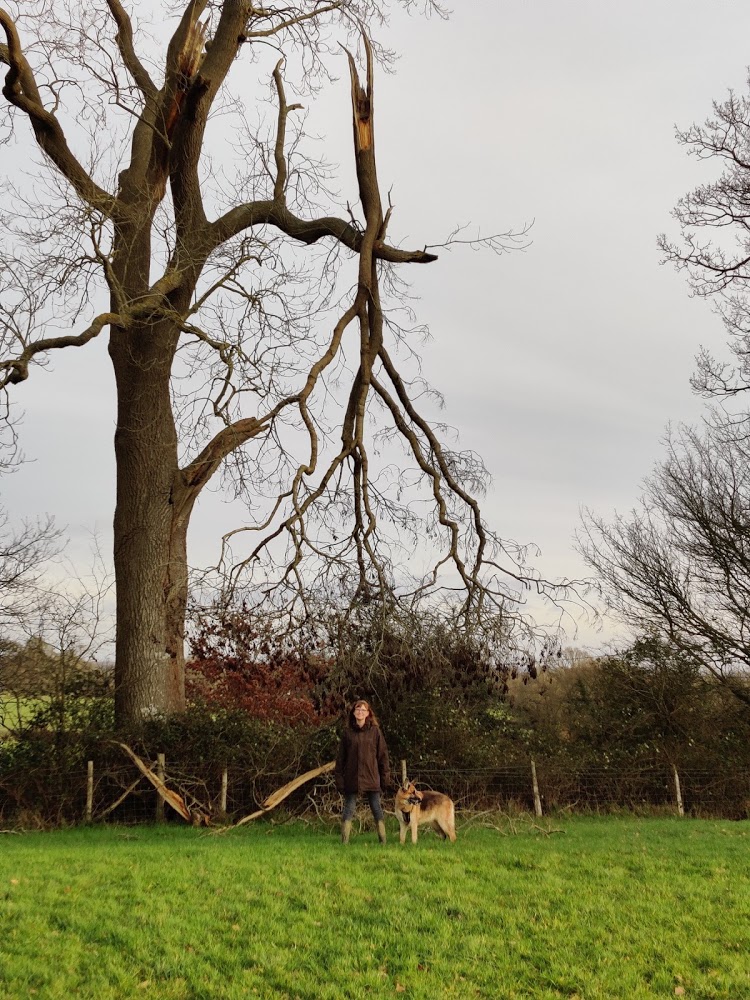
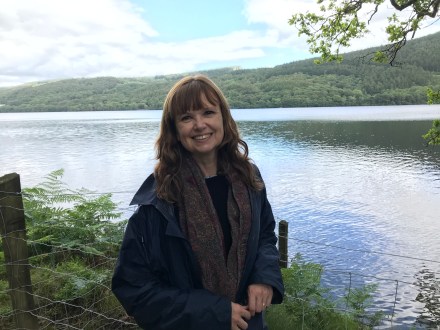
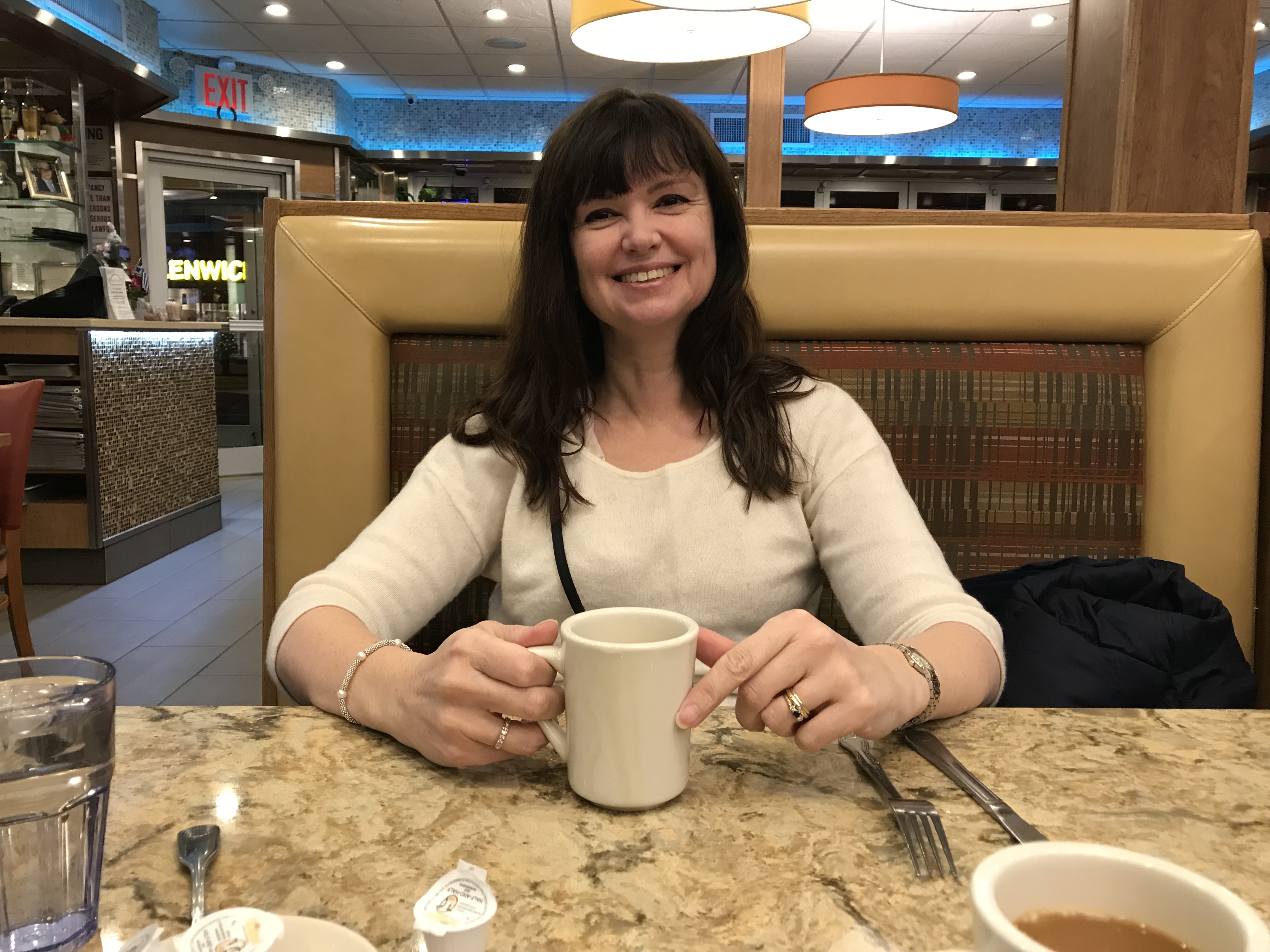
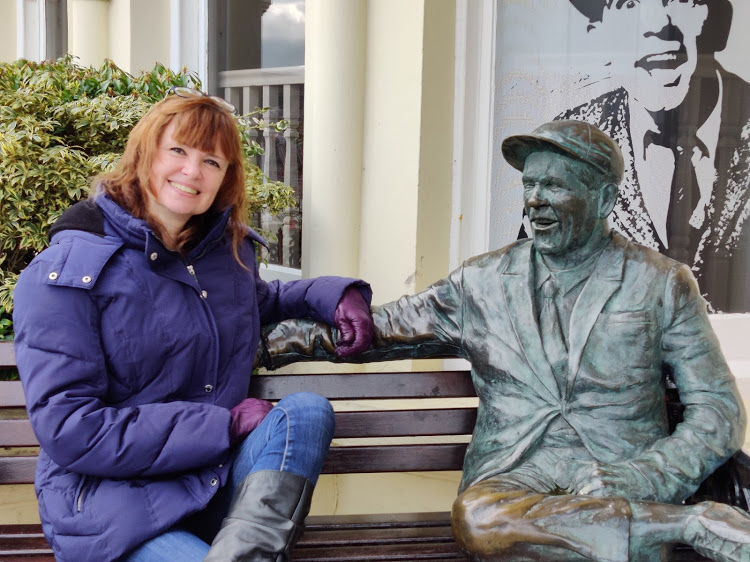
Wondering if Husband is getting fed up with only being able to talk to me during lockdown. He certainly chooses some weird places for me to pose for photos…
Anne E. Thompson
Thank you for reading anneethompson.com Why not sign up to follow my blog?

*****

Coniston Water

Happy 2021.


I think I might be slightly autistic—which I believe is a sign that I’m not—but I do have vast understanding for people who don’t like change. I don’t mind some change, but I struggle with mess, and ‘Christmas and visitors’ does result in a lot of mess, doesn’t it? The Christmas tree is beautiful, but after a while you stop being able to ignore the pine needles on the floor, and the cardboard box stuffed behind the sofa, and the chair that’s dumped on the landing because there’s no space for both it and a guest in the guestroom, and the gifts that never made it beyond the kitchen table, and the cards that drop glitter on the hall table, and so on. Therefore, as I write this, a few days after New Year’s Day, I am in my happy place. All the upheaval has finished, and although I delight in my family and love spending time with them, there is something wonderfully satisfying about putting everything back into place.

Tomorrow, the college semester recommences, and my schedule returns to the pattern of lectures and learning, intermingled with raising animals and cleaning the house, and secretly—just between you and me—I am really looking forward to it. I have an exam at the end of January, and I am even weirdly looking forward to that. I like structure and routine. Maybe it’s an age thing.

How did you find the weird story that I told you last week? I was messaged with various suggestions as to where it came from, some people thought it was a Chinese fable, others from Japan, some from the book of Genesis. It actually came from the book of Judges. I think it was about people being satisfied with the job they have been given, and that we should be wary of those who want to have power. But I’m not entirely sure. There is a lot in those Old Testament books that are weird and confusing and don’t have an obvious meaning.

I read another story this week (another one that my Sunday School teachers forgot to mention!) You might recognise the beginning: A man is travelling and stops overnight in a foreign city. A man of the city says he shouldn’t sleep in the town square because it’s not safe, and he welcomes him into his home. During the night, the men of the town bang on the door, demanding the visitor should come outside so they can gang-rape him. The owner of the house refuses, saying that they will send outside the women instead. (You might be thinking this is the story of Sodom, because it’s similar, but you would be wrong!)

The end is rather gruesome. They put the women outside, and they are abused all night and when the visitor opens the door in the morning, there is his wife, dead on the doorstep. So (brace yourself, this is horrible) he chops her into pieces and sends bits of her to all the tribes of Israel. They are astounded by this, they meet, they destroy the evil city.

It is a very similar story to the one about Sodom, though I have never heard it linked to the debate around whether homosexuality is wrong (which the Sodom story often is). Perhaps it’s because the women were also abused, and no one wants to suggest that it shows being heterosexual is wrong!

I have no idea why this story is in the Bible, or what we should learn about it. Some parts of the Bible are like that, if you read beyond what you were taught as a child, some bits are simply weird. Sometimes we have to accept that we don’t understand them. Personally, I wish that more people would admit that they don’t understand things; I think that being too certain that our theology or politics or lifestyle is right can be dangerous. It closes our ears to things that might teach us something. Not having everything in a neat tidy package—whether it’s our home or our theology—is probably good for us.

Hope you have a good week.

Take care.

Love, Anne x

Anne E. Thompson
Thank you for reading anneethompson.com Why not sign up to follow my blog?
Look on your device for this icon (it’s probably right at the bottom of the screen if you scroll down). Follow the link to follow my blog!

A Story of Trees


It’s nearly 2021—will you be making a new year’s resolution? Is there something that you would like to change about yourself, and how will you plan for a new improved self? I guess we all have dreams and aspirations, and some of them we pursue until we reach them, and others dwindle away into nothing. To be honest, I’m quite glad that some of my dreams evaporated into nothing—especially the ones I had as a teenager—otherwise I’d be in a right mess now!

The trouble with looking ahead and wishing for things that we don’t have, is that sometimes we stop appreciating what we have right now. Maybe, instead of planning to improve things we should sometimes stop and look around at what we already have, and be grateful.

I recently found a story, which sort of links with this idea. I have never noticed it before—add a comment if you recognise where it came from. Or simply sit back with some of your Christmas chocolate, and enjoy a story. . .

Once upon a time the trees got together to choose a king for themselves. They said to the olive tree, “Be our king.”

The olive tree answered, “In order to govern you, I would have to stop producing my oil, which is used to honour gods and human beings.”

Then the trees said to the fig tree, “You come and be our king.”

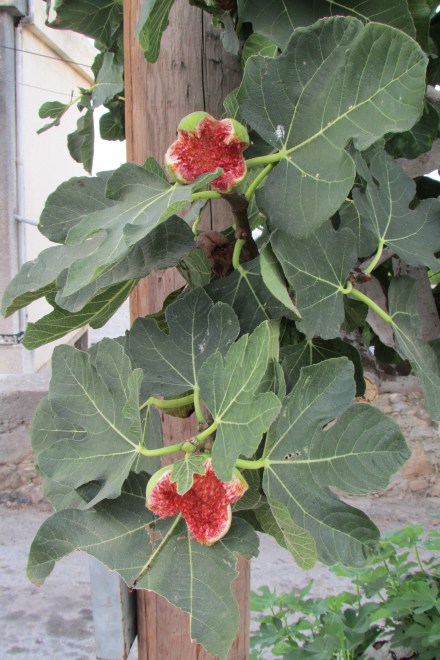
But the fig tree answered, “In order to govern you, I would have to stop producing my good sweet fruit.”

So the trees then said to the grapevine, “You come and be our king.”

But the vine answered, “In order to govern you, I would have to stop producing my wine, and that makes gods and humans happy.”

So then all the trees said to the thorn bush, “You come and be our king.”

The thorn bush answered, “If you really want to make me your king, then come and take shelter in my shade. If you don’t, fire will blaze out of my thorny branches and burn up the cedars of Lebanon.”


Bit of a bizarre story, but I rather like bizarre. Not sure why I have never noticed it before—do you know where it came from?

If you make a resolution for the new year, choose carefully.

Thanks for reading. Take care.

Love, Anne x

Another Week in 2020


Hello, and how has your week been? It was my birthday, so we tried to celebrate whilst also keeping to the current covid restrictions. Last weekend I met some of my children for a socially-distanced walk, and then we shared slices of cake in a carpark. It was lovely, but not as comfortable as sitting on sofas in a lounge.

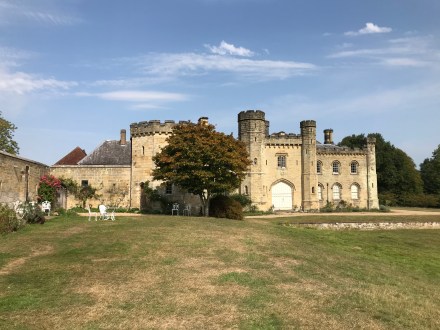
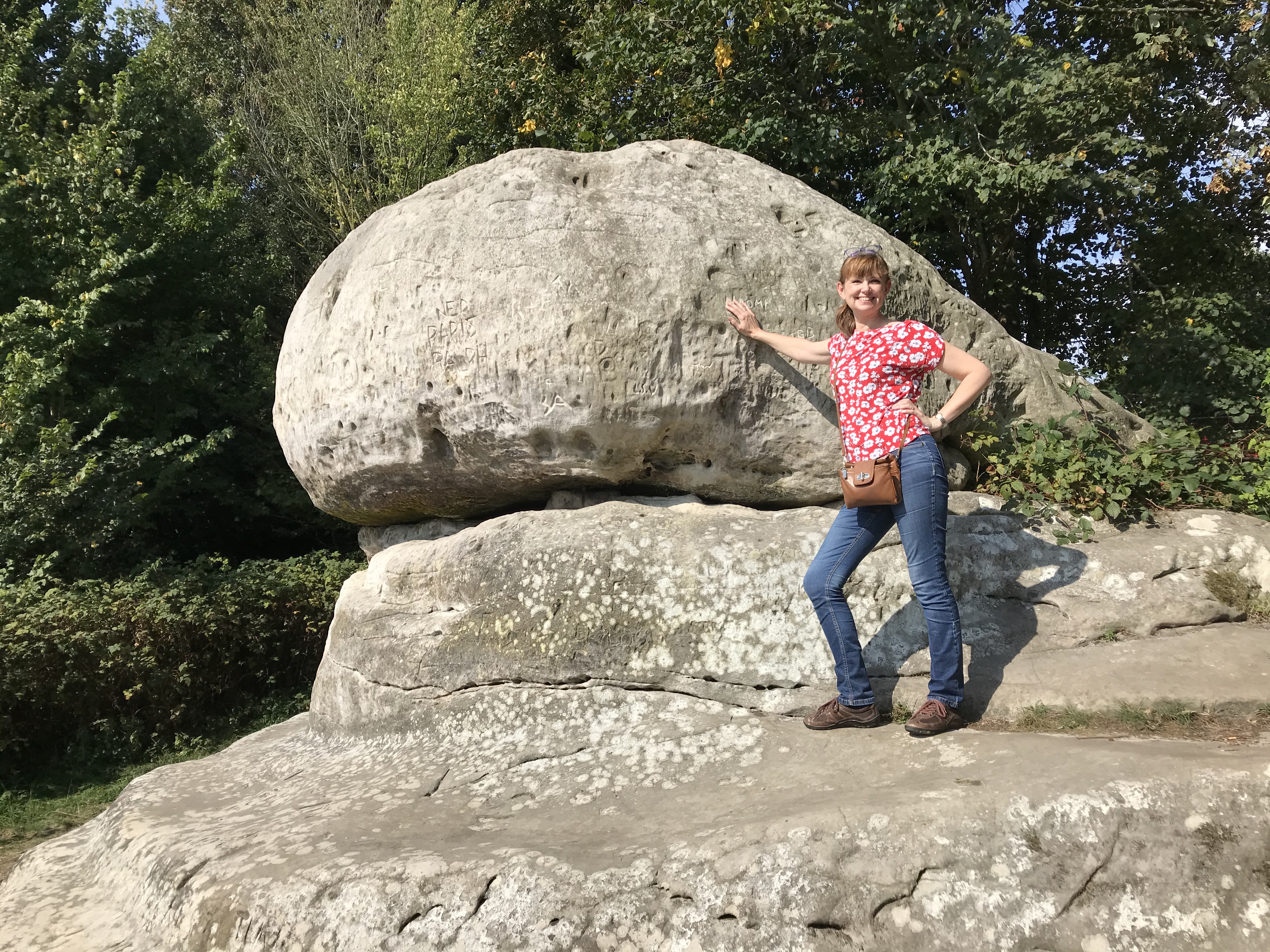
On my actual birthday I was treated to breakfast a’ la husband, which was smoked salmon on muffins with poached eggs and hollandaise sauce, grapefruit halves, and chocolate money in gold wrappers scattered across the table. I felt very spoilt. In the afternoon I took my mum to Chiddingstone Castle, and we walked to the Chidding Stone (and got lost and ended up walking through a field of cabbages!) Then we ate the remains of the carpark cake before I went home.

the ancient Chidding Stone
Chidding Stone

We spent the evening having a family quiz on zoom, where we each had prepared 10 questions. It was very funny, especially the round where we were presented with extracts from our family chat and we had to guess who had written them.

Have you put up your Christmas decorations yet? I noticed lots of houses were decorated in November, which helped to brighten the weird winter we’re having. I suggested we could do the same. We didn’t. Instead we bought our tree today, after a trip to the dentist. I hate going to the dentist, don’t you? Of course it was even worse this time with all the fussing about with hand-sanitiser and masks and not being allowed into the waiting room but freezing outside until the nurse came to fetch us. Actually being a dentist must be even worse — staring into all those germy mouths and wondering if covid is going sneak past your visor and make you ill for Christmas. Not a job I would relish.

Husband kindly drove me to the dentist, but this meant that he was also involved in the tree-buying decision. Needless to say, we now have a tree that is much too big for the space and we will spend Christmas peering at each other through the branches. But the house smells nice.

As if covid isn’t bad enough, I now have to avoid bird flu as well. Apparently there is another outbreak this year, and we all have to keep our poultry inside until it clears (it’s carried by wild birds, and keeping the chickens in their coop is the only way to avoid contact). They are all very grumpy, and try to push their way past me when I open the door to feed them. I’m sure they produce extra levels of poop when they’re locked inside in retaliation.

My Greek lessons continue to be fun and challenging in equal measure. I recognise more and more words in my Greek New Testament, though am still at the stage of saying: “I’ve learnt that word…but I don’t remember what it means.” Not yet very useful, but I am getting better. I have an exam in January, which is terrifying because December is plenty of time to forget absolutely everything learnt so far.

Another morning in my week is taken up with a Bible Study group that I belong to: BSF. It’s all online now, but mostly I like it because I am studying the Bible with a group of women who all live in my town. We do differ in our opinions, as some people tend to take the Bible very literally, and others place it very much in the context of the time it was written and then look to see how it applies today. This week we looked at the destruction of Sodom (lots to disagree about in that particular story!) However, something struck me for the first time.

In one of the daily questions, it asked why Lot didn’t want to leave Sodom. (A quick reminder: Sodom was a city of evil people who did things like gang-rape visitors, they ignored the poor and lived self-indulgent immoral lives, and God said he was going to destroy the city. But when Lot — a man who followed God — was told to leave, he didn’t want to.) Why would Lot not want to leave when he knew there was so much evil in the city? And then I thought, it’s like Christians today who don’t want to die. We know the world has evil things, horrible, unfair things happening. And we know that God has prepared a better place for us, that he will take us safely there when it is time for us to go. And yet when we think about dying, about leaving what we know –even though it’s not perfect — we’re not so sure that we want to go! We don’t want to walk into the unknown, even when we know that God can be trusted. We are a bit like Lot.

Reading the Bible

You can mull over that idea during the week — it will help to distract you from all the political debates if nothing else!

Hope you have a good week. Thanks for reading.

Take care.
Love, Anne x

In an attempt to keep warm during my morning run, I have started to wear my son’s old school rugby shirt and a bobble hat my daughter gave me. Husband informed me that I looked like a ‘Where’s Wally?’ cartoon which seemed harsh. But perhaps he has a point. . .

Keeping warm on my run, but looking a little like ‘Where’s Wally?’

How to Fail


Do You Know How to Fail?

Fear of Failure Can Prevent Us Succeeding

When I was teaching primary children, I noticed that most mothers were very good at teaching their children how to succeed. If, for example, Jimmy won a race at sport’s day, his mummy would smile and clap and tell him: “Well done! You were brilliant!” If Jimmy went on to do a victory dance in front of his class and make a ‘loser’ sign to the child who came last, his mummy would tell him no, that’s not the right way to behave, you mustn’t be a big-head.

I watched children being praised and taught not to be conceited when they passed exams, starred in performances, and painted wonderful pictures. Parents seemed to do a pretty good job of teaching their children how to succeed.

But what about when they failed? What about when Polly came last in the race? Or failed her piano exam? Or wasn’t given a part in the school play? Or painted really awful pictures? How did parents react then, and were the children taught how to fail well? Mostly not. Mostly, the parents made excuses as to why it wasn’t Polly’s fault, or why the system was unfair—or else they lied, and said that Polly was the best anyway, and that her grey/green splodged picture was beautiful.

Do you think it matters? I personally think that it’s a big problem, both for individuals and for society. For most of us, failing at things is a big part of life, and we are more likely to fail than succeed and if we know how to fail, then it doesn’t knock us on our backs, we simply accept that we have failed and carry on.

I am very aware of this as I start to learn Greek as a mature (very mature!) student. I might fail. It’s a long time since I took an exam or tried to learn a new skill, and I might not succeed. But knowing that I might fail shouldn’t stop me trying. If I fail, it will be because I am not intelligent enough. Sometimes, we are not clever enough—this is an excellent thing to learn.

Our society likes to make excuses. It seems to be an innate part of being human. Way back at the beginning of time in the book of Genesis, we read about people failing and making excuses. Whether you think Genesis is a book to take literally, and Adam was a man who physically existed, or whether you think it’s a story to show us why relationships exist as they do, the first story is very clear. Adam messed up (he ate a forbidden fruit) and when challenged he made an excuse: “The woman YOU gave me made me do it.” It wasn’t his fault. Except, it was.

If we always make excuses—the teacher was rubbish, I didn’t have time to study, I couldn’t afford the right textbooks—then things are never our fault. And when we blame others, we start to feel resentment. I think this causes all sorts of problems for society. If the bus drivers, shop assistants, manual workers all think that they are as intelligent and capable as people with more interesting jobs, then they will resent those people, and feel angry at the pay discrepancies. If people have not learnt to fail, they will avoid competition in case they don’t win. They will feel defeated when they don’t get the job or promotion they feel they deserve. They will feel angry with the world for the things they don’t achieve.

Fear of failure also makes people stop trying. They won’t sing the song they composed, they won’t audition for the fashion show, they won’t try for the promotion at work because they might fail.

I am not talking about whether society is fair. I realise that in some cases, people have underachieved due to an unfair system, but not always. Sometimes people fail at school because they don’t do their homework, or because they are not very clever. Sometimes people come last in all the races at sport’s day because they never practise, or they eat unhealthily, or they are simply born with an uncoordinated body that is rubbish at all sports. People fail music exams because they don’t practise or they have no talent.

I believe these problems start in childhood. Some parents at one school I worked in suggested that we shouldn’t have ‘winners’ at sport’s day, and everyone should receive a rosette. How does that help to prepare a person for not always winning? Some parents will buy all children a gift on a sibling’s birthday, because they don’t want the younger brother to feel left out. They always let their children win at games. Everything the child produces is praised. When the child messes up, they make excuses on their behalf. The child is not being taught how to fail. They are being taught that failing is wrong.

Parents, when you play games with your child, don’t let them win. You can play badly, so they enjoy the game, but don’t always let them win—that is not what will happen in real life and it’s sort of lying. (My own mother absolutely believed this, and would always completely annihilate us when we played cards with her!) Acknowledge that your child is not very good at sports/art/music/maths or whatever. Encourage them to still try, but let them know that not being the best is okay. If they fail at something because they didn’t study, or practise, or try, then be honest about that. Let them get used to knowing that yes, they failed the spelling test, and yes, it was their fault because they played on the computer instead of learning the words—but you love them anyway. Teach your children to say sorry. When we are adults, we will sometimes drive badly and bump a wall, or be tired and snap at someone rudely, or forget someone’s birthday. We should accept the fault and say that we are sorry. It is so much easier to accept and forgive another person’s mistakes if they acknowledge the fault and apologise, rather than making excuses.

Accepting that we fail does not stop us trying to achieve, but perhaps it helps us to aim more realistically. I have trouble learning unrelated facts and symbols. I also find abstract concepts difficult to understand and manipulate. Hence, I will never be a great physicist. There’s nothing wrong with that, it is partly the way I was made, and partly because I was lazy at school and never bothered to learn the fundamentals. You too will have things that you can’t do—and that too is possibly partly your own fault and partly not. I think we are much healthier and happier when we accept our failures, try to learn from the experience and move on, rather than perpetually making excuses and self-justifying.

This week, I challenge you to acknowledge your failures—and think about how you could possibly correct them in the future. And if you have children, please teach them how to fail well. It might make them better, happier, adults.

Thanks for reading—and do share your own views in the comments below.

Love, Anne x

Anne E. Thompson

Thank you for reading
anneethompson.com
Why not sign up to follow my blog?

Look on your device for this icon (it’s probably right at the bottom of the screen if you scroll down). Follow the link to follow my blog!

*****

Ironically, I have just ‘failed’ when posting this blog! I always write blogs ahead of time, and this was meant to be posted mid-October. But I forgot to change the date before completion, and so it went to all my followers today. Which must feel like spam as they have already received one blog from me today! Apologies.

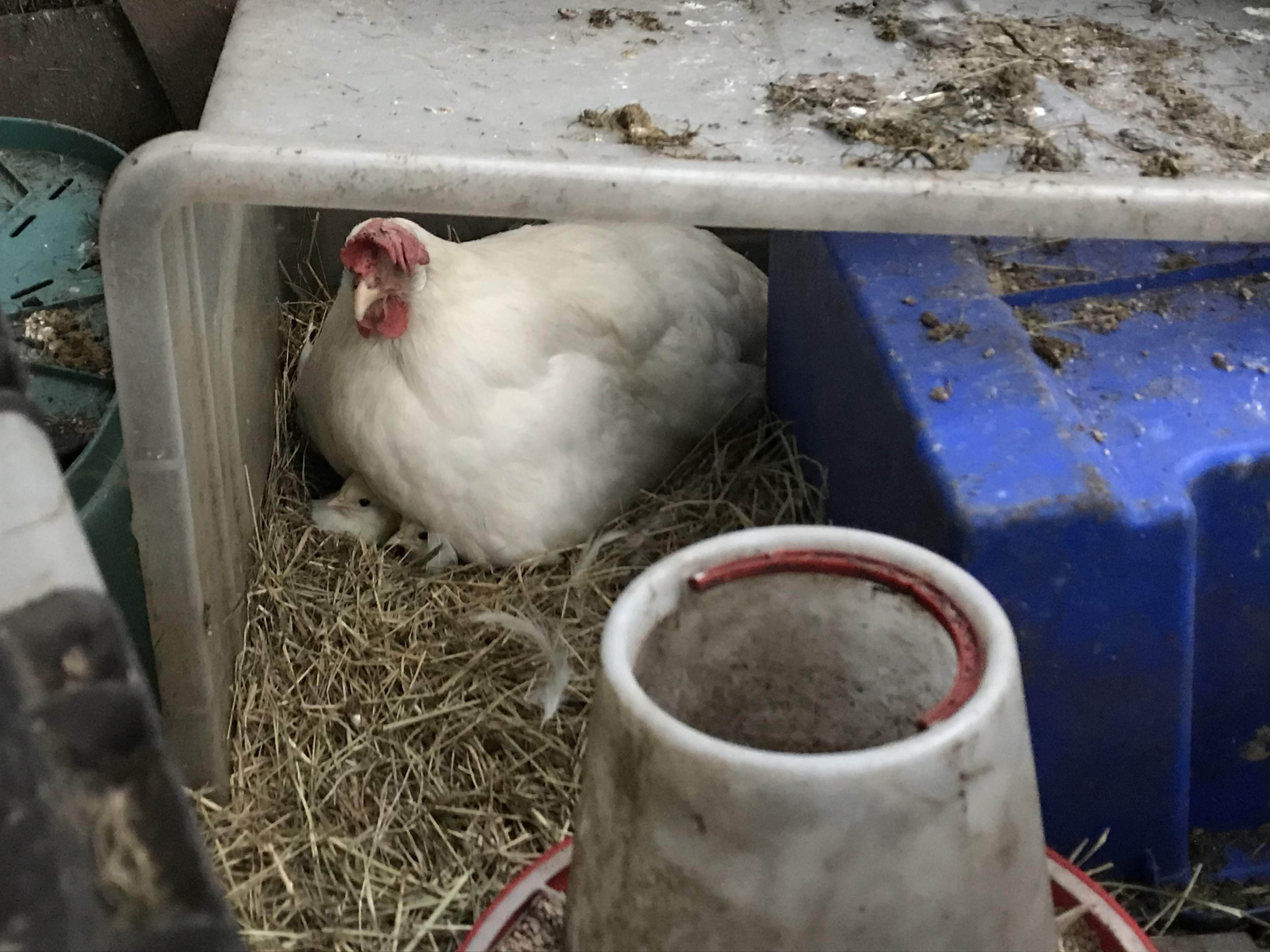
cockerel and hen

A Confused Cockerel and other complaints. . .


He Fancied His Mother, So We Named Him Pharaoh

cockerel and hen

Hello, how are you getting on with this very strange year of 2020? I keep thinking I am used to it—I  have come to terms with the fact that every book-signing and fair has been cancelled this year and I really am not going to be selling many books—and then something else is cancelled, and all the frustration returns. I am obviously not alone, because our town is planning to have an ‘open day’ on 3rd October. It was planned through our town Facebook group (usually the place for people to rant about potholes and inconsiderate parking). Lots of people make crafts, or are artists, and we are all discouraged by the lack of places to sell our work. So, on the 3rd October, we are all going to place stalls at the end of our gardens, and people can walk or drive around town, looking at what’s on offer. To be honest, I doubt if I will actually sell any books, but it’s rather nice to have something in the diary, isn’t it?

Of course, all my animals are completely unperturbed by Covid-19. The ducklings are now on the pond, and—wonders!—they are all female. (You might remember that last spring, all my females flew away in the search of mates, and I was left with a pond full of obviously unattractive drakes.)

The chicks I hatched are a cross between the white Leghorn chickens and my grey Legbar. I am really hoping that the females will lay blue eggs, but they are still too little to lay at the moment. The Legbar cockerels are no more, as they started to get vicious. I only have one full-grown cockerel at the moment, and he is very beautiful but rather sad, as his mate died last week. He keeps running to all the places she used to go and calling for her—so my garden is very noisy at the moment. The relationship was a confused one, as she was also his mother, so I named him Pharaoh, because marrying siblings and fathering children with daughters seems to have been quite a thing in ancient Egypt. I was very confused when I was studying the lineage of the Pharaohs, as there are so many weird couplings—they have a very narrow family tree—it’s probably just as well many of them were sterile and the line died out.

We went to the beach last week. I was feeling depressed with life, so Husband rearranged his schedule, and we zoomed off to Camber with the dog. Kia loved it, and it ‘did my soul good’ as my granny would say, to see her running through the waves. When she had her twisted stomach at the start of the year (really—what an awful year this has been!) my fear was that after such a big operation, she would never enjoy life again. But I can report, that whilst she is beginning to feel her 13 years, Kia is still tremendously excited by sea and sand and seagulls.

On the way home, we had lunch in a pub (The King’s Head in Playdon). There was hand-santiser strategically placed, and the staff wore masks, and the tables were well spaced, and every customer had to leave their contact details. It all felt very safe, and encouraged me to think that eating out doesn’t have to be risky.

But then we went to Ashdown Park Hotel for lunch on Sunday, and that was entirely different! The staff did nothing at all to guard against Covid. They didn’t wear masks, we were given the same menu folders as other tables, they placed the food and drink directly on the table, and I wasn’t aware of any extra wiping or washing or screening at all. Such a shame, especially when they must be struggling to cover their costs and need customers to return. It was a lovely venue, but annoying they aren’t doing more to stop another peak.

My fears for society are reflected in the vocabulary in Mandarin I am learning so that I can chat with my friends:

Jingji weiji shi hen dou gongsi daobi, ye shi hen dou ren shiqu le gongzuo.

经济危机使很多公司倒闭,也使很多人失去了工作。

Which reminds me to tell you: I have decided to study ancient Greek and Hebrew. I often feel frustrated when I discover that something I thought I understood in the Bible has a completely different meaning when you look at the original language it was written in. I realise that if I don’t start to study the things I want to study now, then suddenly I will wake up and I’ll be too old. I have signed up for a course that begins at the end of September, and I am very excited about it. I shall tell you all about it when I start.

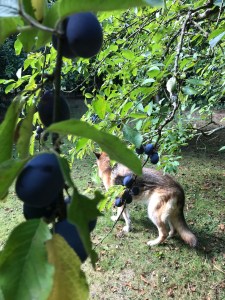
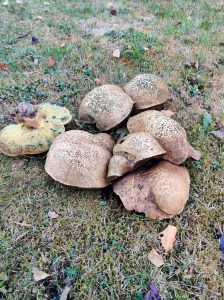
On another brighter note, the plum trees have loved the weather this year and my freezer is now full of plum crumble. When I walk, the hedgerows are teeming with blackberries and fat acorns are dropping from the trees. weird fungus There are also a whole new lot of weird fungus growing on my lawn. We might have had a rubbish year so far, but nature remains beautifully abundant.

I hope you have a positive week. Thank you for reading.

Love, Anne x

Anne E. Thompson

Thank you for reading
anneethompson.com
Why not sign up to follow my blog?

Look on your device for this icon (it’s probably right at the bottom of the screen if you scroll down). Follow the link to follow my blog!

*****

Getting Started


Getting Started

You can follow my blog at:
anneethompson.com

Do you ever feel you spend the whole day ‘not getting started’? I suspect this is especially true for writers, but probably affects everyone. I mean that whole, being busy but not quite managing to do what I intended to do sort of day, when time slips past like an oily jelly, and suddenly it’s lunch time and I still haven’t started what I intended to do.

It’s not that I haven’t done anything, more that I have not accomplished what I planned to do. Like, when you want a cup of coffee, but first you have to wash-up a mug—the washing-up bit was not your purpose, it is merely one of those have-to-do jobs that appear before the main event. I seem to have a lot of those. . .

Take today, as the perfect example. Today, I plan to write. I am two-thirds of the way through the first draft of my new novel, and I’m loving it, and the characters are completely real people inside my head, and I am excited by where the plot is going inside my head, and over the weekend it occurred to me exactly how the book should end. All inside my head. Therefore, this morning, I am raring to get writing, and put those ideas into words. Today I plan to write. But. . .

I cannot really function without my morning coffee and Bible time, so after cleaning my teeth, I go downstairs and put on the kettle. A chick hatched overnight, so I go and check it is managing to drink (touch and go whether this one will survive). I refill the dog and cat’s water and food, make my coffee, read my Bible. Then it’s time to go for a run (not far, a 20 minute yomp to the end of the road: has to be done first-thing otherwise my exercise for the day is non-existent). Husband wants to come, so I agree to wait for him and fill the time sorting out my mother’s shopping for the week with Ocado. Husband appears, we run.

Return to house breathless and very sweaty. While Husband showers, I give feeble chick more water. Then I go to the pond to check chicks outside have water and food and aren’t stuck anywhere. Mother hen is very ferocious, and tries to attack me as I change water and top up food and attempt to grab some of the dirty hay and replace it with clean bedding. I check on Matilda. Matilda is a pheasant I found on a dog-walk, clearly dying as she had been hit (I assume) by a car, and lying on an oft-walked route, so likely to be mauled by the next passing dog/fox—not a nice way to die; so I carried her home and put her in a duck hutch to die peacefully. Except she didn’t die, so I now have a one-legged pheasant living in a hutch. (I have received a lot of family feedback about this.) Matilda is fine. Change her water, and top up the duck food.

Am about to shower, when I realise I haven’t ‘fed’ my sourdough starter today. I make a loaf every Tuesday, and it needs 24 hours to ferment, so I weigh the flour and stir it into the gloop, ready for tomorrow.
Grab a few dirty clothes and shove them into the washing machine, and give feeble chick another few sips of water.

Finally make it into shower, last hurdle before I do what I planned to do, and write more of my book. Except. . . while in the shower, it occurs to me that this would make a reasonably interesting blog, and if I quickly write this first, it leaves the rest of the week beautifully clear for wring my book.

At last, I have finished, and I hope that today, you manage to achieve what you planned to achieve, with no distractions. Now, if you will please excuse me, I have a book to write. . .

Thank you for reading.
You can follow my blog at:
anneethompson.com

A Matter of Life and Death


I don’t know about you, but I am always surprised by how much life bursts forth in the spring. Suddenly, every weed in my garden is ten-foot-high, the chickens start hiding their eggs and going broody, wild birds start to go bananas. It is mostly wonderful.

There are a few downsides though—like the bag of potatoes I found at the bottom of the larder, with roots practically piercing the bag. Maybe not so good for mash. I had the clever idea of planting them, so the chickens could eat the new leaves when they sprouted (wouldn’t take long!) I took them up the garden, and found an area against the chicken coop fence. Ideal, I thought, I’ll chuck them there, toss a bit of compost over them, they can grow through the fence and the chickens can eat the leaves. All good.

About 3 days later, the potatoes appeared in a bucket next to the door.

“Look what I found!” announced pleased husband, beaming all over his face. “These must be the seed potatoes you planted last year, and they’ve grown new tubers.”

I told them I thought they were possibly some old potatoes that I’d found in the larder (I didn’t go into too much detail), but he assured me that the roots were really long, and there was no way they could possibly be from this year. I checked the area next to the chicken coop. No potatoes or heap of compost. I keep trying to avoid the subject, but husband has mentioned it about 50 times since then, saying how amazing it is. Might have to confess.

The welcoming committee. . .

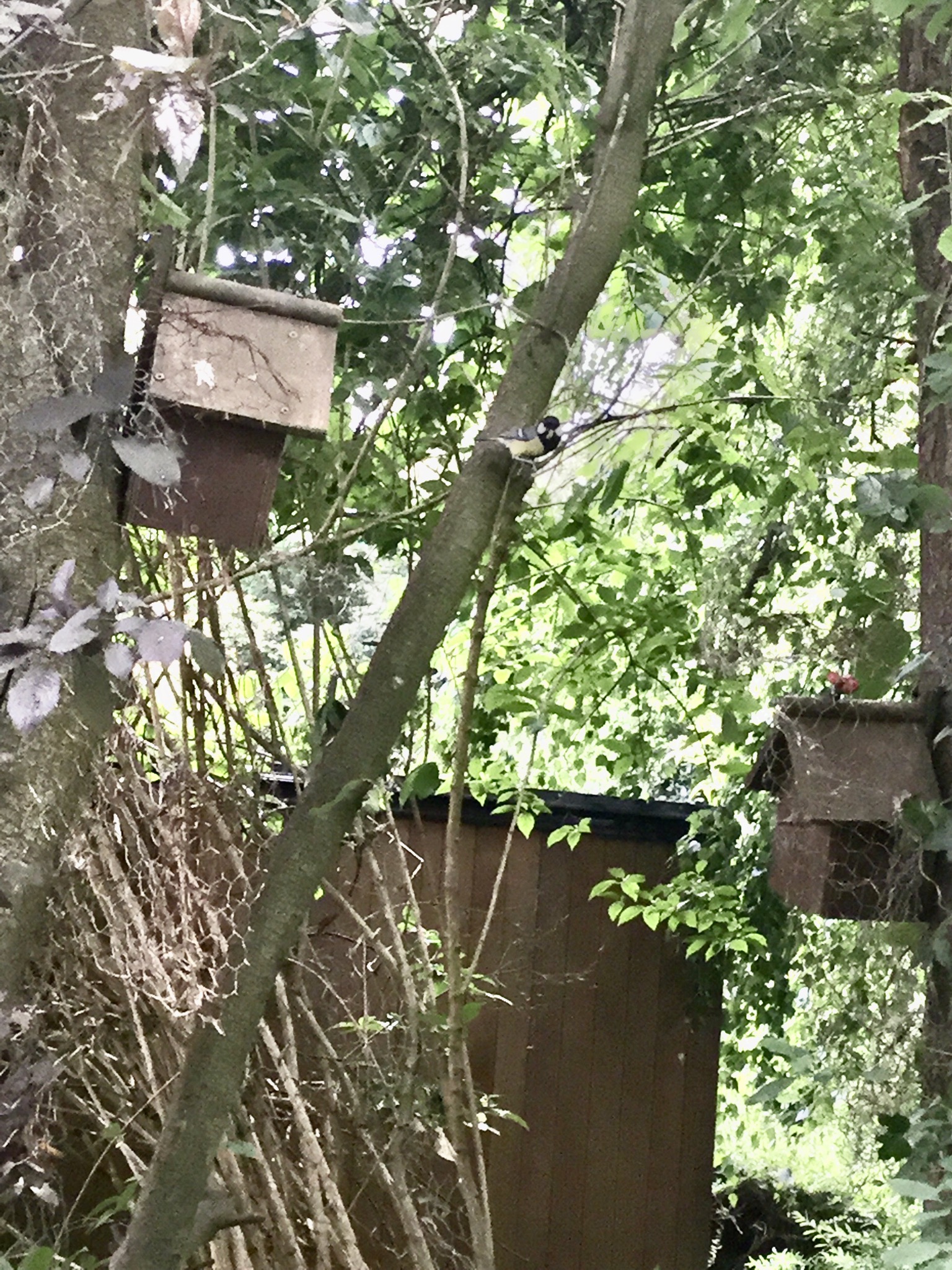
We also had birds in the nesting boxes that Uncle Frank made. He gave them to me ages ago, and I put them near the kitchen window (good plan) so I would see if any birds took an interest. We had some great tits in the area, and I guessed the eggs must have hatched when I noticed a welcoming committee of four cats staring at the nesting box. I started to shut the cats in during the day, letting them out at night. But then one morning, I came down to find one cat up the tree, and by the time I had run outside, he had fished a baby out of the box and was playing with it. I grabbed the baby, shoved it back into the box, and shut the cat inside. Husband then assembled some protective obstacles around the base of the trees. The view from my kitchen window resembled a cross between Guantanamo Bay and a WW1 trench. Not quite what I’d hoped, but at least the birds were safe.

A little like a ‘Where’s Wally?’ wildlife picture, but this is one of the birds.

We watched the parents feed the birds, and I did some online research. Did you know that great tits have a black stripe down the centre of their breast, and that the male has a wider stripe than the female? The width is directly proportional to how many sperm he produces, so female great tits will try to select a mate with a very wide black stripe. Our male was in the ‘acceptable but not a super-stud’ range. Cool fact huh?

We guessed the hatchlings were flying because several blue jays appeared in the garden. Am hoping they didn’t catch them all—maybe the blue jay family had a banquet that day. The next morning, the nesting box was empty except for moss and feathers.

In keeping with the explosion of life that is spring, I have some duck eggs incubating in the utility room, and my beautiful white leghorn chicken is sitting on some eggs in her nest. She has a choice of leghorn (white) cockerel or legbar (grey) cockerel to choose from. I am hoping to have a female chick from the legbar male, as they lay lovely blue eggs (though whether or not a hybrid will, remains to be seen). They are due to hatch next week, so I will let you know how they fare.

I also have a female pheasant (I can’t tell you how delighted Husband is about this!) I found her in a ditch, so am guessing she had been hit by a car. I knew the fox would get her, and I figured it would be nicer to die somewhere peaceful, so I carried her home and put her in an empty duck coop next to the pond. But she didn’t die. I’ve had her a couple of weeks now. I’m feeding her grain and apples (have to smuggle the apples out of the house because technically they belong to Bea’s boyfriend). She can’t actually walk (the pheasant, not Bea) but seems quite happy lolloping around the coop and watching the ducks. There is a ramp down to the pond, and I do have some worries that she might drown herself (pheasants are very silly birds) which means Husband will have to wade out and retrieve the body—which he will mutter about for several days—but at least it will stop him talking about the blessed potatoes!

I hope your week is full of life.

Take care, and stay safe.

Love, Anne x

Thank you for reading
anneethompson.com
Why not sign up to follow my blog?

Another chapter from Counting Stars will be posted on Wednesday.

I have become a 1950s wife, but without the pointy bra. . .


Hello, and how has your week been? I have to admit, I’m feeling a bit ‘down’ now—this whole lockdown experience has moved from weird to depressing. For me, I hit a real low point when Boris Johnson was admitted to Intensive Care. Now, I have a few differences of opinion with Boris (such as whether it’s okay to lie to people) but I didn’t like the idea that our Prime Minister was now fighting for his life. It was very destabilising. I was sent various ‘calls to prayer’ on social media (I get sent lots of Christian messages and videos on social media—some are excellent, many are not). It was a reminder that we should all be praying for our leaders, whatever our political view.

Some things about lockdown are good—I have rediscovered my breadmaker, and am churning out cinnamon buns and focaccia breads as fast as my family can eat them. I find baking to be therapeutic, if not especially good for my cholesterol levels.

Our conversation has become rather predictable though. Someone will start talking about Covid-19, we will discuss the information for about 5 hours, and then someone (often the person who raised the subject) will say: ‘But we’re talking about Coronavirus again, change the subject!’ We also regularly comment on how quickly the dishwasher refills, how much bread/milk/tea has been consumed, how all the mugs are dirty again. We discuss (though don’t necessarily do) possible types of exercise, plans for the garden, general tidying activities. Mealtimes have become important, and have become the focal point of the day; there is something comforting about familiar food when the rest of the world seems to be off-kilter.

I find I am lonely. Although the house is full, everyone is busy working, doing important conference calls and ‘Zoom’ meetings, and I am left with a lot of dirty dishes and a vacuum cleaner. I have become a 1950s wife but without the pointy bra and lipstick smile, and at low points in the day it upsets me, and I wonder what the point of my life is. This isn’t something I can post on social media, where everything is jolly and jokey (as it should be) but I thought I would share the truth with you, in case you sometimes feel the same. If you are unsettled by the news, and find that you’re not sleeping as well as you used to, and worry about the unpredictability of the world, then take comfort in the knowledge that you’re not alone. There are lots of trite solutions flying round the internet at the moment, but actually, if we are real with each other, ‘now’ is not a great time, and there is lots to worry about.

I am also fed up about my writing (if I am going to have a truthful moan, I might as well share it all!) For an author to be motivated to write, they need to know that someone is going to read their work, which for a novelist means selling books. This is not something that any author I know enjoys, but it is necessary. If no one reads our work, there is no point writing it. I found the best way for me to sell books is at book-signings in bookshops, and stalls at craft fairs. Obviously, these avenues have closed for now. I had booked stalls at several fairs (at a cost of between £40 and £60 per session—which is quite a lot of books to sell just to break even). Each day, I dread opening my emails, reading that yet another event has been cancelled, another opportunity to sell books won’t happen. Although my books are also available from Amazon, I find it difficult to promote them, and I sell very few to new customers. All very depressing, and it all gets tangled up with worries about the economy, and what will happen if people start to lose their jobs, plus the health risks of the virus, and at 2am it whizzes round my brain in a sort of never-ending loop of negativity.

And so, each morning I force myself to run down the lane (which brings me quite close to actual physical death, and so takes my mind off the depressing virtual death I worry about). I then have a decent cup of coffee, eat some cake, read my Bible, and tell God about my worries, before going and baking something delicious. It sort of works—I’m still here.

I hope that you are finding ways to cope with life as we find it.
Take care this week.
Love, Anne x

PS.

Now, after I had written the above, I began to worry, as I often do after writing blogs, that someone might misunderstand what I am trying to say. I remembered something I have seen online recently, where Ellen (famous American person) described feeling as if she was in prison due to lockdown, and instantly, lots of people sent complaining messages (or ‘tweets’ as I believe it was on Twitter) saying that it was appalling that she used that analogy, as she lived in a massive house with great views and a swimming pool. And I began to worry, maybe someone would point out that I am lucky enough to have a garden, and how can I complain, when some people are stuck inside a flat?

But here’s the thing. Yes, Ellen lives in a mansion—but for her, lockdown made her feel like a prisoner. It’s fashionable at the moment to say: “it’s okay to not be okay.” But then, with the next breath, we are outraged at someone who admits they are ‘not okay’ because there are people worse off than them, and they jolly well should be okay! Well, it doesn’t work like that. Ellen might live in a better house than me (though actually, I don’t think she has cockerels roaming her garden, so maybe she doesn’t…) but she still felt shut-in. I live in a nice house with a garden, but it’s still depressing. You may tell me that someone in a flat is worse off than me, and yes, they are, but I can still be fed-up. The person with the flat is better-off than some of the slum-dwellers I visited in India, but that doesn’t make their situation any easier.

There is something in people that likes to point out when others are worse off, to suggest that admitting we find life tough is not, actually, okay. I don’t think there is a limit to this. When I had a brain tumour (and accompanying 5-year migraine) I was often reminded that people with cancerous tumours were the ones who ‘really’ had a right to worry. And yes, they had it tougher than me, but other people had it tougher than them, and if we are going to continually tell people that ‘someone else has a tougher life’ then we are going to continue the cycle where we cannot admit we are not happy, we do not look ‘Instagram Ready,’ we are not all hunky-dory. And so, I would like to state that I know I have loads to be thankful for, I have many ‘blessings’ to count. But today, I am fed-up, and if you are too, that really is okay.

Thanks for reading.
Why not sign up to follow my blog?
anneethompson.com

When I tell people I’m feeling low, they often send photos of sunshine or jolly little messages designed to cheer me up. Whilst this is kind of them, it mainly makes me want to punch them! No, what I find most helpful–and you might too–is to read the book of Ecclesiastes (which is about the middle of the Bible). It doesn’t have any trite little messages, it basically agrees that life is pointless and like chasing the wind. You should have a look.

And then, you could do worse than to read one of my books. They’re available from Amazon, and the UK link is Here! You can decide whether to choose a feel-good happy book, or one that is gritty. Depends on your mood really. . .

The Invisible Jane story continues tomorrow

************

A Completely Horrible Night


We all have bad days, I think last Sunday was one of my worst, though it might have been even worse. It began just fine, Bea was here for the weekend, and we’d all had dinner and watched a film, and I was preparing to go to bed. I’d fed Kia and put her out for a last wee, but I had forgotten to sort out the heating for the night, so popped back downstairs. Bea and Jay met me in the kitchen, and said something was wrong with Kia.

Kia was pacing, looking uncomfortable, and stretching her neck as if about to vomit. I had earlier dropped an egg in the garden, and I wondered if she’d eaten it, especially as when moments later she was sick, the result was what looked like uncooked meringue. Maybe she was allergic to egg? But then my mind began to process what was happening, and that she had been fed an hour earlier, and yet none of that food had come back up. Plus, Kia was now panting, stretching out her neck as if she couldn’t catch her breath, and when I felt her stomach it was as hard as a rock. I had read about symptoms like these on one of the German Shepherd Facebook groups I belong to—Kia was showing all the signs of a twisted stomach. And that is often fatal.

I woke Husband and said I thought we needed to go to the vet. We are very fortunate—in a nearby town is a 24 hour veterinary hospital, and they have an out-of-hours casualty department for emergencies. This was an emergency. At least, I thought it was. But when I put on my old dog-walking coat, and collected the lead, Kia seemed suddenly fine. She started to wag her tail, and trot around excitedly, ready for a walk.

“Could Kia simply have had a bad reaction to something she ate? Was I overreacting by rushing her to hospital?”

Possibly, but the facts were that if she had a twisted stomach, she needed to be operated on as soon as possible or she would die. If she had simply eaten something bad, the vet would tell us the visit was unnecessary, we would apologise and return home. The risk of not rushing to the vet was too great. We rushed.

Kia was okay on the journey, obviously uncomfortable, but not in agony. We arrived, I explained the problem, and the vet agreed it sounded suspiciously like a twisted stomach, which is quickly diagnosed with an X-ray. I signed the consent form, Kia was led away, we waited.

Within a few minutes the vet returned. Kia had a twisted stomach, the vet could operate, but Kia is an old dog (12 years old, which is old for a GSD) and the operation was a major one. Did we want to take the risk and spend the (considerable) money? It was all too quick.

Pause for a minute with me, and try to imagine the situation. An hour ago, Kia had been fine, all was peaceful at home. Suddenly, everything had changed, and my completely healthy, very fit dog (lets face it, one of my best friends) was now about to die. What to do? Was I committing her to months of pain, to never properly recovering, because I didn’t want to let her go? Or should I give her a chance, should I decide that she is remarkably healthy for a dog that age, she had every chance of a full recovery and a few more years of active life, and I should not deny her that. What was the right choice? As is often the case, I have no idea. There was no time to take a moment, to pray for wisdom, to test how I felt. The decision had to be now.

I chose to operate.

I then went to sit in the car, leaving Husband to listen to the potential risks and to sign the release forms, because all the sensibleness had deserted me, and a hot fountain of tears was about to escape and I wanted to be somewhere private. I sat in the car, aware of how much I love that opinionated, determined, faithful animal, and how much I was losing if she died; and I cried.

Husband returned, and we drove home. The vet said that if, during surgery, there was too much internal damage, then they would phone and ask permission to put her to sleep. (We were unable to give consent prior to surgery; I don’t know why.)

At 4 am, the vet phoned. The surgery had gone well, Kia was in recovery, but the next 72 hours would be critical.

At 7.30am, the vet phoned to say Kia was awake, and seemed remarkably well. By the evening she was able to walk outside to toilet, and was drinking, though she still had not eaten.

Monday morning, the vet told us that Kia still had not eaten. This didn’t overly surprise me. She has always been a picky eater, and at home she will only eat when I eat. If I put her food down in the morning, it will sit there, untouched, until she sees me eat my evening meal—then she will eat. The vet suggested that if I was comfortable giving all the medication, Kia would be better at home, as she needed to eat. We collected her (and a suitcase of pills).

As I write this, Kia continues to improve. She is still very weak, and is eating lots of little snacks rather than a proper big meal. But gradually her strength is returning, and she is relaxed at home, as long as she can see me, she is happy. The drugs make her drowsy, and her shaved tummy needs to be kept warm, but I think she is going to be all right.

I am so grateful to the dog owners who described the symptoms of a twisted stomach so that I recognised them. I am grateful to the vet, who reacted so professionally. And I am grateful to God, who allowed me to keep Kia for a little longer, even though we never know how long that will be.

Thank you for reading.
Take care.
Love, Anne x

Anne E. Thompson has written several novels and non-fiction books. You can find her work in bookshops and Amazon.
Why not sign up to follow her blog today?
anneethompson.com


You can read more about Kia in my travel book (though she was only invited on the English holidays!) You can read it free if you have a kindle. Also available in paperback–a lovely Mother’s Day gift.

Now is an excellent time to read my travel book. Happy adventures from around the world.
Available from Amazon.

UK link Here