The Ghosts of La Recoleta


She came to us after Mass.

We had watched the people leaving the church, the men pulling on gloves, the women buttoning coats against the chill June air. Older women, dressed in black, tightening their headscarves. Always a good opportunity for some money, using all that guilt, that longing for a better world, that recognition that there might be a God. So we pulled the thin blanket tighter, sat upright on the newspaper, stared into their faces, held out our hands.

Most people looked away, embarrassed by our youth, repulsed by our smell perhaps. Wishing we were invisible. But some looked, even if only to shake their heads. Perhaps to wonder why we were there, who our parents were and where they might be. A few gave money, coins we grasped in our dirty chipped-nailed fingers, slid into pockets, saved for later. Then the woman came.

She stood for a moment, deciding. Searched our faces, considered walking away, dismissing the thought, the belief, the commitment. But she had already decided really. The choice had been made, while she stood before the icon, while she lit the candle, while she allowed herself, for one brief second, to truly seek her God’s face. So she leaned towards me, worried that she might be seen, asked if I was the eldest. Did we sleep here at night? Did we have no shelter now it was winter?

I indicated that I was in charge, suspicious of her motives, nodded slowly, not wanting to commit, ready to deny it in a whisper. For shelter, I glanced upwards, at the high concrete overhang. Not that it was much shelter. When it rained, the water would find a way through, run in rivulets along the broken paving slabs, often soaking the newspaper we lay on for warmth.

Sometimes we used one of the abandoned theatres opposite a faded villa, the weathered gargoyles scowling at us as we pushed through a gap in the boarded up door. But it was always full of empty bottles. It was safer on the street. The cold was less of a threat than the drunken adults who lurked in the shadows of forgotten buildings.

When she told me to come, it was so faint, I barely heard her. The muttered address, the specific time, all whispered in a hurry. Hopeful perhaps that I would mishear, arrive too late or in the wrong place. That she could absolve her conscience by having tried whilst failing to deliver.

I thought about it all day. We sorted through the litter bins in Plaza San Martin, hopeful a wasteful tourist may have thrown away food. Or a bereaved relative, come to find a name on the wall of names, losing their appetite, throwing away their lunch. We watched the fat birds perched on the statues and wished we were them, could fly over the city, up to the sun.

When I told the others, sitting on the steps, looking back at the old clock tower, they wanted to go, to try our luck. What did we have to lose? There might be some food involved. So we went.

It wasn’t far. We left our blankets folded in their place, pushed back against the shop front. So we could come back later, our shelter would be reserved. If it rained, dry space would be hard to find.

We stayed on the main road, away from the broken roofed station, past the memorials and the park. It wasn’t an area we frequented, too full of tourists for the police to turn a blind eye. Too many rich people with carefully made up faces and stomachs full from the parilla. We followed the road, the black and yellow taxis speeding past, the occasional lorry slogging through the city from the pampas, stacked high with produce to sell.

We waited outside, loitering under the giant gum tree, its branches spread as wide as its height. We were early, not wanting to miss something that might be good. Or might not. But we could run if we needed to, back to the anonymity of the disused tracks.

We watched customers leaving the French cafe, the taxis waiting for fares in the little square, the stall holders packing up their wares. When the square was empty, only the pigeons left to find stray crumbs, she came. Hurrying across the faded grass, anxiety in every limb, every glance. She stood at a distance, checked we were unobserved, beckoned us over, turned and hastened back inside. We followed.

Afterwards, we could never be sure why we had. Why had we trusted her, risked walking through the arched entrance, let her pull the gates closed behind us, turn the key in the lock? Let her lead us past the map that guided visitors, through the wide doorway, onto the pathway beyond. Hidden by high stone walls, unseen.

We stood there. Five of us. Ragged and hungry and alone. No one to miss us. No one to care. No one to even notice.

We stood amongst the dead. On every side, the stone booths of the rich and famous protected their remains. Pointed roofed cathedrals, statues of angels, marble shelters. I knew this place. I knew the bereaved visited and the curious. People came to see the statues, the monuments, the plaques. They sought dead relatives, famous writers, the final resting place of Evita.

Beyond the perimeter, reaching towards the sky were the windows of tall buildings, like many eyes watching. An old man approached, as ancient as the tombs, stared at us, smiled a toothless smile, nodded at the woman. She turned to me, all business. Confident now we were unwatched, no possible witnesses.

“You came. Good. I wasn’t sure if you would. I must leave soon, I cannot be late home. But this is Juan. He works here, cleaning the graves. You can stay, it will be sheltered. There are blankets – and food, I can bring more each day, I will leave it somewhere in the evenings, when I lock up to go home. You can use the public washrooms, for water, but you must leave them clean. There must be no sign of you. You must be invisible,” she spoke in a rush, a rehearsed speech.

She paused. Not wanting to say it but knowing that she must.

“You can stay, but… in the daytime, when the cemetery is open, you must be hidden. Juan will show you, there is a place, below ground, where one of the coffins was stored. You can sleep, in the day, when there are people.

“At night,” she continued,”when the gates are locked, you will be free. You can run and play and be safe.”

She stopped, unsure now. Her eyes on my face, seeking reassurance, needing to know that this was better. That to have shelter and food and safety was better than the streets. But I didn’t know.

True, it would be easier to care for the little ones, good to escape the weather, the hunger, the predators. And it wasn’t the dark that scared me. Or the restricted movement in the day.

I looked into her eyes, saw kindness and concern. Knew she wanted to help.

“But,” I whispered, “but, what about the ghosts?”

She knelt then, placed two warm hands on my shoulders, peered straight into my eyes.

“You don’t need to worry about them,” she said. “You are the ghosts now.”

And so it was.

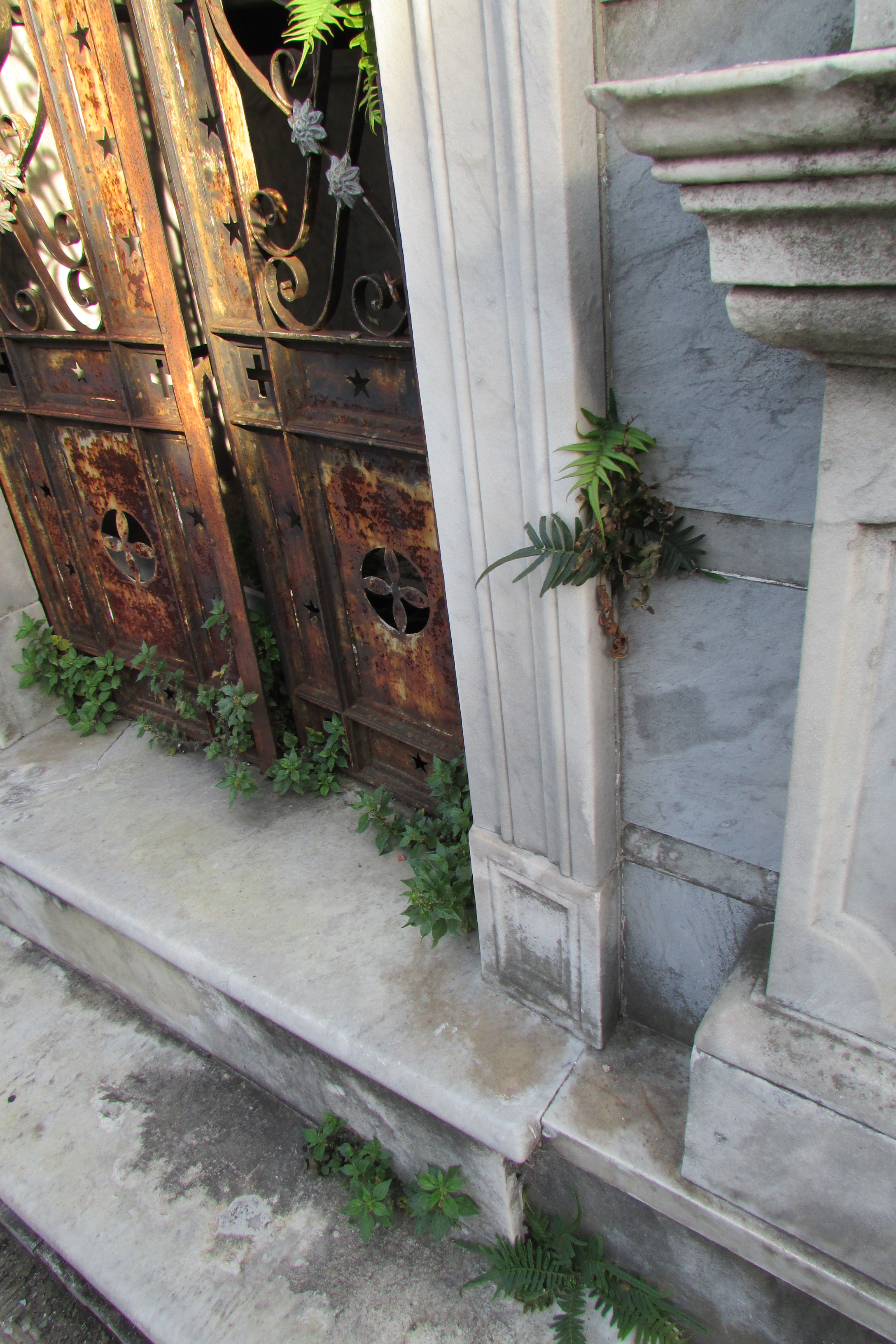
Juan led us to some rusted iron gates, unlocked the chain and they creaked open. He told us that this was a good shelter to choose, there was a cat who slept there, who would keep the mice away. We filed inside, over dead leaves that had blown inside, down steep stone steps to the tiny cavern below. There was a shelf – cleaned now, stacked with blankets, and I wondered briefly where Juan had moved the remains to, which coffin was now in the wrong vault.

Then I busied myself with blankets, helping to settle the little ones, to stop them eating all the food we had been left. Juan showed us how to loop the chain back through the gates, so they would look secure, so none of the visitors would attempt to disturb us.

We lived in the cemetery. We ate the food she left for us each evening, we slept on dry blankets in the safe shelter below the ground. Sometimes we would hear Juan, he often swept near our vault when there were tourists, a careful guard, covering any noise we might make, ever watchful.

But best of all, when it was dark, we would run and laugh and play. The high buildings outside added their lights to the stars, watched as we pretended to dance the tango in the city of the dead. We learned how to be children again.

Sometimes, when it is very dark, people walking past La Recoleta, fancy that they hear voices from within the high walls. The sound of laughter carries on the wind, and they hurry away, telling themselves they are imagining things, that the dead don’t giggle. Which is right. Dead people do not laugh nor dance nor play. But we do. We are the ghosts of La Recoleta.

xxxxxxxxx

Thank you for reading.

anneethompson.com

IMG_4193


xxxx

On A Balcony in Sri Lanka


 IMG_4450

They needed a weapon. Not to hurt anyone of course, just to cause a diversion, enough of a distraction to get past the guards in the entrance lobby. To reach the tuktuk driver undetected.

She hoped the drivers would still be there, would be willing to help them. They looked as though they would be, would be willing to do anything for a price. And the invasion of the hotel had been so stealthy, so professionally implemented with a minimum of fuss, avoiding detection from the outside world, that it was likely those outside of the perimeter of the hotel were still in ignorance. Still unaware of the silently moving gunmen, the imprisonment of foreign guests.

She knew of one weapon. If it could be called that. She had seen him using it while she was writing on her balcony the day before. Before the gunmen came, moving like shadows through the hotel, demanding everyone return to their rooms. Before their world turned inside out. When everything was still normal, the sunlight warming the tiled floor of her balcony, the sea crashing against the beach, storm clouds far away on the horizon.

She had been resting from her work, gazing out across the sea and the lawns, when she had seen him. The hotel grounds were full of crows. Crows or ravens or jackdaws – she didn’t know which. A large black bird that landed greedily whenever she ate, staring at her, trying to hypnotise her into sharing her food. They called constantly, their screech as constant as the rolling waves. She had been standing, enjoying the warm blanket of humid air, scanning the black horizon as the next band of rain raced towards shore, watching the palm trees dance in the wind.

She saw him on the lawn, next to the pool bar, near the steps to the sea wall. He was dressed in white, like all the staff, his skin almost as black as his hair. He turned, following the flight of the crows, hands raised, catapult ready. When he noticed her watching he ducked behind the building, out of sight. Perhaps some guests had complained. They liked to photograph the birds, were sometimes seen feeding them, encouraging their numbers. The hotel knew this was foolish, that they carried germs and caused damage. It was easier to scare away the birds than to reeducate the guests. So they hired catapult man.

The next time she had seen him, she had been quick to wave. To let him know that she approved, was friendly, on his side. The third time he waved back, smiled. Teeth very white against his dark face. Was that enough? Did that make him a friend? Could she now ask him for help? Did he even speak English? She didn’t know. But he was her only chance and they didn’t have long.

They needed to leave quickly, before news of the siege became known. Before people started choosing sides. Before the government sent troops and the gunmen became fearful.

It had to be her who went. They argued about that, of course, he wanted to be the one who left the relative safety of the room. The one to risk losing anonymity, to become a possible target. But they both knew that she was right. He was too great a prize, his capture would mean something. And he would be noticed. A foreign business man – even in casual clothes he was unmistakably so – was a valuable hostage. One that might be made an example of. So it had to be her.

She dressed carefully. No make-up, hair tied back, clothes – what she referred to as ‘missionary clothes’- the high necked, long sleeved baggy blouse and loose trousers. She was well travelled, she knew that there was nothing in the whole world as invisible as an unattractive middle-aged woman.

He looked at her before she left. One long look. No kiss, not wanting to risk affection that might cause feelings, arouse emotions that needed to be held in check. Feelings could come later. She knew what he was saying, thinking, feeling. It needed no words.

Then she left the sanctuary of their room. Heard the door lock behind her. Headed for the stairs. The stairs were beautiful, reflected the old world elegance of the rest of the hotel. Dark wood bannisters, wide stairs with plush red carpet, sweeping under the paneled ceiling, curving down into the entrance lobby.

She met the first gunman on the landing, leaning against the bannister, next to one of the carved elephants. His gun was hanging loose at his side, cigarette in mouth, casual. No older than her boys at home. He stiffened when he saw her, raised the gun.

“Why are you out? Go back to your room,” he said.

She feigned ignorance. Pointed authoritatively down to the lobby, said something indiscernible, a made-up language. Hoped her age would remind him of his mother, her non words would be taken as a language, her confidence would give her authority. Few people will argue with someone foreign, someone who won’t understand them. He would either resort to physical instruction, possibly violence, or would consider her low risk and high effort and would let her pass.

He spat, did nothing, she passed.

Down the stairs to the lobby. There were two men guarding the glass doors. No one behind the desk. There was shouting in a far off room, but the entrance was calm, guarded but casually so. They weren’t expecting trouble. No one outside knew anything was amiss. There had been no declaration, no demands made, no threats. The world was unchanged.

Beyond the glass doors she glimpsed the tuktuk men, waiting in vain for fares. Beyond them, on the green, families still flew kites, hawkers shouted their wares, the ancient snake charmer sat with his round basket, waiting for tips. A normal day.

She continued down, not looking at the groups of young men she passed, not running but walking fast. Somewhere to go. Clear direction, confident, legitimate. There were more stairs beyond the restaurant and she went down them, guessing they would lead to the kitchen area, to the staff quarters.

One more guard. One more loud, nonsensical conversation, spoken with the authority of mothers and aunts the world over, rarely questioned by young men. Even young men with guns. She was, after all, just a woman. A middle-aged woman.

Into the kitchen. The staff were surprised to see her. They began to rise, their training ingrained, anxious that a guest had strayed into their domain, keen to help, to lead her back to the public areas. She ignored them, headed straight to where catapult man was cowering in the corner. Told him her plan. Offered him money, showed him enough to make him listen, to nod, to agree to the risk.

The rest was easy. She returned to their room, same non-conversation with same young guard on the stairs. He left as she passed, determined to find a higher authority, to discover who she was and if she was legitimate.

That gave them time. Only a slither, but long enough. Enough for her to tap on the door, to tell him to hurry, to flee the way she had come. Back down the stairs. Pausing on the bend. Waiting for catapult man to do his best. To shatter a window to the left – the first thing she had ever seen him hit – enough time for a distraction, to remove the guards, very briefly, from their post.

Then out the door. Running now, calling to the tuktuk man, showing money, the language they would understand, climbing aboard, sinking back behind the window, shouting “airport”, feeling the lurch as the three wheeler pulled away. Into traffic. Amongst cars. Towards safety.

xxxxxxxxx

Thank you for reading.

xxxxxxxxx

Henry Wants a Fight


IMG_1535


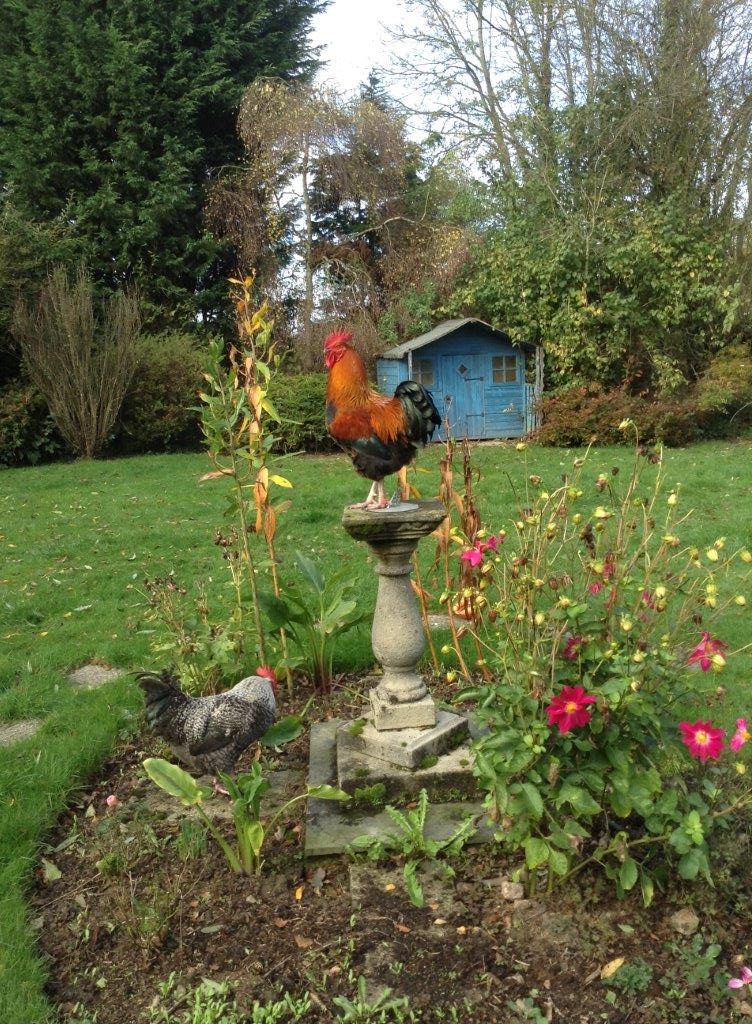
It was a beautiful summer’s day. Annie was in the aviary, feeding the chickens. They all crowded round her, pecking at the corn and kicking it around. They were very messy eaters! Annie sat on the clean hay and watched them. It was a very happy group.

Suddenly, she felt a sharp pain on her arm. “Ow!” she said and jumped up. Next to her was Henry, one of the cockerels. He had fluffed up his feathers, stretched out his neck, and was hopping from side to side. He wanted a fight. Annie stood up very quickly and went back to the house.

Every day after that, whenever Henry saw someone, he would try to peck them. It hurt. Annie had a big bruise on her arm. He had pecked Annie. He tried to peck the boys. He tried to peck Husband. He tried to peck the girl. They were all very cross. When he tried to peck them, they would push him away with their boot. This made Henry worse. He would make himself very tall and dance from side to side.

IMG_1699

Once, Husband went to kick him. Henry then did a flying jump, trying to claw Husband. On Henry’s legs were very sharp claws, like knives. If they had touched Husband, they would have cut him. Husband got the garden rake and used it to keep Henry away.

Henry was a problem. If anyone wanted to go into the garden, they had to take the rake with them. They could push Henry away with the rake, so he couldn’t hurt them.

Annie was worried. She asked her friends what she should do. Some friends said she should lock up Henry in a cage, then he couldn’t hurt anyone. Some friends said she should send Henry to a different garden to live. Some friends said she should give Henry a big kick. Some friends said she should eat him.

Annie didn’t like any of these ideas. She decided to look on the internet. She found someone else who had a problem with a cockerel who wanted to fight. She read lots of information. She learnt what to do.

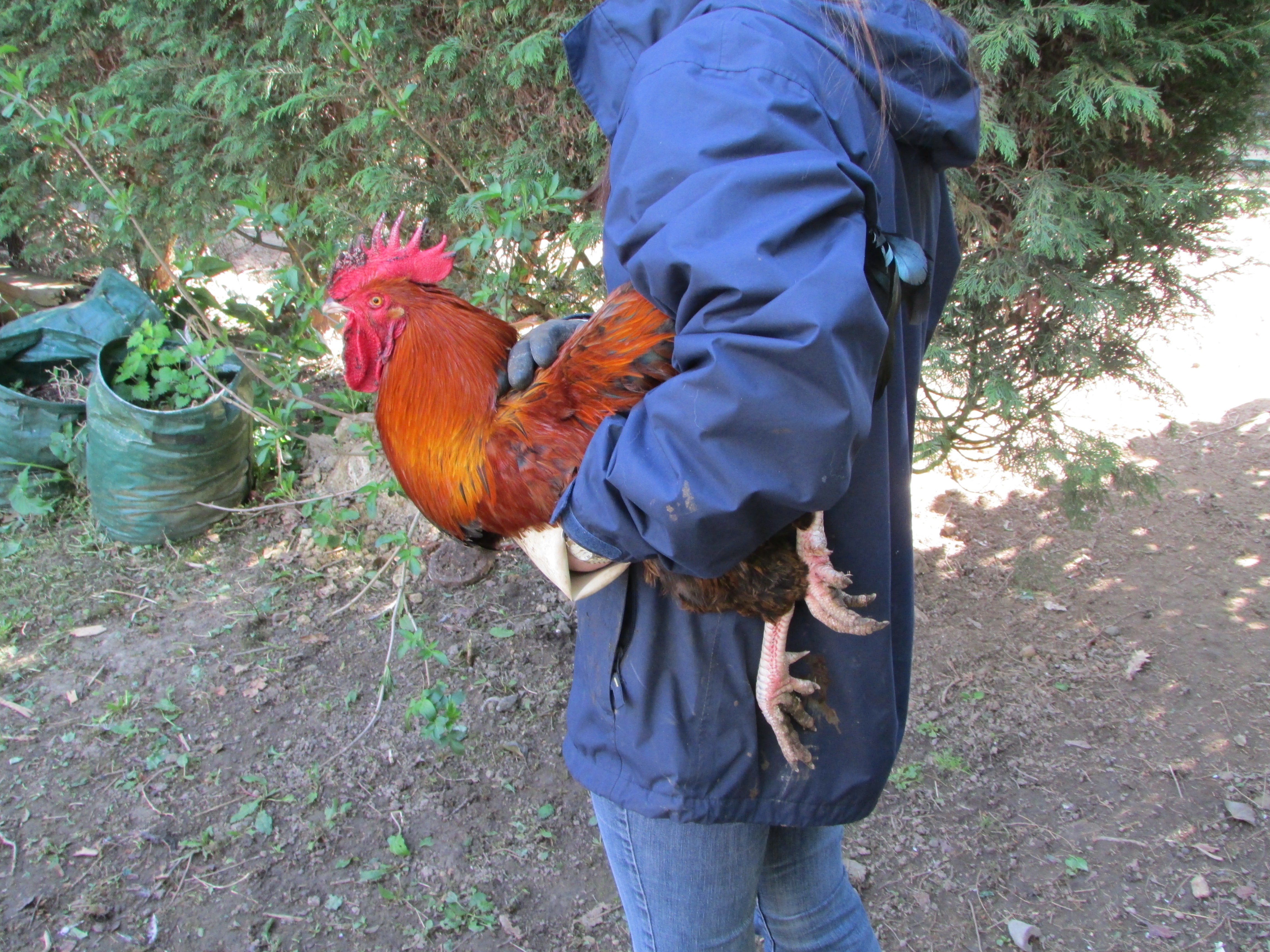
The next time that Annie went into the garden, Henry came running over. He started to do his special fighting dance. Annie folded his wings into his sides and picked him up. She tucked him under her arm. Now Henry knew that Annie was bigger than him. Then, while Annie fed the chickens and changed their water and checked the ducks, she kept Henry tucked under her arm. Now Henry knew that Annie was bigger than him AND that she did not want to fight. When Annie put Henry back on the grass, he ran away.

IMG_2193

For a few days, Annie picked up Henry whenever she went into the garden. Henry stopped trying to attack Annie. Annie told her family what she had learned. When Henry did his funny dance, he was saying, “Do you want to fight?” If they pushed him away, he thought they were saying, “Yes, I want a fight.”

Cockerels are bad fighters. They never stop the fight until someone has won. Sometimes this means they kill each other. The family had to teach Henry not to fight them. They had to show him that they were bigger but they did not want to fight.

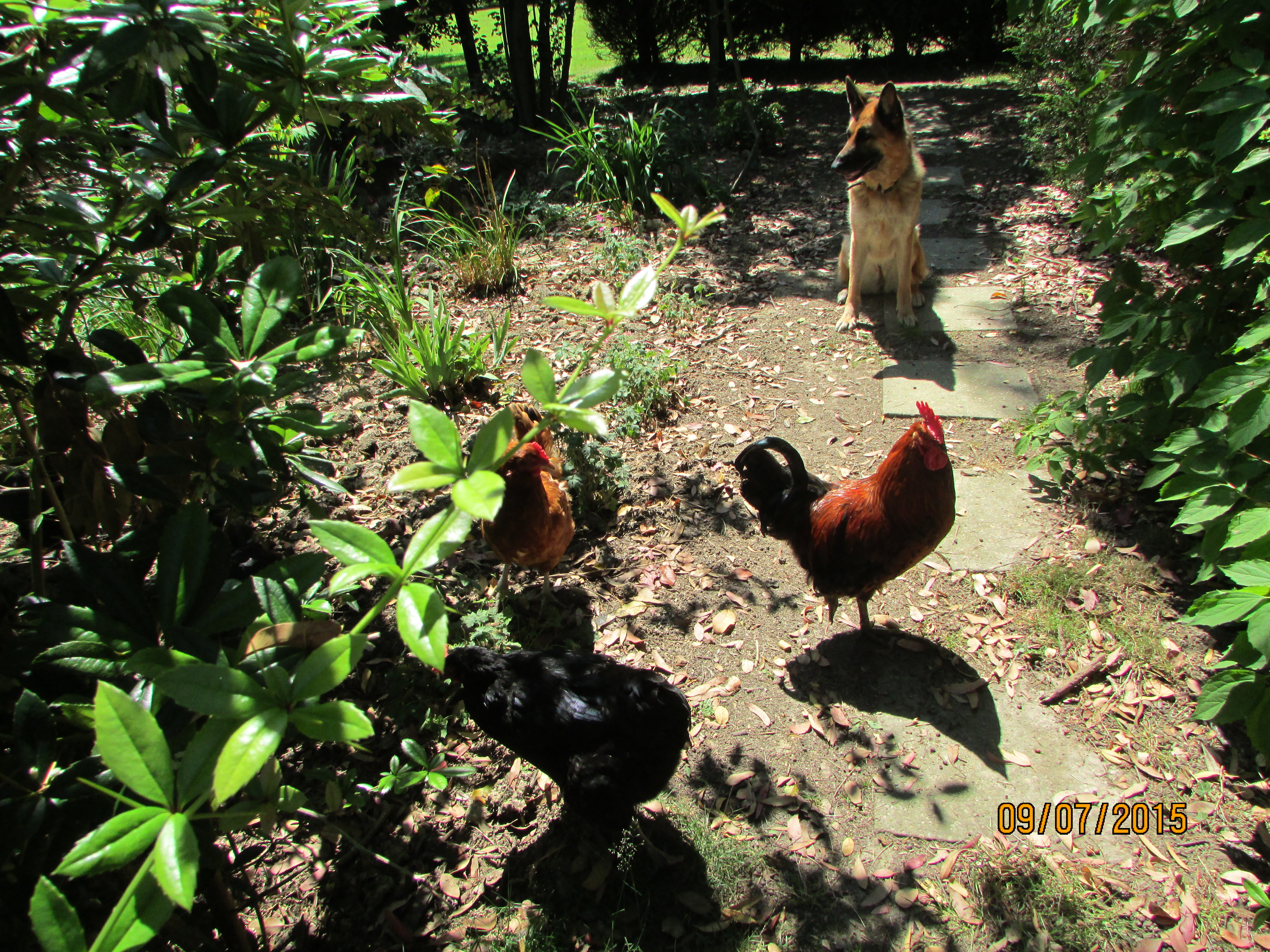
Then Henry stopped trying to attack them. He went back to pecking the corn with the other chickens and walking around the garden with the cats and the dogs. Everyone was happy again.

When someone wants to hurt us, it is hard to not fight back. Sometimes fighting is the wrong thing to do.

IMG_2699 IMG_1551


Thank you for reading.

You can find more Animal Garden Stories at :

The Safe Place

xxxxxxxxxxxxxxxxxxxxxxxxxxxxxxxxxxxxxxxxxxxxxxxxxxxxxxxxxxxxxxxxxx

Clara Call Duck has a Problem


An Animal Garden Story

 Clara call duck was cross. It was a very cold February and lumps of ice had formed on the pond. Annie knew that soon the whole pond would freeze over. This was very dangerous because Mr Fox could then walk across the water. He was hungry and would like duck for dinner. Annie wanted the ducks to be safe, so she had put them all into a large cage.

The cage was very big. It was tall, so the call ducks could fly if they wanted to. It had fresh hay, so the big fat white Aylesbury ducks could sit and chat. There was food and big bowls of water. Most importantly, it was safe. There was strong metal fencing around the sides, across the roof and even under the mud and hay on the floor.

However, there was nowhere quiet and private and Clara wanted to build a nest.

On the first day, she laid an egg in the corner. But Annie collected it when she brought fresh water.

On the second day she laid an egg in a box of hay, but Edna, the East India duck laid her egg there too and then made a mess!

On the the third day she laid an egg at the top of the ramp. But Amy the Aylesbury duck knocked it, and it rolled all the way down and cracked on the hard mud.

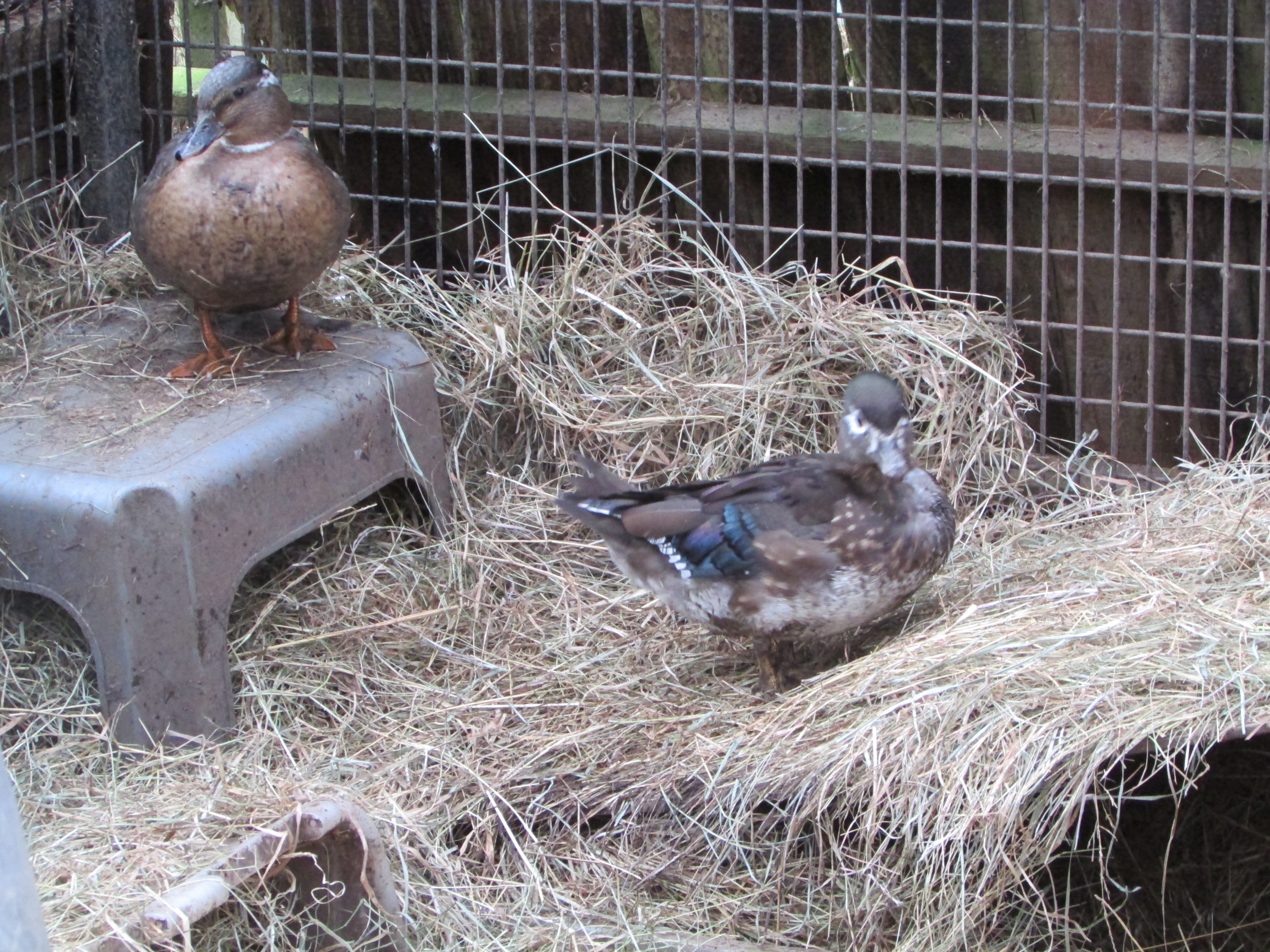
On the fourth day, Clara found a tiny gap between the mounds of hay and a stool. There was just room to crawl underneath. Under the stool there was room to pull bits of hay to make a nest. Clara laid her egg, then crawled out to play with the other ducks.

IMG_0111

The East India ducks were too busy splashing water to notice the gap under the stool. The white Aylesbury ducks were much too fat to fit under the stool. When Annie brought food and water she was too busy to notice the gap under the stool. The boy ducks were too busy chasing everyone to notice the gap under the stool.

Every day, Clara crawled under the stool and laid one more egg. The clutch of eggs became more and more. When there were fifteen eggs, Clara didn’t lay any more. She sat on the nest and plucked lots of soft feathers from her tummy and made the nest soft and cosy.Then she spread her wings across all the eggs and rested.

When Annie came with fresh water, she noticed that Clara was missing. She looked in all the boxes and under all the ramps, but she couldn’t find her anywhere. She worried that somehow Clara had escaped.

After four weeks, the eggs began to hatch. It is very difficult to climb out of an egg but ten ducklings managed to hatch. When Annie came with the food, she was very surprised to see lots of ducklings! She quickly collected them all and put them in a large container with Clara, so they would be safe. She didn’t want an Aylesbury duck to sit on one and squash it!

IMG_0130

A Prayer:

Dear Father God,

Sometimes I have problems. Please help me to think of what to do.

Amen

xxxxxxxxxxxxxxxxxxxxxxxxxxxxxxxx

Thank you for reading.

If you enjoyed this, why not sign up to follow my blog?

anneethompson.com

IMG_1182

xxxxxxxxxxxxxxxxxxxxxxxxxxxxxxxxxxxxxxxxxxxxxxxxxxxx

The Safe Place


An Animal Garden Story

The Safe Place

by Anne E Thompson

It was very cold. All night, soft snowflakes had fallen and now the garden was white and silent.

The dogs were very happy. They had leaped around in the snow, eating great mouthfuls of it, leaving big muddy footprints across the lawn.

The cats were cross. They looked at the beautiful white snow and decided it was much too cold to go outside. They had found somewhere warm and curled up to sleep.

The chickens stayed in the coop, they were safe in there. They stood on their perch and looked miserable.

But Annie was worried about the ducks. The pond had frozen, so Mr Fox could walk across it. He could walk across the ice to the island and catch ducks there. He could walk right into the nesting box and could catch ducks there. He could even catch ducks on the actual water, where they stood in an unhappy huddle, wanting to be able to swim.

Annie went to the pond. She took the dogs and her family. Together, they moved the ducks into the big cage. The ducks would be safe in the cage.

Every day, Annie went up to the big cage. The ducks needed clean water. They couldn’t swim in the pond or drink the water. Every day Annie carried big bowls of water into the cage. Some of the little call ducks jumped into it and splashed and swam. The big ducks dipped their heads into it and had a wash and a drink.

The ducks couldn’t sleep in the nesting box. They couldn’t poop in the pond. Every day Annie took away the dirty hay and cleaned up the duck poop. Then she gave them clean hay to sleep on.

IMG_0112

The ducks needed food. They couldn’t catch insects in the pond or eat the plants on the bank. Every day Annie took them duck food and corn to eat.

When Annie went to the pond, she saw fox footprints. They went round and round the cage. They went round and round the pond. They went round and round the island. But the ducks were safe. The ducks lived in the cage for a long time. They were sad. They wanted to play on the pond. They wanted to eat grass. They wanted to swim. But they were safe.

After lots and lots of days, the sun started to shine. The weather grew warmer. The ice began to melt. Mr Fox couldn’t walk onto the pond when the ice had gone and he didn’t like to swim. When all the ice had melted and the pond had turned back into water, Annie opened the cage door. Out flew the call ducks. They landed ‘splash!’ onto the pond. Out waddled the fat white Aylesbury ducks. They stepped carefully into the pond. Out ran little wood duck, she jumped straight into the pond. The ducks were all very happy. Now they could play and swim and find food, and they were all safe.

IMG_0491

In some countries in the world, people are not safe in the places where they live. If there is lots of fighting in their country, sometimes they have to leave their homes and go to a safe place. This is called a refugee camp. The people need food. They need somewhere to sleep. They need clean water. They need toilets. Sometimes they need other people to help them.

People in our country can give money to a charity to help people who have had to leave their homes. Tearfund is a charity that helps people. Ask someone to help you find tearfund.org on the computer, and you can see pictures of some of the people they help.

xxxxxxxxxxxxxxxxxx

Thank you for reading.

If you enjoyed this, why not sign up to follow my blog?

anneethompson.com

IMG_0499

xxxxxxxxxxxxxxxxxxxxxxxxxxxxxxxxxxxxxxxx

For Easter : The Sword Pierced Heart


IMG_0099 Image 2

I watched my son die today. My beautiful boy, beaten, battered and left to die. My heart broke.

I held my cloak close and I remembered the weight of him as a babe, like a boulder on my hip, wriggling to be free, to run and jump and climb. Those legs will run no more. Those limbs, I was so proud when they grew. I remember when he grew as tall as me, then taller even than Joseph. I remember watching him, stretched out as he ate, those long limbs seemed to go on forever. “I grew him,” I used to think with pride. Those limbs will not sprawl relaxed in my home ever again.

I watched his hands, the hands that used to pat me cheekily on the head when he’d grown tall. Those strong hands which laboured with wood, which helped me carry heavy loads, which lifted young children playfully. They are no longer strong. I saw them bang nails through the flesh, even felt that I heard the sound of bone shattering over the thump of the hammer, heard his ragged breath as they forced the cross upright. I wondered if I too might die.

But I watched. I am his mother and I would not leave him alone. When they tried to take me home, when they told me to shield my eyes, avert my gaze, I did not. For he was my son. I would never leave him alone, not at such an anguished hour of need.

Others watched. Some women were there, terrified and hanging back. Not me, I am his mother. I stood with John, where he could see me. What could they do to me that was worse than this?

Some watched who hated him. They mocked and spat and called abuse. It could not hurt him now, I thought, let them shout.

“He trusts in God,” they called, “Let God save him now,” and they laughed; even as he died they laughed.

Though even God deserted him by the end, and that was hardest to bear. He called out with a loud shout, asking why God had turned from him.

“My God,” he called in anguish, “why have you forsaken me?”

But I was there. I did not leave. I saw them crucify him, naked upon a cross. No mother wants to see her grown son naked, but still I did not look away. I was there at the beginning, I would stay with him until the end.

The soldiers took his clothes, for fabric is costly and even that of a criminal should not go to waste. Most they tore and shared between them but not his tunic. They cast lots for that, not wanting to spoil something precious. Yet my son was precious and they destroyed him.

It began last night. They woke me from my sleep and warned me there was trouble. He had been arrested, taken from a meal with his friends and questioned by the temple authorities. They feared the invaders, so he was then referred to a court of Godless law, a place that feared no God. They told me that he was scourged, beaten with whips that removed chunks of flesh as they struck. He was mocked and abused, then brought to this place.

I came, stumbling through streets full of people, full of noise and smells and fear and hatred. I came to this place, this Godforsaken hill beyond the city wall and I saw my son, my boy, diminished, shrunken somehow. I saw that what they had told me was true, smelt the repugnant stink of excrement mingle with the metallic stench of blood. I heard the shouts of abuse, the curses of the guards, the screams from the prisoners, the wails from friends. And him, like an oasis of calm amidst the turmoil, suffering but at peace.

And he saw me. Those dark eyes that as a baby had watched me intently when he fed. Those eyes that twinkled merrily when he teased me and became serious when he wanted to explain something important. Those eyes, red rimmed with exhaustion now, turned to me. Even hanging there, with parched mouth and dried lips, he spoke to me. His voice was hoarse, for he had refused the wine they offered, but I heard him well. A mother knows her child’s voice.

I stood with John and my son told me that this was to be my son now and he was to care for me as a mother. Even in his torment he cared for me, fulfilled his duty as my son. Still I would not leave.

Then it ended. The sky had turned as black as my world and he drew his last breath. It was finished. Those who had mocked became silent, some cried, some beat their breasts in despair. The blackness of the sky frightened them and many fled, wondering at what they had done.

Then I left, I let them lead me away. My soul was broken and my heart beat even though I bid it stop. My boy was gone, my firstborn, special baby, was no more. I carried that knowledge like a rock within me, I would have rather died in his place. How could I live, continue with my life knowing he is gone? There would be no more sunshine or laughter, nothing matters now. The core of me was gone. I could not even cry.

Afterwards, I could not rest and I heard strange stories. They said the soldiers pierced his side, to check there was no life in him. His blood had separated so they took him down, a solid corpse that had no life. A man came and took the body, they said they followed and knew where he lay, in a tomb that was guarded.

They told me of strange things, of the temple curtain torn in two, of dead men walking and boulders breaking open. I do not know. I only know my boy is gone. That is all that matters.

It should not have been like this. It was so recently that people praised his name, sang and danced before him, treated him like a king. It should not have ended like this.

And yet, I recall a song, it comes persistently to mind, it was sung often in the synagogue. It speaks of one forsaken by God in his time of need, scorned by many. He belonged to God from before he was born, then suffered at the hands of many. They sang of bones poured out like water, a heart of melted wax, that is how my boy would have felt. They sang of hands and feet pierced like his, and enemies gloating over him. They sang of lots being cast for clothing and of God’s ultimate victory. They sang of remembering him for ever, not just now but families of every nation, even those presently unborn. For he has done it. Is this my son’s song? Were the words written for him?

He spoke of his death often, he tried to warn me that he would die. But not like this, not before my own time has come. No mother should bury her child, it goes against what is natural and right. Though, he showed no fear, he knew what his end would be. And he told me there was more.

As I turn now to sleep, I wonder at his words. Will he truly return somehow and will I know? Has he finished what he was sent to do?

xxxxxxxxxxxxxxxxxxxxxxxxxxxxxxxxxxxxxxxxxxxxx

If Mary was a young teenager when she learned she was pregnant (which would fit with the age girls became betrothed in those days) then when Jesus died aged thirty-three, she would have been about forty-seven. How does a woman of that age cope with the things she was forced to witness and how much would she have understood at the time? I am about her age, I have sons, contemplating their dying is too horrible for words. I am sure she loved her boy as much as we love ours.

Crucifixion was a ghastly way to die. We learn in the Bible that Jesus, who never sinned, who never did anything wrong, died to save the world. What does that mean?

You can learn more at:https://anneethompson.com/how-to/378-2/

However, many people were crucified, some probably unjustly accused. So is it the death that was important or was it that God became separate? I think that this is the key issue here – the part of Jesus that was God left him. That was more terrible than crucifixion. That is what each of us deserves and what we do not have to suffer if we choose to come to God.

If we want to know God, we can, even if that means changing our minds.

You may not believe in God, but God believes in you.

The song which Mary recalled in the story was Psalm 22. It has some striking similarities to the account of Jesus’ crucifixion. It was written about one thousand years before the event. (wow) It begins: “My God, my God, why have you forsaken me?”

It finishes: “…..future generations will be told about the Lord. They will proclaim his righteousness to a people yet unborn- for he has done it.”

xxxxxxxxxxxxxxxxxxxxxxxxxxxxxxxxxxxxxx

Thank you for reading.

If you found this interesting, why not sign up to follow my blog?

anneethompson.com

IMG_2422

xxxxxxxxxxxxxxxxxxxxxxxxxxxxxxxxxxxxxxxxxxxxxxxxxxxxx

A Heavenly Story


A man died and went to Heaven.

When he arrived, an angel showed him around. There were lots of large buildings and they began to walk past them. They passed one building and there were sounds of splashing and singing. The man asked who was inside.

“Ah yes,” said the angel, “Those are the Baptists.”

Next they passed a building full of chanting, with smells of incense wafting out.

“That’s the Catholics,” explained the angel.

Then they came to a building with candles twinkling in the windows and choirs singing.

“That’s the Anglicans,” said the angel.

Then they came to a building that was very noisy, lots of laughing, guitars and people were singing the same songs over and over again.
“That’s the Pentecostals” said the angel.

On they walked, passing many different buildings, each one with a slightly different style. Then they stopped and the angel asked the man to take off his shoes. They walked forwards very slowly, not speaking, silently, until they had passed a large building. The man could see many people inside, but the angel warned him to not make a sound.

At the end of the tour, the man thanked the angel but he had to ask, “What was the building that we had to creep past?” Why did they need to be so quiet? he wondered.

“Ah, well,” said the angel, “the people in that church think they’re the only ones here.”

xxxxxxxxxxxxxxxxxxxxxxx

This is a story that my Dad used to tell. I think its blunt humour is still very relevant today, when surely one of the greatest wrongs in the modern church is a pride in our own theology, an unwillingness to really believe that we might not have it all sorted, that perhaps there is more to God than we fully understand.

Dad was good at little sayings and stories. I remember him giving me advice when we were looking for a church to join.

“Anne,” he said, “you will never find the perfect church. But if you do, don’t join it. You will spoil it.”

xxxxxxxxxxxxxxxx

Thank you for reading.

If you enjoyed this, why not sign up to follow my blog?

IMG_3133

xxxxxxxxxxxxxxxxxxxxxxxxxxxxxxxxxxxxxxxxxxxx

Joanna


I have had an idea for my next book. It’s VERY different to my other books but I think will be lots of fun to write. It will take me about 9 months, so I thought I would try out the beginning on you first. Depending on how many people ‘like’ it will help me to decide whether or not to continue writing or change it completely.

I realise I should be posting this at the beginning of the week – always get the most responses on a Monday morning – but I am much too impatient to wait! Here is the first splurge of words. Oh, and Mum, you wont like it.

To save you asking (because my family did): No, it is not based on myself or anyone who I know and, no, I have never wanted to murder anyone at all ever – I could not even kill the rat I caught!

Joanna
by Anne E Thompson

      I first saw them on the bus. They got on after me, the mother helping the toddler up the big step, holding the baby on her hip while she juggled change, paid the driver. I wondered why she hadn’t bought a card or paid by phone, something quick so we didn’t all have to wait.

      I watched as she swung her way to a seat, leaning against the post for support, heaving the toddler onto the chair by his shoulder. Then they sat, a happy family unit, the boy chattering in his high pitched voice, the mother barely listening, watching the town speed past the window, smiling every so often so he knew he had her attention. Knew he was loved. Cared for. They had everything I didn’t have but I didn’t hate them. That would have involved feelings and I tended to not be bothered by those.

      No, I just watched, knew that those children had all the things, all the mothering, that had passed me by. Knew that they were happy. Decided to change things a little. Even up the score, make society a little fairer, more equal.

      Following them was easy. The mother made a great deal about collecting up their bags, warning the boy that theirs was the next stop. She grasped the baby in one hand, bus pole in the other and stood, swaying as we lurched from side to side. She let the boy press the bell button, his chubby fingers reaching up. Almost too high for him. Old ladies in the adjoining seats smiled. Such a cosy scene, a little family returning from a trip to the town.

      They waited until the bus had swung into the stop, was stationary, before they made their way to the door. I was already standing, waiting behind them. The mother glanced behind and I twisted my mouth into a smile, showed my teeth to the boy who hid his face in his mothers jeans, pressing against her as if scared. That was rude. Nothing to be frightened of. Not yet.

      The family jumped from the bus and I stepped down. As the bus left I turned away, walked the opposite direction from the family. In case someone was watching, noticing, would remember later. Not that that was a possibility but it didn’t do to take chances. I strode to the corner, turned it, then made as if I had forgotten something. Searched pockets, glanced at phone, then turned and hurried back.

      The family were still in sight, further down the road but not too far. She had spent time unfolding the buggy, securing the baby, arranging her shopping. All the time in the world.

      I walked behind, gazing into shop windows, keeping a distance between us. They left the main street and began to walk along a road lined with houses, smart semi-detached homes with neat square gardens. Some had extended, built ugly extra bedrooms that loomed above the house, changing the face, destroying the symmetry. There were some smaller houses stuffed by greedy builders into empty plots, a short terrace in red brick.

      It was just after this that the family stopped. The mother scrabbled in her bag, retrieved her key. The boy had already skipped down the path, was standing by the door. The mother began to follow but I was already turning away.

     I would remember the house, could come back later, when it was dark. I would only do it if it was easy, if there was no risk. If she was foolish enough to leave the back door unlocked. No point in going to any effort, it wasn’t as if they meant anything to me. There would be easier options if it didn’t work out. But I thought it probably would. There was something casual about her, about the way she looked so relaxed, unfussy. I thought locking the back door would be low on her priorities until she went to bed herself. People were so complacent, assumed the world was made up of clones of themselves. Which was convenient, often worked to my advantage. As I walked back, towards the bus stop, I realised I was smiling.

xxxxxxxxxxxx

Thank you for reading.

If you enjoyed this, why not sign up to follow my blog?
Then you will receive all my posts by email – usually two per week.

Mary’s Story


I am reposting this because it’s Christmas….
IMG_3787

     I travelled to Bethlehem in a small cart. Every bump (and there were many) was agony. As I was jolted along, I was wracked with pain. The baby’s time was near, you see, and the pain was almost unbearable. Later, they would sing songs about a cute donkey carrying me. Nice thought! I don’t think there’s any way you could have got me on a donkey.

     As each contraction cramped every muscle in my torso, I huddled up like an animal and prayed for it to be over. I could see Joseph, watching me as he walked alongside. He really didn’t have the first idea what to do. Oh, how I wanted my mother. I yearned for her to be there, holding my hand, telling me everything was alright and would be over soon.

    When we arrived at Joseph’s uncle’s house, the women folk came and helped me inside. The room was crowded. All Joseph’s male relatives from miles around had come to the house for shelter and food, responding to the summons from the Romans. The women were busy cooking supper and the men were drinking wine and comparing stories. They all told Joseph how much he resembled his grandfather Matthan and laughed at old stories from years ago. The smell of fish and fresh bread was nauseating. I was so tired and so uncomfortable.

     Joseph knew I was suffering and asked if there was somewhere quiet that I could go. There was no chance that we would get a place in the inn, they had filled up days ago. Somewhere quiet, in a little house packed with relatives? There were some fraught discussions and then his aunt suggested that the animal cave, below the living quarters, might be best. It wasn’t terribly clean, but it would be quiet and private and at least it wouldn’t smell of fish!

     Joseph helped me go down, and a couple of the women came too. One of them examined me and told me the baby was a long way off yet, first babies always take their time in coming. This was not great news but I felt better having her there. I felt that she knew what was happening, had seen this before and it took some of the fear away. I was frightened you see. I was horribly afraid that somehow I would damage my baby. My baby and God’s.

      I knew he was going to be special, I knew I had a great task ahead of me but it all seemed to be going horribly wrong. I trusted that God was still in control but He felt so far away. Could the baby not have been born in a palace, surrounded by comfort? Would these poor beginnings really be part of a plan? Could they really make this king accessible to the people? I had no idea. I was a mere girl, I had no education and my memory of scriptures was often fuzzy. To be honest, at this present moment, I didn’t even care. I just wanted this baby OUT!

     Special or not, my body was tired of carrying him, tired of being stretched and pushed, of fitting something inside that was now too big to be there. I needed this baby to be born and I was too exhausted to wait much longer. How I longed for sleep. The pain in my back was terrible. Great waves of cramp that seared through my body, making me oblivious to everything else. I was vaguely aware that someone was sweeping the floor and moving the animals to a far corner. They had laid out a mattress and blankets for me to rest on but I couldn’t lie still for long. I felt better standing, rocking in time with the pain, trying to remember to breathe, in out, in out. Some one offered me water but I couldn’t drink. I wasn’t thirsty, I just wanted this baby to be born.

      I could see Joseph with his big anxious eyes watching me. He didn’t know what to do. Someone suggested he should go into the house to eat and I nodded in agreement. There was nothing he could do and the poor man must have been tired too. He had endured such an emotional time lately. First there was his fear and anger when he first heard about the baby (now that was a difficult conversation.) Then he had to endure the smirks of his friends when the pregnancy became public knowledge. He never complained, but I know he felt embarrassed, wished that God could have chosen a different girl.

     We had been travelling for five days, with hardly any rest and the last couple of days had been more chilly. I know he felt the burden of caring for me, watching for bandits on the roads and wondering if we would make it to Bethlehem in time. If the baby had come early I don’t know what he’d have done – left me with strangers on the road somewhere I guess and come to register on his own. One didn’t mess with a Roman decree…..

     The pain eventually became almost constant. Joseph had eaten and rested but I continued to sway in discomfort in the little cave of animals. Every so often one of them would poop and although the women with me cleaned it up quickly the smell pervaded the atmosphere.

      I could hear the musicians gathering outside, someone must have told them the birth would be soon. That gave me hope, maybe soon the baby would arrive.

       Then at last, in a final searing pain, the baby was born. I looked down at his blue waxy body as he wriggled on the blanket and I knew that he was mine. One of the women wiped him down with oil and salt and I held him in my arms while they looked for the swaddling bands in our luggage. How beautiful he was. His indigo eyes would soon turn brown and they gazed at me trustingly. I loved him with my whole being.

      Outside, there was the sound of music and singing as the musicians heralded the arrival of a boy. Joseph came and took him from me. He held the tiny baby in his giant carpenter’s hands, hands that spoke of hard work and safety. Then the baby started to mouth for food and Joseph passed him back. The women showed me how to feed him, but he was soon asleep. Then we gently wrapped him in the swaddling bands, securing his tiny limbs so he would feel snug and secure and his bones would grow straight and true. He was so beautiful.

      It was hard to remember what the angel had told me, that this was God’s son too. I began to wonder if I had imagined it, if it were all a dream. This baby did not look like God, he was a baby. My baby.
“If it’s true God,” I thought, “Let there be another sign. He is so little and I love him so much. Remind me again…”

      I too needed to sleep. Joseph fetched fresh hay and put it in the animal’s manger, covering it with a soft blanket. I didn’t want him to put the baby there, I wanted to keep him on the bed next to me, but Joseph was worried I might roll on him in my sleep. Then he laid the baby down and told me to sleep. He looked deep into my eyes and brushed my collar bone lightly with his fingers.

      “Soon you’ll be truly mine,” he whispered. I knew what he meant and felt myself blush.

      I was so tired, I thought I would sleep for a week. I actually slept for about two hours. I was abruptly woken by loud voices and a draft of cold air as the door was flung open. There, standing uncertainly in the doorway was a group of youths. Their clothes were dirty and exuded the strong smell of sheep. Joseph was with them.

     “Mary? Are you awake?” he asked.

       It would be hard not to be with all the noise from outside.

       “These shepherds want to see the baby. They were told by angels where they could find him and they have come to look at him.”

       I nodded and they trouped into the room.

       They seemed so big and clumsy in such a small space, I was worried they might hurt the baby. But they didn’t try to touch him, they just stared for a while and then one of them knelt and they all followed suit, kneeling before the manger, staring at the baby.

       Then they told me their story, how they had been in the fields and an angel had appeared. They had thought they were going to die, to be struck down right where they were. The angel had reassured them, told them that a saviour had been born, the Christ who we’ve all been waiting for. They would find him lying in a manger. Then suddenly there were lots of angels, all praising God and saying he was pleased with people on earth. After the angels had gone, finding they were still alive after all, the shepherds decided to come at once and see for themselves. It was as though they couldn’t quite believe what they had seen and heard, they needed to actually see the baby with their own eyes.

       I felt so humbled and so cared for. God had heard my thoughts, He was reassuring me. It was all His plan, not some terrible mistake. We were meant to be here. He even knew about the manger. I listened and smiled and treasured my thoughts.

      The shepherds left as noisily as they came. I could hear them in the streets, shouting their news, telling everyone what had happened. They were so excited. They had of course woken the baby who was now crying with a thin wail that jarred my nerves and was impossible to ignore. So I fed him some more and then we both slept. A tired, contented sleep borne from exhaustion and wonder.

       After eight days, Joseph came and circumcised the baby. How he wailed. It felt cruel, though I knew it was the right thing to do, even in this strange place we must obey the Jewish laws. We also formally gave him the name Yeshua, the name we had been told to give him by the angel all those months ago. I wondered if Joseph minded, people would know it wasn’t a family name. I also had no one called Yeshua in my own family, though I did know a boy from my childhood with the name.

      After forty days, we had to travel to Jerusalem, to pay for redemption at the temple. As Joseph was from the tribe of Judah, we had to pay five shekels of silver. We couldn’t afford a lamb, so bought two pigeons to sacrifice. It was nice to leave Nazareth and to have some exercise at last, to see people and to take my baby into the world. I felt quite excited as I approached the temple, our holy place. I didn’t recognise anyone, but everyone could see we had a new baby and lots of the women came over to see him. I felt so happy!

     We walked through the Beautiful Gate and up to the Gate of Nicanor. Then something strange happened.
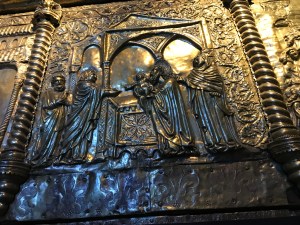
On display in the V&A Museum in London, is a decorated box, showing a scene from this story. It is supposed to have held Simeon’s remains.

      As Joseph and I walked through the temple, a man approached us. He came to look at Yeshua and indicated that he wanted to hold him. That was a little unusual but there was something about him, something that made you sure he was a good man, someone you could trust. When he looked at the baby, he got all emotional and prayed, thanking God and saying that now he could die in peace. He blessed me and Joseph too and then he leant towards me and said something which was very strange. He said Yeshua would cause “the fall and rising of many in Israel” and would be “a sign that would be opposed so that the thoughts of many hearts may be revealed.”

      What does that mean? I know that he is God’s own son and that he is part of the plan to establish God’s reign on earth. Will he be opposed? Surely everyone will accept God’s anointed one, we have waited so long for him. Then he said something that made me afraid. His face was very near, I could smell his breath. He said that a sword would pierce my soul. It made me very frightened, I practically snatched Yeshua away from him! I want my son to grow strong and be happy, will I suffer for this?

      I knew I was tired, not getting enough sleep and it was hard to care for a new baby in a strange place without my mother to help me. I felt that I did not want to hear the man’s words, even if they were true.

      The man left us and almost at once an old lady approached. She was ancient, her white hair showed under her mitpahath and she leant heavily on a stick. What I noticed most were her eyes. They almost sparkled. You could tell at once that she was a holy woman, also one who loved to laugh. As soon as she saw Yeshua she started to pray loudly, thanking God, telling people nearby that if they wanted Jerusalem to be redeemed, they should look to the baby. I was glad that no Romans were allowed in the temple, we would have been in trouble.

      We finished making the offerings and then went back to Bethlehem. I didn’t know whether to tell Joseph what the old man had told me. I kept thinking about his words, worrying about what they might mean. I was so tired, I decided I would wait and maybe tell him later.

      The months passed and we settled into life in Bethlehem. We moved into a little house and Joseph worked on the many building projects that the Romans have introduced. Yeshua continued to thrive. He grew into a sturdy toddler and would walk around the room holding onto the stools and baskets. I loved to feel his solid weight when I carried him on my hip. He started to sleep much better at night and Joseph and I were thinking about having another child. Then everything changed.

      It was one evening, still quite early but we had filled the lamp with olive oil and lit the linen wick. Joseph put it on a bushel basket, so the room was well lit and we could talk about the day. Suddenly, there was a banging at the door. Joseph went at once and there, in the road, was a group of Persian travellers. They had dismounted from their horses and were peering intently into the house.

       They told Joseph they had seen a star and had come to worship the king. I was so glad I hadn’t gone to bed yet. We let them into the house and I went to get Yeshua. He was damp from sleep and his tired eyes looked blearily around him. I wondered if he would cry but he seemed fascinated by our strange visitors. They wore their hair in long curls and one had a band of gold on his head. It glinted in the lamp light and I could see Yeshua watching it intently. Their clothes were patterned with birds and flowers.

      We offered them wine, it was clear they were tired from their journey. I was embarrassed that we only had two stools to offer them, but they didn’t seem to mind and in fact insisted that I should sit on one with Yeshua and they were happy to sit on the rush mat. They didn’t really sit anyway, they wanted to kneel before Yeshua.

      Then they gave him gifts. They were beautiful to look at. They gave him gold, signifying that he is a king. They gave him frankincense. The strong aroma filled the house and I wondered if Yeshua was to be a priest, even though he is not descended from Levi. They also gave him myrrh. Myrrh is costly but is for embalming a body. It was a strange gift for a baby and I wondered what it meant.

       They told us their story before they left. In their Persian home, they were magi, watching the stars and foretelling the future. Many months ago, at the time of Yeshua’s birth, they had seen a special star which they knew meant a powerful new king had been born and they determined they would find him and worship him. Unfortunately, following the star caused them to go to Jerusalem first (I always knew that star gazing was a misleading activity.) They went to Herod’s palace and asked where the new king was. This was scary, Herod had shown he was not a king to be trusted and his cruelty was well known. I would not have wanted to visit his palace.

     However, it sounded as though he had decided to be helpful. He asked the scribes to research the early scriptures and they discovered that the promised king was to be born in Bethlehem. The king told the Easterners and asked them to find the king and then return and tell him the exact location, so that he too could worship. I wondered what would happen next. Would Herod himself come to visit my precious baby or would we be summoned to the palace? This was not a comfortable thought.

      I also wondered why the palace scribes had not come to visit us. Did they not believe the scriptures that they studied so diligently? Surely if they were truly expecting a redeemer they would also have come?

       The men left. They planned to sleep in an inn and return to Jerusalem the next day. We could not offer them lodging in our tiny house and they seemed content to leave now they had seen Yeshua. I returned Yeshua to bed and soon after Joseph and I also went to sleep.

       I had not been asleep for long when Joseph woke me. He shook me awake, then went to light the lamp. I could see his face was tense and instantly turned to check Yeshua was well. He was sleeping soundly.

      Joseph told me I needed to get up at once, we needed to leave. He said that he had had a dream, like the dream when the angel told him that the baby inside me was God’s son. It was so intense and real that he could not ignore it. He said he had been told we must leave Israel, Yeshua was in danger, Herod planned to kill him.

      I wondered why I too had not be warned and then I realised, God had told Joseph to take care of me and Yeshua. That was a hard task for a man, to care for a son that was not his own. So God was now telling Joseph alone what we needed to do, underlining his role, establishing him as head of our family. It was a kind act.

      I began to pack our things but Joseph was hurrying me, telling me to only take what was essential. We were to go to Egypt. Egypt! Could this be right? Was Yeshua not to be king of the Jews? I packed hurriedly and we left that very night.

      What would the future hold? Would we ever return to our home town? The future was uncertain but I knew that something bigger than us was happening.

      Whatever happened, God had a plan and no one could alter the course of that.

xxxxxxxxxxxxxxxxxxxxxxxxxxxxxxxxxxxxxxxxxxxxxxxxxxxxxxxxxxxxxxxxxxxxxxxxxxxxxxx

      This account obviously involves a lot of imagination. However, I believe it is also historically and Biblically accurate (somewhat more accurate than some of our christmas carols!)

I used a variety of sources including:
The gospels of Matthew and Luke
Geoffrey Bromily (1995)
William Hendriksen
William Barclay
Joseph P Amar (university of Notre Dame)
Michael Marlowe
Tessa Afshar

xxxxxxxxxxxxxx

Thank you for reading.

If you enjoyed this, why not sign up to follow my blog?
Then you will receive all my posts by email – usually two per week.

xxxxxxxxxxxxxxxxxxxxxxxxxxxxxxxxxxxxxxxxxxxxxx
Hate Came to Stay


Hate Came to Stay
by Anne E Thompson

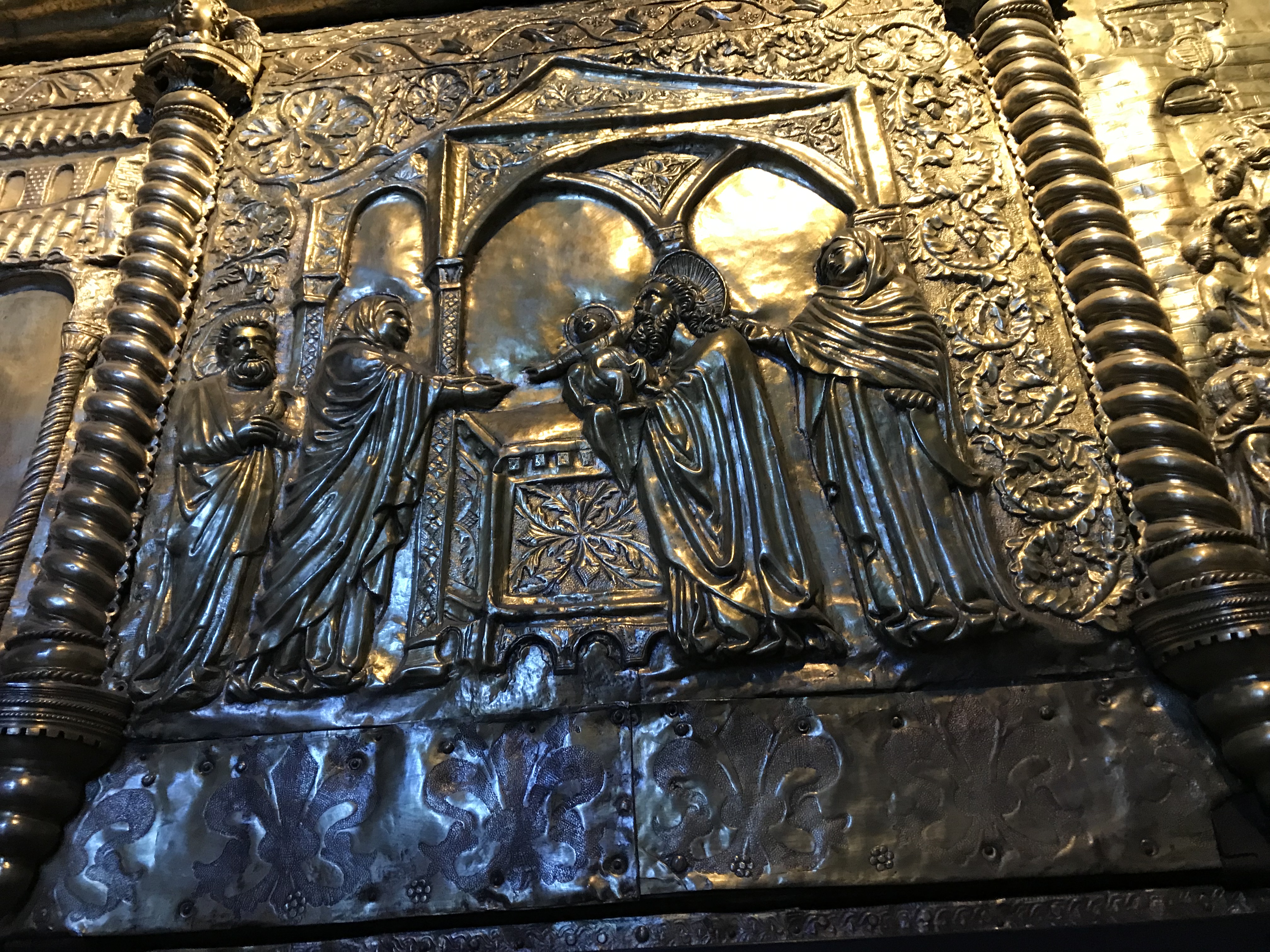
IMG_3682

     Yesterday, Hate came to stay. Uninvited, he knocked on the door and when I opened it, to see who was calling, he burst in, pushing past me. I knew he had visited other houses, had caused damage and hurt and anger. But he had never visited me before. He came yesterday.

     He went into the kitchen and smashed all my plates. He over-turned chairs and tore my cushions. He punched my children and spat at my dog. When I went near he scratched me and made me bleed. The house was dark, he closed all the curtains. I was hurt, frightened and angry.

     But worse, worse than the pain and fear and broken china, was the slime. Every time I tried to stop him, to catch him, hurt him, trap him, he produced more slime. It came off him in silver trails, sticking to everything he touched, dirty, germ filled, slime. It made me change. I began to be like him. I wanted to punch him, cut him, hurt him.

     Others came to my door, friends and family and people needing help. I bolted it shut, refused to let them in. I glared at the world and felt dark thoughts from my hiding place under the bed. I too wanted to scratch and bite and smash.

     So I went to the window and I looked at the sun. I let the light brighten my mind, sear my eyes, burn off the slime.

     Then I turned to Hate. I made him tea but he threw it on the carpet. I gave him bandages for his wounds but he used them to tie up the cat. I made him a cake but he trampled it into the rug. I noticed the slime was disappearing, there was less of it. I read him stories but he put his fingers in his ears. I sang him songs but he swore at me. I danced for him but he threw stones at me. Hate would not accept love. But Love stopped the slime.

     Love made a cage. At last, when I was so tired I thought I would fall, Hate was trapped. The bright cage of Love enclosed Hate. There was no more slime. He couldn’t escape. I pushed the cage out of the door. Hate was gone.

I began to sweep up the broken glass.

xxxxxxxxxxxxxxxxx

Thank you for reading.

If you enjoyed this, why not sign up to follow my blog?
Then you will receive my posts by email (usually two per week.)

xxxxxxxxxxxxxxx