Sorrento, Italy


Sorrento

P1040824

Excerpts from a family diary 2012

      Monday: Boys’ alarm failed. They woke at 4:45 in a panic (I’m not sure they had packed.)

        Left home 5am, one hour delay at Gatwick, then flew to Naples. Mike decided to check out the G-forces on plane by juggling with three tennis balls during take-off. Then checked out High Life magazine for drugs.
David sorted hire car while we collected cases.

      Drove to Sorrento. Managed to miss a ‘no entry’ sign and went the wrong way down a one-way street. Within seconds two policemen (who had been hiding?) hurried over and fined us 39€.

         Staying at Hotel Bristol, another Citalia hotel. All rooms have sea view and balcony.

P1040849         Had sandwiches at pool side bar. James mentioned that everything in his suitcase needs washing. Super.

        Evening meal lovely, though slightly rushed as the next course arrived the second we finished eating the last one! Friendly service. Delicious ice cream.

          Walked into town. Lots of little shops selling leather goods and lemon products.

           Tuesday: Breakfast really nice. Lots of fresh fruit, breads plus cooked stuff.
David tried to plan activities. Not sure we were helpful.
Views so beautiful, want to absorb them.
Went to pool on roof. Nice but very over looked. Issued one towel per day by pool attendant/nazi. Get told off if we leave pool via side rather than steps. Not allowed to take inflatables into pool. Not allowed to reserve loungers (which is mainly good, deters people from leaving a towel at dawn to reserve best chairs. But does mean you have to guard your towel when swimming or predatory pool man reclaims them!) Not allowed to do shoulder stands. Not allowed to jump in. Not sure my boys and the pool attendant are going to be friends…….

          Walked into town and bought calzones and stuff for lunch. Saved about 75€ on hotel price. Ate on balcony.
Read, snoozed, swam.
David started campaign to have inflatables allowed in pool. Am hoping it doesn’t last all week.
Boys seem to swim mainly under water – unsettling when they loom below me as I’m struggling to reach the side.

          Another nice dinner.
Mike admitted he ‘may’ have been seen naked whilst changing on his balcony. Why was he changing there? Luckily person doesn’t sound old enough to have heart attack.

          Played Catan in the lounge.
It’s a really nice lounge, lots of sofas and a piano for James to play.
Fernando won. Of course. Actually, we all nearly won at some point. It was an extremely long game.

          Wednesday: I got up early and went for a walk. Left David to wake the family. Returned to find David engrossed in a book. I woke family.

           Swam, read, swam. Lunch. Swam, read, swam.

           Dinner, then played cards in the bar. Musicians playing jazz.

            Thursday: 7am breakfast then David and I drove to Pompei.
(We went years ago when the children were small and unhappy in the heat and I promised myself that one day I would come back without them!) Everyone else had a late breakfast and lazed.
Pompei still interesting, still dusty, still incredibly hot.

P1040856

              Went to huge supermarket on way back to Sorrento. My feet hurt, next time will wear proper shoes, not sandals.
Finished reading The Book Thief. Best book ever.

               Friday: Up early and went to exercise room.
It’s very hot in there, was nice to swim afterwards.
Went to breakfast. Everyone asked me why my face was so red.
Checked evening meal menu. Planned day (doing nothing.) Swam.

                Played catan on the roof lounge.

P1040867           There are comfy chairs and big umbrellas, but it was still too hot to be completely fun.

            Swam.
Wrote postcards to my chinese friends. Had to use dictionary for mandarin words for volcano, eruption, historical site. Bit nervous I may have written rubbish or something rude.

             Nice dinner then walked into town. Bought gifts, which was easy as there are so many shops selling soaps and trinkets. Bit cooler tonight, might rain.
Saw three german shepherd dogs, made me miss Kia.

              Saturday: Gym at 7:30 with David. Painful. Breakfast.
Becky ate slowly while Fernando sang “We’re not getting any younger”.
James dipped his sausages in the nutella. Then his elbow. Separate tables are tempting.

             Lazed, read, swam.
Males played cards (extremely noisily) in smoking room.

              Walked into town and collected pizzas. Ate on our balcony.
Becky put in charge of rubbish disposal. Was banned from throwing it onto neighbour’s balcony or flinging it off roof. Have horrid feeling I am going to find abandoned pizza boxes in unsuitable place.
Mike went in search of watch (left in smoking room.) Pizza boxes currently in corridor. Hmmm.

               Lazed, read, swam.
Family joined with Irish family to play games in pool. They used James’ rolled up tee shirt as a ball (well, it’s not an inflatable.) Mike cut his toe on pool vent, watch still lost.
James said ants had found some food he was saving. Ah. Pizza boxes still in corridor.

               Another nice dinner. Watched olympics – Bolt won relay.

               Sunday: Gym and swam.
Breakfast. I love the breakfasts here.
Swam, read, lazed.
Walked into town with David. Had a coffee. Was nasty. Drank it in a little square surrounded by typical Italian houses listening to olympics on a television in a bar.
Bought lunch. Had an espresso. Was perfect.
Lunch on balcony. Fernando had done a workout with Mike in gym. Seemed to have trouble lifting his arms.

                Monday: Left hotel, drove to Puglia.

xxxxxxxxxxxxxxx

            Name of some (one) persons changed to protect identity. (From what???)

“I don’t have to go to church to be a Christian.”


“I don’t have to go to church to be a christian”

IMG_1831

     Sometimes, people ask, “Do I have to go to church to be a Christian?” The short answer is clearly, “No.” I am a Christian, I have a relationship with a living God and if I were stranded on a desert island or in a country that did not allow churches, then I would still have that relationship with God. I would still be a Christian. However, the answer is not complete if left there.

     I think we first need to think about why you might ask that question. Imagine a teenaged boy describing his friendship with a girl. What if he said, “She invites me round and I go because she cooks nice food. But I tell her before I go, ‘I will come but we’re not going to talk’, so I don’t have to speak to her when I’m there. She doesn’t seem to mind.”? Frankly, that is appalling! We should not treat other people like that! Now compare that to how you might be treating God. Understand this, God likes you. He wants to have a friendship with you. That involves some effort on both sides.

     Maybe we first need to think about what is a Christian. What makes someone a Christian? “Ah,” you might say, “Well, I believe in God.” Let’s look at that for a minute. I have been reading the book of James in the Bible. I love that book – he is so rude to people! I’m sure you know that Mary gave birth to Jesus (what we celebrate every christmas) but you may not realise that after she had Jesus, she and Joseph then had other children. One of these was James. He grew up with Jesus and yet it is thought that for a while he didn’t believe that Jesus was special. There is even a story about Jesus preaching to people and his family coming to try and stop him because they thought he was crazy! That gives me hope, when I get things wrong I know that so did the people who wrote the Bible but they had a second chance at getting it right. Later, James did come to believe what Jesus was saying and at some point he wrote his book. In that book, he discusses what it means to be a Christian and he talks about people who say they believe in God. First he says, “Well done!”

     Few people would dispute that just as there are good things in the world, so too there are evil influences. In the Bible these are called demons or Satan. Now, when people tell James that they believe in God, he says, “Well done.” He then adds (a little sarcastically perhaps) “So do the demons!” You see, the Bible is very clear that these evil forces believe in God and are terrified of him because they recognise his power. Clearly demons are not Christians, so there must be more to being a Christian than just believing that God is real.

     Think about when your computer freezes. Something has gone wrong, nothing works properly and pressing ‘escape’ or ‘control and delete’ makes no difference. Sometimes, the only option is to shut it down and restart. Well, that is what becoming a Christian is. It is realising that we’ve made a mess of things, something is not working properly and we need to restart. You have a ‘restart’ button, you just need to ask God to press it for you! It really is that easy.

     There is nothing that you can do to make things right with God, you are not big enough, clever enough or good enough. So God did it all. He became a human (in the form of Jesus) and he died and was separated from the God bit of himself, which means that we don’t have to. Jesus rose up from the dead (what we celebrate at Easter time) to show that he is stronger than death, that everything is sorted out for us. We just have to ask God to press that ‘restart’ button to set us right.

     Actually, this can be quite hard to do. We like to be in control, we like to think that what we do makes a difference, that somehow we can become good enough for God. Well, I have to tell you, the Bible is very clear, there is nothing that you can do to be acceptable to God. You are not good enough. So God did it for you. You do have to be prepared to accept that gift though, you do have to want that ‘restart’ button to be pressed. If life is going well for you, that can be a bit scary. We are worried that it means loss of control, that we wont be ourselves anymore. Let me remind you of what I said at the beginning: God likes you. Really, he does! He doesn’t want you to become a different person, just a better version of yourself.

     You don’t have to be a ‘bad’ person to need God. Everyone needs him. I have travelled to lots of different countries, met rich people and poor and I can honestly tell you, people are people wherever you go. I have stayed at the Savoy Hotel and been driven to St James’ Palace in a fleet of silver mercedes to have dinner with Prince Charles (this is due to who I married, nothing to do with me, in case you are mistaken into thinking I am great in any way.) I have also stayed in a mud hut in Zambia with a couple who were HIV positive. I have visited China, Singapore, Dubai, India, Italy, America and most of Europe and there is one thing that I can tell you. People are the same. They might be culturally very different, but deep down, we all want the same things, we all love, we all have fears, we all make a mess of things. We all need God. It is that simple.

     So, what comes next? After we have admitted that actually we might not be perfect and we want to include God in our lives, what do we have to do now? Well, you do not have to do anything (including go to church.) However, if you really have ‘restarted’ (and not just said the words to yourself as a sort of magic chant or insurance policy), if you really do want to include God in how you live, then that will make a difference to how you live.

     A baby is alive after he’s born, but he doesn’t grow into a healthy child and adult unless he eats and exercises. So, just as we need to spend time with people and chat with them to develop a friendship, so too we need to spend time with God. No, this still does not have to involve going to a church! We chat with God by praying (saying things to him, either out loud or thinking them in our heads.) We listen to God by paying attention to our consciences, reading the Bible (where he has given us lots of hints about what he is like) and by listening to other christians. Ah, now we get to the church bit. How can you listen to other Christians, hear their story and share yours, if you never meet any?

     It is a bit like supporting a football team. I can say I support Crystal Palace. I can buy a scarf that’s the right colour, I can check the results in the newspaper, I can even watch a match on television. But it would be hard for that knowledge to touch my emotions. However, if I attend one of their games, if I stand with other supporters and cheer when they score, then just the volume and shared excitement will begin to affect me. I am helped along by other fans’ enthusiasm and I actually feel part of what I say I am involved with. It is hard (and a bit boring) to be a football fan in isolation. It is the same with being a Christian.

     “What constitutes a church?” you might ask. Does it need to be in an Anglican Church building or does the church that meets in my local school count? Well, if we look back at the Bible, a ‘church’ was actually just a group of people who believed the same thing. The first Christians were actually thrown out of their synagogues (the equivalent of our church buildings) and tended to meet secretly in houses. A church is not the building, it is the people. Sometimes buildings can be helpful. I cannot stand in a huge cathedral like St Paul’s without thinking about God, all the architecture has been designed to make me feel like that. However, the building is not essential. Three people meeting in a field to talk about God, to pray and study the Bible together; that is a church.

     Some people might say they don’t need God, they are wrong. I think this is why Jesus talked about it being hard for a rich person to know God. When we are healthy and comfortable it can be hard to acknowledge that we need God, we think we are ‘okay actually’. Some people think they are too bad to know God, they are wrong too. God is able to press the ‘restart’ button for murderers, thieves, adulterers and even that nasty gossip from down the road! The Bible calls all that ‘sin’, but it’s not a word that tends to crop up at the dinner table so I have tried to avoid using it. None of us is good enough, certainly I’m not. That’s another reason for going to a church – it will help you to realise that you are not the only bad person who God likes!

    Have you ever read ‘Screwtape Letters’ by C.S. Lewis? If not, buy a copy. It’s a brilliant book, very funny but with some really poignant truths included. He talks about all the strange and ordinary people who attend church.

    “Ah,” you might say, “But churches are religious. I am a Christian but I don’t believe in religion. Religion just causes trouble, look at all the wars that have been started by religion.” You are half right. Religion does cause trouble. That is why Jesus did not start a new religion, he just pointed people to God. He refused to set down lists of rules, he just gave people principles to live by. When churches start making lots of rules, when they are more concerned with religion than with God, then they are missing the point. Christianity is meant to be about relationship, not rules.

     I am often told that “church is boring.” Yes, sometimes it is. If it always is, then maybe you are going to the wrong church. I would also ask you, when you go to church, what are you expecting to get out of it? If your answer is “nothing” then you are probably right, you probably will get nothing from attending. However, if you dare to go hoping that you might hear God speaking to you, then that is much more likely to happen. Sometimes it is something the speaker says, sometimes it’s something in the reading that week, or a hymn that’s sung, or even what the person giving out the hymn books says, but usually, if we expect God to speak, we hear him. I would also say that just like a growing baby, we grow in faith very slowly. Sometimes it is much later that we remember something that was said in church and it helps us. But if you weren’t there, you wont hear it.

     If church is a collection of people, then try to find a church which has people like you in it. If you are a teenager, try to find where other teenaged Christians meet. If you are a retired person, then try to find somewhere that older Christians meet. If a church caters for all ages that is wonderful but in my experience it is rare.

    Do we have to go to church on Sundays? I guess not. If you attend a school Christian Union or something similar, then that is really just another form of ‘church’. We are advised though that we need one day a week that we keep as a holy day, a day to rest and where thinking about God is part of our routine (I think God knew how bad we would be at including him, so suggested that it should become part of our schedule!) That is hard to do if we attend ‘church’ on a week day.

    What about other religions? To be honest, I don’t know. As I said, christianity is all about that ‘restart’ button, about including God in your life and having a relationship with him. I don’t know if people can find God in other religions. I do have a sneaky suspicion that when I get to Heaven there will be a lot of people there who I wasn’t expecting! Whether or not people have a relationship with God is between them and God.

    What about Hell? Again, this is something that I don’t know much about about. If being with God makes us complete and fulfilled then I guess Hell must be the opposite of that. Sometimes people ask about who goes to Hell and what about people who try but never knew God. I cannot say, that is between them and God. But the Bible is pretty clear that if people decide that they don’t want to include God when they are physically alive, then God will respect that after they have died. That’s what free will and choice is all about, even if it means terrible consequences.

    So, have a think and decide what you believe. If you haven’t ever asked God to press the ‘restart’ button in your life, maybe now is a good time to do so. There aren’t any magic words, God is God, not a genie in a bottle! You might say something like:

   “God, I believe that you are real. I know that I make mistakes and I’m sorry. Please will you forgive all the things that I’ve done wrong. Please be part of my life. I want you to be my God.”

    Then, you should tell someone. We are physical beings and telling someone will help you to believe what you have done and not forget about it. Then go and find some other christians! In England you could look for somewhere that runs an Alpha course (they tend to be churches that welcome new Christians.)

    Do you have to go to church if you are a Christian? Not unless you want to grow……

End


End.

Anne E Thompson

APPRENTICE AUTHOR

Main menu

End

End
by Anne E Thompson

“I wonder what she thought of that,
Was so funny when he said no!
I must remember to contact Jim,
This traffic light is slow.
I think we need more milk and eggs,
I’ll check when we get home.
I could do with a cup of coffee now,
I hope that Mum will phone.
I’m not sure if…..”

Slash of metal, scream of brake,
Glint of sunlight, briefest quake.

Nothing.

Leave a Reply

Love Left


Love Left.

Clearing the Air


Clearing the Air.

Anne E Thompson

APPRENTICE AUTHOR

Main menu

Clearing the Air

Clearing the Air
by Anne E Thompson

As the poison seeped
out from him,
Lifting his heart and
freeing mind,
It flooded her eyes
and blocked her nose,
Drowned her dark, secret places
and eroded her spirit.
It diminished her light
souring her joy,
Leaving nothing light or free
within her.
But he felt so much better
For having said.

Leave a Reply

Richard


Richard.

Anne E Thompson

APPRENTICE AUTHOR

Main menu

Richard

Richard
by Anne E Thompson

This is
My friend.
Listens
To me,
Laughs
With me,
At me.
Tells me
Secrets,
Hopes and
Worries.

This is
My friend.
He makes
Me laugh
And shout.
He is
Obstinate,
Opinionated,
Loud and
Clumsy.

This is
My friend.
The clock
In his
Brain
Stopped
When he
Was ten.
His body
Got old
Too quick.
Sometimes
His mouth
Dribbles.

This is
My friend.
People
Say things:
“How kind,”
‘You are
So nice,”
“That must
Be hard.”
They don’t
Understand,
He’s just
My friend.

Leave a Reply

Night Sounds


Night Sounds.

Anne E Thompson

APPRENTICE AUTHOR

Main menu

Night Sounds

Night Sounds
by Anne E Thompson

As she lay resting after a long day,
The sound of breaking glass shattered the peace.
She frowned and rolled over,
Knowing the cat must have knocked a vase.
There followed a scream and a steady drip,
And she sighed,
For the pet must then have slipped.

There was a click and footsteps on wood.
She nestled deeper into her pillow,
For there were often draughts and floorboard creak.
A sound on the landing,
She pulled the cover close to her cheek,
The tree outside must be blown ‘gainst the window.

A muffled cry and heavy thud
And she snuggled deeper still,
A restless child must have knocked a book,
And the scratch and drag she now could hear,
Must be mice again, seeking warmth.
Then there was peace and she slept on.

In the brittle sunlight of a new day,
She went downstairs to find,
A smashed window and strangled cat,
Blood soaked footprints across the mat
That lead upstairs and her child was gone.
The only sound was her scream that lingered
On and on.

Leave a Reply

It’s a Wrapper on the Floor Mum!


It’s a Wrapper on the Floor Mum!.

Anne E Thompson

APPRENTICE AUTHOR

Main menu

It’s a Wrapper on the Floor Mum!

It’s a Wrapper on the Floor Mum
by Anne E Thompson

“There’s a letter from my school mum,
‘Bout a trip to test the sea.
I don’t really want to go tho’
“Cos is only Geography.
I need you to ‘phone my teacher mum,
seem to have lost a book,
And my shorts are missing too,
Yes, I hung them on my hook.”

“But there isn’t any homework,
It’s just revision instead,
Yes, I’ve prop’ly cleaned up already,
The cup is under the bed.
I need you to buy more shower gel,
The toothpaste ran out last week.
I’ll phone her when I have time,
But don’t expect me to speak.”

“It’s a wrapper on the floor Mum,
Not the start of world war three.
There’s a party at Bill’s ’til late,
‘Fraid I think I’ve lost my key.
The dust will be there tomorrow Mum,
like my clothes on the floor.
Those socks aren’t mine anyway,
Could you please just shut my door.”

ONE THOUGHT ON “IT’S A WRAPPER ON THE FLOOR MUM!

Leave a Reply

How to teach your child to read


IMG_1828

How to Teach Your Child to Read

by Anne E Thompson

If you want to teach your child to read, as a primary school teacher, I am tempted to say:“Don’t!” There are lots of things, like tying shoe laces, identifying birds in the garden and cracking an egg into a cup, which are easiest taught at home and which you will do so much better than a teacher. When done badly, it is actually possible that you might delay your child’s reading or cause problems that can take years to undo.

However, as a mother, I know that teaching your child can be rewarding and fun and we want to do it. This article therefore aims to give you some helpful hints on the sort of things that you might do at home with your child. It also lists a few of the problems that can arise if done badly.

  Firstly, the most important thing that you can do is read and let your child see you reading. Children are great imitators and if they see both their mother and their father reading, then they will want to. You can read anything: books, newspapers, recipes, instruction manuals. What is important is that your child sees you reading. Young children who never or rarely see their parents read are less likely to want to themselves because it does not seem important. They are at that stage where they think everything you do is wonderful and will want to copy. (Unfortunately, this stage does not last long. By the time they are teenagers they will think everything you do is wrong, so make the most of it!)

You also need to have lots of reading material in your home. This does not have to be expensive, join the library or visit jumble sales and buy some cheap secondhand books. If children see their parents reading and if there are books in the home, it is a natural step for them to pick up a book and turn the pages. It does not matter if they are only looking at the pictures or saying words that are not in the book, the first stage of learning to read is ‘playing’ with a book for pleasure.

  You also need to read to your child. Sit them on your knee and read them a story. They will learn that reading is something pleasurable, that can be done in a relaxed manner and will also start to internalise written language. This can be done at any age (some people even advocate reading to your unborn baby!) It will help your child learn to read as naturally as they learn to speak. Much of reading is to do with prediction (which I will explain in more detail later) and if they have heard, “Once upon a time…” a few times it will help them later when they are decoding for themselves.

Let your child see that you turn the pages one at a time and read the words from left to right, top to bottom. Even before they can read, they will start to copy this behaviour.

If you are a working parent, it can be hard to find time in the day to read with your child. However, it really is important. Try to set aside the same time each day and make it part of the rhythm of the day. It does not matter if it is every day while you eat breakfast or last thing in the evening when they are in bed. Read to them! It is as important as cleaning their teeth!

Do not rush into ‘proper’ reading lessons with your child. There is an age whereby a child is physically too young to learn to read. The human brain is a wonderful organ and it takes about 21 years to be fully developed. Different parts of the brain have different functions and control different things. It develops from back to front and inside to outside. You would not sit your child in the drivers seat of your car and tell him to drive – if nothing else you can see that he is not tall enough to look out the windscreen and his legs are not long enough to reach the pedals. Learning to read also needs physical development, but it is harder to gauge because we cannot see that a child is not ready.
There is a substance called myelin, which I do not fully understand (I am a teacher, not a neurologist!) which is essential for a child to be capable of reading. It somehow enables the eye to carry symbols to the brain and for the brain to then decode them into language.

Now, if a child is ‘forced’ to read before they have developed sufficiently, they will use different parts of the brain to decode symbols (the brain is very clever, if it cannot use one pathway, it will make a different one.) This can then cause problems later and they will have to ‘unlearn’ what they are doing, which is very difficult. For this reason, some countries will not begin to teach reading in schools until a child is aged seven and they can be confident that the brain is sufficiently developed.

  However, some children are ready to read long before then – which is why you are reading this article! My daughter learnt to read when she was aged three. One son learnt when he was four, the other was not ready to learn until he was well over five and had started school. There is no correlation between when they learnt to read and their long term academic success. It is not an indication of intelligence, it is an indication of physical development. So do not get involved in competitive mum talk! You may just as well be proud of your child’s hair colour as the age they learn to read!

  It can be difficult to know when your child is ready to learn to read. I do not have a foolproof method, so will simply share my own experience.

  Firstly, I watched my children. As children develop, they are able to use and control their large limbs first (Swaying an arm to hit a baby mobile) then their smaller limbs (holding something in a fist) then their fine motor skills develop (playing with a thread of cotton and holding it with a finger tip and thumb.) Fine motor skills give an indication of how your child is developing.

    Secondly, I played a game with them to discover if they could recognise a symbol. I wrote lots of random letters on a piece of paper (or could be shapes) and wrote one at the top. Then I said: “This is an ‘a’, can you point at the other ‘a’s on the paper?

If they could consistently match letters/shapes, I would begin trying to teach reading. If they did not seem to be learning, I stopped and tried again in a few months.

  So, what do you actually do to teach your child to read? I think that you need to understand the different components of reading and give your child experience in all of them. Education is constantly changing and the methods of teaching and testing reading ability seem to change from decade to decade. However, you are a parent, not a teacher, so you do not have to worry about current policy, you can just give your child a varied reading experience and discover what works for you. Here are some ideas which I suggest you muddle up and use in any order as often as you can. Just be sure that every activity is fun.

  Reading is very similar to listening. To listen, you hear sounds, your brain sorts the different sounds into words and you derive meaning. When reading, you see symbols (which in English are letters, grouped into words) which the brain then deciphers into meaning. When you listen, you do not hear every word. Much of your understanding comes from the tone and the context and what you feel makes sense. The same is true of reading. When you read you do not look at every letter – you do not even look at every word if reading fluently and quickly. Again, you use the context and what is logical to make sense of what you have read.

  Context is very important. You can even ‘read’ things that make no sense because you will use your understanding of how language works to fill in the gaps. So, if you read:
“Judy loved to blimp. Every morning she went blimping. Whatever the weather, rain or shine, Judy could be found blimping away. When she thought back over her year, Judy realised she must have ……… a thousand times.”
If you are a fluent reader, you will probably decipher the last sentence as “Judy realised she must have blimped a thousand times. This is with you having no idea what the verb ‘to blimp’ means!

You can teach your child to use the context of what is being read by asking them to predict the end of phrases. Ask them to read with you and when you read “Once upon …” let them read “…a time.” Sit so your child can see the words, you read the story but leave some gaps where there are ‘obvious’ words and let your child say them. This is developing their prediction skills and their ability to use the context of what is written. Later, when they are reading on their own, they will also use the pictures as part of the context that helps them decode the text.

  Another part of reading is word recognition. There are words which we hardly need to look at, we know their shapes so well. I would teach word recognition as a separate activity to reading. There is, in my view, a real danger that children will focus too much on individual words and not enough on the meaning of the text. We want our children to become fluent readers, not people with amazing memories who can remember thousands of words.

One good way to teach word recognition is to cut up some cardboard and write some simple words on it. Then play a game of ‘pairs’ or ‘bingo’ with the words. Then, when you are reading to your child, if you come to one of the words that they have learnt you can stop and let them read that word. Reading then becomes a shared activity, with you reading most of the story and them filling in any words they have learnt to recognise and any that are obvious from the context. Gradually, they will read more and more of the text themselves.

  Children need to see lots of words and several different types of text. If they are cooking, help them follow a simple recipe. If you have time, write out a recipe for them, if nothing else they will learn lots of imperative verbs. (Imperative verbs are bossy verbs, like ‘put’, ‘fill’, ‘place’.)

Some people make word cards and place them around their house, so every coffee table, kitchen appliance, door, etc is labelled. I expect that this does help children to recognise words (however, I personally would not want to live in that house, so I never did that with my own children . Plus my children were quite inventive, so would probably have switched the labels around, thus confusing the youngest!)

Magnetic letters on the fridge are a fun way for children to practice making words. Do check them though, one of my children wrote lots of mis-spelt swear words. He thought that as he’d never heard me say them I would not know what they were! It was funny, but slightly embarrassing when visitors came.

  Another part of reading is phonics (the sounds of letters.) A fluent reader rarely uses phonics unless they are introduced to a new word. It slows the flow of reading and is fairly inaccurate. Most people do not say the pure letter sounds, so ‘l’ becomes ‘le’. If you sound out ‘le’ ‘o’ ‘o’ ‘ke’ ‘e’ ‘de’ it is very unlikely you will decipher ‘looked.’ However, it can be useful in giving children a clue about what a word might be.

Again, I always taught phonics as a separate lesson to reading. It is a natural part of a spelling lesson and when children have internalised phonics they will use them very naturally when reading. If they are directed to ‘sound out’ words too often then they start to focus all their attention on individual letters and all meaning of the text is forgotten. It is possible to say all the correct words and not actually derive any meaning from the text. If given some German to read, I can probably say all the words correctly but will not have any idea what the text is about. Unfortunately, some children learn to read like this. They are able to say the sounds of the letters to form words, but the words never seem to touch their brain, to have any real meaning. They have to listen to themselves speaking to understand what the words mean, which obviously slows up their reading and is not what they should be doing.

A good way to teach initial letter sounds is to play “I spy”. You can use either letter names or letter sounds (your child needs to learn both) and they will gradually build up a good knowledge of words that begin with the same sounds. You can always write the letter on a piece of paper, so they also begin to recognise the shape.

I often told “The Magic Pens” story (see under children’s stories at anneethompson.com Story link here.) It is best told rather than read and I would tell it to the class whilst writing the relevant words on the white board. The children always, unprompted, would join in with chanting the lists of words, which made a fun way for them to learn phonics. Also, as the initial letter is a different colour, it helps dyslexic readers. It was a great time filler when waiting to go for lunch or assembly and the children always enjoyed it, especially if we included some naughty words like ‘bum’! It can be extended by the teacher returning to the classroom in the morning and making a sentence with the words, such as: “Kit wanted to sit but a nit bit her so she had a fit.” You can do the same activity at home. If you write a sentence with the words, put it on the fridge and your child can return to them throughout the day and read what was written. Obviously, change the letters used each time, so the child begins to build up a good knowledge of letter blends. You can also start with initial sounds, such as ‘br’ or ‘ch’ and change the story accordingly.
{Incidentally, I have only ever told the Magic Pen stories in a classroom. If you try them at home, please let me know if they are still fun and if the child joins in! }

  Your child also needs to read books. Proper, child friendly, story books. It does not matter if they cannot initially read every word, they need the opportunity to explore them and to practice reading. Try to find some simple books that have very repetitive language. Read the story to your child a few times first (Yes, they will remember the words, that is okay, reading uses memory!) If there is a word they cannot read, just tell them. Do not tell them to ‘sound it out’, that takes all the fun out of reading. If they are asking you for help,that is excellent, they are showing that they understand the text has meaning and they want to know what it says.

  Do not ever be tempted to buy the books from the school reading scheme. Your child’s teacher will be using them to both teach and as a diagnostic tool to assess your child’s progress. If your child has read them at home, they will give an unrealistic performance (which the teacher will be aware of) and will also be bored with them and not want to read them again at school. It is hugely unhelpful and will slow their progress. If your child’s teacher wants the child to practice the school books at home, they will be sent home for you to borrow.

  Do not force a child who does not want to read to begin learning. I home-schooled one of my children when we were living abroad and I found reading a real tension point. It really mattered to me that he should read fluently and he decided he did not want to learn. (This is the child who every day picked up his pen by the wrong end and told me he could not remember which way round it went! Some children need more patience and prayers than others….) I did teach him eventually – mainly thanks to finding some simple books about a dragon who had a pet cat that pooped everywhere, which appealed to my son immensely! However, he never enjoyed reading. Even as a teenager, he would pay his younger brother to read to him the books set by his school while he did something ‘more interesting.’ I do not know if his personality means he would never have enjoyed reading or if my daily frustration with his four year old awkward self somehow left a lasting impression. If I could turn back the clock I would tell myself to stop trying, have a rest and start again in six months time.

  On a similar vein, do let older children choose their own books. Another mistake I made was when my daughter, who had read fluently from a very young age, was about eight. I decided that she should be reading books that would extend her and gave her lots of the child classics (The Railway Children, Little Woman, that sort of thing.) She just wanted to read simple tales of magic and princesses! After a while, she stopped reading for pleasure completely. She did, after a year or so, begin again but I had made the mistake of taking the fun out of reading. It has to be fun. If children enjoy reading, they will always read. We might enjoy reading Dickens, but we need a few novels in between time too.

  Your child will learn to read at his/her own pace. Just as some children learn to walk as early as ten months of age and others are well over a year, so some children acquire reading skills very quickly and others learn more slowly. Try not to worry and absolutely do not start comparing with other children! You have been given a very special role in raising your child, let them develop at their own speed, they are not like anyone else. If they seem completely disinterested in reading, stop trying to teach them (but do not stop reading to them) and enjoy other experiences instead. If there is a problem, your child’s teacher will alert you but probably your child is just not quite ready to start learning yet.

  Watching your child learn to read is hugely rewarding and very exciting! I hope that you will both enjoy the experience and it will be special activity that you share.

More articles, stories and poems at: anneethompson.com
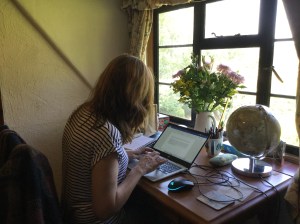
Anne E. Thompson

Thank you for reading
anneethompson.com
Why not sign up to follow my blog?

Look on your device for this icon (it’s probably right at the bottom of the screen if you scroll down). Follow the link to follow my blog!

******

Rebecca


Rebecca

 by Anne E. Thompson

When I first saw you,

I looked into your eyes,

And saw my own.

My head,

My nose,

In miniature.

You helplessly

Demanded food,

And I was lost,

In love for you.

I knew,

Without a doubt,

If I needed to,

I would die

For you.

3 THOUGHTS ON “REBECCA

Leave a Reply