If you are new to my blog, then for the next forty days things will be a little different, as we are learning Psalm 22, a poem about Easter, to raise money for Tearfund. I am attempting to learn the poem in Hebrew. Do sign up to follow my blog if you want to join our mental marathon. I will post an extract of the poem every day. Learn as much as you can…
Please sponsor me! I am raising money for Tearfund, a brilliant aid agency. They work hard to support the poorest people in our world. Now also supporting people fleeing Ukraine, providing food and shelter. Your donation can be part of that.
If you are new to my blog, then for the next forty days things will be a little different, as we are learning Psalm 22, a poem about Easter, to raise money for Tearfund. I am attempting to learn the poem in Hebrew. Do sign up to follow my blog if you want to join our mental marathon. I will post an extract of the poem every day. Learn as much as you can…
If you would like to sponsor me, please see my Just Giving page:
If you are new to my blog, then for the next forty days things will be a little different, as we are learning Psalm 22, a poem about Easter, to raise money for Tearfund. I am attempting to learn the poem in Hebrew. Do sign up to follow my blog if you want to join our mental marathon. I will post an extract of the poem every day. Learn as much as you can…
I have divided Psalm 22 into segments, one for each day in Lent. Lent has 40 days, but Sundays are not included (don’t ask me why, sounds like cheating to me!) I have therefore divided the poem into 40 segments, and Sundays can be our recap days, when we relax and enjoy what we have learnt so far.
I suggest that you read/learn one segment each day, learning as much (or as little) as you can. If you have signed up to follow my blog, a new verse will be sent to you each day (so it will be very easy to learn—simply read it every time you check your phone, or wash your hands, or have a cup of tea).
You can choose whether to learn the poem in English, or a different language. I have included Mandarin and Spanish versions. I am going to attempt to learn it in Hebrew. I found the words online at stepbible.org so if you want a different language, check there. It’s a brilliant resource. At the very least, if we read a little each day, the poem will become very familiar, so we recognise it instantly and can join in when we hear it read. But learning it by heart would be fabulous.
As this is something of a challenge, I am going to ask people to sponsor me, to raise money for Tearfund. If you would like to sponsor me, please go to my Just Giving page:
I am reposting something I wrote last Easter–if you have followed my blog for a while you will recognise it. I decided, a year ago, that rather than give up something for Lent, I would try to learn Psalm 22. My reasons are below. Why not follow my blog and learn with me? Even if you’re not religious (I know most people reading this won’t be) then why not learn the Psalm as a mental exercise? It is after all a poem, and people learn poems that originated from all sorts of places, this one simply started as part of the Hebrew Bible. Perhaps you could learn it in a language you are learning? I will try to learn it in Hebrew, and will also post it in Mandarin and Spanish (and English, of course).
As it will be a challenge, I am going to ask people to sponsor me, to raise money for Tearfund (an aid agency who I trust to spend my money wisely). Why not do the same? I know it’s an effort, but things worth doing usually are, and think how motivating it will be to know that people will donate money if you learn those few lines of poetry each day. You can either make an old-fashioned paper chart and keep note of who is sponsoring you, or use the Just Giving and/or Facebook Fundraising platforms. I will use the online forms, so please consider sponsoring me. The Just Giving link is:
This will be fun! We will be doing something for Lent (which as a non-Anglican is simply for fun in my case) plus we will be stimulating our brains (as a defence against future dementia) AND we will be raising money for people in need. It’s a win-win situation!
Psalm 22 is chosen for a reason. I think I am slightly behind the curve, and maybe you knew this already—when Jesus was dying on the cross, many scholars believe that he was reciting Psalm 22.
The idea that Jesus quoted scripture at his most difficult time makes me think that perhaps this is something I should aspire to do. If Jesus came to give us an example of how to live, maybe when life is hard for me, I should also recite scripture—perhaps it would comfort me and help me to focus on better things than the horrible situation I am coping with. I will probably never suffer anything on the same scale as being crucified, but everyone has dark times, don’t they? We all feel overwhelmed sometimes.
Also, from a purely human viewpoint, when bad things are happening, we cope better if we can distract ourselves. The most painful thing I have ever experienced was after brain surgery when they needed to stitch a hole in the top of my head. After surgery they had left a tube going from my brain out the top of my skull, so I looked like a Telly Tubby for a few days. When they removed the tube they needed to stich the hole closed but were unable to use any anesthetic. It hurt. To distract myself, I listened to some Mandarin, and although it still hurt I wasn’t fully focussed on the pain, which helped. It therefore makes perfect sense to me that reciting scripture is a really good thing to be able to do.
Psalm 22 is very long. We will learn a few lines every day, and by Easter we will know the whole Psalm–or at least, more of it than when we started. I will divide the Psalm into segments and post them on my blog, so if you sign up to follow my blog, they will arrive as an email every morning. It will be fun, it’s good to be part of something. So now you need to plan whether or not to ask people to sponsor you, and then wait for the first section to learn on Ash Wednesday. It’s rather exciting!
I’m writing this on the balcony, listening to the waves wash over rocks. No seagulls though, as Madeira seems to have more pigeons than seagulls. One comes and sits on the rails next to me, checking to see whether I am eating, before flying off in disgust. I will give you a quick tour of the rest of Madeira. Then you can add it to your list of places to visit. Coming in January/February was brilliant, because we had hot sun, cool wind, and very few other tourists. But perhaps we were lucky with the weather, it would have been gloomy if it had rained all the time. Either way, we needed summer clothes for the too-hot-to-sit-for-more-than-10-minutes sunny days, and warm clothes for the cold evenings. Wish I’d known that before we came. Also wish I had packed my walking boots because when it rained, it really rained, and all the walks we did were basically up, or down, the steep side of a mountain. Not much call for flip-flops because the streets are all cobbled.
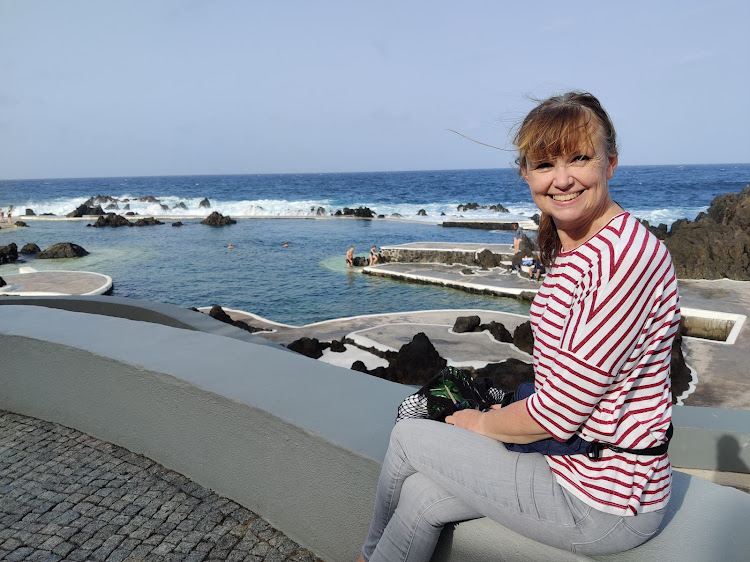
The north side of the island seems to be always under cloud or in the shade of the mountain. We need to remember to take jumpers when we drive north. There are some brilliant natural swimming pools, built into the rocks, and we had fun swimming there, watching the waves crash over the rocks while protected by the edge of the pool. It was freezing though.
Natural pools at Porto Moniz
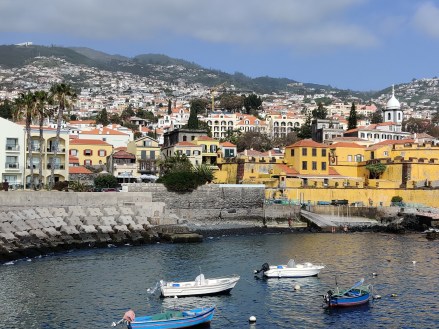
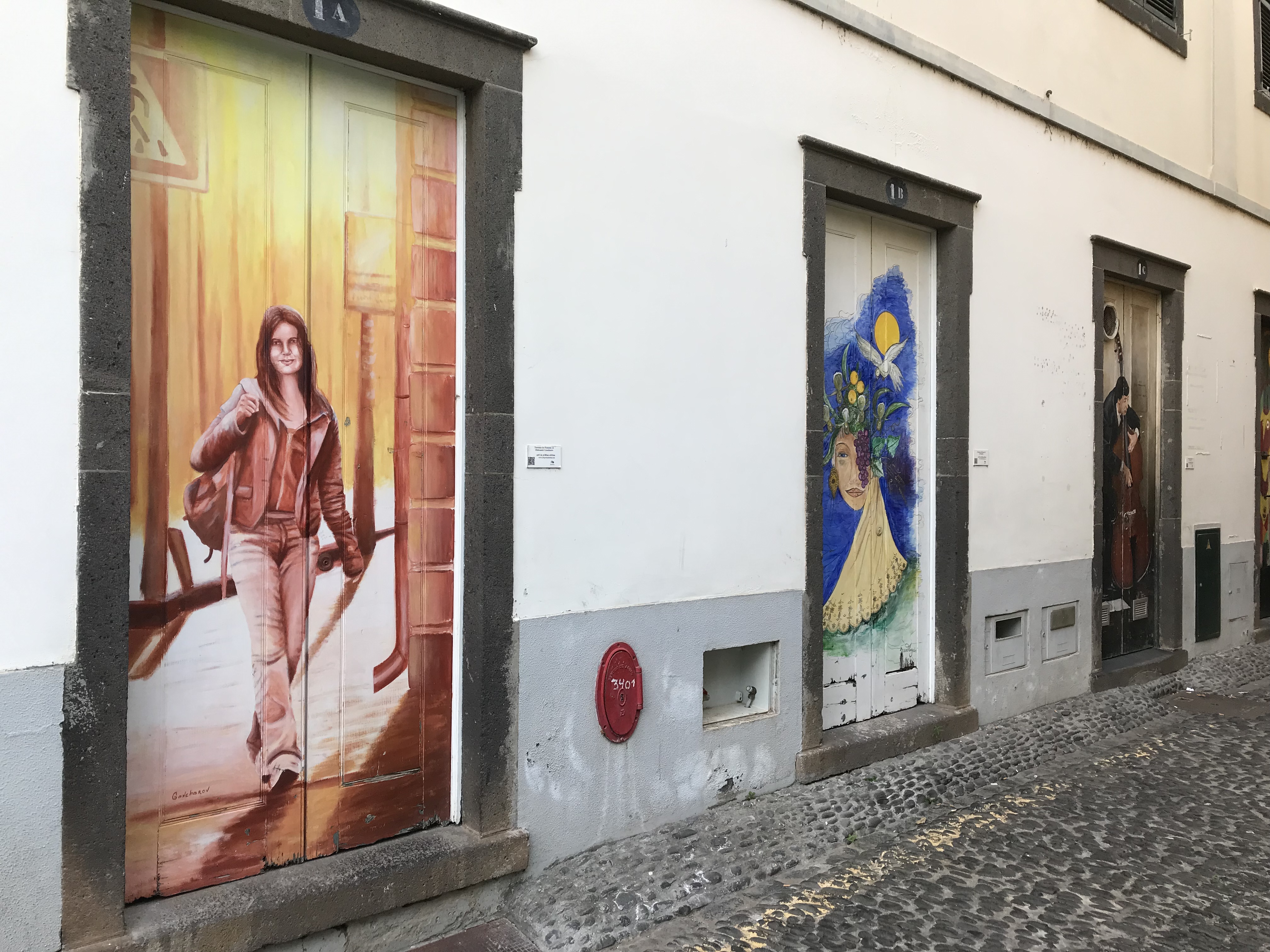
We stayed in the old town of Funchal. I am looking across orange-tiled roofs as I write, the cable-car sweeping past in the distance. If I walk down to street level, I am met with uneven cobblestone roads, palm trees, painted doors. Painted doors are a thing here.
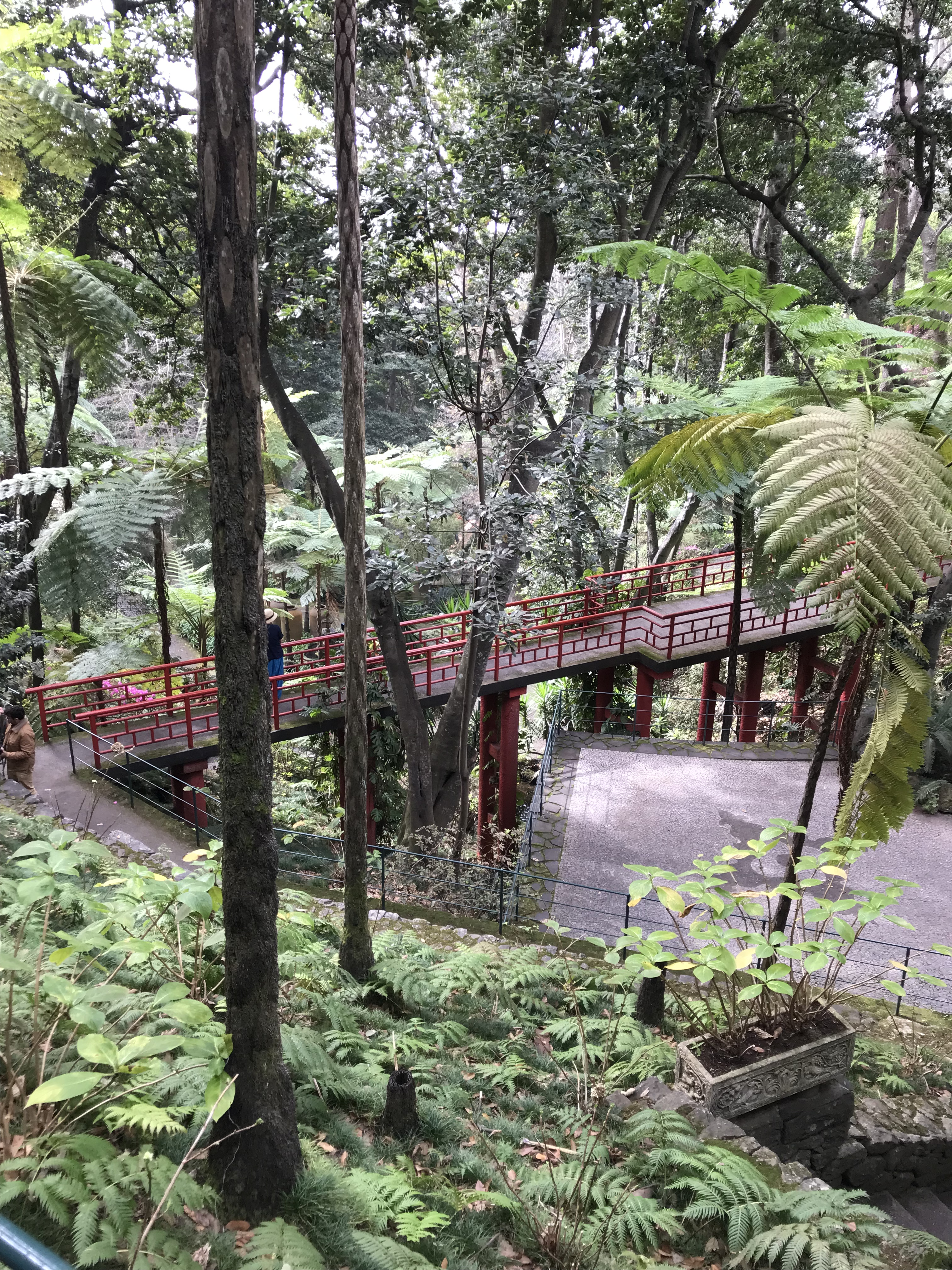
Monte Palace GardensFruit growing on a huge cheese plant.
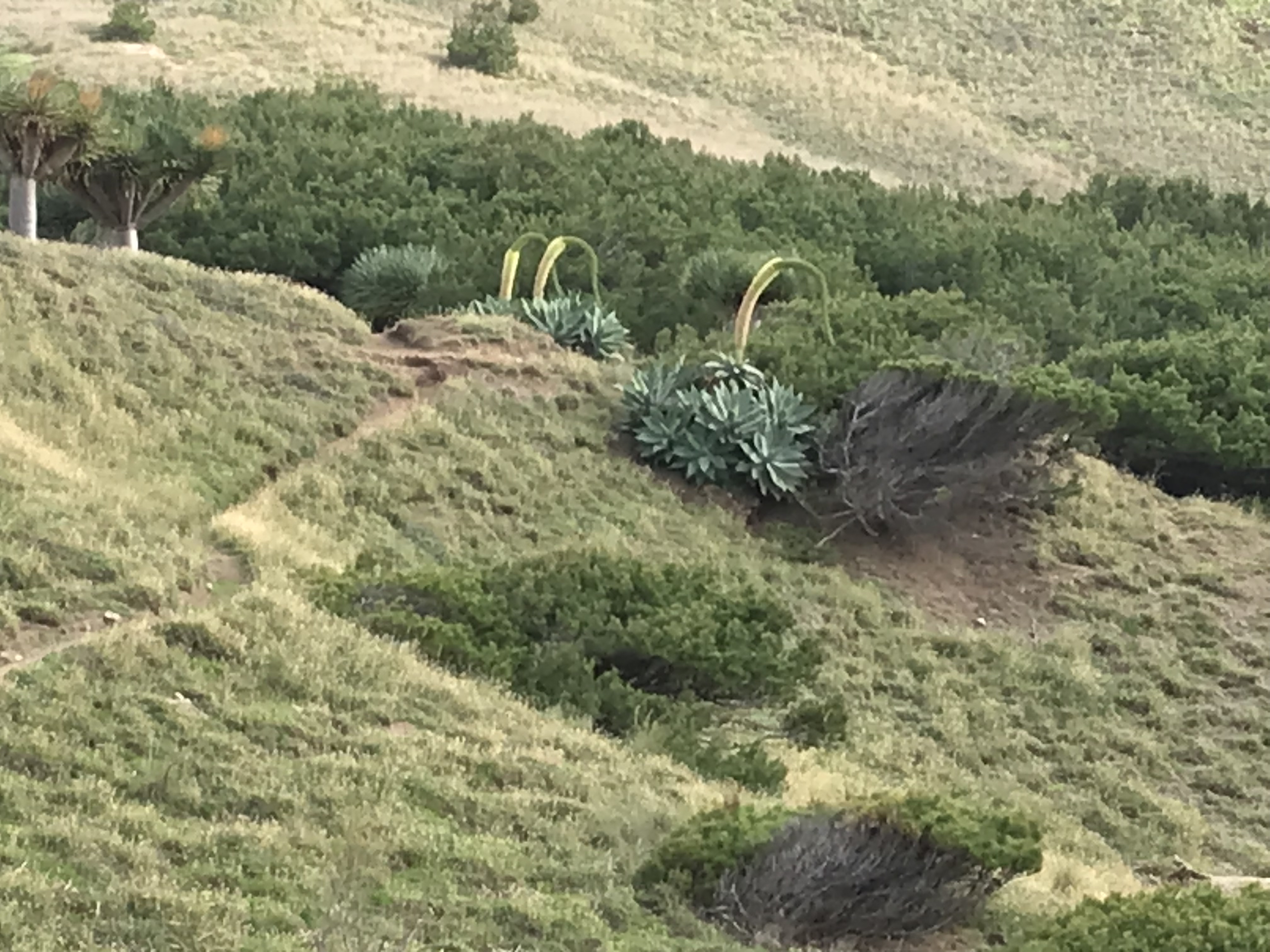
The plants on Madeira are brilliant, it really does feel like a tropical island, even in the winter. There also seem to be very few insects, which is a bonus. One day we walked up the mountain to the botanical gardens. This was not worth the effort. Perhaps it’s seasonal and we were unlucky, but the plants growing wild were better. The garden in Funchal was disappointing. In contrast, the garden of Monte Palace was beautiful, with exotic plants, and vibrant colours, and water features. There were little displays of African art and mineral crystals, plus a taste of Madeira wine all included in the ticket price. Worth the cable-car ride to get there.
One other disappointment was the fruit market in Funchal. It’s basically a tourist-trap, with aggressive stallholders trying to entice you to buy their fruit. I read online that they tend to soak fruit in sugar, offer some to tourists to taste, then sell the not-so-sweet fruit at inflated prices. It was worth a visit, just to look, but don’t buy any fruit! If you walk round the corner, there is a big supermarket, where you can buy all the same fruit at a much better price. It annoyed me that they were so blatantly ripping-off tourist. But maybe that happens in every city in the world.
It is, however, worth trying some of the fruit after you have bought it from the supermarket. There is the big green ‘custard apple’ which is white inside with big black seeds. It tastes of custard. The ‘delicious fruit’ (Monstera delicious) is the fruit of the cheese plant (the one with holey leaves in your auntie’s house). It tastes like a pineapple crossed with a banana, and is poisonous before it’s ripe (so only eat the soft ones). The peel falls off in hexagonal segments when ripe, and the inside is slightly slimy (like a banana). The ‘English tomato’ is not an English tomato and I thought it tasted more like a red version of kiwi fruit. The skin was very bitter, so not great if you take a bite, and you should scoop out the acidic seeds with a spoon. I didn’t like it much. Some of the more delicious local fruits were the bananas and avocados.
The water is carried around the island in levadas, which are sort of long drainage ditches. It’s possible to hike beside them, as they all have maintenance paths next to them, though some are dangerous. We followed the Levada do Risco to a waterfall, and the walk was beautiful (but incredibly steep, so hard work walking back to the car).
Santana has some examples (mostly modern copies) of tent-shaped houses that were typical in Madeira in the past. They are pretty, but I preferred the church of St. Ana (which is what they named the mother of Mary—I didn’t know that).
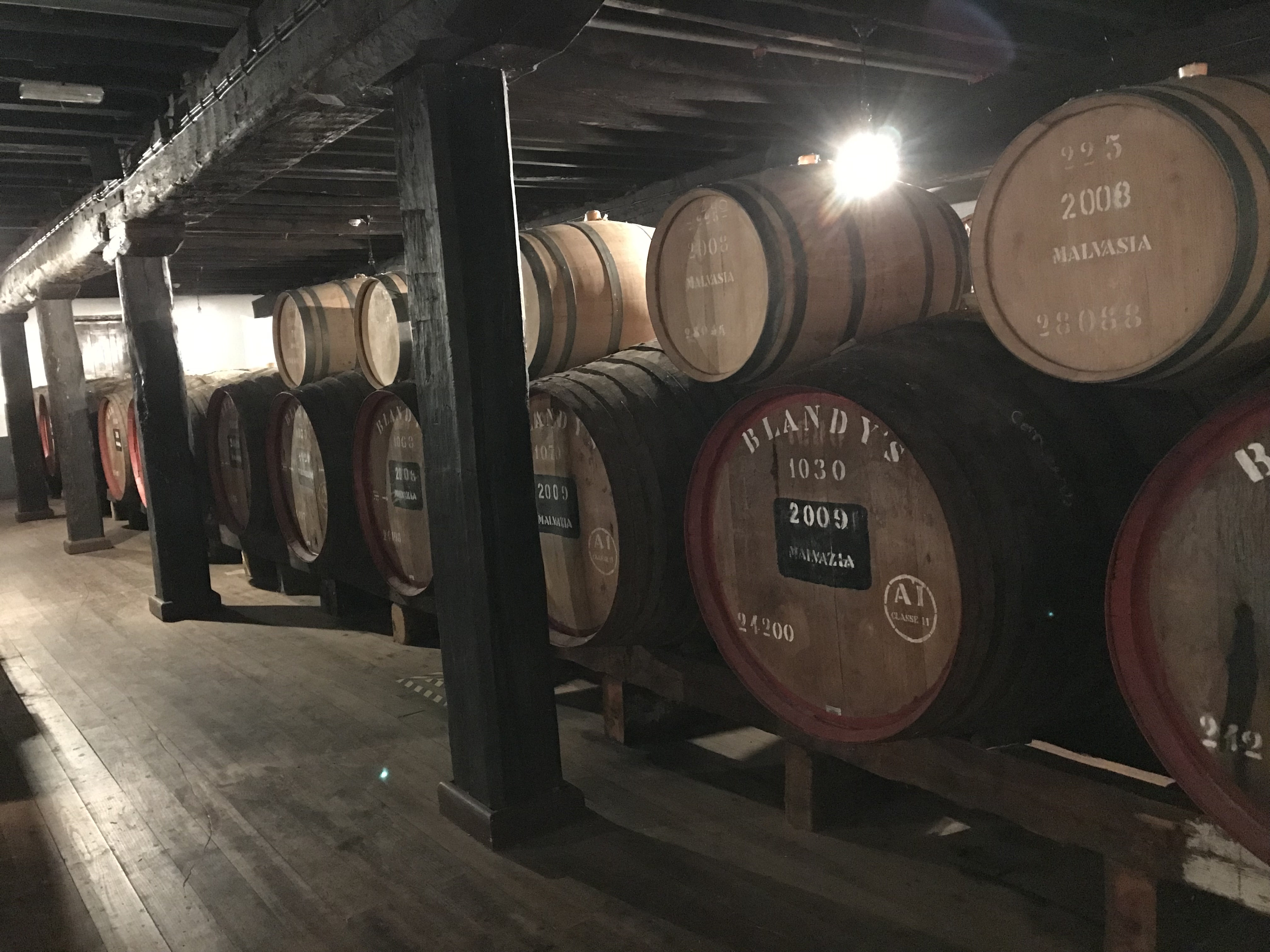
One day we did a tour of Blandy’s and learnt about the production of Madeira wine. It used to be fortified with rum, made from the sugar cane on the island. But the EU stopped that, saying a wine needed to be made only from grapes, so now they import the strong grape alcohol that fortifies it. There are different flavours, depending on the grape used. It tastes very like sherry, I think, and is nice to sip after a meal. Restaurants offer it, or limoncello, (which I’m not so keen on) when you pay the bill.
Eating on the island is very easy, and there are no queues in February, so we never needed to book. Most restaurants have outside eating, and it was often chilly but okay in a thick sweater. The food is nice, very like in Italy or Spain, and we found the staff friendly and helpful. Everyone speaks excellent English, and the menus are always available in English. Importantly for me, all the eateries seem very clean, with good hygiene procedures. Covid rules here seem less strict than in Zurich, but everyone wears masks in restaurants unless sitting.
If you want some winter sun, come to Madeira. England seems a long way away, and I can feel my batteries recharging. The perfect place for a holiday.
Thanks for reading. Hope you have something nice today too. Take care. Love, Anne x
Houses in SantanaLocal fruitThe English Tomato is not English.Walking to Rosco Waterfall.Different grapes that produce Madeira wine.A tour of Blandy’sFolds of mountains that make Madeira.Painted doors are a thing here.A windy walk to the end of the island.Thank you for reading.
anneethompson.com
Follow my blog to read more.
My next few blogs will all be about the Lent challenge that I am going to attempt. More next week…
A short drive along the coast from Funchal is Caniçal, which used to be a whaling community but is now, according to the guidebook, at the forefront of whale conservation. We went to have a look.
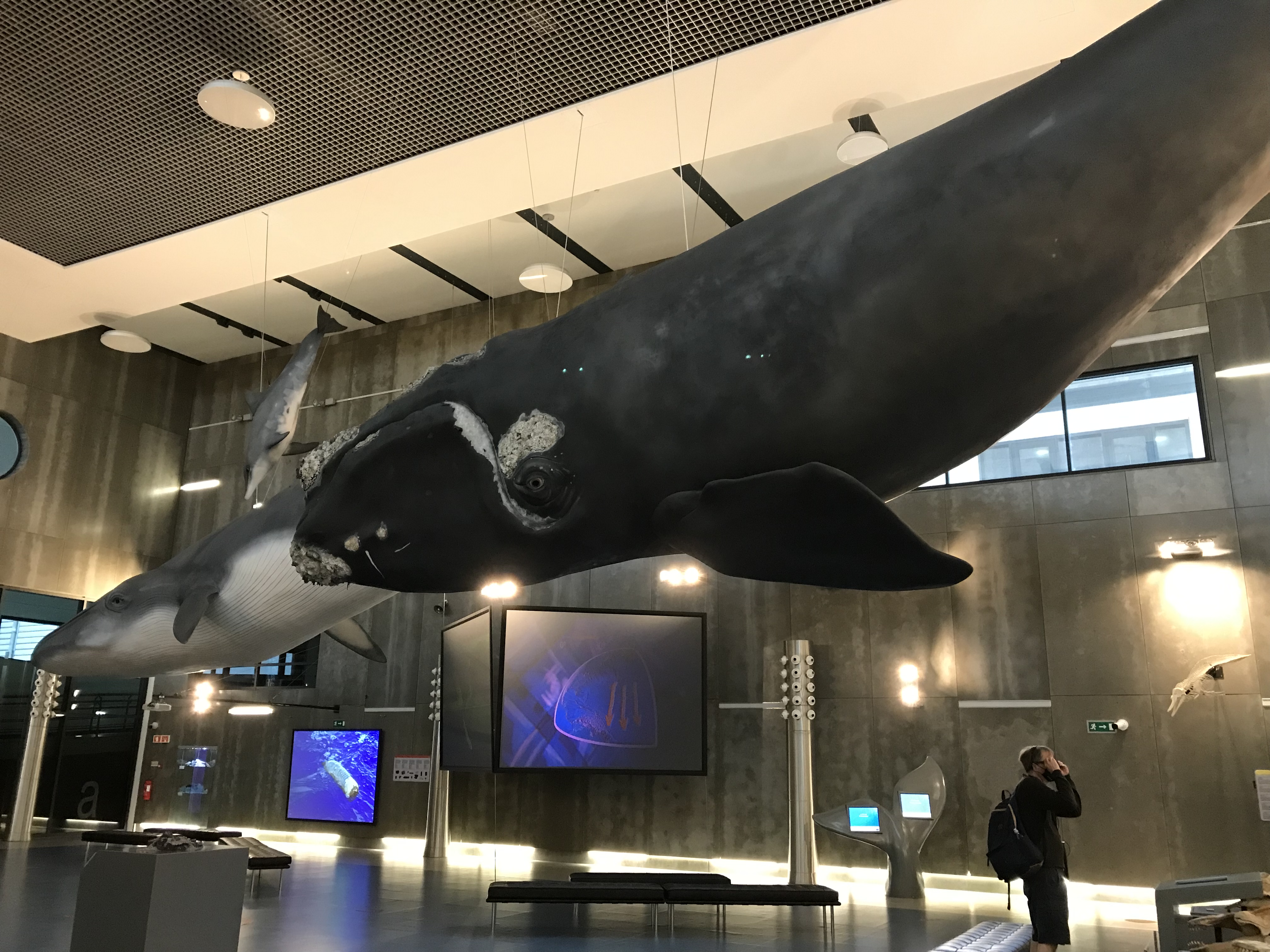
The best place to start seemed to be Museu da Baleia, which looks like a huge warehouse. The museum had a strict covid protocol, and we were instructed to sanitise our hands, and show our covid certificates before we could enter. We were given headphones, charged 10 euros each, and sent off down a series of ramps to the lower level. The headset was very clever, with the commentary automatically changing as I wandered around, giving the correct information for the display I was standing next to. At one point we were given 3-d glasses, and watched a film about how whales evolved, the land mammals returning to the sea.
I was expecting the museum to be about whales, explaining their habitat, showing how they were protected, perhaps a model that I could stand next to and be amazed by their size. There were models hanging from the ceiling, but too far away to really appreciate their size. Mostly, the museum seemed to be about whaling.
A modern museum, with smart headsets and 3D films.
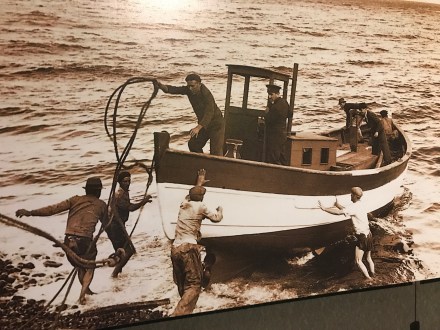
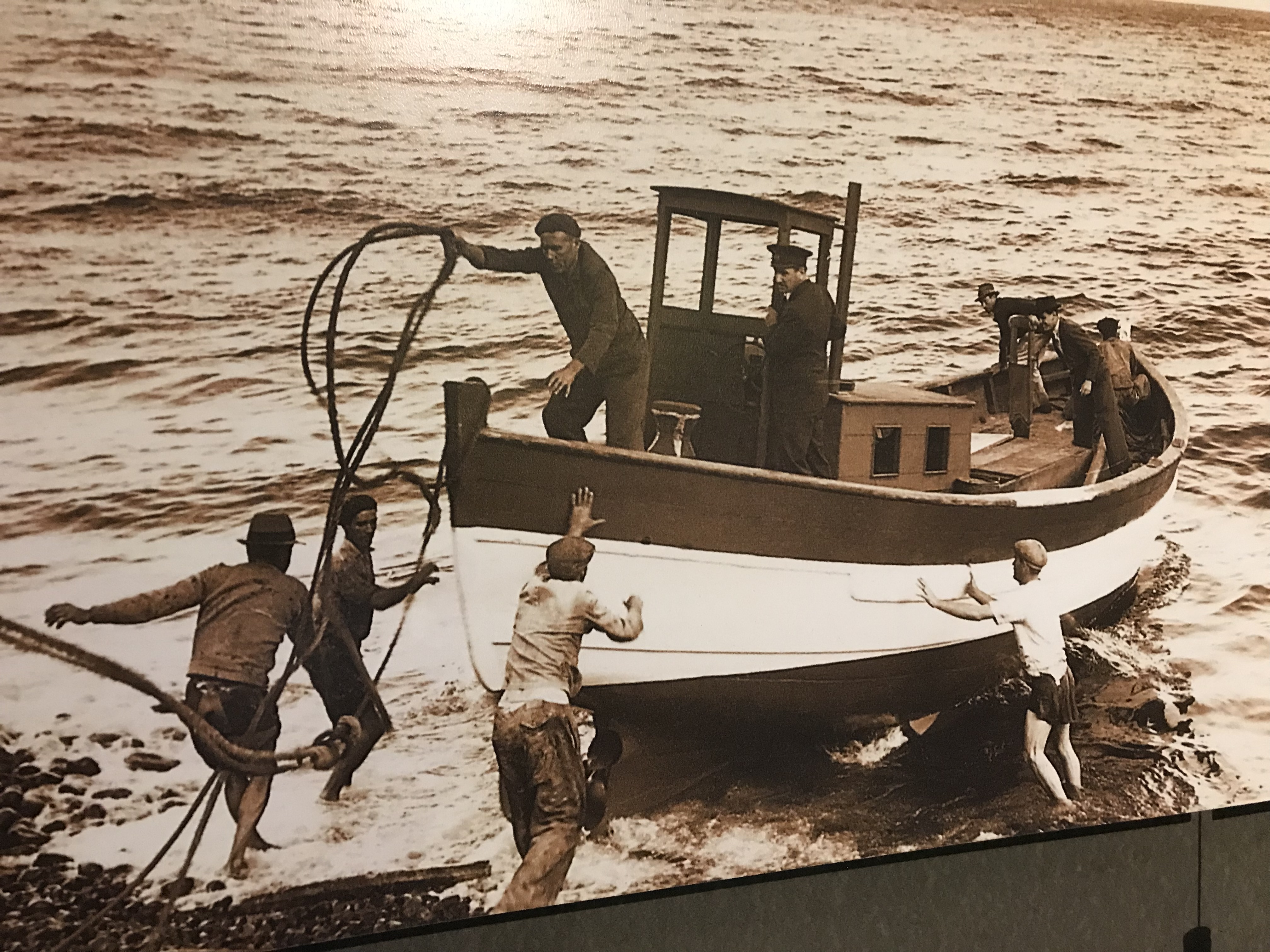
There was a photo wall of whaler portraits. There were models showing the process of stripping the whales after they had been slaughtered, explaining what each component was used for. There was even a film, showing whalers in the 1950s, running to their boats, putting out to sea, harpooning whales. The emphasis seemed to be on the courage of the whalers, the dangers they faced, the difficulty of catching such a huge animal on small wooden boats. It was uncomfortable to watch, like watching a film of hunting elephants. It was also telling that the film was so dated. Nothing from the late 1970s (whaling stopped in 1981) when the boats were more sophisticated, when the whales had no chance of escape. If I had been a ten-year-old on a school trip, I would’ve been impressed by those early sailors, they would appear as brave heroes. Perhaps, at the time, they were.
Whaling in the past.
I guess it’s difficult to know how to portray whaling in a community that until relatively recently has survived due to the practice. School children will know that their grandad was a whaler, the teachers probably grew up in the home of a whaler. I wonder whether my grandchildren will feel the same about me eating meat, and if they will wonder how and why I did such a thing. I wonder if my abhorrence of whaling is hypocritical.
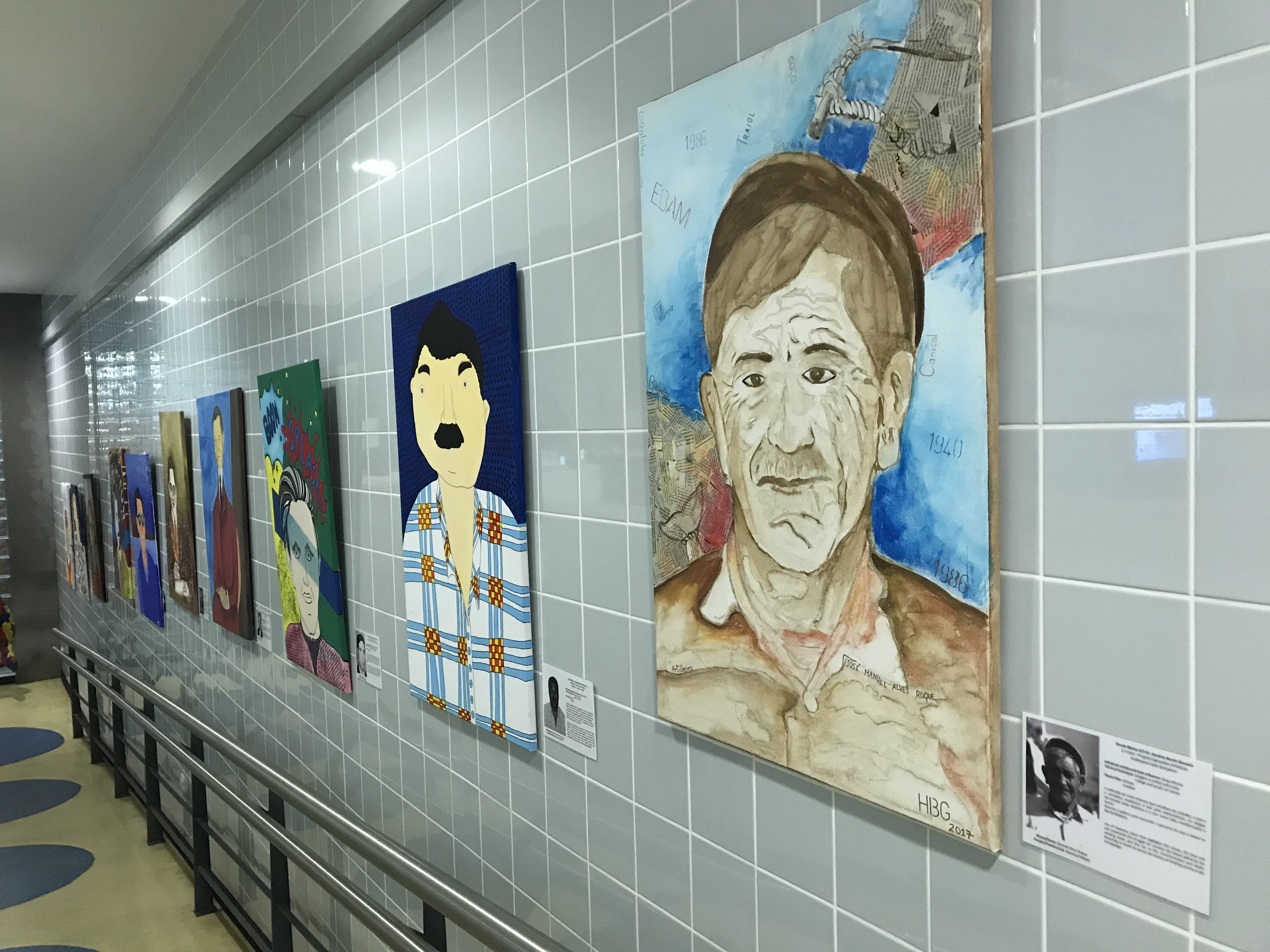
We left, walking up a ramp with portraits of the whalers painted by school children in the style of famous artists. They were clever, the sort of work I would have been pleased to encourage when I was teaching. Though I still felt uneasy with the subject. Were the children honouring their past—and should they have been? But should the community cope with judgement and condemnation when at the time, it was seen as a way of life? I don’t know. But I had hoped to learn more about whales, to stand in awe at their size, to understand how they are faring in today’s world. I had hoped that killing these magnificent creatures would be seen as wrong. Perhaps I was in the wrong town for that to happen, perhaps we need to be further removed from the mistakes of the past before we can face them.
Some talented artwork, portraits of whalers.
Thanks for reading. Take care. Love, Anne x
Thank you for reading
anneethompson.com
Why not sign up to follow my blog?
We had two weeks in Madeira, which is long enough to relax into a routine. We knew the weather might be cold and rainy, but most days we had sunshine, sometimes hot enough to burn if we weren’t careful. I’m writing this on our last day, and it feels as if we have been here forever and the thought of home, and feeding animals and preparing for a new term at college belongs to another world.
The apartment is quite basic, but the position is fabulous. Every morning we run (using the term loosely) along the sea front, as far as the Cristiano Ronaldo statue. One mile, then home. We run on black and white tiled pathways, loop through tiny parks, past a jetty to a lighthouse, a dock full of sailing boats, several cafes with locals sipping espressos. A man stands near the Ronaldo Museum, and he shouts and claps as we run past. Sometimes one of the smaller cruise ships parks next to the museum, and we stand for a while, catching our breath, staring up at the layers of decks, people in dressing gowns on balconies, lifeboats strung across the lower deck. Husband tells me the bigger ships are the height of the Canary Wharf towers, and I wonder how something so big can appear so insignificant as it heads away towards the horizon. The sea dwarfs us.
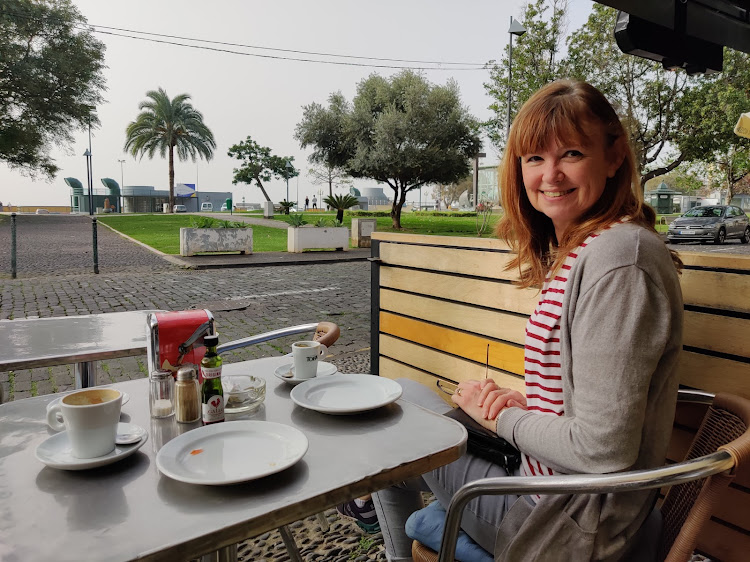
After a quick shower, we walk to a little cafe opposite a park and sit at a round metal table. If it’s raining, we huddle under one of the umbrellas but most days we have full sun and cool morning air. The elderly owner waves in recognition and checks we are having the same order we have every day: a white coffee for Husband, an espresso for me, a tomato, cheese, onion sandwich. The local bread is round and flat, and our sandwich arrives cut into quarters. I eat a quarter, and the owner brings an extra plate, which he places in front of Husband and puts the sandwich in front of me, then shuffles away laughing. This happens every morning. You don’t need much shared language to understand a joke.
The park we face is small, with a few statues, patches of green grass, neat hedges. The paths and streets are very clean, I think a road-cleaner drives round them every night. The park has various uses. People come here to exercise, and there’s a skateboard section with young boys scraping their knees and elbows as they try to fly. Some days one of the tables is full of elderly men, gesturing as they shout about an injustice in the world.
Sometimes the bench has thin people with ancient faces and dead eyes, watching as others arrive, whisper, shuffle, leave, dealing their trade of slow death. We see the same people in position around the city, pleading for the price of a coffee, a few coins so they can eat. After two weeks we begin to recognise certain faces, brown and wrinkled but wearing smart clothes so someone, somewhere, is dressing them.
Cobbled streets of Funchal
Most streets are cobbled, and our walk to the cafe passes several restaurants setting up tables. We ate in the restaurant below our apartment in the first week here, and the staff recognise us now, shouting a greeting when we pass. We check the weather, and decide what to do for the day. Usually we sit on the balcony, listening to the sea, watching locals swim in a little area of sea surrounded by rocks, staring at the waves hoping to see a whale (we know it’s the wrong time of year, but we look anyway).
Funchal is built on a mountain (the whole of the island is a mountain) and a cable car swings up from the centre of town to Monte. One day we ventured up there, and looked at the church dedicated to Emperor Karl, the last Habsburg emperor of Hungary, who took refuge there when in exile. There are cards, with a picture of the emperor on one side, and a prayer to him on the other. I don’t know why people would pray to the emperor rather than to God, they must feel he is able to somehow intercede for them but I don’t know why. The church has two white towers, a statue of the emperor, chandeliers, paintings, and a great view down the hill to Funchal. It’s also the place to have a sleigh ride.
The sleighs are large, square wicker baskets, pulled by men wearing rubber shoes and straw hats. It cost 30 euros for two people, and they whiz you down the hill to Livramento. At various places down the road, people take photos, gesturing to us to remove our face masks. When we arrived in Livramento, they offered to sell us the photo for 10 euros (and were a bit miffed when we didn’t). There are lines of taxis waiting to take people back to the city, but we opted to walk down. It took about half an hour, down steep streets, and we were escorted by a black Labrador, who politely waited for us at every junction before skipping ahead. Pretty sure he was laughing at us. We lost him when he stopped to drink from a stream. The city is full of dogs and cats wandering freely. They look well fed and cared for, but never seem to have a person with them.
Thanks for reading, I’ll tell you more in another blog. Hope you have a fun week. Take care.
Love, Anne x
Thank you for reading. anneethompson.com Follow my blog to read more.
Exams were over, essays submitted, it was a chance to relax. Husband, who is forever lurking in the background trying to entice me away from home (because his work is mostly online) persuaded me that some winter sunshine would be good for me. I didn’t take much persuading. We went to Madeira.
Have you ever visited Madeira? The only thing I knew about it was that it named a rather nice plain cake. I now know that the cake was invented in the UK, to eat when drinking Madeira wine. I now also know how to make Madeira wine (had a tour of Blandy’s) and that it’s delicious—but more of that in later blogs.
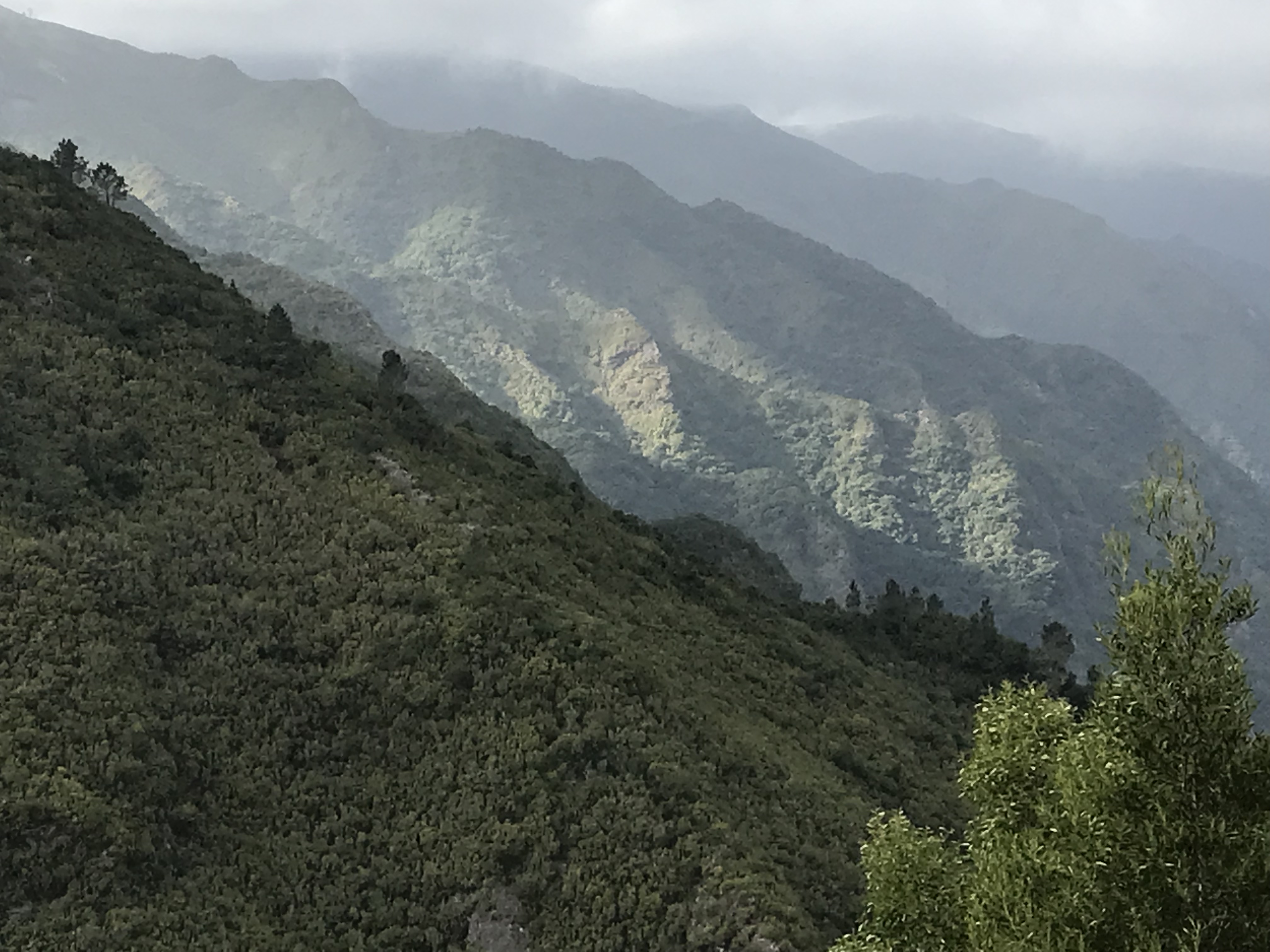
Madeira is a small island (about the size of the Isle of Man) owned by Portugal but actually nearer to Morocco, a drop of volcanic rock in the Atlantic Sea. My brother told me to look out of the window as we approached the airport, and I wish I hadn’t because I saw the rather flimsy-looking runway perched on stilts. I also saw that the island is basically a series of mountains, caused by an ancient volcano and now covered in plants. The plants are fascinating.
We visited right at the end of January, which is sort of their rainy season, though we mostly had glorious sunshine. We rented an Airbnb, which was owned by an agency so fairly plain (individual owners tend to care more and decorate the house a bit) but it was very clean. The main thing was the position, which was brilliant. We were right at the end of the old town, next to an old fort (which someone decided would look nice if painted yellow—a mistake I feel). We overlooked cobbled streets and the sea, and the bright yellow fort.
Driving to the apartment was an adventure. We picked up a hire car ( a small one, thankfully) and set off along the main road. But then the Satnav took us into the city of Funchal and the streets grew smaller and very steep. As we approached the old town, the streets sort of disappeared and turned into narrow cobbled pathways. Very steep narrow cobbled pathways. With blind-bends at the junctions, and parked cars and pedestrians. Some streets had tables spilling out from cafes, for even more excitement. I was map-reading, and we made a few wrong turns, but I decided it was best to not mention it and just to keep talking in a calm voice. We arrived at the apartment, but there was nowhere to park, the narrowed cobbled street/footpath was busy, and a couple of policemen were strolling towards us. Not the time to practice my Portuguese.
Hard to know what to do, so I took charge (I felt Husband had enough on his plate with not killing anyone). I told him to unload me and the luggage and drive off and find somewhere to park, before the policemen reached us. Then he could walk back to help me find the key and lug our bags up to the flat. He left me with the cases and drove off.
I was standing in the entrance to a student residence. The sun shone down, I could hear the sea, the cases were unstable on the old cobblestones. I shuffled into a space next to a wall. Felt conspicuous. Tried to edge cases further from oncoming traffic, and blend into the background. It was quite hot, the street was busy, I had heavy bags, no key to the flat, and limited Portuguese. Felt rather vulnerable and hoped Husband would arrive quickly.
Husband was gone some time. He finally showed up, still driving the car, which was rather disappointing. He told me he had done several laps of complicated one-way system up and down steep, narrow roads, and there was nowhere to park. The flat provided free parking in the town carpark (which cost 40 euros) but the ticket was in the flat. Super.
We left the car sort of jammed in the entrance to the student building and hoped no one (especially the police) would notice. I used the code to get the key, ran up to the flat, grabbed everything that might possibly be linked to parking instructions, and ran back. Husband took the wadge of papers and drove off again. I stood next to heavy bags, feeling things hadn’t really improved.
Eventually Husband returned without the car. Things were getting better. He lugged the bags up to the flat. The view from the balcony made it all worth the effort. I will tell you more in my next blog. Madeira is lovely. But hire a small car.
Thanks for reading. Have a good week, and take care. Love, Anne x
Our Airbnb was the top balcony.Breakfast opposite the park.Cobbled streets of Funchal make for exciting driving!Thank you for reading anneethompson.com
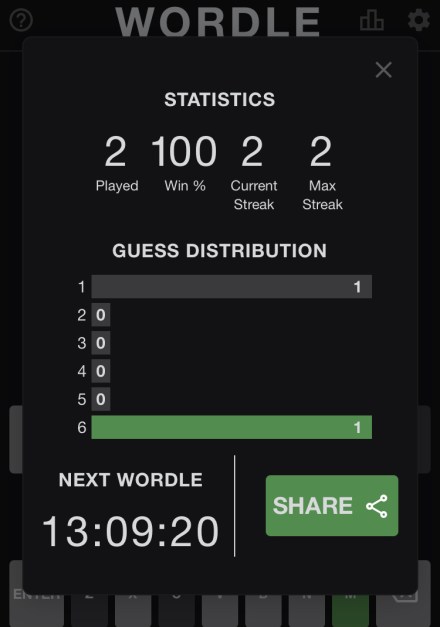
Have you discovered Wordle yet? My sister mentioned it first, saying she had found a new game online. My brother then admitted he played it too, and they started to compare scores. Then my daughter joined the club, and started to reveal her score. My sons tried to beat her, failed, traded insults. This is my family. But then suddenly, both sons managed to get the highest score, every day. They told me they are magic (I guessed this was probably not true.)
Wordle is basically an empty grid and a keyboard. You write a word in the grid, it tells you which letters are in the ‘word of the day’ and which of those letters are in the correct place. You try again on the next line, and so on, trying to guess the word before you have filled all the lines. It’s fun, passes the time, and seems to bring out a competitive streak in my family.
I told my mother she ought to play, as it would help to keep her brain young. I often tell my mother things like this. In return, she tells me to eat less dairy food and to eat brazil nuts every day. We mostly ignore each other.
I was fascinated though that my sons were managing to guess the wordle word every day, first try. They told me they had hacked the system, discovered the algorithm. Tried to appear disapproving but was secretly very impressed. Such clever sons, so impossible to parent.
My brother then pointed out that if you change the time and date on your phone, you can complete Wordle in the future, thereby knowing the word when it appears in your real time zone. Not so clever. But hush, don’t tell them that I know…
Piet Mondrian was a Dutch painter who first played Wordle. Due to lack of internet, he painted his scores.
Thank you for reading
anneethompson.com
Why not sign up to follow my blog?
Before we leave the story of Adam and Eve in the garden near Eden, I wondered if you have formed any conclusions of your own? It’s there, right near the beginning of the Bible, and the story is told in every UK school and every church—so why? What do you think it means?
Whatever you believe, I think you have to accept that you have decided to believe it. Belief is a choice. At this stage, we cannot ‘prove’ anything. We cannot deny that fossils of prehistoric life have been discovered, and scientists have aged them, and they suggest that animals evolved gradually over millions of years. However, to believe this is a choice—we cannot prove it. God may have created the world, in seven days of twenty-four hours, with the fossils already nestling in the earth for humans to find.
My own belief is that this scenario seems unlikely, and it doesn’t fit with my idea of who God is. Creating a world full of fossils feels like lying. I could dispute the aging of those fossils, but my science isn’t advanced enough for that, and everything that I read suggests that actually, the evidence for evolution is strong. We can see it happening today: if an animal’s environment changes, the animal changes too, it evolves into a new variation. When those changes mean that it can no longer reproduce with the animal group it used to, it is categorised as a new species. It happens every day, all the time. It’s not about monkeys waking up one day as humans (which is an argument I have heard when expressing disbelief in evolution). Sometimes, if intelligent people are saying something which sounds daft, it’s probably because we haven’t understood it.
So, I choose to believe in the evolution of animals, though I am aware that I might be wrong. Having studied the science a little, I find it impossible to believe that this can have happened randomly, and I believe (another choice) that this is how God created the world. At some point, humans evolved to be different to other animals, to have a soul. Humans have a moral code, an understanding of things beyond their experience, a conscience. I think that this change from animal to human is what the garden of Eden story is seeking to explain. God put a spirit into humans, at some point during evolution, and it made them different.
As an aside, I have wondered if this explains the extremely weird story just prior to the story about the flood. It talks about why God is angry with the world and decides to destroy it with a flood. I wonder if those early humans (with a soul) were mating with the lesser evolved hominids (without souls) and this was against God’s will. If God at some point gave souls to humans, they may physically have still been similar to lesser creatures, and their human-animal hybrid off-spring would cause big problems if allowed to continue. Therefore they were all destroyed in a flood. But this is just me speculating. I expect someone will tell me this is impossible.
I think the story also shows that humans are not God, they have a propensity to disobey God, and this results in life being spoilt. I don’t, however, think there is enough support in the story for the idea of an inherited ‘original sin’ theology. I don’t think everything human or physical is bad (which is what Augustine and other theologians from the Middle Ages taught) and that humanity is basically rotten. But dismissing this theology raises other questions, which Augustine was trying to answer, and which, to be honest, are beyond me. People do sin, I’m just not convinced that a new-born baby is born sinful.
I’m not sure how much difference any of this makes to real life. Perhaps the only important thing is to understand that God made us (even if you’re not sure how) and this makes you valuable (even if you don’t feel it). It also shows that there is a God, and it’s not you (a hard lesson for teenaged boys to learn, that one!) Maybe one day, we’ll understand how it all fits together.
One thing I do know is that much of creation is extremely beautiful. Next week I’ll tell you about our trip to the island of Madeira, and all the exotic plants we saw and some of the unusual fruit we ate. Not sure any of it made us wiser though.
Enjoy your week. Take care. Love, Anne x
Thank you for reading
anneethompson.com
Why not sign up to follow my blog?



















 Anne E Thompson