A Matter of Life and Death


I don’t know about you, but I am always surprised by how much life bursts forth in the spring. Suddenly, every weed in my garden is ten-foot-high, the chickens start hiding their eggs and going broody, wild birds start to go bananas. It is mostly wonderful.

There are a few downsides though—like the bag of potatoes I found at the bottom of the larder, with roots practically piercing the bag. Maybe not so good for mash. I had the clever idea of planting them, so the chickens could eat the new leaves when they sprouted (wouldn’t take long!) I took them up the garden, and found an area against the chicken coop fence. Ideal, I thought, I’ll chuck them there, toss a bit of compost over them, they can grow through the fence and the chickens can eat the leaves. All good.

About 3 days later, the potatoes appeared in a bucket next to the door.

“Look what I found!” announced pleased husband, beaming all over his face. “These must be the seed potatoes you planted last year, and they’ve grown new tubers.”

I told them I thought they were possibly some old potatoes that I’d found in the larder (I didn’t go into too much detail), but he assured me that the roots were really long, and there was no way they could possibly be from this year. I checked the area next to the chicken coop. No potatoes or heap of compost. I keep trying to avoid the subject, but husband has mentioned it about 50 times since then, saying how amazing it is. Might have to confess.

The welcoming committee. . .

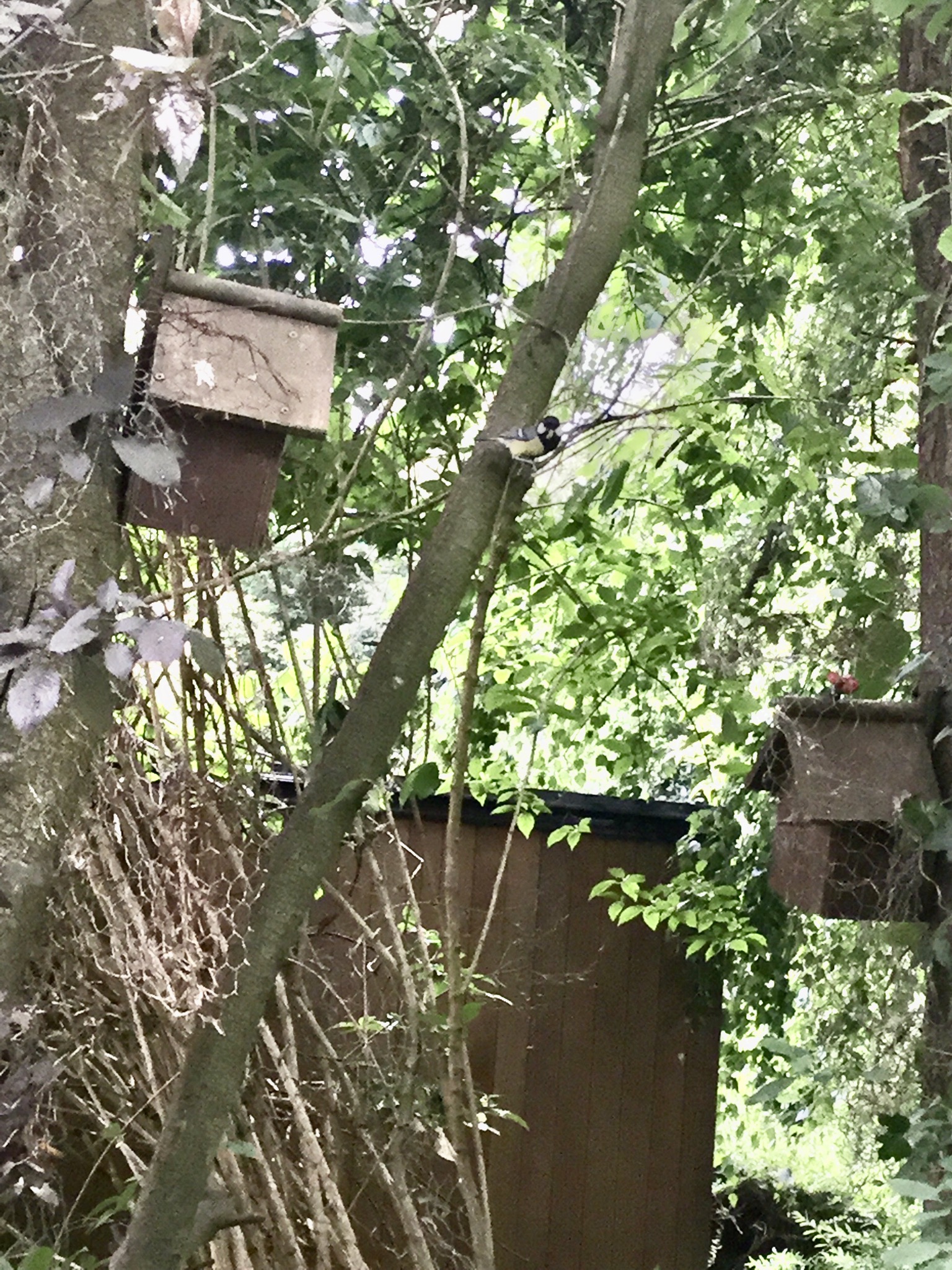
We also had birds in the nesting boxes that Uncle Frank made. He gave them to me ages ago, and I put them near the kitchen window (good plan) so I would see if any birds took an interest. We had some great tits in the area, and I guessed the eggs must have hatched when I noticed a welcoming committee of four cats staring at the nesting box. I started to shut the cats in during the day, letting them out at night. But then one morning, I came down to find one cat up the tree, and by the time I had run outside, he had fished a baby out of the box and was playing with it. I grabbed the baby, shoved it back into the box, and shut the cat inside. Husband then assembled some protective obstacles around the base of the trees. The view from my kitchen window resembled a cross between Guantanamo Bay and a WW1 trench. Not quite what I’d hoped, but at least the birds were safe.

A little like a ‘Where’s Wally?’ wildlife picture, but this is one of the birds.

We watched the parents feed the birds, and I did some online research. Did you know that great tits have a black stripe down the centre of their breast, and that the male has a wider stripe than the female? The width is directly proportional to how many sperm he produces, so female great tits will try to select a mate with a very wide black stripe. Our male was in the ‘acceptable but not a super-stud’ range. Cool fact huh?

We guessed the hatchlings were flying because several blue jays appeared in the garden. Am hoping they didn’t catch them all—maybe the blue jay family had a banquet that day. The next morning, the nesting box was empty except for moss and feathers.

In keeping with the explosion of life that is spring, I have some duck eggs incubating in the utility room, and my beautiful white leghorn chicken is sitting on some eggs in her nest. She has a choice of leghorn (white) cockerel or legbar (grey) cockerel to choose from. I am hoping to have a female chick from the legbar male, as they lay lovely blue eggs (though whether or not a hybrid will, remains to be seen). They are due to hatch next week, so I will let you know how they fare.

I also have a female pheasant (I can’t tell you how delighted Husband is about this!) I found her in a ditch, so am guessing she had been hit by a car. I knew the fox would get her, and I figured it would be nicer to die somewhere peaceful, so I carried her home and put her in an empty duck coop next to the pond. But she didn’t die. I’ve had her a couple of weeks now. I’m feeding her grain and apples (have to smuggle the apples out of the house because technically they belong to Bea’s boyfriend). She can’t actually walk (the pheasant, not Bea) but seems quite happy lolloping around the coop and watching the ducks. There is a ramp down to the pond, and I do have some worries that she might drown herself (pheasants are very silly birds) which means Husband will have to wade out and retrieve the body—which he will mutter about for several days—but at least it will stop him talking about the blessed potatoes!

I hope your week is full of life.

Take care, and stay safe.

Love, Anne x

Thank you for reading
anneethompson.com
Why not sign up to follow my blog?

Another chapter from Counting Stars will be posted on Wednesday.

Quarantime to Read. . . Counting Stars: Altered


She doesn’t look, think, or fight like James Bond, but sometimes a mother simply has to do whatever it takes. . .

Altered

Lena walked slowly to the kitchen. That conversation had not gone well at all. The children had announced that they wanted to keep their barcodes, like everyone else, and what would happen to them anyway now they had left? They didn’t even have their computers, had left them in the guesthouse. How could they contact their friends, what about schooling? Why had she brought them here?

It was Max really, Lucy would have agreed to anything. He was only being difficult because he was tired and found new things disturbing, Lena knew this but it did nothing to make her own task easier. She wound her way back to the kitchen, past the vegetable patch and the neat flower beds, over the lawn and along the small stone path that curved under trees and led to the kitchen door.

Agnes was in the kitchen, chopping vegetables. She smiled when Lena walked in. Lena picked up a knife and sat next to her. She watched as Agnes held the vegetables firmly with one hand on a wooden board, slicing quickly with the other. Lena had never cut vegetables before, and she watched Agnes, wondering if it was difficult. Lena ordered all her meals, like everyone else, scheduling them all to arrive at set times throughout the week. She had a coded cold storage box next to the door and, if she happened to be out, the food was left there for her to collect when she got home. It arrived ready to microwave or reheat, unless she ordered ready-eat food, which arrived hot. That didn’t happen very often, not on their budget.

“Do you want to help?” asked Agnes.

“Yes, but, not entirely sure I’ll be much use,” admitted Lena. “Cooking was never really a hobby.”

“No, I was lucky, I learned to cook when I was young,” said Agnes, resting her knife on the table. “Most people still did at least some cooking then, even if it was only for special occasions. Now people only really cook for fun, if that’s what they enjoy doing.

“We don’t get deliveries on the island, obviously. Since we’ve been here I’ve had to do all the cooking. John grows most of the vegetables and we have some fishermen who will deliver orders for us, keep our stores topped up—tea, coffee, that sort of thing. I don’t really enjoy it, but needs must. We don’t use drones for deliveries because of the cameras.

“Here, why don’t you peel these carrots? Like this, you just run the peeler along the edge. That’s it.” She moved the onions to a large pot and put a pile of carrots next to Lena, placing an old bowl below to catch the peelings.

“I never learned to sew though,” Agnes continued, pulling potatoes from a large sack, showering dirt on the tiled floor. They sat on the table, muddy and smelling of earth. Agnes began to slice off the peel, exposing their moist white insides.

“My Grandmother sewed a little, when she was young,” explained Agnes, “but by the time I was born everyone bought all their clothes. It was a bit like cooking is now, a few people still sewed, for fun or to save money, but very few. It was so much easier to order them online.

“So, I’m afraid we’ll have to order you and the children some clothes,” she said, looking at Lena. “We can give a list to the next fisherman that stops here, ask him to send some. They won’t mind. We never go to the mainland now, obviously.”

“Do they know that you’re here?” asked Lena, thinking that actually, it wasn’t obvious, but not liking to say. She was not sure how much information she should ask for. Not sure how much she wanted.

“Oh yes, of course; you can’t hide a whole island. They seem to have decided to leave us alone though, as long as we don’t cause them any trouble. To be honest, I think they are relieved in a way, it solves a problem for them when the altering doesn’t work. It doesn’t sometimes, you know. Not that they like to advertise that.”

She pulled another potato from the bag. It was soft and smelly so she threw it in with the peelings and selected a new one.

“What do you mean?” asked Lena. She had stopped peeling and was staring at Agnes, not sure if she would cry or be sick. Or maybe this would be good news—so long since she had heard any of that.

Agnes looked up from the potato, paused, put it down and reached for Lena’s hand.

“Oh, my poor girl. You don’t have a clue, do you.” She stood, brushing specks of dirt from her apron. “Let’s have some tea and a proper chat. We need to sort out what’s going to happen anyway, but maybe you need to understand a few things first. Information on the mainland is so very controlled. Are you feeling up to it?”

Lena nodded. Better to know, to stop guessing, wondering, being lost in a maze of confusion. You could prepare for what you knew, fight back if needed. Not knowing left you helpless, in a chasm.

Agnes filled the kettle and set it to boil. She pulled two china cups from the cupboard, added tea, sat back down.

“You know why you were sent to the hospital? What they were looking for?”

Lena nodded.

“You know about the alterations?”

“A little. Only what has been announced. And rumours, lots of rumours. I’m not really sure what’s true.”

She felt nearer to tears now, not sure if she could have this conversation. She had spent so much energy not thinking, not letting herself consider possibilities. Was it really better to know?

Agnes stood and made the tea, put a steaming cup in front of Lena, then sipped her own, as if ordering her thoughts, deciding what to say.

“I’ll start with a little history. Bear with me, you’ll know some of it but maybe not all.

“Before the Global Council, before we got properly organised, if there was trouble of any kind: crime, terrorism, that sort of thing, society used to lock away the culprits. If you go back long enough of course, people were executed—they still were until quite recently in some countries; but in England that had finished a long, long time ago. Obviously, people who were a danger to society needed to be removed, but the only real option was to lock them in a secure place, a prison. Before my time, of course, but I heard talk of it when I was small.

“It didn’t work terribly well, there was not the funding for them to be very nice places, people were sometimes crowded together more than they should have been, and people who had committed minor offences were sometimes put with more serious criminals. It also didn’t work. Most people, when they were let out, continued to commit crimes.”

Lena nodded, she knew all this, had heard it at school during history lessons, and seen pictures of grim buildings that had served as prisons. She even knew someone who had toured a disused prison on the moors, during a holiday. A few were still preserved, a physical reminder of the past, museums. Especially those that had been in remote places, where the Council had decided to conserve the area, away from towns and cities.

Agnes swallowed her tea and continued.

“Now, a quick change of subject but it’s related. Alongside all the other developments we’ve seen recently, is an understanding of how the brain works.

“Brain surgery always came far behind all the other medical disciplines you know. Long after surgeons were operating on hearts, kidneys, things like that, they did not even begin to look at the brain, it was considered too difficult. So, when they did finally start to open up the skull and examine what was inside, it took them a little while to properly master what they could do. They learnt which different parts of the brain did what pretty quickly, and began to do surgery when it was necessary; but the technology to actually alter what was inside, to change the way a person thinks, is fairly recent.

“Of course, once they worked out how to start altering what was happening in the brain, to start changing a person’s reactions to things, the opportunities seemed boundless. The first thing they did was alter the way a criminal thinks. I don’t understand it, you’ll have to ask someone better educated than me, but they managed to change the way a person responds to certain things. They can basically take away a person’s desire to commit certain crimes.

“In many ways this was good, took away the need for all those awful prisons. But of course, they couldn’t always be sure what else might get altered. There have been a few sad cases, people being left with not much ability to decide anything. The part of the brain that controls decisions and desires is so close to the part that stores memory. Some people even lost the ability to speak, by the time they decided what they wanted to say, they forgot the beginning; they couldn’t hold the words in their head for long enough to say them. Though these mistakes are becoming rarer as the technology improves.

“The trouble is, who decides what needs to be altered? The Global Council have written some pretty strong guidelines but things get changed, individual countries’ governments decide how to implement the new policies. That’s where we’ve got to now; if someone is considered a threat to the peace of society, they get altered. We think that’s what has happened to your husband.”

Agnes paused, waiting for Lena to respond.

There, it had been said now. All those hidden worries had escaped, been let out in the real world. Lena breathed. She looked at the carrot lying forgotten on the table. She looked at the tea going cold in her hand. She heard the children, playing noisily outside, arguing about whose turn it was. The world was the same yet everything was different. She could not speak, did not trust her mouth to form words. So she nodded. She wanted Agnes to continue, needed to hear this, to know if there was any hope. Otherwise she might as well go back to the mainland, let them alter her. Maybe she would be happy that way.

Agnes glanced at her, and Lena nodded, a slight dipping of her head, indicating that she was ready—able—to hear more.

Agnes spoke quietly, her voice matter-of-fact, as though trying to normalise the immensity of her words.

“We were already living on the island when they changed who could be altered, when it became used not just for criminals, and so we stayed. There are a few routes here, the one you used but mainly the fishermen drop people off. We usually know when people are coming so can welcome them properly. Most people only stay a few hours and then we get them on a boat, send them off to Asia.”

“Asia?” Lena frowned. Why Asia? Was that any better?

“I think that’s enough for now, why don’t we talk again later?” said Agnes. Her tone conveyed that this was not a suggestion.

“Now, you write down the clothes sizes you need and we’ll see if we can get some things for you. Your little family will be different to most of our guests, because of your husband. We need to find out if we can get him here, and that may take a few days, so you’ll need to stay.”

Lena started, and she felt her eyes widen as the words began to register.

Agnes tilted her head, her expression kind.

“It may not be possible dear. We need to find out some information first, and that takes time. It won’t be easy—you will need to wait and see. If there’s anything that can be done, we will try. It may be too late.

“Now, I need to get this soup boiling and you need to spend some time settling those children. Why don’t you take them for a walk around the island? Everyone is friendly,” she paused, wanting to reassure,

“It’s safe here, no need to be afraid of people here. Everyone is on your side now.”

To be continued on Wednesday.

Thanks for reading.
Why not sign up to follow my blog?
anneethompson.com

Quarantime to Read. . . Counting Stars: The Island continued


She doesn’t look, think, or fight like James Bond, but sometimes a mother simply has to do whatever it takes. . .

You can buy a copy of Counting Stars from Amazon: UK Link Here!

Due to the KDP rules on Amazon, I am not allowed to upload a whole book anywhere other than on the KDP site. I can therefore share chapters with you, but must remove them when read.


If you would like to read the whole story, or perhaps buy a copy for a friend, it is available from an Amazon near you. The link is below:


https://www.amazon.co.uk/Counting-Stars-glimpse-around-corner/dp/0995463212/ref=sr_1_1?dchild=1&keywords=counting+stars+by+anne+e+thompson&qid=1589905723&sr=8-1


Thanks for reading.
Why not sign up to follow my blog?
anneethompson.com


Making Sour Dough Bread


Sourdough Bread

One of the things I have attempted during lockdown is making sourdough bread. I don’t actually like sourdough—it tastes too sour!—but Husband likes it, and I rather liked the idea of making it. It’s completely different to making ‘normal’ bread, and has no yeast. Instead, you have a sort of mini chemical plant bubbling away in your kitchen, which you feed each day, and when it has grown to the appropriate size, you use it to make bread.

It reminded me of when I was a child, and we made ginger beer, having a ‘plant’ of sludge bubbling away in a jam jar, feeding it sugar and ginger every day, and then on a Saturday, filling the sink with bottles we had begged from relatives, filling them with boiling water to sterilize them, and then filling them with ginger beer; which we stored under the kitchen table for a couple of weeks, before drinking copious amounts of wonderful fizzy ginger beer. Any fizzy drink in those days was wonderful, as my parents only ever bought them at Christmas, due to cost. I’m not sure how the cost of the sugar we added when making the beer compared, but to my childhood self, ingredients didn’t count as a ‘cost’ and the beer was therefore ‘free.’

There was the week when our boiling-water-method of ‘sterilization’ obviously didn’t work (I learnt a lot about what ‘hot’ and ‘hurts’ meant in those days) and one of the bottles exploded, all over the kitchen floor. My mother was very good about things like that, she never minded us taking over her kitchen to cook, and she was never angry when we spilt things or bottles of fizzy drink exploded everywhere. It is one of the things I tried to copy when I was a mother.

Anyway, all this fuelled my desire to try and make some sour dough. I was not disappointed.

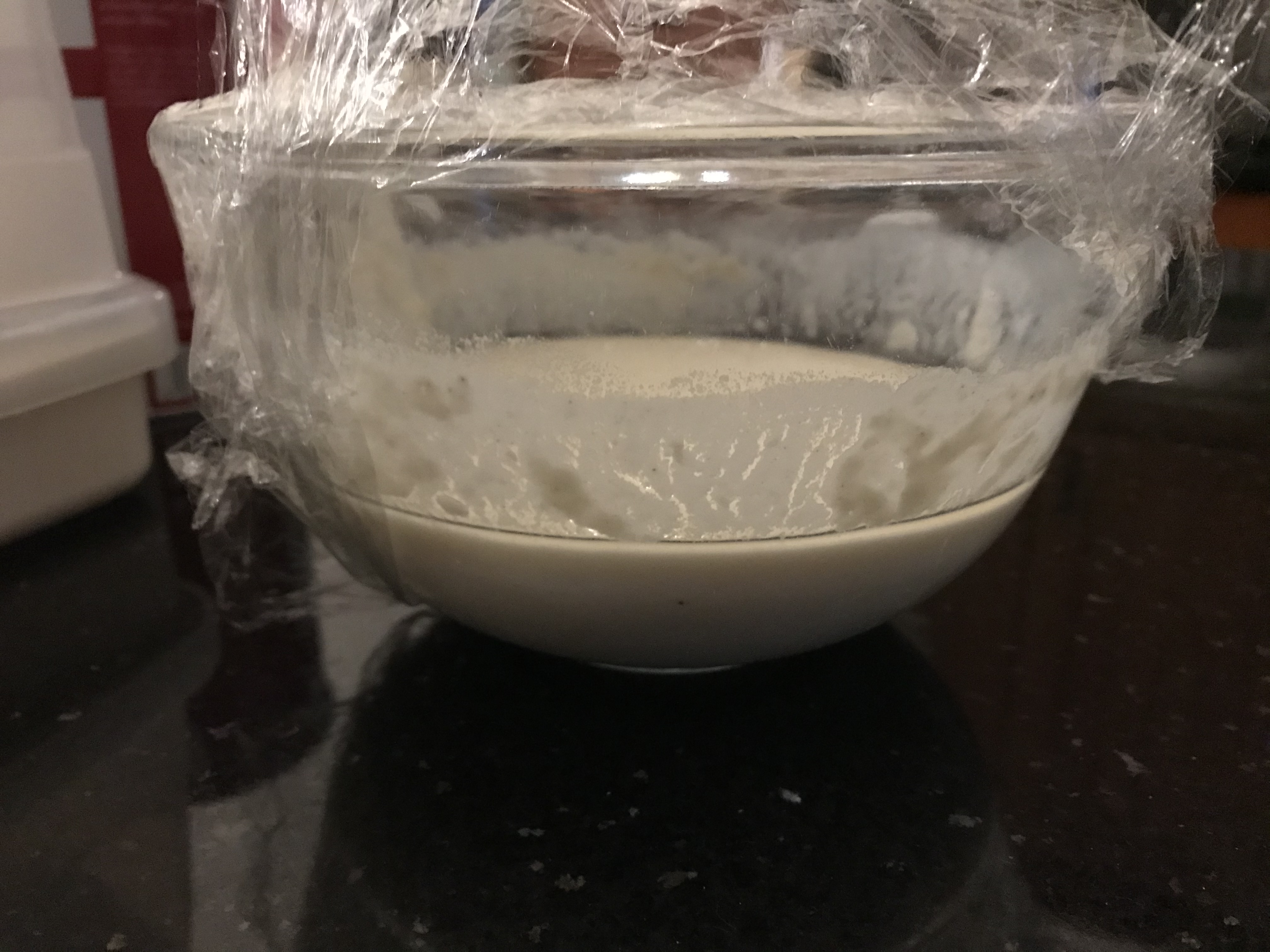
I found a recipe online, and made my ‘starter’. This was a goo of milk, yogurt and flour. Apparently, in days gone by, people made the starter simply by leaving flour (probably whole grain) to soak, until it started to ferment, and this became the base for the starter. But it’s quicker with yogurt, and less likely to go rancid. Each day, I added flour and water. The first couple of days, it expanded slightly, and bubbles appeared on the surface. But then it went flat, and looked dead. I think my house was too cold, and the bacteria couldn’t be bothered to do anything. I moved it to a warmer place, and it started to bubble again. I made it in a small Pyrex bowl, covered with clingfilm and a tea towel (to keep it insulated, as it needs to be warm, but not too warm).

Some days it looked as if the water and flour had separated, and there was water on the surface. This is actually alcohol (with a fancy name). I just stirred it back into the sludge. It looked gloopy, a bit like baby vomit, but it smelt wonderfully beery. If it starts to smell nasty (of poop) then it’s gone off, and you must throw it away and start again.

After six days, I was ready to make the bread. There was a lot of goo and sticky involved, and a good muscle workout in the kneading bit. It also took hours, as a sour dough starter is not as fast as yeast, so it needed two lots of 2 ½ hour rest periods to rise. The dough was never firm enough to support itself, so needed to be left to rise in a bowl. The instructions said to line this with a floured tea towel otherwise it would stick to the bowl. I did, and it stuck to the tea towel. When it was cooked, I was supposed to place tins of water in the oven, to produce a steamy atmosphere, but I forgot.

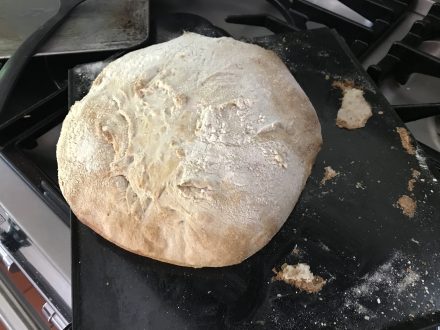
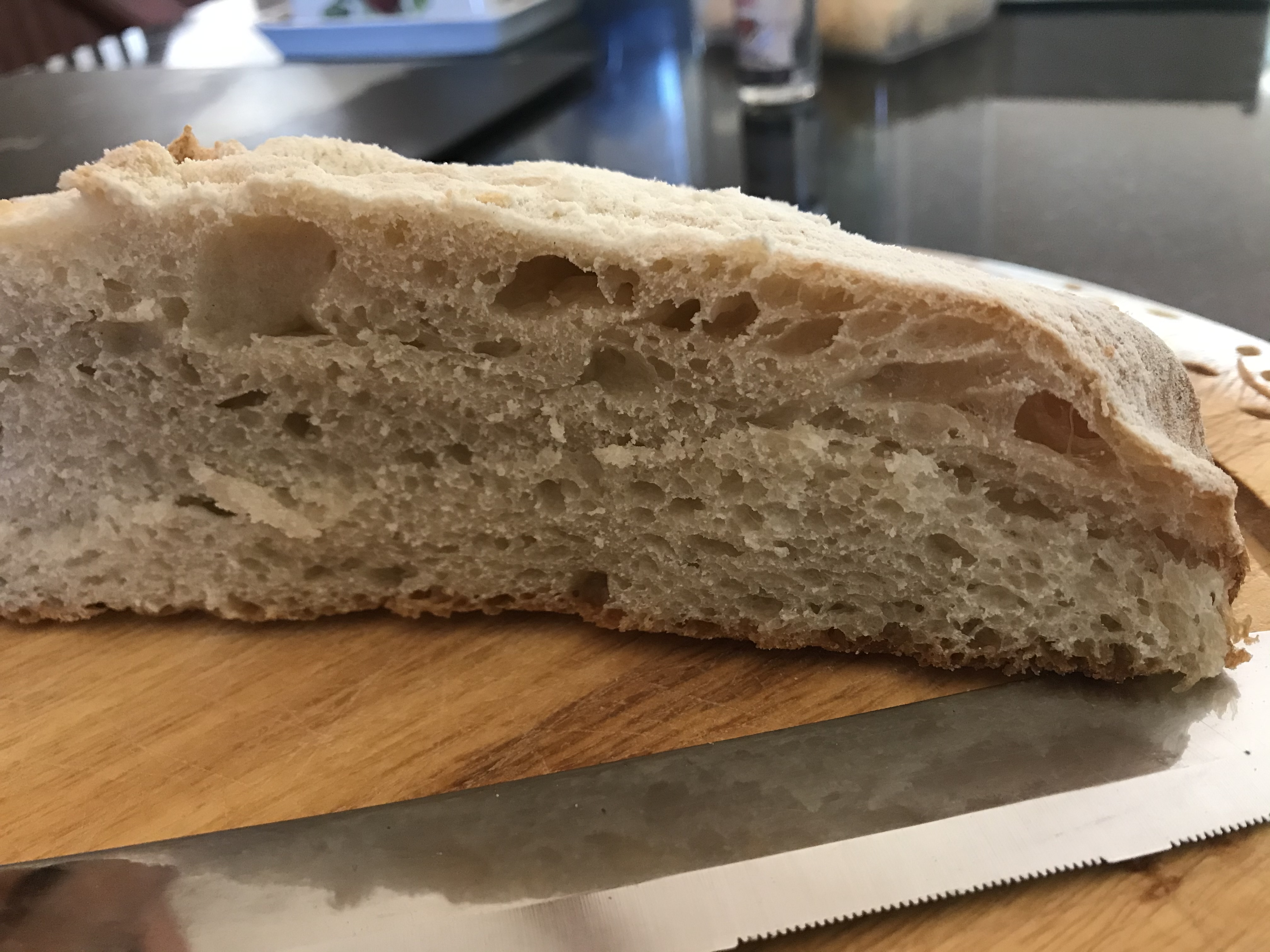
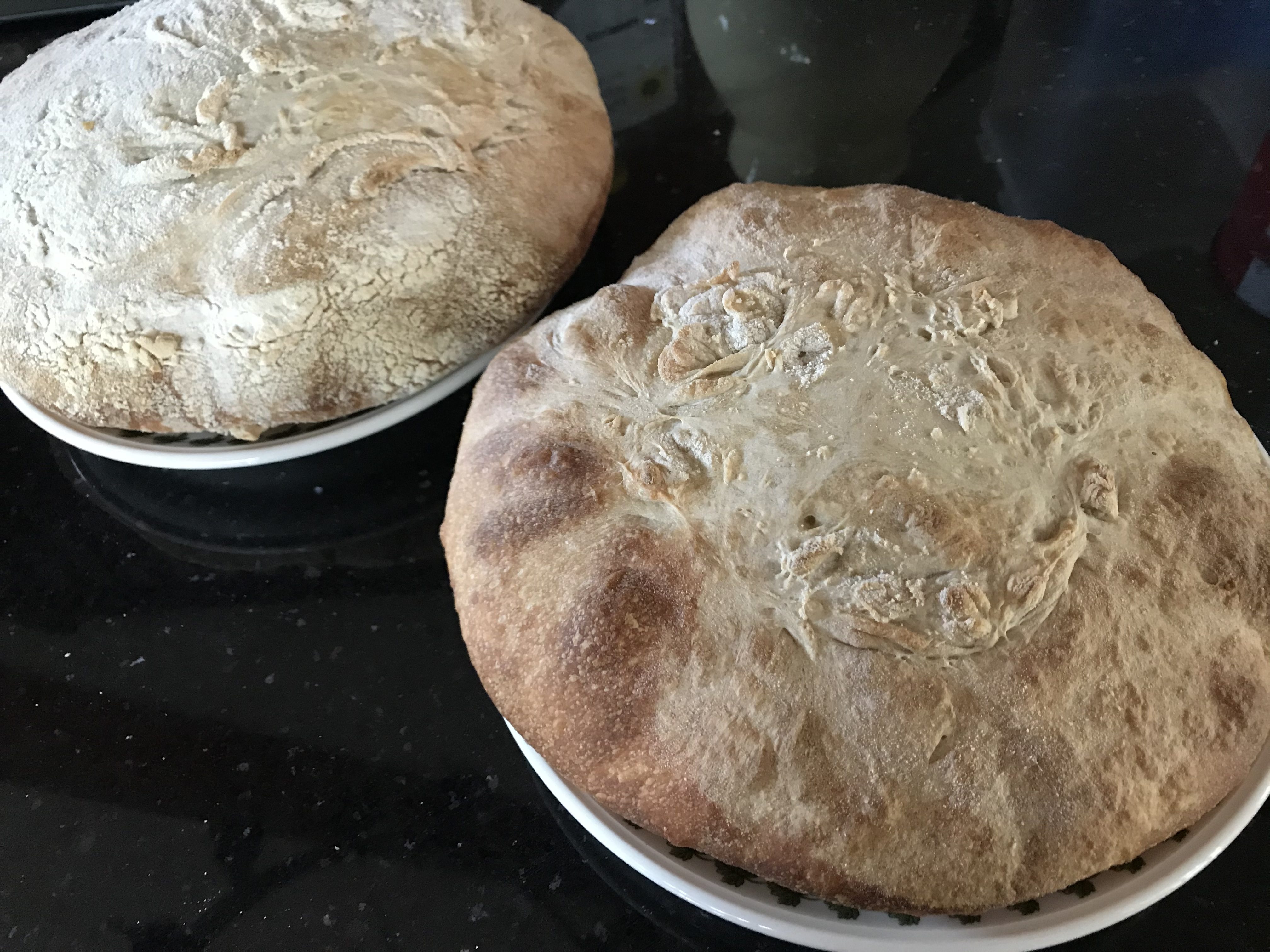
However, it was all great fun, and interesting, and I loved the slightly beery smell of the starter and the bread. I made two loaves, and they looked suitably rustic. Inside, they had the big bubbles we think of when we buy sour dough. It tasted—well, exactly like sour dough bread! So I didn’t much like it, but Husband was very pleased. I will make it again, because it was fun. I have included the recipe below, in case you fancy making some too.


Sour Dough Starter

  1. Day One: Heat 6fl oz skimmed milk (but not too hot to touch, or it will kill the bacteria, and bacteria is your friend here). Mix with 5 tblsp plain yogurt (you need the stuff with bacteria in, and not a flavoured one, as that would make very odd bread!) Cover the bowl. Leave 24 hours (somewhere not too cold). Stir.
  2. Day Two: Stir in 4oz (100g) white bread flour. It needs to be proper bread flour, not plain flour, as it needs the extra strength—otherwise your loaves will flop over in despair and you will have made weird sour pastry, not bread. Cover. Leave 48 hours.
  3. Day Four: Add 6oz (150g) bread flour, and 100 ml water, and 3 tblspn milk (I used semi-skimmed milk). Leave 24 hours.
  4. Day Five: Remove half the starter. You can throw it away, but I put it into another bowl, in the fridge. When I wanted to make more, I simply put it into the warm kitchen and started at Day Four again, hence making another lot of starter for more bread. Apparently, some people keep their starter for generations, passing it on and on, a sort of sludgy heirloom. Not sure my children would especially enjoy inheriting that.
    Add 5 ½ oz (150g) bread flour, 150 ml water. Mix well. Leave 24 hours.
  1. Day Six: Use the starter to make the bread.

Sour Dough Bread

500g Strong White Flour

300g Starter (this is what the above recipe will give you)

2 tsp brown sugar

2 tsp salt

oil for greasing

9fl oz (150 ml) warm water

loads and loads of extra flour to stop the dough sticking to your hands/board/tea towel


  1. Mix the starter and flour, gradually add the water until forms a soft dough, you will probably only need about 6 fl oz. (I added it all, because I didn’t read the recipe properly, and made a sticky mess. Had to add a lot of extra flour to make it workable.)
    Add sugar and salt.
    Knead for 10 minutes, stretching and pushing and squeezing the dough. It’s ready when you can stretch out a piece so thinly that it’s almost translucent. This means all the gluten in the bread has burst, and will hold the bubbles in the dough when it cooks. If the dough isn’t stretchy enough, keep kneading until it is, otherwise you will be making biscuits (ones that will break your teeth).
  1. Put into an oiled bowl. Leave somewhere warm for 2 ½ hours.
  2. Knock back (ie, knead a little bit more, so some of the air is released, but not enough to push out all of it). Shape into two loaves. Cover a tea towel with loads of flour (really, loads, push flour into the fabric with your fingers—it will still stick!) Place the tea towel into a bowl, and add your loaf. (If you leave it to prove on a tin, like normal bread, it will collapse into a dollop). Leave 2 ½ hours.
  3. Place loaf onto an oiled tin. (Good luck with that! I surgically removed the tea towel with a knife. But the scraggy top of the loaf looked quite nice when it was cooked.) Score a hashtag shape on top with a sharp knife (try not to press on the dough—you want to keep all the air bubbles inside now).
  4. Bake 200˚C for 35 minutes. If you remember, put a tin of water in the bottom of the oven, to create a steamy environment. The loaf will sound hollow when it’s cooked (so get it out and knock on the bottom if you’re not sure!)

Thanks for reading.
Why not sign up to follow my blog?
anneethompson.com

*****

Quarantime to Read. . . Counting Stars: The Beginning continued


The Island

She doesn’t look, think, or fight like James Bond, but sometimes a mother simply has to do whatever it takes. . .

Due to the KDP rules on Amazon, I am not allowed to upload a whole book anywhere other than on the KDP site. I can therefore share chapters with you, but must remove them when read.


If you would like to read the whole story, or perhaps buy a copy for a friend, it is available from an Amazon near you. The link is below:


https://www.amazon.co.uk/Counting-Stars-glimpse-around-corner/dp/0995463212/ref=sr_1_1?dchild=1&keywords=counting+stars+by+anne+e+thompson&qid=1589905723&sr=8-1

To be continued on Wednesday.

Why not sign up to follow my blog so you don’t miss the next installment?

Thanks for reading.
Why not sign up to follow my blog?
anneethompson.com

Quarantime to Read. . . Counting Stars: The Beginning


About 6 years ago, I decided to write a dystopian novel, looking roughly 100 years into the future. At the time, my three children were all studying—economics, science, law—so I asked them what they thought was coming in the near future. They all gave me lots of ideas, and especially the scientist was very enthusiastic about discoveries which had been proven, but due to ethical or financial implications, were not considered viable.

It was written at a time when there were several religious terrorist incidents, and so I tried to imagine how the world might solve this problem—and what new problems would arise in its place. It was rather fun to look at the problems in the world—why do we still have people dying of hunger when we can send people into space?—and to solve them all, and then to consider what new problems my solutions would create. I also tended to go off on tangents when things took my interest. I had recently had brain surgery, so was fascinated by how we are affected by relatively small physical changes within the brain, and I became side-tracked with a quick study of Lamarckian theory (such fascinating ideas). I tried to incorporate all this within a story, about a family, set 100 years from now. My rule was that it had to be possible, even if it wasn’t probable. It was great fun to write, and in 2015 I put a new section on my blog each week. At the time, it was very popular, and I had students writing to ask me to send me the next chapter because they didn’t want to wait a week, and elderly ladies complaining they had been on holiday and missed a chapter, and middle-aged men who emailed to say it was the first time they felt properly represented by a character in a book.

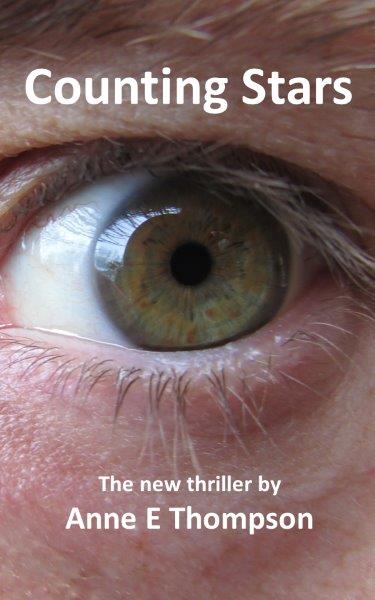
It is several years later, and a surprising number of those futuristic predictions are now beginning to appear (though thankfully not all of them). I thought it might be interesting to post it on my blog again, so I hope my faithful followers from 2015 won’t mind reading it again. When I had posted the last chapter, I rewrote it, and sent it off to an editor, who charged me £300 to improve it, and I then turned it into a short book, available from Amazon. I therefore hope that if you are rereading it, you notice some improvement! The editing took all my funds, so the cover was a DIY job, and I have reliable feedback that it’s pretty terrible. Please do not judge the book by the cover. One day, I will perhaps design a new cover, but I am always besotted with my work-in-progress, and the time to redesign a cover that is rarely seen is very low priority.

Anyway, of all my books, I think this was the most fun to write. I hope you will enjoy it too. I will post sections of it every Wednesday and Sunday. Enjoy. . .


Counting Stars

by Anne E. Thompson

She doesn’t look, think, or fight like James Bond, but sometimes a mother simply has to do whatever it takes. . .

Chapter One

 The Door

They wouldn’t know her, because they had never met. But that didn’t matter. What mattered was that she remembered. It was what she did—remembered. It was why she was useful.

Due to the KDP rules on Amazon, I am not allowed to upload a whole book anywhere other than on the KDP site. I can therefore share chapters with you, but must remove them when read.


If you would like to read the whole story, or perhaps buy a copy for a friend, it is available from an Amazon near you. The link is below:


https://www.amazon.co.uk/Counting-Stars-glimpse-around-corner/dp/0995463212/ref=sr_1_1?dchild=1&keywords=counting+stars+by+anne+e+thompson&qid=1589905723&sr=8-1

***

To be continued on Sunday.

Thanks for reading.
Why not sign up to follow my blog?
anneethompson.com

If you want to buy a copy for a friend, Counting Stars is available from Amazon: UK Link Here!

“There’s none so queer as folk. . .”


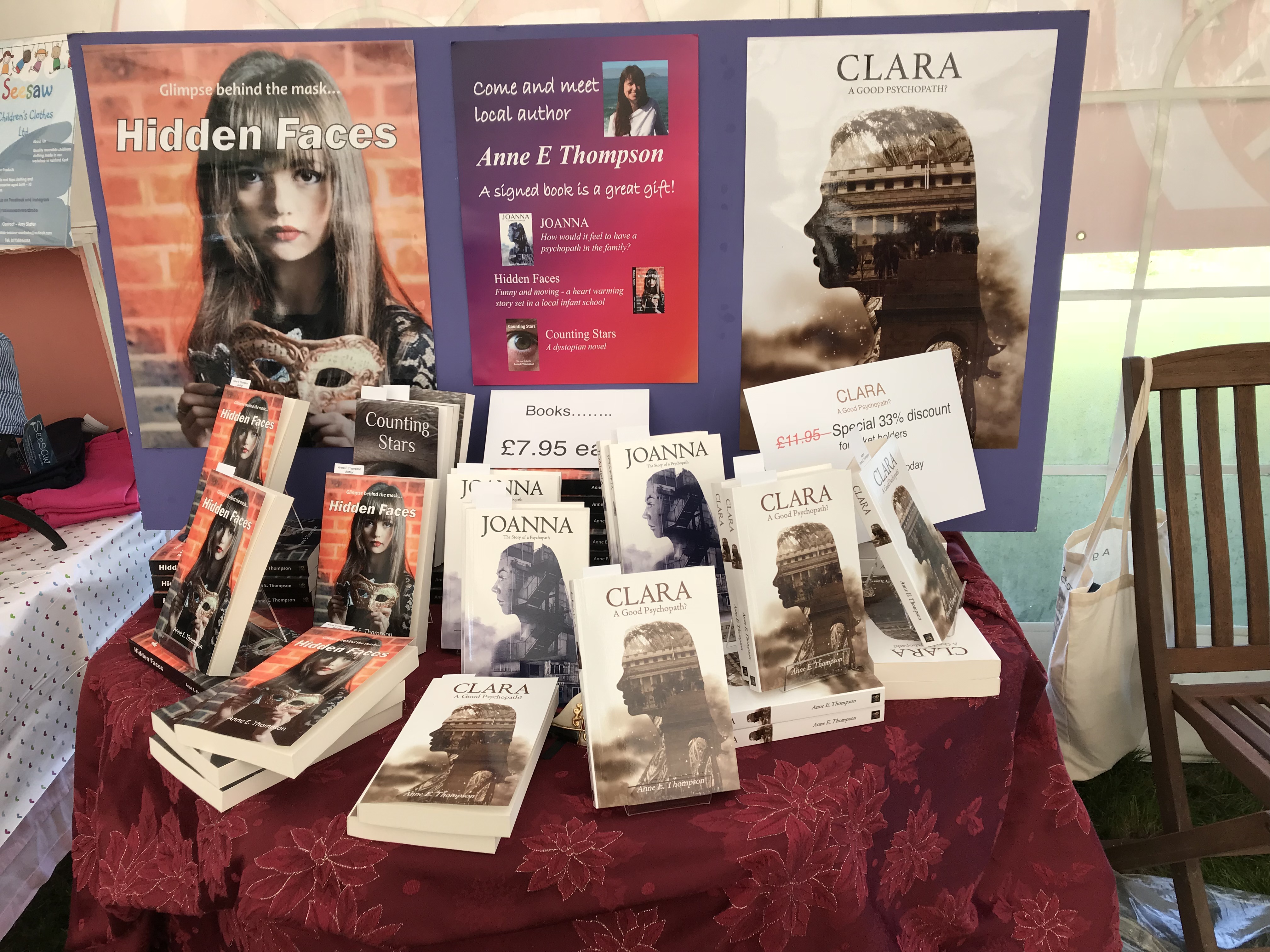
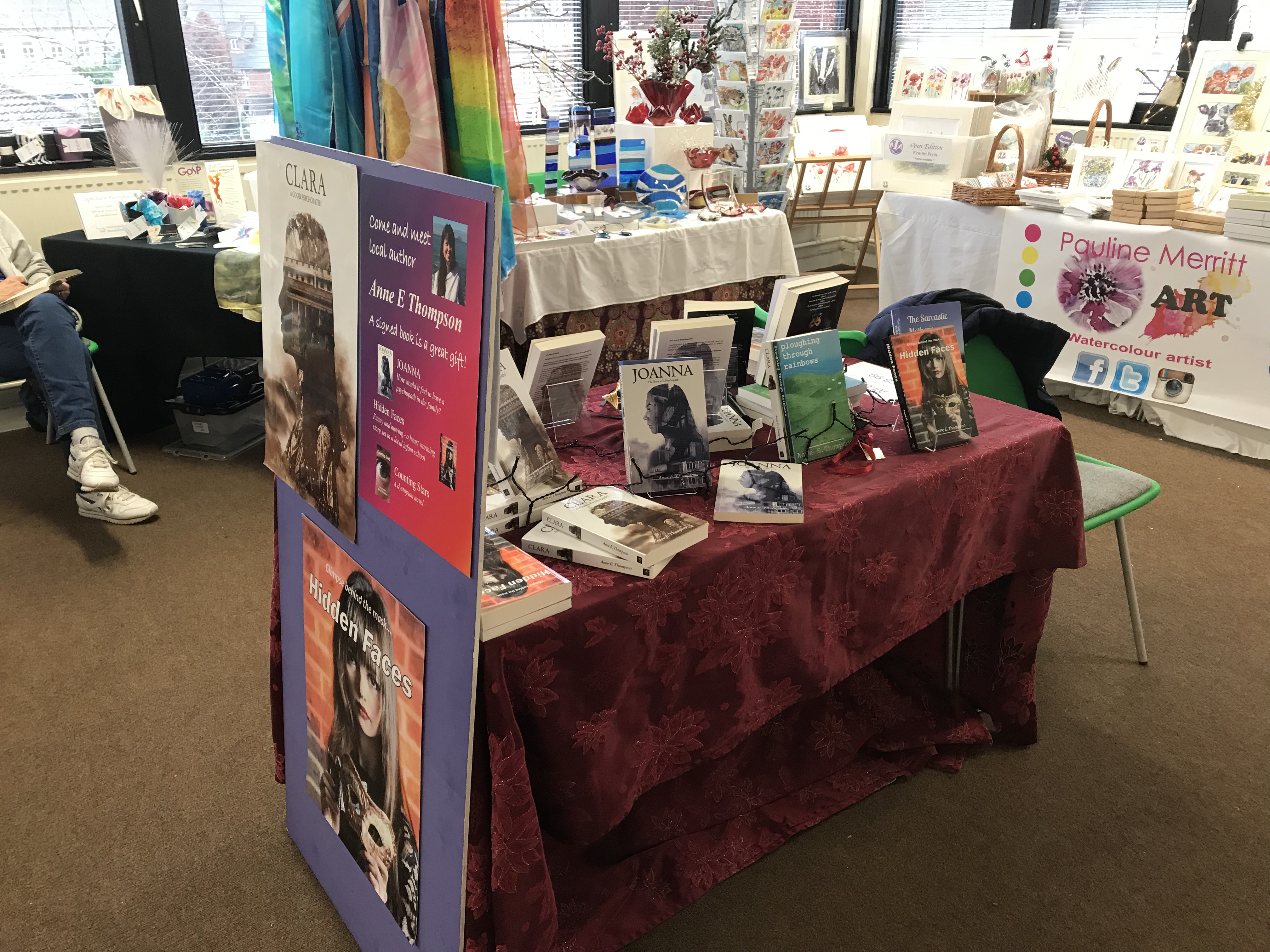
Sometimes, after selling books at a craft fair, I am dying to tell you about some of the people who I’ve met—sometimes because they were very odd, sometimes just because our conversation was interesting. But I try to hold back, and not say too much, because it feels like an invasion of privacy to tell you too much about people who do not expect to be written about.

However, as I have attended more and more fairs, there is a general pattern of types of shoppers emerging, and so, in general terms, I feel I am safe to tell you about them. (If you have ever spoken to me at a fair, then you might recognise yourself, but I am writing in very generic terms, so my descriptions will apply to several people rather than a single individual.)

First of all, there are the Rebuffers. These are the people who really do not want to buy a book, they are generally in a hurry, and will rebuff my initial approach briskly. Sometimes they manage to do this nicely, with a smile and shake of the head whilst not breaking step.

Sometimes they are rather rude, and will reply to my: “Hello, do you like reading?” with a curt: “No!”

I have even known people say: “Not those kinds of books” or, “Not books by a woman!”

Secondly, there are the Chatterers. These people consider that as I have approached them, I must be lonely and want to chat. They will talk, for a very long time, about the kind of book that they would write, if so inclined. It is sometimes difficult to move these people on, and I have watched with despair as several potential customers pass by while a non-buying woman launches into the year after her second child was born when they went on holiday to Paris and there was a man on the ferry who. . .

Thirdly there are the Predators. These people will ask lots of questions, they will examine my books in detail, asking who published them, how I sell them, how many I have sold. By the time they have asked their 57th question, I am beginning to realise that they have no intention of buying, they are simply checking out the opposition! Invariably they turn out to be authors themselves, who have never considered asking bookshops if they can do a book-signing, or taken a table at a craft fair, and they are trying to decided whether they should copy me. I will link these people with the authors who think that as I have told them about my books, I will now be interested to hear about their own. They tell me at length about the plot of their book, and who published it, and how I can buy it—without considering that I have paid £40 for my stall, and really I need to SELL enough books to cover my costs, not look around for other books to BUY!

Next, we have the Investigators. Some of my books are about psychopaths, and they were written after months of research: I read papers by neuroscientists, bought books by neurologists, listened for hours to convicted psychopaths, and found two mothers who would talk to me about raising a psychopathic child. So, although I am a lay-person, I felt sufficiently qualified to write novels about psychopaths. However, I find that some people—often but not always, health professionals—are deeply suspicious. They will start to ask questions about my research, and the questions turn into an aural examination/inquisition as to my understanding of the subject. Generally, I manage to answer satisfactorily, and they often go on to buy a book (one even asked me to write an article for a mental health magazine) but it is uncomfortable. Actually, it is often most uncomfortable when the person has no scientific knowledge themselves, but considers themselves to be an expert because they have read an article or watched a television programme, and often their own understanding is somewhat flawed, which makes it difficult when being ‘tested’ by them.

What if…you were the mother of a psychopath? The story of Joanna and her family – an exciting novel.

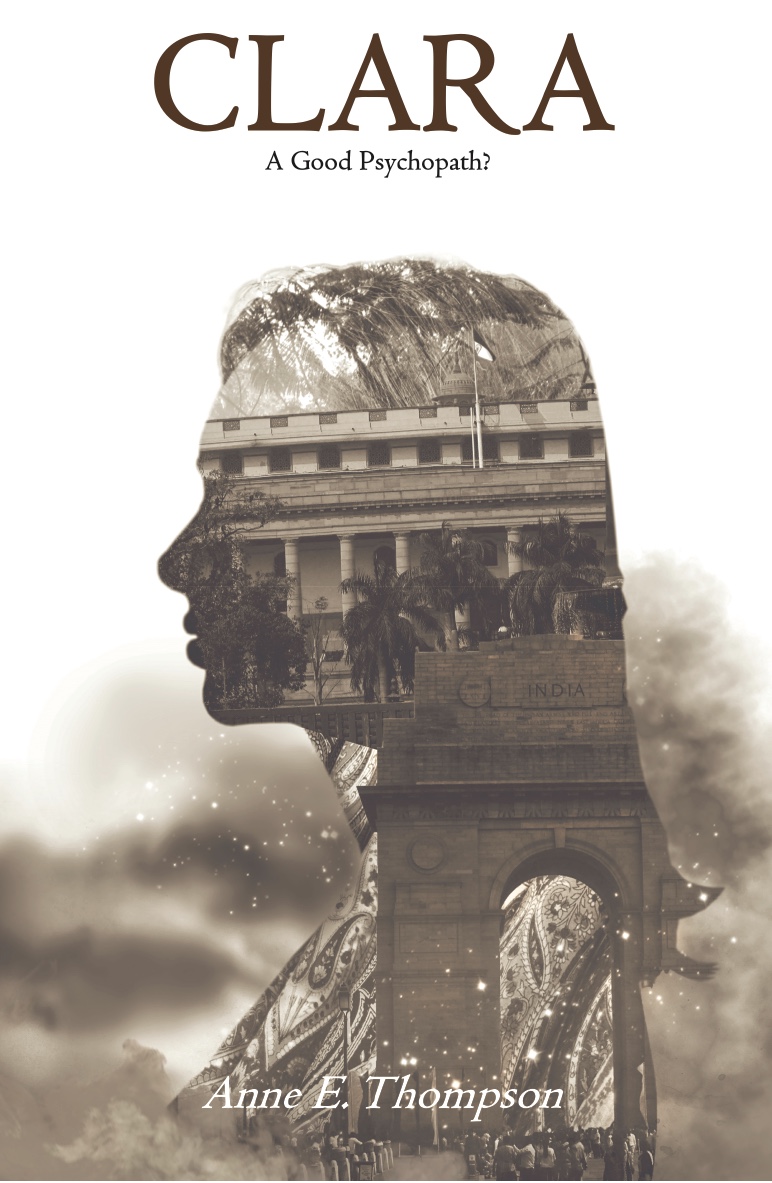
What if…a psychopath managed to do something good. Can psychopathy ever be a strength?

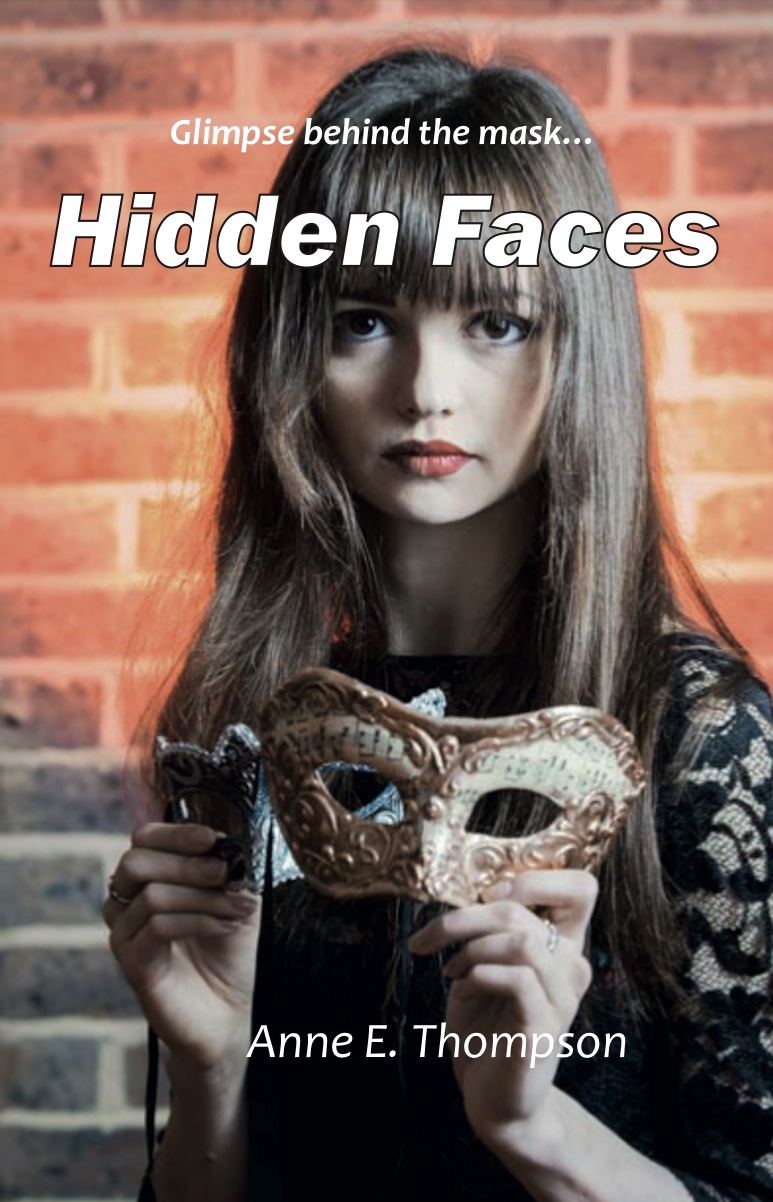
This is the story I always promised myself I would write ‘one day’ while I was teaching in an infant school. A light-hearted novel about 3 teachers.

These people contrast well with the Defensives. These people ask questions about my novels set in a school (Hidden Faces) or a farm (Ploughing Through Rainbows) and then go on to explain that they too could have written a book about their past employment. Perhaps they are a nurse with a lot of funny stories, or a teacher with more experience than me, or a prison warder. They inform me, fairly grumpily, that their lives are just as interesting as mine, and that their book, if they had found time to write it, would be much better than mine. I’m sure that in some cases this is true. However, they haven’t written a book and I have, so it is bit of a non-conversation in my mind. Nor am I quite sure why they are telling me this—am I meant to agree with them and pack up and go home?

A hilarious family saga set on a farm. Being a parent has no end-date, as Susan discovers when her adult sons begin to make unexpected choices in life.
A warm-hearted, feel good novel that will make you smile.

Finally, there are the Lovely people. These people show a genuine interest in my books, whether they buy a copy or not. They are polite, and interesting, and it is always nice to meet them and have a conversation.

I will leave it for you to decide which category you fit into—I’m sure it’s the last one!

I hope you meet some lovely people today. Thank you for reading.

Take care.

Love, Anne xx

Thank you for reading.
You can follow my blog at:
anneethompson.com


Have you read any of my books? Available from bookshops and Amazon. Check out my author page Here!

QuaranTime to Read. . . The Conclusion


Chapter Twenty-Two

It was Sunday afternoon. Abigail was hiding upstairs with a book, and some chocolate she had found, lying forgotten at the back of the fridge.

Jane had cleared away the remains of lunch and was now snuggled on the sofa with a magazine. She flicked the glossy pages, absorbing colours and moods but not bothering to read the articles. It was one of those deliciously lazy afternoons, where no one could be bothered to do much, and nothing was urgent.

Christopher had spread his train set across the carpet and then gone to find his father. They were working together now, moving in easy silence, constructing the track. Painted trains, one missing a wheel, were pushed in a heap under the table as they joined the pieces to form a route. It stretched from the door to the opposite corner, circling a shoe and curving around a chair. It was decidedly unstable where it climbed to go over a rug and Jane doubted it was structurally sound. She was glad there were no passengers.

She watched Peter’s back as he bent to repair the track. The sun caught his hair, highlighting the few white strands. She knew every curve of his body, every crease of his face. The feel and smell of him were as familiar as her own reflection.

“This is what I want,” she realised, certain now of her decision. “This is secure, safe, familiar. I can be at peace here, with this man. It may not always be exciting but it lets me be who I want to be.”

She knew, deep inside, that her decision had been the right one. She might be ignored sometimes, though was probably not as invisible as she felt. Undoubtedly, they would argue and she would be hurt because Peter was selfish. But maybe everyone was selfish, some were just better at hiding it. Nor did he understand her fully. But he understood enough, and he did try—she knew that now. As she had evaluated their life together, forced herself to be fair, she knew that if she was to keep a tally of wet towels on the floor and late nights on her own, she also had to note the surprise gifts, the phone calls when he was away, the security of a husband who worked hard.

She still remembered their early days together, the thrill of seeing him. That excitement had worn away now, become mundane—but would it last forever with anyone? Surely in time, even the most exciting of lovers would become familiar. At the end of the day, she would be swapping a man with—another man, and they were not really so very different at the core.

As father and son played together, intent on their task and oblivious to her thoughts, Jane felt that her whole life had led up to this point. She was deciding to stay. It was her choice. She thought about the smell of Peter, the warmth of his body, the way they fitted together so perfectly when they snuggled. She thought about the shared experiences, how their eyes could say so much to each other, the times they laughed together. It was a lot to risk, a lot to lose.

Peter looked up, smiling to see her watching.

“I could kill for a cup of tea,” he said.

As Jane filled the kettle, her bag on the table began to vibrate. She scooped out her mobile phone.

One new message from Matthew’ the illuminated screen informed her.

She stood very still, not breathing. The timing was eerie. But she had decided. She was staying; she wasn’t going to mess with what she already had.

She pressed ‘menu’. She scrolled down to ‘messages’, selected ‘clean up messages’ and chose ‘all’. Obediently, the phone wiped all messages from its memory.

“I don’t owe him anything, not even politeness,” thought Jane. “He knew I was married; he knew what he was asking me to gamble, and if he’d really cared, he wouldn’t have asked.”

Slowly, Jane slipped the phone back into her bag. She would miss him, and for a moment, tears stung her eyes, her heart aching for what might have been and the savouring of those last wisps of memory of how he had made her feel.

But she knew she was right, knew that whilst this might not be perfect, it was the better choice. She switched on the kettle and pulled down a purple mug.

Outside, a bird began to sing, and Jane paused, watching as it fluffed its chest and warbled its song.

She did not notice the cat below the bush, preparing to pounce.

***

Chapter Twenty-Three

Jane pulled the shoe off the shelf. White satin, with a tiny bow—it  would suit the dress. As she turned towards the fitting room, she glimpsed her reflection in one of the mirrors. Her hair was looking very grey, she hadn’t had time to colour her roots for ages. Not that it mattered, the hair appointment had been booked weeks ago, tomorrow they would turn it back to the brown of younger days.

The curtain parted, and Abigail stepped forwards. A beautiful, untouchable Abigail. The white lace dress fell to the floor in waves, a fish-tail train sweeping the floor. The bodice fitted her slim frame, a scalloped neckline revealing glimpses of shoulder.

She grinned at Jane and walked forwards. Her stride was not particularly princess-like, more a stomp as she struggled with the excess material. It reminded Jane of the girl she had been, the way her feet used to turn inwards, how her shoes were always scuffed. Unbidden, tears filled her eyes. It felt like yesterday, and now that determined girl was a young woman. But still her daughter, still a little girl in her heart.

“Do you like it?” said Abigail, noticing her mother’s rapid blinks and checking they were for the right reason.

“Yes,” said Jane. It was all she could say for a moment. She took a breath, and held up the shoes. “What about these?”

Abigail wrinkled her nose. “They’re a bit high,” she said.

Jane smiled. “I remember when all you wanted were high heels,” she said. “Do you remember the shopping trip when you were little and you lost your shoes?”

“They were stolen, actually,” said Abigail, smiling too. “Can you unzip me?”

Jane followed her back into the fitting room and helped her daughter out of the wedding gown. It was heavy, and very white, she hoped her hands wouldn’t leave a greasy mark. A shop assistant fluttered around, telling Abigail she looked lovely, no alterations were necessary, did she want to take it today? They would box it for her.

When she was dressed in jeans again, she followed Jane to the racks of shoes and started to look.

“It’s only a couple of weeks away,” said Jane, “you really ought to have sorted shoes by now.”

“I know,” said Abigail, “I thought it would be easy. No one will really see them anyway under the dress, I could wear trainers…”

Suddenly serious, she turned to Jane. “Mum, am I doing the right thing?”

Jane looked at her. “Wearing trainers? No.”

She realised her daughter was serious and stopped. “What do you mean? Are you having second thoughts?” She started to think about the cost, how she would tell Peter, what their friends would say.

Abigail shook her head. “Not about Simon, no—I know I love him and want to be with him. But the whole marriage thing. Lots of people just live together, it feels like a lot of fuss…”

Jane sat down on a plush red sofa. Abigail had wanted a wedding for as long as she could remember. She had loved choosing the stationary and the dress and the venue. This was not about the wedding. She waited.

“I mean,” said Abigail, sitting beside her, “what if I can’t do it? What if I am making promises that I can’t keep? The whole ‘until death us do part’ bit—well, that’s a really long time isn’t it! We might change. I know you and Dad have always been happy, but in a way, that makes it harder. What if I’m not made the same, what if I’m not the ‘til death us do part’ sort?”

Jane reached out and took her daughter’s hand.

“Yes, she said, “it is a really long time. And sometimes you will wonder what the heck you’ve signed up for. But it’s a decision. Really, love is a decision. I don’t think there is one ‘Mr. Right’ who you have to look for until you find him, I expect I could’ve been happy with a whole host of people. But I chose your father. And sometimes it was difficult, sometimes I regretted that decision, but I chose to stay. Feelings change, people change, you have to decide what you want and stick with it. And yes, you will both change. But if you spend enough time together, you will change together. It’s about choosing to move through life as a unit, not two separate people. We can’t control what will happen, our health, the economy, politics. But we can choose whether we will face what comes on our own, or with someone else. You have chosen to be with Simon.” She smiled. “It’s not a bad decision, I think.”

“Did you ever wonder?” said Abigail. “Did you ever regret marrying Dad?”

Jane thought a thousand thoughts.

Then she squeezed her daughter’s hand and smiled.

“More than once! But that’s what I mean about it being a decision. Feelings are very unreliable; they come and go, and come again. Sometimes you have to stick it out, but then the love and happiness come back, and you’re glad you stayed.”

She turned, looked her daughter full in the face.

“Marriage isn’t easy Abigail. But it is worth it. I wouldn’t be without your father for all the world.”

Abigail nodded. “Come on, we’ll be late and he’ll moan.” She bent and kissed Jane’s forehead. “Thanks Mum.”

***

Peter watched as they walked towards him. Abigail was talking, racing ahead, full of decision and purpose. Jane walked next to her, listening. He watched Jane’s walk, how she still walked well, even as she had aged.

“I still love that woman,” he thought to himself, “she is the world to me.”

He thought about all the times he could have walked away, the years when money was tight, when the kids were too demanding, when life just seemed like one long treadmill. And he knew there were other women who would’ve taken her place. Women who smiled a bit too often, were slightly too attentive, suggested drinks after work when no one else would be there. There was even one who had sent him photos of herself, like they had some bond outside of the office. He’d had to put a stop to that, ask for her to be transferred. It was all a bit awkward.

But he’d never considered being unfaithful to Jane. She was his life, his home, the place he escaped to. As he watched her now, with her grey roots and chubby belly, her middle-aged body and lined face, he felt so full of love. It was weird really, watching their kids grow up, Abigail about to be married herself, him thinking about retiring. But Jane was there, the person he had wanted to come home to every day for the last thirty years.

“Funny thing, love,” he thought. “You can’t really explain it, but it really does make for a happier life.”

He stood up as the women approached the table.

“I just hope,” he thought, “that Abi’s as lucky in her marriage.”

I hope you have enjoyed the novel. If you would like to buy a copy for a friend, it is available from an Amazon near you.

Now, which book will you read next..? UK Link Here! 

UK Link Here!

****

***

**

Covid-19 Test


Bit of excitement this week—I was asked to take part in some research, which involved taking a Covid-19 test at home and sending it off. I was picked at random, so it was unexpected. My week is not very full of exciting things at the moment so I was happy to take part. I had to reply to the letter online, and answer a couple of questions, and then they would send me the test.

I filled out the online survey, and waited. My children then informed me that this was potentially a scam, and what exactly had I answered, and had I given any passwords or my address or date of birth etc. This worried me, but all the personal data had already been added, and I simply had to confirm details, so I thought it was probably legit. Waited, hoping the test would arrive and not a burglar.

Yesterday, the test arrived. It came through the post in a big padded envelope, and inside were bits of paper and instruction booklets and other stuff. There was a covering letter. This told me to do the test without delay, and I was about to open it and work out what to do, when I decided to read all the instructions first, so turned instead to the instruction booklet. (This I feel, proves that I am female—not saying anything else, just mentioning it.)

The instruction booklet said NOT to take the test immediately, but to first book a courier. The test needs to be analysed within 72 hours, so first I must book a courier to collect it, THEN I do the test on the morning of the collection day. Lucky I read the booklet, feel they should have mentioned this in the covering letter (for all the non-females).

To book a courier, you had to go to a website (this was easy) and type in your ID number (not so easy). The ID code was on the “sheet with the two bar codes”. Well, I had a sheet with several stickers, of which one was a bar code, and a tube with a different bar code. I tried entering the numbers under each of them, both were rejected. The instruction book said “Do not include the GB at the start of the code.” Neither code started with ‘GB’. I searched the pack of stuff, but nothing else had anything remotely like a code. Then I realised that one of the codes started with ‘UK’. Maybe ‘GB’ was actually ‘UK’ and no one had noticed? I tried again, removing the UK from the start, and they accepted the code. Managed to book a courier for today.

This morning I did the test when I woke, because the courier was due between 8am and 8pm. The test was fiddly and uncomfortable, and I just hope I did it correctly. The instructions said I should first watch a Youtube video, but the link they sent didn’t work (rather lost faith in the instruction booklet by this point). I did a Google search, found a video of taking a sample, and tried to copy it. It basically involved sticking a long cotton-bud down your throat and touching your tonsils, then sticking it up your nose, before putting it into a tube and sealing it. Not very pleasant, and made me gag, but there are worse things. I wanted to keep everything clean, and also needed a mirror, so had the brilliant idea of placing a clean tray over the sink, and using this as a shelf. It would have worked better if the tap hadn’t been dripping, but I’m sure soggy labels are something researchers cope with all the time.

The (unreliable) instruction booklet said the courier would arrive and knock on the door, he would then place a box on the doorstep, step back 2 metres, and wait. I should place the test in the box, then shut the door so he would be safe to pick up the box and take it to the lab. In actual fact, the courier arrived, I opened the door, and he held out his hand for the test. I indicated that I would place it on a shelf, and he took it from there, but otherwise he would have taken it directly from my hand. Maybe they forgot to send him a copy of the instruction booklet.

There was also a padded envelope in the kit. No idea what that was for. It is a white, unused, padded envelope. I will keep if for if I need to post anything.

They said they would tell me the test result within a week, but as I have no symptoms, and have not been near anyone at all other than my family, for several weeks, I am fully expecting it to be negative—if I ever hear—not entirely trusting that booklet now. Let’s hope it is useful to the lab, and the clever people who work there manage to help manage Covid-19 so we’re all safe again. Perhaps I’ll apply for a job as their instruction book writer—I feel there is a need there.

Hope you have a nice weekend. Take care, and stay safe.

Love, Anne x

***

Thanks for reading.
Why not sign up to follow my blog?
anneethompson.com

****

QuaranTime to Read. . . Chapter Twenty-One


Chapter Twenty-One

The following morning, having completed the school run, Jane drove to the cemetery. She wanted to think, and there was something intangibly honest about a graveyard. Death was honest. People could pretend their whole life, act a part which convinced even themselves; but no one could be fake in death. There was a stark truth about the ending of a life, a blatant inability to hide. Jane had felt it at the funeral. Sorrow was awful, but it was real. Sometimes life was so muddled and false that even hurtful clarity was welcome. A half-forgotten saying filtered through her mind, something about it being: “Better to attend a funeral than a wedding.”

She felt that she almost understood what that meant.

So, she chose the graveyard to do her thinking. She walked first to Sophia’s grave. She knelt and fingered some fading flowers, the crunchy green oasis showing through where they had shrivelled. A card, damp and curling was still fastened, but Jane did not read it. It would be like prying, spying on a private message.

There were fresh flowers too, white and pink, smiling on the sunken mound of dried earth. Jane supposed Tricia had placed them there, needing to still do something for her child, needing a way to mourn. The thought of it took her breath away, she could barely imagine the emptiness that must consume you if you lost a child. You would, she thought, cease to be the same person. So much is invested in our children, they represent our future. It would be like losing a limb.

Jane moved to a wooden bench and sat. She perched her heels on the edge of the seat and hugged her knees. She was quite alone. There was a distant whine of traffic, and the occasional growl of an overhead aeroplane, but she was watched only by a blackbird as he tugged a worm from the soil. She rested her chin on her folded arms and tried to think.

She thought about her life as it was now. The overwhelming physical bond she shared with her children. She thought about how it felt when Christopher held her face in both small hands, when Abigail confided in her, when they clung to her for comfort. She considered long days of scattered toys, dust and laundry. The tedium of school runs, constant meals, endless shopping.

“Why did you let this happen?” she asked God. “You knew I was lonely; you know that Peter mostly ignores me unless he’s feeling randy or wants me to help with something.

“How many evenings,” she thought, “have I sat alone in a house of sleeping children, while he’s off living his life? How many hours do I spend, never speaking to another adult? Is this what I want? Is this what I have become? Someone who enables everyone else to have a life? I am eclipsed by them, by their needs and demands. They don’t even see me anymore, not Jane, the person. I am a wife, a mother, a daughter. But I want to be me too, Jane, a person. I am not simply an appendage, a useful add-on.

Gradually, the sorrow turned to anger. Hot feelings of resentment surged through Jane, she was alone with her thoughts, her eyes unseeing.

“It’s your fault,” she raged at God, “You made Matthew fun and kind to me. You knew I was vulnerable; you knew I was empty inside. And you sent someone who cares but who I can’t have. You sent someone who sees me, who likes me for who I am, not just because I’m useful to him.”

Jane stopped. If she was honest, she didn’t actually know how Matthew saw her. Did he see her, like her, want her company? Or was he looking for something a bit different and bedding a wife and mother would make a change. At least, she assumed it would be a change—again, she didn’t really know. It was possible he did this with all his customers, moved from lonely wife to lonely wife…

But she didn’t think so. She thought herself a good judge of character, and she was sure he was a good person and had genuinely liked her. He was so good with Christopher, she was sure a philanderer wouldn’t be kind to a child. No, it was just Suzie making her doubt things. He liked her, and thought she was special.

“I only want some fun,” she reasoned, “I only want to feel human again. Isn’t pursuit of happiness a basic human right?”

Jane thought back to her childhood, hours spent playing with dolls. How lovingly she had dressed them, held plastic spoons to their painted lips. She had washed their plastic faces at bedtime, and snuggled them under her own covers. She remembered their unwieldy bodies against her at night, their stiff moulded fingers scratching her face when she rolled against them in her sleep.

One doll, Hilda, she had loved above all others. She had strands of nylon hair that could actually be combed, and blue staring eyes fringed with ginger lashes that closed when she was laid down. Once, Jane had trimmed her hair with red handled scissors. The hair had fallen in one clump, leaving a bald patch behind the right ear. Jane had cried and Hilda had always worn a bonnet after that.

Another time, Jane had bathed her in the sink, washing away grime with rose scented bubble bath. She had dried her in a big towel and dressed her in a yellow onesie. All that night, Hilda’s hollow legs had leaked tepid water into Jane’s bed. The following day she had returned from school to find both her bedding and Hilda hanging on the washing line. She had viewed Daphne as a cruel torturer. It took several days for her to forgive her mother.

Hilda herself never recovered. The water rusted the joints in her hips. Two weeks later, her legs fell off.

“Such futile love,” thought Jane, “so much wasted emotion.”

Or had that care been good practice, preparing her for the unconditional love of real motherhood? It was all she had ever wanted, to be married, to have children.

“If only I had known how lonely it would be,” she thought.

Her thoughts moved to Peter. She could see him as a young man, bursting with vibrant energy, full of ideas. He had seen Jane in those days, had noticed everything about her, made her feel special, cherished. Strange word, cherished. It was only ever used in the wedding vows, which, it seemed to Jane, was the time when mostly it stopped happening. How many wives actually feel cherished by their husbands?

“Did I even choose to marry him?” she wondered, “Or did it just happen? Perhaps I just drifted into marriage, as a logical next step, without even thinking whether I really wanted it. Did I ever consider there might be a different option?

“What do I actually want?” she asked. “Do I want to be free? Do I want to risk losing everything, or am I willing to risk stagnating, disappearing into a shape labelled wife and mother?”

The answer eluded her, but she knew she wanted to make a decision. She did not want to wander through life anymore. Whichever route she took, it would be of her own choosing, she would not allow herself to drift into an affair, nor would she remain married through passive indecision. She would decide. She would attempt to control her own life.

“I’m not Hilda,” she smiled, “I don’t have to just let things happen to me.”

By the time she left, she was stiff from sitting for so long, the damp from the bench had seeped into her bones, her mind numbed by considering her options and the consequences. As she walked through the graves, around the markers for so many forgotten lives, she felt at peace. Her decision was made. Jane was going home.

To be continued on Sunday.

Thanks for reading.
Why not sign up to follow my blog so you don’t miss the next chapter?
anneethompson.com

If you have enjoyed the novel, why not buy a copy for a friend? Available from an Amazon near you. UK Link Here!  

********

***