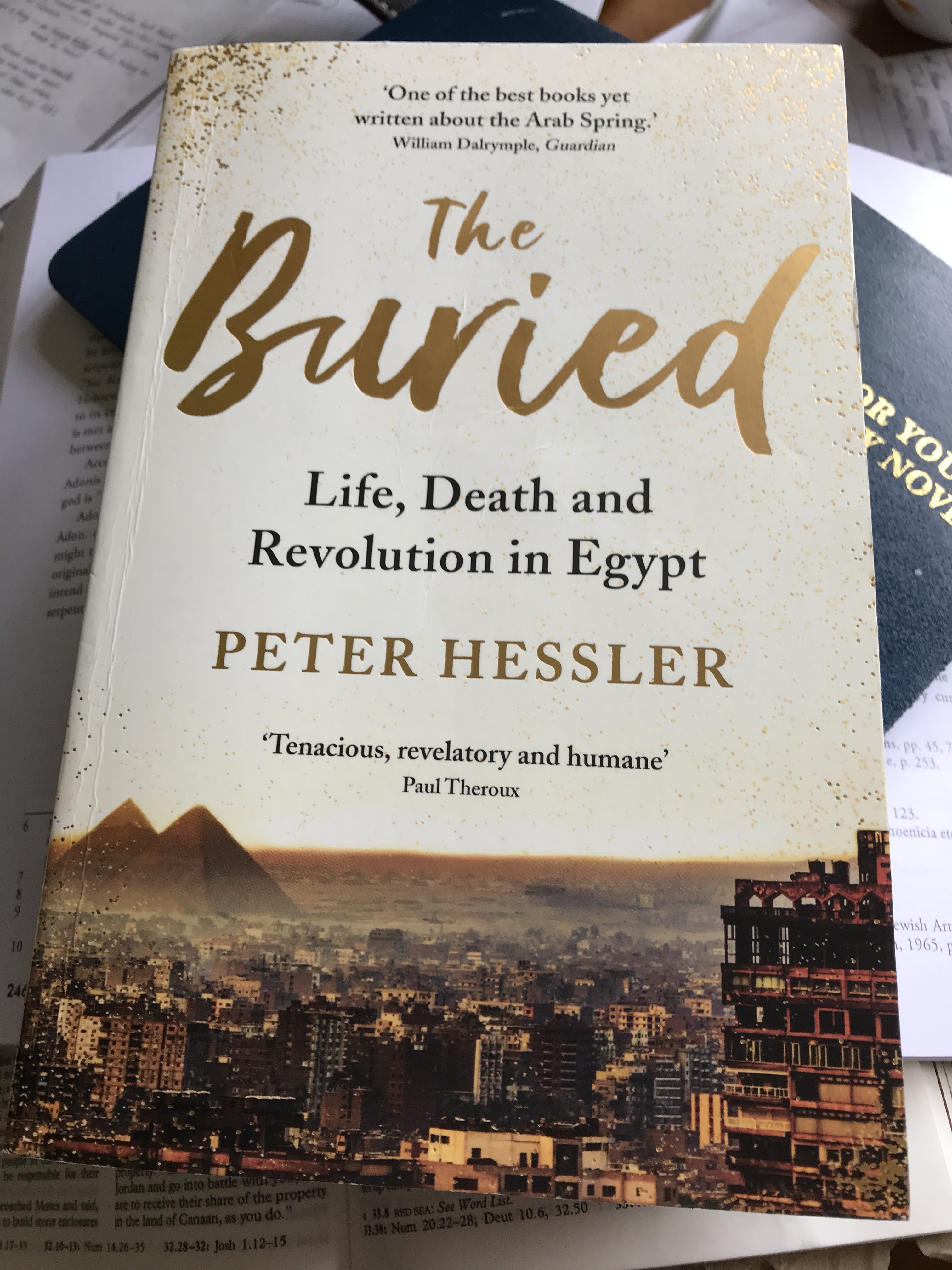
I recently read The Buried by Peter Hessler, and I can definitely recommend it. I knew of Peter Hessler because when I started learning Mandarin, and scanned the bookshops for any English books with any link to China, his books popped up. He was sent to China as a young man, and worked in a remote town, teaching English (with an American accent) to Chinese students. His books described his adventures.
I loved his books. He wrote with humour, describing the many things that went wrong as he learnt Mandarin and described life in China. I felt that he wrote with tact, and had a real respect for the people he met. He seemed to genuinely like Chinese people (most foreign travellers seem rather condescending towards different cultures) and so I wasn’t surprised to learn that he is now married to a woman from China, and they have twin girls.
At the time of writing The Buried, Hessler had again left the US, with his wife and young girls, and had gone to live in Egypt. He applied the same amused patience as he tried to learn Arabic, and the culture in Cairo. He moved there at the beginning of the Arab Spring, and the book describes the events unfolding in the city.
Hessler writes in short sections, so this is a book to dip into during odd moments. I like the respect he shows towards the people he writes about. His says he always tries to learn a language using the books written in the country, because they reveal lots about the culture. I would agree with this. When I learnt Mandarin, the textbooks had lots about authority, and the vocab lists were about managers, and directors, and people in authority. Hessler compares this to the textbooks in Egypt, which were full of polite greetings and blessings, and the correct polite response in every situation. There is apparently even a correct way to thank your hairdresser!
Most people in Cairo spoke Arabic, though any quotes in newspapers were always translated into Fusha. Hessler describes one word, Yanni, which can be translated as: ‘yes,’ sort of,’ or ‘let’s pretend.’ That word alone tells you so much about the culture!
One of the charms of Hessler’s books, is that he befriends normal, working-class people. In Cairo, he befriends the man who collects the rubbish from the flats. There is lots to be gleaned from other people’s waste, much of which is recycled, any alcohol is sold (because good Muslim folk don’t drink alcohol). He also befriends a young gay man, who is struggling with the dangers facing a gay person in a strictly Muslim country (though I was interested to read that mostly, everyone knows that there is a certain place where gay people meet, and yet no one in authority is very bothered by it. It tends to be individuals who react strongly and cruelly, not the governing authorities per se.)
The political situation during the Arab Spring was obviously very interesting. Sometimes Hessler was in dangerous situations, though he writes: “What scared me most was the elevator shaft in our apartment.” He interviews people on the street and in the mosque, and attends news conferences. One feature of Egyptian politics seems to be the repeating of ‘facts’ over and over, until eventually people began to believe them. If something is asserted often enough, it becomes true…
While in Egypt, Hessler visits some of the archaeological sites. The book explores the links with ancient Egypt, and how the past continues to shape the future. The places he visited sound fascinating, and I now firmly want to visit.
Akhenaten
c1346 BC
If you want to read something light and interesting, I recommend The Buried.
Thanks for reading. I hope you have a lovely week.
Take care, Love, Anne x
Thank you for reading
anneethompson.com
Why not sign up to follow my blog?
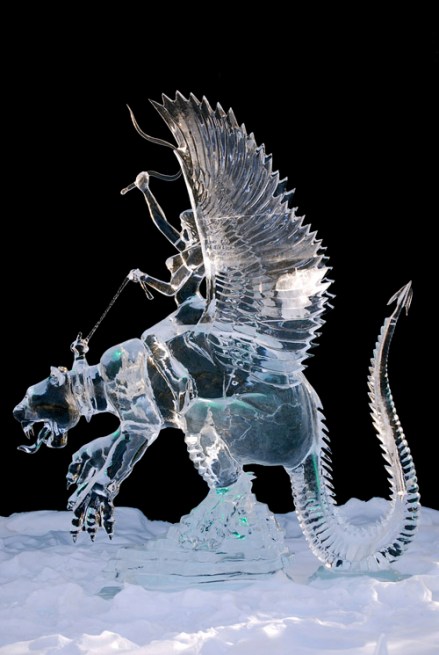
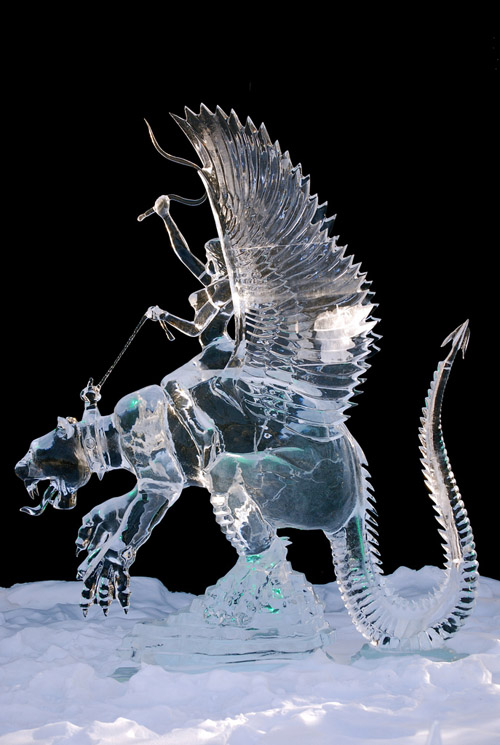
I am often amazed at the skill and time that people spend on ice-sculptures. Some of them are absolute works of art, and yet within a few hours they melt away to nothing. I wonder, is it worth spending all that time on something that melts so quickly? Or is it more beautiful because it’s fleeting?
You might remember that Husband spent time earlier this year emptying a flower bed, filling it with compost, then planting hundreds of tulip bulbs. (He had help. Not from me.) I teased him when he regularly checked the bare earth for signs of shoots. I bought plastic tulips online and crept down one night to put them under his frost-proof cover. But eventually, the tulips blossomed, and they now look rather lovely. However, several gardening-friends have said that they hope the tulips reappear next year, because tulip bulbs don’t always survive as well as daffodil bulbs. Was all that effort for one display? Was it worth it?
The ducklings I hatched are now outside. They’re safely in a cage, and I waste lots of time watching them. Their main aim in life seems to be to fill their water container full of mud, and to spread the water as far as they can. They are happy creatures. But in a couple of weeks I will put them on the pond. Some will fly away, some will get caught by the fox, some will hatch more eggs. But wild ducks don’t tend to last very long—the ducklings I nurtured last year have mostly gone and I am left with just one. Was it worth it?
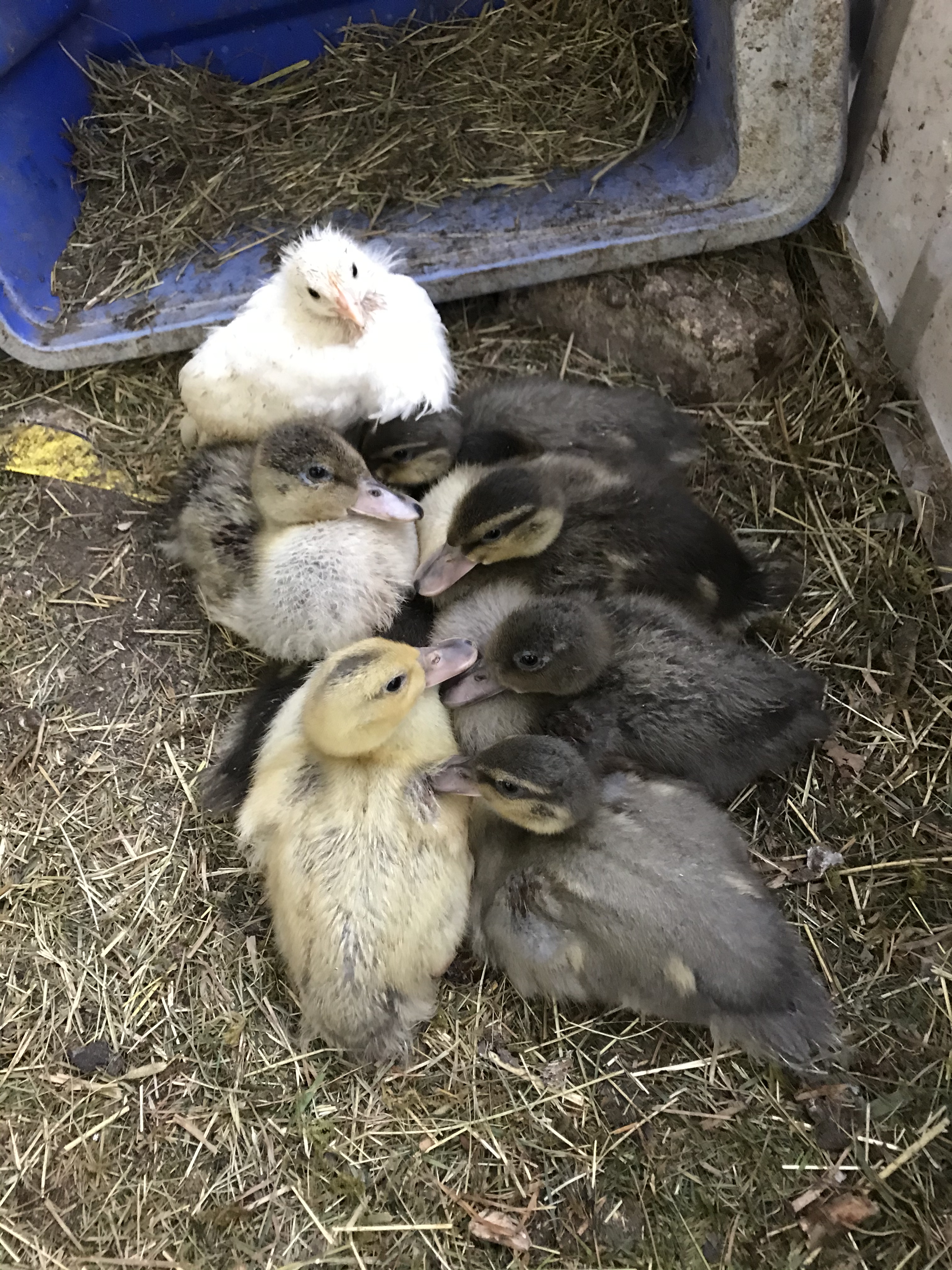
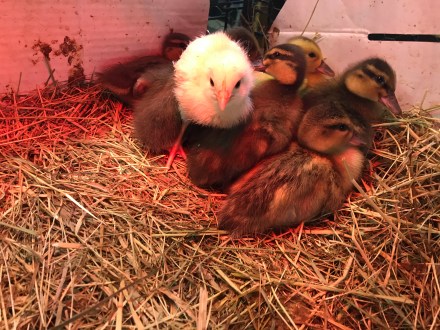
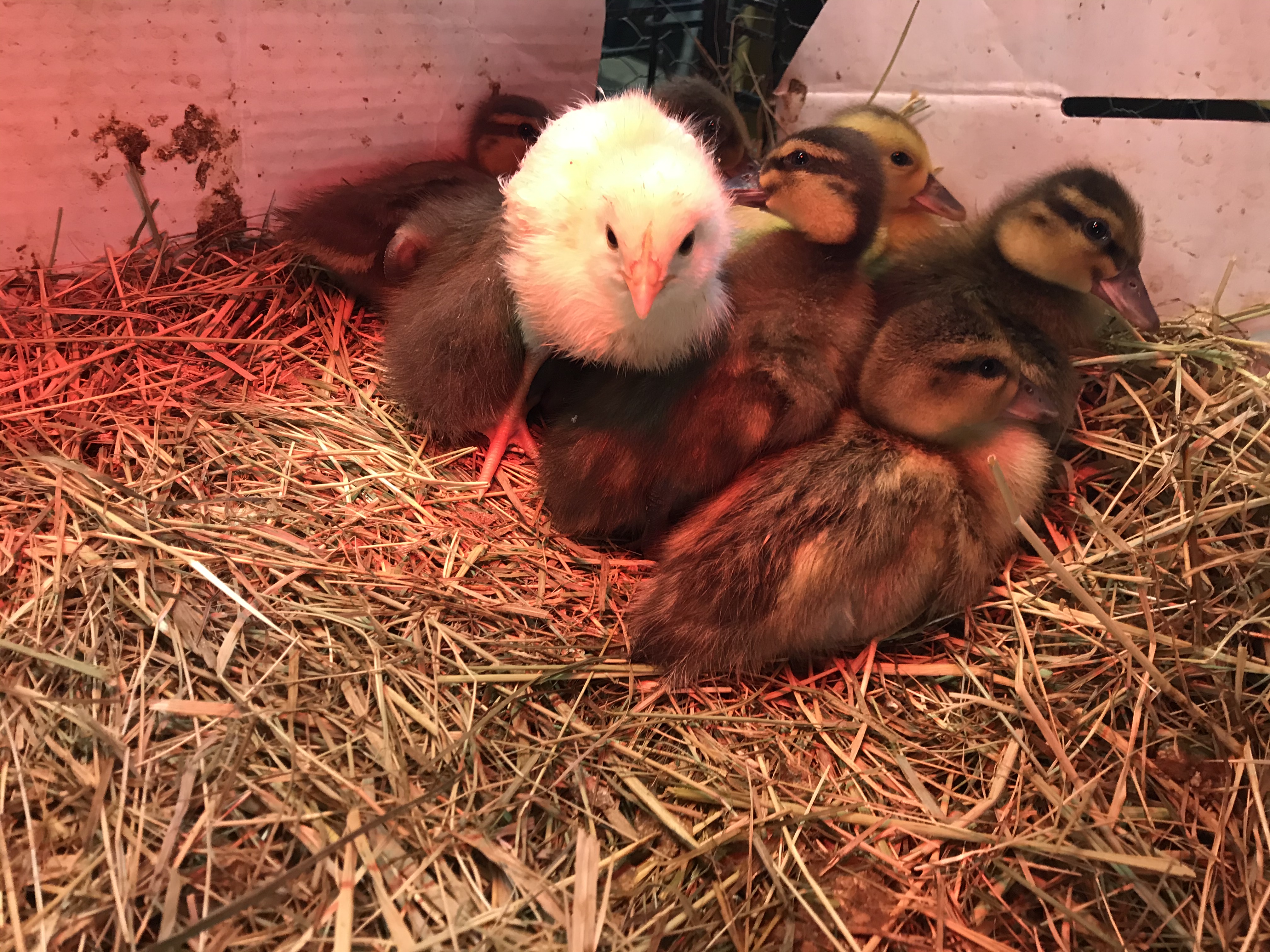
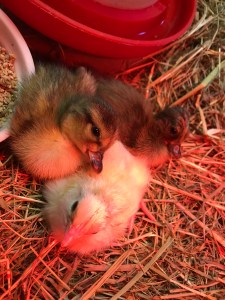
Ducklings snuggled with the chick.
I sometimes struggle with the “Is it worth it?” question. As I get older, I realise that life itself is very fleeting. If you have studied history, or read about the empires in the Bible, lives seem even more fleeting. Here today, gone tomorrow. Think of your own dreams and ambitions, how many have you realised? Is there still time to make them happen?
I feel that life itself is a little like an ice sculpture. We do the best we can, but we know it won’t last, and as we get older, we realise how quickly it will melt. But is it still worth doing? Is it worth creating something beautiful, even knowing that it won’t last, simply because it is beautiful?
I think that perhaps I must answer yes, it is. The shortest life has value. The melting sculpture is still beautiful.
I hope you create something beautiful with your life this week. Even if it is fleeting.
Take care.
Love, Anne x
Thank you for reading
anneethompson.com
Why not sign up to follow my blog?
I have been writing for a few years now, and some of my work I am immensely proud of, and some I am happy to never read again. This poem is definitely something I am proud of. I wanted to write something that answers the “How could a mother sell her child?” question, a poem that showed how choices are limited for some mothers, and how their love and longing to do the best thing for their child is just as strong as ours. I wrote it several years ago, but the message remains sadly unchanged.
Sold
I held you, Your weight light on my hip As I touched your button nose With mine, Peered deep into Shining eyes, Because you are my world.
We held hands As we walked to the station. And you skipped beside me Trusting While my heart Became still, Because you were my world.
I sold you To the man whose words Promised me, That you would be schooled And be fed And have chances in life, Beyond my reach. And I walked away, With breaking heart And one hundred pounds And the prayer you would be safe. Because you were my world.
I continued to explore child-trafficking, and when I wrote my Clara novel, I sent her to India and set her amidst the women in the slums who have such limited choices. While I was writing the book, I visited India several times, meeting girls who had been sold, talking to mothers who had sold their own children, trying to understand how and why this happens. When I finally wrote the book, although the story is fiction (and I know no one as horrible as Clara!) every house in the slum that is described is a home I have been in, every situation is one that I heard about.
If you want to read a copy, I can send you one for £7.99. Or you can buy a KDP copy directly from Amazon.
Thank you for reading
anneethompson.com
Why not sign up to follow my blog?
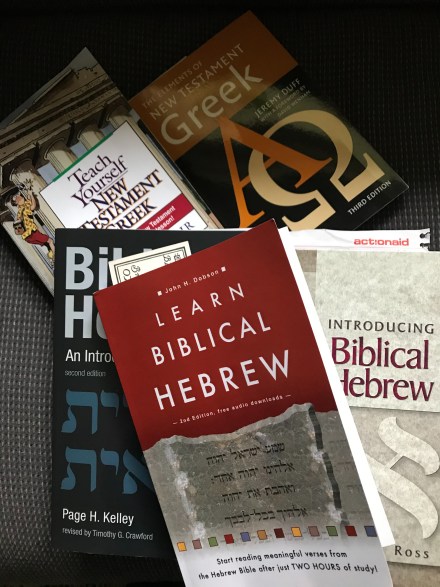
As I continue with my language studies, I have bit of an on-going battle with the textbooks. I realise that this is my problem, rather than the authors’ and is mainly due to my rather poor formal-English education. I was educated in an age when English lessons were about expression and creativity, with not much grammar mentioned. This wasn’t necessarily wrong–I now write novels, and the marketplace is overwhelmed by people my age who are putting that creativity into action. But when it comes to learning a language, it is fairly useless.
My latest novel
My problem is understanding what exactly the textbook is trying to say (the English bits). For example, I am faced with a chapter that begins:
Pronominal suffixes attached to nouns function as genitives, much like absolute nouns in construct relationships.
Introducing Biblical Hebrew by Allen Ross
I stare at the words. I can read the words. I can say the words. But understand them? Not at first glance. My brain has to unwind the language and remind myself that a ‘pronominal suffix‘ is simply ‘random-people-related letters added to the word’ and a ‘genitive’ is simply the word that owns/possesses the other word, and so on. I can get there, but by the time I have decoded the English, I am ready for a break.
I have also discovered that when faced with sentences I don’t understand, my mind sort of goes into shock, and I absorb absolutely nothing. People need to be relaxed in order to learn, and lots of poncy language makes me stressed.
There are of course, textbooks that are more friendly, but they have their own problems. For our Greek lectures, we use a book by Macnair, and he writes in a very folksy manner, describing verbs as ‘slimming-club verbs’ because they lose letters, for example. This was lovely when I started learning, as the information was very accessible. However, when I came to revise it was a nightmare, as I wanted to skim the chapter on ‘liquid-verbs’ and I couldn’t extract the information from the storybook style of writing.
A selection of textbooks.
I think the only answer is for me to have a selection of textbooks. I do need the very formal one, because the exam is written in formal language, and I am expected to behave like a linguist. But when I am learning new grammar points, when understanding is the main aim, then I need a friendly book. For Hebrew, I have found a book by Dobson, which explains the grammar gradually amidst a jumble of reading and this suits the way I learn. I need to use the language in order to learn it, I find learning grammar in isolation to be almost impossible. The formal textbook by Ross will teach something, and then give lists of words (paradigms) to be learnt, but without saying what the words in the paradigm actually mean. (I have scribbled the meanings next to the lists of symbols–otherwise that is all they are–lists of meaningless symbols.) In contrast, the book by Dobson will give an extract of Hebrew text to read, and then points out a few minor grammar points. The order is jumbled, but the information is easily assimilated.
My other problem at the moment is trying to learn lists of Hebrew words (because unlike the Greek exam, we are not allowed to use a dictionary). My memory is pretty rubbish, so every list of new vocab represents many hours of work: writing, reciting, lists on the fridge, letters on my fingers, chants when we jog. Not sure whether I will get there, but I am determined to give it my best shot.
I hope you have something interesting to work on this week. It seems to me, that the most rewarding things usually require an uncomfortable amount of effort–but it’s worth it.
Thanks for reading. Take care.
Love, Anne x
Thank you for reading
anneethompson.com
Why not sign up to follow my blog?
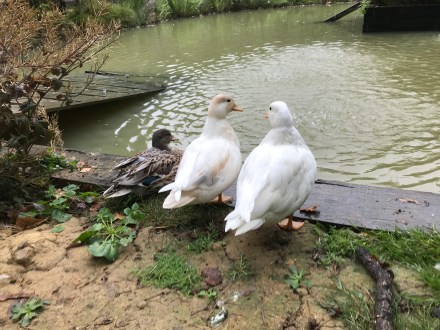
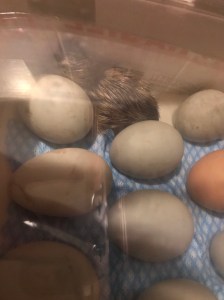
We had a mini crisis. I had managed to safely hatch a couple of ducks and one chick, but the rest of the eggs had died (I suspect this was due to being placed over a rather shaky washing-machine—I will rethink the position next time.) Anyway, the hatchlings were safely in a plastic crate under the red heat-lamp, and we were walking the dog when Husband happened to glance through our hedge. There on the pond was a tiny yellow duckling.
Now, I knew that one of the ducks was sitting on a nest in a hutch, and I had in fact been barricading her in with balanced paving stones and old bricks because there were signs of the fox trying to dig her out at night. But I had decided that if she managed to hatch any, I would leave them to take their chances on the pond. I decide this every year. I never do.
We rushed back into the garden, with the dog trailing behind us looking confused and wondering if we had forgotten we were going on a walk.
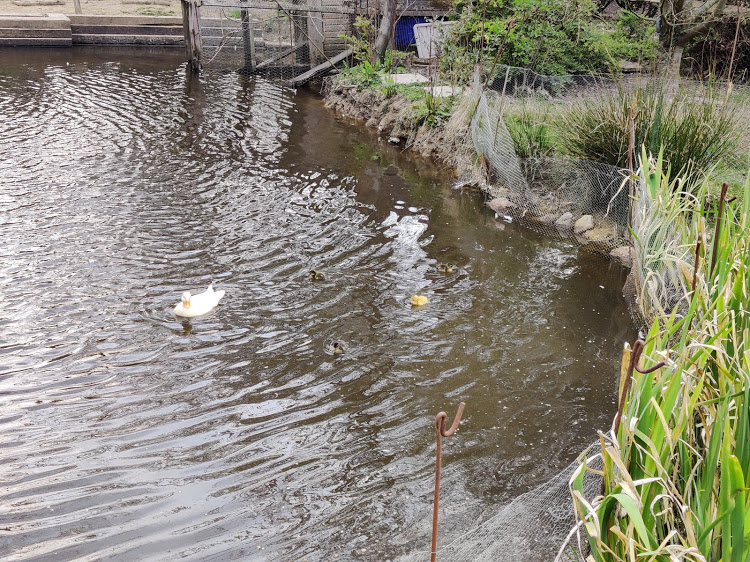
On the pond, the mother duck was swimming around, followed by four ducklings. All very cute. But I wasn’t sure whether she would protect them when the crows heard and swooped in for a snack. We stood, watching.
Mother Duck and Four Ducklings Struggling to Stay With Her
Mother duck went up onto the island. The ducklings swam round, wanting to join her but not understanding about the ramp. One found it and struggled up, the others cheeped in alarm, all the while getting more tired and water-logged. A duckling has the oils from the mother’s feathers to waterproof it for a while, but as that wears off they get soaked and cold and sink. We decided to intervene and Husband went inside for his waders while I stood guard. As soon as he entered the pond, mother duck jumped off, and he managed to grab the duckling on the island. He also spotted another one, lying on a ramp, cold and still. We thought it was dead, but it managed to lift its head when it heard the mother, so we grabbed that one too and I rushed it to the incubator, which was luckily still warm.
When I returned, mother duck had found a spot on the bank, and two ducklings were underneath her. I realised that she would probably stay there for the night, making easy-pickings for the fox. The only safe place is the island, and the ducklings couldn’t get up there. Ducks never return to the nest once the last egg has hatched (it usually has at least one dead egg in it and a lot of smelly egg shell). I approached the mother, and she jumped into the pond, leaving the ducklings on the bank. I put them in my pocket, and watched to see how she would react. She went on the island, and started to clean her feathers, apparently unperturbed. I took the ducklings inside.
I checked a few times, but the mother seemed happy without her ducklings, and was busy swimming or resting—she certainly wasn’t looking for them. I decided to keep them (well of course I did!)
The nearly-dead duckling continued to look nearly dead for a couple of hours, but then perked up, so I added him to the plastic crate in the garage. Ducks are lovely birds, when you introduce a new one they come to investigate, but I have never known them to be anything other than accepting.
The mother duck was white. I’m not sure if that is the reason, but the new ducklings adopted the chick as their mother, and tried to sit under her. She was rather bemused—especially as they were bigger than her. After a day, she seemed to accept her role, and continues to sit on top of the ducklings. I suppose that when you were curled up in an egg a few hours ago, the whole world seems strange; having fluffy ducklings climbing under you is probably no more strange than everything else. The chick (am really hoping it’s not a cockerel) mainly looks perturbed when the ducklings splash in the water. I have noticed it always drinks after the others have finished.
They adopted the chick as mother.
She accepted her role…
Drinking is a shared experience.
Hope your world is not too weird today. Take care.
You might remember that I told you that ancient Hebrew did not have vowels (this seems to have been a thing with ancient languages—not sure why). The vowel signs were written later, a few in the 6th century BC, and then more in about the 9th century AD, when Hebrew was not spoken outside of the religious text and people were worried that everyone would forget how words should properly be pronounced. A group of scholars (the Masoretes) added little symbols below the letters, to show where the vowel sounds should be made.
The personal name of God was considered very special. I have no idea why Christians don’t also consider God’s name to be special, but we don’t tend to limit how/when we use it. If the Queen came to visit, we would refer to her as “Ma’am” or “Your Majesty” and only a person with no respect for the monarchy would talk about “Elizabeth coming to visit,” far less, “I’m going to see Liz.” The Jews give this same respect to God’s name, and they avoid saying it.
Now, here’s the interesting bit. When they added the vowels to the personal name of God, they used the vowels that actually corresponded to one of the titles for God, not his actual name. This reminded people not to read the name, but instead say ‘Adonai’ which is a title. The term for this would translate in English to ‘written-read’ because although something is written you read something different.
If we were to do this with the Queen, we would take the vowels from Majesty: a e and add them to the consonants of her personal name: LaZBeTH. LaZBeTH is not an actual name, people reading it would see the oddly-placed vowels, and remember to read: “Majesty.”
As I said, Christians don’t seem to have this same form of respect for God’s name. (Though to be fair, when God’s name appears in the Bible, it has been translated as LORD all in capitals.) Christians today mostly are not aware of this. In fact, they even have songs that combine both the personal name, and the ‘made-up’ name (Jehovah) and they sing them—sometimes I suspect thoughtlessly—without even being aware that the term ‘Jehovah’ is a sort of non-word created by the Jews to avoid saying God’s personal name. The J at the beginning of Jehovah is because that is how a ‘y’ sound was translated in the original German, and the word first appeared during the time of the Protestant Reformation and simply shows that they didn’t understand much Hebrew. ‘Jehovah’ is not a word.
I wonder what a Jew, listening to Christians being so casual with the name of God, would think about that. I wonder what God thinks about that.
What do you think about that? I’m sure that some people would say that God is more concerned with how we show our respect for him through what we say and do, than how we address him, and perhaps that is correct. But I’m not so sure. As I am learning Hebrew, and listening to my lecturer and various scholars online, I am noticing that most of them avoid using the personal name of God, and when they reached the word יְהוָהthey tend to read ‘Adonai.’ I don’t know whether this is a sign of respect to the Jews whose language is being spoken, or to God. Perhaps the two reasons are the same.
Thank you for reading.
Thank you for reading
anneethompson.com
Why not sign up to follow my blog?
This week has been a busy garden week. We decided to try and create a vegetable patch in the garden. This is probably unwise, as neither of us are gardeners, and we both think the other person is going to do all the hard work. I suspect we will simply create an eatery for slugs and caterpillars, but perhaps that’s overly negative.
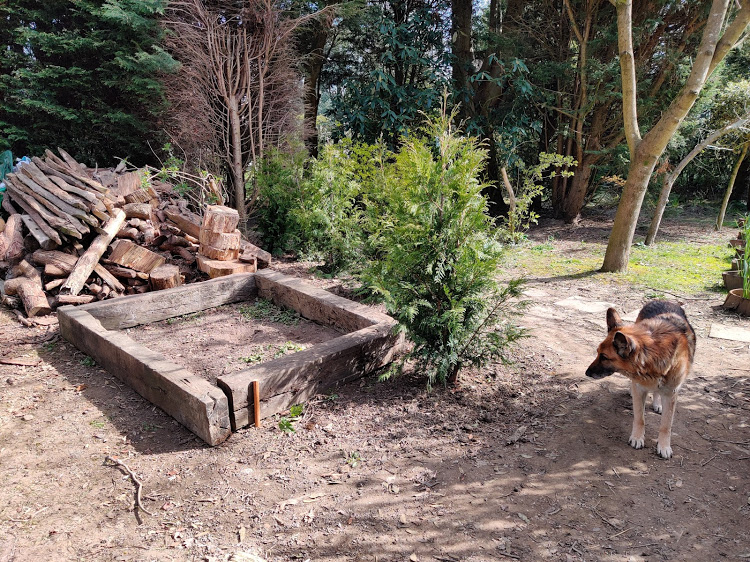
Once we had decided the position of the vegetable patch (which took longer than you might expect) Husband decided to mark it with a border of sleepers—which we have left over from when we moved the pond a couple of years ago. Moving sleepers is very difficult—they are extremely heavy and all our children have inconveniently grown-up and left home. I helped by muttering about hernias, and maybe waiting until the boys next visited, and was it worth the effort when we’d only grow slugs anyway?
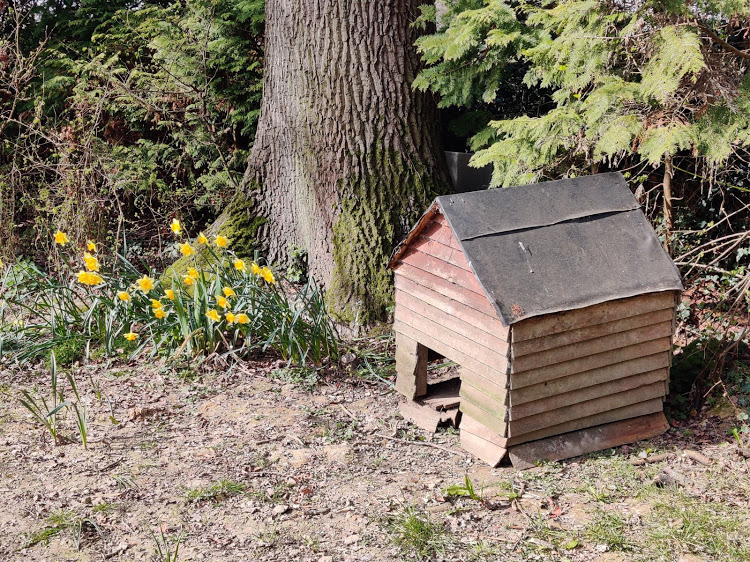
Husband was more inventive, and after I had left and gone into the house, he set to work. The first job was to move the old duck house, which had been on the island before we moved the pond but was a nuisance as it was always full of eggs that I couldn’t reach so had since been moved to the compost heap (because that is obviously the ideal place for a duck house). Husband moved it to under the oak tree, using a system of rolling logs. He then created a series of levers and rollers with old logs, and managed to move the sleepers into place. When I went to check he wasn’t lying in agony with a hernia/slipped disc/broken foot, I found him standing next to the frame of our vegetable patch, looking extremely pleased with himself. He explained his method of using old logs and branches to make rollers and levers in great detail (really, I am saving you from a lot of physics here). It was apparently akin to how people built Stonehenge. But better (obviously).
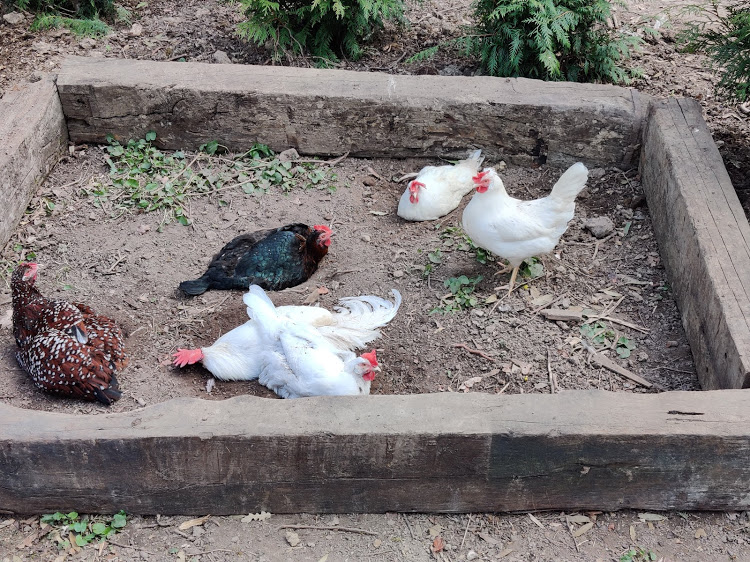
The plan was to remove the weeds from the inside of the excellent frame, and then fill it with compost. However, the chickens had other plans. They were released from their prison a few days ago, when DEFRA announced the bird-flu threat had reduced, and my chickens have been loving the freedom. They clearly decided that Husband had been making a communal bath for them, and have used it ever since as a place to bath. (For the uninformed amongst you, chickens clean themselves by digging into dry earth and kicking it all over themselves. This dust-bath is a very good way to clean feathers.)
I am still not convinced we will ever manage to grow vegetables, but will let you know.
I have also been trying to grow ducks—but not much success there either. I had 20 eggs in the incubator, and they all seemed to be developing well. But then all went quiet. One duck hatched very quickly, and I named him Aleph and put him in the garage. He was lonely, so I gave him a mirror to chat to. He spent long hours in conversation with his reflection.
A day later, Bet hatched. The following day, Gimel emerged from the one chicken egg (because I prefer brown eggs—am hoping the chick isn’t a cockerel). But then…nothing. Very disappointing.
I opened a few eggs, and the birds all seem to have developed to a certain stage and then died. I’m guessing they died a few days before they should have hatched—no idea why. Perhaps something knocked the incubator, or there was something in the air. None had gone bad (which can kill the other eggs) so it must be something external.
It’s especially disappointing because the fox has been visiting again (I think it must have cubs) and I lost two of my female ducks. The remaining female is currently safe because she’s on a nest in the hutch (not the old one Stone-Age-Husband moved). I’m hoping she has more success with hatching her ducklings than I did.
Having a chat.
Hope your week went better than mine.
Thanks for reading. Take care.
Love, Anne x
Thank you for reading
anneethompson.com
Why not sign up to follow my blog?
Hello, have you had your Covid vaccine yet? I had mine this week, and it was both more fun than expected, and more time-consuming. I had booked an appointment online, so went to a nearby vaccine centre in Tonbridge. This took a whole chunk out of the day—whether you are trying to write a book or attempting to learn Hebrew verb conjugations, always real life gets in the way. But perhaps that is good for me.
Anyway, the vaccine was more fun than expected because I had not really focussed on the fact that everyone there would be about the same age. When you are waiting in a sport’s hall with about 200 people of your age-group, you cannot help but compare how you are doing. I went at the same time as Husband, so I checked out how he is doing too (and I think I chose quite well actually, there were a lot of big bellies and bald heads amongst the other candidates!)
My main advice when you have the vaccine is make sure you’ve combed your hair and worn something flattering.
As far as what to wear, it’s also worth wearing something with a sleeve that will roll up. I was surprised how many people had not really thought about what they were going for—unless they thought it was going to be stuck somewhere other than their arm? One person seemed to be having a major strip-tease going on. It reminded me of when I taught the reception class, and without fail when you told the class to change for P.E. there was always one child who got carried away. You would tell them to change, start collecting equipment and then glance up to find a naked body in the room. It matters less when they’re only 5.
It was hard to not think I was having side-effects because at every stage we were told what to expect, given a booklet of scary things to watch for, and were even told by our nurse how ill she had been afterwards. Husband had read somewhere that in trials, about 38% of people had side-effects. He also read that about 20% of people who were given the placebo had side-effects. Hard not to think your little toe feels odd if someone asks you.
I read an interesting article about side-affects from the vaccine. Apparently, they are due to the body having an allergic reaction to the vaccine—much as chicken-pox spots are due to an allergy to the disease rather than the actual disease causing spots. (I think this is different to things like hay-fever, so I don’t think anti-histamine would help.) As older bodies have a less responsive reaction to allergies (and rarely have hay-fever) so too they are less likely to have a big reaction to the vaccine. The younger you are, the more likely it is that your body will decide it doesn’t like the vaccine and produce a temperature or headache. This is completely separate to the antibody producing bit, so whether you have a reaction or not, the antibody count is likely to be similar. The good news is that if you have a bad reaction with the first dose, when you have the second dose your body will realise that it’s not harmful, and there is unlikely to be the same allergic response.
I didn’t have much problem with side-affects (clearly too old).
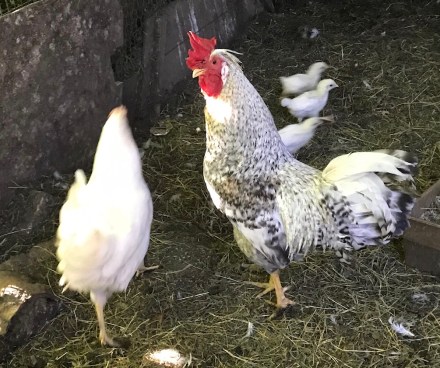
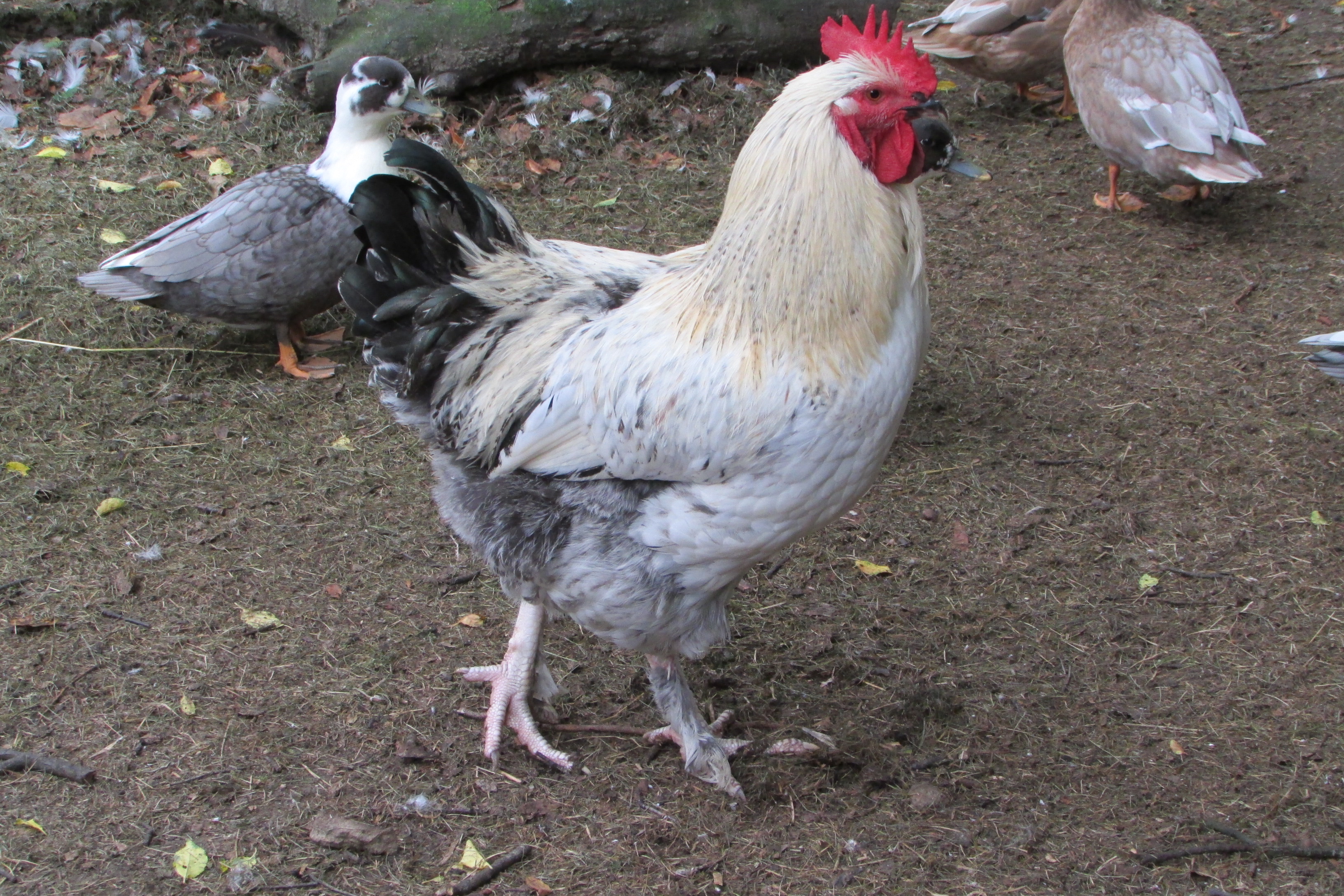
One thing that did hurt me was being attacked on Wednesday. I was collecting the eggs, and had stooped to reach into the nesting box, when suddenly I was walloped on the leg, which caught me off-balance and I fell over. The wretched cockerel had decided I was interfering with his women and had sprung into attack. He’s attacked me before, and I have picked him up and marched round with him tucked under my arm until he’d calmed down, but as it clearly hasn’t stopped him it was more of an issue this time. A nasty cockerel will attack people, cats, dogs, ducks—everything really. Big problem. Plus it really hurt. His spurs had cut right through my trousers, and although the cut was only about 1cm wide, it was fairly deep.
I wasn’t sure what you’re supposed to do with a wound from a cockerel spur. Is it like a bite and needs special attention, or do you just clean it and stick on a plaster? I went for the Savlon and plaster method and it seems to be healing. Don’t ask what happened to the cockerel, but he won’t be attacking anyone else.
Hope you have a pain-free week. Thanks for reading.
Take care.
Love, Anne x
Thank you for reading
anneethompson.com
Why not sign up to follow my blog?
I learnt something interesting recently. I think I am slightly behind the curve, and maybe you knew this already—when Jesus was dying on the cross, he was probably reciting Psalm 22.
I knew that the psalm links to the crucifixion, as it seems to describe exactly how Jesus would be feeling, and some of the actions listed (like gambling to see who would win his clothes) actually happened at the time. I have always thought it was a poem, written about 600 years earlier, to describe how Jesus felt (because God can write things before they happen). But it had never occurred to me that Jesus, in his darkest time, would have recited it.
I learnt about it in a Greek lesson, because the words of Jesus on the cross were recorded by the gospel writers. But here’s the thing: the gospels were written in Greek, and each writer added their own slant. So in the synoptics (Matthew, Mark, Luke) they want to show how Jesus suffered on the cross and so they recite (but in Greek):
“My God, my God, why have you abandoned me?” (See Matthew 27 vs 46)
However, when John wrote his book, he wanted to show how everything about Jesus’ life was planned by God, and the crucifixion was part of that plan, and so he quotes the end of Jesus’ words:
“It is finished.” (See John 19 vs 30)
As I said, John was writing in Greek, and in Greek they are able to write in tense that shows something has happened in the past—but the consequences have not finished, it is on-going. In English we can do this with certain words, so if we say: “I became a vegetarian a year ago” it can be assumed we are still a vegetarian now (but not necessarily, because English doesn’t have the same clever tenses that Greek does).
John used this tense when he wrote the final words of Jesus. It was finished, in the past, but the consequences will continue.
Of course, Jesus wouldn’t have recited the Psalm in Greek, he spoke Hebrew/Aramaic. I don’t know enough Hebrew yet to tell you whether they have the same clever tenses that Koine Greek does, so I only know that he probably recited Psalm 22 when he was on the cross.
Does this knowledge make a difference?
Well, the stuff about the gospel writers using Greek to give an angle on what was said is interesting, but probably doesn’t affect me overly. But the idea that Jesus quoted scripture at his most difficult time makes me think that perhaps this is something I should aspire to do. If Jesus came to give us an example of how to live, maybe when life is hard for me, I should also recite scripture—perhaps it would comfort me and help me to focus on better things than the horrible situation I am coping with. I will probably never suffer anything on the same scale as being crucified, but everyone has dark times, don’t they? We all feel overwhelmed sometimes.
Of course, I can only recite scripture if I have previously learnt it. Which is not something that’s very fashionable these days. Perhaps it should be. I think I will try.
Psalm 22 is very long, so I won’t start with that one. I think it might be a good one to learn next year—perhaps as a discipline for Lent. Do you want to join me? We could learn a few lines every day, and by Easter we will know the whole Psalm. I will divide the Psalm into segments and post them on my blog (I can predate things now, so next year they will arrive in emails to my followers). It will be good for our brains if nothing else!
For now, I will try to learn Psalm 1 (because it’s short). It would be good for me to learn it in Hebrew, as that’s my current challenge—I will let you know how I get on.
Thanks for reading. I hope you find some interesting challenges this week.
Love, Anne x
Thank you for reading
anneethompson.com
Why not sign up to follow my blog?
Look on your device for this icon (it’s probably right at the bottom of the screen if you scroll down). Follow the link to follow my blog!
I watched my son die today. My beautiful boy, beaten, battered and left to die. And my heart broke. I held my cloak close and I remembered the weight of him as a babe, like a boulder on my hip, wriggling to be free, to run and jump and climb.
Those legs will run no more. Those limbs—I was so proud when they grew. I remember when he grew as tall as me, then taller even than Joseph. I remember watching him, stretched out as he ate, those long limbs seemed to go on forever. “I grew him,” I used to think with pride. But those limbs will not sprawl relaxed in my home ever again.
I watched his hands, the hands that used to pat me cheekily on the head when he’d grown tall. Those strong hands which laboured with wood, which helped me carry heavy loads, which lifted young children playfully.
They are no longer strong. I saw them bang nails through the flesh, felt that I heard the sound of bone shattering over the thump of the hammer, heard his ragged breath as they forced the cross upright. And I wondered if I too might die. But I watched. I am his mother and I would not leave him alone.
When they tried to take me home, when they told me to shield my eyes, avert my gaze, I did not. For he was my son. I would never leave him alone, not at such an anguished hour of need. Others watched. Some women were there, terrified and hanging back. Not me, I am his mother. I stood with John, where he could see me. What could they do to me that was worse than this?
Others watched who hated him. They mocked and spat and called abuse. It could not hurt him now, I thought, let them shout.
“He trusts in God,” they called, “Let God save him now,” and they laughed, even as he died, they laughed.
Yet even God deserted him by the end and that was hardest to bear. He called out with a loud shout, asking why God had turned from him. “My God,” he called in anguish, “why have you forsaken me?”
But I was there. I did not leave. I saw them crucify him, naked upon a cross. No mother wants to see her grown son naked, but still I did not look away. I was there at the beginning, I would stay with him until the end.
The soldiers took his clothes, for fabric is costly and even that of a criminal should not go to waste. Most they tore and shared between them, but not his tunic. They cast lots for that, not wanting to spoil something precious. Yet my son was precious and they destroyed him.
It began last night. They woke me from my sleep and warned me there was trouble. He had been arrested, taken from a meal with his friends and questioned by the temple authorities. They feared the invaders, so he was then referred to a court of Godless law, a place that feared no God. They told me that he was scourged, beaten with whips that removed chunks of flesh as they struck. He was mocked and abused, then brought to this place.
I came, stumbling through streets full of people, full of noise and smells and fear and hatred. I came to this place, this Godforsaken hill beyond the city wall and I saw my son, my boy, diminished, shrunken somehow. I saw that what they had told me was true, smelt the repugnant stink of excrement mingle with the metallic stench of blood. I heard the shouts of abuse, the curses of the guards, the screams from the prisoners, the wails from friends. And him, like an oasis of calm amidst the turmoil, suffering but at peace.
And he saw me. Those dark eyes that as a baby had watched me intently when he fed. Those eyes that twinkled merrily when he teased me and became serious when he wanted to explain something important. Those eyes, red rimmed with exhaustion now, turned to me. Even hanging there, with parched mouth and dried lips, he spoke to me. His voice was hoarse, for he had refused the wine they offered, but I heard him well. A mother knows her child’s voice. I stood with John and my son told me that this was to be my son now and he was to care for me as a mother. Even in his torment he cared for me, fulfilled his duty as my son. Still I would not leave.
Then it ended. The sky had turned as black as my world and he drew his last breath. It was finished. Those who had mocked became silent, some cried, some beat their breasts in despair. The blackness of the sky frightened them and many fled, wondering at what they had done.
I left, I let them lead me away. My soul was broken and my heart beat even though I bid it stop. My boy was gone, my firstborn, special baby, was no more. I carried that knowledge like a rock within me, I would have rather died in his place. How can I live, continue with my life knowing he is gone? There will be no more sunshine or laughter, nothing matters now. The core of me has gone. I cannot even cry.
Afterwards, I could not rest and I heard strange stories. They said the soldiers pierced his side, to check there was no life in him. His blood had separated so they took him down, a solid corpse that had no life.
A man came and took the body, they said they followed and knew where he lay, in a tomb that was guarded. They told me of strange things, of the temple curtain torn in two, of dead men walking and boulders breaking open. I do not know. I only know my boy is gone. That is all that matters.
It should not have been like this. It was so recently that people praised his name, sang and danced before him, treated him like a king. It should not have ended like this.
And yet, I recall a song, it comes persistently to mind, sung often in the synagogue. It speaks of one forsaken by God in his time of need, scorned by many. He belonged to God from before he was born, then suffered at the hands of many. They sung of bones poured out like water, a heart of melted wax, that is how my boy would have felt. They sung of hands and feet pierced like his and enemies gloating over him. They sang of lots being cast for clothing and of God’s ultimate victory. They sung of remembering him for ever, not just now but families of every nation, even those presently unborn. For he has done it.
Is this my son’s song? Were the words written for him? Are these the words he whispered while he died?
He spoke of his death often, he tried to warn me that he would die. But not like this, not before my own time has come. No mother should bury her child, it goes against what is natural and right. Though, he showed no fear, he knew what his end would be. And he told me there was more.
As I turn now to sleep, I wonder at his words. Will he truly return somehow and will I know?
Has he finished what he was sent to do?
************
If Mary was a young teenager when she learned she was pregnant (which would fit with the age that girls became betrothed in those days) then when Jesus died aged thirty-three, she would have been about forty-seven. How does a woman of that age cope with the things she was forced to witness and how much would she have understood at the time? I have sons, contemplating their dying is too horrible for words. I am sure she loved her boy as much as we love ours.
Crucifixion was a ghastly way to die. We learn in the Bible that Jesus, who never sinned, who never did anything wrong, died to save the world. What does that mean? You can learn more Here
However, many people were crucified, some probably unjustly accused. So is it the death that was important or was it that God became separate? I think that this is the key issue here: the part of Jesus that was God, left him. That was more terrible than crucifixion. That is what each of us deserves and what we do not have to suffer if we choose to come to God. If we want to know God, we can, even if that means changing our minds.
You may not believe in God, but God believes in you.
The song which Mary recalled in the story was Psalm 22. I will write more about it in another blog.
****
Thank you for reading.
If you liked this, why not sign up to follow my blog?