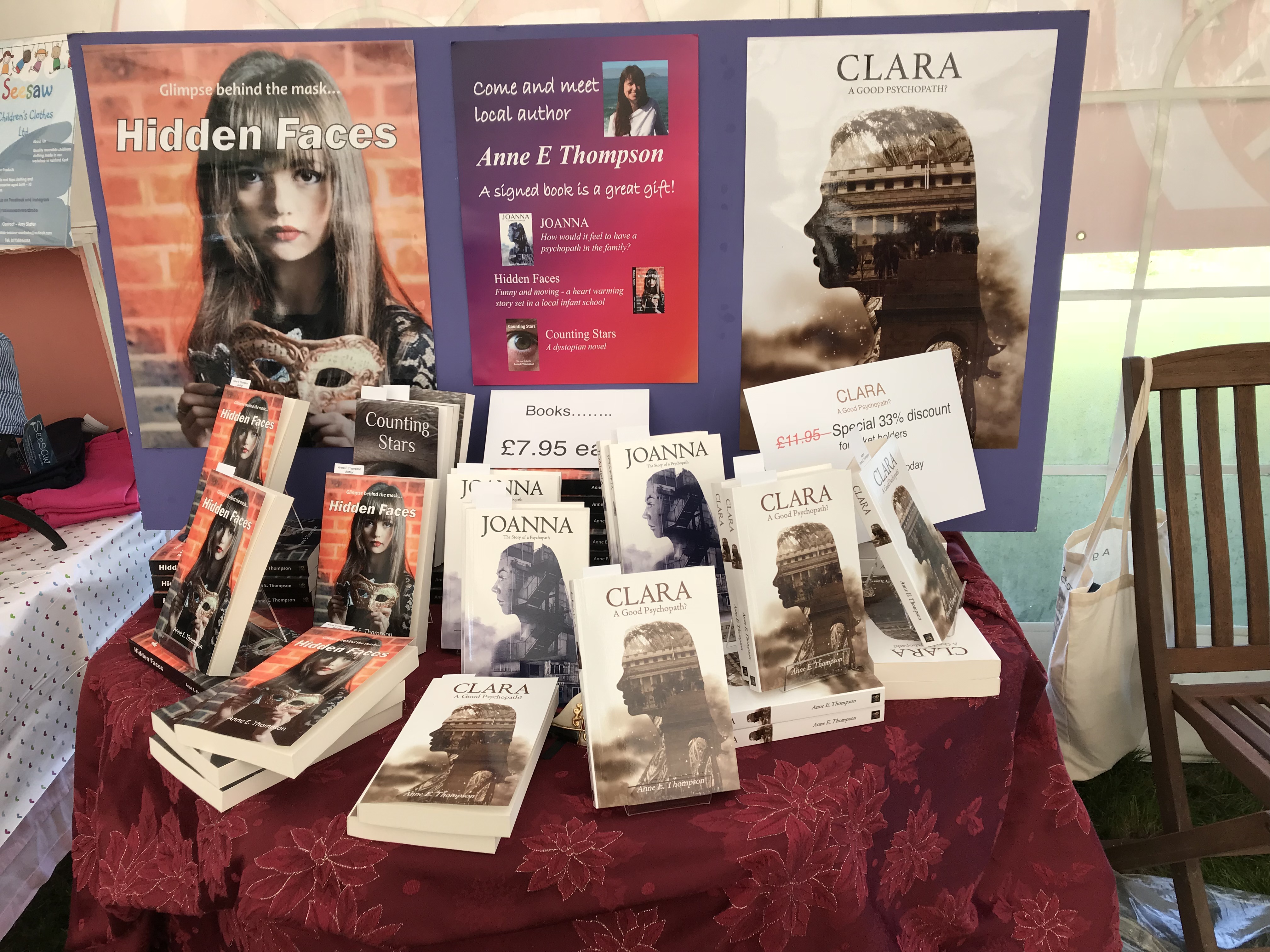
“There’s none so queer as folk. . .”


Sometimes, after selling books at a craft fair, I am dying to tell you about some of the people who I’ve met—sometimes because they were very odd, sometimes just because our conversation was interesting. But I try to hold back, and not say too much, because it feels like an invasion of privacy to tell you too much about people who do not expect to be written about.

However, as I have attended more and more fairs, there is a general pattern of types of shoppers emerging, and so, in general terms, I feel I am safe to tell you about them. (If you have ever spoken to me at a fair, then you might recognise yourself, but I am writing in very generic terms, so my descriptions will apply to several people rather than a single individual.)

First of all, there are the Rebuffers. These are the people who really do not want to buy a book, they are generally in a hurry, and will rebuff my initial approach briskly. Sometimes they manage to do this nicely, with a smile and shake of the head whilst not breaking step.

Sometimes they are rather rude, and will reply to my: “Hello, do you like reading?” with a curt: “No!”

I have even known people say: “Not those kinds of books” or, “Not books by a woman!”
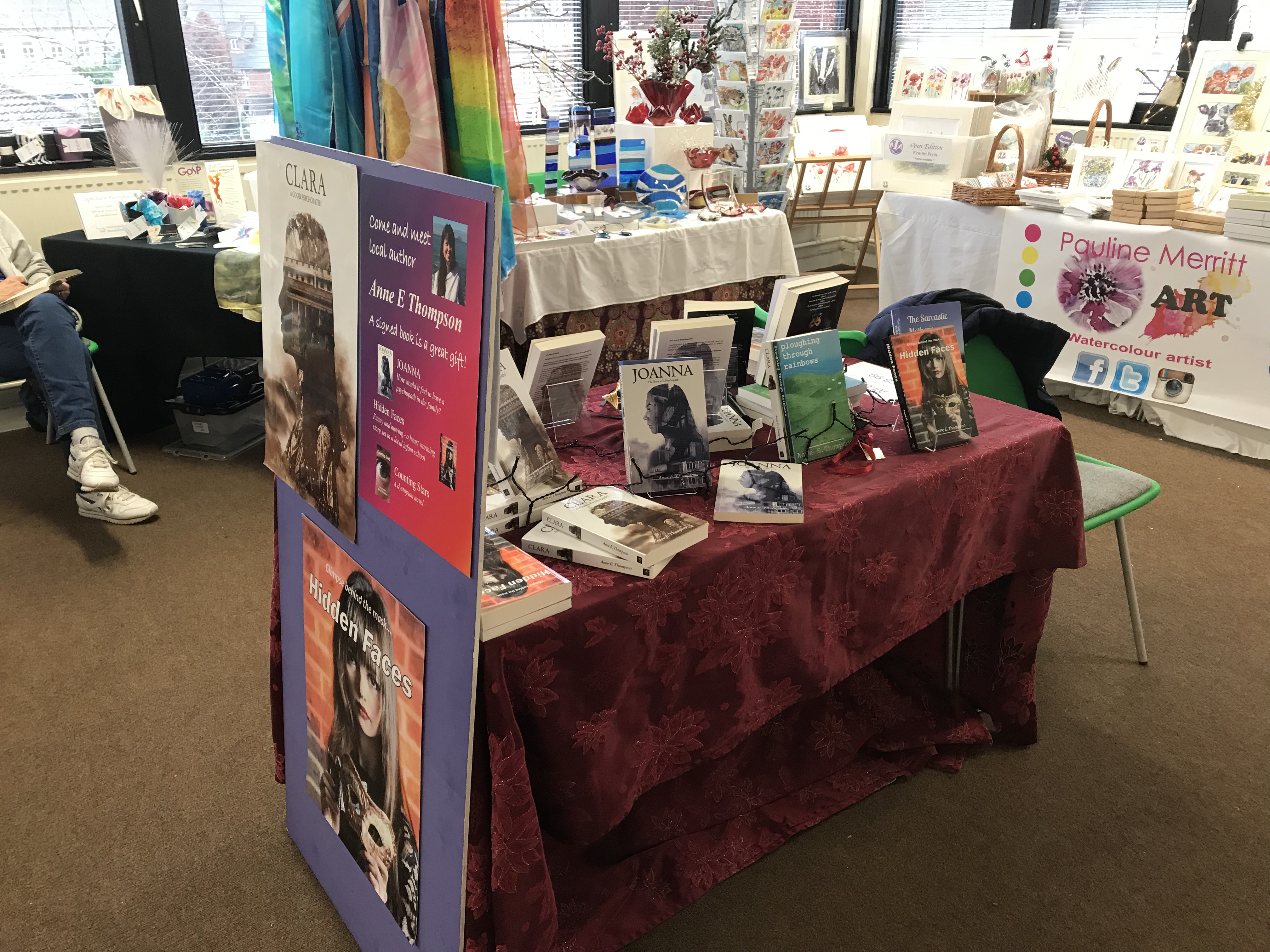
Secondly, there are the Chatterers. These people consider that as I have approached them, I must be lonely and want to chat. They will talk, for a very long time, about the kind of book that they would write, if so inclined. It is sometimes difficult to move these people on, and I have watched with despair as several potential customers pass by while a non-buying woman launches into the year after her second child was born when they went on holiday to Paris and there was a man on the ferry who. . .

Thirdly there are the Predators. These people will ask lots of questions, they will examine my books in detail, asking who published them, how I sell them, how many I have sold. By the time they have asked their 57th question, I am beginning to realise that they have no intention of buying, they are simply checking out the opposition! Invariably they turn out to be authors themselves, who have never considered asking bookshops if they can do a book-signing, or taken a table at a craft fair, and they are trying to decided whether they should copy me. I will link these people with the authors who think that as I have told them about my books, I will now be interested to hear about their own. They tell me at length about the plot of their book, and who published it, and how I can buy it—without considering that I have paid £40 for my stall, and really I need to SELL enough books to cover my costs, not look around for other books to BUY!

Next, we have the Investigators. Some of my books are about psychopaths, and they were written after months of research: I read papers by neuroscientists, bought books by neurologists, listened for hours to convicted psychopaths, and found two mothers who would talk to me about raising a psychopathic child. So, although I am a lay-person, I felt sufficiently qualified to write novels about psychopaths. However, I find that some people—often but not always, health professionals—are deeply suspicious. They will start to ask questions about my research, and the questions turn into an aural examination/inquisition as to my understanding of the subject. Generally, I manage to answer satisfactorily, and they often go on to buy a book (one even asked me to write an article for a mental health magazine) but it is uncomfortable. Actually, it is often most uncomfortable when the person has no scientific knowledge themselves, but considers themselves to be an expert because they have read an article or watched a television programme, and often their own understanding is somewhat flawed, which makes it difficult when being ‘tested’ by them.

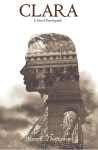
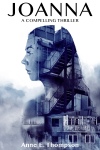
What if…you were the mother of a psychopath? The story of Joanna and her family – an exciting novel.
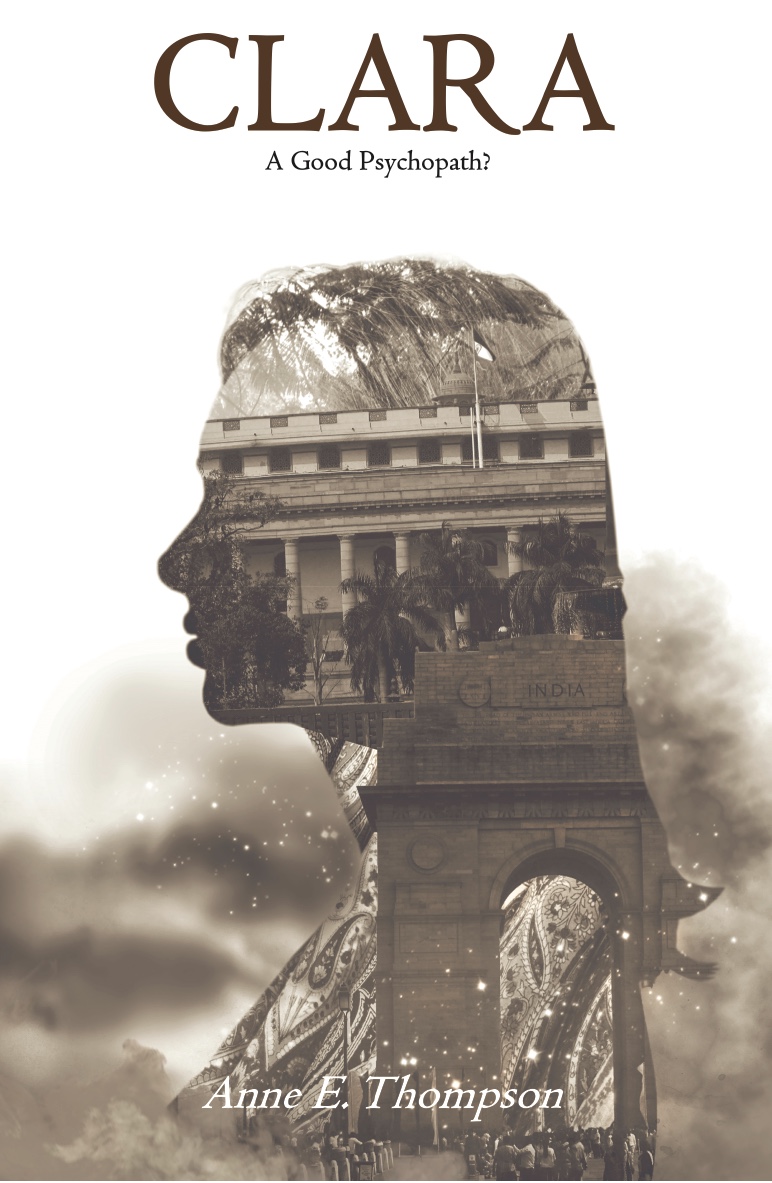
What if…a psychopath managed to do something good. Can psychopathy ever be a strength?
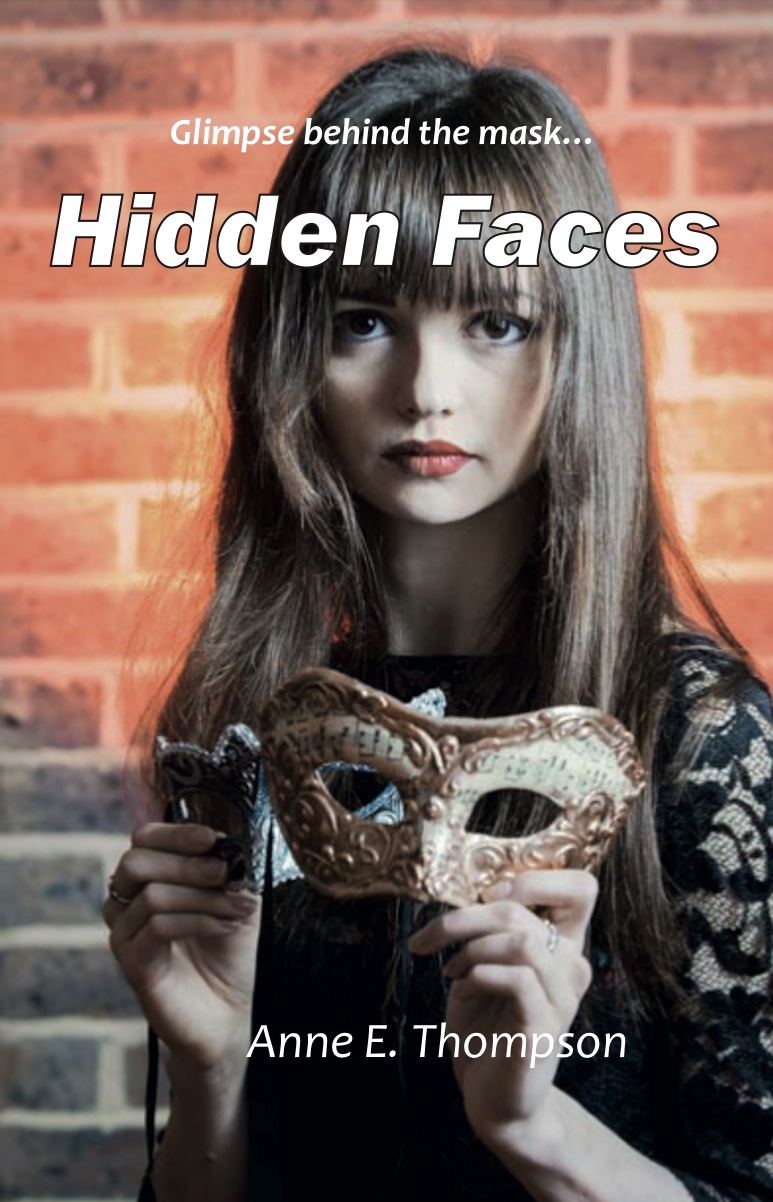
This is the story I always promised myself I would write ‘one day’ while I was teaching in an infant school. A light-hearted novel about 3 teachers.

These people contrast well with the Defensives. These people ask questions about my novels set in a school (Hidden Faces) or a farm (Ploughing Through Rainbows) and then go on to explain that they too could have written a book about their past employment. Perhaps they are a nurse with a lot of funny stories, or a teacher with more experience than me, or a prison warder. They inform me, fairly grumpily, that their lives are just as interesting as mine, and that their book, if they had found time to write it, would be much better than mine. I’m sure that in some cases this is true. However, they haven’t written a book and I have, so it is bit of a non-conversation in my mind. Nor am I quite sure why they are telling me this—am I meant to agree with them and pack up and go home?

A hilarious family saga set on a farm. Being a parent has no end-date, as Susan discovers when her adult sons begin to make unexpected choices in life.
A warm-hearted, feel good novel that will make you smile.

Finally, there are the Lovely people. These people show a genuine interest in my books, whether they buy a copy or not. They are polite, and interesting, and it is always nice to meet them and have a conversation.

I will leave it for you to decide which category you fit into—I’m sure it’s the last one!

I hope you meet some lovely people today. Thank you for reading.

Take care.

Love, Anne xx

Thank you for reading.
You can follow my blog at:
anneethompson.com


Have you read any of my books? Available from bookshops and Amazon. Check out my author page Here!

Covid-19 Test


Bit of excitement this week—I was asked to take part in some research, which involved taking a Covid-19 test at home and sending it off. I was picked at random, so it was unexpected. My week is not very full of exciting things at the moment so I was happy to take part. I had to reply to the letter online, and answer a couple of questions, and then they would send me the test.

I filled out the online survey, and waited. My children then informed me that this was potentially a scam, and what exactly had I answered, and had I given any passwords or my address or date of birth etc. This worried me, but all the personal data had already been added, and I simply had to confirm details, so I thought it was probably legit. Waited, hoping the test would arrive and not a burglar.

Yesterday, the test arrived. It came through the post in a big padded envelope, and inside were bits of paper and instruction booklets and other stuff. There was a covering letter. This told me to do the test without delay, and I was about to open it and work out what to do, when I decided to read all the instructions first, so turned instead to the instruction booklet. (This I feel, proves that I am female—not saying anything else, just mentioning it.)

The instruction booklet said NOT to take the test immediately, but to first book a courier. The test needs to be analysed within 72 hours, so first I must book a courier to collect it, THEN I do the test on the morning of the collection day. Lucky I read the booklet, feel they should have mentioned this in the covering letter (for all the non-females).

To book a courier, you had to go to a website (this was easy) and type in your ID number (not so easy). The ID code was on the “sheet with the two bar codes”. Well, I had a sheet with several stickers, of which one was a bar code, and a tube with a different bar code. I tried entering the numbers under each of them, both were rejected. The instruction book said “Do not include the GB at the start of the code.” Neither code started with ‘GB’. I searched the pack of stuff, but nothing else had anything remotely like a code. Then I realised that one of the codes started with ‘UK’. Maybe ‘GB’ was actually ‘UK’ and no one had noticed? I tried again, removing the UK from the start, and they accepted the code. Managed to book a courier for today.

This morning I did the test when I woke, because the courier was due between 8am and 8pm. The test was fiddly and uncomfortable, and I just hope I did it correctly. The instructions said I should first watch a Youtube video, but the link they sent didn’t work (rather lost faith in the instruction booklet by this point). I did a Google search, found a video of taking a sample, and tried to copy it. It basically involved sticking a long cotton-bud down your throat and touching your tonsils, then sticking it up your nose, before putting it into a tube and sealing it. Not very pleasant, and made me gag, but there are worse things. I wanted to keep everything clean, and also needed a mirror, so had the brilliant idea of placing a clean tray over the sink, and using this as a shelf. It would have worked better if the tap hadn’t been dripping, but I’m sure soggy labels are something researchers cope with all the time.

The (unreliable) instruction booklet said the courier would arrive and knock on the door, he would then place a box on the doorstep, step back 2 metres, and wait. I should place the test in the box, then shut the door so he would be safe to pick up the box and take it to the lab. In actual fact, the courier arrived, I opened the door, and he held out his hand for the test. I indicated that I would place it on a shelf, and he took it from there, but otherwise he would have taken it directly from my hand. Maybe they forgot to send him a copy of the instruction booklet.

There was also a padded envelope in the kit. No idea what that was for. It is a white, unused, padded envelope. I will keep if for if I need to post anything.

They said they would tell me the test result within a week, but as I have no symptoms, and have not been near anyone at all other than my family, for several weeks, I am fully expecting it to be negative—if I ever hear—not entirely trusting that booklet now. Let’s hope it is useful to the lab, and the clever people who work there manage to help manage Covid-19 so we’re all safe again. Perhaps I’ll apply for a job as their instruction book writer—I feel there is a need there.

Hope you have a nice weekend. Take care, and stay safe.

Love, Anne x

***

Thanks for reading.
Why not sign up to follow my blog?
anneethompson.com

****

Wishing for Water


I should be in Italy. Whenever I have a trip away planned, I write a blog ready to post in my absence, and then write about the trip when I’m home again. Obviously, we had to cancel the trip to Italy, but I rather liked this blog, so am posting it anyway. It was written ages ago, long before I had even heard of Covid-19. Enjoy.


Water

Woke yesterday morning, jumped in the shower, noticed the water pressure was slightly less than expected. Thought no more of it.

Went to sort the poultry. Refilled their water and noticed the hose wasn’t working too well. Thought no more of it.

About midday, made a jug of coffee. Noticed the kitchen tap definitely had less water pressure. Decided I would ask Husband when he got home from work.

By lunch time, the water in the taps had slowed to a steady trickle—enough to fill a kettle or wash your hands, but you wouldn’t have wanted to shower under it. Phoned the waterboard.

The woman who eventually answered the phone, after I had listened to numerous recorded messages and pressed a variety of keys, took my details, and said we probably had a leak somewhere on our property. I was given an appointment for an engineer in about 6 weeks time.

I searched the property. No sign of a leak. Water was now barely trickling from taps at all. Phoned unhelpful waterboard lady again. I was told that as we still had water (all be it not very much) then we did not count as an ’emergency’. I could cope for a few weeks.

About 2pm, the taps were empty. Checked with nearest neighbours—they had no water either, so fault was not on my property. I walked up and down the lanes near the house, looking for signs of water bubbling up. Only found puddles. Returned to house to phone unhelpful woman again.

I was told that I was now on the emergency list, and an engineer would visit shortly. I asked how long that would be. She didn’t know. I asked if it would be today. She didn’t know, but thought that it probably would be. I asked how long, legally, I could be left with no water. I was told 12 hours. There was a knock at the door, so I carried the phone, with unhelpful woman still talking, to the door.

There was a water engineer. I was impressed!

Thanked potentially helpful woman (actually, I think their arrival was unrelated, as they were checking the water in the area due to several complaints).

Engineer checked water pressure (none) and went off to try and find the problem. He was very friendly and apologetic and promised someone would deliver some bottled water, but he had no idea why we had no water.

 About 5:30, a delivery of bottled water arrived. As water to drink, it was loads. For cooking—not so sure. For washing hands, crockery, muddy dogs—it was a mere drop in the ocean. Decided everything would stay dirty. Hoped taps would fill again soon, and contacted relatives to discuss the possibility of an early morning shower at their house.

As I began to cook dinner, I realised how much water I usually use—and the amount that I regularly waste. Instead of reaching for the most convenient saucepan, I chose the one which was as small as possible and would still hold the vegetables. Instead of peeling potatoes, rinsing them, cooking them in a depth of water, I tipped in enough water to cover them, and put them on to boil. The main thing I noticed was how often I usually rinse my hands when cooking, how often I usually wipe the work-surface (rinsing cloth under the tap between each wipe). When things cooked, I usually sloosh water into the empty saucepans and tins, so they soak before they can be washed. This time I had to use the water that the veg had cooked in, straining them straight into dirty meat tins and using the ‘stock’ to soak the pans.

After dinner, we discussed a plan for the night. At some point we would need to flush the toilets, so Husband heaved buckets of pond water down to the garage. We stuck notes on the upstairs washrooms, reminding forgetful/tired/drunk off-spring that they couldn’t use the upstairs loo in the night!

The dog was shut in the utility room, covered in mud. She had ignored my instructions to stay clean on the walk.

At about 10pm, just as I was thinking about going to bed, Husband shouted to say the water was on! I ran to a tap, watched it choke and hiss out, expelling the air, gushing clean and cold into the sink. The relief was immense. I appreciate my plumbing in a whole new way!

I  am lying in bed, when I hear Husband open the door to a cheerful waterboard man who wants to check the water. Husband asks if he would mind removing his shoes. “Oh yes,” laughs dirty water man, “you don’t want to know where I’ve been today!” I hear Husband, and sewer water man head for my clean kitchen. What will sewer man touch? Where will he place his sewer toolbox while he works? Why the heck is Husband taking him into the KITCHEN???? I leap into a dressing gown and rush downstairs to monitor placing of hands, tools, dirty coat. Dirty sewer man puts his toolbox on my cooker hob (clearly a good place for a dirty toolbox) then turns on the kitchen tap. He collects samples of water, and tests it for clarity, and chlorine content, and possibly other things–I am more concentrating on what he touches. He tells us that the problem was in another town, which our water happens to be routed through.
Cheerful sewer man then leaves. I go to work with my detox spray, cleaning everything that has been touched, while Husband looks on, bemused.

Hope you have a nice clean day. Thank you for reading.

Take care.

Love, Anne x

Thank you for reading
anneethompson.com
Why not sign up to follow my blog?


Invisible Jane continues tomorrow. . .


Secrets Every Mother Should Know


Here is one of my earlier posts. I hope you enjoy it, and will share it. It makes me smile, as all my children are now adults, and parenting is still wonderful and challenging and full of adventure, as I explored in my novel: Ploughing Through Rainbows — have you read it yet? Amazon Link Here!

Mummy Secrets

1.Boys (of all ages) never look in the back of drawers. This is true. They open the drawer about half way, have a quick look and then tell you that what they are seeking is not in there. This can be used to your advantage if, as in my house, they frequently a) misplace their own scissors and b) borrow yours and don’t replace them. If I keep my things at the back of the drawer, even the drawer where they have always been kept, then they don’t find them. Things at the back are safe. Worth remembering.

2.When they ask which child you love best, pick one. I spent years trying to explain that I loved them all equally, that I could never choose which one I loved best, etc etc – they just kept asking. So one day I picked one and gave an outrageous reason:”Bea, because girls are better than boys,” “Jay because he’s the nicest,” “Emm, because he’s clever,” They still asked occasionally (and I did try to switch which one I chose) but it put them off for a long time and always ended the conversation pretty fast.

3.When your children argue with their siblings, always be the most unreasonable. I always wanted my children to be friends with each other, not least because one day I wont be here to care for them and I want them to look out for each other. All children argue with their siblings, that cannot be avoided. However, when there was no clear reason for the dispute, I would try to be much more unreasonable than any of them. Comments like, “Right, that is no television ever again” or “I am banning all chocolate, forever” would so outrage my children that they would mutter darkly about me – together – and forget all about whatever they had been arguing about. After an hour or so they would ‘persuade’ me to modify my punishment to a more sensible one.

4.Forcing your child to eat something will not make them less fussy eaters. I am an adult now, all grown up, but I still feel sick when I smell rhubarb or gooseberries cooking and I am sure it is because I was forced to eat them as a child. I did initially try the same parenting technique with my own children (most of us copy our parents to some extent) but I abandoned it when I found peas thrown out of the window and half a piece of steak blocking the toilet. If my children did not like something, they were not forced to eat it. They did have to taste it every so often, in case their taste-buds had changed, but they were happy to do that because they knew they could choose to not eat it, if they didn’t want to. They are all adults now and they all have a varied diet. You do of course need to ensure that they have a balanced diet. However, if your child does not eat vegetables, fruit is just as healthy.
 Also, occasionally check the ingredients of what your child is eating. If the list is full of stuff you are more likely to find in a chemistry lab than a supermarket, do you really want to feed it to your child?

5.You cannot reason with an angry boy. When girls are angry, the adrenaline stimulates the speech part of their brain and they want to talk. Sometimes for many hours non stop. The opposite happens with a boy. When they are angry, the speech part of their brain shuts down and they are more likely to hit out than discuss. Something to do with testosterone. I don’t understand the biology but I do know that it is true because I have seen it many many times with my sons and my pupils. So, if a boy is angry, do not bother explaining anything until he has calmed down. If he is small, pick him up and put him somewhere safe. If he is big, put yourself somewhere safe (the washroom is a good place. Even an angry boy will not want to risk seeing his mother using the toilet and there is usually a lock on the door.) When he is calm, then you can explain to him why he was wrong, why you behaved as you did, what is an appropriate punishment, etc.

6.You cannot raise a child on your own. We all need help, mothers especially. In an ideal world, a child is raised by two parents and four grandparents and a whole world of friends, teachers, neighbours. Ours is not an ideal world, but whatever your situation, recognise that you have limitations and get help when you need it. Lots has been written about this, about “it takes a whole village to raise a child”, or even films like “About a Boy”. It is true. When you get to the absolute limit of what you can cope with, get help. I am a sometimes praised for how nice my children are and was a successful teacher, but sometimes I couldn’t cope. I recall one evening when I phoned my brother and told him I could not cope with my teenage son. He talked to him for a while (I think they just agreed that women can be very irrational at times! But it didn’t matter, it broke a cycle that I wasn’t coping with.) Don’t let things get beyond what you can cope with, that’s when horrible things happen. If you need help, get help. It is the wise thing to do.

7.When they bring home a crap picture, tell them its crap. If you always praise them they will a) never trust you to be honest and b) always feel the need to do brilliantly. I firmly believe that if you teach your children how to fail well, then they will do well in life. One of my proudest parenting moments was when my daughter lost a race in the school sports event. She was last by a considerable margin and ran the last lap with the hugest grin to huge cheers from the crowd. She was not a sporty child, she knew she was not good at running and that was fine. In other areas she excelled and she knew that my praise was genuine. If I say something is good, they can trust that it is.

8.Treat your children differently. You can treat them equally without having to do exactly the same thing for each child. For example, I can never understand the parents who buy a gift for the other child on a sibling’s birthday. Letting someone else have a turn at the treat is a good learning point, this is life, they will not always be the one who gets the promotion/job/top mark etc. This is the same when choosing a school, clubs etc – see them as individuals especially if they have different talents.

9.Don’t be fooled when your child tells you that you are either the best or the worst mother in the world. You are not. When they are about five and they tell you that you are the best mummy ever, that is very nice. Write it down and hold on to that memory. It wont be too long before they tell you that “all the other mother’s let their children do/have/go to, whatever” and they will reliably inform you that you are the worst mother ever. Brace yourself and ride the storm, taking regular peeks at the diary entry when they told you how wonderful you are and remembering that ALL good mothers are told this at some point. You are their mother, not their friend. They don’t have to like you all the time. You have to make decisions for what is best for them, not what they will necessarily want. Be brave, it is not easy. But you are the best mother that they have, so they will have to get over it. I regularly told my children, “I am not like other mothers.”

10.Do go with your gut feeling and monitor how long your child plays computer games or watches television, or uses their phone. They can stunt creativity and the ability to communicate and keep track of real life. It wont kill your child to be bored sometimes. Or even (horrors) read a book. Decide what works for you. I found that most games, whilst addictive, also needed a certain amount of time for them to be played satisfactorily. So in our house we had ‘computer weeks’. For one week, they could play computer games for as long as they liked (not including homework times, meal times and bed times, which were rigid unless they were ill.) Then, the next week, there was no computer at all. After a couple of days, they adjusted to the lack of life support and actually managed to enjoy something like cooking or reading or playing in the garden.

We never had the tricky decision of how old is old enough to have a phone–because they didn’t exist when my children were little. I don’t really agree with the ‘phones are bad’ lobby, but like everything, it can be abused and parents have a responsibility for teaching their children how to use a phone appropriately. Is having a phone at a meal table a good idea? Or when they should be concentrating on something else? Is it polite to glance at a phone when having a conversation with someone? I recently watched a programme exploring whether phones are addictive (another blog to follow). Since researching this, if I had a child with a phone, I would definitely go to settings and have the screen set to ‘greyscale’.

11.When your child is a teenager, have difficult discussions in public. This was one of the best things that I discovered. So, if I wanted to discuss with my fifteen year old his bed time, the amount of time spent on homework or any other ‘tricky issue’ I would take him out for lunch or even a to nice coffee shop. Somewhere public. Somewhere that having a meltdown would be embarrassing for him. The social pressure helped him keep a lid on whatever anger he would like to vent and we managed to have a few very sane conversations. It was well worth the price tag.

***

It should perhaps be noted, that when I began writing this article I asked my daughter if she could remember any of my parenting strategies. She informed me that:
I regularly told her she was adopted and suggested she could go and find her real parents (she looks EXACTLY like me, so this was never a problem for her.)
If something hurt, I told her it would probably fall off.
I wanted to burn down her primary school.
I made her move traffic cones that were blocking the road when I wanted to drive down it.
I also always told them that even if they did things that were rubbish, I would love them anyway (they liked that one.)

On reflection, I may have been a slightly rubbish mother. However, all my children have grown up to be happy, sane and good company. Maybe being rubbish doesn’t matter too much. God chose you to raise your child, He has confidence that you can do it. I remember reading: you don’t have to be a perfect mother, you only have to be good enough. There is hope for us all. . .

Thank you for reading. Enjoy your day.

Love, Anne x

Anne E. Thompson has written several novels and one non-fiction book. They are available from book shops and Amazon. She writes a weekly blog at: anneethompson.com

My novel explores the fun and problems when parenting adults (being a parent never ends…trust me!) A heart-warming family saga that will make you smile.

A hilarious family saga set on a farm. Being a parent has no end-date, as Susan discovers when her adult sons begin to make unexpected choices in life.
A warm-hearted, feel good novel that will make you smile.

Available from an Amazon near you — why not buy a copy today?

US Amazon link here

UK Amazon link here

Amazon Germany link here

Into Perspective: A View of Coronavirus


Into Perspective: A View of Coronavirus

(Image: (c) Alfred Pasieka/Science Photo Library via Getty Images)

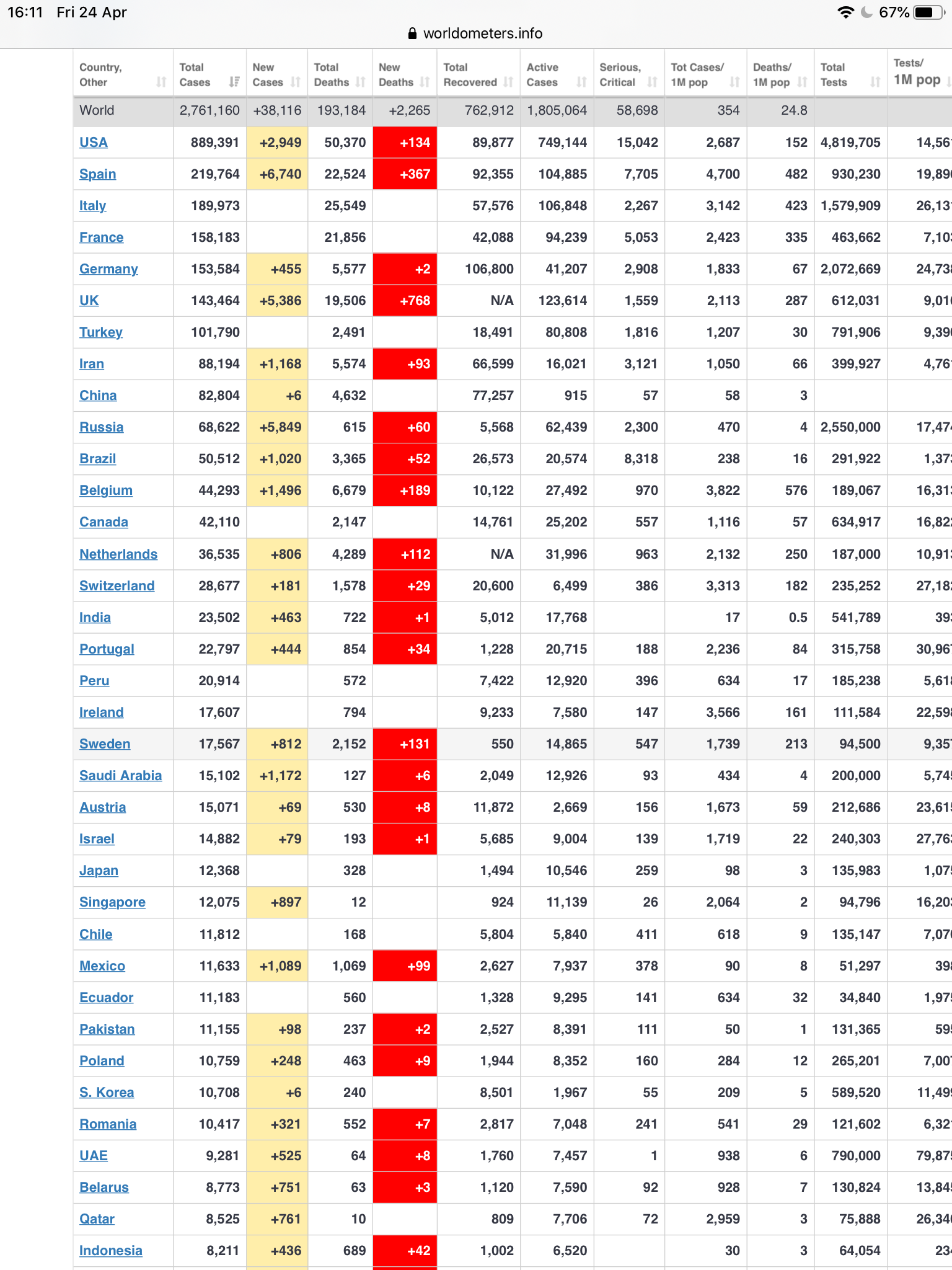
I am having trouble getting into perspective—from both a personal angle and globally—the impact of coronavirus. Each evening, I check the latest stats (while Husband mutters in the background about my having a new fixation) and I look to see how many people have died in the UK. Which I realise is somewhat morbid, but it helps me to understand a little about the impact that the virus is having. Or does it? I am not checking rates of death by other causes, so can a daily update on one cause, in one country, really indicate anything? I decided to look a little wider, and was shocked by what I found.

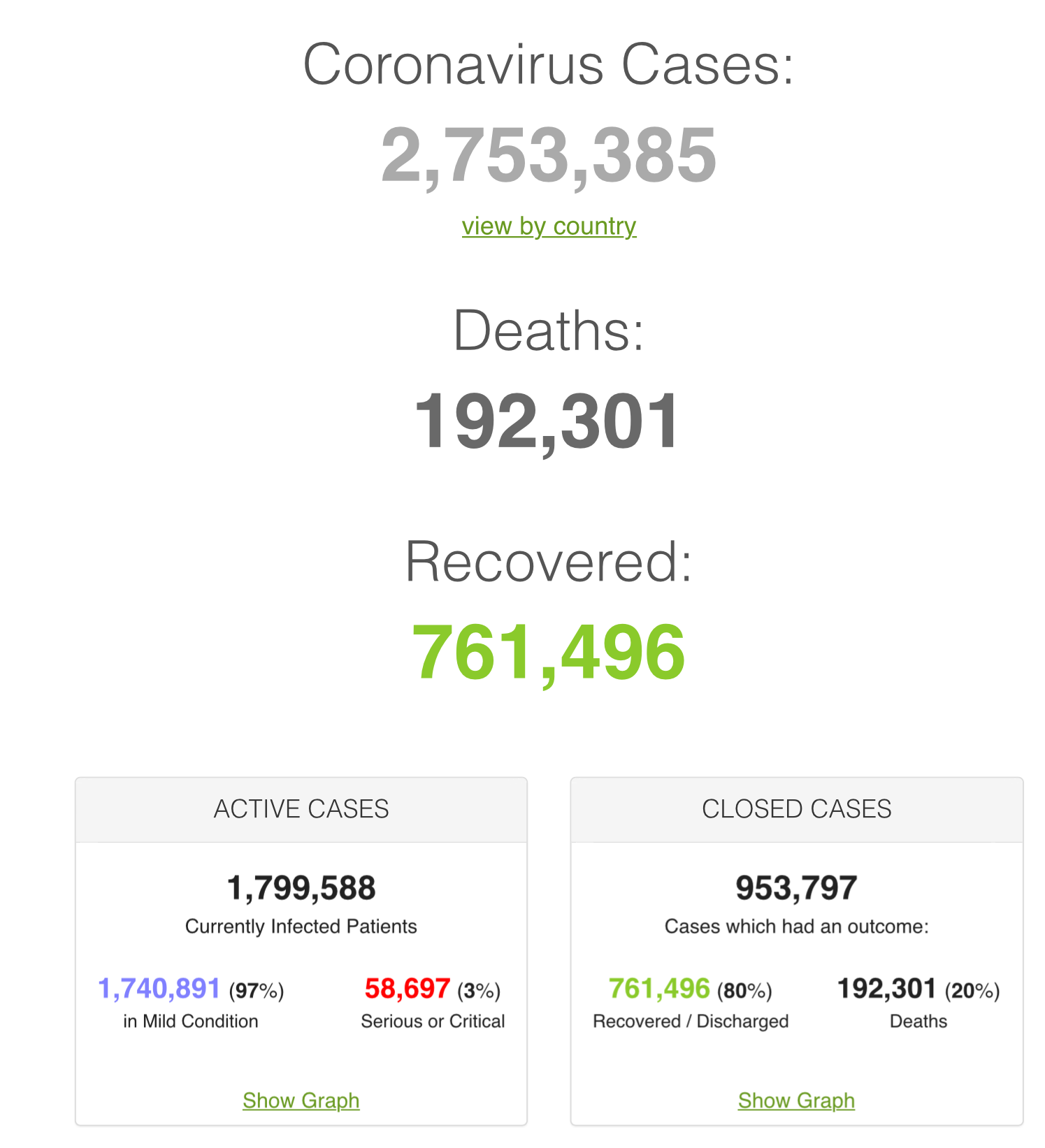
There are many different ways of collecting and presenting stats, but for the sake of comparison, I used one site, worldometers.info and compared several different statistics. I am writing this article a few days before I post it, so all the data will be slightly out of date by the time you read, but it gives you some idea. As I write, there are 2,753,385 coronavirus cases globally, and there have been 192,301 deaths. In the UK, as I write, there have been 19,506 deaths from the virus, which is frankly scary. The deaths were (until lockdown) increasing exponentially, which means the increase each day is more than previously (more on this later). Given these rather scary numbers, what should my reaction be? Should I be taking action to prevent catching the virus, to prevent my family catching the virus? Should I be campaigning for more resources for the NHS? Should I be trying to source a ventilator? And oxygen tank? My overwhelming feeling is that I want to protect my family.

Before I fill my garage with medical supplies and kidnap a nurse, let’s look at some other statistics. How many people die from other things each year? If we look at just this year, there have been 152,707 deaths from seasonal flu; 13,343,461 abortions; 527,656 deaths from HIV/AIDS; 2,577, 889 deaths from cancer; 336,591 suicides; 423,708 deaths from traffic accidents; and a horrible 3,510,459 deaths due to hunger. Hunger. A little shocking, isn’t it?

Now, obviously we are in unknown territory with the coronavirus, and potentially those numbers could rocket in the next few months, overtaking everything else. But when we look at where we are now, and compare them with other factors, it makes me question whether my perceived reaction is correct. (Maybe I shouldn’t kidnap the nurse, after all.) We also need to take into account the effect of the lockdown. The government needed to juggle our mental health, and the economy, with the consequences of letting too many people catch the virus all at once, and overrunning the capabilities of the NHS. We all know this, because ‘Save the NHS’ has become our new catch-phrase. However, there is more to consider than simply whether we have enough beds. As soon as the lockdown was put in place, the exponential curve charting the increase in deaths began to flatten, the increases became less big, and in some cases started to decrease. At the same time, the chart plotting the decline in economy started to increase. As the coronavirus curve dropped, the fall in economy started to rise—except no one was plotting that one in neat little stats, like the deaths of people in hospital, because it’s not so easy to chart.

What are the implications of a drop in economy? Well, obviously some companies will go out of business, leading to unemployment. Even people with jobs are likely to have reduced opportunities for promotions and pay rises. The stock markets will fall, which impacts pensions. People with less money will spend less, so more companies are impacted. Less earnings mean less tax, so investment in things like the NHS will decrease. And so on. All rather depressing, and of course, depression is a big factor too—are we protecting people’s physical health at the expense of their mental health?

So, what can governments do? One possibility is to borrow money to cover the current debt. Where will they borrow it from? The future. This has happened for generations, governments overspend, and save the debt for the next generation—which is why we had ‘austerity’ in the first place. Are we comfortable spending now, so that our grandchildren can pay later?
In some places, such as Sweden, there has been no legal lockdown, and although many people are practising social distancing, schools and pubs etc are all still open. Will the number of deaths in Sweden overtake other countries? Or will they develop a ‘herd immunity’ and their economy survive intact while ours plummets? And is ‘herd immunity’ even a thing? I have read reports from Asia showing that people who have recovered from the virus, and had two negative tests, have then tested positive again. Is coronavirus something you can only catch once? (At the moment, scientists are investigating whether they can extract cultures from these recovered patients, to grow in a lab. At the moment, they can’t, which suggests that the virus has possibly been dormant and flared up again, but not enough to infect someone else; but who knows?)

It all looks very gloomy, and I have asked a lot of questions, and have no real answers to offer. I guess my conclusion is this: Coronavirus is horrible, but so are all the other causes of death that impact the world. And how can so many people be dying of hunger in our modern world? Hunger for goodness sake!

While our scientists are learning about the disease, we need to be cautious, and therefore things like lockdowns are sensible. But they need to be balanced with both the economy and people’s mental health. This takes wisdom—more than I possess. People talk about the NHS as the new religion of England, the one thing that brings the population together, something we all think is good. The NHS is great, and worth protecting, but perhaps it’s time we looked back to something bigger, perhaps it’s time we again considered God, and the possibility that we, as mere humans, need more wisdom than we’re capable of. Perhaps it’s time to admit that we do not have all the answers, and there are some problems too big for us. Perhaps the  most important question you should think about is: when did you last pray?

I hope that you are safe, whatever the problems you face this week. Take care.
Love, Anne x

Thank you for reading.
Why not sign up to follow my blog?
anneethompson.com

***

Another chapter from Invisible Jane will be posted  tomorrow.

***

A Lockdown Bake-Off


To combat the boredom of lockdown, where almost every day is identical, I suggested we had a bake-off. (This had nothing at all to do with the fact that I hate cooking dinners and thought it would be a good way to involve other people). Everyone agreed (there are five of us) and we decided we would have it at 6:30pm (dinner time, which was a complete coincidence) on Saturday. As everyone involved is an adult, they had to buy their own ingredients, but they could use stuff from the larder if they checked with me first. (I was loath for my bag of flour to be wasted unnecessarily in case it couldn’t be replaced.)

I issued the rules via WhatsApp:

So, to clarify the ‘rules’ for Lockdown Bake-off:

Each individual will serve a dish at 6:30pm on Saturday.

The dish will have 5 portions (or more).

The dish can be prepared in advance, but late entries will be abused.

You may refer to a recipe but you cannot ask for copious amounts of help from another individual so they feel like they may as well have baked it themselves.

You need to buy/check availability of ingredients in advance (like, today!) You can use one hob ring, one oven shelf (unless you cook when no one else is cooking). Any other equipment must be prebooked. (I am prebooking the microwave.) The dish must use at least some raw ingredients (ie, it cannot be a ready-meal or takeaway dish) Please say what your dish is by Friday (so I can see whether I need to cook something else for dinner!) You can cook either sweet or savoury. (I am making smoked salmon blinis with Hollandaise sauce.) If your dish has meat, there must be a veggie alternative. You may not use ingredients that people are allergic to (Quorn or Penbritin) We will all allocate marks for each dish (to be decided but will include taste, presentation, interesting value) The winner will be awarded a prize (Husband to provide).

As the day approached, there was a little manoeuvring amongst the contestants. Bea announced she planned to make Baked Alaska. Husband worried that there might not be space in the freezer (I assured him there was) and then it transpired that it clashed with the dish he planned to make. Bea chose a different dish. Jay kept his dish a secret, and did not appear to buy any ingredients, until the very last minute. As in, the very last minute.

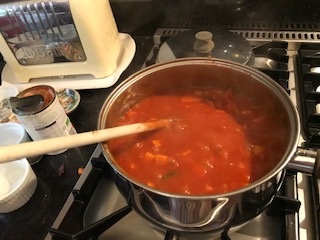
Two hours before, and the tension was palpable. There was an issue with tinned tomatoes having added basil which ruined the taste (they are now in a mug in my fridge). My kitchen looked like a bomb had hit it (not a rare event) and there was a little jostling for room and tension over the allocation of serving plates.

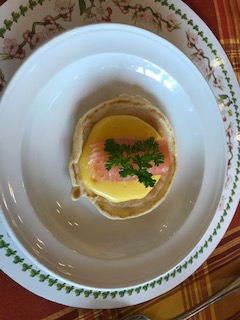
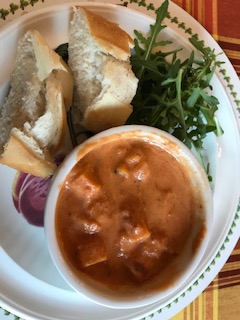
At 6:30, we all sat at the table. Forgot to say Grace due to the excitement. First up were my blinis, which looked better than they tasted, but the hollandaise sauce didn’t curdle, so all was okay. Then we had three main courses. There were veggie tacos, with a kick in the smokey black beans (tasty, and served with freshly made guacamole). Then a spinach tart, with rocket garnish and balsamic glaze—all very professional. Last up was Jay’s goulash, served in ramekin dishes with rocket garnish (stolen) and a hunk of freshly baked bread.

Then it was Husband’s turn. This was worrying, as he doesn’t cook, ever—not since the day I was in labour with child number two many years ago, and he cooked Bea pizza complete with melted polystyrene base attached. He was serving dessert, but we were worried, especially as he disappeared into the garage, then ran to his study with something stuffed up his jumper. We discussed in low voices how to avoid eating his offering if it looked too unhygienic, and pondered as to why it was being prepared in his study. We waited.

Husband returned, carrying a tray of sugar-glazed sundae dishes (I mention the sugar-glaze, as this was the main skill involved). They looked very pretty. We do not actually own any sundae dishes—he had ordered them specially—we now own six. He then brought in a tray of toppings, and a tub of ice-cream. There were crushed Crunchie bars, and mini meringues, and raspberries and strawberries (I checked the fruit had been washed—and which sink it had been washed in). All seemed hygienic, and was, to be fair, very tasty. The only cooking involved was heating the jar of salted caramel sauce in the microwave, but to be honest, that suited everyone.

We then completed the score sheets, added the totals, and awarded the prize of a bottle of Prosecco to Bea (who pointed out that she owned it anyway as it had been a birthday gift—so I guess it’s a good thing no one else won!)

Following the success of this, I am considering suggesting we have a sewing-bee, or a hairdressing competition (they were surprisingly unkeen on this idea!) We could also try a ‘clean-off’ whereby everyone has one room to clean, and then we each judge each other’s efforts. I think this one is my favourite. I’ll let you know how it goes.

Hope you’re managing to have some lockdown fun too.

Take care.
Love, Anne x

Thanks for reading.
Why not sign up to follow my blog?
anneethompson.com

******

Invisible Jane continues tomorrow. . .

***

Here is the score sheet, in case you want to copy:

Lockdown Bake-Off Score Sheet

Name of dish:
(To be completed by cook)


Score (To be completed by other contestants. You must award one dish at least 9 points in each category.)
Marks out of ten to be awarded for:

Is it edible?

1.

2.

3.

4.

Does it look nice?

1.

2.

3.

4.

Does it taste nice?

1.

2.

3.

4.

Is it ‘interesting’?

1.

2.

3.

4.

Is each portion a uniform size?

1.

2.

3.

4.

How much skill was involved in creating the dish?

1.

2.

3.

4.

Would you like to eat this dish again?

1.

2.

3.

4.
Other comments:

A Book Worth Reading. . .


Three more weeks of #lockdown. An excellent time to read one of my books.

All my books are available from Amazon, some of them are free if you have a kindle. Which one will you choose?

UK Amazon Link Here

US Amazon Link Here

Australian Amazon Here

Amazon India Here

I have become a 1950s wife, but without the pointy bra. . .


Hello, and how has your week been? I have to admit, I’m feeling a bit ‘down’ now—this whole lockdown experience has moved from weird to depressing. For me, I hit a real low point when Boris Johnson was admitted to Intensive Care. Now, I have a few differences of opinion with Boris (such as whether it’s okay to lie to people) but I didn’t like the idea that our Prime Minister was now fighting for his life. It was very destabilising. I was sent various ‘calls to prayer’ on social media (I get sent lots of Christian messages and videos on social media—some are excellent, many are not). It was a reminder that we should all be praying for our leaders, whatever our political view.

Some things about lockdown are good—I have rediscovered my breadmaker, and am churning out cinnamon buns and focaccia breads as fast as my family can eat them. I find baking to be therapeutic, if not especially good for my cholesterol levels.

Our conversation has become rather predictable though. Someone will start talking about Covid-19, we will discuss the information for about 5 hours, and then someone (often the person who raised the subject) will say: ‘But we’re talking about Coronavirus again, change the subject!’ We also regularly comment on how quickly the dishwasher refills, how much bread/milk/tea has been consumed, how all the mugs are dirty again. We discuss (though don’t necessarily do) possible types of exercise, plans for the garden, general tidying activities. Mealtimes have become important, and have become the focal point of the day; there is something comforting about familiar food when the rest of the world seems to be off-kilter.

I find I am lonely. Although the house is full, everyone is busy working, doing important conference calls and ‘Zoom’ meetings, and I am left with a lot of dirty dishes and a vacuum cleaner. I have become a 1950s wife but without the pointy bra and lipstick smile, and at low points in the day it upsets me, and I wonder what the point of my life is. This isn’t something I can post on social media, where everything is jolly and jokey (as it should be) but I thought I would share the truth with you, in case you sometimes feel the same. If you are unsettled by the news, and find that you’re not sleeping as well as you used to, and worry about the unpredictability of the world, then take comfort in the knowledge that you’re not alone. There are lots of trite solutions flying round the internet at the moment, but actually, if we are real with each other, ‘now’ is not a great time, and there is lots to worry about.

I am also fed up about my writing (if I am going to have a truthful moan, I might as well share it all!) For an author to be motivated to write, they need to know that someone is going to read their work, which for a novelist means selling books. This is not something that any author I know enjoys, but it is necessary. If no one reads our work, there is no point writing it. I found the best way for me to sell books is at book-signings in bookshops, and stalls at craft fairs. Obviously, these avenues have closed for now. I had booked stalls at several fairs (at a cost of between £40 and £60 per session—which is quite a lot of books to sell just to break even). Each day, I dread opening my emails, reading that yet another event has been cancelled, another opportunity to sell books won’t happen. Although my books are also available from Amazon, I find it difficult to promote them, and I sell very few to new customers. All very depressing, and it all gets tangled up with worries about the economy, and what will happen if people start to lose their jobs, plus the health risks of the virus, and at 2am it whizzes round my brain in a sort of never-ending loop of negativity.

And so, each morning I force myself to run down the lane (which brings me quite close to actual physical death, and so takes my mind off the depressing virtual death I worry about). I then have a decent cup of coffee, eat some cake, read my Bible, and tell God about my worries, before going and baking something delicious. It sort of works—I’m still here.

I hope that you are finding ways to cope with life as we find it.
Take care this week.
Love, Anne x

PS.

Now, after I had written the above, I began to worry, as I often do after writing blogs, that someone might misunderstand what I am trying to say. I remembered something I have seen online recently, where Ellen (famous American person) described feeling as if she was in prison due to lockdown, and instantly, lots of people sent complaining messages (or ‘tweets’ as I believe it was on Twitter) saying that it was appalling that she used that analogy, as she lived in a massive house with great views and a swimming pool. And I began to worry, maybe someone would point out that I am lucky enough to have a garden, and how can I complain, when some people are stuck inside a flat?

But here’s the thing. Yes, Ellen lives in a mansion—but for her, lockdown made her feel like a prisoner. It’s fashionable at the moment to say: “it’s okay to not be okay.” But then, with the next breath, we are outraged at someone who admits they are ‘not okay’ because there are people worse off than them, and they jolly well should be okay! Well, it doesn’t work like that. Ellen might live in a better house than me (though actually, I don’t think she has cockerels roaming her garden, so maybe she doesn’t…) but she still felt shut-in. I live in a nice house with a garden, but it’s still depressing. You may tell me that someone in a flat is worse off than me, and yes, they are, but I can still be fed-up. The person with the flat is better-off than some of the slum-dwellers I visited in India, but that doesn’t make their situation any easier.

There is something in people that likes to point out when others are worse off, to suggest that admitting we find life tough is not, actually, okay. I don’t think there is a limit to this. When I had a brain tumour (and accompanying 5-year migraine) I was often reminded that people with cancerous tumours were the ones who ‘really’ had a right to worry. And yes, they had it tougher than me, but other people had it tougher than them, and if we are going to continually tell people that ‘someone else has a tougher life’ then we are going to continue the cycle where we cannot admit we are not happy, we do not look ‘Instagram Ready,’ we are not all hunky-dory. And so, I would like to state that I know I have loads to be thankful for, I have many ‘blessings’ to count. But today, I am fed-up, and if you are too, that really is okay.

Thanks for reading.
Why not sign up to follow my blog?
anneethompson.com

When I tell people I’m feeling low, they often send photos of sunshine or jolly little messages designed to cheer me up. Whilst this is kind of them, it mainly makes me want to punch them! No, what I find most helpful–and you might too–is to read the book of Ecclesiastes (which is about the middle of the Bible). It doesn’t have any trite little messages, it basically agrees that life is pointless and like chasing the wind. You should have a look.

And then, you could do worse than to read one of my books. They’re available from Amazon, and the UK link is Here! You can decide whether to choose a feel-good happy book, or one that is gritty. Depends on your mood really. . .

The Invisible Jane story continues tomorrow

************

Easter Eggs Are Pagan. . . So, Should Christians Ban Them?


IMG_1163

The festival was for Eastre,
Goddess of fertility.
But they swept it away,
With a cross of humility.
They took over the sunrise–
Coloured eggs were hidden,
They introduced religion,
And pagans were forbidden.

Then the bunnies
Hopped back,
With the chicks
And the eggs.
Spring flowers
In bright posies
Feast times
And families.

But beneath it all
Well hidden within,
Was a story of death
And the blackness of sin.
The anguish of God
Turning his back.
A story of tears
When the world went black.
That tragic tale,
Which won’t go away,
Has a promise of peace
That we long for today.
And the torture and pain
And despair of that day,
Is why God turns and listens
When we kneel and pray.

IMG_1188

***

Originally, at this time of year, there was a pagan festival for Eastre (sometimes spelt with an ‘O’) who was the goddess of fertility. That is where the sunrise, eggs, bunnies and chicks come from. People gave gifts of eggs to enhance fertility, there was dancing at sunrise, a bit of a party.

Then the Christians arrived and they wanted to celebrate the death and resurrection of Jesus. Rather than create their own festival, as the resurrection happened at Passover time (a Jewish festival timed by the phases of the moon) and this was a similar time to the Eastre festival, they sort of merged the two. Everyone was used to having a happy time, so why not simply change the focus? It seemed to work, and gradually people forgot why they were using symbols of fertility, and they became symbols of new life, a promise of what we find if we let God into our lives. It is a little like the Christmas festival, which today we use to celebrate the birth of Jesus, but once was a pagan Winter Festival (there were no fir trees when Jesus was born!)

Does it matter? Should Christians refuse to give gifts of eggs, because the tradition is pagan? Well, I don’t think so. If you read some of the letters in the Bible, the first believers in Jesus were told that if it didn’t cause anyone a problem, then they could eat meat that had been offered to idols. When I give chocolate eggs to my friends and family, I don’t think any of them assume this will improve their fertility! It’s just an egg. The Bible also tells us that celebrations are good, we were designed to have festivals and special times. So try to make today special, whether it is with eggs or a big dinner or some other treat. Remember that Jesus rose up from the dead, which means we really can talk to him, however fed-up we might be feeling, whatever struggles we’re facing right now. Jesus is alive, and he’s on our side.
Thank you for reading. Have a lovely day.
Love, Anne x

***

Thank you for reading.
Why not sign up to follow my blog?
anneethompson.com

***

Good Friday: A Sword-Pierced Heart


I watched my son die today. My beautiful boy, beaten, battered and left to die. And my heart broke. I held my cloak close and I remembered the weight of him as a babe, like a boulder on my hip, wriggling to be free, to run and jump and climb. Those legs will run no more. Those limbs — I was so proud when they grew. I remember when he grew as tall as me, then taller even than Joseph. I remember watching him, stretched out as he ate, those long limbs seemed to go on forever. “I grew him,” I used to think with pride. Those limbs will not sprawl relaxed in my home ever again.

I watched his hands, the hands that used to pat me cheekily on the head when he’d grown tall. Those strong hands which laboured with wood, which helped me carry heavy loads, which lifted young children playfully. They are no longer strong. I saw them bang nails through the flesh, felt that I heard the sound of bone shattering over the thump of the hammer, heard his ragged breath as they forced the cross upright. And I wondered if I too might die. But I watched. I am his mother and I would not leave him alone.

When they tried to take me home, when they told me to shield my eyes, avert my gaze, I did not. For he was my son. I would never leave him alone, not at such an anguished hour of need. Others watched. Some women were there, terrified and hanging back. Not me, I am his mother. I stood with John, where he could see me. What could they do to me that was worse than this?

Others watched who hated him. They mocked and spat and called abuse. It could not hurt him now, I thought, let them shout. “He trusts in God,” they called, “Let God save him now,” and they laughed, even as he died they laughed. Yet even God deserted him by the end and that was hardest to bear. He called out with a loud shout, asking why God had turned from him.
“My God,” he called in anguish, “why have you forsaken me?”
But I was there. I did not leave. I saw them crucify him, naked upon a cross. No mother wants to see her grown son naked, but still I did not look away. I was there at the beginning, I would stay with him until the end.

The soldiers took his clothes, for fabric is costly and even that of a criminal should not go to waste. Most they tore and shared between them, but not his tunic. They cast lots for that, not wanting to spoil something precious. Yet my son was precious and they destroyed him.

It began last night. They woke me from my sleep and warned me there was trouble. He had been arrested, taken from a meal with his friends and questioned by the temple authorities. They feared the invaders, so he was then referred to a court of Godless law, a place that feared no God. They told me that he was scourged, beaten with whips that removed chunks of flesh as they struck. He was mocked and abused, then brought to this place.

I came, stumbling through streets full of people, full of noise and smells and fear and hatred. I came to this place, this Godforsaken hill beyond the city wall and I saw my son, my boy, diminished, shrunken somehow. I saw that what they had told me was true, smelt the repugnant stink of excrement mingle with the metallic stench of blood. I heard the shouts of abuse, the curses of the guards, the screams from the prisoners, the wails from friends. And him, like an oasis of calm amidst the turmoil, suffering but at peace.
And he saw me. Those dark eyes that as a baby had watched me intently when he fed. Those eyes that twinkled merrily when he teased me and became serious when he wanted to explain something important. Those eyes, red rimmed with exhaustion now, turned to me. Even hanging there, with parched mouth and dried lips, he spoke to me. His voice was hoarse, for he had refused the wine they offered, but I heard him well. A mother knows her child’s voice. I stood with John and my son told me that this was to be my son now and he was to care for me as a mother. Even in his torment he cared for me, fulfilled his duty as my son. Still I would not leave.

Then it ended. The sky had turned as black as my world and he drew his last breath. It was finished.
Those who had mocked became silent, some cried, some beat their breasts in despair. The blackness of the sky frightened them and many fled, wondering at what they had done.
Then I left, I let them lead me away. My soul was broken and my heart beat even though I bid it stop. My boy was gone, my firstborn, special baby, was no more. I carried that knowledge like a rock within me, I would have rather died in his place. How can I live, continue with my life knowing he is gone? There will be no more sunshine or laughter, nothing matters now. The core of me has gone. I cannot even cry.

Afterwards, I could not rest and I heard strange stories. They said the soldiers pierced his side, to check there was no life in him. His blood had separated so they took him down, a solid corpse that had no life.
A man came and took the body, they said they followed and knew where he lay, in a tomb that was guarded. They told me of strange things, of the temple curtain torn in two, of dead men walking and boulders breaking open. I do not know. I only know my boy is gone. That is all that matters.
It should not have been like this. It was so recently that people praised his name, sang and danced before him, treated him like a king. It should not have ended like this.

And yet, I recall a song, it comes persistently to mind, sung often in the synagogue. It speaks of one forsaken by God in his time of need, scorned by many. He belonged to God from before he was born, then suffered at the hands of many. They sung of bones poured out like water, a heart of melted wax, that is how my boy would have felt. They sung of hands and feet pierced like his and enemies gloating over him. They sang of lots being cast for clothing and of God’s ultimate victory. They sung of remembering him for ever, not just now but families of every nation, even those presently unborn. For he has done it.
Is this my son’s song? Were the words written for him? He spoke of his death often, he tried to warn me that he would die. But not like this, not before my own time has come. No mother should bury her child, it goes against what is natural and right. Though, he showed no fear, he knew what his end would be. And he told me there was more.

As I turn now to sleep, I wonder at his words. Will he truly return somehow and will I know?

Has he finished what he was sent to do?

************

If Mary was a young teenager when she learned she was pregnant (which would fit with the age that girls became betrothed in those days) then when Jesus died aged thirty-three, she would have been about forty-seven. How does a woman of that age cope with the things she was forced to witness and how much would she have understood at the time?  I have sons, contemplating their dying is too horrible for words. I am sure she loved her boy as much as we love ours.

Crucifixion was a ghastly way to die. We learn in the Bible that Jesus, who never sinned, who never did anything wrong, died to save the world. What does that mean? You can learn more Here

However, many people were crucified, some probably unjustly accused. So is it the death that was important or was it that God became separate? I think that this is the key issue here: the part of Jesus that was God, left him. That was more terrible than crucifixion. That is what each of us deserves and what we do not have to suffer if we choose to come to God.
If we want to know God, we can, even if that means changing our minds.

You may not believe in God, but God believes in you.

The song which Mary recalled in the story was Psalm 22. It has some striking similarities to the account of Jesus’ crucifixion. It was written about one thousand years before the event (wow!)
It begins: “My God, my God, why have you forsaken me?”
It finishes: “…future generations will be told about the Lord. They will proclaim his righteousness to a people yet unborn–for he has done it.”

****

Thank you for reading.

If you liked this, why not sign up to follow my blog?

anneethompson.com

****************