Buying a Bed


Some advice for Bed Salespeople (and others).

Bea needed a new bed, and so, with our suitcases barely unpacked from holiday, off we set. We went to the large shops spread along the Purley Way near Croydon, because many years ago, whenever we wanted to buy furniture, it was always worth braving the confusing dual-carriageway packed with cars, to visit a range of large, out-of-town stores. However, rather shockingly, the super-busy road, and the overly-full car parks had sort of disappeared. Instead of joining throngs of people, we were sometimes the only customers in the shops, and the car parks were empty. Where were all the shoppers? Has retail in the UK really deteriorated to such an extent so quickly? Or did we simply visit on an unusually quiet Saturday? I don’t know, but it was a little worrying (and I shan’t be buying shares in any retail businesses).

However, what I really want to tell you, is about the range of salespeople that we met (in the nearly empty shops). Some were so much better at selling than others, and I found this to be a good learning experience—so if you ever sell anything (such as books) take note!

We visited one shop and began to wander around, looking at furniture in general. Bea spotted that some of the furniture had chips, or was broken. The furniture was pretty, but the quality was fairly awful (and not particularly cheap). We were never approached by any salespeople, and we left pretty quickly. If you want to make a sale, it’s a good idea to approach potential customers before they leave!

The next shop we went into had a good range of furniture, and we were offered help (which we didn’t, at that stage, want). We tried a few beds, and discovered that beds vary a lot in softness, and some are like sleeping on marzipan and others are so hard, you may as well sleep on the floor and save the money. There were mattresses so thick that they doubled the height of the bed, and others which looked more like a thick duvet. You could buy two slim mattresses, and zip them together to make a double, which would suit the couple when one likes marzipan and the other prefers floor. Bea was very decided on her views of sleigh beds and wooden headboards and cushioned headboards. I found some lovely bunk-beds, reminding me of when she was little, but she was not even slightly interested in those. We then needed some help, and a salesperson came, but she looked cross. I felt that she thought we were wasting her time, and that really the answers to our questions were very simple, and we should have done more homework. I didn’t like her at all. Customers like to be smiled at, even if you think they are annoying! We left.

Another shop had very good quality furniture, and we saw several items that we might like to buy. We were very quickly accosted by a salesperson, who asked if we needed any help. We said no, thank you, we are just looking at the moment. However, salesperson was very persistent. She gave us information about the sale items, which was useful but long (and we are quite good at reading, so would have probably found the information eventually) but at least she was trying. She then asked what we were looking at, and proceeded to show us what was in stock. Which stopped us browsing other items (and we were interested in several things). Salesperson left, and we attempted a conversation about size of rooms and space and design. Salesperson returned, and joined in the conversation (despite not knowing the size of our rooms!) and then took us to see another piece of furniture. It was too difficult to make a decision, we felt rushed, and so—even though there were items we liked—we left. Sometimes customers need a little time and space to think! If they are looking at something (or reading a few paragraphs of a book) leave them alone.

Our final shop also had a range of furniture, and we were again approached by a salesperson soon after entering the shop. However, when we said we were just looking, he moved away, and hovered nearby, pretending to adjust display cushions. When we had a question, he was on hand to answer, and he knew the answer and spoke with authority, so we trusted him. He suggested a few items, and then again left us to discuss them. We liked the products, and he gave us the help we needed so we bought something.

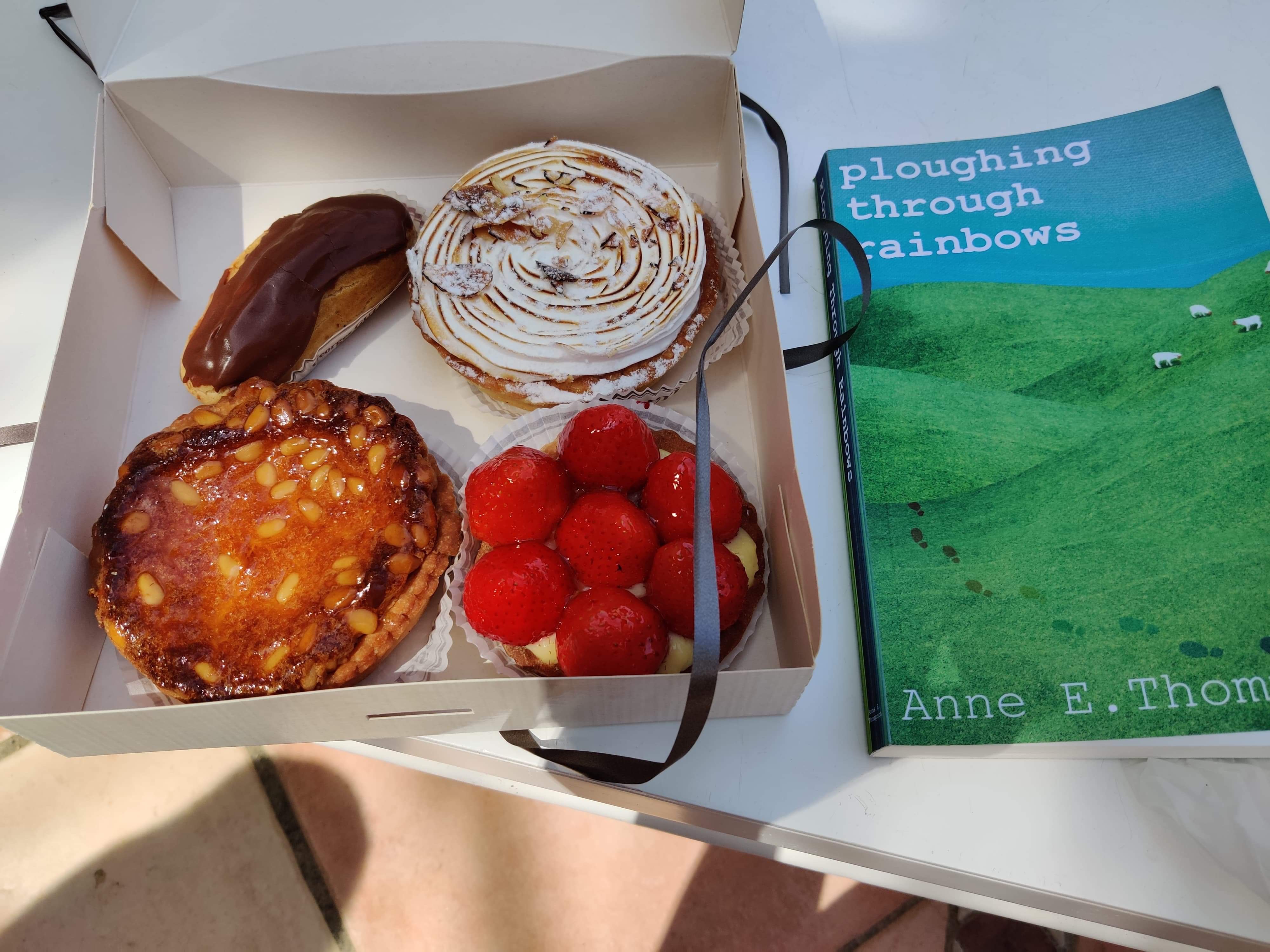
There were a few fun aspects of buying a bed. Like the woman who we saw lying on a bed, with a pull-along suitcase next to her. I wondered if she had moved in, she certainly looked very comfortable. So did the chubby Chinese boy, who was asleep on one bed with his mother telling him to wake up, it was time to leave! There was also a coffee shop, and so we stopped for a quick cake and coffee, which is a lovely thing to do when you’re out with your daughter, and so much more fun than shopping. But we did buy a bed too, so it was a successful trip I feel.

Thank you for reading. I hope you have a successful day too. Take care.
Love, Anne x
Thank you for reading.
anneethompson.com
Why not sign up to follow my blog?

When other people write better than you do…


If you travel to London at the moment, there are several huge billboards advertising The Girl on the Train. The book has morphed into a film, and now a play. Now, I have read the book, and it was very enjoyable, but the writing style is not, in my opinion, very different to my own (Paula Hawkins even has the same errors as me, and tends to write ‘that’ too many times). Other than acknowledging that her book is way more successful than mine, it doesn’t cause me any angst. Nor do the books which are fairly well-known, published commercially, and hugely popular, written in a style which frankly I cannot read, because they are so full of drivel. No, the books which cause me a problem, which make me wonder if I should just give up and make hats or something, are the books which are excellent.

The problem, I think, for an author, is when other people write better than you do.

If you are an author, or writer, or whatever it is that you wish to call yourself, then you cannot help but compare yourself to other people. Let’s be honest, there is a wealth of literature out there, from excellent contemporary fiction, to way back when Jonathan Swift wrote Gulliver’s Travels (now that was a very clever book). And for most of us, if we are honest, our own writing does not compare very well.

Now, when I first began writing, this was something of a problem. I love writing, I always have, but letting other people read what I write was another matter altogether. Writing was private, for fun, not for sharing. The potential for public humiliation is immense—what if other people don’t like your writing? When I read the books I love, from Charlotte Bronté to John le Carré, I am aware that my own offerings are not in the same class. For decades, this meant that my work remained hidden away, never read.

Then, one day, in a moment of madness, I showed one of my books (which was scribbled on the back of Ocado receipts) to my husband. He’s not the sort of husband who gives away compliments freely, and yet, wonder of wonders, he actually liked my writing, and told me that he hadn’t realised that I “could write like that.”

In 2016, I published my first book. This took scary to a whole new level; now complete strangers were going to be reading my work—even worse, people who knew me would read it. I sold some copies, and waited (not quite hiding under the bed, but wanting to). To my amazement and relief, people were nice. I was sent letters from friends, and emails from strangers, who had enjoyed Hidden Faces, asking if there was a sequel.

People read my books, and told me that they: “Read a chapter every night, and so look forward to it that I find I go to bed early just so I can read more,” or “I became so engrossed in Joanna’s actions, she was such a complex character, I didn’t want the story to end,” and, “Reading Clara was like watching a car crash, I knew that I should look away, but I was fascinated, and half of me wanted her to succeed…” I grew braver.

Here’s the thing, I know that my books are still inferior to those by authors that I love to read. I guess it is similar to an artist, who loves to paint, and who creates some very pleasing watercolours, but who knows that their work does not even begin to compare to Van Gogh. They also know that their work is improving and evolving and that other people enjoy it enough to pay for it. Should they stop painting? No, I think they should definitely continue. Do you sometimes feel your own work isn’t good enough? Then improve it—but don’t stop writing!

Personally, I feel that my writing is like orange squash. There is nothing wrong with orange squash, and it’s a lot better than the vinegar that some people produce. In fact, on a hot summer’s day, a long cool drink of orange squash is exactly what you feel like, and is incredibly pleasing. However, it’s not red wine, it cannot pretend to be red wine, and no one is going to think that it is. When I read a certain phrase by John la Carré (my current favourite author) it is like sipping a beautiful red wine, I want to sip it, savour it; I read it several times. I cannot produce that, but that’s okay; there is definitely a place for orange squash, and who knows? Maybe one day, if I keep working hard, I too might produce something of a decent vintage. One day…

Thank you for reading.

The link to my Amazon page is here: Anne’s Amazon page

Work well this week, and take care.
Love, Anne x

As I said, my writing is definitely improving (because people tell me so!) Have you read my latest novel? A heartwarming story, set on a farm, it contains a lot of my family’s humour and some poignant moments. Why not buy a copy today?

Ploughing Through Rainbows by Anne E. Thompson. Available from Amazon.

Is Steve Chalke a Heretic?


Steve Chalke

When I was a teenager, a young trainee pastor at Bible college came to lead a youth weekend at our church. The main thing that I remember is that he talked about sex, and it was one of the few youth weekends I attended that was not boring. His name was Steve Chalke.

Several years later, I heard of Steve Chalke again when he set up a charity, aimed at helping homeless people, which morphed (the charity, not the homeless people) into Oasis Trust. I was therefore interested when recently, during dinner with a friend, they mentioned that Steve Chalke had been ‘thrown out’ of the Evangelical Alliance. Was such a thing even possible? I had (wrongly) assumed that the Evangelical Alliance was a union for anyone who called themselves a Christian, a place to share ideas and resources, and which organised events which might prove helpful to said Christians. I had not realised it was possible to either ‘belong’ or be ‘thrown out’. What, I wondered, had SC done which merited being thrown out of this esteemed organisation? Had he murdered someone, eaten babies, kicked a dog? No! He had, apparently, become a heretic.

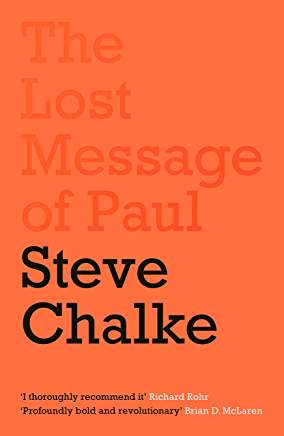
I heard a few whispers about the apparent downfall of SC. I heard that he had turned his back on evangelical Christianity, that he questioned the crucifixion, and even went as far as to call the death of Jesus “child abuse”. I wondered if I was hearing things properly. Searches online were varied, and it was hard to find the truth. I decided to buy his book, The Lost Message of Paul, and decide for myself.

The book is, to be honest, challenging. It begins with an introduction, when SC explains that he is rethinking his faith, and says he is hoping for an informed debate. It seems somewhat ironic to me that the reaction of established Christianity is simply to rebrand Chalke as a heretic and to exclude him from the Evangelical Alliance—but perhaps the debate happened before I was aware of this, and there were other reasons for his exclusion. I again checked online, but he is still the pastor of a church, still working amongst some of the neediest people in our society. I listened to an online interview, and he was still saying that he believes in one God, still believes in the death and resurrection of Jesus, so what is the reason for his exclusion? Maybe he really did eat a baby.

The book gave some insight as to why people find his ideas difficult—I find them difficult myself. The book basically gives good insight into the culture in which the Bible books were first written, and then questions whether we have properly interpreted what the words are saying. My understanding is that SC now questions whether the idea of ‘original sin’ is correct (the idea that when man sinned in the story of Genesis, that sin was then passed down to every person in every generation that followed, hence separating them from God). He makes the point that Genesis is a Jewish book, written in Hebrew, and yet Christians never ask Jews today what their understanding is, we never think about what the words would have meant in Hebrew.

Much of his explanations are very interesting—did you know that in Hebrew, you cannot have a word for an emotion? So, when it talks about God’s anger, it actually talks about God’s nose, because when you’re angry you snort through your nose? But that word could also be translated as passion, or fury, or great sadness?

I felt that SC’s views here (if I was understanding them correctly) were flawed. I never taught any of my children to do wrong, and yet they all did, so my experience suggests that people are born ‘sinful’ and the rest of the Bible seems to support this. If we are all ‘sinful’ then how can we approach God, who has no sin? Surely before we can approach, we need to be washed, there needs to be some kind of repentance? But his argument is persuasive, it cannot easily be dismissed, and gives pause for thought. (Or, of course, you could just chuck him out of your club.)

SC also builds a case for refuting Hell, or that people will be eternally damned. He says that this idea was first introduced by the Renaissance poets and artists (like Dante) and were not based on the Bible at all. SC does think that there will be judgement, but that it will not be an eternal suffering, more of a refining fire that will prepare us for our eternity with God. One example is when Jesus talks about Hell, and the gnashing of teeth, which SC says should never have been translated at all, as the word Jesus used (translated as ‘Hell’) was an actual place, used as a rubbish tip, where wild dogs lived (and gnashed their teeth) and that Jesus is asking, would you rather live with God, or in that place?

There is too much in the book for me to cover everything here, and I found many of the ideas troubling, though also that many fitted with my understanding of God. One of the main points made by SC was that God does not create people for eternal suffering, in other words: Hell, as usually defined, is a human invention and does not exist in the form we imagine. SC says he cannot accept that God, who is defined as Love, could create people knowing that they will eventually be destined for eternal suffering.

SC makes the point that if you asked Paul, or any of the early apostles, how they knew that they were saved, they would look at you blankly, and reply: “Because I am a Jew.” The Jews believed that, simply because they were Jewish, they were chosen, they were ‘saved’. SC argues that when Jesus died and rose again, this grace of God, was automatically extended to non-Jews, in short, that all people were now ‘chosen’ and therefore ‘saved’. He points out that when Paul writes that ‘through one man, all have sinned,’ we have no problem accepting that this means that due to the actions of Adam, who represents the first human, all people now sin. However, when, in the same passage, Paul then says that through the actions of Jesus, all are now saved, we start to add caveats. We say things like, ‘but it only applies if people have faith’ or ‘but people have to believe in the New Testament, and ask God into their lives, otherwise it doesn’t count.’ But that is not what is written. It is written as an equation—Adam sinned, so all sin: Jesus rose, so all are saved. It is, I feel, a compelling argument.

I find that I am left with a lot of questions after reading this book. SC has written a second book, and I will read that and see if it offers some clarity. There are things I disagree with, but some I find it difficult to define quite why I disagree. There are other points which I would like, very much, to be correct, but have not yet decided if it is wishful thinking or true. SC is undoubtedly a talented speaker/persuader, but that does not necessarily mean that he is correct.

Would I recommend this book? Well, that rather depends on who you are. If you don’t feel that you know everything about God, and that there is more to faith than perhaps you have discovered, then you might find this interesting. However, if you think you have faith and God pretty much ‘sorted’, and really you want to read things that backup rather than challenge your views, then perhaps you should avoid this book. SC writes that he hopes his book will start a discussion. My feeling is that it probably will (I for one am bursting to discuss his views with other people!) but unfortunately for SC, I suspect that he will not be part of those discussions. He has stated his views, people will now either agree or disagree with them, but as with most leaders, I expect the only feedback he receives will be negative. It is also quite likely to be voiced by people who have not read his book and have simply heard vague quotes. I do not know whether what SC wrote is correct, but I’m glad he wrote it because I think it’s good to sometimes question what we believe and explore other ideas. None of us knows all there is to know about God, he is beyond our understanding; but we can strive to understand a little more. What do you think?

Thank you for reading.
anneethompson.com
Why not sign up to follow my blog?

Post Script:

Since writing this article, I have learnt more detail concerning the debate with the Evangelical Alliance, and my article is somewhat unfair. If you want to know more, I suggest the following book: Justin Thacker and others, The Atonement Debate (Grand Rapids, MI: Zondervan, 2008) This describes the debate that followed Steve Chalke’s book, and how the EA changed their statement of faith (apparently an unrelated event) which meant Steve Chalke was no longer able to be part of the EA, rather than him being ‘thrown out of the club’ as my article suggests.

If you prefer to read a slightly lighter book, then have a look at my latest novel, Ploughing Through Rainbows.

A feel-good family saga, set on a farm, the story explores how parenthood never ends. It’s a lovely book to relax with, or to buy for a friend. Available as both a Kindle book, or as a paperback, from an Amazon near you. Don’t forget to have a look, UK link below:

UK link here

A hilarious family saga set on a farm. Being a parent has no end-date, as Susan discovers when her adult sons begin to make unexpected choices in life.
A warm-hearted, feel good novel that will make you smile.

Forget Brexit, This is Scary!


I am holding my breath and waiting to see what is going to happen next. . . Husband has retired! Well, to be fair, he has retired from the partnership of his firm (after about 95 years) and is now doing slightly different work. But it does mean that his hours will be less, more like those that most other people work. For the last 95 years, our entire married life, he has been working from about 7am each day until late in the evening, and his phone has been permanently attached to his hand during any time-off, in case the financial world should collapse without him. Well folks, forget Brexit and global warming and anything else that might be giving you nightmares: Husband is no longer holding the fort!

So, you might be asking, what are the implications of this at home? How was the first week of having a not-busy-every-second-of-the-day Husband at home? Let’s put it this way, I know how it would feel to be married to a small tornado.

As you know, my ‘job’ is writing. After sorting the ducks and chickens and cats and dog, I aim to be at my desk by about 9am every day, and start writing. This really does not work too well when within five minutes someone is offering tea, and then five minutes later asking if you need any shopping, and then five minutes later suggesting that the lounge needs repainting. My desk was in a corner of our bedroom. It feels unreasonable to lock a person out of their bedroom. My desk is now in the ‘guestroom’ and if we have any visitors they will have to share our bedroom. It seemed easier.

One thing is for sure, it’s not going to be boring. His extra time began straight after our holiday. By the end of the first evening, before we had even moved the suitcases to the bedroom, let alone unpacked them, he was discussing where we might go next year, and which would be good dates. The family all refused to discuss possible dates, saying that 12 months was too soon to commit. By the end of the second day, he had suggested a few months living in the Italian Alps. The third day he suggested we replace our rather decrepit Fiesta. I then banned him from any more big decisions for 48 hours. The following day he suggested a month in the US. Then spending February in New Zealand. Then adding turrets to the front of the house. (Okay, I made-up the last one, but you get the idea.)

There is of course, a potential book in this situation. I have started making notes. Possible titles are:

Caution: Man Retired
Enjoying Being Retired
Remembering Why You Married Him: The story of a retirement
How to Get Away with Murder
How to Hide a Dead Body
Serving a Life-Sentence: A Wife’s Story

I will let you know which one I decide on.

I hope your day goes well, and you don’t have any unwelcome interruptions. Take care.
Love, Anne x

Thank you for reading.
anneethompson.com
Why not sign up to follow my blog?


Not Quite Catholic. . .


Not Quite Catholic. . .

I have never attended a Catholic Mass, and I was interested to see how it differs from an Anglican service. On Sunday, I persuaded my mother to come with me, and we set off for the 5pm Mass.

The church building was a nice little church, painted white, with no obvious front door to enter, but my mother, who knows these things, took me to a door at the side, and we walked in. There was a foyer, with glass doors into the main church, and we could see a smattering of people (about 8) who were seated, not in the pews, but in a semi-circle around the altar. They looked at us.

Mum gave me a couple of service sheets (I don’t know how she knew which ones we needed, but it turned out she was correct) and we walked, down the aisle, to the front. It was a very long aisle, and I had dressed smartly, in a skirt and boots, and the boots had heels which made a very loud noise on the wooden-floored aisle. We walked, noisily, to the front, while everyone sitting near the altar watched us. I expect my face was red.

There were some empty chairs, and we sat, and looked around. The other people were now looking down, in a prayerful posture, so I copied.

A bell rang, and the priest entered from a side door, dressed in robes, dark-skinned (everyone else was white) and with a friendly face. There was organ music playing, which he controlled from his phone. He faced a statue of Mary, and made the sign of the cross (which interested me, because I’ve always assumed people did that facing the crucifix in the front of the church, but he definitely turned to face the statue). He then leant down and kissed the white cloth on the altar, turned down the music, and the service began.

There was an order of service sheet, but they didn’t seem to follow it entirely, and it was quite difficult to keep up with the liturgy because they spoke very fast. I joined in where I could, but mostly just listened. It all seemed to be almost identical to the words spoken in Anglican churches. At one point, people ‘shared the peace,’ and went around shaking hands and saying: ‘The peace of God be with you.’ We joined in with that. There was a prayer to Mary, but it was very fast, and I couldn’t understand the words enough to hear whether it was something I would want to join in with or not. (I had decided that unless something felt actually ‘wrong’ to me, I would join in. A little like: I don’t think women need to cover their head when praying, but if that is what people in the church believed, I would do it, because covering your head is not ‘wrong’ it is just, in my view, unnecessary. If I want to connect with people, I might need to partake of some rituals that I feel are unnecessary, so that I don’t offend anyone, and so it is easier for them to accept me.)

There was a collection, but I was prepared, and had remembered to put some coins into my bag (how much should one put into the collection in a strange church? I give money regularly as a tithe, so that’s not the issue, the money put into a collection in a strange church is sort of for the other people, to show support—so it has to be more than pennies, but when you’ve already given your main tithe to God, you don’t really want to give notes! I don’t, anyway.) I’m pretty sure that one person didn’t put in anything, and just put a closed hand over the basket and then rattled the money in there to make it look as though they had added something! But I can’t be sure.

There was a short sermon/talk. During this, a young family arrived, and sat in the front pew. I then worried that perhaps only the leadership were sitting around the altar, and they were all wondering why we had joined them! The priest greeted the family, who he clearly knew, and spoke a few words directly to the children.

After the sermon was communion. The priest and another man, did various things—washing fingers in a glass pot of water, drying them on a laced cloth, going to a small locked cabinet and removing other items—and then people filed up, and received communion. Mum had told me that we shouldn’t take communion, as only Catholics are meant to, so we sat and watched. Some people stood with their arms folded across their chest, and they received a blessing rather than the elements, so maybe we could have done that—I don’t know.

I thought we were nearly finished, and although I had lots of questions, we seemed to have survived. . . and then there was another collection! This felt unfair, as if despite our best efforts at integration, we had fallen at the last hurdle. I didn’t have any more money, so we had to just shake our heads when the basket arrived, feeling that out Protestant ineptitude was shining out for all to see.

The service finished, the priest disappeared into the side room in a swirl of robes, and everyone sat down. People started to leave. I had lots of questions, and wanted to make contact with someone, so we sat for a while, trying to look smiley and approachable. No one approached, or looked at us. Perhaps chatting is not a thing in Catholic churches? Baptists are generally very chatty, but perhaps after Mass people leave in reverent silence? Or perhaps we had done something wrong, and they were politely declining to tell us—should we have done the making a sign of the cross thing to the statue of Mary, and was it offensive that we hadn’t? I don’t know, because no one was available to ask. We left, my heels clonking back up the aisle.

As a first experience, it probably left me with more questions than answers. I think I might try to email the priest before I go next time, just to check that nothing I do, or don’t do, is tactless. And I will definitely wear quieter shoes.

Thanks for reading. Have a good day, and take care.

Love, Anne x

Thank you for reading.
anneethompson.com
Why not sign up to follow my blog?

What did you do yesterday. . . Are you sure?


What did you do yesterday? Are you sure? How do you know?

We tend to trust our memories, and those of other people, but actually, these are fairly unreliable.

Now, I think I can remember things from when I was very small. For example, I remember when my brother (2 years younger than me) was born, because Granny came round the next day, and everyone seemed to be in a bad mood (lots I could add here!) I also remember that his cot was put into my room at some point, and that I tried to pinch him to make him cry, but my arms were slightly too chubby for the gaps between the cot bars, and I couldn’t reach him, and I hurt my arms trying. . .I remember Aunty Jenny coming to peel vegetables when my mum was in hospital, and she sat me on the draining board to watch her. . I remember Paul Wong (a family friend) holding me by my ankles and spinning me round, and I disliked him intensely.

However, my son (the scientist) tells me that all this is untrue—or at least unreliable. He says that we cannot trust our memories, and most of what we remember, especially from our early childhood, should not be trusted. Apparently, our brain adds details, and we begin to trust these inventions, and to think they are true. He might be right (annoyingly) and certainly I had one very weird experience of ‘false memory’.

It was when I had brain surgery, and therefore I guess it’s not unexpected that memory and all things brain-related would get messed up a little. But whilst I was worried that I might forget things—and even pinned up photographs of my family next to my bed, so that when I woke after the operation, I could see whether I still recognised them—I did not expect the things I did remember to be unreliable. But they were.

Soon after surgery, the consultant said I needed to have an MRI, to check nothing was wrong. I told him that I had already had a post-op MRI. He was surprised, and my husband, who had not left my side since I woke, assured the consultant that I had not. But I remembered it. I told them that I definitely had, and I had been taken by the same porter who took me for my pre-op MRI, and he had joked that this time I had to ‘travel in style’ and be wheeled in a chair instead of walking, and I felt embarrassed because I had to be wheeled across Queen’s Square with my head shaved, and people stared, and the wind was cool on my naked scalp. I remembered it all. I still do. But when the consultant went to check, it hadn’t happened. None of it. I was remembering something which was simply a thought.

The surgeon explained all this to me, and said that because I had air bubbles in my brain post-surgery, thoughts, and things I imagined, had jumped straight to the memory part of my brain, and therefore I remembered things which actually, had never happened. It’s a weird feeling, because five years on, I still remember those things.

photo: Queensland Brain Institute

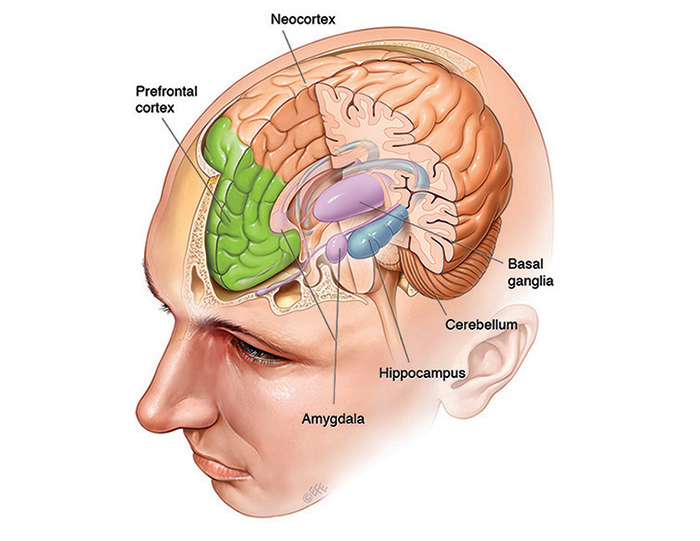
Even in people who don’t have brain injury or surgery, memory is an unreliable thing. Our brain retains snippets of information, things noticed by our senses, and then forms a story around them. The information is stored in the hippocampus part of the brain.

Retrieving memories is another function altogether, and we tend to be able to recall things from our long term memory better than our short term one. You probably remember the name of your best friend at school, but possibly not the name of someone who you met yesterday.

Sleep is a crucial part of memory formation. When we are in deep sleep, the hippocampus replays events of the day, and the neurons—the things that store memory—which were active during those events become stimulated again. It’s a bit like the brain has a little theatre time, and re-enacts the events of the day. The neocortex (this is your ‘grey matter’) then stores these memories. If, therefore, the hippocampus goes ‘off-script’ and adds some actions of its own, these too will be stored as memory. It also means that if you don’t sleep enough—perhaps you are stressed, or ill, or have just given birth to a baby who cries all night—then your memory will be affected. Not enough sleep means the hippocampus doesn’t have time to do its little play for the neocortex, and not much information will be stored.

Memories become less reliable over time, because every time you recall something, your brain changes it slightly, and then stores the new details as memory. For example, let’s say a tea-towel was left on the hob, and caught fire. You saw this, put out the fire, threw away the tea-towel. But you did not notice the colour. While this happened, various neurons in the brain were stimulated as you saw the fire, smelt the smoke, felt the heat, etc. When you next sleep, your brain will replay this, and the neurons will be reactivated. But you cannot actually remember the colour of the tea-towel–was it blue or green?–you own both colours of towel, so your brain fills in the gap with something logical, and you store the memory as a green tea-towel. The next day, you tell someone the story of the fire, and you say, with authority, that it was the green tea-towel which caught fire. This then becomes further embedded in your memory, now you are certain that the tea-towel was green.

Now mostly, an unreliable memory is not too important, and simply means you can argue with your nearest and dearest for many hours about an event which you all remember slightly differently. But of course, in a court of law, when people are asked to be witnesses, it is hugely important. If we cannot properly trust human memory about things they have seen, how can they be asked to tell a court about what they saw several weeks or months ago? How much will those memories have changed in the intervening time? All a bit of a worry.

Thank you for reading. I hope you remember the things that are important today — and perhaps be a little less certain when people remember things differently!

If you want to read more about what it was like having a brain tumour, and how to cope after a craniotomy, you can read my book, How to Have a Brain Tumour. It’s available from Amazon, and you can read it for free if you have a Kindle.

Take care.
Love, Anne x

This tells all the things I wish I had known when first diagnosed. A helpful book for anyone with a potentially terminal illness. It shows how to find a surgeon, how to cope with other people’s fears, how to not be defined by an illness. It also has a few funny anecdotes – because even when you’re ill, it’s good to laugh.
Available from Amazon (you can get it free if you have a Kindle).

German Amazon link

Amazon India link

US link

Australian Amazon link

UK Link

Thank you for reading.
anneethompson.com
Why not sign up to follow my blog?


*****

A Trip to Monk’s Island (near Cannes) and Cube-Throwing in Biot


Saturday August 24th

We all met for breakfast at 8.15. Some people are more awake than others, but buffets tend to get a little ‘picked over’ after a while, so although the AC Hotel does a good breakfast, I don’t like being late. I collected my freshly brewed coffee, some pancakes, banana and maple syrup, and tuned in to the conversations going on around me. Husband was discussing inherited advantage. Girlfriend stuck her finger into her eye—but I think the two were unconnected.

We decided to go to Monk’s Island: Ile Saint-Honorat. We could catch a train from Juans-les-Pins to Cannes, which avoids having to try and park, and then a ferry to the island. Emm had suggested that we hire kayaks and row there, but we were all ignoring that bit.

Catching the train was easy. Return tickets to Cannes were 5 euro. The train was air conditioned, double-decked, and quite full. Most of the journey we could see nothing but ugly concrete walls, with the occasional snatched view of sun shining on deep blue sea and boats.

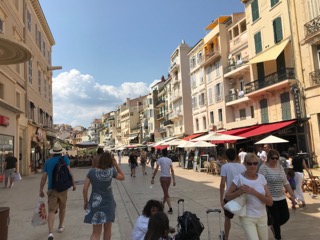
We arrived in a very hot Cannes at 1.30pm. We walked through pretty streets, past restaurants smelling of steaks and garlic, and shops where cold air seeped onto the pathway, and hotels with sleepy guests on balconies. We followed signposts to the quay, and to the ticket office. We then sat, blasted by the sun, waiting for the boat. I wished I had carried my umbrella, so I could have created some shade.

The boat loaded, and we sailed out to sea. Cannes was laid out on the hills to our left, huge ships and pleasure boats were to our right. The wind swept across the deck, drying our sweaty tee-shirts while two men argued in French behind me. Actually, they were French, they might not have been arguing at all—to me, all French men sound as if they are either furious or trying to make love—there seems to be no middle ground.

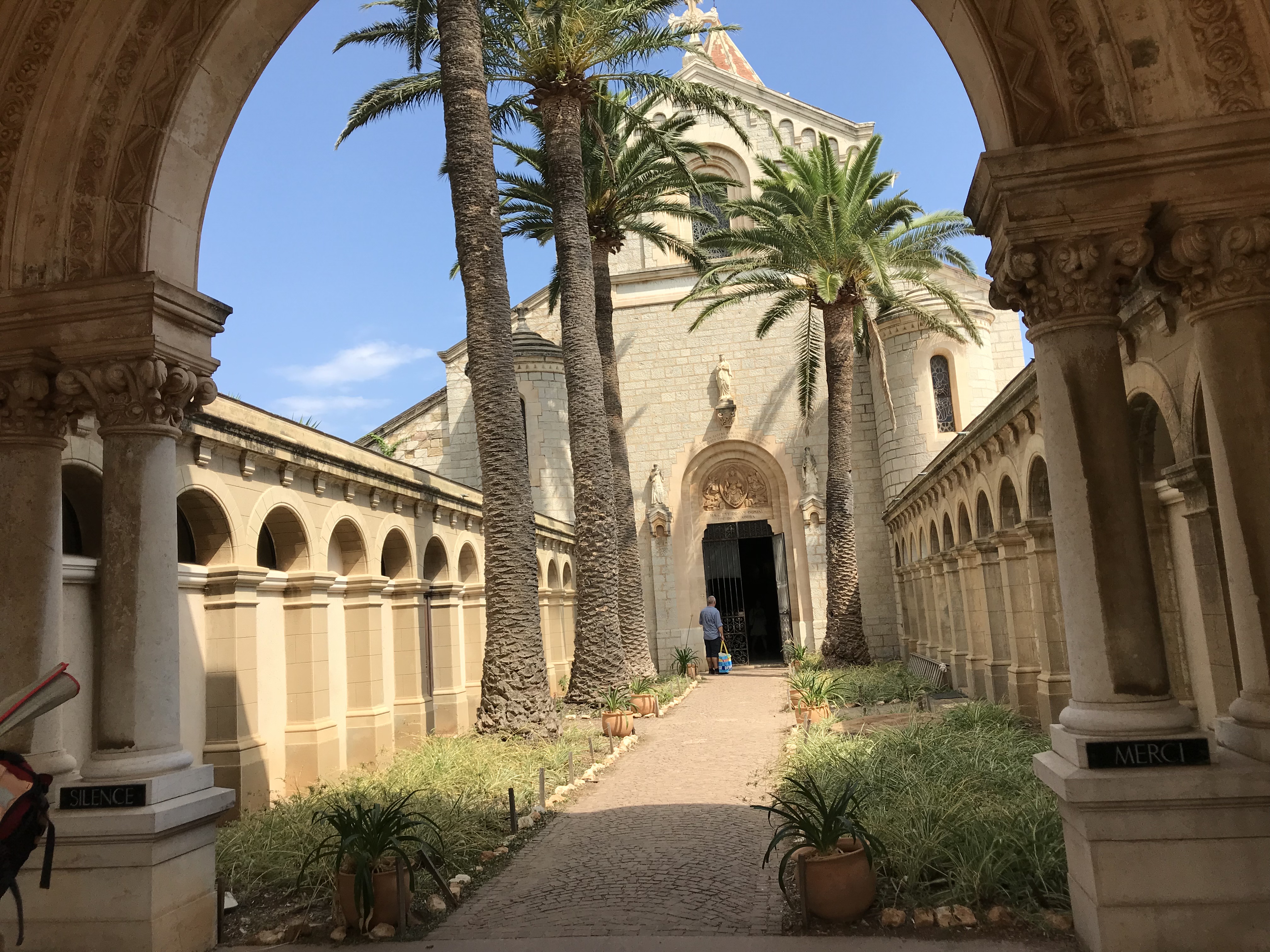
Ile Saint-Honorat is a little island off the coast of Cannes, which is owned by a monastery. The monks allow people to visit, but ask that they dress appropriately and respect the silence of the island. I imagined a secluded island, rarely visited, practically cut-off from the rest of France. Instead, as we arrived at the quay, I saw about a million pleasure boats bobbing in the harbour—not so secluded then.

The monastery was lovely, with a very pretty church. We walked to it through vineyards, and attached to the monastery is a shop, where you can buy all things bee-related (beeswax candles, honey, soaps, alcohol) as well as wine made on the island, religious books, and saintly pendants (which always seem like lucky-charms to me). We saw a few monks, dressed in black and white robes (must have been incredibly hot to wear them all day) but most were hidden away in places not open to the public.

We caught the ferry back to the mainland. Cannes was still hot. We walked back to the station, staring at people we passed, trying to guess if they owned one of the multimillion-dollar boats in the harbour, or if they aspired to, of if they had no interest in the glitzy lifestyle at all. As we walked along one street, we were overtaken by soldiers, all in khaki, carrying machine guns. They fanned out, lining the road, looking in all directions. It was very unnerving. We kept walking, but I wondered if we were being stupid, and hiding under a table would have been better a response. Probably they were getting in place, ready for the motor cavalcade of someone important, but we’d have felt daft afterwards if we’d been shot. We weren’t.

Dinner at La Taille de Guepe (24, rue de Fersen, in the old part of Antibes). The food was delicious, and decorated with edible flowers. It was lovely.

After dinner we walked back via the main square, which was full of musicians and artists and people enjoying themselves. The sleepy old town wakes up at night.


Sunday August 25th

The last day of our holiday, so some people went to the beach, others to the pool.

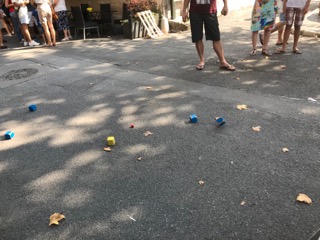
After lunch we drove to Biot, a little village in the hills behind Cannes. There is a large town car park, which was surprisingly full. Then we learned that we had happened to visit on the afternoon of the boules carrees championship, and teams were playing it in every street, and square, and lane. The game appeared to be the same as boule—when you throw little balls towards a target, and the closest wins—but it is played with small coloured cubes (the kind you built towers with as a toddler). Teams were all ages, but the games were pretty intense, and there was a lot of pressure to not, by mistake, walk across the area where they were playing (which as they were playing everywhere was sometimes quite hard!)

Biot is a pretty town, and when not full of people throwing cubes around, it is famous for its blue glass. There were galleries and shops and art installations of blue glass. But mainly, there were people throwing cubes…

We ate an ice-cream, wandered (carefully) through some pretty squares, and sat for a while on a bench, enjoying the view. A sleepy end to our holiday.

Thank you for sharing the holiday with me. If you have enjoyed the blogs, look out for my travel book—I think you will enjoy it.
Take care.
Love, Anne x

Thank you for reading.
anneethompson.com
Why not sign up to follow my blog?
 

Old Town Antibes, Are the French Rude? And David David (so good they named him twice…)


Thursday August 22nd

I walked with Husband to the old town of Antibes (it takes about 15 minutes to walk from the bustling beach of Juan-les-Pins to the ancient town of Antibes on the other side of the peninsula).

There is a public beach area, dotted with rugs and towels, where families had set up camp for the day. Most of the beach is reserved as ‘private’ by the hotels and restaurants, and are crammed full with loungers practically touching under parasols. I much prefer the public areas. The beach has sand, and has a long shallow strip into the sea, which makes a nice place to swim (if you like swimming, which I don’t).

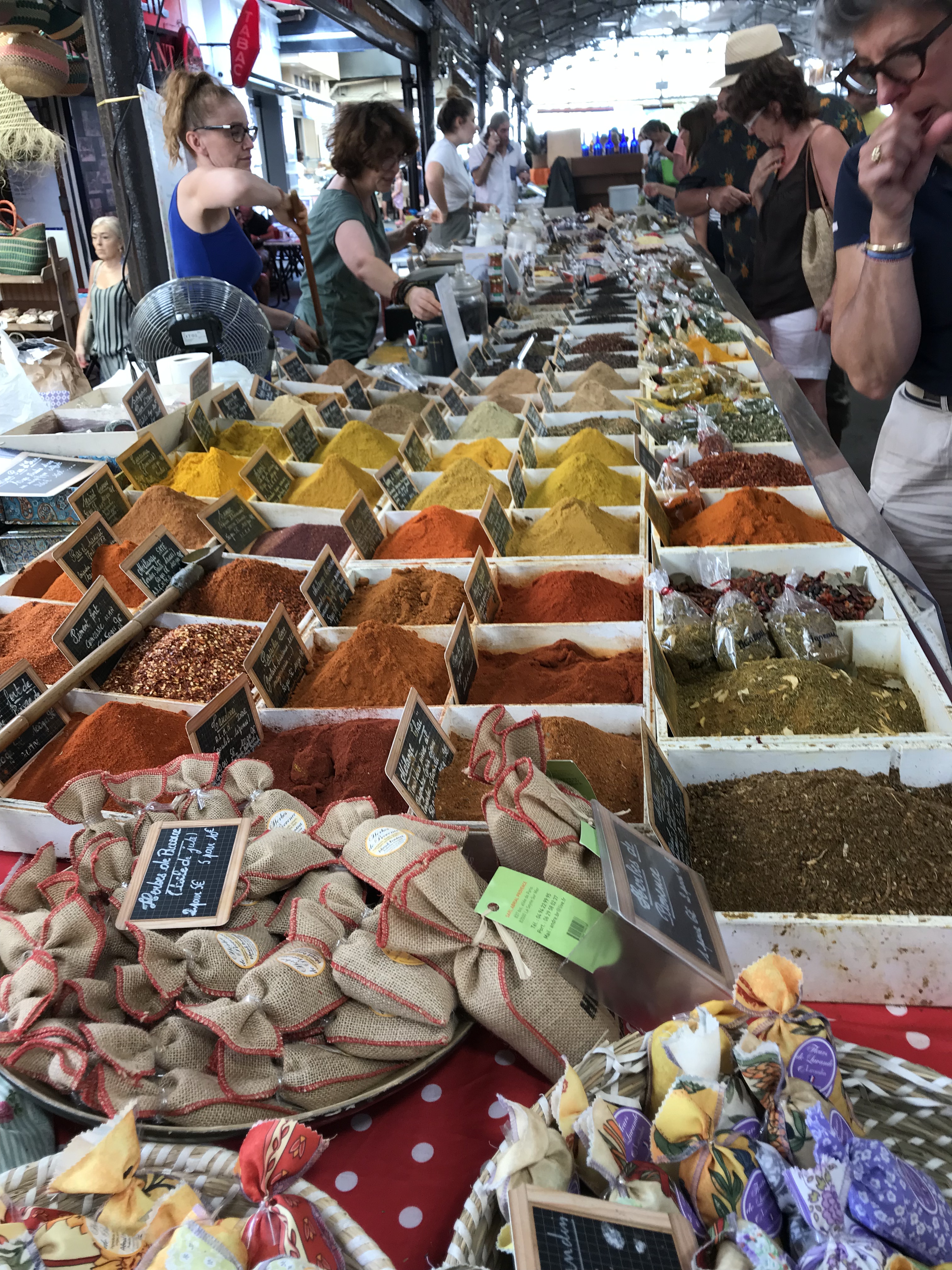
We wandered along the quay area, looking at boats and sculptures, and the little fort on the hill, before walking through one of the old city gates and to the area full of narrow cobbled streets. There are lots of art shops and galleries and interesting things to look at. On Thursdays, there is a market, full of bright spices and smelly meats and fresh fruit, and French people doing their shopping.

We had an espresso next to a fountain, listening to an old man playing an accordion. This is what I love about France.

We ate warm baguettes and humus for lunch, then Husband and son set off to Nice airport to collect Girlfriend, and the rest of us went into Juans-les-Pins. We strolled along the front, then decided to stop for a drink. The place we chose basically ignored us, and even though we eventually managed to order drinks, they never actually arrived, so we left. I left a bad review on Google Reviews, and when they replied, they basically said it wasn’t worth their effort for “two lousy sodas”! I felt that summed up our experience rather well. The trouble is, when we are visiting a different country, the people who we meet tend to colour our view of the whole nation. People often tell me that “the French are very rude” and undoubtedly, some of them are (like the people in the over-priced cafe by the beach). But some of them are not, some French people are kind, and polite, and help us with our bad French speaking, and make our trip special. It’s important to remember the nice people.


Friday August 23rd

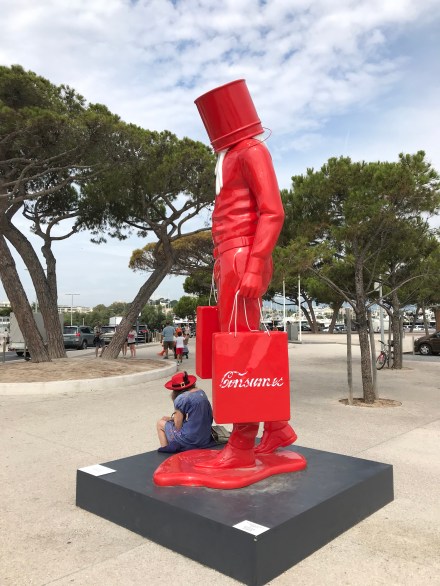
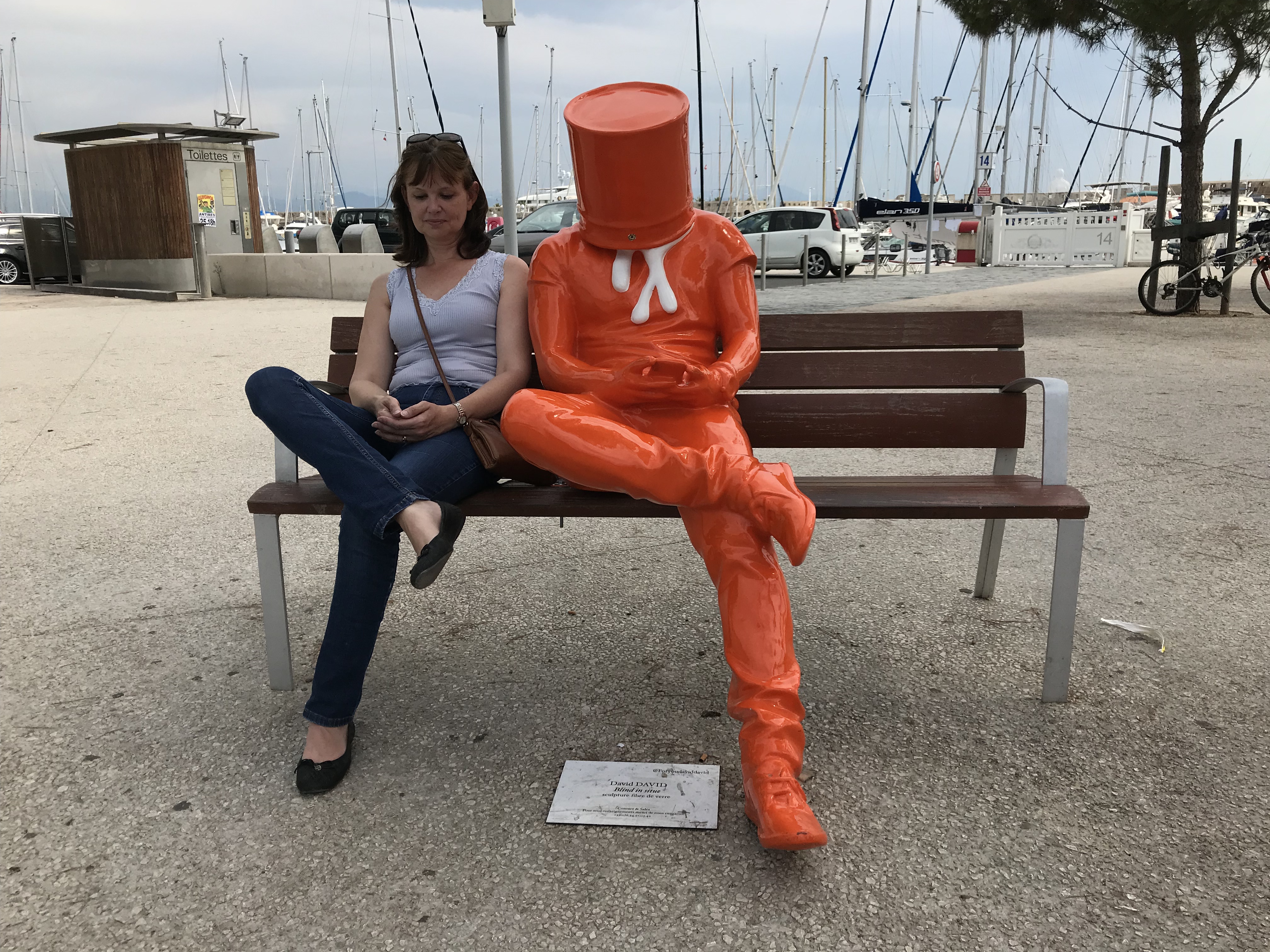
Today we went back to the old town of Antibes, as I wanted to show the family some of the sculptures. They are by an artist called David David. (I really hope that his mother was called Mrs David, and she decided to name her son David. It’s an easy name to remember!) There was an exhibition of his work, which I rather like. He makes fibreglass people in poses that make a statement about society, and they are rather like those people you find in tourist areas, who pretend to be a statue and then move when you’re not expecting it. These did not move. I’m not sure about his paintings, but the statues I loved. I took lots of photographs, some with people posing next to them (and then felt bad about commenting on Husband’s many photographs of fish).

We ate dinner at La Storia, Boulevard Dugommier. It was a lovely meal, and the first restaurant in Antibes where I felt they cared whether or not we enjoyed our meal (many restaurants are rather off-hand, even though quite expensive). The pasta was freshly cooked, the salads were arranged to look pretty (rather than simply plonked into a bowl) and the puddings were all delicious. We were given lemoncello shots when we paid. I wish we had found them earlier in the holiday, we would have eaten there again.

I hope you have some good food today.
Take care and thank you for reading.
Love, Anne x

Thank you for reading.
anneethompson.com
Why not sign up to follow my blog?

Finding a Launderette in Antibes, and A Visit to a Bizarre Museum in Grasse


Wednesday August 21st

We plan to stay in the Antibes area of France for the rest of the week, so first on the agenda, after breakfast, was a trip to a launderette (wayhay!) Finding and using a launderette in another country is usually fairly easy due to the internet (except for in Beijing—I don’t think self-service launderettes exist in Beijing). However, it is always unpleasant, and in the south of France it is especially unpleasant due to the heat. We found one that was full of people doing their washing—mainly tourists. There were machines dispensing washing powder, but I had brought some capsules from home, so all we needed to do was decipher the rather confusing instructions (you had to put your laundry and soap into a numbered machine, then put the money into a computer on the wall, and when you entered your machine number, it automatically started to work. It was not unlike paying for parking when you enter your number plate at the ticket machine). All worked fine, and we didn’t die from heat-exhaustion (though it was close).

After a lunch of warm baguettes, and cheese from the supermarket, we drove to Grasse. Grasse is a very pretty town on a hill overlooking Cannes, where there are several perfumeries, and a museum all about making perfume, and lots of shops selling perfumes, and very few places to park…We went to a completely full carpark, and were lucky enough to find people who were about to leave, so we waited. The people began to vacate their parking space, and we became aware that several other, recently arrived cars, were positioning ready to zoom into the space we had been waiting for. Adrenaline levels rose. The boys got out of our car, and stood behind the departing car, filling the space so that we could reverse into it. There was much gesticulating from the other drivers, but I am assuming they were discussing the weather.

I had hoped we would wander through the pretty town, have a coffee, smell the perfumes and buy some gifts. We have toured a perfumery on a previous visit, so I knew I was safe from that little delight. Husband hoped we would visit the museum.

We visited the museum. Grasse has one of the most boring, yet bizarre, museums that I have ever visited. To be fair, it has washrooms (and I was desperate, which is how the plan was sneakily adopted) but really, that was the sole redeeming feature. The first room showed how ancient Egyptians had used perfumes to embalm bodies. One display case held a human hand, blackened with age, skin peeling, fingers hardened into claws. Bea was somewhat perturbed by the hand, but I was more concerned about the rest of the body—had several museums decided to share various body-parts? Who decided which museum received which part? So much to worry about…

The museum also had pots, lots and lots of pots, all used to store perfume. There is, in my view, a limit to how interesting pots can be.

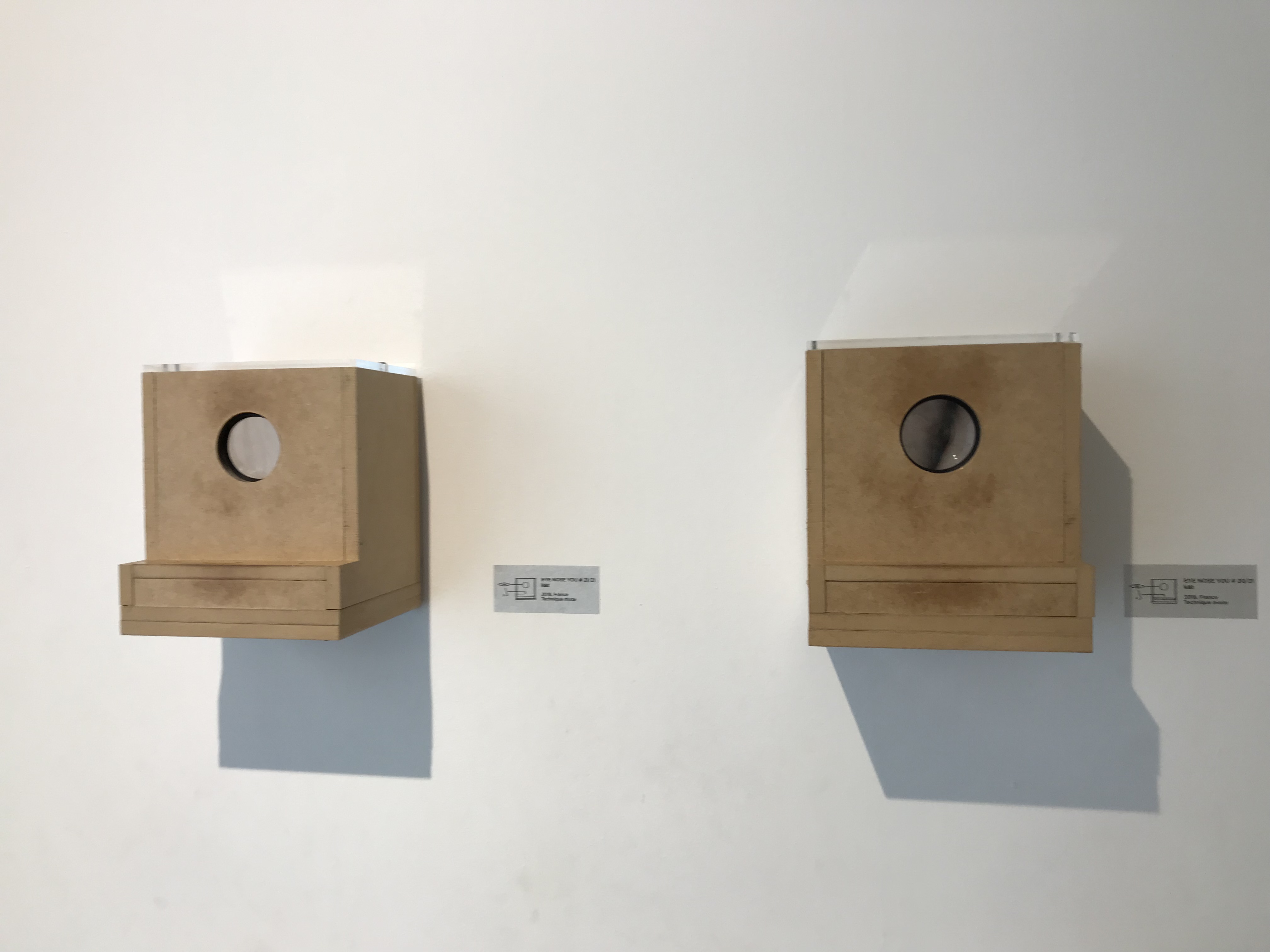
And then, just when you were beginning to tire of yet another room of pots, there were the sensory boxes. These really have to be seen to be believed. They were little wooden boxes, fastened to the wall in several places around the museum at head-height. The unwary visitor was encouraged to peer through the small glass window, and to sniff the air above some holes drilled into the box. I think/hope the scents were of perfume, I never sniffed. The views were of body parts, and there was a lot of pubic hair involved. All I can imagine, is that they were depicting the places on the body that people wear perfume—but to be honest, I have no idea. It was most bizarre and meant the museum was full of hysterically giggling teenaged girls (as well as a lot of pots). There were also small dark rooms, where clips of films were being played. They were snippets from well-known films, and again, I think they were showing people (mostly nude) applying perfume.

To be fair, there was also a scented garden and greenhouse, full of herbs and flowers used to make perfume, which was lovely and very interesting, and there was a shop, which had lots of reasonably priced perfumed products. But mostly, the museum was not a highlight of my holiday. The boys liked it though.

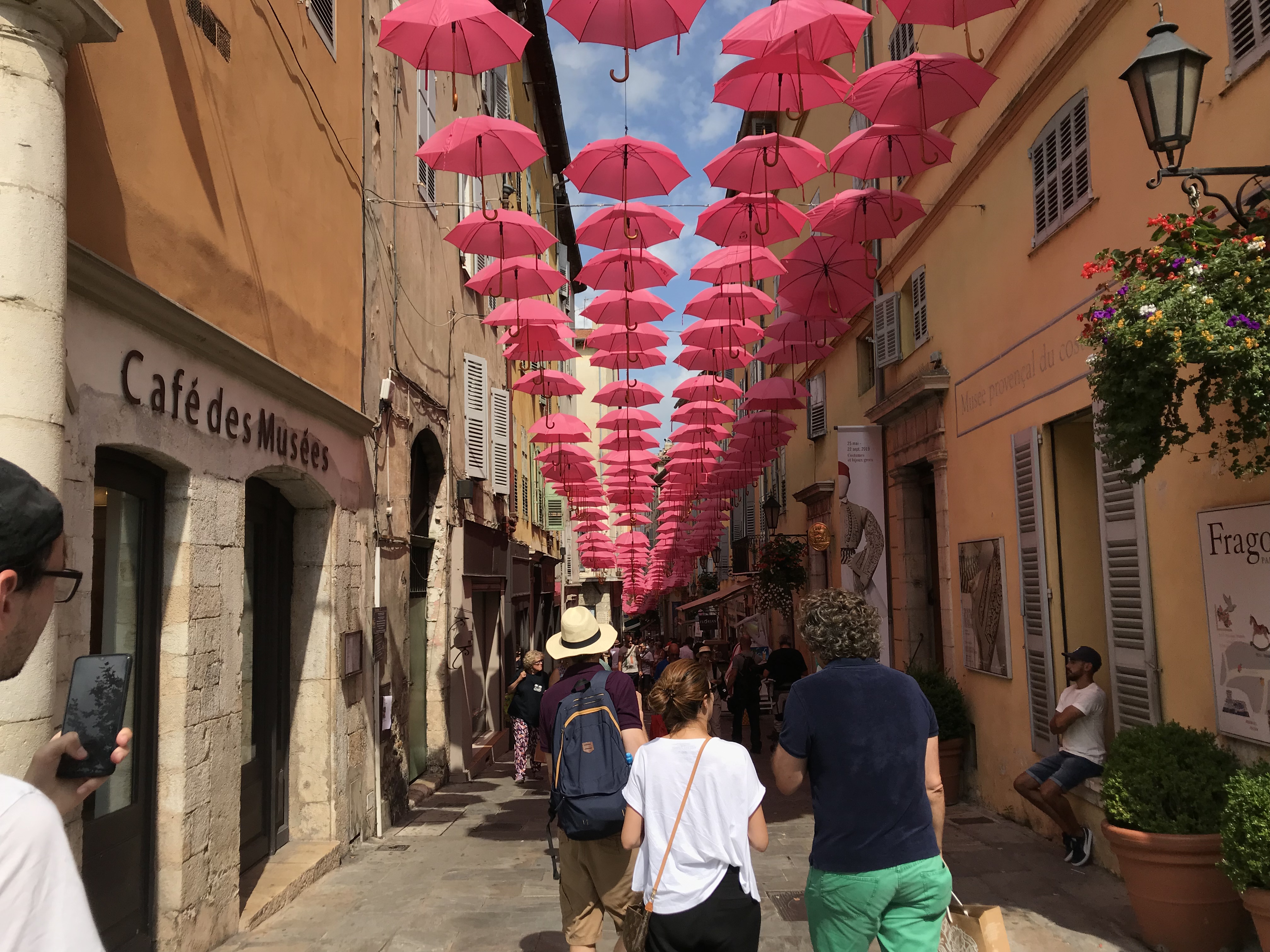
We walked to the town, enticed by a street that had pink umbrellas strung above it, giving everything a rosy hue. The shops were wonderful to look at: a shop with great chunks of nougat that gleamed like granite, a chocolate shop decorated with cacao beans and photographs showing the production of chocolate, a cushion shop—as well as, of course, lots of perfume shops, where they gave you tiny slithers of white paper to test the perfumes. We drank coffee, and wandered through the town and up to the old church, where someone was playing the organ and candles flickered in front of the marble saints.

We found a sensory garden, near to a viewpoint, laid out with coloured deckchairs under pipes in the trees which squirted perfumed mist into the air. People rested there. Some people rested for a very long time, and although I had a book in my bag, the pipe above me leaked and the pages got regular dollops of water, so I left, and went back to wait in the cool of the church.

I hope you find some good places to rest today.
Thank you for reading.
Take care.
Love, Anne x

Thank you for reading.
anneethompson.com
Why not sign up to follow my blog?
If you enjoyed this blog, please share it.

Have you read my travel book yet?
The Sarcastic Mother’s Holiday Diary.
Available from an Amazon near you (and free to readers with a Kindle)

German link here

French link here

US link here

UK link here

Travel with a family…always unexpected.

Antibes, Family Holiday Diary 2019


Monday August 19th

Today we left Genoa, which was not easy, as the SatNav was still trying to take us via the bridge that collapsed last year, and Bea told us that the map on her phone looked like a cat had been sick on it, and it was impossible to identify individual roads. But we escaped eventually.

We arrived at the AC Ambassador Hotel in Juans-les-Pins, France. The hotel has a carpark, with a very narrow ramp down, which was probably the most stressful part of the whole journey. We checked in, and had a quick look around the hotel. The lobby and public areas are very nice, with several alcoves for chatting, and a bar and restaurant, a gym and pool, plus a bigger pool outside. Our rooms were okay—probably less nice than our previous hotels, but everything worked, and we were given plenty of towels, and each room had a balcony and air-con that worked (which will really matter here, as it’s hot!)

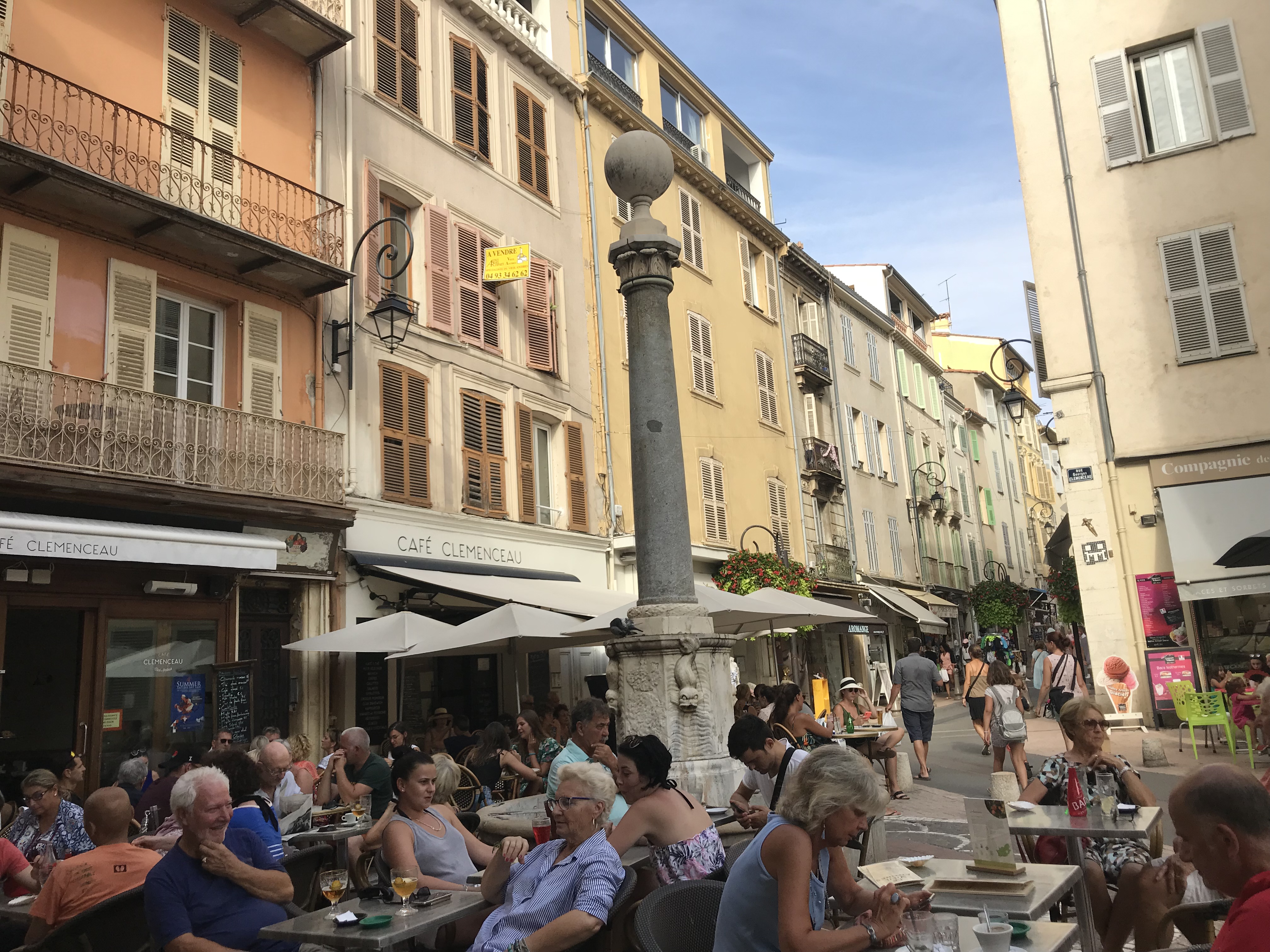
We walked to the beach. Juans-les-Pins is on a narrow spit of land, with Antibes the old town on the other side. It feels like being on an island. The beach area in Juans-les-Pins is very touristy, with beach areas full of hot tanned bodies lying side-by-side on loungers. The town is full of young people, wandering and drinking cocktails, and everything is bright and loud. The old part of town, across the spit of land, is very different. The old town is full of cobbled streets and painted houses with shutters and olive trees.

We ate in La Tours Antique (eating anywhere on Sundays and Mondays in France takes some effort, as many places are closed). Our table was outside, and we sat looking at ancient houses and potted plants while we sipped wine and ate delicious food. We were given tiny glasses of cold soup and freshly baked bread, followed by fish with a pistachio crust and cubes of fried potato. But it was quite expensive, and the menu was fairly limited (and they did not have tiramisu!)

Later, we sat in the hotel bar, playing cards and waiting a very long time while the bar staff tried to work out to make the cocktails we had ordered. (Eventually, they came and asked us for the recipe.) There is a piano, so Jay played it and some other guests stopped and sang, which is always fun.


Tuesday August 20th


Breakfast was just about perfect for me. There were lots of fruit tarts, and pastries, and fruit and pancakes, and a very good coffee machine.

We all went swimming. I pretty much hate swimming, but occasionally I pretend to be sociable and join the rest of the family. It was awful—very wet. After compulsory swim, I looked for a spare sun lounger. The hotel has a sign saying that after 15 minutes, any unoccupied seats will have their towels removed. However, there was one lady who had several unoccupied seats, reserved with towels, for over an hour. I therefore went over, and removed one of the towels. The lady flew from her seat, snatched the towel from my hand, and screamed death threats at me. (It was all in French, so am improvising a little). She was small enough to pick up and throw into pool, but my family get cross when I do things like that, so instead I went to ask the towel-distributing man if he had any more chairs. Towel-man then went and tackled angry seat-hoarding woman. There then followed a long, loud argument in French, with lots of fist-shaking and hand waving. I was given a seat by towel-man, who dumped the reserving towels in a heap on the floor. I took lounger, returned to family, and read for an hour.

After an hour, I was too hot and sticky, so decided to go inside. Chair-hoarding woman was still alone. I figured that her family might, at some point, join her, and I no longer needed the chair, so I carried it back to her and said (in bad French) that I no longer needed it. She thanked me very prettily, as if the preceding argument had never occurred. Perhaps this is normal behaviour in France.

We bought lunch in a patisserie. I had the most perfect strawberry tarte. We ate in the hotel garden (it’s not much of a garden, just a few chairs and some young olive trees on a patio).

We walked to the old town of Antibes, wandering along narrow cobbled streets. We saw a painted church, and the Picasso museum, and a big town square with a bandstand.

We bought drinks in the empty market place at Le Championnet. This was a mistake, as the prices were inflated, and the man dumped ice in the glasses with his dirty fingers.

We ate dinner in Mamma Mia in Juans-les-Pins. It is next to a busy road, but we could see the sea beyond it, and the restaurant was friendly and cheap. I drank wine again by mistake (there is something about a cold glass of wine on a hot summer’s evening that is hard to resist, even when all your clothes are too tight and you’re trying to lose weight).

Thank you for reading. Have a nice day.
Take care.
Love, Anne x

Thank you for reading.
anneethompson.com
Why not sign up to follow my blog?

Travel with a family…always unexpected.

Have you read my travel book yet? A fun-filled book about travelling with a family, from Europe to Malta to Zambia to Argentina to …
Available from an Amazon near you.
UK link here