Joanna


I have had an idea for my next book. It’s VERY different to my other books but I think will be lots of fun to write. It will take me about 9 months, so I thought I would try out the beginning on you first. Depending on how many people ‘like’ it will help me to decide whether or not to continue writing or change it completely.

I realise I should be posting this at the beginning of the week – always get the most responses on a Monday morning – but I am much too impatient to wait! Here is the first splurge of words. Oh, and Mum, you wont like it.

To save you asking (because my family did): No, it is not based on myself or anyone who I know and, no, I have never wanted to murder anyone at all ever – I could not even kill the rat I caught!

Joanna
by Anne E Thompson

      I first saw them on the bus. They got on after me, the mother helping the toddler up the big step, holding the baby on her hip while she juggled change, paid the driver. I wondered why she hadn’t bought a card or paid by phone, something quick so we didn’t all have to wait.

      I watched as she swung her way to a seat, leaning against the post for support, heaving the toddler onto the chair by his shoulder. Then they sat, a happy family unit, the boy chattering in his high pitched voice, the mother barely listening, watching the town speed past the window, smiling every so often so he knew he had her attention. Knew he was loved. Cared for. They had everything I didn’t have but I didn’t hate them. That would have involved feelings and I tended to not be bothered by those.

      No, I just watched, knew that those children had all the things, all the mothering, that had passed me by. Knew that they were happy. Decided to change things a little. Even up the score, make society a little fairer, more equal.

      Following them was easy. The mother made a great deal about collecting up their bags, warning the boy that theirs was the next stop. She grasped the baby in one hand, bus pole in the other and stood, swaying as we lurched from side to side. She let the boy press the bell button, his chubby fingers reaching up. Almost too high for him. Old ladies in the adjoining seats smiled. Such a cosy scene, a little family returning from a trip to the town.

      They waited until the bus had swung into the stop, was stationary, before they made their way to the door. I was already standing, waiting behind them. The mother glanced behind and I twisted my mouth into a smile, showed my teeth to the boy who hid his face in his mothers jeans, pressing against her as if scared. That was rude. Nothing to be frightened of. Not yet.

      The family jumped from the bus and I stepped down. As the bus left I turned away, walked the opposite direction from the family. In case someone was watching, noticing, would remember later. Not that that was a possibility but it didn’t do to take chances. I strode to the corner, turned it, then made as if I had forgotten something. Searched pockets, glanced at phone, then turned and hurried back.

      The family were still in sight, further down the road but not too far. She had spent time unfolding the buggy, securing the baby, arranging her shopping. All the time in the world.

      I walked behind, gazing into shop windows, keeping a distance between us. They left the main street and began to walk along a road lined with houses, smart semi-detached homes with neat square gardens. Some had extended, built ugly extra bedrooms that loomed above the house, changing the face, destroying the symmetry. There were some smaller houses stuffed by greedy builders into empty plots, a short terrace in red brick.

      It was just after this that the family stopped. The mother scrabbled in her bag, retrieved her key. The boy had already skipped down the path, was standing by the door. The mother began to follow but I was already turning away.

     I would remember the house, could come back later, when it was dark. I would only do it if it was easy, if there was no risk. If she was foolish enough to leave the back door unlocked. No point in going to any effort, it wasn’t as if they meant anything to me. There would be easier options if it didn’t work out. But I thought it probably would. There was something casual about her, about the way she looked so relaxed, unfussy. I thought locking the back door would be low on her priorities until she went to bed herself. People were so complacent, assumed the world was made up of clones of themselves. Which was convenient, often worked to my advantage. As I walked back, towards the bus stop, I realised I was smiling.

xxxxxxxxxxxx

Thank you for reading.

If you enjoyed this, why not sign up to follow my blog?
Then you will receive all my posts by email – usually two per week.

Mary’s Story


I am reposting this because it’s Christmas….
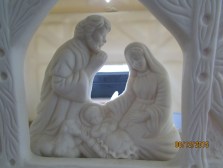
IMG_3787

     I travelled to Bethlehem in a small cart. Every bump (and there were many) was agony. As I was jolted along, I was wracked with pain. The baby’s time was near, you see, and the pain was almost unbearable. Later, they would sing songs about a cute donkey carrying me. Nice thought! I don’t think there’s any way you could have got me on a donkey.

     As each contraction cramped every muscle in my torso, I huddled up like an animal and prayed for it to be over. I could see Joseph, watching me as he walked alongside. He really didn’t have the first idea what to do. Oh, how I wanted my mother. I yearned for her to be there, holding my hand, telling me everything was alright and would be over soon.

    When we arrived at Joseph’s uncle’s house, the women folk came and helped me inside. The room was crowded. All Joseph’s male relatives from miles around had come to the house for shelter and food, responding to the summons from the Romans. The women were busy cooking supper and the men were drinking wine and comparing stories. They all told Joseph how much he resembled his grandfather Matthan and laughed at old stories from years ago. The smell of fish and fresh bread was nauseating. I was so tired and so uncomfortable.

     Joseph knew I was suffering and asked if there was somewhere quiet that I could go. There was no chance that we would get a place in the inn, they had filled up days ago. Somewhere quiet, in a little house packed with relatives? There were some fraught discussions and then his aunt suggested that the animal cave, below the living quarters, might be best. It wasn’t terribly clean, but it would be quiet and private and at least it wouldn’t smell of fish!

     Joseph helped me go down, and a couple of the women came too. One of them examined me and told me the baby was a long way off yet, first babies always take their time in coming. This was not great news but I felt better having her there. I felt that she knew what was happening, had seen this before and it took some of the fear away. I was frightened you see. I was horribly afraid that somehow I would damage my baby. My baby and God’s.

      I knew he was going to be special, I knew I had a great task ahead of me but it all seemed to be going horribly wrong. I trusted that God was still in control but He felt so far away. Could the baby not have been born in a palace, surrounded by comfort? Would these poor beginnings really be part of a plan? Could they really make this king accessible to the people? I had no idea. I was a mere girl, I had no education and my memory of scriptures was often fuzzy. To be honest, at this present moment, I didn’t even care. I just wanted this baby OUT!

     Special or not, my body was tired of carrying him, tired of being stretched and pushed, of fitting something inside that was now too big to be there. I needed this baby to be born and I was too exhausted to wait much longer. How I longed for sleep. The pain in my back was terrible. Great waves of cramp that seared through my body, making me oblivious to everything else. I was vaguely aware that someone was sweeping the floor and moving the animals to a far corner. They had laid out a mattress and blankets for me to rest on but I couldn’t lie still for long. I felt better standing, rocking in time with the pain, trying to remember to breathe, in out, in out. Some one offered me water but I couldn’t drink. I wasn’t thirsty, I just wanted this baby to be born.

      I could see Joseph with his big anxious eyes watching me. He didn’t know what to do. Someone suggested he should go into the house to eat and I nodded in agreement. There was nothing he could do and the poor man must have been tired too. He had endured such an emotional time lately. First there was his fear and anger when he first heard about the baby (now that was a difficult conversation.) Then he had to endure the smirks of his friends when the pregnancy became public knowledge. He never complained, but I know he felt embarrassed, wished that God could have chosen a different girl.

     We had been travelling for five days, with hardly any rest and the last couple of days had been more chilly. I know he felt the burden of caring for me, watching for bandits on the roads and wondering if we would make it to Bethlehem in time. If the baby had come early I don’t know what he’d have done – left me with strangers on the road somewhere I guess and come to register on his own. One didn’t mess with a Roman decree…..

     The pain eventually became almost constant. Joseph had eaten and rested but I continued to sway in discomfort in the little cave of animals. Every so often one of them would poop and although the women with me cleaned it up quickly the smell pervaded the atmosphere.

      I could hear the musicians gathering outside, someone must have told them the birth would be soon. That gave me hope, maybe soon the baby would arrive.

       Then at last, in a final searing pain, the baby was born. I looked down at his blue waxy body as he wriggled on the blanket and I knew that he was mine. One of the women wiped him down with oil and salt and I held him in my arms while they looked for the swaddling bands in our luggage. How beautiful he was. His indigo eyes would soon turn brown and they gazed at me trustingly. I loved him with my whole being.

      Outside, there was the sound of music and singing as the musicians heralded the arrival of a boy. Joseph came and took him from me. He held the tiny baby in his giant carpenter’s hands, hands that spoke of hard work and safety. Then the baby started to mouth for food and Joseph passed him back. The women showed me how to feed him, but he was soon asleep. Then we gently wrapped him in the swaddling bands, securing his tiny limbs so he would feel snug and secure and his bones would grow straight and true. He was so beautiful.

      It was hard to remember what the angel had told me, that this was God’s son too. I began to wonder if I had imagined it, if it were all a dream. This baby did not look like God, he was a baby. My baby.
“If it’s true God,” I thought, “Let there be another sign. He is so little and I love him so much. Remind me again…”

      I too needed to sleep. Joseph fetched fresh hay and put it in the animal’s manger, covering it with a soft blanket. I didn’t want him to put the baby there, I wanted to keep him on the bed next to me, but Joseph was worried I might roll on him in my sleep. Then he laid the baby down and told me to sleep. He looked deep into my eyes and brushed my collar bone lightly with his fingers.

      “Soon you’ll be truly mine,” he whispered. I knew what he meant and felt myself blush.

      I was so tired, I thought I would sleep for a week. I actually slept for about two hours. I was abruptly woken by loud voices and a draft of cold air as the door was flung open. There, standing uncertainly in the doorway was a group of youths. Their clothes were dirty and exuded the strong smell of sheep. Joseph was with them.

     “Mary? Are you awake?” he asked.

       It would be hard not to be with all the noise from outside.

       “These shepherds want to see the baby. They were told by angels where they could find him and they have come to look at him.”

       I nodded and they trouped into the room.

       They seemed so big and clumsy in such a small space, I was worried they might hurt the baby. But they didn’t try to touch him, they just stared for a while and then one of them knelt and they all followed suit, kneeling before the manger, staring at the baby.

       Then they told me their story, how they had been in the fields and an angel had appeared. They had thought they were going to die, to be struck down right where they were. The angel had reassured them, told them that a saviour had been born, the Christ who we’ve all been waiting for. They would find him lying in a manger. Then suddenly there were lots of angels, all praising God and saying he was pleased with people on earth. After the angels had gone, finding they were still alive after all, the shepherds decided to come at once and see for themselves. It was as though they couldn’t quite believe what they had seen and heard, they needed to actually see the baby with their own eyes.

       I felt so humbled and so cared for. God had heard my thoughts, He was reassuring me. It was all His plan, not some terrible mistake. We were meant to be here. He even knew about the manger. I listened and smiled and treasured my thoughts.

      The shepherds left as noisily as they came. I could hear them in the streets, shouting their news, telling everyone what had happened. They were so excited. They had of course woken the baby who was now crying with a thin wail that jarred my nerves and was impossible to ignore. So I fed him some more and then we both slept. A tired, contented sleep borne from exhaustion and wonder.

       After eight days, Joseph came and circumcised the baby. How he wailed. It felt cruel, though I knew it was the right thing to do, even in this strange place we must obey the Jewish laws. We also formally gave him the name Yeshua, the name we had been told to give him by the angel all those months ago. I wondered if Joseph minded, people would know it wasn’t a family name. I also had no one called Yeshua in my own family, though I did know a boy from my childhood with the name.

      After forty days, we had to travel to Jerusalem, to pay for redemption at the temple. As Joseph was from the tribe of Judah, we had to pay five shekels of silver. We couldn’t afford a lamb, so bought two pigeons to sacrifice. It was nice to leave Nazareth and to have some exercise at last, to see people and to take my baby into the world. I felt quite excited as I approached the temple, our holy place. I didn’t recognise anyone, but everyone could see we had a new baby and lots of the women came over to see him. I felt so happy!

     We walked through the Beautiful Gate and up to the Gate of Nicanor. Then something strange happened.
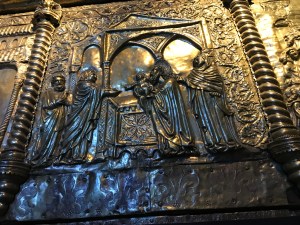
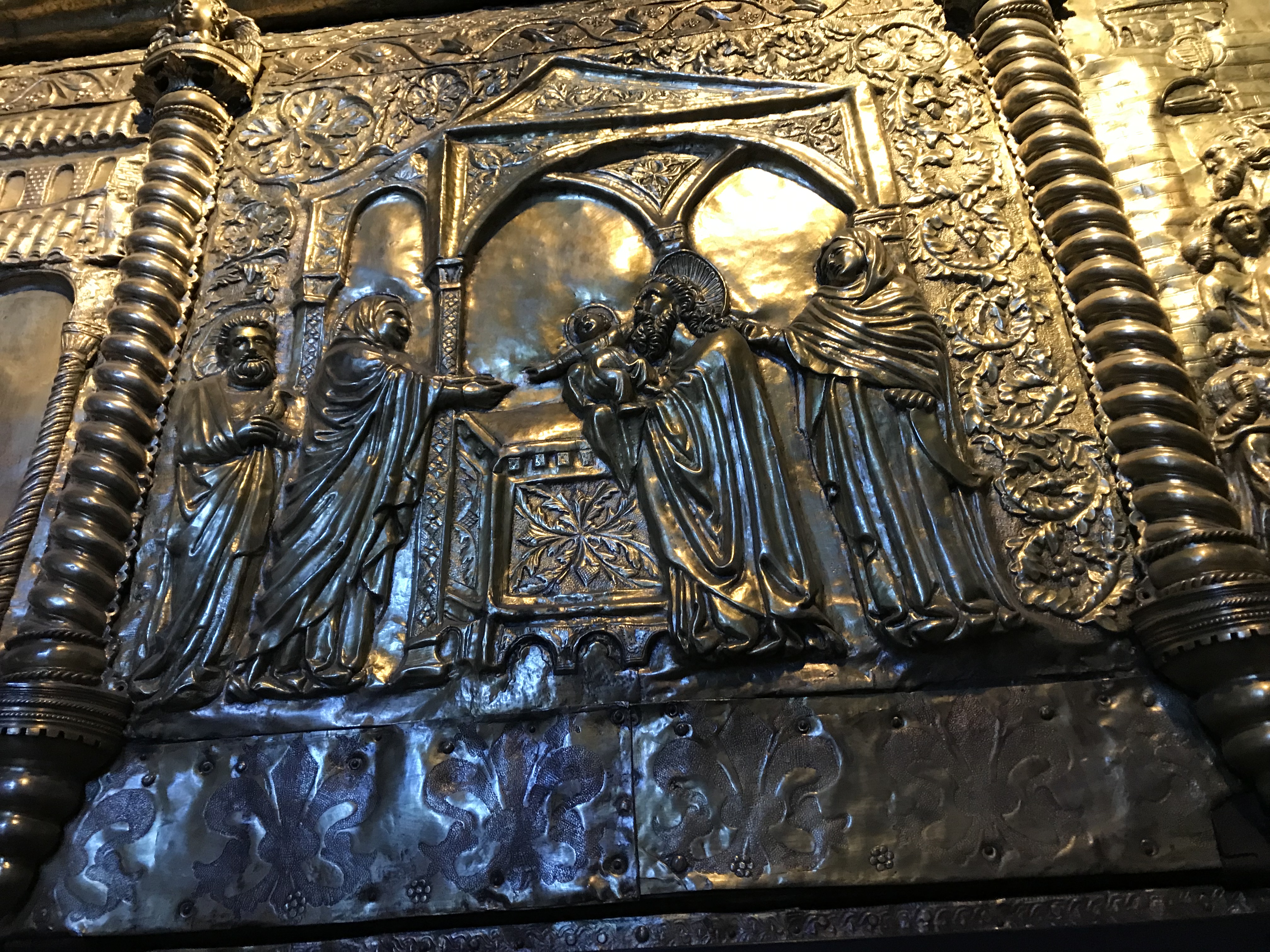
On display in the V&A Museum in London, is a decorated box, showing a scene from this story. It is supposed to have held Simeon’s remains.

      As Joseph and I walked through the temple, a man approached us. He came to look at Yeshua and indicated that he wanted to hold him. That was a little unusual but there was something about him, something that made you sure he was a good man, someone you could trust. When he looked at the baby, he got all emotional and prayed, thanking God and saying that now he could die in peace. He blessed me and Joseph too and then he leant towards me and said something which was very strange. He said Yeshua would cause “the fall and rising of many in Israel” and would be “a sign that would be opposed so that the thoughts of many hearts may be revealed.”

      What does that mean? I know that he is God’s own son and that he is part of the plan to establish God’s reign on earth. Will he be opposed? Surely everyone will accept God’s anointed one, we have waited so long for him. Then he said something that made me afraid. His face was very near, I could smell his breath. He said that a sword would pierce my soul. It made me very frightened, I practically snatched Yeshua away from him! I want my son to grow strong and be happy, will I suffer for this?

      I knew I was tired, not getting enough sleep and it was hard to care for a new baby in a strange place without my mother to help me. I felt that I did not want to hear the man’s words, even if they were true.

      The man left us and almost at once an old lady approached. She was ancient, her white hair showed under her mitpahath and she leant heavily on a stick. What I noticed most were her eyes. They almost sparkled. You could tell at once that she was a holy woman, also one who loved to laugh. As soon as she saw Yeshua she started to pray loudly, thanking God, telling people nearby that if they wanted Jerusalem to be redeemed, they should look to the baby. I was glad that no Romans were allowed in the temple, we would have been in trouble.

      We finished making the offerings and then went back to Bethlehem. I didn’t know whether to tell Joseph what the old man had told me. I kept thinking about his words, worrying about what they might mean. I was so tired, I decided I would wait and maybe tell him later.

      The months passed and we settled into life in Bethlehem. We moved into a little house and Joseph worked on the many building projects that the Romans have introduced. Yeshua continued to thrive. He grew into a sturdy toddler and would walk around the room holding onto the stools and baskets. I loved to feel his solid weight when I carried him on my hip. He started to sleep much better at night and Joseph and I were thinking about having another child. Then everything changed.

      It was one evening, still quite early but we had filled the lamp with olive oil and lit the linen wick. Joseph put it on a bushel basket, so the room was well lit and we could talk about the day. Suddenly, there was a banging at the door. Joseph went at once and there, in the road, was a group of Persian travellers. They had dismounted from their horses and were peering intently into the house.

       They told Joseph they had seen a star and had come to worship the king. I was so glad I hadn’t gone to bed yet. We let them into the house and I went to get Yeshua. He was damp from sleep and his tired eyes looked blearily around him. I wondered if he would cry but he seemed fascinated by our strange visitors. They wore their hair in long curls and one had a band of gold on his head. It glinted in the lamp light and I could see Yeshua watching it intently. Their clothes were patterned with birds and flowers.

      We offered them wine, it was clear they were tired from their journey. I was embarrassed that we only had two stools to offer them, but they didn’t seem to mind and in fact insisted that I should sit on one with Yeshua and they were happy to sit on the rush mat. They didn’t really sit anyway, they wanted to kneel before Yeshua.

      Then they gave him gifts. They were beautiful to look at. They gave him gold, signifying that he is a king. They gave him frankincense. The strong aroma filled the house and I wondered if Yeshua was to be a priest, even though he is not descended from Levi. They also gave him myrrh. Myrrh is costly but is for embalming a body. It was a strange gift for a baby and I wondered what it meant.

       They told us their story before they left. In their Persian home, they were magi, watching the stars and foretelling the future. Many months ago, at the time of Yeshua’s birth, they had seen a special star which they knew meant a powerful new king had been born and they determined they would find him and worship him. Unfortunately, following the star caused them to go to Jerusalem first (I always knew that star gazing was a misleading activity.) They went to Herod’s palace and asked where the new king was. This was scary, Herod had shown he was not a king to be trusted and his cruelty was well known. I would not have wanted to visit his palace.

     However, it sounded as though he had decided to be helpful. He asked the scribes to research the early scriptures and they discovered that the promised king was to be born in Bethlehem. The king told the Easterners and asked them to find the king and then return and tell him the exact location, so that he too could worship. I wondered what would happen next. Would Herod himself come to visit my precious baby or would we be summoned to the palace? This was not a comfortable thought.

      I also wondered why the palace scribes had not come to visit us. Did they not believe the scriptures that they studied so diligently? Surely if they were truly expecting a redeemer they would also have come?

       The men left. They planned to sleep in an inn and return to Jerusalem the next day. We could not offer them lodging in our tiny house and they seemed content to leave now they had seen Yeshua. I returned Yeshua to bed and soon after Joseph and I also went to sleep.

       I had not been asleep for long when Joseph woke me. He shook me awake, then went to light the lamp. I could see his face was tense and instantly turned to check Yeshua was well. He was sleeping soundly.

      Joseph told me I needed to get up at once, we needed to leave. He said that he had had a dream, like the dream when the angel told him that the baby inside me was God’s son. It was so intense and real that he could not ignore it. He said he had been told we must leave Israel, Yeshua was in danger, Herod planned to kill him.

      I wondered why I too had not be warned and then I realised, God had told Joseph to take care of me and Yeshua. That was a hard task for a man, to care for a son that was not his own. So God was now telling Joseph alone what we needed to do, underlining his role, establishing him as head of our family. It was a kind act.

      I began to pack our things but Joseph was hurrying me, telling me to only take what was essential. We were to go to Egypt. Egypt! Could this be right? Was Yeshua not to be king of the Jews? I packed hurriedly and we left that very night.

      What would the future hold? Would we ever return to our home town? The future was uncertain but I knew that something bigger than us was happening.

      Whatever happened, God had a plan and no one could alter the course of that.

xxxxxxxxxxxxxxxxxxxxxxxxxxxxxxxxxxxxxxxxxxxxxxxxxxxxxxxxxxxxxxxxxxxxxxxxxxxxxxx

      This account obviously involves a lot of imagination. However, I believe it is also historically and Biblically accurate (somewhat more accurate than some of our christmas carols!)

I used a variety of sources including:
The gospels of Matthew and Luke
Geoffrey Bromily (1995)
William Hendriksen
William Barclay
Joseph P Amar (university of Notre Dame)
Michael Marlowe
Tessa Afshar

xxxxxxxxxxxxxx

Thank you for reading.

If you enjoyed this, why not sign up to follow my blog?
Then you will receive all my posts by email – usually two per week.

xxxxxxxxxxxxxxxxxxxxxxxxxxxxxxxxxxxxxxxxxxxxxx

Hate Came to Stay


Hate Came to Stay
by Anne E Thompson

IMG_3682

     Yesterday, Hate came to stay. Uninvited, he knocked on the door and when I opened it, to see who was calling, he burst in, pushing past me. I knew he had visited other houses, had caused damage and hurt and anger. But he had never visited me before. He came yesterday.

     He went into the kitchen and smashed all my plates. He over-turned chairs and tore my cushions. He punched my children and spat at my dog. When I went near he scratched me and made me bleed. The house was dark, he closed all the curtains. I was hurt, frightened and angry.

     But worse, worse than the pain and fear and broken china, was the slime. Every time I tried to stop him, to catch him, hurt him, trap him, he produced more slime. It came off him in silver trails, sticking to everything he touched, dirty, germ filled, slime. It made me change. I began to be like him. I wanted to punch him, cut him, hurt him.

     Others came to my door, friends and family and people needing help. I bolted it shut, refused to let them in. I glared at the world and felt dark thoughts from my hiding place under the bed. I too wanted to scratch and bite and smash.

     So I went to the window and I looked at the sun. I let the light brighten my mind, sear my eyes, burn off the slime.

     Then I turned to Hate. I made him tea but he threw it on the carpet. I gave him bandages for his wounds but he used them to tie up the cat. I made him a cake but he trampled it into the rug. I noticed the slime was disappearing, there was less of it. I read him stories but he put his fingers in his ears. I sang him songs but he swore at me. I danced for him but he threw stones at me. Hate would not accept love. But Love stopped the slime.

     Love made a cage. At last, when I was so tired I thought I would fall, Hate was trapped. The bright cage of Love enclosed Hate. There was no more slime. He couldn’t escape. I pushed the cage out of the door. Hate was gone.

I began to sweep up the broken glass.

xxxxxxxxxxxxxxxxx

Thank you for reading.

If you enjoyed this, why not sign up to follow my blog?
Then you will receive my posts by email (usually two per week.)

xxxxxxxxxxxxxxx

The Retelling of Tigers and Strawberries


Once upon a time, as all good stories begin, there was a man. The man was running. He ran and ran, his breath coming in fast gasps, his legs aching, his back sweaty. Every few seconds he glanced behind him. Behind him was a tiger.

The tiger was hungry. The tiger wanted to eat the man. So the man ran and ran and the tiger ran and ran. But the tiger was faster. Every time the man glanced behind, the tiger was a little nearer. He knew the tiger was hungry, he knew the tiger wanted to eat him, so he ran as fast as he could.

Suddenly, he stopped. There was nowhere to go.

The man had reached the edge of a cliff. He peered down. The cliff was very steep, down, down, down it fell. At the bottom, the man could see water. The water bubbled and splashed and boiled. The water was full of crocodiles, squirming and rolling. They were hungry.

The man glanced behind and saw the tiger was nearly upon him. He could see great white teeth glinting in the sunlight, a red tongue lolling, evil eyes gleaming with intent. The man had no place to go. He shut his eyes and jumped.

Down, down, down fell the man. Then he stopped.

Half way down the cliff, there was a bush. A bush with thorns. The man’s shirt had caught on the thorns and now he hung there, suspended against the cliff. The man looked up. Above him was the tiger, greedily looking down. The man looked down. Below him were the crocodiles, waiting to devour him. Next to him was the bush. He heard a sound.

There was a mouse, a tiny brown mouse. The mouse was hungry. The mouse was nibbling at the roots of the bush. The mouse’s teeth were sharp and white, they were biting through the roots of the bush and soon the bush would fall from the cliff, taking the man with it.

In his terror, the man looked around. The cliff was sheer, he could not climb up, he could not climb down. When the bush fell, the man would fall too, down to where the crocodiles waited.

Next to the bush, growing on the tiny ledge of the cliff, was a wild strawberry plant. There were a few leaves and one, ripe, red strawberry. The man looked up, the tiger was waiting. The man looked down, the crocodiles were watching. The man looked at the bush, it would fall any second. So he reached out his hand and picked the strawberry and popped it into his mouth.

It was absolutely delicious.

xxx

I love this story. It is sometimes so hard to notice the strawberries in life.

xxxxxxxxxxxx

Thank you for reading.

If you enjoyed this, why not sign up to follow my blog?
Then you will receive my posts by email – usually two per week.

Counting Stars : Part 13


This story has been removed, edited, and is now available from Amazon as a kindle book.

Counting Stars by Anne E Thompson

The story of a family, that gradually builds to a gripping thriller. One character has undergone brain surgery, and clearly demonstrates the feelings and struggles that this entails.

For UK readers the link is:

For US readers, the link is:

An Easter Story


The Sword Pierced Soul

by Anne E Thompson

     “I watched my son die today. My beautiful boy, beaten, battered and left to die. And my heart broke. I held my cloak close and I remembered the weight of him as a babe, like a boulder on my hip, wriggling to be free, to run and jump and climb. Those legs will run no more.
Those limbs, I was so proud when they grew. I remember when he grew as tall as me, then taller even than Joseph. I remember watching him, stretched out as he ate, those long limbs seemed to go on forever. “I grew him,” I used to think with pride. Those limbs will not sprawl relaxed in my home ever again.
I watched his hands, the hands that used to pat me cheekily on the head when he’d grown tall. Those strong hands which laboured with wood, which helped me carry heavy loads, which lifted young children playfully. They are no longer strong. I saw them bang nails through the flesh, felt that I heard the sound of bone shattering over the thump of the hammer, heard his ragged breath as they forced the cross upright. And I wondered if I too might die. But I watched. I am his mother and I would not leave him alone. When they tried to take me home, when they told me to shield my eyes, avert my gaze, I did not. For he was my son. I would never leave him alone, not at such an anguished hour of need.
Others watched. Some women were there, terrified and hanging back. Not me, I am his mother. I stood with John, where he could see me. What could they do to me that was worse than this?
Some watched who hated him. They mocked and spat and called abuse. It could not hurt him now, I thought, let them shout.
“He trusts in God,” they called, “Let God save him now,” and they laughed, even as he died they laughed.
Yet even God deserted him by the end and that was hardest to bear. He called out with a loud shout, asking why God had turned from him.
“My God,” he called in anguish, “why have you forsaken me?”
But I was there. I did not leave. I saw them crucify him, naked upon a cross. No mother wants to see her grown son naked, but still I did not look away. I was there at the beginning, I would stay with him until the end.
The soldiers took his clothes, for fabric is costly and even that of a criminal should not go to waste. Most they tore and shared between them but not his tunic. They cast lots for that, not wanting to spoil something precious. Yet my son was precious and they destroyed him.

        It began last night. They woke me from my sleep and warned me there was trouble. He had been arrested, taken from a meal with his friends and questioned by the temple authorities. They feared the invaders, so he was then referred to a court of Godless law, a place that feared no God.
They told me that he was scourged, beaten with whips that removed chunks of flesh as they struck. He was mocked and abused, then brought to this place.
I came, stumbling through streets full of people, full of noise and smells and fear and hatred. I came to this place, this Godforsaken hill beyond the city wall and I saw my son, my boy, diminished, shrunken somehow. I saw that what they had told me was true, smelt the repugnant stink of excrement mingle with the metallic stench of blood. I heard the shouts of abuse, the curses of the guards, the screams from the prisoners, the wails from friends. And him, like an oasis of calm amidst the turmoil, suffering but at peace.
And he saw me. Those dark eyes that as a baby had watched me intently when he fed. Those eyes that twinkled merrily when he teased me and became serious when he wanted to explain something important. Those eyes, red rimmed with exhaustion now, turned to me. Even hanging there, with parched mouth and dried lips, he spoke to me. His voice was hoarse, for he had refused the wine they offered, but I heard him well. A mother knows her child’s voice. I stood with John and my son told me that this was to be my son now and he was to care for me as a mother. Even in his torment he cared for me, fulfilled his duty as my son.
Still I would not leave. Then it ended. The sky had turned as black as my world and he drew his last breath. It was finished.
Those who had mocked became silent, some cried, some beat their breasts in despair. The blackness of the sky frightened them and many fled, wondering at what they had done.
Then I left, I let them lead me away. My soul was broken and my heart beat even though I bid it stop. My boy was gone, my firstborn, special baby, was no more. I carried that knowledge like a rock within me, I would have rather died in his place. How can I live, continue with my life knowing he is gone? There would be no more sunshine or laughter, nothing matters now. The core of me was gone. I could not even cry.
Afterwards, I could not rest and I heard strange stories. They said the soldiers pierced his side, to check there was no life in him. His blood had separated so they took him down, a solid corpse that had no life. A man came and took the body, they said they followed and knew where he lay, in a tomb that was guarded. They told me of strange things, of the temple curtain torn in two, of dead men walking and boulders breaking open. I do not know. I only know my boy is gone. That is all that matters.
It should not have been like this. It was so recently that people praised his name, sang and danced before him, treated him like a king. It should not have ended like this.
And yet, I recall a song, it comes persistently to mind, sung often in the synagogue. It speaks of one forsaken by God in his time of need, scorned by many. He belonged to God from before he was born, then suffered at the hands of many. They sung of bones poured out like water, a heart of melted wax, that is how my boy would have felt. They sung of hands and feet pierced like his and enemies gloating over him. They sang of lots being cast for clothing and of God’s ultimate victory. They sung of remembering him for ever, not just now but families of every nation, even those presently unborn. For he has done it.
Is this my son’s song? Were the words written for him?
He spoke of his death often, he tried to warn me that he would die. But not like this, not before my own time has come. No mother should bury her child, it goes against what is natural and right. Though, he showed no fear, he knew what his end would be. And he told me there was more.
As I turn now to sleep, I wonder at his words. Will he truly return somehow and will I know? Has he finished what he was sent to do?”

xxxxxxxxxxxxxxxxxxxxxxxxxxxxxxxxxxxxxxxxxxxxx

        If Mary was a young teenager when she learned she was pregnant (which would fit with the age girl’s became betrothed in those days) then when Jesus died aged thirty-three, she would have been about forty-seven. How does a woman of that age cope with the things she was forced to witness and how much would she have understood at the time?
        I am about her age, I have sons, contemplating their dying is too horrible for words. I am sure she loved her boy as much as we love ours.

           Crucifixion was a ghastly way to die. We learn in the Bible that Jesus, who never sinned, who never did anything wrong, died to save the world. What does that mean? You can learn more at:https://anneethompson.com/how-to/378-2/

           However, many people were crucified, some probably unjustly accused. So is it the death that was important or was it that God became separate? I think that this is the key issue here, the part of Jesus that was God left him. That was more terrible than crucifixion. That is what each of us deserves and what we do not have to suffer if we choose to come to God. If we want to know God, we can, even if that means changing our minds. You may not believe in God but God believes in you.

       The song which Mary recalled in the story was Psalm 22. It has some striking similarities to the account of Jesus’ crucifixion. It was written about one thousand years before the event. (wow)
       It begins: “My God, my God, why have you forsaken me?”
       It finishes: “…..future generations will be told about the Lord. They will proclaim his righteousness to a people yet unborn- for he has done it.”

xxxxxxxxxxxxxxxxxxxxxxx

 More stories, articles and poems at: http://www.anneethompson.com

A Cautionary Tale


A Cautionary Tale

IMG_1165

     Mable was a black labrador and when the Bond family first took her home, she entered it like a small tornado. Everything was exciting! She was just one big wiggle with a tail attached. Whenever she saw someone she would fling herself onto her back, exposing her round pink tummy for tickles. Sometimes she even produced small puddles in excitement. She was the happiest puppy you could hope to own.

However, not everyone was delighted by her arrival. Suki was a mottled brown cat who was aged about four years old and eminently logical. She had inherited her sleek superiority from her Siamese mother and her deft ability as a mouser from her wild Tom father. She watched Mable from the safety of the dresser and puffed her tail in a show of anger. She could really see no use at all for this giddy addition to the family and considered moving out.

Mable grew. She was not a dog who showed great intelligence but no one could doubt her affection. When she was shouted at for producing puddles on the kitchen floor, she was honestly distraught at having caused offence, though completely mystified as to what she had done wrong. She greeted everyone with great enthusiasm, often at face height and pulled enthusiastically when taken out on the lead.

Gradually, she learned manners, helped by kind words and edible treats. She learned to walk calmly next to her owners. She learned to never touch food that was not in her bowl. She learned to sit next to the door when she needed to toilet.

She also learned how to treat Suki, helped by some sharp scratches to her nose. She learned that cats do not like to be bounced. She learned that cats do not like you to investigate their food bowl. She learned that cats do not like to be chased.

One cold winter’s night, the relationship between cat and dog changed. The boiler had shut down for the night and the kitchen had a steady draught blowing through the cat flap. Suki looked down from her bed on the cold boiler. Mable was asleep in her basket under the table, curled tightly on her fleece. She looked warm. She also looked still and calm.

Suki stealthily left her vantage point and approached the sleeping dog. All remained still and she tentatively stepped into the basket. It was warm. She placed a paw on the dog. Nothing happened. She stepped forwards until her weight was fully on the dog. Still Mable did not wake. Suki slowly lay down. She could feel the dog breathing in slow even breaths and the fur was thick and warm under the cat’s body. She slept.

At some point, Mable woke. She found herself under an unexpected weight whose smell she recognised as Suki’s. She knew that close interaction usually resulted in pain and therefore she lay very still, hoping that the cat would leave of her own volition. Thus it was that when Suki herself woke, the dog was still calmly immobile beneath her.

This having proven to be a most satisfactory arrangement, the cat decided to regularly share the dog’s bed. It was warm and comfortable and cat’s crave little else in life. Mable herself grew accustomed to the arrangement and though always slightly nervous when the cat arrived, she found that keeping very still resulted in a pain free experience.

Thus it was that Mable and Suki became friends. They were happy in each other’s company, both understanding the rules of the relationship. Sometimes Suki would even drag a captured mouse or baby rabbit into the dog’s bowl and if the Bond family failed to notice, Mable could enjoy an unexpected treat.

Time passed, seeping through the seasons and bringing subtle changes. Mable lost her bounce and became happily sedate. She remained loving and gentle but wagged her tail rather than spun in circles. She loved to collect presents and would search the kitchen for tea towels and abandoned socks to bring to the family. At night, when the kitchen was empty, she would collect all the discarded possessions and place them in her basket to mark her ownership. Her gentle mouth never caused damage and the family knew where to look if they were missing a sock or a glove.

She continued to be an affectionate dog and never once growled or snapped, even if inadvertently stepped on by a boisterous child. She could oft be found, leaning her heavy weight against her owner’s legs, patiently waiting for her silky head to be stroked.

One day, the Bond family noticed their pets were old. Mable’s muzzle had become grey and she rose stiffly each morning, sometimes not wanting to rise at all to greet visitors. She slept more and more and as her back legs stiffened it became uncomfortable for her to walk very far.

The two constants in her life were food and Suki. Twice a day, glimmers of the puppy would reappear as her bowl was filled with kibble and she would attempt a stiff legged dance of excitement.

Suki now also spent most of her time asleep in the dog’s basket. The two animals were always together, either asleep or wandering slowly around the garden. Suki was obviously an elderly cat. She could no longer jump onto furniture and found even going through the cat flap to require great effort. Her lean form had become austerely thin and her bones formed sharp angles under her sagging fur. Her teeth were yellowed and sore and Mrs Bond started to buy tins of food that were easier to eat than the crunchy biscuits she had formally enjoyed.

One day, the animals were both taken to be checked by the vet. Mable could no longer jump into the boot of the car and so she wobbled unstably in the footwell while Mrs Bond drove her and a vocally cross Suki into town.

When they arrived, the vet methodically examined them. He felt their backs and under sides, listened to their hearts and looked in their mouths. When he tried to check Mable’s back legs, a jolt of pain shot through her. In sudden anger she snarled and snapped her brown teeth.

The vet jumped back alarmed and Mrs Bond rushed to hold Mable’s head. She had never seen her dog be anything other than submissively affectionate and she hastily apologised to the vet. He reassured her and said that animal’s often change in character as they become old.

He stated that Mable seemed in good health and was aging naturally for a dog of her years. He thought Suki would not survive much longer but as she appeared pain free, he suggested that Mrs Bond should return home with both pets and let nature take it’s course.

It was not many days later, that the Bond family arrived in the kitchen to find only one pet. Mable was asleep in her basket but Suki was missing. They gave the garden a cursory search before starting out for work but there was no sign of the cat.

That evening, the whole family looked for her. They hunted in all the nearby streets and under bushes and in ditches. They found nothing but litter and dead leaves. Mrs Bond suggested that perhaps the cat had known she was about to die and so had wandered off to die in solitude, as she had read that wild cats some times behave like that. It was with great sadness that the family returned home.

Mable changed when Suki disppeared. She showed no enthusiasm for food and had to be prised from her bed to toilet in the garden. Both the dog and her bed began to smell unpleasant but Mrs Bond felt that washing either would be unfair so instead she bought air fresheners and kept a small window ajar.

Within a week, life seeped away from Mable. One cold February evening, Mr Bond arrived in the kitchen to find her body lying on the floor, her mouth slightly open and her eyes unseeing.

It was with heavy hearts that they hoisted her immobile form into the garage and wrapped it in an old blanket. Their eyes stung with tears and they spoke little as each person remembered her enthusiasm as a young dog and her constancy as a beloved friend.

When the family had departed for work, Mrs Bond went to tackle the dog’s bed. She sighed as she lifted the odorous blanket from the basket. As she stuffed it into the black dustbin bag, something fell to the floor. She bent to retrieve it, then stopped.

There, on the cold tiles, shrivelled and slightly flattened, was a tail. A cat’s tail. A mottled brown cat’s tail. Feeling slightly sick, Mrs Bond scooped it into the waiting bag and went to sit down.

Had the dog searched for her missing friend and discovered a sordid memento in some hidden corner of the garden? Or had her aging personality change garnered a more vicious explanation?

Was this evidence of unwavering devotion?

Or was it an altogether more cautionary tail?

A facebook lesson


A facebook lesson.

Anne E Thompson

APPRENTICE AUTHOR

Main menu

A facebook lesson

A facebook Lesson

by Anne E Thompson

  I had cycled down to visit my mother. We sat on her sofa, slurping tea, when Mum said she could not see any of my photographs on facebook. We spent some time looking at her computer (which is actually an ipad my brother lent her) but neither of us could work out what the problem was. Then she asked me why I never send her messages on facebook. I explained that I would much rather use email, because I don’t really know what I’m doing and I might send them to the wrong place.

  “Oh!” she said, “It’s easy, I’ll show you. Look, Ruth has posted a picture of chocolate, I’ll just send her the message ‘Ha,Ha,Ha’!” She did.

  Then she realised that actually, she had not sent the message to Ruth. She had sent the message to somebody’s prayer request on one of her religious sites! All the other posts were things like, “I feel for you,” or, “God bless you in this time of need,” – then there was “Mary Thompson: “Ha,Ha,Ha.” We could not stop laughing! It was so funny and of course, neither of us had the first idea if it was possible to ‘unsend’ a message once it was sent! We laughed for ages, but it did rather illustrate my point…..!

2 THOUGHTS ON “A FACEBOOK LESSON

Leave a Reply

Death


Contemplating Death

   Below is a story about death. In England, we rarely talk about death. It would perhaps be considered bad manners. Even when we know someone has lost a close friend or relative, we are uncomfortable confronting it and avoid using words such as “dead’ or “died”. We do not often see dead bodies and when we do they have usually been ‘modified’ by the undertaker and made up to look as if they are merely asleep. I am not sure this is terribly helpful.

I don’t really want to discuss the death of someone else. In my experience, the death of someone we love is like a physical wound which leaves a scar. It never really gets better. I have never found the belief that they are somewhere better, free from pain and troubles, to be particularly comforting. Maybe I am just way too selfish, but basically I just want them back with me.

However, I do think that considering ones own death is a worthwhile pursuit. Lets face it, we all have a ‘Use By’ date, even though we try to avoid thinking about it.

Death is not an unexpected accident, we are all designed to die, it is what was intended when you were created. You are not just a lump of flesh, there is more to you than that. So consider for a moment what that means.

I did not ever think about death until my Dad died. He died on a bank holiday (note to self: avoid dying on a bank holiday, everything shuts and relatives have no one to ask for help.) His body therefore remained in his bedroom for most of the day and I found myself alone with it for a while. I had previously said that I did not want to see his body, preferring to remember him alive. However, in the event, I had no choice as the body was there and we needed to sort out things in the room.

It taught me something important. Dad was not there. I was not in a room with a dead parent, I was in an empty room with a discarded body. That was an entirely different thing and made the whole burial bit much easier because it was not ‘Dad’ going in the ground, it was just his body.

I was forced to confront death again when I found I had a brain tumour. I was advised that a feature of that particular cyst was ‘sudden instant death’ but that removing it involved some brain damage and possibly would be fatal, so they would just monitor it unless it looked to be obviously dangerous. This was something of a shock. I was not planning on dying until much older. It did though make me think about what death meant and I believe it made me live better. Knowing that you may well die tomorrow really makes you live today carefully. It also helps you to keep things in perspective. If someone was rude to me it mattered less – I might be dead the next day, that was bigger! It also made me really sort out what I believed.

I did not want to die (I still don’t actually) but what was I worried about? What did I actually believe about God and eternal life? This became especially urgent in 2014, when the cyst changed and I began to develop hydrocephalus and be dangerously ill. The surgeon decided he needed to operate within a few days. He was very open about the fact that there was a risk of dying during the operation (even though he assured me the odds were in my favour!) I now had to be sure that what I claimed to believe about God was true. It is one thing to trust that God will lead you through life, it is another to trust that he will look after your children for you should you die. Could I trust that God loved my family even more than I did? That if I weren’t there he would take care of them?

I did not actually have any choice about having the operation – I would probably not have survived without it, so these were issues that I could not ignore. There was also no point in fooling myself. If what I believed about God was not true, now was the time to face it. I did not want a ‘sop’ that wasn’t real, pretending would be worse than pointless.

I know that friends and family were praying for me and actually, the amount of prayer was quite overwhelming. When I was actually in hospital, I felt God’s presence like never before. I felt I could almost have reached out and touched him, it was a physical presence, like being surrounded in warm cotton wool. I cannot now, after the event, talk about the operation without talking about God. (Much to the surprise of my hairdresser, postman, lady at the bus stop…….)

I did not though, receive any kind of ‘message’ or assurance that I would not die during the operation. I think God knew that I needed to be prepared, whatever the outcome. I had to trust him completely, even if that involved dying before I wanted to. It was still scary (I cannot describe how I felt as I walked from the ward to the operating room, but it was not something I want to repeat) but it also was not full of despair. It was weirdly peaceful in a strong way.

My point is this. You may not believe in God, that is your absolute right. But you definitely ought to sort out what you DO believe and you need to be sure that when you die it is right. Even people who claim to be christians, seem to avoid talking about death. I was interested that even when people knew I was having the operation, only two people actually mentioned death (apart from the doctors, who kept asking me to sign consent forms and disclaimers!)

Why are we so uncomfortable mentioning something which is inevitable? In the Bible, Jesus often spoke about death, even when people really wanted him to talk about other things. When one man came to be healed, Jesus first forgave his sin. Why? I think because that was the most important thing. If the story had ended there, he still would have done what was best for the man. We read that he only then continued to physically heal the man because that helped the people who were watching. It was not crucial for the man himself. (You can read this story in the Bible, Matthew chapter 9.)

The quote I love most from C S Lewis is the one that says,

“You do not have a soul. You are a soul, you have a body.”

If that is true, if we are more than a bundle of flesh, then we cannot be what we are intended to be unless we die.

I have watched many ducklings hatch. They can never become a proper bird and swim away unless they first struggle out of that egg. That is what I believe about death. It is not terrifying (other than that the unknown is always a bit frightening), it is what needs to happen for us to become who we are intended to become.

I survived this operation but I will die one day. So will you. What is it about our own death which scares us? In the Bible, the only times that ‘after death’ is mentioned, it sounds more like a party than a church service! Actually, when things are going badly or we are depressed, it can be a comfort to remember that we are temporary, that this life is not intended to be the only existence that we will know.

I do believe absolutely that our time of dying is a matter for God. It is too big a decision for us. (I think this applies to prolonging life indefinitely as well as ending it prematurely. We should not mess around with some things. I don’t think humans should have to carry the weight of those decisions.)

So, I challenge you to think about your own death. Not in a morbid, ‘Goth’ manner. But openly and honestly. What worries you about it and can this be resolved before it is too late? I wrote the story about Death, based on my own imagination, my understanding of what the Bible implies and seeing my Dad’s body. I wrote it because I don’t think dying has to be horrible. As I said, I do not want to die, not today anyway, but I do believe that when I do it will not be because of some cosmic mistake. We do not know what comes next but we can prepare for it.

xxxxxxxxxxxxxxxxxxxxxxxxxxxxxxx

Death

We all died together. That in itself is not especially surprising, given the number of families that will only travel abroad together. The very opposite of the royal family, who preserve their heirs by travelling separately. However, the manner of death is unimportant, it is the death itself which may be of interest. It began with the light.

An enticing, beckoning, light which could not be ignored. I have heard surgeons discuss the image of a light that the brain manufactures as it begins to shut down. This was not a simulation or physical aberration, this was real. I was unable to resist but nor did I want to and I left my body without a thought, hastening towards the light. Pause a moment.

Think about the significance of that. My body, which I had fretted over, spent money colouring my hair, spent time applying make up and agonising over for decades and I left it without a second thought. I didn’t need it anymore you see. Like a much loved bike when you learn to drive, or your childhood bedroom abandoned on the day you marry – no longer necessary, no longer needed. I discarded it as easily as I shed my pyjamas at the start of a day.

I could not ignore the light you see. Imagine a shaft of late autumn sunlight that takes you by surprise so you lift your face and for a moment, all you can feel is the gentle warmth and through your closed eyelids you see brightness imprinted on your retina. A light that just for a moment obliterates all other thoughts and makes you smile, glad to just exist. That is something like the light that called me forwards.

As I drew closer there were sounds too. At first I couldn’t discern if it was one or many, merging and tangling, like the drops in a waterfall that unite to create a roar. It was a good sound, I knew that, even though I would be incapable of describing it. The sound and the light both drew me, I wanted to become part of them, be suffused in them.

I knew the others were with me, but in an undefined, unimportant way. Think of when you are engrossed in a film in the cinema, you know who is sitting next to you but are only vaguely aware of them. All attention is focused forward, you are fully absorbed in the film and any interruptions from other people is unwanted, irritating even. I don’t think I even glanced at them, I was just aware that they were alongside me, travelling with me towards the light.

I don’t know when I became aware that the light was God. Maybe I had known from the beginning. I was aware that I was slowing though, the feeling of longing also mingling with awe, fear even. How could anyone approach with anything other than trepidation?

I began to become aware of ‘me’ again. Not the physical, discarded form, but the things I had done, the unworthiness of my life and my advance became ever slower, more reticent. Could I, dare I approach? Everything within me longed to continue, to join that light and the sound. I knew it would complete me. But now there was also a touch of fear, a stone of doubt that cast sharp pricks of worry. Would I be rejected? Was it possible that I might be finally and everlastingly accepted when I had so often lived foolishly, made selfish choices that hurt people and become so absorbed in my own wants and desires that I had frequently ignored God’s voice, not even thinking of looking to him for guidance. The numerous times I had judged God by the irritating people who attended church, the unwillingness to separate God and man’s flawed religions. The moments when I had demanded the right to ‘be happy’.

Then I realised that he was with me. Indistinct, but very present. I could not see him yet I knew him and knew he had been with me for some time. Years even, certainly before I had died. I could not describe his appearance, though I knew he had been wounded, destroyed even and somehow recovered. And I knew he was kind, compassion flowed from him, reassuring me.

There were voices now, whispering, hissing, accusing,urging me to stop.

“You are not good enough. We all know what you did. We can see what you used to think,feel, want. Selfish…..thoughtless……greedy…….”

The voices combined and swelled, filling me with dread. They were true. All that they said was true. Yet still I progressed. Slower now, still unsure, but urged forward by him at my side. As I approached the light I began to understand.

Only the pure could join the light and I was not good enough. I never had been. But he by my side, who had joined me on my journey, was good enough for both of us.

xxxxxxxxxxxxxxxxxxxxxxxxxxxxxxxxxxxxxxxxxxxxxx
If you enjoyed this, you might like ‘Goodbye’ at https://anneethompson.com/poems/bereavement/goodbye/

Share this: Press ThisTwitter1FacebookGoogle