The British Library – Women and Literature


I’ve never been to the current British Library before – have you? I did go, many years ago, when it was part of the British Museum. Now it’s housed in a building (which I think is rather ugly) next door to St Pancreas Hotel (which I think is rather beautiful). Always a shame when a building is not how we imagine.

There are statues and sculptures in various places. Lots were donated when the current building was built. I expect that must be a minefield of diplomacy – where to place the extremely ugly statue that a wealthy benefactor has donated? Perhaps that’s why some are more visible than others. You don’t want to be the one in the staff toilets… Anyway, I have photographed a few, but the quality is bad due to my extremely old phone (which could be in a museum itself).

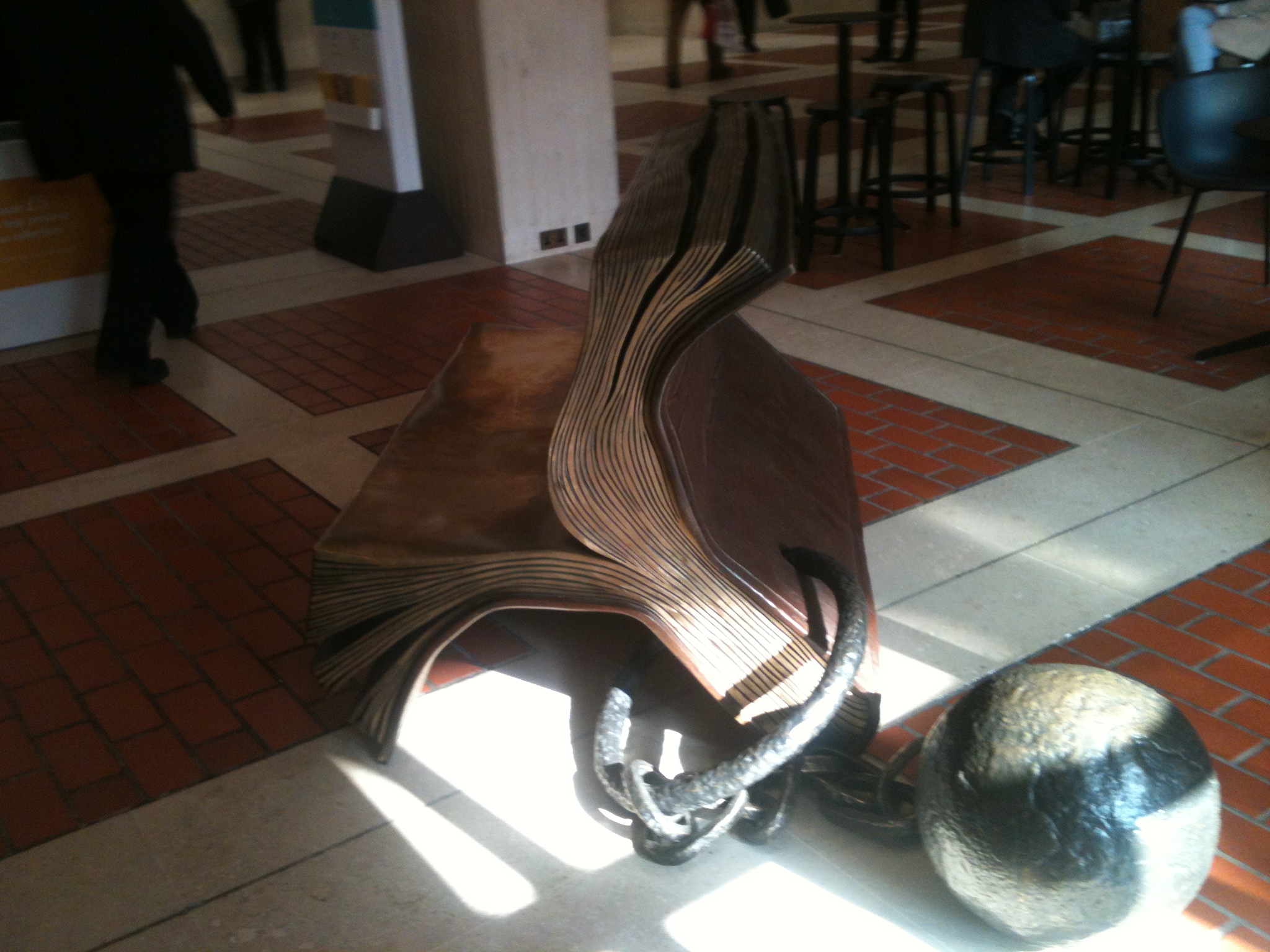
I was meeting a group of friends for a lecture about how the place of women in society can be seen in contemporary literature. ‘Contemporary’ means the last few hundred years, so it was interesting. I met the rest of the group in the foyer. There’s a bench there, in the shape of a book (like the ‘book benches’ that popped up around London in 2014). This one was metallic. When I walked round to take a photo in better light, I noticed it was attached to a ball and chain. Apparently the chain reminds people that in the past, books in libraries were chained (I’m guessing so they weren’t stolen). The ball represents the permanency of ideas – that once you have read a book, it becomes part of you, you can never ‘unread’ it.

The books and pamphlets we were shown seemed to fit into three types:

There were those that accepted the role assigned to women in the past, the domestic science books, the recipe books, the ones advising women married to colonial workers in India how to manage their staff. There were some lovely cookery books, the older ones had fairly random capital letters, because they had been printed before their usage was standardised. I was allowed to photograph pre-copyright books, so I hope you can see this one. They wrote ’s’ as ‘f’. Until 1845, they didn’t make a list of ingredients in recipes, as they weren’t expected to be followed like they are today – they were for women to read and learn.

Then there were the books protesting the roles designated to women. The literature by the suffragettes, the books ridiculing the sexist books by men, the play refuting that women should be degraded. There was a lot of this defensive literature, encouraging women to rebel and defend themselves. Some of it was about the right to control fertility – and one had a photograph of a poor woman who had eleven children, all alive. She looked tired.

Finally, there were the books, written by women, that simply broke the mould. These were brilliant. The Woman and the Car by Dorothy Levitt (1902) was one of these. She was the first British female racing driver. Her photograph showed a wealthy, attractive woman, and her book showed she would have been lots of fun. We weren’t allowed to touch the books, which was a shame, as I would’ve loved to read this one. It was open on a page that began: “If you are going to drive alone in the highways and byways it might be advisable to carry a small revolver”. There was a picture, showing a secret drawer under her seat, where the revolver could be hidden. She also wrote, “If you are driving alone, a dog is great company.” It was thanks to Dorothy that cars now have rear-view mirrors, as she advised women drivers to keep a hand mirror next to them, so they could see what was behind them without having to turn round.

It was an interesting lecture, followed by interesting chat. We were all women, so we (of course) started to discuss how women are treated in society today. In many ways, we are now considered to be equal with men. Yet Joanna Rowling was still advised to use her initials rather than her name when publishing Harry Potter, because some men/boys do not read books by women. There are still echoes of sexism in modern society – and of course, in some cultures, not much has changed and women are still basically ‘owned’, with very few rights. However, someone mentioned an art exhibition, which only exhibited women’s work. For me, this is too much. I am a woman, but I would want my work exhibited because it was good enough, not because I was woman. I know that companies now must consider the balance of their employees. Again, I would want to be employed because I was the best candidate, not because I was a woman, or foreign, or a certain religion. I’m not sure society has the balance quite right yet….

xxx

Thank you for reading.

anneethompson.com

Book Launch and Animals (not a great combo)


Hello, how was your week? Mine was extremely busy! I had the book launch for JOANNA, of course, and I’ll tell you about that in a minute. First, I will tell you about the animals (because they were quite high impact this week).

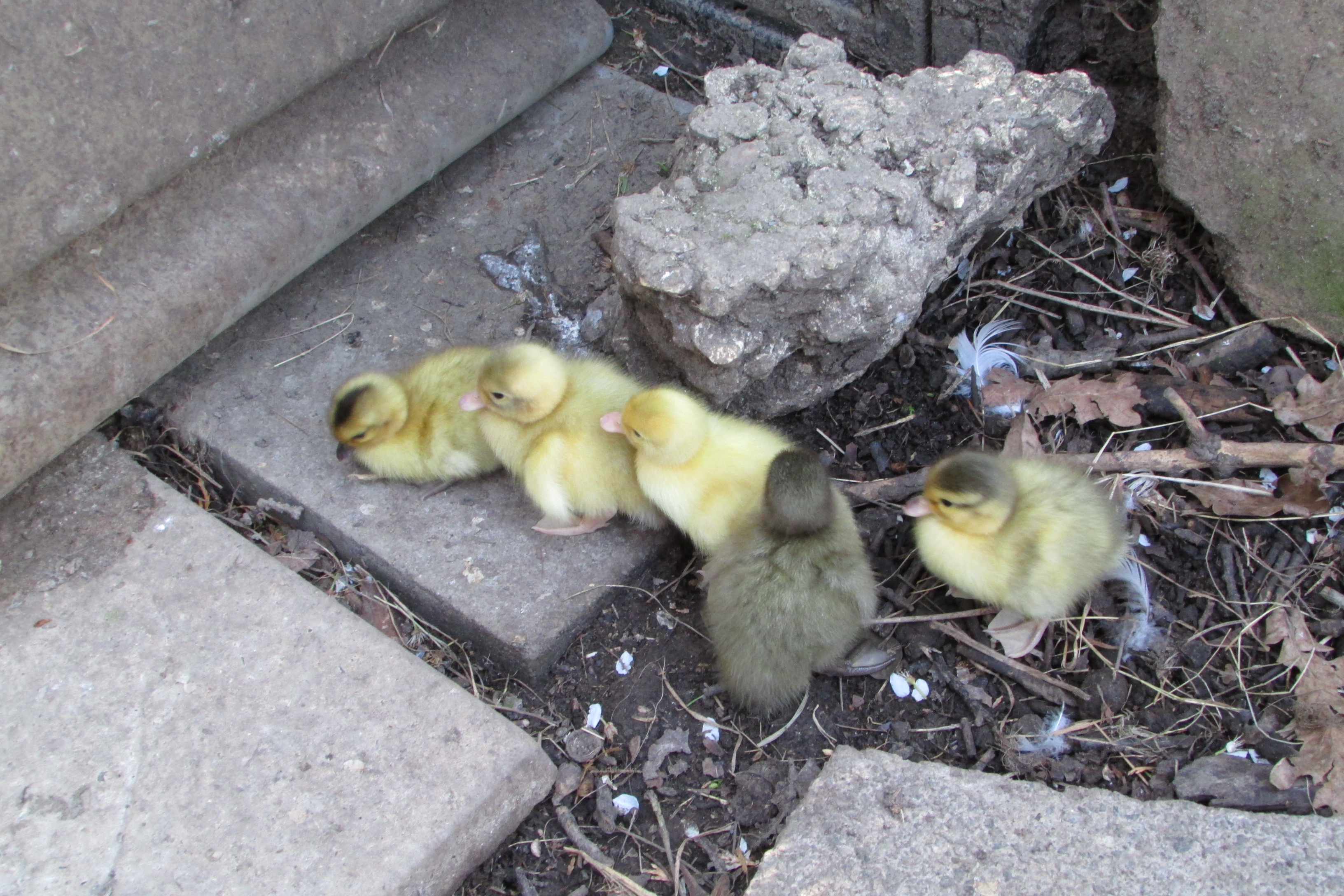
Do you remember me telling you that the ducks had nested in random places hidden around the pond? Well, last Sunday, when I went up to feed them, there was a mother on the bank, completely traumatised, with 5 ducklings and a ring of cats. I had told myself, that if the ducks chose to nest in weird places, I would let nature take its course, and they could take their chances with all the predators. When it came to it, there was no way I could let 5 ducklings be eaten if I could help. So I called husband, told Mum (who had arrived for a relaxing Mother’s Day lunch) that dinner would be late, and we attempted to catch them. Never easy. I grabbed the cats, one of which was angry when he realised I was heading for the workshop, and who stuck out his claws. (Which meant when I got to the book launch I had big scratches down both arms.)

Anyway, we managed to catch all 5 ducklings AND the mother, which was brilliant. They’re all now safely in the aviary until they’re big enough to survive on the pond.

On the day of the book launch, my daughter kindly came home to help. She wanted to see the ducklings, so went up to the pond. For some reason, when the chickens saw her, they freaked. Perhaps they’ve forgotten her – they’re not the most intelligent of animals. Anyway, all 8 chickens scattered – some flying into trees, some running into their cage, and one cockerel headed onto the bank of the pond, paused for a second, spotted the island in the middle of the pond, and decided to fly to it. Cockerels are not great at flying a distance. He got about half way, then crashed, loudly, into the pond. Great. I assume chickens can’t swim, so prepared to wade into the muddy water (this was not what I was hoping to be doing an hour before my book launch). However, he managed to use his wings like oars, and to propel himself, getting ever lower in the water, up to the island. He hauled himself up and stood there, completely bedraggled, making “I don’t know what to do now” noises.

I decided he could stay there for the night, and went to get everything ready for the evening. When I went up to the pond later, he saw me and decided he could now fly back to the bank. He couldn’t. He again landed in the pond, but managed to clamber onto an over-hanging bush. I waded out, picked him up and shoved him into the cage for the night. Stupid bird! He did look completely forlorn, dripping wet on his perch. (He was fine by the next day, in case you’re wondering).

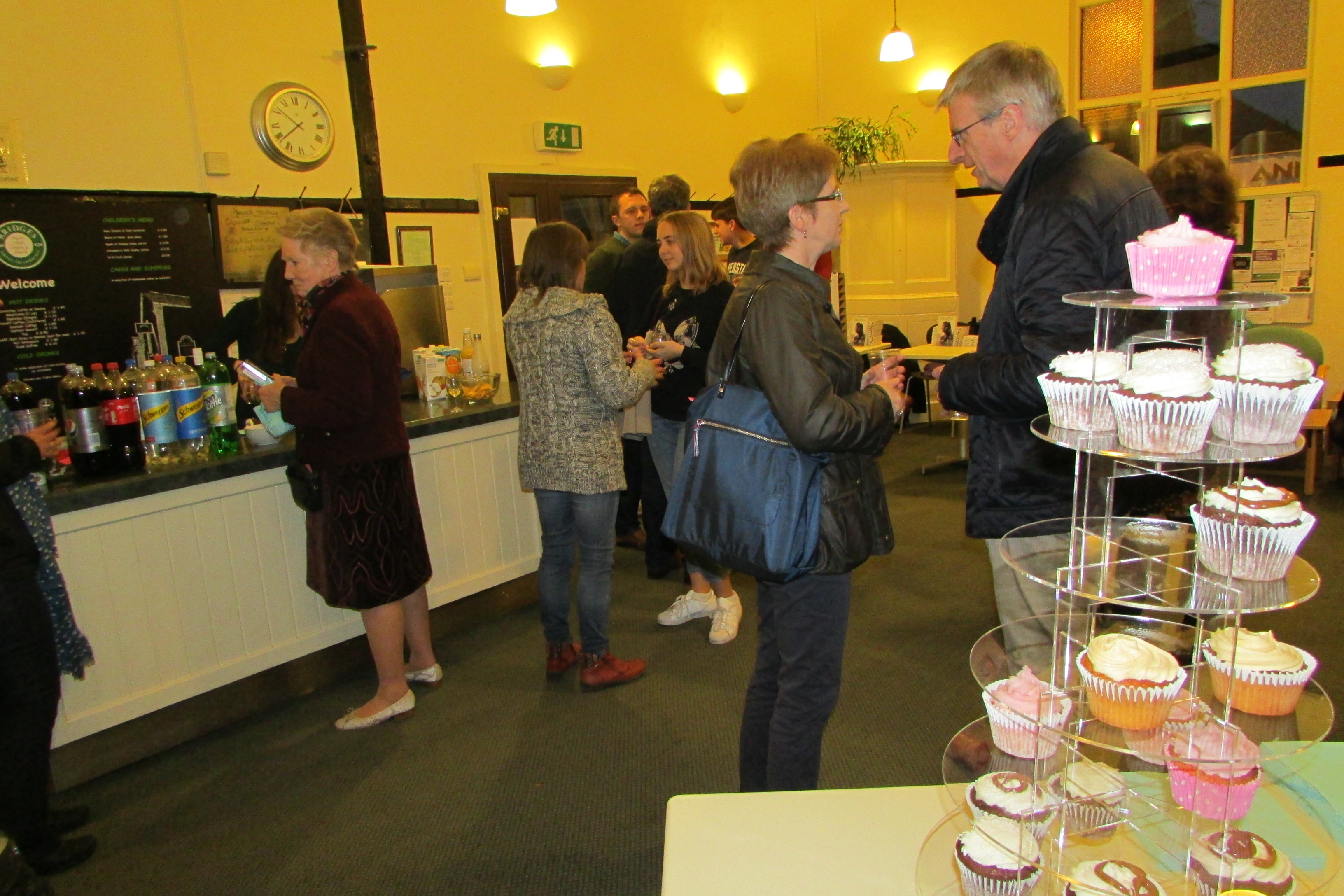
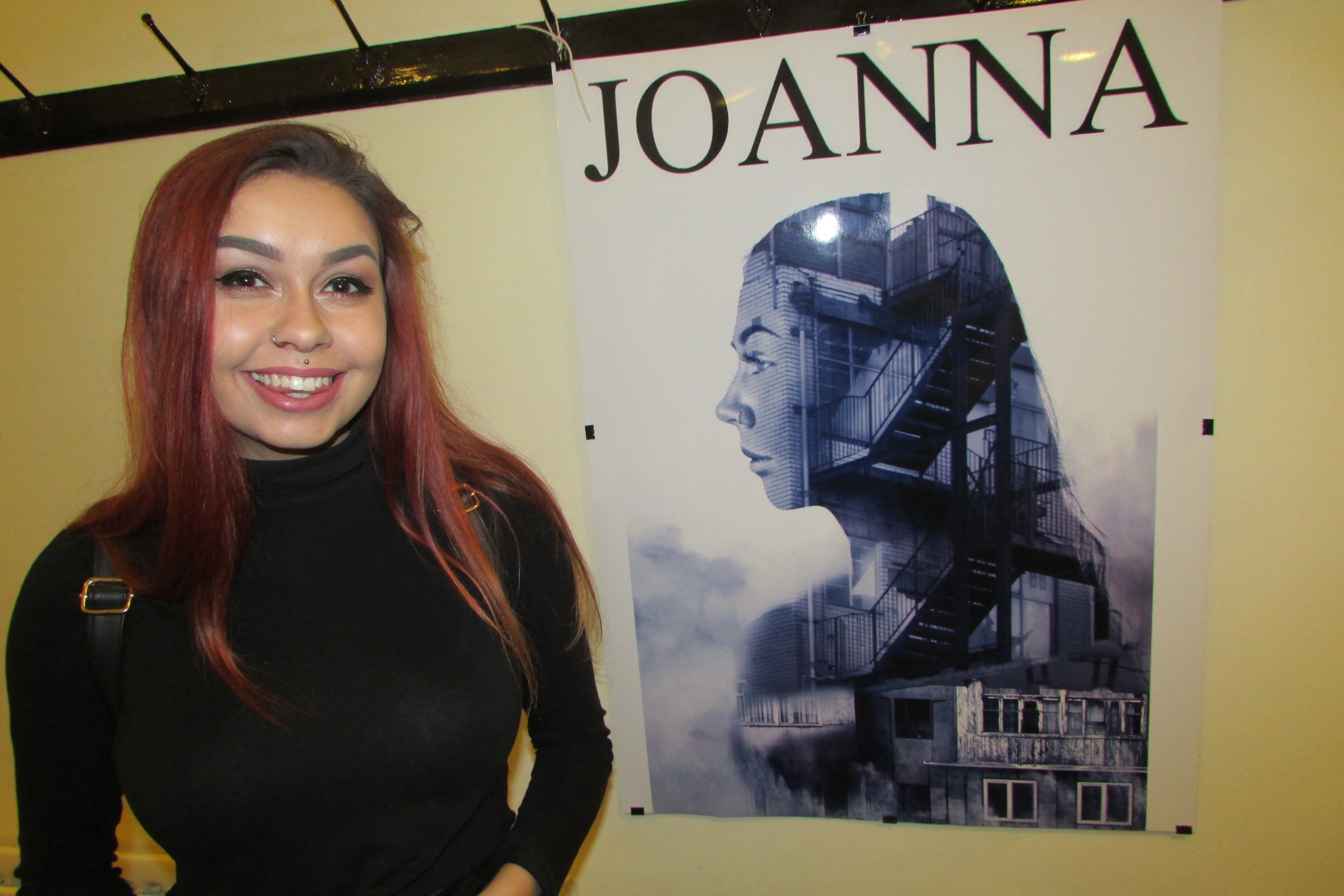
The book launch went well. I will add a section to the bottom of the “how to publish a book” page on the main blog, explaining what I did, and how the costs worked out. My family were brilliant, helping me set up the hall and serving drinks and selling books. About 60 people came, which was a relief (I was terrified it would just be me and my Mum!) I fed them wine and cupcakes, and did a short talk about why I wrote JOANNA.

I explained that we are all influenced by our family, and I wanted to show how having a psychopath in the family affects everyone else. I told them that part of the book is written in the first person, so the reader sees the world through Joanna’s eyes, they will see what motivates a psychopath, how she thinks and feels. The rest of the book shows how those around her cope with living with her, loving her, being hurt by her. The story examines the idea of choices and forgiveness, and what those things actually mean.

There was one funny moment, when a man walked in, marched purposefully through the group of people chatting, and then went and stood still, staring at a wall. I suggested Husband should check he was okay. Apparently, he had come to see the art exhibition that was advertised outside!

I managed to sell lots of books, which was wonderful. Chloe Hughes, the brilliant young photographer who did the cover photo for me, was there, so it was nice for people to meet her too. She’s very talented. (Even if people don’t like the book, they should buy it just to own a Chloe Hughes photo – she’ll be famous one day!) Now I’m hoping everyone loves the story, and tells their friends and neighbours about it. Nothing sells books like other people talking about it, so I hope they do. (I am not very ‘laid back’ about sales. Whenever an Amazon order comes through, I get very excited and walk around smiling! Honestly, every single time. It is so exciting!)

Thanks for reading. If you would like to buy your own copy of JOANNA, the link is below.

xxxx

Reasons for JOANNA


We all have family don’t we? It doesn’t matter if you live in an adopted family, or with a single parent, or with both parents and a whole host of siblings. We have family. And we are affected by them, we can’t help it.

I have a big sister who I’ve always wanted to be like, and a little brother who always won all the medals for football and continually bounced balls off the back of my head when we walked anywhere. They helped to make me who I am today. As did my parents and aunts and uncles and cousins. Family is what shapes us.

Sometimes, family is embarrassing. When someone begins a sentence, “Did you know your mother…..” I’m never sure what might be coming next. (Usually it’s something good, of course). And in turn, I as a mother feel deeply about everything my children do. Doesn’t every mother feel guilty when things aren’t perfect? When your child has a cold, don’t you wonder if you’re giving them enough vitamins? When your child fails a music exam, don’t you wonder if you should have insisted they practiced more often?

I remember as a teacher, when I needed to speak to a parent and I called for them at the school gate, “Mrs Brown, do you have a minute?” Their eyes would look worried. They always worried I might be going to tell them Billy had done something wrong, or was struggling to keep up with his peers.

These are the ideas that I wanted to consider when I wrote Joanna. Everyone has family, even those in our society who do terrible things. But they are rarely considered. Do you know who Hitler’s mother was? If he had siblings? How they felt about the things he did?

I wanted to write about the family of a psychopath, but first I had to fully understand what it meant to be a psychopath. I have already told you about what I discovered. Then I needed to explain to my readers what it meant to be a psychopath – and when you write a book, you don’t tell, you show. So I showed the reader what the world looked like through Joanna’s eyes, how she felt, what she wanted. When I had done that, I could move towards her family; I could show how they felt, the struggles they experienced being part of her, loving her. I hope, when you read my book, you will understand…

Published by The Cobweb Press
ISBN : 978-0-9954632-2-6
xxxxx
Available from book shops (if it’s not in stock, they can order it for you).

Also available from Amazon:

Thank you

PS. This evening is the ‘official’ book launch. This is terrifying! Although the local newspapers and radio have been very kind, and the launch has been well publicised, I have this fear that no one will attend. Being an author has many opportunities for public humiliation – you are very ‘out there’ when you publish a book. Hopefully it will be a wonderful celebration with lots of friends and interested people. I will let you know on Monday how it goes.

Joanna


Joanna

cover-sample

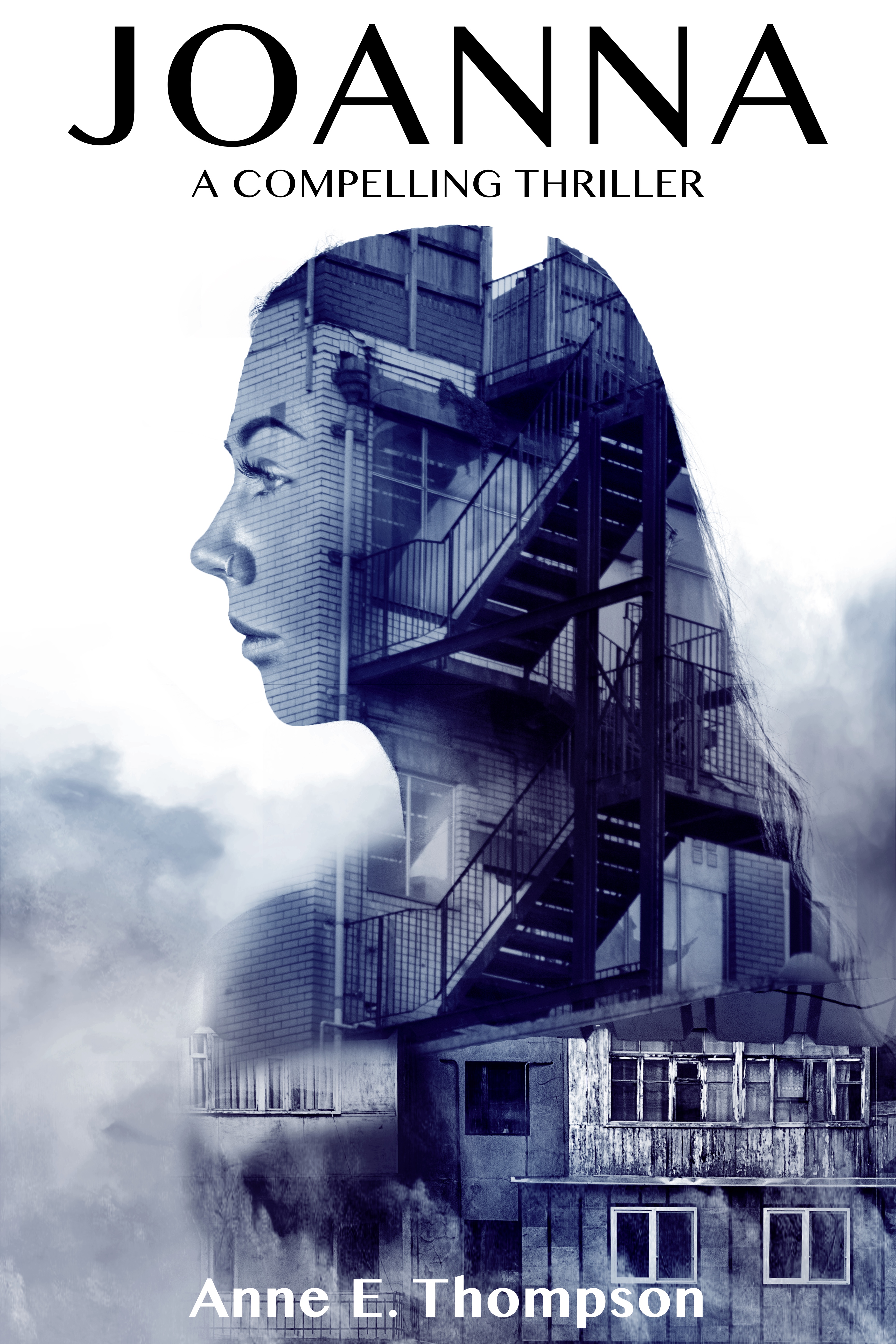
Joanna sits on the bus and begins to plan. When Joanna plans, this usually means trouble for those around her. But this particular plan brings more than trouble, it results in fear and death and guilt. But not her own guilt. Joanna is a psychopath, guilt isn’t within the range of emotions she is able to feel.

Written in the first person, we learn Joanna’s story, from the initial spark of her plan, to the horrible aftermath of wrecked lives. You will view the world through Joanna’s eyes – be careful though, she might lie to you.

This is not just her story. We also watch the impact of her actions on those close to her – the woman who raised her, and Joanna’s own daughter. How does it feel to be related to a serial killer? For how long do you carry the burden of their actions? And when it comes down to it, is anyone really innocent?

Joanna

Published by The Cobweb Press
ISBN : 978-0-9954632-2-6

Why not order a copy today?

xxxxx

Available from book shops (if it’s not in stock, they can order it for you).

US Link:

UK Link:

Thank you

dsc00120

xxx
Researching a Psychopath (and how to avoid being killed).


Do you know how to stay safe from a serial killer? Following extensive research into the disorder, I was able to write two novels.  However, I did also learn a few things that might be useful in real life, so read on for some tips on how to stay safe.

Firstly, who is a psychopath? Let’s look at a few traits. Have a think, do you know someone who’s fun to listen to, but tends to be a bit ‘glib’ – they’ll move on if someone more interesting comes along? Someone who might have been in trouble as a child – perhaps stealing or vandalising? Someone who sometimes speaks in quite a muddled manner, so if you ask them a question, you’re not always sure what their answer was? Someone who is mainly concerned with themselves – so they rarely comment, or ‘like’ other people’s posts on Facebook, unless it will benefit themselves. They won’t let you know whether or not they’ll be attending an event – and are very likely to not show up at the last minute. They like to be seen as a leader, but you’re not quite sure what they actually do. They’re often promiscuous, possibly having children from multiple partners. They lie—sometimes blatant, in your face, lies. They like excitement, and are never scared. They have grandiose ideas about their own capabilities. Do you know that person? Then possibly, you know a psychopath.

OFRQ8157

Researching psychopathy was hugely interesting—you can read more at the end of this article. I read many papers by neuroscientists, books by neurologists, and listened for many hours to convicted psychopaths. I even managed to find two mothers prepared to speak to me about raising a psychopathic child.

Going back to my first paragraph, how can you avoid being the victim of a serial killer? It is, of course, extremely unlikely that you will ever encounter a serial killer. Even though you probably know a psychopath or two, they are not likely to be killers. However, in case you are the one in a million who’s unlucky, what should you do?  Well, they are generally well planned, and will have observed a few possible victims first. So changing your routine helps, don’t always do the same things at the same time.

Also, psychopaths do not want trouble, they want an easy life. So the serial killers I researched would always choose a victim who did not have a dog. Dogs are unpredictable, they might bite the psychopath, so they would avoid those houses. (One of Dennis Radar’s first victims did have a dog, but it had been put into the garden.)

As psychopaths want things to be easy, they will think of a ploy to subdue the victim, so they don’t make a fuss until they have either been tied up or knocked unconscious. So, Ted Bundy pretended to have a broken arm and led his trusting victims to a secluded spot. When people found Dennis Radar in their homes, he told them he was ‘on the run from the police’, so instead of instantly panicking and fighting, they relaxed a bit, decided to be submissive until he had taken their money/car/food and had left. Which he never did. He used their compliance to over-power them. If those people had started fighting at the first sign of trouble, they would possibly have survived. If you suspect someone wants to hurt you, run or fight, don’t ‘play it safe’ and ‘wait and see.’ Be loud, make a fuss, fight.

Having said that, I think the odds of you being killed by a serial killer are much less than the odds of you winning a million pounds on the lottery or being a famous celebrity – so it’s not something you should worry about too much!

xxxx
anneethompson.com
xxxx

Thank you for reading. I am often asked, could the president be a psychopath? In reply, I tell them to read CLARA, as the novel shows clearly how a psychopath thinks and behaves. Most psychopaths are never convicted of any crime, and CLARA shows how, in some circumstances, the disorder could be a strength.

In JOANNA, I wanted to show the impact of living with a psychopath, and how it feels to be the mother of a killer.

Both books are available from bookshops and Amazon. The links are below. Why not buy one today?

The latest, and best book (in my opinion). An exciting novel written in the first person, which shows how a psychopath views the world. The story encompasses the world of women trafficked in India, and shows how someone very bad, can be used to achieve something amazing.

A gritty thriller, which shows what it means to be a psychopath, and how it would feel if someone in your family did something awful. (Because every psychopath has a mother.)


UK link for CLARA:

US Link for JOANNA:

UK Link:

xxxxxxxxxx

Extra Information for the Interested:

Psychopathy is a mental disorder – the brain does not respond like most people’s brains. They tend to have a smaller orbital frontal gyri (no, I didn’t know what that meant either! It means the front bit of their brain, the bit that controls empathy, is underdeveloped). They also have lower serotonin levels, so lack the ability to feel happy, to have emotional highs.

Now, most psychopaths are NOT serial killers. People tend to link the two because the reverse is not true – most serial killers probably are psychopaths. Robert Hare estimates that for every serial killer, there are 30,000 psychopaths who have never killed.

One trait of psychopathy is pathological lying. They will lie, even when it serves no purpose. If you suspect someone is a psychopath, think back to what they have told you – is it verifiable? Can you always prove what they have said is true, or do they tend to twist things slightly? It is thought that lots of politicians are psychopaths, as are the CEOs of many successful businesses.

It is difficult to detect lies though, especially as psychopaths tend to speak in a slightly confusing way. Sometimes they will contradict themselves within a sentence, so it is hard to be sure exactly what they have said. Some neuroscientists believe that they have two speech centres in the brain. For most people, everything relating to speech and words is located on the left side of the brain. However, there is some evidence that psychopaths have a second speech centre, on the right.  Dennis Radar was told he spoke in ‘word salad’ – a whole mix of phrases that barely linked.

You can watch psychopaths on YouTube, as trials and police interviews in the US are recorded, and are now available. I spent many hours listening to Ted Bundy (thought to have killed around 50 young women), Diane Downs (who shot her children), and Dennis Radar (the ‘Bind Torture Kill’ serial killer), learning their speech patterns and trying to understand how they think.

When I first started to watch video clips of convicted serial killers, I was shocked by how nice they were! I have always thought myself a good judge of character – and perhaps if I met them in real life it would be different – but they came across as nice people. Ted Bundy was an attractive, witty, intelligent man. If we knew him, we might have invited him round for dinner. He talks about coming from a ‘loving Christian family’ where he was ‘raised according to standards in the Bible’. However, my background reading indicates his mother fell pregnant when young, and some believe Ted’s father was his grandfather, who she lived with until she married another man. Ted Bundy for many years thought his mother was his sister.

They are often entertaining, very charismatic. Charles Manson (leader of the ‘Manson Family’ sect) was fascinating to watch, you couldn’t avoid listening to him.

Psychopathy is now diagnosed using Hare’s checklist – a list of traits. Most people have some of these traits, a psychopath will have most of them. Psychopathy is a spectrum, a bit like autism (though a very different disorder.) An autistic person will have emotional empathy, they will ‘feel’ how someone else feels, so detect anger or joy, but they will not understand why. A psychopath is the opposite, they will have neurological empathy, they understand how someone is feeling, and can even use this to manipulate people’s feelings, but they have no emotional empathy. A toddler laughing will not make them smile, they don’t pick up the ‘feelings’. You will probably appear somewhere on the psychopathic spectrum, perhaps you are selfish, or like to be in charge, or don’t often feel other’s emotions; but mostly, you will have the same responses as everyone else. You are only classified as a psychopath if you show most of the symptoms.

The neuroscientist James Fallon, was researching the changes in the brain under certain stimuli using an MRI scanner. He found he could detect psychopathy by the results of an MRI scan, he could actually see who was a psychopath.

You can read more about psychopaths, and my research, and general author-type things on my blog. Why not take a look today? Oh, and don’t forget to follow those links and check out my novels! Thank you. x


Anne E. Thompson has written several novels and one non-fiction book. You can find her work in bookshops and Amazon.

Speaking on the Radio (very exciting and slightly terrifying…)


I was invited to speak on Meridian FM, which was very exciting (and rather terrifying!) I’ve never been on the radio before, so had no idea what to expect.

I arrived about half an hour too early, because I was stressing about being late or not being able to park anywhere. I ended up going for a walk, so it was lucky the weather was warm. Then I went inside.

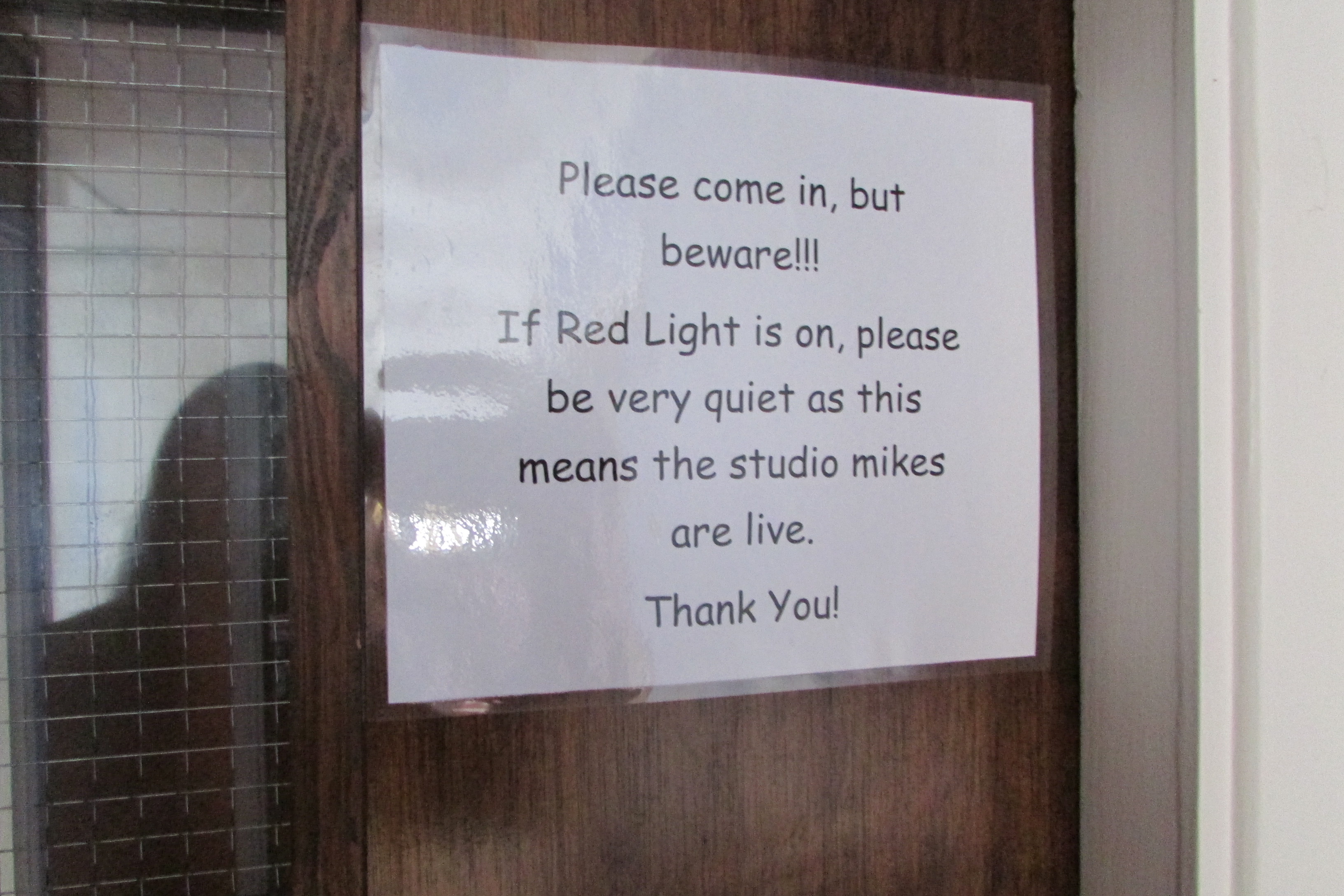
Meridian FM is based at the Jubilee Centre in East Grinstead, which is a large building (with a big carpark) in an industrial estate. The downstairs rooms are used for a playgroup and community events. I was told to go up to the first floor. At the top of the stairs was a door, with signs warning me to be quiet if the red light was lit as they would be on air. How exciting is that!

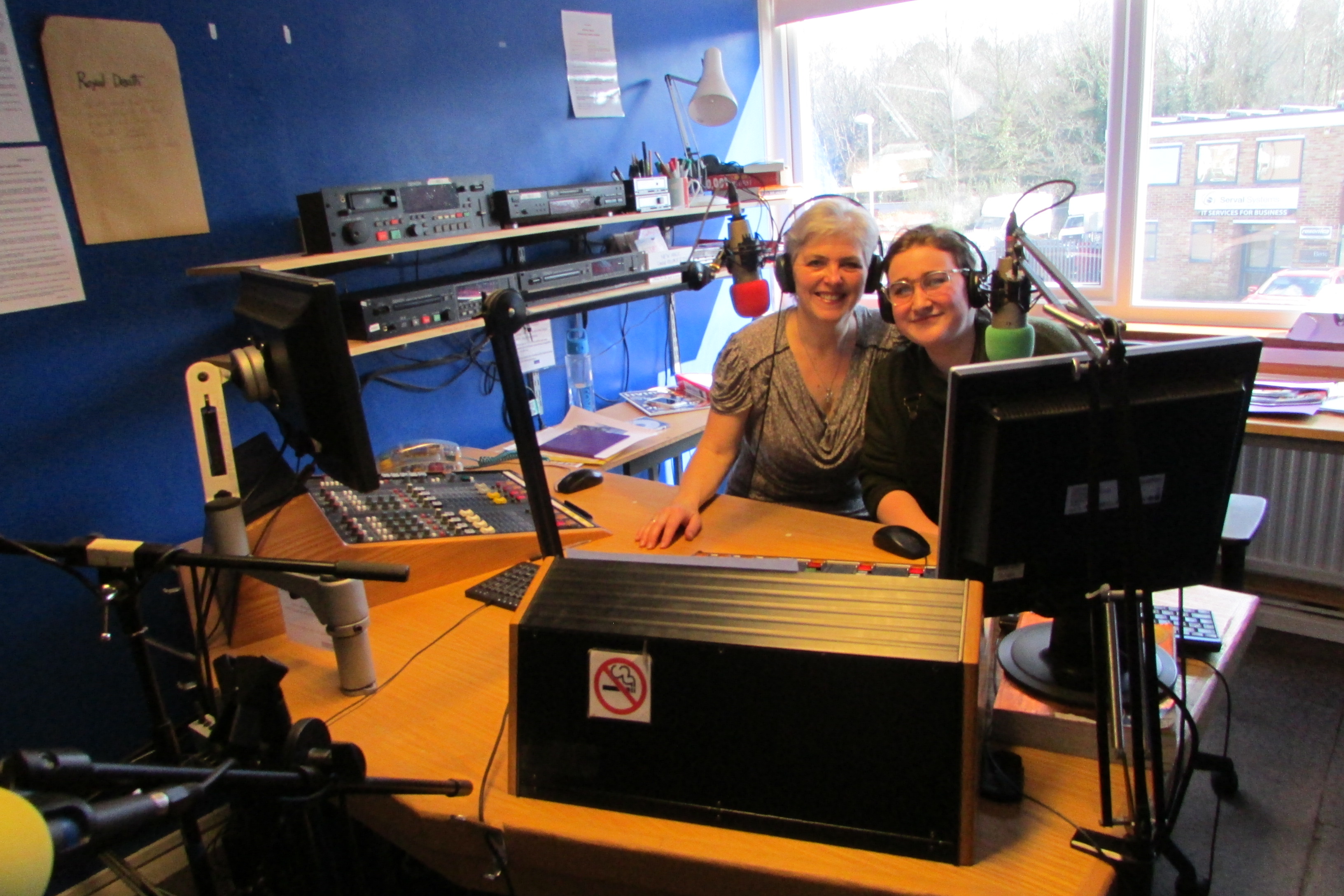
I then went in to an extremely hot room (they seriously need some air conditioning) and I waited until Samantha Day, whose show I was speaking on, was ready. One of the local journalists, who knew I would be there, popped in too, to take a photo. (So I was glad I had worn some make-up, I nearly hadn’t bothered as it was the radio and no one would be able to see me!)

I sat on a chair, facing a big orange mic. Samantha did a sound check, telling me to move nearer and nearer. I told her I was a teacher, I could speak as loud as she wanted – she said to speak up a bit! On the desk was a whole lot of equipment – computers, sound desk type stuff, wires. The other side sat Samantha, and a student doing work-experience. They wore headphones, and Samantha controlled the volume, played music etc in between interviewing me. She was very good at her job. There was a lot going on all at once – I arrived as she was finishing with other guests, she was interviewing, putting on music, directing us, welcoming me and saying goodbye to them, all at once. No one else was up there. When she hasn’t got guests, it must be a weirdly lonely job. Strange to be talking to 8,000 listeners in a room entirely on your own.

My interview was fine (big relief). I had sent Samantha some information about psychopaths, and she had formed questions from this. To be honest, I had forgotten what I’d sent her, and probably wandered ‘off script’ a bit, but it didn’t seem to matter. I can waffle about psychopaths for hours. I could see her while we talked, so I managed to forget other people were listening, and it was really just a chat between the two of us.

My daughter had sent a whole lot of instructions about what not to say – “Jokes about Nanny won’t be funny”, and I managed to not do anything wrong. Husband had suggested a few jokes in case I got stuck – but none were at all suitable, so I didn’t repeat any of those. I also resisted the temptation to do the whole interview in a foreign accent, and managed to not swear. So all in all, a success.

Of course, the main purpose for me was to promote JOANNA and the book launch. Samantha was brilliant here, and asked me right at the beginning to explain where and when the launch was, so I could forget about that and just chat about psychopaths. Hopefully it will encourage some interest in the book. I was able to explain how psychopaths think differently, their brain doesn’t process information and respond in the same way as most people’s. I then told her that I had written JOANNA partly in the first person, showing the reader how Joanna viewed the world. The rest of the book shows how other people are affected by Joanna, what it was like to parent her, live with her, work with her. As the reader hears from other people, they realise that Joanna lied to them in the first part of the book, that her view of the world is not an accurate one.

I do hope it will lead to some sales. I am back in East Grinstead on 8th April, to do a book signing at the bookshop there. Hopefully people will come. So far, everyone has been very interested in the book – I think psychopathy is a hugely interesting subject, and people seem fascinated by it. I will let you know what happens next.

xxx

Thank you for reading.

JOANNA is available from bookshops and Amazon.

Published by The Cobweb Press
ISBN : 978-0-9954632-2-6
Available from bookshops (if it’s not in stock, they can order it).

xxx

How to Advertise a Launch Party (which is mostly scary….)


Hello, how are you? I hope you’ve had a good week.

I’ve been busy advertising the launch of JOANNA. As I have said before, I love writing books, researching new ideas and weaving them into a story. And I pretty much hate everything to do with all sales and promotions once the books are published. I think many authors do, but it’s part of the job. When you are self-published, the whole promotion exercise is down to you. It is therefore hugely appreciated when people help – whoever they might be.

One great piece of help recently was from a friend who bought Hidden Faces and lent it to one of her friends (who I don’t know). Now, mostly, lending a book results in a lost sale for the poor author. However, this friend of a friend happens to run an online bookshop. She read the book, loved it, sent me a very nice email and ordered 40 copies to sell. That was a very nice help.

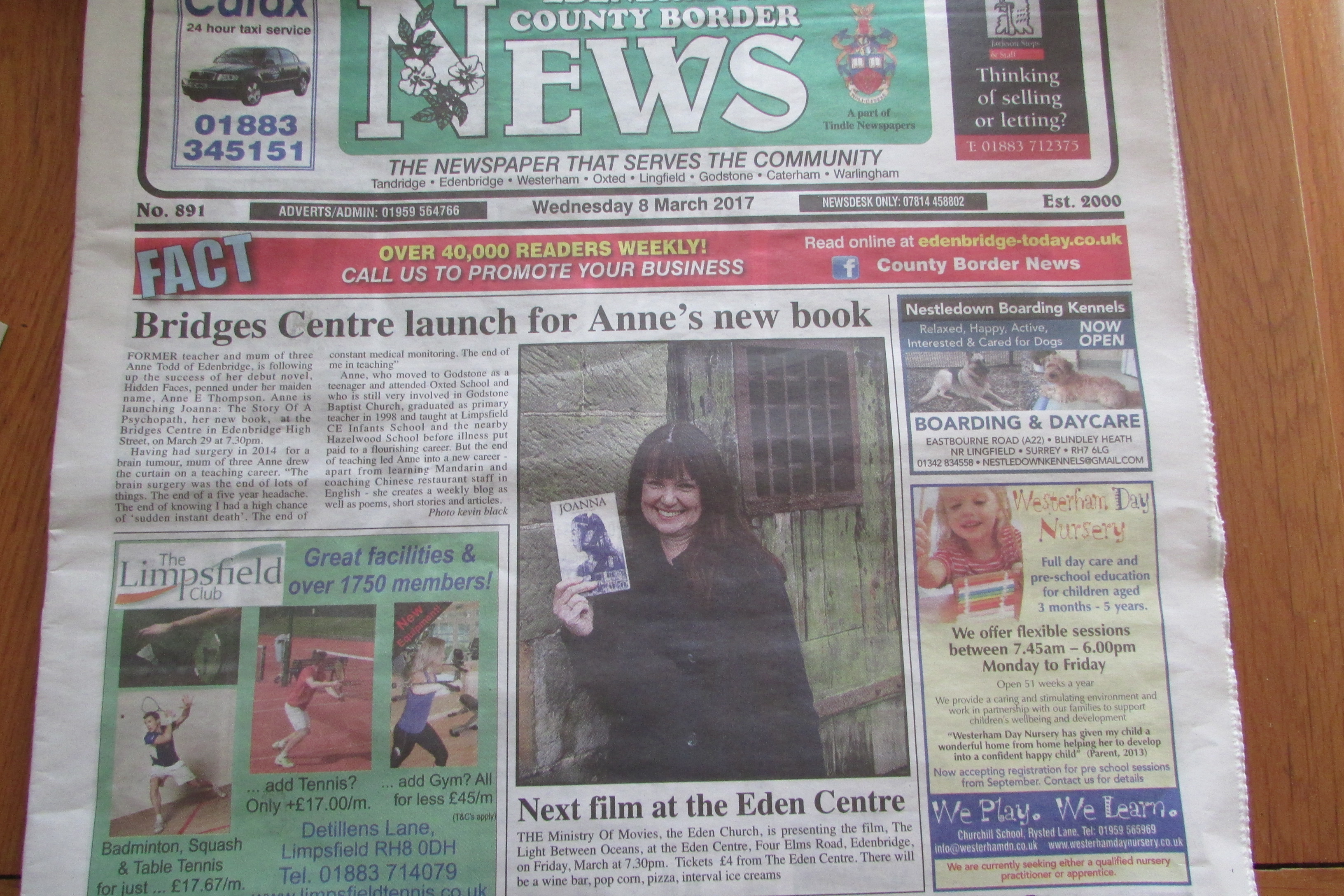
JOANNA has also been featured in local newspapers. Again, I always really appreciate this, as it’s a good way to tell people about my book. I was on the front cover of The County Border News. Embarrassing photo, but good advert for the book:

There was also a nice article in The Edenbridge Chronicle:

If you want to be featured in a local paper, I would suggest emailing the editor to ask if this is the sort of thing they cover. If you can include some local interest – like that you attended a local school, or were the postman in the town for many years, or your Dad ran the chip shop, it encourages them to take an interest in you. They want to know their readers will care that you have written a book (because these days, loads of people self-publish!) I have found the local journalists to be incredibly supportive, which was unexpected and rather nice.

Tomorrow I’ll tell you about being interviewed on the radio. I’ve never done that before.

If you would like to buy a copy of JOANNA, it’s now available on Amazon, and can be ordered from all bookshops.

Published by The Cobweb Press
ISBN: 978-0-9954632-2-6


London : Sayings and Stories


A friend called and asked if I’d like to join her on a guided walking tour of London. It was organised by Sevenoaks School, so we were slightly bemused as we’ve had no links with the school since our sons left nearly 5 years ago. However, we haven’t seen each other for ages and it sounded quite fun, so we signed up.

We met near Tower Bridge. Our guide was a nice man, short, carrying a briefcase and umbrella (he looked like the accountant in The Untouchables, but I didn’t mention it.) I was worried he might stick the umbrella into the air for us all to follow – at which point I would’ve left – but it stayed safely in his bag. He was actually very interesting, he remembered a huge number of facts, and told little stories as we walked around. The walk took 2 hours, mainly because we walked very slowly. I thought I’d tell you some of his stories, about the origins of sayings. They might, or might not, be true, but they were interesting.

Near the Tower of London, is the spot where they executed people who were not considered royal enough to be killed within the walls. There were a few plaques, one of which commemorated the husband of Lady Jane Grey (but I’ve forgotten his name. I would not make a good guide!) Lady Jane Grey was queen, after Henry VIII, for 9 days. After this, Mary (Henry’s daughter) rode into London and had Jane locked up in the tower. Hence the saying, “a nine day wonder”.

We also passed the pub, ‘The Hung, Drawn and Quartered’. It’s possible the owners have very bad grammar (paintings are hung, people are hanged). However, on the side is a plaque with a quote from Samuel Pepys, which includes the same words. So perhaps it was Pepys who had bad grammar and the publican was being ironic.

We passed Bakers Hall, owned by the guild of bakers. When they used fire-heated bread ovens, they got it to temperature, then shoved a piece of elm across the opening, to keep the heat in. This was the “stop gap”. The underside of the loaf would be covered in ash, so that was sold cheaply to the poor. Only the rich could afford “the upper crust”.

We went to a small lane, called Lovats Lane (used to be called Lovers Lane). It was very narrow, and led away from Eastcheap (which is where the meat and fish were sold). ‘Cheap’ was the word for ‘exchange’, or a market. In the past, horse-drawn wagons would have used the lane, going from the river to the market. It would be difficult to pass as it was so narrow, and often the wheels would touch and get stuck. Sometimes though, they touched but managed to keep going, hence the saying, “touch and go”.

We walked down to the river, just below Monument (great tall monument which my son has walked past many times without ever noticing! It’s a monument to the great fire of London). Next to St Magnus the Martyr church, you can see the remains of previous London Bridges. There is a lump of wood which was from the original Roman London Bridge. There is the stone that replaced the wooden bridge, which was destroyed in 1014 when London was attacked, and gave rise to the song, “London Bridge is Falling Down”. There is also the stone from the bridge that was replaced in the 70s because it was too narrow. Apparently we sold it to a chap from Arizona who bought the wrong bridge, as he thought he was buying Tower Bridge. Easy mistake. I was quite surprised the current bridge has only been there since the 1970s, I had assumed it was older.

We walked towards St Paul’s Cathedral, passing other guildhalls on the way. All the guilds used to take part in the Lord Mayor’s Show each year. It was held on the Thames, hence each guild entered a “float”. Two of the guilds constantly argued about their position in the procession, so it was decided they would alternate each year between the places six and seven. Hence the saying, “at sixes and sevens”.

We came to Cheapside, which was where in the past you could buy a piglet. So it didn’t escape, it would be sold, wriggling, in a tied sack. Sometimes the dishonest farmer would substitute the pig, and you’d get home, open the sack, and find not a piglet but a cat. If you checked when at the market and opened the sack in the market, you would “let the cat out of the bag”.
During the reformation, Westminster Abbey, which was catholic, was emptied of everything valuable. At the time it was called St Peter’s. The poor people didn’t gain from this though, as all the icons were carried to the anglican church, which happened to be St Paul’s. Hence, they “robbed Peter to pay Paul”.

We went behind The Old Bailey, and peered through some gates to where you can see a wall, which is all that remains of Newgate Prison. Prisoners to be executed would have a last confession to a priest (called shrift), but as they were deemed to be going to Hell anyway, the priest wouldn’t waste too much time on them, so they would receive “short shrift”. They could then have one last drink in the pub on the way to the gallows – hence “one for the road”. The cart that carried them was called a lurch, hence you could be “left in the lurch”. Anyone who didn’t go into the pub to drink was left “on the wagon”.

There was one guy (name escapes me, I’ll call him James) who was stuck for a few years in the debtors prison. He got to know many of London’s criminals. When he was released, a new law was passed, increasing the penalty for buying stolen goods. This meant few people wanted to buy them, and the price went down. James figured that the people most likely to want to buy the stolen goods, were the people who had had them stolen. He therefore set up a system whereby, if you were robbed, you could go to James with a list of stolen goods and he would find them and sell them back to you. When the items were reunited with the owner, James put a cross next to the robber’s name. Sometimes James discovered a robber hadn’t been honest with him, and so instead of buying the goods and selling them back to the original owner, James would tell the police where to find the robber. When that happened, he put two crosses next to the robber’s name. Hence, the robber was “double crossed”. Eventually, James himself was caught and hanged. (But not hung, because he wasn’t a painting…..)

xxxxxx

Thank you for reading.

xxxxxxx

If you enjoyed this, you will love my new book: The Sarcastic Mother’s Holiday Diary.
I have always written a diary on holiday, so last Christmas, I decided to find all my old diaries and blogs, and make a book for my children. However, several other people also asked for a copy, so I have written a public version – it’s available on Amazon and has been described as “The Durrells meet Bill Bryson”!

Why not buy a copy today? I think it will make you laugh.

The US link is here:

The India link is here:

The UK link is here:

xxx

Don’t tell anyone, but….


I found a lump. I don’t usually discuss personal things on my blog, I like to keep them private. But sometimes it might be helpful for people to hear, so I occasionally force myself to.

Anyway, I don’t usually check for odd lumps and bumps – do you? I know that I should, especially as there is so much family history of cancer. Though it seems to me, that nowadays, everyone has a family history of cancer. I don’t know anyone who hasn’t lost a parent or aunt or cousin. To be honest, I think it’s because I know cancer is in the family, that I don’t like checking. I kind of don’t want to know. I don’t want to have to deal with it, to think about it, to have all the hassle related to any kind of medical problem.

It’s not that I’m worried about dying. When I was diagnosed with a brain tumour, the reality of my body having a ‘use-by’ date was rather hammered home. I had to face that I very well might die soon. It wasn’t scary, because I know what I believe about God, and I trusted him to take care of the whole afterwards side of things. But I didn’t want to die. I still don’t. Partly because I don’t want to miss things – I want to see my children settled, any grandchildren that come along, spend time as a grumpy old woman with my grumpy old husband. Plus there’s lots of things I still want to do. So death, although not scary, is unwelcome.

No, it’s not that I might die, it’s the medical intervention that worries me. I don’t want to be ill. All the hassle of hospitals, and having no energy, and inconveniencing other people. I just don’t want it. I’ve been ill, had my five year headache, recovered from a craniotomy, done. I don’t want something else. Surely it should be someone else’s turn? So, I don’t check very often, but occasionally I do, and this time I found something. Big bummer.

I went to the doctor. Never easy, but they gave me an appointment and I saw a very efficient woman, who said I needed to be referred to the hospital. Disappointing – I was hoping she’d tell me it was nothing and to go home and not be silly.

The hospital appointment came within a couple of weeks, and off I went with some books to read and snacks. Hospitals are never quick. I didn’t tell anyone, because I found with the brain tumour that people don’t always react how you want. They either try to reassure you, and tell you not to worry – which they cannot possibly know, and you are worried, so that doesn’t help. Or, they go into panic mode and you end up reassuring them instead! So I mentioned it to Husband, but then went off on my own.

It was fine. The staff were very professional. I had to wait about three years in various waiting rooms, and I was pretty sure one patient had died a few weeks ago and hadn’t been spotted yet, but when you actually were with the doctors, they were very good. They managed to be sensitive and business-like, and I trusted them. People moan about the NHS in the UK, but I wouldn’t want to be ill anywhere else. We have good doctors and nurses and support staff.

People in hospital are different, have you noticed that? Outside, they might be highly educated, or very fashionable, or super-rich. But in hospital, waiting to find out whether or not you have cancer, everyone is the same. Just people. All tired of waiting. All slightly tense. All real. There’s not much pretence in a hospital, which I kind of like.

My lump turned out to be nothing. It can safely be ignored. They were nice about it though, said I did the right thing to have it checked – because if it had been something nasty, they can often deal with it before it does any harm. Which is why I’m writing this. Old or young, male or female, when did you last do the ‘odd lump’ check? Perhaps you should. I’m not brave, and I hate doing things like that, but if I managed it, so can you.

•••
Thanks for reading.

If you want to know more about what I believe, take a look at :
https://anneethompson.com/how-to/378-2/

On a completely different note…..I was emailed by Samantha Day from Meridian FM and asked if I would speak on the radio about psychopaths, and JOANNA, and my book launch. Wow! Very scary, very exciting. I am going on Wednesday 15th at 11 o’clock. I’m assuming it’s a live broadcast, as her show is 11 til 1, but it might not be. I will let you know how I get on.

Animals and Neighbours


img_5572

The cockerels survived! If you read an earlier post, you’ll know that the DEFRA quarantine (for bird flu) lasted until the end of February. I was worried that when I released the birds into the garden, the cockerels would think it was new territory (having bird brains, and all that) and would fight. Cockerels fight to the death, even if you try to separate them, so I was worried. I couldn’t find anything helpful online – I’m not sure many ‘hobby’ farmers keep cockerels. I decided I would start to let the birds out just as it was getting dark. They are rigid about their routines, and as soon as it gets dark, they all roost on their perch, all in a set order. I thought that maybe, if it was beginning to get dark, even if they started to fight, the urge to roost would be greater, so they’d stop attacking each other before one was dead.

Well, it worked fine. I opened the cage door, and they all rushed out. No fighting. Excellent. The four new ones have never left the cage before, so they were very interested by it all, the older ones went straight onto the compost heap for a good dig.

One of the new ones is tiny, even smaller than her mother (I bought “large chicken eggs” on Ebay, but one- the mother of the latest clutch – is a bantam. That’s Ebay for you!) She was so excited she started to fly around and sit in the trees, which was pretty cool. I was slightly worried the cats might think she was small enough to catch, as she’s smaller than a rat and they do a good job at keeping them under control. When I released them, the dog and all four outside cats arrived to watch. The cats like living outside, but they’re both nosey and keen for snuggles, so they follow us around when we’re in the garden. I watched them carefully, but whenever they were approached by a hen, even a small one, they backed away quickly. They clearly associate chickens with being pecked rather than with sport/food. Which is good. Always a good idea to introduce very young predators to adult birds – they learn to not attack. My cats had some sharp pecks when they were kittens, and obviously remember.

As it grew darker, the three old birds went straight back into the cage to roost. The younger birds partied for a bit longer; which worried the dog, who was keen to round them up, but I wanted to wait and see what happened, so made her sit beside me. She sat there, nudging me with her nose and whimpering – disagreed with my decision. It was fine, they all went to bed before it was properly dark. That’s the only nice thing about short winter days I think, the chickens go to bed early. When the clocks move forward, I will have to wait until later before I can shut the door, which makes going out in the evening difficult.

The ducks are all laying. There are little nests of eggs all around the pond. I keep finding them, and don’t know how old they are, so am leaving them (would be embarrassing to give someone an old egg to eat). Not sure if they’ll sit, it’s still quite early, but sometimes they do if the weather’s warm. I have enough ducks, so if they do, when the ducklings are full grown I’ll give them away. They’re not far removed from mallards, so can fly and would cope fine on a wild pond. I do hope bird flu doesn’t spread to this area. I like my birds.

img_5571

The cats are fat. I think they put on extra fat during the winter months, plus their fur is really thick. They are wonderful to cuddle. Sometimes I try to bring one inside, but they’re very unsettled and want to get back in the garden as soon as they can. They all come running when I whistle, so if I have any meat scraps, I’ll call them to the door.

We have sheep in the field next to the house. They’re fat too, so I’m hoping we might have lambs soon. I don’t like walking through the field when there’re mothers and young – sometimes they become aggressive – so we’re having to find new walks. The dog likes this, but I don’t. I tend to walk each day when I need a break from writing, and I like to walk the same way, so I don’t have to concentrate and can loose myself in the story while I walk. Then when we get home, I’m usually ready to write the next part of the story.

At the moment while I walk, I’m also delivering invites to the book launch on 29th. My neighbours all live several fields away, so I rarely see them. There is one house, which has tall fences and gates, down a private track. It has no name, no letterbox. No one (that I have asked) knows who lives there, but it used to be a pop star. If you look on Google maps, there is a big house and a few small cottages. Who lives there? Could be someone famous. Or a Mafia don. Or someone royal. Very interesting. Very occasionally, the gates are left open. If I’m walking past, I shall sneak in with an invitation – you never know, they might like to come to a book launch. If I discover who lives there, I’ll let you know.

xxx

Thank you for reading.

xxx