This week has been a busy garden week. We decided to try and create a vegetable patch in the garden. This is probably unwise, as neither of us are gardeners, and we both think the other person is going to do all the hard work. I suspect we will simply create an eatery for slugs and caterpillars, but perhaps that’s overly negative.
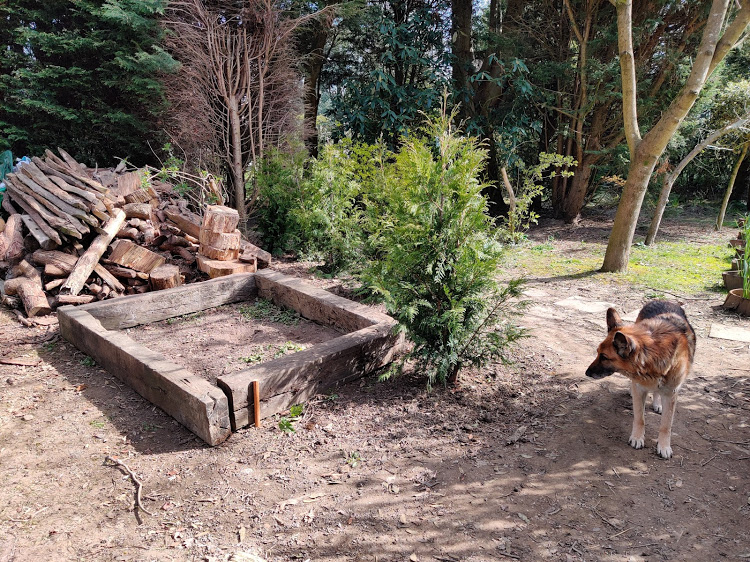
Once we had decided the position of the vegetable patch (which took longer than you might expect) Husband decided to mark it with a border of sleepers—which we have left over from when we moved the pond a couple of years ago. Moving sleepers is very difficult—they are extremely heavy and all our children have inconveniently grown-up and left home. I helped by muttering about hernias, and maybe waiting until the boys next visited, and was it worth the effort when we’d only grow slugs anyway?
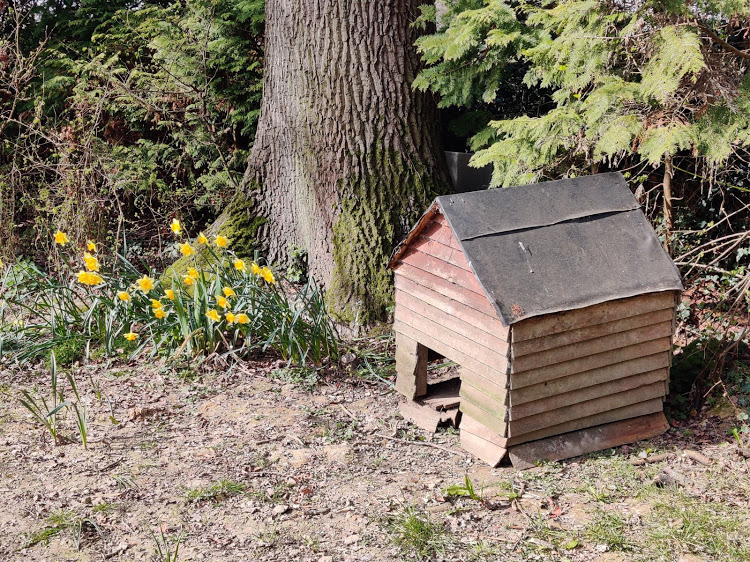
Husband was more inventive, and after I had left and gone into the house, he set to work. The first job was to move the old duck house, which had been on the island before we moved the pond but was a nuisance as it was always full of eggs that I couldn’t reach so had since been moved to the compost heap (because that is obviously the ideal place for a duck house). Husband moved it to under the oak tree, using a system of rolling logs. He then created a series of levers and rollers with old logs, and managed to move the sleepers into place. When I went to check he wasn’t lying in agony with a hernia/slipped disc/broken foot, I found him standing next to the frame of our vegetable patch, looking extremely pleased with himself. He explained his method of using old logs and branches to make rollers and levers in great detail (really, I am saving you from a lot of physics here). It was apparently akin to how people built Stonehenge. But better (obviously).
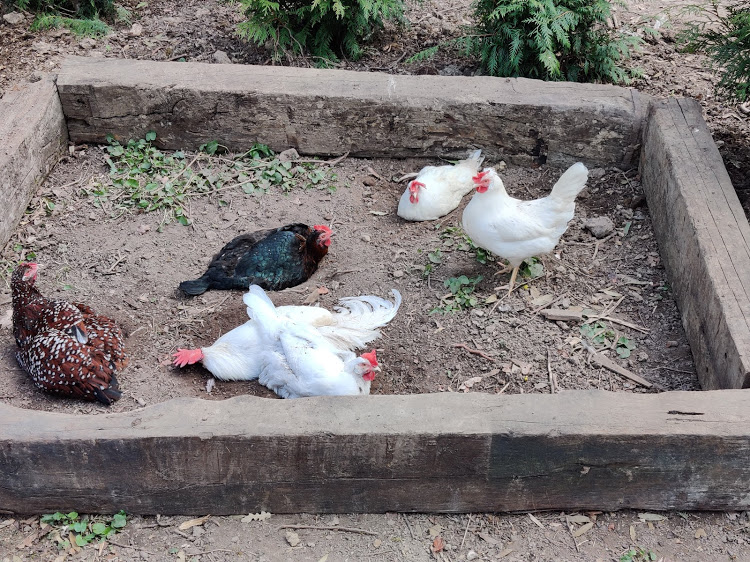
The plan was to remove the weeds from the inside of the excellent frame, and then fill it with compost. However, the chickens had other plans. They were released from their prison a few days ago, when DEFRA announced the bird-flu threat had reduced, and my chickens have been loving the freedom. They clearly decided that Husband had been making a communal bath for them, and have used it ever since as a place to bath. (For the uninformed amongst you, chickens clean themselves by digging into dry earth and kicking it all over themselves. This dust-bath is a very good way to clean feathers.)
I am still not convinced we will ever manage to grow vegetables, but will let you know.
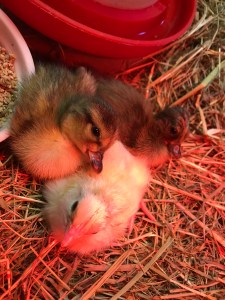
I have also been trying to grow ducks—but not much success there either. I had 20 eggs in the incubator, and they all seemed to be developing well. But then all went quiet. One duck hatched very quickly, and I named him Aleph and put him in the garage. He was lonely, so I gave him a mirror to chat to. He spent long hours in conversation with his reflection.
A day later, Bet hatched. The following day, Gimel emerged from the one chicken egg (because I prefer brown eggs—am hoping the chick isn’t a cockerel). But then…nothing. Very disappointing.
I opened a few eggs, and the birds all seem to have developed to a certain stage and then died. I’m guessing they died a few days before they should have hatched—no idea why. Perhaps something knocked the incubator, or there was something in the air. None had gone bad (which can kill the other eggs) so it must be something external.
It’s especially disappointing because the fox has been visiting again (I think it must have cubs) and I lost two of my female ducks. The remaining female is currently safe because she’s on a nest in the hutch (not the old one Stone-Age-Husband moved). I’m hoping she has more success with hatching her ducklings than I did.
Having a chat.
Hope your week went better than mine.
Thanks for reading. Take care.
Love, Anne x
Thank you for reading
anneethompson.com
Why not sign up to follow my blog?
Hello, have you had your Covid vaccine yet? I had mine this week, and it was both more fun than expected, and more time-consuming. I had booked an appointment online, so went to a nearby vaccine centre in Tonbridge. This took a whole chunk out of the day—whether you are trying to write a book or attempting to learn Hebrew verb conjugations, always real life gets in the way. But perhaps that is good for me.
Anyway, the vaccine was more fun than expected because I had not really focussed on the fact that everyone there would be about the same age. When you are waiting in a sport’s hall with about 200 people of your age-group, you cannot help but compare how you are doing. I went at the same time as Husband, so I checked out how he is doing too (and I think I chose quite well actually, there were a lot of big bellies and bald heads amongst the other candidates!)
My main advice when you have the vaccine is make sure you’ve combed your hair and worn something flattering.
As far as what to wear, it’s also worth wearing something with a sleeve that will roll up. I was surprised how many people had not really thought about what they were going for—unless they thought it was going to be stuck somewhere other than their arm? One person seemed to be having a major strip-tease going on. It reminded me of when I taught the reception class, and without fail when you told the class to change for P.E. there was always one child who got carried away. You would tell them to change, start collecting equipment and then glance up to find a naked body in the room. It matters less when they’re only 5.
It was hard to not think I was having side-effects because at every stage we were told what to expect, given a booklet of scary things to watch for, and were even told by our nurse how ill she had been afterwards. Husband had read somewhere that in trials, about 38% of people had side-effects. He also read that about 20% of people who were given the placebo had side-effects. Hard not to think your little toe feels odd if someone asks you.
I read an interesting article about side-affects from the vaccine. Apparently, they are due to the body having an allergic reaction to the vaccine—much as chicken-pox spots are due to an allergy to the disease rather than the actual disease causing spots. (I think this is different to things like hay-fever, so I don’t think anti-histamine would help.) As older bodies have a less responsive reaction to allergies (and rarely have hay-fever) so too they are less likely to have a big reaction to the vaccine. The younger you are, the more likely it is that your body will decide it doesn’t like the vaccine and produce a temperature or headache. This is completely separate to the antibody producing bit, so whether you have a reaction or not, the antibody count is likely to be similar. The good news is that if you have a bad reaction with the first dose, when you have the second dose your body will realise that it’s not harmful, and there is unlikely to be the same allergic response.
I didn’t have much problem with side-affects (clearly too old).
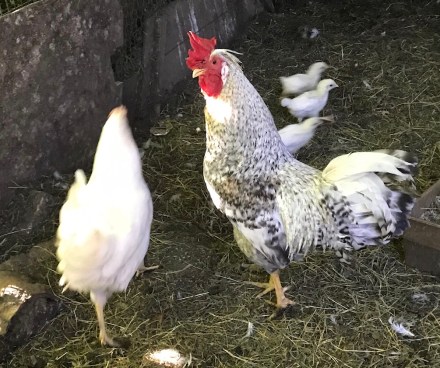
One thing that did hurt me was being attacked on Wednesday. I was collecting the eggs, and had stooped to reach into the nesting box, when suddenly I was walloped on the leg, which caught me off-balance and I fell over. The wretched cockerel had decided I was interfering with his women and had sprung into attack. He’s attacked me before, and I have picked him up and marched round with him tucked under my arm until he’d calmed down, but as it clearly hasn’t stopped him it was more of an issue this time. A nasty cockerel will attack people, cats, dogs, ducks—everything really. Big problem. Plus it really hurt. His spurs had cut right through my trousers, and although the cut was only about 1cm wide, it was fairly deep.
I wasn’t sure what you’re supposed to do with a wound from a cockerel spur. Is it like a bite and needs special attention, or do you just clean it and stick on a plaster? I went for the Savlon and plaster method and it seems to be healing. Don’t ask what happened to the cockerel, but he won’t be attacking anyone else.
Hope you have a pain-free week. Thanks for reading.
Take care.
Love, Anne x
Thank you for reading
anneethompson.com
Why not sign up to follow my blog?
I learnt something interesting recently. I think I am slightly behind the curve, and maybe you knew this already—when Jesus was dying on the cross, he was probably reciting Psalm 22.
I knew that the psalm links to the crucifixion, as it seems to describe exactly how Jesus would be feeling, and some of the actions listed (like gambling to see who would win his clothes) actually happened at the time. I have always thought it was a poem, written about 600 years earlier, to describe how Jesus felt (because God can write things before they happen). But it had never occurred to me that Jesus, in his darkest time, would have recited it.
I learnt about it in a Greek lesson, because the words of Jesus on the cross were recorded by the gospel writers. But here’s the thing: the gospels were written in Greek, and each writer added their own slant. So in the synoptics (Matthew, Mark, Luke) they want to show how Jesus suffered on the cross and so they recite (but in Greek):
“My God, my God, why have you abandoned me?” (See Matthew 27 vs 46)
However, when John wrote his book, he wanted to show how everything about Jesus’ life was planned by God, and the crucifixion was part of that plan, and so he quotes the end of Jesus’ words:
“It is finished.” (See John 19 vs 30)
As I said, John was writing in Greek, and in Greek they are able to write in tense that shows something has happened in the past—but the consequences have not finished, it is on-going. In English we can do this with certain words, so if we say: “I became a vegetarian a year ago” it can be assumed we are still a vegetarian now (but not necessarily, because English doesn’t have the same clever tenses that Greek does).
John used this tense when he wrote the final words of Jesus. It was finished, in the past, but the consequences will continue.
Of course, Jesus wouldn’t have recited the Psalm in Greek, he spoke Hebrew/Aramaic. I don’t know enough Hebrew yet to tell you whether they have the same clever tenses that Koine Greek does, so I only know that he probably recited Psalm 22 when he was on the cross.
Does this knowledge make a difference?
Well, the stuff about the gospel writers using Greek to give an angle on what was said is interesting, but probably doesn’t affect me overly. But the idea that Jesus quoted scripture at his most difficult time makes me think that perhaps this is something I should aspire to do. If Jesus came to give us an example of how to live, maybe when life is hard for me, I should also recite scripture—perhaps it would comfort me and help me to focus on better things than the horrible situation I am coping with. I will probably never suffer anything on the same scale as being crucified, but everyone has dark times, don’t they? We all feel overwhelmed sometimes.
Of course, I can only recite scripture if I have previously learnt it. Which is not something that’s very fashionable these days. Perhaps it should be. I think I will try.
Psalm 22 is very long, so I won’t start with that one. I think it might be a good one to learn next year—perhaps as a discipline for Lent. Do you want to join me? We could learn a few lines every day, and by Easter we will know the whole Psalm. I will divide the Psalm into segments and post them on my blog (I can predate things now, so next year they will arrive in emails to my followers). It will be good for our brains if nothing else!
For now, I will try to learn Psalm 1 (because it’s short). It would be good for me to learn it in Hebrew, as that’s my current challenge—I will let you know how I get on.
Thanks for reading. I hope you find some interesting challenges this week.
Love, Anne x
Thank you for reading
anneethompson.com
Why not sign up to follow my blog?
Look on your device for this icon (it’s probably right at the bottom of the screen if you scroll down). Follow the link to follow my blog!
I watched my son die today. My beautiful boy, beaten, battered and left to die. And my heart broke. I held my cloak close and I remembered the weight of him as a babe, like a boulder on my hip, wriggling to be free, to run and jump and climb.
Those legs will run no more. Those limbs—I was so proud when they grew. I remember when he grew as tall as me, then taller even than Joseph. I remember watching him, stretched out as he ate, those long limbs seemed to go on forever. “I grew him,” I used to think with pride. But those limbs will not sprawl relaxed in my home ever again.
I watched his hands, the hands that used to pat me cheekily on the head when he’d grown tall. Those strong hands which laboured with wood, which helped me carry heavy loads, which lifted young children playfully.
They are no longer strong. I saw them bang nails through the flesh, felt that I heard the sound of bone shattering over the thump of the hammer, heard his ragged breath as they forced the cross upright. And I wondered if I too might die. But I watched. I am his mother and I would not leave him alone.
When they tried to take me home, when they told me to shield my eyes, avert my gaze, I did not. For he was my son. I would never leave him alone, not at such an anguished hour of need. Others watched. Some women were there, terrified and hanging back. Not me, I am his mother. I stood with John, where he could see me. What could they do to me that was worse than this?
Others watched who hated him. They mocked and spat and called abuse. It could not hurt him now, I thought, let them shout.
“He trusts in God,” they called, “Let God save him now,” and they laughed, even as he died, they laughed.
Yet even God deserted him by the end and that was hardest to bear. He called out with a loud shout, asking why God had turned from him. “My God,” he called in anguish, “why have you forsaken me?”
But I was there. I did not leave. I saw them crucify him, naked upon a cross. No mother wants to see her grown son naked, but still I did not look away. I was there at the beginning, I would stay with him until the end.
The soldiers took his clothes, for fabric is costly and even that of a criminal should not go to waste. Most they tore and shared between them, but not his tunic. They cast lots for that, not wanting to spoil something precious. Yet my son was precious and they destroyed him.
It began last night. They woke me from my sleep and warned me there was trouble. He had been arrested, taken from a meal with his friends and questioned by the temple authorities. They feared the invaders, so he was then referred to a court of Godless law, a place that feared no God. They told me that he was scourged, beaten with whips that removed chunks of flesh as they struck. He was mocked and abused, then brought to this place.
I came, stumbling through streets full of people, full of noise and smells and fear and hatred. I came to this place, this Godforsaken hill beyond the city wall and I saw my son, my boy, diminished, shrunken somehow. I saw that what they had told me was true, smelt the repugnant stink of excrement mingle with the metallic stench of blood. I heard the shouts of abuse, the curses of the guards, the screams from the prisoners, the wails from friends. And him, like an oasis of calm amidst the turmoil, suffering but at peace.
And he saw me. Those dark eyes that as a baby had watched me intently when he fed. Those eyes that twinkled merrily when he teased me and became serious when he wanted to explain something important. Those eyes, red rimmed with exhaustion now, turned to me. Even hanging there, with parched mouth and dried lips, he spoke to me. His voice was hoarse, for he had refused the wine they offered, but I heard him well. A mother knows her child’s voice. I stood with John and my son told me that this was to be my son now and he was to care for me as a mother. Even in his torment he cared for me, fulfilled his duty as my son. Still I would not leave.
Then it ended. The sky had turned as black as my world and he drew his last breath. It was finished. Those who had mocked became silent, some cried, some beat their breasts in despair. The blackness of the sky frightened them and many fled, wondering at what they had done.
I left, I let them lead me away. My soul was broken and my heart beat even though I bid it stop. My boy was gone, my firstborn, special baby, was no more. I carried that knowledge like a rock within me, I would have rather died in his place. How can I live, continue with my life knowing he is gone? There will be no more sunshine or laughter, nothing matters now. The core of me has gone. I cannot even cry.
Afterwards, I could not rest and I heard strange stories. They said the soldiers pierced his side, to check there was no life in him. His blood had separated so they took him down, a solid corpse that had no life.
A man came and took the body, they said they followed and knew where he lay, in a tomb that was guarded. They told me of strange things, of the temple curtain torn in two, of dead men walking and boulders breaking open. I do not know. I only know my boy is gone. That is all that matters.
It should not have been like this. It was so recently that people praised his name, sang and danced before him, treated him like a king. It should not have ended like this.
And yet, I recall a song, it comes persistently to mind, sung often in the synagogue. It speaks of one forsaken by God in his time of need, scorned by many. He belonged to God from before he was born, then suffered at the hands of many. They sung of bones poured out like water, a heart of melted wax, that is how my boy would have felt. They sung of hands and feet pierced like his and enemies gloating over him. They sang of lots being cast for clothing and of God’s ultimate victory. They sung of remembering him for ever, not just now but families of every nation, even those presently unborn. For he has done it.
Is this my son’s song? Were the words written for him? Are these the words he whispered while he died?
He spoke of his death often, he tried to warn me that he would die. But not like this, not before my own time has come. No mother should bury her child, it goes against what is natural and right. Though, he showed no fear, he knew what his end would be. And he told me there was more.
As I turn now to sleep, I wonder at his words. Will he truly return somehow and will I know?
Has he finished what he was sent to do?
************
If Mary was a young teenager when she learned she was pregnant (which would fit with the age that girls became betrothed in those days) then when Jesus died aged thirty-three, she would have been about forty-seven. How does a woman of that age cope with the things she was forced to witness and how much would she have understood at the time? I have sons, contemplating their dying is too horrible for words. I am sure she loved her boy as much as we love ours.
Crucifixion was a ghastly way to die. We learn in the Bible that Jesus, who never sinned, who never did anything wrong, died to save the world. What does that mean? You can learn more Here
However, many people were crucified, some probably unjustly accused. So is it the death that was important or was it that God became separate? I think that this is the key issue here: the part of Jesus that was God, left him. That was more terrible than crucifixion. That is what each of us deserves and what we do not have to suffer if we choose to come to God. If we want to know God, we can, even if that means changing our minds.
You may not believe in God, but God believes in you.
The song which Mary recalled in the story was Psalm 22. I will write more about it in another blog.
****
Thank you for reading.
If you liked this, why not sign up to follow my blog?
I struggle to learn things out of context or anything to do with numbers—so learning the Hebrew alphabet has been a challenge. (I console myself with the knowledge that this is predominantly a ‘right-side’ of the brain activity, and the right side of my brain got chopped up during surgery—but to be honest, I never knew the English alphabet either, and that was before surgery!)
However, just to make things even trickier, the Hebrew alphabet is also linked to numbers. The first ten letters represent the numbers (1-10, not surprisingly). Then the eleventh number is 20, the twelfth letter is 30, and so on up to 100. Then the letters jump in hundreds up to 400.
א1 בּ2 גּ3 דּ4 ה5 ו6 ז7 ח8 ט9 י10
כּ20 ל30 מ40 נ50 ס60 ע70 פ80 צ90
ק100 ר200 שׁ300 ת400
This makes it perfect for use as a secret code. In fact, if you remember, I gave Husband a gift of the Israeli series that was the fore-runner of the Homeland series. In Homeland, one character sends messages by taping the morse-code. But in the original series, the characters communicate by tapping their fingers and each number of taps corresponds to a letter, a wrap of the knuckles represents numbers 10 to 90, and so on. This would actually make a fairly simple code to use and learn. I have always loved secret codes, and many hours as a child trying to devise ones for my friends (which were always much to complicated to ever be used). But now I have the Hebrew version, I’m thinking we might use it. Think what fun it will be to be on a crowded train, and to be able to discuss the person sitting opposite us, simply by moving our fingers a number of times.
At the moment, Husband is proving resistant to learning the Hebrew alphabet so we can send secret messages to each other (such a shame my children all grew up and left home). Am thinking of with-holding treats until he can ask for them in code. . .
I have also enjoyed the garden this week. In the autumn, Husband cleared one of the flower beds and ordered hundreds of tulip bulbs (not sure exactly how many—a lot) which he duly planted. When the weather turned warmer, all the spring flowers came up, but the bed of tulips remained bare. I didn’t tease him at all about this. Then, one exciting day, a couple of tulips could be seen pushing up from the soil. Within a couple of weeks, the bed was a mass of tulip sprouts. . . and one hyacinth. (I did not plant the hyacinth, I promise, though if I had thought of it, it would have been a funny thing to do.) The hyacinth was duly transplanted to a different flower bed. The chickens are still imprisoned due to bird-flu so all looks promising for a pretty display very soon.
I’m not sure what is happening with the ducks. There are three hens and two nests. They seem to be sharing. I don’t think there’s a very high chance of any ducklings from them because they sit for a while and then get bored and go back to the pond. I might do what I did last year, and give them all to a chicken to hatch.
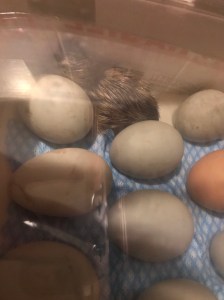
The incubator is whirring away, and the eggs I have stolen should hatch soon. I smuggled in a couple of chicken eggs, as my brown hens are fairly old, and I’d like to keep the line going. If I hatch hens (always more males hatch, so I’ll be lucky) then potentially they could have green eggs, as they’ll be hybrids of my blue-egg birds and my brown-egg hens. But realistically, they’ll probably be cockerels and simply cause trouble. Very little in life is easy.
Thank you for reading
anneethompson.com
Why not sign up to follow my blog?
There has been talk in the media about rich countries blocking the rights of developing countries with regard to the Covid vaccine. On face value, this looks disgraceful, and when I read the headlines I feel a rush of anger, the campaigner in me starts to protest and I am ready to start writing letters. But wait. There is more at stake than first appears.
Governments know that they need to share the Covid vaccine. If only the rich countries are vaccinated, then variants will develop rapidly and the vaccine will be useless. I don’t know how quickly our rich governments are sending vaccines to poorer countries, but they do at least understand the science and are making generous-sounding claims. We can help them with this by being vocal amongst ourselves and on social media. We need to share the vaccine with others.
The issue is whether developing countries are given permission to produce the vaccine, and this is a different issue altogether. If the patents are dropped (the legal thing that allows the vaccine developer to control who can make it) then it will be harder to ensure safety standards—will the vaccine be produced and transported and stored correctly? We do not have the same food safety standards around the world, I assume we also don’t have the same pharmaceutical standards around the world.
There is also the issue of money. There has been a lot of bad press recently about drugs companies and individuals making money from the vaccine, but I tend to dismiss this. (People love to hate rich people—look at the general hatred towards bankers, even though much of the income that makes England wealthy is generated by those same hated bankers. I suspect jealousy is often the motivation.) I don’t know how rich the pharmaceutical companies are, but I do know that if we remove their revenue, they will stop investing in new drugs, and working for those companies will become an unattractive option.
People increasingly expect to receive things for free. This has caused a huge upheaval in some markets—if everyone streams their music for free, what happens to the people who produce the music? If all books are read online for free, what happens to the authors? If all films are viewed via streaming and the cinemas all shut, who will have the money to make quality films? Could the removal of patents be the start of the same problem for drug companies?
Ah, you might say, but we could centralise them, make them the property of the people and put governments in charge. Perhaps you are right, but in my experience that didn’t work very well in the past. When I think of the industries controlled by the government a few decades ago, most of them were inefficient and costly. When I have visited countries that were run by a single communist government, I don’t see places that I would choose to move to.
I think the problem is that people are basically greedy. When populations have a wealth of food, they get fat. When governments are in control of too much power, the bureaucrats get rich while the populations suffer. Today, the heads of pharmaceutical companies will be getting rich—but only if they produce drugs that are effective. If we remove their ability to get rich, then someone else will get rich instead but the quality of drugs will spiral with their demotivation.
I don’t know whether patents should be removed from medicines—that is beyond my field of expertise and I can only offer opinions. But I do know that when we decide policy, we are foolish if we don’t factor in human flaws. Sometimes the least bad option is the best we can hope for.
Thank you for reading.
Thank you for reading
anneethompson.com
Why not sign up to follow my blog?
Hello, what kind of a week have you had? I am enjoying seeing all the spring flowers, the lambs in the field next to the house, and a few blue skies. Spring time has so much promise. The pond is lovely, though it is sadly bare of plants. Even the grass on the bank is being dug up and eaten by greedy ducks—perhaps in retaliation for my stealing their eggs.
Ducks are generally terrible mothers—they often lay their eggs in random places, and although occasionally one will make a nest and hatch the eggs, as soon as they hatch she leaves the nest and goes back to the pond. The ducklings have to struggle to keep up with her, or else be eaten. I am usually aware that the eggs have hatched because I hear the crows and magpies as they circle the pond, ready for a tasty snack.
I am currently collecting the eggs as they are laid, and will incubate them when I have enough. I’ll leave three in the nest. There is one nest, the other eggs are laid randomly on the bank, some roll into the water, some are collected by crows—my ducks clearly never read the ‘how to build a nest’ manual. I’ll then raise them inside until they’re too big for the crows to eat (they’re full-grown in four weeks). Am hoping to time it so they are on the pond before I have to start serious revision for my exams.
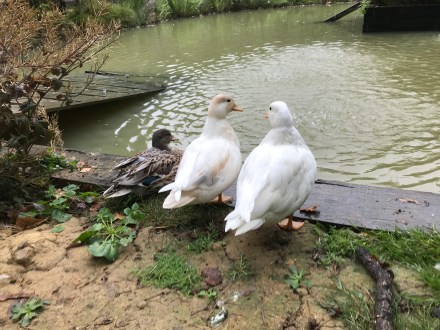
Ducks having a chat.
Ducks are lovely, but they do tend to destroy anything growing around the pond. I have tried protecting plants with nets and fences—but they don’t look very nice. In the early days, I used to believe the people in the garden centres who would assure me that I could buy certain plants and ‘the ducks won’t eat them.’ They either lied, or knew very little about ducks.
So, if you hope to both keep ducks and grow plants around your pond, here is a list of plants that ducks will eat. Some of them are poisonous, so they shouldn’t really be planted near a pond (though none of my ducks have ever died from eating plants that are listed as ‘poisonous’). It is quite a long list.
Plants that ducks will eat include:
water starwort hornwort willow moss frog’s lettuce mare’s-tail water violet water milfoils water lobelia water crowfoot
They also eat floating plants such as:
frogbit water soldier duckweed waterlilies (all kinds)
Marginal plants they will eat include: great water plantain water hawthorn bog bean arum lily sweet flag flowering rush bog arum yellow flag corkscrew rush golden club pickerel weed large-flowered spearwort Old World arrowhead zebra rush T. laxmannii T. minima Acorus gramineus ‘Variegatus’ marsh marigold Bowles’ golden sedge Carex pendula C. pseudocyperus golden buttons Houttuynia cordata Japanese water iris Iris versicolor Mimulus cardinalis M. lewisii M. luteus M. ringens water forget-me-not Saururus cernuus brooklime
Plants that ducks do not eat include:
.
.
.
.
.
Nope, cannot think of any. Trees I guess—but only because duck feet are designed to swim not perch, so they cannot reach the leaves very easily.
Hoping your plants grow well this spring.
Thanks for reading. Take care. Love, Anne x
Thank you for reading
anneethompson.com
Why not sign up to follow my blog?
Look on your device for this icon (it’s probably right at the bottom of the screen if you scroll down). Follow the link to follow my blog!
Last week, the second part of my Greek course started. The tutor gave us an overview of Biblical Greek, and how the culture and church seem to reflect the language.
Greek was an enthusiastic language, a sort of bubble of words that flowed like the thoughts in your head. It reminds me of when a 7-year-old writes a story, with lots of “and…and…and…and then…and…” This might be because some of the books in the New Testament were dictated—and that’s how people talk, but it also seems to be a feature of the language. It’s a wonderfully expressive language. In English, a verb basically can tell you what’s happening, and the time period (‘I went’ or ‘I go’) but not much more. In Greek, time is a tiny element, and verbs have aspects that convey whether the action happened once or was on-going, whether the action was passive or active, who did it. There is a lot of mood and feeling in the ancient Greek language.
Sentences in Greek are often very long. When they’re translated into English, the translators usually add punctuation, so a single sentence in Greek might be split into many sentences in English. (Originally, there was no punctuation, and people paused wherever they felt it was right.) The order of the words is not important, with ideas and expressions spurted onto the page in an order that appears to be random.
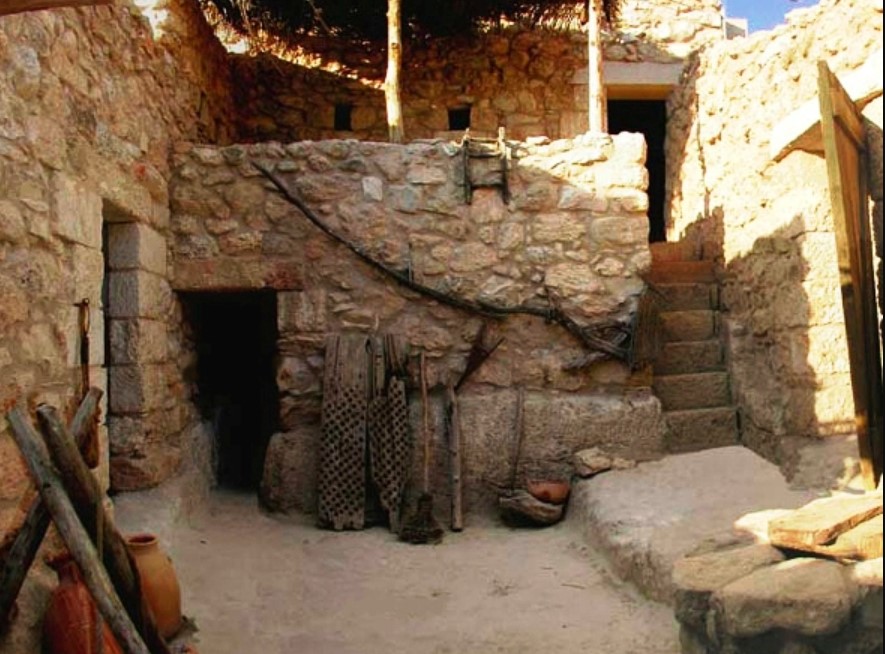
At the time that Greek was being spoken, the church was meeting in homes. The groups would have been fairly small, and homes automatically convey something intimate, expressive. When someone is sitting in your home, you notice if they are sad or worried, sharing emotions would be natural. Like the language, the church would have been enthusiastically conveying ideas and feelings, passing on the themes that Jesus spoke about—a lot of love and acceptance, looking to God rather than rules, learning how to change.
(Image: Blendspace) A home in New Testament times
As the church grew, people needed somewhere bigger to meet. A suitable building was the hall used as a law court. Instead of all sitting in a home, people now would have faced in the same direction, with a speaker at the front. The speaker would have been sitting where during the rest of the week the judge presiding over the court would have sat. The language gradually changed from Greek to Latin, which I understand is a language with strict rules.
The emphasis of the church also seemed to change, moving from expressions of love and freedom towards deciding rules. Who, exactly, was a Christian? Did they need to be circumcised? What were the rules of this new religion? What were the essentials that a person needed to believe in so they could be ‘classified’ as a Christian?
Today, we might like to think our churches are like the friendly church that met in homes, but we do seem to spend a lot of time talking about ‘non-Christians’ and the points they need to believe so that they can ‘become a Christian.’
Churches are currently seeing another huge change, as around the world they are unable to meet in person and services are all virtual. People miss being in the same space, being able to chat with their friends, touch each other, share a smile. But there are good elements too. People who are house-bound are able to be part of the fellowship again. Those who work unsociable hours can watch the service when they have time. People who want to be anonymous can watch a service unseen, they can listen to the Bible truths without having to defend their privacy, without the ‘danger’ of having to join something they are not yet sure about. I know that some churches have many more people ‘logging-on’ to their services than used to attend in person. I know of young people who would never have attended a service, but who will watch an online service, because they feel comfortable with that, it’s easy, more like the interactions they are used to.
Personally, I am enjoying Sundays in a way I never have before. As I wrote in a previous blog, it has become a special day, rather than one of duty. I can enjoy a service without being asked to do a job the minute I walk into the building. I have a loud tuneless singing voice and I’m not expected to sing or to keep standing up. When I take communion I am not wondering how many people have coughed on the bread before I eat it or if the server has washed their hands, and when I drink the ‘wine’ I don’t brace ready for an unknown acidic juice of dubious origin. Instead, I can listen to the words, and think about God, and take communion thinking only about what it means and why I am doing it. (Yes, I am bit of a grumpy unsociable person.)
I hope that when (if) the world opens up again and things start to return to normal, the church won’t rush to return to exactly the same model as before. I hope the leaders will keep some of the good things that have arisen this year.
Languages evolve, and people change. The church is simply a group of people trying to follow God together, and it’s interesting to look back and see the changes reflected there too.
Thanks for reading. Hope any changes in your life this week are good ones.
Take care.
Love, Anne x
Thank you for reading
anneethompson.com
Why not sign up to follow my blog?
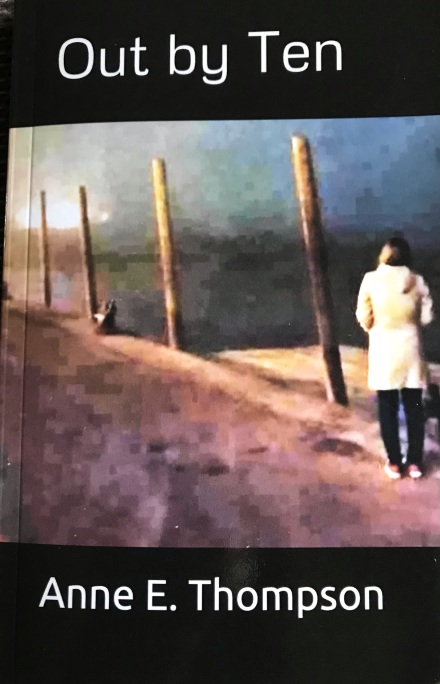
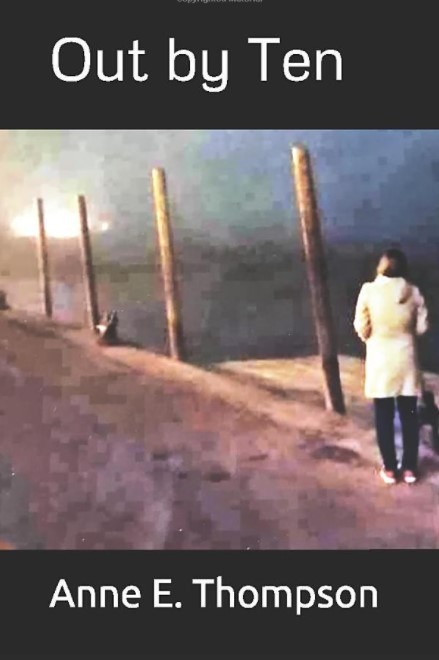
Thank you to all my followers who bought a copy of my new book: Out by Ten. I hope you’re enjoying it (if you could write a review on Amazon, that would be wonderful!) The link is below if you haven’t read a copy yet:
I want to share with you an extract from my new novel: Out by Ten by Anne E. Thompson
As I explained yesterday, it’s listed at the reduced price of £6.99 for just this week so that my friends and neighbours can buy a copy. I will put the Amazon link at the end (it’s available as both Kindle and paperback books).
I shared the bus ride back to Blakeney with a gaggle of teenaged girls, who looked as if they might be bunking off school. As I sat, staring at their snagged tights and improbable shoes, I heard their intense voices, and I remembered being that age, and the glorious excitement of new situations. It was only a few short years ago – and a whole lifetime. I immersed my thoughts in the sound of their whispers, looked at their carefully arranged hair, their casual closeness as they touched an arm, a knee rested against a thigh, feet slid near each other. They didn’t bother with personal space, the flicked hair of one girl brushed the cheek of another, their perfume spilled towards me with their whispered giggles. I remembered the intoxication of friendships, the undiluted energy; I remembered when I first saw Timothy. . .
***
I am sixteen, my school bag is bouncing on my shoulder, I glide into the classroom and slump into the chair next to Carol. I am looking for Nigel, searching the room for his blond hair whilst pretending to look for my homework book. Perhaps I should be worrying about my father, and his recently diagnosed cancer, but I’m not, I am absorbed by Nigel, hunting for his gangly legs stretching out from his desk, and the slant of his shoulder when he reaches for his bag. Carol digs me in the ribs and jerks her head forwards. I look up. I see Timothy.
He is standing at the front, his stance casual, his eyes watchful. I notice his eyes first, set below straight brows, that dark brown that seems to glow; even from my seat at the back I can tell he is noticing, watching us, in control. He wears a faded jacket, with patches on the elbows, and a white shirt, with the tie knotted to a perfect neat nobble, giving his appearance a tidy, meticulous look. His hair is brown. He has good hair, thick and wavy, cut to just above his ears but not so short that he looks like my dad. He doesn’t look like anyone’s dad, though I suppose, given his age, he might be. He smiles, I forget all about Nigel, forget he exists, forget that he has until now been the focus of every maths lesson I have attended this year.
Timothy is speaking. I notice his voice is deep, and posh, and it makes my stomach tingle. He is telling us his name is Timothy Oakfield and I want to write it in my book, and scribble variations of it. Mr. Oakfield. I realise that maths lessons will never be dull again. He is telling us that he’s our new teacher, that he’s pleased to meet us, let’s begin with an evaluation of what we have studied so far with Mr. Corbin. Mr. Corbin has had to leave, we don’t need to know why; I don’t want to know why, I don’t care. All is absorbed by the deep, posh, voice, and the brown, almost black eyes, and the apparent youth of our new mathematics teacher. He is asking for someone to raise their hand, someone who can give him a quick synopsis of work already covered by the unfortunate Mr. Corbin. Not me, I can’t breathe, let alone speak. I feel Carol stir beside me, she is raising her hand, introducing herself, telling him, Mr. Timothy Oakfield, that we have covered up to page 52 in the text book, and we all completed the questions at the back for homework. He smiles at her. I hate her.
He speaks, telling us about simplified equations, and exponential data, and I am barely listening. His words wash over me as I feel the tingle his voice stimulates, and I imagine how he would look in casual clothes, and wonder if he is married. He issues instructions, and everyone turns to a page in their text books, and I have to stop hating Carol long enough to ask her what the page number is. She slides a piece of paper towards me:
“Dreamy, huh?”
Dreamy is not a word I have ever used before, but it fits, I nod. I glance up.
Mr. Timothy Oakfield is walking round the classroom, peering at books. He pauses by John Simpkins and points at something. John Simpkins looks up, his face is very red, he hunches his shoulders and begins to frantically rub at his exercise book with an eraser. I wonder what he has written.
I glance across to my friend Charlie, she is frowning. I’m not sure if this is because she always finds maths difficult, or because her hair has recently been plaited again and I know that it pulls at her scalp and hurts. Her hair is a constant source of trouble for her, teachers repeatedly tell her it’s untidy and she should cut it. But it grows fast and surrounds her face with frizz, and there is nothing she can do but endure small tight plaits that hurt. Her mother shaves her head and wears a wig, I wonder if Charlie will when she’s older, if she will hide her hair in shame and try to look more ‘white.’ I hope not, I think her hair suits her face, and should be allowed to grow naturally. I wonder if my father will wear a wig too, when he loses more of his hair to the poison of chemotherapy, but this is too horrible to think about, so I spin my thoughts back to Charlie, and I wish she would look up so I can grimace to her in sympathy.
Mr. Timothy Oakfield is on the prowl again, I stare down at my book. We are all quiet, I don’t think this class has ever been silent before, there is something about him, an irresistible authority that has cast a spell on us. I try to see if he is wearing a wedding ring. He sees me raise my head, and approaches. I can feel my heart pounding behind my worn-out-doesn’t-fit-properly bra, the blood has rushed to flood my face and neck, so not-cool. I feel him approach. I have written nothing. I glance sideways, Carol’s book is neatly numbered 1 to 12, I begin to write the numbers in a long line down the margin, as if preparing my page for the answers that will surely follow; I haven’t even read the questions yet. He is here, I have only written up to number 7, and there are no words. He is leaning down, I can smell aftershave, he places a hand on my desk, it is his left hand, it is naked. I glance up, and drown in brown eyes.
“Are you okay? Do you understand what you need to do?”
I nod, my face a furnace. I do not have the first idea what I am supposed to be writing. He moves away. I breathe again, force myself to read the questions. They make no sense, words bouncing on a white page. I sneak a look at Carol’s book. I hate her, but I need her. I begin to copy her answers.
I have written several other novels but this is the one I like best.
While writing the book, I was rereading my favourite book of all time, A Tale of Two Cities by Charles Dickens—which has to be the most romantic book ever. As I read, I thought it would be rather fun to mingle what I was reading with what I was writing—my main character began to read the story, and the plot mirrors the same themes of imprisonment and escape, people living under false names, and individuals being caught up by national events (and of course, a dollop of romance).
I actually started to writeOut by Tenin April 2019, when I was staying in a holiday home in Norfolk. It struck me that holiday homes often hide the key in the same place each year, and that if you needed to disappear, they would be good places to hide (plus I thought it would be really fun to secretly live in someone else’s house!) I began to write a story about a young woman who was escaping.
It takes a long time to write a novel. I was still writing in 2020, so when Covid-19 arrived, I realised that my ‘contemporary fiction’ would not be very ‘contemporary’ unless I included references to the virus. I therefore rewrote the novel, setting it in the surreal world that we lived in during lockdown. As I felt bewildered by empty supermarket shelves, and insecure as I changed every event in my diary, I transferred those feelings to my main character. Bizarrely, world events, with the rise of the #BlackLivesMatter protests, beautifully mirrored the start of the French Revolution in A Tale of Two Cities, and I found my story flowed naturally in line with what was happening.
One of my friends is autistic. We worked together at lunch club, and when lockdown began we spoke on the phone. I realised how different things appear through her eyes, and I wanted to show some of the challenges involved for a family when one person is on the autistic spectrum. I therefore made one of the main characters autistic—though a child, so very different to my friend. As I wrote, I heard my friend’s voice bemoaning the silly fuss of coronavirus and I tried to imagine how a child might cope (or not cope) with different situations and the stress this would add to family dynamics.
When I thought the book was finished, I gave it to my beta readers, who informed me it was too religious. I didn’t really want to write ‘a religious book’ and decided to remove all references to my faith. This is simply a good story, with no agenda other than to entertain.
Writing this book was tremendous fun, so I hope you will enjoy reading it. As all my book-signings and fairs are currently in lockdown, a proper ‘launch’ of my book won’t be possible, but I wanted to tell you—my extended friends and neighbours—about it. To be honest, I always feel rather awkward about ‘selling’ to friends anyway but it’s a necessary evil to cover my costs. I have therefore decided to list the paperback on Amazon at the reduced price of just £6.99, for this week only. Next week it will raise to £8.99 (to start paying some costs) so please buy a copy quickly, and settle down for a good story.












 Anne E Thompson
