All Quiet On The Chicken Front…


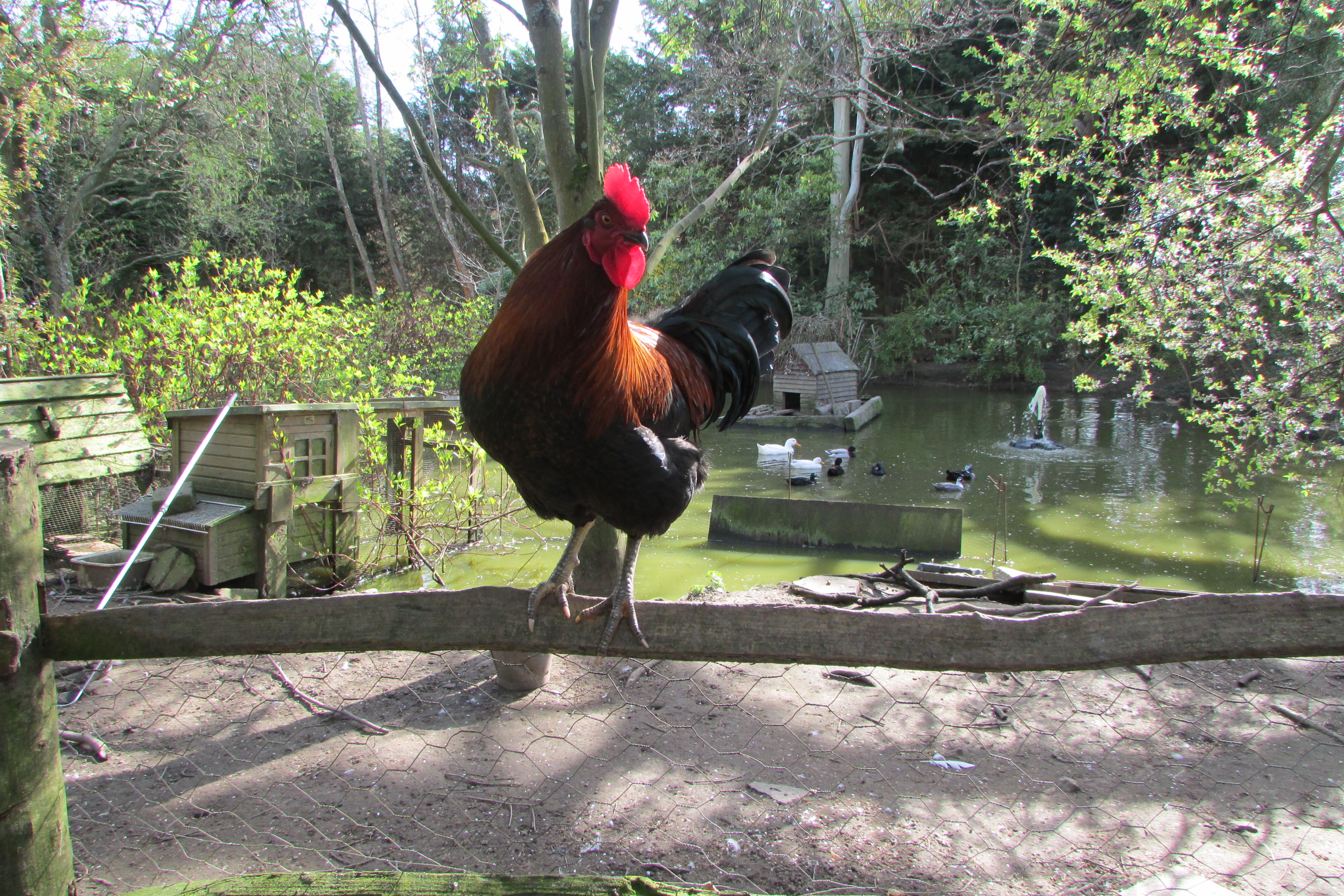
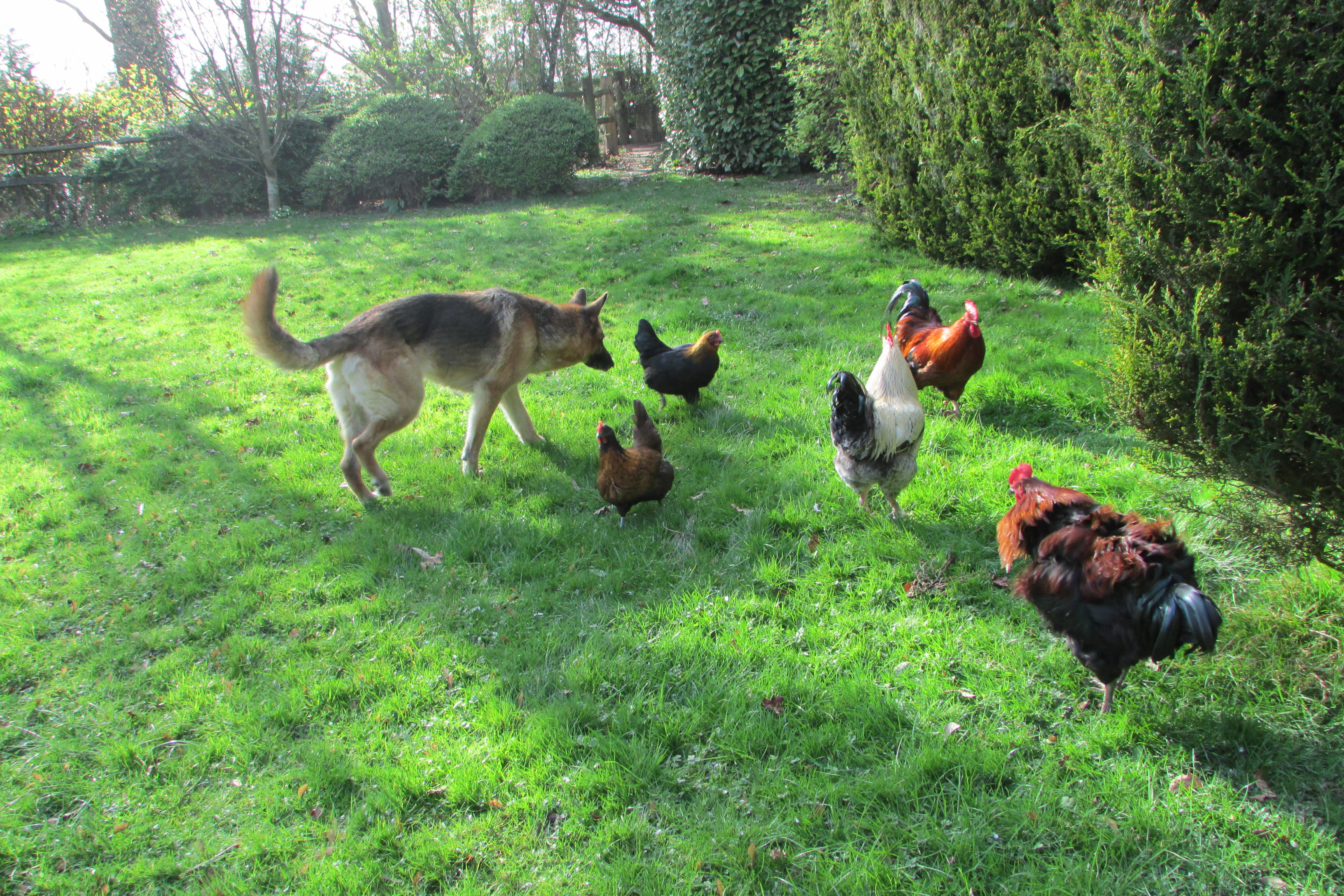
I thought I would give you a quick update on my news. First, the family of cockerels. As you may remember, I was fortunate (!) enough for five of the six hatchlings to be male. Now, contrary to popular belief, it IS possible to have a flock with more than one cockerel and not have open warfare. I know this because I had two cockerels who lived very peacefully alongside each other for a couple of years (until a fox ate them). However, five young cockerels, plus their father, seems like a lot.

As the hatchlings grew, and were allowed to roam freely around the garden, the flock separated. The parents and the female wander around the garden together, and the young cockerels form a separate flock. A few weeks ago, they started ‘facing off’ to each other. None of them has spurs yet (the deadly sharp talons on the back of their legs) so I figured they were unlikely to kill each other, and were probably simply sorting out the pecking order. I left them to it. The dog takes a keen interest in this, and has taken upon herself the role of peace-keeper. If they start to fight, she stamps on them – which is remarkably effective.

When we went to Devon for a week, I was worried about leaving them all in the same cage, so I split them up. I waited until evening, when they were all roosting on the perch, and then went to move the young cocks into a separate cage. I have to say, it takes an amount of courage to approach a cockerel, which is staring you in the eye, at head-height, with an elongated neck and fluffed up feathers. But I managed to pick them all up, ignored all the squawking, and carried them, one by one, to a new cage; and I survived without getting my eyes pecked out (which would have made Husband cross).

When I returned home after Devon, I opened both cages, to see what would happen. For a couple of days, the father and both hens roosted in one cage, the five young cockerels in the other. Gradually, as they have established a pecking order, two of the weaker cockerels have started to join the parents. I now have ‘the elite team’ of cockerels in one cage, and the rest in the other. For now, we are at an uneasy truce. If any of them become very aggressive, they will have to go (don’t ask me how – but I am not vegetarian, and neither is the local fox, so I figure I have a couple of options…unless you would like a pet cockerel? Do let me know.)

My other news, which is sort of vaguely related, is my new book, which is set on a farm. The first draft is finished, and I began to send it out to publishers. One publisher sent back a detailed editorial report, saying they didn’t want to publish it as it was, but would reconsider if I rewrote it. I am therefore in the process of rewriting it. This is taking much longer than I expected – longer in fact than writing the first draft, because as I change things, I lose the rhythm of the story, so have to rewrite increasingly large sections. It feels like work, and is not much fun. But I do feel the book is improving, so it’s worth the effort. When finished, I will resubmit to the publisher, and see what happens. I would like it to be released in the summer, but it may take longer than that. I will let you know.

A late Christmas gift was a trip to the British Museum and having a tour of the artefacts that relate to various stories in the Bible. Do you know why it was historically appropriate for Daniel to be put in a lions den? Or the name of the Pharaoh who put Joseph (of the coloured coat) in charge of all the agriculture? Or the Pharaoh who suffered the plagues at the time of the Exodus (because it probably wasn’t Ramesses!) I’ll tell you all about it in next week’s blog.

That’s all for now. I hope you have a good week.

Take care,
Love, Anne x

Anne E. Thompson has written several novels. They are available from bookshops and Amazon.
You can follow her blog at:
anneethompson.com
Why not sign up to follow today?

A Treat in January


Instow Holiday Diary January 2019
Saturday 5th January:
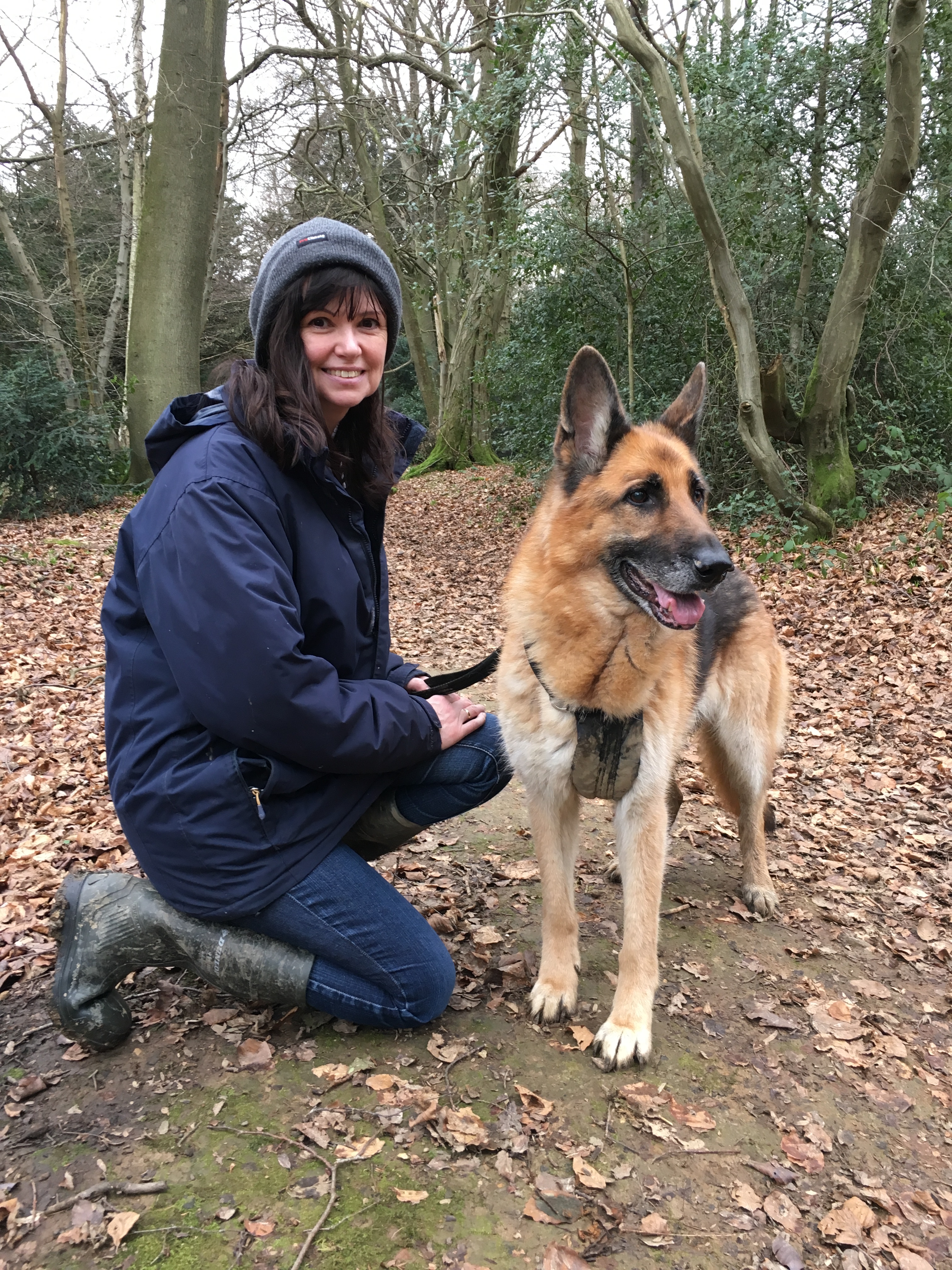
Walked along the Tarka Trail from Instow. This stretch is along a disused railway line, so I liked it because it was easy walking; Husband complained that we were walking along a tarmac path; Kia was just happy to be walking anywhere. The trail crossed bridges, wound near the coast, and went through cuttings of ferns and grasses. It was peaceful and pleasant, and although we had to be aware of the occasional bike that whizzed past, it was very pleasant.

At one point we passed a couple of big old boats, which appeared to be inhabited. I’m not sure what living on a boat would be like – very like camping I imagine. No idea what they do for water or sewage, as the river wouldn’t be any use for either. Instow is on the estuary, where the rivers Taw and Torridge meet the sea (well, they actually meet the sea at Appledore, which is the other side of the river, but you can see the waves on the horizon from Instow.

We turned around when we arrived in Bideford. We checked the ferry to Lundy Island, but it only runs March – October. I didn’t buy a fridge magnet, as they all looked a bit naff.

Walked back to Instow and had coffee at John’s Cafe, which is the best cafe in the whole world (except that it has rather uncomfortable seats, and is a little pricey). Kia lay under the table while we had coffee, and then waited outside while Husband bought some juice. They didn’t have any orange juice (too posh) and the apple juice was all proper, locally produced apple juice, which was rather bewildering for Husband, as he had to choose which variety of apply he wanted. He chose cox’s apple juice, which is pretty horrid unless you like cox apples (which I don’t).

When we got back to the cottage, I checked my clever iPhone app, to see how far we’d walked (it felt like a long way). It was 10.6km, so perhaps not so very far. We had ham sandwiches for lunch (which didn’t fit very well with my sort of vague decision to eat only vegetarian food in January), with apple juice (see above) and ginger biscuits I’d brought from home (left over from Christmas, but still nice).

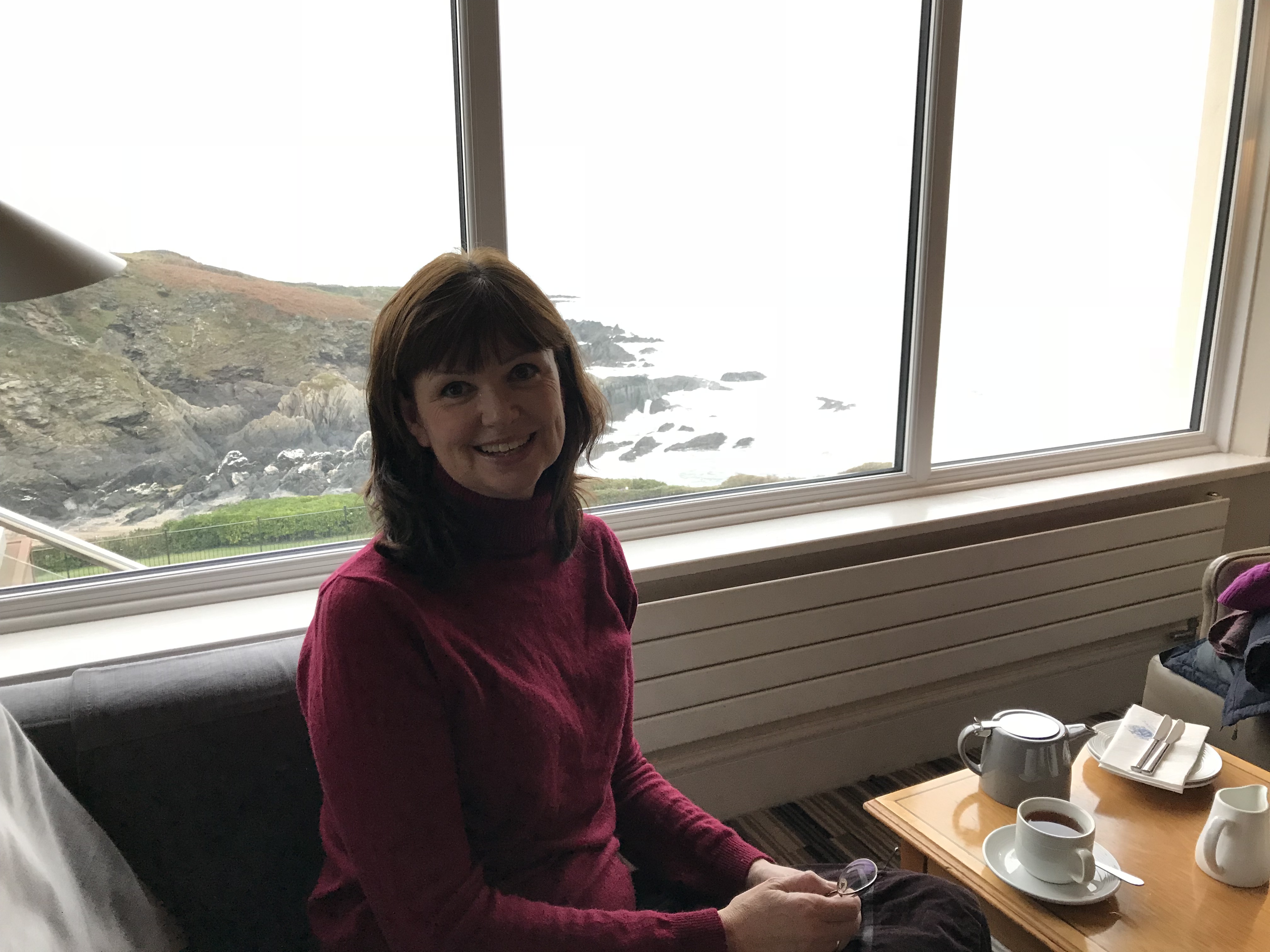
At 3:30pm, we had afternoon tea at Watersmeet Hotel near Woolacombe. This was a Christmas gift from Husband, and as a great lover of cakes and sandwiches, I was rather looking forward to it. I had been given a voucher, showing a dining room, but we were taken to a lounge area for the tea. (It turns out Husband had made the voucher himself, and downloaded photos from the hotel’s website, but tea is not served in the dining area!) The hotel is on the cliff edge, looking down into a bay, and we sat and watched waves crashing over the rocks.

We spent a few minutes taking selfies, as you do—most with my thumb in one corner, and then the tea arrived. There was loads, enough for four people, so we could’ve shared one. It was all so pretty, with cakes on the top tier, a huge scone in the middle, and sandwiches at the bottom. Everything was delicious, and I wrapped up the scone to eat later, and then ate most of the rest. (Not the Battenberg cake though, as I’m not keen on that.) It was all very lovely.

I hope you have some treats this week.

Take care.
Love, Anne x

Thank you for reading.

anneethompson.com

If you enjoyed this, you will love my new book: The Sarcastic Mother’s Holiday Diary.
I have always written a diary on holiday, so last Christmas, I decided to find all my old diaries and blogs, and make a book for my children. However, several other people also asked for a copy, so I have written a public version – it’s available on Amazon and has been described as “The Durrells meet Bill Bryson”!

The paperback version is currently available for £9.99, but as I will need to buy copies for book fairs, I will need to cover my postage costs, so this price is for a very limited time (I think it will be around £12 in the future, but I wanted to let you, my blog readers, know that they can buy it for the cheaper price, until March). It is also available as a Kindle book.

Why not buy a copy today? I think it will make you laugh.

The US link is here:

https://www.amazon.com/Sarcastic-Mothers-Holiday-Diary-ebook/dp/B07N95281F/ref=sr_1_1?ie=UTF8&qid=1549015525&sr=8-1&keywords=the+sarcastic+mothers+holiday+diary

The India link is here:

https://www.amazon.in/Sarcastic-Mothers-Holiday-Diary-ebook/dp/B07N95281F/ref=sr_1_1?ie=UTF8&qid=1549015429&sr=8-1&keywords=the+sarcastic+mothers+holiday+diary

The UK link is here:

https://www.amazon.co.uk/Sarcastic-Mothers-Holiday-Diary-ebook/dp/B07N95281F/ref=sr_1_2?ie=UTF8&qid=1549014970&sr=8-2&keywords=the+sarcastic+mothers+holiday+diary

Micah – A New Year’s Resolution


Did you make a new year’s resolution for 2019? Do you plan/hope to improve something? It’s good to pause and take stock sometimes, to check how we’re living is how we want to live.

Micah is a book which I have often heard quoted, though have never read from start to finish before. It was written about the same time as 1 Kings, which is a history book, whereas this is a prophecy. It tells the people what will happen – that they will be taken into captivity – though it doesn’t say when. They were later taken captive by the Babylonians, and remained captives for much longer than they expected. There is also a snippet in Chapter 5, which foretells the birth of Jesus, and is often quoted (fairly randomly and out of context in my opinion!) at Christmas carol services.

However, for me, the most beautiful part of the book is chapter 6 and verse 8. This tells the people – and us – what God requires. Being a Christian, deciding to follow God, is not about rules or religion or rituals. Micah writes:

“He has told you, O man, what is good; and what does the LORD require of you but to do justice and to love kindness, and to walk humbly with your God?”

This should be our code of conduct. Not grabbing what we can from the world, but being fair; not judging other people, but being kind; not declaring that we understand the Bible and other people are wrong, but being humble and following where God leads us. I think this is a good principle to try and live by this year, as we take stock and look forwards. It reminds me of something my cousin recently shared on Facebook, which I felt says it all, really. I will share it with you (I don’t know who originally wrote it, so I can’t credit them).

If you are kind, people may accuse you of selfish, ulterior motive.
Be kind anyway,
If you are successful, you will win some unfaithful friends and some genuine enemies.
Succeed anyway.
If you are honest and sincere, people may deceive you.
Be honest and sincere anyway.
What you spend years creating, others could destroy overnight.
Create anyway.
If you find serenity and happiness, some may be jealous.
Be happy anyway.
The good you do today, will often be forgotten.
Do good anyway.
Give the best and it will never be enough.
Give your best anyway.
In the final analysis, it is between you and God.
It was never between you and them anyway.

I hope your new year is happy, and that you live it well.

Take care,
Love, Anne x

Anne E. Thompson has written several novels and non-fiction books. You can find her work in bookshops and Amazon.
Why not sign up to follow her blog today?
anneethompson.com

Bible Blog – Jonah


Reading through the Bible is taking way longer than expected! This is partly because there is more there than I realised, and partly because I often don’t understand what I’m reading, and have to spend time doing a little research. There are stories which I knew well, others which I’m sure I’ve never read, and some which leave me with this huge “What???” feeling.

The book of Jonah, however, is one which I felt I knew well. When I was a child, aged about 12, a man called Mr Goss did a series of five sermons on Jonah at our church. They are the first sermons I ever really listened to, and I still remember some of the things he said. (On a different note, I heard recently that Mr Goss’s life went wrong after this, he made some bad decisions, ended up in prison, and died young. I hope the people who knew him remember that he was also a gifted preacher, and some of what he did with his life was good and worthwhile. This is an especially poignant thought when reading Jonah, which is all about people making good and bad decisions – because we all do both. Yet God is bigger than our mistakes.)

The book of Jonah was written about the same time as 2 Kings (a history book) and Nahum (another prophet) so roughly 615BC. Both Jonah and Nahum are about Nineveh, a city which was part of the Assyrian empire (and today would be part of Mosul, in Iraq). You probably know the story:

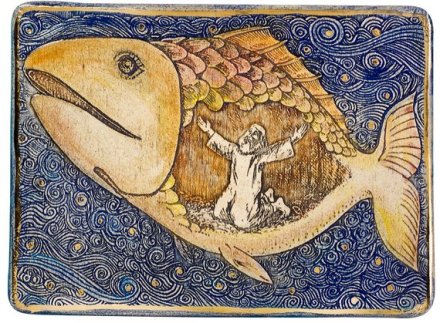
Jonah is told by God to go to Nineveh, to tell them they are evil and God is going to destroy them. Jonah decides to run away, and goes on a boat in the opposite direction, towards Tarshish. There is a big storm, Jonah is thrown overboard, and swallowed by a big fish. The fish vomits him out on dry land, and Jonah goes to Nineveh. The people repent, God doesn’t destroy them, Jonah is angry.

I have a few thoughts about the story. Firstly, why did Jonah try to run away? Did he fear the people of Nineveh, or was he frightened he would look silly? I can relate to both of those feelings. Then later, when he’s in the belly of the fish, and life is looking hopeless, he cries out to God. This still happens today; very often people wait until everything is going wrong, there is no hope, before they cry out to God. He is often our last resort.

The book of Jonah is all about second chances. Jonah tries to run away from what he knows God wants him to do, and yet later, after the fish vomits him out, we read that God spoke to him a second time, telling him to go to Nineveh – he gets another chance to do what he should have done in the first place. Later, the people of Nineveh, after they have listened to Jonah, turn back to God and God doesn’t destroy them – he gives them another chance. I think this reflects so much of what I have read in the other books of the Bible, about a God who always sees the wrong that people are doing, and yet he gives them another chance. God wants people to change and come to him, he doesn’t want to destroy them.

I find the character of Jonah to be very interesting. He was clearly a very passionate man, someone who acted on impulse, very hot-headed. Even so, God chose to use him. Perhaps it was that passion, that depth of feeling, which made him an excellent speaker (because whatever it was that he said to the people of Nineveh, it was enough to change a whole city including the King). Being passionate was both Jonah’s greatest strength and his biggest weakness. We all have weaknesses (some more than others). If we let God help us, he can turn those weaknesses into strengths, which is pretty amazing really.

Caster Oil Plant
This is probably the plant which Jonah sat under.

The book of Jonah doesn’t really finish (in my opinion) it just sort of stops. After the city is saved, Jonah goes off in a sulk, and builds a shelter, which a plant grows over, shading him from the sun. Then the plant dies, and Jonah is livid. God says that Jonah has no right to be angry about the plant, which Jonah did nothing to create, and compares it to the whole city of souls which God wanted to save. Then it stops. We have no idea if Jonah realised he was wrong, or simply stomped home again. I have never really understood the bit about the plant – it just shows that Jonah was a pretty awful person (in my opinion). But perhaps he changed.

I will continue reading through the rest of the Old Testament – near the end now.

Thank you for reading.

Have a good week.
Take care,
Love, Anne

The “Non-Party”


The Non-Party

For as many years as I can remember (well, not really, but a lot!) we have hosted a party on New Year’s Eve. They are, if I’m honest, more Husband’s thing than mine, as I am basically a pretty unsociable person who likes to go to bed early; but marriage is all about give and take, and a fair helping of compromise, and these are my compromise.

Year after year, I have watched my house being rearranged, he has forced/encouraged our friends and family to dress in a variety of costumes, and then everyone has arrived, people have drunk and snacked and danced and generally had a happy time. Usually our children – now all grown up – have joined us and, as they seem to have more than an even proportion of Husband’s genes, they’ve helped and encouraged and been party to the party, year after year, and so have their friends. We have all dressed in pink, been toys, or sixties icons. And it has, I am forced to admit, been mainly fun.

However, last year, we realised that most of the ‘younger’ generation would probably not be attending (because they have all moved out) and the rest of us were dwindling in party enthusiasm (not Husband, it should be noted) so Husband announced that last year would be our last party.

Then, as 2018 progressed, the mood began to change. We began to discuss what we should do instead. I suggested that something small and low effort, like a meal with our friends in a pub would be nice. This evolved into a meal at Husband’s favourite Indian (aptly named Bollywood) followed by everyone coming home for drinks and cigars until midnight. There were a few tense conversations (which my son calls arguments) when we discussed (argued) about whether the “small group of friends meeting for dinner and then coming back afterwards” (my idea) was the same as “a dinner with lots of people at Bollywood, followed by a party at our house” (Husband’s idea) were the same thing. It became named the “non-party”, although I had a sinking feeling that actually, it was a party by another name.

Christmas came and went, and unlike previous years, I did not order masses of food ready for new year’s eve, because we weren’t having a party. Then the day itself arrived, and the mood changed. I began to see furniture moving around (something I hate) and lights being installed. All for our “non-party”. Then Husband asked me what I thought of his ‘disco lighting’ in the dining room, in case people wanted to dance, and I wondered how to tell him that I thought it would trigger epileptic fits.

I went to the fridge, to find all the contents removed, and replaced with bottles of drink, and lemons, and the flavours for cocktails – even though we weren’t having a party. A variety of ‘mood lights’ had been set up (so I put torches in strategic places for our friends who find it difficult to see unless the light is bright). All the candles in the house were placed on window sills, and the dog bed was moved into the utility room, with the dog and the cat, and all the muddy boots.

Eventually, it was time to leave. We met in Bollywood (Indian restaurant—remember?) and ate and chatted and laughed; and then we came home, for our non-party, and chatted and laughed some more. And it was lovely, and eventually I will find all the items that Husband moved to make the house tidy, and no one had an epileptic fit, and I might decide to keep the fridge stocked with alcohol rather than food.

So, all that remains is for me to wish you a very happy 2019, and to thank you, so very much, for continuing to read my blog.

Take care.
Love, Anne x

Anne E. Thompson writes a weekly blog. You can sign up to follow it at:
anneethompson.com
Anne has written several novels, which you can find in bookshops and online.
Thank you for reading.

“Oh, you shouldn’t have…”


“You shouldn’t have…”

I have been watching people receive gifts recently (we all have, I suspect) and I have noticed that some people are exceptionally good at receiving gifts—and others aren’t. There are those people, who simply make you feel that what you have given them is the best thing ever, and has made their day. They seem to smile with their whole face, and look genuinely delighted with those slippers or that mug or those earrings. Other people (and I’m afraid that I might be one of these) struggle to appear pleased, even if they are. I am always aware that I’m being watched, that my reaction matters, and so it all goes to pot and even when I am excited by the gift, I’m not sure that I show it very well.

The thing is, I think that receiving is very important, and there are lots of us who find it difficult. This Christmas, I have heard lots of people say things like: “Oh, you shouldn’t have,” and they mean it. They absolutely do not really want to be given anything. They don’t want gifts, and (perhaps even more) they don’t want help. If they need to be driven somewhere, they would rather pay for a taxi than accept the offer of a lift from a friend. They will grind themselves into the ground with exhaustion rather than let someone help them.

Of course, this isn’t true of everyone, and there are a few people who ONLY ever take from others. They will stand by and let others do all the work, ask for favours but never do any in return, and generally are a drain on those around them—but I’m not talking about those people. I want to consider the others, the people who dislike accepting, because I think it’s important.

We talk sometimes about relationships being “Give and Take” and yet we are so loathe to “take”. This makes relationships unbalanced. I find I feel much closer to those people who will let me help them, who are not completely self-sufficient.

If you believe the Bible, there is lots there to show we should accept help. Right back in Genesis, Man was created to need a helper, so Woman was created. Man didn’t say,”Oh, no thanks, I can manage on my own.” Man needed Woman. And later, the absolute example has to be God himself, who came as a completely vulnerable human baby in order to reach us. Many times during Jesus’ life, from the very first time he needed to be fed by Mary, to the times he asked for a drink of water, or for other people to organise things or find things, or provide things, he asked for help. And his needs were genuine—when he asked a woman at a well for a drink, he really was thirsty and needed a drink and didn’t have a pot to collect water.

This is a lesson that I learnt painfully, when I had brain surgery. I changed from an independent person who didn’t need (or want) much help, to someone who suddenly needed lots. It was a tough lesson to learn.

So please, think about it this week. If people offer to help, perhaps you will deepen your relationship with them if you accept. It’s probably good for us, makes us humble, to realise that we all need other people, we can’t manage to do it all on our own. We were created like that.

Thanks for reading, have a good week.

Take care,
Love, Anne x

Anne E. Thompson has written several novels and non-fiction books. You can find her work in bookshops and Amazon.
Why not sign up to follow her blog today?
anneethompson.com

Not the Nativity?


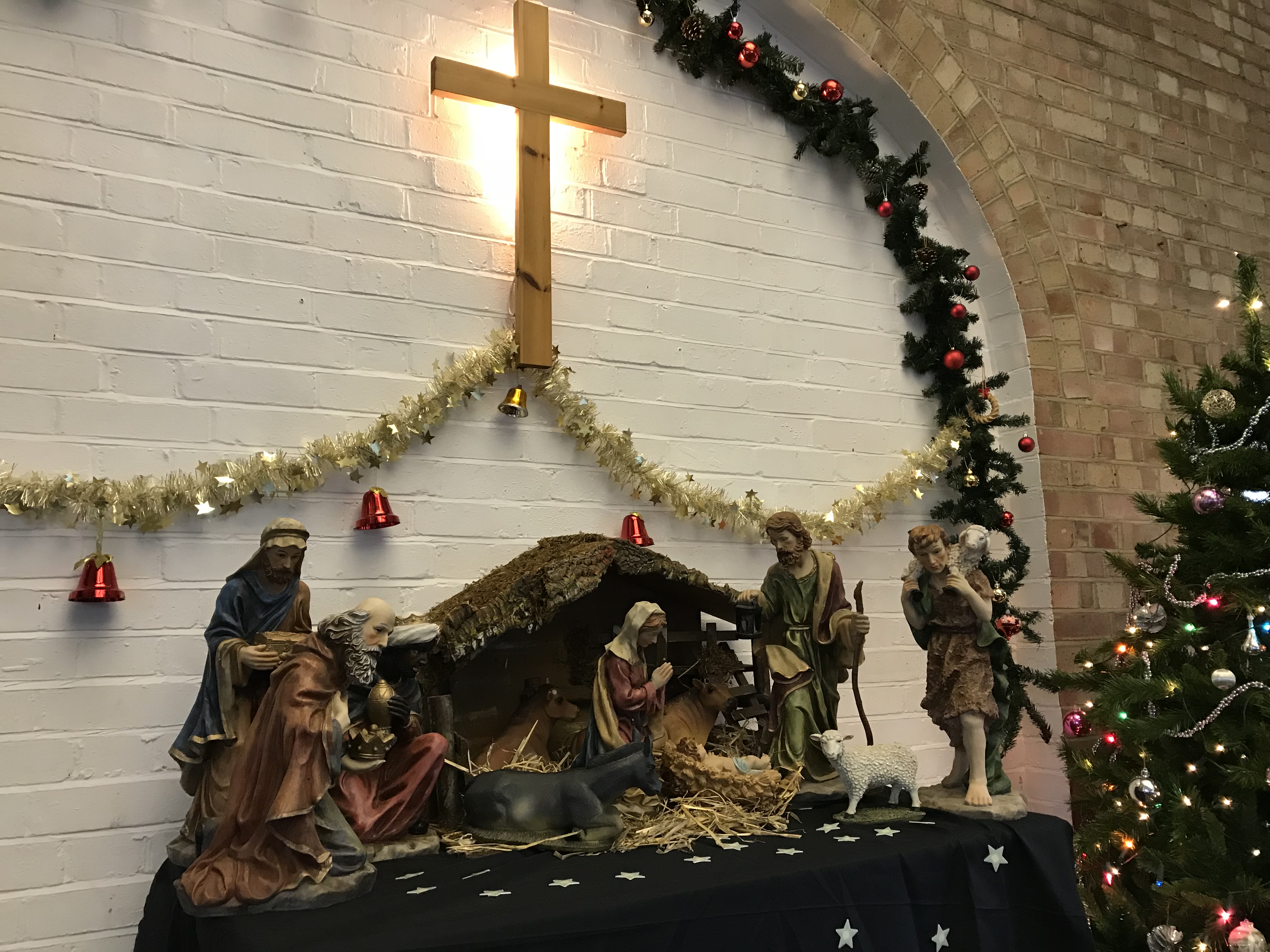
So much of the traditional Christmas Nativity story is made up. People have taken a few of the Bible facts: “The baby was placed in a manger” and created a whole mythology around them: “Jesus was born in a stable” – even though we know that actually, most houses in Bethlehem at the time had a lower floor where the animals were kept, and Joseph, who was returning to the town where his relatives had originated from, was probably staying with distant relatives, and therefore Mary probably gave birth down on the animal’s floor, because the house was crowded with other returning relatives and the inns were all full. But that doesn’t make for such a pretty Christmas card or school play, does it?

So I was wondering, what other ‘facts’ can we surmise from the few details included in the Bible accounts? Firstly, as Mary and Joseph were ‘betrothed’ not ‘married’, Mary would probably have been an adolescent – maybe 13 years old. Which, as Jesus died when he was 33, meant she was a woman of about 46 when she watched her son die. No idea how you cope with that. And as, at the crucifixion, there is no mention of Joseph, presumably he died when young.

Think about that for a minute. God chose this couple, because they were Godly, good, people. Yet Mary had to watch her son die, and Joseph didn’t make it into old age.

Sometimes the church has a tendency to preach that if we are ‘good’, if we do the right things, then all will be well with us. We like to think that good things happen to good people. But the Bible tells a different story. Sometimes, the very best people are the ones who die of cancer, or lose their children. Because being a Christian, following God, is not about being saved from all that is hard and horrid in this world. Being a Christian is about following a God who loved you enough to become a weak, defenceless baby so that we could know him; it’s about trusting God because he is worth trusting – even if life throws cruel things at us. God is God, and the Bible tells us he is magnificent and powerful, that he made storehouses of snow, and rolls up the skirts of dawn, and created all the wondrous things we see in our world today – but he never promised us a pain-free life. God is worth following, because he is God, even when life is tough.

So, if for you, Christmas is not a time of mindless happiness, if you are carrying a weight around with you, that is okay – because probably Mary and Joseph did too. And like them, we can look at our pain, our sadness, our disappointment, in the knowledge that God never promised life would be easy, but he did promise he would help. He loves us enough to share our pain, and at the end, when everything else in this life has wasted away, there will still be God. Because God is God, and he is worth it.

Christmas Memories – When I was Young


I have always loved Christmas, but some memories stand out more than others. Like my father (it was always my father) decorating the lounge. He would hang streamers, which were cut from crepe paper, across the lounge ceiling, sometimes in the shape of a star, sometimes in twisting bands. Occasionally there were balloons. The streamers were reused every year, so were faded and ragged, but oh! The excitement! Dad was a butcher in those days, working around the clock at Christmas plucking and delivering turkeys, so we never knew which night the decorations would appear. I can hear now, that shout of glee, when my brother or sister had been first into the lounge: “The decorations are up!”

Another memory is carol singing. We lived on a council estate in Hertfordshire, and each Christmas, groups of us would go from house to house, singing carols. Sometimes all the lights in the house would go off! But usually, the door would open, we might be asked to sing a specific carol, and then we would be given a few coins. The money went straight into a glove, and when we got home we emptied it onto the table and shared it out. This was the money we earned to buy gifts for each other.

The best singer, by far, was my little brother. He was very short, and had fair hair and big brown eyes, and wow, could he sing! When people opened their door, they were always amazed that there were so few of us, because my brother had the volume of a whole choir.

I remember one year, when I decided to try my luck at the ‘big houses’ on the other side of the busy road. There was a long road of detached houses, and I thought they might have more money to spare than the council estate. I persuaded my brother to go with me, but everyone else refused, saying it was too risky. We weren’t sure how people who lived in houses like that would react. Off we set.

The first house was empty. We sang and knocked, just in case, but no one answered. The second house opened the door. I remember the woman looking annoyed, but she gave us some money, and some of the coins were silver, so that was a good start. It all went wrong at the next house.

We went to the front door, and started to sing. My brother was in full voice, with me as back up and every few minutes I knocked on the door. After a couple of carols, the door opened, and a man stood there, looking cross.

“Who are you collecting for?” he asked.

We had never been asked this before. We sang carols to get enough money to buy gifts; singing in aid of a charity had never occurred to us (I was only 8 years old, at most).

“Us,” I replied, wondering if it was a trick question.

The man told us we were begging, and to go away.

My brother wanted to go home, but I persuaded him to try one more house. He agreed and we went to the next door, and started to sing. Within seconds, the door opened, and the same man stood there! We weren’t used to such big houses, and we had simply walked around to the side door of the same house, not the next house.

“Why are you back?” he grumbled, “I thought I told you to go away.”

“We tried to,” I told him (I was quite brave in those days) “but your house is very big, so we thought this was next door.”

He delved into his pocket and pulled out some coins.

“Right,” he said, “here’s some money, now go away, and don’t come back—and get your foot out of my milk crate!”

My brother, in his nerves, had been using his foot to fiddle with the milk crate next to the door. Somehow, he’d managed to get his shoe stuck in the side, and neither of us could get it out. I remember being torn between giggles and fear, as we struggled to get his shoe out of the milk crate, the man glowering over us all the while. Eventually the shoe was free, and we left. I think we gave up and went home after that.

***

I hope you make some happy memories this Christmas. Thank you for reading.

Take care,
Love, Anne x

You can follow my blog at:
anneethompson.com

Anne E. Thompson has written several novels and non-fiction books. You can find her work in bookshops and Amazon.

A hilarious romance for when you want to relax.

A gritty thriller, which shows what it means to be a psychopath, and how it would feel if someone in your family did something awful. (Because every psychopath has a mother.)

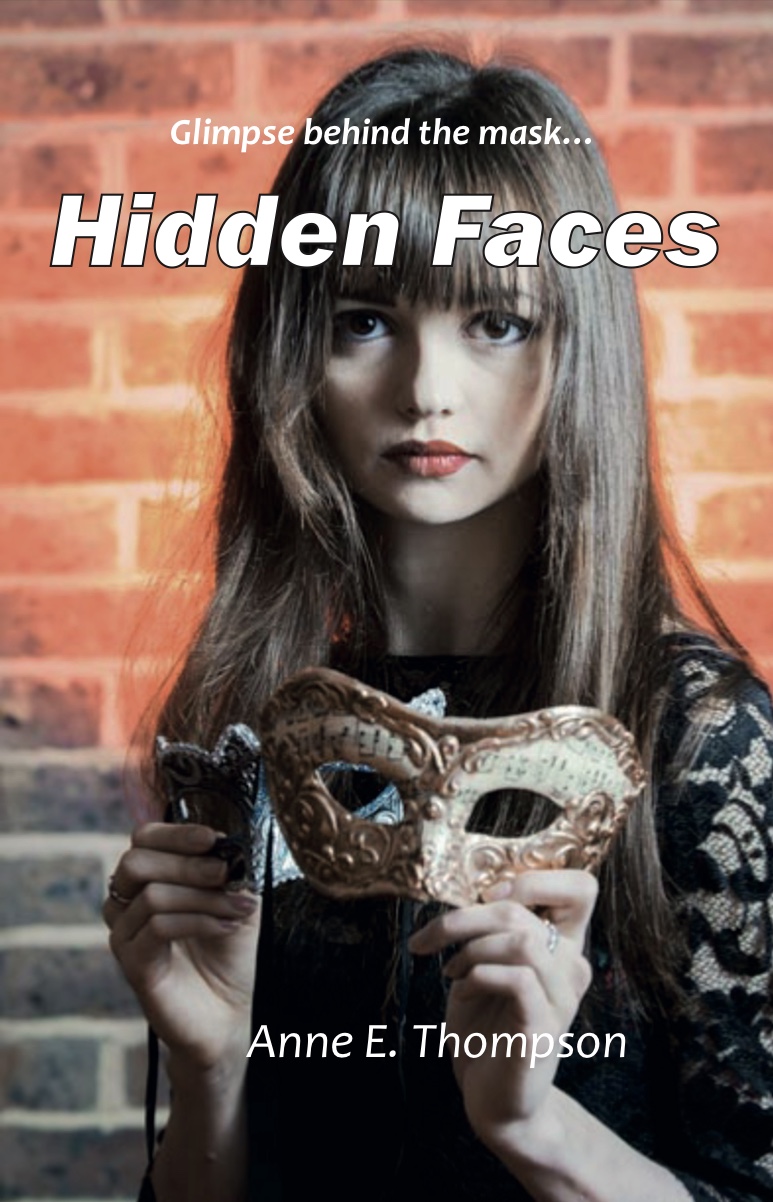
Hidden Faces by Anne E. Thompson.
An easy read, feel good novel, set in an infant school. An ideal gift, this is a book to make you smile.

An exciting novel, set in the near future. One family shows how they cope with driverless cars, new laws, and schools run by computers.

The latest, and best book (in my opinion). An exciting novel written in the first person, which shows how a psychopath views the world. The story encompasses the world of women trafficked in India, and shows how someone very bad, can be used to achieve something amazing.

A Story to Enjoy continued


The final extract from Hidden Faces by Anne E. Thompson – A story to enjoy.

Cynthia Mott found a body in her shed, but it was the day of the school play, and feeling stressed, she decided to shut the door and ignore it. She is now worried that this might be a criminal offence. We rejoin the story after the school play. The teachers are returning to their homes, and we glimpse something of their private lives.

Chapter Two

Jane Lancaster returned to her office and sat at her desk. It was nicely solid, bought as a congratulatory gift by her husband when she first received the headship. She sighed. Life was sometimes so complicated. She felt the burden of her news like a physical weight within her and she had wanted to start preparing the staff. She realised that they would be tired after the nativity play, but that would have worked to her advantage. None of them would have wanted to linger today. She could have discussed the play, let them all vent their feelings and then at the end, just before they left, she could have told them the news and suggested they arrange a special meeting before the beginning of next term in order to fully discuss it.

They would be shocked. Of course they would, that went without saying. But she had so little information to give them that she hoped to avoid too much discussion initially. She just wanted to warn them, let the idea sink in during the Christmas break and then try to confront it properly when they were all accustomed to the idea. Now that wretched woman had scuppered her plans. Whilst she could not help having a headache, Jane felt that Miss Mott would have been more accommodating had she respected Jane’s position. Had she, in fact, respected Jane. She reached for her pen and a sheaf of letters that needed signing and with another sigh began to read.

Cynthia reached her car feeling highly agitated. She fumbled with her keys and dropped them twice before she was able to fit them into the lock. She was feeling very sick and slightly light headed as she steered the car back into the High Street and began to drive home. A gaggle of teenaged boys saw her approaching and purposefully stepped out in front of the car, staring belligerently at her car as they strolled slowly across the road.

‘Oh, they need to learn a lesson in manners,’ thought Cynthia, pressing on the accelerator rather than the brake. She was surprised by the speed at which the car lurched forward, having intended to only rev the engine before braking to give them a warning. The boys leaped onto the kerb, the car narrowly missing them. They turned and Cynthia saw real fear in their eyes as she passed them. She glanced in her rear view mirror and watched as one spat his contempt at the departing car and then she was gone, driving around the slight bend at the end of the street, pausing at the roundabout. She felt a laugh rise in her stomach and giggled.

‘Goodness, I might have killed one of them. That really would give the police cause for suspicion. Two bodies in one day. I would be positively notorious.’ She indicated and turned slowly into her own lane. The giggles had subsided now and she felt very close to crying. What was she about to encounter? In her mind she could already see flashing lights and police tape cordoning off her house. She could imagine the solemn faced constable approaching her car, could hear him cautioning her and telling her she needed to accompany him to the station. She could almost see her neighbours’ faces peering from behind their curtains, hear the mutterings of judgement and her respectability crumbling. She rounded the last corner.

***

Esther Pritchard had also been keen to leave school promptly, so was delighted to hear that the impromptu staff meeting had been postponed. As soon as the last child was safely handed over to his parents, she collected her coat from behind the door of her tidy classroom and left. She rarely stayed for long at the end of a school day as both her boys walked home from their school and although Rob was often there, he certainly could not be relied on.

She parked in the driveway of the modern semi that served as the Baptist Manse and hurried inside. She was greeted by a trail of shoes and bags and coats, leading from the front door to the kitchen. She walked along the hall, tidying as she went. She was hoping to chat to Rob, tell him about the nativity play and maybe have a tea together.

‘Hi Mum,’ called Joseph as she entered the kitchen. ‘What can I eat? I’m starving.’
‘You’re always starving,’ she reminded him, removing the open box of cereal from his hand. She reached for the kettle and began filling it. ‘There’s some cold pizza in the fridge from yesterday,’ she suggested. ‘Do you want a drink?’
‘I’ll have a hot chocolate,’ said Samuel through a mouthful of toast, spraying crumbs over his pullover. He brushed them off absently and stuck out a foot to kick his brother as he passed. Joseph ignored him and pulled the pizza from the fridge.
‘You need a plate for that,’ said Esther as he took a mouthful, ‘and where’s Dad?’
‘Study,’ stated Joseph, moving out of reach of Samuel, who was endeavouring to steal some of the pizza.
‘Honestly, you two,’ said Esther fondly, leaving the kitchen to find her husband. She was approaching the study door when the telephone shrilled. She stopped and listened, hoping it would be nothing important. She really wanted to share her day and laugh about it.

‘Hello? Rob Pritchard,’ she heard her husband’s rich voice answering. ‘Oh, hello Roselyn, how are you today?’

Esther made a face. The telephone rang a million times a day, usually at meal times. At least half the times it seemed to be Roselyn. She was somewhat needy, which Esther understood. Her husband was always willing to listen to her problems, even the imagined ones, for many hours at a time. This Esther did not understand.
She pushed open the door. Rob smiled when he saw her and blew a kiss. She moved her hand in a drinking gesture and received an upraised thumb in response. Wishing she could sometimes disable all telephones she returned to the kitchen.
The boys had disappeared, leaving crumbs and dirty knives strewn across the work surface. She could hear the television blaring in the lounge so took the hot chocolate in there.

The lounge was fairly large, though when filled with chairs for prayer meetings and Bible studies often felt too small. A worn blue carpet covered the floor and curtains from a previous house, which did not quite match, hung forlornly at the large bay window, partially hidden now by the Christmas tree. The tree was much too big for the room and Esther wondered why she always allowed Rob and the boys to persuade her that big was essential when it came to trees. It was covered in an eclectic array of ornaments, some collected over the years, some teacher gifts from classes she had taught and some made by the boys when they were younger. All looked rather tatty this year but there was no money to replace them. Esther felt that she was the only person who noticed.

There was a computer on a small table in one corner which was for family use. The boys were not allowed computers or televisions in their bedrooms. It was the cause of frequent arguments as one invariably wanted to play something noisy while the other was attempting to watch a programme. Of course, neither boy could enjoy either when the church held a meeting there. Esther wished the church had invested in a house that had a study large enough for meetings, but there was nothing she could do to change it. Ministers were supposed to feel led by God to a church congregation, they were meant to have no opinion about the house which that church then provided. Except for gratitude of course.

Both her sons were lying on sofas, socks off, cushions behind heads, elongated limbs draped randomly across the chairs. She smiled, proud of their size and jealous of the relaxed abandon they portrayed.

‘Ooh, thanks Mum,’ said Samuel as she came in, struggling to sit up so he could receive his drink.
‘Do you two have any homework?’ asked Esther, knowing they would say no whether they did or not.
‘Nope,’ they both confirmed, settling back to watch a cartoon family that seemed to be firmly entrenched in all the stereotypes that society claimed to abhor.

Samuel’s drink dripped onto the sofa and he moved his arm to cover it, hoping his mother wouldn’t notice and make a fuss about cleaning it up. School was finished; they were turning off for the day. Esther noticed that the Christmas tree needed watering and returned to the kitchen to begin preparing dinner.

***

Andrew Smyth was one of the last teachers to leave the school and it was dark before he closed his classroom door. Maddy Brown had stayed to help him hang the rest of the costumes and pick up the discarded plimsolls and socks that always seemed to litter the floor after the class had changed clothes. She told him that on Friday the children usually took home all their paintings from the term, so perhaps she could spend tomorrow clearing the display boards and sorting artwork. He planned to let the children mainly play for the last two days while he heard readers, so that seemed a good plan. They were too excited to learn anything he felt, why bother trying?

He returned to his lodgings and was pleased to find the house was empty. He had found the room in a newspaper ad when he was first appointed and it seemed ideal. The house was owned by a divorced woman, who hadn’t wanted to sell the family home when her children moved out, and she now rented out two of the bedrooms to paying guests. He shared the bathroom and a tiny sitting room with the other guest, an IT specialist who never seemed to be there, and they all shared the kitchen and garden. Best of all, his landlady also smoked, so he had no restrictions when he wanted to relax.

He lifted his satchel strap over his head with one hand, dumping it on the stairs before making his way to the kitchen. He pulled a beer from his designated shelf in the fridge and took it upstairs. He threw his navy jacket over the back of his desk chair and loosened his tie. He had a nice room, right at the top of the cottage. It was well furnished, with a sturdy oak bed and matching desk and chair that suited the solidness of the walls and the sloping ceiling.

Sprawling on the bed, he downed half the beer before reaching for his laptop to check his email and Facebook accounts. He had enjoyed the day for once. The children had all been so excited and it was fun to provide a show for the parents. On days like today he quite enjoyed the job.

‘Maybe I’m just bored,’ he thought. ‘Maybe it wouldn’t be so bad staying there if I had something a bit more interesting to think about too. I need a hobby. Something that entails meeting some interesting adults who don’t have children. Maybe something a bit artistic too, I’m good at that.’ He finished his beer and threw the can towards his waste paper basket. It nearly went in. He ran his fingers through his hair. It was getting rather long at the front and flopped over his eye. He had better get it cut before he went home or his mother would nag him.

He began an email to his mother, sending her some dates when he could visit during the holiday. Definitely Christmas Day itself, he would not be missing out on her turkey dinner. He had mixed feelings about going home. It was nice enough seeing his parents and sister again. The food was much better too. But he did feel that he was going back in time. His dad would ask him to help stack shelves in the shop and want advice about his banking and his mother would start tidying his bedroom if he left things on the floor. He seemed to revert back to being a child the moment he stepped inside their house and he was not entirely sure his parents had noticed that he was now an adult. It was strange to be telling a whole class of children what to do all day, and then to go home and be told by his mother and sister what he should be doing himself. They even monitored what he was eating and how much he was smoking. That was partly why he had been so keen to find a job not too near his parents’ home. It was always nice to see them, he just did not want to live there any more. He was his own person now.

****

This is the final extract I will be posting. Why not buy a copy of Hidden Faces?

Hidden Faces by Anne E. Thompson is available in bookshops for £11.95, but you can buy copies directly from me for £7.95 (with free UK postage). Simply complete the contact form below, and I will send you a copy (payment by sterling cheque or bank transfer is due on receipt of the book).

Who would you like to make smile this Christmas? A signed book is a great gift!

← Back

Thank you for your response. ✨

A Story to Enjoy continued


Continuing Hidden Faces by Anne E. Thompson – A story to enjoy.

Cynthia Mott discovered a body in her garden shed, but it was the day of the school play, so she shut the door and left it. She is now worried that ignoring a body might be a criminal offence. We join the story after the play, when the children are returning to their classrooms:

Andrew Smyth followed his class to their classroom. The children were almost running and began pushing to be first through the door. He entered the room, amazed at how quickly they could fill a space with noise and mess.

‘Quiet!’ he shouted. For a moment there was silence, then gradually the noise began again, quietly at first, quickly growing to the same level as when he had entered the room.

His teaching assistant was already there, helping the children to change. She was called Maddy Brown. ‘Mad Brown Cow’ is what Andrew called her in private, in the pub with his mates. She was a nice enough woman, old enough to be his mother and sometimes she treated him more like a forgetful child than the teacher, not that he minded.

He flung himself into the chair beside his desk and slumped against the armrests. He was tall, with a mass of sandy hair and eyes that twinkled when he smiled. He was slightly too thin, but with good shoulders and a confidence that girls seemed to like.

‘Well,’ he said, ‘I think that went pretty well. We certainly gave them a show.’

Maddy Brown came across to ask him where he wanted the costumes to be put.

‘Let’s just heap them on that table,’ he said. ‘We can sort them out later, when the kids have gone.’

‘Do you think it might be better to put them straight onto their hangers?’ suggested his assistant. ‘It will be difficult to remember who wore what, and when we put them away in the costumes cupboard they all need to be labelled and back on their hangers, ready for next year.’

‘Oh, okay,’ he smiled. He did not really care. He was hoping that he wouldn’t be there next year.

Andrew Smyth was a teacher by default. His passion at school had been history. He was good at remembering dates, could argue causes and evidence and had loved the stories that explained why and how things had developed. Unfortunately he had loved socialising and having a laugh even more. His exam results were nowhere near good enough to read history at university and he looked destined to join his father in the corner shop, stacking cans all day and being polite to people who dropped litter and tried to steal bars of chocolate.

A careers teacher at school had taken him to one side and suggested he try to get a place on a teacher training course. Andrew had regularly helped out with the boys’ local football club and that would help his application and one of the minor universities, one that formerly had been a polytechnic, was sure to take him. They would take into account his working class background and the school would give him a good reference. He just had to perform well in the interview and that would not be a problem, he was an excellent public speaker and enjoyed an audience. His father was keen to have ‘someone in the family who went to university’ and Andrew decided it would be a good way to avoid shop work, so he applied. He had hoped to teach history but was told that he stood a better chance in primary education. The government was trying to encourage more men to teach the younger years, he was more likely to get a place.

That had been four short years ago. He had attended university, made friends with the sports teachers and endured regular teaching practices in a variety of schools. His grades were not great but they were good enough to graduate with a middling degree and, as promised, being male was definitely a bonus when it came to applying for jobs. He had survived one term at the school and was very much hoping to leave in September. He found Miss Mott, his mentor, to be a stressed and pernickety woman. She gave a whole new meaning to the word ‘pedantic’. Nothing that he did was right, from his wall displays to how his class sat in assembly.

The trouble was, he just did not care. He liked the children, enjoyed chatting to them and making them laugh. He liked being a mini celebrity in their eyes, the centre of attention in the playground. He just couldn’t bring himself to care if they ran in the corridor or knelt up on the carpet or (worse sin of all) played around in the toilets when they should have been outside on a freezing playground.

He watched them now as they struggled out of their costumes. They were all talking loudly, laughing about ‘the fight’ and saying whether or not their parents had been there. Maddy approached him with a stack of reading books.

‘Do you want to hear readers while I help them change?’

He took the books and read the name from the first card. Billy came across, wearing vest and pants and sat on the small chair next to him. Maddy draped a grey sweatshirt around his shoulders to keep him warm as he opened his reading book and started to read. He knew the story by heart and could say the words without looking. Andrew was not looking either, so sometimes what the child said did not match the words on the page, but neither of them noticed. He got to the last page and paused.

‘Can I have a new book now?’ he asked hopefully.

‘Not today,’ said Andrew. ‘I think we need to read it once more, to be sure you really know those words.’ The new books were stored in a cupboard in the corridor. He didn’t want to have to spend time looking for the next book. Not today. Today had been enough work already. He just wanted to get them all dressed and hand them back to their parents so he could leave for the day.

He called the next name and sent the disappointed Billy back to continue getting dressed. The boy meandered back to his place. He stepped over newspaper that was spilling from a bin in the corner, trailed his fingers through a tub of Lego bricks and walked past a display board where paintings drooped from their pins. They had all painted Christmas gifts and cut them out, and they had been stapled under a large paper tree. The paper had started to curl in the warm classroom, some of the shiny stars they used were now on the floor. Billy could see his picture, where it was pinned, near to the corner of the board. Mr Smyth had written ‘Lots of Christmas Presents’ in large paper letters and Billy’s painting was partially under the last ‘s’. He thought they would probably be allowed to take them home on Friday. Usually the walls were cleared before the holidays. He hoped someone had told Mr Smyth. Sometimes he forgot things like that.

Maddy Brown carried six laden hangers to the rack in the corner. She noticed a heap of props, the treasures carried by the kings, abandoned on the painting rack. They belonged in Miss Mott’s classroom, so Maddy scooped them up and went over to Andrew.

‘I think I’ll take these over to Oak Class now,’ she told him. ‘It’s not worth risking them being spoiled or lost. It would be annoying if at home time someone put one in their bag “by mistake”. Can you manage for a minute?’

Andrew nodded, lost in a daydream while Lucy stammered over words in her book. Maddy watched them for a moment then decided not to comment and walked to Oak Class.

As she walked along the corridor she could hear various levels of noise drifting from the open classroom doors. Cherry Class was by far the loudest. Had she not just departed, she would have assumed the children had been left unsupervised. The volume of Pear Class was audible but subdued. Esther Pritchard allowed Year Two some freedom but kept the noise below a certain level.

Maddy nearly collided with a small boy solemnly carrying a book in both hands as he left his classroom.
‘I finished my book,’ he said proudly, walking towards the book cupboard to collect the next one.
Maddy watched him walk. One plimsoll was only partially on and he was squashing the back as he lopped along the corridor. He gazed at the walls as he walked, absorbing the nativity scene collages and the paper chains that had been strewn across the ceiling.

She turned back to the open door of Oak Class and knocked politely as she entered the quiet room, looking for Cynthia Mott, cautiously, as though she might be told off like a child. She respected Miss Mott’s teaching experience but she was not an individual who was easy to like.

The class was in near silence. Most children were already dressed in their grey sweatshirts and navy trousers or skirts. June Fuller was kneeling in one corner, helping a girl with her tights. She was trying not to grimace as her hand made contact with the clammy foot speckled with grains of sand. She hastily pulled up the sweaty tights and smiled at Maddy.

The class sat at their tables, costumes heaped in mounds in front of them, books in hands, mouths closed. Cynthia was carefully hanging the costumes one at a time, while her gaze constantly swept the room, ready to pounce should she spy the beginnings of an illicit conversation. Outwardly calm, only a small frown belied the tension within. She nodded at Maddy.

‘Ah, Mrs Brown, are those the kings’ treasures? Lovely, I was hoping that someone responsible would take care of them. Could you kindly place them on my desk and I will put them away later. Thank you.
‘Uh, Judith, I do not believe anyone asked you to move from your seat. Sit down and read your book. When you have finished you can put up your hand.
‘Tommy, stop wriggling. If you need to go to the toilet go at once.’

The nervous Tommy sighed with relief and pushed past Mrs Brown on his urgent visit to the toilets.
‘And do not run!’ he heard as he rushed full speed along the corridor, unsure if he would get there in time.

Maddy followed his departing back along the corridor. She smiled at his panic and wondered why boys always left toilet trips to the very last minute.

Cynthia Mott continued sorting the costumes, hanging them tidily. Her mind was a whirl of thoughts.
‘If he died yesterday, I might not have noticed. Maybe he was in my shed all night. In which case, his family will report his absence and begin to look for him. If they find him bolted in my shed they will know he was discovered previously.’ A new thought came to her, striking her already taut nerves and causing bile to rise in her throat.

‘What if they think I locked him in while he was still alive? What if the police arrive and accuse me of causing his death? What if they are there now? They could arrive at the school at any moment. I will be publicly humiliated. I might even be arrested.’
Footsteps could be heard approaching the classroom and Cynthia dropped the costume she was holding in alarm. A form appeared in the doorway. It was Jane Lancaster.

‘Ah, Miss Mott. Sorry to disturb you but I think we need to have a staff meeting when the children have left. We can discuss this morning’s play and write down our thoughts for next year, while it’s still fresh in our minds.’

‘No.’ Cynthia snapped. ‘That will not be possible.’
Jane Lancaster looked rather taken aback.
‘It won’t be for long,’ she said, ‘I do feel it would be of huge benefit. I realise you are all tired but ten minutes in the staffroom seems a sensible plan.’
‘No,’ Cynthia repeated, ‘that will not be possible.’ She hesitated, searching for a legitimate excuse to give to the irritating woman. It seemed a ridiculous idea, even if she were not embroiled in impending disaster.
‘I am afraid I am suffering from a terrible headache and need to return home promptly.’

Jane Lancaster looked at her. She certainly did look extremely pale. It would be inconvenient if she were absent for the last few days of term. She decided to relent.

‘Of course, I am sorry to hear that,’ she sympathised. ‘Are you okay to carry on or do you want June to see the children out? There’s only ten minutes until home time.’

Cynthia leaped at the unexpected reprieve. ‘That would be most appreciated,’ she replied, looking at June for confirmation.

June surveyed the classroom, strewn with costumes waiting to be hung, and the children, who would explode into gleeful noise as soon as Miss Mott left. She had her own children to collect from the junior school but she supposed they would just have to wait a bit longer. She knew they would greet her with resentful eyes at having been left until all the other children had gone. They would be standing in the school office, looking abandoned and uncared for, and she would feel like a negligent parent. Again. She wondered why it should be her and not Jane Lancaster who had to cover for Miss Mott. She thought, yet again, about how little she was paid in relation to what was expected of her. As usual, she seemed to have no choice. She sighed in acquiescence.

Cynthia Mott hurriedly gathered her bag and struggled into her coat. As she flew from her classroom she spied Mr Carter, bucket in hand, as he prepared to start cleaning the floors when the children had left.

‘Do phone me nice and early if you are too ill to work tomorrow,’ she heard, as she rushed along the corridor, scrabbling for her car keys even as she walked. She needed to get home and sort out this ghastly mess before it was too late.

***
Hidden Faces by Anne E. Thompson is available in bookshops for £11.95, but you can buy copies directly from me for £7.95 (with free UK postage). Simply complete the contact form below, and I will send you a copy (payment by sterling cheque or bank transfer is due on receipt of the book).

Who would you like to make smile this Christmas? A signed book is a great gift!
← Back

Thank you for your response. ✨