A Completely Horrible Night


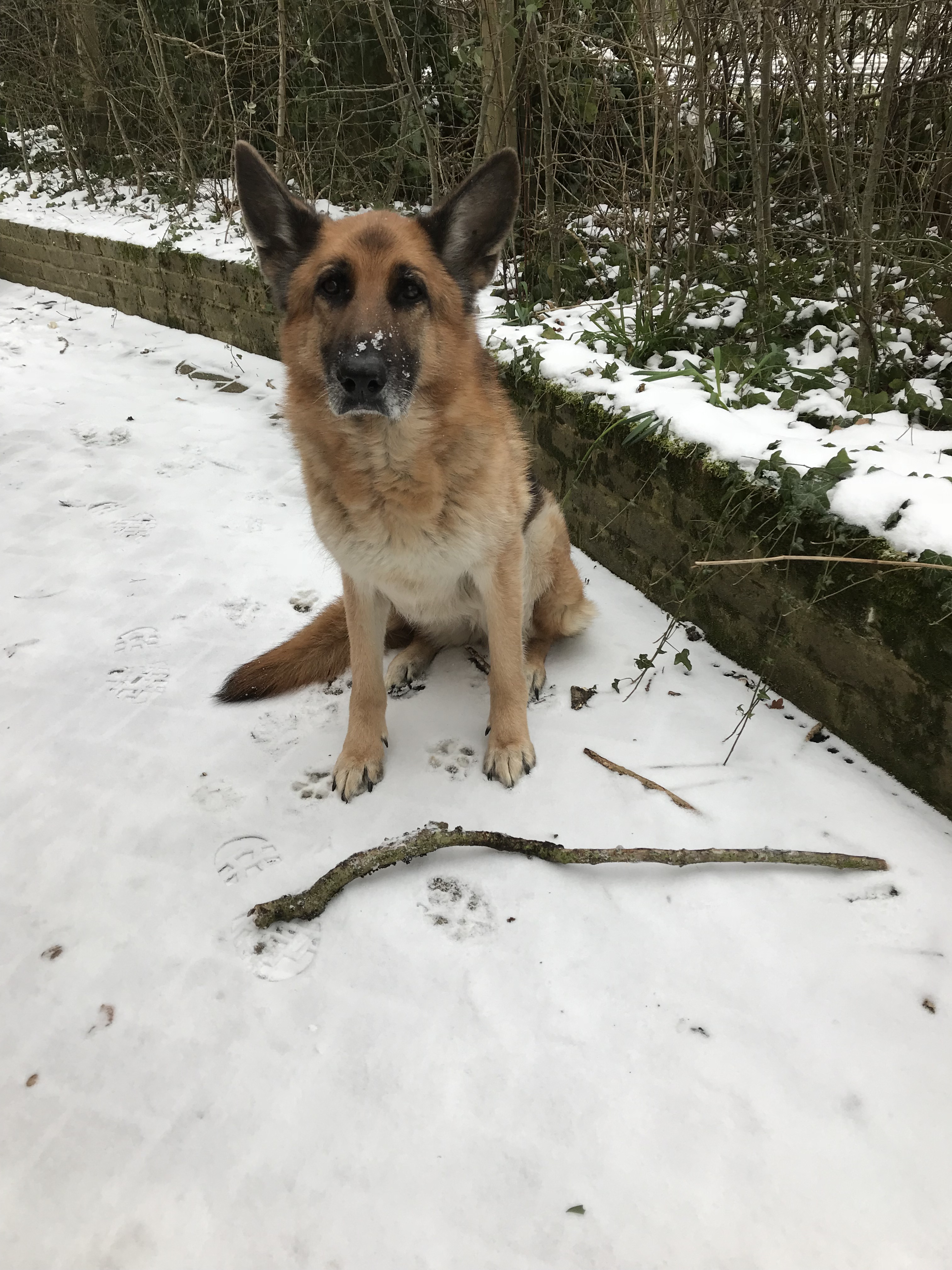
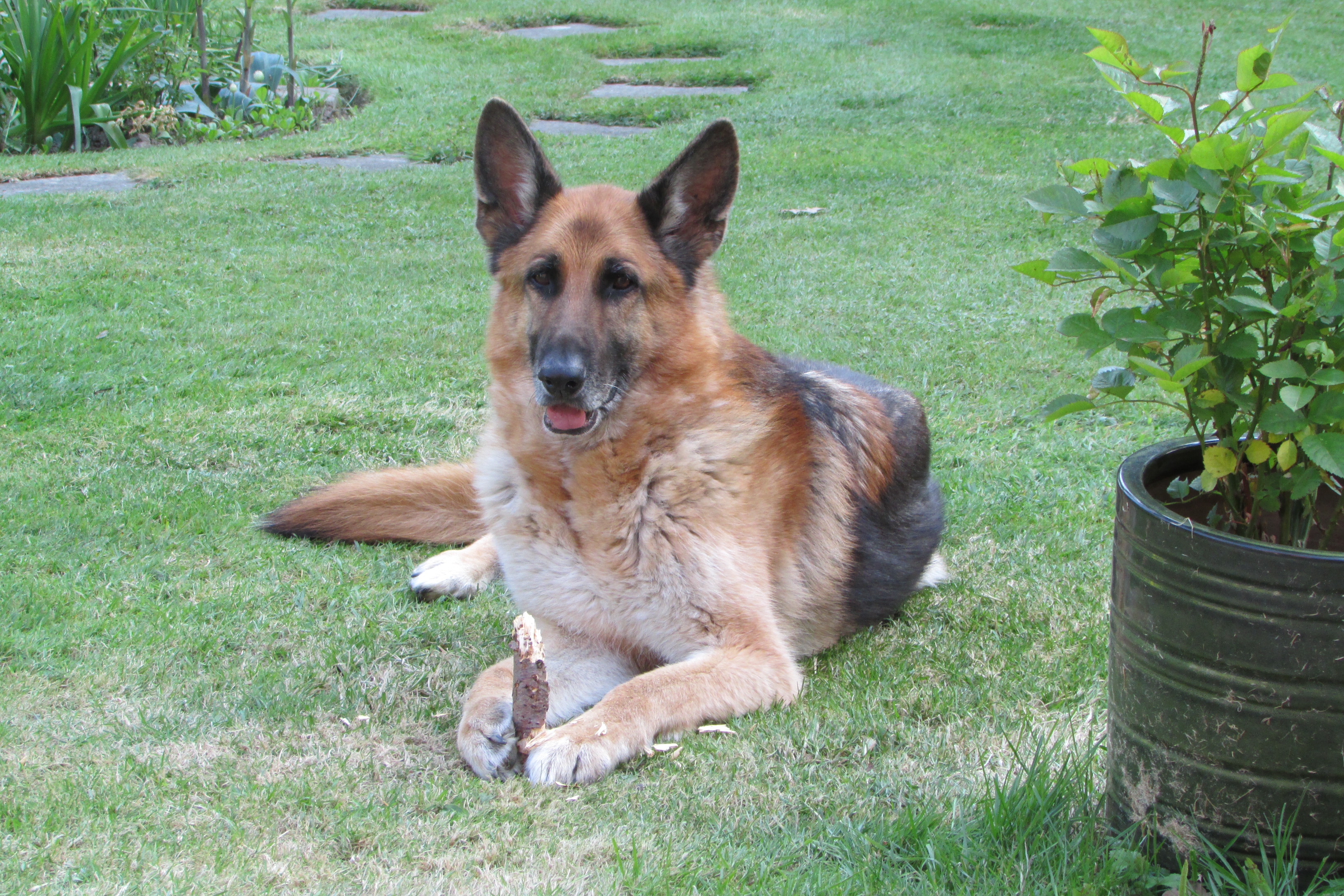
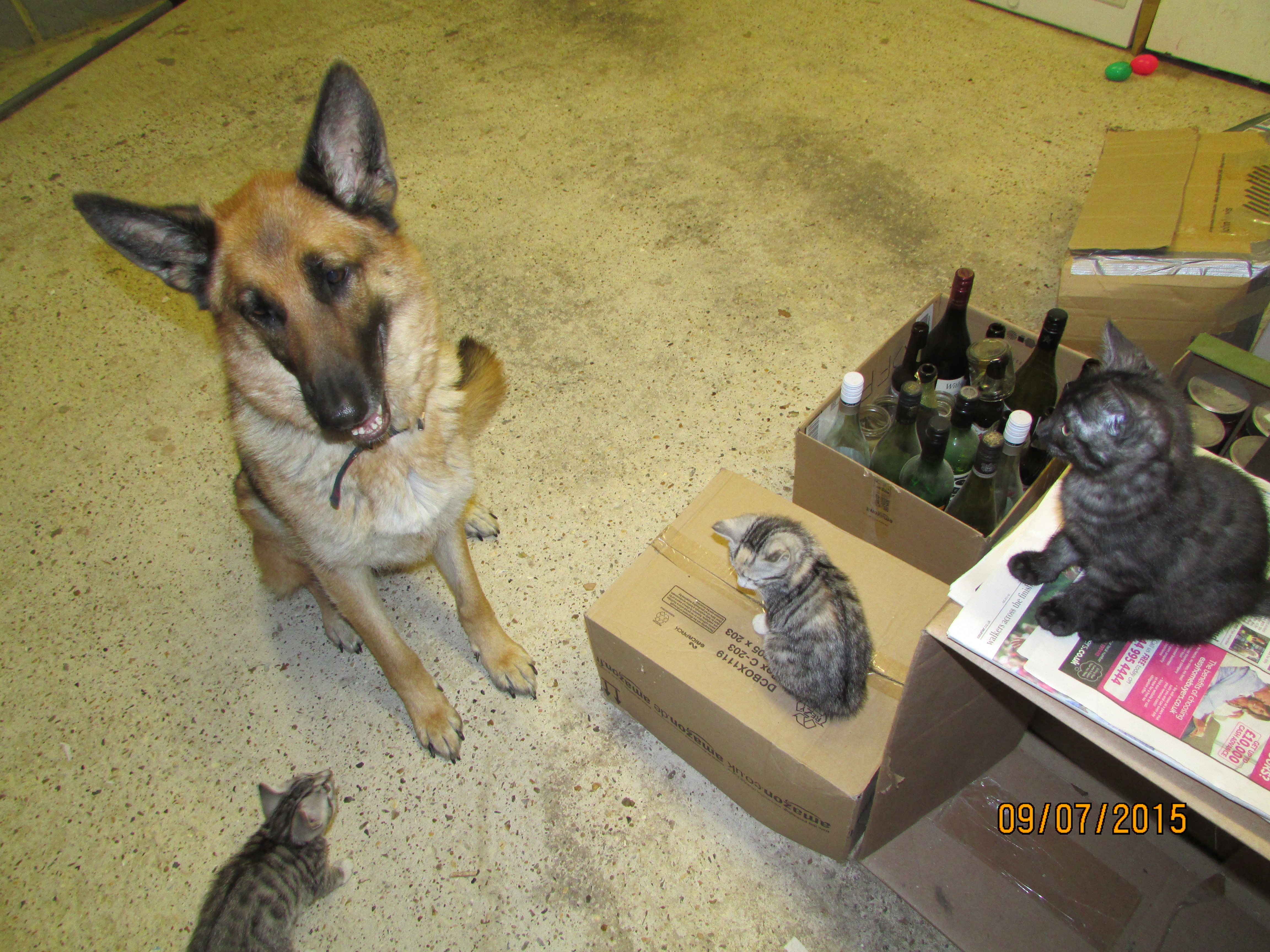
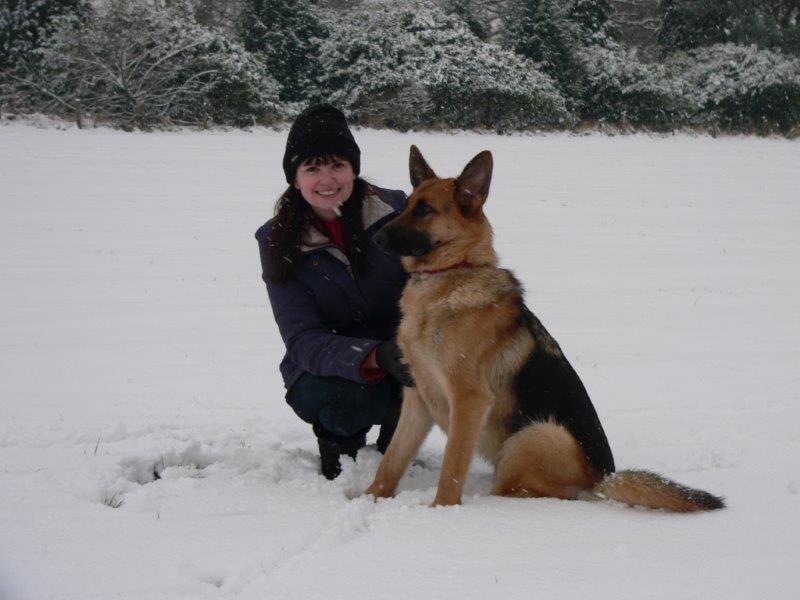
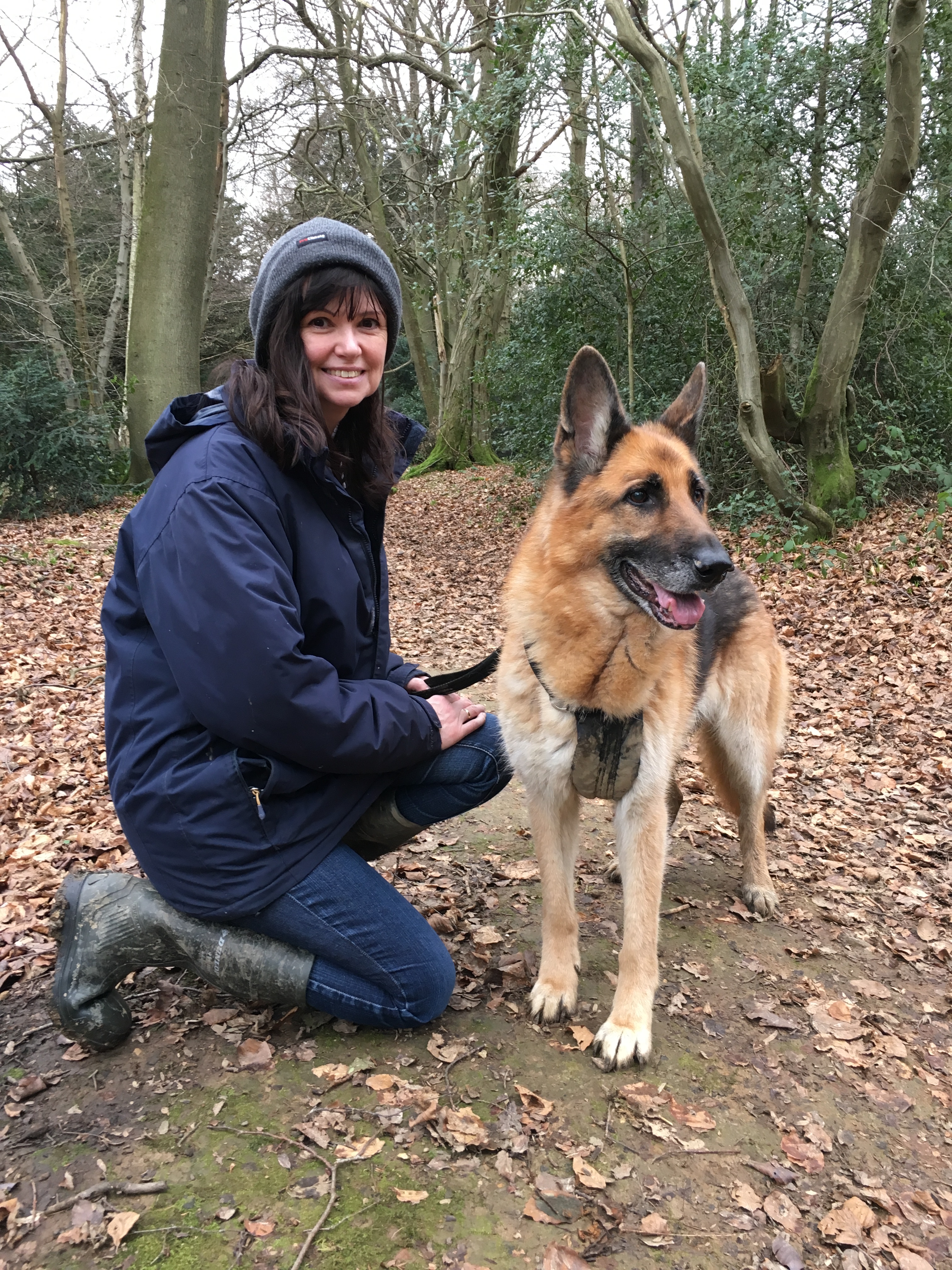
We all have bad days, I think last Sunday was one of my worst, though it might have been even worse. It began just fine, Bea was here for the weekend, and we’d all had dinner and watched a film, and I was preparing to go to bed. I’d fed Kia and put her out for a last wee, but I had forgotten to sort out the heating for the night, so popped back downstairs. Bea and Jay met me in the kitchen, and said something was wrong with Kia.

Kia was pacing, looking uncomfortable, and stretching her neck as if about to vomit. I had earlier dropped an egg in the garden, and I wondered if she’d eaten it, especially as when moments later she was sick, the result was what looked like uncooked meringue. Maybe she was allergic to egg? But then my mind began to process what was happening, and that she had been fed an hour earlier, and yet none of that food had come back up. Plus, Kia was now panting, stretching out her neck as if she couldn’t catch her breath, and when I felt her stomach it was as hard as a rock. I had read about symptoms like these on one of the German Shepherd Facebook groups I belong to—Kia was showing all the signs of a twisted stomach. And that is often fatal.

I woke Husband and said I thought we needed to go to the vet. We are very fortunate—in a nearby town is a 24 hour veterinary hospital, and they have an out-of-hours casualty department for emergencies. This was an emergency. At least, I thought it was. But when I put on my old dog-walking coat, and collected the lead, Kia seemed suddenly fine. She started to wag her tail, and trot around excitedly, ready for a walk.

“Could Kia simply have had a bad reaction to something she ate? Was I overreacting by rushing her to hospital?”

Possibly, but the facts were that if she had a twisted stomach, she needed to be operated on as soon as possible or she would die. If she had simply eaten something bad, the vet would tell us the visit was unnecessary, we would apologise and return home. The risk of not rushing to the vet was too great. We rushed.

Kia was okay on the journey, obviously uncomfortable, but not in agony. We arrived, I explained the problem, and the vet agreed it sounded suspiciously like a twisted stomach, which is quickly diagnosed with an X-ray. I signed the consent form, Kia was led away, we waited.

Within a few minutes the vet returned. Kia had a twisted stomach, the vet could operate, but Kia is an old dog (12 years old, which is old for a GSD) and the operation was a major one. Did we want to take the risk and spend the (considerable) money? It was all too quick.

Pause for a minute with me, and try to imagine the situation. An hour ago, Kia had been fine, all was peaceful at home. Suddenly, everything had changed, and my completely healthy, very fit dog (lets face it, one of my best friends) was now about to die. What to do? Was I committing her to months of pain, to never properly recovering, because I didn’t want to let her go? Or should I give her a chance, should I decide that she is remarkably healthy for a dog that age, she had every chance of a full recovery and a few more years of active life, and I should not deny her that. What was the right choice? As is often the case, I have no idea. There was no time to take a moment, to pray for wisdom, to test how I felt. The decision had to be now.

I chose to operate.

I then went to sit in the car, leaving Husband to listen to the potential risks and to sign the release forms, because all the sensibleness had deserted me, and a hot fountain of tears was about to escape and I wanted to be somewhere private. I sat in the car, aware of how much I love that opinionated, determined, faithful animal, and how much I was losing if she died; and I cried.

Husband returned, and we drove home. The vet said that if, during surgery, there was too much internal damage, then they would phone and ask permission to put her to sleep. (We were unable to give consent prior to surgery; I don’t know why.)

At 4 am, the vet phoned. The surgery had gone well, Kia was in recovery, but the next 72 hours would be critical.

At 7.30am, the vet phoned to say Kia was awake, and seemed remarkably well. By the evening she was able to walk outside to toilet, and was drinking, though she still had not eaten.

Monday morning, the vet told us that Kia still had not eaten. This didn’t overly surprise me. She has always been a picky eater, and at home she will only eat when I eat. If I put her food down in the morning, it will sit there, untouched, until she sees me eat my evening meal—then she will eat. The vet suggested that if I was comfortable giving all the medication, Kia would be better at home, as she needed to eat. We collected her (and a suitcase of pills).

As I write this, Kia continues to improve. She is still very weak, and is eating lots of little snacks rather than a proper big meal. But gradually her strength is returning, and she is relaxed at home, as long as she can see me, she is happy. The drugs make her drowsy, and her shaved tummy needs to be kept warm, but I think she is going to be all right.

I am so grateful to the dog owners who described the symptoms of a twisted stomach so that I recognised them. I am grateful to the vet, who reacted so professionally. And I am grateful to God, who allowed me to keep Kia for a little longer, even though we never know how long that will be.

Thank you for reading.
Take care.
Love, Anne x
Anne E. Thompson has written several novels and non-fiction books. You can find her work in bookshops and Amazon.
Why not sign up to follow her blog today?
anneethompson.com

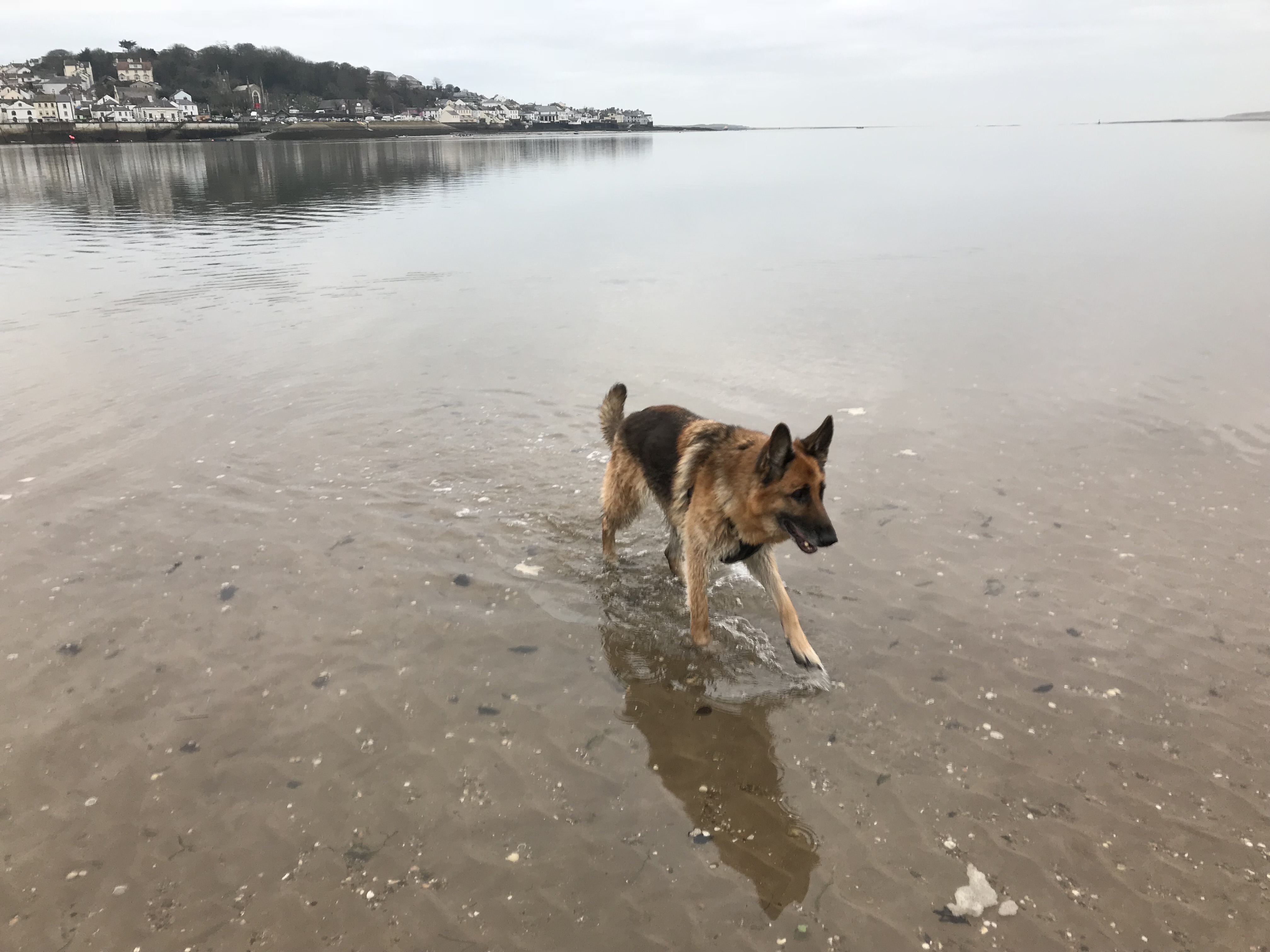
 

You can read more about Kia in my travel book (though she was only invited on the English holidays!) You can read it free if you have a kindle. Also available in paperback–a lovely Mother’s Day gift.

Now is an excellent time to read my travel book. Happy adventures from around the world.
Available from Amazon.

UK link Here

Lazy Days on the Isle of Man


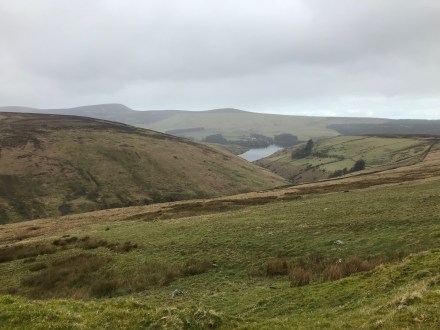
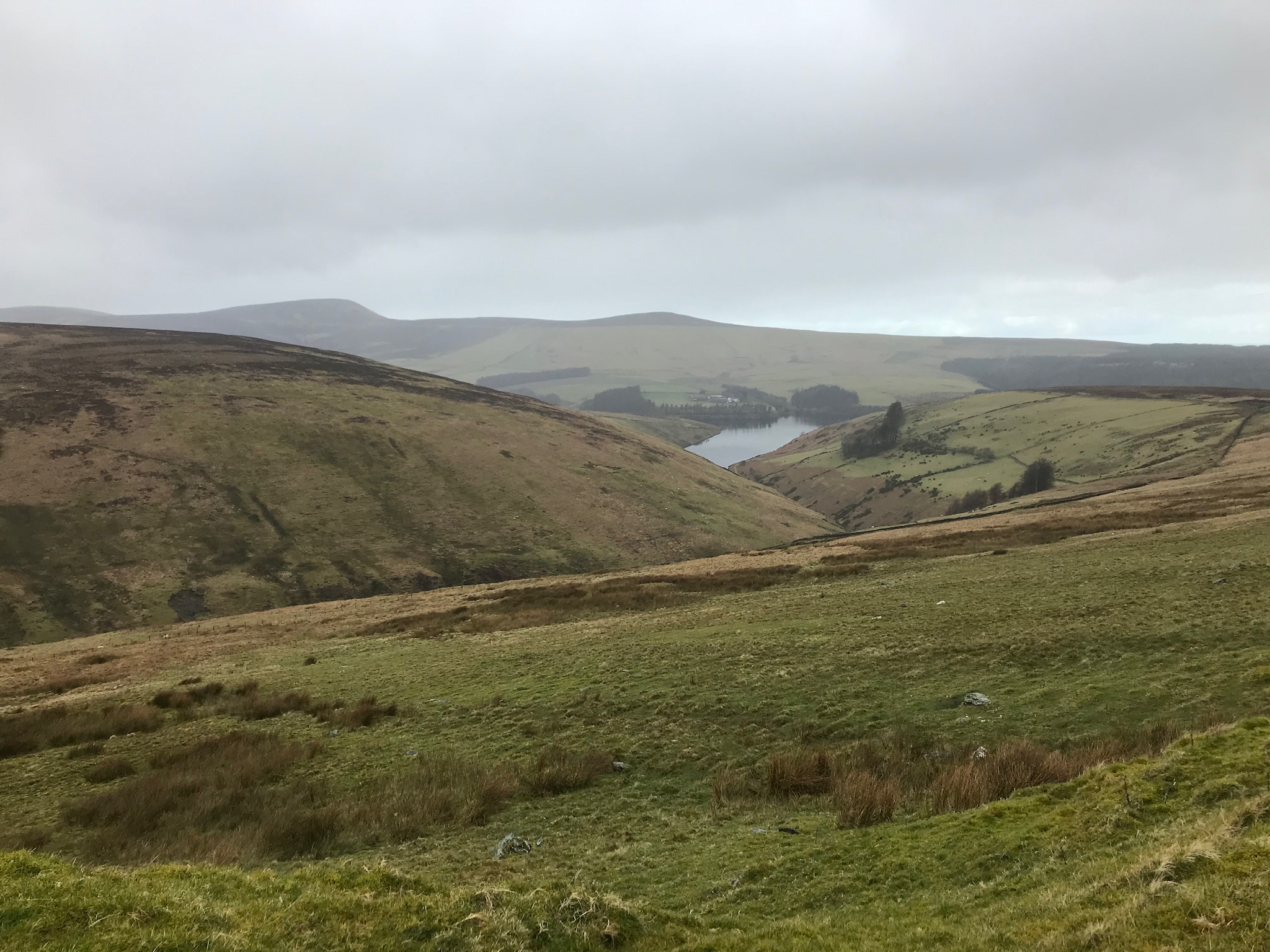
Wednesday was gloomy, a thin veil of rain spoiling the view, so we decided to go for a drive. We drove to the little village of Strang, then headed north on the B22. The road (excellent, because all roads on the Isle of Man are excellent) took us along the top of a mountain, looking down into steep valleys. There were lots of random sheep, patches of snow, plantations of pine trees. We passed reservoirs, crossed cattle grids and narrow stone bridges. Tried to find an ancient stone cairn, but failed.

Drove to the Motor Museum in Jurby. It is shut on Wednesdays.

We then had to decide: pop to look at a nearby prison, or drive to a car park near the sea at Sartfield. We chose the car park near the coast (at least, Husband did, which is the same as us both deciding. I voted for the prison.) Turns out that Sartfield is where the septic tank lorries empty the poop into vats, and a long pipe carries it the length of the footpath, to the sea. I have visited better smelling beaches. Wasn’t tempted to swim.

Drove along the A10, through the northern edge of the island. It was very flat, with fields of cattle and trees twisted by the cold north wind. It has echoes of Dungeness, where weird houses face the the elements in the shadow of a power station.

Drove to the village of Bride, passed an open tea-room and as it was 2.30 and we hadn’t eaten lunch, we stopped. It was perfect. I had red wine and goulash, and Husband had a cup of tea and a burger. People at other tables seemed to be ordering food that wasn’t on the menu (I definitely saw a lasagna!) but I was happy with my choice.

The guide book said there was a Celtic cross in the Parish church, so we went to look. We wandered among the graves, but no Celtic cross. I decided to look inside the church, and there it was! The black stone, engraved in the year 900 was still ornate, though it exuded old age, somehow the black stone managed to look ancient. The son who created it over the grave of his mother would never have guessed that we, in our modern clothes, with cars and houses, would one day trace the markings with our finger, and think about those long-ago people.

We drove home via Ramsey, simply so that Husband could drive the A18, which is the TT course across Snaefell. I am so glad we didn’t hire anything faster than a Corsa!

On Thursday, we went to Castletown. In the town square is the ‘Candlestick’ which is the plynth intended to hold the statue of Governor Cornelius Smelt (1805-1832). But the town people refused—and still refuse—to pay for the actual statue, so the column stands there, empty, looking like a giant candlestick!

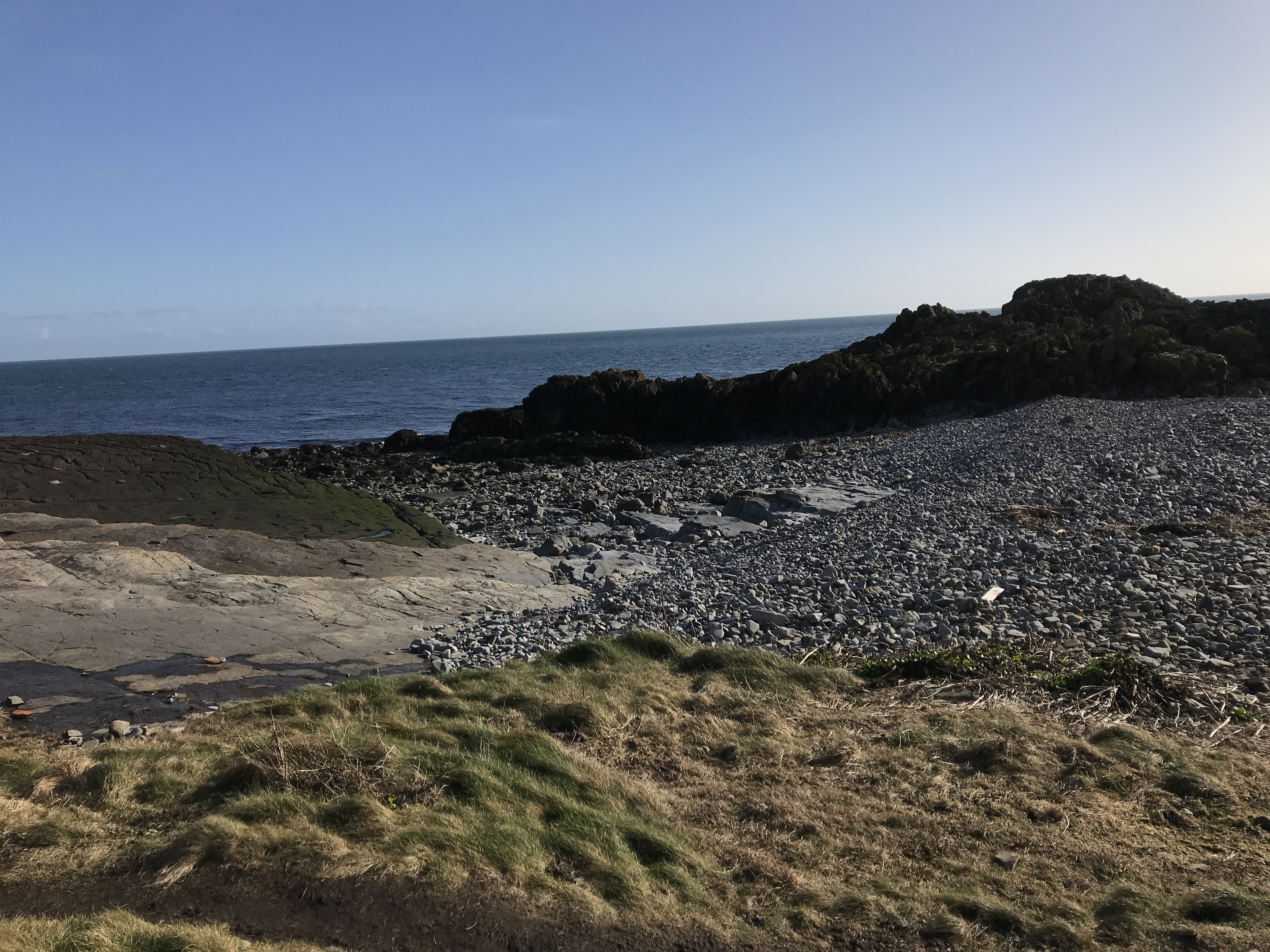
I had read that Castletown had the plug to an old volcano, and I was interested to see it (to be honest, I wasn’t exactly sure what a ‘plug’ was, but I like volcanoes). We set off for the visitor centre. It was shut (everything is shut in March) but there was a helpful sign on the wall, which explained the geology of the beach. Now, I do not usually have any interest in geology, but this was rather amazing. There were slabs of limestone, which had been mined, and the remains of the lime kilns. Right next to the lime was a ‘storm beach’—fat pebbles washed up during a storm; and behind it all was the volcano plug, which was a hill of rocky volcanic larva from about a million years ago. It was, surprisingly, very interesting.

We finished our trip to Castletown with tea and cake. There is of course, a castle in the town, but I felt the teashop would be more fun.

I hope you make some good choices today.
Take care.
Love, Anne x

The Cafe at the Sound


Our guidebook was, to be honest, pretty useless. It told us things like “There is a Celtic cross at Bride, which is very interesting.” Not a huge amount of information or background in that statement. However, some of the places it mentioned (whilst giving absolutely no information about) were rather splendid. The Cafe at the Sound was one of these.

We drove across the island, me giving directions, Husband ignoring them and pretending he was a racing driver. I was in an excellent mood, having enjoyed another breakfast at our favourite cafe: The Tea Junction. Every morning I had porridge, sprinkled with slices of banana and cinnamon, with local honey in a tiny pot at the side. Perfect.

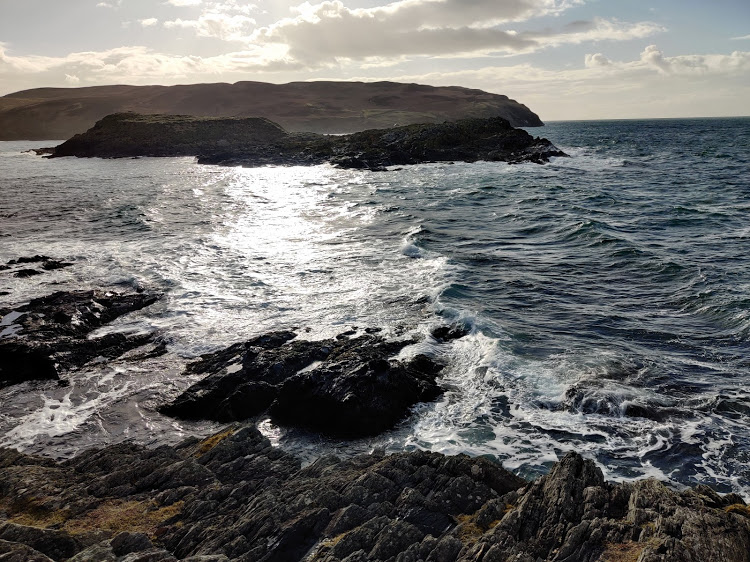
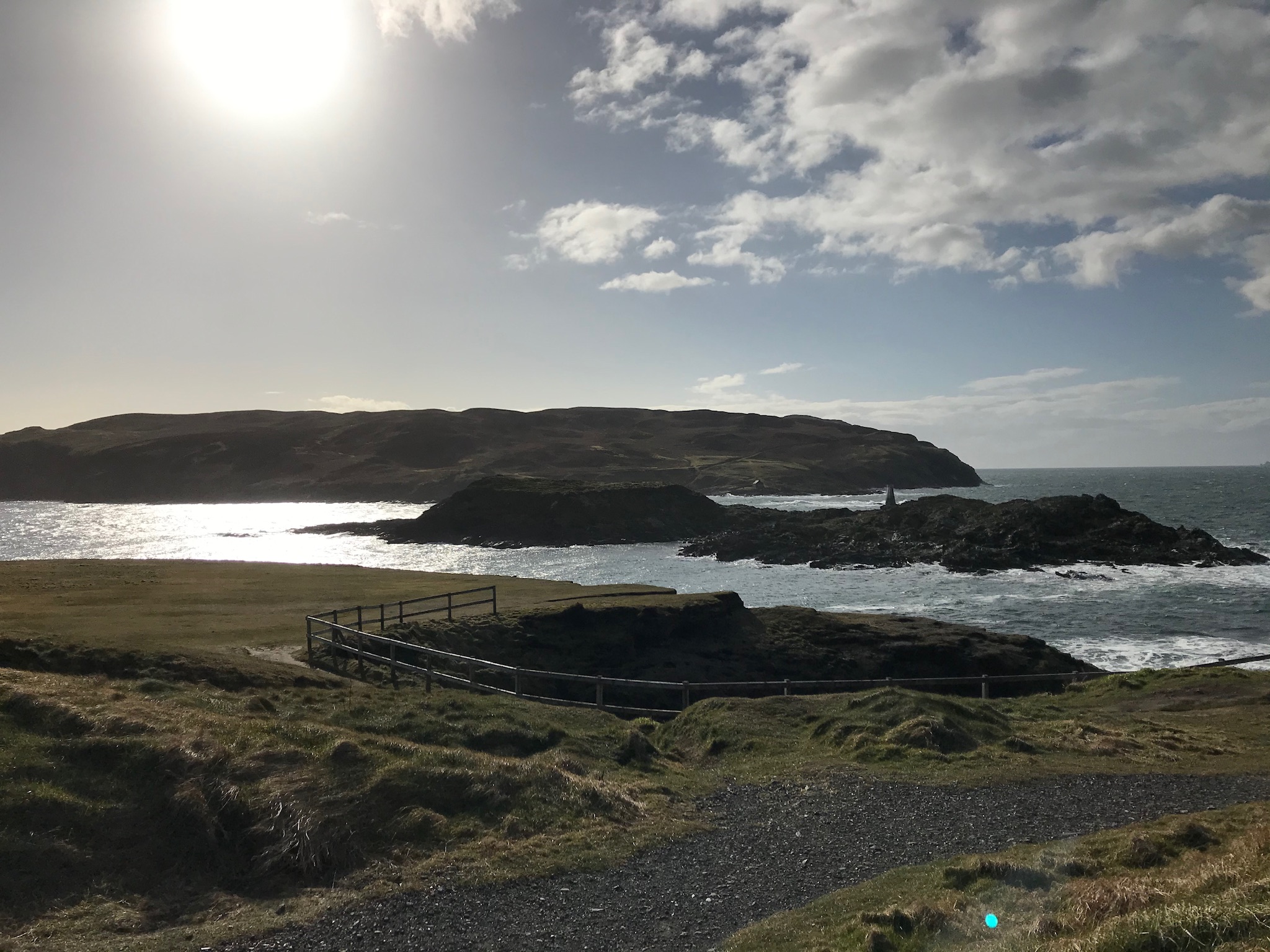
However, the cafe we were heading for was not recommended for its food, but for the view. And oh my word, what a view! Perched on the side of the cliff, overlooking waves that crash over rocks, and sea that races between the Isle of Man and the tiny island of the Calf of Man. The weather was wild, which is absolutely the best time to visit, and we walked up to the cafe and sat at one of the tables next to the curved window, watching the sea and the weather and the wonderful strength of it all.

We ate sandwiches, which were very nice (though nothing could compare with the view) and I lingered over some rather tasty-looking cakes sitting under their glass domes in a tempting manner. Husband reminded me about my cholesterol levels (sometimes I hate him) and we left and went for a walk.

There were paths below the level of the cliff, and we dropped down out of the wind, and everything felt calm and peaceful (apart from the sea, which was still whooshing through the gap between the islands). I thought I could hear a hoarse bark, over the sound of the wind, and peered across to the Calf of Man. It was slightly too far away to be in focus, but I could make out rocks in the little cove. Then one of the rocks lifted its head, and I realised they were seals. We weren’t near enough to see them properly, but every time one of them moved, or a new arrival humped its body out of the waves, we could discern they were seals. It was terribly wonderful. We sat for a while, watching them flop their bodies across the beach, then we drove back across the island.

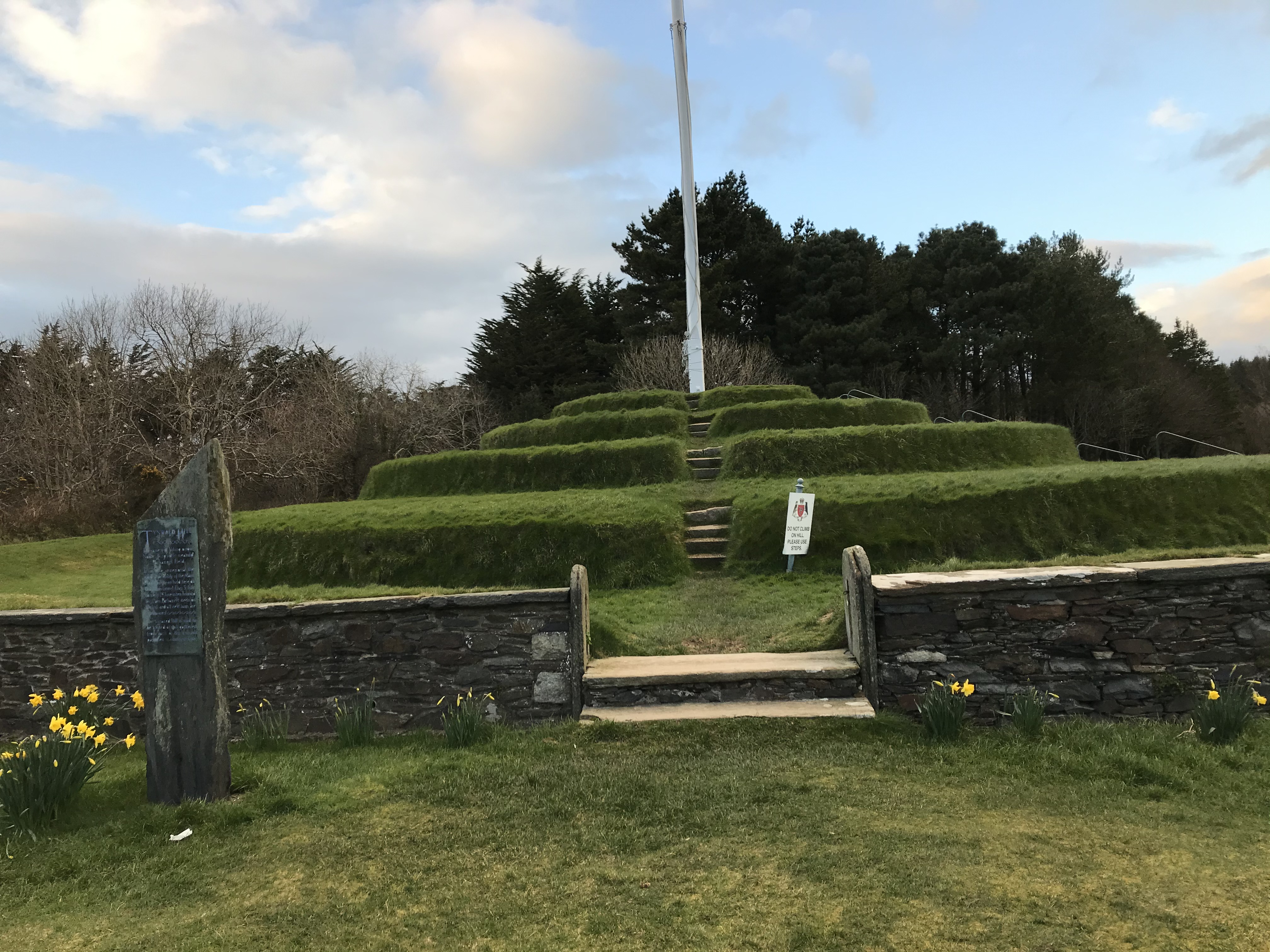
We passed a big church, with an area lined with flag poles, and a tiered hill like a green wedding cake. We stopped. This was Tynwald, the parliament hill I told you about in an earlier post. We walked around for a bit, trying to imagine how it would have been 1,000 years ago when it was established.

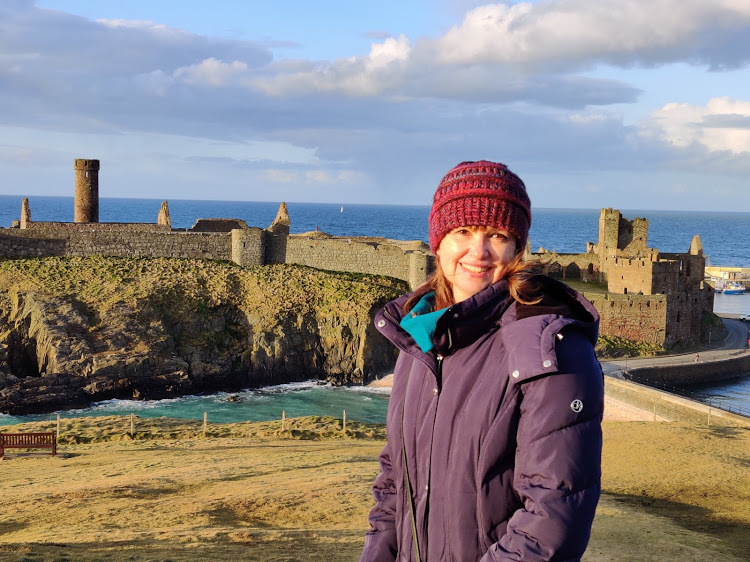
We drove home via Peel (home to those kipper-burgers from yesterday, which I can still taste by the way!) Peel is beautiful, with a quay full of fishing boats, and a castle from a storybook. The castle was possibly Avalon, from the King Arthur legends, and it used to be on an island but now it’s attached to the town by a little road. It was closed (everything was closed the first week of March) but there was a hill opposite, so we sat at the top in the sunshine, staring at the castle and thinking of stories (well, I was. Husband was probably thinking about the cost of renovating it) while the wind pushed against our backs and froze our bones.

Then we left, driving back (racing-driver style) to Douglas, where our Airbnb is. Another nice day on the island.

Thank you for reading, I hope you have a nice day too.
Take care.
Love, Anne xx

Thanks for reading.
Why not sign up to follow my blog?
anneethompson.com

The Island with the Best Roads in the World


The back view is definitely the best! Front view has steamed-up glasses and a very red face.

I am sure you will have guessed by now which island we visited, but here are some more clues:
Each morning, we ran along the quay. I use the term ‘run’ lightly, but it was a lovely way to exercise, watching the ferry appear over the horizon, listening to the seagulls, watching the waves heave seaweed onto the beach. Just beyond the harbour is a tiny island with a tower on it. At night, it lights up with different coloured spotlights, and looks magical.

I went to one of the many shops selling ‘tourist trash’ and spent a happy time looking at fridge magnets and sticks of square rock (because that’s a thing here) and T-shirts with TT Racing emblazoned on the front (because that’s a BIG thing here). I bought a T-shirt. (TT actually stands for Tourist Trophy.)

The TT race is massive here. The island has a tiny population of about 80,000 and about 50,000 people arrive for the race. The race course is on the actual roads that cross the mountains, with start and finish in the towns. Which means that if the roads have even the smallest pothole, they dig up the whole section and resurface it properly, making all the roads fabulous for driving on. This island possibly has the best roads in the whole world.

While I was buying my T-shirt, the person in the shop told me a little about how crowded the island becomes during race season. Most residents have a room they can rent out, and farmers use fields as campsites, and all the restaurants are completely full. The week before the race, the road across the mountain is made one-way, and people with expensive cars come to zoom along the road. Of course, it is still open to normal traffic, and if Mr. Ferrari happens to get stuck behind Granny Slow-Boots, then there is a ginormous traffic jam. Possibly, I was told, the most expensive traffic jam in the world as it is full of the very best, fastest cars.

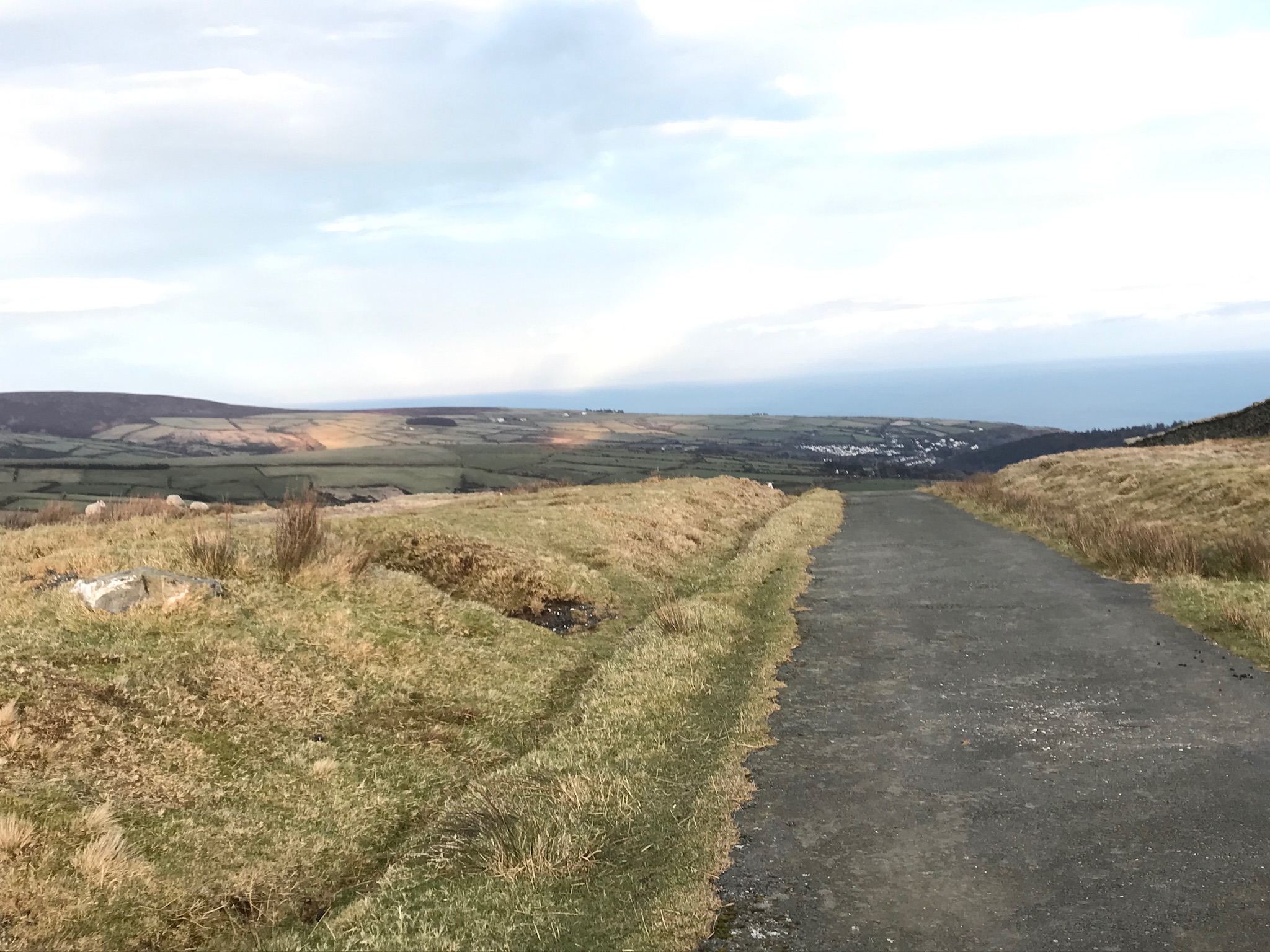
We were not on the island for racing season, but Husband still enjoyed the roads, and I was glad of seat-belts. As we drove through the mountains, we saw patches of snow and beautiful views and we frequently stopped to enjoy where we were. It was always freezing!

We drove up to Laxey, which is an old mining town. There is an huge waterwheel, made into a monument to the miners. My recommendation would be to visit this out of season, otherwise you might be forced to walk up some very scary steps, right to the top. Or to be asked to “Take a photo when I’m up there,” which will involve a long cold wait at the bottom. Much better to visit in March, when everything is closed and you can simply peer through the gates!

On the side of the Laxey Wheel is the triskelion. This is the emblem that is on the flag, and on practically everything else on the island (even hanging from street lights). I could not, to be honest, quite get my head around it. No one seems to really know where it comes from. It’s a three-legged swastika (nothing to do with Nazis) and I found it uncomfortable to look at. Each leg is dressed in armour, and it’s associated with the motto: Quocunque Jeceris Stabit (‘Wherever you throw it, it will stand’). The museum has several ideas about where it originated from, but no one is quite sure.

The island is also famous for a breed of cat. The Manx Cat has no tail, and the back legs are apparently slightly longer than in other breeds. I say “apparently” because we never saw one. I dragged Husband along residential streets, peering over garden walls and into bushes, but we didn’t see a single one. Personally, I think they do not exist (unlike the fairies, of which we saw many potential candidates).

Our first evening on the island, I ate Queenies—the Queen scallops that are a local delicacy.

We also ate some Manx kipper-burgers. These are smoked kippers, served in a bap, and the best place (according to the locals) is a small kiosk next to the castle in Peel. We drove there, dodged the extensive roadworks, and ordered our kipper burgers from the harassed-looking woman behind the counter. Then we climbed some steps, to an eating area above the kiosk and sat on a wooden bench, looking out to sea. The kippers were freshly cooked, the juices dripping from them when we took a bite, the bread fresh and soft. We ate them watching seals in the sea—or rather, with seals in the sea bobbing up to watch us! Kipper burgers are a sort of once-in-a-lifetime experience for me. Glad I did it, never need to do it again. It was a hard-to-forget experience, as the taste lingered long, long after the last bite was swallowed. . .

I am sure by now you know that we were on the Isle of Man. I will tell you more tomorrow. Thanks for reading. Eat something tasty today.
Love, Anne x

The Island Continued


The Island Continued
Have you managed to guess the name of the island we visited? Here are some more clues.

I was interested by the history of the island, knowing that it has a mixture of Celtic and Viking heritage, and is currently protected by the UK, but is not part of it (and has never been part of the EU). The island is owned by the Crown, and has its own Parliament.

I followed signs from the main shopping street to the museum. The sign implied (not sure how, but it did) that the museum was tucked just behind the shops. This was not true. I followed a long succession of signs, up a hill, to an entrance with some steps which looked exactly like the pedestrian entrance to a car park (though they smelt better). A sign told me the museum could be found at level 9. Unexpected. I began to climb.

I walked up the car-park-like steps until I emerged (at level 8, as level 9 did not exist) in. . . a car park! I almost gave up, but another sign directed me through the cars, over a narrow footbridge until I reached a red brick museum. I was greeted at the door by a friendly man, who had a big smile and the curliest hair I have ever seen, sort of piled onto the top of his head like one of those artificial-looking wigs that clowns wear. I was glad Husband was safely at work, because I just knew he would comment. The museum was free, and I was given a map, and directed through the first doorway.

The museum started badly (other than the storybook man at the door) with displays of art. The next room had glass cases of coins, and other old stuff, followed by long explanations about the geology of the island. I remembered that I don’t like museums, and wondered how I could sneak past the friendly man without being noticed. Sat on a leather seat and pondered problem, decided that there was no way I was brave enough to leave after 3 minutes, and continued into the heart of the museum. Here I was greeted by Vikings, but even these managed to look bland.

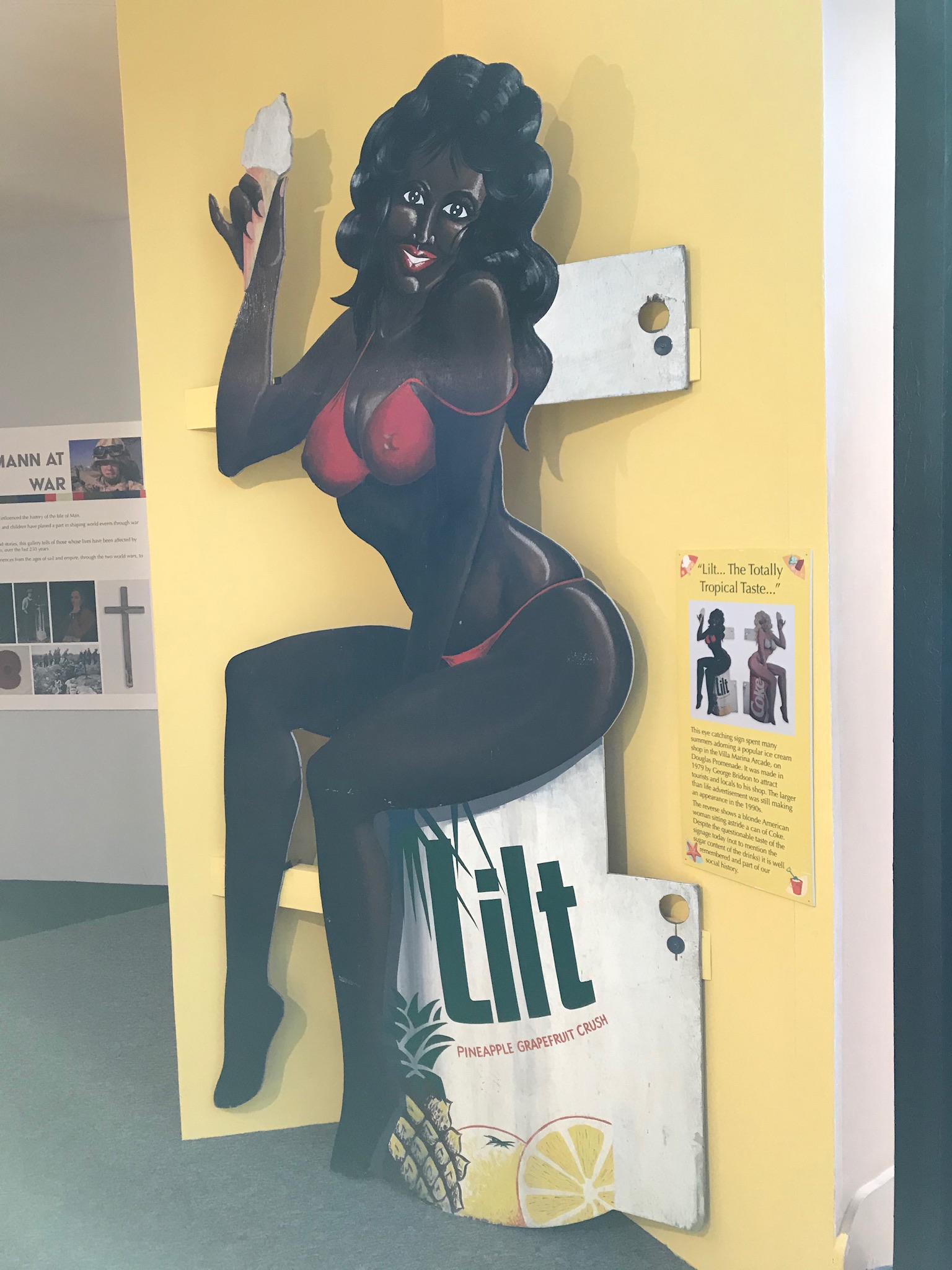
Now, I’m not a fan of museums—too much reading of boards to learn facts I am not interested in—but most museums today manage to mix some story in with their facts, and I was pleased to discover that this was no exception. I rounded a corner, and was directed up the gangplank of an ancient ferry from Liverpool, past portholes showing glimpses of a former life, trunks and suitcases piled high, a man’s voice announcing the imminent departure of the boat; then down the other side onto a beach from yesteryear. There was a horse-pulled tram, and bathing huts that could be wheeled onto the beach. I left via huge displays showing adverts for ice-creams and drinks, which were shocking when viewed with modern eyes.

 I also enjoyed the displays about the war, with a walk-through trench. Photos and displays showed how the island was used to house prisoners of war. There was no purpose-built prison, and initially the prisoners were housed in the properties that lined the beach, with barbed wire to stop them leaving. Later, they were moved to a ‘camp’ with tents, and these were replaced with sheds when the weather turned too cold. Above the displays was a huge mine, menacing in both its size and position.

Another part of the island’s history can be found at St. John’s. Here there is a tiered grassy mound, and a flag-lined area leading to the church. A standing stone explains that this is ‘Tynwald Hill’ and is Viking in origin, the Norse: Thing vollr meaning ‘Parliament Hill’. Each year on old Midsummer Day, the island’s parliament meets and all new laws are proclaimed.

There is also a Parliament building, where they meet during the rest of the year. But it doesn’t look at all interesting, so we will leave it at St. John’s.

I’m sure you will know the name of the island now—if not, read my next post.
I hope you have an interesting day. Thank you for reading.
Take care.
Love, Anne x

The Island


We went to an island that had the hills and valleys of the Yorkshire Dales, with the dramatic coast of Cornwall, and the slightly ugly but real houses of Wales. It was perfect, and very unspoilt, so to be honest I don’t want to tell you where we were. But that feels a little mean, so I will tell you the name in a later blog—unless you can guess already? I will give you some clues.

We left home last Monday, to catch a flight from Gatwick. I worried about Coronavirus, and wrapped my scarf around my head and face, so I resembled a sort of paisley Egyptian mummy. It was very hot! We jostled shoulders with hundreds of people, and I wondered if hand sanitiser—which kills bacteria—was any protection at all against a virus.
We flew to the island, and most other people hadn’t checked in any luggage, so collecting our bags was super-fast. The airport was tiny, and we went straight to the Avis desk, where a friendly lady gave us the keys to our car and told us not to put in too much petrol because the island was too small to need much. She had a sort of Liverpudlian accent, which took me straight back to being 17, and visiting my sister when she studied at Liverpool Uni.

We drove to the Airbnb, which was right opposite the beach, then walked to the town. The main street had all the big-name shops: M&S, Topshop, Next, Clarks; surprisingly it also had customers, and it reminded me of twenty years ago, when High Streets weren’t full of boarded up windows and Poundland. I realised that probably the hassle of internet shopping/delivery when you live on an island, means that real shops, with real products, are how most people shop. It was rather nice.
We drove around the hills behind the main town. The roads were brilliant, and Husband enjoyed the drive and went slightly faster than I hoped. (A big clue here!) The island has no national speed limit, so although there are restrictions in the towns, an ‘end of speed limit’ sign means just that: there is no speed limit. We drove up a mountain, with ragged-looking sheep and patches of white snow gleaming, and views across the sea to the mainland. It was beautiful and wild and absolutely freezing cold.

The island has fairies (this was in the guide book, so it must be true). They are not the tiny flighty girl-fairies of picture books, with their long hair and floaty dresses and shiny wings. No, these fairies are about 4ft tall, with pointy hats, and they cause no end of trouble, especially if you don’t show them respect. They are referred to as ‘Themselves’ and have been known to steal babies and bring bad luck and all sorts of other mischief. I made a huge mistake in reading this section of the guide book to Husband, who then spent the next few days pointing out every person who could, possibly, be a fairy. To be honest, there are an unexpected high number of very short people on the island, most wearing bobble-hats, some sporting long beards (mainly the men). It made me giggle, which was very bad as it encouraged him.
Can you guess where we were? I will give you some more clues in my next post.
I hope you have a fun day. Take care.
Love, Anne x


Should you ask for a miracle when you’ve been given a brain?


Let me set the scene for you: The church service has finished, and people are shuffling their chairs into small circles, ready to take communion. There are small round tables in strategic positions, and someone is quietly walking around, placing silver dishes of bread and small glass cups of wine on each one. (Actually, to be strictly factual, I believe the small glass cups are cocktail dishes, designed for jellies or ice-cream sundaes. And the ‘wine’ is indefinable fruit juice, because this is a Baptist church and they don’t have alcoholic wine for communion.) The bread is gluten free, so that everyone can share from the same loaf.

I sit, in my circle, and look at the other people. This is a mistake—perhaps my head should be bowed in prayer, and I should be oblivious to the people I am about to share a cup with, but I’m not. I notice that at least four people in my group have colds, one lady is stuffing a tissue up her sleeve while we wait, others have red noses and watery eyes and hoarse coughs. I find this stimulates me to pray, but again, not perhaps the prayer I should be praying. I am not praying for my fellow worshippers, not asking God to heal their illnesses, to give them comfort from the sore noses and uncomfortable throats. Nope, I am asking for a miracle. I am asking that could I please, please, be protected from the germs that are about to be shared along with the indefinable fruit juice in the glass cup/jelly dish. Because I have a really busy week coming up, with a book sale, and three different occasions when we’re having a number of people for dinner and I need to cook, and a rather nice event with my family which I don’t want to miss, so please God, please protect me from the cold germs and the flu virus, and anything else that is about to be consumed in the indefinable fruit juice.

Then, as I prayed (my rather selfish prayer) I realised that God had given me a brain and a dollop of common sense. My brain told me that sharing a cup (of indefinable fruit juice) with a bunch of people who were clearly suffering from one lurgy or another, was plain stupid; especially at the start of a particularly busy week. I did not need a miracle (ie to be protected from the germs which I would certainly consume with the drink) I needed instead to use my brain, and not drink it. Perhaps being given a brain was the miracle (brains are after all rather wonderful, with their grey sludge and electrical currents that control every part of us).

And so, dear reader, I did not share the communion cup. I truly hope that I didn’t offend anyone by passing it along the line, I hope that no one felt I was being aloof, or setting myself apart, because I wasn’t. I simply decided to use my brain and not risk catching a germ that I don’t have time to fight.

What, I wonder, would you have done?

Thank you for reading.
anneethompson.com
Why not sign up to follow my blog?

I wrote this several months ago, before I was even aware of Coronavirus. I didn’t post it at the time, thinking I would save it for later. It now seems so poignant, I decided to share it.

Victoria and Albert Museum: Fun without a Deadline


One of my Christmas gift vouchers was a trip to a London museum/gallery and lunch, with Jay. We went on Saturday.

We caught the train to Victoria, which was one of my favourite bits of the day—because I was alone with my son and we chatted, and mothers love this sort of thing when their children are grown-up. (It was sometimes fun when they were little, but less reliably, as the stress of tiny bladders and possible tantrums tended to cloud things a little.) We then walked to Rocca in South Kensington for lunch. Jay chose the route, and suggested that we nip across the road, ignoring the lights, a few times, and I wondered how this trait could possibly be inherited and told him he reminded me of his father (not in a good way).

Rocca turned out to be a very nice little Italian cafe. I had a very tasty lasagna, with a slightly old salad, and drank fizzy water and a coffee. It was very pleasant, with the other tables filled with families (a few mothers struggling with the whole tiny bladder/tantrum stage of parenthood) and students. Our waiter was nice and smiley, and it was a lovely relaxed meal.

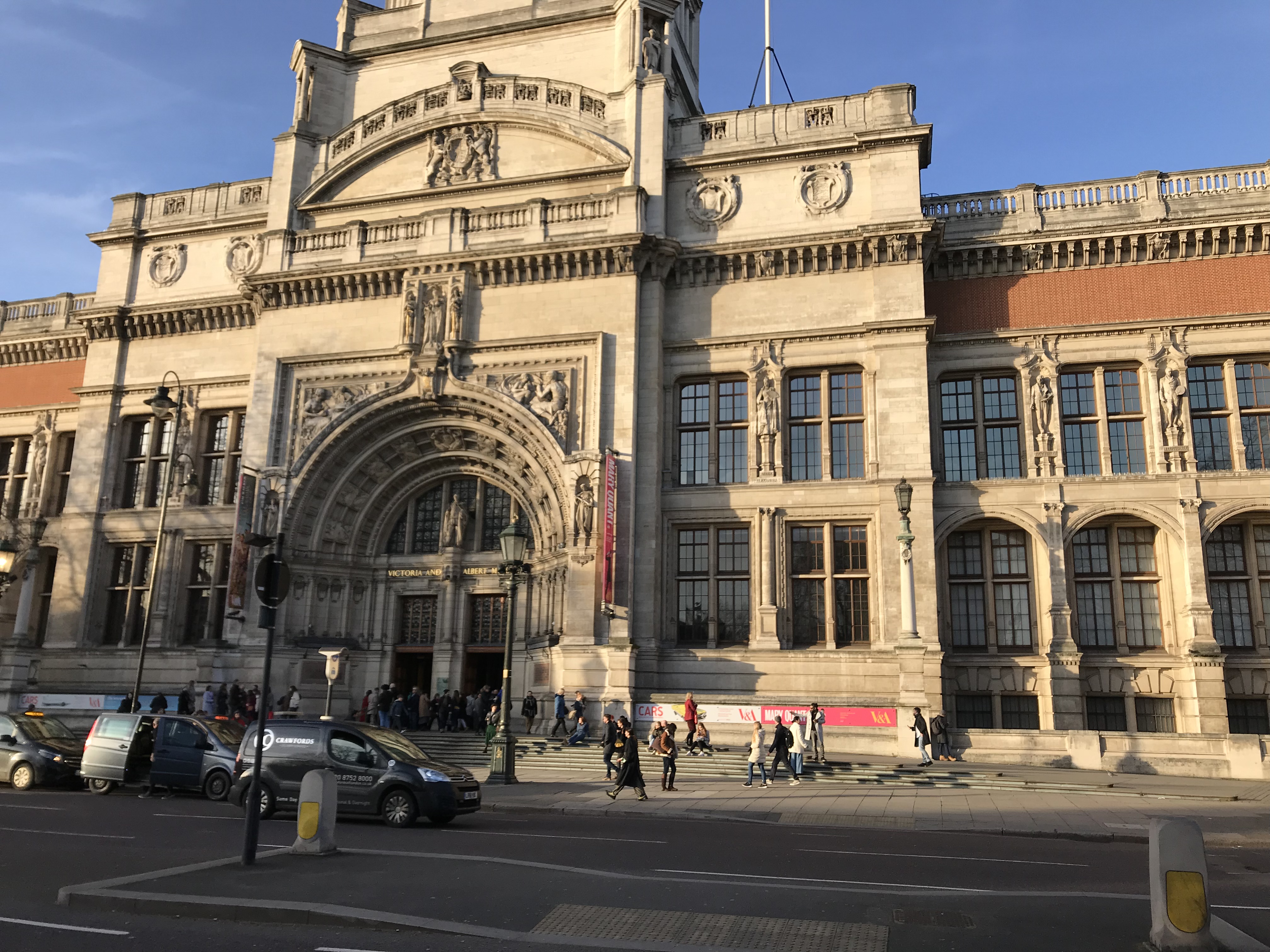
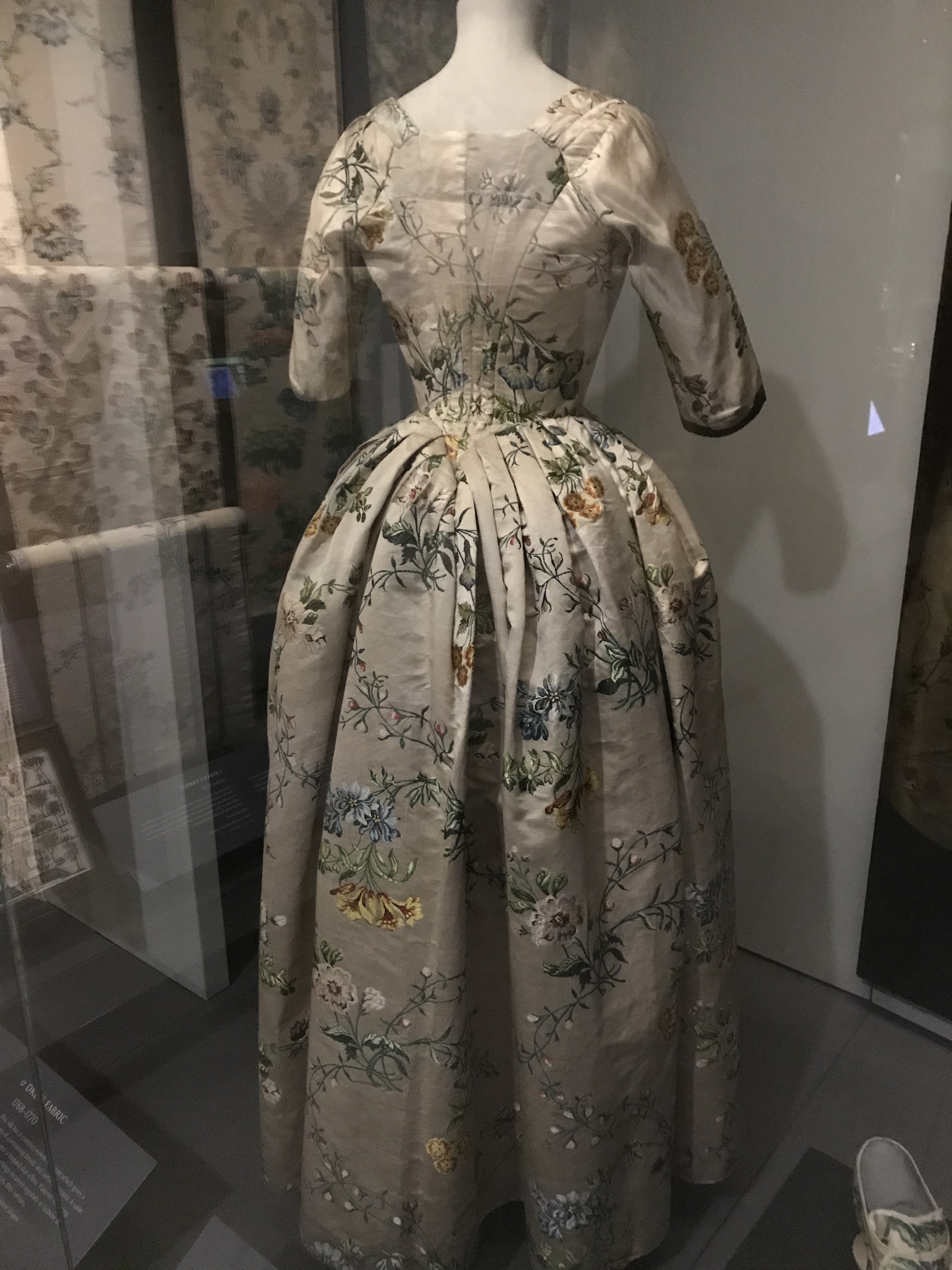
We walked to the V&A museum, which you might remember I visited last year with Husband (who compared it to a jumble sale full of tat). I rather liked the eclectic mix of stuff, and was keen to visit again. I also wanted to check if people wore gloves in 1760. I am writing (very slowly) a story set in 1760, and gloves were a key element, but I wasn’t sure when they became fashionable. The V&A is good for these kinds of facts.

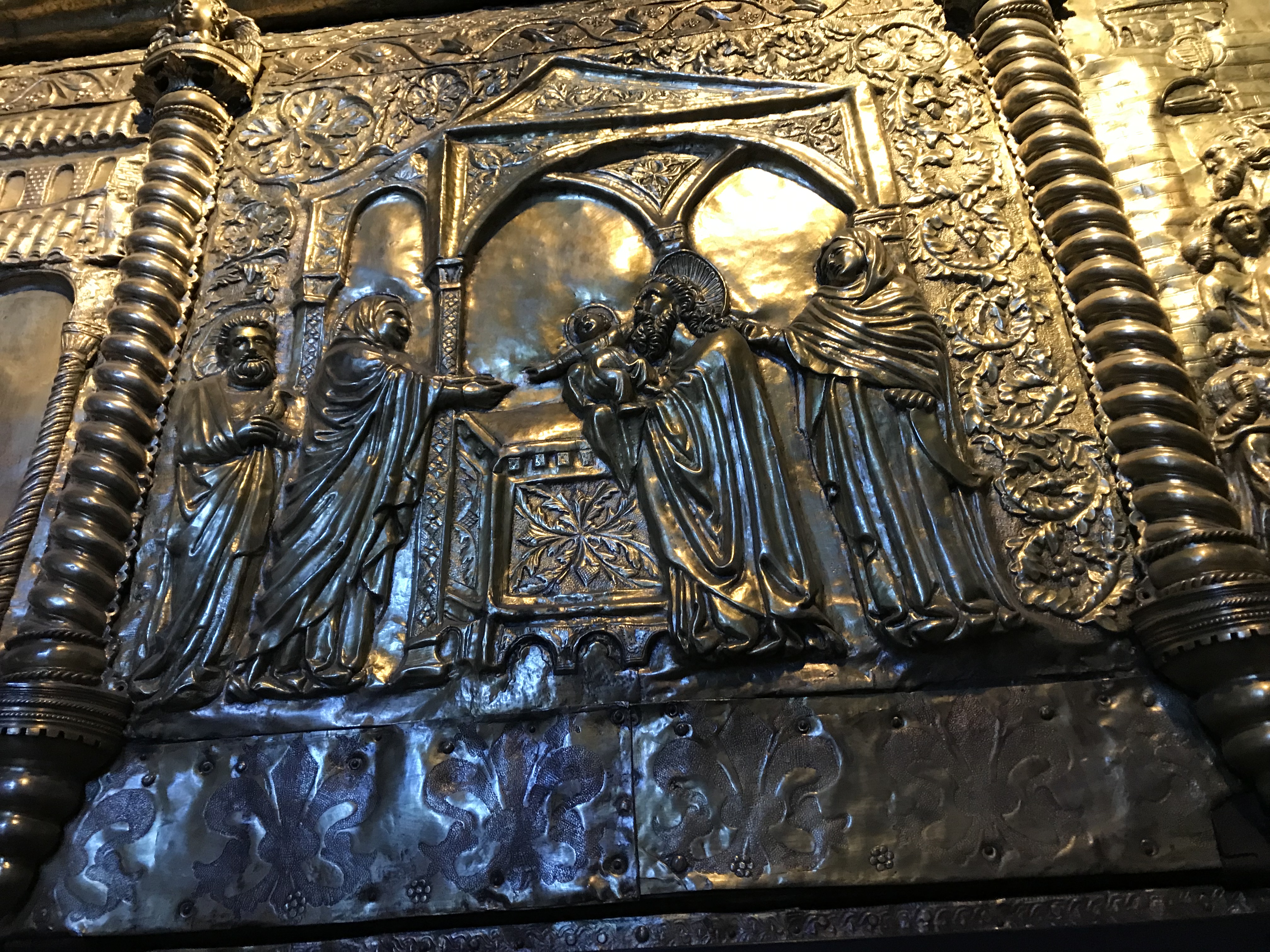
The map showed the 1760s displays were on the third floor. We walked up some stairs to the first floor, where the stairs stopped. We wandered through the displays, looking for an upward staircase. This was fun with no deadline, so we weren’t trying too hard. We saw lots of fancy religious icons, and some very elaborate tankards and lots of silver. One artefact was a silver ‘coffin’ (not called a coffin) where they think the remains of Simeon (old man who saw baby Jesus in the temple) were placed. People were big on things like that once upon a time. There was also a wonderful library, which we could peer at from the doorway but we weren’t allowed inside. But no stairs. It seemed impossible to reach the third floor from this section. We retraced our steps.

The ground floor had some cool statues (why are they always naked?) We found some different steps, and started to go up. The second floor had some 1760 displays, so I stopped to look at those, and managed to find evidence that people did wear gloves. I photographed some of the other clothes, and looked at a reconstructed room from 1760. There were also interactive displays, where you could design patterns, or tie a cravat, or wear a hooped skirt. Jay tested them out, but wasn’t impressed (I think they were aimed at 10 year olds).

We went up to the third floor. There were no displays from 1760. I think they must have hidden them. We saw a model of the Crystal Palace (which apparently was in Hyde Park, not Crystal Palace—is that correct? I had my doubts about the reliability of the museum and locations/maps).

We left, and discussed whether to walk back to Victoria, or take the underground, or catch a bus. Jay checked bus times on his phone (my children are so clever, who knew such a thing was possible!) and told me we needed the C bus. We waited at the stop, and Jay checked I had ‘something to tap’ because apparently you cannot pay with real money on buses anymore.

The bus arrived. Jay tapped his phone, I tapped my credit card. Absolutely no idea on the cost, or how the bus knew where we wanted to go—all very future world. We then worried that perhaps we were supposed to ‘tap-out’ when we left (because apparently this is a thing) so we decided to watch the other passengers. None ‘tapped-out’.

The bus stopped outside Victoria Station 3 minutes before our train left. We ran. We caught the train. It was a nice day.

I hope you have a nice day too. Take care.
Love, Anne x

Thank you for reading
anneethompson.com
Why not sign up to follow my blog?


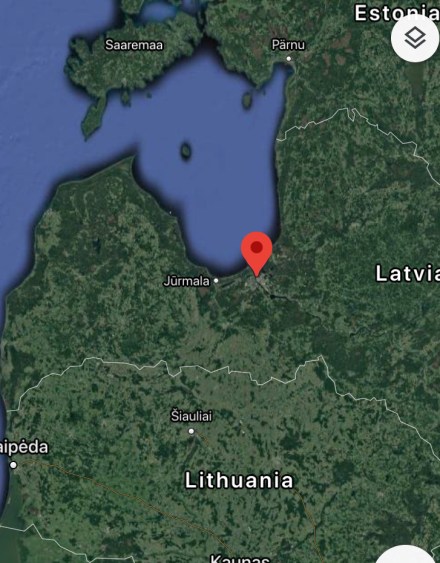
Train to Jūrmala, Latvia


Train to Jūrmala

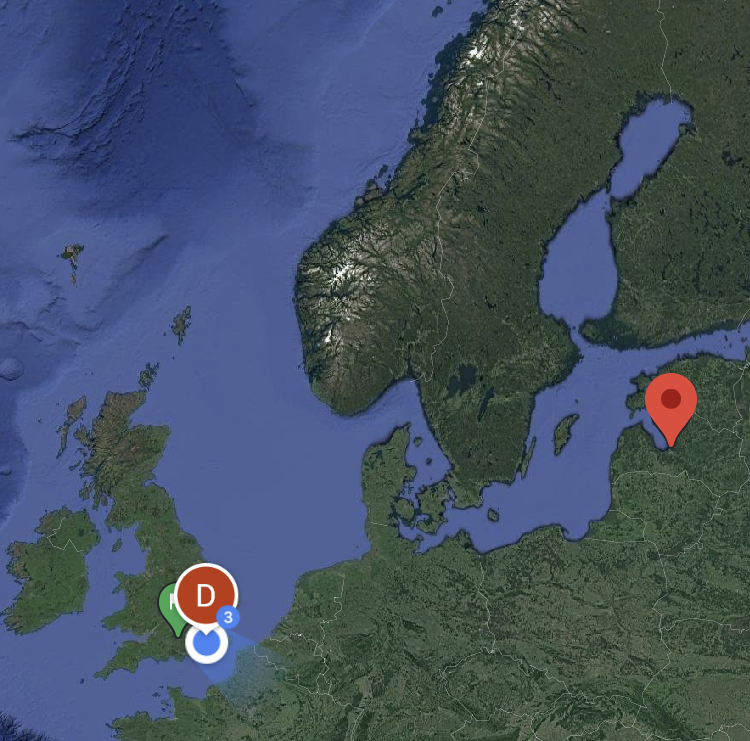
Last week, we were in Riga, Latvia.


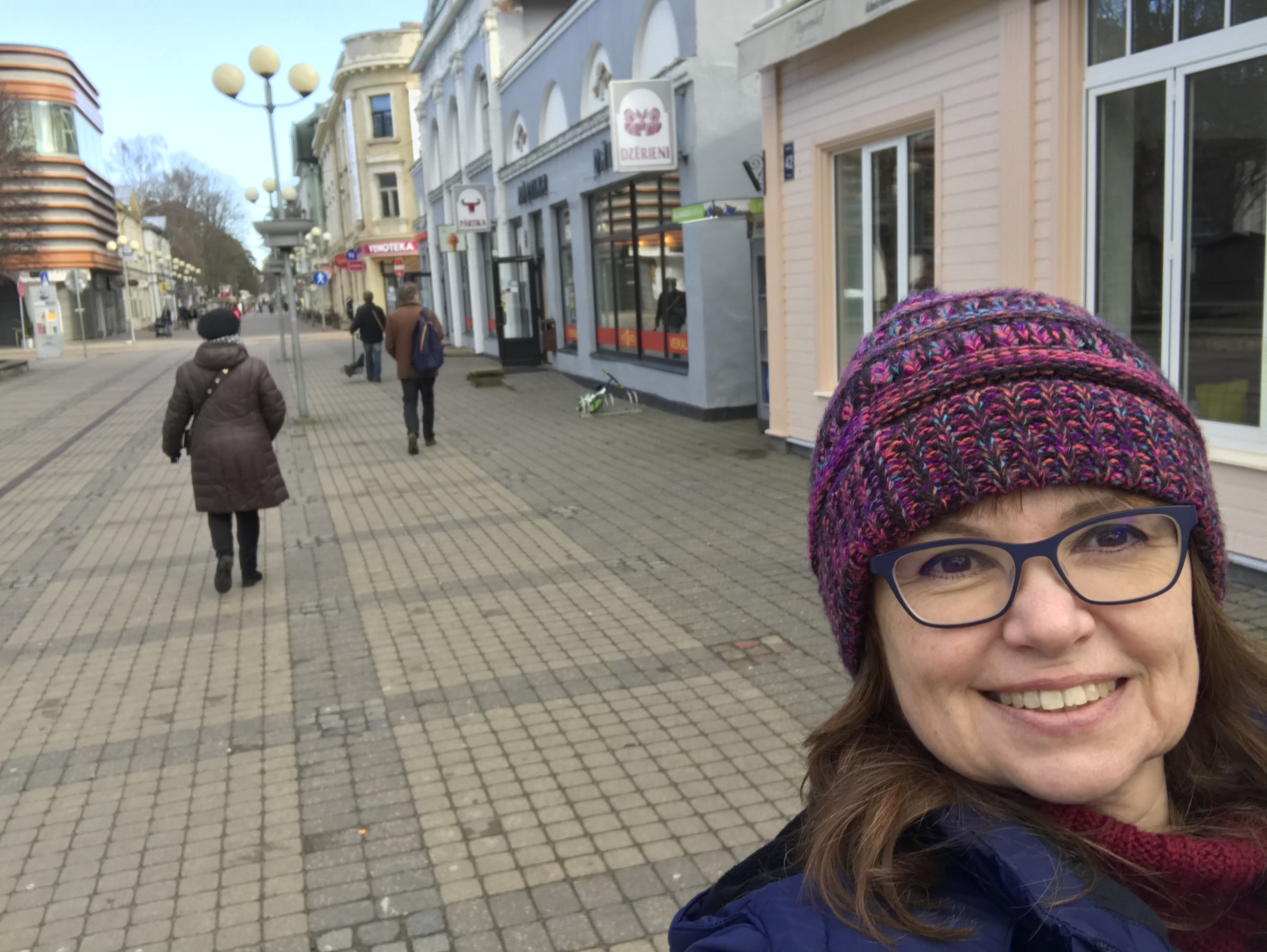
I had read that Jūrmala was a good place to visit from Riga, and we had a day when Husband wasn’t working, so I persuaded him that he would like to go. We walked to the station, which is on the edge of the Old Town, near the zeppelin hangers that house the central market. The weather was dry but cold.

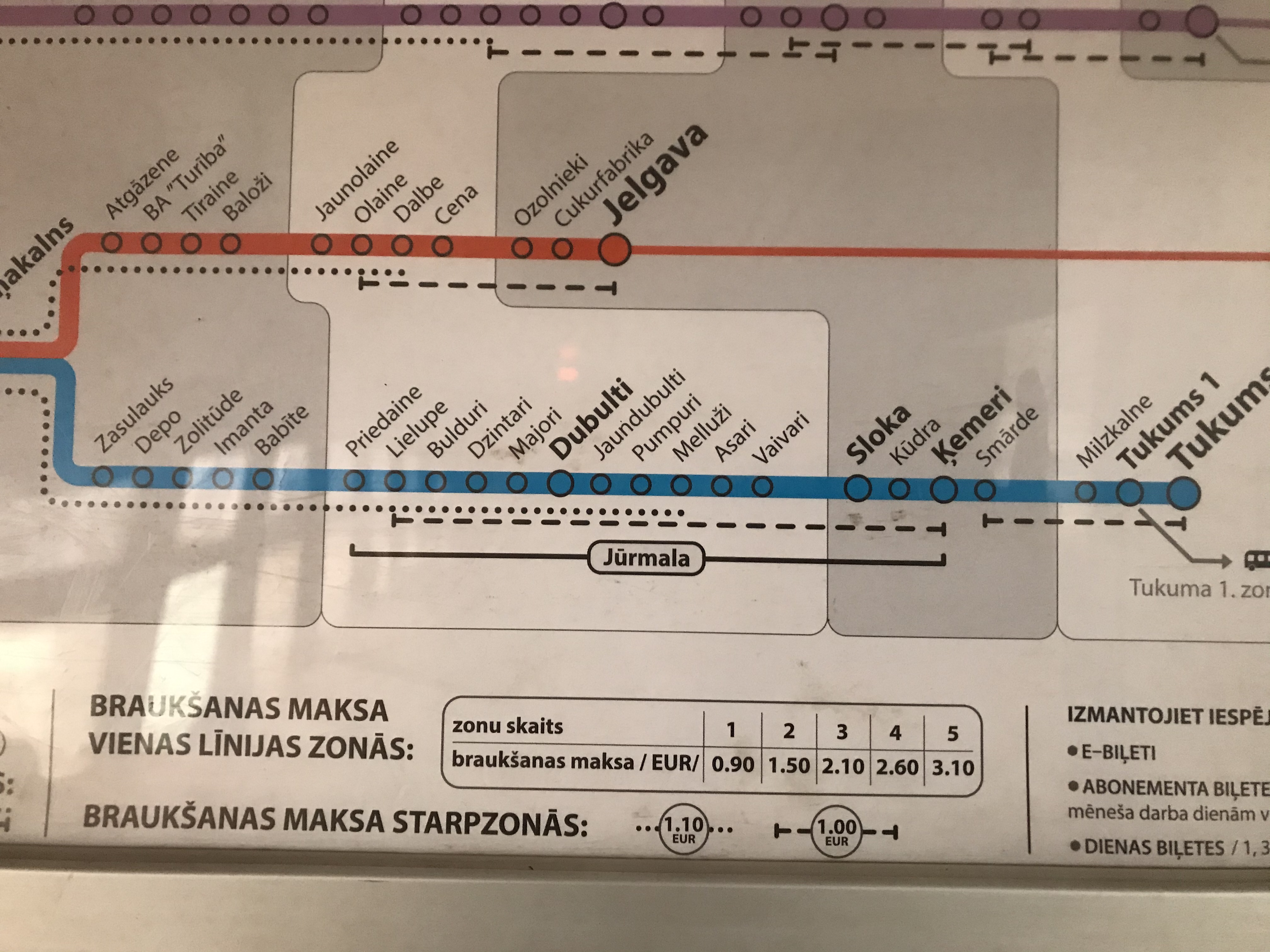
At the station we found a ticket booth where the woman spoke a little English, and we managed to mime that we wanted return tickets to Majori. Jūrmala is the Latvian for ‘seaside‘ and there are several stations along the coast, with Majori being in the middle. I used my phone to photograph the timetable (because I have seen my children do this sort of thing). Finding the correct platform was more complicated, but we found a timetable that showed platforms, and then followed signposts to platform 3. If they had announced a change of platform over the tannoy, we’d have been stumped, and possibly ended up in Russia. But the sign on the platform showed we were at least travelling in the right direction, so we climbed the steep narrow steps up into the carriage, and sat down. A doorbell sound announced the doors were shutting, and we eased away from the station.

I like catching trains in foreign countries, watching the changing scenes through the window. I used my photographed timetable to check the stations we passed through, so we would know when to get off. As we left Riga, we saw many apartment blocks, small industries, red-brick factories. The houses varied, some must once have been grand, with towers and pillars, but all were faded now, the painted plaster cracked, weeds filling the dried gardens. Every wall we passed was decorated with graffiti, none of it clever. Tall brick chimneys piercing the blue sky and modern warehouses swept past the window.

Then we plunged into woods of pine trees, and out the other side. The land was flat, not a hill in sight. As we drew near to Majori there were more forests, and large houses nestled amongst the pine trees.

Majori station is next to a flooded river. One side of the platform is a road, the other is the river. You could see the railway as it curved away from the town, past the tall bulrushes and the fishermen. We left the station, and walked into town.

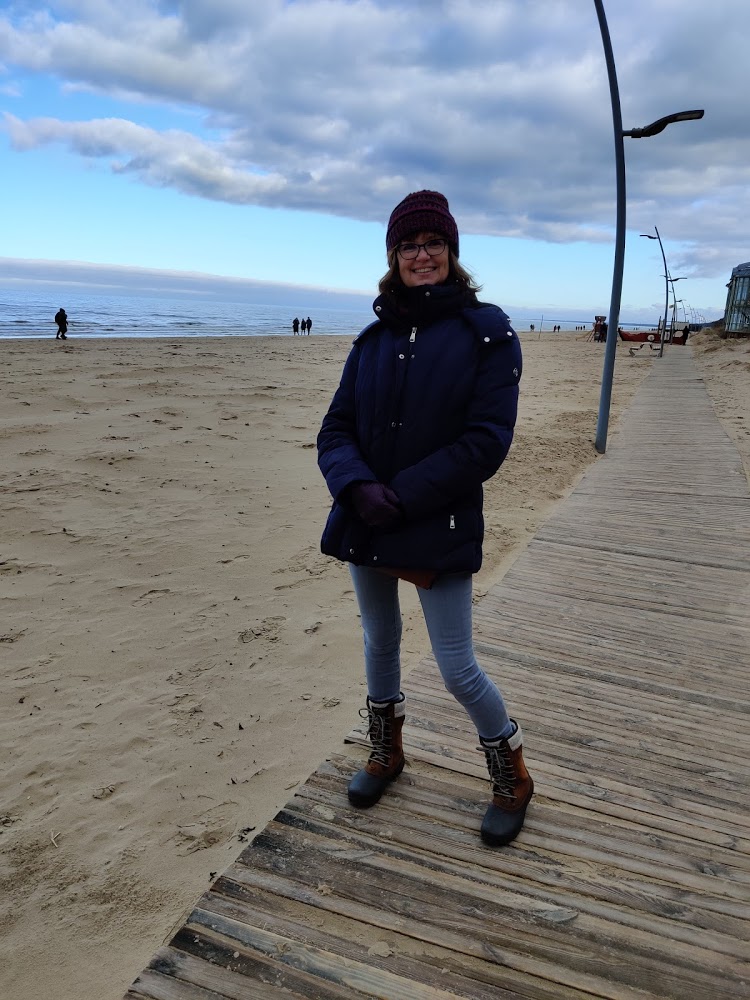
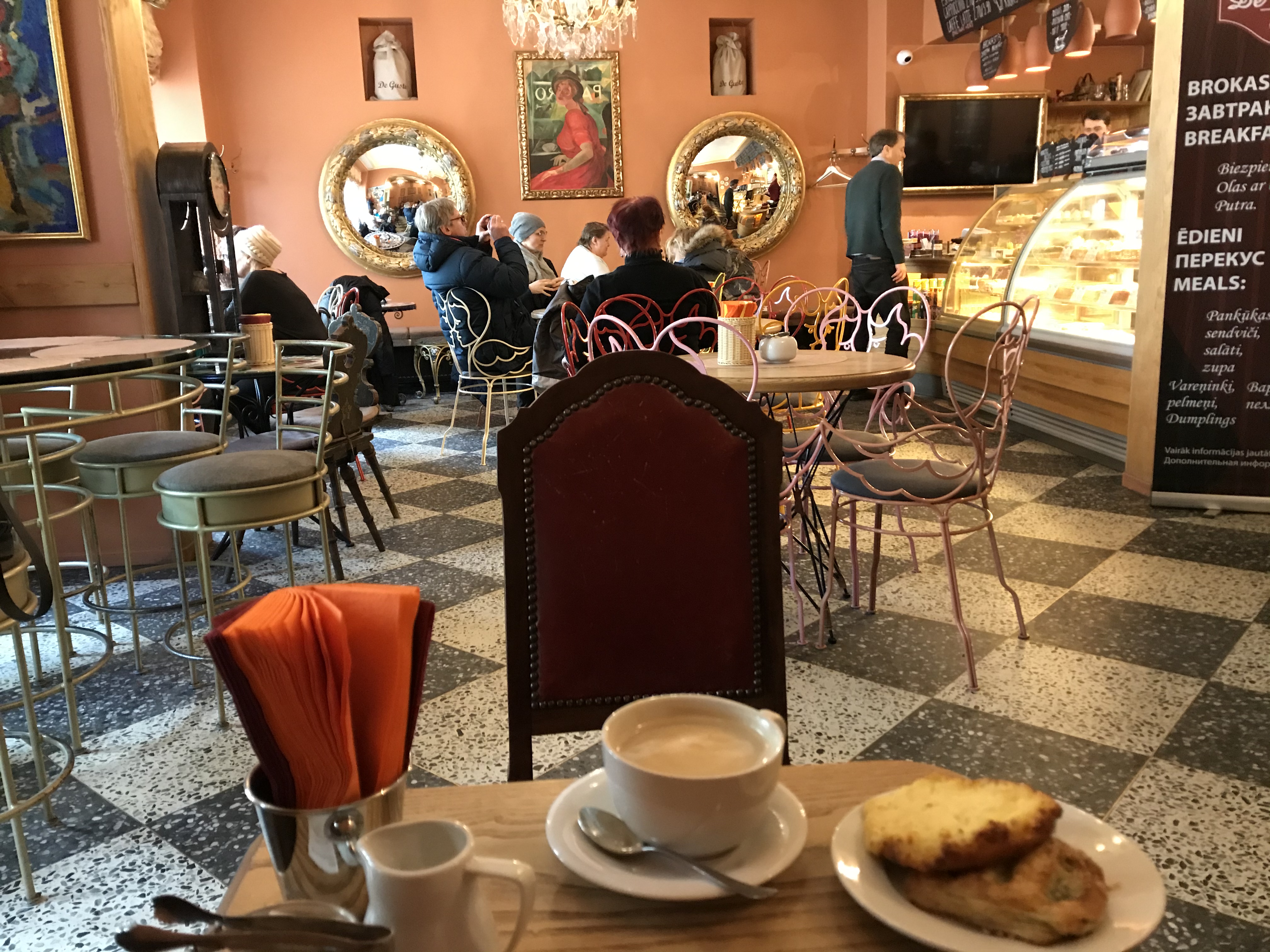
The town has echoes of the Jersey shore in the US, with painted houses and little shops, and a sandy beach with a long boardwalk. We had a quick lunch in a cafe (De Gusto—a pretty little cafe with nice pastries and good coffee). The walk to the beach was signed, and we set off along the boardwalk.

The beach was sandy, the sea calm, the wind cold. To our left were houses, right up to the weeds that lined the beach. They were large, ugly 1950’s constructions, and mostly deserted, with peeling plaster and boarded windows and brambles growing up to the doorstep. I decided they were Russian-owned holiday homes, abandoned in 1991 when the Latvians defended their land against invasion, the Russians refusing to sell them in the belief that one day they would return. Husband informed me they were more likely owned by a developer, who was waiting for them to become completely derelict so that renovation was impossible and he would get planning permission to demolish them and build modern holiday homes and hotels. I prefer my version.

Among the ugly buildings was an ugly look-out tower with radio masts and a high window and speakers for broadcasting instructions. This was the police station, and a man in the window was guarding the safety of everyone on the beach. There was also a cubed building, right on the sand, with a large picture window facing the sea. It was a cafe, large extractor fans whooshing the smell of fried potatoes onto the beach, the steamy windows showing hazy images of tourists huddled inside with mugs of coffee. But the best part was the position, which was below the tide mark, so at high tide, the people inside would be trapped, and they would have to sit there, watching in horror as the sea swept up the beach, past the door, trapping them inside for a couple of hours until the tide went out again. It would, I felt, be great fun to come back at high tide, and watch them as they gradually realised their mistake—but perhaps that’s a little mean of me.

We went back to the main street and walked along it, peering into gift shops and cafes and windows displaying knitted goods and thick coats. At the end of the street was an ornate church, gleaming in the sunshine and looking for all the world as if it had been flown there from Disney Land. We walked back to the same cafe we had lunched in, as they had the freshest cakes. We had tea, and I chose a rather too sickly white chocolate eclair, and Husband chose a completely delicious apple cinnamon tart (why does he always choose better food than me?) Then we walked back to the little station, and watched the train as it wound its way back along the curve of the river, until it reached Majori, and we clambered aboard, ready to return to Riga.

I hope you go somewhere nice this week too. Thanks for reading.
Take care.
Love, Anne x

Why not sign up to follow my blog?

anneethompson.com

Thank you for reading my travel blogs. If you have enjoyed them, why not buy my travel book:

The Sarcastic Mother’s Holiday Diary

Travel with a family…always unexpected.

Available from an Amazon near you. UK link Here

St. Peter’s Church, Riga


 St Peter’s Church, Riga

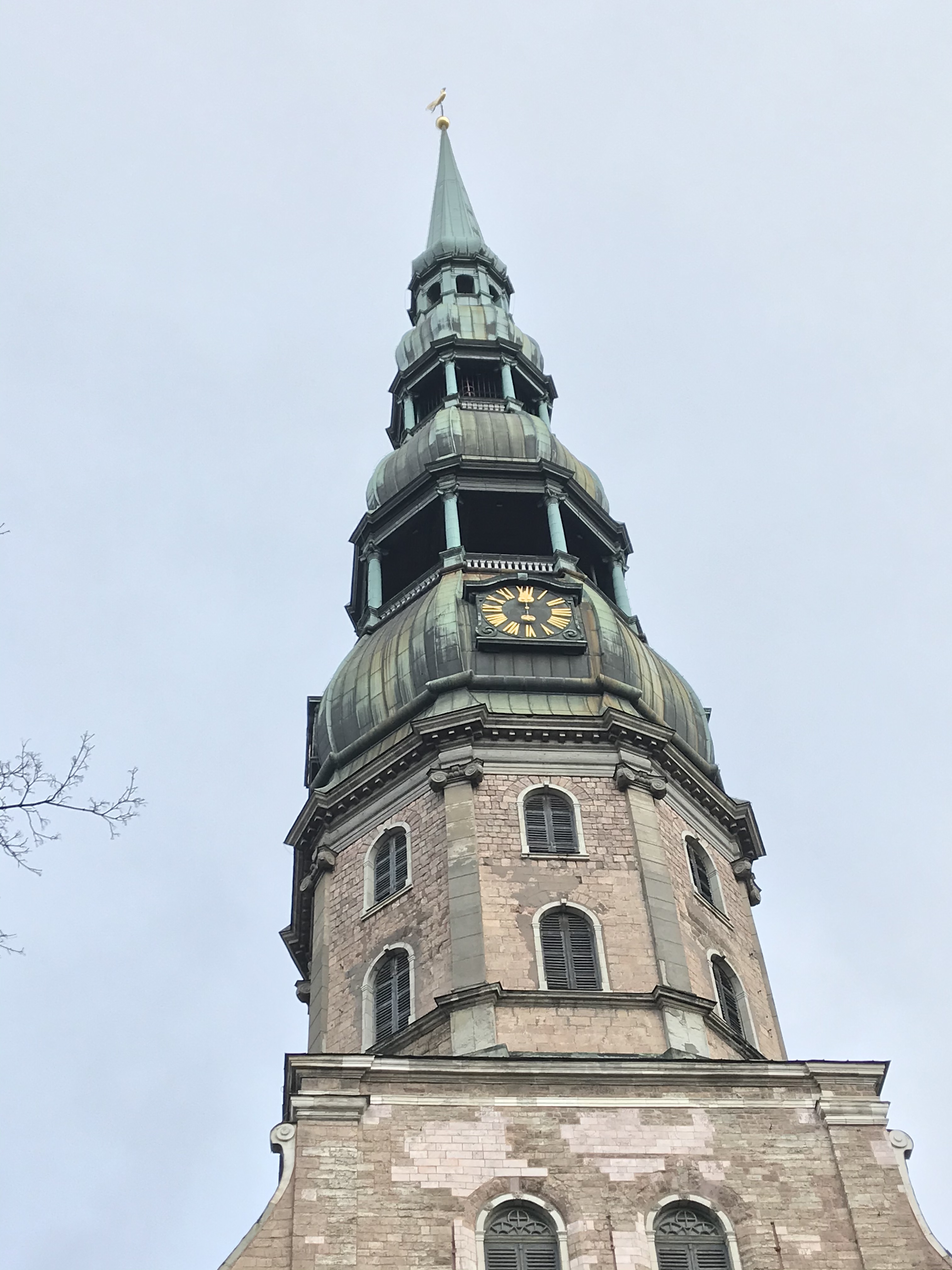
One of the landmarks of Riga Old Town is St. Peter’s Church; the multi-layered barrel-shaped spire can be seen from almost anywhere. This makes it hugely useful for lost tourists trying to find their bearings, and I have often been grateful to the church for its distinctive hugeness. But I have never ventured inside. The weather was dry but cold, and I had at least an hour before Husband finished at the office, so I decided to join the few woolly-hatted tourists through the heavy doors, into the church.

The door is not particularly welcoming, as it is very heavy and very determined to remain closed, but I managed to struggle inside. The signs (in various languages) and the woman behind the desk (in determined Latvian) were also not terribly welcoming, but having defeated the door, I was not to be dissuaded. I paid my €3 and was allowed through the glass barrier into the main sanctuary. Another woman called me over, insisting on inspecting my ticket. There was clearly a lot of angst over non-paying tourists visiting this church. Guess they have big overheads.
 Inside, there are a few things to look at, plus a tower to climb (if you pay extra). I was content to simply be inside and wandered around. Brick pillars hold up the high arching roof, and organ music hummed from speakers. It was a peaceful place to be (maybe noisy tourists object to paying for entry, or are dissuaded from visiting by the two grumpy ladies and the spiteful door).

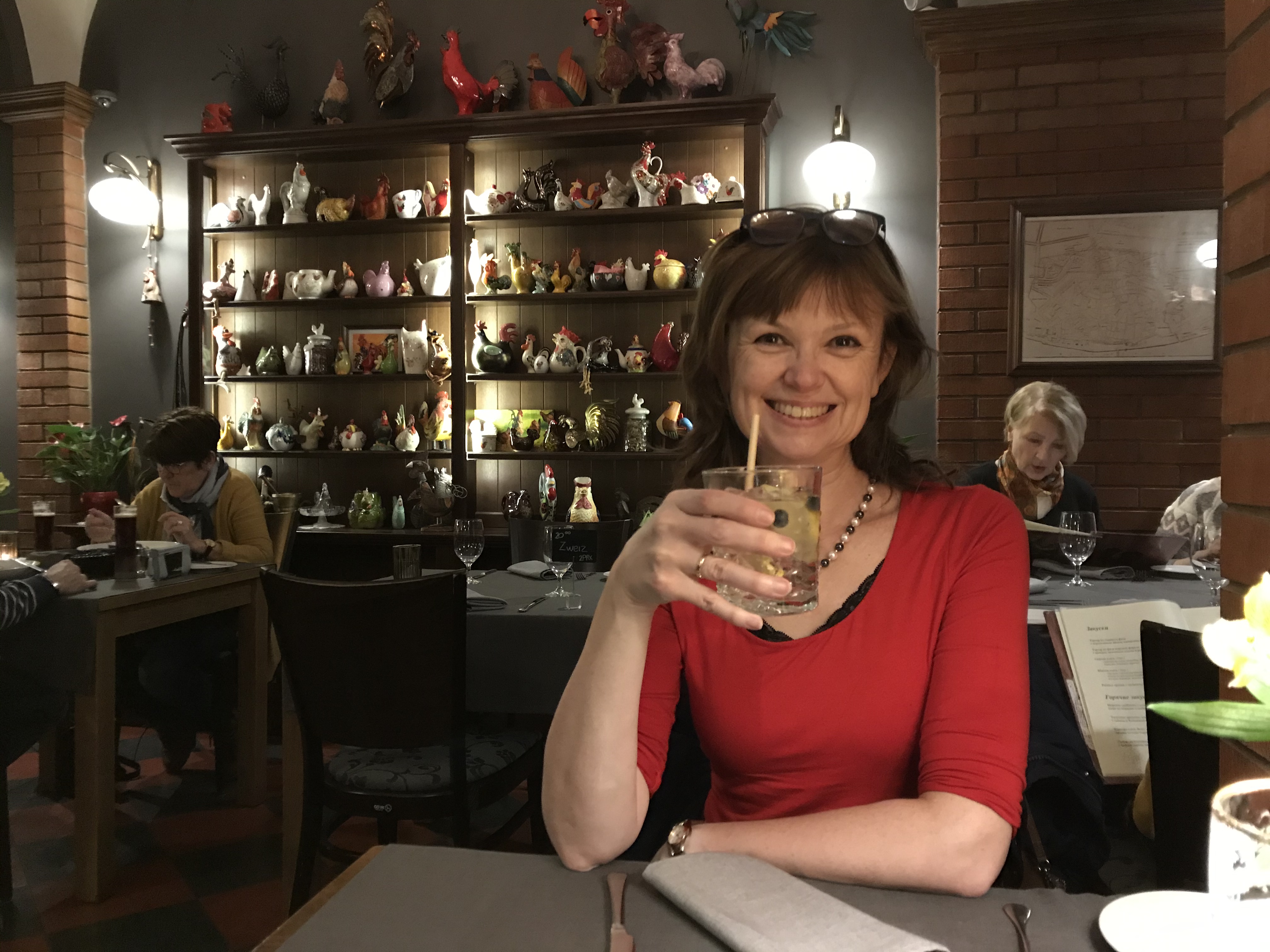
There was a display showing a massive bell, the Peace Bell, which is a feature of a multi-national festival of competing choirs. Next to the giant bell is a giant rooster, which was once the weather-vane on the steeple, but now shelters inside. (It was made in 1690, so has earned a rest from the elements.)

The main sanctuary had various paintings and sculptures, of people who looked religious but I’d never heard of them so possibly not. A local artist, Laine Kainaize, had an exhibition of paintings. They were simplistic in style, and full of colour and I liked them (but not in my house).

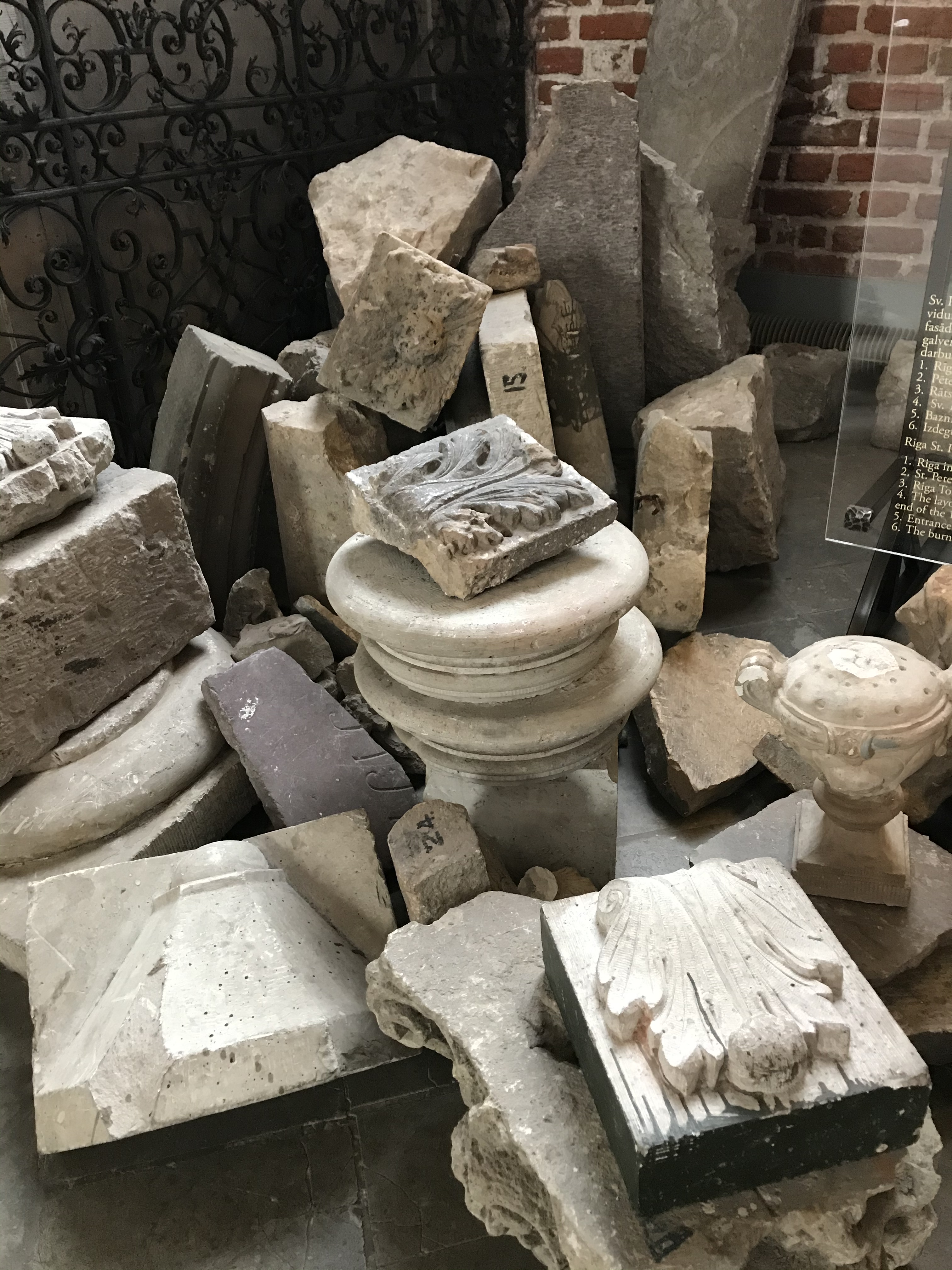
The rear of the church was dominated by a statue of Roland. I don’t know who Roland is, and reading the plaque, I’m not sure anyone else does either! A copy of his statue stands outside one of the guilds, like a lucky charm; but like the ancient rooster, he has been retired to the shelter of the church. He stands with a heap of rubble, which I think are bits of the church which have fallen off.

The question that always begs an answer in a church is: does anyone pray here? Did the sanctuary feel holy? The high ceiling and warm architecture do inspire a feeling of holiness/prayer, but the atmosphere is rather shattered by the grumpy money ladies gossiping at the back. Perhaps, in days gone by, this was a place where people honestly sought God’s will. Today, I’m not so sure—but how much can a mere building convey anyway? Surely a church—any church—is the people who attend, and I wasn’t there for a service, so I cannot comment.

If you have €3 and an hour to spend, there are worse things you could do.

Thanks for reading. I hope you find somewhere to pray today.
Take care.
Love, Anne x

Why not sign up to follow my blog?

@anneethompson.com

(To sign up, scroll to the very bottom of the page, and look for the ‘follow’ icon in the right-hand corner. Sometimes it’s easier on a tablet if your computer blocks all cookies!)

Thank you for reading.
Why not sign up to follow my blog?
anneethompson.com