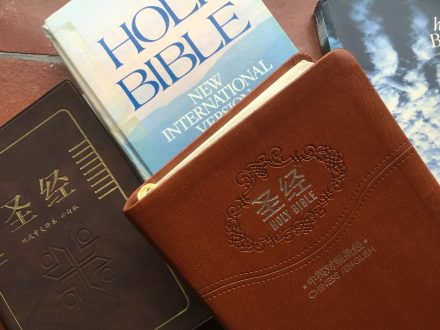
How We Use the Bible…


Hello, thanks for popping back to read this post, which continues from yesterday’s post about how the Bible was compiled. As we saw, the Bible was assembled gradually, and it was relatively recently that the Bible we have today came into existence (even though the books were written thousands of years previously).

Firstly, I find it interesting that our holy book was assembled using logical criteria. This is the way that God chose for people to learn about him, and it was put together logically. I think that sometimes today, churches rely too much on ‘supernatural’ inspiration —we want God to show us things miraculously. Yet the Bible was put together by a group of people making sensible decisions. When we read the Bible, we find this is consistent with how God often led his people, in both the Old and New Testaments. People tended to win wars/save nations, mainly by logical strategy, and less by miracles. We want God to “zap the answer to us” and yet, it seems, God has given us brains and he expects us to use them. Should we move house/rebuild the church/go and preach in darkest Peru? Perhaps, after prayer, we should think about all the pros and cons, and then make a sensible decision. You might see writing in the sky telling you the way, but that would be rare.

When we are disputing something, we need to be careful about saying: “It’s clearly written in the Bible that…” In my experience, people only say this when someone else has obviously NOT seen something as “clearly written” and has formed a different belief. If it was CLEARLY written, then there would be no differing of views amongst people who claim to believe the Bible. We should remember that the Bible was written originally in Hebrew and Greek, we are probably reading a translation, we will certainly be reading it in a different age and culture. Meanings can get lost, we can misunderstand things. A little humility when discussing the Bible would be good.

The Bible does not claim to be infallible. Some religions, such as Islam, believe that their holy book was dictated by God, so it cannot reliably be translated into other languages (because you always change the meaning slightly when translating things). However, the Bible was not dictated word-for-word by God. There are seeming anomalies between some of the books. This in my mind makes the Bible more authentic, because if people were going to sit down and write a ‘holy book’ they would make sure it had no mistakes! The Bible, however, was written by people who had witnessed God working, and they wrote their accounts, and they remembered some details differently—which doesn’t make the account untrue, it simply shows they were real people, writing what they honestly remembered.

What about the books which were rejected? Is only the Protestant Bible correct? This is tricky. I recently listened to a sermon about the book of Jude (which is included in the Bible). Jude refers to ancient Hebrew books, which we have since lost, but which Jude himself obviously regarded as ‘scripture’. Jude was a brother of Jesus—you would think he might know what was ‘holy’ and what wasn’t. Personally, I have no idea.

And that’s the thing really, the point of why I am writing this. We want everything to be sorted, we want God to be nicely tied up, to be sure we see the whole picture, know everything there is to know. But we don’t. God has not chosen to tell us everything. The Bible is, I believe, inspired by God—but we should be careful how we use it. Those early Christians were, absolutely, followers of God—they died for their beliefs. But they had a slightly different Bible to us. They relied on God, not texts, and God used their belief to explain the texts they had, so they could come to him.

Can we believe the Bible? It is the book which I believe God has given to people, to help us to know him. It is not an absolute, definitive, set of rules; we should be careful when we are applying it to others —people have used the Bible in the past to justify slavery and wars and all sorts of injustices. Be careful when you quote bits of it. Almost anything can be justified using selective editing of key verses:
Do I believe in reincarnation? No! (Can I find Bible verses which seem to support reincarnation? Yes.)
Do I believe some people were created to be slaves? No! (Can I find verses which seem to support slavery? Yes.)
Do I think we should be dishonest and scheming? No! (Can I find verses which seem to support gaining things through cheating? Yes.)

But if we read the Bible, honestly searching for God, then we will find him. I did, and I know other people who have…why not read it and decide for yourself?

Thanks for reading. Take care.
Love, Anne x

Anne E. Thompson has written several novels. They are available from bookshops and Amazon.
You can follow her blog at:
anneethompson.com
Why not sign up to follow today?

Who Compiled the Bible?


[Post updated and corrected 2025.]

I was challenged recently when I quoted a bit of the Bible, and someone asked me when it was written, and when it was included in the Bible. I had absolutely no idea, so did a little research. If you know more than me, and can correct any of the following, then please do leave a comment—otherwise, this is where the Bible came from:

The first 5 books of the Bible were traditionally thought to have been written by Moses, and are called The Pentateuch. There is some disagreement on this, even amongst very conservative Jews.[1] My own view is that even if the narrative originated from a single person, it was not physically written until much later and was edited over the centuries.
These books were probably established as ‘scripture’ by Ezra and Nehemiah, and they are what the Jews today still mean when they refer to the Torah. (The books were in existence way before Ezra and Nehemiah, but the early Jews pretty much ignored them until the prophets reminded them they were important.)

Then, about 200BC, the writings of the prophets were added. Later, the book of Psalms was also included as ‘scripture’. Some of the texts (called the Writings) were not fully accepted as canon until much later (about AD 100) according to some sources.[2] However, the books were used by people, given authority and called ‘scripture’ before they were officially accepted as ‘canon.’ Therefore, the writers of the New Testament quoted as scripture texts that are not always part of what we call the Bible.

It became important for the Jews to have a clear understanding of what their holy books were. Jews were beginning to move away from Palestine, and they wanted to know exactly what defined them as a race, what their core beliefs were. Further afield, other Jews included other books as part of their scripture. The further away from Palestine they lived, the more books they seemed to include (some had as many as 15 extra books in their ‘scripture’).

As many Jews lived in Egypt, where Greek was spoken, they wanted scripture translated into Greek. This is sometimes called ‘The Greek Old Testament’ and sometimes called the Septuagint, and this contains hidden books (known as Apocrypha which means ‘hidden’). Some of these books have since disappeared, and we don’t know what was in them. (Actually, it is not as simple as this—for example there was not only one Greek translation that was used in Egypt, so referring to the Septuagint is a little misleading.[3])

So, what about the New Testament? Well, after Jesus left, the people who believed in him, began to separate from the Jews into a new religion. They still regarded the books we call the Old Testament to be scripture. However, gradually, people began to write other things. People who had seen and listened to Jesus began to write accounts of his life and teaching. Later, other people interviewed them, and wrote their own accounts. The early church began to decide what it believed (such as whether non-Jews could be Christians) and the leaders of the early church wrote letters, teaching the church. Letters were called ‘epistles’. People within the church basically chose which of these letters and writings they regarded as sacred. So, there were the letters written by Paul, as well as letters written by Thomas…and the ‘Shepherd of Hermas’ … and the ‘Apocalypse of Peter’ … and the ‘Epistle of Barnabas’…and so on. Some of these writings contradicted what Jesus had taught, and some had a definite bias. Gradually, over several years, the early church began to accept some writing as being from God, and disregard other writing.

Then, in AD 325 (so rather a long time later!) the church decided to state, once and for all, which books should be included as ‘scripture’. They formed a committee (because churches, it seems, have always liked committees) called the Council of Nicea. As far as I can tell from my research, they didn’t actually decide very much about what should be scripture.

Now things get tricky, as different sources contradict each other. One source states that in AD 381, the church had another try. They formed the First Council of Constantinople and set out clear criteria for which books to accept, and which to reject. The criteria for inclusion was:

  • *The book was written by a first-hand witness of Jesus, or someone who had interviewed witnesses (such as Luke).
    *The book was written within 100 years of Jesus (which meant, if it had been wrong, people alive at the time would have said so).
    *The book should be consistent with the other books of the Bible.

I read that this Council decided which books should be part of the Bible. They chose the books we have today, including the books of the Apocrypha.

However, other sources disagree, stating that no Council ever stated which books should be used, and it evolved over time, with respected leaders gradually ignoring certain books and relying on others.[4] Several sources agree that Athanasias, in AD 367, listed the books he considered should be scripture. He was the influential leader of the day, and others followed him, limiting their theology to this selection of books. In AD 393, the Western Council of Hippo specified that the Church accepted 27 books as a canon. (We have ancient manuscripts, such as the Codex Sinaiticus, which includes ‘Barnabus and the Shepherd’ thus showing that not everyone accepted this ruling.)

In AD 400, St. Jerome assembled the books of the Bible, in Latin. It was called ‘The Vulgate’.

In the 16th century, a man called Martin Luther was studying the Bible, and trying to discern what it meant. He decided that actually, the Apocrypha should not be included as Scripture. The protestant church follows Luther on this. The catholic church formed another committee in 1546 (the Council of Trent) who decided that Luther was wrong. This is why today, the Catholic Bible contains different books to the Protestant Bible.

Okay, that’s the end of the history lesson (interesting, huh?) There are implications that arise from all this—but that is for another blog. My final observation is that it is relatively recently that all the books of the Bible appeared together as a single book, and we do not have any original manuscripts from the individual books.

Bye for now, and thanks for reading. Take care.
Love, Anne x

[1] More details in an article by Kim Phillips (Genizah Research Unit; Tyndale House, Cambridge).

[2] See Stephen Chapman, The Law and The Prophets for more details.

[3] See Gregory R. Lanier, The Septuagint (Il: Crossway, 2021).

[4] R. A. Baker, How the New Testament Canon Was Formed.

Understanding DNA


For as long as I can remember, people have asked me if I was partly Chinese. When I was a child, people would sometimes say they hadn’t spoken to me, because they weren’t sure if I spoke English. When, more recently, we visited China, I had complete strangers approach me in shops, telling me that they could tell I was ‘half-Chinese’.

Both my parents are English.

However, I thought that probably, way back in time, I must have a Chinese ancestor somewhere. I therefore decided I would quite like to do one of those online family-tree-research DNA tests. For Christmas, Husband kindly bought me an Ancestry DNA kit.

I was expecting my DNA results to come back as mainly English/European, with perhaps 1 or 2% Asian. Doing the test was very easy – I had to spit into a tube, add stabiliser, and post it in the small white box provided. I then had to wait (about 6 weeks, but it felt much longer).

The whole process did rather spark an interest in DNA, and how exactly these tests work. So I began to do a little research, and I found that many of the explanations online (including those written by the ancestry websites) are rather misleading, so I thought I would explain it to you. I had help – my own knowledge stops at A’ Level Biology  many, many, years ago. However, my children work with people who study DNA, so they were able to answer my questions.

DNA stands for ‘deoxyribonucleic acid’ (you will never need to know this outside of exams and pub quizzes). It’s a long string of ‘stuff’ that carries all the instructions (genes) for how you are built (Eg. whether you’ll have blue eyes or brown eyes). You get DNA from your parents – half from your mum and half from your dad. These strings of ‘stuff’ form two strands, and when cells reproduce, you get one strand from each parent. (There is something different, called ‘mitochondrial DNA’. This is the DNA found in the mitochondria – the ‘powerhouse’ of the cell – and this passes ONLY DNA from the mother. Which means it never changes, and they can discover things about your ancestry from thousands of years ago. But we’re not talking about that type.)

Now, lots of the articles online are rather misleading, as they tell you that you receive half your DNA from each parent, which means, for example, that you and your siblings might have different DNA. This is sort of true, and is all you need to know for GCSE biology. However, it doesn’t take into account something called recombination. All of these articles are therefore misleading. They imply that siblings can have vastly different DNA (so even if your brother has paid to test his DNA, you should too, because it might be different) – remember, these companies are selling tests, it is not in their interests to tell you that the variations will be tiny.

They completely omit recombination, which happens two or three times on every chromosome (other than the gender one in which it only happens for XX). What it means is, you don’t actually inherit one of two potential chromosomes from your mum. You inherit a chromosome that is a mix of the two.

Here is a simple example to explain how it works : Imagine Mummy has two sticks of playdough – one red and one yellow. Daddy also has two – one blue and one green.

According to the online articles (and GCSE biology) both parents give Bob one colour each. So he could, for example, have one red and one blue.

But in reality, before you each choose which colour to give to Bob, you snap the ends off each of them and swap them round.
So in reality Mummy would give Bob one that was mostly red but with some yellow blobs, and Daddy would give him one that was mostly blue but with lots of green blobs. That means you always show traces of everything.

The DNA companies send two results. One shows where your ancestors came from. This is because certain races have certain kinds of DNA, and they can see the markers when they process your DNA. If a group has not, in the past, mixed very much with other races, then the markers are very clear. Due to recombination, the ethnic markers found in your DNA are likely to be very accurate, and will not differ much between siblings with the same parents. So, depending on the markers found, you might be told you are “5% European” and your brother might have clearer markers, and be told he is “5% Spanish” (which is not, really, different). The company can only define certain markers – I understand that they have not identified many markers yet within Asia, so people will not necessarily discover whether their ancestors were Chinese, Korean or Japanese, and might simply be told “9% Asian”.

The company also tells you what percentage of that race you are – such as 30% Asian. The percentages, because they are based on ethnic markers and not actual DNA, can be very inaccurate. So, 30% Asian means you have Asian ancestors, but maybe it was a grandparent, maybe a great, great, grandparent.

However, my results showed that actually, I have no Asian blood at all – which was a little disappointing.

I hope you are happy with who you are.
Thank you for reading. Take care.
Love, Anne x

Anne E. Thompson has written several novels. They are available from bookshops and Amazon.
You can follow her blog at:
anneethompson.com
Why not sign up to follow today?


A Family Christening


We had another family christening on Saturday. These make me feel old, as it feels like yesterday that I was attending the father’s christening.

Arriving on time is always stressful, and not especially helped by my watch, which was 10 minutes slow. In panic, while pulling on tights and trying to find heels, I asked Husband if he could write the card. This was not as simple as I had anticipated, and I was asked a range of questions, such as: “Do I address it to the baby or the parents?” and “What the heck am I supposed to write to a baby?” I dictated the card, he stuck it onto the gift, and we were set.

Daughter decided to buy her own gift. I’m sure the parents will be delighted when they unwrap the super-sized unicorn in their tiny house (and I’m sure Daughter had only the best motives when she chose one quite so large).

Actual event was lovely. Always nice to see extended family (and always slightly odd to see the not-related-but-we met-you-once-at-the-wedding, who are all, of course, as closely related to baby as we are, even if not at all related to us). It was a very windy day, so I was glad it was a christening and not a wedding, and we didn’t all have to pose for photographs. We did though, have to be smartly dressed, and I do find walking in heels bit of a struggle these days – I really ought to practise – living in jeans and wellies means wearing dresses and heels is difficult.

The service was in a tiny village called Markbeech. My son finds this very weird, as my latest novels are all set in an imaginary town called Marksbridge (not based, even remotely, on the village which shares a similar name).

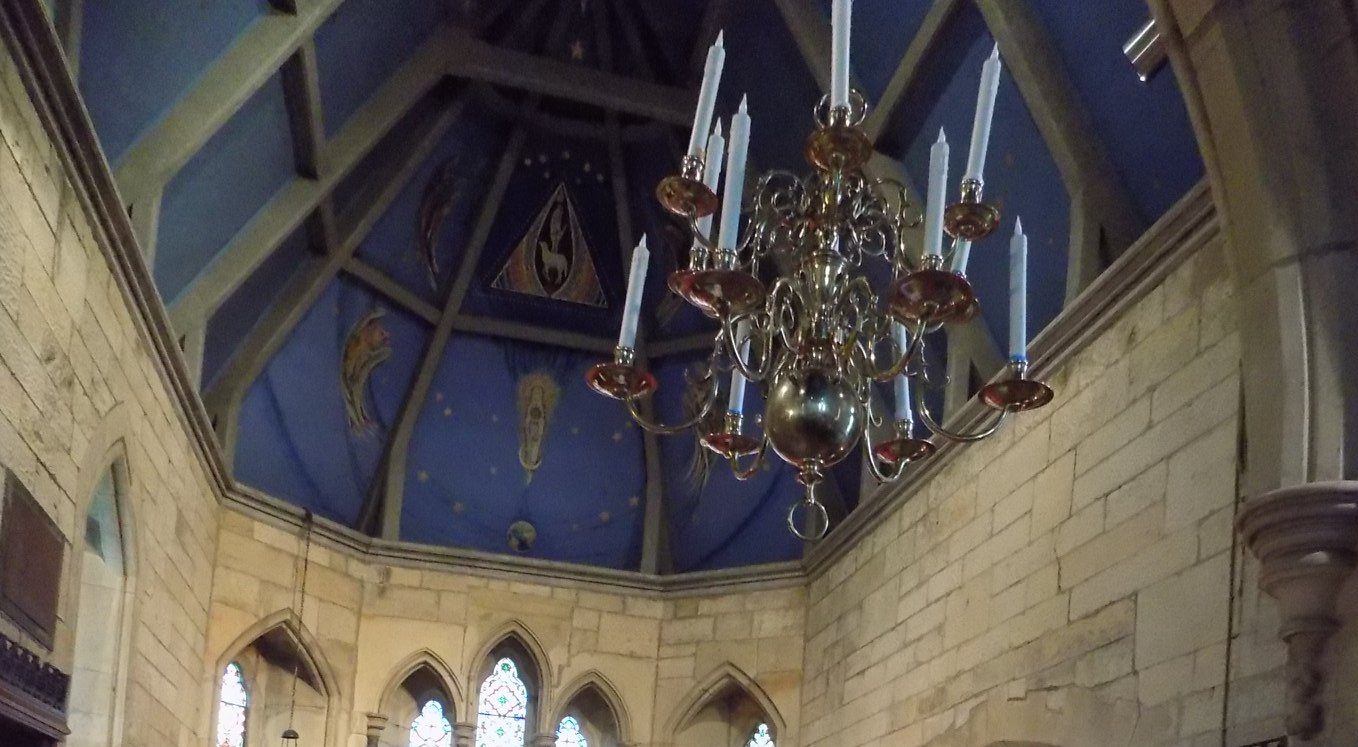
The church was very interesting, I haven’t visited before, it’s one of those little churches which used to belong to an estate (all very English and historical). As I sat, listening to the service and watching the baby (very well-behaved and asleep for most of the service) and his brother (very cute) I peered around the church.

The decorations around the altar were symbolic, relating to the spirituality of women, and looked – to my uneducated eyes – rather masonic in style. Not sure why, perhaps it was the triangles and rainbows. Anyway, after the service, I did a little research, to try and learn more.

It was set up in the early 19th century, as part of the “Tractarian” movement – which was inspired by a sermon by John Keble in Oxford (and is also known as ‘the Oxford Movement’). They believed that the Anglican Church was, in effect, still part of the Catholic Church, that clergy were answerable to God, not the state, and the liturgy etc should all be influenced by the church in Rome – not by kings. In effect, they were sort of the opposite of the ‘protestants’ (a term which means they were protesting against the rule of the Roman Catholic Church – mainly so that Henry VIII could get divorced – way back in 1534).

Anyway, the Tractarians produced lots of tracts (90, I believe) which is how they gained their name. They had support from some influential people (who even I have heard of, such as Wilberforce) but they didn’t in the end, manage to separate the church from the state, and even today, our monarch is head of the church.

I never managed to find out why Markbeech church has the unusual painting decorating the altar. If ever you’re passing through Kent, it’s worth a visit (if you like old English churches).

Hope you have an interesting week.
Take care.
Love, Anne x

Anne E. Thompson has written several novels, which are available in bookshops and Amazon.
Anne writes a weekly blog – why not sign up to follow?
anneethompson.com

Girl Trip to Valencia Part Three


It was Sunday, so we wanted to go to church. Cousin N’s husband is a vicar, so we asked if we could go to a service. She looked nervous, and made us sign to say we wouldn’t tell embarrassing stories or make jokes or generally misbehave.

After showering in the cupboard, and coffee in the sunshine (I still haven’t found my old man smoking a cigar at an outside cafe – I drank Nescafe in the air bnb) we set off. Cousin L seems to be rather good at directions, so we followed her, through streets decorated with flags and lights ready for Las Fallas, and a lot of shut shops. Valencia wakes up slowly.

The church, an Anglican Church, was not especially pretty (only the Catholic churches are pretty) but people were smiley, which is always nice. There were lots of children, and we arrived in time for coffee, and met people, and remembered that Cousin N might kill us if we tried to be funny. Vicar Husband then preached an excellent sermon, teaching people about the character of God and how he wants to be involved in our lives. Unfortunately, he preached in Spanish (Vicar Husband, not God) so we didn’t understand a word of it. Apparently, the church does have an English service, but it’s earlier. I’m not sure why we went to the Spanish one. Personally, I understood every ‘Amen’ that was said.

Vicar Husband wore a long white surplice, which would have been excellent for changing under on the beach – not sure why he didn’t offer it. Perhaps it’s a hassle to iron.

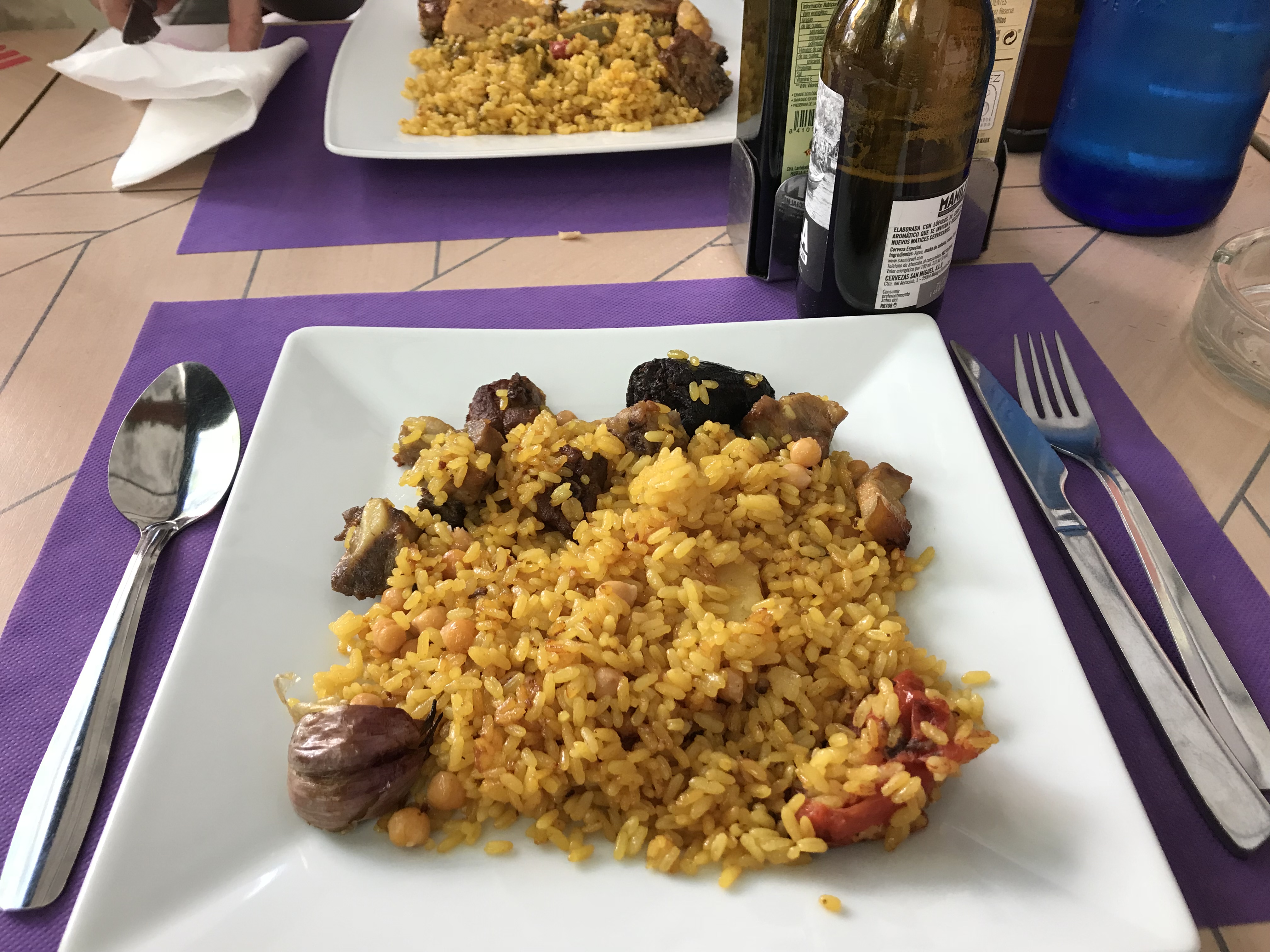
Ate lunch at La Brasqueta – or at least, the others ate lunch, I was catching an earlier flight so was too nervous to do more than nibble. We ate ‘Russian Salads’, which were a sort of variation on a potato salad, and then I had a rice and meat dish (not paella, but similar). We ate, and chatted, and listened to the romantic sound of exploding fireworks all around us. (Seriously, avoid Valencia in March unless you enjoy explosions.) The weather was warm, there were trees, and balconies, and lots of Spanish people and it was rather lovely. I drank beer, Cousin C drank sangria.

Paella is a traditional Spanish dish, and we were told at church that in Valencia they have a ‘take-out’ paella place (churches are always a good source of local information). Apparently, you can order paella and you collect it in a huge metal paella dish. It comes with a plastic bag, and the following day, you put the empty dish into the bag, and return it to the shop. Sounds excellent.

After lunch, I went to the airport. It was such a lovely few days, I haven’t laughed so much in ages. Waited at airport for a very long time, as it was windy in England so the inbound flight was delayed. When I got to my seat on the plane, it was wet, so I asked for a cloth (and hoped it was water). After the general tension over locker space and too much luggage, everyone was seated, and we taxied away from the stand…and stopped. The pilot announced that due to the weather, we would be stationary for at least another hour. Rather took the edge off the trip.

Arrived home eventually, and enjoyed the luxury of curtains at windows. A fun weekend.
Thank you for reading.
Take care.
Love, Anne x

***

anneethompson.com

A laugh-out-loud book about travelling the world with a family. From India to South America, and across most of Europe, this book has been described as “The Durrells meet Bill Bryson”!

If enjoyed this, you will love my travel book. Available from an Amazon near you, as a paperback or kindle book (you can read it for free if you have a kindle).


Girl Trip Day Two


Day 2

Showered in excellent shower in cupboard-sized bathroom. Bruised elbows trying to get dry in there, so gave up and dried on mezzanine. Bathroom has another large, exposed window, (so am hoping no one was looking).

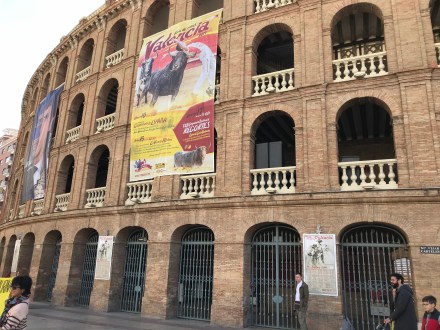
Walked through Valencia, which is very pretty, and very Spanish, with orange trees and fountains and apartments with balconies. We saw the outside of the bullring, and went into the pretty art deco railway station, which reminded me of the one in Portugal with its patterned tiles and beautiful ceilings.

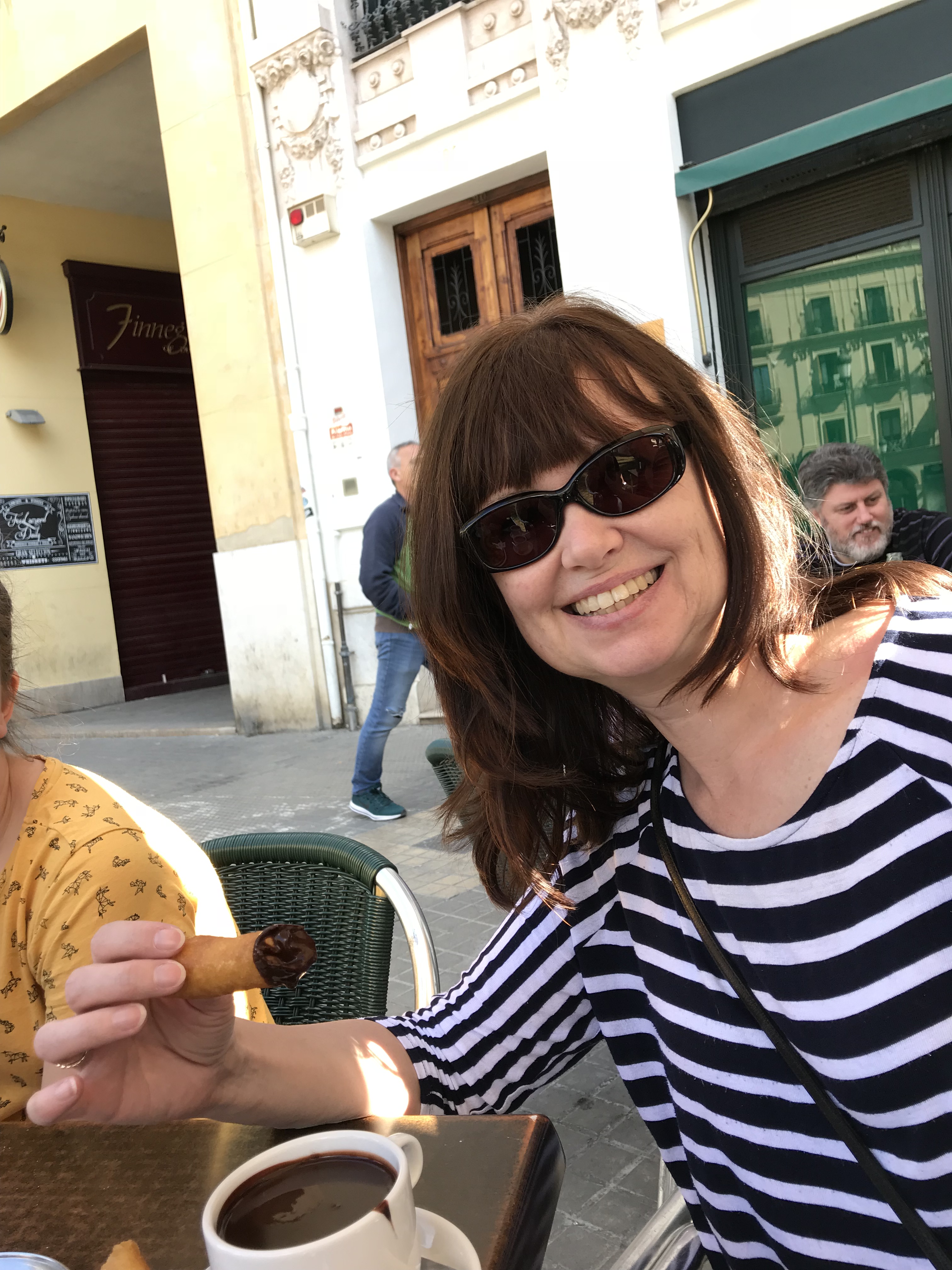
We sat outside and had churros and hot chocolates. I was hoping to find an old Spanish man, smoking a cigar and drinking coffee (because this is what all Spanish men are like) but they were all hiding.

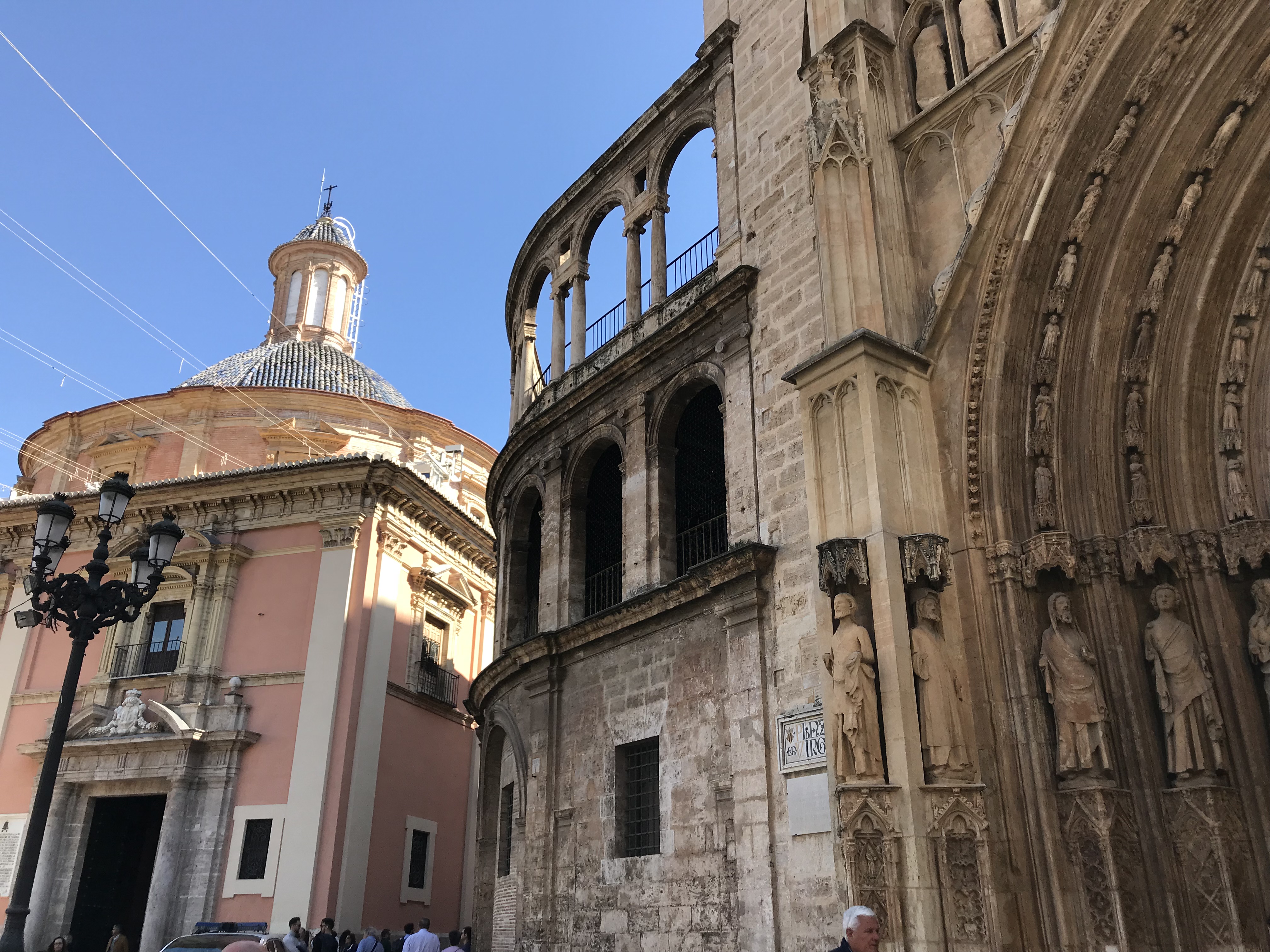
We walked passed the cathedral, and the old city gate, then walked along a dry river bed which is now Turia park.


Visited a lovely park next to the Fine Art Gallery, and enjoyed the sunshine (some of us enjoyed it more than others).

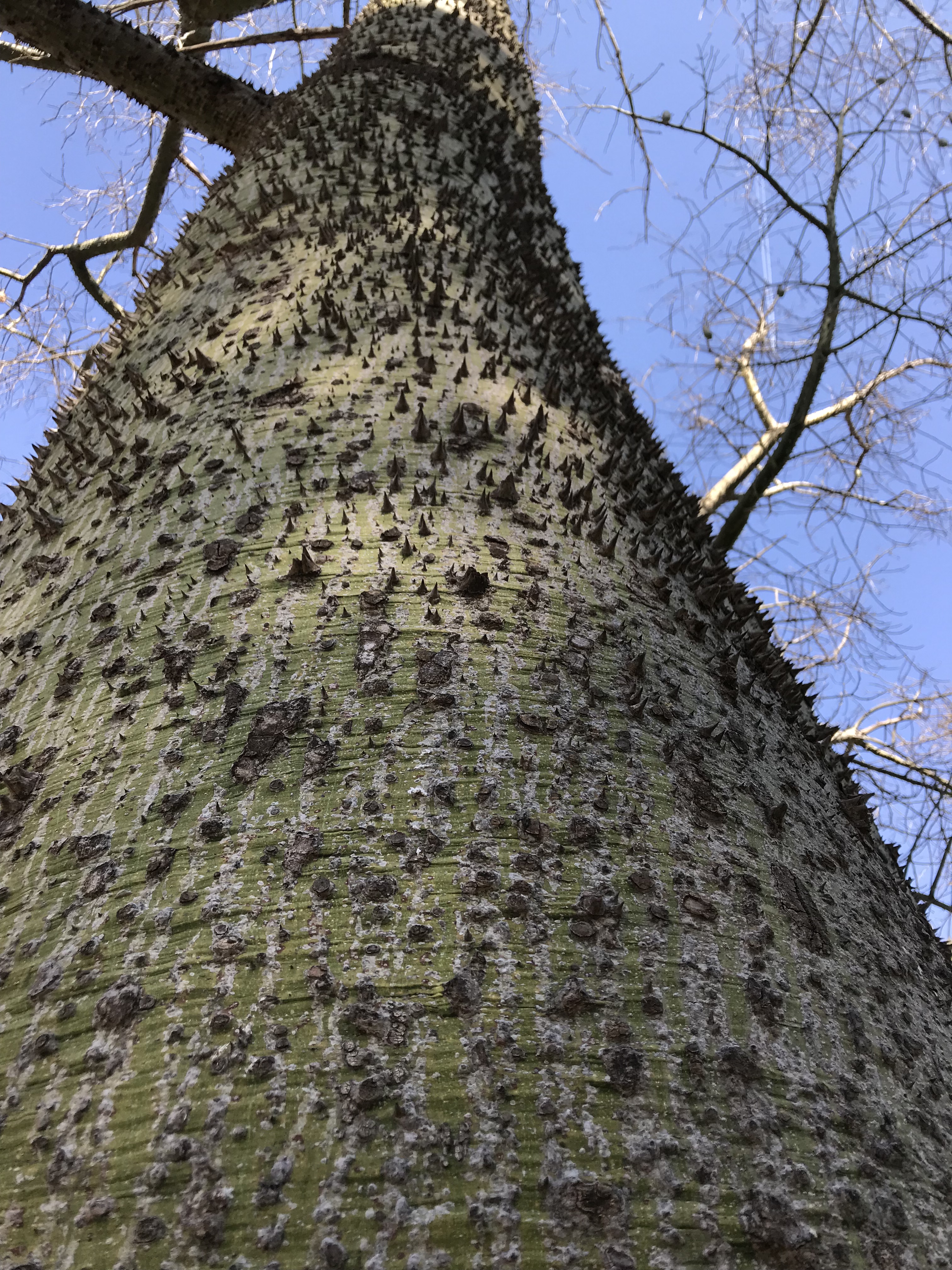
There were lots of unusual trees in the park. We saw some Moreton Bay fig trees – ‘Ficus macrophylla’ – which have arial roots that grow down from the branches, so they look like a tree from a magical land; and some trees with swollen trunks covered in fat spikes (ceiba speciosa).

But my personal favourites are still the orange trees.


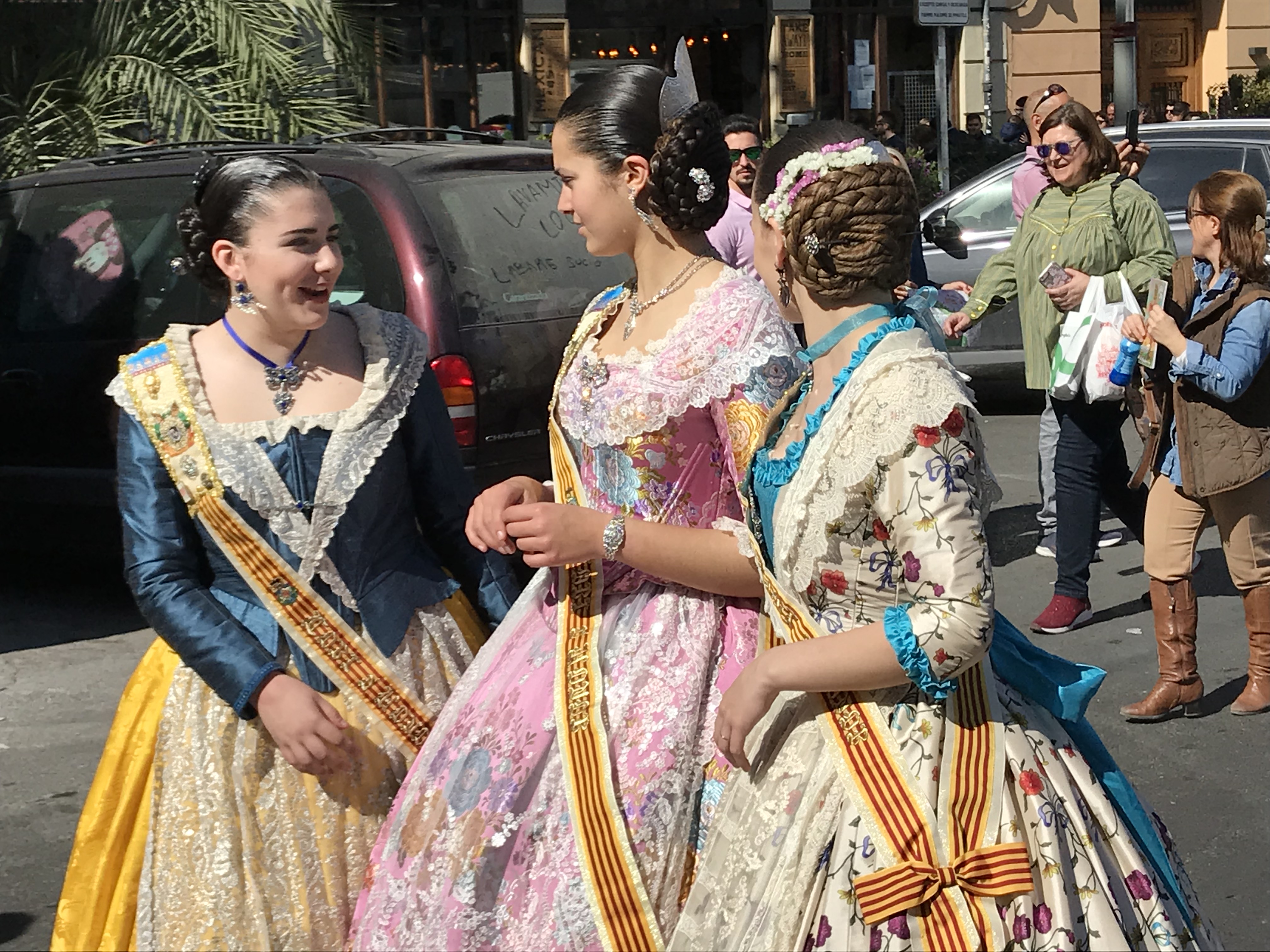
Valencia, in March, is noisy. Don’t come if you have a headache. This is due to Las Fallas…Let me tell you about Las Fallas: This began, in the Middle Ages with San José, (Saint Joseph) who is the patron saint of carpenters.

The carpenters used to hang up planks of wood to support their candles when working through the dark winter months. When spring arrived, they would burn these planks, to celebrate the longer days and sunny weather. Over time, they started to put clothing on the planks of wood (not sure who thought that was good idea) and then they began to make them into effigies of well-known characters. These later became ‘ninots’, which are enormous figures that are made today, and paraded around the streets. As the burning of these elaborate ninots began to get out of control, the authorities decided to link it to St Joseph’s Day.

We didn’t see these (we weren’t there for that day) but we did see people in costume, and we heard lots of fireworks. Really, lots and lots of fireworks. Not the pretty ones that make you say “Aaah”. They just went bang. Sometimes very big bangs, which gave you a heart attack (or worse). It seems that every male (not just males, but mostly males) from the age of about 2 years upwards, buys fireworks to throw around. There are whole shops, whole catalogues, dedicated to the sale of fireworks that go bang. It was like living in a war zone (I imagine).


We stopped for ice-creams. I managed to order mine in Spanish (with a few prompts from Cousin N’s husband) but then, just as I was feeling very pleased with myself, the shop assistant went off-script, and started to say unexpected Spanish words. It was the most delicious ice-cream though (dolce de leche flavour).

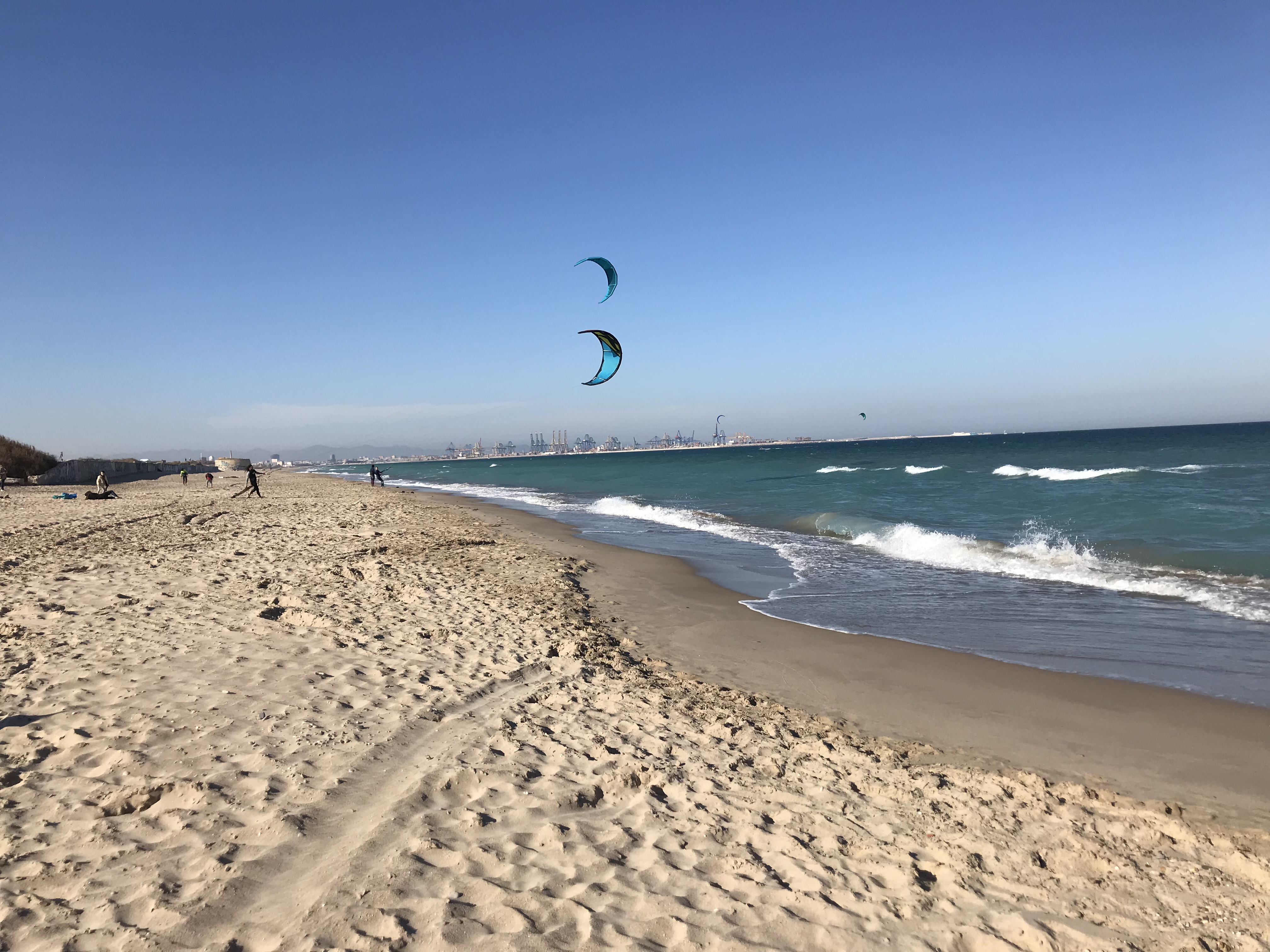
We then drove to the beach. The beach was very cold. One of us decided to swim. I wasn’t tempted to join her, though the water was very blue. An unsuspecting passerby almost got a shock, and I was worried she might drown as our only strong swimmer wandered off with his dad, but all was fine, if damp. We stood on the beach, shivering, laughing and eating cheese and pimento sandwiches (which were delicious).

Thanks for reading. I’ll post the last instalment on Monday (if you sign up to follow my blog you won’t miss it).

***
anneethompson.com

If you enjoyed this, why not read my travel book? You can read it for free if you have a Kindle.

Girl Trip to Valencia


Caught the early morning flight to Valencia (very early). I only had a hand-luggage allowance, so was worried I would have to wear several layers and arrive looking like The Michelin Man, but everything fitted in my pull-along.

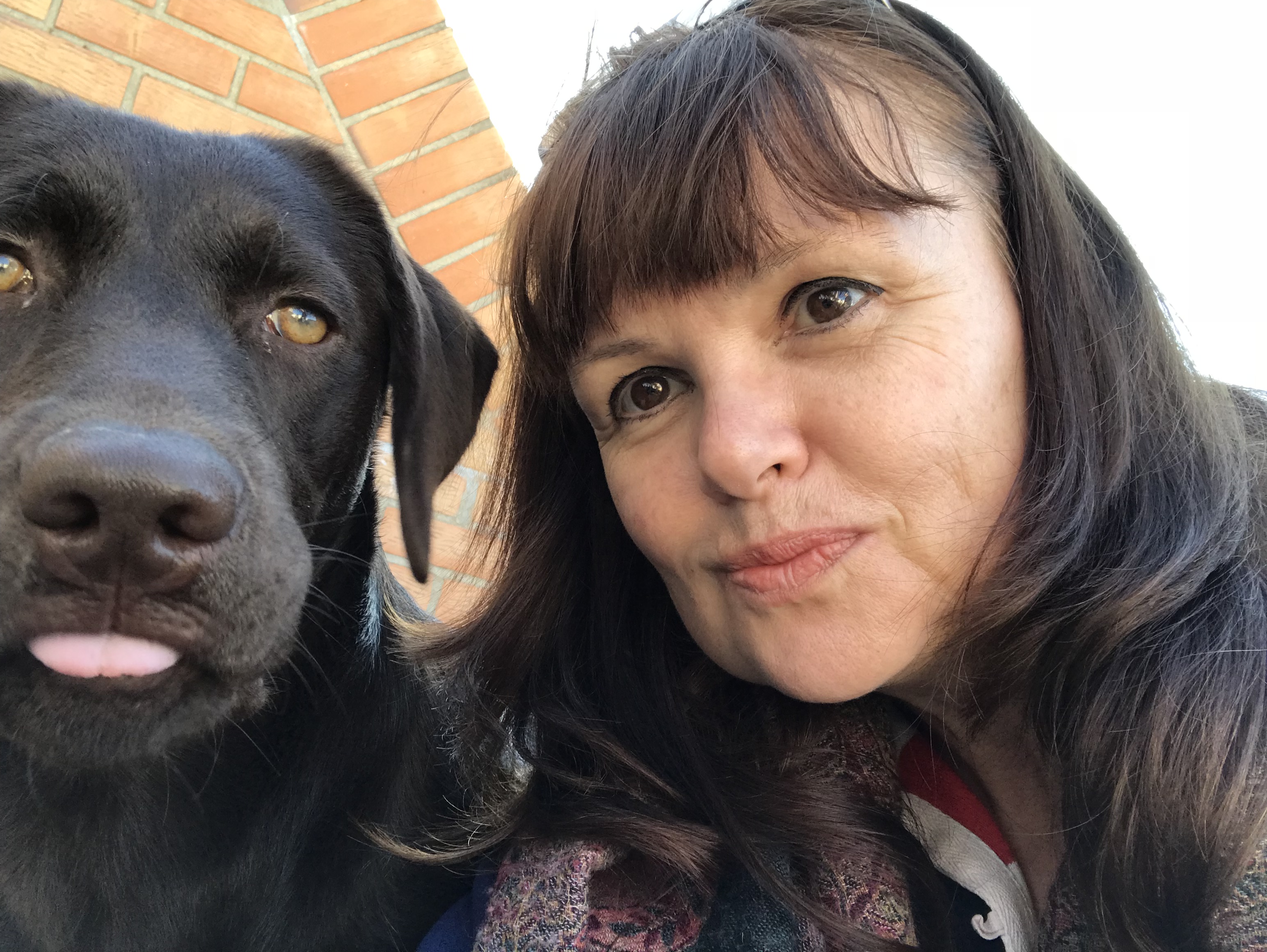
Met Cousins at Valencia airport. We were meeting to celebrate Cousin C’s big birthday, and were visiting Cousin N and family, who have moved to Valencia. Drove to their apartment in the city, and met their extremely cute labrador puppy. (Their children are also very cute, but I rather fell in love with the puppy.)

I was staying in an airbnb with Cousins C and L. New experience for me, so wasn’t quite sure what to expect (my sons stay in air bnb, so I wasn’t expecting ‘posh’).

We dumped our bags, and had a late lunch in Bar Pascualin. All lunches in Spain are late. Walked to Dolche de Leche cake shop, and spent several hours trying to decide which cake to buy. (Mouth is watering as I write this.) Chose a lemon meringue pie. It didn’t disappoint.

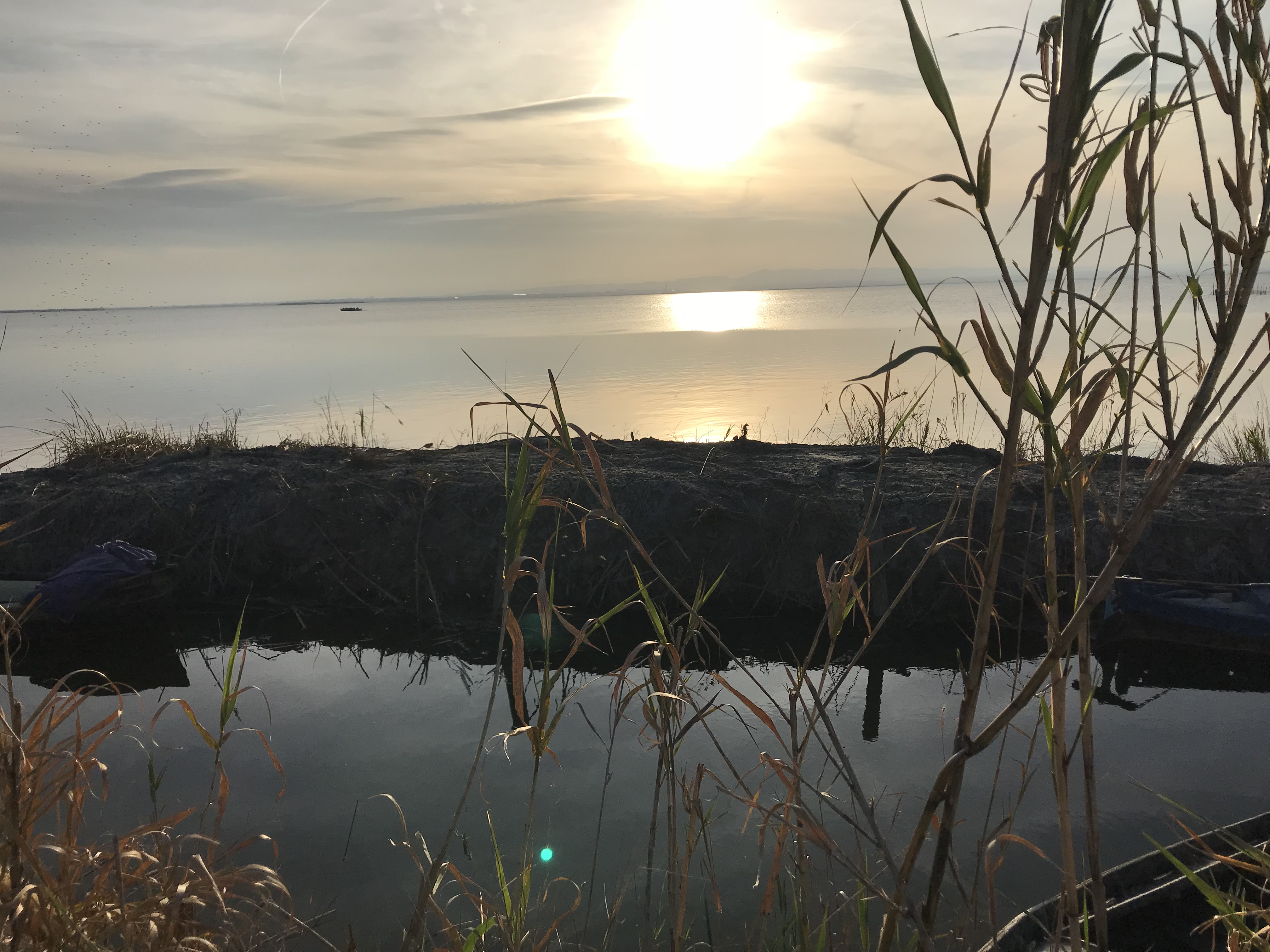
Drove to Lake Albufera and went on a boat. The sun was setting behind the mountains, the birds were wading amongst the reeds, and it was pretty perfect. There was some discussion about the origins of the lake – I think it’s a natural sea-water lake, which the Moors desalinated, so now it’s the largest fresh water lake in Spain…possibly in Europe…or even in the whole world…anyway, it’s big.

After tea, we went to our air bnb. Arrived at a large metal gate (very Spanish), and used our key to enter the lobby.

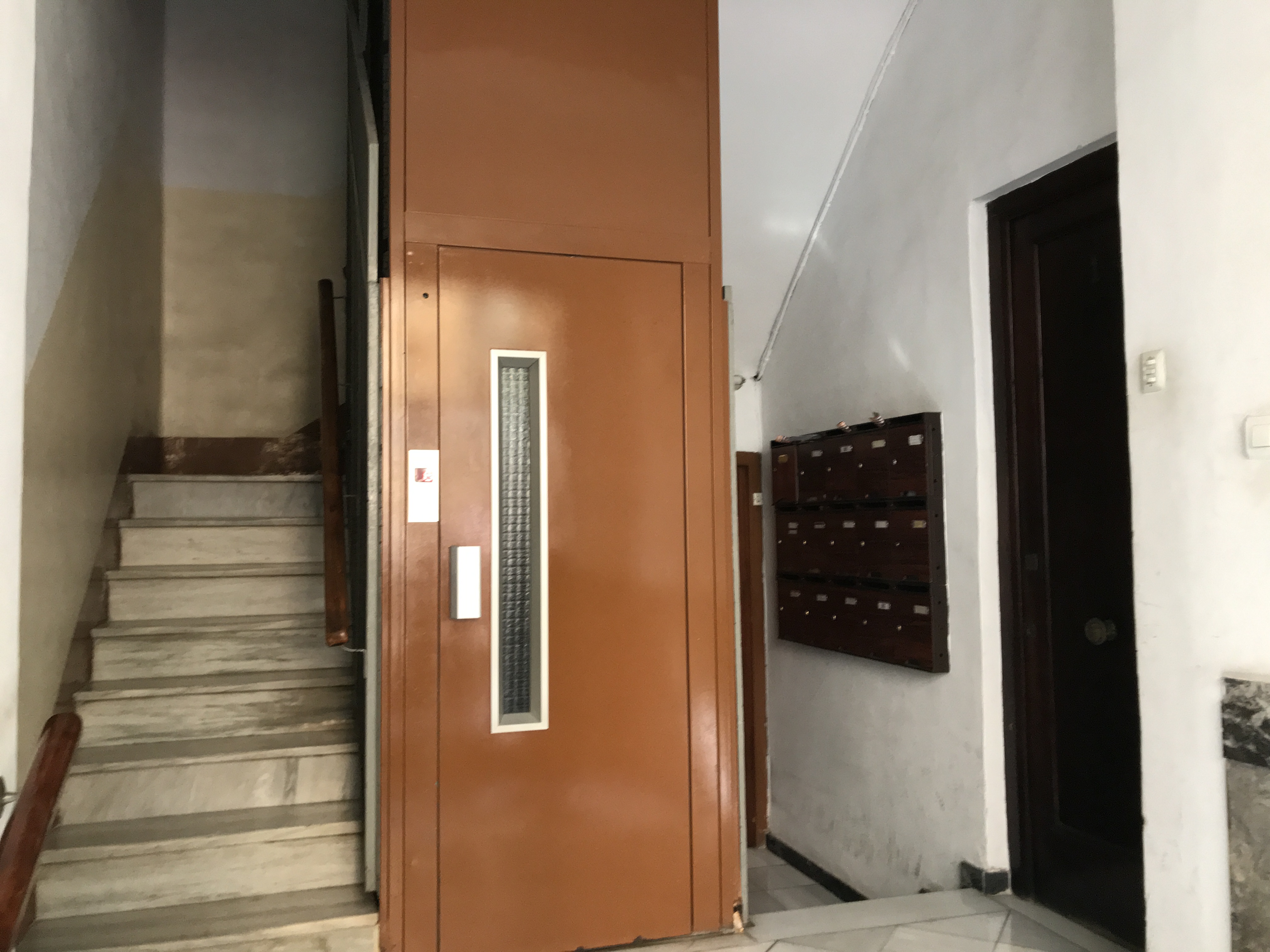
In the lobby was a lift, which closely resembled an upturned coffin (was certainly no bigger). We squashed inside, and Cousin C extracted her arm from rather aggressive sliding door which shut automatically, and we began to ascend. I hoped the coffin analogy wouldn’t be accurate – I certainly didn’t trust that the ‘emergency telephone’ would work if we got stuck. Arrived at the top floor, but still needed to go up a further flight of stairs. The stairwell was very dark, so Cousin C (the practical one amongst us) helpfully pressed the light switch. It didn’t seem to work, so she pressed it several more times. We then realised that actually, it wasn’t a light switch – it was a doorbell. (Spanish people disguise doorbells as light switches, I’m not sure why.) Being mature women, as soon as we realised we ran giggling up the stairs and locked ourselves into our apartment. Am hoping no one heard.

Spanish doorbell disguised as a light switch

The apartment is small, but has everything we need (except for curtains and blinds – I am rather partial to curtains and blinds). There was a blind over the door to the balcony, which took us longer than you might think to work out (practial Cousin C sussed it for us). The balcony is wonderful, and overlooks the whole of Valencia (well, a bit of it). I slept on the mezzanine with Cousin L. It was cosy, and rather lacking in a curtain/blind, so we woke when the sun rose.


I will continue this tomorrow, because I want to tell you about Fallas.
Thank you for reading.

Bye for now. Take care.
Love, Anne x

***
anneethompson.com

A laugh-out-loud book about travelling the world with a family. Taken from diaries written at the time, this book has been described as “The Durrells meet Bill Bryson”!

If you enjoyed this, why not read The Sarcastic Mother’s Travel Diary? It will make you laugh, and you can read it for free if you have a Kindle…available from an Amazon near you.

Being Loved


I was reading Matthew 22 today, and there is a parable in the first 14 verses which seemed a bit odd. Jesus is talking to the leaders of the day, the Pharisees, and he tells them a story about a king throwing a party, and all the invited guests refusing to come. I understood that analogy – the invited guests were the Jews, and many of them were messing up their gift of a relationship with God.

So, in the story, the king sends his servants out into the streets, and they invite everyone who they meet to come to the party. I understand that bit too – after the Jews (well, some of them) messed up the whole ‘people having a relationship with God’ gift, Jesus made the gift available to other people (the ‘dirty gentiles’ – that’s most of us!)

But then there’s something which seemed very odd. In the story, the king arrives at the banquet, where all those people who have accepted the invitation are sitting, enjoying the party, and he sees someone who is inappropriately dressed. The king is so angry, he throws out (in effect, banishes him to hell). Now, what does that mean? Surely, if you invite people who live on the streets to a party, you have to expect them to be inappropriately dressed? This seems a little unfair.

I did some research, and this is what I think it means: God invites everyone to come to him. Like in the parable of the prodigal son, he is a loving father, he will do everything possible to meet us where we are, he wants to save us. (Remember, in an earlier blog, I explained how when the son says: “I have sinned before man and before God,” he is actually quoting what Pharaoh said when he wanted the plagues to stop – he wasn’t sorry, he just wanted things to get better. But the father met him anyway, and that love, that willingness of the father to save the son even when he was continuing to behave badly, was enough for the son to realise that he couldn’t earn his way back, he simply had to accept what the father/God was offering.) So what does the bit about the clothes mean?

Well, I think, that yes, God wants everyone to come to him, and he has done everything necessary for us to know him. However, we also have to accept that. Now, apparently, in the days of Jesus, a king would have provided appropriate clothing for a guest (a bit like when you turn up at a posh restaurant, and they have ties for you to borrow because you didn’t realise there was a dress-code). I guess the clothes would signify the willingness to change, to become what God wants us to be, to let him alter us. Therefore, although we can all come, unless we let God change us through his love, then that is not enough. If we truly are responding to God’s love, rather than using it as a sort of ‘get out of jail free’ card, then we will let that love change us. We will be pleased to wear the garments appropriate for a party. If we don’t, we have missed the point. Which would be worse than never acknowledging that great love in the first place.

I think that’s what it means anyway. Makes you think, doesn’t it?
Thank you for reading.
Take care this week.

Love, Anne x

Anne E. Thompson has written several novels, which are available in bookshops and Amazon.
Anne writes a weekly blog – why not sign up to follow?
anneethompson.com

Hearing What Is Meant


When I was teaching at Limpsfield Infant School, I would very often look up from taking the morning register, to find a child standing next to me. “What’s the matter Tommy?” I would ask (though it might be Jane or Christopher or Matthew). “I’ve got a tummy ache,” they would reply. And I would guess that whatever the first subject of the day was, they found it difficult. Usually I would assure them that maths gave me a tummy ache too, and we would sit down together and try to sort it out.

(Of course, sometimes they really did have a tummy ache, and I will never forget the day that a girl – whose name I remember clearly – vomited all over me. This was not helped when her mother – who I also remember – came to collect her and seemed to find it terribly funny, even though the child was ill because she’d just been taken to have vaccinations for a holiday. There is so much I could say here, but hey, I’m over it. Sort of.)

Anyway, my point is, children don’t always say what they mean, and part of being a good teacher is hearing what they’re trying to say. Grown-ups also don’t always say what they mean, and sometimes this is good. So when, driving home after an event, my husband turns to me and says, “You were the prettiest one there,” I am pleased. Even though I know that it’s not true. But he’s telling me that in his eyes, I am still pretty, and he’s glad I was there. It made me smile recently, to watch a film on Netflix, when all the wives were told by their husbands that they were ‘the prettiest one there’, because I had thought it was only my husband who said that!

However, sometimes people don’t say nice things, they say horrid things, and part of being an adult—I think—is trying to hear what they’re really saying.

I find it much easier with children, perhaps because I want to give them the benefit of the doubt. Or perhaps because they’re not so good at pretending, so it’s easier to see what they’re really saying. My mother always says she likes teenagers, because “they are completely selfish, and they don’t pretend not to be.” Adults are harder, because generally we are also completely selfish, but we try to hide it.

I hope you agree that sometimes, what people say, is not completely what they want you to hear. And usually, they simply need some reassurance, to know that no one else is perfect either, and that’s okay. Sometimes we need other people to hear that we’re vulnerable, and we’re not quite managing to keep up. Because all of us are falling behind with something. And sometimes, we all need someone to say to us: “You were the prettiest one there.”

*****

Thank you for reading.

Why not sign up to follow my blog?
anneethompson.com


Which book would you like to read next? Available from bookshops and Amazon.

Reading…Not reading…


We did a flying visit to Reading – have you been there? It’s rather pretty (at least, the part we were in was pretty). It reminded me a little of Bristol, with a river and lots of shops and places to eat.

I personally dislike it, because I feel it should be pronounced “reeding” and not “redding”. I tend to misread all the signs, and find it a very confusing place to be.

Reading is not a city, which surprised me. I thought that every place with a cathedral was a city, but this is not true. Apparently the monarch has to grant city status to a town, and our current monarch clearly thinks Reading should remain a town. I expect she also dislikes the name.

We had lunch in Browns, next to the river.

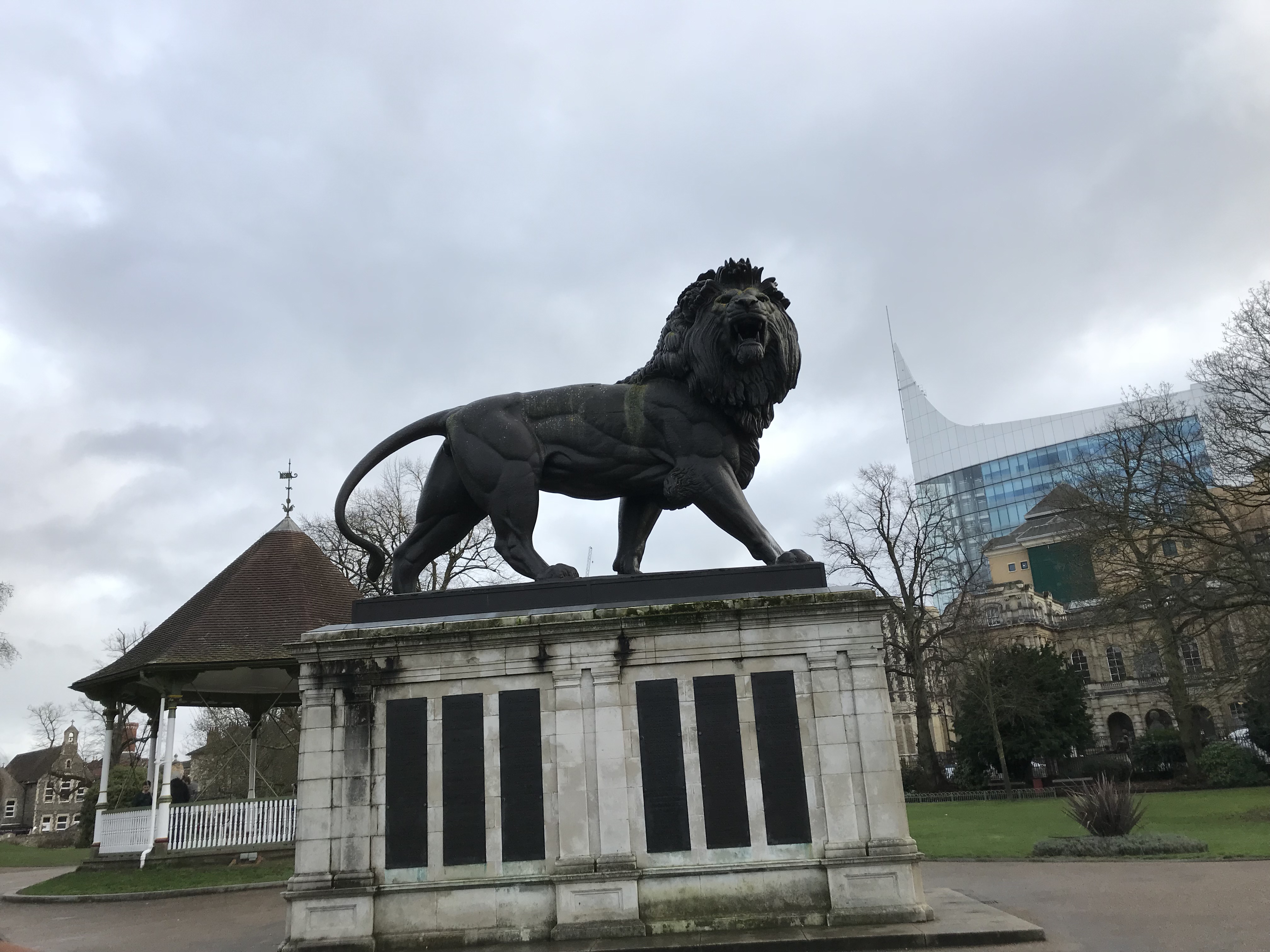
We walked towards the ancient abbey ruins. There was a huge statue – the Maiwand Lion – which commemorates the soldiers lost during a war in Afghanistan (not the most recent one). Russia were beginning to infiltrate Afghanistan, so we sent troops to stop them, and loads of them were killed. It sounds so very like recent wars. History tends to repeat, doesn’t it? Afghanistan seems to be one of those places which is continually being overrun by other countries, they have a sadly unsettled past; it must be very hard for the generations who live there.

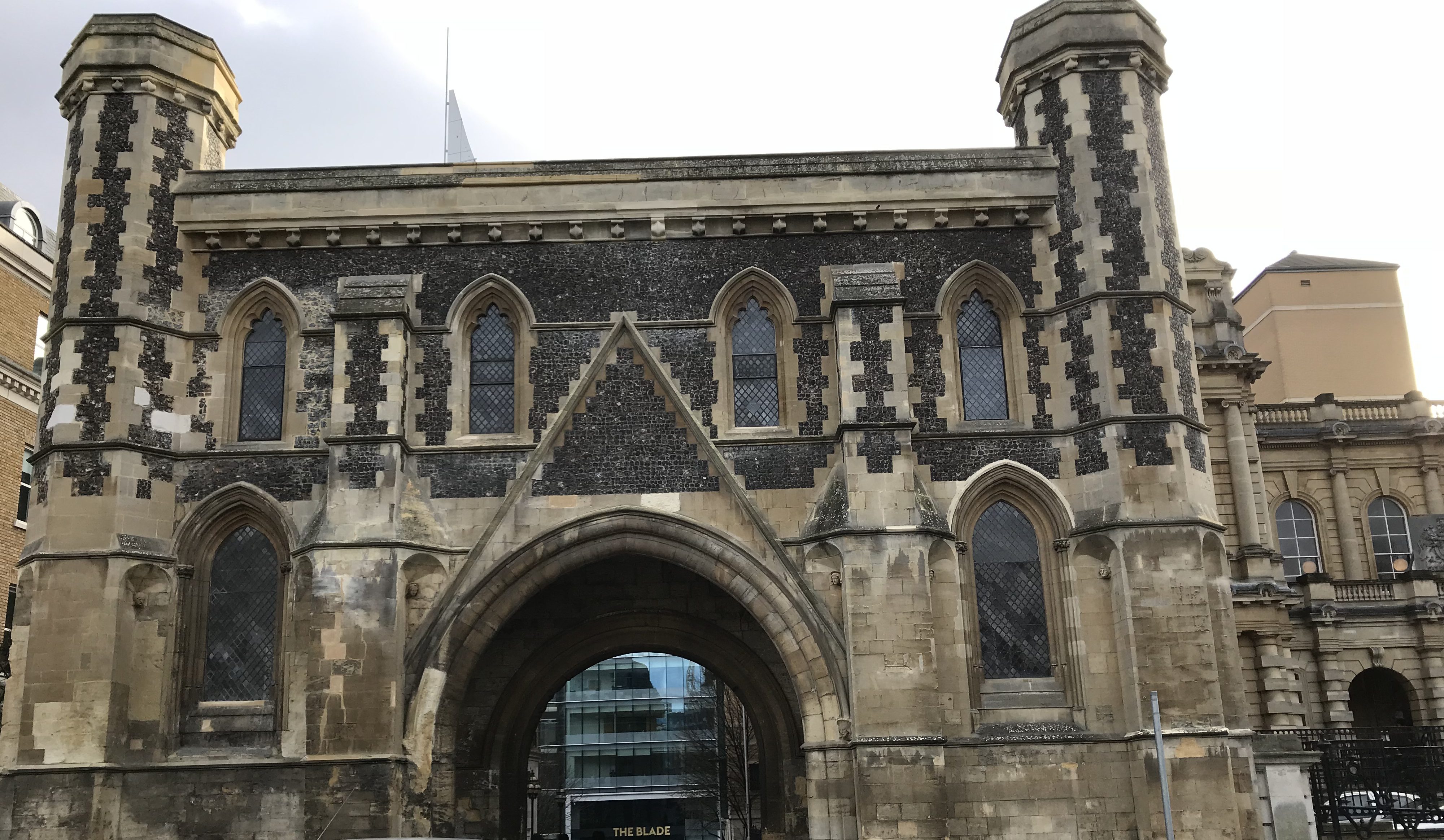
Walked past the old gateway. They executed the abbot near here during Henry III times, and there is an old hotel, which I’m pretty sure must be haunted.

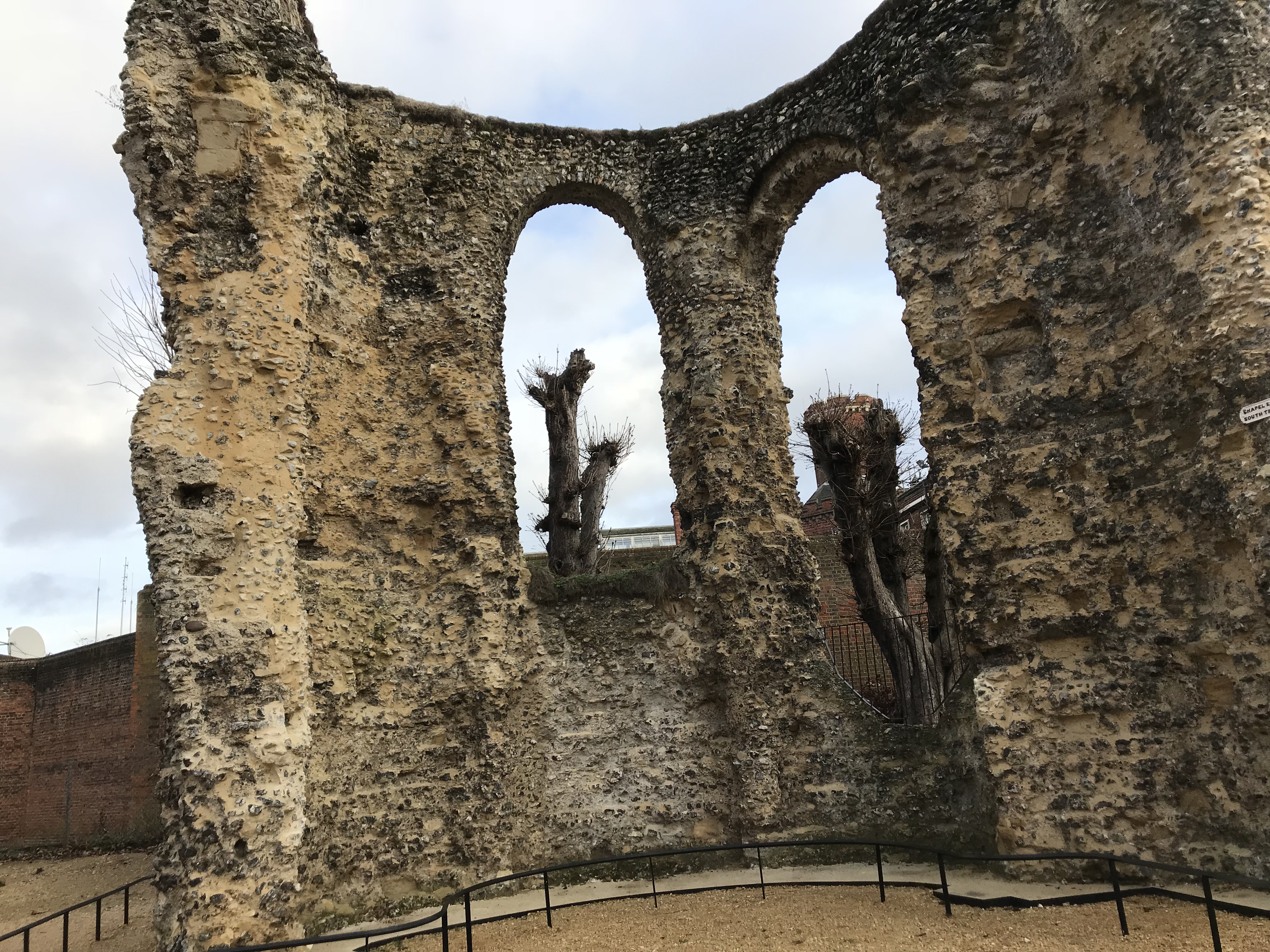
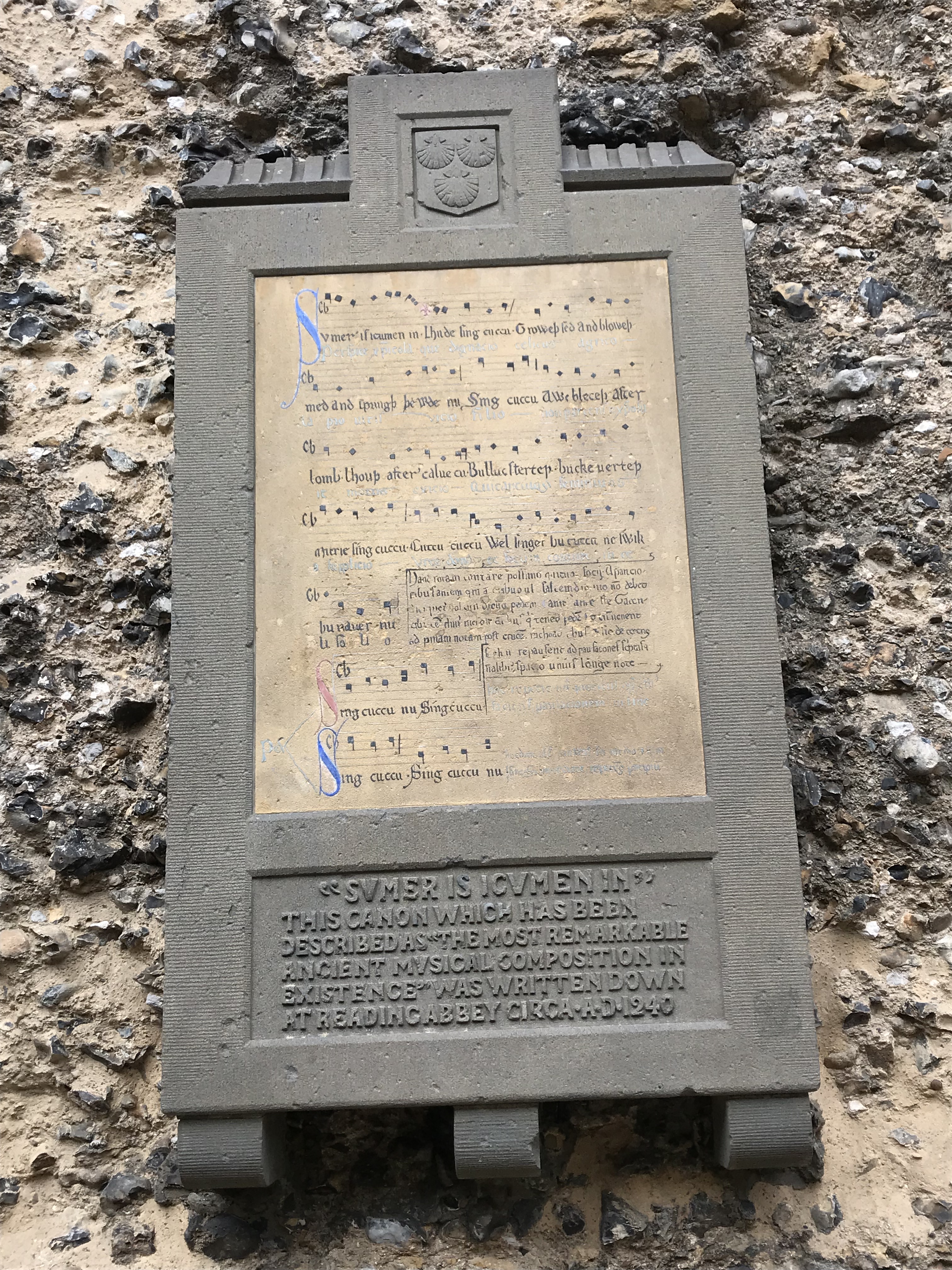
We found the ruins of the ancient abbey, and wandered around. Husband was keen to walk by the river, but we made him wait while we explored. Luckily some of the signs were aimed at children, including one with a wheel to turn that played an old song – so that kept him busy for a few minutes. The song was “Summer is i-comin’ in” which I remember singing (and disliking) at school. Apparently it contains the word “fart” but I don’t think we sang that version at my junior school.

We saw the remains of the chapter house – which was where all the business meetings of the abbey were held. Each meeting began with a reading of a chapter from the Bible, which is why it’s named that.

If I’m honest, the ruins only needed a few minutes to explore – unless you’re a historian and appreciate these things, or a primary school teacher and determined to use the whole day on a school outing…I have been that person.

We then followed Husband back to the river, looked at the boats, before driving back to Kent.

Hope you have a good week.
Take care,
Love, Anne x

Anne E. Thompson has written several novels and non-fiction books. You can find her work in bookshops and Amazon.
Why not sign up to follow her blog today?
anneethompson.com

Thanks for reading.

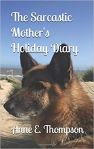
If you enjoyed this, you will love my new book: The Sarcastic Mother’s Holiday Diary.
I have always written a diary on holiday, so last Christmas, I decided to find all my old diaries and blogs, and make a book for my children. However, several other people also asked for a copy, so I have written a public version – it’s available on Amazon and has been described as “The Durrells meet Bill Bryson”!

The paperback version is currently available for £9.99, but as I will need to buy copies for book fairs, I will need to cover my postage costs, so this price is for a very limited time (I think it will be around £12 in the future, but I wanted to let you, my blog readers, know that they can buy it for the cheaper price, until March). It is also available as a Kindle book.(You can read it for free if you have Kindle Unlimited.)

Why not buy a copy today? I think it will make you laugh.
The US link is here:

https://www.amazon.com/Sarcastic-Mothers-Holiday-Diary-ebook/dp/B07N95281F/ref=sr_1_1?ie=UTF8&qid=1549015525&sr=8-1&keywords=the+sarcastic+mothers+holiday+diary

The India link is here:

https://www.amazon.in/Sarcastic-Mothers-Holiday-Diary-ebook/dp/B07N95281F/ref=sr_1_1?ie=UTF8&qid=1549015429&sr=8-1&keywords=the+sarcastic+mothers+holiday+diary

The UK link is here:

https://www.amazon.co.uk/Sarcastic-Mothers-Holiday-Diary-ebook/dp/B07N95281F/ref=sr_1_2?ie=UTF8&qid=1549014970&sr=8-2&keywords=the+sarcastic+mothers+holiday+diary