The Island Continued


The Island Continued
Have you managed to guess the name of the island we visited? Here are some more clues.

I was interested by the history of the island, knowing that it has a mixture of Celtic and Viking heritage, and is currently protected by the UK, but is not part of it (and has never been part of the EU). The island is owned by the Crown, and has its own Parliament.

I followed signs from the main shopping street to the museum. The sign implied (not sure how, but it did) that the museum was tucked just behind the shops. This was not true. I followed a long succession of signs, up a hill, to an entrance with some steps which looked exactly like the pedestrian entrance to a car park (though they smelt better). A sign told me the museum could be found at level 9. Unexpected. I began to climb.

I walked up the car-park-like steps until I emerged (at level 8, as level 9 did not exist) in. . . a car park! I almost gave up, but another sign directed me through the cars, over a narrow footbridge until I reached a red brick museum. I was greeted at the door by a friendly man, who had a big smile and the curliest hair I have ever seen, sort of piled onto the top of his head like one of those artificial-looking wigs that clowns wear. I was glad Husband was safely at work, because I just knew he would comment. The museum was free, and I was given a map, and directed through the first doorway.

The museum started badly (other than the storybook man at the door) with displays of art. The next room had glass cases of coins, and other old stuff, followed by long explanations about the geology of the island. I remembered that I don’t like museums, and wondered how I could sneak past the friendly man without being noticed. Sat on a leather seat and pondered problem, decided that there was no way I was brave enough to leave after 3 minutes, and continued into the heart of the museum. Here I was greeted by Vikings, but even these managed to look bland.

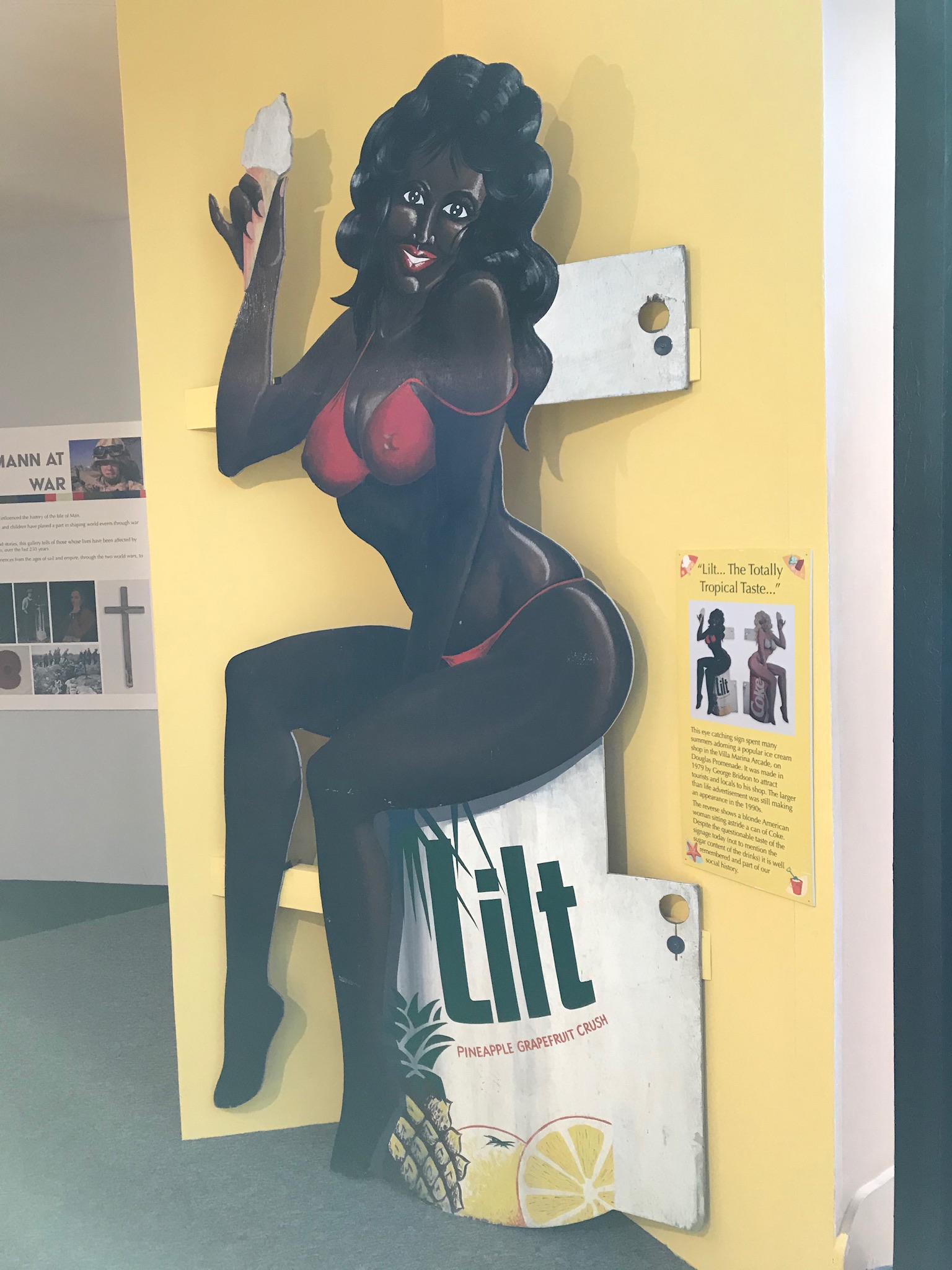
Now, I’m not a fan of museums—too much reading of boards to learn facts I am not interested in—but most museums today manage to mix some story in with their facts, and I was pleased to discover that this was no exception. I rounded a corner, and was directed up the gangplank of an ancient ferry from Liverpool, past portholes showing glimpses of a former life, trunks and suitcases piled high, a man’s voice announcing the imminent departure of the boat; then down the other side onto a beach from yesteryear. There was a horse-pulled tram, and bathing huts that could be wheeled onto the beach. I left via huge displays showing adverts for ice-creams and drinks, which were shocking when viewed with modern eyes.

 I also enjoyed the displays about the war, with a walk-through trench. Photos and displays showed how the island was used to house prisoners of war. There was no purpose-built prison, and initially the prisoners were housed in the properties that lined the beach, with barbed wire to stop them leaving. Later, they were moved to a ‘camp’ with tents, and these were replaced with sheds when the weather turned too cold. Above the displays was a huge mine, menacing in both its size and position.

Another part of the island’s history can be found at St. John’s. Here there is a tiered grassy mound, and a flag-lined area leading to the church. A standing stone explains that this is ‘Tynwald Hill’ and is Viking in origin, the Norse: Thing vollr meaning ‘Parliament Hill’. Each year on old Midsummer Day, the island’s parliament meets and all new laws are proclaimed.

There is also a Parliament building, where they meet during the rest of the year. But it doesn’t look at all interesting, so we will leave it at St. John’s.

I’m sure you will know the name of the island now—if not, read my next post.
I hope you have an interesting day. Thank you for reading.
Take care.
Love, Anne x

The Island


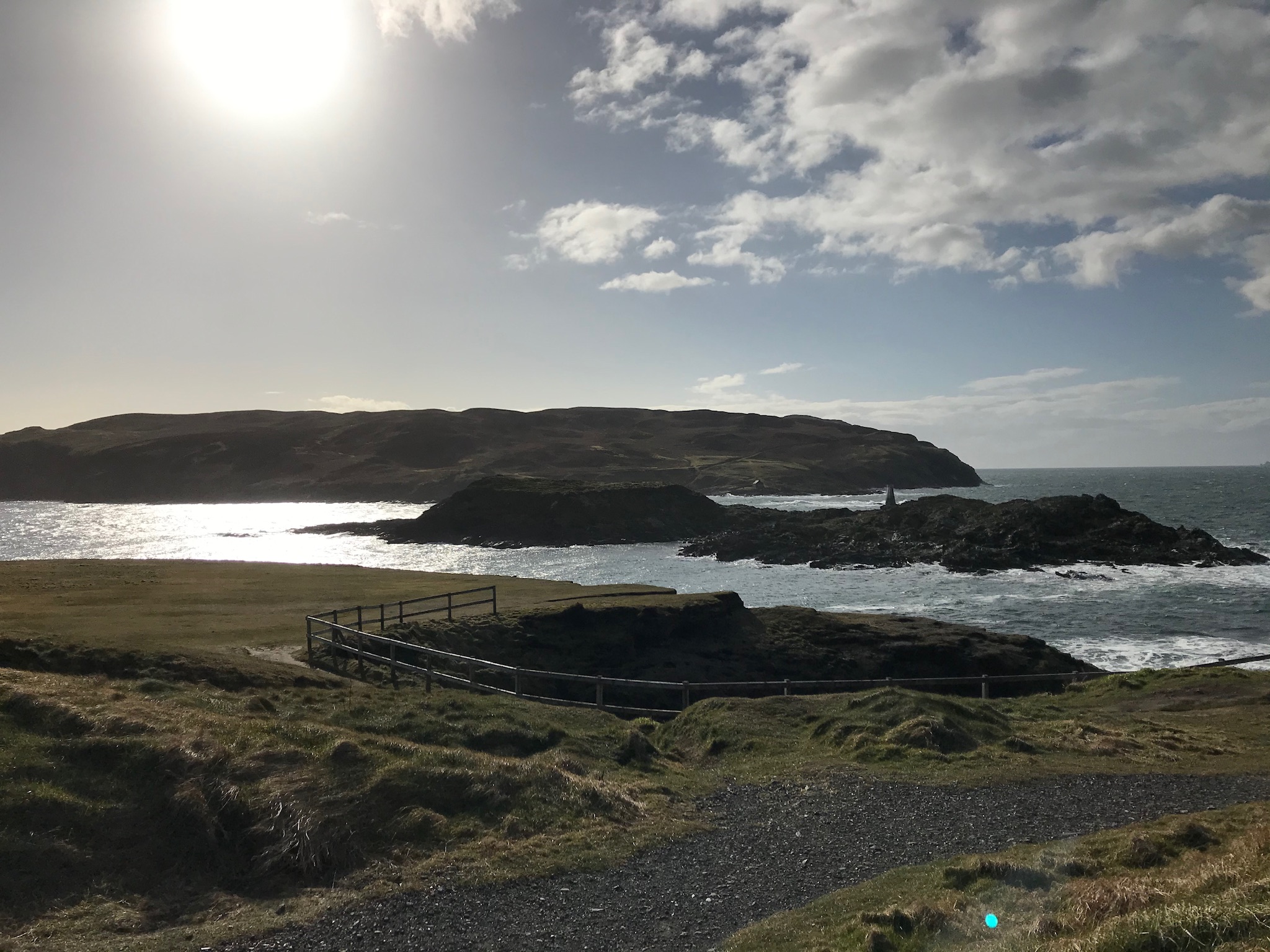
We went to an island that had the hills and valleys of the Yorkshire Dales, with the dramatic coast of Cornwall, and the slightly ugly but real houses of Wales. It was perfect, and very unspoilt, so to be honest I don’t want to tell you where we were. But that feels a little mean, so I will tell you the name in a later blog—unless you can guess already? I will give you some clues.

We left home last Monday, to catch a flight from Gatwick. I worried about Coronavirus, and wrapped my scarf around my head and face, so I resembled a sort of paisley Egyptian mummy. It was very hot! We jostled shoulders with hundreds of people, and I wondered if hand sanitiser—which kills bacteria—was any protection at all against a virus.
We flew to the island, and most other people hadn’t checked in any luggage, so collecting our bags was super-fast. The airport was tiny, and we went straight to the Avis desk, where a friendly lady gave us the keys to our car and told us not to put in too much petrol because the island was too small to need much. She had a sort of Liverpudlian accent, which took me straight back to being 17, and visiting my sister when she studied at Liverpool Uni.

We drove to the Airbnb, which was right opposite the beach, then walked to the town. The main street had all the big-name shops: M&S, Topshop, Next, Clarks; surprisingly it also had customers, and it reminded me of twenty years ago, when High Streets weren’t full of boarded up windows and Poundland. I realised that probably the hassle of internet shopping/delivery when you live on an island, means that real shops, with real products, are how most people shop. It was rather nice.
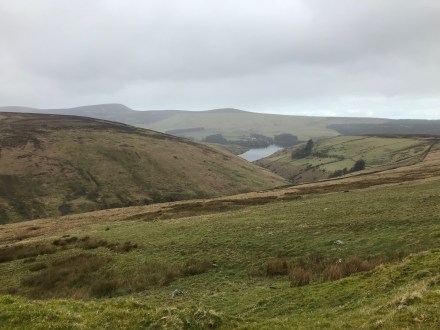
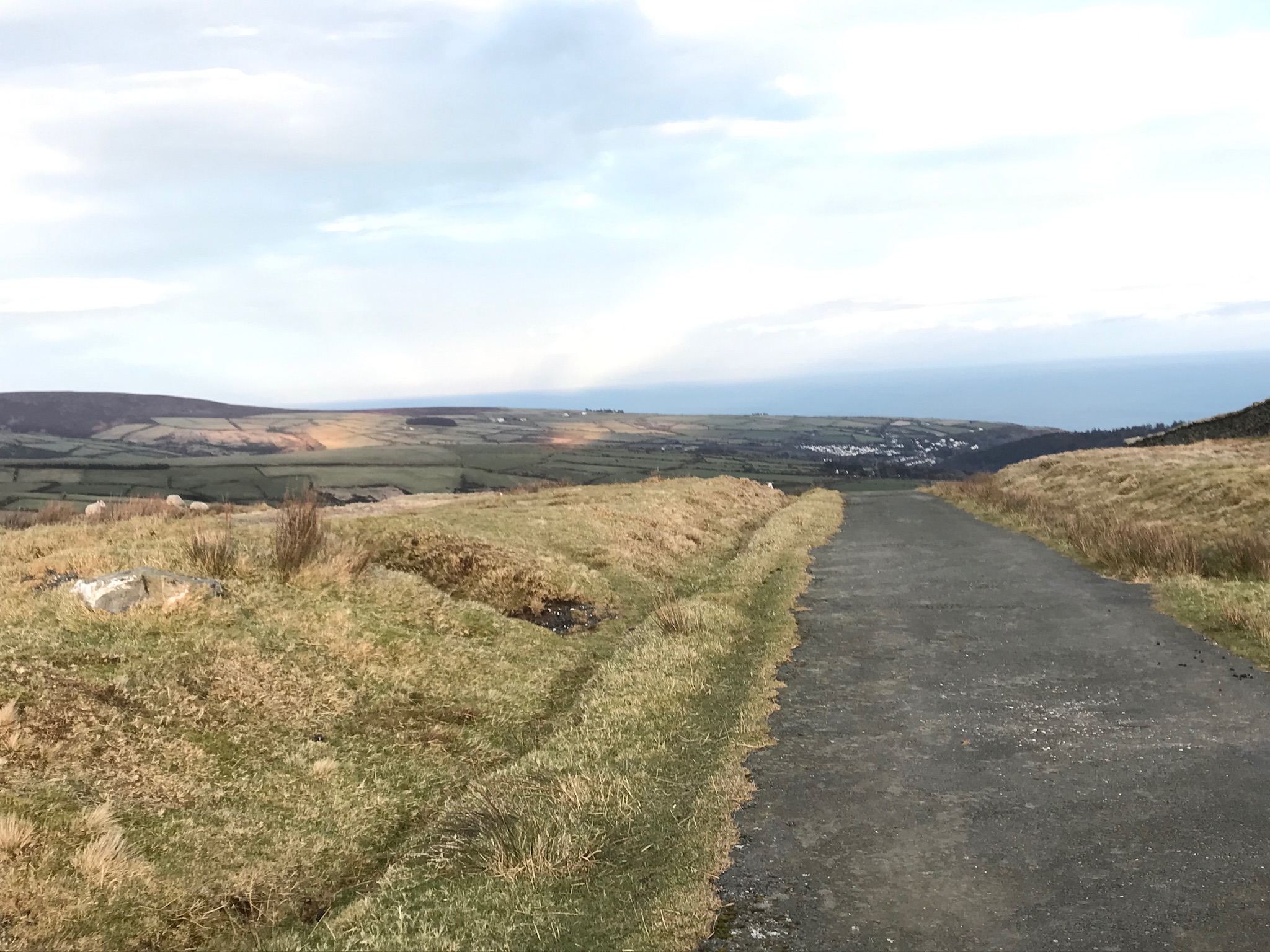
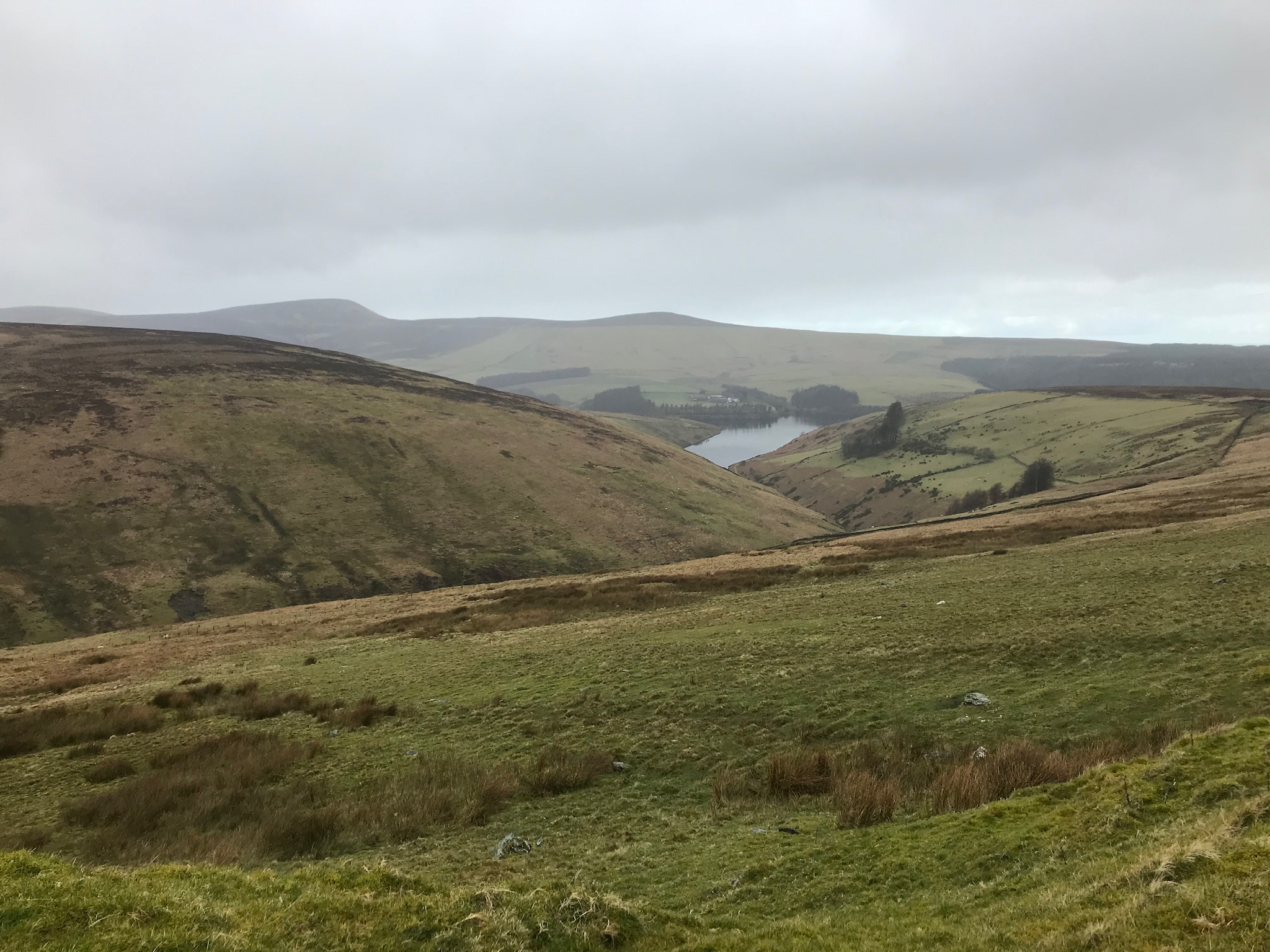
We drove around the hills behind the main town. The roads were brilliant, and Husband enjoyed the drive and went slightly faster than I hoped. (A big clue here!) The island has no national speed limit, so although there are restrictions in the towns, an ‘end of speed limit’ sign means just that: there is no speed limit. We drove up a mountain, with ragged-looking sheep and patches of white snow gleaming, and views across the sea to the mainland. It was beautiful and wild and absolutely freezing cold.

The island has fairies (this was in the guide book, so it must be true). They are not the tiny flighty girl-fairies of picture books, with their long hair and floaty dresses and shiny wings. No, these fairies are about 4ft tall, with pointy hats, and they cause no end of trouble, especially if you don’t show them respect. They are referred to as ‘Themselves’ and have been known to steal babies and bring bad luck and all sorts of other mischief. I made a huge mistake in reading this section of the guide book to Husband, who then spent the next few days pointing out every person who could, possibly, be a fairy. To be honest, there are an unexpected high number of very short people on the island, most wearing bobble-hats, some sporting long beards (mainly the men). It made me giggle, which was very bad as it encouraged him.
Can you guess where we were? I will give you some more clues in my next post.
I hope you have a fun day. Take care.
Love, Anne x


Train to Jūrmala, Latvia


Train to Jūrmala

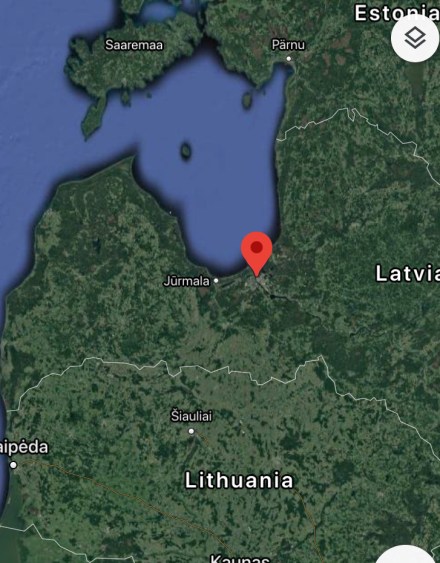
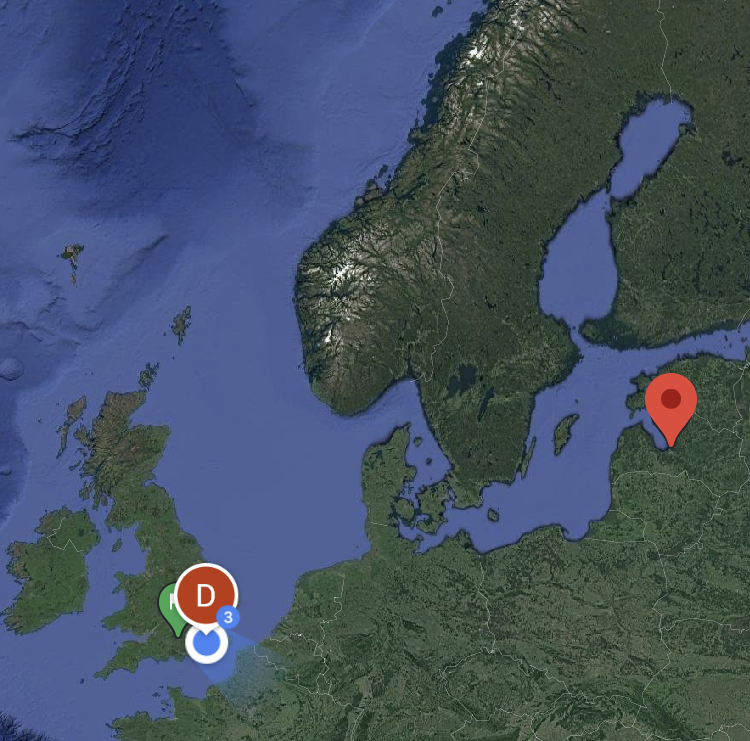
Last week, we were in Riga, Latvia.


I had read that Jūrmala was a good place to visit from Riga, and we had a day when Husband wasn’t working, so I persuaded him that he would like to go. We walked to the station, which is on the edge of the Old Town, near the zeppelin hangers that house the central market. The weather was dry but cold.

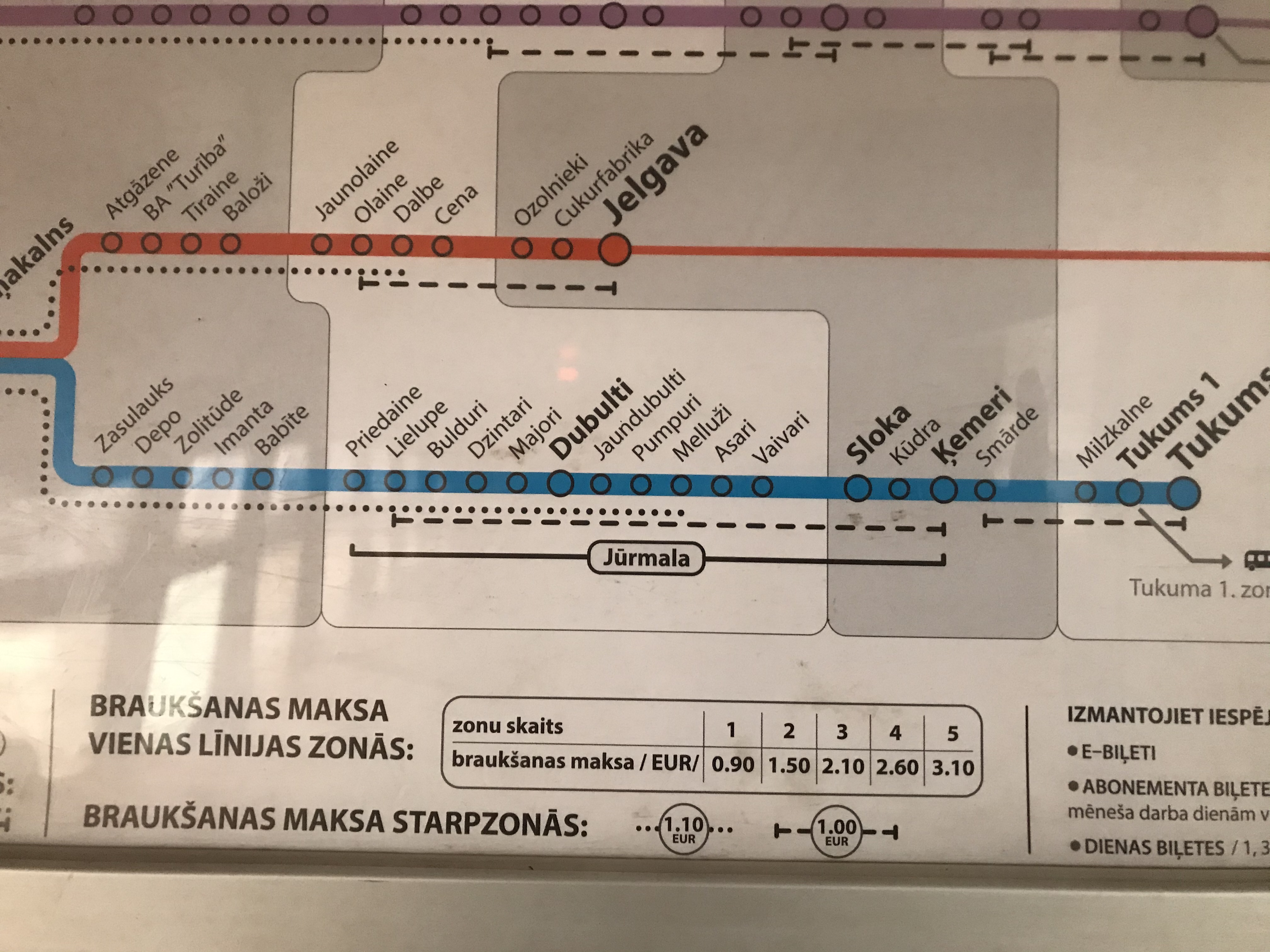
At the station we found a ticket booth where the woman spoke a little English, and we managed to mime that we wanted return tickets to Majori. Jūrmala is the Latvian for ‘seaside‘ and there are several stations along the coast, with Majori being in the middle. I used my phone to photograph the timetable (because I have seen my children do this sort of thing). Finding the correct platform was more complicated, but we found a timetable that showed platforms, and then followed signposts to platform 3. If they had announced a change of platform over the tannoy, we’d have been stumped, and possibly ended up in Russia. But the sign on the platform showed we were at least travelling in the right direction, so we climbed the steep narrow steps up into the carriage, and sat down. A doorbell sound announced the doors were shutting, and we eased away from the station.

I like catching trains in foreign countries, watching the changing scenes through the window. I used my photographed timetable to check the stations we passed through, so we would know when to get off. As we left Riga, we saw many apartment blocks, small industries, red-brick factories. The houses varied, some must once have been grand, with towers and pillars, but all were faded now, the painted plaster cracked, weeds filling the dried gardens. Every wall we passed was decorated with graffiti, none of it clever. Tall brick chimneys piercing the blue sky and modern warehouses swept past the window.

Then we plunged into woods of pine trees, and out the other side. The land was flat, not a hill in sight. As we drew near to Majori there were more forests, and large houses nestled amongst the pine trees.

Majori station is next to a flooded river. One side of the platform is a road, the other is the river. You could see the railway as it curved away from the town, past the tall bulrushes and the fishermen. We left the station, and walked into town.

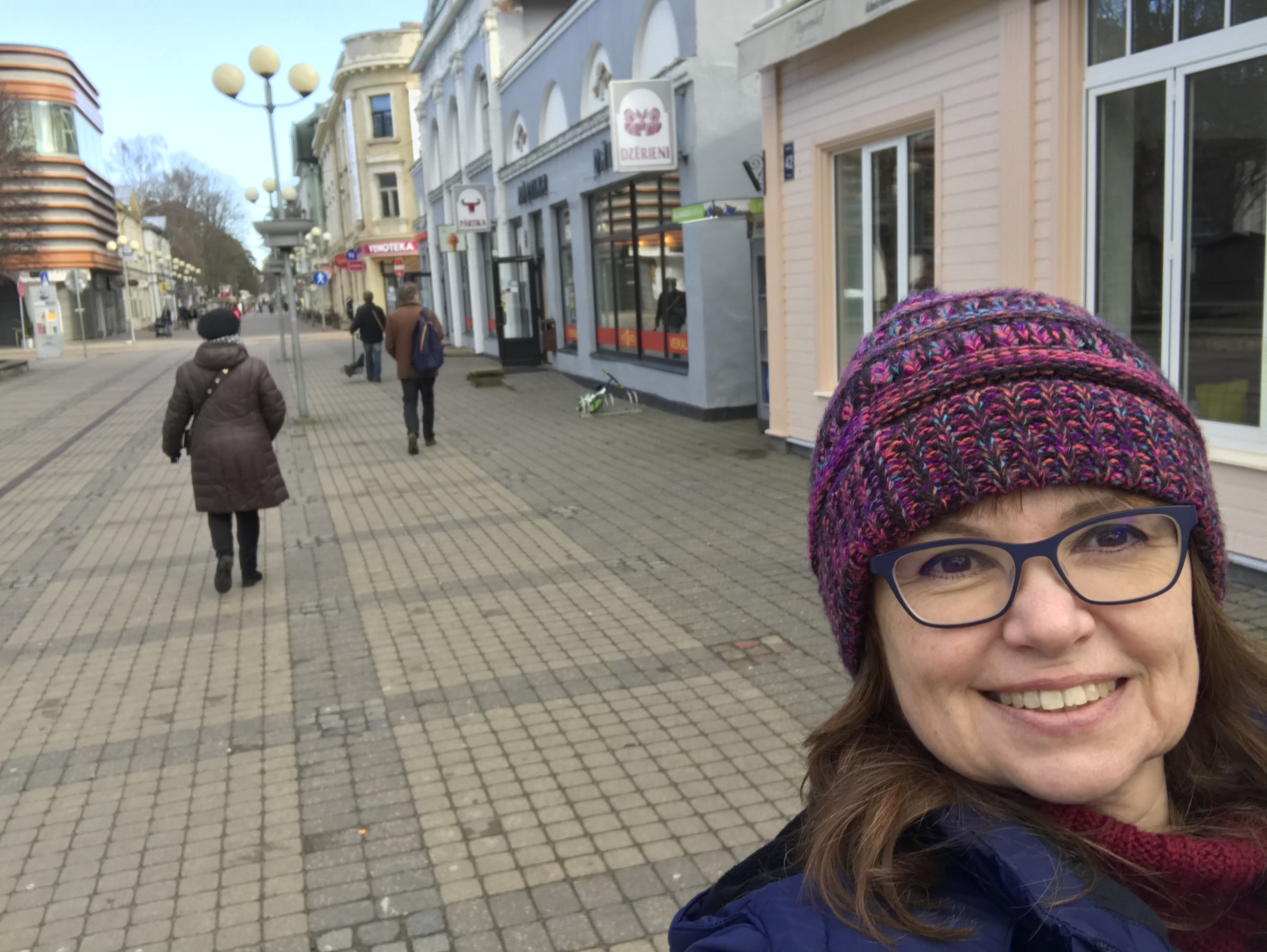
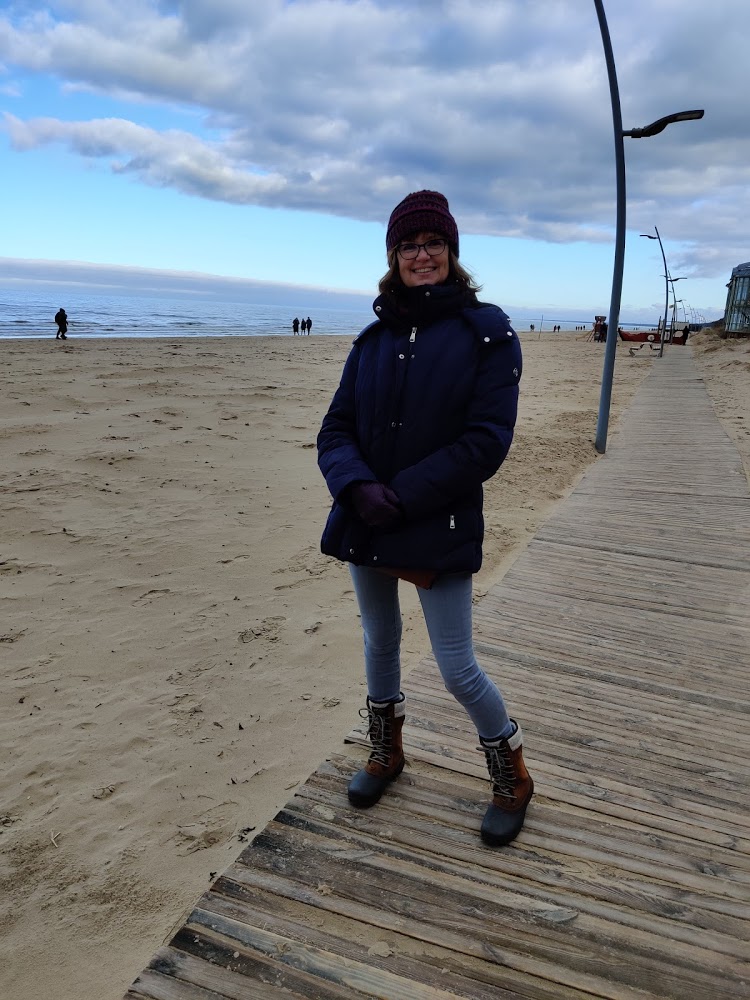
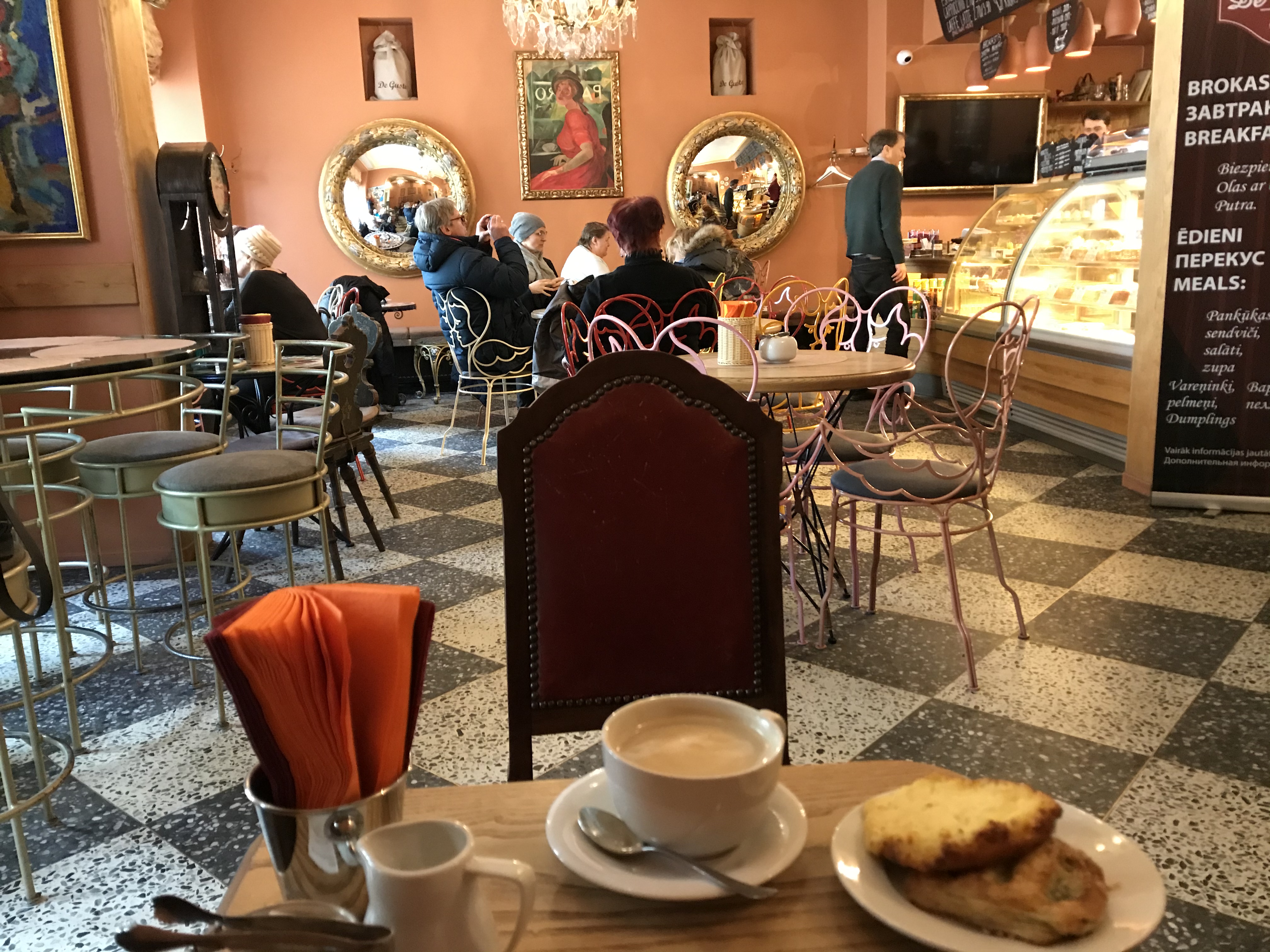
The town has echoes of the Jersey shore in the US, with painted houses and little shops, and a sandy beach with a long boardwalk. We had a quick lunch in a cafe (De Gusto—a pretty little cafe with nice pastries and good coffee). The walk to the beach was signed, and we set off along the boardwalk.

The beach was sandy, the sea calm, the wind cold. To our left were houses, right up to the weeds that lined the beach. They were large, ugly 1950’s constructions, and mostly deserted, with peeling plaster and boarded windows and brambles growing up to the doorstep. I decided they were Russian-owned holiday homes, abandoned in 1991 when the Latvians defended their land against invasion, the Russians refusing to sell them in the belief that one day they would return. Husband informed me they were more likely owned by a developer, who was waiting for them to become completely derelict so that renovation was impossible and he would get planning permission to demolish them and build modern holiday homes and hotels. I prefer my version.

Among the ugly buildings was an ugly look-out tower with radio masts and a high window and speakers for broadcasting instructions. This was the police station, and a man in the window was guarding the safety of everyone on the beach. There was also a cubed building, right on the sand, with a large picture window facing the sea. It was a cafe, large extractor fans whooshing the smell of fried potatoes onto the beach, the steamy windows showing hazy images of tourists huddled inside with mugs of coffee. But the best part was the position, which was below the tide mark, so at high tide, the people inside would be trapped, and they would have to sit there, watching in horror as the sea swept up the beach, past the door, trapping them inside for a couple of hours until the tide went out again. It would, I felt, be great fun to come back at high tide, and watch them as they gradually realised their mistake—but perhaps that’s a little mean of me.

We went back to the main street and walked along it, peering into gift shops and cafes and windows displaying knitted goods and thick coats. At the end of the street was an ornate church, gleaming in the sunshine and looking for all the world as if it had been flown there from Disney Land. We walked back to the same cafe we had lunched in, as they had the freshest cakes. We had tea, and I chose a rather too sickly white chocolate eclair, and Husband chose a completely delicious apple cinnamon tart (why does he always choose better food than me?) Then we walked back to the little station, and watched the train as it wound its way back along the curve of the river, until it reached Majori, and we clambered aboard, ready to return to Riga.

I hope you go somewhere nice this week too. Thanks for reading.
Take care.
Love, Anne x
Why not sign up to follow my blog?

anneethompson.com

Thank you for reading my travel blogs. If you have enjoyed them, why not buy my travel book:

The Sarcastic Mother’s Holiday Diary

Travel with a family…always unexpected.

Available from an Amazon near you. UK link Here

St. Peter’s Church, Riga


 St Peter’s Church, Riga

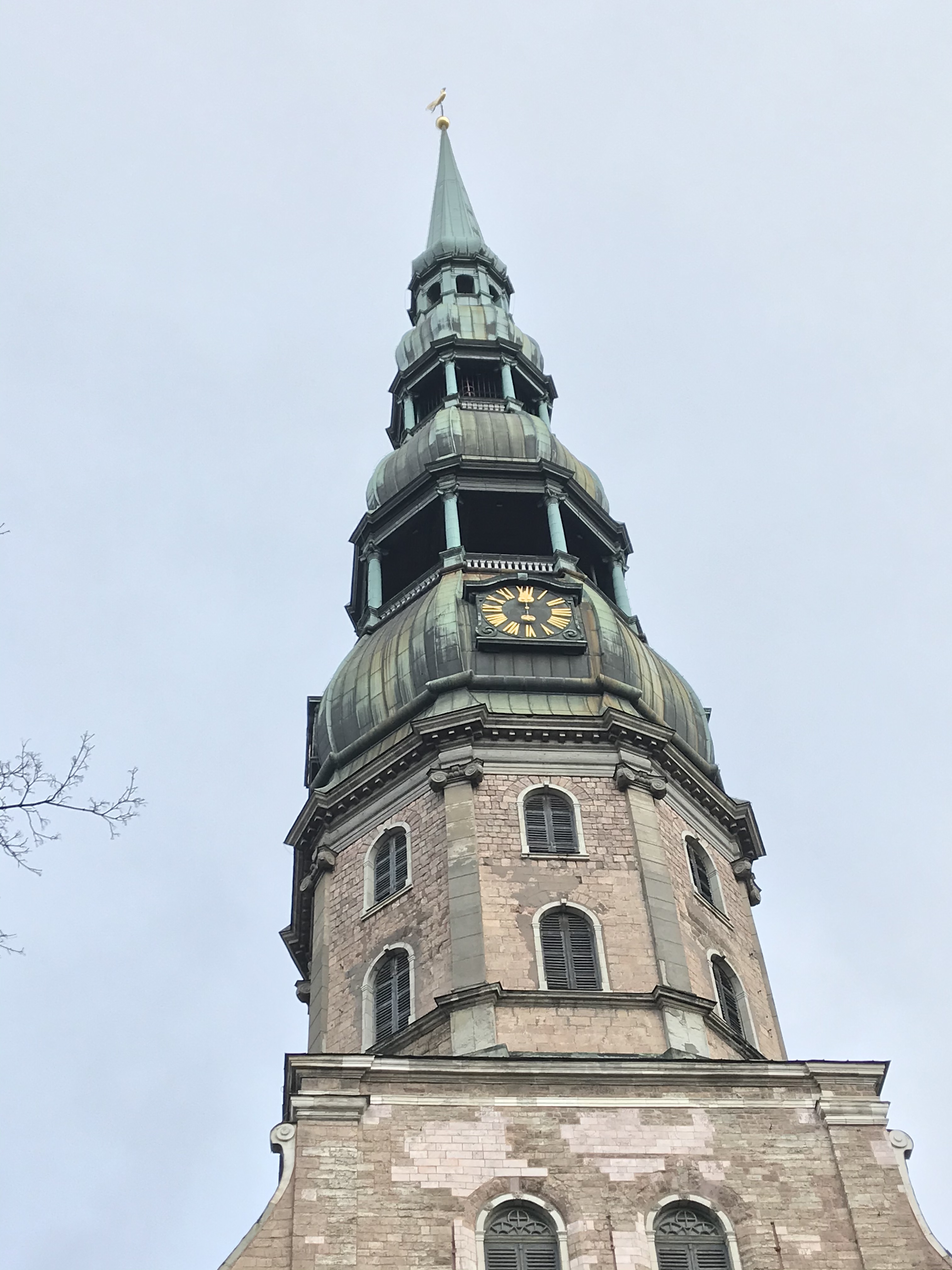
One of the landmarks of Riga Old Town is St. Peter’s Church; the multi-layered barrel-shaped spire can be seen from almost anywhere. This makes it hugely useful for lost tourists trying to find their bearings, and I have often been grateful to the church for its distinctive hugeness. But I have never ventured inside. The weather was dry but cold, and I had at least an hour before Husband finished at the office, so I decided to join the few woolly-hatted tourists through the heavy doors, into the church.

The door is not particularly welcoming, as it is very heavy and very determined to remain closed, but I managed to struggle inside. The signs (in various languages) and the woman behind the desk (in determined Latvian) were also not terribly welcoming, but having defeated the door, I was not to be dissuaded. I paid my €3 and was allowed through the glass barrier into the main sanctuary. Another woman called me over, insisting on inspecting my ticket. There was clearly a lot of angst over non-paying tourists visiting this church. Guess they have big overheads.

 Inside, there are a few things to look at, plus a tower to climb (if you pay extra). I was content to simply be inside and wandered around. Brick pillars hold up the high arching roof, and organ music hummed from speakers. It was a peaceful place to be (maybe noisy tourists object to paying for entry, or are dissuaded from visiting by the two grumpy ladies and the spiteful door).

There was a display showing a massive bell, the Peace Bell, which is a feature of a multi-national festival of competing choirs. Next to the giant bell is a giant rooster, which was once the weather-vane on the steeple, but now shelters inside. (It was made in 1690, so has earned a rest from the elements.)

The main sanctuary had various paintings and sculptures, of people who looked religious but I’d never heard of them so possibly not. A local artist, Laine Kainaize, had an exhibition of paintings. They were simplistic in style, and full of colour and I liked them (but not in my house).

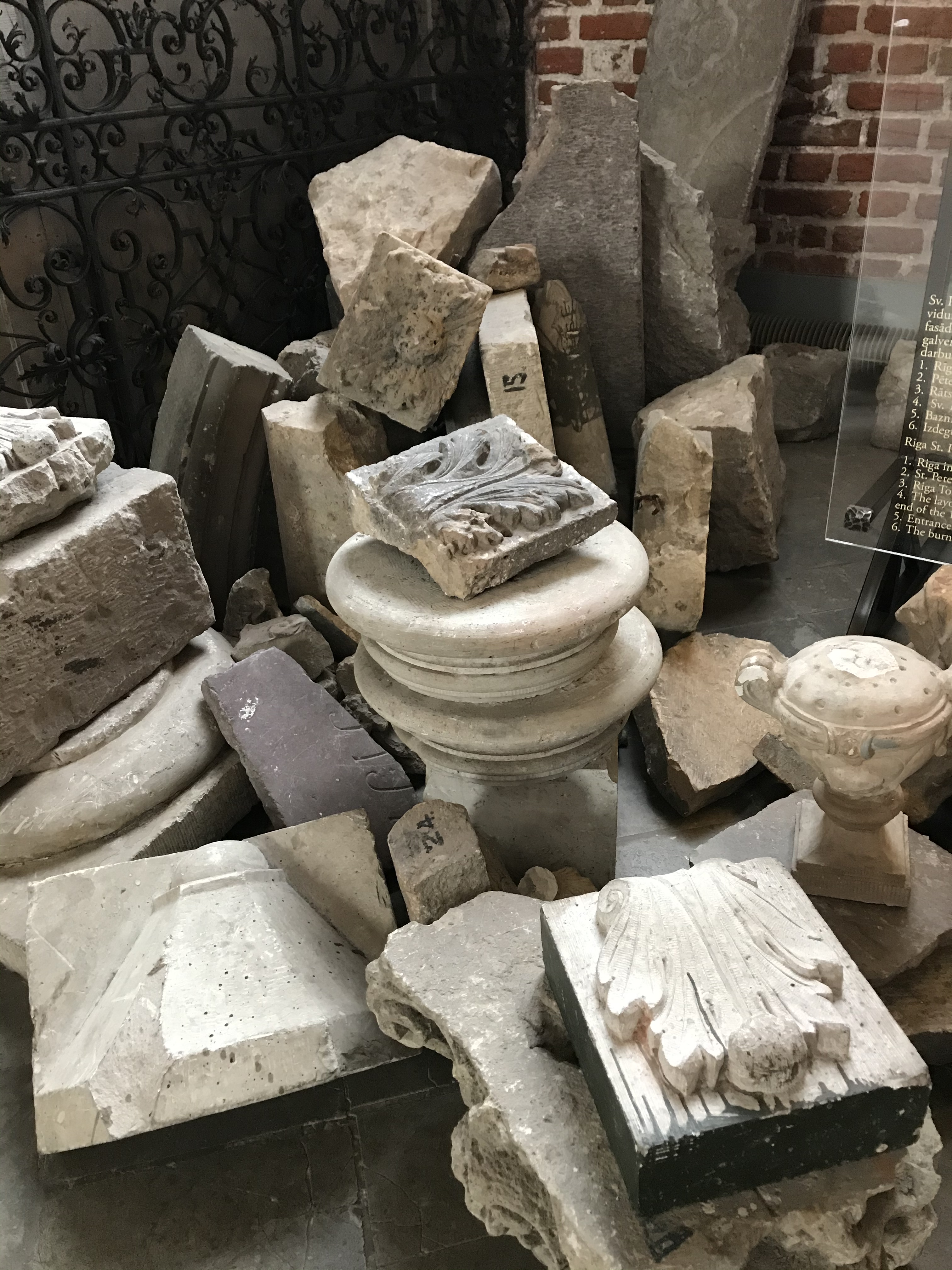
The rear of the church was dominated by a statue of Roland. I don’t know who Roland is, and reading the plaque, I’m not sure anyone else does either! A copy of his statue stands outside one of the guilds, like a lucky charm; but like the ancient rooster, he has been retired to the shelter of the church. He stands with a heap of rubble, which I think are bits of the church which have fallen off.

The question that always begs an answer in a church is: does anyone pray here? Did the sanctuary feel holy? The high ceiling and warm architecture do inspire a feeling of holiness/prayer, but the atmosphere is rather shattered by the grumpy money ladies gossiping at the back. Perhaps, in days gone by, this was a place where people honestly sought God’s will. Today, I’m not so sure—but how much can a mere building convey anyway? Surely a church—any church—is the people who attend, and I wasn’t there for a service, so I cannot comment.

If you have €3 and an hour to spend, there are worse things you could do.

Thanks for reading. I hope you find somewhere to pray today.
Take care.
Love, Anne x
Why not sign up to follow my blog?

@anneethompson.com

(To sign up, scroll to the very bottom of the page, and look for the ‘follow’ icon in the right-hand corner. Sometimes it’s easier on a tablet if your computer blocks all cookies!)

Thank you for reading.
Why not sign up to follow my blog?
anneethompson.com

A Cafe in Riga


I am writing this in a cafe in Riga. Going to a cafe on my own and buying a coffee is fairly high on my scary list, so I am feeling somewhat tense, but there were no real options. Husband was at work all morning, and has returned to make phone calls and I know from past experience that these will be very loud/shouty and the chance of being able to concentrate and write to you is tiny. So I left, and found a cafe that looked empty and might not mind a lonely blogger making a coffee last an hour while they type. And I am very keen to write this, because I want to tell you about my morning. I was brave this morning too.

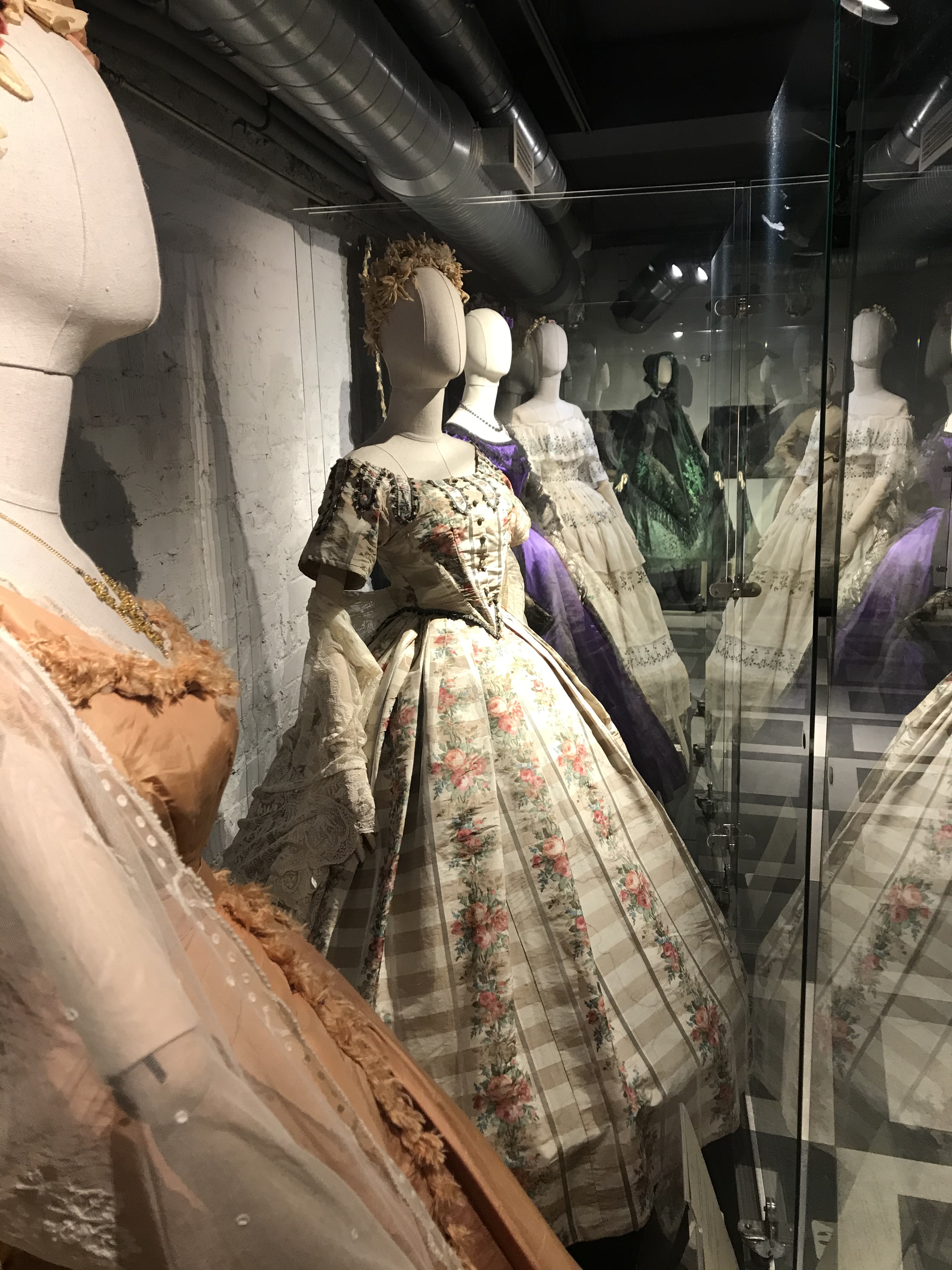
I walked to Modes Muzeja Kafejnica, which is the fashion museum and cafe tucked away behind St Peter’s Church. This is the first cafe in Riga that I have dared to visit on my own (at some point this will be normal) and I had passed it yesterday. It looked so pretty, I was determined to go in. As soon as I stepped inside a lady in an old-fashioned apron and cap welcomed me and showed me to a round wooden table and sofa. I was given a multi-lingual menu; old-time dance music was playing and I felt like I had stepped back in time and should have been wearing a long skirt and lacey blouse with a fat broach at the collar. But I wasn’t. I was wearing jeans and boots and a thick ski jacket that I folded onto the seat next to me and opened the menu. The cafe served drinks and cakes—this was so my kind of place.

I ordered at the counter: a filter coffee which customers pour themselves, and an eclair. There were several types of eclair and I chose one dusted with icing sugar and oozing with cream and strawberry conserve. It was delicious.

Pictures of fashion throughout the ages were strung from the ceiling, reminding me of pictures in books from my mother’s childhood—little girls holding puppies, suited gentlemen with cigarettes, while the women fluttered fans and eye-lashes over their pearls. It was all wonderfully art deco 1920’s. It even smelt 1920’s, with a sort of fruity floral undercurrent.

There is a discount if you buy a museum ticket, so when I had finished my coffee and daydream, I paid for both at the desk. The girl suggested I could leave my jacket on a peg in the cafe, but I am too foreign to trust things like that, so I thanked her and left, hugging my bulky jacket with gloves and hat to my overheated body like some sort of nervous sweating snail.

The entrance to the museum was slightly confusing, with a man who seemed to be shouting at a woman in a ticket booth—but he may not have been shouting, Latvian tends to sound cross. I waved my receipt over his shoulder, so the woman could see I had paid. The woman checked it, and offered to hang my jacket in the wardrobe (I’m not sure if I had pushed in, I hope not. It’s easy to be rude by mistake when you’re foreign).

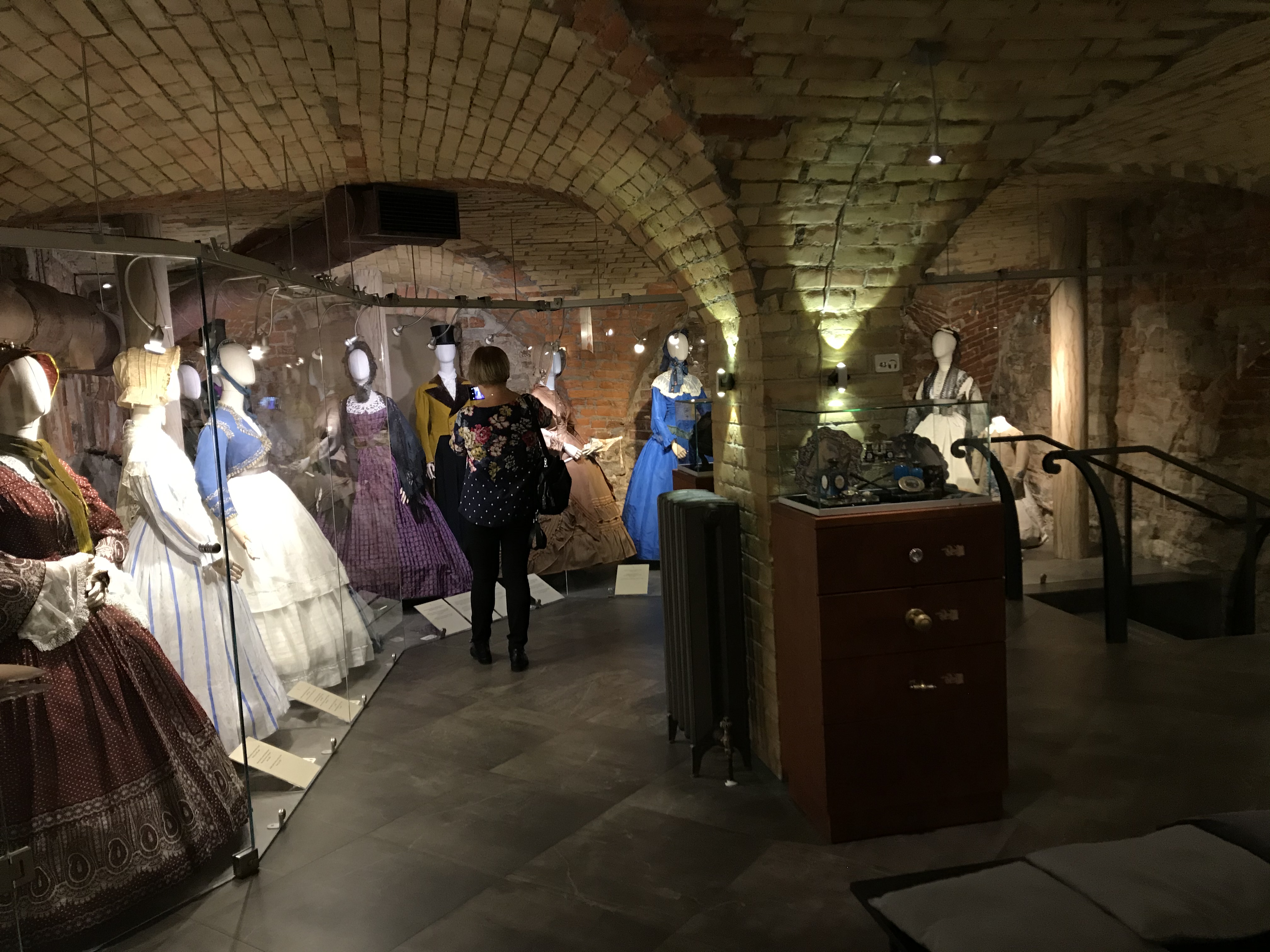
I walked into the museum (still clutching coat and gloves and hat) and was greeted by glass display cases of dresses. They were long with bouffant skirts and the little girl in me wanted to try them on and twirl. Especially as dance music was playing—ideal for twirling in flowing skirts.

An old movie was showing on a television. Screens projected images of clothes. Glass cases displayed gloves and fans and shoes. There was a tiny carved table holding a sewing basket, and velvet drapes covered the walls (Oh! I so wanted to twirl!) I wandered along the row of dresses, staring at the tiny waists and tight sleeves and laced necklines.

Then I realised there was a corner where you could dress up in crinoline, and I wanted to. But no one was with me to take a photo and laugh with me, and I had already been brave by having coffee alone. Maybe next time.

The next room held more dresses—mainly from England, France and America. I didn’t see any Latvian clothes. Why?

It was all so pretty, the air smelt of lily-of-the-valley, music was playing, and I wanted to go into the glass cases and touch the silk and lace and velvet. They sort of lured you to touch them. Which is perhaps why they are displayed in glass cases.

The next room was a dark cellar. I began to search for a light switch, and a helpful lady told me to just wait, and look. (She said it in Latvian, but I think that’s what she said.) The display cases all lit up individually, in time to conversation and music. Each one was a miniature drama, the manikins placed so the words and music told a story, each one in the language of the country where the clothes originated from, with accompanying music by a composer from that country. One display showed traditional Latvian dress—a much simpler peasant outfit in coloured cloth. I still don’t know what the rich women in Latvia wore, maybe they imported their clothes from England or France.

I took some last photographs, and left. I loved this museum. I am also sort of glad that Husband was at work (not saying that he would have spoilt it or anything, but I think his interest in floaty dresses is probably less than mine.) If you have a 10-year-old daughter, or played dressing-up games for hours when young, then you must come to Riga and visit this museum. It is like eating smooth chocolate.

The cafe I am now in is also nice, but very different. It is modern, with hard seats, and instead of soft music it is playing loud radio that’s difficult to ignore. Especially as it sounds just like Terry Wogan, but speaking Latvian! I will finish my coffee and leave. Thank you for reading.

I hope you see something lovely today.
Take care.
Love, Anne x

Why not sign up to follow my blog?

anneethompson.com

Return Trip to Riga


Return Trip to Riga

Last week, Husband had another work trip to Riga, Latvia, so I decided to tag along. (The wonderful thing about writing is that you can do it pretty much anywhere. At least, anywhere that’s not ugly. I cannot write in ugly places.)

The taxi took us to Gatwick, and we found the airBaltic desk and then waited a very long time for the staff to arrive so we could drop our bags. We had breakfast in Pret (I don’t especially like Pret, but Husband has bit of an addiction, so we found a Pret and I didn’t make too many comments). We also bought sandwiches for lunch, to avoid having to eat aeroplane food.

The flight was quite fast due a tail wind from Storm Dennis, and it took less than the three hours I was expecting. The airport is fairly small, so going through customs and collecting our bags was very quick. I wonder if that will change after the EU transition period has ended. We walked to the taxi rank, and remembered to check the prices on the back door of each taxi (see the blog I wrote last summer—the price of a taxi varies a HUGE amount, but the price is displayed on the back door. In Riga, you do not have to take the first taxi in the line, which is likely to be the most expensive one and shunned by locals).

We stayed at the Pullman hotel, which is situated in the old part of Riga. The hotel is modern, with a horse theme (not sure why). We were met by a life-sized horse statue in the lobby, and horse art is displayed in all the corridors and rooms. Some of it is quite nice. Everything else is grey and white. It’s clean, but not especially welcoming.

We found a restaurant on TripAdvisor and walked through the cobbled streets of Old Town, past the 13th century St. Peter’s Church, to Petergailis restaurant. It was only 6.30pm (4.30pm in the UK) but it felt much later. The sky was properly dark, the shops were mostly closed, and there were very few people on the streets. The air was cold and crisp, though there was no snow (which I had been hoping for). I was glad of my thick jacket, gloves and hat—and my flat shoes, because walking on cobbled streets is fairly brutal on heels. As we walked, I began to remember Riga. In my mind, it has become entangled with Krakow, as we visited both fairly close together, and they share cobbled streets and pretty buildings, interesting markets and a sad history. Gradually Riga emerged in my memory, I recalled the beautiful guild halls, and the striking churches, and the house with a cat on top which has themed most of the souvenirs.

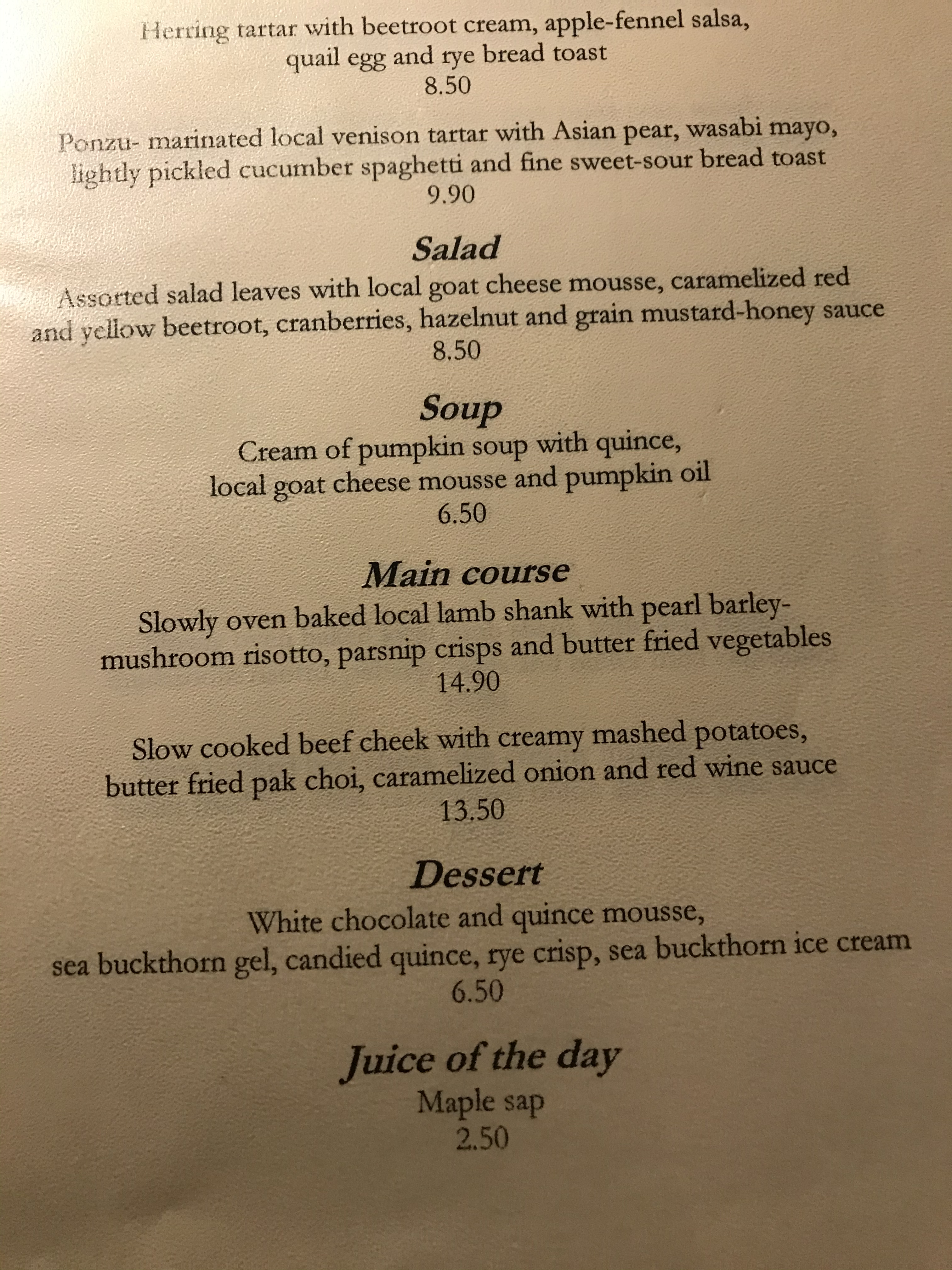
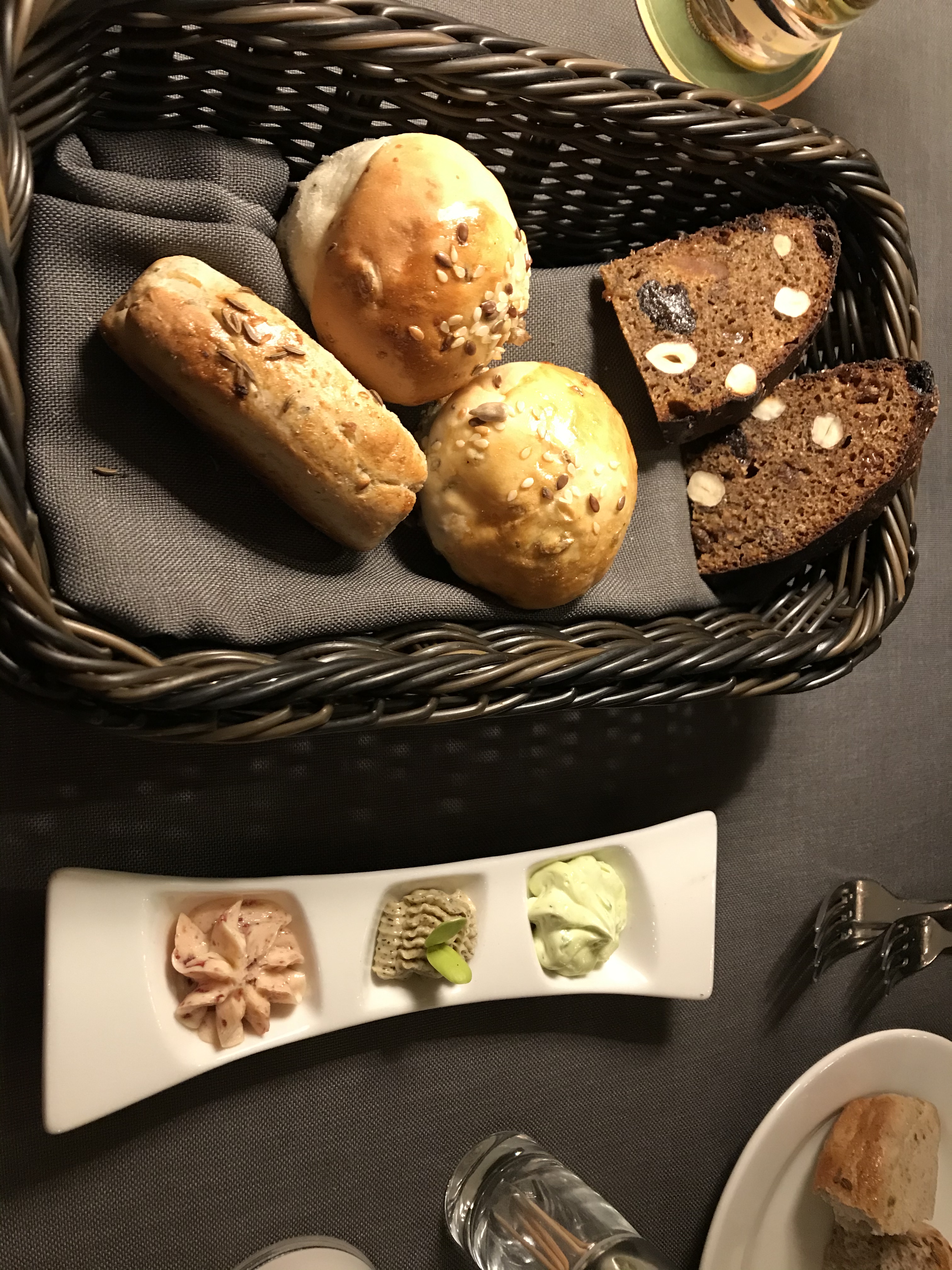
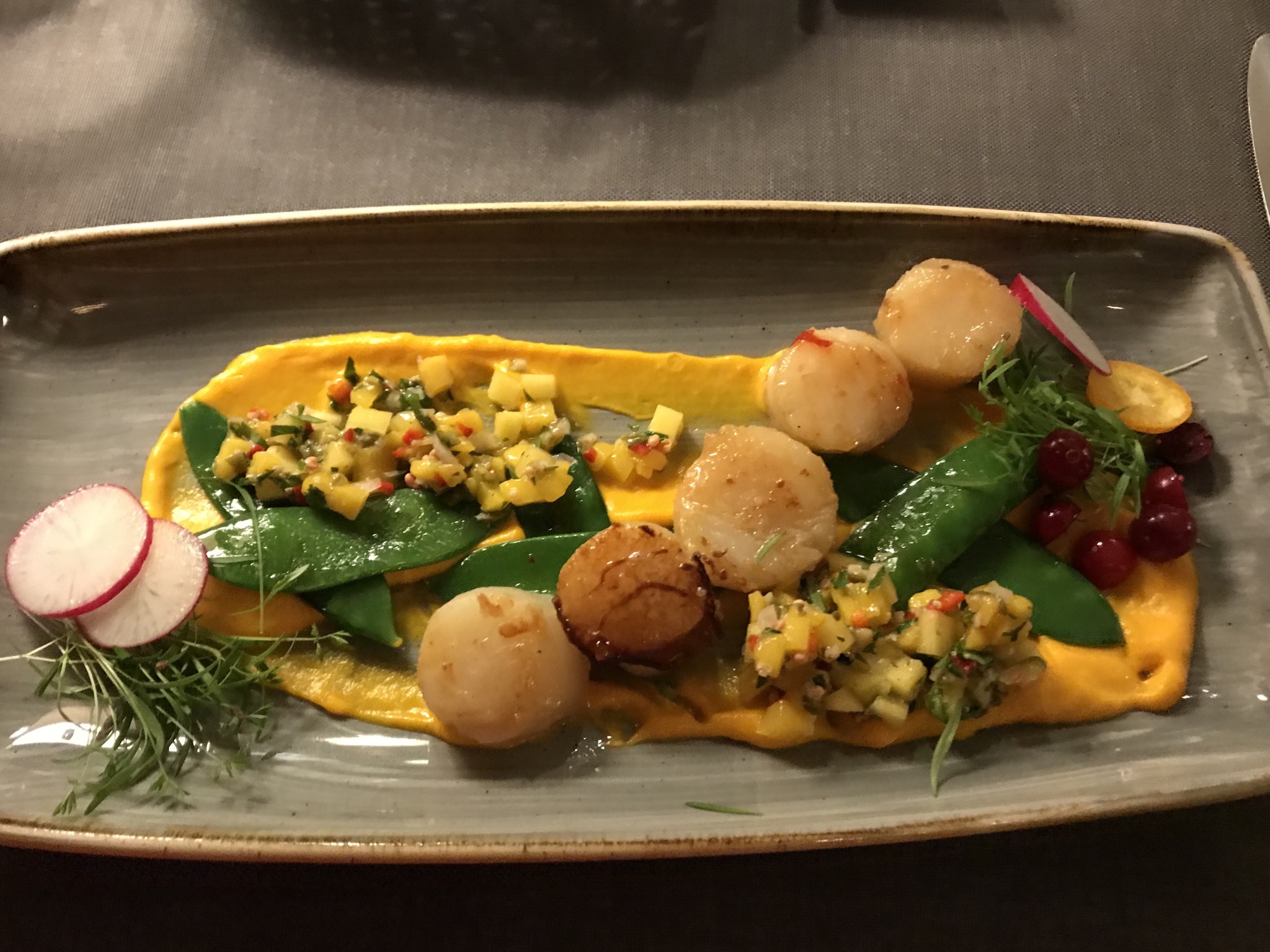
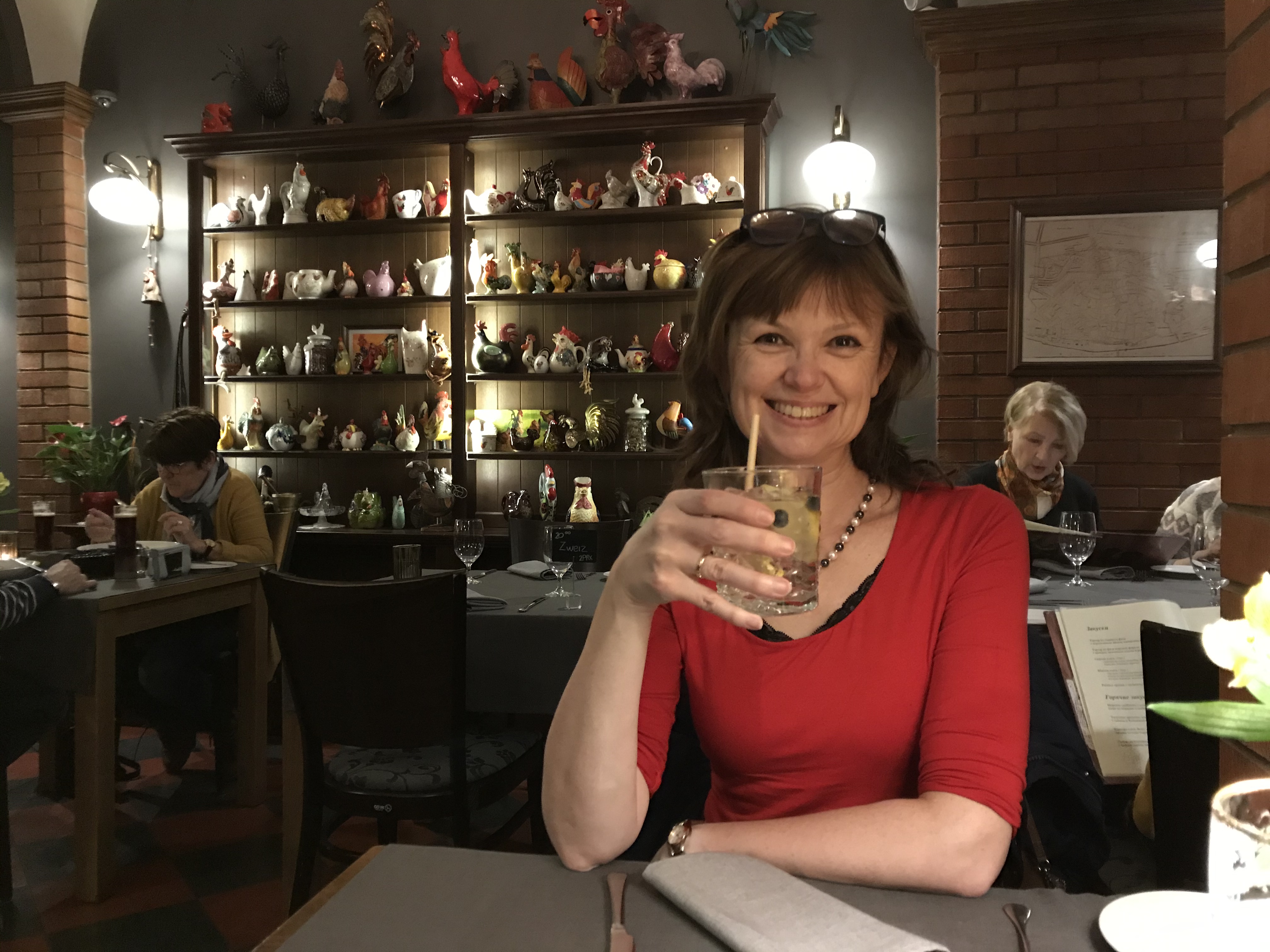
Petergailis restaurant was perfect. It has a cockerel theme, and we had coffee on the terrace last summer, but the terrace has gone now, only marks on the wall remain. Inside was cosy but not too hot and as we were eating relatively early, it wasn’t too crowded. The menu was full of interesting foods I’d never tried, but not so unfamiliar as to be scary. They brought us breads with flavoured butter, and tiny glasses of pumpkin soup to taste. We chose different dishes and shared, so could taste each other’s food (this turned out to be a good idea, because Husband chose better than me). I drank a single gin and tonic, and lusted after the huge glasses of red wine on the next table, but knew that after a flight and a long day I’d have a migraine if I drank it. We left feeling full.

The following day, Husband went to the office after breakfast, and I wrote and explored the city. But I’ll tell you about that in another blog. Thanks for reading. I hope you eat some lovely food too today.
Take care.
Love, Anne x

Thank you for reading.
Why not sign up to follow my blog?
anneethompson.com


The Beast of Exmoor


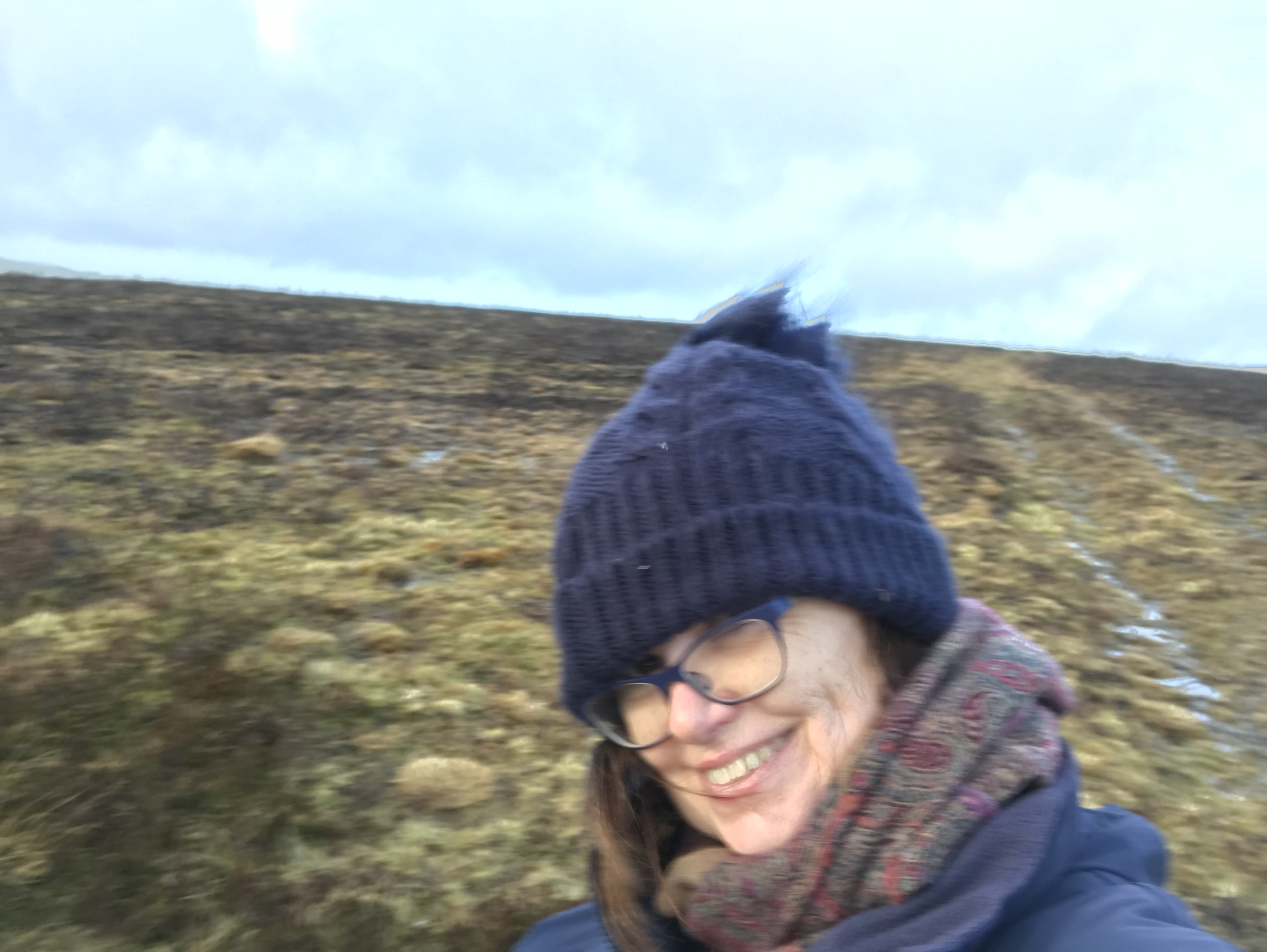
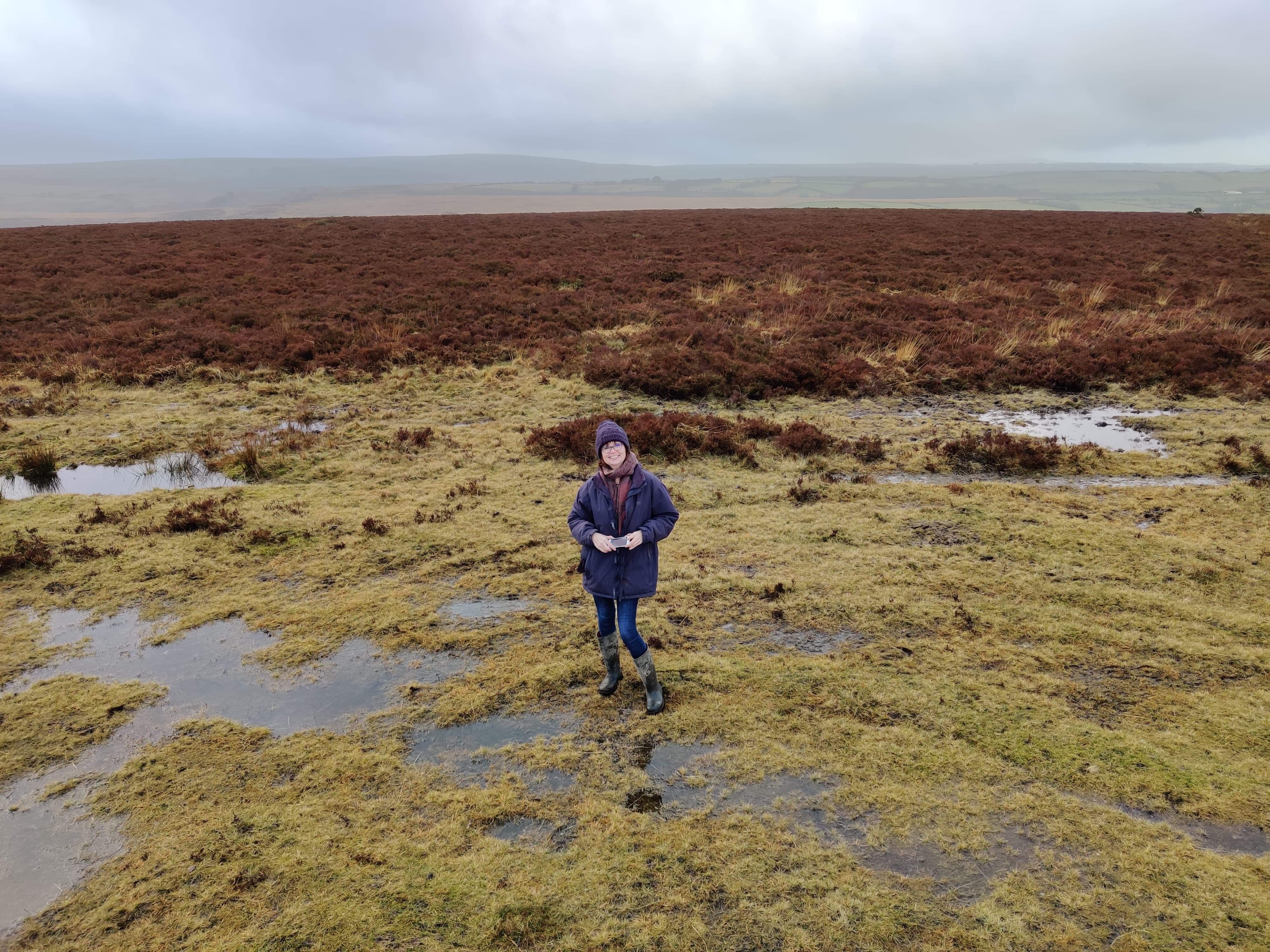
One of my favourite places in the world is Exmoor. I love the wildness, the untamed views, the weather-deformed plants, the wildlife struggling to exist in an austere landscape. I love that people have had so little impact, and that wild ponies wander over areas of toughened grass and wiry heather. So, when we were in Devon, and Husband suggested a walk on the moors rather than another beach walk, I was very keen. 

I dressed in my new bobble hat and gloves and thick coat—because whatever the weather when you leave the house, the moors can catch you out with harsh winds that push through layers of clothes and freeze your bones. We drove to one of the roads that meanders through the moor, crossed the cattle grid, and looked for somewhere to park. There are several areas along the road where cars can pull off and stop.  There were various cars parked on areas of rock, and we were in a 4-wheel drive, so it was easy. I’m not sure how the Fiesta would manage. (But then, our Fiesta has moss growing on it, so I’m never sure it will even make it to the shops and back!)

The moor is covered with tracks, and we followed one towards a triangulation point (a small tower of concrete used in mapping). The earth was black, sodden from the rain, rivulets of water running between the granite stones. The wind snatched at our hats, tangling hair and tugging at our clothes, the heather whispered beside us as we walked up the hill. Kia had to be kept on the extending lead, because I didn’t trust her not to chase sheep or deer, but actually we didn’t see any animals at all, only their tracks.

We saw lots of footprints, and Exmoor is home to sheep, wild ponies, and deer–as well as possibly a panther.
We didn’t see any of them while we were walking.

The water was seeping through the peat soil, meeting a layer of granite and trickling down in a mini waterfall. Kia used it as a drinking fountain!

I was also looking out for signs of the Exmoor Beast—a probably mystical animal that has been sighted for decades on Exmoor. Apparently at one time, after a farmer had a flock of his sheep killed, the government based the Marine Commandoes on Exmoor, in hides, to try to confirm whether the animal existed. They didn’t see anything. Most people think that probably a panther was released there in the 1970’s, when the law changed so it was illegal to keep them as pets—but who knows? Unless it eats some people, it’s unlikely to be discovered.

We didn’t have a compass, and Husband worried that we might get lost if we wandered too far from the sight of the triangulation post. I thought we’d be fine, and marched off into the wilderness. It was surprisingly hard to find the same route back. If the mist had come down, I think you could wander for hours.

As we drove away from the moor, we saw a herd of deer, the males standing tall against the horizon—beautiful.

There is something about Exmoor that reminds us how small we are, how vulnerable we are when immersed in a wilderness, whether there are panthers or not, which is a good thing to be reminded of occasionally. A long walk in the wind also makes you feel a tea with scones and cream is completely justified—which is the part of Devon that should be enshrined in law.

There are triangulation posts scattered over Exmoor, which make helpful markers for not getting lost. Other places have standing stones: large slabs of granite standing up like soldiers.

I hope you have a wonderfully wild time this week. Take care.
Love, Anne x
Thank you for reading
anneethompson.com
Why not sign up to follow my blog?

Sanibel Island Again


Sanibel Island is one of my favourite places in the world. We arrived towards the end of our road trip, after a long drive from St. Petersburg (see my last blog). Husband had splashed out, and paid for a condo facing the sea, so I opened the curtains and there were palm trees blowing in the breeze, and sand, and blue, blue, sea. Perfect.

At 6.30am the following day, I suggested we went for a run. Husband made unkeen sleepy noises, so I went without him. There were about a million people on the beach, so it wasn’t as secluded as I had hoped. Everyone else was searching for shells, wandering up and down, many holding special little nets on sticks so they didn’t have to bend down when they found a pretty shell. (I have lots of comments, which I am holding in, about whether it might have been good for some of those people to have had the exercise of bending down to pick up shells. . . but it’s easy to judge people who you don’t know, so I will remain silent. Ish.)

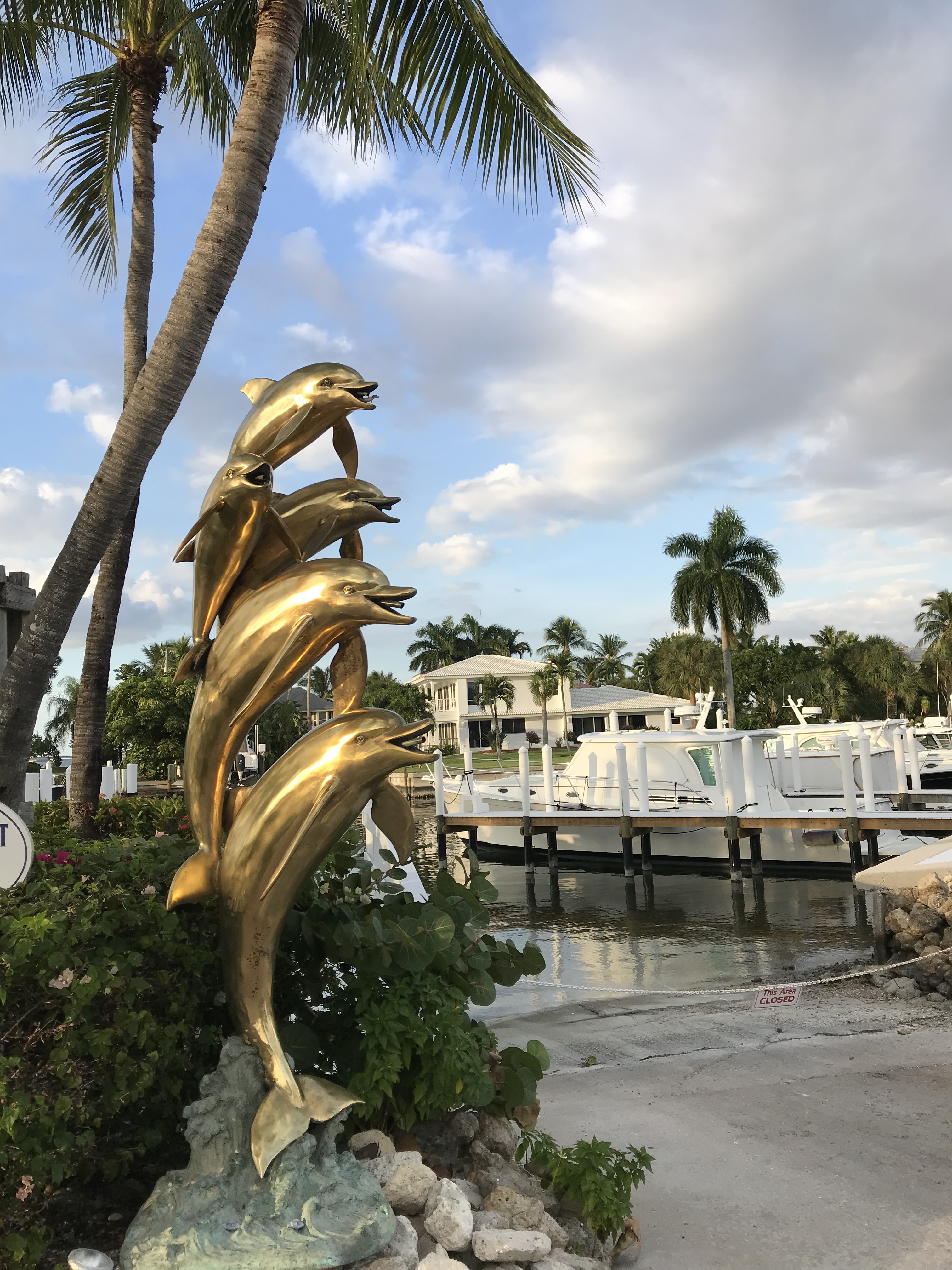
The weather was warm but not too hot, and as I ran beside the sea I saw a dolphin, and dinner-plate spheres of transparent jellyfish, and lots of shells.

Back at the condo, I was having a coffee and reading my Bible, when I heard a shuffling noise coming from my dirty washing bag. I opened it, and a lizard jumped out! Tried to catch it. Failed. Spent the rest of the day with a lizard under the chest of drawers in the bedroom, which was not a very satisfactory outcome.

We went to Sanibel Cafe for brunch. I ate banana and pecan pancakes, lightly sprinkled with cinnamon and drizzled with honey. I love this country!

Later I did some washing, and as I was hanging it on the balcony, I saw Husband wandering around the garden taking photos. I wolf-whistled at him. Husband didn’t hear, and continued taking photos, but a gang of workmen all looked up and grinned. Embarrassing.

Our other days at Sanibel meandered past. We went for long walks on the beach, crunching shells underfoot, searching the waves for dolphins. One afternoon we hired bikes, and zoomed around the island. One day we drove to a manatee park, hoping to see manatees. We saw statues of them, and read a lot of information boards, but no actual manatees were visiting that day. Maybe next time.

Another day we swam, and a flock of white egrets flew overhead, inches from our heads, near enough to touch as they glided over the water. Then three pelicans floated above us, looking for food, diving down like fighter planes when they saw something. One pelican stayed, bobbing on the surface really close to us, and I thought about trying to touch it (but the sharp beak put me off!)

We had some lovely meals, and enjoyed simply being alive in such a beautiful place. Then, all too soon, it was time to pack up and head back to Atlanta, and the end of our road trip. We had such a wonderful time, I really did not want to come home. Thank you for sharing it with me.

I hope you have a lovely week. Take care.

Love, Anne xx

Thank you for reading.
Why not sign up to follow my blog?
anneethompson.com


Salvador Dali in St. Petersburg


St. Petersburg

We left Amelia Island, watching a storm brewing in the sky above us. The weather channel had given tornado warnings before we left, and although we weren’t really sure what we were supposed to do, the roads were comfortably full of other cars, so we figured we would just copy everyone else. As we drove, I tried to Google what we should do if there was a tornado, and abandoning the car and flinging ourselves into a ditch seemed to be the main advice, so I hoped we wouldn’t need it (especially as we might end up sharing a ditch with an alligator!)

We had a couple of stops en route, for bagels and a Mc Donald’s ice-cream. The weather was windy and rainy and as we approached Tampa there was a very tornado-like storm cloud—big and black with wisps coming down. I kept my eye on the possible weather danger while Husband drove (and mostly ignored all my helpful advice about ditches).

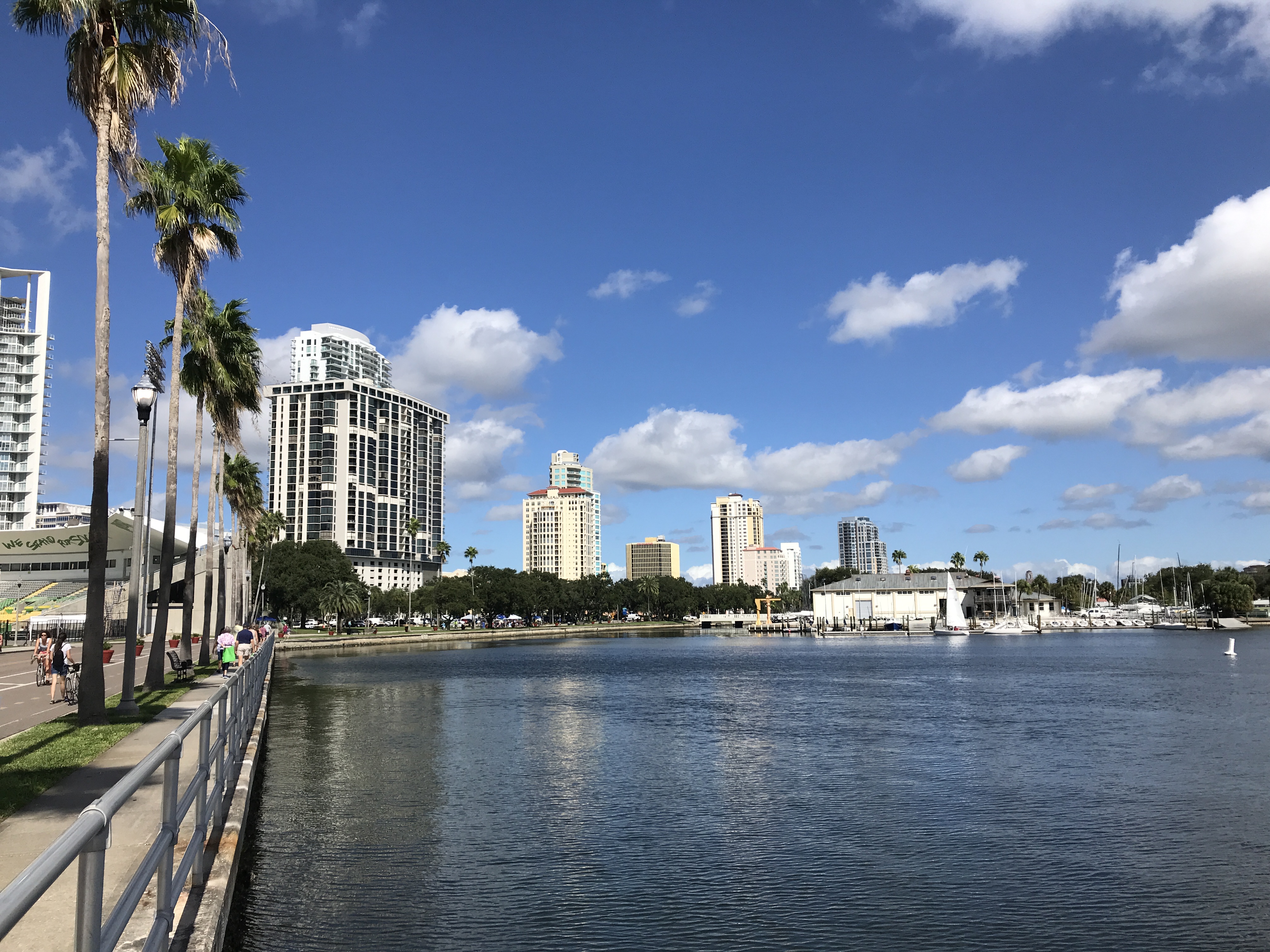
We checked into a hotel in downtown St. Petersburg and went for a walk. It was windy, but dry, and we set off for the water front. As we crossed a small square (with fountain and white egrets) a woman passed us at a jog, and shouted: “I just felt 2 drops of rain!”

So what? We thought, and continued on our walk. Within the minute, it was raining—raining as in a deluge of water from the sky! We ran to an awning over some tables, and watched. The wind was blowing the palm trees, the water was coming in torrents, everyone was running for cover. It was amazing!

After a few minutes, it stopped raining, and we continued our walk. The water front was pretty, with boats and docks, but before we could enjoy it properly, we felt a couple of spots of rain. This time we knew what to expect, so began to run for cover! We dodged between awnings and over-hanging porches, until we came to a bar, all the time avoiding great fat drops of rain that the wind flung at us. We went into the bar.

The bar was fabulous. We sat up at the bar, looking at the room in the mirrors behind the bottles of drink. Everyone was damp and laughing, and having a nice time. There were huge televisions showing sport, and people eating, and a babble of conversation. I suggested we have some shots (it seemed appropriate). We didn’t.

When the rain stopped, we went back to the hotel.

Dinner was at The Ford Garage. The restaurant was set up like a garage, complete with a car hanging from the ceiling. Our napkins were like grease-cloths, and the walls were full of car paraphernalia. The food was really nice, and I had funnel cake for dessert (like donuts).

The following morning we went for our early run. The weather was warm and muggy, so running wasn’t very easy, but there was a small lake near the hotel, so we ran round that.

After breakfast (banana French toast and coffee) we walked to the Salvador Dali museum. This is now my favourite art gallery in the whole world. It was obviously designed by someone who loved Dali’s work, as even the building was very much in keeping with his style. There was a staircase that went up to the ceiling, and drippy benches in the garden.

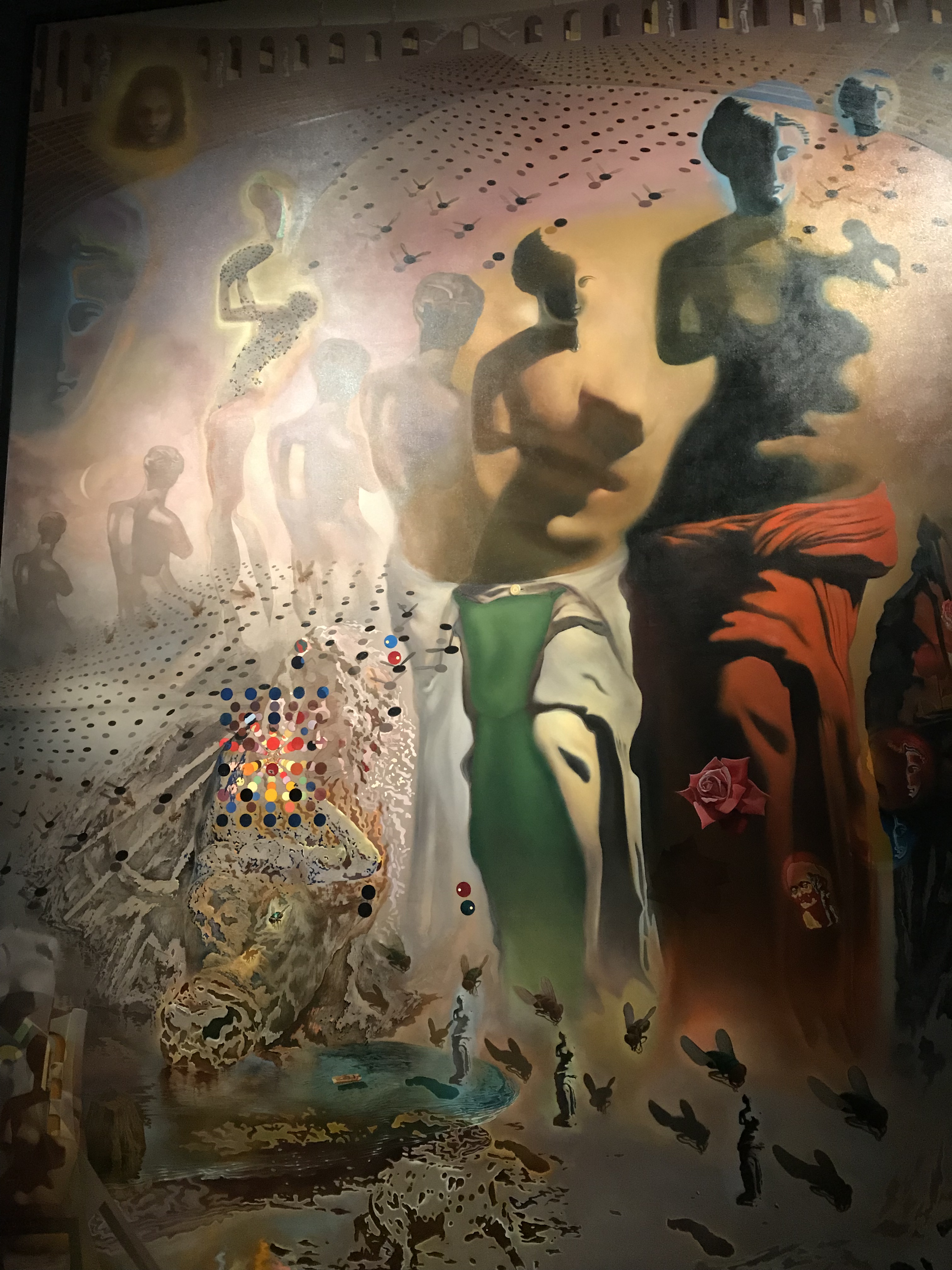
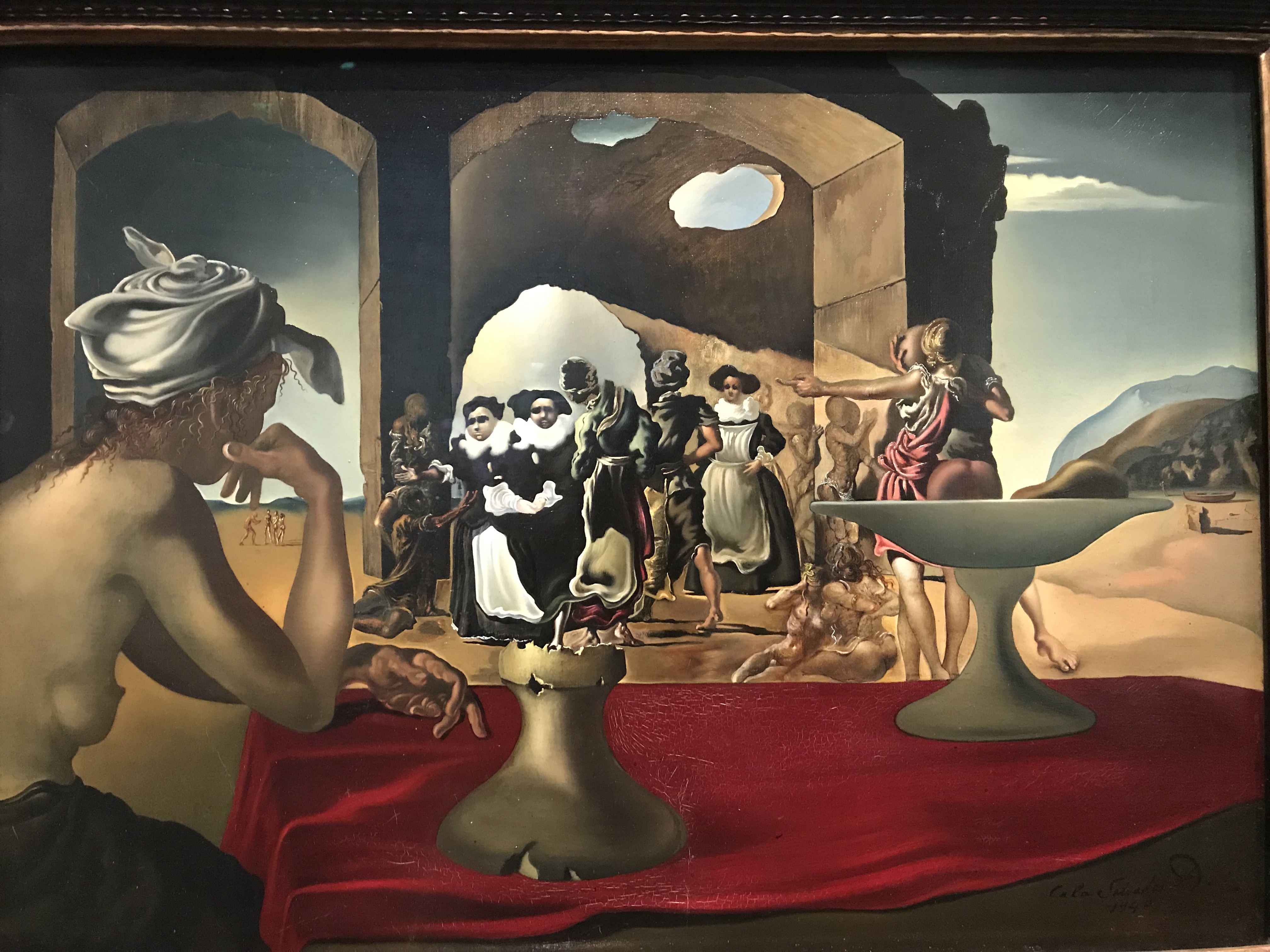
Dali’s work is wonderful—though some needs explaining to be properly understood. It is also very clever. Some of his paintings are pictures within pictures, and the museum had little films next to the paintings, showing how the images combine. For example, his painting of a bull-fighter looks like statues of goddesses, but within that there is a bull dying, and a bull-fighter crying because he feels trapped by his life-style. In a painting of a slave market, as you walk further from the picture, you become aware of a huge skull, which is formed from the bodies of the slaves being sold. It’s all very clever. Plus, I really like Dali’s use of colour, and the way he challenges how we think about things (like time—have you seen his drippy clocks? Is time rigid?)

The museum also has a fabulous shop, and after enjoying Dali’s pictures, we could browse the same works made into notebooks and magnets and jigsaw puzzles. Great place for gifts. There was also a car, which Dali had filled with water, and was driven by a deep-sea diver—playing with the idea that people get taxis to stay dry in the rain. I think that’s what I like about Dali’s work, he plays with ideas. And he is a skilful artist.

Can you see the bull-fighter? (He is wearing a green tie, and has a multi-coloured jacket, and he’s crying…

The Slave Market…can you see the skull image entangled with the slaves?


We had lunch back at the bar we’d sheltered in the day before.

Then we packed our things, and set off for our next stop: Sanibel Island. I absolutely loved St. Petersburg, with its pretty waterfront, and fabulous museum, and amazing weather. I’m so glad we came, even though our visit lasted less than 24 hours. It was all so much fun!

I’ll tell you about Sanibel in another post. Thanks for reading.

Have a great day and take care.

Love, Anne x
You can follow my blog at
anneethompson.com


Amelia Island


Amelia Island

We left Savannah, and drove to Amelia Island in Florida. We crossed a large river/swamp to reach the island, so I guess strictly speaking it’s an island, but it didn’t feel like one! The guide book said it had an historical town, with strong links to pirates in times gone by, so I hoped it would be interesting. In actual fact, it had some deeply naff elements.

We passed The Beach Diner on our way to the motel, so after we’d checked in, we went back for dinner (because diners are usually excellent places to eat). We started with clam chowder, which arrived with warm corn bread (not as sweet as yesterday) and was delicious. While we were still eating the chowder, our main courses arrived, which felt a bit rushed. We watched them getting cold on their plastic plates (what is it with this country and plastic plates!) while we finished our soup. I had meatloaf (huge—enough for a family of four) with mashed potato (very tasty) and some indefinable green/grey vegetable that tasted as bad as it looked. My dinner looked barely started by the time I had finished, so I asked for a box. This has become a tradition—after every meal, I ask for the remains to be boxed (which saves embarrassing questions about why I have eaten so little) and then I dispose of it later.

We walked to the beach. Everyone else had driven, right onto the beach, parked their cars, set up a chair less than a foot away, and was relaxing. Maybe they were too full of dinner.

The town is called Fernandina Beach, and it was full of pirate stuff—statues and toys and fridge magnets and books. . . However, I could find no evidence that the island had ever actually been used by pirates. There was no ancient prison, or gallows, or look-out tower. I began to wonder how true the pirate link was. The next day, I asked in the Tourist Office, and we were directed to the Maritime Museum. The Maritime Museum was certainly an experience.

We arrived at the modern building, which is shared with a wine museum, and we went to the counter to ask how much it cost for entry. I was trying to peer round the man, to try and assess what was there, but I could only see one room. We said we were interested in the pirate theme of the town. The man (who to be honest, looked a little like a pirate himself) beamed, and told us he was a ‘treasure hunter’. Unfortunately, Husband misheard, and thought he said ‘treasurer’ and then launched into a conversation about accountancy and was it easy to make the museum financially viable; while I got the giggles and pretended to be very interested in a map of shipwrecks. We paid and went inside—except there wasn’t really an ‘inside’ as the whole museum was the single room that I could see.

We walked along, looking at the displays, while the treasure-hunter-not treasurer watched us from his desk. It felt a little uncomfortable. The museum was basically a room crammed full with stuff the man had collected during his many diving expeditions around the island. The highlight was a canon, from an original pirate ship, which had to be kept in a tank of water (don’t ask me why). The tank of water (looked like a chest-freezer to me) was full of very murky water, due to all the minerals (again, don’t ask me why). It looked to me as if it was full of bath-oil to me, and all we could see was slick grey liquid. It was impossible to tell if anything was in the bottom, let alone a canon.

There were many maps on the walls, and display cases of ‘treasure’ which might, I suppose, have been genuine but they did look suspiciously like they might have been won at the fair. We left the museum, and I felt the whole pirate thing was something of a scam/tourist attraction (though I do think Mr Treasure-Hunter genuinely believed that one day he might discover a hoard of sunken gold).

I’m not sure I particularly like Amelia Island, though it did have some pelicans resting on the jetty. It is also the starting point for the first cross-state railway, built by David Yulee, and his name appears a lot around the island—should you be interested in railways.

We had dinner at Artes Pizza, which advertised as having real wood-burning pizza ovens. We had a view of the kitchen and the only ovens I could see were definitely gas-powered, but maybe I missed something. I was feeling I had had enough of Amelia Island. To be fair, the town was pretty, and at night they decorate all the trees with fairy-lights, and people seemed friendly. But it didn’t feel very ‘real’ to me, and I had no desire to stay.

We left the following morning, and set off for St. Petersburg. Before we left, we checked the weather, which had tornado warnings for the region. Not really sure what we were meant to do with that information—should we cancel our 4-hour drive to St Petersburg? We didn’t, and I’m so glad we didn’t, because our time in St Petersburg was the best 24 hours of the whole trip. But I’ll tell you about it in my next blog.

Thank you for reading. Have a great day, and take care.
Love, Anne x

Why not sign up to follow my blog?
anneethompson.com

Travel with a family…always unexpected.

If you enjoy my travel blogs, you will love my travel book: The Sarcastic Mother’s Holiday Diary. Available from an Amazon near you.

UK Link:Here


US Link: Here