Exploring Riga Old Town


Exploring Riga Old Town

Husband was working in Riga (Latvia) so I had tagged along for the ride, and we spent the second day exploring the Old Town (clue in the name!) It is full of pretty squares and interesting buildings, and although much of it was rebuilt after the war, they have preserved the historical feel of the city. It’s a nice place to be. We walked through the park which runs alongside the river, and into the pedestrianised zone. We passed Powder Tower (see yesterday’s blog) and saw The Swedish Gate, which is the only remaining gate from the old city wall, and was built below someone’s house — not sure if they were pleased, somewhat inconvenient to have people traipsing below your house I would have thought.

We arrived at St. Jacob’s Cathedral, which has a monument outside to remember the people who died in the 1991 barricades (more about this in a later blog). St. Jacob’s Cathedral is a red brick building, built outside of the original city wall. It has a cupola on the south side, which once held a bell—not to summon people to prayer, but to let them know that an execution was taking place in the city. The bell is no longer there. I am assuming the executions are also a thing of the past.


Opposite the cathedral is the Parliament building (some discussion with Husband about Riga’s flag—I can tell you that it’s red with a white stripe down the middle, and he was wrong. Just saying.)

During World War II, the building was the headquarters for the SS officer responsible for killing the Latvian Jews, gays and Roma. Later it was used by the Supreme Soviet of Latvia. This is an example, repeated around the city, of buildings which were built to look pretty, and later used for a variety of horrible things, and have now returned to simply being buildings. Latvia has a tangled history, and there are traces left wherever you go. I wonder if it’s better to not read any guidebooks or visit any museums, and to simply enjoy the beauty of the place in the sunshine and leave the ghosts in the past.
Around the corner from St. Jacob’s Cathedral is a hidden cafe in a courtyard, which claims to be the most romantic cafe in the world (good marketing strategy!) It offers free hugs at the counter (so I’m guessing it’s run by the church). There was also a Christian bookshop, and I bought my mother a scarf. Riga has lots of linen goods and knitted goods, probably because in the winter it’s usually snowy. This is the city to visit if you want to buy a warm hat that your family will mock.

There are three houses, known as The Three Brothers because they each have a distinct architectural style. Two men busk outside, playing music that the locals recognise and sing along to (I saw them there on several occasions). This means everyone has very confusing photographs, as they are of “The Three Brothers” but they show only two men.

Next on our tour was Dome Square. (To be honest, it wasn’t a very good ‘tour’ as it was simply Husband following a route on a map, regularly waving towards interesting buildings and informing me: “There’s a thing!”) Dome Cathedral has a cockerel on the spire, and the building is lower than the square, as they have raised the land since it was built, to stop the area flooding. (Not sure if this means the cathedral now floods instead—hopefully not.) There was a young girl playing a violin outside. She was very young, and played extremely well, and was receiving a lot of money, as almost everyone passing threw something into her violin case. There are a lot of buskers in Riga, many of them young, most of them excellent musicians. It’s rather lovely to wander around, looking at interesting buildings while accompanied by music.

A laugh-out-loud book about travelling the world with a family. From India to South America, and across most of Europe, this book has been described as “The Durrells meet Bill Bryson”!

Riga has several squares, and many churches/cathedrals. The next square on our tour had a very interesting building: the House of Blackheads—so named because it was a guild for foreign merchants, and their patron was St. Maurice (who was black). I began to realise that many of the buildings, built in the 1500s and 1600s, show how affluent Riga had once been. It was an important trading port, full of rich merchants, and the architecture reflects this. Further from the centre, the buildings were once beautiful, but are now faded, and sometimes derelict, whereas the ones in the centre of the old town have been rebuilt since the war. It must have been a magnificent place a few hundred years ago, and it is still pretty today. You should visit before it becomes too busy. It’s up to you whether you take a guide book and learn about the past, or simply enjoy what you see today.

Tomorrow I will show you some more pretty buildings which have rather nasty history (like the old KGB headquarters)—why not sign up to follow my blog so you don’t miss it?

Hope you have an interesting day.

Take care.

Love, Anne x

Do look at my book: The Sarcastic Mother’s Holiday Diary

Travel with me to Zambia, Malta, Brazil, and explore local traditions while seeing the sights. An amusing collection of diaries, in the style of
Bill Bryson meets the Durrells.

Available from an Amazon near you.

UK Link

Riga in the Summer


Riga in the Summer

Riga is the capital city of the little country of Latvia, and I visited it last week, when Husband was working there. I have never visited Latvia before (I am loath to say that I didn’t even know that Latvia was across the Baltic Sea from Sweden, between Estonia and Lithuania—because that makes me look ignorant!)

Latvia has had a chequered history, belonging at different times to Sweden, Germany and Russia, and more recently being part of the Soviet Union. I had no idea what to expect from the city, but “ex-Soviet Union” musters images in my mind of austere buildings and ugly sculptures; so the pretty architecture and sunny parks were a pleasant surprise (I’ll mention the sculptures later…)

We arrived on Friday, and caught a taxi from the airport. A word of warning here: Taxis in Riga have their prices printed on the outside of the rear door, and there is quite a lot of variation in the price/km charged. There doesn’t seem to be any regulated pricing or official taxi rank at the airport. We chose a taxi with a similar price/km to others we could see, and set off. Husband (who notices these things) realised that the price that was showing on the metre, did not tally with the price displayed outside; you need to keep an eye on what you are being charged. (However, whilst this might be useful information, I have no idea what you do with the knowledge. Next time I am in Riga, if the taxi driver has an over-priced metre, I do not feel inclined to confront him and be dumped in an isolated spot with no transport. But at least you’ll know if you’re being ripped-off and can withhold the tip!) Note, we were later informed by the hotel that we had paid an inflated price. The red taxis (Red Cab) and the lime green taxis (Baltic Taxis) are much cheaper, and cost about .70/km (not 1.99/km, which is what we paid). They park slightly further away from the main exit door at the airport.

We were staying in the AC Hotel, which is an easy walk from the old town. It was okay—I’ve stayed in prettier hotels, and the rooms were as tiny as New York hotel rooms (ie they fitted a bed, but not much else). However, at about £80 a night, it compares to staying somewhere like a Premier Inn on price, and it was much nicer than that!

We set off for a walk to the old part of the city (about 15 minute walk). There was a park, complete with a river and bridges, and outside cafes. There were also lots of people on scooters. These can be rented (information according to Husband, so might be rubbish) and are left and found in random places around the city. They whoosh past you at unexpected times, and must, I imagine, be uncomfortable on the cobbled streets, but they were popular. Very popular.

The park also gave us our first taste of Latvian sculptures, which were as bad as I’d feared. They mostly have the whole cubist-looking Soviet Union chunky-art look. Apparently (read the guide book afterwards) many were put up during the Soviet rule, and many of the ones honouring Soviet people have since been removed. But the ones of famous Latvians remain, staring grimly at tourists, reminding us that the city has not always been a happy place. (Apologies if you actually like the style of Soviet sculptures, perhaps it’s an acquired taste. Everyone looks like Stalin to my eyes.) We did see some more pleasing sculptures, but the dominant ones were very ugly.

We found the Freedom Monument (called Milda—not sure if that’s her real name) and a woman was busking. During Soviet rule, there was a large statue of Lenin facing the monument, and people were not allowed to place flowers on the monument. Leaving flowers on monuments seems to be a thing in Latvia.

The main street through the old town is pedestrianised, which was good, as although there are crossings at the other roads, you are supposed to wait for the lights to go green, and they took hours. Latvians are very obedient about this. All the streets seem to be cobbled, which is probably helpful in the winter, when there’s lots of snow, but means you need to leave your heels at home.

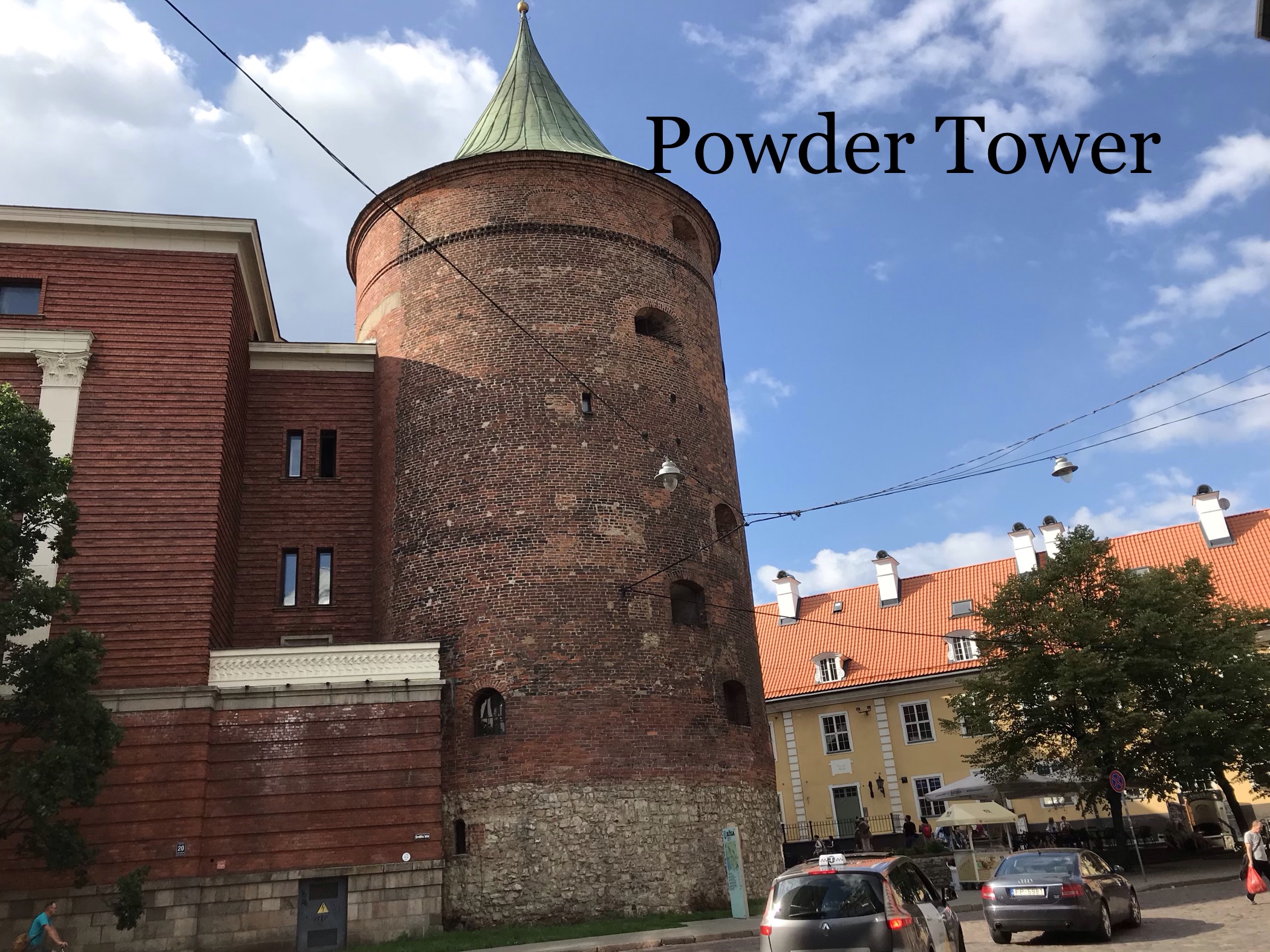
We had coffee and beer next to the Powder Tower, which used to hold gunpowder and is now the war museum. Riga has a lot of museums. The outside of this one is interesting, because you can see cannon balls embedded in the walls, from an ancient battle.

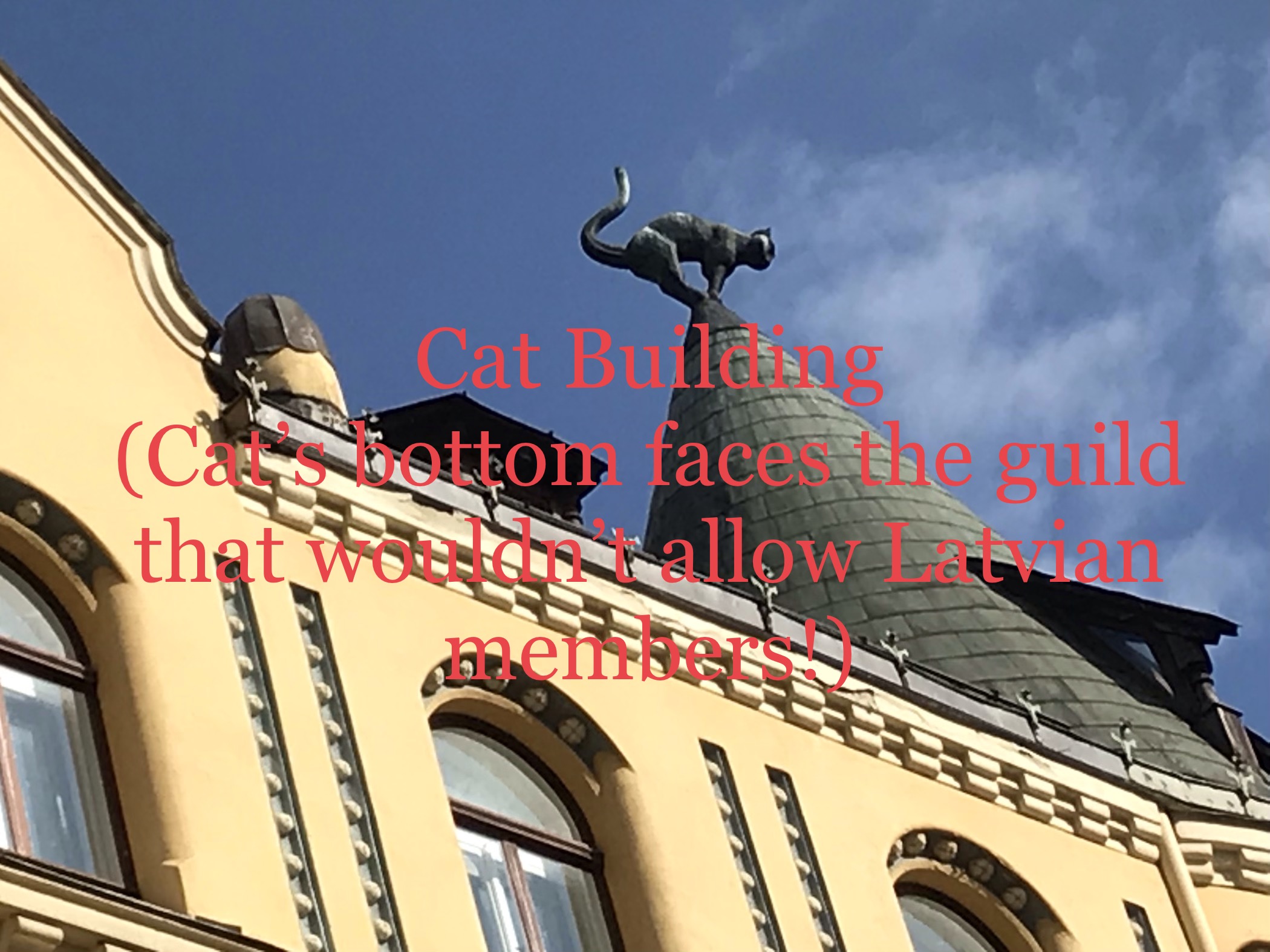
Found ‘Cat House’. This was owned by a merchant who was told he couldn’t join one of the guilds, as it was only open to Germans. He placed two cat statues on his roof, with their tails raised, and their bottoms pointing towards the guild! Later, when the guild finally accepted him, he changed the cat’s position, but they are still on the roof. Many of the souvenirs in Riga have cats on them.

We walked back to the hotel, past lots of churches (Riga has a lot of churches) with scooters whizzing past us, watching our footing on the cobbled streets and waiting many hours at the pedestrian lights.

Riga is very pretty, especially when the sun is shining. I will show you more tomorrow–why not sign up to follow my blog so you don’t miss it?

Thanks for reading.

Take care.

Love, Anne x

anneethompson.com

Thanks for reading.
You can follow my blog at:
anneethompson.com

A laugh-out-loud book about travelling the world with a family. From India to South America, and across most of Europe, this book has been described as “The Durrells meet Bill Bryson”!

If you enjoyed this, why not read The Sarcastic Mother’s Holiday Diary?

Available from an Amazon near you…free if you have a Kindle. A travel diary to make you smile. Buy your copy today.

UK Amazon link

An Escape Room in Cambridge


For Husband’s birthday, I gave him a voucher for an ‘Escape Room’—you know, those places where you go to be locked into a room, and then you solve various puzzles until you manage to escape (or you fail miserably and they throw you out because your allocated time has finished). I thought it would be fun if we did one as a family.

Of course, the most difficult part was finding a date when all the family could actually meet, but once that was achieved we were fine. Last Saturday we set off for Cambridge. The second most difficult part was trying to find a parking space in Cambridge, but we even managed that eventually.

We started with lunch in an Italian. I know my family have a tendency to ‘debate’ so I envisioned an afternoon listening to them ‘discuss’ the solution to the puzzle. I therefore decided to drink wine for lunch (I did have some lasagne too, but the wine was the bit that mattered.) After lunch there was a further challenge as we attempted to keep Husband with us while we tried to find where to go (he has a tendency to stride ahead, unaware that the rest of the group is unable to cross the road).

I began to relax once we actually arrived at the Escape Room, feeling that the most difficult challenges were over.

The room was not at all what I was expecting. For some reason, I expected a room, set up like a lounge, with sofas (where I could snooze off the wine) and a table of puzzles for my family to argue over. However, we were met at the entrance by an actor who explained the world was about to be hit by a comet, and then shown into a small room which resembled a cupboard, with a locker (locked) and a desk with a computer, and several posters on the walls. We then attempted to save the world.

In case you’ve never done one of these rooms, you’re not actually locked inside (so you can leave to use the loo or if your family becomes too argumentative). There were also several different aspects to the challenge, so people could try to solve one part, without having to collaborate too much with the rest of the group, and there was no necessity to persuade the rest of the group that you knew the solution, you could simply get on with your own bit—which worked rather well for my family. The puzzles were pretty perfect for us—there were some tricky ones, which it took several people to solve, but it was lots of fun. There was, surprisingly, no heated debate at all, and the whole thing was really good fun.

Oh, and in case you’re wondering, we did manage to save the world…

We visited the LockHouse Games escape room: link here

Thanks for reading, I hope your week has some fun times too. Next week I’ll tell you about my evening listening to random choirs in the shadow of zombies.
Take care,
Love, Anne x

While we were there, I was able to give the family copies of my latest book: Ploughing Through Rainbows. I wanted to write a happy book, so decided to write about a family on a farm, and as I wanted it to be a funny book, I gave the farmer four sons. However, there are also some gritty issues in the book, as it also shows how the mother, Susan, copes when one of her sons tells her that he is gay. Susan is a Christian, and the book shows her journey as she explores what parenting involves when faced with this news.

Please buy a copy, and tell someone else about it. It’s available from an Amazon near you, as both a Kindle book and a paperback. Links below. Thank you x.

paperback link

kindle link

India link

US link

Auschwitz Birkenau


Auschwitz Birkenau

The second Auschwitz camp was built in 1941, using prisoners from Auschwitz 1 as labourers. The focus had shifted, the prison was no longer viewed as a work camp for people who opposed the regime, it was primarily a death camp. Although there were still other prisoners, mainly gays, gypsies and Soviet prisoners of war, the vast majority were Jews.

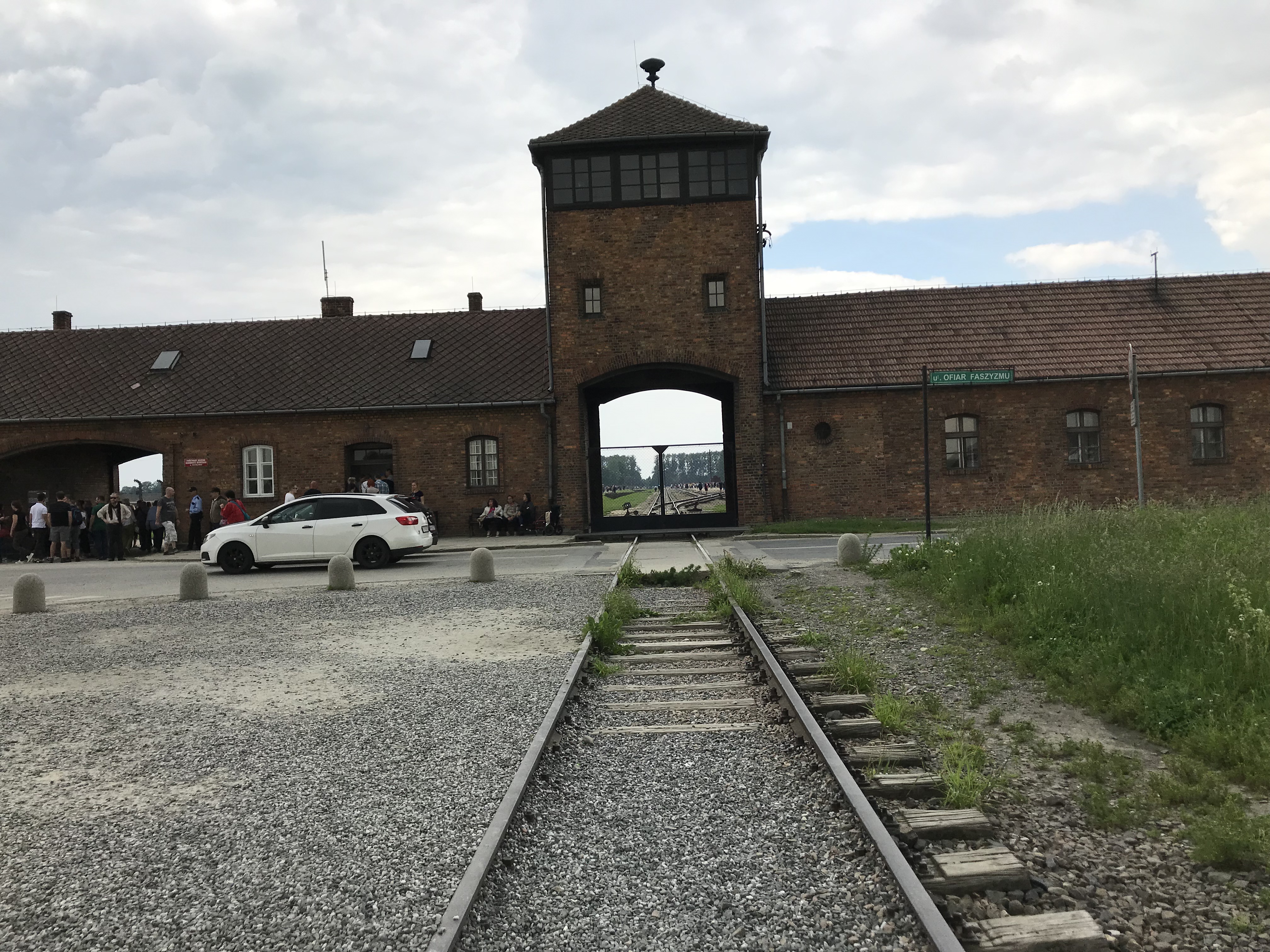
We drove to Auschwitz II, and parked outside the main gate. This is the image so often seen in films, of the cattle trucks on the railway, driving into the camp, and stopping inside where the prisoners are unloaded. In reality, the railway lines finished at the gateway, and were only extended inside the camp in 1944 (or so I understand from what I have read) because the Nazis were losing the war and were keen to exterminate as many Hungarian Jews as quickly as possible.

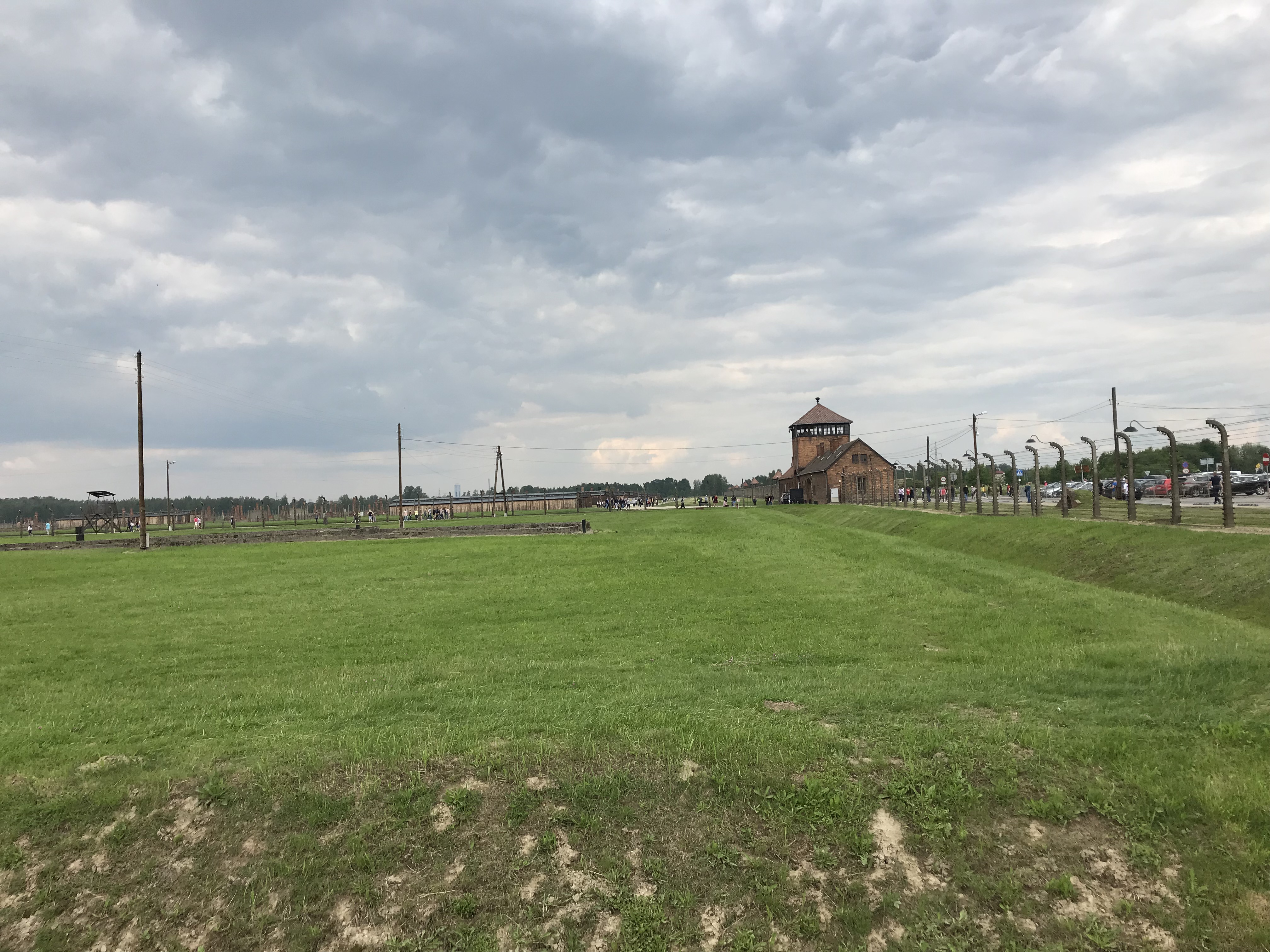
The thing that struck me first was the size of the camp. After Auschwitz 1, this was a whole village in size, it was death on an industrial scale.

The trains would draw into the camp, the people (who had travelled in awful conditions for several days) would be unloaded, then made into lines of men and women. A doctor would then look at everyone, deciding who was fit for work, and who was not. Those deemed able to work would leave their belongings on the platform, strip, be shaved, showered in disinfectant, and given a uniform and tattooed with a number.

Those deemed incapable of work—the old, the ill, the very young—would be sent to the ‘bathhouse’. These were the crematoriums at the end of the camp, next to the forest. They consisted of an undressing room, a gas chamber, and a crematorium. We went to have a look, though the buildings have now been demolished.

Now, I have read several books about the holocaust. As a teenager, I read all the books by Corrie Ten Boom, and Sophie’s Choice, and more recently I read Schindler’s Ark, The Tattooist of Auschwitz and The Boy in the Striped Pyjamas. I therefore knew a lot of facts, but what I was not expecting, was how weirdly civilised the killing seemed. The photographs show people discussing things with the Nazis, everything appears calm, organised. There is no panic—until later, when they were actually inside the gas chambers, when it would be too late. Right until the end, people thought they were simply being processed, and they were not being forced along at gunpoint.

I was shocked by how almost peaceful, some scenes were. For example, the cremating part of the process took hours, so the Nazis did not have the capacity to murder the thousands of arriving Jews immediately. There are photographs of families waiting their turn. There they are, sitting under the trees, grandparents and children, clearly exhausted from their journey, waiting. There seemed to be no resistance, no screaming; people were waiting calmly, looking serene, wondering how long they would have to wait for. The area was surrounded by tall hedges (to hide what was happening from the neighbours) and is bordered by forest—there would I assume have been birds in the trees, in the summer there was grass to sit on; such things seem incompatible with the horrors of what was happening, and that is my point. Auschwitz was not set on the moon, it existed in the midst of life and nature, which somehow makes it worse.

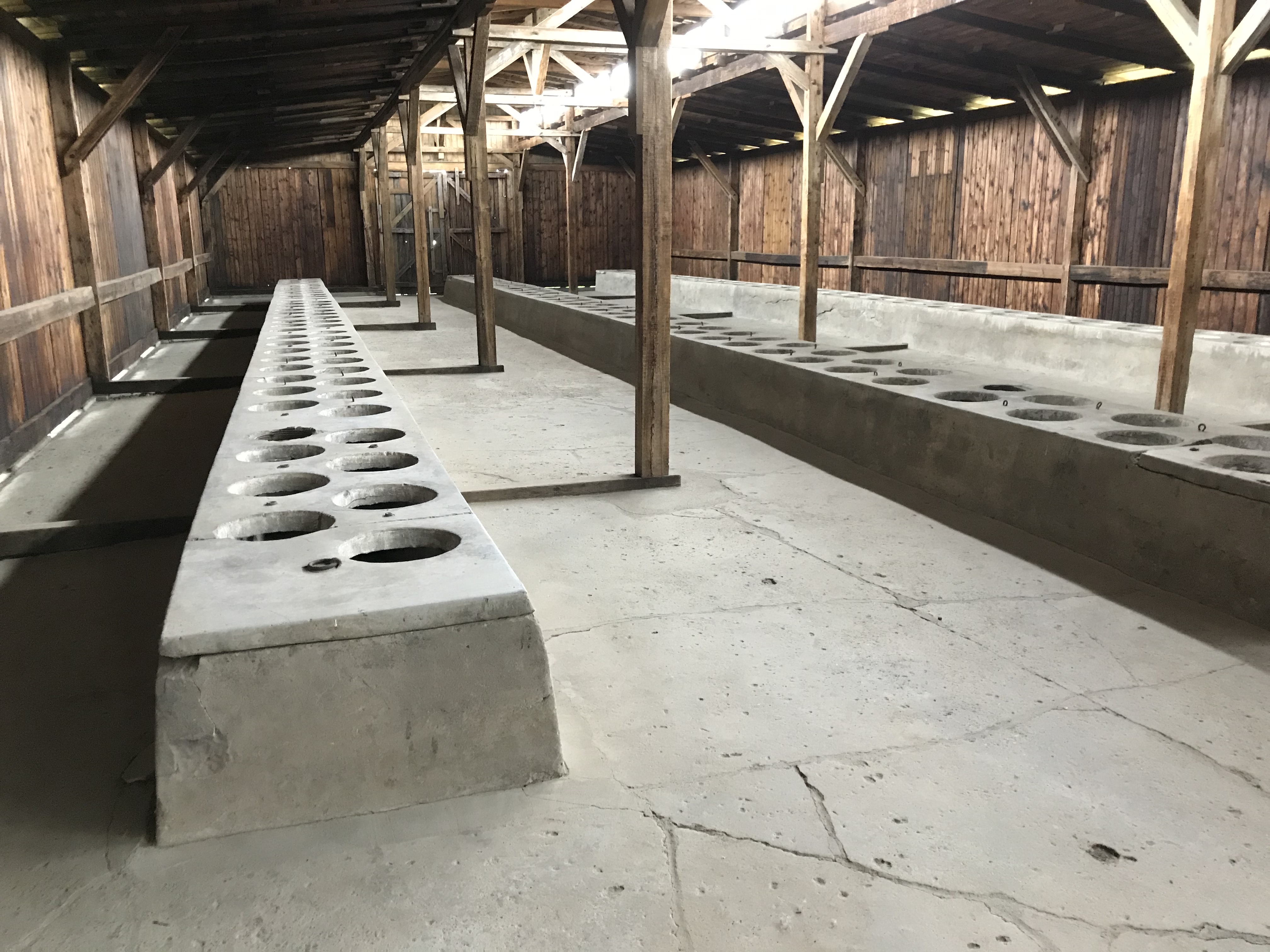
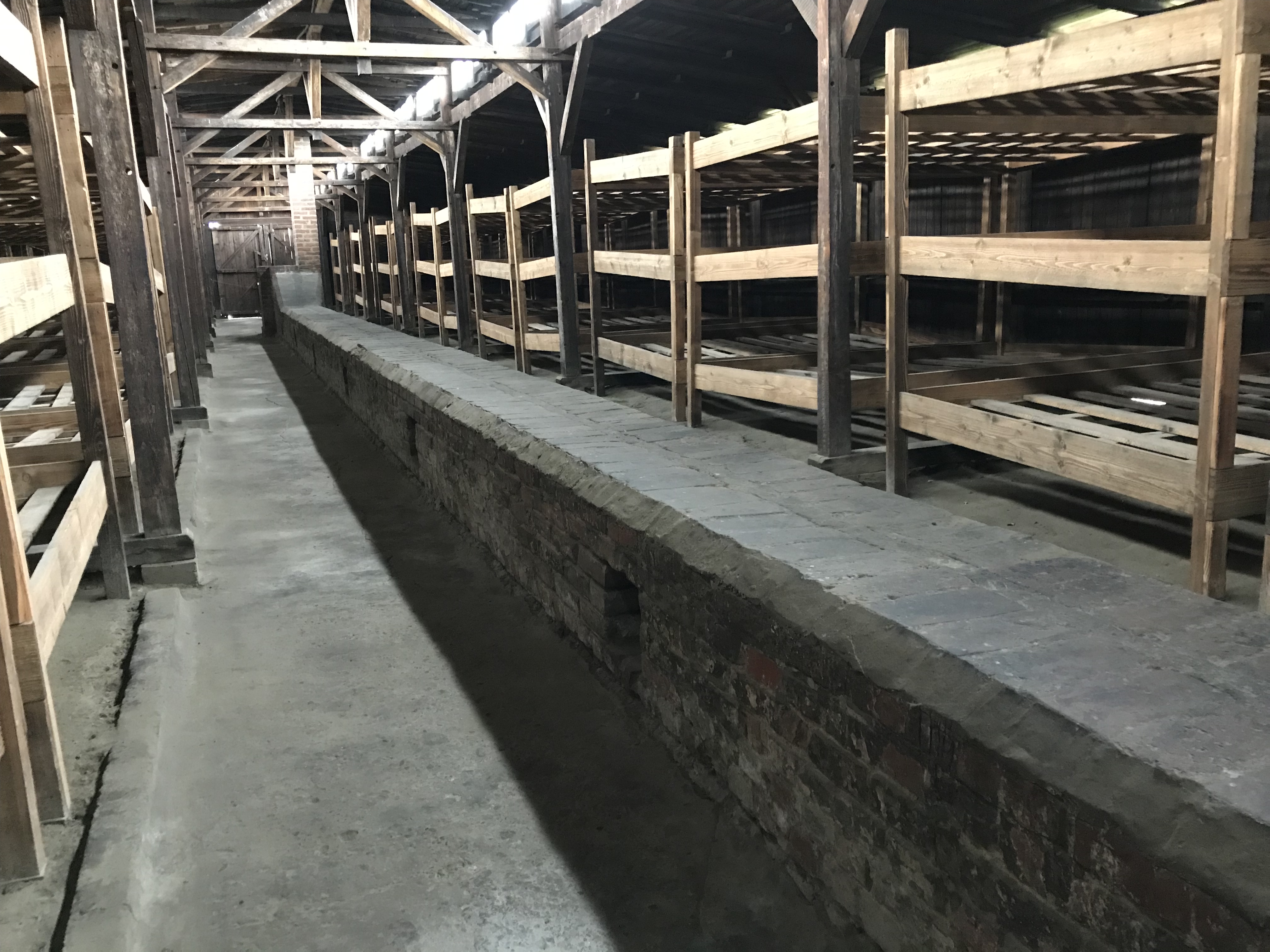
Whereas Auschwitz 1 was very informative, with information and displays, Auschwitz II gave you more idea about how the place would have felt. We saw the brick buildings, which are now beginning to need structural support, crammed with bunks. There were wooden huts—made elsewhere for easy assembly, and designed originally as horse shelters (we saw the rings in the walls for tethering horses). They were designed to shelter 52 horses, they housed 400 people. Many of the huts have disintegrated over time, and all that is left is fields of chimneys, all that remains from their heating system.

We saw the toilets (2 visits per day allowed) and the brick-floored washing area. The hut has since been rebuilt, and today it smells of fresh wood and creosote.

This was a vast camp, with thousands of people crammed together, in terrible conditions. Many people starved to death, or died when working or due to cold. I knew all this before I visited, but to stand next to the electric fence, and stare at row after row of huts, to imagine those people running between them was something no book could explain. Auschwitz today is a quiet place, where larks sing overhead, and people come to remember. I do not know how we make sense of what happened there, when I stare at the photographs of the guards I do not see evil people but I cannot fathom how they could have been part of such horrific actions. Perhaps the problem starts when we begin to see ourselves and those like us, as better than others. If we begin to think some groups of people are less good than us, do they become slightly less human in our eyes? If we think our race, our religion, our career, somehow makes us better than others, then is that the first step along the road we should never travel again? I don’t know, but I pray that we will learn from our mistakes.

Thank you for reading.
Take care.
Love, Anne x

anneethompson.com

Summer Exhibition at The Royal Academy 2019


We went to the summer exhibition again, rather a treat, especially as we started with breakfast at Fortnum and Mason’s (very nice eggs benedict).

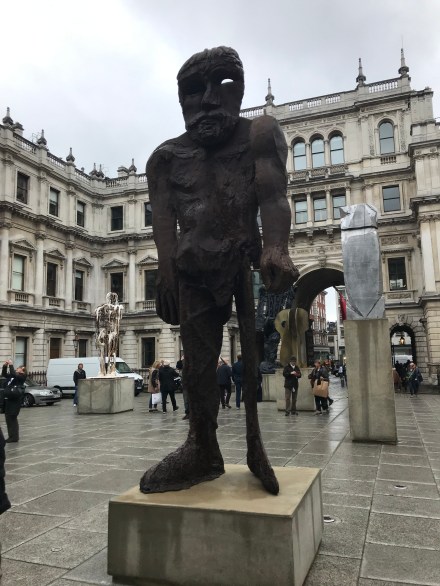
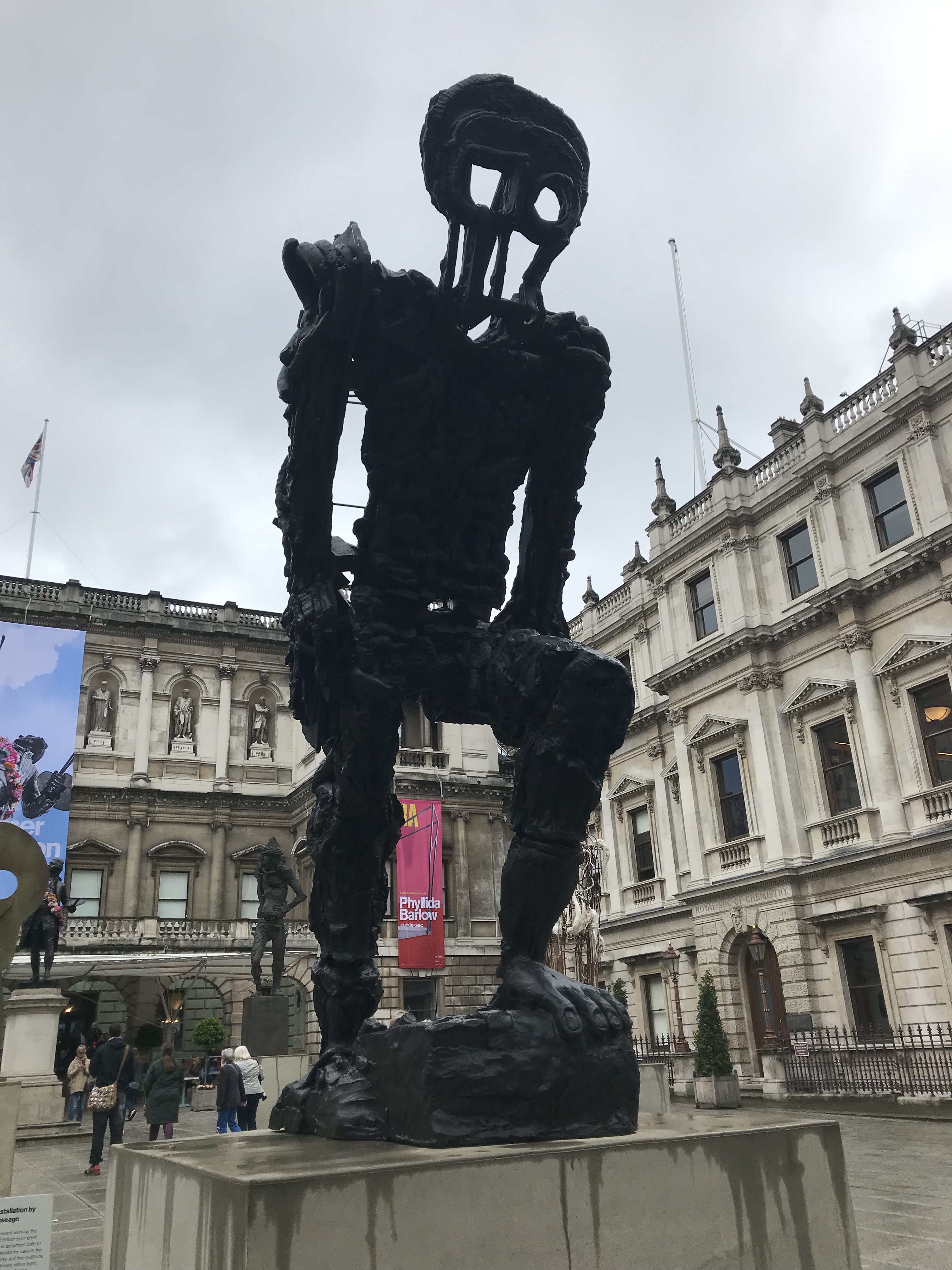
As we approached the royal academy, we were met by zombies. At least, they looked like zombies but we can’t be sure, as the sign which explained what the sculptures are was very highfaluting, and not at all understandable. In fact, this was bit of a criticism with all the signs around the exhibition—they were somewhat pretentious, the sort of signs that you read, twice, and then felt completely confused as to what they had actually said. Why they needed to write: “concerns of scale do not contain his ambition” when they could have written: “He likes making big things” is beyond me.

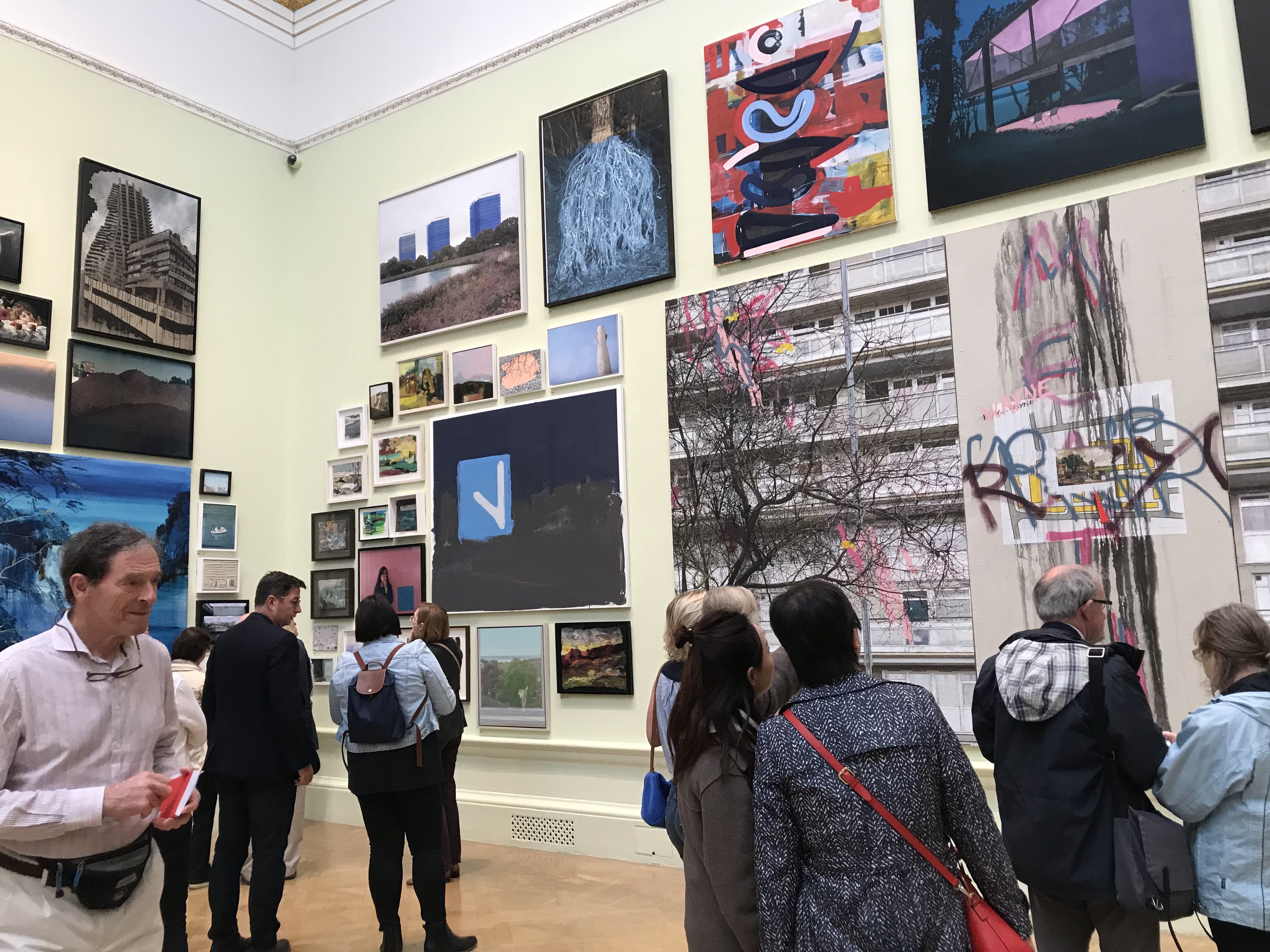
The exhibition was not, I felt, as flamboyant as last year’s, but it was still fun. Here are a few of my favourites:

I loved, of course, all the book-themed installations, especially ones which seemed to be showing how a story can be lifted from a book.

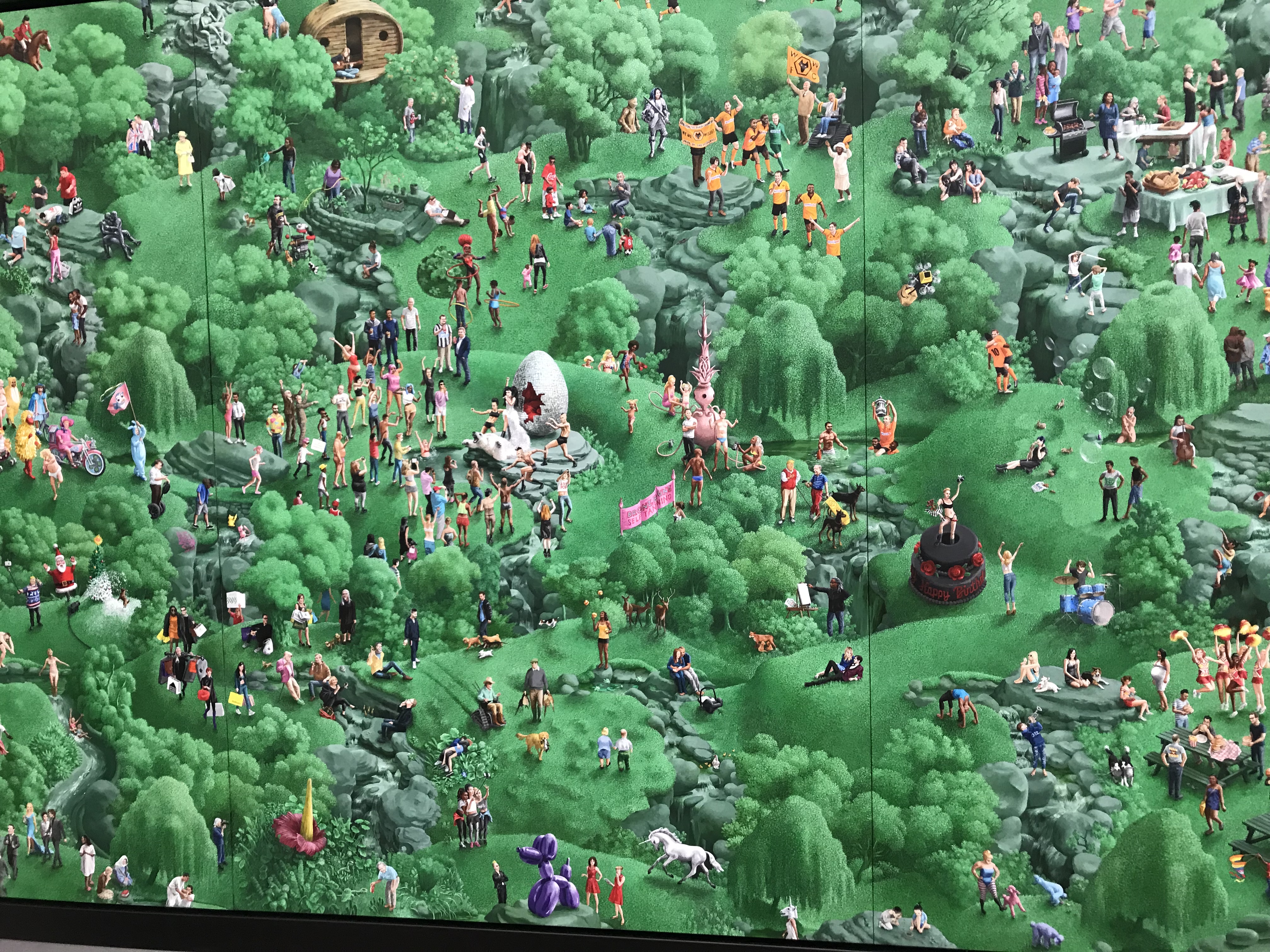
There was a sort of ‘Where’s Wally’ painting, full of famous people to find. As bit of a book nerd who doesn’t watch much telly, many of the characters were lost on me, but I did recognise a few. The painting as a whole had a sort of Central Park feel to it, and was rather fun.

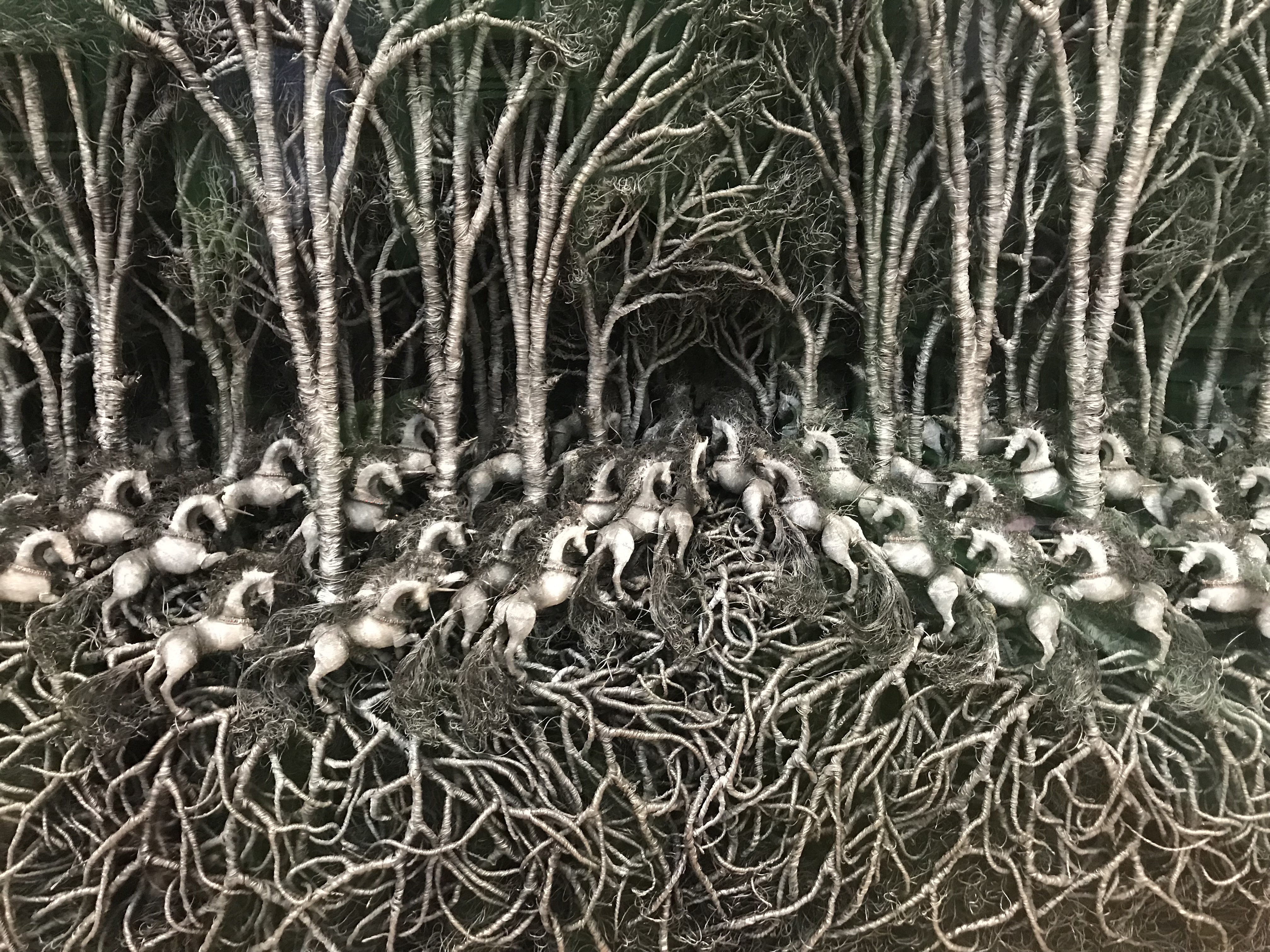
This forest of horses, made of wire, is lovely. I am almost certain that it is the exact same one which I enjoyed last year, which feels like cheating, but it’s still good.

This view of gardens is another one I loved. There is so much going on, and the painting sort of draws you into it.

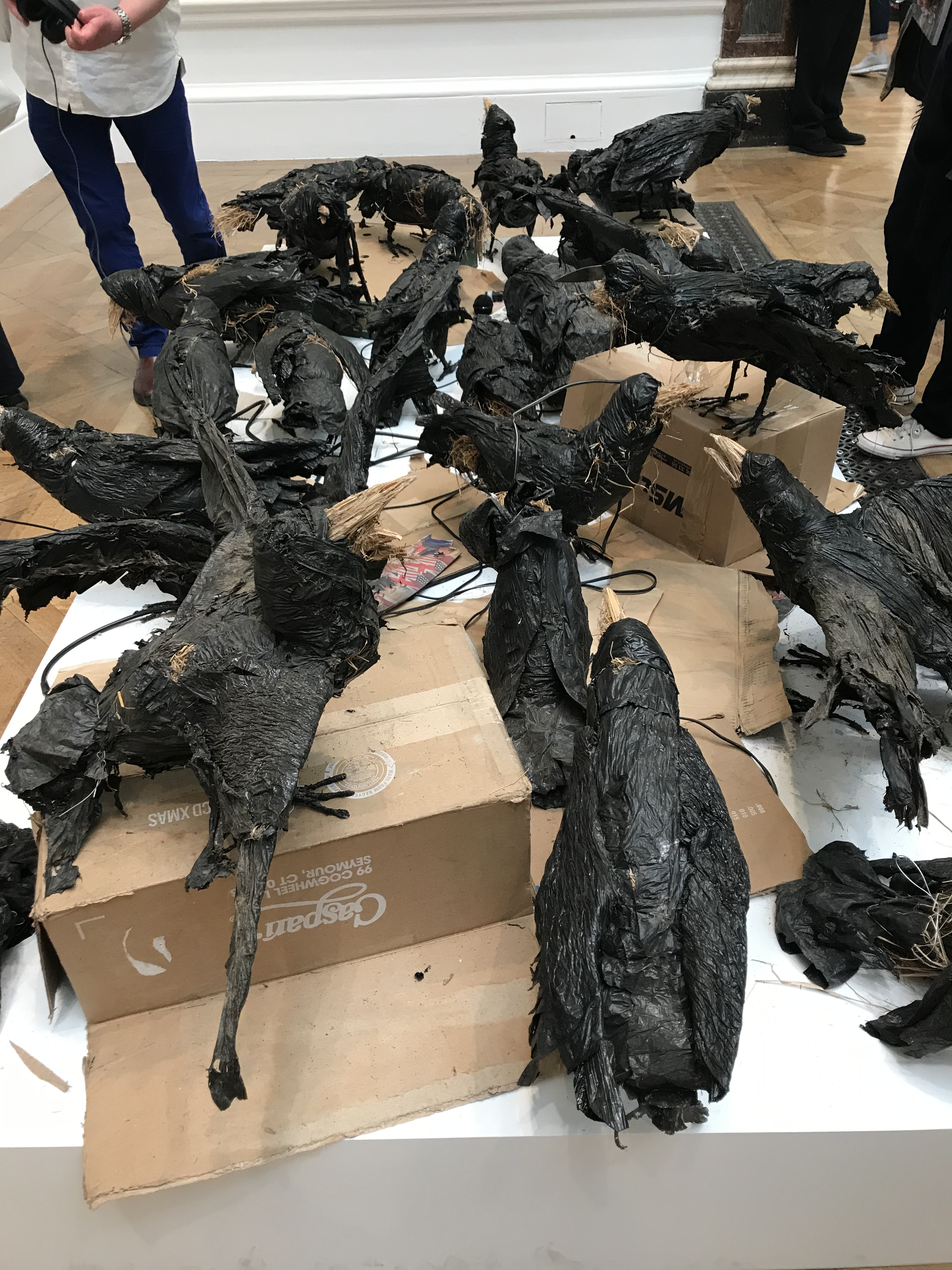
This photo is rubbish, so you’ll have to imagine, but the sculpture was of lots of crows, on upturned boxes. I can tell you that if you get too close and your coat brushes them, they wobble (but I don’t think you are supposed to do that). There are also headphones, with a soundtrack to listen to. I wouldn’t bother if I were you, it’s not very interesting, and I felt it was another bunch of words where the artist was ‘trying to be clever’ but it didn’t really work. I think perhaps I don’t much like how artists write.

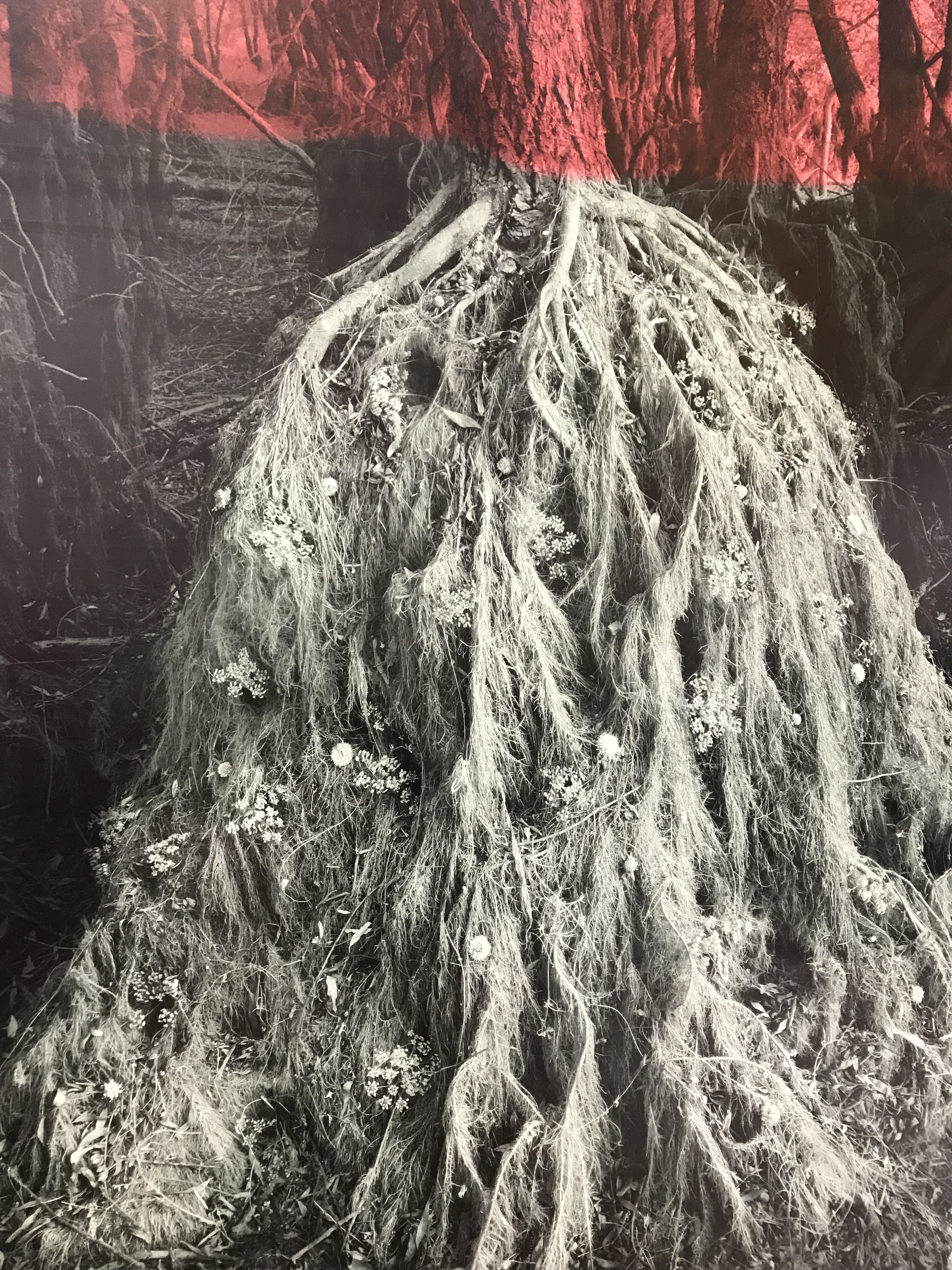
There were a couple of these pictures, with all sorts of flowers and textures growing in the roots of a tree. I couldn’t decide if the artist had created the image and then photographed it, or if they had merged several photos together. Either way, it was clever, and very pleasing to look at. I have no idea who the artist was (because I was too mean to buy a brochure) but I feel the artist was female, and young.

This polar bear on a hoop was in miniature in the entrance hall, and enlarged in another gallery. I think it was made with straw (and an old tyre) but it reminded me of shredded wheat. It had a rather friendly feel to it.

This was a painting, and was simply clever.

This was clever too. White blobs, which are somehow very pleasing to look at.

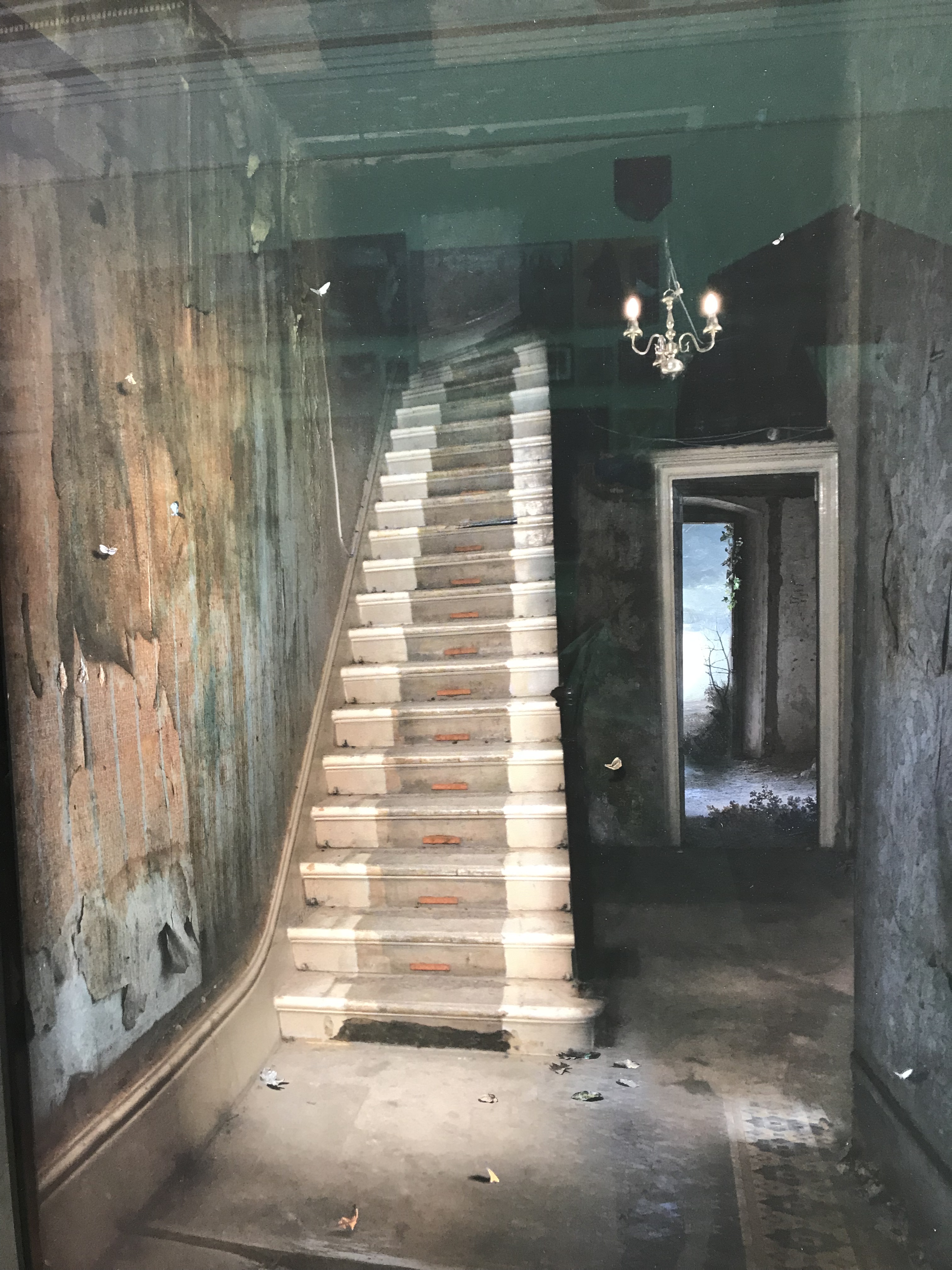
I love paintings which tell a story, and this one sort of entices you into it.

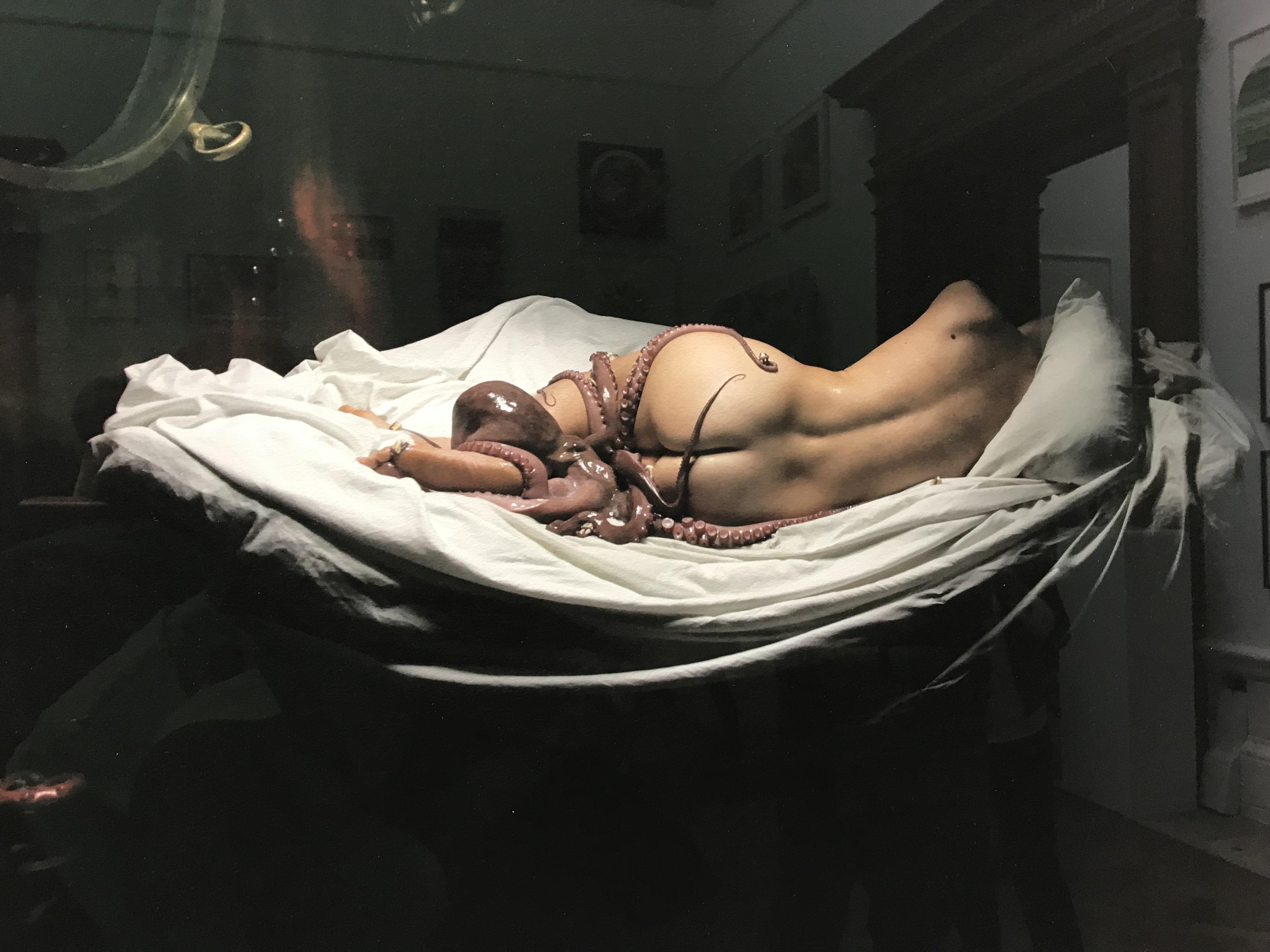
This photograph I love simply because I can imagine the conversation between the artist and the model. Did she know, when asked to strip off and lie down, that the artist was going to drape an octopus over her? Or did the artist pretend it was jewellery, or damp fabric, and it wasn’t until she saw the picture that she realised what the cold slimy thing was? (Made me chuckle, anyway!)

Of course, part of the fun of the summer exhibition is all the other people who go to see it. There are all sorts of people viewing the paintings, and you overhear all kinds of conversations (which are a great source of characters for your next novel!) As ever, I do have a few feedback points for the organisers, especially with regard to their lighting decisions, where they display some of the smaller works, and, most importantly, who they employ to write their signs. Should they ever decide to write information signs which actually impart information rather than confuse people (gosh, there’s a thought!) then I would be happy to help.

Thanks for reading.
Take care.

Love, Anne x

anneethompson.com

Hong Kong New Territories (and a little politics)


Here’s another blog from Hong Kong. If you enjoy it, why not read The Sarcastic Mother’s Holiday Diary? It will make you laugh, and you can read it for free if you have a Kindle…

UK link here

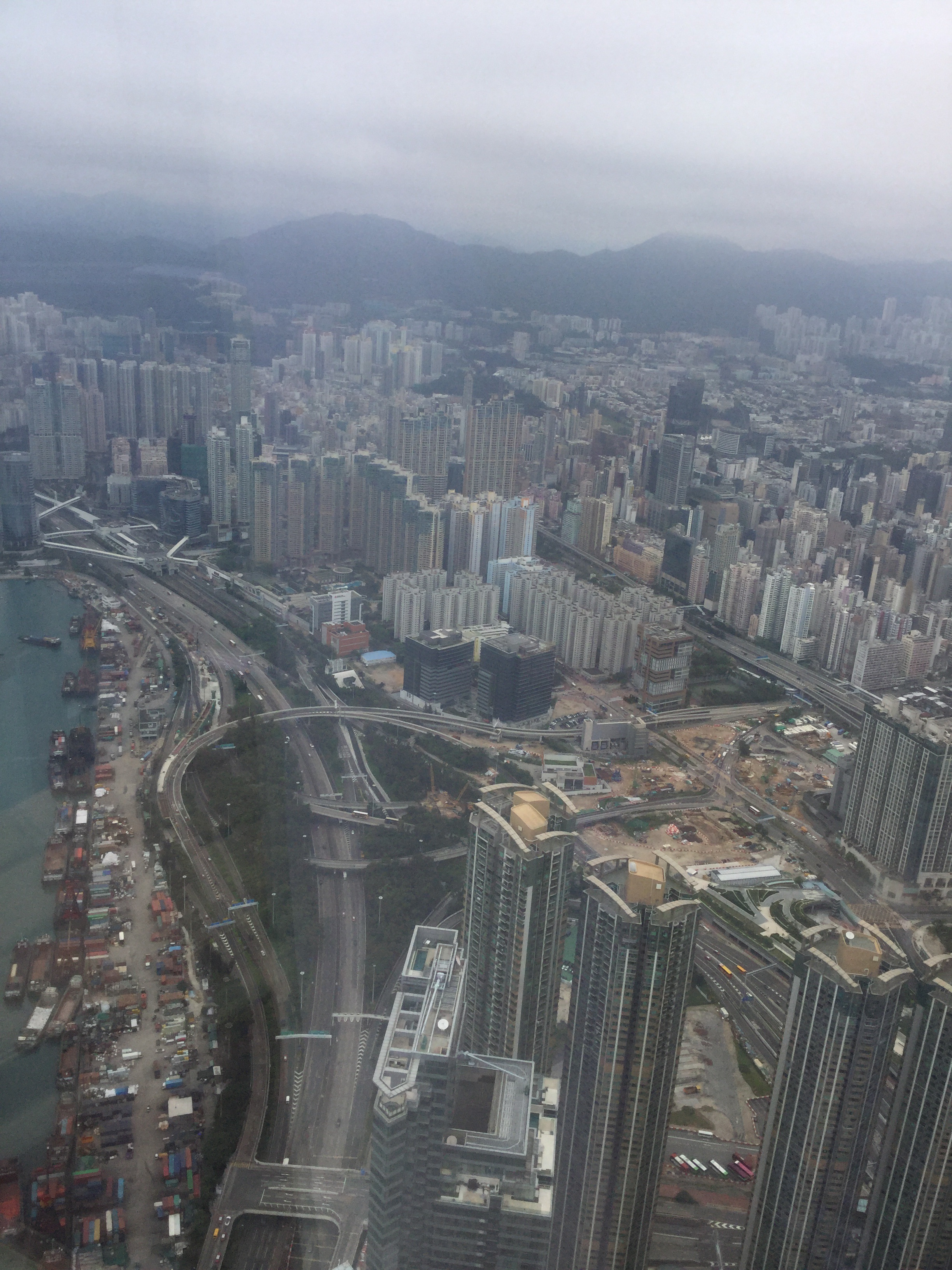
From our hotel room, we can see across the city to the mountains. I wanted to visit those mountains, simply to see what was there, so we hired a car (not a hotel car, as that was about £100 an hour, but a car recommended by the concierge). The driver was very chatty, which was fun, as sometimes you learn more from the driver than from what you see. As we drove from the city, he said that lots of the apartments in Hong Kong were being bought as an investment by businessmen in mainland China. They don’t live there, or rent them out, they simply own them as an investment. He said that at night, whole floors of luxury apartment blocks are dark and unoccupied.

We approached the mountains, which are vast areas of wild, covered in trees. We asked if there are still wild animals—mountain lions and deer—which roam the forests. The driver laughed and informed us that Chinese people, “Eat anything with 4 legs except the table!” No animals left then… The mountains are wildlife parks, and people from the city hike in them. Previously, there had been some areas of farming, but all food is now imported.

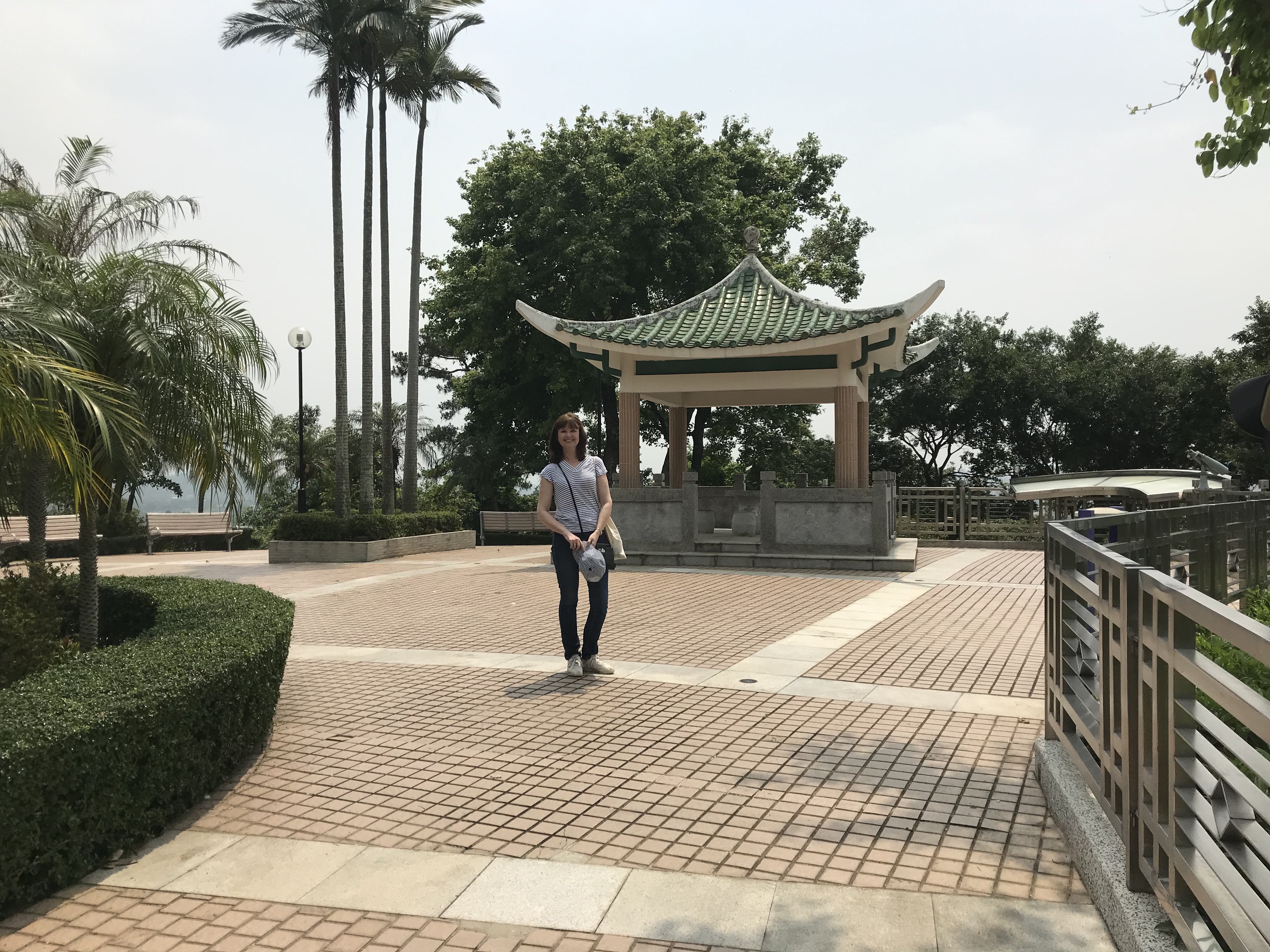
We drove to Lok Ma Chau Garden. This is a small, peaceful garden full of butterflies (and a weird man who was doing something strange). It has wonderful views, across a marsh, to the tower-blocks in China. It’s very close to the border, and the main road actually crosses the border, so we had to drive a clever route (as we don’t have Chinese visas).

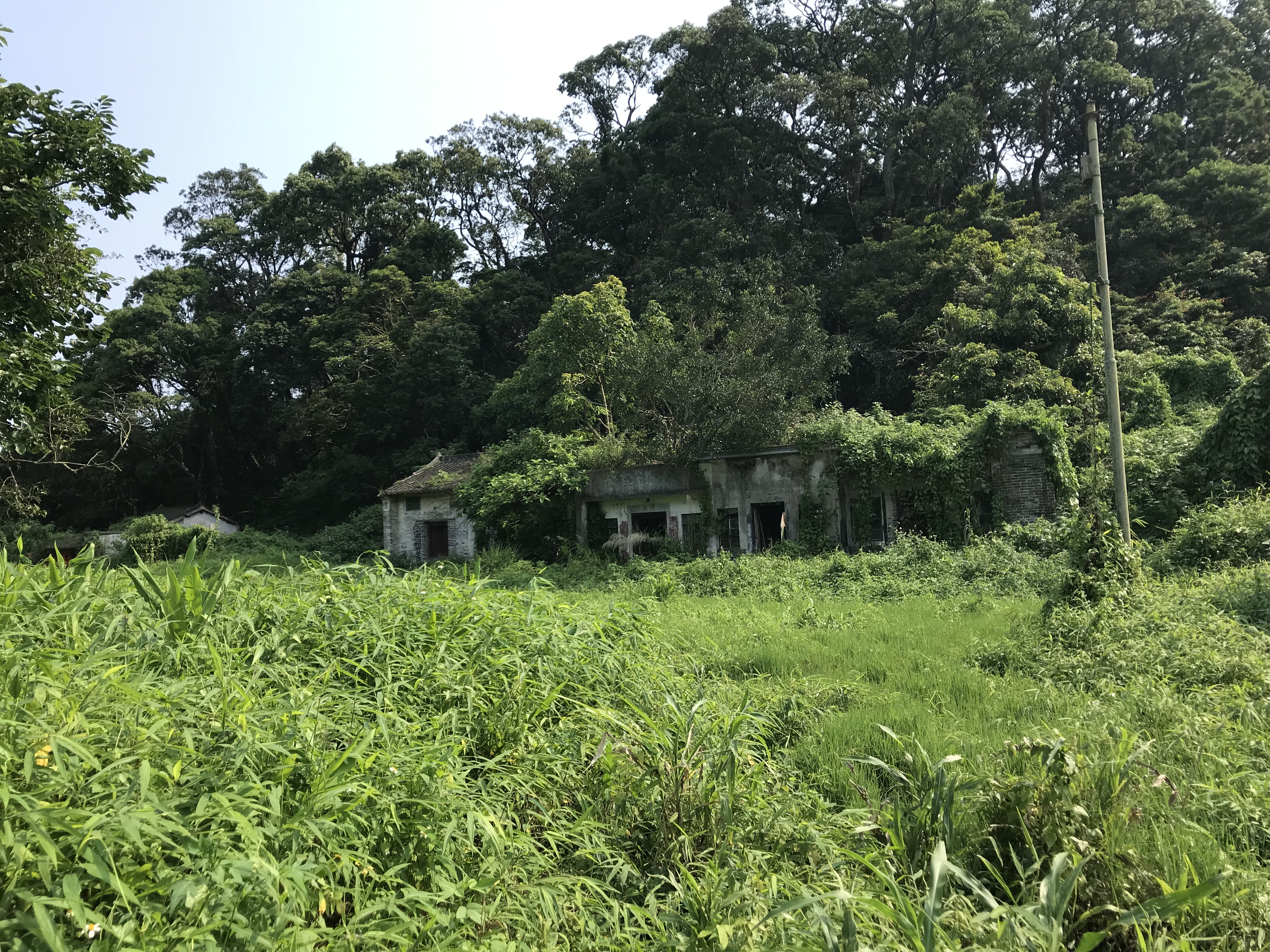
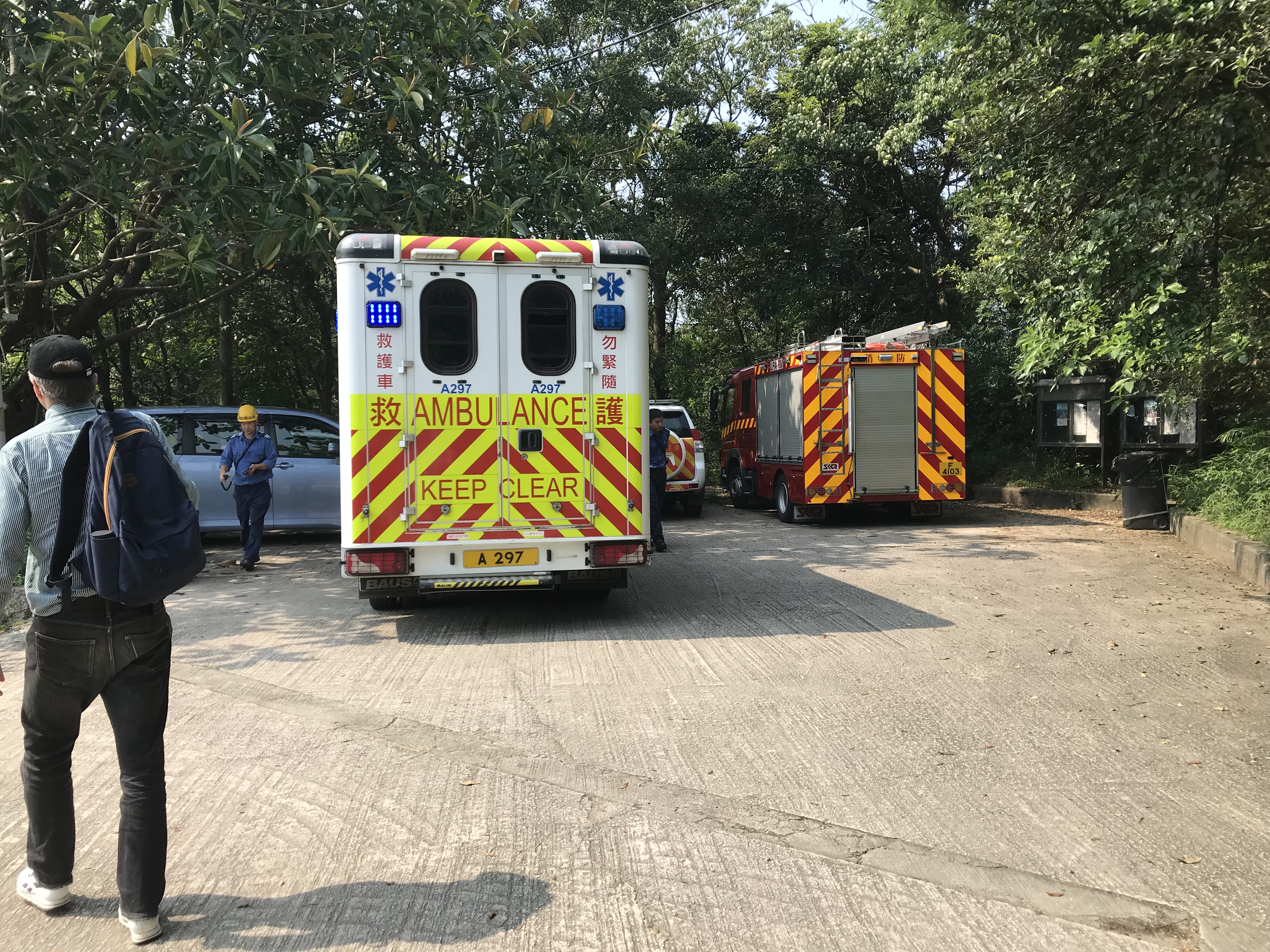
We then tried to visit Sha Lo Tung, which is described in our guidebook as a beautiful abandoned village in the mountains. I think our guidebook is out of date. The roads there have pretty much disappeared, and we ended up driving along narrow tracks, up the side of the mountain, with huge potholes, and sheer drops on one side. I worried the car would be damaged, or that we’d get stuck. It was more exciting than we’d planned. Eventually, we found the village, which was more of a ghost town than described. It was wonderfully isolated, and you could see the remains of paddy fields, and tumbled down buildings, and overgrown shrubs. There were lots of hikers (the roads were better designed for hikers than cars) and a whole array of emergency services arrived because someone had become dehydrated and was unable to walk back. (At least, that’s what they told us—but we’re foreign, and they’re Chinese—they wouldn’t have told us if there had been an accident or crime; I admit to being sceptical that a dehydrated hiker would merit a fire-engine, an ambulance, and 2 police cars, but perhaps I have a suspicious mind.)

Our driver told us that people in Hong Kong love Donald Trump (he might not have been speaking for everyone, of course). He explained that: “My enemy’s enemy is my friend.” The politics of Hong Kong are complicated—brace yourself for a lesson:

The British were ‘given’ Hong Kong Island during the Opium Wars (see previous blog—the British behaved appallingly). Under British rule, it became a thriving trading centre, and the British asked for extra land to support the infrastructure, and so were given Kowloon (up to Boundary Road). As the city developed, so more resources were needed, so China leased the New Territories to the British for 99 years, ending in 1997. As the end of the lease grew near, the British tried to renegotiate, but the Chinese government refused to discuss (according to our driver). The islands of Hong Kong, and Kowloon, were unable to function without the resources on the New Territories—for example, the dam that provided all the electricity was there. Therefore, when 1997 arrived, China took control of both the New Territories and Hong Kong, promising that nothing would change for a set period of time (50 years). They operate a ‘one country, two systems’ policy, which will end in 2047. The people who live in Hong Kong are very bitter about this (at least, our driver was, despite being Chinese ethnicity, he does not want to be part of mainland China). At the moment, there is little discernible difference in the present Hong Kong with the pre-1997 one, but people are worried that this will change, and free trade and free movement and free speech will start to be restricted.

Politics aside, Hong Kong is a wonderful place to visit. We arrived home to hatching eggs—I’ll tell you about that next week.

Thanks for reading.

Take care.

Love, Anne x

Thanks for reading.
You can follow my blog at:
anneethompson.com

Look in Amazon for The Sarcastic Mother’s Holiday Diary. It makes a great gift.

The Bun Festival


We caught a ferry to Chuang Chau from Pier 5 on Hong Kong Island. We had a choice—a slow ferry which takes an hour, or a fast ferry which takes 40 minutes. We went with the slow boat, and sat on hard seats next to an open window, enjoying the view as we rattled our way through the water (it’s not a new boat). The seats were comfy, and clean enough, though it’s important to choose your neighbours carefully, as an hour in front of a screaming toddler or a loud old man or a group of noisy teenagers, is a very long hour. The ferry has several signs – signs telling you not to smoke, and to remain seated, and that gambling is forbidden. I have seen the last sign several times since we’ve been in Hong Kong, gambling is clearly a thing here.

Hong Kong is a busy port, and we passed huge container ships, and tugs, and fishing boats of all sizes. It was a cloudy day, and many of the islands were hidden in the mist.

Cheung Chau greeted us with colour and bustle and noise, there was something exciting in the air as we approached.

May is the bun festival, and as we left the pier we could see stall after stall selling buns, and the quay was lined with bright flags, and everyone was in party mood. The buns are white, and round, and stamped with various characters (Chinese script)—they said things like ‘wealth’ or ‘peace’ or ‘good luck’. If you looked behind the stalls, you could watch people making the buns, tray after tray being put into ovens, or stamped with the character, or put into boxes ready to be sold. People were buying them to take home, or to eat straight away, and there were several flavours: sesame, or red bean paste, or lotus bean. People walked along the street eating them, browsing the stalls and shops crowded with trinkets and gifts. There were also bun-shaped mementoes, we bought a bun-shaped cushion and a fridge magnet.

Now, you might be wondering, why buns? I’m not entirely sure, but the festival is related to one of the island’s gods, Pak Tai. In the early 1800’s, there was a plague, and the people believed that Pak Tai saved the island from this plague. In return, they offered mountains of buns to the resident ghosts. (To be honest, I’m not sure why they offered buns—it’s a fishing island, so offering fish would have made more sense—perhaps they thought the ghosts liked buns. I’m also not sure why they offered them to the ghosts, and not to Pak Tai. But anyway, that’s the only explanation that I found.) Every year, the island holds a bun festival to remember that they were saved from the plague. They make huge towers of buns, and the children climb them. Except, fairly recently, there have been some horrid accidents, so now some health and safety regs have been put in place, so the bun towers are built on a solid structure, and the climbers wear harnesses.

We wandered up to the Pak Tai temple. There were bun towers being constructed. There was also a stage, with a Chinese opera, which we watched for a few minutes. If I’m honest, a few minutes of Chinese opera is long enough for me—I don’t really enjoy it. There were also washrooms. (Note, when travelling in China, the Buddhist temples always have the nicest, cleanest, toilets…Christians should take note of this and try to keep up.)

We bought ice-creams, and wandered back to the quay to watch the fishing boats. Then we crossed the island again, and looked at the beach. There’s a net, to stop the sharks eating the swimmers. (When I was in Hong Kong a few years ago, with a friend who lives here, I asked her if shark attacks were common. “Oh no,” she said, “Only about 3 swimmers a year are eaten.” I think the net is a good idea.)

We passed a school, with cute children in uniform running to meet their friends. Cheung Chau is a very normal place, you can see lots of ‘real life’ as well as all the touristy bits.

It was a lovely day, and there were plenty of ferries, so when we’d seen enough we went back to Kowloon (taking care not to gamble on the ferry).

Afterwards, I worried about the cushion we had bought – is it ‘wrong’ to have things from other religions in the house? Is it rude to God? I don’t think I would want a Buddha, or a Hindu statue in my home, but did a bun-shaped cushion matter? If I believe that God is the only God (which I do) then I should be careful not to ‘hedge my bets’ by also having lucky talisman. I decided that it was fine. For me, it represents a happy day out, and an interesting tourist sight, it has no ‘religious’ or ‘lucky’ connotations for me. Perhaps it worries me because it’s unfamiliar. There are symbols from other religions that are familiar, and I never worry about those—for example, every year I have a Christmas tree in my house, yet those came from the sun god Balder (for me, they are simply part of the Christmas tradition). I also will give and receive Easter eggs, but I never think they will increase fertility, nor do I worry that they originated from Eastex, the pagan goddess. My bun cushion has the Chinese character for ‘peace’ on it, which is not a bad thing to have written on a cushion, and it is a cushion, nothing else.

Thanks for reading, remember not to gamble on your way to work. Take care.

Love, Anne x

Thanks for reading.
You can follow my blog at:
anneethompson.com

If you enjoyed this, why not read my travel book? It makes a nice gift too… (you can read it for free if you have a Kindle.)


The Star Ferry to Central


The Star Ferry to Central

One of the iconic images of Hong Kong is the Star Ferry, going backwards and forwards between Central (the main Hong Kong Island district) and Kowloon (the part of Hong Kong that joins mainland China if you cross the mountains). When you come to Hong Kong, you sort of have to go on the Star Ferry, even though the islands are actually linked by a very efficient underground train service.

We bought our tickets using the ticket machines on the pier. It costs the equivalent of 27p, and the ticket is a round plastic token, which you then use to open the turnstile. When the ferry is ready to board, there are signs and traffic lights, and you walk along walkways that rise and fall with the tide, and onto the boat. The crossing only takes a few minutes, and gives good photo opportunities of both sides of the water.

When you arrive at Central you are greeted with palm trees and Peruvian buskers. (I am guessing that the Peruvian buskers are not always there, but they were on this trip, and they were on my last visit about 6 years ago, so I am going to include them as a fixture.)

You leave the ferry terminal via walkways that cross the roads. These go through posh hotels and shopping malls full of designer shops, so you can walk a long way without leaving the walkways, through perfumed cool air. It’s not very real, but it’s more comfortable than the air outside.

We popped into the Mandarin Oriental while we were there—just because we’ve stayed there on previous visits and I love the smell of place, and the fancy chocolate shop and the comfy sofas in reception. It has an atmosphere of luxury (though again, not very real). Previously, I have always stayed in hotels in Central. However, I now much prefer staying on Kowloon, as it’s easier to find real life, and to glimpse real people bustling in real markets.

We saw old trams, which seem more high and more narrow than trams in other cities, and the old colonial buildings that cluster near to the where the water used to be (but they have now reclaimed so much land, that it has all shuffled back a bit from the water’s edge). We passed HSBC, which is guarded by two lions—they have very shiny paws because people rub them for luck.

The weather was dry, but humid and very hot—not at all comfortable; I don’t know how people managed to be wearing suits.

We returned to Kowloon, and paid 5p extra to sit on the top deck (can’t accuse my husband of being mean). It was dusk when we returned, and the junks had their big red sails illuminated, which was very pretty—they looked like giant red butterflies gliding over the water. The Star Ferry is slightly more prosaic, with hard seats and men who shout, but I prefer it.

We ate at The Night Market restaurant in Elements mall again. We’ve eaten here every evening so far, and the staff all laugh when they see us. But the food is really good, especially for me (am a very anxious eater when abroad because am so often ill)—it’s freshly cooked, comes quickly to the table so is piping hot, and everything is very clean and efficient. We are gradually working our way through the menu, and today I chose noodles, which were basically long spaghetti (no idea how you’re meant to eat that with chopsticks, I made a mess). The dim sum is my absolute favourite, you can’t beat a soup-filled dumpling!

Hope you eat well today. Tomorrow I’ll tell you about the bun festival.
Take care.
Love, Anne x

Thanks for reading.
You can follow my blog at:
anneethompson.com

Hong Kong History


Hong Kong History

Husband has finished work, so he joined me on Anne Time and reset his watch for 3 hours behind HK time. The weather forecast was dry, which makes a huge difference to what you feel like doing, so we left our raincoats in the hotel which was very brave (I smuggled my umbrella into my bag—too many days of rain so far).

We walked to the Hong Kong Museum of History. I’m not keen on museums, and at first, this museum reminded me why—too much information on tiny cards and displays of geological features in glass cases. It was also basically dark, with ferocious spot-lighting and lots of very loud recordings—don’t visit with a headache. However, then we went upstairs. Upstairs was so much better; some parts were hardly like a museum at all.

The museum explained how Hong Kong had been an area of boat people. They lived their whole lives on the boats, fishing and trading. Gradually, the population moved to simple huts on the islands of Hong Kong.

The dragon dance originated with the boat people. When a couple got married, the bride would be carried in a dragon boat (a 10-person rowing boat) to the groom’s boat. When the people moved to the land, they adapted this tradition into a dance, with a symbolic dragon, and the other dancers imitating the rowing action. According to tradition, the bride must neither see nor step on the ground when she is going to meet her husband, and she was carried, piggy-back style into a sedan chair, and then taken to her husband. She wore red. (Brides today in China usually wear red, though they also buy a white dress, for photographs beforehand—we have seen a few brides being photographed in various scenic places.)

The museum has a model, which shows the fort which was in Kowloon. This later developed into a walled city, and when the British took over, it was outside of their jurisdiction, but also beyond the control of the Chinese, so it became a completely lawless place. When I was young, I read Chasing the Dragon which tells the story of the people inside the walled city—it’s a good book if you’re looking for something to read. Eventually, the British and the Chinese agreed to demolish the city, and today it’s a park (which I’m hoping we can visit).

Another display explained how rice is produced. It looks a lot like wheat, and the rice grains are the seed head (I didn’t know that).

There was a display that explained the Opium Wars. In brief: China was a closed country, and did not want to trade with the rest of the world, but the rest of the world was jealous of China’s resources. European countries decided to attack the coastline, so sent boats to attack. China relented, and allowed some trade. The British were very keen to buy tea and silk, but they had nothing to trade in return, so the market was very much in favour of the Chinese. At the time, Britain occupied India, where opium was grown. So, the British imported opium to China, to rebalance the market. The British sent so much opium, that at one point there were over 10 million Chinese addicts, which had huge repercussions on the Chinese economy and health. (Writing this does not make me proud to be British—we did some terrible things in the past.) China tried to stop the opium being imported, and there were wars. In the end, an agreement was reached, and Britain stopped importing opium, and in return, China gave us Hong Kong. However, we still smuggled opium into China, via Hong Kong.

Under British rule, Hong Kong became a major trading port. The museum has recreated an old-fashioned Hong Kong street, which you can walk along, looking at shops from years gone by.

There is then a section devoted to the Japanese occupation. There is a photograph of Nathan Road (which we have walked along several times) showing the response of the locals when the Japanese left.

Many of the museum’s displays explained the various religious festivals in China—like the Bun Festival. One island has huge structures, covered in buns—which look like a massive tribute to McDonalds. The festival takes place in May, so we might go to see it.

After a couple of hours, I had no more brain capacity for further discoveries, and so reluctantly we left. There were still displays we hadn’t seen—this is a museum where you could spend an entire day. I hate museums, but I really enjoyed this one. The displays were like storybooks, you felt as if you were stepping back in time and experiencing what it was like to live in ancient Hong Kong. If you ever visit Hong Kong, make time to come here.

I hope you have an interesting day too.
Take care,
Love, Anne x

Another Day in Hong Kong


Not a Great Day in Hong Kong

Today has not, if I’m honest, been great—which feels rather ungrateful when staying in a luxury hotel in Hong Kong. I’ll tell you about it.

I had decided to go back to the markets I found yesterday, and explore a little more. I packed my bag with water, umbrella and map, and left the room. The first problem was when I arrived at the lift. The hotel is in a gigantic building, and the first few floors are used by different businesses. So, to enter the hotel, you go into the lobby and get a lift to floor 108, which is where reception is. You then take a different lift to the hotel floors (my room is on floor 111). I thought—because it has worked every other time—that while waiting for the lift, you press the ‘Reception‘ button, then when the lift arrives, you step inside, close the door, and it carries you to reception. So today, I did exactly that. I stood inside the closed lift and waited. I waited for quite a long time. Then, to my surprise, we went down one floor, the doors opened, a man got in, and pressed to go up to floor 118 (the gym is there—he looked the type). The lift went up—not down to reception—up. Not what I was expecting. Apparently, you have to actually touch the sign inside the lift that says: Reception.

Well, I finally, after my detour to a higher floor, made it to reception, and walked with confidence to the lift that would take me down to the lobby. This lift doesn’t have buttons, it simply has two signs, one which says lobby, one which says reception. I stood in the lift, doors closed, and stared at the signs. Was I supposed to touch these too? The lift jolted into action and I descended to the lobby. I think someone in the lobby had called the lift, because the ‘lobby’ sign was lit—and I didn’t do that. I realised that every time I have used the lift so far, someone else must have pressed the correct buttons, and it is not as automatic as I thought. Duh! Felt stupid and left. (Actually, to be honest, I had a fit of the giggles when I realised how stupid I’d been, and when the lift arrived at the lobby I was giggling away in an empty lift.)

Set off for the market. I had managed to coincide my time (Anne Time: 10:00) with the rest of Hong Kong’s lunch hour (HK Time: 13:00) so the shopping mall I walk through was jammed full of people trying to buy lunch. I made it, eventually, to the outside, to find it was pouring with rain. Put up my umbrella, and set off.

I planned to walk along the main road (Jordan Road) then turn left at the first major junction (Ferry Street) and then take the first street on the right (Saigon Street) as that road traversed all the little side roads with markets. I was fine for about 2 ½ minutes. Then there was a subway under the road. Subways in Hong Kong are like the moving staircases in Harry Potter’s Hogwarts—they change direction when you are in them. I walked in a straight line, I know I did, straight under the road and up the other side. But as I continued along Jordan Road, nothing was familiar. Then I came to major road-works with pedestrian lights which took forever to change, and then I came to a massive fly-over—which does not exist on Jordan Road. I started checking signs, and all the roads were called the wrong names, and none appeared on my map, and I was only about 10 minutes from the hotel and I was completely lost in the pouring rain with motorways thundering overhead and lots of yellow-clad workers staring at me.

I tried to retrace my steps, back through all those very slow pedestrian lights, and eventually came to a road which was marked on my map. I had somehow, when in the subway, managed to come up half way along Ferry Street, and had marched way past where I wanted to be. I didn’t bother to photograph the motorway for you, it was grey concrete and busy and loud—and not a great place for walking.

I found Saigon Street, and the markets, and wandered around. There were meat stalls, with chicken’s feet in heaps, and dried meats hanging on strings, and great fish-heads staring blankly, while shellfish slithered in overcrowded tubs of water. Many of the stalls sold fruits and vegetables, shining in the rain, pools of colour and textures, some smooth and shiny, others lumpy or with spikes. Many of the fruits were new to me. Some of the stalls had music playing, the stallholders whining along in unison. There was a flower stall, with tubs of lilies and roses—but it didn’t compare to the shops in flower market street yesterday. Mostly, the markets were wet, drops of rain falling from the awnings, people avoiding umbrellas, the ground slippery. Rusty carts and damp boxes had been discarded at one side, along with heaps of rubbish and slurry.

It was actually, a nice market, and on a different day, in different weather, I would have loved it. But I had walked too far along a motorway in the pouring rain, and the hotel room and a coffee seemed very attractive so I left.

I also keep almost being run over. Many of the crossing places have helpful writing painted on the road, telling you which way to look. But they also have an arrow, and something about an arrow on the road, makes my brain think that this is the direction the traffic will be moving in—as opposed to which direction to look. So at every crossing, I stare in completely the wrong direction. Not been hit so far.

Hotel room wonderfully comforting. I sat with my coffee and stared out the window. All I can see is clouds, wafting towards me and floating away while rain splatters the pane. It’s like being in a secret place, above the rest of the world, just me and the rain and a decent cup of coffee. Will stay here and read for a while.

I hope your day turns out well. Thanks for reading.
Take care.
Love, Anne x